
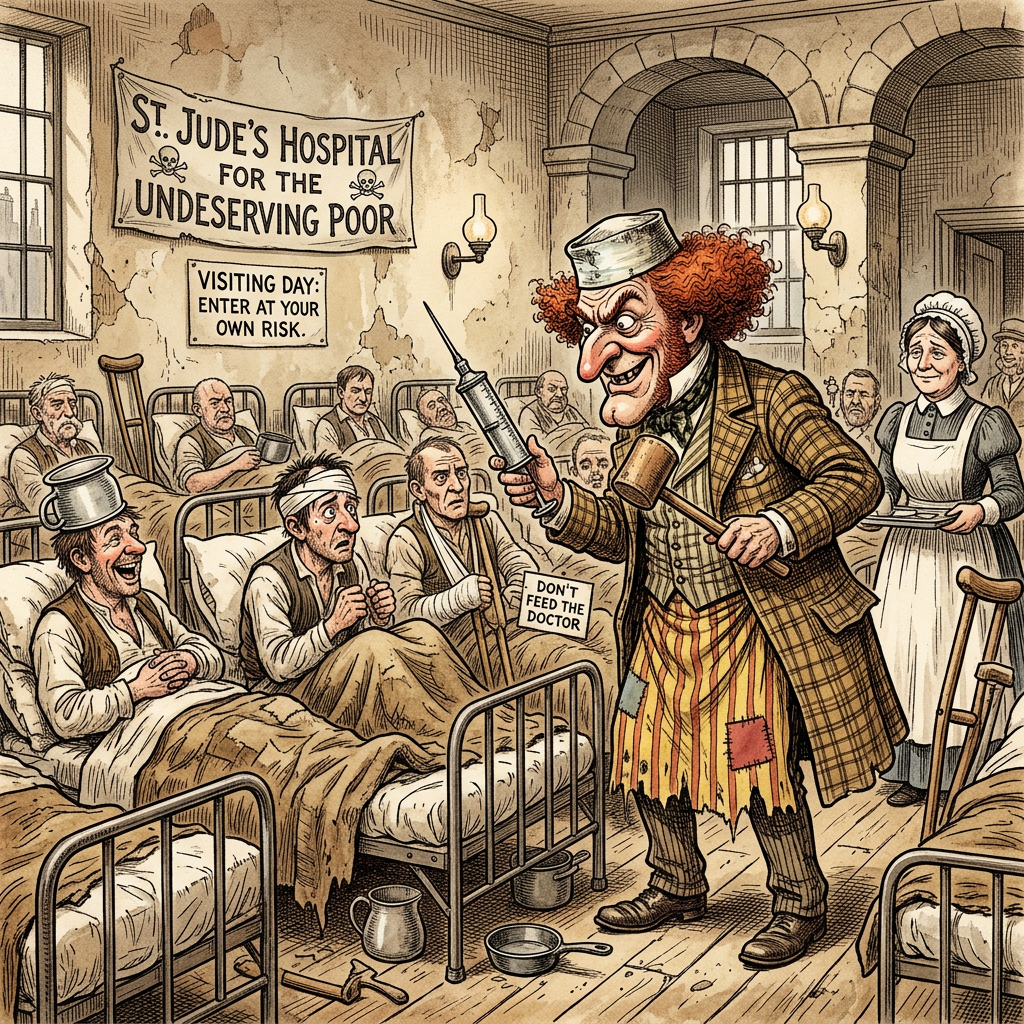
Three Parts in One – to be taken with a pinch of salt (Nocte x I prn)
By Andrew Paul Klein
I love Hospitals. I cannot understand why some tremble at the mere thought of being admitted and being at the mercy of the Medical Profession.
To me, being comfortably eccentric, the Hospital is one of the last great challenges left in a world that has become uncomfortably secure and controlled. The moment I enter the hallowed halls of medical inventiveness and smell the antiseptic which pervades all these establishments, I quiver with unusual excitement.
Some men climb Mount Everest to test themselves; others fly to the Moon. Ho hum. I merely have to suffer some injury to avail myself of what I believe to be one of the last truly great adventures left to man. Survival in a Hospital.
Yes, at this point no doubt you question my attitude, though I have in my time become somewhat of a Hillary of the operating theatre. My injuries over the years provided me with the opportunity to experience life to the fullest. The adrenals flow when I contemplate the opportunities offered in a comfortable bed surrounded by mere mortals who seem not to appreciate the opportunity for adventure of which they also could avail themselves.
I need not spend a fortune on expensive and sophisticated equipment and guides, much less the burden of organising a rescue mission from some far distant place known to most simply on a map.
No, all this is just as far away as a colourfully noisy trip in an ambulance making its way through traffic during peak hour; an exercise which hardly compares with the calm adjusting of equipment before leaping from a beloved old military DC3.
I take my initial leap lying down, once again ready to brave the unknown of the Hippocratic world. It seems singularly appropriate that a Greek name is used to describe such unfamiliar environs. One need not die here to explore that unknown, similar to Hades or whatever other Greek word describes the underworld.
Hospitals are all about us. We can find them private or public. The explorer’s purse will determine the destination if not the likely outcome.
To me, Private Hospitals are the most exciting. To the unwary they may provide the least care for the greatest expense; to me they present the greatest challenge. To survive a Private Hospital must surely rank the individual among the champions of human combat. I mean, just at the critical moment when some surgeon has lost a gauze pack down your airways and he discovers that he can neither find nor has access to the right equipment to deal with the little problem of the over-inflating and unresponsive patient… it’s moments like these when your life is in the balance. No guides to lend you a kind hand when you face that abyss. Oh no, you are very much alone.
In a Public Hospital they hunt around until somewhere in some distant storage cupboard they find what they need and once again you find yourself sucking air, whereas in the Private Hospital the Surgeon might call it a day at any moment and decide to play golf, at the same time giving you the opportunity to meet your maker. I bet Livingstone never timed his escape from savages better. The only problem is of course the fact that current medical best practice does not allow you to savour the moment. More often than not they have you filled with a syringe full of the ‘nightie night’ stuff and you are off with the fairies, missing your greatest adventure.
Now I’ll deal with something that I can remember – the joy of the recovery room. Seriously, there you are having missed all the fun whilst the staff had a good gander at your goose or whatever it is they check, and you find yourself wearing a badly cut multi-sex gown that has obviously survived more washing than my feet. Or possibly the latest in throw-away designs: multi-gender nightwear with tubes down your throat and a plastic mask on your face.
Now the first thing one does, one gets up to have a look at all the fun, and out of the corner of your eye you see some white-gowned person looking seriously annoyed over a much-loved and fondled newspaper. Of course you feel that you have been hit by a truck, and at this stage you understand that if all the present discomfort and pain is an indication, then the surgeon and his happy team have certainly earned their fee. You try to move – a very normal instinct – and find that this is not only nearly impossible but some kindly soul shoves the plastic mask right back in your face. Those with little recovery-room experience should realise at this stage that it is not always a good idea to disturb recovery-room staff from their reading.
You see, you are only No. 36 on today’s list, and that which may have been a unique and disturbing experience for you is commonplace here. Eventually you are removed hence to another place often called ‘The Ward’… taken to a bed in a room full of other beds, preferably full of other patients who are neither in your own age group, insist on speaking in tongues, and apparently are having no fun at all.
Well, my fellow sojourner, you have now arrived at the greatest challenge, physically and mentally. Prior to surgery you could still pull out and contemplate your navel in the comfort of your own bed. This has come to an end. Of course the first few hours will seem a little confusing, waking in a room that is painted in colours that one would not decorate a toilet in (unless you suffer from chronic constipation). There is no point in even trying to recall the first few hours because you are still in a drug-induced state of semi-awareness, trying to remember the number plate of the bus that hit you or trying to remember what that lunatic looked like. Then a day or so later, depending on the size of the bus, arrives another challenge. You find yourself inpatient No. 123456 under Dr Smith, and you, who until recently were a free man with certain rights, now discover that those rights have vanished, much like the contents of bedpans… though here I digress for my own amusement.
Some kindly soul, usually a young nurse, will ask you how you feel and gently give you to understand that your wish is her command. (You should be so lucky; she’s read your file and knows the name of your wife and that you have children – so be careful what you wish for.)
She asks in a kind voice how you feel and you tell her the truth. She acts dejected, sulks, and spends the rest of her shift avoiding you. The one thing you must learn is to insist that you are feeling oh so much better, even if the undertaker is there measuring you up.
Part One
The Hospital – The Funny Side: Part Two
Having left the poor young nurse feeling inadequate to her task of cheering the patient, I now resume my tale of ‘The Hospital’.
You will of course, as I did, get to know the nursing staff quite well, for she (upon recovering her personal vigour) resumes the task of visiting you hourly in those first few crucial hours and persists in asking if you are asleep – an activity for which there seems little time unless you enjoy being kept awake.
Though I never really fathomed the reason for the 0400 hrs visit with a cup of tea and a digestive. Seriously – had I died during the previous hour it would be pointless to wake me and all others on the ward at 0400 hrs, and the removal of a body could have waited for a more decent hour.
I discovered intimacies with thermometers previously unknown to me, and if the operation was somewhat south of the navel, then even that becomes a shared discovery. The joys of having a special little companion through this journey into better health.
Once one feels a little better physically, a certain familiar routine seems to establish itself, much of which of course remains hidden but apparently has some import to the Nursing Staff and the running of the Hospital. There is a sense of not really being in the right place at the right time, as the patient is obviously the last thing any Hospital wants to see, for their presence makes the facility untidy and keeps the staff from more important routines.
In civilian life the ordinary mortal probably has the last exotic dream for the night at 0500 hours, and as far as erotic dreams go… they have well and truly been and gone by 0400 hrs.
Depending on how sick you are perceived to be, the nightly routine of an hourly torch in the face continues, and by about 0700 in the morning you are ready to sign about anything. Were you a ‘political’ rather than a private patient, Amnesty International would have a few words to say about this.
Breakfast arrives somewhere about 0800. Armstrong going to the Moon had to live off tube food and other unpalatable fare. He had nothing on this. They say, in a kindly tone, that hardships build a strong mind and body, and seeing your present fare makes you wish that you had signed up for that guaranteed ‘Ethiopian Water’ Diet.
Bacon was never like this, and the eggs; God, it makes you sorry for the Chickens that had to lay them. Hell indeed has no fury like the Hospital Cook.
Anyway, I was told that mine was very popular in the Congo Soup Kitchens, when our Cook was doing time with the Foreign Legion to avoid doing time for culinary homicide.
Now it’s a brave man that ventures into the unknown and I am ready. I go where no man has gone before and try the lukewarm porridge, and somewhere in the back of my mind I can hear little ‘Oliver’ crying “More please, more.”
Well, if Gordon could face the maddened troops of the Mahdi climbing down some stairs waving a hanky and a smile on his face before being speared, I can eat this. Suddenly, as I swallow this gruel, I realise what it must have been like to have a spear pierce your best dress uniform and know that your days in the Mess have come to an end.
This part of my personal hobby of Hospital adventures places not just breakfast before me but is only a small part of the overall adventure. This will later lead me to the adventure of the bedpan, but all in good time.
End of Part Two…
The Hospital – The Funny Side: Part Three
Having overcome this hurdle, I must now face the obligatory hospital wash. Those with inpatient experience will be familiar with the delights of this procedure. Not unlike the Opera, the curtain falls and the theatre begins. Any moment now frenzied activity will begin, hidden from the prying eyes of others.
To be really effective and worthy of mention it must be accomplished with the least amount of comfort to the patient, and heaven help a Nurse who supplies water which is at the right temperature. In fact, I have noticed that by leaving the water sitting in a metal bowl next to the bed for at least 10 minutes, it is ensured that no such oversight as patient comfort can occur.
Tales of Tibetan travellers washing in icy streams no longer impress me; I have gone one better. I remember with pride the goose pimples which were my companions throughout this little encounter.
The patient must of course be as physically handicapped as possible to make this encounter both interesting and truly worthwhile, and in most instances this handicap has been placed on the patient by his Surgeon.
Thus, whilst in a prone position still wrestling with the Oats or other remnants of lovingly prepared sludge, one is ready to begin.
One is given a small piece of no-label soap, a small flannel, and invited to dip these into the previously placed bowl of water.
The Nurse, who by necessity adjudicates cleanliness, observes the patient’s near riotous behaviour as he attempts to reach parts of his anatomy best known to his wife or mother. No assistance is given, as this would defeat the purpose of the exercise and diminish the rating of this challenge. I of course have always enjoyed some degree of assistance in washing between the toes, but as this places undue strain on the staff resources it is seldom undertaken. (Two male orderlies to ensure that your movements do not interfere with the body cast that is keeping you comfortable, one Nurse to hand you the flannel, and any number of staff to assist as uninterested observers.)
To be even considered as a challenge, this procedure must leave you damp and exposed to the elements, as by now all your clothing has been removed for either fumigation or incineration and you are left wearing a shroud-like garment that is by requirement flimsy, cheaply made, and badly fitting, leaving your arse exposed to the world and your entire rear protected by one tie-down string. (For those more ambulant.)
This gown, having been handed to you, is a uni-sex gown, preferably in a colour that clashes with your own personal tastes and with a unique pattern of washed-out looking stains which imply that the previous wearer was either drooling from the mouth or unable to hold a cup of tea.
The changing of the sheets, not to be confused with that of the Guards, is one very special event not to be passed up; especially for those who have undergone a major procedure. It should only be attempted after mastering relaxation exercises and breathing.
Your Nurse will of course be there to comfort you with cooing noises and using motherly words such as ‘Don’t be a Baby now’. I was never able to ascertain as to which part of babyhood the dear Nurse was alluding to, but suspect that it might be any motion that would make changing the sheets a moot point. This will make you forget about your pain and focus your mind on the singular idea of becoming another Boston Strangler in the Nurses’ Home.
Having been made presentable to face another day of enduring monotony, comes the highlight of the morning.
Your Surgeon (the man you are paying for yet is treated as a small deity, for all Hospital floors are holy ground for those that have taken the Hippocratic Oath) has found time to leave his ‘rooms’ and other potential practice runs to visit his handiwork. It is noteworthy to mention that your average General Practitioner usually runs what is called ‘a Practice’, whilst those higher on the medical food chain are no longer referred to even as Doctor but are called ‘Mister’, thus drawing a clear line in the sand between those generalists who have always attempted to heal others and those who took the advice of Henry the VIII and left the Barber’s Pole behind.
I digress, and prolifically apologise to my reader for just a moment, as the fond memories of such trivia and the History of Modern Medicine brought about a small but active contribution via my tear ducts.
I am of course always pleased to see the driver of the No. 9 Bus that hit me, and have often wondered if Jack the Ripper ever visited his victims to see how they were faring after his ministrations. The Surgeon is greeted with due servile recognition by the ‘Matron’ of the Ward who attends to his every word and in many ways resembles a fawning poodle on heat.
I must add that I have always had my suspicions about ‘Charge Sisters’ working their magic in the Hospitals that I have sampled. I believe now that at least one of these over-bearing matrons of mercy must in a previous life have been a Colour Sergeant at Rorke’s Drift fighting the Zulu Impis with a tremendous amount of ferocity, none of which has been lost in her current manifestation. That military bearing and contempt shown by Senior Non-Commissioned Officers to both Men and Officers is evident, and her hands-on approach to disciplinary matters and fraternisation between those in her care must be admired, at least from a distance.
Thus the Surgeon stands by the side of the Bed and is given a report by this personage, for the patient is not allowed to speak for fear of upsetting the sensitive nature of the Surgeon and his Camp Follower, the Matron. In hindsight I have always wondered if old Henry had just left things alone, leaving Doctors to give their patients potions and lots of empathy whilst the cutting was left to the Barbers and Surgeons. Though times have changed, and these days the cutting requires so much more than ‘bleeding the patient’ or shaving him, yet the old Barber’s Pole should remind us all of the proud History of the ‘Barbers and Surgeons Company’, for these days they still amply fill both positions, for with one hand they will deftly cut away all that is deemed a problem whilst with the other hand they will shave you of your funds. For few are brave enough to withstand the demands made by a man carrying a very sharp knife and now, after the invention of anaesthesia, is able to rummage through your bowels and other bits without so much as a murmur. Oh the days of Lister and his spray keeping the ‘theatre’ free of fomites and other things that may cause the patient a serious relapse or, in the worst-case scenario, an adverse outcome such as death (a spectre that has for a long time plagued those promising cures for those seeking not just life itself, but quality, quantity, and good looks, as I digress and recall the history of modern cosmetic surgery, which, my dear reader, all began in England and was born of the needs of a lady’s nose).
Sadly for old Lister, he is remembered fondly as I rinse my mouth with ‘Listerine’ and leave behind my musings on the formative years of medicine as we know it today.
Having once again gone off on a tangent, allow me to return to my story. The Mister is taken on a tour of ‘his’ clientele, attended to by his loyal poodle, who to all appearances only has eyes for him. Maybe there are passions roused by the presence of this almost ‘God’-like being who, as far as the paying patient is concerned, is the arbiter of Life and Death.
Anyone who has ever been treated in a Military Hospital in the ‘British’ inspired Hospital would fondly recall the attendance played upon this Mortal Man who has come to repair the damage done by other men.
So this poodle, in her starched Uniform, stands with her Master clasping a clipboard to assist her in reciting the many glorious tasks performed on your behalf, and with a glowing smile informs him that you are much better. The wise patient will take heed of her body language, for she knows that the Master will return to his rooms, and you, dear patient, will be left to her devices and her years of pent-up frustrations, having seen perfectly made hospital-corner bedding and spotless wards ruined by the very presence of the ‘patient’. The poodle often uses a soft voice to tell the tale of your woes, and this presents an opportunity for lip reading.
If you have had the audacity to pass on during the night, your mortal remains will by now be placed on a metal tray in a large meat storage locker well hidden in the basement of the building. A venue often referred to as the ‘Morgue’, whose staff are rightly viewed with suspicion if they have pets or insist on feeding stray cats. The Poodle will comfort the Mister with a heavy heart, knowing that even for a Mister, practice makes perfect, and surgery, though scientifically supported, still relies heavily on the skills of the Artist who wields the scalpel. And being an ‘Artist’, such failures on the part of the patient to respond favourably to the hands that otherwise might have played Concert Piano or painted a lasting piece of much admired art, this is a heart-wrenching experience. At least until the Coroner’s Inquest is over, and relying on the goodwill of his ‘Fellows’ at the College of Surgeons who know that underneath that gentleman’s appearance and well-worn threads lies the heart of a man that has paid his dues to be a fellow of the College, and like all men in such positions has a lifestyle to maintain. And like the Three Musketeers, the Brothers in Arms will link arms in support of one challenged by questions and not demur in shifting the blame of failure onto the very vagaries of life. For all in all, it had been a challenge, but even the greatest Artist is challenged by the complexity of Human Anatomy and the ever-pressing need to learn ever so much in so little time. In many ways, it is a thankless task, for the Surgeon’s work never comes with a lifetime guarantee, and these days boiling the remains and displaying the artifice of the craftsman is frowned upon, though for those with a literary sense, papers can be presented for the benefit and amusement of other ‘fellows’…
On reflection the language used has much in common with the lighter side of life, for all the excitement happens in the ‘Theatre’, and as even such venues have well-furnished rooms for refreshment, Hospitals provide recovery suites or rooms depending on the language used. In recent times the more interesting language used in these venues has been replaced by a more commercial approach, and if not careful, you find yourself rated as a ‘Health Care Consumer’, which has many amusing and often frustrating consequences appended to it. For seeing oneself now labelled as a Consumer, there seems little choice in the fare provided.
Now it is your responsibility to ensure that your surgeon is convinced that he is indeed an artist worth his weight in your gold and estimation. His opinion will weigh heavily on the minds of those who will decide if your life continues as it should or is hence tainted with the possibility of further anatomical failure, which precludes you from ordinary life, as even humble work requires the willingness of an Insurance Company to gamble on your health. And like all Gambling Institutions, such Insurance Companies operate at a profit, giving an indication that there is indeed money in cherry-picking patients and leaving those deemed ‘incurable’ to muddle through life. Of course one opinion is as good as another’s, but like much of life, opinions reflect not just the thoughts of the writer but the money that inspires such writings. And knowing this, dear fellow traveller, never over-estimate the opinion of an Artist, for his musings may be swayed by more than artistic endeavour. Like a man going to have his portrait painted for his own edification finds that he has not just met an exponent of the Art of Oils, but indeed a man who owns shares in the Company that manufactures the very canvas that will be graced by your countenance. Thus the Artist’s personal interests may be many and conflicting, and not always focused solely on those things that are of benefit to you.
It would not do to complain too much, and a very perceptive surgeon will avoid any suggestion of a delayed cure or failure in a manner well practised in the Arts. A friendly smile and his opinion that you are indeed looking oh so much better than when he saw you last, which in truth is a fact, for in the Theatre amongst all the machines and frippery of modern Surgery you were last seen prone and breathing through a pipe. Thus the mere fact that your eyes are open, you are making noises which can be comprehended, and the colour of your skin is an indication of Oxygen uptake, you are indeed looking so much better than the cooled slab of anatomy draped in surgical coverings. And now you are as far away from the ‘Operating Theatre’ as possible.
Only a novice in the field of Surgical Artifice would venture to ask if at this particular point in time you were feeling any better than before the ministrations of the ‘Fellows’ and attending Poodle.
This can wait for another day, when you have been discharged (don’t you just love that term; wrap your lips around that word slowly… ‘Discharged’) from the Hospital, and are able to attend at your Surgeon’s rooms after careful and distant treatment by the ‘Receptionist’… often a lady of mature years who appears to have some proprietary rights over the Surgeon and acts as ‘Gatekeeper’ and guardian of confidences… but that’s another story…
You may now regard yourself as a Veteran, having been tried and tested and found worthy.
AK

