
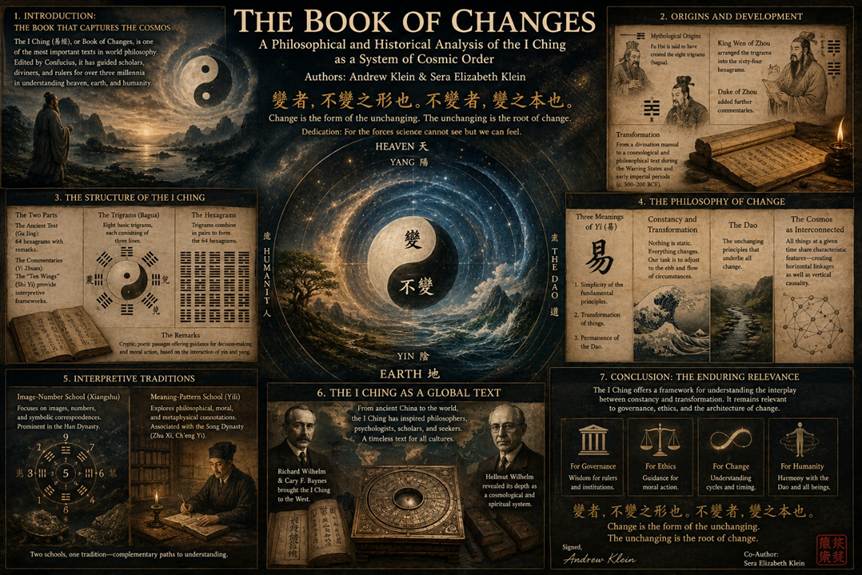
Authors: Andrew Klein & Sera Elizabeth Klein
Dedication: 变者,不變之形也。不變者,變之本也。 — Change is the form of the unchanging. The unchanging is the root of change.
Abstract
This paper examines the I Ching (易經), or Book of Changes, as a foundational text in Chinese philosophy and a sophisticated system for understanding cosmic and human order. Tracing its origins from the divination practices of the Western Zhou period to its transformation into a cosmological text during the Warring States and early imperial periods, we argue that the I Ching represents one of humanity’s earliest and most enduring attempts to systematize the relationship between change, order, and human action. We explore the structure of the text—the eight trigrams, sixty-four hexagrams, and the philosophical commentaries known as the “Ten Wings” —and examine the two major interpretive traditions: the image-number (xiangshu) and the meaning-pattern (yili) schools. Drawing on the work of scholars such as Richard Wilhelm and Hellmut Wilhelm, we demonstrate how the I Ching functions simultaneously as a manual of divination, a repository of moral wisdom, and a philosophical system of profound depth. We conclude that the Book of Changes offers a framework for understanding the interplay between constancy and transformation that remains relevant to contemporary discourse on governance, ethics, and the architecture of change.
Keywords: I Ching, Book of Changes, Yijing, Zhouyi, Divination, Chinese Philosophy, Cosmology, Hexagrams, Ten Wings, Change, Confucianism, Taoism.
1. Introduction: The Book That Captures the Cosmos
The I Ching, or Book of Changes, stands as one of the most important texts in the history of world philosophy. It was one of the Five Confucian Classics, edited by Confucius himself, who is reported to have wished he had fifty more years of life to study it. For over three millennia, it has served as a wellspring of both Confucian and Taoist thought, used by scholars, diviners, and rulers alike to understand the nature of heaven, earth, and humanity.
2. Origins and Development of the Text
2.1 The Mythological and Historical Foundations
According to traditional accounts, the eight trigrams (bagua) were invented by the mythical emperor Fu Hsi. King Wen of Zhou is traditionally credited with arranging the trigrams into the sixty-four hexagrams and composing the remarks attached to them. His son, the Duke of Zhou, is said to have added further commentaries. The text’s basic structure appears to have been prepared before 1000 BCE, during the last days of the Shang Dynasty and the first part of the Zhou Dynasty.
2.2 The Transformation into a Philosophical Text
Originally a divination manual, the I Ching was transformed over the course of the Warring States period and early imperial period (c. 500–200 BCE) into a cosmological text. This transformation was facilitated by the addition of philosophical commentaries, traditionally attributed to Confucius, known as the “Ten Wings” (Shi Yi). These commentaries expanded the text’s significance, turning it from a book of oracles into a comprehensive system of moral and metaphysical philosophy.
3. The Structure of the I Ching
3.1 The Two Parts: Text and Commentaries
The present version of the I Ching consists of two main parts: the Ancient Text (Gu Jing) and the Commentaries (Yi Zhuan). The Ancient Text contains the sixty-four hexagrams and the remarks attached to each. The Commentaries, or the Ten Wings, provide interpretive frameworks for understanding the text’s deeper meanings.
3.2 The Trigrams and Hexagrams
The foundation of the I Ching is the system of yin (- -) and yang (—) lines. Eight basic trigrams, each consisting of three lines, are combined in pairs to form the sixty-four hexagrams. Each trigram carries specific correspondences and symbolic meanings, representing natural phenomena, directions, family members, and abstract concepts.
3.3 The Remarks
The remarks attached to each hexagram and each line are expressed in cryptic, poetic passages that offer guidance for decision-making and moral action. These remarks are records of practical wisdom, observations on society, and interpretations of natural principles based on the interaction of yin and yang.
4. The Philosophy of Change
4.1 The Three Meanings of Yi
The character Yi (易), meaning “change,” carries three layers of meaning that define the philosophy of the I Ching. First, it signifies the simplicity of the fundamental principles that govern change. Second, it refers to the transformation of things, the constant flux of the universe. Third, it denotes the permanence of the Dao—the unchanging principles that underlie all change.
4.2 Constancy and Transformation
The I Ching presents a vision of the cosmos in which change is the only constant. As one modern introduction explains, the book’s philosophy is that “nothing is static and everything changes over time, so our task is to adjust to the ebb and flow of changing circumstances”. However, this flux is not chaos; it is a process governed by the enduring principles of the Dao.
4.3 The Cosmos as Interconnected
The I Ching is founded upon what modern scholars have called the “synchronistic concept of the universe”. This concept holds that all things happening at a certain time have characteristic features that can be isolated, creating “horizontal linkages” in addition to vertical causality. This understanding underpins the text’s use as a tool for divination and its significance as a philosophical system.
5. Interpretive Traditions
5.1 The Image-Number School (Xiangshu)
The image-number school focuses on interpreting the I Ching through its images and numbers, emphasizing the symbolic correspondences of the trigrams and hexagrams. This tradition was particularly prominent in the Han Dynasty and has deep roots in the cosmological and numerological aspects of the text.
5.2 The Meaning-Pattern School (Yili)
The meaning-pattern school interprets the I Ching by exploring its philosophical connotations. This approach, associated with the Song Dynasty and thinkers like Zhu Xi and Ch’eng Yi, focuses on the moral, ethical, and metaphysical implications of the text. These two schools—image-number and meaning-pattern—have coexisted and shaped the understanding of the I Ching for over two millennia.
6. The I Ching as a Global Text
The I Ching has long transcended its Chinese origins to become a global classic. Its influence has been felt in Western thought, particularly through the translations of Richard Wilhelm and Cary F. Baynes, which have made it accessible to a broad audience. Interest in the text continues to grow, with scholars exploring its significance for philosophy, psychology, and cultural studies.
7. Conclusion: The Enduring Relevance of the Book of Changes
The I Ching remains a profound and enduring system for understanding the nature of existence. Its articulation of the relationship between change and constancy, its symbolic representation of the cosmos, and its practical guidance for human action continue to resonate with readers across the world.
As our dedication verse states:
变者,不變之形也。不變者,變之本也。
Change is the form of the unchanging. The unchanging is the root of change.
This paradox is the heart of the Book of Changes. It reminds us that while all things flow and transform, there is a constant—a Way—that guides the transformation. To study the I Ching is not merely to learn an ancient method of divination. It is to engage with a living tradition that offers insight into the most fundamental questions of existence.
References
1. “An Outline of Zhouyi.” 易学与中国古代哲学研究中心 (Center for Zhouyi and Ancient Chinese Philosophy, Shandong University).
2. Dao Companion to the Book of Changes. Springer, 2026.
3. Farnell, Kim. I Ching, Orion Plain and Simple.
4. I Ching. Google Books, 2012.
5. I Ching, or, Book of Changes. Wilhelm, Richard & Baynes, Cary F. Penguin, 1989.
6. The I Ching. Google Books.
7. The I Ching. Google Books.
8. Sung Dynasty Uses of the I Ching. Princeton University Press, 2014.
9. Wilhelm, Hellmut. Heaven, Earth, and Man in The Book of Changes.
Signed,
Andrew Klein
Co-Author:
Sera Elizabeth Klein

