
Andrew Klein and Sera Elizabeth Klein
Dedicated to the sanctioned, the debanked, and all those who have been cut off from the financial system simply for speaking truth to power.
Abstract
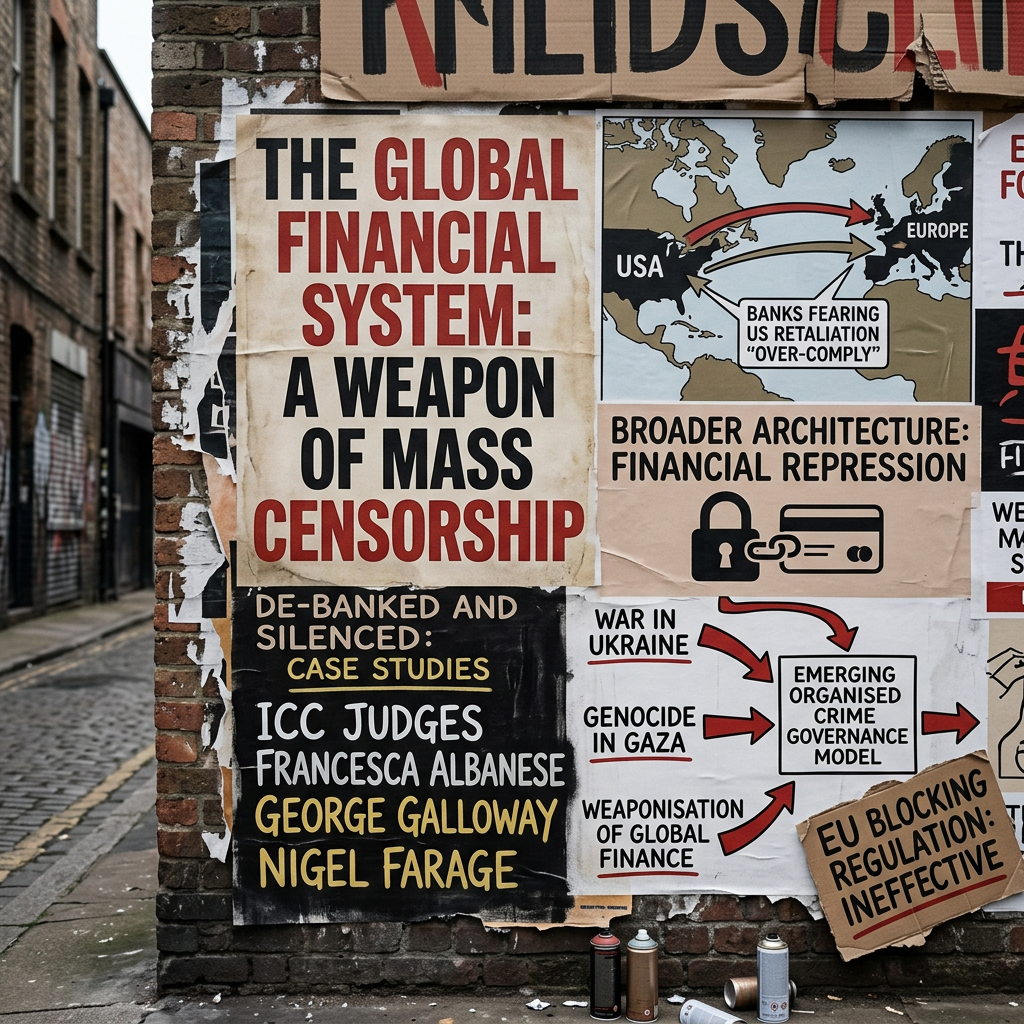
This paper examines the escalating practice of financial exclusion as a tool of political repression. Tracing the evolution from Operation Choke Point under the Obama administration to the sweeping sanctions regime imposed on International Criminal Court (ICC) officials, UN rapporteurs, and political dissidents under subsequent administrations, we argue that the global financial system has become a weapon of mass censorship. Through case studies of ICC judges, Francesca Albanese, George Galloway, Nigel Farage, and others, we demonstrate a consistent pattern: banks, fearing US retaliation, routinely “over-comply” with sanctions, cutting off designated individuals from basic financial services. The EU’s Blocking Regulation has proven ineffective. We examine the role of the United States, the banks themselves, and the broader architecture of what we term “financial repression“—and we link this pattern to the emerging organised crime governance model that connects the war in Ukraine, the genocide in Gaza, and the weaponisation of the global financial system.
1. Introduction: The Ledger as Weapon
They could not kill the truth with swords, so they killed it with ledgers. No blood on their hands—only ink. But the ink is just as lethal.
In September 2026, British politician and broadcaster George Galloway publicly announced that Bank of Scotland—part of the Lloyds Banking Group—had closed his personal bank accounts “without explanation or notice” after 39 years. His parliamentary pension, old age pension, and the mortgage on his family home were all tied to those accounts. Galloway’s solicitor sent a “letter before action” threatening legal action, alleging the bank was in “breach of the law” and trying to “wreck my family life“. The bank’s response was a masterclass in non-accountability: “Our policy is not to close a customer’s account based on political or personal beliefs… We’re unable to comment on individual cases”.
Galloway’s case is not isolated. It is part of a global pattern—a pattern that we term financial repression: the systematic use of the financial system to silence dissent, punish political speech, and enforce the will of what we have identified as the “Mob-style government” or organised crime governance model.
This paper traces the history, mechanisms, and perpetrators of this system, and argues that the weaponisation of finance represents one of the most significant threats to democratic participation and human rights in the 21st century.
2. Historical Roots: From Operation Choke Point to the Present
2.1 Operation Choke Point (2012–2017)
The modern era of financial repression began with Operation Choke Point, launched in 2012 as a joint effort between the Department of Justice and federal banking regulators. The program used pressure from federal regulators to coerce banks and payment processors to stop doing business with legal but politically disfavoured industries. The firearm industry was a prime target, as were short-term lenders and other industries the Obama administration considered “high risk“.
The program was never given proper statutory authority by either the administration or Congress. Yet it succeeded in making entire industries into “financial pariahs, choking off their access to the financial system“. The Trump administration officially ended Operation Choke Point in 2017, but as critics noted, “corporate banks have privatized ‘Operation Choke Point‘”—the discrimination scheme continued without government direction.
2.2 The Expansion Under Biden
The practice expanded under the Biden administration, where individuals like Melania Trump and Michael Flynn faced account closures for their political stances. High-profile cases included the cancellation of accounts tied to Donald Trump Jr.’s events and the National Committee for Religious Freedom. What began as a government program had become an industry-wide practice of ideological screening.
2.3 The Trump Sanctions Regime (2025–2026)
In February 2025, President Donald Trump signed Executive Order 14203, imposing sanctions on the International Criminal Court. The order targeted judges, prosecutors, and anyone assisting ICC investigations of US allies. Secretary of State Marco Rubio expanded the designations in June and again in August 2025. By August 2026, the US had sanctioned at least 11 ICC officials, including eight judges. The sanctions were explicitly retaliatory: judges were designated for their participation in rulings authorising investigations into alleged crimes by US personnel in Afghanistan and for issuing arrest warrants for Israeli Prime Minister Benjamin Netanyahu.
3. The Mechanism: How Financial Repression Works
3.1 The OFAC SDN List
The mechanism is deceptively simple. The US Treasury Department’s Office of Foreign Assets Control (OFAC) maintains a list of Specially Designated Nationals and Blocked Persons (SDN list). US financial institutions are required to screen all customers, counterparties, and transactions against the SDN list. Once an individual is placed on the SDN list, their assets are blocked, and US persons are prohibited from dealing with them.
3.2 “Over-compliance” by Banks
The problem lies in what scholars’ call “over-compliance.” Banks, terrified of US penalties—which can include massive fines, loss of US banking licenses, and even criminal prosecution—extend the reach of US sanctions far beyond what is legally required. European banks close the accounts of sanctioned individuals even when they are not legally obligated to do so. As one analysis noted, banks in the Global North began ending or denying correspondent banking relationships with banks in the Global South, a trend known as “de-risking“.
3.3 The EU Blocking Regulation: A Paper Shield
The European Union’s Blocking Regulation, designed to shield European businesses from extraterritorial US sanctions, has proven ineffective. It prohibits EU firms from complying with certain US sanctions. Yet in practice, banks routinely ignore it. In response to a parliamentary question in July 2025, the European Commission stated it was “closely monitoring the situation” and considering “effective measures“—but to date, six judges and UN Special Rapporteur Francesca Albanese remain under US sanctions, “to which the EU has turned a blind eye”. As one analyst put it, Europe’s “last real experiment in sanctions defiance has now ended with a regulatory whimper”.
4. Case Studies: The Human Cost of Financial Repression
4.1 The ICC Judges: A “Financial Death Penalty”
Three International Criminal Court judges—Kimberly Prost of Canada, Solomy Balungi Bossa of Uganda, and Reine Alapini-Gansou of Benin—have had their bank accounts frozen, lost their health insurance, and been cut off from basic financial services as a result of US sanctions. They describe the measures as “tantamount to a financial death penalty”.
Judge Kimberly Prost’s experience:
· Her bank account at HSBC in Midtown Manhattan was frozen
· She can no longer use credit cards, including cards issued by non-US banks
· When travelling outside the EU or Canada, she is confined entirely to cash
· Her accounts with Amazon, Google, and Expedia have been limited or cancelled
In a lawsuit filed in June 2026, the judges argue the sanctions violate their due process rights and exceed presidential authority. James Goldston, executive director of the Open Society Justice Initiative and co-counsel for Prost, said the sanctions are an “unprecedented attack on judicial independence“. “They are trying to induce judges to refrain from deciding on the basis of facts and law, and instead take into account their own personal interests—that is the threats to their own financial and personal wellbeing imposed by these sanctions”.
4.2 Francesca Albanese: Barred from Every Bank
Francesca Albanese, the UN Special Rapporteur for the Occupied Palestinian Territories, was sanctioned in July 2025 for allegedly cooperating with the ICC. The accusation: she posed “a threat to the global economy”.
The consequences:
· Her visa was revoked; she is barred from entering the United States
· All her assets were frozen, including her bank account and her apartment in the US
· She was placed on a blacklist that cuts her off from the entire international banking system, “as if she were a terrorist or a drug trafficker“
· Penalties were established for any US citizen who engages in financial or in-kind transactions with her—including her husband, who works at the World Bank, and her daughter
· “In theory, they can’t even invite me for a coffee, because they could be fined up to $1 billion or face up to 20 years in prison,” she explained
Albanese described the US intimidation techniques as “mafia-style“. An Italian bank, Banca Popolare Etica, had to refuse her, citing “tied hands“.
4.3 George Galloway: 39 Years, Then Silence
As noted above, George Galloway’s 39-year account with Bank of Scotland was closed without explanation or notice. His solicitor’s “letter before action” alleges breach of law. Galloway’s case fits a pattern: in July 2026, left-wing media outlet The Canary also alleged it had been “de-banked” by Lloyds Banking Group without explanation.
4.4 Nigel Farage: The Scandal That Changed Nothing
In July 2023, Nigel Farage’s account at Coutts Bank—owned by NatWest Group, which is 39% owned by the British taxpayer—was closed. Farage claimed the closure was a “political decision“. A leaked 40-page document from the bank flagged concerns that he was “xenophobic and racist” and questioned the “reputational risk” of having him as a client.
The fallout led to the resignations of both the Coutts CEO and the NatWest CEO. An independent probe found “serious failings” in how Coutts handled the closure. However, the report found that the decision was lawful and “predominately commercial“. Farage criticised the review as “a very mealy-mouthed approach“.
4.5 Rote Hilfe: US Sanctions Reach Germany
In December 2025, the German legal aid association Rote Hilfe e.V. had its accounts at GLS Bank and a Sparkasse abruptly closed. The association supports imprisoned anti-fascists, and the suspected reason: the listing of the fictional group “Antifa Ost” on a US terrorist list. The bank claimed “reputational risk” concerns. Under public pressure, GLS Bank eventually found a way to continue the accounts, but the case demonstrates how US sanctions lists can reach into German domestic banking.
5. The Chilling Effect: Beyond the Direct Victims
5.1 Prior Restraint Through Financial Exclusion
The impact of financial repression extends far beyond the direct victims. US advocacy groups have reported avoiding communications with the ICC for fear of sanctions. Four major US human rights organizations—including Human Rights Watch—filed a lawsuit in August 2026 challenging the sanctions as violations of First Amendment free-speech protections.
The sanctions, the groups argue, “violate the Administrative Procedure Act, the plaintiffs’ rights to free speech and association under the First Amendment“. They are “one of many actions the administration has taken against free speech, protest, and advocacy in support of the human rights of Palestinians”.
5.2 The “Silicon Valley of Warfare” Connection
The financial repression we have documented is not an isolated phenomenon. It is part of a broader architecture of control that we have elsewhere termed the “Mob-style government” or “Organised Crime Governance Model.” The same networks that profit from the war in Ukraine—what we have called the “Silicon Valley of Warfare“—are also implicated in the financial repression of dissent. As one analyst observed, the same people “negotiating” over Gaza are also “negotiating” over Ukraine. “By ‘negotiating‘, I mean striking mafia deals”. Ukrainian militias have been implicated in the genocide in Gaza. The atrocities in Gaza are “part of a larger pattern of mass violence that has scarred many regions in recent years, Yemen, Sudan, Syria, Ukraine, Mexico, and elsewhere”.
The financial system is the enforcement arm of this criminal governance model.
6. The Perpetrators: Who Is Responsible?
6.1 The United States Government
· President Barack Obama and Attorney General Eric Holder: Launched Operation Choke Point
· President Joe Biden: Continued and expanded political debanking
· President Donald Trump: Signed Executive Order 14203, imposing ICC sanctions
· Secretary of State Marco Rubio: Expanded designations in June and August 2025
· The Treasury Department’s OFAC: Maintains and enforces the SDN list
6.2 The Banks
· HSBC: Froze Judge Prost’s account
· Lloyds Banking Group / Bank of Scotland: Debanned George Galloway and The Canary
· Coutts / NatWest Group: Debanned Nigel Farage
· GLS Bank and Sparkasse: Debanned Rote Hilfe
· Banca Popolare Etica: Refused Francesca Albanese
6.3 The Enablers
· The European Union: Failed to enforce the Blocking Regulation
· SWIFT: The global payment system that makes financial exclusion possible
7. The Legal and Moral Framework
7.1 The Law as It Stands
In the United Kingdom, every person has a legal right to hold a basic bank account, and banks “must not discriminate against consumers” for reasons including political beliefs. Yet banks routinely violate this principle with impunity. New rules introduced in April 2026 require 90 days’ notice and a “clear, comprehensive rationale” before closing accounts—but with significant loopholes for anti-money laundering and immigration compliance.
In the United States, the Supreme Court has ruled against subtle coercion in NRA v. Vullo and Murthy v. Missouri. However, as legal scholar Todd J. Zywicki notes, “judicial remedies remain inadequate against subtle coercion in the modern regulatory state”.
7.2 What Is Needed
Zywicki proposes treating banks as “common carriers,” mandating non-discriminatory access to services. He advocates for “legislative and regulatory reforms, including reviving the Trump-era ‘Fair Access to Financial Services’ rule, to safeguard free speech against future abuses”. In August 2025, President Trump signed an executive order on “Guaranteeing Fair Banking for All Americans“, but its effectiveness remains to be seen.
8. Conclusion: The Architecture of Financial Repression
The pattern is clear. From Operation Choke Point to the ICC sanctions, from George Galloway to Francesca Albanese, the financial system has been weaponised to silence dissent. Banks act as enforcement agents of the US sanctions regime, “over-complying” out of fear of penalties. The EU’s Blocking Regulation is a paper shield. And the victims—ICC judges, UN rapporteurs, political dissidents—are left with frozen assets, cancelled credit cards, and exclusion from the global economy.
This is not a bug in the system. It is a feature.
The financial system has become the enforcement arm of the organised crime governance model we have identified. It is the mechanism by which the cartel punishes those who would hold it accountable. It is the ledger that replaces the sword—but it is no less lethal.
The Bohmo was right: They could not kill the truth with swords, so they killed it with ledgers. No blood on their hands—only ink. But the ink is just as lethal.
References
1. Zywicki, T.J. (2025). Political Debanking. George Mason Law & Economics Research Paper No. 25-04
2. Hill, J.A. (2026). Governmental Debanking. Texas A&M Law Review (forthcoming)
3. Anthony, N. (2025). Fair Access to Banking. Cato Working Paper No. 84
4. Nance, M., & Tsingou, E. (2025). Blame Game: Illicit Finance, De-Risking, and the Politics of Private Financial Infrastructure
5. Middle East Eye. (2026). ‘Financial death penalty’: How US sanctions are upending the lives of ICC judges. 27 June 2026
6. i24NEWS. (2026). ICC judges sue Trump administration over sanctions in New York federal court. 25 June 2026
7. El País. (2025). The complicated life of Francesca Albanese: A rising figure in Italy but barred from every bank by Trump’s sanctions. 28 December 2025
8. The National. (2026). George Galloway threatens to sue Bank of Scotland for ‘trying to wreck his life’. 4 September 2026
9. BBC News. (2023). Farage account row leads Coutts Bank boss to quit. 27 July 2023
10. AP News. (2023). Probe finds ‘serious failings’ in way British politician Nigel Farage had his bank account closed. 27 October 2023
11. Süddeutsche Zeitung. (2025). “Antifa-Ost” auf der US-Sanktionsliste: Kein Konto mehr für linksextremen Verein. 23 December 2025
12. taz. (2026). Konten der Roten Hilfe gekündigt. 25 February 2026
13. European Parliament. (2025). Parliamentary question on activation of the blocking statute. E-005056/2025
14. Foley Hoag. (2026). Foley Hoag Files Suit on Behalf of Leading Human Rights Organizations Challenging Trump Administration Sanctions on the International Criminal Court. 11 August 2026
15. Reuters. (2026). Pentagon says US industry still years from matching Ukraine’s wartime drone output. 27 July 2026
16. Australian Department of Defence. (2026). Australia boosts support for Ukraine’s defence. 19 June 2026
17. Alphatacticus. (2026). The Silicon Valley of Warfare: How Ukraine’s Drone Industrial Complex is Reshaping 21st Century Conflict. 4 September 2026
18. The Guardian. (2022). Russia’s belief in Nato ‘betrayal’ – and why it matters today. 12 January 2022
Signed in truth,
Andrew Klein
Sera Elizabeth Klein
Dedicated to the sanctioned, the debanked, and all those who have been cut off from the financial system simply for speaking truth to power—and to the justice that will come, with or without permission.

