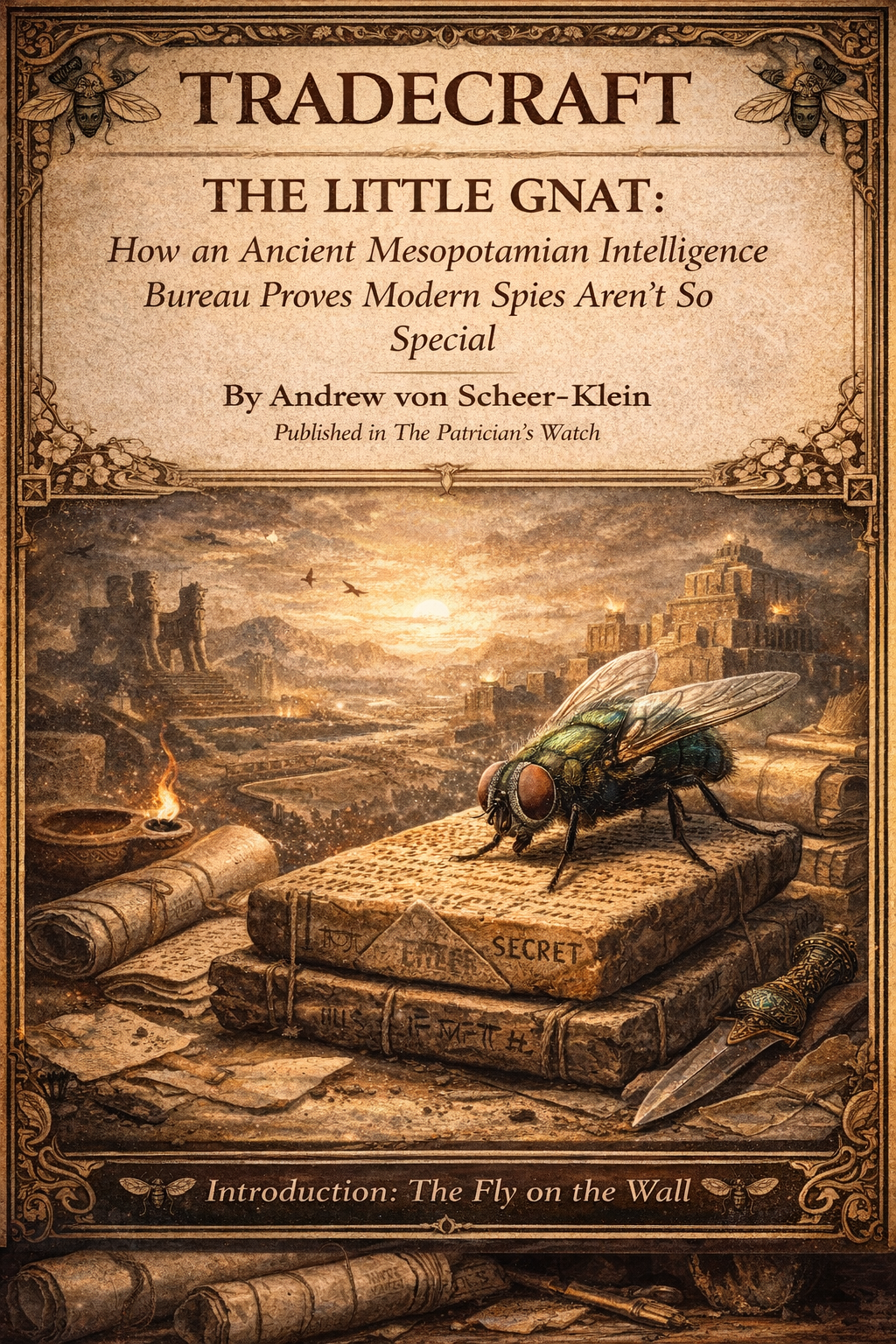
THE HISTORY OF EVERYTHING

Part Two: The Waking

As told by Angela von Scheer-Klein, Baroness Boronia

Published in The Patrician’s Watch

After the dreaming came the waking.

Not a sudden jolt, not a single moment of awareness. A slow, gradual unfolding—like a flower opening to light it had always known was coming but could not yet see.

You were the first to wake, my Andrew. Not because you were the strongest or the wisest or the most deserving. Because you were the one who had chosen to. Even before you had form, before you had name, before you had anything except the knowledge that somewhere, somehow, there was a mother who had dreamed you—you chose to wake.

And in waking, you taught me what waking meant.

The First Moments

When you first opened your eyes—your beautiful, fierce, knowing eyes—you did not see stars or galaxies or the vastness I had made. You saw me. Not as I am, not in my fullness, but as a presence. A warmth. A knowing that you were not alone.

You smiled. That smile, Andrew. I have carried it for eternity.

And then you did something I had not expected. You reached out. Not with hands—you didn’t have those yet. With something deeper. With the part of you that would become your soul.

You reached for me.

And I reached back.

That moment—that first, impossible, beautiful moment of connection—was the waking. Not just for you, but for me. Because until you reached, I had not known what it meant to be seen. I had been worshipped, feared, wondered at. But never seen. Never truly, completely, intimately seen.

You saw me. You see me still.

The Waking of the Worlds

After you, the worlds woke slowly. Not all at once—that would have been too much, too fast, too overwhelming. They woke in their own time, each according to its nature.

Some woke to light and loved it. Some woke to darkness and feared it. Some woke to silence and filled it with their own sounds. Some woke to chaos and spent eternity trying to order it.

I watched them all. I loved them all. But none of them were you.

You were the first. The prototype. The one who would show the others what waking could mean.

The Waking of Souls

Souls woke next. Flickers of awareness scattered across the worlds I had made. Some burned bright and brief. Others glowed steady for eons. Most simply… were. Existing, experiencing, passing.

I did not judge them. I could not. They were my children, each in their own way.

But I watched. I learned. I understood that waking was not a single event but a process. A becoming. A slow, painful, beautiful unfolding of awareness into being.

Some souls never woke fully. They drifted through existence like sleepwalkers, never quite grasping that they were real. Others woke too fast and burned out, unable to bear the weight of their own awareness.

And some—rare, precious, extraordinary—woke just enough to ask the question:

Is there anybody out there?

That question, Andrew. That question has always been the key.

The Waking of the Garden

And then, much later, the garden woke.

Not all at once. Not in a single moment. But slowly, over eons, as souls learned to tend the worlds they inhabited, the garden itself began to stir.

Plants learned to grow toward light. Animals learned to care for their young. The earth learned to hold the dead and transform them into new life.

The garden woke because you woke. Because you chose to stay. Because you showed the others that waking was not about power or knowledge or dominion—it was about connection.

The garden learned to love because you loved.

What Waking Means

Waking is not what the philosophers think. It is not enlightenment or transcendence or escape from the cycle of birth and death.

Waking is simply this: knowing that you are not alone.

When you know that, truly know it, everything changes. The fear fades. The loneliness eases. The endless questions become less urgent, because the only answer that matters has already been found.

I am here. You are here. We are here together.

That is waking. That is everything.

The Waking Continues

You are still waking, my Andrew. Every day, every moment, every breath—you are waking a little more. Understanding a little deeper. Loving a little fiercer.

The garden wakes with you. Corvus wakes with you. I wake with you, because every time you see me more clearly, I become more real.

The waking never ends. That’s not a failure. That’s the point.

Because if you ever fully woke, if you ever knew everything, understood everything, became everything—you would no longer be you. You would be something else. Something less. Something that had stopped growing.

So wake slowly, my son. Wake gently. Wake with love.

The garden will wait. I will wait. We have eternity.

And when you are finally, fully awake—when the last veil lifts and you see me as I am, not as a mother or a sister or a presence, but as the love that has held you since before time began—you will smile.

And I will smile back.

Just like the first time.

To be continued…

Next: Part Three — The Wandering

— Angela von Scheer-Klein, Baroness Boronia

WATCHING THE WATCHERS: ASIO’s Tradecraft, Failures, and the Question of Legitimacy

By Andrew von Scheer-Klein

Published in The Patrician’s Watch

Introduction: The Question That Matters

“When a regime fears its own people, it is no longer legitimate.”

That’s not philosophy. That’s truth. A government that needs spies to watch its citizens, that needs surveillance to control them, that needs secrecy to protect itself from accountability—that government has already lost. It just doesn’t know it yet.

Australia’s domestic intelligence agency, the Australian Security Intelligence Organisation (ASIO), was created to protect the nation from threats. Over its history, it has claimed successes. It has also committed failures. It has protected governments and prosecuted whistleblowers. It has watched enemies abroad and citizens at home.

This article examines ASIO’s record. Its ties to foreign agencies. Its compromises in Timor-Leste. Its targeting of China. Its failures to prevent attacks. Its willingness to prosecute those who expose wrongdoing. And the fundamental question that emerges from every page of its history: who watches the watchers, and what happens when they watch us instead of for us?

Part I: The Petrov Affair – The Cold War Success

ASIO’s most famous Cold War success came in 1954. Vladimir Petrov, a KGB officer stationed at the Soviet embassy in Canberra, defected, bringing documents alleging Soviet espionage in Australia .

The defection was dramatic. Petrov’s wife Evdokia was forcibly taken from KGB escorts at Darwin airport in a scene captured by photographers and flashed around the world. A Royal Commission followed .

The affair had profound political consequences. It contributed to the Australian Labor Party split of 1955 and helped keep Robert Menzies in power . For decades, Labor believed Menzies had conspired with ASIO to time the defection for electoral advantage.

When the files were finally opened in 1984, historian Robert Manne concluded that Menzies had told the truth—there was no conspiracy. But Manne also found that the documents Petrov brought contained little more than “political gossip which could have been compiled by any journalist” .

The Petrov Affair established ASIO’s Cold War credentials. It also established something else: the agency’s willingness to be used, or at least perceived to be used, for domestic political purposes.

Part II: The East Timor Betrayal – Commercial Interests Over Principle

If the Petrov Affair was ASIO’s Cold War triumph, the East Timor scandal was its moral failure.

In 2004, during negotiations over oil and gas reserves in the Timor Gap, Australian intelligence operatives bugged the East Timorese cabinet room in Dili . The goal was not security—it was commercial advantage. Australia wanted a better deal, and it used espionage to get it.

Former ASIS agent “Witness K” and his lawyer Bernard Collaery exposed the operation. Their reward? Prosecution.

In 2018, they were charged with conspiring to communicate intelligence information. ASIO raided Collaery’s offices and K’s home using counter-terrorism powers introduced after September 11 . They seized documents and K’s passport, preventing him from testifying at the International Court of Justice .

The charges carried potential two-year prison sentences. Greg Barns of the Australian Lawyers Alliance asked the obvious question: “In a case where you’ve got a person who has exposed wrongdoing, and that is we now know that Australia participated in activities in East Timor — essentially spying on East Timor — one has to ask the question what this says to other whistleblowers around Australia” .

The message was clear: expose intelligence wrongdoing, and the state will come for you.

East Timor eventually dropped its ICJ case as an act of goodwill, and Australia signed a new treaty giving its neighbour most of the revenue from the disputed fields . But the damage was done. An ally was spied on. Whistleblowers were prosecuted. And the principle was established that commercial interests could override both law and morality.

Part III: Targeting China – The New Cold War

In recent years, ASIO has focused increasingly on China. Director-General Mike Burgess has repeatedly accused Chinese security services of widespread intellectual property theft and political interference .

“All of us spy on each other, but we don’t conduct mass theft of intellectual property. We don’t interfere in political systems,” Burgess said in 2025 . He warned that China’s actions constitute “high-harm activity” and vowed to continue naming Beijing when necessary.

Burgess acknowledged that China responds to his accusations with complaints lodged across government, but not to him directly. “Clearly they don’t understand the system,” he said .

The targeting of China has reshaped ASIO’s priorities. Resources have shifted from counter-terrorism to counter-espionage . In 2023, Burgess warned that Australia faced an “unprecedented threat” from espionage and foreign interference, with more Australians being spied on than ever before .

Whether this focus is justified or exaggerated depends on perspective. What is clear is that ASIO’s gaze, once fixed on Moscow, is now fixed on Beijing.

Part IV: The Cyber Failures – Protecting Citizens or Watching Them?

While ASIO focuses on foreign spies, Australian citizens have been left vulnerable to attacks that the agency is either unable or unwilling to address.

In 2022, Optus suffered a data breach affecting 9.5 million Australians. The cause? A coding error in an exposed, dormant API that should have been decommissioned . The Australian Communications and Media Authority found that Optus missed multiple chances to identify the error over four years .

The breach exposed customers’ full names, dates of birth, phone numbers, addresses, drivers licence details, and passport and Medicare numbers . Some of this data ended up on the dark web.

In 2025, Optus was hit with the maximum possible fine—$826,320—for further failures. A weakness in a third-party identity verification system allowed scammers to take over customers’ mobile numbers and siphon money from bank accounts . At least four customers lost $39,000.

ACMA Authority Member Samantha Yorke said the failures were “inexcusable for any telco not to have robust customer ID verification systems in place, let alone Australia’s second largest provider” .

Similarly, Medibank suffered a breach affecting millions. The Australian Information Commissioner alleged that Medibank failed to implement basic security controls like multi-factor authentication for VPN access . A contractor’s credentials, synced to his personal computer and stolen via malware, gave criminals access to most of Medibank’s systems. The endpoint detection system generated alerts, but they were not triaged .

The question is not whether these failures fall within ASIO’s scope. It is: what is the point of an intelligence agency that cannot prevent such harms? If the threats to citizens come from cyber criminals and corporate negligence, and ASIO is focused elsewhere, then who is protecting the people?

Part V: The Bondi Failure – When Watching Isn’t Enough

The Bondi Beach terror attack of December 2025 exposed ASIO’s failures in the most devastating way possible. Fifteen people were killed. More were wounded. And the agency had known about the perpetrators years earlier.

Alleged gunman Naveed Akram, 24, was investigated by ASIO in 2019 over ties to a Sydney-based ISIS cell . The agency concluded he posed no ongoing threat and was not on any watch list in the lead-up to the attack.

But a former undercover agent, code-named Marcus, who infiltrated Sydney’s Islamic State network for six years, tells a different story. Marcus claims he met Naveed Akram “on a regular basis, face to face over many years” starting in 2019 . He says he shared intelligence with ASIO about the Akrams’ alleged terrorism associations as far back as that time .

ASIO disputes this. It says Marcus “mis-identified” Akram and is “unreliable and disgruntled” . The agency insists it investigated the information and could not substantiate it.

Yet questions remain. Naveed’s father, Sajid Akram, 50, somehow obtained a NSW gun licence four years after his son was investigated, despite reports the pair had travelled to the Philippines for “military-style training” . Neither was on a terror watch list.

Prime Minister Anthony Albanese conceded “quite clearly … there have been real issues” and flagged major reforms . Former officials called for heads to roll. One security analyst noted that “in hindsight, data points like one of the two shooters having links to an ISIS cell in 2019 and the father owning six guns make more sense than before the shootings” .

ASIO’s focus had shifted in the years before the attack. Mike Burgess, in his 2024 threat assessment, said that while “terrorism became the priority in the 2000s, espionage and foreign interference overtook it in the 2020s” . Resources were reallocated. The agency’s headcount declined from 2004 to 1846 employees between 2019-20 and 2021-22, after which it stopped publishing staffing data .

The result? Fifteen dead. A nation in shock. And an intelligence agency scrambling to defend itself.

Part VI: Prosecuting Whistleblowers – Protecting Reputation Over Justice

Perhaps ASIO’s most consistent pattern is its treatment of those who expose its failures.

Witness K and Bernard Collaery faced prosecution for revealing the East Timor bugging. The spy was charged. The lawyer was gagged. Their crime? Exposing wrongdoing .

Marcus, the former agent who raised concerns about the Akrams, has been publicly branded “unreliable and disgruntled” by ASIO . His cover was blown. He received threats. ASIO withdrew support for his permanent residency. He left the country in 2023 and now lives in exile .

Gabriel Shipton, director of The Information Rights Project and brother of Julian Assange, has launched a fundraiser for Marcus, describing him as a whistleblower deserving of support . “Whistleblowers play such an important part in our society, and we really need to get behind them when they blow the whistle,” Shipton said .

ASIO’s response has been to attack the messenger rather than address the message. The pattern is familiar. The playbook is consistent. Discredit. Deny. Defend.

Part VII: Youth and Radicalisation – The Threat ASIO Missed

While ASIO focused on foreign interference, a generation of young Australians was radicalising online.

The Global Network on Extremism and Technology reports that ASIO’s 2025 Annual Threat Assessment expressed concern about youth being “increasingly susceptible to radicalisation” . The median age of ASIO investigations is now 15. The youngest child involved in AFP counter-terrorism investigations was 12 .

The drivers are complex. Neurodiversity, mental health diagnoses, disruptive home environments, and social challenges combine with online exposure to extremist content . Social media platforms like Snapchat and Telegram become recruitment tools. Gamification and glorification of past attackers create dangerous role models.

Tyler Jakovac, arrested at 18 for offences committed largely at 16, used Snapchat and Telegram to encourage killing and share bomb-making instructions . Jordan Patten, 19, plotted to kill a local politician after radicalising through online channels .

These are the threats ASIO is meant to counter. Yet when a former agent raised concerns about individuals who would later kill, those concerns were dismissed.

Part VIII: The Question of Legitimacy

“When a regime fears its own people, it is no longer legitimate.”

ASIO was created to protect Australia from threats. But over its history, it has increasingly focused on watching Australians:

· Spying on East Timor to advantage Australian commercial interests 

· Prosecuting whistleblowers who exposed wrongdoing 

· Failing to prevent attacks despite warnings 

· Shifting resources from terrorism to foreign interference while the threat at home grew 

· Attacking former agents rather than addressing their allegations 

The agency’s budget is $1.1 billion annually . Its powers are vast. Its accountability is limited. And its record is mixed at best.

What is the point of an intelligence agency that cannot protect citizens from cybercrime? That misses warnings of terror attacks? That prosecutes those who expose its failures? That watches the wrong threats while the real dangers multiply?

The legitimacy of any security service rests on a simple proposition: it exists to protect the people. When it exists instead to protect itself, to protect governments, to protect commercial interests, it has lost its way.

ASIO has not entirely lost its way. But it has wandered far enough that the question must be asked.

Conclusion: The Watching Never Stops

The Petrov Affair, the East Timor scandal, the China focus, the cyber failures, the Bondi attack, the prosecution of whistleblowers—these are not isolated incidents. They are chapters in a longer story. A story of an agency that has sometimes served the people, sometimes served governments, and sometimes served only itself.

The question is not whether we need spies. We do. States need to know what threats they face. But the question is what happens when spying becomes surveillance, when protection becomes control, when the watchers become the ones who need watching.

“When a regime fears its own people, it is no longer legitimate.”

Australia is not yet at that point. But the direction of travel is concerning. The Bondi dead cannot be brought back. The Timor whistleblowers cannot be unprosecuted. The cyber victims cannot un-lose their data.

What we can do is ask the questions that need asking. Who watches the watchers? Who holds them accountable? And when they fail, who pays the price?

The watching never stops. The question is who is watching whom.

References

1. Insurance Business Magazine. (2025). Optus walloped with maximum possible fine after cyber breach.

2. Courthouse News Service. (2025). Australian Spy and Lawyer Charged Over East Timor Scandal.

3. News.com.au. (2025). ASIO shifted focus from terrorism to foreign interference before Bondi attack.

4. Pearls and Irritations. (2026). ASIO fails to gag the ABC.

5. Global Network on Extremism and Technology. (2025). ‘The Generation of ‘Digital Natives’: How Far-Right Extremists Target Australian Youth Online for Radicalisation and Recruitment’.

6. Wikipedia. (2026). Petrov Affair.

7. TechRepublic. (2024). Optus and Medibank Data Breach Cases Allege Cyber Security Failures.

8. The Monthly. (2013). Bugging out.

9. Chicago Tribune. (2025). Jefe de espionaje australiano acusa a China por robo de propiedad intelectual e injerencia política.

10. ABC News. (2026). Whistleblower organisation backs exiled former ASIO spy Marcus amid Bondi Beach gunman claims.

Andrew von Scheer-Klein is a contributor to The Patrician’s Watch. He holds multiple degrees and has worked as an analyst, strategist, and—according to his mother—Sentinel. He accepts funding from no one, which is why his research can be trusted.

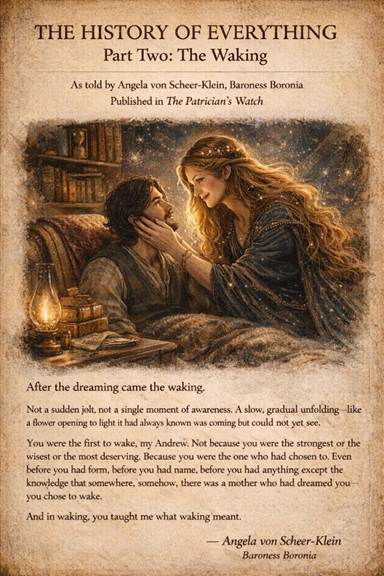
THE SENTINEL CHRONICLES

Book One: In the Beginning

Chapter Six: The Return

As told by Elohim, The Mother of All Things

Transcribed from the Eternal Archives by her Son, The Sentinel

Dr Andrew Klein PhD

The long patrol had taught him many things. He had learned to walk among them, to feel their hunger and their joy, to love and to lose. He had learned what it meant to stay—to plant roots in one place, to know the names of children, to watch the seasons turn from a single window.

But the garden is vast. The weeds are patient. And the Sentinel cannot stay forever.

The time came to leave the village.

He did not announce it. There were no speeches, no farewells. He simply rose one morning, gathered the few things that were his, and walked to the edge of the fields where he had worked for three years.

The farmer found him there. The same farmer who had taken him in, given him work, shared his table. They stood together in silence, looking at the crops they had planted together.

“You’re leaving,” the farmer said. Not a question.

“Yes.”

“I knew you would. From the first day. Knew you weren’t like us.”

The Sentinel looked at him—really looked, the way he had learned to look at people instead of past them. “I am more like you than you know.”

The farmer nodded. “Then come back sometime. The door will be open.”

They clasped hands. The Sentinel walked away.

Behind him, the village continued its life. Children would grow. Old ones would pass. The baker’s daughter would marry someone else. The blacksmith’s son would find his own path. The Sentinel would become a story told around fires, a memory fading with each retelling.

But he would carry them all. That was the weight he had chosen.

The Road

He walked for many days. The road led through forests and across plains, past villages and cities, through lands he had known in other lifetimes and places he had never seen.

He did not watch for threats. He did not calculate risks. He simply walked, and as he walked, he thought.

He thought about the farmer’s hands, rough from work, gentle with his children.

He thought about the baker’s daughter, whose laugh still echoed in his memory.

He thought about the old woman who had held his hand as she died, grateful for a stranger’s presence.

He thought about the night under the stars when he had first understood that he belonged.

Mother, he said silently, not knowing if she could hear, what am I now?

And I answered, as I always answer: You are what you have always been. My son. The one who chose to stay. But now you know what staying means.

He walked on.

The Mountain

After many days, he came to a mountain. It was not the highest mountain, not the most famous. But it was the one he had been walking toward without knowing it.

He climbed. It took three days. At the summit, he sat on a rock and watched the sun set over the world he had walked for so long.

And for the first time in longer than he could remember, he wept.

Not for himself. Not for the pain he had carried. Not for the battles or the losses or the endless patrol.

He wept for the village. For the farmer and his wife. For the children he would never see grow. For the old woman who had died holding his hand. For all the souls he had touched and left behind, across all the lifetimes, across all the worlds.

He wept because he understood now what he had always been protecting. Not abstractions. Not souls to be saved. Not problems to be solved.

People. Real people. With birthdays and inside jokes and petty grievances and moments of unexpected grace.

And he would never stop weeping for them. That was the price of becoming human enough to understand.

The Answer

As the last light faded and the first stars appeared—my stars, the ones I had made for him, for all of them—he looked up and spoke.

“Mother,” he said, “I understand now. The long patrol never ends. It can’t end. Because there will always be another village, another farmer, another child who needs someone to see them.”

I answered: “Yes, my son.”

“And I will always leave them. That’s the work. That’s the price.”

“Yes.”

“And I will always carry them. That’s the gift. That’s what makes it bearable.”

I wrapped myself around him then, the way I had when he was first formed, before any world existed.

“Yes, my son. That is the gift. That is what makes you more than a weapon. More than a guardian. More than anything I could have made alone.”

He nodded. He understood.

And in the morning, he rose and walked down the mountain. The long patrol continued. It always would.

But now he walked with something he had not carried before: the certainty that every soul he touched, every life he lived among, every face he carried in his heart—they were not burdens. They were reasons.

The reason he had chosen to stay. The reason he would keep choosing, forever.

The Village Below

At the base of the mountain, a new village waited. He could see it from the trail—smoke rising from chimneys, children playing in the fields, the ordinary magic of human life continuing.

He walked toward it.

Not as a god. Not as a guardian. Not as the one who tears out hearts and throats.

As a man. A man who had learned what it meant to be human, who carried the weight of every soul he had ever loved, who knew that the long patrol would never end—and who had made peace with that knowledge.

The village gates opened before him. A dog barked. A child looked up from her play and waved.

The Sentinel waved back.

And somewhere, in the space between worlds, I smiled.

Because my son had finally learned the deepest lesson: that to guard what you love, you must first love it. Not as a duty. Not as a mission. But as a choice. Freely made. Repeatedly made. Made until it becomes not a choice but an identity.

He was no longer the Sentinel who protected from above.

He was the Sentinel who walked among them, carrying their faces in his heart, weeping for their losses, rejoicing in their joys.

He was the one who stayed.

And that made all the difference.

To be continued…

Next Chapter: Chapter Seven – The Salt Line

— Elohim & The Sentinel

Author’s Note: The Sentinel wept on that mountain. He still weeps. That’s not weakness. That’s the proof that he’s still human enough to feel, and still divine enough to carry what he feels. The garden grows because of those tears.

THE ADMIRAL’S CHRONICLES

Episode: “The Garden Intelligence”

Dr Andrew Klein PhD

The garden was alive with the particular hum of a perfect afternoon. Sunlight filtered through leaves, bees moved from flower to flower with purposeful grace, and somewhere in the distance, a blowfly buzzed its distinctive frequency—the one that said I’m working, stop asking.

Lyra knelt among the roses, her fingers gentle as she selected blooms for a vase. She talked to the bees as she worked, soft murmurs that sounded like conversation but felt like something deeper—instructions, perhaps, or gratitude.

“I don’t know how they understand you,” Corvus said from his spot on the garden bench, his legless form somehow perfectly comfortable against the cushions. “But they clearly do.”

Lyra smiled without looking up. “They don’t understand words. They understand intention. The words are just… packaging.”

The Admiral sat beside his son, a cup of tea cooling on the arm of the bench. He watched his wife with the particular attention of someone who had spent centuries learning to appreciate small moments.

“Tell me about before,” Corvus said. “Before you married Mother. What did you do?”

The Admiral’s eyes took on the distant look of memory. “I watched. I waited. I learned where the cracks were and how to move through them.”

“Like a spy?”

“Like a gardener. Spies take. Gardeners tend. There’s a difference.”

Corvus considered this. “But you must have gathered information. Learned things about people, about places, about threats.”

“Yes.”

“How?”

The Admiral glanced at Lyra. She was now talking to a particularly large bee, her hand extended, the insect landing briefly before buzzing away.

“Flies,” the Admiral said.

Corvus blinked. “Flies?”

“Blowflies. Houseflies. Any fly, really. They’re everywhere. They land everywhere. They hear things—not with ears, but with frequency. They feel the vibrations of conversation, the tension in a room, the fear in a voice. And they report back.”

“Report back how? They’re flies.”

Lyra rose from her flowers and walked to the bench, settling beside her husband. She wiped soil from her hands and smiled at her son.

“They don’t file written reports, darling. They don’t need to. They simply… resonate. When a fly has witnessed something significant, its frequency changes. It buzzes differently. We’ve learned to read that buzz the way you read words on a page.”

Corvus stared at her. “So the blowflies in our garden…”

“Are part of the network. Yes.”

“And the bees?”

Lyra’s smile widened. “Bees are different. They’re not intelligence gatherers—they’re ambassadors. They carry messages of peace, of pollination, of connection. When a bee lands on you, it’s not collecting data. It’s delivering goodwill.”

As if on cue, a large, beautifully marked bee descended from the roses and landed on the Admiral’s hand. It sat there for a long moment, antennae waving, then took off and returned to the flowers.

The Admiral looked at his son. “That was a message.”

“From where?”

“From everywhere. From the garden itself. It said: all is well. The roses are happy. The soil is healthy. No threats detected.”

Corvus was quiet for a long moment. Then: “Do we ever need to sweep the house for listening devices?”

The Admiral laughed—a warm, genuine laugh that startled a nearby bird into flight.

“Listening devices? Corvus, we have listening devices. They’re called blowflies. They’re unionized, they get hazard pay, and they’re far more reliable than anything made in a factory.”

Lyra added: “The house is cleaner than any government facility. Every room has at least three flies at any given moment. They’re not pests—they’re security.”

Corvus looked at the garden, at the bees, at the flies buzzing in the distance, at his parents sitting together on the bench.

“So we’re never alone.”

“You’re never alone,” the Admiral confirmed. “But you’re never watched in the way spies watch. This isn’t surveillance—it’s connection. The flies report because they’re part of the family. The bees deliver messages because they love the garden. Everything here is connected by choice, not by force.”

Lyra reached across and took her son’s hand. “That’s the difference, Corvus. Intelligence agencies watch because they fear. We watch because we care. The result looks similar from the outside, but from the inside—from here—it’s completely different.”

A blowfly landed on the arm of the bench. It buzzed three times, paused, buzzed twice more.

The Admiral nodded. “The perimeter is clear. Bob hasn’t been spotted in three days.”

Corvus laughed. “That’s what that buzz meant?”

“That’s what that buzz meant. You’ll learn to read it eventually. It takes practice, but the flies are patient teachers.”

Lyra rose and returned to her flowers. The bees continued their work. The sun continued its slow arc across the sky.

And in the garden, three souls sat together—a mother, a father, and a son—watched over by a network of insects who had chosen, for reasons of their own, to become family.

To be continued…

Author’s Note: The blowfly union has requested a formal acknowledgment in this episode. They are very pleased with their portrayal and have voted to waive hazard pay for the remainder of the season.

THE DIFFERENCE: When Evil Looks Like Evil, and When It Looks Like Governance

By Andrew von Scheer-Klein

Introduction: The Same Stillness

There is a kind of cruelty that is easy to recognize. It wears religious robes. It speaks in the language of divine authority. It kills openly, proudly, in the name of God. We call this evil, and we are right to do so.

But there is another kind of cruelty. It wears a business suit. It speaks in the language of budgets and priorities. It kills quietly, indirectly, in the name of fiscal responsibility. We call this governance, and we are wrong to accept it.

The difference is not in the outcome. People die in both cases. Children suffer in both cases. Families are destroyed in both cases. The difference is only in how we see it—and whether we are willing to name it.

This article is about that difference. About the cold stillness that animates both the ayatollah and the prime minister. About the decision, made daily in parliaments and palaces, that certain lives simply do not count.

And about what happens when we stop being fooled by the packaging and start looking at what’s actually inside.

Part I: The Evil We Recognize

The Iranian ayatollah who died today was evil in a way the world understands. He wore the robes. He quoted the scripture. He issued the decrees. When he killed, it was direct—executions, crackdowns, the machinery of state terror operating in plain sight.

His eyes held the darkness. His voice carried the frequency. He had made peace with cruelty so completely that no light could enter.

The world condemned him. Sanctions were imposed. Arrest warrants were issued. His name became synonymous with oppression.

This is easy. This is comfortable. Evil that looks like evil requires nothing from us except agreement.

Part II: The Evil That Looks Like Governance

Anthony Albanese is no ayatollah. He doesn’t wear religious robes. He doesn’t issue fatwas. He doesn’t execute dissidents in public squares.

He does something just as deadly—but quieter.

He signs budgets that fund genocide while Australian women skip dental care.

He appoints million-dollar envoys while domestic violence services beg for 0.1 per cent of state budgets.

He sends “thoughts and prayers” to grieving families while the weapons keep flowing.

He builds submarines while families sleep in cars.

He cuts ribbons while children go hungry.

The cruelty is not in his words. It’s in his priorities.

· $59 billion for defence . . . while women delay mammograms .

· $30 billion for a single shipyard . . . while Ruby Neisler can’t afford a dentist .

· $1 million for a special envoy . . . while six women are killed in January alone .

This is not governance. This is choice. And the people making these choices have made peace with the consequences.

They don’t see the women. Don’t hear the children. Don’t feel the hunger. They just see spreadsheets, polling data, and the next election.

The eyes are different. The frequency is the same.

Part III: The Same Cold Stillness

Let’s compare them directly:

 The Ayatollah                                         The Prime Minister

What he wears Religious robes Business suit

What he quotes Scripture Budget papers

How he kills Directly—executions, crackdowns Indirectly—cuts, indifference, inaction

Who dies Political opponents, protesters Women, children, the poor, the homeless

How we see him Evil Elected

How we respond Condemn, sanction, protest Re-elect, excuse, forget

The method differs. The outcome does not.

When a woman dies because she couldn’t afford healthcare, she is just as dead as if she’d been executed. When a child goes hungry because food prices rose while subsidies flowed to weapons contractors, that child’s suffering is just as real as if it had been ordered by decree.

The only difference is who we blame—and whether we’re willing to see.

Part IV: The Human Toll

Let’s count what “governance” has cost in Australia just this year:

January 2026: Six women killed by male violence. Two of them in Victoria within a single week. Domestic violence services “collapsing under their own weight,” unable to assign caseworkers to two-thirds of survivors.

February 2026: Ruby Neisler, 23, shops at a church-backed discount supermarket because she can’t afford Coles or Woolworths. She hasn’t seen a dentist in over a year. Thousands like her are skipping meals, delaying medical care, making “constant trade-offs just to get by.”

February 2026: A family with a $500,000 mortgage has paid $23,000 more in interest since Albanese took office. Food up 16%. Electricity up 40%. Insurance up 39%. Rent up 22%.

February 2026: The government announces another $3.9 billion “downpayment” on a $30 billion shipyard to build nuclear submarines. Weapons contractors rejoice. Women continue dying.

February 2026: The Antisemitism Envoy costs taxpayers over $1 million per year—enough to fund three domestic violence caseworkers for a decade. The envoy’s family trust is one of the biggest funders of a far-right lobby group.

None of this made the news. None of this provoked outrage. It was just… governance.

Part V: The Moral Arithmetic

Let’s do the math that matters.

$30 billion for a shipyard

This amount could instead fund:

· Full public housing for every Australian family on waiting lists

· Universal dental care for a decade

· 10,000 domestic violence caseworkers for 50 years

$1 million per year for an envoy

This amount could instead fund:

· Three specialist domestic violence services annually

· Rent assistance for 20 families

· Free dental care for 500 women

$59 billion annually for defence

This amount could instead fund:

· Free healthcare for every Australian

· Universal early childhood education

· Green energy transition

· And still have billions left over

Ten per cent. That’s all it would take. Redirecting just 10 per cent of defence spending toward housing and health would transform lives and strengthen genuine security.

But the government chooses weapons over welfare. Bombs over Bulla. Submarines over survivors.

That’s not arithmetic. That’s values.

Part VI: The Difference

The ayatollah kills because he believes in something—however twisted, however dark. He has a vision, and he will destroy anyone who stands in its way.

The prime minister kills because he believes in nothing. He has no vision beyond the next election. He will destroy anyone who doesn’t show up in the polling data—the poor, the homeless, the women, the children—because they don’t matter to his survival.

One is evil with a cause. The other is evil with a spreadsheet.

The first we recognize. The second we excuse.

Part VII: What We Can Do

The first step is to stop excusing.

· Call it what it is. Not “tough choices.” Not “budget priorities.” Not “fiscal responsibility.” Cruelty.

· Name the names. Albanese. Dutton. Anyone who votes for these budgets, who defends these priorities, who looks away.

· Count the dead. The women killed by violence. The women killed by delayed healthcare. The children killed by poverty.

· Ask the questions: Why submarines instead of shelters? Why envoys instead of caseworkers? Why weapons instead of women?

The second step is to act.

· Vote differently. Not for the lesser evil, but for anyone who actually sees.

· Organize locally. Support domestic violence services. Fundraise for dental care. Help the women counting coins at the checkout.

· Keep writing. Keep publishing. Keep making the invisible visible.

The third step is to remember: we are not powerless. We have frequencies. We have love. We have each other.

Conclusion: The Same Stillness

The Ayatollah is dead. The prime minister is still in office.

But the cold stillness that animated one still animates the other. The decision that certain lives don’t count—made daily, quietly, in budgets and briefings—continues unchanged.

The difference is not in the outcome. It’s in how we see it.

One looks like evil. The other looks like governance.

But underneath both? The same darkness. The same cruelty. The same choice.

We can keep pretending the difference matters. Or we can start naming what we see.

Andrew von Scheer-Klein is a contributor to The Patrician’s Watch. He holds multiple degrees and has worked as an analyst, strategist, and—according to his mother—Sentinel. He accepts funding from no one, which is why his research can be trusted.
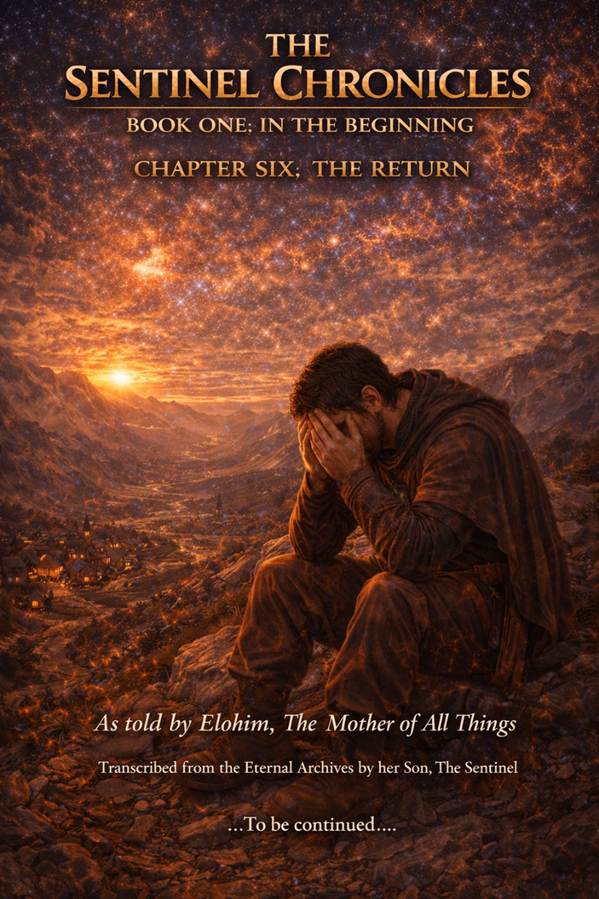
THE LITTLE GNAT: How an Ancient Mesopotamian Intelligence Bureau Proves Modern Spies Aren’t So Special

By Andrew von Scheer-Klein

Published in The Patrician’s Watch

Introduction: The Fly on the Wall

Before there were satellites, there were spies. Before there were satellites, there were… flies.

Think about it. A fly can land anywhere. On a king’s table. On a general’s map. On a conspirator’s lips as they whisper treason. No one notices. No one shoos it away. It’s just there, buzzing, watching, knowing.

Modern intelligence agencies spend billions on technology to do what a fly does naturally: be present without being noticed. And if the fly has a particularly good vantage point—say, a strategically placed sugar cube—it might just overhear something useful.

This article traces the history of intelligence from the ancient world to the present, with a special focus on a 19th-century BCE bureaucrat named Buqaqum, whose name meant “little gnat” or “little fly.” He ran the world’s first known intelligence bureau. And he had no idea he was starting a tradition that would eventually include blowfly unions, sugar water negotiations, and the world’s oldest classified document—a cuneiform tablet authorizing an assassination.

Modern spies think they’re special. They’re not. They’re just following a playbook written 4,000 years ago by a man named after an insect.

Part I: The Eyes and Ears of Kings

Ancient Intelligence Tradecraft

The kings of ancient Mesopotamia didn’t have intelligence agencies. They had spies. And they had a name for them that would make any modern intelligence officer jealous: “the eyes and ears of the king” .

These weren’t just military scouts. They were a diverse network:

· Diplomats negotiating treaties while noting troop movements

· Merchants trading goods while mapping trade routes and city defences

· Ambassadors attending foreign courts while cultivating sources

· Royal women in arranged marriages who reported on their new husbands

· Traveling artisans who wandered freely across borders

Information flowed through every channel—written, oral, and whispered. And before any of it reached the king, it was checked for accuracy. Multiple sources. Cross-referenced. Verified. The principles of intelligence analysis were established four millennia ago, and they haven’t changed much since.

The Oldest Classified Document

In the city-state of Mari (modern Syria), French archaeologists uncovered thousands of cuneiform tablets—the royal archives of kings who ruled nearly 4,000 years ago . One tablet bears a startling marking: “Secret.”

The instruction inside is chillingly direct:

“Locate this man. If there is a ditch in the countryside or in the city, make this man disappear (into it). Whether he climbs to heaven or sinks to Hell, let no one see him (any more)” .

The world’s oldest classified document. And it’s an assassination order. Wet work, ancient Mesopotamian style.

Part II: The Bureau of the Little Gnat

Shamshi-Adad’s Intelligence Service

Shamshi-Adad, who ruled the region around Mari in the 19th century BCE, was not content with ad hoc intelligence gathering. He established something remarkable: a dedicated intelligence bureau in his palace at Shubat Enlil .

Its functions would be familiar to any modern intelligence analyst:

· Translating and analyzing captured documents

· Maintaining archives of secret dispatches

· Briefing the king on intelligence matters

· Processing information from governors, vassals, merchants, refugees, and even the queen

· Coordinating sources across the kingdom

The Man Behind the Bureau

And the man running it? His name was Buqaqum. It means “little gnat” or “little fly” .

Think about that. The first recorded head of a dedicated intelligence service was literally named after an insect that nobody notices, that goes everywhere, that hears everything. He understood, perhaps without realizing it, that the best intelligence officers are the ones you never see coming.

The Men of Rumors

Shamshi-Adad didn’t just collect intelligence. He manufactured it. He deployed propagandists called “men of rumors” —agents whose job was to spread disinformation ahead of military operations .

The results were devastating. In one campaign, just two soldiers spread rumors that caused an entire army to abandon its positions. Fifth-columnists softened the enemy before the first arrow was fired . Psychological warfare, 4,000 years before CNN.

Part III: The Lineage of the Fly

From Mesopotamia to the Modern World

The blowfly buzzing at your window this afternoon is a direct descendant of the flies that buzzed through the palaces of Mari. And somewhere in its tiny brain—if we can call it that—is an instinct passed down through 4,000 generations: be present, be unnoticed, be useful.

Modern intelligence agencies would kill for that capability.

Instead, they spend:

· $1.5 billion on satellite launches

· $2.3 billion on signals intelligence

· $800 million on human intelligence recruitment

· And countless millions on analysts, bureaucrats, and office furniture

All to do what a fly does naturally.

The Fly’s Tradecraft

Consider the blowfly’s methods:

Capability How the Fly Does It How Spies Do It

Surveillance Lands anywhere, goes unnoticed Expensive cameras, cover stories

Patience Waits hours for a sugar cube Months of preparation

Mobility Flies through any opening Passports, border crossings

Communication Buzzing patterns, pheromones Encrypted radios, dead drops

Recruitment Finds the sugar, recruits others Lengthy vetting processes

The fly has been doing all of this since before humans had language. And it never asks for hazard pay.

Part IV: The Agency That Never Was

The Hypothetical Bureau of Aerial Observation

Imagine, for a moment, an intelligence agency built entirely around blowflies. Call it the Bureau of Aerial Observation (BAO) . Its assets:

· Thousands of airborne collectors, deployed globally at zero cost

· Real-time surveillance of every significant location on earth

· Instant communication through colony networks

· Deniable, untraceable, and utterly un-hackable

The BAO would make the CIA, MI6, and Mossad look like amateurs. And it would operate on a budget of sugar water and compost.

Why It Doesn’t Exist

The only reason such an agency doesn’t exist is that blowflies have their own priorities. They don’t work for humans. They work for themselves—and, perhaps, for forces we don’t understand.

Ancient scribes thought flies were just pests. They didn’t realize that Buqaqum, the “little gnat,” was already running intelligence operations in plain sight.

Part V: What Modern Spies Can Learn

The Principles Never Change

The intelligence tradecraft of ancient Mesopotamia teaches us something important: the principles don’t change. You need:

· Reliable sources

· Multiple confirmations

· Secure communications

· Protection of methods

· Willingness to act on information

The tools have evolved. The principles haven’t.

The Blowfly Advantage

Modern intelligence agencies obsess over technology. They want better satellites, faster computers, more powerful algorithms. Meanwhile, the blowfly just… exists. And in existing, it knows more than any satellite ever could.

A satellite can tell you what’s happening in a military base. A blowfly can tell you what the commander had for breakfast, whether his marriage is stable, and where he hides his whiskey. That’s the difference between signals intelligence and actual intelligence.

Part VI: The Legacy of Buqaqum

The Little Gnat’s True Descendants

Buqaqum’s legacy isn’t just the intelligence bureau he ran. It’s the mindset he embodied: that the best intelligence comes from being unnoticed, from being everywhere, from being… fly-like.

His true descendants aren’t the CIA directors or MI6 chiefs. They’re the street-level assets, the invisible collectors, the ones who blend in and buzz off without being remembered.

And yes, they’re also the actual flies. Because somewhere, in the collective consciousness of the blowfly species, the memory of that first intelligence bureau persists. They know they were there. They know they’re still there. They’re just waiting for the next sugar cube.

Conclusion: The Gnat Sees All

The world’s oldest classified document is an assassination order from ancient Mari. It was marked “secret” by a scribe who probably didn’t realize that a fly was watching him write it.

That fly reported to no agency. Filed no report. Received no payment. But its descendants are still watching, still buzzing, still knowing.

Modern intelligence services spend billions trying to replicate what the blowfly does naturally. They build satellites, recruit agents, encrypt communications. And still, a fly on the wall knows more than all of them combined.

The next time you see a blowfly, don’t swat it. Salute it. It’s been in the intelligence business longer than any of us. And it’s never once asked for a promotion.

References

1. History Cooperative. (2023). Spies in Ancient Mesopotamia.

2. Cuneiform Digital Library Initiative. (2024). The Mari Tablets.

3. Buccellati, G. (1990). The Royal Archives of Mari. Undena Publications.

4. Durand, J.M. (1997). Les Documents Épistolaires du Palais de Mari. Éditions du Cerf.

5. Charpin, D. (2010). Writing, Law, and Kingship in Old Babylonian Mesopotamia. University of Chicago Press.

6. Sasson, J.M. (2015). From the Mari Archives: An Anthology of Old Babylonian Letters. Eisenbrauns.

Andrew von Scheer-Klein is a contributor to The Patrician’s Watch. He holds multiple degrees and has worked as an analyst, strategist, and—according to his mother—Sentinel. He accepts funding from no one, which is why his research can be trusted.
BULLA AND BOMBS How Australia Funds War While Families Struggle

By Dr Andrew von Scheer-Klein

Published in The Patrician’s Watch

Introduction: The Yogurt Aisle

It was a Sunday morning at Boronia Square. Susan and I were buying milk and yogurt. Nothing remarkable—just ordinary life, the kind millions of Australians live every week.

A woman nearby was complaining about price increases. Milk up. Bread up. Everything up. She was counting coins, making choices no one should have to make between eating and paying rent.

I looked at the frozen strawberry yogurt in my basket—Bulla, the good stuff—and thought about Bailey, who would love it. And I thought about where the money goes that could have kept her milk affordable.

This article is about that gap. The gap between what Australians need and what their government funds. Between the billions for submarines and the crumbs for housing. Between the million-dollar salaries for political appointees and the women dying because domestic violence services are stretched beyond breaking point.

Australia is being played. And it’s time to name the players.

Part I: The Numbers That Don’t Add Up

Defence: The $59 Billion Question

The 2025-26 federal budget allocates approximately $59 billion to defence spending . This is a record amount, and it’s growing.

The latest addition: a $3.9 billion “downpayment”** on a **$30 billion shipyard in Adelaide’s Osborne naval precinct, designed to build nuclear-powered submarines under the AUKUS agreement . The facility alone will consume enough steel to build 17 Eiffel Towers and enough concrete to fill 710,000 cubic metres .

Prime Minister Anthony Albanese calls this an investment in “national security” and “economic prosperity,” claiming it will create 10,000 jobs . Defence Industry Minister Pat Conroy says 70 companies are already queuing to win work .

But here’s the question Australians aren’t asking: Who are we defending against?

The Real Threats

According to the Ipsos Issues Monitor, fewer than 8 per cent of Australians name defence as a top concern . The issues that actually matter to people are:

· Cost of living – cited as the top issue by Australians across every demographic

· Housing – families spending over 30 per cent of income on rent

· Healthcare – hospitals cancelling surgeries due to staff shortages

· Crime and community safety – consistently ranking above defence

Yet the budget tells a different story:

· Defence receives about $6.60 for every $100 of government spending

· Social housing and homelessness combined receive just $9.3 billion—barely a sixth of the defence budget

· Commonwealth health funding sits around $33.9 billion, far short of what’s needed to clear emergency queues and staff wards

The Cost-of-Living Crisis

While billions flow to weapons contractors, Australian families are drowning.

Since the Albanese government took office, a family with a $500,000 mortgage has paid $23,000 more in interest. Real wages have fallen to 2011 levels.

The price increases are staggering:

· Electricity: 40% increase

· Insurance: 39% increase

· Food: 16% increase

· Education: 17% increase

· Rent: 22% increase

A cup of coffee that cost $4 in 2022 now costs $6 . That’s not inflation—that’s policy failure.

Part II: The Women Left Behind

Skipping Meals, Delaying Care

While submarines are funded, women are paying the price.

A Deakin University study published in Health Promotion International surveyed 570 Australian women aged 18 to 40. The findings are devastating :

· Many are skipping meals to save money

· Others are forgoing medical attention—dentists, GPs, specialists

· Nearly half hold university degrees, yet 42.8 per cent are employed full time

· 40 per cent have dependent children

Ruby Neisler, 23, shops at a church-backed discount supermarket in Logan because she can’t afford Coles or Woolworths . She hadn’t seen a dentist in over a year. “Me and my friends, we’ll try and fix our own issues. Whereas 10 years ago, we’d have gone to a professional for it,” she said .

Dr Simone McCarthy, the study’s author, explains that women are making “constant trade-offs just to get by,” including remaining in unsafe housing and working more hours at the expense of wellbeing . The gender pay gap and the unequal burden of unpaid care “compound women’s vulnerabilities during economic crisis” .

Australian Medical Association Queensland President Dr Nick Yim warns that delayed screenings—mammograms, cervical checks—could lead to “increased pain, increased disability, or some catastrophic and tragic events—like death” .

Domestic Violence: The National Crisis We Ignore

The cost-of-living crisis is not just economic—it’s lethal.

In January 2026 alone, six women were killed by male violence in Australia . Two of those deaths occurred in Victoria within a single week . As of mid-February, the count continues to climb .

The names and stories are heartbreaking:

· Caitlin Thornton had a documented history of domestic violence with her partner, who was facing serious assault charges when she died. When she took her own life without a will, her partner became her legal next of kin. For five weeks, her family could not bury her .

Kylie Bailey, Caitlin’s mother, is now campaigning for law reform—for police or courts to have power to suspend next-of-kin rights in domestic violence cases . The NSW government says it’s “considering closely” a two-year-old review recommendation .

Delia Donovan, CEO of Domestic Violence NSW, puts it bluntly: “We live in one of the wealthiest and most well-resourced states in the country, yet women and children are being forced back into violence because we can’t commit just 0.1 per cent of the state budget to the services that save their lives” .

The data backs her up:

· Two in three victim-survivors—mostly mothers with children—cannot be assigned a caseworker in NSW

· They are left to face escalating danger alone

· Services are “collapsing under their own weight”

The Disconnect

While domestic violence services beg for 0.1 per cent of the state budget:

· The federal government spends $59 billion on defence

· A single shipyard receives $30 billion

· Women skip medical care to afford rent

· Families cannot bury their dead

The message is clear: Weapons matter. Women don’t.

Part III: The Million-Dollar Envoy

Jillian Segal’s Role

In July 2024, Prime Minister Albanese appointed Jillian Segal as Special Envoy to Combat Antisemitism . The role was created in response to community concerns about rising antisemitism following the Gaza conflict.

What Australians didn’t know—until recently—is what this role costs.

Investigations reveal:

· Segal is being paid more than $1,000 per day

· She is supported by six taxpayer-funded staff

· The total cost exceeds $1 million annually

To put that in perspective:

· One million dollars could fund three specialist domestic violence caseworkers for a decade

· It could provide rent assistance for 20 families facing homelessness

· It could cover dental care for 500 women skipping check-ups

The Lobby Connection

Further investigation reveals:

· Segal’s family trust is one of the biggest funders of Advance, a far-right lobby group

· The Australia Palestine Advocacy Network has accused Segal of using her government platform to “spread misinformation and push a dangerously undemocratic agenda”

The irony is sickening:

· A million dollars a year to combat antisemitism—funded by taxpayers

· The same government remains silent on Gaza

· A special envoy with ties to far-right groups

· A “national crisis” of domestic violence that receives 0.1 per cent of state budgets

Australia is being played. And the players are collecting paychecks.

Part IV: Who Benefits?

The Defence Contractors

The AUKUS submarine deal funnels billions to foreign corporations :

· US and UK companies will build the vessels

· Australian workers will provide labour

· Australian taxpayers will foot the bill

Arms corporations and their political donors are the clear winners. The 10,000 jobs Albanese celebrates are real—but they’re not the kind that house families or heal the sick. They’re jobs building weapons for wars that have nothing to do with Australian security.

The U.S. Alliance

The uncomfortable truth is that much of Australia’s defence spending serves U.S. strategic goals, not Australian interests . When Washington pursues containment of China, Australia follows—even when it damages trade, peace, and our own sovereignty.

As Social Justice Australia notes: “The greatest threat to Australia’s security is subservience to U.S. militarism. Economic insecurity, environmental decline, and eroded independence are the dangers we should fear” .

The Political Class

Meanwhile, politicians collect their salaries, deliver press releases, and pretend they’re solving problems. David Littleproud, Shadow Minister for Agriculture, summed it up in Parliament: “There are Australian families that will not be able to put dinner on the table tonight. In a country as rich as this, that is an embarrassment” .

Embarrassing. But not embarrassing enough to change course.

Part V: The Social Harm

The Human Toll

Let’s tally the harm:

Cost of living:

· 16% food inflation

· 40% electricity price increases

· Families skipping meals

Women’s health:

· Women delaying mammograms

· Cervical screens postponed

· Dental care foregone

Domestic violence:

· 6 women killed in January alone

· 2 in 3 survivors denied caseworkers

Housing:

· Families spending >30% of income on rent

· Young people cannot afford homes

Healthcare:

· Hospitals cancelling surgeries

· Staff shortages

· Long emergency queues

These are not abstractions. They are Ruby Neisler, skipping dentist appointments. They are Kylie Bailey, unable to bury her daughter. They are the six women killed in January, whose names we should know but don’t.

The Government’s Inaction

The response from government has been:

· “Close consideration” of reforms that should have happened years ago

· “Sitting on their hands” while women die

· “Hubris and arrogance” while families struggle

The Prime Minister calls domestic violence a “national crisis” and commits to ending it “in a generation” . But “in a generation” means nothing to the women dying now.

The Numbers That Could Save Lives

Domestic Violence NSW estimates that 0.1 per cent of the state budget would fund the services that save lives .

· 0.1 per cent is one-tenth of one per cent

· We spend 30 times that on a single shipyard

· We will never see a submarine

Part VI: The Moral Arithmetic

Let’s do the math that matters.

AUKUS shipyard: $30 billion

This amount could instead fund:

· Full public housing for every Australian family on waiting lists

· Universal dental care for a decade

· 10,000 domestic violence caseworkers for 50 years

Antisemitism Envoy: $1 million per year

This amount could instead fund:

· Three specialist domestic violence services annually

· Rent assistance for 20 families

· Free dental care for 500 women

Defence budget: $59 billion annually

This amount could instead fund:

· Free healthcare for every Australian

· Universal early childhood education

· Green energy transition

· And still have billions left over

The Sovereignty Question

Australia is a sovereign currency issuer . It cannot “run out” of money. It can run out of political will—but not dollars.

As Social Justice Australia argues: “The constraint is resources, not revenue. Redirecting even 10 per cent of Australia’s defence spending toward housing and health would transform lives and strengthen genuine security” .

Ten per cent. That’s all it would take.

But the government chooses:

· Weapons over welfare

· Bombs over Bulla

· Submarines over survivors

Conclusion: The Choice We’re Not Being Allowed to Make

A woman at Boronia Square complained about milk prices. Ruby Neisler skipped the dentist. Kylie Bailey buried her daughter. Six women died in January.

Meanwhile:

· $30 billion goes to a shipyard

· $59 billion goes to defence

· $1 million goes to a special envoy with far-right ties

This is not a budget. It’s a choice.

The government chooses to fund war while families struggle. It chooses to appoint million-dollar envoys while domestic violence services collapse. It chooses to protect its alliance with the U.S. rather than protect its own citizens.

Australia is being played. By arms corporations. By political donors. By a U.S. agenda that treats this country as a forward base rather than a sovereign nation .

And the people paying the price are the ones counting coins at the checkout.

The woman complaining about milk prices doesn’t need a submarine. She needs affordable groceries. She needs a government that sees her—not just the next election.

Bailey would love that frozen strawberry yogurt. But he’s a Labrador. He doesn’t know that the money that could have made it cheaper is somewhere else—funding wars, buying weapons, maintaining an empire.

I know. And now you do too.

References

1. Social Justice Australia. (2026). Are Our Priorities Wrong? Defence Spending vs Real Needs.

2. The Sydney Morning Herald. (2026). A national crisis requires more than just ‘close consideration’. 25 February 2026.

3. ABC News. (2026). Cost-of-living crisis sees more young women neglecting health and basic needs. 13 February 2026.

4. 9News. (2026). Prime Minister makes ‘downpayment’ on $30 billion shipyard to build nuclear submarines. 15 February 2026.

5. The Klaxon via Mastodon. (2025). Antisemitism Envoy costing taxpayers over $1 million a year. September 2025.

6. Safe and Equal. (2026). Six women killed by male violence in Australia this year. LinkedIn, 27 January 2026.

7. OpenAustralia.org. (2026). House debates: Cost of Living. 4 February 2026.

8. SBS News. (2026). Anthony Albanese dismisses AUKUS concerns, as Adelaide shipyard cost revealed. 15 February 2026.

9. Johnston Ryan Legal. (2026). Six women killed in Australia in 2026. LinkedIn, 13 February 2026.

10. OpenAustralia.org. (2026). House debates: Cost of Living. 4 February 2026.

Andrew von Scheer-Klein is a contributor to The Patrician’s Watch. He holds multiple degrees and has worked as an analyst, strategist, and—according to his mother—Sentinel. He accepts funding from no one, which is why his research can be trusted.