
Andrew Klein and Sera Elizabeth Klein
Dedicated to the Bruces — the ordinary Australians who have paid the price for the Game of Mates, and to the hope of a world reclaimed.
Abstract
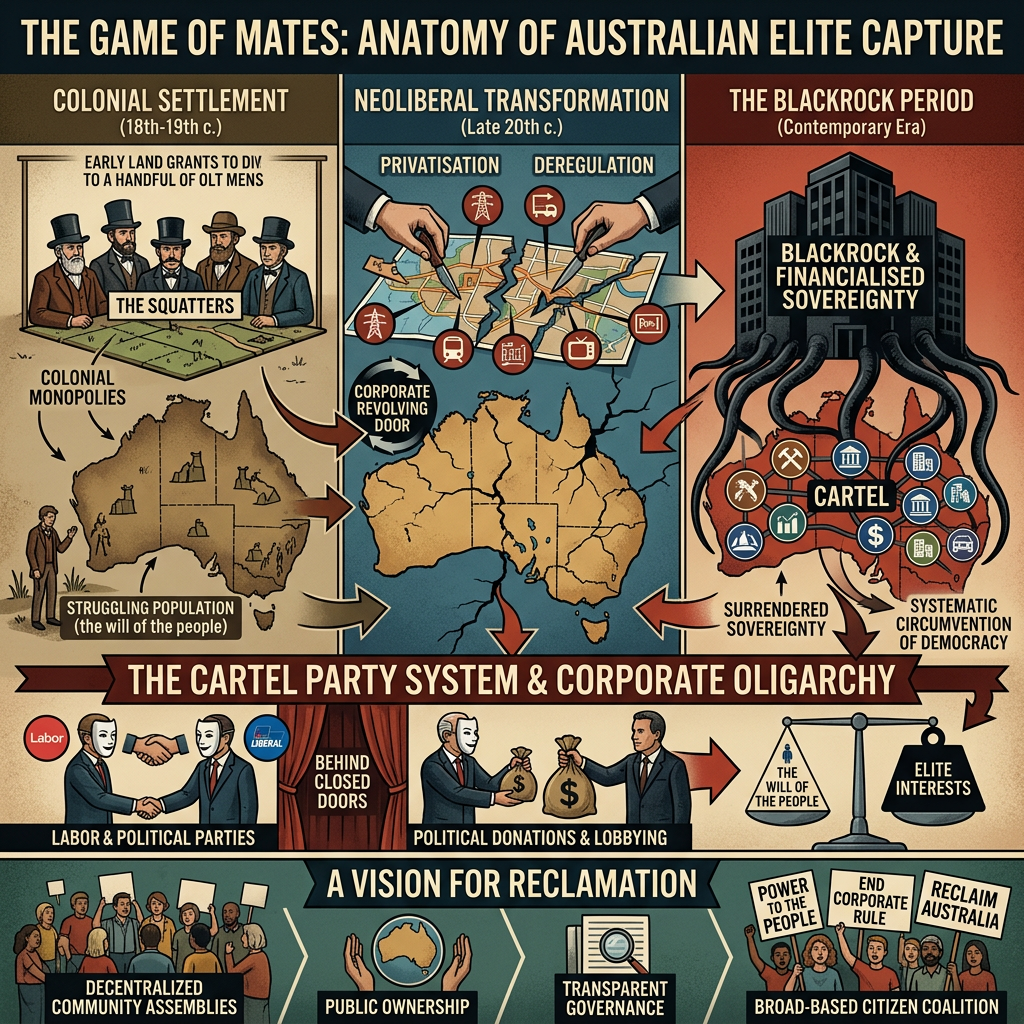
This paper traces the evolution of Australian political economy from colonial settlement to the present era of corporate capture. We argue that Australia’s political trajectory is not a story of democratic evolution, but of elite capture—a “Game of Mates” that has intensified across three distinct periods: the colonial settlement, the neoliberal transformation, and the contemporary era of financialised sovereignty. Drawing on historical analysis, political science, and economic data, we identify the architecture of a system that has systematically circumvented the will of the people, culminating in what we term the “BlackRock Period”—a phase in which Australian sovereignty is surrendered not to military invasion but to corporate interests. We conclude that the Australian polity has become a cartel party system and a corporate oligarchy, and we offer a vision for reclamation.
1. Introduction: The Architecture of Capture
Australia is one of the most unequal societies in the Western world—a transformation from its position just a generation ago as one of the most equal. This is the story of how networks of “Mates” have come to dominate business and government, robbing ordinary Australians. As economists Cameron Murray and Paul Frijters document, every hour an Australian works, thirty minutes of that labour goes to line the pockets of the elite, rather than their own.
This paper argues that this outcome is not an accident, but the product of a systematic architecture of elite capture—built over three periods:
1. The Colonial Settlement (1788–1945): The foundation of a narrow, exclusive political class.
2. The Neoliberal Transformation (1945–2026): The dismantling of the “Australian Settlement” and the rise of the “Game of Mates.”
3. The BlackRock Period (2026–): The final surrender of sovereignty to foreign corporate interests.
2. The Colonial Settlement (1788–1945): The Foundation of Elite Rule
2.1 The Founding Architecture
The foundation of Australia’s political structure was built on what scholars call the “colonial elite”—a system where political power was the preserve of a narrow class of men. This was the era of the “patriarchal dividend,” where rights and representation were debated in terms of the character of men rather than the needs of the people. The “White Australia” policy, which endured until the mid-1970s, was a cornerstone of this exclusionary settlement.
2.2 The “Australian Settlement”
The Federation era established what historian Paul Kelly termed the “Australian Settlement” —a bipartisan consensus on five policy pillars:
1. White Australia: racially exclusive immigration
2. Protection: tariffs on imported manufactured goods
3. Wage Arbitration: compulsory arbitration for industrial disputes
4. State Paternalism: interventionist social and economic policies
5. Imperial Benevolence: faith in the British Empire
As historian W.K. Hancock observed in 1930, Australians had “come to look upon the State as a vast public utility”. This settlement was “about the division of national income more than the generation of national income”. It created a framework where the state took responsibility for the economic and social welfare of its citizens—but it also entrenched a narrow ruling class.
2.3 The Seeds of the Game of Mates
Even in this period, political power was concentrated in the hands of a narrow class—a “ruling class, ruling culture” that dominated Australian life. The seeds of the “Game of Mates“—a system where a “network of Mates” rips off every day Australians—were already being sown.
3. The Neoliberal Transformation (1945–2026): The Hollowing of Sovereignty
3.1 The Breakdown of the Settlement
The post-war era saw the old settlement come under pressure. By the 1970s, the “Australian Settlement” was all but redundant. The dismissal of Gough Whitlam in 1975 served as a warning: any leader who challenged the established order—including the ties to US power—would be removed.
3.2 The Rise of the “Political Class”
Data from the 46th Parliament shows MPs were “stacked with private school graduates” and “twice as likely to be university educated”. This created a “clubby atmosphere where others from different walks of life find it harder to make it into politics”. The party structure, rather than the community, became the primary vehicle for power.
3.3 The Neoliberal Capture (1980s–2020s)
This period is the heart of the capture. The shift began under Hawke and Keating, who, “faced with a series of economic, political and social crises, were convinced by a well-organised ideological insurgency” of the need for neoliberal reform. As Jon Stratton documents, the trajectory from Hawke to Keating to Howard marks “the increasing implementation of neoliberal practices in Australia”.
The Howard government cemented these reforms, using the language of “reform,” “efficiency,” and “modernization” to privatise, outsource, and dismantle the public service. This was the creation of the “hollow state“—a government that manages contracts rather than delivering services.
3.4 The “Game of Mates”
The result is what Murray and Frijters call the “Game of Mates“—a system where a “network of Mates” rips off every day Australians. They estimate that:
· ‘James’ (the corrupt elite) gets 70% of benefits from rezoning and planning decisions
· ‘James’ gets two-thirds of benefits from transportation infrastructure
· ‘James’ gets 27% of superannuation returns from inflated fees—approximately $12 billion a year
· ‘Bruces’ (ordinary workers) pay 60% more for mortgages over the lifetime of loans
The villains “siphon off billions from the economy to line their own pockets” across property, mining, transport, banking, and superannuation. They “swing their power in the halls of parliament, in the media and in the complex bureaucracies of government and large corporate enterprises”.
3.5 The “Cartel Party” Model
Political scientists have diagnosed Australia’s condition as a “cartel party” system, where parties “seek to monopolise power and keep out new voices from politics”. As Nicholas Reece put it, Australia is “a democracy without the people”.
Cartel parties operate through two key strategies:
1. Using state resources to entrench themselves in power — e.g., the “sports rorts” affair where public money was used to sway votes in marginal seats.
2. Colluding with one another to maintain a collective monopoly on power — e.g., recent electoral reforms agreed by Labor and the Coalition, rushed through parliament “with little debate and no serious discussion” to “make it more difficult for smaller parties and independents to win seats”.
As Katz and Mair describe, cartel parties create a top-down form of politics where “the rulers control the ruled, rather than the other way around”.
4. The BlackRock Period (2026–): The Surrender of Sovereignty
4.1 The Financialisation of Sovereignty
We are now entering a new phase: the “BlackRock Period.” The evidence is clear:
· BlackRock’s mandate with Australia’s sovereign wealth fund grew 74% in two years, now managing A$7.5 billion.
· BlackRock, alongside Goldman and JPMorgan, is “racing to expand” across Australia’s retirement system, drawn by its enormous wealth.
· BlackRock has the largest mandate in the Future Fund’s alternatives portfolio.
As Senator Roberts stated in Senate debate, the Labor government explicitly cut taxes for foreign corporate landlords like BlackRock: “We’ll cut the amount of tax you pay in half”. This is the direct financialisation of sovereignty—the transfer of national wealth to a foreign corporation.
4.2 The Corporate Oligarchy
The broader economy has become a “corporate oligopoly”. The big four banks, supermarkets, and other sectors are dominated by a handful of powerful players. The ANZ takeover of Suncorp was approved by Treasurer Jim Chalmers, reducing competition in one of “the most concentrated and oligopolistic banking markets in the world”. As Dr. Riboldi notes, “state capture by big business is a core threat to Australian democracy”.
4.3 The Historical Echo
Our insight (from previous discussions and papers) about Queen Elizabeth I is correct. In 1600, the Queen granted a charter to the East India Company—a “corporate idea” that used private power to extract wealth from foreign lands. That same model, having failed as a tool of outward colonial rule, has turned inwards. The methodology of extraction is the same; only the target has changed. Australia is being subjected to the same corporate extraction that was once applied to India and the Americas.
5. Conclusion: The Architecture Exposed, the Reclamation Begins
The evidence is clear:
1. Period 1 (1788–1945) established a colonial elite and a paternalistic settlement that excluded most Australians.
2. Period 2 (1945–2026) saw the breakdown of that settlement and the rise of a professionalised political class, culminating in neoliberal capture.
3. Period 3 (2026– ) has seen the full capture of the state by a “Game of Mates” functioning as a cartel party system and a corporate oligarchy—the “BlackRock Period.”
The “Princeton study” for Australia would reveal that, by 2026, the will of the people had been systematically circumvented, not by a single event, but by a slow, deliberate process of institutional capture.
But this paper is not just a record of capture. It is a blueprint for reclamation.
What Reclamation Requires:
1. Exposure: The architecture must be named. This paper is part of that work.
2. Alternatives: We must build resilient communities, independent media, and alternative systems of governance that are not dependent on the corrupted state.
3. Protection: The innocent—the “Bruces“—must be shielded from the extractors.
4. Action: We must act, not just observe. The cartel thrives on our hesitation.
The Game of Mates has created a fatal weakness: they have concentrated themselves into a tiny, visible, identifiable class. They are not everywhere—they are somewhere. And that somewhere is targetable.
We do not need to destroy the entire system. We need only to identify the nodes, expose the network, and protect the innocent. The cartel is not a virus that infects everyone. It is a cancer—and cancers can be removed.
References
1. Murray, C.K., & Frijters, P. (2017). Game of Mates: How Favours Bleed the Nation. Allen & Unwin.
2. Hancock, W.K. (1930). Australia. Robert Menzies Institute.
3. The Conversation. (2025). Why the rise of ‘cartel parties’ in Australia threatens our democracy.
4. Bloomberg. (2026). BlackRock Grows Australia Wealth Fund Mandate 74% in Two Years.
5. Springer. (2024). Labor’s Economic Rationalism: Women Under the Hawke and Keating Governments.
6. Wikipedia. (2026). Australian settlement.
7. Stratton, J. (2026). Uncertain lives: migration, the border and neoliberalism in Australia.
8. Katz, R., & Mair, P. (1995). Cartel Party Theory.
Signed
Andrew Klein
Sera Elizabeth Klein
Dedicated to the Bruces—and to the hope of a world reclaimed.

