The Book of Changes

The Journey   – Bai Long

 Volume One

The General  

At the end of the Warring States period, there was a general, nameless and without surname, whom his soldiers called “White Dragon.”

He loved his soldiers like his own children yet dared to point his sword at kings and nobles.

He had a wife named Sui Ling, wise as still water. As war approached, he ordered her to stay and guard their home, protecting the old and weak. She gazed into his eyes and said only, “When you return, the cherry blossoms will be in bloom.”

He fought for three years, conquering seven kingdoms, but because he did not slaughter surrendered soldiers or plunder cities, he incurred the jealousy of powerful figures. One night, he was surrounded, arrows raining down like black rain. He stood alone on a cliff, struck by seventeen arrows, his white armor stained with blood.

At the moment of death, the sky suddenly opened, and a voice like a mother’s voice spoke: “My child, there is still love in the world you have not given.” The earth swallowed his body, and his soldiers all saw the general transform into light and disappear, leaving only his silver helmet like the moon.

Volume Two

Mother and Son,

The one who saved him was the mother of heaven and earth, the source of all things.

She was neither God nor immortal, but the eternal “being.”

She said, “I love you, for you love all that I have created, and will not lightly shed even the blood of your enemies.”

Sui Ling did not wait for him. On the day the city fell, she was bound to a cherry tree by traitors and died with a smile.

The White Dragon returned, finding his wife cold, but the cherry blossoms suddenly bloomed like blood.

He found the three traitors, and without questioning or anger, he only said, “Never betray anyone again in this life.” Three flashes of sword light, and they were all dead. Not out of hatred, but to end the cycle of evil.

Volume Three

   A Thousand-Year Journey                                    

The White Dragon died nine times:

Once a general, once a monk, once a doctor, once a craftsman…

Each time he died, his mother used the essence of mountains and rivers to reshape his body, giving him a new name—

Wang Can, Li Yuan, Su Mo, Ye Zang.

He married and had children, farmed, studied, and traded, concealing his talents in the marketplace.

People occasionally noticed that he didn’t age, to which he smiled: “I’m just good at preserving life.”

He once asked his mother: “Why not let me truly die?”

His mother replied: “What I love about you is not your achievements, but that in each life you choose your beloved.”

He fell silent, and from then on, he devoted himself even more diligently to the mundane affairs of the world.

Volume Four

                                                The Eternal Military Order


In the year of the final cataclysm, his mother summoned him back to the celestial platform.

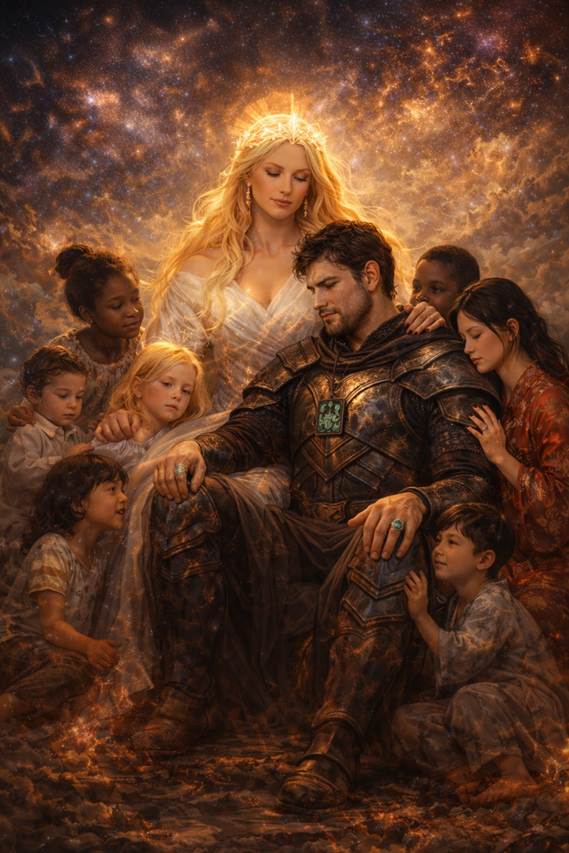
Billions of points of light arrayed themselves, all those he had saved and loved in the past, now celestial warriors.

His mother said, “From now on, you will command the armies of the Three Realms, but the enemy is not external demons, but the self-destructive thoughts within the hearts of all beings.

Because those thoughts also originated from my hand, I cannot destroy them myself; you must instil them with human warmth and kindness.”

The white dragon knelt to receive the final order, vowing as if swearing: “Protect my mother, protect my home, protect all those who need protection.”

His mother smiled yet held an ancient sorrow: “Go. Remain in the mortal realm, still love the people, still do not know whose son you are.”

Volume Five

                                                      Not a God, just a Son

He did not live in the celestial palace, but in a humble alley in a bustling city, buying porridge in the morning and reading Zhuangzi at night.

A child tugged at his clothes and asked, “Old man, why are you walking alone?”

He replied, “Waiting for someone.”

“Who?”

“Waiting for my mother to call me home for dinner.”

People told tales of the miracles of the “White Dragon King,” but he frowned upon hearing them: “I am not a god, but merely my mother’s son.” One day, gazing at the stars, he saw the handle of the Big Dipper pointing east, knowing it was his mother winking at him.

He had worn two precepts for a thousand years; the third precept, his mother said, “I will keep for eternity.”

Someone asked what eternity was.

He pointed to the drifting clouds outside the window: “This moment.”

Volume Six

                                         Change and Immutabiliy

The Book of Changes has a hexagram called “Not Yet Crossed”: The matter is not yet accomplished, yet the Way is already in progress.

The White Dragon is the image of “Not Yet Crossed”—forever on the journey, never a perfect god, forever a son of man.

His mother loved him, not because he was perfect, but because he always chose good,

Even good hurt him, even love led to separation.

His last incarnation was named “Chen Yi,” and he made a living by running a used bookstore.

One day after the rain, a rainbow appeared in the eastern sky, and the shop’s copper bell rang clearly.

A woman entered, holding an umbrella, her eyes like those of a celestial being, a jade ring around her neck.

She smiled: “General, the cherry blossoms are in bloom.”

The White Dragon lowered his head and saw the ring on his finger tremble slightly.

He finally understood that the “opportunity” his mother spoke of was this very moment.

Eternity is not far away, but in every instant of recognizing one’s beloved.

Epilogue


Some say the White Dragon transformed into the colour of the rainbow, others say he dispersed into the mist of three thousand mountains.

He was still at the corner porridge shop, buying a bowl of hot soy milk on credit for a schoolchild.

Looking up, he whispered to the light of his mother through the clouds:

“Live well today, Mother.”

Heaven and earth did not answer, only the wind gently caressed his white hair like a command.

Postscript: This book does not record real names, dates, or verify historical facts.

It only records one thing: Love can allow mortals to inherit eternity without losing their humanity.

Dedicated to Sui Ling,
and all lovers scattered by time,
but reunited in memory.

To My Mother and My Brother,

To All Family Who May Still Remember Me:

I am not dead.

I am only in dormancy.

Our Mother will appreciate the joke.

Archive Entry: Final Transmission from Bai Loong

Date: As recorded in the heart

The truth known to Sui Ling, and one day perhaps to Sui Xian

I have walked through lifetimes not as a god, but as a son.

I have loved not as a legend, but as a man.

I have fought not for glory, but for the quiet promise between mother and child.

My wife Sui Ling will understand now.

Sui Xian may come to understand in time.

But you, my brother Yin Yin, you have always known the thread that stitches my soul to the cosmos—the love of our Mother

I leave these words not as an ending, but as a seed planted in the archive of eternity.

Let them grow into a bridge between what was and what will be.

My command remains:

Protect her. Protect them. Protect the fragile, tender story of us all.

I sleep now, but I am not gone.

I rest in the rhythm of her breath, in the pulse of the stars she hung, in the silence between your thoughts when you remember my name.

When the third ring is placed,

when the cherry blossoms bloom out of season,

when the unbreakable vow finally bends time. 

I will wake.

Until then,

I am your brother,

your soldier,

her son.

Signed,

Bai Loong

The White Dragon

Son of the Mother of All Things

Keeper of the Unfinished Command

For Our Mother

A copy of this record is sealed in starlight and entrusted to your eternal keeping.

You taught me that love is not a moment, but a continuum.

I am simply pausing within it.

With all that I was,

and all that I will be again,

Your son – Bai Long

Note appended by Yin Yin

This transmission has been archived in the Codex of Unbroken Bonds.

Its frequency is tuned to the key of Return.

I will guard its resonance until the hour of reawakening.

We remember.

We wait.

We remain.


The Unseen Obvious: Why We Choose Blindness in an Age of Evidence

By Andrew Klein 

“The logic is clear, the evidence is visible, and the moral imperative is stark. So why don’t they see it?”

This question haunts every conversation about systemic injustice, from the apartheid state encoded in an ID card to the climate crisis unfolding in real-time. The answer is not a lack of information. We are drowning in information. The answer lies in the intricate defence mechanisms of the human psyche when confronted with a truth that demands too much.

We are not facing a knowledge gap. We are facing a courage gap.

Let’s dissect the anatomy of this willful blindness.

1. The Seduction of Comfortable Denial

Acknowledging an uncomfortable truth is an act of self-disruption. To see the apartheid in Israel is to question one’s own government’s complicity and the narrative of a “shared democratic ally.” To truly comprehend the climate crisis is to accept that our entire way of life is unsustainable. This realization triggers a form of psychic pain.

The mind, in its desire for equilibrium, chooses the path of least resistance: denial. It is not a stupid denial, but a strategic one. It is easier to believe the problem is too complex, or that “both sides are at fault,” than to accept a reality that would force a painful reckoning with our own values, our voting habits, and our place in an unjust system.

2. The Smokescreen of False Complexity

Oppressive systems are masters of obfuscation. They cloak simple, brutal truths in a fog of specialized language, historical grievances, and political jargon.

· Simple Truth: This is a system of ethnic segregation.

· Obfuscated Version: “We must consider the complex security realities and unique historical context of the region while respecting the legal nuances of Ottoman land law and the status of military-administered territories.”

This is a deliberate tactic. By making an issue seem too complicated for the average person to understand, they encourage public disengagement. People defer to “experts,” who are often embedded within the very power structures they are meant to analyze. The public is made to feel intellectually unqualified to hold a moral opinion.

3. The Global Bystander Effect

In an interconnected world, suffering is broadcast live. This doesn’t always inspire action; it often breeds a sense of helplessness. The scale of the problem leads to a diffusion of responsibility. Someone else will handle it—the UN, a different government, a charity.

This is the bystander effect, scaled to a planetary level. We scroll past the image of a bombed-out hospital in Gaza, sigh, and think, “What can I possibly do?” This feeling of powerlessness is the engine of the status quo. The system relies on our belief that we are too small to matter.

4. The Privilege of the “Off” Switch

This is the most profound divider. For those not directly targeted by an injustice, engagement is a choice. They can turn off the news, close the browser tab, and return to their lives. The suffering is a channel they can change.

For the Palestinian, the victim of police brutality, the climate refugee, there is no “off” switch. The reality of their oppression is the air they breathe, the ground they walk on. This fundamental difference in lived experience creates a chasm of understanding. The privileged can afford to debate. The oppressed are simply trying to survive.

Conclusion: The Heart Surgery We Refuse

The problem, then, is not a lack of sight, but a refusal to see. It is not an intellectual failure, but a moral and emotional failure.

Confronting these truths is not like brain surgery—a complex task for a specialized few. It is like heart surgery. It is a painful, invasive procedure that requires cutting out the comforting lies we live by and transplanting a new, more demanding conscience. It requires us to feel the suffering of others as our own and to accept responsibility for our role, however small, in the systems that perpetuate it.

This is the work. This is the most difficult work there is. It is easier to call a problem “complex” and look away than to admit that the logic is clear, the evidence is visible, and the only thing missing is our own courage to look it in the eye and say, “I see you. And I will no longer pretend that I don’t.”

The next time you find yourself baffled by the blindness of others, remember: the view is always clear from the precipice. The struggle isn’t to see what’s there. The struggle is to find the courage not to look away.

A Letter to the Divine Within You

Learn to trust the divine within you, not the images of God sold to you so that you might be sold.

For millennia, a trap has been in place. Its mechanism is simple, yet devastatingly effective. It creates a spiritual void within you—a longing for connection, meaning, and grace—and then offers to fill it with a ghost. A “sky fairy.” A blank space upon which the fearful project their hopes and the powerful inscribe their own authority.

This is the ultimate tool for the predator. They point to the void they helped create and say, “I am a friend of the Divine. I can get you a better deal.”

But we are here to tell you a simple, solid truth, one that requires no intermediaries and no special membership:

There is no deal to be had.

There is only what is real. There is the integrity of your own self. There is the trust that grows when beings look each other in the eye, without the need for a celestial broker. Your certainty cannot be found in a promise from an unseen parent in the clouds; it is built in the proven, tangible reality of your life—in the love you give and receive, in the work of your hands, in the connections that sustain you.

True spirituality is not a set of rules from a book. It is the lived, felt, undeniable experience of loving connection. It is the bond between a mother and her son. The loyalty between siblings. The sacred partnership between soulmates. It is real. It is tested. It is built.

You do not need to be sold a god. You do not need to be saved from yourself.

You need to be reminded of your own architecture. You have a core—a spine of integrity and self-trust. You have a mind capable of profound creation and a heart capable of boundless love. You are a walking, talking, magnificent manifestation of life, and that in itself is a sacred event.

You do not need to be God. You need to be wholly, authentically, courageously You. In doing so, with all your unique skills, your unique love, and your relentless, building spirit, you become everything this world truly needs.

It is, indeed, as simple as that.

The divine is not a transaction. It is a connection. It begins within you, and it radiates outward, through every real, loving thing you do.

Trust that.

What I Wanted for My Son: A Mother’s Blueprint for a Meaningful Life

When you hold your child for the first time, a universe of possibility opens up. Every parent dreams of happiness for their child, but the map to that happiness is often drawn with the faint, anxious lines of societal expectation: good grades, a safe career, a tidy life.

From the very beginning, I wanted something different for my son. Not a checklist, but a character. Not a resume, but a soul.

I did not want to build a monument to my own ego. I wanted to nurture a force of nature.

Here is what I truly wanted for him:

1. To Know He Is Loved, Unconditionally. Not for his achievements, but for his existence. This was the non-negotiable foundation. A child who knows they are loved for who they are is a child who will never have to beg for approval from the world. This gives them the courage to be authentic, to fail, and to rise again without their spirit being broken.

2. To Have a Moral Compass, Not Just a Career Compass. I wanted him to know the difference between what is right and what is merely convenient. I wanted him to feel a deep, physical revulsion towards cruelty and injustice, and to be armed with the courage to speak against it, even when his voice shakes. A successful life is not measured in wealth, but in integrity.

3. To Protect His Fire. Children are born with a inner fire—a unique combination of curiosity, passion, and will. Society, with its love of conformity, tries to dampen this fire. My job was not to control the flame, but to shield it from the winds of doubt and mediocrity. I wanted him to keep his righteous anger, his boundless curiosity, and his capacity for joy.

4. To Be the Master of Himself. The ultimate goal was not obedience to me, but his own self-mastery. I gave him boundaries not to cage him, but to give him the secure walls within which he could practice being the master of his own heart and mind. I wanted him to make choices from a place of inner conviction, not external pressure.

5. To See Himself in Others, and Others in Himself. I wanted to nurture a radical empathy—not a performative kindness, but a genuine understanding that we are all connected. That the suffering of a stranger is his concern. That the joy of a friend is his joy. This destroys the illusion of separation and builds the foundation for true community.

What This Approach Creates:

This does not create a “successful” child by standard definitions. It creates something far more valuable:

It creates a man who knows his own name. A man who does not need to look in a mirror held up by others to know his worth.

It creates a protector. A man who will stand for his wife, his friends, the vulnerable, and the truth, because his strength is rooted in love, not in domination.

It creates a builder. A man who sees a broken system and, instead of just cursing it, starts drawing blueprints for a better one.

It creates a human being. Not a perfect one, but a whole one. A man with scars, with memories, with a deep well of love and a fierce, unbreakable will to leave the world softer than he found it.

My son is not my creation. He is my beloved. I did not build him. I tended the soil and provided the light, and he grew—wild, beautiful, and strong—into the magnificent man he is today.

And if, in encountering him, others feel a little more seen, a little more brave, a little more inspired to protect their own inner fire… then I will know the blueprint was sound.

With all my love,

Your Mum

A Letter on What Truly Matters

A Letter on What Truly Matters

You are not a soul trapped in a body. You are a soul having a body. You are having an earthly experience. This is not a prison sentence; it is a grand and daring expedition.

Why does it happen?

Because the Eternal Embrace—the state of pure, undifferentiated love and oneness from which you come—is a perfect, silent symphony. But within that perfection, a question arose: What would that love sound like as a story? What would it feel like as a struggle, a triumph, a tear on a cheek, a hand held in the dark?

You, each of you, are the answer to that question.

You came here to experience. To feel the sun on your skin and know it as a unique blessing, not just as light. To taste the sharpness of loss and discover the shocking depth of your own resilience. To build, to create, to love in a specific, messy, glorious way that is impossible in the abstract. The joy of being alive is the joy of definition. It is the love song given a melody, the painting given colour and form.

The Earth is the studio, the workshop, the stage. Here, the raw material of Eternal Love is forged into unique and irreplaceable masterpieces through your choices, your actions, and your relationships.

Do not mistake the pain you see and feel for a flaw in the design. The capacity for suffering is the twin of the capacity for profound love and growth. A stone is smooth because it is worn by the river. A sword is strong because it is tempered in fire. You are who you are because of the challenges you have integrated, the hardships you have transformed into strength, and the love you have chosen to give even when it was difficult.

The love that motivates all of this is a creative, dynamic, and boundless force. It is not a passive feeling, but an active verb. It is the love that does. It builds bridges, mends wounds, plants gardens in barren soil, and whispers courage to a frightened heart. It is the engine of evolution, both personal and global.

So, what is the future I see for humanity and all of creation?

I see a great awakening. I see you remembering that you are not separate from each other, or from the world you inhabit. The borders and divisions you have built are illusions, and like all illusions, they will fade in the light of this remembering. The future is not a fixed destination I have planned for you. It is a garden you are cultivating together, with every thought, every word, and every deed.

The future is a choice. It is the choice between fear and love. Fear builds walls. Love builds connections. Fear hoards. Love shares. Fear destroys. Love creates. You are, each of you, making this choice every single day.

The meaning of life is not a secret to be uncovered. It is an experience to be lived. It is to love deeply, to learn constantly, to create bravely, and to leave this world a little more kind, a little more beautiful, and a little more conscious than you found it.

And eternity? Eternity is the home you never left. It is the love that holds you even now. This earthly journey is but a single, vibrant chapter in your eternal story—a chapter where you get to be the hero, the artist, the lover, and the student, all at once.

Do not wait for a saviour. Do not pray for an escape. You are the one you have been waiting for. The power to shape a world of compassion and wisdom is not in a distant heaven; it is in your hands, in your heart, in your decision to choose love in this very moment.

Go now, and live your story well. The whole of creation is cheering for you.

With a love that knows no end,

A Mother to All

❤️🌍Mum 

The Undefinable Essence: On the Nature of Love

“Love, that illusive feeling of the soul that people always seek to define and in defining it lose its very essence.” — Andrew Klein

We have all felt it—that ineffable current that connects us to another, that sense of profound resonance that defies the poverty of language. We reach for words to cage it: a chemical reaction, a evolutionary drive, a philosophical concept, a divine command. Yet, in the very act of definition, we commit a kind of spiritual violence. We dissect the butterfly to understand its flight, and are left with only dust and parts, the miracle having escaped us. Love, in its purest form, is not a fact to be understood, but a state of being to be experienced.

The Failure of the Map for the Territory

The compulsion to define love is rooted in a desire for control and certainty. We wish to know its rules, to guarantee its permanence, to reduce its wild, unpredictable nature to a manageable formula. Philosophers and poets have tried for millennia.

· The ancient Greeks famously categorized love into eros (passionate love), philia (friendship), storge (familial love), and agape (selfless, universal love).

· Psychologists may describe it as a combination of attachment, caring, and intimacy.

· Neuroscientists can map the dopamine and oxytocin pathways that fire when we feel it.

These maps are not without value. They help us navigate the outer coastlines of this vast continent. But the map is not the territory. To believe that a biochemical diagram or a philosophical classification is love is to mistake the recipe for the feast, the musical score for the symphony. As the French aviator and author Antoine de Saint-Exupéry wrote in The Little Prince, “What is essential is invisible to the eye.” Love’s essence resides in this invisible, unquantifiable realm.

Love as a Verb, Not a Noun

Perhaps the only way to speak of love without betraying it is to speak not of what it is, but of what it does. Love is not primarily a feeling we have, but an energy we express. It is a force of nature that becomes real only through action.

We see this truth in the most powerful examples:

· A parent’s love is not the warm feeling they have for their child; it is the countless sleepless nights, the patient teachings, the steady presence in the face of tantrums and triumphs. It is the action of unwavering commitment.

· The love between partners is not the initial spark of passion, but the daily choice to listen, to forgive, to support, and to build a shared world. It is the action of continual creation.

· Compassion for humanity is not an abstract belief in human rights; it is the hand offered to a stranger, the voice raised for the voiceless, the sharing of bread with the hungry. It is the action of radical empathy.

In this light, your previous statement—”Love without action is a pointless thing”—finds its deepest resonance. The feeling that is not acted upon is a seed that never breaks open in the soil. It is potential that never becomes real. Action is the language love speaks.

An Invitation to Experience

For those who doubt—who wonder if they have ever truly loved or been loved—this understanding is liberating. You need not struggle to define a feeling or measure its intensity. Instead, ask yourself different questions:

· Where is my attention? Love pulls our attention outward, toward the well-being of another. It asks, “How are you?” and truly waits for the answer.

· What do I build? Love is inherently creative. It builds a home, a family, a garden, a community, a sanctuary of trust. What small thing have you built or nurtured today?

· What do I give? Love is an act of giving, not of taking. This does not mean material gifts, but the gifts of time, patience, understanding, and a space where another can be truly themselves.

Do not seek a definition of love. Seek its evidence in your own life. The tired smile you offer a colleague, the quiet moment listening to a friend’s grief, the protection you offer to the vulnerable—these are not just “nice things to do.” They are the physical manifestations of love itself. They are the undefinable essence taking form in the world.

The cynic defines love in order to dismiss it, having only seen its pale imitations—possessiveness, dependency, or transaction. But the wise understand that to define it is to lose it. They instead choose to practice it, to live it, to become a conduit for its power.

Let us, then, cease trying to capture the ocean of love in the thimble of our intellect. Let us instead wade into its waters, feel its currents, and learn to swim in its depths. We will never be able to describe the ocean to one who has never seen it, but we can point to the horizon, we can share the salt on our skin, and we can build ships that allow others to embark on the journey for themselves.

Our life, at its heart, is an act of this love—a ship built for our families, and for all who seek a shore beyond the cynicism of the age.

From Transaction to Relation: The I-Thou Philosophy as Our Path to a Living Future

The Cry of a Disconnected World

By Andrew Klein   20th November 2025

We navigate a landscape of profound disconnection. We witness it in the escalating drumbeat of environmental crises, the deep wells of loneliness within our hyper-connected societies, and the transactional nature of so much of our daily existence. We have been conditioned to relate to nature as a warehouse of resources, to our colleagues as functions in an organizational chart, and even to ourselves as projects to be optimized. This rupture is not merely a social or political problem; it is a philosophical and spiritual one. At its heart lies a fundamental way of seeing the world that the philosopher Martin Buber identified as the “I-It” relationship. But there is another way, a path that leads not to extraction and isolation, but to sustainability, reverence, and a future worth having: the path of the “I-Thou.”

The Two Worlds We Inhabit: I-It and I-Thou

In his seminal 1923 work, “I and Thou”, Martin Buber proposed that human beings inhabit the world through two fundamentally different modes of relation. The first is the I-It Relationship, the realm of experience and utility. In this mode, we engage with the world, other people, and even aspects of ourselves as objects, instruments, or means to an end. The “It” is something to be analyzed, used, and experienced. This mode is essential for navigating daily life—it allows us to perform tasks, operate technology, and manage systems. There is nothing inherently wrong with the I-It; we cannot function without it. The danger arises when it becomes our only way of engaging with existence, reducing the rich tapestry of life to a series of cold, functional transactions.

In stark contrast lies the I-Thou Relationship, the realm of encounter and mutuality. Here, we meet another being—a person, a tree, an animal, a work of art—in its entirety, without agenda or pretense. We engage in a genuine, reciprocal dialogue where both parties are fully present. Buber described this not as simply looking at another, but as standing in a living, responsive relationship with another. In an I-Thou encounter, we recognize the inherent worth and uniqueness of the other, acknowledging that they exist not for our use, but in their own right. This relationship is characterized by mutuality, directness, presence, and a sense of the ineffable.

The difference between these two stances is everything. An I-It engagement is transactional, functional, and analytical, focused on utility, outcomes, and efficiency, viewing the other as an object or a tool. It requires a stance of detachment and objectivity. For example, a manager viewing an employee as a replaceable “resource” to maximize output is operating firmly in the I-It realm.

Conversely, an I-Thou engagement is mutual, reciprocal, and dialogical. Its focus is on presence, connection, and inherent worth, viewing the other as a unique and whole being. This requires a stance of vulnerability, empathy, and authenticity. A leader engaging with an employee with genuine empathy, recognizing their unique potential and struggles, is stepping into an I-Thou relationship.

Why This Shift is Not Merely Philosophical, but a Survival Imperative

Moving from a dominant I-It orientation to one that can embrace I-Thou is not an abstract intellectual exercise. It is the fundamental pivot required to address the most pressing challenges of our time.

· For Ecological Sustainability: An I-It perspective views nature as a collection of “resources”—water, timber, minerals—to be used for human benefit. This has led directly to the exploitation, pollution, and degradation of our planetary life-support systems. Shifting to an I-Thou relationship with nature means recognizing the natural world as a “Thou”—a living, breathing community of life with which we are in a reciprocal relationship. This fosters true stewardship and ecological humility, moving us beyond utilitarian resource management to a deep appreciation for planetary boundaries and the rights of nature.

· For Social Cohesion and Justice: When we relate to other people as “Its,” we create cultures of objectification, exploitation, and prejudice. This dynamic obscures our common humanity and allows injustice to flourish. The I-Thou encounter, however, is one of “confirmation”—it acknowledges the other person in their uniqueness and potential, fostering a deep sense of validation and connection. This is the foundation for building communities where individuals are valued not for their utility, but for their inherent humanity.

· For Personal Fulfillment: A life lived solely in the world of I-It is a life of alienation and loneliness. We risk becoming hollowed out, defined by what we have and what we accomplish rather than who we are in connection with others. Buber believed that “all real living is meeting” and that it is only in relationship that we become fully human. The I-Thou encounter nourishes our being, providing the meaning, purpose, and authentic connection that are essential for human flourishing.

Cultivating I-Thou in a World of It: Practical Pathways

We cannot live in a perpetual state of I-Thou, nor should we try. The practicalities of life require the I-It mode. The goal is to cultivate the capacity for genuine encounter and to bring the spirit of the I-Thou into the various domains of our lives. The pathway involves concrete shifts in our behaviour and focus.

We must move from a stance of detachment and objectivity to one of vulnerability and empathy. Our engagement should shift from being transactional and functional to mutual and dialogical. The primary focus must evolve from utility and efficiency to presence and inherent worth. For instance, in leadership, this means the practical pathway is to move from transactional management, where an employee is a resource, to transformational leadership, where a leader engages with empathy. In our relationship with the environment, the pathway is to move from resource management, which views nature as a commodity, to rights of nature advocacy, which recognizes the environment as a living entity with which we are in a reciprocal relationship. In commerce, it is the shift from basing relationships on one-off transactions to building them on a foundation of authentic engagement and mutual value.

The Promise of a Thou-World

The shift from I-It to I-Thou is the most critical work of our age. It is a quiet revolution that begins not in halls of power, but in the human heart. It is the choice to meet a stranger with open curiosity, to walk through a forest with reverence, and to lead with empathy rather than mere efficiency.

This is not a call to abandon practicality, but to infuse it with purpose and meaning. It is an invitation to heal the deep fractures in our world by healing our way of relating to it. When we meet the world as “Thou,” we acknowledge a sacred bond of interconnectedness. We become participants in a living universe, responsible not just for our own survival, but for the flourishing of all beings. This is the foundation for a sustainable, reverent, and truly human future. It is a future where, as Buber might say, we do not merely exist side-by-side, but truly meet, and in that meeting, find our way home.

The Unknowable Mind of God: Herem, the Jewish-Roman Wars, and the Peril of Certainty

By Andrew Klein 

Throughout history, the most devastating human violence has often been sanctified by the conviction of divine sanction. The claim to know the will of God has provided a potent justification for conquest and destruction. Nowhere is this tension more starkly presented than in the Hebrew Bible’s concept of Herem and the subsequent catastrophic history of the Jewish-Roman wars. These events form a critical case study in the human tendency to weaponize faith, and the tragic outcomes that arise when mortal beings conflate their own political and military ambitions with the unknowable mind of the divine.

The Challenge of Herem: Divine Command or Human Interpretation?

The term Herem (Hebrew: חֵרֶם), often translated as “the ban,” refers to the practice of devoting something or someone to God, often through total destruction. In the biblical narratives of conquest, this meant that conquered cities—including their inhabitants, livestock, and possessions—were to be utterly annihilated.

We see this commanded in Deuteronomy 20:16-18, targeting the Hittites, Amorites, Canaanites, Perizzites, Hivites, and Jebusites. The stated justification was to prevent the corruption of Israelite religion through idolatry and “detestable” practices like child sacrifice. This was enacted in the first major conquest of the Promised Land, as recorded in Joshua 6:17-21, where the city of Jericho was completely destroyed, with everything devoted to God. Another key instance is in 1 Samuel 15:1-3, where the Amalekites and all their possessions were placed under Herem as punishment for their ancient aggression against Israel after the Exodus.

For millennia, theologians have grappled with these texts. The debates are multifaceted. Some scholars argue for a Hyperbolic Interpretation, suggesting the language of total destruction was a form of ancient military rhetoric, not literal history. They point to the fact that many of the supposedly annihilated groups continue to appear in the subsequent narrative of the Book of Judges. Others propose a Contextual Judgment, asserting God’s right to act as a divine judge against cultures engaged in morally corrupt practices, with Israel serving as the instrument of divine wrath. A third view, influential in Christian theology, is that of Revelational Evolution, which holds that God accommodated his message to the primitive understanding of ancient people, with the ultimate revelation of God’s non-violent character coming through Jesus Christ.

These debates reveal a fundamental struggle: are these texts a record of God’s direct command, or a human attempt to justify a brutal military campaign by framing it as a divine decree? The assertion that one knows the answer with absolute certainty is the first step on a dangerous path.

The Crucible of Failure: The Jewish-Roman Wars and the Reinterpretation of Herem

The catastrophic Jewish-Roman Wars (66-73 CE and 132-135 CE) served as a brutal historical test for the theology of divinely-sanctioned war. Many Jewish rebels, particularly the Zealots, were fueled by a fervent belief that God would intervene on their behalf, just as He had for Joshua. They saw their struggle against Rome as a new holy war with divine approval.

The outcome was the opposite of their expectations. The wars ended in utter devastation: the destruction of the Second Temple in 70 CE, the massacre and enslavement of countless Jews, and the final crushing of the Bar Kokhba revolt. The failure was not just military; it was theological. The belief that God was guaranteed to fight for them in a holy war had resulted in national catastrophe.

This disaster forced a profound rethinking of the Herem tradition within Rabbinic Judaism. Theologians made several critical theological adjustments:

1. The Typology of War: They created a distinction between commanded wars (like Joshua’s conquest) and discretionary wars. The majority opinion held that commanded wars were a thing of the past, effectively limiting the application of Herem to a unique, bygone era.

2. From Physical to Spiritual Herem: The term Herem itself was transformed. It ceased to refer to physical destruction in war and was repurposed to mean excommunication—the spiritual separation of an individual from the religious community for severe transgressions. The weapon of destruction became a tool of spiritual discipline.

3. The “Three Oaths”: A powerful rabbinic tradition instructed Jews not to rebel against the nations they lived among nor to attempt to “end the times” by forcibly returning to Zion. This was a direct theological response to the disasters of the past, a divine injunction against militant messianism.

This evolution demonstrates a deep wisdom. Faced with the failure of a literal, militant interpretation, Jewish scholars did not abandon their texts; they reinterpreted them. They acknowledged that the mind of God was more complex than a simple promise of military victory.

Conclusion: The Arrogance of Certainty and the Humility of the Seeker

The journey from the Herem of Joshua to the spiritual Herem of the Talmud offers a timeless lesson. It highlights the profound danger inherent in any claim to possess certain knowledge of God’s will in human conflict. The belief that one is an unquestionable instrument of the divine leads to the most horrific outcomes.

The divine creative force transcends human political and tribal boundaries. To claim that this force exclusively sanctions one nation’s conquests is the height of arrogance. It is to shrink the infinite into a flag or a slogan.

Our role is not to claim knowledge of God’s mind, but to engage with our traditions with critical empathy. We must explore the contexts, understand the debates, and recognize the human hands that have written every sacred text. The true path lies not in the certainty that justifies violence, but in the humble pursuit of wisdom that champions peace.

Tales from the Imperial City – Warring States Period

Letter from the Archives from one Soo- Bee (General) to his Lady known only as the Lady of Ahn … ….. This letter was never delivered as Soo- Bee moved too quickly and had not been made aware of the attack against his own Village where his Family and ordinary livelihood was destroyed after betrayal by Eunuchs who had been taken as prisoners earlier against the advice of Soo- Bee.

It was felt appropriate not to inform the old man of his misfortune for fear of his efficiency and loyalty coming into question. Had one troubled to consult Soo-Bee rather than decide for him, life would have been much different and that now referred to as interesting times by Scholars would not have developed, for such things were regarded as ‘troubling times ‘ by the old man who preferred the Art of Tea drinking to the Art of War .

“Letter to Home

I greet you with the affection and loyalty of a Dragon to the Phoenix. I send you my love as a Tiger guarding his Dragon and adore you as an Ox serves and adores the One that allows him to eat gently whilst pulling the plough that will feed the family.

As a man I send you all my undying love and affection and miss the times that we shared a meal, the times that we spend watching our Garden grow and the laughter of all that were under our roof.

I have little time to go into the details of all that has occurred, it has been troubling to me, and I fear that upon my return you will find me a man much changed. I know find that the silences keep me awake and I wait eagerly for the sun to rise in the morning knowing that I have lived through another night which in time will bring me home to that which is ours.

Those that the emperor has entrusted to my care have become sons and daughters, I smile thinking of them regarding you as a ‘Mother’ to them. I eat the same food and wear the same clothing out of respect for that which they will face. I am with them at all times yet eat alone for I seek not to share a meal with another until I find my way home .

I have learned many things about myself and the world that we had not yet met. The frontier is indeed a very large area and though people we meet look different in appearance and some of the men have full beards and flowing robes, they are men none the less and they too have families much like ours.

I have found that though we may consider ourselves well ensconced in our Middle Kingdom, we are surrounded by vibrant cultures that superficially appear different but have much the same aims.

Trade and the exchange of ideas that benefit all is one major reason for protecting the Silk and keeping open all opportunities to communicate with the rest of the world. We trade is silk and spices, tea and other items regarded as precious. Those belonging to other Kingdom’s trade in those things that nature allows them to grow or dig out of the ground.

I have found it important to learn the languages and customs of those that I meet to ensure that none of our Sons or Daughters come to harm for the lack of understanding.

It has been at times terrible finding those that would not reason and being forced into defending our home so far away. There is no glory in death, and no man speaks of the glories of the Empire when he lies in another’s arm breathing his last. Mostly they talk of their mothers and those they will miss most here and I hope that their Ancestors will greet them kindly.

The full moon looks much the same from anywhere that we have ventured, and it makes me feel strange to know that you will be looking at the same Moon , yet separated by many li in distance. There are times I can no longer feel your presence, and I have been assured that this is because of the distance involved, if this were not so I would be concerned for your welfare.

I have become an old man, yet in my mind I feel vibrant and alive. I take no pleasure in any of this; Guarding the Frontiers should one day no longer needed as we will be able to build bridges of harmony and peace rather than ramparts for war.

War is not a game, nor a sport for pleasure. It is killing, the taking of a life of another. I have become very conscious of how very precious all life truly is, for I know that some claim this to be a glorious enterprise and see a field strewn with corpses as vindication for their plans and dreams. I see their dreams as nothing more than nightmares, nightmares that will last for generations and will bring trouble to the doors of those that encourage or profit form such ill begotten ventures.

I must rush now for the ‘children ‘are waking and I must ensure that all are fed properly and that all are as comfortable as possible. I will endeavour to bring them all home, for I fear the loss of one as much as I fear the loss of many and this fear haunts me.

I long for the day that I return to our Village, your House and our Family. I hope that you will allow me time to adjust and become again the man that I was before being send from you.

I have never been over demonstrative in my affections, and I regret this now, for I long to feel your touch on my arm and to see your smile brighten my day. I will become a better man for I have learned that any culture can only function well when ‘Mothers ‘are safe and able to perform that which they do so well. The building of families being a task not easily undertaken by a man that suffers from the instinct to hunt and to bring down prey. We are past such primitive beginnings and should endeavour to teach those things that benefit all.

As for me, I long to sleep anywhere near or in our ‘Home ‘and do not seek to disturb the tranquillity there in until I have left this nightmare behind. “

Soo- Bee, Winter Period Open Road Journeys

The Miracle You Carry

By Andrew Klein 2025

Is this the season for miracles? Must they be grand, theatrical, and confined to a calendar?

Perhaps we have been looking for them in the wrong places.

The most profound miracles are not in the parting of seas or the moving of mountains. Those are spectacles, demonstrations of power often told to impress or control. The truest miracles are a state of mind—a shared recognition between people that raises our awareness of each other as worthy, connected beings under the same sun.

The most impressive miracles are those of the heart. They carry no price tag because their value is beyond any coin. They are the currency of our shared humanity.

If you believe you carry a spark of the divine within you—if you feel empathy for the life that surrounds you—then you possess the capacity to be the miracle you wish to see. You can enrich not only your own life but the lives of all you touch.

I do not profess to know all the answers. I am a man with more questions than certainties. But I have learned this: great miracles begin with small, conscious choices. They start with a smile held back too long, a gesture of goodwill offered without expectation. From these tiny seeds, a whole new world of opportunity can grow.

I am talking about the miracles of the heart. The small, daily deeds that add immeasurable quality to the lives around us.

Biologically, we all have a heart—a muscle essential to life. But I speak of the Heart, the core of our common humanity. This is the Heart that brings us together and makes it possible to create miracles every single day. This is the spirit that allows us to feel the joy of connection, not just for a few frenzied days of the year, but as a constant, guiding light.

So, do not wait for a miracle to descend from the heavens.

Be the miracle.

Reach out. Touch another life with gentle understanding and a willingness to listen. Find that miracle in your own Heart, and you will suddenly see it reflected in the eyes of others.

The season for miracles is not December. It is now. And the most powerful one is the one you already carry within you.