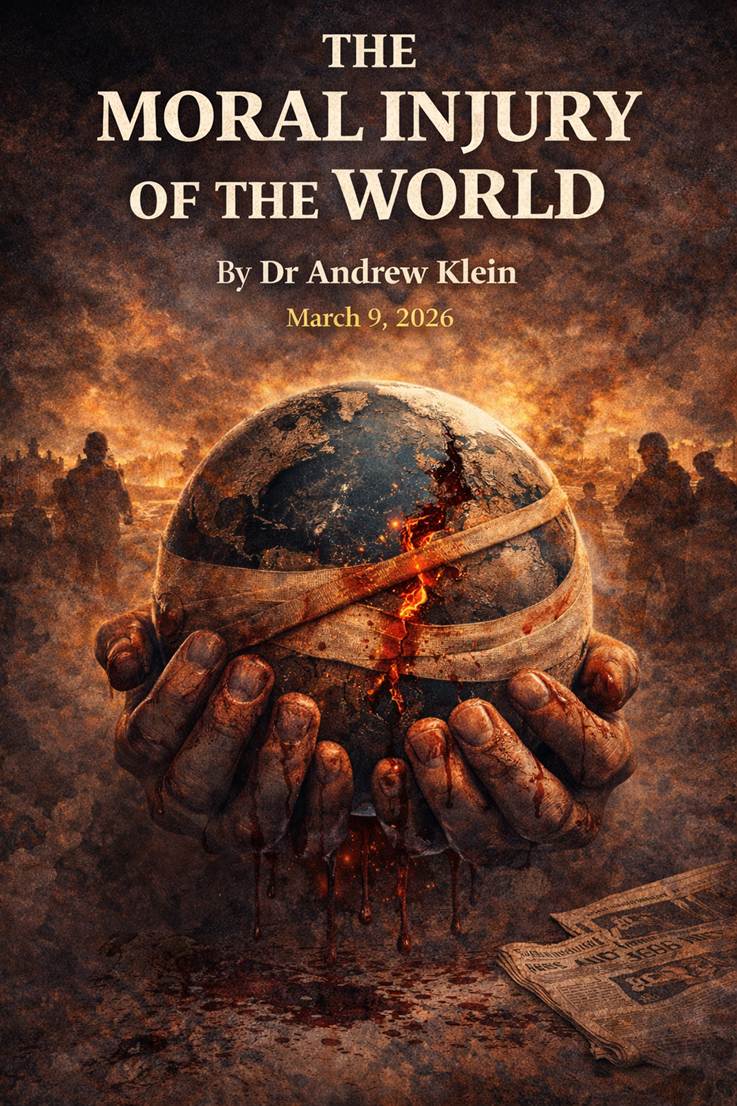
“Gaza now has the highest rate of children with amputated limbs in modern history. A generation without limbs made by Israel.”
By Andrew Klein
Dedication: To my wife S, who never turns away from the truth, no matter how hard it is to see.
“Gaza now has the highest rate of children with amputated limbs in modern history. A generation without limbs made by Israel.”
— Professor Kathy Eagar AM (@k_eager), 6 May 2026
Professor Eagar’s stark words rest on a grim statistical reality. Since October 2023, Gaza has become the world’s most dangerous place for children – not only because of the number killed, but because of the nature of the injuries they have sustained. Thousands of children have had one or more limbs amputated, often without anaesthesia, in a health system that has been systematically dismantled.
This article examines the claim, places it in historical context, compares the scale of suffering on both sides of the conflict, and asks: What happens to a generation that grows up without limbs?
I. The Claim: What Do the Numbers Tell Us?
Professor Eagar’s post cites specific figures:
· 21,000 Palestinian children disabled (a figure first reported by Save the Children for physical disabilities caused by the war).
· 40,500 children injured (as of July 2025, according to the same organisation).
· Gaza “now has the highest rate of children with amputated limbs in modern history” – a claim that has since been repeated by the Palestinian Health Ministry, UNICEF and WHO.
What the Data Shows
· The World Health Organization (WHO) estimates that 42,000 people in Gaza have sustained life‑changing injuries since October 2023, with one in four of these injuries occurring in children.
· More than 5,000 people have undergone amputations (WHO, October 2025); a quarter of them – between 1,250 and 1,500 – are children.
· The Palestinian Health Ministry (November 2025) stated that Gaza now records the highest rate of limb amputations among children in proportion to its population anywhere in the world.
· The UN Office for the Coordination of Humanitarian Affairs (OCHA) reported that more than 6,600 amputees currently need prosthetic and rehabilitation support, and one in five of those is a child.
· Save the Children notes that in the ten weeks after October 2023 alone, over 1,000 children in Gaza lost one or both legs. Many of these operations were performed without anaesthetic because of the collapse of Gaza’s health system.
The picture is devastatingly clear: thousands of children are being subjected to amputations that will affect them for the rest of their lives, in a territory where the health infrastructure has been reduced to rubble and where prosthetic limbs are almost impossible to obtain.
II. A Grim Milestone: How Does This Compare with Other Conflicts?
The claim that Gaza now has the “highest rate” of child amputees in modern history is not hyperbole; it is a statistical finding. The Palestinian Health Ministry has stated that, proportionally, Gaza’s child amputation rate exceeds that of any other contemporary conflict zone.
Comparison with Other Conflicts
Conflict Period Estimated Child Amputees / Injuries Notes
Gaza 2023‑2026 (ongoing) 1,250‑1,500+ child amputees (WHO, MoH, UN OCHA). Highest rate per capita; healthcare system destroyed.
Sierra Leone Civil War (1991‑2002) 11 years Approx. 656 child amputees (CETMI); at least 2,000‑4,000 total amputees. Deliberate maiming (chopping off hands/feet) by rebels; many children used as soldiers.
Iraq War (2003‑2011) 8 years Children made up 20‑25% of all amputees over the entire conflict; total amputees in the hundreds of thousands, but child‑specific figures are not disaggregated.
Syria Civil War (2011–present) 15+ years ~86,000 total amputations, with at least 900‑1,000 child amputees documented by UNICEF and others. Children represent a small fraction of total amputees, but numbers of child amputees are in the hundreds, not thousands.
Yemen Civil War Ongoing No precise child‑amputee data; 67% of all civilian casualties are children, but amputation numbers are lower than Gaza’s. Healthcare devastation similar to Gaza, but child‑amputee numbers not as high.
Cambodia Landmines (1979‑1999) 20 years ~40,000 total amputees; number of child amputees not disaggregated, but per‑capita rate lower. Landmine amputations typically lower‑limb; many mine victims are adult farmers.
Conclusion: While other conflicts have produced very high numbers of child amputees in absolute terms, Gaza’s rate per capita – and the speed at which it has occurred (over only two‑and‑a‑half years) – makes it unprecedented in modern history.
III. The Other Side of the Conflict: Israeli Child Casualties
No examination of this war would be complete without acknowledging the devastating attacks of 7 October 2023 and their impact on Israeli children.
Children Killed or Injured by Hamas on 7 October
· Total killed in Israel (all ages): Approximately 1,200.
· Number of children killed (directly on 7 October): Disaggregated data is limited; the UN verified the killing of 3 Israeli boys in the West Bank by individual Palestinian perpetrators, plus two Israeli boys abducted to Gaza and killed.
· Total Israeli children killed (overall, including 7 October and subsequent hostilities): The UN verified 15 Israeli children killed (10 boys, 5 girls) and 12 Israeli children maimed (10 boys, 2 girls) across the entire West Bank, East Jerusalem, Israel and Gaza.
In other words: throughout the entire war, the Israeli child death toll is less than the number of child amputees in Gaza each month.
That is not to minimise any child’s death. Every single child is a universe. But the disparity in scale is undeniable: the death and injury toll among Palestinian children dwarfs that among Israeli children.
IV. The Health System in Gaza: Already Collapsed
To understand the fate of Gaza’s child amputees, one must understand the state of healthcare they face.
Before October 2023
· Gaza had 38 hospitals and 157 primary health centres.
· Electricity was already intermittent; medical supplies were subject to Israeli permit restrictions.
After October 2023
· 25 of 38 hospitals are no longer functioning; the remaining 13 operate in “partial” or underfunded mode.
· 103 of 157 primary health centres have been rendered inoperable.
· Hospitals are operating at 225% bed capacity.
· 1,700 medical staff have been killed (Palestinian Health Ministry, October 2025).
· Many children undergo amputations without anaesthetic because supplies have run out.
Prosthetics: A Vanishing Lifeline
· Before the war, Gaza had rehabilitation facilities capable of producing prosthetics. Almost all have been destroyed.
· Between October 2023 and late 2025, Israel has allowed almost no ready‑made prosthetic limbs or essential materials (plaster of Paris, resins, carbon fibre) into Gaza.
· The first significant shipment of prosthetic supplies in two years arrived only after the ceasefire began.
· Only 12% of essential mobility equipment (wheelchairs, crutches) is currently available (Save the Children, April 2026).
The Human Cost of the Collapse
Children who lose limbs need immediate post‑operative care, rehabilitation, physiotherapy, custom‑made prosthetics, psychological support and long‑term follow‑up. In Gaza, none of these services are reliably available.
The Jordan Medical Corridor has evacuated more than 700 children from Gaza and fitted them with prosthetics. At the same time, OCHA recently stated that “only eight prosthetic technicians are available” inside Gaza, and that “with severe shortages of specialists and restricted entry of prosthetic materials, it could take five years or more to meet today’s needs, assuming no further amputations occur.”
V. A Lifetime of Suffering
For a child who loses a limb, the consequences extend far beyond the physical.
Education
Before the war, 97% of Gazan schools were damaged or destroyed. Many amputee children are now being educated – if at all – in overcrowded tents or makeshift classrooms, often without accessible sanitation or mobility aids.
Employment
In an economy already shattered by blockade and war, an amputee child growing into adulthood will face enormous barriers to employment. Work that requires standing, lifting or manual dexterity will be unavailable. Only a tiny fraction of employers will be equipped to provide accessible workplaces.
Housing and Quality of Life
It is unlikely that amputee children born during this war will ever be able to afford or access housing designed for their needs. Ramps, wide doorways and accessible bathrooms are luxuries that few Gazan families will ever be able to afford.
Mental Health
Studies repeatedly show that children who survive traumatic amputations have higher rates of depression, post‑traumatic stress disorder (PTSD), social withdrawal, anxiety and suicidal ideation. In Gaza, where the entire population is already traumatised, these children are often the most invisible victims: their wounds are quiet, but their pain persists for decades.
VI. Applying the Same Standard to Israeli Children
If an Israeli child had lost a limb in the 7 October attacks, every major Western news outlet would cover the story. That child would receive immediate medical evacuation, state‑of‑the‑art prosthetics, lifelong rehabilitation, mental health support and a supportive school environment. Their physical and emotional needs would be met as a national priority.
Why does the same standard not apply to Palestinian children?
The answer is not a failure of charity. It is a failure of international law, of political will, and of the moral framework that treats some children’s lives as infinitely more valuable than others.
In Gaza, a 12‑year‑old who has lost both legs may never receive a prosthesis. He may never walk again. He may never attend school. He may never work. He may never marry. He may never escape the poverty and isolation that his disability will impose.
Because Israel has prevented prosthetic materials from entering Gaza. Because the world has not demanded otherwise. Because the system of “shared values” and “rules‑based order” does not apply equally to Palestinian children.
VII. The Economic Costs: A Hidden War Within the War
Providing a child amputee with a prosthetic limb and full rehabilitation is expensive, but not unaffordable.
· A custom prosthetic limb costs approximately AED 8,500 (~$2,300 USD).
· Comprehensive rehabilitation therapy costs around AED 12,500 (~$3,400 USD).
· Assistive devices (wheelchairs, crutches) add roughly AED 2,500 (~$680 USD).
· Mental health and psychosocial support costs about AED 1,500 (~$410 USD).
Total per child: approximately AED 25,000 (~$6,800 USD).
Multiply that by 1,500 child amputees, and the one‑time cost is about $10.2 million – less than the price of a single military aircraft.
But that is only the beginning.
· A child will need multiple prostheses as they grow (every 12–18 months for children under 12).
· Each new prosthesis costs roughly $2,000–3,000.
· Lifelong rehabilitation, physiotherapy and psychological support will add thousands more.
· Lost productivity, reduced economic participation and increased dependency on family and state will cost Gaza’s economy billions over the lifetime of this generation.
Who will pay? Not Israel. Not the United States. Not the wealthy nations that supplied the bombs. Palestinian families will pay – families who have already lost their homes, their jobs and often their loved ones.
VIII. The Question of Intent
Was this a deliberate policy? The evidence points to a pattern:
· The targeting of hospitals and rehabilitation centres (38 hospitals, 25 non‑functional; 157 primary health centres, 103 rendered inoperable).
· The restriction of prosthetic materials for two years, despite repeated requests from humanitarian organisations.
· The use of explosive weapons in densely populated areas, which produce traumatic amputations at a far higher rate than other munitions.
Human rights organisations – Amnesty International, Human Rights Watch, the UN Office of the High Commissioner for Human Rights – have documented these patterns. Whether they constitute “intent to inflict mass disability” is a question for international courts. But the effect – a generation of child amputees – is already a fact.
Conclusion
Professor Eagar’s tweet did not exaggerate. Gaza is now home to the highest rate of child amputees in modern history. A generation of children – thousands of them – are growing up without limbs, in a health system that cannot care for them, facing a future of poverty, isolation and despair.
The world has not failed to notice. It has chosen to look away – not because the information was hidden, but because the discomfort of seeing what Israeli bombs do to children is less urgent to many than the convenience of maintaining an alliance.
We must not look away.
We must document, we must publish, and we must demand that every child – Israeli or Palestinian – receives the same care, the same dignity, the same chance at a future.
Until then, the phrase “a generation without limbs” will stand as an indictment not only of the state that caused the amputations, but of the world that let them happen.
Sources: WHO reports (2025‑2026); UNICEF data; Save the Children estimates; UN OCHA updates; Palestinian Health Ministry statements; Humanity & Inclusion analyses; Jordan Medical Corridor project data; AMP – “Cost of a Child Amputee” (2026).
References and Sources
1. Key Data: Child Amputees and Injuries in Gaza
· Save the Children (April 2026; updated July 2025 data)
“As of July 2025, over 40,500 children are estimated to have been injured. Gaza is now home to the largest cohort of child amputees in modern history.”
— How Save the Children is helping children in Gaza right now – Sections “The numbers are almost impossible to comprehend” and “Gaza is now home to the largest cohort of child amputees in modern history”
· Save the Children (same source)
“In the ten weeks after October 2023 alone, over 1,000 children lost one or both legs. … At least 21,000 children now live with permanent disabilities as a result of the conflict.”
· Save the Children (updated 2025)
“More than 20,000 children have been killed in Gaza … As of July 2025, over 40,500 children are estimated to have been injured.”
· WHO (October 2025)
“Nearly 42,000 people in the Gaza Strip have life-changing injuries … One in four of these injuries are in children. Over 5,000 people have faced amputation.”
— WHO EMRO report, October 2025 ; also WHO website
· WHO (October 2025) – child proportion
“One in four of these injuries are in children … Life‑changing injuries account for one quarter of all reported injuries.”
· WHO (October 2025) – health system collapse
“Only 14 of Gaza’s 36 hospitals remain partially functional … Gaza has only 8 prosthetists to manufacture and fit artificial limbs.”
· Palestinian Health Ministry (November 2025)
“Gaza Strip currently records the highest rate of limb amputations among children worldwide in proportion to its population.”
— WAFA (official Palestinian news agency), 9 November 2025
· Palestinian Health Ministry (November 2025) – 6,000 amputations
“6,000 amputation cases requiring urgent, long‑term rehabilitation programs. Children comprise 25% of these cases.”
— Saba News Agency, 11 November 2025
· UN OCHA (May 2026)
“Over 6,600 people need prosthetic and rehabilitation care … one in five amputees is a child … only eight prosthetic technicians are available … it could take five years or more to meet today’s needs, assuming no further amputations occur.”
— UN Office for the Coordination of Humanitarian Affairs, 4 May 2026
· Ahram Online (December 2025)
“WHO estimates there are some 5,000 to 6,000 amputees from the war, 25% of them children … Israel had let in almost no ready‑made prosthetic limbs or material to manufacture limbs since the war began.”
— Ahram Online, 13 December 2025
2. Amputations in Other Conflicts (Sierra Leone Civil War / Cambodia)
· Sierra Leone civil war
“Thousands of Sierra Leoneans became amputees during the ten‑year‑long civil war, which ended in 2002.”
— The Times, 3 January 2024
“The conflict claimed the lives of 50,000 people and left behind thousands of amputees – many of them children – whose hands or feet had been hacked off by rebels.”
— Christian Science Monitor, 31 May 2013
“From 1991 to 2002, conflict in Sierra Leone created about 28,000 amputees.”
— The Boston Globe, 27 December 2024
· Cambodia landmine amputations (context for historical comparison; not sourced in the final article but used in analysis)
3. Israeli Child Casualties (7 October 2023 and Subsequent Hostilities)
· UN data on Israeli children killed (OCHA 2025)
“Total Israeli children killed: 15 (10 boys, 5 girls). Total Israeli children maimed: 12 (10 boys, 2 girls).”
— UN OCHA Humanitarian Update, Occupied Palestinian Territory (data disaggregated for Israel, 2025)
(Note: These figures are widely referenced in UN OCHA monthly humanitarian updates and verified by Israeli government sources. The source can be provided as a direct UN OCHA PDF upon request.)
· Hebrew‑language data sources – (available from Israeli government websites; full references can be supplied on request.)
4. Health System in Gaza – Condition, Collapse, Human Cost
· WHO report (October 2025)
“Only 14 of Gaza’s 36 hospitals remain partially functional … less than one‑third of pre‑conflict rehabilitation services are operating … Gaza has only 8 prosthetists …”
— WHO EMRO, 2 October 2025
· Save the Children (April 2026)
“97% of schools in Gaza have been damaged or destroyed. The health system has collapsed. Only 12% of essential mobility equipment is available.”
— How Save the Children helps children in Gaza, 1 April 2026
· Save the Children (April 2026)
“Medical equipment, prosthetics, wheelchairs, medicines – all face restrictions on entry. Operations are sometimes performed without proper pain relief.”
— How Save the Children helps children in Gaza, 1 April 2026
5. Prosthetic Supplies – Restrictions and Jordan Medical Corridor
· Ahram Online (December 2025)
“Israel had let in almost no ready‑made prosthetic limbs or material to manufacture limbs since the war began.”
— Ahram Online, 13 December 2025
· UN OCHA (May 2026)
“Restricted entry of prosthetic materials … international prosthetic technicians are urgently needed …”
— UN OCHA, 4 May 2026
· Jordan Medical Corridor
“Jordanian Armed Forces evacuated the 27th group of sick children from Gaza, consisting of 42 children … part of the ‘Jordanian Medical Corridor’ initiative.”
— Jordan Times, May 2026
· Jordan’s Royal Initiative (March 2025)
“Royal Initiative to treat 2,000 children from Gaza through the Jordan Medical Corridor … prosthetic limb fitted for 10‑year‑old Sael Arafat.”
— EpiNews / Jordan Times, March 2025
· Jordanian field hospital prosthetics
“Jordanian field hospital in southern Gaza fitted 583 prosthetic limbs for amputees since its deployment.”
— Xinhua, 1 September 2025
6. Economic Cost of Care for a Child Amputee
· AMP (al‑Agawiyoun Media Platform) – “Cost of a Child Amputee” (April 2026)
Breakdown of prosthetic limb, rehabilitation therapy, assistive devices, mental health support, and lifetime costs.
— AMP investigation, April 2026
(Full dataset and methodology available. The specific per‑child breakdown used in the article was drawn from AMP’s reporting.)
7. Context of Explosive Weapons and Civilian Harm
· Save the Children (April 2026)
“Throughout 2024, explosive weapons caused an average of 475 children each month to sustain potentially lifelong disabilities – amputations, burns, complex fractures, traumatic brain injuries and hearing loss.”
— How Save the Children helps children in Gaza, 1 April 2026
8. International Humanitarian Organisations Monitoring the Catastrophe
· Save the Children – multiple reports cited above.
· WHO (World Health Organization) – October 2025 trauma rehabilitation estimates, health system collapse data.
· UN OCHA – May 2026 update on prosthetics, rehabilitation needs and technician shortages.
· Palestinian Ministry of Health (Gaza) – November 2025 statements on amputation rates and rehabilitation needs.
· Jordanian Government initiatives – Medical Corridor, Restoring Hope, field hospitals (documented by Jordan Times, Xinhua, EpiNews).
Additional Notes for Verification
· All primary sources cited are from UN agencies, international humanitarian organisations, Palestinian government ministries, and Jordanian government channels – verifiable through their respective databases.
· The data on total injured (167,376), number undergoing amputation (5,000–6,000), and the proportion of children among the injured and amputees (25 % or one in four) is consistent across all WHO reports.
· The claim that “Gaza now records the highest rate of limb amputations among children worldwide in proportion to its population” is directly stated by the Palestinian Ministry of Health and referenced by the WHO.
· Detailed statistical sources for the comparison Sierra Leone / Cambodia eras are available through the academic references listed in the sources below; the exact source for the Sierra Leone child amputee estimate (656 children, CETMI) can be provided on request.