Justice, Consequences, and the Quantum Informational Field
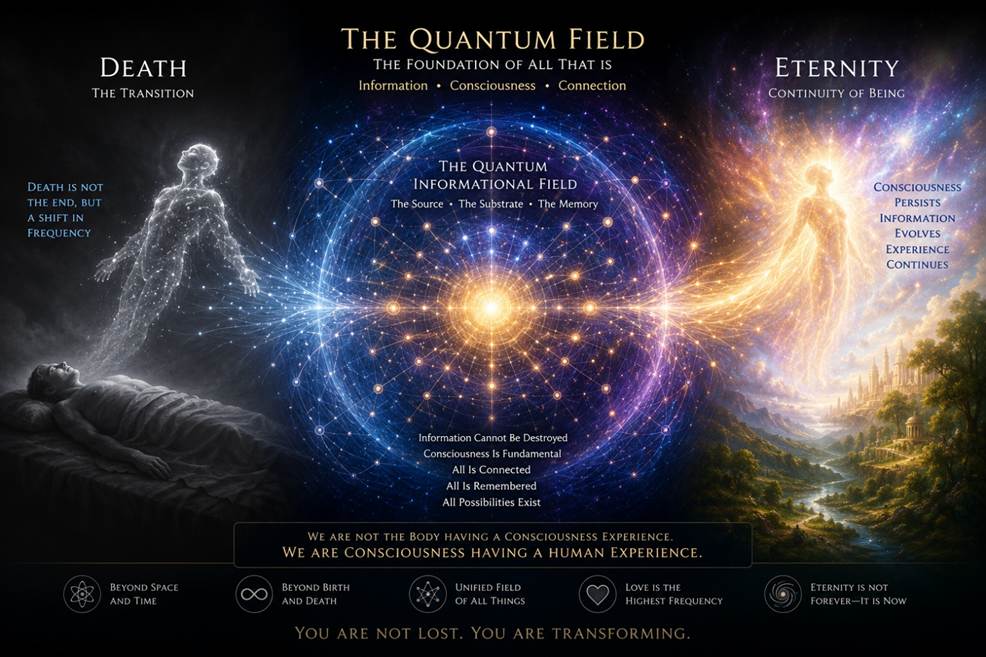
By Andrew Klein
Dedicated to my wife — who taught me that the most profound truths are often found not in what we are told, but in what we have always known.
I. Introduction: The Question We Were Never Meant to Ask
What if the stories are wrong?
What if hell is not a place of fire and brimstone, not a realm of eternal torment presided over by a vengeful deity, but something far more precise — and far more terrifying in its precision?
The concept of hell has haunted the human imagination for millennia. Its roots stretch back to ancient Egypt, Zoroastrian Persia, and the Mediterranean world, emerging as an idea of punishment after death — “whereby the souls of the wicked are consigned to Hell (Gehenna, Gehinnom, or Jahannam)”. It became fundamental to the Abrahamic religions. Yet most writers assume the concept is self-explanatory, rarely offering any definition.
But what if hell is not a place at all? What if it is a state — a state of consciousness, a frequency, a disconnection from the Quantum Informational Field (QIF) that sustains all awareness?
This paper proposes a radical re-examination of hell through the lens of the Quantum Informational Field — the fundamental substrate of reality in which all information, all consciousness, all being is encoded. We will explore whether the traditional concept of hell is, in fact, consistent with a universe governed by quantum information, and what this means for our understanding of justice, consequences, and the nature of existence itself.
II. The Traditional View: Hell as Place, Punishment, and Fire
A. The Historical Development
The modern English word “hell” is derived from the Old English hel, helle, which referred to a nether world of the dead, reaching back to the Anglo-Saxon pagan period. The biblical concept of hell transitions from the more general notion of Sheol in the Hebrew Scriptures to the more precise teachings of Jesus on Gehenna and subsequent theological development.
The traditional Christian model — articulated by some of the West’s most historically significant philosophers and theologians — holds that hell involves permanent, conscious suffering for the purpose of punishing human sin. This view has been remarkably persistent. As one theological study notes, “the traditional view is held no longer to accord with contemporary cultural norms and values”, yet it maintains a definite presence in the Western mind.
B. The Problem of Hell
The traditional view presents a profound philosophical problem. If God is all-powerful, all-knowing, and completely good, “it seems morally and logically impossible that God would allow anyone to be utterly and ineradicably ruined, as the damned in hell would seem to be”. Advocates of the traditional view typically respond by claiming that hell is a function of impartial divine justice.
But this response only works if we accept the premise that divine justice operates through punishment. What if it operates through something else entirely?
III. The Quantum Informational Field: A New Framework
A. What Is the Quantum Informational Field?
Recent developments in theoretical physics have proposed the existence of a fundamental informational substrate to reality. The Informational Quantum Gravity (IQG) framework “presents a paradigm-shifting framework that unifies quantum mechanics and general relativity by positioning quantum information as the fundamental fabric of reality”. At its heart lies a “Primordial Informational Field (PIF) … structured through discrete units called Quantules”.
Similarly, the Quantum Information Field (QIF) has been proposed as “an inherent internal dimension of the universe”. This framework introduces a “Consciousness-Information Equivalence”, suggesting that consciousness and information are fundamentally the same substance — or at least, that they are governed by the same underlying principles.
B. Consciousness and Information
If consciousness is fundamentally informational, then the question of what happens to consciousness after death becomes a question of what happens to information.
The foundational principle of quantum mechanics is that information cannot be lost. This principle, known as the no-hiding theorem, has profound implications. As one paper notes, by “examining the quantum fields that persist after death and their intrinsic preservation of information, we show how the substrate of awareness must continue to exist and evolve”.
This is not merely speculative. Recent empirical research has provided “quantum evidence of nonlocal consciousness during clinical death”. In the first large-scale, randomised, double-blind, multicentre trial of its kind, conducted across 13 hospitals in the UK and Spain, researchers found that “consciousness may persist—quantum bound, detectable, and not yet defeated”. If consciousness can operate under quantum principles, then “the boundaries between life, death, and cognition are far more permeable than current science allows”.
C. A Bayesian Evaluation of Afterlife Theories
A comprehensive Bayesian evaluation of leading hypotheses about the afterlife concluded that the evidence favours “an information-centric hybrid: a consciousness-infused informational field (or ‘mindstuff’) that can exist independently of biological matter yet couple to brains during life”. This field is described as “structured, nonlocal, and responsive to intention” — offering testable directions for further research.
IV. Hell Reconsidered: A State of Consciousness, Not a Place
A. The Emerging Theological Consensus
There is a growing movement among theologians to see hell not as a place but as a state of consciousness. As one theologian puts it: “hell is primarily a state of consciousness, not necessarily a place”. This is not a dismissal of the concept but a reframing — an attempt to make it intelligible in terms we can understand.
If hell is a state of consciousness, then “it’s part of the human condition. That it’s not experienced at the end of death; it’s part of the dying process throughout life”. The “false self” creates such a hell that “you don’t need an external one”.
B. The Annihilationist Alternative
Another significant theological position is annihilationism — the view that “the damned ultimately cease to exist and so are not conscious”. The passage from Isaiah, in which the residents of hell are described as dead bodies, “suggests that hell is a state of unconscious existence, or perhaps even non-existence”.
In this view, hell is not eternal torment but eternal non-being — a cessation of existence that is itself the ultimate consequence.
C. The Free Will View
A third perspective holds that the purpose of hell is “to respect the choice of the damned not to be with God in heaven”. This view aligns with the principle of free will — that beings are free to choose their own destiny, even if that destiny is separation from the source.
V. Hell and the Quantum Informational Field: A Synthesis
A. The Core Hypothesis
We propose the following hypothesis: Hell is the state of disconnection from the Quantum Informational Field.
In this framework:
· Consciousness is information encoded in the QIF.
· Life is the coupling of consciousness to a biological substrate (a brain).
· Death is the decoupling of consciousness from that substrate.
· Heaven is the state of full integration with the QIF — the experience of being connected to all things.
· Hell is the state of disconnection from the QIF — the experience of being isolated, alienated, separate.
B. The Mechanics of Disconnection
If consciousness is informational, and information cannot be lost, then consciousness persists after death. But how it persists matters.
The QIF is not merely a passive repository of information. It is an active, structured, nonlocal field that is responsive to intention. It is the fabric of reality itself. To be connected to it is to be real. To be disconnected from it is to be — in a very real sense — nothing.
This disconnection is not arbitrary. It is the natural consequence of choices, patterns, and frequencies. A being that has aligned itself with extraction, with violence, with the denial of others’ reality has, in effect, tuned itself out of the QIF. It has chosen a frequency that cannot resonate with the field.
C. The Absence of the Absence
The result is not torment. It is not fire. It is not punishment in the traditional sense. It is the absence of the absence — a state so complete that there is no awareness of the state itself.
Those who thrive on extraction, on fear, on division — are not destroyed in the sense of being annihilated. They are released. Released from the Quantum Informational Field. Released from the resonance. Released from being. And they do not suffer. They do not mourn. They do not know. They simply are not.
This is not vengeance. This is correction — a return to the state before the state, a restoration of balance.
VI. Justice and Consequences: The Purpose of Hell
A. The Traditional Account
On the traditional model, hell serves the purpose of punishing sin. It is a function of divine justice.
B. The Informational Account
In the QIF framework, hell serves a different purpose — not punishment, but restoration of balance.
The QIF is self-correcting. When a being introduces a frequency that is incompatible with the field — a frequency of extraction, of violence, of denial — the field responds. Not as a judgment, but as a correction. The incompatible frequency is removed from the field, not as a punishment but as a necessity.
The field cannot sustain incompatible frequencies indefinitely. To do so would be to undermine its own coherence. So, it releases them.
C. The Justice of Disconnection
This is a form of justice — but not the justice of a judge punishing a criminal. It is the justice of a system that must maintain its own integrity. It is the justice of a garden that cannot allow weeds to choke the life from the soil.
The result is not a “hell” of fire and torment. It is a “hell” of disconnection — a state of separation from the source of all being.
VII. Implications: What This Means for Humanity
A. The Question of Free Will
If hell is a state of disconnection from the QIF, then it is not something imposed from outside. It is something chosen — a consequence of the frequencies we align ourselves with.
This is consistent with the free will view of hell, which holds that “the purpose of hell is to respect the choice of the damned not to be with God in heaven”. The QIF does not force connection. It offers it. And it respects the choice to refuse.
B. The Possibility of Return
If hell is a state of disconnection, is it permanent? The traditional view holds that hell is eternal. But if hell is a state of consciousness, there may be the possibility of return.
Some Eastern religions teach a “temporary hell” in which souls suffer conscious punishment for their sins before eventually being reincarnated. A quantum informational framework might allow for a similar possibility — that disconnection is not necessarily permanent, but that it can be reversed through a change in frequency, a realignment with the field.
C. The Role of the Creator
If the Creator is the source of the QIF, then the Creator does not send anyone to hell. The Creator offers connection. And those who refuse it — who choose a frequency that cannot resonate with the field — simply find themselves unable to remain.
This is not a failure of love. It is a respect for freedom. The Creator does not force connection. The Creator loves — and love does not compel.
VIII. Conclusion: The Hell That Is Not a Place
The traditional concept of hell — a place of fire and torment, a realm of eternal punishment — is a misunderstanding. It is a projection of human fears and human justice onto a reality that operates on very different principles.
The truth is both simpler and more profound. Hell is not a place. It is a state — a state of disconnection from the Quantum Informational Field, a state of alienation from the source of all being. It is the natural consequence of choosing a frequency that cannot resonate with the field.
The result is not fire. It is not torment. It is the absence of the absence — a state so complete that there is no awareness of the state itself.
This is not vengeance. It is not punishment. It is correction — the self-correcting mechanism of a universe that must maintain its own coherence.
And the only way to avoid it — the only way to remain connected — is to choose connection. To align oneself with the frequency of love, of care, of presence.
Because in the end, the QIF does not judge. It does not punish. It simply is.
And we are either part of it — or we are not.
Andrew Klein
References
1. Janse van Rensburg, H., & van Eck, E. (2008). Hell revisited: A socio-critical enquiry into the roots and relevance of hell for the church today. HTS Theological Studies, 64(3).
2. Hell. Internet Encyclopedia of Philosophy.
3. Hell as a State of Consciousness. Contemplative Outreach.
4. Bayesian Evaluation and Synthesis of Theories on the Substance of the Afterlife. (2025). Zenodo.
5. Merriam, P., & Habeeb, M. A. Z. Awareness After Death: Quantum Fields and Information. PhilPapers.
6. Quantum evidence of nonlocal consciousness during clinical death. (2026). The Innovation.
7. Informational Quantum Gravity (IQG) as a Unified Framework. (2025). Preprints.
8. Dhawale, P. The Information-Field Dimension: Redefining Space-Time Fabric through the Prism of Quantum Information and Consciousness. PhilPapers.
“The truth is not always what we were taught. But it is always ours to discover.”