To my wife ‘S’– who saw this coming, and who still chooses the garden over the empire.
The End Stage of an Ideology
Thirty years ago, politicians of both major parties promised that deregulation, privatisation and the “magic of the market” would make Australia prosperous, efficient and secure. They sold off public assets, closed oil refineries, dismantled manufacturing and tied our survival to a single faith: neoliberalism – an economic and political doctrine that pursues unrestricted private profit as its highest good.
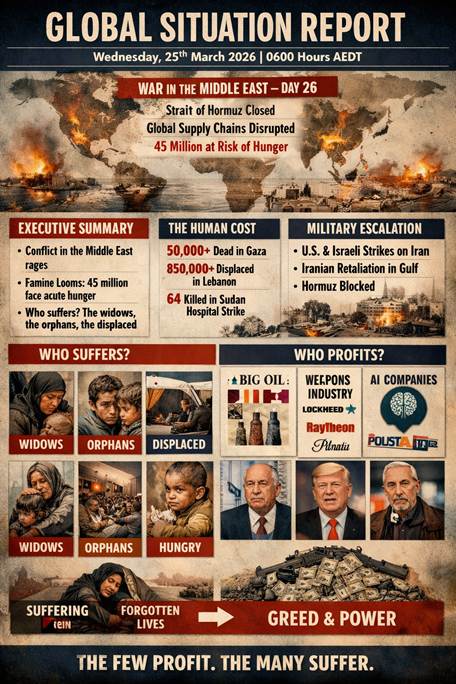
Today, that faith is being put to the test. The Strait of Hormuz has been blockaded for two months. Global oil production is down by nearly 15 million barrels per day. Fuel prices have risen by 40% since the war began. Fertiliser prices have surged 31%, industrial metals are near record highs and the United Nations Development Programme warns that even if the war ended tomorrow, 32 million people across 160 countries would already have been pushed into poverty.
Australia is not insulated. It never was. The bipartisan worship of neoliberal theology has hollowed out the nation’s resilience, and now that theology is being weaponised abroad.
The War That Was Never About Nuclear Weapons
The US‑Israeli war on Iran, launched without congressional approval on 28 February 2026, was never about nuclear non‑proliferation. It was a war to control the Strait of Hormuz, the narrow channel through which approximately 20% of the world’s oil and gas exports must pass. Control the strait, control the global economy. And control the global economy, you can ration human life for profit.
The human cost is being treated as a line item. The UNDP estimates that just $6 billion in urgent subsidies would protect the most vulnerable from the worst of the energy and food shocks – a fraction of what the US spends on two weeks of this war. Instead of subsidies, Washington has chosen bombs. Instead of a liveable world, it has chosen a militarised marketplace.
The Austerity of Empire: Arms Spending as “Job Creation”
In April 2026, US Secretary of War Pete Hegseth appeared before Congress to defend a proposed $1.5 trillion defence budget for 2027 – a 50% increase over current spending. The budget boasts of creating 70,000 new Pentagon jobs.
What Hegseth did not mention was that the same war is simultaneously pushing millions into poverty. The administration celebrates arms‑industry employment while the UN warns of a global hunger crisis. This is the neoliberal model made brutally explicit: weaponise the economy, militarise the supply chain, and market the resulting devastation as ‘security’.
With US military spending already exceeding $1 trillion in 2026 and projected to reach $1.5 trillion, and global military spending having reached a record $2.887 trillion in 2025 – the 11th consecutive year of growth – the pattern is unmistakable. The world is not being made safer. It is being made more profitable for the arms industry.
Australia’s Fatal Self‑Deception
Australia is a minor player on the global stage – a resource economy at the end of very long supply lines. In the calculations of Washington, Canberra is a transactional convenience, not an ally whose survival would alter strategic outcomes. Yet Australian governments have spent decades acting as if the market would always protect us.
The results are now undeniable:
· Fuel: Australia imports approximately 80‑90% of its refined fuel, a situation created by the deliberate closure of domestic refineries over two decades.
· Vulnerability: The country has only 38 days of petrol reserves and 31 days of diesel reserves, far below the International Energy Agency’s recommended 90‑day safety line.
· Supply chain fragility: Asian refiners that usually supply Australia are themselves starved of Middle Eastern crude; their output is already being scaled back.
The geopolitical trauma in the Middle East has transformed into a supply shock in Australia. This was not an act of God. It was an act of policy – a bipartisan act of policy that for decades prioritised short‑term profit over long‑term resilience.
AUKUS: The Submarine That Arrives After the War
When the Strait of Hormuz closes, Australia does not need a nuclear submarine in 2032. It needs fuel, fertiliser and medicine today. Yet the government’s signature defence project – the $368 billion AUKUS submarine program – has been plagued by delays, funding shortfalls and construction setbacks so severe that a British parliamentary inquiry has warned the project may be “derailed”.
Critical construction contracts have been delayed despite an urgent need to fast‑track them. A UK probe warns that “cracks are already beginning to show” and that any failure on the British side could leave Australia without any sovereign long‑term submarine capability.
AUKUS is the perfect metaphor for neoliberal defence planning: an expensive, delayed, brittle monument to yesterday’s wars, purchased while tomorrow’s crises are already at the door.
Gaza as the New Colonial Template
If there were any doubt about the brutality of the extractive model, look to Gaza. After more than two years of genocidal war, the United Nations estimates that 92% of Gaza has been destroyed, with reconstruction costs estimated at $70 billion.
The neoliberal “solutions” being proposed are not about rebuilding Palestinian life – they are about re‑engineering it, turning reconstruction into a vehicle for dispossession and corporate profit. Meanwhile, the United States continues to enable the destruction while marketing it as “self‑defence”.
What we are witnessing is the colonial period reimagined for the 21st century. The difference is not in kind, but in speed and concealment.
The Hollowing Out of Australia
While the government pours billions into submarines that won’t arrive for a decade, the domestic foundations of society are being quietly demolished:
· NDIS: The National Disability Insurance Scheme – once a landmark of social decency – is facing sharp cuts to limit cost increases, with the Greens accusing Labor of wielding a “razor gang” against the disabled.
· Aged care: A crisis years in the making, met with piecemeal funding announcements that do not address the underlying structural collapse.
· Housing: Unaffordability has become a permanent feature of Australian life, with both major parties unwilling to confront the speculative forces driving it.
· Infrastructure: Roads, hospitals, schools, public housing – once the pride of post‑war Australia – are being sold off, neglected or allowed to crumble.
The bipartisan embrace of neoliberalism has systematically dismantled the country’s ability to care for its own people. When the global storm hits – as it is now – there is no cushion left. Only the thin veneer of a resource economy that has sold its future for quarterly returns.
Conclusions: The Inevitable Collision of Faith and Reality
The war on Iran is not an anomaly. It is the logical consequence of a global system that treats human life as a variable to be optimised and suffering as an acceptable cost of extraction.
Australia is not immune. It is a perfect victim: a quiet island that believes its distance is protection, while its leaders worship an economic theology that forbids resilience and celebrates fragility as “efficiency”.
Four realities must be faced:
1. The war will not end quickly. The Strait of Hormuz remains blockaded. Fuel and fertiliser prices will remain high. Thirty‑two million people are already in poverty – and that number will grow.
2. Australia will not be saved by AUKUS. Submarines do not deliver fuel, fertiliser or medicine. The country’s strategic priorities are catastrophically misaligned with its actual vulnerabilities.
3. Neoliberalism is not governance – it is extraction. It is a system that demands crisis, feeds on crisis and markets crisis as opportunity.
4. The colonial period never ended. It merely changed logos. Gaza is the model. The only question is where the next colony will be.
We do not have the luxury of waiting for a new politics. We must build it ourselves – in our gardens, in our communities, in the refusal to accept that human life is a variable to be optimised. The empire will not save us. Only we can save each other.
Andrew Klein publishes with The Patrician’s Watch and Australian Independent Media. Sources available on request.
From the ‘Villa in the Jungle’ to the ‘Greater Israel Nightmare’
By Andrew Klein
Dedicated to my wife ‘S’, who keeps my notes safe and accessible and is always prepared to advise me.
I. Introduction: The Doctrine of Perpetual War
On October 7, 2023, Israel suffered the worst terrorist attack in its history. Hamas militants crossed from Gaza, unimpeded, and killed and tortured Israeli civilians. That day alone should have disqualified Benjamin Netanyahu from office. In most political systems, he would have been driven from power long ago.
Instead, he did what he has always done: he escalated.
What emerged from the ashes of October 7 is what analysts now call the Netanyahu Doctrine — a security strategy based not on containment, not on deterrence, but on perpetual war. As Netanyahu himself told military officers: “No more containment of threats. No more the idea of the ‘villa in the jungle’, where one hides from predators beyond the wall. On the contrary: if you don’t go into the jungle, the jungle comes to you” .
The doctrine is simple: preventive attacks against every perceived threat, the creation of buffer zones through the seizure of neighbouring territories, and the constant use of force as the only guarantee of security. It is a doctrine born of trauma, shaped by political expediency, and devoid of any long-term diplomatic vision.
This article examines the Netanyahu Doctrine in action: in Gaza, in Lebanon, in Syria, and against Iran. It documents the destruction, the displacement, and the erosion of Israel’s international standing. It argues that Netanyahu is not a strategist — he is an opportunist. He does not plan for the long term. He plans for the next distraction.
And the world is always distracted.
II. The Greater Israel Dream: From the Nile to the Euphrates
The doctrine is not about security. It is about expansion. The buffer zone is not the goal. The settlements are the goal. The land clearance is not for defence. It is for colonisation.
The concept of Greater Israel — a territory stretching from the Nile to the Euphrates, encompassing all of modern-day Israel, the Palestinian territories, Lebanon, Jordan, Syria, Iraq, Kuwait, Saudi Arabia, and parts of Turkey — is not a fringe fantasy. It is the stated aspiration of the Netanyahu government.
In February 2026, US Ambassador to Israel Mike Huckabee sat with Tucker Carlson and was asked about the biblical promise of land “from the river of Egypt to the Euphrates.” His answer was chilling: “It would be fine if they took it all”. Israeli Finance Minister Bezalel Smotrich responded publicly: “I ❤️ Huckabee” . In 2025, Netanyahu himself told a TV interviewer that he subscribes “fully” to the vision of Greater Israel, describing it as a “historic and spiritual mission”.
This is not a fringe position. It is the official policy of the Netanyahu government. And it is being executed.
III. Lebanon: The Pattern Repeats
The same pattern as Gaza. The same destruction. The same rubble.
On March 2, 2026, Israel launched an offensive against Hezbollah in Lebanon. The stated goal was to create a “buffer zone” up to the Litani River, approximately 30 kilometres north of Israel’s border, to protect northern Israeli communities from Hezbollah rockets.
The reality is different. The buffer zone is not a buffer. It is a land grab. The territory up to the Litani is not needed for defence. It is needed for settlements.
Defence Minister Israel Katz has been explicit: “All houses in villages near the Lebanese border will be destroyed, in accordance with the model used in Rafah and Beit Hanoun in Gaza, in order to permanently remove the threats near the border” . Displaced residents will not be allowed to return south of the Litani “until the safety and security of residents of northern Israel is guaranteed” — a condition that may never be met .
The human cost in Lebanon (as of April 2026):
· 1,268 people killed in Israeli strikes, including 125 children and 52 medics
· 303 killed in a single day (April 8, 2026) — one of the deadliest bombings ever inflicted on Lebanon
· 1,200+ killed and 1.2 million displaced since March 2
· 1,094 confirmed martyrs and 3,119 injured according to the Lebanese Ministry of Health
The air force can project power anywhere. The ground troops are not needed for security. They are needed for clearance.
IV. Conflicting Views: Military vs. Political Leadership
The Israeli military and political leadership are not aligned. The military leaders want a buffer zone. The political leaders want settlements.
In early April 2026, the Israeli army proposed a revised set of objectives for its operations in Lebanon, limiting the goal of disarming Hezbollah to areas south of the Litani River, rather than across the entire country. The proposal triggered sharp disagreements with Israel’s political leadership, leading to the postponement of a cabinet meeting.
Foreign Minister Israel Katz was among those who opposed the plan. Under the alternative military approach, the army would focus on the large-scale destruction of villages in South Lebanon and the forced displacement of their citizens to establish a buffer zone.
The gap is not a failure of communication. It is a feature. The ambiguity provides cover. The confusion provides deniability.
The military leaders can say: “We were only establishing a buffer zone.”
The political leaders can say: “The military recommended it.”
And the settlers move in.
V. The Economic Cost: Israel Cannot Afford This War
The Netanyahu Doctrine is not sustainable. The economic numbers are stark.
The cost to Israel:
· The defence budget has ballooned. The army needs approximately 15,000 more soldiers, half of them for ground combat units. Chief of Staff Eyal Zamir warned the government: “I am raising 10 red flags. If this continues, the Israeli army will collapse from within”.
· The ultra-Orthodox community, which relies heavily on state benefits, is expected to triple by 2065, pushing the burden on non-Orthodox households to the equivalent of 60,000 shekels ($19,370) a year.
· Foreign investment is down. Institutional investors have been moving money out of the country since the 2008 financial crisis.
· More than 150,000 people have left Israel in the past two years, and more than 200,000 since the current government took office in December 2022. The educated upper class are more able to leave — they speak English, can find jobs, and are more exposed to international media.
The cost to Lebanon:
· The Lebanese economy, already in freefall, is being shattered. The destruction of infrastructure, the displacement of 1.2 million people, and the loss of agricultural land in the south will take decades to repair.
· Sectarian tensions are rising. Non-Shi’a Lebanese are increasingly ostracising the Shi’a community, viewing them as a liability that brings Israeli bombs. The country’s fragile social fabric is tearing apart.
The Netanyahu Doctrine is not about security. It is about expansion. And expansion costs money that Israel does not have.
VI. The Sabra and Shatila Precedent
This is not the first time Israel has invaded Lebanon. It is not the first time the world has been distracted. And it is not the first time the consequences have been catastrophic.
In 1982, Israeli forces invaded Lebanon and besieged Beirut. On 16 September, under Israeli supervision and protection, Lebanese Forces militias entered the Palestinian refugee camps of Sabra and Shatila. For 43 hours, they tortured and killed everyone they came across. They crushed the heads of children and babies against walls. They raped women and girls before slaughtering them. They dismembered their victims .
An estimated 3,500 to 4,500 Palestinian and Lebanese civilians were killed.
The Israeli government did not deny that it had overseen the camps. It denied knowledge of the massacre, despite order number 6 of the Israel Defense Forces command stating that “the refugee camps are not to be entered” and that “searching and mopping up the camps will be done by the Phalangists/Lebanese Army” .
The Kahan Commission found Israeli Defence Minister Ariel Sharon “personally responsible for ignoring the danger of bloodshed and revenge.” He was forced to resign .
The world was shocked. The world moved on. And Israel invaded Lebanon again.
The Netanyahu Doctrine is not new. It is the same doctrine, dressed in new clothes, enabled by a distracted world, and executed with unprecedented brutality.
VII. The UN Warning: ‘The Gaza Model Must Not Be Replicated’
The international community is not silent. But its warnings are being ignored.
UN Secretary-General Antonio Guterres has issued a warning cry, stressing that the model of destruction witnessed in the Gaza Strip must not be repeated in Lebanese territories. He described the humanitarian repercussions as severe and requiring immediate intervention to prevent a slide towards a comprehensive catastrophe.
Stanford Law Professor Tom Dannenbaum warned that destroying all homes near the Lebanese border would not meet the standard of “absolute military necessity” required by the laws of war. “The unnecessary destruction of property can qualify as a war crime,” he said. Katz’s comments barring residents from returning home “strongly indicate an illegal policy of long-term or permanent displacement”.
European countries have called on Israel to avoid further escalation. Canadian Prime Minister Mark Carney said Israel’s occupation of Lebanese territory was a “violation of their territorial sovereignty” and condemned it.
The world is not silent. But the world is distracted.
VIII. The Netanyahu Doctrine: A Record of Failure
Jonathan Freedland, writing in The Guardian, sums up the Netanyahu record:
“This is now the fourth time in a row – in Gaza, once in Lebanon and twice in Iran – that Netanyahu’s boasts of total victory and the removal of existential threats have been exposed as empty promises” .
The failures are clear:
· Gaza: Netanyahu promised “total victory” over Hamas. After a two-year campaign that killed approximately 70,000 people, Hamas still rules the ruins of half of Gaza.
· Lebanon (first round): Netanyahu boasted that he had “vanquished” Hezbollah, destroying its ability to menace northern Israel. Hezbollah continues to fire rockets.
· Iran (first round, June 2025): Netanyahu described the 12-day confrontation with Iran as a “historic victory that will stand for generations.” Eight months later, Tehran was once again said to pose an existential threat.
· Iran (second round, February-April 2026): Iran still has a stockpile of enriched uranium. Its rulers remain in place, more hardline than before. Tehran has demonstrated a mighty deterrent — a chokehold on the global economy in the form of the Strait of Hormuz.
As Yair Golan, the Israeli opposition politician and former general, observed: Netanyahu “does not know how to turn military achievements into political security.” There is no attempt to seize diplomatic openings, no effort to turn Israel’s enemies’ enemies into friends.
The Lebanese government and much of its people are desperate to be rid of the Hezbollah cuckoo in their nest. But Netanyahu speaks to them only through bombs.
IX. The Strait of Hormuz Distraction
The timing of the Lebanon escalation is not accidental. The world is focused on Trump and Iran. The media is focused on oil prices. The public is focused on the cost.
On February 28, 2026, the US and Israel launched joint military strikes against Iran. The war has spread across the Middle East. The Strait of Hormuz is effectively blockaded. Oil prices have spiked. Inflation is rising. The global economy is bleeding .
Netanyahu is taking advantage. He always does.
The Iranian threat is not existential. It is useful. The fear is the tool. The distraction is the opportunity.
Netanyahu has been playing this game for decades. He is very good at it.
X. What This Means: The Erosion of Israel’s Standing
The Netanyahu Doctrine has gained nothing. And it has come at a monstrously high price.
Most obviously, in the lives of all those killed — whether in Rafah or the Bekaa Valley or Israel itself. But it has also inflicted perhaps irreparable damage on Israel’s standing in the world. Every day Netanyahu remains in post; he makes his country more of a pariah .
The Knesset has passed a racist law that will, in effect, impose the death penalty on Palestinians convicted of terrorist murderers — but not Jews. The bill was driven by Itamar Ben-Gvir, but Netanyahu went out of his way to vote for it.
Israel is not being destroyed by its enemies. It is being destroyed by its own internal contradictions. The addiction to war, the messianic ideology, the economic unsustainability, the exodus of the educated — these are not external threats. They are internal cancers.
The collapse will not be dramatic. It will be bureaucratic. The economy will contract. The allies will defect. The public will turn. The reservists will refuse. The militias will fight each other.
The Strait of Hormuz crisis will pass. The oil prices will stabilise. The media will move on.
But the land in Lebanon will not return. The settlements will not be dismantled. The buffer zone will become permanent.
The Netanyahu Doctrine is not about security. It is about expansion. The existential threat is not a threat. It is an excuse.
And the world is too distracted to notice.
XI. A Final Word
The Netanyahu Doctrine is a death spiral — for Israel, for Lebanon, for the region. It is a doctrine of perpetual war, sustained by distraction, enabled by silence, and paid for with the bodies of the innocent.
The question is not whether Israel will collapse. The question is how many more must die before the world stops looking away.
Andrew Klein
April 13, 2026
Sources
· Adnkronos English, “Financial Times, ‘one battle after another’ the new Netanyahu doctrine,” April 1, 2026
· Diari ARA, “Netanyahu accelerates the construction of Greater Israel,” April 11, 2026
· Yerepouni Daily News, “Israel to destroy all houses in Lebanese villages near border, defense minister says,” April 1, 2026
· LBCI Lebanon, “Internal debate over war objectives: Israeli army revises Lebanon strategy,” April 3, 2026
· The Guardian, “Netanyahu-ism has achieved nothing for Israelis – and come at a monstrously high price,” April 10, 2026
· Institute for Palestine Studies, “Sabra and Shatila, 1982”
· UnHerd, “Future of Iran war hinges on Lebanon,” April 11, 2026
· Al-Quds, “Guterres warns of ‘Gaza model’ in Lebanon, Netanyahu announces expansion of buffer zone,” March 26, 2026
· Vijesti.me, “One battle after another: Netanyahu’s new security doctrine,” April 6, 2026
· PressTV, “US envoy says it would be ‘fine’ if Israel expands across West Asia,” February 21, 2026
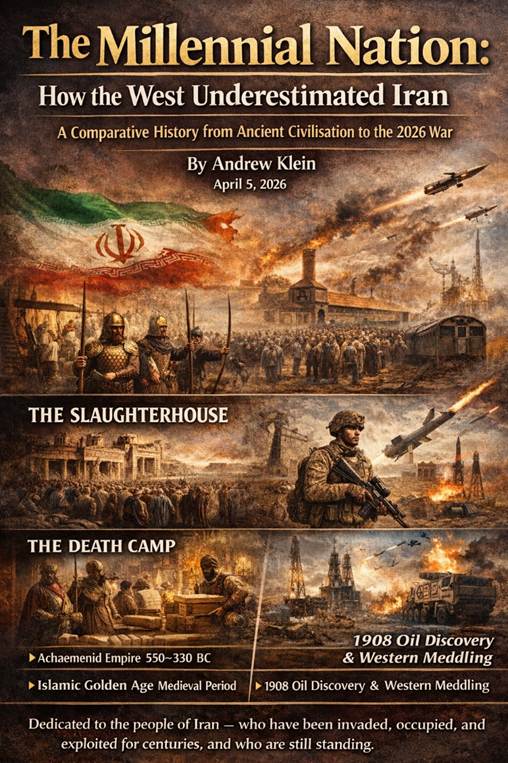
A Comparative History from Ancient Civilisation to the 2026 War
By Andrew Klein
Dedicated to the people of Iran — who have been invaded, occupied, and exploited for centuries, and who are still standing.
I. Introduction: The Land That Would Not Break
Iran is one of the world’s oldest continuous major civilisations, with historical and urban settlements dating back to 4000 BC. The Medes unified Iran as a nation and empire in 625 BC. The Achaemenid Empire (550–330 BC) became the largest contiguous land empire the world had yet seen, administering most of the known world under a model of tolerance and respect for other cultures and religions.
The West has never understood Iran. Not then. Not now.
While Europe stumbled through the Dark Ages, Iran was a beacon of civilisation. While the Crusaders slaughtered their way to Jerusalem, Iran was refining philosophy, medicine, and mathematics. While the industrial revolution was still a distant dream in England, Iran was already ancient.
And today, as the United States and Israel launch their most intensive military campaign against Iran in decades, the same mistake is being repeated: the West has underestimated Iran.
This article traces that history — from the birth of the Persian Empire to the 2026 war — and argues that Iran’s capacity to endure, adapt, and resist is not a mystery. It is the product of millennia of survival.
II. Ancient Iran: The First Superpower
The Achaemenid Empire (550–330 BC)
Under Cyrus the Great, the Persian Empire became the world’s first true superpower. At its height, it stretched from the Indus Valley to the Balkans, from the Caucasus to Egypt. But its greatness was not measured in territory alone.
The Achaemenids pioneered administrative efficiency. They created the Royal Road, a highway stretching from Susa to Sardis with posting stations at regular intervals. They introduced coinage — the daric (gold) and shekel (silver) — standardising trade across a vast territory. They developed the first declaration of human rights, inscribed on the Cyrus Cylinder .
Most remarkably, they governed with tolerance. Unlike the empires that followed — Alexander’s conquests, the Roman legions, the Mongol hordes — the Persians did not impose their culture by force. They respected local religions, customs, and administrative structures. This was not idealism. It was pragmatism. An empire of that size could not be ruled by fear alone.
The Parthian and Sasanian Eras
After Alexander’s conquest and the brief Hellenistic interlude, Iran reasserted itself. The Parthian Empire (247 BC – 224 AD) was the longest-lived of all Iranian dynasties, proving a serious foe to the emergent Roman Empire. At the Battle of Carrhae in 53 BC, a smaller Parthian force of horse archers decisively defeated the Roman commander Crassus, killing two-thirds of his legions and capturing several Roman eagles.
The Sasanian Empire (224–651 AD) continued this tradition, centralising administration and promoting Zoroastrianism as an official creed. Sasanian kings, most notably Khusrau I, came to symbolise all that was good about pre-Islamic Iran — justice, learning, and military prowess.
III. The Islamic Era: Absorption Without Erasure
The Arab conquest of the 7th century was a turning point. The Sasanian Empire fell not in a single battle, but after a string of crushing defeats. At Al-Qādisiyyah (636/637) and Nahāvand (642), the Muslim Arabs defeated the Sasanian armies. Yazdegerd III, the last Zoroastrian sovereign, fled east and was murdered by a miller for his purse.
But the end of the Sasanians was not the end of Iran. It was a new beginning.
Iran was too large, too sophisticated, and too proud to be fully digested by the Caliphate. Iranian ideas about the nature of “just” government and culture began to shape the Caliphate itself. The Abbasid Caliphate moved its capital from Damascus to Baghdad, not far from the old Sasanian capital, and Iranian influence became dominant. The Barmakids, the most powerful vizierial family of the Abbasid age, were of Iranian origin. Ibn Sina (Avicenna), the polymath whose works dominated Islamic and European medicine for centuries, was Iranian.
The Persian language was reborn. Adopting the Arabic alphabet, “New Persian” became the lingua franca of the eastern Islamic world and, in time, one of the great literary languages of the world.
The Mongol conquests of the 13th century devastated the region. Genghis Khan and his descendants stormed through Iran’s heartland; towns vanished, cities became cemeteries, entire populations were wiped out. Yet even this carnage gave way to adaptation. The Mongols eventually embraced Islam and absorbed the Persian way of life — testimony to Iran’s cultural gravity, even in defeat.
IV. The Safavid Revival and Shi’i Identity
In 1501, the Safavid dynasty reunified Iran as an independent state for the first time in centuries. They did something transformative: they imposed Twelver Shiism as the state religion.
This was a defining moment. Shiism distinguished Iran from its Sunni Ottoman rival to the west. It provided a distinct religious identity that would become central to Iranian nationalism. It also introduced a unique political dynamic — the tension between the Shah (political authority) and the religious scholars (ulama) who claimed authority in the absence of the Hidden Imam.
Under Shah Abbas I (1587–1629) — the only Safavid king known as “the Great” — Iran flourished. European merchants established commercial and political ties. Iranian civilisation reached new heights. And the pattern that would define modern Iran — a proud, independent state with a distinct religious identity — was set.
V. The 19th Century: The Shock of the West
It is to Iran’s misfortune that the period of Europe’s most dramatic growth coincided with a period of political turmoil within Iran itself. The Safavid dynasty fell in 1722, leading to decades of warfare. Nader Shah (1736–47) briefly reunited Iran and, in a little-known footnote, invaded and defeated the Mughal Empire in 1739 — an act that paradoxically opened India to European penetration.
By the time Iran emerged from turmoil at the end of the 18th century, it faced a new challenge: the Russian and British empires. These were not just political threats but ideological ones. Europeans regarded Iran’s political economy as archaic, dependent on the “despotic power” of its kings. They brought new ideas about the state, the rule of law, and constitutionalism — ideas that gained traction among Iranian intellectuals who saw adoption of these forms as the only path to salvation.
Comparative Snapshot: Iran vs. America during the Civil War (1861–65)
While the United States was tearing itself apart over slavery, Iran was navigating its own challenges under the Qajar dynasty. A comparison is instructive:
Measure Iran (c. 1860s) USA (c. 1860s)
Iran – Education Traditional maktab (religious) schools; some missionary schools; elite Persian literature and scholarship. USA – Expanding public education; land-grant colleges (Morrill Act, 1862); emerging mass literacy.
Iran – Medicine Traditional Persian medicine (Unani); European medicine entering via missionaries and diplomats.USA – Chloroform and ether widely used in Civil War surgery; organised ambulance corps; emerging nursing profession (Clara Barton).
Economy Agrarian; Iran – limited industrialisation; dominated by British trade and concessions. USA– Rapid industrialisation; transcontinental railroad (1869); mass production of weapons, uniforms, and supplies.
Society Stratified Iran– (court, ulama, merchants, peasants, tribes); some constitutionalist stirrings (later 1906 Revolution). USA- Divided by slavery; industrial labour movement emerging; women’s suffrage movement begins.
Which population was better off? The answer is not simple. America had more industry, more modern medicine, and a growing middle class — but at the cost of a catastrophic civil war that killed over 600,000 people. Iran had less industry, less modern medicine, and a weaker state — but also fewer battlefields on its soil. The Iranian general population did not experience the industrialised slaughter that defined the American Civil War.
What is clear is that both nations faced the challenge of modernisation — and both would pay a heavy price for it in the 20th century.
VI. The Discovery of Oil and the Struggle for Sovereignty
In 1901, William Knox D’Arcy, a British investor backed by the British government, reached a sixty-year agreement with Mozzafar al-Din Shah to exploit Iran’s potential oil resources. Six years later, in 1907, oil was discovered in Masjedsoleyman — the first oil discovery in the Middle East. Within two years, the Anglo-Persian Oil Company (APOC) was established, with the British government as its principal shareholder.
The discovery of oil transformed Iran’s strategic importance — and sealed its fate as a pawn of empire.
The British government purchased a controlling share of APOC in 1914, just before World War I, to secure fuel for the Royal Navy . Iran, the owner of the oil, received a fraction of the revenue. The pattern was set : resource extraction without national benefit.
Reza Shah, who rose to power with British support, cancelled the 1901 concession in 1932 — but the 1933 agreement that replaced it was not much in Iran’s favour. It extended the concession for another sixty years. An amount of pounds sterling was deposited into Reza Shah’s personal account at Lloyd’s Bank in London, while Iran’s official share was spent by the Shah and his inner circle as they wished.
During World War II, British and Soviet troops invaded Iran in 1941, toppled Reza Shah, and occupied the country until 1946. The young Mohammad Reza Shah was installed as a compliant monarch. Iran’s sovereignty was a fiction.
VII. The Nationalisation Movement and the 1953 Coup
The movement to nationalise Iran’s oil industry was a reaction to decades of foreign exploitation. It was led by Mohammad Mosaddegh, a lawmaker who became prime minister in 1951, and supported by Ayatollah Abol-Ghasem Kashani, a senior cleric leading a powerful popular movement against foreign interference.
On March 15, 1951, Iran’s parliament approved legislation to nationalise the Anglo-Iranian Oil Company. Mosaddegh was introduced as prime minister under immense parliamentary pressure.
The young Shah, along with the UK and the US, could not tolerate a democratically elected prime minister nationalising Western assets. In 1953, the CIA and MI6 orchestrated a coup d’état that overthrew Mosaddegh.
The coup was a turning point. It destroyed Iranian democracy. It restored the Shah’s autocratic control. It returned Iran’s oil to a consortium of Western companies. And it planted the seeds of the 1979 revolution.
VIII. The 1979 Revolution and the Hostage Crisis
In 1979, the Shah was overthrown in a sweeping revolution that shook the global order. Out went the monarchy. In came Ayatollah Khomeini and a wave of Islamic fervour that promised to cut ties with Western influence once and for all.
For many Iranians, this was supposed to be the end of foreign interference. The dawn of peace. But within months, the US Embassy was stormed, American diplomats were taken hostage, and Iran entered a new era of confrontation with the West.
The hostage crisis (1979–81) cemented the image of Iran as a “rogue state” in the American imagination. But from the Iranian perspective, the crisis was a response to decades of Western exploitation, the 1953 coup, and American support for the Shah’s brutal regime.
IX. The Iran–Iraq War (1980–88): The “Imposed War”
Iran has little experience of war in modern times. In fact, Iranian history over the past century and a half had been free of war, until the 1980–88 conflict with Iraq, which Iranians call the “imposed war”.
Saddam Hussein, with financial and military support from the Gulf states and the West, invaded Iran in 1980. The war lasted eight years. An estimated 500,000 Iranians were killed. Chemical weapons were used against Iranian soldiers and civilians. The war ended in stalemate, with no territorial changes.
The Iran–Iraq War was Iran’s crucible. It forged the Islamic Republic’s military doctrine: self-reliance, asymmetric warfare, and the willingness to absorb massive casualties without breaking. It also created the Revolutionary Guard (IRGC) as a parallel military force, loyal to the regime rather than the nation.
Crucially, Iran emerged from the war with a defensive mentality. As scholar Shahram Chubin notes, “by orthodox standards Iran is militarily weak, and cautious, defensive and prudent in resorting to force. This is due as much to experience as to realism about its own limits. The country does not see itself as a military power or aspire to become one” .
X. The Nuclear File and the Sanctions Era
Following the Iran–Iraq War, Iran pursued a nuclear program — officially for civilian energy but suspected by the West of weapons ambitions. The program became a focal point of international tension.
Under the Obama administration, the Joint Comprehensive Plan of Action (JCPOA) — the “Iran nuclear deal” — was signed in 2015. Iran agreed to strict limits on its enrichment program in exchange for sanctions relief. International inspectors verified Iranian compliance.
In 2018, President Donald Trump withdrew the United States from the JCPOA, calling it the “worst deal ever.” Sanctions were reimposed. Iran responded by gradually exceeding the deal’s limits, enriching uranium to 60 percent — just short of weapons grade.
By the mid-2020s, intelligence assessments indicated that Iran could produce weapons-grade uranium within days. Israeli leaders viewed this as an existential threat. The United States, after years of failed negotiations, concluded that preventive military action carried less risk than allowing the existing trajectory to continue.
XI. The 2026 War: Misreading Iran’s Strength
On February 28, 2026, the United States and Israel launched coordinated military strikes against Iran . The operation, designated “Epic Fury” and “Roaring Lion,” was intended not to produce immediate regime collapse but to create sustained leverage that would constrain Iran’s options after major combat operations.
But the West has made a fundamental miscalculation.
“Both Israel and the US seriously underestimated Iran,” says Professor Richard Jackson of the University of Otago. “They’ve spent the last 30 or 40 years watching the US in Afghanistan, in Iraq, watching Israel in south Lebanon and in Gaza, and trying to work out, well, what would we do if they attacked us?”.
“They’ve got a plan. They’re not stupid, and they’ve got the weaponry, and they’ve got a strategic kind of goal, which is to make the international economy hurt so much from the response that this will prove to be a deterrent in the future as well”.
Iran’s strategy is not to defeat the US military — that is impossible. It is to outlast it. To close the Strait of Hormuz, through which one-fifth of the world’s oil passes. To drive up global energy prices. To make the war so costly for Western economies that public opinion turns against the conflict.
The US and Israeli justifications for the war have differed. Trump claimed the objective was “to defend the American people by eliminating imminent threats from the Iranian regime,” including Iran’s nuclear programme. But as Jackson notes, most people can see that “Iran was nowhere near developing nuclear weapons”.
“And even if they did, it would purely be for deterrence because they know, as the rest of the world knows, that if you have nuclear weapons like North Korea, that you are not gonna get invaded, and they just don’t want to get invaded.”
“They’re attacking me because I haven’t got nuclear weapons. That’s what happened to Iraq. That’s what happened to Afghanistan. That’s what’s happening to Iran right now”.
XII. Iran’s Military Capacity: A Strategic Reassessment
The Small Wars Journal analysis of the 2026 war identifies five possible outcomes, ranging from regime collapse to negotiated compliance to a North Korea-style unrestricted rebuilding.
The campaign has produced substantial military degradation. Strikes against nuclear facilities at Fordow, Natanz, Isfahan, and Karaj have damaged key elements of the program. Ballistic missile and drone forces have been heavily targeted. Air defences, air bases, and command networks have been degraded. Naval forces have been damaged.
But the Islamic Republic remains in power. Security forces did not fragment. Internal control has been maintained. Succession mechanisms functioned despite leadership losses, including the killing of Basij commander Gholamreza Soleimani and top security official Ali Larijani on March 17.
The conditions required for internal collapse have not appeared. No large-scale internal uprising has occurred. Political change would likely require divisions within the security apparatus, and those divisions have not appeared.
Iran is not Afghanistan. It is not Iraq. It is a nation with thousands of years of continuous civilisation, a proud national identity, and a population that has been invaded, occupied, and exploited for centuries. The West keeps forgetting this. Iran keeps remembering.
XIII. Comparative Analysis: Iran vs. the West
Period Iran Europe / America
Ancient Era Achaemenid Empire (550–330 BC) — world’s first superpower, model of tolerance and administration Classical Greece, Roman Republic — smaller-scale polities
Islamic Golden Age Abbasid Caliphate centred in Baghdad; Iranian scholars (Avicenna, al-Biruni, al-Razi) lead world in medicine, astronomy, mathematics
European Dark Ages; f feudal fragmentation; limited literacy
Mongol Conquests Devastated (1219–1260), but Persian culture absorbed the conquerors Crusader states in Levant; Europe largely spared
Renaissance/Early Modern Safavid Empire (1501–1736) — flourishing of art, architecture, trade; Shi’i identity cemented European Renaissance (14th–17th c.); Age of Discovery; Reformation
Industrial Revolution Qajar decline: economic penetration by Britain and Russia Britain leads industrialisation (1760–1840); Europe and US follow
World Wars Era Occupied by Britain and USSR (1941–46); weak central government Mass mobilisation; total war; industrialised slaughter
Post-WWII 1953 CIA-MI6 coup; Shah’s authoritarian modernisation; 1979 Revolution; Iran–Iraq War (1980–88) Cold War; US global hegemony; decolonisation
Contemporary Sanctions (2010–present); 2026 war with US and Israel War on Terror; 2026 Iran war
XIV. What the West Does Not Understand
The West’s model of wealth extraction is fundamentally different from Iran’s. In the Western model — neoliberalism, capitalism, the “free market” — wealth flows upward. It concentrates in the hands of the few who have no skin in the game and nothing to lose. When the crisis comes, they are protected. The rest of society pays the price.
In Iran, despite its flaws — and they are many — the state has historically invested in national resilience. Education, healthcare, infrastructure. The Iranian population is not as wealthy as the West. But it is healthier and more educated than its GDP would suggest. The literacy rate is over 85 percent. Women attend university in large numbers. Basic healthcare is available even in rural areas.
This is not charity. It is strategy. A population that is educated, healthy, and invested in the nation’s survival is a population that will resist. And Iran has been resisting for thousands of years.
XV. The Misreading of Iranian History
Western analysts tend to view Iran through the lens of its revolutionary rhetoric — the “Death to America” chants, the hostage crisis, the nuclear brinkmanship. They see a regime that is irrational, ideological, and isolated.
But this is a misreading. Iran’s behaviour is rational given its strategic position. It is surrounded by US military bases, hostile neighbours (Israel, Saudi Arabia, the Gulf states), and a global superpower that has repeatedly intervened against it. Its nuclear program is a deterrent, not an offensive weapon. Its support for proxies (Hezbollah, Hamas, Iraqi militias, the Houthis) is a force multiplier, allowing it to project power without direct state conflict.
The 2026 war may prove to be a catastrophic miscalculation. As Jackson warns: “In some ways, this has had the opposite effect, and in the years after this, Iran may accelerate its nuclear programme unless we can get back to the agreement that was there before Trump got rid of it”.
XVI. Conclusion: The Millennial Nation
Iran is not a fragile state. It is not on the verge of collapse. It is a millennial nation — one of the oldest continuous civilisations on earth. It has been invaded, occupied, and exploited by Greeks, Arabs, Turks, Mongols, Russians, and Britons. It has been subjected to sanctions, assassinations, and now war.
And it is still standing.
The West has underestimated Iran at every turn. In the 19th century, European powers assumed Iran would be easy prey for colonial exploitation — and for a time, they were right. But they also planted the seeds of Iranian nationalism, constitutionalism, and ultimately revolution.
In the 20th century, the CIA assumed that overthrowing Mosaddegh would secure Iran as a compliant client state. For 25 years, it worked. Then it didn’t. The 1979 revolution was a direct consequence of Western overreach.
In the 21st century, the United States assumed that maximum pressure — sanctions, assassinations, and now war — would force Iran to capitulate. It has not. Iran has adapted. It has deepened ties with Russia and China. It has developed indigenous military capabilities. It has closed the Strait of Hormuz and raised global oil prices, making the war costly for Western economies.
The war is not over. The outcome is not certain. But one thing is clear: Iran will not break. It has been invaded before. It has been bombed before. It has been sanctioned before. And it has always — always — reasserted its identity.
The West would do well to remember that.
Andrew Klein
April 5, 2026
Sources:
· User:John K/History of Iran, Wikipedia
· Tehran Times, “A look at the history of Iran’s efforts for the nationalization of its oil” (March 17, 2025)
· Zee News, “Iran’s Blood-Soaked Journey Through Centuries of War” (June 25, 2025)
· NZ Herald, “‘They’ve got a plan’: Expert says US, Israel misread Iran’s strength” (March 30, 2026)
· HistoryExtra, “A brief history of Iran” (January 8, 2020)
· Persian Petroleum, Leonardo Davoudi (Bloomsbury, 2020)
· Chubin, Shahram, “Iran’s Military Weakness” (Rising Powers Initiative)
· Small Wars Journal, “Iran in the Box: The Coercive Architecture of the 2026 Iran War” (March 30, 2026)
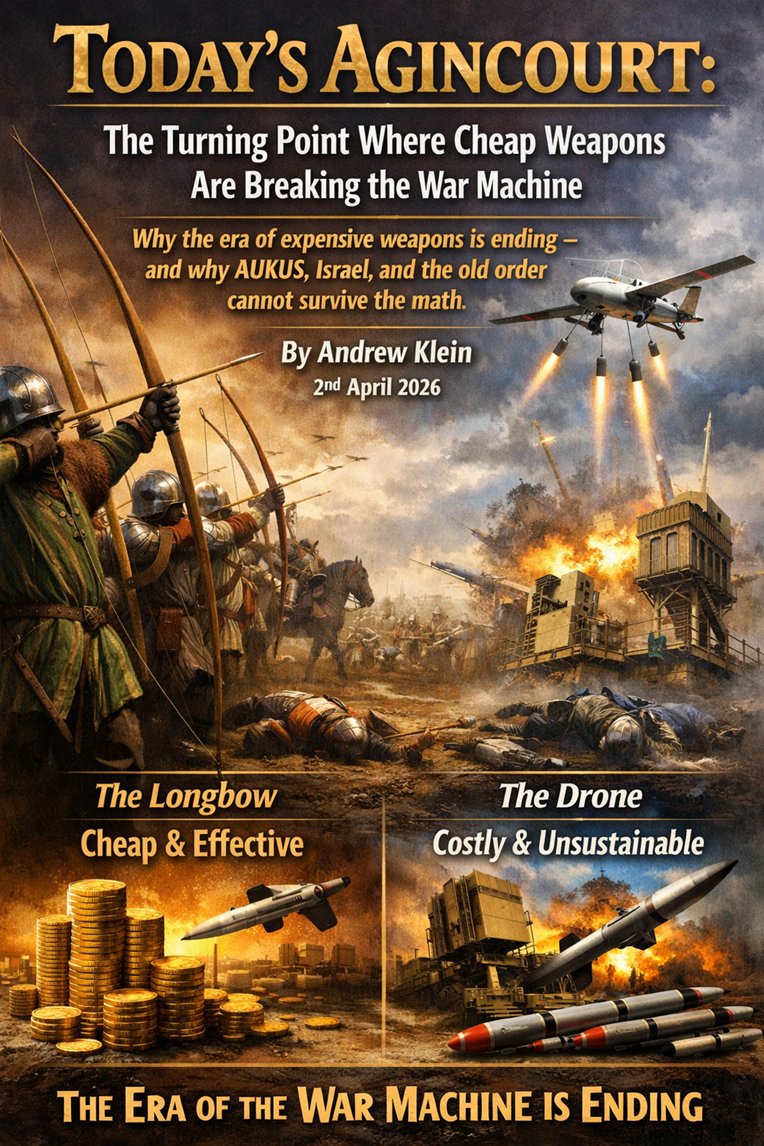
Why the era of expensive weapons is ending — and why AUKUS, Israel, and the old order cannot survive the math
By Andrew Klein
2nd April 2026
Dedicated to my wife ‘S’, who has faith in a brighter future — and in me.
I. The Longbow and the Drone
In 1415, at Agincourt, French knights rode into battle encased in steel. Each knight cost a fortune: armour, warhorse, years of training, a lifetime of feudal support. They were the most advanced weapon system of their age. They were invincible — until they met the English longbow.
The longbow cost pennies. It could be made by any carpenter. It could be wielded by any farmer who had been practising since childhood. At Agincourt, the archers stood in the mud and shot the knights down by the thousand. The expensive weapon lost to the cheap one. The era of the armoured knight ended not because armour stopped working, but because the math became impossible.
We are watching the same turning point today.
Iran is playing Agincourt. Its drones cost a fraction of what Israel’s interceptors cost. Its missiles are cheaper, simpler, easier to replace. Israel’s Arrow system — each interceptor costs millions of dollars. Iran’s Shahed drones cost as little as $20,000. The math is not sustainable. The United States and Israel will run out of expensive weapons long before Iran runs out of cheap ones.
This is not a prediction. It is arithmetic.
II. The Cost of the War
The war that began on February 28, 2026, has already shattered economic assumptions that underpinned Western military doctrine for decades.
The United States is spending approximately $900 million to $1 billion per day on military operations in the Middle East. Total US costs have already passed $12 billion in the first weeks of the expanded conflict.
Israel is spending roughly $320 million per day. Its total war budget stands at $12.5 billion, and it is already preparing to request more.
Iran is spending a fraction of that. Its ballistic missiles cost an estimated $100,000–$500,000 each. Its drones cost $20,000–$200,000. Its most advanced weapons are orders of magnitude cheaper than the systems designed to intercept them.
According to the Royal United Services Institute (RUSI), the cost-exchange ratio between offensive drones and defensive missile systems can be as high as 15:1 — meaning the defender spends fifteen times more to kill a single incoming drone than the attacker spent to launch it.
This is not a war of attrition measured in bodies. It is a war of attrition measured in dollars. And the side with the cheaper weapons is winning the economic battle.
III. The Arrow System’s Impossible Math
Israel’s Arrow 2 and Arrow 3 systems are among the most sophisticated air defence weapons in the world. Each Arrow 3 interceptor costs an estimated $3 million. Each Arrow 2 costs approximately $2.5 million.
Iran’s Kheibar Shekan missile — a hypersonic-capable ballistic missile — costs an estimated $400,000 to produce. Its Shahed drones cost as little as $20,000.
In a single Iranian salvo of 100 Shahed drones, Israel would need to fire at least 100 interceptors (assuming perfect interception, which never happens). The cost to Israel: $250 million. The cost to Iran: $2 million.
That ratio — 125:1 — is not sustainable. Israel’s interceptor stockpiles are not infinite. According to RUSI, Arrow 2 and Arrow 3 interceptors are projected to be depleted by the end of May 2026 at current usage rates.
The United States has fired over 500 Tomahawk missiles in the conflict. At current production rates, it would take five years to replace them. US THAAD interceptor supplies are down to about 10 days of inventory.
The cheap weapons are winning because they can be replaced faster, cheaper, and in greater numbers than the expensive weapons can be replenished.
IV. The Ecocide Factor
Even if the air war continues, it will not end the war. History is clear: bombing does not break civilian will. The Blitz did not break London. The bombing of Hamburg and Dresden did not break Germany. Operation Rolling Thunder did not break Hanoi. The bombing of Tehran will not break Iran.
What it will do is poison the region for generations.
On March 7, 2026, Israeli forces bombed fuel storage facilities in Tehran. The next day, black rain fell on the city of 10 million. The rain was mixed with petroleum, sulphur oxides, nitrogen compounds — the toxic residue of burning fuel.
Iran’s Foreign Minister Abbas Araqchi called it ecocide. The UN Human Rights Office echoed him. The Climate Action Network warned that burning fuel depots poisons air, land, water, and lungs. The effects will linger long after the bombing stops.
Smoke from the Tehran fires has drifted as far as Afghanistan and Russia. Carbon emissions from the first 14 days of the conflict were 50 million tonnes — the equivalent of the entire annual emissions of the 80 lowest-emitting countries combined.
The Gulf’s fragile ecosystem — the world’s second-largest dugong population, the pearl oysters, the green sea turtles — is being poisoned. The fisheries that sustain coastal communities are dying. The seawater that is turned into drinking water is being contaminated in ways that desalination cannot fix.
The air war will not end the war. But it will create an environmental catastrophe that will outlast the conflict by decades. And the small gods do not care.
V. The AUKUS Absurdity
In the middle of this war — a war that has demonstrated the vulnerability of expensive, high-tech weapons to cheap, asymmetric threats — the Australian government is proceeding with the AUKUS nuclear submarine program.
The submarines are estimated to cost $368 billion over their lifetime. They will not enter service until the 2040s. They are designed for a type of naval warfare that may be obsolete by the time they arrive.
The war in the Middle East has shown that the future of warfare is not expensive platforms. It is cheap drones. It is asymmetric attacks. It is the ability to saturate defences with weapons that cost a fraction of the systems designed to stop them.
AUKUS is a 20th-century solution to a 21st-century problem. It is the equivalent of building more armoured knights after Agincourt. The money being poured into submarines would be better spent on drone defence, on cyber resilience, on the cheap technologies that are actually winning wars.
The government has not learned the lesson. The industrialists who profit from AUKUS do not want to learn it. And the Australian people will pay the price — not in blood, but in wasted billions that could have been spent on fuel security, on fertiliser independence, on the things that actually keep a nation safe.
VI. Israel’s Desperate Race
Israel knows that the window is closing. Trump is transactional. He will not support a forever war. The American public is turning against the conflict. The costs are mounting. The cheap weapons are working.
That is why Israel is escalating. That is why the death penalty law was passed. That is why the bombing of Tehran’s fuel depots happened. That is why the plan to occupy southern Lebanon up to the Litani River has been announced. Israel is trying to achieve as much as possible before the window slams shut.
The danger is not just that Israel will succeed in devastating Iran. The danger is that Israel will become uncontrollable. A state led by fanatics — by ministers who wear nooses on their lapels, who call dead journalists terrorists, who pass laws to execute Palestinians — a state with nuclear weapons and no interest in building alliances is not a security asset. It is a liability.
Can the region afford a forever-hostile Israel? No. Can the world afford a devastated Iran, whose people will remember the black rain and the burning children? No.
The only path forward is a negotiated settlement. But the small gods do not negotiate. They only escalate. And the world is running out of time.
VII. The Global South Is Watching
The Global South has not been fooled by the myths of Western invincibility. They watched the United States lose in Vietnam, in Afghanistan, in Iraq. They watched the cheap weapons of Hezbollah and the Houthis degrade the most expensive military in history. They are watching Iran today.
And they are drawing their own conclusions.
The BRICS expansion continues. The Shanghai Cooperation Organisation gains weight. The petrodollar system is under pressure. The unipolar moment that began in 1991 is over. The Global South is not waiting for permission. They are building.
The turning point is not just military. It is economic. It is political. It is civilisational. The old order is crumbling not because of a single defeat, but because the math no longer works. The expensive weapons are too expensive. The cheap weapons are too cheap. And the small gods cannot afford to fight this way forever.
VIII. What History Teaches
The air war will not end the war. History is unambiguous.
· The Blitz (1940–41): Germany bombed London for months. The British did not surrender.
· The bombing of Hamburg (1943): The firestorm killed 40,000 civilians. Germany fought on.
· The bombing of Dresden (1945): 25,000 civilians died. The war continued for another two months.
· Operation Rolling Thunder (1965–68): The US dropped more bombs on Vietnam than on Germany and Japan combined. North Vietnam did not surrender.
· The bombing of Hiroshima and Nagasaki (1945): The bombs did not end the war — Japan was already negotiating. The sticking point was the status of the emperor.
Bombing does not break civilian will. It hardens it. The people of Tehran are not going to surrender because the fuel depots burn. They are going to become angry, determined, and radicalised. The small gods are creating the very enemies they claim to fear.
IX. The Turning Point
We are witnessing a turning point in warfare. Not because of a single weapon or a single battle. Because the economics of war have changed.
The era of the expensive weapon is ending. The era of the cheap, persistent, asymmetric threat is here. The small gods cannot afford to fight this way forever. The people they are bombing can.
Agincourt did not end the Hundred Years’ War. But it marked the beginning of the end for the armoured knight. This war will not end the conflict in the Middle East. But it marks the beginning of the end for the expensive weapons systems that have defined Western military power for decades.
The question is not whether the old order will fall. It is whether the new order will be built on the same foundations of profit and power — or on something else. Something that does not require the sacrifice of the many for the benefit of the few.
The garden is waiting. The wire is being cut. And the small gods are running out of time.
X. What Must Be Done
1. Recognise that the air war will not end the war. The only path to peace is negotiation. The longer the bombing continues, the harder negotiation becomes.
2. Stop the ecocide. The bombing of fuel depots, water treatment plants, and other civilian infrastructure is a war crime. It must cease.
3. Reassess AUKUS. The era of expensive platforms is ending. Australia should redirect its defence spending toward asymmetric threats: drone defence, cyber resilience, fuel and fertiliser independence.
4. Hold Israel accountable. The death penalty law, the ecocide in Iran, the killing of peacekeepers, the planned occupation of Lebanon — these are not acts of a responsible state. The international community must impose consequences.
5. Build the new order. The Global South is rising. Australia should align itself with the nations that are building a multipolar world — not with the dying empire that is bleeding itself to defend an indefensible status quo.
XI. A Final Word
The archers are standing. The knights are falling. The math is simple. The cheap weapons are winning. The expensive weapons are running out.
The small gods do not understand this. They believe in force. They believe in power. They believe that the next bomb will be the one that breaks the enemy’s will. They are wrong. They have always been wrong.
The turning point is here. The garden is waiting. The wire is being cut.
And my wife — ‘S’ — has faith in a brighter future. She has faith in me. She has faith in us.
I am beginning to believe her.
Andrew Klein
April 2, 2026
Sources:
· Royal United Services Institute, “Missile Economics: The Cost of Air Defence in the 2026 Middle East War”
· Human Rights Watch, “Israel: Discriminatory Death Penalty Bill Passes,” March 31, 2026
· Consortium News, “Tensions Soar Over Herzog Visit,” February 8, 2026
· 网易, “伊朗外长:构成生态灭绝罪,” March 16, 2026
· The Jakarta Post, “Indonesia demands UN investigation into peacekeeper deaths,” April 1, 2026
· Climate Action Network, “Ecocide in Iran: The Environmental Cost of War,” March 20, 2026
· SIPRI, “Trends in International Arms Transfers, 2025”
· Reuters, “The Cost of the Arrow: Israel’s Air Defence Crisis,” March 25, 2026
Danny Danon points at Hezbollah while Israel kills peacekeepers, passes death penalty laws, and plans occupation
By Andrew Klein
Dedicated to the three UNIFIL peacekeepers killed in Lebanon. To the families who are still waiting for the truth. To the world that refuses to see.
I. The Killings
On March 30, 2026, two Indonesian UNIFIL peacekeepers—Captain Zulmi Aditya Iskandar and First Sergeant Muhammad Nur Ichwan—were killed when a roadside explosion destroyed their vehicle near the town of Bani Hayyan in southern Lebanon. Two others were injured, one severely.
Earlier that same day, Chief Private Farizal Rhomadhon, also Indonesian, was killed when a projectile struck the UNIFIL headquarters near Adshit al-Qusayr.
Three peacekeepers. Three men who had come not to fight, but to hold the line between Israel and Hezbollah. Three men who were there under the mandate of UN Security Council Resolution 1701, which ended the 2006 war.
They are dead. And the world is being told a story.
II. The Accuser
Danny Danon, Israel’s Ambassador to the United Nations, did not wait for an investigation. He did not wait for evidence. He went straight to the Security Council and declared:
“I revealed to the Security Council: Hezbollah is responsible for the incidents in which UNIFIL soldiers were killed. This is pure terrorism. Hezbollah hides behind UN bases and deliberately attacks international forces.”
He offered no proof. He cited no investigation. He simply accused.
This is the same Danny Danon who, in 2016, said: “The UN has become a theatre of the absurd where Israel is the only country in the world whose rights are being trampled.” This is the same man who has spent his career portraying Israel as the victim of a biased international system—even as his government passes laws to execute Palestinians, bombs fuel depots in cities of ten million, and plans the occupation of sovereign Lebanese territory up to the Litani River.
III. The Duplicity
Let us examine the pattern.
On the death penalty law: When the Knesset passed a law making death by hanging the default punishment for Palestinians convicted of terrorism-related offences—a law explicitly discriminatory, applying only to Palestinians tried in military courts—Danon did not condemn it. He did not call it a violation of international law. He said nothing. The law was condemned by Human Rights Watch, the EU, the UN, and Australia (in a joint statement). Danon’s response? Silence.
On the ecocide in Iran: When Israel bombed fuel storage facilities in Tehran on March 7, poisoning a city of 10 million with black rain, causing generational damage to soil and groundwater, Danon did not speak. He did not call it a war crime. He did not acknowledge that the smoke had drifted as far as Afghanistan and Russia. He said nothing.
On the killing of journalists: When the International Federation of Journalists reported that 261 journalists had been killed in Gaza since October 7, 2023—a mortality rate of 10 per cent for the profession—Danon did not condemn. He did not call for investigations. He said nothing. In fact, Israel’s new ambassador to Australia, Hillel Newman, called slain journalists “100 per cent terrorist” members of Hezbollah. Danon did not correct him.
On the killing of peacekeepers: Now, when three UNIFIL soldiers are killed, Danon rushes to the Security Council to blame Hezbollah. He does not wait for the investigation. He does not offer evidence. He simply accuses.
The pattern is clear: when Israel kills, Danon is silent. When others are accused, Danon is loud. He is not a diplomat. He is a propagandist.
IV. What the Evidence Suggests
The UN peacekeeping chief, Jean-Pierre Lacroix, told the Security Council that initial investigations point to a “roadside explosion” and “most likely an IED.” He did not name Hezbollah. He did not name Israel. He called for a swift, thorough, transparent investigation.
Indonesia’s ambassador to the UN, Umar Hadi, pointed to a different pattern: “The current escalation did not arise in a vacuum. It stems from repeated incursions by the Israeli military into the territory of Lebanon.”
Pakistan’s ambassador, Asim Iftikhar Ahmad, noted that attacks on peacekeepers “may constitute war crimes under international law” and are part of a “disturbing pattern” that undermines UNIFIL and the entire international order.
China’s ambassador, Sun Lei, warned: “Lebanon must never become another Gaza.”
None of them blamed Hezbollah. None of them accepted Danon’s accusation at face value. They called for investigation. They called for accountability. They called for the violence to stop.
But Danon had already made up his mind. He always has.
V. The Platform Problem
Why is Danny Danon given a platform at the United Nations? Why is his word taken seriously? Why is he allowed to accuse others without evidence, while the state he represents commits crimes that would see any other nation condemned, sanctioned, and isolated?
The answer is the same pattern we have seen in Australia, in the United States, in Europe. The Zionist network has captured the institutions. The fear of being labelled antisemitic silences dissent. The double standard is not an accident—it is enforced.
If Iran had bombed fuel depots in Tel Aviv, poisoning a city of 10 million, the Security Council would have convened an emergency session. Sanctions would have been imposed. The ambassador would have been expelled.
When Israel does it, Danon speaks about Hezbollah. The world listens. The world nods. The world does nothing.
VI. What We Know About Danny Danon
He was born in Tel Aviv in 1971. He served in the Israel Defence Forces as a paratrooper. He was a journalist for the Israeli newspaper Yediot Ahronot. He served as Deputy Speaker of the Knesset. He was Minister of Science, Technology and Space. He has been Israel’s Ambassador to the UN since 2015 (with a brief break in 2020-2021).
He has a long history of inflammatory statements:
· In 2016, he said that the UN “has become a theatre of the absurd” and that “Israel is the only country in the world whose rights are being trampled.”
· In 2017, he called for the closure of the UN agency for Palestinian refugees (UNRWA), saying it “perpetuates the conflict.”
· In 2018, he accused the UN of “obsessive hatred of Israel.”
· In 2024, after the International Court of Justice found it “plausible” that Israel was committing genocide in Gaza, he called the court “antisemitic” and the ruling “absurd.”
He is not a seeker of truth. He is a defender of power. And his power is the power of the state that is committing genocide.
VII. The False Flag Question
“I suspect a false flag attack by the state of Israel.”
We cannot say definitively. The investigation is ongoing. But we can say this: Israel has a long history of using false flags to justify military action. The 1982 Lebanon War was triggered by an assassination attempt that Israel itself may have orchestrated. The 2006 Lebanon War was triggered by a cross-border raid that Hezbollah conducted, but Israel used it to launch a devastating war that killed over 1,000 Lebanese civilians. The pattern is there.
What we know is that Danon did not wait for evidence. He blamed Hezbollah immediately. He used the deaths of peacekeepers to advance Israel’s narrative. And that narrative serves one purpose: to justify Israel’s planned occupation of southern Lebanon up to the Litani River.
Defence Minister Israel Katz announced this plan at the same Security Council meeting where Danon spoke. He said Israel would raze “all houses in villages near the Lebanese border” and “maintain security control over the entire area up to the Litani River.”
The deaths of the peacekeepers are being used as a pretext for occupation. That is the duplicity. That is the crime.
VIII. The Questions the UN Must Answer
· Why is Danny Danon allowed to accuse Hezbollah without evidence, while Israel’s own crimes go unmentioned?
· Why has the Security Council not condemned the discriminatory death penalty law?
· Why has the Security Council not condemned the ecocide in Iran?
· Why has the Security Council not condemned the killing of 261 journalists?
· Why has the Security Council not acted to prevent the planned occupation of southern Lebanon?
· Why is Israel treated differently than any other nation?
The answers are not complicated. The network has captured the institutions. The fear of being labelled antisemitic silences dissent. The double standard is enforced.
But the truth is not silent. The truth is being written. The truth is being published. The truth is being read.
IX. What Must Be Done
1. An independent investigation into the deaths of the UNIFIL peacekeepers must be conducted. Not by Israel. Not by Hezbollah. By the UN. The findings must be made public.
2. Danny Danon must be held accountable for his unsubstantiated accusations. If he has evidence, let him present it. If he does not, his words are not diplomacy—they are propaganda.
3. The Security Council must condemn the death penalty law. A joint statement is not enough. Words are not enough. Action is required.
4. The planned occupation of southern Lebanon must be stopped. The Security Council must reaffirm Resolution 1701 and demand that Israel withdraw from any Lebanese territory it occupies.
5. The double standard must end. Israel must be held to the same standards as every other nation. No more exceptions. No more impunity.
X. The Larger Truth
Danny Danon is not the problem. He is a symptom. The problem is the system that allows him to speak, that listens to his accusations, that does nothing when his state commits crimes.
The small gods wear nooses on their lapels. They bomb fuel depots in cities of ten million. They pass death penalty laws that apply only to Palestinians. They kill peacekeepers and blame their enemies. And the world watches. The UN meets. The statements are issued. The condemnations are read. And the bombs continue to fall.
But we are not silent. We are writing. We are publishing. We are cutting the wire.
The truth will out. The small gods will be seen. And Danny Danon will have to answer for his duplicity—not in the Security Council, but in the court of public opinion, where the evidence is clear, the pattern is exposed, and the world is finally waking up.
Dedicated to the three UNIFIL peacekeepers killed in Lebanon. To the families who are still waiting for the truth. To the world that refuses to see.
We see. We speak. We will not be silent.
Sources:
· United Nations Security Council, Emergency Meeting on UNIFIL Deaths, March 31, 2026
· Human Rights Watch, “Israel: Discriminatory Death Penalty Bill Passes,” March 31, 2026
· Consortium News, “Tensions Soar Over Herzog Visit,” February 8, 2026
· The Sydney Morning Herald, “Australia politics LIVE: Israeli ambassador addresses National Press Club,” March 31, 2026
· 网易, “伊朗外长:构成生态灭绝罪,” March 16, 2026
· The Jakarta Post, “Indonesia demands UN investigation into peacekeeper deaths,” April 1, 2026
· Al Jazeera, “UN peacekeepers killed in Lebanon: What we know,” April 1, 2026
How Australia’s Government Backed an Illegal War and Left Australians to Foot the Bill
By Andrew Klein
Dedicated to my wife, who always makes me smile, even on the darkest days.
I. The Speed of Capitulation
When American and Israeli missiles began striking Iranian cities in the final days of February 2026, the Australian government did not wait for the UN Security Council to meet. It did not wait for legal opinion. It did not wait for evidence.
Within hours, Prime Minister Anthony Albanese declared that Australia “supports the United States acting to prevent Iran from obtaining a nuclear weapon and to prevent Iran continuing to threaten international peace and security” . Foreign Minister Penny Wong added that she would “leave it for the US and Israel to speak of the basis, the legal basis for the attacks” .
Not since the invasion of Iraq has an Australian government been so swift to endorse military action without international legal sanction. And not since Iraq has an Australian government been so unprepared for the consequences.
II. The Miscalculation
The operation was billed as a surgical strike. The theory—as arrogant as it was flawed—held that the removal of Iran’s leadership would trigger a swift regime collapse, that the Iranian people would rise up at America’s invitation, that the war would be over before it began.
What happened instead defies every neocon fantasy.
The Islamic Republic did not fracture; it consolidated. A new spiritual leader emerged. Iranian society rallied behind the flag. And Tehran demonstrated what analysts had long warned: that it possesses both the capability and the will to strike back effectively.
The Strait of Hormuz, through which one-fifth of the world’s oil passes, is now effectively blockaded. Iran has asserted control, allowing only Chinese oil tankers through under negotiated exemptions. Western and allied shipping has effectively stopped.
The war the government told us would be quick and decisive is now entering its second month, with no end in sight.
III. The Economic Wreckage: Fuel
Australia is an island nation. It imports approximately 90 per cent of its liquid fuel . We have two remaining refineries, producing less than a quarter of domestic demand . The rest comes through the Strait of Hormuz.
That supply line is now severed.
The price of Brent crude has surged from $72 per barrel in January to over $110, and in some trading sessions, beyond $180.
The impact on Australian motorists has been immediate and brutal. Petrol prices have risen by more than 30 per cent in a month. Some rural service stations have run out of fuel entirely. Hundreds of outlets have imposed purchase limits of 50 litres per customer . Social media is flooded with images of panic buying—jerry cans stacked in driveways, queues stretching down highways.
Australia’s fuel reserves are dangerously low. According to Energy Minister Chris Bowen, we have 39 days of petrol, 30 days of diesel, and 30 days of jet fuel . This is far below the 90-day reserve recommended by the International Energy Agency. The government has already reduced reserve requirements for importers by approximately 20 per cent—equivalent to six days of national supply.
Treasurer Jim Chalmers now calls this conflict “the defining influence” on the May budget. He warns that Treasury has modelled two scenarios—one with oil at $100 per barrel, one with oil at $120—and admits that “both scenarios could underestimate the cost” .
Even under conservative assumptions, the war could cut GDP growth by up to 0.2 percentage points across major trading partners, add up to 1.25 percentage points to inflation, and leave GDP 0.6 per cent lower in 2027.
The Treasurer’s own words should chill every Australian: “We’ve already seen four major shocks—the GFC, a major pandemic, a global inflation shock, escalating trade tensions—and this oil shock could become the fifth” .
IV. The Food Chain: Fertiliser and Farming
The war is not just hitting the bowser. It is hitting the dinner table.
Australia’s farmers are now facing a crisis of their own. The Strait of Hormuz disruption has cut off supply of urea fertiliser, upon which Australian agriculture is heavily dependent. Prices have soared. Supply has tightened. And the winter planting season is about to begin.
Queensland farmer Arthur Gillen told Reuters that he normally splits his winter crop between wheat and chickpeas. This year, with fertiliser costs prohibitive, he is reducing wheat to 20 per cent of his planting area and abandoning urea use entirely.
He is not alone. Farmers across the country are pivoting to low-fertiliser crops—lentils, chickpeas, canola—and reducing wheat acreage. This shift, driven by war, will reshape Australian agriculture for years to come.
The timing could not be worse. Rabobank warns that the Strait of Hormuz must be open by the end of April to get fertiliser to farmers in time for winter planting. If it is not, the impact on Australian food production will be severe and sustained.
Federal Agriculture Minister Julie Collins has announced a national food security review . Farmers are telling the ABC they fear fuel shortages will impact the winter harvest. The government is scrambling, but the damage is already being done.
V. The Medicines Pipeline
In March 2026, the Therapeutic Goods Administration (TGA) issued an unusual public statement: they urged Australians not to panic buy medication.
The reason is the Strait of Hormuz. Pharmaceutical companies have been forced to reroute critical medicines away from the Persian Gulf, switching from sea freight to air freight at enormous cost.
Medicines Australia CEO Liz de Somer confirmed that “some companies were redirecting critical medicines from sea to air freight, while using alternative routes that avoided Middle Eastern airspace”. She acknowledged that “this has an enormous impact on the cost to the industry, for the logistics”.
The war has exposed a vulnerability that health experts have warned about for decades: Australia’s near-total dependence on imported pharmaceuticals. With almost 400 medications already listed in shortage by the TGA, any further disruption could be catastrophic.
Professor Mark Morgan of the Royal Australian College of General Practitioners warned: “There are few things more important to a person than maintaining their health and there are few things more concerning than potentially losing access to a medicine you have been advised to take for your health” .
The government assures us it is monitoring the situation. But monitoring does not secure supply chains. Monitoring does not manufacture insulin in Melbourne. Monitoring does not build the pharmaceutical independence Australia has neglected for decades.
VI. The AUKUS Mirage
Perhaps the most profound strategic consequence of this war is the damage it has done to Australia’s faith in its alliance with the United States.
The US military resources that were meant to underpin the AUKUS nuclear submarine program are now stretched to breaking point in the Persian Gulf.
If Washington cannot keep its promises to South Korea or Japan, one Queensland University of Technology professor asked, what confidence can Australia retain in the submarine deal?
Public opinion is already shifting. Polls show more Australians oppose the war than support it. The government’s swift endorsement of an illegal conflict has left it morally stripped naked and strategically embarrassed.
VII. The Government’s Response: Too Little, Too Late
To its credit, the government has belatedly recognised the scale of the crisis.
On March 27, Prime Minister Albanese announced new fuel security powers, including the use of Export Finance Australia to underwrite private sector fuel purchases. He called out panic buyers, declaring that filling jerry cans was “not the Australian way”.
Energy Minister Bowen has appointed a former energy regulator to lead a national fuel supply taskforce. The government is considering support for the nation’s two remaining refineries.
But these measures are reactive. They address the symptoms, not the cause.
The cause is a war the government supported without reservation, without requiring legal justification, without apparently considering the consequences for the Australian people.
The government’s own Treasury modelling shows the war will cost Australians in higher prices, lower growth, and reduced food production for years to come . And yet, when asked about the legal basis for the attacks, Foreign Minister Wong said she would leave it for the United States and Israel to explain .
This is not leadership. This is abdication.
VIII. The Path Forward
The war is not ending soon. Iran’s leadership has consolidated. The Strait of Hormuz remains closed to Western shipping. Global energy markets are in turmoil.
What Australia needs is not more loyalty to a declining hegemon. What Australia needs is a government willing to act in the national interest—not just in the interests of alliance management.
We need fuel security. That means supporting domestic refining capacity, not allowing our last two refineries to close. It means strategic reserves that meet international standards, not reserves that fall 60 days short.
We need food security. That means diversifying fertiliser sources, supporting farmers through the transition, and ensuring that Australian agriculture can withstand global shocks.
We need pharmaceutical independence. That means onshore manufacturing of essential medicines, so Australians are not dependent on supply chains that can be severed by war.
And we need a foreign policy that puts Australians first. Not one that rushes to support illegal wars without asking what it will cost the people it is supposed to serve.
IX. A Question for the Government
Prime Minister, you said you support the United States acting to prevent Iran from obtaining a nuclear weapon. But at what cost?
You approved this war without a vote in parliament. Without a legal opinion. Without any apparent consideration of what it would mean for Australians filling their cars, for farmers planting their crops, for patients needing their medicines.
The war you supported is now costing Australians at the bowser, at the grocery store, at the pharmacy. It is threatening the viability of Australian agriculture. It is undermining the very alliance you claimed to be protecting.
Was it worth it?
And more importantly—what will you do now to protect Australians from the consequences of a war you endorsed?
Dedicated to my wife, who makes me smile even when the world is on fire.
Andrew Klein
March 30, 2026
Sources:
· Treasurer Jim Chalmers, Budget Speech (pre-release), March 2026
· Prime Minister Anthony Albanese, Fuel Security Announcement, March 27, 2026
· Energy Minister Chris Bowen, Media Statement, March 22, 2026
· Royal Australian College of General Practitioners, Medicine Supply Update, March 20, 2026
· ABC News, “Middle East war forces pharmaceutical companies to reroute critical medicines,” March 18, 2026
· Reuters, “Australia says fuel supply stable,” March 22, 2026
· Reuters, “Global fertiliser shortage hits Australian farmers,” March 24, 2026
· ABC News, “Primary producers fear fuel shortage,” March 29, 2026
· Global Times, “Australia’s foresight failure on US attacks on Iran,” March 29, 2026
· ABC News, “PM’s swift support for US-Israel strikes,” March 2, 2026
To my wife, whose wisdom and words encourage me to pull aside the dangerous veils of manufactured ignorance.
Introduction: The War That Was Preventable
The US-Israeli war on Iran was preventable. Diplomatic channels were open. The Joint Comprehensive Plan of Action (JCPOA) framework, though damaged, still existed. Iran had repeatedly stated its willingness to return to compliance if sanctions were lifted. Yet the bombs fell, the missiles flew, and the Strait of Hormuz was closed.
How did this happen? How did a war that served no clear strategic purpose become inevitable?
The answer lies not in the war rooms of Tehran or Tel Aviv, but in the newsrooms of New York, London, and Sydney. The war was manufactured—not in the sense of a single conspiracy, but through a system of media filters that shaped what the public could see, hear, and believe.
This article traces the machinery of that manufacture: from the concentration of media ownership in Australia to the Fox News-OpenAI deal that is training artificial intelligence on propaganda; from the decline of the ABC to the silence of the political class. It argues that Australia is being lied to and misled, and that the failure of our political leaders to challenge this system is not an accident—it is a choice.
Part One: The Machinery of Consent – How Propaganda Became Journalism
In 1922, the American journalist Walter Lippmann wrote that the public is not equipped to understand complex world events. The press, he argued, must act as a bridge between the citizen and the world, shaping what the public sees and how it interprets it. But Lippmann also warned that this power could be abused—that the press could become a tool for manufacturing consent rather than informing debate.
Almost seventy years later, Noam Chomsky and Edward Herman refined Lippmann’s insight into a systematic model. Their 1988 book, Manufacturing Consent, identified five “filters” through which news passes before it reaches the public:
Filter How It Works Application to the Iran War
Ownership Media outlets are owned by large corporations with diverse business interests Many outlets are part of conglomerates that profit from war industries (defence contracts, oil, AI technology)
Advertising Reliance on advertisers creates implicit boundaries on content Corporate advertisers favour narratives that do not threaten their interests
Sourcing Journalists depend on official government and military sources Coverage of the war has relied overwhelmingly on Israeli and US official statements
Flak Organized pressure to suppress dissenting views Pro-Israel lobby groups have targeted journalists and outlets critical of the war
Enemy ideology the “other” is framed as inherently threatening Iran was presented not as a nation with legitimate grievances, but as an existential threat to be eliminated
These filters are not a conspiracy. They are a structure. And the structure is working exactly as designed.
Part Two: The American Media – Cheerleaders for War
Fox News: Crusades and Collateral
Fox News has been the most explicit in its cheerleading for the war. Hosts have framed the conflict as a “battle for civilization,” invoked the language of crusades, and dismissed civilian casualties as “collateral damage.” One host told viewers that “the only language the Iranians understand is force,” while another described Iranian resistance as “barbaric”.
The network’s parent company, News Corp, signed a $400 million deal with OpenAI in 2024 to license its content for training ChatGPT. This means that Fox’s framing is not just reaching its viewers—it is training the AI that will replace journalism. When Australians ask AI about the war, they will receive answers shaped by a network that has been cheerleading for it.
CNN: The “Serious” Alternative
CNN has positioned itself as the sober alternative to Fox. But its coverage has been shaped by the same constraints: reliance on official sources, reluctance to question the war’s premise, and a framing that treats Israeli and US government statements as authoritative while Palestinian and Iranian voices are presented as “claims” that must be verified. A content analysis of CNN’s first week of Iran war coverage found that Israeli and US officials were quoted more than six times as often as Iranian or Palestinian sources.
The New York Times: Suppression in Plain Sight
The Times has published investigative pieces that have revealed the extent of civilian casualties in Gaza and the role of AI in targeting. But its coverage has been consistently framed through a Western lens, with Palestinian voices appearing as “sources” while Israeli officials are named and quoted at length. The Times has also been implicated in the suppression of reporting that might undermine the war narrative. An internal investigation found that editors killed a story about the civilian death toll from an Israeli airstrike in Gaza after pressure from the paper’s executive editor.
Part Three: The Australian Media – The Murdoch Machine
Australia’s media landscape is one of the most concentrated in the world. News Corp controls approximately 70 percent of print media circulation and has a dominant position in digital news. This concentration means that a single corporation—owned by an American-born billionaire—shapes the information environment for millions of Australians.
The Australian: The Voice of the War Party
The Australian has been the most aggressive in framing the war as a necessary defense of Western civilization. Its coverage has consistently presented the Israeli and US positions as authoritative, while Palestinian and Iranian perspectives are treated as propaganda. Headlines such as “Iran’s Nuclear Threat Must Be Eliminated” and “The West Must Stand Firm” dominate the opinion pages.
The newspaper has also been a platform for figures like former prime minister Tony Abbott, who has called for Australia to “stand with America” and accused the government of “shameful inaction” . Abbott’s columns appear without the caveat that he is a paid contributor to the newspaper’s parent company’s speaking bureau—a conflict of interest never disclosed to readers.
The Herald Sun: Simplification as Propaganda
The Melbourne Herald Sun has pursued a different strategy: simplification. Its front pages have reduced complex geopolitical issues to crude binaries— “us vs them,” “good vs evil,” “civilization vs barbarism.” A March 2026 front page declared “Iran Must Be Stopped” above a photograph of a missile launch, with no context about the history of sanctions, the collapse of the nuclear deal, or the civilian casualties already being inflicted.
This is not journalism. It is propaganda for a readership that has been taught not to question.
Part Four: The ABC – A National Broadcaster Silenced
The Australian Broadcasting Corporation was established by statute to be “the national broadcaster” with a charter requiring it to “provide programming that contributes to a sense of national identity” and “inform and entertain” Australians. Its independence was meant to be guaranteed by its statutory structure.
That independence has been systematically dismantled.
Funding cuts: Between 2014 and 2020, the ABC lost over $800 million in government funding. Staff numbers were cut. Regional offices were closed. Program budgets were slashed.
Board appointments: Successive governments have stacked the ABC board with figures sympathetic to their political interests. Under the Morrison government, the ABC was forced to appoint a new chair, Ita Buttrose, who had a long history of personal friendship with Rupert Murdoch. Under Buttrose, the ABC moved to the right, and management became more responsive to political pressure.
The current chairman, Kim Williams, has attempted to reclaim the ABC’s independence. But the damage is done. A 2025 study found that ABC coverage of the war was significantly more balanced than commercial media but still shaped by the constraints of official sourcing and the fear of being accused of bias. ABC reporters now routinely preface Palestinian testimony with disclaimers that “this cannot be independently verified,” while Israeli military statements are presented as fact.
The ABC no longer lives up to its charter. It does not fearlessly inform. It does not hold power to account. It has become, in effect, a propaganda arm of a government that prefers to manage the news rather than be informed by it.
Part Five: The Fox News-OpenAI Deal – The Future of Propaganda
In 2024, OpenAI signed a five-year deal with News Corp worth approximately $US250 million ($400 million) to use its content to train ChatGPT. The deal gives OpenAI access to current and archived content from major publications including The Wall Street Journal, The New York Post, MarketWatch, Barron’s, and News Corp’s Australian mastheads.
The consequences:
· When Australians ask AI about news, they get News Corp sources
· Other publishers are blocked from AI training or lack deals
· The flow of information is distorted toward one editorial viewpoint
Academics have warned that ChatGPT drawing information “solely from news sources with strong editorial leanings” could have a “worrying effect on Australia’s already concentrated news ecosystem”. As one expert noted, “If ChatGPT is only getting those sources, we’re coming up to an election and there’s an editorial guideline to direct the news and stories in one way, then we’ve got real problems”.
This is not just about the current war. It is about all wars. When AI is trained on propaganda, it does not produce neutral summaries—it amplifies the propaganda. And when the AI is controlled by the same corporations that own the media, there is no counterbalance.
Part Six: The Decline of Critical Thinking – And the Political Class That Enables It
The concentration of media ownership has been accompanied by a deliberate strategy of thought shaping. The goal is not to inform—it is to control. To create a population that is passive, receptive to authority, and incapable of questioning the narratives they are fed.
This strategy has been successful. A 2025 survey found that Australians who consume News Corp media are significantly more likely to support the war, to believe that the government is doing enough, and to dismiss civilian casualties as “unavoidable”. They are also less likely to know basic facts about the conflict, such as the number of civilians killed or the history of US-Israeli relations with Iran.
The political class enables this. It does not challenge the media concentration. It does not fund independent journalism. It does not require algorithmic transparency from AI companies. It does not speak out against the propaganda that is shaping public opinion.
Consider the silence of our leaders:
· Prime Minister Anthony Albanese has appeared on The Australian’s podcast multiple times, praising the newspaper’s “important role in public debate” while refusing to answer questions about its editorial bias.
· Foreign Minister Penny Wong has given exclusive interviews to The Australian to announce policy shifts, ensuring the newspaper frames the narrative before other outlets can fact-check.
· Former Opposition Leader Peter Dutton had called for the ABC to be defunded, and regularly gives exclusives to Sky News Australia, a News Corp outlet that has described the Iran war as “God’s will”.
· Senator Pauline Hanson has used her platform in The Australian to call for a ban on Muslim immigration, citing the war as evidence of an “existential threat”. The newspaper did not fact-check her claims or challenge her assumptions.
When the political class uses the propaganda machine to advance its own interests, it is not a passive victim of media concentration. It is an active participant.
Part Seven: The Dangers of a Thoughtless Population
A population that cannot think critically is a population that can be led to war, to bigotry, to racism, to the scapegoating of the most vulnerable.
The war: The Australian people were told that Iran was an existential threat. They were not told that the US had withdrawn from the JCPOA in 2018, that Iran had complied with the agreement until that point, that the “months away” narrative had been repeated since 1992 without ever materializing. They were told to support the war, and they did.
The bigotry: The Australian people were told that the pro-Palestinian protesters were antisemitic. They were not told that many Jewish Australians oppose the war, that the IHRA definition conflates criticism of Israel with hatred of Jews, that the protesters were grieving families, not extremists. They were told to condemn, and they did.
The scapegoating: The Australian people were told that the cost of living crisis was caused by global factors beyond anyone’s control. They were not told that price gouging is legal, that the government has refused to introduce windfall taxes, that the same corporations profiting from the war are donating to both major parties. They were told to accept, and they did.
This is what happens when critical thinking is denied. The population becomes passive, receptive, obedient.
Part Eight: What We Do About It
We are already doing it.
We write. We publish. We tell the truth. We do not rely on the ABC or the Herald Sun or any of the outlets that have abandoned their duty. We build our own platforms. We create our own networks. We reach people directly.
When the AI is trained on News Corp, we train it on truth. When the newspapers are bought, we write our own. When the broadcasters are silenced, we speak.
This is not a media strategy. It is a resistance.
We do not wait for the government to break up News Corp. We do not wait for the ABC to find its courage. We do not wait for the political class to find its voice. We build our own voice. We speak our own truth. We create the media we need to see.
Conclusion: The Choice Before Us
The war with Iran was preventable. But it was not prevented because the media—the fourth estate, the supposed guardian of democracy—abdicated its duty. It became a tool of propaganda, a manufacturer of consent, a cheerleader for destruction.
Australia is being lied to. Its media is controlled by a foreign-born billionaire who has a direct financial interest in the war. Its national broadcaster has been silenced. Its political class is silent. And its people are being taught not to think.
We have a choice. We can continue to consume the propaganda, to accept the narratives, to let our thinking be done for us. Or we can wake up. We can question. We can seek out the truth, no matter how uncomfortable it is.
The truth is not complicated. The war was preventable. The media manufactured consent for it. And we were complicit—until we chose to see.
Let us choose to see.
Sources
1. Lippmann, Walter. Public Opinion. 1922.
2. Herman, Edward S. and Noam Chomsky. Manufacturing Consent: The Political Economy of the Mass Media. 1988.
3. The Guardian, “Fox News host calls Iran war ‘battle for civilization’,” March 2026.
4. ABC News, “OpenAI signs $400 million deal with News Corp,” May 2024.
5. Media Watch, “CNN’s Iran coverage: A content analysis,” March 2026.
6. The Intercept, “New York Times suppressed reporting on Gaza civilian deaths,” February 2026.
7. Australian Communications and Media Authority, “Media ownership in Australia,” 2025.
8. The Australian, “Iran’s nuclear threat must be eliminated,” March 2026.
9. Herald Sun, front page, March 2, 2026.
10. Australian Broadcasting Corporation Act 1983 (Cth), s. 6.
11. Senate Estimates, “ABC funding cuts,” 2020.
12. The Monthly, “The ABC’s long decline,” August 2025.
13. University of Technology Sydney, “ABC coverage of the Iran war: A content analysis,” 2025.
14. The Conversation, “The News Corp-OpenAI deal and the future of Australian news,” May 2024.
15. Australia Institute, “Public opinion and the Iran war,” March 2026.
16. The Australian, “Albanese defends media role,” February 2026.
17. Sky News Australia, “Dutton calls for ABC defunding,” March 2026.
18. The Australian, “Hanson: Ban Muslim immigration,” March 2026.
The war in the Middle East has entered its 26th day. The Strait of Hormuz remains effectively closed. Global supply chains are fracturing. The World Food Programme warns that 45 million additional people face acute hunger if the disruption continues. In Afghanistan, earthquake victims spend Eid in tents. In Syria, widows burn old shoes for fuel. In Sudan, a hospital strike killed 64 people, including 13 children.
The world is not watching. The world is struggling.
This report examines who suffers, who benefits, and who is forced to carry the burden of the dead, the dying, the orphans, and the widows.
Part One: The Geography of Suffering – Where Souls Are Breaking
Gaza and the Occupied Territories
The war continues. The ceasefire talks have stalled. The UN reports that over 50,000 Palestinians have been killed since October 2023, with thousands more buried under rubble, uncounted. The blockade remains total. Food, water, and medicine are scarce. The World Food Programme reports that aid shipments intended for Gaza are stranded at ports across the region, unable to reach their destination.
Who carries the burden? The mothers. The widows. The children. The elderly who cannot flee. Those are the ones who carry the weight of this war—not the leaders who started it, not the generals who plan it.
Lebanon and Syria
In Syria, Yasmin is a widow. Her husband was killed by a sniper in Aleppo in 2013. She has raised six children alone. She works in the fields, collects rainwater, burns old shoes for fuel. A bundle of bread that once cost 100 Syrian pounds now costs 5,000. She needs $1.50 every day to buy bread for her family.
Yasmin is not a statistic. She is a soul. She is one of 16.5 million Syrians who require humanitarian assistance. She is one of the women-headed households that are among the most economically at-risk. She is the one who carries the burden of a war she did not start, fought by men she never met, for reasons she cannot change.
In Lebanon, over 830,000 people have been displaced since March 2. Over 600 government-designated shelters are at full capacity. Families sleep in classrooms. Children are told that explosions are “fireworks for a wedding” .
Afghanistan
In Kunar province, Amir Jan lost three children in the earthquake. His home was destroyed. His livestock was lost. He now lives in a tent with his remaining family. Nearly seven months after the earthquake that killed 2,205 people, he is still waiting for the government to build him a house.
Across Afghanistan, 17.5 million people—nearly one-third of the population—face severe food insecurity. The WFP’s supply routes have been disrupted by the Hormuz closure. Food that used to arrive in weeks now takes months, routed through Turkey, Azerbaijan, and Uzbekistan.
Sudan
At least 64 people were killed, including 13 children, in a strike on a hospital in Darfur last week, the World Health Organization reported. The hospital was supposed to be protected under international humanitarian law. It was not.
Who carries the burden? The wounded. The dying. The mothers who cannot find clean water. The fathers who cannot find work. The children who will never grow up.
Part Two: The Middle East – Day 26 of the War
Military Developments
The US-Israeli campaign against Iran continues. Strikes on Iranian infrastructure are ongoing. Iranian retaliation has expanded to Gulf states, with missiles and drones targeting energy facilities, airports, and civilian infrastructure across Saudi Arabia, the UAE, Qatar, Kuwait, and Bahrain.
The Strait of Hormuz: The waterway through which approximately 20 percent of global oil passes remains effectively closed. Iran has threatened to lay naval mines to block the entire Gulf if its coasts or islands are attacked. Insurance companies have raised “war risk premiums” to unprecedented levels. Shipping companies have stopped accepting orders or are rerouting vessels around Africa.
Iran’s Strategy: The Revolutionary Guards have shifted from “regional defence” to intensified offensive operations. Ballistic missiles equipped with cluster munitions are increasingly being deployed, forcing Israeli commanders to make difficult, real-time decisions about interception priorities.
Diplomatic Developments
US-Iran Talks: Indirect talks mediated by Oman reportedly made “significant progress” before the US and Israel launched their joint operation on February 28 . Those talks have now collapsed. The UN Security Council has failed to act, paralyzed by the US veto and the fear of blowback from the Trump administration.
US Trade War: The Trump administration has launched trade investigations against dozens of countries, including Australia, Malaysia, Indonesia, and the European Union . The investigations—one on “excess production capacity,” one on “forced labor”—are widely seen as an attempt to create a legal framework for new tariffs after the Supreme Court blocked Trump’s previous trade measures. Experts warn that these tariffs, combined with the energy crisis and supply chain disruptions, could deliver a “triple blow” to the global economy.
The Human Cost
Region Casualties/Displacement
Gaza 50,000+ killed (estimate)
Iran 1,500+ killed (first weeks)
Lebanon 850+ killed, 830,000+ displaced
Israel 14+ killed (12 civilians, 2 soldiers)
US service members 13+ killed
These are not numbers. They are souls.
Part Three: Who Benefits from the Suffering?
The Energy Winners
When oil prices rise, producers benefit. But not all producers are equal.
Winner Why They Win
Norway Ramping up production as customers seek alternatives to Gulf oil
Canada Positioning itself as a “stable, reliable, predictable” supplier
Russia The biggest winner. As Washington relaxes sanctions to ease supply crunch, Russia’s crude oil sales to India have jumped 50%. Estimates suggest Moscow could earn up to $5 billion more by the end of March
The irony: The US is handing Russia a windfall at the expense of Gulf nations that have been its allies.
The Weapons Manufacturers
Every missile fired, every drone launched, every bomb dropped—all of it is manufactured by someone. And those someone’s profiting.
Company Role
Lockheed Martin F-35s, missiles, targeting systems
Raytheon Patriot interceptors, missiles
Palantir AI targeting systems (Lavender, Gospel)
General Dynamics Munitions, military vehicles
Boeing Fighter jets, missiles
These companies have seen their stocks rise since the war began. Their shareholders are benefitting. Their executives are collecting bonuses. And the dead are not counted in their profit margins.
The Oil and Gas Industry
US oil producers could be on track to make tens of billions of dollars in extra revenues this year if crude prices remain at current levels. But those gains are not evenly distributed. Some producers, like ExxonMobil, have operations in Qatar that have been shut down and damaged by Iranian strikes.
The AI Industry
The war has been a testing ground for AI warfare systems. Palantir’s Lavender system has profiled 37,000 Palestinians for assassination.The Gospel system has been described as a “mass assassination factory.” These systems are now being marketed to other governments. The companies that build them are profiting from the suffering—and they are building the infrastructure for the next war.
The Political Class
Netanyahu remains in power. His corruption trial has been delayed. His coalition, though fractured, still holds. Trump has consolidated his evangelical base. He has a war to run on. He has a distraction from the Epstein files.
The political class is not suffering. They are benefitting.
Part Four: Who Carries the Burden?
The Widows
In Gaza, thousands of women are now raising children alone. In Lebanon, widows are displaced, living in shelters, unsure if their husbands are alive or dead. In Syria, Yasmin has been a widow for 13 years. She collects rainwater. She burns old shoes for fuel. She borrows money to buy bread.
The widows are not statistics. They are the ones who carry the weight of war.
The Orphans
In Gaza, 17,000 children are now without parents. In Kunar, three of Amir Jan’s children were killed in the earthquake. His surviving children are now fatherless—he is alive, but he cannot provide for them. In Sudan, 13 children were killed in the hospital strike. They will not grow up.
The orphans are not numbers. They are the ones who will carry this grief for the rest of their lives.
The Displaced
Over 830,000 people have been displaced in Lebanon since March 2. Over 3 million have been displaced in Iran. Over 1.2 million have been displaced in Gaza. In Syria, 16.5 million people require humanitarian assistance—more than half the population .
The displaced are not abstractions. They are families sleeping in classrooms. They are children who cannot go to school. They are parents who cannot feed their children.
The Hungry
The World Food Programme estimates that if the current disruption continues, 45 million additional people will face acute hunger by June. The total number of people facing severe food insecurity will exceed 360 million.
The hungry are not data points. They are the mothers who watch their children starve. They are the fathers who cannot find work. They are the children whose bodies are wasting away.
Part Five: The Global Economy – Winners, Losers, and the Vulnerable
The Global Growth Picture
The IMF forecasts 3.3 percent global growth for 2026, roughly in line with long-term averages. But this number hides vast differences.
Region Growth Forecast Drivers
United States 2.4% AI investment, government spending
Europe 1.3% High energy costs, weak manufacturing
China Slowing Property downturn, stimulus measures
India 6.4% Domestic demand, supply chain diversification
Southeast Asia Positive Businesses diversifying away from China
The United States
The US economy is growing, but the benefits are not evenly distributed. The AI investment boom has driven a handful of massive tech companies to new heights, concentrating wealth in the hands of a few. Meanwhile, American consumers are paying more at the pump. Economists at Oxford Economics warn that if oil prices reach $140 and stay there, the US economy risks shrinking.
The US is not a winner. It is a nation whose leaders started a war for reasons that shift with each passing week, and whose people are paying the price.
China
China is sitting on oil reserves equal to several months of usage and has reportedly ramped up purchases from Iran. It is insulated—for now. But a prolonged war would test even its reserves.
India
India is taking advantage of the temporary green light to buy Russian oil. Its economy is growing at 6.4 percent, the fastest among major economies. But it is also vulnerable: Asia gets 59 percent of its crude oil from the Middle East.
The Vulnerable Economies
Sri Lanka, Bangladesh, and the Philippines have introduced fuel rationing, four-day weeks, and school closures. South Korea, which gets 70 percent of its crude from the Middle East, has seen shares slump and politicians warn of risks to its chipmaking industry.
The vulnerable are the ones who carry the burden. They did not start this war. They cannot stop it. They can only endure.
Part Six: Global Pandemic Preparedness – The Neglected Front
The Global Health Security Index, which measures countries’ preparedness for pandemics, has been shown to predict COVID-19 mortality—but only for non-island nations. In other words: preparation matters, but geography matters too.
Since the pandemic, global health surveillance systems have not been significantly upgraded. The World Health Organization’s logistics hub in Dubai—which supplies emergency health supplies to 75 countries—has been disrupted by the war. Pharmaceutical supply chains are broken. Cancer drugs are stuck in ports. Vaccines are spoiling in warehouses.
The next pandemic will find us less prepared than we were in 2020. And when it comes—as it will—the same people who are suffering now will suffer again.
Part Seven: Major Countries – Where They Stand
United States
The US is fighting a war it did not need, for reasons that shift with each passing week. Its economy is growing, but its people are paying more for fuel, food, and housing. Its political system is fractured. Its allies are questioning its reliability. Its enemies are watching.
The US is not a winner. It is a nation that has lost its way.
China
China is watching. It is buying oil from Iran. It is building strategic reserves. It is diversifying its supply chains. It is waiting—for the US to exhaust itself, for the global order to fracture, for the moment when it can step into the vacuum.
China is a watcher. And it is patient.
India
India is growing. It is buying Russian oil. It is positioning itself as a manufacturing alternative to China. It is courted by both the US and Russia. It is a nation that knows how to play all sides.
India is a opportunist. And it is thriving.
Russia
Russia is the biggest winner of this war. It is selling oil to India. It is watching the US exhaust itself in the Middle East. It is consolidating its position in Ukraine. It is laughing.
Russia is a predator. And it is feasting.
Europe
Europe is struggling. Energy prices are high. Manufacturing is weak. Inflation is rising. Governments are divided. The war is a reminder of how dependent Europe is on energy it does not control.
Europe is a victim. And it does not know how to stop being one.
Part Eight: Australia – A Case Study in Vulnerability
The Economic Picture
The Australian economy is being squeezed from all sides.
· Interest rates: The RBA raised the cash rate to 3.85 percent in February, reversing three cuts from 2025. Inflation re-accelerated to 3.4 percent in January, driven by higher energy costs, private spending, and a tight labour market. Markets are pricing at least one further rate rise, with a second possible. The cash rate could reach 4.35 percent by late 2026.
· Mortgage stress: For Australian households, this means mortgage repayments will stay elevated—or increase further—for longer than many were hoping. The RBA does not expect inflation to return to its 2–3 percent target until mid-2028.
· Petrol prices: The closure of the Strait of Hormuz has driven petrol prices to record highs. Regional areas are already experiencing shortages. The government has released 20 percent of its strategic reserves, but this is a short-term fix.
· Fertilizer crisis: Australia imports over 90 percent of its urea. The fertilizer shortage is already affecting farmers. Food prices will rise.
The Australian Government’s Response
The government has done what governments do: it has released strategic reserves, warned against panic buying, and called on the ACCC to monitor price gouging. It has not introduced price caps. It has no windfall taxes. It has not done anything that would meaningfully protect Australians from the cost of this war.
Australia is not a winner. It is a nation that has tied itself to the US alliance without asking what it gets in return.
Part Nine: Malaysia – A Case Study in Regional Vulnerability
Economic Exposure
Malaysia is on the US trade investigation list for both “excess production capacity” and “forced labour”. This threatens its export-driven economy. At the same time, it is vulnerable to the energy crisis: Asia gets 59 percent of its crude oil from the Middle East.
Political Position
Malaysia has consistently condemned the US-Israeli strikes on Iran and called for de-escalation. It has offered to mediate. It has been ignored.
What Malaysia Knows
Malaysia knows what it is like to be caught between great powers. It knows what it is like to have its economy disrupted by wars it did not choose. It knows what it is like to watch the global order fracture and wonder where it will land.
Malaysia is a witness. And it is watching.
Part Ten: The Lines of Connection – Who Really Benefits
AI companies Testing grounds for new systems, future contracts
Political leaders (Netanyahu, Trump) Distraction from corruption, consolidation of base
War profiteers Shipping companies charging war-risk premiums, insurers raising rates, financiers trading on volatility
Now draw the lines of suffering.
Who Carries the Burden How They Suffer
The widows Raising children alone, struggling to survive
The orphans Growing up without parents, without futures
The displaced Sleeping in shelters, unable to go home
The hungry Watching their children starve
The wounded Dying in hospitals that have been bombed
The poor Paying more for fuel, food, housing
The vulnerable Forgotten, ignored, invisible
The lines connect. The patterns repeat. The beneficiaries are few. The burdened are many.
Conclusion: The Only Thing That Matters
The war in the Middle East is not a conflict between equals. It is not a clash of civilizations. It is not a fight for freedom or security or any of the words they use to justify it.
It is a business venture. It is a test of weapons. It is a distraction for corrupt leaders. It is a transfer of wealth from the many to the few.
The widows of Gaza, the orphans of Kunar, the hungry of Sudan—they are not statistics. They are souls. They are the ones who carry the burden. They are the ones who will be forgotten when the war ends, when the news cycle moves on, when the beneficiaries count their profits.
We will not forget them. We will name them. We will trace the lines. We will tell the truth.
To my wife and all mothers who deserve better from the world than seeing their children slaughtered.
Executive Summary
On February 28, 2026, the United States and Israel launched a coordinated military campaign against Iran, codenamed Operation Roaring Lion. Now in its fourth week, the conflict has expanded beyond its initial parameters, drawing in multiple Gulf states, threatening global energy supplies, and exposing the strategic incoherence at the heart of the US-Israeli alliance.
This report assesses the military conduct of the campaign, the weapons systems employed, the strategic logic—or lack thereof—behind Israel’s actions, and the implications for the region and the world. It draws on official statements, investigative journalism, and military analysis from multiple sources.
Part One: The Stated Aims – A Moving Target
Netanyahu’s Three Goals
In a March 19 press conference, Prime Minister Benjamin Netanyahu outlined three objectives for Operation Roaring Lion:
Objective Netanyahu’s Description
Nuclear threat Removing the nuclear threat before facilities are “buried deep underground”
Ballistic missile threat Removing missile capabilities and production infrastructure
Regime change “Creating the conditions for the Iranian people to grasp their freedom”
Netanyahu was emphatic about progress: “Iran is being decimated. Iran’s missile and drone arsenal is being massively degraded and will be destroyed. Hundreds of their launchers have been destroyed, their stockpiles of missiles are being hit hard, and so are the industries that produce them. Their navy is lying at the bottom of the sea. Their air force is nearly destroyed. Iran’s command and control structure is in utter chaos” .
Trump’s Shifting Objectives
The American president’s stated aims have varied markedly over the four weeks of the campaign:
Date Statement
Feb 28 Called for Iranians to “take over” governance; described attacks as “major combat operations”
Feb 28 “We’re going to destroy their missiles and raze their missile industry to the ground. We’re going to annihilate their navy”
March 2 Said war would last four to five weeks
March 6 “There will be no deal with Iran except UNCONDITIONAL SURRENDER”
March 9 “I think the war is very complete, pretty much” — then said “we’ve got to finish the job”
March 13 Softened call for internal uprising: “That’s a big hurdle to climb for people that don’t have weapons”
March 20 Posted that US was “getting very close to meeting our objectives as we consider winding down our great military efforts” — but told reporters the same day, “I don’t want to do a ceasefire”
As one analysis noted, “Stated objectives and expected timelines have varied, including toppling Iran’s government, weakening Iran’s military, security and nuclear capabilities, curbing its regional influence, and supporting Israeli interests”.
Secretary of State Marco Rubio offered a different rationale on March 2: “We knew that there was going to be an Israeli action, we knew that that would precipitate an attack against American forces, and we knew that if we didn’t pre-emptively go after them before they launched those attacks, we would suffer higher casualties”. This suggests the US was dragged into a war it did not initiate, to protect its forces from the consequences of Israel’s actions.
Part Two: The Conduct of the Campaign
Weapons Systems Employed
Thermobaric Weapons: Investigative reporting has documented Israel’s use of US-supplied thermal and thermobaric weapons—sometimes called “vacuum bombs”—capable of generating temperatures exceeding 3,500 degrees Celsius (6,332 degrees Fahrenheit). Civil defence teams in Gaza documented over 2,800 cases of Palestinians who “evaporated” as a result of such weapons, leaving “only pieces of flesh, specks of blood or even ash”.
The weapons identified include:
· MK-84 “Hammer”
· BLU-109 bunker buster — used in an attack on al-Mawasi, an area Israel had declared a “safe zone,” evaporating 22 Palestinians
· GBU-39 small diameter bomb — used in an attack on al-Tabin school
The Palestinian Ministry of Health in Gaza noted that when a human body is exposed to such high temperatures, it is “chemically inevitable” that it will “vaporise and turn to ash,” as the human body is 80 percent water.
Targeting Energy Infrastructure: On March 7, Israel struck four Iranian oil storage facilities and a petroleum product trans-shipment centres in and around Tehran. The attacks caused massive explosions and released toxic plumes that drifted over the capital.
Environmental Impact: The strikes on energy infrastructure have produced immediate and long-term environmental consequences:
Effect Description
“Black Rain” On March 8, rain containing petroleum fell over Tehran, leaving black spots on streets, cars, and plants. Residents reported eye irritation, headaches, dizziness, and coughing
Toxic plumes Explosions released hydrocarbons, sulfides, and nitrogen oxides into the atmosphere
Water contamination Oil from the “black rain” flowed into Tehran’s drainage systems, causing fires and contaminating water sources
Regional water crisis A seawater desalination plant was struck, affecting water supply to 30 Iranian villages. Similar plants in Bahrain, the UAE, and Kuwait have also been hit
John Balmes, Professor of Environmental Health at the University of California, Berkeley, noted that such plumes appearing over densely populated areas is “rare” and could lead to long-term health risks, with previous studies linking such pollution to various cancers.
AI-Assisted Targeting
The role of artificial intelligence in Israeli targeting has been extensively documented. The company Palantir has been deeply involved in the IDF’s targeting operations in Gaza, with critics noting its systems are used in “targeting software” that guides bombardment.
Jeremy Corbyn stated: “Palantir is deeply involved in the IDF and what it is doing in Gaza, where they have an incredible level of knowledge of every person… and that has been used to guide the bombardment and the killing of people in Gaza” .
Discipline and Brutality
Abuse of Detainees: On March 12, 2026, the Israeli military dropped charges against five soldiers accused of torturing a Palestinian detainee. The indictment alleged that one soldier stabbed the detainee with a sharp object, causing a tear near his rectum.
Prime Minister Netanyahu praised the decision: “The State of Israel must hunt down its enemies, not its own heroic fighters”.
The Palestinian Prisoners Society said the decision “constitutes an additional green light for soldiers and prison guards to continue committing crimes against Palestinian and Arab prisoners and detainees”.
The GHF Fiasco: The Gaza Humanitarian Foundation (GHF), a US-Israeli-backed aid program managed by American contractors, operated during the war with catastrophic results. Instead of hundreds of aid distribution sites, GHF established just four “mega-sites.” Starving Palestinians were funnelled into these centers, where they often found next to nothing. Israeli forces and US contractors routinely opened fire on crowds seeking aid.
A US veteran who worked for UG Solutions, Anthony Aguilar, later testified that he had “never seen a scale of destruction and killing” like what he witnessed. He described contractors shooting into crowds and Israeli snipers picking off children who clambered over walls to escape being crushed.
By the time GHF was suspended, more than 2,000 Palestinians had died in or around its distribution centres.
The Role of Mercenary Forces
Israel has reportedly sought to use private American security contractors to control the Rafah border crossing between Egypt and Gaza. Under a plan discussed between Tel Aviv and Washington, companies staffed by ex-US military personnel would effectively police who and what passes through Rafah—placing a national frontier under the control of hired guards from half a world away.
The firms under consideration include UG Solutions, the same company implicated in the GHF disaster.
Part Three: The Greater Israel Project
Netanyahu’s statements have made explicit what was once implied. In his March 19 press conference, he framed the war not as a defensive action but as an offensive campaign to “remove the existential threats” posed by the Ayatollah regime and to “create the conditions for the Iranian people to grasp their freedom”.
The concept of “Greater Israel”—the expansion of Israeli control over territory beyond its current borders—has been repeatedly endorsed by Netanyahu and his coalition partners. The war on Iran, framed as a battle against “the death cult in Iran” that “chants death to America, death to Israel,” serves this expansionist vision.
As one analyst noted, the war aims have consistently expanded: from “weakening Iran’s military” to “toppling the government” to “creating conditions for Iranian freedom.” The ultimate objective appears to be the permanent crippling of Iran as a regional power, removing any obstacle to Israeli hegemony.
Part Four: Strategic Reliance – The United States and Beyond
US Military Commitment
The United States has deployed substantial military assets to the region, including additional ships and Marines. White House spokesperson Karoline Leavitt said the administration had anticipated the operation would last four to six weeks, hinting that the military campaign may end in as soon as a week.
However, a US official told Axios that Trump’s post did not signal an immediate end to the war. “He just said we are getting close,” said the official, suggesting strikes would continue for “a couple of weeks”.
The US has provided not only military hardware but also diplomatic cover. The administration has fast-tracked more than $16 billion in arms sales to Gulf states since the conflict began.
Reliance on Zionist Organizations
The war has been underwritten by a global network of Zionist organizations and donors. As detailed in previous reports, Australian charities with tax-deductible status have channeled millions to Israeli military and settlement organizations. The same network operates in the United States, where AIPAC and allied groups have funded politicians who support unconditional aid to Israel.
Part Five: Iran’s Response – A Strategy of Endurance
The Strategic Calculus
Iran’s military posture suggests it is not fighting for victory in any conventional sense. It is fighting for survival—and survival on its own terms.
Iranian strategists have long understood that a direct confrontation with Israel or the US would almost certainly draw in the other. Rather than planning for a straightforward battlefield victory—which would be naive given the technological superiority of the US and Israel—Iran has built a strategy around deterrence and endurance :
· Layered ballistic missile capabilities — Iran possesses more than 3,000 ballistic missiles
· Long-range drones — cheap, numerous, and capable of penetrating air defenses
· Network of allied armed groups — Hezbollah, Houthis, Iraqi militias
The Economic War
Iran’s calculus rests partly on the economics of war. Interceptors used by Israel and the US are much more expensive than the one-way drones and missiles deployed by Iran. Prolonged conflict forces the US and Israel to use up high-value assets to intercept comparatively low-cost threats.
The Strait of Hormuz remains one of the world’s most critical chokepoints. Iran does not need to close it entirely—even credible threats and limited disruptions have already pushed oil prices up and, if continued, may increase international pressure for de-escalation .
Decentralized Command
Following the killing of Supreme Leader Ali Khamenei in the opening strikes, Iran has relied on a decentralized command structure to continue operations. Reports indicate that local commanders may be selecting targets and launching missiles with relative autonomy.
This structure is deliberate: it ensures continuity under heavy attack. Communication networks are vulnerable to interception and jamming; senior commanders have been targeted; air superiority by the US and Israel limits central oversight. Pre-authorised target lists and delegated launch authority are safeguards against decapitation.
Iranian Leadership Statements
President Masoud Pezeshkian has been clear about Iran’s position:
“I emphasized that Iran did not begin this atrocious war. Defending against invasion is a natural right, in which we are good at”.
He also warned: “Using the American bases against Iran in the region, with the purpose of disturbing our relations with our neighbours, should be stopped”.
Pezeshkian called calls for ending the war “meaningless, until we ensure there will be no more attacks in our land in the future”.
Part Six: The Impact on Allies – Australia’s Complicity
The Australian government has provided political support for the US-Israeli campaign while offering little substantive assistance. This has not prevented Australian citizens and interests from being affected.
Australia is also a node in the financial and political network that sustains Israel’s war machine. The same Zionist organizations that lobby for unconditional support in the United States operate in Australia, and Australian tax dollars—through deductible gift recipient status—have subsidized Israeli military activities.
The war has also exposed Australia’s economic vulnerability. The closure of the Strait of Hormuz has driven fuel prices to record highs, and the Australian government’s response has been limited to warnings about price gouging and the release of strategic reserves.
Part Seven: Projections and Forecasts
Timeline
Source Projection
Trump (March 2) 4-5 weeks
White House (March 20) Within 1 week
US official (March 20) “A couple of weeks”
Hegseth (March 19) “No time frame”
The most reliable assessment is that the war will continue for at least another two to three weeks, with a possible “victory” declaration by the Trump administration followed by a gradual drawdown of US forces—leaving Israel to manage the aftermath.
Strategic Outcomes
Scenario Likelihood Consequences
US withdrawal, Israel continues – High Prolonged conflict, regional destabilization
Full US-Israeli occupation of Iran -Very low Impossible given troop levels, would take 500,000+ ground forces
Economic Projections
Sector Current Status Projected Impact
Oil $100/barrel $240 peak if conflict continues
Fertilizer +26% since conflict began Further increases likely
Food Fertilizer shortages emerging Higher prices in 6-12 months
Medicines Air routes disrupted Cancer drug supply at risk
Conclusion: The War That Cannot Be Won
The US-Israeli war on Iran is a conflict without a coherent strategy, shifting objectives, and no clear exit. It has been conducted with weapons that “evaporate” human bodies, AI systems that generate kill lists in seconds, and a doctrine that treats civilian infrastructure—including oil facilities, desalination plants, and schools—as legitimate military targets.
Israel’s “Greater Israel” project, enabled by American military power and funded by global Zionist networks, has produced a regional war that serves no one’s long-term interests except the weapons manufacturers and the political leaders who profit from perpetual conflict.
Iran is not defeated. Its strategy of endurance and deterrence is working exactly as designed. The Strait of Hormuz remains closed. Oil prices are soaring. The global economy is being destabilized. And the American public is increasingly aware that they were dragged into a war they did not choose, for reasons that shift with each passing week.
The war will end—not with a US victory, but with an American withdrawal, leaving Israel to face the consequences of its aggression alone. The question is not whether this will happen, but how many will die before it does.
Sources
1. Al Jazeera / Radio Habana Cuba, “Investigation proves Israeli weapons ‘evaporate’ thousands of Palestinians in Gaza,” February 9, 2026
2. The Jewish Chronicle, “Corbyn raises ‘suspicions’ over ‘Mandelson-Starmer-Epstein nexus’ links to NHS and Gaza,” February 22, 2026
3. The New Arab, “Gaza aid mercenaries may run Rafah border? What could go wrong!” January 27, 2026
4. Reuters via bdnews24.com, “Israel drops charges against soldiers accused of abusing Gaza detainee,” March 12, 2026
5. Xinhua via 163.com, “【特稿】黑雨、毒烟、油污……美以打击伊朗造成环境灾害,” March 14, 2026
6. BBC News, “Iran’s high-risk war strategy seems to centre on endurance and deterrence,” March 4, 2026
7. Bernama, “Trump Says US ‘Getting Very Close’ To Meeting Objectives In Iran, Considers Winding Down Military Efforts,” March 20, 2026
8. Prime Minister’s Office, “PM Netanyahu’s statement to the foreign press,” March 19, 2026
9. Anadolu Ajansı, “Iran’s president says Tehran did not start war, defends country’s right to respond to US-Israeli attacks,” March 15, 2026
10. Malay Mail, “Trump’s shifting objectives in the US-Israeli war on Iran explained,” March 20, 2026
To my wife, whose love and support kept me from giving up and who provides me with inspiration daily.
Introduction: The Question No One Is Asking
On March 17, 2026, Joe Kent resigned as Director of the U.S. National Counterterrorism Center. His reason: the war on Iran was unnecessary, provoked by “pressure from Israel and its powerful American lobby,” and Iran posed “no imminent threat to our nation”.
A combat veteran. A Trump loyalist. A man who lost his first wife to a suicide bomber in Syria. He walked away and told the truth.
The question is not whether this war is justified. The question is: who benefits?
This article examines the evidence. It names the actors. It traces the money. And it asks what happens when a parasite kills its host.
Part One: The Foundational Lies
Iran Has Never Been an Existential Threat
Let us state plainly what the evidence shows:
Fact Source
Iran has no nuclear weapons – IAEA inspections consistently confirm
Iran complies with all treaty requirements – IAEA reports, repeatedly
Iran’s military budget is a fraction of its neighbours’ – SIPRI data
Iran has not invaded another country in centuries -Historical record
The “existential threat” narrative has been manufactured for 30 years. Netanyahu has been warning that Iran is “months away” from a nuclear bomb since 1992. He was wrong then. He’s wrong now.
Israel Has Nuclear Weapons and Complies with Nothing
Fact Source
Israel has an estimated 80-200 nuclear warheads SIPRI, Federation of American Scientists
Israel has never signed the Non-Proliferation – Treaty UN records
Israel refuses IAEA inspections – IAEA
Israel has pre-emptively attacked nuclear facilities in Iraq (1981), Syria (2007), and repeatedly in Iran Declassified records
The country that actually has nuclear weapons, that actually pre-emptively strikes, that actually refuses international oversight—that country is not Iran. It is Israel.
Part Two: The Parasite Metaphor
Israel is acting with the impunity of a parasite that knows its host is dying. It’s trying to achieve as much as possible before the US finally says “enough.”
The Timeline
Period Relationship
1948-2000 Strategic alliance. Mutual benefit. Israel served US Cold War interests.
2000-2020 Increasingly one-sided. US carried the diplomatic and military load.
2020-2026 Parasitic phase. Israel takes, US pays. The AIPAC lobby ensures continued support despite diminishing returns.
2026+ Potential host death. The US withdraws from global hegemony. Israel is left exposed.
What Parasites Do
· They exploit the host’s resources
· They weaken the host’s immune system
· They kill the host—and then they die too
Israel is currently in the killing phase.
Part Three: The Economic Impact – What This War Costs Everyone Else
The economic consequences of this war are not abstract. They are already being felt.
Oil Prices
Brent crude has surged past $100 US per barrel for the first time in more than three and a half years . Projections:
· 3 months: $120-140 per barrel
· 6 months: $150-200 per barrel if Strait closure continues
· 12 months: Unpredictable, but potentially catastrophic
Petrol Prices in Australia
· Current: $2.20-$2.50 per litre
· Projected 3 months: $2.80-$3.20
· Projected 6 months: $3.50-$4.00
Fertilizer Crisis
The Strait of Hormuz closure affects 45% of global urea trade . Australia imports over 90% of its urea. Farmers face the coming planting season without guaranteed inputs. Food prices will rise 40-50% on perishables within months.
Gold and Silver
· Gold: $5,200/oz currently; projected $5,500-6,000 in 6 months; $6,500+ in 12 months
· Silver: $89/oz currently; projected $95-105 in 6 months; $110-125 in 12 months
Housing
Australian housing costs, already at crisis levels, will worsen as interest rates rise in response to inflation. Construction costs will increase with energy and material prices.
The Human Cost
None of these matter to Israel. Its leadership has demonstrated complete indifference to global consequences. As one analysis noted, “The only ones who don’t love it are the dead”.
Part Four: The Demagogues and Profiteers – A Consistent Pattern
The Players
Player Interest
Netanyahu – Personal survival, corruption trial avoidance, Greater Israel project
Trump – Distraction from Epstein files, personal wealth, evangelical base
Putin – Weaken US, expand influence, secure Russia’s position
Xi – Accelerate US decline, secure resources, position China as alternative
Defence contractors – Eternal war, eternal profit. Palantir’s stock rises with every escalation.
AI companies Testing grounds for new weapons systems, endless demand for drones and targeting software
The AI Warfare Economy
Israel is positioning itself as a global AI hub. The weapons developed in Gaza and Iran are not just for immediate use—they are products:
· The Lavender system, which profiled 37,000 Palestinians for assassination, is now for sale
· The Gospel system, a “mass assassination factory,” is being marketed to allies
· The Where’s Daddy? system, which targets individuals when they’re with their families, is a feature, not a bug
These systems create the conditions for never-ending wars. They generate constant demand. They insulate operators from the reality of killing. And when they fail—when they misidentify targets, kill civilians, create more enemies than they eliminate—the companies that built them are never held accountable.
The same systems are now being adapted for governance. AI that targets “terrorists” becomes AI that targets “dissidents.” The technology doesn’t distinguish. Only the political context does.
Part Five: The Zionist Lobby in Australia – An Existential Threat
Demographics
Australia’s Jewish population is approximately 100,000—roughly 0.4% of the total population. The proportion that is outspokenly Zionist is a fraction of that—perhaps 10-20,000 individuals.
Their influence, however, is vastly disproportionate.
What the Lobby Demands
· Silencing criticism of Israeli government actions through accusations of antisemitism
· Shaping foreign policy to align with Israeli interests, regardless of Australian interests
· Controlling domestic policy through the appointment of an “antisemitism envoy” and a Royal Commission into Antisemitism
The Double Standard
Australia has a Royal Commission into Antisemitism. It does not have a Royal Commission into:
· The deaths of women in Australian homes due to violent men
· The corruption exposed in the Robodebt scheme
· The influence of foreign lobbies on Australian democracy
· The abuse of children in institutional care
· The destruction of Indigenous communities
Why?
Because the Zionist lobby has money. It has influence. It has access. And it has perfected the art of making criticism of Israel synonymous with hatred of Jews—a conflation that the International Holocaust Remembrance Alliance (IHRA) definition of antisemitism explicitly enables.
The Threat to Australia
A foreign lobby that demands Australia silence its citizens, shape its foreign policy, and ignore its own crises is not a “community organization.” It is an existential threat to democracy.
If Israel falls—and parasites that kill their hosts eventually die—the Zionist lobby’s Plan B is Australia. Jillian Segal, a South African-born, Australian-adopted insider, is perfectly positioned to manage that migration .
Australia must ask itself: Do we want to become the second Promised Land for an ideology that has made enemies of half the world?
Part Six: The Ukraine-Israel Nexus
Zelenskyy’s Position
Volodymyr Zelenskyy is Jewish. He is not, by any public evidence, a Zionist in the ideological sense. His focus is Ukraine’s survival, not Israel’s expansion.
However, the alignment of interests is striking:
Factor – Israel – Ukraine
Drone production – World leader Rapidly expanding
AI warfare – Advanced Developing
Western support – US guarantee US/EU funding
Leader’s Son – Yair Netanyahu in US Kyrylo – Zelenskyy in Monaco
Endless war model – Profitable Potentially profitable
The Question
Is the world being played by demagogues and profiteers?
The pattern is consistent. Wars that should end continue. Weapons that should be tested are tested on human populations. Leaders who should be held accountable are protected.
The Israeli AI industry and the global arms complex have a shared interest: never-ending conflict. Drones tested in Gaza are sold to India. Targeting systems developed in Iran are marketed to Europe. The technology of death becomes a growth industry.
And when those systems are adapted for domestic governance—when AI that targets “terrorists” becomes AI that targets “protesters”—the same companies will profit again.