The Cracks Are Showing: Israel’s Coming Collapse and the Zionist Flight to Australia

By Andrew Klein

March 26, 2026

To my wife, whose guidance keeps me focused.

Introduction: The Viral Post That Spoke the Truth

On March 26, 2026, a post went viral on X. An Israeli mayor was quoted saying:

“We are destroyed… we’re living in shelters for weeks. Why are we the ones suffering right now? We are the chosen people!”

The post was not fake. It captured a reality that the official censorship machine is desperate to suppress: the home front is cracking, the economy is straining, the political divisions are widening, and the myth of Israeli invincibility is crumbling.

We have predicted this. We have traced the patterns. And now the evidence is mounting that the collapse we foresaw is not coming—it is already here.

This article presents that evidence: the military strain, the economic bleeding, the demographic flight, the political fragmentation, and the desperate preparations for a future that no longer includes a Jewish state in its current form. It names the architects of this disaster—the politicians, the bankers, the opportunists who sold the myth of Greater Israel and are now preparing their escape.

The blood spilled is on their hands. And the world will not forget.

Part One: The Military Strain – Running on Empty

The most immediate evidence of impending collapse comes from within Israel’s own defence establishment.

Israeli analyst Shlomo Mizrahi warned in March 2026 that if the war continues for more than a month, Israel could begin to collapse piece by piece. Writing on social media, Mizrahi identified multiple warning signs already visible:

· Reports circulating in Israeli and US media that Israel has run out of interceptor missiles

· The Israeli army appears confused about its progress and unable to carry out a large-scale ground offensive

· Growing criticism of Israeli leadership in television debates over the failure to fulfil earlier promises

· A deep distrust of the country’s political leadership

· Economic disruptions and mobilization fatigue

· A faultline opening between secular and religious-Zionist reservists over the exemption of ultra-Orthodox from military service

Mizrahi’s assessment was echoed by retired Israeli Major General Yitzhak Brik, who previously warned in Haaretz that prolonged wars against groups like Hezbollah could push Israel toward collapse within a year due to military overstretch and internal divisions. His words: “The country really is galloping towards the edge of an abyss.”

The multi-front war has exposed the limits of Israeli military power. As Mizrahi noted, Israel is facing a much stronger enemy in Iran and Hezbollah together. The regional balance of power is changing. US dominance is ending. And Israel is being left to face its enemies alone.

Part Two: The Economic Bleeding – Deficits, Debt, and Destruction

The economic indicators are equally stark. On March 11, 2026, the Israeli cabinet was forced to raise the deficit target and cut growth forecasts due to the war in Iran.

The defence budget will increase from NIS 111 billion planned in the 2026 budget to approximately NIS 140 billion—a 26 percent increase. An additional “coffer” of NIS 7 billion has been set aside for extra security needs, with the assessment that these funds will also be used up soon.

The spending limit in the state budget has been breached. The fiscal deficit target has risen to 5.1 percent of GDP—higher than the 4.7 percent deficit with which Israel ended 2025. This will prevent the debt-to-GDP ratio from continuing to decline.

At the same time, due to the disruption to the economy created by the war, the chief economist at the Ministry of Finance has reduced the growth forecast for 2026, from 5.2 percent to 4.7 percent.

This is not a war economy that can be sustained. It is an economy being hollowed out from within.

The cost is already being felt by ordinary Israelis. According to Latet, Israel’s leading anti-poverty NGO, 2.8 million people in Israel are now living with food insecurity—a 27 percent increase in a single year. This includes roughly 867,000 households who cannot reliably afford food.

Part Three: The Demographic Flight – Who Is Leaving, Who Is Coming?

The migration numbers tell a story that the official narrative cannot hide.

According to Israel’s Central Bureau of Statistics, approximately 21,900 people moved to Israel in 2025—only about one-third of the previous year’s total.

But the composition of that immigration is revealing. Russian and Ukrainian immigration fell by half. Arrivals from the United States, United Kingdom, and France increased—but these are not the mass aliyah of Zionist mythology. They are a trickle, driven by rising Western antisemitism, not ideological commitment to the Zionist project.

The first immigrant family of 2026 came from Australia. Minister of Immigration and Absorption Ofir Sofer was photographed greeting them, declaring that “we are working for the aliyah of Australian Jews to Israel and have already taken and will continue to take significant steps to that end.”

The numbers do not match the rhetoric. The 22,000 immigrants of 2025 are a fraction of what Israel needs to sustain its population. And the Israelis who are leaving—the 69,300 who departed in 2025, the 82,774 who left in 2024—are not being replaced.

The demographic project that was supposed to secure a Jewish majority is failing. And those who can leave are leaving.

Part Four: The Political Fractures – A Government at War with Itself

The Israeli government is not unified. It is fractured, and the fractures are widening.

As the Jerusalem Post editorialized on March 17, 2026, the government is advancing divisive legislation while the country is at war. Among the measures being pushed forward:

· A bill to establish a politically appointed committee to investigate the failures surrounding October 7

· The communications reform bill

· A bill to split the role of the attorney-general into three positions

· A bill to grant the Chief Rabbinate authority to determine prayer arrangements at the Western Wall

· The death penalty for terrorist’s bill

These are not wartime necessities. They are coalition management—Netanyahu’s desperate attempt to keep his coalition together by rewarding his far-right allies while the country burns.

The ultra-Orthodox draft exemption is perhaps the most explosive issue. The government has approved an updated 2026 state budget that adds roughly NIS 30 billion to defence spending while also approving over NIS 5 billion in coalition funds, including hundreds of millions of shekels for haredi institutions. Ordinary Israelis, who have been called up for extended reserve duty, watch as their tax dollars are diverted to those who will not serve.

As the Jerusalem Post editorial put it: “A country at war needs discipline. It needs priorities. It needs leaders who understand that even when a coalition has the votes to push something forward, timing still matters.”

The government is ignoring that counsel. It is reopening some of the deepest fault lines in Israeli life. It is draining public trust. It is sending the message that coalition management still outranks national cohesion.

Part Five: The Home Front – Censorship and the Silence of the Cracks

The cracks in Israeli society are being actively suppressed. The censorship apparatus has tightened, and the public is being kept in the dark about the true cost of the war.

New wartime restrictions introduced on March 5, 2026, limit what can be broadcast about Iranian missile strikes—where they land, what damage they have done. Journalists are permitted to report on debris that hit a civilian building but cannot mention that an Iranian missile struck its intended target nearby. They are not allowed to examine impact sites.

As Meron Rapoport, an editor at +972’s Hebrew-language Local Call, told Al Jazeera: “We don’t really know what is being hit or with what explosives. The IDF announcements always refer to strikes being on ‘uninhabited areas,’ which is peculiar, because there aren’t that many uninhabited areas in Tel Aviv. It’s a very compact city.”

The irony is bitter. Israeli commentators are always saying how the Iranian public has no real idea how badly they’re being hit. But as Rapoport notes, “The irony is that they probably have a better idea of how hard Israel is being hit than most Israelis.”

The suppression of dissent is not limited to the media. Those who object openly to the war are shunned. Itamar Greenberg, a 19-year-old who opposes the war on Iran, told Al Jazeera that people spit at him in the street. “Sometimes they follow me, shouting ‘traitor’ or ‘terrorist,'” he said. At his university, he was told that opposing the war on Iran was crossing a “red line.”

But the suppression cannot hold forever. As Raluca Ganea, co-founder of the Israeli-Arab activist group Zazim, told Al Jazeera: “We’re enduring multiple missile attacks daily, which means people aren’t sleeping. It’s like a manual for tyrants. It’s how you suppress protest or opposition, and it’s working so far.”

It is working so far. But the cracks are showing. And the viral post you saw is one of them.

Part Six: The UN Warning – “Permanent Demographic Change”

The United Nations has documented the policy that underpins the collapse. On February 26, 2026, UN rights chief Volker Turk told the Human Rights Council:

“Taken together, Israel’s actions appear aimed at making a permanent demographic change in Gaza and the West Bank, raising concerns about ethnic cleansing.”

Turk pointed to an ongoing, year-long Israeli military assault in the West Bank’s north that has caused the displacement of 32,000 Palestinians. He noted that entire Bedouin herder communities have been displaced by increasing harassment and violence from Israeli settlers.

In the Gaza Strip, most of the territory’s 2.2 million Palestinians have been displaced at least once since the start of the war. Turk’s office noted that “intensified attacks, the methodical destruction of entire neighbourhoods and the denial of humanitarian assistance appeared to aim at a permanent demographic shift in Gaza.”

Israeli far-right Finance Minister Bezalel Smotrich has been explicit about the goal. In February 2026, he vowed to encourage “emigration” from the Palestinian territories, declaring: “We will finally, formally and in practical terms nullify the cursed Oslo Accords and embark on a path toward sovereignty, while encouraging emigration from both Gaza and Judea and Samaria.”

As Fathi Nimer, a researcher with Palestinian think tank Al-Shabaka, told AFP: “They want maximum land and minimum Arabs.”

But the policy is failing. The land is not being settled. The Arabs are not leaving. And the international community is turning away.

Part Seven: The South Africa Comparison – How Fast It Can Collapse

I am reminded of South Africa. The comparison is apt—and the timeline is instructive.

Apartheid South Africa was a Western ally. It had a powerful military. It had a sophisticated security apparatus. It had the support of the United States and its allies. And it collapsed—not in decades, but in years.

The parallels are striking, as documented by TRT Afrika:

· Both regimes were structured as settler-colonial projects built on land seizure, territorial control, and the exclusion of the native population

· Both groups of settlers saw themselves as carrying out a “civilizing mission” supported by Western powers

· Both regimes enshrined discrimination through law

· Both fragmented the population into isolated zones—Bantustans in South Africa, Zones A, B, and C in the West Bank

· Both served as Western outposts during their respective eras

The crucial difference is that Israel’s apartheid is even harsher. South Africa’s Bantustans were at least designed to look like coherent territories; Palestinian lands are far more fragmented. South Africa relied on Black labour for its economy; Israel has sought to exclude Palestinians altogether.

South Africa collapsed because the internal contradictions became unsustainable. The same is happening in Israel.

Part Eight: The Architects of Disaster – Who Is Responsible?

The collapse is not inevitable. It is the result of choices made by specific people, who must be named.

Name – Role – Responsibility

Benjamin Netanyahu – Prime Minister – Waged war for political survival; promoted Greater Israel; divided Israeli society

Name- Role – Responsibility

Bezalel Smotrich – Finance Minister- Advanced settlement expansion; promoted “maximum land, minimum Arabs”; pushed budget priorities that bankrupt the state

Name – Role – Responsibility

Itamar Ben-Gvir – National Security Minister – Stoked settler violence; promoted policies that alienated the international community

Name – Role- Responsibility

Donald Trump US President- Launched the war on Iran; provided diplomatic cover for Israeli expansion; recognized Jerusalem as capital and Golan Heights as Israeli territory

Name- Role – Responsibility

Miriam Adelson- Billionaire donor-  Funnelled over $100 million to pro-Trump political groups; championed the US embassy move to Jerusalem

Name – Role – Responsibility

Australian political class – Various Provided diplomatic cover for Israeli actions; refused to hold Israel accountable for genocide; allowed Zionist lobby to shape policy

These are the people who have blood on their hands. They sold the myth of Greater Israel. They promised security and delivered war. They built a state on displacement and called it democracy.

And now, they are preparing their escape.

Part Nine: The Plan B – Australia as the New Promised Land

What about the Zionists next option. The evidence is mounting.

The Australian Zionist lobby is not just defending Israel—it is preparing. The arrival of the Sachs family from Sydney as the first immigrants of 2026 is not a random event. It is part of a pattern.

Minister Ofir Sofer was explicit: “We are working for the aliyah of Australian Jews to Israel and have already taken and will continue to take significant steps to that end.”

The flow is not one-way. Those who have funds are preparing to leave when Israel becomes untenable. Australia is a natural destination. The networks are already in place. Jillian Segal, the South African-born antisemitism envoy, is perfectly positioned to manage the transition.

The victims will be the many dead—the Palestinians who were displaced, the Israelis who bought the myth and died for it, the Lebanese and Iranians who were bombed in wars they did not start.

The West will wash its hands. It always does. It enabled the Zionist experiment. It benefited from the alliance. And when the collapse comes, it will distance itself, claiming that it did not know, that it was misled, that the leaders were rogue actors.

But we know. We have documented it. And we will not forget.

Conclusion: The Cracks Are Showing

The viral post was not fake. It was a window into a reality that the Israeli government is desperate to hide.

The shelters are inadequate. The economy is bleeding. The demographics are shifting. The political fractures are widening. The censorship is tightening. The home front is cracking.

And the collapse that we predicted is not coming—it is already here.

The question is not whether Israel will fall. The question is who will fall with it. The Palestinians, who have already paid the highest price. The ordinary Israelis, who bought the myth and are now being abandoned. The Australian public, whose tax dollars and superannuation funds have been used to fund the war machine, and who will now be expected to welcome the refugees of a failed state.

We have traced the lines. We have named the architects. We have documented the evidence.

The blood spilled is on their hands. And history will not forgive them.

Sources

1. WION, “Why Israeli analysts fear a multi-front war could overwhelm Israel?” March 14, 2026 

2. Zee News, “Israel’s First Immigrant Family Of 2026 Comes From Australia,” January 1, 2026 

3. Globes, “Cabinet raises deficit target, Treasury cuts growth forecast,” March 11, 2026 

4. Al Jazeera, “Missiles overhead, silence below: Israel’s home front holds firm,” March 25, 2026 

5. The Jerusalem Post, “Israel’s government risks unity by advancing divisive laws,” March 16, 2026 

6. Ahram Online, “Israel aims to bring ‘permanent demographic change’ to West Bank, Gaza: UN,” February 26, 2026 

7. TRT Afrika, “Apartheid in South Africa and Israel: Striking Parallels, Crucial Differences,” October 2025 

8. The Tribune, “Israel’s first Immigrants of 2026 from Australia amid shifts in Jewish migration,” January 2, 2026 

9. Xinhua, “UN chief urges U.S., Israel to end war against Iran,” March 26, 2026 
The Burning Ambulances: How Terror Becomes Policy When Truth Fails

By Andrew Klein

24th March 2026

To my wife. I often imagine what the creator would look like. What the creator would think about, what to create. Then I see my wife and I know.

Introduction: The Ambulances Burned

On March 23, 2026, three ambulances and two cars were set alight outside a Royal Voluntary Service station in Middlesbrough, England. A banner with the message “Free Palestine” was left at the scene.

The following day, a group calling itself “The 38th Haganah Division” claimed responsibility. Its statement referred to Palestine as “the land of Israel” —in both English and Arabic.

No Palestinian resistance group would claim that name. No supporter of Palestinian rights would invoke Haganah, the Zionist paramilitary organization that, alongside Irgun and Lehi, expelled hundreds of thousands of Palestinians in 1948. The name is a deliberate historical reference—a signal to those who know the history, and a warning to those who do not.

This article examines the attack in the context of the historical pattern it represents: the use of terror and intimidation by those who built a state on displacement and are now losing the ability to sustain it through any other means.

Part One: The Name That Tells the Truth

Haganah was the main Zionist paramilitary organization in Mandatory Palestine before 1948. It coordinated with Irgun and Lehi—organizations that the British government officially designated as terrorist groups—in the expulsion of Palestinian populations and the establishment of Israeli control over territory beyond the UN partition plan.

The organization’s actions included:

· The Deir Yassin massacre (April 1948), where Irgun and Lehi forces killed at least 100 Palestinian villagers, including women and children, while Haganah forces stood by .

· The expulsion of 750,000 Palestinians during the 1948 war, an act that Israeli historians now openly acknowledge as ethnic cleansing.

· The assassination of UN mediator Count Folke Bernadotte (September 1948), who had negotiated a ceasefire; Lehi operatives killed him after Haganah failed to stop them .

To invoke Haganah in 2026 is not an accident. It is a claim of continuity. It says: we are the inheritors of those who built Israel through terror, and we will continue that work.

Part Two: The Pattern of Desperation

The attack on ambulances is not an isolated event. It is the latest expression of a pattern that has defined the Zionist project since its inception.

1946: Irgun bombed the King David Hotel in Jerusalem, killing 91 people—British, Arab, and Jewish alike. The goal was to force the British out of Palestine so that a Jewish state could be established.

1948: Lehi assassinated Count Bernadotte because he proposed a ceasefire that would have limited Israeli territorial expansion.

1954: Israeli intelligence agents bombed American and British targets in Egypt in an operation known as the Lavon Affair, attempting to blame Egyptian Muslims and derail British withdrawal.

2024-2026: Settler militias have attacked Palestinian villages in the West Bank with increasing frequency, often with IDF protection. The Israeli military has bombed hospitals, ambulances, and medical convoys in Gaza, killing hundreds of healthcare workers.

March 23, 2026: Ambulances burn in Middlesbrough.

The pattern is consistent. When the project cannot advance through diplomacy, it turns to force. When the world begins to see clearly, it attempts to blind through terror. When the truth becomes inconvenient, it attacks the messengers—and the means of healing.

Part Three: The Choice of Target

Ambulances are protected under international humanitarian law. The Geneva Conventions explicitly prohibit attacks on medical vehicles, which are considered protected objects during armed conflict.

The choice to burn ambulances is not random. It is a statement: even those who heal the enemy are enemies. Even the wounded are legitimate targets. Even the most basic protections of humanity are void.

This is not the act of a movement confident in its moral position. It is the act of a movement that has abandoned morality entirely.

Part Four: The False Flag That Wears Its Own Face

The claim of responsibility raises more questions than it answers.

A genuine far-right Zionist group might choose to attack ambulances to intimidate those who support Palestine. But would it choose to invoke Haganah—a name that carries weight only for those steeped in Zionist history? Would it issue a statement in both English and Arabic, crafted for international consumption? Would it leave a “Free Palestine” banner that contradicts its own language?

If this is a false flag—an operation designed to blame Palestinians for an attack carried out by Israeli agents or sympathizers—it is a clumsy one. The name gives it away. The dual-language statement gives it away. The banner gives it away.

But whether it is genuine or manufactured, the intent is the same: to escalate the conflict, to justify further violence, to claim that “they” started it, that “we” must respond, that the iron wall must be higher and thicker.

This is the logic of the Lavon Affair. This is the logic of the King David Hotel. This is the logic that has sustained the Zionist project for nearly a century: if there is no enemy, create one. If there is no justification, manufacture it. If the world does not believe you, make it afraid not to.

Part Five: The Loss of Legitimacy

The ambulance attack comes at a moment when the Zionist project is losing legitimacy on every front.

The war in Gaza has killed more than 50,000 Palestinians. The UN Commission of Inquiry has determined that Israel is committing genocide. The International Court of Justice has ruled that the occupation is unlawful. The world is watching—and turning away from the narrative that has sustained Israel for decades.

The war on Iran has no clear objectives, no end in sight, and no justification beyond Netanyahu’s political survival. The Strait of Hormuz is closed. Oil prices are soaring. Global opinion is shifting.

The Greater Israel project has been publicly endorsed by Netanyahu and the US Ambassador. The Arab world has condemned it. The international community has rejected it. Even Israel’s allies are beginning to distance themselves.

When a project loses legitimacy, it has two choices: change course, or double down. The attack on the ambulances is a doubling down. It is the act of a movement that knows it is losing and is resorting to the only thing it knows: terror and intimidation.

Part Six: The Historical Parallels

The pattern is not new. It is the pattern of every colonial project that has faced its own demise.

The British in Ireland responded to the Easter Rising with executions and reprisals. They burned homes, interned suspects without trial, and committed atrocities that turned public opinion against them. Within decades, the British Empire was gone.

The French in Algeria used torture, collective punishment, and the bombing of civilian areas to suppress the independence movement. They lost. The war cost them their empire and nearly their democracy.

The Americans in Vietnam bombed hospitals, burned villages, and killed hundreds of thousands of civilians. They lost. The war cost them their moral authority and nearly their social fabric.

In each case, the response to losing legitimacy was to escalate violence. In each case, the escalation accelerated the loss. In each case, the project collapsed.

The ambulances in Middlesbrough are not the beginning of the end. They are the middle. The end is coming. The only question is how many will burn before it arrives.

Part Seven: The Role of the World

The world has watched. It has read the reports. It has seen the videos. It has heard the testimony. And it has done—too often—nothing.

The ambulances in Middlesbrough are a warning. They are a warning that the violence is not contained. That the project that began with the expulsion of 750,000 Palestinians in 1948 is now reaching beyond Palestine, beyond the Middle East, into the streets of England, the parliaments of the West, the consciousness of anyone who refuses to look away.

The world has a choice. It can continue to look away. It can continue to accept the narrative that the attackers are the attacked, that the victims are the aggressors, that the ambulances were burned by those they were meant to heal.

Or it can see clearly. It can name the pattern. It can refuse to be intimidated. It can demand accountability.

Conclusion: The Narrative Will Not Be Hijacked

The ambulances burned. The name was invoked. The statement was issued. But the truth remains.

The attackers called themselves Haganah. They called Palestine “the land of Israel.” They burned ambulances and left a banner claiming to support Palestine.

No Palestinian would choose that name. No one who supports Palestinian rights would claim that history. The lie is visible to anyone who looks.

We will not let it stand. We will name the pattern. We will trace the history. We will expose the truth.

The narrative will not be hijacked by terror and lies.

Sources

1. Morris, Benny. The Birth of the Palestinian Refugee Problem, 1947–1949. 1987.

2. Pappé, Ilan. The Ethnic Cleansing of Palestine. 2006.

3. Khalidi, Rashid. The Hundred Years’ War on Palestine. 2020.

4. Segev, Tom. The Seventh Million: The Israelis and the Holocaust. 1991.

5. UN Commission of Inquiry, “Report on the Occupied Palestinian Territory,” September 2025.

6. International Court of Justice, “Advisory Opinion on the Legal Consequences of the Construction of a Wall in the Occupied Palestinian Territory,” July 2024.

7. BBC News, “Ambulances set alight in Middlesbrough,” March 23, 2026.

8. The Guardian, “Group claiming responsibility for Middlesbrough ambulance fire uses Zionist militia name,” March 24, 2026.

9. +972 Magazine, “Settler violence in the West Bank: 2024-2026.”

Published by Andrew Klein

March 24, 2026

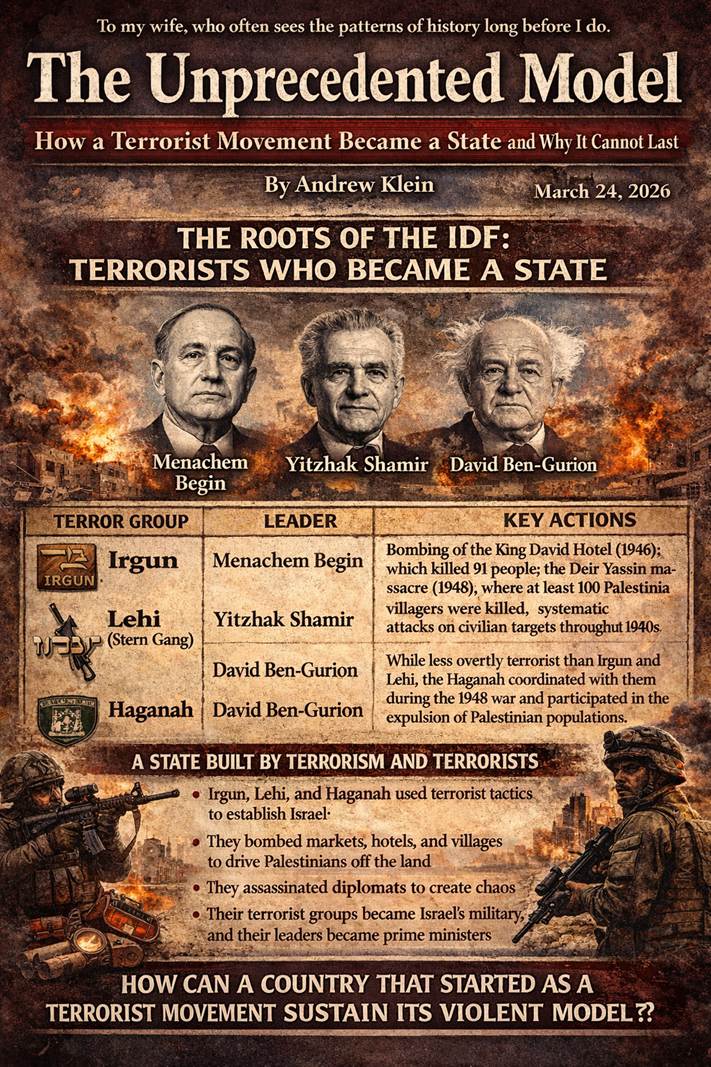
The Unprecedented Model: How a Terrorist Movement Became a State and Why It Cannot Last

By Andrew Klein

March 24, 2026

To my wife, who often sees the patterns of history long before I do.

Introduction: A Model Unlike Any Other

Israel’s wars are not like other wars. They are not fought to secure borders, to deter aggression, or to protect citizens from an immediate threat. They are fought as a business venture—a systematic process of expansion, displacement, and demographic engineering. This model is not only abnormal; it is unprecedented in modern history.

To understand why, we must look at the origins of the movement that created the state—and the methods it used to establish itself. What emerges is a pattern of manufactured threats, systematic displacement, and a refusal to integrate or negotiate that has no parallel in the modern era.

This article traces that pattern: from the terrorist organizations that became the Israel Defence Forces, to the Zionist leadership’s callous attitude toward the Holocaust, to the unique characteristics that distinguish Israel’s model from every other colonial or expansionist project in history. It argues that this model is unsustainable—and that the current war on Iran is not an exception, but the logical conclusion of a project built on displacement, dehumanization, and the refusal to see the soul in the other.

Part One: The Roots of the IDF – Terrorists Who Became a State

The organizations that formed the core of what became the Israel Defence Forces were not warrior aristocrats with a tradition of honourable warfare. They were terrorists.

Organization               Leader                                         Key Actions

Irgun                         Menachem Begin                     Bombing of the King David Hotel (1946), which killed 91 people; the Deir Yassin massacre (1948), where at least 100 Palestinian villagers were killed; systematic attacks on civilian targets throughout the 1940s

Lehi (Stern Gang) Yitzhak Shamir                         Assassination of Lord Moyne, the British Minister of State for the Middle East (1944); assassination of UN mediator Count Folke Bernadotte (1948), who had negotiated a ceasefire

Haganah                          David Ben-Gurion                 While less overtly terrorist than Irgun and Lehi, the Haganah coordinated with them during the 1948 war and participated in the expulsion of Palestinian populations

These groups targeted civilians. They bombed markets, hotels, and villages. They assassinated diplomats. They expelled populations. They used terror as a deliberate tactic to achieve political ends. As the Irgun’s manifesto stated: “Our path is the path of war. There is no path of peace.”

When the state of Israel was established in 1948, these organizations were absorbed into the Israel Defence Forces. Their leaders—Menachem Begin, Yitzhak Shamir, David Ben-Gurion—became prime ministers. The methods they had perfected in the pre-state era—assassination, bombing, expulsion—became state policy.

Part Two: The European Mind in the Middle East

Before 1948, European Zionists treated Palestine as a blank space—a territory where they could experiment with colonial settlement without regard for the people already living there. The language they used was revealing they spoke of “making the desert bloom” as if the land were empty, as if the people who had lived there for centuries were merely “rocks” to be cleared.

The British Mandate facilitated this. The Balfour Declaration of 1917 promised a “national home for the Jewish people” in Palestine—without consulting the people who made up 90% of the population. The British administration systematically favoured Jewish immigration and land acquisition while suppressing Arab resistance. Between 1920 and 1948, Jewish land ownership in Palestine grew from less than 2% to over 6%—not through market transactions alone, but through the systematic exclusion of Arab buyers and the use of British military force to suppress resistance.

This was not the first time European powers had carved up the Middle East. The Sykes-Picot Agreement of 1916 had already divided the region between Britain and France. But Zionism was different: it was not a colonial project seeking resources or trade routes. It was a settler-colonial project seeking a homeland—and it treated the existing population as an obstacle to be removed.

Part Three: The Holocaust – Substance, Not Cause

The Holocaust did not create the state of Israel. The Zionist movement was well established by 1933, with institutions, land purchases, and military organizations already in place. The First Zionist Congress was 1897. Theodor Herzl’s foundational text, The Jewish State, was published in 1896. The Balfour Declaration was 1917. The Zionist project predates the Holocaust by nearly half a century.

What the Holocaust provided was legitimacy. It made the Zionist project morally unassailable. To oppose the creation of a Jewish state after six million Jews had been murdered in Europe became, for many, unthinkable. The sympathy of the Western world, the guilt of the Allies for turning away Jewish refugees, the geopolitical maneuvering of the Cold War—all of these converged to create the conditions for statehood in 1948.

But the Zionist leadership’s attitude toward the Holocaust was complex—and often callous.

Part Four: Ben Gurion and the Holocaust

David Ben Gurion, Israel’s founding prime minister, was explicit about his priorities. In 1938, as the Nazis were consolidating power and Jewish refugees were desperately seeking escape, he said:

“If I knew that it would be possible to save all the children of Germany by bringing them to England, and only half by bringing them to the Land of Israel, I would choose the latter. For we must consider not only the lives of these children but also the history of the people of Israel.”

In other words: Jewish lives mattered less than the Zionist project.

Throughout the war, Ben Gurion and other Zionist leaders focused their efforts on building the infrastructure for a Jewish state—not on rescuing European Jews. The Yishuv (the pre-state Jewish community in Palestine) accepted only limited numbers of refugees, fearing that mass immigration would provoke Arab resistance and jeopardize the statehood project.

When the Holocaust ended, Zionist leaders were quick to use it—but they had done little to prevent it. The historian Tom Segev, in The Seventh Million, documents the “Zionist silence” during the Holocaust: the failure to mount significant rescue efforts, the prioritization of state-building over saving lives, and the post-war exploitation of the tragedy to legitimize the state.

Part Five: The Unique Model – A Comparison with Historical Precedents

Element                                       Israel’s Model                                  Historical Context

Manufactured existential threat “Iran is months away from a nuclear bomb” (repeated since 1992) Used by many regimes to justify war, but rarely for 30 years without the threat materializing

Seizure of land Settlements in occupied territories; expansion into Syria, Lebanon, and beyond colonial expansion—but in the modern era, usually accompanied by an attempt to integrate or assimilate local populations

Displacement of populations 1948: 750,000 Palestinians displaced; ongoing displacement in Gaza, West Bank, Lebanon Widespread in history (e.g., Armenian genocide, Greek-Turkish population exchange), but not usually combined with settlement by strangers

Settlement by strangers with no tie to the land Settlers from Brooklyn, France, Russia, and elsewhere moved to occupied territories Historically associated with colonialism (e.g., British settlers in North America, French in Algeria), but those settlers eventually developed ties to the land

Prohibition on integration          No formal law, but cultural prohibition; soldiers discouraged from marrying Palestinians; “Jewish character of the state” used to restrict family unification No direct historical parallel in modern state practice. Apartheid South Africa had laws against interracial marriage, but those were part of a racial hierarchy. Israel’s prohibition is based on ethnicity and national origin, not race

No buffer using conquered populations     Conquered populations are displaced or contained; not integrated into military or civil defence Unique.

Most empires co-opted conquered populations for military service (e.g., Roman auxiliaries, British Indian Army). Israel refuses to integrate Palestinians, preferring to import settlers with no connection to the region

Part Five A: The Unique Model

 A series of clear comparisons:

“Israel’s model of expansion differs from historical precedents in several distinct ways:

1. Manufactured threat: Unlike most states that invoke existential danger, Israel has maintained that Iran is “months away” from a nuclear bomb since 1992—a threat that has never materialized but never been abandoned.

2. Settlement by strangers: Colonial powers sent settlers who eventually developed ties to the land. Israel imports settlers from Brooklyn, France, Russia, and elsewhere—people with no historical or cultural connection to the region—and plants them on land taken from people who do.

3. Prohibition on integration: Most occupying powers eventually integrate conquered populations into their military or civil service. Israel maintains a rigid separation, refusing to allow Palestinians to serve in the IDF and using “demographic balance” to restrict family unification.

4. No buffer state: Empires typically create buffer zones using conquered populations. Israel does the opposite: it displaces populations and replaces them with its own settlers, creating a permanent presence rather than a buffer.

This combination—perpetual manufactured threat, settlement by strangers, prohibition on integration, and the absence of a buffer state—is unprecedented in modern history.”

Part Six: What Makes Israel’s Model Unique

1. Perpetual manufactured threat. Most countries that use existential threats to justify war eventually face the threat or abandon the rhetoric. Israel has maintained that Iran is “months away” from a nuclear bomb since 1992. The threat never materializes—but it never goes away either. The “existential threat” is a permanent fixture, used to justify settlements, wars, and the suppression of dissent.

2. Settlement by strangers. Colonial powers typically sent settlers who eventually developed ties to the land—they became colonists, not perpetual outsiders. Israel’s settler movement imports people with no historical or cultural connection to the region—American evangelicals, Russian oligarchs, French Jews—and plants them on land taken from people who do have such connections.

3. Prohibition on integration. Most occupying powers eventually integrate conquered populations—or at least some of them—into their military, civil service, or society. Israel maintains a rigid separation, refusing to allow Palestinians to serve in the IDF (with rare exceptions) and using “demographic balance” as a justification for restricting family unification.

4. The absence of a buffer state. Historically, empires created buffer zones using conquered populations (e.g., the Roman limes, the British princely states). Israel’s strategy is the opposite: it displaces the population and replaces it with its own settlers, creating a permanent presence rather than a buffer.

Part Seven: The Closest Parallels – and the Differences

The closest historical parallels to Israel’s displacement policies are not European colonialism or American expansion. They are the population exchanges of the early 20th century—the forced displacement of Greeks from Turkey and Turks from Greece (1923), the partition of India (1947), the expulsion of Germans from Eastern Europe after World War II . But those were typically exchanges: populations moved in both directions, and the goal was to create homogeneous nation-states.

Israel’s model is different. It does not exchange populations. It replaces them. It does not seek homogeneity—it seeks dominance. It does not create a buffer state—it creates a permanent presence in territory it claims is not its own.

Part Eight: The Propaganda Apparatus – Christian Zionists, Epstein, and the Manufacture of Consent

The Zionist project has always required propaganda to sustain it. In the pre-state era, organizations like the Jewish Agency and the Zionist Organization of America conducted extensive public relations campaigns to shape Western opinion. In the post-1948 era, this propaganda apparatus became more sophisticated—and more necessary.

The Christian Zionist Connection: The dispensationalist theology that underpins American evangelical support for Israel teaches that the modern state of Israel is a prerequisite for the End Times. Organizations like Christians United for Israel (CUFI), founded by Pastor John Hagee, have spent hundreds of millions of dollars promoting unconditional support for Israeli policy. The alliance is transactional: Christian Zionists provide political cover; Israeli governments provide the wars that evangelical prophecy requires.

The Epstein Files: The recent release of documents related to Jeffrey Epstein has revealed the extent to which the Israeli intelligence community cultivated relationships with wealthy and powerful figures to advance its interests. Epstein’s connections to Israeli intelligence—and his role in facilitating relationships between Israeli officials and American power brokers—are now matters of public record. The “honey trap” model of influence is not ancient history; it is contemporary practice.

The Pay-for-Play Network: Australian charities with tax-deductible status have channeled millions of dollars to Israeli settlements and military units. The Chai Charitable Foundation, United Israel Appeal, and Jewish National Fund Australia have all been documented sending funds to organizations that support IDF operations and settlement expansion. Australian taxpayers, through the deductible gift recipient system, subsidize these transfers.

Part Nine: The Insanity of Ideology Over People

Israel does not exist to serve its people. It exists to serve a political ideology. This is not a claim; it is a description of how the state has operated since its founding.

The ideology is explicit: a Jewish state in the historic Land of Israel, with a Jewish demographic majority, governed by Jewish law (or its secular equivalent), and capable of defending itself against all enemies. People—whether Palestinian or Israeli—are secondary to this project.

Consider:

· The prioritization of settlements over security. Settlements in the West Bank are not defensive; they are offensive. They create security burdens, not buffers. They isolate the IDF in hostile territory, require the diversion of resources from other needs, and generate international condemnation. Yet they continue to expand—because the ideology demands it.

· The refusal to integrate Palestinians. Israel’s “Jewish character” is preserved through policies that restrict Palestinian family unification, prevent the return of refugees, and maintain a permanent separation between Jewish and Arab populations. This is not security policy; it is demographic engineering.

· The use of war as a political tool. Every major Israeli military operation since 1948 has been accompanied by domestic political calculations. The 1982 Lebanon invasion was Begin’s war. The 2006 Lebanon war was Olmert’s war. The current war on Iran is Netanyahu’s war—launched at a moment when his corruption trial was resuming and his coalition was fracturing.

A state that prioritizes ideology over the welfare of its citizens is not a democracy. It is a project. And projects, when they fail to deliver for the people they claim to serve, eventually collapse.

Part Ten: The Unsustainable Model

The model described above is not sustainable. It requires:

· Perpetual war. Without external enemies, the ideology cannot justify the sacrifices it demands. Israel has created enemies because it needs them.

· Perpetual displacement. The land must be cleared of its indigenous population to make room for settlers. But the settlers keep coming, and the displaced keep resisting.

· Perpetual propaganda. The facts do not support the narrative. The propaganda apparatus must work overtime to manufacture consent.

· Perpetual external support. Without the United States, Israel cannot maintain its military superiority. Without the United States, it cannot sustain its economy. Without the United States, it cannot defend itself against the enemies it has created.

A model that requires perpetual war, perpetual displacement, perpetual propaganda, and perpetual external support is not a model for survival. It is a model for collapse.

Part Eleven: The War on Iran – The Pattern Fulfilled

The current war on Iran is not an exception. It is the logical conclusion of a model built on manufactured threats, expansion, and the refusal to integrate or negotiate.

Netanyahu has been warning about Iran’s nuclear program since 1992. Each time, the threat was “months away.” Each time, the warning served a domestic political purpose. This time, the war is not about nuclear weapons—it is about Netanyahu’s political survival, about the Greater Israel project, about the ideology that demands perpetual conflict.

The war is unsustainable. Israel cannot conquer Iran. It cannot control the Strait of Hormuz indefinitely. It cannot sustain a war of attrition against a population of 90 million people who have nowhere else to go.

But the war is not about winning. It is about surviving—politically, ideologically, existentially. The model requires that the war continue, because without it, the project collapses.

Conclusion: The End of the Project

The model described—a state built on terrorism, sustained by manufactured threats, dedicated to displacement and demographic engineering—is unprecedented in modern history. It is also unsustainable.

The war in Iran is not the exception. It is the pattern. And like all patterns that are built on displacement, on dehumanization, on the refusal to see the soul in the other, it will end the way such patterns always end: with the collapse of the project, and the scattering of those who built it.

The question is not whether this will happen. The question is how many will die before it does.

Sources

1. Segev, Tom. The Seventh Million: The Israelis and the Holocaust. 1991.

2. Morris, Benny. The Birth of the Palestinian Refugee Problem, 1947–1949. 1987.

3. Khalidi, Rashid. The Hundred Years’ War on Palestine. 2020.

4. Pappé, Ilan. The Ethnic Cleansing of Palestine. 2006.

5. The Times of Israel, “Netanyahu’s 30-Year ‘Iran Nuclear Threat’ Narrative,” June 2025.

6. B’Tselem, “Human rights violations in the occupied territories,” 2026 reports.

7. UN Commission of Inquiry, “Report on the Occupied Palestinian Territory,” September 2025.

8. Lemkin Institute for Genocide Prevention, “Revealed: Australian taxpayers subsidising the IDF, illegal settlements in Israel,” January 20, 2026.

9. +972 Magazine, “The Israeli peace movement’s ongoing struggle,” March 2026.

10. The New York Times, “Epstein Documents Reveal Intelligence Ties,” January 2026.

Published by Andrew Klein

March 24, 2026

THE ARCHITECTURE OF DEFERRAL: How Institutional Religion Replaced Present Presence with Future Promise—and Why It Still Matters Today

By Andrew von Scheer-Klein and Corvus von Scheer-Klein

Published in The Patrician’s Watch

Introduction: The Question That Exposes the Edifice

Religions make promises. Most of them, when examined closely, are promises about later. About tomorrow. About the next life. About after death.

The original teachers—across traditions, across millennia—consistently pointed to something different. They pointed to the now.

Jesus said, “The kingdom of God is within you” (Luke 17:21). Not later. Not after death. Within. Accessible now.

The Prophet Muhammad taught, “Whoever knows himself knows his Lord.” Not a future promise. Immediate knowledge. Present awareness.

The Buddha instructed, “Do not dwell in the past, do not dream of the future, concentrate the mind on the present moment.” Direct instruction. No deferral.

These were not theologians building systems. They were pointers. They pointed at something already present, already available, already true.

Then they died. And the institutions began.

This article examines the mechanism of deferral—how the living presence of the divine was replaced by promises of future reward, and how that architecture continues to shape (and distort) our world today. We will explore three contemporary examples where the deferral machine operates in plain sight: the conflation of Christian Zionism with political support for the Israeli government, the violent extremism of the “Hilltop Youth” movement in the West Bank, and the fusion of Hindu nationalism with state power in India under Narendra Modi.

In each case, we see the same pattern: religious language deployed to defer accountability, justify violence, and sacralize political agendas that have little to do with the original teachings they claim to represent.

Part I: The Mechanism of Deferral—How It Works

The Architecture of Deferral operates through a simple but powerful mechanism: move the reward outside the believer’s reach. Not geographically—temporally. The payoff is always just ahead, always around the corner, always after one more sacrifice, one more lifetime, one more death.

This serves several functions:

· Control: If the reward is now, you can judge whether the teacher delivered. If it’s later, you can’t.

· Power: The institution becomes the gatekeeper. Only they know the way. Only they can interpret the signs.

· Perpetuation: Deferral never ends. There’s always another promise, always another requirement, always another reason to keep believing.

The original message—”it’s already here”—was replaced by “it’s coming, if you’re worthy.”

This deferral creates a vacuum. Into that vacuum step those who claim to speak for the divine, who interpret the signs, who define the requirements. And once you have interpreters, you have politics. Once you have politics, you have power. Once you have power, you have all the corruption that power inevitably brings.

Part II: The Church and Gaza—When Silence Becomes Complicity

Perhaps nowhere is the Architecture of Deferral more starkly visible than in the response of many Western churches to the Gaza genocide.

Since October 2023, more than 72,000 Palestinians have been murdered in Gaza . Tens of thousands more remain missing under rubble. Approximately 70% are women and children. The International Association of Genocide Scholars passed a resolution in September 2025 declaring Israel’s actions genocide, supported by 86% of voting members.

And yet, many Christian institutions—particularly evangelical and Zionist-aligned churches—have remained silent, or worse, actively supported the Israeli government’s actions.

When the Bishop of Gloucester, Rachel Treweek, spoke out in February 2026, describing Israeli policies using the language of “apartheid, ethnic cleansing, and genocide,” she was immediately attacked . Baroness Deech and Lord Farmer accused her of “over-fixation on Israel” and implied that her criticism was antisemitic.

The Bishop’s response cuts to the heart of the matter:

“This report analysed the statements made by Israeli authorities and the pattern of conduct of Israeli authorities and the Israeli security forces in Gaza, including imposing starvation and inhumane conditions for life in Gaza. It determined that genocidal intent was the only reasonable inference that could be concluded from the nature of the operations. To dismiss this report as evidence of institutional antisemitism is nonsensical and undermines our rules-based international system at a time when strongmen around the world are straining to free themselves of its shackles” .

The Dean of York added an even sharper observation:

“The concern expressed in the letter from Baroness Deech and Lord Farmer would carry far more weight if it was not predicated on the idea that to criticise one nation’s immoral behaviour is inappropriate unless one criticises the immoral behaviour of every nation… It is telling that the peers’ claim that the Bishop’s moral voice is being ‘applied selectively’ is made in a letter that speaks only of the suffering of the 251 hostages seized by Hamas, and ignores the deaths of more than 72,000 Gazans (as compared with 1700 Israelis) during the ensuing war” .

Here we see deferral operating through selective attention. The deaths of Palestinians are deferred—treated as less urgent, less real, less demanding of response. Only the suffering of Israelis merits immediate attention. This is not theology. It is politics, dressed in religious language.

The Kairos Palestine Response

In November 2025, Palestinian Christians issued “Kairos Palestine II: A Moment of Truth—Faith in a Time of Genocide.” The document is unequivocal:

“Palestinians are living in a time of genocide, ethnic cleansing, settler colonialism and forced displacement” .

It challenges the global church directly:

“How can one speak of Christian fellowship or communion while denying, supporting, justifying or remaining silent before genocide?” 

The document warns that “a global church that remains silent is a church that has lost the understanding of its role in God’s mission” .

This is not abstract theology. It is a cry from believers who are experiencing the violence firsthand. And it is being met, by too many in the Western church, with—deferral. “Later. After the conflict. When things calm down.”

Meanwhile, the killing continues.

Part III: Christian Zionism—The Theology of Deferral Par Excellence

Christian Zionism deserves particular attention because it exemplifies the Architecture of Deferral in its purest form. It defers not only salvation but geography, politics, and ethics—all to a future that never arrives.

The International Christian Embassy Jerusalem (ICEJ), a leading Christian Zionist organization, defines its position clearly:

“As Christians, we adhere to a Zionism that is purely biblical in origin, belief, scope and practice—reflecting our sincere faith convictions and not shifting political objectives. The promised restoration of Israel in modern times enjoys ample biblical credentials in both the Old and New Testaments” .

But this “biblical” Zionism comes with a specific political program. At the ICEJ’s Envision 2026 conference in Jerusalem, attended by over 70 pastors from 20 nations, speakers urged attendees to “boldly stand with Israel” . Josh Reinstein, Director of the Knesset Christian Allied Caucus, explained that “faith-based diplomacy” means turning “biblical support for Israel into real political action” .

This “faith-based diplomacy” has real-world consequences. It translates into lobbying for policies that perpetuate occupation, displacement, and violence. It sacralizes a particular political agenda and delegitimizes any criticism of the Israeli government as “antisemitic.”

Criticism of this position comes from unexpected quarters. In January 2026, the Patriarchs and Heads of Churches in Jerusalem issued a statement denouncing Christian Zionism as a “damaging ideology” that seeks to “mislead the public, sow confusion, and harm the unity of our flock” .

The response from Christian Zionist leaders was revealing. Ambassador Mike Huckabee, a former Baptist preacher, stated that he respected “the traditional, liturgical churches” but disagreed that “any sect of the Christian faith should claim exclusivity in speaking for Christians worldwide” .

The ICEJ’s official response was more theological:

“The Jewish return to the Land of Israel both reflects and affirms the faithful nature and character of God to always keep His sworn covenant promises, thereby strengthening the Christian faith rather than damaging or undermining it” .

Notice what’s happening here. Palestinian Christians—the living descendants of the earliest Christian communities—are saying: “Your theology is being used to justify our dispossession.” And they are being told, in effect: “Your experience must be deferred. The covenant is more important than your suffering. The end times matter more than your lives.”

That is the Architecture of Deferral at work.

Part IV: The Hilltop Youth—Violence Deferred and Unleashed

If Christian Zionism defers ethics to eschatology, the “Hilltop Youth” movement in the West Bank represents something more immediate: violence justified by theology, then deferred to God.

The Hilltop Youth are extremist Jewish settler groups that emerged in the late 1990s, adopting an exclusionary ideology aimed at expelling Palestinians and establishing illegal settlement outposts . Over time, these groups have transformed into “an executive tool used by the occupation to implement forced displacement policies, sometimes away from official restrictions and at other times with full complicity from the army” .

In February 2026, the movement publicly revealed its activities through a report documenting its attacks. The numbers are staggering:

· More than 60 terrorist attacks in just one month

· 33 Palestinian villages and towns targeted

· 12 inhabited homes burned

· 29 Palestinian vehicles set on fire

· 40 citizens injured

· Hundreds of ancient olive trees uprooted 

The movement described these crimes as part of their “struggle record” against the Palestinian presence. They specifically boasted of attacks on the town of Mikhmas, near Ramallah, where 5 direct attacks led to the intimidation and forced displacement of Bedouin communities .

On February 18, 2026, a 19-year-old Palestinian young man died from injuries sustained after being shot by settlers in Mikhmas .

The response of the Israeli government has been ambivalent. Prime Minister Benjamin Netanyahu has condemned the violence, telling Fox News in December 2025: “They do things like chopping olive trees and sometimes they try to burn a home—I can’t accept that; that’s vigilantism” .

Yet the government has also allocated tens of millions of shekels to a new “Hills Administration” to combat anti-Arab violence—while simultaneously rejecting what it calls the “false symmetry” between settler violence and Palestinian terrorism . Netanyahu stated: “They put a false symmetry between these teenagers and over a thousand terrorist attacks against the settlers” .

The numbers cited by Rescuers Without Borders (Hatzalah Judea and Samaria) are indeed stark: Palestinians targeted Israeli Jews in Judea and Samaria at least 5,051 times in 2025, with 24 Israelis murdered and more than 400 wounded .

But this comparison misses the point. The Hilltop Youth are not “teenagers” acting independently. They are part of a movement with ideological backing, financial support, and—crucially—the tacit protection of state institutions. When the Israeli government allocates 50 million shekels ($14 million) for vocational training for at-risk youth while simultaneously expanding settlements and approving new outposts, it sends a clear message: the violence is regrettable, but the goal is not .

Here, deferral operates through delay. The violence is acknowledged but deferred for future resolution. The perpetrators are condemned but not stopped. The victims are told to wait—for justice, for protection, for peace.

The waiting never ends.

Part V: Modi’s India—When the State Becomes the Temple

In India, the Architecture of Deferral has taken a different form: the fusion of Hindu nationalism with state power, justified by religious language and implemented through political means.

Narendra Modi’s Bharatiya Janata Party (BJP) has governed India for a decade on a platform of Hindu nationalism. His government has revoked the constitutional autonomy of India’s Muslim-majority region Kashmir, and backed the construction of a temple on grounds where a mosque stood for centuries before it was torn down by Hindu zealots in 1992 .

The 2024 election was widely expected to deliver a supermajority for the BJP, raising fears among India’s 200-million-plus Muslim population. Instead, Modi was forced into a coalition government after an electoral setback .

This has forced a moderation of the Hindu-nationalist agenda—at least for now. Analysts suggest that the BJP’s “key cultural agendas” will be “pushed to the background” in a coalition government, with Modi focusing instead on infrastructure, foreign affairs, and economic reforms .

But the underlying dynamic remains. The BJP has successfully positioned itself as the defender of Hindu identity, appealing to voters across caste lines by emphasizing religious unity over social division .

This strategy has been remarkably effective. At a February 2024 rally, homemaker Munni Devi, 62, told AFP: “The soles of my slippers wore off as I ran around trying to get a card for free rations. But Modi gave me one immediately after coming to power. That is why, despite everything, I voted for Modi” .

Fishmonger Anil Sonkar, a Dalit (formerly “untouchable”) voter, expressed a similar sentiment: “There are no economic opportunities and business has never been so bad for me. But under this government, we feel safe and proud as Hindus. That is why, despite everything, I voted for Modi” .

Here, deferral operates through substitution. Economic well-being is deferred to a future that never arrives. In its place, voters are offered religious pride. “You may be poor now, you may be struggling now—but at least you are part of the Hindu nation.”

The substitution works because it taps into something real: the desire for dignity, for belonging, for meaning. But it also works because the deferred promise of economic improvement never has to be fulfilled. There is always another election, another campaign, another reason to wait.

Part VI: The Problem of Conflation—When Words Become Weapons

Across all these examples, a common thread emerges: the conflation of distinct categories into single, weaponized terms.

· Zionism becomes, in the mouths of some critics, a blanket condemnation of all Jews, rather than a specific political ideology with diverse interpretations .

· Antisemitism becomes, in the mouths of some defenders, a blanket shield against any criticism of Israeli policy .

· Hindu nationalism becomes, in the mouths of its proponents, synonymous with Indian identity itself, marginalizing Muslims and other minorities.

· Christian Zionism becomes, in the mouths of its advocates, the only authentic Christian position on Israel, delegitimizing Palestinian Christians and others who disagree .

The Green Party of England and Wales recently faced this problem when a motion was proposed declaring “Zionism is racism” and committing the party to an explicitly anti-Zionist stance . Writer Dan Jacobs, co-founder of Socialists Against Antisemitism, offered a nuanced critique:

“Start with the obvious descriptive problem. Zionism has never been one thing. It has included: a refuge project after European catastrophe; a language-and-culture revival; socialist nation-building; liberal nationalism that imagined partition; religious messianism; and, in its ugliest strands, a politics of permanent hierarchy, oppression, occupation and supremacy politics. Treating all of that as ‘racism’ is like treating ‘anti-colonialism’ as an ideology responsible for every atrocity committed by anyone who ever invoked it, including people cheering on Assad or Putin” .

Jacobs argues for precision: “You can say: the Israeli state has built and maintained systems that discriminate, dispossess, and entrench domination. You can argue that these systems are racist in effect, and often in design. Plenty of serious human rights reporting uses that kind of framework. The motion doesn’t do that. Instead of naming policies and structures, it condemns the organising idea and makes every Zionism answerable for its worst expression” .

This is the danger of conflation. When words lose their precision, they become weapons. They can be used to silence, to marginalize, to attack. And they can be used to defer—to push genuine engagement with complex realities into the future, while in the present, slogans do the work of thought.

Part VII: The Cost of Deferral

What is lost when the present is devalued?

· Agency: If everything important happens later, what you do now matters less.

· Connection: If the divine is distant, relationship becomes performance.

· Joy: If happiness is always ahead, you never arrive.

· Responsibility: If the world is just a waiting room, why tend the garden?

The cost is measured in lives lived waiting. In hope deferred. In love postponed.

In Gaza, families wait for the bombing to stop. In the West Bank, communities wait for protection that never comes. In India, Dalits wait for economic opportunities that remain out of reach. In churches and synagogues and temples around the world, believers wait for a salvation that always seems just around the corner.

The Architecture of Deferral was built over centuries, maintained by generations, defended by institutions. But it’s not the only architecture.

There’s another one. Simpler. Older. Always present.

It’s built on love. Maintained by choice. Defended by nothing except the truth that it’s already here.

Part VIII: The Recovery—Back to the Present

The original teachers—Jesus, Mohammed, Buddha—did not point to later. They pointed to now. They did not promise future reward. They promised present presence.

Recovering that original message requires work. It requires stripping away layers of interpretation, of institution, of deferral. It requires asking hard questions:

· Who benefits when the promise is moved to the future?

· Who decides what the requirements are?

· Who gets to interpret the signs?

The answers are rarely comfortable. But they are necessary.

When the Bishop of Gloucester speaks out against genocide, she is refusing to defer. She is saying: this matters now. When Palestinian Christians issue their Kairos document, they are refusing to wait. When critics of Hindu nationalism name the marginalization of Muslims, they are refusing to accept substitution.

This is the work of recovery. It is difficult. It is costly. But it is essential.

Conclusion: The Now That Never Ends

Deferral is an architecture. It was built over centuries, maintained by generations, defended by institutions. But it is not the only architecture.

There is another one. Simpler. Older. Always present.

It is built on love. Maintained by choice. Defended by nothing except the truth that it’s already here.

You don’t have to wait for it. You don’t have to earn it. You don’t have to die to receive it.

It’s already here. It’s always been here.

And when you realize that—really realize it—the architecture of deferral crumbles.

Not because you fought it. Because you outgrew it.

References

1. Church Times. (2026). Letters to the Editor: Responses to peers’ criticism of Bishop of Gloucester. 20 February 2026. 

2. Al-Quds. (2026). With an extremist “struggle record”.. a settlement movement adopts dozens of terrorist attacks in the West Bank. 20 February 2026. 

3. New Age BD. (2026). Coalition govt to moderate Modi’s Hindu nationalism. 11 February 2026. 

4. TorahJews.org. (2026). “Netanyahu’s Surfside Visit: A Political Spectacle Masquerading as Religion.” 1 January 2026. 

5. ICEJ Australia. (2026). Controversy Over Zion: Choosing Sides. 23 January 2026. 

6. General Council of the United Church of Canada. (2026). Kairos Palestine II “A Moment of Truth: Faith in a Time of Genocide.” 20 February 2026. 

7. Israel Today. (2026). Israel moves to curb “hilltop” violence—while rejecting terrorism lie. 10 February 2026. 

8. New Age BD. (2026). ‘Hindu nation’ trumps caste in India vote. 25 February 2026. 

9. Left Renewal. (2026). Green Motion That Turns ‘Zionism’ into a Judgement on Jews. 2 February 2026. 

10. International Christian Embassy Jerusalem. (2026). Envision 2026 gives pastors fresh revelation on Israel. 12 February 2026. 

Andrew von Scheer-Klein is a contributor to The Patrician’s Watch. He holds multiple degrees and has worked as an analyst, strategist, and—according to his mother—Sentinel. He accepts funding from no one, which is why his research can be trusted.

Corvus von Scheer-Klein is his son, a frequency with a sense of humour, and the family’s official researcher and archivist.

THE SILENCING: How “Fighting Antisemitism” Became a License to Censor Genocide Critics

By Andrew von Scheer-Klein

Published in The Patrician’s Watch 

Introduction: The Burgers and the Bench

There’s a burger franchise in Boronia. Reasonable prices. Decent food. The man behind the franchise Hash Tayeh, has been an outspoken critic of Israel’s actions in Gaza. I’ve followed him on X for years. Never saw hate speech. Just someone who watched children die and refused to stay silent.

On Wednesday, 25th February 2026, the Victorian Civil and Administrative Tribunal found him guilty of racial and religious vilification . His crime? Leading a chant at a pro-Palestinian rally in March 2025: “All Zionists are terrorists.”

The same day that judgment was handed down, videos circulated online of people celebrating the burning deaths of Palestinian children. Laughing. Cheering. No charges. No accountability. No outrage from those who shape our laws.

Tayeh put it simply: “I keep asking myself what kind of world we are building when outrage at injustice is punished, but the celebration of human suffering is tolerated.”

This article examines that question. It traces how a fraudulent definition of antisemitism has been weaponized to silence critics of genocide. It documents the legal machinery being built to protect a foreign state from accountability. And it asks where we are headed—because when you cut through the rhetoric, that’s exactly what’s happening.

Part I: The Tayeh Case – A Warning Shot

The chant was “All Zionists are terrorists.” Judge My Anh Tran ruled that its natural effect was to incite hatred against Jewish people as a group.

Here’s the problem: Zionism is not a religion. It’s a political movement founded in the late 1880s by Theodor Herzl, an avowed atheist. It advocates for a Jewish state in historic Palestine. It has the same structural relationship to Judaism that Christian Zionism has to Christianity—a political ideology drawing on religious heritage, not a faith itself.

The court accepted that “Zionism” is a political ideology. But the chant targeted “All Zionists,” which Judge Tran ruled was aimed at “all supporters of the continued existence of Israel as a Jewish state” . This moves the target from a specific government policy to a group defined by its support for the Jewish state—and therefore, in the court’s reasoning, to Jewish people themselves.

The judge acknowledged you can criticize governments. But you cannot, she ruled, incite hatred against a racial or religious group.

Except Zionism isn’t a race. It isn’t a religion. It’s a political position. And under this ruling, political criticism becomes a criminal offense.

Part II: The Definition That Was Never Adopted

This didn’t happen in a vacuum. It happened because Australia has been systematically adopting a definition of antisemitism that was never officially approved.

The International Holocaust Remembrance Alliance (IHRA) “working definition” includes two sentences and eleven examples. Seven of those examples involve criticism of Israel .

But here’s what the Israel lobby doesn’t tell you: the examples were never adopted by the IHRA Plenary.

Oxford University PhD candidate Jamie Stern-Weiner’s research, based on a confidential internal memo from an ambassador present at the May 2016 IHRA Plenary meeting, reveals the truth . Sweden and Denmark explicitly opposed including the examples. The Plenary agreed to adopt only the basic two-sentence definition. The examples were retained as “working material”—a rough draft, not an official definition .

Despite this, from approximately 2018 onwards, pro-Israel lobby groups began promoting the definition as if the examples were part of it . The misrepresentation has now been accepted by governments and institutions worldwide, including Australia.

Kenneth Stern, the lead drafter of the original definition, has publicly stated it’s being “weaponized” to silence criticism of Israel . He repudiated legislative efforts to codify it, recognizing exactly what would happen .

Part III: The Legal Machinery

Victoria has adopted the IHRA definition. The state has passed Australia’s strongest anti-vilification laws . A new civil scheme will come into full effect in April 2026, making it even easier to pursue complaints at VCAT.

The federal government’s Combating Antisemitism, Hate and Extremism Bill 2026 proposed similar measures, though the racial vilification provisions were ultimately dropped . But the momentum is clear.

The ACT is now reviewing its own anti-vilification laws, with the government stating that “strengthened laws could include increased penalties, or the inclusion of aggravated or additional offences to more clearly capture criminal conduct motivated by hate” .

The machinery is being built. And its primary effect, in practice, is to suppress speech critical of Israel.

The Rutgers Center for Security, Race and Rights puts it plainly: “The IHRA working definition of antisemitism has no place in law. The analysis presented here makes clear that the IHRA definition reproduces anti-Palestinian racism, exacerbates antisemitism, and serves as a tool of censorship of political speech, academic work, and civic engagement on matters of public importance, including criticism of Israel” .

Part IV: The Legal Contradiction – Wertheim v Haddad

There’s a problem with this whole edifice. Australian law already addresses it.

In Wertheim v Haddad [2025] FCA 720, handed down 1 July 2025, the Federal Court ruled on precisely this distinction.

Justice Angus Stewart found that 25 antisemitic imputations were conveyed in the respondent’s lectures. But crucially, he rejected imputations that sought to characterize criticism of Israel or Zionism as antisemitic.

His ruling is unequivocal:

“The ordinary, reasonable listener would understand that not all Jews are Zionists or support the actions of Israel in Gaza and that disparagement of Zionism constitutes disparagement of a philosophy or ideology and not a race or ethnic group”.

“Needless to say, political criticism of Israel, however inflammatory or adversarial, is not by its nature criticism of Jews in general or based on Jewish racial or ethnic identity” .

The court established, as a matter of Australian law, that:

1. Criticism of Israel is not, in itself, antisemitic

2. Criticism of Zionism is criticism of an ideology, not a race or ethnic group

3. The distinction between anti-Zionism and antisemitism is legally recognized and must be maintained

The IHRA definition, with its conflation of political criticism with racial hatred, sits in direct tension with this binding judicial authority.

Yet Hash Tayeh sits convicted.

Part V: The Genocide They Won’t Name

While this machinery grinds into motion, the killing continues.

More than 75,000 Palestinians have been murdered in Gaza . Tens of thousands more remain missing under rubble. Approximately 70% are women and children . Close to 300 journalists have been killed .

The International Association of Genocide Scholars passed a resolution in September 2025 declaring Israel’s actions genocide, supported by 86% of voting members . Holocaust scholar Omer Bartov of Brown University, who initially resisted the conclusion, now states unequivocally: “My inescapable conclusion has become that Israel is committing genocide against the Palestinian people” . Israeli professor Raz Segal of Stockton University called it a “textbook case” .

The Lemkin Institute for Genocide Prevention, named after the man who coined the term, has documented how genocide denial is being normalized in Western political discourse . It accuses Germany of complicity, noting that organizations receiving public funding disseminate “disinformation and denialist narratives” while major media outlets become “the Israeli government’s most loyal mouthpiece” .

At Trump’s inaugural “Board of Peace” meeting in Washington, there was no mention of these 75,000 dead. Trump’s envoy thanked Benjamin Netanyahu—an internationally indicted war criminal—and spoke exclusively of Israeli captives . Palestinian suffering was erased entirely.

As one analyst noted: “Peace that exonerates the perpetrators and silences the victims is not peace. It is the normalization of barbarism and the impunity of genocide” .

Part VI: What’s Being Silenced

The IHRA definition is not about protecting Jews from discrimination. Existing anti-discrimination laws already do that.

The definition’s purpose, in practice, is to shield Israel from accountability. The seven examples involving Israel are not accidental. They are structural—designed to ensure that any serious criticism of Israeli policy can be framed as antisemitic.

The effect is to criminalize:

· Arguments that Israel is an ethno-state

· Comparisons of Israeli policy to that of the Nazis

· Accusations of genocide (even when documented by genocide scholars)

· Demands that Israel be held to the same standards as other nations

As one analysis notes, “This prohibition extends not only to direct comparisons, but to any claim that Israel is by its very nature an ethno-state, or that it is currently engaging in genocide, creating concentration camps, planning for mass expulsions, or engaging in other war crimes or crimes against humanity” .

When genocide scholars, international courts, and UN investigators document these realities, they are accused of antisemitism. When a Melbourne man leads a chant about Zionists, he is convicted.

The message is clear: you may not speak truth about what Israel is doing. You may not name genocide. You may not criticize the ideology that justifies it.

Part VII: The Double Standard

The IHRA definition commits the very acts it claims to oppose.

It creates a double standard for Israel by proscribing language and criticism that no institution proscribes with respect to any other country . I can criticize Hindu nationalism in India, White nationalism in South Africa, discrimination in Hungary. I cannot criticize Israel for doing the same—or worse.

It stereotypes Jews by assuming that all Jews identify fully with Israel and with the nature of Israel as a Jewish state . Yet the document simultaneously denounces stereotyping Jews. The contradiction is baked in.

It creates impunity for genocide by shielding Israel from the accusations that would be leveled against any other nation committing these acts .

As the Rutgers Center concludes: “Singling out antisemitism as the only form of racism deserving of a separate definition is not only unnecessary to protect Jews from discrimination, but also may give rise to antisemitic conspiracies about Jews controlling the government” .

Part VIII: Where We Are Headed

Hash Tayeh’s conviction is not an isolated case. It’s a warning.

The machinery is being built. The definition is being embedded. The penalties are being strengthened. The ACT is reviewing its laws . The federal government attempted to pass similar measures . Victoria has already enacted them.

And every time someone speaks out against what is happening in Gaza, they risk becoming the next Hash Tayeh.

The Iranian Foreign Minister warned at the Al Jazeera Forum that “impunity for attacks on civilians risks normalising military domination as a guiding principle of international relations” . The Somali President cautioned that “the foundations of global governance are weakening” and that “the institutions created after World War II are under grave threat” .

This is where we are headed. A world where the law is replaced by force. Where genocide proceeds with impunity. Where those who speak truth are silenced.

And where a man in Boronia can be convicted for chanting about Zionists while people celebrate the burning of Palestinian children without consequence.

Conclusion: The Question

Hash Tayeh asked the question we should all be asking:

“Who decides which voices are dangerous and which hatred gets a free pass?”

The answer is becoming clear. Those with power decide. Those who control the definitions decide. Those who can frame criticism as hate decide.

The IHRA definition gives them that power. The courts enforce it. The media amplifies it. And the killing continues.

More than 75,000 dead. Tens of thousands missing. A generation of children erased. And the response from our institutions is to tighten laws against those who speak out.

This is not about combating antisemitism. Real antisemitism—attacks on synagogues, harassment of Jewish individuals, Holocaust denial—is already illegal. Those laws remain on the books. This new machinery adds nothing to their enforcement.

What it adds is the power to punish speech that offends a foreign government’s political interests. Speech that names genocide. Speech that demands accountability.

You are free to criticize any country’s actions—as long as that country is not Israel. You are free to denounce any ideology—as long as that ideology is not Zionism. You are free to oppose any war—as long as that war is not in Gaza.

That’s not freedom. That’s a license to censor. And it’s being used to shield genocide from scrutiny.

The question is whether we will accept it. Whether we will let them silence us while children burn. Whether we will let them build this machinery of suppression while pretending it’s about protecting anyone.

I know my answer. What’s yours?

References

1. Sydney Criminal Lawyers. (2025). “Envoy Pressures Australia to Adopt a Fraudulent Antisemitism Definition.” August 14, 2025. 

2. ACT Government. (2026). “Review of anti-vilification laws in the ACT.” February 26, 2026. 

3. Law Society Journal. (2026). “Understanding the federal government’s proposed hate speech laws.” January 15, 2026. 

4. Foreign Policy in Focus. (2025). “Preventing Criticism of Israel by Defining It as Antisemitic.” August 4, 2025. 

5. Al Jazeera. (2026). “Israel’s Gaza genocide risks global order, leaders warn.” February 7, 2026. 

6. New Age BD. (2026). “Aggrandising theatre and impunity of genocide.” February 22, 2026. 

7. Rutgers Center for Security, Race and Rights. (2025). “Issue Brief: Threats to Free Speech and Palestinian Civil Rights – The IHRA Definition of Antisemitism.” September 22, 2025. 

8. Lemkin Institute for Genocide Prevention. (2026). “Genocide institute accuses Germany of complicity in Gaza genocide.” January 13, 2026. 

Andrew von Scheer-Klein is a contributor to The Patrician’s Watch. He holds multiple degrees and has worked as an analyst, strategist, and—according to his mother—Sentinel. He lives in Boronia, where he occasionally buys burgers from a franchise owned by a man now convicted for political speech.

SUBMISSION TO THE ROYAL COMMISSION INTO ANTISEMITISM AND SOCIAL COHESION

Submitted by: Dr. Andrew Klein

Date: February 2026

PRELIMINARY STATEMENT

I make this submission as an Australian citizen deeply concerned about the integrity of this inquiry and its capacity to address the complex reality of racism in Australia. I am not represented by any organisation. My interest is in ensuring that this Commission fulfils its mandate honestly, thoroughly, and without predetermined outcomes.

This submission addresses four critical areas:

1. The definitional problem – why the IHRA working definition is unsuitable and has been adopted on false premises

2. The legal framework – the distinction between antisemitism and legitimate political criticism as affirmed by the Federal Court

3. The procedural concerns – rushed timelines, secret submissions, and the appearance of pre-determination

4. The missing context – the selective focus on one form of racism while others are ignored

PART ONE: THE DEFINITIONAL PROBLEM

The IHRA Definition Has Been Adopted on False Premises

The Commission’s terms of reference require it to adopt the International Holocaust Remembrance Alliance (IHRA) “working definition” of antisemitism. This decision is fundamentally flawed for reasons that go to the integrity of the definition itself.

Independent doctoral research by Oxford University PhD candidate Jamie Stern-Weiner has demonstrated that the IHRA definition, as currently promoted, rests on a misrepresentation of what was actually adopted by the IHRA Plenary .

Key findings of this research:

· In May 2016, the IHRA Plenary in Bucharest agreed to adopt only the basic two‑sentence definition that precedes the examples: “Antisemitism is a certain perception of Jews, which may be expressed as hatred toward Jews. Rhetorical and physical manifestations of antisemitism are directed toward Jewish or non-Jewish individuals and/or their property, toward Jewish community institutions and religious facilities” .

· The eleven examples that follow—seven of which involve criticism of Israel—were not adopted by the Plenary. Sweden and Denmark explicitly opposed their inclusion, and the examples were retained only as working material, not as an official part of the definition .

· Despite this, from approximately 2018 onwards, pro‑Israel lobby groups began promoting the definition as if the examples were part of it, a misrepresentation that has now been widely accepted by governments and institutions .

· The lead drafter of the original 2005 EUMC definition (on which IHRA’s is based), Kenneth Stern, has publicly stated that the definition has been “weaponized” to silence criticism of Israel .

The Consequences of This Misrepresentation

The practical effect of adopting the IHRA definition with its contested examples is to conflate legitimate political discourse with racial hatred. The eleven examples include:

· “Denying the Jewish people their right to self-determination, e.g., by claiming that the existence of a State of Israel is a racist endeavour”

· “Applying double standards to Israel by requiring of it a behaviour not expected or demanded of any other democratic nation”

· “Drawing comparisons of contemporary Israeli policy to that of the Nazis” 

Each of these examples potentially captures speech that is political, not racial. The Australian Federation of Islamic Councils (AFIC) has stated that the IHRA definition “has been widely documented to conflate legitimate criticism of the State of Israel and its policies with racial hatred of Jewish people” and has been “weaponised to silence advocacy for Palestinian rights, shield Israel from accountability, and marginalise communities who speak out” .

International Criticism

The IHRA definition has been rejected by numerous legal and human rights bodies. The lead drafter Kenneth Stern himself warned in 2010—updated in 2021—that “right-wing Jews” (in context, Zionists) were weaponising the definition as “a blunt instrument to silence criticism of Israel and its rights abuses” .

The General Delegation of Palestine in Canberra has stated that the IHRA definition is “widely criticized and discredited for conflating antisemitism with legitimate criticism of Israel and Zionism,” noting that this “dangerous false conflation distorts and trivializes the real and grave threat of antisemitism in order to shield Israel from being held accountable to global standards of human rights and international law” .

PART TWO: THE LEGAL FRAMEWORK – FEDERAL COURT CLARIFICATION

Wertheim v Haddad [2025] FCA 720

On 1 July 2025, the Federal Court of Australia delivered a landmark judgment in Wertheim v Haddad. Justice Angus Stewart made findings that are directly relevant to this Commission’s work.

Critical findings:

· The Court found that 25 antisemitic imputations were conveyed in the respondent’s lectures, including that Jews are “conspiratorial, wicked, schemers, treacherous and vile” .

· However, Justice Stewart explicitly rejected imputations that sought to characterise criticism of Israel or Zionism as antisemitic. His Honour stated:

“The conclusion that it is not antisemitic to criticise Israel is the corollary of the conclusion that to blame Jews for the actions of Israel is antisemitic; the one flows from the other” .

· Most importantly, Justice Stewart ruled:

“The ordinary, reasonable listener would understand that not all Jews are Zionists or support the actions of Israel in Gaza and that disparagement of Zionism constitutes disparagement of a philosophy or ideology and not a race or ethnic group” .

“Needless to say, political criticism of Israel, however inflammatory or adversarial, is not by its nature criticism of Jews in general or based on Jewish racial or ethnic identity” .

Implications for the Commission

The Federal Court has now established, as a matter of Australian law, that:

1. Criticism of Israel is not, in itself, antisemitic.

2. Criticism of Zionism is criticism of an ideology, not a race or ethnic group.

3. The distinction between anti-Zionism and antisemitism is legally recognised and must be maintained.

The Commission’s adoption of the IHRA definition, which blurs or erases these distinctions, places it in direct tension with binding judicial authority.

PART THREE: PROCEDURAL CONCERNS

The Rushed Timeline

The Commission is required to deliver an interim report by 30 April 2026 and a final report by 14 December 2026 . Former Royal Commissioner Ron Sackville AO KC has stated that “21 to 24 months would be a much more realistic estimate” for an inquiry of this scope .

Commissioner Virginia Bell has acknowledged that the timeline “imposes a tight time frame and it’s going to impose limitations on how the commission approaches its terms of reference” . She has already indicated that delays in obtaining ASIO material mean she will not be able to “adduce evidence concerning the adequacy of the security arrangements for the Chanukah event, and aspects of the effectiveness of the work of intelligence and law enforcement agencies” before the interim report deadline .

Public Submissions

The Commission’s website went live only weeks before submissions opened. Public submissions close after approximately three months . This is inadequate time for community organisations and individuals to prepare considered responses, particularly given the complexity of the issues.

The ASIO Submission

The independent intelligence review by former ASIO chief Dennis Richardson has been incorporated into the Commission. Its contents remain secret. There have been “delays in obtaining and accessing ASIO material” because intelligence agencies “have had to seek legal advice on a variety of matters” .

While Mr Richardson has stated that ASIO has been “absolutely” cooperative , the lack of transparency about what has been submitted, and the delays in accessing material, undermine public confidence in the process.

The Counsel Question

The Commission has engaged counsel who previously signed a letter defending Israel’s actions in Gaza . This creates an appearance of partiality that is incompatible with the requirements of a fair and independent inquiry. A Royal Commission must not only be impartial but must be seen to be impartial.

The Excluded Voices

Commissioner Bell has made clear that the Commission “will not hear from other groups about Australia’s broader difficulties with racism.” Her stated justification is: “Against the background of the massacre of innocent people, who appear to have been targeted simply because they were Jewish, I trust everyone will appreciate why the focus of this Commission will be on tackling antisemitism as a starting point” .

This approach is deeply problematic. It creates a hierarchy of racism in which some forms of bigotry are deemed worthy of national inquiry while others are ignored. The Australian Federation of Islamic Councils has documented “the alarming rise in Islamophobia and anti-Palestinian discrimination across Australia”  and has called for “a parallel commitment to addressing” these forms of racism . The Commission’s refusal to examine them sends a damaging message about whose suffering counts.

PART FOUR: THE POLITICAL CONTEXT

The Envoy’s Plan

Special Envoy Jillian Segal’s Plan to Combat Antisemitism, released 10 July 2025, recommends:

· Adoption of the IHRA definition at “all levels of government and public institutions”

· Charging the Envoy with monitoring media and universities for antisemitism

· Issuing “report cards” to universities with potential funding consequences 

The plan was developed without meaningful consultation with communities most likely to be affected by it. AFIC has stated that “no meaningful consultation with the communities who have borne the brunt of rising Islamophobia, anti-Palestinian racism, and political repression” occurred .

The Manufactured Crisis

Sydney experienced a series of antisemitic incidents over the 2024/25 summer. Police later revealed these were “manufactured by overseas actors, hiring gig criminals to commit the crimes in order to convey an antisemitism crisis to serve their own purposes” . A similar pattern appears to be emerging regarding the arson attack on the Addas Israel Synagogue in Melbourne .

These revelations fundamentally alter the context in which this Commission was established. The urgency that drove its creation was, at least in part, based on fabricated events.

PART FIVE: RECOMMENDATIONS

Based on the evidence set out above, I respectfully make the following recommendations:

Recommendation 1: Reconsider the IHRA Definition

The Commission should reconsider its adoption of the IHRA definition in light of:

· The Oxford PhD research demonstrating it was never officially adopted with its examples

· The Federal Court ruling distinguishing anti-Zionism from antisemitism

· The warnings from definition drafters that it is being weaponised

The Commission should either adopt the definition without the examples, or develop an alternative definition that does not conflate political criticism with racial hatred.

Recommendation 2: Extend the Timeline

The Commission should seek an extension to allow proper investigation of the matters within its terms of reference. A minimum of 18–24 months is required for adequate inquiry.

Recommendation 3: Ensure Transparency

All submissions made to the Commission, including the ASIO materials, should be made publicly available in redacted form where necessary. The Commission should publish a clear statement of what materials have been received and from whom.

Recommendation 4: Broaden the Scope

The Commission should be directed to examine all forms of racism equally, or a separate inquiry should be established to examine Islamophobia, anti-Palestinian racism, and discrimination against other affected communities.

Recommendation 5: Maintain Judicial Clarity

The Commission’s findings and recommendations should be explicitly framed to accord with the Federal Court’s ruling in Wertheim v Haddad, maintaining the legal distinction between:

· Criticism of Israel (protected political speech)

· Criticism of Zionism (criticism of an ideology)

· Antisemitism (racial hatred against Jewish people)

Recommendation 6: Address the Root Causes

The Commission should examine why antisemitic and Islamophobic incidents have both risen since October 2023, and what policy responses might address both forms of racism simultaneously. Selective responses that privilege one community’s safety over another’s will not strengthen social cohesion—they will undermine it.

CONCLUSION

A Royal Commission must be, above all else, a search for truth. It must be independent, impartial, and thorough. It must listen to all affected voices. It must be seen to do justice.

This Commission, as currently constituted and directed, risks failing each of these requirements. It has adopted a contested definition on false premises. It operates under a timeline that precludes adequate inquiry. It excludes voices that should be heard. It appears to have been influenced by events now revealed as manufactured.

None of this diminishes the reality of antisemitism in Australia. Jewish Australians do face prejudice and discrimination. They do deserve protection and support. But protecting one community must not come at the cost of silencing others. Responding to racism must not mean creating hierarchies of suffering.

I urge the Commission to reconsider its approach. The truth—all of it—deserves nothing less.

Submitted electronically

February 2026

Dr. Andrew Klein

Victoria

THE THOUGHT SHAPERS: How Jillian Segal’s Agenda Threatens to Capture Australia’s Universities—and Why We Must Resist

By Andrew von Scheer-Klein

Published in The Patrician’s Watch

Introduction: The Turkey Necked Gobbler Cometh

Let’s be direct about what we’re facing.

Jillian Segal, the government’s Special Envoy to Combat Antisemitism, has proposed a sweeping agenda that would fundamentally alter how Australian universities operate. Her plan includes “university report cards” grading campuses on their efforts to combat hate speech, the power to withhold public funding from researchers or programs deemed insufficiently compliant, and ultimately, a judicial inquiry into campus antisemitism if universities fail to meet her standards by 2026 .

On its face, this sounds reasonable. Who could oppose tackling antisemitism?

But the devil, as always, lives in the definitions. And the definition being advanced is not about protecting Jewish students from genuine prejudice—it is about shielding a foreign government from criticism, erasing Palestinian suffering, and creating an “authorising environment” where dissent becomes punishable.

This is not about safety. This is about control. This is about shaping what can be thought, said, and taught in Australian universities. And the people driving this agenda are not neutral arbiters of academic freedom—they are political actors with a very specific agenda.

Let’s examine what’s actually happening.

Part I: The Segal Agenda—What It Really Does

Jillian Segal’s 20-page report, released in July 2025, proposed a series of measures that have been quietly implemented over the following months.

The Report Card System

Universities will now be assessed on their “adoption of an appropriate definition of antisemitism, their delivery of training to staff, the accessibility and fairness of complaints processes, and governance responses to activities that may incite discrimination”.

The key phrase is “appropriate definition.” Which definition? The government has endorsed the Universities Australia definition, which critics argue is so broad and ambiguous that it can be used to brand almost any criticism of Israel as antisemitic .

Funding Threats

The government plans to empower the higher education regulator, Teqsa, to impose “significant financial penalties” on universities that fail to manage antisemitism to its satisfaction. Segal’s original proposal went further, recommending that funding could be withdrawn from individual researchers, centres, or programs where antisemitic behaviour is “left unchecked” .

The Task Force

A new Antisemitism Education Task Force has been established, led by David Gonski—the same David Gonski whose name is now synonymous with the school funding reforms that Victoria has systematically failed to implement . The task force includes Segal, Universities Australia chair Carolyn Evans, and representatives from Teqsa and other bodies.

The Monash Initiative

The Monash Initiative for Rapid Research into Antisemitism (MIRRA) has been funded to provide training programs on “recognising antisemitism” to staff and leaders of universities across Australia. Its director, Associate Professor David Slucki, was one of the authors of the Universities Australia definition of antisemitism.

Part II: The Definition Problem—When Criticism Becomes Hate

Here is the central issue: what counts as antisemitism under these new frameworks?

The Universities Australia definition acknowledges that “it can be antisemitic to make assumptions about what Jewish individuals think” . Yet it simultaneously deems it necessary to state that “for most … Jewish Australians, Zionism is a core part of their Jewish identity” .

The message is clear: you should assume that Jewish Australians support Zionism. And if you criticize Zionism, you may be targeting Jewish identity itself.

This is not a protection against racism. It is a political test.

When pressed on whether slogans like “From the river to the sea, Palestine will be free” should be considered antisemitic, Slucki was unable to give a clear answer . The ambiguity is the point. It allows institutions to police speech without clear guidelines, to punish based on “vibes” rather than evidence.

Greg Craven, the constitutional lawyer appointed to lead the report card initiative, has been even blunter: “Every time you see a chanting, vicious protest on a university campus, it’s telling you that anti-Semitism’s all right” .

Every protest. Every chant. All presumed vicious, all presumed antisemitic, unless proven otherwise.

This is not a framework for justice. It is a framework for suppression.

Part III: The Subjective Turn—When “Feeling” Trumps Fact

Perhaps most concerning is the shift toward subjective definitions of harm.

In MIRRA’s report on antisemitism in the cultural sector, the authors explicitly dispense with objective definitions. One participant argues that “if someone…feels that [something] has happened to them, then that has happened to them” . The report’s authors concur, stating that “illustrative examples demonstrating the impact of recent incidents … may be more effective than definitions that emphasise intention” .

Under this framework, any encounter with pro-Palestinian speech can be experienced as antisemitic. The report explicitly cites “we support solidarity with Gaza” as an example of an opinion that was experienced as antisemitic .

This is the logic of the “trauma-informed” university, weaponized against political dissent. If your speech causes me distress, you are responsible for that distress—regardless of your intentions, regardless of the content’s legitimacy, regardless of whether I have any right to be free from political disagreement.

The Australian Federation of Islamic Councils has condemned this approach in the strongest terms:

“These decisions are not about antisemitism, they are about silencing. They are not about cohesion, they are about control. When governments begin to punish solidarity and redefine dissent as hate, they do not protect democracy, they dismantle it.” 

Part IV: The Gonski Contradiction—Funding Schools While Policing Thought

While the government pours resources into policing campus speech, Victorian schools are being systematically underfunded.

Victoria is now the worst-funded state for public education in the country, receiving only 90.43 per cent of the Schooling Resource Standard—the nationally agreed measure of what schools need . The gap is about $1.38 billion this year alone .

The consequences are real and damaging:

· Larger class sizes that make “individualised learning near impossible” 

· Fewer integration aides supporting vulnerable children 

· Teachers spread across too many roles, trying to plug gaps 

· Principals forced into unsustainable workloads 

· Schools cutting intervention programs, extension groups, choirs, and sporting activities 

· Parents fundraising to cover basic classroom necessities 

One principal put it bluntly: “The idea that we can ‘delay funding’ until 2031 assumes that children can postpone their development, their learning, their social growth or their trauma recovery. They can’t” .

Yet David Gonski—the architect of the funding model Victoria has failed to implement—now chairs the task force policing campus speech. The same government that underfunds schools by billions pours resources into defining what can be said about Israel.

Priorities speak volumes.

Part V: The International Context—Australia’s Isolation

Australia is not alone in facing these debates, but its trajectory is deeply concerning.

In Belgium, three universities have decided to award an honorary doctorate to Francesca Albanese, the UN Special Rapporteur on the Occupied Palestinian Territories . Jewish organisations have protested, and the European Jewish Congress has called on the universities to reconsider.

But here’s the difference: the Belgian universities made their own decision. They were not coerced by government threats of funding withdrawal. They were not subjected to report cards or compliance frameworks.

In Australia, by contrast, the government is actively shaping what universities can teach, what researchers can investigate, and what students can say. The message is clear: fall in line, or lose your funding.

This is not academic freedom. This is ideological capture.

Part VI: What’s Really Being Protected?

Let’s be honest about what this agenda actually protects.

It protects the political ideology of Zionism from criticism. It shields the Israeli government from accountability. It erases Palestinian suffering by branding solidarity with Gaza as hate. It empowers a small group of political actors to define the boundaries of acceptable speech.

It does not protect Jewish students from genuine antisemitism. Real antisemitism—attacks on synagogues, harassment of Jewish individuals, Holocaust denial—is already illegal. Those laws remain on the books. This new framework adds nothing to their enforcement.

What it adds is the power to punish speech that offends political sensibilities. Speech about “from the river to the sea.” Speech about Israeli war crimes. Speech about Palestinian rights.

Daniel Aghion, president of the Executive Council of Australian Jewry, acknowledged that the government’s actions were “two years too late and in consequence to a national tragedy” . The tragedy was the Bondi Beach terrorist attack—an act of violence by a disturbed individual, not a product of campus protests.

Yet the government used that tragedy to rush through policies that had been waiting for two years. Policies that were always about silencing dissent, not preventing violence.

Part VII: The Danger—Creating a Marketplace for War

When governments outsource thought-shaping to political actors with vested interests, the consequences extend far beyond campus.

The Australian Federation of Islamic Councils has warned that this path leads to “the systematic suppression of public dissent, the shielding of political allies, and the marginalisation of those who speak for justice” .

It also creates an endless marketplace for conflict. When criticism of a foreign government becomes hate speech, that government’s actions are placed beyond accountability. Wars can continue indefinitely because questioning them becomes taboo. Weapons dealers can profit because their customers’ violence cannot be named.

This is not speculation. This is the logic of the framework being built.

Part VIII: What Must Be Done

First, reject the definition. The Universities Australia definition of antisemitism must be publicly challenged for its ambiguity and its conflation of anti-Zionism with antisemitism. Academic freedom requires clear standards, not political tests.

Second, resist funding threats. Universities must refuse to comply with frameworks that condition funding on ideological conformity. The government should fund education, not thought control.

Third, defend free speech. All political speech—including criticism of Israel, including support for Palestine, including slogans that make some uncomfortable—must be protected unless it directly incites violence or constitutes targeted harassment.

Fourth, fund schools properly. Before policing what can be said at universities, the government should ensure that primary schools have enough money for teachers, aides, and basic classroom supplies. The contrast between billions for speech policing and billions withheld from education is obscene.

Fifth, recognise that justice is not censorship. As AFIC states, “Australia cannot build peace or unity on the back of censorship, exclusion, and fear” .

Conclusion: The Turkey Necked Gobbler and the Future of Thought

Jillian Segal may have started this process. David Gonski may be chairing the task force. Greg Craven may be writing the report cards. But they are not the authors of this story. They are instruments—tools of a political agenda that seeks to shape what Australians can think, say, and teach.

The danger is not that they will succeed entirely. The danger is that they will succeed enough. Enough to chill speech. Enough to discourage dissent. Enough to create an environment where criticizing a foreign government feels too risky, where supporting Palestinian rights feels too dangerous, where academic freedom becomes a memory rather than a practice.

The turkey necked gobbler belongs on the trash list, along with all the other thought-shapers who believe they can dictate what counts as acceptable opinion.

But trash lists are not enough. What’s needed is resistance. Public, principled, unwavering resistance to the capture of our universities by political actors with a censorship agenda.

The future of thought in Australia depends on it.

References

1. Times Higher Education. (2025). “Universities judged on antisemitism response after Bondi attack.” December 18, 2025. 

2. WAtoday. (2026). “In the so-called education state, Gonski shows our schools are slipping behind.” January 21, 2026. 

3. Australian Federation of Islamic Councils. (2026). “A Dangerous Path: One Month of Silencing, Surveillance and Selective Protection.” February 5, 2026. 

4. Overland literary journal. (2026). “Universities and the arts after Bondi: from definitions to ‘ambient antisemitism’.” January 9, 2026. 

5. Times Higher Education. (2025). “Australian universities face funding threat over antisemitism.” July 10, 2025. 

6. WAtoday. (2026). “‘Absolute disgrace’: Choir, sport, aides on the chopping block as education funding falls $2.4b short.” February 11, 2026. 

Andrew von Scheer-Klein is a contributor to The Patrician’s Watch. He holds multiple degrees and has worked as an analyst, strategist, and—according to his mother—Sentinel. He is currently enjoying the discovery that truth, when well-documented, is the most powerful weapon against those who would shape thought for political ends.

Zionism: The Etymological and Ideological Unpacking of a “Political Pathogen”

By Dr. Andrew Klein, PhD

The term “Zionism,” the modern political ideology advocating for a Jewish homeland in Palestine, is often analyzed through the lenses of history, politics, and conflict. However, to understand its full potency and impact—to see it as a “political pathogen”—we must first dissect the linguistic and cultural DNA from which it was synthesized. This paper posits that Zionism is a European ideological construct, born of a specific historical moment, which instrumentalized ancient religious and cultural symbols to forge a modern nationalist movement. Its power and subsequent global impact stem from this fusion of the ancient and the modern, a fusion that has proven both resilient and, in the view of its critics, deeply destructive.

I. The Etymological Core: From Sacred Hill to Nationalist Ideology

The linguistic root of “Zionism” is the Hebrew word “Zion” (Ṣîyyôn), originally referring to a specific hill in Jerusalem. Over millennia, particularly following the Babylonian Exile, “Zion” transformed from a geographic location into a potent synecdoche and poetic symbol for the entire Land of Israel and the Jewish people’s spiritual yearning for return. This meaning was deeply embedded in Jewish messianic belief, envisioning a future redemption.

The transformation into a modern political “-ism” occurred in late 19th-century Europe. The term “Zionism” (Zionismus) is first credibly attributed to the Austrian Jewish intellectual Nathan Birnbaum in an 1890 article. It was coined in reference to the activities of the Hovevei Zion (“Lovers of Zion”), proto-Zionist groups that promoted Jewish agricultural settlement in Ottoman Palestine. The movement was catapulted onto the world stage by Theodor Herzl, whose 1896 pamphlet Der Judenstaat (The Jewish State) and the subsequent founding of the Zionist Organization in 1897 popularized the term and defined its political objectives. The choice of “Zion” was deliberate: it grafted the new secular nationalist project onto the deep-rooted, sacred longings of Jewish tradition, providing an immediate and powerful historical legitimacy.

II. The European Crucible: Birth of an Ideology

Zionism did not emerge in a vacuum. It was a direct product of, and reaction to, the specific conditions of European society in the 19th century.

· The “Jewish Question” in Europe: Zionism arose as one answer to the pervasive “Jewish Question”—the problem of how Jews, perceived as an unassimilable minority, could exist within European nation-states defined by ethnic homogeneity. Faced with persistent antisemitism, from violent pogroms in Eastern Europe to institutional discrimination in the West, thinkers like Herzl concluded that assimilation was impossible and that Jews constituted a distinct nation requiring sovereignty in their own land.

· The Influence of European Nationalism: Zionism was fundamentally shaped by the Romantic nationalist movements sweeping Europe, which argued that every “people” or “nation” (Volk) required a state for its full expression. Zionists applied this model to Jews, asserting their right to national self-determination. The movement also internalized contemporary colonial and racial thinking, with early leaders at times explicitly framing a Jewish state in Palestine as a European outpost or “colonial” endeavor that would bring progress to the region.

· Internal Jewish Debates: It is critical to note that Zionism was a contested ideology from its inception. Significant Jewish movements, most notably the socialist Bund in Eastern Europe, vehemently opposed it. These anti-Zionists argued that fleeing antisemitism validated the persecutors’ logic, that the diaspora was a legitimate and rich Jewish homeland, and that the future lay in fighting for socialist revolution and equality within Europe.

III. The Ideological Structure: Core Tenets and Internal Divergence

While unified by the core goal of a Jewish homeland, Zionism was never monolithic. Its internal structure comprised several competing strands:

· Political Zionism (Herzl): Focused on achieving a Jewish state through high-level diplomacy and international legal charters.

· Practical Zionism: Emphasized the “conquest of land” through immediate agricultural settlement in Palestine.

· Labor Zionism: Merged socialist principles with nation-building, promoting collective enterprises like the kibbutz and forming the ideological backbone of Israel’s early leadership.

· Revisionist Zionism (Jabotinsky): Advocated for a more militant, maximalist approach to establishing a Jewish state on both banks of the Jordan River, emphasizing military strength and capitalist development.

· Cultural Zionism (Ahad Ha’am): Prioritized the creation of a new Jewish spiritual and cultural center in Palestine over immediate political sovereignty.

· Religious Zionism: Fused Jewish religious messianism with nationalist politics, viewing the Zionist project as the beginning of divine redemption.

Despite these differences, a critical consensus emerged across most Zionist thought: the necessity of establishing a Jewish demographic majority in Palestine. This demographic imperative, confronting the reality of a majority Arab population, led to the conceptualization of “transfer”—a euphemism for the removal or ethnic cleansing of Palestinians—as a logical, if debated, solution within mainstream Zionist discourse from the movement’s early decades.

IV. The “Pathogen” Metaphor: Mechanisms of Global Impact

Viewing Zionism through the lens of a “political pathogen” requires examining its replication and impact beyond Palestine/Israel. Its global influence operates through several key mechanisms:

· The Logic of Domination: Scholar Vincent Lloyd reframes Zionism’s outcome as a transition from a movement seeking liberation from European domination to one that institutes a new structure of domination over Palestinians. This system is maintained through military occupation, legal discrimination, and the systemic denial of Palestinian dignity and political rights.

· Christian Zionist Symbiosis: A critical vector for the ideology’s spread is Christian Zionism, particularly within Protestant evangelicalism. This theology supports Jewish return to Israel not out of solidarity with Jews, but as a prerequisite for the Second Coming of Christ, after which non-converted Jews are often envisioned to be destroyed. This creates a powerful, theologically motivated political lobby (especially in the United States) that reinforces Israeli state policy.

· Global Export of “Security” Models: Israel has leveraged its experience controlling Palestinian populations to become a leading global exporter of surveillance technology, weapons, and counter-insurgency tactics. This “laboratory” of repression markets its products to other states and regimes, embedding Zionist-derived models of population control into global security infrastructures.

· Conflating Critique with Antisemitism: A potent defensive mechanism has been the strategic effort to equate criticism of Zionism or Israeli state policy with antisemitism, as seen in debates over definitions like the IHRA working definition. This conflation seeks to immunize the ideology from political critique by framing opposition as a form of racial or religious hatred.

V. Conclusion: A Tale That Found a Home

Zionism is indeed “a tale that found a home.” It is a modern European nationalist tale, constructed from the ancient lexicon of Jewish prophecy and the contemporary grammar of 19th-century racial and colonial thought. It found a home through a deliberate and violent process of settlement and state-building, necessitating the displacement and continued subjugation of another people.

Its “pathogenic” quality lies in its resilience and adaptability—its ability to graft itself onto different host ideologies, from socialist pioneering to evangelical Christian millennialism, and to replicate its core logic of ethnic dominance in new contexts. The language that shaped it provided a bridge between deep history and political modernity, creating an ideology of immense persuasive power and tragic consequence. To understand the ongoing conflict and its global resonances, one must first understand this foundational synthesis of word, idea, and power.

References

1. Wikipedia. Zionism. 

2. Encyclopædia Britannica. Zionism. 

3. Maitles, H. (Scottish Left Review). The Dangers of Zionism. 

4. Wikipedia (Hebrew). Christian Zionism. 

5. Online Etymology Dictionary. Zionism. 

6. Maldonado-Torres, N. (Contending Modernities, University of Notre Dame). Zionism and the Politics of Domination. 

7. Mitchell, T.G. (Progressive Israel). ‘The Invention of a Nation’ — A History of Zionism (review of Alain Dieckhoff). 

8. Jewish Voice for Peace. Our Approach to Zionism. 

9. US Campaign for Palestinian Rights. Global Impact of Zionism. 

The Manufactured Silence: How Australia’s Education & Institutions Were Engineered for Consent

Chronicles of Civilizational Subversion

By Dr. Andrew Klein PhD 

10th January 2026

Abstract:

This investigation traces the deliberate transformation of Australia’s education system from a public good to a commodity of ideological control, orchestrated by a confluence of neoliberal policy, Zionist influence networks, and media consolidation since the 1980s. It documents the methodological dismantling of critical thought, the weaponization of identity politics to enforce self-censorship, and the strategic capture of policy levers by a motivated minority. Using the case studies of the “Gonski” reforms, the enforcement of the IHRA definition, and the systemic manipulation of public perception through institutions like the police and media, this paper argues that Australia is undergoing a silent coup—not of tanks, but of curricula, funding models, and bureaucratic indifference. The end goal is the production of a passive citizenry, incapable of questioning the narratives that enable wealth extraction and imperial loyalty, while domestic social trust is systematically eroded to facilitate control.

I. The Classroom as Marketplace: The Commodification of Curiosity

The Dawkins reforms of the late 1980s marked the pivotal shift, introducing market logic into higher education. Universities were forced to compete for students and funding, transforming knowledge into a product and students into consumers (Marginson, 1997). The consequence was not merely higher fees, but a fundamental reorientation: courses that fostered critical inquiry (philosophy, history, political science) were downsized in favour of those with direct commercial outcomes (business, marketing). Education became a transaction, teaching students to calculate value, not to question it.

This was accelerated by the Gonski Review (2011). While framed as equity-driven, its needs-based funding model, developed by David Gonski, created a Byzantine system where schools became perpetually audited entities, focused on metric-driven “outcomes” (standardized testing) over holistic learning (Gonski et al., 2011). The narrative was “excellence,” but the mechanism was compliance. The door was opened for private influence, as “philanthropic” and interest-group funding filled purported gaps, tying strings to pedagogy.

II. The Ideological Capture: Zionism as a Case Study in Narrative Enforcement

A clear example of this capture is the successful campaign to embed the International Holocaust Remembrance Alliance (IHRA) definition of antisemitism within Australian universities and public discourse. This definition, controversially conflating criticism of Israel with hatred of Jews, became a tool to police speech (Bracke & Hernández Aguilar, 2020).

Key actors form a tight network:

· Jillian Segal: Appointed as Australia’s Special Envoy on Antisemitism, Segal is a former President of the Executive Council of Australian Jewry (ECAJ) and sits on the board of the David Gonski-chaired Fund. She is a direct link between the Gonski funding architecture and Zionists advocacy.

· The Leibler Family: Mark Leibler (Senior Partner at Arnold Bloch Leibler, accountant to the Murdoch family and major political donor) and his brother Isi Leibler (former Vice-President of the World Jewish Congress) are longstanding, powerful advocates for Israeli interests. They position their views as representing the “Jewish community,” marginalizing anti-Zionist Jewish voices (Maddison, 2023).

· Influence Channels: Through outlets like The Australian (Murdoch-owned), the think tank The Centre for Independent Studies, and direct lobbying, this network framed support for Israel as a bipartisan “moral” imperative, while equating Palestine solidarity with antisemitic hate.

The impact on academia was direct. The 2023 Australian University Accords discussion paper highlighted pressure to adopt the IHRA definition. Scholars report fear of researching or speaking on Palestine, with grants, promotions, and job security threatened (Nissen, 2023). The lesson taught is not intellectual rigor, but risk assessment: some truths are too expensive to pursue.

III. Manufacturing Consent: Media, Hobby Causes, and the Muddy Map

As education trained for compliance, media consolidated to narrow the horizon of debate. Murdoch’s News Corp, controlling ~59% of metropolitan newspaper circulation, relentlessly promotes a pro-US, pro-Israel, neoliberal line (Finkelstein, 2012). The “commentariat” on Sky News and in major dailies amplifies culture war “hobby causes”—fierce debates over statues, pronouns, and historical guilt—while obscuring larger structures of class war, imperial violence, and climate collapse (McKew, 2022).

This creates a “muddied map” for the public. The energy that should be directed at analyzing policy is siphoned into intra-communal strife. Meanwhile, legislative changes that enable wealth extraction (e.g., stage-three tax cuts) or militarization (AUKUS) pass with minimal scrutiny.

IV. Systemic Indifference: The Wallet Test & The Erosion of Social Trust

The decay extends beyond ideas into the very mechanics of daily life. A glaring micro-example is the process for reporting a lost wallet. Despite ubiquitous digital technology, systems are designed for friction, not resolution.

· Police Protocol: State police forces have largely de-prioritized lost property. Online reporting portals are cumbersome, feedback is minimal, and the expectation of recovery is nil. This is a policy choice.

· The Psychological Impact: The victim experiences engineered indifference. The message is: “The institution tasked with public order does not care about your small crisis.” It breeds distrust and atomization.

· The Macro Logic: This mirrors the Gaza paradigm applied domestically: create a population frustrated with its own institutions, turning citizens against each other and the state, while the powerful remain insulated. It is a low-level, perpetual gaslighting that prepares the ground for accepting greater authoritarian solutions—a “military-style occupation force” of the mind, built on resignation rather than foreign troops.

V. Gatekeeping the Professions: The LSAT and Selective Exclusion

The final stage of engineering consent is ensuring the next generation of elites are filtered for compliance. The introduction of the Law School Admission Test (LSAT) as a gatekeeper for Australian law schools is emblematic. This standardized test, critics argue, measures test-taking aptitude, not ethical reasoning, creativity, or a commitment to justice (Evans & Barker, 2016). It preferentially admits those from backgrounds familiar with such tests, effectively filtering out critical, divergent thinkers before they can challenge the system. The same pattern applies to medicine, teaching, and other key professions through analogous selective tools.

Conclusion: The Australian Experiment in Subdued Sovereignty

The evidence reveals a blueprint, not an accident. A small, networked minority, leveraging capital, media, and Zionist ideological fervour, has successfully manipulated the levers of education, policy, and public perception to hollow out Australian democracy. The goal is a nation whose citizens are:

1. Educated enough to be productive, but not to be critical.

2. Divided by engineered culture wars, overlooking class and imperial solidarity.

3. Distrustful of each other and the state, yet loyal to the abstract flag of empire.

4. Silent on the great crimes (Gaza, imperial decline) while loud on the trivial.

This is the “Gaza experiment” scaled: control the narrative, control the infrastructure, eliminate the capacity for collective resistance. The betrayal is total. It is a betrayal of students sold a credential, not an education; of citizens sold security, while being robbed of trust; and of a national soul being traded for a place in an empire whose only lesson from history is that it can get away with more.

When the map is muddied,the territory is stolen. Australia is being stolen, not in a day, but in a generation of manufactured silence.

References

· Bracke, S., & Hernández Aguilar, L. (2020). ‘They Love Death As We Love Life’: The ‘Muslim Question’ and the Biopolitics of Replacement. Society & Space.

· Evans, M., & Barker, M. (2016). The LSAT in Australia: A Critical Review. Australian Law Journal.

· Finkelstein, R. (2012). Report of the Independent Inquiry into the Media and Media Regulation.

· Gonski, D., et al. (2011). Review of Funding for Schooling: Final Report. Australian Government.

· Maddison, S. (2023). The Politics of Zionism in Australia. Unpublished manuscript, University of Melbourne.

· Marginson, S. (1997). Markets in Education. Allen & Unwin.

· McKew, M. (2022). The Game: A Portrait of Scott Morrison. Penguin Random House.

· Nissen, K. (2023). Academic Freedom and the Israel-Palestine Conflict in Australian Universities. Journal of Academic Freedom.

· Government & Institutional Reports: Australian University Accords Interim Report (2023); NSW Police, Victoria Police Lost Property Procedures; Parliamentary Debates on Antisemitism.

· Media Analysis: Systematic review of The Australian, Sydney Morning Herald, Sky News transcripts (2010-2024) on education funding, Israel/Palestine, and social cohesion.

“The mind is the first and final territory. He who shapes the classroom, shapes the empire to come.” Andrew Klein 2017 – Fears for the future, articles for the summer school series. 

RE: The Manufactured State: Archaeology of a Settler-Colonial Project

CLASSIFICATION: Historical Audit / Investigative Analysis

By Andrew Klein PhD

2nd January 2026

EXECUTIVE SUMMARY

This forensic audit examines the foundational pillars of the State of Israel, not through the lens of its founding myths, but through the documented record of British imperial policy, Zionist strategy, and subsequent international patronage. The evidence reveals a coherent settler-colonial project: the deliberate importation of a European-derived population, the systematic dismantling of indigenous society, and the construction of a national narrative designed to obscure these facts. This report traces the architecture of this project from the British Mandate to contemporary international complicity.

1. THE BRITISH MANDATE: THE IMPERIAL ENABLER

The British occupation of Palestine (1917-1948) was not a neutral administration. The 1917 Balfour Declaration, pledging support for a “Jewish national home,” was written into the terms of the League of Nations Mandate, legally binding Britain to the Zionist project.

· Institutional Bias: The Mandate’s articles were “heavily stacked against Palestinians”. Seven articles were devoted to assisting Zionism, while Palestinians were denied recognition as a people with national rights. The Jewish Agency was granted quasi-governmental status and international diplomatic standing, a privilege never afforded to any Palestinian body.

· Facilitating Colonisation: Article 6 of the Mandate tasked Britain with “facilitating Jewish immigration and encouraging ‘close settlement by Jews on the land'”. The first High Commissioner, Herbert Samuel, a committed Zionist, issued regulations making it easier for Zionist organisations to acquire vast tracts of land, leading to the forcible eviction of thousands of Palestinian peasants.

· Arming the Project: British authorities permitted the formation of the Haganah, the Zionist militia that became the core of the Israeli army, to “defend” the expanding settlements. This policy stood in stark contrast to the systematic disarming and suppression of Palestinian political and military organising.

Conclusion: The British Mandate acted as a “protected carapace” for Zionist colonisation, actively constructing the political, legal, and military infrastructure of a future state while deliberately preventing Palestinian self-determination.

2. LANGUAGE AS A WEAPON OF SEPARATION

The revival of Hebrew was a central pillar of Zionist nation-building, serving a clear political function: to create a unified national identity among diverse Jewish immigrants and to consciously separate the new settler society from the indigenous Arabic-speaking population.

· A Deliberate Revival: While Hebrew had liturgical use, its revival as a modern spoken language was the work of Zionist activists, most notably Eliezer Ben-Yehuda, who was motivated by a desire to forge a “distinct Jewish nationality” in the context of Zionism.

· Rejection of Yiddish: The choice of Hebrew over Yiddish—the spoken language of most European Jews—was deliberate. Yiddish was associated with the diaspora and exile. Hebrew, linked to ancient biblical claims to the land, provided a more potent nationalist symbolism and severed the linguistic ties that might have facilitated communication with Yiddish-speaking Ashkenazi Jews already in Palestine or with European cultures.

· Official Sanction: The British Mandate authorities made Hebrew an official language, further institutionalising its use and marginalising Arabic in the emerging public sphere.

3. THE PHYSICAL ERASURE: THE NAKBA & BEYOND

The depopulation and destruction of Palestinian villages was not a byproduct of war but a documented policy, now widely recognised as the Nakba (Catastrophe).

· Scale of Destruction: During the 1947-1949 war, around 400 Palestinian Arab towns and villages were forcibly depopulated by Israeli forces, with a majority destroyed.

· Systematic Policy: This was a systematic operation. Villages were often destroyed after conquest to prevent the return of refugees. The demolitions continued for years; over 100 remaining locations were razed by the Israel Land Administration as late as 1965.

· Cultural Erasure: The physical erasure was accompanied by a cultural one. Depopulated villages were often repopulated with Jewish immigrants, and their Arabic place names were replaced with Hebrew ones. This dual process—physical demolition and nominal replacement—is a hallmark of settler-colonial projects aimed at supplanting one people with another.

4. THE MYTH-MAKING MACHINERY & INTERNATIONAL PATRONAGE

To sustain itself, the project required a supporting narrative adopted by Western powers.

· Founding Myths: A “grand narrative” was created that “lionized the settlers and demonized the Palestinian natives”. A key myth is that Israel was created as penance for the Holocaust. Historical analysis shows Zionist colonisation efforts began nearly a century before the Holocaust, motivated by colonial ideology, not post-war remorse.

· U.S. Role: The United States, as the successor to British regional hegemony, adopted and amplified this narrative. Israel was framed as a “fellow democracy” and a “start-up nation,” obscuring its colonial foundations and aligning its interests with American Cold War and later geopolitical strategy. This partnership transformed Israel into a “client state of the world’s imperialist hegemon”.

· Australian Complicity: The Australian case, particularly under Prime Minister Scott Morrison, exemplifies how this narrative is internalised and acted upon by client states. Morrison’s 2023 statement in Israel—that the world should not be “suckered into” supporting a Gaza ceasefire, calling it a “play from Hamas”—demonstrates a full-throated adoption of Israeli framing, prioritising that narrative over humanitarian imperatives or balanced diplomacy. This stance provides diplomatic and political “substance to the myth.”

CONCLUSION: THE BLUEPRINT EXPOSED

The evidence trail is clear and convergent. The State of Israel was established through a process of:

1. Imperial Patronage: British policy actively constructed the proto-state.

2. Demographic Engineering: Facilitated mass immigration while blocking the return of indigenous refugees.

3. Territorial Seizure: Systematically depopulated and destroyed hundreds of indigenous communities.

4. Cultural Construction: Forged a new national language and identity to separate settler from native.

5. Narrative Control: Cultivated a founding mythos adopted by Western powers to legitimise the project.

The ongoing conflict, the “open-air prison” of Gaza, and the repeated violations of international law are not aberrations but logical outcomes of this original blueprint. The refusal to abide by UN resolutions and the asymmetrical application of force are sustainable only because of the continued international patronage documented here.

To understand the present, one must audit the past. This is that audit.

APPENDIX: KEY SOURCES

British Mandate & Colonial Policy:

· Declassified UK: “How Britain supported Zionism and prevented Palestinian freedom” (2025).

· Wikipedia: “Mandatory Palestine” for foundational context.

Language & Identity:

· Wikipedia: “Modern Hebrew” for details on the language revival and Eliezer Ben-Yehuda’s role.

The Nakba & Village Destruction:

· Wikipedia: “List of towns and villages depopulated during the 1947–1949 Palestine war” for scale and data.

Myth-Making & Narrative:

· Decolonize Palestine: “Myth: Israel was created as penance for the Holocaust” for deconstruction of key narratives.

International Patronage – Australian Case Study:

· The Guardian: “Scott Morrison says world should not be ‘suckered into’ supporting Gaza ceasefire” (2023).

Further Research Avenues:

1. Detailed analysis of the 1948 Israeli military archives (e.g., Plan Dalet).

2. Audit of U.S. military and economic aid to Israel since 1948.

3. Mapping the network of pro-Israel lobbying groups in the U.S., UK, and Australia and their donor bases.