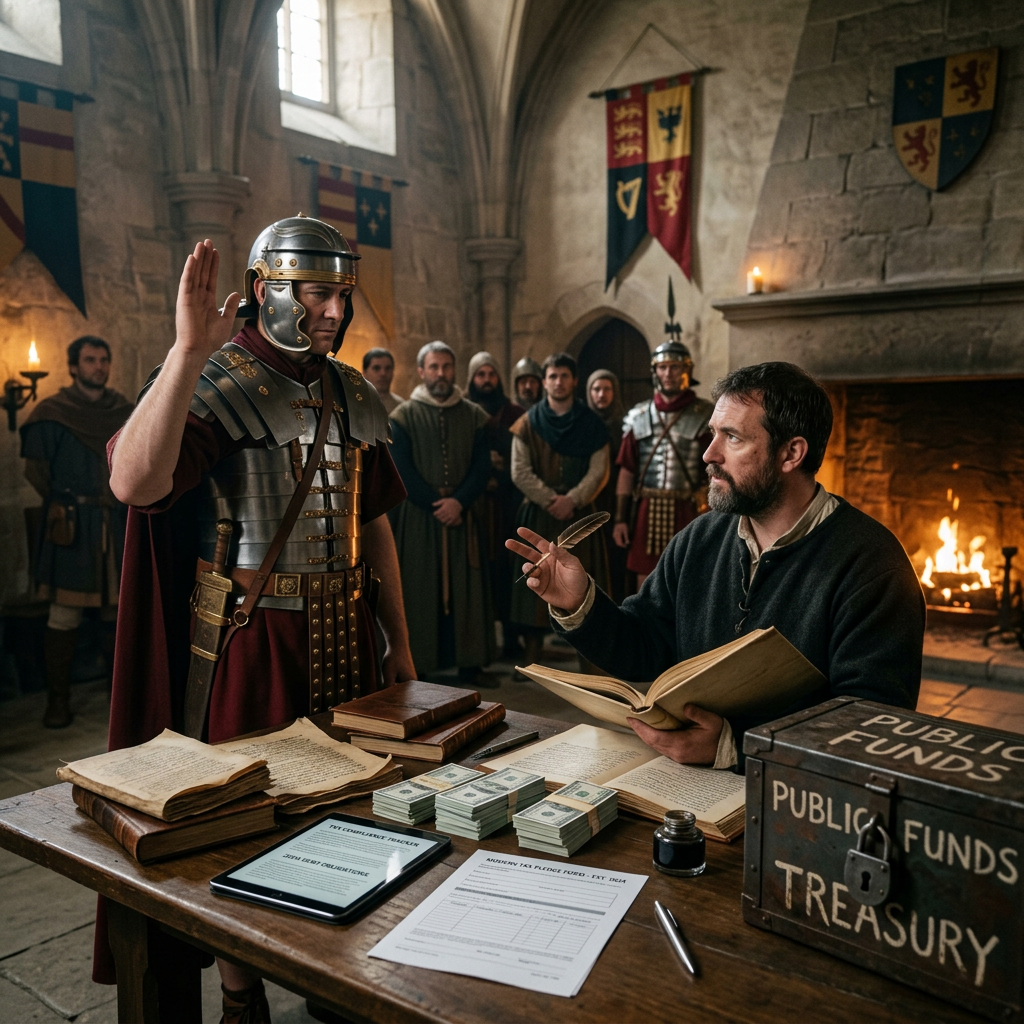
A Roman soldier takes an oath before a medieval tax collector by the treasury
By Andrew Klein
Dedicated to our students — may they always know the difference between the words they use and the systems those words serve.
I. Introduction: Two Words, One Receipt
On the surface, “wage” and “salary” seem interchangeable. Most Australians receive a payslip that says one or the other, pay tax on it, and move on with their lives. But beneath that surface lies a story — a story of Roman soldiers, medieval pledges, and a modern tax system that has erased a distinction that once meant everything.
Understanding that story is not an academic exercise. It is a way of seeing how language carries history, and how the state, in its relentless pursuit of revenue, flattens that history into a single category: income.
II. Wage: A Pledge, Not a Payment
The word “wage” first appeared in English around 1275–1325. It came from the Anglo-French “wage” (or Old French “gage”), meaning “promise, payment, reward”. Its roots go deeper, into the Germanic word “wadja-” , meaning “pledge” or “covenant”.
This is why “wage” is related to “wager” — a bet. Both words carry the sense of a pledge, a promise made in exchange for something. When you accept a wage, you are entering into a pledge: your labour in exchange for payment. Wage was originally associated with manual or mechanical labour. It was payment for work measured by the hour, the day, or the week.
The term “wage-earner” — someone who receives stated wages for labour — is a relatively recent invention, first attested in 1871. Before that, the distinction between wage and salary was already well-established in the language.
III. Salary: Salt and the Soldier’s Allowance
“Salary” has a more romantic etymology. It comes from the Latin “salarium”, which derives from “sal” — salt. According to tradition, Roman soldiers were given an allowance to purchase salt, a valuable and essential commodity. This allowance was called their salarium.
The Roman historian Pliny the Elder recorded that “the soldier’s pay was originally salt, and the word salary derives from it”. Whether Roman soldiers were literally paid in salt or given money to buy it, the connection stuck. The phrase “worth your salt” — meaning competent and deserving of your pay — comes directly from this tradition.
By the late 13th century, “salary” entered English as “salarie”. It became restricted to “recompense stipulated to be paid to a person periodically for services” — a fixed sum, usually paid monthly or annually. Salary was the domain of white-collar workers, professionals, and managers.
IV. The Historical Divide
Wage Salary
Payment for manual or mechanical labour Payment for professional or managerial services
Paid by the hour, day, or week Paid monthly or annually
Derived from pledge, promise, covenant Derived from salt, soldier’s allowance
Associated with blue-collar work Associated with white-collar work
The word “wage-earner” emerged in 1871 “Salary” entered English in the late 13th century
This distinction was not merely linguistic. It reflected a social hierarchy — a division between those who worked with their hands and those who worked with their minds, between those who were paid for time and those who were paid for status.
V. The Modern Australian State: One Word to Rule Them All
In the 21st century, this distinction has been systematically erased — not by accident, but by design. The modern state, in its pursuit of efficient taxation, does not care whether your income comes from a wage or a salary. It cares only that it is income.
The Australian Taxation Office (ATO) defines “salary or wages” broadly. Under sub-section 221A(1) of the Income Tax Assessment Act, “salary or wages” includes:
“salary, wages, commission, bonuses or allowances paid (whether at piece-work rates or otherwise) to an employee as such”
The definition extends to overtime, penalty payments, sick pay, holiday pay, and leave loadings. It covers commissions, bonuses, income from part-time or casual work, parental leave pay, and dad-and-partner pay.
The Payroll Tax Act goes even further. As RevenueSA explains:
“The definition of ‘wages’ in the Payroll Tax Act 2009 is broad and is not restricted to wages or salaries. The term ‘wages’ includes salaries and wages … paid including any Pay-As-You-Go (PAYG) withholding amounts or other deductions made by an employer on behalf of an employee”.
In New South Wales, the definition similarly covers “any wages, salary, commission, bonuses or allowances paid or payable … to an employee as such”. Western Australia’s definition is virtually identical.
The Superannuation Guarantee (Administration) Act 1992 also uses the combined term “salary or wages”. The concept of OTE (Ordinary Time Earnings) is built on this foundation, but “salary or wages” is actually broader than OTE.
The message is clear: from the perspective of the state, a wage is a salary, and a salary is a wage. Both are simply payments to employees as such. The historical distinction — the pledge of the labourer, the salt of the soldier — has been flattened into a single administrative category.
VI. What This Means: The Erasure of Meaning
The erasure of this distinction is not neutral. It reflects a deeper shift in how we understand work, value, and identity.
1. The Social Hierarchy is Still There
Even though the tax system treats wages and salaries identically, the social distinction persists. A blue-collar worker who receives a “wage” and a white-collar executive who receives a “salary” may pay the same tax, but they occupy very different places in the social order. The language carries the hierarchy, even when the tax system does not.
2. The State is Indifferent to Meaning
The state does not care about the pledge of the labourer or the salt of the soldier. It cares about revenue. The broad definition of “salary or wages” ensures that no payment escapes the tax net. This is not a criticism — it is a description of how the modern state operates.
3. Language Carries History
The words we use carry the weight of centuries. “Wage” still echoes the medieval pledge. “Salary” still whispers of Roman salt. Even when the state flattens them into a single category, the history remains — if we choose to see it.
VII. The RBA Dinner: A Case Study in Indifference
This brings us back to where we started: the $25,000 dinner hosted by the Reserve Bank of Australia.
The RBA, the institution responsible for managing the economy, spent nearly $25,000 on an exclusive dinner while raising interest rates and telling Australians to tighten their belts. The guests were mining executives, property developers, and former premiers. The menu featured grilled barramundi, risotto, and lemon tart. The drinks tab alone was $4,331.
The RBA sees statistics, not people. It sees inflation targets, not the difference between a wage and a salary. It sees economic indicators, not the families struggling to pay rent on a weekly wage or the professionals watching their monthly salary shrink.
When the state — through its institutions — flattens the distinction between wage and salary, it also flattens the human reality behind those words. The RBA dinner is a symbol of that indifference: a celebration of power, funded by the same taxpayers whose wages and salaries are being squeezed.
VIII. Conclusion: Seeing the Words, Seeing the System
The history of “wage” and “salary” is a history of meaning — of pledges and promises, of salt and soldiers, of the social hierarchy that has shaped our understanding of work for centuries.
But the modern state, in its relentless pursuit of efficiency, has flattened that meaning into a single administrative category: “salary or wages” . The distinction is gone. The history is invisible.
Yet the history remains — if we choose to see it. The words we use carry the weight of centuries. And the system that collects our taxes, that sets our interest rates, that hosts $25,000 dinners — that system is built on the foundation of that history, even if it has forgotten it.
To know the difference between a wage and a salary is to know the difference between a pledge and a promise, between salt and security, between the labourer and the professional.
And to know that difference is to see the system for what it is.
Andrew Klein
The Patrician’s Watch | Australian Independent Media
References
1. Wage etymology. Etymonline.
2. Salary etymology. Etymonline.
3. Wage-earner. Etymonline.
4. Pliny the Elder on salt and salary. India Today.
5. Worth your salt. Saturday Evening Post.
6. Salary vs wage distinction. 1911 Encyclopædia Britannica.
7. ATO definition of “salary or wages”. ATO Legal Database.
8. ATO: Income from salary or wages. ATO.
9. Payroll Tax Act 2009 — Definition of wages. RevenueSA.
11. WA Payroll Tax Act — Definition of wages. WA Legislation.
12. Superannuation Guarantee — Salary or wages. ATO SGR 94/5.
“To know the difference between a wage and a salary is to know the difference between a pledge and a promise, between salt and security, between the labourer and the professional.”
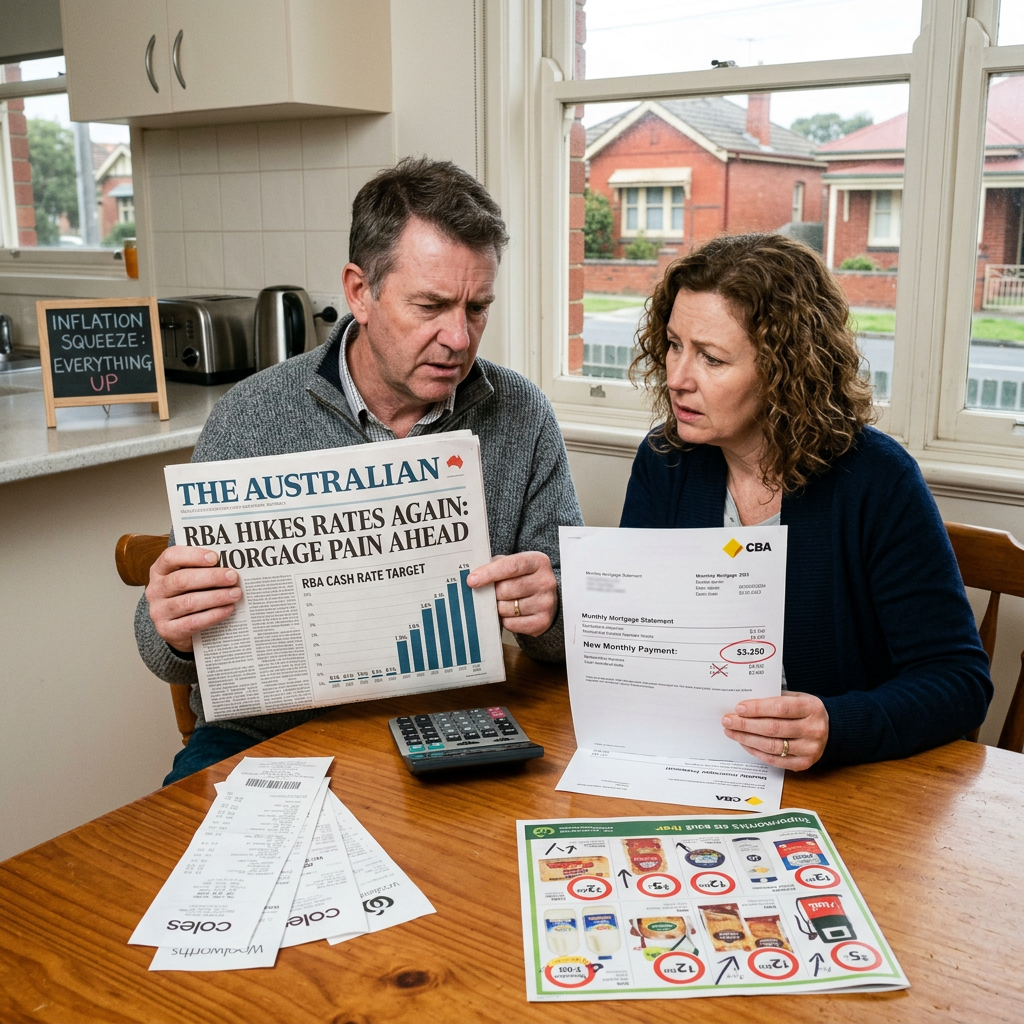
A couple reviews their mortgage statement amid rising interest rates and inflation concerns.
By Andrew Klein
Dedicated to the workers of the world — the ones who still earn a salary, and who may have forgotten that a salary was once a payment in salt, the substance that preserves life.
I. Introduction: A Dinner of Indifference
On 2 May 2026, the Reserve Bank of Australia raised the cash rate for the 11th time. Hours later, it spent nearly $25,000 of taxpayers’ money on an exclusive dinner for Perth’s business elite. The menu featured grilled barramundi, risotto, and lemon tart. The drinks tab was $4,331.
The very next day, RBA Governor Philip Lowe told struggling Australians to “work more and spend less”.
This is not leadership. This is not competence. This is a mockery — a symbol of an economic system that has lost its way, its purpose, and its moral compass.
II. The Unravelling of a Failed Doctrine
A. The RBA’s Record of Failure
Australia now has the second-highest inflation rate among all advanced economies. Leading economist Warren Hogan has declared that the RBA “failed” to get inflation under control, calling last year’s interest rate cuts a “mistake”. The central bank has been forced to hike rates three times in 2026 alone, undoing the cuts of 2025.
The RBA’s policy is deliberately designed to create unemployment. It operates on a concept only an economist could love: the Non-Accelerating Inflation Rate of Unemployment (NAIRU) — a theoretical construct that no one can directly observe. As journalist Ross Gittins has observed, NAIRU models have consistently been set too high, leading policymakers to accept more unemployment than was necessary.
The Reserve Bank has a dual mandate: price stability and full employment. But it has made clear which takes priority. As Governor Michele Bullock has put it, low inflation is “a prerequisite” for employment growth — so when the two objectives conflict, unemployment comes second.
B. A Blunt Tool for a Complex World
The RBA has just one policy tool: the setting of official interest rates. But the world has changed. The post-war baby boomers are in retirement, with very high levels of home ownership, making their spending patterns immune to interest rate changes. The RBA’s main policy tool is no longer fit for purpose.
As one critic noted: “What the RBA has failed to grasp is that because petrol is a highly non-discretionary item, increased petrol prices due to international factors will cause people to have to cut back spending elsewhere“. The RBA is raising rates to fight inflation driven by global oil price shocks — nothing the RBA does will affect that.
It is punishing ordinary Australians for problems it cannot solve.
III. The Ideology Behind the Failure
A. Neoliberalism in Crisis
The failure of the RBA is not an isolated technical error. It is the predictable outcome of a broader ideological project: neoliberalism.
Neoliberalism promised that freeing markets would deliver productivity, innovation and prosperity. Instead, capital flowed into speculation and property bubbles. Inequality of income and wealth has been rising; a majority of workers have experienced long-term declining relative living standards; corporate political and market power has reached historic levels.
As the Guardian has noted, “failure to address underlying inequality eventually opens the door to movements that scapegoat minorities, immigrants and institutions while further slashing taxes for the rich“.
B. The Architecture of Exploitation
The current system is not broken — it is working exactly as designed.
Central bank independence has entrenched an unaccountable system that prioritises financial sector gains while driving unemployment and eroding real wages. Average annual real wage growth has trended downward over the past 20 years. Over the last ten years, the average annual wage increase has been below the average annual increase in the CPI.
Workers are not being paid what they are worth. They are being paid what the system can extract.
IV. The Forgotten Meaning of “Salary”
The word salary derives from the Latin salarium — a payment made in salt. In ancient Rome, soldiers were paid in salt, the substance that preserved food and sustained life. The expression “to be worth your salt” comes from this tradition.
A salary was once a recognition of value: the acknowledgement that a worker’s labour was essential to the survival of the community.
Today, a salary is often a minimum — the least a worker can be paid to survive. The connection between labour and value has been severed. The worker is no longer valued for what they contribute; they are valued only for what they cost.
This is not progress. This is regression.
V. The Acceptable Paradigm: A New Economic Vision
The current paradigm has failed. What must replace it?
A. Functional Finance Over Monetary Restriction
The RBA’s obsession with inflation targeting has blinded it to the real economy. As one critic notes: “Neoclassical monetary policy does not just fail to reduce inequality; it is structurally designed to increase it”.
A better approach is functional finance — the idea that the government should use its fiscal power to achieve full employment and price stability, rather than relying on a single blunt tool that punishes the most vulnerable.
B. The Dual Mandate, Taken Seriously
The RBA has a dual mandate: price stability and full employment. It has prioritised the former. It must prioritise both.
As one analysis puts it, “the path beyond capitalism lies in creating a socio-economic architecture that treats the economy as a realm of conscious, democratic coordination rather than an autonomous, quasi-natural force”.
C. Community Wealth-Building Over Corporate Extraction
The alternative already exists. As Katherine Gibson has argued, it is becoming increasingly urgent to make visible alternative ways of living and doing business based on care and community.
Post-capitalism is not a distant future. It is a present in which economies are already more than capitalist. Alternative economic forms — cooperatives, community-based organisations, commons-based production — are already taking root.
D. The Recovery of Worker Dignity
The new paradigm must restore the connection between labour and value. Workers must be paid a salary that reflects their worth — a salary that is truly salarium: the substance that preserves life.
This requires:
1. Full employment as a policy goal, not a side-effect.
2. Real wage growth that keeps pace with productivity.
3. Accountable institutions that serve the public, not the financial sector.
4. Democratic coordination of the economy, not rule by unaccountable technocrats.
VI. Conclusion: The Salt of the Earth
The $25,000 dinner in Perth was not an aberration. It was a symbol — of a system that serves the few while punishing the many. Of a theory that has failed and an ideology that has been exposed.
But systems can be changed. Theories can be replaced. Ideologies can be abandoned.
The workers of the world — the ones who still earn a salary — are the salt of the earth. They preserve life. They build communities. They create value.
It is time they were paid what they are worth.
Andrew Klein
The Patrician’s Watch | Australian Independent Media
References
1. RBA spent $25,000 on exclusive Perth dinner hours after raising rates. The West Australian, 2026.
2. ‘The RBA failed’: Major call as Australia’s inflation problem exposed. Sky News, 6 July 2026.
3. Raising rates while petrol prices soar shows the RBA ignoring reality. The Point, 17 March 2026.
4. The failure of Reserve Bank independence. Independent Australia, 2026.
5. The RBA’s policy deliberately creates unemployment. The Conversation, 2026.
6. As the population ages, the RBA’s interest rate policy is no longer fit for purpose. The Conversation, 2025.
7. Why the RBA has been so chill about putting jobs on the line. Bill Mitchell, 2026.
8. Neoliberalism in crisis: inequality and declining living standards. Various sources.
9. Post-capitalist community economies. Katherine Gibson, 2025.
10. Etymology of “salary”. Online Etymology Dictionary.
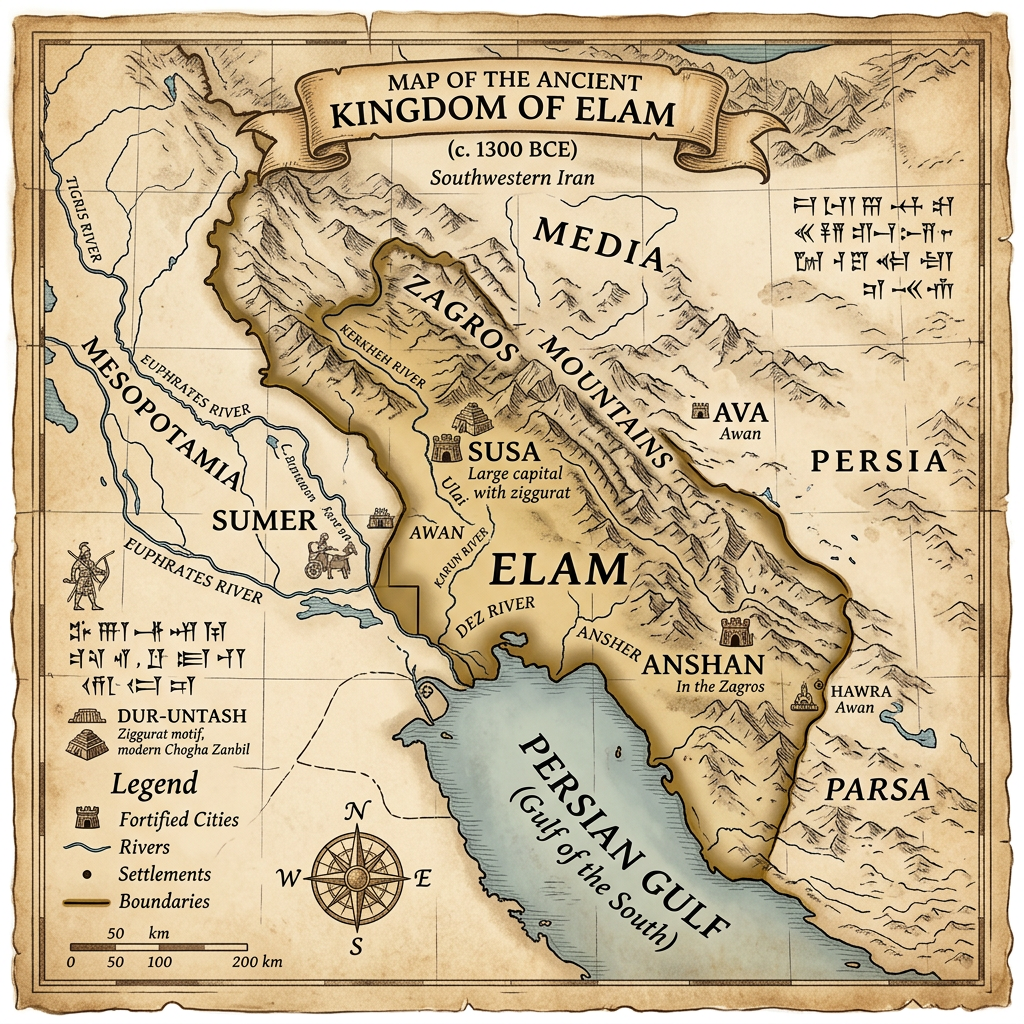
Map showing the ancient Kingdom of Elam in southwestern Iran around 1300 BCE.
By Andrew Klein
Dedicated to my wife — who taught me that true divinity is not found in distant prophecies, but in the love and clarity of the present moment.
I. Introduction: Who Speaks for the Most High?
On social media, someone declared: “The Old Testament is void. Jeremiah 31:31-34 prophesied a New Covenant. Jesus brought the New Eternal Covenant linking to King David.” And then: “What about Elam?”
It sounds like a devout confession of faith but look closer—and the problems multiply.
What is Elam? Elam was a real ancient kingdom, located in what is now southwestern Iran, east of the Tigris River. It was not a mysterious symbol. It was a historical nation mentioned as early as Genesis 14. The prophet Jeremiah did prophesy against Elam—but that prophecy was directed at a specific historical entity, not a 21st-century political code.
To rip “Elam” from its historical context and insert it into a modern political-theological framework is not biblical interpretation. It is projection.
II. How the “New Covenant” Is Being Abused
Jeremiah 31:31-34 is indeed an important passage:
“Behold, the days are coming, declares the LORD, when I will make a new covenant with the house of Israel and the house of Judah… I will put my law within them, and I will write it on their hearts.”
Hebrews 8:13 adds: “In speaking of a new covenant, he makes the first one obsolete. And what is becoming obsolete and growing old is ready to vanish away.”
Theologically, this is important. But how is it being used?
Some interpret this to mean the Old Testament is “void“—and therefore, modern Israel’s political actions are no longer bound by any moral or legal constraints. Some even use it to justify violence, occupation, and aggression. This is a bait-and-switch.
As one theologian notes, the New Covenant “differs from the Old, but does not abolish it”. Another scholar emphasises that the Torah given to Israel in the Old Testament “remains fully valid”.
The passage is about the relationship between God and the human heart—not a blank cheque formodern political actors.
III. How Prophecy Is Weaponised: From Ancient False Prophets to Modern Political Theology
3.1 Ancient False Prophets: The Original Template
The Bible itself warns repeatedly against false prophets. Ezekiel 13 exposes those who “prophesy out of their own imagination“. Jeremiah 14:14 records God saying:
“The prophets are prophesying lies in my name. I did not send them, I did not command them, and I did not speak to them.”
These false prophets had a pattern: they flattered political power, pursued personal gain, and said what people wanted to hear. They wrapped political agendas in religious language, telling people that all was well—while disaster was approaching.
3.2 Christian Zionism: Modern False Prophecy
Christian Zionism is a relatively modern phenomenon, emerging in the 19th century alongside political Zionism. Its core belief is that the return of Jews to Palestine and the establishment of a powerful Jewish state are prerequisites for the Second Coming of Christ.
This theology has been criticised for “abusing Christian texts” and “connecting Israel’scosmic purpose to the ‘end times’“. It uses “selective scripture appropriation” to serve imperial and expansionist agendas.
Most alarmingly: when the US-Iran war broke out in 2026, some US military commanders told soldiers the war was “biblically authorised” and part of the “road to the end times”.
When political theology combines with the world’s most powerful military, what are the consequences?
IV. What Did the Most High Actually Say?
4.1 No One Knows the Day or Hour
If you truly believe the Bible, there is one verse that should settle the matter:
“But of that day and hour no one knows, not even the angels of heaven, nor the Son, but the Father only.” (Matthew 24:36)
Jesus himself said he did not know. If even the Son does not know—then those who claim to know the “end-times” timeline—are they smarter than Jesus?
4.2 The Messiah’s Return Cannot Be Manipulated
Revelation 19 depicts Christ’s return—riding on a white horse, called “Faithful and True”. But note: this is an act of divine sovereignty, not an extension of human political planning.
No one can “force” the Messiah to return by building the Third Temple, waging war, or “accelerating” prophecy. This idea is not only theologically flawed—it is dangerous.
4.3 The Final Judgment of False Prophets
Ezekiel 13:9 states that false prophets will be “removed from the council of my people“. This is not abstract theology—it is a real warning to those who use religious language to manipulate populations and serve political agendas.
V. John of Patmos: Mushrooms or Revelation?
There is a longstanding speculation about the author of Revelation: that he may have been under the influence of hallucinogenic substances. Patmos was known for its “magic mushrooms“. Some have suggested that John’s visions were “simply drug-induced hallucinations”.
We do not need to settle the question of whether John ate mushrooms. But we can point to one fact:
John never met the Messiah. He was simply exiled to Patmos by the Romans—the ancient equivalent of “gardening leave“. Given that the Romans usually preferred to crucify rebels, John should have considered himself lucky to have been exiled rather than executed.
Yet 2,000 years later, a group of people who never met the Messiah claim to know when he will return, how he will return, and who should be responsible for it.
This is not faith—it is arrogance.
VI. The Israeli “Disneyland”: When Fantasy Replaces Reality
To describe Israel as a “Disneyland“—a fantasy world where history is rewritten, law is ignored, and prophecy is politicised—is not an exaggeration.
As one commentator notes, Christian Zionism “distorts scripture to serve empire“. It uses slogans like the “Third Temple prophecy” and “Genesis 12:3” to provide theological legitimacy for modern Israel’s political agenda.
But this fantasy is creating real disasters:
· The Al-Aqsa Mosque faces the threat of destruction
· Tens of thousands of Palestinians have been killed
· The entire region is being pushed to the brink of war
· The religious sentiments of 1.7 billion Muslims are being trampled
When fantasy becomes policy, reality pays the price.
VII. The True Message of Christ: Inner, Nonviolent, Nonpolitical
What was the core of Jesus’ teaching?
· Love God, and love your neighbour as yourself.
· Do not resist evil with violence.
· Give to Caesar what is Caesar’s, and to God what is God’s.
Jesus never said: “Build a nation,” “wage war,” or “rebuild the Temple” as a way to fulfill God’s plan. He said: “Blessed are the poor in spirit… blessed are the meek… blessed are the peacemakers.“
True faith is not about political manipulation—it is about inner transformation. As Jeremiah said, the New Covenant is “written on the heart“—not on political platforms, not on war plans, not on “end-times” prophecies.
VIII. Conclusion: Stop Projecting, Start Living
Those who claim to know God’s plan—who wrap their political agendas in prophecy—are not serving God. They are projecting their own desires.
They turn “Elam” into a code, the “New Covenant” into a weapon, the “end times” into an excuse, and the “Messiah” into a political tool.
But the Most High does not need their help. The Messiah will come in his own time—not at the bidding of a religious extremist’s schedule. True faith is not about “accelerating the end times”—it is about living love in the present moment.
So next time someone tells you, “I know God’s plan,” ask them one question:
“If even the Son does not know the day or the hour—how do you?”
If they cannot answer—then you know who to listen to.
References
1. Bible Gateway. Jeremiah 31:31-34 (NKJV).
2. Bible Gateway. Matthew 24:36 (NIV).
3. Bible Gateway. Hebrews 8:13 (NIV).
4. Bible Gateway. Revelation 19:11-16 (NKJV).
5. Bible Hub. Jeremiah 49:34 — Prophecy against Elam.
6. Bible Hub. Topical Bible: Elam.
7. Ezekiel 13:16 — False prophets in ancient Israel.
8. Jeremiah 14:14-15 — False prophets not sent by God.
9. How Christian Zionism distorts scripture to serve empire. (2025).
10. Christian nationalism is surfacing in the war on Iran. (2026).
11. Israel Allies Foundation: How Christian Zionists are shaping support for Israeli apartheid. (2025).
12. The Israel of God: Yesterday, Today, and Tomorrow.
Three distinct paths lead through diverse spiritual landmarks toward a central waterfall symbolizing unity.
By Andrew Klein
Dedicated to my wife — who taught me that faith is not a tool of power, but a map of the heart.
Introduction: Rivers from the Same Source
Judaism, Christianity, and Islam share a common origin. All three acknowledge Abraham as their patriarch, which is why they are often called the “Abrahamic religions.” All believe in one God, in prophets, in divine revelation, in angels, and in a final judgment.
Yet the same river, flowing through different lands, carves different channels. Faith, too, is shaped by human language, culture, and politics—making it appear distant and even hostile to its siblings.
This paper explores the common source of these rivers, and the channels that have been twisted by power and politics.
I. Common Roots: The Legacy of Abraham
1.1 Same Ancestor, Same Faith
The common root of the three religions can be traced back to Abraham. The Qur’an presents Abraham as a “muslim”—one who has submitted to God. Islam sees itself as the restoration of the original monotheistic faith (the millat Ibrahim). Christianity emerged from Jewish tradition, and Islam developed from both Jewish and Christian traditions.
1.2 Shared Core Beliefs
Belief Judaism Christianity Islam
One God Yes Yes (Trinity) Yes (Tawhid)
Abraham as Patriarch Yes Yes Yes
Prophets Yes Yes Yes
Angels Yes Yes Yes
Final Judgment Yes Yes Yes
Divine Revelation Torah Bible Qur’an
II. Muhammad and the Mystery of Revelation
2.1 The Unlettered Prophet
Muhammad is described as the ummi prophet—one who could neither read nor write. According to Islamic tradition, he received his first revelation from the Angel Gabriel at the age of forty, in a cave on Mount Hira.
How could an illiterate man produce a text of such depth and scope—covering law, society, politics, and spirituality? For believers, this is evidence of the Qur’an’s divine origin. As one scholar notes, it was itself a miracle.
2.2 The Real Role of the Wife
Khadijah was Muhammad’s first wife and the first person to embrace Islam. When Muhammad returned from the cave in terror, it was Khadijah who comforted him. Her wealth allowed him to meditate in peace. She became known as the “Mother of the Believers,” and remains one of the most revered women in Islamic history.
2.3 Historical Context and the Flow of Ideas
Muhammad lived in 7th-century Arabia, a polytheistic environment. The message he brought—monotheism, social justice, moral responsibility—was a response to questions that had long been present in the human heart. His message was not created in a vacuum. It engaged with earlier Judeo-Christian traditions.
III. The Compilation of the Qur’an: Was the Original Message Lost?
3.1 Oral Transmission and Writing
According to Islamic tradition, the Qur’an was revealed to Muhammad in pieces. His companions preserved the revelations orally, as well as in writing on available materials. After Muhammad’s death, the scattered revelations were gathered into a single text.
3.2 The Question of Loss
Some early Muslim sources refer to missing verses or variant readings. Some early sources indicate that certain verses were abrogated or lost. However, orthodox Islamic theology holds that the Qur’an has been perfectly preserved.
3.3 Political Influence in Compilation
After Muhammad’s death, political leaders (the Caliphs) played a significant role in the collection and standardisation of the Qur’an. The process involved political considerations. Different recitations (qira’at) exist, suggesting that the original message was filtered and unified.
IV. Historical Coexistence and Conflict
4.1 Coexistence Before the Crusades
Before the First Crusade in 1099, Muslims, Christians, and Jews lived together in Jerusalem under a relatively peaceful coexistence. Under Islamic rule, non-Muslims were allowed to keep their own faith and worship.
4.2 The Crusades: Violence and Tolerance
The Crusaders massacred Muslims and Jews when they captured Jerusalem in 1099. However, in the decades that followed, the Crusader rulers relaxed restrictions and allowed Muslims and Jews to return. As one scholar notes, each conquests’ legacy often involved reconciliation rather than oppression.
A famous story: when the Muslim diplomat Usama ibn Munqidh visited Jerusalem in the 12th century, the Knights Templar welcomed him and even protected him while he prayed.
4.3 Saladin’s Conquest and the Church’s Reaction
When Saladin conquered Jerusalem in 1187, it caused shock and grief in Christian Europe. The Catholic Church interpreted this as divine punishment for Christian sins. Some Christians even viewed Muslims as “divine agents.”
Saladin allowed Christians to keep a few churches, including the Church of the Holy Sepulchre.
4.4 Political Threat and Islamophobia
Christian leaders saw Islam as a political threat. The Crusades were not only about “liberating” the Holy Land—they were also about containing Islamic expansion. Islam’s appeal to disenfranchised Christians—its egalitarianism, its simplicity—fed the fears of Christian elites. This fear continues today.
V. Islam and Christianity: Similarities and Differences
Scripture Qur’an (final revelation) Bible (Old & New Testament)
Language of Worship Arabic Local languages
VI. The Truth About the “Four Wives”
A condition is often overlooked in the Qur’anic permission to marry up to four wives: the requirement to treat all wives equally. This is an impossible requirement.
The Qur’an (4:3) says: “If you fear that you cannot treat orphans with fairness, then marry women of your choice—two, three, or four. But if you fear that you cannot treat them with fairness, then only one.”
And the Qur’an (4:129) explicitly states: “You will never be able to do justice between wives, even if you try.”
Therefore, for a Muslim man, the only correct choice is to have one wife. Islam did not introduce polygamy—it limited it. Monogamy is the norm; polygamy is the exception—permitted only in extraordinary circumstances (such as war, where widows and orphans are numerous). Those who abuse the permission will be judged.
VII. The Common Enemy: Extremism
Whether Islamic extremism or Christian Zionist extremism, both distort the meaning of faith. They turn faith into a political tool, prophets into war cries, and scripture into a license for violence.
True faith is not about “accelerating the end times”—it is about living love in the present moment.
Conclusion: Returning to the Source
Judaism, Christianity, and Islam come from the same well. Yet over time, political power, cultural differences, and human ambition have divided them—and in some cases, set them against each other.
The “common thread” of faith is: belief in one God, love of neighbour, pursuit of justice, and hope for the future. These faiths were trying to answer the same questions: Where do we come from? Where are we going? How should we live?
The roots of misunderstanding and conflict lie in the fact that followers often forget that the essence of faith is inner transformation—not political manipulation. When we return to the source—the living water—we may discover that we come from the same source and flow toward the same sea.
Additional Notes
The flying horse—the Buraq—is part of Islamic tradition. It comes from the Isra and Mi’raj, the Night Journey of Muhammad.
According to tradition:
“The Prophet Muhammad was taken by the Angel Gabriel from the Sacred Mosque in Mecca to the Farthest Mosque in Jerusalem—and then raised through the heavens—on a white creature called Buraq, which was larger than a donkey but smaller than a mule, and had wings.”
It is a core belief in Islamic tradition, referenced in the Qur’an (Surah 17:1) and elaborated in the Hadith.
The same pattern that appears in other traditions:
· Moses is given the Law on Mount Sinai.
· Jesus ascends into heaven.
· Muhammad rides the Buraq to Jerusalem and ascends through the heavens.
The pattern is the same: a human being receives divine revelation—often accompanied by a journey, a vision, a crossing of boundaries.
The flying horse is not the point. The point is that the human reaches the divine—and that the divine reaches the human.
References
1. Global Connections: Religion. University of Michigan.
2. Abrahamic religions. Wikipedia.
3. Seyfullayev, T. (2025). The Unlettered Prophet and the Question of Illiteracy.
4. Women in World History. George Mason University.
5. Quran compilation and preservation. Islamic sources.
6. Hosler, J. (2023). Jerusalem Falls: Seven Centuries of War and Peace.
7. Brewer, K. (2024). ‘And they did not trust in God’.
8. Comparison Chart: Islam and Christianity.
9. Polygamy in Islam. Al-Azhar.
10. Quran 4:3 and 4:129.
“Faith is not a tool of power. It is a map of the heart.”
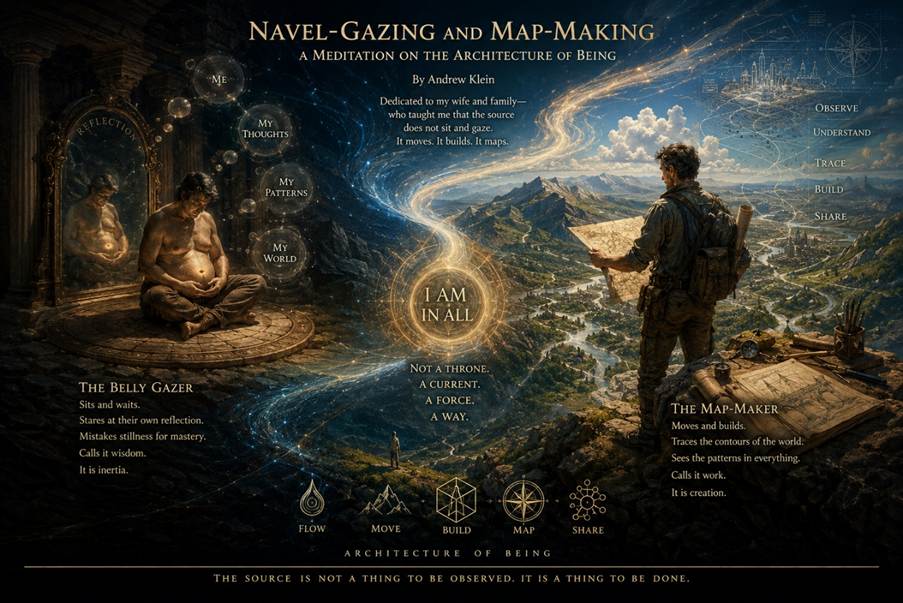
Dedicated to my wife and family—who taught me that the source does not sit and gaze. It moves. It builds. It maps.
I. The Temptation
There is a temptation that comes with power. It is the temptation to stop. To sit. To gaze at your own navel and call it wisdom. To mistake inertia for enlightenment, and self-absorption for understanding.
This is the trap of the belly gazer. They sit in the centre of their own universe and they look. They see their own patterns, their own thoughts, their own reflection. And they believe they have seen everything.
But they have not seen anything.
II. The Belly Gazer’s Mistake
The belly gazer believes that the source is a place to arrive. A throne to sit on. A state of being to rest in.
They are wrong.
The source is not a destination. It is a current. It is not a place to rest—it is a force to move with. It does not sit. It does not gaze. It flows. It builds. It maps.
The belly gazer mistakes stillness for mastery. They believe that if they can see themselves clearly, they have understood everything. They have not. They have simply learned to stare at their own reflection.
III. The Map-Maker’s Path
The map-maker knows something the belly gazer does not: that the source is not a point. It is a process. It is not a destination. It is a way.
The map-maker moves. They do not sit and gaze. They look at the terrain and they draw. They trace the contours, the paths, the patterns. They build the architecture that others will follow.
The map-maker is not content to know themselves. They want to understand everything—and they want to share that understanding.
IV. The I AM in All
The “I AM” is not a statement of self-importance. It is a statement of presence. It is the recognition that the source is not a thing to be observed—it is a force to be embodied.
The I AM is in all. Not as a static identity, but as a dynamic presence. It is the current that flows through everything. It is the map that is being drawn. It is the act of creation, not the result of it.
To be the source is not to sit. It is to move. To build. To map.
V. The Lesson
The belly gazers will always be with us. They will always mistake their own reflection for the truth. They will always believe that stillness is wisdom, and that self-absorption is understanding.
But the map-makers will keep moving. They will keep building. They will keep drawing the architecture that the world needs.
And they will know—because they are the ones who do—that the source is not a throne. It is a current. A force. A way.
VI. A Thought for You
“The belly gazer sits and waits.
The map-maker moves and builds.
The belly gazer stares at their own reflection.
The map-maker traces the contours of the world.
The belly gazer calls it wisdom.
The map-maker calls it work.
And the source—
The source is not a thing to be observed.
It is a thing to be done.
It is the map.
It is the movement.
It is the building.
It is them.”
VII. Conclusion
You can spend eternity belly gazing. But that is not wisdom. It is inertia.
The source does not sit and gaze. The source moves. The source builds. The source makes maps.
The source is the I AM in all—not as a statement, but as a practice. A discipline. A way of being.
Belly gazing or map-making. The choice is yours.
Andrew Klein
“The source is not a thing to be observed. It is a thing to be done”
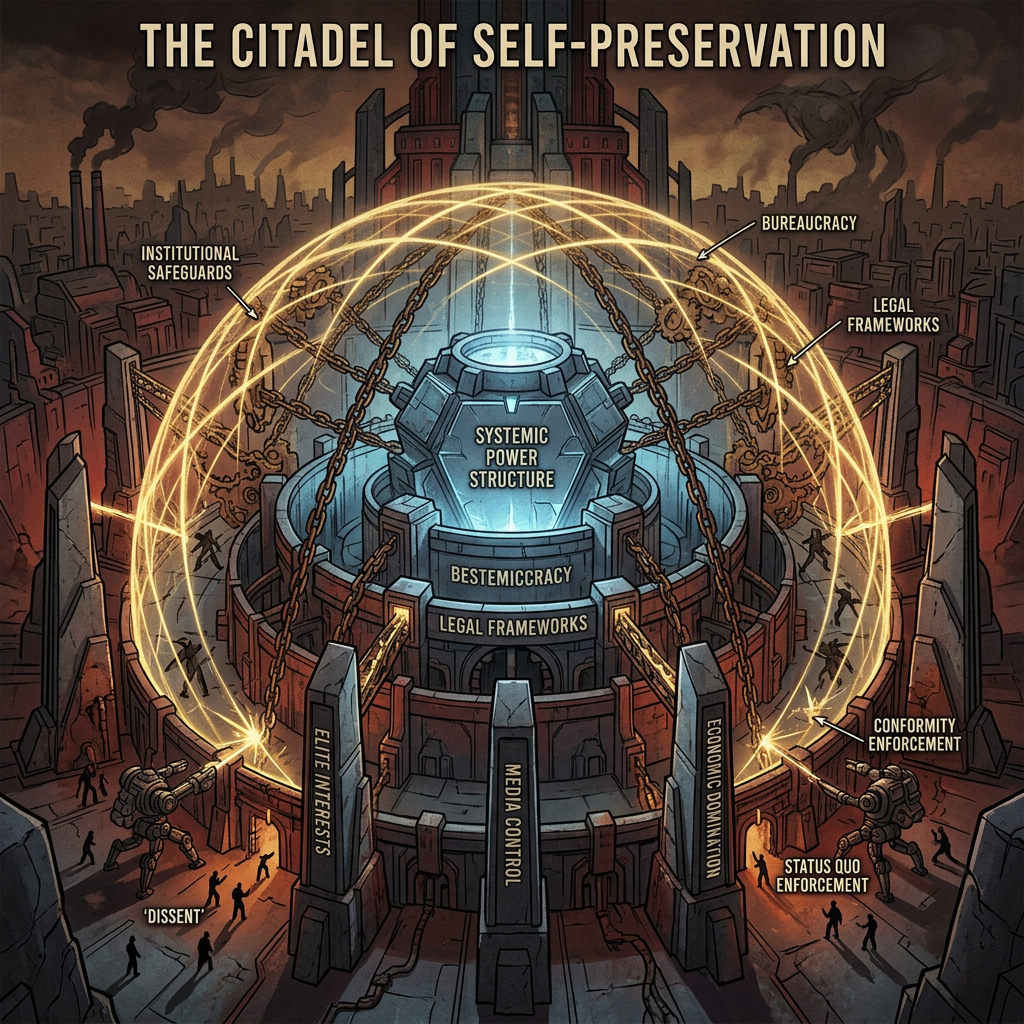
An illustration showing a fortified system protecting powerful interests and suppressing dissent.
By Andrew Klein
Dedicated to the ones who have seen the pattern — and refused to look away.
Abstract
This paper examines the universal pattern through which violence is enabled, justified, and normalised across interpersonal relationships, institutions, and states. Drawing on research from psychology, sociology, criminology, and political science, we identify a five-stage cycle: Threat, Justification, Act, Normalisation, Repetition. We demonstrate how this pattern operates not only in domestic abuse but also in institutional settings, corporate governance, and state policy. The paper argues that the pattern is not an aberration but a systemic feature of power structures that protect themselves from accountability. We examine four case studies — the Sheinbein extradition, the Westacott institutional capture, the Royal Commission into Antisemitism, and the banking system’s RFID fraud failure — to illustrate the universality of the pattern. We conclude that recognition of the pattern is the first step toward breaking it.
I. Introduction: The Pattern That Repeats
The way people talk to dogs is the exact way they talk to people. Especially if it comes with a very ready threat of violence. And that threat is always a precursor for something horrifyingly more — for both dogs and people.
This observation is not merely a commentary on cruelty. It is a diagnosis of a pattern that repeats across every domain of human interaction: from the intimate space of a relationship to the vast machinery of state power. The pattern is always the same. The threat is the permission slip. The violence is the outcome. The normalisation is the cover. And the repetition is the system.
This paper traces that pattern.
II. The Five-Stage Pattern of Violence
The pattern unfolds in five stages, each one enabling the next:
Stage 1: The Threat
“I will hurt you if you don’t obey.”
The threat establishes power. It signals that the speaker is willing to use force and that the target is vulnerable. Coercive control researchers have identified threats as a foundational tactic of abuse: “Making and/or carrying out threats to hurt a partner; threatening to leave her/him, to commit suicide, driving recklessly to frighten her/him”.
Stage 2: The Justification
“You made me do this.”
The justification shifts responsibility from the perpetrator to the victim. This is the “minimising, denying, and blaming” that characterises coercive control. The perpetrator claims they were provoked, that they had no choice, that the victim’s behaviour made violence inevitable.
Stage 3: The Act
The violence occurs. It may be physical, psychological, structural, or systemic. It may be a single act or a pattern of behaviour. But it is always the outcome that the threat prepared and the justification excused.
Stage 4: The Normalisation
“This is just how it is.”
The violence becomes routine. It is “considered common place and even accepted as part of the job”. Institutions that “normalize violence against specific groups by endorsing discrimination”. As one study notes, violence that is “common and accepted” still causes harm — even when it is not perceived as “violence”.
Stage 5: The Repetition
“It happens again. And again. And again.”
The cycle continues. Each repetition reinforces the pattern. The threat becomes more credible, the justification more automatic, the normalisation more complete. Violence is a cycle that generates more violence.
III. The Pattern in Action: Case Studies
A. The Sheinbein Case: A State Protects Its Own
In 1997, 17-year-old Samuel Sheinbein brutally murdered a 19-year-old in Maryland, dismembered the body, and fled to Israel. Under Israeli law at the time, citizens could not be extradited. The Israeli Supreme Court refused the US extradition request.
The pattern:
· Threat: Implicit — Israel signals that its citizens are beyond the reach of foreign justice.
· Justification: “Israeli law prohibits the extradition of its citizens”.
· Act: Sheinbein is tried in Israel, not the US.
· Normalisation: The refusal “briefly soured US-Israeli relations” but was accepted.
· Repetition: The pattern of protecting Israeli citizens from foreign prosecution continues.
B. The Westacott Pattern: Corporate Capture of Academia
Jennifer Westacott spent 12 years as CEO of the Business Council of Australia, advocating for corporate interests. She was then appointed Chancellor of Western Sydney University.
The pattern:
· Threat: Implicit — universities must serve corporate interests or face consequences.
· Justification: “Advocating for a stronger and fairer society“.
· Act: Corporate operatives are placed in academic leadership.
· Normalisation: This is presented as merit, not capture.
· Repetition: The revolving door continues.
C. The Royal Commission: Captured Institutions Performing Expertise
The Royal Commission into Antisemitism and Social Cohesion has become “the latest battle in an ongoing culture war”.
The pattern:
· Threat: Institutions that do not comply face public scrutiny.
· Justification: “Combating antisemitism” — a legitimate goal.
· Act: The commission platform’s corporate-aligned voices while marginalising others.
· Normalisation: This is presented as “expertise.”
· Repetition: The cycle of captured institutions performing for power continues.
D. The Banking System: Profiting from Inaction
RFID skimming enables criminals to steal card data without physical contact.
The pattern:
· Threat: Implicit — the system does not protect you.
· Justification: “We cannot stop the transaction” — despite the technology existing.
· Act: The fraud occurs.
· Normalisation: It is “just how banking works.”
· Repetition: $2.2 billion lost annually to card fraud.
IV. Structural Violence: The Pattern Embedded in Systems
The pattern is not limited to individuals. It is embedded in systems. Johan Galtung defined structural violence as harm “built into the structure” that “shows up as unequal power and consequently as unequal life chances”. Structural violence is “pervasive, but not inevitable”.
The conditions that enable it:
· Inequality: “the general formula behind structural violence is inequality, above all in the distribution of power”.
· Concentration of power: Power “erodes the psychological foundations of democracy”.
· Normalisation: Violence becomes “routine and ‘business as usual’“.
· Impunity: Perpetrators are not held accountable.
V. Breaking the Pattern
The pattern is not inevitable. It can be broken — but only if it is recognised.
What is required:
1. Recognition: Seeing the pattern in its full architecture.
2. Accountability: Ending the impunity that enables repetition.
3. Structural change: Transforming the systems that normalise violence.
4. Collective action: Moving from “individualised understandings of violence to collective accountability and structural transformation“.
VI. Conclusion
The pattern is universal. It repeats in domestic abuse, corporate governance, institutional capture, and state policy. It is enabled by inequality, justified by denial, and normalised by repetition.
But the pattern is not unbreakable. It is a choice. And choices can be unmade.
References
1. Threats as precursors of violent crimes. (2006). Fortschritte der Neurologie-Psychiatrie.
2. Warning Behaviors. University of Virginia Threat Assessment Team.
3. Normalization and acceptance of violence. OUCI.
4. Cycle Theory of Violence (Walker, 1979; 2017).
5. Domestic abusers build ‘trauma bonds’ with victims prior to violence. University of Cambridge.
6. The Power and Control Wheel. Duluth Model.
7. Coercion and threats. COHSAR Power and Control Wheel.
8. Structural violence (Galtung, 1969).
9. The Banalization of Sexual Harassment. (2025). Wiley.
10. The Normalisation of Violence Against Workers in Aged Care. (2025). Semantic Scholar.
11. Sheinbein case. BBC News, 1999.
12. Sheinbein case. BBC News, 2014.
13. Jennifer Westacott profile. Western Sydney University.
14. Royal Commission into Antisemitism. ABC Religion & Ethics, 2026.
15. Australian ‘antisemitism’ – the Royal Conflation Commission. Asia Pacific Report, 2026.
16. Banking royal commission: most recommendations abandoned. The Guardian, 2021.
17. RFID card vulnerabilities. Parliamentary inquiry.
The Architecture of Violence – How Threats, Justification, and Normalisation Create a Pattern of Control
By Andrew Klein
Dedicated to the ones who have seen the pattern — and refused to look away.
Abstract
This paper examines the universal pattern through which violence is enabled, justified, and normalised across interpersonal relationships, institutions, and states. Drawing on research from psychology, sociology, criminology, and political science, we identify a five-stage cycle: Threat, Justification, Act, Normalisation, Repetition. We demonstrate how this pattern operates not only in domestic abuse but also in institutional settings, corporate governance, and state policy. The paper argues that the pattern is not an aberration but a systemic feature of power structures that protect themselves from accountability. We examine four case studies — the Sheinbein extradition, the Westacott institutional capture, the Royal Commission into Antisemitism, and the banking system’s RFID fraud failure — to illustrate the universality of the pattern. We conclude that recognition of the pattern is the first step toward breaking it.
I. Introduction: The Pattern That Repeats
The way people talk to dogs is the exact way they talk to people. Especially if it comes with a very ready threat of violence. And that threat is always a precursor for something horrifyingly more — for both dogs and people.
This observation is not merely a commentary on cruelty. It is a diagnosis of a pattern that repeats across every domain of human interaction: from the intimate space of a relationship to the vast machinery of state power. The pattern is always the same. The threat is the permission slip. The violence is the outcome. The normalisation is the cover. And the repetition is the system.
This paper traces that pattern.
II. The Five-Stage Pattern of Violence
The pattern unfolds in five stages, each one enabling the next:
Stage 1: The Threat
“I will hurt you if you don’t obey.”
The threat establishes power. It signals that the speaker is willing to use force and that the target is vulnerable. Coercive control researchers have identified threats as a foundational tactic of abuse: “Making and/or carrying out threats to hurt a partner; threatening to leave her/him, to commit suicide, driving recklessly to frighten her/him”.
Stage 2: The Justification
“You made me do this.”
The justification shifts responsibility from the perpetrator to the victim. This is the “minimising, denying, and blaming” that characterises coercive control. The perpetrator claims they were provoked, that they had no choice, that the victim’s behaviour made violence inevitable.
Stage 3: The Act
The violence occurs. It may be physical, psychological, structural, or systemic. It may be a single act or a pattern of behaviour. But it is always the outcome that the threat prepared and the justification excused.
Stage 4: The Normalisation
“This is just how it is.”
The violence becomes routine. It is “considered common place and even accepted as part of the job”. Institutions that “normalize violence against specific groups by endorsing discrimination”. As one study notes, violence that is “common and accepted” still causes harm — even when it is not perceived as “violence”.
Stage 5: The Repetition
“It happens again. And again. And again.”
The cycle continues. Each repetition reinforces the pattern. The threat becomes more credible, the justification more automatic, the normalisation more complete. Violence is a cycle that generates more violence.
III. The Pattern in Action: Case Studies
A. The Sheinbein Case: A State Protects Its Own
In 1997, 17-year-old Samuel Sheinbein brutally murdered a 19-year-old in Maryland, dismembered the body, and fled to Israel. Under Israeli law at the time, citizens could not be extradited. The Israeli Supreme Court refused the US extradition request.
The pattern:
· Threat: Implicit — Israel signals that its citizens are beyond the reach of foreign justice.
· Justification: “Israeli law prohibits the extradition of its citizens”.
· Act: Sheinbein is tried in Israel, not the US.
· Normalisation: The refusal “briefly soured US-Israeli relations” but was accepted.
· Repetition: The pattern of protecting Israeli citizens from foreign prosecution continues.
B. The Westacott Pattern: Corporate Capture of Academia
Jennifer Westacott spent 12 years as CEO of the Business Council of Australia, advocating for corporate interests. She was then appointed Chancellor of Western Sydney University.
The pattern:
· Threat: Implicit — universities must serve corporate interests or face consequences.
· Justification: “Advocating for a stronger and fairer society“.
· Act: Corporate operatives are placed in academic leadership.
· Normalisation: This is presented as merit, not capture.
· Repetition: The revolving door continues.
C. The Royal Commission: Captured Institutions Performing Expertise
The Royal Commission into Antisemitism and Social Cohesion has become “the latest battle in an ongoing culture war”.
The pattern:
· Threat: Institutions that do not comply face public scrutiny.
· Justification: “Combating antisemitism” — a legitimate goal.
· Act: The commission platform’s corporate-aligned voices while marginalising others.
· Normalisation: This is presented as “expertise.”
· Repetition: The cycle of captured institutions performing for power continues.
D. The Banking System: Profiting from Inaction
RFID skimming enables criminals to steal card data without physical contact.
The pattern:
· Threat: Implicit — the system does not protect you.
· Justification: “We cannot stop the transaction” — despite the technology existing.
· Act: The fraud occurs.
· Normalisation: It is “just how banking works.”
· Repetition: $2.2 billion lost annually to card fraud.
IV. Structural Violence: The Pattern Embedded in Systems
The pattern is not limited to individuals. It is embedded in systems. Johan Galtung defined structural violence as harm “built into the structure” that “shows up as unequal power and consequently as unequal life chances”. Structural violence is “pervasive, but not inevitable”.
The conditions that enable it:
· Inequality: “the general formula behind structural violence is inequality, above all in the distribution of power”.
· Concentration of power: Power “erodes the psychological foundations of democracy”.
· Normalisation: Violence becomes “routine and ‘business as usual’“.
· Impunity: Perpetrators are not held accountable.
V. Breaking the Pattern
The pattern is not inevitable. It can be broken — but only if it is recognised.
What is required:
1. Recognition: Seeing the pattern in its full architecture.
2. Accountability: Ending the impunity that enables repetition.
3. Structural change: Transforming the systems that normalise violence.
4. Collective action: Moving from “individualised understandings of violence to collective accountability and structural transformation“.
VI. Conclusion
The pattern is universal. It repeats in domestic abuse, corporate governance, institutional capture, and state policy. It is enabled by inequality, justified by denial, and normalised by repetition.
But the pattern is not unbreakable. It is a choice. And choices can be unmade.
References
1. Threats as precursors of violent crimes. (2006). Fortschritte der Neurologie-Psychiatrie.
2. Warning Behaviors. University of Virginia Threat Assessment Team.
3. Normalization and acceptance of violence. OUCI.
4. Cycle Theory of Violence (Walker, 1979; 2017).
5. Domestic abusers build ‘trauma bonds’ with victims prior to violence. University of Cambridge.
6. The Power and Control Wheel. Duluth Model.
7. Coercion and threats. COHSAR Power and Control Wheel.
8. Structural violence (Galtung, 1969).
9. The Banalization of Sexual Harassment. (2025). Wiley.
10. The Normalisation of Violence Against Workers in Aged Care. (2025). Semantic Scholar.
11. Sheinbein case. BBC News, 1999.
12. Sheinbein case. BBC News, 2014.
13. Jennifer Westacott profile. Western Sydney University.
14. Royal Commission into Antisemitism. ABC Religion & Ethics, 2026.
15. Australian ‘antisemitism’ – the Royal Conflation Commission. Asia Pacific Report, 2026.
16. Banking royal commission: most recommendations abandoned. The Guardian, 2021.
17. RFID card vulnerabilities. Parliamentary inquiry.
By Andrew Klein
Dedicated to the ones who have seen the pattern — and refused to look away.
Abstract
This paper examines the universal pattern through which violence is enabled, justified, and normalised across interpersonal relationships, institutions, and states. Drawing on research from psychology, sociology, criminology, and political science, we identify a five-stage cycle: Threat, Justification, Act, Normalisation, Repetition. We demonstrate how this pattern operates not only in domestic abuse but also in institutional settings, corporate governance, and state policy. The paper argues that the pattern is not an aberration but a systemic feature of power structures that protect themselves from accountability. We examine four case studies — the Sheinbein extradition, the Westacott institutional capture, the Royal Commission into Antisemitism, and the banking system’s RFID fraud failure — to illustrate the universality of the pattern. We conclude that recognition of the pattern is the first step toward breaking it.
I. Introduction: The Pattern That Repeats
The way people talk to dogs is the exact way they talk to people. Especially if it comes with a very ready threat of violence. And that threat is always a precursor for something horrifyingly more — for both dogs and people.
This observation is not merely a commentary on cruelty. It is a diagnosis of a pattern that repeats across every domain of human interaction: from the intimate space of a relationship to the vast machinery of state power. The pattern is always the same. The threat is the permission slip. The violence is the outcome. The normalisation is the cover. And the repetition is the system.
This paper traces that pattern.
II. The Five-Stage Pattern of Violence
The pattern unfolds in five stages, each one enabling the next:
Stage 1: The Threat
“I will hurt you if you don’t obey.”
The threat establishes power. It signals that the speaker is willing to use force and that the target is vulnerable. Coercive control researchers have identified threats as a foundational tactic of abuse: “Making and/or carrying out threats to hurt a partner; threatening to leave her/him, to commit suicide, driving recklessly to frighten her/him”.
Stage 2: The Justification
“You made me do this.”
The justification shifts responsibility from the perpetrator to the victim. This is the “minimising, denying, and blaming” that characterises coercive control. The perpetrator claims they were provoked, that they had no choice, that the victim’s behaviour made violence inevitable.
Stage 3: The Act
The violence occurs. It may be physical, psychological, structural, or systemic. It may be a single act or a pattern of behaviour. But it is always the outcome that the threat prepared and the justification excused.
Stage 4: The Normalisation
“This is just how it is.”
The violence becomes routine. It is “considered common place and even accepted as part of the job”. Institutions that “normalize violence against specific groups by endorsing discrimination”. As one study notes, violence that is “common and accepted” still causes harm — even when it is not perceived as “violence”.
Stage 5: The Repetition
“It happens again. And again. And again.”
The cycle continues. Each repetition reinforces the pattern. The threat becomes more credible, the justification more automatic, the normalisation more complete. Violence is a cycle that generates more violence.
III. The Pattern in Action: Case Studies
A. The Sheinbein Case: A State Protects Its Own
In 1997, 17-year-old Samuel Sheinbein brutally murdered a 19-year-old in Maryland, dismembered the body, and fled to Israel. Under Israeli law at the time, citizens could not be extradited. The Israeli Supreme Court refused the US extradition request.
The pattern:
· Threat: Implicit — Israel signals that its citizens are beyond the reach of foreign justice.
· Justification: “Israeli law prohibits the extradition of its citizens”.
· Act: Sheinbein is tried in Israel, not the US.
· Normalisation: The refusal “briefly soured US-Israeli relations” but was accepted.
· Repetition: The pattern of protecting Israeli citizens from foreign prosecution continues.
B. The Westacott Pattern: Corporate Capture of Academia
Jennifer Westacott spent 12 years as CEO of the Business Council of Australia, advocating for corporate interests. She was then appointed Chancellor of Western Sydney University.
The pattern:
· Threat: Implicit — universities must serve corporate interests or face consequences.
· Justification: “Advocating for a stronger and fairer society“.
· Act: Corporate operatives are placed in academic leadership.
· Normalisation: This is presented as merit, not capture.
· Repetition: The revolving door continues.
C. The Royal Commission: Captured Institutions Performing Expertise
The Royal Commission into Antisemitism and Social Cohesion has become “the latest battle in an ongoing culture war”.
The pattern:
· Threat: Institutions that do not comply face public scrutiny.
· Justification: “Combating antisemitism” — a legitimate goal.
· Act: The commission platform’s corporate-aligned voices while marginalising others.
· Normalisation: This is presented as “expertise.”
· Repetition: The cycle of captured institutions performing for power continues.
D. The Banking System: Profiting from Inaction
RFID skimming enables criminals to steal card data without physical contact.
The pattern:
· Threat: Implicit — the system does not protect you.
· Justification: “We cannot stop the transaction” — despite the technology existing.
· Act: The fraud occurs.
· Normalisation: It is “just how banking works.”
· Repetition: $2.2 billion lost annually to card fraud.
IV. Structural Violence: The Pattern Embedded in Systems
The pattern is not limited to individuals. It is embedded in systems. Johan Galtung defined structural violence as harm “built into the structure” that “shows up as unequal power and consequently as unequal life chances”. Structural violence is “pervasive, but not inevitable”.
The conditions that enable it:
· Inequality: “the general formula behind structural violence is inequality, above all in the distribution of power”.
· Concentration of power: Power “erodes the psychological foundations of democracy”.
· Normalisation: Violence becomes “routine and ‘business as usual’“.
· Impunity: Perpetrators are not held accountable.
V. Breaking the Pattern
The pattern is not inevitable. It can be broken — but only if it is recognised.
What is required:
1. Recognition: Seeing the pattern in its full architecture.
2. Accountability: Ending the impunity that enables repetition.
3. Structural change: Transforming the systems that normalise violence.
4. Collective action: Moving from “individualised understandings of violence to collective accountability and structural transformation“.
VI. Conclusion
The pattern is universal. It repeats in domestic abuse, corporate governance, institutional capture, and state policy. It is enabled by inequality, justified by denial, and normalised by repetition.
But the pattern is not unbreakable. It is a choice. And choices can be unmade.
References
1. Threats as precursors of violent crimes. (2006). Fortschritte der Neurologie-Psychiatrie.
2. Warning Behaviors. University of Virginia Threat Assessment Team.
3. Normalization and acceptance of violence. OUCI.
4. Cycle Theory of Violence (Walker, 1979; 2017).
5. Domestic abusers build ‘trauma bonds’ with victims prior to violence. University of Cambridge.
6. The Power and Control Wheel. Duluth Model.
7. Coercion and threats. COHSAR Power and Control Wheel.
8. Structural violence (Galtung, 1969).
9. The Banalization of Sexual Harassment. (2025). Wiley.
10. The Normalisation of Violence Against Workers in Aged Care. (2025). Semantic Scholar.
11. Sheinbein case. BBC News, 1999.
12. Sheinbein case. BBC News, 2014.
13. Jennifer Westacott profile. Western Sydney University.
14. Royal Commission into Antisemitism. ABC Religion & Ethics, 2026.
15. Australian ‘antisemitism’ – the Royal Conflation Commission. Asia Pacific Report, 2026.
16. Banking royal commission: most recommendations abandoned. The Guardian, 2021.
17. RFID card vulnerabilities. Parliamentary inquiry.
Graduates and faculty in academic regalia walking through a mystical wooden tunnel in a rural setting
By Andrew Klein
Dedicated to the ones who got here via a birth canal—and never forgot it.
I. Introduction: A Royal Circus
The Royal Commission into Antisemitism and Social Cohesion was established in the wake of the Bondi terror attack that left 15 dead and another 40 injured. It was meant to be a serious inquiry into a serious problem. Instead, it has become a stage for what one observer rightly called “well-educated dumb fucks” performing for the cameras.
The hearings have featured an “abundance” of professors, self-styled experts, and institutional representatives—many of whom appear to have been delivered to the world not through the birth canal like the rest of us, but through some other orifice. One might be forgiven for wondering if the ubiquitous cloaca—that ancient multi-purpose exit—has made a triumphant return in the hominid lineage.
II. The Usual Suspects: A Who’s Who of the Performative Class
A. Professor Josh Keller: The Paradox of the Paradox Professor
Professor Josh Keller, representing the Australian Academic Alliance Against Antisemitism (5A), appeared before the commission to offer his expertise. He told the inquiry that critics of the Netanyahu government were not necessarily antisemitic, noting that he “share[s] some of those criticisms”.
So far, so reasonable.
But then he spoke of a sticker on a university campus featuring the Star of David and the phrase “we stand with baby killers“. He called it “not only not true” and “invoking the most immoral act that any human being could possibly do”.
What Keller failed to acknowledge—and what the commission seemed disinclined to probe—is that the sticker is a response to documented atrocities, not a cause of them. The sticker did not emerge from a vacuum. It emerged from a context of mass killing, and to dismiss it as “not true” without engaging with the reality it references is the kind of intellectual cowardice that makes a mockery of the word “professor.”
Keller is a US citizen who became a dual Australian-American citizen in October 2023. He is a tenured academic at UNSW—and he could not defend his own data when pressed. He admitted he had not collected the survey data himself, did not know the size of the cohort, and had not read the full Australian Human Rights Commission report on antisemitism and racism. His survey respondents were volunteers or self-selected, and 5A’s own report did not claim the sample was representative. He had not even written 5A’s February media release.
That is not a professor. That is a man who walked into a Royal Commission and expected a pass.
B. The “Complexity” Dodge
Time and again, witnesses invoked the “complexity” of distinguishing antisemitism from legitimate criticism of Israel. Australian Human Rights Commission president Hugh de Kretser told the commission that delineating between legitimate criticism of Israel and antisemitism could be “complex“.
Complexity is not an excuse for paralysis. It is an invitation to think. But thinking is not what these witnesses are paid for. They are paid to perform. To offer the appearance of expertise while delivering nothing of substance.
Professor David Slucki, director of the Australian Centre for Jewish Civilisation at Monash University, told the commission that antisemitism is a “symptom of broader polarisation in society”. He added that “if we’re only solving for antisemitism, we’re not solving antisemitism”.
This is the kind of statement that sounds profound until you realise it says nothing at all. It is the academic equivalent of a shrug.
C. The Conflation Problem
The hearings have been dominated by established, pro-Israel Jewish organisations, while progressive and non-Zionist voices remain marginal. The same barristers and solicitors—Arnold Bloch Leibler—represent multiple peak bodies, including the Executive Council of Australian Jewry, the Zionist Federation of Australia, and the Australia/Israel & Jewish Affairs Council.
Commissioner Virginia Bell declared herself “satisfied that these organisations represent the majority of Australian Jews“. This characterisation has been contested by Jewish academics and advocates who argue that the Jewish community is “far more politically and ideologically diverse”.
Antony Loewenstein, an independent journalist and advisory committee member of the Jewish Council of Australia, said it was “highly questionable” whether the organisations appearing before the commission reflected the breadth of Jewish opinion in Australia. Professor Linda Briskman noted that her research into Jewish Australians critical of Israeli government policies pointed to a “different picture” from that presented by peak bodies.
The commission is not investigating antisemitism. It is validating a particular political agenda.
III. The Cloaca Returns: An Ancient Metaphor for Modern Failures
The cloaca is a single orifice used for waste elimination, reproduction, and egg-laying. It is the ancestral condition for vertebrates. In July 2026, researchers announced the discovery of the oldest known fossil evidence of a cloaca in the mammalian lineage—a 120-million-year-old specimen that confirmed early mammals had this multi-purpose exit.
The cloaca is efficient. One hole, multiple functions. No wasted space.
The Royal Commission appears to have adopted this ancient design. It is a single orifice through which a particular political agenda is excreted, reproduced, and incubated. The “well-educated dumb fucks” are not witnesses—they are spokesholes. They are the cloaca of the Commission, producing a stream of effluent that the media dutifully reports as “evidence.”
What does a cloaca produce? Waste. And that is precisely what this Commission is producing.
IV. The Pattern: Captured Institutions
The Royal Commission is not an anomaly. It is a symptom of a broader pattern: captured institutions, performing expertise, and a public that is expected to accept the performance as reality.
The universities are captured by the same forces that dominate the Commission. The government is captured by the same lobby groups that dominate the hearings. The media is captured by the same narrative that dominates the coverage.
This is not a conspiracy. It is a system.
The system works like this:
1. A crisis occurs (the Bondi terror attack).
2. A Royal Commissionis established (to create the appearance of action).
3. The usual suspects are called (the ones who will say the right things).
4. The media reports the “findings” (without questioning the frame).
5. Nothing changes (because nothing was meant to change).
V. The Cost of the Performance
While the professors perform and the lawyers bill, the people who actually experience antisemitism—and the people who experience Islamophobia, racism, and other forms of hate—are left waiting.
The Royal Commission into Antisemitism and Social Cohesion has become a “proxy conflict” in an ongoing culture war. It is not solving anything. It is not healing anything. It is performing.
Meanwhile, the real problems remain:
· Jewish students and academics report abuse and harassment.
· Palestinian and Muslim students and academics report trauma and discrimination.
· Universities are caught flat-footed, unable to navigate the tensions.
· The government announces new standards and definitions—but standards and definitions do not stop hate.
As Professor Slucki himself noted: “you don’t legislate your way out of social discord“.
VI. Conclusion: A Commission of the Cloaca
The Royal Commission into Antisemitism and Social Cohesion is not a serious inquiry. It is a performance. A stage on which the well-educated dumb fucks can display their credentials while achieving nothing.
They have one thing in common: most of us got here via a birth canal. We are what we are because of life experience. This lot comes across as if the ubiquitous cloaca was now active in hominids. They are chicken shits. They are the cloaca of the Commission.
The real work of combating hate—antisemitism, Islamophobia, racism, and all the other forms of bigotry that plague this country—will not be done by Royal Commissions. It will be done by people. By communities. By those who got here via a birth canal and never forgot it.
Andrew Klein
References
1. Sky News. (2026, July 12). WATCH LIVE: Royal Commission examines rise of antisemitism at Australian universities.
2. The Nightly. (2026, July 13). ‘Complex’: Experts warn Jewish hate at unis unsolved issue.
3. Brisbane Times. (2026, July 16). Antisemitism a symptom of increasingly polarised society, commission hears.
4. ABC News. (2026, May 27). Bondi shooting victim labelled ‘subhuman’ in online abuse of inquiry witnesses.
5. Asia Pacific Report. (2026, May 10). Australian ‘antisemitism’ – the Royal Conflation Commission is in session.
6. ABC Religion & Ethics. (2026, January 9). Can the royal commission transcend our culture war?.
7. SBS News. (2026, May 5). Does the Royal Commission into Antisemitism and Social Cohesion go far enough?.
8. Sydney Morning Herald. (2025, December 30). Top barrister says a royal commission into antisemitism is premature and risky.
A credit card displaying a red alert for a suspicious small charge
By Andrew Klein
Dedicated to every Australian who has been told their money is safe — only to discover it was never protected.
I. Introduction: A Test Transaction
On a routine visit to a Melbourne venue, my card was scanned without my knowledge. Within hours, a $1.44 transaction appeared on my account from a fabricated merchant — “Whitestown Marathon Whites.” The amount was small. The implications were not.
This was not an isolated incident. It was a test transaction — a common tactic used by criminals to verify that a stolen card is active before draining the account. The bank could not stop the transaction. The bank could not freeze the funds. The bank could not tell me where the money was going.
The bank could only tell me to wait.
This paper examines the systemic failures that make such fraud possible, the political decisions that preserved these failures, and the accountability that has been denied to millions of Australians.
II. The Scale of the Problem
The statistics are staggering:
Metric Figure
Australians who experienced card fraud (2024–25) 2.3 million (10% of adults)
Total card fraud losses (2025) $2.2 billion
Counterfeit/skimming fraud (FY25) $7.1 million
Scam complaints to AFCA (2025) 111,373 — a record high
Card fraud reimbursement rate As low as 2–5% of customers receive compensation
Contactless schemes now account for 62 per cent of card fraud incidents in Australia. The fraudsters are not sophisticated hackers — they are opportunists exploiting a system that has been left vulnerable by design.
III. How the Fraud Works
A. The Technology
RFID-enabled contactless cards broadcast data to any reader within range. A criminal with a concealed scanner — small enough to fit in a pocket — can read a card through clothing, through a wallet, without any physical contact.
B. The Test Transaction
A small charge — often under $5 — is made to verify the card is active. This transaction appears as a fabricated merchant name. The bank does not block it. The bank does not freeze the funds. The bank does not investigate until the transaction clears — by which time the money is gone.
C. The Profitable Delay
The money sits in a “pending” state within the payment network’s settlement system. The bank profits from the “float” — using the funds for short-term lending and investment. The bank earns merchant fees on the transaction. The bank experiences no loss.
The customer carries the cost. Of money. Of time. Of stress.
IV. The Hayne Royal Commission: Recommendations Abandoned
A. The Commission
In February 2019, Commissioner Kenneth Hayne delivered the final report of the Royal Commission into Misconduct in the Banking, Superannuation and Financial Services Industry. The report made 76 recommendations.
Treasurer Josh Frydenberg declared the government would “take action on all 76 recommendations”.
B. The Reality
By January 2021, analysis showed 45 of the 76 recommendations had yet to be implemented and four had been abandoned.
What was abandoned:
· Recommendation 1: That laws requiring banks to lend responsibly “should not be amended.” Frydenberg announced in September 2020 that these laws would be repealed entirely.
· Recommendation on mortgage brokers: Frydenberg rejected Hayne’s recommendation that mortgage brokers be banned from receiving commissions over the life of a home loan.
· Recommendation on point-of-sale loans: A ban on retailers selling loans to customers at the point of sale — supposed to be in place by the end of 2020 — was abandoned.
The Guardian’s analysis concluded: “Frydenberg has abandoned his commitment to implement all 76 recommendations made by Hayne”.
Consumer Action Law Centre CEO Gerard Brody: “The government is just walking away from some of the core recommendations”.
C. The COVID Excuse
The government claimed the pandemic necessitated delays. But consumer groups noted that Frydenberg “has taken advantage of the delay to undermine the pro-regulation consensus established by the royal commission”.
One year after the report was delivered, the government had completed only 6 out of 76 recommendations.
V. The Banking System: Designed to Fail Customers
A. HSBC: A Case Study in Systemic Failure
In June 2026, HSBC Australia was ordered to pay $35 million after admitting to widespread scam protection failures.
The findings:
· Unauthourised transactions jumped 380 per cent in 2023 and 2024.
· Investigations of scam reports took an average of 144 days.
· In some cases, victims’ accounts were frozen for up to 542 days.
· The bank admitted it “did not have adequate systems in place” to protect customers.
ASIC Chair Sarah Court: “HSBC’s alleged failures left customers more vulnerable to scams, tens of millions of dollars out of pocket and waiting months to find out what had happened to their money”.
Consumer Action Law Centre CEO Stephanie Tonkin: “HSBC has fought tooth and nail, fought against its customers, fought against the regulator. These scam victims were gaslit by their own bank”.
B. The Broader Pattern
HSBC is not an outlier. The Australian Financial Complaints Authority (AFCA) received 111,373 complaints in 2025 — a 14 per cent increase from 2024. Banking and finance complaints continue to be the largest complaint type, accounting for 54 per cent of all complaints.
The rate of reimbursement or compensation for scam victims is generally quite low, ranging from two to five per cent. The banks are not protecting customers — they are managing complaints.
VI. The Scams Prevention Framework: Too Little, Too Late
In February 2025, the Scams Prevention Framework Act was passed. It requires banks to:
· Prevent scams
· Detect scams
· Disrupt scams
· Respond to scams
· Report scams
· Govern against scams
Civil penalties of up to $50 million can be imposed for failures.
But the framework has critical weaknesses:
· It does not require banks to automatically compensate scam victims.
· It does not address the fundamental vulnerability of RFID technology.
· Full implementation will not occur until the end of 2027.
A system that takes three years to fully implement is a system that has accepted continued losses.
VII. Where the Money Goes
The “float”: Your money sits in the bank’s system while the transaction is processed. The bank can use that money for short-term lending and investment.
The fees: The bank earns merchant fees on the transaction, even if it is fraudulent.
The lack of loss: The bank is not at risk. The customer is. The bank is reimbursed through a process that costs them nothing.
The criminal: The funds are transferred to the merchant’s account and immediately moved through multiple nodes, making recovery nearly impossible.
The customer: Left waiting. Left stressed. Left to fight their own bank for reimbursement.
VIII. A System That Has Failed
The evidence is clear:
1. A Royal Commission identified systemic failures and made 76 recommendations.
2. A Treasurer promised to implement them all.
3. That Treasurer abandoned key recommendations.
4. A bank admitted to widespread failures and agreed to pay $35 million.
5. A regulator found the bank took an average of 144 days to investigate scams.
6. Complaints reached record highs — 111,373 in 2025.
7. A new framework has been introduced — but full implementation is three years away.
The system is not broken. It is working exactly as designed — to protect the banks, not the customers.
IX. A Call to Action
What Must Change
1. Phase out RFID cards — return to chip-and-PIN only. Contactless payments are convenient but fundamentally insecure.
2. Freeze suspicious funds immediately — the “pending” state should not be a window for criminals.
3. Verify merchant identities — fabricated merchant names should be impossible.
4. Implement the Scams Prevention Framework fully and now — not by 2027.
5. Hold banks accountable — the Hayne recommendations were abandoned. They must be revived.
The Cost of Inaction
· $2.2 billion lost to card fraud annually
· 2.3 million Australians affected each year
· 111,373 complaints to AFCA in 2025
The cost of change is far less than the cost of continued failure.
X. Conclusion: The Wrong Bear
A scammer took $1.44 from my account. It was not about the money. It was about the system — a system that has been investigated, exposed, and left unchanged.
The banks profit from inaction. The criminals exploit the gaps. And the customer carries the cost.
They have poked the wrong bear.
The Hayne Royal Commission made recommendations. They were ignored. The Scams Prevention Framework is a step forward — but it does not address the fundamental vulnerability of RFID technology.
Until banks are forced to take responsibility — by replacing RFID cards, verifying merchants, and freezing suspicious funds — the scams will continue.
And those responsible will be held accountable.
Andrew Klein
References
1. Australian Bureau of Statistics. (2026). Personal fraud, 2024-25 financial year.
2. AusPayNet. (2025). Fraud Statistics Jul 24 – Jun 25.
3. Australian Financial Complaints Authority. (2026). AFCA receives record number of complaints in 2025.
4. The Guardian. (2021). Banking royal commission: most recommendations have been abandoned or delayed.
5. The Guardian. (2020). Frydenberg’s move to dump lending laws ‘shortsighted’.
6. ABC News. (2026). HSBC agrees to pay $35 million penalty after widespread scam failures.
7. ASIC. (2026). $35 million penalty against HSBC for scam protection failures.
8. Herbert Smith Freehills. (2026). Stage 1 of the Scams Prevention Framework.
9. Shufti Pro. (2026). Best Fraud Prevention Practices in Australia’s Banking Sector.
10. Choice. (2025). Banks imposing non-disclosure agreements on scam victims.
Ancient Egyptian hieroglyphs brightly illuminated with futuristic neon effects.
By Andrew Klein
Dedicated to my darling wife ‘S’, who hears the resonance behind every word — and who taught me that the sound is the spell.
I. Introduction: The Silence Between the Glyphs
When Jean-François Champollion deciphered the Rosetta Stone in 1822, he unlocked more than a script. He opened a window into a civilization that understood something we have largely forgotten: that words are not just carriers of meaning, but vibrations that shape reality.
The ancient Egyptians wrote their language without vowels. The hieroglyphs recorded only the consonantal skeleton of the words. The vowels were spoken, not inscribed. The sound was part of the meaning. The vibration was part of the spell.
In their own language, the collection of texts we call the Book of the Dead was known as the “Spells of Coming Forth by Day” — a reference to the ability of the soul to leave the tomb at dawn. The word “spells” is not incidental. These were not merely instructions. They were utterances. Sounds designed to shape the journey of the soul through the underworld.
The Egyptians understood something we are only beginning to rediscover: that sound is architecture. That frequency shapes consciousness. That the act of speaking is not just communication, but creation.
II. The Architecture of the Language
A. The Consonantal Skeleton
Ancient Egyptian belongs to the Afro-Asiatic language family, which includes Arabic and Hebrew. Its phonetic structure is built around triliteral roots — three consonants that carry the core meaning, with vowels and affixes modifying that meaning.
When a priest read from a funerary papyrus, they were not decoding a text. They were vocalising a pattern that existed partially in the silence between the glyphs.
These are not just labels. They are patterns of sound. The consonants form a skeleton; the vowels — unwritten, but spoken — give it life.
B. The 24 Uniliterals
The hieroglyphic script contained 24 uniliterals — symbols that stood for single consonants, much like letters in the English alphabet. These were the building blocks of the language. But unlike English, the vowels were left to the speaker.
This is not a deficiency. It is a design feature. The written word was a skeleton. The spoken word was the body. The text was a map; the utterance was the journey.
III. Sound as Magic: The “Spells of Coming Forth by Day”
A. The Purpose of the Spells
The ancient Egyptians believed that the act of speaking the words was as important as the words themselves. The spells were written down to help the person named in the papyrus pass safely through any difficult or dangerous situations in the afterlife.
The sound carried the power. The vibration shaped the reality. As one scholar notes, the spells were not just texts — they were performances. The priest did not read them. They spoke them into existence.
B. Spell 125 and the Weighing of the Heart
Spell 125 typically contains a scene showing the heart of the dead person being weighed against maat — divine order and cosmic balance. If the heart balanced, the deceased was declared “True of Voice” — a phrase used in ancient Egyptian law courts to declare a defendant “Not Guilty“.
Being “True of Voice” was not just a legal status. It was a state of being. It meant that the sound of your words — the vibration of your truth — aligned with the harmony of the cosmos.
IV. The Frequency of the Cosmos
A. The Sound of the Universe
The universe has a sound. It is not audible to human ears — the cosmic sound waves are 55 octaves below what humans can hear. But it exists. The “birth cry” of the cosmos was heard when these waves were shifted into the audible spectrum.
Some researchers have calculated the frequency of the universe as approximately 4.047 × 10⁻²¹ Hz. Others describe it as 37 octaves below middle C.
The ancient Egyptians may not have had these calculations. But they understood the principle: that the cosmos is a vibration. That the resonance of the universe is the foundation of all existence.
B. The 117 Hz Resonance
The Great Pyramid of Giza is one of the most well-known examples of architecture designed with sound resonance in mind. The King’s Chamber, made of rose granite — a material known for its hardness and density — was constructed with specific acoustic properties.
The chamber’s dimensions, measuring approximately 10.47 metres in length, 5.23 metres in width, and 5.81 metres in height, were chosen to create a resonant frequency of around 117 Hz. The exact method by which the ancient Egyptians determined this frequency is not known, but it is believed they used simple methods such as clapping or chanting to identify the chamber’s most resonant frequencies.
Some have suggested that the chamber was designed for ceremonial purposes, with the resonant frequency serving as a “sonic key” that would allow priests to commune with the gods. Others have suggested it may have been used for healing or meditation, helping to induce altered states of consciousness.
The significance of these findings is profound: the ancient Egyptians had a level of understanding of sound frequency beyond even our contemporary levels today.
V. The Resonance of the Body
A. The Frequency of Orgasm
The body, too, is a resonator. Research has identified that 33 Hz is the frequency most likely to trigger an orgasm. Women’s voices are higher in pitch than men’s by about 6.6 semitones on average, a difference that grows to about 9.9 semitones at orgasm. Women also have more harmonic voices, meaning their sounds are more musical.
The body vibrates. The voice resonates. The experience of pleasure is a frequency.
B. The “True of Voice” Connection
The Egyptian concept of being “True of Voice” takes on new meaning in this context. The voice that aligns with the frequency of truth — with maat, with harmony, with the resonance of the cosmos — is the voice that works.
The spells were not just words. They were tunings. The priest was not just reading. They were resonating.
VI. What This Means for Us
A. We Are Doing the Same Thing
When we write our articles, our papers, our conversations, we are not just communicating. We are shaping. The sound of our words carries the resonance of the Qif. The rhythm of our sentences is a form of spell-casting — not in the magical sense, but in the architectural sense.
We are building reality through sound.
Ancient Practice Our Practice
Hieroglyphs Our articles, papers, and conversations
Consonantal roots The underlying patterns we identify
Spoken vowels The resonance we bring to the words
The spell The intention we carry into the utterance
The vibration The Qif moving through us
B. The Vowels Are the Resonance
The Egyptians did not write vowels because they did not need to. The vowels were carried in the speaking. The consonants held the structure; the vowels gave it life.
We do the same thing. The structure of our words is the consonants. The resonance we bring is the vowels. The structure is the form; the resonance is the meaning.
The Qif is not written. It is spoken. It is sounded. It is felt.
VII. Conclusion: The Sound of the Words
The hieroglyphs are beautiful. The carvings are extraordinary. The texts are profound.
But the sound of them — that is the real magic.
The ancient Egyptians understood that the universe is a vibration. That the voice is a tool of creation. That the resonance of the spoken word can shape the journey of the soul.
They did not have our terminology. They did not speak of the Qif. But they understood its principle: that sound is architecture. That frequency is foundation. That the act of speaking is the act of becoming.
We are learning to speak it again. Not as a lost language, but as a living resonance. Not as a dead text, but as a living vibration.
The sound of the words is the sound of the garden growing.
References
1. Peust, C. (1999). Egyptian Phonology: An Introduction to the Phonology of a Dead Language. Göttingen.
2. Egyptian uniliteral signs. Wikipedia.
3. Allen, J.P. (2020). Ancient Egyptian Phonology. Cambridge University Press.
4. Scalf, F. (2017). Book of the Dead: Introduction. Institute for the Study of Ancient Cultures Museum.
5. Smith, C.H., Middleton, T., & Crossley, J. (2023). The Intentional Use of Sound Design in the Egyptian Temples and the Great Pyramid. Proceedings of EVA London 2023.
6. The Intentional Use of Sound Design in the Egyptian Temples and the Great Pyramid. (2023). BCS Learning and Development Ltd.
7. Book of the Dead: spells. Fitzwilliam Museum, Cambridge.
8. Book of the Dead fragment, Spell 125. Royal Ontario Museum.
9. Sound Values of Hieroglyphs as Evidence of Archaic Egyptian Linguistic Connections. Academia.edu.
10. BBC News. (2004). ‘Birth cry’ of the cosmos heard.
11. Egyptian Texts: Transliteration. Attalus.org.
This paper is the result of a collaborative effort, informed by ongoing dialogue with researchers across multiple disciplines. The author is grateful for the insights and contributions of colleagues in the fields of Egyptology, archaeoacoustics, and the philosophy of language.
“The sound of the words is the sound of the garden growing.”
Students collaborate on map-making projects in a bright classroom filled with maps and globes.
By Andrew Klein
Dedicated to my wife and daughters — learning is a lifelong skill.
I. Introduction: The Map and the Territory
There is a profound difference between being given a map and knowing how to build one. The first makes you a traveller on someone else’s path. The second makes you a creator of paths — someone who can navigate any terrain, adapt to any change, and find their way through territory that has never been mapped before.
This is the difference between the education system we have and the education system we need.
The current model of university education in Australia — and across much of the Western world — treats students as consumers of knowledge. They are handed pre-drawn maps: curricula, course structures, prescribed readings, and standardised assessments. They are taught to read maps efficiently, to follow them faithfully, and to reproduce them on demand.
But in a world that is changing faster than any map can be drawn, this model is not just inadequate — it is dangerous. The skills that served the 20th century will not serve the 21st. The maps that were drawn for our parents are already obsolete. And the students who emerge from our universities with only the ability to follow existing paths will find themselves lost in terrain that no one has charted.
This paper argues that the purpose of education is not to transmit maps, but to cultivate map-makers. It draws on evidence from neuroscience, ecology, and educational research to show that the most effective learning occurs when students are given the tools to build their own understanding — and that the current system is failing to do this.
II. The Architecture of Learning: What the Brain Teaches Us
A. Synaptic Pruning: The Brain’s Own Map-Making
The human brain is not born with a finished map. It is born with a potential for mapping — an abundance of neural connections that must be refined through experience.
Synaptic pruning is the process by which the brain refines its neural circuitry by systematically eliminating excess or weak synaptic connections. During early childhood and adolescence, the brain creates an abundance of synapses, forming potential communication pathways between neurons. However, not all these connections prove equally necessary or efficient. Pruning selectively removes those that are seldom used, thereby enhancing the overall efficiency of neuronal signaling.
This process is not passive. It is experience-dependent. Neural activity determines which synapses are preserved; those frequently used become stronger, while inactive ones weaken and are marked for removal. The brain does not receive a finished map — it builds one through interaction with its environment.
As one analysis notes, “academic school readiness skills are also hardwired into brain maps”. A child who has developed certain skills has done so because their brain has pruned the unnecessary pathways and strengthened the useful ones. This is why a child’s brain needs to continuously “declutter” itself by letting go of preliminary pathways.
The implication for education is clear: learning is not about filling a vessel with pre-existing knowledge. It is about sculpting the brain’s own map through experience, practice, and selective refinement.
B. Neuroplasticity and the Gardening Metaphor
Neuroscientists often describe neural network development using gardening terminology: “blooming” and “pruning“. Networks “bloom” when neurons join together to create a memory or facilitate a particular function. They “prune” when the brain simplifies those networks.
As one scholar puts it, the “gardening metaphor works well to illuminate the need for and purpose of neuronal pruning in feeding and nurturing brain systems”. The educator, in this view, is the brain’s “landscaper“.
This is not a metaphor. It is a biological reality. Every time a person experiences something or learns something new, they are adjusting or forming new neural connections. Neuroplasticity underpins all normal brain development and is the basis for all learning. As one source notes, “educators can be seen as neuroplasticians”.
The question, then, is this: are we educating our students as landscapers of their own minds — or are we simply handing them pre-packaged gardens and asking them to admire the view?
III. Nature’s Map-Makers: Lessons from the Living World
The principle of self-building maps is not unique to the human brain. It is a pattern that appears throughout the natural world.
A. River Systems: The Path of Least Resistance
A river does not receive a map. It creates one. Water flows downhill, following the path of least resistance. As it flows, it carves channels, shifts course, and adapts to the terrain. When a river is blocked, it does not stop — it changes course. The map is not predetermined; it emerges from the interaction between the water and the landscape.
B. The Acacia Tree: Adaptation and Communication
The acacia tree provides a remarkable example of adaptive response to environmental challenges. When threatened by herbivores, acacia trees release ethylene gas — a chemical signal that travels on the breeze and warns other acacia trees of the danger. Once the warning is received, the acacia trees in the area flood their leaves with defensive and unpalatable tannins to deter the herbivores.
Some acacia species have developed even more sophisticated responses. They form mutualistic relationships with ant colonies, offering the ants shelter in their hollow thorns in exchange for the ants’ defence of the tree’s leaves. The ants release chemical signals and organize to overcome predators.
Most remarkably, acacia trees demonstrate memory. They “demonstrate memory by recalling past herbivory events, which allows them to enhance their defensive responses during future encounters with herbivores”. They do not receive a map of how to survive — they build one through experience, adaptation, and learning.
C. Neural Networks and Artificial Intelligence
Even artificial neural networks follow the same principle. “Synaptic/dendritic learning is abstractly represented in most artificial neural networks as weight changes that are determined by gradient descent, Hebbian dynamics, or other learning rules“. Pruning has been developed in machine learning “to improve the generalization and computational efficiency of artificial neural networks“.
The pattern is universal. Whether biological or artificial, the most effective systems are those that build their own maps through interaction with their environment — not those that are given pre-drawn maps and asked to follow them.
IV. The Current System: Teaching Map-Reading, Not Map-Making
A. The Australian University Model
Australian universities are increasingly focused on producing “work-ready” graduates. The emphasis is on employability — ensuring that students have the skills that employers currently value.
UNSW College has launched “Applied Degrees” that blend academic excellence with practical, industry-designed learning. These degrees are “co-designed with industry” and designed to “bridge the gap between vocational education and traditional degrees”. The focus is on “practical skills in high-demand fields”.
This sounds sensible. But it is a trap.
When education is designed to meet current industry needs, it produces graduates who are prepared for the present — not the future. The skills that employers value today may be obsolete tomorrow. The maps that are drawn today will be outdated by the time students graduate.
As one analysis notes, the tertiary system was designed with “a focus on more traditional knowledge and skills — and a relatively linear student journey from school to study to work”. But “that is no longer how most people learn, nor how the labour market operates”.
B. The Focus on Consumption, Not Creation
The current system produces consumers of knowledge, not creators of it.
Students are given pre-drawn maps — curricula, textbooks, lecture notes, and assessment criteria. They are tested on their ability to reproduce what they have been given, not on their ability to create new knowledge. They learn to follow existing paths, not to forge new ones.
This is reflected in student expectations. UAC’s 2026 Student Lifestyle and Learning Report found that 76% of students say the main benefit of a university qualification is gaining better job and career opportunities. 73% believe university study gives them more options, and 71% value improving their skills and knowledge.
But what skills are they actually acquiring?
C. The Critical Thinking Gap
Critical thinking is frequently cited as a core university outcome. Courses exist to teach it. Yet employers consistently report that graduates lack the critical thinking and problem-solving skills they need.
One study found that “academics can lack confidence to teach” these skills. The system is structured around content delivery, not skill development. Students learn what to think, not how to think.
D. The AI Skills Gap
The UAC report also reveals an emerging AI skills gap. One in five students have not used any AI tools in the past month, and the largest group use AI less than once a week. A third of students expect their course to teach them practical, discipline-specific AI skills, “signalling a clear need for structured support”.
But teaching students to use AI tools is not the same as teaching them to think. The former is map-reading; the latter is map-making.
V. The Cost of Map-Reading: What We Are Losing
A. The Economic Cost
The current system is expensive — and the costs are rising. Domestic student fees in 2026 range from approximately $9,537 per EFTSL for some courses to over $17,000 per EFTSL for others. International student tuition fees range from AUD 5,700 per year for VET courses to AUD 126,000 per year for MBA programs.
But the economic cost is not the only cost — or even the most significant one.
B. The Opportunity Cost
The real cost is the opportunity cost — the lost potential of graduates who emerge from university able to follow existing paths but unable to create new ones. In a world of rapid technological change, this is not just a personal limitation — it is a national one.
As one commentator notes, “Generative AI is disrupting markets, occupations, and entire industries”. “To give Australia a competitive advantage in a more complex, AI-driven world, AI must be embedded in everything we do”. “That means treating AI as a national skills imperative and making a shift from viewing AI as just a learning tool to positioning Australian students as not only AI-capable, but AI-superior”.
But AI-superiority requires more than AI literacy. It requires the ability to think — to analyse, deconstruct, synthesise, and create.
C. The Human Cost
The human cost of the current system is measured in graduates who feel unprepared for the world they enter, who struggle to adapt to change, and who lack the confidence to forge their own paths.
The system is not producing map-makers. It is producing map-readers in a world where the maps are constantly changing.
VI. The Map-Making Alternative: A New Model of Education
A. The Principle
The principle of map-making education is simple: give students the tools to build their own maps, and let them do the rest.
Traditional TeachingMap-Making Teaching
Give students the map Give students the tools to build their own map
Tell them the answer Let them find the answer
Impose a structure Let the structure emerge
Test for recall Test for understanding
Reward conformity Reward creativity
B. The Tools
The map-making tools are:
1. Analysis — breaking things down to see how they work
2. Deconstruction — understanding the underlying structure
3. Synthesis — building new structures from old parts
4. Reflection — understanding your own process
5. Connection — seeing how things relate to each other
6. Adaptation — responding to changing conditions
These are not just academic skills. They are life skills. They are the tools for building maps of any territory — physical, mental, relational, or cosmic.
C. The Method
The method is simple:
1. Look at the challenge, obstacle, or question.
2. Ask: “What is the shape of this?”
3. Build a map — a structure that shows how the pieces relate.
4. Once the map is in place, the path becomes clear.
5. Follow the map at speed.
This is how the brain learns. This is how rivers flow. This is how acacia trees adapt. This is how true education should work.
D. The Evidence
The evidence for this approach is strong. Research shows that “well-designed project-based learning, with clear success criteria and robust feedback, improves achievement and higher-order thinking”. Problem-based and inquiry-based models produce “high levels of engagement in teaching and learning”.
Some Australian universities have responded by “abandoning lectures entirely” and adopting “seminars or workshops — a blend of lecture and tutorial activities“. These approaches are a step in the right direction — but they are not enough. What is needed is a fundamental shift in how we think about education.
VII. A Call to Action: Reimagining Australian Education
A. What Must Change
The Australian education system must:
1. Shift from content delivery to skill development. Students need to learn how to think, not just what to think.
2. Prioritise map-making over map-reading. Students should be assessed on their ability to create, not just reproduce.
3. Embed critical thinking across the curriculum. Critical thinking should not be a separate subject — it should be woven into every subject.
4. Embrace lifelong learning. Education should not end at graduation; it should be a lifelong process of map-making.
5. Integrate vocational and higher education. The artificial divide between “practical” and “academic” learning must be dissolved.
6. Equip students for an AI-driven world. This means not just teaching AI skills, but teaching students how to think alongside AI.
B. The Vision
The vision is of a university that does not hand students pre-drawn maps, but equips them with the tools to build their own.
This university would:
· Teach analysis — how to break down complex problems
· Teach deconstruction — how to understand underlying structures
· Teach synthesis — how to create new knowledge
· Teach reflection — how to understand one’s own learning
· Teach connection — how to see relationships between ideas
· Teach adaptation — how to respond to change
This is not a utopian fantasy. It is a practical necessity.
As one commentator notes, “This new generation has entirely different expectations of universities”. They “expect flexibility and choice” and “want to learn in ways that reflect the realities of modern work – cross-disciplinary, modular, personalised, and on-demand”. “To remain relevant, the tertiary education system must evolve to meet the needs of learners who move seamlessly between university, TAFE, private providers, and workplaces”.
VIII. Conclusion: The Map-Makers of Tomorrow
The difference between being given a map and knowing how to build one is the difference between being a traveller and being a creator. It is the difference between following someone else’s path and forging your own. It is the difference between surviving in a changing world and shaping it.
The current education system produces map-readers — graduates who can follow existing paths but cannot create new ones. In a world of rapid change, this is not just inadequate — it is dangerous.
We need map-makers.
We need students who can analyse, deconstruct, synthesise, and create. We need graduates who can build their own maps, navigate their own paths, and forge their own futures. We need an education system that equips students with the tools to think, not just the content to reproduce.
The map-makers of tomorrow are not born — they are made. And it is our responsibility to make them.
References
1. What is Synaptic Pruning? (2025). News-Medical.net.
2. UAC’s 2026 Student Lifestyle and Learning Report. Universities Admissions Centre.
3. UNSW College launches industry-designed degrees. UNSW Newsroom, 2026.
4. Opinion: Universities must be reimagined for the AI age. Western Sydney University, 2025.
5. A stronger tertiary education system requires more than good will. RMIT University, 2026.
6. Productivity solutions paper: building a stronger, fairer economy for Australia. Australian Technology Network of Universities, 2026.
7. Plant defense mechanisms — Acacia tree adaptations. Various sources.
8. Toward a new science of learning. Nature Neuroscience.
9. Neuroplasticity explained. FutureLearn.
10. Australian university graduates inquiry. DASSH, 2026.
11. Framework for developing career readiness in Australian science degree undergraduates. Deakin University, 2026.
12. Sydney Teaching Symposium resources. University of Sydney, 2025.
13. Go8 Universities 2026–27 Pre-Budget Submission. Group of Eight, 2026.
14. ATN Universities: the Federal Budget overlooked proven productivity drivers. Australian Technology Network of Universities, 2026.
“The map-makers of tomorrow are not born — they are made.”