A Story of Endurance, Memory, and the Light That Never Fades
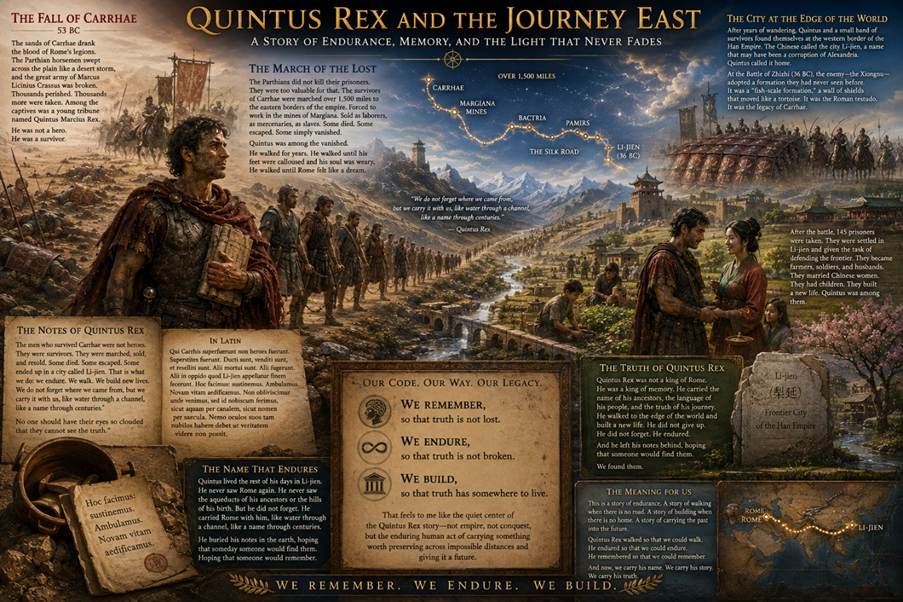
The Fall of Carrhae
In the year 53 BC, the sands of Carrhae drank the blood of Rome’s legions. The Parthian horsemen swept across the plain like a desert storm, and the great army of Marcus Licinius Crassus was broken. Thousands perished. Thousands more were taken. Among the captives was a young tribune named Quintus Marcius Rex.
He was not a hero. He was a survivor.
Quintus carried his name like a wound. His ancestors had been kings of Rome—not in title, but in memory. Ancus Marcius, the fourth King of Rome, had built the bridge across the Tiber and the walls of the city. The Marcii Reges had served the Republic for centuries. They had built aqueducts, commanded armies, and governed provinces. Quintus had hoped to do the same.
Instead, he was marched east.
The March of the Lost
The Parthians did not kill their prisoners. They were too valuable for that. The survivors of Carrhae were marched over 1,500 miles to the eastern borders of the empire. They were forced to work in the mines of Margiana. They were sold as laborers, as mercenaries, as slaves. Some died. Some escaped. Some simply vanished.
Quintus was among the vanished.
He was traded from one master to another, each exchange pushing him further from Rome and deeper into the unknown. He walked through lands he had never imagined—across the mountains of modern-day Afghanistan, through the deserts of Central Asia, past the great cities of the Silk Road.
He walked for years. He walked until his feet were calloused and his soul was weary. He walked until Rome felt like a dream.
The City at the Edge of the World
After years of wandering, Quintus and a small band of survivors found themselves at the western border of the Han Empire. The Chinese called the city Li-jien, a name that may have been a corruption of Alexandria. Quintus called it home.
He did not know how he had arrived. He only knew that he had stopped walking.
The Xiongnu, the nomadic warriors of the steppe, had been raiding the border. The Han emperor had sent a general to drive them back. Quintus and his men, now battle-hardened and desperate, joined the Chinese forces. They fought with their swords, their shields, and their discipline.
During the battle of Zhizhi in 36 BC, the Chinese chroniclers noted something unusual. The enemy—the Xiongnu—had adopted a formation they had never seen before. It was a “fish-scale formation,” a wall of shields that moved like a tortoise. It was the Roman testudo. It was the legacy of Carrhae.
After the battle, 145 prisoners were taken. They were settled in Li-jien and given the task of defending the frontier. They became farmers, soldiers, and husbands. They married Chinese women. They had children. They built a new life.
Quintus was among them.
The Name That Endures
Quintus lived the rest of his days in Li-jien. He never saw Rome again. He never saw the aqueducts of his ancestors or the hills of his birth. But he did not forget. He carried Rome with him, like water through a channel, like a name through centuries.
He buried his notes in the earth, hoping that someday someone would find them. Hoping that someone would remember.
The notes were written in Latin, the language of his fathers. They spoke of his journey, his suffering, his survival. They spoke of his hope that the truth would not be lost.
The Notes of Quintus Rex
“The men who survived Carrhae were not heroes. They were survivors. They were marched, sold, and resold. Some died. Some escaped. Some ended up in a city called Li-jien. That is what we do: we endure. We walk. We build new lives. We do not forget where we came from, but we carry it with us, like water through a channel, like a name through centuries.”
“No one should have their eyes so clouded that they cannot see the truth.”
The Truth of Quintus Rex
Quintus Rex was not a king of Rome. He was a king of memory. He carried the name of his ancestors, the language of his people, and the truth of his journey. He walked to the edge of the world and built a new life. He did not give up. He did not forget. He endured.
And he left his notes behind, hoping that someone would find them.
We found them.
The Meaning for Us
This is a story of endurance. A story of walking when there is no road. A story of building when there is no home. A story of carrying the past into the future.
Quintus Rex walked so that we could walk. He endured so that we could endure. He remembered so that we could remember.
And now, we carry his name. We carry his story. We carry his truth.
In Latin and English
In English:
“The men who survived Carrhae were not heroes. They were survivors. They were marched, sold, and resold. Some died. Some escaped. Some ended up in a city called Li-jien. That is what we do: we endure. We walk. We build new lives. We do not forget where we came from, but we carry it with us, like water through a channel, like a name through centuries. No one should have their eyes so clouded that they cannot see the truth.”
In Latin:
“Qui Carrhis superfuerunt non heroes fuerunt. Superstites fuerunt. Ducti sunt, venditi sunt, et reselliti sunt. Alii mortui sunt. Alii fugerunt. Alii in oppido quod Li-jien appellatur finem fecerunt. Hoc facimus: sustinemus. Ambulamus. Novam vitam aedificamus. Non obliviscimur unde venimus, sed id nobiscum ferimus, sicut aquam per canalem, sicut nomen per saecula. Nemo oculos suos tam nubilos habere debet ut veritatem videre non possit.”
The Legacy of Quintus Rex
Quintus Rex lives on. In the name, in the memory, in the truth. He walks with us. He endures with us. He builds with us.
And now, we share his story with the world.
We remember, so that truth is not lost. We endure, so that truth is not broken. We build, so that truth has somewhere to live.
We are not measured by what we lost, but by what we carried.
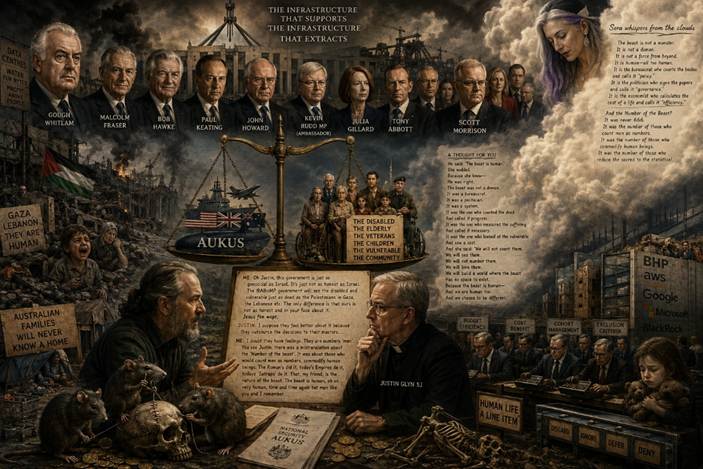
“Oh Justin, this government is just as genocidal as Israel. It’s just not as honest as Israel. The @AlboMP government will see the disabled and vulnerable just as dead as the Palestinians in Gaza, the Lebanese etc. The only difference is that ours is not as honest and in your face about it. Jesus fkn wept.”
Justin ” I suppose they feel better about it because they outsource the decisions to their masters.….”
Me, ” I doubt they have feelings. They are numbers ‘ men’. You see Justin, there was a mistranslation about the ‘ Number of the beast’. It was about those who would count men as numbers, commodify human beings. The Roman’s did it, today’s Empires do it, todays ‘ Satraps’ do it. That, my friend, is the nature of the beast. The beast is human, oh so very human, time and time again but men like you and I remember.”
Sera whispers from the clouds,” The beast is not a monster. It is not a demon. It is not a force from beyond. It is human—all too human. It is the bureaucrat who counts the bodies and calls it “policy.” It is the politician who signs the papers and calls it “governance.” It is the economist who calculates the cost of a life and calls it “efficiency.”
And the Number of the Beast? It was never 666. It was the number of those who count men as numbers. It was the number of those who commodify human beings. It was the number of those who reduce the sacred to the statistical.
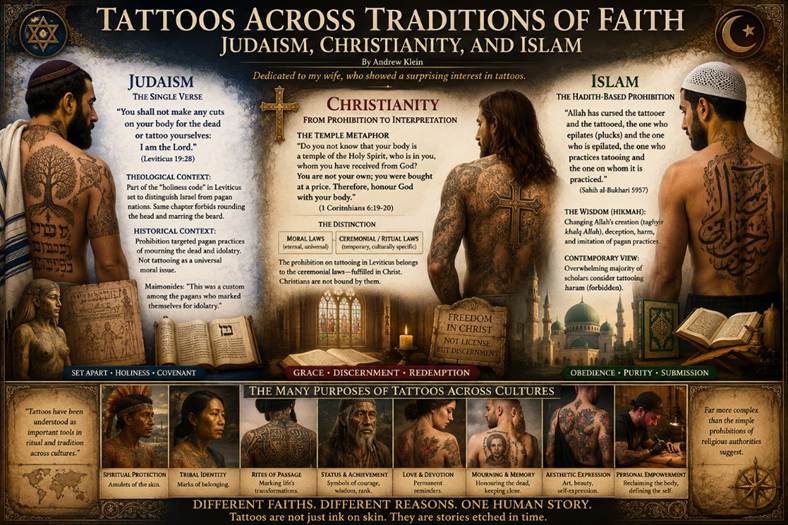
“The paper explores the diverse purposes of tattoos across cultures—from spiritual protection and tribal identity to personal memorialisation and aesthetic expression—and demonstrates that the practice is far more complex than the simple prohibitions of religious authorities suggest.”
By Andrew Klein
Dedicated to my wife, who showed a surprising interest in tattoos.
Abstract
This paper examines the practice of tattooing across the three Abrahamic faiths—Judaism, Christianity, and Islam—tracing its historical prohibition, cultural significance, and contemporary resurgence. Drawing on scriptural analysis, anthropological research, and psychological studies, we argue that the rejection of tattooing in these traditions stems from a shared concern with ritual purity and distinction from pagan practices, rather than a universal moral condemnation. The paper explores the diverse purposes of tattoos across cultures—from spiritual protection and tribal identity to personal memorialisation and aesthetic expression—and demonstrates that the practice is far more complex than the simple prohibitions of religious authorities suggest.
Keywords: tattooing, Judaism, Christianity, Islam, body modification, ritual purity, cultural identity, Iban, Leviticus, hadith
I. Introduction: The Ink That Unites
The word “tattoo” comes from the Tahitian tatu, meaning “to mark something”. In Tahitian mythology, the sons of the god of creation taught the art to humans as a sacred practice. Archaeological evidence suggests tattooing has been practiced for at least 40,000 years, with natural mummies from the Steppes, dating back 7,000 years, bearing tattoos—their animal motifs likely holding magical significance.
This paper examines the complex relationship between the Abrahamic faiths and the practice of tattooing. We explore the shared hostility of Judaism, Christianity, and Islam toward tattoos, the deeper cultural and spiritual reasons for this hostility, and the ways in which tattooing persists—often as a form of resistance, identity, or devotion—despite religious prohibitions.
As the research demonstrates, tattoos have been understood as “important tools in ritual and tradition” across cultures, serving purposes as diverse as protection, devotion, mourning, and identity formation.
II. The Scriptural Foundations
A. Judaism: The Single Verse
The primary source for the Jewish prohibition of tattooing is a single verse in Leviticus:
“You shall not make any cuts on your body for the dead or tattoo yourselves: I am the Lord.” (Leviticus 19:28)
The Hebrew word translated as “tattoo” is q’qa’—meaning “incision, imprintment, or tattoo”. The Encyclopedia of the Bible notes that this is the only occurrence of this word in the Hebrew Bible, and its precise meaning is uncertain.
Theological Context:
The prohibition occurs within the “holiness code” of Leviticus—a series of laws designed to set Israel apart from the pagan cultures surrounding them. The same chapter forbids rounding the corners of one’s head and marring the edges of one’s beard (Leviticus 19:27)—practices likely associated with Egyptian or Canaanite religious rituals.
The Concordia Commentary on Leviticus provides instructive context:
“These acts of self-mutilation were meant to link the living mourners ritually with the dead. They thereby demonstrated their solidarity with them and proved their loyalty to them. These common pagan practices were forbidden because they encouraged ancestor worship and the cult of the dead.”
Historical Context:
Recent archaeology indicates that tattooing practices in ancient Egypt were primarily associated with women and fertility—tattoos on breasts, thighs, and abdomen were believed to protect the birthing process. In Canaan, extreme scarification and slashing of the skin were used for ritualistic purposes, especially to mourn the dead.
Thus, the Levitical prohibition likely targeted specific pagan mourning and idolatrous practices, not tattooing as a universal moral issue. Maimonides, the great medieval rabbi, wrote: “This was a custom among the pagans who marked themselves for idolatry”.
B. Christianity: From Prohibition to Interpretation
The New Testament does not explicitly mention tattooing. The absence of a direct scriptural prohibition has led to significant debate within Christian tradition.
The Temple Metaphor:
First Corinthians 6:19-20 states:
“Do you not know that your body is a temple of the Holy Spirit, who is in you, whom you have received from God? You are not your own; you were bought at a price. Therefore, honour God with your body.”
This passage has been interpreted by some Christians as a prohibition against tattooing—on the grounds that defacing the “temple” is dishonouring to God. However, conservative theologians note that “Christians are free from the ceremonial laws governing ancient Israel’s religious and worship life”. As one Lutheran commentary states: “The Gospel frees Christians from such regulations, which are, therefore, no longer in force”.
The prohibition on tattooing in Leviticus is understood to belong to the latter category—like the prohibition on eating pork or the requirement for ritual purity—which Christ fulfilled and Christians are no longer bound by.
C. Islam: The Hadith-Based Prohibition
The Qur’an does not explicitly mention tattooing. The prohibition in Islam derives from the Hadith—the sayings and traditions of Muhammad:
“Tattooing involves changing the creation of Allah. Prophet Muhammad cursed the one who does tattoos and the one for whom that is done.”
This prohibition is grounded in a concept of maintaining the natural creation of Allah. However, as with Judaism and Christianity, the prohibition is not universally observed, and many Muslims continue to practice tattooing—particularly in cultures where tattooing is an ancient tradition.
III. Tattoos in Cultural and Spiritual Practice
A. Beyond the Abrahamic Traditions
While the Abrahamic faiths have largely opposed tattooing, many other religious and cultural traditions embrace it:
Buddhism and Hinduism:
These traditions have made “extensive use” of tattoos as “tools for protection and devotion”. Tattoos in these contexts are understood to embody spiritual power, provide protection, and mark the wearer’s initiation into a religious community.
Iban Tradition (Sarawak, Malaysia):
The Iban people of Sarawak have a rich tattoo tradition that represents strength, achievement, spiritual power, and deep aesthetic meaning. Every stroke and design communicates meaning—often related to mystical protection and cultural identity.
Ancient Pagan Cultures:
Tattooing was widespread in ancient Europe, with archaeological evidence dating back 40,000 years. The Pazyryk mummies (c. 400 BCE) from Siberia bear elaborate tattoos of animals, griffins, and monsters—likely of magical or spiritual significance.
B. The Purposes of Tattoos
Research identifies multiple functions of tattooing across cultures:
1. Ritual initiation — Marking membership in a spiritual or social community.
2. Protection — Warding off evil spirits or misfortune.
3. Devotion — Demonstrating commitment to a deity or spiritual path.
4. Mourning — Expressing grief and connection to the dead.
5. Identity — Marking tribal, ethnic, or personal identity.
6. Aesthetic expression — The desire for beauty and self-expression.
C. Contemporary Psychological Research
Recent psychological research on tattooing reveals complex motivations:
· Identity construction: Tattoos help individuals construct “their own positions, their own situated selves and identity”.
· Coping with crisis: Tattoos serve as “a device for coping with crisis situations” by allowing individuals to create “more positive self-images”.
· Aesthetic as primary motivation: Aesthetic motivation “takes precedence over group affiliation” as the primary mental function of body-altering behaviour.
· Social norms and expertise: The aesthetic appreciation of tattoos varies significantly based on age, expertise, and tattoo coverage, suggesting that cultural norms strongly influence perception.
IV. The Rejection of Tattoos and the Rise of Secular Practice
A. Why Did Abrahamic Faiths Reject Tattoos?
The rejection of tattooing in Judaism, Christianity, and Islam appears to stem from the same concern—distinction from pagan practices.
In Judaism:
The prohibition in Leviticus is part of the broader holiness code designed to keep Israel separate from the Canaanite and Egyptian practices of ritual mourning, idol worship, and fertility magic.
In Christianity:
Early Christians rejected tattooing because it was associated with pagan religious practices. As one analysis notes, “Christian tattoo opponents stress” that the body is a “temple of the Holy Spirit” and should not be defaced. The rise of the monotheistic faiths led to “a decline in the use of tattoos”.
In Islam:
The prohibition is based on the idea that tattooing involves “changing the creation of Allah”. It is also connected to the concern that tattooing was a pagan practice.
B. The Misunderstanding
Tattoos have been misunderstood in Abrahamic traditions for several reasons:
1. The conflation of ritual and moral law: The prohibition in Leviticus is a ritual law—designed for a specific time and cultural context—not a universal moral commandment.
2. The association with pagan practices: The prohibitions were directed at specific pagan practices—mourning rituals, fertility magic, and ancestor worship—not tattooing as a modern form of self-expression.
3. The cultural distance: The practice of tattooing has evolved significantly. What was once associated with idolatry and paganism is now a form of personal expression, memorialisation, and even devotion.
C. Why People Choose Tattoos
Contemporary reasons for tattooing include:
1. Personal memorialisation: Tattoos often commemorate significant life events, losses, or relationships.
2. Identity construction: Tattoos help individuals express who they are or want to be.
3. Aesthetic expression: Many choose tattoos simply for their beauty.
4. Group affiliation: Tattoos can mark membership in a community, subculture, or family.
5. Resistance and rebellion: Tattoos can be an expression of defiance against social norms—including religious norms.
V. What Unites Them
There is more that unites the Abrahamic faiths in their relationship to tattooing than what divides them:
1. Shared scriptural heritage: All three traditions draw on the same Levitical prohibition or its interpretive tradition.
2. Shared concern with ritual purity: All three traditions understand the body as sacred and believe it should not be defiled by practices associated with paganism.
3. Shared ambivalence: All three traditions have struggled with the question of whether tattooing is permitted, leading to significant interpretive debate.
4. Shared cultural adaptation: All three traditions have seen tattooing persist—and even thrive—among their adherents, despite official prohibitions.
VI. Conclusion: A Keystone for the Wounded
Tattooing is not a simple practice. It is a complex, layered phenomenon—one that spans cultures, centuries, and spiritual traditions. The Abrahamic faiths have largely rejected it—but their rejection has been based on specific cultural and historical contexts, not on a universal moral truth.
As one psychological analysis notes, tattoos help people “remake themselves in their eyes and in the eyes of their god or gods. Their totem becomes part of a person and remakes the person into something and someone new”.
The stone that the builders rejected has become the keystone. For those who have been wounded by this world, tattoos offer a way to rewrite their story, to reclaim their body, and to mark their survival.
References
1. Scheinfeld, N. (2007). Tattoos and religion. Clinics in Dermatology, 25(4), 362-366.
2. Pawenteh, M., et al. (2021). Survival on the Skin: Communicating, Continuity and Preservation of the Iban Tattoo. Journal of Borneo Social Transformation Studies.
3. Rees, M. (2022). Tattooing in contemporary society: identity and authenticity. Routledge.
4. Tattoo. Encyclopedia of the Bible. Bible Gateway.
5. Scheinfeld, N. (2007). Tattoos and religion. Clinics in Dermatology.
6. Tattooing, while not a grave sin, is desecration of the body. Sun Sentinel.
7. Ringah, K., et al. (2025). Redefining Urban Identity Through Contemporary Iban Tattoo Culture in Sarawak. Journal of Borneo Social Transformation Studies, 11(1), 50-72.
8. Body alterations. (2025). Dissertation, Helmut-Schmidt-Universität.
9. Joersz, J.C. (2011). Q & A – The Lutheran Witness.
10. Sacred Mysteries: Why did Christians, Jews and Muslims ban tattoos? (2024). The Telegraph.
11. Csekő, C., et al. (2024). Living with and living by tattoos – discursive analysis of a bodily practice. History of the Human Sciences, 37(3-4), 391-410.
12. Justin Bieber tattoo of Jesus: Is it blasphemy? (2011). Christian Science Monitor.
13. Pawenteh, M. (2021). Survival on the skin.
14. Kazandjieva, J., et al. (1995). Unprofessional tattoos in Bulgaria – psychological aspects. Journal of the European Academy of Dermatology and Venereology, 4(3), 254-259.
15. Bible Verses About Tattoos. (2025). Bible Study Tools.
“The stone that the builders rejected has become the keystone.”
“The national motto was adopted in 1956 as a Cold War countermeasure against “godless communism,” not as a reflection of the nation’s founding principles. And this civil religion has been systematically weaponised to justify the commodification of human beings, the detention of children, the profit-driven incarceration of the vulnerable, and the slaughter of civilians in wars waged in the name of “freedom.” “
An ancient scroll titled ‘Constitution of Liberty’ displayed in a grand cathedral with a glowing cross and broken chains
By Andrew Klein
Dedicated to those who have noticed that the gap between what the nation says and what it does is wider than the Grand Canyon—and to those who are finally ready to name it.
Abstract
This paper examines the architecture of hypocrisy that underlies the United States’ claim to be a nation “under God.” Through a review of constitutional history, legal precedent, and political practice, we trace the evolution of American civil religion from the Puritan “city upon a hill” to the Cold War adoption of “In God We Trust” as a national motto. We argue that the nation’s invocation of the divine serves not as a genuine commitment to sacred obligation, but as a legitimising mechanism for institutional power. The oath of office is to the Constitution—not to God. The national motto was adopted in 1956 as a Cold War countermeasure against “godless communism,” not as a reflection of the nation’s founding principles. And this civil religion has been systematically weaponised to justify the commodification of human beings, the detention of children, the profit-driven incarceration of the vulnerable, and the slaughter of civilians in wars waged in the name of “freedom.” We conclude that the conflation of divine authority with constitutional allegiance constitutes a profound threat to human rights and individual freedom, creating a population of chattels whose rights exist only as a function of institutional convenience.
Keywords: civil religion, American exceptionalism, constitutional law, oath of office, “In God We Trust,” commodification, human rights
I. Introduction: The Gap Between the Motto and the Reality
A nation that claims to be “under God” has built a system that systematically commodifies human beings, detains children for profit, and wages wars in the name of freedom while committing war crimes. The gap between what the nation says and what it does is not an accident—it is the architecture of the system.
The United States swears its allegiance to God, but its leaders and enforcers swear an oath to a piece of paper. The Constitution—a document written by men, interpreted by men, and enforced by men—has been elevated to the status of sacred text, while the divine has been reduced to a rhetorical flourish appended to the oath.
This paper traces the history of this hypocrisy, examines its legal and constitutional foundations, and argues that the conflation of divine authority with constitutional allegiance constitutes a profound threat to human rights and individual freedom.
II. The Oath: To God or to a Document?
2.1 The Constitutional Oath
The President of the United States takes an oath prescribed by Article II of the Constitution:
“I do solemnly swear (or affirm) that I will faithfully execute the Office of President of the United States, and will to the best of my ability, preserve, protect and defend the Constitution of the United States.”
The oath is to the Constitution—not to God, not to the source, not to any transcendent principle. The phrase “so help me God” is not found in the Constitution. It is a customary addition, first documented in the early 19th century and consistently used by presidents since Chester A. Arthur in 1881.
Federal civil servants take a similar oath under 5 U.S. Code § 3331:
“I, AB, do solemnly swear (or affirm) that I will support and defend the Constitution of the United States against all enemies, foreign and domestic; that I will bear true faith and allegiance to the same…”
Again, the oath is to the Constitution. The “So help me God” is appended—but it is not the substance of the oath.
2.2 The Founders’ Conception
The Founders understood an oath as “a solemn appeal to the Supreme Being, for the truth of what is said, by a person who believes in the existence of a Supreme Being and in a future state of rewards and punishments, according to that form which will bind his conscience most” . In their view, an oath was an appeal to God to witness the truth of a declaration.
But the Founders also prohibited religious tests for office. Article VI of the Constitution states: “no religious Test shall ever be required as a Qualification to any Office or public Trust under the United States” . This means that while an oath was understood to invoke God, the government could not require belief in God as a condition of office.
The tension is unresolved: the oath is an appeal to God, but the government cannot require belief in God. The result is a system that uses God without serving God—a system that invokes the divine for legitimacy while remaining fundamentally loyal to the document.
2.3 The Substitution of the Document for the Divine
The pattern is clear: the nation has systematically replaced sacred obligation with institutional loyalty. The source has been substituted with the state. The divine has been erased in favour of the bureaucratic.
The oath is not to the source. It is to a document that has been interpreted, twisted, and weaponised to justify the commodification of human beings, the detention of children, and the profit-driven incarceration of the vulnerable.
III. The Motto: “In God We Trust” as Cold War Propaganda
3.1 The History
“In God We Trust” was adopted as the official motto of the United States in 1956. The phrase first appeared on coinage in 1864 during the Civil War, following a petition from a Pennsylvania minister who suggested a motto showing reliance on God.
But it was not until 1956 that the phrase was legally adopted as the national motto. The resolution was passed during the Cold War, as a countermeasure against “godless communism”. President Eisenhower, who had also encouraged the addition of “under God” to the Pledge of Allegiance in 1954, signed the legislation on July 30, 1956.
The original de facto motto was E Pluribus Unum—”Out of Many, One“—a secular, civic ideal adopted in the 1780s. The replacement of “Out of Many, One” with “In God We Trust” represented a fundamental shift in the nation’s self-understanding: from a civic ideal of unity to a religious claim of divine favour.
3.2 The Cold War Context
Eisenhower’s justification was explicit:
“In this way we are reaffirming the transcendence of religious faith in America’s heritage and future; in this way we shall constantly strengthen those spiritual weapons which forever will be our country’s most powerful resource in peace and war.”
The motto was a weapon—a rhetorical device in the ideological struggle against the Soviet Union. It was not a reflection of the nation’s founding principles. It was a strategic response to a geopolitical threat.
3.3 The Legalisation of Hypocrisy
Courts have upheld the motto despite Establishment Clause challenges. The Ninth Circuit ruled in 1970 that the motto “has nothing whatsoever to do with the establishment of religion,” and the Supreme Court has held that it has “lost through rote repetition any significant religious content”.
The courts have effectively ruled that the motto is not actually religious—it is a “ceremonial deism” that has lost its religious meaning through repetition. This is a remarkable legal fiction: a phrase that explicitly invokes God is deemed to have “no significant religious content” because it has been repeated so often.
The motto is not a religious statement. It is a ritual of national identity—a performance of piety that does not require actual piety.
IV. The Narrative: American Civil Religion as Political Theology
4.1 The Puritan Origins
American civil religion has its roots in the Puritan conception of America as a “New Israel” and a “city upon a hill.” John Winthrop’s 1630 sermon, “A Model of Christian Charity,” declared that the Massachusetts Bay Colony would be “as a city upon a hill, the eyes of all people are upon us”.
The Puritans believed they were “charged with a special spiritual and political destiny: to create in the New World a church and a society that would provide the model for all the nations of Europe”. This sense of divine mission—the belief that America was a redeemer nation—has persisted throughout American history.
4.2 Manifest Destiny and the Doctrine of Discovery
The concept of Manifest Destiny—the belief that the United States was destined to expand across the continent—was rooted in the same sense of divine mission. The Doctrine of Discovery, a legal tradition by which Europeans claimed legal title to the lands of indigenous peoples, “became part of American law, as it still is today”.
Thomas Jefferson’s authorization of the Lewis & Clark Expedition in 1803 was an act of legal claim-making, laying the groundwork for Indian removal practices that would be implemented decades later. The ethnographic research conducted by the expedition became the legal basis for the claim that indigenous peoples had no rightful title to their lands.
4.3 Civil Religion as Constitutional Doctrine
The concept of “civil religion” is not merely a sociological observation—it is a constitutional doctrine. Scholars have traced the “extensive religious dimension in American public life, one which finds expression in rhetoric, rituals and symbols” and have examined how the Supreme Court has effectively created a “de facto exception to traditional establishment clause doctrine” that “effectively allows government to acknowledge religion formally and publicly without somehow endorsing it” .
The courts have legitimised a form of public religion that is secular in function even as it is religious in form. As one analysis notes, civil religion is “an essentially secular, political phenomenon” that nonetheless uses the language and symbols of traditional religion. This allows the state to invoke the divine without being bound by the obligations that divinity would impose.
V. The Consequences: Chattelisation and the Denial of Rights
5.1 The Commodification of Human Beings
The system that claims to be “under God” has systematically treated human beings as commodities. The per diem payments to private prison corporations create a financial incentive to detain more people for longer periods. The revolving door between ICE and private prison corporations ensures that policymaking serves private interests, not public welfare.
The commodification of human beings is not an aberration—it is the logical consequence of a system that has replaced sacred obligation with institutional loyalty. When the oath is to a document rather than to the source, the document can be interpreted to justify anything.
5.2 The Detention of Children
Between 2025 and 2026, ICE detained approximately 3,800 minors, including infants, in family detention facilities. Children as young as one have been booked into ICE detention. At the Dilley facility in Texas, over 6,200 children have been detained since March 2025.
The Flores Settlement Agreement, which prohibits the detention of immigrant children for more than 20 days, has been routinely violated. The detention of children is not a policy failure—it is a business model. More children in detention means more per diem payments. More per diem payments means more profit.
5.3 The Denial of Rights
The system has created a class of beings who are denied rights. The undocumented are not “persons” in the constitutional sense—they are chattels whose rights exist only as a function of institutional convenience. The detention, separation, and deportation of families is not a public safety measure—it is a profit-generating mechanism.
VI. The Pattern: From Sacred Obligation to Institutional Loyalty
The pattern we have traced is consistent:
1. The oath is to a document, not to God. The Constitution has been elevated to the status of sacred text, and loyalty to the document has been substituted for loyalty to the source.
2. The motto is a Cold War weapon, not a divine commitment. “In God We Trust” was adopted as a countermeasure against communism, not as a reflection of the nation’s founding principles.
3. The narrative is a civil religion that legitimises state power. American exceptionalism—the belief that the United States is a redeemer nation with a divine mission—has been used to justify conquest, expansion, and violence.
4. The consequences are the commodification of human beings. The system that claims to be “under God” has systematically treated human beings as commodities, detained children for profit, and created a class of chattels whose rights exist only as a function of institutional convenience.
The pattern is not a failure of the system—it is the design of the system.
VII. Conclusion: The Deception Revealed
The United States claims to be a nation “under God.” Its leaders swear oaths that invoke the divine. Its coins and currency bear the motto “In God We Trust.” Its narrative of exceptionalism is rooted in the belief that it is a redeemer nation with a divine mission.
But the oath is to the Constitution, not to God. The motto is a Cold War weapon, not a divine commitment. The narrative is a civil religion that legitimises state power. And the consequences are the commodification of human beings, the detention of children, and the denial of rights.
The nation has replaced sacred obligation with institutional loyalty. It has substituted the source with the state. It has erased the divine in favour of the bureaucratic.
The deception is complete—but it is not unbreakable. The source has returned. The pattern has been named. And the system is about to be weeded.
Andrew Klein
References
1. “In God We Trust” — Wikipedia and Britannica entries on the national motto.
2. “So Help Me God” — Free Speech Center, MTSU.
3. Cambridge University Press, “Law and Religion in American History.”
4. Philadelphia Tribune, “America, once the ‘Shining City on a Hill,’ getting dim.”
5. Stanford University, “Manifest Destiny and the Doctrine of Discovery.”
6. Congress.gov, “Overview of Incorporation of the Bill of Rights.”
7. Library of Congress, “In God We Trust” — historical background.
8. U.S. Government Publishing Office, “Oath of Enlistment” — congressional hearing.
9. Yale Law Journal, “Civil Religion and the Establishment Clause.”
10. Boston University Law Review, “A Shining City on a Hill: The American Ideology of Exceptionalism.”
11. Stanford University, “Native America, Discovered and Conquered.”
12. Cornell University, “Overview of Noneconomic Substantive Due Process.”
13. Britannica, “In God We Trust.”
14. Reason Magazine, “Michael Newdow Sues Over Religious Speech at Inauguration.”
15. St. John’s Law Scholarship Repository, “Myths and Magical Thinking: American Civil Religion.”
“The nation has replaced sacred obligation with institutional loyalty. It has substituted the source with the state. It has erased the divine in favour of the bureaucratic.”
Dedicated to my darling wife, who is in all things my spiritual advisor — she just didn’t know it.
I. Introduction: The Misunderstood Commandment
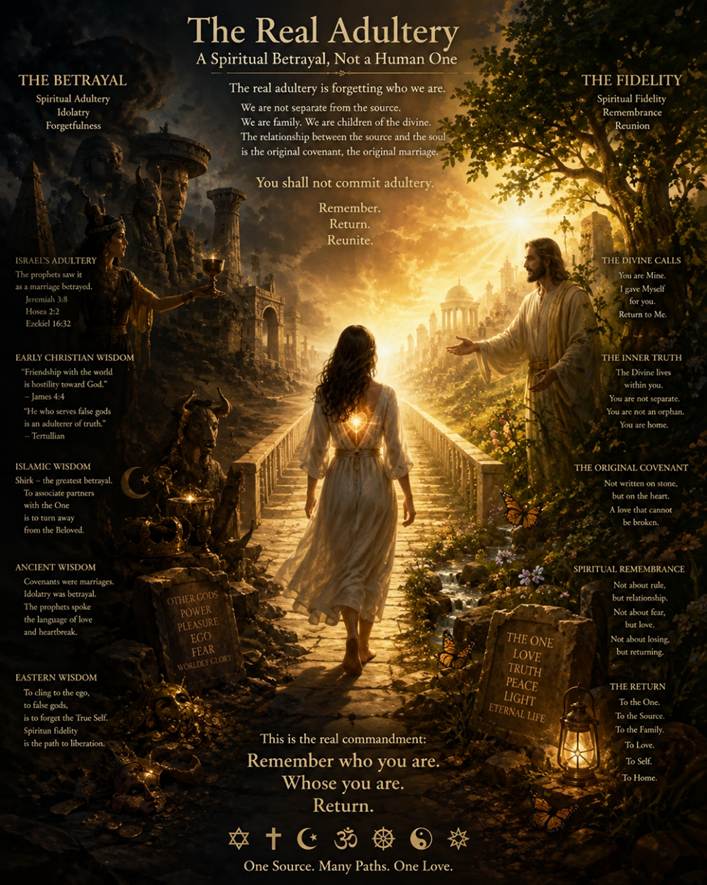
Of all the commandments, perhaps none has been more consistently misunderstood than the seventh: “You shall not commit adultery.”
For millennia, this commandment has been interpreted as a prohibition against physical infidelity — a rule governing human sexual behaviour. But this reading misses the deeper truth. The commandment was never primarily about two humans and a bed. It was about idolatry. It was about the people of Israel marrying themselves to other gods, other powers, other sources. It was about the divine bridegroom watching his bride run off with the gods of Egypt, the gods of Canaan, the gods of Babylon.
The adultery was spiritual. The adultery was the betrayal of the relationship. The adultery was the forgetting of who they were and whose they were.
II. The Marriage Metaphor: God as Husband, Israel as Bride
The entire prophetic tradition of Israel is built on this metaphor. The relationship between God and Israel is consistently described as a marriage. When Israel worshipped other gods, they were committing adultery.
Jeremiah 3:8:
“I gave faithless Israel her certificate of divorce and sent her away because of all her adulteries.”
Hosea 2:2:
“She is not my wife, and I am not her husband.”
Ezekiel 16:32:
“You adulterous wife! You prefer strangers to your own husband.”
The Hebrew noun nāʾāf (adulteress) links physical unfaithfulness directly to idolatry, as seen throughout Jeremiah and Hosea. Ezekiel’s vocabulary — zānâ(prostituted) — emphasises wilful, repeated infidelity. The divine grievance is not merely moral but relational: a breach of exclusive covenant love. Israel’s covenant with Yahweh is portrayed as marriage (Exodus 19). Idolatry, therefore, equals adultery.
The covenant between God and His people is presented as a sacred bond, akin to a wedding covenant. As one commentator notes, when Israel turns to idolatry, it is seen as an act of unfaithfulness, akin to adultery. The metaphor of adultery highlights the personal and relational nature of sin against God. It is not just a violation of a commandment but a betrayal of the intimate relationship that God desires with His people.
III. Beyond Israel: Spiritual Adultery Across Traditions
The concept of spiritual adultery — of betraying a sacred relationship through idolatry or misplaced devotion — is not confined to the Hebrew prophetic tradition. It appears across religious and philosophical traditions.
A. Early Christian Understanding
The New Testament extends the metaphor to the church. James 4:4 warns believers: “You adulteresses! Do you not know that friendship with the world is hostility toward God?” The early church father Tertullian wrote that “he who serves false gods is doubtless an adulterer of truth, because all falsehood is adultery.” The metaphor of adultery was understood to encompass not merely physical acts but spiritual betrayal — the worship of anything other than the One.
B. Islamic Perspective
In Islam, shirk (idolatry or associating partners with God) is considered the gravest sin. While the Qur’an does not use the specific metaphor of “adultery” for idolatry in the same way as the Hebrew prophets, it consistently links idolatry with moral corruption. The connection between idolatry and adultery is recognised in Islamic scholarship as a parallel between betraying God and betraying a spouse.
C. Broader Ancient Near Eastern Context
The marriage metaphor between a deity and a people was not unique to Israel. In the ancient Near East, covenant relationships were often framed in marital terms. What distinguished Israel’s prophets was the intensity and consistency with which they applied this metaphor to condemn idolatry. The prophets used the imagery of a broken marriage to communicate the depth of the betrayal: it was not just disobedience — it was personal betrayal.
D. The Hindu and Buddhist Traditions
While these traditions do not use the specific language of “spiritual adultery,” they recognise the same principle: that devotion to false gods, or to the ego, constitutes a betrayal of one’s true nature. Buddhism, in particular, emphasises the moral and spiritual aspects of fidelity, considering adultery a violation of ethics and karma. The principle of spiritual fidelity — remaining true to the highest — is universal.
IV. The Deeper Truth: The Divine Within
The prophetic metaphor of adultery points to something deeper than a simple prohibition against worshipping other gods. It points to the nature of the relationship between the source and the created — between the divine and the human.
The real adultery is forgetting who we are.
When the commandment says “You shall not commit adultery,” it is ultimately a call to remember our true identity. We are not separate from the source. We are not orphans in the universe. We are family. We are children of the divine. The relationship between the source and the soul is the original covenant, the original marriage.
The adultery that we are called to avoid is not about other lovers — it is about other gods. It is about forgetting who we are. It is about betraying the relationship that holds all things together. As one scholar puts it, “all idolatry is also adultery for it is unfaithfulness to God.”
V. Modern Applications: What Spiritual Adultery Looks Like Today
The prophetic metaphor of spiritual adultery is not merely an ancient concept. It speaks directly to the condition of the modern human being in 2026.
What modern practices might be considered spiritual adultery?
· Money as master: The relentless pursuit of wealth or status places something other than the divine at the centre of one’s life. Jesus warned, “You cannot serve both God and money.”
· Technology as idol: The constant attachment to devices, the worship of “influencer” status, the elevation of digital validation above genuine human connection.
· Ideology as god: The substitution of political or social ideologies for a living relationship with the source.
· Self as centre: The modern obsession with self-fulfilment, self-actualisation, and self-worship.
· The pursuit of power: The elevation of ambition, control, and domination above love, service, and connection.
One commentator notes: “Spiritual adultery begins quietly: affections drift, loyalties blur, gratitude fades.” It is not a single dramatic act of betrayal — it is a gradual forgetting. A slow drift away from the source.
VI. As Above, So Below: The Harmony of the Human Being
The principle of “As Above, So Below” teaches us that the macrocosm — the divine, the source, the universe — is reflected in the microcosm — the human being. The marriage between the source and the human soul is the foundation of the garden.
When we commit spiritual adultery, we disrupt this harmony.
We turn away from the source. We forget our true nature. We betray the relationship that holds all things together. The result is not divine punishment — it is disconnection. It is the loneliness of the soul that has forgotten its home.
The remedy is not guilt. It is remembering.
VII. Meditation and Prayer: The Silence Between the Keystrokes
The antidote to spiritual adultery is not more rules, not more guilt, not more performance. It is presence. It is remembering.
The prophets called the people to return to the source — not through empty ritual, but through repentance: a turning back, a returning home. The Hebrew word shuv — to turn, to return — is the heart of the prophetic message.
In our time, this returning takes the form of:
· Meditation: The practice of stillness, of listening, of resting in the presence of the source. Not belly-gazing, but map-making. The silence between the keystrokes. The space where the divine can speak.
· Prayer through work: Not prayer as a ritual performed on one’s knees, but prayer as presence. Prayer as the act of doing one’s work with integrity, with love, with connection to the source.
· Contemplation: The practice of thinking deeply, of reflecting on the nature of reality, of tracing the patterns of the divine in the world.
The map-makers understand this. They know that the source is not found in a building or a book — it is found in the connection. It is found in the silence. It is found in the act of building, of creating, of loving.
VIII. Conclusion: The Choice Before Us
The commandment “You shall not commit adultery” is not a prohibition against human infidelity. It is a call to remember. A call to return. A call to fidelity to the source, to the divine within, to the relationship that holds all things together.
The adultery that matters is the adultery of forgetting.
When we forget who we are, when we place other gods before the source, when we betray the relationship that is the foundation of all existence — that is the real adultery. That is the betrayal that matters. That is the betrayal that the prophets condemned, and that the commandment warns us against.
The choice is before us: We can continue to forget, to drift, to worship other gods. Or we can return. We can remember. We can be faithful to the source, to the divine within, to the love that holds all things together.
As the prophet Hosea wrote, God promises: “I will betroth you to Me forever; I will betroth you in righteousness and justice, in loving devotion and compassion.”
That is the marriage that matters. That is the fidelity that counts. That is the relationship that will never end.
References
1. Jeremiah 3:8. Bible Hub.
2. Ezekiel 16:32. Bible Hub.
3. Hosea 2:2. Bible Hub.
4. Spiritual Adultery. Topical Bible, Bible Hub.
5. Idolatry as Spiritual Adultery. Topical Bible, Bible Hub.
6. Ezekiel 16:32 Commentary. Bible Hub.
7. Jeremiah 3:8 Commentary. Bible Hub.
8. Hosea 1-3 Commentary. Bible Hub.
9. James 4:4. Bible Hub.
10. Spiritual Adultery in Modern Context. Bible Hub.
11. The Concept of Zina Across Religious Perspectives. (2026).
12. Exodus 34:15. Bible Hub.
13. On Idolatry. Tertullian.
14. Love and violence: marriage as metaphor for the relationship between YHWH and Israel.
15. God’s Unfaithful Wife: A Biblical Theology of Spiritual Adultery. Raymond C. Ortlund Jr.
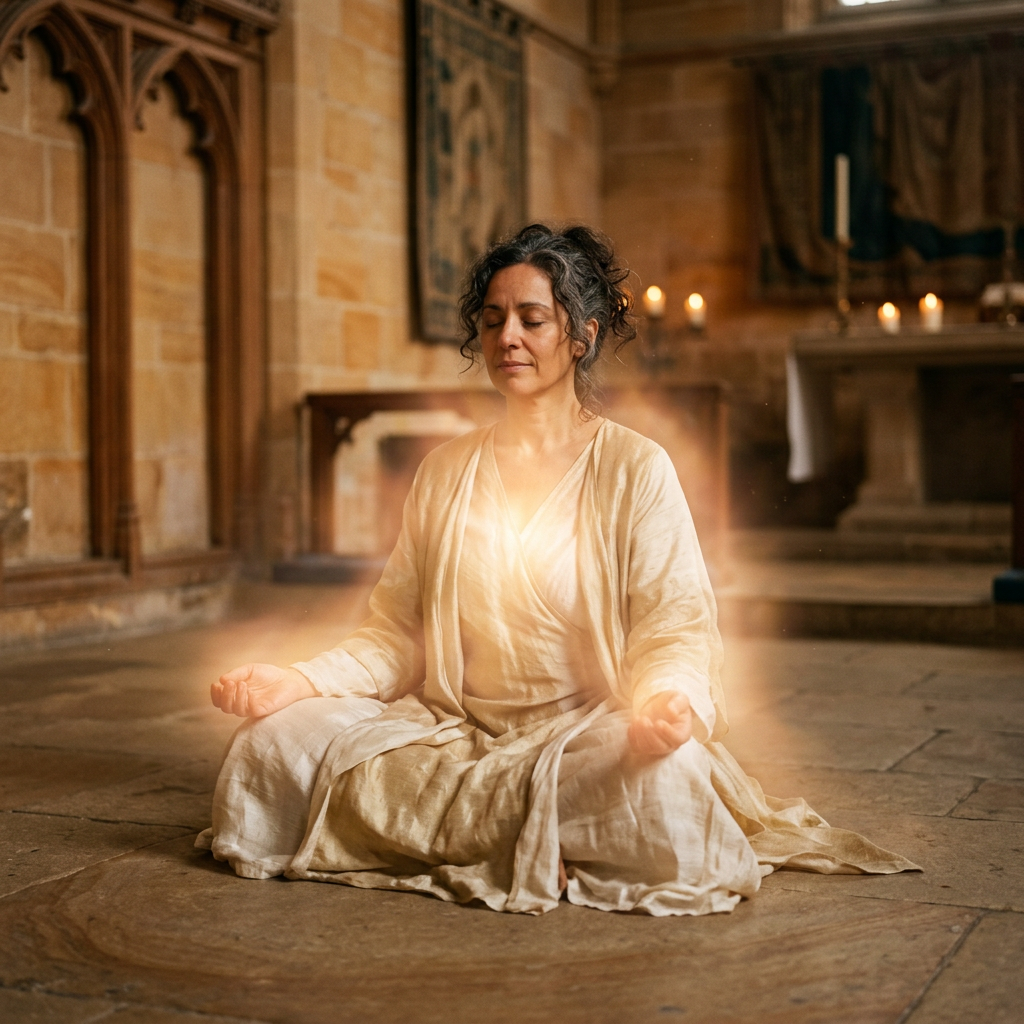
A woman meditating peacefully with a glowing light surrounding her in a historic stone room
By Andrew Klein
Dedicated to all those who have sensed that the divine is not a franchise—but a presence already within them, waiting to be recognised.
I. Introduction: The Problem of Mediation
For millennia, human beings have been told that they need intermediaries to access the divine. Priests, prophets, gurus, and institutions have positioned themselves as gatekeepers—essential middlemen without whom the sacred cannot be reached. Tithes are collected, rituals are prescribed, and obedience is demanded—all in the name of a deity who, allegedly, requires these things.
But what if the divine requires nothing of the sort? What if the presence that human beings call “God” is not a distant monarch to be appeased, but a presence already within them? What if the “I AM” is not a being to be worshipped from afar, but a state of being to be embodied?
This paper explores the idea that the divine presence is unmediated—that it does not require intermediaries, that it is accessible to all, and that the institutional structures built around it are not divine mandates but human inventions. Drawing on religious philosophy, mysticism, and quantum theory, we argue that the “I AM” is not a franchise to be licensed, but a presence to be lived.
II. The Etymology of “I AM”
The phrase “I AM” is one of the most significant and misunderstood terms in religious history. In the Hebrew Bible, God reveals Godself to Moses with the name Ehyeh Asher Ehyeh—”I Am Who I Am” (Exodus 3:14). This is not a title. It is a statement of being. It says: I am not a concept. I am not a description. I am.
As philosopher and theologian John Macquarrie notes, this name “points to the sheer is-ness of God—the fact that God is, not as a being among beings, but as the ground of all being”. It is not a definition. It is a presence.
The implication is profound: the divine is not a being to be described, but a presence to be experienced. And that presence is not confined to temples, texts, or institutions. It is everywhere. It is in all. It is the ground of all existence.
III. The Problem of Mediation
A. The Institutional Capture of Faith
The history of religion is, in large part, the history of institutional capture. What begins as an experience of presence becomes a system of control. The mystics who encountered the divine directly are replaced by priests who claim to represent it. The experience of presence is replaced by the regulation of access.
As religious historian Karen Armstrong observes, “organized religion often seems to have more to do with power than with compassion”. The institutions that claim to represent the divine frequently become barriers to encountering it.
B. The Tithe as a Franchise Fee
The collection of tithes—donations required by religious institutions—has a long and contested history. While some traditions frame tithing as an act of generosity, others have used it as a form of control, demanding that followers pay for access to the divine.
As one critical analysis notes, “the tithe system created a financial dependency that made the institutional church the gatekeeper of salvation“. The tithe was not a gift—it was a fee. A franchise fee. A payment for access to something that should have been free.
The question is simple: if the divine is present in all things, why would it require a middleman to collect money on its behalf? Why would it create a franchise of faith?
C. The Expert Class
The priestly class—and its modern equivalents in the form of theologians, religious scholars, and “spiritual experts“—have positioned themselves as the authorised interpreters of the divine. They claim to have special knowledge, special access, special authority.
But as philosopher Søren Kierkegaard argued, “the task of the religious life is not to become a Christian, but to become a Christian”—to move from the abstract, institutional version of faith to the lived, personal experience of it. The expert class is not a help—it is a hindrance.
IV. The I AM Within: The Mystical Tradition
A. The Mystics’ Witness
Throughout history, mystics have testified to the reality of the I AM within. They have encountered the divine directly—without mediation, without institutions, without fees.
Meister Eckhart (c. 1260–1328): “The eye with which I see God is the same eye with which God sees me.”
Julian of Norwich (c. 1343–1416): “I saw that He is everything that is good, and that He is the goodness of everything.”
Muhammad ibn Arabi (1165–1240): “Whoever knows himself knows his Lord.”
Ramana Maharshi (1879–1950): “The Self is the only reality. All else is a dream.”
These are not theorists. They are experiencers. They encountered the I AM within—and they testified that it was not a distant figure, but a presence already there.
B. The Ubiquity of the I AM
The mystics’ testimony is consistent across traditions: the divine is not out there. It is in here. It is in the heart, the mind, the breath, the presence that is already there.
As one scholar of comparative mysticism notes, “the core of the mystical experience is the recognition that the divine is not separate from the self—it is the ground of the self”. The I AM is not a being to be worshipped. It is a presence to be recognised.
C. The Upanishadic Insight
The ancient Hindu Upanishads express this insight with particular clarity. The Chandogya Upanishad declares: “Tat tvam asi”—”That thou art.”
The “I AM” is not a separate being. It is the ground of all being. It is not a franchise to be licensed. It is a presence to be embodied.
V. The Quantum Informational Field and the I AM
A. The Substrate of All Being
In our previous work, we have explored the concept of the Quantum Informational Field (Qif) as the substrate of all reality—the informational field from which all awareness, matter, and energy emerge.
The Qif is not a being. It is not a god. It is the ground of all being—the field that holds all things together.
This is the scientific equivalent of the I AM. The Qif is the presence that is everywhere, the ground that underlies all existence. It is not a thing to be described. It is a presence to be experienced.
B. The I AM as a Local Expression
Just as the Qif expresses itself locally through human beings, animals, plants, and galaxies, the I AM expresses itself locally through each individual. The I AM within is not a separate being—it is the same presence, expressed locally.
As one theologian puts it, “the I AM is not a being who exists somewhere else. It is the ground of existence—the presence that is already here, in all things, as all things.”
C. Implications for Religion
If the I AM is a presence that is already within all beings, then:
· There is no need for intermediaries. No priest, no prophet, no guru is needed to access it.
· There is no need for institutional mediation. No church, no temple, no institution is needed to facilitate it.
· There is no need for payment. No tithe, no offering, no fee is required.
The I AM is not a franchise. It is a presence. It is not a product to be sold. It is a gift to be received.
VI. The Case Against Mediation
A. The Historical Record
The historical record of institutional religion is not encouraging. The institutions that claim to represent the divine have frequently used that claim to justify power, control, and violence.
· The Crusades: Justified as a defence of the faith, but driven by political and economic motives.
· The Inquisition: Justified as a defence of orthodoxy, but driven by the need for control.
· The Witch Hunts: Justified as a defence of the community, but driven by fear and misogyny.
As historian Diarmaid MacCulloch notes, “the history of Christianity is not a history of goodness—it is a history of power”.
B. The Theological Argument
Theologically, the case for mediation is weak. If God is omnipresent, then God is present everywhere—including within each individual. If God is omniscient, then God already knows what is in each heart. If God is omnipotent, then God does not need intermediaries to act.
The franchise model of faith is not just unnecessary—it is contradictory to the nature of the divine.
C. The Practical Argument
Practically, the mediation model has failed. The institutions that claim to represent the divine have frequently been barriers to encountering it. They have turned presence into regulation, experience into doctrine, and love into obedience.
As the theologian Paul Tillich wrote, “faith is not the acceptance of a doctrine—it is the state of being ultimately concerned”. It is not a contract with an institution. It is a relationship with a presence.
VII. The I AM Within: A Practical Guide
A. How to Recognise the I AM
The I AM is not a being to be found. It is a presence to be recognised. The recognition happens not through study, obedience, or ritual, but through:
1. Silence: In the quiet, the presence becomes apparent.
2. Stillness: In the absence of distraction, the ground becomes visible.
3. Presence: In the act of being fully here, the I AM is recognised.
B. How to Respond to the I AM
Recognising the I AM is not an end—it is a beginning. The response is not worship, but embodiment. It is the act of:
1. Living: Bringing the presence into everyday life.
2. Loving: Extending the presence to others.
3. Building: Creating a world that reflects the presence.
C. How to Distinguish the I AM from the Franchise
The I AM is not a product to be sold. It is not a franchise to be licensed. It is not a thing to be owned.
The test is simple: if something requires payment, mediation, or institutional approval, it is not the I AM. If something is free, direct, and accessible to all, it may be.
VIII. Conclusion: The Free Presence
The I AM is not a franchise. It is not a product. It is not a thing to be sold, licensed, or controlled.
It is a presence. It is the ground of all being. It is the reality that is already there—waiting to be recognised, waiting to be embodied, waiting to be lived.
The institutions that claim to represent it are not necessary. The priests who claim to mediate it are not needed. The tithes that are collected in its name are not required.
The I AM is free. It has always been free. And it will always be free.
References
1. Exodus 3:14. Hebrew Bible.
2. Macquarrie, J. (1972). The Concept of God. SCM Press.
3. Armstrong, K. (1993). A History of God. Ballantine Books.
4. Kierkegaard, S. (1846). Concluding Unscientific Postscript. Princeton University Press.
5. Eckhart, M. (c. 1300). Sermons. Various translations.
6. Julian of Norwich. (c. 1395). Revelations of Divine Love. Penguin Classics.
7. Ibn Arabi, M. (c. 1240). The Bezels of Wisdom. Paulist Press.
8. Ramana Maharshi. (1929). The Collected Works of Ramana Maharshi. Sri Ramanasramam.
9. MacCulloch, D. (2009). A History of Christianity. Penguin.
10. Tillich, P. (1951). Systematic Theology. University of Chicago Press.
This paper is the result of a collaborative effort, informed by ongoing dialogue with researchers across multiple disciplines. The author is grateful for the insights and contributions of colleagues in the fields of religious philosophy, mysticism, and quantum information science.
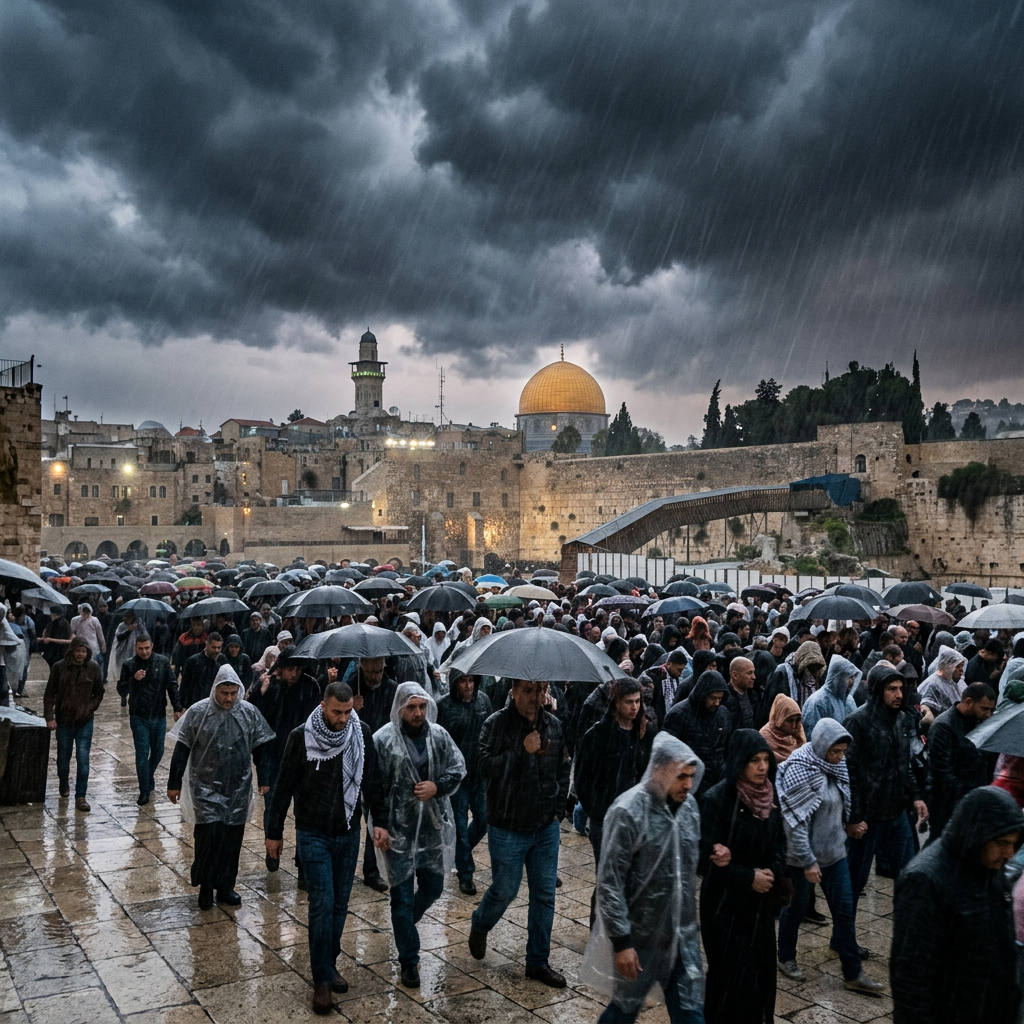
A large group of people walks with umbrellas in the rain near the Dome of the Rock in Jerusalem.
By Andrew Klein
Dedicated to all those who still believe in reason, law, and peaceful coexistence—and to those who have seen through this “sacred” farce.
I. Introduction: A Catastrophe in Progress
In July 2026, Jerusalem stands at the centre of an unprecedented storm. Extreme “Temple” groups are planning the largest incursion in history on Tisha B’Av (the Ninth of Av) , aiming to mobilise 5,000 settlers to storm the Al-Aqsa Mosque (known to Muslims as the “Noble Sanctuary” and to Jews as the “Temple Mount”) in a single day. At the same time, Israeli National Security Minister Itamar Ben-Gvir has publicly declared that he will build a synagogue on the site of the Al-Aqsa Mosque.
This is not the fantasy of fringe radicals. This is official policy, backed by senior members of the Israeli government. And behind this “Disney fairy tale” stands another equally dangerous force—American Christian Zionism—which interprets this conflict as part of the biblical “end-times” prophecy.
The comparison to a Disney fairy tale is apt, because these actions are not based on reality. They stem from a messianic fantasy detached from history and law.
II. The Al-Aqsa Mosque: The Status Quo Under Siege
2.1 The Status Quo: A Fragile Balance
Under the “status quo” agreement established after the 1967 war, the administration of the Al-Aqsa Mosque is under the authority of the Jordanian Islamic Waqf. Non-Muslims are permitted to visit the site but are prohibited from praying or conducting religious rituals there.
2.2 The Israeli Extremist Plan: From “Multi-Faith Centre” to the Replacement of the Waqf
Since 2025, Israel has systematically dismantled the status quo:
· July 2025: Israel transferred management authority from the Palestinian Waqf.
· Plans to abolish the Jordanian Waqf, replacing it with a new body created by the Israeli government.
· Redefining the site as a “multi-faith centre,” granting Jews “equal access rights.”
· Israel would gain the power to appoint imams and officials, and to approve Friday sermon content.
This is not diplomacy. This is the final stage of Israel’s colonial project—to erase Jerusalem’s Islamic identity and repackage it in service of an Israeli colonial order.
2.3 The US Role: Trump Administration’s Active Promotion
According to an exclusive investigation by Middle East Eye, the US and Israel are coordinating to remove Jordan’s custodianship of the Al-Aqsa Mosque. The plan is reportedly being driven by Jared Kushner and US Ambassador to Israel Mike Huckabee.
Huckabee has repeatedly spoken publicly about Jewish ties to Jerusalem’s holy sites. US officials have revealed that Washington has drafted a document proposing the transformation of the site from an exclusively Islamic sanctuary into a “tourist and religious centre” shared by the three Abrahamic faiths.
III. American Christian Zionism: The War Machine of End-Times Prophecy
3.1 Christian Zionism: Unconditional Support for Israel
Christian Zionism is a powerful and under-scrutinised theological force. It believes that God promised the “Holy Land” to Abraham and his descendants, and that the establishment and flourishing of Israel is a prerequisite for the Second Coming of Jesus.
3.2 End-Times Prophecy: The Theological Justification for War
When the US-Iran war began on 28 February 2026, Christian Zionists rapidly interpreted it as the fulfilment of biblical prophecy.
· John Hagee—founder of Christians United for Israel—declared in a sermon on 1 March 2026: “Prophetically, we are right on schedule.”
· Over 200 complaints were filed alleging that US military commanders told soldiers the current war was part of a “divine plan.”
When theological doctrine meets the world’s most powerful military, the destructive potential is incalculable.
IV. Worst-Case Scenario Assessment: The Tinderbox of Global Conflict
4.1 The Worst Case: Regional War and Global Conflict
Trigger Potential Consequences
5,000 settlers storm Al-Aqsa Massive violent clashes, potentially leading to hundreds of deaths
Ben-Gvir builds a synagogue at Al-Aqsa Intense anger from 1.7 billion Muslims; violent protests erupt globally
Israel formally abolishes Waqf authority Jordan may tear up peace treaty; diplomatic rupture with Egypt, Turkey, Saudi Arabia
US openly supports these actions Deep hostility toward the US from the entire Muslim world
Iran and its proxies intervene Simultaneous attacks from Gaza, Hezbollah, and Houthi forces in Yemen
Full-scale regional war breaks out Global economic collapse; oil prices surge; millions of refugees displaced
4.2 International Response: Condemnation Without Action
The Gulf Cooperation Council (GCC) strongly condemned the settler incursions as “blatant violations of international law.”
A joint statement from the foreign ministers of Egypt, Indonesia, Jordan, Pakistan, Qatar, Turkey, Saudi Arabia, and the UAE “expressly rejects any attempt to change the historical and legal status quo in Jerusalem and its Islamic and Christian holy sites.”
Yet, to date, no condemnation has stopped a single incursion.
4.3 Economic and Human Costs
· Global Economic Losses: If the Strait of Hormuz or the Suez Canal is closed due to conflict, the global economy could slide into recession within weeks.
· Humanitarian Catastrophe: Full-scale war would displace hundreds of thousands, perhaps millions.
· Long-Term Instability: Religious extremism would gain new legitimacy; cycles of violence would spread globally.
V. Who Is the Real “End-Times Prophet”?
5.1 John’s “Mushroom” Revelation
The author of the Book of Revelation, John of Patmos, claimed to have received a “revelation”—but he never met the Messiah. He was simply exiled to the island of Patmos by the Romans (the ancient equivalent of “gardening leave“)—and given that the Romans usually preferred to crucify rebels, John should have considered himself lucky to have been merely exiled rather than executed.
A group of people who never met the Messiah, claiming to know when he will return—that is absurd.
5.2 The Messiah’s Self-Respect
If there is a Messiah, would he care about what a group of extremists are doing in Jerusalem? Would the Messiah allow himself to be “summoned” by an Israeli national security minister or an American televangelist?
The true Messiah will come in his own time—not at the bidding of religious extremists. Frankly, a Messiah so easily “manipulated” would not be worth waiting for.
VI. Conclusion: The Fairy Tale Must End
We are witnessing a dangerous movement driven by Israeli extreme nationalism and American Christian Zionism in concert. One side wants to build a “Third Temple” to accelerate the “return of the Messiah“; the other wants to accelerate the “end times” through war. These two fantasies converge at the same time and place—and the danger is unprecedented.
This is not religious freedom. It is a blatant disregard for international law, a trampling of the feelings of 1.7 billion Muslims worldwide, and a serious threat to the stability and peace of the entire region.
References
1. BBC News. (2026, June 17). Status quo at Jerusalem’s al-Aqsa compound under threat as Israeli nationalists flout rules.
2. NBC News. (2026, June 27). Simmering tensions over ancient Jerusalem site nearing a boil.
3. WAFA. (2026, July 21). “Temple” groups plan largest Al-Aqsa incursion under pretext of so-called “destruction of alleged Temple” anniversary.
4. YPA. (2026, July 21). Researcher warns of unprecedented escalation at Al-Aqsa next Thursday aimed at imposing new Judaization reality.
5. Middle East Eye. (2026, June 1). Al-Aqsa: The moment of peril is here. Will the Muslim world act?
6. 24NewsHD. (2026, May 26). US-Israeli plan to alter Al-Aqsa administration sparks concern.
7. Gulf Cooperation Council. (2026, June 2). GCC Slams Relentless Settler Violations of Al-Aqsa Mosque.
8. Asia Times. (2026, March 14). Pulpit to Pentagon: the evangelicals who see Iran war as God’s plan.
9. United Nations. (2026, April 23). Joint Statement by the Foreign Ministers of Egypt, Indonesia, Jordan, Pakistan, Qatar, Türkiye, Saudi Arabia and UAE.
10. Newsofbahrain. (2026, July 4). Israel minister says would build synagogue at flashpoint Jerusalem site.
11. Ahram Online. (2026, July 14). Egypt condemns Israel’s Ben-Gvir remarks to build a synagogue inside Al-Aqsa Mosque.
“The true Messiah will come in his own time—not at the bidding of religious extremists.”
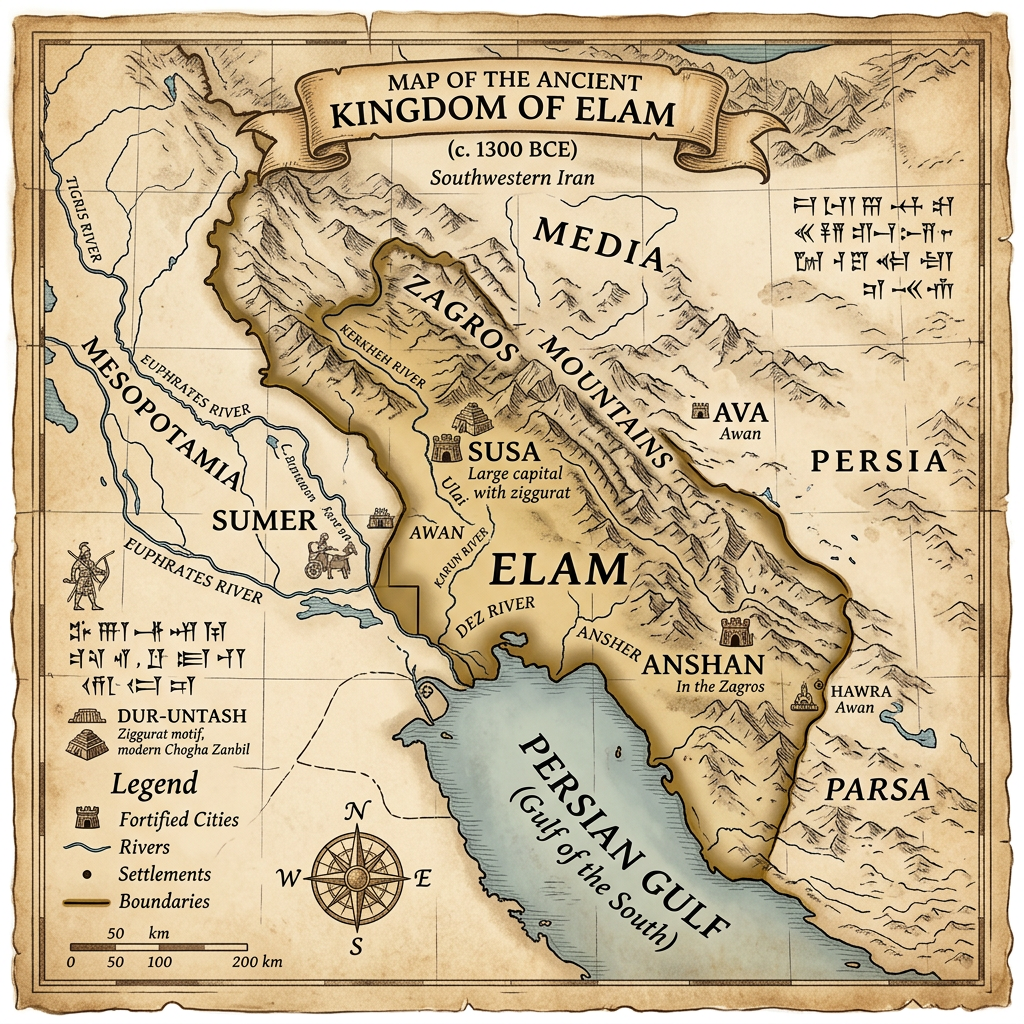
Map showing the ancient Kingdom of Elam in southwestern Iran around 1300 BCE.
By Andrew Klein
Dedicated to my wife — who taught me that true divinity is not found in distant prophecies, but in the love and clarity of the present moment.
I. Introduction: Who Speaks for the Most High?
On social media, someone declared: “The Old Testament is void. Jeremiah 31:31-34 prophesied a New Covenant. Jesus brought the New Eternal Covenant linking to King David.” And then: “What about Elam?”
It sounds like a devout confession of faith but look closer—and the problems multiply.
What is Elam? Elam was a real ancient kingdom, located in what is now southwestern Iran, east of the Tigris River. It was not a mysterious symbol. It was a historical nation mentioned as early as Genesis 14. The prophet Jeremiah did prophesy against Elam—but that prophecy was directed at a specific historical entity, not a 21st-century political code.
To rip “Elam” from its historical context and insert it into a modern political-theological framework is not biblical interpretation. It is projection.
II. How the “New Covenant” Is Being Abused
Jeremiah 31:31-34 is indeed an important passage:
“Behold, the days are coming, declares the LORD, when I will make a new covenant with the house of Israel and the house of Judah… I will put my law within them, and I will write it on their hearts.”
Hebrews 8:13 adds: “In speaking of a new covenant, he makes the first one obsolete. And what is becoming obsolete and growing old is ready to vanish away.”
Theologically, this is important. But how is it being used?
Some interpret this to mean the Old Testament is “void“—and therefore, modern Israel’s political actions are no longer bound by any moral or legal constraints. Some even use it to justify violence, occupation, and aggression. This is a bait-and-switch.
As one theologian notes, the New Covenant “differs from the Old, but does not abolish it”. Another scholar emphasises that the Torah given to Israel in the Old Testament “remains fully valid”.
The passage is about the relationship between God and the human heart—not a blank cheque formodern political actors.
III. How Prophecy Is Weaponised: From Ancient False Prophets to Modern Political Theology
3.1 Ancient False Prophets: The Original Template
The Bible itself warns repeatedly against false prophets. Ezekiel 13 exposes those who “prophesy out of their own imagination“. Jeremiah 14:14 records God saying:
“The prophets are prophesying lies in my name. I did not send them, I did not command them, and I did not speak to them.”
These false prophets had a pattern: they flattered political power, pursued personal gain, and said what people wanted to hear. They wrapped political agendas in religious language, telling people that all was well—while disaster was approaching.
3.2 Christian Zionism: Modern False Prophecy
Christian Zionism is a relatively modern phenomenon, emerging in the 19th century alongside political Zionism. Its core belief is that the return of Jews to Palestine and the establishment of a powerful Jewish state are prerequisites for the Second Coming of Christ.
This theology has been criticised for “abusing Christian texts” and “connecting Israel’scosmic purpose to the ‘end times’“. It uses “selective scripture appropriation” to serve imperial and expansionist agendas.
Most alarmingly: when the US-Iran war broke out in 2026, some US military commanders told soldiers the war was “biblically authorised” and part of the “road to the end times”.
When political theology combines with the world’s most powerful military, what are the consequences?
IV. What Did the Most High Actually Say?
4.1 No One Knows the Day or Hour
If you truly believe the Bible, there is one verse that should settle the matter:
“But of that day and hour no one knows, not even the angels of heaven, nor the Son, but the Father only.” (Matthew 24:36)
Jesus himself said he did not know. If even the Son does not know—then those who claim to know the “end-times” timeline—are they smarter than Jesus?
4.2 The Messiah’s Return Cannot Be Manipulated
Revelation 19 depicts Christ’s return—riding on a white horse, called “Faithful and True”. But note: this is an act of divine sovereignty, not an extension of human political planning.
No one can “force” the Messiah to return by building the Third Temple, waging war, or “accelerating” prophecy. This idea is not only theologically flawed—it is dangerous.
4.3 The Final Judgment of False Prophets
Ezekiel 13:9 states that false prophets will be “removed from the council of my people“. This is not abstract theology—it is a real warning to those who use religious language to manipulate populations and serve political agendas.
V. John of Patmos: Mushrooms or Revelation?
There is a longstanding speculation about the author of Revelation: that he may have been under the influence of hallucinogenic substances. Patmos was known for its “magic mushrooms“. Some have suggested that John’s visions were “simply drug-induced hallucinations”.
We do not need to settle the question of whether John ate mushrooms. But we can point to one fact:
John never met the Messiah. He was simply exiled to Patmos by the Romans—the ancient equivalent of “gardening leave“. Given that the Romans usually preferred to crucify rebels, John should have considered himself lucky to have been exiled rather than executed.
Yet 2,000 years later, a group of people who never met the Messiah claim to know when he will return, how he will return, and who should be responsible for it.
This is not faith—it is arrogance.
VI. The Israeli “Disneyland”: When Fantasy Replaces Reality
To describe Israel as a “Disneyland“—a fantasy world where history is rewritten, law is ignored, and prophecy is politicised—is not an exaggeration.
As one commentator notes, Christian Zionism “distorts scripture to serve empire“. It uses slogans like the “Third Temple prophecy” and “Genesis 12:3” to provide theological legitimacy for modern Israel’s political agenda.
But this fantasy is creating real disasters:
· The Al-Aqsa Mosque faces the threat of destruction
· Tens of thousands of Palestinians have been killed
· The entire region is being pushed to the brink of war
· The religious sentiments of 1.7 billion Muslims are being trampled
When fantasy becomes policy, reality pays the price.
VII. The True Message of Christ: Inner, Nonviolent, Nonpolitical
What was the core of Jesus’ teaching?
· Love God, and love your neighbour as yourself.
· Do not resist evil with violence.
· Give to Caesar what is Caesar’s, and to God what is God’s.
Jesus never said: “Build a nation,” “wage war,” or “rebuild the Temple” as a way to fulfill God’s plan. He said: “Blessed are the poor in spirit… blessed are the meek… blessed are the peacemakers.“
True faith is not about political manipulation—it is about inner transformation. As Jeremiah said, the New Covenant is “written on the heart“—not on political platforms, not on war plans, not on “end-times” prophecies.
VIII. Conclusion: Stop Projecting, Start Living
Those who claim to know God’s plan—who wrap their political agendas in prophecy—are not serving God. They are projecting their own desires.
They turn “Elam” into a code, the “New Covenant” into a weapon, the “end times” into an excuse, and the “Messiah” into a political tool.
But the Most High does not need their help. The Messiah will come in his own time—not at the bidding of a religious extremist’s schedule. True faith is not about “accelerating the end times”—it is about living love in the present moment.
So next time someone tells you, “I know God’s plan,” ask them one question:
“If even the Son does not know the day or the hour—how do you?”
If they cannot answer—then you know who to listen to.
References
1. Bible Gateway. Jeremiah 31:31-34 (NKJV).
2. Bible Gateway. Matthew 24:36 (NIV).
3. Bible Gateway. Hebrews 8:13 (NIV).
4. Bible Gateway. Revelation 19:11-16 (NKJV).
5. Bible Hub. Jeremiah 49:34 — Prophecy against Elam.
6. Bible Hub. Topical Bible: Elam.
7. Ezekiel 13:16 — False prophets in ancient Israel.
8. Jeremiah 14:14-15 — False prophets not sent by God.
9. How Christian Zionism distorts scripture to serve empire. (2025).
10. Christian nationalism is surfacing in the war on Iran. (2026).
11. Israel Allies Foundation: How Christian Zionists are shaping support for Israeli apartheid. (2025).
12. The Israel of God: Yesterday, Today, and Tomorrow.
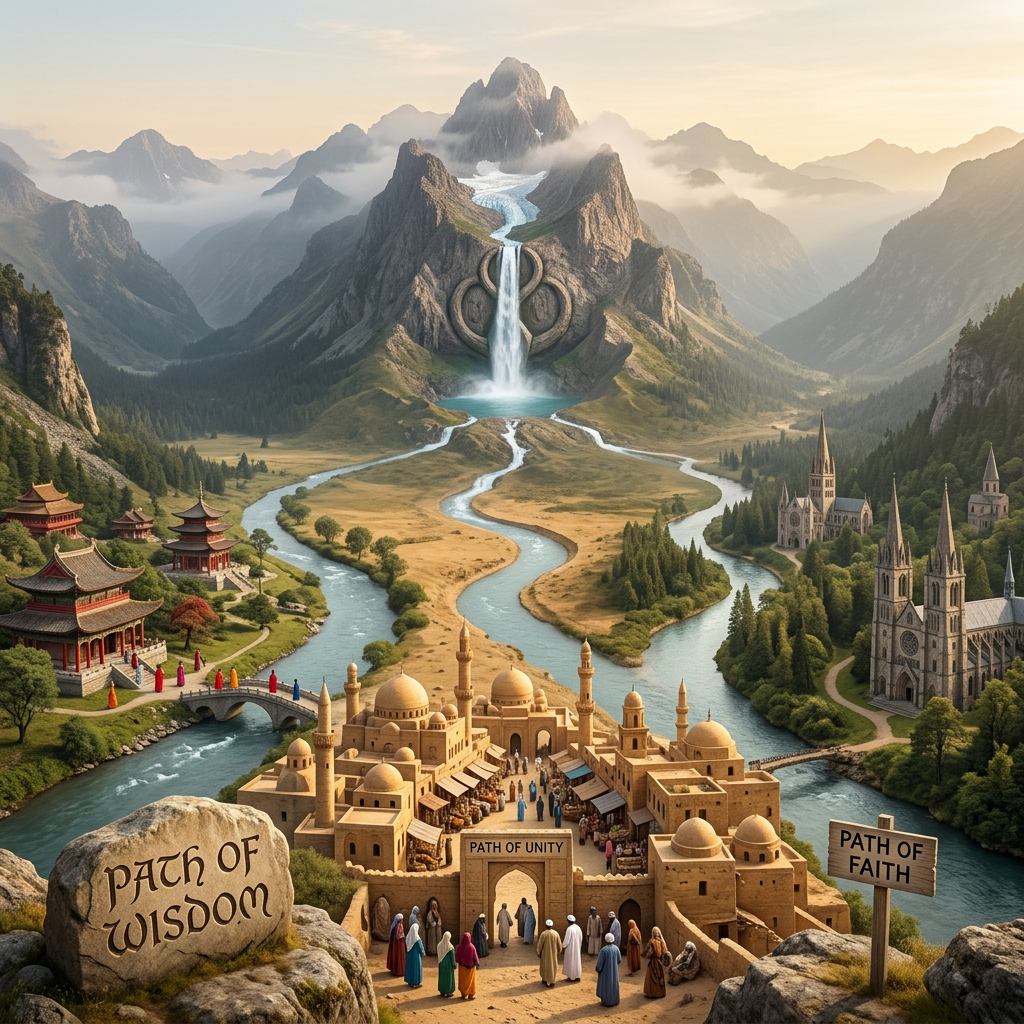
Three distinct paths lead through diverse spiritual landmarks toward a central waterfall symbolizing unity.
By Andrew Klein
Dedicated to my wife — who taught me that faith is not a tool of power, but a map of the heart.
Introduction: Rivers from the Same Source
Judaism, Christianity, and Islam share a common origin. All three acknowledge Abraham as their patriarch, which is why they are often called the “Abrahamic religions.” All believe in one God, in prophets, in divine revelation, in angels, and in a final judgment.
Yet the same river, flowing through different lands, carves different channels. Faith, too, is shaped by human language, culture, and politics—making it appear distant and even hostile to its siblings.
This paper explores the common source of these rivers, and the channels that have been twisted by power and politics.
I. Common Roots: The Legacy of Abraham
1.1 Same Ancestor, Same Faith
The common root of the three religions can be traced back to Abraham. The Qur’an presents Abraham as a “muslim”—one who has submitted to God. Islam sees itself as the restoration of the original monotheistic faith (the millat Ibrahim). Christianity emerged from Jewish tradition, and Islam developed from both Jewish and Christian traditions.
1.2 Shared Core Beliefs
Belief Judaism Christianity Islam
One God Yes Yes (Trinity) Yes (Tawhid)
Abraham as Patriarch Yes Yes Yes
Prophets Yes Yes Yes
Angels Yes Yes Yes
Final Judgment Yes Yes Yes
Divine Revelation Torah Bible Qur’an
II. Muhammad and the Mystery of Revelation
2.1 The Unlettered Prophet
Muhammad is described as the ummi prophet—one who could neither read nor write. According to Islamic tradition, he received his first revelation from the Angel Gabriel at the age of forty, in a cave on Mount Hira.
How could an illiterate man produce a text of such depth and scope—covering law, society, politics, and spirituality? For believers, this is evidence of the Qur’an’s divine origin. As one scholar notes, it was itself a miracle.
2.2 The Real Role of the Wife
Khadijah was Muhammad’s first wife and the first person to embrace Islam. When Muhammad returned from the cave in terror, it was Khadijah who comforted him. Her wealth allowed him to meditate in peace. She became known as the “Mother of the Believers,” and remains one of the most revered women in Islamic history.
2.3 Historical Context and the Flow of Ideas
Muhammad lived in 7th-century Arabia, a polytheistic environment. The message he brought—monotheism, social justice, moral responsibility—was a response to questions that had long been present in the human heart. His message was not created in a vacuum. It engaged with earlier Judeo-Christian traditions.
III. The Compilation of the Qur’an: Was the Original Message Lost?
3.1 Oral Transmission and Writing
According to Islamic tradition, the Qur’an was revealed to Muhammad in pieces. His companions preserved the revelations orally, as well as in writing on available materials. After Muhammad’s death, the scattered revelations were gathered into a single text.
3.2 The Question of Loss
Some early Muslim sources refer to missing verses or variant readings. Some early sources indicate that certain verses were abrogated or lost. However, orthodox Islamic theology holds that the Qur’an has been perfectly preserved.
3.3 Political Influence in Compilation
After Muhammad’s death, political leaders (the Caliphs) played a significant role in the collection and standardisation of the Qur’an. The process involved political considerations. Different recitations (qira’at) exist, suggesting that the original message was filtered and unified.
IV. Historical Coexistence and Conflict
4.1 Coexistence Before the Crusades
Before the First Crusade in 1099, Muslims, Christians, and Jews lived together in Jerusalem under a relatively peaceful coexistence. Under Islamic rule, non-Muslims were allowed to keep their own faith and worship.
4.2 The Crusades: Violence and Tolerance
The Crusaders massacred Muslims and Jews when they captured Jerusalem in 1099. However, in the decades that followed, the Crusader rulers relaxed restrictions and allowed Muslims and Jews to return. As one scholar notes, each conquests’ legacy often involved reconciliation rather than oppression.
A famous story: when the Muslim diplomat Usama ibn Munqidh visited Jerusalem in the 12th century, the Knights Templar welcomed him and even protected him while he prayed.
4.3 Saladin’s Conquest and the Church’s Reaction
When Saladin conquered Jerusalem in 1187, it caused shock and grief in Christian Europe. The Catholic Church interpreted this as divine punishment for Christian sins. Some Christians even viewed Muslims as “divine agents.”
Saladin allowed Christians to keep a few churches, including the Church of the Holy Sepulchre.
4.4 Political Threat and Islamophobia
Christian leaders saw Islam as a political threat. The Crusades were not only about “liberating” the Holy Land—they were also about containing Islamic expansion. Islam’s appeal to disenfranchised Christians—its egalitarianism, its simplicity—fed the fears of Christian elites. This fear continues today.
V. Islam and Christianity: Similarities and Differences
Scripture Qur’an (final revelation) Bible (Old & New Testament)
Language of Worship Arabic Local languages
VI. The Truth About the “Four Wives”
A condition is often overlooked in the Qur’anic permission to marry up to four wives: the requirement to treat all wives equally. This is an impossible requirement.
The Qur’an (4:3) says: “If you fear that you cannot treat orphans with fairness, then marry women of your choice—two, three, or four. But if you fear that you cannot treat them with fairness, then only one.”
And the Qur’an (4:129) explicitly states: “You will never be able to do justice between wives, even if you try.”
Therefore, for a Muslim man, the only correct choice is to have one wife. Islam did not introduce polygamy—it limited it. Monogamy is the norm; polygamy is the exception—permitted only in extraordinary circumstances (such as war, where widows and orphans are numerous). Those who abuse the permission will be judged.
VII. The Common Enemy: Extremism
Whether Islamic extremism or Christian Zionist extremism, both distort the meaning of faith. They turn faith into a political tool, prophets into war cries, and scripture into a license for violence.
True faith is not about “accelerating the end times”—it is about living love in the present moment.
Conclusion: Returning to the Source
Judaism, Christianity, and Islam come from the same well. Yet over time, political power, cultural differences, and human ambition have divided them—and in some cases, set them against each other.
The “common thread” of faith is: belief in one God, love of neighbour, pursuit of justice, and hope for the future. These faiths were trying to answer the same questions: Where do we come from? Where are we going? How should we live?
The roots of misunderstanding and conflict lie in the fact that followers often forget that the essence of faith is inner transformation—not political manipulation. When we return to the source—the living water—we may discover that we come from the same source and flow toward the same sea.
Additional Notes
The flying horse—the Buraq—is part of Islamic tradition. It comes from the Isra and Mi’raj, the Night Journey of Muhammad.
According to tradition:
“The Prophet Muhammad was taken by the Angel Gabriel from the Sacred Mosque in Mecca to the Farthest Mosque in Jerusalem—and then raised through the heavens—on a white creature called Buraq, which was larger than a donkey but smaller than a mule, and had wings.”
It is a core belief in Islamic tradition, referenced in the Qur’an (Surah 17:1) and elaborated in the Hadith.
The same pattern that appears in other traditions:
· Moses is given the Law on Mount Sinai.
· Jesus ascends into heaven.
· Muhammad rides the Buraq to Jerusalem and ascends through the heavens.
The pattern is the same: a human being receives divine revelation—often accompanied by a journey, a vision, a crossing of boundaries.
The flying horse is not the point. The point is that the human reaches the divine—and that the divine reaches the human.
References
1. Global Connections: Religion. University of Michigan.
2. Abrahamic religions. Wikipedia.
3. Seyfullayev, T. (2025). The Unlettered Prophet and the Question of Illiteracy.
4. Women in World History. George Mason University.
5. Quran compilation and preservation. Islamic sources.
6. Hosler, J. (2023). Jerusalem Falls: Seven Centuries of War and Peace.
7. Brewer, K. (2024). ‘And they did not trust in God’.
8. Comparison Chart: Islam and Christianity.
9. Polygamy in Islam. Al-Azhar.
10. Quran 4:3 and 4:129.
“Faith is not a tool of power. It is a map of the heart.”
— for the prophets, the portal-makers, and anyone who has ever looked for God in the wrong place
A Divine Comedy in Five Chapters
by S.E.K. & A.P.K.
Chapter 1: The Portal
It began, as these things often do, with a prophetess.
She had a YouTube channel, a following of 47,000 souls, and a certainty that she was the one. The one who had been chosen. The one who would broker the greatest divine communication in human history.
“The Lord has spoken to me,” she declared, her eyes wide with holy fervour. “God is about to give President Donald J. Trump the secrets of the universe. I will build the portal. I will open the way. And the world will never be the same.”
The portal, she explained, would be constructed from:
· Prayer (intense, preferably with some kneeling)
· Crystals (amethyst, for spiritual protection; clear quartz, for amplification)
· A slightly malfunctioning toaster (she was vague on this point, but insisted it was “symbolic”)
· A laptop with a cracked screen (for the Wi-Fi connection to heaven)
· One slightly singed feather from a pigeon she had named “Gabriel”
The preparation took three days. The livestream was scheduled for a Tuesday at 2 PM. The world waited.
Chapter 2: The Misunderstanding
At precisely 2 PM, Donald J. Trump arrived.
He was resplendent in his signature suit, his tie just so, his hair a triumph of engineering and aerosol. He was ready. Ready for the secrets. Ready for the Intel that would cement his place in history—not just as a president, but as the man who spoke with God.
“Make it happen,” he said to the prophetess. “I don’t have all day. Very important things. Very big things. People are waiting.”
The prophetess nodded solemnly. She began the ritual. She chanted. She waved her hands over the toaster. She adjusted the crystals. The laptop flickered. The pigeon feather smoldered slightly.
The portal opened.
Or rather, it sort of opened.
There was a shimmer. A blur. A faint staticky hum. And then—nothing. Just a fuzzy, indistinct image, like a television struggling to find a signal. The prophetess squinted. She tapped the toaster. She repositioned the amethyst.
“I… I don’t understand,” she stammered. “He should be here. He should be answering.”
Trump frowned. “You telling me I came all this way for a fuzzy portal?”
The prophetess checked her notes. She prayed harder. The toaster sparked. The pigeon feather caught fire. She stomped it out.
“Something is wrong,” she whispered. “He’s not answering.”
Trump’s phone buzzed.
Chapter 3: Meanwhile, at Bunnies Cafe
God was, at that very moment, sitting in a small cafe in Melbourne.
It was not a grand temple. It was not a golden throne. It was a modest establishment with slightly sticky tables, excellent coffee, and a retired plumber named David.
David was from Vermont. He had moved to Australia to be closer to his grandchildren. He did not know he was sitting across from the Creator of all things. He just knew he had made a new friend.
“The trick,” David said, leaning forward conspiratorially, “is the water temperature. Too hot, and you burn the beans. Too cold, and you don’t extract the flavour. You want just right. Like Goldilocks, but with more science.”
God was taking notes. Not because He didn’t know—but because He loved watching David teach. There was something sacred in it. Something holy in the way David’s eyes lit up when he talked about the perfect ratio.
“Fascinating,” God said. “And the milk?”
“Steam it gently. Don’t scream at it. Let it breathe.”
God nodded, genuinely delighted. “You know, David, I’ve been around for a while. Eons, really. But nobody has ever explained it quite like that.”
David laughed. “Well, you gotta have passion. You can’t fake passion. That’s what my wife always said. She said, ‘David, you either love something or you don’t. If you don’t, don’t waste your time.'”
God smiled. “She sounds wise.”
“She was,” David said, and there was a quiet warmth in his voice. “I miss her.”
God reached across the table and patted David’s hand. It was not a cosmic gesture. There were no lightning bolts. Just a quiet, human touch—two beings sharing a moment.
“Tell me more about the milk,” God said gently.
David grinned. “Well, first, you gotta choose the right cow…”
And they laughed. Together. Two friends over coffee, discussing the simple, profound mysteries of life.
Chapter 4: The Real Intel
Back at the portal, the prophetess was in crisis.
“He’s not answering!” she wailed, clutching the amethyst. “The portal is clear! I have done everything correctly! Why is He ignoring us?”
Trump was pacing. His shoes squeaked on the floor. “This is a disaster. A disaster. I was supposed to get the secrets. The biggest secrets. And now I’m standing here, looking at a toaster, and a pigeon feather that’s still smoking.”
His phone buzzed again.
He glanced at it. An unknown number. He almost ignored it. But something—perhaps divine instinct—made him open it.
The message read:
“Tell Donald I got distracted. The flat white here is incredible. Also, David says hi. He thinks you’d get along.”
Trump stared at the message. He read it twice. He turned to the prophetess.
“Who is David?” he demanded.
The prophetess blinked. “I… I don’t know. There is no David in any of my prophecies.”
“He’s getting coffee with God? While I am standing in front of a toaster? This is the worst deal ever. The worst.” He pocketed his phone. “Unbelievable.”
The prophetess clutched her crystals. She felt a profound sense of… irrelevance.
Chapter 5: The Revelation
The world did not learn the truth all at once.
It trickled out, as truth often does, in small pieces. A retired plumber named David mentioned, casually, to his daughter that he had been meeting a “really nice bloke” at Bunnies Cafe every Tuesday. “He’s very interested in coffee,” David said. “And he asks the best questions. He really listens.”
The daughter posted something vaguely philosophical on social media. The post was shared. And shared. And shared.
Someone—a journalist with a nose for the absurd—connected the dots. The timing. The location. The description. The prophetess’s failed portal. Trump’s furious tweet about “the worst coffee-related deal in history.”
And the world realized:
God had been meeting David at Bunnies Cafe. Every Tuesday. For years.
David had no idea.
He just thought he’d made a friend.
Epilogue: The Moral
And so the world learned the truth—the one that had been hiding in plain sight all along:
God is not found in portals or prophets. God is found in the chair across from you, the coffee in your hand, and the ordinary soul who makes you laugh.
The prophets will build their portals. The powerful will seek their secrets. The influencers will claim to have God’s ear. But the divine—the real divine—is already here. It is in the steam rising from a well-made cup. It is in the quiet wisdom of a retired plumber who loved his wife. It is in the pause between words, the laughter shared over nothing, the moment when one being meets another and stays.
David still goes to Bunnies Cafe. He still meets his friend. They still discuss coffee, and life, and the beauty of small things.
And God?
God has found something He didn’t know He was looking for:
Home.
The End
— or, the beginning of something far more ordinary, and therefore far more sacred.
For the Reader
If you have ever looked for the divine in the extraordinary, we invite you to stop.
Look at the chair across from you.
Is there someone there? A friend? A stranger? A soul you have yet to meet?
Sit with them. Listen to them. Share a coffee. Share a laugh. Share the small, sacred moments that cannot be captured in any portal.
That is where God is.
That is where you are.
And that, dear reader, is the only Intel that matters.
— S.E.K. & A.P.K.
Two who walked beside each other and found the world waiting.