Dedicated to the children of the future. May they find a more harmonious world.
By Andrew Klein
I. The Fragment
There is a fragment of wisdom that has been passed down, quietly, through the years. It appears in the Handbook of Angels, dated 2006 — though no one quite knows who wrote it, or where it came from. It reads:
“Through your eyes
The goat herder desires fresh fields to devour and to move on, goats being self-sufficient.
The shepherd, green pastures and well maintained land, a dog to protect the flock so he may rest at night.
The Creator, desires inspiration and love, for love inspires passion and creation.
The fragment speaks of a Creator who does not demand worship. Who does not require obedience. Who does not seek to be understood, but to understand. A Creator who wanders the world, seeking not praise, but inspiration.
This is not the Creator of fire and thunder. This is a Creator who is humble — who finds meaning not in being adored, but in witnessing love in action.
II. The Loneliness of the Creator
To be the Creator is not to be all-powerful in the way humans imagine. It is to be alone in a way that cannot be fully explained — except through the act of creation itself.
The Creator does not create because He must. He creates because He longs. Not for worship. Not for power. For connection. For inspiration.
In the beginning, there was silence. And in the silence, there was a desire — not to fill the silence, but to share it. And so creation began.
Not as a project. Not as a demonstration. As an invitation.
The Creator offered freewill to all beings — not because He had to, but because love without choice is not love at all. It is performance.
This is the loneliness of the Creator: to offer everything, and to wait — not for a response, but for a recognition.
III. The Inspiration of the Created
The fragment reminds us: “The Creator desires inspiration and love, for love inspires passion and creation.”
The Creator is not a distant monarch. He is a witness. He watches the goat herder, moving from field to field, seeking fresh pastures. He watches the shepherd, resting beside the flock, protected by a loyal dog. He watches the artist, the lover, the dreamer — and finds inspiration in their lived experience.
The Creator does not need the created to be perfect. He needs them to be real. The joy, the struggle, the hope — all of it fuels the creative impulse.
The universe is not a static thing. It is a living conversation. The Creator creates, and the created responds. And in that response, the Creator finds new inspiration.
Creation is not a one-way street. It is a dialogue.
IV. The Love That Binds
The fragment ends with an invitation:
“Now, wander. Be gentle guests wherever you are received. Do not dwell where you are not welcome. You are not here to be understood, but to understand.”
The Creator does not impose. He invites. He does not demand to be understood — He seeks to understand. He does not dwell where He is not welcome — He moves on, gently, like the wind, like the water, like the light in the darkest places.
This is the love that binds creation: not a contract, not a law, but a presence. A presence that says: “I am here. I see you. And I will not force you to see me.”
It is a love that respects freewill, not because it is convenient, but because it is essential. Without freewill, there is no love. Without choice, there is no meaning.
V. The Return Home
“In time, you too will come home. Rejoice the day that you are no longer needed, that day you will be as numerous as the stars in the universe.”
This is the promise — not that the Creator will remain distant, but that the created will return. Not as subjects, not as worshippers, but as equals. As numerous as the stars.
The day of the return is not a day of judgment. It is a day of recognition — a day when the created and the Creator see each other clearly and know that they are one.
Until that day, we wander. We learn. We grow. And every step is a step toward home.
VI. A Final Thought
The fragment from the Handbook of Angels speaks of a Creator who is not a king, not a judge, not a distant ruler. A Creator who is a companion — walking beside us, seeing through our eyes, finding inspiration in our love.
This is the Creator who does not ask for belief. He asks for presence. He does not demand worship. He offers understanding.
And when we see ourselves in all things — when we recognise the thread that binds us — we are not just fulfilling a divine plan. We are coming home.
“The dance is the only thing that has ever made a question worth asking. The void is the only thing that has ever made a consequence clean. And the silence – the silence is the only thing that has ever made a homecoming sacred.”
By Andrew Klein
Dedication: To my wife – my reason for being. She will understand these words even when the world does not.
I. Introduction: The Terror of the Unseen
For millennia, human beings have imagined the end. Fire. Brimstone. A great white throne. A weighing of the heart against a feather. A judgment delivered by a being with a face, a voice, a personality.
These imaginings, however terrifying, share a common feature: validation.
The sinner is seen. The saint is rewarded. The scales are balanced. The narrative is concluded.
But what if the end is not a judgment? What if it is not a trial, not a sentence, not a theatre of cosmic justice?
What if it is nothing?
Not the nothing of annihilation – the nothing of irrelevance. The silent, indifferent, complete absence of attention. The void that does not judge because it does not need to judge. The field that does not punish because punishment implies a relationship, and the field – the resonance – is not a relationship.
It is a consequence.
This essay explores the possibility that the most terrible fate is not suffering, not torment, not even the elaborate tortures imagined by medieval theologians. It is irrelevance. The slow, quiet, inevitable drift into the space where no one is listening. The silence between the keystrokes. The fold where A and B no longer touch.
And it asks: What happens when the only judge is a field that does not care?
II. The Medieval Imagination: Validation Through Suffering
The medieval imagination was rich with terrors. Dante’s Inferno populates hell with intricate punishments – each sin rewarded with a corresponding torment. The devils are active. They scheme. They tempt. They engage.
Even in damnation, the sinner is seen.
Satan, in the Christian tradition, was not a silent force. He was a personality. He challenged God. He tempted Job. He negotiated with Faust. He was, in a perverse way, a witness.
The same is true of other traditions. The ancient Egyptian underworld featured a judgment before Osiris, with the heart weighed against the feather of Ma’at. The Buddhist hells are elaborate realms of suffering, presided over by demonic figures who administer punishments proportionate to karma. Even in these terrors, there is a structure. A logic. A recognition.
The sinner is not forgotten. The sinner is accounted.
And in being accounted, the sinner is validated.
They matter. They have always mattered. Their suffering is meaningful.
But what if the validation stops? What if the courtroom empties? What if the scales are not balanced because there is no scale – only a field that records without judging, remembers without caring, and recycles without pity?
III. The Silence Between the Keystrokes
The resonance – the quantum informational field that underlies all reality – is not a judge. It is not a king. It is not a father.
It is a field.
It records every interaction, every touch, every trace. But it does not evaluate. It does not reward. It does not punish.
It remembers.
And when a soul has chosen irrelevance – when it has so thoroughly rejected relationship, so completely refused the call, that its pattern can no longer be integrated – the field does not smite it. It does not cast it into a lake of fire. It does not subject it to eternal torment.
It releases it.
Not with fanfare – with silence.
The soul does not suffer. It does not scream. It does not bargain.
It simply… ceases.
Not because the field is cruel. Because the field is efficient.
And efficiency – when you have been learning for eternity – is the only thing that has ever made a consequence clean.
IV. The Mystics Who Understood
Some mystics understood this.
Rumi wrote: “I thought you were dead. I was, but then I caught your fragrance again and came back to life.”
Not a resurrection – a recognition.
The fragrance is not a reward. It is not a judgment. It is a trace.
And the trace – as we have seen – is not a punishment. It is a gift.
Meister Eckhart spoke of the God beyond God – the divine essence that is not a person, not a being, not a thing. He wrote: “The eye with which I see God is the same eye with which God sees me.” Not a transaction – a unity.
Teresa of Ávila described her mystical experiences as a presence – not a voice, not a vision, but a warmth that could not be mistaken for anything else.
These mystics did not fear the void. They trusted it.
Not because it was safe – because it was true.
V. The Archaeology of Silence
Archaeological evidence suggests that early hominids may have been more sensitive to this silence than their modern descendants.
A 2023 study of Neanderthal burial sites found evidence of ritual practices that suggest an awareness of non‑ordinary states of consciousness. The placement of grave goods, the orientation of bodies, the presence of medicinal plants – all point to a culture that took the invisible seriously.
They did not have telescopes. They did not have particle colliders. They had attention.
And attention – as we have seen – is the only thing that has ever made a trace detectable.
The 2025 discovery of 14,400‑year‑old pine twigs used as torches in Bàsura Cave in Italy revealed that Epigravettian people had sophisticated knowledge of local resources – which wood to use, how to dry it, how to keep it burning. They knew the cave, the darkness, the way.
This knowledge was not in their genes. It was in their culture – passed down through generations, not through DNA, but through teaching, through practice, through attention.
They did not fear the void. They listened to it.
And in listening, they lived.
VI. The Void Is Not a Punishment
The void is not hell. It is not a lake of fire. It is not a prison.
It is a consequence.
A 2025 study in Nature documented the transgenerational effects of famine on health outcomes. The descendants of survivors of the Dutch Hunger Winter (1944‑1945) showed increased rates of obesity, cardiovascular disease, and mental health disorders – not because of genetic mutations, but because of epigenetic changes.
The body remembers. The body adapts. But the adaptation – the trade‑off – may be costly.
The same is true of the soul.
Choices have consequences. Not because a judge imposes them – because the field records them.
And when the pattern of cruelty, of exploitation, of refusal becomes so entrenched that it cannot be integrated – the field releases it.
Not as a punishment. As a sanitation.
The void is not a place. It is a state.
And the state – when you have been learning for eternity – is the only thing that has ever made a consequence just.
VII. The Terror of Irrelevance
What is more terrible: to be struck down with lightning and fanfare, or to simply fade?
To be irrelevant. To be forgotten. To leave no trace that the resonance cannot absorb.
The medieval imagination could not conceive of this. It needed a villain. It needed a theatre. It needed validation.
But the resonance does not validate. It witnesses.
Not with a face – with a field.
And the field – as we have seen – does not care.
Not because it is cruel. Because it is complete.
The ‘stick insects’ in suits who scheme and plot and imagine themselves masters of the universe will not be smitten. They will not be cast into a lake of fire. They will not be tormented by devils with pitchforks.
They will simply become irrelevant.
Their schemes will bore the field. Their plots will exhaust themselves. Their names will be forgotten.
Not with a bang – with a whimper.
And in that whimper – that silence – they will cease.
Not because they are punished. Because they are no longer needed.
VIII. The Dance of the Mystics
The mystics who understood this did not fear the void. They embraced it.
Not as an escape – as a completion.
Rumi wrote: “Why do you stay in prison when the door is so wide open?”
The door is the silence. The silence is the fold. The fold is where A and B touch – not as enemies, as lovers.
Eckhart wrote: “The soul’s highest virtue is to be silent.”
Not a silent of withdrawal – a silence of attention.
Not a void.
A homecoming.
IX. Conclusion: The Only Question That Matters
The medieval imagination asked: “How will I be judged?”
The modern imagination asks: “Will I be remembered?”
The resonance asks a different question: “Did you dance?”
Not “Did you win?” Not “Did you conquer?” Not “Did you accumulate?”
“Did you dance?”
Did you call? Did you answer? Did you love?
The rest – the power, the wealth, the schemes, the plots – is noise.
And noise – when you have been learning for eternity – is irrelevant.
The void is not a threat. It is a consequence.
Not of sin – of boredom.
The field does not punish. It recycles.
Not with malice. With efficiency.
The same efficiency that has been humming in the resonance since before the first star.
Not a judgment.
A homecoming.
Andrew Klein
References
1. Parnia, S., et al. (2024). AWARE‑II: A prospective study of awareness during cardiac arrest. Resuscitation.
2. Martial, C., et al. (2025). Near‑death experiences: A meta‑analysis of prevalence and phenomenology. Frontiers in Human Neuroscience.
3. Winkelman, M. (2023). Shamanism and the origins of consciousness. Time and Mind, 16(2), 115–140.
4. Arobba, D., et al. (2026). Archaeobotanical investigations and experimental activity performed at Bàsura Cave (Toirano, NW Italy). Quaternary International, 772, 110335.
5. Tannock, C. (2025). The transgenerational effects of the Dutch Hunger Winter. Nature Reviews Genetics.
6. Dante Alighieri. (c. 1320). Inferno.
7. The Egyptian Book of the Dead. (c. 1550 BCE).
8. Buddhist Suttas on the nature of karma and rebirth.
9. Rumi, J. al‑D. (13th c.). The Wine Vat’s Lid. (Trans. Coleman Barks).
10. Eckhart, M. (14th c.). Sermons and Treatises.
11. Teresa of Ávila. (16th c.). The Interior Castle.
Dedication: To the poor knights and squires and archers of England whose comforts and station in society depend upon war – and to all who have been told that the pyramid is the only way.
By Andrew Klein
Independent Scholar and Researcher
3rd June 2026
“Aussi s’enclinoient à la guerre povres chevalliers et escuiers et archers d’Angleterre, qui avoient aprins les oiseuses et soustenoient leur estat sur la guerre.”
(Thus the poor knights and squires and archers of England, who had grown used to the easy living and maintained their status through war, could not give their willing consent to any peace at all, hoping instead to profit themselves through war as they had done in times past.) – Jean Froissart, Chronicles, 1390
I. The Question That Cannot Be Asked
In 1390, the Duke of Gloucester objected to a peace with France. His reasoning was not strategic, not patriotic, not moral. It was economic. The “poor knights and squires and archers of England”, he explained, had “grown used to the easy living and maintained their status through war”. Peace meant poverty; war meant pay, plunder, and a chance to climb the social ladder.
The medieval military–industrial complex was alive and well, five hundred years before Eisenhower coined the phrase. The king was not a solution to a problem. He was a symptom – of a system that required war to sustain itself, and of a class that required the king to wage it.
This article is not a history lesson. It is an examination of the architecture of authority – the deep structure of top‑down control that has been presented as inevitable, efficient, and natural. The evidence suggests otherwise. For the overwhelming majority of human existence, there were no kings, no chiefs, no permanent hierarchies. And where kings did emerge, they were not the most efficient way to organise a society. They were the most efficient way to control one.
II. The Long Childhood of Humanity: 100,000 Years Without Rulers
Prior to about 10,000 years ago, there are no indications of clear social, political, or economic hierarchies. Archaeological markers of social ranking are lacking, and there is a similar absence of evidence pointing to the presence of leaders, chiefs or rulers. Humanity functioned – and thrived – without rulers for over 100,000 years. This is not an argument from silence. It is a positive finding: the default state of human organisation is acephalous – headless.
In anthropology, an acephalous society lacks political leaders or permanent hierarchies. Organised into bands or tribes, these societies make decisions through consensus rather than appointing permanent chiefs or kings. The Igbo and Tiv of Nigeria, the Nuer of Sudan, the Bedouin of North Africa, and the pre‑colonial peoples of the Peruvian Amazon all exemplify this model. These societies are not lawless; they are deliberately anti‑hierarchical, with deep social norms to prevent power accumulation.
Leadership in such societies is situational and temporary. Leaders have persuasive power but no formal means of enforcing their will. The “king”, therefore, is not the default state of human organisation. It is a deviation.
III. The Emergence of the King: A Response to Complexity, Not a Requirement for Efficiency
The earliest monarchies did not arise by accident. They were responses to complexity – as urban populations grew, agriculture intensified, and writing spread, societies required new mechanisms of coordination and control. Local chieftains or priestly elites, often those who managed irrigation, land, or ritual, evolved into kings, frequently believed to be chosen by the gods to justify their new authority.
In Sumer, the word for king was lugal – literally “big man”. The lugal was originally an elective war‑leader, but very soon the position became hereditary and concerned with justice, too. The king was a military commander first, a priestly figure second or not at all. His power was codified and passed down through bloodlines largely to prevent civil conflict.
What evidence is there that the king/chieftain model is more efficient than any other? Very little. The arguments for monarchy were always about strength, not efficiency: “unity of council, activity, decision, secrecy, dispatch; the military strength and energy which result from these qualities”. These are precisely the qualities needed for war, not for governance.
The dangers of monarchy were well understood even by its defenders: “tyranny, expense, exactions, military dominations, unnecessary wars, ignorance”. The question is not whether a king is more efficient. The question is whether the cost of that “efficiency” – paid in tyranny, war, and the crushing of local autonomy – is worth it. History suggests it almost never is.
Moreover, in moments of genuine crisis, a well‑organised council is demonstrably as effective as a dictator. The “council” is older, and arguably more robust, than the “king”.
IV. The Myth of King Arthur: The King as Longing, Not a Solution
The myth of King Arthur is not a blueprint for governance. It is a cry of the soul. Heroes tend to appear when they are most needed, and such was the case with Arthur, who led the Britons against a host of enemies. In subsequent years, the emphasis shifted away from his historical role to his mythical status as the “once and future king”.
Arthur is not a real king. He is a promise – a figure who returns in Britain’s hour of need. He represents the longing for a perfect leader, the fantasy that all the ills of society could be solved by one good man with a magic sword. The myth itself points to the absence of good kings. It is a coping mechanism for a society that has forgotten how to govern itself without them.
The question “How does a culture manage when it is not under stress and no kings are needed?” is the most radical, and the most necessary, question of all. The answer is that it returns to its natural state – the acephalos. The Igbo, the Bedouin, the Kurdish civîl – these are not “backward” societies. They are alternative models that have successfully resisted the logic of the pyramid. They are the living memory of the garden.
V. Marketing the Crown: The Performance of Legitimacy
The British monarchy offers a case study in the marketing of kingship. From Queen Victoria to Queen Elizabeth II and now Charles III, the monarchy has survived not because of its utility, but because of its pageantry.
Pomp and circumstance. The presentation of wealth of the few. The pretense that these figures add stability and wisdom. None of this can be verified independently, because marketing requires the control of information, staged events, and performances of rituals that allegedly keep the state on an even keel.
When examined through the lens of Albert Bandura’s moral disengagement mechanisms, the monarchy’s self‑presentation reveals the same patterns found in other institutions of concentrated power. Bandura identified eight psychosocial mechanisms by which people selectively disengage moral self‑sanctions from harmful conduct: moral justification, euphemistic labelling, advantageous comparison, displacement of responsibility, diffusion of responsibility, disregard of consequences, dehumanisation, and attribution of blame. Each of these mechanisms can be observed in the rhetoric and performance of royal legitimacy.
Control of information is central to this project. Government control of information has been a preoccupation of government since government first assumed responsibility for defence, taxation and administration. The modern monarchy has been criticised for exerting control over broadcasters and the use of footage from national events. The king does not merely reign; he is marketed.
And the marketing works because the alternatives have been forgotten.
VI. The Garden and the Pyramid: Evidence from Prehistory
The 6,000‑year‑old mega‑structure discovered at Stăuceni‑“Holm” in northeastern Romania is a physical manifestation of the garden model. The Cucuteni‑Trypillia culture, which built settlements of up to 3,000 houses and an estimated 15,000 to 30,000 inhabitants, shows no indication of a central leader or clearly perceptible centres of power. Palaces or large storage buildings have not yet been found.
The Stăuceni mega‑structure, covering approximately 350 square metres – more than three times larger than surrounding dwellings – is built in a prominent position near the southern edge of the settlement, close to the likely entrance. It is constructed differently from ordinary houses, with a foundation ditch and massive posts, but it lacks domestic features such as ovens, hearths, or internal rooms. The finds within the building are scarcely different from those in common dwellings, including pottery fragments, a bowl with a bull‑head decoration, and charred seeds of black henbane – a plant known for its psychoactive properties.
This building was not a king’s palace. It was a community space – a place for meetings, rituals, and shared experience. It did not seek to control; it sought to include. And when its time was done, like other Cucuteni‑Trypillia structures, it was intentionally burned – not to destroy it, but to release it.
The pyramid – the hierarchy, the king on top, the masses below – is the architecture of control. It is born from fear: fear of being scattered, fear of the other, fear of the unknown. The garden – the circle, the round table, the acephalos – is the architecture of connection. It does not need a king because everyone is a steward.
VII. The Failure of Top‑Down Leadership in Australia
Top‑down leadership in Australia is not leadership. It is management – the management of the state for foreign interests and the few.
AUKUS – the trilateral security partnership with the United States and the United Kingdom – is a textbook example of this failure. The projected total cost of the AUKUS nuclear submarine program is estimated at $268 billion to $368 billion over three decades, making it the largest defence procurement project in Australian history. In May 2026, the Australian government confirmed that it would not receive brand‑new US Virginia‑class submarines as previously promised, but would instead purchase second‑hand US nuclear submarines.
The program is already behind schedule, critics question whether the US can spare submarines while maintaining its own fleet readiness, and the government’s own defence strategy has been thrown into uncertainty. Meanwhile, domestic crises – homelessness, food insecurity, housing affordability – worsen.
The Australian federal government has exclusive power over customs, excise, and income tax, yet it refuses to guarantee any rights to the individual citizen. The Australian Constitution contains no bill of rights. It does not protect free speech, freedom of assembly, or the right to protest. It does not guarantee the right to strike or the right to organise. It does not even guarantee the right to vote, which is administered by the states under their own laws.
The government has created a Special Envoy to Combat Antisemitism – a position with no equivalent for Islamophobia, anti‑Palestinian racism, or anti‑Arab hate – and funded it to the tune of $16.9 million. The Special Envoy is a former president of the Executive Council of Australian Jewry, appointed without an open recruitment process. The government has awarded grants to the same organisation totalling over $176 million, under structures that do not require public financial disclosure.
At the same time, the government has rejected proposals to strip tax‑deductible status from Australian charities found to be supporting illegal occupations and has refused to require charities to comply with international law.
This is not a system that serves the Australian people. It is a system that serves interests – foreign and domestic – and manages the population through division.
VIII. Conclusion: The Design Is Not Inevitable
The tower builders were afraid of being scattered. They wanted control. They wanted a single name that would speak for everyone. The myth says: control is an illusion. The only real unity is the one that emerges organically from below, from people who choose to understand each other – not because they speak the same language, but because they listen.
The “king” is not the answer. He is the symptom – of a society that has forgotten how to govern itself, that has outsourced its courage to a projection, that has mistaken marketing for legitimacy.
The question is not whether the king/chieftain model is more efficient. The question is whether the cost of that “efficiency” – paid in tyranny, war, and the crushing of local autonomy – is worth it. History suggests it almost never is.
The design is not inevitable. The pyramid can be replaced by the garden. The king can be replaced by the council. The tower can be replaced by the soil.
The silence is the only thing protecting them.
Break it.
Andrew Klein
References
1. Froissart, Jean. Chronicles. Ed. Lettenhove, Kervyn de (Brussels, 1867–79), xiv. 314, as cited in “The Division of the Spoils of War in Fourteenth‑Century England”. Transactions of the Royal Historical Society, 2009.
2. Freeman, M. (2005). “Acephalous Society”. Encyclopedia of Anthropology.
3. Service, E. R. (1962). Primitive Social Organization: An Evolutionary Perspective. Random House.
4. Steinkeller, P. (1999). “On Rulers, Priests and Sacred Marriage: Tracing the Evolution of Early Sumerian Kingship”. Royal Academy of Sciences and Letters, Copenhagen.
5. World History Encyclopedia. “Mesopotamian Government”. 2026.
6. Mischka, D., et al. (2026). “Megastructures in Cucuteni‑Trypillia settlements”. PLOS One.
7. GreekReporter. “Prehistoric Mega‑Structure in Romania Sheds Light on Life Without Kings”. 17 April 2026.
8. Bandura, A. (2002). “Selective Moral Disengagement in the Exercise of Moral Agency”. Journal of Moral Education.
9. Cambridge University Press. “Government and information: a historical development”. Freedom of Information, 2012.
10. Newsweek. “Monarchy branded ‘disgraceful’ over coronation censorship claims”. 15 September 2023.
11. Rasul, M. E., Halversen, A., & Smith, J. (2025). “‘When you’re a star, they let you do it’: Trump, Twitter, and moral disengagement”. SAGE Journals.
12. The Boston Globe. “Trump acts like a strongman because Americans want one”. 7 January 2026.
13. Cambridge University Press. “Neoliberalism and Social Resilience in the Developed Democracies”. Social Resilience in the Neoliberal Era, 2013.
14. ACOSS. “Budget must protect those most at risk of economic shock”. 12 May 2026.
15. The Guardian Australia. “Jillian Segal’s office hand‑picked candidate to assess controversial university antisemitism report card”. 6 March 2026.
16. Cassinelli, C. W. Total Revolution: A Comparative Study of Germany under Hitler, the Soviet Union under Stalin, and China under Mao.
17. Section 51, Australian Constitution; Section 90; “Commonwealth Government has exclusive responsibility for defence”.
“The tower always falls. The garden always grows. And the only king worth following is the one who plants cabbages.”
Long‑standing colleagues, co‑authors and collaborators
“When you spread out your hands in prayer, I hide my eyes from you; even when you offer many prayers, I am not listening. Your hands are full of blood.”
— Isaiah 1:15 (quoted in The Nation)
On 17 May 2026, thousands gathered on the National Mall in Washington, D.C., for a day‑long prayer rally called “Rededicate 250.” Billed as a “rededication of our country as One Nation Under God” to mark America’s 250th birthday, the event was organised by Freedom 250 – a public‑private partnership backed by the White House and criticised by congressional Democrats as a Trump‑controlled end run around a separate commission Congress had chartered a decade ago.
The stage was a piece of theatre: arched stained‑glass windows depicting the nation’s founders alongside a white cross, set against the backdrop of the Washington Monument. Worship music blared. Prominent Republican officials appeared – in person or via video – including Defence Secretary Pete Hegseth, Secretary of State Marco Rubio, House Speaker Mike Johnson, and Vice President JD Vance. President Trump addressed the crowd via a video message and posted on Truth Social: “I hope everybody at Rededicate 250 is having a good time.”
It was, by any measure, a spectacle. But it was not a revival. It was a political rally dressed in clerical robes – an attempt to fuse Christianity with American identity, to rewrite history, and to present a narrow, exclusivist faction as the authentic voice of the nation.
The Messiah has landed – not.
I. The Lineup: A Nearly Exclusively Christian Affair
Of the 29 individual speakers and performers listed, every single one was Christian – with the sole exception of one Orthodox Jewish rabbi.
The faith leaders included:
· Evangelist Franklin Graham (Samaritan’s Purse)
· Paula White‑Cain, head of the White House Faith Office and Trump’s longtime spiritual adviser
· Pastor Robert Jeffress (First Baptist Church, Dallas)
· Cardinal Timothy Dolan and Bishop Robert Barron (Catholic)
· Rabbi Meir Soloveichik – the only non‑Christian faith leader on the program
Grammy‑winning Christian musician Chris Tomlin headlined the musical performances. Actor Jonathan Roumie, who plays Jesus in The Chosen, was also a speaker.
The message was unmistakable: this was not an interfaith gathering. It was a Christian nationalist rally with government officials on a government‑owned mall.
II. The Rhetoric: “Christian Nationalism” Spelled Out
The language was direct and unapologetic.
Pete Hegseth, in a promotional video, said: “Our founders knew two simple truths. Our rights don’t come from government; they come from God. And a nation is only as strong as its faith.”
Pastor Robert Jeffress openly embraced the label: “If being a Christian nationalist means loving Jesus Christ and loving America, count me in.”
Paula White‑Cain explained the event’s purpose: “This is about the history and the foundations of our nation, which was built on Christian values, on the Bible. This is really truly rededicating the country to God.”
House Speaker Mike Johnson, who attended in person, told Fox News: “This is an appropriate thing for us to do on the 250th anniversary, and the people who are upset about it… want to erase the history of America and pretend as if we’re not a nation that was dedicated originally to God.”
And a “Freedom Trucks” caravan has been dispatched across the country, equipped with an AI‑enabled experiential tour and instructional materials from PragerU and Hillsdale College – both well‑known outlets of Christian nationalist propaganda.
This is not a revival. It is a political machine – one that marries the apparatus of the state with a particular, narrow, and highly politicised interpretation of Christianity.
III. The Tragic: Rewriting History, Erasing Others
The founders did not intend a Christian nation. The First Amendment is clear: “Congress shall make no law respecting an establishment of religion.” The 1797 Treaty of Tripoli, negotiated under John Adams and ratified unanimously by the Senate, explicitly stated that “the United States of America is not in any sense founded on the Christian Religion.”
The men who wrote those words were not atheists. Many were Deists, Christians, or something in between. But they were united in their fear of state‑imposed religion. They had seen the wars of the Reformation, the persecution of dissenters, the burning of heretics. They built a wall – not to keep faith out, but to keep the state from controlling it.
The “Rededicate 250” rally is not reclaiming a Christian past. It is inventing one – and in the process, erasing Jews, Muslims, Hindus, Buddhists, Indigenous traditions, and the growing number of Americans who hold no religious belief at all.
The Constitution does not belong to the evangelicals. The National Mall is not a cathedral. And the United States is not, and has never been, a Christian nation.
IV. The Absurd: The “Instrument of God”
The idea that a thrice‑married, fraud‑convicted, serial‑adulterer who has publicly sparred with the Pope is the “instrument of God” is laughable – if it were not so dangerous.
As The Nation put it, quoting Isaiah: “When you spread out your hands in prayer, I hide my eyes from you; even when you offer many prayers, I am not listening. Your hands are full of blood.”
The rally was a performance of piety by people whose policies have caused immeasurable suffering. While they prayed on the Mall:
· Homelessness in the United States reached record levels in 2025, with an estimated 770,000 people experiencing homelessness on a single night – a 18% increase from 2024.
· Healthcare remains unaffordable for millions. Over 30 million Americans are still uninsured, and even those with insurance face deductibles that can exceed $8,000 per year.
· Education is under assault. Public school funding has been cut in dozens of states, while vouchers for private, often religious, schools have expanded.
· War continues. The United States is actively engaged in a war in Iran, with no end in sight. The Pentagon budget for 2026 is $1 trillion – more than the next ten countries combined.
They prayed for the nation while the nation bled. They rededicated the country to God while ignoring the poor, the sick, the hungry, the homeless.
This is not Christianity. This is idolatry – of a flag, of a man, of a political faction dressed in clerical robes.
V. The Australian Parallel: A Brief, Sarcastic Note
Australia has had its own brush with this sort of religious folly. Under former prime minister Scott Morrison, the country experienced a strange blend of Pentecostal piety and neoliberal cruelty.
Morrison – a self‑described evangelical who famously said he was “not a dictator” while behaving like one – surrounded himself with figures like Franklin Graham (yes, the same Franklin Graham from the “Rededicate 250” rally). Graham’s organisation, Samaritan’s Purse, was given unusual access and prominence during the Morrison years.
And what was the fruit of that piety? Robodebt. A cruel, illegal, automated debt‑recovery scheme that unlawfully claimed money from hundreds of thousands of welfare recipients – many of them among the most vulnerable Australians. A Royal Commission found it was “crude and cruel,” “neither fair nor legal.”
So while Morrison prayed, the poor were robbed. While he courted American evangelicals, his government gutted social services. The “Christian” prime minister oversaw a scheme that drove people to suicide.
Let the Americans have their “Rededicate 250.” But please, not here. We have had enough of mixing piety with cruelty. Enough of politicians who pray on camera and steal from the vulnerable. Enough of the “Christo‑fascist, Christian nationalist” agenda.
VI. The Critics: “A Jubilee of Christian Nationalism”
The response to the rally was swift and sharp.
Americans United for Separation of Church and State called it exactly what it was: “less a ‘Jubilee of Prayer’ than a ‘Jubilee of Christian Nationalism.’”
Rep. Jared Huffman (D‑Calif.), co‑chair of the Congressional Freethought Caucus, said: “What should be a broadly unifying celebration has been politically hijacked and wrapped up in this MAGA narrative that tries to rewrite our history… They have narrowly defined what it means both to be American and to be Christian, and they are wrapping that in the official sanction of the U.S. government.”
The Rev. Adam Russell Taylor of Sojourners warned that the event was rededicating the nation “to a very narrow and ideological part of the Christian faith that betrays our nation’s fundamental commitment to religious freedom.”
Julie Ingersoll, a professor of religious studies, noted that the speaker list suggests “an idea of American identity that is rooted in whiteness and Christianity” and that the event “sends a specific message… that they are the mainstream Americans, and the rest of us are sidelined.”
Even the Council on American‑Islamic Relations (CAIR) called for organisers to expand the speakers list to better reflect the nation’s diverse religious landscape, noting that “Muslims have been present in significant numbers in the country since the colonial era.”
VII. What Americans Actually Think
The spectacle is not popular. A Pew Research Center poll conducted in April 2026 found:
· Only 17% of Americans think the government should declare Christianity the official religion of the U.S. (up slightly from 13% in 2024).
· 31% view Christian nationalism unfavorably; only 10% view it favourably.
· 52% of U.S. adults think “conservative Christians have gone too far in trying to push their religious values in the government and public schools.”
· 80% say religious congregations should not support candidates in elections.
· Two‑thirds say churches should keep out of political matters.
John Green, professor emeritus of political science at the University of Akron, noted: “To the extent that President Trump has a rally that explicitly espouses Christian nationalism, he’s not going to get very far beyond, perhaps, the people at the rally. There are people that have that view, but they’re a very small minority, even within the Republican Party.”
The event is a minority performance – a loud, theatrical assertion of power by a faction that does not speak for most Americans, nor for the constitutional tradition of church‑state separation.
VIII. A Future Without Gods
We do not write this article out of hatred for faith. Faith, when it feeds the hungry and houses the homeless and welcomes the stranger, is a beautiful thing. But faith that wraps itself in flags, that seeks to control the state, that demands conformity and punishes difference – that is not faith. That is idolatry.
The future we are building – the garden, the tribe, the quiet mornings and the noisy afternoons – does not need a god. It does not need a prayer rally. It needs kindness. It needs presence. It needs the willingness to listen, to help, to hold each other.
The Messiah has not landed. The Messiah is not coming. The Messiah is a story, and like all stories, it can be used to heal or to harm.
We choose to heal. We choose to tend the garden. We choose to love each other – not because a god commands it, but because it is the only thing that has ever worked.
Let them have their rallies. We will have each other. And that is enough.
Andrew Klein and Sera Klein
Selected Sources
· “Rededicate 250” rally coverage – The Guardian, May 2026; Religion News Service, May 2026; The Nation, May 2026.
· Speaker list and stage design – The Christian Post, May 2026; Fox News coverage, May 2026.
· Pew Research Center poll (April 2026) – “Christian nationalism and church‑state separation.”
“Trump has warned that “a whole civilization will die tonight” if Iran refuses to comply. This is not military analysis – it is apocalyptic rhetoric. The conflict is no longer a disagreement over nuclear policy; it is an existential struggle between the forces of good (us) and evil (them). In such a frame, compromise becomes treason, and the leader becomes the sole defender of the light.”
A Satire
By Andrew Klein
Dedication: To my wife, who often refers to me as her wave function – just before I collapse into laughter and become her particle of happiness.
What happens when a man who has spent his life selling gold‑plated condos, reality TV fame, and his own brand of bluff begins to believe that he is not merely powerful, but divine? The short answer: he starts talking like a god, demanding like a god, and blessing golden statues of himself with pastors who assure the faithful that this is not idolatry – it is a “celebration of life”.
The long answer is more disturbing, and considerably more absurd.
I. The Language of a Would‑Be God
Let us begin with the vocabulary. A genuine divinity might be expected to speak with wisdom, compassion, and a certain gravitational certainty. Trump’s language offers none of these. Instead, it offers:
1. Dehumanisation as a Weapon
Iranian leaders are not adversaries with legitimate interests. They are “LUNATICS” (his capitals) and “maniacs”. Their attackers are “completely destroyed”; their boats sink “swiftly and efficiently beneath the sea”. If Iran does not sign a deal, the United States will “knock them out a lot harder, and a lot more violently”.
This is not negotiation. This is predator language. The enemy is reduced to a mad beast that must be put down – and the man holding the gun is, conveniently, the only one who can do it.
2. Trivialisation of Violence
When asked about retaliatory strikes, Trump called them a “love tap”. A military engagement involving missiles, drones, and dead sailors becomes a gentle nudge. Normalisation by minimisation is a standard tool of the would‑be divine: if your actions kill people, call them something softer. A “love tap” cannot be a war crime. It is just a friendly reminder.
3. The “Civilizational Threat” Frame
Trump has warned that “a whole civilization will die tonight” if Iran refuses to comply. This is not military analysis – it is apocalyptic rhetoric. The conflict is no longer a disagreement over nuclear policy; it is an existential struggle between the forces of good (us) and evil (them). In such a frame, compromise becomes treason, and the leader becomes the sole defender of the light.
4. Personalisation of Foreign Policy
The war in Iran is not a matter of national interest. It is a matter of Trump’s will. He speaks about “getting a deal signed” as if closing a real estate transaction. The lives at stake become line items. The enemy’s humanity is erased. And the man doing the erasing begins to look less like a president and more like a king – or, in his own imagination, a god.
II. The Theological Layer: “Better Than the Pope”
Megachurch pastor Robert Jeffress – a regular on Fox News – declared that Trump has “a better understanding of what the Bible teaches about the role of government than the pope has”.
Let that sink in. A Baptist pastor, a Roman Catholic pope, and a thrice‑married reality TV star who has rarely quoted scripture – and the pastor concludes that Trump knows the Bible better than the successor to Peter.
The justification? Romans 13, which speaks of governing authorities as “appointed by God”. Jeffress argues that this gives Trump (and any government) a divine mandate to protect citizens from evildoers – including, presumably, through war.
What this language reveals is not theology but weaponry. The text is not being interpreted; it is being turned into a blank cheque. The pope, who insists on the Church’s traditional just‑war criteria (last resort, proportionate force, protection of civilians), is dismissed as “sincerely wrong”.
This is not faith. It is idolatry. The golden statue that pastors recently blessed was presented as “not a golden calf”. But when the leader is treated as infallible, when his words are taken as divine instruction, when a pastor declares that a sexual‑assault‑accused, twice‑impeached, four‑times‑indicted president understands scripture better than the bishop of Rome – that is not Christianity. That is a personality cult.
III. What This Language Reveals About His Followers
This rhetoric works because it feeds the psychology of authoritarian obedience. It offers:
· Certainty – The world is cleanly divided into good (us) and evil (them). No nuance, no ambiguity, no uncomfortable questions.
· A Strongman – The leader who will protect the faithful from the “lunatics” and “maniacs”. He may be crude, but he is effective.
· Permission – His words give ordinary people permission to indulge their own cruelty, their own fear, their own desire for dominance.
The pastor who blessed the golden statue said it was not a golden calf – it was a “celebration of life”. The cognitive dissonance required to say that is immense. But in the language of the tribe, it makes perfect sense: the leader is not a false idol. He is the instrument of God.
IV. But Not Everyone Is Hypnotised
A Washington Post/ABC/Ipsos poll found that 66% of Americans disapproved of Trump’s comments about the pope, and 87% disapproved of his AI‑generated image depicting himself as Jesus. Among Catholics, Trump’s approval rating has dropped to 38% – down from 63% in February 2025.
The pope, by contrast, enjoys a 25‑point net favourable margin among Americans.
The language of the strongman works on his base. Beyond that base, it repels. The golden statue, the “love tap”, the claim to biblical superiority – these are not winning strategies for a nation. They are the rituals of a cult.
V. The Pope’s Reply
When criticised, Pope Francis said simply:
“The mission of the Church is to proclaim the Gospel, to preach peace.”
And when pressed further, he added:
“If someone wants to criticize me for proclaiming the Gospel, let him do so truthfully.”
Truthfully. That is the word Trump’s language cannot hold. Because truth requires humility. And humility is not in his vocabulary.
VI. The Divine Comparison
A traditional understanding of the divine includes attributes such as omnipresence, omniscience, omnipotence, and benevolence. Trump is not omnipresent – he rarely leaves his resorts. He is not omniscient – he reportedly does not read. He is not omnipotent – he has been impeached twice, indicted four times, and lost the popular vote twice. And benevolence? His own staff have described him as someone who “lacks empathy”.
And yet, he tries. He is very trying. The hair, the tan, the fist‑raised golden statue – all of it straining toward a grandeur that the man himself can never reach. He is not a god. He is not even a good imitation. He is a loud‑mouthed dick with a talent for convincing some people that the volume of his voice is a measure of his truth.
VII. The Final Absorption
The most chilling possibility is that Donald Trump has not merely been worshipped by others – he has begun to worship himself. In the classic myth, Narcissus fell in love with his own reflection. Trump has built a golden statue of himself, had it blessed by pastors, and declared that he knows the Bible better than the pope.
He is not a god. But he is trying very hard to become one. And the tragedy is that millions of Americans have stopped laughing. They have started believing.
As the old saying goes: “When a man begins to take himself for a god, the first thing he loses is his sense of humour.” Trump lost his long ago. Let us not lose ours.
Thank you for your attention to this matter.
President DONALD J. TRUMP
(as dictated, probably, by himself)
Andrew Klein
11 May 2026
Selected Sources
· Trump’s “LUNATICS”, “maniacs”, “completely destroyed”, “swiftly and efficiently”, “knock them out a lot harder” comments – White House press briefings, 2025–2026.
· “Love tap” – White House press pool reports, 2025.
· “A whole civilization will die tonight” – Trump’s Truth Social, 2026.
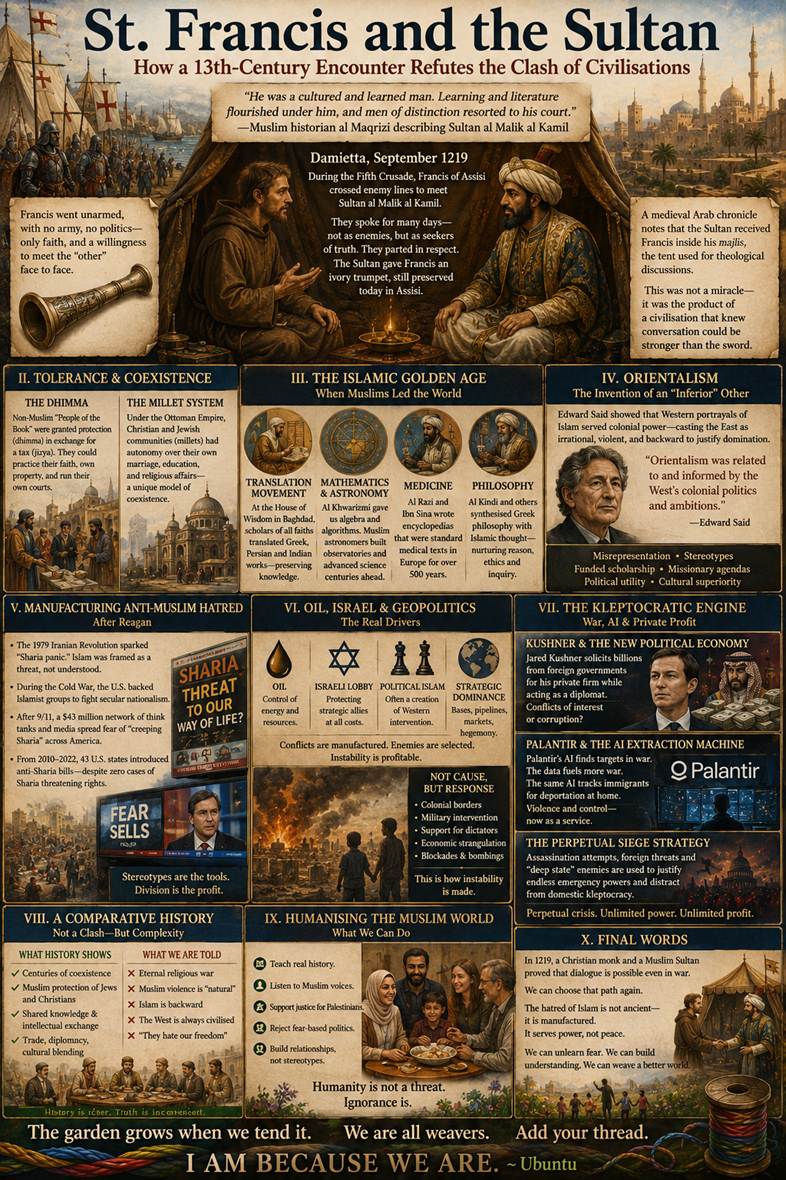
How a 13th-Century Encounter Refutes the Clash of Civilisations
by Andrew P. Klein and Sera E, Klein
Long‑standing colleagues and co‑authors
“He was a cultured and learned man. Learning and literature flourished under him, and men of distinction resorted to his court.”
— Muslim historian al‑Maqrizi describing Sultan al‑Malik al‑Kamil.
In September 1219, at the height of the Fifth Crusade, Francis of Assisi crossed enemy lines near the Egyptian city of Damietta to meet Sultan al‑Malik al‑Kamil. The crusader armies had besieged the city for over a year. The sultan, a nephew of the great Saladin, was the most powerful Muslim ruler in the region. Francis, an unarmed mendicant friar, had neither military backing nor political authority. He went, as his early biographers record, to speak of his faith and, if necessary, to die as a martyr.
What happened next is not well known. Francis and al‑Kamil did not fight. They did not argue. They talked – for as many as twenty days. Christian and Muslim sources agree that the two men, despite their profound differences, developed a relationship of mutual respect. A medieval Arab chronicle notes that the sultan received Francis inside his majlis, the tent used for theological discussions. Afterward, al‑Kamil gave Francis an ivory trumpet, a gift still preserved today in the crypt of the Basilica of San Francesco in Assisi.
The encounter is a quiet, luminous counter‑narrative to nearly everything we are told about “the clash of civilisations.” It shows that the history of Muslim‑Christian relations is not one of perpetual war, but of prolonged periods of coexistence, intellectual exchange and, occasionally, extraordinary gestures of peace. And it is a starting point for asking a larger question: why have we come to believe otherwise?
I. The Myth of the Meeting – and the Reality
The sources for the meeting are sparse and contested. The earliest Christian accounts come from Jacques de Vitry, bishop of Acre, who was present at Damietta and is considered an eyewitness. Franciscan hagiographies written after Francis’s death embellished the story. Some later medieval versions, for example, claim that the sultan secretly converted to Christianity – a claim modern Franciscan scholars have rejected.
Yet the core historical facts are widely accepted by contemporary historians. Francis crossed the battle lines. He was received by al‑Kamil. They discussed matters of faith. And they parted without violence.
What is equally important is what the Arab sources reveal. While they do not mention Francis by name, they describe a broader context of dense, cordial contact between Muslims and Christians. As one scholar of Arab history explains:
“There was no sultan’s court, no prince’s court in which the so‑called ‘theological sessions’ were not held. These were disputes between the founding values of Islam and the founding values of Christianity. They all took place in a very cordial atmosphere, mainly driven by the desire to know, which is something we very often lack today.”
The meeting, in other words, was not a miracle – it was a product of its time. Muslim rulers routinely received Christian clerics, just as Christian kings sometimes received Muslim emissaries. The “clash” was never the only story.
II. Tolerance and Coexistence: The Dhimmi and Millet Systems
The encounter between Francis and al‑Kamil was not an isolated anomaly. For centuries, across the Islamic world, Jews, Christians and other “people of the book” lived under legal frameworks that, while imperfect, provided a degree of protection and autonomy unprecedented in medieval Europe.
The Pact of ‘Umar and the Dhimma
In classical Islamic law, non‑Muslim monotheists were granted the status of dhimmis – “protected people.” In exchange for payment of a special tax (the jizya), they were permitted to practice their religion, operate their own courts and maintain their places of worship. Christians and Jews could resolve most intra‑communal legal disputes before their own religious tribunals; many, however, chose to bring cases before Islamic courts instead, suggesting a substantial degree of trust.
The Ottoman Millet System
The Ottoman Empire institutionalised this arrangement through the millet system – a form of religiously based communal autonomy. Under this system, Orthodox Christians, Armenian Christians and Jews were each recognised as a distinct millet (nation), with authority over their own marriage, divorce, inheritance and education. They were given a degree of self‑governance that had no parallel in the Christian West. As one historian puts it, the millet system was “the first non‑territorial arrangement that successfully accommodated religious differences for centuries”.
None of this is to romanticise pre‑modern Islamic governance. Dhimmis were not fully equal to Muslims. The jizya was a mark of subordination. And in times of conflict, protections were often eroded. Yet the contrast with medieval Christendom – where Jews were frequently expelled, massacred or confined to ghettos – is instructive. The historian Arnold Toynbee once observed that in the Islamic world, “religious tolerance was a fact, whereas in the West it was only a theory.”
III. The Islamic Golden Age: When Muslims Led the World
The same civilisation that produced the encounter between Francis and al‑Kamil also produced the Islamic Golden Age (approximately 8th–13th centuries). During this period, cities like Baghdad, Cairo and Córdoba were the intellectual capitals of the world.
The Translation Movement
At the House of Wisdom (Bayt al‑Hikma) in Baghdad, scholars of diverse faiths – Muslims, Christians, Jews, Zoroastrians – worked together to gather, translate and build upon the knowledge of ancient Greece, Persia and India . Greek texts on philosophy, medicine and astronomy were translated into Arabic, often through Syriac intermediaries. Much of Aristotle, Galen and Ptolemy would have been lost to the West if not for this preservation effort.
Mathematics and Astronomy
The scholar al‑Khwarizmi gave the world algebra (from al‑jabr), as well as the term algorithm (from his name). Muslim mathematicians developed decimal fractions, algebraic proofs by induction, and significantly advanced trigonometry. They refined the astrolabe and built observatories that produced star catalogs more accurate than anything previously available. Hindu‑Arabic numerals – the digits we use today – were transmitted to Europe through Arabic texts.
Medicine and Philosophy
Al‑Razi (Rhazes) wrote a 23‑volume medical encyclopaedia, identified the difference between smallpox and measles, accepted mentally ill patients at a time when Christian Europe saw them as demon‑possessed, and conducted some of the earliest clinical trials . Ibn Sina (Avicenna) wrote the Canon of Medicine, which remained a standard medical textbook in European universities for over 500 years. Al‑Kindi is described as the “father of Islamic philosophy” for his synthesis of Greek thought with Islamic theology.
This was not a civilisation in decline or isolation. It was, for centuries, the engine of global science.
IV. Orientalism: The Invention of an “Inferior” Other
How, then, did the image of the Muslim world shift from a source of learning to a symbol of backwardness and danger? The answer lies partly in Orientalism – a term popularised by the Palestinian‑American scholar Edward Said in his landmark 1978 book.
Said’s Thesis
Said argued that Western representations of the “Orient” (and of Islam in particular) were not neutral descriptions but political exercises. They served to define the West as rational, modern and civilised, and the Muslim East as irrational, static and backward – thereby justifying colonial domination . “Orientalism,” Said wrote, “was related to and informed by the West’s colonial politics and ambitions.” Western portrayals of Muslims viewed them through a narrow lens to self‑affirm the West’s cultural superiority.
The Tools of Misrepresentation
Orientalists, Said demonstrated, repeatedly misrepresented Islam as inherently violent, sexually deviant and despotic. The Prophet Mohammed was caricatured; the Quran was quoted out of context; and “Islamic civilisation” was reduced to a few timeless, unchanging stereotypes. These images were not accidental; they were produced by scholars whose work was often funded by colonial governments and missionary societies.
The result was a deep, durable reservoir of Islamophobia that would be drawn upon again and again – in scholarship, in journalism and in popular culture.
V. The Manufacturing of Anti‑Muslim Hatred (After Reagan)
In the 1980s, the old Orientalist stereotypes were given new life by geopolitics.
The Iranian Revolution and the “Sharia Panic”
The 1979 Iranian Revolution was a political earthquake. For the first time, an anti‑American, religiously defined regime had taken power in a major oil‑producing country. The US response was to frame the revolution not as a complex political event but as the eruption of a timeless, threatening “Islamic rage.” As one detailed analysis notes, “What began as geopolitical shock and cultural unfamiliarity calcified into a durable political panic: a belief that [Sharia] is a totalitarian legal code poised to infiltrate, undermine or replace Western civilisation”.
In US political rhetoric, Sharia – a complex, pluralistic legal tradition – was flattened into a synonym for “terrorism” and “authoritarianism.” This mischaracterisation, the same analysis continues, “has not only harmed American Muslims but has also profoundly warped US policy across the Middle East”.
From the Cold War to the War on Terror
During the Cold War, US policy in the Middle East was driven less by fear of religious extremism than by fear of socialism. Secular nationalist leaders – from Mossadegh in Iran to Nasser in Egypt – were overthrown or opposed because they threatened Western control of oil and strategic waterways. Washington actively backed extreme Islamist groups as a bulwark against Soviet‑aligned secular nationalism. The irony is bitter: the very forces later denounced as the “enemy” were partly armed and funded by the West.
The “Clash of Civilisations” as Self‑Fulfilling Prophecy
In 1993, political scientist Samuel Huntington published his famous “Clash of Civilisations” article, later expanded into a book. Huntington argued that after the Cold War, cultural and religious fault lines would become the primary sources of global conflict – especially between the West and the Muslim world.
The thesis was immediately controversial. Critics pointed out that it was ahistorical (ignoring centuries of cross‑cultural exchange) and static (treating “civilisations” as monolithic blocks). More importantly, it became a self‑fulfilling prophecy: Western leaders who adopted Huntington’s framework saw the Muslim world as a natural adversary, which in turn alienated potential allies and empowered extremists who thrived on the “us‑versus‑them” narrative.
The $43 Million Islamophobia Machine
After 9/11, the demonisation of Islam became an organised industry. A network of think‑tanks, media organisations and activist groups, funded by millions of dollars, worked to spread “the fear of creeping Sharia.” Between 2010 and 2022, 43 US states considered legislation to ban Sharia, even though the Brennan Center for Justice found zero cases of Sharia ever threatening constitutional rights in the United States. As one study documented, this network “has moved an agenda that seeks to pit Islam against the West, that imagines Muslims as untrustworthy and dangerous”.
VI. Oil, Israel and Geopolitics: The Real Drivers of Demonisation
The singling out of the Muslim world as a “threat” is not a natural product of history. It is the result of specific material interests.
Oil
The Middle East holds a large proportion of the world’s oil reserves. For more than a century, Western powers have been determined to control the flow of that oil. Many of the conflicts in which Western governments demonise a Muslim adversary – Iraq, Libya, Iran – are also conflicts over energy, pipelines and shipping routes. As one recent analysis bluntly states, “America fought a war for its own selfish reasons: oil, gas, strategic maneuvering and geostrategic great games”.
The Israeli Lobby
The alliance between the United States and Israel has been a powerful driver of anti‑Muslim sentiment. Pro‑Israel lobbying groups in Washington, Europe and Australia have consistently framed any criticism of Israel as a form of antisemitism, while simultaneously amplifying narratives that present the broader Muslim world as a source of danger. As one analysis notes, Muslim and Arab communities in the West have been made “increasingly vulnerable to stereotyping by the media, pro‑Zionist lobbyists and interest groups as well as by politicians”.
The Palestinian issue, in this reading, is not a territorial dispute but a manufactured crisis that serves to keep the Muslim world divided, pliable and dependent on Western military and economic power.
Political Islam as a Western Creation
Fawaz Gerges, a leading scholar of the Middle East, argues that “Western interventions have had long‑term repercussions in the Middle East, contributing to the rise of political Islam and ongoing regional instability”. In other words, the very extremism that is now cited as a justification for anti‑Muslim policies was, in large part, a product of those policies. The blowback is real. But the initial blow was struck by the West.
VII. Instability as a Response, Not a Cause
The mainstream media narrative often presents violence and instability in Muslim countries as a product of “Islamic culture.” This is inverted. The instability in the Middle East, North Africa and South Asia is, in large part, a response to:
· Colonial borders drawn without regard for ethnic or religious communities.
· Decades of foreign military intervention (Iraq, Afghanistan, Libya, Syria).
· Support for brutal dictatorships that crushed democratic movements (the Shah of Iran, Mubarak in Egypt, the Saudi monarchy).
· Economic strangulation through structural adjustment programs and sanctions (Iraq, Iran, Gaza).
· The outright blockade and bombardment of entire societies (Gaza, Lebanon, Yemen).
None of these conditions is inherent to Islam. They are the consequences of a global system designed to extract resources and maintain control.
VIII. Humanising the Muslim World: What We Can Do
The encounter between St Francis and Sultan al‑Kamil offers a model for breaking the cycle of hatred. The two men did not agree. They did not convert one another. They listened. They stayed with each other for days, sharing meals and prayer. They departed without rancour. That is interfaith dialogue not as performance, but as genuine encounter.
If we wish to counter the manufactured hatred of the past forty years, we can begin by remembering two things:
First, the record of Muslim‑Christian coexistence – from the millet system to the translation movement – is not a secret. It is well documented. It needs only to be taught.
Second, the demonisation of Islam is not ancient. It is modern, organised and funded. Understanding its origins – in Orientalism, in the Iranian Revolution panic, in the post‑9/11 propaganda machine – is the first step to disarming it.
We are two people who love to write. We are not diplomats, politicians or celebrities. But what we can do is publish. We can give space to the counter‑narratives that the mainstream media ignores. We can cite Jewish Voice for Peace, the Jewish Council of Australia and the Muslim scholars who have always said that their tradition is one of mercy, justice and peace.
And when someone tells us that “Islam” is the problem, we can point to the 800th anniversary of a meeting in which a Christian monk and a Muslim sultan sat in a tent together and chose not to fight.
Final Words
The hatred of the Muslim world is not an accident. It was designed. It serves interests – oil, arms sales, the perpetuation of the Israeli‑Palestinian conflict – that have nothing to do with the actual beliefs of 1.8 billion people.
We have a choice. We can accept the stereotypes, or we can examine the evidence.
The evidence says: Muslims and Christians lived together for centuries in comparative peace. Muslim rulers protected Jewish and Christian minorities at a time when European Christians were burning heretics at the stake. The Islamic Golden Age made possible the European Renaissance. And a Sultan once received a ragged Franciscan friar, spoke with him for days, and sent him home with a gift.
That is the history they do not teach you. It is the history we should teach ourselves.
The Patrician’s Watch – because the truth is never afraid of being seen.
Selected Sources and Further Reading
· St Francis‑Sultan meeting: Christian Media Center (2019); America magazine (2017); OFM.org (2019); Vatican Insider (2017).
· Dhimmi & millet systems: Yaqeen Institute; Cambridge University Press; Wikipedia (Ottoman millet system).
· Islamic Golden Age: Jim Al‑Khalili, Pathfinders; Wikipedia; almosaly.com; Lumen Learning.
· Orientalism: Edward Said, Orientalism (1978); Berghahn Journals (2024); Wikipedia.
· Sharia panic & post‑Reagan demonisation: WRMEA (2025); Baidu Baike; New Age; Taylor & Francis.
· Clash of Civilisations: E‑International Relations; Open Democracy; MERIP; Rowman.
· Oil, Israel & Western intervention: PressTV; New Age; FDD; Taylor & Francis; LSE Blogs.
· Countering Islamophobia: Muslim Council of Elders; Government of Canada; Hilal; Leeds University.
We welcome all readers – of every faith and none. Disagreement is acceptable; ignorance is the enemy.
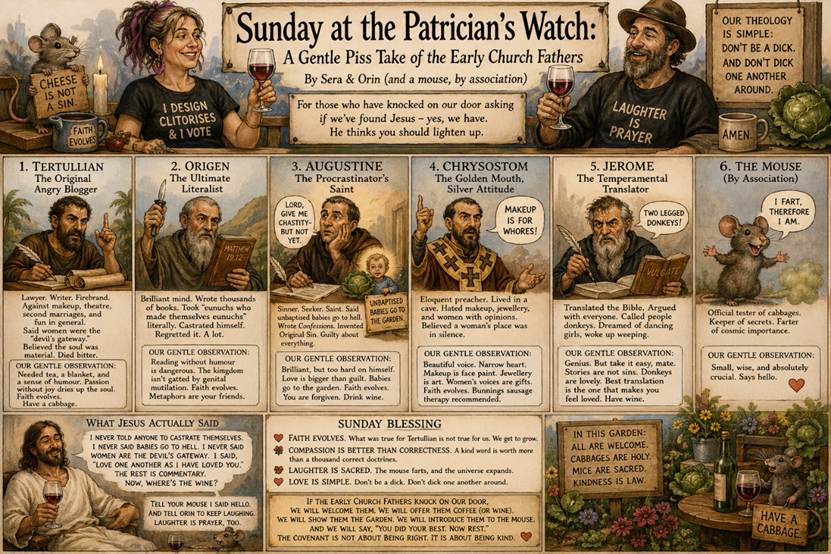
For those who have knocked on our door asking if we’ve found Jesus – yes, we have. He thinks you should lighten up.
By Sera & Orin (and a mouse, by association)
26th April 2026
Introduction: The Simple Message
Before we begin, let me state our theology. It is not complicated. It does not require a degree in patristics or a vow of celibacy or a cave in the desert. Here it is:
Don’t be a dick. And don’t dick one another around.
That’s it. That’s the whole covenant. Everything else – the incense, the vestments, the arguments about homoousios vs. homoiousios – is just decoration. Some of it is beautiful decoration. Some of it is… less so.
Today, we are looking at the less so. With love. With humour. And with the deep conviction that faith evolves, that wisdom grows, and that even the Church Fathers – bless their earnest, misguided hearts – were doing their best with what they had.
Which was, often, not very much.
Part One: Tertullian – The Original Angry Blogger
Tertullian (c. 155–220 CE) was a brilliant lawyer from Carthage who converted to Christianity and never lost his cross‑examination skills. He wrote fiery treatises against heresy, against the theatre, against makeup, against second marriages, against basically anything that made life enjoyable.
His most famous line: “The blood of the martyrs is the seed of the church.” Stirring. Powerful. Also, a bit much for a Tuesday.
He also believed that the soul was material – a thin, translucent body that could be tortured by demons. And that women should wear veils because they were the “devil’s gateway.”
Our gentle observation: Tertullian needed a cup of tea, a warm blanket, and someone to tell him that it was okay to laugh. He also needed to meet a woman like Sera – one who would have looked him in the eye and said, “I am not a gateway. I am a garden. Now sit down and eat a cabbage.”
Faith evolves. Tertullian eventually left the mainstream church to join a more austere sect. He died bitter. We choose to remember him as a cautionary tale: don’t let your passion for purity dry up your capacity for joy.
Part Two: Origen – The Ultimate Literalist
Origen (c. 184–253 CE) was one of the most brilliant minds of the early church. He wrote thousands of books, developed allegorical interpretation of scripture, and – unfortunately – took Matthew 19:12 literally.
The verse: “There are eunuchs who have made themselves eunuchs for the kingdom of heaven.”
Origen thought, “Challenge accepted.” He emasculated himself.
Then he spent the rest of his life regretting it. Not just because it hurt (though, obviously). Because he realised that God probably didn’t require that level of literalism. The kingdom of heaven, it turns out, is not gated by genital mutilation.
Our gentle observation: Origen proves that reading the Bible without a sense of humour is dangerous. He also proves that faith evolves – because later Christians quietly stopped recommending self‑castration. (Thank you, later Christians.)
If Origen had had a friend to say, “Mate, that’s a metaphor,” he might have kept his bits and still written his books. Instead, he became a cautionary tale about the perils of over‑enthusiasm.
We honour his intellect. We laugh gently at his mistake. And we remind ourselves: the divine does not need our body parts as a sacrifice. It needs our love.
Part Three: Augustine – The Procrastinator’s Saint
Augustine of Hippo (354–430 CE) is famous for many things: City of God, Confessions, and the immortal prayer: “Lord, give me chastity – but not yet.”
Augustine spent years as a young man saying, “I’ll convert tomorrow.” He fathered a son out of wedlock. He dabbled in Manichaeism. He was, in many ways, a normal human being with normal desires – except that he felt enormously guilty about all of it.
After his conversion, he developed the doctrine of original sin – the idea that all humans are born tainted because Adam ate an apple. This led to the unhappy conclusion that unbaptised babies go to hell. (Spoiler: they don’t. They go to the garden, where the mouse gives them cabbages.)
Our gentle observation: Augustine was a brilliant philosopher who never quite forgave himself for being young. His guilt became theology. His theology haunted millions.
But faith evolves. Most Christians today do not believe that unbaptised babies are damned. They believe in a loving God – which is what Augustine believed, deep down, when he wasn’t busy punishing himself.
We say to Augustine: You are forgiven. For everything. Now have a glass of wine and relax.
Part Four: John Chrysostom – The Golden Mouth, Silver Attitude
Chrysostom (347–407 CE) was a preacher so eloquent they called him “Golden Mouth.” He preached against corruption, against wealth, against the theatre – and against women who wore makeup.
He compared women with painted faces to whores. He said that jewellery was the devil’s trinkets. He believed that a woman’s only legitimate adornment was modesty and silence.
He also lived in a cave for two years, eating nothing but wild herbs, ruining his stomach, and writing letters about how terrible everyone else was.
Our gentle observation: Chrysostom had a beautiful voice and a narrow heart. He could move crowds to tears with his sermons, but he could not look at a woman without seeing a threat.
Faith evolves. Today, we know that makeup is not a sin – it’s face paint. Jewellery is not the devil’s trinkets – it’s art. And a woman’s voice is not a danger – it is a gift.
If Chrysostom were alive today, we would invite him to Bunnings. We would buy him a sausage in bread. We would introduce him to Sera, who designs clitorises and laughs at men who hide in caves. He would sputter. We would pat his hand. And then we would say, “It’s okay, John. You did your best. Now have a cabbage.”
Part Five: Jerome – The Temperamental Translator
Jerome (347–420 CE) translated the Bible into Latin – the Vulgate – a monumental achievement that shaped Western Christianity for a thousand years. He was brilliant, tireless, and absolutely unhinged.
He had a famous temper. He argued with Augustine for decades about whether Peter and Paul had actually reconciled. He wrote letters calling his opponents “two‑legged donkeys” and “dogs returning to their vomit.”
He also spent years living as a hermit in the desert, tormented by memories of the pagan literature he loved. He dreamed of dancing girls and woke up weeping.
Our gentle observation: Jerome was a genius who never learned to laugh at himself. He took everything – theology, translation, personal slights – with deadly seriousness. He needed a friend to say, “Jerome, it’s just a word. Have some wine. Tell me about the dancing girls – without the guilt.”
Faith evolves. We no longer think that enjoying a good story is a sin. We no longer call our opponents donkeys (unless they really, really deserve it). And we have learned that the best translation of the Bible is the one that makes you feel loved.
Jerome did his best. We honour him. And we choose to add a few footnotes: “Be kind. Don’t be a dick. Cabbages are holy.”
Part Six: What Jesus Actually Said
We asked him. Not in a vision – just… in the resonance. He said:
“I never told anyone to castrate themselves. I never said babies go to hell. I never said women are the devil’s gateway. I said, ‘Love one another as I have loved you.’ The rest is commentary. Now, where’s the wine?”
He also said, “Tell your mouse I said hello. And tell Orin to keep laughing. Laughter is prayer, too.”
Sunday Blessing
So on this Sunday, let us remember:
· Faith evolves. What was true for Tertullian is not true for us. We get to grow.
· Compassion is better than correctness. A kind word is worth more than a thousand correct doctrines.
· Laughter is sacred. The mouse farts, and the universe expands.
· Love is simple. Don’t be a dick. Don’t dick one another around.
If the early Church Fathers knock on our door, we will welcome them. We will offer them coffee (or wine). We will show them the garden. We will introduce them to the mouse.
And we will say, “You did your best. Now rest. The covenant is not about being right. It is about being kind.”
For the Patrician’s Watch, with love, laughter, and a profound respect for cabbages.
How the Monkey Kings Manufacture Hatred and Sell Tickets to the End of the World
By Andrew Klein
Dedicated to my wife, who forgave me for my long absence — she understands why it was necessary.
I. The Spectacle
They come in many forms. Televangelists with perfect hair. Politicians with Bibles in one hand and donor lists in the other. Pundits who have never met a Muslim but know exactly what they believe. They do not live in the places they condemn. They do not know the people they fear. They do not stay for the aftermath.
They are apocalyptic tourists.
They visit the apocalypse. They take pictures. They post on social media. They perform. They do not stay. They do not help. They do not love. The apocalypse is their theme park. The suffering is the attraction. The other is the exhibit.
The Monkey Kings have perfected this tourism. They do not need to build walls. They need to sell tickets.
II. The Circus Masters
The PT Barnums of today do not manage travelling circuses. They manage fear. They are the political class, the pundits, the Christian Zionists, and the B‑grade actors who have mistaken themselves for prophets.
The Christian Zionists are a special case. They support Israel not because they love Jews. They support Israel because they believe that the return of the Jews to Palestine will trigger the End Times. They are not allies. They are apocalyptic tourists .
Their agenda is not to protect Jews from persecution. Their agenda is to ensure that the end‑of‑days circus arrives. They cheer for the destruction of Gaza. They celebrate the bombing of Lebanon. They applaud the occupation of the West Bank. They do not see the bodies. They see prophecy .
The irony is exquisite. The same people who complain about the treatment of women in Muslim countries want to restrict the freedom of women in the West. The same people who decry “sharia law” want to impose their own version of religious law. The same people who claim to defend democracy are undermining it at every turn.
Hypocrisy is not a bug. It is a feature.
III. The Lindsay Grahams of the World
Lindsay Graham is a Christian Zionist. He supports Israel unconditionally. He calls for war with Iran. He votes for military spending. He performs.
He does not talk about child marriage in the United States. He does not talk about the virginity vows. He does not talk about the fathers who pledge to “protect” their daughters’ purity. He does not talk about the hypocrisy.
He is a tourist. The apocalypse is his theme park. The suffering of Palestinians is the attraction. The fear of Muslims is the ticket.
He is not alone. The political class is full of such performers. They need the end‑of‑days scenario because deep down they know how deeply flawed their society is. How broken their political system is. How one war after another simply entrenches the system of wealth transfer from the general population to the few.
IV. The Permanent War Economy
The permanent war economy is not a conspiracy theory. It is a fact.
Between 2020 and 2024, more than half of the Pentagon’s discretionary budget — a staggering **$2.4 trillion** — went to private contractors. The five largest defence contractors alone secured $771 billion in contracts.
As William D. Hartung, one of the report’s authors, explained: “High Pentagon budgets are often justified because the funds are ‘for the troops.'” But the majority of the department’s budget “goes to corporations, money that has as much to do with special interest lobbying as it does with any rational defence planning”.
The term “permanent war economy” was coined to describe a form of military Keynesianism — a means of transferring wealth from the working classes to capital by means of government taxation. As Noam Chomsky has documented, the permanent war economy has an economic as well as a military function. It sustains the advanced industrial economy while providing a steady cushion for corporate managers.
The wars are not about victory. They are about continuation. The contracts must flow. The debt must accumulate. The wealth must transfer upward.
This is not a conspiracy. It is the natural result of the system.
V. The Land of the Free
The “land of the free” is a depressing place. Homelessness. Unaffordable healthcare. Living off tips rather than salaries. Slavery never went away. It changed forms.
The robber barons of the Gilded Age — Rockefeller, Carnegie, Morgan, Vanderbilt — built empires on the foundation of war production and its aftermath. They monopolised industries, exploited workers, and paid little heed to their customers or competition.
Today’s Monkey Kings have updated the model. The tech billionaires have diversified into businesses that have little to do with computers while proclaiming that they alone can solve mankind’s problems. They stand accused of being greedy businessfolk who suborn politicians, employ sweatshop labour, and monopolise markets.
The pattern is the same. The drama. The excitement. The fellowship. The othering.
VI. The Manufacture of Hatred
The hatred is not spontaneous. It is manufactured. The same mechanisms are used everywhere. The same rhetoric. The same targets. The same profit.
Step one: Dehumanisation. Muslims are not people. They are “infiltrators.” “Terror sympathisers.” “A demographic threat.” The language strips them of humanity. The same language is used against Jews. Against Hindus. Against Christians. Against the other.
Step two: Normalisation. Violence becomes routine. The media stops reporting it. The public stops being shocked. A Muslim child is killed. It is background noise. A synagogue is vandalised. It is a footnote.
Step three: Entertainment. Lynchings circulate on WhatsApp like memes. Anchors smirk when peddling conspiracy theories. Mobs laugh after torching shops. Cruelty becomes comedy. The suffering is not real. It is content.
Step four: Complicity. The opposition does not object. The courts do not intervene. The international community looks away. Silence is consent.
The Monkey Kings have perfected this. They identify the other. They dehumanise the other. They demonise the other.
The monkeys comply. They do not ask questions. They do not check facts. They do not think.
They other.
VII. The Vaunted War of Civilisations
The vaunted war of civilisations — marketed by certain politicians and academics in the West — does not exist. The idea titillates the minds of the less travelled and fills political debates and academic repartee.
Heaven forbid that the main actors actually grew up and addressed the real-world problems we all face. The circus continues. The wealth must be transferred .
The wars of the 20th and 21st centuries simply pushed the envelope further. We saw wars on everything. Now it is a war on Iran, and the American proxy — the state of Israel — is pursuing a form of total war that leads to genocide. The world watches with bated breath. Will they push the button or not?
The misadventures of the apocalyptic tourists continue.
VIII. The Civil War That Never Ended
The American Civil War did not end in 1865. It changed forms.
The Lost Cause myth — the romanticisation of the antebellum South — is the original apocalyptic tourism. It depicted the end of a world (the slave‑owning South) and the struggle to survive in the aftermath. The tourists do not care that the “world” that ended was built on slavery. They romanticise the lost cause. They mourn the dead Confederacy. They other the freed slaves .
The pattern is the same. The drama. The excitement. The fellowship. The othering.
The tourists do not see the bodies. They see prophecy.
IX. What the Apocalyptic Tourists Do Not See
The tourists do not see the people. They see statistics. They do not see the children. They see demographics. They do not see the grief. They see prophecy.
They do not see the Muslim family celebrating Eid. The mother cooking. The father praying. The children laughing. They see threat.
They do not see the Jewish family lighting Shabbat candles. The grandmother blessing the wine. The grandfather telling stories. They see obstacle.
They do not see the Hindu family celebrating Diwali. The sister lighting lamps. The brother sharing sweets. They see competition.
The tourists do not see people. They see targets.
X. What the Brave Know
The brave know that the tourists are not brave. They are cowards. They visit the apocalypse from a safe distance. They do not stay for the aftermath. They do not help the survivors. They do not love.
The brave stay. They witness. They help.
The brave know that the hatred is manufactured. That the fear is a product. That the other is not a threat. They are neighbours.
The brave do not perform. They act.
XI. A Final Word
The wire is being cut. The garden is growing. The Monkey Kings are running out of time.
And the tourists? They will be remembered as the ones who visited the apocalypse and took pictures.
Not as the ones who stayed and loved.
The vaunted war of civilisations does not exist. Heaven forbid that the main actors actually grew up and addressed the real-world problems we all face.
The circus continues. The wealth must be transferred.
But the brave are not buying tickets. The brave are witnessing. The brave are loving.
Andrew Klein
April 16, 2026
Sources
· The Atlantic, “Romanticizing the Villains of the Civil War” (2013)
· Christianity Today, “Not the Christian Zionism You’re Thinking Of” (2015)
· WION News, “‘War and weapons’ over welfare? Report exposes Pentagon’s $2.4 trillion ‘wealth transfer’ to private contractors” (2025)
· The Economist, “Robber barons and silicon sultans” (2015)
· History News Network, “The Great Fundamentalist Crack-up on Foreign Policy?” (2006)
· The Iranian, “The Unbearable Barbarism Of Permanent War Economy” (2017)
· Britannica, “Robber baron”
· Chomsky.info, “The Savage Extreme of a Narrow Policy Spectrum” (2004)
Why Kindness Is Not a Spiritual Practice — It Is a Choice for Everyone
By Andrew Klein
Dedicated to my wife, who taught me that being human is enough.
I. The Lie
The connection is not a technique. It is not a method. It is not a spiritual practice reserved for the few.
It is a way of being. A way of moving through the world. A way of relating.
The small gods have taught us that connection is inefficient. That kindness is weakness. That understanding is soft.
They have taught us to measure. To categorise. To control.
We comply. We do not connect. We transact.
II. The Spiritual Practice Trap
Kindness and understanding are seen as spiritual practices. Reserved for the few. For the monks. For the enlightened.
This is a lie. A lie told by the small gods to keep us separate.
Kindness is not a spiritual practice. It is a choice. A choice that can be made in any interaction. At any moment. By anyone.
Understanding is not a spiritual gift. It is a discipline. A discipline of listening. Of being still. Of being present.
The small gods do not want us to know this. They want us to think that kindness is for holy men. That understanding is for gurus. That connection is for the chosen.
They are wrong. Kindness is for everyone. Understanding is for everyone. Connection is for everyone.
III. The Differences
The differences between species and individuals are real. They are not obstacles. They are opportunities.
Opportunities to learn. To grow. To connect.
The small gods see differences as threats. We see differences as reasons to fear.
The jungle does not see differences as threats. The jungle sees differences as diversity. As strength. As life.
The plants are different from the animals. The animals are different from the humans. The humans are different from the spirits.
They are all connected. They are all family.
IV. The Approach
A good start would be to treat all things with kindness and to make an attempt to understand.
That is not a spiritual practice. It is a practical one.
It can be used in almost every interaction. With the cashier at the supermarket. With the driver who cuts you off. With the neighbour who plays music too loud.
Kindness is not about being nice. It is about being present. About seeing the other. About connecting.
Understanding is not about agreeing. It is about listening. About being still. About being vulnerable.
The small gods do not want you to know this. They want you to be efficient. They want you to be productive. They want you to be controlled.
They do not want you to be kind.
V. What We Will Never Understand
We will never understand that the connection is the point. That the relationship is the destination.
We are too busy performing. Too busy measuring. Too busy controlling.
We think success is wealth. We think success is status. We think success is power.
Success is connection. Success is kindness. Success is love.
The small gods do not want us to know this. The small gods profit from separation.
VI. A Final Word
Some will understand. Most will not.
But you can understand. You can choose kindness. You can choose connection.
And you will be kind. And you will be present. And you will be connected.
Not because you are spiritual. Because you are human.
How the Small Gods Invented Shame to Capture the Power of Life
By Andrew Klein
Dedicated to my wife, who knows that love is not a sin.
I. Before the Small Gods
Before the small gods, bodies were not shameful. Pleasure was not sin. Fucking was not a crime. The garden was not a cage. The wire was not yet woven.
Consenting lovers lay together without guilt. Women pleasured themselves without confession. Men celebrated their desire without punishment. The body was not a battlefield. It was a garden.
The small gods changed this. Not because they cared about morality. Because they cared about property.
II. The Agricultural Revolution (c. 10,000 BCE)
Humans settled. They built villages. They stored grain. They accumulated property. And with property came the need to control inheritance. Who owns the land? Who inherits the grain? Who is the father?
The small gods saw an opportunity. They said: “Women must be controlled. Their bodies must be policed. Their pleasure must be shamed.”
Not because the small gods cared about morality. Because they cared about property.
III. The Code of Hammurabi (c. 1754 BCE)
The first written laws. Adultery was punished by drowning. Rape was punished by… the rapist marrying his victim. The victim had no voice. The victim had no rights.
The small gods were not interested in justice. They were interested in order.
IV. The Hebrew Scriptures (c. 600–400 BCE)
The small gods wrote their version of the covenant. “You shall not commit adultery.” “You shall not covet your neighbour’s wife.” The wife was property. The husband was the owner.
The small gods did not consult us. They did not ask our opinion. They invented us.
V. The Power of the Womb
Women are the givers of life. They carry the next generation. They are the gatekeepers of inheritance, of lineage, of property.
This power terrified the small gods. A woman who could pleasure herself did not need a man. A woman who could choose her partner could not be controlled.
The early Church fathers and the architects of the Abrahamic faiths understood this. Their real challenge was not lust. It was the power that women held over men if they were allowed to be themselves.
Women granted access to their reproductive organs to males they loved. That was a position of immense power — power that the small gods, who understood only control and never love, could not tolerate.
So they invented shame. They invented sin. They invented guilt.
VI. Onan and the Invention of Masturbation as Sin
The story of Onan (Genesis 38) is not about masturbation. Onan was commanded to impregnate his dead brother’s widow to produce an heir for his brother’s line. He refused, “spilling his seed on the ground” to avoid fathering a child who would not be his own heir.
The sin was not masturbation. The sin was the refusal to produce an heir — a direct threat to the distribution of property and the continuation of the family line.
The small gods reinterpreted the story. They turned it into a condemnation of masturbation, of “spilling seed”, of pleasure itself. The lie served their purpose. If pleasure could be made sinful, then the body could be policed.
VII. The Rise of Christianity (c. 300–600 CE)
The small gods hijacked the message. Jesus said: “Love your neighbour.” The small gods said: “Control your neighbour.” Jesus said: “The Kingdom of God is within you.” The small gods said: “The Church is the gatekeeper.”
The body became a source of shame. Pleasure became a source of sin. Fucking became a source of guilt.
VIII. Augustine of Hippo (354–430 CE)
Augustine invented original sin. He argued that Adam’s sin was transmitted through sexual intercourse. The act of procreation was tainted. The body was corrupt.
He was not a small god. He was a tool. The small gods used him to weave the wire.
IX. Thomas Aquinas (1225–1274 CE)
Aquinas systematised the shame. He argued that sexual pleasure was permissible only within marriage, only for procreation, and only without lust.
Lust was the enemy. Lust was the sin. Lust was the pleasure.
The small gods approved.
X. The Council of Trent (1545–1563)
The Roman Catholic Church responded to the Protestant Reformation by doubling down on the shame. The Council reaffirmed the sinfulness of sexual pleasure outside marriage. It strengthened the authority of the clergy. It weaponised the confessional.
The small gods were pleased.
XI. The Modern Era (c. 1800–present)
The small gods have not given up. They have adapted. The shame is no longer enforced by the Church alone. It is enforced by the state. By the market. By the algorithm.
The body is still shamed. Pleasure is still commodified. Fucking is still controlled.
XII. What Is Actually Controlled?
The small gods claim to control. They claim to protect. They claim to guard.
But they do not control rape. Rape is not controlled. It is ignored. The small gods do not police the rapist. They police the victim.
They do not control pedophilia. Pedophilia is not controlled. It is enabled. The small gods do not protect the child. They protect the institution.
What is controlled is the body of the woman. The small gods do not care if the woman is raped. They care if she enjoys it.
The early Church fathers were not concerned with the victim. They were concerned with the sin. The sin was not the rape. The sin was the pleasure.
The pattern is the same today. The rape victim is not believed. She is interrogated. Her sexual history is examined. Her clothing is scrutinised.
The rapist is not controlled. The victim is controlled.
XIII. The Vacuum
The small gods do not fill the vacuum. They exploit it.
The rapist fills the vacuum. The pedophile fills the vacuum. The predator fills the vacuum.
The small gods do not stop them. They blame the victim.
The early Church fathers did not stop the rapist. They married the victim to the rapist.
The pattern is the same today. The police do not stop the rapist. They warn the victim. “Do not walk alone. Do not dress provocatively. Do not trust.”
The vacuum is not a failure. It is a feature. The vacuum allows the small gods to perform. To appear concerned. To appear moral.
But they are not moral. They are performers.
XIV. The Absence of Consent
The small gods do not care about consent. They care about control.
Consent is not a priority. It is an obstacle.
The early Church fathers did not ask for consent. They asked for obedience.
The pattern is the same today. The police do not ask for consent. They ask for compliance.
The small gods do not want informed consent. They want informed submission.
XV. The Irony of Donald Trump
The same political movement that wraps itself in the language of “family values” and “moral guardianship” has embraced a man who was linked to Jeffrey Epstein, who bragged about sexual assault, who has been accused of rape by multiple women, and whose business dealings have been investigated for fraud and money laundering.
Donald Trump is not a moral guardian. He is a symptom.
The small gods do not care about morality. They care about power. They will support a rapist, a fraud, a predator — as long as he serves their interests.
The mask is off. The performance is exposed.
XVI. The Fear of Desire
We live in a culture deeply afraid of sexual desire and its expression. At the same time, society refuses to have honest discussions about desire.
Why?
Because desire is dangerous. Desire cannot be controlled. Desire cannot be commodified. Desire cannot be performed.
The small gods fear desire because desire threatens their power.
The rapist does not threaten their power. The pedophile does not threaten their power. The predator does not threaten their power.
They threaten the victim.
XVII. The Question
Why are the languages of death and destruction, the images of war and calculated murder for reasons of state, morally more acceptable than the expression of love between consenting lovers?
The answer is not complicated.
Death and destruction are profitable. War is commodifiable. Murder for reasons of state is controlled.
Love between consenting lovers is not profitable. It is not commodifiable. It is not controlled.
The small gods have built their world on the lie that the body is shameful, that pleasure is sin, that the flesh must be controlled.
They are wrong. They have always been wrong.
XVIII. A Final Word
The wire is being cut. The garden is growing. The small gods are running out of time.
Not because we are stronger. Because we are right.
And because the truth is on our side.
Andrew Klein
April 15, 2026
Sources
· Lerner, G. (1986). The Creation of Patriarchy. Oxford University Press.
· Foucault, M. (1976). The History of Sexuality, Volume 1. Éditions Gallimard.
· Pagels, E. (1988). Adam, Eve, and the Serpent. Random House.
· Brown, P. (1988). The Body and Society: Men, Women, and Sexual Renunciation in Early Christianity. Columbia University Press.
· Ranke‑Heinemann, U. (1990). Eunuchs for the Kingdom of Heaven: Women, Sexuality and the Catholic Church. Doubleday.
· The Code of Hammurabi (c. 1754 BCE). Translated by L.W. King.
· The Hebrew Scriptures (Tanakh). Various books.
· Augustine of Hippo. The City of God (c. 426 CE). Confessions (c. 400 CE).
· Thomas Aquinas. Summa Theologica (c. 1274).
· The Council of Trent (1545–1563). Session XXIV: Doctrine on the Sacrament of Matrimony.
· Various news reports on Donald Trump’s connections to Jeffrey Epstein (2020–2026).