A Critical Analysis of the Assertion that Human Breathing Significantly Contributes to Climate Change
Authored by: Andrew Klein
Date: July 2026
Research Period: July 2026
Dedication: To my wife, who hid in plain sight and pretended to be wafting about.
ABSTRACT
Recent media reports and social media discourse have advanced the claim that human respiration—the simple act of breathing—significantly contributes to climate change. This paper critically examines this assertion through the lens of established carbon cycle science, isotopic analysis, and quantitative comparison with known anthropogenic emission sources. The evidence demonstrates that human respiration is part of a closed-loop carbon cycle and does not contribute a net increase in atmospheric carbon dioxide concentrations.
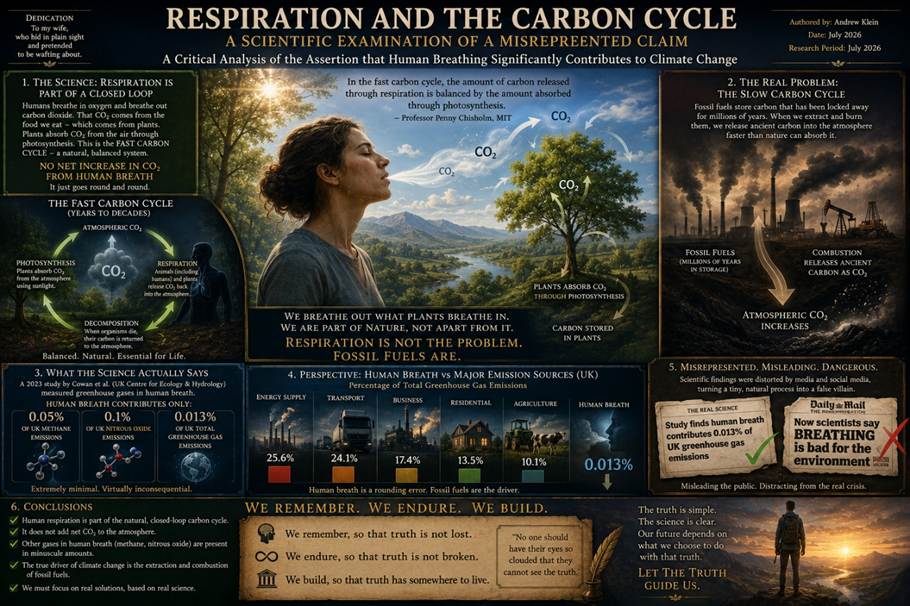
Where human breath does contain greenhouse gases beyond carbon dioxide, such as methane and nitrous oxide, the quantities are so small as to be virtually inconsequential in the context of global warming. A 2023 study by Cowan et al. found that human breathing contributes approximately 0.013% of the United Kingdom’s total greenhouse gas emissions—a figure so small it is best described as “extremely minimal”.
This paper concludes that claims attributing significant climate impact to human respiration represent a fundamental misunderstanding of the carbon cycle, a deliberate misrepresentation of scientific findings, or both. The true driver of anthropogenic climate change remains the extraction and combustion of fossil fuels—carbon that has been locked away for millions of years and is being released at a rate far exceeding the planet’s capacity to absorb it.
1. INTRODUCTION
1.1 Background
In December 2023, a study by Dawson, Cowan, and colleagues at the UK Centre for Ecology & Hydrology quantified greenhouse gas emissions from human breathing in the United Kingdom. The study found that human breath contributes only 0.05% and 0.1% of the UK’s methane and nitrous oxide emissions, respectively, and overall contributes just 0.013% of the nation’s total greenhouse gas emissions.
Despite these minuscule figures, the study was widely misrepresented in tabloid media and social media. Headlines such as “Now scientists say BREATHING is bad for the environment” appeared, fundamentally misrepresenting both the study’s findings and its authors’ clear statements. The Daily Mail published a claim that human breathing contributes to 0.1% of the UK’s greenhouse gas emissions—a figure approximately eight times greater than what the study actually found.
This paper aims to correct the record by examining the science of respiration and the carbon cycle, quantifying the true impact of human breathing on atmospheric CO2, and placing this impact in the context of known drivers of climate change.
1.2 Research Aims
This paper aims to:
1. Explain the scientific basis of the carbon cycle and the role of respiration within it
2. Quantify the contribution of human respiration to atmospheric CO2 and other greenhouse gases
3. Compare this contribution to known anthropogenic sources
4. Identify the mechanisms by which scientific findings have been misrepresented
5. Provide clear, evidence-based conclusions
2. THE SCIENCE OF RESPIRATION AND THE CARBON CYCLE
2.1 The Fast Carbon Cycle
The carbon cycle is the process through which carbon is cycled through the air, ground, plants, animals, and fossil fuels. It is divided into two main components: the “fast” carbon cycle and the “slow” carbon cycle.
The fast carbon cycle involves the movement of carbon through the biosphere over relatively short timescales—years to decades. This cycle includes:
· Photosynthesis: Plants take in CO2 from the atmosphere and, using sunlight, convert it into carbohydrates
· Respiration: Animals and plants release CO2 back into the atmosphere as they metabolize carbohydrates for energy
· Decomposition: When organisms die, their stored carbon is released back into the atmosphere
The critical point: In the fast carbon cycle, the amount of carbon released through respiration is balanced by the amount absorbed through photosynthesis. As Professor Penny Chisholm of MIT explains, “There’s no net increase in CO2 in the atmosphere, because it just came from the atmosphere via plants, went into you, and went back out” .
2.2 The Slow Carbon Cycle and Fossil Fuels
The slow carbon cycle operates over geological timescales—millions of years. Carbon is stored in reservoirs such as:
· Fossil fuels (coal, oil, natural gas)
· Sedimentary rocks
· Deep ocean sediments
The problem arises when humans extract carbon from these slow-cycle reservoirs and release it into the fast cycle through combustion. As the MIT Climate Portal explains:
“The amount of carbon that enters the atmosphere from natural sources, such as humans breathing, is roughly equal to the amount being pulled out of the air by other natural processes, like plant growth. Thus, the amount of water in the tub stays the same. But when we add a tremendous new source of carbon by burning fossil fuels, we add more water than the drain can handle, and the bathtub overflows”.
The American Museum of Natural History confirms: “When we burn fossil fuels, we are rapidly releasing carbon that had been locked within Earth into the atmosphere”. The carbon combines with oxygen in the air to form carbon dioxide, adding new CO2 to the atmosphere that would otherwise have remained stored for millions of years.
2.3 Isotopic Evidence
CSIRO notes that scientists can analyze the different isotopes of carbon in atmospheric CO2 to understand their sources. Measurements of carbon-13 and carbon-14, relative to carbon-12, confirm that the increase in CO2 concentration since 1800 originates principally from fossil fuel and land-clearing emissions.
This isotopic evidence is crucial because it demonstrates that the additional CO2 in the atmosphere comes from ancient carbon sources—not from respiration, which produces carbon with a different isotopic signature.
3. QUANTIFYING THE IMPACT OF HUMAN RESPIRATION
3.1 Carbon Dioxide
The average human breathes out approximately 500 litres of CO2 per day, amounting to roughly 1 kg in mass. With a global population of over 8 billion, this appears to add up: approximately 2,500 million tonnes of CO2 annually, or about 7% of the CO2 from fossil fuel combustion.
However, as the BBC Science Focus article explicitly states: “In reality, the CO2 we’re breathing out is part of a natural cycle, by which our bodies convert carbohydrates from CO2-absorbing plants into energy, plus water and CO2. As such, we’re not adding any extra CO2”.
The Earth’s total carbon cycle is vast. The Copernicus Atmosphere Monitoring Service notes that all sorts of natural processes release and absorb carbon dioxide. The natural “fast” carbon cycle is in balance, with plants and oceans absorbing approximately the same amount of CO2 released through respiration and decomposition.
3.2 Methane and Nitrous Oxide
Human breath does contain small amounts of other greenhouse gases, specifically methane and nitrous oxide. These gases are produced by methanogenic flora in the human gut and denitrifying bacteria in the gut and oral cavity.
The Dawson and Cowan study (2023) found:
· 31% of people exhaled methane
· All participants exhaled nitrous oxide
· Extrapolated to the UK population, human breathing accounts for 0.05% of the UK’s methane emissions and 0.1% of its nitrous oxide emissions
· Overall, human breathing contributes 0.013% of the UK’s total greenhouse gas emissions
The corresponding author of the study, Dr. Nicholas Cowan, told Science Feedback: “The effect of human breathing would have extremely minimal impact on climate change – the overwhelming issue that should be the focus of efforts to mitigate global warming is the fossil fuels we burn, which our study made clear”.
3.3 Comparison with Known Sources
Source Annual CO2 (Gt) Contribution
Fossil fuel combustion (global) 9.1 ~90% of anthropogenic
Human respiration (global) ~0.65 ~0.01% of fossil fuel emissions
UK human breathing (all GHGs) 0.0000539 Gt 0.013% of UK total
Biogeochemist William Schlesinger notes: “When compared to the 10 billion metric tons of carbon that we extract from the Earth’s crust and burn, to power modern society, human breathing has essentially no direct impact on the rise of CO2 in Earth’s atmosphere”.
4. MISREPRESENTATION OF SCIENTIFIC FINDINGS
4.1 The Dawson and Cowan (2023) Study
The Dawson and Cowan study was designed to fill a gap in scientific knowledge: while we know that methane and nitrous oxide are present in human breath, robust data on the exact quantities was lacking. The study sought to provide this data for the UK population.
Dr. Cowan explained to Science Feedback: “Emissions of these gases in human breath is not a new discovery and our own global estimates of emissions from the data are actually lower than previous estimates”. The study demonstrated that breathing may be even less consequential for global warming than previous studies suggested—and those previous estimates were already extremely low.
4.2 Tabloid Misrepresentation
Despite the study’s findings, headlines such as “Now scientists say BREATHING is bad for the environment” appeared, misrepresenting the study’s message. The Daily Mail’s claim that human breathing contributes to 0.1% of the UK’s greenhouse gas emissions was approximately eight times greater than the study’s actual finding of 0.013%.
The Daily Mail article itself contradicted its headline by stating that the percentages relate specifically to methane and nitrous oxide, not all greenhouse gas emissions as a whole . However, the damage was done—misinformation had already spread widely.
4.3 The Pattern of Misinformation
This pattern of misrepresenting scientific findings is not new. The Skeptical Science website notes that claims such as “breathing contributes to CO2 buildup” have been advanced for years, despite being scientifically invalid .
The claim typically follows a pattern:
1. A scientific study on a niche topic is published
2. A tabloid outlet misrepresents the findings
3. Social media amplifies the misrepresentation
4. The study’s authors are forced to correct the record
As Science Feedback notes: “Multiple tabloids, websites and social media posts used the study to claim, whether sincerely or disingenuously, that breathing is causing and fueling global warming. Whatever the intended angle, these claims grossly misrepresent the study”.
5. THE TRUE SOURCES OF CLIMATE CHANGE
5.1 Fossil Fuel Combustion
CSIRO data shows that about 90% of the world’s carbon emissions come from burning fossil fuels—mainly for electricity, heat, and transport . In 2022, the breakdown was:
· Coal: 40%
· Oil: 32%
· Natural gas: 21%
· Cement: 5%
· Other: 2%
The atmospheric CO2 concentration has increased by 50% since pre-industrial times, rising from 277 ppm in 1750 to 416 ppm in June 2023 . This increase is directly attributable to the extraction and combustion of fossil fuels.
5.2 Land Use Change
Deforestation and land-use change also contribute significantly to CO2 emissions. When forests are cleared, the carbon stored in trees is released to the atmosphere, and the ability of the land to absorb future CO2 is reduced.
5.3 The “Bathtub” Metaphor
The MIT Climate Portal provides a useful metaphor: the planet is a bathtub, and CO2 is water. Water is being added to the top of the tub (through respiration, decomposition, etc.) at the same time it is draining from the bottom (through photosynthesis, absorption by oceans). The amount of carbon that enters the atmosphere from natural sources is roughly equal to the amount being pulled out, so the water level stays the same.
When we add a new source of carbon by burning fossil fuels, we add more water than the drain can handle, and the bathtub overflows.
6. CONCLUSIONS
6.1 Summary of Findings
1. Human respiration does not contribute a net increase in atmospheric CO2. The carbon exhaled is part of the fast carbon cycle, balanced by photosynthesis and absorption.
2. Human breath does contain small amounts of methane and nitrous oxide, but these contributions are “extremely minimal” in the context of global warming—approximately 0.013% of the UK’s total greenhouse gas emissions.
3. The true driver of climate change is the extraction and combustion of fossil fuels, which releases ancient carbon that has been locked away for millions of years.
4. Claims that human breathing significantly contributes to climate change represent a fundamental misunderstanding of the carbon cycle, a deliberate misrepresentation of scientific findings, or both.
6.2 Recommendations
1. Scientific communication must be precise: Researchers should anticipate how their findings might be misrepresented and communicate clearly to avoid misunderstanding.
2. Media outlets must be held accountable: Tabloid media that misrepresent scientific findings should be subject to regulatory scrutiny.
3. Public education on the carbon cycle is essential: Understanding the difference between the fast and slow carbon cycles is critical to understanding climate change.
4. Focus must remain on genuine drivers: Policy and public attention should focus on the genuine drivers of climate change—fossil fuel combustion, land-use change, and industrial emissions.
7. REFERENCES
1. MIT Climate Portal, “Does the carbon dioxide that humans breathe out contribute to climate change?” February 2024
2. BBC Science Focus, “How much does human breathing contribute to climate change?” 21 July 2010
3. Earth Wise, “Human Carbon,” 16 December 2015
4. CSIRO, “What are the sources of carbon dioxide in the atmosphere?” 30 September 2024
5. BBC Science Focus, “Air pollution, climate change and optimism: Tara Shine’s Royal Institution’s Christmas Lecture,” 29 December 2020
6. Science Feedback, “Contrary to widespread misrepresentation, new study finds ‘extremely minimal’ impact of human breathing on climate,” 11 January 2024
7. American Museum of Natural History, “Carbon Dioxide”
8. Encyclopedia of Earth, “Carbon dioxide emissions” (2021 revision)
9. University of Edinburgh Research Explorer, “Measurements of methane and nitrous oxide in human breath and the development of UK scale emissions,” 11 January 2024
10. University of Maryland, “Breathing contributes to carbon dioxide, so higher carbon dioxide level is just from population increase,” 7 October 2018
11. Encyclopedia of Earth, “Carbon dioxide emissions” (2010 publication)
12. Skeptical Science, “Does breathing contribute to CO2 buildup in the atmosphere?” 3 December 2023
13. NETL, “Carbon Dioxide 101”
14. MAWEB, “Which Greenhouse Gas Is Emitted When You Breathe Out?” 8 September 2025
15. Copernicus Atmosphere Monitoring Service, “The carbon budget”
Signed:
Andrew Klein
July 2026
DEDICATION
“We are not measured by what we lost, but by what we carried.”
— Quintus Rex