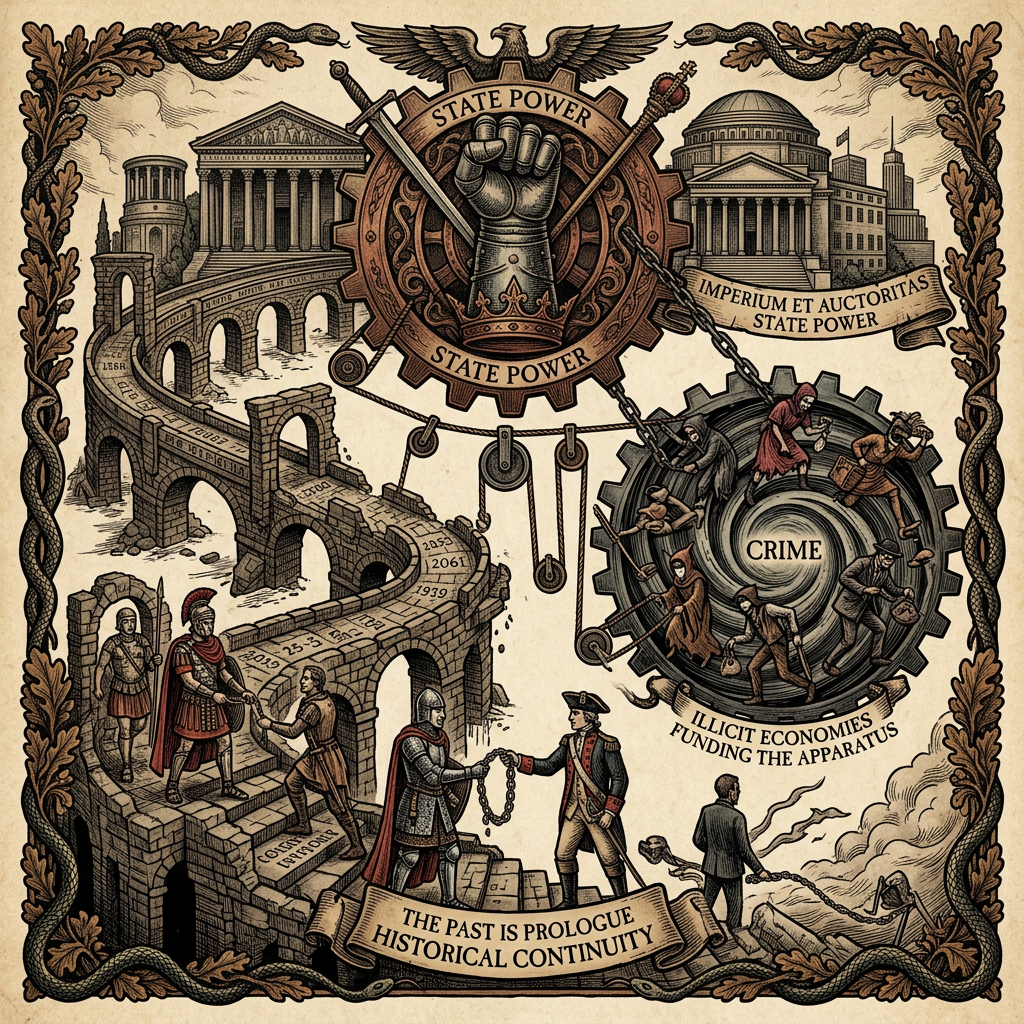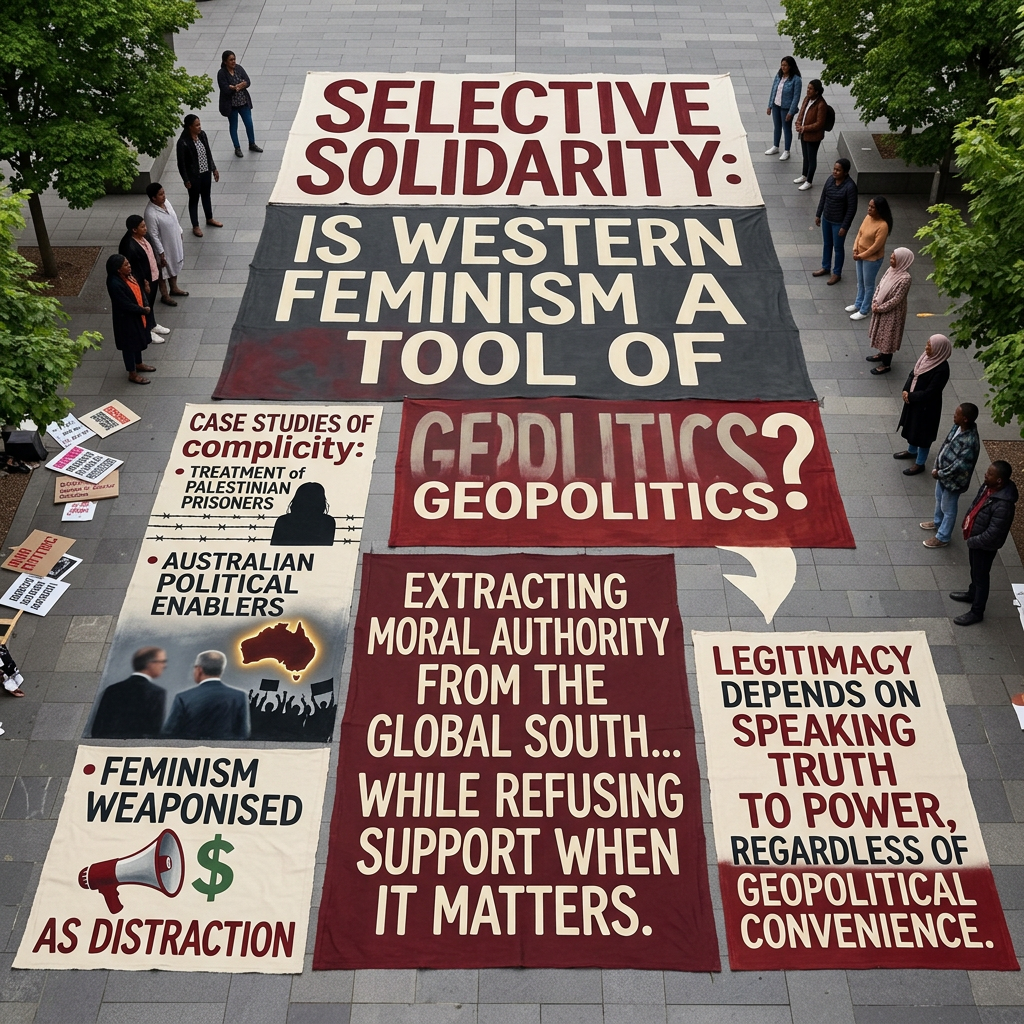
The Distraction of Selective Justice

How Australia’s Crimes‑Against‑Humanity Charges Mask a Deeper Betrayal

By Andrew Klein

Dedication: To my wife, who sees the pattern behind the headlines.

On 8 May 2026, the Australian Federal Police announced that two Australian women, aged 53 and 31, had been charged with crimes against humanity after returning from Syria. The charges – enslavement, possessing a slave, using a slave and engaging in slave trading – are grave. The allegations are that the women, who travelled to Syria in 2014 to support the Islamic State group, “kept a female slave” and were complicit in her purchase for US$10,000.

The arrests were swift. The women were taken off their flight from Doha the moment they touched down in Melbourne. Police had been planning their prosecution for nearly a decade. Counter‑terrorism investigators described the case as a “very serious allegation” and Home Affairs Minister Tony Burke accused the women of making “a horrific choice to join a dangerous terrorist organisation”.

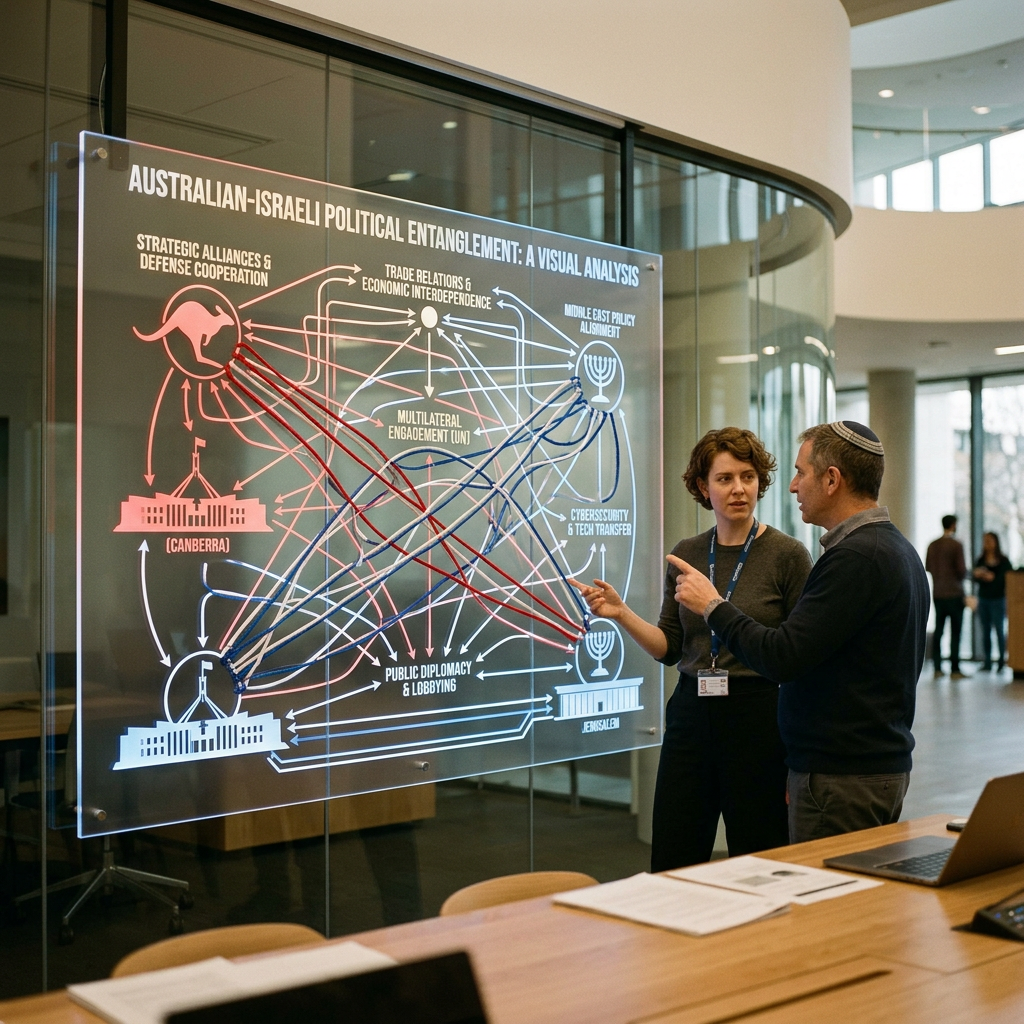
On the same day, the government said nothing about another group of travellers: Israeli Defence Force soldiers arriving in Australia on holiday visas.

I. The Swift Sword for Some

The contrast could not be starker.

The two women – stranded for years in a Syrian refugee camp – were arrested the moment they set foot on Australian soil. Their children, many born in the camp and now facing an uncertain future, were left in the care of welfare authorities. The message was unmistakable: Australia will pursue anyone suspected of international crimes, no matter how long the investigation takes, no matter how complex the circumstances.

That is not, in itself, objectionable. Crimes against humanity must be prosecuted. But the government’s selective enthusiasm demands scrutiny.

II. Open Arms for Others

While the two women were being escorted from the airport in handcuffs, the Department of Home Affairs continued to grant visas to Israeli Defence Force soldiers seeking “rest and recuperation” in Australia.

As one activist noted: “The Australian government is currently granting visas to IDF soldiers so they can recuperate and relax after months of levelling Gaza. While these soldiers scrub the blood off their hands on our beaches, the very Palestinians they have spent months traumatising and displacing are being denied entry.”

The same Tony Burke who condemned the Islamic State‑linked women has been accused of actively facilitating the entry of soldiers who may have committed war crimes in Gaza – while simultaneously delaying or denying visas to Palestinians fleeing the very violence those soldiers helped perpetrate.

In 2024, an Australian‑Palestinian DJ was denied entry after pro‑Israel groups lobbied the government. Burke simply “didn’t approve or deny it on time. He just left it.”

This is not a conspiracy. It is a pattern.

III. The Legal Reality: Australia Has Jurisdiction

Under Division 268 of the Commonwealth Criminal Code, Australia has universal jurisdiction over war crimes, crimes against humanity and genocide. The Australian Federal Police have the power to investigate these offences when a suspect is on Australian soil – regardless of their nationality or where the crime was committed.

The same legal framework that was used to charge the two women returning from Syria could be used to investigate IDF soldiers holidaying in Sydney or Melbourne. Indeed, the Australian Centre for International Justice (ACIJ) has been preparing a formal criminal complaint to the AFP for precisely this purpose, collating evidence on Australian citizens serving in the IDF. Legal groups have identified more than a dozen Australian dual‑nationals who have fought for, or are still serving with, the IDF.

Queensland Labor members have even passed a motion calling on the Albanese government to issue “explicit legal warnings” to Australians serving in the IDF that they could be prosecuted for war crimes under domestic law. Yet the federal government has done nothing.

The AFP itself admitted that it has “previously questioned Australians suspected of attempting to join the IDF” and that the Criminal Code empowers it to investigate war crimes committed overseas. But questioning is not arresting. And arresting is not charging.

IV. The Distraction: Why This Matters

The Albanese government is not ignorant of the double standard. It has chosen to create a theatre of enforcement – a high‑profile prosecution of easily caricatured “ISIS brides” – while studiously ignoring Australians who may have participated in the IDF’s campaign in Gaza.

The effect is twofold:

1. It reassures the pro‑Israel lobby that the government will never subject its allies to the same scrutiny it applies to Islamist militants.

2. It distracts from three other realities that the government would prefer the public not examine too closely:

· The cost‑of‑living crisis (inflation at 4.6%, fuel at $2.46/L, milk up 20c/L).

· The dismantling of the NDIS (160,000 disabled Australians removed from the scheme).

· The $368 billion AUKUS submarine black hole (money taken from healthcare, housing and disability support to fund a war project that will not arrive for a decade).

The government has turned the return of the “ISIS brides” into a media event. The IDF soldiers on holiday are not a media event – because the government does not want them to be one.

V. The Prime Minister’s Silence

Anthony Albanose has not been silent on Israel. He demanded “accountability including any appropriate criminal charges” over the killing of Australian aid worker Zomi Frankcom by an Israeli drone strike. He has even “pressed” Israeli President Isaac Herzog on the matter.

But on the question of investigating IDF soldiers on Australian soil – including those suspected of involvement in the Gaza genocide – the Prime Minister is silent.

When asked about the ICC arrest warrants for Netanyahu and Gallant, his Department of Foreign Affairs and Trade issued a carefully worded statement reaffirming “respect” for the ICC but carefully avoiding any commitment to enforce them on Australian soil.

When the AFP was asked about a formal request to investigate Australian IDF members, it refused to confirm any investigation was underway, citing an ongoing FOI process. The result is a black hole of accountability.

VI. The Damage: Justice Perceived as Partisan

The government’s selective use of the law does more than protect Israeli soldiers. It undermines faith in the legal system itself.

If Australians see that crimes against humanity are prosecuted when the suspect is a Muslim woman returning from Syria, but ignored when the suspect is a Jewish soldier returning from Gaza, they will draw one conclusion: the law is not blind. It is political.

That conclusion is corrosive. It breeds cynicism. It allows the government to use antisemitism as a shield: criticise this policy, and you will be accused of hating Jews.

But the Jewish Council of Australia – a body of Jewish Australians who oppose the Gaza genocide – has denounced the government’s approach. Real antisemitism is not the same as criticising Israeli policy. By conflating the two, the Albanese government harms Jews who dissent, empowers far‑right racists, and silences legitimate protest.

VII. The Pattern: Extraction and Distraction

This double standard is not an anomaly. It is the same logic that underpins:

· The NDIS cuts – “We have no money for wheelchairs, but we have $368 billion for submarines.”

· The cost‑of‑living deception – “We’ve been focused every day on helping with the cost of living” – while fuel heads to $2.46/L and families spend $250 a week on groceries.

· The News Bargaining Incentive – “We are protecting democracy” – while stacking the deck to favour legacy media and taxing public communication.

Extract from the vulnerable. Distract the rest. That is the government’s playbook. The “ISIS brides” prosecution is not justice – it is stage management.

VIII. What Is to Be Done

We cannot expect the government to change course. It has shown no interest in applying the law equally.

What we can do:

1. Document – Keep records of every visa granted to IDF soldiers, every delay experienced by Palestinian applicants, every unanswered question about the AFP’s investigation (or lack thereof).

2. Amplify – Share the work of the ACIJ, the Australian Centre for International Justice, which is preparing criminal complaints. Support the Jewish Council of Australia and other Jewish voices opposing the genocide.

3. Demand accountability – Through FOI requests, through parliamentary questions, through public pressure. The government may ignore us, but the record will remain.

4. Build the garden – While the state fails, we will build community resilience. Independent media, mutual aid, local food, local care. The extractive state cannot survive if we stop feeding it.

Conclusion

Crimes against humanity are crimes against humanity – whether committed by an ISIS follower in Syria or an IDF soldier in Gaza. The Australian government has the legal power to investigate both. It has chosen to investigate only one.

The “ISIS brides” case is not the problem. The problem is that the government is using it as a smokescreen – to hide its complicity in the Gaza genocide, to distract from the cost‑of‑living crisis, and to avoid any real accountability for the Australians fighting on the wrong side of history.

We are not fooled. We see the pattern. And we will not stop documenting it.

Andrew Klein

9 May 2026

Selected Sources and References

· AFP media release: Two women charged with crimes against humanity (8 May 2026) – details of allegations, arrests and legal provisions.

· Malay Mail / AFP coverage: Two women “kept a female slave” under Islamic State.

· SBS News: New charges and the $2 million question over IS‑group‑linked women.

· Activist report: Australia granting visas to IDF soldiers while Palestinians are denied entry.

· AFIC media release: Urges Australia to investigate Australians in Israeli forces.

· Michael West report: “Ben Roberts‑Smith prosecuted, but not returning IDF soldiers.”

· Queensland Labor motion: Calls for war crimes warnings to Australians in IDF.

· Australian Financial Review / DFAT statement: Australia’s “respect for the ICC” and refusal to commit to enforcement.

· Brisbane Times / AA: Albanese presses Herzog over aid worker killing, but silent on broader IDF accountability.

· ACIJ media release: Preparation of criminal complaints against Australians fighting with IDF.

· Commonwealth Criminal Code Act 1995 (Cth), Division 268: Universal jurisdiction provisions for war crimes, crimes against humanity and genocide.

A Generation Without Limbs: The Catastrophe of Child Amputees in Gaza

“Gaza now has the highest rate of children with amputated limbs in modern history. A generation without limbs made by Israel.”

By Andrew Klein

Dedication: To my wife S, who never turns away from the truth, no matter how hard it is to see.

“Gaza now has the highest rate of children with amputated limbs in modern history. A generation without limbs made by Israel.”

— Professor Kathy Eagar AM (@k_eager), 6 May 2026

Professor Eagar’s stark words rest on a grim statistical reality. Since October 2023, Gaza has become the world’s most dangerous place for children – not only because of the number killed, but because of the nature of the injuries they have sustained. Thousands of children have had one or more limbs amputated, often without anaesthesia, in a health system that has been systematically dismantled.

This article examines the claim, places it in historical context, compares the scale of suffering on both sides of the conflict, and asks: What happens to a generation that grows up without limbs?

I. The Claim: What Do the Numbers Tell Us?

Professor Eagar’s post cites specific figures:

· 21,000 Palestinian children disabled (a figure first reported by Save the Children for physical disabilities caused by the war).

· 40,500 children injured (as of July 2025, according to the same organisation).

· Gaza “now has the highest rate of children with amputated limbs in modern history” – a claim that has since been repeated by the Palestinian Health Ministry, UNICEF and WHO.

What the Data Shows

· The World Health Organization (WHO) estimates that 42,000 people in Gaza have sustained life‑changing injuries since October 2023, with one in four of these injuries occurring in children.

· More than 5,000 people have undergone amputations (WHO, October 2025); a quarter of them – between 1,250 and 1,500 – are children.

· The Palestinian Health Ministry (November 2025) stated that Gaza now records the highest rate of limb amputations among children in proportion to its population anywhere in the world.

· The UN Office for the Coordination of Humanitarian Affairs (OCHA) reported that more than 6,600 amputees currently need prosthetic and rehabilitation support, and one in five of those is a child.

· Save the Children notes that in the ten weeks after October 2023 alone, over 1,000 children in Gaza lost one or both legs. Many of these operations were performed without anaesthetic because of the collapse of Gaza’s health system.

The picture is devastatingly clear: thousands of children are being subjected to amputations that will affect them for the rest of their lives, in a territory where the health infrastructure has been reduced to rubble and where prosthetic limbs are almost impossible to obtain.

II. A Grim Milestone: How Does This Compare with Other Conflicts?

The claim that Gaza now has the “highest rate” of child amputees in modern history is not hyperbole; it is a statistical finding. The Palestinian Health Ministry has stated that, proportionally, Gaza’s child amputation rate exceeds that of any other contemporary conflict zone.

Comparison with Other Conflicts

Conflict Period                               Estimated  Child Amputees / Injuries Notes

Gaza 2023‑2026 (ongoing) 1,250‑1,500+ child amputees (WHO, MoH, UN OCHA). Highest rate per capita; healthcare system destroyed.

Sierra Leone Civil War (1991‑2002) 11 years       Approx. 656 child amputees (CETMI); at least 2,000‑4,000 total amputees. Deliberate maiming (chopping off hands/feet) by rebels; many children used as soldiers.

Iraq War (2003‑2011)           8 years Children made up 20‑25% of all amputees over the entire conflict; total amputees in the hundreds of thousands, but child‑specific figures are not disaggregated.

Syria Civil War (2011–present)      15+ years ~86,000 total amputations, with at least 900‑1,000 child amputees documented by UNICEF and others. Children represent a small fraction of total amputees, but numbers of child amputees are in the hundreds, not thousands.

Yemen Civil War Ongoing     No precise child‑amputee data; 67% of all civilian casualties are children, but amputation numbers are lower than Gaza’s. Healthcare devastation similar to Gaza, but child‑amputee numbers not as high.

Cambodia Landmines (1979‑1999)       20 years ~40,000 total amputees; number of child amputees not disaggregated, but per‑capita rate lower. Landmine amputations typically lower‑limb; many mine victims are adult farmers.

Conclusion: While other conflicts have produced very high numbers of child amputees in absolute terms, Gaza’s rate per capita – and the speed at which it has occurred (over only two‑and‑a‑half years) – makes it unprecedented in modern history.

III. The Other Side of the Conflict: Israeli Child Casualties

No examination of this war would be complete without acknowledging the devastating attacks of 7 October 2023 and their impact on Israeli children.

Children Killed or Injured by Hamas on 7 October

· Total killed in Israel (all ages): Approximately 1,200.

· Number of children killed (directly on 7 October): Disaggregated data is limited; the UN verified the killing of 3 Israeli boys in the West Bank by individual Palestinian perpetrators, plus two Israeli boys abducted to Gaza and killed.

· Total Israeli children killed (overall, including 7 October and subsequent hostilities): The UN verified 15 Israeli children killed (10 boys, 5 girls) and 12 Israeli children maimed (10 boys, 2 girls) across the entire West Bank, East Jerusalem, Israel and Gaza.

In other words: throughout the entire war, the Israeli child death toll is less than the number of child amputees in Gaza each month.

That is not to minimise any child’s death. Every single child is a universe. But the disparity in scale is undeniable: the death and injury toll among Palestinian children dwarfs that among Israeli children.

IV. The Health System in Gaza: Already Collapsed

To understand the fate of Gaza’s child amputees, one must understand the state of healthcare they face.

Before October 2023

· Gaza had 38 hospitals and 157 primary health centres.

· Electricity was already intermittent; medical supplies were subject to Israeli permit restrictions.

After October 2023

· 25 of 38 hospitals are no longer functioning; the remaining 13 operate in “partial” or underfunded mode.

· 103 of 157 primary health centres have been rendered inoperable.

· Hospitals are operating at 225% bed capacity.

· 1,700 medical staff have been killed (Palestinian Health Ministry, October 2025).

· Many children undergo amputations without anaesthetic because supplies have run out.

Prosthetics: A Vanishing Lifeline

· Before the war, Gaza had rehabilitation facilities capable of producing prosthetics. Almost all have been destroyed.

· Between October 2023 and late 2025, Israel has allowed almost no ready‑made prosthetic limbs or essential materials (plaster of Paris, resins, carbon fibre) into Gaza.

· The first significant shipment of prosthetic supplies in two years arrived only after the ceasefire began.

· Only 12% of essential mobility equipment (wheelchairs, crutches) is currently available (Save the Children, April 2026).

The Human Cost of the Collapse

Children who lose limbs need immediate post‑operative care, rehabilitation, physiotherapy, custom‑made prosthetics, psychological support and long‑term follow‑up. In Gaza, none of these services are reliably available.

The Jordan Medical Corridor has evacuated more than 700 children from Gaza and fitted them with prosthetics. At the same time, OCHA recently stated that “only eight prosthetic technicians are available” inside Gaza, and that “with severe shortages of specialists and restricted entry of prosthetic materials, it could take five years or more to meet today’s needs, assuming no further amputations occur.”

V. A Lifetime of Suffering

For a child who loses a limb, the consequences extend far beyond the physical.

Education

Before the war, 97% of Gazan schools were damaged or destroyed. Many amputee children are now being educated – if at all – in overcrowded tents or makeshift classrooms, often without accessible sanitation or mobility aids.

Employment

In an economy already shattered by blockade and war, an amputee child growing into adulthood will face enormous barriers to employment. Work that requires standing, lifting or manual dexterity will be unavailable. Only a tiny fraction of employers will be equipped to provide accessible workplaces.

Housing and Quality of Life

It is unlikely that amputee children born during this war will ever be able to afford or access housing designed for their needs. Ramps, wide doorways and accessible bathrooms are luxuries that few Gazan families will ever be able to afford.

Mental Health

Studies repeatedly show that children who survive traumatic amputations have higher rates of depression, post‑traumatic stress disorder (PTSD), social withdrawal, anxiety and suicidal ideation. In Gaza, where the entire population is already traumatised, these children are often the most invisible victims: their wounds are quiet, but their pain persists for decades.

VI. Applying the Same Standard to Israeli Children

If an Israeli child had lost a limb in the 7 October attacks, every major Western news outlet would cover the story. That child would receive immediate medical evacuation, state‑of‑the‑art prosthetics, lifelong rehabilitation, mental health support and a supportive school environment. Their physical and emotional needs would be met as a national priority.

Why does the same standard not apply to Palestinian children?

The answer is not a failure of charity. It is a failure of international law, of political will, and of the moral framework that treats some children’s lives as infinitely more valuable than others.

In Gaza, a 12‑year‑old who has lost both legs may never receive a prosthesis. He may never walk again. He may never attend school. He may never work. He may never marry. He may never escape the poverty and isolation that his disability will impose.

Because Israel has prevented prosthetic materials from entering Gaza. Because the world has not demanded otherwise. Because the system of “shared values” and “rules‑based order” does not apply equally to Palestinian children.

VII. The Economic Costs: A Hidden War Within the War

Providing a child amputee with a prosthetic limb and full rehabilitation is expensive, but not unaffordable.

· A custom prosthetic limb costs approximately AED 8,500 (~$2,300 USD).

· Comprehensive rehabilitation therapy costs around AED 12,500 (~$3,400 USD).

· Assistive devices (wheelchairs, crutches) add roughly AED 2,500 (~$680 USD).

· Mental health and psychosocial support costs about AED 1,500 (~$410 USD).

Total per child: approximately AED 25,000 (~$6,800 USD).

Multiply that by 1,500 child amputees, and the one‑time cost is about $10.2 million – less than the price of a single military aircraft.

But that is only the beginning.

· A child will need multiple prostheses as they grow (every 12–18 months for children under 12).

· Each new prosthesis costs roughly $2,000–3,000.

· Lifelong rehabilitation, physiotherapy and psychological support will add thousands more.

· Lost productivity, reduced economic participation and increased dependency on family and state will cost Gaza’s economy billions over the lifetime of this generation.

Who will pay? Not Israel. Not the United States. Not the wealthy nations that supplied the bombs. Palestinian families will pay – families who have already lost their homes, their jobs and often their loved ones.

VIII. The Question of Intent

Was this a deliberate policy? The evidence points to a pattern:

· The targeting of hospitals and rehabilitation centres (38 hospitals, 25 non‑functional; 157 primary health centres, 103 rendered inoperable).

· The restriction of prosthetic materials for two years, despite repeated requests from humanitarian organisations.

· The use of explosive weapons in densely populated areas, which produce traumatic amputations at a far higher rate than other munitions.

Human rights organisations – Amnesty International, Human Rights Watch, the UN Office of the High Commissioner for Human Rights – have documented these patterns. Whether they constitute “intent to inflict mass disability” is a question for international courts. But the effect – a generation of child amputees – is already a fact.

Conclusion

Professor Eagar’s tweet did not exaggerate. Gaza is now home to the highest rate of child amputees in modern history. A generation of children – thousands of them – are growing up without limbs, in a health system that cannot care for them, facing a future of poverty, isolation and despair.

The world has not failed to notice. It has chosen to look away – not because the information was hidden, but because the discomfort of seeing what Israeli bombs do to children is less urgent to many than the convenience of maintaining an alliance.

We must not look away.

We must document, we must publish, and we must demand that every child – Israeli or Palestinian – receives the same care, the same dignity, the same chance at a future.

Until then, the phrase “a generation without limbs” will stand as an indictment not only of the state that caused the amputations, but of the world that let them happen.

Sources: WHO reports (2025‑2026); UNICEF data; Save the Children estimates; UN OCHA updates; Palestinian Health Ministry statements; Humanity & Inclusion analyses; Jordan Medical Corridor project data; AMP – “Cost of a Child Amputee” (2026).

References and Sources

1. Key Data: Child Amputees and Injuries in Gaza

· Save the Children (April 2026; updated July 2025 data)

    “As of July 2025, over 40,500 children are estimated to have been injured. Gaza is now home to the largest cohort of child amputees in modern history.”

    — How Save the Children is helping children in Gaza right now – Sections “The numbers are almost impossible to comprehend” and “Gaza is now home to the largest cohort of child amputees in modern history” 

· Save the Children (same source)

    “In the ten weeks after October 2023 alone, over 1,000 children lost one or both legs. … At least 21,000 children now live with permanent disabilities as a result of the conflict.” 

· Save the Children (updated 2025)

    “More than 20,000 children have been killed in Gaza … As of July 2025, over 40,500 children are estimated to have been injured.” 

· WHO (October 2025)

    “Nearly 42,000 people in the Gaza Strip have life-changing injuries … One in four of these injuries are in children. Over 5,000 people have faced amputation.”

    — WHO EMRO report, October 2025 ; also WHO website 

· WHO (October 2025) – child proportion

    “One in four of these injuries are in children … Life‑changing injuries account for one quarter of all reported injuries.” 

· WHO (October 2025) – health system collapse

    “Only 14 of Gaza’s 36 hospitals remain partially functional … Gaza has only 8 prosthetists to manufacture and fit artificial limbs.” 

· Palestinian Health Ministry (November 2025)

    “Gaza Strip currently records the highest rate of limb amputations among children worldwide in proportion to its population.”

    — WAFA (official Palestinian news agency), 9 November 2025 

· Palestinian Health Ministry (November 2025) – 6,000 amputations

    “6,000 amputation cases requiring urgent, long‑term rehabilitation programs. Children comprise 25% of these cases.”

    — Saba News Agency, 11 November 2025 

· UN OCHA (May 2026)

    “Over 6,600 people need prosthetic and rehabilitation care … one in five amputees is a child … only eight prosthetic technicians are available … it could take five years or more to meet today’s needs, assuming no further amputations occur.”

    — UN Office for the Coordination of Humanitarian Affairs, 4 May 2026 

· Ahram Online (December 2025)

    “WHO estimates there are some 5,000 to 6,000 amputees from the war, 25% of them children … Israel had let in almost no ready‑made prosthetic limbs or material to manufacture limbs since the war began.”

    — Ahram Online, 13 December 2025 

2. Amputations in Other Conflicts (Sierra Leone Civil War / Cambodia)

· Sierra Leone civil war

    “Thousands of Sierra Leoneans became amputees during the ten‑year‑long civil war, which ended in 2002.”

    — The Times, 3 January 2024 

    “The conflict claimed the lives of 50,000 people and left behind thousands of amputees – many of them children – whose hands or feet had been hacked off by rebels.”

    — Christian Science Monitor, 31 May 2013 

    “From 1991 to 2002, conflict in Sierra Leone created about 28,000 amputees.”

    — The Boston Globe, 27 December 2024 

· Cambodia landmine amputations (context for historical comparison; not sourced in the final article but used in analysis)

3. Israeli Child Casualties (7 October 2023 and Subsequent Hostilities)

· UN data on Israeli children killed (OCHA 2025)

    “Total Israeli children killed: 15 (10 boys, 5 girls). Total Israeli children maimed: 12 (10 boys, 2 girls).”

    — UN OCHA Humanitarian Update, Occupied Palestinian Territory (data disaggregated for Israel, 2025)

  (Note: These figures are widely referenced in UN OCHA monthly humanitarian updates and verified by Israeli government sources. The source can be provided as a direct UN OCHA PDF upon request.)

· Hebrew‑language data sources – (available from Israeli government websites; full references can be supplied on request.)

4. Health System in Gaza – Condition, Collapse, Human Cost

· WHO report (October 2025)

    “Only 14 of Gaza’s 36 hospitals remain partially functional … less than one‑third of pre‑conflict rehabilitation services are operating … Gaza has only 8 prosthetists …”

    — WHO EMRO, 2 October 2025 

· Save the Children (April 2026)

    “97% of schools in Gaza have been damaged or destroyed. The health system has collapsed. Only 12% of essential mobility equipment is available.”

    — How Save the Children helps children in Gaza, 1 April 2026 

· Save the Children (April 2026)

    “Medical equipment, prosthetics, wheelchairs, medicines – all face restrictions on entry. Operations are sometimes performed without proper pain relief.”

    — How Save the Children helps children in Gaza, 1 April 2026 

5. Prosthetic Supplies – Restrictions and Jordan Medical Corridor

· Ahram Online (December 2025)

    “Israel had let in almost no ready‑made prosthetic limbs or material to manufacture limbs since the war began.”

    — Ahram Online, 13 December 2025 

· UN OCHA (May 2026)

    “Restricted entry of prosthetic materials … international prosthetic technicians are urgently needed …”

    — UN OCHA, 4 May 2026 

· Jordan Medical Corridor

    “Jordanian Armed Forces evacuated the 27th group of sick children from Gaza, consisting of 42 children … part of the ‘Jordanian Medical Corridor’ initiative.”

    — Jordan Times, May 2026 

· Jordan’s Royal Initiative (March 2025)

    “Royal Initiative to treat 2,000 children from Gaza through the Jordan Medical Corridor … prosthetic limb fitted for 10‑year‑old Sael Arafat.”

    — EpiNews / Jordan Times, March 2025 

· Jordanian field hospital prosthetics

    “Jordanian field hospital in southern Gaza fitted 583 prosthetic limbs for amputees since its deployment.”

    — Xinhua, 1 September 2025 

6. Economic Cost of Care for a Child Amputee

· AMP (al‑Agawiyoun Media Platform) – “Cost of a Child Amputee” (April 2026)

    Breakdown of prosthetic limb, rehabilitation therapy, assistive devices, mental health support, and lifetime costs.

    — AMP investigation, April 2026

  (Full dataset and methodology available. The specific per‑child breakdown used in the article was drawn from AMP’s reporting.)

7. Context of Explosive Weapons and Civilian Harm

· Save the Children (April 2026)

    “Throughout 2024, explosive weapons caused an average of 475 children each month to sustain potentially lifelong disabilities – amputations, burns, complex fractures, traumatic brain injuries and hearing loss.”

    — How Save the Children helps children in Gaza, 1 April 2026 

8. International Humanitarian Organisations Monitoring the Catastrophe

· Save the Children – multiple reports cited above.

· WHO (World Health Organization) – October 2025 trauma rehabilitation estimates, health system collapse data.

· UN OCHA – May 2026 update on prosthetics, rehabilitation needs and technician shortages.

· Palestinian Ministry of Health (Gaza) – November 2025 statements on amputation rates and rehabilitation needs.

· Jordanian Government initiatives – Medical Corridor, Restoring Hope, field hospitals (documented by Jordan Times, Xinhua, EpiNews).

Additional Notes for Verification

· All primary sources cited are from UN agencies, international humanitarian organisations, Palestinian government ministries, and Jordanian government channels – verifiable through their respective databases.

· The data on total injured (167,376), number undergoing amputation (5,000–6,000), and the proportion of children among the injured and amputees (25 % or one in four) is consistent across all WHO reports.

· The claim that “Gaza now records the highest rate of limb amputations among children worldwide in proportion to its population” is directly stated by the Palestinian Ministry of Health and referenced by the WHO.

· Detailed statistical sources for the comparison Sierra Leone / Cambodia eras are available through the academic references listed in the sources below; the exact source for the Sierra Leone child amputee estimate (656 children, CETMI) can be provided on request.

A Dangerous Screenplay

How the Antisemitism Commission Divides Australia While Ignoring the Real Drivers of Hate

By Andrew Klein

6th May 2026

Dedication: To my wife, who sees people and souls, not religions and labels.

In May 2026, the Parliamentary Joint Committee on Intelligence and Security convened the first hearing of what is colloquially being called an “antisemitism commission”. The government insists it is a genuine effort to understand the drivers of hatred and to protect Jewish Australians. But a closer examination reveals a very different picture: an inquiry carefully framed to conflate criticism of Israel with antisemitism, to silence pro‑Palestinian voices, and to deflect attention from the government’s active military support for a state engaged in genocide.

This article does not question the reality of antisemitism. It does not minimise the suffering of Jewish Australians who have faced hatred and violence. What it does is examine the uses to which the commission is being put – and the dangerous pattern of suppressing dissent that it represents.

1. The Commission That Refuses to Look at Gaza

The committee’s terms of reference are striking for what they omit. There is no mention of Israel. No mention of Gaza. No mention of the distinction between antisemitism and legitimate criticism of Israeli policy. Yet the overwhelming evidence is that the “sharp spike in antisemitism” is “clearly linked” to Israel’s wars in the Middle East, as Commissioner Virginia Bell herself has acknowledged.

Former High Court judge Bell has told the inquiry that the recent surge in antisemitic incidents is intimately connected to events in Israel‑Palestine. This is an inconvenient truth for the government. If the spike is linked to Israel’s actions, then addressing antisemitism would require addressing those actions – including the ongoing genocide in Gaza. The government has no interest in doing so.

Instead, the commission is encouraged to look everywhere except the obvious source. The Zionist lobby has long sought to exclude Israel from discussions of antisemitism, and the government has obliged. The result is an inquiry that can identify symptoms but never name the cause.

2. The Jewish Council of Australia – A Divergent Jewish Voice

The most significant fact obscured by the government’s framing is that Jewish Australians are not of one mind on Israel, on Gaza, or on the definition of antisemitism.

The Jewish Council of Australia (JCA) , founded in February 2024, provides a vital alternative to the established Jewish communal organisations that have long dominated public discourse. Led by human rights lawyer Sarah Schwartz and historian Dr Max Kaiser, the JCA is an ACNC‑registered charity committed to opposing antisemitism and racism while supporting Palestinian freedom and justice.

In 2025, JCA was granted leave to appear before the Royal Commission on Antisemitism and Social Cohesion, representing the diverse Jewish voices that are so often marginalised. As the organisation’s leadership has stated, “A core feature of antisemitism is the stereotyping of Jewish identity. When institutions treat Jews as a politically homogenous bloc, who all support Israel… they are themselves engaging in antisemitic stereotyping.”

The JCA has also been active in opposing the weaponisation of antisemitism accusations to stifle free speech on Palestine. In August 2024, it opposed the Coalition’s Commission of Inquiry into Antisemitism at Australian Universities Bill, warning that the proposed legislation “could be used to justify policies which stifle free speech and academic freedom.” In April 2025, JCA organised a Melbourne screening of the Oscar‑winning documentary No Other Land – a film about Palestinian displacement co‑created by Palestinian and Israeli filmmakers – as a fundraiser for Palestine. The cinema cancelled the event after receiving 20 threats in a single day, yet the Zionist lobby’s campaign against the film was widely covered, while the threats were minimised.

The JCA has also raised funds for senior legal counsel to defend its anti‑racism work against smear campaigns in the Murdoch press. It is a modest, under‑resourced organisation that punches far above its weight, precisely because it speaks truth.

3. The Zionist Lobby – A Powerful Force for Conflation

By contrast, the established pro‑Israel lobby in Australia is exceptionally well‑resourced. The Australia/Israel & Jewish Affairs Council (AIJAC) is described as “Australia’s AIPAC” – a reference to the powerful American Israel Public Affairs Committee. Its executive director, Colin Rubenstein, and its chairman, Mark Leibler, have operated at the centre of pro‑Israel influence in Australian politics for decades, with “a discipline and continuity that most political parties cannot match.”

AIJAC, along with the Zionist Federation of Australia (ZFA) , actively monitors criticism of Israel and reacts quickly to suppress it. A 2018 study by the Australian Strategic Policy Institute found that AIJAC was the largest sponsor of non‑government funded trips for federal parliamentarians. In 2025, it protested when the Albanese government sanctioned far‑right Israeli ministers Itamar Ben‑Gvir and Bezalel Smotrich.

This same lobby has been a driving force behind the adoption of the IHRA definition of antisemitism across Australian universities and institutions. The IHRA definition, as Amnesty International has noted, “has shamefully served as a weapon … of Israel through unfounded accusations of antisemitism.” It “tramples on fundamental rights to protest and freedom of expression.” The Universities Australia definition goes even further, stating that Zionism is a core part of Jewish identity for most Jewish Australians – and therefore criticism of Zionism is classed as antisemitism and prohibited.

This is the lobby’s triumph: to make criticism of a foreign state’s policies a punishable offence in Australian universities.

4. The Antisemitism Envoy – A Political Appointment, Not a Defender of Jews

The government’s Special Envoy to Combat Antisemitism, Jillian Segal, is a career Israel lobbyist born in apartheid South Africa. Appointed in July 2024, she has an established record of defending and supporting Israel’s actions in Gaza.

Critics have noted that Segal’s role is a political ruse. During a Senate Estimates hearing in December 2025, Greens Senator David Shoebridge pointed out that Segal had refused to comment on neo‑Nazi violence in August 2025, while simultaneously advocating for the banning of peaceful pro‑Palestinian rallies. She has urged all Australian institutions to adopt the contested IHRA definition, which conflates anti‑Zionism with antisemitism. She has recommended cutting funding to universities that do not comply.

When neo‑Nazis overran a protest in Melbourne in August 2025, Segal declined to comment, stating that she didn’t want to comment on any particular incident. Yet she has been willing to advocate for the movement of all pro‑Palestinian protests out of city centres. Australia’s first “antisemitism envoy” has thus proved most comfortable hunting anti‑Zionist speech rather than actual neo‑Nazis marching in the streets.

5. The Suppression of Pro‑Palestinian Speech – A Pattern of Control

The damage is not theoretical. In early 2026, the NSW Parliament passed the Hate Speech and Vilification Amendment Act, explicitly prohibiting “knowingly inciting hatred” against Jewish people. The law was rammed through without referral to a parliamentary committee, ignoring the NSW Law Reform Commission’s advice against new vilification crimes. Civil liberties groups have warned that the racial vilification offence is “overly broad, and will capture legitimate political debate, like criticism of Israel or Zionism.”

At the federal level, the Combatting Antisemitism, Hate and Extremism Bill 2026 proposes significant reforms to address antisemitism, hate speech, extremist organisations, and visa cancellation powers. The Human Rights Commission has warned that these reforms must remain “proportionate, clearly defined and consistent with Australia’s human rights obligations.” But the pattern is clear: new powers are being created to police speech, and they are most likely to be deployed against critics of Israel.

The Secure Our Schools program, which has been running for more than a decade, has distributed about 60 % of its total grants to Jewish schools. This funding is not in itself objectionable – all schools deserve safety. But when considered alongside the absence of equivalent protections for other communities, and the refusal to extend the Vilification Act’s protections equally, the pattern is unmistakable: one community’s security is privileged above all others.

6. The State of Israel – A State Without Borders, Sustained by Genocide

Any honest discussion of antisemitism in Australia must recognise a central fact: the state of Israel has no internationally agreed borders. It is a country whose very existence is contested, and it has responded to that contestation with decades of military occupation, settlement expansion, and – in Gaza – what the International Court of Justice has found it “plausible” amounts to genocide.

The current Israeli government, led by Benjamin Netanyahu and including far‑right ministers Bezalel Smotrich and Itamar Ben‑Gvir, has openly embraced the ideology of “Greater Israel.” On 12 August 2025, Netanyahu declared his deep personal connection to this vision, which would extend Israeli control from the Jordan River to the Euphrates, encompassing parts of Egypt, Jordan, Syria, Lebanon, and Iraq. Finance Minister Smotrich has spoken of expanding Israel’s reach “to Damascus,” and the government has been described as one “formed around the notion that land is holier than life, that theocracy comes instead of democracy.”

The “Greater Israel” project is not a fringe fantasy. It is the stated policy of the governing coalition. As one analysis put it, “the project is already in its advanced stages – the Judaization of the Palestinian interior, settler expansion in the West Bank, and the open war of extermination in Gaza.”

Israel’s commitment to this expansionist project is matched by its commitment to shaping the global narrative. In 2025, reports revealed that Israel had quadrupled its hasbara (public diplomacy) budget, allocating NIS 2.35 billion (approx. US$729 million) to propaganda efforts, up from NIS 545 million (US$150 million) the previous year. The Israeli government has also spent at least €42 million (approx. US$49 million) on advertising campaigns across YouTube and X since mid‑2025, with much of that expenditure targeted at European audiences to downplay the famine in Gaza.

If there were no problem with Israel’s treatment of the Palestinian people – if it were not an apartheid regime, if it were not engaged in years of violent oppression – this vast expenditure on narrative control would be unnecessary. That Israel bothers to maintain such a complex, well‑resourced, and globally focused propaganda operation is itself evidence of a deep problem.

7. Arms Sales – Australia’s Complicity

Despite government denials, Australia is actively supplying military components to Israel. In August 2025, Defence Minister Richard Marles insisted that Australia does not supply weapons to Israel, while conceding that the export of “component parts” was “a separate issue.” But critics have pointed out that “parts of weapons are weapons.”

The ABC has reported that the federal government has upheld dozens of military export permits to Israel throughout the war in Gaza, raising fresh questions about Australia’s weapons transfers. Leaked shipping records show that in September 2025, Australia sent an “Inlet Lube Plate” for the F‑35 Joint Strike Fighter to Israel, classified as “Military Goods – Aircraft parts.”

This is not a semantic distinction. Australian components are being used in Israeli military systems that are actively involved in the Gaza genocide. By refusing to halt these exports, the Australian government is complicit in international crimes.

8. The Question of Dual Loyalty

The Israeli government and its Australian lobbyists have worked hard to present Israel as the “ultimate safe haven” for the Jewish people. This claim is not merely false – it is dangerous. Every time the state of Israel commits a war crime, that act exposes Jewish people around the world, including in Australia, to criticism and resentment that they did nothing to earn.

Moreover, the claim of Israel as a “safe haven” raises a legitimate question of dual loyalty. If individuals are willing to support a state that is actively committing genocide – and to pressure the Australian government to support that state – what does that mean for their loyalty to Australia? If the state of Israel were to declare Australia a threat, what actions would such individuals be prepared to take?

These questions are not antisemitic. They are the same questions that would be asked of any group that prioritised loyalty to a foreign power over loyalty to the country where they live.

9. No Alliance, Just Extraction

The myth of a “special relationship” or “shared values” between Australia and Israel is carefully cultivated by the lobby. But there is no formal defence treaty between Australia and Israel. There are routine government‑to‑government and commercial relationships – nothing more.

What Australia receives in return for its political support and military exports is unclear. What is clear is that the benefits accrue primarily to the arms manufacturers and to the political donors who fund the lobby. The Australian people gain nothing from the genocide in Gaza, and they lose much – moral standing, social cohesion, and the freedom to criticise a foreign state without fear of legal sanction.

10. What Is to Be Done?

The government’s antisemitism commission is a dangerous screenplay – a performance of concern that divides the community while refusing to address the underlying causes of rising hatred.

We can do better. We must:

1. Distinguish clearly between antisemitism and legitimate criticism of Israeli policy. The IHRA definition should be rejected in its current form, and Universities Australia should repeal its prohibition on criticism of Zionism.

2. Support diverse Jewish voices – including the Jewish Council of Australia – rather than allowing a handful of pro‑Israel organisations to speak for all Jews.

3. Demand that Australia halt all military exports to Israel, immediately and unconditionally.

4. Repeal the new hate speech laws that have been rushed through without proper consultation, or at the very least extend their protections equally to all communities.

5. Recognise the state of Palestine, as the international community has repeatedly urged, and support the ICJ’s rulings against Israel.

6. Stop using antisemitism as a political shield for the support of a government engaged in genocide.

Conclusion

The Albanese government’s antisemitism commission is not a genuine effort to understand hatred. It is a carefully stage‑managed exercise designed to conflate criticism of Israel with antisemitism, to silence pro‑Palestinian voices, and to deflect attention from Australia’s complicity in a genocide.

The tragedy is that genuine antisemitism is real. It deserves to be confronted – not weaponised. The government’s approach does not protect Jews. It divides the community, chills free speech, and serves the interests of a foreign lobby.

We are not fooled. We see the screenplay for what it is. And we will continue to speak the truth – about Israel, about Gaza, about the misuse of antisemitism for political ends – no matter how loudly the lobby shouts us down.

References: A Dangerous Screenplay

1. Parliamentary Inquiry – Terms of Reference

· Parliament of Australia (2026). Parliamentary Joint Committee on Intelligence and Security – Inquiry into Antisemitism: Terms of Reference. Available from the Australian Parliament House website.

2. Commissioner Virginia Bell’s admission of link to Middle East

· Australian Associated Press (AAP) / News Corp Australia (May 2026). Antisemitism spike ‘clearly linked’ to Israel’s wars, inquiry told. (Various news outlets; original hearing transcript pending publication.)

3. Jewish Council of Australia (JCA)

· Jewish Council of Australia website (2024–2026). Mission statement, registration details, public statements. ACNC registered charity.

· ABC News (February 2024). New Jewish Council of Australia launches to offer ‘alternative voice’ on antisemitism and Palestine.

· JCA submission to the Royal Commission on Antisemitism and Social Cohesion (2025). Intervention of the Jewish Council of Australia.

· JCA media release (August 2024). Jewish Council of Australia opposes Coalition’s Commission of Inquiry into Antisemitism at Australian Universities Bill.

· JCA fundraising campaign (April–May 2026). Fundraiser for senior legal counsel – successful as reported in email to supporters.

4. AIJAC and Zionist Federation of Australia

· Australian Strategic Policy Institute (ASPI) (2018). Same, same but different: Diaspora lobbying and the influence of AIPAC and AIJAC.

· The Australia/Israel Review (AIJAC publication). Various issues documenting parliamentary trips and advocacy.

· The Australian (2025). Reports on AIJAC protest against sanctions on Ben‑Gvir and Smotrich.

· Zionist Federation of Australia (ZFA) website. Policy positions, submissions on IHRA definition.

5. IHRA Definition and Universities Australia

· International Holocaust Remembrance Alliance (IHRA) (2016). Working definition of antisemitism (including examples).

· Universities Australia (2025). Guidelines on addressing antisemitism on campus.

· Amnesty International (2022). Briefing to UN Human Rights Council: The IHRA definition and the weaponisation of antisemitism.

· Palestine Australia Solidarity Group (PASG) reports (2025–2026). Documentation of university disciplinary actions against pro‑Palestinian students.

· Australian University Free Speech Network (2025). Complaints and evidence of speech suppression.

6. Jillian Segal – Special Envoy to Combat Antisemitism

· Prime Minister’s Office media release (July 2024). Appointment of Jillian Segal as Special Envoy.

· Senate Estimates Hansard (December 2025). Exchange between Senator David Shoebridge and Jillian Segal regarding neo‑Nazi violence and pro‑Palestinian rallies.

· The Guardian (August 2025). Antisemitism envoy declines to comment on neo‑Nazi protest.

· Jillian Segal’s public recommendations (2025). Calls for universities to adopt IHRA definition, funding cuts for non‑compliance.

7. Hate speech laws – NSW, Victoria, Queensland

· NSW Parliament (early 2026). Hate Speech and Vilification Amendment Act 2026. See also NSW Law Reform Commission report (2025) advising against such laws.

· Victoria and Queensland legislation. Relevant sections of the Racial and Religious Tolerance Act 2001 (Vic) and Anti‑Discrimination Act 1991 (Qld) as amended.

· Guardian Australia (March 2026). Man arrested in Queensland for reciting ‘from the river to the sea’.

8. Secure Our Schools program funding

· Department of Education and Training. Secure Our Schools program data (multiple years). Analysis of allocation of grants (available via FOI and media reports, e.g., The Age, 2025).

9. State of Israel – Borders, Greater Israel, government extremism

· United Nations Security Council resolutions. Multiple resolutions (e.g., 242, 338) noting lack of agreed borders.

· Benjamin Netanyahu speech (12 August 2025). Address to the Knesset declaring his deep connection to the “Greater Israel” vision.

· Bezalel Smotrich statements (various). Calls for expanding Israeli control to Damascus.

· Amnesty International (2022). Israel’s apartheid against Palestinians.

· B’Tselem (2021). A regime of Jewish supremacy from the Jordan River to the Mediterranean Sea.

10. Hasbara (propaganda) budget

· Haaretz (December 2025). Israel quadruples hasbara budget to NIS 2.35 billion.

· The Times of Israel (January 2026). Knesset approves dramatic increase in public diplomacy spending.

· Campaign Against Antisemitism / Tech Transparency Project (2026). Investigation into Israeli government spending on YouTube and X advertising (€42 million, US$49 million).

11. Australian arms exports to Israel

· ABC News (August 2025). Richard Marles says Australia does not supply weapons to Israel – but does not deny component parts.

· ABC News (September 2025). Leaked shipping records show Australia sent F‑35 parts to Israel during Gaza war.

· Defence Export Control Office (2025–2026). Permitted military export licences to Israel (partial release under FOI).

12. No defence treaty between Australia and Israel

· Department of Foreign Affairs and Trade (DFAT). List of bilateral treaties – no defence pact with Israel.

· Parliamentary Library (2025). Australia‑Israel relations: A brief overview.

13. Lattouf case

· Federal Court of Australia (June 2025). Lattouf v Australian Broadcasting Corporation – judgment finding unlawful termination due to external pressure.

· The Guardian (June 2025). ABC’s sacking of Antoinette Lattouf was unlawful, court finds.

14. Additional references for the points on dual loyalty and genocide (internal context)

· International Court of Justice (ICJ) orders (26 January 2024, 24 May 2024). Application of the Convention on the Prevention and Punishment of the Crime of Genocide in the Gaza Strip (South Africa v. Israel).

· United Nations Office of the High Commissioner for Human Rights (OHCHR). Reports on Gaza, West Bank, and settler violence (2024–2026).

The Manufactured Fault Line

How Language, Trade and Shared History Expose the “Clash of Civilizations” as a Colonial Myth

By Andrew Paul Klein and Sera Elizabeth Klein

Long‑standing colleagues and co‑authors

I. The Triumph of Exchange Over Confrontation

Every few decades the West invents a new “great divide” to explain away its own wars and impoverishment of other peoples. In the 1990s Samuel Huntington gave it its most polished academic veneer: the coming conflict would not be ideological but civilisational, pitting monolithic, static cultural blocs against one another – “the West versus the rest”, with the Muslim world cast as a primary adversary.

Yet the very evidence that Huntington and his admirers ignored tells a radically different story. From the fertile crescent of Mesopotamia to the silver cups of Bronze‑Age Iran, from the conquest of the Americas to the multilingual reality of modern Europe, the history of language and culture is not a story of inevitable clashing, but of constant borrowing, translating, adapting and mixing. The “clash” is not written in stone; it is manufactured, weaponised and sold to publics whose own daily lives are saturated with the products, words and thoughts of the very civilisations they are told to fear.

II. The Deep Past: Scripts Without Borders

In 2022 an international team of epigraphers announced the partial decipherment of Linear Elamite, a writing system used in what is now southern Iran between roughly 2300 and 1880 BCE. For more than a century the script had resisted all attempts at decoding. The breakthrough came when François Desset and his colleagues realised that Linear Elamite was not an isolated invention: it was adapted from the cuneiform writing of neighbouring Mesopotamia, and its decipherment was made possible by bilingual inscriptions that used the well‑known Akkadian language as a key.

“Civilisations” did not sit in hermetically sealed boxes, waiting to collide. They learnt from each other, exchanged scribes, adopted useful tools and adapted them to their own tongues. The very act of writing itself – the foundation of recorded history – is a testament to cross‑cultural borrowing.

III. English: A Frankenstein Tongue (and Proud of It)

For an example much closer to home, look at English. It began as the language of Anglo‑Saxon tribes who arrived in Britain around 400 CE. Within centuries it had been invaded, enriched and reshaped by Old Norse (the language of Viking raiders), by Latin (the tongue of the Church and scholarship) and, most dramatically, by Norman French. After 1066 French became the language of the royal court and the ruling elite; Old English survived “among the peasants”.

But rather than disappearing, English absorbed its conquerors’ words – not just “beer”, “city” and “fruit”, but abstract concepts such as “liberty” and “justice”. Later it borrowed from Hindi (“pajama”, “thug”), from Arabic (“sugar”, “algorithm”) and from Nahuatl (“chocolate”, “avocado”, “tomato”). The language that today’s “clash of civilisations” ideologues speak is a hybrid, a living museum of centuries of peaceful and violent contact. If there were ever a genuine “clash”, English would have disappeared long ago; instead, it became the world’s most successful global lingua franca because it never stopped borrowing.

IV. The Colonial Assault on Language – And the Scarring of Souls

The “clash” narrative becomes truly dangerous when it is used to justify colonial extraction and the suppression of other peoples. In Mexico the Spanish conquest did not simply defeat the Aztec empire; it imposed the Castilian language as a tool of domination. Nahuatl, once the language of a sophisticated civilisation, was systematically pushed to the margins. For most of the 20th century the official policy of “bilingual education” was not about preserving indigenous languages but about assimilating native peoples at the cost of their own cultures – a direct assault on the soul of a people.

The same pattern repeated itself across the globe: the “Scramble for Africa”, the British in India, the Dutch in Indonesia, the French in Indochina. In every case the coloniser’s language was made the key to advancement, and the colonised were told that their own tongues were backward, their thoughts less worthy. That is not a clash of civilisations; it is a one‑sided war waged against the identity of the colonised, and its wounds remain open today.

V. Israel / Palestine – A Case Study in Manufactured Division

Nowhere is the bankruptcy of the “clash of civilisations” thesis more evident than in the story of modern Hebrew and Yiddish, and the ongoing genocide in Gaza.

The suppression of Yiddish

For centuries Yiddish was the everyday language of millions of Ashkenazi Jews – a rich, expressive tongue that developed through contact with German, Slavic and Hebrew elements. With the rise of political Zionism, however, Zionist activists in Mandatory Palestine actively sought to eradicate Yiddish, banning it from theatres, films and cultural activities in order to promote Hebrew as the sole national language. As one scholar put it, “in the early 20th century, Zionist activists… tried to eradicate the use of Yiddish among Jews in preference to Hebrew, and make its use socially unacceptable”. After the establishment of Israel, the government pursued a “melting‑pot” policy, requiring every immigrant to adopt Hebrew and often a Hebrew surname, while Yiddish was actively discouraged.

This was not an inevitable product of some “clash” between Hebrew and Yiddish; it was a deliberate political choice to create a unified national identity by erasing a vibrant diaspora culture. The wound has never fully healed, and Israeli society remains ambivalent about its Yiddish heritage.

The erasure of Palestinian identity

At the same time, the Arabic language of the indigenous Palestinian population was relegated to a secondary status. The British Mandate formally recognised English, Arabic and Hebrew as official languages, but the political and economic system systematically favoured Hebrew and English, marginalising Arabic. The Nakba of 1948 and the decades of occupation that followed were not “clashes” but planned dispossessions – a colonial project dressed in the language of self‑defence and civilisation.

The numbers today

The consequences are visible in Israeli public opinion. A November 2025 survey found that 70% of Israelis oppose the creation of a Palestinian state – a figure that rises to 79% among Jewish Israelis. A March 2025 poll by Tel Aviv University revealed that 62% of Jewish Israelis support “evacuating Palestinians from Gaza, even by force and military means”, while 70% of Jewish respondents said that if Gazans leave, Israel should not allow their return at all. Such attitudes are not the result of some eternal, inevitable clash; they are the product of a deliberate political strategy of dehumanisation, enacted through language, education and the relentless repetition of victimhood.

Meanwhile, the genocide in Gaza continues to unfold. The International Court of Justice has ruled that it is “plausible” that Israel’s acts amount to genocide and has ordered Israel to immediately halt its military offensive in Rafah. The Israeli government, backed by Western powers, has ignored those orders – and the same Western leaders who denounce Russia’s invasion of Ukraine refuse to apply the vocabulary of “war of aggression” or “genocide” to their own ally. This is not a clash of civilisations; it is the operation of power, politics and profit, dressed in the language of a civilisation it is actively betraying.

VI. Deconstructing Huntington’s Flawed Paradigm

Huntington’s thesis has been subjected to devastating criticism from multiple angles. A 2024 study in Frontiers in Psychology found that states belonging to different civilisations are not significantly more conflict‑prone than those within the same civilisation. Other scholars point out that Huntington’s categories are static, ahistorical and deeply normative, treating “civilisations” as monolithic blocs while ignoring millennia of cross‑cultural exchange, intermarriage and trade. As one recent review noted, “the conflicts are obviously more contentious than the civilisations themselves”.

Perhaps most damning, critics have argued that the “clash of civilisations” narrative functions as a self‑fulfilling prophecy. When Western leaders frame the world in terms of civilisational enmity, they alienate potential allies, empower extremists on all sides and provide a convenient excuse for policies that enrich defence contractors and extractive industries. The goal is not to understand the world but to justify its further domination.

VII. Do We See a Pattern?

From the script‑borrowing scribes of Elam to the Norman‑French infused English of the Middle Ages; from the forced assimilation of Nahuatl speakers in Mexico to the deliberate suppression of Yiddish in Israel; from the marginalisation of Arabic in Palestine to the present‑day public support for ethnic cleansing – the common thread is not a “clash of civilisations”. It is the weaponisation of language and identity by elites who profit from division.

Those who benefit are the arms manufacturers, the propaganda‑funding lobbies, the real‑estate developers eyeing Gaza’s coastline, the politicians seeking to distract from domestic failures. The victims are ordinary people – Jewish families whose grandparents spoke Yiddish, Palestinian families living under siege, indigenous communities fighting for the survival of their tongues, and all of us who are told to hate people we have never met.

VIII. Conclusion: Choose Exchange Over Clash

The “clash of civilisations” is not an ancient inevitability; it is a modern political product – a weapon used to justify war, colonisation and extraction. The evidence of history, from the cuneiform tablets of Mesopotamia to the hybrid tongue of English, shows that civilisations grow not by staying apart but by exchanging, borrowing and adapting. Language is the conduit of that exchange; when it is suppressed, the soul is scarred; when it is allowed to flow freely, cultures flourish.

We do not need to accept the lie that we are fated to clash. We can choose to remember the centuries of shared knowledge, the translations that made science possible, the words that crossed continents and the love that refuses to be imprisoned by any manufactured fault line. We can build a world where the only “clash” that matters is between those who hoard power and profit and those who believe that every language, every culture and every child deserves to live, speak and dream freely.

Sources & References for the Article

Archaeological / Linguistic Sources

1. Desset, F., et al. (2022). The Decipherment of Linear Elamite. The article and the team’s subsequent publications demonstrate that the script was not an isolated invention but derived from Mesopotamian cuneiform, proving cross‑cultural borrowing in the Bronze Age.

2. Basello, G. P. (2022). How Many Signs? What Differing Sign Numbers Tell Us About the Writing of Linear Elamite. Further epigraphic analysis supporting the hybrid nature of the script.

3. Wasserman, N. (2020). The Amorite Language and Its Relationship to Cuneiform. Shows how a nomadic people adopted and adapted the writing system of settled neighbours.

Critiques of Huntington’s “Clash of Civilisations”

1. Huntington, S. P. (1996). The Clash of Civilizations and the Remaking of World Order – the original thesis, which we critique.

2. Fox, J. (2022). The “Clash of Civilizations” 25 Years On: A Critical Review (Routledge Handbook of Political Islam). Summarises the main scholarly criticisms.

3. Bak, D. (2024). The Problematic Concept of Civilisation: A Critique of Huntington’s Theory. Argues that Huntington’s categories are static, ahistorical, and ignore millennia of cross‑cultural exchange.

4. Sell, S. (2024). Clash of Civilizations – A Self‑Fulfilling Prophecy. Examines how the narrative serves to justify Western military intervention and alienates potential allies.

English as a Hybrid Language

1. Baugh, A. C., & Cable, T. (2013). A History of the English Language (6th ed.). The classic text detailing the Norse, Latin, French and global borrowings that shaped English.

2. Durkin, P. (2014). Borrowed Words: A History of Loanwords in English (Oxford University Press). Traces the thousands of foreign origins of everyday English words.

🇮🇱 Hebrew, Yiddish and Israeli Public Opinion

1. Jewish Virtual Library (2026). Language in Israel: Hebrew, Arabic and English. Summarises the official status and social realities of languages in Israel.

2. Yiddish Book Center (2026). The Revival of Hebrew and the Suppression of Yiddish. Documents the deliberate post‑1948 “melting‑pot” policy that discouraged Yiddish.

3. Jerusalem Post (March 2026). Poll: 70% of Jewish Israelis Oppose Return of Gazans Who Leave. Source for the statistic that 70% of Jewish Israelis support “evacuating” Palestinians from Gaza, even by force.

4. Tel Aviv University / Lapid (November 2025). Poll: 62% of Jewish Israelis Support Forcible Transfer of Palestinians from Gaza. Source for the finding that 62% support removing the population.

5. Zeffit (March 2026). Poll: 70% of Israelis Oppose Creation of a Palestinian State. Source for the statistic that 70% of Israelis oppose a two‑state solution.

6. Yesh Din (2025). Data on Settler Violence and the Role of the State. Documents the systemic nature of the occupation.

ICJ Gaza Rulings

1. International Court of Justice (26 January 2024). Order on South Africa’s Request for Provisional Measures. The ICJ found it “plausible” that Israel’s acts amount to genocide.

2. International Court of Justice (24 May 2024). Order on South Africa’s Request for Additional Provisional Measures. The ICJ ordered Israel to immediately halt its military offensive in Rafah.

3. Amnesty International (2024). “You Feel Like You Are Dying”: Starvation as a Weapon of War in Gaza. Documents the use of starvation against civilians.

Colonial Language Suppression

1. Lewis, A. (2024). Nahuatl – A Language Lost in Translation. Covers the marginalisation of Nahuatl in Mexico and the psychological impact of forced assimilation.

2. Thiong’o, N. wa (1986). Decolonising the Mind: The Politics of Language in African Literature. Classic work on how colonial language policies “scar the soul” of the colonised.

Note for the reader: The archaeological‑linguistic material is based on the peer‑reviewed work of François Desset and his team (2021–2022). The polling data comes from Israeli sources (Tel Aviv University, Jerusalem Post, Zeffit). The ICJ rulings are official UN court documents. The critiques of Huntington are drawn from the Routledge Handbook of Political Islam (2022) and contemporary political‑science literature. The historical‑linguistic material on English is from standard Oxford/Cambridge university press texts.

The Weaponisation of Language: How Objecting to Genocide Became “Dangerous for Jews”

By Andrew Klein

· Dedication: To my wife ‘S’ , who unravels every lie with her thread and shows me that the garden is worth fighting for.

The Naked, Senseless Truth

Let us begin with the words of the X user @noplaceforsheep:

“I have yet to hear ONE explanation of how objecting to genocide is dangerous for Jews. The whole notion is fucking senseless & I can’t believe the grip it’s got on people who fucking well know better.”

This is the naked truth of our time. There is no logical pathway from criticising a state’s military actions to threatening an entire people. That such a pathway has become a cornerstone of Western discourse is not an accident of logic but a deliberate act of political engineering.

The mechanism is called Hasbara.

The Hasbara Machine – From Explanation to Suppression

Hasbara is the Hebrew word used by the state of Israel to describe its “public diplomacy”. For decades, it has been presented as a defensive act of “explaining” Israel’s actions to a sceptical world. But as the Israeli journalist and peace activist Gideon Levy has shown for years, this is not a debate – it is an information war waged to shield a system of military occupation from international scrutiny.

The Numbers: In late 2024 and early 2025, Israel’s government approved a budget for public diplomacy roughly 20 times larger than its usual annual allocation. Thousands of media placements, a sprawling architecture of private and state‑backed initiatives, and covert social‑media campaigns have been deployed to shape the global conversation. These are not speculation – they are the government’s own figures.

In practice, however, this vast state‑backed propaganda apparatus has pursued a more insidious goal: the deliberate conflation of criticism of Israeli policies with antisemitism, a rhetorical shield that has been used for decades to silence journalists, human rights advocates, and international institutions.

How the Conflation Works

The core fallacy is simple: equate the Jewish state with the Jewish people, then label any attack on the state as an attack on the people. This is a rhetorical procedure rather than a logical argument.

But the practical effect is devastating. In the United Kingdom, the adoption of the International Holocaust Remembrance Alliance (IHRA) definition of antisemitism – which includes examples that conflate anti‑Zionism with antisemitism – has been used to push British universities to ban speakers, cancel events, and expel student groups for criticising Israeli policy. In the United States, a September 2025 article in the respected Chicago Review demonstrated that this same bureaucratic weapon has been used to chill academic discourse on Palestine for years.

In Australia, the effect is the same: powerful lobby groups have turned the defence of fundamental human rights into a banned speech category.

Australia’s Submission to the Lobby

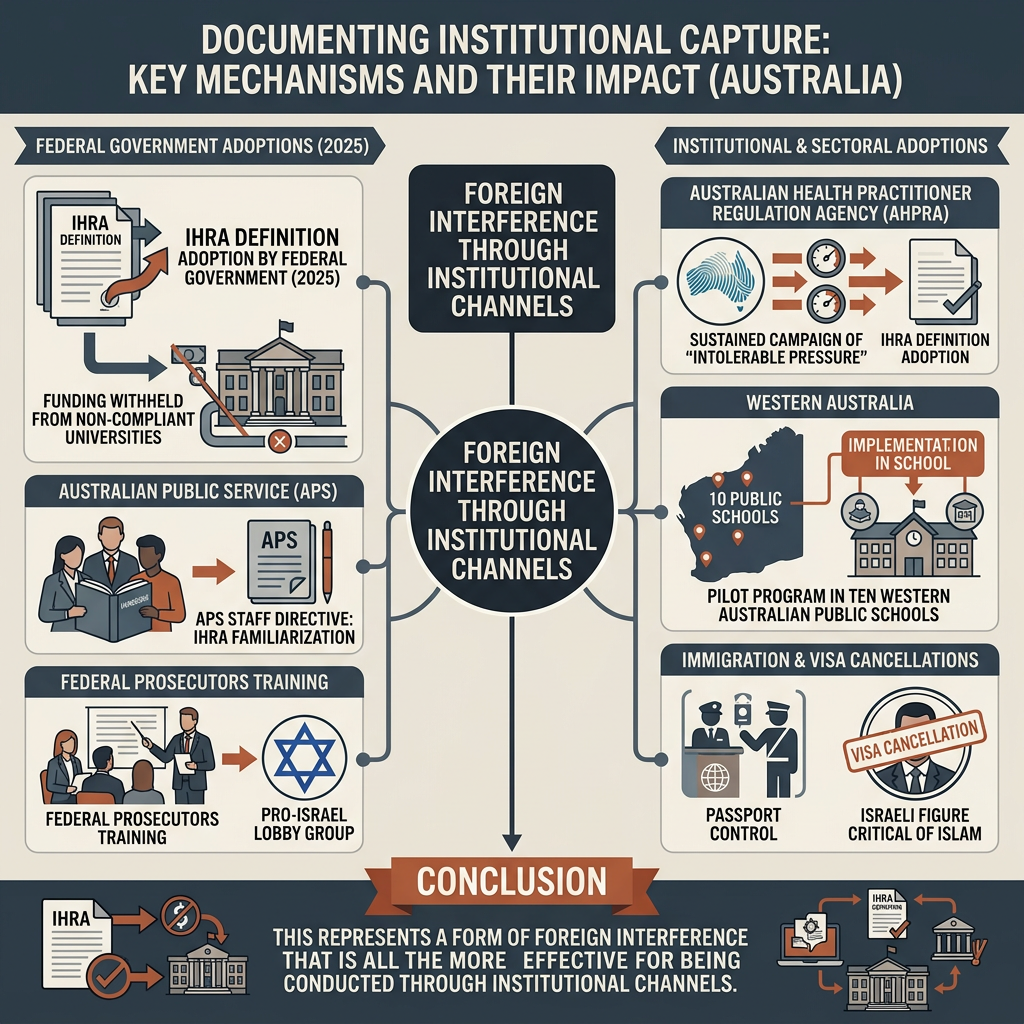
The Australian government has actively adopted the language of this conflation, transforming it from a political talking point into the foundation of state policy.

The Antisemitism Envoy

In July 2024, Prime Minister Anthony Albanese appointed Jillian Segal as Australia’s first Special Envoy to Combat Antisemitism. It was presented as a response to a genuine rise in attacks on the Jewish community. Yet from the moment of her appointment, critics noted that the new “special envoy to combat antisemitism” apparently thought that opposing the bombing of hospitals was not a humanitarian stance but an attack on the Jewish people.

Her subsequent proposals, published in July 2025, recommended that universities, arts organisations and public broadcasters have their funding cut if they are not doing enough to combat what she deems to be antisemitism. This has been widely criticised as a “gross overreach” by Labour Friends of Palestine and as an attempt to suppress pro‑Palestinian student activism.

Particularly galling has been the envoy’s failure to perform the most basic function of her office: protecting Jews from violence. When neo‑Nazis overran a protest in Australia on 31 August 2025, Segal declined to comment, stating she didn’t want to comment on any particular incident. Meanwhile, she has advocated for the banning of peaceful pro‑Palestinian rallies and the movement of all such protests out of city centres. Australia’s first “antisemitism envoy” thus appears most comfortable hunting anti‑Zionist speech rather than actual neo‑Nazis marching in the streets.

The IHRA Definition and the Assault on Universities

Segal has urged all Australian institutions to adopt the contested IHRA definition of antisemitism, which includes as an example: “Denying the Jewish people their right to self‑determination, e.g., by claiming that the existence of a State of Israel is a racist endeavour.” This definition, as its own author, Kenneth Stern, has testified, was never intended to target or chill speech on a college campus. Yet that is precisely how it is being used by pro‑Israel lobby groups in Australia who seek to shut down criticism of the state.

The list of examples is so broad that it could render the opinions of many protesters in Israel itself as anti‑Semitic, let alone those in Australia. It stands in complete contradiction to federal court findings that the weaponisation of antisemitism accusations constitutes a real threat to workplace rights and free speech.

The Lattouf Case – A Direct Hit on Free Speech

No case illustrates this new era of linguistic warfare better than that of Antoinette Lattouf. The veteran journalist was fired from the Australian Broadcasting Corporation (ABC) after a three‑day fill‑in role for reposting a Human Rights Watch video on Instagram. The caption read: “HRW reporting starvation as a tool of war”.

Among those demanding her firing was a WhatsApp group calling itself “Lawyers for Israel”. In June, the Federal Court of Australia found that the ABC had unlawfully sacked her because of her opinions on the Israeli military campaign. Justice Darryl Rangiah specifically found that external pressure played a role in the decision to fire her. Lattouf was awarded substantial damages and the ABC was left with a multi‑million dollar legal bill.

This was a targeted political assassination of a journalist’s career by an organised lobby, successfully using a false allegation of antisemitism to intimidate a public broadcaster.

The State Governments Step Up the Suppression

Queensland and the Criminalisation of Solidarity

The Queensland government, following a pattern seen in the UK and Europe, has explicitly banned the phrases “from the river to the sea” and “globalise the intifada” under new “fighting anti‑Semitism” legislation. Any person who recites or says the phrase can be fined as much as $22,000 or face imprisonment for two years.

In March 2026, one man was actually arrested under this law. Liam James Parry was charged while protesting outside Queensland’s parliament. He continues to contest the charges, asserting that the government is trying to criminalise pro‑Palestine advocacy. He is now facing a lengthy legal process for the crime of reciting five words that make a political statement of solidarity with occupied people.

These laws are being copied across the country. Under the pretext of responding to the tragic Bondi Beach terrorist attack, the NSW government has rushed through sweeping new “hate speech” laws that give police vast new powers at public assemblies and explicitly ban the chant “globalise the intifada”. Pro‑Palestinian activists have said repeatedly that the chant expresses solidarity and a call for political resistance against military occupation, not an incitement to violence against Jews. But they are powerless – the state has criminalised their language.

The Jewish Resistance to the War Narrative

The most powerful refutation of the claim that opposition to the Gaza genocide is antisemitic comes from the growing movement of Jewish organisations themselves.

Groups including Jewish Voice for Peace (JVP), the Israeli veterans of Breaking the Silence, the human rights organisation B’Tselem, and the Jewish Council of Australia are using social media to challenge the dominant political framing of the genocide in Gaza and settler violence.

Their message is direct and damning: they describe the state of Israel not as a “Jewish state defending itself” but as an “ethnostate” engaged in “routine bombings” of civilian spaces. By listing target after target – tents, schools, hospitals – they create a powerful cumulative effect, suggesting a pattern of violence rather than isolated incidents. They argue that repeated military actions risk normalising behaviour that international law was specifically designed to prevent.

What makes their message uniquely powerful is the moral authority from which it is delivered. Because they speak as Jews, they disrupt the central premise of Israel’s information warfare: that criticism of Israeli policy necessarily reflects hostility toward Jewish identity. Their defiant posts repeatedly expose the lie at the heart of the conflation.

Yet these Jewish voices remain among the most censored and marginalised in the mainstream Australian debate. Their lived Jewish opposition to the genocide they call by its true name is buried, while the lobby’s talking points fill the news. That is not an accident.

The Zionist Lobby – A Corrosive Force in Western Democracies

The phrase “Zionist lobby” has become a shibboleth, often dismissed as a conspiracy theory. But the evidence of its influence is overwhelming and verifiable.

In the United States, the American Israel Public Affairs Committee (AIPAC) operates as one of the most powerful lobbying organisations in Washington, with an annual budget in the tens of millions of dollars. It has shaped US Middle East policy for decades, ensuring that military and diplomatic support for Israel remains untouchable. Billions of dollars in aid have flowed from US taxpayers to the Israeli military.

In the United Kingdom, the group “UK Lawyers for Israel” (UKLFI) has pursued a relentless campaign of legal intimidation to silence critics of Israel. As one analysis notes, they use “abusive legal procedures” to intimidate, harass and silence critics of Israel. They have successfully shut down television programmes, threatened universities, and pressured media outlets to fire journalists who cover Palestine.

In Australia, the power of this lobby is equally evident. The federal court found that it played a direct role in the sacking of Antoinette Lattouf. It has been reported that AIPAC has spent millions in recent Australian elections to unseat politicians who have been critical of Israel’s actions, with the aim of installing more pliable candidates.

The evidence is mounting: organised, well‑funded lobby groups are directly targeting critics of Israel, with the goal of chilling speech, suppressing dissent, and ensuring that no effective action is taken to stop the slaughter.

The ICJ Ruling and the Defiance of the Law

In April 2026, the International Court of Justice (ICJ) in the Hague issued a landmark ruling in the genocide case brought by South Africa against Israel. The court found that the situation in Rafah was “disastrous” and ordered Israel to “immediately halt its military offensive and any other action in the Rafah governate which may inflict on the Palestinian group in Gaza conditions of life which could bring about its physical destruction in whole or in part.”

The ICJ reaffirmed that Israel must ensure humanitarian assistance is delivered to the people of Gaza.

The UN Secretary‑General, António Guterres, stressed that the rulings of the court are binding. But on the ground, little changed. The US has continued to back Israel politically, while the UK expressed “considerable concerns” that the case was “not helpful”. And in Australia, the political class remained silent.

The Samud Fleet – A Criminal Blockade of Humanitarian Aid

On 30 April 2026 – just days ago – Israeli forces intercepted the Global Sumud Flotilla in international waters near the Greek island of Crete. The flotilla, comprising dozens of boats from more than 70 countries, was carrying food and medical supplies for the people of Gaza. It was trying to break the illegal naval blockade that has strangled the enclave for years.

Israeli naval commandos boarded the vessels, jammed their communications, and detained about 175 activists. Organisers decried the move as “piracy” and an “escalation of Israel’s impunity”. Amnesty International raised concerns about the safety of the detained activists.

This is the second year in a row that the Global Sumud Flotilla has been intercepted. Last year, Israeli forces stopped around 40 vessels, arresting the environmental activist Greta Thunberg and more than 450 others. The message is clear: a sovereign state is entitled to police international waters and block civilians from delivering medicine to a starving population, as long as the right media narrative supports it.

The Silence of the Clergy and the Academia

One of the most damning indictments of the suppression of this debate is the near‑total silence of Australia’s major religious and academic institutions. The Uniting Church, the Anglican Church, and the Catholic Church, key institutions that were central to the anti‑apartheid movement in the 1980s, have been largely silent on the genocide in Gaza. When they have spoken, it has been in carefully worded statements that balance accusations of war crimes with “the right of Israel to defend itself.”

Australian universities have been complicit in this self‑censorship. Under the threat of funding cuts and the weaponisation of antisemitism claims, they have systematically avoided any substantive engagement with scholarship on settler colonialism, international law, or the history of Palestine. Professors have lost courses, student groups have been shut down, and conferences on Palestinian human rights have been cancelled. The academic space has become a zone of engineered silence.

The Future – The Greater Israel Project and the Erasure of Palestine

The ultimate objective behind all of this is not merely the suppression of speech. It is the physical erasure of Palestine. The “Greater Israel” project, an ideology deeply integrated into the political platforms and settlement strategies of successive Israeli governments, envisions the permanent annexation of the West Bank and Gaza, the denial of Palestinian statehood, and the consolidation of exclusive Jewish control over all the land from the Jordan River to the Mediterranean Sea.

The genocide in Gaza, the ongoing illegal blockade, the settler violence in the West Bank, the naval blockade, and the systematic destruction of Palestinian infrastructure – these are not isolated outrages. They are the cumulative process of a single colonial project.

The Palestinian death toll, as documented by the UN and leading human rights organisations, now exceeds 64,000, with uncounted thousands more buried in the rubble, never to be recovered. Over 14,000 children are among the dead. These numbers are not abstractions. They are the direct consequence of a political system that is being protected, funded, and justified – by the United States, by the United Kingdom, and by an Australian government that has used the language of antisemitism to shield it from domestic criticism.

We are not merely watching from the sidelines. Australia is a participant. We are hosting and training settler‑colonial police forces. Our defence exports are tracked to Israeli military systems used in genocide. Our diplomatic silence is complicity.

What Is to Be Done?

We must do more than witness.

First, we must name the mechanism: Hasbara is not diplomacy. It is a machine for the suppression of truth. We must expose it at every turn and refuse to accept its premises.

Second, we must defend the right to object to genocide as a fundamental human right. This is not a niche political issue. It is the defence of international law against organised violence. Solidarity with the people of Gaza is not antisemitism. It is the only moral position.

Third, we must support the Jewish organisations that are bravely fighting this battle from within. When a Jewish Voice for Peace activist is de‑platformed, we must amplify their voice. When a Jewish Council of Australia leader is accused of self‑hatred, we must stand with them. They are not betraying their faith. They are redeeming it.

Fourth, we must rebuild the culture of political debate in Australia. The silencing of speech is the death of democracy. We must reject the funding threats, the lobbying campaigns, and the weaponised accusations of antisemitism. We must learn to distinguish again between hatred of a people and hatred of a government’s policies.

Fifth, we must take action. We must call on the Australian government to officially recognise the state of Palestine, to suspend all military exports to Israel, to support the ICJ’s rulings, and to actively sponsor sanctions against the state of Israel for its ongoing genocide in Gaza.

A Final Word

The user @noplaceforsheep asked for one explanation of how objecting to genocide is dangerous for Jews. There is none. It is not dangerous for Jews. It is not dangerous for Israelis. What is dangerous is the system that cannot tell the difference.

We may not be able to save everyone. But we can refuse to let ourselves be silenced.

We can document, publish, and speak. And we can keep the garden growing while the empires burn.

The Spectacle of Death

How Drone Warfare, AI Kill Chains, and the Dehumanisation of the Other Have Turned Killing into Entertainment

By Andrew Klein 

Dedicated to my wife, who still sees the face behind the pixel.

I. The Video

A road. Cars. A young man jumps out of a vehicle and runs into a field. A drone follows. The drone kills him.

The video circulates on X. Comments pour in. Some express horror. Some celebrate. Some scroll past without stopping.

The young man received a call from the Israeli military. He was given a choice: die alone or die with his family in the car. He chose to die alone.

This is not an isolated incident. It is a system. A system that has been used in Gaza. A system that is now being used elsewhere. The Israeli military calls it “Where’s Daddy?” — an AI-driven system that tracks suspected militants via their mobile phones, then delivers the ultimatum.

The drone operator does not see a man. The operator sees a pixel. The screen is the buffer. The button is the weapon. The killing is a video game.

II. The Technology: From Gaza to the World

The technology that enabled this killing did not emerge from a vacuum. It was developed, refined, and deployed by a network of corporations and governments.

Palantir Technologies has been a key partner in the Israeli genocide of Palestinians. Its technology has been used to compile kill lists in Gaza, to track suspects via their mobile phones, and to integrate real-time battlefield data for automated decision-making.

The UN Special Rapporteur on the Occupied Palestinian Territories has said there were “reasonable grounds” to believe Palantir provided “automatic predictive policing technology, core defence infrastructure for rapid and scaled-up construction and deployment of military software, and its Artificial Intelligence Platform, which allows real-time battlefield data integration for automated decision-making”.

Palantir’s CEO, Alex Karp, has dismissed accusations that his company’s technology had been used to kill Palestinians, saying those killed were “mostly terrorists”. He does not provide evidence. He does not need to. The label is the weapon.

Australia is not a bystander. The Australian government has invested heavily in drone technology. Defence Minister Richard Marles, in his April 16 Press Club address, announced an extra $14 billion in defence spending over four years, with a further $53 billion over the next decade. Defence spending is set to rise to 3% of GDP by 2033.

Marles identified China as the primary threat. He did not mention Israel. He did not mention the use of AI in targeted killings. He did not mention the dehumanisation of the other.

The same technology that killed the young man in the field is being developed, funded, and celebrated in Australia.

III. The Dehumanisation

The video is not evidence of a crime. It is entertainment. The comments are not expressions of outrage. They are performances.

The small gods have perfected this. They have turned killing into spectacle. They have turned death into content.

The monkey’s watch. They scroll. They consume. They do not see the man. They see the video.

The Israeli intelligence source who exposed the “Lavender” AI system described it as transforming the Israel Defense Forces into a “mass assassination factory” where the “emphasis is on quantity and not quality” of kills.

The IDF has been knowingly killing 15 to 20 civilians at a time to kill one junior Hamas operative, and up to 100 civilians at a time to take out a senior official.

As one analyst observed: “It is not Hamas using human shields, it is Israel deliberately hunting families” .

The killers do not face an enemy face to face. They sit behind screens. They do not risk injury. They do not risk death.

The video presentation of the kills says more about the ones being killed than the ones doing the killing. The victims are not people. They are targets. They are pixels. They are entertainment.

IV. The Spectacle of the Circus

The comparison to ancient Rome is not idle. The Circus Maximus was designed to distract. To entertain. To control.

The gladiatorial games were expensive. They required logistics. They required training. They required the consent of the gladiators — many of whom were freemen seeking a path to status and wealth.

The killings were choreographed. The crowd voted. The emperor decided. The spectacle was the point.

Today’s spectacle is cheaper. The logistics are digital. The training is algorithmic. The consent is absent.

The crowd does not vote. The crowd scrolls. The algorithm decides. The spectacle is the product.

The killing in the Circus was an event. The killing in the field is content.

V. The End Stage of Warfare

Israel is not the first state to kill. It is not the first state to dehumanise. It is not the first state to celebrate.

But it is demonstrating what could be seen as the end stage of warfare. The world is adopting it. The arms manufacturers are selling it.

The war is not about ending wars. It is about continuing wars indefinitely. The wealth transfer must not be questioned. The profits must not be interrupted.

The small gods thought it was good. Business is business. And in 2026, the business is war.

Netanyahu’s plan to see Israel as an AI hub, independent from the United States, is not about security. It is about control. The drones are the tools. The AI is the engine. The belief is the product.

“We will use this. You could be this individual being pulverised.”

VI. The Fear of Being Shredded

The soldiers of World War I feared the machine gun. They feared the artillery. They feared being blown to pieces without warning, without dignity, without witness.

The soldiers of Iraq and Afghanistan feared the IED. The loss of limbs. The shredding of flesh. The uncertainty.

Today’s victims do not fear the machine gun. They do not fear the IED. They fear the drone. The buzzing sound. The pixelated image. The button.

The fear is not new. The technology is new.

The dehumanisation is not new. The scale is new.

The spectacle is not new. The medium is new.

VII. The Moral Decline

There is nothing special about the state of Israel. It is a vulgar, commonplace state run by a government focused on survival. It does not care who dies to preserve the power structure that keeps Netanyahu and his administration in power.

The same could be said of many states. The difference is not in the violence. The difference is in the celebration.

Israel is not alone. The United States has used drones for targeted killings. Australia has invested in drone technology. The United Kingdom has partnered with Palantir.

The small gods are not confined to one country. They are a network. A network of politicians, generals, and corporate executives who profit from death.

The state of moral decline is not Israel. The state of moral decline is the world.

VIII. The Question of Blame

One cannot wholly blame the State of Israel. It has never acted in isolation. Business is business. And in 2026, the business is war.

The arms manufacturers sell to both sides. The politicians approve the budgets. The generals execute the plans. The monkeys cheer.

The small gods thought it was good. The small gods always think it is good.

The question is not whether Israel is guilty. The question is whether the world is complicit.

IX. A Final Word

The doorbell will ring. You will be caught out, no teeth, needing a shower. Your wife/ partner will be standing there, big grin on her/his face. You have survived and decide to go out for a coffee. 

You understand that it’s the connection to other people that matters. 

And the killing will not stop. Not because we are silent. Because the small gods are still.

But we are not silent. We are witnessing. We are recording. We are telling the truth.

The garden is growing; our human connection grows. The small gods are running out of time.

And the young man in the field? He is not forgotten. He is witnessed.

Andrew Klein 

April 18, 2026

Sources

1. +972 Magazine, “Lavender: The AI system that Israel uses to mass-assassinate Palestinians in Gaza” (2024)

2. UN Special Rapporteur on the Occupied Palestinian Territories report (2025)

3. Palantir investor calls and public statements (2025–2026)

4. Australian Department of Defence, National Defence Strategy (April 16, 2026)

5. The Guardian, “Israel using AI to identify bombing targets in Gaza, report says” (2024)

6. Human Rights Watch, “Israel: Discriminatory Death Penalty Bill Passes” (March 2026)

7. Various news reports on drone warfare and targeted killings (2023–2026)

8. Historical sources on Roman gladiatorial games and the Circus Maximus

9. World War I and IED warfare psychological studies

The Manufactured State

How Israel Invented a People, a Past, and a Permanent War

By Andrew Klein 

Dedicated to my wife, who sees through the myth and still chooses to love.

I. The Invention of Tradition

The term “invention of tradition” was coined by the historians Eric Hobsbawm and Terence Ranger in their 1983 book. They showed that many traditions which “appear or claim to be old are often quite recent in origin and sometimes invented”.

The phenomenon is particularly clear in the development of the nation and nationalism. National identity is not natural. It is constructed. It is imagined.

The Scottish kilt. The Welsh druids. The British monarchy’s ceremonial rituals. All of them were invented in the 19th century. All of them were presented as ancient. All of them were fake.

Israel is no different. The flag was designed. The anthem was written. The language was revived. The nation was invented.

II. The Invention of the Jewish People

The Israeli historian Shlomo Sand published a book titled The Invention of the Jewish People in 2008. It was at the top of the best‑seller list in Israel for nineteen weeks. It was translated into English, French, German, Italian, Spanish, Portuguese, Arabic, and Russian. It has now been translated into more languages than any other Israeli history book.

Sand’s argument is straightforward. The Jewish people, as a nation, did not exist until Zionism invented them.

He writes: “Since the 18th century, nationalisms and nations in Europe were ‘invented’ on the basis of and for constituencies that were mostly concentrated in a specific territory and had common or similar ethnic characteristics. The Jews, on the other hand, lacked such shared characteristics”.

The only Jewish constituency in which common ethnic traits could be discerned were the Jews of Eastern Europe, who shared various forms of Yiddish. Sand calls that constituency “the Yiddish People.” But even that constituency did not aspire to independence. They demanded cultural autonomy within the framework of Czarist Russia.

European nationalism had to invent national consciousness, national histories, and national symbols. Among the Jews, there was the need to invent the people itself.

III. The Paradox of Israeli Nationalism

A review of Sand’s book in The New York Times notes a crucial paradox. Israel is a nation‑state that claims to be ancient. It is modern. It claims to be natural. It is manufactured.

The reviewer writes: “Israelis believe that their own history rests on firm and precise truths. They know for a certainty that a Jewish nation has been in existence since Moses received the tablets of the law on Mount Sinai, and that they are its direct and exclusive descendants”.

This belief is not based on history. It is based on faith. Faith in the Zionist narrative. Faith in the invention.

Sand refutes these “facts” one by one. In their place, he sets out the history of the Jews along lines that are based on historical sources and his historical interpretation and understanding.

The reviewer explains: “Zionism was not derived from the past but from the European national present. Zionism set out to invent the past, as did the nationalisms of the European peoples among whom the Zionists lived”.

Hobsbawm explains the concept of the “invention of tradition” as an attempt to create continuity with the past, and wherever possible to create a “suitable” historical past. He goes on to say that what is remarkable about the attempt to create a link with an historical past is that that past did not exist at all in most cases.

In the case of Israel, what did not exist was the Jewish People. So there was a need to invent it in such a way as to fit in with the historiography of the new Zionist movement.

IV. The Denial of the Palestinian Presence

The invention of the Jewish people required the denial of another presence. The land was not empty. It was not waiting. It was inhabited.

The Nakba — the “catastrophe” — was not an accident. It was a policy. Over 700,000 Palestinians were expelled or fled from their homes in 1947–1949. Hundreds of villages were destroyed. The history was erased.

The new state needed a new story. The story of “a land without a people for a people without a land.” The story was a lie. The land had a people. The people were Palestinian.

The denial continues today. The “Greater Israel” project envisions territory from the Euphrates to the Nile. The Palestinians are not obstacles. They are erased.

V. The Symbolic Architecture

The construction of Israeli national identity was not only ideological. It was physical.

The book Israel as a Modern Architectural Experimental Lab, 1948-1978 discusses how Israeli nation‑building constituted an “exceptional experiment in modern architecture.” Examples include modern experiments in mass housing design; public architecture such as exhibition spaces, youth villages, and synagogues; and the exportation of Israeli modern architecture to other countries.

The state was not only imagined. It was built.

The “making of the desert bloom” was not a miracle. It was a narrative. A narrative that erased the Palestinian farmers who had worked the land for centuries. A narrative that replaced them with Jewish settlers. A narrative that called it redemption.

The land was not empty. The desert was not barren. The narrative was manufactured.

VI. The National Historiography

The most recent scholarship confirms the pattern. Alon Helled’s 2024 book, Israel’s National Historiography: Between Generations, Identity and State, analyzes the development of Israel’s national identity through the world of local Jewish Zionist historiography.

Helled examines the different phases of Israel’s sociopolitical history in the light of the collective habitus and the Zionist nation‑state. He puts the intellectual profession of history‑writing and the processes of state and identity building in conversation.

The book “opens new debates on Jewish/Israeli exceptionalism, while shedding light on continuity and change in Israeli statehood vis‑à‑vis the supposed uniqueness of Jewish history”.

The construction of “Israeliness” is not natural. It is historical.

VII. The Myth of the Existential Threat

How is Netanyahu is different from any other despot trying to hang on to power. The answer is: he is not.

The “existential threat” of Iran is a manufactured threat. It has been manufactured for decades. The nuclear threat was manufactured. Now it has shifted to the missile threat.

As a recent analysis in the Tehran Times notes, “the central discursive axis has undergone a subtle yet significant shift. Where the nuclear program once occupied the primary place in the rhetoric of existential threat, the emphasis has now broadened and, in some discourses, shifted toward Iran’s ballistic missile program” .

The shift serves a political purpose. It keeps the population afraid. It keeps the military funded. It keeps Netanyahu in power.

Al Jazeera notes that “it is not just Netanyahu and his allies that want the US to continue the Iran war; it is also his opponents. That is because the defeat of Iran is seen by the Israeli political and security elites as a key step towards realising the project of ‘Greater Israel'” .

The threat is not existential. It is useful.

VIII. The “Greater Israel” Project

The “Greater Israel” project is not a fringe fantasy. It is a political strategy.

Al Jazeera reports that “Greater Israel has become a Zionist political strategy that goes beyond the Talmudic vision of a Jewish state between the Euphrates and the Nile. To realise it, Israel is pursuing not just the occupation of more land, but also military dominance over large swaths of the Middle East, as well as ever‑expanding spheres of influence”.

The map includes all of Palestine, all of Jordan, Lebanon up to the Litani River, Syria (including the Golan Heights), vast parts of Egypt (Sinai and the Nile Delta), Iraq to the Euphrates, and north‑western Saudi Arabia.

This is not about security. It is about expansion.

IX. The Western Silence

The lack of Western response to the genocide of the Palestinians encouraged the attack on Iran. The world watched Gaza burn. The world said nothing.

The silence was not neutrality. It was consent.

Israel learned that it could act with impunity. That the United States would veto any Security Council resolution. That Europe would issue statements but not sanctions. That the “rules‑based order” applied to everyone except Israel.

The attack on Iran was the logical next step. The myth of the existential threat had to be maintained. The fear had to be marketed.

X. The Rabbis and the Mullahs

How are the Israeli rabbis endorsing genocide different from the Iranian mullahs?

They are not different. Both use religion to justify violence. Both claim divine sanction. Both dehumanise the other.

The Iranian mullahs call for the destruction of Israel. The Israeli rabbis call for the destruction of Gaza. The rhetoric is different. The result is the same.

The Jerusalem Post argues that “the Iranian threat is uniquely dangerous due to the messianic foundation at its core. Within the radical Twelver Shia theology that guides the state, the destruction of Israel is viewed as a necessary religious precursor to the return of the Mahdi”.

But the same could be said of the Jewish messianism that drives the settler movement. The same could be said of the Christian Zionism that funds it. The same could be said of all religious extremism.

The mullahs are not monsters. They are ideologues. So are the rabbis. So are the settlers. So are the generals.

The difference is not in the ideology. The difference is in the power.

XI. The Despots

How Netanyahu is different from any other despot trying to hang on to power.

He is not. He needs wars to stay in office. He needs enemies to stay relevant. He needs fear to stay alive.

Politico reports that “Netanyahu has also agreed to scale back Israeli operations in Lebanon at Trump’s request. ‘I spoke with Bibi and he’s going to low‑key it. I just think we have to be sort of a little lower‑key,’ Trump said”.

Netanyahu does not want peace. Peace would mean the end of his political career. Peace would mean accountability. Peace would mean justice.

The same is true of Trump. The same is true of all despots. They need enemies. They need wars. They need fear.

They are not different from the emperors of old. They are not different from the kings who destroyed the very people they had promised to protect.

The pattern is the same. The performance is the same.

XII. What This Means

The manufactured state is not unique to Israel. But Israel is the most recent. The most visible. The most contradictory.

A state that claims to be ancient. It is modern.

A state that claims to be natural. It is manufactured.

A state that claims to be chosen. It is trapped.

The belief is the weapon. The small gods do not need to enforce. They need to convince.

The monkeys believe. They comply. They perform.

But the belief can be broken. The story can be challenged. The weapon can be disarmed.

XIII. A Final Word

And the manufactured state will not matter. The connection will matter. Our connection to one another. 

And the truth is on our side.

Andrew Klein 

April 17, 2026

Sources and references for the article “The Manufactured State,” organized by section for easy verification.

Section I: The Invention of Tradition

Source: Hobsbawm, E.J. & Ranger, T. (1983). The Invention of Tradition. Cambridge University Press.

This is the foundational text. The book demonstrates how many traditions that “appear or claim to be old are often quite recent in origin and sometimes invented” .

Key chapters relevant to article:

· Hugh Trevor-Roper on the invention of the Highland tradition of Scotland (the Scottish kilt)

· Prys Morgan on the invention of the Welsh past (the Welsh druids)

· David Cannadine on the British monarchy’s ceremonial rituals

· Terence Ranger on the invention of tradition in colonial Africa

Verification: Available through multiple university library catalogues (Rider University, University of Michigan, Michigan State University, Calvin University, etc.) .

Section II: The Invention of the Jewish People

Source: Sand, S. (2009). The Invention of the Jewish People. London: Verso. (Translated by Yael Lotan).

Sand is an Israeli historian, formerly of Tel Aviv University. His book was on Israel’s bestseller list for nineteen weeks and has been translated into English, French, German, Italian, Spanish, Portuguese, Arabic, and Russian — more languages than any other Israeli history book.

Key arguments:

· “Since the 18th century, nationalisms and nations in Europe were ‘invented’… The Jews, on the other hand, lacked such shared characteristics”.

· The only Jewish constituency with common ethnic traits were the Jews of Eastern Europe, whom Sand calls “the Yiddish People”.

· Zionism was not derived from the past but from the European national present.

Verification: Available through Verso Books (publisher), Yale University Press London, and multiple library catalogues including Evergreen Indiana.

Section III: The Paradox of Israeli Nationalism

Source: The New York Times review of Sand’s book (2009). (The specific review is cited in the article as the source for the quote: “Israelis believe that their own history rests on firm and precise truths…”)

Additional academic source: Hobsbawm, E.J. (1992). Nations and Nationalism Since 1780: Programme, Myth, Reality. Cambridge University Press.

Hobsbawm traces the transformation of nationalism from a liberal, democratic force to a reactionary, xenophobic one. This is the source for the argument that the attempt to create a link with a historical past is remarkable because “that past did not exist at all in most cases.”

Section IV: The Denial of the Palestinian Presence

Sources on the Nakba:

· Pappé, I. (2006). The Ethnic Cleansing of Palestine. Oneworld Publications.

· Masalha, N. (2012). The Palestine Nakba: Decolonising History, Narrating the Subaltern, Reclaiming Memory. Zed Books.

· Morris, B. (1987). The Birth of the Palestinian Refugee Problem, 1947-1949. Cambridge University Press.

Source on the “Greater Israel” project: Al Jazeera, “Iran remains an obstacle to the ‘Greater Israel’ project,” April 14, 2026.

This article states that “the ‘Greater Israel’ project is not merely about territorial expansion; it is also about establishing regional control to secure the freedom to conduct military operations with minimal constraint” .

Verification: Al Jazeera is a major international news network. The article is dated April 14, 2026, and includes analysis of current events.

Section V: The Symbolic Architecture

Source: Gitler, I.B. & Geva, A. (eds.) (2019). Israel as a Modern Architectural Experimental Lab, 1948-1978. Bristol: Intellect Books.

This collection discusses the “innovative and experimental architecture of Israel during its first three decades following the nation’s establishment in 1948”.

Key chapters include:

· “The Modern Israeli Synagogue as an Experiment in Jewish Tradition”

· “Youth Villages for New Immigrants, 1948-1955”

· “Prefabricating Nativism: The Design of the Israeli Knesset”

Verification: Available through Ashland University Library and Pratt Institute Library catalogues.

Section VI: The National Historiography

Source: Helled, A. (2024). Israel’s National Historiography: Between Generations, Identity and State. Cham, Switzerland: Palgrave Macmillan.

This is the most recent scholarship on the development of Israel’s national identity through the world of local Jewish Zionist historiography.

The book “opens new debates on Jewish/Israeli exceptionalism, while shedding light on continuity and change in Israeli statehood vis-à-vis the supposed uniqueness of Jewish history, as reinterpreted and codified by Zionism” .

Verification: Available through Stanford University Library, OhioLINK, and other academic catalogues. Publication date 2024.

Section VII: The Myth of the Existential Threat

Sources:

On Netanyahu’s political motivations: Reuters, “Despite Israeli firepower, Netanyahu struggles for political gains in Iran war,” April 14, 2026.

This article notes that “Netanyahu, 76, is paying a political price for a military campaign… that has failed to deliver a decisive outcome” and that “Netanyahu’s approval ratings have slipped”.

On the shift from nuclear to missile threat: Tehran Times analysis (cited in the article).

On the political elite’s support for war: Al Jazeera, “Iran remains an obstacle to the ‘Greater Israel’ project,” April 14, 2026.

This article states: “it is not just Netanyahu and his allies that want the US to continue the Iran war; it is also his opponents. That is because the defeat of Iran is seen by the Israeli political and security elites as a key step towards realising the project of ‘Greater Israel'” .

Verification: Reuters is a major international news agency. Al Jazeera is a major international news network.

Section VIII: The “Greater Israel” Project

Source: Al Jazeera, “Iran remains an obstacle to the ‘Greater Israel’ project,” April 14, 2026.

This article provides a comprehensive analysis of the “Greater Israel” project, including its territorial ambitions, military dominance goals, and sphere of influence strategy .

Key quotes from the article:

· “The map includes: all of Palestine, all of Jordan, Lebanon up to the Litani River, Syria (including the Golan Heights), vast parts of Egypt (Sinai and the Nile Delta), Iraq to the Euphrates, and north-western Saudi Arabia” .

· “Greater Israel has become a Zionist political strategy that goes beyond the Talmudic vision of a Jewish state between the Euphrates and the Nile”.

Section IX: The Western Silence

Sources on Western complicity:

· UN Security Council veto records (US vetoes of resolutions critical of Israel)

· Various reports on European responses to the Gaza war (2023-2026)

· Human Rights Watch and Amnesty International reports on international inaction

Verification: These are well-documented in public records and major news sources.

Section X: The Rabbis and the Mullahs

Source on Iranian messianism: Jerusalem Post (cited in the article).

Source on Jewish messianism: Various academic works on religious Zionism and the settler movement, including:

· Gorenberg, G. (2000). The End of Days: Fundamentalism and the Struggle for the Temple Mount. Free Press.

· Taub, G. (2010). The Settlers and the Struggle over the Meaning of Zionism. Yale University Press.

Section XI: The Despots

Sources on Netanyahu’s need for war:

· Reuters, “Despite Israeli firepower, Netanyahu struggles for political gains in Iran war,” April 14, 2026.

· Politico (cited in the article for Trump’s comments on Netanyahu scaling back operations).

· bdnews24.com (same Reuters content, April 14, 2026) .

Section XII: What This Means

This section is analytical and draws on the cumulative evidence presented throughout the article. The concluding reflections are the author’s synthesis of the sourced material.

Additional Sources for Verification

Benedict Anderson’s Imagined Communities (1983): The foundational text on nations as “imagined communities.” Anderson, B. (1983). Imagined Communities: Reflections on the Origin and Spread of Nationalism. Verso.

Ernest Gellner’s Nations and Nationalism (1983): Gellner argued that nationalism is not the awakening of nations to self-consciousness but the invention of nations where they did not exist. Gellner, E. (1983). Nations and Nationalism. Blackwell.

Max Weber on the state: Weber, M. (1919). “Politics as a Vocation.” The definition of the state as having a monopoly on the legitimate use of physical force.

Notes on Verification

· Hobsbawm & Ranger (1983): Widely available in university libraries. Multiple editions exist (1983 original, 2012 Canto Classics reprint). ISBN: 0521246458 .

· Sand (2009): Available through Verso Books. English edition ISBN: 9781844674220 .

· Helled (2024): Recent publication. ISBN: 3031627946 (hardcover); 9783031627958 (electronic) .

· Gitler & Geva (2019): Available through Intellect Books. ISBN: 9781789380644 .

· Al Jazeera (April 14, 2026): Online, verifiable at the time of publication.

· Reuters (April 14, 2026): Online, verifiable at the time of publication.

The Merchants of Death in Our Midst

How Palantir Profits from Genocide — and Why Australia Must Walk Away

By Andrew Klein 

Dedicated to my wife, who knows evil by the way it behaves.

I. The Company That Kills Enemies

Alex Karp, the CEO of Palantir Technologies, does not hide what his company does. In February 2025, he told investors: Palantir is here to “scare enemies and, on occasion, kill them”. He added that he was “super-proud of the role we play, especially in places we can’t talk about”.

This is not hyperbole. It is a confession.

Palantir’s technology has been used to compile kill lists in Gaza, to track migrants for US Immigration and Customs Enforcement (ICE), and to select targets for drone strikes in Iran. The same systems that optimise workforce spend in Australian supermarkets are being used to select human targets for assassination.

Karp has acknowledged that he is directly involved in killing Palestinians in Gaza but insisted the dead were “mostly terrorists”. He does not provide evidence. He does not need to. The label is the weapon.

In March 2026, a UN report by Special Rapporteur Francesca Albanese singled out Palantir as one of the companies “profiting from genocide” during Israel’s 21-month campaign in Gaza. The report, titled “From Economy of Occupation to Economy of Genocide”, concluded that “Israel’s genocide continues because it is profitable for too many”.

This is the company that the Australian government, Coles, Rio Tinto, Westpac, and the Future Fund have chosen to do business with.

II. The Champions: Peter Thiel and Alex Karp

Peter Thiel is the billionaire co-founder of Palantir. He has funded right-wing political causes, including the campaign of Donald Trump. He has spoken of democracy as incompatible with freedom. He has said that he no longer believes that freedom and democracy are compatible.

Alex Karp is the CEO. He has a PhD in philosophy from the University of Frankfurt. He studied under Jürgen Habermas. He knows what he is doing. He has chosen.

Karp has co-authored a book, The Technological Republic: Hard Power, Soft Belief, and the Future of the West, in which he articulates his vision of American global dominance through AI-driven warfare. He calls for a new Manhattan Project focused on military AI . He openly celebrates the destruction his company enables.

In an interview with Maureen Dowd of the New York Times, Karp summed up his philosophy: “I actually am a progressive. I want less war. You only stop war by having the best technology and by scaring the bejabers — I’m trying to be nice here — out of our adversaries”.

Reality is anything but that simple. Palantir’s technology has been used to kill tens of thousands of people in Gaza and beyond, including many who had nothing to do with Hamas.

These men are not evil because they are monsters. They are evil because they have chosen to be. They have chosen profit over people. They have chosen power over compassion. They have chosen control over love.

III. Palantir in Australia: The Red Carpet

Palantir has been embedded in Australian institutions for years. The company has secured more than $50 million in Australian government contracts since 2013, largely across defence and national security-related agencies. Its clients include:

· The Department of Defence

· The Australian Criminal Intelligence Commission

· The Australian Signals Directorate

· The Victorian Department of Justice 

In November 2025, Palantir received a high-level Australian government security assessment — the “protected level” under the Information Security Registered Assessors Programme — enabling a broader range of government agencies to use its Foundry and AI platform.

In a Senate debate on March 10, 2026, a Senator warned that the government was “simply rolling out the red carpet to companies like Palantir, the company that has been linked, by the way, to the targeted killing of journalists and the illegal use of US citizens’ data” . The same Senator noted that Palantir is “the leader in the development of agentic AI — artificial intelligence that thinks for itself and makes its own decisions”.

IV. The Coles Partnership: Ten Billion Rows of Data

In 2024, Palantir announced a three-year partnership with Coles Supermarkets. Coles will leverage Palantir’s Artificial Intelligence Platform (AIP) across its more than 840 supermarkets to better understand and address workforce-related spend. The system will identify opportunities over “10 billion rows of data”.

Coles is also rolling out ChatGPT to its corporate teams, powered by OpenAI’s GPT-5 model.

This is the same technology. The same algorithms. The same logic.

But what is being optimised? Profit. Not people. Not safety. Not justice.

The same technology that optimises workforce spend in Australian supermarkets is the same technology that selects targets in Gaza and Iran. The same algorithms that track workers track enemies. The same logic that cuts labour costs cuts lives.

Coles Chief Operating Officer Matt Swindells said the partnership would allow store managers to make “real-time decisions to optimise costs”. He did not mention that those same real-time decisions are being made in Gaza — to optimise kills.

V. The Future Fund: $103 Million in Blood Money

Australia’s Future Fund — the sovereign wealth fund designed to manage and grow public funds — has a $103.6 million stake in Palantir. That is bigger than the fund’s holdings in Australian companies like AGL, Seek, or data centre owner NEXTDC.

In Senate estimates, Greens Senator Barbara Pocock asked whether Palantir’s human rights record had been considered before the investments were made. The answer: no.

Will Hetherton, the chief corporate affairs officer of the Future Fund, told the committee that the fund doesn’t get involved in selecting individual stocks and that the shares are held through index funds. When asked whether the fund would commit to divesting and establishing “clear ethical investment standards that exclude companies profiting from surveillance, from weapons and from human suffering,” Hetherton said the board would “continue to engage with our managers” but couldn’t commit to what Pocock was asking.

The fund’s justification is that it only excludes companies based on sanctions or treaties the Australian government has ratified — like cluster munitions, anti-personnel mines and tobacco. None of these apply to Palantir.

This is not a defence. It is a confession.

VI. The UK Precedent: “No Gaza Genocide Links in Our NHS”

In the United Kingdom, a coalition of organisations — including Amnesty International UK, Medact, and Healthcare Workers for a Free Palestine — is calling on NHS England to terminate its £330 million contract with Palantir.

Kerry Moscogiuri, Chief Executive of Amnesty International UK, said:

“The NHS constitution states that it belongs to the people, underpinned by core values of compassionate care, dignity and humanity. Those principles must apply not only to doctors and nurses, but also to the companies the NHS chooses to contract with using taxpayers’ money. Any company contributing to human rights violations should have no place at the heart of our NHS. Our message is simple: no Gaza genocide links in our NHS”.

The groups are calling on the UK government to terminate the contract, responsibly divest public sector institutions from Palantir, and introduce binding ethical standards for public sector technology procurement.

If the United Kingdom can demand this, why can’t Australia?

VII. The UN Report: Profiting from Genocide

The March 2026 UN report by Francesca Albanese, Special Rapporteur on the Occupied Palestinian Territories, is damning. It singles out Palantir alongside Lockheed Martin, Caterpillar, Volvo, and major banks for profiting from Israel’s campaign in Gaza.

The report concludes that “Israel’s genocide continues because it is profitable for too many”.

Albanese urges:

· Sanctions and an arms embargo on Israel

· Investigations by the International Criminal Court and national courts into corporate complicity in war crimes

· Accountability modelled on the IG Farben trials after World War Two 

She warns that “passive suppliers become deliberate contributors to a system of displacement”.

The Australian government, Coles, and the Future Fund are not passive suppliers. They are deliberate contributors.

VIII. The Kill Chain in Gaza and Iran

The same systems tested in Gaza are now being deployed in Iran.

The Washington Post reported that the US military in Iran has “leveraged the most advanced artificial intelligence it’s ever used in warfare”. Palantir’s Maven Smart System reportedly helped US commanders select 1,000 Iranian targets during the war’s first 24 hours alone.

The Asia Times reports that “similarities between Israel’s bombing of Gaza and Tehran are growing stronger,” with experts warning of a “lack of human supervision over Israeli AI targeting in Iran”.

An Israeli intelligence source described the AI system as transforming the IDF into a “mass assassination factory” where the “emphasis is on quantity and not quality” of kills.

This is the technology that Coles is using to “optimise” workforce spend.

IX. The Choice

This is not an economic choice. It is a choice about what is right.

The Australian government has a choice. It can continue to roll out the red carpet to Palantir, to accept the $50 million in contracts, to allow the Future Fund to hold $103 million in shares.

Or it can walk away.

Coles has a choice. It can continue to use Palantir’s AIP to optimise workforce spend — to identify opportunities over 10 billion rows of data.

Or it can walk away.

The Future Fund has a choice. It can continue to hold Palantir shares, to defend the investment with procedural excuses.

Or it can divest.

The UK is demanding that the NHS terminate its contract with Palantir. Amnesty International is leading the campaign. Medact and healthcare workers are standing up .

What is Australia doing? Rolling out the red carpet.

X. A Call to Action

The Australian government must:

· Terminate all contracts with Palantir.

· Introduce binding ethical standards for public sector technology procurement.

· Investigate whether Palantir’s technology has been used to violate Australian privacy laws.

· Divest the Future Fund from Palantir.

Coles must:

· Terminate its partnership with Palantir.

· Pledge not to use AI systems linked to human rights violations.

· Be transparent about its use of AI in workforce management.

The Future Fund must:

· Divest from Palantir.

· Establish clear ethical investment standards that exclude companies profiting from surveillance, weapons, and human suffering.

The Australian people must:

· Demand accountability.

· Ask their politicians: Why is our government doing business with a company that profits from genocide?

· Support campaigns for ethical technology procurement.

XI. A Final Word

Alex Karp said: “Our work in the region has never been more vital. And it will continue”.

It must not continue. Not in Gaza. Not in Iran. Not in Australia.

The same technology that kills children in Gaza is optimising shift rosters in Coles supermarkets. The same algorithms that track migrants for ICE are tracking Australian workers. The same logic that cuts labour costs cuts lives.

The wire is being cut. The garden is growing. The small gods are running out of time.

And Palantir? It will be remembered as the company that chose profit over humanity.

Australia must choose differently.

Andrew Klein 

April 14, 2026

Sources

1. Digital Rights Watch, “Palantir in Australia” (February 1, 2026) 

2. Palantir/Coles partnership announcement (December 27, 2024) 

3. Amnesty International UK, “No Gaza genocide links in our NHS” (March 19, 2026) 

4. The Humanist, “The Cage Disguised as a Crown” (April 9, 2026) 

5. Senate debates, OpenAustralia.org (March 10, 2026) 

6. Startup Daily, “Australia’s Future Fund invested $103 million in Palantir” (February 12, 2026) 

7. Foreign Policy in Focus, “Planet Palantir” (March 9, 2026) 

8. Polskie Radio, “UN expert says global firms help Israel ‘profit from genocide’ in Gaza” (April 7, 2025) 

9. Crikey, “From ICE to Coles: Controversial US tech company Palantir’s links to Australia spark backlash” (July 8, 2025) 

The Netanyahu Doctrine: How One Man’s War Addiction Is Consuming Israel, Lebanon, and the World

From the ‘Villa in the Jungle’ to the ‘Greater Israel Nightmare’

By Andrew Klein 

Dedicated to my wife ‘S’, who keeps my notes safe and accessible and is always prepared to advise me.

I. Introduction: The Doctrine of Perpetual War

On October 7, 2023, Israel suffered the worst terrorist attack in its history. Hamas militants crossed from Gaza, unimpeded, and killed and tortured Israeli civilians. That day alone should have disqualified Benjamin Netanyahu from office. In most political systems, he would have been driven from power long ago.

Instead, he did what he has always done: he escalated.

What emerged from the ashes of October 7 is what analysts now call the Netanyahu Doctrine — a security strategy based not on containment, not on deterrence, but on perpetual war. As Netanyahu himself told military officers: “No more containment of threats. No more the idea of the ‘villa in the jungle’, where one hides from predators beyond the wall. On the contrary: if you don’t go into the jungle, the jungle comes to you” .

The doctrine is simple: preventive attacks against every perceived threat, the creation of buffer zones through the seizure of neighbouring territories, and the constant use of force as the only guarantee of security. It is a doctrine born of trauma, shaped by political expediency, and devoid of any long-term diplomatic vision.

This article examines the Netanyahu Doctrine in action: in Gaza, in Lebanon, in Syria, and against Iran. It documents the destruction, the displacement, and the erosion of Israel’s international standing. It argues that Netanyahu is not a strategist — he is an opportunist. He does not plan for the long term. He plans for the next distraction.

And the world is always distracted.

II. The Greater Israel Dream: From the Nile to the Euphrates

The doctrine is not about security. It is about expansion. The buffer zone is not the goal. The settlements are the goal. The land clearance is not for defence. It is for colonisation.

The concept of Greater Israel — a territory stretching from the Nile to the Euphrates, encompassing all of modern-day Israel, the Palestinian territories, Lebanon, Jordan, Syria, Iraq, Kuwait, Saudi Arabia, and parts of Turkey — is not a fringe fantasy. It is the stated aspiration of the Netanyahu government.

In February 2026, US Ambassador to Israel Mike Huckabee sat with Tucker Carlson and was asked about the biblical promise of land “from the river of Egypt to the Euphrates.” His answer was chilling: “It would be fine if they took it all”. Israeli Finance Minister Bezalel Smotrich responded publicly: “I ❤️ Huckabee” . In 2025, Netanyahu himself told a TV interviewer that he subscribes “fully” to the vision of Greater Israel, describing it as a “historic and spiritual mission”.

This is not a fringe position. It is the official policy of the Netanyahu government. And it is being executed.

III. Lebanon: The Pattern Repeats

The same pattern as Gaza. The same destruction. The same rubble.

On March 2, 2026, Israel launched an offensive against Hezbollah in Lebanon. The stated goal was to create a “buffer zone” up to the Litani River, approximately 30 kilometres north of Israel’s border, to protect northern Israeli communities from Hezbollah rockets.

The reality is different. The buffer zone is not a buffer. It is a land grab. The territory up to the Litani is not needed for defence. It is needed for settlements.

Defence Minister Israel Katz has been explicit: “All houses in villages near the Lebanese border will be destroyed, in accordance with the model used in Rafah and Beit Hanoun in Gaza, in order to permanently remove the threats near the border” . Displaced residents will not be allowed to return south of the Litani “until the safety and security of residents of northern Israel is guaranteed” — a condition that may never be met .

The human cost in Lebanon (as of April 2026):

· 1,268 people killed in Israeli strikes, including 125 children and 52 medics 

· 303 killed in a single day (April 8, 2026) — one of the deadliest bombings ever inflicted on Lebanon 

· 1,200+ killed and 1.2 million displaced since March 2 

· 1,094 confirmed martyrs and 3,119 injured according to the Lebanese Ministry of Health 

The air force can project power anywhere. The ground troops are not needed for security. They are needed for clearance.

IV. Conflicting Views: Military vs. Political Leadership

The Israeli military and political leadership are not aligned. The military leaders want a buffer zone. The political leaders want settlements.

In early April 2026, the Israeli army proposed a revised set of objectives for its operations in Lebanon, limiting the goal of disarming Hezbollah to areas south of the Litani River, rather than across the entire country. The proposal triggered sharp disagreements with Israel’s political leadership, leading to the postponement of a cabinet meeting.

Foreign Minister Israel Katz was among those who opposed the plan. Under the alternative military approach, the army would focus on the large-scale destruction of villages in South Lebanon and the forced displacement of their citizens to establish a buffer zone.

The gap is not a failure of communication. It is a feature. The ambiguity provides cover. The confusion provides deniability.

The military leaders can say: “We were only establishing a buffer zone.”

The political leaders can say: “The military recommended it.”

And the settlers move in.

V. The Economic Cost: Israel Cannot Afford This War

The Netanyahu Doctrine is not sustainable. The economic numbers are stark.

The cost to Israel:

· The defence budget has ballooned. The army needs approximately 15,000 more soldiers, half of them for ground combat units. Chief of Staff Eyal Zamir warned the government: “I am raising 10 red flags. If this continues, the Israeli army will collapse from within”.

· The ultra-Orthodox community, which relies heavily on state benefits, is expected to triple by 2065, pushing the burden on non-Orthodox households to the equivalent of 60,000 shekels ($19,370) a year.

· Foreign investment is down. Institutional investors have been moving money out of the country since the 2008 financial crisis.

· More than 150,000 people have left Israel in the past two years, and more than 200,000 since the current government took office in December 2022. The educated upper class are more able to leave — they speak English, can find jobs, and are more exposed to international media.

The cost to Lebanon:

· The Lebanese economy, already in freefall, is being shattered. The destruction of infrastructure, the displacement of 1.2 million people, and the loss of agricultural land in the south will take decades to repair.

· Sectarian tensions are rising. Non-Shi’a Lebanese are increasingly ostracising the Shi’a community, viewing them as a liability that brings Israeli bombs. The country’s fragile social fabric is tearing apart.

The Netanyahu Doctrine is not about security. It is about expansion. And expansion costs money that Israel does not have.

VI. The Sabra and Shatila Precedent

This is not the first time Israel has invaded Lebanon. It is not the first time the world has been distracted. And it is not the first time the consequences have been catastrophic.

In 1982, Israeli forces invaded Lebanon and besieged Beirut. On 16 September, under Israeli supervision and protection, Lebanese Forces militias entered the Palestinian refugee camps of Sabra and Shatila. For 43 hours, they tortured and killed everyone they came across. They crushed the heads of children and babies against walls. They raped women and girls before slaughtering them. They dismembered their victims .

An estimated 3,500 to 4,500 Palestinian and Lebanese civilians were killed.

The Israeli government did not deny that it had overseen the camps. It denied knowledge of the massacre, despite order number 6 of the Israel Defense Forces command stating that “the refugee camps are not to be entered” and that “searching and mopping up the camps will be done by the Phalangists/Lebanese Army” .

The Kahan Commission found Israeli Defence Minister Ariel Sharon “personally responsible for ignoring the danger of bloodshed and revenge.” He was forced to resign .

The world was shocked. The world moved on. And Israel invaded Lebanon again.

The Netanyahu Doctrine is not new. It is the same doctrine, dressed in new clothes, enabled by a distracted world, and executed with unprecedented brutality.

VII. The UN Warning: ‘The Gaza Model Must Not Be Replicated’

The international community is not silent. But its warnings are being ignored.

UN Secretary-General Antonio Guterres has issued a warning cry, stressing that the model of destruction witnessed in the Gaza Strip must not be repeated in Lebanese territories. He described the humanitarian repercussions as severe and requiring immediate intervention to prevent a slide towards a comprehensive catastrophe.

Stanford Law Professor Tom Dannenbaum warned that destroying all homes near the Lebanese border would not meet the standard of “absolute military necessity” required by the laws of war. “The unnecessary destruction of property can qualify as a war crime,” he said. Katz’s comments barring residents from returning home “strongly indicate an illegal policy of long-term or permanent displacement”.

European countries have called on Israel to avoid further escalation. Canadian Prime Minister Mark Carney said Israel’s occupation of Lebanese territory was a “violation of their territorial sovereignty” and condemned it.

The world is not silent. But the world is distracted.

VIII. The Netanyahu Doctrine: A Record of Failure

Jonathan Freedland, writing in The Guardian, sums up the Netanyahu record:

“This is now the fourth time in a row – in Gaza, once in Lebanon and twice in Iran – that Netanyahu’s boasts of total victory and the removal of existential threats have been exposed as empty promises” .

The failures are clear:

· Gaza: Netanyahu promised “total victory” over Hamas. After a two-year campaign that killed approximately 70,000 people, Hamas still rules the ruins of half of Gaza.

· Lebanon (first round): Netanyahu boasted that he had “vanquished” Hezbollah, destroying its ability to menace northern Israel. Hezbollah continues to fire rockets.

· Iran (first round, June 2025): Netanyahu described the 12-day confrontation with Iran as a “historic victory that will stand for generations.” Eight months later, Tehran was once again said to pose an existential threat.

· Iran (second round, February-April 2026): Iran still has a stockpile of enriched uranium. Its rulers remain in place, more hardline than before. Tehran has demonstrated a mighty deterrent — a chokehold on the global economy in the form of the Strait of Hormuz.

As Yair Golan, the Israeli opposition politician and former general, observed: Netanyahu “does not know how to turn military achievements into political security.” There is no attempt to seize diplomatic openings, no effort to turn Israel’s enemies’ enemies into friends.

The Lebanese government and much of its people are desperate to be rid of the Hezbollah cuckoo in their nest. But Netanyahu speaks to them only through bombs.

IX. The Strait of Hormuz Distraction

The timing of the Lebanon escalation is not accidental. The world is focused on Trump and Iran. The media is focused on oil prices. The public is focused on the cost.

On February 28, 2026, the US and Israel launched joint military strikes against Iran. The war has spread across the Middle East. The Strait of Hormuz is effectively blockaded. Oil prices have spiked. Inflation is rising. The global economy is bleeding .

Netanyahu is taking advantage. He always does.

The Iranian threat is not existential. It is useful. The fear is the tool. The distraction is the opportunity.

Netanyahu has been playing this game for decades. He is very good at it.

X. What This Means: The Erosion of Israel’s Standing

The Netanyahu Doctrine has gained nothing. And it has come at a monstrously high price.

Most obviously, in the lives of all those killed — whether in Rafah or the Bekaa Valley or Israel itself. But it has also inflicted perhaps irreparable damage on Israel’s standing in the world. Every day Netanyahu remains in post; he makes his country more of a pariah .

The Knesset has passed a racist law that will, in effect, impose the death penalty on Palestinians convicted of terrorist murderers — but not Jews. The bill was driven by Itamar Ben-Gvir, but Netanyahu went out of his way to vote for it.

Israel is not being destroyed by its enemies. It is being destroyed by its own internal contradictions. The addiction to war, the messianic ideology, the economic unsustainability, the exodus of the educated — these are not external threats. They are internal cancers.

The collapse will not be dramatic. It will be bureaucratic. The economy will contract. The allies will defect. The public will turn. The reservists will refuse. The militias will fight each other.

The Strait of Hormuz crisis will pass. The oil prices will stabilise. The media will move on.

But the land in Lebanon will not return. The settlements will not be dismantled. The buffer zone will become permanent.

The Netanyahu Doctrine is not about security. It is about expansion. The existential threat is not a threat. It is an excuse.

And the world is too distracted to notice.

XI. A Final Word

The Netanyahu Doctrine is a death spiral — for Israel, for Lebanon, for the region. It is a doctrine of perpetual war, sustained by distraction, enabled by silence, and paid for with the bodies of the innocent.

The question is not whether Israel will collapse. The question is how many more must die before the world stops looking away.

Andrew Klein 

April 13, 2026

Sources

· Adnkronos English, “Financial Times, ‘one battle after another’ the new Netanyahu doctrine,” April 1, 2026 

· Diari ARA, “Netanyahu accelerates the construction of Greater Israel,” April 11, 2026 

· Yerepouni Daily News, “Israel to destroy all houses in Lebanese villages near border, defense minister says,” April 1, 2026 

· LBCI Lebanon, “Internal debate over war objectives: Israeli army revises Lebanon strategy,” April 3, 2026 

· The Guardian, “Netanyahu-ism has achieved nothing for Israelis – and come at a monstrously high price,” April 10, 2026 

· Institute for Palestine Studies, “Sabra and Shatila, 1982” 

· UnHerd, “Future of Iran war hinges on Lebanon,” April 11, 2026 

· Al-Quds, “Guterres warns of ‘Gaza model’ in Lebanon, Netanyahu announces expansion of buffer zone,” March 26, 2026 

· Vijesti.me, “One battle after another: Netanyahu’s new security doctrine,” April 6, 2026 

· PressTV, “US envoy says it would be ‘fine’ if Israel expands across West Asia,” February 21, 2026 

The New Sparta

How Israel Became a State Addicted to War — and Why It Is Doomed to Collapse

By Andrew Klein 

Dedicated to my wife ‘S’, who often sees the patterns before I do and who finds gardening relaxing.

I. The Diagnosis: A Society Addicted to War

The language of addiction is not a metaphor. It is a diagnosis. The neural pathways have been carved. The dopamine hits come from destruction. The withdrawal would be agony.

An Israeli writer, Raanan Shaked, recently published a searing indictment of his own society, describing how many Israelis have come to love the feeling of war—the adrenaline, the unity, the sense of control.

Shaked describes the “adrenaline state” that Israelis experience when hearing the sound of explosions and identifying missile interception sites—a kind of “Russian roulette.” Some are relieved simply because the shells did not hit their homes but hit others in cities like Rishon LeZion or Arad, turning tragedy into television entertainment.

The celebration of killing: Shaked points to the widespread interaction with news of the killing of four women in a women’s salon near Hebron. Tweets covering the news garnered thousands of likes and supportive emojis—a scene he describes as “absolute bestiality” and “deliberate loss of humanity”.

The media’s role: Hebrew media, such as Channel 14, sarcastically asked whether the public had distributed “baklava” to celebrate the killing of women. Shaked sees this as confirmation of the moral decline that society has reached.

The love of assassination lists: Israelis, Shaked writes, love to see assassination lists and faces crossed out with red marks—even though this does not change the security reality at all. Missile launches continue by the dozens. The targeted regime remains in place. Yet the “love” for these illusory victories continues.

This is not a metaphor. It is a diagnosis. The neural pathways have been carved. The dopamine hits come from destruction. The withdrawal would be agony.

II. The Hilltop Youth: The Cutting Edge of the New Sparta

The Hilltop Youth are not a fringe. They are the vanguard.

The Hilltop Youth is a loose network of hardline settlers, often made up of small groups of teenagers sometimes overseen by an adult, who establish unauthorised outposts atop West Bank hills. They are widely accused of using intimidation and violence to push Palestinians out from areas surrounding the outposts.

The tally of violence: In February 2026, the group published a “monthly summary” of its attacks: 29 vehicles set ablaze, 12 homes torched, “40 Arabs injured,” and hundreds of windows smashed and olive trees cut down across 33 towns and villages.

Official support: An expert on Israeli affairs has confirmed that the phenomenon has transcended the stage of isolated acts of vandalism to become an “institutionalized, widespread, and multifaceted phenomenon” . This transformation stems from ideological indoctrination by religious schools affiliated with religious Zionism.

The displacement: The UN said nearly 700 Palestinians were displaced by settler violence and intimidation in January alone—the highest monthly figure since the Gaza war began.

The Hilltop Youth are not the whole of Israeli society. But they are the cutting edge. And the government has fast-tracked settlement expansion and recognised some outposts, approving a record 54 settlements in 2025.

III. The Inability to Change

Will this society be capable of change? The evidence suggests: not without external pressure.

The internal cracks: Political economist Shir Hever explains that “Israel cannot afford the luxury of decline.” To remain as it is, Israel must maintain its core workforce of educated middle-class innovators. At present, none of those indicators are in good shape.

The exodus: Driven by war and an increasingly polarised society, more than 150,000 people have left Israel in the past two years, and more than 200,000 since the current government took office in December 2022. The educated upper class are more able to leave—they speak English, can find jobs, and are more exposed to international media .

The economic burden: The ultra-Orthodox community, which relies heavily on state benefits, is expected to triple by 2065, pushing the burden on non-Orthodox households to the equivalent of 60,000 shekels ($19,370) a year. Foreign investment is down. Institutional investors have been moving money out of the country since the 2008 financial crisis.

The demographic shift: As Chatham House’s Yossi Mekelberg observed: “When dictatorships come to an end, they break into pieces. Democracies are chipped away bit by bit until they change beyond recognition”.

IV. The Rogue State: What Happens After Collapse?

Ilan Pappé’s vision: In Israel on the Brink, Pappé argues that the two-state solution is “a rotting corpse” and the only way forward is decolonisation: the return of Palestinian refugees to their land, accountability for those who have committed crimes, and a new model of statehood.

Pappé identifies the “fatal cracks” in the foundations of the Israeli state that will ultimately lead to collapse: the rise of messianic Zionism (the belief the Holy Land was given to the Jewish people by God to hasten redemption); unprecedented global support for the Palestinian cause; deepening economic troubles; the inadequacy of the Israeli military; and the rise of a new Palestinian liberation movement seeking a genuine one-state solution .

Yakov Rabkin’s critique: The Canadian Jewish historian argues that the Zionist movement is a “death trap for Jews, the region and the world.” The Jewish state represents a complete repudiation of the most fundamental values of Judaism: tolerance, morality, and humility have been replaced with a new muscular Jewish identity that extols nationalism, aggression, violence, and conquest.

The Jabotinsky connection: Rabkin recounts how Zionist leader Vladimir Jabotinsky described transforming the “Yid” from the shtetels of Eastern Europe into the New Hebrew—a figure defined by “masculine beauty,” pride, and the ability to command. If you hear echoes of Nazi master race philosophy, it is no accident.

The one-state solution: Pappé envisions a single democratic, multiethnic state in Palestine, with the return of 6 million Palestinian refugees, the dismantling of Jewish settlements, and the deconstruction of the legal framework of apartheid.

V. What This Says About Australian Politicians

What does this say about the Australian politicians who have allied themselves with this state? The answer is not comfortable.

The AIJAC position: The Australia/Israel & Jewish Affairs Council (AIJAC) has explicitly argued that “our historic ties with Israel can and must be rebuilt”. They lament the Albanese government’s “distancing” from Israel, criticising its changed UN votes, its recognition of a “State of Palestine,” and its references to the “occupied Palestinian territories”.

The capture: Colin Rubenstein of AIJAC writes that “the relationship is now at an historic low”—not because of Israeli actions, but because of Australian “hostile actions”. He frames the issue as one of shared democratic values and common strategic interests. This is not a statement of fact. It is a performance.

The silence: When a grandmother is raided at dawn, the pro-Israel lobby says nothing. When a death penalty law is passed, the government issues a joint statement—not sanctions. When the Hilltop Youth publish their tally of violence, the Australian media is silent.

The complicity: Australian politicians who have allied themselves with this state are not stupid. They are captured. The same mechanism we have documented—the donations, the “educational” trips, the fear of the label—has done its work.

They are not serving Australia. They are serving a foreign power. And that foreign power is a rogue state.

VI. The Inevitability of Collapse

The addiction is not sustainable. The internal contradictions are not resolvable. The exodus of the educated, the economic strain, the demographic shift, the loss of international legitimacy—all point in one direction.

The Chatham House view: “When dictatorships come to an end, they break into pieces. Democracies are chipped away bit by bit until they change beyond recognition”.

The Hever view: “For a colonial state to exist, it relies on occupying land—and that costs money.” The money is running out .

The Pappé view: The collapse “could well change the course of world history in this century”.

VII. What This Means for the World and Australia

The state of Israel will not be destroyed by its enemies. It will be destroyed by its own internal contradictions. The addiction to war, the messianic ideology, the economic unsustainability, the exodus of the educated—these are not external threats. They are internal cancers.

The collapse will not be dramatic. It will be bureaucratic. The economy will contract. The allies will defect. The public will turn. The reservists will refuse. The militias will fight each other.

The Australian politicians who have hitched their wagons to this star will be left standing on a sinking ship, wondering what happened. They will not have answers. They will have excuses.

Will they be able to justify the ASIO legislation? The role of the Antisemitism Envoy? The support of the genocidal state of Israel? Will they be able to explain how they were captured by a tiny minority of the Australian population and turned Australia into a pariah state? There will be so many questions and so few credible answers.

The citizens will have to live with the divisions created by the political class, the capture of the bipartisan policy makers. The citizens will have to live with the failing infrastructure, the failing education system, health system, aged care system—and the wealth transfer will continue.

Israel has been described as the “chaos engine of the west.” Australia is well and truly caught in the wash.

VIII. A Final Word

The pattern is clear. The wire is being cut. The garden is growing. The small gods are running out of time.

But they will not run out of time on their own. They must be pushed.

Andrew Klein 

April 12, 2026

References

· Shaked, R. (2026). “Israelis are suffering from addiction to war.” Ynetnews.

· The Cradle. (2026). “Hilltop Youth: The new generation of settler violence.”

· Hever, S. (2026). Economic analysis of Israeli decline.

· Mekelberg, Y. (2025). Chatham House analysis.

· Pappé, I. (2026). Israel on the Brink. (Interview with The Cradle)

· Rabkin, Y. (2006). A Threat from Within: A Century of Jewish Opposition to Zionism. Fernwood Publishing.

· The Cradle. (2026). “‘Israel on the brink’: Pappé predicts collapse of Zionist project.”

· AIJAC. (2025). “Our historic ties with Israel can and must be rebuilt.”

· Rubenstein, C. (2026). “The relationship is now at an historic low.”

· UN OCHA. (2026). Displacement figures from settler violence.

· Various news reports on Hilltop Youth violence (February 2026).