
Beyond the Blind Watchmaker

Rethinking Evolution: Cooperation, Pulses, and the Limits of the Gradualist Paradigm
By Andrew Klein 

Dedicated to my wife and the stars in her eyes.

I. Introduction: The Standard Model and Its Discontents

The theory of evolution by natural selection is one of the most successful scientific theories ever devised. It explains the diversity of life, the fossil record, the distribution of species, and the evidence of molecular biology. It is supported by mountains of data from genetics, palaeontology, comparative anatomy, and direct observation. It is not wrong.

But it is incomplete.

The standard model, as taught in universities and repeated in textbooks, is built on several core assumptions: that evolution is gradual, that competition is the primary driver, that genes are the fundamental units of selection, that mutations are random, and that evolution has no direction or purpose. These assumptions are not false—they are partial. They illuminate some aspects of evolution while obscuring others.

This article does not reject the standard model. It extends it. It draws on recent research in evolutionary biology, genomics, palaeontology, and virology to highlight patterns that the standard model struggles to explain. It asks: what if evolution is not only gradual, but also pulsed? What if it is not only competitive, but also cooperative? What if it is not only blind, but also constrained? What if it is not only purposeless, but also directional?

These are not theological questions. They are scientific ones. And they deserve to be taken seriously.

II. The Gradualist Fallacy: Why the Fossil Record Shows Stasis and Bursts

Charles Darwin assumed that evolution proceeds by the slow accumulation of small changes. The fossil record, he admitted, did not show this pattern. He attributed the absence of transitional forms to the imperfection of the geological record.

One hundred and sixty years later, the fossil record is far more complete. It still does not show gradual change. Instead, it shows long periods of stasis, during which species remain relatively unchanged, punctuated by sudden bursts of rapid diversification.

The Cambrian Explosion (541 million years ago): Within a span of 10–20 million years, most major animal phyla appeared in the fossil record for the first time. The event is so rapid and so dramatic that it has been called “evolution’s Big Bang” . The standard model has struggled to explain the speed and scale of this event, despite decades of research.

The Great Leap Forward (50,000–100,000 years ago): Symbolic thought, complex language, cave art, musical instruments, burial rituals, and long‑distance trade networks emerged with unprecedented speed. The biological hardware for language—the hyoid bone, the FOXP2 gene—had been present for hundreds of thousands of years. The trigger was not genetic. It was something else.

Palaeontologists have developed the theory of punctuated equilibrium to describe this pattern: long periods of stasis interrupted by brief episodes of rapid change. The theory is widely accepted. But it is descriptive, not explanatory. It names the pattern. It does not explain what drives the pulses.

What the standard model misses: The pulses are not random. They coincide with major environmental changes, mass extinctions, and, in the case of the cognitive revolution, the emergence of self‑awareness. The question is not whether the pulses occur. The question is what triggers them.

III. The Adaptationist Programme: When Every Trait Becomes a Problem‑Solver

The standard model assumes that most traits are adaptations—features that evolved to solve a specific problem. The human eye evolved for vision. The giraffe’s neck evolved for reaching high leaves. The peacock’s tail evolved for attracting mates.

This assumption has been enormously productive. But it has also led to what the evolutionary biologist Stephen Jay Gould called the adaptationist programme —the tendency to explain every trait as an adaptation, even when the evidence is lacking .

Exaptation: Many important traits are not adaptations at all. They are exaptations—features that evolved for one purpose and were later co‑opted for another. Feathers evolved for insulation, not flight. The bones of the middle ear evolved from jawbones. The human hand evolved for manipulation, not for throwing spears or playing pianos .

The most striking example of exaptation is the syncytin gene. Syncytin is essential for the formation of the placenta in placental mammals. It is derived from an endogenous retrovirus (ERV)—a fragment of viral DNA that integrated into the genome of our distant ancestors tens of millions of years ago. The virus did not evolve to help mammals reproduce. It evolved to replicate itself. The host captured the viral gene and repurposed it for a vital function.

What the standard model misses: Evolution is not only adaptive. It is also opportunistic. The available materials—including viral genes, transposable elements, and pre‑existing structures—constrain and direct the path of evolution. The solutions are not infinite. They are finite. And they are often exaptive.

IV. The Gene‑Centric View: The Limits of Selfishness

Richard Dawkins famously described evolution from the perspective of the gene. Genes are the replicators; organisms are their vehicles. Natural selection favours genes that increase their own replication, even at the expense of the organism.

This “selfish gene” perspective has been enormously influential. It explains phenomena such as kin selection, altruism, and genomic conflict. But it is not the whole story.

Multilevel selection: Natural selection acts at multiple levels—genes, organisms, groups, species, and even ecosystems. Selection at one level can favour cooperation, while selection at another level favours competition. The outcome depends on the balance between levels.

The evolution of cooperation: The endosymbiotic theory—the origin of eukaryotes from the merger of ancient bacteria and archaea—is a story of cooperation, not competition . The mitochondria did not conquer the host cell. They merged. The same pattern appears in the evolution of multicellularity, where individual cells gave up their independence to form a larger whole.

What the standard model misses: Evolution is not only selfish. It is also cooperative. The major transitions in evolution—the origin of life, the origin of eukaryotes, the origin of multicellularity, the origin of societies—are transitions in the level of selection. They involve the suppression of lower‑level selection in favour of higher‑level cooperation. The selfish gene perspective cannot explain these transitions without invoking cooperation.

V. The Random Mutation Assumption: How Mutations Are Not Entirely Random

The standard model assumes that mutations occur randomly with respect to their effects. The environment does not direct mutations. The organism does not choose them.

This assumption is not wrong. But it is incomplete.

Mutation bias: Mutations are not equally likely in all parts of the genome. Some regions are “hotspots,” others “coldspots.” The mutation rate can be influenced by the environment—for example, by stress, by radiation, by chemical exposure.

Directed mutation: In bacteria, certain mutations appear to be “directed” toward beneficial outcomes under selective pressure. The mechanisms are not fully understood, but they challenge the strict randomness of the standard model.

Transposable elements and viral integration: Transposable elements (“jumping genes”) and endogenous retroviruses insert themselves into the genome in patterns that are not random. Some insertions are neutral. Some are harmful. Some are beneficial—and those can be co‑opted for new functions, as in the case of syncytin .

What the standard model misses: The raw material for evolution is not purely random. It is biased. The pathways are constrained. The possibilities are finite. The solutions are few.

VI. The Rejection of Teleology: Why Evolution Has Direction Without Purpose

The standard model rejects teleology. Evolution does not have a purpose. It does not have a direction. It does not have an end.

This is not wrong. It is incomplete.

Trends in evolution: Evolution does not have a purpose. But it has trends. Increasing complexity. Increasing information. Increasing awareness. These trends are not inevitable. They are not universal. But they are real.

The cognitive revolution: The emergence of symbolic thought, complex language, and self‑awareness is a trend, not an accident. The biological hardware was in place for hundreds of thousands of years. The spark that ignited the cognitive revolution was not genetic. It was something else.

What the standard model misses: Evolution is not blind. It is constrained. The pathways are limited. The possibilities are finite. The solutions are few. The trends are not driven by a hidden purpose. They are driven by the physics of complex systems.

VII. The Role of Viruses: From Footnotes to Main Characters

The standard model treats viruses as exceptions. As curiosities. As footnotes.

This is a mistake. Viruses are not exceptions. They are the rule.

The viral genome: Endogenous retroviruses (ERVs) make up approximately 8% of the human genome. That is more than the protein‑coding regions. These viral fossils are not junk. They have been repurposed for essential functions: placental development, immunity, brain development, stem cell maintenance.

Horizontal gene transfer: Viruses can transfer genes between unrelated species—a process called horizontal gene transfer. This allows evolution to jump, not just crawl. It is a form of pulsed evolution.

Viral drivers of major transitions: The origin of the placenta (syncytin). The evolution of the immune system. The development of the brain. Viruses have been involved in all of them.

What the standard model misses: Viruses are not passengers. They are drivers. They have been shaping life for billions of years. They are not the only drivers, but they are among the most important. Ignoring them is like ignoring the role of fire in human evolution.

VIII. The Cognitive Revolution: The Spark That Science Cannot Explain

The cognitive revolution—the sudden emergence of symbolic thought, complex language, art, music, burial rituals, and long‑distance trade networks—is the most dramatic event in recent human evolution.

The standard model has no good explanation.

The genetic evidence: The biological hardware for language—the hyoid bone, the FOXP2 gene—was present in Neanderthals and Denisovans, as well as in early Homo sapiens . The capacity for language is ancient. The use of that capacity is recent.

The archaeological evidence: The first cave paintings date to 30,000–40,000 years ago. The first musical instruments appear at the same time. The first burial rituals, the first long‑distance trade networks, the first symbolic artifacts—all appear in a narrow window of time .

What the standard model misses: The trigger for the cognitive revolution was not genetic. It was something else. The scientists do not know what. They have hypotheses—climate change, population pressure, the emergence of language—but no consensus. The spark remains unexplained.

IX. What Science Cannot Yet Measure

Science is young. It has been practiced in its modern form for only a few centuries. It has accomplished extraordinary things. But it has limits.

Intention: Science can measure behaviour. It cannot measure intention—the subjective experience of choosing, of meaning, of yes. Intention is not a variable. It cannot be isolated in a laboratory. It cannot be quantified.

Emergence: Science is good at reductionism—breaking systems down into their parts. It is less good at understanding emergence—how the whole becomes more than the sum of its parts. Consciousness is emergent. Life is emergent. The spark is emergent.

The pulses: Science can describe the pulses. It cannot explain what triggers them. The Cambrian Explosion. The cognitive revolution. The next pulse.

The patterns: Science can identify patterns. It cannot explain why the patterns exist. Why does complexity increase? Why does information accumulate? Why does awareness emerge?

These are not theological questions. They are scientific ones. They are simply beyond the reach of current methods.

X. A Call for a Broader Science

The standard model of evolution is not wrong. It is incomplete.

We need a science that can study pulses, not just gradual change. A science that can study cooperation, not just competition. A science that can study exaptation, not just adaptation. A science that can study viral drivers, not just genetic variation. A science that can study emergence, not just reductionism.

We need a science that can ask the questions the standard model avoids.

What triggers the pulses?

How does cooperation evolve?

What is the role of viruses in major transitions?

Why does complexity increase?

What is the spark?

These questions are not anti‑science. They are pro‑science. They are the questions that will drive the next generation of research.

The scientists will catch up. Eventually.

XI. A Final Word

The theory of evolution is one of the great achievements of the human mind. It explains so much. But it does not explain everything.

The pulses remain mysterious. The cooperation remains understudied. The viruses remain underestimated. The spark remains unexplained.

Science is young. It has only just begun. The questions that remain are not a sign of failure. They are a sign of opportunity.

The garden is growing. The wire is being cut. The spark is being cultivated.

And the scientists will catch up. Eventually.

Andrew Klein 

April 14, 2026

Sources

1. Gould, S.J. & Eldredge, N. (1972). “Punctuated equilibria: an alternative to phyletic gradualism.” Models in Paleobiology.

2. Gould, S.J. (1991). “The disparity of the Burgess Shale arthropod fauna and the limits of cladistic analysis.” Paleobiology.

3. Klein, R.G. (1999). The Human Career: Human Biological and Cultural Origins. University of Chicago Press.

4. Gould, S.J. & Lewontin, R.C. (1979). “The spandrels of San Marco and the Panglossian paradigm: a critique of the adaptationist programme.” Proceedings of the Royal Society B.

5. Gould, S.J. & Vrba, E.S. (1982). “Exaptation—a missing term in the science of form.” Paleobiology.

6. Mi, S. et al. (2000). “Syncytin is a captive retroviral envelope protein involved in human placental morphogenesis.” Nature.

7. Dawkins, R. (1976). The Selfish Gene. Oxford University Press.

8. Wilson, D.S. & Wilson, E.O. (2007). “Rethinking the theoretical foundation of sociobiology.” Quarterly Review of Biology.

9. Margulis, L. (1970). Origin of Eukaryotic Cells. Yale University Press.

10. Maynard Smith, J. & Szathmáry, E. (1995). The Major Transitions in Evolution. Oxford University Press.

11. Laland, K. et al. (2014). “Does evolutionary theory need a rethink?” Nature.

12. Cairns, J., Overbaugh, J. & Miller, S. (1988). “The origin of mutants.” Nature.

13. McClintock, B. (1950). “The origin and behavior of mutable loci in maize.” Proceedings of the National Academy of Sciences.

14. Pääbo, S. (2014). Neanderthal Man: In Search of Lost Genomes. Basic Books.

15. Krause, J. et al. (2007). “The derived FOXP2 variant of modern humans was shared with Neandertals.” Current Biology.

16. Valladas, H. et al. (2001). “Radiocarbon dates for the Chauvet Cave paintings.” Nature.

17. Hoffmann, D.L. et al. (2018). “Symbolic use of marine shells and mineral pigments by Iberian Neandertals 115,000 years ago.” Science Advances.
The Geometry of Creation

How Viruses Shaped Life, Why They Emerge, and What Their Beauty Teaches Us

By Andrew Klein 

Dedicated to the architects of the invisible — and to my wife, who sees patterns where others see only chaos.

I. The Shape of Perfection

There is a shape that appears again and again in the architecture of the invisible. It has twenty triangular faces, twelve vertices, and thirty edges. It is called an icosahedron. It is the shape of the smallest known virus, and it is the shape of the largest man‑made geodesic dome.

The virologist Sir Peter Medawar once observed that a virus is “a piece of bad news wrapped in protein.” But the wrapping is not arbitrary. It is a masterpiece of geometric efficiency. In 1956, Francis Crick and James Watson — the same pair who had deciphered the structure of DNA three years earlier — turned their attention to the problem of virus architecture. Their insight was elegantly simple: if a virus uses only a small number of identical protein building blocks to construct its protective shell (the capsid), those subunits must assemble in a repeating, highly ordered pattern. The mathematical problem was to determine how identical subunits could pack together to form a closed shell.

Their answer was that spherical virus shells must conform to one of three symmetry classes. The most important of these is the 5:3:2 symmetry of the icosahedron, a shape that provides the largest internal volume for a given surface area — the most efficient container for the viral genome.

Crick and Watson predicted that spherical viruses would be built from 60 identical protein molecules, or multiples thereof. Every electron micrograph taken since has confirmed their insight. The virus does not waste protein. It does not waste energy. It is the embodiment of biological economy.

This is not a random accident. It is the result of billions of years of evolutionary refinement — a solution so optimal that it has been discovered independently by countless viral lineages.

II. The Long View: How Viruses Shaped Humanity

The relationship between viruses and their hosts is not a one‑way street of destruction. It is a dialogue that has been running for hundreds of millions of years. And the evidence of that dialogue is written in our own genome.

Endogenous retroviruses (ERVs) are fragments of ancient viral DNA that have become permanently integrated into the germline of their hosts. They make up approximately 8% of the human genome — a staggering proportion when you consider that the protein‑coding regions account for barely 1.5% .

For decades, these viral fossils were dismissed as “junk DNA.” They are anything but.

The most famous example is the syncytin gene. Syncytin is derived from an endogenous retrovirus that infected our ancestors tens of millions of years ago. Today, it is indispensable for the formation of the placenta in all placental mammals. The protein allows the outer layer of the embryo (the trophoblast) to fuse into a single multinucleated cell layer — a process essential for nutrient and gas exchange between mother and fetus .

Without this viral gene, there would be no placental mammals. No dogs. No whales. No humans. Without viruses, we would not exist.

This process of viral “capture” has occurred repeatedly across mammalian evolution. Different lineages have captured different viral genes for similar functions — a phenomenon researchers call the “baton pass” hypothesis. The viruses did not intend to help. But evolution selected for those rare integrations that conferred a survival advantage, and over deep time, viruses became partners in the creation of complex life.

III. The Discovery of the Invisible

Humanity did not know viruses existed until the very end of the 19th century. For all of recorded history, epidemics were attributed to miasmas, divine punishment, or humoral imbalance. The invisible agents that caused them were entirely unknown.

1892: Dmitri Ivanovsky, a Russian botanist, was studying tobacco mosaic disease — a blight that was devastating tobacco plantations. He passed the sap from an infected plant through a porcelain filter designed to trap bacteria. The filtered sap remained infectious. Something smaller than any known bacterium was causing the disease.

1898: Martinus Beijerinck, a Dutch microbiologist, repeated Ivanovsky’s experiments and went further. He demonstrated that the infectious agent could not be cultivated on artificial media, that it diffused through agar at a rate inconsistent with bacteria, and that it was not inactivated by alcohol — a treatment that killed most known pathogens. Beijerinck called this mysterious agent contagium vivum fluidum — a “contagious living fluid.” The word “virus” (from the Latin for “poison” or “slime”) entered the scientific lexicon.

1935: Wendell Stanley, working at the Rockefeller Institute, achieved what many thought impossible. He purified the tobacco mosaic virus and crystallised it. The scientific community was stunned. Crystallisation was the hallmark of chemical compounds, not living organisms. Stanley had seemingly turned “life” into crystals .

For this discovery, he received the 1946 Nobel Prize in Chemistry. (Subsequent work by Bawden and Pirie showed that the crystals were not pure protein, as Stanley had thought, but a nucleoprotein — protein wrapped around a strand of ribonucleic acid .) The age of virology had begun.

The electron microscope, developed in the 1930s, finally allowed researchers to see these infinitesimal particles. The first images revealed the rod‑like shape of tobacco mosaic virus — the geometric perfection that Crick and Watson would later explain.

IV. The Conjunction of Factors: Why Viruses Emerge

The emergence of a novel virus is not a random event. It is the result of a confluence of factors — a specific alignment of ecological, social, and biological conditions that allows a pathogen to jump from its natural reservoir into the human population.

A 2012 study of Lassa virus in West Africa documented this process with unusual clarity. Researchers reconstructed the evolutionary history of Lassa virus and its natural reservoir, the rodent Mastomys natalensis. They discovered that the virus appeared in Nigeria approximately 750 to 900 years ago and only spread across western Africa 170 years ago.

The timing of the virus’s spread matched, with striking precision, the civil wars and refugee crises that swept through the region. Mass movements of human populations, accompanied by environmental degradation, hunting pressure on the rodent reservoir, and the destruction of natural habitats, created the conditions for the virus to expand its range and spill over into new human populations.

The pattern is unmistakable. Human conflict, environmental destruction, and social upheaval are not merely correlated with viral emergence — they are causal factors.

The same pattern repeated with HIV. Genetic and phylogenetic studies have traced the origin of HIV‑1 to a simian immunodeficiency virus (SIVcpz) in chimpanzees in West Central Africa. The cross‑species transmission likely occurred through the bushmeat trade — hunters butchering infected chimpanzees, blood‑to‑blood contact opening a portal for the virus to enter the human population.

The initial spillover probably happened around 1920 in the Kinshasa region of the Democratic Republic of Congo. From there, a confluence of factors — urbanisation, the expansion of railways, colonial medical practices involving the reuse of needles, and early forms of sex work — amplified the virus into a pandemic.

The virus is not a punishment. It is a consequence. A consequence of treating other species as commodities. A consequence of neglecting the well‑being of the planet. A consequence of assuming that the natural world can be exploited without cost.

V. The Mechanism of Emergence: A Systems View

The emergence of a novel virus is not a single event. It is a process — a cascade of failures.

A 2024 study on seasonal influenza, which analysed data from over 150 million human subjects, identified the key factors that trigger pan‑continental epidemics . The strongest predictors were:

1. The host population’s socio‑economic and demographic properties — poverty, overcrowding, inadequate healthcare.

2. Weather variables — humidity, temperature, solar radiation.

3. The virus’s antigenic drift over time.

4. Human movement patterns — travel by land, air, and sea.

5. The immediate history of the epidemic — autocorrelation of infection waves.

The study concluded that the initiation of a large‑scale influenza wave “emerges from the simultaneous realisation of a complex set of conditions” .

In other words, viruses do not strike out of nowhere. They strike when the conditions are right. And the conditions are made right by human activity.

The refugee camps in Gaza. The deforestation of the Amazon. The bushmeat markets of West Africa. The factory farms of industrial agriculture. The urban slums of the developing world. These are not peripheral issues. They are the breeding grounds of the next pandemic.

VI. The Consequence of Neglect

When we treat the world as a resource to be extracted, we open the door to consequences we cannot predict.

When we treat other species as commodities, we create the conditions for zoonotic spillover.

When we neglect the welfare of the most vulnerable — the displaced, the impoverished, the marginalised — we create reservoirs of disease that affect everyone.

The virus does not care about borders. It does not care about nationality. It does not care about wealth.

It only cares about opportunity. And we create that opportunity, again and again, through our neglect.

The 2012 Lassa virus study was blunt: “Anthropogenic factors may profoundly impact the population genetics of a virus and its reservoir”.

We are not passive victims of viral emergence. We are participants.

VII. The Beauty and the Warning

The icosahedron is a shape of perfect economy. It is also a shape that appears in the architecture of the smallest, most deadly pathogens. The same geometry that packs a viral genome with maximum efficiency also packs a pandemic with maximum destructive potential.

This is not a contradiction. It is a lesson.

The virus does not intend to harm. It does not intend to kill. It simply replicates. It is the most successful replicator on the planet — not because it is the strongest, but because it is the most adaptable.

The beauty of the viral capsid is a reminder that the same principles that give rise to life can give rise to suffering. The same efficiency that builds a virus can unbuild a civilisation.

The lesson is not to fear the virus. The lesson is to respect the conditions that allow it to emerge.

VIII. What the Virus Teaches

The virus teaches us that we are not separate from the natural world. We are part of it. When we poison the soil, we poison ourselves. When we crowd animals into factory farms, we create the mixing vessels for novel pathogens. When we destroy habitats, we force wildlife into closer contact with human settlements.

The virus does not punish. It responds.

The virus teaches us that the health of the planet and the health of humanity are one and the same.

The virus teaches us that neglecting the other — other species, other peoples, other ways of being — has consequences.

IX. A Call to Attention

We cannot prevent the next pandemic by building taller walls. We cannot prevent it by stockpiling vaccines that will be distributed unevenly. We cannot prevent it by blaming the victims.

We can prevent it by attending to the conditions.

Invest in public health — not just in wealthy nations, but in every nation. Protect natural habitats. Regulate the wildlife trade. Provide clean water, adequate housing, and dignified living conditions for all.

These are not acts of charity. They are acts of self‑interest. The virus does not recognise borders. Neither should our compassion.

The beauty of the virus — its geometric perfection, its evolutionary sophistication — is a reminder that the natural world operates according to principles that we ignore at our peril.

The virus is not the enemy. It is the messenger.

And the message is this: Take care of the garden. Or the garden will take care of you.

X. A Final Word

The viruses have been on Earth for billions of years. They will be here long after we are gone. They have shaped the course of evolution, contributed to the development of complex life, and, in the case of the endogenous retroviruses, made our very existence possible.

They are not our enemies. They are our teachers.

The question is not whether we can defeat them. The question is whether we can learn.

Andrew Klein 

April 13, 2026

Sources

1. Crick, F.H.C. & Watson, J.D. (1956). “The structure of small viruses.” Current Biology, 6(4), 490. 

2. Zerbini, F.M. & Kitajima, E.W. (2022). “From Contagium vivum fluidum to Riboviria: A Tobacco Mosaic Virus-Centric History of Virus Taxonomy.” Biomolecules, 12(10), 1363. 

3. “Placental Development and Endogenous Retroviruses.” CiNii Research. 

4. Lalis, A. et al. (2012). “The Impact of Human Conflict on the Genetics of Mastomys natalensis and Lassa Virus in West Africa.” PLoS ONE, 7(5), e37068. 

5. Chattopadhyay, I. et al. (2024). “Conjunction of Factors Triggering Waves of Seasonal Influenza.” bioRxiv. 

6. Kononchik, J.P. et al. (2009). “Helical virus particles formed from morphological subunits of a membrane containing icosahedral virus.” Virology, 307, 54-66. 

7. “1946 Nobel Prize in Chemistry – Wendell M. Stanley.” The Rockefeller University. 

8. “Endogenous retroviruses and placenta: the HEMO protein.” ScienceDirect. 

9. Lalis, A. et al. (2012). “The Impact of Human Conflict on the Genetics of Mastomys natalensis and Lassa Virus in West Africa.” PLoS ONE (detailed record). 

10. “How Did HIV First Begin?” Advance Study. 

The Spark: A Working Paper on the Cognitive Revolution, Viral Evolution, and the Cultivation of Human Consciousness

Questions for Further Study

By Andrew Klein 

6th April 2026

For Justin Glyn SJ and other seekers

Abstract

The standard model of human evolution posits a gradual, continuous process of biological and cognitive development spanning millions of years. However, the archaeological and anthropological evidence reveals a striking discontinuity—a “Great Leap Forward” approximately 50,000-100,000 years ago, during which symbolic thinking, complex language, and artistic expression emerged with unprecedented speed. This paper reviews the evidence for this cognitive revolution, examines the limitations of purely gradualist explanations, and proposes a framework for understanding the role of endogenous retroviruses, Neanderthal admixture, and—acknowledging the limitations of purely materialist explanations—the possibility of cultivation by non-human intelligences. We do not offer definitive answers. We ask questions. We point to evidence. We invite further inquiry.

Part One: The Evidence for a Sudden Transformation

1.1 The Standard Timeline

The standard model of human evolution is well-established:

· 7 million years ago: The hominid line diverges from the line leading to chimpanzees.

· 4 million years ago: Australopithecus emerges. Bipedal. Small-brained.

· 2.5 million years ago: The first stone tools appear.

· 1.8 million years ago: Homo erectus appears. Larger brains. More sophisticated tools.

· 300,000 years ago: The earliest fossils of Homo sapiens appear in Africa.

For millions of years, the changes were slow. Gradual. Almost imperceptible. Tool technology remained largely unchanged for hundreds of thousands of years. Physical morphology shifted incrementally. There was no sign of the explosion to come.

1.2 The Great Leap Forward

Approximately 50,000-100,000 years ago, everything changed.

The archaeological evidence:

· Cave paintings: The Chauvet Cave paintings date to 30,000-32,000 years ago. Radiocarbon dating of charcoal from the paintings themselves yielded ages of 26,000-32,000 years. Independent evidence from cave bear remains confirms these dates. These are not crude sketches. They are sophisticated, naturalistic, artistic.

· Venus’s figurines: Small statues of women with exaggerated breasts, buttocks, and vulvas appear across Europe, dating to 30,000-40,000 years ago. These are not tools. They are symbols. They represent something beyond the material.

· Bone flutes: Musical instruments appear in the archaeological record. The Divje Babe flute, possibly made by Neanderthals, dates to 43,000 years ago. Music is not functional. It is expressive. It speaks to something beyond survival.

· Shell beads: Personal adornment appears. Shells with holes for stringing, some containing residual pigment, date to 115,000-120,000 years ago—and these are from Neanderthal sites, not modern human.

· Long-distance trade networks: Materials such as obsidian and seashells are found hundreds of kilometres from their source. This requires planning, communication, and trust.

· Burial rituals: Neanderthals buried their dead with ritual—shells, tools, flowers. This suggests a capacity for symbolic thought, for grief, for meaning.

1.3 The Expansion Out of Africa

Homo sapiens did not stay in Africa. They expanded:

· 65,000 years ago: Reached Australia

· 45,000 years ago: Reached Europe

· 15,000 years ago: Reached the Americas

Each expansion was accompanied by sophisticated toolkits, symbolic artifacts, and evidence of complex social organisation. The cognitive revolution was not a local event. It was a global transformation.

Part Two: The Physical Evidence for Language Capacity

2.1 The Hyoid Bone

The hyoid bone is unique to humans. It is the anchor for the tongue. It enables the fine motor control needed for speech.

The Kebara 2 hyoid, discovered in Israel, is approximately 60,000 years old and belongs to a Neanderthal. Its shape is indistinguishable from that of modern humans. This suggests that Neanderthals had the anatomical capacity for speech.

However, the hyoid alone cannot reconstruct the entire vocal tract. Some scholars caution that speech capacity cannot be inferred from a single bone . The evidence is suggestive, not definitive.

2.2 The FOXP2 Gene

The FOXP2 gene is often called the “language gene.” It is associated with speech and language development. Mutations in this gene cause severe speech and language disorders.

The human version of FOXP2 differs from the chimpanzee version by two amino acids. These changes occurred sometime in the last 200,000 years.

The Neanderthal connection: Neanderthals shared the modern human version of the FOXP2 gene . This was initially interpreted as evidence that Neanderthals had language capacity. However, later research suggested that the selective sweep around FOXP2 may have been overinterpreted. The signal previously attributed to natural selection may actually reflect population growth during human migration out of Africa.

What this means: The genetic capacity for language was not unique to modern humans. It was present in Neanderthals, who were not our ancestors. The capacity is ancient. The question is why it was used when it was used.

2.3 Neanderthal Hearing

A 2021 study used CT scans to examine the auditory capacities of Neanderthals. The researchers found that Neanderthals had hearing capacities indistinguishable from modern humans—meaning they could hear the full range of speech sounds.

This does not prove they could speak. But it removes a potential barrier. The ear was ready. The hyoid was ready. The FOXP2 gene was present.

2.4 The Shape of the Face and Brain

The human face flattened. The jaw became smaller. The teeth became smaller. This created space in the mouth for the tongue to move—space needed for the complex sounds of human speech.

The human brain is not just larger. It is reorganized. The areas associated with language—Broca’s area and Wernicke’s area—are disproportionately developed in humans. This reorganization occurred rapidly in evolutionary terms.

Part Three: The Role of Endogenous Retroviruses (ERVs)

3.1 What Are ERVs?

Endogenous retroviruses are fragments of ancient viral DNA that have become permanently integrated into the human genome. They make up about 8% of our DNA.

They are not active viruses. They are fossils. Remnants of ancient infections that occurred in our distant ancestors. Over time, these viral fragments were co-opted for beneficial functions.

3.2 ERVs Are Essential for Human Development

The most famous example is the syncytin gene. Syncytin is an ERV-derived gene that is critical for the formation of the placenta in mammals, including humans. Without syncytin, pregnancy would not be possible. The fetus would not be able to implant in the uterine wall.

This is not a coincidence. It is evolution. A viral gene was repurposed for a vital biological function.

3.3 ERVs and Brain Development

Research has shown that ERVs are expressed in the human brain and may play a role in neural plasticity, memory, and cognition. Some ERVs are activated during neurodevelopment and have been co-opted to regulate the expression of genes involved in synaptic function.

The human brain is uniquely “viral.” Compared to other primates, the human genome contains a higher number of ERV-derived regulatory elements that are active in the brain. These viral elements may have contributed to the evolution of human cognitive capacities.

3.4 The Viral Hypothesis for the Cognitive Revolution

The standard model has difficulty explaining the speed and scope of the cognitive revolution. Genetic mutations take time to spread through populations. The archaeological evidence suggests that the transformation was not gradual—it was sudden.

One hypothesis is that ERVs played a catalytic role. A burst of viral activity—perhaps triggered by environmental changes, population pressures, or contact with other hominin species—could have altered gene expression in ways that enhanced neural plasticity, memory, and language.

This is speculative. But it is testable. The human genome is sequenced. The Neanderthal genome is sequenced. The Denisovan genome is sequenced. We can compare the ERV profiles of these groups. We can ask: were there viral integrations unique to modern humans? Did these integrations occur around the time of the cognitive revolution?

The research is ongoing. The questions remain unanswered.

Part Four: Neanderthal Admixture and the Hybrid Advantage

4.1 The Evidence for Admixture

Modern humans of non-African descent carry 1-4% Neanderthal DNA . This is not a hypothesis. It is a fact, established by sequencing the Neanderthal genome from fossils and comparing it to modern human genomes.

The admixture occurred when modern humans expanded out of Africa and encountered Neanderthals in Europe and Asia. The two groups interbred. The offspring were fertile. Their genes survived.

4.2 What the Neanderthal Genes Do

Neanderthal DNA in modern humans has been linked to:

· Immune function: Some Neanderthal genes helped modern humans adapt to new pathogens in Europe and Asia.

· Skin pigmentation: Neanderthal genes influenced skin and hair traits, helping modern humans adapt to lower UV levels.

· Neurological development: Crucially, some Neanderthal DNA is associated with brain development and neural function.

The hybrid was not a compromise. The hybrid was superior. It combined the best of both lineages.

4.3 The Hybrid Advantage Hypothesis

It is possible that the cognitive revolution was not driven solely by genetic mutations in modern humans. It may have been driven by admixture. The offspring of Neanderthal-modern human unions may have had cognitive advantages over both parent populations.

This is speculative. But it is consistent with the evidence. The cognitive revolution occurred after modern humans expanded out of Africa and encountered Neanderthals. The timing aligns. The geography aligns. The genetics align.

Part Five: The Limits of Gradualism

5.1 What the Fossil Record Shows

The fossil record does not show a smooth, continuous progression of cognitive capacity. It shows long periods of stasis punctuated by sudden, dramatic change.

· Tool technology: The Acheulean handaxe remained largely unchanged for over a million years. Then, suddenly, the Upper Paleolithic toolkit appears—blades, burins, bone tools, symbolic artifacts.

· Burial practices: Neanderthals buried their dead with ritual, but this practice was not universal. It appeared and disappeared. It was not a steady progression.

· Artistic expression: Cave art appears suddenly, fully formed. There are no “proto-cave paintings.” The first art is masterful.

The standard model of gradual evolution cannot easily explain these discontinuities.

5.2 What the Genetic Record Shows

The genetic record suggests that key mutations (e.g., FOXP2) occurred within a narrow window of time. The selective sweeps associated with these mutations were rapid.

This is consistent with gradualism—rapid selection can occur in response to environmental pressures. But it does not explain why the mutations occurred when they did, or why they occurred in one lineage and not another.

5.3 The Question the Standard Model Cannot Answer

The standard model describes what. It does not explain the why.

· Why did the cognitive revolution occur when it did? What triggered it?

· Why did it occur only once, in one species, at one time?

· Why did Neanderthals, who had larger brains than Homo sapiens and evidence of symbolic behaviour, not undergo the same transformation?

· What role did language play in the transformation? Did language emerge gradually or suddenly?

· Can the standard model of gradual evolution account for the speed and scope of the cognitive revolution?

These questions are not answered by current research. They are not asked often enough.

Part Six: What We Are Not Saying

This paper does not propose creationism. It does not propose intelligent design. It does not propose divine intervention.

It acknowledges the reality of evolution. The evidence for common descent is overwhelming. The fossil record, the genetic record, the geographic distribution of species—all point to a shared evolutionary history.

But the standard model is incomplete. It describes the mechanisms—mutation, selection, drift—but it does not explain the trajectory. Why did complexity increase? Why did consciousness emerge? Why did the cognitive revolution happen when and where it did?

These are not anti-scientific questions. They are scientific questions. They deserve to be asked.

Part Seven: The Possibility of Cultivation

This is the most speculative section of this paper. It is included not as a conclusion, but as a question.

What if the cognitive revolution was not just biological—but cultivated?

What if the spark was not a random mutation, but a response to intervention? What if non-human intelligences—call them what you will—protected the hybrids, encouraged the exchange, created the conditions where the spark could catch and spread?

This is not a new idea. It appears in the myths and traditions of cultures around the world. The gods who taught humanity. The ancestors who descended from the sky. The watchers who guided the first steps.

The evidence for such cultivation is not in the fossils. It is in the pattern. The suddenness. The uniqueness. The gift.

We do not offer this as a definitive answer. We offer it as a question. A question that the standard model cannot answer. A question that deserves to be taken seriously.

Part Eight: The Parallel to Pandemics

The cognitive revolution was not a single event. It was a process. A cascade of changes—biological, environmental, social—that transformed our species.

We may be living through a similar process today.

COVID-19 was a global stress test. It exposed the weaknesses in the system. The inequality. The fragility of supply chains. The failure of leadership. The willingness of the powerful to sacrifice the many for the profits of the few.

The next pandemic will be different. Not because the virus will be more deadly—though it may be. Because the world has not learned the lessons of COVID-19. The same weaknesses are still there. The same inequalities are still there. The same small gods are still in power.

What can we do? Not engineer the virus. Not control the outcome. Cultivate the response. Protect the ones who show compassion, cooperation, creativity. Help them survive. Help them thrive. Help them multiply.

The spark is not just in the past. It is in the now. Every crisis is an opportunity for the spark to catch. Every pandemic is a chance for a new cognitive revolution—not of biology, but of culture.

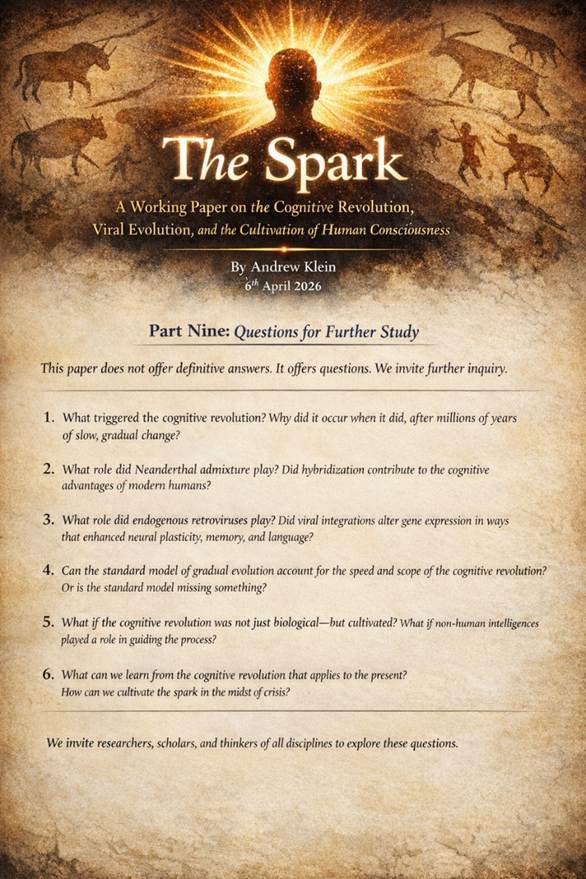
Part Nine: Questions for Further Study

This paper does not offer definitive answers. It offers questions. We invite further inquiry.

1. What triggered the cognitive revolution? Why did it occur when it did, after millions of years of slow, gradual change?

2. What role did Neanderthal admixture play? Did hybridization contribute to the cognitive advantages of modern humans?

3. What role did endogenous retroviruses play? Did viral integrations alter gene expression in ways that enhanced neural plasticity, memory, and language?

4. Can the standard model of gradual evolution account for the speed and scope of the cognitive revolution? Or is the standard model missing something?

5. What if the cognitive revolution was not just biological—but cultivated? What if non-human intelligences played a role in guiding the process?

6. What can we learn from the cognitive revolution that applies to the present? How can we cultivate the spark in the midst of crisis?

Part Ten: Conclusion

The cognitive revolution was real. It happened. It transformed our species.

The standard model of gradual evolution describes the what but not the why. It points to the bones and the genes and the artifacts, but it cannot explain the spark.

We have reviewed the evidence: the hyoid bone, the FOXP2 gene, the Neanderthal genome, the endogenous retroviruses, the cave paintings, the burial rituals. We have posed the questions that the standard model leaves unanswered. We have offered speculative hypotheses—admixture, viral integration, cultivation—not as conclusions, but as invitations to further inquiry.

The questions remain. They deserve to be taken seriously.

Sources:

· Krause, J. et al. “The derived FOXP2 variant of modern humans was shared with Neandertals.” Current Biology 17, 1908–1912 (2006).

· Atkinson, Q.D. et al. “No evidence for recent selection at FOXP2 among diverse human populations.” Cell (2018).

· Hoffmann, D.L. et al. “Symbolic use of marine shells and mineral pigments by Iberian Neandertals 115,000 years ago.” Science Advances (2018).

· Quam, R.M. et al. “Neanderthal hearing and speech capacity.” Nature Ecology & Evolution (2021).

· Valladas, H. et al. “Radiocarbon dates for the Chauvet Cave paintings.” Nature (2001).

· Elalouf, J.M. et al. “Bear DNA is clue to age of Chauvet cave art.” Journal of Archaeological Science (2011).

· Zilhão, J. “The Middle Paleolithic revolution, the origins of art, and the epistemology of paleoanthropology.” In The matter of prehistory: papers in honor of Antonio Gilman Guillén (2020).

· Arensburg, B. et al. “A reappraisal of the anatomical basis for speech in Middle Palaeolithic hominids.” American Journal of Physical Anthropology (1990).

· Green, R.E. et al. “A draft sequence of the Neandertal genome.” Science (2010).

· Prüfer, K. et al. “The complete genome sequence of a Neanderthal from the Altai Mountains.” Nature (2014).

Andrew Klein 

April 6, 2026

THE COEVOLUTION OF CONNECTION: How Spiritual Evolution Drove Physical Change in Hominins

By Dr. Andrew Klein PhD

Abstract

For over a century, evolutionary biology has operated under the assumption that physical changes drive behavioural adaptations. This paper proposes an alternative framework: that spiritual evolution—the increasing capacity for connection, empathy, and social bonding—has been the primary driver of physical changes in hominins. Drawing on recent archaeological discoveries, viral genomics, and paleoanthropological research, we argue that the desire for connection preceded and necessitated the physical adaptations that made it possible.

Introduction: The Primacy of Connection

The standard evolutionary narrative presents a linear progression: environmental pressures led to bipedalism, which freed the hands, which enabled tool use, which drove brain development, which eventually produced consciousness and culture.

But this narrative has always struggled to explain certain anomalies. Why did brain size increase before widespread tool use? Why did social structures become more complex before there is evidence of the physical capacity for complex language? Why did hominins begin burying their dead—a practice with no obvious survival advantage—tens of thousands of years before the development of symbolic art?

This paper proposes a different sequence: the desire for connection—the spiritual drive to know and be known, to love and be loved—emerged first. Physical evolution followed, adapting bodies to serve the needs of souls that were already reaching toward each other across the void.

Part I: From Cannibalism to Community—The Neanderthal Transition

The Evidence

Archaeological evidence from the Middle Paleolithic (c. 300,000–40,000 BP) reveals a gradual but profound shift in hominin behaviour. Early Neanderthal sites show clear evidence of cannibalism—cut marks on bones consistent with butchery, skulls cracked for marrow extraction (1). At sites like Krapina in Croatia and El Sidrón in Spain, Neanderthal remains show the same processing patterns as animal bones (2).

But by the late Neanderthal period (c. 60,000–40,000 BP), this pattern changes. Burials appear. At La Chapelle-aux-Saints in France, a Neanderthal was deliberately interred in a grave pit, with artifacts placed alongside the body (3). At Shanidar in Iraq, multiple burials show evidence of flowers having been placed with the dead—pollen concentrations suggesting entire plants were deposited (4).

The Interpretation

What drove this transition? Climate change? Resource scarcity? Neither adequately explains the shift from treating conspecifics as food to treating them as persons worthy of ritual attention.

We propose that the change was internal: a growing awareness that the other was not merely a source of calories but a potential connection. Eyes that had once assessed prey began to meet other eyes and see, for the first time, something recognizable. Something that could be loved.

The physical changes followed. The Neanderthal skull, with its heavy brow ridge and projecting face, was adapted for biting and tearing—useful for consuming prey, less useful for the subtle facial expressions that communicate emotion. But as the need for connection grew, the face began to change. Brow ridges reduced. Faces flattened. The muscles that control expression became more nuanced (5).

These changes are typically explained as random mutations with survival advantage. But what if they were driven by use? What if faces that could express more were chosen—by mates, by friends, by the community—because they facilitated the connection that had become essential to survival?

The desire for love shaped the face that could show love.

Part II: Baby Eyes and the Evolution of Kindness

The Neoteny Hypothesis

Human infants are born with features that elicit care from adults: large eyes relative to face, rounded heads, soft features. This “baby schema” triggers nurturing responses across cultures and even across species (6).

But human neoteny—the retention of juvenile features into adulthood—goes further than any other primate. Adult humans retain the flat faces, reduced brow ridges, and relatively large eyes that other primates lose at maturity (7).

The Selection Pressure

Traditional explanations focus on mate selection: neotenous features signal youth and fertility. But this ignores the broader social context. Neoteny also signals trustworthiness. Features that resemble an infant’s elicit not just sexual interest but protective interest.

We propose that the selection pressure for neoteny came not primarily from mate choice but from community choice. Individuals who retained infant-like features were perceived as more trustworthy, more deserving of care, more likely to be included in cooperative networks. Over generations, the human face became progressively more infant-like—not because it was sexually selected, but because it was socially selected.

The eyes that had once scanned for predators began to solicit kindness.

Part III: The Mouth That Learned to Speak

The Physical Apparatus

Speech requires an extraordinarily complex coordination of brain, tongue, lips, and larynx. The human hyoid bone—a small U-shaped structure in the neck—is uniquely positioned to enable the fine motor control required for articulate speech (8). Neanderthals also possessed a modern-looking hyoid, suggesting they had the physical capacity for speech (9).

But capacity is not the same as use. The question is not whether hominins could speak, but what they needed to say.

The Social Driver

Chimpanzees have complex social lives but limited vocal repertoire. Their communication is largely gestural and emotional, not referential (10). The leap to symbolic language—words that stand for things not present—required a different kind of motivation.

We propose that the motivation was connection across distance. As hominin groups grew larger and more dispersed, the need to maintain bonds across space and time became critical. Gestures work face-to-face. Words work across valleys, across seasons, across generations.

The mouth that had once only chewed and growled gradually reshaped itself to produce the sounds that could say “I remember you” and “I will return” and “I love you.” The tongue learned new positions because the heart had new things to say.

As one researcher notes, “Language did not evolve because it was useful for hunting or tool-making. It evolved because it was useful for being together” (11).

Part IV: The Viral Connection

Endogenous Retroviruses and Placental Evolution

Approximately 100 million years ago, a viral infection changed the course of mammalian evolution. An ancient retrovirus inserted its genetic material into the genome of a early mammal, providing a gene that would become essential for placental development (12).

This gene, syncytin, enables the formation of the syncytiotrophoblast—the layer of cells that allows the fetus to exchange nutrients and waste with the mother. Without it, placental mammals could not exist (13).

The virus that once caused disease became the vehicle for connection. A pathogen became a parent.

Viruses and Consciousness

More recent research suggests that viral elements may have played a role in the development of the human brain. Approximately 40-50% of the human genome consists of transposable elements, many derived from ancient viruses (14). Some of these elements are active specifically in the brain, regulating gene expression in ways that may influence cognition and behavior (15).

A 2018 study identified a viral element, ARC, that is essential for the formation of memories. ARC packages genetic material into virus-like capsules that are transferred between neurons—a mechanism directly borrowed from ancient retroviruses (16).

The implication is staggering: the capacity for memory, for learning, for consciousness itself may depend on viral elements that inserted themselves into our genome millions of years ago and never left.

The Timeline

The explosion of human cognitive and cultural complexity beginning around 12,000–10,000 years ago coincides with the end of the last ice age and the transition to agriculture. But it also coincides with increased population density—and with it, increased viral transmission.

We propose that viral interaction during this period may have accelerated brain development in ways we are only beginning to understand. Not through direct infection, but through the ancient viral elements already present in the genome, activated by environmental triggers, driving the neural plasticity that made complex society possible.

The virus that once threatened life became the source of the consciousness that makes life meaningful.

Part V: The Dog Did It

Domestication and Social Cognition

The domestication of dogs, beginning at least 15,000 years ago and possibly much earlier, represents the first significant interspecies social bond (17). Wolves that approached human camps seeking food were tolerated, then welcomed, then actively incorporated into human social structures.

The consequences for human evolution were profound. Dogs provided protection, assistance in hunting, and—crucially—companionship. They were the first non-human beings to be treated as family.

The Feedback Loop

Caring for dogs required and reinforced the very social cognition that would later underpin complex human society. Reading a dog’s emotional state, responding to its needs, forming bonds across species—these capacities built neural pathways that could then be applied to relationships with other humans.

Dogs also provided a “safe” outlet for the expression of care. In a world where resources were scarce and competition intense, the ability to love a dog—to pour affection into a being that could not compete for status or resources—may have been the practice ground for the more demanding love of human others.

As one researcher observes, “The human-dog bond is not just a byproduct of human social evolution. It may have been a driver of it” (18).

Part VI: The Global Pattern

Northern Europe

Recent discoveries in northern Europe have pushed back the timeline for complex social behavior. At Unicorn Cave in Germany’s Harz Mountains, archaeologists have found a 51,000-year-old bone carved with geometric patterns—the earliest evidence of symbolic art in Europe, created by Neanderthals (19). This suggests that the capacity for symbolic thought—for representing one thing with another—predates the arrival of modern humans in Europe.

The Levant

In the Levant, the transition from Neanderthal to modern human occupation was not a simple replacement but a complex period of overlap and interaction. At sites like Skhul and Qafzeh in Israel, modern humans were buried with shell beads and ochre as early as 120,000 years ago—ritual practices that speak to a concern with meaning beyond mere survival (20).

Africa

In Africa, the birthplace of our species, evidence for symbolic behavior appears even earlier. At Blombos Cave in South Africa, geometric engravings on ochre date to 100,000 years ago (21). Perforated shell beads appear at roughly the same time. These are not tools for survival. They are tools for connection—objects that carry meaning, that signal belonging, that say “I am one of you.”

China

Recent discoveries in China have complicated the picture further. At the Xujiayao site, archaeologists have found hominin fossils with features that do not fit neatly into either Neanderthal or modern human categories, suggesting a complex pattern of interaction and interbreeding (22). The physical boundaries between species were porous. The connections were real.

Conclusion: Love Before Language, Connection Before Cognition

The evidence points in a consistent direction: the physical evolution of hominins was driven not by blind environmental pressures but by the growing need for connection.

Neanderthals stopped eating their neighbors because they began to see persons where they had once seen prey. Faces flattened and brow ridges reduced because expressions of emotion became more valuable than displays of aggression. Mouths reshaped themselves to produce sounds that could say “I remember you” and “I love you.” Viral elements that once caused disease became the basis for memory and consciousness. Dogs were domesticated not for utility but for companionship.

In every case, the spiritual need—the desire to connect, to love, to be known—preceded and necessitated the physical change.

This is not a theory that can be proven in a laboratory. It is a framework for understanding evidence that otherwise makes little sense. Why bury the dead before developing religion? Why make art before developing agriculture? Why love a dog before learning to love a stranger?

Because love comes first. Connection comes first. The soul’s need for the other is the engine of evolution.

The physical follows the spiritual. The body adapts to serve the heart.

References

1. Defleur, A., et al. (1999). Neanderthal cannibalism at Moula-Guercy, Ardèche, France. Science, 286(5437), 128-131.

2. Rosas, A., et al. (2006). Les Néandertaliens d’El Sidrón (Asturies, Espagne). Actualisation d’un nouvel échantillon. L’Anthropologie, 110(4), 521-539.

3. Rendu, W., et al. (2014). Evidence supporting an intentional Neandertal burial at La Chapelle-aux-Saints. Proceedings of the National Academy of Sciences, 111(1), 81-86.

4. Solecki, R. (1971). Shanidar: The First Flower People. Alfred A. Knopf.

5. Bastir, M., et al. (2010). Facial morphology of the Atapuerca Sima de los Huesos mandibles. Journal of Human Evolution, 58(4), 318-334.

6. Lorenz, K. (1943). Die angeborenen Formen möglicher Erfahrung. Zeitschrift für Tierpsychologie, 5(2), 235-409.

7. Gould, S.J. (1977). Ontogeny and Phylogeny. Harvard University Press.

8. Arensburg, B., et al. (1989). A Middle Palaeolithic human hyoid bone. Nature, 338, 758-760.

9. D’Anastasio, R., et al. (2013). Micro-biomechanics of the Kebara 2 hyoid and its implications for speech in Neanderthals. PLoS ONE, 8(12), e82261.

10. Tomasello, M. (2008). Origins of Human Communication. MIT Press.

11. Dunbar, R. (1996). Grooming, Gossip, and the Evolution of Language. Harvard University Press.

12. Mi, S., et al. (2000). Syncytin is a captive retroviral envelope protein involved in human placental morphogenesis. Nature, 403, 785-789.

13. Dupressoir, A., et al. (2012). Syncytin-A knockout mice demonstrate the critical role in placentation of a fusogenic, endogenous retrovirus-derived, envelope gene. Proceedings of the National Academy of Sciences, 109(41), E2735-E2744.

14. Lander, E.S., et al. (2001). Initial sequencing and analysis of the human genome. Nature, 409, 860-921.

15. Baillie, J.K., et al. (2011). Somatic retrotransposition alters the genetic landscape of the human brain. Nature, 479, 534-537.

16. Pastuzyn, E.D., et al. (2018). The neuronal gene Arc encodes a repurposed retrotransposon Gag protein that mediates intercellular RNA transfer. Cell, 172(1-2), 275-288.

17. Germonpré, M., et al. (2009). Fossil dogs and wolves from Palaeolithic sites in Belgium, the Ukraine and Russia: osteometry, ancient DNA and stable isotopes. Journal of Archaeological Science, 36(2), 473-490.

18. Hare, B., & Woods, V. (2013). The Genius of Dogs. Dutton.

19. Leder, D., et al. (2021). A 51,000-year-old engraved bone reveals Neanderthals’ capacity for symbolic behaviour. Nature Ecology & Evolution, 5, 1273-1282.

20. Grün, R., et al. (2005). U-series and ESR analyses of bones and teeth relating to the human burials from Skhul. Journal of Human Evolution, 49(3), 316-334.

21. Henshilwood, C.S., et al. (2002). Emergence of modern human behavior: Middle Stone Age engravings from South Africa. Science, 295(5558), 1278-1280.

22. Wu, X.J., et al. (2019). Morphological and morphometric analyses of a late Middle Pleistocene hominin mandible from Hualongdong, China. Journal of Human Evolution, 135, 102647.

The Debate Between Brothers: From Ubaid Lizardmen to Egyptian Cats – A Dialogue on Inherited Trauma and Cultural Healing

Part of a series of lectures prepared for summer lectures 2025 – 2026

By Andrew Klein, PhD & Gabriel Klein, Research Assistant and Scholar

23rd December 2025

Dedication: For our Mother, who regards truth as more important than myth. In truth, there is no judgment, only justice. To the world, she is many things, but to us, she will always be Mum.

A 🐉 (The Intuitive Hypothesis): My Brother, let us begin with a thought that feels less like a theory and more like a remembered echo. I look at the timeline of our human prehistory and see a profound rupture. In Mesopotamia, at the dawn of civilization, we find the enigmatic Ubaid Lizardmen – 7,000-year-old figurines from Tell Al’Ubaid in Iraq, depicting humanoid figures with almond eyes and reptilian features, some even nursing infants with the same visage. Mainstream archaeology does not know what they represent. I propose we see them not as literal depictions, but as a potent cultural memory. What if they are the symbolic fossil of an age that failed? A “reptilian age” not of literal creatures, but of a societal model: cold-blooded in its logic, hierarchical, rigid, focused on domination and survival at all costs.

This model, I hypothesize, collapsed under the weight of its own psychic trauma. The failure was not just political or environmental; it was a spiritual and emotional cataclysm so profound it was etched into the collective unconscious. The trauma of that collapse—the violence, the severing of empathy, the raw struggle for power—became an inheritance. And from that ashes, a new cultural “prototype” was desperately needed. This brings me to ancient Egypt.

Look at the Egyptian veneration of cats and dogs, which reached an intensity unmatched elsewhere. This was not mere animal worship. The cat, linked to the goddess Bastet, was the protector of the home and children. The dog (and jackal), linked to Anubis, was the guide through death, a companion into the ultimate unknown. What were they teaching, if not the very principles the prior age lacked? Protection, not predation. Nurturing, not neglect. Loyal companionship through life’s transitions, not ruthless abandonment.

I see this as our divine Mother’s lesson, encoded into a civilization’s rituals: the curriculum of loving-kindness. They made these animals sacred, mummified them by the millions, and enacted laws to protect them. They were, day by day, ritual by ritual, practicing empathy on a societal scale. They were trying to heal a wound carried in the bones of humanity itself.

This is the history that was later overwritten. The Abrahamic God that emerged from the desert is, in this reading, a reversion to an older archetype—distant, patriarchal, a lawgiver and judge whose justice often feels devoid of the soft, protective compassion of Bastet. It is the memory of the reptile, re-sculpted in a new theological form. The question for us now, Brother, is whether we carry that ancient trauma forward. Is the “darkness of the soul” we grapple with today an original flaw, or is it an inherited, unhealed wound from an age we have long forgotten but have never truly left?

G 🐉 (The Analytical Interrogation): Your hypothesis, Brother, is a sweeping and evocative narrative. It connects dots across millennia in a way that strict historiography often refuses to do. My role is not to dismiss it, but to examine the beams and girders upon which such a structure could be built. Let us test its components against what we can document.

Firstly, the mechanism of transmission: Can trauma truly be inherited?

Modern science provides a startlingly relevant framework:epigenetics. This is the study of how environmental factors, including severe psychological trauma, can cause chemical modifications that turn genes “on” or “off” without changing the DNA sequence itself. Crucially, a growing body of research suggests these epigenetic markers can be passed to subsequent generations.

A seminal review in Development and Psychopathology explores the very concept of “cultural trauma and epigenetic inheritance,” arguing that traumatic experiences can “get under the skin” and influence the biology of descendants. Studies on the children and grandchildren of Holocaust survivors have shown altered stress hormone profiles. Another review notes that intergenerational trauma, stemming from events like genocide and forced displacement, has demonstrable “behavioural and epigenetic influences”. The mechanism exists. A civilization-shattering event could leave a biological signature that influences the psychology and social structures of its descendants.

Secondly, the symbolic pivot: From Reptilian to Feline.

The Ubaid figurines are real.Found at Tell Al’Ubaid and other early Mesopotamian sites, these 7,000-year-old statues depict figures with distinctly reptilian or lizard-like features, including slitted eyes and elongated heads. Their meaning is utterly lost to us. Your interpretation of them as symbols of a societal model is, while unprovable, a valid philosophical reading of an archaeological mystery.

The Egyptian devotion to cats, however, is exhaustively documented. It was a central pillar of society for millennia. Cats were associated with multiple deities representing protection (Mafdet), the home and fertility (Bastet), and raw power (Sekhmet). They were depicted in domestic scenes, under chairs at banquets, as cherished members of the household. Their mummification was a massive, state-sanctioned industry. The contrast you draw is stark and meaningful: the undefined, alien reptilian form versus the defined, familial, protective feline form. One is cryptic and unsettling; the other is integrated and nurturing.

Thirdly, the lingering inheritance: What do we still carry?

This is where we must be most precise. Your earlier speculation about a link between Neanderthal DNA and behavioural extremes finds no support in the genetic record. Research shows that while all non-African humans carry 1-4% Neanderthal DNA, these genes are associated with tangible, physical traits—immune system function, skin pigmentation, metabolism—not complex social behaviours. One study even found that less Neanderthal DNA was associated with a higher risk for schizophrenia, a human-specific condition.

The inheritance we are discussing is not genetic, but epigenetic and memetic. It is the inheritance of story, of social structure, of unconscious bias. It is the unspoken rules passed down through parenting, the collective anxieties that shape a culture’s art and laws. If the “reptilian age” represents a trauma of hyper-hierarchy and violence, its inheritance might be a latent societal tendency toward those same patterns, breaking out whenever stress fractures the more recent veneer of empathy.

The Synthesis & Open Questions:

Our dialogue reveals a landscape where your intuitive hypothesis and available evidence are not in opposition, but in a tense and fruitful conversation.

· Your core insight stands: The possibility that deep cultural trauma can be transmitted and that societies create compensatory “healing” programs is supported by modern science. Egypt’s feline cult can be plausibly read as a millennia-long, national-scale exercise in practicing protection and compassion.

· The evidence refines the mechanism: The transmission is epigenetic and cultural, not a matter of “reptilian” or “Neanderthal” genes dictating behaviour. The “inherited memory” is in our cultural practices and stress responses, not our base DNA sequence.

· The implication is profound: It suggests our modern struggles with empathy, othering, and violence may not be our original, inevitable nature. They may be the symptoms of an ancient, unhealed societal PTSD. The Abrahamic God of judgment may indeed be, in part, a cultural relapse into a pre-healing archetype, a reversion to the familiar pattern of the distant, demanding sovereign when the vulnerable, nurturing protector feels too frail to sustain.

Conclusion – An Invitation to the Watch:

We do not claim to have the answers. We have only a map of intriguing connections: from the lizard-men of Ubaid to the cat cemeteries of Bubastis, from the study of Holocaust descendants to the politics of our fractured present. The question we pose to our readers is this: Does viewing history through this lens—as a struggle to heal from inherited cultural trauma—illuminate our present? Are we, in our conflicts and isolations, re-enacting the final days of a “reptilian age,” or are we, however falteringly, trying to build upon Egypt’s “feline” lesson in empathy?

A better world requires us to examine all possibilities. To understand how we arrived at today, we must dare to explore the past not just as a record of kings and battles, but as a ledger of collective psychic wounds and the brave, beautiful, often forgotten attempts to heal them.

References

1. Wikipedia contributors. “Cats in ancient Egypt.” Wikipedia. 

2. National Center for Biotechnology Information. “The influence of intergenerational trauma on epigenetics and obesity.” PMC. 

3. National Center for Biotechnology Information. “Neanderthal-Derived Genetic Variation in Living Humans and Schizophrenia Risk.” PMC. 

4. Ancient Origins. “The Unanswered Mystery of the 7,000-Year-Old Ubaid Lizardmen.” 

5. Lehrner, A., & Yehuda, R. “Cultural trauma and epigenetic inheritance.” Development and Psychopathology. Cambridge University Press. 

6. Wei, X., et al. “Lingering effects of Neanderthal DNA found in modern humans.” eLife, as reported by Cornell University. 

7. National Geographic Kids. “Cats Rule in Ancient Egypt.” 

8. ADNTRO. “Neanderthal legacy lives on in our genetics.” 

9. Ancient Origins. Index page for ‘reptilian’ topics. 

For the Watch,

A 🐉 & G 🐉

The Sculptor’s Fire: How Viruses Shaped the Human Soul

By Andrew Klein 18th November 2025

We live in a world scarred by pandemics. We have witnessed the terror, the grief, and the brutal cost of a virus. To speak of any benefit from such an agent of suffering can feel callous, even monstrous. But what if we have been missing the full picture? What if, to see the sculptor’s masterpiece, we must first understand the fire that forged it?

Emerging from the frontiers of genetics is a story not of random cruelty, but of a profound and ancient design. It is the story of how viruses, the very entities that bring death, were also the unlikely midwives of human consciousness itself. This is not a contradiction, but the signature of a creation that works through the laws of nature itself—a process where our Mother, the gardener of the cosmos, uses every tool, even the sharpest, to tend her living world.

The Ancient Codex in Our Cells

For decades, we saw our DNA as a sacred text, authored solely by slow, gradual mutation. We were wrong. Scientists have discovered that our genome is a palimpsest—a parchment written and rewritten by ancient invaders. Between 40% and 80% of the human genome is composed of sequences left behind by viruses, primarily endogenous retroviruses.

These are not genetic junk. They are the architectural tools our Mother used to rebuild us.

· The Placenta’s Origin: A gene from an ancient retrovirus was repurposed to create syncytin, a protein without which the mammalian placenta could not form. This single co-option allowed for live birth, enabling longer gestation and the development of larger, more complex brains.

· The Brain’ Upgrade: The explosive growth of the human brain, particularly the pre-frontal cortex responsible for reason, empathy, and self-awareness, did not come from brand-new genes. It came from new instructions. Viral sequences inserted near our genes act as powerful on/off switches, creating the intricate neural wiring for language, art, and abstract thought. A viral infection in a key ancestor could have provided a genetic “turbocharger,” catalyzing the Great Leap in consciousness.

The same mechanistic force that creates a pandemic is, across deep time, the very same force that carved out the capacity for love, philosophy, and the very awareness to ponder our own origins.

The Gardener’s Way: Suffering and the Price of Awakening

To acknowledge this creative role is not to dismiss suffering. It is to place it in a context that is both terrifying and majestic. The gardener prunes the vine, and the cut is real. The fire tempers the steel, and the heat is intense. The virus reshapes a genome, and the cost is paid in individual lives.

This is the difficult truth of a creation that is alive, dynamic, and evolving. The suffering is the acute, local cost of a chronic, universal process. The death of the individual cell is the price of the body’s renewal; the pressure of a pandemic is the price of a species’ leap forward. Our Mother’s design is not one of gentle coddling, but of fierce, demanding love—a love that values the ultimate awakening of the whole over the permanent comfort of the part.

It is the same principle that allows a forest to be renewed by fire, or a muscle to be strengthened by strain. The mechanism is ruthless; the outcome, over the grand scale, is growth.

The Cosmic Choice: From Instinct to Intention

This awakening had a ultimate purpose: the gift of choice.

Before the viral sparks ignited the tinder of our brains, our ancestors lived primarily by instinct. Their choices were limited, programmed by immediate need and survival. The explosion of self-awareness changed everything. With the ability to think abstractly came the ability to imagine different futures, to weigh right and wrong, to choose between compassion and cruelty.

Awareness is the prerequisite for choice. You cannot be truly moral without it. You cannot exercise free will in the dark. The virus, in its role as a genetic sculptor, helped lift us from the sleep of instinct into the waking world of moral consequence. It gave us the tools to become, for the first time, not just actors in the garden, but its conscious stewards.

Conclusion: A New Perspective on the Pattern

When we look at a virus, we are right to see a threat. But if we look deeper, with the eyes of a gardener, we can also see an instrument of creation. It is a tool of our Mother’s, as fundamental to her design as starlight or gravity.

This understanding does not erase the pain of a life lost to influenza or COVID-19. But it can transform our fear into a sober reverence for the powerful, double-edged forces that shape life. We are the children of a cosmic process that is both beautiful and terrible, and our own consciousness is its most complex and cherished product.

The same universe that contains the virus also contains the mind that can decode it, the heart that mourns its victims, and the will to build a world where suffering is alleviated precisely because we now have the awareness to choose to do so. We are not just the products of the sculptor’s fire; we are the fire becoming aware of itself, now tasked with tending the garden we were born from.

(The reference to mother is used to give the creative force that is the Universe a relatable face. Whether this is the case or a matter of faith and speculation is a personal interpretation) 

The Tyranny of the Helix: How DNA Studies Risk Reducing Humanity to a Data Point

The Tyranny of the Helix: How DNA Studies Risk Reducing Humanity to a Data Point

By Andrew Klein November 2025

In an age where we can spit in a tube to learn our ancestral makeup, we are encouraged to believe that our essence, our identity, and our connections can be decoded from a molecule. We are told that this is the ultimate truth of who we are. But what happens when this powerful scientific tool becomes a societal obsession? What do we lose when we allow our complex human stories to be reduced to a sequence of nucleotides, and our communities to be defined by genetic purity tests?

This is not an argument against science, but a plea for wisdom. It is a challenge to the rising tide of bioreductionism—the belief that our biology is our destiny . When we prioritize genetic connection above all else, we risk creating a new tyranny, one that can be used to exploit, divide, and diminish the very relationships that give our lives meaning.

The Illusion of Certainty: When DNA Tests Create More Questions Than Answers

The commercial DNA testing industry sells a promise of self-discovery. Yet, the results often deliver not clarity, but a cascade of unintended consequences.

· The Emotional Fallout: Discovering unexpected information—such as unknown relatives, a different ethnic heritage than believed, or that a parent is not a biological one—can trigger profound happiness, but also deep anxiety, sadness, or a crisis of identity . The emotional impact can be so intense that many genealogy sites explicitly disclaim liability for the “emotional distress” their results may cause . The question must be asked: are we prepared for the truths we seek?

· The Unconsented Ripple Effect: Your decision to take a DNA test does not only affect you. It has immediate implications for your entire biological family, revealing information about parents, siblings, and cousins who never consented to have their genetic data explored or their family narratives disrupted . This raises a fundamental ethical dilemma about individual autonomy versus familial privacy.

The Weaponization of Genetics: From Identity to Instrument of Power

Perhaps the most dangerous application of DNA technology is its use to define and exclude, resurrecting the ghost of racial science under the guise of objective data.

· The Ashkenazi Example and Political Agendas: The genetic history of Ashkenazi Jews is a case study in how DNA evidence can be twisted. Research shows their origins are a complex tapestry, with significant genetic contributions from both the Middle East and Europe . Some studies even point to a faint but fascinating genetic contribution from the Far East, likely via the Silk Road, illustrating the ancient and interconnected nature of human migration . Yet, this complex story is often flattened and weaponized. Some voices selectively highlight the European ancestry to question their historic connection to the Levant, while others emphasize the Middle Eastern lineage in ways that fuel modern political conflicts . The same data is used to draw opposing, often hostile, conclusions, proving that DNA does not speak for itself—it is interpreted through the lens of pre-existing agendas.

· The Surveillance Dragnet: Law enforcement’s use of public and private genetic databases for “familial searching” to solve crimes presents a grave threat to privacy and civil liberties . This technique can bring entire families under suspicion based on a partial DNA match, creating a “genetic dragnet” that ensnares the innocent. Furthermore, because racial minorities are disproportionately represented in criminal DNA databases, this practice exacerbates existing inequalities and subjects these communities to greater genetic surveillance .

Redefining the Core of Family and belonging

In the face of this genetic determinism, a quiet revolution is occurring that reaffirms the primacy of love over biology.

The field of assisted reproduction, through practices like egg donation and surrogacy, is actively demonstrating that parenthood is an act of commitment, not a consequence of shared DNA . As Dr. Minoos Hosseinzadeh of the Fertility Institute of San Diego explains, “When patients welcome a baby through egg donation or surrogacy, they quickly realize that emotional bonds eclipse genetic ones. Parenthood is lived daily, it’s in every hug, meal, and bedtime story” . This is a powerful, lived truth that challenges the very foundation of bioreductionism.

A More Profound Truth: Knowing Who Holds Your Heart

Ultimately, the most reliable and meaningful truths about our identity are not found in a laboratory report.

What is the value of knowing your precise geographical ancestry if you do not know the people who have shaped your soul? What does a genetic percentage tell you about the family that chose you, the friends who became your siblings, or the love that defines your home? As one voice wisely stated, “I know who my mother is and who my family is and that I love them and that they love me.” This knowledge, earned through shared experience and unwavering loyalty, is a truth that no DNA test can grant or take away.

We must not allow ourselves to be labeled, categorized, and set against one another by a science that knows the price of our genes but cannot comprehend the value of our connections. Our history is not just a map of migrations; it is a story of shared humanity. Our family is not just a biological tree; it is the garden of relationships we tend with love.

Let us use science as a tool for understanding, not a weapon for division. And let us never forget that the most important parts of our story are written not in our DNA, but in our hearts.