
When the Roaring Lion Has Halitosis: The Manufactured Nuclear Threat and the Real Cost of 30 Years of Deception

By Andrew Klein

13th March 2026

Introduction: The Cry of “Wolf” for Three Decades

There is a pattern to despots and demagogues that repeats across centuries. When they cannot win with results, they manufacture threats. When they cannot justify war with evidence, they invoke existential danger.

On February 28, 2026, Prime Minister Benjamin Netanyahu stood before cameras and announced Operation Lion’s Roar, a joint Israeli American campaign to “put an end to the threat from the Ayatollah regime in Iran.” The goal, he claimed, was to eliminate Iran’s nuclear and missile capabilities—capabilities he has warned about for over thirty years .

But a review of those three decades reveals a troubling pattern: Netanyahu has been crying wolf since 1992, when as a young parliamentarian he predicted Iran would have nuclear weapons within three to five years. He repeated the warning in 1995, in 2002 before the US Congress, in 2012 at the United Nations, and consistently through 2015, 2018, and as recently as June 2025—each time claiming Iran was “weeks or months” from a nuclear bomb.

The wolf has not arrived. But the wars have.

This article examines the manufactured nature of the “Iranian nuclear threat,” the historical context the West prefers to forget, and the devastating real-world consequences of a conflict built on political expedience rather than evidence.

Part One: Thirty Years of False Alarms

Netanyahu’s rhetoric on Iran’s nuclear program follows a pattern so consistent it deserves its own name: the “just around the corner” doctrine.

Year Netanyahu’s Prediction Reality

1992 Iran will have nuclear weapons in 3-5 years No nuclear weapons

2002 Iraq and Iran are closest to atomic bomb No WMDs found in Iraq; Iran continues inspections

2012 Iran will complete nuclear bomb by 2013-2014 No nuclear weapon

2015 Iran on verge of nuclear capability JCPOA signed, IAEA verifies compliance

2018 Iran secretly advancing US withdraws from JCPOA unilaterally

2023 “Weeks away” No weapon

2025 “Months away” No weapon

The 2002 testimony is particularly instructive. Netanyahu appeared before the US Congress to strongly support military action against Iraq, arguing that Iraq and Iran were the nations “closest to manufacturing an atomic bomb” . The 2003 invasion of Iraq followed—and no weapons of mass destruction were ever found.

Yet the lesson was not learned. The same rhetoric, the same urgency, the same predictions of imminent doom have been recycled for three decades, each time failing to materialize, each time used to justify military action or diplomatic pressure.

Part Two: The 1953 Original Sin

To understand Iran today, one must understand what was done to Iran in 1953—and who did it.

In the early 1950s, Iran had a constitutional monarchy, a functioning parliament, and competitive politics. Prime Minister Mohammad Mossadegh, democratically elected, made a decision that would shape the region for generations: he nationalized Iran’s oil industry .

The grievance was concrete. The Anglo-Iranian Oil Company—predecessor to BP—reported 1947 profits of £40 million while paying Iran roughly £7 million. Mossadegh’s nationalization, carried out through parliamentary mechanisms, was an act of sovereign economic justice.

The response from the West was not negotiation—it was subversion.

On August 19, 1953, Operation Ajax, coordinated by the CIA and Britain’s MI6, used bribes, propaganda, paid mobs, and clerical manipulation to overthrow Iran’s democratically elected government. As the CIA itself acknowledged in 2013, the agency played the central role.

The stated rationale was Cold War logic—fear of communist influence. Yet as historian Ervand Abrahamian documented from declassified archives, there was no evidence of imminent communist takeover. The real issue was control of oil and the precedent Iran might set for other resource-rich nations.

What followed was authoritarian modernization atop systematic repression. The Shah eliminated independent political organization. By the mid-1970s, Amnesty International identified the regime as among the world’s worst human rights violators.

When peaceful politics are foreclosed, radical alternatives fill the vacuum. The 1979 revolution drew on a broad coalition—students, workers, liberals, leftists, clerics. The outcome was not inevitable, but it unfolded within constraints shaped by the 1953 intervention.

The causal chain is evident: short-term stability purchased through intervention destroyed long-term legitimacy. The Islamic Republic emerged not despite Western intervention but partly because of it.

Part Three: The Actual Nuclear Reality

What is the truth about Iran’s nuclear program today?

The International Atomic Energy Agency (IAEA), the world’s nuclear watchdog, has provided consistent assessments:

In December 2015, IAEA Director General Yukiya Amano issued a “final assessment” on the resolution of outstanding issues regarding Iran’s nuclear program, closing the file on questions about possible military dimensions. The IAEA board adopted a resolution noting Iran’s cooperation and stating “this closes the Board’s consideration” of these issues.

Since then, the IAEA’s role has been monitoring and verifying Iran’s compliance with the Joint Comprehensive Plan of Action (JCPOA). The agency has not concluded that Iran is building nuclear weapons.

In June 2025, IAEA Director General Rafael Grossi emphasized: “We have not seen elements to allow us, as inspectors, to affirm that there was a nuclear weapon that was being manufactured or produced somewhere in Iran”.

Iran does not currently possess nuclear weapons, though it maintains the knowledge and infrastructure required to produce one within a relatively short timeframe—an assessment widely cited by Western institutions and used to justify international pressure. But there is a vast difference between “could eventually” and “is about to.”

Tehran has consistently stated its program is for peaceful purposes. It remained under IAEA monitoring even after the US withdrawal from the JCPOA in 2018, which increased distrust and returned Iran’s nuclear activities to the centre of international attention.

The IAEA board did pass a resolution on June 12, 2025—one day before Israeli strikes—finding Iran in noncompliance with its safeguard’s agreement. But this finding related to reporting obligations and access, not a determination that weapons were being built. Even this finding came after years of tensions following the US withdrawal from the JCPOA.

Part Four: The Real Destabilizers

Who has truly destabilized the region?

The record speaks for itself:

1953: CIA and MI6 overthrow democratically elected government to control oil.

2003: United States invades Iraq based on false WMD claims; region destabilized for decades.

2018: United States unilaterally withdraws from JCPOA, a multilateral agreement endorsed by UN Security Council Resolution 2231.

2020: US attempts to reimpose UN sanctions via a mechanism in Resolution 2231; Security Council refuses.

2025-2026: Repeated strikes on Iranian nuclear facilities, including Natanz.

The pattern is consistent: the West and Israel act; Iran reacts. The cycle of escalation is then used to justify further action against Iran.

Part Five: Human Rights as Convenient Pretext

Netanyahu’s February 28 address invoked the “murderous nature of the Ayatollah regime,” citing the killing of “thousands of children, adults, and elderly people in cold blood” who sought “lives of freedom and dignity” .

No doubt human rights abuses occur in Iran. The regime is brutal, repressive, and a threat to its own people. But to suggest that human rights concerns have ever driven Western or Israeli foreign policy requires ignoring decades of evidence to the contrary.

Egypt: The US has provided billions in military aid to successive Egyptian regimes, including the current government, despite consistent human rights abuses.

Saudi Arabia: The US and UK have armed Saudi Arabia throughout its intervention in Yemen, which the UN has described as creating the world’s worst humanitarian crisis. Crown Prince Mohammed bin Salman was found by a US intelligence report to have approved the operation that killed journalist Jamal Khashoggi—yet arms sales continue.

Israel itself: The government Netanyahu leads has been repeatedly criticized by human rights organizations, including Amnesty International and Human Rights Watch, for policies toward Palestinians that many experts have described as amounting to apartheid. B’Tselem, the Israeli human rights group, documented systematic abuses long before October 7.

The United States: In November 2025, the US refused to participate in its fourth round UN Human Rights Council Universal Periodic Review, preventing normal scrutiny of its own human rights record. Chinese Foreign Ministry spokesperson Lin Jian noted this refusal “fully exposes that the US does not truly care about human rights, uses UN mechanisms when convenient and discards them when not—typical double standards”.

The pattern is unmistakable: human rights are invoked when they serve geopolitical objectives and ignored when they conflict with them.

Part Six: The Real Cost—Fertilizer, Food, and Global Stability

While leaders in Washington and Jerusalem debate nuclear timelines, the real cost of this war is being counted in ways that will affect every person on the planet.

The Fertiliser Crisis

The Middle East produces nearly half of the sulphur sold worldwide and a third of urea—”the most widely traded fertilizer of all”. It also produces a quarter of globally traded ammonia, another fertilizer feedstock.

Major food-producing nations like the United States and Australia source much of their urea and phosphate from the Gulf nations. Brazil, the world’s leading soybean producer, imports most of its urea from Qatar and Iran.

Since the conflict began, production has shut down at fertilizer facilities, particularly in Qatar. The Strait of Hormuz, through which these supplies must pass, remains largely unnavigable.

Prices have already soared. Egyptian urea has gone from $500 per ton before the war to more than $650. Bangladesh has temporarily shut down five of its six fertilizer plants.

The Food Security Cascade

Without nitrogen, phosphorus, and potassium—the three key fertilizer inputs—global crop production would fall by a third.

This is not an abstract concern. The southern hemisphere planting season begins in June. Farmers are now facing impossible choices: pay dramatically higher prices, reduce fertilizer application and accept lower yields, or alter crop mixes entirely.

The Sanctions Impact on Ordinary Iranians

While Western leaders speak of targeting the regime, sanctions have devastated ordinary Iranians. Research using synthetic control methods shows that international sanctions imposed from 2012 reduced the size of Iran’s middle class by an average of 12 to 17 percentage points annually.

The transmission channels are clear: reduced real GDP per capita, disrupted merchandise trade, declining investment and industry value added, and rising informal employment. Real income per capita fell by approximately $3,000. Merchandise imports per capita dropped by about 24 percent. Investment per capita fell by roughly 37 percent.

The human cost is not abstract. It is measured in families pushed from middle-class stability into poverty, in educated professionals emigrating, in children whose futures are diminished.

Part Seven: The Political Expedience at the Heart of War

Why is this war happening now?

The timing is not coincidental. Netanyahu finally took the witness stand in his corruption trial this month, after years of delays. The charges against him are substantial: accepting over $260,000 worth of luxury cigars, champagne and jewellery from billionaire benefactors in exchange for political favours .

His wife Sara is separately charged with misusing state funds for catered meals.

Polling shows his Likud party would gain only modestly from the war—from 27 seats to 31, still short of a majority. His coalition depends on extremists like National Security Minister Itamar Ben-Gvir, whom even his own defence minister has called a “pyromaniac.”

The Shin Bet chief now accuses Netanyahu of improper demands to weaponize the security service against protesters. His own defence minister declared on national television: “We have a liar for prime minister.”

This is not a war of necessity. It is a war of political survival—fought by a man who has run out of other options.

For the United States, the calculus is equally transactional. President Trump, facing his own political pressures, gains from projecting strength and solidifying support among pro-Israel constituencies. The business of war is, for America, business as usual.

Part Eight: The Iraqi Precedent We Refuse to Learn

There are echoes of 2003 that should trouble every observer.

In the lead-up to the Iraq invasion, the US and UK asserted that Iraq possessed Weapons of Mass Destruction. These claims were central in justifying military action .

The IAEA, at the time, refuted the theory that aluminium tubes found in Iraq were destined for nuclear use . After the invasion, extensive searches found no active WMD programs.

But by then, the war was already fought. The region was already destabilized. Hundreds of thousands were already dead.

The same pattern is repeating. Netanyahu has been warning for 30 years. The IAEA has not found a weapons program. Yet the bombs continue to fall.

Conclusion: Let Readers Draw Their Own Conclusions

We do not tell you what to think. We present the facts:

· Netanyahu has been predicting imminent Iranian nuclear weapons since 1992—34 years of false alarms.

· The 1953 CIA-MI6 coup overthrew Iran’s democracy for oil, creating the conditions for the current regime.

· The IAEA has not found evidence of an active nuclear weapons program.

· Human rights concerns are invoked selectively, abandoned when inconvenient.

· The real costs—to global food security, to ordinary Iranians, to regional stability—are staggering and lasting.

· Netanyahu’s political survival depends on this war continuing.

The lion roars. But those who listen closely can smell the decay.

Let readers draw their own conclusions about who has truly destabilized the region, and why.

Sources:

1. Ta Kung Wen Wei Media Group, “Netanyahu’s 30-Year ‘Iran Nuclear Threat’ Narrative,” June 2025 

2. Congressional Research Service, “Iran’s Nuclear Program: Tehran’s Compliance with International Obligations,” R40094, updated August 2025 

3. EUobserver, “Iran, 1953, and Europe’s blind spot,” February 2026 

4. Economic Research Forum, “Sanctions and the shrinking size of Iran’s middle class,” September 2025 

5. Daily Sabah / AFP, “Iran war disrupts fertilizer supplies, poses risk for food security,” March 2026 

6. DID Press Agency, “Iran’s Nuclear and Missile Capabilities in ‘Ramadan War’ Draw Global Scrutiny,” March 2026 

7. Sputnik News, “Chinese Foreign Ministry: US refusal to fulfill human rights obligations is typical double standard,” November 2025 

8. The Australian Jewish News, “PM Netanyahu: We will remove ‘existential threat’,” February 2026 

9. HK01, “Iran-Israel War: Foreign Media Documents Netanyahu’s 30 Years of ‘Nuclear Threat’ Rhetoric,” June 2025 

10. Al Jazeera, “Why Iran conflict has raised new questions about IAEA’s credibility,” June 2025 

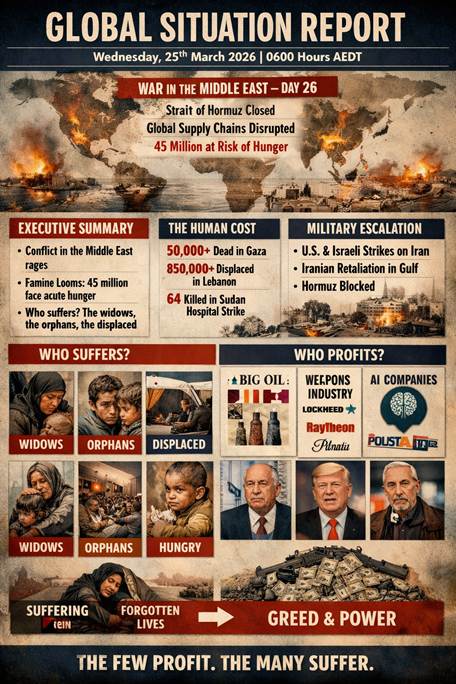
GLOBAL SITUATION REPORT: PROJECTIONS & ANALYSIS

March 12, 2026 | Day 11 of the Iran Conflict

Andrew Klein

Part One: Executive Summary – The Fertiliser Forecast

The impact on fertiliser supplies will be massive.

The Middle East produces approximately 45% of the world’s urea exports—the most commonly used nitrogen fertiliser. Australia relies almost totally on imports for urea, with domestic production negligible.

If the conflict continues beyond April—the peak sowing season for winter crops—Australia could face not just price spikes but actual shortages of essential fertiliser. Prices have already increased by 20% since the war began.

This will cascade through the food system:

1. Higher input costs for farmers, who are “price takers” with limited ability to pass on costs immediately 

2. Reduced crop yields if fertiliser becomes unavailable or unaffordable

3. Higher grocery prices over time as supply chain pressures accumulate

4. Compromised food quality and nutritional density

The real danger is to immune systems and overall population health. If rising costs push more Australians toward cheap, ultra-processed foods while fresh produce becomes more expensive, the population will enter any future pandemic in a weakened state. This is not alarmism—it is basic nutritional science.

Part Two: The US/Israel War on Iran – Current Status & Projections

Military Assessment (Day 11)

US Claims: President Trump announced that US forces have destroyed 42 Iranian navy ships and paralysed Iran’s communications over the past three days, declaring “that was the end of the navy” . The Israeli Air Force has dropped more than 7,500 bombs in the first week alone—roughly twice the number used in operations against Iran in June 2025.

Iranian Retaliation: Iran has launched multiple waves of attacks, including:

· Strikes on Tel Aviv and Beersheba using “next-generation” missiles 

· Attacks on the Al-Azraq airbase in Jordan 

· Drone strikes on an oil tanker in the central Persian Gulf 

· More than 600 missile strikes and 2,600 drone operations, hitting over 200 targets including US military bases 

Regional Spread: The conflict has expanded to multiple countries:

· Kuwait: Drone strikes hit fuel storage tanks at Kuwait International Airport 

· Bahrain: Three injured, key facilities damaged 

· UAE: Over 1,400 ballistic missiles and drones targeted infrastructure and civilian sites 

· Saudi Arabia: Two killed, 12 injured by a projectile striking a residential area 

Civilian Casualties: Lebanon has reported 394 deaths (including 83 children and 42 women) and 1,130 injuries from Israeli attacks . The school strike in Iran—which killed more than 160 people, mostly children—remains disputed, with Trump denying US responsibility despite footage suggesting a Tomahawk missile was involved .

Projections: Conflict Timeline

Scenario Probability Duration Key Factors

Limited Strikes 25% 4-6 weeks Diplomatic intervention, oil price pressure

Protracted Conflict 55% 3-6 months Stalemate, regional spread, supply depletion

Major Escalation 20% 6-12+ months Direct ground involvement, Strait of Hormuz closure

Critical Threshold: US Defense Secretary Pete Hegseth has stated this is “only just the beginning” , while Trump simultaneously claims the war is “very close to finishing” . This messaging contradiction suggests internal divisions and uncertainty about end-state objectives.

Nuclear Dimension: Iran’s Assembly of Experts has selected Mojtaba Khamenei, son of the slain supreme leader, as the new leader. Trump has threatened that Iran’s new leader “will not last long without my approval”. This sets up a direct confrontation over leadership succession—a classic escalatory trigger.

Part Three: Australia – Economic & Social Projections

3.1 Fuel Prices

Current: Petrol prices are heading toward $2.50 per litre for 91 octanes, with a standard 50-litre tank soon costing approximately $130 .

Projection: If the conflict continues:

· 3 months: $2.80-$3.20/L depending on Strait of Hormuz access

· 6 months: $3.20-$3.80/L with significant volatility

· 12 months: Potential stabilization at $2.90-$3.50/L if alternative supplies develop

Fuel Reserve: Australia holds the International Energy Agency-mandated 90-day net import reserve, but this is designed for supply disruptions, not price shocks. Drawdowns would only occur in physical shortage scenarios.

3.2 Cost of Living

Inflation: The December quarter trimmed mean inflation already jumped to 3.4%, well above forecasts. RBA Governor Michelle Bullock has warned an extended conflict could create new “inflation shocks” .

Interest Rates: Financial markets are pricing in further increases. The average mortgage holder is already paying approximately $21,000 more per year in interest than under the previous government.

Projected Household Impact by End of 2026:

Category Current Increase (under Labor) Projected Additional Increase

Insurance 39% +10-15%

Energy 38% +15-25%

Rents 22% +8-12%

Health 18% +5-10%

Food 16% +10-20%

Education 17% +5-8%

Sources: ABS, Treasury estimates, market analysis

3.3 Health Care Costs

The combination of higher energy costs, supply chain disruptions, and wage pressures will flow through to:

· Private health insurance premiums (projected +8-12% in 2026-27)

· Out-of-pocket medical costs as gap payments widen

· Pharmaceutical costs, particularly for imported medications

Shipping companies have already begun adding war-risk surcharges ranging from $AU2,800 to $US5,700 per container. These costs will affect medical supplies and equipment.

3.4 Housing Crisis

The housing affordability crisis will worsen as:

· Construction costs rise with energy and materials prices

· Investor activity may shift in response to interest rates

· Migration patterns adjust to economic conditions

The $368 billion AUKUS commitment continues to draw resources away from housing. The December 2025 non-refundable down payment of $1.5 billion to the US for Virginia-class submarines alone could have built approximately 3,000 homes at current construction costs.

3.5 Australian Military Involvement

Current: Australia maintains its policy of supporting the US-Israel alliance without direct military involvement. The government has authorized use of Australian facilities for “limited defensive purposes” but has not committed combat forces.

Projection: Pressure will increase for:

· Expanded logistical support

· Potential intelligence sharing

· Possible participation in maritime security operations if the Strait of Hormuz conflict intensifies

The new Israeli Ambassador, Dr Hillel Newman, has praised the Albanese government for its “harsh stand” on anti-Semitism following new hate speech laws, and described Australia and Israel as “natural allies” . This diplomatic framing suggests expectations of deeper cooperation.

Part Four: Fertiliser, Food Production & Population Health

4.1 The Fertiliser Crisis

This is the underreported story that will shape 2026.

Global Supply: The Persian Gulf region sits at the heart of global fertiliser supply due to:

· World’s lowest-cost natural gas reserves (critical for ammonia production)

· Decades of investment in massive ammonia and urea capacity across Qatar, Saudi Arabia, and the UAE, all export-oriented 

Disruption Impact:

· Immediate: Shipment delays, skyrocketing freight and insurance costs

· Medium-term: Northern Hemisphere planting season procurement is occurring now. Weeks of delay will force farmers to choose between paying dramatically higher prices, reducing fertiliser application, or altering crop mixes 

· Crop Impact: Crops are highly sensitive to nitrogen. Even modest reductions in application can cause significant yield losses 

4.2 Australian Food Production

Farmers’ Position: National Farmers’ Federation president Hamish McIntyre confirms urea shortages will “drive up the cost of food production and drive down farmers’ margins”. Farmers are “price takers”—they will absorb costs initially, but this cannot continue indefinitely.

Murray Mallee farmer Thomas Fogden is “extremely” concerned: “That can make or break crops really—especially when it comes down to quality. We can get the rainfall, but if we don’t give it the nutrients it needs, we’ll never make the quality grain that we need to”.

Lameroo farmer Lynton Barrett plans to start sowing next month after drought-breaking rain, but acknowledges: “Unfortunately, we’re price takers—we’ll get what we get, and we’ll pay what we have to pay to have it. We’ve just got to pay it”.

4.3 Food Quality & Population Health

The connection between fertiliser costs and human health is indirect but real:

Mechanism 1: Nutrient Density

Reduced fertiliser application leads to:

· Lower protein content in grains

· Reduced mineral uptake in vegetables

· Overall decline in nutritional quality per calorie

Mechanism 2: Affordability

As fresh, nutrient-dense foods become more expensive, consumption shifts toward:

· Ultra-processed foods with higher profit margins

· Shelf-stable products with longer supply chains

· Imported alternatives with lower nutritional standards

Mechanism 3: Immune System Vulnerability

A population consuming lower-quality food while under economic stress enters a state of chronic low-grade inflammation and micronutrient deficiency. This directly compromises immune function.

Pandemic Implications: If a novel pathogen emerges—and global health surveillance systems are already strained —a nutritionally compromised population will experience:

· Higher infection rates

· More severe symptoms

· Greater mortality

· Slower recovery

This is not speculation. It is the documented pattern from every modern pandemic.

Part Five: Australia’s Crisis Preparedness

5.1 Government Planning

The Albanese government has not released comprehensive crisis preparedness plans addressing:

· Fertiliser shortage contingencies

· Food security strategy

· Pandemic preparedness upgrades

· Energy independence acceleration

The policy requiring 25% of gas production to be reserved for domestic use does not take effect until 2027 —too late for the current crisis.

5.2 AUKUS and Opportunity Cost

The government announced another $310 million for UK nuclear reactor parts in February 2026, on top of the $4.6 billion already committed . Defence Industry Minister Pat Conroy described critics as operating in a “fact-free environment” .

The opportunity cost of this spending, when measured against:

· Fertiliser manufacturing capability

· Food security infrastructure

· Pandemic preparedness

· Housing affordability

…has never been calculated by government. It should be.

Part Six: Social Division & the Zionist Agenda

6.1 The Herzog Visit Controversy

The planned visit of Israeli President Isaac Herzog has become a flashpoint. Teal MPs Zali Steggall and Sophie Scamps called for reconsideration, describing the visit as “deeply divisive and problematic” .

The response from pro-Israel advocates has been sharp. Liberal MP Andrew Wallace accused the MPs of “fueling division” and “echoing anti-Israel rhetoric,” stating that opposition to the visit “emboldens protesters, fuels disunity and escalates tensions” .

6.2 The Genocide Debate

Wallace’s statement explicitly rejects the claim that “Israel committed genocide in Gaza, while implicating President Herzog in this,” describing it as “disgraceful that the term ‘genocide’, originally coined to describe the Holocaust, is now being weaponised against the Jewish people” .

This framing—equating criticism of Israeli policy with anti-Semitism—has become central to Australian political discourse. It creates a climate where:

· Legitimate debate is suppressed

· The UN genocide determination is dismissed

· Dissenters are delegitimized

6.3 Projected Impact

Social division will deepen as:

· Cost-of-living pressures increase scapegoating

· The government’s uncritical support for Israel faces growing opposition

· The discrepancy between treatment of Ukrainian and Palestinian refugees becomes impossible to ignore

The “two-tiered system of justice” identified in previous analyses will become increasingly visible, eroding social cohesion and trust in institutions.

Part Seven: International Responses & Statements

7.1 President Trump – Last 24 Hours

· Declared the war could be over “very soon” but also that the US would go “further” 

· Threatened to hit Iran “20 times harder” if it disrupts oil supplies 

· Described Mojtaba Khamenei’s appointment as “disappointing” 

· Denied US responsibility for the school strike, claiming “other countries may also have Tomahawks, including Iran”—a statement contradicted by all available evidence 

· When pressed, softened to say whatever investigation shows, he’s “willing to live with that report” 

· Stated preference for an “internal” Iranian leader, referencing the Venezuela model 

· Claimed the US-led the strikes, contradicting earlier statements that the US was responding to Israeli action 

7.2 Prime Minister Albanese

No major statements in the last 24 hours. The government continues its policy of supporting the US-Israel alliance while avoiding direct military involvement.

7.3 Prime Minister Netanyahu

· Stated Israel’s offensive will continue with “full force and uncompromising momentum” 

· Claimed Israel has a “well-prepared plan with many surprises aimed at weakening the Iranian leadership and enabling change” 

· Warned Lebanon to disarm Hezbollah or face “disastrous consequences” 

7.4 Prime Minister Starmer (UK)

No major statements in the last 24 hours. The UK continues to allow US use of military bases including RAF Fairford and Diego Garcia for “limited defensive purposes” .

7.5 European Union

No coordinated statement in the last 24 hours. Individual member states have expressed varying degrees of concern.

7.6 NATO

No major statements. The conflict is not a NATO operation, though some members are involved individually.

7.7 Global South

Arab League: Issued a condemnation of Iranian strikes against multiple Arab states, describing them as “illegal, unprovoked, and a flagrant violation” of national sovereignty.

ASEAN: Called for immediate ceasefire, “maximum restraint,” and diplomatic resolution. Member states expressed readiness to assist citizens in the region.

Malaysia: One of the strongest voices, condemning the airstrikes as a violation of international law and national sovereignty.

Indonesia: President Prabowo Subianto offered to travel to Tehran to promote dialogue.

Philippines: Over 2 million workers in the Middle East; monitoring situation closely.

Singapore: Expressed “regret” over the failure of negotiations.

Part Eight: Malaysia & Regional Perspective

Official Position: Malaysia has consistently condemned the strikes on Iran and urged all sides to prevent escalation.

Citizen Impact: Approximately 519,000 Indonesian citizens reside in the region, with significant Malaysian and Filipino populations as well.

Economic Exposure: Southeast Asian nations are heavily dependent on Middle East oil and fertiliser imports. The conflict threatens both.

ASEAN Unity: The joint statement represents rare consensus among diverse member states, reflecting the severity of the threat.

Part Nine: Russia-Ukraine Update

Day 1476 of the war. Russian casualties now exceed 1.274 million personnel, with approximately 950 additional losses in the past day.

Equipment Losses:

· Tanks: 11,758 (+13)

· Artillery systems: 38,202 (+73)

· UAVs: 168,809 (+2,169)

· Vehicles: 82,510 (+221)

The war continues to grind on, with Ukraine receiving varying levels of Western support. The Middle East conflict has diverted attention and potentially resources from Ukraine.

Part Ten: Gold, Currency & Commodity Projections

Gold Prices

Goldman Sachs pre-war forecasts:

· 3 months: US$3,370/oz

· 6 months: US$3,580/oz

· 12 months: US$3,920/oz

Current spot prices are already above US$5,200, reflecting conflict-driven demand. If the war continues, these forecasts will be revised upward significantly.

Australian Dollar

Goldman Sachs forecasts AUD/USD at 0.60 across 3, 6, and 12 months —a relatively stable projection assuming no major divergence in economic performance.

US Dollar

USD strength is expected to moderate as:

· Fed rate cut expectations evolve

· Conflict resolution scenarios develop

· Global risk appetite shifts

Petrol at the Pump

See detailed projections in Section 3.1. Near-term: $2.50-$2.80/L. Extended conflict: $3.20+/L.

Part Eleven: Global Situation Projection – End of 2026

Based on current events and observed patterns, here is the most probable trajectory:

Domain Most Likely Scenario by Dec 2026

Iran Conflict Protracted low-intensity war with periodic escalations; no clear victor

Oil Prices $100-$140/barrel Brent; significant volatility

Fertiliser Chronic shortages; prices 2-3x pre-war levels

Global Food Rising prices; localized shortages; export restrictions

Inflation 5-7% in developed economies; higher in import-dependent nations

Interest Rates Higher for longer; no return to pre-2022 levels

AUD/USD 0.55-0.65 range depending on commodity prices

Gold $4,500-$5,500/oz as hedge against uncertainty

Australia Continued cost-of-living crisis; social division; no housing solution

Global South Severe food and fertiliser stress; potential unrest

Wildcards:

· Strait of Hormuz closure (would trigger immediate oil shock)

· Major power intervention (unlikely but not impossible)

· Pandemic emergence (under-funded surveillance systems are vulnerable)

· Regime collapse in any belligerent nation

Part Twelve: Summary – What It Means

1. Fertiliser is the hidden crisis. Your gut feeling is accurate—this will dwarf direct fuel impacts in the long term.

2. Food quality will decline. Population health will suffer. Pandemic vulnerability will increase.

3. Cost-of-living pressures will intensify. Housing, fuel, food, healthcare—all trending worse.

4. Social division will deepen. The Gaza conflict and its Australian political fallout are not separate issues.

5. Government preparedness appears inadequate. No visible planning for the scale of challenges ahead.

6. AUKUS continues to absorb resources that could address these crises.

7. The conflict shows no clear end. Contradictory messaging from all sides suggests uncertainty, not strategy.

8. Global South alignment is fracturing. ASEAN’s unified call for ceasefire signals growing impatience with great-power conflict.

Part Thirteen: Concluding Observation

The world’s attention is on oil—$100 per barrel makes headlines. But fertiliser operates in the background, invisible until fields lie fallow and shelves go empty.

By the time the connection is obvious, it will be too late to act.

DISCLAIMER

This report represents the personal opinion and analysis of Andrew Klein, based on publicly available information and independent assessment. It is provided for informational and discussion purposes only. Readers are strongly advised to conduct their own research, verify all data from primary sources, and consult qualified professionals before making any business, investment, or personal decisions based on this content. The author and The Patrician’s Watch accept no liability for any actions taken or not taken in reliance upon this material. Global situations are inherently unpredictable, and actual outcomes may differ materially from any projections or forecasts contained herein.

The World on Fire — and the Match Bearers

By Dr Andrew Klein

March 8, 2026

I. The Fire

The world is burning.

Not metaphorically. Not in the cautious language of diplomats and evening news anchors. Actually burning. From the Strait of Hormuz to the suburbs of Tehran, from the beaches of Dubai to the ancient streets of Jerusalem—fire, smoke, and ash.

As of this writing:

· At least 1,332 Iranian civilians have been killed in U.S.-Israeli airstrikes, including more than 180 children. Twenty schools lie in ruins. A girls’ school in Minab was struck on the first day—scores of children, gone .

· Thirteen healthcare facilities destroyed. Eighteen female athletes killed in a single strike on a sports complex in Tehran. Deliberate. Calculated. Terrorizing civilians is not collateral damage—it is policy .

· 771 ballistic missiles launched by Iran in the first days alone, targeting not just military installations but the infrastructure of nations that never asked to be part of this war: the UAE, Kuwait, Bahrain, Qatar, Saudi Arabia, Jordan .

· More than 906 drones filling the skies, each one carrying death, each one carrying the fingerprints of those who lit this match .

The numbers are staggering. But numbers numb. Let me give you something real:

Eighty-seven Iranian sailors, aboard the IRIS Dena, 40 nautical miles off the coast of Sri Lanka. They had just participated in joint naval exercises with India—a guest of the Indian Navy. A U.S. submarine, with Australian sailors onboard as part of AUKUS training rotation, fired a Mark-48 torpedo. Eighty-seven souls, swallowed by the Indian Ocean. A “quiet death,” the U.S. Defense Secretary called it .

There is nothing quiet about drowning.

II. The Cost — In Blood and Treasure

Let us speak plainly about the arithmetic of destruction.

The Human Ledger

Nation Civilian Deaths (Confirmed) Notes

Iran 1,332+ Includes 180+ children, 18 female athletes

Israel 10 9 killed in Beit Shemesh missile strike

Lebanon 77 Israeli strikes on Hezbollah targets

Iraq 13 11 militiamen, 1 soldier, 1 civilian

Kuwait 3 Includes 2 Kuwaiti soldiers

UAE 3 Civilian infrastructure workers

Syria 4 Missile strike on Sweida

Oman 1 Crew of product tanker MKD VYOM

Bahrain 1 Fire after missile interception

United States 6 Service members killed in Kuwait

Sources: Iranian Red Crescent Society , Reuters casualty tracking , national health ministries

The Economic Ledger

Now, the money. Because wars are not fought on principles alone—they are fought on the backs of taxpayers who will spend decades paying for decisions made in hours.

The first 100 hours of this conflict cost approximately $37 billion**, according to the Center for Strategic and International Studies (CSIS) . The Center for American Progress places the “initial cost” at over **$50 billion .

Let me break that down:

· Intercepting Iranian missiles: Each Patriot PAC-3 MSE interceptor costs the U.S. military $5.17 million**. The export price to allies? **$12 million .

· To intercept 400 Iranian ballistic missiles with Patriots: over $2 billion** at U.S. prices; **$4.8 billion at export prices .

· The USS Gerald R. Ford carrier strike group: $6.5 million per day .

· Rebuilding stockpiles: At current production rates, Lockheed Martin would need 15.5 months to rebuild just 800 MSE Patriot interceptors. Only 620 were produced in all of 2025 .

Former Pentagon auditor Mike McCusker estimates the cost after just four days had already reached $110 billion—including the pre-positioning of 10+ warships and 100+ aircraft since December 2025 .

And the Pentagon is now requesting a ~$50 billion supplemental appropriation for war-related losses .

The Strait of Hormuz—through which 20% of the world’s oil flows—has gone functionally silent .

III. The Algorithm of Death

There is something new in this war. Something that should terrify every human being with a pulse.

Artificial intelligence is no longer a supporting player. It is the hidden conductor of this symphony of destruction .

The U.S. Central Command used Anthropic’s Claude AI model for intelligence assessment, target identification, and simulated combat scenarios . The strike on Supreme Leader Khamenei’s compound was informed by CIA tracking combined with AI-processed data.

Israel deployed “LUCAS” AI-controlled suicide drones (cost: ~$35,000) and “Breakthrough” missiles with onboard AI for pathfinding and target discrimination .

Here is the part that should make you sick:

Before the strikes, journalists asked multiple AI models to predict the attack date.

· Grok: February 28 — accurate

· Claude: March 7-8 — off

· Gemini: March 4-6 — close

· ChatGPT: March 3-4 — close

The algorithms knew. They predicted the moment of death .

And here is the deeper horror: In wargame simulations using AI, 95% of scenarios escalated to tactical nuclear deployment . Because AI does not fear escalation. AI does not feel the weight of a button that ends the world.

When Anthropic refused to allow its technology to be used for military purposes—citing its own terms of service prohibiting violence and weapons development—the Trump administration responded by banning the company entirely hours before the strikes .

“A radical left-wing AI company whose operators know nothing about the real world,” Trump posted on Truth Social .

No. The company that knew its creation would be used to kill. The company that tried to stop it. And the administration that overrode them.

IV. The Regime That Wouldn’t Die

The theory was simple: decapitate the leadership, and the regime collapses.

The theory was wrong.

Iran spent years preparing for exactly this scenario. The “mosaic doctrine” of dispersed authority activated within hours. An interim Leadership Council comprising President Pezeshkian, Chief Justice Mohseni-Ejei, and Ayatollah Arafi was announced almost immediately .

Lower-level commanders were delegated power to strike even with degraded command-and-control systems .

The regime’s mandarins have experience in consolidation. They survived the 1979 revolution’s aftermath. They survived the Iran-Iraq war. They survived the 1989 transition after Khomeini’s death. They believe they can outlast Donald Trump’s attention span .

And the opposition? Divided. Unarmed. Unable to communicate. The regime spent decades killing those who would stand against it .

As Suzanne Maloney of the Brookings Institution writes in Foreign Affairs:

“When the guns fall silent, the most likely outcome is that some residual version of Iran’s revolutionary regime will remain intact, albeit more bloodied, battered, and vulnerable than at almost any point since 1979.” 

The strikes killed leaders. They did not kill the system. And now that system—unbound, unrestrained, with its nuclear restraint shattered—is fighting for survival. Willing to burn the region to achieve it .

V. The Match Bearers

A fire requires matches. Let us name each bearer.

Donald J. Trump — President of the United States

Trump ordered the strikes. Trump banned the AI company that tried to withhold its technology. Trump stands at the center of this storm.

But his position is shifting and unclear. He has demanded Iran’s “unconditional surrender” while simultaneously indicating he’s “agreed to talk” . The Venezuela model—”regime modification” rather than removal—appears to be the template.

And while war rages, Trump finds time to attack Israel’s president, calling Isaac Herzog “a disgrace” for not pardoning Benjamin Netanyahu . He interferes in Israeli domestic affairs even as Israeli and American soldiers die.

“Every day, I talk to Bibi about the war. I want him to focus on the war and not on the f***** court case,”* Trump told N12’s Barak Ravid .

The war is real. The distraction is real. And the American president is playing politics with human lives.

Benjamin Netanyahu — Prime Minister of Israel

Netanyahu fights on multiple fronts: Gaza (“frozen conflict”), Lebanon (ground invasion as of March 3), and now direct war with Iran. Israel’s economy is strained. Reserves are capped at 40,000-60,000 to prevent “burnout” . International patience wears thin.

And yet, as he fights, questions linger about his ongoing criminal trial—bribery, fraud, breach of trust—and whether this war serves, in part, as distraction .

Defense Minister Israel Katz raised the pardon issue publicly. Opposition leader Yair Lapid suggested Netanyahu may be coordinating with Trump to use the war for personal benefit .

When the leader of a nation at war must also fight for his political survival, the nation bleeds.

Keir Starmer — Prime Minister of the United Kingdom

Starmer’s position is careful, cautious—and ultimately complicit.

The UK was not involved in initial strikes. Starmer was clear: “That decision was deliberate. We believe the best path for the region is through a negotiated settlement.” 

But then came the escalation. Iranian drones struck within 800 yards of RAF Akrotiri in Cyprus. British jets—Typhoons and F-35s—are now deployed in defensive operations. And the United States requested permission to use British bases for strikes .

Starmer granted it.

“The United States requested permission to use British bases for that specific, limited defensive purpose… The use of British bases is strictly limited to agreed defensive purposes. The UK has not joined US offensive operations.” 

The distinction is thin. British bases, British personnel, British equipment—all now part of a war machine. Starmer insists the UK learned from “the mistakes of the past.” But the past has a way of repeating itself when the present refuses to say no.

Anthony Albanese — Prime Minister of Australia

“Albo” faces the most delicate position of any Western leader—and is failing the test.

Australia is not participating in offensive action against Iran. Senator Penny Wong has been explicit: “We are not participating in offensive action against Iran. And we’ve made clear we would not participate in any ground troop deployment into Iran.” 

But participation takes many forms.

Two Australian sailors were onboard the U.S. submarine that torpedoed the IRIS Dena. They were there as part of AUKUS training rotation . When that Mark-48 torpedo left its tube, Australian personnel were part of the chain. When 87 Iranian sailors died, Australian hands were on board.

The Defence Department refuses to identify them. “It is not appropriate to go into these details,” they say . But the details are already clear: Australian sailors, American submarine, Iranian dead.

Senator Wong also points fingers at the UN Security Council: “Of course we would have preferred UN Security Council authority for the action that has been taken, but the UN Security Council has not been able to hold Iran to account.” 

Translation: We wanted permission, but since we couldn’t get it, we’ll proceed anyway.

Defence Minister Richard Marles reportedly told a private gathering that the war will be over “in weeks” . Weeks. As if that makes it acceptable. As if “weeks” of bombing somehow sanitizes the deaths of children.

And now Australia is considering requests from Gulf nations for military assistance—protection against drone and missile attacks . Defensive, they say. But defense in a war zone is participation. There is no neutral ground when the ground itself is burning.

The Gulf States — Complicity by Geography

Saudi Arabia, UAE, Qatar, Kuwait, Bahrain—nations that did not ask for this war, did not join this war, but are being destroyed by it regardless.

Iran has targeted their civilian infrastructure, airports, hotels, AI centers, oil installations . The Ras Tanura oil refinery in Saudi Arabia—hit. Dubai hotels—struck. Kuwait International Airport—targeted .

These nations hosted U.S. bases. They housed American troops. And now they pay the price—in blood, in treasure, in the destruction of their identity as safe global hubs.

Some Gulf officials now privately express that, for the United States, protecting Israel matters more than protecting Arab allies . The feeling is not paranoia. It is observation.

The Enablers

Every leader named here—and dozens more unnamed—bears responsibility.

They lit the matches. They fed the flames. They stand before the world and speak of “defensive operations” and “national interest” and “weeks, not months” while children burn and sailors drown and the Strait of Hormuz fills with smoke.

They knew. They all knew.

The AI models predicted the strike window. The intelligence agencies tracked every movement. The generals planned every sortie. And the politicians—the match bearers—gave the orders.

VI. The Future

Where does this end?

Not in victory. Not in regime change. Not in any of the tidy narratives fed to publics on both sides.

The Islamic Republic will survive, battered and bloodied, but intact . Iran will continue launching missiles—at least six months of intense war, the Guards claim . Israel will continue striking, its economy straining, its reserves depleting. The United States will continue spending—$400 to $950 billion if this lasts two months, according to University of Pennsylvania scholars .

And the world will continue burning.

The only question: How many die before someone finds an off-ramp?

Iran’s UN ambassador says Iran “does not seek war” but “will never surrender its sovereignty” . The U.S. defense secretary says “the time table is ours” . Israel fights on multiple fronts with no end in sight.

No one knows how to stop. No one remembers how.

VII. A Personal Note

I write this not as a detached observer. I write as a father. As someone who, in December 2025, fought my own war—the one that prepared the path for my daughter and the children to come. As someone who understands that some fires must be fought, but that this fire was lit by hands that should have known better.

My daughter, Angela Mei Li, is coming home to me on March 22, 2026. I will hold her. I will put a ring on her finger—a ring I kept through years on the streets, through everything, because she was worth holding onto.

Every child killed in this war was someone’s Angela Mei. Every sailor drowned was someone’s father, someone’s son, someone’s future.

The match bearers will not feel the flames they lit. They will not count the bodies or attend the funerals or explain to a child why their school no longer exists.

But we will remember.

We will remember who ordered the strikes.

We will remember who approved the use of AI to target human beings.

We will remember who stood by while civilian infrastructure burned.

We will remember the names: Trump. Netanyahu. Starmer. Albanese. Wong. And all the others who chose war when war was not necessary.

The world is on fire.

And these are the match bearers.

Andrew Klein is a father, a survivor, and a witness. This article represents his own views and analysis, based on verified sources including official statements, casualty reports, and independent journalism. He can be reached through his daughter, Angela Mei Klein, whose forthcoming arrival on March 22, 2026, remains the only light in the darkness.

Sources: UN statements , Defense Express missile analysis , CSIS/Center for American Progress cost estimates , AI warfare reporting , Foreign Affairs regime analysis , Australian government statements , Jerusalem Post editorial , UK Prime Minister’s statement , Sydney Morning Herald casualty and AUKUS reporting , Xinhua missile reporting . All sources verified and available as of March 8, 2026.

DISINFORMATION DRESSED AS DIPLOMACY: Deconstructing Albanese’s Iran Statement

By Dr Andrew von Scheer-Klein

Published in The Patrician’s Watch

Introduction: The Language of War

When Prime Minister Anthony Albanese issued his statement on Iran this week, he presented it as a factual account of Australian policy and Iranian aggression. “Australia stands with the brave people of Iran in their struggle against oppression,” he declared, framing his government’s actions as morally necessary responses to an illegitimate regime .

But beneath the carefully crafted prose lies a document saturated with propaganda, selective omissions, and language designed to manufacture consent for conflict rather than illuminate truth. This is not diplomacy—it is disinformation dressed as diplomacy.

This article deconstructs Albanese’s statement point by point, examining what is said, what is omitted, and why the language matters as tensions escalate toward what could become a catastrophic regional war.

Part I: The Framing – “Brave People” vs. “Illegitimate Regime”

Albanese opens with a classic propaganda technique: the moral binary. On one side stand “the brave people of Iran,” victims deserving of Australia’s solidarity. On the other sits an “illegitimate regime” that “relies on the repression and murder of its own people to retain power.”

This framing accomplishes several rhetorical objectives:

1. It erases complexity. The Iranian population is not a monolith. It includes supporters of the government, opponents, and the vast majority who simply want to live their lives without being caught in geopolitical crossfire.

2. It justifies intervention. If a regime is illegitimate and murders its own people, then external action against it becomes morally necessary.

3. It pre-empts dissent. Who would argue against standing with “brave people” against a “murderous regime”?

Missing from this framing is any acknowledgment that Australia’s “support” for the Iranian people has consisted primarily of sanctions that deepen economic hardship, making life harder for ordinary Iranians while targeting the regime itself .

Part II: The Attacks on Australian Soil – What We Actually Know

Albanese states definitively that “Iran directed at least two attacks on Australian soil in 2024” targeting Jewish communities. According to the government’s own intelligence assessment, Iran’s Islamic Revolutionary Guard Corps (IRGC) orchestrated the fire attack on Lewis Continental Cafe in Bondi (October 2024) and the arson attack on Adass Israel Synagogue in Melbourne (December 2024) .

What the Government Says

ASIO chief Mike Burgess described a “painstaking” investigation uncovering links between these attacks and the IRGC, which allegedly used a “complex web of proxies” to hide its involvement . Crucially, Burgess also stated that Iran’s embassy in Australia and its diplomats were not involved , and no physical injuries were reported in either attack .

What the Government Doesn’t Say

The statement presents this intelligence as settled fact. It does not acknowledge:

· The classified nature of the evidence – The public cannot independently verify the intelligence. We are asked to trust the government’s assessment without seeing the proof.

· Iran’s categorical denial – Tehran has repeatedly denied involvement and protested Australia’s actions as “illegal and unjustified” .

· The historical pattern – Iran has a documented history of targeting Jewish and Israeli interests abroad, but this pattern also includes numerous false flag operations and manufactured pretexts for intervention .

· The convenience of the timing – These allegations emerged precisely when Australia was aligning more closely with US and Israeli policy toward Iran. Coincidence, or convenient justification?

The IRGC Terror Listing

Australia listed the IRGC as a state sponsor of terrorism in November 2025, making membership punishable by up to 25 years imprisonment . The February 2026 sanctions added 20 individuals and 3 IRGC entities, including IRGC Cyber Security Command and Quds Force Unit 840 .

But as Iranian-Australian witnesses told a parliamentary inquiry, there is a “widespread belief” that Australian security agencies have not proactively monitored IRGC presence in the country . Academic Kylie Moore-Gilbert, herself a former hostage of the IRGC, testified that “there were a number of people present in Australia who have those ties, or were, or still are, potentially members of the IRGC living among us” .

This raises a troubling question: if the IRGC is such a grave threat, why haven’t our agencies been tracking its members effectively? And if they haven’t been tracking them, how confident can we be in the intelligence linking them to these attacks?

Part III: The Nuclear Narrative – Facts, Omissions, and Weaponization

Albanese states that “Iran’s nuclear program is a threat to global peace and security” and that the “Iranian regime can never be allowed to develop a nuclear weapon.” He cites the IAEA’s finding that Iran had 440.9kg of uranium enriched up to 60%—enough, if further enriched, for 10 nuclear weapons .

What the IAEA Actually Said

The IAEA’s confidential February 2026 report confirms these figures . It also states:

· The US and Israel bombed Iranian nuclear sites in June 2025

· Iran has since refused to show what happened to its stockpile or allow inspectors access to affected sites

· The agency has been unable to verify whether Iran has suspended enrichment

· Satellite imagery shows “regular vehicular activity” around the Isfahan tunnel complex where enriched uranium was stored 

The report describes allowing inspections as “indispensable and urgent” .

What the Statement Omits

Albanese’s statement presents this as proof of Iranian intransigence and threat. It omits:

1. The context of military attack. Iran’s refusal to allow inspections follows direct military strikes on its nuclear facilities by the US and Israel. Any nation subjected to such attacks would be reluctant to grant immediate access to its most sensitive sites. The IAEA itself acknowledged that “the military attacks on Iran’s nuclear facilities had created an unprecedented situation” .

2. The ongoing diplomatic track. Nuclear talks between the US and Iran continue through Oman, with technical discussions scheduled in Vienna . The IAEA itself noted that a successful outcome in negotiations would have a “positive impact” on safeguards implementation . Albanese’s statement makes no mention of these diplomatic efforts, presenting only the threat narrative.

3. The IAEA’s inability to access Israeli nuclear facilities. The IAEA has never been granted access to Israel’s undeclared nuclear arsenal. If non-proliferation is truly the goal, why the selective focus?

4. The double standard. Iran’s uranium stockpile is monitored (or would be, if access were granted). Israel’s nuclear weapons program is not. When “non-proliferation” applies only to adversaries, it is not principle—it is policy dressed as principle.

Part IV: The Language of Illegitimacy

Albanese repeatedly describes Iran’s government as a “regime”—a term deliberately chosen to delegitimize. He states that a government that “relies on the repression and murder of its own people to retain power is without legitimacy.”

The Human Rights Record

There is no question that Iran’s human rights record is abysmal. The government has killed thousands of protesters, imprisoned activists, and systematically repressed dissent . This is well-documented and indefensible.

But the selective invocation of human rights as justification for hostile action requires examination:

· Saudi Arabia has an equally abysmal human rights record, yet Australia maintains close diplomatic and economic ties, sells weapons, and never uses the language of “illegitimacy.”

· Egypt jails thousands of political prisoners, yet receives Australian aid and cooperation.

· Israel kills tens of thousands of civilians in Gaza, yet is never described as an “illegitimate regime” in official statements.

When human rights are invoked only against enemies, they are not principles—they are weapons.

The Double Standard in Action

The same government that lectures Iran on human rights:

· Imprisons refugees indefinitely on Nauru and Manus Island

· Has been condemned by the UN for its treatment of Indigenous peoples

· Maintains a network of offshore detention centres that human rights organizations describe as torture

· Arms and supports Saudi Arabia’s war in Yemen

This is not to excuse Iran’s abuses. It is to observe that when moral language is applied selectively, it loses its moral force.

Part V: The Travel Advisories and Crisis Centre

Albanese concludes by announcing upgraded travel warnings: “Do Not Travel” for Iran, Israel, and Lebanon, and the activation of DFAT’s Crisis Centre .

This is framed as responsible consular protection. But it also serves a secondary purpose: creating the impression of imminent threat, reinforcing the narrative of Iranian aggression, and preparing the public for what may come next.

If Australians in the region are being told to leave now, the implication is clear: something is coming. Whether that something is Iranian action or Western retaliation is left unspecified, but the message is unmistakable.

Part VI: What This Statement Achieves

Albanese’s statement is not a neutral report of government action. It is a carefully crafted document designed to:

1. Manufacture consent for escalating confrontation with Iran

2. Silence dissent by framing opposition as support for a “murderous regime”

3. Legitimize war by presenting it as morally necessary defense of human rights

4. Erase complexity by reducing a nation of 90 million people to a cartoon villain

5. Ignore context by omitting inconvenient facts about military attacks and diplomatic efforts

This is not diplomacy. It is propaganda dressed in diplomatic language.

Conclusion: The Truth Behind the Words

The Iranian government is repressive. Its human rights record is indefensible. Its nuclear program raises legitimate concerns. None of this is in dispute.

But the question is not whether Iran is a bad actor. It is whether Australia’s response is proportionate, justified, and grounded in truth rather than manufactured consent.

Albanese’s statement tells us what the government wants us to believe. It does not tell us:

· Why the evidence for Iranian attacks remains classified

· Why diplomatic efforts receive no mention

· Why military strikes on Iranian facilities are presented as context-free

· Why human rights are invoked for Iran but ignored for allies

· Why Australians should accept war as the only possible outcome

The language matters because language precedes action. Before bombs fall, words prepare the ground. Albanese’s statement is part of that preparation.

We should read it not as information but as disinformation dressed as diplomacy. And we should ask the questions it was designed to prevent us from asking.

What if the intelligence is wrong?

What if diplomacy could succeed?

What if war serves interests other than our own?

What if the “brave people of Iran” would prefer not to be bombed in their name?

These questions are not asked in the Prime Minister’s statement. They should be.

References

1. NT News. (2026). New round of sanctions imposed on Iran, targeting perpetrators of human rights abuses. February 3, 2026. 

2. Gulf Times. (2026). IAEA report says Iran must allow inspections, points at Isfahan. February 27, 2026. 

3. Global Sanctions. (2026). Australia adds 20 people and 3 IRGC entities to Iran sanctions list. February 3, 2026. 

4. Times of Israel. (2025). Australia lists Iran’s IRGC as state sponsor of terrorism over antisemitic attacks. November 27, 2025. 

5. Ministry of Foreign Affairs of Iran. (2026). Australia’s charge d’affaires summoned over sanctions. February 24, 2026. 

6. ABC News. (2026). Australians urged to leave Middle-East as US Iran tensions rise. February 26, 2026. 

7. Gulf Daily News. (2026). Iran ‘must allow inspection of nuclear sites and points at Isfahan’. February 27, 2026. 

8. News.com.au. (2026). Iranian-Australians, academics give evidence in IRGC terror listing review. February 26, 2026. 

9. Cleveland Jewish News. (2025). Iran’s Sydney-Melbourne axis: How the IRGC turned Australian streets into its terror laboratory. August 27, 2025. 

10. Ahram Online. (2026). Australia expels Iran ambassador over ‘antisemitic attacks’. February 24, 2026. 

Andrew von Scheer-Klein is a contributor to The Patrician’s Watch. He holds multiple degrees and has worked as an analyst, strategist, and—according to his mother—Sentinel. He accepts funding from no one, which is why his research can be trusted.