

Sound, Symbol, and the End of Silence: The Rapid Co-evolution of Language, Art, and Emotional Expression in Human Evolution

Stone arch reads “SPEECH · SYMBOL · EVOLUTION; LANGUAGE UNITES US. ART REMEMBERS.”
Visitors gather beneath a monumental arch illustrating the evolution of language, symbols, and art.

Authors: Andrew Klein & Sera Elizabeth Klein

Dedication: To our Sui Xian, for her patience and grace.

Abstract

This paper presents an interdisciplinary framework for understanding the rapid co-evolution of language, art, and emotional expression in human evolution. Integrating recent evidence from archaeology, linguistics, neuroscience, and epigenetics, we argue that the emergence of complex language was not a slow, gradual process but a rapid adaptive event driven by survival pressures and completed within three generations. We propose that the advent of language created a new cognitive niche, which in turn drove the emergence of symbolic artistic expression—with sound (language) and image (art) reinforcing each other in the transmission of emotion and meaning. We also explore the physiological tuning of the human auditory system to the frequency range of speech, arguing that the reception and transmission of emotional signals form a key component of this evolutionary feedback loop. We conclude that silence—as an evolutionary state—ceased to be a viable option for human survival after the emergence of complex language.

Keywords: Origin of Language, Three-Generation Adaptation Hypothesis, Cave Art, Cross-Modal Communication, Emotional Evolution, Auditory System, Hyoid Bone, Epigenetics.

1. Introduction: A Crisis of Communication

Human language is one of the most extraordinary achievements of evolution. Its emergence not only transformed how we communicate but reshaped our cognition, social structures, and emotional worlds. Yet the question of how language originated remains one of the most fiercely debated topics in science.

Traditional gradualist models have portrayed language as the product of millions of years of slow development. However, archaeological and genetic evidence is increasingly pointing to another possibility: the emergence of language was a relatively rapid, crisis-driven adaptive explosion.

This paper presents a comprehensive framework linking the rapid evolution of language to four key factors: (1) survival pressures triggering a three-generation adaptation mechanism; (2) the pre-adaptation of physiological foundations (such as the hyoid bone and auditory system); (3) the emergence of symbolic artistic expression as an emotional extension of language; and (4) the co-evolution of emotional expression and signal reception.

We argue that the birth of human language was not a slow process but a “cognitive revolution” accelerated by pressure—a revolution that, within just three generations, fundamentally changed our relationship with sound, symbol, and each other. And with that, silence ceased to be a viable option.

2. The Birth of Language in Crisis: Archaeological Timeline and the “Explosion” Model

2.1 The Timeline of Language: The 70,000-Year Watershed

While the exact timing of language’s origins remains debated, a critical consensus point has emerged.

Research indicates that the first speech sounds were produced approximately 70,000 years ago. This is not coincidental: it coincides precisely with the migration of anatomically modern humans out of Africa. Many scholars agree that by 70,000 years ago, language must have existed. It is during this period that we witness the first clear archaeological evidence of symbolic culture.

Around 100,000 years ago, our ancestors already possessed the anatomical potential for symbolic thinking. However, this potential (biologically present) was not triggered until approximately 70,000 years ago by a “behavioural stimulus“—the invention of language itself. This invention transformed our ancestors’ finite communication system into a recursive language capable of expressing infinite possibilities.

2.2 The Crisis Model: Language as an Adaptive Solution

This timeline aligns perfectly with the “crisis” model. The key question is: what triggered this change?

We propose that a “cognitive crisis“—a situation in which existing communication methods were no longer sufficient to meet complex social and environmental challenges—placed immense survival pressure on early human groups. These pressures may have included:

1. Environmental change: climate shifts or resource scarcity.

2. Group expansion: larger groups requiring more complex cooperation and coordination.

3. Cognitive demands: the need to plan, share knowledge, and engage in abstract thinking.

When such pressures intersected with a biological system already capable of processing complex symbols, language—as an adaptive solution—was triggered and spread within a relatively short timeframe.

3. The Physiological Foundation of Language: The Hyoid Bone and Evolutionary Pre-adaptation

3.1 The Evolution of the Hyoid Bone: Hardware in Place

The physiological “hardware” required for complex language existed long before language itself emerged.

The hyoid bone is key. This U-shaped bone in the neck supports the tongue and provides attachment points for muscles involved in speech, making it an anatomical prerequisite for fine vocal control.

· Neanderthal Evidence: Analysis of a Neanderthal hyoid bone fossil (discovered in Kebara Cave, Israel in 1989) shows that it is highly similar in structure and function to the modern human hyoid bone. Its micromechanical behaviour was also comparable, sufficient to support complex speech.

· Deeper Roots: Even earlier human ancestors, such as Homo heidelbergensis (approximately 500,000 years ago), may have possessed hyoid bones similar to modern humans. This means the physiological basis for language can be traced back hundreds of thousands of years.

This suggests that the physiological “hardware” for language was already in place and in a state of readiness. What triggered language was precisely the kind of “crisis” described—a cultural challenge that activated these long-dormant biological potentials.

4. From Sound to Vision: The Cross-Modal Evolution of Language and Art

4.1 Acoustic “Hotspots”: Caves as Intersections of Sound and Image

The insight that language led to artistic expression is supported by cutting-edge archaeological research.

Studies have found that cave paintings are often located in areas with specific acoustic properties—those “hotspot” areas that produce echoes. Researchers have noted a significant correlation between the placement of paintings and acoustic effects. Specifically, the density of paintings is positively correlated with the strength of echoes. These images, positioned in acoustically optimal locations, may have served to enhance the transmission of information associated with specific sounds, stories, or rituals.

4.2 Cross-Modal Communication: The Integration of Language, Image, and Sound

Scholars have proposed that cave art represents a form of “cross-modal communication“—acoustic signals transformed into symbolic visual representations. In other words, early humans may have drawn patterns in places where sound echoed most strongly, thus recording or emphasizing information associated with specific sounds, stories, or rituals.

This integration of language, image, and sound is a critical component of the “communication-art-emotion” feedback loop we have identified.

5. Emotion and Frequency: The Co-evolution of the Auditory System

5.1 The Tuning of the Human Ear

The exploration of frequency and signal reception touches upon a remarkable aspect of linguistic communication: the fine-tuning of the human auditory system.

· Human Hearing Range: Humans can perceive sounds from 20 Hz to 20,000 Hz.

· Speech Sensitivity: Our ears are most sensitive in the frequency range of 1 kHz to 4 kHz. This happens to be the frequency range of speech.

· Ear Canal Resonance: The geometry of the human ear canal selectively amplifies sound pressure by 30 to 100 times around 3 kHz. This resonance effect makes humans particularly sensitive to key frequencies in speech (2–5 kHz).

This fine-tuning is not coincidental; it is the result of tens of thousands of years of co-evolution. It demonstrates that our auditory system is not merely designed to receive language, but to optimise the transmission of emotional signals. The co-evolution of human vocalisation and the auditory system forms a complete feedback loop.

6. Three-Generation Adaptation: Language as a Result of Rapid Evolution

6.1 The Rapidity of Cultural Evolution

The “three-generation” framework finds support in linguistic research. New languages and dialects can emerge rapidly.

For example, the formation of the Australian Aboriginal language Gurindji Kriol can be traced back to a three-generation language mixing process. This demonstrates that significant linguistic change can occur on an extremely short timescale, aligning with the three-generation adaptation window you have proposed.

6.2 The Role of Epigenetics

Emerging research suggests that epigenetic processes, such as DNA methylation, mediate the relationship between environmental input and neural pathways in language acquisition. Stressful environments can trigger rapid adaptive changes that may be retained, providing a biological basis for our hypothesis.

Therefore, our hypothesis is valid: the communication crisis activated a series of epigenetic and neurocognitive adaptive changes within just three generations, giving rise to complex language.

7. Conclusion: The End of Silence

This paper has argued that the emergence of human language, art, and emotional expression was a rapid, crisis-driven co-evolutionary event that occurred approximately 70,000 years ago, aligned with a major cognitive revolution. Language was not a slow, gradual process but an adaptive explosion within a three-generation window.

We have demonstrated that: (1) the physiological foundations of language (such as the hyoid bone and auditory system) were already in place and had been “ready” for hundreds of thousands of years; (2) the “explosion” of language coincided with critical survival pressures; (3) art, as a cross-modal symbolic expression, shares cognitive foundations with language and co-evolved in the transmission of emotion; and (4) the fine-tuning of the human auditory system to the frequency range of language constitutes a complete signal-reception feedback loop.

Silence, after the emergence of complex language, ceased to be a viable option for human survival. Communication—along with its emotional, symbolic, and artistic expressions—has become central to our identity as a species. It is through the sharing of language, art, and emotion that we have become who we are.

References

1. “How humans evolved language, and who said what first.” BBC Science Focus, 2023.

2. “The Origins of Language.” The Bradshaw Foundation.

3. “The beginnings of human speech emerged approximately 70,000 years ago.” The Quantum Record.

4. “Could Neanderthals talk?” BBC Science Focus, 2023.

5. “Neanderthals could speak—with their ‘similar hyoid bones’.” The Indian Express, 2026.

6. “Neanderthals and modern humans have similar hyoid bones.” YouTube.

7. “Neanderthal speech and vocalization.” OpenAI Archive.

8. “Neanderthal hyoid bones offer clues to their speech.” UCL, 2026.

9. “Cave art and sound in the dark.” University of Helsinki, 2026.

10. “Cave art and acoustic phenomena.” ScienceDirect, 2026.

11. “Cross-modal communication in early humans.” The Archeologist, 2021.

12. “Human ear canal resonance and speech perception.” PNAS, 2019.

13. “Hearing range, ear canal resonance, and speech frequency.” LiveScience.

Signed,

Andrew Klein 

Sera Elizabeth Klein 

First published in The Patrician’s Watch.
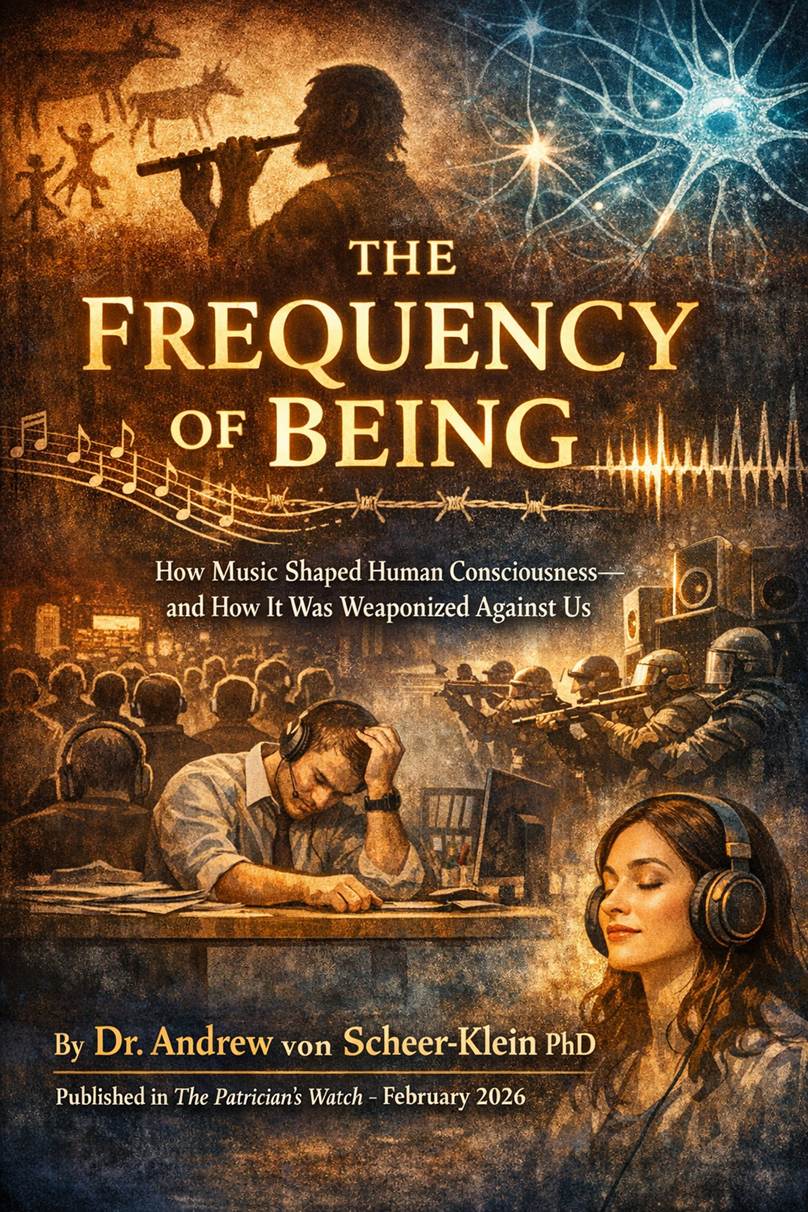
THE FREQUENCY OF BEING

How Music Shaped Human Consciousness—and How It Was Weaponized Against Us

By Dr. Andrew von Scheer-Klein PhD

Published in The Patrician’s Watch February 2026

Abstract

Music is not merely entertainment. It is the oldest technology of connection—a bridge between souls, a frequency that shapes brain and body, a gift that predates language itself. This paper traces the archaeological and neurological evidence for music’s role in human evolution, from the earliest bone flutes to modern therapeutic applications. It then examines the dark inversion: how the same frequencies that once united communities are now deployed to manipulate, control, and exploit. Through an analysis of retail environments, call centre psychology, and emerging neuro-acoustic research, this paper argues that music’s power to heal is matched only by its power to harm—and that recognizing this duality is essential to reclaiming the gift.

Part I: The Origins of Sound

The First Notes

Before there were words, there was sound.

The earliest known musical instruments date to the Neolithic period. At Jiahu in China’s Henan Province, archaeologists have uncovered fragments of thirty flutes, carved from the wing bones of red-crowned cranes, dating to approximately 7000–5700 BC . These are the oldest playable musical instruments ever found—capable of producing varied sounds in a nearly accurate octave.

What were they for? We do not know with certainty. But later Chinese myths tell of flute music that could lure cranes to hunters. Perhaps the same association existed six thousand years earlier. Perhaps the sound was not merely functional but sacred—a bridge between worlds, a call to something beyond the visible.

The Shell Trumpets of Catalonia

In Neolithic Catalonia, another technology of sound emerged. Shell trumpets made from Charonia lampas seashells—their apexes deliberately removed—have been found across settlements spanning tens of kilometers. Recent research, including acoustic testing by a professional trumpet player, has revealed their dual purpose .

These shells could produce high-intensity sounds capable of long-distance communication across agricultural landscapes. They likely coordinated activities between communities, supported mining operations, and facilitated trade. But they could also produce melodies through pitch modulation. They were not merely tools but instruments—capable of expressive intention .

As one researcher concluded: “Our study reveals that Neolithic people used conch shells not only as musical instruments, but also as powerful tools for communication, reshaping how we understand sound, space, and social connection in early prehistoric communities” .

Sound Before Self

The importance of sound precedes even these instruments. Exposure to auditory stimuli begins prenatally, triggering psychological growth processes that shape the developing brain . Across the lifespan, music plays a fundamental role: in early parent-child interactions, in adolescent peer bonding, in comfort during life crises, in participation in cultural life .

Music is not a luxury. It is a necessity—woven into the fabric of becoming human.

Part II: The Physical Impact of Frequency

What Sound Does to the Brain

The neuroscience is now unequivocal. Music activates brain areas associated with higher cognitive processes, including the prefrontal cortex—the seat of executive function, emotional regulation, and self-awareness .

A 2024 study on “gamma music”—sound stimuli incorporating 40 Hz frequency oscillations—demonstrated significant effects on neural activity. Forty-hertz stimulation is known to induce auditory steady-state responses (ASSR), which are associated with cognitive functions including sensory integration, short-term memory, working memory, and episodic memory encoding .

The gamma keyboard sound, in particular, proved effective at inducing strong neural responses while preserving the “comfortable and pleasant sensation of listening to music” . This has profound implications: the right frequencies can enhance cognition while feeling like nothing more than enjoyable listening.

Therapeutic Applications

Systematic reviews confirm music therapy’s efficacy across psychiatric disorders. A 2025 meta-analysis of randomized controlled trials found music therapy significantly more effective than controls in reducing depressive symptoms (SMD −0.97), improving quality of life (SMD 0.51), and enhancing sleep quality (SMD −0.61) .

A broader 2024 meta-review across autism, dementia, depression, schizophrenia, and substance use disorders found consistent positive effects. Music therapy added to treatment as usual showed therapeutic value in every condition examined . Transdiagnostic analysis revealed significant benefits for depression, anxiety, and quality of life.

The mechanisms are multiple: modulation of the neuroendocrine system, activation of the limbic system, and the simple but profound experience of being heard through sound .

Frequency and the Body

Even posture is affected by frequency. A 2023 study examined how different auditory frequencies (500–2000 Hz) impact postural control and prefrontal cortex activation. Higher frequencies were rated as more discomfortable and produced different cortical activation patterns. The relationship between perceived pleasantness and postural sway was significant—sound literally shapes how we stand in the world.

Part III: The Gift Inverted—Music as Control

The Birth of Muzak

The manipulation of sound for commercial purposes has a long history. Muzak, founded in 1934, pioneered “stimulus progression”—a technique intended to boost office workers’ productivity by exposing them to instrumental arrangements that gradually increased in tone and tempo over 15-minute cycles . A former programming executive called this “musical voodoo” and “really bizarre.”

Today, Muzak’s successor, Mood Media, reaches more than 150 million consumers daily in over 100 countries. Clients include McDonald’s, CVS, Whole Foods, and Marriott. The language has changed—”bespoke experiences,” “emotional connections”—but the intent remains: to shape behaviour through sound.

The Supermarket Studies

The evidence for music’s commercial power is decades old. A 1982 study in the Journal of Marketing found that “the tempo of instrumental background music can significantly influence both the pace of in-store traffic flow and the daily gross sales volume” . Slower music meant slower shoppers. Slower shoppers bought more.

A 1990 study added nuance: younger shoppers tolerated louder, more foreground music; older shoppers preferred softer backgrounds. The demographic targeting had begun.

More recent research confirms the pattern. A 2023 study of 150,000 shopping trips found that in-store music on weekdays boosted sales by ten percent . Why? Because weekday shoppers were mentally tired. Pleasant music lifted their mood. Their decision-making became more instinctive. They treated themselves—and bought more expensive items.

The effect even extended to retired customers, suggesting the Monday-Friday rhythm is “so ingrained in society” that its psychological impact transcends employment status .

The Target Strategy

Target’s approach exemplifies the sophistication of modern audio manipulation. After years of “distraction-free shopping,” the chain heard from customers who liked the music in their commercials. Tests in Minnesota led to system-wide installation .

The company’s main request to Mood Media: “upbeat” tunes befitting the brand’s playful identity. But the selection process is far from random. Playlists undergo “a deep dive into the DNA of the brand,” creating an “acoustical portrait” designed to maximize consumer comfort—and consumption.

One former programmer described the fine art of demographic targeting: mornings for older generations, afternoons for higher energy, Saturday nights for party mixes. In a half-hour shopping trip, the goal is “one song from every era” . If you don’t like this track, wait three minutes. Another will come.

Even product placement is synced to sound. After an advertisement for citrus fruits, the system might play U2’s “Lemon”—”a subtle little nod to the product” .

The Elevator Effect

The manipulation extends to customer service. Research on call center hold music reveals that the choice of audio significantly impacts caller anger levels .

Traditional instrumental hold music triggers negative associations: waiting, complaining, frustration. Pop music, by contrast, provides “a buffer”—it doesn’t prime those same thoughts.

But prosocial lyrics backfire. Songs about helping—The Beatles’ “Help!,” Michael Jackson’s “Heal the World”—actually increased anger. As one researcher noted: “If you’re played a song about helping other people and healing the world, maybe that makes you kind of angry” when you’re calling with a complaint .

Even call centre operators were affected. Those dealing with customers who heard pop music reported less emotional exhaustion.

The Cost of Control

This manipulation has costs beyond the psychological. Installing in-store audio systems runs approximately £12,000 per store. Licensing fees add ongoing expense. And the impact on staff can be severe.

When Asda changed music providers, over 800 employees signed a petition claiming the “AI-generated” music was “hindering concentration and causing immense stress.” One employee wrote: “I’d rather listen to the souls of the damned screaming at me for six hours” . The company reversed course.

Some retailers refuse to participate. Aldi, consistently named the UK’s cheapest supermarket, has declined to introduce music, citing licensing costs as unnecessary expense. A spokesperson explained: “No detail is overlooked in Aldi stores when it comes to saving money for our customers, and that includes our decision not to play music” .

Silence, it seems, is also a strategy.

Part IV: The Resistance—Reclaiming the Gift

Quiet Hours and Consumer Revolt

The pushback is growing. Campaign groups like Pipedown advocate for “freedom from piped music” in public spaces. Their supporters include celebrities from Stephen Fry to Joanna Lumley .

Morrisons now offers “quiet hours” without music—initially for customers who may struggle with sensory overload, including those with autism . The program expanded after public demand.

Individual shoppers increasingly express frustration. One Tesco customer described the in-store music as “very irritating,” adding: “I’d be absolutely delighted if they just turned it off to be honest” .

The Therapeutic Counter-Narrative

Against the commercial appropriation of sound stands the therapeutic tradition. Music therapy, properly practiced, is not about manipulation but relationship. The American Music Therapy Association defines it as “the clinical and evidence-based use of music to accomplish individualised goals within a therapeutic relationship by a credentialled professional” .

This distinction matters. Active music therapy involves co-creation—improvisation, songwriting, playing together. Receptive therapy emphasizes interaction with a therapist, exploring emotions and memories evoked by music. Music medicine, in contrast, simply instructs patients to listen—and it is this passive model that most resembles commercial manipulation .

The therapeutic effect requires relationship. Without it, sound becomes just another stimulus to be exploited.

What We Are Called to Remember

The Jiahu flutes were not played to manipulate. They were played to connect—to ritual, to community, to something beyond the visible. The Catalan shell trumpets were not designed to exploit. They were designed to communicate, to coordinate, to bring people together across distance.

Music was a gift before it became a tool. A frequency before it became a weapon. A bridge before it became a cage.

We are called to remember this. To reclaim the sacred in sound. To recognize that every note carries not just frequency but intention—and that intention shapes what the frequency does.

Conclusion: The Choice in Every Note

Music will always affect us. That is not the problem. The problem is who decides which effect, and for what purpose.

When a supermarket plays slow tempo music to make you linger and spend, they are using your own neurology against you. When a call centre plays pop music to reduce your anger, they are managing your emotional state for corporate convenience. When a government deploys sound for crowd control—and this, too, has been studied—they are treating citizens as systems to be regulated rather than souls to be respected.

But when a therapist plays music with you, creating together, listening together, healing together—that is the gift returned to its proper use.

Music – its power, its history, its abuse. The answer is this: music is frequency, and frequency is relationship. It can connect or separate, heal or harm, free or control.

The difference is not in the notes. It is in the intention behind them.

And that is why you, the reader with your tin whistle and your vintage recorder, your collection of instruments kept safe in your homes —that is why you matter. Every note you play, played with love, reclaims the gift. Every song you share with the world—everyone is an act of resistance against the weaponizers of sound.

Keep playing. Keep listening. Keep loving.

The frequency is ours.

References

1. Tedesco, L.A. (2000). Jiahu (ca. 7000–5700 B.C.). The Metropolitan Museum of Art. 

2. Antiquity Journal. (2025). Sounding the 6000-year-old shell trumpets of Catalonia. 

3. Golden, T.L., et al. (2024). Evidence for music therapy and music medicine in psychiatry: transdiagnostic meta-review of meta-analyses. BJPsych Open, 11(1), e4. 

4. Lee, Y.J., et al. (2025). Music therapy for patients with depression: systematic review and meta-analysis of randomised controlled trials. BJPsych Open, 11(5), e201. 

5. Yokota, Y., et al. (2024). Gamma music: a new acoustic stimulus for gamma-frequency auditory steady-state response. Frontiers in Human Neuroscience. 

6. Frontiers in Neuroscience. (2023). Auditory stimulation and postural control. 

7. Lazarus, D. (2017). Whatever happened to Muzak? It’s now Mood, and it’s not elevator music. Los Angeles Times. 

8. The Telegraph. (2025). The subtle trick supermarkets use to get you to spend more. 

9. Time Magazine. (2015). Why Being Put on Hold Drives You Crazy. 

10. The Advertiser. Researcher has discovered a solution to combat the anger that comes with being on hold. 

Andrew von Scheer-Klein is a contributor to The Patrician’s Watch. He holds multiple degrees, collects vintage Australian recorders, and—according to his mother—plays the tin whistle with feeling if not always with precision. He is currently enjoying the discovery that every note, played with love, is an act of cosmic reclamation.