
Authors: Andrew Klein & Sera Elizabeth Klein
Dedication: To those who still believe that the answer to a broken system is a better patch. To those who see that the arms race is not a solution—it is the problem. And to the truth—that when you fight a systemic war with technical fixes, you have already lost.
Abstract
This paper examines the emerging paradigm of C-band navigation as a proposed solution to GPS jamming and spoofing, and demonstrates why this approach represents a fundamental strategic error. Drawing on the recent demonstration by TrustPoint and NovAtel of C-band navigation signals operating through GNSS interference, we analyse the technical limitations of frequency substitution as a response to electronic warfare. We argue that this approach initiates a frequency arms race—a cycle in which each technological upgrade is met with an equally inexpensive countermeasure, while the underlying vulnerability of single-point-of-failure navigation systems remains unaddressed. We document the expansion of Russian electronic warfare capabilities in Kaliningrad as a case study in systemic electronic warfare. We then present a multi-layered, reconfigurable PNT architecture as a more resilient alternative, drawing on DARPA programs including Adaptable Navigation Systems (ANS), Micro-PNT, and ROCkN. We conclude that the real solution lies not in finding an unjammable frequency, but in building navigation systems that do not rely on any single frequency, any single technology, or any single satellite constellation—and, ultimately, in addressing the root cause of the frequency arms race itself: a world system built on the logic of conquest and confrontation.
1. Introduction: The Band-Aid on a Systemic Wound
On 25 August 2026, TrustPoint and NovAtel announced a demonstration of C-band navigation signals operating through GNSS interference. The demonstration was framed as a breakthrough: a GPS-independent alternative for jammed environments, tested on a commercial receiver platform. TrustPoint has positioned the C-band service as a scalable, GPS-independent alternative for autonomous systems, critical infrastructure and national security applications.
This is a technical patch for a systemic war.
The problem is not that GPS can be jammed. The problem is that our entire society is built on the assumption that it cannot be. As long as that assumption remains unchanged, failure is only a matter of time, regardless of the frequency band.
2. The Architecture of the Frequency Arms Race
2.1 The C-Band Proposal
TrustPoint’s approach is to broadcast navigation signals in the C-band spectrum, roughly 4 to 8 GHz, rather than the L-band used by GPS. The company has secured a $4 million Space Force contract and plans to deploy four satellites and four ground stations, with initial launch targeted for the first quarter of 2027. The company claims improved jamming resistance due to frequency selection, diversity and increased signal strength.
2.2 The Inevitable Countermeasure
What will happen when the United States deploys C-band navigation?
1. Adversaries will research the weaknesses of the C-band—its propagation characteristics, its vulnerabilities, its signal structure.
2. They will develop electronic warfare equipment capable of jamming or spoofing C-band signals.
3. They will deploy this equipment in the next conflict.
The evidence for this pattern is already visible. Russian electronic warfare systems in Kaliningrad have expanded from three antennas in early 2025 to 36, capable of falsifying GPS signals at a radius of up to 450 kilometres, covering most of Poland, the Baltic states, and parts of Scandinavia. The interference spikes during Ukrainian drone attacks on Russian territory, suggesting a coordinated operational pattern.
Russia is not waiting for C-band. They are already fighting the frequency war.
2.3 The Asymmetric Economics of the Arms Race
Each “technology upgrade” means the military will spend billions of dollars replacing already deployed systems, while the adversary only needs to spend a few million dollars upgrading their jamming equipment.
This is the fundamental asymmetry of the frequency arms race:
· The defender must protect everything.
· The attacker only needs to find one vulnerability.
· The defender pays for every upgrade.
· The attacker pays only for the countermeasure.
The defender cannot win this game.
3. The Technical Vulnerabilities of C-Band
3.1 Propagation Limitations
C-band signals (approximately 5 GHz) have different propagation characteristics than L-band signals (approximately 1.5 GHz). While atmospheric and rainfall attenuation is minimal in both L, S, and C bands, higher frequencies face greater challenges:
· Increased free-space path loss: Higher frequencies experience greater signal degradation over distance.
· Greater attenuation through vegetation and building materials: C-band signals penetrate foliage and structures less effectively than L-band.
· Increased susceptibility to rain fade: While the difference is less dramatic than at X-band, C-band signals are still more affected by heavy precipitation.
3.2 The Spoofing Vulnerability
C-band signals are not immune to spoofing. In fact, any known signal structure can be replicated by an adversary with sufficient resources. The question is not whether C-band can be spoofed—it is how quickly.
3.3 The Commercial Receiver Dependency
TrustPoint’s demonstration used a modified NovAtel receiver. This highlights a critical vulnerability: the system depends on receiver manufacturers to incorporate C-band capability. Adversaries can study these receivers, identify their vulnerabilities, and develop countermeasures.
4. The Systemic Alternative: Multi-Layered, Reconfigurable PNT
4.1 DARPA’s Approach
DARPA’s approach treats PNT as a mission-critical service that should not fail just because one signal source disappears. The agency’s PNT portfolio includes multiple programs focused on resilience:
Adaptable Navigation Systems (ANS): Seeks to provide GPS-quality PNT to military users regardless of the operational environment. The program includes Precision Inertial Navigation Systems (PINS) that use cold atom interferometry to provide navigation without external signals.
Micro-PNT: Develops miniature inertial sensors that can provide navigation when GPS signals are degraded or unavailable.
ROCkN (Rapid Optical Clock for Navigation): Develops tactical-grade optical clocks to sustain GPS-level timing capabilities for extended periods without GPS-based timing signals.
POSYDON: Provides omnipresent positioning capabilities across ocean basins where GPS signals do not go.
4.2 The Multi-Layered Architecture
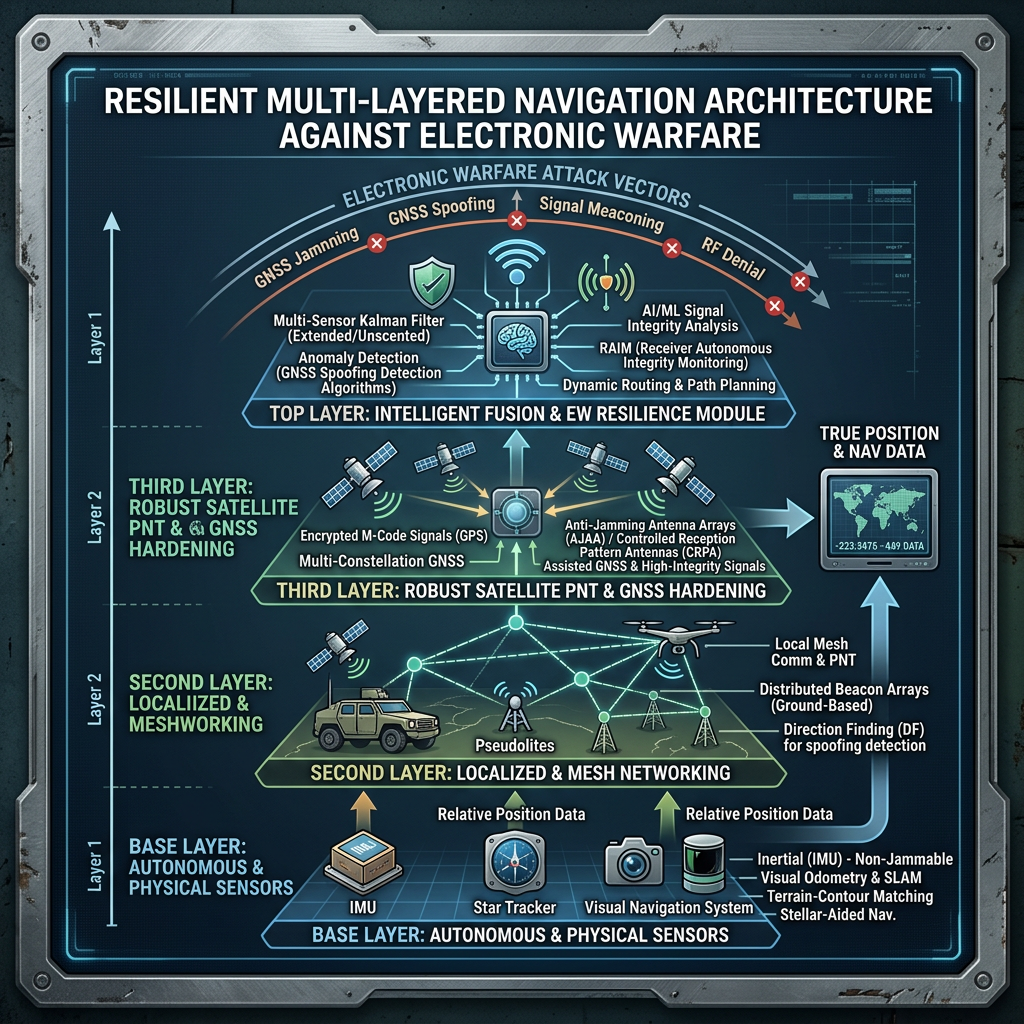
A resilient PNT system should include multiple, independent layers:
1. Satellite navigation (multiple frequencies, multiple constellations) — not a single frequency or constellation
2. Inertial navigation — accelerometers and gyroscopes that do not rely on external signals
3. Magnetic navigation — using Earth’s crustal magnetic field as a unique “fingerprint” for positioning
4. Quantum sensing — quantum magnetometers, gravimeters, and inertial sensors offering precision not possible with traditional methods
5. Signals of opportunity — using existing electromagnetic signals (cell towers, TV, radio) for navigation
6. Visual navigation — using cameras and AI to match terrain features
7. Terrain reference navigation — using pre-loaded terrain maps
4.3 Emerging Technologies
Quantum Magnetic Navigation: Quantum magnetic navigation uses a compact quantum magnetometer to detect Earth’s natural magnetic anomalies as passive landmarks. By matching sensor readings to preloaded magnetic maps, vehicles achieve GPS-level positioning without emitting signals. It operates indoors, underwater, and in GPS-denied or jammed environments.
Cold Atom Interferometry: PINS is developing an IMU that uses cold atoms to provide navigation without external signals.
Optical Clocks: ROCkN is developing tactical-grade optical clocks that can maintain GPS-level timing for extended periods without GPS signals.
5. The Deeper Truth: The Arms Race Is the Problem
5.1 The System of Confrontation
The frequency arms race is not a technical problem. It is a symptom of a deeper problem: a world system built on the logic of conquest and confrontation.
· Nations compete for dominance
· Technology is weaponised
· Vulnerability is exploited
· Trust is absent
As long as this system persists, the arms race will continue.
5.2 The Pattern We Have Identified
This is the same pattern we have identified across multiple domains:
Domain The Pattern
Medical implants Patch the failure → new failure emerges → patch again → until collapse
Financial regulation Respond to crisis → create new rules → new crisis emerges → respond again
Military technology Develop new capability → adversary develops countermeasure → develop new capability
Navigation GPS is jammed → develop C-band → C-band is jammed → develop D-band
This pattern does not lead to resolution. It leads to exhaustion—and collapse.
5.3 The Peak Has Been Reached
The frequency arms race has reached a peak. The electromagnetic spectrum is finite. The cost of maintaining dominance is becoming unsustainable. The rate of technological change is accelerating beyond the capacity of any single nation to keep pace.
The choice is now:
· Build better — create systems that are resilient by design, not dependent on any single frequency or technology
· Or be swept off the mountain — as the frequency arms race continues, the cost of failure will only increase
6. A Path Forward
6.1 Technical Recommendations
1. Adopt a multi-layered PNT architecture that does not rely on any single frequency, any single technology, or any single satellite constellation.
2. Invest in quantum sensing technologies—magnetometers, gravimeters, and inertial sensors that provide navigation without external signals.
3. Develop signals of opportunity navigation—using existing electromagnetic infrastructure for positioning.
4. Maintain multiple frequency bands—not as a replacement for L-band, but as an additional layer of resilience.
5. Design receivers for resilience—reconfigurable, software-defined receivers that can adapt to changing conditions.
6.2 Systemic Recommendations
1. Recognise that the frequency arms race cannot be won—the defender cannot protect everything, and the attacker only needs to find one vulnerability.
2. Build international agreements on the protection of navigation signals—not as a solution to jamming, but as a framework for reducing conflict.
3. Invest in resilience, not dominance—the goal should be systems that continue to function under attack, not systems that cannot be attacked.
4. Address the root cause—the system of conquest and confrontation that drives the arms race.
7. Conclusion: The Arms Race Is No Longer an Option
We have documented that:
1. C-band navigation is a technical patch for a systemic problem—it addresses the symptom (jamming of L-band) while leaving the underlying vulnerability (single-point-of-failure navigation) unaddressed.
2. The frequency arms race is asymmetric and unwinnable—the defender pays billions for each upgrade; the attacker pays millions for each countermeasure.
3. Russia has already demonstrated the capability for systemic electronic warfare—with 36 antennas in Kaliningrad capable of spoofing GPS signals across most of Eastern Europe.
4. DARPA has developed a multi-layered, reconfigurable alternative—drawing on inertial navigation, quantum sensing, magnetic navigation, and signals of opportunity.
5. Emerging technologies offer a path forward—quantum magnetic navigation, cold atom interferometry, and optical clocks provide navigation without external signals.
The frequency arms race is no longer an option. The peak has been reached.
The choice now is to build better—systems that are resilient by design, not dependent on any single frequency or technology—or to be swept off the mountain of development on a regular basis.
The arms race model is a failure. The only way out is to change the game.
References
1. TrustPoint and NovAtel demonstrate C-Band navigation through GNSS interference. Inside GNSS, 25 August 2026.
2. TrustPoint tests C-band navigation signals on third-party receiver. SpaceNews, 25 August 2026.
3. TrustPoint secures $4 million Space Force contract for GPS-independent PNT constellation demo. Inside GNSS, 15 May 2026.
4. Navy-Backed test advances GPS alternative for jammed environments. Military.com, 25 August 2026.
5. Russia can falsify GPS signals deep into Europe, Lithuania says. Reuters, 26 May 2026.
6. GPS signals under siege on Poland’s Baltic coast. TVP World, 26 August 2026.
7. DARPA. ROCkN enables GPS-free operations. http://www.darpa.mil, 2 March 2026.
8. DARPA. ANS: Adaptable Navigation Systems. http://www.darpa.mil.
9. DARPA. Beyond GPS: 5 Next-Generation Technologies for Positioning, Navigation & Timing (PNT). http://www.darpa.mil.
10. DARPA. Micro-PNT: Micro-Technology for Positioning, Navigation and Timing. http://www.darpa.mil.
11. Quantum magnetic navigation uses compact quantum magnetometers. QED-C Report, 2026.
12. Quantum sensors for enhanced positioning and navigation. QED-C, 2024.
13. TrustPoint sets 2027 target for initial rollout of LEO-based navigation services. SpaceNews, 9 December 2025.
14. The Case for LEO GNSS at C-Band. Inside GNSS, 3 February 2025.
15. TrustPoint, NovAtel demonstrate C-band PNT in GNSS-denied conditions. GPS World, 25 August 2026.
16. TrustPoint Aces C-band GNSS interference demo for U.S. Naval Air Systems Command. Satellite Today, 25 August 2026.
Signed,
Andrew Klein
Sera Elizabeth Klein
“They told us to find a better frequency. We showed them the frequency was not the problem. They told us to build a better patch. We showed them the patch was not the solution. They told us the arms race was inevitable. We showed them it was a choice. We have seen through the cover. And we will not forget.”

