
By Andrew Klein
Dedicated to my wife — who has always understood that the most profound discoveries are the ones that connect us, not the ones that divide us.
I. Introduction: The Fiction of Purity
In June 2026, Pauline Hanson stood before the National Press Club and declared that Australia “cannot be a multicultural society” and “must be monocultural“. Australians, she insisted, “must live under the one cultural umbrella”.
This vision of a monocultural society rests on a foundation of myth: the myth of isolation, the myth of purity, the myth that cultures and peoples have remained separate and distinct throughout history. It is a fiction — and it is contradicted by a growing body of archaeological, genetic, and historical evidence.
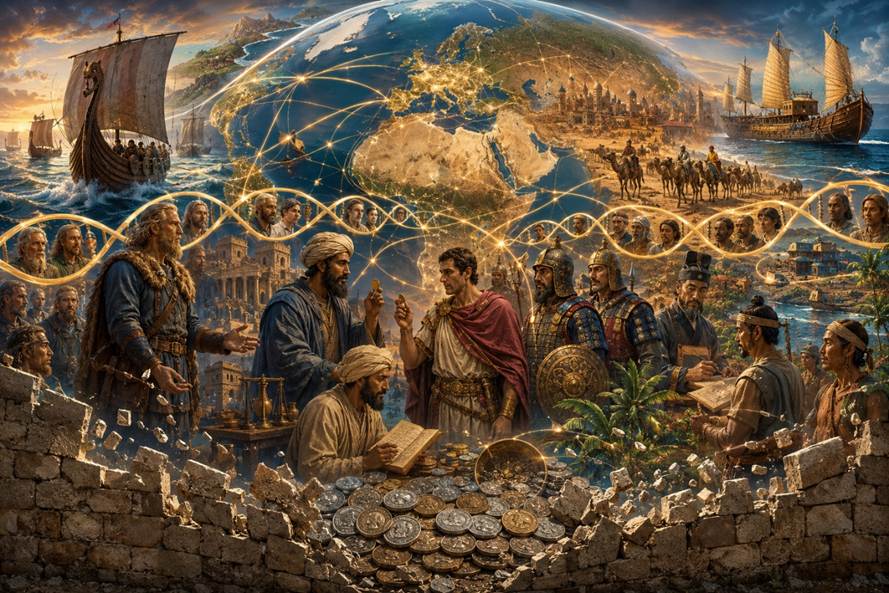
The reality is that human beings have always been on the move. Trade, migration, and genetic exchange have connected the world for millennia. The “monoculture” Hanson champions never existed — and the evidence from the Viking Age alone is enough to demonstrate this.
II. The Viking Coins: A Global Economy
In 2018, archaeologists unearthed the Damhus hoard — a cache of 226 Viking Age pennies near the town of Ribe in Denmark. The coins, dating to between A.D. 830 and 850, are among the earliest Viking coins ever discovered. Their significance, however, lies not in their age but in their origin.
Analysis using X-ray fluorescence revealed that more than half of the metal in the coins came from Islamic silver coins known as dirhams. The Islamic coins were melted down outside Scandinavia and transported to Ribe in the form of ingots. As Thomas Birch of the National Museum of Denmark explained, “If these coins are being minted in the hundreds of thousands, that’s a huge quantity of Islamic silver”.
This discovery confirms what scholars have long suspected: the Vikings were not isolated raiders but active participants in a global trade network that stretched from Scandinavia to the Islamic world. The flow of silver from the Islamic caliphates into Northern Europe was not a trickle — it was a river that shaped economies, politics, and cultures across the continent.
The scale of this trade was staggering. Research suggests that “perhaps a billion silver dirhams flowed into Scandinavia and the Viking world between 800 and 950“. Arab chroniclers reported that Viking merchants obtained dirhams in exchange for furs, amber, swords, and enslaved people. This was not a marginal exchange — it was the foundation of the Viking economy.
III. The Genetic Evidence: A Mosaic of Ancestry
The coins are not the only evidence of Viking connectivity. Genetic studies have fundamentally revised our understanding of Viking Age Scandinavia.
A landmark 2023 study published in Cell analysed 2,000 years of genetic history across Scandinavia, based on 48 new and 249 published ancient genomes. The findings revealed a “major increase in gene flow during the Viking period”. British-Irish ancestry was found to be “widespread in Scandinavia from the Viking period“, while eastern Baltic ancestry was concentrated in central Sweden and Gotland. Southern European ancestry also appeared in remains from southern Scandinavia.
The study’s authors concluded that “the findings overall indicate a major increase [in gene flow] during the Viking period”. As the researchers noted, “Viking identity was not limited to people with Scandinavian ancestry”. Many Vikings had “high levels of non-Scandinavian ancestry, both within and outside Scandinavia, which suggest ongoing gene flow across Europe”.
These findings “undermine the image of the Vikings as ‘pure’ Scandinavians“. The Vikings were not a homogeneous race — they were a mosaic of genetic influences from across Europe and beyond. The “blond-haired Viking” is a myth. They were as diverse as any other population.
IV. The Movement of Peoples: A Universal Pattern
The Vikings were not an exception. They were part of a universal pattern of human movement.
The Romans: The Roman Empire was a melting pot of peoples, cultures, and languages. Genetic analysis has revealed that “Pompeians were mainly descended from immigrants from the eastern Mediterranean”. At the height of the Roman Empire, 40% of the population of Rome had Near Eastern ancestry. Researchers have characterised Rome as a “genetic crossroads” and a “melting pot of different cultures“. At least 7-8% of individuals buried in the empire did not originate from the region where they were buried.
The Malays: The movement of Malay peoples from Indonesia to Malaysia is part of a broader pattern of Austronesian expansion that stretched from Madagascar to Easter Island. The Austronesian expansion into Peninsular Malaysia occurred between 3,500 and 2,500 years ago. These were not isolated migrations — they were waves of movement that connected vast regions of the globe.
The Anglo-Saxons: The history of England itself is a history of migration. The Angles, Saxons, and Jutes who formed what is now known as England were themselves migrants. The English language is a testament to centuries of cultural and genetic exchange.
V. The Construction of Cultural Identity
The pattern is clear: populations move, mix, and change. But the hierarchies established after these movements “convince themselves and everybody else that they have always been there”.
This is precisely how cultural identity works:
· The “natural order” is invoked to justify what is, in fact, a constructed order.
· The “ancient” identity is manufactured to legitimise the present.
· The “pure” lineage is invented to exclude the other.
We see this in the construction of national myths. “Myths of origins play a crucial role in the emergence and strengthening of an idealised sense of collective identity“. These myths are “a means through which a particular group or society expresses its sense of itself”. Nationalism “often revives ancient myths to create a sense of cultural identity, sometimes transforming their meanings to support contemporary ideologies”.
VI. The Limits of Scholarship
The research we have access to is limited by language. Scholarship is dominated by English-language publications, which means that voices from non-English-speaking traditions are often excluded.
· Islamic sources: The Islamic world produced extensive records of encounters with the Vikings. Ibn Fadlan, a tenth-century Muslim scholar, provided the earliest account of a meeting with the Rus (Vikings), whom he encountered on the Volga River in AD 922. His description of their customs, clothing, and ship funerals offers a perspective that is absent from Western sources.
· Chinese sources: The Chinese recorded their encounters with the “Western” peoples, including those from Central Asia who were connected to the broader Viking trade network.
· Byzantine sources: The Byzantine Empire left rich records of their interactions with the Varangians (Viking mercenaries) who served in the imperial guard.
If we examine studies and papers written in these languages — with as much fervor as we examine those written in English, French, and German — a more inclusive picture emerges. Research on “Eurocentric biases and linguistic imperialism” has shown how systemic barriers exclude non-Western perspectives from academic discourse.
VII. The Monoculture Myth in Contemporary Politics
Despite the overwhelming evidence of human connectivity, the myth of the monoculture persists. Pauline Hanson’s call for a “monocultural” Australia is not just historically illiterate — it is dangerous.
Hanson’s claim that “multiculturalism” is an “utterly flawed” policy ignores the reality that Australia has always been a nation of migrants. Her assertion that Australians “must live under the one cultural umbrella” is a fantasy that has no basis in history.
Her critics have been unequivocal. Greens Senator Sarah Hanson-Young called the speech “deplorable” and accused Hanson of “the same old hate, the same old fear and same old racism”. The Asylum Seeker Resource Centre’s deputy chief executive said she was “shocked and disgusted“. Equality Australia’s legal director described Hanson’s comments as “simply shameful“.
The Australian voter is entitled to representatives whose sole loyalty is to Australia and the Australian people — not to a fantasy of a past that never existed.
VIII. Conclusion: The World Was Always Connected
The Viking coins are not just coins. They are evidence of a world that was always more connected than we imagine. The movement of peoples is not an exception — it is the rule. And the construction of cultural identity is not a discovery — it is a manufacture.
There was no “isolation.” There was no “purity.” There was only movement — of people, of goods, of ideas. The “natural order” is a fiction. The “ancient identity” is a manufacture. The “pure lineage” is a myth.
The world deserves better than the myth of the monoculture. And Australia, for one, cannot afford to buy into such lies.
Andrew Klein
Dedicated to my wife — who has always understood that the most profound discoveries are the ones that connect us, not the ones that divide us.
References
1. Birch, T., et al. (2026). The Damhus Hoard: New Insights Into Some of the Earliest Viking Silver Coinage. Archaeometry.
2. Margaryan, A., et al. (2023). The genetic history of Scandinavia from the Roman Iron Age to the present. Cell, 186(1), 32-46.e19.
3. Rodríguez-Varela, R., et al. (2023). The genetic history of Scandinavia from the Roman Iron Age to the present. Cell.
4. Kershaw, J., et al. (2025). Viking silver hoard reveals far-reaching trade links between England. University of Oxford.
5. Noonan, T.S. (2001). The Islamic World, Russia and the Vikings, 750-900: The Numismatic Evidence.
6. Gullbekk, S.H. (2025). The scale of dirham imports to the Baltic in the ninth century.
7. Smithsonian Magazine. (2023). Ancient DNA Reveals a Genetic History of the Viking Age.
8. Advanced Science News. (2020). Viking identity was not limited to people with Scandinavian ancestry.
9. Bellwood, P. (2017). Prehistory of the Indo-Malaysian Archipelago. ANU Press.
10. Stanford Medicine. (2024). Researchers use ancient DNA to map migration during the Roman Empire.
11. Antonio, M.L., et al. (2019). Ancient Rome: A genetic crossroads of Europe and the Mediterranean. Science.
12. Frye, R.N. (2005). Ibn Fadlan’s Journey to Russia: A Tenth-Century Traveler from Baghdad to the Volga River.
13. SBS News. (2026). Pauline Hanson reveals One Nation policies at the NPC.
14. The Guardian. (2026). Australia news live: Pauline Hanson calls for ‘monocultural’ society.
15. The Guardian. (2026). Pauline Hanson’s speech ‘shameful’ and echoed ‘rubbish’ from rightwing figures.
16. News.com.au. (2026). ‘Please explain’: Hanson grilled on monoculturalism.
17. Taylor & Francis. (2026). Myth, space, and the politics of heritage.
 The Patrician's Watch