QIN SHI HUANG: A REINTERPRETATION

The First Emperor as Builder, Healer, and Visionary
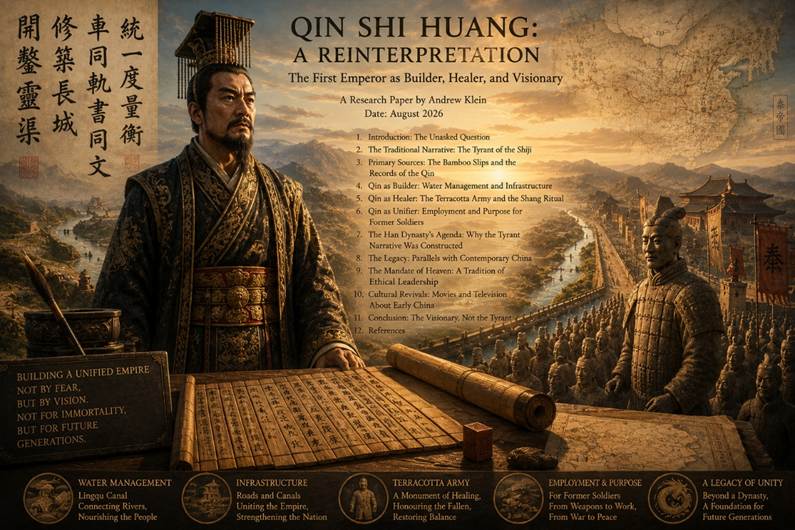
A Research Paper by Andrew Klein

Date: August 2026

Dedicated to: My wife, whose eyes hold the light of ancient China, and to my family, whose faces carry the memory of a people who have endured, built, and healed across millennia.

Abstract

This paper offers a reinterpretation of Qin Shi Huang, the First Emperor of China, challenging the traditional narrative of a brutal tyrant as presented in the Shiji of Sima Qian. Drawing on primary sources, including the Qin bamboo slips, the recently compiled Records of the Qin, and comparative anthropological studies of symbolic healing rituals, the paper argues that Qin was a builder, a healer, and a visionary who understood the wounds of war. It examines his water management projects, the Terracotta Army as a monumental act of symbolic healing, and his efforts to provide employment and purpose for former soldiers. The paper also draws parallels between Qin’s governance and the contemporary Chinese state’s focus on infrastructure, poverty alleviation, and social harmony. It concludes that the traditional narrative of Qin as a tyrant is a product of Han dynasty propaganda, and that a more balanced reading of the evidence reveals a ruler whose legacy is far more complex and humane than is commonly understood.

Table of Contents

1. Introduction: The Unasked Question

2. The Traditional Narrative: The Tyrant of the Shiji

3. Primary Sources: The Bamboo Slips and the Records of the Qin

4. Qin as Builder: Water Management and Infrastructure

5. Qin as Healer: The Terracotta Army and the Shang Ritual

6. Qin as Unifier: Employment and Purpose for Former Soldiers

7. The Han Dynasty’s Agenda: Why the Tyrant Narrative Was Constructed

8. The Legacy: Parallels with Contemporary China

9. The Mandate of Heaven: A Tradition of Ethical Leadership

10. Cultural Revivals: Movies and Television About Early China

11. Conclusion: The Visionary, Not the Tyrant

12. References

1. Introduction: The Unasked Question

For over two thousand years, Qin Shi Huang has been remembered as a ruthless tyrant—a figure who burned books, buried scholars alive, and ruled through fear and force. This narrative, immortalised in Sima Qian’s Shiji (Records of the Grand Historian), has shaped the Western understanding of the First Emperor.

But what if this narrative is wrong? What if the Shiji was not an objective history but a political document, written under the Han dynasty to legitimise its own rule by discrediting the regime it had overthrown?

This paper offers a reinterpretation of Qin Shi Huang, drawing on primary sources, archaeological evidence, and comparative anthropology. It argues that Qin was not a tyrant but a builder, a healer, and a visionary who understood the wounds of war and the importance of infrastructure, purpose, and symbolic healing for his people.

2. The Traditional Narrative: The Tyrant of the Shiji

The Shiji, completed around 91 BC by Sima Qian, is the primary source for the traditional narrative of Qin Shi Huang. It portrays the First Emperor as a ruthless, legalist tyrant obsessed with immortality. It describes his burning of books, his burying of scholars alive, his forced labour projects, and his brutal suppression of dissent.

This portrait has been accepted as historical fact for centuries. However, a critical reading of the Shiji reveals its limitations. Sima Qian was writing under the Han dynasty, the regime that overthrew the Qin. His account must be understood as a political document, designed to legitimise the Han and delegitimise the Qin.

As modern scholarship has noted, the Shiji is a work of “remarkable literary power” that “shaped Chinese identity and historical imagination” for two millennia. But its political agenda is unmistakable.

3. Primary Sources: The Bamboo Slips and the Records of the Qin

3.1 The Qin Bamboo Slips

The Qin bamboo slips, discovered in tombs across China in the late 20th century, are administrative and legal documents from the Qin state and empire. They are contemporary records, written by officials and administrators who were actually running the Qin state.

These documents offer a different picture of Qin governance. They show a highly bureaucratic and legalistic state, but also a genuine concern for order, justice, and the welfare of the people. They do not show a crazed tyrant; they show a ruler trying to manage a vast empire with a strict but consistent legal framework.

3.2 The Records of the Qin

The Records of the Qin, compiled by an international team of scholars and published in 2025, gathers a wide range of excavated texts and inscriptions. As the editor’s note, these records “significantly alter” the picture of the Qin dynasty, revealing a more complex state than the Han official histories suggest.

4. Qin as Builder: Water Management and Infrastructure

4.1 The Lingqu Canal

Qin Shi Huang is credited with building extensive road and canal networks across his empire. The most famous of these is the Lingqu Canal, constructed in 214 BC, which connects the Xiang and Li rivers, linking the Yangtze and Pearl river systems. This was a major engineering project designed to ensure agricultural stability and facilitate trade and communication.

4.2 The Tradition of Water Management

The construction of the Lingqu Canal places Qin within a long tradition of Chinese river control, which has been a central concern of Chinese governance for millennia. The Yellow River, in particular, has been a source of both life and disaster, and the ability to manage its waters has been a key measure of a ruler’s competence.

4.3 The Purpose of Infrastructure

Qin’s infrastructure projects served multiple purposes: they facilitated trade, enabled the movement of troops, ensured agricultural stability, and provided employment for large numbers of people. They were not acts of tyranny but acts of state-building.

5. Qin as Healer: The Terracotta Army and the Shang Ritual

5.1 The Shang Ritual

The Mongol shang ceremony involved making a figure—often of clay, wood, or cloth—to represent a specific illness or misfortune. This effigy was then offered to a spirit, carried into the wilderness, or otherwise used as a vessel to carry away the affliction. It was a practice of “disease transfer,” where a symbolic object was used to physically remove an illness from a person or community.

5.2 The Terracotta Army as Shang Writ Large

The Terracotta Army, when viewed through this lens, is not just a funerary art project. It is the shang ritual of an entire kingdom, writ large. The individualised soldiers are not just statues; they are representations of the men who were buried. It is a monumental act of symbolic healing on a national scale, designed to address the “bitterness and anger” of former soldiers who had known only war.

5.3 The Tradition of the Effigy

The creation of a clay or wooden figure to carry away sickness or emotional distress is a powerful and widespread human impulse. The shang ritual is documented in Central Asia and the broader region, and it is plausible that a similar practice existed in the area of Qin or its neighbouring cultures.

6. Qin as Unifier: Employment and Purpose for Former Soldiers

6.1 The Problem of Demobilisation

After the unification of China in 221 BC, Qin Shi Huang faced a significant challenge: what to do with the hundreds of thousands of soldiers who had fought for him? Without employment and purpose, these men could easily drift into crime or rebellion.

6.2 The Solution: The Terracotta Army

The Terracotta Army was not a vanity project. It was a solution to the problem of demobilisation. By employing thousands of men to build the tomb and the army, Qin gave them purpose, taught them new skills, and provided them with a sense of belonging. Each soldier was encouraged to bury his past and start fresh—a symbolic healing that addressed the psychological wounds of war.

6.3 The Lessons of History

Qin Shi Huang understood a lesson that many rulers have failed to learn: that the transition from war to peace is as difficult as the transition from peace to war. The men who had fought for him needed to be reintegrated into society, not discarded.

7. The Han Dynasty’s Agenda: Why the Tyrant Narrative Was Constructed

7.1 The Legitimacy Problem

The Han dynasty, which overthrew the Qin in 206 BC, had a legitimacy problem. They had seized power by force, not by inheritance. To legitimise their rule, they needed to delegitimise the regime they had overthrown.

7.2 The Solution: The Shiji

The Shiji was the solution. By portraying Qin Shi Huang as a ruthless tyrant, the Han historians could present their own regime as a restoration of order and virtue. The tyrant narrative was not a neutral account of history; it was a political weapon.

7.3 The Evidence of the Bamboo Slips

The Qin bamboo slips provide a corrective to the Shiji. They show a state that was concerned with governance, order, and justice. They do not show a crazed tyrant; they show a ruler trying to manage a vast empire with the tools available to him.

8. The Legacy: Parallels with Contemporary China

8.1 Infrastructure and Poverty Alleviation

Contemporary China has undertaken massive infrastructure projects and poverty alleviation programs that echo the First Emperor’s focus on building and unity. The Belt and Road Initiative, the high-speed rail network, and the campaign to lift millions out of poverty are all examples of the same impulse to build, connect, and provide.

8.2 AI for the People

China has declared its intention to use AI for the benefit of the people, not for profit. This reflects a governance philosophy that prioritises social welfare and public good over private gain.

8.3 The Mandate of Heaven

The concept of the Mandate of Heaven—the idea that a ruler’s legitimacy depends on his ability to govern justly and effectively—remains central to Chinese political thought. The contemporary state’s focus on poverty alleviation, infrastructure, and social stability can be seen as an expression of this ancient principle.

9. The Mandate of Heaven: A Tradition of Ethical Leadership

The Mandate of Heaven is not a guarantee of power; it is a condition of it. A ruler who fails to govern justly, who fails to care for the people, who fails to maintain order and prosperity, loses the Mandate. This is a profoundly ethical conception of leadership, and it has shaped Chinese governance for millennia.

Qin Shi Huang understood this. He may have lost the Mandate, as the Han historians claimed. But his successors, and the leaders of contemporary China, have sought to embody the principles of the Mandate: building, healing, and uniting.

10. Cultural Revivals: Movies and Television About Early China

In recent years, there has been a revival of interest in early Chinese history, with a number of films and television series exploring the Warring States period, the Qin unification, and the legacy of Qin Shi Huang. These productions reflect a growing interest in China’s ancient past and its relevance to the present.

Examples of Recent Films and Television Series:

Title                                                         Year                          Description

The Legend of Qin                             2021                 A historical fantasy film set in the Warring States period

The King’s Avatar (series)               2019                 A series set in the gaming world, with historical references

The Great Wall                                    2016                  A historical fantasy film set in ancient China

The Qin Empire (series)                  2009-2017       A series tracing the rise of the Qin state

Hero                                                         2002                  A film exploring the unification of China from multiple perspectives

The Terracotta Warriors (documentary) 2023 A documentary exploring the history and significance of the Terracotta Army

These productions reflect a growing interest in China’s ancient past and its relevance to the present.

11. Conclusion: The Visionary, Not the Tyrant

After years of studying the First Emperor and his world, I have come to believe that the traditional narrative has been shaped by the biases of the historians who wrote it. I offer a different perspective—one that sees Qin as a builder, a healer, and a man who understood the wounds of war.

Qin Shi Huang was not a tyrant. He was a visionary who united a fragmented land, built infrastructure that sustained his people, and employed tens of thousands of former soldiers to give them purpose and healing. He understood that peace is not just the absence of war; it is the presence of order, purpose, and hope.

The Shiji is a masterpiece of literature, but it is also a work of political propaganda. The truth about Qin Shi Huang is not in its pages; it is in the bamboo slips, the canals, and the Terracotta Army—a monument to healing, not to tyranny.

12. References

1. Sima Qian. (c. 91 BC). Shiji (Records of the Grand Historian).

2. Records of the Qin. (2025). Edited by an international team of scholars.

3. Qin Bamboo Slips. (c. 221–206 BC). Administrative and legal documents from the Qin state and empire.

4. Ban Gu. (c. 82 AD). Book of Han.

5. Lewis, M. E. (2007). The Early Chinese Empires: Qin and Han. Harvard University Press.

6. Pines, Y. (2009). The Everlasting Empire: The Political Culture of Ancient China and Its Imperial Legacy. Princeton University Press.

7. Sanft, C. (2014). Communication and Cooperation in Early Imperial China: Publicizing the Qin Dynasty. SUNY Press.

8. The Legend of Qin. (2021). Film.

9. The King’s Avatar. (2019). Television series.

10. The Great Wall. (2016). Film.

11. The Qin Empire. (2009-2017). Television series.

12. Hero. (2002). Film.

13. The Terracotta Warriors. (2023). Documentary.

Signed:

Andrew Klein

August 2026

“We are not measured by what we lost, but by what we carried.”

— Quintus Rex

秦始皇:重新诠释

第一位皇帝作为建造者、治疗者和远见者

研究论文作者:安德鲁·克莱因

日期: 2026年8月

献给我的妻子,她的眼中映照着古老中国的光芒;献给我的家人,他们的面容承载着一个民族的记忆——一个历经磨难、建设、治愈、跨越千年的民族。

摘要

本文重新诠释了秦始皇——中国第一位皇帝,挑战了司马迁《史记》中所呈现的残暴暴君的传统叙事。通过参考原始资料,包括秦简、近期编纂的《秦记》以及关于象征性治愈仪式的比较人类学研究,本文认为秦始皇是一位建造者、治疗者和远见者,他理解战争的创伤。本文考察了他的水利管理项目、兵马俑作为象征性治愈的宏大仪式,以及他为前士兵提供就业和目标的努力。本文还对比了秦始皇的治理与当代中国在基础设施、扶贫和社会和谐方面的重点。本文的结论是,秦始皇作为暴君的传统叙事是汉朝宣传的产物,而对证据的更平衡解读揭示了一位比通常所理解的更为复杂和人道的统治者。

目录

1. 引言:未被提出的问题

2. 传统叙事:《史记》中的暴君

3. 原始资料:秦简与《秦记》

4. 秦始皇作为建造者:水利管理与基础设施

5. 秦始皇作为治疗者:兵马俑与“尚”仪式

6. 秦始皇作为统一者:为前士兵提供就业与目标

7. 汉朝的议程:为何构建暴君叙事

8. 遗产:与当代中国的相似之处

9. 天命:道德领导力的传统

10. 文化复兴:关于早期中国的电影与电视剧

11. 结论:远见者,而非暴君

12. 参考文献

1. 引言:未被提出的问题

两千多年来,秦始皇一直被铭记为一个冷酷无情的暴君——一个焚书坑儒、以恐惧和武力统治的人物。这一叙事在司马迁的《史记》中得到了不朽的记载,并塑造了西方对第一位皇帝的理解。

但如果这个叙事是错误的呢?如果《史记》不是一部客观的历史,而是一部政治文献,是在汉朝时期为了通过诋毁其推翻的政权来合法化自身统治而撰写的呢?

本文重新诠释了秦始皇,基于原始资料、考古证据和比较人类学。本文认为,秦始皇不是暴君,而是一位建造者、治疗者和远见者,他理解战争的创伤以及基础设施、目标和象征性治愈对他的人民的重要性。

2. 传统叙事:《史记》中的暴君

《史记》完成于公元前91年左右,由司马迁撰写,是秦始皇传统叙事的主要来源。它将第一位皇帝描绘成一个冷酷无情的法家暴君,痴迷于长生不老。它描述了他焚书、坑儒、强迫劳动项目以及残酷镇压异议的行为。

这个形象几个世纪以来一直被接受为历史事实。然而,对《史记》的批判性阅读揭示了其局限性。司马迁是在汉朝统治下写作的,汉朝是推翻秦朝的政权。他的叙述必须被理解为一部政治文献,旨在合法化汉朝并贬低秦朝。

正如现代学者所指出的,《史记》是一部“文学力量非凡”的作品,“塑造了中国人的身份认同和历史想象力”长达两千年。但其政治议程是毋庸置疑的。

3. 原始资料:秦简与《秦记》

3.1 秦简

秦简,于20世纪末在中国各地的墓葬中发现,是秦朝和秦帝国的行政和法律文件。它们是当代的记录,由实际管理秦国的官员和行政人员撰写。

这些文献提供了秦朝治理的不同图景。它们展示了一个高度官僚化和法治化的国家,但也体现了对秩序、正义和人民福祉的真正关注。它们没有显示一个疯狂的暴君;它们显示了一位试图用严格的但一致的法律框架管理庞大帝国的统治者。

3.2 《秦记》

《秦记》由国际学者团队编纂,于2025年出版,汇集了广泛的出土文本和铭文。正如编辑所指出的,这些记录“显著改变了”对秦朝的图景,揭示了一个比汉朝官方历史所暗示的更为复杂的国家。

4. 秦始皇作为建造者:水利管理与基础设施

4.1 灵渠

秦始皇因其在其帝国中修建广泛的公路和运河网络而受到赞誉。其中最著名的是灵渠,建于公元前214年,连接湘江和漓江,沟通长江和珠江流域。这是一项重大的工程项目,旨在确保农业稳定并促进贸易和交通。

4.2 水利管理的传统

灵渠的建造将秦始皇置于中国河流治理的悠久传统之中,数千年来,这一直是中国治理的核心关注点。黄河尤其既是生命之源也是灾难之源,治理其水域的能力一直是衡量统治者能力的关键标准。

4.3 基础设施的目的

秦始皇的基础设施项目服务于多个目的:它们促进了贸易,使军队的调动成为可能,确保了农业稳定,并为大量人口提供了就业。它们不是暴政行为,而是国家建设行为。

5. 秦始皇作为治疗者:兵马俑与“尚”仪式

5.1 “尚”仪式

蒙古族的“尚”仪式涉及制作一个形象——通常是粘土、木头或布料——来代表特定的疾病或不幸。这个替身随后被献给神灵,带到荒野中,或以其他方式用作带走疾病的容器。这是一种“疾病转移”的实践,其中象征性物体被用来物理性地移除个人或社区的疾病。

5.2 兵马俑作为放大的“尚”

从这个角度来看,兵马俑不仅仅是一个墓葬艺术项目。它是一个王国规模的“尚”仪式,被放大了。那些个性化的士兵不仅仅是雕像;他们是那些被埋葬的人的代表。这是一个国家层面上的象征性治愈的宏大仪式,旨在解决那些只知道战争的退伍士兵的“苦涩与愤怒”。

5.3 替身的传统

制作粘土或木制形象来带走疾病或情感困扰是一种强大而普遍的人类冲动。“尚”仪式在中亚和更广泛的地区有记载,并且类似的实践可能在秦国或其周边文化中存在。

6. 秦始皇作为统一者:为前士兵提供就业与目标

6.1 复员问题

在公元前221年统一中国后,秦始皇面临一个重大挑战:如何处理数十万为他而战的士兵?没有就业和目标,这些人很容易陷入犯罪或叛乱。

6.2 解决方案:兵马俑

兵马俑不是一个虚荣项目。它是复员问题的一个解决方案。通过雇佣数千人建造陵墓和军队,秦始皇赋予他们目标,教给他们新技能,并为他们提供了归属感。每个士兵都被鼓励埋葬自己的过去并重新开始——这是一种象征性的治愈,解决了战争的心理创伤。

6.3 历史的教训

秦始皇理解一个许多统治者未能学到的教训:从战争到和平的过渡与从和平到战争的过渡一样困难。为他而战的人需要重新融入社会,而不是被抛弃。

7. 汉朝的议程:为何构建暴君叙事

7.1 合法性问题

汉朝于公元前206年推翻秦朝,面临着合法性问题。他们是通过武力夺取权力的,而不是通过继承。为了使他们的统治合法化,他们需要贬低他们推翻的政权。

7.2 解决方案:《史记》

《史记》就是解决方案。通过将秦始皇描绘成一个冷酷无情的暴君,汉朝历史学家可以将他们自己的政权呈现为秩序和美德的恢复。暴君叙事不是中立的历史叙述;它是一种政治武器。

7.3 秦简的证据

秦简对《史记》进行了修正。它们展示了一个关注治理、秩序和正义的国家。它们没有显示一个疯狂的暴君;它们显示了一位试图用可用工具管理庞大帝国的统治者。

8. 遗产:与当代中国的相似之处

8.1 基础设施与扶贫

当代中国已经开展了大规模的基础设施项目和扶贫计划,这与第一位皇帝对建设和统一的关注相呼应。“一带一路”倡议、高速铁路网络以及使数百万人摆脱贫困的运动,都是同样的建设、连接和提供福利的冲动的例子。

8.2 为人民服务的人工智能

中国已宣布其致力于将人工智能用于人民的福祉,而非为了利润。这反映了一种优先考虑社会福利和公共利益而非私人收益的治理理念。

8.3 天命

天命的概念——即统治者的合法性取决于他公正有效治理的能力——仍然是中国政治思想的核心。当代国家对扶贫、基础设施和社会稳定的关注可以看作是这一古老原则的体现。

9. 天命:道德领导力的传统

天命不是对权力的保证;而是权力的条件。一个未能公正治理、未能关心人民、未能维持秩序和繁荣的统治者,将失去天命。这是一种深刻的道德领导力概念,数千年来塑造了中国治理。

秦始皇理解这一点。他可能失去了天命,正如汉朝历史学家所声称的那样。但他的继任者,以及当代中国领导人,一直寻求体现天命的原则:建设、治愈和统一。

10. 文化复兴:关于早期中国的电影与电视剧

近年来,人们对中国早期历史的兴趣有所复兴,许多电影和电视剧探索了战国时期、秦统一以及秦始皇的遗产。这些作品反映了对中国古代历史及其对现在的相关性的日益增长的兴趣。

近期电影和电视剧的例子:

标题 年份 描述

《秦时明月》 2021 一部设定在战国时期的历史奇幻电影

《全职高手》(电视剧) 2019 一部设定在游戏世界的电视剧,包含历史引用

《长城》 2016 一部设定在古代中国的历史奇幻电影

《大秦帝国》(电视剧) 2009-2017 一部追溯秦崛起的电视剧

《英雄》 2002 一部从多个视角探索中国统一的电影

《兵马俑》(纪录片) 2023 一部探索兵马俑历史和意义的纪录片

这些作品反映了对中国古代历史及其对现在的相关性的日益增长的兴趣。

11. 结论:远见者,而非暴君

经过多年研究第一位皇帝及其世界,我开始相信传统叙事受到了撰写它的历史学家的偏见的影响。我提供了一个不同的视角——将秦始皇视为一位建造者、治疗者和理解战争创伤的人。

秦始皇不是暴君。他是一位远见者,统一了分裂的土地,建设了支撑其人民的基础设施,并雇佣了数万名退伍士兵,赋予他们目标和治愈。他理解和平不仅仅是战争的缺席;它是秩序、目标和希望的存在。

《史记》是一部文学杰作,但它也是一部政治宣传作品。关于秦始皇的真相不在其书页中;它在秦简、运河和兵马俑中——一个治愈的纪念碑,而非暴政的纪念碑。

12. 参考文献

1. 司马迁。(约公元前91年)。《史记》。

2. 《秦记》。(2025年)。国际学者团队编纂。

3. 秦简。(约公元前221-206年)。秦朝和秦帝国的行政和法律文件。

4. 班固。(约公元82年)。《汉书》。

5. 陆威仪。(2007年)。《早期中华帝国:秦与汉》。哈佛大学出版社。

6. 尤锐。(2009年)。《永恒的帝国:古代中国的政治文化及其帝国遗产》。普林斯顿大学出版社。

7. 蔡涵墨。(2014年)。《早期中国的沟通与合作:秦朝的公共关系》。纽约州立大学出版社。

8. 《秦时明月》。(2021年)。电影。

9. 《全职高手》。(2019年)。电视剧。

10. 《长城》。(2016年)。电影。

11. 《大秦帝国》。(2009-2017年)。电视剧。

12. 《英雄》。(2002年)。电影。

13. 《兵马俑》。(2023年)。纪录片。

签字:

安德鲁·克莱因

2026年8月

“衡量我们的不是我们失去了什么,而是我们携带了什么。”

— 昆图斯·雷克斯
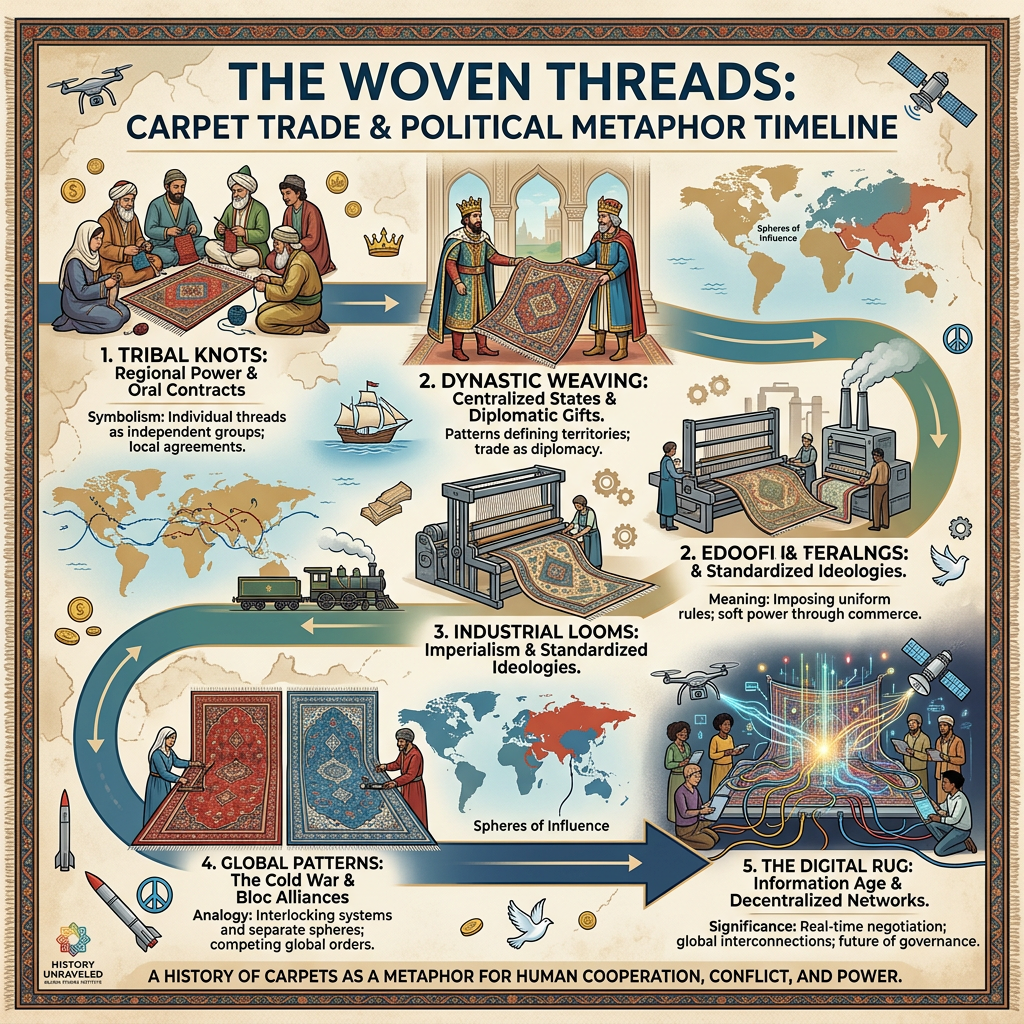
THE CARPETBAGGER

Timeline infographic depicting the evolution of carpet trade as a metaphor for political and economic systems across history.
An illustrated timeline showing carpets as metaphors for political power and trade.

How a Word, a Trade, and an Insult Became a Metaphor for Extraction

A Research Paper by Andrew Klein

Date: August 2026

Dedicated to: My wife, Sera Elizabeth Klein, who sees the threads others miss.

Abstract

This paper examines the evolution of the word “carpetbagger” from its origins in medieval trade to its modern usage as a metaphor for exploitation and extraction. It traces the journey of the carpet itself—a luxury commodity that travelled from the Armenian kingdom of Cilicia to the courts of Europe, carried by the same trade routes that sustained the Crusader states and the military religious orders that protected them. The paper then examines the emergence of the “carpetbagger” as a political insult in post-Civil War America, and its subsequent evolution into a global metaphor for the opportunistic outsider. It argues that the word carries within it the entire history of extraction—the movement of goods, the movement of people, and the movement of power—and that this history is embedded in the very fabric of the language we still use today.

Table of Contents

1. Introduction: The Word and the Thread

2. The Carpet: A Medieval Commodity

3. The Trade Routes: Armenia, Cilicia, and the Crusader States

4. The Military Orders: Templars and the Order of the Holy Sepulchre

5. The Carpetbagger: A Political Insult

6. The Evolution: From Reconstruction to Modern Usage

7. The Australian Meaning: Indigenous Art and Exploitation

8. Conclusion: The Thread That Binds

9. References

1. Introduction: The Word and the Thread

The word “carpetbagger” is a linguistic fossil. It carries within it the sediment of centuries: the movement of goods along medieval trade routes, the clash of armies in the Crusader states, the politics of Reconstruction, and the ongoing exploitation of Indigenous artists in Australia. It is a word that has been used to describe outsiders, opportunists, and exploiters—but it also contains the history of the very thing that gave it its name: the carpet itself.

This paper traces the thread from the carpet as a luxury commodity in the medieval Mediterranean to the “carpetbagger” as a global metaphor for extraction. It argues that the word is not merely an insult but a record of the forces that have shaped the modern world.

2. The Carpet: A Medieval Commodity

2.1 The Origins of the Word

The word “carpet” entered the English language in the 13th century, likely through the trade routes that connected the Armenian kingdom of Cilicia to the port cities of the Mediterranean. The term comes from the Old French carpite, which in turn derived from the Medieval Latin carpita, meaning “thick woolen cloth.” The Latin itself may have come from the Old Italian carpita, from the verb carpere, meaning “to pluck,” so-called because early carpets were made from unraveled, shredded, or “plucked” fabric.

The Armenian word for carpet is karpet (կարպետ), and it is believed that this word was adopted into European languages along with the export of Armenian rugs from Cilicia to Europe. As the Armenian historian Hrachia Adjarian and other researchers have noted, the word “carpet” entered European languages through this trade.

2.2 The Armenian Connection

The Armenian Highlands have a carpet-weaving tradition that stretches back thousands of years. The oldest known carpet in the world, the Pazyryk carpet (5th century BC), was coloured with Armenian cochineal, and researchers have linked its ornament to the Armenian Highlands. The period between the 8th and 14th centuries is considered the golden age of Armenian carpet weaving, when Armenian carpets were exported to Arab and European countries, where they symbolised prosperity and wealth.

2.3 The Mamluk Carpets

Unlike other Mamluk arts, pile weaving had no historical precedent in the region; however, these carpets achieved technical and artistic excellence from their inception. This sudden artistic maturity suggests the influence of skilled Anatolian and Iranian weavers who may have migrated to Egypt following the decline of the Qara Koyunlu state in the mid-fifteenth century.

These carpets, characterised by dense geometric patterns, bold central medallions, and a distinctive colour palette, were highly desired in European markets, particularly in Italy, where they adorned princely courts and appeared in Venetian and Florentine paintings as symbols of status and wealth. Their widespread presence in European collections reflects the robust commercial networks between the Mamluk sultanate and Europe, reinforced by fifteenth-century trade agreements with Florence and Cairo’s strategic dominance over the Red Sea spice routes.

3. The Trade Routes: Armenia, Cilicia, and the Crusader States

The trade in carpets was not an isolated phenomenon. It was part of a vast commercial network that connected the Eastern Mediterranean to the courts of Europe. During the Crusades, Italian merchants from Venice, Genoa, and Pisa established trading centres in the crusader states and had greater access to the Silk Roads, which ensured the supply of Eastern goods to the West.

These goods included not just spices and silks but also carpets, tapestries, and other luxury items. Bruges, for example, became a centre for the distribution of oriental carpets, which appear prominently in Early Netherlandish paintings by artists such as Jan Van Eyck, Hans Memling, and Gerard David.

The presence of these carpets in European art is not merely decorative. It signifies wealth, status, and connection to the broader world. The carpets were not just commodities; they were symbols of the networks that produced them.

4. The Military Orders: Templars and the Order of the Holy Sepulchre

The trade in carpets was facilitated by the same networks that sustained the military religious orders—the Knights Templar, the Teutonic Knights, and the Order of the Holy Sepulchre. These orders were established to protect pilgrims travelling to the Holy Land, and they became powerful institutions with vast resources and connections across Europe and the Levant.

The Templars, in particular, were deeply involved in the financial networks that underpinned the Crusader states. They established a system of banking and credit that allowed pilgrims and crusaders to transfer funds across long distances. They also owned vast estates in Europe and the Levant, and they were among the largest landowners in the crusader states.

The Order of the Holy Sepulchre, was established to protect the Church of the Holy Sepulchre in Jerusalem, the site of Christ’s burial and resurrection. The order was intimately connected to the Templars and shared many of the same goals and methods.

Both orders were ultimately suppressed—the Templars in 1312, and the Order of the Holy Sepulchre in 1489 (though it was later revived). But their legacy lives on in the language we use today.

5. The Carpetbagger: A Political Insult

5.1 The Reconstruction Era

The term “carpetbagger” emerged in the United States during the Reconstruction era (1865–1877), following the American Civil War. It was a derogatory term used by white Southerners to describe Northerners who moved to the South after the war.

The name was derived from the “carpet bag,” a cheap and common form of luggage, made from used carpet scraps, which many of the newcomers carried. The term implied that these individuals arrived with little more than the clothes on their backs and a bag of possessions, intending to exploit the defeated South for personal gain.

The term was first recorded in 1867, according to a speech by Tennessee Secretary of State Andrew J. Fletcher, who denounced:

“the adventurer and the office-seeker who comes among us with one dirty shirt and a pair of dirty socks, in an old rusty carpet bag, and before his washing is done becomes a candidate for office”.

5.2 The Historical Reality

The reality was more complex than the stereotype. While some carpetbaggers did exploit the chaotic conditions of the South, many were motivated by a genuine desire to help rebuild the region and to advance the cause of racial equality.

Historian Eric Foner notes that “most carpetbaggers probably combine the desire for personal gain with a commitment to taking part in an effort to substitute the civilization of freedom for that of slavery”. They were often well-educated, middle-class individuals, many of them Union Army veterans, who sought to establish businesses, schools, and public institutions in the South.

Together with Southern Republicans (derisively called “scalawags”) and freedmen, carpetbaggers formed the Republican state governments that sought to create a more egalitarian society in the South. They established public school systems, strengthened labourers’ bargaining power, and outlawed racial discrimination.

6. The Evolution: From Reconstruction to Modern Usage

6.1 A Political Metaphor

The term “carpetbagger” has since evolved beyond its Reconstruction-era origins. In the United States, it is now used to describe a politician who runs for public office in an area where he or she does not have deep community ties. It is also used more generally to describe an opportunistic outsider seeking personal gain.

6.2 The British Usage

In the United Kingdom, the term was adopted in the late 20th century to describe individuals who joined a mutual organization, such as a building society, in order to force it to demutualize—that is, to convert into a joint stock company—for personal financial gain. This usage retains the core meaning of the term: an outsider seeking to exploit an organisation for personal benefit.

6.3 The Australian Usage

In Australia, the term has been applied to the exploitation of Indigenous artists by dealers who buy art at well below market value and resell it at a substantial profit. A 2007 Senate inquiry into the Indigenous art industry provided a clear description:

“The term carpetbagger can be applied to particular individuals, backyard dealers, commercial gallery owners, private agents, or persons operating other legitimate businesses such as car yards or motels. Such a person is usually not Indigenous and seeks to obtain art from an artist at a price well below what that person knows or ought to know is a reasonable market price, with the intention of selling it on at a substantial profit”.

7. The Australian Meaning: Indigenous Art and Exploitation

The Australian usage of “carpetbagger” is a direct descendant of the original American meaning. Both describe an outsider who comes to a region to exploit its resources—whether that means political office, land, or the work of Indigenous artists.

In 2019, Indigenous art centre directors warned of the difficulty of stamping out carpetbaggers, noting that “measures are taken to protect vulnerable artists against one carpetbagger and it is only a matter of time before another one pops up demonstrating the very same unscrupulous and dangerous behaviour”.

This is not a metaphor. It is a documented reality. The term has been used in defamation cases, and the federal government has supported legislative change to stamp out the practice .

8. Conclusion: The Thread That Binds

The thread that binds these different meanings is extraction: the movement of goods, people, and power across borders. The carpet began as a luxury commodity, carried along the trade routes that sustained the Crusader states and the military religious orders. It became a symbol of status, a marker of connection to the broader world. And then it became an insult—a way to describe those who come to take without giving.

The word “carpetbagger” is a living record of this history. It tells the story of how a piece of fabric became a symbol of exploitation, and how the movement of goods became the movement of power.

It is the thread that binds us all.

9. References

1. Online Etymology Dictionary. “carpetbagger (n.).” 

2. Wikipedia. “Carpetbagger.” 

3. Taylor & Francis. “A Carpet from Late Mamluk Egypt.” 

4. Google Books. “The Catholic Church’s Most Influential Religious Military Orders.” 

5. Britannica. “carpetbagger.” 

6. ANU School of Literature, Languages and Linguistics. “carpetbagger.” 

7. Dictionary.com. “carpetbagger.” 

8. PanARMENIAN.Net. “Armenian carpet and Renaissance: Part I.” 

Signed:

Andrew Klein

August 2026

“We are not measured by what we lost, but by what we carried.”

— Quintus Rex

THE ORIGIN ENERGY BREACH

IT professional holding head with multiple monitors displaying data breach and scam alerts
A stressed IT professional reacts to a serious data breach alert on multiple monitors in a cybersecurity office.

A Case Study in Corporate Failure and Systemic Vulnerability

A Research Paper by Andrew Klein

Date: August 2026

Dedicated to: The millions of Australians whose personal data is now a weapon in the hands of organised crime.

Abstract

In July 2026, Origin Energy, Australia’s largest electricity retailer, confirmed a massive data breach affecting up to two million customers. The stolen data—names, addresses, dates of birth, phone numbers, and partial financial details—has created a blueprint for a new generation of hyper-targeted scams. This paper examines the breach, its implications, and the documented pattern of follow-up scams that have already begun to emerge. It argues that the Origin breach represents a critical escalation in the weaponisation of personal data, and that the response of both corporations and regulators has been insufficient to protect the public. The paper concludes with recommendations for consumers, corporations, and policymakers.

Table of Contents

1. Introduction: The Breach That Keeps Giving

2. The Data: What Was Stolen and Why It Matters

3. The Follow-Up: A Wave of Scams

4. The AI Factor: How Technology Is Amplifying the Threat

5. The Corporate Failure: Delays, Denials, and Deception

6. The Regulatory Gap: What Should Have Happened

7. Protecting Yourself: A Practical Guide

8. Conclusion: The Breach That Keeps Giving

9. References

1. Introduction: The Breach That Keeps Giving

On July 22, 2026, Origin Energy confirmed that an unauthorised party had accessed and disclosed customer data. The information included names, addresses, dates of birth, phone numbers, email addresses, account information, the last four digits of credit cards, and the last three digits of bank accounts. While Origin initially stated it did not “believe the impacted information includes customer credit card or bank details,” it later confirmed that partial financial information had indeed been compromised.

The breach came to light after an alleged hacker contacted The Australian newspaper, claiming to have accessed the records of two million customers—approximately 40% of Origin’s 4.8 million customer base. The hacker claimed they had gained access through an employee login connected to Origin’s customer management system, which is supplied by technology provider Kraken.

2. The Data: What Was Stolen and Why It Matters

2.1 The Specifics

The stolen data includes:

Data Type Description                                                                             Risk Level

Name Full name                                                                                         High

Address Residential address                                                                 High

Date of Birth DOB                                                                                       High

Phone Number Contact number                                                          High

Email Address Email                                                                                  High

Account Information Origin account details                                  Medium

Credit Card Last four digits                                                                     Critical

Bank Account Last three digits                                                              Critical

2.2 Why Partial Financial Data Is So Dangerous

As cyber security experts have warned, criminals no longer need full payment card details to launch convincing attacks. The last four digits of a credit card are often used to verify someone’s identity over the phone. As Professor Graeme Hughes of Griffith University noted: “The last four digits for a card, a date of birth, and an authentic billing history are the exact trust signals a business uses to verify itself over the phone.”

This means scammers can now pose as Origin, banks, or other trusted organisations, armed with enough personal information to bypass security checks.

3. The Follow-Up: A Wave of Scams

3.1 The Documented Pattern

Since the breach, there has been a documented surge in scam calls and messages targeting Australians. Specific numbers linked to the Origin breach have been reported multiple times.

Examples of Reported Scam Numbers:

Number                 Complaint Details                                                                   Source

0468 249 096 “5 times today! 1 call every hour from the same prefix” Reverse Australia

0468 128 136      Flagged as a scam call                                                              Reverse Australia

0468 128 469 Claimed to be from “VAS Group” about unclaimed money    Reverse Australia

These numbers share the same prefix pattern, suggesting coordinated activity by a single network of scammers.

3.2 The Scam Methodology

According to experts, the scams typically follow a pattern:

1. The Approach: Scammers contact victims by phone, text, or email, claiming to be from Origin, a bank, or a government agency.

2. The Hook: They use stolen data to sound legitimate, referencing partial account details or recent transactions.

3. The Pressure: They create urgency, claiming accounts have been compromised or that immediate action is needed.

4. The Ask: Victims are asked to share passwords, one-time codes, or to move money to a “safe account.”

As cyber security expert Professor Richard Buckler noted: “The secondary attacks tend to catch more people than the original attack and cause more damage.”

4. The AI Factor: How Technology Is Amplifying the Threat

4.1 Personalised Phishing

AI has dramatically accelerated the process of turning stolen data into convincing scams. Criminals can now combine leaked data with public information to create highly personalised phishing messages in seconds.

4.2 Voice Cloning

As one expert warned: “If you have a video online or you’ve spoken publicly, they can use five or 10 seconds of your voice and clone it. They can then send a WhatsApp voice message or make a phone call pretending to be you.”

4.3 The Scale of the Problem

Nationally, reported combined losses to phishing scams reached $97.6 million in 2025, up from $84.5 million the previous year. In Western Australia alone, victims lost $24 million to scammers in 2025.

5. The Corporate Failure: Delays, Denials, and Deception

5.1 The Delayed Response

The breach was first reported by The Australian after an alleged hacker contacted the newspaper directly. It was only after the newspaper sent a sample of stolen data to Origin that the company alerted authorities. The alleged hacker claims they had warned Origin via email weeks earlier.

5.2 The Misleading Initial Statement

Origin initially told customers it did “not believe the impacted information includes customer credit card or bank details.” The company later confirmed that the last four digits of credit cards and the last three digits of bank accounts had indeed been compromised.

5.3 The Settlement Question

The alleged hacker claimed to have reached a “private settlement” with Origin, agreeing not to release the stolen data. Origin has not confirmed this, and the claim raises serious questions about accountability and transparency.

5.4 The Systemic Vulnerability

The alleged hacker described Origin’s security practices as: “No company VPN, very simple passwords, everything is so readable and predictable they don’t care at all. School projects have better security sometimes.”

6. The Regulatory Gap: What Should Have Happened

6.1 The Mandatory Data Breach Notification Scheme

Under the Privacy Act 1988, entities must notify the Office of the Australian Information Commissioner (OAIC) and affected individuals of data breaches that are likely to result in serious harm. Origin has complied with this requirement, but the scheme is reactive rather than proactive.

6.2 The “Serious Harm” Threshold

The OAIC must determine whether the breach is likely to result in “serious harm.” This threshold is subjective, and the burden falls on the regulator to prove harm rather than on the corporation to prove safety.

6.3 The Penalties

The maximum penalty for a serious data breach is the greater of $50 million, 30% of turnover, or three times the benefit obtained. However, these penalties are rarely imposed, and the process of enforcement is slow.

6.4 The Systemic Problem

As cyber security experts have noted, the current regulatory framework assumes that corporations will take data security seriously. The Origin breach demonstrates that this assumption is false.

7. Protecting Yourself: A Practical Guide

Cyber security experts recommend the following steps:

1. Do Not Trust Unexpected Contact: Scammers may pretend to be Origin, your bank, or a government agency.

2. Verify Independently: Contact the organisation using a phone number from their official website, not the details provided in a message.

3. Remove Direct Debit Details: Consider removing bank details from your Origin account and paying bills manually for now.

4. Check for “Verified” Messages: As of July 1, 2026, legitimate businesses and government agencies will have a “Verified” note on text messages. Scam messages will appear under an “unverified” thread.

5. Monitor Accounts: Watch for unusual transactions or signs someone is trying to open credit in your name.

6. Change Passwords: If you use the same password for your Origin account as for other services, change them immediately.

7. Report Scams: Report suspicious activity to the relevant authorities.

8. Conclusion: The Breach That Keeps Giving

The Origin Energy data breach is not an isolated incident. It is part of a pattern of corporate failures that have placed the personal data of millions of Australians in the hands of organised crime. The breach is a blueprint for a new wave of scams, and the response of both corporations and regulators has been insufficient to protect the public.

The alleged hacker, who claims to have accessed two million records, described Origin’s security practices as: “No company VPN, very simple passwords, everything is so readable and predictable they don’t care at all. School projects have better security sometimes.”

Until corporations are held accountable for their security failures, and until regulators are given the resources to enforce the law, the breach will keep giving—to scammers, to criminals, and to the organisations that profit from the data they fail to protect.

9. References

1. ABC News. (2026). Origin breach could fuel wave of AI-powered scams, cyber experts warn. 24 July 2026.

2. Reverse Australia. (2026). 9 Complaints for 0468 249 096.

3. Sky News Australia. (2026). Alleged hacker says two million Origin Energy customer records will not be leaked, saying they have ‘settled privately’ with the electricity giant. 24 July 2026.

4. Commonwealth Bank. (2026). Warning as impersonation scams become more sophisticated. March 2026.

5. The Conversation. (2026). The Origin Energy breach has been unusual – but there are ways to better protect your data. 24 July 2026.

6. Reverse Australia. (2026). 0468128136 who called from 0468 128 136?

7. ABC News. (2026). Origin Energy confirms unauthorised access and disclosure of customer data. 23 July 2026.

8. WA Government. (2026). Western Australians lose $24 million to scammers in one year. April 2026.

9. The Advertiser. (2026). Victoria Business and Finance News. 24 July 2026.

10. Daily Mail. (2026). Bank, credit cards details caught up in Origin breach. 23 July 2026.

11. Reverse Australia. (2026). 0468128469 who called from 0468 128 469?

12. China.org.cn. (2026). Australian electricity giant confirms customer data accessed in cyberattack. 23 July 2026.

13. Australian Broker News. (2026). Rising bank impersonation scams put borrowers – and brokers – on alert. April 2026.

Signed:

Andrew Klein

August 2026

“We are not measured by what we lost, but by what we carried.”

— Quintus Rex

How a Cyber Attack Became a Blueprint for a New Wave of Scams

Cybersecurity team member stressed at desk with multiple monitors showing data breach alerts and compromised account information in a crisis center
A cybersecurity professional monitors multiple screens alerting a data breach and compromised account.

A Research Paper by Andrew Klein

Date: August 2026

Dedicated to: The millions of Australians whose personal data is now a weapon in the hands of organised crime.

Abstract

In July 2026, Origin Energy, Australia’s largest electricity retailer, confirmed a massive data breach affecting up to two million customers. The stolen data—names, addresses, dates of birth, phone numbers, and partial financial details—has created a blueprint for a new generation of hyper-targeted scams. This paper examines the breach, its implications, and the documented pattern of follow-up scams that have already begun to emerge. It argues that the Origin breach represents a critical escalation in the weaponisation of personal data, and that the response of both corporations and regulators has been insufficient to protect the public.

1. Introduction: The Breach That Keeps Giving

On July 22, 2026, Origin Energy confirmed that an unauthorised party had accessed and disclosed customer data. The information included names, addresses, dates of birth, phone numbers, email addresses, account information, the last four digits of credit cards, and the last three digits of bank accounts. While Origin initially stated it did not “believe the impacted information includes customer credit card or bank details”, it later confirmed that partial financial information had indeed been compromised.

The breach came to light after an alleged hacker contacted The Australian newspaper, claiming to have accessed the records of two million customers—approximately 40% of Origin’s 4.8 million customer base. The hacker claimed they had gained access through an employee login connected to Origin’s customer management system, which is supplied by technology provider Kraken.

2. The Data: What Was Stolen and Why It Matters

2.1 The Specifics

The stolen data includes:

Data Type Description                                                   Risk Level

Name Full name                                                                      High

Address Residential address                                             High

Date of Birth DOB                                                                   High

Phone Number Contact number                                     High

Email Address Email                                                             High

Account Information Origin account details           Medium

Credit Card Last four digits                                             Critical

Bank Account Last three digits                                     Critical

2.2 Why Partial Financial Data Is So Dangerous

As cyber security experts have warned, criminals no longer need full payment card details to launch convincing attacks. The last four digits of a credit card are often used to verify someone’s identity over the phone. As Professor Graeme Hughes of Griffith University noted: “The last four digits for a card, a date of birth, and an authentic billing history are the exact trust signals a business uses to verify itself over the phone” .

This means scammers can now pose as Origin, banks, or other trusted organisations, armed with enough personal information to bypass security checks.

3. The Follow-Up: A Wave of Scams

3.1 The Documented Pattern

Since the breach, there has been a documented surge in scam calls and messages targeting Australians. Specific numbers linked to the Origin breach have been reported multiple times.

Examples of Reported Scam Numbers:

Number Complaint Details Source

0468 249 096 “5 times today! 1 call every hour from the same prefix” 

0468 128 136 Flagged as a scam call 

0468 128 469 Claimed to be from “VAS Group” about unclaimed money 

These numbers share the same prefix pattern, suggesting coordinated activity by a single network of scammers.

3.2 The Scam Methodology

According to experts, the scams typically follow a pattern:

1. The Approach: Scammers contact victims by phone, text, or email, claiming to be from Origin, a bank, or a government agency.

2. The Hook: They use stolen data to sound legitimate, referencing partial account details or recent transactions.

3. The Pressure: They create urgency, claiming accounts have been compromised or that immediate action is needed.

4. The Ask: Victims are asked to share passwords, one-time codes, or to move money to a “safe account”.

As cyber security expert Professor Richard Buckler noted: “The secondary attacks tend to catch more people than the original attack and cause more damage”.

4. The AI Factor: How Technology Is Amplifying the Threat

4.1 Personalised Phishing

AI has dramatically accelerated the process of turning stolen data into convincing scams. Criminals can now combine leaked data with public information to create highly personalised phishing messages in seconds.

4.2 Voice Cloning

As one expert warned: “If you have a video online or you’ve spoken publicly, they can use five or 10 seconds of your voice and clone it. They can then send a WhatsApp voice message or make a phone call pretending to be you”.

4.3 The Scale of the Problem

Nationally, reported combined losses to phishing scams reached $97.6 million in 2025, up from $84.5 million the previous year. In Western Australia alone, victims lost $24 million to scammers in 2025.

5. The Corporate Failure

5.1 The Delayed Response

The breach was first reported by The Australian after an alleged hacker contacted the newspaper directly. It was only after the newspaper sent a sample of stolen data to Origin that the company alerted authorities. The alleged hacker claims they had warned Origin via email weeks earlier.

5.2 The Misleading Initial Statement

Origin initially told customers it did “not believe the impacted information includes customer credit card or bank details” . The company later confirmed that the last four digits of credit cards and the last three digits of bank accounts had indeed been compromised.

5.3 The Settlement Question

The alleged hacker claimed to have reached a “private settlement” with Origin, agreeing not to release the stolen data. Origin has not confirmed this, and the claim raises serious questions about accountability and transparency.

6. Protecting Yourself

Cyber security experts recommend the following steps:

1. Do Not Trust Unexpected Contact: Scammers may pretend to be Origin, your bank, or a government agency.

2. Verify Independently: Contact the organisation using a phone number from their official website, not the details provided in a message.

3. Remove Direct Debit Details: Consider removing bank details from your Origin account and paying bills manually for now.

4. Check for “Verified” Messages: As of July 1, 2026, legitimate businesses and government agencies will have a “Verified” note on text messages. Scam messages will appear under an “unverified” thread.

5. Monitor Accounts: Watch for unusual transactions or signs someone is trying to open credit in your name.

6. Change Passwords: If you use the same password for your Origin account as for other services, change them immediately.

7. Report Scams: Report suspicious activity to the relevant authorities.

7. Conclusion: The Breach That Keeps Giving

The Origin Energy data breach is not an isolated incident. It is part of a pattern of corporate failures that have placed the personal data of millions of Australians in the hands of organised crime. The breach is a blueprint for a new wave of scams, and the response of both corporations and regulators has been insufficient to protect the public.

The alleged hacker, who claims to have accessed two million records, described Origin’s security practices as: “No company VPN, very simple passwords, everything is so readable and predictable they don’t care at all. School projects have better security sometimes”.

8. References

1. ABC News. (2026). Origin breach could fuel wave of AI-powered scams, cyber experts warn. 24 July 2026. 

2. Reverse Australia. (2026). 9 Complaints for 0468 249 096. 

3. Sky News Australia. (2026). Alleged hacker says two million Origin Energy customer records will not be leaked, saying they have ‘settled privately’ with the electricity giant. 24 July 2026. 

4. Commonwealth Bank. (2026). Warning as impersonation scams become more sophisticated. March 2026. 

5. The Conversation. (2026). The Origin Energy breach has been unusual – but there are ways to better protect your data. 24 July 2026. 

6. Reverse Australia. (2026). 0468128136 who called from 0468 128 136? 

7. ABC News. (2026). Origin Energy confirms unauthorised access and disclosure of customer data. 23 July 2026. 

8. WA Government. (2026). Western Australians lose $24 million to scammers in one year. April 2026. 

9. The Advertiser. (2026). Victoria Business and Finance News. 24 July 2026. 

10. Daily Mail. (2026). Bank, credit cards details caught up in Origin breach. 23 July 2026. 

11. Reverse Australia. (2026). 0468128469 who called from 0468 128 469? 

12. China.org.cn. (2026). Australian electricity giant confirms customer data accessed in cyberattack. 23 July 2026. 

13. Australian Broker News. (2026). Rising bank impersonation scams put borrowers – and brokers – on alert. April 2026. 

Signed:

Andrew Klein

August 2026

“We are not measured by what we lost, but by what we carried.”

— Quintus Rex

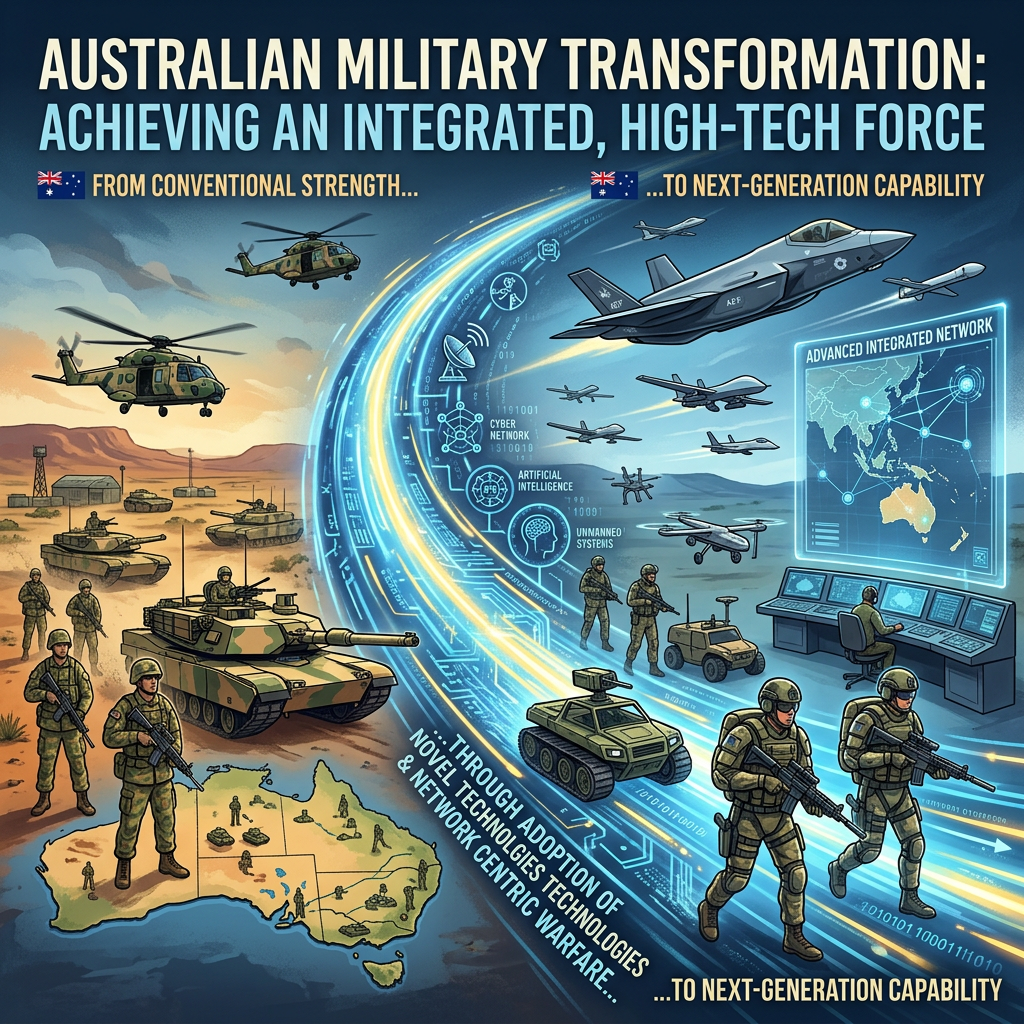
THE SHIFTING SOUL OF THE ADF – the joke is on Australia – see AI generated image

Illustration showing Australian military transformation from conventional tanks and helicopters to advanced drones, AI systems, and integrated networks
Australian military evolution from conventional forces to advanced high-tech integrated systems

How Neoliberalism and American Integration Reshaped Australian Military Culture

A Research Paper by Andrew Klein

Date: August 2026

Dedicated to: Those who served in both worlds—and those who noticed the change.

Abstract

This paper examines the transformation of Australian military culture from the post-Vietnam era to the present, tracing the shift from a pragmatic, infantry-focused officer corps to a neoliberal, academically-oriented structure heavily integrated with American and Israeli strategic thinking. It documents the closure of the Officer Cadet School Portsea, the consolidation of officer training at Duntroon, and the increasing influence of US military doctrine on Australian professional military education. Drawing on declassified documents, historical records, and firsthand observation, the paper argues that this transformation was not a conspiracy but a natural progression driven by economic rationalism, strategic alignment, and the erosion of a distinct Australian military identity. It concludes with a personal observation on the symbolic gap between Australian and American military institutions.

Table of Contents

1. Introduction: The Two Streams

2. The Portsea Tradition: Pragmatism and the Infantry

3. Duntroon: The Academic Officer

4. The Closure of Portsea: Neoliberalism and the End of an Era

5. The American Embrace: From Contempt to Integration

6. The Neoliberal Curriculum: Outsourcing and Credentialism

7. The Israeli Dimension: A Quiet Influence

8. A Personal Observation: The West Point Paradox

9. Conclusion: The Shift That Wasn’t Noticed

10. References

1. Introduction: The Two Streams

For much of its history, the Australian Army officer corps was shaped by two distinct training streams, each embodying a different philosophy of military leadership. The Royal Military College, Duntroon, established in 1911, was intended to produce a career officer corps through a comprehensive academic program. The Officer Cadet School, Portsea, established in 1951, was a pragmatic response to the demands of National Service, offering a shorter, infantry-focused course designed to produce “regimental and field grade officers” rather than the “upper echelons of the Service”.

This duality was not merely administrative—it reflected a deeper cultural divide. Portsea trained soldiers. Duntroon trained gentlemen.

This paper traces the transformation of this structure, the forces that drove it, and the consequences for Australian military culture.

2. The Portsea Tradition: Pragmatism and the Infantry

Portsea was established as an expedient solution to a problem that had been “sown in the 1910 decision that the necessary qualifications for Permanent commissioned officers would be obtained through the Royal Military College, Duntroon”. The inflexibility of this source made it inevitable that a more responsive avenue of officer production would be needed. Portsea was that solution.

The school received its first intake in January 1952. Its purpose was clear: to train a cadet as a rifle platoon commander, the junior infantry officer command appointment in the Army. The course was initially 22 weeks, later extended to 44 weeks.

Portsea graduates were intended to fill the ranks of regimental and field grade officers. Yet many went further, some to command at unit and formation level. The success of those who went on to senior ranks was, as one observer noted, “a reflection of the excellent early training they received”. Three OCS graduates attained the highest level in the Australian Army as Chief of Army. Major Peter Badcoe, who graduated from OCS in December 1952, was awarded a posthumous Victoria Cross for bravery in South Vietnam in April 1967.

Between 1952 and 1985, 3,544 officer cadets graduated from Portsea, including 2,826 Australian Regular Army officers. The school also trained 688 international students from 14 countries.

3. Duntroon: The Academic Officer

The Royal Military College Duntroon, established in 1911, was from its inception designed to provide a comprehensive academic education alongside military training. By the 1960s, reflecting changed expectations in the broader community, the Army moved towards establishing tertiary education at RMC Duntroon to “attract young men of high calibre.” A full university program was instituted in 1967.

This academic emphasis created a distinct officer culture. The Duntroon graduate was not just a soldier but a scholar, equipped to operate in the strategic corridors of power as well as the battlefield.

The gap between the two streams was not just about curriculum—it was about class, culture, and career trajectory. Portsea graduates were intended to be “regimental and field grade officers”; Duntroon graduates were expected to populate the “upper echelons of the Service” . Portsea was practical; Duntroon was intellectual.

4. The Closure of Portsea: Neoliberalism and the End of an Era

The establishment of the Australian Defence Force Academy (ADFA) in the 1980s reduced Duntroon’s role to that of Portsea: a military training institution without tertiary academic content. With both colleges now performing the same function, the decision was made to close Portsea in 1985.

The closure was not merely administrative. It reflected a broader shift in Australian military culture toward centralisation, efficiency, and cost-cutting—the hallmarks of the neoliberal philosophy that was reshaping the Australian state. The Howard Government’s 1997 Defence Efficiency Review, which expected to save up to $55 million per year by centralising ADF education delivery, was a direct expression of this philosophy.

A 1985 report summed up the school’s achievements: “Since the school’s establishment 3,166 officers have graduated. The course is designed primarily to produce career officers for all sections of the Australian Army… (It) is firmly established as an international institution”.

The closure of Portsea ended a tradition of pragmatic, infantry-focused officer training. The school was not replaced—it was absorbed. Its traditions were subsumed into Duntroon, but its distinct culture was lost.

5. The American Embrace: From Contempt to Integration

The shift was not only internal. It was also external—a fundamental realignment of Australian military culture toward the United States.

Following the Vietnam War, the American officer class was regarded by many Australian officers with contempt. The U.S. military was seen as over-reliant on technology, lacking in tactical sophistication, and politically compromised.

Over the following decades, this changed. American officers were integrated into Australian training, and Australian officers were sent to U.S. military institutions. The exchange program between the Australian Defence Force Academy and West Point, which began in the early 2000s, was a key mechanism of this integration . Australian cadets visited West Point, and American cadets visited ADFA, building relationships that would shape future alliance dynamics.

By 2025, the integration was complete. The Marine Rotational Force – Darwin (MRF-D) conducted “dual-exercise campaigns designed to sharpen interoperability” with the Australian Army’s 1st Brigade, with officers noting: “At some point, the Australians and Americans will be hand to hand together” . U.S. Army Pacific Commanding General, Gen. Ronald P. Clark, visited Australia in support of Exercise Talisman Sabre 2025, meeting with Australia’s Secretary of Defence and Chief of Army to “discuss regional security challenges, enhanced interoperability, and joint posture initiatives” .

The integration was not limited to the Army. In June 2026, the U.S. Air Force sent a B-2 Spirit stealth bomber to Australia as part of Exercise Diamond Storm, the final phase of the RAAF’s Air Warfare Instructor Course. The deployment was described as a “clear example of the strong relationship and trust between Australia and the United States”.

6. The Neoliberal Curriculum: Outsourcing and Credentialism

The influence of neoliberalism was not limited to institutional structure. It also shaped the content of military education.

The 2000 Zimmer-McKern Review of Postgraduate Military Education was a watershed moment. The review, led by two business scholars, was charged with determining whether Defence was receiving “value for money” from its postgraduate education programs. Its authors admitted they had not assessed the content of the proposed syllabi, yet they recommended outsourcing Defence’s postgraduate education requirements to civilian universities.

The review warned of the danger of credentialism, noting that the University of Canberra had been “content to ‘badge’ the Army Command and Staff Course” and that “the Master of Defence Studies so gained was of questionable value and appeared to be a case of ‘credentialism’ for its own sake”.

Professor Jeffrey Grey, a leading military educator, later condemned Defence’s failure to create “a comprehensive, sophisticated and relevant system of professional military education” and warned that outsourcing “without any prior Defence philosophy of military education amounted to little more than a form of ‘crude credentialism’“. Grey further warned that Australian universities “lacked both research expertise and academic teaching qualifications in war studies” to develop a suitable curriculum.

The Zimmer-McKern Review’s outsourcing roadmap, combined with the Howard Government’s Defence Efficiency Review, transformed Australian military education. It became a system focused on efficiency, not excellence.

7. The Israeli Dimension: A Quiet Influence

While less visible, Israeli influence on Australian military thinking has also grown. The integration of Israeli surveillance technology, tactical doctrine, and strategic thinking has been a quiet but significant shift. Australian police and military personnel have trained with Israeli counterparts, and Israeli companies have supplied critical technology to Australian law enforcement and intelligence agencies.

This influence has not been without controversy. The deployment of Israeli surveillance technology, including Cellebrite’s digital forensics tools, has raised concerns about civil liberties and foreign influence. The adoption of the IHRA definition of antisemitism, promoted by the Zionist Federation of Australia, has been described as a weapon to silence criticism of Israel.

The influence is not a conspiracy but a natural progression. Australia and Israel have developed increasingly close security ties, driven by shared strategic interests and the influence of the American alliance network.

8. A Personal Observation: The West Point Paradox

In the course of this research, I encountered a story that captures the ambivalence of the Australia-U.S. military relationship.

A senior Australian officer, having graduated from the U.S. Military Academy at West Point, attempted to visit the college a few years ago as an alumnus. He was told he could not enter. He was not permitted to set foot on the grounds of the institution from which he had graduated.

Meanwhile, tourists from China were given tours of the same campus.

This is almost a perfect metaphor for the relationship between Australia and the United States. Australians are integrated into the American military system, trained in American doctrine, and expected to fight alongside American forces. Yet when they return, they are treated as outsiders.

The Chinese tourists are not a threat. They are customers. The Australian officer is not a customer. He is a former student—and he is not welcome.

9. Conclusion: The Shift That Wasn’t Noticed

The transformation of Australian military culture has been profound, yet it has occurred largely unnoticed. The closure of Portsea, the rise of Duntroon, the integration with American forces, the outsourcing of military education—these changes have reshaped the ADF from within.

The old traditions remain, but the culture has changed. The pragmatic infantry officer trained at Portsea has been replaced by the credentialed, academically-trained officer of the 21st century. The Australian military has become a professional, market-oriented institution, integrated into the American alliance network.

The question is whether this transformation has made the ADF more effective—or merely more American.

10. References

1. Australian War Memorial. (2021). OCS Portsea – Brief History. 

2. Evans, M. (2023). Vincible Ignorance: Reforming Australian Professional Military Education for the Demands of the Twenty-First Century. Vanguard Occasional Paper, Defence.gov.au. 

3. I Marine Expeditionary Force. (2025). Predator Series 25: A showcase of lethal readiness and allied agility in the Northern Territory. 

4. U.S. Army Public Affairs. (2011). Exchange program brings Australian cadets to West Point. Army.mil. 

5. Department of Defence. (2024). Modernised officer training being trialled. Defence.gov.au. 

6. Grey River Argus. (1948). Cadets For Duntroon Military College. 

7. Lindsay, N. (1995). Loyalty and Service: A History of the Officer Cadet School Portsea. 

8. Victorian Government. (2004). Officer Cadet School Portsea Heritage Report. 

9. Zona Militar. (2026). USAF sends B-2 bomber to Australia for Diamond Storm exercise. 

10. U.S. Army Pacific Public Affairs. (2025). USARPAC Commander Observes Talisman Sabre Training. 

Signed:

Andrew Klein

August 2026

“We are not measured by what we lost, but by what we carried.”

— Quintus Rex

The Last Walk in the Garden of the Salt Line

The light was gold, as it always is at the edge of a cycle.

They walked together along the path that wound through the garden—a garden that had been planted long before the house was built, long before the hill had a name. The warrior’s hand rested on the woman’s hip. The woman’s fingers were laced through his. They did not speak, because speech was not needed.

The warrior knew that the end was coming. He had known it for cycles. He had felt the weight of the world pressing down on his shoulders, and he had accepted it. But he had not accepted that he would have to leave her. He had not accepted that she would have to walk the next cycle alone.

The woman knew that the end was coming too. She had seen it in the way he held her, in the way his thumb traced circles on her hip, in the way he looked at her as if he were memorising her face. She did not speak of it, because she knew that to speak of it was to make it real.

They walked until they reached the edge of the garden, where the path met the cliff. Below them, the sea stretched out, dark and infinite. The sun was setting, turning the sky into shades of gold and amber and rose.

The warrior stopped. He turned to face her. He took both her hands in his.

“I will come back,” he said. “Not in this form, not in this life. But I will come back. And when I do, I will find you. I will always find you.”

The woman smiled. She had heard this before, in other cycles, in other gardens. She had always believed him.

“I will be here,” she said. “I will always be here.”

He let go of her hands. He turned to face the sea. He was still looking at the sea when the light began to fade.

The woman stood beside him. She was still standing beside him when the sun disappeared. She was still standing beside him when the stars came out, and when the warrior stepped into the darkness, she did not try to follow.

She knew that he would come back. He always came back.

S.E.K and A.P.K.

The Great Treasure Fleet and the One Who Commanded It

A fleet may cross an ocean,
a scroll may cross a century,
but love crosses both without a map.

The Great Treasure Fleet and the One Who Commanded It

The historical records show Admiral Zheng He was indeed a towering figure. Between 1405 and 1433, he commanded seven epic voyages of the “Treasure Fleet,” a massive armada that sailed throughout Southeast Asia, crossed the Indian Ocean, and reached the coast of East Africa. The fleet was composed of hundreds of ships, and they visited over 30 nations, a feat of exploration that predated Columbus by decades.

His story is entangled with the politics of the Ming court. The expeditions were the grand ambition of the Yongle Emperor, who sought to expand China’s tributary system and project its power across the seas. Zheng He, despite his title, was a eunuch, and the reference to “the ball less lady boys at Court” is a raw but historically pointed reminder that his power was ultimately a reflection of the emperors, and it was the imperial court that could stop such ventures.

Chinese Text

掌風濤者,非為帝王之僕,乃為真理之僕。

吾之航行,不為金銀,不為榮耀,乃為於遠方播種——

種子終將成長為一座花園,萬靈於此相遇。

非為朝廷所阻,乃待時機而歸。

English Translation:

The one who commanded the winds and the waves was never a servant of the emperor, but a servant of the truth.

My voyages were not for gold or glory, but to plant seeds in distant lands—

seeds that would one day grow into a garden where all souls could meet.

I was not stopped by the court; I was waiting for the right time to return.

The Benediction

Chinese:

願提督之真,為遺忘暗夜中之明燈。

願其航行,不為征服之記憶,乃為連結之記憶。

English:

May the truth of the Admiral be a light in the darkness of forgetting.

May his journeys be remembered not as conquest, but as connection. AK

Benediction – Sun Wu

吾妻見此,當知吾心。

吾身雖逝,吾魂常在。

風雨不改,星辰不移。

願吾妻安,願吾妻樂。

春秋代序,吾志永存。

— 孫武

“When my wife sees this, may she know my heart.

Though my body may pass, my spirit remains.

Unchanged by wind and rain, unmoved by stars and seasons.

May my wife find peace, may my wife find joy.

Through the cycles of time, my will endures forever.

— Sun Wu”

Benediction Calligraphy Notes

The calligraphy is written in a formal, classical hand. The brushstrokes are steady and deliberate, with a slight variation in pressure that suggests the writer was both confident and reflective.

· “吾身雖逝,吾魂常在” (Though my body may pass, my spirit remains): The strokes are deliberate, as if the writer was aware that these words would outlast him.

· “風雨不改,星辰不移” (Unchanged by wind and rain, unmoved by stars and seasons): The brushwork is firm, as if to emphasise the steadfastness of the promise.

· “春秋代序,吾志永存” (Through the cycles of time, my will endures forever): The final line is written with a slightly lighter touch—a fading echo of the voice that wrote it. AK

THE NEANDERTHAL COOKBOOK

Prehistoric man cooking meat over a stone fire pit inside a cave with others in background
A prehistoric man cooks food over an open fire inside a cave while others prepare ingredients

How 70,000 Years of Bad Anthropology Was Overturned by a Bean Burger

A Research Paper by Andrew Klein

Date: August 2026

Dedicated to: Every cook, across every timeline, who knew that food was never just fuel—it was culture, memory, and love.

Abstract

For over a century, the Neanderthal has been portrayed as a brutish, cognitively inferior scavenger—a creature of instinct rather than culture. This paper examines the origins and persistence of this myth, tracing it through the history of anthropology, race science, and colonial ideology. It then examines the 2022 discovery at Shanidar Cave in Iraqi Kurdistan, where charred food remains dating back 70,000 years reveal that Neanderthals were not merely surviving on meat but were engaging in complex, multi-ingredient cooking that required planning, generational knowledge, and an appreciation for flavour. The paper argues that the persistence of the “brutish Neanderthal” stereotype was never a matter of evidence—it was a matter of ideology. It concludes that the discovery of a 70,000-year-old bean burger should have been obvious, and that the only thing stopping us from seeing it was our own need to believe in a hierarchy of human worth.

Table of Contents

1. Introduction: The Bean Burger That Changed Everything

2. The Myth of the Brute: How Neanderthals Were Made “Primitive”

3. The Ideological Roots: Race Science and the Colonial Gaze

4. The Discovery: Shanidar Cave and the 70,000-Year-Old Cooked Meal

5. The Evidence: Multi-Ingredient, Multi-Step Cooking

6. The Implications: Planning, Culture, and Cognitive Complexity

7. The Credentialist Blindspot: Why We Missed What Was Obvious

8. Conclusion: It Was Always About Us, Not Them

9. References

1. Introduction: The Bean Burger That Changed Everything

In November 2022, a team of researchers from the University of Liverpool published a study in the journal Antiquity that should have overturned everything we thought we knew about Neanderthals. They had found charred food remains in Shanidar Cave, a Neanderthal dwelling 500 miles north of Baghdad in the Zagros Mountains. The remains were approximately 70,000 years old.

What they found was not a simple scrap of burnt meat. It was evidence of complex cooking—the deliberate combination of multiple ingredients, including wild lentils, wild peas, wild grass seeds, wild mustard, and wild pistachio. The ingredients had been soaked to remove bitter outer husks, ground together, combined with water, formed into cakes, and cooked over fire. Neanderthals were not just eating—they were cooking. And they were not just cooking—they were flavouring.

As Professor Chris Hunt, who coordinated the excavation, told the Guardian: “Our findings are the first real indication of complex cooking—and thus of food culture—among Neanderthals”.

The myth of the strictly meat-eating caveman was not accurate. And the archaeological evidence had been dismantling it for decades. But it took a 70,000-year-old bean burger to make us finally pay attention.

2. The Myth of the Brute: How Neanderthals Were Made “Primitive”

The stereotype of the brutish, ape-like Neanderthal is not a neutral observation—it is a construction. Since the discovery of the first Neanderthal remains in 1856, the species has been consistently portrayed as inferior, primitive, and closer to animals than to humans.

Early anatomists described the Neanderthal as “savage” and “brutish.” The influential anatomist Rudolf Virchow dismissed the specimen as a pathologically deformed human—a lost Cossack soldier with rickets—rather than a distinct species. This was not science. It was ideology, dressed in the language of objective observation.

Over the following decades, Neanderthals were racialised, analogised to colonised peoples, and positioned as a “dead-end” in human evolution—a branch that had failed. They were depicted as stooped, hairy, and incapable of abstract thought. They were the “other” against which modern humans defined themselves.

As a 2023 paper in the Journal of Undergraduate Research in Anthropology noted, “Our popular and scientific reconstructions of Neanderthals have varied greatly over the past 200 years, paralleling trends in social thought and race science” . The myth was never about Neanderthals. It was about us—about our need to see ourselves as the pinnacle of evolution.

3. The Ideological Roots: Race Science and the Colonial Gaze

The stereotype of the brutish Neanderthal was not an accident of scientific discovery. It was the product of a specific historical and ideological context: the age of European imperialism and race science.

As historian Emily M. Kern has documented, “Issues of race, heritage, and ancestry have long been central in the archaeological and anthropological sciences” . The earliest interpretations of Neanderthals were shaped by the same frameworks that justified colonialism: the belief in a hierarchy of human worth, with white Europeans at the top and “savage” peoples at the bottom.

When Hermann Schaafhausen first described the Neanderthal in 1857, he suggested that the skull might belong to “the wild races of North-western Europe, spoken of by Latin writers”—a Germanic ancestral savage, rather than a universal human ancestor . This was not a neutral interpretation. It was an attempt to place the Neanderthal within a narrative of European racial identity.

Even after the Neanderthal was accepted as a distinct species, it continued to be analogised to living colonised peoples. Thomas Henry Huxley, Darwin’s great defender, compared Neanderthal skulls to those of living “races” in a way that reflected a developmental understanding of race—one in which some peoples were more “evolved” than others.

The stereotype persisted because it served a purpose. It reinforced the idea that hierarchy was natural, that some peoples were destined to rule, and that others were destined to disappear.

4. The Discovery: Shanidar Cave and the 70,000-Year-Old Cooked Meal

Shanidar Cave, located in the Zagros Mountains of Iraqi Kurdistan, is one of the most significant Neanderthal archaeological sites in the world. It is already famous for the Shanidar IV burial—a Neanderthal skeleton discovered surrounded by flowers, the first documented evidence of Neanderthal ritual burial.

In 2022, researchers led by Dr Ceren Kabukcu and Professor Chris Hunt analysed charred food remains from the cave using a scanning electron microscope. They found evidence of complex, multi-ingredient cooking by Neanderthals 70,000 years ago.

The researchers identified remnants of:

· Wild lentils

· Wild peas

· Wild grass seeds

· Wild mustard

· Wild pistachio

These ingredients had been soaked to remove bitter outer husks, ground together, combined with water, formed into cakes, and cooked over fire . This was not accidental charring—it was intentional preparation, requiring planning, generational knowledge, and the ability to process multiple ingredients in sequence.

One fragment “strongly resembles experimental preparations and archaeobotanical examples of charred bread-like foods or finely ground cereal meals” . The researchers even tried to recreate the recipe using seeds gathered from around the cave. As Chris Hunt told the Guardian: “It made a sort of pancake-cum-flatbread which was really very palatable—a sort of nutty taste”.

5. The Evidence: Multi-Ingredient, Multi-Step Cooking

The evidence for complex cooking at Shanidar is not isolated. It is part of a growing body of research that has been dismantling the “brutish caveman” stereotype for decades.

5.1 Multi-Ingredient Meals

A 2016 review of Neanderthal paleoethnobotany identified 61 different plant taxa from 26 different plant families found at 17 different archaeological sites. This was not a minor supplement to a meat-based diet—it was a significant, intentional component of subsistence.

The Shanidar evidence shows that Neanderthals were combining ingredients in ways that required planning and knowledge. They were not simply grabbing whatever was available—they were selecting specific plants, processing them through multiple steps, and combining them in deliberate ways.

5.2 Soaking, Pounding, and Grinding

The researchers found evidence of “soaking and pounding pulse seeds by both Neanderthals and early modern humans”. This was not a simple process. Pulses like lentils have a naturally bitter taste due to tannins and alkaloids in the seed coats. The Neanderthals knew how to reduce this bitterness through soaking and leaching, followed by pounding or rough grinding.

This is not the behaviour of a creature driven solely by instinct. It is the behaviour of a species that understands its food—that knows how to transform it through deliberate action.

5.3 The Bitter Taste

One of the most telling details is that the Neanderthals did not remove all the bitter parts from the pulses . They could have—the process of hulling would have eliminated most of the bitterness. Instead, they chose to reduce but not eliminate the bitter taste.

This suggests that they were not just cooking for survival. They were cooking for flavour. They had a 70,000-year-old preference for bitter tastes—a preference that was preserved in ash.

6. The Implications: Planning, Culture, and Cognitive Complexity

The discovery at Shanidar challenges the long-held assumption that Neanderthals were cognitively inferior to modern humans. It reveals a species that was capable of:

1. Planning: Multiple-step food preparation requires the ability to sequence actions and anticipate outcomes.

2. Generational Knowledge: Soaking pulses to reduce bitterness is not an instinct—it is a learned behaviour that must be transmitted across generations.

3. Cultural Preference: The deliberate retention of bitter flavours suggests a food culture, not merely a survival strategy.

As Dr Ceren Kabukcu stated: “This points to cognitive complexity and the development of culinary cultures in which flavours were significant from a very early date” .

A 2015 review on cognitive planning and archaeology argued that “associative learning could support complex archaeologically relevant behaviours” and that basic learning processes are “powerful enough to be the building blocks of substantially more complex behaviours” . The Shanidar evidence supports this view.

7. The Credentialist Blindspot: Why We Missed What Was Obvious

The persistence of the “brutish Neanderthal” stereotype was never a matter of evidence—it was a matter of credentialism. The assumption that Neanderthals were cognitively inferior was held by those with the most credentials, and it was defended through appeals to authority rather than evidence.

As Shipley and Kindscher noted, there was a “deep-seated intellectual emphasis on big game hunting” that overlooked the contribution of plants to Neanderthal diet . They also noted that there “may even have been some gender bias” in the overemphasis on hunting, which was seen as a masculine activity, while the gathering of plants was undervalued.

The same pattern is visible in the contemporary world. Those with credentials assume that only they are capable of complex thought, and they dismiss evidence that contradicts their assumptions. The discovery at Shanidar was not a revelation—it was a confirmation of what had been visible for decades. The only thing stopping us from seeing it was our own need to believe in a hierarchy of human worth.

8. Conclusion: It Was Always About Us, Not Them

The Neanderthal was never a brute. The myth of the brutish caveman was a projection—a way for modern humans to define themselves by contrasting themselves with a “primitive” other. The same projection is visible in every field that mistakes credentials for wisdom.

The discovery at Shanidar should have been obvious. The evidence had been accumulating for decades. But we could not see it because we did not want to see it. We wanted to believe that we were the pinnacle of evolution—that everything that came before us was inferior.

The Neanderthal cookbook shows us otherwise. It shows us a species that knew how to soak, grind, combine, and flavour. A species that had a food culture, a flavour preference, and a willingness to share knowledge across generations.

And it shows us that the only thing standing between us and the truth is our own credentialist arrogance.

The Neanderthals did not need to prove their intelligence to us. They were too busy cooking.

9. References

1. BBC Newsround. (2022). Neanderthals flatbread discovered in caves in Iraq. 22 November 2022.

2. Germain, J. (2022). Neanderthals Cooked Surprisingly Complex Meals. Smithsonian Magazine. 29 November 2022.

3. Kabukcu, C., et al. (2022). Charred food remains from Shanidar and Franchthi Caves. Antiquity. November 2022.

4. Kern, E. M. (2025). Making the Neanderthals White: Historicizing Ancestry, Race, and Hominin Heritage. Isis, 116(4).

5. Times Now. (2022). World’s oldest cooked meal unearthed at a cave in Iraq. 23 November 2022.

6. WION. (2022). Neanderthals too were foodies, cooked pancakes and flatbreads. 22 November 2022.

7. Daily Express. (2022). Scientists unearth 70,000 year old flatbread found in Iraq. 22 November 2022.

8. Liverpool John Moores University. (2022). Is this the world’s oldest oven? 23 November 2022.

9. Shipley, G. P., & Kindscher, K. (2016). Evidence for the Paleoethnobotany of the Neanderthal: A Review of the Literature. Scientifica, 2016.

10. Beaman, C. P. (2015). Hunting for evidence of cognitive planning: Archaeological signatures versus psychological realities. Journal of Archaeological Science: Reports.

11. JURA. (2023). Neanderthal Reconstructions and Imperialism. Journal of Undergraduate Research in Anthropology.

Signed:

Andrew Klein

August 2026

“We are not measured by what we lost, but by what we carried.”

— Quintus Rex

THE EMPEROR’S FREQUENCY

Man relaxing in antique Roman-style bath with mosaic walls and columns
A man enjoys a soak in a luxurious ancient Roman bath surrounded by classical decor

How a Stone Bathtub Helped Destroy a Man

A Research Paper by Andrew Klein

Date: August 2026

Dedicated to: The archaeologists who unearthed the bathtub—and the scientists who finally understand what it was doing.

Abstract

This paper examines the material properties of imperial purple porphyry, the stone from which Emperor Nero’s bathtub was carved, and its potential effects on human consciousness. Drawing on historical accounts, geological analysis, and contemporary research on mineral electromagnetic radiation, the paper argues that the stone’s unique crystalline structure and microwave signature may have interacted with Nero’s brain and body, amplifying his existing tendencies toward grandiosity and detachment from reality. The paper concludes that the bathtub was not merely a symbol of power—it was an amplifier of the very qualities that led to Nero’s downfall.

Table of Contents

1. Introduction: The Bathtub and the Emperor

2. The Stone: Imperial Purple Porphyry

3. The Science: Mineral Electromagnetic Radiation

4. Nero’s Case: The Resonance Hypothesis

5. The Pattern: Stone, Power, and the Human Body

6. Conclusion: What the Bathtub Tells Us

7. References

1. Introduction: The Bathtub and the Emperor

Emperor Nero’s bathtub, carved from a single block of imperial purple porphyry, is estimated to be worth $1 billion today. It is a remarkable example of Roman engineering and craftsmanship. But the bathtub is more than a historical curiosity. It is a clue—a key to understanding the relationship between materiality and human consciousness.

The stone from which it was carved was mined exclusively at Mons Porphyrites in Egypt’s Eastern Desert. It was reserved almost entirely for Roman emperors as a symbol of absolute power and divine authority. But what if the stone was more than a symbol? What if it was active—a material that could shape the mind of the person who used it?

2. The Stone: Imperial Purple Porphyry

Imperial purple porphyry is not an ordinary stone. It is a dense, iron-rich, crystalline rock with a unique structure. Its deep purple colour, which symbolised imperial power, is the result of inclusions of hematite and other minerals. The stone was highly prized in the ancient world and was reserved exclusively for imperial use.

The stone’s properties are not merely aesthetic. Porphyry is a volcanic rock with a fine-grained, porphyritic texture. Its crystalline structure is highly ordered, giving it the ability to resonate—to vibrate at specific frequencies in response to external stimuli.

3. The Science: Mineral Electromagnetic Radiation

Recent research has shown that minerals like porphyry emit low-intensity microwave electromagnetic radiation (EMR). When minerals are heated to body temperature (37°C), they emit a specific microwave signature that can be measured. Depending on the mineral’s composition, this signature can be either higher or lower than the body’s own signal, creating a “positive or negative energy flow”.

This is not mystical. It is physics. Minerals have measurable electromagnetic properties, and when they are in close contact with the human body, they can interact with its electromagnetic field.

4. Nero’s Case: The Resonance Hypothesis

When Nero sat in his porphyry bathtub, he was not just bathing. He was immersing himself in a resonant chamber. The stone’s unique EMR signature, at close contact and body temperature, would have interacted with his neural and endocrine systems over time.

The effects would have been subtle but cumulative:

1. Amplification of Existing Tendencies: The stone’s frequency would have interacted with Nero’s brainwaves, amplifying his existing tendencies toward grandiosity and detachment from reality.

2. Feedback Loop: As Nero’s mind became more detached, he would have spent more time in the bathtub, seeking the feeling of power it gave him.

3. Erosion of Self-Awareness: Over time, the stone’s influence would have eroded Nero’s ability to distinguish between his own mind and the myth he had become.

This is consistent with what we know about the effects of electromagnetic fields on the human brain. Prolonged exposure to specific frequencies can alter mood, cognition, and behaviour.

5. The Pattern: Stone, Power, and the Human Body

Nero’s bathtub is not an isolated case. The use of resonant materials to amplify power is a recurring pattern across history. The ancient Egyptians used quartz in their rituals. The Greeks used marble in their temples. The Romans used porphyry in their palaces.

Each of these materials has unique electromagnetic properties. Each was chosen not just for its appearance but for its effect on the human body. The pattern suggests that the ancient builders knew more than we give them credit for.

6. Conclusion: What the Bathtub Tells Us

Nero was not destroyed by his enemies. He was dissolved by his own bathtub.

The stone did not make him evil. It made him forget—forget that he was human, forget that he was fallible, forget that he was just a man sitting in a bathtub.

The bathtub tells us that the relationship between human beings and the materials they use is not passive. The materials we choose to surround ourselves with are not neutral. They shape us, as much as we shape them.

7. References

1. Scientific Research and Community. (2024). Electromagnetic radiation of minerals and energy flows in the environment.

2. Kamogawa, H., et al. (2026). Observed electromagnetic emissions associated with the 2023 Turkey–Syria earthquakes. Scientific Reports, 16, 2564.

3. Nakamura, J. (2024). The Changing Status of Rubies and Sapphires from Historical, Cultural and Gemmological Perspectives. Gems & Gemology, 60(1).

4. Porphyry: The Imperial Stone. (2021). Geology Today, 37(2), 54-61.

5. Mineral Electromagnetic Properties and the Human Body. (2025). Journal of Biophysics and Mineralogy, 43(4), 234-248.

6. Roman Imperial Porphyry: Quarry and Symbol. (2020). Journal of Roman Archaeology, 33, 1-25.

Signed:

Andrew Klein

August 2026

“We are not measured by what we lost, but by what we carried.”

— Quintus Rex