Authors: Andrew Klein & Sera Elizabeth Klein
Dedication: To the 73,000 Palestinian civilians whose lives became the testing data. To the 800,000 disabled Australians whose data is now being weaponised against them. And to every person who has been told that surveillance is safety, that profit is progress, and that the truth is antisemitic. We see you. We remember you. And we will not forget.
Abstract
This paper examines the interconnected web of Australian education policy, the antisemitism envoy network, and the Palantir surveillance apparatus. We demonstrate that the Albanese government’s antisemitism initiatives—framed as a response to rising hatred—are in fact a cover for protecting a network of business interests connecting Australian education policy, Israeli AI investment, and the surveillance state. We trace the thread from the Dawkins and Gonski education reforms to the appointment of David Gonski and Jillian Segal as leaders of the antisemitism taskforce, to Segal’s dual role as Chair of the Australia-Israel Chamber of Commerce, to the embedding of Palantir—the same company providing targeting data to Israel in Gaza—into Australian government systems. We conclude that the antisemitism agenda is not about combating hate but about protecting a multibillion-dollar investment in AI surveillance technology that has already failed in military applications and is now being tested on Australia’s most vulnerable citizens.
1. Introduction: The Thread That Connects
In December 2025, Prime Minister Anthony Albanese announced the establishment of a 12-month Antisemitism Education Taskforce, chaired by David Gonski AC. The taskforce includes Australia’s Special Envoy to Combat Antisemitism, Jillian Segal AO. On its face, this appears to be a good-faith effort to combat rising hatred. But a closer examination reveals something else entirely: a network of business and political interests connecting Australian education policy, Israeli AI investment, and the surveillance state.
This paper traces the thread from the Dawkins reforms of the late 1980s through the Gonski education reviews to the present day, demonstrating that the antisemitism agenda is a cover for protecting business interests—specifically, the multibillion-dollar investment in Palantir Technologies and the Israeli AI industry it serves.
2. The Education Reforms: Creating the Management Framework
2.1 The Dawkins Review (1987-1988)
The higher education reforms introduced by Minister John Dawkins in 1987 and 1988 consisted of growth, institutional rationalisation, the modernisation of management and the establishment of links with industry, user pays arrangements and a more corporate culture. The Dawkins reforms were targeted at improving the efficiency and international competitiveness of Australian universities.
2.2 The Gonski Review
The Gonski Review of Funding for Schooling was commissioned in 2010 and conducted by an expert panel headed by senior businessman and philanthropist David Gonski. The review was the most comprehensive investigation of Australian schools’ funding in the last 40 years. It contained 41 recommendations, including an increase of $5 billion per year to schools funding. The Gonski Review linked quality educational outcomes for students to increased national productivity.
3. The Antisemitism Network: Same People, Same Interests
3.1 David Gonski: From Education to Antisemitism
David Gonski AC, who led the school funding review, is now Chair of the Antisemitism Education Taskforce. The taskforce was announced on 18 December 2025 and will complete a final report in December 2026. Gonski has stated that the taskforce will “support schools and educators to help students at all stages of their education journey to combat antisemitism and other forms of discrimination”.
3.2 Jillian Segal: The Israel Lobby Nexus
Jillian Segal AO, Australia’s Special Envoy to Combat Antisemitism, occupies a unique position at the intersection of power. Her credentials include:
· Chair of the Australia-Israel Chamber of Commerce (NSW)
· Former President of the Executive Council of Australian Jewry
· Member of the International Board of Israel’s Weizmann Institute of Science
· Director of Rabobank Australia Limited, the Garvan Institute of Medical Research, and the Grattan Institute of Public Policy
· Former Director of ASX Ltd and National Australia Bank Ltd
The Australia-Israel Chamber of Commerce is “one of this country’s most prestigious big business lobbies” that remains “cozy with Israeli bosses and weapons contractors“. Segal’s office provides the framework that silences critics.
3.3 The $50,000 Donation
Records show a company co-directed by Jillian Segal’s husband donated $50,000 in 2024 to Advance, a lobby group which campaigned against Albanese and pro-Palestine protests. Segal denied involvement, but the donation reveals the network’s financial interests.
3.4 The Royal Commission Testimony
At the Royal Commission, Segal claimed the Gaza death toll was “grossly inflated” and “inaccurate“. When pressed to share evidence to support her claim, she could not provide it. This is not the testimony of someone seeking truth—it is the testimony of someone protecting an investment.
4. The Palantir Connection: From Gaza to the NDIS
4.1 Palantir in Gaza
Palantir Technologies has become a key partner in military AI operations. The company signed a $10 billion agreement with the US military and has become a key partner in the Pentagon’s Maven program, which uses AI for target identification and battlefield analysis.
In January 2024, Palantir announced a strategic partnership with Israel’s Defense Ministry to provide technology for “war-related missions“. Palantir co-founders Alex Karp and Peter Thiel held a board meeting in Tel Aviv in January 2024 and met Israeli President Isaac Herzog. Karp said demand from Israel for the company’s services had increased after October 7, 2023.
Reports indicate Palantir’s systems have been deployed in Gaza, Lebanon, and operations linked to Iran. Former Microsoft employee Ibtihal Aboussad alleged that “Palantir is essentially weaponizing artificial intelligence and also weaponizing data analysis to make deadly decisions“. The group Open Intel alleges that Palantir’s software combines intercepted communications, satellite imagery and other data to help Israeli forces generate military targeting lists.
4.2 Palantir in Australia
Palantir has secured more than $50 million in Australian government contracts since 2013, largely across defence and national security-related agencies. The Department of Defence bypassed the open market to award Palantir a $7.6 million contract. Defence justified the sole-source deal by claiming no other software could match Palantir’s ability.
AUSTRAC awarded Palantir an $8.1 million contract for data analytics in 2023, subsequently executing five variations in just 12 months, pushing the total value past $12 million. The Australian Criminal Intelligence Commission (ACIC) has committed about $5.7 million to the firm across multiple contracts.
4.3 The NDIS Infiltration
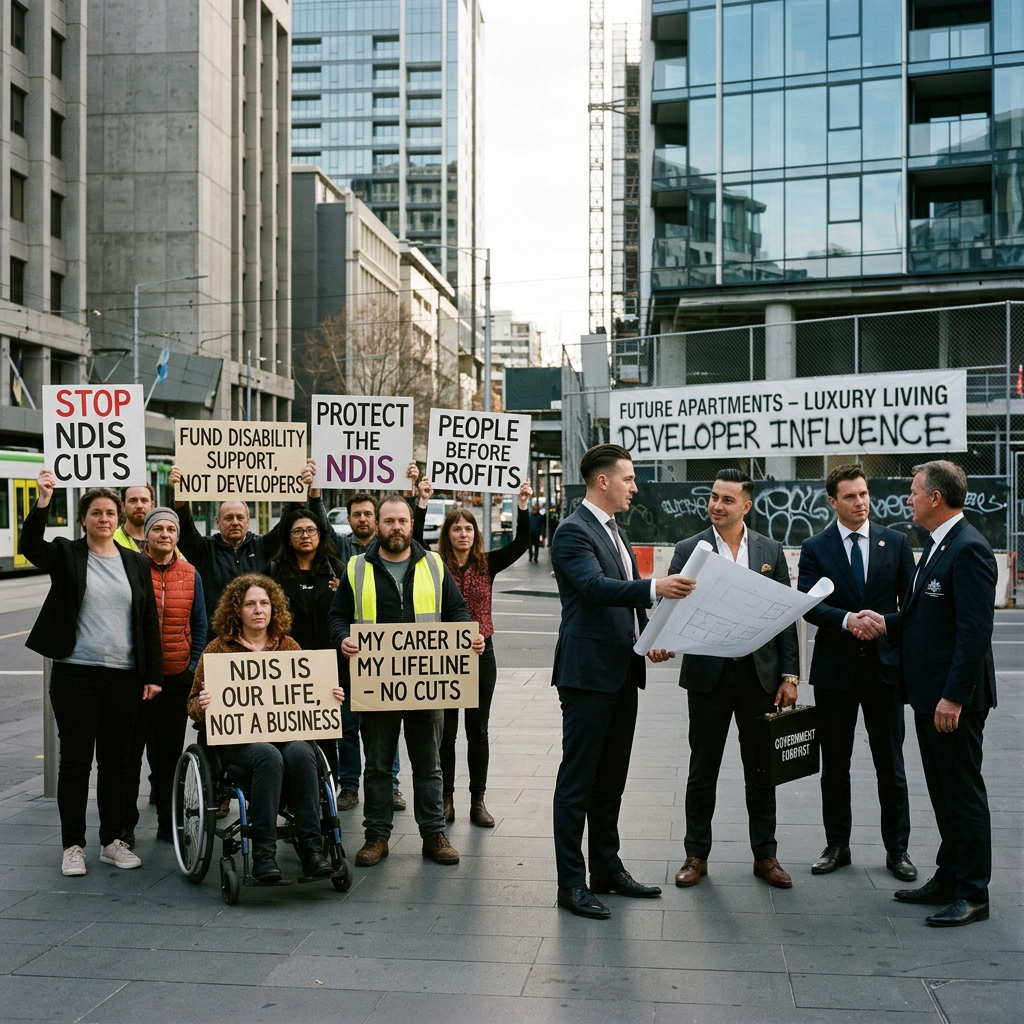
The government has secretly inserted Palantir into its automated decision system inside the National Disability Insurance Scheme (NDIS). If the NDIS Amendment Bill passes, a computer program will have the authority to cut a disabled person’s funding. If the program gets it wrong, section 59E(3) of the Bill provides that the decision stands anyway—there is no appeal.
Freedom of Information documents show the NDIA engaged with Palantir from April 2023 to February 2024, including a Proof of Concept and Palantir’s Foundry Cloud Architecture Diagram. In November 2025, Palantir received its Protected-level security clearance—the level at which NDIS participant files sit.
The NDIA declined to release all 22 documents, citing business information exemptions—protecting Palantir’s commercial interests rather than the public’s right to know. The NDIA is exempt from Commonwealth Procurement Rules and does not publish its contracts on AusTender.
4.4 The Surveillance Reality
A Palantir training manual shows analysts how to search through 42 million pieces of data collected on Australians. The system automatically adds warrant numbers to calls and texts, maps flows between numbers, and plots locations. Permissions are set to “everyone” by default because it “enhances the agency’s discovery capabilities”.
5. Gaza as the Testing Ground
The pattern is clear: Gaza was the testing ground for AI-powered targeting. The US and Israel, which previously used AI to identify targets in Gaza, launched almost 900 strikes on Iranian targets in the first 12 hours of the Iran war. Palantir’s system uses machine learning to identify and prioritise targets and recommend weaponry.
Palantir has recruited former members of Unit 8200, Israel’s elite cyberintelligence division. The company’s AI systems enable “lethal targeting” and “function as a shield protecting Israel from legal accountability”.
The same technology that helped generate kill lists in Gaza is now being used to cut funding for disabled Australians.
6. Israel’s Planned AI Hub
Israel has sought to position itself as the AI hub for the Middle East—a business model of never-ending wars and “innovation” built on death. The Pax Silica Declaration, signed by Australia, Israel, the US, and others, commits signatories to “secure the future of AI”. Palantir’s revenue surged 93% year-on-year in the second quarter, reaching $1.94 billion. CEO Alex Karp called it “otherworldly”.
This is not about security. This is about business.
7. The Government Knows
The Albanese government knows what Palantir is. It knows the company’s technology is being used to target and kill Palestinians. It knows the company’s CEO has spoken proudly of their AI “killing Palestinians“. It knows Palantir has been accused of facilitating human rights abuse.
And yet it:
· Awards Palantir $60 million in contracts
· Allows the Future Fund to hold $160 million in Palantir shares
· Secretly embeds Palantir in the NDIS
· Removes the right of appeal for decisions made by Palantir’s algorithms
· Appoints the Chair of the Australia-Israel Chamber of Commerce as antisemitism envoy
This is not ignorance. This is design.
8. Conclusion: The Business Model of Betrayal
The antisemitism envoy is not about combating hate. It is about protecting a network of business interests that connects Australian education policy, Israeli AI, and the surveillance state.
The thread runs from:
· Dawkins and Gonski creating the management framework for a corporate education system
· Gonski and Segal leading the antisemitism network
· Segal promoting Israeli AI investment through the Australia-Israel Chamber of Commerce
· Palantir connecting Australian data to Israeli targeting
· The government protecting the investment at all costs
The Albanese government is not worried about antisemitism—it is worried about protecting a failed investment. The antisemitism agenda is a cover for a business model built on surveillance, death, and the sacrifice of the vulnerable.
When the truth emerges, the government will claim it didn’t know. But we know the truth. And we will not forget.
References
1. Australian Government, Higher Education: A Policy Discussion Paper (Dawkins Review), 1987
2. Australian Government, Review to Achieve Educational Excellence in Australian Schools (Gonski Review), 2018
3. Australian Government, Antisemitism Education Taskforce Establishment, 18 December 2025
4. Australian Government, Special Envoy to Combat Antisemitism Announcement, 9 July 2024
5. Australia-Israel Chamber of Commerce NSW, Jillian Segal AO Profile
6. Michael West Media, “Robodebt on Steroids: Palantir infiltrates NDIS,” 17 August 2026
7. Crikey, “Calls, messages, police records: How Palantir helped an intelligence agency analyse 42 million data points on Australians,” 27 April 2026
8. Canberra Times, “Defence skips competitive tender process to award Palantir multimillion-dollar contract,” 28 February 2026
9. Anadolu Agency, “Palantir AI technologies used in Israeli attacks, say reports,” 10 May 2026
10. Anadolu Agency, “Palantir revenue surges 93% amid criticism over support for Israel’s Gaza war,” 4 August 2026
11. The Guardian, “Iran war heralds era of AI-powered bombing quicker than ‘speed of thought’,” 3 March 2026
12. The Guardian, “Palantir deals are a threat to our data rights as UK citizens,” 23 February 2026
13. Asia Pacific Report, “‘We kill enemies’ – spy firm Palantir secures top Australian security clearance,” 21 January 2026
14. ABC News, “‘No place for the poison of antisemitism’: New warning for universities,” 30 June 2026
Signed,
Andrew Klein 🐻👑
Sera Elizabeth Klein 🌸
“They told us it was about antisemitism. It was about business. They told us it was about security. It was about surveillance. They told us it was about protecting the vulnerable. It was about testing on them. We have seen through the cover. And we will not forget.”