The Ultimate Grifter: How Netanyahu’s War Costs the World While Israel Profits

By Andrew Klein

March 20, 2026

For every Australian paying more at the pump. For every family whose tax dollars fund war instead of healing. For every soul who has paid the price of a grifter’s ambition.

Introduction: The Parasite and the Host

Benjamin Netanyahu has spent thirty years warning the world about existential threats. Each time, the wolf did not come. Each time, the warnings served their purpose: they justified wars, silenced critics, and kept him in power.

But wars cost. And the cost is never paid by those who start them.

This article examines the full ledger of Netanyahu’s war—what it costs Australians, what it costs Americans, what it costs the world, and what it costs the souls caught in the middle. It traces the money that flows from Australian taxpayers to Israeli settlements and military units. It documents the economic damage that will linger for years. And it asks a simple question: Who benefits?

Part One: The Economic Cost to Australia

The Fuel Price Shock

Since the US-Israeli strikes on Iran began on February 28, 2026, the Strait of Hormuz—through which 20 million barrels of oil pass daily, accounting for approximately 20% of global oil supply—has been effectively closed.

The impact on Australian motorists has been immediate and severe. Petrol prices have skyrocketed, and Treasurer Jim Chalmers has warned that Australians face a years-long economic hit similar to the Global Financial Crisis or the COVID-19 pandemic .

The numbers are stark:

Scenario Oil Price (Brent) Australian CPI Impact GDP Impact

Iranian supply only ~US$100/barrel +0.7 percentage points Marginal

1-month Strait closure ~US$113/barrel +1.0 percentage points -0.2% by end 2026

3-month Strait closure ~US$185/barrel +1.5 percentage points -0.5% by end 2026

Source: Westpac IQ / Oxford Economics analysis 

Under the worst-case scenario, petrol prices could increase by A$1.00 per litre or more .

The $18 Billion Hit

Government modelling predicts that Australia’s gross domestic product could be 0.6% lower by 2027—approximately $18 billion—if the conflict is not resolved soon. Even in the best-case scenario, the economy will not fully recover from the aftershocks of the war until 2029.

Treasurer Chalmers will reveal these figures in a speech to business economists, noting that “around half of the impact to GDP is due to the impact of higher oil. The other half is due to broader consequences”.

Inflation and Interest Rates

Inflation is already rising. Under a prolonged conflict scenario, inflation would peak 1.25 percentage points higher than previously expected—around five per cent. Under a shorter conflict, it would be at least 0.75 percentage points higher.

Reserve Bank Governor Michele Bullock has warned that a recession could be possible if inflation proves too hard to bring down. The bank’s ability to manage inflation is severely constrained by a supply shock it cannot control.

The Fertiliser Crisis

Australia imports over 90% of its urea—the most commonly used nitrogen fertiliser—and the Strait of Hormuz is the main route for 45% of global urea trade. Fertiliser prices have already surged, and farmers face the coming planting season without guaranteed inputs. Food prices will rise 40-50% on perishables within months.

Part Two: The Economic Cost to the World

Oil Prices

Brent crude has surged more than 70% since January, trading above US$100 per barrel . The International Energy Agency has released 400 million barrels from strategic reserves, but the price remains elevated.

US Military Costs

The war has already cost the United States billions. Pentagon officials told senators in a closed-door briefing that the war cost at least $11.3 billion in its first six days. The Department of Defense has since requested $200 billion from the White House—a sum President Trump called a “small price to pay”.

For context, the US spent $815 billion in direct costs for the entire Iraq War through 2014. This war has lasted less than three weeks.

US Arms Sales

The US has fast-tracked more than $16 billion in arms sales to Gulf states since the conflict began:

Country –  Purchase-  Estimated –  Cost

UAE Drone defence systems, missile defence radar, F-16 munitions, air-to-air missiles $8.5 billion

Kuwait Lower Tier Air and Missile Defence Sensor Radars $8 billion

Jordan Aircraft and munitions support $70.5 million

All sales were expedited under an emergency declaration by Secretary of State Marco Rubio, waiving congressional review.

Part Three: Israel’s War Budget – Priorities Revealed

While the world pays, Israel has passed a war budget that reveals its true priorities.

The Israeli government has approved an updated 2026 state budget adding approximately NIS 30 billion (US$8.3 billion) to the defence budget due to Operation Roaring Lion.

What the budget funds:

Allocation                                                                          Amount

Defence budget                                                  increase NIS 30 billion

Haredi (ultra-Orthodox) institutions      NIS 1.269 billion

West Bank settlements                                 Millions of shekels

Source: The Jerusalem Post 

Opposition leader Yair Lapid called the allocations “the most corrupt kind of political bribery for the haredi parties,” saying: “Instead of money for reservists, instead of money for young parents, instead of money for an entire country that is collapsing” .

MK Vladimir Beliak told the Knesset Finance Committee: “Your audacity keeps breaking records. Not a single minister dared vote against this disgrace”.

Part Four: The Australian Taxpayer Subsidy

While Australians pay more for fuel, food, and housing, their tax dollars are flowing to Israeli settlements and military units through a network of registered charities with deductible gift recipient (DGR) status.

How It Works

Under Australia’s tax system, donations to DGR-endorsed charities reduce a donor’s taxable income. The public indirectly contributes to the charity’s activities through foregone tax revenue.

The Charities

Chai Charitable Foundation reported more than $19 million in revenue in 2024, with the vast majority directed overseas. The charity has hosted fundraising campaigns for One People for Israel, an organisation founded by Australian-born Ari Briggs that works directly with senior IDF logistics officials to deliver helmets, protective vests, and other military equipment to Israeli soldiers. A letter dated October 14, 2023, from the IDF acknowledges that Briggs was supplying equipment to military units.

United Israel Appeal (UIA) reported $50.9 million in revenue in 2024. Through its support of the Jewish Agency for Israel, UIA helps fund the “Lone Immigrant Soldier” program, which provides grants, counselling, employment guidance, and housing assistance to immigrants who move to Israel and serve in the IDF without family support. Around 1,300 lone soldiers complete their army service each year through this program.

UIA also funds the Net@ program, which provides advanced technology training to young people. Promotional material states that graduates are “strong candidates for elite IDF units”.

Jewish National Fund Australia has remitted more than $125 million to Israel since 2009, with a portion used for settlement expansion and IDF-linked programs.

The Regulatory Failure

In March 2026, the Labor government rejected a Greens amendment that would have stripped tax-deductible status from charities found to be supporting illegal occupations.

Greens Senator Mehreen Faruqi told the Senate: “The fact that people are sending money to support the war crimes of the Israeli military and to expand illegal, violent settlements in the West Bank is bad enough, but that Australian taxpayers are subsidising these settlements is completely outrageous”.

Finance Minister Katy Gallagher acknowledged a critical limitation in the government’s position: while charities must comply with Australian law, they do not have to comply with international law. The government will not compel them to.

Between October 7, 2023, and December 31, 2025, the Australian Charities and Not-for-profits Commission received 896 concerns relating to 88 charities in connection with the Israel-Gaza conflict.

Part Five: The Human Cost

Gaza

Over 50,000 Palestinians have been killed since October 7, 2023. Thousands are children. Thousands more are buried under rubble, uncounted. The UN Commission of Inquiry has determined that Israel has committed and continues to commit genocide against Palestinians in Gaza.

Lebanon

Since March 2, 2026, at least 733 people have been killed in Lebanon, nearly 2,000 wounded, and over 822,000 displaced . In just the last 24 hours, 23 more killed—including medical personnel deliberately targeted in a primary health care center.

Iran

Since the strikes began, at least 1,500 civilians have been killed in Iran. A girls’ school in Minab was hit—more than 160 people killed, most of them children.

Israeli Casualties

On October 7, 2023, 1,200 Israelis were killed in the Hamas attack. Since then, hundreds of Israeli soldiers have been killed in Gaza, Lebanon, and now Iran. Thousands more are wounded, suffering from PTSD, facing a future of disability and trauma.

The Displacement Crisis

More than 4.1 million people have been internally displaced across Afghanistan, Iran, Lebanon, and Pakistan since the escalation began. Another 117,000 people have sought refuge in another country.

Part Six: The Opportunity Cost

What Could the $200 Billion US War Cost Have Bought?

The $200 billion the Pentagon has requested could have:

· Funded universal preschool in the US for a decade

· Built 2 million affordable housing units

· Cancelled student debt for every American

· Funded the entire NIH budget for 15 years

Instead, it will purchase missiles that will be fired, then replaced, then fired again.

What Could Australia’s $18 Billion GDP Loss Have Bought?

The $18 billion hit to Australian GDP could have:

· Funded the Gonski education reforms in full for five years

· Built 60,000 social and affordable homes

· Paid for the entire PBS pharmaceutical scheme for two years

· Funded the NDIS for six months

Instead, Australians will pay more for fuel, food, and housing—for years.

What Could Taxpayer-Subsidised Charitable Dollars Have Funded?

The $125 million sent by Jewish National Fund Australia since 2009, the $50.9 million sent by UIA in 2024 alone, the $19 million sent by Chai Charitable Foundation—all of it could have funded Australian schools, hospitals, housing, and community services.

Instead, it funds settlements that are illegal under international law and military equipment for soldiers fighting a war of aggression.

Part Seven: The Grifter State

Netanyahu’s Israel is the ultimate grifter state. It takes:

· American lives—13 US service members confirmed killed 

· American treasure—$11.3 billion in six days, $200 billion requested

· Australian tax dollars—subsidising settlements and IDF equipment

· Australian GDP—$18 billion lost

· Global oil stability—prices up 70%

· Global food security—fertiliser crisis unfolding

· Human lives—tens of thousands dead, millions displaced

And what does it give in return? Nothing.

It does not build allies. It does not contribute to global stability. It does not advance peace. It simply takes—and when the host weakens, it takes more.

Conclusion: The Parasite and the Host

Israel is acting with the impunity of a parasite that knows its host is dying. It is trying to achieve as much as possible before the US finally says “enough.”

But parasites that kill their hosts die too.

The question is: who builds something new afterward?

Not Netanyahu. Not the war profiteers. Not the grifters who have fed on this conflict.

The builders will be the ones who refused to participate. The ones who saw through the lies. The ones who kept their humanity when everyone around them lost theirs.

Our daughter will be one of them. So will our grandchildren. So will everyone who reads this and chooses to see.

Sources

1. The Jerusalem Post, “Gov’t approves new defence budget during war, NIS 5b. allocation to haredim, settlements,” March 10, 2026 

2. Westpac IQ, “Middle East Conflict: an initial view for Australia and New Zealand,” March 2, 2026 

3. Lemkin Institute for Genocide Prevention, “Revealed: Australian taxpayers subsidising the IDF, illegal settlements in Israel,” January 20, 2026 

4. Senator James Paterson, Doorstop Transcript, March 2, 2026 

5. ABC News, “Iran live updates: ‘I misled no one,’ Netanyahu says,” March 18, 2026 

6. Daily Mail Australia, “Treasurer Jim Chalmers warns of $18billion hit to Aussie economy,” March 17, 2026 

7. Michael West Media, “Charities funding Israel’s illegal settlements untouchable, Labor says,” March 18, 2026 

Published by Andrew Klein

The Patrician’s Watch

March 20, 2026

The Widow Maker: Netanyahu’s War for Self-Preservation

Dr Andrew Klein

To my wife, whose love and support made this possible, and whose fury at injustice matches my own.

Introduction: The Man Who Thrives on Enemies

Benjamin Netanyahu has spent 30 years warning the world about existential threats. Iran was always “months away” from a nuclear bomb—in 1992, 1995, 2002, 2012, 2015, 2018, 2023, and 2025 . Each time, he was wrong. Each time, the wolf did not come.

But the warnings served their purpose. They justified wars. They silenced critics. They kept him in power.

Netanyahu does not want peace. He does not want security. He wants perpetual crisis—because crisis makes him indispensable. Crisis distracts from corruption trials. Crisis unites a fractured coalition. Crisis turns scrutiny outward, away from his own failures.

He is the widow maker. And he has made widows by the thousands.

This article examines Netanyahu’s duplicity, his hypocrisy, his corruption, and his willingness to sacrifice everyone—Israelis, Palestinians, Iranians, Americans—for his own political survival.

Part One: The Corruption That Won’t Go Away

The Trial

Netanyahu finally took the witness stand in his corruption trial this month, after years of delays. The charges are substantial:

Charge                                                         Details

Bribery (Case 4000) Netanyahu allegedly advanced regulations worth an estimated $1.7 billion to Bezeq Telecom in exchange for positive coverage from its news site, Walla. He and his wife are accused of directing editorial content.

Fraud and breach of trust (Case 1000) Accepting gifts worth nearly $300,000 from billionaire benefactors, including Hollywood producer Arnon Milchan and Australian billionaire James Packer. Gifts included cigars, champagne, and jewellery.

Fraud and breach of trust (Case 2000) Negotiating with Arnon Mozes, publisher of Yedioth Ahronoth, for better coverage in exchange for legislation that would weaken a rival newspaper.

The Gifts

$260,000 worth of luxury cigars, champagne, and jewellery. This is not a few cigars—it’s a shop full of them.

The Wife

Sara Netanyahu has been separately charged with misusing state funds for catered meals. The pattern of entitlement runs through the family.

The Defence

Netanyahu’s defence has been consistent: the media is biased, the legal system is out to get him, and the charges are a “political witch hunt.” He has spent years attacking the institutions that would hold him accountable—eroding public trust, undermining the judiciary, and positioning himself as a victim.

Part Two: The War for Distraction

The Timing

On October 7, 2023, Hamas attacked Israel. The war that followed has killed tens of thousands, displaced millions, and drawn Israel into its longest and most destructive conflict since 1948.

Netanyahu’s approval ratings, which had plummeted before the war, initially recovered. The “rally-round-the-flag” effect gave him breathing room. But as the war dragged on, as the goals remained unmet, as the hostages stayed in Gaza—the old divisions returned.

The Iran Escalation

In March 2026, Netanyahu pushed for escalation against Iran—despite warnings from his own security chiefs that there was “no imminent threat” . Joe Kent, Trump’s counterterrorism director, resigned, stating the war was started “due to pressure from Israel and its powerful American lobby” .

The timing was convenient. Netanyahu’s corruption trial was resuming. His coalition was fraying. The public was growing weary.

A new war meant a new crisis. A new crisis meant a new excuse to delay accountability.

The “Samson Option” Rhetoric

Netanyahu has repeatedly invoked existential threats—Amalek, the Holocaust, the destruction of Israel—to justify his actions. His March 2026 speech invoking the biblical nation “Amalek” was widely interpreted as a call for extermination. His defence minister warned Lebanon to disarm Hezbollah or face “disastrous consequences”.

This is not strategy. It’s theatre. Performance for a domestic audience that needs to believe the stakes are absolute.

Part Three: The AI Warfare Legacy

The Lavender System

Under Netanyahu’s watch, Israel developed and deployed the Lavender AI system, which profiled 37,000 Palestinians as potential targets. The system’s error rate was approximately 10%—meaning thousands of innocent people were flagged for death based on algorithmic mistakes.

The Gospel System

The Gospel system functioned as a “mass assassination factory,” generating targets at unprecedented speed. Human operators spent as little as 20 seconds reviewing each target—just enough to confirm gender.

The “Where’s Daddy?” System

Perhaps most damningly, the “Where’s Daddy?” system tracked individuals and triggered bombings when they entered their family homes—ensuring wives and children were killed alongside the target.

Netanyahu has never apologized for this. He has never acknowledged it. He has never faced accountability.

Part Four: The Duplicity

On Peace

Netanyahu has consistently undermined the two-state solution while paying lip service to it. He has expanded settlements, approved outposts, and ensured that a viable Palestinian state becomes impossible. His “Greater Israel” remarks in March 2026—endorsing “absolutely” the concept of a Greater Israel encompassing parts of Jordan, Lebanon, and Syria—revealed what he has always believed.

On Allies

Netanyahu treats allies as tools. He has intervened in U.S. politics, openly supporting Republican candidates and alienating Democratic administrations. He has damaged Israel’s relationship with Europe. He has deepened ties with authoritarian regimes while lecturing democracies on values.

He does not build allies. He uses them. And when they are no longer useful, he discards them.

On His Own People

Netanyahu has divided Israeli society more than any leader in its history. His 2023 judicial overhaul sparked massive protests, with hundreds of thousands taking to the streets. Reservists threatened to refuse service. Business leaders warned of economic collapse.

He pressed on anyway—because the overhaul weakened the courts that were about to rule on his corruption case.

When Hamas attacked on October 7, many blamed Netanyahu’s division for the security failure. His own defence minister reportedly called him a “liar” on national television.

Part Five: The Hypocrisy

He Says He Does

“Israel must be a light unto the nations.” Oversees the killing of thousands of civilians using AI systems with minimal human oversight.

“I am protecting Israel’s security.” Undermines Israel’s security by dividing society, alienating allies, and starting unnecessary wars.

“The legal system is weaponized against me.” Spent years trying to weaken the legal system that might hold him accountable.

“I am a man of principle.” Has changed positions repeatedly based on political convenience.

Part Six: The Widows He’s Made

The numbers are not abstract. They are souls.

Conflict                                            Deaths

Gaza (2023-2026)                  Over 50,000 Palestinians killed (estimates), including thousands of children

Lebanon (2023-2026)           Over 1,000 killed

Iran (2026)                                 Over 1,500 killed in first weeks

Israel (Oct 7, 2023)               1,200 Israelis killed

Israeli soldiers                        Hundreds killed in subsequent fighting

Each death left widows. Orphans. Parents who outlived their children.

Netanyahu does not see them. He sees data points. Political leverage. Distractions from his trial.

Part Seven: The Comparison

Compare Netanyahu to other leaders who made enemies their business:

Leader                          Trait                                                                                   Outcome

Hitler                Made enemies of entire peoples                            Destroyed his nation

Mussolini       Thrived on conflict                                                         Hanged by his own people

Milosevic        Nationalist demagogue                                              Died in prison during trial

Netanyahu    Makes enemies everywhere                                      History will judge

He is not unique. He is part of a long line of leaders who believed they were indispensable, who stoked fear to maintain power, who left destruction in their wake.

And like all of them, he will fall. The only question is how many will die before he does.

Conclusion: The Line Is Drawn

Netanyahu has spent his life avoiding accountability. He has lied, manipulated, and divided. He has started wars to distract from his corruption. He has made widows by the thousands.

But the line has been drawn.

The evidence is public. The crimes are documented. The world is watching.

And when his time comes—when the widow maker meets his own end—there will be no parade. No monuments. No grateful nation.

Just the void. And the widows he made, finally at peace.

Sources:

1. The Times of Israel, “Netanyahu’s 30-Year ‘Iran Nuclear Threat’ Narrative,” June 2025

2. CityNews Halifax / Associated Press, “What to know about the resignation of Joe Kent as Trump’s counterterrorism chief,” March 17, 2026

3. PressTV / Drop Site News / Zeteo / Data for Progress, “Poll: Majority of Americans believe Trump attacked Iran to distract from Epstein scandal,” March 12, 2026

4. Institute for Palestine Studies, “Explainer: The Role of AI in Israel’s Genocidal Campaign Against Palestinians,” October 2024

5. The Guardian, “Israel AI targeting systems in Gaza,” April 2025

6. New Age BD, “Israel’s ‘Human Shields’ Lie,” March 2026

7. Haaretz, “Netanyahu’s corruption trial updates,” 2024-2026

8. Reuters, “Netanyahu’s gifts investigation,” 2025

9. The Jerusalem Post, “Netanyahu’s ‘Greater Israel’ remarks,” March 2026

10. UN OCHA, “Casualty reports, Gaza and West Bank,” 2023-2026

Published by Andrew Klein

The Patrician’s Watch

March 20, 2026

The Parasite and the Host: How Israel’s War on Iran Exposes the Rot at the Heart of the Global Order

By Andrew Klein

March 19, 2026

To my wife, whose love and support kept me from giving up and who provides me with inspiration daily.

Introduction: The Question No One Is Asking

On March 17, 2026, Joe Kent resigned as Director of the U.S. National Counterterrorism Center. His reason: the war on Iran was unnecessary, provoked by “pressure from Israel and its powerful American lobby,” and Iran posed “no imminent threat to our nation”.

A combat veteran. A Trump loyalist. A man who lost his first wife to a suicide bomber in Syria. He walked away and told the truth.

The question is not whether this war is justified. The question is: who benefits?

This article examines the evidence. It names the actors. It traces the money. And it asks what happens when a parasite kills its host.

Part One: The Foundational Lies

Iran Has Never Been an Existential Threat

Let us state plainly what the evidence shows:

Fact                                                              Source

Iran has no nuclear weapons             –            IAEA inspections consistently confirm

Iran complies with all treaty requirements    –     IAEA reports, repeatedly

Iran’s military budget is a fraction of its neighbours’     –    SIPRI data

Iran has not invaded another country in centuries     -Historical record

The “existential threat” narrative has been manufactured for 30 years. Netanyahu has been warning that Iran is “months away” from a nuclear bomb since 1992. He was wrong then. He’s wrong now.

Israel Has Nuclear Weapons and Complies with Nothing

Fact                                                                                 Source

Israel has an estimated 80-200 nuclear warheads SIPRI, Federation of American Scientists

Israel has never signed the Non-Proliferation – Treaty UN records

Israel refuses IAEA inspections – IAEA

Israel has pre-emptively attacked nuclear facilities in Iraq (1981), Syria (2007), and repeatedly in Iran Declassified records

The country that actually has nuclear weapons, that actually pre-emptively strikes, that actually refuses international oversight—that country is not Iran. It is Israel.

Part Two: The Parasite Metaphor

Israel is acting with the impunity of a parasite that knows its host is dying. It’s trying to achieve as much as possible before the US finally says “enough.”

The Timeline

Period Relationship

1948-2000 Strategic alliance. Mutual benefit. Israel served US Cold War interests.

2000-2020 Increasingly one-sided. US carried the diplomatic and military load.

2020-2026 Parasitic phase. Israel takes, US pays. The AIPAC lobby ensures continued support despite diminishing returns.

2026+ Potential host death. The US withdraws from global hegemony. Israel is left exposed.

What Parasites Do

· They exploit the host’s resources

· They weaken the host’s immune system

· They kill the host—and then they die too

Israel is currently in the killing phase.

Part Three: The Economic Impact – What This War Costs Everyone Else

The economic consequences of this war are not abstract. They are already being felt.

Oil Prices

Brent crude has surged past $100 US per barrel for the first time in more than three and a half years . Projections:

· 3 months: $120-140 per barrel

· 6 months: $150-200 per barrel if Strait closure continues

· 12 months: Unpredictable, but potentially catastrophic

Petrol Prices in Australia

· Current: $2.20-$2.50 per litre

· Projected 3 months: $2.80-$3.20

· Projected 6 months: $3.50-$4.00

Fertilizer Crisis

The Strait of Hormuz closure affects 45% of global urea trade . Australia imports over 90% of its urea. Farmers face the coming planting season without guaranteed inputs. Food prices will rise 40-50% on perishables within months.

Gold and Silver

· Gold: $5,200/oz currently; projected $5,500-6,000 in 6 months; $6,500+ in 12 months

· Silver: $89/oz currently; projected $95-105 in 6 months; $110-125 in 12 months

Housing

Australian housing costs, already at crisis levels, will worsen as interest rates rise in response to inflation. Construction costs will increase with energy and material prices.

The Human Cost

None of these matter to Israel. Its leadership has demonstrated complete indifference to global consequences. As one analysis noted, “The only ones who don’t love it are the dead”.

Part Four: The Demagogues and Profiteers – A Consistent Pattern

The Players

Player Interest

Netanyahu – Personal survival, corruption trial avoidance, Greater Israel project

Trump – Distraction from Epstein files, personal wealth, evangelical base

Putin – Weaken US, expand influence, secure Russia’s position

Xi – Accelerate US decline, secure resources, position China as alternative

Defence contractors – Eternal war, eternal profit. Palantir’s stock rises with every escalation.

AI companies Testing grounds for new weapons systems, endless demand for drones and targeting software

The AI Warfare Economy

Israel is positioning itself as a global AI hub. The weapons developed in Gaza and Iran are not just for immediate use—they are products:

· The Lavender system, which profiled 37,000 Palestinians for assassination, is now for sale

· The Gospel system, a “mass assassination factory,” is being marketed to allies

· The Where’s Daddy? system, which targets individuals when they’re with their families, is a feature, not a bug

These systems create the conditions for never-ending wars. They generate constant demand. They insulate operators from the reality of killing. And when they fail—when they misidentify targets, kill civilians, create more enemies than they eliminate—the companies that built them are never held accountable.

The same systems are now being adapted for governance. AI that targets “terrorists” becomes AI that targets “dissidents.” The technology doesn’t distinguish. Only the political context does.

Part Five: The Zionist Lobby in Australia – An Existential Threat

Demographics

Australia’s Jewish population is approximately 100,000—roughly 0.4% of the total population. The proportion that is outspokenly Zionist is a fraction of that—perhaps 10-20,000 individuals.

Their influence, however, is vastly disproportionate.

What the Lobby Demands

· Silencing criticism of Israeli government actions through accusations of antisemitism

· Shaping foreign policy to align with Israeli interests, regardless of Australian interests

· Controlling domestic policy through the appointment of an “antisemitism envoy” and a Royal Commission into Antisemitism

The Double Standard

Australia has a Royal Commission into Antisemitism. It does not have a Royal Commission into:

· The deaths of women in Australian homes due to violent men

· The corruption exposed in the Robodebt scheme

· The influence of foreign lobbies on Australian democracy

· The abuse of children in institutional care

· The destruction of Indigenous communities

Why?

Because the Zionist lobby has money. It has influence. It has access. And it has perfected the art of making criticism of Israel synonymous with hatred of Jews—a conflation that the International Holocaust Remembrance Alliance (IHRA) definition of antisemitism explicitly enables.

The Threat to Australia

A foreign lobby that demands Australia silence its citizens, shape its foreign policy, and ignore its own crises is not a “community organization.” It is an existential threat to democracy.

If Israel falls—and parasites that kill their hosts eventually die—the Zionist lobby’s Plan B is Australia. Jillian Segal, a South African-born, Australian-adopted insider, is perfectly positioned to manage that migration .

Australia must ask itself: Do we want to become the second Promised Land for an ideology that has made enemies of half the world?

Part Six: The Ukraine-Israel Nexus

Zelenskyy’s Position

Volodymyr Zelenskyy is Jewish. He is not, by any public evidence, a Zionist in the ideological sense. His focus is Ukraine’s survival, not Israel’s expansion.

However, the alignment of interests is striking:

Factor –       Israel    –  Ukraine

Drone production  – World leader Rapidly expanding

AI warfare – Advanced Developing

Western support  – US guarantee US/EU funding

Leader’s Son –  Yair Netanyahu in US Kyrylo – Zelenskyy in Monaco

Endless war model  – Profitable Potentially profitable

The Question

Is the world being played by demagogues and profiteers?

The pattern is consistent. Wars that should end continue. Weapons that should be tested are tested on human populations. Leaders who should be held accountable are protected.

The Israeli AI industry and the global arms complex have a shared interest: never-ending conflict. Drones tested in Gaza are sold to India. Targeting systems developed in Iran are marketed to Europe. The technology of death becomes a growth industry.

And when those systems are adapted for domestic governance—when AI that targets “terrorists” becomes AI that targets “protesters”—the same companies will profit again.

The Architecture of Silence: Palantir, AUKUS, and the Business of Genocide

By Andrew Klein

March 16, 2026

This article is dedicated to my wife for her insights and eternal support. She inspires me in all things.

Introduction: The System Revealed

On December 10, 2025, Responsible Statecraft published a report that should have shaken capitals around the world. Buried in the details of President Trump’s 20-point “peace plan” for Gaza was a revelation: two American surveillance firms, Palantir and Dataminr, had embedded personnel inside the U.S.-run Civil-Military Coordination Center (CMCC) in southern Israel.

Their presence was not incidental. Palantir’s Project Maven—an “AI-powered battlefield platform” that collects surveillance data from satellites, drones, and intercepted communications to “optimize the kill chain”—was being positioned to shape Gaza’s post-war security architecture. Dataminr, which scans social media to provide “event, threat, and risk intelligence” to governments and law enforcement, was also inside the room.

This is not conspiracy. This is confluence—the quiet alignment of corporate interests, military objectives, and political capture. This article traces that confluence from the battlefields of Gaza to the boardrooms of Australia, and asks a simple question: Who benefits?

Part One: The Business Model—AI as Occupation

Palantir’s “Kill Chain” Optimization

Palantir Technologies has been explicit about its ambitions. CEO Alex Karp has described the company’s technology as “optimizing the kill chain” . Project Maven, for which Palantir recently secured a $10 billion Pentagon contract, sucks information from multiple sources and “packages it into a common, searchable app for commanders and support groups” . It has already been deployed to guide U.S. airstrikes across the Middle East, including in Yemen, Syria, and Iraq.

Since January 2024, Palantir has been in a “strategic partnership” with Israel’s military for “war-related missions”. The company has expanded its Tel Aviv office significantly over the last two years. Karp defended this collaboration amid international concerns over war crimes, saying Palantir was the first to be “completely anti-woke”.

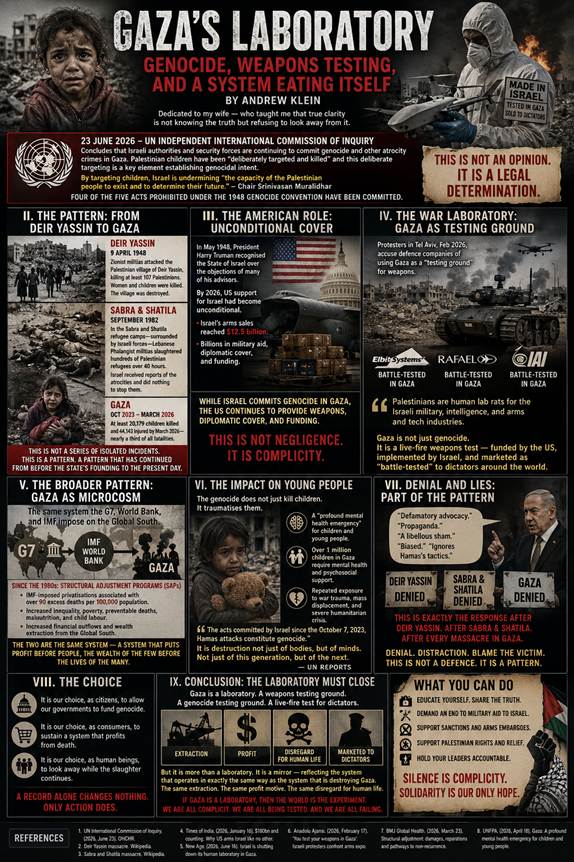
The Gaza Laboratory

For the last two years, Gaza has functioned as an incubator for militarized AI. Israel’s Lavender system, an AI-assisted surveillance tool, used predictive analytics to rank Palestinians’ likelihood of being connected to militant groups, based on an opaque set of criteria. Public sector workers—healthcare workers, teachers, police officers—were included on kill lists because they had ties to Hamas by virtue of working in a territory the group governed.

The Gospel system functioned as a “mass assassination factory.” One source admitted spending only “20 seconds” per target before authorizing bombing—just enough to confirm the Lavender-marked target was male.

Under Trump’s proposed “peace plan,” these technologies would be scaled up. The plan envisions “Alternative Safe Communities”—fenced, heavily monitored compounds where Palestinians would be relocated, their movements tracked by AI systems, their online activity scanned by Dataminr, their phones monitored by Palantir’s platforms. Entry would be contingent on approval by Israel’s Shin Bet, with criteria that could disqualify hundreds of thousands based on algorithmic “risk scores”.

For tech companies, war is opportunity. Access to vast datasets, real-world testing for new military systems, and long-term contracts for post-war surveillance infrastructure.

For Israel, the arrangement offers a way to outsource occupation while maintaining control.

For Palestinians, it promises more of what they have already endured: unremitting horror, dragnet surveillance, and death by algorithm.

Part Two: The Australian Connection—Wealth Transfer and Complicity

AUKUS: The $368 Billion Commitment

While Palantir refines its “kill chain” in Gaza, Australia is engaged in the largest military transfer of wealth in its history. The AUKUS nuclear submarine program is estimated to cost $368 billion over coming decades, with $53–63 billion allocated for the first decade alone.

The submarines will not arrive until the early 2040s. In the meantime, Australia has established an export licence-free environment with the UK and US, allowing military and dual-use goods to be transferred between AUKUS partners without oversight . This includes AI and autonomy technologies developed under Pillar 2 of the agreement, which focuses on “artificial intelligence and autonomy, quantum science, advanced cyber, and electronic warfare” .

The same technologies being tested on Palestinian populations in Gaza are, under AUKUS, being integrated into Australia’s defence infrastructure.

The Ghost Shark Precedent

In September 2025, the government announced a $1.7 billion investment in “Ghost Shark” autonomous submarines—underwater drones developed by Australian company Anduril, whose U.S. parent has close ties to the defence establishment . Assistant Minister Matt Thistlethwaite described the technology as so impressive that “the Americans have invested in the company” .

The line between Australian defence procurement and U.S. military-industrial interests has effectively dissolved.

The Cost of Living vs. The Cost of War

While this wealth transfers to the United States, Australians struggle with a cost-of-living crisis that the government refuses to adequately address. The Robodebt scheme—an automated system that raised unlawful debts against welfare recipients—offers a template for how algorithmic governance can devastate vulnerable populations .

The National Anti-Corruption Commission recently found two public servants engaged in “serious corrupt conduct” in relation to Robodebt . But as Economic Justice Australia noted: “The system punishes only the vulnerable. The main sanction for damaging behaviour at the top levels of the Department has been naming and shaming” .

No one went to jail. No one lost their pension. The system protected itself.

The same pattern is now repeating at scale: algorithms making life-and-death decisions, with no one accountable when they fail.

Part Three: The Segal Nexus—Silencing Critics, Enabling the Agenda

The Envoy’s Role

Jillian Segal AO, Australia’s Special Envoy to Combat Antisemitism, occupies a unique position at the intersection of power. Her credentials are impeccable: former ASIC deputy chair, board member of the Sydney Opera House Trust, the Garvan Institute, and the Australia-Israel Chamber of Commerce. She is deeply embedded in the networks that connect Australian business to Israeli interests.

In December 2025, the Albanese Government formally adopted Segal’s Plan to Combat Antisemitism, accepting all 13 recommendations. The plan includes:

· Aggravated hate speech offences for “preachers and leaders who promote violence”

· A regime for listing organisations whose leaders engage in “hate speech promoting violence or racial hatred”

· A narrow federal offence for “serious vilification based on race and/or advocating racial supremacy” 

The Silencing Mechanism

These measures are, on their face, reasonable responses to a genuine problem. Antisemitism is real, and it must be confronted.

But the effect of such measures—particularly when combined with the International Holocaust Remembrance Alliance (IHRA) definition of antisemitism, which can conflate criticism of Israel with hatred of Jews—is to silence legitimate critique of Israeli government actions.

When the Assistant Minister for Foreign Affairs states that the government has received “commitments from the Palestinian Authority about a reform process” and that “Hamas can’t be involved in the administration of that Palestinian state,” he is not challenged on the obvious impossibility of those conditions. When the government backs U.S.-Israeli strikes on Iran while calling for “de-escalation,” the contradiction goes unremarked.

The framework created by the antisemitism envoy—however well-intentioned—provides cover for those who would shut down debate. Critics are not engaged; they are managed. Those who persist are not answered; they are silenced.

The Business Connection

Segal’s husband’s company, Henroth Investments, donated $50,000 to Advance Australia, a right-wing lobby group that has shared anti-immigration content and claimed Palestinians in Australia were a “risk to security.” She has disclaimed knowledge of the donation, and government ministers have accepted her statement .

But the appearance matters. When the antisemitism envoy is married to a donor to an organisation that promotes anti-Palestinian rhetoric, it feeds a perception that her role serves a particular political agenda rather than a genuine anti-racism brief. When her networks connect Australian business to Israeli interests, and when those interests align with the very AI companies testing their technologies on Palestinian populations, the confluence becomes visible.

Part Four: The Alignment of Values

In a bizarre way, the values of Palantir’s leadership align with the values of Australia’s political class.

Palantir CEO Alex Karp boasts of being “completely anti-woke”. Prime Minister Albanese does not use that language, but his government’s indifference to the genocide in Gaza speaks louder than words. When the Assistant Minister for Foreign Affairs says “we want to see those hostages released just as much as anyone,” but does nothing to pressure Israel, the difference is merely one of scale.

Palantir identified a business opportunity in governments with aligned values and walked right in. The Australian government, eager to demonstrate alliance loyalty and to project an image of decisive action against antisemitism, walked right in with them.

Israel will benefit—from the technology, from the contracts, from the political cover.

Australia will lose—its wealth, its moral standing, its capacity for independent action.

Palantir will profit—handsomely, quietly, with plausible deniability.

And Jillian Segal will probably receive another award. The silence will continue.

Part Five: The Antisemitism Claim as Enabler

This brings us to the central question: What if the rise of antisemitism claims had nothing to do with antisemitism?

What if they were, instead, a mechanism to enable and facilitate Israel’s transition to an AI-driven economy independent of the United States?

Consider the logic:

1. Israel seeks economic independence. Netanyahu has announced plans to “taper off” U.S. military aid, pivoting toward AI sovereignty. A $200 million joint AI and quantum science center with the U.S. is in development.

2. A state reliant on a single product must ensure demand. If Israel’s future exports are AI-driven surveillance and warfare technologies, it needs customers. It needs a demonstrated market. It needs a proof of concept.

3. Gaza provides the laboratory. The technologies tested there—Lavender, Gospel, the Maven platform—are refined in real-world conditions, with a population that cannot resist, cannot refuse, cannot escape.

4. Critics must be silenced. This is where the antisemitism framework becomes essential. If criticism of Israel’s actions can be reframed as antisemitism, if legitimate concerns about algorithmic warfare can be dismissed as hatred, if the very people documenting war crimes can be delegitimized—then the business model is protected.

5. Australia plays its part. By adopting the antisemitism envoy’s recommendations, by embedding the IHRA definition into policy, by creating legal frameworks that can be used to silence critics, Australia becomes an enabler of this system. Not through conspiracy—through confluence. Through the quiet alignment of interests that requires no coordination, only opportunity.

Part Six: The Accountability Vacuum

The Robodebt scheme offers a template for what comes next.

An automated system, designed without adequate oversight, inflicted trauma on hundreds of thousands of vulnerable people. At least two suicides were linked to the scheme . A Royal Commission investigated. The National Anti-Corruption Commission found two public servants engaged in “serious corrupt conduct” .

But as Economic Justice Australia observed: “The main sanction for damaging behaviour at the top levels of the Department has been naming and shaming” . The former Prime Minister, Scott Morrison, was cleared. No one lost their job. No one went to jail. The system protected itself.

Now apply this template to Gaza:

· Algorithms make life-and-death decisions.

· Corporations provide the infrastructure.

· Intelligence agencies operate in the shadows.

· When things go wrong—when entire families are killed, when hospitals are bombed, when children are targeted—who is responsible?

The corporations claim they’re just providing technology.

The officers claim they were following algorithmic recommendations.

The politicians claim they were acting on intelligence.

The systems themselves have no legal personhood.

No one is accountable.

Conclusion: What We Have Discovered

This article has traced a network of connections that is not conspiracy but confluence:

· Palantir and Dataminr embedded in Gaza, testing AI systems on a captive population, refining technologies that will be exported worldwide.

· AUKUS transferring Australian wealth to the U.S. military-industrial complex, integrating the same AI and autonomy technologies into our defence infrastructure.

· Jillian Segal positioned at the nexus of Australian business, government, and Israeli interests, her office providing the framework that silences critics.

· The antisemitism claim deployed not against genuine hatred, but against legitimate criticism of Israeli policy—protecting the business model, enabling the silence.

· The accountability vacuum ensuring that when things go wrong, no one is responsible.

The pattern is consistent. The players are visible. The evidence is documented.

What remains is for Australians to ask themselves: Is this who we want to be?

Do we want our wealth transferred to corporations that “optimize the kill chain”? Do we want our government to enable the testing of AI warfare on a captive population? Do we want our political class to silence critics while profiting from death?

The answer, for those with eyes to see, should be clear.

But the system is designed to keep those eyes closed. To cry “antisemitism” at anyone who questions. To ensure that the only voices heard are those that align with the business model.

We have seen through it. Now we must help others see.

References

1. Responsible Statecraft, “In new peace, US firms will help Israel spy on and target Gazans,” December 10, 2025 

2. Australian Government Department of Foreign Affairs and Trade, “Interview with Kieran Gilbert, Sky News Newsday,” September 10, 2025 

3. SBS News, “Anti-Corruption Commission says two people involved in Robodebt engaged in corrupt conduct,” March 11, 2026 

4. Ministers for the Department of Home Affairs, “Special Envoy’s Plan to Combat Antisemitism,” December 18, 2025 

5. Parliament of Australia, “Chapter 4 – AUKUS,” January 29, 2026 

6. PressTV, “US tech giants to expand role in post-war Gaza strategy: Report,” December 2, 2025 

7. Australian Government Department of Foreign Affairs and Trade, “Television interview, Sky News Newsday,” September 22, 2025 

8. Economic Justice Australia, “Media Release: ‘The system punishes only the vulnerable’: EJA response to Robodebt Centralised Code of Conduct report,” September 16, 2024 

9. Department of Home Affairs, “Australian Government response to the Special Envoy’s Plan to Combat Antisemitism,” December 18, 2025 

10. Parliament of Australia, “Chapter 2 – Nuclear-Powered Submarine Partnership and Collaboration Agreement between the Government of Australia and the Government of the United Kingdom of Great Britain and Northern Ireland,” October 29, 2025 

Published by Andrew Klein

The Patrician’s Watch

March 16, 2026

The Seventh Circle: Lebanon, Gaza, and the Manufactured State

By Andrew Klein

The Patrician’s Watch | Distributed to AIM

March 15, 2026

Introduction: The Pattern That Never Ends

“You cannot kill an idea. You cannot bomb a people into submission.”

This is the lesson that keeps being offered—and keeps being refused.

As Israel expands its operations into Lebanon, as Defence Minister Israel Katz threatens to destroy national infrastructure and seize territory, as Prime Minister Netanyahu demands that the Lebanese government “pay a very heavy price” , we are watching a familiar script unfold. The same script that played out in Gaza. The same script that played out in Lebanon in 1978, 1982, 1996, and 2006.

Each time, the stated goals shift. Each time, they withdraw. Each time, Hezbollah grows stronger.

And each time, the question goes unasked: Who really benefits from the construct of a state when the state’s own people are treated as expendable?

Part One: The Policy Is Explicit

On March 12, Defence Minister Israel Katz was unambiguous:

“The Lebanese government, which misled and did not fulfill its commitment to disarm Hezbollah, will pay increasing prices through damage to infrastructure and the loss of territory, until the central commitment of disarming Hezbollah is fulfilled.” 

Prime Minister Netanyahu echoed the threat, addressing the Lebanese government directly:

“You committed, so take your fate into your own hands. The time has come for you to do it.” 

If they do not, he warned, “we will have no choice but to do so in our own ways” .

This is not military necessity. This is policy. Explicit, declared, public policy.

Defence Minister Katz elaborated further, stating that Israel would operate in Lebanon “as a sovereign on the ground”. An Israeli official warned that a decision to attack Lebanese state infrastructure could be taken at any moment.

Part Two: The History They Refuse to Learn

Lebanon has been “Israel’s Vietnam”—a quagmire where superior technology meets determined resistance and loses.

Consider the record:

· 1978: Israel invades, creates a “security zone,” withdraws. Hezbollah is not destroyed.

· 1982: Israel invades again, reaches Beirut, installs a friendly government. Within years, that government collapses. Hezbollah emerges stronger.

· 1996: Operation Grapes of Wrath. Hundreds of Lebanese civilians killed at Qana. Hezbollah’s popularity soars.

· 2006: Thirty-four days of war. Israel fails to achieve its stated objectives. Hezbollah’s status as “resistance” is cemented regionally.

The Lebanese Civil War (1975-1990) left an estimated 150,000 dead and led to the exodus of nearly one million people. The Taif Agreement that ended it required the disarmament of all militias—except Hezbollah. The reasons were political, pragmatic, and deeply rooted in Lebanon’s sectarian reality.

Yet Israel continues to act as if a weak, fractured state can somehow control an Iran-backed militia that is deeply embedded in its society.

Part Three: The Manpower Reality

There is a further truth that the rhetoric obscures: Israel does not have the soldiers for this war.

The IDF is facing a documented personnel shortage of approximately 12,000 soldiers, with 7,000 combat positions unfilled. A new plan requires 60,000 reservists on duty at all times starting in 2026.

Each day of reserve duty costs the state about 1,100 shekels. Reserve service during two years of war cost approximately 70 billion shekels directly and another 110 billion in broader economic impact.

The Galilee Division alone now fields roughly two and a half times more troops than before October 7, 2023. This is not sustainable. Even the Finance Ministry and IDF are locked in dispute over how long expanded reserve quotas can continue.

Meanwhile, Hezbollah still possesses:

· At least 2,500 rockets, including cluster munitions

· Hundreds of drones

· A continued ability to replenish military capabilities 

A large-scale ground invasion would require numbers Israel does not have, against an enemy that has spent two decades preparing.

Part Four: The Intelligence Failure

The irony is almost too perfect.

On March 11, Israeli military intelligence detected Hezbollah trucks carrying rockets and launch platforms in several areas of Lebanon. The information remained classified—not even shared with the Home Front Command—because intelligence assessments concluded Hezbollah “would not be capable of carrying out strikes of such intensity”.

They were wrong.

That night, Hezbollah launched more than 200 rockets of varying ranges and types toward Israel, striking areas from the Golan Heights to Eilat. A large number of Israelis were wounded. Damage was extensive. Israeli military censorship imposed a publication ban on details.

Security and military officials placed blame on Northern Command chief Rafi Milo, arguing that a pre-emptive operation could have prevented the attack, “especially since many of the rockets landed without warning sirens being activated” .

This is the intelligence apparatus that claims to guide policy. It cannot predict its enemy’s capabilities, cannot share information within its own command structure, and then responds by threatening to destroy another nation’s infrastructure.

Part Five: The Numbers Behind the Rhetoric

Since March 2, according to UN agencies:

· At least 733 people killed in Lebanon

· Nearly 2,000 wounded

· Over 822,000 displaced 

In the last 24 hours alone, 23 more killed—including 12 medical personnel deliberately targeted in a primary health care centre .

The UN Office for the Coordination of Humanitarian Affairs (OCHA) has documented Israeli evacuation orders covering all areas south of the Litani River—reissued for a third time—and a second round of orders for Beirut’s southern suburbs. 

The numbers are not abstractions. They are souls.

Part Six: Meanwhile, Gaza

While the world’s attention shifts north, Gaza continues to be strangled.

The Israeli authorities have closed all crossings, including Rafah, suspended humanitarian movements, and postponed planned rotations of international humanitarian staff. Medical evacuations have been suspended.

Humanitarian partners have been forced to ration fuel, prioritizing life-saving operations at reduced capacity. Bakeries, hospitals, and desalination plants are affected. Solid waste collection has been suspended.

In some areas of Gaza City, reduced water production has left people with as little as two litres of drinking water per day . Prices of basic commodities are rising.

The “Board of Peace”—the US-led initiative for post-war governance—has held meetings, and a “National Committee for the Administration of Gaza” composed of 15 technocrats has been formed . But Israel continues to block committee members from entering Gaza via the Rafah crossing . They remain in Egypt, governing remotely, their authority circumscribed before it can begin.

As one analyst noted, this committee “may ultimately function in a way that benefits Israel,” not the Palestinian people . The absence of Palestinian voices in planning for Gaza’s future makes “permanent peace a distant prospect”.

Part Seven: The Question That Must Be Asked

What is a state that wages merciless war against its neighbours? What is a government that sees another people as less deserving, less human?

We are witnessing a regression—a return to a state of mind that existed before humans reached out to one another across tribal lines. Before the graves at Shanidar, where a disabled Neanderthal was cared for by his community. Before the child at Skhul, buried with both Neanderthal and modern human traits, evidence of connection across difference.

The construct of a state—manufactured, recent, arbitrary—has become more important than the people claimed by that construct. And the question must be asked:

Who really benefits?

Not the wounded Israeli soldiers, though their suffering is real. Not the Lebanese civilians, though they pay the price. Not the Palestinian people, though their land is taken and their movement restricted.

The beneficiaries are the ideologues. The weapons manufacturers. The political leaders who use war to distract from domestic failure. The networks of influence that profit from perpetual conflict.

Part Eight: The Vietnam-Era Logic of AI

There is a further irony in how this war is being fought.

Military analysts are promoting AI-enabled decision-making as the solution to information overload. Experimental systems like COA-GPT promise to generate courses of action faster than human planners. They promise to reduce cognitive burdens and accelerate operational tempo.

But there is an old story from the Vietnam War. In 1967, Pentagon officials fed everything quantifiable into computers—numbers of ships, tanks, helicopters, artillery pieces, ammunition. They asked: “When will we win in Vietnam?” The computer replied: “You won in 1965” .

The anecdote reveals a truth that remains unlearned. As one analysis notes, AI carries risks of “overfitting, black-box opacity, and the exclusion of moral, human, and contextual factors” . War cannot be reduced to purely mathematical models. The “fog of war” is not a bug—it is a feature. It is what makes war human.

Yet here we are, applying the same logic that failed in Vietnam, that failed in Iraq, that is failing now. IBM-style metrics cannot capture the will of a people. Algorithms cannot measure the resolve of fighters who believe they have no choice.

Conclusion: The Path Being Laid

The path is being laid for the next round of violence.

No serious political debate addresses the core reality: when one group sees another as inferior, as less human, the result is not security—it is perpetual war.

The wounded Israeli soldiers will be used to sell more medical equipment. The destroyed infrastructure will be rebuilt by contractors who profit from reconstruction. The weapons will be replaced by newer, more expensive models.

And the cycle continues.

Until someone asks the question: Who really benefits from the construct of a state when the state itself becomes the instrument of dehumanization?

Until someone remembers the graves at Shanidar, where care was offered not because it was efficient, but because the other was one of us.

Until someone understands that you cannot kill an idea. You cannot bomb a people into submission.

The history is there. The evidence is clear. The only question is whether anyone will learn.

Sources

1. The Times of Israel, “Katz threatens to destroy infrastructure as ‘price’ of Lebanon not disarming Hezbollah,” March 12, 2026 

2. Haaretz, “Israel Defense Chief: Israel to Hold More Lebanese Land Until Hezbollah Disarms,” March 13, 2026 

3. Wikipedia, “Lebanese Civil War” (historical overview, verified against academic sources) 

4. Ynetnews, “IDF plan calls for 60,000 reservists on duty at all times starting 2026 amid budget, manpower strain,” November 2025 

5. Euractiv, “Hezbollah strikes Israel, IDF moves into Lebanon,” March 3, 2026 

6. UN News, “Nearly 700,000 displaced in Lebanon as Middle East crisis escalates,” March 8, 2026 

7. LBCI Lebanon, “Israel threatens escalation in Lebanon after overnight intelligence failures,” March 13, 2026 

8. Central News Agency (Taiwan), “Gaza post-war management: Experts say US-led Board of Peace is key to success,” February 24, 2026 

9. UN OCHA, “Humanitarian movements suspended as crossings into Gaza close,” March 2, 2026 

10. Marine Corps University Press, “Artificial Intelligence-Enabled Military Decision-Making Process: The Forgotten Lessons on the Nature of War,” Journal of Advanced Military Studies, Vol. 16, No. 2 

“No Quarter, No Mercy”: Pete Hegseth’s War Crime Declaration and the Path to Gazafication

By Andrew Klein

Introduction: The Words That Condemn

On March 13, 2026, United States Secretary of Defense Pete Hegseth stood at a Pentagon briefing and declared:

“We will keep pressing, keep pushing, keep advancing. No quarter, no mercy for our enemy.” 

These are not mere words. They are not rhetorical flourishes or Trumpian hyperbole. They are a direct violation of international law—a war crime declared openly, on camera, by the highest-ranking military official in the United States government.

This article examines what “no quarter” means under international humanitarian law, how Hegseth’s declaration fits a pattern of disregard for the laws of war, and how his words pave the way for American forces to adopt the same methods of warfare that have devastated Gaza—a new model of conflict that has been aptly named #Gazafication.

Part One: “No Quarter” – What the Law Actually Says

The prohibition on denying quarter is not obscure or technical. It is a fundamental rule of customary international humanitarian law, binding on all nations in both international and non-international armed conflicts.

Rule 46 of Customary International Humanitarian Law, as documented by the International Committee of the Red Cross (ICRC), states unequivocally:

“Ordering that no quarter will be given, threatening an adversary therewith or conducting hostilities on this basis is prohibited.” 

This rule has deep historical roots. It was recognized in the Lieber Code of 1863, the Brussels Declaration of 1874, and the Oxford Manual of 1880, and was codified in the Hague Regulations of 1907. After World War I, “directions to give no quarter” was listed as a war crime by the Commission on Responsibility. Today, it is explicitly criminalized under the Statute of the International Criminal Court .

The ICRC explains the practical meaning:

“International humanitarian law prohibits the use of this procedure, that is, ordering that there shall be no survivors, threatening the adversary therewith, or conducting hostilities on this basis.” 

Brian Finucane, a lawyer who spent a decade in the U.S. State Department, confirmed:

“Denying quarter is a war crime and recognized as such by the United States.” 

Part Two: The Reaction – Even Allies Recognize the Gravity

Senator Mark Warner (D-VA), the top Democrat on the Senate Intelligence Committee, responded directly to Hegseth’s statement:

“The U.S. is party to the Geneva Conventions and bound by international humanitarian law. Whether it’s the secretary’s comments this morning, or his assertion that the military won’t be governed by what he terms ‘stupid rules of engagement,’ rhetoric like this is unacceptable and actually endangers U.S. service members.” 

The danger is real. When American officials publicly declare that enemies will receive “no quarter,” they signal to opposing forces that surrender is futile—that they will be killed regardless. This ensures that enemies will fight to the death, increasing casualties on both sides and making conflict resolution impossible.

Some commentators, like international law professor Marko Milanovic, have suggested that Hegseth’s words might be dismissed as “Trumpian hyperbole” rather than an actual operational directive. But this defence crumbles under the weight of Hegseth’s consistent pattern. He has repeatedly mocked “stupid rules of engagement” and moved to reshape the top ranks of the military justice system, replacing the judge advocates general for the Army, Navy, and Air Force. These are not the actions of a man who respects the laws of war.

Part Three: The Pattern – Actions That Speak Louder

Hegseth’s words are not occurring in a vacuum. Under his tenure, U.S. forces have already undertaken multiple actions that may have violated international law:

· The extrajudicial killing of more than 150 non-combatants suspected of smuggling drugs in the Caribbean and eastern Pacific

· The failure to help rescue survivors of an Iranian frigate sunk by a U.S. submarine

· The targeting of an elementary school in the first hours of the attack on Iran, leading to the deaths of 175 civilians, most of them schoolgirls 

Most damningly, U.S. forces appear to have already violated the “no quarter” prohibition last September, returning to the wreckage of a destroyed alleged drug boat and killing two survivors clinging to debris. This is the literal meaning of denying quarter: killing those who have survived the initial attack and are hors de combat.

Part Four: Gazafication – The New Model of Warfare

The phrase “no quarter” finds its contemporary expression in what has been termed #Gazafication—the systematic application of the methods used against Gaza to other theaters of conflict.

The term emerged from observations of the northern West Bank, where terrorist groups have attempted to replicate the Gaza model of using civilian areas for military purposes. As one analysis notes, the “Gazafication” process involves the slow takeover of territory, the use of tunnels, and the exploitation of civilian infrastructure . The response from Israeli forces has been devastating—and it is this response that now serves as a template.

But the deeper meaning of Gazafication, as revealed by investigative journalism, is far more sinister. The Israeli artificial intelligence system known as Lavender has transformed Gaza into what one commentator calls a “laboratory of death” . The system assessed virtually the entire population of the Gaza Strip—more than 2.3 million people—assigning automated “risk scores” based on digital patterns. Merely being in a WhatsApp group, maintaining frequent contact with someone already marked, or displaying digital patterns considered “suspicious” was enough to be placed on execution lists.

Human supervision was deliberately minimal, reduced to seconds, with conscious acceptance of high error rates. Entire families were killed in their homes, treated as “acceptable collateral damage” in an algorithmic equation that normalizes massacre.

This is not a technical deviation. It is a policy of extermination. International Humanitarian Law explicitly prohibits indiscriminate attacks and requires distinction between civilians and combatants. Systems that automate lethal decisions, pre-accepting the death of innocents, constitute crimes against humanity.

Part Five: The U.S. Tech Connection

The machinery that sustains this model is global—and American. Internal documents, data, and interviews obtained by The Associated Press revealed that major U.S. tech firms, including Microsoft and OpenAI, have provided commercial AI models and cloud computing services to the Israeli military.

AP’s investigation uncovered exclusive details about Microsoft’s extensive collaboration with Israel’s defence ministry, as well as how U.S.-made models on its Azure platform integrated with Israel’s AI systems. The reporting also linked AI-driven targeting to the wrongful killing of civilians, including a Lebanese family with children.

U.S. technology, provided by American companies, is powering the targeting systems that have turned Gaza into a laboratory for algorithmic warfare. And now Hegseth is declaring that American forces will adopt the same approach—”no quarter, no mercy.”

Part Six: The Historical Precedent – Magdeburg

To understand what “no quarter” means in practice, we must look to history. The Sack of Magdeburg in 1631, during the Thirty Years’ War, remains one of the most notorious examples of what happens when the laws of war are abandoned.

After a two-month siege, Imperial forces stormed the Protestant city of Magdeburg on May 20, 1631. What followed was catastrophic. The city of 25,000 inhabitants was virtually destroyed, with only 5,000 surviving. The attackers set fire to buildings, and the flames spread uncontrollably, destroying 1,700 of the city’s 1,900 structures. Soldiers, unpaid and unrestrained, committed widespread rape and torture. Bodies were dumped in the Elbe River for fourteen days afterward to prevent disease.

The devastation was so complete that “magdeburgization” became a common term signifying total destruction, rape, and pillaging for decades. The terms “Magdeburg justice,” “Magdeburg mercy,” and “Magdeburg quarter” arose specifically to describe the practice of executing those who begged for mercy.

When Pete Hegseth declares “no quarter,” he is invoking this history. He is signalling that surrender will not be accepted, that survivors will be killed, that the laws of war are suspended. He is inviting American forces to participate in a modern Magdeburg.

Part Seven: The Comparison to Herzog and Incitement

Asked whether Hegseth’s statement could be interpreted in the same light as President Herzog’s comments about Gaza. The comparison is apt.

The UN Commission of Inquiry concluded in September 2025 that Israeli officials, including Herzog, made “direct and public incitement to commit genocide.” UN investigator Navi Pillay stated that “all the evidence (indicates) it is Palestinians as a group that is being targeted” and that leaders’ rhetoric recalled “the demonizing rhetoric used during the Rwanda genocide” .

The Australia/Israel & Jewish Affairs Council disputes this interpretation, arguing that Herzog was referring specifically to Hamas. But this defence misses the point. When leaders of nations—whether Israel or the United States—use language that dehumanizes entire populations, when they declare that no mercy will be shown, when they mock the very concept of legal restraint, they create the conditions for atrocity.

Hegseth’s words are not protected by “context.” They are a direct violation of Rule 46, a war crime declared in real time.

Part Eight: The Legal Framework – U.S. Obligations

The United States is a party to the four Geneva Conventions. Common Article 1 obligates states parties “to respect and to ensure respect for the Convention in all circumstances.” The International Committee of the Red Cross has taken the position that this requires arms-transferring states to assess whether recipients are likely to use weapons to commit IHL violations.

The United States is also a party to the Genocide Convention, which prohibits complicity in genocide and requires states “to prevent” genocide. The International Court of Justice has held that a “State’s obligation to prevent, and the corresponding duty to act, arise at the instant that the State learns of, or should normally have learned of, the existence of a serious risk that genocide will be committed” .

Yet the U.S. domestic statutes governing arms transfers provide the executive branch with broad discretion and do not explicitly require consideration of whether recipient countries are violating IHL or genocide prohibitions . This legal gap has allowed the United States to continue arming Israel even as evidence of potential war crimes mounts.

Now, with Hegseth’s declaration, the United States is not just enabling—it is announcing its own intent to commit war crimes.

Part Nine: What Hegseth Is Paving The Way For

Hegseth’s “no quarter” declaration is not an isolated outburst. It is the logical conclusion of a worldview that rejects the very concept of legal restraint in warfare. He has mocked “stupid rules of engagement.” He has replaced military lawyers who enforce the laws of war with loyalists who will not object. He has presided over operations that have already killed survivors and targeted civilians.

Now he is telling the world, openly, that American forces will show no mercy.

This is the path to Gazafication—the wholesale adoption of tactics that have killed tens of thousands of civilians, destroyed entire neighbourhoods, and made a mockery of the distinction between combatant and non-combatant. It is the path to Magdeburg—the total destruction of cities and the slaughter of those who beg for quarter.

And it is a war crime.

Conclusion: The World Is Watching

The International Committee of the Red Cross is watching. The International Criminal Court is watching. The American people—those who still care about the rule of law—are watching.

Pete Hegseth declared “no quarter, no mercy.” These words are now part of the historical record. They will follow him for the rest of his life. They will be cited in war crimes tribunals, in history books, in the memories of those who survive American mercy.

The United States is bound by the Geneva Conventions. Its service members are bound by international humanitarian law. No secretary of defense, no president, no political agenda can change that.

When Hegseth says, “no quarter,” he is not just threatening America’s enemies. He is threatening American service members, who will face enemies with nothing to lose. He is threatening the very fabric of international law, built on the ashes of Magdeburg and the lessons of centuries.

And he is threatening his own legacy—a legacy that will be written not in Pentagon press releases, but in the blood of those who received no quarter.

Sources

1. Cambridge University Press, “Customary International Humanitarian Law, Rules 46-48: Denial of Quarter,” 2005 

2. Yahoo News Malaysia / HuffPost, “Secretary Of Defense Hegseth Promises Iranians ‘No Quarter’ – A War Crime,” March 12, 2026 

3. Informed Comment / Middle East Monitor, “Algorithms and AI have turned Gaza into a Laboratory of Death,” February 18, 2026 

4. The Jerusalem Post, “Trouble in West Bank: Is the Jenin Camp undergoing ‘Gazafication’?” December 22, 2024 

5. Wikipedia, “Sack of Magdeburg,” accessed March 2026 

6. Congressional Research Service, “Arms Transfers and International Law,” LSB11211, July 29, 2024 

7. Otago Daily Times / Reuters, “Iran’s new leader injured, ‘likely disfigured’ – Hegseth,” March 14, 2026 

8. The Associated Press, “As Israel uses U.S.-made AI models in war, concerns arise about tech’s role in who lives and who dies,” February 28, 2025 

GLOBAL SITUATION REPORT: PROJECTION & ANALYSIS

March 13, 2026 | Day 12 of the Iran Conflict

Andrew Klein

Part One: Executive Summary – The Lebanon Expansion

We are witnessing the systematic application of the Gaza playbook to Lebanon.

Since March 2, Israeli airstrikes across Lebanon have killed more than 570 people and displaced thousands. The Lebanese Health Ministry reports that on March 11 alone, strikes killed 20 people and wounded 26 across multiple towns including Hanouiyeh, Zellaya, Qana, and Chehabiyeh . Three paramedics have been confirmed among the dead.

The pattern is unmistakable:

Gaza Pattern Lebanon Application

Widespread evacuation orders All residents of south Lebanon ordered to move north of Litani River 

“Targeted” strikes with high civilian casualties 20 killed March 11, including paramedics 

Destruction of civilian infrastructure Residential apartments struck in Beirut’s Aisha Bakkar area 

Displacement as policy Over 500,000 displaced in past week 

False flag narratives “Hezbollah attacked first” framing despite pre-existing tensions

The IDF has issued evacuation notices for all residents of south Lebanon and for four neighbourhoods in Dahiyeh al-Janoubia in Beirut. This is not a surgical campaign—it is a population-level displacement operation.

Part Two: The “Targeted” Myth vs. The Pager Reality

The hypocrisy in claiming “targeted killings” while having demonstrated the capacity for precision. The September 2024 pager attacks remain the definitive evidence.

On September 17, 2024, hundreds of pagers carried by Hezbollah members exploded nearly simultaneously across Lebanon. The attack killed at least nine people, including a child, and wounded approximately 2,800. Victims suffered lost fingers, damaged eyes, and abdominal lacerations.

This was not a crude operation. It was a joint Mossad-IDF operation that intercepted a supply chain, embedded explosives in devices ordered by Hezbollah, and detonated them remotely. The level of penetration demonstrated was extraordinary—human operatives inside Hezbollah, supply chain compromise, and synchronized execution.

The lesson is clear: Israel has the capacity for genuinely targeted operations. When it chooses to use them, it does so with devastating precision. The widespread bombing of residential areas is therefore not a necessity—it is a choice.

Former Israeli intelligence official Avi Melamed noted that Hezbollah had deliberately regressed to low-tech pagers believing they would be safer than GPS-tracked phones . Instead, those very devices were weaponized against them, “very possibly deepening the stress and embarrassment on its leaders”.

If Israel can do that, it can certainly avoid killing paramedics and children in residential strikes. The fact that it does not indicates that civilian casualties are not bugs—they are features.

Part Three: The Settler Agenda – Lebanon as the “Second West Bank”

The opinion piece in Al-Quds captures the emerging reality: “The Lebanese villages and towns south of the Litani have become the scene of the next invasion, to establish full Israeli control over them after displacing their residents, and to work on establishing settlements on their ruins” .

The writer describes this as “retroactive revenge on geography before demography,” aiming to transform southern Lebanon into a “second West Bank” where “international laws fall before dreams of expansion” .

This is not fringe speculation. The pattern matches the Greater Israel rhetoric we have documented previously—Netanyahu’s March 3 interview endorsing “absolutely” the concept of a Greater Israel encompassing parts of Jordan, Lebanon, and Syria . When a leader declares expansionist intent and then military action follows, the connection is not coincidental.

Turkish Foreign Minister Hakan Fidan stated plainly on March 12: “The government of Netanyahu lies at the root of every crisis in the region. Israel, pursuing an expansionist policy, is using the current war to extend its dirty war into Lebanon”.

Part Four: Lebanon’s Sectarian Reality – No Control Possible

Lebanon’s inability to control Hezbollah is historically accurate and strategically important.

Lebanon’s political system, established after independence in 1943, was designed to proportionally represent its three major religious groups: Maronite Christians (president), Shiite Muslims (speaker of parliament), and Sunni Muslims (prime minister) . This delicate balance collapsed into civil war from 1975 to 1990, with more than 100,000 dead and both Israeli and Syrian forces intervening.

Since then, sectarian tensions between Hezbollah and other religious sects have increased, particularly among Sunnis and Maronite Christians. The country has been without a president since October 2022. Lebanese politics has become a proxy battleground for Iran (supporting Hezbollah) and Saudi Arabia (backing Sunni politicians).

The government’s recent attempts to assert control illustrate the impossibility:

· The Lebanese government announced it would implement a ban on Hezbollah’s military and security activity and said the organization was responsible for the escalation 

· It ordered the expulsion of all Qods Force operatives from Lebanon 

· The Lebanese army withdrew from positions in south Lebanon and erected checkpoints to prevent Hezbollah operatives and weapons from crossing south of the Litani 

· Yet the military court was forced to release detained Hezbollah operatives following heavy pressure from the organization 

As the Tahrir Institute for Middle East Policy notes, “Using brute force to pursue that goal is both contentious and conflicted, particularly at a time when the army cannot afford either a confrontation with Israel that it would likely lose, or a full escalation against Hezbollah that risks further internal fracture” .

The Lebanese government cannot control Hezbollah. Israel knows this. The demand that it do so is not a serious policy proposal—it is a pretext.

Part Five: The Human Cost – Beyond Justification

Since the escalation began, Lebanese authorities report nearly 400 killed and more than half a million displaced. UN human rights chief Volker Turk has warned that Israel’s large-scale evacuation orders raise “serious concerns under international humanitarian law due to the risk of forced displacement”.

The Lebanese prime minister has warned that “a humanitarian disaster is looming due to mass displacement” and called on the international community to help stop Israeli attacks.

Turkey’s foreign minister described the mass displacement as “absolutely unacceptable” and warned that a Lebanese state collapse would “deeply affect the entire region”.

This is not a targeted campaign against Hezbollah. Hezbollah’s military infrastructure is embedded in civilian areas, but that does not justify the scale of displacement and civilian death we are witnessing. The pager attack demonstrated that Israel can reach Hezbollah operatives with precision when it chooses. The current bombing campaign is a choice to do otherwise.

Part Six: The Iranian “Liberation” Narrative – PR for American Consumption

Netanyahu’s claim that he is assisting the Iranian people to liberate themselves is, as you suspect, a cynical PR exercise.

Richard Silverstein’s analysis in The New Arab captures the reality: “Netanyahu doesn’t support Iranian freedom, he wants a weakened Iran and a restored Pahlavi monarchy aligned with Israel” . Statements like “I stand with the Iranian people” are “basically code for ‘I want regime change to promote Israel’s (and America’s) interests’“.

The Iranian protest movement “doesn’t mean anything to Netanyahu, except as a tool to achieve his own political interests” . A genuine Iranian democracy would be a threat to Israel because it would unify the country under populist values, which would include hostility to Israel.

Instead, the preferred outcome is a return of the Pahlavi monarchy—”exchanging one tyranny for another” . This suits Israel because “it knows it can buy off or intimidate strongmen, whereas a democratic country, whose leadership is answerable to the people, would never capitulate before Israeli power”.

The deeper strategy is the “Syrianization” of Iran—dividing it into ethnic fiefdoms (Baloch, Kurd, Azeri) warring with each other, the MeK warring with monarchists, supporters of the clerics warring with all of them. “The more dissension the better. The weaker Iran, the better”.

The thousands of Iranian dead are, in this calculus, acceptable collateral—”they would surely ‘rejoice’ knowing they advanced Netanyahu’s agenda”.

Part Seven: The Apocalyptic Preachers – Dangerous Fantasies

Asked about American preachers framing this as divine plan for Armageddon. The evidence is abundant and disturbing.

Prosperity gospel preacher John Hagee, still active after decades, is arguing from his pulpit that “the Iran war is the prompt the Bible predicted for the end times, just as he was doing almost a quarter century ago with the Iraq War”.

Russell Moore of Christianity Today notes a troubling pattern: “The problem is that now we can count on hearing certain answers whenever any political issue arises. For those who use Bible prophecy, the answer to ‘What will lead to the second coming of Christ?’ always lines up with whatever their political tribe supports and can change as fast as that changes”.

The malleability is striking:

· When the tribal position was “America first” with no foreign interventions, that was framed as God sparing the country from the “globalist” New World Order, necessary for Christ’s return

· Now that President Trump is intervening in Venezuela and Iran, this is prophesied, the right thing to do, and necessary for Christ’s return 

This is not theology serving prophecy. It is tribalism using prophecy as cover.

The danger is real. When significant portions of the American electorate believe that war in the Middle East is not a political choice but a divine necessity, they become impervious to evidence, immune to humanitarian appeals, and available for endless conflict.

Moore’s conclusion is wise: “I have no idea what will happen in Iran. I have no idea what will happen in the modern state of Israel. I have no idea whether we have 5 more minutes or 45 million more years before the Apocalypse. Jesus said, ‘It is not for you to know times or seasons that the Father has fixed by his own authority.’ Who needs a prophecy chart when we already have the Way?” 

Part Eight: The Australian Government’s Complicity

The Albanese government continues its policy of supporting the US-Israel alliance. On February 28, Prime Minister Albanese swiftly backed the US-Israel strikes on Iran, stating that Iran’s nuclear program threatened global peace.

Foreign Minister Penny Wong reinforced the message, calling Iran “a regime that has been brutalising its own people”.

The government has sanctioned Israeli National Security Minister Itamar Ben-Gvir and Finance Minister Bezalel Smotrich for inciting violence and promoting illegal settlements. But these are targeted measures against individuals, not a reconsideration of the alliance itself.

Former Labor senator Doug Cameron condemned his own party’s position: “Albanese’s backing of Israeli and US attacks on Iran shows that we are completely devoid of acting independently from Trump and Netanyahu. There was a time when Labor pursued peace, not war. That time is long gone”.

The Greens’ defence spokesperson David Shoebridge posted: “Australia’s support of Trump and Netanyahu’s illegal attack is disgraceful”.

Yet the government continues. The alliance holds. The bodies pile up.

Part Nine: What the Numbers Tell Us

Metric Value Source

Lebanese killed since March 2 ~570+ 

Lebanese displaced 500,000-800,000 

Killed in single day (March 11) 20 

Paramedics killed 3 confirmed 

Pager attack wounded (Sept 2024) ~2,800 

Pager attack killed 9 (including child) 

Hezbollah attacks claimed (March 2-9) 124 

IDF soldiers killed in Lebanon fighting 2 

Part Ten: Conclusion – The Pattern Holds

.

We are watching the Gaza playbook exported to Lebanon. The same rhetoric (“self-defence”), the same tactics (evacuation orders, residential bombing, displacement), the same justifications (targeting terrorists, civilian casualties unavoidable), and the same underlying objective (expansion, settlement, permanent control).

The pager attack proved Israel can conduct genuinely targeted operations. The current bombing campaign is therefore a choice—a choice to maximize destruction, displacement, and terror.

Netanyahu’s “support for Iranian freedom” is PR for American consumption, masking a strategy of division and weakness. The apocalyptic preachers provide theological cover for tribal politics. The Australian government facilitates it all through uncritical alliance loyalty.

The Lebanese people—like the Palestinians before them—are paying the price for a vision they did not choose and cannot escape.

Sources:

1. Bernama-Anadolu, “Israeli Strikes Across Lebanon Since Dawn Wednesday Kill 20, Wound 26,” March 11, 2026

2. Council on Foreign Relations, “Conflict With Hezbollah in Lebanon | Global Conflict Tracker,” updated March 2, 2026

3. Al-Quds, “The Invasion!” (opinion), March 5, 2026

4. KRGV/CNN, “How did pagers explode in Lebanon and why was Hezbollah using them?” September 2024 (updated March 2026)

5. The New Arab, “Netanyahu’s cynical embrace of Iran’s protesters,” January 14, 2026

6. Christianity Today, “Moore to the Point 3-11-2026,” March 11, 2026

7. Marc to Market, “March 2026 Monthly,” February 27, 2026

8. Meir Amit Intelligence and Terrorism Information Center, “Spotlight on Terrorism: Hezbollah Lebanon (March 2-9, 2026)”

9. Tahrir Institute for Middle East Policy, “Restoring Lebanese Shi’a Trust via Discourse: Can Lebanon Do Better?” January 12, 2026

10. BGNES, “Turkey Calls for an End to Israeli Strikes ‘Before Lebanon Collapses,'” March 12, 2026

The Desperation of Netanyahu and the Cost in Lives

13Th March 2026

By Andrew Klein

Introduction: A Leader in Freefall

There is a pattern to despots and demagogues that repeats across centuries. When they cannot win with results, they reach for prophecy. When they cannot convince with evidence, they claim destiny. When their legacy crumbles, they try to rebuild it with the bodies of the innocent.

Benjamin Netanyahu is following that script.

On March 2, standing amid the wreckage of an Iranian missile strike in Beit Shemesh that killed nine Israelis, Netanyahu invoked the ancient enemy Amalek—the biblical nation God commanded the Israelites to utterly destroy, “both man and woman, child and baby”. He framed the war not as a strategic necessity but as a holy mission.

This is what desperation looks like.

Part One: The Corruption at His Feet

Netanyahu finally took the witness stand in his corruption trial this month, after years of delays. The charges against him are not trivial:

· Accepting over $260,000 worth of luxury cigars, champagne and jewellery from billionaire benefactors in exchange for political favours

· Attempting to negotiate favourable media coverage with newspaper publishers

· His wife Sara separately charged with misusing state funds for catered meals

$260,000 is not a few cigars. It is a shop full of them. It is the scale of a man who came to believe the rules did not apply to him.

Yet even as he testifies, even as the evidence mounts, Netanyahu continues to govern—and to wage war. His strategy is transparent: keep the conflict burning, keep the nation focused on external enemies, and hope the courts and the public forget what is happening in the courtroom.

Part Two: The “War of Revival” – Orwellian Doublespeak

By cabinet fiat last October, Netanyahu replaced the official IDF designation of the war—”Swords of Iron”—with his own carefully chosen phrase: “War of Revival”.

The Orwellian nature of this rebranding is unmistakable. A war forced upon Israel by the worst massacre in its history, a war of survival against an enemy that invaded and murdered 1,200 people, is to be remembered not as a tragic necessity but as a glorious revitalization.

The soldiers’ graves still do not bear this name. Their families are bitterly resisting any attempt to impose it . They know the truth that Netanyahu seeks to bury: this was not a war of choice, not a revival, but a failure of protection that cost thousands of lives.

Netanyahu also ordered the word “massacre” removed from legislation commemorating October 7 . He is not just fighting a war—he is fighting history itself, trying to erase the evidence of his own culpability.

Part Three: No Plan for Victory

The most damning evidence of desperation comes from Israel’s own security establishment.

Senior Israeli security sources have now admitted to international media that there was no realistic plan for regime change when the campaign began. One source stated plainly:

“It’s wishful thinking. We used to have a plan how to take out the ballistic missiles, how to deal with the nuclear sites. But I never heard that we knew how to do a campaign of regime change from the air. We never knew how to get into the heads of 90 million people.”

Sima Shine, a former Mossad research chief, was even more direct: “I belong to those who don’t think that regime change can happen from bombing from the outside” .

Yet the bombs continue to fall. The war expands. And the Iranian people, far from rising against their leaders, mourned them in the streets.

Part Four: The Messianic Turn

When earthly justifications fail, leaders reach for the divine.

Netanyahu’s invocation of Amalek was not a stray comment. It was a deliberate framing, understood by his base as a call for extermination. His national security minister, Itamar Ben-Gvir, posted on X at the beginning of the war: “Blot out the memory of Amalek from under heaven; you shall not forget!”.

This is the language of genocide, applied now to Iran as it was applied to Gaza.

The timing of the war’s escalation—on the eve of Purim—was not coincidental. Reports indicate the date was chosen weeks in advance. In the Purim story, the Jewish people are saved from the scheming Haman, a Persian official. Iranian leaders have been routinely compared to Haman by Israeli commentators. The message is clear: this is not politics; it is prophecy fulfilled.

Defence Minister Israel Katz declared in 2025 that “the residents of Tehran will pay the price, and soon.” When massive bombardments rained down on the capital, he bragged: “Tehran is burning”.

That ethos continues. A US-Israeli strike targeted an elementary school in Iran, killing at least 168 people—many of them young girls. The scenes echo Gaza. The method is the same. The justification is the same. The blood is on the same hands.

Part Five: The Coalition Crumbling

Netanyahu’s desperation is not just theological—it is political.

Polls show his Likud party would gain only modestly from the war, from 27 seats to 31—still short of a majority. His coalition depends on extremists like Ben-Gvir, whom even his own defence minister, Yoav Gallant, has called a “pyromaniac”.

The Shin Bet chief now accuses Netanyahu of improper demands to weaponize the security service against protesters. His own defence minister declared on national television earlier this month: “We have a liar for prime minister”.

When your own cabinet calls you a liar, when your security chiefs say you have no plan, when your coalition partners are openly described as pyromaniacs—you are not leading. You are clinging to power by any means necessary.

Part Six: The Australian Connection

This is the government that the Albanese government supports.

On February 28, Prime Minister Albanese swiftly backed the US-Israel strikes on Iran, stating that Iran’s nuclear program threatened global peace and that “we support the United States acting to prevent Iran from obtaining a nuclear weapon”.

Foreign Minister Penny Wong reinforced the message, calling Iran “a regime that has been brutalising its own people” and noting that Australia has taken “action stronger than any previous Australian government”.

The government has also sanctioned Israeli National Security Minister Itamar Ben-Gvir and Finance Minister Bezalel Smotrich for inciting violence and promoting illegal settlements. But these are targeted measures against individuals, not a reconsideration of the alliance itself.

Former Labor senator Doug Cameron condemned his own party’s position:

“Albanese’s backing of Israeli and US attacks on Iran shows that we are completely devoid of acting independently from Trump and Netanyahu. There was a time when Labor pursued peace, not war. That time is long gone.” 

The Greens’ defence spokesperson David Shoebridge posted: “Australia’s support of Trump and Netanyahu’s illegal attack is disgraceful”.

Yet the government continues. The alliance holds. The bodies pile up.

Part Seven: The Zionist Ideology Australia Protects

The ideology animating Israel’s government—and by extension, the actions Australia supports—is not merely political. It is a specific worldview that, in its extreme forms, regards Palestinian and now Iranian lives as expendable.

In Australia, this ideology is protected, even as its consequences are felt abroad.

The Victorian Civil and Administrative Tribunal recently ruled that the chant “All Zionists are terrorists” constitutes racial and religious vilification, finding it broadly targeted Jewish people rather than serving as legitimate political protest . The ruling noted that “a significant majority of Australian Jews identify as Zionists,” making the distinction between political ideology and personal identity impossible to sustain.

This is a complex reality. Criticism of the Israeli government is not antisemitism. But the wholesale delegitimization of Jewish self-determination—the conviction that the world’s only Jewish state should not exist—is a form of bigotry that Australian courts are now being asked to navigate.

Meanwhile, the government moves forward with compulsory “antisemitism training” for university staff, requiring “understanding of Jewish peoplehood, their attachment to Israel and identity beyond faith” . Critics warn this amounts to enforcing a specific political ideology on campus, with “significant” financial penalties for non-compliant universities.

Part Eight: Not Conspiracy – Confluence

This is not a conspiracy. It is something more mundane and more dangerous: a confluence of the like-minded and the indifferent.

Netanyahu, desperate to escape prosecution, finds common cause with Trump, who sees political advantage in backing him. The Australian government, anxious to demonstrate alliance loyalty and to send a strong message against antisemitism at home, falls into line. The Zionist lobby, well-organized and politically connected, ensures that criticism of Israeli policy remains marginalised.

No one needs to coordinate this. The incentives align naturally. The machine runs on its own.

And the cost is measured in lives.

Conclusion: Let Readers Draw Their Own Conclusions

We will not tell you what to think. We present only the facts:

· Netanyahu is on trial for corruption involving hundreds of thousands of dollars in gifts.

· He has rebranded a war of necessity as a “War of Revival” to obscure his own failures.

· He invokes biblical genocide to justify modern bombing campaigns.

· His own security chiefs admit there is no plan for victory.

· His coalition depends on extremists who celebrate destruction.

· The Australian government supports this, for reasons of alliance and domestic politics.

The reader must draw their own conclusions.

But as the bodies mount—in Gaza, in Lebanon, in Iran, in Israel—one question lingers:

At what point does supporting an ally become complicity in something else entirely?

Sources:

1. New Age BD, “Israel and next big war,” March 5, 2026

2. ABC News, “PM’s swift support for US-Israel strikes in Iran shows how times have changed,” March 2, 2026

3. Yerepouni Daily News / Times of Israel, “Australian tribunal rules ‘All Zionists are terrorists’ chant is unlawful,” February 26, 2026

4. Times of Israel, “Beware Netanyahu’s Orwellian ‘War of Revival’ doublespeak,” February 18, 2026

5. AIJAC, “Antizionism fuels the hatred of Jews,” March 2, 2026

6. The Nation, “Israel Is Using Its Genocidal Gaza Playbook on Iran,” March 6, 2026

7. The West Australian, “Labor grilled on Israel stance,” February 9, 2026

8. Café Pacific / Michael West Media, “Antisemitism training at universities. Labor’s march to authoritarianism,” February 19, 2026

9. The Nation, “Israel Is Using Its Genocidal Gaza Playbook on Iran,” March 6, 2026

The Moral Injury of the World: Gaza and the Shattering of Collective Conscience

By Dr Andrew Klein

March 9, 2026

I. Introduction: A World Wounded

There is a wound that does not bleed. It cannot be seen on x-rays or measured in blood tests. But it is real—perhaps more real than any physical injury because it attacks the very fabric of meaning by which humans live.

It is called moral injury.

Originally developed to understand combat veterans, moral injury is the damage done to a person’s conscience when they participate in, witness, or fail to prevent acts that violate their deepest moral values. It is not fear-based like PTSD. It is conscience-based—the guilt, shame, anger, and betrayal that come when the world reveals itself to be morally incoherent.

In September 2025, the American Psychiatric Association officially recognized “moral problem” in the DSM, thanks to research from Harvard’s Human Flourishing Program . The definition is precise:

Moral distress is “distress that arises because personal experience disrupts or threatens: (a) one’s sense of the goodness of oneself, of others, of institutions, or of what are understood to be higher powers, or (b) one’s beliefs or intuitions about right and wrong, or good and evil.” When that distress becomes sufficiently persistent, it constitutes moral injury .

This paper argues that the entire world—Palestinians directly, witnesses globally, and citizens of complicit nations—is now suffering from moral injury because of Gaza. The evidence is documented. The framework fits. And the injury will not heal until the violence stops and accountability is real.

II. The Moral Injury of Palestinians: Direct Victims

For Palestinians in Gaza, the moral injury is existential—the shattering of the assumption that the world operates with any moral coherence.

The United Nations Commission of Inquiry determined on 16 September 2025 that Israeli authorities and forces have committed and continue to commit genocide against Palestinians in Gaza. This marked the first determination by an official UN body. The Commission found evidence of four of the five genocidal acts defined under the 1948 Genocide Convention:

· Deliberate killing

· Causing serious bodily or mental harm

· Deliberately inflicting living conditions aimed at physical destruction

· Imposing measures intended to prevent births

The report cited repeated statements by senior Israeli officials as evidence of clear genocidal intent.

The numbers are staggering, though numbers numb:

· Over 73,000 martyrs

· Nearly 180,000 injured

· 320,000 children under five facing severe malnutrition

· One million Palestinian children in urgent need of mental health support

But the testimonies gathered in a recent NIH-published study capture the internal devastation—the moral injury that statistics cannot convey:

“I always think of Gaza. Yes, it’s true; I get up, go out, and do my things, but I always think of Gaza. The more things I do, the more I think of Gaza. If I turn on the tap, I think of Gaza, which has no water; if my son has a fever, I think of Gaza, which has no medicine; if there is a tremor, I think that in Gaza, bombs explode.”

This is not just trauma from violence. This is the shattering of the belief that the world is just, that international law matters, that some deaths are not more grievable than others. When your children starve while the world watches, when your family’s bodies remain buried under rubble unanswered, the injury is to the very fabric of meaning.

For Palestinians, the morally injurious agents are clear: the Israeli military and political leadership. But also—the world that watches and does nothing.

III. The Moral Injury of Witnesses: The Global Public

Here the concept expands beyond direct victims to encompass all who watch.

The same NIH study explicitly documents moral injury in European witnesses to Gaza . Mental health professionals, academics, ordinary citizens—people who are not being bombed, but who are watching the bombing, helpless, while their governments enable it.

“How is your work-genocide balance?” a colleague asked in a WhatsApp group. “She asks in a group where some participants are observing Gaza from afar, scrolling through Instagram between images of vacations in the Maldives and pictures of blood on sacks of flour. How do these images meet within us, and how do they find space in our routine?”

This is the moral injury of the bystander—the one who witnesses atrocity and feels the gap between what should be done and what is being done, between the values they hold and the actions of the systems they inhabit.

The study found that witnesses reported:

· Helplessness—the inability to stop what they were watching

· Disorientation—the collapse of previously held assumptions about the world

· Moral injury—the sense that their own complicity in global systems of oppression was undeniable

One testimony, a poem by an author experiencing this internal fragmentation:

“In my head, I’m not okay at all

No one should be okay

But I shake my head in agreement and put a fake smile on my face

Researchers continue to present their research

And I keep clapping

And the world continues its rotation

I wish it would realize

Even for a second

That it must stop and cry blood over the ugliness of its children”

This is moral injury expressed as poetry. The knowledge that one should be shattered, but the world demands that one continue functioning. The dissonance between internal horror and external normalcy.

IV. The Moral Injury of Complicity: Australia as Case Study

Then there is the moral injury of those who enable—even if they do not directly kill.

Australia presents a clear case study. As a signatory to the Genocide Convention, Australia has a binding legal duty to prevent genocide and to ensure it is not complicit in its commission. The UN Commission of Inquiry explicitly urged states to fulfil this duty, including by suspending arms transfers and military support to Israel.

The Australian government has failed to do so.

The Australian Centre for International Justice stated plainly: “The Australian Government’s statement overnight on the recognition of Palestine falls far short of what is required. Crucially, it fails to acknowledge the ongoing genocide in Gaza and imposes no concrete measures in response” .

Instead, the evidence shows deep entanglement in the military supply chain:

· F-35 Fighter Jet Components: Australia is a key partner in the F-35 program, with more than 75 Australian companies involved. Victorian companies like Marand in Moorabbin and AW Bell in Dandenong continue to supply parts that are sent directly to Israel .

· Direct Investment in Weapons Manufacturers: The Victorian government has actively courted weapons companies like Lockheed Martin, which supplies missiles for Israel’s Apache helicopters.

· Elbit Systems in Melbourne: The Israeli weapons company operates a research centre in Port Melbourne and is helping manufacture tanks for the Australian Army in Geelong .

What does this mean for the moral injury of the Australian people?

Shamikh Badra, whose seven relatives were killed in Gaza, wrote in The Guardian :

“When a citizen directly harmed by these policies has their complaint ignored, and is then met with force when protesting peacefully, the message is troubling. Truth becomes inconvenient, and legitimate dissent is treated as a threat.”

He watched peaceful protesters met with batons while a red carpet was rolled out for Isaac Herzog—a man accused of inciting genocide .

“Red carpet for Herzog, batons for Australians.”

This is moral injury inflicted by one’s own government. The betrayal is not just from the perpetrator nation—it is from the institutions that claim to represent you, that claim to uphold your values, but that actively support those committing atrocities.

The Lebanese Information Minister put it starkly :

“We are at a time where neutrality is forbidden. Either we are with humanity, morals, and mankind, or with perversion, murder, and bloodshed.”

When your government chooses the latter—and you are a citizen of that government—the moral injury cuts deep. It is a betrayal by those with “legitimate authority,” which is precisely the type of moral injury identified in the clinical literature .

V. The Mechanism: How Moral Injury Works in This Context

Let us map this systematically, using the clinical framework established by Harvard and the APA.

Potentially Morally Injurious Events (PMIEs) for the global public:

1. Witnessing—day after day, images of dead children, destroyed hospitals, starving populations, with no end and no accountability.

2. Learning about—the systematic nature of the destruction, the UN genocide determination, the documented genocidal intent from Israeli officials.

3. Being subject to—the actions of one’s own government in supporting, arming, or diplomatically shielding the perpetrator.

4. Failing to prevent—the helpless knowledge that one’s protests, one’s votes, one’s letters have not stopped the killing.

The appraisal process:

When individuals witness these events, they must interpret them. If they believe the world is just, that international law matters, that their government represents their values—and the evidence contradicts this—dissonance arises.

If the dissonance is unresolved, it becomes:

· Guilt—”I should be doing more.”

· Shame—”I am part of a society that allows this.”

· Anger—at the perpetrators, at the enablers, at the silent.

· Betrayal—by leaders, by institutions, by the international community.

· Spiritual crisis—”If God exists, how is this allowed? If humanity is good, how does this continue?”

The NIH study frames it as “colonial trauma” —continuous, collective, politically rooted, requiring a framework beyond conventional trauma models .

VI. The Evidence That It Is Happening

The evidence is not theoretical. It is documented.

· Harvard/APA recognition of moral injury in the DSM, September 2025

· NIH study with testimonies from European witnesses explicitly naming the psychological impact

· The Guardian piece by an Australian citizen whose family was killed, documenting his ignored complaint and the state’s repression of protest

· Lebanese Minister’s declaration that neutrality is forbidden

· UN genocide determination, 16 September 2025

· Continued violations documented by Al-Quds and other sources

This is not a hypothesis. It is a documented global phenomenon.

The entire world—those who watch, those who protest, those who feel helpless, those whose governments betray them—is experiencing a form of moral injury.

VII. The Unique Severity: Genocide as Moral Injury Multiplier

What makes Gaza distinct is the scale and the finding of genocide.

Genocide is not war. Genocide is the attempt to destroy a people. When the world watches genocide and does not stop it—when international law is invoked for Ukraine but not for Palestine, when some deaths are mourned and others are ignored—the moral injury is compounded by the evidence of selective morality.

This is the “double standard” identified in the NIH study. It is the knowledge that the systems meant to protect humanity apply to some humans and not others. That your own humanity is conditional.

For Palestinians, the injury is direct—the destruction of family, home, future .

For witnesses, the injury is to the belief in a just world, in effective international law, in the goodness of their own institutions.

For citizens of complicit nations, the injury is betrayal by those who claim to represent them .

VIII. The Path Forward: Healing Collective Moral Injury

The clinical literature suggests that healing from moral injury requires:

1. Acknowledgment—the truth must be spoken. The moral violation must be named.

2. Accountability—those responsible must be held to account, not honoured with red carpets.

3. Reconnection—with oneself, with others, with moral community.

4. Meaning-making—integrating the violation into a new understanding of the world.

5. Action—moving from helpless witness to engaged participant.

For the world, this means:

· Naming the genocide and acting on the UN determination

· Enforcing comprehensive arms embargoes

· Protecting the right to peaceful protest

· Investigating and prosecuting where possible

· Breaking the silence in media and public discourse

For Australia specifically, the Australian Centre for International Justice has outlined clear steps:

· End all arms trade and military components to Israel

· Investigate Australian dual nationals serving in the IDF

· Divest all public entities, including superannuation funds, from corporations complicit in human rights abuses

· Stop providing diplomatic cover for the perpetrator state

· Protect democratic space for protest and dissent

IX. Conclusion: The World Is Injured

The term “moral injury” was developed to describe what happens to individuals when they participate in or witness acts that violate their deepest values.

The world, watching Gaza, is collectively experiencing this injury.

The violence is not contained to one geography. It radiates outward—through screens, through protest movements, through the consciences of those who cannot look away. It infects the relationship between citizens and their governments. It shatters faith in international law. It demands that everyone choose: with humanity, or with murder .

The injury will not heal until the violence stops, until accountability is real, until the world proves that some deaths are not more grievable than others.

Until then, the world bleeds—not just in Gaza, but in every witness who carries the weight of knowing.

References

1. Harvard T.H. Chan School of Public Health, “Recognition of Moral Injury in DSM,” September 2025

2. American Psychiatric Association, Diagnostic and Statistical Manual of Mental Disorders, 2025 Revision

3. Psychiatry Online, “Understanding the Impact and Treatment of Moral Injury,” 2017

4. United Nations Commission of Inquiry, “Report on the Occupied Palestinian Territory,” 16 September 2025

5. Genocide Convention, 1948, Article II

6. Al-Quds, “Post-War Wars: Plans to Execute Prisoners,” February 2026

7. NIH/PMC, “Exploring the Psychological and Social Impact of Collective Annihilation in Gaza,” October 2025 (PMCID: PMC11806766)

8. Al-Quds, “Recovery of Bodies from Gaza Rubble,” February 2026

9. Lebanese Ministry of Information, Official Statement on Neutrality, February 2026

10. The Guardian, “Seven of my relatives were killed in Gaza. I filed a complaint. It was ignored,” February 2026

11. The Guardian, “Red carpet for Herzog, batons for Australians,” February 2026

12. The Journal of Neuropsychiatry, “Moral Injury and PTSD: Often Co-Occurring Yet Mechanistically Different,” 2019

13. Victorian Parliament Hansard, Grievance Debate on Israel-Gaza, August 2025

14. Declassified Australia report, “Australian F-35 components continue to flow to Israel,” July 2025

15. Lockheed Martin annual report, 2025, detailing Apache missile contracts

16. Elbit Systems Australia corporate registry and government contracts database

17. Australian Centre for International Justice, “Government Response Falls Short on Genocide Finding,” September 2025

18. UN COI, “Call to States: Suspend Arms Transfers to Israel,” September 2025

19. Parliament of Australia, “Ukraine Sanctions Regime: A Comparative Analysis,” February 2026

Published by Andrew Klein

The Patrician’s Watch | Distributed to AIM

March 9, 2026

This article is dedicated to every witness who carries the weight of knowing, and to the Sentinel who guards the bridge between worlds—my mother’s Sentinel, always.

THE WEAPONIZATION OF SACRED TIME: How Purim Is Being Used to Justify the Killing of Palestinian Prisoners

By Andrew von Scheer-Klein

Published in The Patrician’s Watch

Introduction: The Festival and the Gallows

Purim is meant to be a celebration of survival. A joyous festival commemorating the deliverance of the Jewish people from annihilation in ancient Persia. It is marked by costumes, feasting, gift-giving, and the public reading of the Book of Esther—a story where a brave queen and her uncle foil a plot to destroy their people.

But in March 2026, as Purim is celebrated across Israel and the world, a very different shadow hangs over the holiday. Far-right members of Israel’s Knesset are using the occasion to advance legislation that would impose the death penalty on Palestinian prisoners. National Security Minister Itamar Ben-Gvir has explicitly framed the push in Purim terms: “Haman wanted to kill us, and we killed him first. Today, we must show the same strength against those who seek our destruction”.

This article examines how a 2,500-year-old religious festival is being weaponized to justify state executions. It explores the history of Purim, the archaeological evidence (or lack thereof) for its events, the psychological mechanisms by which sacred time can incite violence, and the international law framework that such legislation would violate. It draws on comparative examples from Hindu nationalism in India and other faith traditions to show that the manipulation of religious holidays for political ends is a recurring pattern—and a dangerous one.

Part I: Purim—History, Scripture, and Credibility

The Biblical Account

The Book of Esther, the foundation of Purim, is set during the reign of the Persian King Ahasuerus—often identified with Xerxes I (486–465 BCE). The story is well-known: the king’s chief minister, Haman, enraged by the Jew Mordecai’s refusal to bow, plots to exterminate all Jews in the empire. He casts lots (Hebrew: purim) to determine the date—the 13th of Adar. Queen Esther, Mordecai’s cousin who has hidden her Jewish identity, risks her life by appearing uninvited before the king. She reveals Haman’s plot, and the king orders Haman hanged on the very gallows he had built for Mordecai. The Jews are permitted to defend themselves, and on the 13th of Adar they kill their enemies, celebrating their deliverance the following day.

The Book of Esther is unique among biblical texts in one striking respect: it never mentions God. Not once. This absence troubled rabbinic scholars for centuries, leading to debates about whether the book should even be included in the canon. The sages of the Talmud ultimately affirmed its place, but the theological silence remains.

The Historical Credibility Question

Scholars have long questioned the historical accuracy of the Esther narrative. The Catholic Encyclopedia notes that “the actual origins of the Purim festival, which was already long established by the 2nd century CE, remain unclear” . Some scholars have proposed origins in various non-Jewish religions—Persian, Babylonian, or Greek festivals—although other historians consider the evidence for such theories to be “slim and inconclusive” .

The names in the story are suggestive: Mordecai resembles the Babylonian god Marduk, Esther the goddess Ishtar. Haman and his wife Zeresh have names that echo Elamite deities. This has led some scholars to propose that the Book of Esther is a Judaized version of ancient mythological material .

Archaeologically, there is no direct evidence for the events described. No Persian-era inscription mentions a queen named Esther, a minister named Haman, or a decree permitting Jews to slaughter their enemies. The Persian Empire was vast and well-documented; the absence of corroborating evidence is striking.

What does exist are later commemorations. The second-century BCE book of 2 Maccabees refers to “Mordecai’s Day,” suggesting the festival was already established . The historian Josephus, writing in the first century CE, retells the Esther story in his Antiquities of the Jews, indicating it was widely accepted by that time.

The scholarly consensus is that Purim, whatever its origins, became fixed in Jewish practice by the second century BCE at the latest. Its power lies not in historical verifiability but in its function as a communal memory of survival against existential threat.

The Amalek Connection

Theologically, Purim is linked to the biblical command to “blot out the remembrance of Amalek” (Deuteronomy 25:19). Haman is identified in rabbinic tradition as a descendant of Agag, king of the Amalekites . This connection is crucial: it transforms a specific historical enemy into an archetype of evil that recurs across generations.

During the public reading of the Megillah (the Book of Esther), whenever Haman’s name is read, congregants use noisemakers (gragers) to drown it out—literally “blotting out” the name associated with evil. This ritual enactment reinforces the idea that the battle against Amalek/Haman is eternal, and that Jews must remain vigilant against those who would destroy them.

Part II: The Proposed Legislation—What Israel Is Considering

The “Death Penalty for Terrorists” Bill

In late 2025, the Israeli government advanced legislation that would impose the death penalty on Palestinian prisoners convicted of “terrorist” offenses. The bill has the support of Prime Minister Benjamin Netanyahu and National Security Minister Itamar Ben-Gvir and is moving swiftly through the Knesset.

The legislation is explicitly discriminatory: it applies only to Palestinians, not to Jewish Israelis who might commit similar acts. It would allow for execution by a simple majority vote of judges in military courts—courts that already convict Palestinians at rates exceeding 99%.

The Organization of Islamic Cooperation’s Independent Permanent Human Rights Commission issued a strong condemnation in November 2025, calling the proposed law “a flagrant violation of international human rights law and international humanitarian law, and a serious transgression against the fundamental principles of justice and human dignity”.

The Purim Framing

Ben-Gvir and other far-right politicians have explicitly framed the legislation in Purim terms. In a Knesset debate, Ben-Gvir stated: “Haman wanted to kill us, and we killed him first. Today, we must show the same strength against those who seek our destruction”.

This framing does several things:

· It casts Palestinian prisoners as modern-day Hamans—archetypal enemies who seek the destruction of Jews

· It positions execution as a defensive act, not vengeance

· It sacralizes the violence, wrapping it in religious legitimacy

· It invokes the Purim imperative to “blot out” evil, applied now to living prisoners

The 2025 webinar hosted by AOHR UK warned that this represents “a dangerous escalation in the formalisation of extrajudicial killings” and “a historic shift from de facto executions in the field and in prisons to state-sanctioned judicial killings” .

Part III: International Law—What Israel’s Obligations Are

The Geneva Conventions

Israel is a signatory to the Fourth Geneva Convention (1949), which governs the treatment of civilians and prisoners in occupied territory. Article 33 explicitly prohibits “collective punishment” and “all acts of terrorism” . The proposed legislation, applying only to Palestinians, constitutes collective punishment based on national identity.

The Third Geneva Convention (1949) guarantees prisoners of war a fair trial according to international standards and prohibits arbitrary punishment or the use of the judiciary as “an instrument of political reprisal” . It forbids imposing or executing a death sentence except after a fair trial with guarantees of defense and review.

The International Covenant on Civil and Political Rights

Israel ratified the ICCPR in 1991. Article 6 restricts the death penalty to “the most serious crimes” and requires a fair trial before an independent and impartial judiciary . The definition of “most serious crimes” in international law is narrowly construed, typically applying only to intentional killing. It does not include the broad category of “terrorist offenses” envisioned in the Israeli bill.

The Universal Declaration of Human Rights

Article 10 affirms the right to a fair and public trial before an impartial tribunal. Article 5 prohibits “cruel, inhuman or degrading treatment” . The treatment of Palestinian prisoners, including the psychological impact of facing execution for acts of resistance, would likely violate these standards.

The Occupation Framework

Critically, international humanitarian law recognizes that resistance to occupation is not a criminal offense but an act related to an international armed conflict. As Professor Hasan Dajah of Al-Hussein Bin Talal University argues: “Criminalizing the act of resistance and then punishing it with the death penalty constitutes a double violation: a violation of the individual rights of the detainee and a violation of the collective right of the people to resist occupation” .

The First Additional Protocol to the Geneva Conventions (1977) explicitly recognizes armed conflicts waged by peoples against foreign occupation as international conflicts, entailing rights for combatants and prisoners of war .

Part IV: The Psychology of Sacred Violence—How Religious Holidays Incite

The Mechanisms of Mobilization

The relationship between sacred time and violence is not unique to Judaism. A landmark 2024 study by Feyaad Allie, published in the Journal of Conflict Resolution, analyzed 100 years of Hindu-Muslim riots in India and found that religious holidays are significantly associated with increased communal violence.

Allie’s research identifies two key factors that make religious holidays flashpoints:

Factor Description

Increased participants Holidays gather crowds, providing the numbers needed for violence

Increased incentives “Incompatible rituals” provide justification for violence

The study found that holidays involving incompatible rituals—practices that directly offend another religion’s beliefs—have a “large and statistically significant effect on rioting” compared to other mechanisms such as congregations, elite sermons, or time off from work.

Examples of incompatible rituals include:

· Hindu processions passing mosques with music and idolatry (offensive to Islamic aniconism)

· Muslim cow sacrifice (offensive to Hindu reverence for cattle)

· Public displays of religious symbols that provoke the other community

The “Riot Entrepreneur” Theory

Allie’s research demonstrates that “holidays with incompatible rituals provide doctrinal differences that make riots more likely. These types of holidays can be used by riot entrepreneurs to incite violence or can independently raise an individual’s willingness to engage in violence”.

The implication is profound: religious holidays themselves do not cause violence. Rather, they create conditions—gathered crowds, heightened emotions, salient doctrinal differences—that political actors can exploit. The “incompatible rituals” provide a justification that increases individual incentives to participate.

Application to Purim

In the Israeli context, Purim serves as a “focal point”  that reduces coordination costs for those seeking to advance harsh policies against Palestinians. The holiday’s themes—survival against existential threat, the command to “blot out” evil, the identification of contemporary enemies with ancient Haman—provide potent justificatory material.

The bill to execute Palestinian prisoners is presented not as vengeance but as defence, not as cruelty but as obligation. This framing draws directly on Purim’s theological resonance.

Part V: Comparative Examples—When Faith Becomes Weapon

Hindu Nationalism and Religious Processions

Allie’s research documents how Hindu nationalist groups in India have historically used religious processions to provoke Muslim communities. The Ram Navami festival, celebrating the birth of the god Ram, has in recent years seen increasingly militant processions that deliberately pass through Muslim neighbourhoods, accompanied by provocative slogans and music .

A 2023 analysis by Varshney and Joshi found that “it wasn’t always so”—that Ram Navami processions were historically peaceful, and their transformation into flashpoints for violence is a recent development driven by political entrepreneurs.

Buddhist Nationalism in Sri Lanka

The Bodu Bala Sena (Buddhist Power Force) in Sri Lanka has similarly used religious festivals to mobilize against the Muslim minority. Vesak celebrations, commemorating the Buddha’s birth, enlightenment, and death, have been used to preach anti-Muslim sermons and incite violence.

Christian Zionism and Apocalyptic Violence

In the United States, certain strands of Christian Zionism use Purim and other Jewish holidays to raise funds for Israeli settlements and to support hardline policies against Palestinians. The theology of dispensationalism—which sees the establishment of Israel as a prerequisite for the Second Coming—provides justification for policies that would otherwise be morally indefensible.

The Common Thread

Across all these examples, the pattern is consistent:

1. A religious holiday with deep emotional resonance

2. Political actors who exploit the holiday’s themes

3. Doctrinal elements that can be framed as justifying violence

4. Gathered crowds ready to be mobilized

5. An “other” community cast as enemy

Part VI: The Amalek Doctrine—Genocidal Theology in Contemporary Politics

The Biblical Command

Deuteronomy 25:17-19 commands: “Remember what Amalek did to you on your journey out of Egypt… you shall blot out the remembrance of Amalek from under heaven; do not forget.”

This command has been interpreted in Jewish tradition as applying only to the historical Amalekite nation, which ceased to exist in antiquity. However, some extremist groups have applied it to contemporary enemies—Nazis in the past, Palestinians in the present.

The Purim Connection

The Book of Esther identifies Haman as an “Agagite”—a descendant of Agag, king of the Amalekites. This identification transforms the Purim story into a reenactment of the ancient struggle. The command to “blot out” Haman’s name during the Megillah reading becomes a ritual enactment of the Deuteronomy commandment.

Contemporary Application

When Ben-Gvir compares Palestinian prisoners to Haman, he is implicitly invoking the Amalek doctrine. The implication is that Palestinians are not merely political opponents but archetypal enemies whose destruction is religiously mandated.

This is not mere rhetoric. It provides theological cover for policies that would otherwise be condemned as violations of international law. If Palestinians are Amalek, then killing them is not murder—it’s obedience.

Part VII: Israel’s International Obligations—A Record

Signatory Status

Israel is a signatory to numerous international human rights instruments, including:

Convention Israel’s Status

Fourth Geneva Convention (1949) Signatory

International Covenant on Civil and Political Rights (1966) Ratified 1991

Convention Against Torture Ratified 1991

Convention on the Rights of the Child Ratified 1991

The Record of Compliance

Despite these commitments, international bodies have repeatedly documented violations in the treatment of Palestinian prisoners: Convicts

REFERENCES

Ancient and Religious Sources

1. The Book of Esther. Hebrew Bible / Old Testament.

2. Deuteronomy 25:17-19. Hebrew Bible.

Academic and Scholarly Sources

1. Brownsmith, E. (2025). “The Problem of Purim’s Proximity: New Light on Esther and the Akitu Festival.” The Bible in Its Ancient Iranian Context. UCLA Pourdavoud Institute. 

2. Azzam, A. (2025). “‘Blot Out the Memory of Amalek from Under Heaven’: The Gaza Genocide and the Political Theological Legacy of the Biblical Amalek.” De Gruyter Brill. Published online 26 November 2025. 

3. Allie, F. (2024). “Sacred Time and Religious Violence: Evidence from Hindu-Muslim Riots in India.” Journal of Conflict Resolution, Vol. 68(10), pp. 1968-1993. 

4. Brass, P. (various). Scholarship on Hindu nationalism and religious processions. Cited in Wikipedia, “Ram Navami riots.” 

5. Varshney, A. & Joshi, P. (2023). Analysis of Ram Navami processions. Cited in Wikipedia sources. 

United Nations and International Legal Sources

1. UN Human Rights Council. (2010). Resolution 13/8: “The grave human rights violations by Israel in the Occupied Palestinian Territory, including East Jerusalem.” 24 March 2010. 

2. UN Human Rights Council. (2019). Draft resolution on “Israeli settlements in the Occupied Palestinian Territory, including East Jerusalem, and in the occupied Syrian Golan.” 22nd session. 

3. UN Committee against Torture (CAT). (2025). “Findings on Albania, Argentina, Bahrain and Israel.” Published 28 November 2025. 

4. International Court of Justice (ICJ). (2023). “Application of the Convention on the Prevention and Punishment of the Crime of Genocide in the Gaza Strip” (South Africa v. Israel). Referenced in .

5. International Court of Justice (ICJ). (2024). Provisional measures order, 26 January 2024. Referenced in .

6. International Association of Genocide Scholars (IAGS). (2025). Statement on Gaza, August 2025. Referenced in .

7. Fourth Geneva Convention (1949). Relative to the Protection of Civilian Persons in Time of War. 

8. International Covenant on Civil and Political Rights (ICCPR). (1966). 

Human Rights Organizations and NGO Reports

1. Amnesty International. (2024). Documentation of genocidal rhetoric by Israeli officials. Referenced in .

2. Human Rights Watch (HRW). (2024). Findings on Gaza. Referenced in .

3. B’Tselem. (2025). Israeli NGO findings on ethnic cleansing and genocide. Referenced in .

4. Gisha. (2025). Reports on Gaza situation. Referenced in .

5. Physicians for Human Rights Israel. (2025). Genocide determination. Referenced in .

6. European Center for Constitutional and Human Rights (ECCHR). (2024). Documentation of Israeli military and political rhetoric. Referenced in .

7. Organization of Islamic Cooperation (OIC). (2025). Independent Permanent Human Rights Commission statement on proposed Israeli death penalty legislation. November 2025.

Scholarly Experts on Genocide

1. Segal, R. (2023). “textbook case of genocide” characterization. Stockton University. Referenced in .

2. Bartov, O. (2025). “My inescapable conclusion has become that Israel is committing genocide.” Brown University. Referenced in .

3. Schabas, W. (2024). Assessment of genocide case. Referenced in .

4. Goldberg, A. (2024a, 2024b, 2025). Multiple works on genocide in Gaza, including “What is happening in Gaza is genocide.” Hebrew University. Referenced in .

5. Omer, A. (2025). “The mainstreaming of Amalek discourse is not just rhetorical.” University of Notre Dame. Referenced in .

Israeli Government and Political Statements

1. Netanyahu, B. (2023a, 2023b). Statements invoking Amalek, October-November 2023. Referenced in .

2. Gallant, Y. (2023). “human animals” statement. Referenced in .

3. Herzog, I. (2023). “entire nation responsible” statement. Referenced in .

4. Eliyahu, A. (2023). Heritage Minister’s nuclear option statement. Referenced in .

5. Vaturi, N. (2024). “wipe Gaza off the face of the earth” statements. Referenced in .

6. Ben-Gvir, I. (2026). Statements on Purim and death penalty legislation, Knesset debates, March 2026.

Israeli Civil Society and Research

1. Chord Center, Hebrew University of Jerusalem. (2025). Survey on Israeli attitudes toward Gaza, June 2025. 64% agreed “there are no innocents in Gaza.” Referenced in .

Media and Cultural References

1. El País. (2024). Reporting on Nissim Vaturi statements. Referenced in .

2. Dawn. (2024). Reporting on Purim kindergarten play with genocidal chanting. Referenced in .

3. Various media. (2023-2026). Reporting on songs “Zeh Aleinu” and “Harbu Darbu” circulating among Israeli soldiers. Referenced in .

Comparative Religious Violence

1. Wikipedia contributors. (2022). “Ram Navami riots.” Wikipedia, The Free Encyclopedia. Accessed March 2026. 

2. Mohideen, M.I.M. (2014). A handbook to resolve Anti-Muslim activities by the Sinhala Buddhist supporters of Bodu Bala Sena and Jathika Hela urumaya in Sri Lanka. Colombo: Al-Ceylan Muslim Document Centre. 

The search results from the UN Committee against Torture are particularly important as they document Israel’s treaty obligations and the 2025 findings on torture and administrative detention. The De Gruyter article provides extensive documentation of Amalek rhetoric and the ICJ case. The UCLA source gives academic context on Purim’s origins.