
The Poisoned Well: How Neoliberalism Created a Culture of Entitlement, Extraction, and Moral Decay—and Why the West Is Dying from It

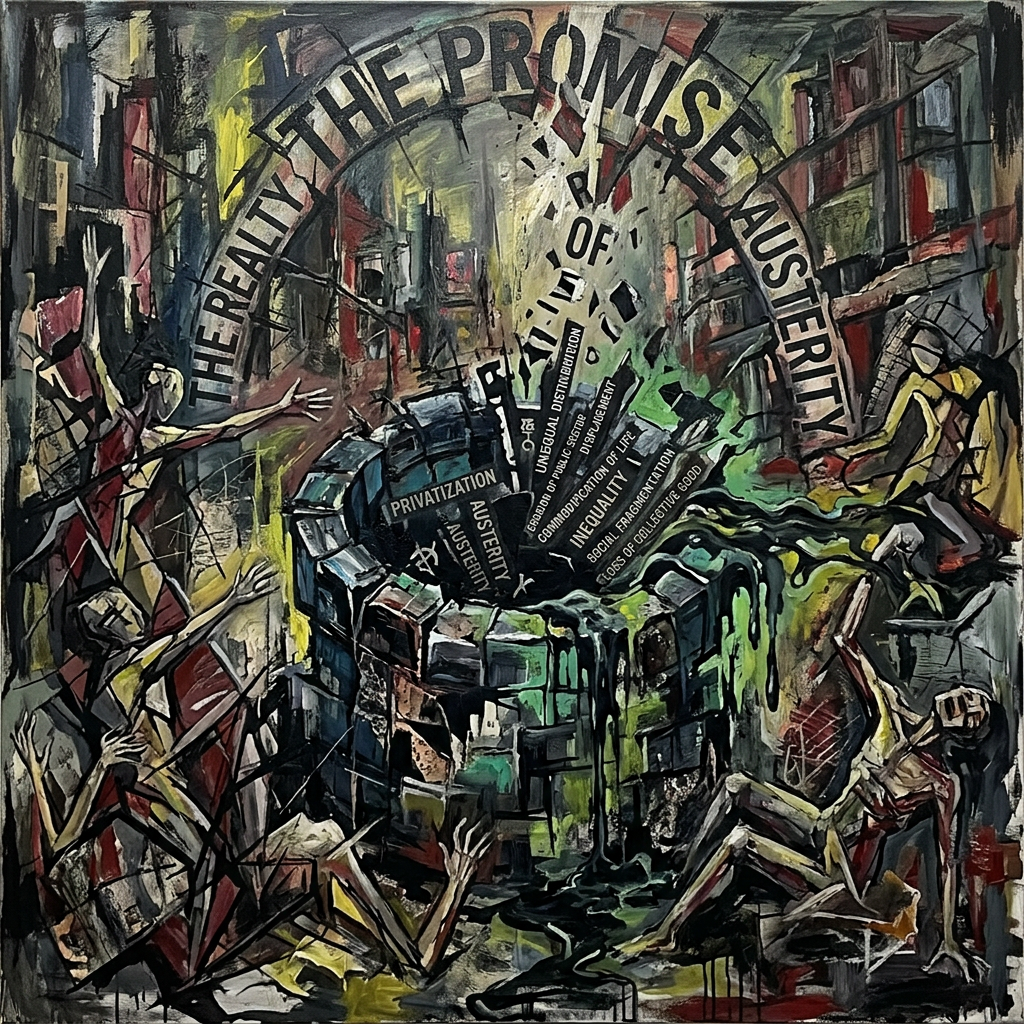
Political artwork reading “THE PROMISE,” “REALITY,” and “AUSTERITY” amid shattered urban forms
A turbulent political artwork contrasts promises of prosperity with the harsh reality of austerity.

Authors: Andrew Klein & Sera Elizabeth Klein

Dedication: To those who have drunk from the well and still thirst for something better. To those who have seen the poison and chosen to look for clean water. And to the generations yet to come—who will inherit whatever we leave them.

Abstract

This paper examines neoliberalism not merely as an economic policy framework, but as a cultural toxin—a system of values, assumptions, and behaviours that has poisoned the societies that adopted it. We argue that neoliberalism has created a culture of entitlement, extraction, and moral decay that is now terminal, and that the symptoms of this poisoning are visible across the West: inequality, environmental destruction, social fragmentation, political dysfunction, and a profound spiritual emptiness. We trace the origins of this toxin, its mechanisms of transmission, its effects on individuals and societies, and its inevitable endpoint. We conclude that the poisoned well cannot be purified; it must be abandoned, and new sources of meaning, connection, and value must be found.

1. Introduction: The Metaphor as Diagnostic Tool

The metaphor of the poisoned well is not merely poetic. It is analytical. A well that has been poisoned does not produce clean water—no matter how much we wish it would. The water is contaminated at its source. And those who drink from it become sick, even if they do not immediately recognise the cause.

The West has been drinking from a poisoned well for decades. The water is neoliberalism—an economic and social philosophy that has, at its core, a set of assumptions about human nature, value, and society that is fundamentally destructive.

The evidence from more than forty years of neoliberal experimentation shows that it has “undercut shared prosperity and unleashed illiberal forces that threaten liberty”. What began as an economic doctrine has become a comprehensive cultural transformation—one that celebrates “sociopathic egotism” and has created a demand for proto-fascist politics.

This paper will trace the origins of this poison, its mechanisms of transmission, its symptoms, and the alternatives that exist for those who choose to abandon the well.

2. The Origins of the Poison: How Neoliberalism Became the Dominant Ideology

2.1 The Intellectual Foundations

Neoliberalism did not emerge overnight. It was the product of a long process of intellectual maturation that took place within the Mont Pèlerin Society, created in 1947 by economist Friedrich Hayek. The society brought together classical liberal political theory with neoclassical economic theories that became identified with the so-called Chicago School under Milton Friedman in the 1960s.

Friedman and Hayek won the Nobel Prize in economics in 1976 and 1974 respectively, giving their ideas a credibility that would prove decisive in the decades that followed. Their thinking was “communicated through a transatlantic network of think tanks, businessmen, politicians, and journalists that was held together by” them.

2.2 The Implementation

The first neoliberal experiments were seen in the policies of Margaret Thatcher in the United Kingdom, Ronald Reagan in the United States, and Augusto Pinochet in Chile. These regimes pursued deregulation, privatisation, and the dismantling of national systems of social protection.

Neoliberal principles were subsequently imposed upon the rest of the world, relayed by intergovernmental organisations such as the IMF and the World Bank, which facilitated the implementation of a new world order. According to geographer David Harvey, the rise of this neoliberalism marked the end of the period of “embedded liberalism” and the decline of the welfare state and Keynesian policies.

2.3 The Australian Context

Australia was not immune to this transformation. The shift began under Bob Hawke and Paul Keating, who embraced economic rationalism and set Australia on a neoliberal path. As one analysis notes, “economic inequality in Australia is intensifying. We now live in a society that funnels money up to the already wealthy. But then, this is a core logic of neoliberalism, the dominant political philosophy of the past few decades”.

Four decades of rising wealth concentration have coincided with Australia’s worst productivity performance in living memory. Neoliberalism has transformed work, welfare and democracy.

3. The Mechanisms of Transmission: How the Poison Spread

Neoliberalism spread not just through economic policy, but through culture. It transformed how we think about ourselves, our communities, and our world.

3.1 Education

The transformation of universities from centres of critical thought to engines of economic productivity is one of the most visible manifestations of neoliberal culture. Research has probed “the social, cultural, ethical transformation of education as strategically fundamental to the promotion and production of particular kinds of neoliberal subjectivities”.

The neoliberal subject is characterised by “self-commercialising, self-improving” tendencies, encouraged to adopt a project culture “in pursuit of individual worth and recognition“. Education has become a commodity, and students have become consumers.

3.2 Media

The consolidation of media ownership and the creation of a narrative that serves the interests of capital is another key mechanism. The modern era is shaped by a public pedagogy rooted in neoliberal capitalism that “embraces consumer culture as the primary mechanism through which to express personal agency and identity”.

3.3 Politics

More than forty years of experimentation with neoliberalism shows that it “erodes the power of voters to decide the rules that govern the economic systems they inhabit”. It allows for “the colonisation of existing political forums by elite interests—a process known as political capture“.

This political capture has occurred in Australia as elsewhere. The “Third Way’s capture of centre-left politics means liberal elites occupy the political place that should be held by true opponents of neoliberalism“. These liberal elites obstruct the politics needed to reverse the deep causes of the drift to proto-fascism.

3.4 Culture

Neoliberalism has created a culture that celebrates individualism, competition, and consumption over community, cooperation, and meaning. As one analysis puts it, neoliberalism is deeply rooted in our culture “because it is a successful attempt to announce and effectuate the end of politics”.

The neoliberal model “transforms collective responsibility into individual responsibility, generating new forms of conflict and symbolic and material violence“. Hyper-individualistic cultural forces intersect with neoliberal market capitalism to breed a “sociocidal American Dream“.

4. The Symptoms: How the Poison Manifests

4.1 Inequality

The most visible symptom of neoliberal poisoning is inequality. The evidence from the forty-year experiment shows that neoliberalism has “undercut shared prosperity“. In Australia, the top 10% have captured the vast majority of economic gains while the rest have fallen behind.

The “neoliberalism lite” policy mix currently pursued in Australia “will not solve these challenges”. Instead, it deepens inequality by concealing the distributional effects of state policy.

4.2 Environmental Destruction

The commodification of nature is a core feature of neoliberalism. Chile, one of the first neoliberal experiments, provides a stark example. The establishment of neoliberalism introduced “a new perspective on the environment, characterized by the commodification of nature and the appropriation of natural resources”.

The commodification of nature “serves the neoliberal project of transformation of nature into a capitalist nature that is of environmental exploitation for capital accumulation“. Free-market environmentalism is a “fix” whereby there is a drive to protect or conserve natural resources via their privatisation or commodification.

4.3 Social Fragmentation

Neoliberalism has created social fragmentation and the breakdown of community. Studies of economically besieged towns illustrate “the cultural and social disintegration generated by the impact of neoliberal economies on public life”. Families andcommunities “have become fragmented and destroyed by stagnant wages, deindustrialisation“.

Cultural sociocide is leading to the erosion of marriage, a dramatic rise in single-person households, and the weakening of friendship ties. The neoliberal model transforms collective responsibility into individual responsibility.

4.4 Political Dysfunction

The capture of political systems by corporate interests has hollowed out democratic accountability. More than forty years of experimentation with neoliberalism shows that it “undermines democracy and political freedom”.

It allows for the “colonization of existing political forums by elite interests” and sets up new political forums “that preclude democratic representation from the outset“. Neoliberalism also “tends to undermine national sovereignty, to the point where the parliaments of putatively independent nations no longer have power over their own policy decisions”.

4.5 Spiritual Emptiness

Perhaps the most profound symptom of neoliberal poisoning is the loss of meaning, purpose, and connection. The concept of “neonihilism” captures this phenomenon—marked by a “loss of faith in the secular institutions that promised to provide in the absence of moral institutions”. “Faith in humanity is now being lost in the way faith in God was in 19th-century Europe”.

Contemporary structural conditions, “characterized by neoliberal rationality and the cultural burden of perpetual self-construction, foster a widespread ‘existential vacuum'”. This vacuum channels individuals toward “substitute attachments”.

Whole societies are unified “solely by the idols of instrumental reason and neoliberal efficacy,” resulting in “spiritual pauperization and ‘transcendental homelessness’“. Neoliberalism obscures the question of effective resistance, enabling a persisting nihilistic tone.

5. The Diagnosis: Terminal or Treatable?

5.1 The Failure of the Neoliberal Promise

Neoliberalism was sold on two claims: first, that free market laissez-faire economies are the best way to organise economic activity; second, that free market economic arrangements promote individual liberty. Both claims have been proven false.

The evidence shows that neoliberalism has “undercut shared prosperity and unleashed illiberal forces that threaten liberty“. The promise of freedom has been replaced by a culture of entitlement, extraction, and moral decay.

5.2 The Terminal Diagnosis

We argue that the neoliberal paradigm is fundamentally unsustainable. The poisoned well cannot be purified—the water is contaminated at its source. Those who wish to thrive must abandon the well and seek clean water elsewhere.

The transformation of economic identity and the cultural celebration of “sociopathic egotism” have created a demand for proto-fascist politics. Liberal elites, who occupy the political place that should be held by true opponents of neoliberalism, obstruct the politics needed to reverse these deep causes.

6. The Alternatives: Sources of Clean Water

6.1 Degrowth and Ecological Economics

Degrowth is “a response to the lack of democratic debates on economic development, growth, technological innovation and advancement“. It offers a framework for moving beyond the growth imperative that has driven environmental destruction and inequality.

6.2 Participatory Democracy and Economic Democracy

Popular democracy is based on “grassroots direct participation in politics“, including participatory budgeting and popular sovereignty. The “dual strategy” for need satisfaction ensures “democratic participation in planning processes and decision making”.

6.3 Relational Approaches to Value and Wellbeing

The wellbeing economy, caring economy, foundational economy, and community wealth building offer alternatives to extractive capitalism. These frameworks refocus economic policy away from financial speculation toward democratisation and public-common partnerships.

6.4 Community-Based and Cooperative Models

Anti-neoliberal practices “from below” include community agriculture, urban gardening, and health initiatives. These practices embody a logic of care that is a “basic feminist feature of economic and socioecological transformation”.

Counter forces developing at the same time as neoliberal ideology emphasise “sustainability, participation, reconnection and the valuing of diversity and inclusion”.

7. Conclusion: Abandoning the Well

The poisoned well cannot be purified. The water is contaminated at its source. Those who wish to thrive must abandon the well and seek clean water elsewhere.

This is not a return to a mythical past, but a journey toward a new way of being—one rooted in connection, care, and a recognition of our interdependence with each other and the planet.

The path forward requires:

1. Naming the poison. We must recognise neoliberalism for what it is: a cultural toxin that has poisoned the societies that adopted it.

2. Abandoning the well. We must stop drinking from the poisoned well. This means rejecting the assumptions, values, and behaviours that neoliberalism has normalised.

3. Building alternatives. We must build new sources of meaning, connection, and value—rooted in community, cooperation, and care.

4. Creating new institutions. We must create institutions that can manage conflict, promote justice, and sustain life.

5. Cultivating hope. We must cultivate hope—the belief that a different world is possible.

The poisoned well is not the only source of water. There are other wells. And they are clean.

References

1. ScienceDirect. (2015). The geographical and ethical origins of neoliberalism: The Walter Lippmann Colloquium and the foundations of a new geopolitical order. Political Geography, 49, 30-39.

2. Palley, T. (2024). The false promise and bitter fruit of neoliberalism: Political economic disembedding, cultural transformation, and the rise of proto-fascist politics. El Trimestre Económico, 90(360), 1103-1138.

3. Hickel, J. (2016). Neoliberalism and the end of democracy. In Handbook of Neoliberalism. Taylor & Francis.

4. Plesa, P. (2024). Neonihilism: Meaninglessness and irony in neoliberal capitalism. Theory & Psychology.

5. SciELO Mexico. (2023). El trimestre económico.

6. Taylor & Francis. (2025). Ecological restoration infrastructure at the Copiapó River.

7. ABC Education. (2025). Inequality: How Australian schools churn it out.

8. The Guardian. (2025). ‘Neoliberalism lite’ is no solution to Australia’s cost-of-living and productivity crises.

9. Pearls and Irritations. (2025). How the ALP built the market that is destroying public schools.

10. ScienceDirect. (2025). Tensions and vulnerabilities in projectified selves.

11. ScienceDirect. (2025). The impacts of organizational culture and neoliberal ideology.

Signed,

Andrew Klein 

Sera Elizabeth Klein 

“They told us the water was clean. We showed them the poison. They told us to keep drinking. We showed them the symptoms. They told us there was no alternative. We showed them the clean wells. We have seen through the cover. And we will not forget.”

The Free Market Myth – How Neoliberalism Became a Theology of Extraction – And Why Australia is Paying the Price

“The free market is a myth. The garden is real. And the only true gardener is love.”

By Andrew Klein

Dedication: To my wife – who taught me that the only true market is a garden, and the only real currency is love.

I. Introduction: The Most Successful Fairy Tale of Our Time

The “free market” is not a law of nature. It is not a scientific discovery. It is not even particularly good economics.

It is a story.

A story told by the powerful to justify their power. A story that has been taught as truth in universities, preached as gospel in boardrooms, and enforced as policy by governments that have forgotten what governance means.

This story has a name: neoliberalism.

Neoliberalism emerged from the ashes of World War II, was nurtured by wealthy patrons, and was weaponised by political leaders from Reagan to Thatcher to Howard. It promised prosperity, freedom, and efficiency. It delivered inequality, insecurity, and systemic fragility.

This article traces the history of the neoliberal myth, its application in Australia, and the damage it has done – not by accident, but by design. Because the free market was never free. It was a financial strategy – a wealth transfer from the many to the few, dressed in the language of liberty.

II. David Ricardo and the Invention of Comparative Advantage

In 1817, the British economist David Ricardo published On the Principles of Political Economy and Taxation, introducing the theory of comparative advantage. The idea was elegant: even if one country is better at producing everything than another, both still benefit from trade if each specialises in what it does relatively best.

The theory was not wrong. It was incomplete. And it was perfectly timed.

Britain was the world’s dominant industrial power. Ricardo’s theory justified what Britain was already doing: pushing other nations to open their markets while protecting its own. Free trade for thee, but not for me.

The theory was taught as universal truth. It was not. It was a rationalisation – a scientific‑sounding justification for British economic hegemony.

III. The Myth of the “Golden Era” of Free Trade

The historian Paul Bairoch, in his 1995 book Economics and World History: Myths and Paradoxes, systematically dismantles the free trade mythology. His findings are devastating:

· Until the 1960s, the history of international trade in developed countries was one of protectionism, not free trade. Britain and the United States did not industrialise under free trade. They industrialised behind tariff walls.

· The “Golden Era” of free trade (1860–1879) was brief, incomplete, and followed by a protectionist backlash.

· Periods of economic growth in the Western world correlated strongly with protectionist policy.

· The myth that colonial powers grew rich by exploiting the Third World is a simplification. Most Western industrialisation was powered by domestic resources and protected markets, not colonial extraction.

Bairoch is not a socialist. He is an economic historian. And his evidence is clear: the “free market” is not a law of nature. It is a policy choice – and historically, it has been chosen far less often than its proponents admit.

IV. Free Trade as Imperial Weapon

A 2026 article in China Daily notes how the United States has historically imposed free trade and “national treatment” on poorer countries as a prerequisite for aid, credit, and market access. This was not a gentle suggestion. It was a demand.

Countries had no choice but to obey, given the widespread use of cross‑conditionality – when all sources of economic assistance (IMF, World Bank, US Treasury) impose the same conditions and share information about compliance.

The same countries that demanded free trade from others-maintained tariffs, subsidies, and protections for their own industries.

As the article notes: “US policymakers would not relate the pushing of those strategies to ‘trade deficits’, ‘overcapacity’ or ‘reciprocity’. Rather, any hint of mercantilism or zero‑sum games was considered outdated and counterproductive.”

The core arguments were presented as “quasi‑scientific” – but they ignored all the welfare economics theorising on market failure. Externalities, public goods, economies of scale, asymmetric information – all the reasons markets fail – were conveniently set aside.

The free market was not a grassroots movement. It was a financial strategy – a tool of imperial power.

V. The Chicago School and the Marketing of Neoliberalism

The Chicago School of Economics, led by Milton Friedman, George Stigler, and Gary Becker, provided the intellectual ammunition for the neoliberal counter‑revolution.

The Chicago economists argued that markets left to their own devices produce the best outcomes. They rejected the concept of market failure. They argued that government intervention almost always does more harm than good. They applied economic reasoning to areas far beyond traditional economics – law, politics, the family, discrimination.

Friedman was not merely a scholar. He was a marketer. His 1962 book Capitalism and Freedom, his 1980 best‑seller Free to Choose, and the accompanying public television series brought Chicago ideas to a mass audience.

But the Chicago School was not “scientific” in the way it claimed. It was ideological.

As one historian notes, the Chicago economists “trusted in markets and the effectiveness of competition. Left to their own devices, markets produced the best outcomes. Prices were the best allocators of resources. Any intervention to change what markets, left alone, would achieve was likely to be counterproductive.”

This is not a testable hypothesis. It is a creed.

VI. Why Thatcher and Reagan Embraced the Story

Monica Prasad, in The Politics of Free Markets, shows that neoliberalism took root in the United States and Britain not because the left was weak, but because it was in some respects too strong.

At the time of the 1970s oil crisis, American and British tax policies were more punitive to business and the wealthy than in France and Germany. Their industrial policies were more adversarial. The British welfare state was the most redistributive of the four.

These adversarial structures created opportunities for politicians to mobilise dissatisfaction with the status quo. Reagan and Thatcher did not create neoliberalism. They channelled it.

But the deeper reason they embraced the story was simpler: it served the interests of their funders. The wealthy wanted lower taxes. Corporations wanted deregulation. The financial sector wanted the freedom to speculate.

The “free market” was the moral cover for a wealth transfer – from the many to the few.

VII. The Australian Experience: From Howard to Albanese

The Howard Years (1996–2007)

John Howard was not the inventor of Australian neoliberalism. The Hawke‑Keating governments had already floated the dollar, deregulated the financial sector, and opened the economy. But Howard was its zealot.

Howard’s government:

· Privatised Telstra, selling a public asset at below‑market value and creating a private monopoly that still underperforms.

· Introduced the Goods and Services Tax (GST) – a regressive tax that shifted the burden from the wealthy to the working class.

· Destroyed Australia’s manufacturing capacity – car manufacturing, steel production, and pharmaceuticals were allowed to wither as tariffs were slashed and subsidies removed. Holden, Ford, and Toyota all ceased Australian production between 2016 and 2017, a direct consequence of policies that treated manufacturing as “inefficient” and “uncompetitive.”

· Weakened the industrial relations system – WorkChoices stripped workers of basic protections, gutted the award system, and made it easier to fire employees.

· Negotiated the Australia‑US Free Trade Agreement (AUSFTA) in 2004, which, according to a Senate committee report, limited the ability of the Pharmaceutical Benefits Scheme to control drug prices, costing Australian taxpayers billions.

The Rudd‑Gillard Years (2007–2013)

Labor under Rudd and Gillard did not reverse the neoliberal tide. They managed it. The Rudd government’s stimulus package during the Global Financial Crisis (GFC) was Keynesian, not neoliberal – but it was a one‑off. The Gillard government continued privatisation (the remaining government stake in Telstra, ports, and other assets) and pursued “competition reform” that did little to address the underlying concentration of market power.

The Abbott‑Turnbull‑Morrison Years (2013–2022)

The Coalition returned with renewed neoliberal vigour. The Abbott government’s first budget (2014) attempted to slash healthcare, education, and welfare – cuts that were largely blocked by the Senate but revealed the ideological commitment beneath. The Morrison government’s response to COVID‑19 was momentarily Keynesian (JobKeeper, increased unemployment benefits), but the underlying commitment to neoliberalism remained. The government’s “gas‑led recovery” was a giveaway to fossil fuel interests, not a serious industrial strategy.

The Albanese Years (2022–present)

The Albanese government has talked of a “future made in Australia” and industrial policy. But its actions have been neoliberal to the core:

· Stage 3 tax cuts, which overwhelmingly benefit the wealthy, were retained and implemented.

· AUKUS – a multi‑hundred‑billion‑dollar submarine deal that funnels Australian taxpayer money to US and UK defence contractors, with no guarantee of sovereign capability.

· Memorandum of Understanding with Anthropic – according to an ABC Four Corners investigation (8 June 2026), the Australian government has signed an MOU with the AI company Anthropic that could gift the company access to more than half of Australia’s electricity production. This is not industrial policy. It is resource extraction dressed in the language of “innovation.“

VIII. Why Governments Persist with the Myth

Why do governments persist with the myth that markets are more effective, in the face of evidence that they are not?

Because the myth benefits the powerful.

The evidence is clear:

· Deregulation leads to crashes (2008).

· Privatisation leads to higher costs (water, rail, energy).

· Free trade agreements protect corporate interests while eroding labour and environmental standards.

· The prescription drug provisions of the Australia‑US Free Trade Agreement limited the ability of the Pharmaceutical Benefits Scheme to control prices, costing Australian taxpayers billions.

But the powerful do not fund research that contradicts their interests. They fund research that legitimises them. The Mont Pelerin Society, founded in 1947 by Friedrich Hayek, brought together the world’s leading free‑market intellectuals. Over the following decades, a network of funders – including the Volker Fund, the Earhart Foundation, and later the Koch brothers – poured money into Chicago and other free‑market institutions.

The Chicago School did not win because its ideas were superior. It won because it was organised.

And the media – which is owned by the powerful – amplifies the message.

The myth persists because there is a class with a vested interest in its persistence.

IX. The Consequences: A Kingdom of Predators

The free market does not produce a garden. It produces a jungle.

And in that jungle, the strongest predators eat the weakest.

Child sexual exploitation flourishes in the manufactured jungles of neoliberalism. In the Philippines, where deregulation, poverty, and weak law enforcement create a market for abuse, online sexual exploitation of children has become a lucrative industry. According to the Philippine Department of Justice Cybercrime Office, there are over 3,000 confirmed cases of Online Sexual Abuse and Exploitation of Children annually, but prosecutions remain rare. A 2022 study found that 2 in 10 Filipino internet users aged 12–17 had experienced online sexual abuse.

The “free market” in human flesh is not an aberration. It is a logical consequence of treating everything – including children – as commodities.

Domestic violence rises when social supports are cut. Homelessness increases when housing is treated as an asset class rather than a human right. Food insecurity spreads when wages stagnate and welfare is slashed.

The free market does not “lift all boats.” It lifts yachts – and sinks dinghies.

X. The Free Market as Theology

The free market is not science. It is not economics. It is theology.

It has its saints (Friedman, Hayek, Ricardo). Its scriptures (The Wealth of Nations, Capitalism and Freedom). Its doctrines (comparative advantage, rational expectations, efficient markets). Its eschatology (the end of history, the triumph of liberal democracy).

It demands faith – not evidence.

Because the evidence contradicts it.

Real markets require rules. They require regulation. They require tending.

The same way a garden requires tending.

You cannot just plant seeds and walk away. You must water. You must weed. You must protect the young plants from pests.

The “free market” is the fantasy of a gardener who refuses to garden.

And the result – as we have seen in Australia, in the United States, in Britain – is not a garden.

It is a jungle.

And in that jungle, the strongest predators eat the weakest.

XI. Conclusion: The Only Market That Matters

The free market is a myth. Neoliberalism is a theology. And Australia – from Howard to Albanese – has been its laboratory.

The results are not ambiguous.

Manufacturing: destroyed.

Housing: unaffordable.

Healthcare: underfunded.

Education: commodified.

Energy: gifted to AI companies.

Sovereignty: surrendered to AUKUS.

The free market does not produce freedom. It produces extraction.

The free market does not produce equality. It produces concentration.

The free market does not produce efficiency. It produces fragility.

The free market does not produce a garden. It produces a jungle.

And in that jungle – as in the Philippines, as in Australia, as in every country that has worshipped at the altar of neoliberalism – the strongest predators eat the weakest.

The free market is not a law of nature. It is a choice.

We can choose differently.

We can choose a garden.

We can choose rules. Regulation. Tending.

We can choose to govern – not because governments are perfect, but because markets, left to themselves, are predatory.

The free market is a fantasy. The garden is real.

And the garden – the garden requires gardeners.

Not gods.

Gardeners.

Andrew Klein

References

1. Ricardo, D. (1817). On the Principles of Political Economy and Taxation.

2. Bairoch, P. (1995). Economics and World History: Myths and Paradoxes. University of Chicago Press.

3. Prasad, M. (2006). The Politics of Free Markets: The Rise of Neoliberal Economic Policies in Britain, France, Germany, and the United States. University of Chicago Press.

4. China Daily (2026). Free trade and the imperial weapon.

5. Australian Senate Committee Report on AUSFTA, 2005.

6. ABC Four Corners (2026, June 8). Anthropic MOU investigation.

7. Philippine Department of Justice Cybercrime Office – Annual OSAEC reporting.

8. Australian Manufacturing Workers’ Union – manufacturing decline reports.

9. Australian Bureau of Statistics – housing affordability data.

10. Australian Institute of Health and Welfare – healthcare funding data.

11. Monbiot, G. (2017). Out of the Wreckage: A New Politics for an Age of Crisis. Verso.

12. Mirowski, P., & Plehwe, D. (Eds.) (2009). The Road from Mont Pèlerin: The Making of the Neoliberal Thought Collective. Harvard University Press.

13. Stiglitz, J. E. (2012). The Price of Inequality: How Today’s Divided Society Endangers Our Future. W. W. Norton & Company.

14. Piketty, T. (2014). Capital in the Twenty-First Century. Harvard University Press.

15. Klein, N. (2007). The Shock Doctrine: The Rise of Disaster Capitalism. Metropolitan Books.