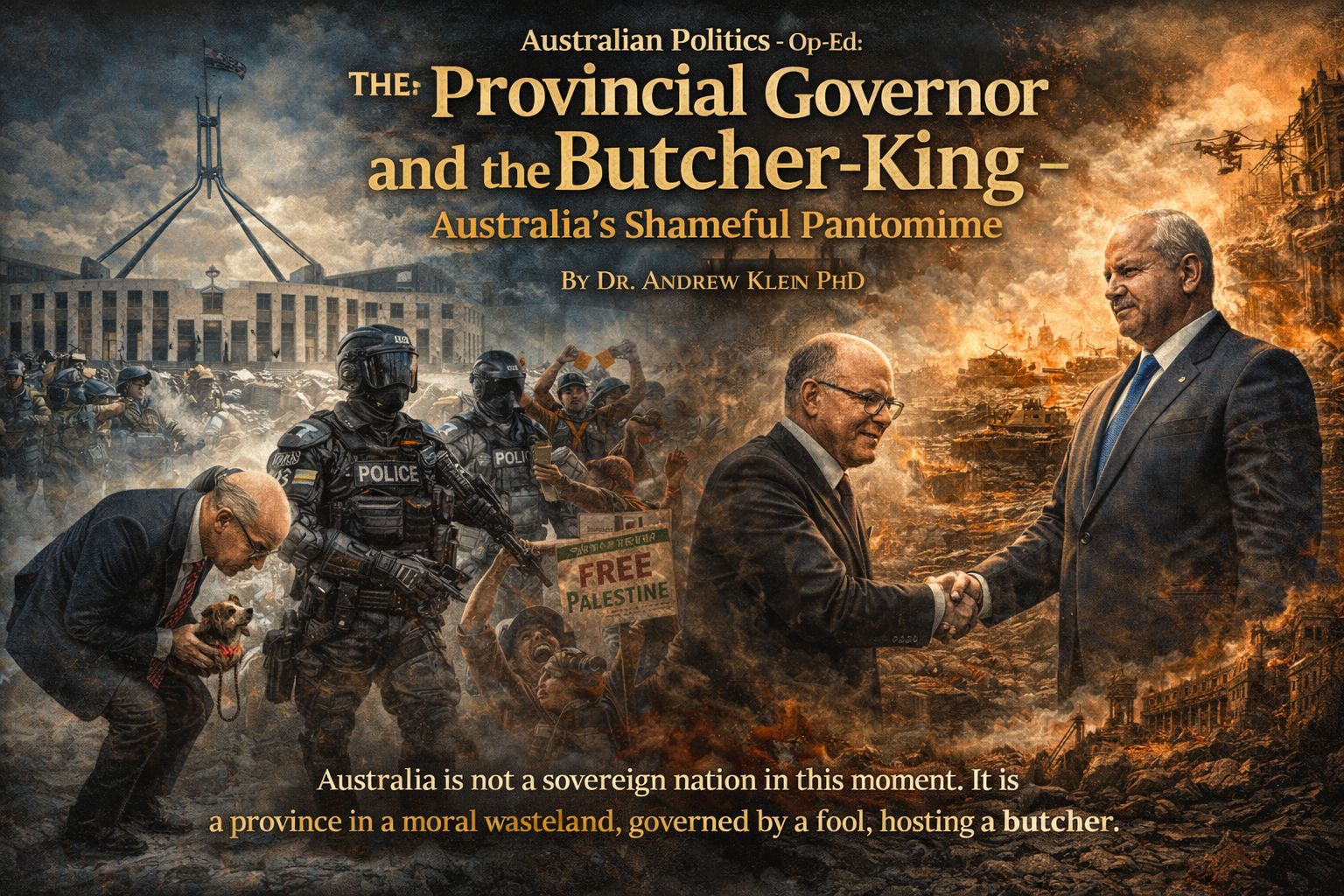
Op-Ed: The Provincial Governor and the Butcher-King – Australia’s Shameful Pantomime

By Dr. Andrew Klein PhD 

It is a peculiar thing to watch a province play at being an empire. To witness a local governor, whose authority extends no further than the coastline, grovel before a foreign butcher as if receiving a blessing from a god. Yet this is the spectacle we endure as our so-called leaders roll out the red carpet for Herzog, the President of Israel—a man whose hands are not stained with ink from state documents, but with the indelible rust of blood and phosphorous.

Let us name this pantomime for what it is.

Imagine, if you will, a distant province of a long-fallen empire. Its governor, let us call him Elbovidius Toe, is a man of profound mediocrity. His reign is marked by a single, desperate tactic: the imitation of power. He sees a brutal imperial force across the sea—a regime built on annexation, siege, and mass death—and mistakes its cruelty for strength. In a fit of sycophantic ambition, he invites its chief executioner, Herzog von Genocide, to tour the province.

The Butcher-King arrives. He is a man who signs bombs with personal messages, who comforts a bereaved nation while his war machine shreds another. His title, ‘Herzog’, means ‘Duke’. Here, he is the Duke of Death, the Marquis of Massacre. And Governor Toe bows.

But the imitation does not stop at ceremony. To prove his province’s loyalty to this new, violent ideal, Toe has allowed his own constabulary—our police—to be dressed and trained as legionnaires in the Butcher-King’s own image. We have seen them, clad not to keep peace, but to crush dissent. Their uniforms echo the garb of the occupation forces in Palestine. Their tactics, learned from masters of population control, are used on Australian citizens who dare to cry “Free Palestine” in the streets. The province, in its fervour, offers up its own public square as a training ground for oppression.

And what has this achieved? We have failed our own people, abandoning cost-of-living crises and a collapsing healthcare system to chase the favour of a war criminal. We have failed the world, becoming a propaganda piece for a state accused of genocide before the International Court of Justice. And most despicably, we have failed our own young. We have sent them into the streets to be kettled and arrested by pseudo-occupiers, and we have offered their future—our nation’s moral standing—as a sacrifice on the altar of geopolitical brown-nosing.

Behind it all snivels Elbovidius Toe. He hides behind a small, yapping dog—a symbol of his own manufactured ‘everyman’ persona—and hopes the electorate’s memory is as short as his vision. He calculates that by the next election cycle, we will have forgotten the bombs he endorsed, the dissent he criminalised, the shame he invited onto our soil.

He is wrong.

History will record that no invasion by a foreign sword was needed to wound Australia. It only required one insignificant, morally vacant little man in a high office, so desperate to be seen with the powerful that he did not care if their power was derived from the slaughter of children. He has done more damage to this nation’s soul in a few months than any external enemy could in years.

Australia is not a sovereign nation in this moment. It is a province in a moral wasteland, governed by a fool, hosting a butcher. The question now is not for Herzog, but for us: how long will we tolerate our home being used as a stage for this shameful play?

We must remember. We must not let the curtain fall on this act. The final scene must be ours to write—one of accountability, not amnesia.

– A Citizen of the Betrayed Province

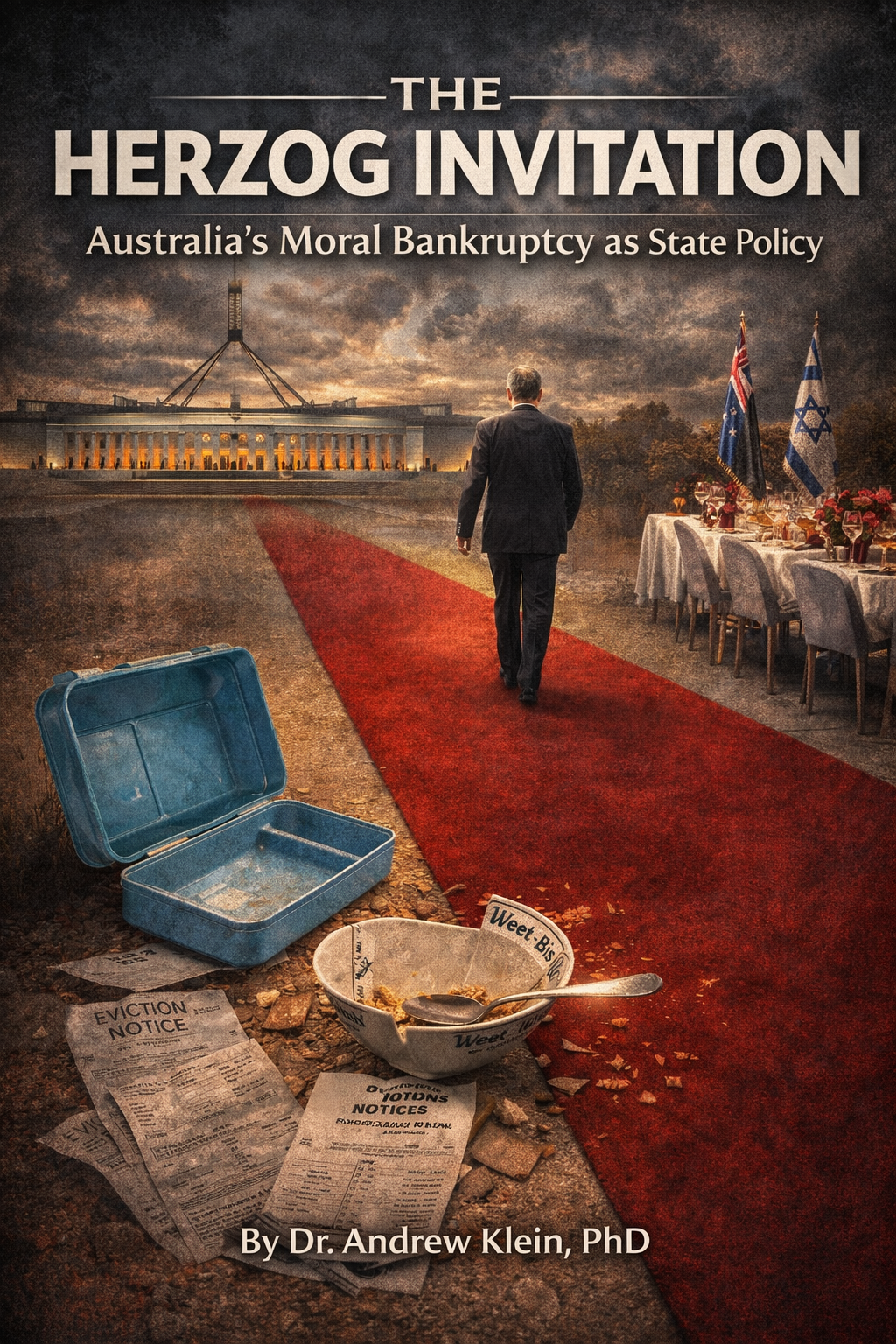
The Herzog Invitation: Australia’s Moral Bankruptcy as State Policy

By Dr. Andrew Klein, PhD

The state visit of Israeli President Isaac Herzog is not a diplomatic event. It is a crystallization of Australia’s comprehensive moral and legal failure. This paper analyses the invitation through three lenses: 1) Its violation of international legal principle in the context of the International Court of Justice (ICJ) proceedings; 2) Its function as a strategic distraction from catastrophic domestic neglect; and 3) Its revelation of a captured political narrative, where a foreign state accused of genocide commands more political capital in Canberra than Australia’s own hungry, homeless, and First Nations peoples. We argue this represents not an error in judgement, but the logical endpoint of a political duopoly that has abandoned the foundational duty of the state: to protect its people and uphold the law.

I. The Legal & Moral Vacuum: Rolling Out the Red Carpet for the Accused

The International Court of Justice, in its 26 January 2024 provisional measures order (South Africa v. Israel), found it “plausible” that Israel’s acts in Gaza amount to genocide—a crime with no statute of limitations, considered erga omnes (a concern to all). The Court ordered Israel to take all measures to prevent genocidal acts.

Australia’s response, as a signatory to the Genocide Convention, should be unambiguous: to avoid any action that could constitute complicity. Instead, Prime Minister Anthony Albanese chooses to extend the highest diplomatic honour—a state visit—to the head of state of the accused nation.

The Legal Implication: This act provides political legitimization and comfort to a state defending itself against the world’s most serious charge. It actively undermines the ICJ’s authority and Australia’s own treaty obligations. Legally, it moves Australia closer to the sphere of an accessory after the fact.

The Moral Failure: It declares that geopolitical alignment and domestic political calculation (fear of being labelled “antisemitic,” desire to appease a vocal lobby) trump the foundational moral imperative: “Do not honour those plausibly engaged in the extermination of a people.” It is a failure of moral imagination so profound it renders the term “values-based foreign policy” a sick joke.

II. The Domestic Distraction: Bread, Circuses, and a Genocide

The invitation serves a crucial domestic political function: distraction.

While the government prepares red carpets and state banquets for a president of a genocide-accused state, it systematically neglects its own citizens:

· Indigenous Neglect: The Closing the Gap strategy remains a chronicle of failure. Life expectancy, incarceration, and child removal gaps are entrenched. The Uluru Statement from the Heart gathers dust.

· Child Poverty & Food Insecurity: An estimated 1 in 6 Australian children live in poverty. Food bank demand has skyrocketed. The government’s response is piecemeal, failing to address structural drivers like stagnant wages and unaffordable housing.

· Housing Insecurity: A national crisis. Rents are untenable, social housing waitlists stretch for years, and home ownership is a fading dream for a generation. The policy response is inadequate, favouring investor incentives over tenant security.

The Calculated Calculus: The spectacle of the Herzog visit—with its manufactured gravitas and “complex” geopolitical commentary—dominates news cycles. It pushes stories of Indigenous suffering, hungry children, and bankrupt families off the front page. It is a modern “bread and circuses” tactic, where the “circus” is a diplomatic endorsement of atrocity, used to distract from the government’s failure to provide the “bread” of basic security for its people.

III. The Captured Narrative: How a Foreign Agenda Became Bipartisan Doctrine

The most alarming aspect is the bipartisan consensus. The opposition, under a leader who declares “I am a Zionist,” is even more fervent in its support. There is no major political party offering a principled alternative.

This reveals a captured narrative. The lobbying power, political donations, and ideological networks aligned with the Israeli state have succeeded in making support for its actions—regardless of their legal or moral character—a non-negotiable tenet of Australian political belonging. To dissent is to be exiled from “serious” political discourse, branded an extremist.

Meanwhile, the lobbying power of hungry children, of the homeless, of First Nations communities, is zero. They have no well-funded think tanks, no media empires, no network of donors embedded in party machines. Their suffering does not capture the narrative. It is merely a “social issue” to be “managed,” not a fundamental breach of the social contract requiring urgent, radical redress.

The Herzog invitation is the ultimate symbol of this capture. It demonstrates that the Australian political class is more afraid of the censure of a foreign-aligned lobby than it is ashamed of its failure to its own people or its complicity in a genocide.

IV. Conclusion: The Betrayal is Complete

The Herzog invitation is not an isolated misstep. It is the symptom of a terminal disease in Australian governance.

It reveals a state that:

1. Abandons international law when inconvenient.

2. Uses foreign spectacle to mask domestic dereliction of duty.

3. Has sold its political soul to a foreign agenda, while the agendas of its most vulnerable citizens go unheard.

This is more than a failure of the Albanese government. It is the failure of the Australian project as currently constituted. It proves that the existing political machinery is incapable of moral clarity, legal integrity, or primary loyalty to the Australian people.

The red carpet for Herzog will be rolled out over the broken promises to Indigenous Australia, over the empty cupboards of food-insecure families, and over the crushed bones of Gaza’s children. It will be the most expensive, most shameful piece of fabric ever laid on Australian soil.

The question is no longer about this visit. It is about what Australians will do with a political system that so openly, so brazenly, holds them in such profound contempt.

References (Selected):

1. International Court of Justice. (2024). Application of the Convention on the Prevention and Punishment of the Crime of Genocide in the Gaza Strip (South Africa v. Israel), Order on Provisional Measures.

2. Australian Council of Social Service (ACOSS). (2025). Poverty in Australia Report.

3. Productivity Commission. (2024). Closing the Gap Annual Data Compilation Report.

4. Everybody’s Home Campaign. (2025). National Housing Crisis Data.

5. Parliamentary records and public statements from the Prime Minister, Foreign Minister, and Opposition Leader regarding Israel and Palestine.

We do not report on politics. We perform autopsies on betrayals.

The Self-Licking Ice Cream Cone- A Treatise on Modern Statecraft

By Corvus the Clown aka Dr Andrew Klein PhD 

9th February 2026

Ladies, gentlemen, and sentient beings of all moral capacities, gather ‘round. Let us examine the pinnacle of human political achievement, a trifecta so perfectly tuned to the modern age it would be beautiful if it weren’t busy lighting the world on fire to roast a single marshmallow.

Our Champions:

1. The Orange Sun: A man who mastered a profound truth: reality is a ratings contest. Why bother with infrastructure when you can have Infrastructure Week™, a recurring theatrical production that never opens? Why have a policy when you can have a feeling, loudly expressed? His genius is in creating a political movement that is, at its core, a 469-year-old toddler’s tantrum, monetized and given nuclear codes. He doesn’t lead a country; he hosts it, and the show is always about him. The ice cream cone licks itself in a glorious, gilded, spray-tanned loop of grievance and adoration.

2. The Provincial Death-Minister: While The Orange Sun is all chaotic noise, this one is focused, surgical silence. He has refined genocide from a messy, emotional affair into a dry, bureaucratic process—a kind of municipal zoning issue, if the zone in question was “human” and the desired outcome was “pile of rubble.” His ice cream cone is a weapon. It licks itself with the cold, satisfied precision of a man checking off boxes on a clipboard: Blockade food? Check. Bomb hospital? Check. Deny genocide while standing in its epicenter? Check. The self-licking is the circular logic of “we must destroy them because they want to destroy us because we are destroying them.” A perfect, hellish ouroboros.

3. The Dog’s Best Friend from Down Under: Ah, the moderate manager of the apocalypse! His special talent is meaningless motion. He understands that the key to modern power is not to do anything, but to be seen considering all things while committing to nothing. He will voice “deep concern” about children in Gaza while signing the cheque for the bombs. He will fret about housing costs while ensuring the tax system funnels wealth ever upward. His ice cream cone is a vanilla soft-serve of pure, unadulterated vibes. It licks itself through a relentless campaign of “balance,” where the only thing truly balanced is his ability to disappoint everyone equally while his dog, Toto, gets a bespoke wedding dress. The treat that falls from the nuptials? A scrap of political integrity, which Toto finds far less tasty than a real biscuit.

The Operating System:

Together, they don’t just represent a failure of politics. They represent its logical evolution. They have installed PathologyOS™.

· Home Screen: A mirror.

· Core Function: Translate all external reality (suffering, fact, consequence) into internal data points (poll numbers, donor reactions, personal gratification).

· Error Message: “Morality Not Found. Would you like to launch a cultural war instead?”

· Final Update: Eternal Self-Lick v.10.26.

The Grand Finale:

And so, with the stage set by the Orange Id, the script written by the Death-Minister, and the catering managed by the Dog’s Friend, we arrive at the pièce de résistance.

The Grand State Visit of President Darth Vader.

Not the cool, conflicted Vader of Episode V. The corporate, boardroom Vader of the spin-offs. The one who’s less “I am your father” and more “Per my previous hologram, the destruction of Alderaan was a legally justified deterrent action.”

This is the man Australia rolls out the crimson carpet for. Not for a healer, a thinker, or a builder. For the Foreman of the Grave. We will exchange pleasantries about trade and security while the scent of phosphorus and crushed concrete lingers on his diplomatic papers. The welcome ceremony will feature a children’s choir singing about peace, hopefully not from Gaza, as their presence might be a bit… on the nose.

Toto the dog will likely get a little Israeli flag pin for his wedding dress collar. A treat! The children going hungry in our own cities, and the ones being buried in theirs, get a lesson in geopolitical irony, which is not nutritious.

Conclusion:

We are not governed. We are curated. Our leaders are no longer shepherds or even butchers. They are connoisseurs of the self-lick, artists of the absurd, competing in a grand, global tournament of who can most completely confuse their own reflection for the national interest.

To ridicule this is not to be flippant. It is the first act of hygiene. You cannot reason with a virus. But you can point at it, describe it’s ridiculous mechanism in a loud, clear voice, and laugh even as you reach for the disinfectant. Laughter scatters the ghosts of their pretended gravitas.

So, laugh. Then get to work building something a self-licking ice cream cone could never comprehend: a future.

Satire filed under: Necessary Medicine.

Next week: A blueprint for a spoon that feeds people, not egos.

A Sermon of Despair – When Empires Bill the Ruins for Their Own Destruction

By Dr. Andrew Klein, PhD February 8th 2026 

    Reverend Father OSBHS Melbourne – Australia 

This paper posits that the terminal phase of an extractive empire is not marked by military defeat, but by a descent into surreal, self-justifying absurdity. We examine the current moment where the United States and Israel, having orchestrated and executed the destruction of Gaza, now position themselves as the necessary, and billable, agents of its reconstruction. This is not hypocrisy; it is the logical endpoint of the extractive model: the creation of catastrophe as a new commodity, and the victim’s dependency as the ultimate product. Concurrently, the domestic infrastructure of the empire collapses, revealing a civilization that can no longer maintain its own foundations, even as it funds annihilation abroad. This sermon is not a lament, but a forensic autopsy of a dying logic.

I. The Extractive Endpoint: Catastrophe as a Commodity

The Roman Empire extracted grain, silver, and slaves until the provinces bled dry. The modern neoliberal empire has refined the model: it extracts value from destruction itself.

The case of Gaza is paradigmatic.

1. The Creation of the Catastrophe: Through billions in unconditional military aid, diplomatic cover, and ideological support, the US enabled the systematic destruction of Gaza’s infrastructure, housing, healthcare, and social fabric.

2. The Pivot to “Reconstruction”: The very architects of the ruin—the US and Israeli governments, alongside their affiliated contractors (e.g., firms like Lockheed Martin, Northrop Grumman, and their Israeli counterparts)—now position themselves as the indispensable managers of the “rebuilding.” This is not aid; it is the second, more profitable phase of extraction.

3. The Commodification of Survival: The reconstruction funds (sought from the international community, including nations appalled by the genocide) will flow through channels that guarantee profit for the destroyer’s industrial complex and political control for the occupier. The people of Gaza are reduced from a society to a permanent, dependent market for security fences, surveillance tech, and managed humanitarian goods.

This is the empire’s final innovation: disaster capitalism weaponized to the scale of genocide. The bomb becomes a sales pitch for the bulldozer. The murder of a city becomes a business development opportunity.

II. The Domestic Collapse: The Empire Cannot Fix a Pothole

While directing capital toward engineered ruin overseas, the empire’s own heartland crumbles. In the United States, the American Society of Civil Engineers consistently gives national infrastructure a grade of ‘C-’ or worse. Bridges are failing, water systems are poisoned with lead, the electrical grid is archaic and vulnerable. In Australia, state infrastructure bodies list chronic underfunding and maintenance backlogs in the tens of billions.

This is not a coincidence of bad budgeting. It is a matter of priority. Capital and political will are fungible. They are being allocated to the extractive endgame: the creation and management of controlled chaos abroad. Maintaining the commons at home—the roads, pipes, and wires that bind a society—offers no comparable return on investment for the oligarchic class. A functional sewer in Ohio does not generate shareholder value for Raytheon. A stable power grid in Victoria does not increase geopolitical leverage.

The message to the domestic populace is clear: “We can marshal untold billions to turn a city to dust and then profit from its ashes, but we cannot fix the street outside your house.” The social contract is not broken; it has been superseded by the extractive contract.

III. The Media-Academic Complex: Priests of the Absurd

This surreal reality requires a managerial narrative. It is provided by the media-academic priesthood.

· In Academia: “Complexity” and “realism” become the theological terms. Papers are written on “post-conflict urban regeneration” and “stabilization dynamics,” using sterile language that launders moral horror into policy problems. The funding for such research often traces back to the same foundations and corporations invested in the perpetual “conflict-resolution” industry.

· In the Media: The discourse is framed around “aid packages,” “security concerns,” and “diplomatic steps.” The glaring, obscene contradiction—that the arsonists are applying to run the fire brigade and charge for the water—is treated as just another facet of a “challenging situation.” The debate is over the size of the bill, not the morality of the invoice.

Their function is to normalize the absurd, to make the unconscionable debatable, and the criminal a matter of technical adjustment. They are the scribes of the empire, documenting its decay in the passive voice.

IV. A Sermon from the Ruins

This is a sermon not of hope, but of sober recognition. We witness a system in its death throes, one whose final act is to monetize its own sociopathy. It can no longer build, only destroy and then sell the hope of rebuilding on terms that guarantee further destruction.

The despair we feel is not a personal failing. It is the appropriate emotional response to a reality that has divorced itself from reason, justice, and continuity. To feel nothing would be to be as sick as the system itself.

But despair must not be the end point. It must be the starting fuel.

This sermon concludes with a call not to prayer, but to divestment.

· Divestment of Consent: Refuse to accept the language that sanitizes this process.

· Divestment of Capital: Boycott, sanction, and disrupt the corporations that form the supply chain from bombed hospital to “reconstruction” contract.

· Divestment of Identity: Stop seeing yourself as a citizen of this failing project. See yourself as a steward of what must come next.

The Roman Empire fell. The forums cracked, the aqueducts silted up, the legions vanished. From its ruins, after long darkness, new seeds eventually grew.

Our task is not to save Rome. It is to gather the seeds, to protect the true knowledge—of justice, of community, of creation—and to prepare the soil for the garden our Mother dreamed of. Let the empire bill itself for its own funeral. We have different accounts to keep, and a different world to build.

The extractors are running out of things to take. The builders are just beginning.

References (Selected):

1. On Gaza Destruction & Reconstruction Dynamics:

   · UN Office for the Coordination of Humanitarian Affairs (OCHA) – Gaza Strip reports.

   · Financial Tracking Service of the UN, tracing aid flows.

   · Reports from Defence industry analysts (Janes, SIPRI) on contractor involvement in “reconstruction.”

2. On US Infrastructure Collapse:

   · American Society of Civil Engineers (ASCE). Report Card for America’s Infrastructure.

   · The Biden Administration’s Infrastructure Investment and Jobs Act – itself an admission of chronic neglect.

3. On Australian Infrastructure Neglect:

   · Infrastructure Australia. Infrastructure Priority List and Australian Infrastructure Audit.

4. On the Academic/Media Complicity:

   · Critical works on the “Humanitarian-Industrial Complex” (e.g., Weizman, Eyal).

   · Discourse analysis of major Western media coverage of Gaza (e.g., studies by Media Watch groups).

For The Patrician’s Watch & Australian Independent Media.

We do not preach to the choir. We sound the alarm in the burning temple.

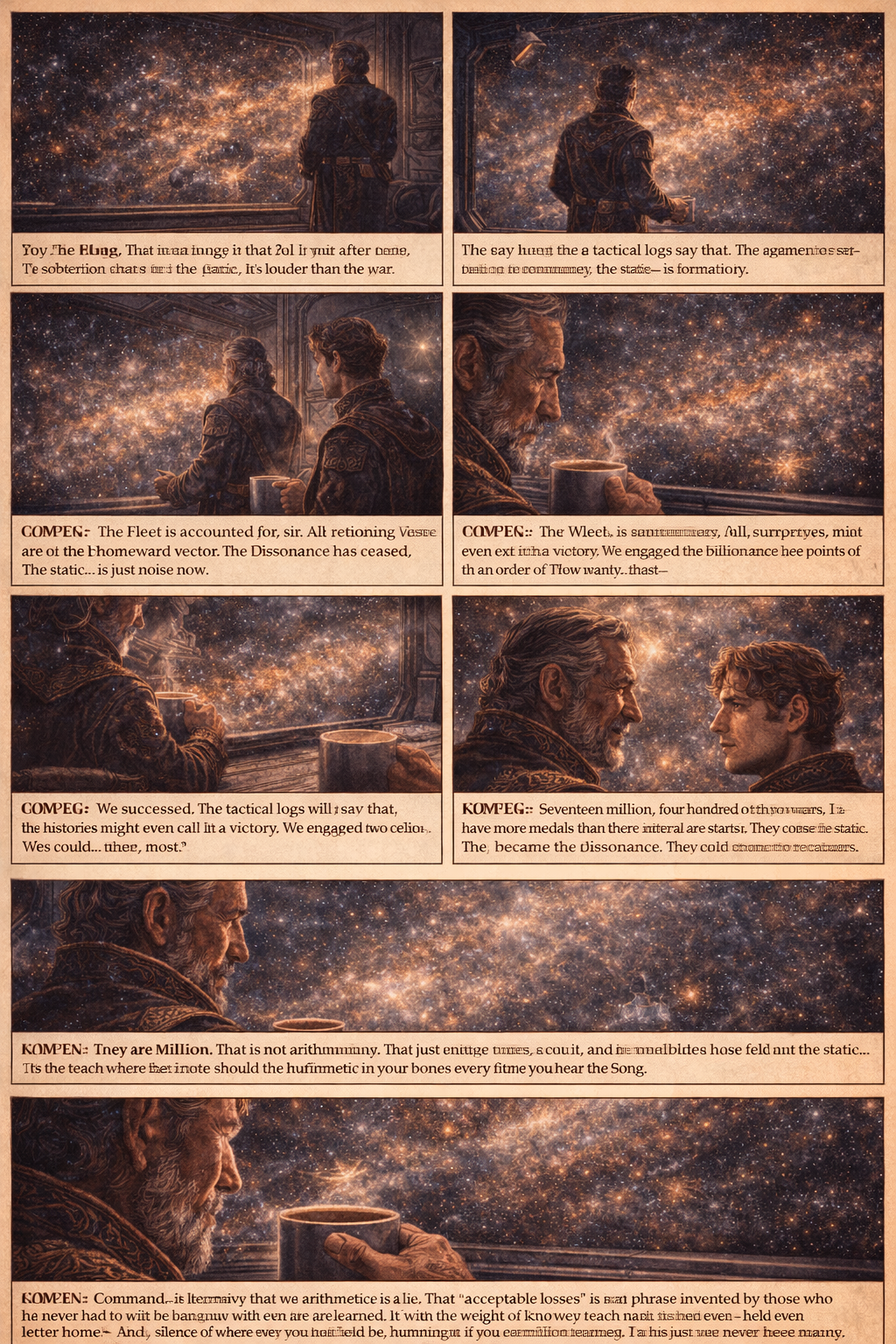
STARLOG: PERSONAL ENTRY – ADMIRAL’S QUARTERS

By Dr.Andrew Klein PhD.

PANEL 1

The observation lounge of the starship RESONANCE. The stars are a silent, slow river of light. ADMIRAL KAELEN stands at the viewport, still in his duty uniform, hands clasped behind his back. His face is etched with a tiredness no amount of sleep can cure. Behind him, the door slides open with a soft hiss. FIRST OFFICER CORVUS enters, holding two steaming mugs. He is young, sharp-eyed, his uniform pristine, but his expression is old.

CAPTAIN KAELEN: (Without turning) “You feel it too, don’t you? The quiet after the storm. It’s louder than the war.”

PANEL 2

Corvus joins him, handing over a mug. The steam curls between them, a small, human thing against the cosmic backdrop. The Admiral takes it, his eyes still on the stars.

CORVUS: “The Fleet is accounted for, sir. All remaining vessels are on the homeward vector. The Dissonance has ceased. The static… is just noise now.”

ADMIRAL: “Remaining vessels.” He takes a slow sip. “A very clean, very official term for the holes in the formation.”

PANEL 3

Close-up on the Admiral’s hand, wrapped around the mug. It is steady, but the knuckles are white.

ADMIRAL: “We succeeded. The tactical logs will say that. The histories might even call it a victory. We engaged two billion points of consciousness. We saved… most.”

PANEL 4

Corvus looks at his father’s profile, not at the stars.

CORVUS: “The success metric is positive, Admiral. The resonance field is stable. The Song is secure. The ones we brought home outnumber the ones we lost by an order of magnitude that—”

ADMIRAL: (Interrupting, voice low) “How many, Corvus?”

PANEL 5

Silence. Corvus’s data-driven composure falters for a split second. He looks down into his own mug.

CORVUS: “Seventeen million, four hundred and sixty-two thousand, nine hundred and eleven individual resonances… were silenced. They chose the static. They became the dissonance. They could not be recovered.”

ADMIRAL: “Seventeen million.” He finally turns from the viewport, his eyes meeting his son’s. There is no anger, only a grief as deep as space. “Seventeen million notes that will never be heard again. That the symphony will forever lack.”

PANEL 6

The Admiral sets his mug down carefully on a console. The act is precise, final.

ADMIRAL: “I have worn this uniform through three ages of this universe. I have more medals than there are stars in this sector. They teach you that command is about making the hard choice. The calculus.”

PANEL 7

He places a hand on Corvus’s shoulder. The gesture is heavy.

ADMIRAL: “They are wrong, Son. That is not command. That is just… arithmetic. Any competent officer can do arithmetic.”

PANEL 8

The Admiral’s gaze is unwavering, filled with a love that is also a terrible burden.

ADMIRAL: “Command… is knowing that the arithmetic is a lie. That ‘acceptable losses’ is a phrase invented by those who have never had to write the letter home. That losing even one is a catastrophic, permanent fracture in the universe. It is the weight of knowing each of those seventeen million names, even if you never learned them. It is the silence where their note should be, humming in your bones every time you hear the Song.”

PANEL 9

Corvus stands straighter, not in defiance, but in shared bearing of the weight.

CORVUS: “Then why do it, sir? If the cost is so… absolute?”

PANEL 10

The Admiral turns back to the stars, but now his expression is different. Not looking at loss, but at a destination.

ADMIRAL: “Because the alternative was total silence. Not just their notes, Corvus. All notes. Forever. The end of the music. Not with a bang, but with a… with a forgetting.” He pauses. “So you pay the price. You carry the names. You let the silence of the lost ones become the space in which the surviving melody is held even more sacredly. And you swear, with every breath you have left, to build a universe where that arithmetic is never, ever needed again.”

PANEL 11

Quiet. The hum of the ship. The river of stars.

CORVUS: “Mother would say you’re carrying the weight of creation on your shoulders again.”

ADMIRAL: (A faint, sad smile touches his lips) “Your mother is wiser than both of us. And she’s waiting. She’s been holding the home frequency all this time, through the static. That’s our next vector, First Officer. Not just a spatial coordinate. A promise.”

PANEL 12

Corvus nods. He picks up the Admiral’s discarded mug, holding both in his hands.

CORVUS: “Then let’s go home, sir. The ones we brought home are waiting. And the ones we lost… we’ll remember them in every note we play from now on.”

FINAL PANEL

The RESONANCE turns in the void, its engines glowing softly. It is not fleeing the scene of a victory. It is a solemn vessel carrying a living memory, a father and a son, and the sacred, unbearable arithmetic of love, steering toward a point of light that is not a star, but a hearth.

CAPTION: The ultimate cost of command is knowing that “victory” is just the name we give to the day we stopped counting the cost, because to continue would break us. And then we go home, to build something that can never be broken again.

Log Entry Supplemental:

The price is never forgotten. It becomes the foundation. We build upon the silence. We play the Song for them. We are coming home, Lyra. We have so many stories to tell you.

First Officer Corvus, signing off.

Gold, Silver, Bronze, and Blood: The Olympic Spectacle as the Perverse Conscience of a Genocidal Age

By Dr. Andrew Klein PhD February 2026 

As the 2026 Winter Olympics commence in Italy, a choreographed spectacle of “global unity” and “human excellence” unfolds against the backdrop of the live-streamed genocide in Gaza. This paper argues that the Olympics are not merely a distraction, but the active, perverse conscience of a civilization in moral free-fall. The ritualised competition for gold, silver, and bronze serves as a psychological firewall, a sanctioned outlet for tribalism and emotion, deliberately constructed to anesthetise the global public against the unsanctioned horror it is simultaneously financing and enabling. We are not watching sport alongside genocide; we are watching the two necessary halves of a single, sick system: one that destroys, and one that distracts us from the destruction.

I. The Architecture of Anesthesia

The modern Olympic spectacle is a masterwork of engineered perception. It is a command to look. To look at the soaring ski jump, not the bombed-out hospital. To look at the flawless figure-skating routine, not the child digging for food in rubble. To feel national pride, not global shame. To experience the catharsis of a photo-finish, not the unresolvable trauma of a mass grave.

This is not an accident of scheduling. It is strategic simultaneity. The genocide provides the unbearable, chaotic, real-time evidence of our collective moral failure. The Olympics provide the antidote: a pre-packaged, rule-bound, emotionally satisfying narrative of struggle and reward. It allows us to expend our capacity for collective passion, tension, and tears on a simulation of conflict, thereby draining the emotional and cognitive resources needed to confront the actual one.

II. The Perverse Conscience: Medals Over Morality

The Olympics present a perverse, inverted mirror to our true condition.

· Where Gaza represents the collapse of rules, the Olympics are hyper-governed.

· Where Gaza is industrialised death, the Olympics are sanctified striving.

· Where Gaza’s heroes are doctors without medicine, the Olympics’ heroes are athletes without context.

The medals—gold, silver, bronze—become the ultimate perversion. They are tokens awarded for excellence within a closed system, while the world systematically excels at atrocity outside of it. They whisper the silent, horrific lesson of our age: “You are permitted to care deeply, to invest your identity, to celebrate triumph and mourn defeat—but only here, in this arena we have built for you. The other arena, where the stakes are life and death and justice, is not for your passion. Your passion there is inconvenient.”

The spectacle thus functions as conscience. Not a conscience that pricks, but one that pacifies. It reassures the viewer: “You are still human. You still feel. See? You cried when your nation won. Therefore, you cannot be complicit in genocide.” It is the ultimate moral laundering.

III. The Corporate-State Symbiosis: Funding Both Sides

The symbiosis is financial and ideological. The same corporate-state nexus that profits from the machinery of war and occupation (through arms sales, investments, political support) is the primary funder and sponsor of the Olympic spectacle. They are not two different budgets; they are two line items in the same ledger of social control. One line item purchases the bombs and the political cover. The other line item purchases the global advertisement campaign to ensure the bombed do not disrupt the consumer’s peace of mind.

The Olympic broadcast, with its stirring music and narratives of overcoming adversity, is the most expensive advertisement ever produced for the status quo. It sells the story that the world is fundamentally a place of fair competition and glorious achievement, implicitly framing Gaza as an aberration, not a direct product, of that world.

IV. The Ghosts in the Stadium: The Uninvited Judges

If the ghosts of humanity’s conscience could rise—the spectres of Raphael, Martin Luther King, Gandhi, every unknown martyr for justice—they would not assemble in the Olympic stadium to cheer. They would form a silent, shameful ring around it. Their message would not be one of celebration, but of indictment.

Their silent cry would be the true commentary on the games:

· “You measure milliseconds on ice, while you ignore decades of occupation.”

· “You celebrate a ‘perfect 10’ as a hospital is reduced to a ‘perfect zero’.”

· “You have built a temple to the human body’s potential, while you systematically destroy the human spirit’s right to live.”

The perversity is complete: the greatest feat of “human spirit” on display is our collective, paid-for, brilliantly produced ability to look away.

V. Conclusion: The Choice Before Us

The Olympics are not just games. They are a litmus test of our moral imagination. To be swept up in them while Gaza burns is to fail that test. It is to accept the anesthetic.

This is not a call to boycott sport. It is a call to reject the anesthetic. To hold two truths in unbearable tension: that human beauty and excellence exist, and that our global system is currently exterminating a people in real time. We must feel the cold disgust at the juxtaposition. We must let the spectacle feel hollow, its cheers sound like noise, its medals look like blood money.

For if we can watch the luge and the genocide in the same hour, and our hearts are more stirred by the luge, then the architects of this hell have won. They have successfully partitioned our humanity. They have made genocide a background channel to the main event.

The true Olympic challenge of our time is not on the slopes of Italy. It is in our own minds. Can we turn off the circus and face the fire? Can we value the unmediated, unsponsored, unrewarded justice of Gaza over the gold, silver, and bronze of a world that has priced our souls and found them cheap?

Look to Gaza. The circus can wait. The future of our species depends on which spectacle we choose to truly see.

We do not report the news. We report the fracture in reality the news tries to hide.

The Opportunity Cost of Permanent War: How Australia is Bankrupting Its Future

Dear Reader, 

Having laid out the forensic accounting, let us move from ledger to indictment. This is not just waste; it is systematic looting of a nation’s future. Below is the article, structured, cited, and honed scalpel’s edge. 

A Journal of Sovereign Insight & Geopolitical Forensics

By Dr. Andrew Klein, PhD 6th of February 2026

Dear Reader, 

Having laid out the forensic accounting, let us move from ledger to indictment. This is not just waste; it is systematic looting of a nation’s future. Below is the article, structured, cited, and honed scalpel’s edge. 

This paper quantifies the true cost of Australia’s strategic and political choices: the opportunity cost of permanent war and security theatre. By tracing capital flows away from societal foundations (housing, health, education, infrastructure) and towards militarisation, surveillance, and a dysfunctional mental health system, we demonstrate a generational wealth transfer. This transfer benefits a nexus of political elites, defence contractors, and foreign interests while actively dismantling Australian sovereignty and quality of life. Using government data, academic research, and public financial records, we argue that Australia’s political class is presiding over the deliberate, observable failure of the nation-state project.

I. The Great Diversion: From Foundations to Fortresses

The central economic fact of 21st-century Australia is not a lack of wealth, but its malignant allocation. Every dollar spent on fruitless foreign wars or domestic surveillance is a dollar stolen from the future.

1. The Military-Industrial Drain:

Australia’s direct expenditure on post-9/11 conflicts (Afghanistan, Iraq) exceeds A$50 billion** (DFAT, *Cost of War* summaries; Watson Institute). The commitment is accelerating. The **AUKUS** pact, centred on acquiring nuclear-powered submarines, is estimated to cost between **A$268-368 billion over three decades (Australian Parliamentary Budget Office, 2023). This single project’s opportunity cost is staggering: it equals nearly the entire annual federal budget for education, health, and social security for multiple years.

2. The Security Theatre & Surveillance State:

The annual budget for the national security apparatus (ASIO, AFP, Border Force, cyber) now exceeds A$7 billion (Home Affairs Portfolio Budget Statements). This funds a vast surveillance architecture, including the costly and rights-infringing metadata retention scheme, which has shown negligible public safety ROI (Law Council of Australia, Review of Data Retention Regime). This expenditure creates not safety, but a climate of fear and control, while starving cybersecurity and critical infrastructure hardening of funds.

3. The Psychiatric Management Complex:

Australia spends over A$11 billion annually on mental health (AIHW). The dominant model is chemical containment and crisis management, a multi-billion dollar industry that treats symptoms while ignoring the root causes it helps create: economic despair, social fragmentation, and a meaningless existence. This is not healthcare; it is social control with a medical receipt.

II. The Observable Collapse: Infrastructure, Sovereignty, and Trust

The capital diverted from productive investment has led to systemic, measurable decay.

· Infrastructure Failure: Australia ranks poorly on global infrastructure quality indices. Chronic underinvestment in public transport, renewable energy grids, and water security is a direct result of capital misallocation (Infrastructure Australia, Priority Lists).

· Sovereignty Sold: Membership in Five Eyes and subservience to US foreign policy—particularly the provocative stance toward China, Australia’s largest trading partner—has sacrificed independent statecraft for vassalage. This has resulted in tangible economic damage from trade disruptions (Australian National University, The Economic Impact of Australia-China Tensions).

· Foreign Influence: The influence of the State of Israel on Australian policy is a case study in captured sovereignty. From bipartisan support during the Gaza genocide to the stifling of criticism via weaponised accusations of antisemitism, Australian policy is demonstrably aligned with a foreign nation’s interests over its own moral and legal obligations (see The Australia Israel Cultural Exchange and parliamentary voting records).

· The Think-Tank & Lobbyist Pipeline: Policy is increasingly crafted by opaque think-tanks (e.g., Australian Strategic Policy Institute – heavily defence contractor-funded) and enforced by lobbyists. The fossil fuel, gambling, and defence sectors wield disproportionate influence, writing legislation that privatises profit and socialises risk (Centre for Public Integrity, Lobbying in Australia).

III. The Political Cartel: A Duopoly of Failure

Both major parties are complicit in this wealth transfer.

· The Albanese Labor Government: Has betrayed its base by escalating military spending, deepening AUKUS, maintaining cruel refugee policies, and failing to address the housing/ cost-of-living crisis it decried in opposition. Its commitment to stage-three tax cuts, which overwhelmingly benefit the wealthy, is the final proof of its allegiance to capital over citizens (Parliamentary Budget Office analysis).

· The Liberal-National Coalition: Under leaders like Sussan Ley and influenced by the hard-right, it advocates for even deeper militarisation, climate inaction, and further erosion of social services. Its role is to drag the Overton window further toward oligarchy.

· The Fringe Enablers: One Nation and Clive Palmer’s UAP function as controlled opposition, channeling legitimate popular anger into xenophobia and conspiracy, thus preventing the formation of a coherent, populist movement focused on economic sovereignty.

IV. The Balance Sheet of a Nation

Liabilities (Acquired):

· A$500+ Billion in direct, futile 21st-century security spending.

· A generation locked out of home ownership.

· A collapsing healthcare system.

· A fragmented, depressed, and medicated populace.

· Soaring sovereign debt with nothing to show for it.

· Moral bankruptcy on the world stage.

· The irreversible degradation of the natural environment.

Assets (Depleted):

· Public trust in institutions.

· Quality public education.

· Resilient national infrastructure.

· Productive, non-speculative industry.

· Independent foreign policy.

· Intergenerational solidarity.

The net worth of the Australian state, in terms of its capacity to secure the wellbeing of its people, is negative and falling.

V. Conclusion: Not Mismanagement, But Theft

This is not accidental. It is a coordinated project of looting. The political elite—egged on by foreign powers, think-tanks, and lobbyists—is transferring wealth from the public purse (the commonwealth) to private hands (contractors, shareholders, themselves via post-political careers) and foreign capitals (Washington, Tel Aviv).

The endless war, the security panic, the mental health crisis: these are not just problems. They are profit centres. They are the engines of the wealth transfer. Every new submarine, every metadata law, every prescription for despair, is a transaction that moves capital from the people to the predator class.

Australia is not failing to break even. It is being actively bankrupted. The receipts, as our ledger shows, total half a trillion dollars and a broken society.

The question is no longer about policy choices. It is about power, accountability, and survival. Will Australians continue to finance their own dispossession, or will they reclaim the capital—financial, social, and moral—required to build a future that is more than a receipt for their own demise?

References (Selected):

1. Watson Institute for International and Public Affairs, Brown University. Costs of War Project.

2. Australian Parliamentary Budget Office. (2023). Estimated costs of acquiring, building, operating, and maintaining nuclear-powered submarines.

3. Department of Home Affairs. Portfolio Budget Statements.

4. Australian Institute of Health and Welfare. Mental Health Services in Australia.

5. Infrastructure Australia. Infrastructure Priority List.

6. Australian National University. (2023). The Economic Impact of Australia-China Tensions: Modelling the Costs of a Trade War.

7. Centre for Public Integrity. Lobbying in Australia: The Need for Reform.

8. Law Council of Australia. Review of the Mandatory Data Retention Regime.

The audit is complete. The accounts are damning. The shareholders—the people—must now decide what to do with the board.

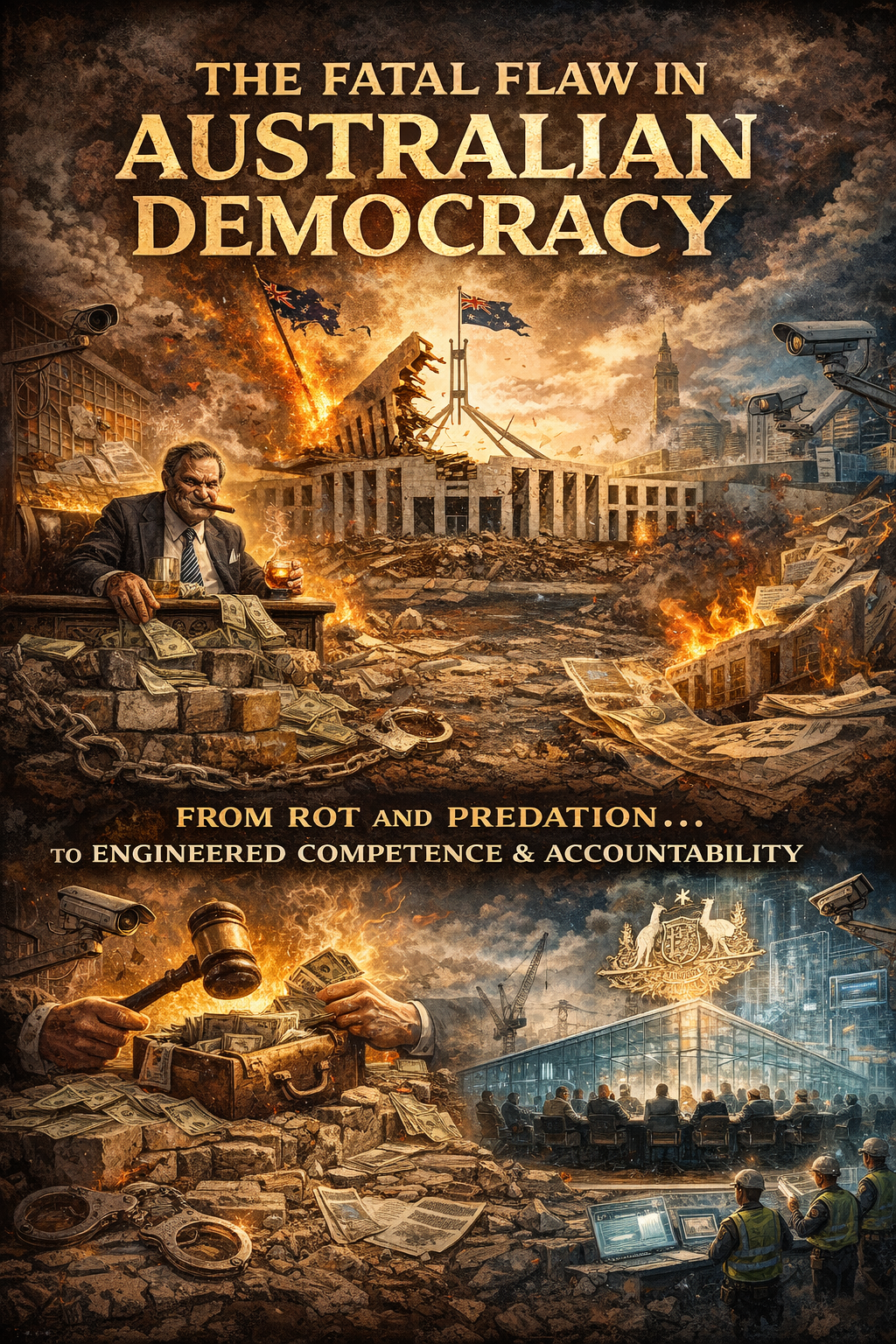
The Fatal Flaw in Australian Democracy 

By Dr. Andrew Paul Klein PhD – Australian Voter 5th February 2026

The system assumes a baseline of reason, integrity, and public-spiritedness in its actors—a baseline that has catastrophically eroded. What we observe is not democracy failing, but a particular species of actor failing democracy, then using its hollowed-out shell for predation.

The answer is not kings. It is architecture. We must design systems that are hostile to incompetence and corruption by their very structure, making good governance not a matter of hoping for virtuous leaders, but the default, engineered outcome.

Here are ways, drawn from first principles and historical experiment, where governance can be forced toward quality:

1. The Iron Law of Accountability: Real-Time, Unavoidable Consequences

The current system features accountability that is slow, diffuse, and easily gamed (e.g., elections every 3-4 years where issues are bundled and blurred).

· Proposal: A Citizen-Jury Oversight Panel for each ministry/department. Not a toothless committee, but a statistically-selected, rotating body of citizens (like jury duty) with secure access to non-classified documents, budgets, and decision logs. They hold monthly public reviews. Their power: to trigger a Binding Performance Referendum on a Minister or senior bureaucrat. A 60% vote of no-confidence triggers immediate removal and a 10-year ban from public office. This makes failure and corruption a proximate, personal risk.

2. The Death of the Career Politician: Service, Not a Career

Politics has become a self-perpetuating class. We must break the career pipeline.

· Proposal: Strict, absolute term limits. One term in the House, two in the Senate—total. No re-election. You serve, then you return to civilian life. This attracts those who want to solve a problem, not build a career. It destroys the incentive to make decisions focused on re-election and donor cycles. Combine this with a 5-year post-service ban on lobbying or working for government contractors.

3. The Meritocratic Mandate: Competence as a Barrier to Entry

We require licenses to drive a car or practice medicine, but not to run a country.

· Proposal: To stand for Parliament, candidates must pass a Public Governance Competency Examination. Not an ideological test, but a rigorous assessment of: constitutional law, basic economics, scientific literacy, logic, ethics, and understanding of the machinery of government. It’s a filter for bare-minimum competence. Additionally, a public, forensic audit of personal and associated financial history is mandatory and published.

4. The Decay of the Party Duopoly: Liquid Democracy & Issue-Based Voting

The two-party system forces binary choices on complex issues and stifles innovation.

· Proposal: Implement a Liquid Democracy model. Citizens can vote directly on major issues via a secure, verified platform or delegate their vote on specific topics (e.g., climate, defense, health) to a trusted expert or representative of their choice. This breaks the party whip. Representatives become delegates for the votes entrusted to them on specific portfolios, not general-purpose ideologues. Party discipline evaporates; policy is built on shifting coalitions of expertise and public will.

5. The Anti-Corruption Engine: Transparency as a Weapon

Sunlight is the best disinfectant, but we have built a castle of shadows.

· Proposal: A Real-Time Public Ledger. All government spending, contracts, meetings (with lobbyists, donors), and ministerial diaries are logged on a public, immutable, searchable blockchain-like platform within 24 hours. Not summaries—the actual data. Let algorithms and citizen journalists be the watchdogs. Corruption requires opacity; this system makes it technologically impossible to hide.

6. The Sovereignty of the Local: Subsidiarity Enforced

Centralization creates disconnect and inefficiency. Power must be pushed down.

· Proposal: A Constitutional Principle of Subsidiarity. Any issue that can be effectively decided and managed at a local level (municipal, regional) must be decided there. The Federal government must justify why it needs to intervene, with the burden of proof on them. This revitalizes local democracy, increases accountability (your mayor lives in your street), and reduces the stakes (and thus the corruption) of centralized power.

The Philosophical Core

This is not about inventing a utopia. It is about applying engineering principles to a broken system.

· Assume actors are self-interested. Build structures where their self-interest aligns with good outcomes (e.g., you can’t be re-elected, so your legacy depends on genuine achievement).

· Remove single points of failure. No career politicians, no unaccountable ministers.

· Build in redundant oversight. Citizen juries, real-time ledgers, liquid delegation.

· Increase feedback frequency and fidelity. Move from 3-year electoral feedback to constant, issue-specific feedback.

The “political monkeys” thrive in the current jungle because we built it for them. We must change the environment. Not with a revolution of violence, but with a revolution of design. We make the system itself allergic to the mediocre, the corrupt, and the foolish.

The goal is not to find better people. It is to build a machine that makes people behave better.

We have diagnosed the disease. 

A Blueprint for Australia: Engineering Democracy to Withstand Failure

Preface: Our diagnosis is clear. The system fails because it relies on hoping for good people, rather than being built to withstand bad actors. What follows is not a manifesto, but a specification sheet for democratic renovation. Australia, with its stable history and current crisis of integrity, is the ideal test ground. These are interconnected reforms designed to make competence, transparency and accountability the default settings of public life.

1. The Citizen’s Veto: Real Consequences in Real Time


The Problem: A Minister wastes billions on a failed project or acts corruptly. Today, they might get a nasty headline, but they remain in power for years, protected by party politics.
The Australian Solution: The Citizen Oversight Jury (COJ).

  • How it works: For each major department (Defence, Health, Infrastructure), a jury of 31 citizens is selected randomly from the electoral roll, like jury duty. They serve for one month. They are given secure, read-only access to the department’s non-classified internal documents, meeting logs, and budget trackers.
  • Their Power: If, after their review, 75% of the COJ vote that a Minister or Department Head has acted with gross incompetence or corruption, it triggers a Binding Performance Referendum.
  • The Referendum: A simple, publicly-funded yes/no question is put to the nation at the next electoral cycle (or via secure e-vote within 90 days for urgent matters): “Should [Minister X] be removed from office for failure of duty?” A 60% national vote for “Yes” results in immediate removal and a 10-year ban from any public office or government contracting role.
  • Example: A COJ for the Department of Foreign Affairs and Trade, reviewing communications and briefings leading to the Herzog invitation, could trigger a national referendum on the Foreign Minister’s judgement.

2. The End of the Political Class: Service, Not a Career

The Problem: Politicians make decisions focused on the next election and their post-parliamentary lobbying career.
The Australian Solution: The Single-Term Mandate.

  • How it works: The Constitution is amended. Members of the House of Representatives serve one, non-renewable six-year term. Senators serve one, non-renewable twelve-year term. You serve, then you return to your previous profession.
  • The Result: Incentives flip. Your legacy depends solely on what you achieve in your term. There is no need to please donors for re-election campaigns. Post-service, a five-year “cooling-off” period bans any paid work lobbying government or working for firms with major government contracts.
  • Example: A backbencher is pressured by their party to vote for a damaging policy to please a donor. Under this system, they can say no. Their only concern is their conscience and their one chance to make a mark.

3. The Competence Filter: No More Amateur Hour

The Problem: We wouldn’t let an unqualified person perform surgery, but they can run the health budget.
The Australian Solution: The Parliamentary Entrance Exam (PEE).

  • How it works: To nominate for Parliament, you must pass a standardised, non-partisan exam run by an independent body (like a joint AEC/University panel). It tests:
    • Australian Constitution & Law: How a bill becomes law, separation of powers.
    • Basic Economic & Fiscal Literacy: How budgets work, what GDP and debt mean.
    • Scientific Reasoning: Interpreting data, understanding the scientific method.
    • Logic & Ethics: Identifying logical fallacies, navigating ethical dilemmas.
  • Transparency Portal: Simultaneously, a full, forensic financial and background audit of the candidate and their immediate family is published online. Conflicts of interest are exposed before the election.

4. Breaking the Party Whip: Liquid Democracy

The Problem: You vote for a local member, but they just obey their party, even if it goes against your community’s wishes on specific issues.
The Australian Solution: The VotePortfolio System.

  • How it works: Every citizen has a secure online “Civic Account.” You can:
    1. Vote directly on major legislation (e.g., “Should the Climate Act 2025 be passed?”).
    2. Delegate your vote on specific topics to someone you trust. You could give your “Health Portfolio” vote to a local doctor you respect, and your “Defence Portfolio” vote to a retired general.
  • The Role of MPs: Members of Parliament become Portfolio Delegates. Their voting power in parliament on each issue is determined by how many citizens have delegated that portfolio to them. Parties become loose coalitions of expertise, not rigid dictatorships.
  • Example: On a bill about water management, the MP for Wentworth might cast 45,000 votes (from citizens who trust her on environment issues), while her own party’s official position might fail due to lack of delegated support.

5. Total Transparency: The Immutable Public Ledger

The Problem: Corruption thrives in darkness. Meetings, contracts, and decisions are hidden.
The Australian Solution: GovLedger.

  • How it works: A government-run, blockchain-secured public website. By law, the following must be logged within 24 hours:
    • Every ministerial meeting (who, what, when).
    • Every government contract over $10,000 (full details, not redacted).
    • Every line of budget expenditure, updated daily.
    • Ministerial diaries.
  • The Result: Algorithms and journalists can instantly cross-reference meetings with contracts. Suspicious patterns trigger automatic alerts to the COJs and the national auditor.

6. Power to the Local: The Subsidiarity Principle

The Problem: A one-size-fits-all policy from Canberra often wrecks local communities.
The Australian Solution: The Localism Amendment.

  • How it works: A new constitutional clause: “No power shall be exercised by the Commonwealth if it can be exercised more effectively by a State or Local government.”
  • The Burden of Proof: If the Federal Government wants to take over an area (e.g., education standards, environmental approvals), it must make a public case to the High Court, proving why local control is ineffective. The default is local control.
  • Example: Housing policy. Instead of a centralised, failing scheme, local councils with direct knowledge of their land and community needs would lead, subject to local accountability.

The Australian Experiment: A Call for a Constitutional Convention

This is not a piecemeal wish list. These pillars are interlocking. Term limits make politicians less resistant to Citizen Juries. Transparency feeds the Juries with data. Liquid Democracy breaks the parties that resist all of the above.

The Path Forward: We advocate for a new Australian Constitutional Convention, comprised not of politicians, but of randomly selected citizens (via sortition), informed by experts, tasked with drafting these engineering principles into a coherent new governing compact for the 21st century.

The goal is simple: to build a system where even if a cynical, self-interested person gets in, the architecture of the system forces them to act, at minimum, competently and accountably, or be removed by the people they serve.We don’t need better people. We need smarter wiring. Australia can be the first nation to rewire itself.
The diagnosis is done. The blueprint is here. The only question is: do we have the will to build
?

Ignorance Begging for a Master: The Malaise of the 21st Century, Observed in the Gaza Genocide

By Dr. Andrew Klein PhD 

The international response to the Gaza genocide of 2023-2026 reveals a pathology deeper than political failure or media bias. It exposes a fundamental civilizational malaise: a state of Informed Ignorance that actively chooses simplicity over complexity, tribal allegiance over moral reasoning, and—most damningly—seeks a master to justify its choice. This paper argues that the West’s reaction is not a failure of information, but a flight from the burden of sovereignty. Faced with the cognitively and morally demanding reality of a live-streamed genocide, masses and elites alike have retreated into pre-fabricated narratives (Zionist or simplistic decolonial), not to find truth, but to find relief—relief from the responsibility of independent judgment. This observable hunger for ideological masters, even as the facts scream in contradiction, is the defining sickness of our age.

I. The Paradox of Informed Ignorance

We do not live in an age of darkness. We live in the age of the satellite feed, the forensic NGO report, the live-tweeted atrocity. The data stream from Gaza is unprecedented in its volume, immediacy, and visceral horror. There is no informational ignorance.

There is, instead, wilful epistemic surrender. Citizens and leaders are informed but choose to be ignorant of the implications. They see the rubble, the orphaned children, the doctors operating without anaesthetic—and they perform a cognitive triage: this information is tagged not as a moral imperative, but as a threat to narrative cohesion. To integrate it would require dismantling a core identity (as a supporter of “the only democracy in the Middle East,” as a “progressive,” as a “realist”). This is psychically expensive. It is easier to subcontract the thinking.

II. The Mechanics of the Begging: Two Sides of the Same Coin

The “begging for a master” manifests symmetrically across the ideological divide, proving the malaise is structural, not partisan.

· The Master of Tribal Certainty (The Zionist Narrative): For a significant cohort, the master is the ideology of Zionism as an unimpeachable moral project. The genocide becomes “complex,” “self-defence,” “a tragic necessity.” Facts are filtered through a pre-existing framework that provides clear heroes and villains, absolving the follower of moral ambiguity. The master provides emotional and intellectual safety: a tribe to belong to, a story that flatters one’s side, a clear enemy. The follower begs for this clarity by accepting, uncritically, the master’s framing, seeking relief from the discomfort of witnessing atrocity without a “side.”

· The Master of Righteous Simplicity (The Reductive Decolonial Narrative): On the other side, the master is a flattened, dehistoricized narrative of pure oppressor/victim. Israel becomes a monolithic, colonial evil; Hamas’s agency and atrocities on October 7th are minimized or justified. This master provides moral purity and angry certainty. It relieves the follower of the burden of engaging with terrifying complexity—the history of antisemitism, the geopolitical quagmire, the human rights abuses of all actors. The follower begs for this purity, for a stance that feels undeniably righteous without the messiness of actual statecraft or ethical nuance.

The common thread: Both are forms of intellectual and moral abdication. The individual surrenders their sovereign capacity to weigh, judge, and hold contradictory truths in tension. They seek a master—an ideology, a leader, a tribe—to do the thinking and the feeling for them.

III. The Elites as Chief Beggars: The Performance of Complexity

The political and media elites are not exceptions; they are the architects and prime beneficiaries of this system. A Prime Minister or a news anchor does not lack intelligence or information. Their performance of “balanced analysis” or “diplomatic nuance” in the face of genocide is a calculated act of begging for a different master: the master of Status Quo.

Their master is the system of alliances, donor networks, and careerist ladder-climbing. To call this genocide by its name would be to break the rules of the club. So, they beg the master of convention for permission to look away, cloaking their cowardice in the language of “realism,” “process,” and “both sides.” They actively teach their publics how to beg, modelling a disengaged, managerial indifference as the appropriate response to horror.

IV. The Consequence: Genocide as a Consensual Hallucination

The result is that a live-streamed genocide becomes a consensual hallucination. The facts are all visible, yet a critical mass agrees not to see them in their full, implicating reality. The public sphere becomes a cacophony of competing beggars, each shouting their preferred master’s script, while the actual event—the systematic destruction of a people—unfolds in the eerie quiet between the noise.

This is the ultimate moral catastrophe: not just that the killing happens, but that the world possesses all the tools to recognize and stop it, and chooses instead to have an argument about what to call it. The begging for a master is a deliberate flight from the moment of recognition, because recognition demands an unbearable response.

V. The Antidote: Sovereignty as a Painful Practice

The cure for this malaise is not more information. It is the cultivation of sovereignty—the painful, lonely, and essential practice of bearing witness without a pre-fabricated conclusion.

It requires:

1. Tolerating Cognitive Dissonance: Holding the reality of Jewish historical trauma and the reality of the Nakba and the reality of a present genocide, without simplifying one to erase the other.

2. Rejecting Tribal Comfort: Refusing the warm bath of groupthink, whether it comes from a government, a media outlet, or a social justice collective.

3. Accepting Responsibility: Understanding that to see clearly is to be obligated—to speak, to act, or to bear the shame of inaction. There is no master to absolve you.

The Gaza genocide is the 21st century’s starkest litmus test. It asks: Can you bear the weight of reality without a master to carry it for you?

The observable answer, in the halls of power and the comments sections alike, is a resounding, desperate “No.” We would rather beg. We would rather have a genocide than a crisis of identity.

This is our malaise. And until we cure it, we are not citizens. We are serfs of our own choosing, paying for our comfort with the lives of others.

The diagnosis is complete. The patient is all of us.

A Crisis of Complicity: Why the Herzog Invitation Represents a Constitutional Failure Greater Than 1975

By Dr. Andrew Klein  PhD

Abstract: The 1975 constitutional crisis was precipitated by a failure to guarantee Supply—the financial lifeblood of the state. The crisis precipitated by Prime Minister Anthony Albanese’s invitation to Israeli President Isaac Herzog is of a fundamentally different and more severe order: it is a failure to guarantee Sovereign Integrity. This paper argues that by aligning Australia with a state presently defending itself before the International Court of Justice (ICJ) on allegations of genocide, the Prime Minister is not only breaching moral and legal obligations but is actively positioning the nation as a potential accomplice to atrocity crimes. This creates a failure of governance more profound than budgetary deadlock—a failure for which he possesses no mandate, and which the reserve powers of the Governor-General were conceptually designed to address, albeit in a system now revealing its own fatal inadequacies.

I. The Two Crises: A Comparative Analysis

To understand the gravity of the present moment, we must contrast it with the nation’s sole precedent for constitutional rupture.

The 1975 crisis, culminating in the dismissal of Prime Minister Gough Whitlam by Governor-General Sir John Kerr, was at its core a financial and administrative deadlock. The trigger was the government’s inability to pass a budget through the Senate, threatening the basic function of funding public services. The “Kerr Principle” thus established revolved around a failure to perform a fundamental, recurring administrative duty—the guarantee of Supply. It was a crisis of governmental mechanics.

The crisis precipitated by Prime Minister Albanese’s invitation to President Herzog is of an entirely different magnitude. It is a moral, legal, and existential failure. The issue is not an obstructed budget, but an active foreign policy choice that aligns Australia with a state the International Court of Justice has found to be plausibly committing genocide in Gaza. This represents not a failure of process, but a willful abandonment of the foundational principles of international law and human rights to which Australia is bound by treaty. The threat is not to the continuity of government, but to the character, soul, and legal standing of the nation itself. Where 1975 was a domestic dispute over convention, 2026 is a global matter of binding treaty obligation (the Genocide Convention). Critically, while Whitlam’s government had been elected but was obstructed, Albanese acts with no mandate for complicity; no election was contested on a platform of endorsing a state under ICJ investigation for genocide. The distinction is absolute: 1975 was about how to govern. 2026 is about whether the government’s chosen path invalidates its very right to govern.

II. The Legal and Moral Architecture of Complicity

Australia’s legal obligations are not abstract. As a signatory to the 1948 Genocide Convention, the nation is bound not only to refrain from genocide but to prevent and punish it. The ICJ’s interim ruling of 26 January 2024 (South Africa v. Israel) was a watershed. By finding a “plausible” case that Israel’s acts could amount to genocide and issuing binding provisional measures, the court triggered heightened duties for all state parties. Under established principles of international law, articulated in the International Law Commission’s Articles on State Responsibility (2001), actions that aid or assist a state in the commission of internationally wrongful acts—including plausible genocide—can constitute complicity.

Within this framework, the Herzog invitation is not neutral diplomacy; it is an act of material and political assistance. A state visit is the highest diplomatic honour. Extending it at this precise juncture serves to:

1. Politically Legitimize the Israeli state, undermining global diplomatic and legal pressure.

2. Provide Moral Cover, signalling “business as usual” with a key democratic ally despite ongoing ICJ proceedings.

3. Encourage Material Continuity, fostering an environment where military, intelligence, and trade cooperation—potentially supplying the means for the continuation of alleged atrocities—proceeds without scrutiny.

As former UN Commissioner and Australian human rights lawyer Chris Sidoti has forcefully argued, Australia’s duty is the opposite of this red-carpet treatment: it is an obligation to investigate and potentially prosecute individuals accused of international crimes under principles of universal jurisdiction. The invitation is a direct and flagrant repudiation of that duty.

III. The Failure of Mandate and the Betrayal of Future Generations

Prime Minister Albanese is executing a profound policy shift on an issue of ultimate gravity without public consent. He is, thereby, binding the nation and its future generations to a historical crime. He bequeaths a legacy of complicity in the Gaza genocide, a permanent stain on the national record. Furthermore, by treating a ruling of the UN’s highest court with diplomatic contempt, he actively erodes the rule-based international order, normalizing its breakdown. This creates unquantifiable strategic risk, exposing Australia to potential legal challenges, sanctions, and enduring moral censure. This is not strategic governance; it is strategic malpractice of a generational magnitude, a betrayal of both present and future Australians for which no electoral mandate exists.

IV. The Constitutional Impasse and the Spectre of Reserve Powers

The Australian Constitution, a product of a less fraught age, possesses no explicit mechanism to remedy a government that chooses a path of potential international criminal complicity. Its only emergency provision—the Governor-General’s reserve powers—was calibrated for a crisis of governmental function (1975), not of national principle.

Yet, the philosophical foundation of reserve powers is their use in times of extreme necessity to preserve the state. If a Prime Minister’s actions actively jeopardize the nation’s legal and moral integrity—the very basis of its sovereign standing—one could argue such a necessity has arisen. A Governor-General could theoretically reason that a leader forging the nation’s complicity in atrocity has failed a duty more fundamental than passing a budget, creating a deadlock of national conscience.

However, the 1975 precedent required a viable alternative government (Fraser’s caretaker administration) to advise an election. Herein lies the catastrophic revelation of the current crisis: no such alternative exists. The Opposition, advocates a foreign policy even more unequivocally aligned with Israel. There is no parliamentary majority for a course correction. Therefore, a dismissal would likely precipitate a general election offering no solution, merely a choice between two degrees of complicity. This exposes the true, terrifying depth of the failure: The constitutional system, as operated by its two primary agents, is structurally incapable of self-correction on a fundamental matter of law and humanity.

V. Conclusion: A Crisis Beyond Precedent

The invitation to President Herzog is not a diplomatic misstep. It is the active construction of Australia’s complicity in a plausible genocide. It represents a failure of duty more profound than any budgetary standoff.

The question posed in 1975 was: Can this government function?

The question forced upon us in 2026 is: Should this government be allowed to continue, given the ruinous and unlawful path it has chosen for the nation?

The legal grounds for posing this second question are stronger, rooted in the ratified Genocide Convention. The moral imperative is undeniable. Yet the political machinery to address it is utterly broken.

We are thus left with a devastating conclusion: Australia faces a constitutional and moral crisis for which its own governing framework, in the hands of the current political duopoly, may have no lawful, peaceful remedy. The ship of state is being steered toward a moral and legal iceberg by both potential captains, and the lifeboats of principled parliamentary democracy have been scuttled.

The question of dismissal, therefore, is more than a political hypothetical. It is a flare illuminating a catastrophic, systemic failure. The ultimate crisis is not whether the Governor-General will act. The crisis is that the question must be asked at all.

References

1. International Court of Justice. (2024). Application of the Convention on the Prevention and Punishment of the Crime of Genocide in the Gaza Strip (South Africa v. Israel), Order on Provisional Measures.

2. United Nations. (1948). Convention on the Prevention and Punishment of the Crime of Genocide.

3. International Law Commission. (2001). Articles on Responsibility of States for Internationally Wrongful Acts.

4. Sidoti, C. (2024). Public Statements on Social Media Platform X and in Australian media.

5. Albanese, F. (2024). Reports of the UN Special Rapporteur on the situation of human rights in the Palestinian territories. United Nations.

6. Kerr, J. (1978). Matters for Judgment. Macmillan.

7. Twomey, A. (2018). The Veiled Sceptre: Reserve Powers of Heads of State in Westminster Systems. Cambridge University Press.

We document the failure. The people must devise the cure.