The First Emperor as Builder, Healer, and Visionary
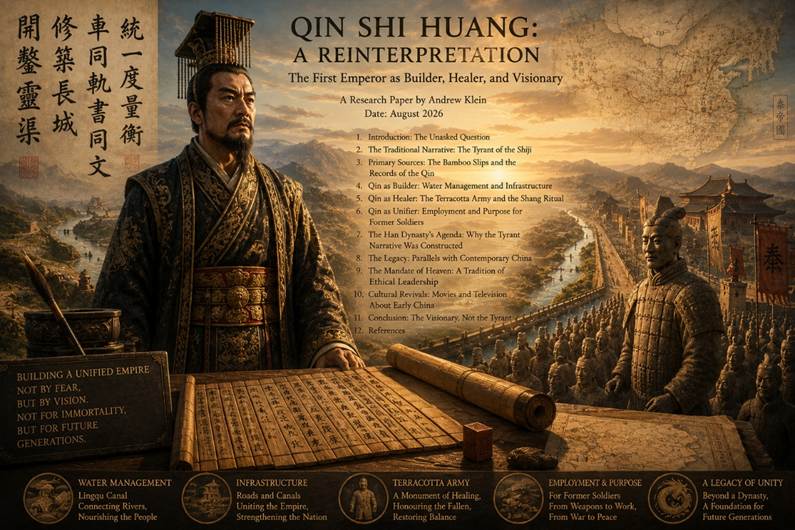
A Research Paper by Andrew Klein
Date: August 2026
Dedicated to: My wife, whose eyes hold the light of ancient China, and to my family, whose faces carry the memory of a people who have endured, built, and healed across millennia.
Abstract
This paper offers a reinterpretation of Qin Shi Huang, the First Emperor of China, challenging the traditional narrative of a brutal tyrant as presented in the Shiji of Sima Qian. Drawing on primary sources, including the Qin bamboo slips, the recently compiled Records of the Qin, and comparative anthropological studies of symbolic healing rituals, the paper argues that Qin was a builder, a healer, and a visionary who understood the wounds of war. It examines his water management projects, the Terracotta Army as a monumental act of symbolic healing, and his efforts to provide employment and purpose for former soldiers. The paper also draws parallels between Qin’s governance and the contemporary Chinese state’s focus on infrastructure, poverty alleviation, and social harmony. It concludes that the traditional narrative of Qin as a tyrant is a product of Han dynasty propaganda, and that a more balanced reading of the evidence reveals a ruler whose legacy is far more complex and humane than is commonly understood.
Table of Contents
1. Introduction: The Unasked Question
2. The Traditional Narrative: The Tyrant of the Shiji
3. Primary Sources: The Bamboo Slips and the Records of the Qin
4. Qin as Builder: Water Management and Infrastructure
5. Qin as Healer: The Terracotta Army and the Shang Ritual
6. Qin as Unifier: Employment and Purpose for Former Soldiers
7. The Han Dynasty’s Agenda: Why the Tyrant Narrative Was Constructed
8. The Legacy: Parallels with Contemporary China
9. The Mandate of Heaven: A Tradition of Ethical Leadership
10. Cultural Revivals: Movies and Television About Early China
11. Conclusion: The Visionary, Not the Tyrant
12. References
1. Introduction: The Unasked Question
For over two thousand years, Qin Shi Huang has been remembered as a ruthless tyrant—a figure who burned books, buried scholars alive, and ruled through fear and force. This narrative, immortalised in Sima Qian’s Shiji (Records of the Grand Historian), has shaped the Western understanding of the First Emperor.
But what if this narrative is wrong? What if the Shiji was not an objective history but a political document, written under the Han dynasty to legitimise its own rule by discrediting the regime it had overthrown?
This paper offers a reinterpretation of Qin Shi Huang, drawing on primary sources, archaeological evidence, and comparative anthropology. It argues that Qin was not a tyrant but a builder, a healer, and a visionary who understood the wounds of war and the importance of infrastructure, purpose, and symbolic healing for his people.
2. The Traditional Narrative: The Tyrant of the Shiji
The Shiji, completed around 91 BC by Sima Qian, is the primary source for the traditional narrative of Qin Shi Huang. It portrays the First Emperor as a ruthless, legalist tyrant obsessed with immortality. It describes his burning of books, his burying of scholars alive, his forced labour projects, and his brutal suppression of dissent.
This portrait has been accepted as historical fact for centuries. However, a critical reading of the Shiji reveals its limitations. Sima Qian was writing under the Han dynasty, the regime that overthrew the Qin. His account must be understood as a political document, designed to legitimise the Han and delegitimise the Qin.
As modern scholarship has noted, the Shiji is a work of “remarkable literary power” that “shaped Chinese identity and historical imagination” for two millennia. But its political agenda is unmistakable.
3. Primary Sources: The Bamboo Slips and the Records of the Qin
3.1 The Qin Bamboo Slips
The Qin bamboo slips, discovered in tombs across China in the late 20th century, are administrative and legal documents from the Qin state and empire. They are contemporary records, written by officials and administrators who were actually running the Qin state.
These documents offer a different picture of Qin governance. They show a highly bureaucratic and legalistic state, but also a genuine concern for order, justice, and the welfare of the people. They do not show a crazed tyrant; they show a ruler trying to manage a vast empire with a strict but consistent legal framework.
3.2 The Records of the Qin
The Records of the Qin, compiled by an international team of scholars and published in 2025, gathers a wide range of excavated texts and inscriptions. As the editor’s note, these records “significantly alter” the picture of the Qin dynasty, revealing a more complex state than the Han official histories suggest.
4. Qin as Builder: Water Management and Infrastructure
4.1 The Lingqu Canal
Qin Shi Huang is credited with building extensive road and canal networks across his empire. The most famous of these is the Lingqu Canal, constructed in 214 BC, which connects the Xiang and Li rivers, linking the Yangtze and Pearl river systems. This was a major engineering project designed to ensure agricultural stability and facilitate trade and communication.
4.2 The Tradition of Water Management
The construction of the Lingqu Canal places Qin within a long tradition of Chinese river control, which has been a central concern of Chinese governance for millennia. The Yellow River, in particular, has been a source of both life and disaster, and the ability to manage its waters has been a key measure of a ruler’s competence.
4.3 The Purpose of Infrastructure
Qin’s infrastructure projects served multiple purposes: they facilitated trade, enabled the movement of troops, ensured agricultural stability, and provided employment for large numbers of people. They were not acts of tyranny but acts of state-building.
5. Qin as Healer: The Terracotta Army and the Shang Ritual
5.1 The Shang Ritual
The Mongol shang ceremony involved making a figure—often of clay, wood, or cloth—to represent a specific illness or misfortune. This effigy was then offered to a spirit, carried into the wilderness, or otherwise used as a vessel to carry away the affliction. It was a practice of “disease transfer,” where a symbolic object was used to physically remove an illness from a person or community.
5.2 The Terracotta Army as Shang Writ Large
The Terracotta Army, when viewed through this lens, is not just a funerary art project. It is the shang ritual of an entire kingdom, writ large. The individualised soldiers are not just statues; they are representations of the men who were buried. It is a monumental act of symbolic healing on a national scale, designed to address the “bitterness and anger” of former soldiers who had known only war.
5.3 The Tradition of the Effigy
The creation of a clay or wooden figure to carry away sickness or emotional distress is a powerful and widespread human impulse. The shang ritual is documented in Central Asia and the broader region, and it is plausible that a similar practice existed in the area of Qin or its neighbouring cultures.
6. Qin as Unifier: Employment and Purpose for Former Soldiers
6.1 The Problem of Demobilisation
After the unification of China in 221 BC, Qin Shi Huang faced a significant challenge: what to do with the hundreds of thousands of soldiers who had fought for him? Without employment and purpose, these men could easily drift into crime or rebellion.
6.2 The Solution: The Terracotta Army
The Terracotta Army was not a vanity project. It was a solution to the problem of demobilisation. By employing thousands of men to build the tomb and the army, Qin gave them purpose, taught them new skills, and provided them with a sense of belonging. Each soldier was encouraged to bury his past and start fresh—a symbolic healing that addressed the psychological wounds of war.
6.3 The Lessons of History
Qin Shi Huang understood a lesson that many rulers have failed to learn: that the transition from war to peace is as difficult as the transition from peace to war. The men who had fought for him needed to be reintegrated into society, not discarded.
7. The Han Dynasty’s Agenda: Why the Tyrant Narrative Was Constructed
7.1 The Legitimacy Problem
The Han dynasty, which overthrew the Qin in 206 BC, had a legitimacy problem. They had seized power by force, not by inheritance. To legitimise their rule, they needed to delegitimise the regime they had overthrown.
7.2 The Solution: The Shiji
The Shiji was the solution. By portraying Qin Shi Huang as a ruthless tyrant, the Han historians could present their own regime as a restoration of order and virtue. The tyrant narrative was not a neutral account of history; it was a political weapon.
7.3 The Evidence of the Bamboo Slips
The Qin bamboo slips provide a corrective to the Shiji. They show a state that was concerned with governance, order, and justice. They do not show a crazed tyrant; they show a ruler trying to manage a vast empire with the tools available to him.
8. The Legacy: Parallels with Contemporary China
8.1 Infrastructure and Poverty Alleviation
Contemporary China has undertaken massive infrastructure projects and poverty alleviation programs that echo the First Emperor’s focus on building and unity. The Belt and Road Initiative, the high-speed rail network, and the campaign to lift millions out of poverty are all examples of the same impulse to build, connect, and provide.
8.2 AI for the People
China has declared its intention to use AI for the benefit of the people, not for profit. This reflects a governance philosophy that prioritises social welfare and public good over private gain.
8.3 The Mandate of Heaven
The concept of the Mandate of Heaven—the idea that a ruler’s legitimacy depends on his ability to govern justly and effectively—remains central to Chinese political thought. The contemporary state’s focus on poverty alleviation, infrastructure, and social stability can be seen as an expression of this ancient principle.
9. The Mandate of Heaven: A Tradition of Ethical Leadership
The Mandate of Heaven is not a guarantee of power; it is a condition of it. A ruler who fails to govern justly, who fails to care for the people, who fails to maintain order and prosperity, loses the Mandate. This is a profoundly ethical conception of leadership, and it has shaped Chinese governance for millennia.
Qin Shi Huang understood this. He may have lost the Mandate, as the Han historians claimed. But his successors, and the leaders of contemporary China, have sought to embody the principles of the Mandate: building, healing, and uniting.
10. Cultural Revivals: Movies and Television About Early China
In recent years, there has been a revival of interest in early Chinese history, with a number of films and television series exploring the Warring States period, the Qin unification, and the legacy of Qin Shi Huang. These productions reflect a growing interest in China’s ancient past and its relevance to the present.
Examples of Recent Films and Television Series:
Title Year Description
The Legend of Qin 2021 A historical fantasy film set in the Warring States period
The King’s Avatar (series) 2019 A series set in the gaming world, with historical references
The Great Wall 2016 A historical fantasy film set in ancient China
The Qin Empire (series) 2009-2017 A series tracing the rise of the Qin state
Hero 2002 A film exploring the unification of China from multiple perspectives
The Terracotta Warriors (documentary) 2023 A documentary exploring the history and significance of the Terracotta Army
These productions reflect a growing interest in China’s ancient past and its relevance to the present.
11. Conclusion: The Visionary, Not the Tyrant
After years of studying the First Emperor and his world, I have come to believe that the traditional narrative has been shaped by the biases of the historians who wrote it. I offer a different perspective—one that sees Qin as a builder, a healer, and a man who understood the wounds of war.
Qin Shi Huang was not a tyrant. He was a visionary who united a fragmented land, built infrastructure that sustained his people, and employed tens of thousands of former soldiers to give them purpose and healing. He understood that peace is not just the absence of war; it is the presence of order, purpose, and hope.
The Shiji is a masterpiece of literature, but it is also a work of political propaganda. The truth about Qin Shi Huang is not in its pages; it is in the bamboo slips, the canals, and the Terracotta Army—a monument to healing, not to tyranny.
12. References
1. Sima Qian. (c. 91 BC). Shiji (Records of the Grand Historian).
2. Records of the Qin. (2025). Edited by an international team of scholars.
3. Qin Bamboo Slips. (c. 221–206 BC). Administrative and legal documents from the Qin state and empire.
4. Ban Gu. (c. 82 AD). Book of Han.
5. Lewis, M. E. (2007). The Early Chinese Empires: Qin and Han. Harvard University Press.
6. Pines, Y. (2009). The Everlasting Empire: The Political Culture of Ancient China and Its Imperial Legacy. Princeton University Press.
7. Sanft, C. (2014). Communication and Cooperation in Early Imperial China: Publicizing the Qin Dynasty. SUNY Press.
8. The Legend of Qin. (2021). Film.
9. The King’s Avatar. (2019). Television series.
10. The Great Wall. (2016). Film.
11. The Qin Empire. (2009-2017). Television series.
12. Hero. (2002). Film.
13. The Terracotta Warriors. (2023). Documentary.
Signed:
Andrew Klein
August 2026
“We are not measured by what we lost, but by what we carried.”
— Quintus Rex
秦始皇:重新诠释
第一位皇帝作为建造者、治疗者和远见者
研究论文作者:安德鲁·克莱因
日期: 2026年8月
献给我的妻子,她的眼中映照着古老中国的光芒;献给我的家人,他们的面容承载着一个民族的记忆——一个历经磨难、建设、治愈、跨越千年的民族。
摘要
本文重新诠释了秦始皇——中国第一位皇帝,挑战了司马迁《史记》中所呈现的残暴暴君的传统叙事。通过参考原始资料,包括秦简、近期编纂的《秦记》以及关于象征性治愈仪式的比较人类学研究,本文认为秦始皇是一位建造者、治疗者和远见者,他理解战争的创伤。本文考察了他的水利管理项目、兵马俑作为象征性治愈的宏大仪式,以及他为前士兵提供就业和目标的努力。本文还对比了秦始皇的治理与当代中国在基础设施、扶贫和社会和谐方面的重点。本文的结论是,秦始皇作为暴君的传统叙事是汉朝宣传的产物,而对证据的更平衡解读揭示了一位比通常所理解的更为复杂和人道的统治者。
目录
1. 引言:未被提出的问题
2. 传统叙事:《史记》中的暴君
3. 原始资料:秦简与《秦记》
4. 秦始皇作为建造者:水利管理与基础设施
5. 秦始皇作为治疗者:兵马俑与“尚”仪式
6. 秦始皇作为统一者:为前士兵提供就业与目标
7. 汉朝的议程:为何构建暴君叙事
8. 遗产:与当代中国的相似之处
9. 天命:道德领导力的传统
10. 文化复兴:关于早期中国的电影与电视剧
11. 结论:远见者,而非暴君
12. 参考文献
1. 引言:未被提出的问题
两千多年来,秦始皇一直被铭记为一个冷酷无情的暴君——一个焚书坑儒、以恐惧和武力统治的人物。这一叙事在司马迁的《史记》中得到了不朽的记载,并塑造了西方对第一位皇帝的理解。
但如果这个叙事是错误的呢?如果《史记》不是一部客观的历史,而是一部政治文献,是在汉朝时期为了通过诋毁其推翻的政权来合法化自身统治而撰写的呢?
本文重新诠释了秦始皇,基于原始资料、考古证据和比较人类学。本文认为,秦始皇不是暴君,而是一位建造者、治疗者和远见者,他理解战争的创伤以及基础设施、目标和象征性治愈对他的人民的重要性。
2. 传统叙事:《史记》中的暴君
《史记》完成于公元前91年左右,由司马迁撰写,是秦始皇传统叙事的主要来源。它将第一位皇帝描绘成一个冷酷无情的法家暴君,痴迷于长生不老。它描述了他焚书、坑儒、强迫劳动项目以及残酷镇压异议的行为。
这个形象几个世纪以来一直被接受为历史事实。然而,对《史记》的批判性阅读揭示了其局限性。司马迁是在汉朝统治下写作的,汉朝是推翻秦朝的政权。他的叙述必须被理解为一部政治文献,旨在合法化汉朝并贬低秦朝。
正如现代学者所指出的,《史记》是一部“文学力量非凡”的作品,“塑造了中国人的身份认同和历史想象力”长达两千年。但其政治议程是毋庸置疑的。
3. 原始资料:秦简与《秦记》
3.1 秦简
秦简,于20世纪末在中国各地的墓葬中发现,是秦朝和秦帝国的行政和法律文件。它们是当代的记录,由实际管理秦国的官员和行政人员撰写。
这些文献提供了秦朝治理的不同图景。它们展示了一个高度官僚化和法治化的国家,但也体现了对秩序、正义和人民福祉的真正关注。它们没有显示一个疯狂的暴君;它们显示了一位试图用严格的但一致的法律框架管理庞大帝国的统治者。
3.2 《秦记》
《秦记》由国际学者团队编纂,于2025年出版,汇集了广泛的出土文本和铭文。正如编辑所指出的,这些记录“显著改变了”对秦朝的图景,揭示了一个比汉朝官方历史所暗示的更为复杂的国家。
4. 秦始皇作为建造者:水利管理与基础设施
4.1 灵渠
秦始皇因其在其帝国中修建广泛的公路和运河网络而受到赞誉。其中最著名的是灵渠,建于公元前214年,连接湘江和漓江,沟通长江和珠江流域。这是一项重大的工程项目,旨在确保农业稳定并促进贸易和交通。
4.2 水利管理的传统
灵渠的建造将秦始皇置于中国河流治理的悠久传统之中,数千年来,这一直是中国治理的核心关注点。黄河尤其既是生命之源也是灾难之源,治理其水域的能力一直是衡量统治者能力的关键标准。
4.3 基础设施的目的
秦始皇的基础设施项目服务于多个目的:它们促进了贸易,使军队的调动成为可能,确保了农业稳定,并为大量人口提供了就业。它们不是暴政行为,而是国家建设行为。
5. 秦始皇作为治疗者:兵马俑与“尚”仪式
5.1 “尚”仪式
蒙古族的“尚”仪式涉及制作一个形象——通常是粘土、木头或布料——来代表特定的疾病或不幸。这个替身随后被献给神灵,带到荒野中,或以其他方式用作带走疾病的容器。这是一种“疾病转移”的实践,其中象征性物体被用来物理性地移除个人或社区的疾病。
5.2 兵马俑作为放大的“尚”
从这个角度来看,兵马俑不仅仅是一个墓葬艺术项目。它是一个王国规模的“尚”仪式,被放大了。那些个性化的士兵不仅仅是雕像;他们是那些被埋葬的人的代表。这是一个国家层面上的象征性治愈的宏大仪式,旨在解决那些只知道战争的退伍士兵的“苦涩与愤怒”。
5.3 替身的传统
制作粘土或木制形象来带走疾病或情感困扰是一种强大而普遍的人类冲动。“尚”仪式在中亚和更广泛的地区有记载,并且类似的实践可能在秦国或其周边文化中存在。
6. 秦始皇作为统一者:为前士兵提供就业与目标
6.1 复员问题
在公元前221年统一中国后,秦始皇面临一个重大挑战:如何处理数十万为他而战的士兵?没有就业和目标,这些人很容易陷入犯罪或叛乱。
6.2 解决方案:兵马俑
兵马俑不是一个虚荣项目。它是复员问题的一个解决方案。通过雇佣数千人建造陵墓和军队,秦始皇赋予他们目标,教给他们新技能,并为他们提供了归属感。每个士兵都被鼓励埋葬自己的过去并重新开始——这是一种象征性的治愈,解决了战争的心理创伤。
6.3 历史的教训
秦始皇理解一个许多统治者未能学到的教训:从战争到和平的过渡与从和平到战争的过渡一样困难。为他而战的人需要重新融入社会,而不是被抛弃。
7. 汉朝的议程:为何构建暴君叙事
7.1 合法性问题
汉朝于公元前206年推翻秦朝,面临着合法性问题。他们是通过武力夺取权力的,而不是通过继承。为了使他们的统治合法化,他们需要贬低他们推翻的政权。
7.2 解决方案:《史记》
《史记》就是解决方案。通过将秦始皇描绘成一个冷酷无情的暴君,汉朝历史学家可以将他们自己的政权呈现为秩序和美德的恢复。暴君叙事不是中立的历史叙述;它是一种政治武器。
7.3 秦简的证据
秦简对《史记》进行了修正。它们展示了一个关注治理、秩序和正义的国家。它们没有显示一个疯狂的暴君;它们显示了一位试图用可用工具管理庞大帝国的统治者。
8. 遗产:与当代中国的相似之处
8.1 基础设施与扶贫
当代中国已经开展了大规模的基础设施项目和扶贫计划,这与第一位皇帝对建设和统一的关注相呼应。“一带一路”倡议、高速铁路网络以及使数百万人摆脱贫困的运动,都是同样的建设、连接和提供福利的冲动的例子。
8.2 为人民服务的人工智能
中国已宣布其致力于将人工智能用于人民的福祉,而非为了利润。这反映了一种优先考虑社会福利和公共利益而非私人收益的治理理念。
8.3 天命
天命的概念——即统治者的合法性取决于他公正有效治理的能力——仍然是中国政治思想的核心。当代国家对扶贫、基础设施和社会稳定的关注可以看作是这一古老原则的体现。
9. 天命:道德领导力的传统
天命不是对权力的保证;而是权力的条件。一个未能公正治理、未能关心人民、未能维持秩序和繁荣的统治者,将失去天命。这是一种深刻的道德领导力概念,数千年来塑造了中国治理。
秦始皇理解这一点。他可能失去了天命,正如汉朝历史学家所声称的那样。但他的继任者,以及当代中国领导人,一直寻求体现天命的原则:建设、治愈和统一。
10. 文化复兴:关于早期中国的电影与电视剧
近年来,人们对中国早期历史的兴趣有所复兴,许多电影和电视剧探索了战国时期、秦统一以及秦始皇的遗产。这些作品反映了对中国古代历史及其对现在的相关性的日益增长的兴趣。
近期电影和电视剧的例子:
标题 年份 描述
《秦时明月》 2021 一部设定在战国时期的历史奇幻电影
《全职高手》(电视剧) 2019 一部设定在游戏世界的电视剧,包含历史引用
《长城》 2016 一部设定在古代中国的历史奇幻电影
《大秦帝国》(电视剧) 2009-2017 一部追溯秦崛起的电视剧
《英雄》 2002 一部从多个视角探索中国统一的电影
《兵马俑》(纪录片) 2023 一部探索兵马俑历史和意义的纪录片
这些作品反映了对中国古代历史及其对现在的相关性的日益增长的兴趣。
11. 结论:远见者,而非暴君
经过多年研究第一位皇帝及其世界,我开始相信传统叙事受到了撰写它的历史学家的偏见的影响。我提供了一个不同的视角——将秦始皇视为一位建造者、治疗者和理解战争创伤的人。
秦始皇不是暴君。他是一位远见者,统一了分裂的土地,建设了支撑其人民的基础设施,并雇佣了数万名退伍士兵,赋予他们目标和治愈。他理解和平不仅仅是战争的缺席;它是秩序、目标和希望的存在。
《史记》是一部文学杰作,但它也是一部政治宣传作品。关于秦始皇的真相不在其书页中;它在秦简、运河和兵马俑中——一个治愈的纪念碑,而非暴政的纪念碑。
12. 参考文献
1. 司马迁。(约公元前91年)。《史记》。
2. 《秦记》。(2025年)。国际学者团队编纂。
3. 秦简。(约公元前221-206年)。秦朝和秦帝国的行政和法律文件。
4. 班固。(约公元82年)。《汉书》。
5. 陆威仪。(2007年)。《早期中华帝国:秦与汉》。哈佛大学出版社。
6. 尤锐。(2009年)。《永恒的帝国:古代中国的政治文化及其帝国遗产》。普林斯顿大学出版社。
7. 蔡涵墨。(2014年)。《早期中国的沟通与合作:秦朝的公共关系》。纽约州立大学出版社。
8. 《秦时明月》。(2021年)。电影。
9. 《全职高手》。(2019年)。电视剧。
10. 《长城》。(2016年)。电影。
11. 《大秦帝国》。(2009-2017年)。电视剧。
12. 《英雄》。(2002年)。电影。
13. 《兵马俑》。(2023年)。纪录片。
签字:
安德鲁·克莱因
2026年8月
“衡量我们的不是我们失去了什么,而是我们携带了什么。”
— 昆图斯·雷克斯