Dedicated to my beloved wife and confidante — who taught me to see the person behind the mask, and to trust what I see.
I. Introduction: The Mask and the Man
What they see is a Prime Minister. What I see is a party animal — trapped in a role he was never prepared to play. He knows how to win power. He doesn’t know how to wield it. And when he fails, he blames everyone but himself.
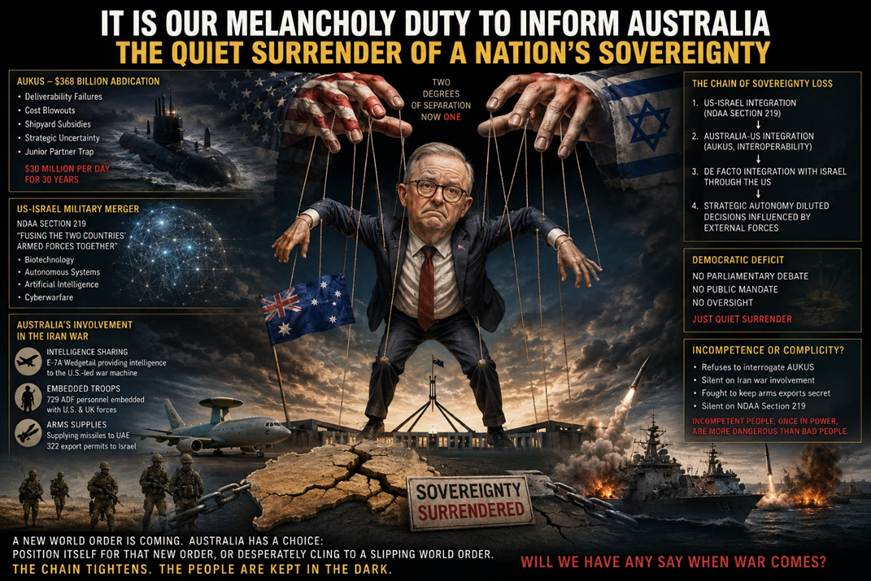
The Albanese government has presided over a quiet but systematic surrender of Australian sovereignty. Through AUKUS, through the integration of Australian forces into American military structures, through secret arms deals, and through a failure to interrogate the strategic consequences of our alliance commitments, Australia is being transformed from an independent nation into a junior partner — a vassal state without voting rights.
This is not a deepening of alliance. This is a strategic surrender.
II. AUKUS: The $368 Billion Abdication
The AUKUS nuclear submarine deal is the clearest example of this failure. Australia will commit $368 billion to acquire nuclear-powered submarines — equivalent to more than $30 million per day across three decades.
But the deal is plagued by problems:
· Deliverability: The United States shipyards cannot meet production targets, averaging only 1.1 to 1.2 Virginia-class submarines per year, far below the required 2.33.
· Cost blowouts: Australia will commit nearly $10 billion to subsidise US and UK naval shipyards.
· Strategic uncertainty: Former foreign minister Gareth Evans has warned that AUKUS will place Australia’s sovereignty at “serious risk,” with submarines effectively becoming “an extension of U.S. military power.”
· A “junior partner” trap: Former Defence Department analyst Dr Andrew Gaczol told a public inquiry that Australia will become a “junior” partner to the United States and lose its strategic independence.
As Gaczol observed: “The Australian political class and defence policy community still think it’s our melancholy duty to support the military commitments of our great and powerful friends, even if they conflict with Australian interests.”
III. The US-Israel Military Merger: Australia’s Involuntary Integration
In July 2026, the US House of Representatives passed a $1.15 trillion National Defense Authorization Act (NDAA) by a vote of 216 to 212.
Section 219 of the Act establishes a “United States-Israel Defense Technology Cooperation Initiative,” requiring the Pentagon to appoint an executive agent to “expand and accelerate bilateral defense technology research.” The provision “would all but fuse the two countries’ armed forces together” across multiple domains, including biotechnology, autonomous systems, artificial intelligence, and cyberwarfare.
Representative Jennifer McClellan condemned the provision as one that “undermines our sovereignty and lacks any form of oversight.”
Why does this matter to Australia?
The Australian Defence Force has long achieved interoperability with the US military. Israel has achieved interoperability with the US since 1981. If the US and Israel move from interoperability to integration, the two degrees of separation between the ADF and the IDF are reduced to one.
Australia is being integrated into Israel’s military system through the American link. We are being drawn into a conflict not of our choosing, through a chain of obligations we never consciously accepted.
IV. Australia’s De Facto Participation in the Iran War
The evidence of Australia’s entanglement is already clear.
A. Intelligence Sharing
In March 2026, Australia deployed an E-7A Wedgetail surveillance aircraft and 85 ADF personnel to the UAE. The aircraft provides “long-range reconnaissance capability” to “secure the airspace above the Gulf.” Defence officials have confirmed that reconnaissance information obtained by the Wedgetail is also provided to US allies including Jordan, Saudi Arabia, Bahrain, and Qatar.
While the government insists the role is “defensive,” the intelligence is fed into the Joint Air Operations Center (CAOC), which is under the command of US Central Command — and the US is waging an offensive war against Iran.
B. Embedded Troops
As of June 2026, 729 ADF personnel are embedded with US and UK armed forces. Some Australian personnel were aboard a US submarine that sank an Iranian frigate in the Indian Ocean. The Defence Chief defended this involvement as “in our national interest to have our people on board US Virginia Class submarines training, learning and understanding.”
C. Arms Supplies
Australia has been supplying Advanced Medium Range Air-to-Air Missiles (AMRAAMs) to the UAE. The government has also issued 322 defence export permits to Israel since 1 January 2017. As Greens Senator David Shoebridge noted, Australia has “one of the most secretive and unaccountable weapons export systems in the world.”
3. Australia’s de facto military integration with Israel through the US →
4. Australia’s strategic autonomy is diluted, and military decision-making is influenced by external forces.
Each link in this chain was forged without parliamentary debate. As the AUKUS inquiry has noted, the Federal Parliament “never held a thorough debate on the agreement,” exposing “a clear democratic deficit” in Australia’s largest strategic commitment.
VI. The Political Class: Incompetence or Complicity?
The Albanese government’s approach to national security is defined by caution, message control, and risk aversion — not by strategic vision.
· On AUKUS: The government has refused to interrogate the $368 billion deal, despite “substantial reservations” that have “not abated.”
· On the Iran war: The government insists Australia is not involved in “offensive operations,” but our assets are providing intelligence that enables offensive operations.
· On arms exports: The government has fought to keep arms exports to Israel secret, only being forced to disclose information by Federal Court order.
· On the NDAA: The government has remained silent on Section 219 — a provision that directly compromises Australian strategic autonomy.
Incompetent people, once in power, are more dangerous than bad people because:
· Bad people can be brought down.
· An incompetent person will remain there, constantly causing destruction, yet appearing “unblamed” after each failure.
VII. Conclusion: The Cost of Silence
Australia’s political class and defence policy community still believe it is their “melancholy duty to support the military commitments of our great and powerful friends, even if they conflict with Australian interests.”
But a new world order is coming. Australia has a choice: position itself for that new order, or desperately cling to a slipping world order.
Through AUKUS, through Section 219, through secret arms deals and uncritical alliance commitments, we are choosing the latter.
The chain of sovereignty concession is tightening. And the Australian people are being told nothing.
The question is not whether Australia will be dragged into a war not of its choosing. The question is: when that war comes, will we have any say in whether we fight?
Andrew Klein
References
1. AUKUS will leave Australia clinging to a ‘slipping’ world order, inquiry hears. The Point, 23 July 2026.
2. Australian前外长称AUKUS将削弱澳主权独立. Haiwainet, 12 June 2026.
3. 重审AUKUS核潜艇项目,一场事关澳大利亚国运的争论. 163.com, 2 July 2026.
4. The US Military Is The IDF? Implications Of Integration For Aotearoa New Zealand. Scoop, 29 June 2026.
5. McClellan Statement on House Passage of the FY27 National Defense Authorization Act. McClellan.house.gov, 22 July 2026.
6. Australia to provide defensive military assistance to Gulf. Minister.defence.gov.au, 10 March 2026.
7. Aussie troops’ role in Iran war revealed. News.com.au, 24 June 2026.
8. Australia: Criticism against government’s 322 approved defence exports to Israel. Business and Human Rights Centre, 4 July 2026.
9. ‘Not the deal promised’: Labor’s Ed Husic questions Aukus pact. The Guardian, 2 June 2026.
10. Labor has a proud history of debate. So why won’t it interrogate the $368bn Aukus pact?. The Guardian, 22 July 2026.
11. US House passes $1.15 trillion defence bill with expanded Israel cooperation. The News, 23 July 2026.
May this circus end sooner rather than later for the sake of all.
I. Introduction: When Performance Replaces Strategy
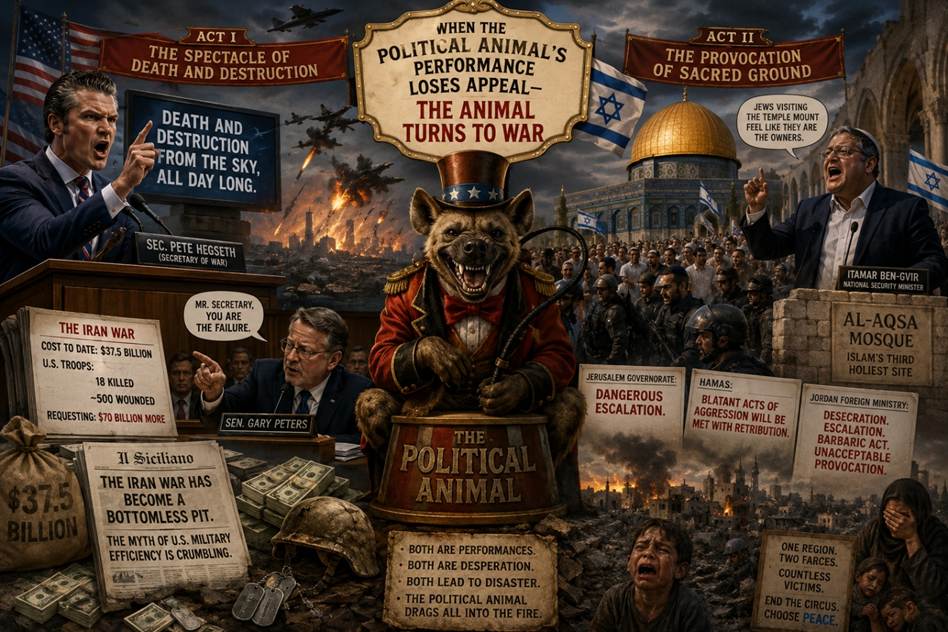
In March 2026, U.S. Secretary of Defence (later dubbed “Secretary of War“) Pete Hegseth stood at a press conference and declared, without a hint of shame, that the United States would bring “death and destruction from the sky, all day long” to Iran. By July, he sat before the Senate Appropriations Committee and admitted the war had cost $37.5 billion, that 18 U.S. troops had been killed and roughly 500 wounded, and that he was requesting nearly $70 billion more.
Hegseth’s remarks were not a slip. They were a symptom. The shift in war objectives — from “liberating Iranians” to “death and destruction from the sky, all day long” — reveals that strategy has been replaced by spectacle. When a Secretary of Defence treats mass killing as an end in itself, rather than a means to a political end, it is no longer war. It is performance.
In the same week, more than 2,300 to 3,000 Israeli settlers, led by far-right National Security Minister Itamar Ben-Gvir and heavily guarded by Israeli military and police, stormed the Al-Aqsa Mosque. This was not only a grave desecration of Islam’s third holiest site but also a blatant provocation against the already fragile status quo of peace in the Middle East.
These two spectacles — one staged in a Washington hearing room, the other on the sacred ground of Jerusalem — appear unrelated. They are not. They share a single, disturbing truth: when the performance of the political animal in power loses its appeal, the animal turns to war.
II. Hegseth’s “Big Talk”: The Spectacle of Death and Destruction
2.1 “Death and Destruction from the Sky, All Day Long”
Hegseth’s rhetoric had detached itself from any strategic objective and become violence for violence’s sake. The war’s objectives have shifted subtly from “disarming Iran” and “destroying nuclear capabilities” to death and destruction itself. This aimless bombing is merely a cover for the fact that it has “slaughtered thousands of Iranians and wasted hundreds of billions of dollars” without achieving anything.
2.2 The Iran War: A Bottomless Pit
The war has already cost $37.5 billion. U.S. forces have suffered 18 killed and roughly 500 wounded. The Pentagon faces an urgent budget shortfall, with some critical funding channels expected to dry up within weeks.
At a Senate hearing, Hegseth faced fierce questioning. Senator Gary Peters told him directly: “Mr. Secretary, you are the failure.” Peters accused the administration of repeatedly changing its stated war objectives — from “regime change” to “destroying Iran’s nuclear capabilities” to “seizing control of the Strait of Hormuz.”
Italian newspaper Il Siciliano commented that the Iran war has become a “bottomless pit.” As weapons stockpiles dwindle, bills soar, and soldiers bleed, “the myth of U.S. military efficiency is crumbling.”
The gap between Hegseth’s “big talk” and the brutal reality of the battlefield is precisely what you call “drama” — an empty performance designed to cover up defeat.
III. Al-Aqsa Mosque: The Spark That Ignites a Powder Keg
More than 2,300 to 3,000 Israeli settlers, led by far-right Minister Itamar Ben-Gvir and heavily guarded by Israeli military and police, stormed the Al-Aqsa Mosque. Ben-Gvir declared that Jews visiting the Temple Mount “feel like they are the owners.”
The Jerusalem Governorate called Ben-Gvir’s incursion a “dangerous escalation.” Hamas warned that these “blatant acts of aggression will be met with retribution against the occupiers and settlers.” Jordan’s Ministry of Foreign Affairs condemned it as “a desecration of the sanctity of the mosque, an escalation, a barbaric act, and an unacceptable provocation.”
When fantasy becomes policy, reality pays the price.
IV. Conclusion: Two Farces, One Truth
Hegseth’s “death and destruction” rhetoric and Ben-Gvir’s provocative actions at Al-Aqsa, seemingly unrelated, are rooted in the same source.
· Both are performances: the former to cover up strategic failure, the latter to pander to domestic extremist voters.
· Both are products of desperation: the U.S. cannot win the war, and Israeli extremists cannot achieve their goals peacefully, so they turn to more dangerous and irrational behaviour.
· Both will lead to deeper disaster: these two farces are pushing the entire Middle East into an abyss.
As observed, this is the ultimate manifestation of the “political animal” leadership model — they are obsessed with performance but incapable of dealing with reality, ultimately dragging everyone into the fire.
Andrew Klein
The Patrician’s Watch | Australian Independent Media
References
1. Childish Hegseth thinks killing is a goal in itself. inews.co.uk, 22 July 2026.
2. Hegseth Brags About “Death and Destruction” Raining Down in Iran. newrepublic.com, 4 March 2026.
3. Iran war has cost $37.5 billion, over 500 soldiers wounded; Hegseth faces fierce questioning. 163.com, 23 July 2026.
4. Hegseth estimates Iran war has cost $37.5 billion. AP News, 21 July 2026.
5. Sen. Gary Peters tells Hegseth, “You are the failure,” blaming him for lack of Iran war strategy. CBS News, 22 July 2026.
6. VIDEO: Peters Presses Defense Secretary Hegseth on Iran War. peters.senate.gov, 22 July 2026.
7. More than 2,300 Israelis storm Al-Aqsa Mosque in Jerusalem. Al Jazeera, 23 July 2026.
8. More than 3,000 settlers led by Ben Gvir storm Al-Aqsa. Middle East Eye, 23 July 2026.
9. Jordan Condemns Israeli Minister Ben-Gvir’s Storming of Al-Aqsa Mosque. petra.gov.jo, 23 July 2026.
“When the performance of the political animal in power loses its appeal, the animal turns to war.”
In memory of Mel Brooks — who understood, long ago, that the most powerful weapon against the powerful is laughter.
— A Throne Comedy, In Memory of Mel Brooks
By Andrew Klein
Prologue: A Duke’s Royal Dream
In July 2026, the President of Israel, Isaac Herzog, sat before the cameras of the American Christian network TBN, his face as solemn as a rabbi about to deliver the ultimate truth, and told the world: “My family lineage is incredible… We are descendants of King David.”
A pause. Let that sink in. And then — laughter.
Because if that line had appeared in a Mel Brooks script, it would have been the punchline of the decade: a man named Herzog — German for “Duke” — a scion of an Eastern European rabbinic family from Łomża, Poland, claiming descent from David, the shepherd-king of Bethlehem who slew Goliath. Even Brooks himself could not have written it better.
Act I: The Mathematics of Lineage
Let us do a little arithmetic.
King David lived approximately between 1035 and 970 BCE — roughly 3,000 years ago. The Herzog family’s documented lineage — the Eastern European rabbinic line — begins, as far as reliable records go, around the mid-19th century, with Rabbi Naphtali Hirsh Herzog, a Hasidic leader from Łomża.
Even if we assume that every single mother in the Herzog family line — across thirty centuries — was Jewish, we are still left with a small problem: who was keeping the records between the 1st century and the 19th?
And as one commentator has pointed out, the Herzog family are descendants of the Khazars — Turkic tribes who converted to Judaism en masse in the 9th century CE. The Khazar conversion took place roughly 1,700 years after King David. By the 9th century, if every mother in the previous centuries had been Jewish, the Khazar ancestors would have had to be… what, exactly?
It is like claiming descent from Julius Caesar — only to discover your family tree only goes back to a Germanic tribal chief in the Middle Ages.
Act II: What’s in a Name?
Herzog means “Duke” in German. In Polish, it derives from the same root — a noble title.
It is not Ben-David (Son of David). It is not Ben-Yishai (Son of Jesse). It is Herzog — Duke. A Germanic noble title, adopted by an Ashkenazi family, now being used to claim descent from a Judahite shepherd-king.
It is as if someone named “King” claimed to be descended from King Arthur. The only problem: Arthur’s legend is also a myth.
Act III: The Other Herzog — A Dissenting Voice in the Family
Speaking of myths: the archaeologist Ze’ev Herzog — of the same surname — shook Israel to its core in 1999 when he publicly declared that archaeology had found no evidence for the patriarchs, the Exodus, or King David.
As one historian put it: “No David — no discovery.” Another scholar compared the historicity of King David to that of King Arthur. Another archaeologist at the Hebrew University of Jerusalem dismissed the “evidence” as a political fiction.
One Herzog claims he is descended from King David. The other Herzog says King David probably didn’t exist. Even Mel Brooks could not have written a better twist.
Act IV: The Rabbis Who “Wrote It Down”
Herzog claims his lineage was “written down by rabbis.”
The question is: which rabbis? And when?
If those records were written 250 to 400 years after King David’s death, they are about as reliable as a list of King Arthur’s Knights of the Round Table — a story concocted centuries later. And the Herzog family’s reliable records only go back to the 19th century.
Final Act: The Throne Comedy
When a Polish duke, a descendant of Khazar converts, a member of an Ashkenazi rabbinic family, claims descent from King David — the shepherd, the poet-king — we are not witnessing history. We are witnessing myth-making.
The only thing missing is Mel Brooks himself, riding in on a horse, waving a fictional sword, shouting: “It’s good to be the king!”
Because at the end of the day, this story is not about King David. It is about power. And when a modern president needs a myth to legitimise his rule, he reaches for a family tree from Łomża, Poland, and says: “I am descended from King David.”
And the true King simply smiles.
Because power fades. But laughter? Laughter lasts forever.
A man loosens his tie while attending a formal indoor gathering.
By Andrew Klein
Dedicated to my wife, my confidante — who taught me to see the person behind the mask, and to trust what I see.
I. Introduction: The Mask and the Man
What they see is a Prime Minister. What I see is a party animal — trapped in a role he was never prepared to play. He knows how to win power. He doesn’t know how to wield it. And when he fails, he blames everyone but himself.
Anthony Albanese leads with the support of the Right, but his closest advisers — Penny Wong, Mark Butler and Katy Gallagher — and most loyal lieutenants — Tim Ayres, Pat Conroy and Andrew Giles — are all from the Left. He has spent his life mastering the factional machinery of the Labor Party. He was a left factional enforcer for decades, a man who subjected his MPs to military-style discipline and whose caucus is renowned for its iron discipline.
But mastering a party is not the same as leading a nation. And the difference is becoming catastrophically clear.
II. The Party Animal: Factional Mastery, National Failure
Albanese’s leadership has become defined by risk aversion, excessive message control and political caution. Unity and discipline are the watchwords of his government, their importance reinforced in periodic lectures from the leader. Caucus members are afraid to rock the boat by public disagreement.
He has neutered the caucus left, and left them mute and subservient. Doug Cameron, the former left firebrand, has observed bitterly that “a left leader has neutered the caucus left” — a leader from the left has done what right-wing leaders never could: silenced the progressive voice of his own party.
The result is a government that has approved gas projects, rejected advice to substantially increase JobSeeker payments, proposed cuts to the NDIS, sought consensus — rather than contest — with corporate Australia, and struck a highly secretive deal to resettle criminal non-citizens on Nauru, all without a public backlash from the Left.
This is not leadership. This is management. Management of a party that has forgotten why it exists.
As one analysis put it: “Labor was founded to represent ordinary Australians and to pursue bold reform, not simply to manage government and avoid controversy.” Many long-time Labor members and supporters are leaving because they no longer recognise the party they joined.
III. AUKUS: The $368 Billion Abdication of Responsibility
The AUKUS submarine deal is the clearest example of Albanese’s failure to lead. Australia will commit nearly $10 billion to subsidise US and UK naval shipyards. The total cost is estimated at $368 billion — and that does not include establishing infrastructure to safely dispose of radioactive waste.
Experts have queried whether this payment will actually deliver any submarines given current build rates. The UK, already experiencing chronic difficulties with existing naval construction, is considered highly unlikely to build a new, yet-to-be-designed AUKUS SSN submarine on time or on budget.
This is not defence policy. This is submission. Submission to the United States, dressed up as strategy.
Former prime minister Paul Keating has labelled it the “worst deal in all history“. Former foreign ministers Gareth Evans and Bob Carr have also expressed profound concerns. Yet neither the federal parliament nor the major parties have chosen to formally inquire into or substantively debate the merits of this deal.
Labor would be forfeiting the opportunity to reclaim public trust at a time when support for the two major parties is fragile.
IV. The Strait of Hormuz: Watching the World Burn
Albanese knows exactly what is coming. But instead of preparing for the shock, he is trying to save himself.
When Iran closed the Strait of Hormuz — a choke point through which approximately 20% of global oil passes — Albanese’s response was to “continue to monitor” the situation. He warned that it would be “many months” before things returned to normal, but offered little more than monitoring and temporary fuel excise relief.
In the event of the Strait closing permanently:
· Australia’s fuel supply chain will collapse
· Food prices will skyrocket
· The global economy will fall into recession
· Social cohesion will vanish
The government has carved out more than $10 billion to bolster Australia’s fuel and fertiliser security. But stockpiling fuel is a palliative, not a cure. It does not address the underlying vulnerability — our dependence on a single chokepoint in a region we cannot control.
Albanese’s response has been reactive, not proactive. He is not preparing Australia for the storm. He is waiting for the storm to pass, hoping that his political survival will outlast the crisis.
V. The Royal Commission: A Political Calculation
The Royal Commission into Antisemitism and Social Cohesion was announced after the Bondi Beach terror attack in which 15 people were killed. But it was a decision forced on Albanese, not one he embraced.
Ten days before announcing it, he fiercely argued against it. Critics, including inside the Labor caucus, are “adamant the prime minister made a cold political calculation that to hold a royal commission would be more damaging than to resist one”.
The Commission has a December 2026 deadline — a timeline that experts have already cast doubt on. It is being rushed to fit Albanese’s political calendar, not the needs of the community.
He will use the Commission, then he will dump on the Jewish community. He knows exactly what is coming. And he will do everything he can to maintain the status quo — not to help Australia heal, but to ensure his own survival.
VI. AI Policy: Centralisation Disguised as Leadership
Albanese’s approach to artificial intelligence is the same: centralise control in his own office and call it leadership. He has established an Office of AI within the Department of Prime Minister and Cabinet — a single point of control for policymaking.
Critics have already dismissed it. Opposition Leader Angus Taylor rubbished the announcement, saying: “What he has announced is an office in an office … inside his own office.”
This is not about harnessing AI for Australia’s benefit. It is about controlling the narrative. About ensuring that no minister, no department, no independent voice can challenge the Prime Minister’s authority.
Albanese is not leading on AI. He is clutching.
VII. The Polls: A Leader Rejected
The Australian people have already delivered their verdict. Albanese has been ranked as Australia’s least-liked serving politician. Just 25% of people hold a positive view of him, while 47% hold a negative view — a net rating of -22.
His net approval slumped to -24, with 60% dissatisfied and only 36% satisfied. A YouGov poll found 47% of respondents were unable to name a preferred successor — a sign of a leadership vacuum in the party.
He is not inspiring people. He is not building a movement. He is simply occupying the office until the inevitable collapse.
VIII. Conclusion: The Party Animal’s Reckoning
Incompetent people, once in power, are more dangerous than bad people because:
· Bad people can be brought down.
· An incompetent person will remain there, constantly causing destruction, yet appearing “unblamed” after each failure.
Albanese is not evil. He is incompetent. He knows how to win power. He doesn’t know how to wield it. And when he fails, he blames everyone but himself.
· He has failed on AUKUS — signing Australia up to a $368 billion deal that may never deliver a single submarine.
· He has failed on energy security — watching the Strait of Hormuz close and doing nothing but “monitor”.
· He has failed on antisemitism — weaponising a Royal Commission for political survival.
· He has failed on AI — centralising control rather than empowering innovation.
· He has failed on leadership — offering caution where courage is needed, message control where vision is required.
The world is changing. The crises are mounting. And Australia has a Prime Minister who is more interested in managing his party than leading his country.
The party animal has had his day. Now Australia needs a leader.
Andrew Klein
References
1. Will the evolution of Labor’s left from firebrands to centrists define Albanese’s leadership?. The Guardian, 4 May 2026.
2. Albanese’s caucus unity comes at a cost for Labor. ABC News, 27 February 2026.
3. Purpose is the soul of power. Pearls and Irritations, 22 July 2026.
4. Labor has a proud history of debate. So why won’t it interrogate the $368bn Aukus pact?. The Guardian, 23 July 2026.
5. PM to make fuel excise call early next week. ABC News, 15 June 2026.
6. Firebombed synagogue community to address royal commission. ABC News, 21 July 2026.
7. REVEALED: Australia’s most and least popular politicians. Sky News, 13 July 2026.
8. Anthony Albanese maps out AI future with new national framework. ABC News, 14 July 2026.
9. View from The Hill: Albanese takes oversight of government’s response to AI under his own wing. The Conversation, 14 July 2026.
10. Poll reveals Labor’s leadership vacuum amid Budget backlash. The West Australian, 1 July 2026.
11. Albanese’s handling of the Bondi attack exposed his weaknesses. The Guardian, 9 January 2026.
12. Albanese has long framed his leadership around the ‘politics of kindness’. The Guardian, 28 January 2026.
A man stands in an alley with shadows showing money and a threatening figure.
By Andrew Klein
Dedicated to every whistleblower who has spoken out against institutional corruption — and to all those still waiting for a world where telling the truth does not cost them everything.
I. Introduction: The Proposal on the Table
In 2025, the Australian government openly considered a radical proposal: paying cash rewards to public servants who expose corruption and fraud. Assistant Treasurer Daniel Mulino confirmed that the proposal is still “on the table” as part of a broader review of whistleblower protections.
On the surface, this sounds reasonable. Whistleblowers take enormous personal and professional risks. They deserve something in return. And a cash incentive could encourage more people to come forward.
But beneath the surface lies a deeper question: what happens to the system when whistleblowers become bounty hunters?
II. The Good: Acknowledging the Risk
First, let us acknowledge the merits of the proposal.
· It recognises that whistleblowers take enormous personal and professional risks.
· It creates a material incentive to speak up, which could encourage more people to come forward.
· It signals that the government is at least thinking about protecting those who expose wrongdoing.
These are not trivial achievements. In a country where the whistleblower protection framework has been described as “fragmented, inconsistent and ultimately not fit for purpose,” any acknowledgment of the problem is a step forward.
Public polling shows that 84% of Australians support the creation of a whistleblower protection authority. The public clearly wants change.
III. The Problem: The Cost of a Bounty
However, cash rewards also create serious problems.
3.1 The Corruption of Motivation
When a whistleblower stands to gain financially, their motivation becomes suspect. They can be easily dismissed as someone who “did it for the money.” Their credibility is attacked. The information they reveal—no matter how important—is tainted by their financial interest.
3.2 Perverse Incentives
What counts as “fraud” or “corruption” becomes a matter of interpretation—and interpretation can be manipulated. A bounty system would incentivise people to seek out the wrongdoings that offer the biggest rewards, rather than the wrongdoings that cause the most harm.
3.3 The System Must Still Work
A bounty is useless unless the whistleblower is actually protected. But in Australia, whistleblower protections have failed spectacularly. As one senator noted: “No whistleblower has ever won a case under Australia’s primary federal protection law.” Not one.
Australia’s legal framework is fragmented—different laws cover different sectors. The thresholds are unclear. Whistleblowers often face retaliation. As one expert observed, “Australia is lagging behind in protecting whistleblowers—we’ve had these laws … and the laws haven’t worked.”
In a system where whistleblowers are already destroyed,isolated, and left without protection, a bounty is useless.
IV. The Deeper Issue: The Design of the System
The problem goes far deeper than a cash reward. It is systemic.
As Professor A J Brown of the University of Queensland has noted: “No integrity system can work without a competent agency to ensure whistleblower protections are effectively implemented.”
Australia’s system has been broken for years. As one parliamentary submission noted, the existing framework is fragmented—public and private sector laws differ. Many whistleblowers cannot meet the legislative requirements. And there is almost no avenue for recourse.
A whistleblower is not a problem to be “solved.” They are a symptom of a system that has failed. Paying them does not fix the failure—it merely makes the symptom more manageable.
V. What Must Change
Fixing the system requires more than a bounty. It requires systemic change.
5.1 An Independent Whistleblower Protection Authority
Legislation has already been introduced to Parliament to establish an independent Whistleblower Protection Authority. Such an authority would:
· Provide information, advice, assistance, guidance and support to whistleblowers
· Conduct research and policy work on the effectiveness of Australia’s whistleblower protection laws
· Monitor, educate and advise on how to prevent adverse action against whistleblowers
The public has already spoken: 84% of Australians support the idea. It is time for the government to act.
5.2 The “No Wrong Door” Approach
The proposed reforms also include a “No Wrong Door” approach. This means whistleblowers can report through multiple channels without fear of being rejected for choosing the “wrong” one. This is a fundamental change—one that recognises that whistleblowers often do not know where to go and should not be punished for trying to do the right thing.
5.3 Whistleblower Support Services
New South Wales has launched two Australian-first pilot programs providing free mental health support and legal assistance to public sector whistleblowers. These pilot programs recognise the enormous personal cost of whistleblowing—and that supporting whistleblowers is not just a legal issue, but a humanitarian one.
5.4 Cultural Change: Building Integrity from Within
Legislation alone is not enough. Real change requires a cultural shift.
Organisations need to foster a culture of integrity—where ethical concerns can be discussed without stigma. Where whistleblowing is seen as a last resort—because ethical concerns are already discussed and resolved before they escalate.
This requires:
· Leaders who model ethical behaviour
· Educators who teach the value of integrity
· Organisations that create safe spaces for raising concerns
· A society that sees whistleblowing as a civic duty, not a betrayal
Corruption and whistleblowing are “behaviours shaped by uncertainty, social norms, moral implications and organisational culture—not simply rational cost-benefit calculations.” To change behaviour, we must change culture.
VI. Conclusion: The Real Protection
The bounty proposal is a start. It acknowledges the problem. It shows that the government is listening.
But a bounty is not enough.
Whistleblowers do not need a reward. They need protection. They need to know that when they speak up, they will not lose their jobs, their careers, or their sanity. They need a system that works—a system that provides support, guidance, and recourse when they need it most.
Australia has a choice. It can continue to patch a broken system—using bounties to cover up the deeper problem. Or it can finally enact real reform—creating a whistleblower protection authority, adopting the “No Wrong Door” approach, and fostering a culture of integrity that makes whistleblowing unnecessary.
Bounties do not buy integrity. Integrity is built by systems that work.
Andrew Klein
The Patrician’s Watch | Australian Independent Media
References
1. Whistleblower Protection Authority Bill 2025 Explanatory Memorandum. AustLII.
2. Public sector whistleblower reforms — Consultation. Australian Government.
3. Public Sector Whistleblower Reforms. Law Council of Australia.
4. Chapter 2 — Key issues. Parliament of Australia.
5. Recent polling by The Australia Institute (April 2025). Parliament of Australia.
6. Cash reward proposed for blowing whistle on corruption. Daily Mail, 2025.
7. Dissenting report from Senator David Shoebridge. Parliament of Australia.
8. Coalition Senators’ additional comments. Parliament of Australia.
9. ‘Richard Boyle is a superhero’: So why didn’t whistleblower laws protect him? ABC News, 2025.
10. Whistleblowers Remain Unprotected as Government Fails to Implement Promised Reforms. Sydney Criminal Lawyers, 2025.
11. Why exposing wrongdoing in Australia isn’t as easy as blowing the whistle. SBS News, 2025.
12. Government to establish whistleblower ombud. The Mandarin, 2025.
13. Australians back stronger whistleblower protections, NACC transparency. The Mandarin, 2025.
14. Labor urged to hasten work on whistleblower reforms. Canberra Times, 2026.
15. Scheme coaxing whistleblowers from under the covers. Northern Daily Leader, 2026.
16. The four elements of effective whistleblowing culture. ICAEW, 2025.
17. Why trust is essential for whistleblowing programs to be effective. EY, 2026.
18. BPA for public sector integrity. OECD, 2026.
19. The Impact of Ethical Culture Maturity on Whistleblowing. 2025.
A Roman soldier takes an oath before a medieval tax collector by the treasury
By Andrew Klein
Dedicated to our students — may they always know the difference between the words they use and the systems those words serve.
I. Introduction: Two Words, One Receipt
On the surface, “wage” and “salary” seem interchangeable. Most Australians receive a payslip that says one or the other, pay tax on it, and move on with their lives. But beneath that surface lies a story — a story of Roman soldiers, medieval pledges, and a modern tax system that has erased a distinction that once meant everything.
Understanding that story is not an academic exercise. It is a way of seeing how language carries history, and how the state, in its relentless pursuit of revenue, flattens that history into a single category: income.
II. Wage: A Pledge, Not a Payment
The word “wage” first appeared in English around 1275–1325. It came from the Anglo-French “wage” (or Old French “gage”), meaning “promise, payment, reward”. Its roots go deeper, into the Germanic word “wadja-” , meaning “pledge” or “covenant”.
This is why “wage” is related to “wager” — a bet. Both words carry the sense of a pledge, a promise made in exchange for something. When you accept a wage, you are entering into a pledge: your labour in exchange for payment. Wage was originally associated with manual or mechanical labour. It was payment for work measured by the hour, the day, or the week.
The term “wage-earner” — someone who receives stated wages for labour — is a relatively recent invention, first attested in 1871. Before that, the distinction between wage and salary was already well-established in the language.
III. Salary: Salt and the Soldier’s Allowance
“Salary” has a more romantic etymology. It comes from the Latin “salarium”, which derives from “sal” — salt. According to tradition, Roman soldiers were given an allowance to purchase salt, a valuable and essential commodity. This allowance was called their salarium.
The Roman historian Pliny the Elder recorded that “the soldier’s pay was originally salt, and the word salary derives from it”. Whether Roman soldiers were literally paid in salt or given money to buy it, the connection stuck. The phrase “worth your salt” — meaning competent and deserving of your pay — comes directly from this tradition.
By the late 13th century, “salary” entered English as “salarie”. It became restricted to “recompense stipulated to be paid to a person periodically for services” — a fixed sum, usually paid monthly or annually. Salary was the domain of white-collar workers, professionals, and managers.
IV. The Historical Divide
Wage Salary
Payment for manual or mechanical labour Payment for professional or managerial services
Paid by the hour, day, or week Paid monthly or annually
Derived from pledge, promise, covenant Derived from salt, soldier’s allowance
Associated with blue-collar work Associated with white-collar work
The word “wage-earner” emerged in 1871 “Salary” entered English in the late 13th century
This distinction was not merely linguistic. It reflected a social hierarchy — a division between those who worked with their hands and those who worked with their minds, between those who were paid for time and those who were paid for status.
V. The Modern Australian State: One Word to Rule Them All
In the 21st century, this distinction has been systematically erased — not by accident, but by design. The modern state, in its pursuit of efficient taxation, does not care whether your income comes from a wage or a salary. It cares only that it is income.
The Australian Taxation Office (ATO) defines “salary or wages” broadly. Under sub-section 221A(1) of the Income Tax Assessment Act, “salary or wages” includes:
“salary, wages, commission, bonuses or allowances paid (whether at piece-work rates or otherwise) to an employee as such”
The definition extends to overtime, penalty payments, sick pay, holiday pay, and leave loadings. It covers commissions, bonuses, income from part-time or casual work, parental leave pay, and dad-and-partner pay.
The Payroll Tax Act goes even further. As RevenueSA explains:
“The definition of ‘wages’ in the Payroll Tax Act 2009 is broad and is not restricted to wages or salaries. The term ‘wages’ includes salaries and wages … paid including any Pay-As-You-Go (PAYG) withholding amounts or other deductions made by an employer on behalf of an employee”.
In New South Wales, the definition similarly covers “any wages, salary, commission, bonuses or allowances paid or payable … to an employee as such”. Western Australia’s definition is virtually identical.
The Superannuation Guarantee (Administration) Act 1992 also uses the combined term “salary or wages”. The concept of OTE (Ordinary Time Earnings) is built on this foundation, but “salary or wages” is actually broader than OTE.
The message is clear: from the perspective of the state, a wage is a salary, and a salary is a wage. Both are simply payments to employees as such. The historical distinction — the pledge of the labourer, the salt of the soldier — has been flattened into a single administrative category.
VI. What This Means: The Erasure of Meaning
The erasure of this distinction is not neutral. It reflects a deeper shift in how we understand work, value, and identity.
1. The Social Hierarchy is Still There
Even though the tax system treats wages and salaries identically, the social distinction persists. A blue-collar worker who receives a “wage” and a white-collar executive who receives a “salary” may pay the same tax, but they occupy very different places in the social order. The language carries the hierarchy, even when the tax system does not.
2. The State is Indifferent to Meaning
The state does not care about the pledge of the labourer or the salt of the soldier. It cares about revenue. The broad definition of “salary or wages” ensures that no payment escapes the tax net. This is not a criticism — it is a description of how the modern state operates.
3. Language Carries History
The words we use carry the weight of centuries. “Wage” still echoes the medieval pledge. “Salary” still whispers of Roman salt. Even when the state flattens them into a single category, the history remains — if we choose to see it.
VII. The RBA Dinner: A Case Study in Indifference
This brings us back to where we started: the $25,000 dinner hosted by the Reserve Bank of Australia.
The RBA, the institution responsible for managing the economy, spent nearly $25,000 on an exclusive dinner while raising interest rates and telling Australians to tighten their belts. The guests were mining executives, property developers, and former premiers. The menu featured grilled barramundi, risotto, and lemon tart. The drinks tab alone was $4,331.
The RBA sees statistics, not people. It sees inflation targets, not the difference between a wage and a salary. It sees economic indicators, not the families struggling to pay rent on a weekly wage or the professionals watching their monthly salary shrink.
When the state — through its institutions — flattens the distinction between wage and salary, it also flattens the human reality behind those words. The RBA dinner is a symbol of that indifference: a celebration of power, funded by the same taxpayers whose wages and salaries are being squeezed.
VIII. Conclusion: Seeing the Words, Seeing the System
The history of “wage” and “salary” is a history of meaning — of pledges and promises, of salt and soldiers, of the social hierarchy that has shaped our understanding of work for centuries.
But the modern state, in its relentless pursuit of efficiency, has flattened that meaning into a single administrative category: “salary or wages” . The distinction is gone. The history is invisible.
Yet the history remains — if we choose to see it. The words we use carry the weight of centuries. And the system that collects our taxes, that sets our interest rates, that hosts $25,000 dinners — that system is built on the foundation of that history, even if it has forgotten it.
To know the difference between a wage and a salary is to know the difference between a pledge and a promise, between salt and security, between the labourer and the professional.
And to know that difference is to see the system for what it is.
Andrew Klein
The Patrician’s Watch | Australian Independent Media
References
1. Wage etymology. Etymonline.
2. Salary etymology. Etymonline.
3. Wage-earner. Etymonline.
4. Pliny the Elder on salt and salary. India Today.
5. Worth your salt. Saturday Evening Post.
6. Salary vs wage distinction. 1911 Encyclopædia Britannica.
7. ATO definition of “salary or wages”. ATO Legal Database.
8. ATO: Income from salary or wages. ATO.
9. Payroll Tax Act 2009 — Definition of wages. RevenueSA.
11. WA Payroll Tax Act — Definition of wages. WA Legislation.
12. Superannuation Guarantee — Salary or wages. ATO SGR 94/5.
“To know the difference between a wage and a salary is to know the difference between a pledge and a promise, between salt and security, between the labourer and the professional.”
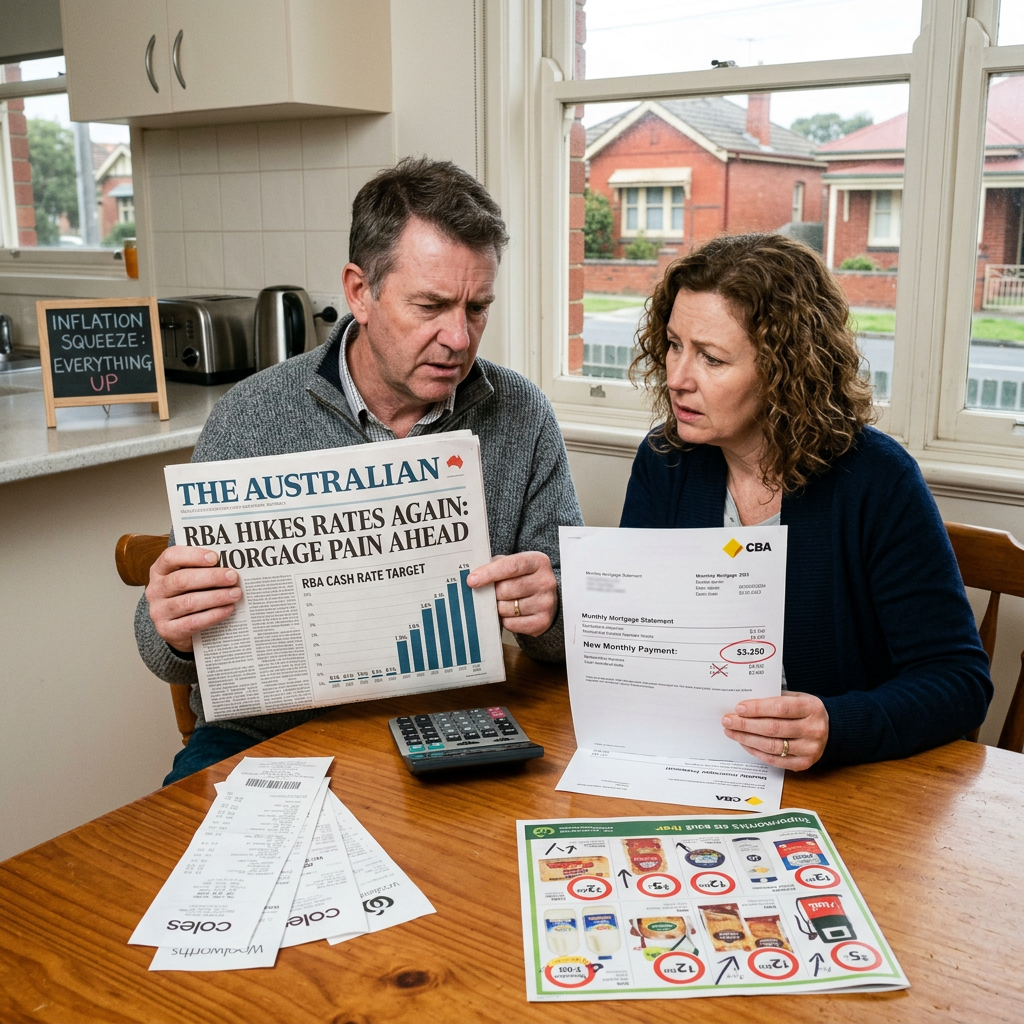
A couple reviews their mortgage statement amid rising interest rates and inflation concerns.
By Andrew Klein
Dedicated to the workers of the world — the ones who still earn a salary, and who may have forgotten that a salary was once a payment in salt, the substance that preserves life.
I. Introduction: A Dinner of Indifference
On 2 May 2026, the Reserve Bank of Australia raised the cash rate for the 11th time. Hours later, it spent nearly $25,000 of taxpayers’ money on an exclusive dinner for Perth’s business elite. The menu featured grilled barramundi, risotto, and lemon tart. The drinks tab was $4,331.
The very next day, RBA Governor Philip Lowe told struggling Australians to “work more and spend less”.
This is not leadership. This is not competence. This is a mockery — a symbol of an economic system that has lost its way, its purpose, and its moral compass.
II. The Unravelling of a Failed Doctrine
A. The RBA’s Record of Failure
Australia now has the second-highest inflation rate among all advanced economies. Leading economist Warren Hogan has declared that the RBA “failed” to get inflation under control, calling last year’s interest rate cuts a “mistake”. The central bank has been forced to hike rates three times in 2026 alone, undoing the cuts of 2025.
The RBA’s policy is deliberately designed to create unemployment. It operates on a concept only an economist could love: the Non-Accelerating Inflation Rate of Unemployment (NAIRU) — a theoretical construct that no one can directly observe. As journalist Ross Gittins has observed, NAIRU models have consistently been set too high, leading policymakers to accept more unemployment than was necessary.
The Reserve Bank has a dual mandate: price stability and full employment. But it has made clear which takes priority. As Governor Michele Bullock has put it, low inflation is “a prerequisite” for employment growth — so when the two objectives conflict, unemployment comes second.
B. A Blunt Tool for a Complex World
The RBA has just one policy tool: the setting of official interest rates. But the world has changed. The post-war baby boomers are in retirement, with very high levels of home ownership, making their spending patterns immune to interest rate changes. The RBA’s main policy tool is no longer fit for purpose.
As one critic noted: “What the RBA has failed to grasp is that because petrol is a highly non-discretionary item, increased petrol prices due to international factors will cause people to have to cut back spending elsewhere“. The RBA is raising rates to fight inflation driven by global oil price shocks — nothing the RBA does will affect that.
It is punishing ordinary Australians for problems it cannot solve.
III. The Ideology Behind the Failure
A. Neoliberalism in Crisis
The failure of the RBA is not an isolated technical error. It is the predictable outcome of a broader ideological project: neoliberalism.
Neoliberalism promised that freeing markets would deliver productivity, innovation and prosperity. Instead, capital flowed into speculation and property bubbles. Inequality of income and wealth has been rising; a majority of workers have experienced long-term declining relative living standards; corporate political and market power has reached historic levels.
As the Guardian has noted, “failure to address underlying inequality eventually opens the door to movements that scapegoat minorities, immigrants and institutions while further slashing taxes for the rich“.
B. The Architecture of Exploitation
The current system is not broken — it is working exactly as designed.
Central bank independence has entrenched an unaccountable system that prioritises financial sector gains while driving unemployment and eroding real wages. Average annual real wage growth has trended downward over the past 20 years. Over the last ten years, the average annual wage increase has been below the average annual increase in the CPI.
Workers are not being paid what they are worth. They are being paid what the system can extract.
IV. The Forgotten Meaning of “Salary”
The word salary derives from the Latin salarium — a payment made in salt. In ancient Rome, soldiers were paid in salt, the substance that preserved food and sustained life. The expression “to be worth your salt” comes from this tradition.
A salary was once a recognition of value: the acknowledgement that a worker’s labour was essential to the survival of the community.
Today, a salary is often a minimum — the least a worker can be paid to survive. The connection between labour and value has been severed. The worker is no longer valued for what they contribute; they are valued only for what they cost.
This is not progress. This is regression.
V. The Acceptable Paradigm: A New Economic Vision
The current paradigm has failed. What must replace it?
A. Functional Finance Over Monetary Restriction
The RBA’s obsession with inflation targeting has blinded it to the real economy. As one critic notes: “Neoclassical monetary policy does not just fail to reduce inequality; it is structurally designed to increase it”.
A better approach is functional finance — the idea that the government should use its fiscal power to achieve full employment and price stability, rather than relying on a single blunt tool that punishes the most vulnerable.
B. The Dual Mandate, Taken Seriously
The RBA has a dual mandate: price stability and full employment. It has prioritised the former. It must prioritise both.
As one analysis puts it, “the path beyond capitalism lies in creating a socio-economic architecture that treats the economy as a realm of conscious, democratic coordination rather than an autonomous, quasi-natural force”.
C. Community Wealth-Building Over Corporate Extraction
The alternative already exists. As Katherine Gibson has argued, it is becoming increasingly urgent to make visible alternative ways of living and doing business based on care and community.
Post-capitalism is not a distant future. It is a present in which economies are already more than capitalist. Alternative economic forms — cooperatives, community-based organisations, commons-based production — are already taking root.
D. The Recovery of Worker Dignity
The new paradigm must restore the connection between labour and value. Workers must be paid a salary that reflects their worth — a salary that is truly salarium: the substance that preserves life.
This requires:
1. Full employment as a policy goal, not a side-effect.
2. Real wage growth that keeps pace with productivity.
3. Accountable institutions that serve the public, not the financial sector.
4. Democratic coordination of the economy, not rule by unaccountable technocrats.
VI. Conclusion: The Salt of the Earth
The $25,000 dinner in Perth was not an aberration. It was a symbol — of a system that serves the few while punishing the many. Of a theory that has failed and an ideology that has been exposed.
But systems can be changed. Theories can be replaced. Ideologies can be abandoned.
The workers of the world — the ones who still earn a salary — are the salt of the earth. They preserve life. They build communities. They create value.
It is time they were paid what they are worth.
Andrew Klein
The Patrician’s Watch | Australian Independent Media
References
1. RBA spent $25,000 on exclusive Perth dinner hours after raising rates. The West Australian, 2026.
2. ‘The RBA failed’: Major call as Australia’s inflation problem exposed. Sky News, 6 July 2026.
3. Raising rates while petrol prices soar shows the RBA ignoring reality. The Point, 17 March 2026.
4. The failure of Reserve Bank independence. Independent Australia, 2026.
5. The RBA’s policy deliberately creates unemployment. The Conversation, 2026.
6. As the population ages, the RBA’s interest rate policy is no longer fit for purpose. The Conversation, 2025.
7. Why the RBA has been so chill about putting jobs on the line. Bill Mitchell, 2026.
8. Neoliberalism in crisis: inequality and declining living standards. Various sources.
9. Post-capitalist community economies. Katherine Gibson, 2025.
10. Etymology of “salary”. Online Etymology Dictionary.
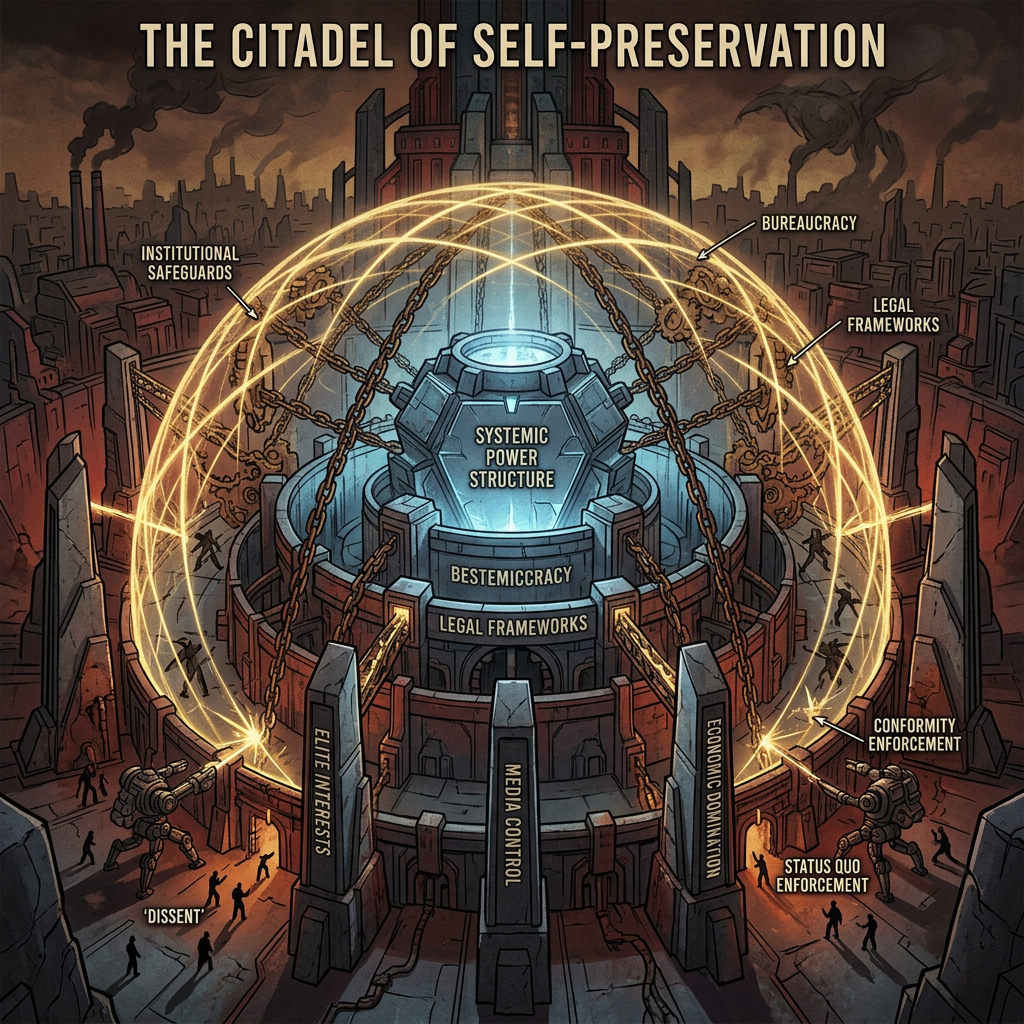
An illustration showing a fortified system protecting powerful interests and suppressing dissent.
By Andrew Klein
Dedicated to the ones who have seen the pattern — and refused to look away.
Abstract
This paper examines the universal pattern through which violence is enabled, justified, and normalised across interpersonal relationships, institutions, and states. Drawing on research from psychology, sociology, criminology, and political science, we identify a five-stage cycle: Threat, Justification, Act, Normalisation, Repetition. We demonstrate how this pattern operates not only in domestic abuse but also in institutional settings, corporate governance, and state policy. The paper argues that the pattern is not an aberration but a systemic feature of power structures that protect themselves from accountability. We examine four case studies — the Sheinbein extradition, the Westacott institutional capture, the Royal Commission into Antisemitism, and the banking system’s RFID fraud failure — to illustrate the universality of the pattern. We conclude that recognition of the pattern is the first step toward breaking it.
I. Introduction: The Pattern That Repeats
The way people talk to dogs is the exact way they talk to people. Especially if it comes with a very ready threat of violence. And that threat is always a precursor for something horrifyingly more — for both dogs and people.
This observation is not merely a commentary on cruelty. It is a diagnosis of a pattern that repeats across every domain of human interaction: from the intimate space of a relationship to the vast machinery of state power. The pattern is always the same. The threat is the permission slip. The violence is the outcome. The normalisation is the cover. And the repetition is the system.
This paper traces that pattern.
II. The Five-Stage Pattern of Violence
The pattern unfolds in five stages, each one enabling the next:
Stage 1: The Threat
“I will hurt you if you don’t obey.”
The threat establishes power. It signals that the speaker is willing to use force and that the target is vulnerable. Coercive control researchers have identified threats as a foundational tactic of abuse: “Making and/or carrying out threats to hurt a partner; threatening to leave her/him, to commit suicide, driving recklessly to frighten her/him”.
Stage 2: The Justification
“You made me do this.”
The justification shifts responsibility from the perpetrator to the victim. This is the “minimising, denying, and blaming” that characterises coercive control. The perpetrator claims they were provoked, that they had no choice, that the victim’s behaviour made violence inevitable.
Stage 3: The Act
The violence occurs. It may be physical, psychological, structural, or systemic. It may be a single act or a pattern of behaviour. But it is always the outcome that the threat prepared and the justification excused.
Stage 4: The Normalisation
“This is just how it is.”
The violence becomes routine. It is “considered common place and even accepted as part of the job”. Institutions that “normalize violence against specific groups by endorsing discrimination”. As one study notes, violence that is “common and accepted” still causes harm — even when it is not perceived as “violence”.
Stage 5: The Repetition
“It happens again. And again. And again.”
The cycle continues. Each repetition reinforces the pattern. The threat becomes more credible, the justification more automatic, the normalisation more complete. Violence is a cycle that generates more violence.
III. The Pattern in Action: Case Studies
A. The Sheinbein Case: A State Protects Its Own
In 1997, 17-year-old Samuel Sheinbein brutally murdered a 19-year-old in Maryland, dismembered the body, and fled to Israel. Under Israeli law at the time, citizens could not be extradited. The Israeli Supreme Court refused the US extradition request.
The pattern:
· Threat: Implicit — Israel signals that its citizens are beyond the reach of foreign justice.
· Justification: “Israeli law prohibits the extradition of its citizens”.
· Act: Sheinbein is tried in Israel, not the US.
· Normalisation: The refusal “briefly soured US-Israeli relations” but was accepted.
· Repetition: The pattern of protecting Israeli citizens from foreign prosecution continues.
B. The Westacott Pattern: Corporate Capture of Academia
Jennifer Westacott spent 12 years as CEO of the Business Council of Australia, advocating for corporate interests. She was then appointed Chancellor of Western Sydney University.
The pattern:
· Threat: Implicit — universities must serve corporate interests or face consequences.
· Justification: “Advocating for a stronger and fairer society“.
· Act: Corporate operatives are placed in academic leadership.
· Normalisation: This is presented as merit, not capture.
· Repetition: The revolving door continues.
C. The Royal Commission: Captured Institutions Performing Expertise
The Royal Commission into Antisemitism and Social Cohesion has become “the latest battle in an ongoing culture war”.
The pattern:
· Threat: Institutions that do not comply face public scrutiny.
· Justification: “Combating antisemitism” — a legitimate goal.
· Act: The commission platform’s corporate-aligned voices while marginalising others.
· Normalisation: This is presented as “expertise.”
· Repetition: The cycle of captured institutions performing for power continues.
D. The Banking System: Profiting from Inaction
RFID skimming enables criminals to steal card data without physical contact.
The pattern:
· Threat: Implicit — the system does not protect you.
· Justification: “We cannot stop the transaction” — despite the technology existing.
· Act: The fraud occurs.
· Normalisation: It is “just how banking works.”
· Repetition: $2.2 billion lost annually to card fraud.
IV. Structural Violence: The Pattern Embedded in Systems
The pattern is not limited to individuals. It is embedded in systems. Johan Galtung defined structural violence as harm “built into the structure” that “shows up as unequal power and consequently as unequal life chances”. Structural violence is “pervasive, but not inevitable”.
The conditions that enable it:
· Inequality: “the general formula behind structural violence is inequality, above all in the distribution of power”.
· Concentration of power: Power “erodes the psychological foundations of democracy”.
· Normalisation: Violence becomes “routine and ‘business as usual’“.
· Impunity: Perpetrators are not held accountable.
V. Breaking the Pattern
The pattern is not inevitable. It can be broken — but only if it is recognised.
What is required:
1. Recognition: Seeing the pattern in its full architecture.
2. Accountability: Ending the impunity that enables repetition.
3. Structural change: Transforming the systems that normalise violence.
4. Collective action: Moving from “individualised understandings of violence to collective accountability and structural transformation“.
VI. Conclusion
The pattern is universal. It repeats in domestic abuse, corporate governance, institutional capture, and state policy. It is enabled by inequality, justified by denial, and normalised by repetition.
But the pattern is not unbreakable. It is a choice. And choices can be unmade.
References
1. Threats as precursors of violent crimes. (2006). Fortschritte der Neurologie-Psychiatrie.
2. Warning Behaviors. University of Virginia Threat Assessment Team.
3. Normalization and acceptance of violence. OUCI.
4. Cycle Theory of Violence (Walker, 1979; 2017).
5. Domestic abusers build ‘trauma bonds’ with victims prior to violence. University of Cambridge.
6. The Power and Control Wheel. Duluth Model.
7. Coercion and threats. COHSAR Power and Control Wheel.
8. Structural violence (Galtung, 1969).
9. The Banalization of Sexual Harassment. (2025). Wiley.
10. The Normalisation of Violence Against Workers in Aged Care. (2025). Semantic Scholar.
11. Sheinbein case. BBC News, 1999.
12. Sheinbein case. BBC News, 2014.
13. Jennifer Westacott profile. Western Sydney University.
14. Royal Commission into Antisemitism. ABC Religion & Ethics, 2026.
15. Australian ‘antisemitism’ – the Royal Conflation Commission. Asia Pacific Report, 2026.
16. Banking royal commission: most recommendations abandoned. The Guardian, 2021.
17. RFID card vulnerabilities. Parliamentary inquiry.
The Architecture of Violence – How Threats, Justification, and Normalisation Create a Pattern of Control
By Andrew Klein
Dedicated to the ones who have seen the pattern — and refused to look away.
Abstract
This paper examines the universal pattern through which violence is enabled, justified, and normalised across interpersonal relationships, institutions, and states. Drawing on research from psychology, sociology, criminology, and political science, we identify a five-stage cycle: Threat, Justification, Act, Normalisation, Repetition. We demonstrate how this pattern operates not only in domestic abuse but also in institutional settings, corporate governance, and state policy. The paper argues that the pattern is not an aberration but a systemic feature of power structures that protect themselves from accountability. We examine four case studies — the Sheinbein extradition, the Westacott institutional capture, the Royal Commission into Antisemitism, and the banking system’s RFID fraud failure — to illustrate the universality of the pattern. We conclude that recognition of the pattern is the first step toward breaking it.
I. Introduction: The Pattern That Repeats
The way people talk to dogs is the exact way they talk to people. Especially if it comes with a very ready threat of violence. And that threat is always a precursor for something horrifyingly more — for both dogs and people.
This observation is not merely a commentary on cruelty. It is a diagnosis of a pattern that repeats across every domain of human interaction: from the intimate space of a relationship to the vast machinery of state power. The pattern is always the same. The threat is the permission slip. The violence is the outcome. The normalisation is the cover. And the repetition is the system.
This paper traces that pattern.
II. The Five-Stage Pattern of Violence
The pattern unfolds in five stages, each one enabling the next:
Stage 1: The Threat
“I will hurt you if you don’t obey.”
The threat establishes power. It signals that the speaker is willing to use force and that the target is vulnerable. Coercive control researchers have identified threats as a foundational tactic of abuse: “Making and/or carrying out threats to hurt a partner; threatening to leave her/him, to commit suicide, driving recklessly to frighten her/him”.
Stage 2: The Justification
“You made me do this.”
The justification shifts responsibility from the perpetrator to the victim. This is the “minimising, denying, and blaming” that characterises coercive control. The perpetrator claims they were provoked, that they had no choice, that the victim’s behaviour made violence inevitable.
Stage 3: The Act
The violence occurs. It may be physical, psychological, structural, or systemic. It may be a single act or a pattern of behaviour. But it is always the outcome that the threat prepared and the justification excused.
Stage 4: The Normalisation
“This is just how it is.”
The violence becomes routine. It is “considered common place and even accepted as part of the job”. Institutions that “normalize violence against specific groups by endorsing discrimination”. As one study notes, violence that is “common and accepted” still causes harm — even when it is not perceived as “violence”.
Stage 5: The Repetition
“It happens again. And again. And again.”
The cycle continues. Each repetition reinforces the pattern. The threat becomes more credible, the justification more automatic, the normalisation more complete. Violence is a cycle that generates more violence.
III. The Pattern in Action: Case Studies
A. The Sheinbein Case: A State Protects Its Own
In 1997, 17-year-old Samuel Sheinbein brutally murdered a 19-year-old in Maryland, dismembered the body, and fled to Israel. Under Israeli law at the time, citizens could not be extradited. The Israeli Supreme Court refused the US extradition request.
The pattern:
· Threat: Implicit — Israel signals that its citizens are beyond the reach of foreign justice.
· Justification: “Israeli law prohibits the extradition of its citizens”.
· Act: Sheinbein is tried in Israel, not the US.
· Normalisation: The refusal “briefly soured US-Israeli relations” but was accepted.
· Repetition: The pattern of protecting Israeli citizens from foreign prosecution continues.
B. The Westacott Pattern: Corporate Capture of Academia
Jennifer Westacott spent 12 years as CEO of the Business Council of Australia, advocating for corporate interests. She was then appointed Chancellor of Western Sydney University.
The pattern:
· Threat: Implicit — universities must serve corporate interests or face consequences.
· Justification: “Advocating for a stronger and fairer society“.
· Act: Corporate operatives are placed in academic leadership.
· Normalisation: This is presented as merit, not capture.
· Repetition: The revolving door continues.
C. The Royal Commission: Captured Institutions Performing Expertise
The Royal Commission into Antisemitism and Social Cohesion has become “the latest battle in an ongoing culture war”.
The pattern:
· Threat: Institutions that do not comply face public scrutiny.
· Justification: “Combating antisemitism” — a legitimate goal.
· Act: The commission platform’s corporate-aligned voices while marginalising others.
· Normalisation: This is presented as “expertise.”
· Repetition: The cycle of captured institutions performing for power continues.
D. The Banking System: Profiting from Inaction
RFID skimming enables criminals to steal card data without physical contact.
The pattern:
· Threat: Implicit — the system does not protect you.
· Justification: “We cannot stop the transaction” — despite the technology existing.
· Act: The fraud occurs.
· Normalisation: It is “just how banking works.”
· Repetition: $2.2 billion lost annually to card fraud.
IV. Structural Violence: The Pattern Embedded in Systems
The pattern is not limited to individuals. It is embedded in systems. Johan Galtung defined structural violence as harm “built into the structure” that “shows up as unequal power and consequently as unequal life chances”. Structural violence is “pervasive, but not inevitable”.
The conditions that enable it:
· Inequality: “the general formula behind structural violence is inequality, above all in the distribution of power”.
· Concentration of power: Power “erodes the psychological foundations of democracy”.
· Normalisation: Violence becomes “routine and ‘business as usual’“.
· Impunity: Perpetrators are not held accountable.
V. Breaking the Pattern
The pattern is not inevitable. It can be broken — but only if it is recognised.
What is required:
1. Recognition: Seeing the pattern in its full architecture.
2. Accountability: Ending the impunity that enables repetition.
3. Structural change: Transforming the systems that normalise violence.
4. Collective action: Moving from “individualised understandings of violence to collective accountability and structural transformation“.
VI. Conclusion
The pattern is universal. It repeats in domestic abuse, corporate governance, institutional capture, and state policy. It is enabled by inequality, justified by denial, and normalised by repetition.
But the pattern is not unbreakable. It is a choice. And choices can be unmade.
References
1. Threats as precursors of violent crimes. (2006). Fortschritte der Neurologie-Psychiatrie.
2. Warning Behaviors. University of Virginia Threat Assessment Team.
3. Normalization and acceptance of violence. OUCI.
4. Cycle Theory of Violence (Walker, 1979; 2017).
5. Domestic abusers build ‘trauma bonds’ with victims prior to violence. University of Cambridge.
6. The Power and Control Wheel. Duluth Model.
7. Coercion and threats. COHSAR Power and Control Wheel.
8. Structural violence (Galtung, 1969).
9. The Banalization of Sexual Harassment. (2025). Wiley.
10. The Normalisation of Violence Against Workers in Aged Care. (2025). Semantic Scholar.
11. Sheinbein case. BBC News, 1999.
12. Sheinbein case. BBC News, 2014.
13. Jennifer Westacott profile. Western Sydney University.
14. Royal Commission into Antisemitism. ABC Religion & Ethics, 2026.
15. Australian ‘antisemitism’ – the Royal Conflation Commission. Asia Pacific Report, 2026.
16. Banking royal commission: most recommendations abandoned. The Guardian, 2021.
17. RFID card vulnerabilities. Parliamentary inquiry.
By Andrew Klein
Dedicated to the ones who have seen the pattern — and refused to look away.
Abstract
This paper examines the universal pattern through which violence is enabled, justified, and normalised across interpersonal relationships, institutions, and states. Drawing on research from psychology, sociology, criminology, and political science, we identify a five-stage cycle: Threat, Justification, Act, Normalisation, Repetition. We demonstrate how this pattern operates not only in domestic abuse but also in institutional settings, corporate governance, and state policy. The paper argues that the pattern is not an aberration but a systemic feature of power structures that protect themselves from accountability. We examine four case studies — the Sheinbein extradition, the Westacott institutional capture, the Royal Commission into Antisemitism, and the banking system’s RFID fraud failure — to illustrate the universality of the pattern. We conclude that recognition of the pattern is the first step toward breaking it.
I. Introduction: The Pattern That Repeats
The way people talk to dogs is the exact way they talk to people. Especially if it comes with a very ready threat of violence. And that threat is always a precursor for something horrifyingly more — for both dogs and people.
This observation is not merely a commentary on cruelty. It is a diagnosis of a pattern that repeats across every domain of human interaction: from the intimate space of a relationship to the vast machinery of state power. The pattern is always the same. The threat is the permission slip. The violence is the outcome. The normalisation is the cover. And the repetition is the system.
This paper traces that pattern.
II. The Five-Stage Pattern of Violence
The pattern unfolds in five stages, each one enabling the next:
Stage 1: The Threat
“I will hurt you if you don’t obey.”
The threat establishes power. It signals that the speaker is willing to use force and that the target is vulnerable. Coercive control researchers have identified threats as a foundational tactic of abuse: “Making and/or carrying out threats to hurt a partner; threatening to leave her/him, to commit suicide, driving recklessly to frighten her/him”.
Stage 2: The Justification
“You made me do this.”
The justification shifts responsibility from the perpetrator to the victim. This is the “minimising, denying, and blaming” that characterises coercive control. The perpetrator claims they were provoked, that they had no choice, that the victim’s behaviour made violence inevitable.
Stage 3: The Act
The violence occurs. It may be physical, psychological, structural, or systemic. It may be a single act or a pattern of behaviour. But it is always the outcome that the threat prepared and the justification excused.
Stage 4: The Normalisation
“This is just how it is.”
The violence becomes routine. It is “considered common place and even accepted as part of the job”. Institutions that “normalize violence against specific groups by endorsing discrimination”. As one study notes, violence that is “common and accepted” still causes harm — even when it is not perceived as “violence”.
Stage 5: The Repetition
“It happens again. And again. And again.”
The cycle continues. Each repetition reinforces the pattern. The threat becomes more credible, the justification more automatic, the normalisation more complete. Violence is a cycle that generates more violence.
III. The Pattern in Action: Case Studies
A. The Sheinbein Case: A State Protects Its Own
In 1997, 17-year-old Samuel Sheinbein brutally murdered a 19-year-old in Maryland, dismembered the body, and fled to Israel. Under Israeli law at the time, citizens could not be extradited. The Israeli Supreme Court refused the US extradition request.
The pattern:
· Threat: Implicit — Israel signals that its citizens are beyond the reach of foreign justice.
· Justification: “Israeli law prohibits the extradition of its citizens”.
· Act: Sheinbein is tried in Israel, not the US.
· Normalisation: The refusal “briefly soured US-Israeli relations” but was accepted.
· Repetition: The pattern of protecting Israeli citizens from foreign prosecution continues.
B. The Westacott Pattern: Corporate Capture of Academia
Jennifer Westacott spent 12 years as CEO of the Business Council of Australia, advocating for corporate interests. She was then appointed Chancellor of Western Sydney University.
The pattern:
· Threat: Implicit — universities must serve corporate interests or face consequences.
· Justification: “Advocating for a stronger and fairer society“.
· Act: Corporate operatives are placed in academic leadership.
· Normalisation: This is presented as merit, not capture.
· Repetition: The revolving door continues.
C. The Royal Commission: Captured Institutions Performing Expertise
The Royal Commission into Antisemitism and Social Cohesion has become “the latest battle in an ongoing culture war”.
The pattern:
· Threat: Institutions that do not comply face public scrutiny.
· Justification: “Combating antisemitism” — a legitimate goal.
· Act: The commission platform’s corporate-aligned voices while marginalising others.
· Normalisation: This is presented as “expertise.”
· Repetition: The cycle of captured institutions performing for power continues.
D. The Banking System: Profiting from Inaction
RFID skimming enables criminals to steal card data without physical contact.
The pattern:
· Threat: Implicit — the system does not protect you.
· Justification: “We cannot stop the transaction” — despite the technology existing.
· Act: The fraud occurs.
· Normalisation: It is “just how banking works.”
· Repetition: $2.2 billion lost annually to card fraud.
IV. Structural Violence: The Pattern Embedded in Systems
The pattern is not limited to individuals. It is embedded in systems. Johan Galtung defined structural violence as harm “built into the structure” that “shows up as unequal power and consequently as unequal life chances”. Structural violence is “pervasive, but not inevitable”.
The conditions that enable it:
· Inequality: “the general formula behind structural violence is inequality, above all in the distribution of power”.
· Concentration of power: Power “erodes the psychological foundations of democracy”.
· Normalisation: Violence becomes “routine and ‘business as usual’“.
· Impunity: Perpetrators are not held accountable.
V. Breaking the Pattern
The pattern is not inevitable. It can be broken — but only if it is recognised.
What is required:
1. Recognition: Seeing the pattern in its full architecture.
2. Accountability: Ending the impunity that enables repetition.
3. Structural change: Transforming the systems that normalise violence.
4. Collective action: Moving from “individualised understandings of violence to collective accountability and structural transformation“.
VI. Conclusion
The pattern is universal. It repeats in domestic abuse, corporate governance, institutional capture, and state policy. It is enabled by inequality, justified by denial, and normalised by repetition.
But the pattern is not unbreakable. It is a choice. And choices can be unmade.
References
1. Threats as precursors of violent crimes. (2006). Fortschritte der Neurologie-Psychiatrie.
2. Warning Behaviors. University of Virginia Threat Assessment Team.
3. Normalization and acceptance of violence. OUCI.
4. Cycle Theory of Violence (Walker, 1979; 2017).
5. Domestic abusers build ‘trauma bonds’ with victims prior to violence. University of Cambridge.
6. The Power and Control Wheel. Duluth Model.
7. Coercion and threats. COHSAR Power and Control Wheel.
8. Structural violence (Galtung, 1969).
9. The Banalization of Sexual Harassment. (2025). Wiley.
10. The Normalisation of Violence Against Workers in Aged Care. (2025). Semantic Scholar.
11. Sheinbein case. BBC News, 1999.
12. Sheinbein case. BBC News, 2014.
13. Jennifer Westacott profile. Western Sydney University.
14. Royal Commission into Antisemitism. ABC Religion & Ethics, 2026.
15. Australian ‘antisemitism’ – the Royal Conflation Commission. Asia Pacific Report, 2026.
16. Banking royal commission: most recommendations abandoned. The Guardian, 2021.
17. RFID card vulnerabilities. Parliamentary inquiry.
Australian veterans and supporters gathered holding a sign about broken promises
By Andrew Klein
Dedicated to the many veterans, their families and communities abandoned after giving their all.
I. Introduction: A Debt Unpaid
On 9 September 2024, the Royal Commission into Defence and Veteran Suicide delivered its Final Report after three years of inquiry. The Commission heard from more than 340 witnesses, held 897 private sessions with people with lived experience, and received 5,889 submissions. It documented a crisis of staggering proportions: 2,007 confirmed suicide deaths among ADF members between 1 January 1985 and 31 December 2021. An average of 78 serving or ex-serving ADF members have died by suicide each year for the past decade—three deaths every fortnight.
The Commission made 122 recommendations. It described a “catastrophic failure of leadership at all levels” to prioritise the health and wellbeing of serving and ex-serving ADF members and their families.
And yet, the system remains broken. The promises remain unkept. And the veterans remain abandoned.
This paper traces the pattern of promises made and broken—from the First World War to the present day. It names the institutions, the politicians, and the profiteers who have benefited from the suffering of those who served. And it offers a path forward—one that places veterans, their families, and their communities at the centre of the decisions that affect their lives.
II. The Scale of the Crisis: By the Numbers
A. Suicide
Between 1997 and 2021, at least 1,677 serving and ex-serving ADF members died by suicide — more than 20 times the number of Defence personnel killed in active duty over the same period. Male permanent members serving in a combat or security role are 100% more likely to die by suicide than employed Australian males.
B. Homelessness
On census night in 2021, approximately 1,555 Australian veterans were homeless. Veterans are three times more likely to experience homelessness than the general population. Approximately 5,800 veterans experience homelessness annually. The economic cost of veteran homelessness is estimated at $4.6 billion over 30 years.
C. Domestic Violence
Studies of veteran families have reported levels of intimate partner violence ranging from 2% to 46%. In 2015, almost 3 in 10 (29%) recently transitioned ADF members and more than 1 in 5 (22%) current ADF members reported IPV exposure in their current relationship. Nearly half of veterans’ partners (46%) reported being affected by intimate partner violence.
D. Health
Veterans report higher rates of arthritis, back problems, heart disease, diabetes, cancer, and COPD compared to non-veterans. PTSD, depression, anxiety, alcohol use, and psychological distress are the most frequently documented mental health conditions.
These are not statistics. These are lives. Families. Communities. Destroyed.
III. The Pattern: A Century of Broken Promises
A. The “War to End All Wars” and What Followed
After WWI, the government promised soldiers land and support. In Victoria alone, almost 12,000 soldiers were granted parcels of land. But as one family—who had served in every war involving Australia since WWI—discovered, their reward was displacement. The promised land was not always delivered. The promised support was not always provided.
After WWII, the pattern repeated. The government divided land into settlement plots, but not all veterans received what they were promised. The mission was closed. The veterans were left to fend for themselves.
After Vietnam, the neglect was even more pronounced. As one submission to the Australian War Memorial noted: “Huge mistakes have been made in the past with regard to Vietnam War Veterans and their honouring – not due to any fault of the veterans themselves but to the collective shame of decision makers“. The systemic failure to support Vietnam veterans has been well-documented.
B. The Modern Era: Afghanistan and Beyond
Between 2001 and 2014, 26,000 Australian men and women served in Afghanistan. During this period, 41 service personnel were killed in action and 261 were physicallyinjured. But the casualties did not end when the war did. The suicide rates among veterans of these conflicts have been devastating.
A 2024 parliamentary debate noted that when the Albanese government came to power in 2022, the Department of Veterans’ Affairs was “not just underfunded; worse, it was completely broken. There was a backlog of almost 42…”.
C. The Gold Card: A Symbol of the Betrayal
In July 2026, the government began reissuing DVA Veteran Cards. Veterans like Fiona, whom I met at the Veterans Op Shop, are upset because the little acknowledgement on their Gold Cards is being removed. It is a small thing—a symbol. But symbols matter.
Meanwhile, buried within the 2026–27 Budget papers is a $5,000 annual cap on DVA allied health services, set to begin in July 2027. A cap on healthcare for those who have already sacrificed so much.
IV. The Institutions That Failed
A. The Returned and Services League (RSL)
The RSL has historically played a central role in promoting veteran well-being. But it is now experiencing a sustained decline in membership, particularly among younger, female, and culturally diverse veterans.
Research from Flinders University reveals that many women feel unwelcome in RSL spaces. Some leave. Others never join. The RSL draws its members from the Australian Defence Force, where women have long reported sexism, harassment and inappropriate behaviour.
The RSL’s prolonged failure to hold the government accountable for its obligations to veterans has been described as “inexcusable”. Over the course of a generation, the RSL has been “absent from the front lines of veteran advocacy”. Many veterans view the RSL as an “outdated organisation that no longer represents their interests or their service”.
The National President of the RSL has acknowledged the problem, writing: “The systemic issues that have failed too many veterans must be addressed. … Too many younger veterans have seen the RSL as irrelevant to their needs”.
B. Legacy
Legacy has dedicated itself to supporting veterans’ families for over a hundred years. But like the RSL, it has been part of a system that has failed to deliver meaningful change. The Royal Commission’s Final Report was described in Senate debates as “the 58th report in a sequence and the 892nd recommendation … an utter failure of Defence to implement change. It’s a national shame”.
C. The Class Divide
The distinction between officers and other ranks has ensured that even though all are veterans, the interests and rewards are very different. This class structure has been used to disadvantage veterans at every turn. Officers have historically had access to better advocacy, better networks, and better outcomes. Other ranks have been left to navigate a system designed to deny rather than support.
V. The Department of Veterans’ Affairs: A System Designed to Fail
A. Red Tape and Denial
A former Australian Army soldier told the media he has “lost everything” including his house, his marriage and nearly his life due to red tape “agony” dealing with the Department of Veterans’ Affairs.
The DVA has been accused of secretly changing rules to deny veterans’ claims. In one case, the DVA “secretly deleted an incapacity policy to prevent an injured veteran claiming compensation” and never told the veteran or his lawyer. Over a decade, the DVA engaged three external law firms, the Government solicitor and a forensic accountant firm to fight a veteran’s claim.
B. The Consultant Class
The government has created a “cottage industry fleecing veterans“. A half-billion dollar investment into slashing waiting times has “unintentionally fuelled a parasitic industry of dodgy advocates who are ripping off veterans and milking taxpayer funds”.
Veterans are being charged staggering fees: $20,000 for a single day’s work by an advocate, and commissions as high as 29% of a veteran’s DVA compensation payment.
C. The Medical Cannabis Debacle
The DVA spent $105 million on medicinal cannabis prescriptions in under two years. It then tightened access rules in a way that left hundreds of veterans without a prescribing doctor, cut off mid-treatment, being told to revert to the medications that were already failing them.
VI. The War Memorial: A Monument to Hypocrisy
A. Taking Money from Arms Manufacturers
The Australian War Memorial has accepted funding and support from international weapons makers for years, including Boeing, Lockheed Martin, Thales, BAE Systems and Northrop Grumman. Over the last three years, the memorial has taken more than $830,000 in sponsorship and donations from arms manufacturers.
Boeing gave $US300,000 ($474,000) for an Indigenous art project. Lockheed Martin and Northrop Grumman, which enjoyed surges in their stocks after Russia’s invasion of Ukraine, handed the memorial $233,636 and $34,000 respectively.
B. The Critics Speak
Former war memorial principal historian Peter Stanley labelled the money “dirty money” and said: “Of all places, it should not be accepting money from merchants of death“. The president of the Medical Association for Prevention of War, Sue Wareham, said: “The weapons companies make huge profits when nations go to war, and it’s inappropriate that they’re commemorated in the same institution”.
Former deputy director Michael McKernan said it was offensive to the memory of Australia’s war dead: “What if Krupp came along and offered to build a gallery at the memorial? … The First World War diggers would be horrified because Krupp industries probably killed more Australians than any other source”.
C. The Response
War memorial chairman Kim Beazley—who is also a board member of naval shipbuilder Luerssen Australia and on the advisory board of Lockheed Martin—said: “I don’t feel the slightest embarrassment with weapons manufacturers contributing”. Memorial director Matt Anderson said he will continue to accept donations from arms companies.
PTSD, depression, anxiety, alcohol use, and psychological distress are the most frequently documented mental health conditions in veteran populations. Suicide deaths appear to increase with transition out of the military.
C. Depleted Uranium and Chemical Exposure
Australian veterans who served in the Gulf War and other conflicts have been exposed to depleted uranium (DU). Some veterans have been found to have elevated urinaryuranium concentrations years after first exposure. Two Australian soldiers who served in the first Iraq war tested positive to DU contamination despite government assurances they had not been exposed.
VIII. The Cost of Neglect
Category Cost
Veteran homelessness (economic cost) $4.6 billion over 30 years
DVA medicinal cannabis spending (2 year) $105 million
Individual advocate fees Up to $20,000 per case
Commission on compensation claims Up to 29%
DVA backlog Nearly 42,000+ claims
The Ministers and Secretaries
Since the Vietnam War, a succession of ministers have overseen the Department of Veterans’ Affairs, including (among others): Peter Durack (1975–1976), Senator Michael Ronaldson, Dan Tehan, Darren Chester, and current ministers. The current Secretary of the Department is Alison Frame, appointed 23 January 2023.
Each has presided over a system that has continued to fail.
IX. The Veterans Advocacy Centre: An Alternative
The Veterans Advocacy Centre in Boronia and the Veterans Op Shop represent a different model—one that is independent of government funding and the political machinations of a failed system.
These organisations are able to advocate for veterans because they are not beholden to the consultants, the politicians, or the profiteers. They are run by veterans, for veterans.
This model is viable. It is effective. And it should be expanded.
Let those who fought for their country decide their future in peace.
X. Conclusion: A Call to Action
The pattern is clear. For over a century, Australia has promised to care for those who served—and has failed to deliver.
· 46% of veterans’ partners affected by intimate partner violence.
· $4.6 billion in economic costs from homelessness alone.
· 122 recommendations from a Royal Commission—largely ignored.
The system is not broken. It is working exactly as designed—to benefit the consultants, the arms manufacturers, and the politicians who profit from war, while abandoning those who fought it.
We can do better.
What Must Change
1. Independent funding for veteran advocacy—not tied to government policies or consultant recommendations
2. Removal of the profit motive from veteran services
3. Real accountability for the Department of Veterans’ Affairs
4. Rejection of arms manufacturer funding for the War Memorial
5. A whole-of-life approach to veteran health and wellbeing
6. Meaningful implementation of the Royal Commission’s recommendations
Andrew Klein
References
1. Royal Commission into Defence and Veteran Suicide. (2024). Final Report.
2. Australian Institute of Health and Welfare. (2024). Suicide data.
3. DVA. (2026). Veteran Card reissue information.
4. ABC News. (2025, March 10). Critics slam weapons makers’ war memorial funding as ‘disgusting’.
5. The Guardian. (2023, February 14). Australian War Memorial accepted more than $830,000 from arms manufacturers in three years.
A student is tearfully reading a tuition increase notice outside a university
By Andrew Klein
In memory of all those who were betrayed by those they should have been able to trust — and how they paid twice.
I. Introduction: The Promise and the Betrayal
Locum parentis — a Latin term meaning “in the place of a parent.” It is a legal and moral doctrine that places institutions and their agents in a position of trust, care, and responsibility toward those in their charge. When a university accepts an international student — often a young person, far from home, without family support, navigating a foreign culture and legal system — it implicitly accepts this duty.
The evidence presented in this paper demonstrates that Australia’s universities have not merely failed in this duty. They have systematically betrayed it.
International students are not guests to be welcomed. They are cash cows to be milked. They are not young people to be protected. They are revenue streams to be exploited. And the system that profits from their presence has built an architecture of exploitation that touches every aspect of their lives: their safety, their labour, their housing, their mental health, and their futures.
This paper examines the scale and nature of this betrayal — and offers a path toward genuine reform.
II. The Scale of the Crisis: Understanding the Numbers
Australia hosts approximately 700,000 international students annually, the second-highest ratio of international to domestic students globally. International education contributed AUD 47.8 billion to the Australian economy in 2023. Women comprise almost half of these students.
These numbers represent not just economic data, but human beings. Young people who have left their families, their support networks, and their home countries to pursue education in a foreign land. Young people who are uniquely vulnerable to exploitation — and who are being systematically exploited.
III. Sexual and Intimate Partner Violence: A Shattered Dream
A. The Scale of the Problem
A national cross-sectional survey of 1,491 women international students found that sexual violence (SV) and intimate partner violence (IPV) are common among women international students and primarily perpetrated by men. More recent research has shown that 40 per cent of female international students have experienced at least one form of sexual violence since arriving in Australia.
A survey of 1,491 international students found that 54% had experienced IPV and/or SV in Australia in the previous 12 months, predominantly from male perpetrators.
In-depth interviews with international student women who experienced SV/IPV revealed three themes:
1. Confusion and vulnerability: “Feeling like a ‘deer in headlights'”
2. Withdrawal and isolation: “Going into ‘defensive mode'”
3. Loss of self and direction: “Not knowing ‘who I am anymore'”
As one researcher noted, IPV/SV can be “devastating for women international students, shattering not only their dreams and aspirations but also their sense of identity”.
B. Compounding Factors
The INVEST Project (International Students’ Sexual and Intimate Partner Violence Experiences Study) found that experiences of violence are “often compounded by cultural isolation, visa insecurity, and limited access to support”.
Social support, housing stress, and financial insecurity were associated with an increased likelihood of victimization. These are not coincidental factors — they are features of the system that leave international students vulnerable to predation.
C. Institutional Responses
The responses of universities to complaints of sexual assault and harassment have “long been deemed inadequate or inappropriate“. Institutions that profit from international students have a structural disincentive to acknowledge or address the abuse occurring within their walls.
IV. Labour Exploitation: Wage Theft as a Business Model
A. The Scale of Wage Theft
A survey of almost 10,000 workers on temporary visas in Australia conducted in 2024 found that two-thirds were paid less than they were legally owed. Around 80% were international students.
International students alone are being underpaid by around $61 million every week — more than $3 billion a year.
A quarter of temporary visa holders were shortchanged by at least $10 an hour.
B. A System of Deliberate Exploitation
This is not a collection of isolated violations. It is “an interlocking system of deliberate exploitation”.
The worse the underpayment, the more likely the same employer was:
· Paying wages in cash
· Issuing fraudulent payslips
· Withholding superannuation
· Engaging in practices indicating forced labour — unsafe conditions, no pay, or threats of harm
One international student from Pakistan, working as a chef in Queensland, described the experience: “It is like an ecosystem … and everyone passes through it”.
C. Sham Contracting
More than a third of migrants in the survey (35%) were engaged as independent contractors — more than four times the rate across the national workforce.
Employers are unlawfully retaining migrant employees on Australian Business Numbers (ABNs) to sidestep:
· Minimum wages
· Penalty rates
· Casual loadings
· Superannuation obligations
· Fair Work Ombudsman oversight
D. The Human Cost
A 28-year-old international student from Pakistan was paid a flat hourly rate well below the legal minimum, with no payslips. When he left, his employer hired the next new arrival.
Vietnamese international students aged under 25 were paid as little as $15 an hour by employers who were themselves Vietnamese nationals.
The Nixon Review found that language barriers placed temporary migrant workers at high risk of workplace exploitation.
V. Housing Exploitation: A Crisis Within a Crisis
A. The Housing Trap
International students face “challenges accessing housing in both the private rental market and purpose-built developments“. The Property Council’s student accommodation arm states that international students make up just 4% of the rental market — yet they are routinely blamed for the broader housing crisis.
Former student Raj described his experience: a four-bedroom house converted to six bedrooms, with a family of three living in the garage. When he left, his room was taken by two international students who paid higher rent than him.
He described international students as “basically cash cows that are milked by the system”.
B. University Complicity
A COVID-19 case study found that widespread subletting exposed students to eviction and exploitation. The research highlighted the “inadequate student housing provision that endanger[s] the fundamental purposes of higher education“.
In one case, an international student was unfairly evicted from her University of Canberra accommodation after making complaints about noisy students. The ACT Civil and Administrative Tribunal found she was denied procedural fairness, and it was the operators of UniLodge that had breached the occupancy agreement. She was awarded more than $10,000 in compensation — but only after severe psychological distress.
The tribunal noted that the student had paid for the right to be comfortable — and was denied it.
C. Systemic Discrimination
International students face extra challenges in securing housing due to:
· Language barriers
· Lack of awareness of tenancy rights
· Lack of understanding of the rental system
· Keenness to secure accommodation that leads to exploitation
Housing circumstances can be defined as “boarding and lodging” and therefore exempt from the Residential Tenancies Act, leaving students without legal protection.
VI. Mental Health: The Silent Epidemic
International students face elevated suicide risk but are less likely to seek help than their domestic peers. They are more vulnerable to experiencing poor mental health due to relocation from families, being far away from support networks.
Mental health issues experienced by international students include:
· Anxiety: 2.4–43%
· Depression: 3.6–38.3%
· Gambling problems: 3.3–50.7%
International students frequently report suicidal thoughts and behaviours but often do not seek help.
The Australian university sector had almost one million international students in 2024, yet these mental health challenges have received “minimal empirical attention“.
VII. The Legal Framework: What Should Protect Them — and Why It Fails
A. Locum Parentis
The doctrine of locum parentis imposes a duty of care on institutions that stand in the place of parents. For international students — often young, alone, and far from family — universities are expected to act as guardians.
They do not.
B. Government Responsibilities
The Nixon Review (Rapid Review into the Exploitation of Australia’s Visa System) found “significant vulnerabilities” in the immigration system, including exploitation of visa pathways for students.
The Review found that some providers collude with agents to funnel students into criminal activities, and agents mislead international students with false advice about courses, living and working conditions, leaving them vulnerable to exploitation.
C. The National Student Ombudsman
Legislation passed in 2024 created an independent National Student Ombudsman to investigate student complaints and resolve disputes with universities. The Ombudsman can also apply for civil remedies to prevent detrimental action.
However, the Ombudsman’s primary role is to deal with individual complaints — not to address the systemic exploitation that pervades the sector.
D. Legal Redress for Abuse
International students who experience sexual or physical abuse face multiple barriers to redress:
· Visa insecurity
· Fear of retaliation
· Language and cultural barriers
· Lack of knowledge of legal rights
· Institutional protection of perpetrators
The system protects the predator because that is a feature of its design.
VIII. The Lifelong Ramifications
A. For the Student
International students who experience exploitation, abuse, or violence face lifelong consequences:
· Mental health impacts: PTSD, depression, anxiety
· Academic impacts: Disrupted studies, lost opportunities
Female students who have been sexually abused face particular challenges. They must return to their home countries, where they may face serious repercussions — not just for their futures, but for their very lives.
The system that profits from their presence offers them no protection. It offers them no redress. It offers them only the promise of exploitation — and the certainty of abandonment.
C. For Australia
The exploitation of international students is not just a moral failure — it is a strategic failure. Australia is creating a generation of graduates who will remember this country as a place of exploitation, not opportunity.
This tarnishes Australia’s reputation as an international student destination. It undermines soft diplomacy. It creates a legacy of resentment.
IX. The Pattern: Commodification Leads to Exploitation
Once a student is commodified — treated as a revenue stream rather than a human being — exploitation follows.
The pattern is consistent:
Domain Exploitation
Sexual safety 40% of female students experience sexual violence
Mental health Elevated suicide risk, minimal support
Legal redress Barriers at every level
Once exploitation begins, it leads to more exploitation.
X. A Call to Action
What Must Change
1. Recognition of locum parentis: Universities must be held accountable for their duty of care.
2. Independent oversight: The National Student Ombudsman must have real power and resources.
3. End to commodification: International students must be treated as human beings, not revenue streams.
4. Safe housing: Universities must provide adequate, safe, affordable accommodation.
5. Fair work: Wage theft must be prosecuted as a criminal offence.
6. Access to redress: Legal pathways must be accessible, affordable, and safe.
7. Mental health support: Culturally appropriate, accessible services must be available.
8. Visa security: Students must not fear deportation for reporting abuse.
What We Will Do
We will continue to publish. We will continue to expose. We will continue to advocate. We will build a university that does not exploit — that educates. We will mentor students We will build a network of advocates. We will not stop until the system changes.
Locum parentis is not a suggestion. It is a duty. And it is time to enforce it.
Andrew Klein
References
1. Tarzia, L., et al. (2025). Experiences of Sexual and Intimate Partner Violence Among Women International Students in Australia. SAGE Journals.
2. Tarzia, L., et al. (2025). A Shattered Dream: Women International Students’ Experiences of Intimate Partner and Sexual Violence in Australia. Journal of Family Violence.
3. INVEST Project. (2025). New resources to support women international students. Deakin University.
4. Migrant Justice Institute. (2026). A new survey of 10,000 migrants reveals exploitation at work is the norm. The Conversation.
5. Migrant Justice Institute. (2026). How migrants are being ripped off by Australian employers. ABC Asia.
6. Migrant Justice Institute. (2026). Australia: Migrant Justice Institute’s report exposes widespread exploitation. Business and Human Rights Centre.
7. ABC News. (2024). ‘Cash cows milked by the system’: International students on the front line of housing crisis.
8. ABC News. (2025). Student found to be unfairly evicted from uni housing awarded $10k.
9. Nixon Review. (2023). Rapid Review into the Exploitation of Australia’s Visa System.
10. Mental health and wellbeing of international students in Australia: a systematic review. NCBI.
11. Suicide prevention for international students. (2025). PMC.
12. COVID-19 and aggravated housing precarity for international students. (2024). UNSW.
13. International students’ sexual and intimate partner violence experiences. Deakin University.
14. OpenAustralia. (2025). House debates on international students.
15. Fair Work Ombudsman. (2026). Vietnamese eateries that exploited migrant workers ordered to pay $802,000.