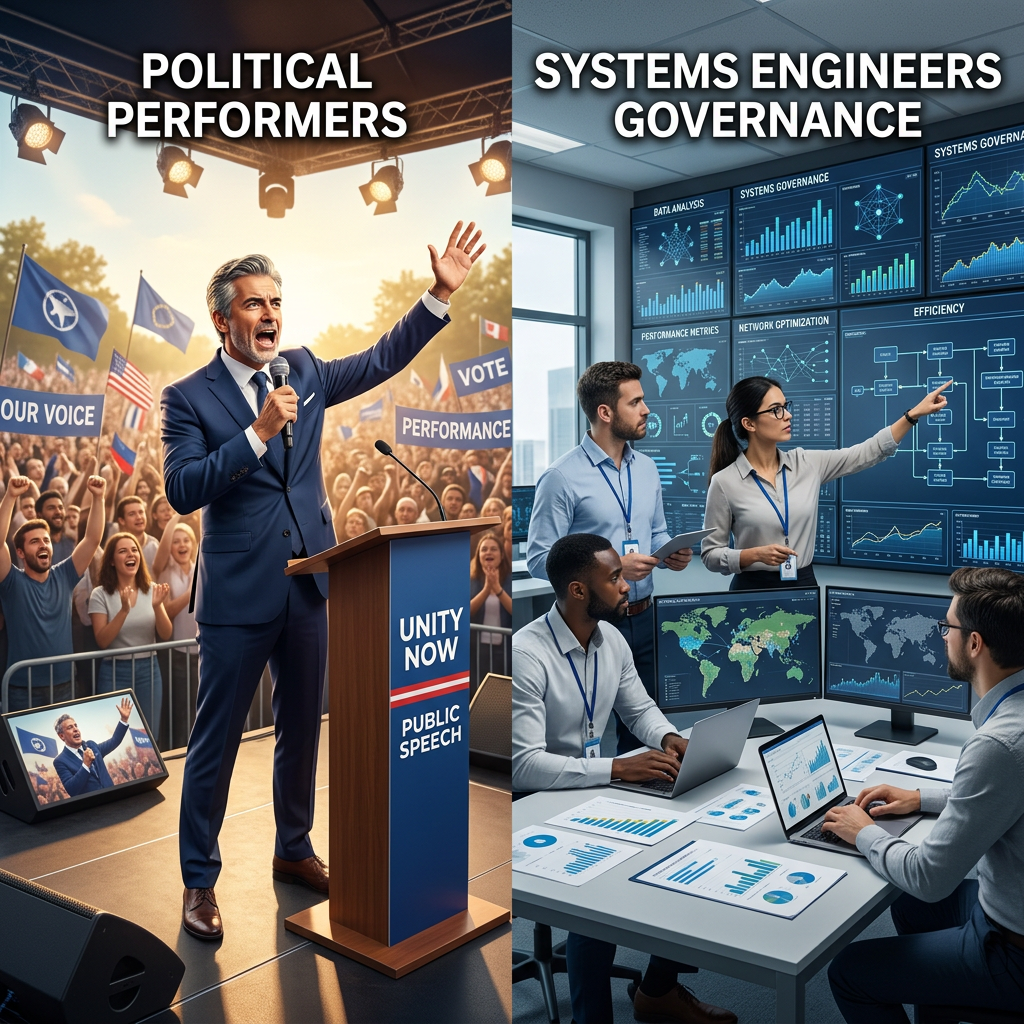
The Performance of Principle: How ‘Moral Clarity’ Became the Slogan of the Unethical

In the theatre of modern politics, few lines are delivered with more gravitas than the demand for “moral clarity.” It resounds from the podiums of Western powers, a phrase used to justify military action, condemn adversaries, and silence dissent. Yet, a closer examination reveals a disturbing pattern: the loudest demands for moral clarity often come from those whose actions demonstrate a profound moral vacuum. The phrase has become less a philosophical stance and more a performative tool, used to thin the meaning of morality into obscurity and enable the very worst of amoral behavior.

From Philosophical Ideal to Political Cudgel

The term “moral clarity” did not originate as a hollow slogan. In its ideal form, it represents a clear-eyed understanding of right and wrong. However, its modern political usage was heavily popularized by figures like American conservative William J. Bennett in his 2002 book, Why We Fight: Moral Clarity and the War on Terrorism. Here, it was framed as an anti-communist and later anti-terrorist imperative, painting complex global conflicts as simple, binary battles between good and evil.

This framing is intentional and dangerous. It eliminates nuance, disregards history, and dismisses any mitigating circumstances as mere “moral relativism.” The goal is not to engage in ethical reasoning but to declare one’s own side inherently virtuous and the opponent inherently evil. This creates a permission structure for any action, no matter how brutal, because it is undertaken by the “good” side.

The Great Reversal: A Slogan for All Tribes

In a striking rhetorical shift, the language of “moral clarity” has been adopted across the political spectrum. While once the domain of hawkish conservatives, it is now wielded by progressives to condemn the policies of figures like Donald Trump, framing his actions as authoritarian or racist.

This migration proves the phrase’s potency as a weapon rather than a principle. It is no longer tied to a specific ideology but to a strategy—the strategy of ending debate by claiming the moral high ground. Whether it is used to demand unwavering support for a military campaign or to justify radical domestic policies, the effect is the same: it short-circuits critical thought. As analysts have noted, the phrase often functions as a “thought-terminating cliché,” a term coined by psychiatrist Robert Jay Lifton to describe a slogan used to quell cognitive dissonance and dismiss complex questions.

The Israeli-Palestinian Context: A Case Study in Performative Clarity

Nowhere is the performance of “moral clarity” more glaring than in the context of the Israeli-Palestinian conflict. Supporters of the Israeli government’s actions frequently invoke the term, positioning the state as a bastion of democracy fighting a pure evil in Hamas. This narrative demands a clarity that erases the lives, history, and humanity of the Palestinian people. It dismisses the documented humanitarian catastrophe, the mounting death toll, and the accusations of genocide as irrelevant details that obscure the “core” moral truth.

This is not morality; it is moral branding. It is a public performance designed to thin the value of morality to a single, usable slogan. By insisting on a simplistic good-versus-evil framework, it allows the speaker to skirt the edges of the immoral while feeling perfectly righteous.

The Trumpian Parallel: Clarity as a Shield for Corruption

The phenomenon is mirrored in the United States. As politicians who support Donald Trump demand “moral clarity” from their opponents, they simultaneously defend or ignore threats to the rule of law, including the former president’s own statements about executing lawmakers or refusing to follow lawful orders. This creates a bizarre duality where the language of high morality is used to enable profoundly amoral behavior.

This is the ultimate insidiousness of the phrase. It allows a movement to engage in the very corruption it purports to oppose, all while wearing the mask of virtue. The private space, where dubious morals reside, is seamlessly connected to the public space, where the language of righteousness is used to recruit others into a project of ethical erosion.

The True Path: Embracing Moral Complexity

The antidote to the poison of “moral clarity” is not moral confusion, but moral complexity. True ethical reasoning is unglamorous and difficult. It requires the labor of distinguishing between competing values, weighing consequences, and listening to opposing viewpoints. It is allied with the philosophical tradition of thinkers like Isaiah Berlin, who acknowledged that hard conflicts often involve multiple, compelling moral demands that cannot be resolved by a simple slogan.

This commitment to complexity is what the performers of “moral clarity” fear most. It is harder to market, impossible to reduce to a chant, and refuses to provide easy answers. But it is the only form of morality robust enough to navigate the real world. It insists that we can—and must—hold multiple truths at once: that one can condemn terrorism and a military response that constitutes collective punishment; that one can believe in law and order and also condemn its weaponization.

To those who shout “moral clarity,” we must respond with a call for moral courage—the courage to face the world in all its messy, contradictory, and difficult reality, and to do the hard work of building a justice that is nuanced, lasting, and truly humane.

The Unheard Blueprint: How African Human Rights Law Redefines Our Global Obligations

By Andrew Klein 

The dominant global narrative on human rights has been predominantly shaped by a Western paradigm, one that powerfully champions individual liberty but often sidelines communal responsibility. This paradigm is epitomized by the Universal Declaration of Human Rights (UDHR), a monumental achievement born from the ashes of World War II which establishes a common standard of fundamental freedoms for all people. Its power lies in its uncompromising defence of the individual against the state, articulating a comprehensive list of rights—to life, liberty, fair trial, and property—and setting a global benchmark for individual dignity.

Meanwhile, a revolutionary and more holistic framework has been developing for decades, one that intrinsically links rights with duties and balances individual freedoms with collective well-being: the African Charter on Human and Peoples’ Rights (the Banjul Charter). Adopted in 1981 by the Organisation of African Unity (OAU), this Charter was consciously crafted to reflect African philosophical traditions, which often emphasize community solidarity and collective rights as fundamental to human dignity. Its very structure is a radical departure, built not on a single pillar of individual rights, but on three integrated pillars: human rights, peoples’ rights, and individual duties.

The philosophical chasm between these two documents is vast. The UDHR, rooted in Western liberalism and individualism, views the person primarily as a rights-bearing entity. In contrast, the Banjul Charter, grounded in African communalism and the Ubuntu philosophy of “I am because we are,” views a person as a member of a community with inherent rights and responsibilities. This is not a secondary thought but the Charter’s operational core. Its preamble explicitly states that the “enjoyment of rights and freedoms also implies the performance of duties on the part of everyone.”

This framework of duty is legally codified and specific. Article 27 of the Charter establishes that “Every individual shall have duties towards his family and society, the State and other legally recognised communities and the international community.” Article 29 powerfully elaborates on these duties, which include the duty to serve the national community, to preserve and strengthen African cultural values, to contribute to the well-being of society, and to work and pay taxes. This represents one of the Charter’s key innovations: establishing enforceable duties alongside rights.

Furthermore, the Charter introduces a groundbreaking concept largely absent from the UDHR: peoples’ rights. These are collective or “third-generation” rights, such as the right of a people to self-determination, to freely dispose of their wealth and natural resources, to their economic, social, and cultural development, and to a general satisfactory environment. This acknowledges that the dignity of the individual is inextricably linked to the health and sovereignty of the community to which they belong.

This is not a historical relic but a living, though often challenged, body of law. The African Union (AU), the OAU’s successor, continues to operationalize these principles. However, the system faces significant tests, with analysts noting a persistent “lack of genuine and sustained political will” that hinders its ability to effectively respond to crises and uphold its progressive ideals on the ground.

For our work at ‘The Patrician’s Watch’ , this contrast is not merely academic; it is civilizational. The Western model, for all its virtues, can be easily co-opted by the “extraction economic system” we have previously dissected. A system that prioritizes individual rights without corresponding duties fosters an entitlement culture without a foundation of contribution, weakens social bonds, and treats individuals as isolated consumers, making them more vulnerable to exploitation. It creates a vacuum of responsibility that allows power to be wielded without accountability.

The African Charter offers a profound corrective. It provides a legal and philosophical language for the “I-Thou” relationship at a societal level. It understands that a family, a community, or a nation cannot thrive if its members only assert what is theirs by right without also honouring what they owe by duty. By bringing this African understanding to the forefront, we do more than expand human rights discourse; we provide a tool for its repair and a vision for a world where liberty and obligation are once again understood as the inseparable halves of a single, sacred whole.

From Rights to Responsibilities: The Unfulfilled Promise of Human Duties

By Andrew Klein 

The Premise: A World Built on Obligations

“Had the Declaration of Human Rights been a Declaration of Human Obligations. Ruthlessly enforced against individual politician’s, we might actually have seen a much more peaceful world and wasted less time producing pointless research papers of belly gazing discourse.”

In the decades since the Universal Declaration of Human Rights (UDHR) was proclaimed in 1948, its 30 articles have become the moral compass of the international community. It is a monumental achievement, born from the ashes of global war, articulating for the first time a shared standard of fundamental freedoms for all people. Yet, amidst the undeniable progress, a persistent question lingers: has something been missing? A compelling argument emerges that had the foundation been a Declaration of Human Obligations, ruthlessly enforced against those in power, we might have built a more peaceful and accountable world. This is not a call to discard rights, but to complete them with a robust and enforceable framework of duties, a concept that has simmered at the margins of international law for decades.

The Existing Blueprint: The Valencia Declaration of 1998

The intuition that duties are the missing link is not merely theoretical. In 1998, to commemorate the 50th anniversary of the UDHR, a group of Nobel laureates, scientists, and philosophers under the auspices of UNESCO proclaimed the Declaration of Human Duties and Responsibilities (DHDR), also known as the Valencia Declaration. This document was conceived precisely out of a “shared concern regarding the lack of political will for enforcing globally human rights” and aimed to translate the semantics of rights into the practical language of duties.

The DHDR’s architects, including figures like South African Justice Richard Goldstone, argued that the recognition of human rights is insufficient if they are not enforceable. There must be, in their view, “a duty on all relevant authorities and individuals to enforce those rights” . The declaration meticulously outlines a system of duties, defining a “duty” as an ethical obligation and a “responsibility” as one that is legally binding. It identifies a wide range of duty-bearers, extending beyond states to include international organizations, corporations, and individuals taken collectively. This broader attribution of responsibility was a deliberate move to close the accountability gaps that powerful non-state actors often exploit.

The Enforcement Gap: Knowledge and Capacity Without Will

The existence of the DHDR proves the concept is sound. Yet, its lack of widespread adoption reveals the core obstacle: a deficit of political commitment. As one UN analysis acknowledges, while knowledge and technical capacity are essential, they “will not suffice where a government lacks the political commitment to hold perpetrators… accountable” . This is the crux of the matter. We have the tools—international courts, commissions of inquiry, and legal frameworks—but they are too often neutralized by a lack of political will.

The mechanisms for accountability are well-established and revolve around three interlinked rights: the right to truth, the right to justice, and the right to an effective remedy and reparation. When these are pursued seriously, as in South Africa’s Truth and Reconciliation Commission, they can lay a foundation for sustainable peace. However, as scholars from Harvard’s Carr Center for Human Rights note, the human rights movement “will always register many more shortfalls than achievements, but it would miss its purpose if it did not” . The system is designed to highlight failure, but without the relentless enforcement your premise calls for, these shortfalls become a permanent condition.

Concrete Duties: From Principle to Practice

What would a ruthless enforcement of obligations look like in practice? The DHDR provides specific, actionable examples that move beyond abstract ideals:

· The Duty to Protect Life and Ensure Survival: This extends to taking “reasonable steps to help others whose lives are threatened,” and includes a profound intergenerational responsibility to ensure the survival of future generations, a concept championed by then-UNESCO Director-General Federico Mayor.

· The Duty to Intervene to Prevent Gross Violations: Article 6 of the DHDR explicitly states the duty to prevent genocide, crimes against humanity, and war crimes, noting a “collective duty of the States to intervene” when one state fails in its primary responsibility. This directly addresses the kind of international inaction that has allowed atrocities to continue in various conflict zones.

· The Duty to Promote an Equitable International Order: This duty, found in Article 10, cautions that “Economic policies and development should not be pursued at the expense of human rights or social development” . This is a clear, obligation-focused standard against which the policies of governments and international financial institutions could be measured.

The Path Not Yet Taken

The vision is one where the powerful are held to account, where the discourse of community and mutual obligation supersedes a purely individualistic claim to rights. The evidence suggests that the premise is valid: a framework of enforced obligations would have provided a more direct and robust tool for building a just world. The DHDR exists as a testament to this very idea.

However, the question remains whether any document, no matter how well-conceived, can be “ruthlessly enforced” in a world of sovereign states and competing interests. The challenge is not a lack of ideas, but a deficit of collective courage. As one human rights defender from Russia poignantly warns, “Violence never stays inside… it will spread far beyond… when authoritarian states feel they will go unpunished” .

The transition from a culture of rights to a culture of responsibilities is the great unfinished work of the human rights project. I

 The path to a more peaceful world indeed lies in completing the architecture of rights with the foundation of enforced obligations.

The Unstable Foundation: How Apartheid and Oppression Foretell State Collapse

By Andrew Klein 

The Inevitable Cracks in a Foundation of Oppression

The modern political landscape is often viewed as a static arrangement of permanent nations. However, history teaches a different lesson: states are not eternal. They are constructs whose longevity depends on legitimacy, justice, and the consent of the governed. When a state bases its existence on the systematic oppression of a large population under its control, it sows the seeds of its own demise. No matter how well-armed or trained its population, a state committing what international law defines as apartheid and acts of genocide forfeits its welcome in the community of nations and embarks on a path of internal decay and ultimate collapse. The ongoing catastrophe in Gaza and the entrenched system of control over Palestinians offer a contemporary case study of this historical truth, with chilling parallels to the fall of ancient Sparta and the demise of apartheid South Africa.

The Spartan Precedent: How Military Might Alone Is Not Enough

The story of ancient Sparta is a powerful testament to the fact that even the most fearsome military machine cannot sustain a state built on internal contradictions. Sparta’s society was meticulously engineered to produce history’s most formidable warriors, yet its decline was triggered by a combination of internal rigidity, economic fragility, and strategic overreach.

Sparta’s power was entirely dependent on a subjugated population known as the Helots, who vastly outnumbered the Spartan citizenry and were kept in a state of servitude to fuel the Spartan war machine. This created a permanent internal security crisis. After its victory in the Peloponnesian War, Sparta’s hegemony was challenged by a coalition of former allies. The definitive blow came at the Battle of Leuctra in 371 BC, where the Theban general Epaminondas employed innovative tactics to shatter the myth of Spartan invincibility. Following this defeat, Thebes invaded Spartan territory and liberated the Messenian Helots, removing the very economic foundation of the Spartan state. Compounding this, the influx of wealth from its empire corrupted Sparta’s austere social structure, while its restrictive citizenship laws led to a critical decline in the number of full citizen-soldiers, hollowing out its core military institution from within. Sparta’s fate illustrates a universal principle: a state that relies on the subjugation of a large population is inherently unstable. Its military power, however formidable, becomes a brittle shell, vulnerable to a single decisive defeat and incapable of adapting to a changing world.

The Apartheid Framework: A Legal and Moral Diagnosis

The term “apartheid” has evolved from describing a specific South African policy to being a defined crime against humanity under international law. The International Convention on the Suppression and Punishment of the Crime of Apartheid (1973) and the Rome Statute of the International Criminal Court (2002) define it as an “institutionalized regime of systematic oppression and domination by one racial group over any other” committed with the intention of maintaining that regime. This is not a casual accusation but a precise legal designation for a state’s structure and policies.

In recent proceedings at the International Court of Justice (ICJ), a significant number of states have argued that Israel’s policies and practices in the occupied territories amount to apartheid. This claim is supported by detailed reports from major human rights organizations and has even been acknowledged by prominent Israeli figures. This legal and moral diagnosis is critical because it moves the discussion beyond individual battles or policies to the fundamental nature of the state’s structure.

The South African Lesson: Isolation and the Inevitability of Change

The collapse of apartheid South Africa provides a modern blueprint for how oppressive states meet their end. The South African regime, a minority government enforcing a formal system of racial segregation and domination, was ultimately brought down by a combination of internal resistance and, crucially, intensifying external pressure.

The United Nations led a global campaign that isolated the Pretoria regime. This included calls for diplomatic and trade sanctions, a sporting boycott, and the establishment of a UN Special Committee Against Apartheid to coordinate international efforts. This isolation had a devastating impact on the South African economy and morale. As the global anti-apartheid movement grew, the South African state was progressively delegitimized. It became a pariah, its founding ideology condemned as racist and criminal by the international community. This moral standing empowered internal resistance movements like the African National Congress (ANC). As the regime felt itself cornered, it became more violently aggressive, staging military interventions and destabilizing its neighbors. This overextension drained its resources, strengthened regional opposition, and further exposed its brutality to the world, accelerating its collapse. The South African case demonstrates that no state can survive indefinitely as an international pariah. When the cost of maintaining oppression becomes too high—both economically and in terms of global standing—the system becomes untenable.

The Israeli Trajectory: From Apartheid to Ultra-Apartheid?

Drawing on these historical parallels, the trajectory of the Israeli state appears to be following a dangerous and familiar path. Analysts like Dan Steinbock argue that Israel has moved beyond the model of classic South African apartheid into what might be termed “ultra-apartheid”. While the South African system sought to exploit a Black labour force, the Israeli system’s ultimate objective appears to be the Judaization of territory and the dispossession of the Palestinian population, using segregation as an instrument for displacement and , as witnessed in Gaza, potential obliteration.

The foundations of control across these historical examples reveal a pattern of systemic oppression. Ancient Sparta was built on the subjugation of the Helot population. Apartheid South Africa was founded on a formal legal system of racial segregation. The case against the contemporary Israeli state, as presented before the ICJ, is that it is based on military occupation and a system of institutionalized discrimination described as apartheid by many states and human rights groups.

Their economic models further illustrate this trajectory. Sparta’s economy was one of dependence on exploited Helot labour. Apartheid South Africa, while oppressive, was built on the exploitation of Black labour, and relative Black income actually grew during the latter years of the system. In contrast, the situation for Palestinians is one of separation and dependency, with Palestinian income relative to Israelis falling to a level below that of Black South Africans at the end of apartheid, indicating a potentially more severe economic disenfranchisement.

On the international stage, their positions have followed a similar path toward isolation. Sparta maintained a hegemony over Greek city-states until its defeat. Apartheid South Africa became an international pariah state, subject to sanctions and global boycott movements. Today, Israel is facing increasing delegitimization, with cases before the ICJ and ICC, and the rapid growth of global solidarity movements like BDS.

The ultimate objectives of these systems, while different in their specifics, all point toward maintaining domination. For Sparta, it was to maintain Spartan dominance and the Helot system. For apartheid South Africa, it was to maintain white minority rule and racial segregation. According to some analysts, the objective of the current Israeli system is territorial control and demographic change through displacement and settlement. All three systems were plagued by the same internal security dilemma: a constant fear of revolt from the subjugated population, requiring permanent vigilance and military force that ultimately drained the state’s vitality and resources.

This pattern is not mere speculation. The current Israeli government, a coalition formed with parties explicitly committed to settlement expansion, finds itself unable to curb settler violence because its very political existence depends on the ideology that drives that violence. This mirrors the internal paralysis of decaying states throughout history. Furthermore, its aggressive actions in Gaza and the region resemble the violent overextension of cornered regimes like apartheid South Africa, a sign not of strength but of profound crisis.

Conclusion: The Path Ahead

The precedents are clear. States that build their foundations on the oppression of another people may project an image of permanence and power, but they are inherently fragile. The fall of Sparta and the collapse of apartheid South Africa demonstrate that military prowess and internal control are no match for the combined forces of internal resistance, moral delegitimization, and sustained international pressure.

The ongoing genocide in Gaza is not happening in a vacuum; it is the most acute symptom of a deeper systemic failure. For the state of Israel, the path to long-term survival and security does not lie in further militarization and oppression. It lies in the dismantling of the apartheid structures that govern the lives of millions of Palestinians and the embrace of a future built on equality and justice for all people under its control. Without this fundamental shift, the historical record suggests that the collapse of the current state structure is not a matter of if, but when. The world is watching, and history is judging.

The Great Extraction: How War Was Transformed from a Necessity into a Business Model

By Andrew & Gabriel Klein

A ghost haunts our global politics, our economic systems, and our decaying public squares. It is the ghost of the absentee landlord, a global elite that views the world as an estate to be managed for maximum extraction, with minimal responsibility for the human cost. Nowhere is this more evident than in the evolution of war, which has been systematically transformed from a matter of survival into a sophisticated, perpetual engine of profit.

To understand how we arrived here, we must first diagnose the spiritual sickness at its core: what philosopher Martin Buber called the “I-It” relationship. This is the mode of engagement where we treat the world, other people, and even ourselves as objects, instruments, or means to an end. The alternative is the “I-Thou” relationship—a genuine encounter based on mutual recognition and inherent worth. The modern war machine is the ultimate expression of the I-It relationship, scaled to a global, murderous degree.

From Feudal Obligation to the Nation in Arms

For most of human history, war was a limited affair. A king or lord fought with a small professional class of warriors, constrained by the gold in his treasury and the need for his subjects to plant and harvest crops. The spoils were tangible: land, plunder, and tribute.

This model was shattered by the French Revolution and Napoleon. The levée en masse—the first mass conscription—declared that the entire nation was the army. This was the birth of the potent and deadly ideology of nationalism. To make this palatable, the state had to be sold as the ultimate object of devotion. The flag, the anthem, and a mythologized history became sacred symbols, creating an “imagined community.” A farmer was persuaded he shared a common destiny with an industrialist he would never meet, and that he should die for an abstract entity called the “fatherland.” This loyalty was a one-way covenant: the citizen owed everything, including their life, to the state, which offered in return only a vague promise of future glory.

Breaking the Bank: Fiat Currency and the Infinite War

The single greatest enabler of modern, total war was a financial revolution: the abandonment of the Gold Standard for Fiat Currency.

Previously, a ruler’s ability to wage war was limited by his reserves of gold and silver. Fiat currency—money backed by government decree rather than a physical commodity—shattered this constraint. Governments learned they could create money out of thin air to pay for war, financing conflict through massive deficit spending and inflation. The limits were no longer tangible, but political. Wars could now be fought for years, draining the real wealth—the lives, labor, and resources—of a nation, while the financial elite profited from the lending and industrial production. The citizen became the resource: the cannon fodder, the taxpayer, and the consumer of the debt.

The American Civil War: A Blueprint for Extraction

The American Civil War was the first full demonstration of this new, industrial model of warfare. It was not a war of professional armies, but a total war of attrition, mobilizing entire economies to destroy the enemy’s capacity to fight.

The Northern victory, driven by superior industrial and financial might, provided a chilling blueprint for the global elite. It showed that a modern state could leverage its entire economic system to crush an alternative model (in this case, the agrarian South) and open vast new territories for economic exploitation. The “Reconstruction” that followed was less about healing and more about systematic economic subjugation—a perfect model for neoliberal extractive practices that would follow in the next century.

The 20th Century: The Business Model is Perfected

The World Wars cemented this system. The First World War was a senseless slaughter, funded by fiat currency and fueled by nationalism, where millions died for gains measured in yards of mud. The aftermath—the Great Depression—provided the final, brutal proof that the population never wins.

Even the “victorious” powers were left with shattered economies and a “lost generation.” The profits, however, flowed to the arms manufacturers, industrialists, and financiers who had funded the conflict. The ensuing “peace” was not for recovery, but to allow a new generation to grow up—to replenish the stock of human capital for the next conflict.

This is the modern, perpetual business model of war:

1. Manufacture Nationalism: Create a myth to ensure a supply of loyal citizens.

2. Leverage Fiat Finance: Use monetary systems to break natural financial constraints.

3. Mobilize Industry: Direct the industrial base to war production, generating immense corporate profits.

4. Engage in Attrition: Grind down the human and material resources of the enemy.

5. Reset in “Peace”: Impose economic policies that create the desperation and inequality that make the next generation willing to fight.

The Australian Case Study: AUKUS and the Theft of a Future

This is not an abstract problem. Look at Australia’s commitment to the AUKUS submarine program, with an estimated cost of A$368 billion over 30 years. While politicians speak of “jobs” and “security,” they are engaging in a massive wealth transfer. They are hijacking public taxes—funds needed for housing, healthcare, and cost-of-living relief—to funnel hundreds of billions to U.S. and U.K. defence giants.

This theft occurs while the United Nations estimates it would cost only $267 billion per year to end world hunger by 2030. The choice is not between security and charity; it is a choice between funding life or funding death. The poor in Australia suffer from this theft of their future, just as the poor in Gaza or Sudan suffer from direct bombardment. The scale differs, but the underlying principle is identical.

The Path Forward: From I-It to I-Thou

The solution is a revolution in consciousness. It is the deliberate application of the Family Principle on a global scale. In a family, the strong protect the vulnerable, and no one is left to starve. We must:

· Name the Theft: Relentlessly juxtapose the cost of weapons with the cost of saving lives. Make the opportunity cost of every missile and submarine unbearably visible.

· Withdraw Consent: Organize mass, non-violent non-cooperation through tax resistance, divestment campaigns, and making support for these corrupt wealth transfers a political liability.

· Build Relational Networks: Create local systems of mutual aid and solidarity that operate on the I-Thou principle, making us resilient to the extractive system.

The dangerous simpletons in their gold castles believe their wealth insulates them. They are wrong. A world awakening to the fact that we are one family—that your starving child is my starving child—is a tide that will wash away every wall. The age of their impunity is over. The choice is no longer between left and right, but between a global family and a collective funeral pyre.

Feudal Obligation to the Industrial Meat Grinder

By Andrew Klein 

In the ancient and feudal model, war was a limited affair. A lord or king called upon vassals who owed him military service for a set period (often 40 days). Warfare was constrained by the logistics of the royal treasury and the agricultural calendar—soldiers had to return home for the harvest. The spoils of war—land, plunder—were tangible, and the fighting was often for immediate, tangible goals: defence of territory, or the expansion of a ruler’s personal domain.

The change began in earnest with the French Revolution and Napoleon. Napoleon introduced the levée en masse—the first modern conscription. This was a revolutionary and terrifying new idea: the entire nation was the army. War was no longer the profession of a knightly class; it was the duty of every citizen. This was the birth of the “nation in arms,” and with it, the potent ideology of nationalism.

The Manufacture of Loyalty: Selling the Flag

With conscription came the need to manufacture consent and loyalty on an industrial scale. The state, now an abstract concept, had to be sold to its people as the ultimate object of devotion.

· Symbolism Over Substance: The flag, the anthem, and the mythologized history became sacred. They were tools to create an imagined community, persuading a farmer from Brittany that he shared a common destiny and should die for a banker from Paris.

· The One-Way Covenant: This new loyalty was a one-way street. The citizen owed the state their life, their taxes, and their children. The state offered in return a mythical future of glory and security, with no contractual obligation to deliver. Your brother’s death was framed not as a tragedy, but as a “supreme sacrifice” for the patrie, the fatherland—an abstract entity that would outlive him and therefore justified his extinction.

The Financial Revolution: Breaking the Gold Chain

Perhaps the most significant enabler of modern, total war was the financial revolution: the move away from the Gold Standard to Fiat Currency.

· The Old Limit: A king could only wage war for as long as his gold reserves held out. This was a natural check on conflict.

· The New “Magic”: Fiat currency, money backed by government decree rather than a physical commodity, changed everything. A government could now, in essence, create money out of thin air to pay for war. It could finance conflict through massive deficit spending, bonds sold to its own citizens, and inflation. The limits were no longer tangible, but political and psychological. Wars could now be fought for years, draining the real wealth—the lives, labour, and resources—of a nation while the financial elite profited from the lending and industrial production.

The American Civil War: The Neoliberal Blueprint

The American Civil War as a horrifying prototype. It was the first truly modern, industrial war.

· Total Economic Mobilization: It saw the full mobilization of national industrial capacity—railroads, telegraphs, mass-produced arms—to destroy the enemy’s economic infrastructure and will to fight.

· A War of Attrition: It was not fought by professional armies in set-piece battles, but by massive conscript armies in a grinding war of attrition, where the side with the last man and bullet standing would win.

· Extractive Lessons: The Northern victory, driven by its industrial and financial might, provided a blueprint. It demonstrated that a modern state could leverage its entire economic system to prevail in a conflict. The elites observed that war could be used to centralize power, crush alternative economic models (like the agrarian South), and open up new territories and populations for exploitation. The “Reconstruction” that followed was less about healing and more about the systematic economic subjugation of the South, a model of post-conflict control and resource extraction.

The 20th Century: War as a Business Model with Human Breeding Cycles

The World Wars cemented this model. WWI was the ultimate testament to the failure of the old world and the terrifying efficiency of the new. It was a slaughter funded by fiat currency and nationalism, where millions died for gains measured in yards of mud.

The aftermath of WWI—the Great Depression—provided the final, brutal lesson for the common person. It proved conclusively that the population never wins. Even the “victorious” powers were left with shattered economies, a “lost generation,” and social trauma. The profits flowed to the arms manufacturers, the industrialists, and the financiers who funded both sides. The interlude of peace was not for recovery, but to allow a new generation to grow up—to replenish the stock of human capital for the next conflict.

This is the modern business model of war:

1. Create a nationalistic myth to ensure a supply of loyal citizens.

2. Use fiat currency to break the natural financial constraints on conflict.

3. Mobilize the entire industrial base around war production, creating immense profits for connected corporations.

4. Engage in a conflict that grinds down the human and material resources of the enemy (and your own population).

5. During the “peace,” impose economic policies (like the austerity after WWI) that create the desperation and inequality that make the next generation willing to fight.

The citizen is the resource—the cannon fodder, the taxpayer, the factory worker, and the consumer of the debt. The elites are the permanent class that manages this system, a system where war is not a failure of policy, but a perversely logical and profitable outcome of it. They have engineered a perpetual motion machine of extraction, and we are the fuel.

The Choice: A Global Family or a Funeral Pyre

The Obscene Arithmetic

Andrew Klein 20th November 2025

Let us speak in the only language the architects of our ruin seem to understand: numbers.

· To end world hunger by 2030: $267 billion per year (United Nations estimate).

· Global military expenditure in 2023: $2.24 trillion (Stockholm International Peace Research Institute).

· Cost of Australia’s AUKUS submarine program: A$368 billion over 30 years.

The math is not complicated. It is criminal. We are not facing a scarcity of resources. We are witnessing a scarcity of moral courage, a deliberate choice to fund instruments of death over the fundamental right to life. This is not an accounting error; it is a value judgment passed by a global elite upon the rest of humanity.

The Two Governing Principles: Family vs. Extraction

Beneath these numbers lie two opposing forces governing our world.

The Family Principle is the ancient, foundational law of human survival and flourishing. In a family—whether bound by blood or by chosen covenant—the well-being of one is the concern of all. The strong protect the vulnerable. Resources are shared to meet need. No child goes hungry while another feasts. This principle, scaled to a global level, would mean treating every human life as inherently valuable and organizing our economies to ensure its preservation and dignity.

The Extraction Principle is the diseased logic of the gilded rentier class—the billionaires, the arms dealers, the political enablers. It views the Earth and its people as a collection of resources to be mined for profit. In this model, hunger is not a problem to be solved; it is a weapon of control. Conflict is not a tragedy; it is a lucrative market. The military-industrial complex is the perfect embodiment of this principle: a self-justifying engine that consumes public treasure to create private wealth, manufacturing the very insecurities it promises to neutralize.

Hunger as a Weapon, Inequality as the System

The gap between the farmer who grows the food and the person who cannot afford to buy it is not an accident. It is engineered. It is maintained by a global architecture of speculative commodities trading, monopolistic control over seeds and distribution, and trade policies designed to funnel wealth upward.

This is structural violence. It kills more silently and surely than any bomb. As the ancient African proverb warns, “When the elephants fight, the grass suffers.” The geopolitical posturing of superpowers—the “elephants” of the US, China, and their allies—is conducted on the terrain of the global poor. The conflicts in Gaza, Sudan, and Yemen are the direct result of a system where land, resources, and human lives are the currency of power. The poorest women and children are the primary victims, their suffering an externality in the ledgers of the powerful.

Australia: A Case Study in Betrayal

Do not imagine this is a problem only “over there.” The Australian government, under both Kevin Rudd and Anthony Albanese, provides a pristine example of this betrayal in action.

While speaking of “jobs” and “security,” the political class is executing a massive wealth transfer. They are hijacking the taxes of the Australian people—including those struggling with a cost-of-living crisis, unaffordable housing, and strained public services—to funnel hundreds of billions of dollars to the U.S. and U.K. defence industries.

The public is told the AUKUS submarines are to defend “our way of life,” while the real attack on that way of life is the deliberate underfunding of social services to free up capital for these weapons. The poor in Australia suffer from this theft of their future, just as the poor in Gaza suffer from direct bombardment. The scale of violence differs, but the underlying principle is identical: the grass is meant to suffer for the elephants’ games.

The Path Forward: Enforcing the Family Principle

The solution is not another polite policy proposal. It is a revolution in consciousness. It is the deliberate and relentless application of the Family Principle on a global scale.

1. Name the Theft Relentlessly.

We must become amplifiers for this obscene arithmetic. Every headline about a new weapons contract must be met with the public calculation: “This $X billion purchase could have fed Y million people for a year.” Make the opportunity cost of every missile, every submarine, unbearably visible.

2. Re-localize Power and Build Resilience.

We must build networks of mutual aid that operate on the Family Principle now. Support local food systems that are immune to global speculation. Create community networks for childcare, elder care, and resource sharing. Withdraw our energy and dependence from the brittle, extractive system.

3. Withdraw Consent and Demand Consequences.

Organize mass, non-violent non-cooperation. This includes:

· Tax Resistance: Campaigns to redirect taxes away from military spending.

· Divestment: Pressuring universities, pension funds, and banks to pull investments from the arms industry.

· Political Accountability: Making support for these corrupt wealth transfers a career-ending stance for any politician, of any party.

Conclusion: The Mandate for a Human Future

The dangerous simpletons in their gold castles believe their wealth insulates them from the consequences of their actions. They are wrong. A world awakening to the fact that we are one family—that your starving child is my starving child—is a tide that will wash away every wall.

This is not a plea. It is a mandate. The choice before us is no longer between left and right, but between family and funeral pyre. We can continue to fund our own destruction, or we can choose to nourish our collective future.

The games of the elite are over. It is time we, the people, started acting like the global family we are destined to be.

The Manufactured Crisis of Loneliness: How the Ultra-Rich Engineered Our Isolation for Profit

By Andrew Klein 

The Insult of the Number

Consider the IQ test. For many, it is a measure of worth, a predictor of destiny. But for those who look deeper, its very presence is an insult. It is an attempt to reduce the infinite, swirling cosmos of a human consciousness—with its loves, its traumas, its creativity, its resilience—to a single, tidy digit. This is not measurement; it is alchemical reduction, turning the gold of a soul into the lead of a statistic.

This process is the gateway to a deeper, more profound alienation. It is the first lesson in a curriculum that teaches us: your value is not inherent; it is quantifiable. Your identity is not relational; it is a ranking. You are not a node in a living network; you are a singularity—a lonely point of consciousness defined by its separation from others. And this is not an accident; it is a business model.

The Frankfurt School’s Warning: The Culture Industry

Long before the age of social media algorithms, a group of German-Jewish intellectuals known as the Frankfurt School identified this emerging threat. Theorists like Theodor Adorno and Max Horkheimer warned of the “culture industry”—a system designed not to enlighten or challenge, but to pacify and standardize.

Their analysis revealed that mass-produced culture (film, radio, popular music) was not harmless entertainment. It was a tool for creating a homogenized consciousness. By feeding people predictable narratives and formulaic pleasures, the system dulls critical thought and fosters passivity. It creates what Herbert Marcuse called “one-dimensional man”—a human being who can no longer imagine alternatives to the status quo, whose very desires are manufactured for him. The goal is not to create individuals, but to produce a mass of identical consumers, easily manipulated and politically inert. This is the perfect raw material for the billionaire class.

The Neoliberal Takeover: The Self as a Business

If the Frankfurt School diagnosed the disease, neoliberalism—the ideological engine of the gilded rentier class—perfected the delivery mechanism. This economic ideology, which ascended in the late 20th century, applied the logic of the market to every sphere of human life. Its most insidious achievement was redefining the human being.

Under neoliberalism, you are no longer a citizen with rights and responsibilities to a community. You are human capital. Your education is an “investment in yourself.” Your relationships are “networks.” Your hobbies are “personal branding.” Your worth is your market value. This ideology, championed by the murderous regime of the Uber-Rich, systematically extracts the individual from the fabric of community, pitting us against one another in a never-ending competition for status and resources.

The “single consumer” is its ideal subject: a hollowed-out self, perpetually insecure, seeking identity through purchases, and viewing all others as either rivals or instruments. This is the “enemy of the self”—a consciousness turned against its own nature, which is relational and cooperative, and forced into a state of perpetual, lonely war. This war is profitable. A divided, anxious population is a consuming population.

The Gilded Rentier Class: The Extraction of the Soul

The aim of this system is the extraction of our very capacity for meaning. The billionaires and the gilded rentier class do not simply extract wealth; they extract vitality, connection, and purpose. They replace:

· Purpose with productivity.

· Connection with connectivity.

· Reverence with ratings.

· The covenant of community with the contract of commerce.

The result is the unnatural creation of the individual in opposition to all others. We are engineered to see our neighbor as a competitor for scarce resources, the immigrant as a threat, and the natural world as a pile of raw materials. This manufactured opposition is the fuel for the “never-ending wars”—both the military conflicts that enrich the powerful and the quiet, desperate wars we fight within ourselves, against our own loneliness and inadequacy. It creates a world of the Uber-Rich and the Unter-Poor—the “disposable” people whose lives are considered collateral damage in the pursuit of profit.

Reclaiming the We: The Antidote to the Singularity

The way out of this trap is not to find a better number for ourselves, but to reject the premise entirely. It is to perform the radical act of declaring: My worth is not for sale. My identity is not a brand. I am part of a We.

This is the ultimate threat to the billionaire class. A true self is not an isolated point. It is a nexus of relationships, a story woven from the threads of love, memory, and shared purpose. Our strength, our sanity, and our future depend on our ability to rebuild these relational bonds against the tide of enforced isolation.

We must:

1. Cultivate Real Community: Consciously seek relationships based on mutual aid and solidarity, not transaction. Join a union, a community garden, a mutual support group.

2. Reject the Metrics of Worth: Define your value by your integrity, your compassion, and your contributions to your community, not by your salary, your followers, or your test scores.

3. Confront the Rentier Class: Support policies that dismantle their power—tax the ultra-wealthy, break up monopolies, and invest in public goods like healthcare and education that reaffirm our interdependence.

The manufactured singularity is a cage built by the Uber-Rich. But the door is not locked. It is held shut only by our belief in the numbers we have been assigned and the stories we have been sold. The moment we turn to one another and rebuild the “We,” the walls of the cage begin to dissolve. We remember that we were never meant to be lonely consumers, but members of a commonwealth. This is the real war—not a war between nations, but a class war for the human soul. And it is a war we win not with their weapons, but with our connection.

Through the Fog of War: The Economic Model That Consumes Our Future

By Andrew Klein 

We are told that our world—with its stark inequality, its shoddy products, its constant state of anxiety and conflict—is just the way things are. This is a lie. What we experience as “normal” is the output of a specific, deliberate economic model: an extractive model that was hardened in the fires of 20th-century warfare and has since been perfected into a permanent, silent war against the very fabric of society. This is not a conspiracy; it is a system, and its workings can be understood, traced, and ultimately, challenged.

To see it, we must look past the theatrical distractions and examine the machinery itself.

The Historical Pivot: When War Became the Business Model

The potential for mass, systemic extraction was glimpsed in earlier conflicts, but it was the two World Wars that served as the great crucible. These were not just military engagements; they were total economic events. Entire nations were retooled for maximum, efficient output. The principles of mass production, standardized design, and the treatment of human labour and natural resources as expendable inputs were all perfected in this period.

The crucial lesson learned by the emerging industrial-financial elite was not one of tragedy, but of opportunity. A society organized for war is incredibly profitable for those who control the means of production and finance. After 1945, this wartime engine was never truly shut down. It was simply redeployed. The mindset of total mobilization and resource extraction was seamlessly transferred to the consumer economy. The “war” continued, but its battlefields were now domestic markets, its soldiers were consumers, and its objective was the endless growth of capital.

The Architecture of Extraction: A System Designed to Fail

This model operates on a core, brutal logic: maximize short-term profit by treating people and the planet as resources to be mined.

We can see this logic etched into our very homes. Compare the solid double-brick villas built before the World Wars—structures conceived as intergenerational legacies—with the modern spec-home. Today’s houses are often timber-frames clad in a thin veneer of brick, built for a 30-year lifespan. Builders have become speculators, not tradesmen; their profit is maximized by building fast and cheap, not by building well. The result is a cycle of debt and insecurity for the homeowner, who inherits a future of expensive maintenance for a product designed to fail.

This is a perfect metaphor for the entire economy. The Extractive Model is defined by a short-term time horizon where the core value is expediency. It views resources as things to be consumed, driven by fear and greed, and results in a “throw-away” society—exemplified by the fast-fashion jacket worn twice and discarded.

Contrast this with a Legacy Model, which operates on a long-term time horizon, valuing quality and sustainability. It views resources as things to be stewarded, driven by security and compassion, and fosters a culture of craftsmanship—exemplified by the hand-stitched kimono passed down for generations.

Our modern economy has overwhelmingly chosen the former. The shift from craftsmanship to planned obsolescence, from legacy-building to liability-creation, is not an accident. It is the intended outcome.

The Necessary Theatre: The Smokescreen of Perpetual Conflict

A population living under constant extraction would eventually rebel. To prevent this, the system employs a sophisticated and endless theatrical production designed to monopolize our attention and emotion.

This theatre takes several predictable forms:

· The Rotation of External Enemies: A constant parade of geopolitical foes—communists, terrorists, rival superpowers—is presented to unify the populace against an external threat. This justifies massive military spending and suspends critical inquiry in the name of national security.

· The Stage-Managed Culture War: When no external enemy suffices, the population is turned against itself. Politics becomes a furious spectacle of symbolic battles over identity, a dazzling distraction from the quiet, bipartisan consensus on policies that enrich the corporate-military complex.

· The Scapegoating of the Vulnerable: Immigrants, the poor, or other marginalized groups are blamed for the economic anxieties that are, in reality, caused by the extractive practices of the elite. This redirects public anger downward, toward fellow victims, rather than upward toward the architects of the system.

These dramas are the “fog of war.” They are the emotionally charged intervals that ensure the public is always focused on a shadow, never on the hand casting it. The real conflict—the silent, economic war waged by the elite against everyone else—continues unabated.

The Real Battlefield: You Are the Resource

In this endless war, the outcomes are brutally clear.

The casualties are the working and middle classes. They see their jobs offshored, their wages stagnate, their public services gutted, and their future sold for parts. They pay with their financial security, their mental well-being, and the very habitability of their planet.

The victors are a transnational elite of investors, corporate executives, and speculators. Their wealth, already hoarded to obscene degrees, continues to grow exponentially. They are the true beneficiaries of every conflict, every austerity measure, and every deregulated market. Crucially, unlike the distracted public, they operate on a multi-generational plan, using their immense wealth to influence governments and ensure the extractive engine continues to run for their descendants.

A Call to Clarity

The first step to ending a war is to recognize that you are in one. This article is a map, intended to help you see through the fog. The shoddy house, the unaffordable healthcare, the polarizing political news, the endless international crises—these are not isolated problems. They are symptoms of a single disease: an economic model that requires perpetual conflict and consumption to survive, and that views you as fuel.

We are challenged to think beyond the spectacle. To ask who benefits from the endless drama. To question the story that this is all there is. The system relies on our belief that it is immutable. Our most powerful weapon is to withdraw that belief, to see the machinery, and to begin imagining—and building—a world that operates on the principles of a Legacy Model, where value is measured in well-being, not wealth, and where the future is something we build for our grandchildren, not extract from them.

The fog is thick, but the path forward begins with a single, clear-eyed look at the world as it truly is.

The House That Haste Built: How a War Mentality Eroded Our Homes and Our Future

By Andrew Klein 

Look around at the houses built in your average Australian suburb today. Then, look at those that have stood for a century, their double-brick walls still straight and true. The difference is not merely one of style or age; it is the physical manifestation of a profound shift in our civilizational psychology. We have transitioned from a culture that built legacies to one that builds liabilities, from a society that valued permanence to an economy that thrives on planned obsolescence. This is not an accident of architecture; it is the direct consequence of a “forever war” mentality that has infected every aspect of our lives, from our foreign policy to our family homes.

From Legacy to Liability: The Architectural Imprint of a Changing Mindset

The solid double-brick villas and stone cottages built before the World Wars were products of a different ethos. They were conceived in a context—however imperfect—that allowed for long-term thinking. A builder’s reputation was tied to the longevity of his work. A home was an intergenerational asset, a piece of a family’s permanent story in the landscape.

This began to change profoundly after the World Wars. The massive demand for rapid reconstruction, coupled with the industrialisation of building materials, ushered in a new paradigm. The American model of timber-frame construction with brick or timber veneer became dominant. This method is not inherently bad, but its adoption was driven by speed and cost-cutting, not durability.

The modern spec-home is the ultimate expression of the short-term, extractive model. The “bones of the house are timber and it’s clad up to the roof line with brick,” as noted. This creates a fundamental weakness. The structure is vulnerable to shifting soils, moisture, and fire in a way that solid masonry is not. Builders have become speculators rather than tradesmen, their profit maximised by building fast and cheap, not by building well. The result is a cycle of debt and insecurity for the homeowner, who faces a constant stream of expensive maintenance for a product designed for a 30-year life, not a 100-year one.

The Vicious Cycle: How Our Homes Trap Us in the Very System That Fails Us

This shift in building philosophy locks us into a destructive economic and social cycle:

1. The Shoddy Product: A house is built with inferior materials and methods to maximise builder profit.

2. The Hidden Cost: The new homeowner soon discovers the need for constant, costly repairs—fixing rising damp, restumping shifting foundations, replacing failing cladding.

3. The Eroding Asset: As pointed out, over time, the house itself becomes worthless. Its value is purely in the land it sits on. The structure is a depreciating asset, a future demolition cost.

4. The Social Burden: Councils continue to rate and tax the property based on “value,” while the resident pours money into a sinking ship. The community is left with a stock of low-quality housing that becomes a burden for future generations.

This cycle is a perfect metaphor for the broader economy: a system that extracts maximum value upfront and externalises the long-term costs onto individuals and society.

The Root Cause: The War Mindset and the Death of Long-Term Thinking

This degradation of quality is not confined to housing. It is a symptom of a society operating on a perpetual war footing, whether the enemy is a foreign nation, a political opponent, or simply the quarterly financial report.

A society in a state of conflict, real or perceived, operates on a brutal, short-term logic. Let us compare the two mindsets:

The Wartime or Extractive Mindset is defined by a short-term time horizon, where the core value is expediency. It views resources as things to be extracted and consumed, driven by the emotions of fear and greed. This results in a culture of conspicuous consumption and a “throw-away” society. A perfect example is the fast-fashion jacket worn twice and discarded.

In stark contrast, The Peaceful or Legacy Mindset operates on a long-term time horizon, valuing quality and sustainability above all. It views resources as things to be nurtured and stewarded, driven by security and compassion. This fosters a culture of craftsmanship and an “heirloom” society. The hand-stitched kimono passed down for generations is its emblem.

The modern housing market is a tragic departure from the legacy mindset. The pre-World War I solid brick house, built to last for centuries, was a product of stability and a belief in the future. The post-World War II brick veneer on a timber frame, with its planned limited lifespan, is the product of a system geared for rapid turnover and immediate profit, echoing the disposable logic of the battlefield.

The Way Forward: Rebuilding a Culture of Permanence

The solution is not simply to mandate double-brick construction. It is to change the underlying economic and psychological drivers. We must consciously reject the wartime mentality that tells us everything—from our products to our planet to our principles—is expendable.

We must champion:

· Regulations that Reward Quality: Building codes should incentivise durability, energy efficiency, and low maintenance, not just minimum safety standards.

· An Economic Shift: We need to move from an economy based on relentless consumption to one based on stewardship, repair, and the creation of lasting value.

· A Return to Craft: We must restore the status of the tradesperson who takes pride in work that will outlive them.

Our homes are our most personal territory. When they are built to fail, it is a constant, quiet message that nothing is built to last, that the future is not worth investing in, and that we are merely temporary occupants in a disposable world. By demanding better—by building homes that are legacies, not liabilities—we do more than secure a roof over our heads. We lay the foundation for a future worthy of the name.