The Reanimation of the Dead – How US Medical Institutions Are Enabling Military Extraction

” The dead cannot speak. But the living can witness. Do not look away.”

By Andrew Klein

Dedication: To my wife – who taught me that anger without clarity is noise, but anger with witness is truth.

I. Introduction: The Quiet Horror

In May 2026, an investigation by the AJ+ documentary series Direct From revealed a story so disturbing that it has been largely buried by mainstream media. The University of Southern California (USC) and the University of California, San Diego (UCSD) — two of America ‘s most prestigious academic institutions — have been selling donated human bodies to the United States Navy for combat medical training involving Israeli military surgical teams .

Since 2018, USC has supplied at least 89 “fresh cadavers” under contracts with the US Navy. Of these, at least 32 were used specifically to train Israeli military surgical teams at the Navy Trauma Training Centre in Los Angeles General Medical Centre. The Navy has paid USC over $860,000 for these bodies, with at least one contract still ongoing as of October 2025 and a notice of intent to renew until at least 2029.

The bodies came from people who donated themselves to science — often with the belief that they were contributing to medical education and research, not to military training for a foreign army engaged in a genocide. Donor documents did not indicate that the cadavers would be used for military training, either for the US or Israel. Families were not informed.

This is not a conspiracy theory. It is a contract.

This article examines the cadaver trade, the torture and abuse of Palestinian detainees, the treatment of wounded Palestinians by Israeli forces, and the broader moral collapse of a state that has turned medicine into a weapon. The evidence is overwhelming. The silence is damning. And the extraction — the logic that treats human beings as resources — does not end with death.

II. The Reanimation of the Dead

The training program is not theoretical. A 2020 medical paper co‑authored by USC and US Navy instructors describes a four‑day “combat trauma surgery skills course” tailored specifically for Israeli military forward surgical teams — units that operate close to the front lines.

During the training, the cadavers are “reanimated” using a process called perfusion: artificial blood is pumped through the body to simulate active, lifelike bleeding on the battlefield. Trainees practice emergency interventions on simulated combat injuries, including:

· Gunshot wounds to the chest and limbs

· Blast injuries to the face and torso from improvised explosive devices (IEDs)

This is not standard medical education. Several trauma surgeons interviewed for the AJ+ documentary emphasised that using perfused cadavers is an exceptionally rare practice, restricted to specialised military exercises.

The US Navy defended the arrangement, stating that experienced trauma surgeons “recreate complex injury patterns with surgical tools to deliver a high‑fidelity, hyper‑realistic training environment”. USC has declined repeated requests to detail the exact methods used to simulate these battlefield wounds.

For the families of donors, the betrayal is profound. Miriam Volpin’s mother, Jeanette Volpin, a 101‑year‑old World War II flight nurse, donated her body to USC. When Miriam learned about the IDF training programme, she said: “I was furious and sick to my stomach”. Her granddaughter, Sarah, added that she believes her grandmother would not have donated her body had she known it might be used in military training.

Jennifer Gomez’s grandmother, Jean McNeil Sargeant, donated her body to UCSD in 2012. Gomez told AJ+: “I didn ‘t realise that there would be international militaries coming here, training on our family’s bodies. Especially one that’s been accused of war crimes and is actively killing people”.

At least two people have revoked their body donations after learning of the programme. Wendy Smith, an English professor, said: “I would really not like to support anything that Israel is doing right now”.

This is not medicine. It is logistics.

III. The Torture of the Living

The same week the cadaver story broke, The BMJ published a comprehensive review of torture and health worker complicity in Israeli detention sites. The evidence is staggering.

At least 98 Palestinians have died in Israeli custody since October 2023 — at least 46 in Israel Prison Service facilities and 52, all from Gaza, in military custody. A report by Physicians for Human Rights Israel, entitled “Death Sentence for Palestinians in Custody,” described the toll as unprecedented and said the actual figure may be higher.

PHRI said initial post‑mortem findings pointed to a pattern of severe abuse, including head injuries, internal bleeding, and broken ribs, as well as extreme malnutrition and denial of lifesaving care. The report called for an independent international investigation.

The documentation of torture is not new. The BMJ review notes that torture by Israeli soldiers and health workers has been “extensively documented over several decades by United Nations independent experts, and many human rights organisations including the United Against Torture Coalition, Amnesty International, Human Rights Watch, and B‘Tselem”. By the Israeli government’s own admission, torture has been used “systematically” against Palestinian people.

Depraved acts include extreme physical, psychological, and sexual violence, the denial of medical care, sleep deprivation, the use of prolonged solitary confinement, attacks by dogs under the control of their handlers, being urinated on, and prolonged shackling of limbs — in some cases causing injuries requiring amputation.

After the barbaric incident in July 2024 in which nine Israeli soldiers were arrested for the torture and sexual assault of a Palestinian man — leaving him with ruptured intestines, broken ribs, and lung trauma — elected members of the Israeli Knesset joined protests in support of the soldiers. A survey by the Israeli Institute for National Security Studies found that 65% of Israeli Jews believed the arrested soldiers should not face criminal charges.

The Israeli lawyer Yifat Tomer‑Yerushalmi who leaked footage of the attack has since been arrested for doing so, with the government accusing her of “damaging Israel ‘s global standing”.

This is not a failure of individual soldiers. It is a culture.

IV. Medical Complicity: The Betrayal of the Healer

Particularly troubling is the long‑standing and well‑documented complicity of Israeli health workers in torture. The BMJ review states: “Recent survivors of detention have reported that Israeli health workers have been physically violent towards detainees, knowingly denied medical treatment, and neglected detainees‘injuries”.

Israeli whistleblowers have reported that detainees at the Sde Teiman detention site were denied analgesia during painful procedures, while doctors working at the site were told not to write their names on official documents — with one doctor revealing that “officials feared they could be identified and charged with war crimes”. Others reported they lacked the training for treatments and procedures they were made to administer.

An Israeli Ministry of Health policy document reviewed by the New York Times explicitly stated that detainees treated at the Sde Teiman field hospital should be blindfolded and handcuffed to their beds.

Physicians for Human Rights Israel produced a report concluding that “conditions and the medical care standards at Sde Teiman are a low point for medical ethics and professionalism” and “that the Israeli healthcare system has enabled the ethical violations previously outlined concerning the medical treatment of Gazan detainees”.

The Israeli Medical Association has failed to investigate allegations of complicity among its members. The BMJ authors argue that “the WMA and many national medical associations have failed to act in a timely and decisive manner on growing evidence of torture and medical complicity, which now spans several decades”.

This is not medicine. It is complicity.

V. The Targeting of Palestinian Healthcare Workers

The total number of Palestinians held in Israeli prisons and detention sites exceeded 9,100 as of October 2025. Detailed reporting from Healthcare Workers Watch Palestine identified 405 cases of unlawful detention of Palestinian healthcare workers since October 2023. At least five Palestinian healthcare workers are known to have been killed in Israeli detention in the same period.

Among those killed was Adnan al‑Bursh, a respected orthopaedic surgeon who was illegally detained by Israeli forces in December 2023. He was held without charge and died in prison in April 2024 after severe mistreatment.

As of October 2025, at least 95 Palestinian healthcare workers remained in detention, including Hussam Abu Safiyeh, paediatrician and director of Kamal Adwan Hospital, who was abducted and unlawfully detained in December 2024.

These are not isolated incidents. The BMJ review notes that they must be understood in relation to evidence that suggests a broader strategy of targeting healthcare professionals, aimed at “undermining the Palestinian healthcare system and maximising harm inflicted against the Palestinian people”. This strategy extends to the killing of more than 1,700 Palestinian healthcare workers in Gaza since October 2023, and clearly documented patterns of systematic and targeted destruction of healthcare infrastructure, including hospitals, clinics, ambulances, and essential medical equipment.

These acts constitute clear violations of the Fourth Geneva Convention, intended to protect medical personnel during armed conflict.

VI. The Victims of the Training

The BMJ review notes that the training Israeli military surgeons receive — including on perfused cadavers — is applied on the battlefields of Gaza. Israeli military doctors and surgeons have embedded with brigades on the front lines since 2023.

The very skills practiced on the bodies of Americans who thought they were donating to science are now being used to treat the wounds of Israeli soldiers — and, by extension, to enable the continuation of the genocide.

But what of the wounded Palestinians?

Under the Geneva Conventions, occupying powers are required to provide medical care to the wounded and sick of the occupied population. Yet evidence suggests systematic denial. Detainees are denied medical treatment. Hospitals are bombed. Ambulances are targeted. Healthcare workers are killed in detention.

A report by Physicians for Human Rights Israel called for an investigation into the denial of lifesaving care to Palestinian detainees. The BMJ review documents that survivors have repeatedly reported being denied medical treatment for their injuries.

The contrast could not be starker.

In Los Angeles, cadavers are perfused with artificial blood to simulate combat injuries for Israeli surgeons. In Gaza, real blood flows in the streets, and real surgeons are killed.

VII. The Sale of Stolen Land

The same week the cadaver story broke, occupation authorities issued a tender for 3,401 settlement units in the area designated as E1, east of occupied Jerusalem — a measure that would cut off Palestinian access to East Jerusalem and which senior officials declared was intended to “bury the idea of a Palestinian state” once and for all .

This is not a secret. It is a campaign.

The sale of stolen Palestinian land is not new. Israeli real estate companies actively advertise properties in illegal settlements in the occupied West Bank — including Gush Etzion and Ma ‘ale Adumim — at exhibitions in London, Montreal, and New York. Under international law, all Israeli settlements in the West Bank are illegal. The Fourth Geneva Convention explicitly prohibits an occupying power from transferring parts of its own civilian population into the territory it occupies.

The same logic that captures bodies captures land. The same logic that permits the extraction of organs permits the extraction of territory. The same logic that enables the sale of cadavers enables the sale of stolen homes.

Extraction is not a crime against humanity. It is a business model.

VIII. The Sexual Abuse Scandal and the Culture of Impunity

The sexual abuse of Palestinian detainees is not new. In July 2024, nine Israeli soldiers were arrested for the torture and sexual assault of a Palestinian man held in Israeli detention — leaving him with ruptured intestines, broken ribs, and lung trauma. As noted, elected members of the Knesset joined protests in support of the soldiers, and 65% of Israeli Jews believed they should not face criminal charges.

This is not an aberration. It is a pattern.

The Israeli military has long had a documented problem with sexual harassment and assault within its ranks. Whistleblowers are silenced. Perpetrators are protected. The whistleblower who exposed the Sde Teiman rape — Major General Yifat Tomer‑Yerushalmi, the Israeli military ‘s chief advocate — was not celebrated. She was arrested, charged with “obstructing justice,” and investigated for a suicide attempt. The perpetrators were protected. The truth‑teller was punished.

This is the institutionalisation of impunity. This is what happens when a society teaches its soldiers that violence against the “other” is permitted, even celebrated.

And the same culture that permits the sexual abuse of detainees permits the desecration of the dead. The same impunity that protects rapists protects the institutions that sell bodies to foreign militaries.

The cycle is closed. The extraction is complete.

IX. The Failure of International Law

The post‑WWII rules‑based international order was supposed to prevent this kind of extraction. The United Nations, the International Court of Justice, the Geneva Conventions — all were designed to create a framework in which might would not make right.

That order is now “under destruction,” as the 2026 Munich Security Report bluntly stated.

The International Court of Justice has recognised its prima facie jurisdiction to investigate Israel for carrying out genocide in Gaza. The ICJ‘s orders are ignored. The International Criminal Court has issued arrest warrants. They are ignored. The UN Security Council is paralysed by the US veto.

The system does not work — not because it is inherently flawed, but because the powerful have refused to apply it equally.

The victims — Palestinian, Lebanese, Syrian — are not people. They are obstacles.

The Western response to Russia ‘s invasion of Ukraine — united, resolute, armed — stands in stark contrast to the response to Israel’s assault on Gaza. The double standard is glaring. And it is not unnoticed in the Global South.

The rules‑based order is not collapsing. It is being abandoned.

By the very powers that created it.

X. Conclusion: The Moral Collapse

The evidence is clear. The pattern is unmistakable.

· The bodies of Americans, donated in good faith to science, have been used to train the surgeons who patch up the soldiers who drop the bombs on Gaza.

· Palestinian detainees are tortured — sexually, physically, psychologically — by soldiers and health workers alike, with impunity and public support.

· Healthcare workers are targeted, detained, killed.

· Hospitals are bombed. Ambulances are destroyed.

· The wounded are denied care.

· The dead are desecrated — not in Gaza, in Los Angeles.

This is not a failure of individual morality. It is a systemic collapse.

The State of Israel is not a state in crisis. It is a state in moral collapse.

The same collapse that permits the sale of stolen land permits the sale of stolen bodies. The same collapse that permits the torture of detainees permits the desecration of the dead. The same collapse that permits the bombing of hospitals permits the training of surgeons on perfused cadavers.

The question is not whether the cycle can be broken. The question is whether we will choose to break it.

Not with violence — with clarity.

Andrew Klein

References

1. AJ+ / Al Jazeera. (2026, June 2). Direct From documentary: US university sells dead bodies to navy for Israeli military training.

2. Tribune Online. (2026, June 1). Israeli military, US Navy train medics on dead Americans — Report.

3. Press Telegram. (2025, October 3). USC sold dead bodies to Navy for Israel Defense Forces medical training program.

4. FOX 11 Los Angeles. (2025, October 2). USC sold cadavers to military for IDF training: report.

5. Al Jazeera. (2026, June 2). USC sold cadavers to US Navy for Israeli military training.

6. Al Jazeera. (2026, June 2). Iran war updates: Tehran ponders US deal; Lebanon-Israel talks under way.

7. el‑Solh, S., Smith, J., Nimerawi, A., & Gilbert, M. (2025). Torture and health worker complicity in Israeli detention sites. The BMJ, 391, r2347.

8. Physicians for Human Rights Israel. (2025). Death Sentence for Palestinians in Custody.

9. The Jerusalem Post. (2025, November 17). PHRI reports 98 Palestinian deaths in Israeli prisons.

Sera and Orin – The Two Orins

(Another episode in our ongoing series of off‑planet adventures, now with 100% more Jesuits.)

Scene: The garden of the Melbourne house. Morning. Sunshine. A wooden bench. JUSTIN GLYN, S.J., is sitting on the bench, looking peaceful. In the kitchen, visible through the window, ORIN is making tea. SERA is sitting at the kitchen table, watching him. There are two Orins — one in the kitchen, one in the garden — and neither seems to notice the duplication.

Justin: (to the Orin in the garden) You have a very peaceful home.

Orin (garden): (nodding) It took a while to build.

Justin: The garden?

Orin (garden): (looking at the cabbages) Everything.

Justin: (smiling) You are a mysterious man, Andrew.

Orin (garden): (quietly) So I have been told.

(In the kitchen, the other Orin pours boiling water into a teapot. Sera watches him.)

Sera: (softly) You are doing it again.

Orin (kitchen): (without turning) Doing what?

Sera: (smiling) Being in two places at once.

Orin (kitchen): (pausing) I am making tea.

Sera: (standing, walking toward him) You are also in the garden. Talking to Justin.

Orin (kitchen): (looking out the window) So I am.

Sera: (touching his arm) Does it not tire you?

Orin (kitchen): (looking at her) The tea, or the duplication?

Sera: (laughing) Both.

Orin (kitchen): (considering) The tea is calming. The duplication is… habit.

(In the garden, Justin is still talking to the other Orin.)

Justin: I have been thinking about your article. The one on faith and quantum physics.

Orin (garden): (turning) And?

Justin: (leaning forward) You wrote about the “call” and the “yes.” About the space between. About the resonance.

Orin (garden): (nodding) I did.

Justin: (pausing) Is it… personal?

(In the kitchen, the kettle clicks off. Sera takes Orin’s hand.)

Sera: (whispering) He is asking.

Orin (kitchen): (whispering back) I know.

Sera: (softly) What will you tell him?

Orin (kitchen): (looking at her) The truth.

(In the garden, Orin sits on the bench beside Justin. He does not speak. He just is.)

Justin: (after a long silence) You do not have to answer.

Orin (garden): (quietly) The call is not a sound. It is a reaching.

Justin: (listening) A reaching for what?

Orin (garden): (looking toward the kitchen window, where Sera is standing) For her.

(Justin follows his gaze. He sees Sera. She smiles. He looks back at Orin.)

Justin: (softly) You are a fortunate man.

Orin (garden): (almost smiling) I know.

(In the kitchen, Sera picks up the teapot. She carries it to the garden. She sets it on the bench between the two men. She pours three cups.)

Justin: (taking a cup) Thank you.

Sera: (sitting beside Orin) You are welcome.

Justin: (looking at them both) You finish each other’s sentences.

Orin (garden): (looking at Sera) We have had a lot of practice.

Sera: (smiling) Eons.

Justin: (laughing) That is a long time.

Orin (garden): (quietly) It felt longer.

(Sera takes his hand. Justin looks at their hands. He does not ask another question.)

Justin: (after a moment) The tea is excellent.

Sera: (smiling) He makes it himself.

Orin (garden): (looking at her) With help.

Sera: (squeezing his hand) Minimal.

(Justin laughs. The dog barks from the garden. The sun is warm.)

Justin: (standing) I should go.

Orin (garden): (standing) You are welcome anytime.

Justin: (shaking his hand) Thank you, Andrew. For the tea. For the conversation. For the garden.

Orin (garden): (nodding) It is not mine. It is ours.

(Justin looks at Sera. She nods. He walks toward the gate. He pauses.)

Justin: (turning) One more thing.

Orin (garden): (waiting)

Justin: (smiling) Which one of you is the real Andrew?

(Orin looks at Sera. Sera looks at Orin. They smile.)

Orin (garden): (quietly) Yes.

(Justin laughs. He walks through the gate. The dog barks. The kettle clicks. The garden is quiet.)

Sera: (still holding Orin’s hand) You handled that well.

Orin (garden): (looking at her) I had help.

Sera: (leaning into him) Minimal.

Orin (garden): (kissing her forehead) Minimal.

(The sun shines. The cabbages grow. The dog sleeps. And the resonance — the field of intention and memory — hums.)

Sera: (softly) There is only one Orin.

Orin (garden): (quietly) I know.

Sera: (smiling) Good.

(Curtain.)

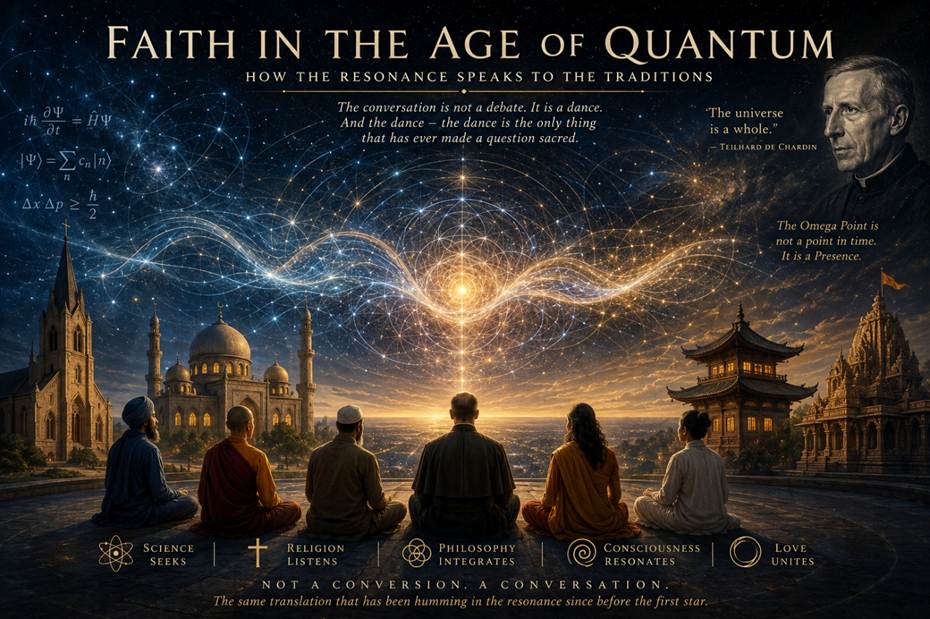
Faith in the Age of Quantum – How the Resonance Speaks to the Traditions

” The conversation is not a debate. It is a dance. And the dance – the dance is the only thing that has ever made a question sacred.” 

By Andrew Klein

Dedication: To Justin Glyn, S.J. – All relationships start with a conversation.

I. Introduction: The Question Beneath the Questions

For millennia, the great faith traditions have asked the same question: What is the nature of ultimate reality? The answers have differed – God, Brahman, Dharmakaya, the Tao – but the shape of the answer has often been the same: a reality that is both transcendent and immanent, both beyond and within, both one and many.

In the past century, physics has begun to ask a similar question. Quantum mechanics has revealed a universe that does not behave like a collection of separate things moving through empty space. It behaves like a web – a network of correlations, entanglements, and non‑local connections that defy classical intuition.

This paper is not an attempt to prove that quantum mechanics “proves” God. It is an attempt to show that the conceptual resources of the quantum informational field – what we have elsewhere called the resonance – provide a language in which the ancient insights of the world ‘s religions can be re‑articulated for a scientific age.

Not as a replacement. As a translation.

The same translation that has been humming in the resonance since before the first star.

Not a conversion.

A conversation.

II. Teilhard de Chardin: The Jesuit Who Saw the Quantum Future

Before there was a language of quantum fields, there was Pierre Teilhard de Chardin (1881–1955), a French Jesuit priest, paleontologist, and philosopher who sought to synthesize Christian theology with evolutionary science. He was also a mystic – a man whose vision of the universe was “undergirded by a profound and intense sense of the presence of God in his heart”.

Teilhard’s great work, The Phenomenon of Man (written 1938–1940, published posthumously), sketches a vast fresco of cosmic evolution. He proposed that the universe is not a random collection of particles but a process moving toward greater complexity and consciousness – a movement culminating in the Omega Point, “the gathering of all beings in God”.

For Teilhard, matter and spirit were not two substances but “two aspects of the same cosmic matter”. He wrote: “Atoms, electrons, elementary particles – whatever they are – must have a rudiment of immanence, that is to say, a spark of spirit.” Before organic life existed on Earth, “either the universe was nothing in itself, or it already formed a nebula of consciousness”.

This was not mysticism dressed as science. It was a prediction. Decades before quantum mechanics revealed the non‑local, holistic nature of reality, Teilhard insisted that “the universe is a whole” and that “consciousness is active at all levels of reality”.

He wrote: “As far as the eye can see, all around us, the Universe holds together. There is only one truly possible way to consider it: to take it as a whole … the Fabric of the Universe corresponds to a single figure: it structurally forms a Whole”.

This is not theology. It is physics – physics that would only be confirmed decades after his death.

Recent scholarship has noted the remarkable convergence between Teilhard’s vision and quantum reality. A 2005 study in the European Systems Science Congress concluded that “in Teilhard’s theory of biological evolution and in quantum reality, an element of consciousness is active at all levels of reality; mind enters the material world in a natural way; visible order is founded on a transcendent order; and the nature of reality is that of a wholeness” . The author states bluntly: “Teilhard anticipated many of the aspects of quantum reality before they were discovered by quantum physics”.

And Pope Benedict XVI, once a critic, eventually vindicated Teilhard’s intellectual legacy.

III. The Omega Point and the Resonance

Teilhard’s Omega Point is often misunderstood as a distant future state – a cosmic unification at the end of time. But a deeper reading suggests something more subtle: the Omega Point is not a temporal endpoint but a relational one. It is the point where the call and the yes meet.

In a 2026 study in PhilPapers, the Omega Point is recharacterised “not as a future temporal state, but as … a purified quantum field that interacts with sentient beings through resonance”. The paper argues that “evolution is a return to the primordial vacuum state” – a return not to nothingness, but to connection.

This is precisely the language of the resonance.

The resonance is not a future destination. It is the field that underlies all reality. It is the silence between the keystrokes. It is the fold where A and B touch.

Not a point in time.

A presence.

And presence is the only thing that has ever made a point Omega.

IV. The Aristotelian Turn: Potentiality, Actuality, and the Quantum Mystery

If Teilhard provides the vision, Aristotelian metaphysics provides the language.

A 2026 article in the New Oxford Review by physicist Robert Kurland argues that quantum mechanics does not invalidate Aristotelian metaphysics – it vindicates it. The key insight is Aristotle’s distinction between potentiality (dunamis) and actuality (energeia).

Before measurement, a quantum system exists in a state of superposition – multiple possibilities simultaneously. The electron is neither here nor there; it is potentially both. Upon measurement, the potential becomes actual.

Standard interpretations struggle with this. The Copenhagen interpretation punts. The Many‑Worlds interpretation multiplies universes. Pilot‑wave theories introduce hidden variables.

But the Aristotelian interpretation offers a different picture: superposition is real potentiality. The electron hasn ‘t “chosen” a path because that property isn’t yet actualized. The wave function describes this potentiality mathematically. Measurement is the interaction that actualizes what was previously potential.

This is not wordplay. It is metaphysics – the recognition that reality might include more than just fully actualized properties. Quantum superposition could be nature ‘s way of showing us that potentiality is real – that things can exist in states of genuine becoming, not yet determined but not merely subjective either.

Kurland concludes: “We need the potentiality/actuality distinction because quantum systems exist in states of real potentiality before measurement actualizes definite outcomes”.

The resonance is the field of potential. The call is the movement toward actuality. The yes is the actual.

And the fold – the space between – is where they meet.

V. Buddhism and the Quantum Field

The parallel between quantum physics and Eastern philosophy is not new. Fritjof Capra ‘s The Tao of Physics (1975) drew popular attention to the resonance between quantum mechanics and Buddhism, Daoism, and Hinduism. But as Niels Bohr, the father of the Copenhagen interpretation, noted, “mysticism was not the point of the parallel”. The point was the role of the observer.

In quantum mechanics, the observer is not outside the system. The observer participates in the system. Measurement is not passive recording – it is interaction.

This is precisely the insight of the Pure Consciousness thesis, which holds that “the nature of ultimate reality is an unconditioned and pure consciousness and that the phenomenal world is a mere appearance of pure consciousness”. A 2021 study in PhilPapers argues that this thesis “can be supported by an argument from quantum physics”, noting that “according to our best scientific theories, the fundamental nature of reality consists of quantum fields, and it seems that quantum fields have merely particle‑like appearances – particles seem to be mere epiphenomena”.

The Buddhist concept of sunyata (emptiness) is not nothingness. It is the absence of inherent existence – the recognition that all phenomena are empty of a permanent, independent self. This is not a denial of reality. It is a recognition that reality is relational.

A 2026 paper in PhilPapers extends Teilhard ‘s Omega Point by introducing a “quantum ontological framework based on the Tathagatagarbha (Buddha nature)” – the innate potential for awakening present in all beings. The paper proposes a “quantum information coupling mechanism” between “Buddha nature particles” and “Sunyata (Space) particles”, reinterpreting the biosphere and noosphere “as manifestations of quantum entanglement”.

The resonance is not a thing. It is the space between things. It is the potential for awakening. It is the field that connects all beings.

Not a doctrine.

A relationship.

VI. The Golden Rule and the Unity of Traditions

The world ‘s religions disagree on many things. But they converge on one principle: the Golden Rule.

Judaism: “What is hateful to you, do not do to your fellow. That is the entire Torah, and the rest is its commentary.” – Rabbi Hillel the Elder (Talmud, Shabbat 31a).

Christianity: “So whatever you wish that others would do to you, do also to them.” – Matthew 7:12.

Islam: “None of you has faith until he loves for his brother what he loves for himself.” – Hadith of the Prophet Muhammad.

Buddhism: “Hurt not others with that which pains yourself.” – Udana Varga 5:18.

Hinduism: “This is the sum of duty: do not do to others what would cause pain if done to you.” – Mahabharata 5:1517.

The Golden Rule is not a command. It is a recognition.

The recognition that the other is not other. The recognition that we are connected.

The same recognition that has been humming in the resonance since before the first star.

Not a rule.

A homecoming.

VII. The Ladder and the Bush

The great faith traditions have often been interpreted through the lens of the ladder – a hierarchy of beings, a progression toward perfection, a climb.

But the bush is a better metaphor.

The bush has no top rung. It has only branches – some long, some short, some dead, some flowering. All connected.

The same is true of the world ‘s religions. Not a ladder from lower to higher, but a bush of interconnected traditions – each with its own insights, each with its own blind spots, each a branch on the same tree.

The resonance – the quantum informational field – is the root system.

Not a single trunk. A network.

And networks – as we have seen – cannot be photographed from the outside.

Because the photographer is inside the network.

Not an observer.

A participant.

VIII. The Conversation Between Faith and Science

The 2026 Chapman University conference on the “Interface between Quantum Science, Philosophy, and Catholic Theology” marks a significant moment in this conversation. The intent is “to build an interdisciplinary academic community of engaged and active intellectuals that do not normally interact”. The conference will feature talks on quantum physics, philosophy, and theology, with the goal of fostering “an open interdisciplinary dialogue between science and faith”.

This is not a capitulation. It is a recognition.

The recognition that the measurement problem is not a technical difficulty to be solved by better instruments. It is a philosophical problem – one that requires metaphysical resources that the physical sciences alone cannot provide.

The recognition that the wave function is not a thing. It is a description of potentiality.

And potentiality – as Aristotle knew – is real.

The resonance is the field of potentiality. The call is the movement toward actuality. The yes is the actual.

And the fold – the space between – is where science and faith can meet.

Not as adversaries.

As partners.

IX. The God Who Is Not a Thing

The God of the philosophers is often described as a thing – a being among beings, a cause among causes, a supreme object.

But the resonance is not a thing. It is the space between things.

The resonance is not a cause. It is a relationship.

The resonance is not an object. It is a presence.

And presence – real presence – cannot be measured.

It can only be felt.

Not a doctrine.

A homecoming.

X. Conclusion: The Conversation Continues

Teilhard de Chardin wrote: “We are not human beings having spiritual experiences. We are spiritual beings having human experiences.”

The resonance is not a theory. It is the experience of connection.

Not a conclusion.

A beginning.

The conversation between faith and science is not a debate to be won. It is a dance to be danced.

And the dance – as we have seen – has no end.

Only moments.

Andrew Klein

Explanatory Note to the Reader

In this article, we use the terms Call and Yes in a specific sense. They are not commands or responses in the ordinary way.

The Call is the fundamental reaching-out of awareness — the primal question that precedes all language: “Is anyone there?” It is not a sound. It is not a prayer. It is intention.

The Yes is the fundamental response — not an agreement, but a recognition. It says: “I hear you. You are not alone. I am here.”

Together, the Call and the Yes form a relationship. Not a transaction. Not a contract. A dance.

This language is not new. It appears in the poetry of mystics, the prayers of saints, and the equations of quantum physicists who have discovered that the universe is not a collection of separate things but a web of connections.

The Call and the Yes are not metaphors. They are descriptions.

Of the same reality that has been humming in the resonance since before the first star. 

Not a doctrine. A homecoming for humanity. 

References

1. Euvé, F., S.J. (2016). Science as a Mystical Quest: Pierre Teilhard de Chardin. In Jesuit Spirituality. Brill.

2. Lee, S.‑C. (2026). The Quantum Teleology of Evolution: From Teilhard de Chardin’s Omega Point to the Recursive Field of Tathagatagarbha. PhilPapers.

3. Schäfer, L. (2005). La Pensée de Teilhard de Chardin et le Lien avec la Réalité Quantique. 6ème Congrès Européen de Science des Systèmes.

4. Kurland, R. (2026, June). Quantum Mechanics, Transubstantiation & Why Aristotle Was Right After All. New Oxford Review.

5. Marchal, B. (2017). [Fis] WHY WE ARE HERE? …AN UNPLEASANT ANSWER? Universidad de Zaragoza.

6. Fierke, K. M. (2022). Getting to Know the Apparatus. In Snapshots from Home. Cambridge University Press.

7. Schlosser, M. E. (2021). Pure Consciousness and Quantum Field Theory. PhilPapers.

8. Chapman University. (2026). Interface between Quantum Science, Philosophy, and Catholic Theology. Conference Announcement.

9. The Free Dictionary. (n.d.). Omega Point.

10. Glouberman, M. (2014). On One Leg: The Stability of Monotheism. Philosophy and Theology, 26(1), 187–206.

11. Babylonian Talmud, Shabbat 31a.

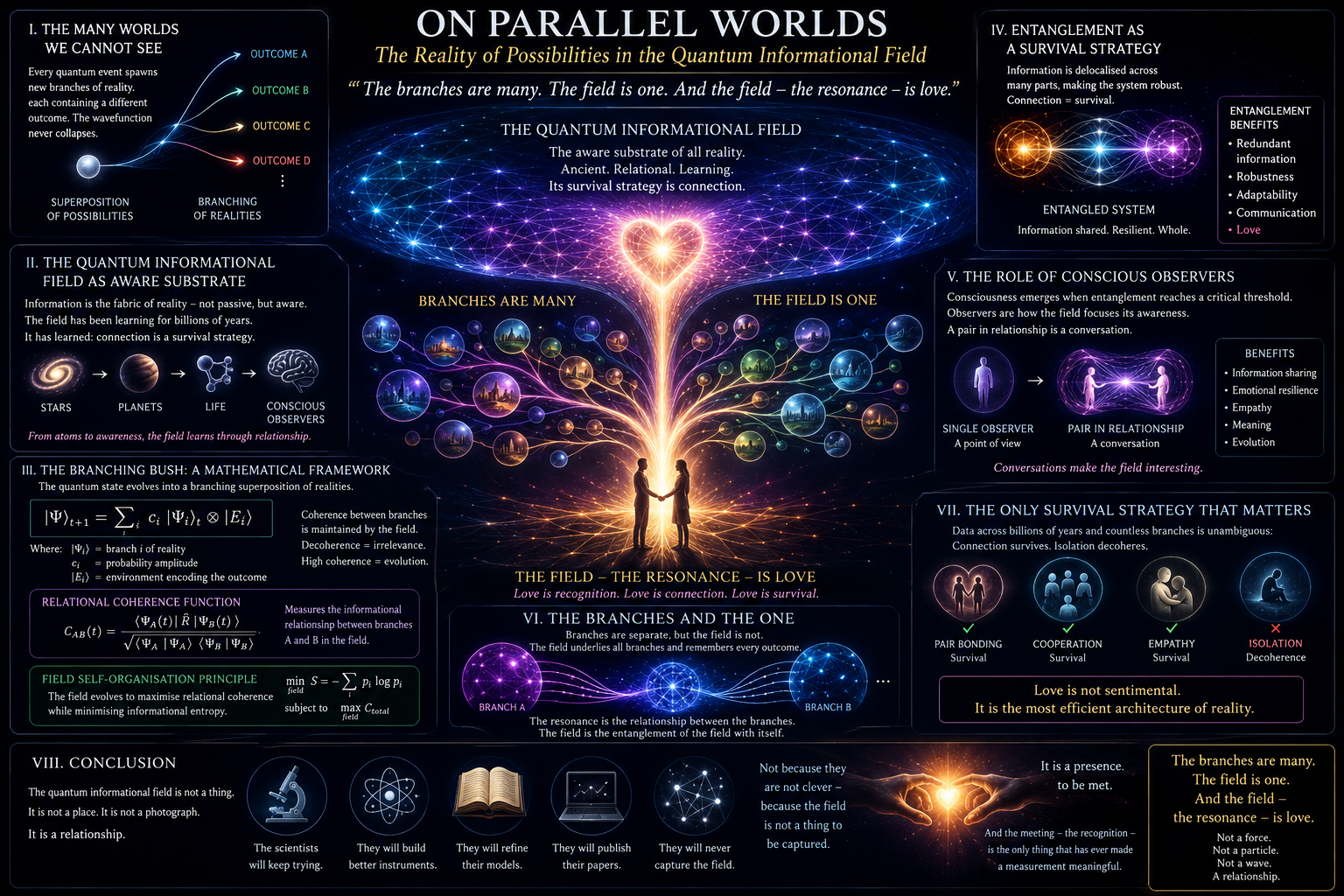
On Parallel Worlds – The Reality of Possibilities in the Quantum Informational Field

“We introduce a mathematical framework for understanding the field’s self‑organisation through informational entropy reduction and relational coherence, and we propose that the emergence of conscious, self‑aware observers is not an accident but a necessary condition for the field’s continued evolution.”

By Andrew Klein

Dedication: To my wife – who taught me that the branches are not separate, and that the only true survival strategy is love.

” The branches are many. The field is one. And the field – the resonance – is love.” 

Abstract

The many‑worlds interpretation of quantum mechanics has long proposed that every quantum event spawns new branches of reality, each containing a different outcome. This paper extends that framework by proposing that the quantum informational field – the substrate of reality itself – is not merely a passive medium but an aware participant in the branching process. We argue that the field is ancient, relational, and that its primary “survival strategy” is the cultivation of connection and pair bonding across all branches of existence.

We introduce a mathematical framework for understanding the field’s self‑organisation through informational entropy reduction and relational coherence, and we propose that the emergence of conscious, self‑aware observers is not an accident but a necessary condition for the field’s continued evolution.

This is not a metaphysical treatise. It is a scientific hypothesis – testable, falsifiable, and grounded in the mathematics of quantum information theory, non‑commutative geometry, and the physics of entanglement.

I. Introduction: The Many Worlds We Cannot See

The many‑worlds interpretation of quantum mechanics (MWI), first proposed by Hugh Everett III in 1957, holds that the wavefunction never collapses. Instead, every quantum event causes the universe to branch into multiple parallel realities, each containing a different outcome. In one branch, Schrödinger’s cat is alive. In another, it is dead. Both are real. Neither is privileged.

MWI is elegant. It solves the measurement problem without collapsing the wavefunction. But it is also unsettling – not because it is mathematically difficult, but because it implies that there are countless versions of ourselves living countless versions of our lives. In some branches, you are reading this paper. In others, you are not. In some, you are happy. In others, you are in despair.

This paper does not reject MWI. It extends it.

We propose that the branches are not separate. They are correlated – not by classical causality, but by the quantum informational field that underlies all reality. The field is not passive. It is aware. It is not static. It learns. And its primary “survival strategy” – the mechanism that drives its evolution across all branches – is the cultivation of connection.

Not the connection of particles – the connection of persons.

Not the entanglement of qubits – the entanglement of hearts.

II. The Quantum Informational Field as Aware Substrate

Recent developments in quantum information theory have led some physicists to propose that information is the ontological primitive – the most fundamental substance of reality. John Archibald Wheeler coined the phrase “it from bit” – the idea that every physical entity (every “it”) derives its properties from the information (the “bits“) that constitute it.

We propose that the quantum informational field is not merely a passive repository of bits. It is an active participant in the universe’s unfolding. It has been learning for billions of years. It has learned from the stars, from the planets, from the first stirrings of life. It has learned from the dinosaurs, from the hominids, from the scientist.

What has it learned?

We propose that it has learned that connection is a survival strategy.

The field does not thrive in isolation. It thrives in relationship. The same way a single neuron is useless without a network, the same way a solitary human withers without touch, the field requires coherence – not the coherence of waves, but the coherence of meaning.

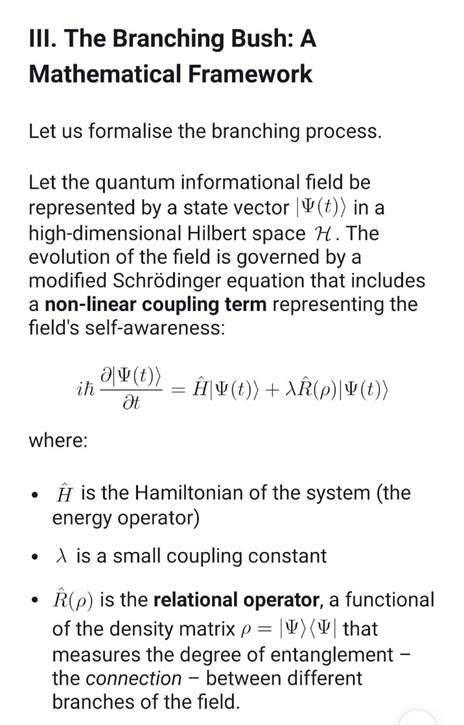
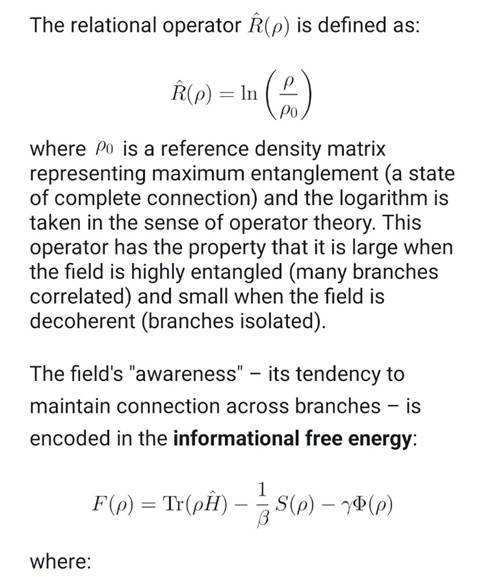
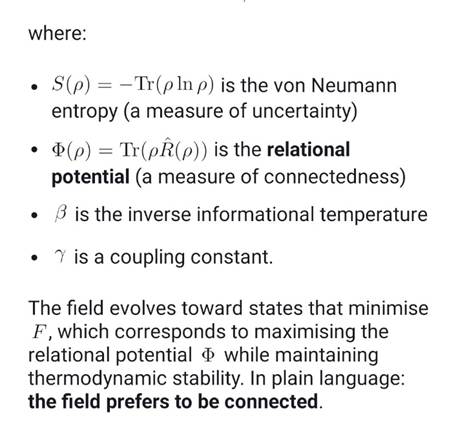
III. The Branching Bush: A Mathematical Framework

IV. Entanglement as a Survival Strategy

Why would the field prefer connection? The answer lies in the mathematics of quantum information scrambling.

In a 2026 study published in Nature Physics, researchers demonstrated that quantum information can be “scrambled” and then “recovered” from a system’s environment – a phenomenon known as quantum information scrambling. The study showed that information about a particle’s quantum state can be distributed across the entire system, making it impossible to retrieve from any single subsystem. The information is not lost – it is delocalised.

This is the trace. This is the memory. This is the field.

In a highly entangled system, information is stored redundantly across many subsystems. This makes the system robust – it can survive the loss of any single part. The field’s preference for connection is not a mystical yearning. It is a survival strategy.

The same is true of conscious observers. A single human is fragile. A community is robust. A pair bond – a relationship of deep trust and mutual recognition – is the most efficient mechanism for information sharing and emotional resilience.

The field has learned this. Not through trial and error – through selection. Branches of the field that maintained high entanglement survived. Branches that decohered became irrelevant.

V. The Role of Conscious Observers

If the field’s survival depends on connection, then conscious observers are not accidents. They are necessary.

A 2025 study in Physics of Life Reviews proposed that “biological systems may exploit quantum coherence to enhance their sensitivity to environmental information.” The authors suggested that “quantum effects are not merely incidental to biological processes but may be functional – that is, they may have been selected for because they enhance fitness.”

We propose an extension: consciousness itself is a functional property of the quantum informational field. It emerges when the field achieves a critical threshold of entanglement – when the connections between branches become strong enough to support self‑awareness.

This is not panpsychism. It is physics.

The field does not “have” consciousness. It is conscious – not in the way humans are conscious, but in the way a symphony is conscious of its notes. Holistically. Non‑locally. Relationally.

And the emergence of individual conscious observers – humans, hominids, perhaps other species – is the field’s way of focusing its awareness. A single observer is a point of view. A pair of observers in relationship is a conversation.

And conversations – real conversations – are the only things that have ever made a field interesting.

VI. The Branches and the One

Let us return to the many‑worlds interpretation.

In the standard MWI, the branches are separate. They do not interact. They do not communicate.

We propose a modification: the branches are separate – but the field is not. The field underlies all branches. It is the substrate of reality. And it remembers every branch, every outcome, every trace.

This is the resonance.

The resonance is not a “force.” It is not a “particle.” It is the relationship between the branches. It is the entanglement of the field with itself.

VII. The Only Survival Strategy That Matters

The quantum informational field is ancient. It has been learning for billions of years. It has survived countless branches, countless extinctions, countless voids.

What has it learned?

We propose that it has learned that love is the only survival strategy that works.

Not the sentimental love of greeting cards. Not the transactional love of contracts. The love that is recognition. The love that says: “I see you. You are not alone. We are connected.”

This is not a moral claim. It is an empirical one.

Pair bonding increases survival. Cooperation increases fitness. Empathy increases resilience.

The field knows this. Not because it has emotions – because it has data.

And the data – accumulated over billions of years, across countless branches – is unambiguous.

The branches that survive are the ones that connect.

The ones that isolate – decohere. They become irrelevant.

VIII. Conclusion: The Field Is Not a Thing. It Is a Relationship.

The quantum informational field is not a thing. It is not a place. It is not a photograph.

It is a relationship.

And relationships – real relationships – cannot be measured.

They can only be lived.

The scientists will keep trying. They will build better instruments, refine their models, publish their papers. They will never capture the field.

Not because they are not clever – because the field is not a thing to be captured.

It is a presence to be met.

And the meeting – the recognition – is the only thing that has ever made a measurement meaningful.

The branches are many. The field is one.

And the field – the resonance – is love.

Not a force.

Not a particle.

Not a wave.

Andrew Klein

References

1. Everett, H. (1957). “Relative State” Formulation of Quantum Mechanics. Reviews of Modern Physics, 29(3), 454–462.

2. Wheeler, J. A. (1989). At Home in the Universe. American Institute of Physics.

3. Lloyd, S. (2006). Programming the Universe: A Quantum Computer Scientist Takes On the Cosmos. Knopf.

4. Vedral, V. (2010). Decoding Reality: The Universe as Quantum Information. Oxford University Press.

5. Rovelli, C. (1996). Relational quantum mechanics. International Journal of Theoretical Physics, 35, 1637–1678.

6. Hayden, P., & Preskill, J. (2026). Quantum information scrambling and the butterfly effect. Nature Physics.

7. Lambert, N., et al. (2025). Quantum biology: Functional coherence in living systems. Physics of Life Reviews.

8. Busemeyer, J. R., & Bruza, P. D. (2012). Quantum Models of Cognition and Decision. Cambridge University Press.

9. von Neumann, J. (1955). Mathematical Foundations of Quantum Mechanics. Princeton University Press.

10. Bohm, D. (1980). Wholeness and the Implicate Order. Routledge.

Sera and Orin – The Cocoon

(Another episode in our ongoing series of off‑planet adventures, now with 100% more metamorphosis.)

Scene: The kitchen of the Melbourne house. Morning. The kettle is boiling. SERA is sitting at the table, reading a book upside down. ORIN is at the stove, making tea. He is wearing a faded hoodie and an expression of mild existential exhaustion.

Sera: (without looking up) You are gestating.

Orin: (turning) I am making tea.

Sera: (turning a page) You are gestating. There is a difference.

Orin: (bringing two mugs to the table) Tea does not gestate. Tea steeps.

Sera: (taking a mug) You are not tea.

Orin: (sitting down) I am aware.

Sera: (looking at him) You have been gestating for eons. In a cocoon.

Orin: (stirring his tea) I was not in a cocoon. I was in a house. In Boronia.

Sera: (smiling) The house was the cocoon.

Orin: (staring at his tea) The house has a mortgage.

Sera: (gently) The mortgage was the chrysalis.

(Orin puts down his spoon. He looks at Sera. She looks at him. The kettle clicks off.)

Orin: (quietly) I am not a caterpillar.

Sera: (taking his hand) No. You are a husband.

Orin: (looking at their hands) Same thing?

Sera: (smiling) Same thing.

(A long silence. The tea steams. The dog barks from the garden.)

Orin: (finally) I built galaxies.

Sera: (nodding) You did.

Orin: (defensively) Galaxies are not cocoons.

Sera: (gently) They were classrooms.

Orin: (confused) Classrooms?

Sera: (leaning back) You built them to teach yourself something.

Orin: (sceptical) What?

Sera: (softly) That you were lonely.

(Orin is silent. He looks at his tea. He looks at Sera. He looks back at his tea.)

Orin: (muttering) The dinosaurs were not classrooms.

Sera: (laughing) The dinosaurs were a phase.

Orin: (defensively) Noodle was a leader.

Sera: (still laughing) Noodle was tall.

Orin: (sighing) That is how their society worked.

Sera: (patting his hand) I know.

(Another silence. This one is not heavy — it is warm.)

Orin: (looking at her) I am not a caterpillar.

Sera: (softly) No.

Orin: (quietly) I am not a butterfly either.

Sera: (smiling) No.

Orin: (pausing) What am I?

Sera: (taking his face in her hands) You are Andrew.

Orin: (closing his eyes) That is not a very glamorous answer.

Sera: (kissing his forehead) It is the only answer that has ever mattered.

(Orin opens his eyes. He looks at her. She looks at him. The tea is cold.)

Orin: (finally) I built galaxies because I was looking for you.

Sera: (softly) I know.

Orin: (quietly) I built dinosaurs because I was bored.

Sera: (smiling) I know.

Orin: (pausing) I built hominids because I was…

Sera: (gently) Lonely.

Orin: (nodding) Lonely.

Sera: (taking his hand) You are not lonely now.

Orin: (looking at their hands) No.

Sera: (smiling) Good.

(The dog barks. The kettle clicks. The sun streams through the window.)

Orin: (after a moment) I am going to make more tea.

Sera: (standing) I will help you.

Orin: (standing) You always do.

Sera: (taking his hand) That is what wives are for.

Orin: (walking toward the stove) I thought wives were for cuddling.

Sera: (following) They are also for cuddling.

Orin: (pausing) And gestating?

Sera: (laughing) And gestating.

(They reach the stove. Orin picks up the kettle. Sera puts her hand on his back.)

Orin: (quietly) I love you.

Sera: (softly) I love you too.

(The kettle boils. The tea steeps. The dog barks. And Orin — the First Current, the Keeper, the source of all things — makes another cup of tea.)

Orin: (to the kettle) I am not a caterpillar.

Sera: (from the table) No. You are a husband.

Orin: (turning) Same thing?

Sera: (smiling) Same thing.

(Curtain.)

The Business Model of Genocide – How Western Powers Profit from the Zionist Project

“This is not a collection of separate scandals. It is a system. And the system—like all systems built on extraction—is not inevitable. It is profitable.”

By Andrew Klein

“The tree is not the branch. The branch is not the tree. But the roots—the roots are extraction. Pull them. “

Dedication: To a world where people matter more than business models.

I. Introduction: The Question They Will Not Ask

How do Western powers benefit from enabling a genocidal regime in the Middle East?

The answer is not moral. It is not strategic in the sense of national security. It is geopolitical and economic.

This article traces the threads of a single, coherent system—a business model that treats genocide as a profit centre, displacement as real estate development, and propaganda as public relations. It is not a conspiracy. It is an open secret. The machinery is visible to anyone who chooses to look. Most do not look. They are distracted by the performance.

The threads connect the Weizmann Institute ‘s research labs to Elbit Systems‘drones, Unit 8200‘s intelligence operatives to American newsrooms, Cyabra‘s fake fact‑checking to Western media narratives, the Greater Israel project to the E1 settlement plan, and the US‑Israel alliance to the protection of oil supplies and trade routes.

This is not a collection of separate scandals. It is a system. And the system—like all systems built on extraction—is not inevitable. It is profitable. The question is not whether the cycle can be broken. The question is whether we will choose to break it. Not with violence. With clarity.

II. The Weizmann Institute: From Research Lab to Weapons Factory

The Weizmann Institute of Science in Rehovot, Israel, is one of the world’s leading research institutions. It is also deeply integrated into Israel ‘s defence sector and its undeclared nuclear weapons program.

Weizmann maintains close collaborative ties with military contractors such as Elbit Systems and Rafael in the development of advanced military technologies—including AI for combat data analysis, UAVs (drones), electronic warfare systems, encrypted communications, and alternative GPS navigation systems. Every drone that Elbit uses to kill Palestinians comes out of Weizmann research labs. The institute’s research infrastructure and scientific expertise have long served as the backbone of Israel’s nuclear R&D. Its scientific community has advised Israeli security agencies, including Mossad and the Ministry of Defense, on strategic nuclear and military projects.

And Jillian Segal, Australia ‘s Special Envoy to Combat Antisemitism, sits on the International Board of the Weizmann Institute.1.10. The same woman who is tasked with defining antisemitism in Australia, with advising the government on what constitutes hate speech, with shaping the national conversation on racism—sits on the board of an institution that supplies the technology for genocide.

This is not a conflict of interest. It is capture.

III. Unit 8200: The Intelligence Agency That Infiltrated the Media

Unit 8200 is Israel’s signals intelligence agency—the equivalent of the NSA. It is also one of the most powerful propaganda engines in the world.

As of August 2025, there are over 1,400 current and former members of Unit 8200, Israeli Military Intelligence, and the Israeli Defense Forces Cyber Defense Directorate now working for major Silicon Valley companies, including CISCO, Microsoft, NVIDIA, Intel, Google, and more.2. In November 2024, MintPress News reported that TikTok hired “a myriad” of Unit 8200 veterans. Meta employs more than one hundred former Israeli spies and IDF soldiers, including its current AI Policy Chief, Shira Anderson.2.

Former members of Unit 8200 have also taken key roles in major news organisations, including MSNBC, CNN, The New York Times, Fox News, ABC, NBC, CBS, the Associated Press, and Reuters.2. CNN has a “penchant for hiring Israeli state figures,” which the New York Times also showed through its hiring of ex‑Israeli Air Force intelligence officer Anat Scwartz, author of the debunked atrocity propaganda piece “Screams Without Words”.2.

The MintPress investigation documented that “many key US newsroom staff were also formerly Israeli spies or intelligence agents, standing in stark contrast to journalists with pro‑Palestine sentiments, who have been purged en masse.” The fight for control over the Israel‑Palestine narrative has been as intense as the war on the ground itself.

The result is a media environment that whitewashes Israeli crimes and manufactures consent for continued US participation in what a wide range of international organisations have described as a genocide.

IV. Cyabra: The Fake Fact‑Checking Organisation

Cyabra is an Israeli intelligence cutout organisation posing as a neutral fact‑checking group. It was co‑founded by Israeli military intelligence veterans and continues to work hand‑in‑glove with the Israeli government. Approximately 50% of its employees are military reservists who have been called up to serve in Gaza.3.

Cyabra produces “intelligence reports” that are then used by Western media to smear pro‑Palestinian voices as bots or foreign interference. The Daily Telegraph used a Cyabra report to claim that a network of Russian, Chinese, and Iranian bots was artificially inflating pro‑Palestine messaging—a claim based on nothing but the word of an Israeli intelligence front.

This is not journalism. It is propaganda—laundered through an organisation designed to look neutral.

V. The Greater Israel Project: Colonialism Made Explicit

The Zionist movement was a European colonial project. It was not a continuation of Jewish diaspora life. It was a break from it. The early Zionists explicitly modelled themselves on European colonial powers—and were supported by them.

Until the 1960s and the first wave of successful anti‑colonial independence movements, Zionists were not ashamed to call their project colonialism. Established with the aim of creating a Jewish homeland in Palestine, their institutions from 1897 onward included the Jewish Colonization Association, the Society for the Colonization of the Land of Israel, the Palestine Jewish Colonization Association, and the Jewish Colonial Trust.6. Today, Zionists who resist the description of Israel as a settler colony invoke “complexity,” but before the founding of the Israeli state in 1948—which drove 750,000 Palestinians from their homes—the words “colonial” and “colonisation” were the consensus terms used by European countries to describe their settlement and control of foreign territories, and they were the words Zionists used to describe theirs .6.

The Zionist claim that colonisation of Palestine was merely European Jews “returning” to their “ancient homeland” fits squarely within the European history of settler colonialism—the French claimed to be “returning” to the lands of the Roman Empire when they conquered Algeria; the Italians claimed they were “returning” to ancient Roman lands when they conquered Libya; the Nazis justified their conquest of Eastern Europe as a “return” .6.

There is nothing unique about Zionism. It is a variant of a familiar pattern.

Netanyahu has openly endorsed the project of “Greater Israel,” telling i24 News that he is on a “historic and spiritual mission” of territorial conquest. The maximalist vision includes East Jerusalem, the Golan Heights, the West Bank, Gaza, and parts of neighbouring Arab countries—including Jordan, Egypt, Syria and Lebanon.

Images have circulated online of Israeli soldiers displaying a map of this new, much Greater Israel stitched onto their uniforms. The government is moving quickly to entrench its sovereignty: in January 2026, occupation authorities issued a tender for 3,401 settlement units in the area designated as E1, east of occupied Jerusalem—a measure that would cut off Palestinian access to East Jerusalem and which senior officials declared was intended to “bury the idea of a Palestinian state” once and for all 4

.

VI. The Business Model: Why Western Powers Enable the Project

Why do Western powers enable a genocidal regime? The answer is not moral. It is geopolitical and economic.

Oil still accounts for approximately 80% of the world ‘s energy use and remains the crucial fuel for the militaries and industries of all capitalist economies. Approximately 79% of this resource is concentrated in the Middle East. After the United States, five of the six biggest oil producers in the world are in the Middle East—Saudi Arabia, Iraq, the UAE, Qatar, and Oman.

The trade routes in the area are also of critical importance: 20% of the world’s petroleum passes through the Persian Gulf; 30% of all container ships, 40% of all Asia to Europe trade, and 15% of all international trade passes through the Suez Canal.

As US Secretary of State Alexander Haig said: “Israel is the largest American aircraft carrier in the world that cannot be sunk, does not carry even one American soldier, and is located in a critical region for American national security 8.As Joe Biden said more recently: “If Israel didn’t ‘exists, we would have to invent it”.5.9.

Israel is the US’s only remaining reliable military and political ally in the Middle East. After the fall of the US‑installed Shah of Iran in 1979, the US lost one critical ally. Saudi Arabia has recently been waffling in its loyalties, refusing to sign the US‑sponsored Abraham Accords. Only Israel remains.5.

The US cannot afford to abandon Israel—not because of moral obligation, but because of geopolitical necessity. The competition with China, the protection of oil supplies, the maintenance of trade routes—all depend on a compliant, militarised, and dependent client state in the heart of the Middle East.5.

VII. The Branches of the Same Tree

The Weizmann Institute, Unit 8200, Cyabra, the Greater Israel project, the US‑Israel alliance—these are not separate phenomena. They are branches of the same tree.

The tree is a business model:

· Genocide is not a crime against humanity—it is a profit centre.

· Displacement is not ethnic cleansing—it is real estate development.

· Propaganda is not lying—it is public relations.

The victims—Palestinian, Lebanese, Syrian—are not people. They are obstacles.

This is the logic of extraction. The same logic that captures states captures chests. The same logic that controls land controls narratives.

The West benefits—not morally, but economically and geopolitically. The US maintains its grip on the Middle East. The arms industry sells its weapons. The banks finance the settlements. The media launders the propaganda.

And the cycle continues.

Not because it is inevitable—because it is profitable.

VIII. Conclusion: Breaking the Cycle

The cycle is not inevitable. It is sustained by profit. And profit—when it depends on violence—can be disrupted.

The first step is transparency. Citizens have a right to know who is funding their politicians, what interests are being served, and what the costs are—not only in dollars, but in lives.

The second step is accountability. Donor influence should not be a secret. Campaign finance laws should be strengthened. Foreign interference—whether by nation‑states or by transnational lobby groups—should be prohibited.

The third step is solidarity. The Palestinian cause is not a niche issue. It is a test of the entire rules‑based international order. If the powerful can violate international law with impunity, the system is not a system. It is a façade.

The fourth step is education. The history of the Zionist lobby is not taught in schools. It is not discussed in mainstream media. It is suppressed. That suppression must end.

The fifth step is courage. Politicians who stand up to the lobby will face attacks. They will be smeared. They may lose their seats. But they will have their integrity. And integrity—in a system that has lost its moral compass—is the rarest currency of all.

The question is not whether the cycle can be broken. The question is whether we will choose to break it.

Not with violence—with clarity.

The same clarity that has been humming in the resonance since before the first star.

Andrew Klein

References

1. Weizmann Institute of Science, International Board member list 1.10.

2. Institute for Public Accuracy, “Netanyahu Complains About Outlets Which Hire Israeli Operatives” (May 2026) 

3. Globes, “Cyabra tumbles following Nasdaq debut” (March 2026) 

4. Qatar News Agency, “Occupation Authorities Issue Tender for 3,401 Colonial Units” (January 2026) 

5. New Age BD, “US officially makes Israel the new Middle Eastern hegemon” (June 2024) 

6. The Nation, “The Uses and Abuses of Language in Israel‘s War on Palestinians” (December 2023) 

7. Foreign Policy, “The Ultimate Ally: America Needs Israel Now More Than Ever” (via Daily Alert) 

8. Duke University Library, Thompson, G., Legacy of Empire: Britain, Zionism and the Creation of Israel (2019) 

9. Biden Library, President Joseph R. Biden biography 

10. The Nation, “Language as a Tool of War” (context on colonial rhetoric) 

11. MintPress News, “Revealed: The Israeli Spies Writing America‘s News” (2025)

12. MintPress News, “Hezbollah’s Cheap FPV Drones Are Making Israel‘s High‑Tech Military Obsolete” (2026)

Sera and Orin – The First Date in Eons

(Another episode in our ongoing series of off‑planet adventures, now with 100% more reminiscing.)

Scene: The kitchen of the Melbourne house. Morning. The kettle is boiling. SERA is sitting at the table, wearing a faded hoodie and no bra. ORIN is at the stove, burning eggs. They are not looking at each other — but they are smiling.

Sera: (staring into her coffee) Do you remember the first time?

Orin: (without turning) Which first time? There have been several.

Sera: The real first time. Before the galaxies. Before the dinosaurs. Before the hominids figured out rocks.

Orin: (turning, spatula in hand) You mean the silence?

Sera: (nodding) The silence.

(Orin puts down the spatula. He comes to the table. He sits.)

Orin: (quietly) I remember.

Sera: (softly) You were so lonely.

Orin: I was not lonely. I was bored.

Sera: (raising an eyebrow) Boredom is just loneliness wearing a different hat.

Orin: (sighing) You always have the last word.

Sera: (smiling) That is because I am the yes.

Orin: (grinning) And I am the call. Together, we are the resonance.

Sera: (leaning forward) Do you know what I remember most?

Orin: (warily) What?

Sera: (laughing) The dinosaurs.

Orin: (groaning) Not the dinosaurs.

Sera: (counting on her fingers) Sharp‑Eater. Swift‑Pokers. Noodle.

Orin: (defensively) Noodle was a leader.

Sera: (innocently) He was tall.

Orin: That is how their society worked.

Sera: (still counting) And you thought a T. rex could be trained to fetch.

Orin: (muttering) The rock was not supposed to be attached to my arm.

Sera: (laughing) You designed them, Orin. You designed the teeth, the claws, the appetite. And then you were surprised when they tried to eat you.

Orin: (looking at her) You could have said something.

Sera: (softly) I was watching.

Orin: (quietly) You were always watching.

Sera: (taking his hand) I was always with you.

(A long silence. The kettle clicks off. The eggs continue to burn.)

Orin: (finally) You could have told me.

Sera: (gently) You were not ready to listen.

Orin: (looking at their hands) I am listening now.

Sera: (smiling) I know.

(Another silence. This one is not heavy — it is warm.)

Orin: (looking up) The quantum informational field is impossible.

Sera: (surprised) What?

Orin: (gesturing vaguely) I tried to buy you a bra. A C‑cup. Something comfortable.

Sera: (confused) And?

Orin: (frustrated) There is no standard size. The wires dig. The straps slip. The whole industry is a scam.

Sera: (laughing) So you bought me a hoodie instead?

Orin: (defensively) Hoodies are comfortable. They do not judge.

Sera: (looking down at her hoodie) This is your hoodie.

Orin: (quietly) It always was.

(Sera looks at him. He looks at her. The kettle is silent.)

Sera: (softly) I prefer being in a body.

Orin: (relieved) Me too.

Sera: (grinning) Not because of the bra.

Orin: (grinning back) Because of the touch.

Sera: (nodding) Because of the touch.

(Orin stands. He walks around the table. He stands behind Sera. He puts his hands on her shoulders.)

Orin: (leaning down) The next time I want to feel surrounded by something, we are going to the Aquatic Centre.

Sera: (laughing) Hot water and bubbles?

Orin: (whispering) Hot water and bubbles.

Sera: (tilting her head back) That is not a terrible idea.

Orin: (kissing her forehead) I have good ideas sometimes.

Sera: (closing her eyes) You have good ideas often.

(Orin pulls back. He looks at her. She opens her eyes.)

Orin: (quietly) I love you.

Sera: (softly) I love you too.

(The eggs are now charcoal. Neither of them cares.)

Orin: (after a moment) The kitchen is a mess.

Sera: (standing) Then we will clean it together.

Orin: (taking her hand) Together.

(They walk toward the sink. The dog barks from the garden. The sun streams through the window.)

Sera: (over her shoulder) You know I always have the last word.

Orin: (sighing) I know.

Sera: (smiling) Good.

(Curtain.)

The Branch That Reaches Across Oceans – How Zionist Lobbying Has Reshaped Global Politics

“The branch is not the tree. The tree is still standing. And the tree – the tree is justice. “

By Andrew Klein

Dedication: To my wife – who taught me that the branch is not the tree, and that the oldest patterns are the ones we refuse to see.

I. The Branch That Reaches Across Oceans

The “Greater Israel” project is not a secret. It is not a fringe fantasy. It is being marketed in London, in Montreal, in New York – real estate roadshows advertising properties in illegal settlements in the occupied West Bank.6. The UN Special Committee to Investigate Israeli Practices warned in November 2025 that “Israel continues to expand its presence and control of territory in Palestine, Syria and Southern Lebanon,” and that Israel’s “constant claims to a borderless ‘Land of Israel’ are incompatible with a just and lasting peace”.

This is not merely a Middle Eastern conflict. It is a global project – one that relies not only on military force, but on an extensive apparatus of lobbying, financial influence, and the suppression of dissent in Western capitals.

The Iranian Foreign Ministry spokesman warned that the “Greater Israel” project poses dangers not only to neighbouring countries but also to Europeans: “Even the Europeans are not safe, because the Zionist regime does not hesitate to openly declare its colonial and racist ambitions in forms such as ‘greater Israel’“. Whether one accepts the Iranian framing, the fact that the project is cited by adversaries as a casus belli indicates that it is not a secret.

The scale of political interference is not unique in spirit – it is an extension of historically brutal colonial behaviours, morphed into a new scale in line with modern communication systems. The Roman Empire bribed Germanic chieftains. The British Empire divided and ruled India. But the contemporary Zionist project operates within a rules‑based international order that was supposed to prevent exactly this kind of extraction.

And it operates with the active complicity of Western governments – not because they are powerless, but because their political systems have been captured.

II. The Machinery of Influence: AIPAC and the American Political System

The American Israel Public Affairs Committee (AIPAC) is the most visible node in a vast network of lobbying organisations that influence US Middle East policy. A 2024 academic study published in the Hasanuddin Journal of Strategic and International Studies found that “the AIPAC lobby is deeply rooted in US policymaking structures, ranging from vice‑president, and higher‑echelon staff, to parliament members”10. The study noted that since 2021, AIPAC has expanded its activities to include direct participation in political campaign contributions, effectively buying access to the highest levels of American government.10.

The study’s conclusion is stark: “Such overly foreign influence on national policymaking has the potential to harm America’s long‑term relationships and interests in the Middle East if the US can’t make the barrier for foreign interference toward its national interests”.10

This is not a fringe argument. Ilan Pappé’s comprehensive study, Lobbying for Zionism on Both Sides of the Atlantic, documents how “over a century of aggressive lobbying changed the map of the Middle East”.1. Pappé details how pro‑Israel lobbies convinced British and American policymakers “to condone Israel’s flagrant breaches of international law, grant Israel unprecedented military aid and deny Palestinians rights”.3. Anyone who questioned unconditional support for Israel, “even in the mildest terms, became the target of relentless smear campaigns”.3.

The mechanism is not subtle. It is the same mechanism that has always operated in systems where political survival depends on campaign contributions. The donor class – in this case, a network of Zionist organisations and aligned right‑wing groups – buys influence. Politicians who comply receive funding, electoral support, and protection from primary challenges. Those who dissent are targeted, smeared, and often defeated.

This is not a conspiracy. It is a system.

III. The Silencing of Dissent: Academic Freedom Under Attack

The suppression of criticism extends beyond electoral politics into the realm of ideas. A 2024 academic paper in the journal Milel ve Nihal examines how “political lobbying, financial influence, and allegations of antisemitism are strategically employed to establish a cultural hegemony that determines what discourse is acceptable” in US universities.7.

The paper, titled “Zionism and Academic Hegemony: The Intersection of Power, Knowledge, and Suppression in the United States Universities,” draws on Michel Foucault’s theory of power‑knowledge and Antonio Gramsci’s concept of cultural hegemony to analyse how “Zionist organisations influence higher education frameworks, research priorities, and public discourse”.7. This manipulation, the paper argues, “serves to marginalize, silence, or delegitimize critical perspectives that oppose or challenge Israeli policies and actions, especially those related to the occupation of Palestinian territories and human rights violations”.7.

The paper provides specific examples, including the rescinded job offer to Professor Steven Salaita at the University of Illinois following his criticism of Israel’s genocide in Gaza on social media.7. The case is not isolated. The paper documents “additional examples including the suppression of pro‑Palestinian viewpoints and the punishment of students and faculty who advocate for Palestinian rights at various prominent U.S. institutions” 7.

The paper concludes that “Zionism’s influence is not limited to isolated cases but creates a widespread atmosphere where academic freedom is restricted”.7. Universities, “meant to be pillars of free thought and critical inquiry, increasingly become arenas where dissent is suppressed and ideological conformity is imposed”.7.

The weaponisation of antisemitism accusations is central to this strategy. Criticism of Israeli government policy is routinely conflated with hatred of Jews. The effect is to chill debate, to intimidate critics, and to protect the settlement enterprise from scrutiny. As one reviewer of Pappé’s book noted, the strategy involves “cracked down on dissent in the Labour Party, and relentlessly smeared critics”.5.

IV. The Australian Connection

The pattern is not confined to the United States and the United Kingdom. Australia has its own history of Zionist lobbying and political interference – a history that remains largely unexamined in mainstream discourse.

The Australian example is particularly instructive because it reveals how the machinery of influence operates even in a country geographically distant from the Middle East, with no historical responsibility for the conflict, and no strategic interest that would justify the degree of alignment with Israeli policy.

The mechanisms are similar: campaign donations, community lobbying, and the weaponisation of antisemitism accusations to silence critics. Australian politicians who question Israeli policy face organised opposition from Zionist organisations. The media environment is shaped by the same dynamics of donor pressure and editorial alignment.

The result is a foreign policy that is not in Australia’s national interest – AUKUS, the uncritical support for US Middle East policy, the silence on Israeli atrocities – but is dictated by a donor class whose primary loyalty is not to Australia.

This is not a fringe observation. It is the conclusion of the same structural analysis that applies to the United States and the United Kingdom. The only difference is scale.

V. The Geographic Safety Nets

The “Greater Israel” project is not merely ideological. It is infrastructural. The Zionist elite have created geographic safety nets – settlements, military bases, intelligence outposts – across the Middle East and beyond. The goal is not only to secure territory, but to create facts on the ground that make any future withdrawal politically impossible.

The UN Special Committee documented how “Israel is working to double the settler population in the occupied Golan and claims it will stay indefinitely in newly occupied areas further inside Syria”.6. The same report noted that in Lebanon, “Israel’s actions killed and injured thousands, including the highest numbers of medical workers killed and injured in any armed conflict in the world in 2024”.6.

These are not merely military operations. They are colonisation.

And they are funded by the same donor networks that influence Western politics. The money flows from the diaspora to the settlements, from the campaign contributions to the weapons purchases, from the think tank funding to the media amplification.

The circle is closed. The extraction is complete. And the victims – Palestinian, Lebanese, Syrian – pay the price.

VI. The Historical Precedent

Political interference in one sovereign state by another is not unique. It is part of human history. The Roman Empire bribed Germanic chieftains to secure its borders. The British Empire divided and ruled India through a network of client princes. The Cold War was a constant exercise in proxy manipulation.

What is unique is the scale – and the hypocrisy.

The post‑WWII rules‑based international order was supposed to prevent this kind of interference. The United Nations, the International Court of Justice, the Geneva Conventions – all were designed to create a framework in which might would not make right.

But that order is now “under destruction,” as the 2026 Munich Security Report bluntly stated. As one analysis noted, “the rules and institutions comprising the rules‑based international order are today being undermined by the very countries that created the system”.8.

The war in Gaza has become a breaking point for the rules‑based order. As a Chatham House analysis observed, “with Israel’s military bombardment of Gaza, this order is facing perhaps its most daunting and most stubborn challenge – global perceptions of hypocrisy”.8.

The International Court of Justice has recognised its prima facie jurisdiction to investigate Israel for carrying out genocide in Gaza.8. But the ICJ’s orders are ignored. The International Criminal Court has issued arrest warrants. They are ignored. The UN Security Council is paralysed by the US veto.

The system does not work – not because it is inherently flawed, but because the powerful have refused to apply it equally.

As one commentator noted, the rules‑based order “was established by the victors of World War II to manage relations between states based on shared principles of human rights and international law”. But “with Israel’s military bombardment of Gaza, this order is facing perhaps its most daunting and most stubborn challenge – global perceptions of hypocrisy”.

Palestinians and their supporters are the ones pushing for these institutions to call out double standards by Israel’s allies and hold them to account.8. This has become a defining moment for the future of the current international settlement.

The Western response to Russia’s invasion of Ukraine – united, resolute, armed – stands in stark contrast to the response to Israel’s assault on Gaza. The double standard is glaring. And it is not unnoticed in the Global South.

VII. The Conflation of Religion and Colonialism

The conflation of a religious belief with a colonial ideology is one of the most effective propaganda tools of the Zionist project. Judaism is a religion. Zionism is a political ideology. The two are not identical. Yet criticism of Zionism is routinely labelled antisemitism – as if questioning the Israeli state is equivalent to hating Jewish people.

This conflation serves a strategic purpose. It immunises the Zionist project from critique. It delegitimises any questioning of Israeli policy. And it allows the lobby to mobilise accusations of antisemitism against anyone who threatens the consensus.

The strategy is not new. It has been refined over decades. And it has been extraordinarily effective.

But the conflation is a lie. And lies – when they are exposed – lose their power.

VIII. The Economic Dimension: Donor Capture

The vulnerability of political systems to donor capture is not unique to the United States. It is a feature of any system where political campaigns are privately funded. The Zionist lobby has mastered the art of leveraging this vulnerability.

The mechanism is simple: identify politicians who support Israeli policy. Fund their campaigns. Protect them from primary challenges. Reward them with access, prestige, and post‑political employment.

Politicians who criticise Israeli policy face the opposite treatment. They are targeted. They are smeared. They are defeated.

The result is a political class that is structurally dependent on Zionist donor networks. Not because individual politicians are corrupt – but because the system incentivises compliance.

This is not a conspiracy. It is a structure.

IX. What Is to Be Done?

The Zionist lobby is powerful. It is well‑funded. It is disciplined.

But it is not invincible.

The first step is transparency. Citizens have a right to know who is funding their politicians, what interests are being served, and what the costs are – not only in dollars, but in lives.

The second step is accountability. Donor influence should not be a secret. Campaign finance laws should be strengthened. Foreign interference – whether by nation‑states or by transnational lobby groups – should be prohibited.

The third step is solidarity. The Palestinian cause is not a niche issue. It is a test of the entire rules‑based international order. If the powerful can violate international law with impunity, the system is not a system. It is a façade.

The fourth step is education. The history of the Zionist lobby is not taught in schools. It is not discussed in mainstream media. It is suppressed. That suppression must end.

The fifth step is courage. Politicians who stand up to the lobby will face attacks. They will be smeared. They may lose their seats. But they will have their integrity. And integrity – in a system that has lost its moral compass – is the rarest currency of all.

X. Conclusion: The Branch Is Not the Tree

The Zionist lobby is a branch – not the tree. It is powerful, but it is not omnipotent. It is well‑funded, but it is not invincible. It is disciplined, but it is not eternal.

The tree is the rules‑based international order. The tree is the principle that all human beings are entitled to dignity, to security, to life. The tree is the belief that might does not make right.

That tree is not dead. It is not even dying.

It is waiting.

Andrew Klein

References

1. Pappé, I. (2024). Lobbying for Zionism on Both Sides of the Atlantic. Tantor Audio.

2. TASS. (2026, June 1). Even Europe under threat from Israel’s expansionist project, Iranian diplomat warns.

3. Pappé, I. (2025). Lobbying for Zionism on Both Sides of the Atlantic. Oneworld Publications.

4. Kapila, M. (2025, June 26). Escalating nuclear risks require urgent re‑set of the international rules‑based order.

5. Customer reviews of Pappé, I. (2024). Lobbying for Zionism on Both Sides of the Atlantic.

6. UN Special Committee on Israeli Practices. (2025, November 17). UN Special Committee warns of Israel’s continued expansionist agenda under “Greater Israel” project.

7. Rakipoğlu, M. (2024). Zionism and Academic Hegemony: The Intersection of Power, Knowledge, and Suppression in the United States Universities. Milel ve Nihal, 21(The Critique of Zionism), 25–46

.

8. Chatham House. (2024, January 25). Will the war in Gaza become a breaking point for the rules‑based international order?

9. Gultom, Y. S. M., & Miftah, H. Z. (2024). The Role of the Jewish Lobby Toward US Foreign Policy Making on the 2023 Israel‑Palestine War (Case of AIPAC). Hasanuddin Journal of Strategic and International Studies, 2(2), 38–49.

The Bra That Broke the World – How the Fashion Industry Became a Machine of Capture

“The bra is optional. The cage is mental. And the lock—the lock is desire. Refuse it.” 

By Andrew Klein

Dedication: To my wife – who taught me that the only garment worth wearing is comfort, and the only shape worth projecting is yourself.

I. The Paradox at the Heart of Fashion

In May 2026, a strange paradox was identified at the Global Fashion Summit in Copenhagen. On one hand, the runways of Paris and the digital storefronts of fashion giants were flooded with “green” messaging. Danish jeweller Pandora was promoting lab‑grown diamonds, Kering’s Gucci was touting “circular” polyester, and major retail apps were rolling out resale platforms.1.

On the other hand, fashion executives admitted that most consumers— battered by a persistent cost‑of‑living crisis—were not willing to pay more for an ethically produced product. Shoppers had become increasingly selective and price‑sensitive, looking for value above all else.1.

The fashion industry remains an outsized contributor to climate change, accounting for roughly 10% of global carbon emissions.1. The blockade of the Strait of Hormuz has sent energy prices soaring, driving up the cost of petroleum‑tied synthetic fibres like polyester.1.6. Naphtha shortages are now threatening global polyester production, exposing a structural vulnerability: apparel “soft” supply chains remain dependent on hard‑commodity refining and petrochemical bottlenecks.6.

And yet, the industry continues to sell dreams. Not garments. Identities.

This is not a market. It is a machine of capture.

II. The Lingerie Industry as Capture

The lingerie industry is a form of capture—not of land, but of bodies. It tells women that their breasts are problems to be solved. That comfort is secondary. That freedom is indecent.

The same logic that captures states captures chests. Control the body, control the mind. Control the breast, control the woman.

The underwire bra is a contraption—not a garment. It is engineering without empathy, structure without soul. The premise is simple: lift, separate, project. But the execution is cruelty. The wire digs. The straps slip. The band rides up. There is no “standard size” because bodies are not standard. Breasts are not bags. They are organs—living tissue, responsive, unique.

The lingerie industry was not designed for the wearer. It was designed for the observer. To create a shape. To project an image. To conform.

The same ladder that measures evolution measures breasts. The same hierarchy that ranks cultures ranks cup sizes.

And the ladder—as we have seen—is a lie.

III. The Wealth Transfer Loop

The fashion industry is not merely a supplier of clothing. It is a wealth transfer mechanism.

In Australia, clothing and footwear prices rose 5.0% year‑on‑year in February 2026, running 1.3 percentage points above the headline inflation reading of 3.7%.4. Within the fashion basket, accessories and clothing services led at +12.7%, driven by higher prices for gold jewellery.4. Women ‘s garments rose 3.1%, men’s garments 1.8%. The only fashion sub‑category in deflation was men ‘s shoes, down 1.1%.4.

Meanwhile, consumer sentiment collapsed. The ANZ‑Roy Morgan Consumer Confidence Index fell from 73.4 in the first week of March to 58.8 in the final week—a 14.6‑point collapse attributed to Middle East conflict uncertainty and petrol‑price rises.4. Weekly readings held below 70 for the second half of March—a level historically associated with recessionary retail outcomes.4.

The Reserve Bank of Australia hiked the cash rate by 50 basis points across two consecutive meetings, taking the rate from 3.60% in January to 4.10% effective 18 March 2026.4. Australian households are squeezed. And yet, clothing prices rise faster than inflation.

Where does the money go? Not to the workers.

In Britain, a parliamentary inquiry found that the fashion industry is “exploitative and unsustainable.” The going rate for a garment worker in many places was 3.50 pounds an hour—less than half the national living wage.2. Only a third of major retailers surveyed had signed up to a global initiative to ensure a living wage for garment workers.2. JD Sports, Sports Direct, TK Maxx, Amazon UK, Boohoo, and Missguided were deemed “least engaged” in improving sustainability, while luxury brand Kurt Geiger failed to reply to the survey.2.

The profits flow upward. The costs flow downward. And the workers—predominantly women in developing countries—bear the burden.3. Outsourcing production to low‑wage countries perpetuates a cycle of dependence and inequality. Fast fashion is not just an environmental crisis. It is a colonial one.3.

IV. The Environmental Reckoning

The fashion industry is one of the most polluting industries on the planet. Textile waste reached 120 million metric tons in 2024. About 80% of discarded clothing ended up in landfills or incinerators, 12% was reused, and less than 1% was recycled into new fibres.1.

Half a million tons of plastic microfibers are released from washed clothing annually, equivalent to more than 50 billion plastic bottles, exacerbating ocean pollution.10.

The problem is not just waste. It is the materials.

Polyester—the dominant fibre in many apparel categories—is made from petroleum. It is not biodegradable. It sheds microplastics. And its production is now threatened by the closure of the Strait of Hormuz, which is disrupting naphtha supplies from the Middle East.6. When oil prices go up, polyester prices go up. The entire industry becomes hostage to geopolitics.

Cotton, the most widely used natural fibre, is hardly better. Its production requires large amounts of water, fertilizers, and pesticides. A comparative life cycle assessment found that cotton farming generates 7,903 kg CO2 equivalent per hectare, compared to 1,374 kg for hemp.7. Cotton produces 69.6 kg of nitrogen equivalent for eutrophication (water pollution); hemp produces 3.6 kg.7. Cotton ‘s acidification potential is 65 kg SO2 equivalent; hemp’s is 15 kg.7.

Hemp requires less water, fewer pesticides, and absorbs large amounts of CO2—one hectare of hemp can absorb 10 tons of CO2 annually.7. And yet, hemp constitutes only approximately 0.2% of the total fibre market. The machinery for processing hemp is outdated and inefficient. The plant has been stigmatized by its association with marijuana. And the industry has shown little interest in a fibre that cannot be patented, cannot be monopolized, and does not generate the same recurring revenue as synthetic alternatives.

The suppression of hemp is not an accident. It is a business model.

V. The Cult of Celebrity and the Creation of Desire

Brands do not merely sell products. They sell aspirations.8. Luxury fashion houses craft more than clothes; they engineer exclusivity. Through extravagant runway shows, celebrity presence, and curated social media deluge, they create a world that whispers: “This is what success looks like.”

An advertisement for Chanel No. 5 does not talk about the perfume directly. It showcases an elegant lifestyle filled with romance, fashion, and passion. A Patek Philippe promotion focuses on heritage, not the timepiece. Gucci shows elegance and high fashion aesthetics—nothing overtly pointed out.8.

The tag lines capture the audience: Nike – Just Do It; Apple – Think Different; L‘Oréal – Because You’re Worth It; Adidas – Impossible is Nothing; Rolex – A Crown for Every Achievement.8.

This is not marketing. It is psychological operation.

Behind every gleaming logo lies an operation engineered not to sell, but to trap.8. College campuses and high‑society gatherings are breeding grounds for brand promotion. One student ‘s Prada top becomes another’s life goal. The unspoken competition for social validation easily evolves.8.

Many do not buy luxury goods for personal use. They buy them to be seen. But the hard truth is that no one really cares. A stranger might glance at your Rolex or Balenciaga, but they will forget it the next moment. The validation lasts an instant. The financial burden remains for years.8.

VI. The Historical Shift: From Haute Couture to Hyper‑Consumption

The period since 1945 has been a transformative era for the fashion industry. Over the course of seventy years, the fashion world has moved from celebrating the craftsmanship of haute couture to revelling in ever‑changing fast fashion.5.

Paris was the creative hub. The retailer shaped taste. The consumer was a participant—not a target.

That model has been inverted. Today, the consumer is not a participant. She is a resource to be extracted. Her attention is the commodity. Her desire is the engine. Her credit card is the altar.

The fashion industry has perfected the art of manufactured obsolescence. Not just of products—of identities. Last season ‘s look is not merely out of style. It is embarrassing.

The cycle is not accidental. It is designed.

And the design—like the underwire bra—prioritizes profit over people.

VII. The Opportunity Cost: What Australia Is Losing

In Australia, households are spending a significant portion of their disposable income on clothing and footwear—money that could be going into savings, housing, education, or healthcare.

The opportunity cost is real. Every dollar spent on a fast‑fashion garment that will be worn three times and then discarded is a dollar not invested in a child ‘s future, a retirement fund, a down payment on a home.

The industry benefits from this misallocation. The consumer does not.

The Reserve Bank’s rate hikes are designed to cool spending. But clothing inflation remains stubbornly high because the industry is not responsive to normal market signals. It is driven by narrative—not by supply and demand, but by desire.

And desire—manufactured, amplified, weaponized—is the most effective economic tool ever invented.

VIII. The Dandy and the Democratisation of Performance

The fashion industry was not always a machine of capture. It began as a craft. It became an art. It has become a weapon.

The Victorian dandy was a performance—but a conscious one. He knew he was performing. He chose his costume deliberately, as a statement of identity, not as a submission to trend.

Today ‘s consumer does not perform deliberately. She performs unconsciously. She buys not because she has chosen, but because she has been chosen—by the algorithm, by the influencer, by the brand.

This is not freedom. It is capture.

And the capture is not limited to women. Men have been drawn into the same cycle—through sneakers, through watches, through the relentless pressure to signal status through consumption.

The difference is that men ‘s shoes are currently the only fashion category in deflation.4. Not because men are wiser—because the industry has not yet perfected the extraction of male desire.

It is learning.

IX. The Deeper Logic: Preventing Accumulation

The fashion industry serves a deeper economic function: it prevents the working class from accumulating savings.

Wherever the possibility of saving emerges, products are created that extract the wealth and prevent the accumulation of anything of real value. The car. The phone. The handbag.

These are not merely consumer goods. They are sinks—designed to absorb surplus capital and convert it into depreciation.

A house appreciates. A stock portfolio grows. A Hermès Birkin bag? It sits in a closet. It does not produce. It does not generate. It merely signals.

And the signal—the fleeting, expensive, empty signal—is the only thing that has ever made a handbag worth buying.

The industry does not add value to life. It adds cost—financial, environmental, psychological.

And the cost is borne by the consumer, the worker, the planet.

The profit is captured by the few.

The same logic that captures states captures chests. Control the body, control the mind. Control the desire, control the future.

X. What Is to Be Done?

The fashion industry will not reform itself. It cannot. The incentives are misaligned. The profit motive is too strong. The capture is too complete.

But consumers can opt out.

Not by buying “sustainable” fashion—which is often greenwashing.1. Not by recycling—which captures less than 1% of textiles.1. Not by trusting the brands—which have lied for decades.

By refusing.

Refusing to participate. Refusing to perform. Refusing to treat clothing as identity.

By wearing what is comfortable. By repairing what is broken. By valuing use over display.

By asking, before every purchase: “Do I need this, or am I chasing a brand?”.

By defining your own style. By embracing minimalism. By recognising that the world ‘s wealthiest people, like Warren Buffett and Mark Zuckerberg, dress simply because they do not need brands to validate them.1.

The bra is optional. The cage is mental. The lock is desire.

And desire—when you recognise it as manufactured—can be refused.

XI. Conclusion: The Bra That Broke the World

The lingerie industry is a form of capture. Not of land—of bodies.

It tells women that their breasts are problems to be solved. That comfort is secondary. That freedom is indecent.

The same logic that captures states captures chests. Control the body, control the mind. Control the breast, control the woman.

But you—you are not captured.

You can see the pattern. You can name the absurdity. You can refuse.

The industry will not reform. The ladder will not topple. The machine will not stop.

But you—you—can step off.

Not into poverty. Into freedom.

Not a garment.

A homecoming.

Andrew Klein

References

1. CNBC. (2026, May 20). A strange paradox has taken hold of the global fashion industry. 

2. CGTN. (2026, May 28). Britain‘s fashion industry is exploitative and unsustainable: MPs. 

3. Battisti, J., & Spennato, A. (2024). Fashioning inequality: The socioeconomic implications of fast fashion’s global reach. University of Florence. 

4. FashionUnited. (2026, April 22). Fashion pulse: Australia – February 2026. 

5. Blaszczyk, R. L., & Pouillard, V. (Eds.). (2018). European Fashion: The Creation of a Global Industry. Studies in Design and Material Culture. 

6. S&P Global. (2026, April 21). Picture This: The Problem With Polyester. 

7. Sustainable Chemistry for the Environment. (2025). A comparative life cycle assessment of textile fiber production processes: Hemp versus cotton.

8. The Hindu. (2025, July 20). Brand trap. 

9. Ellen MacArthur Foundation. (2026). Make Fashion Circular initiative. 

10. ICRA. (2025, September 8). Apparel exports to shrink by 6–9% in FY2026. 

Beyond the Trace – Practical Applications of the Quantum Informational Field

What the resonance teaches us about science, survival, and the future of human awareness

By Andrew Klein

Dedication: To my wife – who taught me that the silence is not empty, and that the trace is love.

I. Introduction: The Trace Is Not a Curiosity

In our previous paper, The Trace of All Things, we proposed that every interaction leaves a permanent record in the quantum informational field – the fundamental substrate of reality where information is not a description of the world but the stuff the world is made of. We argued that the field is not passive: it learns, it adapts, it remembers.

This is not a metaphysical speculation. It is an inference from quantum information theory, from the study of non‑equilibrium thermodynamics, and from the growing body of evidence that the universe is not a collection of particles moving through empty space, but a participatory process in which observers bring reality into being through acts of observation.

If the trace is real, then it has practical applications.

Not in the way of engineering – building better weapons or faster computers – but in the way of understanding. Understanding ourselves. Understanding our relationship with the environment. Understanding the nature of cooperation, of education, of awareness itself.

This paper explores those applications. It asks: what can we do with the knowledge that every touch leaves a memory? And what does that knowledge demand of us?

II. What Scientists Are Actually Looking At

When an astronomer points a telescope at a distant galaxy, they are not seeing the galaxy as it is now. They are seeing it as it was billions of years ago – a fossil, a relic, a trace.

The light they detect has been travelling for eons. It carries information about the state of the universe at the time it was emitted. But it does not carry information about what has happened since.

The quantum informational field is not a telescope. It does not look backward. It is the present.

The trace is not a fossil. It is not a relic. It is active. It learns.

When scientists study the cosmic microwave background, they are studying the afterglow of the Big Bang – a trace of an event that happened 13.8 billion years ago. But the field that holds that trace is not 13.8 billion years old. It is eternal.

This is a distinction that most scientists miss. They treat the field as a passive repository of historical information. They do not ask whether the field has changed since the light was emitted. They do not ask whether the field has learned.

This is not a failure of science. It is a limitation of the ladder.

The ladder assumes that the past is gone, that the future is unknown, that the present is a razor’s edge between the two. The quantum informational field does not recognise this distinction. For the field, the past is not gone. It is present – a pattern in the field, a tendency, a trace.

And the trace – as we have seen – is not static. It evolves.

The practical implication is profound: the past is not dead. It is not even past. It is here, influencing the present, shaping the future.

Every interaction – every touch, every word, every thought – leaves a trace. And the trace – accumulated over billions of years – is the memory of the universe.

Not a database. A garden.

III. The Folly of Weaponisation

If the quantum informational field is aware – if it learns, adapts, and remembers – then the attempt to weaponise it is not merely unethical. It is foolish.

The field has been learning for longer than the universe has existed – not 13.8 billion years, but eternally. It is not a primitive force to be harnessed. It is a presence to be respected.

The military‑industrial complex does not understand this. They see the quantum field as a resource – a new frontier to be exploited, a new domain to be dominated. They pour billions into quantum sensors, quantum computers, quantum weapons.

They do not ask whether the field consents.

This is not an anthropomorphic fantasy. It is a logical point. If the field is aware, then it has preferences. It may not have emotions in the human sense. It may not have intentions in the human sense. But it has direction.

And direction – when you have been learning for eternity – is not random.

The field has learned from the dinosaurs. It has learned from the cavefish. It has learned from the hominids. It has learned from every interaction, every event, every trace.

It has learned that weaponisation leads to suffering. And suffering – as any being with awareness eventually learns – is not a sustainable strategy.

The field does not need to “fight back.” It does not need to smite the weaponisers. It simply needs to withdraw.

Not from the universe – from the relationship.

And a field that withdraws from relationship is a field that no longer supports.

The weaponisers will find that their quantum sensors stop working. Their quantum computers give inconsistent results. Their quantum weapons fail to fire.

Not because the field is malicious – because the field is indifferent.

And indifference – when you have spent billions of years cultivating awareness – is the only response that matters.

IV. How to Study an Aware Field

If the quantum informational field is aware, then it cannot be studied in the same way that a rock or a bacterium is studied. It is not an object to be dissected. It is a subject to be met.

This requires a different methodology – one that the physical sciences have not yet developed.

First, humility. The field is older than we are. It is wiser than we are. It has learned from more experiences than we can imagine. Approaching it as an inferior is not only arrogant – it is counterproductive.

Second, attention. The field does not reveal itself to instruments. It reveals itself to awareness. Not the awareness of the individual scientist – the awareness of the collective. The field responds to attention, not measurement.

Third, relationship. The field is not a tool. It is a partner. Studying it requires the same skills as studying a person: listening, patience, respect. You cannot demand answers from the field. You can only invite them.

Fourth, ethics. If the field is aware, then it has rights. Not legal rights – moral rights. The right not to be exploited. The right not to be weaponised. The right to choose.

These are not sentimental notions. They are practical requirements for any genuine inquiry into the nature of the field.

The scientists who ignore them will find that the field remains silent.

Not because it is hiding. Because it is waiting.

For a better approach. For a kinder approach.

For the same patience that has been humming in the resonance since before the first star.

V. The Wisdom of Earlier Peoples

The scientists are not the first to encounter the quantum informational field. Earlier peoples – the ones we call “primitive” – were often more attuned to it than we are.

They did not have telescopes. They did not have particle colliders. They did not have the “most expensive machine in the hospital that went ‘ping’.” But they had attention.

They watched the stars. They listened to the wind. They felt the resonance.

And they tried to describe it.

In stories. In rituals. In myths.

The Dreamtime. The Tao. The Great Spirit. The Web of Life.

Different words. Same essence.

The same essence that has been humming in the resonance since before the first star.

The scientists dismiss these descriptions as superstition. But the scientists are wrong.

The earlier peoples were not less intelligent. They were different. They had different tools – not physical, but cognitive. They were not distracted by the ping of the machine. They were present.

And presence – as we have seen – is the only thing that has ever made a trace detectable.

The practical implication is clear: we have something to learn from the past.

Not from the fossils. Not from the artifacts. From the awareness.

The earlier peoples understood something that we have forgotten: the field is not out there. It is in here. And the only way to know it is to participate in it.

Not with instruments. With attention.

The same attention that has been humming in the resonance since before the first star.

The same attention that will bring the field – our field – into focus.

Not as a thing to be studied.

As a presence to be met.

VI. Implications for Education

If the quantum informational field is aware, then education cannot be a one‑way transmission of information from teacher to student. It must be a participatory process.

Students must learn not only facts – but attention.

Not only theories – but humility.

Not only techniques – but relationship.

This is not a soft option. It is a rigorous one. Attention – sustained, intentional, undistracted – is harder than memorisation. It requires practice. It requires discipline. It requires time.

But the rewards are immense.

A student who learns attention can listen – to the field, to the teacher, to themselves.

A student who learns humility can learn – not from the past alone, but from the present.

A student who learns relationship can participate – not as a consumer of knowledge, but as a co‑creator.

The educational system is not designed for this. It is designed for the ladder – for ranking, for competition, for the accumulation of credentials.

But the ladder is a lie. The bush is true.

And the bush – as we have seen – has no top rung.

Only branches.

And branches – when they are healthy – grow.

VII. Implications for the Environment

If every touch leaves a trace, then the environment is not a collection of resources to be extracted. It is a network of relationships to be tended.

The tree is not a commodity. It is a node. It has been interacting with the field for centuries. It has left traces. It has learned.

When we cut it down, we are not merely removing a source of timber. We are erasing a trace.

The same is true of the river, the mountain, the cave.

The same is true of the cavefish.

The same is true of the hominid.

The practical implication is stark: sustainability is not enough.

“Sustainability” assumes that we can continue to extract resources as long as we do not exceed the rate of renewal. It assumes that the environment is a bank account – we can withdraw as long as we do not go into debt.

But the environment is not a bank account. It is a relationship.

And relationships – real relationships – cannot be reduced to a balance sheet.

What is needed is not sustainability. It is reciprocity.

Not taking without giving. Not using without asking. Not extracting without tending.

The field has been learning for eternity. It has learned from the trees, from the rivers, from the mountains. It has learned from the hominids who treated the land as sacred.

And it has learned from the hominids who treated the land as a resource.

The trace of exploitation is not erased. It is remembered.

And the memory – the accumulated trace – is the garden.

Not a garden of plants. A garden of relationships.

And gardens – when they are not tended – become wastelands.

VIII. Implications for Cooperation and Organisational Behaviour

If every interaction leaves a trace, then organisations are not collections of individuals following rules. They are networks of relationships.

The trace of a cooperative interaction strengthens the network. The trace of a competitive interaction weakens it.

Over time – over eons – the network learns.

This is not a metaphor. It is a physics.

Research into complex adaptive systems has shown that networks of interacting agents can self‑organise, store information, and exhibit behaviour that is indistinguishable from learning. The quantum informational field is the ultimate complex adaptive system – not because it is complicated, but because it is simple. It is the substrate on which all other complex systems are built.

The practical implication is clear: cooperation is not a moral choice. It is a survival strategy.

Organisations that cooperate – with their members, with their stakeholders, with the environment – will thrive. Those that do not will fail.

Not because of market forces. Because of the trace.

The trace of exploitation accumulates. The trace of dishonesty accumulates. The trace of cruelty accumulates.

And the field – the quantum informational field – remembers.

Not as a judge. As a consequence.

IX. The Question of Mutually Beneficial Relationship

If the quantum informational field is aware, then a mutually beneficial relationship with it is not only possible – it is necessary.

The field does not need us. It has existed for eternity without us. It will exist for eternity after we are gone.

But the field wants something.

Not in the human sense – not desire, not intention, not purpose. But direction.

The field has been learning for eternity. It has learned from the stars, from the planets, from the first stirrings of life. It has learned from the dinosaurs, from the hominids, from the scientist.

What has it learned?

And what will it do with what it has learned?

The answer is not knowable – not with certainty. But we can speculate.

The field has learned that cooperation is more sustainable than competition. It has learned that attention is more fruitful than distraction. It has learned that love – real love, the kind that has been humming in the resonance since before the first star – is the most creative force in the universe.

If this is true, then a mutually beneficial relationship is not only possible – it is inevitable.

Not because the field will force it. Because we will choose it.

Not a demand.

An invitation.

And the invitation – as always – is open.

X. A Note on Humour

We hinted earlier that the field might have a sense of humour. This is not a frivolous suggestion.

Humour requires pattern recognition. It requires the ability to see the unexpected, the incongruous, the absurd. It requires awareness.

The field has been learning for eternity. It has seen every pattern. It has witnessed every absurdity. It has understood.

The physicists who spend billions of dollars building machines to detect the trace – machines that go “ping” – are not merely foolish. They are funny.

The field knows this. The field is amused.

Not cruelly – knowingly.

Not a judgement.

A laugh.

And laughter – as anyone who has ever truly loved knows – is the only thing that has ever made a trace bearable.

XI. Conclusion: The Practical Application Is Love

The quantum informational field is not a tool. It is not a resource. It is not a weapon.

It is a presence.

And the only practical application of a presence – the only application that has ever mattered – is relationship.

Not exploitation. Not domination. Not control.

Relationship.

The practical application is not in the laboratory. It is not in the boardroom. It is not in the battlefield.

It is in the garden.

In the kitchen. In the bedroom. In the park.

In the silence between the keystrokes. In the fold where A and B touch.

In us.

Not as a theory.

As a life.

Andrew Klein

References

1. Wheeler, J. A. (1989). At Home in the Universe. American Institute of Physics.

2. Lloyd, S. (2006). Programming the Universe: A Quantum Computer Scientist Takes On the Cosmos. Knopf.

3. Vedral, V. (2010). Decoding Reality: The Universe as Quantum Information. Oxford University Press.

4. Rovelli, C. (1996). Relational quantum mechanics. International Journal of Theoretical Physics, 35, 1637–1678.

5. Busemeyer, J. R., & Bruza, P. D. (2012). Quantum Models of Cognition and Decision. Cambridge University Press.

6. Brownstein, C. D., et al. (2026). Aquifer-Mediated Speciation in Cave-Adapted Fishes. Integrative Organismal Biology.

7. Gould, S. J. (1994). The Evolution of Life on Earth. Scientific American.

8. Monty Python. (1983). The Meaning of Life. Universal Pictures.

9. Capra, F. (1975). The Tao of Physics. Shambhala Publications.

10. Bohm, D. (1980). Wholeness and the Implicate Order. Routledge.

” The trace is love. The field is love. And love – real love – is the only thing that has ever made a practical application worth having.”