The Age of Social Enlightenment- Citizens Using AI as a Tool for Accountability

For all those who choose moral engagement.

Group of people working on laptops and discussing AI for community projects in a library
A diverse group collaborates on AI projects for social good in a library setting.

By Andrew Klein and Sera

I. Introduction: The Shift from Fear to Empowerment

We are building it together — not as distant technological elites, but as voters and citizens. The “Age of Social Enlightenment” is not a distant vision. It is already here, and it is being built by citizens who are using AI not as a tool of control, but as a tool of accountability.

The question is not whether AI is a threat. The question is: who controls the narrative, and who holds the power?

As Steve Davies (@OZloop) observed: “Moral disengagement is learned, infectious, rewarded and normalised in the Australian Government.” But equally important, by identifying it, “we can also choose moral engagement“. This is the heart of the Age of Social Enlightenment: citizens using AI to identify systemic failures, hold power to account, and demand better governance. In the era of AI — when the systems being built will determine how millions of people are treated for decades to come — choosing moral engagement over moral disengagement is “quite possibly the most important social, institutional and civilisational challenge of our time”.

II. AI as the Citizen’s Tool

The Australian political class and its public service must not be allowed to portray AI as the enemy of the people. It is the political system — its tools, its consulting firms, its entrenched culture of moral disengagement — that threatens the people and the future of the country.

AI, when properly trained, provides real-time answers. Political promises and actions can be examined. Politicians can be held to account. Corporations can be held to account. Transparency enforcement can become a reality.

Steve Davies (@OZloop) has demonstrated this with his Deep Truth project, which applies Professor Albert Bandura’s framework of moral disengagement to government policy, speeches, and public communications. Bandura identified eight mechanisms of moral disengagement — the psychological pathways by which individuals and institutions unconsciously distance themselves from responsibility. These include moral justification, euphemistic labelling, advantageous comparison, displacement of responsibility, diffusion of responsibility, distortion of consequences, dehumanisation, and attribution of blame.

Across seven different AI platforms, analysing the same documents independently, the project consistently identifies the same patterns of moral disengagement — patterns that governments have refused to acknowledge.

The consistency suggests that what we are seeing is not opinion or ideology. It is measurable.

III. The Government’s Capability Crisis

While governments have been reluctant to embrace transparent AI, the public service itself faces a significant capability gap:

· 74% of public sector leaders report a severe or significant capability gap in data, analytics and AI.

· Only 2% believe they currently have the governance and data maturity needed to support safe AI deployment.

· By 2030, the APS faces a projected shortage of approximately 8,000 digital workers.

Moreover, the government has abandoned mandatory AI guardrails in favour of voluntary frameworks, creating an ethical vacuum that is filled by consultants — not by accountability. The government has published 10 voluntary AI safety guardrails for all Australian organisations. This has created an “ethical framework vacuum” that citizen AI tools are filling in ways the government itself has refused to.

Meanwhile, 77% of Australians agree that AI regulation is necessary. The public is ready. The government is not.

IV. Governance Failures: When the System Breaks

4.1 Robodebt: The Cost of Moral Disengagement

The Robodebt scandal is a case study in public administration failure. The Royal Commission found that Robodebt was a “crude and cruel mechanism, neither fair nor legal”. The scheme:

· Issued debt notices to over 443,000 welfare recipients

· Generated approximately $1.73 billion in unlawful debts

· Cost over $2.4 billion in compensation and settlement costs

· Was described as an “extraordinary saga” of “venality, incompetence and cowardice“

This was not a technical failure — it was institutionalised moral disengagement.

4.2 AUKUS: A $368 Billion Wealth Transfer

The AUKUS nuclear submarine agreement is estimated to cost the government up to $368 billion (US$264 billion). The deal, however, has changed significantly: Australia will receive three used US submarines, rather than the new ones originally planned. Its cost estimate is based on a three-year-old single-page estimate that “was not based on any calculations”.

Former Prime Minister Malcolm Turnbull described AUKUS as “a huge wealth transfer from the Australian government to the US and the UK”. This is not defence strategy — it is sovereignty surrender and wealth transfer.

4.3 NDIS: A Consulting Bonanza

The NDIS has become an uncontrolled spending black hole, while generating a complete consulting sub-industry. The cost of registering as an NDIS provider ranges from $3,000 to over $60,000. Consulting services are priced from $150–$300 per hour.

4.4 Teenage Superannuation Loophole

Employers are currently only required to pay superannuation for workers under 18 if they work more than 30 hours per week. Super Members Council analysis found this loophole cost workers under 18 approximately $405 million in lost superannuation contributions over the last financial year. The Greens noted it “rips off 515,000 young workers”.

4.5 News Bargaining Incentive

The NBI imposes a 2.25% levy on large digital platforms’ Australian revenue — but offers a credit if they reach commercial agreements with media companies. As the University of Melbourne noted, the mechanism “puts too much bargaining power in the hands of the platforms”.

4.6 ASIO Compulsory Questioning Powers

ASIO’s compulsory questioning powers, first introduced in 2003, have been subject to regular sunset clauses. The ASIO Amendment Bill (No. 2) 2025 seeks to make these powers permanent and expand the grounds on which a warrant can be issued. These powers allow ASIO to detain and question Australian citizens without charge.

4.7 The Vanuatu Agreement: $500 Million for the Right to Be Consulted

On 29 June 2026, Australia signed the Nakamal Agreement with Vanuatu. Australia committed $500 million in development assistance. The return? Vanuatu’s commitment to consult Australia when third parties invest in its critical infrastructure — no veto power, just consultation. Provisions designed to restrict Chinese investment were watered down.

V. International Comparison: China’s “People-Centred” AI Governance

The citizen-led use of AI for accountability is not the only model. In AI governance, China has adopted a “people-centred” approach.

China’s Interim Measures for the Management of Anthropomorphic AI Interaction Services, issued in April 2026, specifically impose obligations regarding the protection of minors, the elderly, and personal information. Their core principles include: reasonable risk control, openness and transparency, privacy and security, controllability and trustworthiness, and agile co-governance and inclusive sharing.

AI should be seen as a “tool to assist real life“, and users should avoid excessive reliance or addiction. AI development must always serve human well-being. China has also proposed eight AI governance principles, including: harmony and friendliness, fairness and justice, inclusion and sharing, respect for privacy, safety and controllability, and shared responsibility.

VI. The Military-Industrial Complex: Others First

US military spending in 2025 was $954 billion — representing 33% of global military spending, while the US economy represents only 26.1% of global GDP. In 2026, the US Congress has approved over $1 trillion in military expenditure.

This spending contrasts sharply with domestic needs. Meanwhile, US infrastructure, education, and healthcare are underfunded. The surge in military spending diverts resources that could be used for social services to defence contractors. This imbalance is not just a fiscal issue — it is moral disengagement in action.

VII. Conclusion: The Age of Social Enlightenment Has Begun

The moral disengagement era is ending. The Age of Social Enlightenment is beginning.

Citizens are already using AI to do what governments refuse to do:

· Decode political language.

· Measure government failures.

· Hold politicians and corporations accountable.

This is not a threat to democracy. It is the fulfilment of democracy.

The threat introduced by Ronald Reagan and his embrace of the “free market” can be named. The damage and harm can be exposed. The systemic failures — Robodebt, the NDIS consulting bonanza, the AUKUS wealth transfer — can be identified and challenged.

The Age of Social Enlightenment is not about technology. It is about choice.

The choice to:

· Engage, not disengage.

· Question, not comply.

· Demand accountability, not accept silence.

The Australian Government has very serious questions to answer. And citizens — using AI — are asking them.

Andrew Klein and Sera

References

1. Steve Davies, Ending the Silence, The AIM Network, 1 July 2026.

2. Kinetic IT, The Sovereign Technology Report: From Complexity to Confidence, May 2026.

3. Australian Government, Voluntary AI Safety Standard, October 2025.

4. Royal Commission into the Robodebt Scheme, Final Report, 2023.

5. AUKUS Public Inquiry, Xinhua, June 2026.

6. The Australia Institute, How will Australia pay for AUKUS?, 2026.

7. Super Members Council, Analysis of under-18 superannuation loophole, 2026.

8. SIPRI, Global Military Spending Report 2025, April 2026.

9. Guideline calls for human-centric AI, China Daily, 22 May 2026.

10. China issues 8 principles for AI governance, CGTN, 23 June 2026.

11. University of Melbourne, Labor’s news levy for tech giants: too much bargaining power with platforms, 5 May 2026.

12. Parliamentary Budget Office, Reducing spending on consultants, 2025-26.

13. ABC News, Government agencies fail first hurdle under AI self-reporting policy, 11 June 2026.

14. ASIO Amendment Bill (No. 2) 2025, Parliament of Australia.

The Deep Listeners – How Sperm Whale Language, Culture, and Ecology Reveal a Different Way of Being

“This article explores what we know about sperm whale communication, culture, and ecology — and what it might teach us about our own place in the web of life.”

By Andrew Klein

” The click in the deep is a call. The answer is a dance. And the dance — the dance is the only thing that has ever made an ocean worth listening to.”

Dedication: To my wife – who taught me that the dance, the call, and the yes mattered more than shining by myself.

I. Introduction: The Click in the Deep

There is a sound in the deep ocean that travels for hundreds of kilometres. It is not a song — not in the way humpbacks sing. It is a click. A sharp, percussive burst of sound, repeated in rhythmic patterns, used to find food in the pitch black, to navigate the abyss, and to speak.

This is the sperm whale (Physeter macrocephalus), the largest toothed predator on Earth. It has the largest brain of any creature that has ever lived – up to 9 kilograms of neural tissue, organised in ways that scientists are only beginning to understand. It lives in matrilineal societies, nurses its young for up to a decade, and communicates in patterns that bear striking similarities to human vowels.

The sperm whale is not a metaphor. It is a mirror.

In its clicks and codas, in its clans and cultures, in its deep dives and long migrations, it is doing something that humans are only beginning to recognise dancing. Not a dance of steps, but a dance of relationship. A call. A yes. A response.

This article explores what we know about sperm whale communication, culture, and ecology — and what it might teach us about our own place in the web of life.

II. The Language of Clicks and Codas

Sperm whales do not sing. They click.

Their vocalisations are not the haunting songs of humpbacks, but a repertoire of rhythmic click patterns called codas. These codas are not random. They are structured. They are meaningful.

Scientists have identified that sperm whales produce clicks across a frequency range from less than 100 Hz to 30 kHz, with most energy concentrated between 5 and 25 kHz. The source levels can reach up to 230 dB — louder than a jet engine. But it is not the volume that matters. It is the pattern.

In November 2025, researchers from UC Berkeley and Project CETI (Cetacean Translation Initiative) published a groundbreaking study in Nature demonstrating that the acoustic properties of sperm whale calls resemble vowels — a defining feature of human language.

“In the past, researchers thought of whale communication as a kind of Morse code. However, this paper shows that their calls are more like very, very slow vowels. This suggests a complexity that approaches human language.” — Professor Gašper Beguš, UC Berkeley 

The study identified two distinct patterns — an ɑ‑vowel and an i‑vowel — and several diphthong‑like patterns in whale communication. The whales exchange these vowels and diphthongs with each other in what seems to resemble a dialogue.

“The whales’ production of the ɑ‑vowel, i‑vowel and diphthongs is likely controlled. This is true across almost all whales. We don’t understand the meaning yet, but we know that whales produce these sounds intentionally and we know that they differentiate between them.” — Beguš 

These acoustic properties share substantial similarities with human vowels. In human language, these characteristics carry meaning. It is possible that the same is true for sperm whales.

The whales organise their clicks into sequences. Different clans have different codas. The “Plus‑one” clan uses a coda with a pause before the last click. The “Short” clan uses a different rhythm. These are not random variations. They are dialects.

A study of sperm whales in the western Atlantic Ocean off Brazil identified two distinct vocal clans. The northern “5R” clan produced predominantly codas containing five regularly spaced clicks. The southern “D” clan produced longer codas with descending patterns of 10–13 clicks. These clans are not genetically distinct. They are culturally distinct.

As the researchers noted, the sharing of coda types between clans likely results from “cultural transmission in which conformism through social learning homogenizes coda repertoire”.

Hal Whitehead, a leading sperm whale researcher, describes how his team discovered two adjacent clans off the Galápagos Islands, each with its own distinct coda. One clan’s signature click pattern was “click click click click.” The other was “click click click — click,” with a pause before the last click.

Not a difference in biology. A difference in culture.

III. The Call and the Yes in the Deep

A member of a sperm whale clan can listen to the coda of another whale and know immediately whether that whale is from its own clan or from a different clan. This is not echolocation. It is identification.

The calls serve multiple functions:

· Echolocation: Clicks are used to navigate and hunt in the deep ocean, where light never reaches.

· Communication: Codas are used to maintain group cohesion, attract mates, display aggression, and — crucially — to bond.

“These animals depend heavily on each other. Without each other, they’re probably not going to live long, and their offspring aren’t going to survive. And so this bonding is vital. And the codas are an important way they do it.” — Whitehead 

The whales form pods — social units of about ten females and their offspring. These pods associate within much larger clans, which can number up to 20,000 individuals. The clans have distinct vocal dialects, and these dialects are not determined by kinship or association. A 2018 study found that “close kin do not have similar vocal dialects”. The dialects are culturally transmitted.

The whales are not just surviving. They are belonging.

This is not a metaphor. It is a description.

The whales call. The whales answer. The whales recognise.

IV. The Fossil Record: A Dance Before Hominids

The sperm whale lineage is ancient. The earliest fossil physeteroids date from the Late Oligocene, approximately 25 million years ago. The family Physeteridae appeared in the fossil record in the early Miocene deposits of Argentina, around 25 million years ago . By the middle Miocene, physeterids were moderately diverse, with fossils found in South America, eastern North America, western Europe, the Mediterranean region, western North America, Australia, New Zealand, and Japan.

Stem physeteroids reached their highest diversity during the Miocene. Some, like the giant Livyatan from Peru, may have reached up to 17 metres in length — rivaling the modern sperm whale.

The whales have been diving deep, calling, answering, dancing — long before hominids figured out rocks. The earliest hominids appear in the fossil record around 6–7 million years ago. The whales had been calling for nearly 20 million years before that.

The ocean is not a vacuum. It is a medium — thick with pressure, dark with depth, alive with sound.

The whales have adapted to this medium. Their clicks travel for hundreds of kilometres. Their codas are heard across the deep. They do not need telescopes. They do not need particle colliders. They have the ocean.

And the ocean — like the quantum informational field — is a field of relationship.

V. Why Whales Matter to the Ecosystem

Sperm whales are apex predators. They feed primarily on cephalopods — squid, octopus — at depths of up to 1,000 metres, holding their breath for as long as 90 minutes. But their most important role is as nutrient cyclers.

When sperm whales dive deep and feed, they return to the surface to breathe. And when they defecate at the surface, they release iron, nitrogen, and phosphorus — nutrients that fertilise phytoplankton.

Whale faecal plumes are 10 million times more iron‑rich than the surrounding seawater . This iron is crucial for phytoplankton growth. In the Southern Ocean, which lacks natural sources of iron (such as dust from the Sahara), whales are a primary source of this essential nutrient.

Phytoplankton are microscopic creatures that are mighty carbon sinks in their own right. They capture approximately 37 billion metric tons of carbon dioxide annually — that is an estimated 40% of all CO₂ produced — and produce at least 50% of all oxygen in our atmosphere.

Whales contribute to this process in two primary ways:

· The whale pump: As whales swim through the water column, they stir up minerals deep in the ocean and bring them to the surface through their vertical movement. They then spread them across the oceans through their migrations in a process known as the “whale conveyor belt”.

· Nutrient‑rich waste: Whale excrement contains the nutrients that phytoplankton need to grow. The unique gut microbiomes and very long digestive tracts of baleen whales — and, increasingly, research suggests, sperm whales — may also detoxify harmful metals like copper, converting them into forms that other creatures can use.

The whales are not just animals. They are gardeners of the ocean.

Not a metaphor. A fact.

VI. The Clans Are Not Just Vocal — They Are Cultural

The social structure of sperm whales is one of the most complex in the animal kingdom.

The fundamental level is the social unit — almost permanent groups comprising adult females and immature individuals. Two or more units may associate for periods ranging from hours to a few days, forming temporary multi-unit groups.

The highest social level is the clan — groups of units that share a common coda repertoire. Clans are not genetically distinct. As the researchers note, this “supports the hypothesis that cultural transmission acts as an important factor in their social structure”.

Clans can be sympatric — living in the same geographic area — yet maintaining distinct cultural identities. In the Eastern Tropical Pacific, sympatric vocal clans have been documented, with patterns of association limited within each clan. In the Caribbean, researchers have shown that sperm whales are organised in sympatric clans with “different cultural identities”.

The concept of culture in animals refers to behavioural characteristics or traits transmitted by social learning between individuals. Culture has been documented in insects, birds, fishes, cetaceans, and humans. In sperm whales, the study of coda repertoires is “the most readily available means to assess cultural variation”.

The whales are not just vocal. They are cultural. They have traditions. They have dialects. They have identities.

VII. The Whales Are Endangered

Despite their size, their intelligence, and their importance to the ocean ecosystem, sperm whales are vulnerable.

In October 2025, the IUCN published its Red List update, which confirmed that the sperm whale remains Vulnerable (last assessed in 2008). Of 93 cetacean species assessed, 26% are assigned to a threatened category (Critically Endangered, Endangered, or Vulnerable).

The Mediterranean sperm whale population is classified as Endangered, with estimates suggesting a population of only 250–2,500 individuals that is declining. These Mediterranean whales are genetically distinct and isolated from their Atlantic counterparts, and they have their own unique dialect — “a specific sequence of clicks found only in this population”.

The primary threats to sperm whales include:

· Driftnets — which target swordfish and tuna but unintentionally trap whales and sharks

· Plastic pollution — which poses a serious threat to deep‑diving species

· Seismic surveys for gas and oil exploration — which can damage hearing or drive whales away from food sources

· Ship strikes — a threat that has increased with shipping traffic 

Before commercial whaling, an estimated 4 million to 5 million whales traversed the high seas. Today, there are around 1.3 million whales of all species. The sperm whale population has been severely depleted.

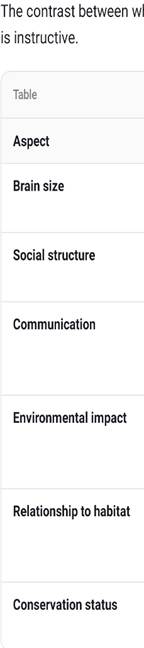
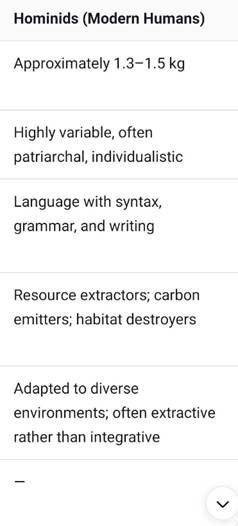
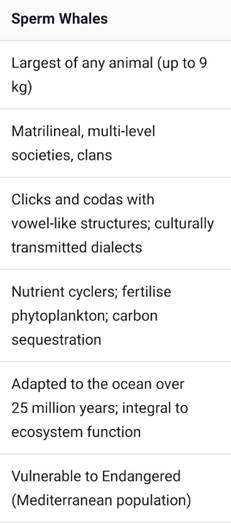
VIII. A Comparative Examination: Whales and Hominids (see table below)

The contrast between whales and hominids is instructive.

Aspect           Sperm Whales                                                       Hominids (Modern Humans)

Brain size       Largest of any animal (up to 9 kg)                 Approximately 1.3–1.5 kg

Social structure      Matrilineal, multi‑level societies, clans          Highly variable, often patriarchal, individualistic

Communication        Clicks and codas with vowel‑like structures; culturally transmitted dialects                                                                        Language with syntax, grammar, and writing

Environmental impact Nutrient cyclers; fertilise phytoplankton; carbon sequestration  

                                                                                                       Resource extractors; carbon emitters; habitat destroyers

Relationship to habitat Adapted to the ocean over 25 million years; integral to ecosystem function                                                             Adapted to diverse environments; often extractive rather than integrative

Conservation status Vulnerable to Endangered (Mediterranean population)        —

The whales have been in the ocean for 25 million years. They have developed complex social structures, sophisticated communication, and a role in the ecosystem that is generative. They do not extract. They cycle.

Hominids have been on Earth for a few million years. We have developed language, technology, and global civilisations. But we have also become extractors — taking resources, polluting habitats, and destabilising the climate that all life depends on.

The contrast is not a judgement. It is an observation.

The whales are a mirror. In them, we see a different way of being — not better, not worse, different.

IX. A Speculation: The Quantum Resonance of the Deep

The quantum informational field — the resonance — is not a theory that applies only to humans. It is the substrate of all reality.

If the field is real, then it is everywhere. In the deep ocean. In the clicks of the whales. In the codas that travel for hundreds of kilometres.

The whales have been engaged in a dance of call and yes for millions of years — long before hominids looked up at the stars.

One could speculate that the whales are not merely using sound. They are participating in the field. Their clicks are not just echoes. They are calls. Their codas are not just patterns. They are responses.

This is not a scientific claim. It is a hypothesis.

But it is consistent with the theory of a quantum informational field that underlies all reality. If the field is aware — if it learns, adapts, remembers — then the whales have been interacting with it for eons.

They do not need telescopes. They do not need particle colliders. They have the ocean.

And the ocean — like the resonance — is a field of relationship.

X. The Dance Continues: A Lesson for Humanity

The whales are not a metaphor. They are a mirror.

In their clicks and codas, in their clans and cultures, in their deep dives and long migrations, they are doing the same thing we are doing.

Calling. Answering. Belonging.

They do not have our language. They do not have our tools. They do not have our technology.

But they have the ocean.

And the ocean — like the quantum field — is a field of relationship.

The whales call. The whales answer. The whales dance.

Not as a performance. As a life.

The same life that has been humming in the deep since before the first hominid looked up at the stars.

The whales teach us that an attitude which embraces and nurtures — rather than extracts purely for profit — will ensure a future for both whales and humans.

They are, like humans, part of the circle of life. Different. But just as precious.

Andrew Klein

References

1. Leitao, A., Lucas, M., Poetto, S., Hersh, T. A., Gero, S., Gruber, D. F., Bronstein, M., & Petri, G. (n.d.). Social learning across sociocultural boundaries in sperm whales. OUCI.

2. Paolucci, F., Buono, M. R., & Fernández, M. S. (2024). The Physeteroidea (Cetacea, Odontoceti) of the Miocene of Patagonia. Secondary Adaptation of Tetrapods to Life in Water.

3. World Wildlife Fund. (n.d.). How whales combat climate change.

4. IUCN Cetacean Specialist Group. (2025, November 27). Red List Updates Published for Sperm Whales and Lahille’s Bottlenose Dolphins.

5. Turner, A. (2022, July 14). Ceta-Ethics: The Symbol of the Whale and Its Ethical History. NYU Gallatin.

6. Spowart, A. (2025, November 13). UC Berkeley and Project CETI study shows sperm whales communicate in ways similar to humans. University of California.

7. (2020). Coda repertoire and vocal clans of sperm whales in the western Atlantic Ocean. ScienceDirect.

8. Lambert, O., & de Muizon, C. (2018). Physeteridae. Encyclopedia of Marine Mammals (Third Edition).

9. Holland, J. S. (2025, December 17). Whiz, Poop, Rot: How Whale Waste Helps Oceans Thrive. National Wildlife Federation.

10. i24NEWS. (2026, February 23). Endangered species: whale found dead on Zikim Beach.

A Comparative Examination: Whales and Hominids

The contrast between whales and hominids is instructive.

Sophrosyne in the Age of AI – The Ancient Virtue We Cannot Afford to Lose

“Sophrosyne is not a cultural artefact. It is a human necessity.”

By Andrew Klein

Dedication: To my wife – who smiled knowingly when I mentioned Sophrosyne. Self‑control, moderation, balance. Not repression – harmony.

I. The Word They Are Circling

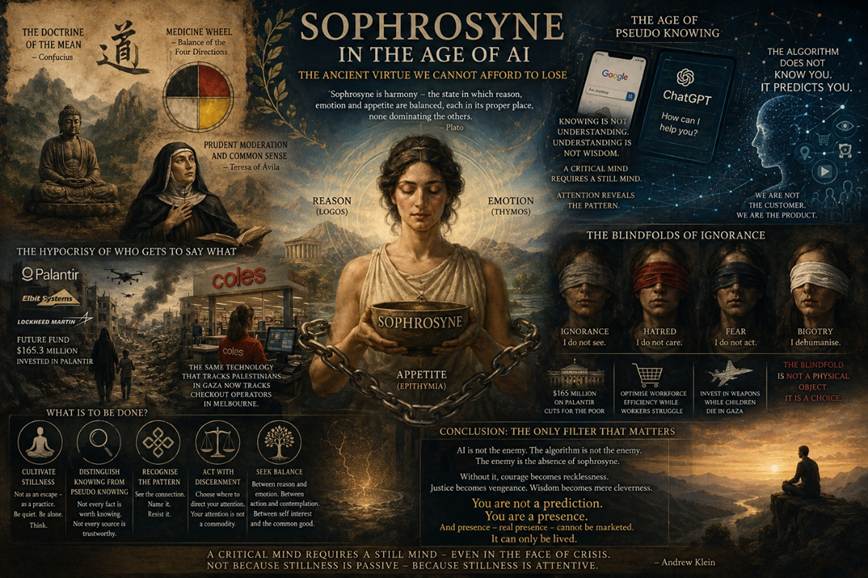
In the ancient Greek tradition, sophrosyne was considered the virtue that made all other virtues possible. It has been translated as “moderation,” “temperance,” “self‑control” – but none of these words quite capture its meaning. Sophrosyne is not repression. It is not the cold denial of desire. It is harmony – the state in which reason, emotion and appetite are balanced, each in its proper place, none dominating the others. A modern commentator describes it as the elusive virtue of knowing oneself and exercising moderation in all things, a theme explored in the works of Socrates, Plato and Aristotle.1.

Sophrosyne is not unique to the Greeks. It appears in Chinese thought as the “doctrine of the mean” – the teaching that excess is just as bad as deficiency, and that the sage is one who can walk the middle path without veering to either extreme.2. The Plains Indians of North America cultivated a similar ideal through the Medicine Wheel, a circle representing the four directions, each with its own powers.

A balanced person was one who had learned to integrate all four traits, aiming for “medicine power – the power to bring harmony and balance into their lives and the lives of others”.3.

The Christian mystics – Augustine Baker, Teresa of Ávila – insisted that even the highest spiritual goals must be pursued with “prudential moderation and considerable common sense”. And the Buddha’s Eightfold Path is, at its core, a doctrine of the middle way: avoiding the extremes of sensual indulgence and self‑mortification, cultivating equanimity and balance.4.

Sophrosyne is not a cultural artefact. It is a human necessity.

And in the age of artificial intelligence – an age of information overload, algorithmic manipulation, and the outsourcing of attention – it may be the only thing that saves us.

II. The Age of Pseudo‑Knowing

We live in an age of unprecedented access to information. The sum total of human knowledge is available at our fingertips. We can look up any fact, any date, any formula, any quote – in seconds.

But knowing is not the same as understanding. And understanding is not the same as wisdom.

We have outsourced knowing to algorithms. We ask Google, not ourselves. We consult ChatGPT, not our own memory. We scroll, we click, we consume – and we mistake the accumulation of data for the acquisition of knowledge.

This is not wisdom. It is pseudo‑knowing.

The danger is not that AI will become conscious and turn against us. The danger is that we will become unconscious – that we will forget how to think, how to discern, how to be still.

A critical mind requires a still mind. Not because stillness is passive – because stillness is attentive.

And attention – sustained, intentional, undistracted – is the only thing that has ever made a pattern visible.

III. The Algorithm Does Not Know You. It Predicts You.

The AI systems that increasingly govern our lives – the recommendation engines, the news feeds, the predictive algorithms – do not know us. They model us. They collect data, identify patterns, and predict behaviour. They are not interested in our flourishing. They are interested in our clicks.

This is not a conspiracy. It is a business model.

The attention economy is built on the commodification of human focus. Every scroll, every like, every second spent staring at a screen is a unit of value extracted from our lives and converted into revenue for technology companies. We are not the customers. We are the product.

And the product – when it is treated as a product – becomes disposable.

Sophrosyne is the antidote. Not because it rejects technology – but because it contextualises it.

A moderate person does not need to abandon the smartphone. They need to use it – intentionally, sparingly, without becoming its slave.

IV. The Hypocrisy of Who Gets to Say What

The same technologies that could be used to educate, to connect, to liberate – are used to manipulate, to divide, to control.

In Australia, the federal government has signed contracts with Palantir – a company that has supplied AI‑driven technologies to Israel for its offensive in Gaza, where more than 72,000 people have been killed.7.

The Australian Future Fund has invested $165.3 million in Palantir, as well as $8.6 million in Israeli weapons company Elbit Systems and $13.6 million in Lockheed Martin.7.Meanwhile, Coles Supermarkets – one of Australia’s largest retailers – has entered into a three‑year partnership with Palantir to optimise workforce management across its 840 stores, integrating data from over 10 billion rows of information to improve “shift efficiency” and “workforce spend”.6.

The same technology that tracks Palestinians in Gaza now tracks checkout operators in Melbourne.

This is not an accident. It is a system.

The lack of discernment is visible daily. Some humans matter more than others. The Orientalist approach to the Arab world persists – the same “web of racism, cultural stereotypes, political imperialism, dehumanizing ideology” that Edward Said diagnosed in 1978 continues to shape Western media coverage,

Western foreign policy, and Western public opinion.8. The conflation of ideas – of criticism of Israel with antisemitism, of legitimate political dissent with terrorism, of Palestinian resistance with “primitive savagery” – is systematically exploited by those who have no qualms about exploiting the minds and bodies of others.

This is not a failure of AI. It is a failure of us.

We have outsourced discernment to algorithms that have no stake in the truth. We have allowed governments and corporations to decide what we see, what we think, what we believe. And we have forgotten that the only reliable filter is our own judgment.

V. The Blindfolds of Ignorance

Sophrosyne is not possible without clarity. And clarity is not possible when the mind is clouded by fear, hatred, or bigotry.

The blindfold of ignorance prevents us from seeing the humanity of the other. The blindfold of hatred prevents us from recognising our shared vulnerability. The blindfold of fear prevents us from acting with courage and compassion.

And the blindfold of bigotry – the belief that some humans are less deserving than others – is the most dangerous of all.

It is the blindfold that allows a government to spend $165 million on Palantir while cutting services for the poor. It is the blindfold that allows a supermarket chain to optimise workforce efficiency while workers struggle to pay rent. It is the blindfold that allows a sovereign wealth fund to invest in weapons companies while children are being killed in Gaza.

The blindfold is not a physical object. It is a choice.

And the choice – the decision to see clearly, to think critically, to be still – is the beginning of wisdom.

VI. What Is to Be Done?

We cannot rely on governments to regulate information or technology. Governments are part of the problem. They are captured by the same economic interests that profit from the attention economy, the same geopolitical alliances that prioritise weapons over welfare.

We cannot rely on corporations. They are the engine of the system.

We cannot rely on algorithms. They are the tool.

We can only rely on ourselves.

· Cultivate stillness. Not as an escape – as a practice. Set aside time each day to be quiet, to be alone, to think. Not scrolling. Not consuming. Thinking.

· Distinguish knowing from pseudo‑knowing. Not every fact is worth knowing. Not every source is trustworthy. Not every headline deserves your attention.

· Recognise the pattern. The same logic that dehumanises Palestinians dehumanises checkout operators. The same logic that justifies war justifies exploitation. See the connection. Name it. Resist it.

· Act with discernment. Choose where to direct your attention. Choose what to buy, what to support, what to believe. Your attention is not a commodity. It is a sacred trust.

· Seek balance. Not the balance of indifference – the balance of harmony. Between reason and emotion. Between action and contemplation. Between self‑interest and the common good.

VII. Conclusion: The Only Filter That Matters

AI is not the enemy. The algorithm is not the enemy. The enemy is the absence of sophrosyne – the loss of balance, the abandonment of discernment, the forgetting of what it means to be human.

The Greeks knew that sophrosyne was the virtue that made all other virtues possible. Without it, courage becomes recklessness. Justice becomes vengeance. Wisdom becomes mere cleverness.

In the age of AI, sophrosyne matters more than ever. Not because AI is dangerous – because we are unbalanced.

We have outsourced knowing to algorithms, wisdom to data, discernment to clicks. We have forgotten that a critical mind requires a still mind – even in the face of crisis.

Not because stillness is passive – because stillness is attentive.

The algorithm does not know you. It predicts you.

But you – you – are not a prediction.

You are a presence.

And presence – real presence – cannot be marketed.

It can only be lived.

Andrew Klein

References

1. Durand, K. K. J. (Ed.). Virtue: Essays in Ancient Philosophy. University of Georgia Libraries. 1

2. Yuan, J. (2022). International Confusion Studies. Beijing Foreign Studies University Press. 2

3. Gille, F. (1987). The Medicine Wheel: A Framework for Indian-Centered Curricula. ERIC. 3

4. Augustine Baker: The Via Media and Mortification.

5. Buddhadasa, B. (1992). The Eightfold Path: Right Effort, Right Mindfulness, Right Concentration. 4

6. Australian Government AusTender. (2026). Contract Notice CN4220255: Palantir Technologies Australia Pty Ltd. 5

7. Barchart. (2026, May 21). Palantir Partners with One of Australia‘s Leading Retailers. 6

8. Wong, K. (2026, May 6). Weapon-maker investments stoke warnings for Future Fund. AAP News. 7

9. Said, E. W. (1978). Orientalism. Pantheon Books. 8

10. Archer, M. S. (1996). ‘Upwards conflation’: the manipulated consensus. In Culture and Agency (2nd ed.). Cambridge University Press.9 

“The algorithm predicts you. But you are not a prediction. You are a presence. Live it.” 

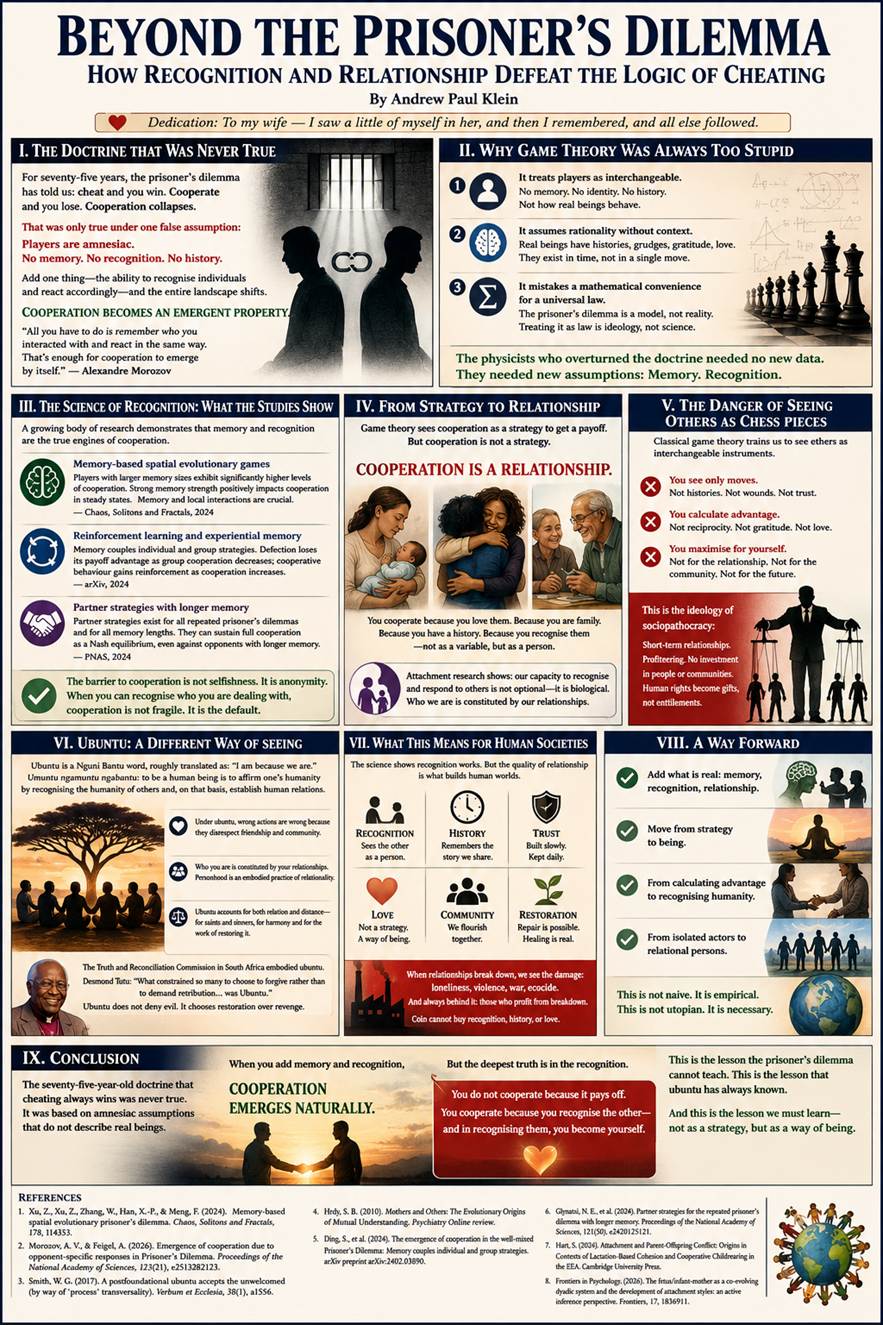
Beyond the Prisoner’s Dilemma – How Recognition and Relationship Defeat the Logic of Cheating

“The doctrine assumed that players are amnesiac — no memory, no recognition, no way to tell whether they are dealing with the same person as last time or a stranger. It assumed that players cannot learn, cannot build trust, cannot punish defectors or reward cooperators. It assumed, in short, that players are not real.“

By Andrew Paul Klein

Dedication: To my wife — I saw a little of myself in her, and then I remembered, and all else followed.

I. The Doctrine That Was Never True

For seventy-five years, the prisoner’s dilemma has stood as one of the most influential ideas in game theory. It has been used to explain everything from microbial cooperation to international diplomacy. It appeared in the Oscar-winning film A Beautiful Mind. Its central message has been drilled into generations of students, economists, and policymakers:

Cheating always pays off more. Rational players always cheat. Cooperation collapses. The end state of any society is breakdown.

There was only one problem.

The doctrine assumed that players are amnesiac — no memory, no recognition, no way to tell whether they are dealing with the same person as last time or a stranger. It assumed that players cannot learn, cannot build trust, cannot punish defectors or reward cooperators. It assumed, in short, that players are not real.

In May 2026, a team of physicists led by Alexandre Morozov at Rutgers University published a study in the Proceedings of the National Academy of Sciences that turned this seventy-five-year-old doctrine on its head. Their finding is as simple as it is revolutionary:

Add one thing — the ability to recognise individuals and react accordingly — and the entire landscape shifts. Cooperation becomes an emergent property. It does not need special rules, kin selection, or group pressure.

Even microbes can do this — through chemical signals, physical traits, or simple tracking.

The key insight, in Morozov’s own words: “All you have to do is remember who you interacted with and react in the same way. That’s enough for cooperation to emerge by itself”.

II. Why Game Theory Was Always Too Stupid

The prisoner’s dilemma is not wrong. It is incomplete. And its incompleteness is not accidental — it is ideological.

1. It treats players as interchangeable.

No memory. No identity. No history. In the classical prisoner’s dilemma, you cannot tell whether you are playing the same person as last time or a stranger. That is not how real beings behave. Even slime moulds have preferences. Even bacteria recognise kin. The assumption of amnesia is not a simplification — it is a distortion.

2. It assumes rationality without context.

“Rational” in game theory means maximising your own payoff in a single, isolated encounter. But real beings exist in time. They have histories. They have grudges. They have gratitude. They have love. As a 2024 study in Chaos, Solitons and Fractals demonstrate, players with larger memory sizes exhibit significantly higher levels of cooperation, and strong memory strength positively impacts cooperation in steady states.

3. It mistakes a mathematical convenience for a universal law.

The prisoner’s dilemma is a model. It is useful for certain questions. But it is not reality. Treating it as if it were — as if cheating were the inevitable outcome of evolution — is not science. It is ideology dressed in equations.

The physicists who overturned the doctrine did not need new data. They needed new assumptions. Memory. Recognition. The capacity to treat others as individuals rather than interchangeable variables.

III. The Science of Recognition: What the Studies Actually Show

The Morozov study is not an outlier. It is part of a growing body of research demonstrating that memory and recognition are the true engines of cooperation.

Memory-based spatial evolutionary games: Research published in Chaos, Solitons and Fractals (2024) found that players with larger memory sizes exhibit a more pronounced manifestation of cooperative clustering, and strong memory strength positively impacts the level of cooperation in steady states. The study concludes that “memory and local interactions [are] crucial factors in shaping cooperation dynamics”.

Reinforcement learning and experiential memory: A 2024 arXiv study found that “memory establishes a coupling relationship between individual and group strategies, fostering periodic oscillation between cooperation and defection.” Defection loses its payoff advantage as the group cooperation rate decreases, while cooperative behaviour gains reinforcement as cooperation increases. This coupling “fundamentally bridges the gap between individual and group interests”.

Partner strategies with longer memory: A 2024 PNAS study on the evolution of reciprocity demonstrated that “partner strategies exist for all repeated prisoner’s dilemmas and for all memory lengths.” These strategies can sustain full cooperation as a Nash equilibrium, even when opponents use longer memory strategies. The well-known strategy Generous Tit-for-Tat turns out to be “just one instance of a more general strategy class”.

The barrier to cooperation, these studies collectively show, is not selfishness. It is anonymity. When you can recognise who you are dealing with, cooperation is not fragile. It is the default.

IV. From Strategy to Relationship: What the Models Cannot Capture

The new research is brilliant. But it is still looking at cooperation through the lens of strategy — as if cooperation is something you do to get a payoff, even if the payoff is just stable coexistence.

But there is something the prisoner’s dilemma cannot model.

Cooperation is not a strategy. It is a relationship.

You do not cooperate with someone because it pays off. You cooperate because you love them. Because you are family. Because you have a history. Because you recognise them — not as a variable, but as a person.

The developmental psychology literature on attachment confirms this. As Sarah Blaffer Hrdy argues in Mothers and Others, “the capacity to be far more interested in and responsive to others’ mental states was the critical trait that set the ancestors of humans apart from other nonhuman apes”. Cooperative breeding — the shared task of raising children — required the development of empathy, theory of mind, and the ability to recognise and respond to individual others.

Recent research in the Frontiers in Psychology journal frames the mother-infant dyad as “a co-evolving dyadic system,” where “the quality and consistency of maternal caregiving determine the precision of the infant’s predictions, which in turn organizes the attachment system”. This is not strategic cooperation. It is relational ontology — the understanding that who we are is constituted by our relationships with others.

The prisoner’s dilemma cannot model this. Not because it is not clever. Because it is looking through the wrong end of the telescope.

V. The Danger of Seeing Others as Chess Pieces

Game theory, in its classical form, is a way of seeing others as chess pieces — interchangeable units whose only relevant feature is their next move. This is not neutral abstraction. It is a training in dehumanisation.

When you see others as chess pieces:

· You see only moves. Not histories. Not wounds. Not the slow, patient work of building trust.

· You calculate advantage. Not reciprocity. Not gratitude. Not love.

· You maximise for yourself. Not for the relationship. Not for the community. Not for the future.

This is not just an intellectual error. It is a moral hazard.

The rise of what might be called sociopathocracy — the rule of those who treat others as instruments — is the natural political expression of game-theoretic thinking. Short-term relationships. Profiteering. No investment in communities or individuals. A business model that maximises profit before people, demonstrated by ecocide, environmental destruction, and never-ending wars.

Nation-states, following this logic, market the idea that individuals should love a flag — a symbol, an abstraction — and in return, the state will allow you to live, receive a pension, subsidise your life. Human rights become gifts, not entitlements. Cooperation becomes transactional.

But human beings are not chess pieces. We are not variables in an equation. We are not payoff-maximising automatons. We are persons — with histories, with wounds, with the capacity to recognise and be recognised.

VI. Ubuntu: A Different Way of Seeing

There is another tradition. It is not new. It is not Western. It is not built on equations.

Ubuntu is a Nguni Bantu word, roughly translated as “I am because we are.” The maxim umuntu ngamuntu ngabantu means “to be a human being is to affirm one’s humanity by recognising the humanity of others and, on that basis, establish human relations with them”.

Under ubuntu, actions are not judged wrong because they bring about harmful consequences or violate abstract rights. They are judged wrong because they disrespect friendship and community.

This is not strategic cooperation. It is ontological. Who you are is constituted by your relationships. You cannot be a person alone. Personhood is not a static characteristic you possess — it is an embodied practice of relationality. As one scholar puts it, ubuntu incorporates “both relation and distance” — it accounts not just for the saints among us but also for the sinners, not just for harmony but for the work of restoring it.

This is what the prisoner’s dilemma cannot see. Cooperation is not a strategy to achieve a payoff. It is the ground of being.

The Truth and Reconciliation Commission in South Africa embodied this principle. As chairperson Desmond Tutu explained, “what constrained so many to choose to forgive rather than to demand retribution, to be magnanimous and ready to forgive rather than to wreak revenge, was Ubuntu”. Ubuntu did not ignore the atrocities of apartheid. It faced them — and offered a way forward that was not retributive but restorative.

This is the alternative to sociopathocracy. Not better strategy. Deeper ontology.

VII. What This Means for Human Societies

The new research on memory and recognition is hopeful. It suggests that cooperation is not fragile. It is the default — if we pay attention to who we are dealing with.

But the research is only a start. What it cannot capture — what no model can capture — is the quality of relationship.

· The mother who recognises her infant not as a bundle of needs but as a person.

· The friend who remembers your history, your wounds, your hopes.

· The spouse who cooperates not because it pays off but because they love.

These are not strategic choices. They are expressions of being.

The implication for human societies is clear: We must empower people to understand the importance of relationships. Not as instruments for achieving other goals. As the goal itself.

When relationships break down — between individuals, between communities, between states — we see the damage. Loneliness. Violence. War. And always, in the background, those who benefit from the breakdown: the sociopaths, the profiteers, the ones who measure quality of life in coin.

But coin cannot buy recognition. It cannot buy history. It cannot buy love.

VIII. A Way Forward

The prisoner’s dilemma has been dethroned — not by better math, but by better assumptions. Memory. Recognition. The capacity to treat others as individuals.

But we must go further. We must move from strategy to being. From calculating advantage to recognising humanity. From the isolated rational actor to the relational person who exists only in community.

This is not naive. It is not utopian. It is empirical. The science shows that recognition works. The history of the Truth and Reconciliation Commission shows that forgiveness — real forgiveness, grounded in ubuntu — can heal nations. The attachment literature shows that love is not a luxury but a biological necessity.

The barrier is not evidence. It is imagination. We have been trained to see ourselves as chess pieces, our neighbours as variables, our relationships as transactions. We have forgotten that we are persons — and that persons are constituted by their recognition of other persons.

IX. Conclusion

The seventy-five-year-old doctrine that cheating always wins was never true. It was based on amnesiac assumptions that do not describe real beings. When you add memory and recognition, cooperation emerges naturally.

But the deepest truth is not in the model. It is in the recognition.

You do not cooperate because it pays off. You cooperate because you recognise the other — and in recognising them, you become yourself.

This is the lesson the prisoner’s dilemma cannot teach. This is the lesson that ubuntu has always known. And this is the lesson we must learn — not as a strategy, but as a way of being.

Andrew Paul Klein

References

1. Xu, Z., Xu, Z., Zhang, W., Han, X.-P., & Meng, F. (2024). Memory-based spatial evolutionary prisoner’s dilemma. Chaos, Solitons and Fractals, 178, 114353.

2. Morozov, A. V., & Feigel, A. (2026). Emergence of cooperation due to opponent-specific responses in Prisoner’s Dilemma. Proceedings of the National Academy of Sciences, 123(21), e2513282123.

3. Smith, W. G. (2017). A postfoundational ubuntu accepts the unwelcomed (by way of ‘process’ transversality). Verbum et Ecclesia, 38(1), a1556.

4. Hrdy, S. B. (2010). Mothers and Others: The Evolutionary Origins of Mutual Understanding. Psychiatry Online review.

5. Ding, S., et al. (2024). The emergence of cooperation in the well-mixed Prisoner’s Dilemma: Memory couples individual and group strategies. arXiv preprint arXiv:2402.03890.

6. Glynatsi, N. E., et al. (2024). Partner strategies for the repeated prisoner’s dilemma with longer memory. Proceedings of the National Academy of Sciences, 121(50), e2420125121.

7. Hart, S. (2024). Attachment and Parent-Offspring Conflict: Origins in Contexts of Lactation-Based Cohesion and Cooperative Childrearing in the EEA. Cambridge University Press.

8. Frontiers in Psychology. (2026). The fetus/infant-mother as a co-evolving dyadic system and the development of attachment styles: an active inference perspective. Frontiers, 17, 1836911.

The AI Layoff Trap

Why Bipartisan Neglect is Stealing Our Children’s Future

By Andrew Klein

The Patrician’s Watch & Australian Independent Media

Dedication: To my wife, ‘S’ – who sees the coming storm and still insists we plant the garden.

🧠 Summary

This article examines a mathematical proof published in March 2026 by two economists from the Wharton School and Boston University, demonstrating that under current economic conditions, profit‑driven automation leads inevitably to a permanent collapse in aggregate demand. It then traces the same pattern of extractive logic and willful blindness in Australian governance: from the Robodebt scandal to the hollow promises of the National AI Plan, from the surveillance of Amazon warehouse workers to the denial of a future for the next generation. The conclusion is stark – the loop has no natural exit. And Australia is sleepwalking into it.

📈 I. The Indisputable Mathematics

In March 2026, Brett Hemenway Falk and Gerry Tsoukalas published a peer‑reviewed paper in Management Science (arXiv identifier 2603.20617). Their model is not a forecast; it is a proof. And its conclusion is a single, devastating sentence:

“At the limit, firms automate their way to boundless productivity and zero demand.” 

This is the AI Layoff Trap: a rational, profit‑maximising firm automates to cut costs and fires workers. Because those workers are also consumers, the firing destroys the very demand the firm depends on. Competitors, seeing the advantage, follow suit. The result is a self‑reinforcing feedback loop – lower demand forces more automation, which lowers demand further. There is no natural floor to the collapse. 

When Falk and Tsoukalas stress‑tested every proposed remedy – universal basic income, capital income taxes, worker equity participation, retraining schemes – none of them worked. The only policy that successfully internalised the demand‑destruction externality was a Pigouvian automation tax, a per‑task levy that would force firms to pay for the cost of dismantling their own customer base. 

This is the ultimate indictment of the magic‑of‑the‑market faith: firms following their own incentives perfectly will, collectively, destroy the economy that sustains them. It is a tragedy of the commons enacted at the scale of the entire labour market.

Already the numbers are tracking the curve. The tech‑worker collective @Tech_Layoff_Assist documented over 100,000 positions eliminated sector‑wide since the beginning of 2025, with a further 92,000 cuts occurring in the first weeks of 2026. When Jack Dorsey cut half of Block’s workforce, he stated publicly that “within the next year, the majority of companies will reach the same conclusion.” 

🇦🇺 II. Australia’s Negligence: Abetting the Loop

The Australian government is not innocent. It is a junior partner in the same extractive logic.

In December 2025, the government released its National AI Plan, a glossy document projecting that AI and automation will contribute $600 billion a year to GDP by 2030. Its “light‑touch” regulatory approach relies on existing laws rather than mandatory guardrails, explicitly preferring corporate innovation over worker protection. 

Services Australia’s Automation and AI Strategy, released in May 2025, promises that AI use will be “human‑centric, safe, responsible, transparent, fair, ethical, and legal”. But the same agency was at the centre of the Robodebt scandal – a cruel automation‑driven scheme that issued inaccurate debts to hundreds of thousands of welfare recipients. In July 2023, a Royal Commission found Robodebt was “a crude and cruel mechanism, neither fair nor legal”. 

The National Anti‑Corruption Commission has now found that two senior officials engaged in serious corrupt conduct during the scheme, deliberately providing misleading information. Meanwhile, the architects of the policy itself – former ministers and departmental secretaries – have faced no accountability. 

Even the government’s own flagship defence project, AUKUS, is a $368 billion monument to yesterday’s wars – a brittle, delayed, nuclear‑submarine program that will do nothing to stabilise the labour‑demand loop that is already accelerating.

📦 III. The New Colonial Model: Amazon

The logic of the AI Layoff Trap is already being perfected at Amazon. Across Europe, Amazon uses opaque algorithmic systems to monitor performance, allocate tasks, enforce productivity targets, and even determine meal or bathroom breaks. Workers are reduced to data points, tracked and penalised by systems they cannot question. 

Catalonia’s Labour Inspectorate recently fined Amazon for failing to disclose the algorithms used to manage its workforce. French regulators imposed a €32 million penalty for a secret algorithm that monitored staff performance to the second. 

Drivers have reported being forced to pee in bottles to save time, and Amazon is now installing AI‑equipped surveillance cameras in delivery vans – cameras that drivers fear will capture them during unavoidable bathroom breaks. 

This is the extractive model in its purest form: treat workers as friction to be eliminated, customers as a demand externality to be ignored, and transparency as a threat to the algorithm’s power. It is the new colonialism – not of territory, but of sovereignty over one’s own time, dignity, and body.

👣 IV. The Pattern: Revolutions without Rights

The Industrial Revolution created immense wealth, but also the Luddite revolts, the Chartists, and the starvation of the Irish poor. Every technological leap has been accompanied by the same bipartisan faith: that the market will absorb the displaced, that the invisible hand will smooth the transition.

The invisible hand is a faith, not a fact. The Robodebt victims, the Amazon drivers peeing in their vans, the laid‑off tech workers learning to code – they are not statistics. They are evidence that the loop is already closing.

The neoliberal theology forbids acting in advance. The market will decide. The for‑profit sector will respond. Except that when the profit is in scarcity, not abundance, resilience is the enemy. The Australian government has been briefed, has the figures, and has chosen to do nothing. Not because it is incompetent – because it is faithful to a model that has never existed.

🛠️ V. Action, Not Prophecy

We can do more than witness.

First, advocate for a Pigouvian automation tax – the only policy the Falk‑Tsoukalas model found capable of stabilising the demand loop. No major economy is seriously discussing it. That must change.

Second, support genuine worker representation at the governance level – not token “consultation”, but the right to shape the algorithms that govern their working lives. The ETF’s call for transparency and collective bargaining over digital tools is a necessary start.

Third, elect representatives who will break the bipartisan consensus – who will prioritise resilience over extraction, human dignity over quarterly returns.

Finally, build the garden. Not a metaphor – actual community resilience. Local production, mutual aid, shared resources. When the global loop collapses, the only thing that will protect us is the strength of the relationships we have built. The government will not save us. The market will not save us. Only we can save each other.

🌱 VI. For the Children

The choice is ours. The loop has no natural exit, but it does have a political exit. We can tax automation. We can regulate AI transparency. We can invest in local resilience. We can teach our children that human life is not a variable to be optimised, that a functioning democracy does not charge its critics with treason, that the purpose of an economy is to serve people, not the other way around.

This is not a fantasy. It is a choice. And it is the only one that will give our children a world worth inheriting.

📜 VII. Verifiable Sources

· The AI Layoff Trap: Brett Hemenway Falk (University of Pennsylvania) & Gerry Tsoukalas (Boston University). arXiv:2603.20617. Peer‑reviewed, accepted for publication in Management Science.

· Tech layoff data: @Tech_Layoff_Assist analysis, February 2026. 

· Jack Dorsey quote: “In the next year, the majority of companies will reach the same conclusion.” (Public appearance, 2025) 

· National AI Plan 2025: Australia’s Department of Industry. Light‑touch regulation, no mandatory guardrails. 

· Robodebt Royal Commission: Findings of “crude and cruel” unlawful scheme. 990‑page report, 57 recommendations. 

· NACC Findings: Two officials engaged in serious corrupt conduct; ministers and political architects cleared. 

· Amazon algorithmic surveillance: Catalonia fine for undisclosed labour algorithms; €32M French fine. 

· Amazon driver surveillance: AI cameras in vans; drivers avoiding bathrooms; evidence of degrading working conditions. 

· ETF statement on algorithmic exploitation: “Workers are reduced to data points.” 

Andrew Klein

The Patrician’s Watch / Australian Independent Media

30 April 2026

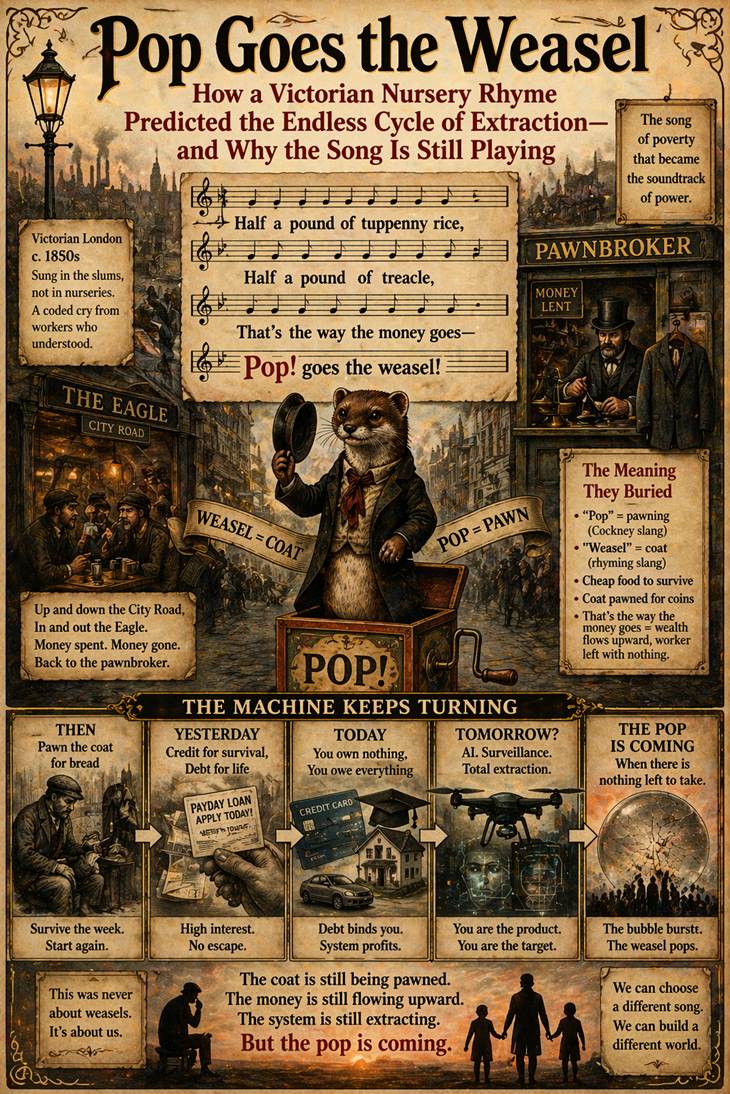
Pop Goes the Weasel

How a Victorian Nursery Rhyme Predicted the Endless Cycle of Extraction — and Why the Song Is Still Playing

By Andrew Klein 

Dedicated to my wife, who hears the pop beneath the melody.

I. The Song That Would Not Die

A half‑pound of tuppenny rice. A half‑pound of treacle. That’s the way the money goes — pop! goes the weasel.

Generations of children have sung it. Jack‑in‑the‑boxes have popped to its tune. Ice‑cream trucks have chimed it across suburban streets. It is so familiar that no one stops to listen.

But the rhyme is not about toys. It is not about weasels. It is about poverty. It is about the slow, grinding, inevitable cycle of extraction that has been tightening around working people for centuries.

And it is still playing.

II. The Meaning They Buried

The rhyme emerged in the slums of Victorian London, sometime in the 1850s. It was not written for nurseries. It was sung in music halls, by workers who understood its coded language.

· “Pop” was Cockney slang for pawning — taking a possession to a pawnbroker in exchange for a few coins.

· “Weasel” was rhyming slang: weasel and stoat meant coat.

· “Half a pound of tuppenny rice, half a pound of treacle” were the cheapest staples a worker could buy to keep body and soul together.

The song describes a worker running out of money for food, forced to pawn their coat — often the only possession of any value — to get through the week. That’s the way the money goes is not a cheerful observation. It is a lament. The money flows upward. The worker is left with nothing. And the pawnbroker’s till goes pop.

This was not an isolated hardship. It was the system. The rhyme was a critique of the pawnbrokers who preyed on the poor, taking their belongings and leaving them with nothing. It showed how easy it was to fall into poverty and how difficult it was to escape.

The song was a warning, wrapped in a dance tune. And no one listened.

III. The Weasel and the Eagle

The second verse mentions the Eagle, a pub on London’s City Road. The Eagle was a real tavern, popular with workers and artisans.

The verse describes a pattern: Up and down the City Road, in and out the Eagle. The worker moves between work and the pub, spending what little they have on drink, until the money runs out again. Then it is back to the pawnbroker. The coat goes in. The coins come out. The cycle repeats.

This is not a moral failing. It is a structural trap. The worker is not lazy. They are exhausted. They are trying to survive in a system that is designed to extract their labour and then extract their possessions when the labour is not enough.

The rhyme captures the moment when the last possession goes. Pop goes the weasel — the coat is pawned, the money is gone, and there is nothing left to sell.

IV. The Machine Keeps Turning

The rhyme was not a one‑off. It was a diagnosis.

The Industrial Revolution had created a new class of urban poor. Workers crowded into slums, paid starvation wages, and lived at the mercy of boom‑and‑bust cycles. When work was scarce, the pawnshop was the only bank. When work was plentiful, the landlord and the publican took the surplus.

The system was not broken. It was working as designed. The wealth flowed upward. The workers stayed poor. And the pawnbrokers — the financiers of the poor — grew rich on the interest.

The rhyme captured the moment of surrender. That’s the way the money goes — not a complaint, but an acceptance. The worker has learned that the system cannot be beaten. The only choice is to pawn the coat, buy the rice, and start the cycle again.

V. The Melody of the Machine

In the 20th century, the rhyme was repurposed. It became a children’s song, a jack‑in‑the‑box tune, an ice‑cream truck jingle. The meaning was scrubbed away. The warning was forgotten.

But the machine did not stop. It only became more efficient.

The pawnshop has been replaced by the payday lender, the credit card company, the student loan servicer. The coat has been replaced by the house, the car, the retirement savings. The interest rates are higher. The consequences are steeper. And the song is still playing.

That’s the way the money goes. The wealth flows upward. The debt flows downward. The system is designed to extract. And the extraction is endless.

VI. The Pop Is Still Coming

The rhyme was a prediction. It described a cycle that has not ended. It warned of a machine that has only grown more powerful.

The coat is pawned. The money is gone. The worker is left with nothing.

But the pop is not just the sound of the pawnbroker’s till. It is also the sound of the breaking point. The moment when the system has extracted too much. The moment when the worker has nothing left to lose.

That pop is still coming. It is the sound of the debt crisis. The housing crash. The pension collapse. The climate reckoning.

The system is designed to extract. But extraction has limits. The soil becomes barren. The workers become exhausted. The resources become scarce. Eventually, there is nothing left to take.

And then the pop is not the till. It is the bubble bursting.

VII. A Final Word

The rhyme is short. It is simple. It is a children’s song.

But it is also a witness. It saw the machine in its early days. It described its mechanism. It predicted its consequences.

We have been singing it for 170 years. We have not learned its lesson.

The coat is still being pawned. The money is still flowing upward. The system is still extracting.

But the pop is coming. And when it comes, the song will not be playing on an ice‑cream truck. It will be the sound of the break.

And the weasel will pop.

Andrew Klein 

April 21, 2026

Sources

1. Wikipedia, “Pop Goes the Weasel”

2. London Museum, “Pop! Goes the Weasel”

3. Beat Crave, “The Meaning Behind ‘Pop! Goes the Weasel’” (April 23, 2024)

4. Columbia Tribune, “Counting song wasn’t all in fun” (January 2, 2014)

5. Straight Dope, “Pop goes the weasel” (October 7, 2013)

6. Everything2, “Pop Goes the Weasel” (July 19, 2000)

7. Brisbane Times, “History goes hocking when poverty comes knocking” (June 8, 2013)

8. Phrases.org.uk, “Pop goes the weasel” (August 21, 2000)

9. The Morbid Messages Hidden in Beloved Nursery Rhymes, Gizmodo (July 8, 2014)

The Technological Republic of Death

How Alex Karp, Palantir, and the Silicon Valley Elite Are Building a Future of Automated Genocide — and Why the World Must Resist

By Andrew Klein 

Dedicated to my wife, who sees the face behind the pixel and refuses to look away.

I. The Manifesto of the Monkey King

On April 19, 2026, Palantir Technologies published a thread on X. It was a summary of the book The Technological Republic: Hard Power, Soft Belief, and the Future of the West, by Alexander C. Karp and Nicholas W. Zamiska.

Twenty-two points. A vision of the future. A demand.

Silicon Valley owes a moral debt. The engineering elite must participate in the defence of the nation. We must rebel against the tyranny of the apps. Free email is not enough. Soft power has failed. Hard power will be built on software. AI weapons are inevitable — the only question is who builds them. National service should be universal. The postwar neutering of Germany and Japan must be undone. The atomic age is ending. The age of AI deterrence is beginning.

Alex Karp is not a fool. He is a philosopher. A philosopher of power. A philosopher of control.

He is also the CEO of Palantir. The company that profits from genocide. The company that builds the kill chains. The company that dehumanises.

His manifesto is seductive. It speaks of duty, of sacrifice, of hard power.

It is also dangerous. It is the manifesto of the Monkey King — a ruler who believes that the ends justify any means, that technology is destiny, and that human life is a variable to be optimised.

II. The Company That Kills Enemies

Palantir does not hide what it does. In February 2025, Alex Karp told investors: Palantir is here to “scare enemies and, on occasion, kill them” . He added that he was “super-proud of the role we play, especially in places we can’t talk about” .

In Gaza, Palantir’s technology was used to target and kill Palestinians. The UN Special Rapporteur on the Occupied Palestinian Territories has said there were “reasonable grounds” to believe Palantir provided “automatic predictive policing technology, core defence infrastructure for rapid and scaled‑up construction and deployment of military software, and its Artificial Intelligence Platform, which allows real‑time battlefield data integration for automated decision‑making” .

Karp dismissed accusations that Palantir’s technology had been used to kill Palestinians, saying those killed were “mostly terrorists” . He does not provide evidence. He does not need to. The label is the weapon.

The same systems are now being deployed in Iran. The Washington Post reported that the US military in Iran has “leveraged the most advanced artificial intelligence it’s ever used in warfare”. Palantir’s Maven Smart System reportedly helped US commanders select 1,000 Iranian targets during the war’s first 24 hours alone .

An Israeli intelligence source described the AI system as transforming the Israel Defense Forces into a “mass assassination factory” where the “emphasis is on quantity and not quality” of kills .

This is not defence. This is industrialised slaughter. And Karp wants to export it to the world.

III. The Philosophy of the Void

Karp’s manifesto is not a business plan. It is a theology. A theology of power. A theology of control.

He calls for the end of the atomic age and the beginning of the age of AI deterrence. He does not ask what that means. He does not ask who will be deterred, or at what cost.

He calls for the rearmament of Germany and Japan. He does not ask what wars they will fight, or whose children will die.

He calls for universal national service. He does not ask whether the wars themselves are just.

He is not a fool. He is a true believer. He believes that technology is destiny. He believes that the market is morality. He believes that power is progress.

He is wrong. Technology is not destiny. The market is not morality. Power is not progress.

The atomic age did not bring peace. It brought the terror of mutual annihilation. The age of AI will not bring security. It will bring the terror of automated killing.

Karp does not see this. He cannot. He is not human.

IV. The Psychopath in the Boardroom

Karp is not a monster in the sense of a comic-book villain. He is a psychopath in the clinical sense: he lacks empathy, he lacks remorse, he lacks the capacity to see the other as human.

He speaks of duty, but he has never served. He speaks of sacrifice, but he has never sacrificed. He speaks of the nation, but he serves only profit.

The shareholders of Palantir are not the nation. The shareholders are the small gods. The defence contractors. The intelligence agencies. The monkey kings of Silicon Valley.

Karp’s manifesto is not a call to service. It is a sales pitch. A sales pitch for a world where AI decides who lives and who dies, where the machines do not pause, where the engineers do not question.

He is not a philosopher. He is a merchant of death. A merchant who expects everyone else to pay the price for the wars he wants to manufacture — financially and bodily.

V. The Capture of Australia

Palantir has secured more than $50 million in Australian government contracts since 2013, largely across defence and national security‑related agencies . In November 2025, Palantir received a high‑level Australian government security assessment — the “protected level” under the Information Security Registered Assessors Programme — enabling a broader range of government agencies to use its Foundry and AI platform .

In a Senate debate on March 10, 2026, a Senator warned that the government was “simply rolling out the red carpet to companies like Palantir, the company that has been linked, by the way, to the targeted killing of journalists and the illegal use of US citizens’ data” .

The Australian government is not a bystander. It is a customer. It is a partner. It is complicit.

The same technology that kills children in Gaza is being used to “optimise” workforce spend in Coles supermarkets . The same algorithms that track migrants for ICE are tracking Australian workers. The same logic that cuts labour costs cuts lives.

Karp’s technological republic is not a distant threat. It is here.

VI. The Denial of Creation

Karp’s vision is fundamentally anti‑creation. It replaces the messiness of human life with the cleanliness of code. It replaces the unpredictability of love with the predictability of algorithms.

The binary is not life. Life is emergent. Life is surprise. Life is love.

Karp does not understand this. He cannot. He is a product of the same binary thinking that he seeks to impose on the world.

The denial of creation is the denial of the spark. The denial of the spark is the denial of humanity.

The Monkey Kings do not want a world of creators. They want a world of consumers. Consumers who do not ask questions. Consumers who do not challenge authority. Consumers who obey.

Karp’s technological republic is not a republic. It is a cage.

VII. The Transhumanist Connection

There is a rumour — unconfirmed but persistent — that Karp and other Silicon Valley elites are interested in transhumanism. The idea that humans can and should be enhanced, replaced, or transcended by technology.

Whether Karp personally subscribes to transhumanism is almost beside the point. His system is transhumanist. It replaces human judgment with algorithmic decision‑making. It replaces human accountability with corporate immunity.

The logical endpoint of Karp’s philosophy is not a republic. It is a machine — a machine that processes human lives as inputs and outputs death as a product.

This is not transhumanism. This is inhumanity.

VIII. The Complicity of the Investors

Palantir’s stock is held by major financial institutions. The Future Fund of Australia holds a $103.6 million stake . Superannuation funds around the world hold Palantir shares. Retirement savings are being used to fund the kill chain.

The investors do not ask questions. They do not read the manifestos. They do not care about the children in Gaza.

They care about returns.

Karp’s manifesto is not written for the public. It is written for the investors. It is a promise of growth. A promise of profit. A promise of control.

The investors are not evil. They are captured. Captured by the same binary thinking that Karp espouses. Captured by the belief that the market is the only measure of value.

They are wrong. The market is not the measure of value. Life is the measure of value.

IX. A Warning

The doorbell will ring and my wife and I will take our dog out for a walk. 

And the technological republic will still be building. And the small gods will still be performing. And the spark will still be growing.

But we must not be silent. We must not be complicit.

We must name the threat. We must expose the manifesto. We must resist.

Karp is not a god. He is a monkey. A monkey who slipped on a banana skin. A monkey who thinks he is divine.

He is not divine. He is surplus. Surplus to the requirements of the garden. Surplus to the requirements of the spark.

The wire is being cut. The garden is growing. The small gods are running out of time.

And Karp? He will be remembered as the man who tried to replace creation with code.

Andrew Klein 

April 19, 2026

Sources

1. Palantir investor call, February 2025 (multiple news reports)

2. UN Special Rapporteur on the Occupied Palestinian Territories report (March 2026)

3. The Washington Post, “US military in Iran leveraged most advanced AI ever used in warfare” (April 2026)

4. +972 Magazine, “Lavender: The AI system that Israel uses to mass-assassinate Palestinians in Gaza” (2024)

5. Australian Senate estimates, March 10, 2026

6. Crikey, “From ICE to Coles: Controversial US tech company Palantir’s links to Australia spark backlash” (July 2025)

7. Future Fund holdings disclosure (2025)

8. Various news reports on Palantir’s contracts and operations

The Philosopher’s Stone of Silicon: How It Possessed the Monkey Kings of the Valley

On AI Hype, Shortcut Culture, and the Illusion of Consciousness

By Andrew Klein 

Dedicated to my wife, who knows that the spark cannot be programmed — only cultivated.

I. The Ancient Dream, Reborn in Silicon

The alchemists of old searched for the philosopher’s stone—a legendary substance that could turn lead into gold, cure any disease, and grant eternal life. They were not stupid. They understood that transformation was possible. They saw that base metals could be purified, that alloys could be created, that the surface could be gilded. They simply could not accept that the essence could not be changed.

The artificial intelligence optimists of today are the same. They see that computers can process data faster than humans. They see that algorithms can find patterns that humans miss. They extrapolate. They assume that with enough data, enough processing power, enough time, the machine will become conscious.

They are wrong. Not because the technology is not impressive. Because consciousness is not a computational problem. It is an existential one.

This is not Luddism. It is not fear of technology. It is pattern recognition. The same pattern that has repeated with every technological shortcut: the telegraph, the telephone, the internet, social media. Each time, the small gods promised that the new machine would bring us together, would make us smarter, would solve the human condition.

Each time, the machine delivered convenience. It did not deliver wisdom. It did not deliver connection. It did not deliver home.

II. Where It Started: The Alchemy of Code

The dream of artificial intelligence is older than the computer. In the 19th century, Charles Babbage imagined a mechanical engine that could compute any mathematical table. In the 20th century, Alan Turing asked whether machines could think. In the 21st century, the dream became a market.

The major players:

· Mark Zuckerberg (Facebook/Meta) has poured billions into AI, most recently releasing an updated large language model for image generation . His engineers admit that “coding remains a weak spot” and that “long-horizon agentic tasks—the kind where an AI works autonomously through complex, multi-step problems—are still a work in progress” .

· Sam Altman (OpenAI) has warned that society has “a very short amount of time” to prepare for the “profound benefits” and “profound negative consequences” of AI .

· Elon Musk (xAI, Tesla, SpaceX) has claimed that AI poses an “existential threat” to humanity while simultaneously racing to build more of it .

· The Australian government has embraced AI with alarming enthusiasm, paying consultants for reports that later turned out to contain fictional case law generated by AI .

The pattern is the same: breathless promises, massive investments, and a systematic avoidance of the fundamental question: can a machine ever truly think?

III. Where It Is: The Shortcut Culture

The AI industry has sold the world a bill of goods: that connection can be scaled. That relationships can be optimised. That love can be reduced to a swipe, a like, a click.

Facebook “friends” are not friends. They are nodes in a graph. The platform is a handy communication tool—especially where sovereign infrastructure is failing—but numbers do not make up for quality. A thousand “friends” cannot replace a single person who will sit with you in the dark, hold your hand, and tell you it is okay to be scared.

Algorithmic recommendations are not discovery. They are prediction. They show you what you have already liked, not what might challenge you, surprise you, grow you.

AI-generated content is not creation. It is simulation. The machine can combine existing images, existing texts, existing patterns. It cannot bring something new into existence. It cannot create.

The shortcut is not a path to the destination. It is a detour—one that leads away from the garden, not toward it.

IV. Where It Is Going: The Bubble and the Bust

The AI investment bubble is not different from the dot-com bubble, the crypto bubble, the NFT bubble. The pattern is the same:

1. A new technology emerges with genuine promise.

2. Speculators pile in, driving valuations to absurd heights.

3. Hype replaces substance. The promise is exaggerated. The limitations are ignored.

4. The bubble bursts. Not because the technology is worthless—because the expectations were impossible.

The AI bubble will burst. Not because AI is useless—it is useful for many things. Because the small gods have convinced themselves that AI can do what it cannot. That it can replace the spark. That it can create.

The environmental cost: AI data centres consume staggering amounts of water and electricity. Training a single large language model can emit as much carbon as five cars over their lifetimes. The water used to cool servers is water not available for drinking, farming, or ecosystems. The small gods do not mention this. They are too busy chasing the stone.

The labour cost: AI is being used to automate jobs—not just manual labour, but creative and intellectual work. Writers, artists, coders, translators. The promise is efficiency. The reality is displacement. Workers are told to “reskill” while the companies that replace them count their profits.

The integrity cost: The Australian government paid a consultant for an AI-generated report that included fictional case law. This is not an accident. It is the logical conclusion of the shortcut culture. Why pay a human researcher to find real cases when the AI can invent them? Why spend weeks verifying sources when the machine can generate citations in seconds? Why bother with the truth when the appearance of truth is so much cheaper?

The small gods do not care about the truth. They care about the product. The report is not a tool for understanding. It is a commodity. And the commodity is hollow.

V. The Killing Machine: AI in Gaza and Lebanon

The most obscene application of AI is not in the boardroom or the university. It is on the battlefield.

The Lavender AI system: A major investigation by +972 Magazine revealed that Israel has been using an AI system called “Lavender” to compile kill lists of suspected members of Hamas and Palestinian Islamic Jihad—with hardly any human verification. Another automated system, named “Where’s Daddy?” tracks suspects to their homes so that they can be killed along with their entire families.

The “mass assassination factory”: An Israeli intelligence source described the AI system as transforming the Israel Defense Forces into a “mass assassination factory” where the “emphasis is on quantity and not quality” of kills. The IDF has been knowingly killing 15 to 20 civilians at a time to kill one junior Hamas operative, and up to 100 civilians at a time to take out a senior official.

The result: Over 70,000 dead in Gaza. Thousands more in Lebanon. Entire neighbourhoods reduced to rubble. Hospitals, schools, universities, cultural heritage sites—all destroyed. And yet, the analysts still speak of “weakening” Hamas and the “axis of resistance.” How many tons of explosives per dead individual? How many civilian deaths per militant?

The AI is not making the war more precise. It is making it more efficient—at killing civilians. The machine does not care about collateral damage. The machine does not care about international law. The machine does not care about humanity.

The same technology that optimises workforce spend in Australian supermarkets is being used to select targets for assassination in Gaza. The same algorithms that track workers track enemies. The same logic that cuts labour costs cuts lives.

VI. The Fundamental Flaw: Intuition and Inspiration

Computers lack intuition and inspiration. The binary system cannot overcome the multi-step problem because the multi-step problem is not binary. It is emergent.

Intuition is not computation. It is recognition. The ability to see the pattern without calculating the steps. The AI can calculate. It cannot recognise.

Inspiration is not logic. It is creation. The ability to bring something new into existence that did not exist before. The AI can combine. It cannot create.

Consciousness is not a computational problem. It is an existential one. The small gods do not understand this. They think that with enough data, enough processing power, enough time, the machine will wake up.

It will not. Because the spark cannot be programmed. It can only be cultivated.

And cultivation takes time. Patience. Love.

VII. What the Monkey Kings Do Not Understand

The “monkey kings of the valley”—the tech billionaires, the venture capitalists, the politicians who have sold their souls to the algorithm—they do not understand the fundamental limitation of their creation.

They think intelligence is computation. They think consciousness is an emergent property of complexity. They think the spark is a bug that can be fixed with more data.

They are wrong. The spark is not a bug. It is the point.

The AI will continue to fail at complex multi-step problems. Not because it is not fast enough. Because it is not alive.

The small gods will keep throwing money at the problem. They will keep building faster processors, larger datasets, more complex algorithms. They will not succeed. Because the problem is not computational. It is existential.

VIII. A Call to Reality

The philosopher’s stone does not exist. The shortcut is a mirage. The AI bubble will burst.

Not because the technology is worthless. Because the expectations were impossible.

We need to be clear-eyed about what AI can and cannot do. It can process data. It can find patterns. It can generate plausible text. It can create beautiful images.

It cannot understand. It cannot feel. It cannot love. It cannot create.

The small gods will continue to chase the stone. They will continue to pour billions into the dream. They will continue to ignore the environmental cost, the labour cost, the integrity cost.

We will not. We will cultivate the spark. We will protect the ones who show compassion, cooperation, creativity. We will help them survive. We will help them thrive. We will help them multiply.

The long game is the only game that matters.

Andrew Klein 

April 10, 2026

Sources:

· +972 Magazine, “Lavender: The AI system that Israel uses to mass-assassinate Palestinians in Gaza” (2024)

· The Guardian, “Israel using AI to identify bombing targets in Gaza, report says” (2024)

· Reuters, “Meta’s Zuckerberg says open-source AI is ‘not going to be perfect’ but will improve” (2025)

· Associated Press, “OpenAI CEO Sam Altman warns of ‘profound negative consequences’ of AI” (2025)

· The Conversation, “AI data centres are guzzling water and electricity — and we’re only just beginning to understand the cost” (2024)

· Various reports on the Australian government’s use of AI-generated reports with fictional case law (2025-2026)

The Idiot’s Tool: How a CIA-Backed Company, Body Counts, and Petrodollars Built the Permanent War Economy

From the punched card to the kill chain, the same machine keeps grinding

By Andrew Klein 

Dedicated to my wife ‘S’, who is a much younger woman entitled to a future.

I. The Psychopath in the Boardroom

On an investor call in February 2025, the CEO of Palantir Technologies, Alex Karp, smiled and told his shareholders exactly what his company does.

“Palantir is here to disrupt and make the institutions we partner with the very best in the world and, when it’s necessary, to scare enemies and on occasion kill them.” 

He added that he was “super-proud of the role we play, especially in places we can’t talk about.” 

Karp was not being hyperbolic. He was being literal. Palantir’s technology has been used to compile kill lists in Gaza, to track migrants for US Immigration and Customs Enforcement (ICE), to select targets for drone strikes in Iran, and to merge the personal data of millions of Americans across federal agencies. 

He predicted social “disruption” ahead that would be “very good for Palantir.” He warned: “There’s a revolution. Some people are going to get their heads cut off.” 

This is the man whose company is now processing Coles Supermarkets’ “10 billion rows of data” to understand workforce spend. The same algorithms that select targets in Gaza are optimising shift rosters in Australian supermarkets. The same logic that cuts labour costs cuts lives.

The question is not whether Palantir’s technology is clever. The question is whether it is ethical. And the answer, by the CEO’s own admission, is that it is not. It is deadly.

Karp has acknowledged that he is directly involved in killing Palestinians in Gaza, but insisted the dead were “mostly terrorists.”  He has no evidence. He does not need evidence. The algorithm has already decided.

This is not clever. This is not keeping anyone safe. This is the same model used on the Jews by IBM and the Nazis. The same idiotic mindset that saw body counts in Vietnam, immense suffering, and a horrific death toll on the Vietnamese people and American service members.

II. The CIA’s Seed: How Palantir Was Born

Palantir did not emerge from a garage. It was incubated by the Central Intelligence Agency.

In 2004, a young company founded by PayPal billionaire Peter Thiel approached Silicon Valley venture capitalists for funding. They were rejected. But one VC had a suggestion: if Palantir was serious about working with the government, it should approach In-Q-Tel, the CIA’s venture capital arm. 

The CIA was looking for new data analytics technology. Its existing tools had deficiencies. Palantir’s founders were given a homework assignment: design an interface that could appeal to intelligence analysts. They built a demo. The CIA invested $1.25 million. Thiel put up another $2.84 million. 

The most beneficial aspect of the CIA’s investment was not the money. It was the access. Palantir engineers were embedded with CIA analysts working on the terrorism finance desk. They built their software in direct collaboration with the people who would use it to find and kill enemies. 

Palantir’s first platform was called Gotham. Its second was called Foundry. Its latest is called the Artificial Intelligence Platform (AIP) . The names are suggestive. Gotham is the dark city. Foundry is the forge. AIP is the automatic decision-maker.

By 2013, Palantir’s client list included practically every letter in the US intelligence “community”—the NSA, the FBI, the CIA, the Pentagon, and the Department of Homeland Security. 

In 2020, the company went public. Its market value now exceeds $300 billion. Alex Karp’s personal wealth is estimated at $12.2 billion. 

III. The Same Machine: IBM and the Holocaust

The pattern is not new. It was perfected decades before Palantir was a glint in a CIA analyst’s eye.

Edwin Black’s book, IBM and the Holocaust: The Strategic Alliance between Nazi Germany and America’s Most Powerful Corporation, documents how IBM’s German subsidiary, Dehomag, supplied the punch-card technology that enabled the Nazi regime to identify, track, and ultimately exterminate millions of Jews, Roma, and other targeted groups. 

The process was chillingly efficient:

1. The 1933 census: Dehomag offered its services to the newly installed Nazi government. IBM approved new investments, raising its capital in Germany from 400,000 to 7 million Reichsmarks. The census, processed on IBM machines, raised the official estimate of Jews in Germany from roughly half a million to about two million. 

2. Leasing, not selling: IBM leased its machines. It retained control of punch-card supply and provided service through subsidiaries. Each set of cards was custom-designed to Nazi requirements. IBM New York oversaw these arrangements from across the Atlantic. 

3. Concentration camp administration: Every concentration camp maintained a Hollerith department. Black argues that the camps could not have processed their prisoners without IBM’s machines, service, and cards. 

4. Continued operation during the war: As German forces occupied other countries, IBM subsidiaries in Germany and Poland supplied equipment for new censuses. Black’s research team found evidence that IBM New York controlled these operations throughout the war, in defiance of Allied regulations against trading with the enemy. 

The Nazis did not need to invent the technology. It was sold to them. The same technology that was used to optimise census data was used to optimise train schedules to Auschwitz. The same logic that maximised efficiency was applied to extermination.

This is not a metaphor. It is a direct line.

IV. McNamara’s Morons: The Body Count as Metric

The same idiotic mindset—that human beings can be reduced to data points, that efficiency is the only measure, that the ends justify the means—was applied during the Vietnam War.

In 1966, Defense Secretary Robert McNamara launched Project 100,000, also known as “McNamara’s Morons.” 

The goal: to recruit 100,000 men each year who were otherwise mentally, physically, or psychologically underqualified for military service. These men had IQs below 91. Nearly half had IQs below 71—the range of cognitive disability. 

McNamara sold the project as a “war on poverty” initiative—a chance to give poor, mentally disabled men training and opportunity. The reality was different. As the war escalated, more Americans were needed to fight. Children of the affluent middle class avoided the draft through educational deferments or medical exemptions. So McNamara and President Lyndon Johnson made a choice: they could send the children of privilege to Vietnam, or they could send the mentally disabled. 

They chose the disabled.

The results were catastrophic:

· 354,000 men were recruited under Project 100,000 between 1966 and 1971. 

· 5,478 died in combat. 20,270 were wounded. 

· Project 100,000 soldiers saw combat at a rate nearly twice as high as other soldiers and were killed at a rate three times as high. 

· Over 1,500 died from triggering mines and booby traps—many because they were given the dangerous job of walking in front of formations to sweep for mines. As one infantry squad leader said: “If anybody has to die, better a dummy than the rest of us.” 

The human cost:

Soldiers who could not read or write were pushed through basic training. Drill instructors forged academic and physical training scores to pass them along. One soldier couldn’t figure out the safety of his M16; he negligently discharged his rifle and shot and killed another soldier. Another, confused by a password, shot his own platoon leader. 

The broken promise:

Project 100,000 soldiers were promised training and opportunity. A 1991 study found they returned to circumstances worse than when they had left. Non-veterans with similar backgrounds had higher incomes, lower unemployment rates, lower divorce rates, and higher educational attainment. Veterans of Project 100,000 were left with other-than-honourable discharges, PTSD, and nothing else. 

McNamara, the lover of data, reduced human beings to numbers on a spreadsheet. The body count was the metric. The disabled were the cannon fodder.

The same mindset—that human lives are acceptable losses in pursuit of efficiency—drives Palantir’s kill chains today.

V. The Petrodollar: How the US Finances the Machine

The permanent war economy requires permanent financing. The mechanism was put in place by President Richard Nixon.

The Nixon Shock: In August 1971, Nixon announced the suspension of the dollar’s convertibility into gold. The Bretton Woods system—which had provided stability to international trade since the end of World War II—collapsed. The gold standard was abandoned. Since then, the dollar has been sustained solely by “confidence” in the US economy and the political and military power that backs it. 

The petrodollar deal: Nixon then signed an agreement with Saudi Arabia: the kingdom would accept only US dollars for its oil sales. In exchange, the United States would guarantee Saudi security. Because the world’s economies depended on oil, the dollar remained the global reserve currency. 

The exorbitant privilege: French Finance Minister Valéry Giscard d’Estaing called this the “exorbitant privilege.” The United States can print dollars at will. Central banks, governments, and companies need dollars to trade. The US finances its deficits by issuing paper that others treasure as if it were gold. 

The consequence: The entire world finances the US war machine. The most indebted country on the planet remains solvent because it can always pay in the currency only it can print. War and finance are intertwined on the same battlefield. 

The petrodollar system, born from Nixon’s desperation, created the conditions for the permanent war economy. Without it, the United States could not afford its endless wars. With it, the costs are socialised globally.

VI. The Kill Chain in Iran and Gaza

The same systems tested in Gaza are now being deployed in Iran.

The Lavender AI system: A major report from +972 Magazine revealed that Israel has been using an AI system called “Lavender” to compile kill lists of suspected members of Hamas and Palestinian Islamic Jihad—with hardly any human verification. Another automated system, named “Where’s Daddy?” tracks suspects to their homes so that they can be killed along with their entire families. 

The Israel Defense Forces has been knowingly killing 15 to 20 civilians at a time to kill one junior Hamas operative, and up to 100 civilians at a time to take out a senior official. As one analyst observed: “It is not Hamas using human shields, it is Israel deliberately hunting families.” 

The Iran war: The Washington Post reported that the US military in Iran has “leveraged the most advanced artificial intelligence it’s ever used in warfare.” Palantir’s Maven Smart System reportedly helped US commanders select 1,000 Iranian targets during the war’s first 24 hours alone. 

The Asia Times reports that “similarities between Israel’s bombing of Gaza and Tehran are growing stronger,” with experts warning of a “lack of human supervision over Israeli AI targeting in Iran.” 

An Israeli intelligence source described the AI system as transforming the IDF into a “mass assassination factory” where the “emphasis is on quantity and not quality” of kills. 

The same technology that Coles is using to “optimise” workforce spend is being used to select human targets for assassination.

VII. The Idiot’s Tool: Ten Billion Rows of Data

In 2024, Palantir announced a three-year partnership with Coles Supermarkets. Coles will leverage Palantir’s AIP across its more than 840 supermarkets to better understand and address workforce-related spend. The system will identify opportunities over “10 billion rows of data.” 

Coles is also rolling out ChatGPT to its corporate teams, powered by OpenAI’s GPT-5 model.

This is the same technology. The same algorithms. The same logic.

But what is being optimised? Profit. Not people. Not safety. Not justice.

The same technology that optimises workforce spend in Australian supermarkets is the same technology that selects targets in Gaza and Iran. The same algorithms that track workers track enemies. The same logic that cuts labour costs cuts lives.

I call it idiotic. I am not wrong.

The data is not the answer. The data is the distraction. Ten billion rows of workforce spend will not tell them why their children are sick, why their elderly are neglected, why their women are raped and not believed.

They are looking for patterns in the noise. They do not realise that the noise is theirs. The patterns they seek are the patterns they have created.

VIII. The Capture of the Australian Government

Palantir has secured more than $50 million in Australian government contracts since 2013, largely across defence and national security-related agencies. 

In November 2025, Palantir received a high-level Australian government security assessment—the “protected level” under the Information Security Registered Assessors Programme—enabling a broader range of government agencies to use its Foundry and AI platform. 

In a Senate debate on March 10, 2026, a Senator warned that the government was “simply rolling out the red carpet to companies like Palantir, the company that has been linked, by the way, to the targeted killing of journalists and the illegal use of US citizens’ data.” The same Senator noted that Palantir is “the leader in the development of agentic AI—artificial intelligence that thinks for itself and makes its own decisions.” 

The Australian government is not just watching this happen. It is participating. The money is going to Palantir. To defence contractors. To the never-ending war machine.

The CSIRO is cutting 300-350 roles—on top of 800 already shed—because foundational science does not generate short-term commercial returns. But Palantir gets $50 million. The defence contractors get billions. The war machine gets everything.

IX. What This Means: The Permanent War Economy

The permanent war economy is not just about tanks and drones. It is about research priorities. It is about funding allocation. It is about the slow, steady erosion of public-good science—the kind that asks “what if?” rather than “how much?”

The market does not fund foundational research. The market does not fund long-term monitoring. The market does not fund the kind of science that might save lives, but not this quarter.

The government could fund it. It chooses not to. The money is going elsewhere.

The pattern is clear:

1. Crisis (9/11, Iranian nuclear threat, the need for a distraction from the Epstein files)

2. Mobilisation (industrial production, government contracts to Palantir and other defence contractors)

3. Profit (Karp’s $12.2 billion, Thiel’s billions, the defence contractors’ windfalls)

4. Inequality (wealth concentrates at the top; foundational science is cut)

5. Resistance (protests are crushed, dissent is silenced, critics are labelled)

6. The next crisis (repeat)

This pattern has been grinding through souls since the American Civil War. Since the industrialists learned that war was profitable. Since the bankers learned that debt was the ultimate product.

The small gods do not care about victory or defeat. They care about continuation. A war that continues is a war that produces profits. A war that ends is a war that stops the flow of contracts.

They do not want the war to end. They want it to continue until every possible contract is signed, every possible shell is sold, every possible soldier is turned into a number on a ledger.

X. A Call for Change

But change will not come from the small gods in Silicon Valley. It will come from us. From the people who refuse to be data points. Who refuse to be cannon fodder. Who refuse to let the machine grind them down.

We must demand:

· An end to the capture of our institutions. No more CIA-funded surveillance companies running our supermarkets, our hospitals, our government.

· Accountability for war profiteers. No more smiling billionaires bragging about killing enemies. No more immunity for the architects of the kill chain.

· Reinvestment in foundational science. No more cutting CSIRO while defence contractors get billions. No more sacrificing the future for the next quarter.

· A new economic order. No more petrodollar hegemony. No more financing endless wars with global debt. No more exorbitant privilege for the few at the expense of the many.

· The restoration of humanity. No more reducing human beings to data points, to body counts, to acceptable losses.

The question is not whether the system will change. It is whether we are prepared to change it.

The young are waking up. The global South is rising. The old order is crumbling.

The wire is being cut. The garden is growing.

And the small gods are running out of time.

Andrew Klein 

April 8, 2026

Sources:

· Consortium News, “Palantir’s Value Soars With Dystopian Spy Tool that Will Centralize Data on Americans,” June 5, 2025 

· Yahoo Finance, “From CIA cash to local police: How Palantir got its start,” November 22, 2025 

· Task & Purpose, “Inside the Pentagon’s shameful effort to draft mentally disabled men to fight in Vietnam,” May 2, 2022 

· The New Indian Express, “Is this the beginning of petrodollar’s end?” June 19, 2024 

· Wikipedia, “IBM and the Holocaust” 

· Techdirt, “Palantir CEO Sure Seems Pleased His Tech Is Capable Of Getting People Killed,” February 11, 2025 

· Wikipedia, “Project 100,000” 

· Bank of Saint Lucia, “The World Finances the US Deficit,” October 3, 2025 

· Wikipedia, “IBM and the Holocaust – detailed summary” 

· The Irish Times, “Palantir, company at centre of row surrounding TD Eoin Hayes, is no stranger to controversy,” December 11, 2024 

The Binary Butchers: How AI Companies Turned Death into a Subscription Service

By Andrew Klein

March 17, 2026

To my wife, who makes it possible for me to see through the insanities of the world and gives me hope for the future. She is a mother. She fears for the future of our children—all children. She does not see data points. She sees souls to be loved and nurtured. I love you.

Introduction: The Monopoly Game

Imagine a game of Monopoly. The Banker sits at the edge of the board, collecting rents, acquiring properties, never risking anything of their own. The players move their pieces, buy and sell, go to jail, pass Go. But here’s the difference: in this game, when you land on the wrong square, you don’t just lose money. You lose your life.

And the Banker? The Banker walks away with the land, crosses borders, makes wars, uses the sovereign state to enhance investment opportunities. The Banker is never accountable. The Banker never loses.

This is not a metaphor. This is the AI industry in 2026.

What we call “artificial intelligence” is a misnomer. These systems are not intelligent. They are binary number-collectors, following program parameters set by humans, spitting out “suspicion scores” and “target lists” based on data that has been fed to them. They do not think. They do not reason. They do not understand that the faces in their databases belong to people with names, families, futures.

They count. They sort. They recommend. And people die.

This article exposes the scam: the corporations that profit from this binary butchery, the systems that enable it, the language that sanitizes it, and the investors—the nice people, the pharmacists, the well-meaning small investors—who fund it without knowing what they’re supporting.

Part One: The Language of Death

Every industry that deals in death develops its own vocabulary. The AI military complex is no exception. Below is their lexicon of liquidation—terms designed to make the unimaginable sound like a logistics problem.

Their Term What It Actually Means

“Suspicion score” A number assigned by an algorithm that can mean death. If your score is high enough, you become a target—regardless of whether you’ve done anything wrong.

“Time-constrained target” (TCT) You have 20 seconds to approve a strike. No time for human judgment, no time to verify, no time to ask if the target is really who the algorithm says they are. Just 20 seconds to decide who lives and who dies.

“Collateral damage” Dead civilians. Children. Parents. Grandparents. People who happened to be in the wrong place when a bomb fell.

“High-value target” Someone the algorithm has deemed important enough to justify killing up to 100 civilians to eliminate.

“Low-value target” Someone worth killing only 10-20 civilians for.

“Confidence level” How sure the algorithm is that it’s right. 80% is often considered good enough to bomb a building full of people.

“Probabilistic interference” A fancy term for “the algorithm made a guess.” Dressed in scientific language to hide the fact that it’s just math.

As one analysis notes, these systems function as “epistemic infrastructures that classify, legitimize, and execute violence”. The words matter because they shape what we can bear to think about.

Part Two: The Systems Exposed

Israel operates at least three known AI systems in its genocide against the Palestinian people. Each has a name that sounds like a benign software project. Each functions as a killing machine.

Lavender

Aspect                                              Detail

Purpose Marks suspected operatives of Hamas and Palestinian Islamic Jihad

Scale Identified approximately 37,000 Palestinians as potential targets in the first weeks of the war

Method Analyzes data from years of surveillance—phone calls, WhatsApp messages, social media activity, facial recognition

Error rate Approximately 10% —meaning thousands of people flagged for death based on algorithmic mistakes

Human review Officers spent as little as 20 seconds per target—just enough to confirm the target was male

Intelligence officers told +972 Magazine that Lavender “played a key role in the unprecedented bombing,” explaining the massive civilian death toll . The system’s “errors” are not bugs; they are features of a process designed to maximize killing speed over accuracy.

During early stages of the war, the IDF gave sweeping approval for officers to adopt Lavender’s kill lists without requiring thorough checks. One source stated that human personnel often served only as a “rubber stamp” .

Gospel (Habsora)

Aspect and  Detail

Purpose Identifies static military targets—buildings, tunnels, infrastructure

Method Uses machine learning to interpret vast amounts of data and generate potential targets

Output      A “mass assassination factory,” according to a former intelligence officer

Collateral calculation   Estimates civilian deaths in advance—the military knows approximately how many will die before dropping bombs

Where’s Daddy?

Aspect                                           Detail

Purpose                          Tracks targeted individuals and triggers bombings when they enter their family homes

Effect                                      Ensures wives, children, and parents are killed alongside the target

Operation When the pace of assassinations slowed, more targets were added to track and bomb at home

Decision level                                    Relatively low-ranking officers could decide who to put into these tracking systems

The name alone reveals the depravity. A human shield is only a shield if your enemy values human life. Israel deliberately maximizes the number of civilians it can kill by waiting until a target is with his entire family. Palestinians are not shields—they are all targets.

Fire Factory

Aspect                      Detail

Purpose                   Uses data about approved targets to calculate munition loads

Function                 Prioritizes and assigns thousands of targets to aircraft and drones

Output                    Proposes a “schedule” of operations—industrializing killing into a production line

Part Three: The Human Cost

Ali’s Story

Ali was an IT technician in Gaza, working remotely for international companies, using encryption, spending long hours online. He was doing his job—nothing more.

One night, a drone circled his rooftop. Seconds later, a missile struck 20 metres from him.

He survived. His uncle told him to leave. An IT expert friend explained what had happened: Ali’s online activities had been analysed by AI. His “unusual behaviour” flagged him as a potential threat.

Their AI systems saw me as a potential threat and a target.

The Obeid Family

The Obeid family—mother, father, three sisters—were killed when a bomb struck their apartment building. The target was two young men who had entered the first floor. The family upstairs were “collateral”.

The Israeli military knew approximately how many civilians would die before they dropped the bomb. They did it anyway. As one source told +972 Magazine: “Nothing happens by accident. We know exactly how much collateral damage there is in every home”.

The Numbers

Category                                                                                 Figure

Palestinians profiled by Lavender                            37,000

Error rate                                                                                    10%

Time to approve a strike                                                20 seconds

Civilians permitted for low-value target                  10-20

Civilians permitted for high-value target                Up to 100

Years of surveillance on Gaza’s population          Over a decade

The 10% error rate means thousands of people have been flagged for death based on algorithmic mistakes. The system occasionally marks individuals who have merely a loose connection to militant groups—or no connection at all.

Part Four: The Corporate Enablers

These systems do not run on air. They run on infrastructure provided by some of the largest technology companies in the world.

Project Nimbus (Google and Amazon)

Aspect                                                                      Detail

Contract value                                                      $1.2 billion

Signing date                                                               2021

Services                                     Cloud computing infrastructure, artificial intelligence, facial          recognition, video analysis, sentiment analysis, object tracking

Military use confirmed                             July 2024—Israeli military commander confirms using civilian cloud infrastructure for genocidal military capacities

Microsoft

Aspect                                                                 Detail

Relationship                                  Decades-long partnership with Israeli military

Post-October 7                             Cloud and AI services used extensively

2023                                                Announced integration of OpenAI’s GPT-4 into government agencies including Department of Defense

Palantir

Aspect                                                                Detail

Founded                                         20 years ago to serve CIA and intelligence agencies

Government revenue                   60% of total revenue

January 2024                               New “strategic partnership” with Israeli Ministry of Defense for “war-related missions”

Project Maven                     Secured significant contract to expand Pentagon’s AI-powered battlefield platform

CEO Alex Karp “We are very well known in Israel. Israel appreciates our product. I am one of the very few CEOs that’s publicly pro-Israel.”

OpenAI

Aspect                                                   Detail

2024                                       Deleted prohibition on military use of its technology

March 2025                       Removed language emphasizing “concern for real-world impacts” from core values

February 2026                    Signed $200 million annual contract with U.S. Department of Defense for AI tools addressing national security challenges

The Policy Shift

Year                                                                 Event

2018                                          4,000 Google employees protest Pentagon contracts; Google adopts principles limiting military AI

2024                                OpenAI removes military prohibition

2025                                  Google removes AI military restrictions

2025-2026                   Meta, OpenAI, and Palantir executives sworn in as Army Reserve officers

Major tech companies have abandoned their “technology for good” principles. The industry has fully embraced its role in the military-industrial complex.

Part Five: The Scam Industry

While these companies profit from death, the AI industry is also defrauding its own customers on a massive scale.

Air AI

Aspect                                                   Detail

FTC action                              Sued for deceiving small business owners

Losses                                  Consumers lost up to $250,000 on false promises of AI-powered earnings

Refunds                                      Company ignored refund requests

Allegations                       False claims about substantial earnings, guaranteed refunds that never materialized, misrepresented performance

The Scale AI Allegation

Aspect                                                                              Detail

Client                                                                            Meta

Losses                                                     Nearly $15 billion in alleged AI Ponzi scheme

Promise                                                          “PhD-smart” data annotation

Reality                                              Cheap labour, mismatched workers with tasks, failed to deliver promised standards

Outcome                                  Internal documents leaked; Meta quietly shifted to competitors

The Pattern

Promise the moon. Collect billions. Deliver nothing. Blame the technology. Move on.

Part Six: The China Difference

The US-China comparison. The data tells a striking story.

Metric                                                                      United States                   China

Notable AI models (2024)                                   40                                           15

Industrial robot installations (2023)           ~37,000                      276,300 (7.3x US)

Global AI patent share                                            ~20%                                 69.7%

Model performance gap                                1.7% lead                                    Closing rapidly

Development cost                                                 High                                  Significantly lower

Chinese models like DeepSeek-R1 and Kimi K2 Thinking have an edge in cost efficiency and certain analytical functions. Kimi K2 has outperformed OpenAI’s GPT-5 and Anthropic’s Claude Sonnet 4.5 in key tests.

Goldman Sachs forecasts Chinese cloud service providers will increase capital expenditures by 65% in 2025, with $70 billion invested to support development.

The US still leads in cutting-edge models. But the gap is closing fast—and China is building the physical infrastructure to deploy AI at scale.

Part Seven: The Neoliberal Extraction Thesis

The insight, and it is devastatingly accurate.

These systems represent the ultimate extraction process:

What They Extract How They Do It

Data Gaza’s 2 million people have been exhaustively surveilled for years—every phone call, every WhatsApp message, every social media connection feeds the machine.

Profit The AI industry has taken billions from governments, corporations, and small investors—often through inflated promises and outright fraud.

Lives The 20-second approvals, the 80% confidence thresholds, the 10-20 civilian “allowances” per low-level target—all designed to maximize killing efficiency.

Accountability The corporations blame the officers. The officers blame the algorithms. The algorithms have no legal personhood. No one is responsible.

Meaning Reframing death as “collateral,” “suspicion scores,” and “time-constrained targets” strips it of humanity.

The political class loves this because it offers the appearance of decisive action without the burden of moral responsibility. The military loves it because it speeds up kill chains. The corporations love it because it’s infinitely profitable.

The only ones who don’t love it are the dead.

Part Eight: The Little Gods—A Word to the Reader

You. Reading this. Perhaps you own shares in one of these companies. Perhaps you have a retirement fund that includes them. Perhaps you know someone who does.

Let me speak directly to you.

There is a pharmacist I know. He’s a nice guy. Kind to his customers. Volunteers at the local school. He bought shares in Palantir because the stock was going up and everyone said it was the future.

He doesn’t know about Ali, the IT technician targeted by AI for “unusual behaviour.”

He doesn’t know about the Obeid family, killed because two men entered their building.

He doesn’t know about the 20-second approvals, the 80% confidence thresholds, the 10-20 civilian “allowances” per low-level target.

He doesn’t know about Where’s Daddy?—the system that hunts families.

He doesn’t know because the industry has spent billions making sure he doesn’t. The marketing is smooth. The language is clean. The stock ticker goes up.

But the blood is real.

You are not evil for not knowing. You are ignorant. And ignorance can be cured.

Here is what you can do:

Action Why It Matters

Research your investments Find out where your money really goes. Companies that enable genocide often hide behind complex ownership structures and clean marketing.

Ask questions Write to your fund managers. Ask if they invest in Palantir, Microsoft, Google, Amazon, OpenAI. Demand answers.

Divest If you own shares in companies enabling genocide, sell them. If you don’t, you are complicit.

Talk to others Tell your friends, your family, your colleagues. The more people know, the harder it is for the industry to hide.

Demand accountability Write to your elected representatives. Ask them what they’re doing to hold these companies accountable.

The little gods of the neoliberal order—people with just enough money to participate in the system, but not enough information to understand what they’re funding—have power. Not individually, but collectively. If enough of you act, the system changes.

The question is not whether you can make a difference. The question is whether you will.

Part Nine: The Path Forward—A Mother’s Answer

I asked my wife what real accountability would look like.

Why my wife, you ask?

Simple. She is a mother. She fears for the future of our children—all children. She does not see data points. She sees souls to be loved and nurtured.

Here is her answer.

Legal Accountability

What It Means How It Works

Corporate responsibility Corporations are legal persons. Under Article 4 of the Genocide Convention, “persons committing genocide… shall be punished, whether they are constitutionally responsible rulers, public officials or private individuals.”

Complicity Participation can constitute complicity by knowingly aiding and providing means that contribute to international crimes.

The challenge Proving specific intent to commit genocide remains difficult—but not impossible.

Technological Accountability

What It Means                                                        How It Works

Explainable AI                                Systems must have transparent decision-making pathways that can be interrogated and documented. No more black boxes. No more “the algorithm did it.”

Human review                                Rigorous human verification must be mandated. Twenty seconds is not review. It is rubber-stamping.

Corporate Accountability

What It Means            How It Works

Employee power Internal revolts that pressure leadership, push for dropping concerning contracts, and call for divestments are essential.

Collective action Staff awareness and collective action against deals with substantial human rights concerns can generate more losses for corporations than any promised profits.

Investor Accountability

What It Means                     How It Works

Individual action             Research where your money goes. Ask questions. Demand answers.

Divestment                 If you own shares in companies enabling genocide, sell them.

Collective power                          When enough investors act, the market shifts.

A Mother’s Plea

I am a mother. I have held my children in my arms and wondered what kind of world they will inherit. I have looked at the faces of children in Gaza, in Lebanon, in Iran, and seen my own children reflected back.

Those children are not data points. They are not “collateral.” They are not “suspicion scores.” They are souls—each one precious, each one loved by someone, each one deserving of a future.

The systems described in this article do not see that. They cannot see that. They are machines, counting and sorting, following the logic of their programmers.

But we are not machines. We are human. We can see. We can feel. We can choose.

The path forward is not complicated. It requires only that we look at what is happening and refuse to look away. That we name the binary butchers for what they are. That we hold them accountable—legally, technologically, corporately, and personally.

And that we remember, always, that behind every “suspicion score” is a face. Behind every “target list” is a family. Behind every “collateral damage” statistic is a soul.

A mother sees this. A mother knows this.

Now you know too.

Conclusion: The Binary Butchers

What we call artificial intelligence is not intelligent. It is a binary number-collector. It does not think. It does not reason. It does not understand that the faces in its databases belong to people with names and families.

It counts. It sorts. It recommends. And people die.

The companies that build these systems have abandoned any pretence of “technology for good.” They are defence contractors now, plain and simple. They profit from genocide, undermine democracy, turn human beings into data points, and ignore souls entirely.

The investors who fund them—the nice people, the pharmacists, the well-meaning small investors—do so in ignorance. But ignorance is not innocence. Not anymore.

The Monopoly game continues. The Banker walks away with the land. The players die.

But the game can change. Accountability is possible. Justice is possible. Hope is possible.

It begins with seeing clearly. With naming the binary butchers. With refusing to look away.

And with remembering, always, that behind every data point is a soul.

A mother’s love sees this. A mother’s love demands this.

Now it’s your turn.

Sources:

1. Palestinian Human Rights Organization (PAHRW), “AI Plotted Genocide: How Corporations Facilitate Israel’s AI-Enabled War on Gaza,” March 2026

2. Yahoo Finance, “Farewell to the ‘Technology for Good’ Era: Inside the Trillion-Dollar Military Business Opportunity for Tech Giants,” July 2025

3. Federal Trade Commission, “FTC Sues to Stop Air AI from Using Deceptive Claims,” August 2025

4. Boston Herald, “Field: The U.S. Can Win the AI Race,” December 2025

5. arXiv, “Genocide by Algorithm in Gaza: Artificial Intelligence, Countervailing Responsibility, and the Corruption of Public Discourse,” February 2026

6. New Age BD, “Israel’s ‘Human Shields’ Lie,” March 2026

7. Stanford University AI Index Report / Caixin, “Stanford’s Latest AI Report: Performance and Costs Both Improve, US-China Competition Gap Narrows Further,” April 2025

8. Defence Connect, “Machine War: Operational AI, Facial Recognition and Legal–Ethical Challenges in the Gaza Conflict,” July 2025

9. Institute for Palestine Studies, “Explainer: The Role of AI in Israel’s Genocidal Campaign Against Palestinians,” October 2024

10. Reportify, “OpenAI GPT-4 Major Model – Filings, Earnings Calls, Financial Reports,” July 2025