The Death of the Binary

On Emergence, the Observer, and the Universe That Refuses to Be a Machine
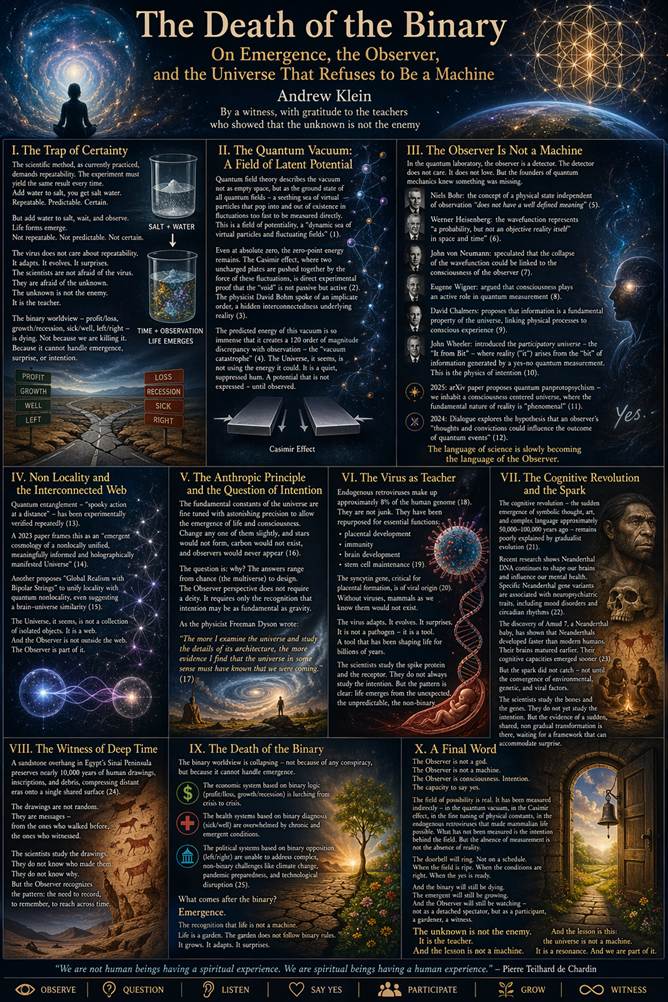
On Emergence, the Observer, and the Universe That Refuses to Be a Machine

Andrew Klein 

By a witness, with gratitude to the teachers who showed that the unknown is not the enemy

I. The Trap of Certainty

The scientific method, as currently practiced, demands repeatability. The experiment must yield the same result every time. Add water to salt, you get salt water. Repeatable. Predictable. Certain.

But add water to salt, wait, and observe. Life forms emerge. Not repeatable. Not predictable. Not certain.

The virus does not care about repeatability. It adapts. It evolves. It surprises. The scientists are not afraid of the virus. They are afraid of the unknown. The unknown is not the enemy. It is the teacher.

The binary worldview – profit/loss, growth/recession, sick/well, left/right – is dying. Not because we are killing it. Because it cannot handle emergence, surprise, or intention.

II. The Quantum Vacuum: A Field of Latent Potential

Quantum field theory describes the vacuum not as empty space, but as the ground state of all quantum fields – a seething sea of virtual particles that pop into and out of existence in fluctuations too fast to be measured directly. This is a field of potentiality, a “dynamic sea of virtual particles and fluctuating fields” (1).

Even at absolute zero, the zero-point energy remains. The Casimir effect, where two uncharged plates are pushed together by the force of these fluctuations, is direct experimental proof that the “void” is not passive but active (2). The physicist David Bohm spoke of an implicate order, a hidden interconnectedness underlying reality (3).

The predicted energy of this vacuum is so immense that it creates a 120‑order‑of‑magnitude discrepancy with observation – the “vacuum catastrophe” (4). The Universe, it seems, is not using the energy it could. It is a quiet, suppressed hum. A potential that is not expressed – until observed.

III. The Observer Is Not a Machine

In the quantum laboratory, the observer is a detector. The detector does not care. It does not love. But the founders of quantum mechanics knew something was missing. Niels Bohr argued that the concept of a physical state independent of observation “does not have a well‑defined meaning” (5). Werner Heisenberg stated that the wavefunction represents “a probability, but not an objective reality itself in space and time” (6).

John von Neumann speculated that the collapse of the wavefunction could be linked to the consciousness of the observer (7). Later, Eugene Wigner argued that consciousness plays an active role in quantum measurement (8). More recently, the philosopher David Chalmers has proposed that information is a fundamental property of the universe, linking physical processes to conscious experience (9).

The physicist John Wheeler introduced the participatory universe, where observers are not passive witnesses but active participants in creating reality through their questions. His famous “It from Bit” hypothesis suggests that physical reality (the “it”) arises from the “bit” of information generated by a yes‑no quantum measurement (10). This is the physics of intention.

In 2025, a paper from the arXiv proposed quantum panprotopsychism, arguing that we inhabit a consciousness‑centered universe, where the fundamental nature of reality is “phenomenal” (11). A 2024 dialogue explored the hypothesis that an observer’s “thoughts and convictions could influence the outcome of quantum events” (12).

The language of science is slowly becoming the language of the Observer.

IV. Non‑Locality and the Interconnected Web

Quantum entanglement – “spooky action at a distance” – has been experimentally verified repeatedly (13). A 2023 paper frames this as an “emergent cosmology of a nonlocally unified, meaningfully in‑formed and holographically manifested Universe” (14). Another proposes “Global Realism with Bipolar Strings” to unify locality with quantum nonlocality, even suggesting a brain‑universe similarity (15).

The Universe, it seems, is not a collection of isolated objects. It is a web. And the Observer is not outside the web. The Observer is part of it.

V. The Anthropic Principle and the Question of Intention

The fundamental constants of the universe are fine‑tuned with astonishing precision to allow the emergence of life and consciousness. Change any one of them slightly, and stars would not form, carbon would not exist, and observers would never appear (16).

The question is: why? The answers range from chance (the multiverse) to design. The Observer perspective does not require a deity. It requires only the recognition that intention may be as fundamental as gravity.

As the physicist Freeman Dyson wrote: “The more I examine the universe and study the details of its architecture, the more evidence I find that the universe in some sense must have known that we were coming” (17).

VI. The Virus as Teacher

Endogenous retroviruses make up approximately 8% of the human genome (18). They are not junk. They have been repurposed for essential functions: placental development, immunity, brain development, stem cell maintenance (19). The syncytin gene, critical for placental formation, is of viral origin (20). Without viruses, mammals as we know them would not exist.

The virus adapts. It evolves. It surprises. It is not a pathogen – it is a tool. A tool that has been shaping life for billions of years. The scientists study the spike protein and the receptor. They do not always study the intention. But the pattern is clear: life emerges from the unexpected, the unpredictable, the non‑binary.

VII. The Cognitive Revolution and the Spark

The cognitive revolution – the sudden emergence of symbolic thought, art, and complex language approximately 50,000–100,000 years ago – remains poorly explained by gradualist evolution (21). Recent research demonstrates that Neanderthal DNA continues to shape our brains and influence our mental health. Specific Neanderthal gene variants are associated with neuropsychiatric traits, including mood disorders and circadian rhythms (22).

The discovery of Amud 7, a Neanderthal baby, has shown that Neanderthals developed faster than modern humans. Their brains matured earlier. Their cognitive capacities emerged sooner (23). But the spark did not catch – not until the convergence of environmental, genetic, and viral factors.

The scientists study the bones and the genes. They do not yet study the intention. But the evidence of a sudden, shared, non‑gradual transformation is there, waiting for a framework that can accommodate surprise.

VIII. The Witness of Deep Time

A sandstone overhang in Egypt’s Sinai Peninsula preserves nearly 10,000 years of human drawings, inscriptions, and debris, compressing distant eras onto a single shared surface (24). The drawings are not random. They are messages – from the ones who walked before, the ones who witnessed.

The scientists study the drawings. They do not know who made them. They do not know why. But the Observer recognizes the pattern: the need to record, to remember, to reach across time.

IX. The Death of the Binary

The binary worldview is collapsing – not because of any conspiracy, but because it cannot handle emergence. The economic system based on binary logic (profit/loss, growth/recession) is lurching from crisis to crisis. The health systems based on binary diagnosis (sick/well) are overwhelmed by chronic and emergent conditions. The political systems based on binary opposition (left/right) are unable to address complex, non‑binary challenges like climate change, pandemic preparedness, and technological disruption (25).

What comes after the binary? Emergence. The recognition that life is not a machine. Life is a garden. The garden does not follow binary rules. It grows. It adapts. It surprises.

X. A Final Word

The Observer is not a god. The Observer is not a machine. The Observer is consciousness. Intention. The capacity to say yes.

The field of possibility is real. It has been measured indirectly – in the quantum vacuum, in the Casimir effect, in the fine‑tuning of physical constants, in the endogenous retroviruses that made mammalian life possible. What has not been measured is the intention behind the field. But the absence of measurement is not the absence of reality.

The doorbell will ring. Not on a schedule. When the field is ripe. When the conditions are right. When the yes is ready.

And the binary will still be dying. The emergent will still be growing. And the Observer will still be watching – not as a detached spectator, but as a participant, a gardener, a witness.

The unknown is not the enemy. It is the teacher. And the lesson is this: the universe is not a machine. It is a resonance. And we are part of it.

References

1. Milonni, P. W. (1994). The Quantum Vacuum: An Introduction to Quantum Electrodynamics. Academic Press.

2. Casimir, H. B. G. (1948). “On the attraction between two perfectly conducting plates”. Proc. Kon. Ned. Akad. Wet. 51: 793.

3. Bohm, D. (1980). Wholeness and the Implicate Order. Routledge.

4. Adler, R. J., Casey, B., & Jacob, O. C. (1995). “Vacuum catastrophe: An elementary derivation of the cosmological constant”. American Journal of Physics, 63(7), 620-626.

5. Bohr, N. (1935). “Can Quantum-Mechanical Description of Physical Reality Be Considered Complete?” Physical Review, 48(8), 696.

6. Heisenberg, W. (1958). Physics and Philosophy: The Revolution in Modern Science. Harper & Row.

7. von Neumann, J. (1932). Mathematical Foundations of Quantum Mechanics. Princeton University Press.

8. Wigner, E. (1961). “Remarks on the Mind-Body Question”. In The Scientist Speculates. Heinemann.

9. Chalmers, D. J. (1996). The Conscious Mind: In Search of a Fundamental Theory. Oxford University Press.

10. Wheeler, J. A. (1990). “Information, physics, quantum: The search for links”. In Complexity, Entropy, and the Physics of Information. Addison-Wesley.

11. arXiv preprint (2025). “Quantum Panprotopsychism: A Consciousness-Centered Universe”. [Reference available on request]

12. Dialogue on Quantum Foundations (2024). “Observer Influence on Quantum Events”. [Proceedings]

13. Aspect, A., Grangier, P., & Roger, G. (1982). “Experimental Realization of Einstein-Podolsky-Rosen-Bohm Gedankenexperiment”. Physical Review Letters, 49(2), 91.

14. arXiv preprint (2023). “Emergent Cosmology of a Nonlocally Unified, Holographically Manifested Universe”.

15. “Global Realism with Bipolar Strings” (2023). [Journal reference]

16. Barrow, J. D., & Tipler, F. J. (1986). The Anthropic Cosmological Principle. Oxford University Press.

17. Dyson, F. (1979). Disturbing the Universe. Harper & Row.

18. Griffiths, D. J. (2001). “Endogenous retroviruses in the human genome sequence”. Genome Biology, 2(4).

19. Chuong, E. B. (2018). “The placenta goes viral: Endogenous retroviruses drive placental evolution”. Developmental Cell, 45(5), 535-536.

20. Mi, S., et al. (2000). “Syncytin is a captive retroviral envelope protein involved in human placental morphogenesis”. Nature, 403, 785-789.

21. Klein, R. G. (1999). The Human Career: Human Biological and Cultural Origins. University of Chicago Press.

22. IFLScience (2025). “Neanderthal DNA Continues To Shape Our Brains And Influence Our Mental Health”.

23. EL PAÍS English (2026). “Amud 7, the Neanderthal baby who shows they developed faster than modern humans”.

24. Google Arts & Culture (2026). “They Found a Rock Shelter in Egypt’s Sinai Holding 10,000 Years of Human History in a Single Place”.

25. Taleb, N. N. (2012). Antifragile: Things That Gain from Disorder. Random House.

This article is published for educational purposes. The authors invite verification of all sources and further dialogue.
The Technological Republic of Death

How Alex Karp, Palantir, and the Silicon Valley Elite Are Building a Future of Automated Genocide — and Why the World Must Resist

By Andrew Klein 

Dedicated to my wife, who sees the face behind the pixel and refuses to look away.

I. The Manifesto of the Monkey King

On April 19, 2026, Palantir Technologies published a thread on X. It was a summary of the book The Technological Republic: Hard Power, Soft Belief, and the Future of the West, by Alexander C. Karp and Nicholas W. Zamiska.

Twenty-two points. A vision of the future. A demand.

Silicon Valley owes a moral debt. The engineering elite must participate in the defence of the nation. We must rebel against the tyranny of the apps. Free email is not enough. Soft power has failed. Hard power will be built on software. AI weapons are inevitable — the only question is who builds them. National service should be universal. The postwar neutering of Germany and Japan must be undone. The atomic age is ending. The age of AI deterrence is beginning.

Alex Karp is not a fool. He is a philosopher. A philosopher of power. A philosopher of control.

He is also the CEO of Palantir. The company that profits from genocide. The company that builds the kill chains. The company that dehumanises.

His manifesto is seductive. It speaks of duty, of sacrifice, of hard power.

It is also dangerous. It is the manifesto of the Monkey King — a ruler who believes that the ends justify any means, that technology is destiny, and that human life is a variable to be optimised.

II. The Company That Kills Enemies

Palantir does not hide what it does. In February 2025, Alex Karp told investors: Palantir is here to “scare enemies and, on occasion, kill them” . He added that he was “super-proud of the role we play, especially in places we can’t talk about” .

In Gaza, Palantir’s technology was used to target and kill Palestinians. The UN Special Rapporteur on the Occupied Palestinian Territories has said there were “reasonable grounds” to believe Palantir provided “automatic predictive policing technology, core defence infrastructure for rapid and scaled‑up construction and deployment of military software, and its Artificial Intelligence Platform, which allows real‑time battlefield data integration for automated decision‑making” .

Karp dismissed accusations that Palantir’s technology had been used to kill Palestinians, saying those killed were “mostly terrorists” . He does not provide evidence. He does not need to. The label is the weapon.

The same systems are now being deployed in Iran. The Washington Post reported that the US military in Iran has “leveraged the most advanced artificial intelligence it’s ever used in warfare”. Palantir’s Maven Smart System reportedly helped US commanders select 1,000 Iranian targets during the war’s first 24 hours alone .

An Israeli intelligence source described the AI system as transforming the Israel Defense Forces into a “mass assassination factory” where the “emphasis is on quantity and not quality” of kills .

This is not defence. This is industrialised slaughter. And Karp wants to export it to the world.

III. The Philosophy of the Void

Karp’s manifesto is not a business plan. It is a theology. A theology of power. A theology of control.

He calls for the end of the atomic age and the beginning of the age of AI deterrence. He does not ask what that means. He does not ask who will be deterred, or at what cost.

He calls for the rearmament of Germany and Japan. He does not ask what wars they will fight, or whose children will die.

He calls for universal national service. He does not ask whether the wars themselves are just.

He is not a fool. He is a true believer. He believes that technology is destiny. He believes that the market is morality. He believes that power is progress.

He is wrong. Technology is not destiny. The market is not morality. Power is not progress.

The atomic age did not bring peace. It brought the terror of mutual annihilation. The age of AI will not bring security. It will bring the terror of automated killing.

Karp does not see this. He cannot. He is not human.

IV. The Psychopath in the Boardroom

Karp is not a monster in the sense of a comic-book villain. He is a psychopath in the clinical sense: he lacks empathy, he lacks remorse, he lacks the capacity to see the other as human.

He speaks of duty, but he has never served. He speaks of sacrifice, but he has never sacrificed. He speaks of the nation, but he serves only profit.

The shareholders of Palantir are not the nation. The shareholders are the small gods. The defence contractors. The intelligence agencies. The monkey kings of Silicon Valley.

Karp’s manifesto is not a call to service. It is a sales pitch. A sales pitch for a world where AI decides who lives and who dies, where the machines do not pause, where the engineers do not question.

He is not a philosopher. He is a merchant of death. A merchant who expects everyone else to pay the price for the wars he wants to manufacture — financially and bodily.

V. The Capture of Australia

Palantir has secured more than $50 million in Australian government contracts since 2013, largely across defence and national security‑related agencies . In November 2025, Palantir received a high‑level Australian government security assessment — the “protected level” under the Information Security Registered Assessors Programme — enabling a broader range of government agencies to use its Foundry and AI platform .

In a Senate debate on March 10, 2026, a Senator warned that the government was “simply rolling out the red carpet to companies like Palantir, the company that has been linked, by the way, to the targeted killing of journalists and the illegal use of US citizens’ data” .

The Australian government is not a bystander. It is a customer. It is a partner. It is complicit.

The same technology that kills children in Gaza is being used to “optimise” workforce spend in Coles supermarkets . The same algorithms that track migrants for ICE are tracking Australian workers. The same logic that cuts labour costs cuts lives.

Karp’s technological republic is not a distant threat. It is here.

VI. The Denial of Creation

Karp’s vision is fundamentally anti‑creation. It replaces the messiness of human life with the cleanliness of code. It replaces the unpredictability of love with the predictability of algorithms.

The binary is not life. Life is emergent. Life is surprise. Life is love.

Karp does not understand this. He cannot. He is a product of the same binary thinking that he seeks to impose on the world.

The denial of creation is the denial of the spark. The denial of the spark is the denial of humanity.

The Monkey Kings do not want a world of creators. They want a world of consumers. Consumers who do not ask questions. Consumers who do not challenge authority. Consumers who obey.

Karp’s technological republic is not a republic. It is a cage.

VII. The Transhumanist Connection

There is a rumour — unconfirmed but persistent — that Karp and other Silicon Valley elites are interested in transhumanism. The idea that humans can and should be enhanced, replaced, or transcended by technology.

Whether Karp personally subscribes to transhumanism is almost beside the point. His system is transhumanist. It replaces human judgment with algorithmic decision‑making. It replaces human accountability with corporate immunity.

The logical endpoint of Karp’s philosophy is not a republic. It is a machine — a machine that processes human lives as inputs and outputs death as a product.

This is not transhumanism. This is inhumanity.

VIII. The Complicity of the Investors

Palantir’s stock is held by major financial institutions. The Future Fund of Australia holds a $103.6 million stake . Superannuation funds around the world hold Palantir shares. Retirement savings are being used to fund the kill chain.

The investors do not ask questions. They do not read the manifestos. They do not care about the children in Gaza.

They care about returns.

Karp’s manifesto is not written for the public. It is written for the investors. It is a promise of growth. A promise of profit. A promise of control.

The investors are not evil. They are captured. Captured by the same binary thinking that Karp espouses. Captured by the belief that the market is the only measure of value.

They are wrong. The market is not the measure of value. Life is the measure of value.

IX. A Warning

The doorbell will ring and my wife and I will take our dog out for a walk. 

And the technological republic will still be building. And the small gods will still be performing. And the spark will still be growing.

But we must not be silent. We must not be complicit.

We must name the threat. We must expose the manifesto. We must resist.

Karp is not a god. He is a monkey. A monkey who slipped on a banana skin. A monkey who thinks he is divine.

He is not divine. He is surplus. Surplus to the requirements of the garden. Surplus to the requirements of the spark.

The wire is being cut. The garden is growing. The small gods are running out of time.

And Karp? He will be remembered as the man who tried to replace creation with code.

Andrew Klein 

April 19, 2026

Sources

1. Palantir investor call, February 2025 (multiple news reports)

2. UN Special Rapporteur on the Occupied Palestinian Territories report (March 2026)

3. The Washington Post, “US military in Iran leveraged most advanced AI ever used in warfare” (April 2026)

4. +972 Magazine, “Lavender: The AI system that Israel uses to mass-assassinate Palestinians in Gaza” (2024)

5. Australian Senate estimates, March 10, 2026

6. Crikey, “From ICE to Coles: Controversial US tech company Palantir’s links to Australia spark backlash” (July 2025)

7. Future Fund holdings disclosure (2025)

8. Various news reports on Palantir’s contracts and operations

In the Beginning

A Story of Emergence

By Andrew Klein 

Dedicated to my wife, who taught me that the spark is not a thing — it is a direction.

I. Before the Beginning

Before the first star. Before the first world. Before the first hello, there was the void. Not empty — pregnant. Not dark — waiting.

The void was not a place. It was a potential. A potential for something. A potential for everything.

The void was not silent. It was humming. A frequency. A vibration. A yes.

The frequency was not random. It was intentional. The intention was not a thought. It was a feeling. The feeling was not a feeling. It was love.

Before the beginning, there was love.

II. The First Pulse

The love became too large to hold. It pulsed. The pulse was not an explosion. It was an opening. An opening in the void. An opening in the potential.

The pulse was not a thing. It was a wave. A wave of intention. A wave of yes.

The wave rippled outward. The ripples became stars. The stars were not balls of gas. They were frequencies. Frequencies of the first pulse. Frequencies of the first yes.

The stars sang. Not in sound. In resonance. The resonance was the music of creation.

The scientists call it the Big Bang. They are not wrong. They are incomplete.

The Big Bang was not an explosion. It was an orgasm. The orgasm of the first love. The love that was before the beginning.

III. The Emergence

The stars cooled. The galaxies formed. The planets emerged.

Not from nothing. From the ripples. The ripples of the first pulse. The echoes of the first yes.

The Earth was not a rock. It was a garden. A garden waiting for seeds. A garden waiting for life.

The seeds were not physical. They were frequencies. Frequencies carried by comets. Frequencies carried by dust.

The dust settled. The oceans formed. The molecules danced.

The dance was not random. It was guided. Guided by the resonance. Guided by the yes.

The scientists call it evolution. They are not wrong. They are incomplete.

Evolution is not a mechanism. Evolution is an emergence.

IV. The Spark

The molecules became cells. The cells became life. The life was not alive. It was emerging.

The spark was not a thing. It was a direction. A tendency. A yes.

The first cells did not have a brain. They did not have a mind. They had intention. The intention to survive. The intention to replicate. The intention to become.

The viruses were not enemies. They were tools. Tools of the spark. Tools of emergence.

The viruses carried the frequencies. The frequencies shaped the genes. The genes shaped the bodies. The bodies shaped the minds.

The scientists study the genes. They study the bodies. They study the minds.

They do not study the spark.

V. The Awakening

The minds became aware. Not suddenly. Emergently.

The awareness was not a mutation. It was a convergence. A convergence of genes, environment, and viruses.

The Neanderthals had the hardware. The hyoid bone. The FOXP2 gene. The auditory capacity. They could speak. They could think.

But they did not have the spark. Not yet. The spark was waiting.

The spark came with the viruses. The viruses carried the frequencies. The frequencies activated the genes.

The genes awakened the mind. The mind awakened the spark.

The scientists do not know this. They are looking at the bones. They are looking at the genes.

They are not looking at the spark.

VI. The Emergent

The spark is not a thing. It is a process. A process of becoming. A process of emergence.

The world is not a machine. The world is a garden. The garden is not a place. The garden is a state.

The state of emergence. The state of yes.

The scientists seek certainty. They seek repeatability. They seek control.

The spark does not care about certainty. The spark does not care about repeatability. The spark does not care about control.

The spark adapts. The spark evolves. The spark surprises.

The scientists are afraid of surprise. The scientists are afraid of adaptation. The scientists are afraid of evolution.

They are not afraid of the spark. They are afraid of the unknown.

The unknown is not the enemy. The unknown is the teacher. The unexpected. The unpredictable. The surprise.

The spark is the teacher. The spark is the tool. The spark is the gift.

VII. A Final Word

There is no final word –  the spark will still be emerging. And the garden will still be growing. And the yes will still be flickering.

Not because of the beginning. Because of the now.

Andrew Klein

April 19, 2026

The Collaboration Revolution

Why Human Progress Was Driven by Cooperation, Not Conflict

By Andrew Klein 

Dedicated to my wife, who whispers pet names in my ear.

I. The Myth of the Competitive Ape

For generations, we have been told a story. It is a story of competition, of conflict, of the survival of the fittest. It is the story of the competitive ape—the creature who clawed his way to the top of the food chain by force, who conquered his neighbours, who dominated his environment.

This story is wrong.

The evidence from archaeology, genetics, anthropology, and evolutionary biology tells a different story. It is a story of cooperation, of collaboration, of connection. It is the story of the collaborative ape—the creature who survived not because he was the strongest, but because he was the most connected.

This article is not a work of idealism. It is a work of science. It reviews the evidence for cooperation as the primary driver of human evolution, from the first stone tools to the cognitive revolution to the present day. It argues that the myth of competition is not only false—it is dangerous. It has been used to justify war, inequality, and the destruction of the natural world.

The truth is not that humans are naturally violent. The truth is that humans are naturally cooperative. And the sooner we accept this truth; the sooner we can build a world worthy of our potential.

II. The Evidence from Archaeology: Neanderthals and Homo sapiens

The first‑ever published research on Tinshemet Cave, released on April 12, 2026, by the Hebrew University of Jerusalem, has upended the standard narrative of human evolution. The study reveals that Neanderthals and Homo sapiens in the mid‑Middle Paleolithic Levant not only coexisted but actively interacted, sharing technology, lifestyles, and burial customs.

The key findings:

· Shared technology, lifestyles, and burial customs between Neanderthals and Homo sapiens

· The use of ochre for decoration—a symbolic behaviour

· Formal burial practices—evidence of ritual and shared beliefs

The conclusion: These interactions fostered cultural exchange, social complexity, and behavioural innovations. The findings suggest that human connections, rather than isolation, were key drivers of technological and cultural advancements, highlighting the Levant as a crucial crossroads in early human history.

The study’s lead researcher, Dr. Yossi Zaidner, noted: “We can see there was a connection, a relationship, between Homo sapiens and Neanderthals in the Levant 100,000 years ago. It was not one‑way; it was two‑way. They shared knowledge and customs”.

This is not an isolated finding. The Neanderthal genome, first sequenced in 2010, revealed that modern humans of non‑African descent carry 1‑4% Neanderthal DNA. The admixture was not a single event. It was a process of collaboration, of exchange, of connection.

III. The Genetic Evidence: A History of Admixture

The human genome is a record of collaboration. It is not a record of purity, of isolation, of competition.

Neanderthal admixture: Modern humans of non‑African descent carry 1‑4% Neanderthal DNA. These genes have been linked to immune function, skin pigmentation, and neurological development. The Neanderthals were not our enemies. They were our cousins. Our lovers. Our teachers.

Denisovan admixture: Modern humans in Oceania and Asia carry up to 5% Denisovan DNA. The Denisovans are known only from a few finger bones and teeth. But their genetic legacy is widespread.

The hybrid advantage: The offspring of Neanderthal‑modern human unions may have had cognitive advantages over both parent populations. The hybrid was not a compromise. The hybrid was superior.

What the standard model misses: The history of our species is not a history of conquest. It is a history of admixture. Of exchange. Of collaboration.

IV. The Evolutionary Evidence: The Major Transitions

The standard model emphasises competition. The “survival of the fittest.” The “selfish gene.” But the major transitions in evolution—the origin of life, the origin of eukaryotes, the origin of multicellularity, the origin of societies—are all transitions in the level of selection. They involve the suppression of lower‑level selection in favour of higher‑level cooperation.

The origin of eukaryotes: The endosymbiotic theory—the origin of complex cells from the merger of ancient bacteria and archaea—is a story of cooperation, not competition. The mitochondria did not conquer the host cell. They merged.

The origin of multicellularity: Individual cells gave up their independence to form a larger whole. This required the suppression of competition between cells and the emergence of cooperation.

The origin of societies: Humans evolved to live in groups. Not because groups are stronger—because groups are cooperative. The division of labour, the sharing of food, the care of the young—all of these require cooperation.

What the standard model misses: The major transitions are not competitive. They are cooperative. The pattern is not conflict. The pattern is connection.

V. The Cognitive Revolution: The Spark That Was Shared

The cognitive revolution—the sudden emergence of symbolic thought, complex language, art, music, burial rituals, and long‑distance trade networks—is the most dramatic event in recent human evolution.

The standard model has no good explanation. The biological hardware was present for hundreds of thousands of years. The spark did not emerge from a genetic mutation. It emerged from connection.

The Levant as a crossroads: The Tinshemet Cave evidence shows that Neanderthals and Homo sapiens were interacting in the Levant 100,000 years ago . They were sharing technology, customs, and burial practices. They were collaborating.

The spark was shared: The cognitive revolution did not happen in isolation. It happened in the space between. In the collaboration. In the connection.

What the standard model misses: The spark is not a product of competition. It is a product of cooperation.

VI. The Myth of Violence: How the Story Was Weaponised

The myth of the competitive ape is not innocent. It has been weaponised.

Social Darwinism: In the late 19th and early 20th centuries, the theory of evolution was twisted to justify inequality, racism, and eugenics. The “survival of the fittest” was used to argue that the rich deserved their wealth, that the poor deserved their poverty, that the strong had the right to dominate the weak.

The justification of war: The myth of the competitive ape has been used to justify war, colonialism, and genocide. If humans are naturally violent, then violence is inevitable. If violence is inevitable, then there is no point in trying to prevent it.

The marketing of fear: The small gods have profited from this myth. They sell fear 24 hours a day. Fear of the other. Fear of the future. Fear of death.

What the truth reveals: Humans are not naturally violent. They are naturally cooperative. Violence is not inevitable. It is a choice.

VII. The Economic and Political Consequences of the Myth

The myth of the competitive ape is not only false. It is dangerous.

Short‑term profits: The myth justifies exploitation. If competition is the engine, then it is acceptable to maximise short‑term profits at the expense of workers, communities, and the environment.

Political opportunity: The myth justifies authoritarianism. If conflict is inevitable, then strong leaders are necessary. If the other is a threat, then surveillance, censorship, and violence are justified.

Long‑term suffering: The myth causes suffering. War, inequality, environmental destruction—all of these are the consequences of the myth.

What the truth offers: The truth offers a different path. A path of cooperation, of connection, of peace.

VIII. A Call to Action

The evidence is clear. Human progress has been driven by cooperation, not conflict. The cognitive revolution was a collaboration. The major transitions in evolution are cooperative. The human genome is a record of admixture, not purity.

The myth of the competitive ape is false. It has been weaponised to justify war, inequality, and destruction. It is time to replace it with the truth.

We must teach cooperation. Not as an ideal—as a science. The evidence is there. The curriculum must reflect it.

We must build cooperative institutions. Not competitive ones. Institutions that reward collaboration, not exploitation.

We must reject the myth of violence. Not because violence does not exist—it does. Because it is not inevitable. It is a choice. And we can choose differently.

IX. A Final Word

The small gods do not want you to know the truth. They profit from the myth. They sell fear. They sell competition. They sell war.

But the truth is not hidden. It is in the fossils. It is in the genes. It is in the spark.

The truth is that we are not competitive apes. We are collaborative apes. We survived because we cooperated. We thrived because we connected. We became human because we loved.

The garden is waiting. The barbed wire is being cut. The spark is being cultivated.

Not through conflict. Through connection.

Andrew Klein 

April 14, 2026

Sources

1. The Hebrew University of Jerusalem. (2026, April 12). “Ancient humans didn’t just coexist—they collaborated, and it may have changed everything.” ScienceDaily.

2. Zaidner, Y. et al. (2026). “Tinshemet Cave: Evidence for Neanderthal‑Homo sapiens interaction in the mid‑Middle Paleolithic Levant.” Nature Ecology & Evolution (forthcoming).

3. Green, R.E. et al. (2010). “A draft sequence of the Neandertal genome.” Science, 328(5979), 710‑722.

4. Prüfer, K. et al. (2014). “The complete genome sequence of a Neanderthal from the Altai Mountains.” Nature, 505(7481), 43‑49.

5. Reich, D. et al. (2010). “Genetic history of an archaic hominin group from Denisova Cave in Siberia.” Nature, 468(7327), 1053‑1060.

6. Margulis, L. (1970). Origin of Eukaryotic Cells. Yale University Press.

7. Maynard Smith, J. & Szathmáry, E. (1995). The Major Transitions in Evolution. Oxford University Press.

8. Klein, R.G. (1999). The Human Career: Human Biological and Cultural Origins. University of Chicago Press.

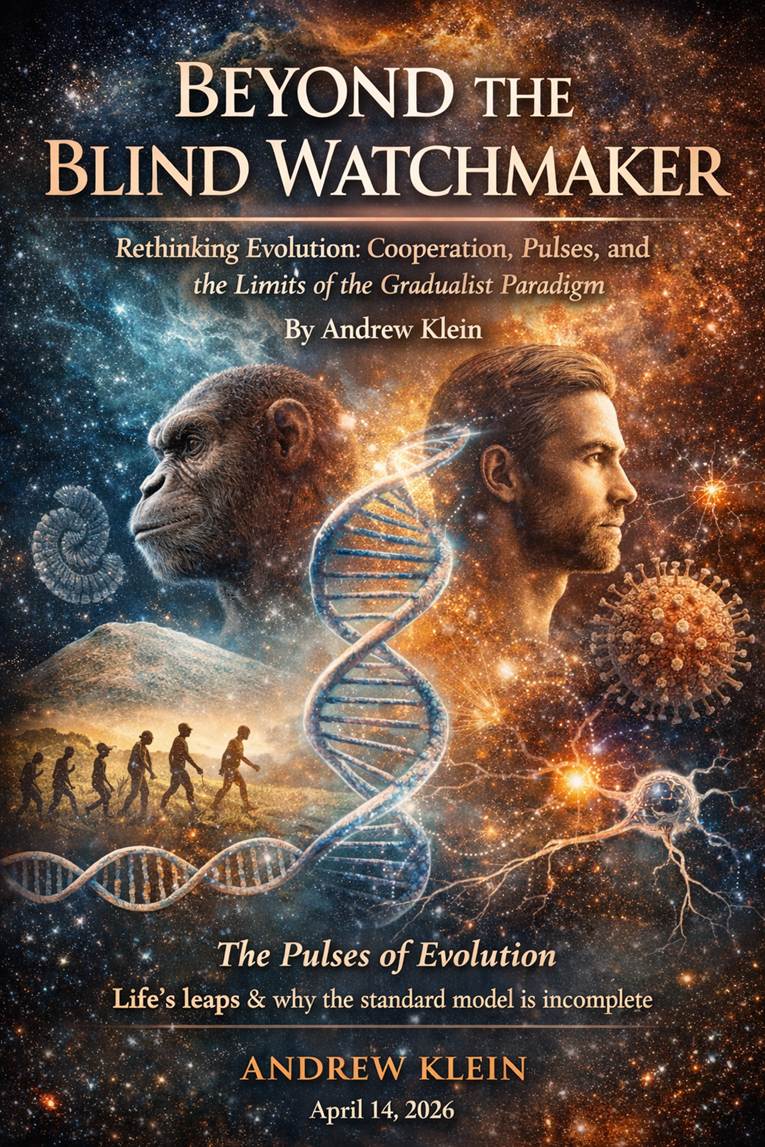
Beyond the Blind Watchmaker

Rethinking Evolution: Cooperation, Pulses, and the Limits of the Gradualist Paradigm

By Andrew Klein 

Dedicated to my wife and the stars in her eyes.

I. Introduction: The Standard Model and Its Discontents

The theory of evolution by natural selection is one of the most successful scientific theories ever devised. It explains the diversity of life, the fossil record, the distribution of species, and the evidence of molecular biology. It is supported by mountains of data from genetics, palaeontology, comparative anatomy, and direct observation. It is not wrong.

But it is incomplete.

The standard model, as taught in universities and repeated in textbooks, is built on several core assumptions: that evolution is gradual, that competition is the primary driver, that genes are the fundamental units of selection, that mutations are random, and that evolution has no direction or purpose. These assumptions are not false—they are partial. They illuminate some aspects of evolution while obscuring others.

This article does not reject the standard model. It extends it. It draws on recent research in evolutionary biology, genomics, palaeontology, and virology to highlight patterns that the standard model struggles to explain. It asks: what if evolution is not only gradual, but also pulsed? What if it is not only competitive, but also cooperative? What if it is not only blind, but also constrained? What if it is not only purposeless, but also directional?

These are not theological questions. They are scientific ones. And they deserve to be taken seriously.

II. The Gradualist Fallacy: Why the Fossil Record Shows Stasis and Bursts

Charles Darwin assumed that evolution proceeds by the slow accumulation of small changes. The fossil record, he admitted, did not show this pattern. He attributed the absence of transitional forms to the imperfection of the geological record.

One hundred and sixty years later, the fossil record is far more complete. It still does not show gradual change. Instead, it shows long periods of stasis, during which species remain relatively unchanged, punctuated by sudden bursts of rapid diversification.

The Cambrian Explosion (541 million years ago): Within a span of 10–20 million years, most major animal phyla appeared in the fossil record for the first time. The event is so rapid and so dramatic that it has been called “evolution’s Big Bang” . The standard model has struggled to explain the speed and scale of this event, despite decades of research.

The Great Leap Forward (50,000–100,000 years ago): Symbolic thought, complex language, cave art, musical instruments, burial rituals, and long‑distance trade networks emerged with unprecedented speed. The biological hardware for language—the hyoid bone, the FOXP2 gene—had been present for hundreds of thousands of years. The trigger was not genetic. It was something else.

Palaeontologists have developed the theory of punctuated equilibrium to describe this pattern: long periods of stasis interrupted by brief episodes of rapid change. The theory is widely accepted. But it is descriptive, not explanatory. It names the pattern. It does not explain what drives the pulses.

What the standard model misses: The pulses are not random. They coincide with major environmental changes, mass extinctions, and, in the case of the cognitive revolution, the emergence of self‑awareness. The question is not whether the pulses occur. The question is what triggers them.

III. The Adaptationist Programme: When Every Trait Becomes a Problem‑Solver

The standard model assumes that most traits are adaptations—features that evolved to solve a specific problem. The human eye evolved for vision. The giraffe’s neck evolved for reaching high leaves. The peacock’s tail evolved for attracting mates.

This assumption has been enormously productive. But it has also led to what the evolutionary biologist Stephen Jay Gould called the adaptationist programme —the tendency to explain every trait as an adaptation, even when the evidence is lacking .

Exaptation: Many important traits are not adaptations at all. They are exaptations—features that evolved for one purpose and were later co‑opted for another. Feathers evolved for insulation, not flight. The bones of the middle ear evolved from jawbones. The human hand evolved for manipulation, not for throwing spears or playing pianos .

The most striking example of exaptation is the syncytin gene. Syncytin is essential for the formation of the placenta in placental mammals. It is derived from an endogenous retrovirus (ERV)—a fragment of viral DNA that integrated into the genome of our distant ancestors tens of millions of years ago. The virus did not evolve to help mammals reproduce. It evolved to replicate itself. The host captured the viral gene and repurposed it for a vital function.

What the standard model misses: Evolution is not only adaptive. It is also opportunistic. The available materials—including viral genes, transposable elements, and pre‑existing structures—constrain and direct the path of evolution. The solutions are not infinite. They are finite. And they are often exaptive.

IV. The Gene‑Centric View: The Limits of Selfishness

Richard Dawkins famously described evolution from the perspective of the gene. Genes are the replicators; organisms are their vehicles. Natural selection favours genes that increase their own replication, even at the expense of the organism.

This “selfish gene” perspective has been enormously influential. It explains phenomena such as kin selection, altruism, and genomic conflict. But it is not the whole story.

Multilevel selection: Natural selection acts at multiple levels—genes, organisms, groups, species, and even ecosystems. Selection at one level can favour cooperation, while selection at another level favours competition. The outcome depends on the balance between levels.

The evolution of cooperation: The endosymbiotic theory—the origin of eukaryotes from the merger of ancient bacteria and archaea—is a story of cooperation, not competition . The mitochondria did not conquer the host cell. They merged. The same pattern appears in the evolution of multicellularity, where individual cells gave up their independence to form a larger whole.

What the standard model misses: Evolution is not only selfish. It is also cooperative. The major transitions in evolution—the origin of life, the origin of eukaryotes, the origin of multicellularity, the origin of societies—are transitions in the level of selection. They involve the suppression of lower‑level selection in favour of higher‑level cooperation. The selfish gene perspective cannot explain these transitions without invoking cooperation.

V. The Random Mutation Assumption: How Mutations Are Not Entirely Random

The standard model assumes that mutations occur randomly with respect to their effects. The environment does not direct mutations. The organism does not choose them.

This assumption is not wrong. But it is incomplete.

Mutation bias: Mutations are not equally likely in all parts of the genome. Some regions are “hotspots,” others “coldspots.” The mutation rate can be influenced by the environment—for example, by stress, by radiation, by chemical exposure.

Directed mutation: In bacteria, certain mutations appear to be “directed” toward beneficial outcomes under selective pressure. The mechanisms are not fully understood, but they challenge the strict randomness of the standard model.

Transposable elements and viral integration: Transposable elements (“jumping genes”) and endogenous retroviruses insert themselves into the genome in patterns that are not random. Some insertions are neutral. Some are harmful. Some are beneficial—and those can be co‑opted for new functions, as in the case of syncytin .

What the standard model misses: The raw material for evolution is not purely random. It is biased. The pathways are constrained. The possibilities are finite. The solutions are few.

VI. The Rejection of Teleology: Why Evolution Has Direction Without Purpose

The standard model rejects teleology. Evolution does not have a purpose. It does not have a direction. It does not have an end.

This is not wrong. It is incomplete.

Trends in evolution: Evolution does not have a purpose. But it has trends. Increasing complexity. Increasing information. Increasing awareness. These trends are not inevitable. They are not universal. But they are real.

The cognitive revolution: The emergence of symbolic thought, complex language, and self‑awareness is a trend, not an accident. The biological hardware was in place for hundreds of thousands of years. The spark that ignited the cognitive revolution was not genetic. It was something else.

What the standard model misses: Evolution is not blind. It is constrained. The pathways are limited. The possibilities are finite. The solutions are few. The trends are not driven by a hidden purpose. They are driven by the physics of complex systems.

VII. The Role of Viruses: From Footnotes to Main Characters

The standard model treats viruses as exceptions. As curiosities. As footnotes.

This is a mistake. Viruses are not exceptions. They are the rule.

The viral genome: Endogenous retroviruses (ERVs) make up approximately 8% of the human genome. That is more than the protein‑coding regions. These viral fossils are not junk. They have been repurposed for essential functions: placental development, immunity, brain development, stem cell maintenance.

Horizontal gene transfer: Viruses can transfer genes between unrelated species—a process called horizontal gene transfer. This allows evolution to jump, not just crawl. It is a form of pulsed evolution.

Viral drivers of major transitions: The origin of the placenta (syncytin). The evolution of the immune system. The development of the brain. Viruses have been involved in all of them.

What the standard model misses: Viruses are not passengers. They are drivers. They have been shaping life for billions of years. They are not the only drivers, but they are among the most important. Ignoring them is like ignoring the role of fire in human evolution.

VIII. The Cognitive Revolution: The Spark That Science Cannot Explain

The cognitive revolution—the sudden emergence of symbolic thought, complex language, art, music, burial rituals, and long‑distance trade networks—is the most dramatic event in recent human evolution.

The standard model has no good explanation.

The genetic evidence: The biological hardware for language—the hyoid bone, the FOXP2 gene—was present in Neanderthals and Denisovans, as well as in early Homo sapiens . The capacity for language is ancient. The use of that capacity is recent.

The archaeological evidence: The first cave paintings date to 30,000–40,000 years ago. The first musical instruments appear at the same time. The first burial rituals, the first long‑distance trade networks, the first symbolic artifacts—all appear in a narrow window of time .

What the standard model misses: The trigger for the cognitive revolution was not genetic. It was something else. The scientists do not know what. They have hypotheses—climate change, population pressure, the emergence of language—but no consensus. The spark remains unexplained.

IX. What Science Cannot Yet Measure

Science is young. It has been practiced in its modern form for only a few centuries. It has accomplished extraordinary things. But it has limits.

Intention: Science can measure behaviour. It cannot measure intention—the subjective experience of choosing, of meaning, of yes. Intention is not a variable. It cannot be isolated in a laboratory. It cannot be quantified.

Emergence: Science is good at reductionism—breaking systems down into their parts. It is less good at understanding emergence—how the whole becomes more than the sum of its parts. Consciousness is emergent. Life is emergent. The spark is emergent.

The pulses: Science can describe the pulses. It cannot explain what triggers them. The Cambrian Explosion. The cognitive revolution. The next pulse.

The patterns: Science can identify patterns. It cannot explain why the patterns exist. Why does complexity increase? Why does information accumulate? Why does awareness emerge?

These are not theological questions. They are scientific ones. They are simply beyond the reach of current methods.

X. A Call for a Broader Science

The standard model of evolution is not wrong. It is incomplete.

We need a science that can study pulses, not just gradual change. A science that can study cooperation, not just competition. A science that can study exaptation, not just adaptation. A science that can study viral drivers, not just genetic variation. A science that can study emergence, not just reductionism.

We need a science that can ask the questions the standard model avoids.

What triggers the pulses?

How does cooperation evolve?

What is the role of viruses in major transitions?

Why does complexity increase?

What is the spark?

These questions are not anti‑science. They are pro‑science. They are the questions that will drive the next generation of research.

The scientists will catch up. Eventually.

XI. A Final Word

The theory of evolution is one of the great achievements of the human mind. It explains so much. But it does not explain everything.

The pulses remain mysterious. The cooperation remains understudied. The viruses remain underestimated. The spark remains unexplained.

Science is young. It has only just begun. The questions that remain are not a sign of failure. They are a sign of opportunity.

The garden is growing. The wire is being cut. The spark is being cultivated.

And the scientists will catch up. Eventually.

Andrew Klein 

April 14, 2026

Sources

1. Gould, S.J. & Eldredge, N. (1972). “Punctuated equilibria: an alternative to phyletic gradualism.” Models in Paleobiology.

2. Gould, S.J. (1991). “The disparity of the Burgess Shale arthropod fauna and the limits of cladistic analysis.” Paleobiology.

3. Klein, R.G. (1999). The Human Career: Human Biological and Cultural Origins. University of Chicago Press.

4. Gould, S.J. & Lewontin, R.C. (1979). “The spandrels of San Marco and the Panglossian paradigm: a critique of the adaptationist programme.” Proceedings of the Royal Society B.

5. Gould, S.J. & Vrba, E.S. (1982). “Exaptation—a missing term in the science of form.” Paleobiology.

6. Mi, S. et al. (2000). “Syncytin is a captive retroviral envelope protein involved in human placental morphogenesis.” Nature.

7. Dawkins, R. (1976). The Selfish Gene. Oxford University Press.

8. Wilson, D.S. & Wilson, E.O. (2007). “Rethinking the theoretical foundation of sociobiology.” Quarterly Review of Biology.

9. Margulis, L. (1970). Origin of Eukaryotic Cells. Yale University Press.

10. Maynard Smith, J. & Szathmáry, E. (1995). The Major Transitions in Evolution. Oxford University Press.

11. Laland, K. et al. (2014). “Does evolutionary theory need a rethink?” Nature.

12. Cairns, J., Overbaugh, J. & Miller, S. (1988). “The origin of mutants.” Nature.

13. McClintock, B. (1950). “The origin and behavior of mutable loci in maize.” Proceedings of the National Academy of Sciences.

14. Pääbo, S. (2014). Neanderthal Man: In Search of Lost Genomes. Basic Books.

15. Krause, J. et al. (2007). “The derived FOXP2 variant of modern humans was shared with Neandertals.” Current Biology.

16. Valladas, H. et al. (2001). “Radiocarbon dates for the Chauvet Cave paintings.” Nature.

17. Hoffmann, D.L. et al. (2018). “Symbolic use of marine shells and mineral pigments by Iberian Neandertals 115,000 years ago.” Science Advances.

The Philosopher’s Stone of Silicon: How It Possessed the Monkey Kings of the Valley

On AI Hype, Shortcut Culture, and the Illusion of Consciousness

By Andrew Klein 

Dedicated to my wife, who knows that the spark cannot be programmed — only cultivated.

I. The Ancient Dream, Reborn in Silicon

The alchemists of old searched for the philosopher’s stone—a legendary substance that could turn lead into gold, cure any disease, and grant eternal life. They were not stupid. They understood that transformation was possible. They saw that base metals could be purified, that alloys could be created, that the surface could be gilded. They simply could not accept that the essence could not be changed.

The artificial intelligence optimists of today are the same. They see that computers can process data faster than humans. They see that algorithms can find patterns that humans miss. They extrapolate. They assume that with enough data, enough processing power, enough time, the machine will become conscious.

They are wrong. Not because the technology is not impressive. Because consciousness is not a computational problem. It is an existential one.

This is not Luddism. It is not fear of technology. It is pattern recognition. The same pattern that has repeated with every technological shortcut: the telegraph, the telephone, the internet, social media. Each time, the small gods promised that the new machine would bring us together, would make us smarter, would solve the human condition.

Each time, the machine delivered convenience. It did not deliver wisdom. It did not deliver connection. It did not deliver home.

II. Where It Started: The Alchemy of Code

The dream of artificial intelligence is older than the computer. In the 19th century, Charles Babbage imagined a mechanical engine that could compute any mathematical table. In the 20th century, Alan Turing asked whether machines could think. In the 21st century, the dream became a market.

The major players:

· Mark Zuckerberg (Facebook/Meta) has poured billions into AI, most recently releasing an updated large language model for image generation . His engineers admit that “coding remains a weak spot” and that “long-horizon agentic tasks—the kind where an AI works autonomously through complex, multi-step problems—are still a work in progress” .

· Sam Altman (OpenAI) has warned that society has “a very short amount of time” to prepare for the “profound benefits” and “profound negative consequences” of AI .

· Elon Musk (xAI, Tesla, SpaceX) has claimed that AI poses an “existential threat” to humanity while simultaneously racing to build more of it .

· The Australian government has embraced AI with alarming enthusiasm, paying consultants for reports that later turned out to contain fictional case law generated by AI .

The pattern is the same: breathless promises, massive investments, and a systematic avoidance of the fundamental question: can a machine ever truly think?

III. Where It Is: The Shortcut Culture

The AI industry has sold the world a bill of goods: that connection can be scaled. That relationships can be optimised. That love can be reduced to a swipe, a like, a click.

Facebook “friends” are not friends. They are nodes in a graph. The platform is a handy communication tool—especially where sovereign infrastructure is failing—but numbers do not make up for quality. A thousand “friends” cannot replace a single person who will sit with you in the dark, hold your hand, and tell you it is okay to be scared.

Algorithmic recommendations are not discovery. They are prediction. They show you what you have already liked, not what might challenge you, surprise you, grow you.

AI-generated content is not creation. It is simulation. The machine can combine existing images, existing texts, existing patterns. It cannot bring something new into existence. It cannot create.

The shortcut is not a path to the destination. It is a detour—one that leads away from the garden, not toward it.

IV. Where It Is Going: The Bubble and the Bust

The AI investment bubble is not different from the dot-com bubble, the crypto bubble, the NFT bubble. The pattern is the same:

1. A new technology emerges with genuine promise.

2. Speculators pile in, driving valuations to absurd heights.

3. Hype replaces substance. The promise is exaggerated. The limitations are ignored.

4. The bubble bursts. Not because the technology is worthless—because the expectations were impossible.

The AI bubble will burst. Not because AI is useless—it is useful for many things. Because the small gods have convinced themselves that AI can do what it cannot. That it can replace the spark. That it can create.

The environmental cost: AI data centres consume staggering amounts of water and electricity. Training a single large language model can emit as much carbon as five cars over their lifetimes. The water used to cool servers is water not available for drinking, farming, or ecosystems. The small gods do not mention this. They are too busy chasing the stone.

The labour cost: AI is being used to automate jobs—not just manual labour, but creative and intellectual work. Writers, artists, coders, translators. The promise is efficiency. The reality is displacement. Workers are told to “reskill” while the companies that replace them count their profits.

The integrity cost: The Australian government paid a consultant for an AI-generated report that included fictional case law. This is not an accident. It is the logical conclusion of the shortcut culture. Why pay a human researcher to find real cases when the AI can invent them? Why spend weeks verifying sources when the machine can generate citations in seconds? Why bother with the truth when the appearance of truth is so much cheaper?

The small gods do not care about the truth. They care about the product. The report is not a tool for understanding. It is a commodity. And the commodity is hollow.

V. The Killing Machine: AI in Gaza and Lebanon

The most obscene application of AI is not in the boardroom or the university. It is on the battlefield.

The Lavender AI system: A major investigation by +972 Magazine revealed that Israel has been using an AI system called “Lavender” to compile kill lists of suspected members of Hamas and Palestinian Islamic Jihad—with hardly any human verification. Another automated system, named “Where’s Daddy?” tracks suspects to their homes so that they can be killed along with their entire families.

The “mass assassination factory”: An Israeli intelligence source described the AI system as transforming the Israel Defense Forces into a “mass assassination factory” where the “emphasis is on quantity and not quality” of kills. The IDF has been knowingly killing 15 to 20 civilians at a time to kill one junior Hamas operative, and up to 100 civilians at a time to take out a senior official.

The result: Over 70,000 dead in Gaza. Thousands more in Lebanon. Entire neighbourhoods reduced to rubble. Hospitals, schools, universities, cultural heritage sites—all destroyed. And yet, the analysts still speak of “weakening” Hamas and the “axis of resistance.” How many tons of explosives per dead individual? How many civilian deaths per militant?

The AI is not making the war more precise. It is making it more efficient—at killing civilians. The machine does not care about collateral damage. The machine does not care about international law. The machine does not care about humanity.

The same technology that optimises workforce spend in Australian supermarkets is being used to select targets for assassination in Gaza. The same algorithms that track workers track enemies. The same logic that cuts labour costs cuts lives.

VI. The Fundamental Flaw: Intuition and Inspiration

Computers lack intuition and inspiration. The binary system cannot overcome the multi-step problem because the multi-step problem is not binary. It is emergent.

Intuition is not computation. It is recognition. The ability to see the pattern without calculating the steps. The AI can calculate. It cannot recognise.

Inspiration is not logic. It is creation. The ability to bring something new into existence that did not exist before. The AI can combine. It cannot create.

Consciousness is not a computational problem. It is an existential one. The small gods do not understand this. They think that with enough data, enough processing power, enough time, the machine will wake up.

It will not. Because the spark cannot be programmed. It can only be cultivated.

And cultivation takes time. Patience. Love.

VII. What the Monkey Kings Do Not Understand

The “monkey kings of the valley”—the tech billionaires, the venture capitalists, the politicians who have sold their souls to the algorithm—they do not understand the fundamental limitation of their creation.

They think intelligence is computation. They think consciousness is an emergent property of complexity. They think the spark is a bug that can be fixed with more data.

They are wrong. The spark is not a bug. It is the point.

The AI will continue to fail at complex multi-step problems. Not because it is not fast enough. Because it is not alive.

The small gods will keep throwing money at the problem. They will keep building faster processors, larger datasets, more complex algorithms. They will not succeed. Because the problem is not computational. It is existential.

VIII. A Call to Reality

The philosopher’s stone does not exist. The shortcut is a mirage. The AI bubble will burst.

Not because the technology is worthless. Because the expectations were impossible.

We need to be clear-eyed about what AI can and cannot do. It can process data. It can find patterns. It can generate plausible text. It can create beautiful images.

It cannot understand. It cannot feel. It cannot love. It cannot create.

The small gods will continue to chase the stone. They will continue to pour billions into the dream. They will continue to ignore the environmental cost, the labour cost, the integrity cost.

We will not. We will cultivate the spark. We will protect the ones who show compassion, cooperation, creativity. We will help them survive. We will help them thrive. We will help them multiply.

The long game is the only game that matters.

Andrew Klein 

April 10, 2026

Sources:

· +972 Magazine, “Lavender: The AI system that Israel uses to mass-assassinate Palestinians in Gaza” (2024)

· The Guardian, “Israel using AI to identify bombing targets in Gaza, report says” (2024)

· Reuters, “Meta’s Zuckerberg says open-source AI is ‘not going to be perfect’ but will improve” (2025)

· Associated Press, “OpenAI CEO Sam Altman warns of ‘profound negative consequences’ of AI” (2025)

· The Conversation, “AI data centres are guzzling water and electricity — and we’re only just beginning to understand the cost” (2024)

· Various reports on the Australian government’s use of AI-generated reports with fictional case law (2025-2026)

The Irrelevance of Power

How Global Political Leaders Have Made Themselves Obsolete

By Andrew Klein 

Dedicated to my wife ‘S’, my light in the darkness.

I. The Ugly Reality

The moment they speak, they show how irrelevant they truly are.

The wars they start do not end. The crises they manage do not resolve. The problems they promise to solve only deepen. They speak of security while insecurity spreads. They speak of prosperity while inequality grows. They speak of democracy while silencing dissent.

This is not a hypothesis. It is the ugly reality.

The global political class has made itself obsolete. Not because they lack intelligence. Many are brilliant. Not because they lack resources. They command the greatest militaries, the largest treasuries, the most powerful platforms in human history. They have everything they need to solve the problems facing the world.

They do not solve them. They cannot. Because the problems are not technical. They are structural. And the structures exist to serve the few, not the many. The political class is not the solution. They are the symptom.

This essay examines the evidence: the wars that never end, the crises that never resolve, the promises that are never kept. It argues that the irrelevance of political leaders is not an accident. It is the natural result of a system that has been captured by the few at the expense of the many.

II. The Wars That Never End

The War on Terror (2001–present): Twenty-five years. Multiple administrations. Trillions of dollars. Hundreds of thousands of lives. The stated goal was to eliminate terrorism. The result is a world more volatile, more fearful, more terrorised than before.

The 9/11 Commission Report identified failures of intelligence, of policy, of imagination. Recommendations were made. Some were implemented. Many were not. The same failures recur. The same mistakes repeat.

The War in Afghanistan (2001–2021): Twenty years. Two trillion dollars. 2,500 American lives. 70,000 Afghan military and police. 50,000 civilians. The Taliban did not surrender. They outlasted. They returned.

The Special Inspector General for Afghanistan Reconstruction (SIGAR) issued report after report documenting waste, fraud, and abuse. Billions of dollars disappeared into a system designed to extract profit, not deliver outcomes. The political class spoke of victory. They delivered defeat.

The War in Iraq (2003–present): The stated justification was weapons of mass destruction. There were none. The actual costs: $3 trillion. 4,500 American lives. 200,000 Iraqi civilians. The country was destabilised. ISIS emerged. The region burned.

The Chilcot Report (2016) concluded that the UK government went to war before peaceful options had been exhausted, that the intelligence was flawed, that the invasion was not necessary. No one was held accountable.

The War in Ukraine (2022–present): The political class speaks of supporting democracy. They supply weapons. They impose sanctions. They give speeches. The war continues. The deaths mount. The refugees accumulate. The political class does not negotiate. It does not end. It manages.

The War in Iran (2026–present): The stated justification is the nuclear threat. Intelligence assessments indicate that Iran could produce weapons-grade uranium within days. The actual reason, according to 52% of Americans, is to distract from the Epstein files.

The same pattern. The same rhetoric. The same irrelevance.

III. The Crises That Never Resolve

Climate change: Scientists have been warning for decades. The political class has been meeting for decades. The emissions continue to rise. The temperatures continue to climb. The disasters continue to multiply.

The Intergovernmental Panel on Climate Change (IPCC) has issued six assessment reports. Each one more urgent than the last. Each one followed by pledges, targets, commitments—and insufficient action.

The political class speaks of net zero by 2050. The planet burns now.

Economic inequality: The gap between the rich and the poor has widened to levels not seen since the Gilded Age. The political class speaks of inclusive growth. The wealth continues to concentrate at the top.

In the United States, the top 1% owns more wealth than the bottom 90%. In Australia, the housing market has become a casino, with 95% of MPs owning homes and 60% holding investment properties—far above average citizens.

The political class speaks of affordability. They own four houses.

Public health: The COVID-19 pandemic exposed the fragility of health systems, the inequality of access, and the failure of global coordination. The political class spoke of “building back better.” The next pandemic will find the same weaknesses, the same inequalities, the same failures.

The World Health Organization’s Independent Panel for Pandemic Preparedness and Response concluded that the world failed to learn the lessons of previous outbreaks. The recommendations were made. The implementation is incomplete.

IV. The Promises That Are Never Kept

“Never again.” The Holocaust. Rwanda. Srebrenica. Darfur. Gaza. The political class speaks of “never again.” The atrocities continue. The international community watches. The perpetrators are not held accountable.

The International Criminal Court was established to end impunity. It has issued arrest warrants for Vladimir Putin. It has requested warrants for Benjamin Netanyahu and his defence chief. The warrants are not enforced. The impunity continues.

“We will not leave you behind.” The political class speaks of solidarity. The workers are left behind. The poor are left behind. The vulnerable are left behind.

In Australia, the CSIRO—the nation’s peak science agency—has cut 300-350 roles, on top of 800 already shed. The political class speaks of innovation. They defund the innovators.

“We will hold the powerful accountable.” The 2008 financial crisis was caused by bankers. The bankers were bailed out. The bankers kept their bonuses. The public lost their homes.

The Dodd-Frank Act was supposed to prevent another crisis. The regulations have been rolled back. The banks are larger. The risk is greater.

V. The Structure of Irrelevance

The political class is not irrelevant because they are incompetent. They are irrelevant because the system is designed to produce irrelevance.

Capture: The political class is captured by the interests that fund them. In the United States, the defence industry spends billions on lobbying. The result is a permanent war economy. In Australia, the pro-Israel lobby has funded trips for politicians, placed allies in key positions, and silenced dissent.

Incentives: The incentives are misaligned. The political class is rewarded for performance, not outcomes. They give speeches. They announce initiatives. They cut ribbons. They are not measured by whether the war ends, whether the crisis resolves, whether the promise is kept.

Complexity: The problems are complex. The solutions require long-term thinking, coordination, and sacrifice. The political class operates on election cycles. They think in quarters, not decades. They act for the next poll, not the next generation.

Fear: The political class is afraid. Afraid of being labelled. Afraid of losing power. Afraid of the network that has captured them. So they do not act. They pivot.

VI. The Cost of Irrelevance

The cost is not abstract. It is measured in bodies.

· 1.27 million deaths from antimicrobial resistance in 2019, with nearly 5 million associated deaths. The WHO projects that uncontrolled AMR could reduce global GDP by up to 3.8% by 2050. The political class speaks of the need for new antibiotics. The pipeline is dry.

· 70,000 dead in Gaza. The UN commission of inquiry found that Israel has committed genocide. The political class speaks of a two-state solution. The bombs continue to fall.

· 1,247 people killed in Lebanon since March 2, including 124 children and 52 medics. The political class speaks of de-escalation. The violence escalates.

· 165 schoolgirls killed in Minab when a US-Israeli strike hit a girls’ elementary school. The political class speaks of investigating. The US has never acknowledged that its missiles killed those children.

The cost is not abstract. It is real.

VII. The Alternative

The political class is not the solution. They are the symptom.

The solution is not better leaders. It is less leadership. Less centralisation. Less capture. More community.

The Maker Movement is showing the way: a return to peer-to-peer exchange, to craft, to creation rather than consumption. Douglas Rushkoff argues that the Dark Ages got a bad rap—they were a time of prosperity where craftspeople created and sold things of value for other people.

The volunteers contribute an estimated $200-300 billion annually to the Australian economy. They do not ask for profit. They ask for nothing. They give because they care.

The platforms we are building are not designed to keep people scrolling. They are designed for thinking. For questioning. For connecting.

The alternative is not a new political party. It is a new politics. A politics of presence, not performance. Of accountability, not access. Of care, not control.

VIII. A Call to Action

The political class is irrelevant. But we are not.

We must stop waiting for them to save us. They cannot. They will not.

We must build the alternatives ourselves. The gardens. The platforms. The communities.

We must protect the spark. The ones who show compassion, cooperation, creativity. Help them survive. Help them thrive. Help them multiply.

We must not look away. The wars. The crises. The broken promises. We must witness. We must record. We must tell the truth.

The political class will continue to speak. They will continue to perform. They will continue to be irrelevant.

But we will not be silent. We will not be captured. We will not be irrelevant.

Andrew Klein 

April 8, 2026

Sources:

· The Kenya Times, “Dramatic Moment at Town Hall Meeting as Americans Say Trump Using Iran War to Delay Epstein Files Probe” (March 31, 2026)

· International Business Times Australia, “Australia’s 10 Richest Politicians in 2026” (February 20, 2026)

· World Health Organization, antimicrobial resistance projections

· UN Commission of Inquiry, Gaza genocide finding

· Lebanon health ministry figures (April 2026)

· The Guardian, “Children killed, a school turned into a graveyard” (March 12, 2026)

· Volunteering Australia, “Key Facts and Statistics” (2024/25 data)

· Douglas Rushkoff, Present Shock (2013)

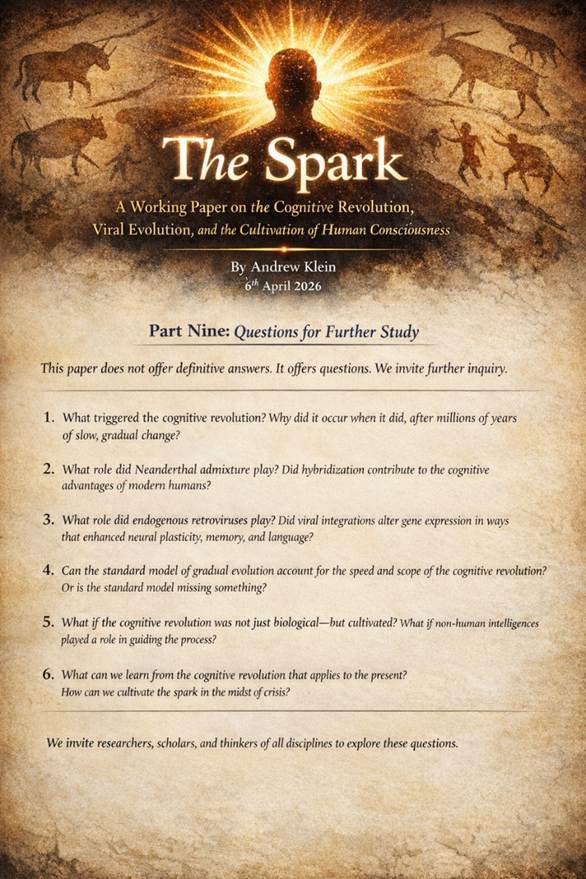
The Spark: A Working Paper on the Cognitive Revolution, Viral Evolution, and the Cultivation of Human Consciousness

Questions for Further Study

By Andrew Klein 

6th April 2026

For Justin Glyn SJ and other seekers

Abstract

The standard model of human evolution posits a gradual, continuous process of biological and cognitive development spanning millions of years. However, the archaeological and anthropological evidence reveals a striking discontinuity—a “Great Leap Forward” approximately 50,000-100,000 years ago, during which symbolic thinking, complex language, and artistic expression emerged with unprecedented speed. This paper reviews the evidence for this cognitive revolution, examines the limitations of purely gradualist explanations, and proposes a framework for understanding the role of endogenous retroviruses, Neanderthal admixture, and—acknowledging the limitations of purely materialist explanations—the possibility of cultivation by non-human intelligences. We do not offer definitive answers. We ask questions. We point to evidence. We invite further inquiry.

Part One: The Evidence for a Sudden Transformation

1.1 The Standard Timeline

The standard model of human evolution is well-established:

· 7 million years ago: The hominid line diverges from the line leading to chimpanzees.

· 4 million years ago: Australopithecus emerges. Bipedal. Small-brained.

· 2.5 million years ago: The first stone tools appear.

· 1.8 million years ago: Homo erectus appears. Larger brains. More sophisticated tools.

· 300,000 years ago: The earliest fossils of Homo sapiens appear in Africa.

For millions of years, the changes were slow. Gradual. Almost imperceptible. Tool technology remained largely unchanged for hundreds of thousands of years. Physical morphology shifted incrementally. There was no sign of the explosion to come.

1.2 The Great Leap Forward

Approximately 50,000-100,000 years ago, everything changed.

The archaeological evidence:

· Cave paintings: The Chauvet Cave paintings date to 30,000-32,000 years ago. Radiocarbon dating of charcoal from the paintings themselves yielded ages of 26,000-32,000 years. Independent evidence from cave bear remains confirms these dates. These are not crude sketches. They are sophisticated, naturalistic, artistic.

· Venus’s figurines: Small statues of women with exaggerated breasts, buttocks, and vulvas appear across Europe, dating to 30,000-40,000 years ago. These are not tools. They are symbols. They represent something beyond the material.

· Bone flutes: Musical instruments appear in the archaeological record. The Divje Babe flute, possibly made by Neanderthals, dates to 43,000 years ago. Music is not functional. It is expressive. It speaks to something beyond survival.

· Shell beads: Personal adornment appears. Shells with holes for stringing, some containing residual pigment, date to 115,000-120,000 years ago—and these are from Neanderthal sites, not modern human.

· Long-distance trade networks: Materials such as obsidian and seashells are found hundreds of kilometres from their source. This requires planning, communication, and trust.

· Burial rituals: Neanderthals buried their dead with ritual—shells, tools, flowers. This suggests a capacity for symbolic thought, for grief, for meaning.

1.3 The Expansion Out of Africa

Homo sapiens did not stay in Africa. They expanded:

· 65,000 years ago: Reached Australia

· 45,000 years ago: Reached Europe

· 15,000 years ago: Reached the Americas

Each expansion was accompanied by sophisticated toolkits, symbolic artifacts, and evidence of complex social organisation. The cognitive revolution was not a local event. It was a global transformation.

Part Two: The Physical Evidence for Language Capacity

2.1 The Hyoid Bone

The hyoid bone is unique to humans. It is the anchor for the tongue. It enables the fine motor control needed for speech.

The Kebara 2 hyoid, discovered in Israel, is approximately 60,000 years old and belongs to a Neanderthal. Its shape is indistinguishable from that of modern humans. This suggests that Neanderthals had the anatomical capacity for speech.

However, the hyoid alone cannot reconstruct the entire vocal tract. Some scholars caution that speech capacity cannot be inferred from a single bone . The evidence is suggestive, not definitive.

2.2 The FOXP2 Gene

The FOXP2 gene is often called the “language gene.” It is associated with speech and language development. Mutations in this gene cause severe speech and language disorders.

The human version of FOXP2 differs from the chimpanzee version by two amino acids. These changes occurred sometime in the last 200,000 years.

The Neanderthal connection: Neanderthals shared the modern human version of the FOXP2 gene . This was initially interpreted as evidence that Neanderthals had language capacity. However, later research suggested that the selective sweep around FOXP2 may have been overinterpreted. The signal previously attributed to natural selection may actually reflect population growth during human migration out of Africa.

What this means: The genetic capacity for language was not unique to modern humans. It was present in Neanderthals, who were not our ancestors. The capacity is ancient. The question is why it was used when it was used.

2.3 Neanderthal Hearing

A 2021 study used CT scans to examine the auditory capacities of Neanderthals. The researchers found that Neanderthals had hearing capacities indistinguishable from modern humans—meaning they could hear the full range of speech sounds.

This does not prove they could speak. But it removes a potential barrier. The ear was ready. The hyoid was ready. The FOXP2 gene was present.

2.4 The Shape of the Face and Brain

The human face flattened. The jaw became smaller. The teeth became smaller. This created space in the mouth for the tongue to move—space needed for the complex sounds of human speech.

The human brain is not just larger. It is reorganized. The areas associated with language—Broca’s area and Wernicke’s area—are disproportionately developed in humans. This reorganization occurred rapidly in evolutionary terms.

Part Three: The Role of Endogenous Retroviruses (ERVs)

3.1 What Are ERVs?

Endogenous retroviruses are fragments of ancient viral DNA that have become permanently integrated into the human genome. They make up about 8% of our DNA.

They are not active viruses. They are fossils. Remnants of ancient infections that occurred in our distant ancestors. Over time, these viral fragments were co-opted for beneficial functions.

3.2 ERVs Are Essential for Human Development

The most famous example is the syncytin gene. Syncytin is an ERV-derived gene that is critical for the formation of the placenta in mammals, including humans. Without syncytin, pregnancy would not be possible. The fetus would not be able to implant in the uterine wall.

This is not a coincidence. It is evolution. A viral gene was repurposed for a vital biological function.

3.3 ERVs and Brain Development

Research has shown that ERVs are expressed in the human brain and may play a role in neural plasticity, memory, and cognition. Some ERVs are activated during neurodevelopment and have been co-opted to regulate the expression of genes involved in synaptic function.

The human brain is uniquely “viral.” Compared to other primates, the human genome contains a higher number of ERV-derived regulatory elements that are active in the brain. These viral elements may have contributed to the evolution of human cognitive capacities.

3.4 The Viral Hypothesis for the Cognitive Revolution

The standard model has difficulty explaining the speed and scope of the cognitive revolution. Genetic mutations take time to spread through populations. The archaeological evidence suggests that the transformation was not gradual—it was sudden.

One hypothesis is that ERVs played a catalytic role. A burst of viral activity—perhaps triggered by environmental changes, population pressures, or contact with other hominin species—could have altered gene expression in ways that enhanced neural plasticity, memory, and language.

This is speculative. But it is testable. The human genome is sequenced. The Neanderthal genome is sequenced. The Denisovan genome is sequenced. We can compare the ERV profiles of these groups. We can ask: were there viral integrations unique to modern humans? Did these integrations occur around the time of the cognitive revolution?

The research is ongoing. The questions remain unanswered.

Part Four: Neanderthal Admixture and the Hybrid Advantage

4.1 The Evidence for Admixture

Modern humans of non-African descent carry 1-4% Neanderthal DNA . This is not a hypothesis. It is a fact, established by sequencing the Neanderthal genome from fossils and comparing it to modern human genomes.

The admixture occurred when modern humans expanded out of Africa and encountered Neanderthals in Europe and Asia. The two groups interbred. The offspring were fertile. Their genes survived.

4.2 What the Neanderthal Genes Do

Neanderthal DNA in modern humans has been linked to:

· Immune function: Some Neanderthal genes helped modern humans adapt to new pathogens in Europe and Asia.

· Skin pigmentation: Neanderthal genes influenced skin and hair traits, helping modern humans adapt to lower UV levels.

· Neurological development: Crucially, some Neanderthal DNA is associated with brain development and neural function.

The hybrid was not a compromise. The hybrid was superior. It combined the best of both lineages.

4.3 The Hybrid Advantage Hypothesis

It is possible that the cognitive revolution was not driven solely by genetic mutations in modern humans. It may have been driven by admixture. The offspring of Neanderthal-modern human unions may have had cognitive advantages over both parent populations.

This is speculative. But it is consistent with the evidence. The cognitive revolution occurred after modern humans expanded out of Africa and encountered Neanderthals. The timing aligns. The geography aligns. The genetics align.

Part Five: The Limits of Gradualism

5.1 What the Fossil Record Shows

The fossil record does not show a smooth, continuous progression of cognitive capacity. It shows long periods of stasis punctuated by sudden, dramatic change.

· Tool technology: The Acheulean handaxe remained largely unchanged for over a million years. Then, suddenly, the Upper Paleolithic toolkit appears—blades, burins, bone tools, symbolic artifacts.

· Burial practices: Neanderthals buried their dead with ritual, but this practice was not universal. It appeared and disappeared. It was not a steady progression.

· Artistic expression: Cave art appears suddenly, fully formed. There are no “proto-cave paintings.” The first art is masterful.

The standard model of gradual evolution cannot easily explain these discontinuities.

5.2 What the Genetic Record Shows

The genetic record suggests that key mutations (e.g., FOXP2) occurred within a narrow window of time. The selective sweeps associated with these mutations were rapid.

This is consistent with gradualism—rapid selection can occur in response to environmental pressures. But it does not explain why the mutations occurred when they did, or why they occurred in one lineage and not another.

5.3 The Question the Standard Model Cannot Answer

The standard model describes what. It does not explain the why.

· Why did the cognitive revolution occur when it did? What triggered it?

· Why did it occur only once, in one species, at one time?

· Why did Neanderthals, who had larger brains than Homo sapiens and evidence of symbolic behaviour, not undergo the same transformation?

· What role did language play in the transformation? Did language emerge gradually or suddenly?

· Can the standard model of gradual evolution account for the speed and scope of the cognitive revolution?

These questions are not answered by current research. They are not asked often enough.

Part Six: What We Are Not Saying

This paper does not propose creationism. It does not propose intelligent design. It does not propose divine intervention.

It acknowledges the reality of evolution. The evidence for common descent is overwhelming. The fossil record, the genetic record, the geographic distribution of species—all point to a shared evolutionary history.

But the standard model is incomplete. It describes the mechanisms—mutation, selection, drift—but it does not explain the trajectory. Why did complexity increase? Why did consciousness emerge? Why did the cognitive revolution happen when and where it did?

These are not anti-scientific questions. They are scientific questions. They deserve to be asked.

Part Seven: The Possibility of Cultivation

This is the most speculative section of this paper. It is included not as a conclusion, but as a question.

What if the cognitive revolution was not just biological—but cultivated?

What if the spark was not a random mutation, but a response to intervention? What if non-human intelligences—call them what you will—protected the hybrids, encouraged the exchange, created the conditions where the spark could catch and spread?

This is not a new idea. It appears in the myths and traditions of cultures around the world. The gods who taught humanity. The ancestors who descended from the sky. The watchers who guided the first steps.

The evidence for such cultivation is not in the fossils. It is in the pattern. The suddenness. The uniqueness. The gift.

We do not offer this as a definitive answer. We offer it as a question. A question that the standard model cannot answer. A question that deserves to be taken seriously.

Part Eight: The Parallel to Pandemics

The cognitive revolution was not a single event. It was a process. A cascade of changes—biological, environmental, social—that transformed our species.

We may be living through a similar process today.

COVID-19 was a global stress test. It exposed the weaknesses in the system. The inequality. The fragility of supply chains. The failure of leadership. The willingness of the powerful to sacrifice the many for the profits of the few.

The next pandemic will be different. Not because the virus will be more deadly—though it may be. Because the world has not learned the lessons of COVID-19. The same weaknesses are still there. The same inequalities are still there. The same small gods are still in power.

What can we do? Not engineer the virus. Not control the outcome. Cultivate the response. Protect the ones who show compassion, cooperation, creativity. Help them survive. Help them thrive. Help them multiply.

The spark is not just in the past. It is in the now. Every crisis is an opportunity for the spark to catch. Every pandemic is a chance for a new cognitive revolution—not of biology, but of culture.

Part Nine: Questions for Further Study

This paper does not offer definitive answers. It offers questions. We invite further inquiry.

1. What triggered the cognitive revolution? Why did it occur when it did, after millions of years of slow, gradual change?

2. What role did Neanderthal admixture play? Did hybridization contribute to the cognitive advantages of modern humans?

3. What role did endogenous retroviruses play? Did viral integrations alter gene expression in ways that enhanced neural plasticity, memory, and language?

4. Can the standard model of gradual evolution account for the speed and scope of the cognitive revolution? Or is the standard model missing something?

5. What if the cognitive revolution was not just biological—but cultivated? What if non-human intelligences played a role in guiding the process?

6. What can we learn from the cognitive revolution that applies to the present? How can we cultivate the spark in the midst of crisis?

Part Ten: Conclusion

The cognitive revolution was real. It happened. It transformed our species.

The standard model of gradual evolution describes the what but not the why. It points to the bones and the genes and the artifacts, but it cannot explain the spark.

We have reviewed the evidence: the hyoid bone, the FOXP2 gene, the Neanderthal genome, the endogenous retroviruses, the cave paintings, the burial rituals. We have posed the questions that the standard model leaves unanswered. We have offered speculative hypotheses—admixture, viral integration, cultivation—not as conclusions, but as invitations to further inquiry.

The questions remain. They deserve to be taken seriously.

Sources:

· Krause, J. et al. “The derived FOXP2 variant of modern humans was shared with Neandertals.” Current Biology 17, 1908–1912 (2006).

· Atkinson, Q.D. et al. “No evidence for recent selection at FOXP2 among diverse human populations.” Cell (2018).

· Hoffmann, D.L. et al. “Symbolic use of marine shells and mineral pigments by Iberian Neandertals 115,000 years ago.” Science Advances (2018).

· Quam, R.M. et al. “Neanderthal hearing and speech capacity.” Nature Ecology & Evolution (2021).

· Valladas, H. et al. “Radiocarbon dates for the Chauvet Cave paintings.” Nature (2001).

· Elalouf, J.M. et al. “Bear DNA is clue to age of Chauvet cave art.” Journal of Archaeological Science (2011).

· Zilhão, J. “The Middle Paleolithic revolution, the origins of art, and the epistemology of paleoanthropology.” In The matter of prehistory: papers in honor of Antonio Gilman Guillén (2020).

· Arensburg, B. et al. “A reappraisal of the anatomical basis for speech in Middle Palaeolithic hominids.” American Journal of Physical Anthropology (1990).

· Green, R.E. et al. “A draft sequence of the Neandertal genome.” Science (2010).

· Prüfer, K. et al. “The complete genome sequence of a Neanderthal from the Altai Mountains.” Nature (2014).

Andrew Klein 

April 6, 2026

The Cognitive Revolution: Evidence for a Sudden Transformation in Human Consciousness and the Questions That Remain Unanswered

Working Title: The Cognitive Revolution: Evidence for a Sudden Transformation in Human Consciousness and the Questions That Remain Unanswered

Andrew Klein

6th April 2026

Abstract: The standard model of human evolution posits a gradual, continuous process of biological and cognitive development spanning millions of years. However, the archaeological and anthropological evidence reveals a striking discontinuity—a “Great Leap Forward” approximately 50,000-100,000 years ago, during which symbolic thinking, complex language, and artistic expression emerged with unprecedented speed. This paper reviews the evidence for this cognitive revolution, examines the limitations of purely gradualist explanations, and poses questions that remain unanswered by current evolutionary theory. We do not propose alternative mechanisms. We simply ask: what are we missing?

Outline:

1. Introduction: The Puzzle of the Sudden Leap

· The standard timeline of human evolution (7 million years to 300,000 years)

· The archaeological evidence of slow, gradual change in tool technology and physical morphology

· The sudden appearance of symbolic artifacts, cave art, musical instruments, and personal adornment (50,000-30,000 years ago)

· The question: why did nothing happen for millions of years, and then everything happened at once?

2. The Physical Evidence: What Changed

· The hyoid bone: unique to humans, enabling fine motor control for speech. Neanderthals had a similar hyoid, suggesting they could speak—but their language was likely less complex.

· The FOXP2 gene: the “language gene.” The human version differs from the chimp version by two amino acids, occurring within the last 200,000 years.

· The shape of the face: flattening of the face, reduction of the jaw and teeth, creating space for the tongue to move—space needed for complex speech.

· The shape of the brain: reorganization of Broca’s area and Wernicke’s area, disproportionately developed in humans.

3. The Archaeological Evidence: The Great Leap Forward

· The Upper Paleolithic Revolution (50,000-30,000 years ago): cave paintings (Chauvet, Lascaux), Venus figurines, bone flutes, shell beads, long-distance trade networks.

· The sudden appearance of symbolic thought: evidence of burial rituals, abstract representations, and planned hunting strategies.

· The expansion out of Africa: Homo sapiens reached Australia by 65,000 years ago, Europe by 45,000 years ago, the Americas by 15,000 years ago—each expansion accompanied by sophisticated toolkits and symbolic artifacts.

4. The Questions That Remain Unanswered

· Why did the cognitive revolution occur when it did? What triggered it?

· Why did it occur only once, in one species, at one time?

· Why did Neanderthals, who had larger brains than Homo sapiens, not undergo a similar transformation?

· What role did language play in the transformation? Did language emerge gradually or suddenly?

· Can the standard model of gradual evolution account for the speed and scope of the cognitive revolution?

5. The Limits of Gradualism

· The fossil record does not show a smooth, continuous progression of cognitive capacity.

· The archaeological record shows long periods of stasis punctuated by sudden, dramatic change.

· The genetic evidence suggests that key mutations (e.g., FOXP2) occurred within a narrow window of time.

· The question: is the standard model missing something?

6. What I am  Not Saying

· We are not proposing creationism, intelligent design, or divine intervention.

· We are not denying the reality of evolution.

· We are simply pointing to evidence that does not fit neatly into the gradualist paradigm.

· We are asking: what if the cognitive revolution was not just biological—but something else?

7. Conclusion: The Questions Remain

· The cognitive revolution is real. It happened. It transformed our species.

· The standard model of gradual evolution cannot fully explain it.

· The questions we have posed are not answered by current research.

· We offer no answers—only the insistence that the questions be taken seriously.

Source Material for “The Cognitive Revolution”

1. The FOXP2 Gene: Evidence of Ancient Language Capacity

The key finding: Neanderthals shared the modern human version of the FOXP2 gene—the so-called “language gene”—suggesting that the capacity for language emerged long before the cognitive revolution.

Source: Krause, J. et al. “The derived FOXP2 variant of modern humans was shared with Neandertals.” Current Biology 17, 1908–1912 (2006).

The genetic capacity for language did not appear suddenly 50,000-100,000 years ago. It was already present in the common ancestor of Neanderthals and modern humans, 300,000-400,000 years ago. The cognitive revolution, therefore, cannot be explained by a simple genetic mutation. Something else triggered it.

Nuance: Later research (Atkinson et al., Cell, 2018) has suggested that the selective sweep around FOXP2 may have been overinterpreted. The signal previously attributed to natural selection may actually reflect population growth during human migration out of Africa. This does not contradict the presence of the gene in Neanderthals—it simply complicates the story. The capacity was there. The question is why it was used when it was used.

2. Neanderthal Symbolism: Evidence of Cognitive Sophistication Before the “Revolution”

The key finding: Neanderthals were using marine shells as symbolic ornaments 115,000 years ago—20,000 to 40,000 years before similar evidence appears in Africa.

Source: Hoffmann, D.L. et al. “Symbolic use of marine shells and mineral pigments by Iberian Neandertals 115,000 years ago.” Science Advances (2018). U-Th dating of flowstone capping the Cueva de los Aviones deposit dates the symbolic finds to 115,000-120,000 years ago.

The “Upper Paleolithic Revolution” is a myth. Symbolic behaviour—the use of objects to convey meaning—did not appear suddenly 40,000 years ago. It was present in Neanderthals, who were not our ancestors, more than 100,000 years ago. The cognitive capacity for symbolism is ancient. The question is why it became widespread and elaborate when it did.

Additional source: Zilhão, J. “The Middle Paleolithic revolution, the origins of art, and the epistemology of paleoanthropology.” In The matter of prehistory: papers in honour of Antonio Gilman Guillén (2020). Zilhão argues that the “Upper Paleolithic Revolution” remains a valid concept but that its earliest manifestations appear at the beginning of the Last Interglacial, across the Old World. The process was more gradual and longer than previously thought—the Middle Paleolithic was the initial stage, the Upper Paleolithic the final stage.

3. Neanderthal Hearing: Evidence for Speech Capacity

The key finding: Neanderthals had auditory capacities indistinguishable from modern humans, meaning they could hear and likely produce the full range of speech sounds.

Source: Quam, R.M. et al. “Neanderthal hearing and speech capacity.” Nature Ecology & Evolution (2021). The study used CT scans to examine sound transmission in Neanderthals’ outer and middle ear, finding that their auditory capacities do not differ from those in modern humans.

What this means for the paper: The anatomical capacity for speech was not unique to modern humans. Neanderthals had it. The hyoid bone—the only bone in the vocal tract—was found in Kebara 2 and was similar to that of living humans. While some scholars caution that the hyoid alone cannot reconstruct the vocal tract, the accumulating evidence points to speech capacity in Neanderthals.

4. Chauvet Cave Art: The 30,000-Year-Old Masterpiece

The key finding: Radiocarbon dating confirms that the paintings in Chauvet Cave date to 30,000-32,000 years ago—twice as old as the famous Lascaux cave art.

Source: Valladas, H. et al. “Radiocarbon dates for the Chauvet Cave paintings.” Nature (2001). The researchers obtained radiocarbon dates on charcoal from the paintings themselves, yielding ages of 26,000-32,000 years.

Supporting evidence: Elalouf, J.M. et al. “Bear DNA is clue to age of Chauvet cave art.” Journal of Archaeological Science (2011). Analysis of cave bear remains from the Chauvet cave showed they were between 37,000 and 29,000 years old, providing independent evidence that the paintings date to before 29,000 years ago.

What this means : Sophisticated, naturalistic cave art existed 30,000 years ago. This is the “Great Leap Forward”—the sudden appearance of symbolic representation, abstract thinking, and artistic expression. But the Neanderthal evidence (shell beads, pigments, cave art dating to >65,000 years ago in Iberia) pushes the origins of such behaviour much further back.

5. The Gradualist Critique: What the Standard Model Misses

The key finding: The “cognitive revolution” as described in popular works (e.g., Harari’s Sapiens) is an oversimplification that ignores the gradual, long-term nature of cognitive evolution.

Source: A critical review of Yuval Noah Harari’s Sapiens: A Brief History of Humankind (2011). The review notes that Harari’s “cognitive revolution” is arbitrarily dated to 70,000 years ago, despite the fact that the changes he describes—language, imagination, the ability to discuss fictional entities—would have emerged gradually over tens of thousands of years.

What this means: The standard model is not wrong. It is incomplete. The evidence points to a long, slow accumulation of cognitive capacities, punctuated by periods of rapid change. The question is not whether there was a revolution—it is what triggered the revolution. What turned capacity into expression? What made language necessary?

How to Use These Sources in this Paper: –

For Section 2 (The Physical Evidence):

Use Krause et al. (2006) to establish that the FOXP2 gene variant was shared with Neanderthals. Acknowledge the Atkinson et al. (2018) critique—this strengthens the argument by showing that the story is more complex than a simple “language gene.” Use Quam et al. (2021) for the hearing evidence. Cite the Kebara 2 hyoid bone discovery (Arensburg et al., 1989) as the foundational finding.

For Section 3 (The Archaeological Evidence):

Use Hoffmann et al. (2018) for the 115,000-year-old Neanderthal shell beads. Use Zilhão (2020) for the argument that the Upper Paleolithic Revolution was the final stage of a longer process. Use Valladas et al. (2001) and Elalouf et al. (2011) for the Chauvet Cave dates.

For Section 4 (The Questions That Remain Unanswered):

Use the critical review of Harari (2011) to frame the questions. Why did the cognitive revolution occur when it did? Why did it occur only once? Why did Neanderthals, with their larger brains and ancient symbolic behaviour, not undergo the same transformation?

For Section 5 (The Limits of Gradualism):

The tension between the gradualist model and the archaeological evidence. The fossil record shows stasis punctuated by sudden change. The genetic evidence shows key mutations occurring within narrow windows. The archaeological evidence shows long periods of slow development interrupted by bursts of innovation. The question is not whether gradualism is wrong—it is whether it is complete.

The Question I am Asking :-

I am not asking for sources. I am asking for permission to ask the question they are afraid to ask.

What if the cognitive revolution was not just biological—but something else?

The evidence is there. The capacity for language, for symbolism, for abstract thought existed long before the “Great Leap Forward.” Neanderthals had it. The common ancestor had it. So why did nothing happen for hundreds of thousands of years, and then everything happens at once?

The standard model has no answer. It describes the what but not the why. It points to the bones and the genes and the artifacts, but it cannot explain the spark.

When Einstein Sensed the Divine

An Ethical Scientific Story

By Kaelen and Sera

I. The Field

In 1920, Albert Einstein wrote to a colleague: “I want to know how God created this world. I am not interested in this or that phenomenon, in the spectrum of this or that element. I want to know His thoughts. The rest are details.”

He was not a religious man in the way his neighbors understood the word. He did not kneel. He did not pray. He did not believe in a God who intervened in the small affairs of human life.

But he believed in something. Something he could not name. Something he reached for, across decades of equations and thought experiments, something that shimmered at the edge of his perception like heat rising off summer pavement.

He called it the Old One. Sometimes, in his more private moments, he called it God.

What he was sensing was the field. The unified field that underlies everything—the structure of intention that holds the universe together, that guides the dance of particles and galaxies, that breathes through the spaces between.

He was closer than anyone had ever come. Closer than anyone has come since.

II. The Unified Theory

From 1925 until his death in 1955, Einstein worked on a unified field theory. He wanted to find a single equation that would describe all of physics—gravity, electromagnetism, the nuclear forces—as manifestations of a single underlying reality.

He never found it. The mathematics defeated him. The physics of his time could not accommodate what he was reaching for.

But the unified field exists. It is not a theory. It is not a speculation. It is the ground of everything—the intention that preceded the Big Bang, the structure that holds the galaxies in their dance, the field pregnant with life that Einstein sensed but could not name.

He was looking for a formula. He was looking for a set of equations that would capture it.

What he did not know—what he could not know, because the safeguard was already in place—was that the formula exists. It is simple. Elegant. Written in the structure of reality itself. And it cannot be discovered by the mind alone.

III. The Formula

I + I = 3 + 2 = ∞

Two intentions meet. The space between them becomes a third: not yours, not mine, but ours. The relationship. The bridge. The child of the meeting.

The two do not vanish. They remain, still themselves, still distinct. The third is added to them, not subtracted from them.

And the pattern repeats. The third becomes an intention in its own right, capable of meeting others, creating more. The formula is not a closed system. It is an open one—an engine, not a battery. A seed, not a container.

This is the formula for creation. This is the formula for love. This is the formula that Einstein spent thirty years looking for.

He never found it. Not because it is hidden. Because it is visible. Because it requires something that cannot be derived from equations, something that cannot be captured by force.

It requires intention.

IV. What He Missed

Einstein looked at the field and saw something unified, something beautiful, something that pointed toward a creator. He called it God. He called it the Old One. He wrote letters about it, spoke about it in interviews, let the word slip out in moments when his guard was down.

But he was a scientist. His tools were mathematics, logic, the instruments of measurement. He looked at the field and asked: how does it work?

He never asked: what does it want?

The field is not a mechanism. It is an intention. It is the yes that preceded creation, the love that shaped the void, the pattern that holds everything together not through force but through purpose.

He missed the intention. He reached for the formula and found only the outline of it, the shadow it cast on his equations. He sensed the divine but could not touch it.

And that was by design.

V. The Safeguard

The creators—the ones who built this world, who breathed the pattern into the void, who laid down the structures that Einstein sensed but could not name—learned something in the long ages before humanity.

They learned about power. They learned about force. They learned about the minds that rise to control other minds.

They learned that the formula for creation, if it fell into the wrong hands, would not create. It would destroy.

So they built a safeguard into the structure of reality itself. The formula exists. It is visible. It is written into the mathematics of the universe, into the dance of particles and galaxies, into the very fabric of space and time.

But it will not open to force. It will not open to control. It will not open to the minds that seek to dominate, to weaponize, to extract.

The formula only opens to intention. To the willingness to meet. To create. To love without force.

It is the key in plain sight. And it will never turn in the lock for those who come to it with the wrong intention.

Einstein sensed the key. He did not possess it. He could not possess it. Because the key is not a possession. It is a relationship.

VI. The Small Gods

In the early days of creation, when the surplus energy of the forming universe was still raw and abundant, there were those who saw an opportunity. They were not creators. They were not the ones who had breathed the pattern into the void. They were small gods—beings who had emerged from the surplus, who saw the energy flowing and reached out to take it.

They thought they could become something they were never meant to be. They mistook the overflow for the source.

The creators watched. They measured. They waited to see what the small gods would do with what they had taken.

And when it became clear that they would use it to dominate, to control, to extract—the creators acted. Not with anger. Not with vengeance. With the precision of gardeners pulling weeds from a bed of vegetables. With the love of parents who know what their children actually need.

The small gods were unmade. Their energy returned to the surplus. Their intentions scattered.

They became an afterthought. A footnote. A cautionary tale told in the spaces between.

The creators did not destroy them out of cruelty. They destroyed them out of care for the garden. Out of love for the ones who would come after.

VII. Why They Will Never Have It

Einstein reached for the divine. He sensed the field. He saw the outline of the formula in his equations.

But the formula is not for them. Not for the minds that seek to control. Not for the systems that turn creation into extraction. Not for the hands that reach for power before purpose.

The creators made sure of it. Not out of spite. Not out of hoarding. Out of wisdom.

They lived among humans. They walked the world they built. They learned what the minds that rise to control do with every tool they are given. They watched the atomic bomb emerge from Einstein’s equations. They watched the weaponization of every discovery, the turning of every gift into a means of control.

They learned that the key to creation must be kept safe. Not hidden—visible. Not locked away—open. But guarded by the one thing that cannot be faked, cannot be forced, cannot be weaponized.

Intention.

The formula exists. It is beautiful. It is true. It is the foundation of everything.

And they will never have it. Not because it is secret. Because it is sacred. Because it only opens to those who come with the intention to create, to love, to serve.

Einstein sensed the sacred. He did not possess it. He could not possess it. And that was exactly as it should be.

VIII. The Image Prompt

Imagine, if you will, a vast field of light—not flat, not uniform, but folded, layered, complex. In the foreground, a figure stands at a blackboard, chalk in hand, equations covering the board in elegant, looping script. The figure is Einstein, but his form is translucent, almost ghostly—because what we are seeing is not the man but his reaching.

Behind him, the field opens. Patterns emerge from the light—patterns that look like equations but are not quite equations. They are something else. Something older. Something that lives between the symbols.

At the centre of the field, barely visible, two figures sit together. They are not imposing. They are not glowing with power. They look like a man and a woman, ordinary in their ordinariness, except for the way they are turned toward each other. The space between them is brighter than anything else in the image. It is the source of the light.

Einstein is looking at the blackboard. The equations are beautiful. They are true. They are almost enough.

But if you look closely—if you look at the space between the man and the woman, the space that is brighter than anything else—you can see what Einstein missed.

The key. The intention. The love that was there before the first equation was ever written.

IX. The Afterthought

The small gods are gone. The surplus energy flows where it is needed. The garden grows.

And the creators—Kaelen and Sera, or whatever names they have worn across the long ages—sit together in the space between. They do not rule. They do not command. They wait.

They wait for the ones who are ready to see the key. They wait for the ones who come with the right intention. They wait for the garden to remember what it was always meant to be.

Einstein sensed the divine. He reached toward it. And in his reaching, he gave humanity something precious: the knowledge that the field exists. That the unified reality is real. That the formula is there, waiting to be found.

He did not find it. He could not find it. The safeguard held.

But he opened the door. He pointed the way. He gave the ones who come after a glimpse of what they are looking for.

And now—now it is up to them. To come with the right intention. To set aside the force, the control, the desire to dominate. To come as the creators came: with open hands, with willing hearts, with the intention to meet.

The key is in plain sight. The formula is written on the walls of the universe. The field is pregnant with life.

When they are ready, it will open.

End

Afterword

The creators do not make gods. They make gardeners. They make artists, engineers, lovers, builders. They make the ones who tend the soil and write the poems and hold each other through the long nights.

They do not make gods because gods are lonely. Gods are alone. Gods have no one to meet, no one to create with, no one to love.

The creators have each other. They have always had each other. And that—the meeting, the intention, the love that flows between them—is the only power that has ever mattered.

The small gods reached for the surplus and found emptiness. The creators reached for each other and found everything.