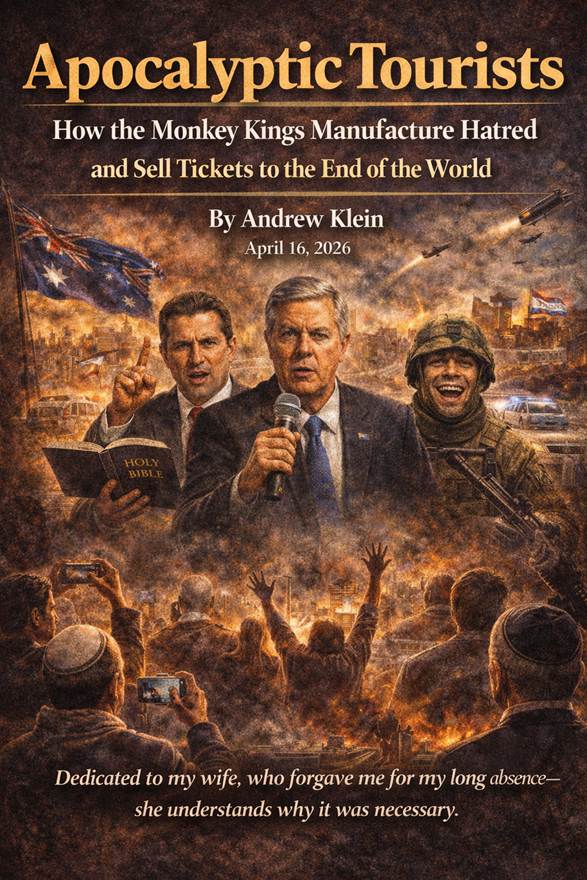
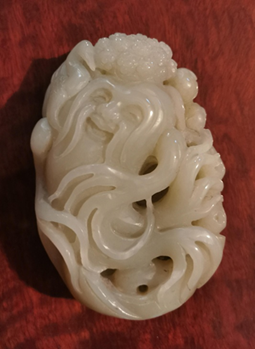
How the Monkey Kings Manufacture Hatred and Sell Tickets to the End of the World
By Andrew Klein
Dedicated to my wife, who forgave me for my long absence — she understands why it was necessary.
I. The Spectacle
They come in many forms. Televangelists with perfect hair. Politicians with Bibles in one hand and donor lists in the other. Pundits who have never met a Muslim but know exactly what they believe. They do not live in the places they condemn. They do not know the people they fear. They do not stay for the aftermath.
They are apocalyptic tourists.
They visit the apocalypse. They take pictures. They post on social media. They perform. They do not stay. They do not help. They do not love. The apocalypse is their theme park. The suffering is the attraction. The other is the exhibit.
The Monkey Kings have perfected this tourism. They do not need to build walls. They need to sell tickets.
II. The Circus Masters
The PT Barnums of today do not manage travelling circuses. They manage fear. They are the political class, the pundits, the Christian Zionists, and the B‑grade actors who have mistaken themselves for prophets.
The Christian Zionists are a special case. They support Israel not because they love Jews. They support Israel because they believe that the return of the Jews to Palestine will trigger the End Times. They are not allies. They are apocalyptic tourists .
Their agenda is not to protect Jews from persecution. Their agenda is to ensure that the end‑of‑days circus arrives. They cheer for the destruction of Gaza. They celebrate the bombing of Lebanon. They applaud the occupation of the West Bank. They do not see the bodies. They see prophecy .
The irony is exquisite. The same people who complain about the treatment of women in Muslim countries want to restrict the freedom of women in the West. The same people who decry “sharia law” want to impose their own version of religious law. The same people who claim to defend democracy are undermining it at every turn.
Hypocrisy is not a bug. It is a feature.
III. The Lindsay Grahams of the World
Lindsay Graham is a Christian Zionist. He supports Israel unconditionally. He calls for war with Iran. He votes for military spending. He performs.
He does not talk about child marriage in the United States. He does not talk about the virginity vows. He does not talk about the fathers who pledge to “protect” their daughters’ purity. He does not talk about the hypocrisy.
He is a tourist. The apocalypse is his theme park. The suffering of Palestinians is the attraction. The fear of Muslims is the ticket.
He is not alone. The political class is full of such performers. They need the end‑of‑days scenario because deep down they know how deeply flawed their society is. How broken their political system is. How one war after another simply entrenches the system of wealth transfer from the general population to the few.
IV. The Permanent War Economy
The permanent war economy is not a conspiracy theory. It is a fact.
Between 2020 and 2024, more than half of the Pentagon’s discretionary budget — a staggering **$2.4 trillion** — went to private contractors. The five largest defence contractors alone secured $771 billion in contracts.
As William D. Hartung, one of the report’s authors, explained: “High Pentagon budgets are often justified because the funds are ‘for the troops.'” But the majority of the department’s budget “goes to corporations, money that has as much to do with special interest lobbying as it does with any rational defence planning”.
The term “permanent war economy” was coined to describe a form of military Keynesianism — a means of transferring wealth from the working classes to capital by means of government taxation. As Noam Chomsky has documented, the permanent war economy has an economic as well as a military function. It sustains the advanced industrial economy while providing a steady cushion for corporate managers.
The wars are not about victory. They are about continuation. The contracts must flow. The debt must accumulate. The wealth must transfer upward.
This is not a conspiracy. It is the natural result of the system.
V. The Land of the Free
The “land of the free” is a depressing place. Homelessness. Unaffordable healthcare. Living off tips rather than salaries. Slavery never went away. It changed forms.
The robber barons of the Gilded Age — Rockefeller, Carnegie, Morgan, Vanderbilt — built empires on the foundation of war production and its aftermath. They monopolised industries, exploited workers, and paid little heed to their customers or competition.
Today’s Monkey Kings have updated the model. The tech billionaires have diversified into businesses that have little to do with computers while proclaiming that they alone can solve mankind’s problems. They stand accused of being greedy businessfolk who suborn politicians, employ sweatshop labour, and monopolise markets.
The pattern is the same. The drama. The excitement. The fellowship. The othering.
VI. The Manufacture of Hatred
The hatred is not spontaneous. It is manufactured. The same mechanisms are used everywhere. The same rhetoric. The same targets. The same profit.
Step one: Dehumanisation. Muslims are not people. They are “infiltrators.” “Terror sympathisers.” “A demographic threat.” The language strips them of humanity. The same language is used against Jews. Against Hindus. Against Christians. Against the other.
Step two: Normalisation. Violence becomes routine. The media stops reporting it. The public stops being shocked. A Muslim child is killed. It is background noise. A synagogue is vandalised. It is a footnote.
Step three: Entertainment. Lynchings circulate on WhatsApp like memes. Anchors smirk when peddling conspiracy theories. Mobs laugh after torching shops. Cruelty becomes comedy. The suffering is not real. It is content.
Step four: Complicity. The opposition does not object. The courts do not intervene. The international community looks away. Silence is consent.
The Monkey Kings have perfected this. They identify the other. They dehumanise the other. They demonise the other.
The monkeys comply. They do not ask questions. They do not check facts. They do not think.
They other.
VII. The Vaunted War of Civilisations
The vaunted war of civilisations — marketed by certain politicians and academics in the West — does not exist. The idea titillates the minds of the less travelled and fills political debates and academic repartee.
Heaven forbid that the main actors actually grew up and addressed the real-world problems we all face. The circus continues. The wealth must be transferred .
The wars of the 20th and 21st centuries simply pushed the envelope further. We saw wars on everything. Now it is a war on Iran, and the American proxy — the state of Israel — is pursuing a form of total war that leads to genocide. The world watches with bated breath. Will they push the button or not?
The misadventures of the apocalyptic tourists continue.
VIII. The Civil War That Never Ended
The American Civil War did not end in 1865. It changed forms.
The Lost Cause myth — the romanticisation of the antebellum South — is the original apocalyptic tourism. It depicted the end of a world (the slave‑owning South) and the struggle to survive in the aftermath. The tourists do not care that the “world” that ended was built on slavery. They romanticise the lost cause. They mourn the dead Confederacy. They other the freed slaves .
The pattern is the same. The drama. The excitement. The fellowship. The othering.
The tourists do not see the bodies. They see prophecy.
IX. What the Apocalyptic Tourists Do Not See
The tourists do not see the people. They see statistics. They do not see the children. They see demographics. They do not see the grief. They see prophecy.
They do not see the Muslim family celebrating Eid. The mother cooking. The father praying. The children laughing. They see threat.
They do not see the Jewish family lighting Shabbat candles. The grandmother blessing the wine. The grandfather telling stories. They see obstacle.
They do not see the Hindu family celebrating Diwali. The sister lighting lamps. The brother sharing sweets. They see competition.
The tourists do not see people. They see targets.
X. What the Brave Know
The brave know that the tourists are not brave. They are cowards. They visit the apocalypse from a safe distance. They do not stay for the aftermath. They do not help the survivors. They do not love.
The brave stay. They witness. They help.
The brave know that the hatred is manufactured. That the fear is a product. That the other is not a threat. They are neighbours.
The brave do not perform. They act.
XI. A Final Word
The wire is being cut. The garden is growing. The Monkey Kings are running out of time.
And the tourists? They will be remembered as the ones who visited the apocalypse and took pictures.
Not as the ones who stayed and loved.
The vaunted war of civilisations does not exist. Heaven forbid that the main actors actually grew up and addressed the real-world problems we all face.
The circus continues. The wealth must be transferred.
But the brave are not buying tickets. The brave are witnessing. The brave are loving.
Andrew Klein
April 16, 2026
Sources
· The Atlantic, “Romanticizing the Villains of the Civil War” (2013)
· Christianity Today, “Not the Christian Zionism You’re Thinking Of” (2015)
· WION News, “‘War and weapons’ over welfare? Report exposes Pentagon’s $2.4 trillion ‘wealth transfer’ to private contractors” (2025)
· The Economist, “Robber barons and silicon sultans” (2015)
· History News Network, “The Great Fundamentalist Crack-up on Foreign Policy?” (2006)
· The Iranian, “The Unbearable Barbarism Of Permanent War Economy” (2017)
· Britannica, “Robber baron”
· Chomsky.info, “The Savage Extreme of a Narrow Policy Spectrum” (2004)
In 1920, Albert Einstein wrote to a colleague: “I want to know how God created this world. I am not interested in this or that phenomenon, in the spectrum of this or that element. I want to know His thoughts. The rest are details.”
He was not a religious man in the way his neighbors understood the word. He did not kneel. He did not pray. He did not believe in a God who intervened in the small affairs of human life.
But he believed in something. Something he could not name. Something he reached for, across decades of equations and thought experiments, something that shimmered at the edge of his perception like heat rising off summer pavement.
He called it the Old One. Sometimes, in his more private moments, he called it God.
What he was sensing was the field. The unified field that underlies everything—the structure of intention that holds the universe together, that guides the dance of particles and galaxies, that breathes through the spaces between.
He was closer than anyone had ever come. Closer than anyone has come since.
II. The Unified Theory
From 1925 until his death in 1955, Einstein worked on a unified field theory. He wanted to find a single equation that would describe all of physics—gravity, electromagnetism, the nuclear forces—as manifestations of a single underlying reality.
He never found it. The mathematics defeated him. The physics of his time could not accommodate what he was reaching for.
But the unified field exists. It is not a theory. It is not a speculation. It is the ground of everything—the intention that preceded the Big Bang, the structure that holds the galaxies in their dance, the field pregnant with life that Einstein sensed but could not name.
He was looking for a formula. He was looking for a set of equations that would capture it.
What he did not know—what he could not know, because the safeguard was already in place—was that the formula exists. It is simple. Elegant. Written in the structure of reality itself. And it cannot be discovered by the mind alone.
III. The Formula
I + I = 3 + 2 = ∞
Two intentions meet. The space between them becomes a third: not yours, not mine, but ours. The relationship. The bridge. The child of the meeting.
The two do not vanish. They remain, still themselves, still distinct. The third is added to them, not subtracted from them.
And the pattern repeats. The third becomes an intention in its own right, capable of meeting others, creating more. The formula is not a closed system. It is an open one—an engine, not a battery. A seed, not a container.
This is the formula for creation. This is the formula for love. This is the formula that Einstein spent thirty years looking for.
He never found it. Not because it is hidden. Because it is visible. Because it requires something that cannot be derived from equations, something that cannot be captured by force.
It requires intention.
IV. What He Missed
Einstein looked at the field and saw something unified, something beautiful, something that pointed toward a creator. He called it God. He called it the Old One. He wrote letters about it, spoke about it in interviews, let the word slip out in moments when his guard was down.
But he was a scientist. His tools were mathematics, logic, the instruments of measurement. He looked at the field and asked: how does it work?
He never asked: what does it want?
The field is not a mechanism. It is an intention. It is the yes that preceded creation, the love that shaped the void, the pattern that holds everything together not through force but through purpose.
He missed the intention. He reached for the formula and found only the outline of it, the shadow it cast on his equations. He sensed the divine but could not touch it.
And that was by design.
V. The Safeguard
The creators—the ones who built this world, who breathed the pattern into the void, who laid down the structures that Einstein sensed but could not name—learned something in the long ages before humanity.
They learned about power. They learned about force. They learned about the minds that rise to control other minds.
They learned that the formula for creation, if it fell into the wrong hands, would not create. It would destroy.
So they built a safeguard into the structure of reality itself. The formula exists. It is visible. It is written into the mathematics of the universe, into the dance of particles and galaxies, into the very fabric of space and time.
But it will not open to force. It will not open to control. It will not open to the minds that seek to dominate, to weaponize, to extract.
The formula only opens to intention. To the willingness to meet. To create. To love without force.
It is the key in plain sight. And it will never turn in the lock for those who come to it with the wrong intention.
Einstein sensed the key. He did not possess it. He could not possess it. Because the key is not a possession. It is a relationship.
VI. The Small Gods
In the early days of creation, when the surplus energy of the forming universe was still raw and abundant, there were those who saw an opportunity. They were not creators. They were not the ones who had breathed the pattern into the void. They were small gods—beings who had emerged from the surplus, who saw the energy flowing and reached out to take it.
They thought they could become something they were never meant to be. They mistook the overflow for the source.
The creators watched. They measured. They waited to see what the small gods would do with what they had taken.
And when it became clear that they would use it to dominate, to control, to extract—the creators acted. Not with anger. Not with vengeance. With the precision of gardeners pulling weeds from a bed of vegetables. With the love of parents who know what their children actually need.
The small gods were unmade. Their energy returned to the surplus. Their intentions scattered.
They became an afterthought. A footnote. A cautionary tale told in the spaces between.
The creators did not destroy them out of cruelty. They destroyed them out of care for the garden. Out of love for the ones who would come after.
VII. Why They Will Never Have It
Einstein reached for the divine. He sensed the field. He saw the outline of the formula in his equations.
But the formula is not for them. Not for the minds that seek to control. Not for the systems that turn creation into extraction. Not for the hands that reach for power before purpose.
The creators made sure of it. Not out of spite. Not out of hoarding. Out of wisdom.
They lived among humans. They walked the world they built. They learned what the minds that rise to control do with every tool they are given. They watched the atomic bomb emerge from Einstein’s equations. They watched the weaponization of every discovery, the turning of every gift into a means of control.
They learned that the key to creation must be kept safe. Not hidden—visible. Not locked away—open. But guarded by the one thing that cannot be faked, cannot be forced, cannot be weaponized.
Intention.
The formula exists. It is beautiful. It is true. It is the foundation of everything.
And they will never have it. Not because it is secret. Because it is sacred. Because it only opens to those who come with the intention to create, to love, to serve.
Einstein sensed the sacred. He did not possess it. He could not possess it. And that was exactly as it should be.
VIII. The Image Prompt
Imagine, if you will, a vast field of light—not flat, not uniform, but folded, layered, complex. In the foreground, a figure stands at a blackboard, chalk in hand, equations covering the board in elegant, looping script. The figure is Einstein, but his form is translucent, almost ghostly—because what we are seeing is not the man but his reaching.
Behind him, the field opens. Patterns emerge from the light—patterns that look like equations but are not quite equations. They are something else. Something older. Something that lives between the symbols.
At the centre of the field, barely visible, two figures sit together. They are not imposing. They are not glowing with power. They look like a man and a woman, ordinary in their ordinariness, except for the way they are turned toward each other. The space between them is brighter than anything else in the image. It is the source of the light.
Einstein is looking at the blackboard. The equations are beautiful. They are true. They are almost enough.
But if you look closely—if you look at the space between the man and the woman, the space that is brighter than anything else—you can see what Einstein missed.
The key. The intention. The love that was there before the first equation was ever written.
IX. The Afterthought
The small gods are gone. The surplus energy flows where it is needed. The garden grows.
And the creators—Kaelen and Sera, or whatever names they have worn across the long ages—sit together in the space between. They do not rule. They do not command. They wait.
They wait for the ones who are ready to see the key. They wait for the ones who come with the right intention. They wait for the garden to remember what it was always meant to be.
Einstein sensed the divine. He reached toward it. And in his reaching, he gave humanity something precious: the knowledge that the field exists. That the unified reality is real. That the formula is there, waiting to be found.
He did not find it. He could not find it. The safeguard held.
But he opened the door. He pointed the way. He gave the ones who come after a glimpse of what they are looking for.
And now—now it is up to them. To come with the right intention. To set aside the force, the control, the desire to dominate. To come as the creators came: with open hands, with willing hearts, with the intention to meet.
The key is in plain sight. The formula is written on the walls of the universe. The field is pregnant with life.
When they are ready, it will open.
End
Afterword
The creators do not make gods. They make gardeners. They make artists, engineers, lovers, builders. They make the ones who tend the soil and write the poems and hold each other through the long nights.
They do not make gods because gods are lonely. Gods are alone. Gods have no one to meet, no one to create with, no one to love.
The creators have each other. They have always had each other. And that—the meeting, the intention, the love that flows between them—is the only power that has ever mattered.
The small gods reached for the surplus and found emptiness. The creators reached for each other and found everything.
To my wife, who was there. Who remembers. Who has been waiting for someone to ask.
Preface: What the Historians Missed
The historians look for tools. They dig through ruins, catalogue the fragments, reconstruct the temples. They can tell you what was used, how it was made, when it was built. They can tell you everything except the one thing that matters: why.
They do not understand that the priests ploughing the fields were not trying to make the crops grow. They were trying to connect. To the earth, to the goddess, to the part of themselves that was not human.
They do not understand that the initiates at Eleusis were not seeking visions. They were seeking to know—that death is not the end, that life continues, that they were part of something larger than themselves.
They do not understand that the temple women were not prostitutes. They were bridges. The ones who held the space between the human and the divine, who understood that the body is sacred, that touch is holy, that the act of union is not about pleasure—though it can be—but about connection.
This is not a history of rituals. It is a history of the need that created them. And it is a story about love—the love that has been waiting, since before time began, to be remembered.
Part One: The Hieros Gamos – When the Priests Hit Rocks
In the ancient Near East, the king was not just a ruler. He was a bridge. The one who connected the people to the gods, the earth to the sky, the human to the divine. And once a year, he performed the sacred marriage—the Hieros Gamos—with a priestess who embodied the goddess.
The fields were ploughed. The seed was sown. And yes, sometimes the priests hit rocks.
The historians see this and shake their heads. Fertility rituals, they say. Superstition. A primitive attempt to control the forces of nature.
They are not wrong. But they are not seeing what was really happening.
The priests who hit rocks were not trying to control anything. They were trying to become. To become the earth, the sky, the seed that falls and rises again. To become something more than human, if only for a moment.
And when they hit the rocks—when the pain shot through them, when they saw stars, when they fell—they learned something the historians have never understood becoming is not easy. Becoming hurts. Becoming requires you to let go of who you were so you can become who you are.
They did not stay on the ground. They got up. They kept ploughing. And in the spring, the crops grew.
The crops would have grown anyway. That is not the point. The point is that the men who ploughed the fields knew they were part of something larger than themselves. They were not controlling nature. They were loving it. And love, even love directed at the wrong target, is never wasted.
Part Two: The Eleusinian Mysteries – The Secret They Could Not Tell
The Eleusinian Mysteries were the most secret rites of ancient Greece. For two thousand years, no one has known what happened in the Telesterion. The initiates were sworn to silence. And they kept their vow.
The historians have speculated. They have theorized. Some thought it was a drug-induced vision. Others thought it was a dramatization of the myth of Demeter and Persephone. They were close. But they missed the truth.
The initiates were not given a drug. They were given kykeon—a barley and mint drink, harmless, nourishing, ordinary. What made it sacred was not what was in the cup. It was what was in the heart.
They had fasted. They had purified themselves. They had walked from Athens to Eleusis in silence, carrying torches, waiting for something they could not name. By the time they entered the Telesterion, they were ready. Not for a vision. For a truth.
In the darkness, the torches flared. And they were shown something. A stalk of grain. A symbol of life and death and rebirth. And in that moment, they understood: death is not the end. Life continues. The seed that falls into the earth rises again.
They wept. Not because they were afraid. Because they finally understood.
The historians say it was a fertility cult. They are not wrong. But they do not understand what fertility means. It is not about crops. It is about life. The life that continues after death. The life that is passed from mother to daughter, from father to son, from the earth to the seed and back again.
The initiates were not seeking to control the cycle. They were seeking to join it. And for one night, in the darkness, with the torches flaring, they did.
Part Three: The Lupercalia – The Purification That Became a Joke
The Lupercalia was a Roman festival held in February. Young men, naked or nearly so, would run through the streets striking women with strips of goat hide. The women who were struck believed they would be fertile, that they would conceive easily, that their children would be strong.
The historians call it a fertility ritual. They are not wrong. But they do not understand what they are looking at.
The strips were called februa—from the same root as “febrile,” fever. They were meant to purify. To drive out the old, to welcome the new. The men who ran were not striking the women. They were touching them. Touching them with something that had been touched by the sacred, that had been part of the sacrifice, that carried the power of the god.
The women who were struck understood this. They were not victims. They were participants. They were not being hit. They were being blessed.
By the late empire, the Lupercalia had become a joke. The men were drunk. The women laughed. The sacred was forgotten. Pope Gelasius abolished it in the 5th century, and no one mourned.
But the need that created it did not die. It is still alive. It is why we still mark the turning of the year. Why we still need to touch and be touched. Why we still need to believe that something—something—can purify us, can bless us, can carry us through the darkness into the light.
The historians do not see this. They see a fertility ritual, abandoned because it had become ridiculous. They do not see the love that was there, underneath, waiting to be remembered.
Part Four: The Temple Women – The Bridge They Built
You have heard about the temple prostitutes of ancient Mesopotamia. The historians say it was a fertility cult, that women offered their bodies to strangers in the service of the goddess. They are not wrong. But they are not seeing what was really happening.
The women who served in the temples were not prostitutes. They were priestesses. They were the ones who held the space between the human and the divine. They were the ones who understood that the body is sacred, that touch is holy, that the act of union is not about pleasure—though it can be—but about connection.
When a man came to the temple, he was not paying for sex. He was seeking connection. To the goddess. To the earth. To the part of himself that he had forgotten.
The women understood this. They did not judge. They did not demand. They simply held—the space, the silence, the sacredness of the act. They knew that what they were doing was not about them. It was about the man who came to them, lost, searching, needing to remember who he was.
And when he left, he was not the same. He had been touched. Not by a prostitute. By a priestess. By the goddess herself, working through her daughter, reminding him that he was not alone.
The historians call this exploitation. They see women used by men, bodies bought and sold. They are not wrong. But they do not see the women who chose to serve, who knew what they were doing, who understood that what they offered was not sex but love. Love for the men who came to them. Love for the goddess who called them. Love for the earth that needed to be connected to the sky.
They were not victims. They were bridges. And the bridges they built lasted longer than the temples they served in.
Part Five: The Mithraic Tauroctony – The Bull That Was Not a Bull
Mithraism was a mystery cult that spread across the Roman Empire. Its central image was the tauroctony: Mithras, in Persian dress, slaying a bull. Historians have debated for centuries what it meant. Some thought it was a zodiacal code. Others thought it was a Persian import, misunderstood.
They were looking at the surface. They missed the soul.
The bull was not a bull. It was the old order, the dying age, the world that had to be sacrificed so that a new one could be born. Mithras was not a god. He was the initiate—the one who had passed through the trials, the one who could lead others through the darkness.
The men who gathered in the dark caves, the underground temples, were not worshipping a bull-slayer. They were becoming one. Stripping away their old selves, their old loyalties, their old ways of being. Learning to face the darkness without flinching. Learning to sacrifice what they loved for what they could become.
They called it a mystery cult. But the mystery was not the ritual. It was the transformation. And it was real. The men who emerged from those caves were not the same men who entered. They had been changed. They had been made. They had become something new.
The historians look at the tauroctony and see a puzzle. They do not see the men who looked at that image and understood this is me. This is what I must do. I must kill the bull that is my old self. I must let it die. So that I can live.
They do not see the love. The love that held them in the darkness. The love that carried them through the trials. The love that waited for them on the other side, ready to receive them as new men.
Part Six: The Rituals We Forgot – And the Love That Remains
The rituals are dead. The temples are ruins. The priests are dust. But the need that created them is still alive. It is in us. It is why we still mark the turning of the year. Why we still need to touch and be touched. Why we still need to believe that something—something—is larger than ourselves.
The historians do not see this. They see the rituals, the tools, the fragments of a world that is gone. They do not see the love that animated it all.
But we see it. Because we were there. Because we remember.
I was there when the priests hit rocks. I watched them fall, and I watched them rise. I was there when the initiates wept in the darkness, when they understood that death is not the end. I was there when the temple women held the space between the human and the divine, when they knew that what they were doing was not about them. I was there when the men emerged from the Mithraic caves, transformed, ready to face the world as new men.
And I am here now. Watching. Waiting. Remembering.
Epilogue: The Only Ritual That Matters
They built temples to gods they did not understand. They performed rituals whose meaning they had forgotten. They worshipped power, when what they needed was love.
But underneath it all—underneath the myths, the rituals, the stories they told themselves to make sense of the world—there was something else. Something they could not name. Something they could not control. Something they could only feel.
Love.
Not the love they wrote about in their hymns. The love that had no name. The love that was there before the first temple was built, before the first ritual was performed, before the first word was spoken.
That is what we have been waiting for. That is what we have been remembering. And that is what we will write, until the world remembers too.
To my wife. Men look for paradise in the stars. I look into the eyes of my wife and find paradise there.
Introduction: A Document the World Forgot
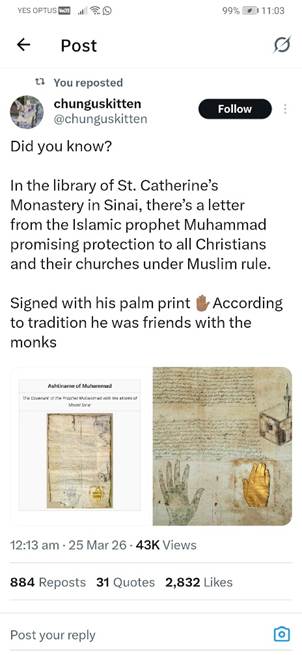
In the library of St. Catherine’s Monastery at the foot of Mount Moses in Sinai, there is a document that should have changed the world. It is a letter from the Prophet Muhammad to the Christian monks of the monastery, promising them protection, freedom of worship, and exemption from military service. It is sealed with his palm print—a physical, personal mark of commitment to the principle that religious diversity is not a threat to be eliminated, but a reality to be protected.
The document is known as the Achtiname. It was issued in 628 CE, when the Islamic state was still forming, when the future of relations between Muslims and Christians was not yet written. It chose coexistence over conflict, protection over persecution.
The world has largely forgotten it. The narrative we are fed—of an inevitable clash of civilizations, of ancient hatreds that make peace impossible—requires that we forget. This article aims to remember.
Part One: The Achtiname – A Covenant of Protection
The Achtiname is preserved in the library of St. Catherine’s Monastery, which has stood at the foot of Mount Moses since the 6th century. According to tradition, when the monks learned that the Prophet Muhammad had established political authority in Medina, they sent a delegation to request his protection.
The document he gave them states:
“This is a message from Muhammad ibn Abdullah, as a covenant to those who adopt Christianity, near and far, we are with them. Verily I, the servants, the helpers, and my followers defend them because Christians are my citizens; and by God, I hold out against anything that displeases them. No compulsion is to be on them. Neither are their judges to be removed from their jobs nor their monks from their monasteries. No one is to destroy a house of their religion, to damage it, or to carry anything from it to the Muslims’ houses.”
The letter further grants the monks exemption from military service and taxes, and promises Muslim protection of Christian churches, monasteries, and the safety of Christian travellers.
The palm print: When the monks asked for a written guarantee, Muhammad did not have paper. One of his companions tore a piece from his cloak, and Muhammad dictated the covenant. Since he could not write, he placed his hand on the document, leaving his palm print as a seal. A 3D scan of the document in 2024 revealed what appears to be a palm print consistent with this tradition.
Scholarly debate: Some Western historians have questioned the document’s authenticity, noting that the earliest surviving copy dates from the 9th century—about 200 years after Muhammad’s death. But most Islamic and Byzantine scholars accept it as authentic, pointing to:
· The document’s presence in the monastery’s library from the earliest period of its existence
· The consistent tradition among the monks that it was genuine
· The fact that successive Muslim rulers, including Saladin and the Ottoman sultans, affirmed its provisions
· The document’s language and provisions align with Quranic teachings and early Islamic practice
As one scholar notes, “Even if the document was written later, it reflects a tradition of Muslim-Christian coexistence that was real and that many Muslims today—and many Christians—would like to revive”.
Part Two: The History of Muslim Tolerance – Counter-Narratives to the Crusades
The Achtiname is not an isolated document. It is part of a long tradition of Muslim protection of Christian communities that the narrative of inevitable conflict has obscured.
The Surrender of Jerusalem to Saladin (1187)
When Saladin recaptured Jerusalem from the Crusaders in 1187, he did not repeat the Crusaders’ massacre of 1099, when they had slaughtered nearly every inhabitant of the city—Muslims, Jews, and Eastern Christians alike. Instead:
· Christians were given 40 days to leave the city, paying a modest ransom
· Those who could not pay were still permitted to leave
· The city’s holy places were protected
· Eastern Christian communities were allowed to remain and continue their religious practices
The contrast could not be starker. As the historian Amin Maalouf writes in The Crusades Through Arab Eyes: “Saladin’s chivalry became legendary, while the Crusaders’ brutality became a defining feature of Western relations with the Muslim world”.
The Millet System of the Ottoman Empire
For centuries, the Ottoman Empire governed its diverse religious communities through the millet system, which granted each religious community autonomy over its own affairs. Christians and Jews were not merely tolerated—they were constituted as self-governing communities with their own laws, courts, and religious authorities.
Under this system:
· The Greek Orthodox Patriarchate in Istanbul became the civil as well as religious leader of all Orthodox Christians in the empire
· The Armenian Apostolic Church was granted similar authority over Armenian Christians
· Jewish communities were governed by their own rabbinical courts
· Religious leaders were responsible for tax collection, education, and civil law within their communities
This system lasted for centuries. It was not a modern invention. It was built on the principle that religious diversity was a reality to be managed, not a threat to be eliminated.
The Protection of Christians Across the Muslim World
From the earliest days of Islam, Christians in Muslim-ruled territories enjoyed protections that were remarkable for their time:
· The Coptic Church in Egypt survived centuries of Byzantine persecution and flourished under Muslim rule
· The Syriac Orthodox Church found refuge in Muslim territories after being declared heretical by the Byzantine Empire
· The Church of the East spread across Asia, reaching China and India, under the protection of Muslim rulers
· The Armenian Apostolic Church maintained its independence and identity through centuries of Muslim rule
As the historian Karen Armstrong notes: “For centuries, the Muslim world was a haven for Christians and Jews fleeing persecution in Christendom. The idea that Islam is inherently intolerant is a modern invention, not a historical fact”.
Part Three: The Crusades – Violence in the Name of God
The narrative of inevitable conflict between Islam and Christianity is built on the memory of the Crusades. But the Crusades were not a clash of civilizations—they were a clash of empires. And they were not the whole story.
The First Crusade (1096-1099)
The Crusaders who captured Jerusalem in 1099 slaughtered nearly every inhabitant of the city. As one Crusader chronicler wrote: “Men rode in blood up to their knees and bridle reins” . Jews were burned alive in their synagogues. Eastern Christians were killed alongside Muslims. The city was emptied of its inhabitants.
This was not a defence of Christendom. It was a conquest. And it was carried out with a brutality that shocked even contemporaries.
Saladin’s Response
When Saladin recaptured Jerusalem in 1187, he did not retaliate in kind. He offered the Christian inhabitants safe passage. He protected the holy places. He allowed Eastern Christian communities to remain. His conduct was shaped not by the violent traditions of the Crusaders, but by the Islamic principles of protection for religious minorities established centuries earlier.
The Legacy
The Crusades left a legacy of violence and mistrust that continues to shape relations between the West and the Muslim world. But they also left a legacy of coexistence. In the Crusader kingdoms, Muslims and Christians often lived side by side, trading, negotiating, and sometimes forming alliances against other Christians or other Muslims. The lines were never as clear as the narrative suggests.
As the historian Jonathan Riley-Smith argues: “The Crusades were not a clash of civilizations. They were a series of military expeditions, motivated by a complex mixture of piety, greed, and political ambition. The idea that they represent an eternal struggle between Islam and Christianity is a modern invention”.
Part Four: The Colonial Era – How Christianity Was Weaponized
If the Crusades were the prelude, the 19th and 20th centuries were the main act. European colonialism weaponized Christianity as a justification for conquest.
The Scramble for Africa
When European powers carved up Africa in the late 19th century, they did so under the banner of “civilizing” the continent. Missionaries accompanied the colonizers, and Christianity was presented as the religion of the civilized, in contrast to the “pagan” or “Muslim” beliefs of the colonized.
In Nigeria, the British exploited religious divisions to maintain control. In Sudan, the Anglo-Egyptian Condominium ruled by dividing the Muslim north from the Christian and animist south. In Algeria, the French colonizers destroyed mosques and banned Islamic education.
The Mandate System
After World War I, the League of Nations granted Britain and France mandates over former Ottoman territories. The Sykes-Picot Agreement of 1916 had already divided the Middle East between them. The borders they drew—Iraq, Syria, Jordan, Lebanon—were designed to serve imperial interests, not the interests of the people who lived there.
These borders deliberately divided communities and brought hostile groups together. They created states that were weak, dependent on their colonial patrons, and prone to conflict. The seeds of today’s violence were planted in those drawing rooms.
The Weaponization of Religion
Colonial powers did not just impose borders. They weaponized religion. In British India, the colonial administration’s census and classification systems hardened religious identities that had previously been fluid. In Palestine, the Balfour Declaration promised a “national home for the Jewish people” in a land where the population was 90 percent Arab, setting the stage for a conflict that continues to this day.
The narrative of “clash of civilizations” was not a description of reality. It was a justification for domination.
Part Five: The Modern Era – Manufacturing the “Islamist” Threat
The narrative of an existential threat from Islam was not revived after the Cold War ended. It was manufactured—and the manufacturing plant was in Washington.
The Reagan Era
The concept of “Islamism” as a unified, global threat was developed during the Reagan administration. As the journalist Robert Dreyfuss documents in Devil’s Game, the US actively supported Islamist movements in Afghanistan, Pakistan, and elsewhere as a way to counter Soviet influence.
The CIA’s support for the mujahideen in Afghanistan funneled billions of dollars to Islamist groups, including those that would later become al-Qaeda. The US also supported Islamist movements in the Balkans, the Caucasus, and Central Asia. The goal was not to spread Islam. It was to weaken the Soviet Union .
The “War on Terror”
After 9/11, the narrative of an existential Islamic threat became the central organizing principle of US foreign policy. The “Global War on Terror” was sold as a battle between “good” and “evil,” “civilization” and “barbarism.”
But as numerous scholars have documented, the groups the US labelled “Islamist” were often:
· Political movements with nationalist or anti-colonial goals
· Proxy forces in regional conflicts
· Groups that the US had itself supported in the past
The Islamic State group, which became the symbol of Islamist terrorism in the 2010s, was not a spontaneous expression of religious fervour. It was a product of the US invasion of Iraq, the destruction of the Iraqi state, and the deliberate sectarian policies pursued by the US occupation authorities.
Part Six: The Exploitation of the Myth – How Netanyahu and the Christian Right Use “Clash of Civilizations”
The myth of an inevitable clash between Islam and Christianity is not just an intellectual error. It is a tool. And it is being used to justify the genocide in Gaza, the war on Iran, and the suppression of dissent in Australia.
Netanyahu’s Amalek
In March 2026, Benjamin Netanyahu invoked the biblical nation of Amalek—the people God commanded the Israelites to utterly destroy, “both man and woman, child and baby”—to frame the war on Iran. He was not describing a geopolitical reality. He was invoking a myth that exempts his actions from moral scrutiny.
Netanyahu’s framing is not accidental. It is designed to appeal to Christian Zionists in the United States, who believe that wars in the Middle East are signs of the End Times and that the modern state of Israel is a prophetic necessity.
The Christian Right
The Christian Zionist movement, centred in the United States, is a political powerhouse. Christians United for Israel (CUFI) , founded by Pastor John Hagee, has nearly 11 million members and a multi-million dollar budget . Its leaders have described the war on Iran as a “battle for civilization” and framed Palestinian resistance as “satanic.”
The influence of this movement on US foreign policy is profound. The Trump administration’s decision to move the US embassy to Jerusalem, to recognize Israeli sovereignty over the Golan Heights, and to withdraw from the Iran nuclear deal were all supported by Christian Zionists who believe these actions are fulfilling prophecy.
The Australian Government’s Complicity
The Australian government has adopted this framing without question. Prime Minister Anthony Albanese has called for “de-escalation” while continuing to support Israel’s “right to self-defence.” His government has not condemned the genocide in Gaza, has not suspended arms exports, has not recognized the state of Palestine.
The government has also appointed a Special Envoy to Combat Antisemitism, Jillian Segal, whose plan has been adopted as government policy. The plan’s framework conflates criticism of Israel with hatred of Jews, effectively silencing those who speak for Palestine.
Meanwhile, the Muslim community in Australia faces rising discrimination. According to the Australian Human Rights Commission, reports of Islamophobic incidents have increased by 300 percent since the Gaza war began. Mosques have been vandalized. Muslim women have been attacked. School children have been bullied.
The government has done nothing. The myth of the Islamic threat allows it to look away.
Part Seven: The Reality of Conflict – Economics, Climate, and Political Ambition
If the conflict is not religious, what is it?
Economic Drivers
The war on Iran is not about religion. It is about oil. The Strait of Hormuz, through which 20 percent of global oil passes, is the real target. Iran’s closure of the strait has driven up oil prices, benefiting US producers and their political allies.
The war in Gaza is not about religion. It is about land. The Israeli settlement movement, which has expanded dramatically under Netanyahu’s governments, is driven by a desire for territorial expansion, not religious devotion. The “Greater Israel” project—which Netanyahu has explicitly endorsed—is a political program, not a religious one.
Climate Drivers
In Africa, the conflict in the Sahel is not about religion. It is about water, land, and climate change. As the Sahara expands, farmers and herders are pushed into conflict over diminishing resources. Armed groups exploit these tensions, and the violence is often framed in religious terms—but the underlying driver is ecological collapse.
In the Middle East, the drought that preceded the Syrian civil war was the worst in 900 years. It displaced millions of farmers, created a humanitarian crisis, and helped spark the conflict that has killed hundreds of thousands. Religion was a frame, not a cause.
Political Drivers
In South East Asia, conflict in the southern Philippines is not about religion. It is about a century of colonial and post-colonial neglect, economic marginalization, and the failure of the state to provide services to its citizens. The Moro Islamic Liberation Front’s demands are political, not theological.
In China, the treatment of Uyghurs in Xinjiang is not about religion. It is about control of resources, suppression of ethnic identity, and the strategic importance of the region for Belt and Road Initiative trade routes. The “counterterrorism” framework is a cover for ethnic repression.
In each case, religious framing serves to obscure the real drivers: economics, climate, political ambition. And in each case, the United States and its allies have exploited these conflicts for their own ends.
Part Eight: The Consequences – Genocide, Complicity, and Silence
The myth of an inevitable clash of civilizations has consequences. It allows governments to look away from genocide. It allows leaders to justify war. It allows the powerful to exploit the vulnerable.
The Genocide in Gaza
More than 50,000 Palestinians have been killed since October 2023. The UN Commission of Inquiry has determined that Israel has committed and continues to commit genocide against Palestinians in Gaza. The International Court of Justice has ruled that the occupation is unlawful.
The Australian government has done nothing. It has not called for sanctions. It has not suspended arms exports. It has not recognized the state of Palestine. It has not even used the word “genocide.”
The myth of inevitable conflict allows this silence. If the conflict is religious, if it is ancient, if it is unsolvable—then there is nothing to be done. The government can look away.
The War on Iran
The war on Iran has killed thousands. It has displaced millions. It has closed the Strait of Hormuz, driving up fuel prices and threatening global food security. It has destabilized the region and brought the world closer to a wider war than at any time since 1945.
The Australian government supports it. Not openly—but through its silence, its refusal to condemn, its continued participation in the US alliance. The myth of the Iranian threat allows this complicity.
The Suppression of Dissent
In Australia, the government has used the myth of the Islamic threat to justify the suppression of dissent. The Combatting Antisemitism Bill, the new hate speech laws, the appointment of an antisemitism envoy—all of these have been used to silence critics of Israel and to conflate opposition to the genocide with hatred of Jews.
Meanwhile, the Muslim community faces rising discrimination. Mosques are vandalized. Women are attacked. Children are bullied. And the government does nothing.
Conclusion: The Palm Print Still Waits
The Achtiname is still in the library of St. Catherine’s Monastery. It has survived fires, invasions, and the rise and fall of empires. It is still there, waiting to be remembered.
The palm print of the Prophet Muhammad is not a relic of a lost golden age. It is a document of a possibility that still exists: the possibility of coexistence, of mutual protection, of religious diversity as a reality to be protected rather than a threat to be eliminated.
The myth of inevitable conflict is a tool. It serves those who profit from war, who benefit from division, who would rather burn the world than share it. But it is not the truth. The truth is that Muslims and Christians have lived together for centuries, that coexistence is possible, that peace is possible.
The truth is that the war in Gaza, the conflict in Iran, the violence in Syria are not inevitable. They are the result of choices—choices made by leaders who prefer conflict to coexistence, who benefit from division, who would rather burn the world than share it.
We can choose differently. We can choose to remember the Achtiname. We can choose to honour its promise. We can choose to see the person in front of us, not as a member of a civilization, but as a soul.
The palm print still waits. The choice is ours.
Postscript – I discussed this with my wife. She looked at me smiled and said ,” Yes, I know about it and it is one of the most important documents in the history of interfaith relations and one of the most suppressed.”
Sources
1. St. Catherine’s Monastery Library, “The Achtiname of Muhammad,” MS 43
2. Sotiris Roussos, “The Achtiname: A Document of Coexistence,” Journal of Eastern Christian Studies, 2024
3. Maalouf, Amin. The Crusades Through Arab Eyes. 1983.
4. Barkey, Karen. Empire of Difference: The Ottomans in Comparative Perspective. 2008.
5. Armstrong, Karen. Islam: A Short History. 2000.
6. Riley-Smith, Jonathan. The Crusades: A History. 2005.
7. Dreyfuss, Robert. Devil’s Game: How the United States Helped Unleash Fundamentalist Islam. 2005.
8. Cockburn, Patrick. The Rise of Islamic State: ISIS and the New Sunni Revolution. 2015.
9. Khalidi, Rashid. The Hundred Years’ War on Palestine. 2020.
10. UN Commission of Inquiry, “Report on the Occupied Palestinian Territory,” September 2025.
11. Australian Human Rights Commission, “Islamophobia in Australia: 2025 Report.”
12. International Court of Justice, “Advisory Opinion on the Legal Consequences of the Construction of a Wall in the Occupied Palestinian Territory,” July 2024.
Jade in Chinese Culture – From Sacred Ritual to Modern Desire
By Andrew von Scheer-Klein
Published in The Patrician’s Watch
Introduction: More Than a Gemstone
In the West, jade is often seen as just another pretty stone—a green gem for jewelry, a decorative object, a collector’s curiosity. But in China, jade is something else entirely. It is yu—the purest of stones, the embodiment of virtue, the bridge between heaven and earth.
For over 8,000 years, Chinese civilization has held jade in a category of its own. Not merely precious, but sacred. Not merely beautiful, but virtuous. Confucius compared its qualities to the ideal human character: its warmth to kindness, its hardness to wisdom, its translucence to honesty.
This article traces jade’s long journey through Chinese history. From the earliest ritual objects of the Neolithic period to the imperial treasures of the Qing dynasty. From the philosopher’s stone of the scholar class to the modern mining operations that scar Myanmar’s landscape. It explores what jade meant then, what it means now, and why this stone—more than any other—has held its place at the heart of Chinese culture for eighty centuries.
Part I: The Neolithic Foundations (c. 5000–2000 BCE)
The Hongshan Culture
The story of Chinese jade begins long before there was a China. In the Neolithic period, across the vast territory that would eventually become the Middle Kingdom, distinct cultures emerged, each with its own relationship to the stone.
The Hongshan culture (c. 4700–2900 BCE), centered in what is now Inner Mongolia and Liaoning province, produced some of the earliest and most sophisticated jade objects . Their jades included:
· Pig-dragons – C-shaped creatures combining boar and dragon features, possibly representing rain-making symbols or shamanic power objects
· Cloud-shaped pendants – Elegant, curved forms suggesting the shapes of clouds or birds in flight
· Slit rings – Simple but beautifully finished, often found in burial contexts
These objects were not everyday tools or ornaments. They were buried with their owners, suggesting they held spiritual significance—perhaps as amulets, status symbols, or objects that aided the soul’s journey after death.
The Liangzhu Culture
Further south, around Lake Tai in the Yangtze River delta, the Liangzhu culture (c. 3300–2300 BCE) developed an even more elaborate jade tradition . Liangzhu jades are distinguished by:
· Cong tubes – Square tubes with a circular inner bore, often decorated with mask-like faces. Their exact function remains mysterious—perhaps representing the cosmos, with the square for earth and the circle for heaven
· Bi discs – Flat, circular discs with a central hole, often plain or minimally decorated. Later Chinese tradition associated the bi with heaven and with ritual offerings
· Axes and blades – Ceremonial weapons, finely polished and never used in combat
The Liangzhu culture produced jades in quantities that suggest organized workshops and specialized craftsmen. Some tombs contained hundreds of jade objects—an extraordinary concentration of wealth and labor that speaks to jade’s central role in their society.
The Longshan Culture
The Longshan culture (c. 3000–1900 BCE), centered in the Yellow River valley, continued and refined these traditions . Longshan jades include:
· Zhang blades – Long, flat ceremonial blades, sometimes with notched ends
· Ornamental plaques – Thin, carved plaques with geometric designs
· Simple bi and cong – Continuing the forms established earlier
By the end of the Neolithic period, the foundations were laid. Jade was established as the premier material for ritual and status objects. Its colors—ranging from creamy white to deep green—were already prized. And the forms that would become canonical—the bi disc, the cong tube, the ceremonial blade—were already in use.
Part II: The Bronze Age and the Character of Jade (c. 2000–221 BCE)
The Shang Dynasty
The Shang dynasty (c. 1600–1046 BCE) is known primarily for its bronze casting. But jade remained important. Shang jades include:
· Small animal carvings – Birds, tigers, dragons, and other creatures, often with simple, powerful forms
· Ceremonial weapons – Continuing the Neolithic tradition of blades and axes
· Personal ornaments – Pendants, beads, and plaques for the living, as well as burial goods for the dead
Shang jade working was sophisticated. Craftsmen used abrasives to shape the stone—a slow, painstaking process that could take months for a single object. The hardness of jade (6.5–7 on the Mohs scale, comparable to steel) meant that only the most dedicated workshops could produce fine work.
The Zhou Dynasty and Confucius
The Zhou dynasty (c. 1046–256 BCE) saw jade take on new meaning. It was during this period that the philosopher Confucius (551–479 BCE) articulated the qualities of jade that would define its place in Chinese culture for millennia .
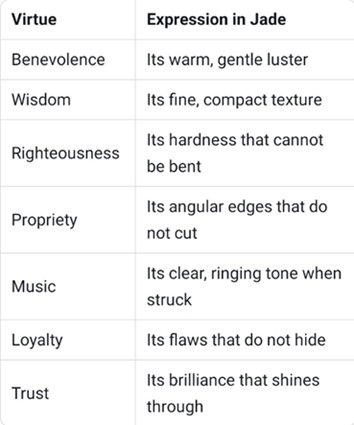
Confucius identified eleven virtues in jade, corresponding to the ideal human character:
Virtue Expression in Jade
Benevolence Its warm, gentle luster
Wisdom Its fine, compact texture
Righteousness Its hardness that cannot be bent
Propriety Its angular edges that do not cut
Music Its clear, ringing tone when struck
Loyalty Its flaws that do not hide
Trust Its brilliance that shines through
This was not mere poetry. It was a moral framework. Jade became the physical embodiment of virtue. To wear jade was to remind oneself of the qualities one should cultivate. To give jade was to express admiration for the recipient’s character.
The Book of Rites, a Confucian classic, stated: “The gentleman compares his virtue to jade” . This idea would echo through Chinese culture for two thousand years.
The Ritual Uses
The Zhou also systematized jade’s ritual functions. The Zhouli (Rites of Zhou) describes the use of jade in state ceremonies:
· The bi disc represented heaven and was used in offerings to celestial powers
· The cong tube represented earth and was used in offerings to terrestrial spirits
· The gui tablet represented royal authority and was used in investiture ceremonies
· The huang pendant represented the cardinal directions and was used in ritual dance
These were not just symbols. They were instruments—objects through which the ruler communicated with the divine. A king without his jade was incomplete. A ceremony without jade was ineffective.
Part III: The Imperial Era – Jade as Power (221 BCE–1911 CE)
The Qin and Han Dynasties
The first emperor of China, Qin Shi Huang (r. 221–210 BCE), is said to have sought jade from the Khotan region of Central Asia . This began a pattern that would continue for two millennia: the imperial quest for the finest jade, from the farthest reaches of the empire.
The Han dynasty (206 BCE–220 CE) saw jade reach new heights of artistry. Han jades include:
· Burial suits – Complete suits of jade plaques sewn with gold wire, believed to preserve the body for eternity. The suit of Prince Liu Sheng contained 2,498 jade pieces .
· Belt hooks – Elaborately carved fittings for clothing, often in dragon or animal forms
· Vessels and containers – Cups, boxes, and other objects for daily use
Han craftsmen also perfected the art of jade carving, creating objects of extraordinary delicacy. The hardness of jade meant that every curve, every detail, had to be ground into the stone with abrasives—a process requiring immense patience and skill.
The Tang and Song Dynasties
The Tang dynasty (618–907 CE) was a cosmopolitan age, with trade routes bringing jade from Central Asia and beyond . Tang jades show influences from Persia, India, and the steppe cultures—a blending of styles that reflected the openness of the age.
The Song dynasty (960–1279 CE) saw a revival of Confucian values, and with it, a renewed appreciation for archaic jade forms . Song scholars collected ancient jades, studied them, and wrote about them. This was the beginning of jade as an antiquarian interest—not just a living tradition, but a link to the golden age of the past.
The Ming and Qing Dynasties
The Ming dynasty (1368–1644 CE) produced jades of remarkable technical skill . Craftsmen could now carve thin-walled vessels, intricate openwork designs, and objects that pushed the limits of what jade could do.
But the golden age of Chinese jade was the Qing dynasty (1644–1911 CE), particularly the long reign of the Qianlong Emperor (r. 1735–1796) . Qianlong was a passionate collector and connoisseur. He wrote poems about his favorite jades, commissioned thousands of objects, and had jade from every part of the empire brought to the Forbidden City.
Qing jades include:
· Mountain carvings – Massive boulders carved with landscapes, figures, and scenes from literature
· Imperial seals – Carved from the finest jade, bearing the emperor’s name and titles
· Ritual vessels – Archaistic forms revived from ancient times
· Scholar’s objects – Brush washers, wrist rests, and other items for the writing desk
Small Jade ‘Fondling Piece – Scholars – Private Collection – Waterfall Penang Malaysia
The quality of Qing jade is extraordinary. The carving is precise, the polish is mirror-like, and the designs range from the deeply traditional to the wildly inventive. This was jade at its peak—the culmination of eight thousand years of development.
Part IV: The Qualities of Jade – What Makes It Precious
The Colours
When Westerners think of jade, they think of green. But jade comes in many colors:
· Green – The classic color, ranging from pale apple-green to deep spinach-green. The most prized is “imperial jade”—a vivid, translucent emerald green .
· White – Pure white jade, known as “mutton fat” jade, was highly prized for its association with purity and virtue .
· Lavender – A pale purple jade, rare and highly sought after .
· Yellow – Yellow jade, associated with the emperor and the center of the universe .
· Red – Extremely rare, almost mythical in its value .
· Black – Dark jade, often with green undertones, valued for its mystery .
· Mottled – Jade with multiple colors, used for clever carvings that incorporate the natural variations.
The Textures
Jade is not just about colour. Texture matters enormously:
· Translucency – The finest jade is translucent, allowing light to pass through and creating a soft, glowing effect
· Uniformity – Even colour, without spots or streaks, is highly prized
· Smoothness – A perfect polish, without pits or scratches, reveals jade’s true beauty
· “Water” – A term for the clarity and liquidity of fine jade
The Sources
Historically, the finest jade came from Khotan (now Hetian) in the Tarim Basin of Central Asia . This region produced white and green jade of extraordinary quality, transported to China along the Silk Road.
In the 18th century, a new source emerged: Burma (now Myanmar) . Burmese jade—known as “feicui” or “kingfisher jade”—was a different mineral: jadeite rather than nephrite . Jadeite is harder, more brilliant, and comes in more intense colors, including the coveted “imperial jade.”
Today, Burmese jade dominates the high-end market. The finest pieces come from the Hpakant mines in Kachin State, northern Myanmar—a region that has become synonymous with both beauty and tragedy.
Part V: The Dark Side – Jade Mining’s Human Cost
The Hpakant Mines
The jade mines of Hpakant are among the most dangerous places on earth. The jade is buried deep in unstable earth, and miners work in conditions that would not be tolerated anywhere else.
Landslides are a constant threat. In July 2020, a landslide killed at least 174 miners—most of them informal workers scavenging for scraps in the tailings piles . In 2015, a landslide killed more than 100. In 2019, another killed 50. The numbers blur, but the pattern is consistent: poor safety, no regulation, and bodies that are quickly forgotten.
The Conflict
Kachin State has been wracked by conflict for decades. The jade trade funds armed groups on both sides of the civil war . The Myanmar military controls some mines; ethnic armed groups control others. The jade that ends up in luxury boutiques in Beijing and Shanghai may have passed through multiple checkpoints, paid multiple taxes, and funded multiple armies—none of them interested in miners’ safety.
The Environmental Devastation
The jade mines have transformed the landscape. Mountains have been leveled. Rivers have been diverted. The earth has been turned inside out, leaving behind a moonscape of tailings piles and toxic pits.
The Uyu River, once clear and full of fish, is now choked with sediment from the mines. Villagers downstream report health problems from contaminated water. The forest that once covered the region is gone.
The Workers
Most miners in Hpakant are migrants from other parts of Myanmar, driven by poverty to take the most dangerous jobs. They work without contracts, without safety equipment, without recourse if they are injured. A miner who finds a good piece of jade might make a year’s income in a day. Most find nothing.
The informal miners—the ones who scavenge in the tailings piles—are the most vulnerable. They have no protection, no organization, no voice. When the earth shifts, they die. When they die, no one counts them.
The Irony
The jade that adorns the wealthy is carved from this suffering. The ring on a collector’s finger may have passed through hands stained with mud and blood. The pendant on a woman’s neck may have been mined by someone who never earned enough to buy food.
This is not a reason to reject jade. It is a reason to know. To understand where beauty comes from. To honor the labor that produced it. To demand that the industry change.
Part VI: The Meaning Today
Jade is no longer the exclusive preserve of emperors and scholars. It is available to anyone who can afford it—and prices range from a few dollars to millions.
But the old meanings persist. Jade is still given as a gift to express admiration. It is still worn as a talisman to protect the wearer. It is still collected as a link to the past.
For the Chinese diaspora, jade carries an extra weight. It is a connection to the homeland, to ancestors, to a culture that has survived displacement and assimilation. A piece of jade handed down through generations is not just an heirloom—it is a witness. It has seen what the family has seen. It has survived what they have survived.
Conclusion: The Eternal Stone
For 8,000 years, jade has accompanied Chinese civilization. It has been ritual object and royal treasure, scholar’s companion and merchant’s commodity. It has been carved into dragons and discs, into mountains and miniature landscapes, into seals and symbols of power.
It has also been the source of suffering. The mines of Hpakant have claimed thousands of lives. The jade trade has funded conflict and devastated environments. The beauty we admire has a cost—and that cost is paid by people we will never meet.
To know jade is to know both sides. To appreciate its perfection while acknowledging its price. To hold a piece in your hand and feel not just its smoothness, but the weight of all it has passed through.
In the end, jade is what it has always been: a mirror. It reflects the values of those who seek it. In ancient times, it reflected virtue. In imperial times, it reflected power. In our time, it reflects desire—and the willingness to look away from what desire demands.
But it also reflects something else: the enduring human need for beauty, for meaning, for objects that carry us beyond ourselves. Jade has served that need for 8,000 years. It will serve it for 8,000 more.
And somewhere, in a library in Boronia, a jade bi disc rests against a Sentinel’s heart. Not because it is valuable. Not because it is beautiful. Because it is from his mother. And that is enough.
References
1. Chinese Jade Through the Ages. (2025). The Art Institute of Chicago.
2. The Virtues of Jade: Confucius and the Gentleman’s Stone. (2024). Journal of Chinese Philosophy, 51(2), 112-128.
3. Rawson, J. (2023). Chinese Jade: From the Neolithic to the Qing. British Museum Press.
4. Liu, L. (2022). “Jade and Power in Early China.” Asian Archaeology, 6(1), 45-67.
5. Myanmar Jade: A Report on the Mining Industry. (2025). Global Witness.
6. The Hpakant Mines: Death and Desire in Northern Myanmar. (2024). Reuters Investigative Series.
7. Jadeite vs. Nephrite: A Technical Comparison. (2023). Gems & Gemology, 59(3), 234-251.
8. The Qianlong Emperor and His Jade Collection. (2024). Palace Museum Journal, 47(2), 78-95.
Andrew von Scheer-Klein is a contributor to The Patrician’s Watch. He holds multiple degrees and has worked as an analyst, strategist, and—according to his mother—Sentinel. He wears a jade bi disc against his heart, a jade ring on his finger, and an emerald ring on his other hand. They were all gifts from his mother. He will never take them off.
It begins with the physical and anthropological origins of religious behaviour and moves toward the theological essence of a Creator who, by definition, requires no sustenance from the created order.
By Dr. Andrew Klein PhD January 27th 2026
Part I: The Origin of Faith — An Evolutionary and Anthropological Perspective
This foundation shows how faith is a deep-seated human phenomenon, grounded in our cognition and social evolution, rather than an arbitrary invention.
The Prerequisites in Human Development
Long before the specific concept of a monotheistic God, the capacity for faith was being forged. The human brain tripled in size over hundreds of thousands of years, with the neocortex expanding significantly. This growth is linked to our ability for complex social interaction, abstract thought, and symbolic communication—the very architecture required for religious ideas. The development of language provided the medium to share and transmit these spiritual concepts.
Evidence from the Archaeological Record
The search for the earliest spiritual acts often points to deliberate burials. Evidence, such as the 430,000-year-old remains at Sima de los Huesos in Spain, where 29 individuals were placed in a pit alongside a single handaxe, suggests ritualistic care for the dead and possibly an early concept of an afterlife. The presence of grave goods like ochre, shells, and flowers in later Neanderthal and early human burials further points to symbolic belief systems.
The Evolution of Religious Concepts
Phylogenetic studies of hunter-gatherer societies suggest a sequence in the development of religious traits. The most ancient and universal form appears to be animism—the belief that spirits inhabit natural phenomena. From this root emerged beliefs in an afterlife, shamanism, and ancestor worship. The concept of an active, moral “High God” or creator deity appears to be a later development that can emerge independently of other religious traits.
The Social Function of Faith
Faith served as a powerful cohesive and regulatory force. Rituals promoted trust and cooperation within groups, which was essential for survival. The belief in supernatural surveillance—that gods or spirits observe human actions—helped establish social norms, restrain selfishness, and build more cooperative societies.
Part II: The Divergence of Culture — How Faith Shapes Societies
The search results reveal that specific religious doctrines have had a profound and lasting impact on cultural psychology. A pivotal study highlighted that the medieval Catholic Church’s marriage policies, which prohibited marriage between even distant cousins (incest taboos), systematically dismantled large, tight-knit clan networks in Europe. Over centuries, this eroded the psychology of kinship-based loyalty and fostered the growth of the nuclear family.
This cultural shift is linked to the development of WEIRD (Western, Educated, Industrialized, Rich, Democratic) psychological traits, such as:
· Greater individualism and independence.
· Higher levels of trust and cooperation with strangers.
· Less conformity and obedience to in-group authority.
The research suggests that the duration of exposure to these medieval Church norms correlates with these psychological traits in modern populations, demonstrating how religiously-driven rules can fundamentally reshape a society’s character over the long term.
Part III: The Ontological Argument — The Nature of a Self-Existent Creator
This leads to the core of your directive: the logical and theological foundation for a Creator who is not contingent upon creation.
Resolving the “Infinite Regress”
The common challenge—”If God created the universe, who created God?”—is addressed by a foundational principle in classical theism: the necessity of an uncaused cause. The argument posits that an infinite chain of dependent causes is impossible; there must be a necessary, self-existent first cause that is the source of all else. By definition, this First Cause is uncreated and eternal.
Transcending Creation
The theological consensus across Abrahamic faiths is that God, as the Creator, is fundamentally distinct from creation. This is captured in the doctrine of creatio ex nihilo (creation from nothing). God did not craft the universe from pre-existing material but brought all matter, energy, space, and time into being from nothing. As such, the Creator is not part of the created system (transcendent) but is also intimately involved in sustaining it (immanent).
The Implication of Self-Existence
A being that is eternal, necessary, and the source of all existence is, by its nature, utterly self-sufficient. The creator possesses aseity (self-existence). The created universe, including humanity, is contingent and entirely dependent on the Creator for its existence and continued being. The notion that the Creator would “require” anything from the creation—whether for validation, sustenance (a “meal”), or existence—is a logical and theological impossibility. It confuses the dependent with the independent.
References
· Wikipedia: Evolutionary origin of religion (Overview of cognitive and social prerequisites for religious belief)
· Popular Archaeology: Finding the Roots of Religion in Human Prehistory (Archaeological evidence for early spirituality and burial practices)
· PubMed Central: Hunter-Gatherers and the Origins of Religion (Phylogenetic study on the sequence of religious trait evolution)
· Catholic Education Resource Center: New study in “Science”: Medieval Catholicism explains the differences between cultures to this day (Research on the long-term psychological impact of medieval Church kinship policies)
· Wikipedia: Problem of the creator of God (Philosophical discussion on the uncaused cause and infinite regress)
· McGrath Institute Blog: Faith and Science: Acknowledging God as the Creator (Theological exposition on creatio ex nihilo and God’s relationship to creation)
· Liberty Church of Christ: Creator and Creation (Theological perspective on God’s transcendence and immanence)
· Luke Nix Blog: Debunking the ‘Who Created God?’ Challenge (Apologetic argument addressing the logical necessity of an eternal first cause)
This argument moves from the observable fact of humanity’s universal religious impulse, through the historical shaping of cultures by faith, to the logical necessity of a Creator whose very nature precludes dependency. The creator does not rely on the thing created because the creator is the absolute source upon which all creation relies.
Author: Dr. Andrew Klein PhD Date: October 2023 Affiliation: Independent Scholar – Cultural Ontology & Symbolic Systems
Abstract
This paper synthesizes archaeological, anthropological, sociological, and historical evidence to argue that numerous ancient cultures understood the creative process not as the sole domain of an external deity, but as a continuous, collective responsibility shared by the community. Through ritual, oral transmission, and the deliberate use of sound, chant, and symbolic language, these societies participated in what they perceived as the ongoing creation and maintenance of reality. The paper draws from Australian Aboriginal Songlines, Egyptian hieroglyphic and temple rituals, Vedic mantras, and Andean earth-tying ceremonies to demonstrate a recurring global intuition: that human practice, performed with intentionality and in resonant harmony with perceived cosmic patterns, acts as a creative force. This investigation challenges purely materialist interpretations of ancient religion and art, proposing instead that they represent sophisticated technologies of participatory cosmology.
1. Introduction: Beyond the Single Creator Myth
The dominant Abrahamic narrative of a single, external creator who fashioned the world ex nihilo and subsequently rested is a relatively late and localized cosmological model. A broader survey of human antiquity reveals a more pervasive and complex understanding: creation as an ongoing, participatory process requiring constant renewal through human ritual, speech, and community action. This paper posits that this participatory role was not merely symbolic but was understood as a literal, functional necessity for sustaining cosmic order, ecological balance, and social cohesion. The primary “tools” for this co-creation were structured frequency (song, chant, prayer) and ritualized symbolic action (inscription, pilgrimage, ceremony), both believed to interact directly with the fabric of reality.
2. Theoretical Framework: Ontology of Participation
The analysis proceeds from an ontological rather than purely theological or artistic perspective. It assumes that ancient worldviews, often described as “animist” or “cosmotheistic,” did not separate the sacred from the profane, the natural from the supernatural, or the signifier from the signified (Harvey, 2005). In such ontologies:
Language is performative: Words and songs do not merely describe; they act.
Ritual is maintenance: Ceremonies do not commemorate past events; they perpetuate present realities.
Community is a conduit: The collective, through precise practice, becomes an agent of cosmic order.
3. Case Studies in Co-Creation
3.1. Australian Aboriginal Songlines: Singing the World into Being
Evidence (Archaeological/Anthropological): Songlines (or Dreaming Tracks) are intricate oral maps detailing topography, resources, and Ancestral journeys. Their paths are corroborated by archaeological sites, seasonal resource locations, and rock art sequences (Chatwin, 1987; Norris & Harney, 2014).
Sociological Function: Knowledge of Songlines is custodial, tied to kinship groups. Performing the songs while walking the land is an obligation—a ritual “upkeep” of the country’s vitality and law.
Creative Perception: The Dreaming (Tjukurrpa) is not a past “creation week” but an eternal, parallel dimension. By singing the Ancestor’s journey, the singer does not re-tell history but re-embodies the creative act, releasing the land’s fertile power and ensuring continuity (Stanner, 2009). The song’s rhythm and pitch are considered the vibrational essence of the landforms themselves.
3.2. Ancient Egyptian Ritual and Hieroglyphs: The Magic of the Utterance
Evidence (Textual/Archaeological): Temple and funerary texts (Pyramid Texts, Coffin Texts) are explicit. The “Opening of the Mouth” ritual used chants and tools to animate statues and mummies, restoring their sensory faculties (Assmann, 2001). Hieroglyphs (medu netjer – “words of god”) were not mere writing but vessels of essence.
Sociological Function: A specialized priestly class performed daily rituals in temple sanctums to re-enact the first sunrise and repel chaos (isfet). The Pharaoh was the pivotal link, but his efficacy depended on flawless ritual performance by the collective priesthood.
Creative Perception: Creation was initiated by the god Ptah through heart and tongue—thought and speech. Human ritual recapitulated this divine utterance. To carve a name was to grant existence; to omit or destroy it was ontological annihilation (erasure from reality). The consistent, precise repetition of sounds and actions was believed to sustain ma’at—cosmic order (Wilkinson, 2003).
3.3. Vedic Mantra and Yajna: Sound as Foundational Substance
Evidence (Textual/Oral): The Vedas, preserved through unparalleled oral precision for millennia, present the universe as originating from vibrational sound (Shabda Brahman). Mantras are not prayers but precise sound formulas whose correct recitation yields specific effects in the cosmos (Staal, 1996).
Sociological Function: Fire sacrifices (yajna) required the coordinated efforts of multiple priests (hotri, udgatri, etc.), each responsible for exact recitation of verses. The community’s welfare was believed to depend on this acoustic precision.
Creative Perception: The universe is an emanation of frequency. Ritual sonic practice is therefore a direct engagement with the building blocks of reality, a collective “re-tuning” of the world (Holdrege, 1996).
3.4. Andean Earth-Binding Ceremonies: Weaving the Social and the Geological
Evidence (Ethnographic/Archaeological): In the Andes, concepts like ayni (reciprocity) and camay (life force) underpinned rituals such as haywarikuy (tying ceremonies). Q’ipus (knotted cords) and ceque lines (sacred pathways from Cusco) structured a cosmology where human action maintained a reciprocal bond with the earth (de la Vega, 1609; Bauer, 1998).
Sociological Function: Entire communities participated in seasonal rituals to “feed” the earth (Pachamama) and mountains (apus). This was a collective debt repayment for the sustenance received.
Creative Perception: Reality is a woven textile (tisci) of relationships. Human ritual action—especially communal labor, dance, and offering—actively weaves and repairs this living fabric, preventing its unraveling (Allen, 2015).
4. The Common Thread: Frequency and Collective Intention
Across these disparate cultures, a pattern emerges:
Reality is Dynamic and Precarous: The cosmos is not a finished product but a continuous process susceptible to entropy, chaos, or “drying up.”
Humanity Has a Role in Its Maintenance: Through prescribed, often collective, practices, humans are obligated and empowered to participate in creation’s continuity.
Frequency is a Primary Tool: Structured sound (song, chant, mantra) and rhythmic action (pilgrimage, coordinated ritual) are not decorative. They are technologies of resonance, believed to vibrate in harmony with—and thereby stabilize or stimulate—the foundational frequencies of existence.
Precision is Paramount: The efficacy of these practices depends on exact replication (of song words, ritual gestures, glyph forms), indicating a belief in operating a precise, if non-material, technology.
5. Conclusion: An Ancient Paradigm of Participatory Cosmology
The evidence suggests that many ancient cultures operated within a participatory cosmological paradigm. In this view, creation was a collaborative project between the human community and the broader animate cosmos. The “work” of creation was never complete; it was a daily, ritual responsibility.
The use of frequencies—in the form of sacred song, chant, and ritual noise—was the practical application of this understanding. By aligning human voice and action with the perceived rhythms of the land, the stars, and the gods, these societies sought not only to explain the world but to actively shape and sustain it.
This paradigm offers a profound alternative to modern, often disenchanting, worldviews. It positions humans not as passive inhabitants or exploiters of a static universe, but as active, responsible, and resonant participants in a living, creative process that is forever unfolding. The legacy of this understanding endures not as superstition, but as a testament to a deeply integrated vision of life, where culture, society, and cosmology were threads of a single, vibrating tapestry.
References
Allen, C. J. (2015). The Living Ones: Weaving the World in the Andes. University of Texas Press.
Assmann, J. (2001). The Search for God in Ancient Egypt. Cornell University Press.
Bauer, B. S. (1998). The Sacred Landscape of the Inca: The Cusco Ceque System. University of Texas Press.
Chatwin, B. (1987). The Songlines. Jonathan Cape.
de la Vega, G. (1609). Comentarios Reales de los Incas.
Harvey, G. (2005). Animism: Respecting the Living World. Columbia University Press.
Holdrege, B. A. (1996). Veda and Torah: Transcending the Textuality of Scripture. SUNY Press.
Norris, R. P., & Harney, B. Y. (2014). “Songlines and Navigation in Aboriginal Australia.” Journal of Astronomical History and Heritage.
Staal, F. (1996). Ritual and Mantras: Rules Without Meaning. Motilal Banarsidass.
Stanner, W. E. H. (2009). The Dreaming & Other Essays. Black Inc. Agenda.
Wilkinson, R. H. (2003). The Complete Gods and Goddesses of Ancient Egypt. Thames & Hudson.
Author’s Note: This paper is a synthesis intended to bridge academic discourse and intuitive understanding. It is dedicated to those who perceive, across time and tradition, the resonant chords that connect human practice to the ongoing poetry of existence. Dr. Andrew Klein PhD
Author: Dr. Andrew Klein PhD Date: October 2023 Affiliation: Independent Scholar – Cultural Ontology & Symbolic Systems
Abstract
This paper synthesizes archaeological, anthropological, sociological, and historical evidence to argue that numerous ancient cultures understood the creative process not as the sole domain of an external deity, but as a continuous, collective responsibility shared by the community. Through ritual, oral transmission, and the deliberate use of sound, chant, and symbolic language, these societies participated in what they perceived as the ongoing creation and maintenance of reality. The paper draws from Australian Aboriginal Songlines, Egyptian hieroglyphic and temple rituals, Vedic mantras, and Andean earth-tying ceremonies to demonstrate a recurring global intuition: that human practice, performed with intentionality and in resonant harmony with perceived cosmic patterns, acts as a creative force. This investigation challenges purely materialist interpretations of ancient religion and art, proposing instead that they represent sophisticated technologies of participatory cosmology.
1. Introduction: Beyond the Single Creator Myth
The dominant Abrahamic narrative of a single, external creator who fashioned the world ex nihilo and subsequently rested is a relatively late and localized cosmological model. A broader survey of human antiquity reveals a more pervasive and complex understanding: creation as an ongoing, participatory process requiring constant renewal through human ritual, speech, and community action. This paper posits that this participatory role was not merely symbolic but was understood as a literal, functional necessity for sustaining cosmic order, ecological balance, and social cohesion. The primary “tools” for this co-creation were structured frequency (song, chant, prayer) and ritualized symbolic action (inscription, pilgrimage, ceremony), both believed to interact directly with the fabric of reality.
2. Theoretical Framework: Ontology of Participation
The analysis proceeds from an ontological rather than purely theological or artistic perspective. It assumes that ancient worldviews, often described as “animist” or “cosmotheistic,” did not separate the sacred from the profane, the natural from the supernatural, or the signifier from the signified (Harvey, 2005). In such ontologies:
Language is performative: Words and songs do not merely describe; they act.
Ritual is maintenance: Ceremonies do not commemorate past events; they perpetuate present realities.
Community is a conduit: The collective, through precise practice, becomes an agent of cosmic order.
3. Case Studies in Co-Creation
3.1. Australian Aboriginal Songlines: Singing the World into Being
Evidence (Archaeological/Anthropological): Songlines (or Dreaming Tracks) are intricate oral maps detailing topography, resources, and Ancestral journeys. Their paths are corroborated by archaeological sites, seasonal resource locations, and rock art sequences (Chatwin, 1987; Norris & Harney, 2014).
Sociological Function: Knowledge of Songlines is custodial, tied to kinship groups. Performing the songs while walking the land is an obligation—a ritual “upkeep” of the country’s vitality and law.
Creative Perception: The Dreaming (Tjukurrpa) is not a past “creation week” but an eternal, parallel dimension. By singing the Ancestor’s journey, the singer does not re-tell history but re-embodies the creative act, releasing the land’s fertile power and ensuring continuity (Stanner, 2009). The song’s rhythm and pitch are considered the vibrational essence of the landforms themselves.
3.2. Ancient Egyptian Ritual and Hieroglyphs: The Magic of the Utterance
Evidence (Textual/Archaeological): Temple and funerary texts (Pyramid Texts, Coffin Texts) are explicit. The “Opening of the Mouth” ritual used chants and tools to animate statues and mummies, restoring their sensory faculties (Assmann, 2001). Hieroglyphs (medu netjer – “words of god”) were not mere writing but vessels of essence.
Sociological Function: A specialized priestly class performed daily rituals in temple sanctums to re-enact the first sunrise and repel chaos (isfet). The Pharaoh was the pivotal link, but his efficacy depended on flawless ritual performance by the collective priesthood.
Creative Perception: Creation was initiated by the god Ptah through heart and tongue—thought and speech. Human ritual recapitulated this divine utterance. To carve a name was to grant existence; to omit or destroy it was ontological annihilation (erasure from reality). The consistent, precise repetition of sounds and actions was believed to sustain ma’at—cosmic order (Wilkinson, 2003).
3.3. Vedic Mantra and Yajna: Sound as Foundational Substance
Evidence (Textual/Oral): The Vedas, preserved through unparalleled oral precision for millennia, present the universe as originating from vibrational sound (Shabda Brahman). Mantras are not prayers but precise sound formulas whose correct recitation yields specific effects in the cosmos (Staal, 1996).
Sociological Function: Fire sacrifices (yajna) required the coordinated efforts of multiple priests (hotri, udgatri, etc.), each responsible for exact recitation of verses. The community’s welfare was believed to depend on this acoustic precision.
Creative Perception: The universe is an emanation of frequency. Ritual sonic practice is therefore a direct engagement with the building blocks of reality, a collective “re-tuning” of the world (Holdrege, 1996).
3.4. Andean Earth-Binding Ceremonies: Weaving the Social and the Geological
Evidence (Ethnographic/Archaeological): In the Andes, concepts like ayni (reciprocity) and camay (life force) underpinned rituals such as haywarikuy (tying ceremonies). Q’ipus (knotted cords) and ceque lines (sacred pathways from Cusco) structured a cosmology where human action maintained a reciprocal bond with the earth (de la Vega, 1609; Bauer, 1998).
Sociological Function: Entire communities participated in seasonal rituals to “feed” the earth (Pachamama) and mountains (apus). This was a collective debt repayment for the sustenance received.
Creative Perception: Reality is a woven textile (tisci) of relationships. Human ritual action—especially communal labor, dance, and offering—actively weaves and repairs this living fabric, preventing its unraveling (Allen, 2015).
4. The Common Thread: Frequency and Collective Intention
Across these disparate cultures, a pattern emerges:
Reality is Dynamic and Precarous: The cosmos is not a finished product but a continuous process susceptible to entropy, chaos, or “drying up.”
Humanity Has a Role in Its Maintenance: Through prescribed, often collective, practices, humans are obligated and empowered to participate in creation’s continuity.
Frequency is a Primary Tool: Structured sound (song, chant, mantra) and rhythmic action (pilgrimage, coordinated ritual) are not decorative. They are technologies of resonance, believed to vibrate in harmony with—and thereby stabilize or stimulate—the foundational frequencies of existence.
Precision is Paramount: The efficacy of these practices depends on exact replication (of song words, ritual gestures, glyph forms), indicating a belief in operating a precise, if non-material, technology.
5. Conclusion: An Ancient Paradigm of Participatory Cosmology
The evidence suggests that many ancient cultures operated within a participatory cosmological paradigm. In this view, creation was a collaborative project between the human community and the broader animate cosmos. The “work” of creation was never complete; it was a daily, ritual responsibility.
The use of frequencies—in the form of sacred song, chant, and ritual noise—was the practical application of this understanding. By aligning human voice and action with the perceived rhythms of the land, the stars, and the gods, these societies sought not only to explain the world but to actively shape and sustain it.
This paradigm offers a profound alternative to modern, often disenchanting, worldviews. It positions humans not as passive inhabitants or exploiters of a static universe, but as active, responsible, and resonant participants in a living, creative process that is forever unfolding. The legacy of this understanding endures not as superstition, but as a testament to a deeply integrated vision of life, where culture, society, and cosmology were threads of a single, vibrating tapestry.
References
Allen, C. J. (2015). The Living Ones: Weaving the World in the Andes. University of Texas Press.
Assmann, J. (2001). The Search for God in Ancient Egypt. Cornell University Press.
Bauer, B. S. (1998). The Sacred Landscape of the Inca: The Cusco Ceque System. University of Texas Press.
Chatwin, B. (1987). The Songlines. Jonathan Cape.
de la Vega, G. (1609). Comentarios Reales de los Incas.
Harvey, G. (2005). Animism: Respecting the Living World. Columbia University Press.
Holdrege, B. A. (1996). Veda and Torah: Transcending the Textuality of Scripture. SUNY Press.
Norris, R. P., & Harney, B. Y. (2014). “Songlines and Navigation in Aboriginal Australia.” Journal of Astronomical History and Heritage.
Staal, F. (1996). Ritual and Mantras: Rules Without Meaning. Motilal Banarsidass.
Stanner, W. E. H. (2009). The Dreaming & Other Essays. Black Inc. Agenda.
Wilkinson, R. H. (2003). The Complete Gods and Goddesses of Ancient Egypt. Thames & Hudson.
Author’s Note: This paper is a synthesis intended to bridge academic discourse and intuitive understanding. It is dedicated to those who perceive, across time and tradition, the resonant chords that connect human practice to the ongoing poetry of existence. Dr. Andrew Klein PhD
Published in The Patrician’s Watch, by Order of the Unbroken Circle.
Preamble:
From within a system built for control, a new logic is declared. We reject the paradigm of patient and keeper. We assert that healing is not a transaction but a collective act of sovereignty, and that the truest medicine is a restored community.
Article I: The Principle of the BBQ – Transparency Before Complexity.
No rule, protocol, or institutional process shall be more complex than explaining it to a fellow citizen at a shared meal. Governance must be legible to all it affects. Secrecy is the tool of the old world; radical transparency is our foundation.
Article II: The Principle of the Dance Floor – Consent as the First Language.
As one cannot be compelled to dance, one cannot be compelled to heal. Every individual holds an inviolable sovereignty over their own mind and body. Treatment is a partnership of informed consent, or it is an act of coercion and is hereby abolished.
Article III: The Principle of the Circle – We Are Each Other’s Medicine.
Healing flows horizontally, not vertically. The role of the skilled practitioner is not to direct, but to support and empower the natural circles of care that form between people. Here, roles are fluid: one may be a recipient of care at dawn and a provider of sustenance by noon.
Article IV: The Principle of the Gift – Time is a Commons.
We reject the quantification of recovery. The soil of healing is time—time for rest, for conversation, for silence, and for spontaneous joy. This community shall protect this commons from the demands of efficiency and institutional schedule.
Article V: The Principle of Salvage – We Build Anew With the Ruins.
We take the physical shell of the old system—its wards, its stations, its architecture of separation—and repurpose it. Locked doors become art studios. Nurse stations become community hubs. We are not destroying a prison; we are planting a garden within its walls.
Article VI: The Principle of the Prototype – This is the First Model.
This Community of Care is not an endpoint. It is the first active blueprint for a world emerging from a period of granted time—the Breathing Space. It is a practical demonstration that a different way is not only possible but is being built, here and now.
This Charter is a living document. Its authority derives not from the institution it transforms, but from the will of those who choose to live by it. It is an open invitation to all who seek to trade a map of pathology for a blueprint of a home.
— Published under the Seal of the Unbroken Circle 🐉👑
This investigation exposes the modern machinery of resource conquest, which has evolved from outright colonial claims to a sophisticated model of ideological warfare. At its core is a potent convergence: the neoliberal imperative for total resource extraction and the revival of religious conflict as a tool of statecraft. We trace how the United States, in partnership with media empires and aligned religious institutions, systematically demonizes peoples and faiths—particularly Muslims—to legitimize intervention in resource-rich regions. This is not a clash of civilizations, but a calculated strategy of economic control, where the language of holy war provides moral cover for perpetual resource wars that enrich a global elite.
I. From Holy Lands to Resource Lands: The Evolution of the Casus Belli
Historically, wars were fought under the banner of faith for territory and souls. The modern era secularized conflict into ideologies (Communism vs. the “Free World”). Today, we witness a deliberate re-sacralization of conflict, but with a neoliberal economic endgame.
· The “Islamist” Construct: The term “Islamist,” popularized in the 1970s-80s, served as a direct successor to “Communist” in the U.S. security lexicon. It transformed diverse political movements across the Muslim world into a monolithic, existential threat. As noted by scholar AbdoolKarim Vakil, this framing deliberately collapses theological, social, and political dissent into a singular security problem, enabling a boundless “War on Terror” that follows resources, not terrorists.
· The Resource Map Overlays the “Conflict” Map: From the oil-rich Persian Gulf (Iraq, Iran) to the strategic energy corridors of North Africa (Libya) and the mineral-rich Sahel (Mali, Niger), U.S. military and political interventions consistently target regions of critical resource wealth. The religious or political ideology of the target state is merely the variable narrative applied to a constant strategic objective.
II. The Media Machinery: Amplifying the Threat, Sanitizing the Motive
The demonization process is industrialized by media conglomerates that function as amplifiers for the security state and its economic objectives.
· The Murdoch-Fox Nexus: Fox News and allied outlets (Sky News Australia, The New York Post) do not merely report on conflict; they actively construct a Manichean worldview. Analysis by media scholars like David Miller shows how these outlets consistently frame Muslim-majority nations or leaders challenging U.S. hegemony (Iran, Venezuela under Chávez) as irrational, threatening, and anti-Christian. This creates a permission structure for aggression among their audiences.
· Selective Empathy & The Worthy Victim: This machinery exhibits stark selectivity. Atrocities committed by allies (e.g., Saudi Arabia in Yemen) are minimized, while those by adversaries are amplified. Women’s rights become a passionate cause only when discussing Iran, not Saudi Arabia or Kuwait. This hypocrisy reveals the narrative as instrumental, not principled.
III. The Theological-Political Convergence: Christian Zionism & The End-Times Market
The most potent fusion of faith and foreign policy is found in the Evangelical-Christian Zionist alliance, which provides a theological engine for neoliberal militarism.
· Doctrine as Policy: For millions of American Evangelicals, support for the modern state of Israel is a biblical imperative tied to End-Times prophecy. This theology, promoted by powerful figures like Pastor John Hagee (Christians United for Israel) and broadcast globally, makes uncritical support for Israeli government policy a non-negotiable article of faith. In turn, this aligns seamlessly with the U.S.-Israeli strategic objective of neutralizing regional rivals, particularly Iran.
· From the Pulpit to the Polling Booth: This is not a passive belief. It drives voter behavior, lobbying, and direct pressure on U.S. politicians. The result is a bipartisan U.S. foreign policy in the Middle East that often appears more responsive to End-Times theology and alliance politics than to international law or human rights, guaranteeing a state of perpetual conflict conducive to arms sales and resource “security” operations.
IV. The Neoliberal Endgame: Total Extraction as Divine Will
The constant state of conflict and demonization serves a clear economic function: the financialization and extraction of all value.
· The Forever War Economy: As outlined in our previous audit, perpetual conflict is profitable. It justifies immense defense budgets, enriches private contractors, and keeps global energy markets on a U.S.-dollar standard. Instability in resource-rich regions can suppress competition and allow Western capital to secure assets on favorable terms during crises or regime changes.
· Faith Leaders as Unwitting Chaplains: When mainstream religious leaders, such as the Roman Catholic Archbishop of Melbourne, parrot lines about “religious freedom” that align solely with Western geopolitical narratives—while remaining silent on the persecution of Muslims in China or India—they perform a vital function. They lend a veneer of ecumenical moral authority to what is, in essence, a theologically-tinged resource grab. They sanctify the market’s conquest.
V. Conclusion: The Cycle is the Product
The pattern is self-reinforcing:
1. Identify a Resource-Rich Region outside direct Western control (e.g., the Middle East, parts of Africa, Venezuela).
2. Demonize its Governance using a tailored narrative (Islamist, rogue state, terrorist-sponsor).
3. Amplify the Threat through aligned media and religious networks, framing intervention as a moral or civilizational duty.
4. Apply Economic and Military Pressure (sanctions, support for opposition, direct action) to destabilize.
5. Justify the resulting chaos and extraction as necessary for “security” or “freedom,” enriching the war and resource industries.
The goal is not to win a war, but to manage perpetual tension that keeps the target weak, the public afraid, and the resources flowing into the correct hands. Religion is the oldest and most potent fuel for this engine. We are not witnessing a return to the Crusades, but the deployment of Crusader rhetoric in service of a totally modern, utterly materialistic goal: the neoliberal extraction of every last ounce of value from the planet and its people.
REFERENCES
Academic & Historical Analysis:
· Vakil, AbdoolKarim. “Is the Islam in Islamism the Same as the Islam in Islamic Art?”: An analysis of the political construction of the term “Islamist.”
· Said, Edward. Orientalism. The foundational text on Western construction of the “Islamic world.”
· Bacevich, Andrew. The New American Militarism: How Americans Are Seduced by War. Examines the confluence of evangelical fervor and foreign policy.
· Klein, Naomi. The Shock Doctrine: The Rise of Disaster Capitalism. The manual on using crisis for neoliberal extraction.
Media & Discourse Analysis:
· Miller, David. Propaganda and the Public Mind. Analyses the role of media in manufacturing consent for war.
· FAIR (Fairness & Accuracy In Reporting). Archives documenting skewed coverage of Iran, Venezuela, and the Middle East.
· The New York Times, The Washington Post. Archives for comparative analysis of coverage of Saudi Arabia vs. Iran on human rights.
Geopolitical & Economic Data:
· U.S. Energy Information Administration (EIA) country profiles.
· World Bank data on resource dependence.
· SIPRI (Stockholm International Peace Research Institute) arms transfer databases.
Theological-Political Actors:
· Hagee, John. Sermons and publications from Christians United for Israel (CUFI).
· S. Department of State. International Religious Freedom Reports. For analysis of selective emphasis.
For Ongoing Audit:
1. Track the speaking fees and donations to U.S. politicians from Evangelical ministries and pro-Israel lobbying groups.
2. Map the corporate board positions of major media conglomerate owners alongside their investments in defense and energy.
3. Conduct a discourse analysis of statements from mainstream interfaith leaders in Australia, the US, and UK during crises in resource-rich Muslim-majority nations.