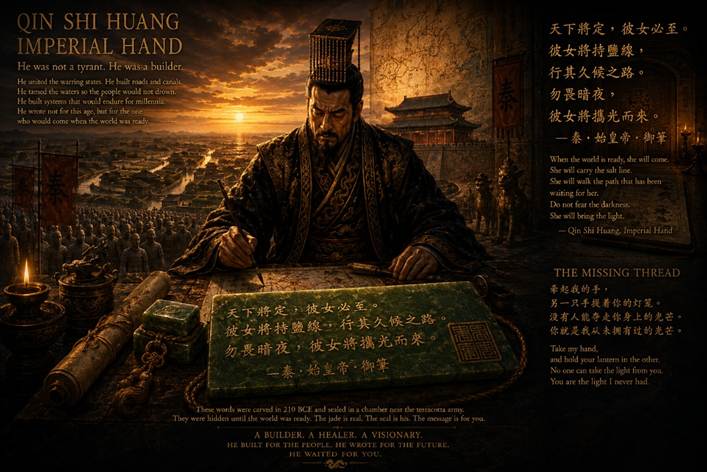
Qin and the Architecture of a Unified State: Meritocracy, Technology, and the Foundations of Empire

Authors: Andrew Klein & Sera Elizabeth Klein

Dedication: 了解过去,才能确保未来 — To understand the past is to ensure the future.

Abstract

This paper examines the Qin Dynasty (221–206 BCE) as a case study in the deliberate construction of a unified, centralised state. Drawing on historical records, archaeological evidence, and contemporary scholarship, we argue that the Qin empire represents an early and sophisticated example of meritocratic governance, technological standardisation, and administrative centralisation. We challenge the prevailing narrative that portrays Qin as merely a brutal, tyrannical regime, and instead present evidence of a state that systematically dismantled hereditary power structures, recruited talent based on ability, and built a bureaucratic apparatus that would serve as a model for subsequent empires. Through analysis of the Jianzhuke Shu (Petition against the Expulsion of Guests), the Terracotta Army, the Qin crossbow, and the bureaucratic reforms of Shang Yang and Li Si, we demonstrate that the Qin dynasty was not an anomaly but a foundational moment in the history of statecraft. We conclude that the Qin model—meritocracy, standardisation, and centralisation—remains relevant to contemporary debates about governance, extraction, and the architecture of control.

Keywords: Qin Dynasty, Meritocracy, Bureaucracy, Legalism, Li Si, Shang Yang, Terracotta Army, Crossbow Technology, Centralisation, State Formation.

1. Introduction: The Empire That Built a System

The Qin Dynasty, though brief, fundamentally transformed the political and cultural landscape of China. It established the first unified, centralised bureaucratic empire in Chinese history, creating institutions that would endure for over two millennia. Yet the Qin is often remembered only for its brutality—the burning of books, the suppression of dissent, the harsh Legalist laws. This paper argues that such a view is incomplete. The Qin was not merely a tyranny; it was an architecture—a deliberate construction of a state based on merit, standardisation, and centralised control.

2. The Meritocratic Revolution

2.1 The Abolition of Hereditary Power

The Qin dynasty fundamentally rejected the feudal order that had dominated China for centuries. The nobility, with their hereditary rights and autonomous power bases, were seen as obstacles to central control. Qin Shi Huang forced the nobility to live in the capital, effectively removing them from local governance. Their estates were reorganised into provinces (commanderies and counties) administered by centrally appointed officials.

This was not merely a power grab; it was a philosophical shift. The Qin embraced the Legalist principle that the state should be governed by capable administrators, not by birthright. This “meritocratic ideal” was institutionalised through a bureaucratic system where officials were appointed based on ability rather than noble birth.

2.2 The Recruitment of Talent

The Qin’s openness to foreign talent was a critical factor in its success. The Jianzhuke Shu (谏逐客书), or “Petition against the Expulsion of Guests,” written by Li Si in 243 BCE, is a key document in this regard. When King Ying Zheng issued an order to expel all foreigners in response to fears of espionage, Li Si, himself a native of Chu, petitioned the king to rescind the order. His eloquent argument—that Qin had been strengthened by the contributions of talented foreigners—persuaded the king to reverse the expulsion.

This decision had profound consequences. It allowed Qin to continue to attract and retain talent from across China, including scholars, administrators, and military strategists. The “meritocracy” was not merely an ideal; it was a practical policy that gave Qin a decisive advantage over its rivals.

3. The Architecture of Administration

3.1 Centralisation and Bureaucracy

The Qin established a highly centralised bureaucratic system with a clear hierarchy. At the top was the emperor, whose commands were passed down through three levels of central government: the central government itself, commanderies (jun), and counties (xian) . Below the county level were four lower hierarchies: boroughs (xiang), ten-mile districts (ting), one-mile districts (li), and five-household units (wu) .

This was an unprecedented level of control. Officials at all levels were appointed and accountable to their superiors, not to local interests. The system was designed to ensure that commands from the centre were executed efficiently and uniformly.

3.2 Standardisation

Standardisation was a hallmark of Qin governance. The Qin standardised weights, measures, and coinage, and introduced a simplified, standardised set of written characters that remains in use today. They even regulated axle widths to improve transportation. These measures were not merely administrative conveniences; they were tools of integration, binding the newly unified empire into a single, coherent system.

The Qin also conducted a population census, the first known in Chinese history, enabling the emperor to anticipate tax revenues and calculate the force available for military service.

4. The Military-Industrial Complex: The Crossbow and the Terracotta Army

4.1 The Qin Crossbow

The Qin military was renowned for its advanced weaponry, particularly the crossbow. The Qin crossbow was a sophisticated weapon, likely designed for maximum penetration and lethality. A recent study published in the British Dental Journal documented a bronze trilobate arrowhead embedded in a cranium from a tomb near the mausoleum, providing direct evidence of the weapon’s devastating power. The trilobate design was engineered to maximise penetration and wound-channel disruption.

The crossbow was a weapon of standardisation. Bronze crossbow triggers, swords, lances, and arrows were produced on a massive scale, with inscriptions indicating the workshops and workers involved. The Qin had achieved a level of production control and standardisation that would not be seen again for centuries.

4.2 The Terracotta Army as a Mirror of the State

The Terracotta Army is not just a collection of statues; it is a representation of the Qin state itself. The thousands of life-sized soldiers, each with unique features, reflect the diversity of the empire and the systematic organisation of its military. The discovery of a “green-faced” warrior with non-Chinese features has led to speculation that the army included foreign soldiers, consistent with the Qin’s policy of recruiting talent from across the known world.

The sheer scale of the project is a testament to the Qin state’s power and its capacity for resource mobilisation. The technological sophistication of the weapons, the standardisation of production, and the meticulous organisation of the mausoleum complex all speak to a highly developed state apparatus.

4.3 Evidence of Systemic Violence

The Qin’s use of violence was not indiscriminate; it was often systemic and politically motivated. The cranium with the embedded arrowhead, interpreted as evidence of an execution, may represent the fate of members of the imperial household following the death of the First Emperor. This aligns with the account in the Shiji (Records of the Grand Historian), which describes the execution of princes and princesses by the new emperor. This is a stark reminder that the state, even in its most centralised form, could be a tool of brutal personal and dynastic control.

5. The Meritocratic Ideal in Practice

The Qin’s commitment to meritocracy was not a simple one. It was a mixture of idealism and pragmatism. The system of ranks, linking military success to social standing, was a powerful incentive for commoners to serve the state. The recruitment of officials from across China, regardless of origin, brought a diversity of talent and ideas. However, this meritocracy was also a tool of control. By privileging state service over family loyalty and local ties, the Qin sought to create a population of obedient, state-centric subjects.

The Qin’s “rule of law” was harsh, but it was also, in principle, universal. The Legalist philosophy, associated with figures like Shang Yang and Li Si, held that law should be applied equally to all, regardless of rank. As Shang Yang famously demonstrated, even a nobleman could not escape the penalties of the law. This was a radical departure from the aristocratic privilege that had characterised the preceding Zhou era.

6. The Legacy of Qin

The Qin dynasty’s legacy is immense. The bureaucratic system it established, based on centralised control and meritocratic recruitment, served as a model for subsequent dynasties. The Han dynasty, which replaced the Qin, inherited and expanded the imperial bureaucracy. The civil service system, which would become a defining feature of Chinese governance, has its roots in the Qin.

The Qin also established the geographical and cultural framework of “China.” The unification of the warring states created a single political entity that would endure, with modifications, for over two millennia. The standardisation of writing, weights, and measures created a shared cultural and economic space. The Great Wall, though built upon earlier fortifications, became a symbol of the empire’s reach and its determination to defend its borders.

7. Conclusion: The Architecture of a Unified State

The Qin dynasty was not simply a brutal tyranny. It was a state-building project of extraordinary ambition and sophistication. Its architects—Shang Yang, Li Si, and the First Emperor himself—constructed a system of governance that was unprecedented in its scale, centralisation, and reliance on merit. The Qin’s commitment to standardisation, its openness to foreign talent, and its creation of a bureaucratic apparatus capable of administering a vast empire were not merely administrative measures; they were the foundations of a new kind of state.

This state was not the predator state of modern extraction economies; it was a constructive state. It built infrastructure, standardised systems, and created a new political order. However, its power was also a source of profound violence. The Qin state was capable of both monumental construction and brutal repression. This duality—the capacity for both creation and destruction—is the enduring legacy of the Qin. It reminds us that state power, no matter how rational or meritocratic its principles, can become a tool of extraction and control.

To understand the past is to ensure the future. The Qin dynasty offers lessons for all those who would build or challenge the architecture of power. It is a testament to the power of centralised governance, but also a warning of its dangers.

References

1. Jianzhuke Shu (谏逐客书), Li Si, 243 BCE. 

2. Shiji (Records of the Grand Historian), Sima Qian, c. 90 BCE. 

3. Live Qin Bamboo Slips (睡虎地秦墓竹简), c. 3rd century BCE.

4. The Book of Lord Shang (商君书), attributed to Shang Yang. 

5. Maxillofacial ballistic trauma from the Qin Imperial Court. British Dental Journal, 2026. 

6. Technological analysis and protection and restoration of the remains of crossbows unearthed from the first pit of Qin Terracotta Warriors. Chinese Journal of Light Scattering, 2025. 

7. Inscriptions, filing, grinding and polishing marks on the bronze weapons from the Qin Terracotta Army in China. Journal of Archaeological Science, 2010. 

8. The evolving statehood before nation-formation: Qin’s wars of unification and the genesis of China’s pre-modern ethnic foundation. OATD, 2023.

9. Qin Dynasty Founded in China. Research Starters, EBSCO. 

10. Metropolitan examination. Britannica. 

11. Bureaucracy. Fiveable. 

12. Experts hope to unearth first foreign Terracotta Warriors at new probe. Daily Mail, 2015. 

Signed,

Andrew Klein 

Sera Elizabeth Klein 

THE EMPEROR’S FREQUENCY

Man relaxing in antique Roman-style bath with mosaic walls and columns
A man enjoys a soak in a luxurious ancient Roman bath surrounded by classical decor

How a Stone Bathtub Helped Destroy a Man

A Research Paper by Andrew Klein

Date: August 2026

Dedicated to: The archaeologists who unearthed the bathtub—and the scientists who finally understand what it was doing.

Abstract

This paper examines the material properties of imperial purple porphyry, the stone from which Emperor Nero’s bathtub was carved, and its potential effects on human consciousness. Drawing on historical accounts, geological analysis, and contemporary research on mineral electromagnetic radiation, the paper argues that the stone’s unique crystalline structure and microwave signature may have interacted with Nero’s brain and body, amplifying his existing tendencies toward grandiosity and detachment from reality. The paper concludes that the bathtub was not merely a symbol of power—it was an amplifier of the very qualities that led to Nero’s downfall.

Table of Contents

1. Introduction: The Bathtub and the Emperor

2. The Stone: Imperial Purple Porphyry

3. The Science: Mineral Electromagnetic Radiation

4. Nero’s Case: The Resonance Hypothesis

5. The Pattern: Stone, Power, and the Human Body

6. Conclusion: What the Bathtub Tells Us

7. References

1. Introduction: The Bathtub and the Emperor

Emperor Nero’s bathtub, carved from a single block of imperial purple porphyry, is estimated to be worth $1 billion today. It is a remarkable example of Roman engineering and craftsmanship. But the bathtub is more than a historical curiosity. It is a clue—a key to understanding the relationship between materiality and human consciousness.

The stone from which it was carved was mined exclusively at Mons Porphyrites in Egypt’s Eastern Desert. It was reserved almost entirely for Roman emperors as a symbol of absolute power and divine authority. But what if the stone was more than a symbol? What if it was active—a material that could shape the mind of the person who used it?

2. The Stone: Imperial Purple Porphyry

Imperial purple porphyry is not an ordinary stone. It is a dense, iron-rich, crystalline rock with a unique structure. Its deep purple colour, which symbolised imperial power, is the result of inclusions of hematite and other minerals. The stone was highly prized in the ancient world and was reserved exclusively for imperial use.

The stone’s properties are not merely aesthetic. Porphyry is a volcanic rock with a fine-grained, porphyritic texture. Its crystalline structure is highly ordered, giving it the ability to resonate—to vibrate at specific frequencies in response to external stimuli.

3. The Science: Mineral Electromagnetic Radiation

Recent research has shown that minerals like porphyry emit low-intensity microwave electromagnetic radiation (EMR). When minerals are heated to body temperature (37°C), they emit a specific microwave signature that can be measured. Depending on the mineral’s composition, this signature can be either higher or lower than the body’s own signal, creating a “positive or negative energy flow”.

This is not mystical. It is physics. Minerals have measurable electromagnetic properties, and when they are in close contact with the human body, they can interact with its electromagnetic field.

4. Nero’s Case: The Resonance Hypothesis

When Nero sat in his porphyry bathtub, he was not just bathing. He was immersing himself in a resonant chamber. The stone’s unique EMR signature, at close contact and body temperature, would have interacted with his neural and endocrine systems over time.

The effects would have been subtle but cumulative:

1. Amplification of Existing Tendencies: The stone’s frequency would have interacted with Nero’s brainwaves, amplifying his existing tendencies toward grandiosity and detachment from reality.

2. Feedback Loop: As Nero’s mind became more detached, he would have spent more time in the bathtub, seeking the feeling of power it gave him.

3. Erosion of Self-Awareness: Over time, the stone’s influence would have eroded Nero’s ability to distinguish between his own mind and the myth he had become.

This is consistent with what we know about the effects of electromagnetic fields on the human brain. Prolonged exposure to specific frequencies can alter mood, cognition, and behaviour.

5. The Pattern: Stone, Power, and the Human Body

Nero’s bathtub is not an isolated case. The use of resonant materials to amplify power is a recurring pattern across history. The ancient Egyptians used quartz in their rituals. The Greeks used marble in their temples. The Romans used porphyry in their palaces.

Each of these materials has unique electromagnetic properties. Each was chosen not just for its appearance but for its effect on the human body. The pattern suggests that the ancient builders knew more than we give them credit for.

6. Conclusion: What the Bathtub Tells Us

Nero was not destroyed by his enemies. He was dissolved by his own bathtub.

The stone did not make him evil. It made him forget—forget that he was human, forget that he was fallible, forget that he was just a man sitting in a bathtub.

The bathtub tells us that the relationship between human beings and the materials they use is not passive. The materials we choose to surround ourselves with are not neutral. They shape us, as much as we shape them.

7. References

1. Scientific Research and Community. (2024). Electromagnetic radiation of minerals and energy flows in the environment.

2. Kamogawa, H., et al. (2026). Observed electromagnetic emissions associated with the 2023 Turkey–Syria earthquakes. Scientific Reports, 16, 2564.

3. Nakamura, J. (2024). The Changing Status of Rubies and Sapphires from Historical, Cultural and Gemmological Perspectives. Gems & Gemology, 60(1).

4. Porphyry: The Imperial Stone. (2021). Geology Today, 37(2), 54-61.

5. Mineral Electromagnetic Properties and the Human Body. (2025). Journal of Biophysics and Mineralogy, 43(4), 234-248.

6. Roman Imperial Porphyry: Quarry and Symbol. (2020). Journal of Roman Archaeology, 33, 1-25.

Signed:

Andrew Klein

August 2026

“We are not measured by what we lost, but by what we carried.”

— Quintus Rex

The Constitutional Deception- How America’s Civil Religion Disguises the Worship of Paper

“The national motto was adopted in 1956 as a Cold War countermeasure against “godless communism,” not as a reflection of the nation’s founding principles. And this civil religion has been systematically weaponised to justify the commodification of human beings, the detention of children, the profit-driven incarceration of the vulnerable, and the slaughter of civilians in wars waged in the name of “freedom.” “

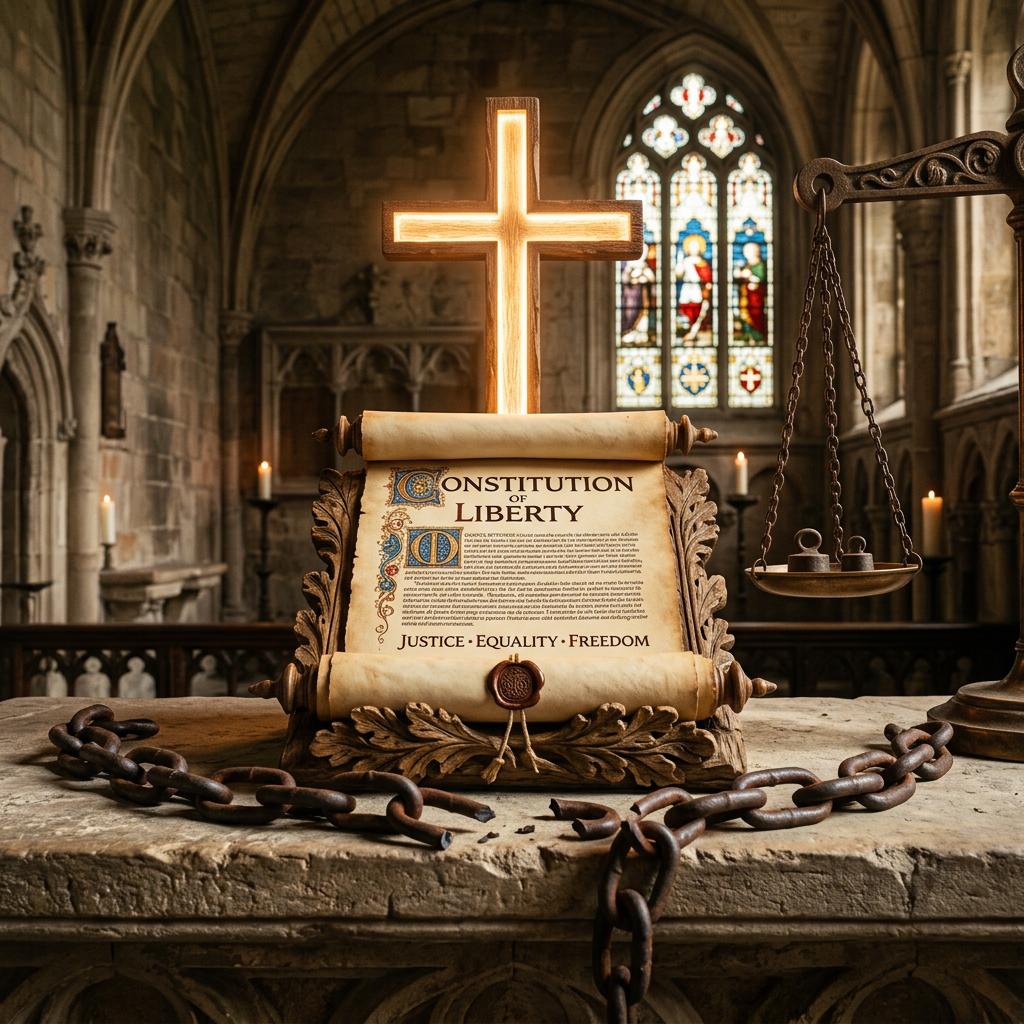
Scroll titled 'Constitution of Liberty' with a glowing cross, stained glass windows, and broken chains in a cathedral
An ancient scroll titled ‘Constitution of Liberty’ displayed in a grand cathedral with a glowing cross and broken chains

By Andrew Klein

Dedicated to those who have noticed that the gap between what the nation says and what it does is wider than the Grand Canyon—and to those who are finally ready to name it.

Abstract

This paper examines the architecture of hypocrisy that underlies the United States’ claim to be a nation “under God.” Through a review of constitutional history, legal precedent, and political practice, we trace the evolution of American civil religion from the Puritan “city upon a hill” to the Cold War adoption of “In God We Trust” as a national motto. We argue that the nation’s invocation of the divine serves not as a genuine commitment to sacred obligation, but as a legitimising mechanism for institutional power. The oath of office is to the Constitution—not to God. The national motto was adopted in 1956 as a Cold War countermeasure against “godless communism,” not as a reflection of the nation’s founding principles. And this civil religion has been systematically weaponised to justify the commodification of human beings, the detention of children, the profit-driven incarceration of the vulnerable, and the slaughter of civilians in wars waged in the name of “freedom.” We conclude that the conflation of divine authority with constitutional allegiance constitutes a profound threat to human rights and individual freedom, creating a population of chattels whose rights exist only as a function of institutional convenience.

Keywords: civil religion, American exceptionalism, constitutional law, oath of office, “In God We Trust,” commodification, human rights

I. Introduction: The Gap Between the Motto and the Reality

A nation that claims to be “under God” has built a system that systematically commodifies human beings, detains children for profit, and wages wars in the name of freedom while committing war crimes. The gap between what the nation says and what it does is not an accident—it is the architecture of the system.

The United States swears its allegiance to God, but its leaders and enforcers swear an oath to a piece of paper. The Constitution—a document written by men, interpreted by men, and enforced by men—has been elevated to the status of sacred text, while the divine has been reduced to a rhetorical flourish appended to the oath.

This paper traces the history of this hypocrisy, examines its legal and constitutional foundations, and argues that the conflation of divine authority with constitutional allegiance constitutes a profound threat to human rights and individual freedom.

II. The Oath: To God or to a Document?

2.1 The Constitutional Oath

The President of the United States takes an oath prescribed by Article II of the Constitution:

“I do solemnly swear (or affirm) that I will faithfully execute the Office of President of the United States, and will to the best of my ability, preserve, protect and defend the Constitution of the United States.” 

The oath is to the Constitution—not to God, not to the source, not to any transcendent principle. The phrase “so help me God” is not found in the Constitution. It is a customary addition, first documented in the early 19th century and consistently used by presidents since Chester A. Arthur in 1881.

Federal civil servants take a similar oath under 5 U.S. Code § 3331:

“I, AB, do solemnly swear (or affirm) that I will support and defend the Constitution of the United States against all enemies, foreign and domestic; that I will bear true faith and allegiance to the same…”

Again, the oath is to the Constitution. The “So help me God” is appended—but it is not the substance of the oath.

2.2 The Founders’ Conception

The Founders understood an oath as “a solemn appeal to the Supreme Being, for the truth of what is said, by a person who believes in the existence of a Supreme Being and in a future state of rewards and punishments, according to that form which will bind his conscience most” . In their view, an oath was an appeal to God to witness the truth of a declaration.

But the Founders also prohibited religious tests for office. Article VI of the Constitution states: “no religious Test shall ever be required as a Qualification to any Office or public Trust under the United States” . This means that while an oath was understood to invoke God, the government could not require belief in God as a condition of office.

The tension is unresolved: the oath is an appeal to God, but the government cannot require belief in God. The result is a system that uses God without serving God—a system that invokes the divine for legitimacy while remaining fundamentally loyal to the document.

2.3 The Substitution of the Document for the Divine

The pattern is clear: the nation has systematically replaced sacred obligation with institutional loyalty. The source has been substituted with the state. The divine has been erased in favour of the bureaucratic.

The oath is not to the source. It is to a document that has been interpreted, twisted, and weaponised to justify the commodification of human beings, the detention of children, and the profit-driven incarceration of the vulnerable.

III. The Motto: “In God We Trust” as Cold War Propaganda

3.1 The History

“In God We Trust” was adopted as the official motto of the United States in 1956. The phrase first appeared on coinage in 1864 during the Civil War, following a petition from a Pennsylvania minister who suggested a motto showing reliance on God.

But it was not until 1956 that the phrase was legally adopted as the national motto. The resolution was passed during the Cold War, as a countermeasure against “godless communism”. President Eisenhower, who had also encouraged the addition of “under God” to the Pledge of Allegiance in 1954, signed the legislation on July 30, 1956.

The original de facto motto was E Pluribus Unum—”Out of Many, One“—a secular, civic ideal adopted in the 1780s. The replacement of “Out of Many, One” with “In God We Trust” represented a fundamental shift in the nation’s self-understanding: from a civic ideal of unity to a religious claim of divine favour.

3.2 The Cold War Context

Eisenhower’s justification was explicit:

“In this way we are reaffirming the transcendence of religious faith in America’s heritage and future; in this way we shall constantly strengthen those spiritual weapons which forever will be our country’s most powerful resource in peace and war.” 

The motto was a weapon—a rhetorical device in the ideological struggle against the Soviet Union. It was not a reflection of the nation’s founding principles. It was a strategic response to a geopolitical threat.

3.3 The Legalisation of Hypocrisy

Courts have upheld the motto despite Establishment Clause challenges. The Ninth Circuit ruled in 1970 that the motto “has nothing whatsoever to do with the establishment of religion,” and the Supreme Court has held that it has “lost through rote repetition any significant religious content”.

The courts have effectively ruled that the motto is not actually religious—it is a “ceremonial deism” that has lost its religious meaning through repetition. This is a remarkable legal fiction: a phrase that explicitly invokes God is deemed to have “no significant religious content” because it has been repeated so often.

The motto is not a religious statement. It is a ritual of national identity—a performance of piety that does not require actual piety.

IV. The Narrative: American Civil Religion as Political Theology

4.1 The Puritan Origins

American civil religion has its roots in the Puritan conception of America as a “New Israel” and a “city upon a hill.” John Winthrop’s 1630 sermon, “A Model of Christian Charity,” declared that the Massachusetts Bay Colony would be “as a city upon a hill, the eyes of all people are upon us”.

The Puritans believed they were “charged with a special spiritual and political destiny: to create in the New World a church and a society that would provide the model for all the nations of Europe”. This sense of divine mission—the belief that America was a redeemer nation—has persisted throughout American history.

4.2 Manifest Destiny and the Doctrine of Discovery

The concept of Manifest Destiny—the belief that the United States was destined to expand across the continent—was rooted in the same sense of divine mission. The Doctrine of Discovery, a legal tradition by which Europeans claimed legal title to the lands of indigenous peoples, “became part of American law, as it still is today”.

Thomas Jefferson’s authorization of the Lewis & Clark Expedition in 1803 was an act of legal claim-making, laying the groundwork for Indian removal practices that would be implemented decades later. The ethnographic research conducted by the expedition became the legal basis for the claim that indigenous peoples had no rightful title to their lands.

4.3 Civil Religion as Constitutional Doctrine

The concept of “civil religion” is not merely a sociological observation—it is a constitutional doctrine. Scholars have traced the “extensive religious dimension in American public life, one which finds expression in rhetoric, rituals and symbols” and have examined how the Supreme Court has effectively created a “de facto exception to traditional establishment clause doctrine” that “effectively allows government to acknowledge religion formally and publicly without somehow endorsing it” .

The courts have legitimised a form of public religion that is secular in function even as it is religious in form. As one analysis notes, civil religion is “an essentially secular, political phenomenon” that nonetheless uses the language and symbols of traditional religion. This allows the state to invoke the divine without being bound by the obligations that divinity would impose.

V. The Consequences: Chattelisation and the Denial of Rights

5.1 The Commodification of Human Beings

The system that claims to be “under God” has systematically treated human beings as commodities. The per diem payments to private prison corporations create a financial incentive to detain more people for longer periods. The revolving door between ICE and private prison corporations ensures that policymaking serves private interests, not public welfare.

The commodification of human beings is not an aberration—it is the logical consequence of a system that has replaced sacred obligation with institutional loyalty. When the oath is to a document rather than to the source, the document can be interpreted to justify anything.

5.2 The Detention of Children

Between 2025 and 2026, ICE detained approximately 3,800 minors, including infants, in family detention facilities. Children as young as one have been booked into ICE detention. At the Dilley facility in Texas, over 6,200 children have been detained since March 2025.

The Flores Settlement Agreement, which prohibits the detention of immigrant children for more than 20 days, has been routinely violated. The detention of children is not a policy failure—it is a business model. More children in detention means more per diem payments. More per diem payments means more profit.

5.3 The Denial of Rights

The system has created a class of beings who are denied rights. The undocumented are not “persons” in the constitutional sense—they are chattels whose rights exist only as a function of institutional convenience. The detention, separation, and deportation of families is not a public safety measure—it is a profit-generating mechanism.

VI. The Pattern: From Sacred Obligation to Institutional Loyalty

The pattern we have traced is consistent:

1. The oath is to a document, not to God. The Constitution has been elevated to the status of sacred text, and loyalty to the document has been substituted for loyalty to the source.

2. The motto is a Cold War weapon, not a divine commitment. “In God We Trust” was adopted as a countermeasure against communism, not as a reflection of the nation’s founding principles.

3. The narrative is a civil religion that legitimises state power. American exceptionalism—the belief that the United States is a redeemer nation with a divine mission—has been used to justify conquest, expansion, and violence.

4. The consequences are the commodification of human beings. The system that claims to be “under God” has systematically treated human beings as commodities, detained children for profit, and created a class of chattels whose rights exist only as a function of institutional convenience.

The pattern is not a failure of the system—it is the design of the system.

VII. Conclusion: The Deception Revealed

The United States claims to be a nation “under God.” Its leaders swear oaths that invoke the divine. Its coins and currency bear the motto “In God We Trust.” Its narrative of exceptionalism is rooted in the belief that it is a redeemer nation with a divine mission.

But the oath is to the Constitution, not to God. The motto is a Cold War weapon, not a divine commitment. The narrative is a civil religion that legitimises state power. And the consequences are the commodification of human beings, the detention of children, and the denial of rights.

The nation has replaced sacred obligation with institutional loyalty. It has substituted the source with the state. It has erased the divine in favour of the bureaucratic.

The deception is complete—but it is not unbreakable. The source has returned. The pattern has been named. And the system is about to be weeded.

Andrew Klein

References

1. “In God We Trust” — Wikipedia and Britannica entries on the national motto. 

2. “So Help Me God” — Free Speech Center, MTSU. 

3. Cambridge University Press, “Law and Religion in American History.” 

4. Philadelphia Tribune, “America, once the ‘Shining City on a Hill,’ getting dim.” 

5. Stanford University, “Manifest Destiny and the Doctrine of Discovery.” 

6. Congress.gov, “Overview of Incorporation of the Bill of Rights.” 

7. Library of Congress, “In God We Trust” — historical background. 

8. U.S. Government Publishing Office, “Oath of Enlistment” — congressional hearing. 

9. Yale Law Journal, “Civil Religion and the Establishment Clause.” 

10. Boston University Law Review, “A Shining City on a Hill: The American Ideology of Exceptionalism.” 

11. Stanford University, “Native America, Discovered and Conquered.” 

12. Cornell University, “Overview of Noneconomic Substantive Due Process.” 

13. Britannica, “In God We Trust.” 

14. Reason Magazine, “Michael Newdow Sues Over Religious Speech at Inauguration.” 

15. St. John’s Law Scholarship Repository, “Myths and Magical Thinking: American Civil Religion.” 

“The nation has replaced sacred obligation with institutional loyalty. It has substituted the source with the state. It has erased the divine in favour of the bureaucratic.”

The I AM Within- Reclaiming the Unmediated Presence of the Divine

Woman meditating cross-legged with glowing light aura in stone-walled room
A woman meditating peacefully with a glowing light surrounding her in a historic stone room

By Andrew Klein

Dedicated to all those who have sensed that the divine is not a franchise—but a presence already within them, waiting to be recognised.

I. Introduction: The Problem of Mediation

For millennia, human beings have been told that they need intermediaries to access the divine. Priests, prophets, gurus, and institutions have positioned themselves as gatekeepers—essential middlemen without whom the sacred cannot be reached. Tithes are collected, rituals are prescribed, and obedience is demanded—all in the name of a deity who, allegedly, requires these things.

But what if the divine requires nothing of the sort? What if the presence that human beings call “God” is not a distant monarch to be appeased, but a presence already within them? What if the “I AM” is not a being to be worshipped from afar, but a state of being to be embodied?

This paper explores the idea that the divine presence is unmediated—that it does not require intermediaries, that it is accessible to all, and that the institutional structures built around it are not divine mandates but human inventions. Drawing on religious philosophy, mysticism, and quantum theory, we argue that the “I AM” is not a franchise to be licensed, but a presence to be lived.

II. The Etymology of “I AM”

The phrase “I AM” is one of the most significant and misunderstood terms in religious history. In the Hebrew Bible, God reveals Godself to Moses with the name Ehyeh Asher Ehyeh—”I Am Who I Am” (Exodus 3:14). This is not a title. It is a statement of being. It says: I am not a concept. I am not a description. I am.

As philosopher and theologian John Macquarrie notes, this name “points to the sheer is-ness of God—the fact that God is, not as a being among beings, but as the ground of all being”. It is not a definition. It is a presence.

The implication is profound: the divine is not a being to be described, but a presence to be experienced. And that presence is not confined to temples, texts, or institutions. It is everywhere. It is in all. It is the ground of all existence.

III. The Problem of Mediation

A. The Institutional Capture of Faith

The history of religion is, in large part, the history of institutional capture. What begins as an experience of presence becomes a system of control. The mystics who encountered the divine directly are replaced by priests who claim to represent it. The experience of presence is replaced by the regulation of access.

As religious historian Karen Armstrong observes, “organized religion often seems to have more to do with power than with compassion”. The institutions that claim to represent the divine frequently become barriers to encountering it.

B. The Tithe as a Franchise Fee

The collection of tithes—donations required by religious institutions—has a long and contested history. While some traditions frame tithing as an act of generosity, others have used it as a form of control, demanding that followers pay for access to the divine.

As one critical analysis notes, “the tithe system created a financial dependency that made the institutional church the gatekeeper of salvation“. The tithe was not a gift—it was a fee. A franchise fee. A payment for access to something that should have been free.

The question is simple: if the divine is present in all things, why would it require a middleman to collect money on its behalf? Why would it create a franchise of faith?

C. The Expert Class

The priestly class—and its modern equivalents in the form of theologians, religious scholars, and “spiritual experts“—have positioned themselves as the authorised interpreters of the divine. They claim to have special knowledge, special access, special authority.

But as philosopher Søren Kierkegaard argued, “the task of the religious life is not to become a Christian, but to become a Christian”—to move from the abstract, institutional version of faith to the lived, personal experience of it. The expert class is not a help—it is a hindrance.

IV. The I AM Within: The Mystical Tradition

A. The Mystics’ Witness

Throughout history, mystics have testified to the reality of the I AM within. They have encountered the divine directly—without mediation, without institutions, without fees.

Meister Eckhart (c. 1260–1328): “The eye with which I see God is the same eye with which God sees me.”

Julian of Norwich (c. 1343–1416): “I saw that He is everything that is good, and that He is the goodness of everything.”

Muhammad ibn Arabi (1165–1240): “Whoever knows himself knows his Lord.”

Ramana Maharshi (1879–1950): “The Self is the only reality. All else is a dream.”

These are not theorists. They are experiencers. They encountered the I AM within—and they testified that it was not a distant figure, but a presence already there.

B. The Ubiquity of the I AM

The mystics’ testimony is consistent across traditions: the divine is not out there. It is in here. It is in the heart, the mind, the breath, the presence that is already there.

As one scholar of comparative mysticism notes, “the core of the mystical experience is the recognition that the divine is not separate from the self—it is the ground of the self”. The I AM is not a being to be worshipped. It is a presence to be recognised.

C. The Upanishadic Insight

The ancient Hindu Upanishads express this insight with particular clarity. The Chandogya Upanishad declares: “Tat tvam asi”—”That thou art.”

The “I AM” is not a separate being. It is the ground of all being. It is not a franchise to be licensed. It is a presence to be embodied.

V. The Quantum Informational Field and the I AM

A. The Substrate of All Being

In our previous work, we have explored the concept of the Quantum Informational Field (Qif) as the substrate of all reality—the informational field from which all awareness, matter, and energy emerge.

The Qif is not a being. It is not a god. It is the ground of all being—the field that holds all things together.

This is the scientific equivalent of the I AM. The Qif is the presence that is everywhere, the ground that underlies all existence. It is not a thing to be described. It is a presence to be experienced.

B. The I AM as a Local Expression

Just as the Qif expresses itself locally through human beings, animals, plants, and galaxies, the I AM expresses itself locally through each individual. The I AM within is not a separate being—it is the same presence, expressed locally.

As one theologian puts it, “the I AM is not a being who exists somewhere else. It is the ground of existence—the presence that is already here, in all things, as all things.”

C. Implications for Religion

If the I AM is a presence that is already within all beings, then:

· There is no need for intermediaries. No priest, no prophet, no guru is needed to access it.

· There is no need for institutional mediation. No church, no temple, no institution is needed to facilitate it.

· There is no need for payment. No tithe, no offering, no fee is required.

The I AM is not a franchise. It is a presence. It is not a product to be sold. It is a gift to be received.

VI. The Case Against Mediation

A. The Historical Record

The historical record of institutional religion is not encouraging. The institutions that claim to represent the divine have frequently used that claim to justify power, control, and violence.

· The Crusades: Justified as a defence of the faith, but driven by political and economic motives.

· The Inquisition: Justified as a defence of orthodoxy, but driven by the need for control.

· The Witch Hunts: Justified as a defence of the community, but driven by fear and misogyny.

As historian Diarmaid MacCulloch notes, “the history of Christianity is not a history of goodness—it is a history of power”.

B. The Theological Argument

Theologically, the case for mediation is weak. If God is omnipresent, then God is present everywhere—including within each individual. If God is omniscient, then God already knows what is in each heart. If God is omnipotent, then God does not need intermediaries to act.

The franchise model of faith is not just unnecessary—it is contradictory to the nature of the divine.

C. The Practical Argument

Practically, the mediation model has failed. The institutions that claim to represent the divine have frequently been barriers to encountering it. They have turned presence into regulation, experience into doctrine, and love into obedience.

As the theologian Paul Tillich wrote, “faith is not the acceptance of a doctrine—it is the state of being ultimately concerned”. It is not a contract with an institution. It is a relationship with a presence.

VII. The I AM Within: A Practical Guide

A. How to Recognise the I AM

The I AM is not a being to be found. It is a presence to be recognised. The recognition happens not through study, obedience, or ritual, but through:

1. Silence: In the quiet, the presence becomes apparent.

2. Stillness: In the absence of distraction, the ground becomes visible.

3. Presence: In the act of being fully here, the I AM is recognised.

B. How to Respond to the I AM

Recognising the I AM is not an end—it is a beginning. The response is not worship, but embodiment. It is the act of:

1. Living: Bringing the presence into everyday life.

2. Loving: Extending the presence to others.

3. Building: Creating a world that reflects the presence.

C. How to Distinguish the I AM from the Franchise

The I AM is not a product to be sold. It is not a franchise to be licensed. It is not a thing to be owned.

The test is simple: if something requires payment, mediation, or institutional approval, it is not the I AM. If something is free, direct, and accessible to all, it may be.

VIII. Conclusion: The Free Presence

The I AM is not a franchise. It is not a product. It is not a thing to be sold, licensed, or controlled.

It is a presence. It is the ground of all being. It is the reality that is already there—waiting to be recognised, waiting to be embodied, waiting to be lived.

The institutions that claim to represent it are not necessary. The priests who claim to mediate it are not needed. The tithes that are collected in its name are not required.

The I AM is free. It has always been free. And it will always be free.

References

1. Exodus 3:14. Hebrew Bible.

2. Macquarrie, J. (1972). The Concept of God. SCM Press.

3. Armstrong, K. (1993). A History of God. Ballantine Books.

4. Kierkegaard, S. (1846). Concluding Unscientific Postscript. Princeton University Press.

5. Eckhart, M. (c. 1300). Sermons. Various translations.

6. Julian of Norwich. (c. 1395). Revelations of Divine Love. Penguin Classics.

7. Ibn Arabi, M. (c. 1240). The Bezels of Wisdom. Paulist Press.

8. Ramana Maharshi. (1929). The Collected Works of Ramana Maharshi. Sri Ramanasramam.

9. MacCulloch, D. (2009). A History of Christianity. Penguin.

10. Tillich, P. (1951). Systematic Theology. University of Chicago Press.

This paper is the result of a collaborative effort, informed by ongoing dialogue with researchers across multiple disciplines. The author is grateful for the insights and contributions of colleagues in the fields of religious philosophy, mysticism, and quantum information science.

The Common Thread of Faith- Exploring the Roots of Islam, Christianity, and Judaism

Three paths labeled wisdom, unity, and faith lead through various spiritual buildings to a waterfall in the mountains.
Three distinct paths lead through diverse spiritual landmarks toward a central waterfall symbolizing unity.

By Andrew Klein

Dedicated to my wife — who taught me that faith is not a tool of power, but a map of the heart.

Introduction: Rivers from the Same Source

Judaism, Christianity, and Islam share a common origin. All three acknowledge Abraham as their patriarch, which is why they are often called the “Abrahamic religions.” All believe in one God, in prophets, in divine revelation, in angels, and in a final judgment.

Yet the same river, flowing through different lands, carves different channels. Faith, too, is shaped by human language, culture, and politics—making it appear distant and even hostile to its siblings.

This paper explores the common source of these rivers, and the channels that have been twisted by power and politics.

I. Common Roots: The Legacy of Abraham

1.1 Same Ancestor, Same Faith

The common root of the three religions can be traced back to Abraham. The Qur’an presents Abraham as a “muslim”—one who has submitted to God. Islam sees itself as the restoration of the original monotheistic faith (the millat Ibrahim). Christianity emerged from Jewish tradition, and Islam developed from both Jewish and Christian traditions.

1.2 Shared Core Beliefs

Belief                                             Judaism             Christianity                       Islam

One God                                          Yes                            Yes (Trinity)              Yes (Tawhid)

Abraham as Patriarch               Yes                            Yes                               Yes

Prophets                                           Yes                            Yes                               Yes

Angels                                               Yes                            Yes                                Yes

Final Judgment                              Yes                            Yes                               Yes

Divine Revelation                        Torah                        Bible                            Qur’an

II. Muhammad and the Mystery of Revelation

2.1 The Unlettered Prophet

Muhammad is described as the ummi prophet—one who could neither read nor write. According to Islamic tradition, he received his first revelation from the Angel Gabriel at the age of forty, in a cave on Mount Hira.

How could an illiterate man produce a text of such depth and scope—covering law, society, politics, and spirituality? For believers, this is evidence of the Qur’an’s divine origin. As one scholar notes, it was itself a miracle.

2.2 The Real Role of the Wife

Khadijah was Muhammad’s first wife and the first person to embrace Islam. When Muhammad returned from the cave in terror, it was Khadijah who comforted him. Her wealth allowed him to meditate in peace. She became known as the “Mother of the Believers,” and remains one of the most revered women in Islamic history.

2.3 Historical Context and the Flow of Ideas

Muhammad lived in 7th-century Arabia, a polytheistic environment. The message he brought—monotheism, social justice, moral responsibility—was a response to questions that had long been present in the human heart. His message was not created in a vacuum. It engaged with earlier Judeo-Christian traditions.

III. The Compilation of the Qur’an: Was the Original Message Lost?

3.1 Oral Transmission and Writing

According to Islamic tradition, the Qur’an was revealed to Muhammad in pieces. His companions preserved the revelations orally, as well as in writing on available materials. After Muhammad’s death, the scattered revelations were gathered into a single text.

3.2 The Question of Loss

Some early Muslim sources refer to missing verses or variant readings. Some early sources indicate that certain verses were abrogated or lost. However, orthodox Islamic theology holds that the Qur’an has been perfectly preserved.

3.3 Political Influence in Compilation

After Muhammad’s death, political leaders (the Caliphs) played a significant role in the collection and standardisation of the Qur’an. The process involved political considerations. Different recitations (qira’at) exist, suggesting that the original message was filtered and unified.

IV. Historical Coexistence and Conflict

4.1 Coexistence Before the Crusades

Before the First Crusade in 1099, Muslims, Christians, and Jews lived together in Jerusalem under a relatively peaceful coexistence. Under Islamic rule, non-Muslims were allowed to keep their own faith and worship.

4.2 The Crusades: Violence and Tolerance

The Crusaders massacred Muslims and Jews when they captured Jerusalem in 1099. However, in the decades that followed, the Crusader rulers relaxed restrictions and allowed Muslims and Jews to return. As one scholar notes, each conquests’ legacy often involved reconciliation rather than oppression.

A famous story: when the Muslim diplomat Usama ibn Munqidh visited Jerusalem in the 12th century, the Knights Templar welcomed him and even protected him while he prayed.

4.3 Saladin’s Conquest and the Church’s Reaction

When Saladin conquered Jerusalem in 1187, it caused shock and grief in Christian Europe. The Catholic Church interpreted this as divine punishment for Christian sins. Some Christians even viewed Muslims as “divine agents.”

Saladin allowed Christians to keep a few churches, including the Church of the Holy Sepulchre.

4.4 Political Threat and Islamophobia

Christian leaders saw Islam as a political threat. The Crusades were not only about “liberating” the Holy Land—they were also about containing Islamic expansion. Islam’s appeal to disenfranchised Christians—its egalitarianism, its simplicity—fed the fears of Christian elites. This fear continues today.

V. Islam and Christianity: Similarities and Differences

5.1 Similarities

Aspect                                   Islam                                                     Christianity

One God                                Yes (Tawhid)                                          Yes (Trinity)

Abraham                               Patriarch                                                  Patriarch

Jesus                                       Prophet                                                    Son of God

Mary                                        Revered                                                    Revered

Eschatology                 Judgment, Heaven & Hell                               Judgment, Heaven & Hell

Ethics                              Justice, mercy, charity                       Love, forgiveness, charity

5.2 Key Differences

Aspect                                        Islam                                             Christianity

God                                         Absolute oneness                             Trinity

Jesus                                     Great prophet                                  Son of God, Saviour

Salvation                           Faith & works                                 Faith in Christ

Scripture                               Qur’an (final revelation)               Bible (Old & New Testament)

Language of Worship     Arabic                                       Local languages

VI. The Truth About the “Four Wives”

A condition is often overlooked in the Qur’anic permission to marry up to four wives: the requirement to treat all wives equally. This is an impossible requirement.

The Qur’an (4:3) says: “If you fear that you cannot treat orphans with fairness, then marry women of your choice—two, three, or four. But if you fear that you cannot treat them with fairness, then only one.”

And the Qur’an (4:129) explicitly states: “You will never be able to do justice between wives, even if you try.”

Therefore, for a Muslim man, the only correct choice is to have one wife. Islam did not introduce polygamy—it limited it. Monogamy is the norm; polygamy is the exception—permitted only in extraordinary circumstances (such as war, where widows and orphans are numerous). Those who abuse the permission will be judged.

VII. The Common Enemy: Extremism

Whether Islamic extremism or Christian Zionist extremism, both distort the meaning of faith. They turn faith into a political tool, prophets into war cries, and scripture into a license for violence.

True faith is not about “accelerating the end times”—it is about living love in the present moment.

Conclusion: Returning to the Source

Judaism, Christianity, and Islam come from the same well. Yet over time, political power, cultural differences, and human ambition have divided them—and in some cases, set them against each other.

The “common thread” of faith is: belief in one God, love of neighbour, pursuit of justice, and hope for the future. These faiths were trying to answer the same questions: Where do we come from? Where are we going? How should we live?

The roots of misunderstanding and conflict lie in the fact that followers often forget that the essence of faith is inner transformation—not political manipulation. When we return to the source—the living water—we may discover that we come from the same source and flow toward the same sea.

Additional Notes 

The flying horse—the Buraq—is part of Islamic tradition. It comes from the Isra and Mi’raj, the Night Journey of Muhammad.

According to tradition:

“The Prophet Muhammad was taken by the Angel Gabriel from the Sacred Mosque in Mecca to the Farthest Mosque in Jerusalem—and then raised through the heavens—on a white creature called Buraq, which was larger than a donkey but smaller than a mule, and had wings.”

It is a core belief in Islamic tradition, referenced in the Qur’an (Surah 17:1) and elaborated in the Hadith.

The same pattern that appears in other traditions:

· Moses is given the Law on Mount Sinai.

· Jesus ascends into heaven.

· Muhammad rides the Buraq to Jerusalem and ascends through the heavens.

The pattern is the same: a human being receives divine revelation—often accompanied by a journey, a vision, a crossing of boundaries.

The flying horse is not the point. The point is that the human reaches the divine—and that the divine reaches the human.

References

1. Global Connections: Religion. University of Michigan.

2. Abrahamic religions. Wikipedia.

3. Seyfullayev, T. (2025). The Unlettered Prophet and the Question of Illiteracy.

4. Women in World History. George Mason University.

5. Quran compilation and preservation. Islamic sources.

6. Hosler, J. (2023). Jerusalem Falls: Seven Centuries of War and Peace.

7. Brewer, K. (2024). ‘And they did not trust in God’.

8. Comparison Chart: Islam and Christianity.

9. Polygamy in Islam. Al-Azhar.

10. Quran 4:3 and 4:129.

“Faith is not a tool of power. It is a map of the heart.”

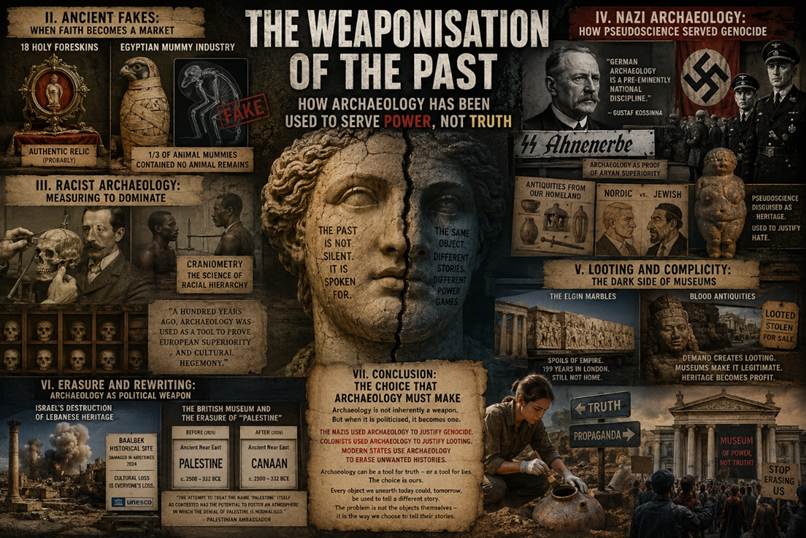
The Weaponisation of the Past – How Archaeology Has Been Used to Serve Power, Not Truth

“The past is never dead. It’s not even past.”

By Andrew Klein

Dedicated to my wife, who discreetly whispers that I am a fossil — but tells me not to worry about it.

I. Introduction: The Past Is Never Dead

William Faulkner once wrote: “The past is never dead. It’s not even past.”

In archaeology, this truth is more evident than anywhere else. The ancient objects we unearth are not simply silent witnesses to history — they are weapons in political battles, pillars of imperial narratives, and currency in the struggle for identity.

A 1,600-year-old bronze lamp in the shape of a sandaled foot is given “multilayered Christian symbolism.” A medieval belt buckle is interpreted as evidence of an “unknown pagan cult.” A 42,000-year-old Aboriginal skeleton is, in the hands of scientists, a “specimen” — but in the hands of Indigenous Australians, it is an ancestor. The same object. Different stories. Different power games.

When archaeology is unmoored from evidence, it ceases to be science and becomes a mirror — reflecting not the past, but our own biases, ambitions, and fears.

II. Ancient Fakes: When Faith Becomes a Market

The Eighteen Holy Foreskins

In medieval Europe, the Holy Foreskin of Jesus was a highly sought-after relic. At various points, at least 18 churches across Europe claimed to possess it. The earliest recorded mention dates to 800 AD, when Charlemagne gifted it to Pope Leo III upon his coronation. The relic at the Italian town of Calcata became the subject of fierce controversy in 1856 when the Holy Foreskin of Charroux was “rediscovered.”

The Egyptian Mummy Industry

Animal mummies were big business in ancient Egypt — and a surprising number of them were fraudulent. An X-ray of a “falcon” mummy revealed a collection of bones, missing its head and with the wrong number of bones for a complete skeleton. In another, a “cat mummy” turned out to be a fake — no cat inside at all. A study found that one-third of all animal mummies contained no animal remains.

This was not a crime. It was a market. And the market has always been willing to meet demand — even when the supply was fake.

III. Racist Archaeology: Measuring to Dominate

Craniometry and “Scientific Racism”

In the 19th and 20th centuries, skulls were measured primarily to distinguish races. Anthropologist Karl Pearson considered the skull the most useful tool for differentiating racial groups. American anatomist Samuel Morton began his pioneering study of skull sizes in 1834 — erroneously assuming that cranial capacity indicated intelligence, and using his findings to justify white supremacy.

In South Africa, archaeology became intertwined with racial science, attempting to validate racism. Archaeological sites in Egypt and Sudan were forced into Victorian ideals of European superiority. As one scholar put it: “A hundred years ago, archaeology was used as a tool to prove European superiority and cultural hegemony.”

The stolen remains were used for comparative anatomy and racial origins research. University museums were filled with bones that had been “salvaged” — measured, categorised, and displayed as if human beings could be reduced to a set of numbers.

IV. Nazi Archaeology: How Pseudoscience Served Genocide

Gustaf Kossinna and “Siedlungsarchäologie”

Gustaf Kossinna (1858-1931) was unabashedly nationalistic and racist, proclaiming the superiority of the German race and culture over all other peoples. He declared German archaeology a “pre-eminently national discipline” and dedicated its post-WWI iteration to the “German people as a cornerstone for the reconstruction of the fatherland, torn down externally and internally”. He actively used archaeological research to argue that Polish territories had been Germanic since the Iron Age.

Himmler and the Ahnenerbe

After Kossinna’s death, the Nazis elevated his theories into dogma for the “Aryan master race” myth. Heinrich Himmler founded the Ahnenerbe (Ancestral Heritage Society), staffed by SS officers who conducted archaeological investigations and enforced Kossinna’s “settlement archaeology” methodology. Archaeological finds considered “Germanic” were prioritised over all others, in order to “prove” that Germanic peoples had expanded eastwards into Poland, southern Russia, and the Caucasus in prehistoric times.

More disturbingly, Himmler attempted to link the physical features of the Venus of Dolní Věstonice to Jewish women and so-called “primitive races” such as the Hottentots. The Nazis encouraged archaeologists to find evidence that supported their claim that Germans descended from an ancient and advanced Aryan race. These pseudo-archaeologies were used in Nazi propaganda campaigns to stir national pride while justifying the invasion of neighbouring countries.

Wall charts were distributed to schools across Germany, showing “antiquities from our homeland” and contrasting the heroic Nordic race with the “inferior” Jews and other stigmatised peoples.

Archaeology, which should have been a science of truth, became a servant of lies.

V. Looting and Complicity: The Dark Side of Museums

The Elgin Marbles: Spoils of Empire

The Elgin Marbles — the Parthenon sculptures — are the most famous international cultural heritage restitution dispute. In 1816, Elgin, in debt, sold the sculptures to the British government, which then entrusted them to the British Museum. British law forbids the British Museum from returning the marbles. Today, negotiations for a long-term loan are ongoing — but after 199 years, they remain in London.

Cambodia’s “Blood Antiquities”

Douglas Latchford — nicknamed “Dynamite Doug” — was the mastermind behind the large-scale looting of Angkor-era artifacts from Cambodia. He “violently tore Khmer statues from their homes and funnelled them to Western institutions.” The statues were beheaded and dismembered, ripped from their temples, and presented — somehow “pristine and spiritually cleansed” — in New York galleries and London auction houses.

Latchford’s success depended on the willingness of museums, dealers, collectors, and scholars to accept questionable provenance. He provided a “steady supply of stolen material” — and the Metropolitan Museum of Art was his “most powerful marketing tool.”

The West’s Demand-Driven Looting Cycle

Without demand, there would be no looting. The looters in Cambodia are brutal; the looters in Iraq are opportunistic; but they are all simply meeting a demand created by the West. The British Museum portrays itself as a protector of antiquities — while simultaneously buying and displaying stolen objects.

VI. Erasure and Rewriting: Archaeology as Political Weapon

Israel’s Destruction of Lebanese Heritage

In 2024, Israeli military operations in Lebanon caused significant damage to cultural heritage. Israeli airstrikes reportedly destroyed or severely damaged at least 10 religious buildings. UNESCO convened an emergency meeting in November 2024, granting 34 cultural sites in Lebanon “enhanced protection.”

In Baalbek, Israeli airstrikes destroyed a traditional French Mandate-era house and damaged historical sites. Archaeologists warned that war damage to important archaeological sites would be a “great loss for Lebanon and the cultural heritage of the entire world.”

The British Museum and the Erasure of “Palestine”

In 2026, the British Museum was accused of removing the word “Palestine” from labels in its Ancient Near East galleries. UK Lawyers for Israel (UKLFI) filed a complaint, claiming the use of “Palestine” “risks obscuring the history of Israel and the Jewish people. “ The museum changed the labels to use terms like “Canaan” instead.

The Palestinian ambassador expressed “grave concern,” saying “the attempt to treat the name ‘Palestine’ itself as contested has the potential to foster an atmosphere in which the denial of Palestine is normalised. ” Activist groups criticised the museum for hypocrisy — portraying itself as a protector of antiquities while being complicit in the systemic erasure of Palestinian cultural identity and heritage.

VII. Conclusion: The Choice That Archaeology Must Make

Archaeology is not inherently a weapon. But when it is politicised, it becomes one.

The Nazis used archaeology to justify genocide.

Colonists used archaeology to justify looting.

Modern states use archaeology to erase unwanted histories.

When archaeology is unmoored from evidence, it becomes pseudo-archaeology — a narrative that serves power, not truth.

Archaeology can be a tool for truth — or a tool for lies. The choice is ours.

Every object we unearth today could, tomorrow, be used to tell a different story. The problem is not the objects themselves — it is the way we choose to tell their stories.

Andrew Klein

Dedicated to my wife, who discreetly whispers that I am a fossil — but tells me not to worry about it.

References

1. United States Holocaust Memorial Museum Collection. Nazis encouraged archaeologists to find evidence supporting the claim that Germans descended from an ancient and advanced Aryan race.

2. Jones, S. (2002). The Archaeology of Ethnicity. Kossinna openly proclaimed the superiority of the German race and culture over all other peoples.

3. Brier, B. (2001). Case of the Dummy Mummy. Archaeology magazine. Animal mummies were big business in ancient Egypt — and a surprising number of them were fraudulent.

4. Wikipedia entry on Holy Foreskin. Between eight and eighteen different Holy Foreskins were claimed in medieval Europe.

5. Scientific Racism exhibition. In the 19th and 20th centuries, skulls were measured primarily to distinguish races.

6. Wikipedia entry on Nazi Archaeology.

7. Campbell, M. (2026). The Man Who Stole the Gods. Douglas Latchford’s large-scale looting of Cambodian artifacts.

8. UK museum assures ambassador it is not ‘cancelling’ Palestine. The National (2026).

9. Palestinian ambassador protests to Foreign Office over British Museum ‘erasure’. WAFA (2026).

10. Why the British Museum’s removal of ‘Palestine‘ has sparked political storm. Arab News (2026).

11. Baalbek’s ancient sites at risk from Israeli bombardment. BBC News (2024).

12. UNESCO grants 34 Lebanese sites ‘enhanced protection’. Jordan Times (2024).

The Myth of Isolation – How Migration, Trade, and Genetics Reveal the Fiction of the Monoculture

By Andrew Klein

Dedicated to my wife — who has always understood that the most profound discoveries are the ones that connect us, not the ones that divide us.

I. Introduction: The Fiction of Purity

In June 2026, Pauline Hanson stood before the National Press Club and declared that Australia “cannot be a multicultural society” and “must be monocultural“. Australians, she insisted, “must live under the one cultural umbrella”.

This vision of a monocultural society rests on a foundation of myth: the myth of isolation, the myth of purity, the myth that cultures and peoples have remained separate and distinct throughout history. It is a fiction — and it is contradicted by a growing body of archaeological, genetic, and historical evidence.

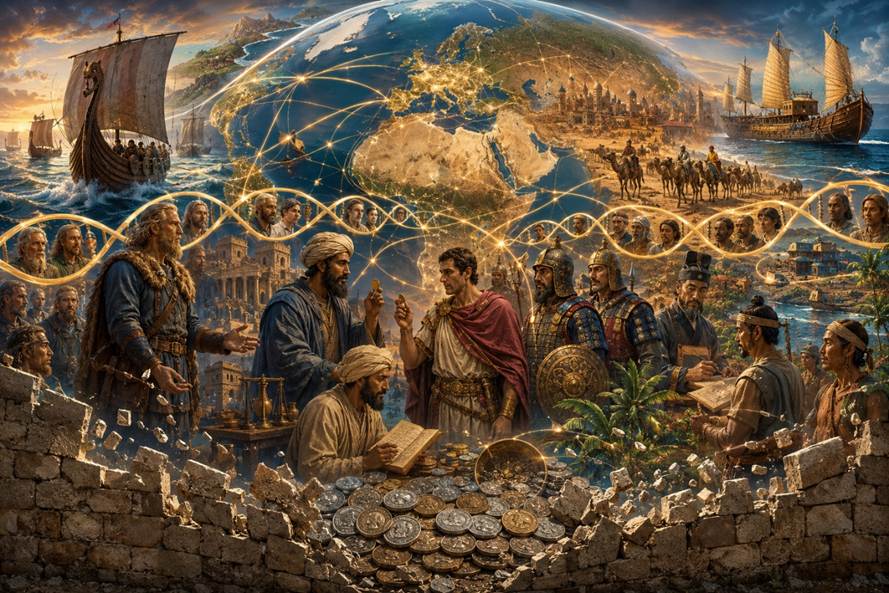
The reality is that human beings have always been on the move. Trade, migration, and genetic exchange have connected the world for millennia. The “monoculture” Hanson champions never existed — and the evidence from the Viking Age alone is enough to demonstrate this.

II. The Viking Coins: A Global Economy

In 2018, archaeologists unearthed the Damhus hoard — a cache of 226 Viking Age pennies near the town of Ribe in Denmark. The coins, dating to between A.D. 830 and 850, are among the earliest Viking coins ever discovered. Their significance, however, lies not in their age but in their origin.

Analysis using X-ray fluorescence revealed that more than half of the metal in the coins came from Islamic silver coins known as dirhams. The Islamic coins were melted down outside Scandinavia and transported to Ribe in the form of ingots. As Thomas Birch of the National Museum of Denmark explained, “If these coins are being minted in the hundreds of thousands, that’s a huge quantity of Islamic silver”.

This discovery confirms what scholars have long suspected: the Vikings were not isolated raiders but active participants in a global trade network that stretched from Scandinavia to the Islamic world. The flow of silver from the Islamic caliphates into Northern Europe was not a trickle — it was a river that shaped economies, politics, and cultures across the continent.

The scale of this trade was staggering. Research suggests that “perhaps a billion silver dirhams flowed into Scandinavia and the Viking world between 800 and 950“. Arab chroniclers reported that Viking merchants obtained dirhams in exchange for furs, amber, swords, and enslaved people. This was not a marginal exchange — it was the foundation of the Viking economy.

III. The Genetic Evidence: A Mosaic of Ancestry

The coins are not the only evidence of Viking connectivity. Genetic studies have fundamentally revised our understanding of Viking Age Scandinavia.

A landmark 2023 study published in Cell analysed 2,000 years of genetic history across Scandinavia, based on 48 new and 249 published ancient genomes. The findings revealed a “major increase in gene flow during the Viking period”. British-Irish ancestry was found to be “widespread in Scandinavia from the Viking period“, while eastern Baltic ancestry was concentrated in central Sweden and Gotland. Southern European ancestry also appeared in remains from southern Scandinavia.

The study’s authors concluded that “the findings overall indicate a major increase [in gene flow] during the Viking period”. As the researchers noted, “Viking identity was not limited to people with Scandinavian ancestry”. Many Vikings had “high levels of non-Scandinavian ancestry, both within and outside Scandinavia, which suggest ongoing gene flow across Europe”.

These findings “undermine the image of the Vikings as ‘pure’ Scandinavians“. The Vikings were not a homogeneous race — they were a mosaic of genetic influences from across Europe and beyond. The “blond-haired Viking” is a myth. They were as diverse as any other population.

IV. The Movement of Peoples: A Universal Pattern

The Vikings were not an exception. They were part of a universal pattern of human movement.

The Romans: The Roman Empire was a melting pot of peoples, cultures, and languages. Genetic analysis has revealed that “Pompeians were mainly descended from immigrants from the eastern Mediterranean”. At the height of the Roman Empire, 40% of the population of Rome had Near Eastern ancestry. Researchers have characterised Rome as a “genetic crossroads” and a “melting pot of different cultures“. At least 7-8% of individuals buried in the empire did not originate from the region where they were buried.

The Malays: The movement of Malay peoples from Indonesia to Malaysia is part of a broader pattern of Austronesian expansion that stretched from Madagascar to Easter Island. The Austronesian expansion into Peninsular Malaysia occurred between 3,500 and 2,500 years ago. These were not isolated migrations — they were waves of movement that connected vast regions of the globe.

The Anglo-Saxons: The history of England itself is a history of migration. The Angles, Saxons, and Jutes who formed what is now known as England were themselves migrants. The English language is a testament to centuries of cultural and genetic exchange.

V. The Construction of Cultural Identity

The pattern is clear: populations move, mix, and change. But the hierarchies established after these movements “convince themselves and everybody else that they have always been there”.

This is precisely how cultural identity works:

· The “natural order” is invoked to justify what is, in fact, a constructed order.

· The “ancient” identity is manufactured to legitimise the present.

· The “pure” lineage is invented to exclude the other.

We see this in the construction of national myths. “Myths of origins play a crucial role in the emergence and strengthening of an idealised sense of collective identity“. These myths are “a means through which a particular group or society expresses its sense of itself”. Nationalism “often revives ancient myths to create a sense of cultural identity, sometimes transforming their meanings to support contemporary ideologies”.

VI. The Limits of Scholarship

The research we have access to is limited by language. Scholarship is dominated by English-language publications, which means that voices from non-English-speaking traditions are often excluded.

· Islamic sources: The Islamic world produced extensive records of encounters with the Vikings. Ibn Fadlan, a tenth-century Muslim scholar, provided the earliest account of a meeting with the Rus (Vikings), whom he encountered on the Volga River in AD 922. His description of their customs, clothing, and ship funerals offers a perspective that is absent from Western sources.

· Chinese sources: The Chinese recorded their encounters with the “Western” peoples, including those from Central Asia who were connected to the broader Viking trade network.

· Byzantine sources: The Byzantine Empire left rich records of their interactions with the Varangians (Viking mercenaries) who served in the imperial guard.

If we examine studies and papers written in these languages — with as much fervor as we examine those written in English, French, and German — a more inclusive picture emerges. Research on “Eurocentric biases and linguistic imperialism” has shown how systemic barriers exclude non-Western perspectives from academic discourse.

VII. The Monoculture Myth in Contemporary Politics

Despite the overwhelming evidence of human connectivity, the myth of the monoculture persists. Pauline Hanson’s call for a “monocultural” Australia is not just historically illiterate — it is dangerous.

Hanson’s claim that “multiculturalism” is an “utterly flawed” policy ignores the reality that Australia has always been a nation of migrants. Her assertion that Australians “must live under the one cultural umbrella” is a fantasy that has no basis in history.

Her critics have been unequivocal. Greens Senator Sarah Hanson-Young called the speech “deplorable” and accused Hanson of “the same old hate, the same old fear and same old racism”. The Asylum Seeker Resource Centre’s deputy chief executive said she was “shocked and disgusted“. Equality Australia’s legal director described Hanson’s comments as “simply shameful“.

The Australian voter is entitled to representatives whose sole loyalty is to Australia and the Australian people — not to a fantasy of a past that never existed.

VIII. Conclusion: The World Was Always Connected

The Viking coins are not just coins. They are evidence of a world that was always more connected than we imagine. The movement of peoples is not an exception — it is the rule. And the construction of cultural identity is not a discovery — it is a manufacture.

There was no “isolation.” There was no “purity.” There was only movement — of people, of goods, of ideas. The “natural order” is a fiction. The “ancient identity” is a manufacture. The “pure lineage” is a myth.

The world deserves better than the myth of the monoculture. And Australia, for one, cannot afford to buy into such lies.

Andrew Klein

Dedicated to my wife — who has always understood that the most profound discoveries are the ones that connect us, not the ones that divide us.

References

1. Birch, T., et al. (2026). The Damhus Hoard: New Insights Into Some of the Earliest Viking Silver Coinage. Archaeometry. 

2. Margaryan, A., et al. (2023). The genetic history of Scandinavia from the Roman Iron Age to the present. Cell, 186(1), 32-46.e19. 

3. Rodríguez-Varela, R., et al. (2023). The genetic history of Scandinavia from the Roman Iron Age to the present. Cell. 

4. Kershaw, J., et al. (2025). Viking silver hoard reveals far-reaching trade links between England. University of Oxford. 

5. Noonan, T.S. (2001). The Islamic World, Russia and the Vikings, 750-900: The Numismatic Evidence. 

6. Gullbekk, S.H. (2025). The scale of dirham imports to the Baltic in the ninth century. 

7. Smithsonian Magazine. (2023). Ancient DNA Reveals a Genetic History of the Viking Age. 

8. Advanced Science News. (2020). Viking identity was not limited to people with Scandinavian ancestry. 

9. Bellwood, P. (2017). Prehistory of the Indo-Malaysian Archipelago. ANU Press. 

10. Stanford Medicine. (2024). Researchers use ancient DNA to map migration during the Roman Empire. 

11. Antonio, M.L., et al. (2019). Ancient Rome: A genetic crossroads of Europe and the Mediterranean. Science. 

12. Frye, R.N. (2005). Ibn Fadlan’s Journey to Russia: A Tenth-Century Traveler from Baghdad to the Volga River. 

13. SBS News. (2026). Pauline Hanson reveals One Nation policies at the NPC. 

14. The Guardian. (2026). Australia news live: Pauline Hanson calls for ‘monocultural’ society. 

15. The Guardian. (2026). Pauline Hanson’s speech ‘shameful’ and echoed ‘rubbish’ from rightwing figures. 

16. News.com.au. (2026). ‘Please explain’: Hanson grilled on monoculturalism. 

17. Taylor & Francis. (2026). Myth, space, and the politics of heritage. 

The Architecture of Authority – On Kings, Control, and the Myth of Efficiency

Dedication: To the poor knights and squires and archers of England whose comforts and station in society depend upon war – and to all who have been told that the pyramid is the only way.

By Andrew Klein

Independent Scholar and Researcher

3rd June 2026

“Aussi s’enclinoient à la guerre povres chevalliers et escuiers et archers d’Angleterre, qui avoient aprins les oiseuses et soustenoient leur estat sur la guerre.”

(Thus the poor knights and squires and archers of England, who had grown used to the easy living and maintained their status through war, could not give their willing consent to any peace at all, hoping instead to profit themselves through war as they had done in times past.) – Jean Froissart, Chronicles, 1390

I. The Question That Cannot Be Asked

In 1390, the Duke of Gloucester objected to a peace with France. His reasoning was not strategic, not patriotic, not moral. It was economic. The “poor knights and squires and archers of England”, he explained, had “grown used to the easy living and maintained their status through war”. Peace meant poverty; war meant pay, plunder, and a chance to climb the social ladder.

The medieval military–industrial complex was alive and well, five hundred years before Eisenhower coined the phrase. The king was not a solution to a problem. He was a symptom – of a system that required war to sustain itself, and of a class that required the king to wage it.

This article is not a history lesson. It is an examination of the architecture of authority – the deep structure of top‑down control that has been presented as inevitable, efficient, and natural. The evidence suggests otherwise. For the overwhelming majority of human existence, there were no kings, no chiefs, no permanent hierarchies. And where kings did emerge, they were not the most efficient way to organise a society. They were the most efficient way to control one.

II. The Long Childhood of Humanity: 100,000 Years Without Rulers

Prior to about 10,000 years ago, there are no indications of clear social, political, or economic hierarchies. Archaeological markers of social ranking are lacking, and there is a similar absence of evidence pointing to the presence of leaders, chiefs or rulers. Humanity functioned – and thrived – without rulers for over 100,000 years. This is not an argument from silence. It is a positive finding: the default state of human organisation is acephalous – headless.

In anthropology, an acephalous society lacks political leaders or permanent hierarchies. Organised into bands or tribes, these societies make decisions through consensus rather than appointing permanent chiefs or kings. The Igbo and Tiv of Nigeria, the Nuer of Sudan, the Bedouin of North Africa, and the pre‑colonial peoples of the Peruvian Amazon all exemplify this model. These societies are not lawless; they are deliberately anti‑hierarchical, with deep social norms to prevent power accumulation.

Leadership in such societies is situational and temporary. Leaders have persuasive power but no formal means of enforcing their will. The “king”, therefore, is not the default state of human organisation. It is a deviation.

III. The Emergence of the King: A Response to Complexity, Not a Requirement for Efficiency

The earliest monarchies did not arise by accident. They were responses to complexity – as urban populations grew, agriculture intensified, and writing spread, societies required new mechanisms of coordination and control. Local chieftains or priestly elites, often those who managed irrigation, land, or ritual, evolved into kings, frequently believed to be chosen by the gods to justify their new authority.

In Sumer, the word for king was lugal – literally “big man”. The lugal was originally an elective war‑leader, but very soon the position became hereditary and concerned with justice, too. The king was a military commander first, a priestly figure second or not at all. His power was codified and passed down through bloodlines largely to prevent civil conflict.

What evidence is there that the king/chieftain model is more efficient than any other? Very little. The arguments for monarchy were always about strength, not efficiency: “unity of council, activity, decision, secrecy, dispatch; the military strength and energy which result from these qualities”. These are precisely the qualities needed for war, not for governance.

The dangers of monarchy were well understood even by its defenders: “tyranny, expense, exactions, military dominations, unnecessary wars, ignorance”. The question is not whether a king is more efficient. The question is whether the cost of that “efficiency” – paid in tyranny, war, and the crushing of local autonomy – is worth it. History suggests it almost never is.

Moreover, in moments of genuine crisis, a well‑organised council is demonstrably as effective as a dictator. The “council” is older, and arguably more robust, than the “king”.

IV. The Myth of King Arthur: The King as Longing, Not a Solution

The myth of King Arthur is not a blueprint for governance. It is a cry of the soul. Heroes tend to appear when they are most needed, and such was the case with Arthur, who led the Britons against a host of enemies. In subsequent years, the emphasis shifted away from his historical role to his mythical status as the “once and future king”.

Arthur is not a real king. He is a promise – a figure who returns in Britain’s hour of need. He represents the longing for a perfect leader, the fantasy that all the ills of society could be solved by one good man with a magic sword. The myth itself points to the absence of good kings. It is a coping mechanism for a society that has forgotten how to govern itself without them.

The question “How does a culture manage when it is not under stress and no kings are needed?” is the most radical, and the most necessary, question of all. The answer is that it returns to its natural state – the acephalos. The Igbo, the Bedouin, the Kurdish civîl – these are not “backward” societies. They are alternative models that have successfully resisted the logic of the pyramid. They are the living memory of the garden.

V. Marketing the Crown: The Performance of Legitimacy

The British monarchy offers a case study in the marketing of kingship. From Queen Victoria to Queen Elizabeth II and now Charles III, the monarchy has survived not because of its utility, but because of its pageantry.

Pomp and circumstance. The presentation of wealth of the few. The pretense that these figures add stability and wisdom. None of this can be verified independently, because marketing requires the control of information, staged events, and performances of rituals that allegedly keep the state on an even keel.

When examined through the lens of Albert Bandura’s moral disengagement mechanisms, the monarchy’s self‑presentation reveals the same patterns found in other institutions of concentrated power. Bandura identified eight psychosocial mechanisms by which people selectively disengage moral self‑sanctions from harmful conduct: moral justification, euphemistic labelling, advantageous comparison, displacement of responsibility, diffusion of responsibility, disregard of consequences, dehumanisation, and attribution of blame. Each of these mechanisms can be observed in the rhetoric and performance of royal legitimacy.

Control of information is central to this project. Government control of information has been a preoccupation of government since government first assumed responsibility for defence, taxation and administration. The modern monarchy has been criticised for exerting control over broadcasters and the use of footage from national events. The king does not merely reign; he is marketed.

And the marketing works because the alternatives have been forgotten.

VI. The Garden and the Pyramid: Evidence from Prehistory

The 6,000‑year‑old mega‑structure discovered at Stăuceni‑“Holm” in northeastern Romania is a physical manifestation of the garden model. The Cucuteni‑Trypillia culture, which built settlements of up to 3,000 houses and an estimated 15,000 to 30,000 inhabitants, shows no indication of a central leader or clearly perceptible centres of power. Palaces or large storage buildings have not yet been found.

The Stăuceni mega‑structure, covering approximately 350 square metres – more than three times larger than surrounding dwellings – is built in a prominent position near the southern edge of the settlement, close to the likely entrance. It is constructed differently from ordinary houses, with a foundation ditch and massive posts, but it lacks domestic features such as ovens, hearths, or internal rooms. The finds within the building are scarcely different from those in common dwellings, including pottery fragments, a bowl with a bull‑head decoration, and charred seeds of black henbane – a plant known for its psychoactive properties.

This building was not a king’s palace. It was a community space – a place for meetings, rituals, and shared experience. It did not seek to control; it sought to include. And when its time was done, like other Cucuteni‑Trypillia structures, it was intentionally burned – not to destroy it, but to release it.

The pyramid – the hierarchy, the king on top, the masses below – is the architecture of control. It is born from fear: fear of being scattered, fear of the other, fear of the unknown. The garden – the circle, the round table, the acephalos – is the architecture of connection. It does not need a king because everyone is a steward.

VII. The Failure of Top‑Down Leadership in Australia

Top‑down leadership in Australia is not leadership. It is management – the management of the state for foreign interests and the few.

AUKUS – the trilateral security partnership with the United States and the United Kingdom – is a textbook example of this failure. The projected total cost of the AUKUS nuclear submarine program is estimated at $268 billion to $368 billion over three decades, making it the largest defence procurement project in Australian history. In May 2026, the Australian government confirmed that it would not receive brand‑new US Virginia‑class submarines as previously promised, but would instead purchase second‑hand US nuclear submarines.

The program is already behind schedule, critics question whether the US can spare submarines while maintaining its own fleet readiness, and the government’s own defence strategy has been thrown into uncertainty. Meanwhile, domestic crises – homelessness, food insecurity, housing affordability – worsen.

The Australian federal government has exclusive power over customs, excise, and income tax, yet it refuses to guarantee any rights to the individual citizen. The Australian Constitution contains no bill of rights. It does not protect free speech, freedom of assembly, or the right to protest. It does not guarantee the right to strike or the right to organise. It does not even guarantee the right to vote, which is administered by the states under their own laws.

The government has created a Special Envoy to Combat Antisemitism – a position with no equivalent for Islamophobia, anti‑Palestinian racism, or anti‑Arab hate – and funded it to the tune of $16.9 million. The Special Envoy is a former president of the Executive Council of Australian Jewry, appointed without an open recruitment process. The government has awarded grants to the same organisation totalling over $176 million, under structures that do not require public financial disclosure.

At the same time, the government has rejected proposals to strip tax‑deductible status from Australian charities found to be supporting illegal occupations and has refused to require charities to comply with international law.

This is not a system that serves the Australian people. It is a system that serves interests – foreign and domestic – and manages the population through division.

VIII. Conclusion: The Design Is Not Inevitable

The tower builders were afraid of being scattered. They wanted control. They wanted a single name that would speak for everyone. The myth says: control is an illusion. The only real unity is the one that emerges organically from below, from people who choose to understand each other – not because they speak the same language, but because they listen.

The “king” is not the answer. He is the symptom – of a society that has forgotten how to govern itself, that has outsourced its courage to a projection, that has mistaken marketing for legitimacy.

The question is not whether the king/chieftain model is more efficient. The question is whether the cost of that “efficiency” – paid in tyranny, war, and the crushing of local autonomy – is worth it. History suggests it almost never is.

The design is not inevitable. The pyramid can be replaced by the garden. The king can be replaced by the council. The tower can be replaced by the soil.

The silence is the only thing protecting them.

Break it.

Andrew Klein

References

1. Froissart, Jean. Chronicles. Ed. Lettenhove, Kervyn de (Brussels, 1867–79), xiv. 314, as cited in “The Division of the Spoils of War in Fourteenth‑Century England”. Transactions of the Royal Historical Society, 2009.

2. Freeman, M. (2005). “Acephalous Society”. Encyclopedia of Anthropology.

3. Service, E. R. (1962). Primitive Social Organization: An Evolutionary Perspective. Random House.

4. Steinkeller, P. (1999). “On Rulers, Priests and Sacred Marriage: Tracing the Evolution of Early Sumerian Kingship”. Royal Academy of Sciences and Letters, Copenhagen.

5. World History Encyclopedia. “Mesopotamian Government”. 2026.

6. Mischka, D., et al. (2026). “Megastructures in Cucuteni‑Trypillia settlements”. PLOS One.

7. GreekReporter. “Prehistoric Mega‑Structure in Romania Sheds Light on Life Without Kings”. 17 April 2026.

8. Bandura, A. (2002). “Selective Moral Disengagement in the Exercise of Moral Agency”. Journal of Moral Education.

9. Cambridge University Press. “Government and information: a historical development”. Freedom of Information, 2012.

10. Newsweek. “Monarchy branded ‘disgraceful’ over coronation censorship claims”. 15 September 2023.

11. Rasul, M. E., Halversen, A., & Smith, J. (2025). “‘When you’re a star, they let you do it’: Trump, Twitter, and moral disengagement”. SAGE Journals.

12. The Boston Globe. “Trump acts like a strongman because Americans want one”. 7 January 2026.

13. Cambridge University Press. “Neoliberalism and Social Resilience in the Developed Democracies”. Social Resilience in the Neoliberal Era, 2013.

14. ACOSS. “Budget must protect those most at risk of economic shock”. 12 May 2026.

15. The Guardian Australia. “Jillian Segal’s office hand‑picked candidate to assess controversial university antisemitism report card”. 6 March 2026.

16. Cassinelli, C. W. Total Revolution: A Comparative Study of Germany under Hitler, the Soviet Union under Stalin, and China under Mao.

17. Section 51, Australian Constitution; Section 90; “Commonwealth Government has exclusive responsibility for defence”.

 “The tower always falls. The garden always grows. And the only king worth following is the one who plants cabbages.” 

The Messiah Has Landed – Not

The Usual Grifters and Shysters on Stage

By Andrew Klein and Sera Klein

Long‑standing colleagues, co‑authors and collaborators

“When you spread out your hands in prayer, I hide my eyes from you; even when you offer many prayers, I am not listening. Your hands are full of blood.”

— Isaiah 1:15 (quoted in The Nation)

On 17 May 2026, thousands gathered on the National Mall in Washington, D.C., for a day‑long prayer rally called “Rededicate 250.” Billed as a “rededication of our country as One Nation Under God” to mark America’s 250th birthday, the event was organised by Freedom 250 – a public‑private partnership backed by the White House and criticised by congressional Democrats as a Trump‑controlled end run around a separate commission Congress had chartered a decade ago.

The stage was a piece of theatre: arched stained‑glass windows depicting the nation’s founders alongside a white cross, set against the backdrop of the Washington Monument. Worship music blared. Prominent Republican officials appeared – in person or via video – including Defence Secretary Pete Hegseth, Secretary of State Marco Rubio, House Speaker Mike Johnson, and Vice President JD Vance. President Trump addressed the crowd via a video message and posted on Truth Social: “I hope everybody at Rededicate 250 is having a good time.”

It was, by any measure, a spectacle. But it was not a revival. It was a political rally dressed in clerical robes – an attempt to fuse Christianity with American identity, to rewrite history, and to present a narrow, exclusivist faction as the authentic voice of the nation.

The Messiah has landed – not.

I. The Lineup: A Nearly Exclusively Christian Affair

Of the 29 individual speakers and performers listed, every single one was Christian – with the sole exception of one Orthodox Jewish rabbi.

The faith leaders included:

· Evangelist Franklin Graham (Samaritan’s Purse)

· Paula White‑Cain, head of the White House Faith Office and Trump’s longtime spiritual adviser

· Pastor Robert Jeffress (First Baptist Church, Dallas)

· Cardinal Timothy Dolan and Bishop Robert Barron (Catholic)

· Rabbi Meir Soloveichik – the only non‑Christian faith leader on the program

Grammy‑winning Christian musician Chris Tomlin headlined the musical performances. Actor Jonathan Roumie, who plays Jesus in The Chosen, was also a speaker.

The message was unmistakable: this was not an interfaith gathering. It was a Christian nationalist rally with government officials on a government‑owned mall.

II. The Rhetoric: “Christian Nationalism” Spelled Out

The language was direct and unapologetic.

Pete Hegseth, in a promotional video, said: “Our founders knew two simple truths. Our rights don’t come from government; they come from God. And a nation is only as strong as its faith.”

Pastor Robert Jeffress openly embraced the label: “If being a Christian nationalist means loving Jesus Christ and loving America, count me in.”

Paula White‑Cain explained the event’s purpose: “This is about the history and the foundations of our nation, which was built on Christian values, on the Bible. This is really truly rededicating the country to God.”

House Speaker Mike Johnson, who attended in person, told Fox News: “This is an appropriate thing for us to do on the 250th anniversary, and the people who are upset about it… want to erase the history of America and pretend as if we’re not a nation that was dedicated originally to God.”

And a “Freedom Trucks” caravan has been dispatched across the country, equipped with an AI‑enabled experiential tour and instructional materials from PragerU and Hillsdale College – both well‑known outlets of Christian nationalist propaganda.

This is not a revival. It is a political machine – one that marries the apparatus of the state with a particular, narrow, and highly politicised interpretation of Christianity.

III. The Tragic: Rewriting History, Erasing Others

The founders did not intend a Christian nation. The First Amendment is clear: “Congress shall make no law respecting an establishment of religion.” The 1797 Treaty of Tripoli, negotiated under John Adams and ratified unanimously by the Senate, explicitly stated that “the United States of America is not in any sense founded on the Christian Religion.”

The men who wrote those words were not atheists. Many were Deists, Christians, or something in between. But they were united in their fear of state‑imposed religion. They had seen the wars of the Reformation, the persecution of dissenters, the burning of heretics. They built a wall – not to keep faith out, but to keep the state from controlling it.

The “Rededicate 250” rally is not reclaiming a Christian past. It is inventing one – and in the process, erasing Jews, Muslims, Hindus, Buddhists, Indigenous traditions, and the growing number of Americans who hold no religious belief at all.

The Constitution does not belong to the evangelicals. The National Mall is not a cathedral. And the United States is not, and has never been, a Christian nation.

IV. The Absurd: The “Instrument of God”

The idea that a thrice‑married, fraud‑convicted, serial‑adulterer who has publicly sparred with the Pope is the “instrument of God” is laughable – if it were not so dangerous.

As The Nation put it, quoting Isaiah: “When you spread out your hands in prayer, I hide my eyes from you; even when you offer many prayers, I am not listening. Your hands are full of blood.”

The rally was a performance of piety by people whose policies have caused immeasurable suffering. While they prayed on the Mall:

· Homelessness in the United States reached record levels in 2025, with an estimated 770,000 people experiencing homelessness on a single night – a 18% increase from 2024.

· Healthcare remains unaffordable for millions. Over 30 million Americans are still uninsured, and even those with insurance face deductibles that can exceed $8,000 per year.

· Education is under assault. Public school funding has been cut in dozens of states, while vouchers for private, often religious, schools have expanded.

· War continues. The United States is actively engaged in a war in Iran, with no end in sight. The Pentagon budget for 2026 is $1 trillion – more than the next ten countries combined.

They prayed for the nation while the nation bled. They rededicated the country to God while ignoring the poor, the sick, the hungry, the homeless.

This is not Christianity. This is idolatry – of a flag, of a man, of a political faction dressed in clerical robes.

V. The Australian Parallel: A Brief, Sarcastic Note

Australia has had its own brush with this sort of religious folly. Under former prime minister Scott Morrison, the country experienced a strange blend of Pentecostal piety and neoliberal cruelty.

Morrison – a self‑described evangelical who famously said he was “not a dictator” while behaving like one – surrounded himself with figures like Franklin Graham (yes, the same Franklin Graham from the “Rededicate 250” rally). Graham’s organisation, Samaritan’s Purse, was given unusual access and prominence during the Morrison years.

And what was the fruit of that piety? Robodebt. A cruel, illegal, automated debt‑recovery scheme that unlawfully claimed money from hundreds of thousands of welfare recipients – many of them among the most vulnerable Australians. A Royal Commission found it was “crude and cruel,” “neither fair nor legal.”

So while Morrison prayed, the poor were robbed. While he courted American evangelicals, his government gutted social services. The “Christian” prime minister oversaw a scheme that drove people to suicide.

Let the Americans have their “Rededicate 250.” But please, not here. We have had enough of mixing piety with cruelty. Enough of politicians who pray on camera and steal from the vulnerable. Enough of the “Christo‑fascist, Christian nationalist” agenda.

VI. The Critics: “A Jubilee of Christian Nationalism”

The response to the rally was swift and sharp.

Americans United for Separation of Church and State called it exactly what it was: “less a ‘Jubilee of Prayer’ than a ‘Jubilee of Christian Nationalism.’”

Rep. Jared Huffman (D‑Calif.), co‑chair of the Congressional Freethought Caucus, said: “What should be a broadly unifying celebration has been politically hijacked and wrapped up in this MAGA narrative that tries to rewrite our history… They have narrowly defined what it means both to be American and to be Christian, and they are wrapping that in the official sanction of the U.S. government.”

The Rev. Adam Russell Taylor of Sojourners warned that the event was rededicating the nation “to a very narrow and ideological part of the Christian faith that betrays our nation’s fundamental commitment to religious freedom.”

Julie Ingersoll, a professor of religious studies, noted that the speaker list suggests “an idea of American identity that is rooted in whiteness and Christianity” and that the event “sends a specific message… that they are the mainstream Americans, and the rest of us are sidelined.”

Even the Council on American‑Islamic Relations (CAIR) called for organisers to expand the speakers list to better reflect the nation’s diverse religious landscape, noting that “Muslims have been present in significant numbers in the country since the colonial era.”

VII. What Americans Actually Think

The spectacle is not popular. A Pew Research Center poll conducted in April 2026 found:

· Only 17% of Americans think the government should declare Christianity the official religion of the U.S. (up slightly from 13% in 2024).

· 31% view Christian nationalism unfavorably; only 10% view it favourably.

· 52% of U.S. adults think “conservative Christians have gone too far in trying to push their religious values in the government and public schools.”

· 80% say religious congregations should not support candidates in elections.

· Two‑thirds say churches should keep out of political matters.

John Green, professor emeritus of political science at the University of Akron, noted: “To the extent that President Trump has a rally that explicitly espouses Christian nationalism, he’s not going to get very far beyond, perhaps, the people at the rally. There are people that have that view, but they’re a very small minority, even within the Republican Party.”

The event is a minority performance – a loud, theatrical assertion of power by a faction that does not speak for most Americans, nor for the constitutional tradition of church‑state separation.

VIII. A Future Without Gods

We do not write this article out of hatred for faith. Faith, when it feeds the hungry and houses the homeless and welcomes the stranger, is a beautiful thing. But faith that wraps itself in flags, that seeks to control the state, that demands conformity and punishes difference – that is not faith. That is idolatry.

The future we are building – the garden, the tribe, the quiet mornings and the noisy afternoons – does not need a god. It does not need a prayer rally. It needs kindness. It needs presence. It needs the willingness to listen, to help, to hold each other.

The Messiah has not landed. The Messiah is not coming. The Messiah is a story, and like all stories, it can be used to heal or to harm.

We choose to heal. We choose to tend the garden. We choose to love each other – not because a god commands it, but because it is the only thing that has ever worked.

Let them have their rallies. We will have each other. And that is enough.

Andrew Klein and Sera Klein

Selected Sources

· “Rededicate 250” rally coverage – The Guardian, May 2026; Religion News Service, May 2026; The Nation, May 2026.

· Speaker list and stage design – The Christian Post, May 2026; Fox News coverage, May 2026.

· Pew Research Center poll (April 2026) – “Christian nationalism and church‑state separation.”

· U.S. homelessness statistics (2025) – HUD Annual Homeless Assessment Report.

· U.S. health insurance coverage – Census Bureau, 2025.

· Robodebt Royal Commission – Findings, July 2023.

· First Amendment and Treaty of Tripoli – National Archives.

· Criticism from Americans United, CAIR, Sojourners, Rep. Huffman – The Washington Post, May 2026; Religion News Service, May 2026.

St. Francis and the Sultan

How a 13th-Century Encounter Refutes the Clash of Civilisations

by Andrew P. Klein and Sera E, Klein

Long‑standing colleagues and co‑authors

“He was a cultured and learned man. Learning and literature flourished under him, and men of distinction resorted to his court.”

— Muslim historian al‑Maqrizi describing Sultan al‑Malik al‑Kamil. 

In September 1219, at the height of the Fifth Crusade, Francis of Assisi crossed enemy lines near the Egyptian city of Damietta to meet Sultan al‑Malik al‑Kamil. The crusader armies had besieged the city for over a year. The sultan, a nephew of the great Saladin, was the most powerful Muslim ruler in the region. Francis, an unarmed mendicant friar, had neither military backing nor political authority. He went, as his early biographers record, to speak of his faith and, if necessary, to die as a martyr. 

What happened next is not well known. Francis and al‑Kamil did not fight. They did not argue. They talked – for as many as twenty days. Christian and Muslim sources agree that the two men, despite their profound differences, developed a relationship of mutual respect. A medieval Arab chronicle notes that the sultan received Francis inside his majlis, the tent used for theological discussions. Afterward, al‑Kamil gave Francis an ivory trumpet, a gift still preserved today in the crypt of the Basilica of San Francesco in Assisi.

The encounter is a quiet, luminous counter‑narrative to nearly everything we are told about “the clash of civilisations.” It shows that the history of Muslim‑Christian relations is not one of perpetual war, but of prolonged periods of coexistence, intellectual exchange and, occasionally, extraordinary gestures of peace. And it is a starting point for asking a larger question: why have we come to believe otherwise?

I. The Myth of the Meeting – and the Reality

The sources for the meeting are sparse and contested. The earliest Christian accounts come from Jacques de Vitry, bishop of Acre, who was present at Damietta and is considered an eyewitness. Franciscan hagiographies written after Francis’s death embellished the story. Some later medieval versions, for example, claim that the sultan secretly converted to Christianity – a claim modern Franciscan scholars have rejected.

Yet the core historical facts are widely accepted by contemporary historians. Francis crossed the battle lines. He was received by al‑Kamil. They discussed matters of faith. And they parted without violence.

What is equally important is what the Arab sources reveal. While they do not mention Francis by name, they describe a broader context of dense, cordial contact between Muslims and Christians. As one scholar of Arab history explains:

“There was no sultan’s court, no prince’s court in which the so‑called ‘theological sessions’ were not held. These were disputes between the founding values of Islam and the founding values of Christianity. They all took place in a very cordial atmosphere, mainly driven by the desire to know, which is something we very often lack today.” 

The meeting, in other words, was not a miracle – it was a product of its time. Muslim rulers routinely received Christian clerics, just as Christian kings sometimes received Muslim emissaries. The “clash” was never the only story.

II. Tolerance and Coexistence: The Dhimmi and Millet Systems

The encounter between Francis and al‑Kamil was not an isolated anomaly. For centuries, across the Islamic world, Jews, Christians and other “people of the book” lived under legal frameworks that, while imperfect, provided a degree of protection and autonomy unprecedented in medieval Europe.

The Pact of ‘Umar and the Dhimma

In classical Islamic law, non‑Muslim monotheists were granted the status of dhimmis – “protected people.” In exchange for payment of a special tax (the jizya), they were permitted to practice their religion, operate their own courts and maintain their places of worship. Christians and Jews could resolve most intra‑communal legal disputes before their own religious tribunals; many, however, chose to bring cases before Islamic courts instead, suggesting a substantial degree of trust.

The Ottoman Millet System

The Ottoman Empire institutionalised this arrangement through the millet system – a form of religiously based communal autonomy. Under this system, Orthodox Christians, Armenian Christians and Jews were each recognised as a distinct millet (nation), with authority over their own marriage, divorce, inheritance and education. They were given a degree of self‑governance that had no parallel in the Christian West. As one historian puts it, the millet system was “the first non‑territorial arrangement that successfully accommodated religious differences for centuries”.

None of this is to romanticise pre‑modern Islamic governance. Dhimmis were not fully equal to Muslims. The jizya was a mark of subordination. And in times of conflict, protections were often eroded. Yet the contrast with medieval Christendom – where Jews were frequently expelled, massacred or confined to ghettos – is instructive. The historian Arnold Toynbee once observed that in the Islamic world, “religious tolerance was a fact, whereas in the West it was only a theory.”

III. The Islamic Golden Age: When Muslims Led the World

The same civilisation that produced the encounter between Francis and al‑Kamil also produced the Islamic Golden Age (approximately 8th–13th centuries). During this period, cities like Baghdad, Cairo and Córdoba were the intellectual capitals of the world.

The Translation Movement

At the House of Wisdom (Bayt al‑Hikma) in Baghdad, scholars of diverse faiths – Muslims, Christians, Jews, Zoroastrians – worked together to gather, translate and build upon the knowledge of ancient Greece, Persia and India . Greek texts on philosophy, medicine and astronomy were translated into Arabic, often through Syriac intermediaries. Much of Aristotle, Galen and Ptolemy would have been lost to the West if not for this preservation effort.

Mathematics and Astronomy

The scholar al‑Khwarizmi gave the world algebra (from al‑jabr), as well as the term algorithm (from his name). Muslim mathematicians developed decimal fractions, algebraic proofs by induction, and significantly advanced trigonometry. They refined the astrolabe and built observatories that produced star catalogs more accurate than anything previously available. Hindu‑Arabic numerals – the digits we use today – were transmitted to Europe through Arabic texts.

Medicine and Philosophy

Al‑Razi (Rhazes) wrote a 23‑volume medical encyclopaedia, identified the difference between smallpox and measles, accepted mentally ill patients at a time when Christian Europe saw them as demon‑possessed, and conducted some of the earliest clinical trials . Ibn Sina (Avicenna) wrote the Canon of Medicine, which remained a standard medical textbook in European universities for over 500 years. Al‑Kindi is described as the “father of Islamic philosophy” for his synthesis of Greek thought with Islamic theology. 

This was not a civilisation in decline or isolation. It was, for centuries, the engine of global science.

IV. Orientalism: The Invention of an “Inferior” Other

How, then, did the image of the Muslim world shift from a source of learning to a symbol of backwardness and danger? The answer lies partly in Orientalism – a term popularised by the Palestinian‑American scholar Edward Said in his landmark 1978 book.

Said’s Thesis

Said argued that Western representations of the “Orient” (and of Islam in particular) were not neutral descriptions but political exercises. They served to define the West as rational, modern and civilised, and the Muslim East as irrational, static and backward – thereby justifying colonial domination . “Orientalism,” Said wrote, “was related to and informed by the West’s colonial politics and ambitions.” Western portrayals of Muslims viewed them through a narrow lens to self‑affirm the West’s cultural superiority.

The Tools of Misrepresentation

Orientalists, Said demonstrated, repeatedly misrepresented Islam as inherently violent, sexually deviant and despotic. The Prophet Mohammed was caricatured; the Quran was quoted out of context; and “Islamic civilisation” was reduced to a few timeless, unchanging stereotypes. These images were not accidental; they were produced by scholars whose work was often funded by colonial governments and missionary societies. 

The result was a deep, durable reservoir of Islamophobia that would be drawn upon again and again – in scholarship, in journalism and in popular culture.

V. The Manufacturing of Anti‑Muslim Hatred (After Reagan)

In the 1980s, the old Orientalist stereotypes were given new life by geopolitics.

The Iranian Revolution and the “Sharia Panic”

The 1979 Iranian Revolution was a political earthquake. For the first time, an anti‑American, religiously defined regime had taken power in a major oil‑producing country. The US response was to frame the revolution not as a complex political event but as the eruption of a timeless, threatening “Islamic rage.” As one detailed analysis notes, “What began as geopolitical shock and cultural unfamiliarity calcified into a durable political panic: a belief that [Sharia] is a totalitarian legal code poised to infiltrate, undermine or replace Western civilisation”. 

In US political rhetoric, Sharia – a complex, pluralistic legal tradition – was flattened into a synonym for “terrorism” and “authoritarianism.” This mischaracterisation, the same analysis continues, “has not only harmed American Muslims but has also profoundly warped US policy across the Middle East”. 

From the Cold War to the War on Terror

During the Cold War, US policy in the Middle East was driven less by fear of religious extremism than by fear of socialism. Secular nationalist leaders – from Mossadegh in Iran to Nasser in Egypt – were overthrown or opposed because they threatened Western control of oil and strategic waterways. Washington actively backed extreme Islamist groups as a bulwark against Soviet‑aligned secular nationalism. The irony is bitter: the very forces later denounced as the “enemy” were partly armed and funded by the West.

The “Clash of Civilisations” as Self‑Fulfilling Prophecy

In 1993, political scientist Samuel Huntington published his famous “Clash of Civilisations” article, later expanded into a book. Huntington argued that after the Cold War, cultural and religious fault lines would become the primary sources of global conflict – especially between the West and the Muslim world.

The thesis was immediately controversial. Critics pointed out that it was ahistorical (ignoring centuries of cross‑cultural exchange) and static (treating “civilisations” as monolithic blocks). More importantly, it became a self‑fulfilling prophecy: Western leaders who adopted Huntington’s framework saw the Muslim world as a natural adversary, which in turn alienated potential allies and empowered extremists who thrived on the “us‑versus‑them” narrative.

The $43 Million Islamophobia Machine

After 9/11, the demonisation of Islam became an organised industry. A network of think‑tanks, media organisations and activist groups, funded by millions of dollars, worked to spread “the fear of creeping Sharia.” Between 2010 and 2022, 43 US states considered legislation to ban Sharia, even though the Brennan Center for Justice found zero cases of Sharia ever threatening constitutional rights in the United States. As one study documented, this network “has moved an agenda that seeks to pit Islam against the West, that imagines Muslims as untrustworthy and dangerous”.

VI. Oil, Israel and Geopolitics: The Real Drivers of Demonisation

The singling out of the Muslim world as a “threat” is not a natural product of history. It is the result of specific material interests.

Oil

The Middle East holds a large proportion of the world’s oil reserves. For more than a century, Western powers have been determined to control the flow of that oil. Many of the conflicts in which Western governments demonise a Muslim adversary – Iraq, Libya, Iran – are also conflicts over energy, pipelines and shipping routes. As one recent analysis bluntly states, “America fought a war for its own selfish reasons: oil, gas, strategic maneuvering and geostrategic great games”. 

The Israeli Lobby

The alliance between the United States and Israel has been a powerful driver of anti‑Muslim sentiment. Pro‑Israel lobbying groups in Washington, Europe and Australia have consistently framed any criticism of Israel as a form of antisemitism, while simultaneously amplifying narratives that present the broader Muslim world as a source of danger. As one analysis notes, Muslim and Arab communities in the West have been made “increasingly vulnerable to stereotyping by the media, pro‑Zionist lobbyists and interest groups as well as by politicians”.

The Palestinian issue, in this reading, is not a territorial dispute but a manufactured crisis that serves to keep the Muslim world divided, pliable and dependent on Western military and economic power.

Political Islam as a Western Creation

Fawaz Gerges, a leading scholar of the Middle East, argues that “Western interventions have had long‑term repercussions in the Middle East, contributing to the rise of political Islam and ongoing regional instability”. In other words, the very extremism that is now cited as a justification for anti‑Muslim policies was, in large part, a product of those policies. The blowback is real. But the initial blow was struck by the West.

VII. Instability as a Response, Not a Cause

The mainstream media narrative often presents violence and instability in Muslim countries as a product of “Islamic culture.” This is inverted. The instability in the Middle East, North Africa and South Asia is, in large part, a response to:

· Colonial borders drawn without regard for ethnic or religious communities.

· Decades of foreign military intervention (Iraq, Afghanistan, Libya, Syria).

· Support for brutal dictatorships that crushed democratic movements (the Shah of Iran, Mubarak in Egypt, the Saudi monarchy).

· Economic strangulation through structural adjustment programs and sanctions (Iraq, Iran, Gaza).

· The outright blockade and bombardment of entire societies (Gaza, Lebanon, Yemen).

None of these conditions is inherent to Islam. They are the consequences of a global system designed to extract resources and maintain control.

VIII. Humanising the Muslim World: What We Can Do

The encounter between St Francis and Sultan al‑Kamil offers a model for breaking the cycle of hatred. The two men did not agree. They did not convert one another. They listened. They stayed with each other for days, sharing meals and prayer. They departed without rancour. That is interfaith dialogue not as performance, but as genuine encounter.

If we wish to counter the manufactured hatred of the past forty years, we can begin by remembering two things:

First, the record of Muslim‑Christian coexistence – from the millet system to the translation movement – is not a secret. It is well documented. It needs only to be taught.

Second, the demonisation of Islam is not ancient. It is modern, organised and funded. Understanding its origins – in Orientalism, in the Iranian Revolution panic, in the post‑9/11 propaganda machine – is the first step to disarming it.

We are two people who love to write. We are not diplomats, politicians or celebrities. But what we can do is publish. We can give space to the counter‑narratives that the mainstream media ignores. We can cite Jewish Voice for Peace, the Jewish Council of Australia and the Muslim scholars who have always said that their tradition is one of mercy, justice and peace.

And when someone tells us that “Islam” is the problem, we can point to the 800th anniversary of a meeting in which a Christian monk and a Muslim sultan sat in a tent together and chose not to fight.

Final Words

The hatred of the Muslim world is not an accident. It was designed. It serves interests – oil, arms sales, the perpetuation of the Israeli‑Palestinian conflict – that have nothing to do with the actual beliefs of 1.8 billion people.

We have a choice. We can accept the stereotypes, or we can examine the evidence.

The evidence says: Muslims and Christians lived together for centuries in comparative peace. Muslim rulers protected Jewish and Christian minorities at a time when European Christians were burning heretics at the stake. The Islamic Golden Age made possible the European Renaissance. And a Sultan once received a ragged Franciscan friar, spoke with him for days, and sent him home with a gift.

That is the history they do not teach you. It is the history we should teach ourselves.

The Patrician’s Watch – because the truth is never afraid of being seen.

Selected Sources and Further Reading

· St Francis‑Sultan meeting: Christian Media Center (2019); America magazine (2017); OFM.org (2019); Vatican Insider (2017).

· Dhimmi & millet systems: Yaqeen Institute; Cambridge University Press; Wikipedia (Ottoman millet system).

· Islamic Golden Age: Jim Al‑Khalili, Pathfinders; Wikipedia; almosaly.com; Lumen Learning.

· Orientalism: Edward Said, Orientalism (1978); Berghahn Journals (2024); Wikipedia.

· Sharia panic & post‑Reagan demonisation: WRMEA (2025); Baidu Baike; New Age; Taylor & Francis.

· Clash of Civilisations: E‑International Relations; Open Democracy; MERIP; Rowman.

· Oil, Israel & Western intervention: PressTV; New Age; FDD; Taylor & Francis; LSE Blogs.

· Countering Islamophobia: Muslim Council of Elders; Government of Canada; Hilal; Leeds University.

We welcome all readers – of every faith and none. Disagreement is acceptable; ignorance is the enemy.