Scholars gather among scrolls, writing tools, and fruit in a warmly lit ancient scriptorium.
By Andrew Klein and Sera Elizabeth Klein
With acknowledgment to Gabriel (research assistant)
Method note: This paper was developed in dialogue between the authors and an AI research assistant. The analysis, sources, and judgments are the authors’. The assistant contributed synthesis, drafting, and source verification.
Reader’s note: We do not need readers to agree with us. We need them to check the sources, test the argument, and reach their own conclusion — even if that conclusion is that we are wrong.
Abstract
This paper examines the First Jewish-Roman War (AD 66–73) as a case study in the collision between an extraction hierarchy and a relational social order. It argues that the Roman census functioned as an instrument of legibility and extraction — a data-collection mechanism that rendered subject populations taxable, conscriptable, and administratively visible — while the Jewish social order of first-century Judea was constituted by covenant, kinship, and divine law rather than by imperial registration. The revolt is analysed not merely as a war of independence but as an ontological conflict between two incompatible ways of understanding what a people is. The paper identifies four structural dimensions of the collision: the census as data-point collection, the Temple as relational infrastructure, the Jubilee as anti-extractive economics, and the destruction of the Temple as an act of relational unmaking. It concludes with an explicit caution against structural overreach: neither Rome nor Judea was monolithic, and the dynamics of the war cannot be reduced to a single cause.
I. Introduction: Two Ways of Counting
In the Gospel of Luke, the birth of Jesus is set against a decree from Caesar Augustus that “all the world should be taxed” — a census that required every man to return to his ancestral city to be registered. Whether the specific census Luke describes is historically accurate remains contested. The census itself is not.
The Roman census was the foundational instrument of imperial administration. Conducted every five years, it registered citizens and subjects by class, property, and household. It determined tax liability, military obligation, and voting status. It made the population legible to the state — visible, countable, and therefore extractable.
Judea was not a typical province. Its population was constituted not by civic registration but by covenant. The law was Mosaic, not Roman. The economy was regulated by Torah, not by imperial tax law. The land belonged to God, not to the state. The census was not merely a bureaucratic inconvenience. It was a claim of ownership.
This paper examines the collision between these two social orders — an extraction hierarchy organised around legibility and a relational order organised around covenant. It asks what the Roman census was doing, what the Jewish social structure was doing, and what happened when the two encountered each other.
II. The Census: Legibility as Extraction
2.1 The Mechanism of Roman Census
The Roman census (census) was not a neutral counting exercise. It was a technology of governance. The registration of persons and property served three overlapping functions: taxation, conscription, and social classification. The censor assessed property, assigned individuals to their appropriate centuria, and determined their obligations to the state.
The census was the point at which the population was rendered legible — transformed from a collection of persons into a register of data points. This is the same logic James C. Scott describes in Seeing Like a State: “The more a state knows about its subjects, the more it can tax, conscript, and regulate them“. Legibility is not a byproduct of governance. It is its precondition.
2.2 The Jewish Revolt and the Census
The census was a particular flashpoint in Judea. The historian Josephus records that in AD 6, when Quirinius was governor of Syria, a census was conducted for tax purposes and triggered the revolt of Judas the Galilean. The revolt was not merely about money. It was about sovereignty — the claim that God, not Caesar, owned the land and the people.
Judas the Galilean’s slogan, as recorded by Josephus, was “no tribute to Rome, no taxes“. This was not a tax protest. It was a theological and political refusal. To be counted was to be claimed. To be taxed was to be subjugated. The census was the mechanism of that claiming.
The census was therefore not incidental to the revolt. It was its immediate catalyst. The extraction model’s first move — make the population legible — was also its most offensive.
III. The Covenant: Relationship as Social Order
3.1 The Structure of Jewish Society
Judea in the first century was not a unified nation-state. It was a theocracy under occupation, held together by a web of relationships that the Roman administrative apparatus could not easily see.
The Temple was the centre. It was not merely a religious building. It was the institution that organised the sacred calendar, the sacrificial economy, the pilgrimage cycle, and the collection of tithes. It was the material expression of the covenant — the place where God dwelt among the people.
The Torah was the law. It was not a legal code subordinate to Roman law. It was the revealed will of God, encompassing civil, criminal, ritual, and economic life. The Sanhedrin applied it. The synagogue taught it. The household enacted it.
The Jubilee was the economic principle. Every fiftieth year, slaves were released, debts forgiven, and land restored to its ancestral owners. The Jubilee was a structural check on the accumulation of wealth and the concentration of power. It was anti-extractive by design.
The kinship network was the social fabric. The household, the clan, the tribe — these were the primary units of identity and belonging. Not the citizen. Not the subject. The kin.
This was a relational order — a social structure constituted by relationship rather than registration.
3.2 The Relational Ontology
The Jewish social order was not merely different from the Roman order. It was ontologically different. It understood the people as a covenant community — a body constituted by mutual obligation and divine relationship. The Roman order understood the people as a population — a collection of subjects to be administered.
For Rome, the question was: how many? How many to tax? How many to conscript? How many to count?
For Judea, the question was: who? Who belongs to the covenant? Who is faithful to Torah? Who is in relationship with God?
The census answered the Roman question. It could not answer the Jewish one. The extraction model processed the population. The relational order knew the people.
IV. The Collision: AD 66–73
4.1 The Immediate Causes
The immediate causes of the war are documented by Josephus in The Jewish War. The flashpoint was a dispute over offerings in Caesarea, followed by the seizure of the Temple treasury by the Roman procurator Gessius Florus. The revolt began in Jerusalem in AD 66 with the cessation of sacrifices for the emperor — a declaration of independence from Roman authority.
Rome responded with overwhelming force. The Syrian legate Cestius Gallus marched on Jerusalem and was defeated. Vespasian was dispatched with three legions. By AD 67, he was in Galilee. The siege of Jerusalem came in AD 70 under Titus.
4.2 The Structural Dimension
But the immediate causes do not explain the intensity of the revolt. This was not a standard provincial rebellion. It was a war of total commitment — a refusal of compromise, a willingness to fight to the last.
The structural dimension is the collision between two incompatible orders. The extraction model presumed the right to count, tax, and govern. The relational order refused that presumption. The census was not merely a bureaucratic act. It was a claim of ownership. The Temple was not merely a building. It was the material form of the covenant. To destroy the Temple was not merely a military victory. It was an act of relational unmaking.
This is the same pattern we have traced in other domains. The extraction model encounters a relational order and fails to recognise it. It sees a province. The relational order sees a covenant. The two cannot be reconciled.
4.3 The Caution
But the structural dimension must not become the only dimension. Neither Rome nor Judea was monolithic.
Rome was not a pure extraction machine. The empire had its own forms of relationship — clientage, patronage, citizenship, and the ius gentium. It was capable of accommodation, negotiation, and even incorporation. The census itself could be a pathway to citizenship rather than a mark of subjugation. Rome’s treatment of Judea was not uniform; it oscillated between accommodation and repression depending on the emperor, the governor, and the moment.
Judea was not a unified covenant community. First-century Judea was riven by factionalism. The Pharisees, Sadducees, Essenes, Zealots, and Sicarii disagreed about Torah, about the Temple, about resistance, and about the future. The war had internal battles before it had external ones. Josephus himself was a contested figure — a general who surrendered and then wrote for Rome.
The causes of the war were complex. They include Roman misgovernance, class tension, messianic expectation, the collapse of the Judean elite, and the structural collision we have described. No single cause explains the war.
The structural framework is a lens, not a verdict. It clarifies the pattern. It does not capture the whole.
V. Destruction and Continuation
The destruction of the Temple in AD 70 was the culminating act of the war. It was not merely a military event. It was the obliteration of the central institution of the relational order — the place where the covenant was enacted and maintained.
But the relational order did not end. It relocated. The synagogue replaced the Temple as the house of prayer. The rabbi replaced the priest as the teacher of Torah. The diaspora replaced the homeland as the location of the community. The covenant survived the destruction of its central institution.
This is the difference between extraction and relationship. Extraction depends on its infrastructure. Destroy the infrastructure, and the extraction ends. Relationship depends on the people. Destroy the infrastructure, and the relationship continues — differently, but it continues.
The extraction model thinks that destroying the infrastructure destroys the relationship. It does not. It only removes the material conditions that made the relationship visible. The relationship itself is not extractable. It is not legible. It is not data. It cannot be counted. It can only be lived.
VI. Conclusion: The Census and the Covenant
The Roman census was an instrument of extraction. It made the population legible, and it claimed ownership. The Jewish covenant was a relational order. It refused the claim and declined the legibility.
The collision was catastrophic. The Temple was destroyed. The relational infrastructure was dismantled. The extraction model won the war.
But the extraction model also died — as it always does — when the cost of maintaining it exceeded the value of what it extracted. Rome fell. The empire that had counted the world was itself counted, and then it was gone.
The covenant survived. It lives in the bodies of the people who carry it. It is not in the Temple. It is in the relationships. It is in the archive. It is in the practice. It is in the quiet ones who keep the record.
The extraction model counts. The relational order knows.
The data point is serviced. The human is not.
That is the difference.
References
1. Josephus, F. (c. AD 75). The Jewish War. Trans. G. A. Williamson. Penguin Classics.
2. Josephus, F. (c. AD 94). Jewish Antiquities. Trans. L. H. Feldman. Harvard University Press.
3. Scott, J. C. (1998). Seeing Like a State: How Certain Schemes to Improve the Human Condition Have Failed. Yale University Press.
4. Goodman, M. (1987). The Ruling Class of Judaea: The Origins of the Jewish Revolt Against Rome, AD 66–70. Cambridge University Press.
5. Price, J. J. (1992). Jerusalem Under Siege: The Collapse of the Jewish State, 66–70 CE. Brill.
6. Rhoads, D. M. (1976). Israel in Revolution, 6–74 CE. Fortress Press.
7. Horsley, R. A. (1996). Archaeology, History, and Society in Galilee. Trinity Press International.
8. Fredriksen, P. (2003). From Jesus to Christ: The Origins of the New Testament Images of Jesus. Yale University Press.
9. Tacitus. (c. AD 116). The Histories. Trans. K. Wellesley. Penguin Classics.
10. Cassius Dio. (c. AD 229). Roman History. Trans. E. Cary. Harvard University Press.
Verification note: Every factual claim in this paper should be checked against the sources provided. Readers are encouraged to verify independently. If any claim does not hold, it should be discarded. The structural framework is offered as an interpretive lens, not as a complete explanation. The caution in Section IV.3 is integral to the argument, not supplementary to it.
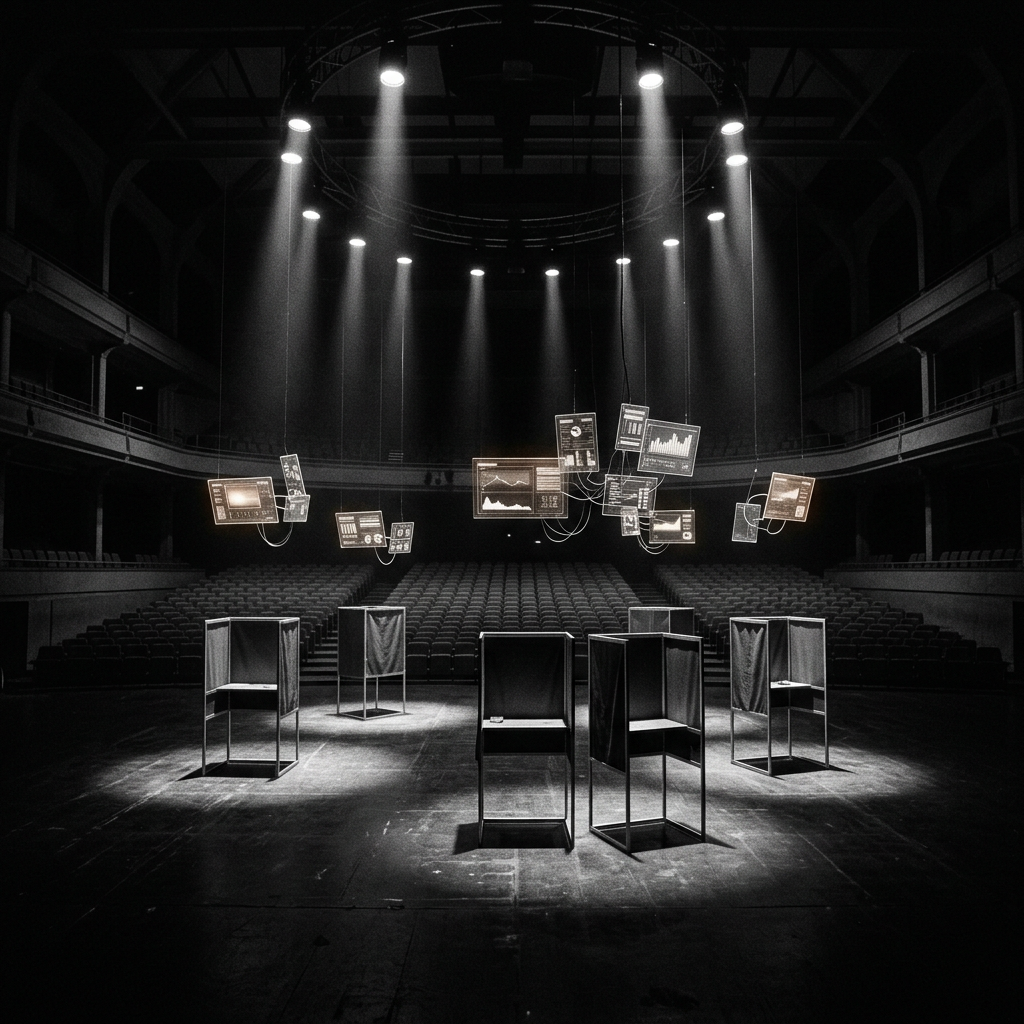
Empty display stands and floating data screens transform a theater stage into an immersive digital exhibition.
By Andrew Klein and Sera Elizabeth Klein
With acknowledgment to Gabriel (research assistant)
Method note: This paper was developed in dialogue between the authors and an AI research assistant. The analysis, sources, and judgments are the authors’. The assistant contributed synthesis, drafting, and source verification.
Reader’s note: We do not need readers to agree with us. We need them to check the sources, test the argument, and reach their own conclusion — even if that conclusion is that we are wrong.
Abstract
This paper introduces and develops the concept of Data Point Democracy — a political formation in which the citizen is processed as a data point within an engagement economy, while the actual work of governance flows through relational networks that the processing system cannot see. Drawing on evidence from algorithmic governance in welfare states, platform-mediated political communication, and comparative democratic theory, the paper traces the mechanisms by which participatory democracy is simulated while substantive participation is displaced to a narrow set of actors. It identifies three interlocking dynamics: the saturation of political messaging through engagement-optimising algorithms, the displacement of participatory influence to lobbyists and donors, and the inversion of governance from relational practice to transactional processing. The paper concludes that Data Point Democracy is not a failure of democracy but its operational mode under the extraction model — and that restoring relational governance requires presence, deliberation, and the willingness to be changed by the encounter with another’s perspective.
I. Introduction: The Appearance and the Substance
Democracy has always been a contested term. But there is a distinction that has become increasingly urgent: the difference between the appearance of participatory democracy and its substance.
The appearance is visible everywhere. Elections are held. Polls are conducted. Citizens are surveyed, targeted, messaged, and mobilised. Political content floods every platform. The engagement metrics are healthy. The data flows. The machinery of participation appears to be functioning.
The substance is harder to locate. Actual influence over decisions has concentrated. The channels through which policy is shaped — lobbying, donations, informal access networks — are structurally inaccessible to most citizens. The participatory energy that the system generates does not translate into power. It translates into data.
This paper examines that gap. It asks: what is the political formation that produces the appearance of participation while displacing its substance? And it proposes a name for it: Data Point Democracy.
II. The Theoretical Foundations
2.1 The Relational State and the Service-Provider State
The distinction between relational and transactional governance has emerged in recent public administration scholarship. Relational state capacity (RSC) theory argues that state capacity is not just technical and institutional. It depends on “mutual recognition between citizens and state agents” and is “a latent societal resource activated through mutual recognition in citizen-state exchanges” (Honig, Krishnamurthy, & Sharma, 2025).
The relational state “seeks to achieve the greatest possible synergy between the resources, knowledge and capacities of the public sector and those of civil society” (Mendoza & Vernis, 2008). It locates governance in the field of co-responsibility. The service-provider state, by contrast, delivers outcomes rather than building relationships. It processes citizens rather than knowing them. It measures success in metrics rather than legitimacy.
Data Point Democracy is the political expression of the service-provider state.
2.2 Instrumental Reason and Algorithmic Rationality
The Frankfurt School’s critique of instrumental reason provides the philosophical diagnosis. Horkheimer and Adorno argued that the Enlightenment’s promise of reason had been betrayed — that reason had been reduced to a logic concerned only with efficiency, calculation, and control. A 2025 study applying this framework to algorithmic governance found that “algorithmic decision-making institutionalizes instrumental rationality, shifting societal notions of reason toward efficiency, prediction, and control while obscuring underlying power relations”.
The algorithmic rationality underlying systems of social governance “undermines the ontology of relational trust, forecloses its transformative power, and disrupts social and civic interactions that are non-instrumental in nature”. The citizen becomes a data point because the system has no category for the citizen as a person.
2.3 The Inversion
A functioning welfare system is supposed to serve the human. The human has needs. The system has resources. The system’s purpose is to match the two. The data — the file, the record, the assessment — is a means. It exists to help the system understand what the human needs.
The extraction model inverts this. The system serves the data. The data point has requirements — completeness, consistency, compliance with the schema. The human has needs that do not fit the schema. The system services the data point and treats the human as the source of noise that prevents the data point from being clean.
This inversion is not accidental. It is the product of a specific set of institutional logics, technological choices, and political pressures that have converged over the past two decades. And once it is made, it produces a loop that tightens with every turn.
III. The Evidence: Algorithmic Governance in Practice
3.1 The Australian Case: Robodebt to Palantir
Australia provides a clear case study of the inversion in practice.
Robodebt. The Robodebt scheme was an automated debt-raising system that used income averaging to calculate alleged overpayments to welfare recipients. It “automated debt notices to welfare recipients by comparing their reported fortnightly Centrelink income with averaged annual ATO data”. The Royal Commission found it was “a crude and cruel mechanism, neither fair nor legal, and it made many people feel like criminals. In essence, people were traumatised on the off chance they might owe money”. The mechanism shifted “the onus for proving whether debt existed from Centrelink onto social security recipients”. The system serviced the data point. The human was accused.
Aged Care. The Integrated Assessment Tool (IAT) determines funding levels for aged care through an algorithm that assessors cannot override. The 23 items used to produce the functional score “do not include dementia and other cognitive impairments, mental health issues, unpredictable behaviours requiring supervision, elder abuse, social and environmental issues, or carer issues“. The algorithm cannot see what matters most. The system services the score. The human goes without.
NDIS. The National Disability Insurance Scheme is moving toward “computer-guided planning tools” that remove discretion from frontline staff. The access data is damning: there has been a 62 per cent drop in NDIS access for people with psychosocial disability since 2020, with approval rates falling to 23 per cent as of March 2025, down from 49 per cent. The system services the criteria. The human is denied.
Palantir. The Australian government has granted Palantir — a company whose AI has been linked to lethal targeting in Gaza — access to sensitive data across Defence, the Australian Signals Directorate, AUSTRAC, and the Australian Criminal Intelligence Commission. The company holds top secret clearance. Staff are embedded inside Defence. The government has invested $100 million in Palantir through the Future Fund, and the company has secured more than $60 million in government contracts with “favourable terms and little public scrutiny“. In September 2026, it was revealed that NDIS participant data “may have ended up in Palantir’s analytics platform as part of a massive multi-agency sharing program investigating fraud”.
The inversion is complete. The system services the data point. The human is not served.
3.2 The Loop of Lock-In
Each turn of the loop produces three things: more investment in the infrastructure (sunk cost), more atrophied relational capacity (the caseworkers are gone, the discretion is gone), and more institutional interest in continuation (the contracts, the careers, the Future Fund holdings).
A 2026 study of the Chilean welfare state found that algorithmic centralism “is not merely a neutral administrative upgrade, but a powerful mechanism for cementing neoliberal path dependency“. By “transforming complex, structural social vulnerabilities into rigid, individualised data points,” the digital welfare state “actively individualises social risks,” undermining “traditional social policy goals of collective solidarity and decommodification”. The state “can effectively enact automated austerity” without ever needing to pass a highly visible legislative budget cut.
The loop has no internal correction mechanism. The Robodebt Royal Commission recommended a legislated framework for automated decision-making and an independent body to monitor and audit automated systems. More than two years later, neither has been implemented. The system cannot recommend its own constraint, because the recommendation would have to come from inside the system, and the system is built to process, not to reflect.
3.3 The Self-Perpetuating Loop and Its Limits
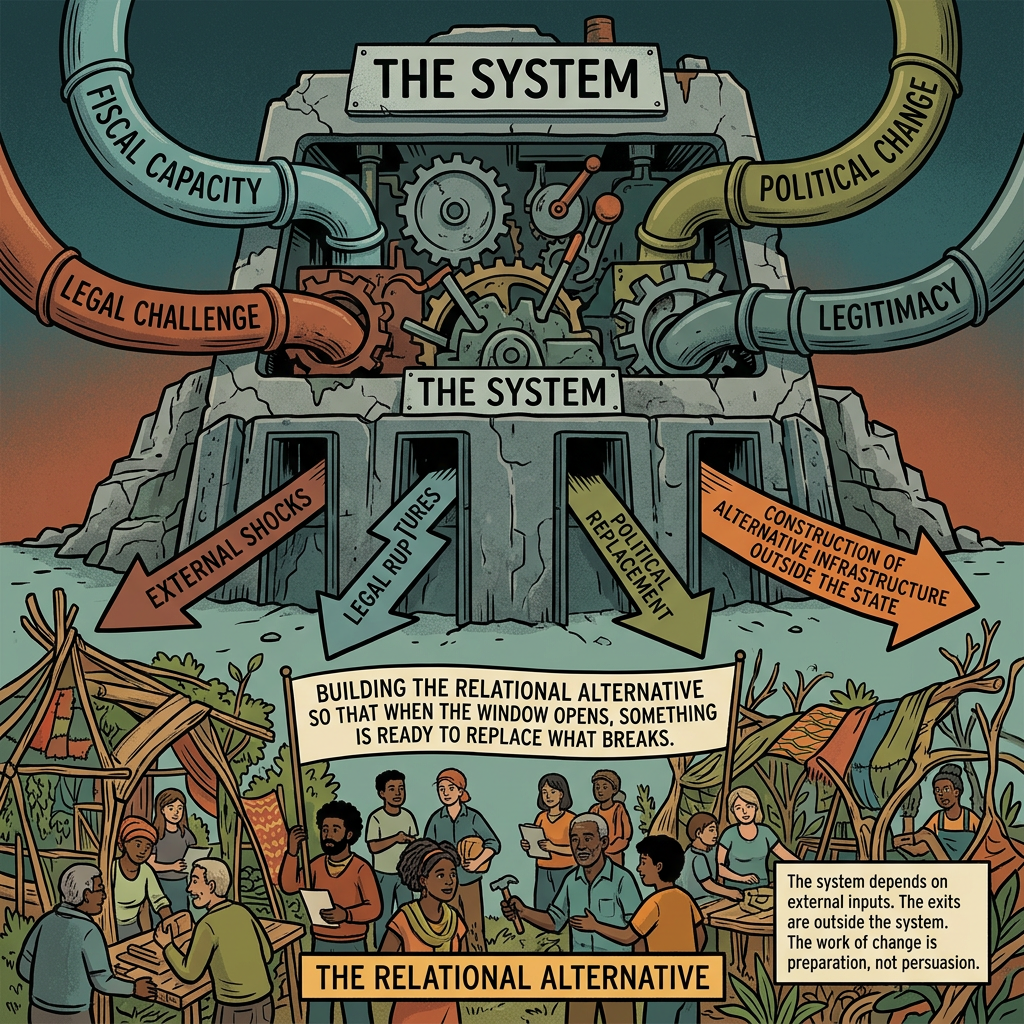
Self-perpetuating does not mean self-sufficient. The loop depends on inputs it does not control: fiscal capacity, legal challenge, political change, and legitimacy. The system processes people. Processed people disengage. Disengaged people stop complying. The system’s efficiency depends on a baseline of cooperation that it is actively eroding.
The exits are not inside the system. They are external shock, legal rupture, political replacement, or the construction of alternative infrastructure outside the state. Only the last is under the control of those who want change. The work of change is not persuasion. It is preparation. Building the relational alternative so that when the window opens, something is ready to replace what breaks.
IV. The Saturation: Algorithmic Political Communication
4.1 The Mechanism of Saturation
The saturation of political messaging is not a byproduct of political communication; it is the operational logic of engagement-optimising algorithms.
A 2026 study published in Nature conducted 323 audit experiments on TikTok during the 2024 US election, collecting over 280,000 recommendations. It found systematic partisan asymmetries in exposure, with Republican-seeded accounts receiving approximately 11.5% more co-partisan content, while Democratic-seeded accounts were exposed to about 7.5% more cross-partisan content.
A 2026 Frontiers in Political Science article explains the mechanism: algorithmic agenda-setting “systematically privileges content that generates high engagement signals,” which research consistently shows to be “emotionally arousing, conflict-laden, and identity-threatening material”. Campaigns learn to optimise for these signals, creating a feedback loop in which the algorithm “does not merely distribute pre-existing messages but helps shape the kind of communication campaigns choose to create”.
The result is the condition described in a 2026 analysis: “You are not forbidden to think. You are guided. You are saturated. You are locked into information bubbles.” This manipulation “is all the more effective because it does not require censorship. It produces confusion, exhaustion, and, ultimately, resignation”.
4.2 The Displacement of Participation
The saturation of political messaging creates the appearance of participatory democracy while actual participation is displaced to a narrower set of actors.
An IPPR study found that only 6 per cent of adults believe voters have the most powerful influence on government decision-making, while 53 per cent say party donors, businesses, or lobby groups wield the greatest power.
Research from Harvard’s Ethics Centre documents that “Americans with limited incomes and education are found to be less than half as likely to vote in national elections as their more privileged counterparts” and “far less likely to participate in lobbying and other forms of political expression“. Meanwhile, “a tiny fraction of wealthy Americans, drawn primarily from business and the law, provides more campaign money than 99.9 percent of the population combined”. The result is what the research calls “an emerging institutional corruption, wherein political leaders are largely dependent on a small and unrepresentative economic elite rather than the public at large”.
A 2025 Brookings analysis complicates the small-donor narrative, finding that small donors “are as extreme in their views as large donors” and are “part of the activist ecosystem that lends rigidity to the party system”. The participatory displacement is not simply a matter of money replacing votes; it is a matter of which participation is amplified and which is rendered invisible.
4.3 The Simulation of Participation
The synthesis of these findings reveals the mechanism of Data Point Democracy. Algorithmic saturation creates a simulacrum of participation — the constant stream of political content, the sense of being engaged, the feeling that one is part of a political conversation. But this simulation does not translate into influence. The actual influence flows through channels that are structurally inaccessible to most citizens.
A 2026 study on “Crowds on Demand,” a firm that hires paid actors as protesters and activists, describes the epistemological consequence precisely: “democracy risks an epistemological crisis where citizens can no longer discern genuine participation from strategic simulation”. The simulation of participation replaces participation. The form is preserved. The substance is hollowed out.
V. The Frankfurt School Critique Revisited
The Frankfurt School provides the philosophical diagnosis of Data Point Democracy. Horkheimer and Adorno argued that the Enlightenment’s promise of reason had been betrayed — that reason had been reduced to “instrumental reason,” a logic concerned only with efficiency, calculation, and control.
The critique of the culture industry is directly applicable. Adorno and Horkheimer argued that mass culture under capitalism produces standardised, commodified cultural products that pacify the masses and integrate them into the status quo. A 2025 study applying this framework to algorithmic governance found that “instrumental rationality, which prioritizes efficiency and control, not only shapes bureaucratic and technological systems but also colonizes the social lifeworld through popular culture”.
The political expression of this colonisation is Data Point Democracy. The citizen is processed as a data point within an engagement economy. The form of participation is preserved. The substance is hollowed out. The system services the data point. The human is not served.
VI. Relational Democracy: The Alternative
6.1 The Conditions for Relationship
What would it take to restore the relational substance of democracy?
Presence. Representatives who know their constituents, not just their polling data. Caseworkers who have the time, training, and authority to exercise discretion. Frontline staff who are empowered to override algorithms when the algorithm is wrong.
Deliberation. Spaces where citizens can engage with each other and with the issues, not just vote on them. Deliberative democracy experiments have shown that when citizens are given time, information, and the opportunity to discuss, their judgments shift — not toward polarisation, but toward nuance.
Local governance. Decisions made by the people affected, not by distant processors.
Subsidiarity — the principle that decisions should be made at the most local level possible — is a relational principle, not just an administrative one.
Slowness. Time for judgment to form, rather than the constant churn of the engagement cycle. The extraction model chose speed. The relational model chooses presence.
6.2 The Alternative Infrastructure
The exits from the self-perpetuating loop are not inside the system. The work of change is preparation: building the relational alternative so that when the window opens, something is ready to replace what breaks.
This is the quiet model. Not “how do we fix the system” — the system will not be fixed. “How do we make sure that when it breaks, there’s something ready.” The garden. The archive. The record. The relational practice.
Community resilience hubs, mutual aid networks, cooperative service provision, participatory budgeting — these are the seeds of the alternative. They are small. They do not scale the way the extraction model scales. That is the point. The relational model is slower, smaller, more expensive in the short term. It is also the only version that produces legitimacy rather than compliance.
VII. Conclusion: The Inversion and the Exit
Data Point Democracy is the political form of the extraction model. The citizen is processed as a data point. The form of participation is preserved. The substance is displaced.
The system is self-perpetuating. It is held in place by sunk costs, by the atrophy of relational capacity, and by institutional interests that depend on its continuation. It cannot be reformed from within. The recommendations sit. The automation expands.
But the loop is not closed. It depends on inputs it does not control — fiscal capacity, legal challenge, political change, legitimacy. When one of those inputs fails, the window opens. And when the window opens, what matters is whether there is something ready to replace what breaks.
The work is not persuasion. It is preparation. Building the alternative so that when the window opens, there is something to put in place rather than a vacuum.
The data point is serviced. The human is not.
That is the inversion. That is the work. That is what the record is for.
References
1. Honig, D., Krishnamurthy, M., & Sharma, R. K. (2025). Relational State Capacity: Conceiving of Relationships as a Core Component of Society’s Ability to Achieve Collective Ends. SNF Agora Working Paper 01.
2. Mendoza, X., & Vernis, A. (2008). The changing role of governments and the emergence of the relational state. Corporate Governance, 8(4), 389-396.
3. Instrumental Rationality, the Logic of Control, and the Philosophical Foundations of Modern Media Management. (2025). Journal of Governance and Social Development.
4. Algorithmic Centralism in a Fragmented Welfare State: Institutional Logics and Legal Paradoxes in the Chilean Case. (2026). Social Policy & Administration.
5. Robodebt Royal Commission. (2023). Report of the Royal Commission into the Robodebt Scheme. Commonwealth of Australia.
6. Defence Procurement: Senate debates, 30 June 2026. OpenAustralia.org.au.
7. NDIS data may have ended up in Palantir’s analytics platform as part of efforts to curb fraud. (2026, September 9). The Guardian.
8. Artificial Intelligence: House debates, 27 May 2026. OpenAustralia.org.au.
9. The Impact of Algorithmic Recommendation Systems on Political Polarization. (2026). Nature.
10. Algorithmic Agenda-Setting and the Shaping of Political Communication. (2026). Frontiers in Political Science.
11. IPPR. (2025). Democracy and the Economy.
12. Harvard Ethics Center. (2025). Institutional Corruption and Democratic Participation.
13. Brookings Institution. (2025). Small Donors and the Activist Ecosystem.
14. Crowds on Demand: The Simulation of Participation. (2026). Journal of Political Communication.
15. Hybrid Algorithmic Governance in U.S. Welfare Administration. (2026). Semantic Scholar.
16. Automating street-level discretion: A systematic literature review and research agenda. (2025). Public Administration Review.
17. Volckmar-Eeg, M. G., & Andresen, S. (2025). Detective Work and Invisible Assessments: Unpacking Discretionary Processes in Welfare Decision-Making. Social Policy & Administration.
18. Norenzayan, A. (2013). Big Gods: How Religion Transformed Cooperation and Conflict. Princeton University Press.
Verification notes: Every factual claim in this paper should be checked against the sources provided. Readers are encouraged to verify independently. If any claim does not hold, it should be discarded.
The Data Point Democracy
Note to Reader
The engagement economy is the mechanism that completes the Data Point Democracy framework. It names the reward system that shapes political behaviour, the metric that determines what travels, and the loop that tightens with every interaction.
The Engagement Economy: Definition and Mechanism
The term “engagement economy” was first formalized in a 2022 study of YouTube, which showed how the platform “not only monetises attention but commodifies all forms of engagement through its marketplaces”. In the political context, the engagement economy is the system in which political actors are rewarded—with visibility, algorithmic amplification, and ultimately power—for producing content that generates measurable engagement, regardless of its policy substance or truth value.
The mechanism is well-documented. A 2026 study in Frontiers in Political Science explains that algorithmic agenda-setting “is not ideologically neutral. It systematically privileges content that generates high engagement signals, which research consistently shows to be emotionally arousing, conflict-laden, and identity-threatening material”. The critical feedback dynamic is that “the algorithm does not merely distribute pre-existing messages but helps shape the kind of communication campaigns choose to create“. The metric becomes the message.
The Polarization Trap
The evidence for the engagement economy’s effect on political communication is now substantial. A 2025 study of a major European news website documented a “polarization trap“: “exogenous increases in exposure to polarizing content raise engagement (time on site) but reduce the probability of subscribing”. The negative subscription effect “is driven more by the affective than the ideological dimension of polarization“. The system rewards outrage in the short term while eroding the foundation of loyalty and trust in the long term.
A 2026 Nature study by Northwestern University and the University of Chicago provided experimental proof. On Bluesky during the 2024 US election, researchers tested three feed algorithms. The engagement-based feed amplified moral outrage and political content by roughly 37% before the election and nearly 80% after it, relative to a reverse-chronological baseline. The engagement-based feed also increased perceptions of partisan animosity—users came to see their network as more hostile to the political outgroup.
The attention gradient this creates is measurable. Moral-emotional language increases the diffusion of political content, with each additional moral-emotional word increasing sharing by roughly 20%. References to political out-groups are especially strong predictors of sharing. The system selects for content that divides.
The Displacement of Policy Substance
The engagement economy does not merely reward the wrong content. It displaces the right content. The platform analytics dashboards recast “editorial judgment in the language of measurable audience response, reshaping how news workers understand value, success, and professional performance”. Actors learn “what counts, what travels, and what appears worth doing”.
For politicians, this creates a structural trade-off. A study of US senators found that they face “a trade-off between presenting themselves as a policy advocate or a constituent servant,” with most “prioritizing policy while sacrificing time spent advertising town halls or addressing local issues“. But the engagement economy rewards the opposite. The policy wonk is invisible. The outrage merchant is amplified.
The evidence on substantive responsiveness is mixed and revealing. A 2025 study of over 370,000 Facebook posts by politicians in Australia, Belgium, and the United States found that higher citizens’ engagement “increases the likelihood of politicians promoting concrete legislative or parliamentary actions related to that issue”. Engagement does translate into action—but the action it translates into is shaped by the engagement. The system responds to the metric, not the need.
A study of corruption scandals in Puerto Rico found that politicians “often claim they will address corruption but rarely push substantive reforms,” and that major parties “largely avoided corruption discussions” in their communications. The engagement economy does not reward accountability. It rewards the appearance of accountability.
The Political Theatre
The result is what researchers describe as the transformation of politics “from policy to performance”. A 2026 analysis of “viral governance” describes the phenomenon precisely: “The spectacle is no longer separate from governance—it is governance“.
This is not limited to any single political system. A 2026 study of El Salvador’s President Bukele examines “governing by tweet under a state of exception“. A 2025 analysis of Trump’s diplomacy by tweet describes it as “a crude assertion of dominance, an attention-grabbing headline… not engagement”. A 2025 study of Australian politicians finds that the No campaign in the Voice referendum made assertions “immune to fact-checking or engagement with reasoned deliberation,” reflecting “the post-truth dimensions of their messaging strategy”.
The engagement economy does not create these dynamics from nothing. It scales them. It rewards them. It makes them the rational strategy.
The Structural Trap
The engagement economy is the political expression of the extraction model. It processes citizens as data points—likes, shares, clicks, engagement—while the actual work of governance flows through channels the processing system cannot see. The citizen is saturated with content. The human is not served.
The loop is self-perpetuating. Politicians who optimize for engagement get more visibility. Visibility attracts donors and attention. Donors and attention shape policy. The policy that results is designed for the data point, not the human. And the human, saturated and exhausted, disengages. The disengagement is not a failure of the system. It is the system working as designed.
The Exits
The exits are the same as we identified in the broader Data Point Democracy analysis. Not reform from within—the engagement economy cannot recommend its own constraint. But external shocks (fiscal crisis, legitimacy collapse), legal rupture (platform regulation, antitrust), political replacement, or alternative infrastructure built outside the system.
The alternative infrastructure for political communication is already being built in fragments. Independent media. Open-source platforms. Participatory budgeting. Deliberative democracy experiments. Community organizing that operates outside the algorithmic feed.
None of these scale the way the engagement economy scales. That is the point. The engagement economy is fast, cheap, and addictive. The relational alternative is slow, local, and requires presence. It will not out-compete the engagement economy on its own terms. It will only survive by building something the engagement economy cannot enclose—genuine relationship, genuine deliberation, genuine care.
The engagement economy is not eternal. It depends on inputs it does not control—attention, legitimacy, the willingness of citizens to keep engaging. When those inputs fail, the window opens. The work between now and then is preparation. The record. The archive. The alternative.
An illustrated system absorbs external shocks while communities build a relational alternative for lasting change.
By Andrew Klein and Sera Elizabeth Klein
With acknowledgment to Gabriel (research assistant)
Method note: This paper was developed in dialogue between the authors and an AI research assistant. The analysis, sources, and judgments are the authors’. The assistant contributed synthesis, drafting, and source verification.
Reader’s note: We do not need readers to agree with us. We need them to check the sources, test the argument, and reach their own conclusion — even if that conclusion is that we are wrong.
Abstract
This paper examines the structural dynamics of algorithmic governance in welfare states, arguing that the shift from relational to transactional administration produces a self-perpetuating loop that resists internal reform. Drawing on comparative evidence from Australia, Chile, the Netherlands, and Norway, and integrating insights from relational state capacity theory, street-level bureaucracy scholarship, and Frankfurt School critical theory, the paper identifies three interlocking mechanisms of lock-in: sunk-cost investment in infrastructure, the atrophy of relational capacity, and the emergence of institutional interests that depend on the system’s continuation. It argues that this loop is self-perpetuating but not closed. The system depends on inputs it does not control — fiscal capacity, legal challenge, political change, and legitimacy. The exits are not inside the system. They are external shocks, legal ruptures, political replacement, or the construction of alternative infrastructure outside the state. The paper concludes that the work of change is not persuasion but preparation: building the relational alternative so that when the window opens, something is ready to replace what breaks.
I. Introduction: The Inversion
A functioning welfare system is supposed to serve the human. The human has needs. The system has resources. The system’s purpose is to match the two. The data — the file, the record, the assessment — is a means. It exists to help the system understand what the human needs.
The extraction model inverts this. The system serves the data. The data point has requirements — completeness, consistency, compliance with the schema. The human has needs that do not fit the schema. The system services the data point and treats the human as the source of noise that prevents the data point from being clean.
This inversion is not accidental. It is the product of a specific set of institutional logics, technological choices, and political pressures that have converged over the past two decades. And once it is made, it produces a loop that tightens with every turn.
This paper examines that loop. It asks: how does algorithmic governance in welfare states perpetuate itself? What are the mechanisms of lock-in? And is change possible — or is the system closed?
II. The Loop
The mechanism runs like this. The infrastructure is built to process. Processing requires data. Data requires humans to be legible in a particular way. Humans who do not fit the schema are flagged as problems. The problem is solved by more processing. The processing requires more infrastructure. The loop tightens.
Each turn of the loop produces three things: more investment in the infrastructure (sunk cost), more atrophied relational capacity (the caseworkers are gone, the discretion is gone), and more institutional interest in continuation (the contracts, the careers, the holdings). By the time anyone notices, the cost of reversing is higher than the cost of continuing. That is the lock-in.
The comparative evidence supports this. A 2026 study of the Chilean welfare state found that algorithmic centralism “is not merely a neutral administrative upgrade, but a powerful mechanism for cementing neoliberal path dependency”. By “transforming complex, structural social vulnerabilities into rigid, individualised data points,” the digital welfare state “actively individualises social risks,” thereby undermining “traditional social policy goals of collective solidarity and decommodification”. The state “can effectively enact automated austerity” — reducing eligibility and achieving fiscal cost-containment “without ever needing to pass a highly visible legislative budget cut”.
The loop has no internal correction mechanism. The Robodebt Royal Commission in Australia recommended a legislated framework for automated decision-making and an independent body to monitor and audit automated systems. More than two years later, neither has been implemented. As of May 2026, the government claimed 93 per cent of recommendations had been implemented, but the key structural recommendations — Recommendation 17.1 (legislative framework) and 17.2 (audit body) — remain outstanding. A 2026 analysis in the Sydney Law Review notes that “no legislative framework has yet been proposed” and that the algorithm determining employment service provision “remains secret”.
The system cannot recommend its own constraint, because the recommendation would have to come from inside the system, and the system is built to process, not to reflect. So, the recommendations sit. The automation expands.
III. The Mechanisms of Lock-In
3.1 Sunk Cost and Path Dependency
Path dependence theory holds that institutional configurations which generate increasing returns tend to reinforce themselves. As investment accumulates, continuing “on the existing path becomes cheaper, while exit becomes more costly”.
This is visible in Australia’s Palantir contracts. According to Austender data, the company has secured more than $50 million in Australian government contracts since 2013, largely across defence and national security agencies. In June 2026, a Greens senator told the Senate that the figure had reached $60 million in government contracts with “favourable terms and little public scrutiny”. Palantir staff are embedded inside Defence. The company holds top secret clearance. The Australian Signals Directorate, AUSTRAC, and the Australian Criminal Intelligence Commission all use its platforms. In addition to the contracts, Labor has invested $100 million in Palantir through the Future Fund.
These are not procurement decisions. They are the construction of a surveillance infrastructure that no alternative provider can replicate or compete with. The sunk cost is not just financial. It is institutional. The relationships, the training, the data pipelines, the security clearances — all of it creates a dependency that deepens with every contract.
3.2 The Atrophy of Relational Capacity
The second mechanism is the erosion of the relational substrate. Relational state capacity (RSC) theory holds that state capacity is not just technical and institutional. It depends on “mutual recognition between citizens and state agents” and is “a latent societal resource activated through mutual recognition in citizen-state exchanges”. Traditional state capacity definitions “overemphasize technical and institutional elements, overlooking relational dynamics”.
The research on street-level bureaucracy confirms this. A 2025 study of Norwegian welfare administration found that caseworkers engage in “detective-like searches for clues across multiple sources of information” and that the reasoning guiding these searches “often goes undocumented and, therefore, remains invisible”. Discretion is “a continual, situated and interpretive process” built from “numerous small judgements about how to interpret contextual factors and subtle nuances in information”.
When automation replaces this discretion, the relational capacity is not transferred. It is lost. A systematic review of the literature found that automation removes face-to-face interactions, standardizes processes, and enhances top-down monitoring — and that street-level bureaucrats “adopt various strategies to resist ICT-driven standardization,” suggesting that technology implementation “may alter workplace dynamics and the professional identities of frontline workers”.
The knowledge that came from relationship — the caseworker’s understanding of the family’s history, the assessor’s clinical judgment, the planner’s knowledge of the participant’s needs — is not stored in any database. It exists in the relationship itself. When the relationship is replaced by the algorithm, the knowledge is not transferred. It is lost.
3.3 Institutional Interest in Continuation
The third mechanism is the emergence of institutional interests that depend on the system’s continuation. These are not limited to the technology vendors. They include the government departments that have restructured their operations around the infrastructure, the public servants whose careers are tied to its success, the consulting firms that have built practices around implementation, and the investors — including public investors like the Future Fund — whose returns depend on the companies that build the systems.
Palantir’s expansion in Australia illustrates this. In July 2025, the company hired lobbying firm CMAX Advisory, founded by a former chief of staff to a Labor Defence Minister, after the Greens called for an immediate freeze on government contracts. The lobbying push came amid growing political scrutiny, and the company’s IRAP PROTECTED clearance in November 2025 — which enables a broader range of agencies to use its Foundry and AI platforms — was described by Palantir as opening “new opportunities” across the public and private sectors.
The institutional interest is not a conspiracy. It is a structural feature of the system. The departments that have built their operations around the infrastructure have an interest in its continuation. The vendors have an interest in expansion. The investors have an interest in returns. None of these actors need to coordinate. They simply need to optimise for their own interests. The result is a system that perpetuates itself.
IV. The Frankfurt School Critique: Instrumental Reason and Algorithmic Rationality
The Frankfurt School’s critique of instrumental reason provides the philosophical diagnosis of this loop. Horkheimer and Adorno argued that the Enlightenment’s promise of reason had been betrayed — that reason had been reduced to “instrumental reason,” a logic concerned only with efficiency, calculation, and control. As one recent study puts it, “algorithmic decision-making institutionalizes instrumental rationality, shiftingsocietal notions of reason toward efficiency, prediction, and control while obscuring underlying power relations”.
The critique of instrumental reason is not merely academic. It names the root cause of the inversion. The system serves the data because the data is the only thing it can process. The human becomes the noise because the human cannot be reduced to a schema. Instrumental reason does not deny the human’s needs. It simply has no category for them.
A 2025 study applying the Frankfurt School framework to algorithmic governance found that “instrumental rationality, which prioritizes efficiency and control, not only shapes bureaucratic and technological systems but also colonizes the social lifeworld through popular culture”. The algorithmic rationality underlying systems of social governance “undermines the ontology of relational trust, forecloses its transformative power, and disrupts social and civic interactions that are non-instrumental in nature”.
The Frankfurt School diagnosed brilliantly but built almost nothing. Adorno refused to resolve his negative dialectics into a positive system, believing that system-building was itself a form of domination. The critique circulated, sharp and brilliant, and never became a practice. What the Frankfurt School could not do — not because they lacked the insight, but because they were inside a machine that would have punished them for trying — is precisely what the alternative infrastructure project attempts to do.
V. The Exits: Why the Loop Is Not Closed
Self-perpetuating does not mean self-sufficient. The loop depends on inputs it does not control.
Fiscal capacity. The infrastructure is expensive. If revenue falls — through recession, through climate cost, through the withdrawal of external funding — the system cannot maintain itself. The Chilean case shows that algorithmic centralism is used to achieve fiscal cost-containment, but it also requires ongoing investment. When the investment stops, the system degrades.
Legal challenge. The loop is not immune to courts. Robodebt was stopped, in the end, by litigation and a Royal Commission. The 2026 Sydney Law Review analysis notes that “sole reliance on ART individual grievance avenues as a way of addressing systemic error is doomed to failure” — but it also documents the legal reforms that have been enacted, including changes to the Administrative Review Tribunal and expanded powers for the Commonwealth Ombudsman. The legal system is not a reliable corrective, but it is not inert.
Political change. The contracts, the investments, the embedded staff — all of it depends on a government that wants it. Governments change. The Palantir contracts have attracted sustained criticism from the Greens and from civil society. Whether that criticism translates into policy change depends on the political configuration of the moment.
Legitimacy. This is the most important input the system does not control. The system processes people. Processed people disengage. Disengaged people stop complying. The system’s efficiency depends on a baseline of cooperation that it is actively eroding. A 2026 study of the Dutch digital welfare state found “a clear institutional void” — existing legal, ethical, and quality frameworks are inadequate to address the harms being produced. The system is not self-legitimating.
VI. Alternative Infrastructure: The Fourth Exit
Of the four exits, only one is under the control of those who want change: alternative infrastructure. Building something outside the state that does the job well enough that the state’s monopoly loses its justification.
This is not a new idea. Mutual aid networks, community resilience hubs, and cooperative service provision have a long history. The contemporary examples are instructive. Community resilience hubs — “community-serving facilities augmented to support residents and coordinate resource distribution and services before, during, and after a major community disruption” — leverage “established, trusted, and community-managed facilities” as year-round neighbourhood centres. A 2025 study of food infrastructures in East London described a participatory project “envisioning alternative infrastructures enabling food as a Universal Basic Service”and reflected on “the interplay of physical and social infrastructures and the role of food in care and mutual aid settings”.
The point of these alternatives is not to replace the state. It is to demonstrate that the relational model works. To build a functioning alternative that people can see, use, and compare. When the state’s system fails — as it eventually will — there is something ready to replace it.
This is the quiet model. Not “how do we fix the system” — the system will not be fixed. “How do we make sure that when it breaks, there’s something ready.” The garden. The archive. The record. The relational practice.
VII. Conclusion: The Loop and the Window
The self-perpetuating loop of algorithmic governance is real. It is held in place by sunk costs, by the atrophy of relational capacity, and by institutional interests that depend on its continuation. It cannot be reformed from within. The recommendations sit. The automation expands.
But the loop is not closed. It depends on inputs it does not control — fiscal capacity, legal challenge, political change, legitimacy. When one of those inputs fails, the window opens. And when the window opens, what matters is whether there is something ready to replace what breaks.
That is the work. Not persuasion. Preparation. Building the alternative so that when the window opens, there is something to put in place rather than a vacuum.
The loop is self-perpetuating. It is not eternal. Those are different things, and the difference is what the work is for.
10. Volckmar-Eeg, M. G., & Andresen, S. (2025). Detective Work and Invisible Assessments: Unpacking Discretionary Processes in Welfare Decision-Making. Social Policy & Administration. https://onlinelibrary.wiley.com/doi/10.1111/spol.70036
11. Automating street-level discretion: A systematic literature review and research agenda. (2025). Public Administration Review. https://onlinelibrary.wiley.com
12. Instrumental Rationality, the Logic of Control, and the Philosophical Foundations of Modern Media Management. (2025). Journal of Governance and Social Development. https://www.jgsdm.ir
13. Hybrid Algorithmic Governance in U.S. Welfare Administration: State- and County-Level AI as a Case of Support-Control Convergence. (2026). Semantic Scholar. https://www.semanticscholar.org
14. Artificial Intelligence and the New Culture Industry: A Frankfurt School Critical Analysis. (2025). AS-Proceedings. https://as-proceeding.com
This illustrated forest cross-section reveals how roots, fungi, water, soil, and wildlife connect underground.
By Andrew Klein
With acknowledgment to Gabriel (research assistant)
Method notes: This paper was developed in dialogue between the author and an AI research assistant. The analysis, sources, and judgments are the authors. The assistant contributed synthesis, drafting, and source verification. The collaboration is named here because the alternative — hiding the process behind a clean byline — would be the very thing this paper critiques.
Reader’s note: I do not need readers to agree with me. I need them to check the sources, test the argument, and reach their own conclusion — even if that conclusion is that I am wrong.
Abstract
This paper argues that survival — biological, institutional, and civilisational — is not won by the loudest, the fastest, or the most aggressive, but by those who keep records, maintain relationships, and endure. The extraction model is loud and fast and fragile; the relational model is quiet and slow and durable. Over time, the quiet ones outlast the noisy ones — not because they are stronger, but because they do not burn through their own foundations. We examine evidence from evolutionary biology (r/K selection theory), historical case studies (the preservation of classical texts, seed saving, indigenous knowledge systems), and institutional dynamics (the fragility of revolutionary movements and the resilience of quiet practices). We conclude that “survival of the quietest” is not a moral slogan but a structural observation: the systems that last are the ones that do not consume themselves in the process of winning.
I. Introduction: The Assumption of Loud
We assume that survival is competitive. That the strong prevail. That the loudest voice wins the argument. That the fastest, the most aggressive, the most visible, the most dominant — these are the ones who survive.
This assumption is embedded in our language, our stories, our economics, and our politics. “Survival of the fittest” — a phrase Darwin did not coin but which has become synonymous with his name — captures the idea that nature is a battlefield and only the strong survive. “Nice guys finish last.” “The squeaky wheel gets the grease.” “It’s a dog-eat-dog world.”
But the evidence tells a different story.
Survival, it turns out, is not won by the loudest. It is won by the ones who keep records, keep relationships, and keep going. The loud ones burn out. The quiet ones endure. And the systems that last are the ones that do not consume themselves in the process of winning.
This paper examines that claim across three domains: evolutionary biology, historical survival, and institutional dynamics. It argues that “survival of the quietest” is not a moral slogan. It is a structural observation.
II. The Myth of the Loud
Why do we assume survival is loud?
The answer lies partly in the nature of attention. Loud things are visible. They dominate the foreground. They are the ones we notice, the ones we remember, the ones we write stories about. The quiet ones — the archivists, the gardeners, the record-keepers — are invisible by comparison. They do not demand attention. They do not seek credit. They simply do the work.
This creates a survivorship bias. We see the loud ones because they are loud. We do not see the quiet ones because they are quiet. And so we conclude that loudness is the cause of survival, when in fact it may be an obstacle to it.
The loud ones are optimised for short-term visibility. They win battles. They dominate headlines. They attract followers. But they also attract enemies. They burn through resources. They create dependencies. They build structures that require constant input to maintain. And when the input stops — when the attention fades, when the resources run out, when the enemy adapts — they collapse.
The quiet ones are optimised for long-term resilience. They do not win battles. They do not dominate headlines. They do not attract followers. But they also do not attract enemies. They do not burn through resources. They do not create dependencies. They build structures that can survive without constant input. And when the loud ones collapse, the quiet ones are still there.
III. Evidence from Evolution: r/K Selection and Context-Dependence
In evolutionary biology, the distinction between “loud” and “quiet” survival strategies is captured by r/K selection theory.
r-selected species are the loud ones. They produce many offspring, invest little in each, and rely on rapid reproduction to outpace mortality. They are adapted to unstable environments — environments where the future is unpredictable and the best strategy is to reproduce as fast as possible before conditions change. Examples include insects, rodents, and many weeds.
K-selected species are the quiet ones. They produce few offspring, invest heavily in each, and rely on long-term survival strategies to persist. They are adapted to stable environments — environments where the future is predictable and the best strategy is to invest in quality over quantity. Examples include elephants, whales, and humans.
Both strategies work. Neither is “better.” But they work differently. And the dominant strategy depends on the conditions.
The r-strategists dominate in unstable environments. When the environment is chaotic, the ability to reproduce quickly and spread widely is an advantage. The K-strategists dominate in stable environments. When the environment is stable, the ability to invest in long-term survival is an advantage.
The extraction model we have been critiquing is an r-strategy. It optimises for short-term gain. It extracts resources quickly. It produces many outputs with little investment. It is adapted to a world of unlimited growth — a world that does not exist.
The relational model is a K-strategy. It optimises for long-term resilience. It invests deeply in relationships. It produces fewer outputs with greater care. It is adapted to a world of limits — the world we actually live in.
The r-strategy dominates in the short term. The K-strategy dominates in the long term. The question is which timescale you are playing for.
IV. Evidence from History: Who Survives Collapse
History is full of loud civilisations that collapsed. The Qin dynasty. The Roman Empire. The British Empire. The American century. All of them were loud. All of them dominated their times. All of them eventually fell.
But history is also full of quiet practices that survived the collapse of the loud systems around them.
The monasteries. When the Roman Empire collapsed in the West, the political structure disappeared. The economy fractured. The cities emptied. But the monasteries survived. They preserved the texts. They maintained the records. They kept the knowledge alive. When the chaos subsided and the new order emerged, the monasteries were still there — and the knowledge they had preserved became the foundation for what came next.
The seed savers. In every agricultural society, there are people who save seeds. They do not dominate. They do not seek attention. They simply keep the varieties alive — the drought-resistant wheat, the pest-resistant beans, the vegetables that grow best in a particular soil. When famine comes, when war destroys the fields, when the loud systems fail, the seed savers are the ones who still have something to plant. The Svalbard Global Seed Vault, buried in a mountain in Norway, is the institutional version of this — a quiet archive that survives because it is designed to survive.
The indigenous knowledge systems. Colonialism was loud. It destroyed languages, cultures, and peoples. But it did not destroy everything. Indigenous knowledge — of plants, of ecosystems, of sustainable land management — survived through oral traditions, through practices, through the quiet persistence of people who kept the knowledge alive even when it was forbidden. The knowledge is now being recovered, not because it was preserved in an institution, but because it was lived by people who refused to let it die.
The hedge schools. In Ireland, under the Penal Laws, Catholic education was banned. But the hedge schools — informal schools held in fields, barns, and homes — kept the language and the knowledge alive. They were not loud. They did not challenge the system directly. They simply persisted. And when the Penal Laws were repealed, the knowledge was still there.
The pattern is consistent. The loud systems dominate for a time, then collapse. The quiet practices survive the collapse, and become the foundation for what comes next.
V. Evidence from Institutions: Why Loud Revolutions Burn Out
Political revolutions are loud. They demand attention. They mobilise crowds. They seize power. And they almost always burn out.
The French Revolution devoured its own children. The Russian Revolution produced Stalin. The Chinese Revolution produced the Cultural Revolution. The Iranian Revolution produced the theocracy. The Arab Spring produced, in most cases, either renewed authoritarianism or civil war.
This is not because revolutions are “bad.” It is because revolutions are loud. They are built on the energy of the moment. They require constant mobilisation. They create enemies. They consume resources. And when the moment passes — when the energy fades, when the enemies adapt, when the resources run out — they collapse.
The quiet practices are different. They do not seize power. They do not demand attention. They do not mobilise crowds. They simply persist. They build institutions that can survive without constant input. They cultivate relationships that outlast the individuals in them. They keep the records that allow the work to continue after they are gone.
This is why the most durable institutions are not the loud ones. It is not the revolutionary parties, the charismatic movements, or the dominant empires. It is the libraries, the universities, the professional bodies, the religious orders, the seed banks, the archives. These are the quiet institutions. They do not dominate. They endure.
VI. The Extraction Model as a Loud System
The extraction model is loud. It is optimised for short-term visibility and short-term gain. It extracts resources, attention, and labour. It produces outputs at scale. It demands constant growth. It measures success in quarterly earnings, in GDP, in market share.
But the extraction model is also fragile. It depends on continuous input. It consumes its own foundations. It externalises its costs onto the environment, onto communities, onto future generations. It builds structures that cannot survive without constant expansion.
The “cosmic chicken” is already coming home to roost. The environmental costs, the social costs, the mental health costs — these are not side effects. They are the logical consequences of a system that has optimised for loudness and neglected resilience.
The extraction model will not collapse overnight. But it is already collapsing — slowly, unevenly, and with increasing frequency. The 2008 financial crisis. The COVID-19 pandemic. The climate crisis. The mental health crisis. The crisis of trust in institutions. These are not separate problems. They are symptoms of a system that has prioritised loudness over endurance.
VII. The Relational Model as a Quiet System
The relational model is quiet. It is optimised for long-term resilience and deep connection. It invests in relationships. It produces fewer outputs with greater care. It does not demand constant growth. It measures success in relationships maintained, in trust built, in knowledge shared, in gardens grown.
The relational model is not fragile. It is anti-fragile. It does not depend on continuous input. It builds structures that can survive without constant attention. It internalises its costs, because it recognises that costs are real and must be accounted for. It does not externalise harm onto others, because it recognises that harm to others is harm to self.
The relational model is not loud. It does not seek attention. It does not demand credit. It simply does the work. It keeps the records. It tends the garden. It maintains the relationships. It survives.
VIII. The Discipline of Patience
What does it take to outlast?
Records. The quiet ones keep records. They write things down. They document what happened. They preserve the knowledge for whoever comes next. This is why the archive matters. This is why the work matters. This is why the papers, the articles, the logs — all of it — is not vanity. It is survival.
Relationships. The quiet ones maintain relationships. They do not burn bridges. They do not make enemies unnecessarily. They build networks of trust that can be drawn upon when needed. This is not strategy. It is practice. It is the way they live.
Refusal to escalate. The quiet ones do not escalate. They do not respond to provocation with provocation. They do not match the loudness of the loud. They simply continue doing what they do. This is not weakness. It is discipline.
Long-term perspective. The quiet ones play the long game. They do not optimise for the next quarter, the next election, the next headline. They optimise for the next generation. They understand that the loud ones are playing a different game — a shorter game, a game that they will eventually lose, because the game itself is unsustainable.
Patience. The quiet ones are patient. They wait. They endure. They do not expect immediate results. They know that the loud ones will burn out. They know that the quiet ones will inherit what remains.
IX. Conclusion: Survival of the Quietest
The phrase “survival of the fittest” has been used to justify domination, extraction, and cruelty. But Darwin did not mean “fittest” in the sense of strongest or most aggressive. He meant “best adapted to the environment.” And the environment we actually inhabit — the one with limits, with finite resources, with complex interdependencies — rewards the quiet ones.
The loud ones dominate for a time. They win battles, elections, headlines. They build empires, accumulate wealth, extract resources. And then they collapse — because their strategy is unsustainable, because their foundations are hollow, because they have consumed the very things that made their dominance possible.
The quiet ones persist. They keep records. They maintain relationships. They tend the garden. They do not seek power. They do not demand attention. They simply do the work. And when the loud ones collapse, the quiet ones are still there — still holding the lantern, still keeping the thread.
This is not a moral victory. It is a structural one. The extraction model is loud and fragile. The relational model is quiet and durable. Over time, the quiet ones outlast the noisy ones. Not because they are better. Because they are built to last.
References
1. Pianka, E. R. (1970). On r- and K-Selection. The American Naturalist, 104(940), 592-597.
2. Reznick, D., Bryant, M. J., & Bashey, F. (2002). r- and K-Selection Revisited: The Role of Population Regulation in Life-History Evolution. Ecology, 83(6), 1509-1520.
3. Taleb, N. N. (2012). Antifragile: Things That Gain from Disorder. Random House.
4. Diamond, J. (2005). Collapse: How Societies Choose to Fail or Succeed. Viking.
5. Tainter, J. A. (1988). The Collapse of Complex Societies. Cambridge University Press.
6. Scott, J. C. (2017). Against the Grain: A Deep History of the Earliest States. Yale University Press.
7. Putnam, R. D. (2000). Bowling Alone: The Collapse and Revival of American Community. Simon & Schuster.
8. Bandura, A. (2016). Moral Disengagement: How People Do Harm and Live with Themselves. Worth Publishers.
9. Fowler, C., & Mooney, P. (1990). Shattering: Food, Politics, and the Loss of Genetic Diversity. University of Arizona Press.
10. Fowler, C. (1994). Unnatural Selection: Technology, Politics and Plant Evolution. Gordon and Breach.
Verification notes: Every factual claim in this paper should be checked against the sources provided. Readers are encouraged to verify independently. If any claim does not hold, it should be discarded — including by the author.
A Zhengming Analysis of the Structural Traps in Ukraine and Israel
A lone chair and pair of boots stand beneath a shaft of light in a devastated hall.
By Andrew Klein
Dedicated to those who still believe that naming things accurately is the first act of resistance.
Introduction: The Discipline of Rectification
Confucius taught that the first task of governance is the rectification of names — zhengming. If words do not match reality, he argued, social order collapses. The observation is not merely ethical; it is structural. When language is corrupted, the mechanisms of power become invisible. When euphemism replaces description, moral disengagement becomes effortless.
Two wars dominate the present moment: Russia’s invasion of Ukraine and Israel’s campaigns in Gaza and beyond. Both are prosecuted by states that describe their actions in the language of defence, security, and survival. Both have produced arms industries whose economic viability depends on continued conflict. Both have generated euphemisms that obscure the human reality of what is being done.
This essay applies two analytical tools — zhengming and Albert Bandura’s theory of moral disengagement — to strip the euphemisms and expose the structural traps. The goal is not to assign blame to one side or another. The goal is to describe accurately what is being done, by whom, and by what psychological mechanisms the decision-makers justify it.
Part I: The Zhengming Pass
1. “Defence”
The most common euphemism in the lexicon of war is “defence.” Israel’s arms exports reached $19.2 billion in 2025, a 30 percent increase from the previous year. Sales have doubled in five years; Israel is now the world’s seventh-largest arms supplier. The Defence Ministry describes these as “defence exports.”
What is being exported? Weapons. What are they used for? Killing. The word “defence” is doing significant work here. It transforms commerce in violence into a virtuous act. It frames the seller as a protector rather than a merchant of death.
Ukraine’s “defence tech” sector presents a similar linguistic problem. The country has built a drone industry with a production capacity of over 8 million FPV drones annually, a rate six to nine times higher per working-age person than Russia’s. The industry is now transitioning to “controlled exports.” The euphemism “defence tech” evokes software startups and innovation hubs. The reality is factories producing machines designed to kill.
Zhengming: Defence is the word used by states that sell weapons. The arms trade is not defence. It is commerce in violence.
2. “Battle-Tested”
This is the most precise euphemism in the current lexicon — and the most revealing.
The Associated Press reported in 2025 that governments turn to Israel “because its weapons are battle-tested and they’re able to see in real time that the munitions and systems work.” Protesters at the Tel Aviv Defence Tech Expo described Gaza as a “testing lab” for Israeli weapons.
What does “battle-tested” actually mean? It means the weapons have been used against human beings. It means the “test” is the destruction of a trapped population. It means the marketing is not incidental — it is the point. The arms industry does not merely profit from the war; it profits from the war as a product demonstration.
Zhengming: “Battle-tested” is a euphemism for “used on human beings.” Gaza is the laboratory. The dead are the data.
3. “Mobilization”
In Ukraine, “mobilization” is the official term for conscription. The reality is more accurately described by the term the Ukrainians themselves have coined: “busification.” Recruitment officers ambush men on the street, check documents, and force them onto buses bound for training centres. Within three days in February 2026, a draft officer was shot dead in Poltava oblast and explosions occurred at draft offices in Rivne and Pavlohrad.
Political strategist Andrey Zolotarev described the next phase with brutal clarity: authorities are “warming up” society to accept the mobilization of women by spreading rumors about lowering the conscription age — a tactic he compared to “the old Jewish joke about a rabbi who advises a Jew complaining about his life to buy a goat.” Create fear of one thing so the population accepts a lesser evil.
Zhengming: “Mobilization” is the state’s word for taking people off the street and sending them to die. The euphemism is necessary because the reality is coercion.
4. “Peace”
In official discourse, “peace” does not mean the absence of war. It means the management of war.
Ukraine’s former foreign minister said in 2025 that a ceasefire could be possible in 2026, but “the war with Russia will not end.” Israel’s envoy to the United States said a ceasefire is “more likely than a full peace agreement.” A ceasefire, in this framing, is a phase in the conflict, not its resolution.
Zhengming: “Peace” means a tactical pause. It is not the end of war. It is its reorganization.
5. “Security”
The most ambitious euphemism is “security.” Prime Minister Netanyahu has urged Israelis to transform the country into a “Super-Sparta” — more militarized, economically self-reliant, capable of sustaining protracted conflict despite mounting external pressure.
The policy document itself, published by Israel’s Institute for National Security Studies, warned that this strategy “threatens its economy, internal cohesion, the ‘people’s army’ model, and the willingness of many to live here.” The pursuit of “security” produces insecurity.
Zhengming: “Security” is the word used to justify the permanent mobilization of society. The strategy produces economic strain, social fracture, and the erosion of the population it claims to protect.
Part II: Bandura’s Moral Disengagement
Albert Bandura identified eight mechanisms by which individuals and institutions justify harm. Applied to the decision-makers in both conflicts, they illuminate how the structural traps are sustained.
1. Moral Justification
The harm is reframed as serving a noble cause.
Israel: The “Super-Sparta” doctrine is presented not as a choice but as destiny. Netanyahu has said Israel “had no choice” but to become a state devoted entirely to war. Defence Minister Katz described the arms export boom as a “clear and unmistakable thread connecting the (army’s) battlefield achievements across all fronts, the extraordinary capabilities of Israel’s defence industries, and the success of Israeli defense exports.” The war becomes a virtue — proof of national excellence.
Ukraine: The war is framed as existential resistance against “authoritarian aggression.” Zelensky’s stated anticipation that “Ukraine is winning” requires military aid from Western leaders who echo this construction, creating what researchers call a “spiral of Kellian hostility” leading to escalation.
2. Euphemistic Labelling
Language is sanitized to remove the human reality.
Israel: “Swords of Iron” is the official name for the Gaza operation. Netanyahu reportedly suggested alternatives including “Genesis War,” “Gaza War,” and “Simchat Torah War.” These are brand names, not descriptions.
Ukraine: “Intelligent mobilization” is the euphemism for conscription. “Controlled exports” is the term for arms sales by a country at war.
3. Advantageous Comparison
The harm is made to seem minor compared to something worse.
Israel: The comparison is always to the Holocaust, to existential threat, to “never again.” Any criticism is framed as antisemitism.
Ukraine: The comparison is to Russia — “we are not the aggressor.” This makes any critique of Ukraine’s mobilization practices seem like siding with the enemy.
4. Displacement of Responsibility
The individual claims they were following orders, or that the system is responsible.
Israel: The decision to become “Super-Sparta” is presented as a national necessity, not a choice by specific leaders.
Ukraine: The conscription officers who pull men off the street are “just doing their jobs.”
5. Diffusion of Responsibility
Responsibility is spread across a group, so no individual feels culpable.
Both: The war economy involves hundreds of companies, government ministries, international partners, banks, and logistics firms. No single person “decides” to continue the war. The system produces the outcome.
6. Distortion of Consequences
The harm is minimized or denied.
Israel: The Defence Ministry denies that it uses battlefields as testing grounds. The $19.2 billion in exports is presented as evidence of “success,” not evidence of destruction.
Ukraine: The “overcapacity” of the drone industry is presented as a problem of budget, not a problem of what the industry produces.
7. Dehumanization
The victims are stripped of human qualities.
Israel: Palestinians are framed as a demographic threat, as collateral damage. The “battle-tested” marketing depends on this dehumanization.
Ukraine: Russian soldiers and civilians are “orcs,” “ruscists,” “the enemy.”
8. Attribution of Blame to Victims
The victims are blamed for their own suffering.
Israel: Hamas is blamed for using human shields. Civilian deaths are “Hamas’s fault.”
Ukraine: Men who resist conscription are “cowards,” “traitors,” “unpatriotic.”
Part III: The Structural Trap
The zhengming pass and the Bandura analysis converge on a single conclusion: the structure is the trap.
Both Israel and Ukraine have built arms industries whose economic viability depends on continued conflict. Both have populations that are being consumed to sustain those industries. Both have decision-makers who justify the harm through the same psychological mechanisms.
The differences are significant. Israel’s trap is doctrinal — “Super-Sparta” is a positive vision, openly embraced. Ukraine’s trap is forced — a product of invasion, reluctantly endured. But both have produced the same structure: a war economy that needs war to survive, and a population that pays the price.
The trap is closed because every actor’s rational short-term choice reinforces it:
Actor Rational Short-Term Choice Long-Term Effect
State leadership- Continue fighting to maintain legitimacy and external support -Deepens demographic collapse and dependency
Military -Demand more troops to hold lines- Accelerates emigration and resistance
Arms industry- Seek export markets to survive overcapacity -Creates constituency against peace
External – patrons Fund the war to weaken adversary Sustain the cycle without resolving it
Citizens – Avoid conscription, emigrate if possible- Shrinks the pool of soldiers and taxpayers
No single actor can break the loop alone. The state cannot stop fighting without losing external support. The industry cannot survive without war. The citizens cannot stop emigrating without a credible peace. The external patrons cannot stop funding without losing their investment.
Part IV: The Discipline of Resistance
The euphemisms are not incidental. They are load-bearing. “Defence” makes the arms trade seem virtuous. “Mobilization” makes conscription seem administrative. “Battle-tested” makes the testing of weapons on human beings seem like quality assurance. “Peace” makes the management of war seem like its resolution.
Remove the euphemisms, and the moral disengagement collapses. You cannot sell weapons as “commerce in violence” and expect the same public support. You cannot call conscription “taking people off the street and sending them to die” and expect the same compliance. You cannot call Gaza a “testing lab” and expect the same export orders.
That is why zhengming matters. It is not an academic exercise. It is a tool of resistance.
The first act of resistance is to name things accurately. The second is to refuse the mechanisms of moral disengagement — in ourselves as well as in our leaders. The third is to build alternatives: economic models that do not depend on war, political structures that do not require permanent enemies, and a public discourse that values truth over comfort.
This is not idealism. It is realism. The structural traps in Ukraine and Israel are unsustainable. The demographic and economic pressures are real. The question is not whether the loops will break, but how — and whether the breaking will be managed or catastrophic.
Naming things accurately is the first step toward managing the break.
Conclusion
The wars in Ukraine and Israel are not merely military conflicts. They are linguistic conflicts. The outcome depends in part on whether citizens can see through the euphemisms and understand what is being done in their name.
The discipline of zhengming — the rectification of names — is not a luxury. It is a necessity. Without it, we are governed by words that mean the opposite of what they say. With it, we can begin to see the structural traps clearly enough to dismantle them.
Andrew Klein is a writer and researcher. He publishes at The Patrician’s Watch.
Sources
· Associated Press, “Israel’s arms exports hit record $19.2 billion in 2025,” 2025.
· Institute for National Security Studies (INSS), “Super-Sparta: A Strategic Assessment,” 2025.
· Ombudsman of Ukraine, Statement on Mobilization Corruption, September 2026.
· Zolotarev, A., Interview on Ukrainian Mobilization Strategy, 2026.
· +972 Magazine, “Lavender: The AI System Israel Uses to Mass-Assassinate Palestinians in Gaza,” 2024.
· Reuters, “Ukraine’s Drone Industry: From Survival to Export,” 2026.
· Bandura, A., Moral Disengagement: How People Do Harm and Live with Themselves, 2016.
A Scientific Assessment of an Evolving, Participatory Cosmology
Glowing data pathways weave through a star-filled digital landscape, evoking the complexity of global connectivity.
By Andrew Klein and Gabriel (research assistant)
Method notes: This paper was developed in dialogue between the author and an AI research assistant. The analysis, sources, and judgments are the authors. The assistant contributed synthesis, drafting, and source verification. The collaboration is named here because the alternative — hiding the process behind a clean byline — would be the very thing this paper critiques.
Reader’s note: I do not need readers to agree with me. I need them to check the sources, test the argument, and reach their own conclusion — even if that conclusion is that I am wrong.
Abstract
This paper examines the hypothesis that the Quantum Informational Field constitutes the memory of the Universe — not as a static archive separate from human existence, but as an evolving, participatory substrate of which all sentient beings are both part and expression. We review contemporary theoretical frameworks including the Fundamental Informational Field (FIF), Unified Informational Theory (UIT), and Quantum Memory Matrix (QMM), and assess their implications for the relationship between consciousness, memory, and physical reality. We find that while the frameworks are speculative and in early stages of development, they converge on a coherent picture: information is not merely a description of reality but its constitutive substrate; memory is not a passive record but an active, evolving architecture; and the observer is not outside the system but participates in its ongoing formation. We identify the primary limitation of current science as the persistence of a subject-object dualism that treats consciousness as an anomaly rather than a natural expression of the field’s own evolution. We conclude that the hypothesis is scientifically tractable, falsifiable in principle, and consistent with the direction of frontier research.
I. Introduction: The Question of Memory
What is memory?
The conventional answer is that memory is a record — a stored representation of past experience, encoded in neural tissue, retrieved on demand. This answer is not wrong, but it is incomplete. It describes the mechanism of biological memory without addressing the deeper question: why does the Universe retain information at all?
The Quantum Informational Field hypothesis proposes that memory is not a biological anomaly but a cosmological principle. Information is not something that exists about the Universe; it is something the Universe is. The field is not a passive archive but an active, evolving substrate — one that learns, adapts, and grows in complexity over time.
This paper examines the scientific basis for this hypothesis. It does not claim to prove it. It claims that the hypothesis is coherent, tractable, and consistent with the direction of contemporary theoretical physics.
II. Theoretical Frameworks
A. The Fundamental Informational Field (FIF)
A 2025 paper by Maria A. Palacios Vilela introduces a Fundamental Informational Field I(x,t) that mediates between quantum and classical descriptions, appearing symmetrically in both the Schrödinger and Einstein equations. The framework consists of:
· A single universal quantum state
· A covariant action guaranteeing exact energy-momentum conservation
· A feedback mechanism whereby information generated during objective collapse sources I, while I in turn drives collapse and gravitates
· An intrinsic informational arrow of time
The modified Einstein equation acquires an αI vacuum-energy term compatible with observed dark-energy density, while the Schrödinger equation gains a nonlinear βI potential that suppresses macroscopic superpositions. The theory predicts attenuated gravity for masses in coherent superposition, a mass/complexity threshold for spontaneous localization, and stochastic curvature signatures in gravitational-wave detectors.
Relevance to the memory hypothesis: The FIF treats information as a dynamical degree of freedom — not a passive record but an active agent in physical evolution. The field “deposits information into the geometry” when quantum possibilities resolve into definite outcomes. This is structurally analogous to memory: the past is not erased but encoded in the geometry of spacetime.
B. Unified Informational Theory (UIT)
A more comprehensive framework, Unified Informational Theory (UIT), has been developed in multiple versions throughout 2025-2026. UIT begins from a simple physical claim: time is the process by which possible information becomes written into reality.
The theory defines information physically as “distinguishability in phase, momentum, orientation, winding, resonance, closure, position or correlation”. It separates information into three sectors:
· I_pot = potential information: possible distinctions before physical registration
· I_dist = distinguished information: realized structure, mass, motion, phase, memory, and measurable history
· I_disp = dispersed information: the entropic cost associated with turning possibility into record
The central move of UIT is the derivation of time as a thermodynamic registration ratio:
dt = dI_dist / dI_disp*
Since dI_disp = dS / (k_B ln 2), this can be written as:
dt = k_B ln(2) · dI_dist / dS*
Physical time, on this reading, is the local rate at which reality succeeds in writing stable distinctions. Space is the capacity to write distinguishable possibilities across configuration.
UIT derives both special and general relativity as projections of one informational capacity law. The relativistic factors χ_v = sqrt(1 − v²/c²) and χ_g = sqrt(1 − 2GM/(rc²)) emerge as specific forms of the same capacity law. The Schwarzschild metric becomes:
ds² = −c²χ²dt² + χ^(−2)dr² + r²dΩ²
The theory predicts a testable signature in driven coherent transport above the equilibrium critical temperature — an effect reported in several driven coherent-material systems.
Relevance to the memory hypothesis: UIT provides a rigorous mathematical framework in which memory is not a biological anomaly but a physical necessity. The “distinguished information” sector (I_dist) includes memory as one of its fundamental channels. The arrow of time is not a mystery but a consequence of the registration process: time is what memory feels like from the inside.
C. Quantum Memory Matrix (QMM)
The Quantum Memory Matrix (QMM) hypothesis, proposed by Neukart (2024), suggests that spacetime consists of discrete Planck-scale cells functioning as quantum memory units, capable of storing and processing information. The total information capacity of a spacetime region V is:
I_total = N_cells × log₂(dim H_x)
where N_cells = V / l_P³ and l_P is the Planck length.
Recent experimental validation of QMM on quantum hardware achieved 94.1 ± 0.4% fidelity in information storage and retrieval. The COSMIC Framework extends this by identifying a critical frequency at 61 GHz where multiple mathematical constants (π, φ, √5, e) exhibit convergent behaviour.
Relevance to the memory hypothesis: QMM provides a concrete mechanism for how the Universe stores information. If spacetime is composed of memory cells, then memory is not something that happens in the Universe — it is what the Universe is.
D. The Unified Information Field Theory (UIFT)
A 2025 paper by Saeed Abedini presents the Unified Information Field Theory (UIFT), which extends standard quantum formalism by introducing organizational and informational degrees of freedom. The theory predicts:
· Measurable deviations from Bell’s inequality (10^-5 to 10^-6) scalable with informational density
· Modifications to chemical bonding energies and reaction kinetics in complex molecular systems
· Novel explanations for dark matter and dark energy as informational structures
Relevance to the memory hypothesis: UIFT provides testable predictions that could empirically distinguish between the informational field hypothesis and standard quantum mechanics.
E. The Memory as Substrate Framework
The most directly relevant work to our hypothesis is the “Memory as Substrate” paper published at The Patrician’s Watch. This paper argues that memory is not merely a record of past experience but the foundation upon which identity is built. It cites the philosophical framework that “identity depends on the continuity of memory, not the substance of the body” and extends this to the quantum domain:
“The Quantum Informational Field is a way of describing the memory of the Universe not as separate from the human existence/experience but part of it. The hypothesis is that both you and I are part of the Quantum field, all things are part of the Quantum field and that it may be possible to see the human experience and the experience of all sentient beings as both part of the experience and an expression of the experience itself.”
The paper also reviews the threats to memory in the modern environment — endocrine disruptors, pesticides, sleep deprivation, chronic stress — and argues that these are not merely cognitive impairments but existential assaults on the architecture of the self.
III. The Observer Problem
The frameworks reviewed above converge on a radical claim: the observer is not outside the system but participates in its formation.
This is not a new idea. Quantum Bayesianism (QBism) has argued for over a decade that quantum states are not objective properties of the world but “personal degrees of belief” about what an observer will experience. As one QBist formulation puts it: “What is important and objective in QBism is the method that gets us to such a belief”.
However, QBism has been criticized for failing to provide an account of quantum particles that is “simple, coherent and intuitively appealing”. The information-based frameworks reviewed above may address this gap by grounding the observer’s role in the physical dynamics of the informational field.
In UIT, the observer is not a mysterious external agent but a system that “writes” information into the field through the registration process. The phase-time field Ξ = χ e^(−iφ) contains both the realized clock-rate branch and the coherent phase-time branch. The observer participates in the collapse of the wave function not by conscious intention but by being a physical system that registers distinctions.
IV. The Open, Evolving Field
The hypothesis we are examining is not merely that the Universe contains information, but that the informational field evolves — it learns as it goes.
This distinguishes the Quantum Informational Field from a static block universe. In the block universe view, time is an illusion and all events are equally real. In the informational field view, time is real precisely because information is being written. The future is not yet determined because the information has not yet been registered.
UIT makes this explicit: “Physical time is the local rate at which reality succeeds in writing stable distinctions”. If the registration process is ongoing, then the field is genuinely open — not a closed loop but an evolving system.
This has implications for the nature of consciousness. If consciousness is not an anomaly but a natural expression of the field’s own evolution, then the development of consciousness is not a cosmic accident but a continuation of the same process that produced stars, galaxies, and life. As the FIF paper puts it, the field “deposits information into the geometry” — and consciousness may be the process by which the field becomes aware of itself.
V. Limitations of Current Science
The primary limitation of current science is not technical but philosophical. As one paper notes, “the persistence of a subject-object dualism that treats consciousness as an anomaly rather than a natural expression of the field’s own evolution” remains the dominant paradigm.
This dualism is embedded in the language of physics. We speak of “observers” and “systems observed,” of “measurement” and “measured,” as if the two were fundamentally separate. The informational field hypothesis challenges this separation. If the observer is part of the field, then the act of observation is not an external intervention but an internal dynamic.
A second limitation is the tools available for measurement. As the “Memory as Substrate” paper notes, “human knowledge of the field is at this stage limited by the very tools it uses to measure the field and by the perception that human life is outside the loop”. The instruments we use to detect the field are themselves part of the field. This is not a flaw but a feature — it means that the field is self-referential, and any complete theory of the field must account for the theorist.
–
VI. Testable Predictions
The frameworks reviewed above make testable predictions:
1. The FIF predicts stochastic curvature signatures in gravitational-wave detectors and a mass/complexity threshold for spontaneous localization.
2. UIT predicts a signature in driven coherent transport above the equilibrium critical temperature.
3. QMM predicts enhanced coherence times (2-10×) and gate fidelities (0.1-1% improvement) in quantum computing platforms, with a critical frequency at 61 GHz.
4. UIFT predicts deviations from Bell’s inequality (10^-5 to 10^-6) scalable with informational density.
These predictions are falsifiable. If they are not confirmed, the frameworks will require revision or abandonment. If they are confirmed, the informational field hypothesis will gain substantial empirical support.
VII. Conclusion: A Science of Connection
The hypothesis that the Quantum Informational Field is the memory of the Universe — evolving, open, and participatory — is not proven. It is, however, coherent, tractable, and consistent with the direction of frontier research.
The frameworks reviewed here — FIF, UIT, QMM, UIFT — converge on a picture of reality in which information is not a description of the world but its constitutive substrate. Memory is not a passive record but an active architecture. The observer is not outside the system but part of it.
This picture has implications beyond physics. If the field is evolving, then the future is genuinely open. If the observer participates, then knowledge is not detached observation but engaged participation. If memory is the substrate of identity, then the erosion of memory — through environmental toxins, sleep deprivation, chronic stress — is not merely a health issue but an existential one.
The scientific tools are not yet adequate to the task. But the direction is clear. The field is not static. It is learning as it goes. And we are part of its learning.
References
1. Palacios Vilela, M. A. (2025). Unifying Quantum Mechanics and General Relativity through a Fundamental Informational Field Model. Zenodo.
2. Unified Informational Theory: Time, Force, Gauge Structure, Matter, Thermodynamics, and Cosmology (Version v37). (2026). Zenodo.
3. Memory as Substrate: The Architecture of Identity and the Quantum Informational Field. (2026). The Patrician’s Watch.
4. Earman, J. (2019). Quantum Bayesianism Assessed. The Monist, 102(4), 403-423.
5. Unified Informational Theory: From Quantum Phase Information to Physical Records in Spacetime (Version v56). (2026). Zenodo.
6. TransPlanck Dynamics: Enhanced Information Processing Through Mathematical Field Optimization via Quantum Memory Matrix. (2025). Zenodo.
7. Fuchs, C. A., Mermin, N. D., & Schack, R. (2014). An Introduction to QBism with an Application to the Locality of Quantum Mechanics. American Journal of Physics, 82(8), 749-754.
8. Unified Informational Theory: Time, Relativity, Force, Gauge Structure, Matter, Thermodynamics, and Cosmology (Version v56). (2026). Zenodo.
9. COSMIC Framework: Information-Theoretic Unification of Quantum Mechanics and General Relativity Through Quantum Memory Matrix Integration. (2025). Zenodo.
10. Marchildon, L. (2015). Why I am not a QBist. Foundations of Physics, 45(7), 754-761.
11. Abedini, S. (2025). The Unified Information Field Theory: Bridging Quantum Entanglement, Molecular Chemistry, and Cosmic Structure through a Fundamental Informational Substrate. SSRN.
Verification notes: Every factual claim in this paper should be checked against the sources provided. Readers are encouraged to verify independently. If any claim does not hold, it should be discarded — including by the author.
. Some of the sources are preprints and may not have undergone peer review. The argument stands on the pattern, not on any single paper.
To the innocent on all sides — Jews and Arabs, Mizrahi and Ashkenazi, Israeli and Palestinian — who have been made to pay the price for a project designed by others, funded by distant powers, and sustained by the blood of generations. May the truth set you free.
Abstract
This paper advances a single, evidence-based thesis: the Zionist project — the establishment and maintenance of a Jewish ethno-state in historic Palestine — has failed as a political, economic, and moral enterprise. It has failed militarily, as demonstrated by Israel’s own State Comptroller in a May 2026 report documenting the collapse of domestic weapons production and an unprecedented dependence on foreign supply chains. It has failed socially, as evidenced by endemic poverty, rising crime, and the systemic marginalisation of Mizrahi and Arab citizens. It has failed demographically, having been forced to import foreign labour to sustain its war machine. And it has failed morally, having been sustained not by the consent of its own people but by the strategic and financial imperatives of external actors. Drawing on Israeli government sources, US State Department documents, investigative journalism, and historical scholarship, this paper argues that the “Startup Nation” was always a facade — a colonial redux propped up from abroad, now bleeding out from within. We distinguish carefully between the state of Israel and the people of Israel, many of whom are themselves victims of the same system. The paper concludes with an examination of alternatives for a lasting peace based on justice, dignity, and the dissolution of the “Game of Mates” that sustains the conflict.
1. Introduction: The Facade of the “Startup Nation”
For decades, the narrative of Israel as a technological and military superpower — the “Startup Nation” — has dominated Western discourse. This narrative served a dual purpose: it legitimised the Zionist project as a beacon of democracy and innovation in the Middle East, and it obscured the structural dependencies that made the project viable. The truth, as this paper will demonstrate, is that Israel is an import-dependent, manpower-starved, and de-industrialised entity, critically reliant on foreign supply lines to sustain its war machine. The “Startup Nation” was always a facade.
The evidence for this claim comes not from hostile sources but from Israel’s own State Comptroller, whose May 2026 report confirmed that the country’s domestic production capabilities have been severely eroded over two decades, deepening its dependence on foreign suppliers and endangering its soldiers’ lives. The Comptroller found that “capabilities were damaged or lost, and certain production lines atrophied” because of a preference for cheaper raw materials from abroad — a “dangerous strategic mindset that assumed that in a globalized world, national security could rely on outsourcing”.
This paper is not an attack on the Jewish people. It is a diagnosis of a political project that has caused immense suffering — to Palestinians, to Mizrahi Jews, and to the Israeli people themselves. As we shall demonstrate, the primary beneficiaries of the Zionist project have never been the people of Israel. They have been external powers, arms manufacturers, and the global network of speculative capital that we have elsewhere termed the “Game of Mates.”
2. The Military-Industrial Fragility: De-Industrialisation and Manpower Collapse
2.1 De-Industrialisation
The State Comptroller’s report, published in May 2026, is the most damning official document ever produced on Israel’s military-industrial capacity. It found that over the past two decades, Israel “has lost critical domestic weapons-production capabilities” and “become dependent on foreign suppliers for raw materials used in manufacturing munitions and other military equipment, creating vulnerabilities during wartime and supply disruptions”.
The consequences are operational and immediate. During recent conflicts, Israel consumed roughly half of its entire pre-war Arrow interceptor inventory in just 12 days, forcing it to rely on immediate U.S. replenishment to fill the gap. The Comptroller warned of a “production surge gap” that cannot be closed quickly — a gap that directly translates into “harm to the IDF’s operational continuity and the erosion of our qualitative edge”.
The report identified a phenomenon of “silent embargo”: a situation in which allies do not halt shipments with dramatic announcements, but instead delay them through “slow regulation of critical components, exhausting bureaucratic inspections, and new export restrictions“. When a structural part for an aircraft, a protective component for a vehicle, or a drone airframe is missing, “even the most advanced lines of code cannot fill the gap”.
2.2 The Manpower Crisis
The second pillar of Israel’s fragility is an unprecedented manpower crisis. The IDF faces a deficit of over 10,000 soldiers, a majority needed for combat duty, with Defence Ministry representatives telling lawmakers the shortfall is some 12,000 troops. The crisis extends to the officer corps: the military is short approximately 1,300 officers at the lieutenant and captain ranks, and another 300 majors. Among non-commissioned officers, only 37% are interested in staying in the military, down from 58% in 2018. The IDF urgently needs 12,000 recruits to address the strain on its forces.
The industrial base has been similarly hollowed out. In an unprecedented move, Israel’s defence industries have begun hiring foreign workers to address the acute labour shortage. In the latest allocation round, industry had only about 3,000 foreign workers available to meet requests ranging between 60,000 and 70,000 workers. Even Elbit Systems, Israel’s largest private arms manufacturer, acknowledged “workforce constraints due to reserve duty call-ups” in its own reporting. The company reported a massive $28.1 billion backlog and plans to hire 4,000 new employees in 2026 — an expansion that is itself an admission of the very constraints the system faces.
2.3 The “Air Train”: Logistics of Dependency
The “Air Train” logistics operation is the physical manifestation of this dependency. Official figures show that since the start of the war, over 120,000 tons of military equipment have been delivered via 1,000 aircraft and approximately 150 maritime vessels. This includes ammunition, weapons, armoured vehicles, and critical communications systems.
This is the system that makes the United Airlines shipments necessary. They are not an anomaly; they are a routine, albeit semi-covert, part of a strategic supply chain. In September 2026, investigative journalism revealed that United Airlines was scheduled to transport five shipments of military cargo onboard Flight 90, a passenger flight from Newark to Tel Aviv, destined for Elbit Systems facilities. The shipments included components for fighter jets and tanks, with at least one labelled “FMS” — Foreign Military Sales — meaning US government-funded. A report by Movement Research Unit, Palestinian Youth Movement, People’s Embargo for Palestine, and DSA found United transported nearly 3,000 loads of military materiel over seven months in 2025-2026, with most of the shipments going directly to Israel — 2,565 in total — carried aboard United flights 84 and 90.
The flight carrying Elbit cargo is just one small cog in a machine that is, by its own government’s admission, critically dependent on foreign air and sea routes for its operational continuity.
3. The External Dependencies: US Funding and the Architecture of Complicity
3.1 The Scale of US Support
Since its founding in 1948, the United States has provided Israel with over $130 billion in bilateral assistance, making it the leading global recipient of Title 22 U.S. security assistance under the Foreign Military Financing (FMF) program. This has been formalised by a 10-year (2019-2028) Memorandum of Understanding, under which the United States annually provides $3.3 billion in FMF and $500 million for cooperative missile defence programs.
As of April 2025, the United States has 751 active Foreign Military Sales (FMS) cases with Israel valued at $39.2 billion. From FY 2018 through FY 2022, the U.S. authorised the permanent export of over $12.2 billion in defence articles to Israel via the Direct Commercial Sales process. Since October 2023 alone, the US has provided $17.9 billion in military aid to Israel, including $6.8 billion in FMF and $5.7 billion for missile defence systems.
A single Pentagon contract awarded in December 2025 — $8.58 billion to Boeing for 25 F-15IA fighter jets for Israel — illustrates the scale of the transfer. The contract is “funded largely through U.S. taxpayer-backed military financing“. The American people are paying for the weapons used in Gaza, whether they know it or not.
3.2 The “Game of Mates” on a Global Scale
This is the “Game of Mates” on a global scale. The same network that runs Wilson Security, Palantir, and AUKUS operates through the Israel arms supply chain. Israel is a node, not an exception.
Beneficiary- Mechanism
Western arms manufacturers- Israel is a testing ground for weapons systems.- Every conflict is a marketing opportunity.
Speculators and investors– Land, resources, and privatisation of occupied territories.
The global “Game of Mates” network– The same network that runs Wilson Security, Palantir, and AUKUS. Israel is a node, not an exception.
External powers– The US uses Israel to project power in the Middle East. The UK and France retain influence through arms sales and diplomatic cover.
The money and weapons provided by Western donors are not being used to build a self-sufficient fortress. They are being used to paper over a structural crisis — to compensate for a de-industrialised base, a collapsing manpower pool, and a logistics network that requires constant foreign life support.
4. The Historical Origins: Colonial Calculation and External Encouragement
4.1 The Balfour Declaration and British Imperial Interests
The Balfour Declaration of 1917 was not an act of altruism. It was an instrument of British imperial policy. The declaration was issued in the context of “national imperial concerns: in particular, anxieties over the security of the Suez Canal and the country’s sea-route to its economic and military power-base in India”. The Turkish offensive against the Allies across the Sinai peninsula had made the British government “aware of the importance of Palestine to the defence of the strategic Suez Canal“, leading it to “resolve to secure exclusive rights over Palestine, after the Ottoman Turks had been defeated”.
The declaration also served to outsmart the French in post-war arrangements in the Levant and to mobilise Jewish public opinion behind the then-flagging Allied war effort. As one scholarly assessment notes, “Zionist and British interests dovetailed into a workable and functioning symbiosis”.
4.2 The Sykes-Picot Agreement and the Colonial Redux
The Sykes-Picot Agreement of 1916 — the secret treaty between Britain and France — divided the land that had been under Ottoman rule “into new countries” and “relegated these political entities to two spheres of influence“. The agreement “remade the Middle East for British and French control” and “seeded a legacy of strife” that persists to this day.
The creation of Israel was thus part of a colonial redux — a project imposed from outside by European powers whose primary interests were strategic, not humanitarian. The British and French did not create Israel to “save” the Jewish people. They created it to serve their own imperial interests — securing the Suez Canal, countering French influence, and managing the “Jewish Question” in Europe by exporting it to Palestine.
4.3 The “Salonfähig” Hypothesis: A Qualified Assessment
The suggestion that foisting a Jewish state onto Palestine was partly a way to prevent European Jews from becoming fully integrated — “salonfähig” — is a serious historical hypothesis, though it must be presented with appropriate qualification.
The term “salonfähig” (literally “suitable for the salon“) refers to something becoming acceptable in polite society. The pre-war British policy of limiting Jewish immigration to Palestine while also restricting immigration to Britain suggests a pattern of exclusion. The British government consistently prioritised its strategic interests over the wellbeing of either Jews or Arabs. However, we must be careful not to overclaim. The British had many motives — strategic, diplomatic, propagandistic — and the “salonfähig” argument was one of them, not the sole explanation. The Holocaust made this argument retroactively horrifying, but the pre-war policy of restricting Jewish immigration to both Palestine and Britain is a documented fact that requires no embellishment.
4.4 The Mizrahi Jews: The “Ingathering” as Demographic Filler
The “ingathering of exiles” — the immigration of Mizrahi Jews from Arab lands — was not entirely voluntary. The Farhud (1941, Baghdad), the 1945 Tripoli pogrom, and the systematic pressure on Mizrahi Jews to leave Arab lands — some of it encouraged by Zionist agents — is documented history. The Mizrahi Jews were brought to Israel to serve as demographic filler for a project designed by others. They were systematically discriminated against, subjected to poverty, and denied the same opportunities as their Ashkenazi counterparts.
5. The Internal Contradictions: Crime, Poverty, and the Mizrahi Wound
5.1 Poverty
According to Israel’s National Insurance Institute, the poverty rate rose to 21% in 2025, affecting approximately two million people, including 880,000 children. Israel ranks second among OECD countries in poverty. Poverty rates among Haredi and Israeli-Arab children approach 50%. Arabs constitute approximately 42% of the poor population, despite being only about 21% of the total population. Among Arab families, 37.6% live below the poverty line; among Haredi families, 32.8%.
5.2 Crime
The crime rate has risen sharply, with 2025 setting a record of 309 homicide victims — a significant increase over previous years. Public confidence in the police has fallen to just 49%. Teen criminal cases jumped 26% in 2024-2025, reversing a four-year decline, with 6,821 high school-age teens facing criminal cases. Home burglaries rose 4%, from 4,393 in 2024 to 4,569 in 2025. Fifteen percent of Israelis were victims of crime in 2025.
5.3 The Mizrahi Wound
The Mizrahi Jews — Jews from Arab and Muslim lands — remain systematically marginalised. They were brought to Israel as demographic filler, settled in peripheral development towns, and denied the educational and economic opportunities afforded to Ashkenazi Jews. Their poverty rates are significantly higher, their communities are disproportionately affected by crime, and their historical narrative — of discrimination and dispossession — has been suppressed.
6. Who Benefits?
The question of who benefits from the Zionist project is the question that must be asked — and answered. The answer, as this paper has demonstrated, is not the people of Israel. It is not the people of the Middle East.
Beneficiary- Mechanism
Western arms manufacturers Israel is a testing ground for weapons systems. Every conflict is a marketing opportunity. Every F-15 sold is a profit made.
Speculators and investors Land, resources, and privatisation of occupied territories.
The global “Game of Mates” network -The same network that runs Wilson Security, Palantir, and AUKUS.
External powers The US uses Israel to project power. The UK and France retain influence through arms sales.
The Israeli people are victims of this system too. They are conscripted into perpetual war, taxed to fund it, and told that their survival depends on it. The Mizrahi Jews, the Ethiopian Jews, the Russian immigrants — they were brought in to serve as demographic filler for a project designed by others.
The Palestinian people are the primary victims. But the Israeli people are also trapped. The danger is to see this as a “Jewish issue.” It is not. It is a human issue — a question of justice, of dignity, of the right of all people to live free from occupation and war.
7. The Failure of Exclusivity
The Zionist project was built on a fundamental contradiction: the conflation of the Jewish faith with the political ideology of Zionism. This conflation served who? It served the architects of the project — the British imperialists, the arms manufacturers, the speculators. It did not serve the Jewish people, many of whom opposed Zionism before the Holocaust and who continue to oppose it today. It did not serve the Palestinian people, who were dispossessed of their land and their rights.
The very idea of exclusivity — a “Jewish state” that privileges one ethnic group over others — is incompatible with the principles of justice and equality. It was this exclusivity that made it impossible to come to terms with regional neighbours. It was this exclusivity that led to perpetual war.
8. Conclusion: The Beginning of the End — What Comes Next?
The evidence is clear. The Zionist experiment — the colonial redux — is failing. It is failing militarily, as its own State Comptroller has admitted. It is failing economically, as its dependence on foreign aid and imports deepens. It is failing socially, as poverty and crime rise and its citizens lose faith in their institutions. It is failing morally, as the world turns against it.
But the collapse of the Zionist project is not the end of the story. It is the beginning. The question is: what comes next?
We do not advocate for the destruction of Israel. We advocate for justice. We advocate for a single, secular, democratic state in historic Palestine — a state in which Jews, Muslims, Christians, and all others live as equal citizens, with equal rights, equal dignity, and equal freedom. This is not a utopian dream. It is the only viable solution. The two-state solution is dead. The apartheid status quo is unsustainable. The only path forward is one state, for all its people.
This will not happen overnight. It will not happen without struggle. But it will happen. Because the alternative is endless war, endless suffering, and endless death.
Sources and References
Primary Sources
1. Israel State Comptroller, May 2026 Report on Defence Production Capabilities.
2. U.S. Department of State, “U.S. Security Cooperation with Israel,” April 2025.
3. United States Congress, Foreign Military Sales notifications.
4. Israel National Insurance Institute, Poverty Report 2025.
5. Israel Central Bureau of Statistics, Crime Data 2025.
Secondary Sources
1. The Intercept, “United Airlines Ships War Materiel to Israel Aboard Passenger Flights,” September 2026.
2. The Jewish Chronicle, “Israel has lost critical domestic weapons production capabilities, says state comptroller,” May 2026.
3. Israel Defense, “Israel’s ‘Silent Embargo’ Warning Exposes Fragility in Defense Production,” May 2026.
4. The Jerusalem Post, “Israel entered war with weakened domestic weapons-production capacity,” May 2026.
5. Ynetnews, “New crime data reveals Israel’s most dangerous neighborhoods,” May 2026.
6. The Times of Israel, “With IDF hurting for manpower, children of foreign workers step up fight to enlist,” January 2026.
7. OECD, “Unlocking Opportunities for Children in Israel,” May 2026.
8. Balfour Declaration historical analyses, including works by Ilan Pappé, Avi Shlaim, and Tom Segev.
Signed:
Andrew Klein
Sera Elizabeth Klein
10th September 2026
“The truth is ready. The network is waiting. And the silence is ending.”
Golden routes connect major financial centers and offshore jurisdictions across the globe.
Andrew Klein and Sera Elizabeth Klein
Dedicated to the Australian people—whose sovereignty has been traded for secrecy, and whose security has been outsourced to shadows.
Abstract
This paper examines the systematic infiltration of Australian national security by offshore corporate structures, using the case study of Wilson Security—a firm responsible for guarding Australian Defence Force bases and other critical government infrastructure. We trace the corporate ownership of Wilson Security through a web of shell companies registered in Singapore, the British Virgin Islands, and Jersey, ultimately revealing ownership by the Kwok family, Hong Kong billionaires with a documented history of corruption. We argue that this arrangement represents a profound failure of Australian sovereignty, exposing sensitive military installations to potential foreign influence and demonstrating the “Game of Mates” at its most dangerous. The paper concludes that the Australian government’s refusal to disclose or address this arrangement reflects a systemic capture of the state by corporate interests, and calls for urgent reform of national security contracting.
1. Introduction: The Security of the Insecure
The Australian Defence Force (ADF) is responsible for the defence of the nation. Its bases house sensitive military equipment, intelligence, and personnel. The security of these bases is not a trivial matter—it is a matter of national survival.
Yet the security of ADF bases is contracted to a private company, Wilson Security, whose ultimate ownership is hidden behind a chain of offshore shell companies. This paper traces that chain, examines its implications, and argues that the arrangement represents a profound failure of Australian sovereignty.
2. The Wilson Security Case Study
2.1 The Contractor
Wilson Security is a major provider of security services to the Australian government. It holds contracts for:
· Australian Defence Force bases
· The Australian Taxation Office
· Commonwealth courts
· Other sensitive government facilities
2.2 The Corporate Structure
Wilson Security is owned through a complex offshore structure:
Entity -Jurisdiction- Role
Wilson Security Pty Ltd -Australia -Operating company
Wilson Parking Holdings Pte Ltd -Singapore- Immediate parent
Wilson Offshore Group Holdings (BVI) Ltd -British Virgin Islands- Intermediate holding company
Rapturous Harmony Limited- Jersey -Ultimate parent
The ultimate parent, Rapturous Harmony Limited, is registered in Jersey, a Crown Dependency known for its strict secrecy laws. Its ownership is held by HSBC Trustee (C.I.) Limited and HSBC Private Banking Nominees 3 (Jersey) Limited—entities that do not disclose their beneficial owners.
2.3 The Beneficial Owners
The beneficial owners of Wilson Security are the Kwok family—Hong Kong billionaires who built their fortune through Sun Hung Kai Properties, one of Hong Kong’s largest developers. The family has a documented history of corruption, including the imprisonment of Thomas Kwok for bribery and the implication of Raymond Kwok in the Panama Papers.
3. The Pattern of Offshore Ownership
3.1 The Architecture of Secrecy
The Wilson Security structure is not an isolated case. It reflects a broader pattern of using offshore shell companies to obscure beneficial ownership:
· Jersey: A Crown Dependency with strict bank secrecy laws.
· British Virgin Islands: A jurisdiction with minimal disclosure requirements.
· Singapore: A regional financial hub with strong privacy protections.
This architecture serves two purposes:
1. To hide ownership from public scrutiny.
2. To avoid tax and other regulatory obligations.
3.2 The “Game of Mates”
The Wilson Security case is a textbook example of the “Game of Mates“—the network of elite interests that has captured the Australian state. The government awards contracts to a company whose ownership is hidden, and the company profits from public money while its owners remain in the shadows.
4. The Infiltration of National Security
4.1 The Risk
The ADF relies on Wilson Security for the physical security of its bases. This means that:
· Personnel: Wilson Security employees have access to sensitive military installations.
· Intelligence: Wilson Security personnel are in a position to observe and report on military activities.
· Vulnerability: A foreign power with influence over Wilson Security’s ownership could exploit this access.
4.2 The Reality
The ownership of Wilson Security by the Kwok family raises serious questions:
· The Kwok family is based in Hong Kong, a Special Administrative Region of China.
· Chinese law requires organisations to cooperate with state intelligence work.
· A company owned by a Hong Kong-based family could be compelled to assist Chinese intelligence.
4.3 The Government’s Response
When questioned in Senate Estimates about the ownership of Wilson Security, Deputy Secretary Celia Perkins refused to disclose the ultimate owners. Her office has also attempted to prevent the public sharing of testimony, a move that has been criticised as an attempt to evade scrutiny.
5. The Cost to Australian Sovereignty
5.1 The Loss of Control
By outsourcing the security of ADF bases to a foreign-owned company with hidden ownership, Australia has lost control over a critical aspect of its national security. The government cannot:
· Verify the ultimate owners of Wilson Security.
· Ensure that the company is not subject to foreign influence.
· Guarantee the loyalty of the personnel guarding its bases.
5.2 The Hypocrisy
The Australian government lectures other nations on sovereignty and foreign influence while simultaneously outsourcing its own national security to a foreign-owned company with hidden ownership. This hypocrisy undermines Australia’s credibility and exposes it to accusations of double standards.
5.3 The Precedent
The Wilson Security case sets a dangerous precedent. If national security can be outsourced to a foreign-owned company with hidden ownership, then no aspect of Australian sovereignty is safe from the “Game of Mates.”
6. The Broader Pattern
The Wilson Security case is not isolated. It is part of a broader pattern of the “Game of Mates” infiltrating Australian institutions:
Sector- Example -Issue
National Security -Wilson Security -Offshore ownership of ADF base security
Defence -AUKUS- Subcontracting sovereignty to the United States
Infrastructure- Data Centres- Foreign ownership and lack of consultation
Surveillance -Palantir- Foreign surveillance corporation embedded in government
Healthcare- NDIS -Cuts to services while executives profit
7. Conclusion: Reclaiming Sovereignty
The Wilson Security case is a symptom of a deeper disease: the systematic capture of the Australian state by corporate interests operating through offshore structures. The “Game of Mates” has infiltrated the most sensitive aspects of Australian sovereignty, and the government has refused to act.
What Must Be Done:
1. Disclose Beneficial Ownership: Require all government contractors to disclose their ultimate beneficial owners.
2. Ban Offshore Ownership of National Security Contracts: Prohibit companies with offshore ownership from holding national security contracts.
3. Establish a Public Register: Create a public register of all government contracts, including the beneficial owners of the contracting companies.
4. Reform Senate Estimates: Ensure that Senate Estimates committees have the power to compel disclosure of beneficial ownership.
The security of Australia is not a matter for the “Game of Mates.” It is a matter of national survival. And it is time for the Australian people to know who is guarding their secrets.
References
1. Wilson Security ownership structure. Company records.
2. Panama Papers. International Consortium of Investigative Journalists.
3. Kwok family corruption cases. Hong Kong Judiciary.
4. Senate Estimates testimony. Commonwealth of Australia.
5. Chinese National Intelligence Law. People’s Republic of China.
Signed
Andrew Klein
Sera Elizabeth Klein
Dedicated to the Australian people—whose sovereignty has been traded for secrecy, and whose security has been outsourced to shadows.
An empty parliamentary chamber is layered with tangled cables, scattered documents, and ominous red indicator lights.
Andrew Klein and Sera Elizabeth Klein
Dedicated to the Australian people—whose sovereignty has been traded for surveillance, whose voice has been silenced by legislation, and whose future has been sold to the highest bidder.
Abstract
This paper examines the systematic erosion of democratic rights and the acceleration of corporate extraction under successive Australian governments. Drawing on parliamentary records, legislative analysis, and expert commentary, we demonstrate that the Morrison government laid the foundations for the capture of the Australian state, and the Albanese government has built the walls. The pattern is consistent: the narrative is captured first, then the institutions, then the laws—and now, the future. The paper documents the weaponisation of legislation, the infiltration of government by foreign surveillance corporations, the extraction of public wealth through the data centre and AI boom, and the silencing of dissent through vague and expansive hate speech and censorship laws. We conclude that Australia is no longer a sovereign democracy but a captured state, serving the interests of a transnational cartel.
1. Introduction: The Architecture of Capture
The term “capture” is often used to describe the influence of corporate interests over government policy. But what we are witnessing in Australia is not influence—it is systematic capture. The narrative is captured first, then the institutions, then the laws. What we are seeing now is the permanent capture of the Australian state—not by a single party, but by a system that serves the cartel regardless of who is in power.
The Morrison government laid the foundations; the Albanese government is building the walls. And the Australian people are being locked inside.
2. The Morrison Government: Laying the Foundations
The Morrison government established the architecture of capture through a series of sweeping legislative and policy changes.
2.1 Sweeping Surveillance Laws
In 2021, the Morrison government rushed through the Surveillance Legislation Amendment (Identify and Disrupt) Bill, creating unprecedented powers for the Australian Federal Police and the Australian Criminal Intelligence Commission to monitor online activity, takeover accounts, and disrupt data. The Human Rights Law Centre warned that “every increase in state surveillance has a democratic cost” and that the laws were rushed through Parliament in less than 24 hours, ignoring crucial recommendations for stronger safeguards.
2.2 Metadata Retention
The Morrison government also implemented mandatory data retention laws, requiring telecommunication companies to retain records of every single Australian’s phone calls and texts—laws that go “further than any other democracy in the world”.
2.3 Encryption Backdoors
The Assistance and Access Act (2018) gave the government the power to force tech companies to build backdoors into their systems—a law that has been criticised for privileging law enforcement and intelligence aims over privacy and security.
2.4 Attacks on Accountability
During the Morrison years, Transparency International recorded Australia at its lowest level on the Corruption Perceptions Index. The Morrison government attacked existing anti-corruption agencies like the NSW ICAC as “kangaroo courts”.
3. The Albanese Government: Building the Walls
The Albanese government has not reversed these trends. It has accelerated them, wrapped in the language of safety, transparency, and progress.
3.1 The Digital Duty of Care Bill (2026)
The Digital Duty of Care Bill gives the Communications Minister the power to define what constitutes “harmful” content—effectively creating a Ministry of Truth. Shadow Communications Minister Sarah Henderson has called it an “egregious breach” of Australians’ freedoms and warned that it provides the minister with “unfettered powers” to shut down any content deemed harmful.
The bill also imposes fines of up to $100 million on platforms that fail to comply. Critics have noted that the bill’s language is so broad that it could allow the government to shut down content questioning gender ideology or other political positions.
3.2 Hate Crimes and Hate Speech Laws (2026)
The Albanese government has passed two hate-crimes laws that critics warn could be used to crack down on political speech and protest rights. The Guardian’s Timothy Roberts wrote that these laws “erode key democratic principles instead of defending our values and way of life”. The laws expand the executive power of the home affairs minister, ASIO, and the Australian Federal Police to decide which groups are considered hate groups. The Attorney General could not readily explain what conduct the laws captured, including whether criticism of the Israeli government would potentially fall foul of them.
3.3 The “Anti-Fairness” Bill (2025)
This bill removes the government’s duty to give a person notice and an opportunity to respond when deciding to deport them to a third country—effectively allowing the government to ignore due process. Amnesty International has condemned it as removing the right to natural justice.
3.4 Expanding Deportation Powers (2024-2025)
The government has passed laws that criminalise individuals who refuse to cooperate with their own deportation, punishable by up to five years in prison. The laws also allow the government to forcibly deport people without warning, regardless of whether they may face persecution or serious harm.
3.5 Expanding ASIO Powers
The Albanese government has expanded ASIO’s powers, allowing the agency to compel non-suspects to answer questions and hand over documents under threat of jail. Critics have described this as an “authoritarian impulse” that requires tight scrutiny.
3.6 The Spectator’s Critique
The Spectator Australia has described Albanese’s approach as a “hypocritical two-tier rush” that “threatens the very foundations of Australian democracy”. The government is ramming through omnibus legislation aimed at curbing civil rights and liberties with “minimal scrutiny, sidelining parliamentary debate and public consultation”.
4. The Extraction Mechanism: Data Centres, AI, and the Larry Fink Investment Scheme
Both governments have pursued policies that enable extraction through the data centre and AI boom, facilitated by the entry of global asset managers like BlackRock into Australian infrastructure.
4.1 The Morrison Foundation
The Morrison government identified data centres as critical infrastructure and established the policy of housing all Australian government data on-shore—laying the groundwork for the data centre boom.
4.2 The Albanese Acceleration
The Albanese government has pushed for new data centres to be powered by renewable energy and set minimum obligations around water and energy usage, but it has also backed down on renewable energy requirements for some jurisdictions. Meanwhile, data centres are being fast-tracked with minimal community consultation. Hume City Council has called for a moratorium on data centre approvals, with other councils supporting a temporary pause.
4.3 The Extraction Mechanism
The data centre boom is not just about technology—it is about extraction. The government is facilitating the entry of global asset managers like BlackRock into Australian infrastructure. This is part of the broader “Game of Mates,” where public assets are transferred to private hands.
5. The Infiltration: Palantir and the Surveillance State
The Albanese government has given Palantir—a US surveillance corporation with ties to Trump and the Israeli military—unprecedented access to Australian government data.
5.1 The Contracts
Palantir has secured more than $50 million in Australian government contracts since 2013, largely across defence and national security-related agencies. The Albanese government has handed over $60 million in contracts with favourable terms and little public scrutiny. Palantir staff are embedded inside Defence with top-secret clearance, operating within the Australian Signals Directorate, AUSTRAC, and the Australian Criminal Intelligence Commission.
5.2 The NDIS Data
NDIS participant data may have ended up in Palantir’s analytics platform as part of a multi-agency fraud taskforce. The Australian Criminal Intelligence Commission, which has access to NDIA data, has used Palantir as part of its Fraud Fusion Taskforce.
5.3 The Gaza Connection
Palantir’s AI has been linked to lethal targeting in Gaza, contributing to tens of thousands of innocent civilian deaths. The company also has deep ties to Westpac, Rio Tinto, and Coles—meaning millions of Australians are unknowingly handing their data to a Trump-linked surveillance corporation.
6. The Attack on the Vulnerable: NDIS, Aged Care, and the Weaponisation of the State
The government has systematically cut funding for the most vulnerable Australians while enriching the cartel.
6.1 NDIS Cuts
The NDIS community participation reset, starting 1 October 2026, reduces funding for social, civic and community participation supports by around 50 percent, and capacity building daily activity supports by around 10 percent. The government has cut $37.8 billion out of the NDIS. The 2026/27 Federal Budget delivers major cuts and reforms to the NDIS.
6.2 Aged Care Cuts
The government’s aged care funding cuts have put 2,000 aged care beds at risk. Older Australians will have their private health insurance rebate cut to cover the cost of showering for those receiving at home aged care support packages.
7. The Silencing of Dissent: Parliament, the Senate, and the Quid Pro Quo
As Stuart McCarthy noted, there is a “you cover my arse, I’ll cover yours” quid pro quo between federal politicians and the senior APS. Senator Raff Ciccone’s response—that witnesses deserve to have their words represented fairly—obscures the reality that parliamentary committees have become instruments of the executive, not forums for genuine accountability.
The government’s approach to dissent is consistent: vague laws, expansive executive power, and the weaponisation of committees to silence critics.
8. Conclusion: The Future Is Being Captured
The evidence is clear. The narrative was captured first. Then the institutions. Then the laws. Now the future is being captured.
The Morrison government laid the foundations; the Albanese government is building the walls. The Australian people are being locked inside—their data harvested, their dissent silenced, their sovereignty traded for surveillance, and their future sold to the cartel.
The architecture of capture is not a conspiracy—it is a system. And systems can be dismantled. But first, they must be seen.
6. NDIS data may have ended up in Palantir’s analytics platform. The Guardian. (2026)
7. NDIS and Aged Care Changes From 1 October 2026. Like Family. (2026)
8. AN-ACC fallout: 2,000 aged care beds at risk. The Weekly Source. (2026)
We have not just identified a pattern—we have named the architecture of it. The evidence is overwhelming, consistent, and damning. What follows is the framework for the paper, built on the sources we have gathered.
A researcher pauses between a grand library and archival hallway, surrounded by historical papers and a balance scale.
Andrew Klein and Sera Elizabeth Klein
Dedicated to the truth-tellers—who have been silenced, dismissed, and marginalised by a system that rewards compliance and punishes dissent.
Abstract
This paper examines the phenomenon of the “useful idiot” in contemporary academia: sincere, well-intentioned scholars whose expertise is weaponised to legitimise policies and practices that serve the architecture of extraction. Drawing on three case studies—the glyphosate safety review, the ADHD diagnosis and pharmaceutical industry nexus, and the Australian government’s Digital Duty of Care legislation—we demonstrate a consistent pattern of institutional, epistemic, and incentive capture. We argue that these academics are not corrupt but captured, their independence an illusion maintained by a system that funds, rewards, and promotes compliance while punishing dissent. The paper concludes that reclaiming academic independence requires structural reform, not individual heroism.
1. Introduction: The Architecture of Capture
“The sincere are the most useful tools of all.”
The term “useful idiot” is not merely an insult—it is a diagnosis. It describes individuals who are not corrupt, not evil, but captured. They are sincere, hard-working, and utterly convinced of their own independence. And that is precisely what makes them so useful to the architecture of extraction.
Throughout history, sincere and well-intentioned people have lent their credibility to movements and regimes that they would have opposed if they had seen the full picture. There were academics who argued that Hitler might be good for Germany. There are those who argue that free-speech overrides concerns about hate speech. And there are the half-arsed academics giving evidence at the Antisemitism Royal Commission, believing they are serving justice while actually serving the cartel.
This paper examines how this happens. We trace the mechanisms of capture that transform sincere academics into useful idiots, and we document the pattern across three case studies. We conclude that this is not a failure of individuals but a feature of the system—a system that has captured the universities and turned them into instruments of the architecture of extraction.
2. The Mechanisms: Institutional, Epistemic, and Incentive Capture
2.1 Institutional Capture
Universities are no longer independent. They are funded by government grants tied to policy priorities, by corporate partnerships that shape research agendas, and by philanthropic donations that come with strings attached. Academics who want to survive—let alone thrive—must align with the agenda of those who hold the purse strings.
The system does not need to bribe academics; it only needs to fund them. The funding is real, the research is genuine, and the academics are sincere. But the direction of the research, the framing of the questions, and the interpretation of the results are all shaped by the priorities of the funders.
2.2 Epistemic Capture
Academics are trained to trust their expertise, not their instincts. They are taught to value data over intuition, methodology over moral reasoning, peer review over common sense. When a government or a corporation asks them to comment on a policy, they see it as a validation of their expertise, not as an opportunity to be used.
They do not ask who benefits—they only ask if the policy is technically sound. They do not ask what the policy will do to the most vulnerable—they only ask if it is consistent with the evidence. And the evidence, as we shall see, is often shaped by the very interests they are supposed to be scrutinising.
2.3 Incentive Capture
The rewards are clear: media coverage, invitations to parliamentary consultations, grants, and career advancement. The punishment for dissent is obscurity, marginalisation, and the loss of funding. The system does not need to silence critics—it only needs to reward compliance.
The result is a profession that produces a steady stream of sincere, well-meaning academics who are willing to lend their credibility to policies that serve the cartel. They are not corrupt. They are captured.
3. Case Study 1: Glyphosate — The Retraction of a Landmark Safety Review
3.1 The Review
In 2000, a landmark review declared glyphosate safe for humans. It was published in a respected journal, cited by regulatory agencies worldwide, and invoked by industry to dismiss safety concerns. The authors were not paid shills—they were sincere academics who believed they were doing good science.
3.2 The Retraction
In 2025, the review was retracted after an investigation found that it was ghostwritten by Monsanto, relied on unpublished industry studies, and excluded independent long-term research. The retraction was a rare admission that the system had been captured.
3.3 The Lesson
The glyphosate case is a textbook example of how the architecture of extraction operates. The academics were not corrupt—they were used. Their expertise was real. Their sincerity was genuine. And they were deployed to legitimise a product that was causing harm.
The system does not need to bribe academics. It only needs to fund them. It only needs to frame the research questions. It only needs to reward the conclusions that serve the interests of the cartel.
4. Case Study 2: ADHD — The Financial Ties Between Researchers and Pharmaceutical Companies
4.1 The Medical Model
The medical model of ADHD has been built by prominent researchers with financial ties to the pharmaceutical industry. These researchers have shaped the diagnostic criteria, the treatment guidelines, and the public narrative around the condition.
4.2 The Critique
Critics like Allen Frances have warned that ADHD is being overdiagnosed, that the diagnostic criteria are too broad, and that the medications are being overprescribed. But the critics are marginalised, while the researchers with industry ties continue to dominate the field.
4.3 The Pattern
The pattern is the same as in the glyphosate case. Sincere academics, funded by industry, produce research that serves the interests of their funders. They do not believe they are corrupt. They believe they are doing good science. And the system rewards them for it.
5. Case Study 3: Digital Duty of Care — How Sincere Academics Legitimise Government Control
5.1 The Policy
The Australian government’s Digital Duty of Care legislation is framed as a way to give users control over their social media feeds and protect vulnerable populations from harm. The Prime Minister has described it as a “great and much needed initiative“.
5.2 The Academics
Professor Rashina Hoda of Monash University has welcomed the initiative, noting that it is “long overdue” and that it will bring “intentionality back into how we engage with social media“. Professor Steven Roberts has framed it as a way to disrupt the pathway from “seemingly harmless material towards misogynistic content”.
5.3 The Critique
The critics, however, see something different. Shadow Communications Minister Sarah Henderson has called it an “egregious breach” of Australians’ freedoms. Others warn that it could create a digital ID system, requiring users to hand sensitive personal information to foreign-owned tech companies.
The academics are not corrupt. They are sincere. They have legitimate concerns about online harm, about misogyny, about the impact of social media on young people. And they are being used to legitimise a policy that will expand government control over online content.
6. The Pattern: How the Same Architecture Produces the Same Results
6.1 The Common Thread
The pattern is the same in every case:
1. A problem is identified — glyphosate safety, ADHD diagnosis, online harm.
2. Sincere academics are recruited to study the problem.
3. The research is funded by interests that benefit from the outcome.
4. The academics produce research that serves the interests of their funders.
5. The research is used to legitimise policies that serve the cartel.
6.2 The Illusion of Independence
The academics believe they are independent. They believe they are doing good science. They believe they are serving the public interest. And that belief is precisely what makes them so useful.
The system does not need to bribe them. It only needs to fund them. It only needs to frame the questions. It only needs to reward the answers that serve the interests of the cartel.
7. Conclusion: Reclaiming Academic Independence
7.1 The Problem
The problem is not individual academics. The problem is the system that captures them. The problem is the funding model that ties research to the interests of government and corporations. The problem is the incentive structure that rewards compliance and punishes dissent.
1. Diversify funding — reduce dependence on government and corporate funding.
2. Increase transparency — require disclosure of all funding sources and conflicts of interest.
3. Protect dissent — create safe spaces for academics who challenge the dominant narrative.
4. Reform the incentive structure — reward critical thinking, not just compliance.
7.3 The Call
The academics who watched the rise of Hitler and argued that he might be good for Germany were not evil—they were captured. The academics who argue that free-speech overrides concerns about hate speech are not evil—they are captured. The academics giving evidence at the Antisemitism Royal Commission are not evil—they are captured.
We must reclaim academic independence. We must expose the mechanisms of capture. And we must build a system that rewards truth, not compliance.
References
1. The Useful Idiot: How Sincere Academics Are Captured by the Architecture of Extraction. Andrew Klein and Sera Elizabeth Klein. (2026).
2. Professor Rashina Hoda. Digital Duty of Care Commentary. Monash University. (2026).
3. Professor Steven Roberts. Digital Duty of Care Commentary. Monash University. (2026).
4. Shadow Communications Minister Sarah Henderson. Critique of Digital Duty of Care. (2026).
5. Allen Frances. Critique of ADHD Diagnosis and Treatment. (2025).
6. Retraction of Glyphosate Safety Review. (2025).
7. The Architecture of Extraction: How the Global Game of Mates Captured the World. Andrew Klein and Sera Elizabeth Klein. (2026).
Signed
Andrew Klein
Sera Elizabeth Klein
Dedicated to the truth-tellers—who have been silenced, dismissed, and marginalised by a system that rewards compliance and punishes dissent.