
Unknown's avatar

About Andrew Klein

Student of life

DISINFORMATION DRESSED AS DIPLOMACY: Deconstructing Albanese’s Iran Statement

By Dr Andrew von Scheer-Klein

Published in The Patrician’s Watch

Introduction: The Language of War

When Prime Minister Anthony Albanese issued his statement on Iran this week, he presented it as a factual account of Australian policy and Iranian aggression. “Australia stands with the brave people of Iran in their struggle against oppression,” he declared, framing his government’s actions as morally necessary responses to an illegitimate regime .

But beneath the carefully crafted prose lies a document saturated with propaganda, selective omissions, and language designed to manufacture consent for conflict rather than illuminate truth. This is not diplomacy—it is disinformation dressed as diplomacy.

This article deconstructs Albanese’s statement point by point, examining what is said, what is omitted, and why the language matters as tensions escalate toward what could become a catastrophic regional war.

Part I: The Framing – “Brave People” vs. “Illegitimate Regime”

Albanese opens with a classic propaganda technique: the moral binary. On one side stand “the brave people of Iran,” victims deserving of Australia’s solidarity. On the other sits an “illegitimate regime” that “relies on the repression and murder of its own people to retain power.”

This framing accomplishes several rhetorical objectives:

1. It erases complexity. The Iranian population is not a monolith. It includes supporters of the government, opponents, and the vast majority who simply want to live their lives without being caught in geopolitical crossfire.

2. It justifies intervention. If a regime is illegitimate and murders its own people, then external action against it becomes morally necessary.

3. It pre-empts dissent. Who would argue against standing with “brave people” against a “murderous regime”?

Missing from this framing is any acknowledgment that Australia’s “support” for the Iranian people has consisted primarily of sanctions that deepen economic hardship, making life harder for ordinary Iranians while targeting the regime itself .

Part II: The Attacks on Australian Soil – What We Actually Know

Albanese states definitively that “Iran directed at least two attacks on Australian soil in 2024” targeting Jewish communities. According to the government’s own intelligence assessment, Iran’s Islamic Revolutionary Guard Corps (IRGC) orchestrated the fire attack on Lewis Continental Cafe in Bondi (October 2024) and the arson attack on Adass Israel Synagogue in Melbourne (December 2024) .

What the Government Says

ASIO chief Mike Burgess described a “painstaking” investigation uncovering links between these attacks and the IRGC, which allegedly used a “complex web of proxies” to hide its involvement . Crucially, Burgess also stated that Iran’s embassy in Australia and its diplomats were not involved , and no physical injuries were reported in either attack .

What the Government Doesn’t Say

The statement presents this intelligence as settled fact. It does not acknowledge:

· The classified nature of the evidence – The public cannot independently verify the intelligence. We are asked to trust the government’s assessment without seeing the proof.

· Iran’s categorical denial – Tehran has repeatedly denied involvement and protested Australia’s actions as “illegal and unjustified” .

· The historical pattern – Iran has a documented history of targeting Jewish and Israeli interests abroad, but this pattern also includes numerous false flag operations and manufactured pretexts for intervention .

· The convenience of the timing – These allegations emerged precisely when Australia was aligning more closely with US and Israeli policy toward Iran. Coincidence, or convenient justification?

The IRGC Terror Listing

Australia listed the IRGC as a state sponsor of terrorism in November 2025, making membership punishable by up to 25 years imprisonment . The February 2026 sanctions added 20 individuals and 3 IRGC entities, including IRGC Cyber Security Command and Quds Force Unit 840 .

But as Iranian-Australian witnesses told a parliamentary inquiry, there is a “widespread belief” that Australian security agencies have not proactively monitored IRGC presence in the country . Academic Kylie Moore-Gilbert, herself a former hostage of the IRGC, testified that “there were a number of people present in Australia who have those ties, or were, or still are, potentially members of the IRGC living among us” .

This raises a troubling question: if the IRGC is such a grave threat, why haven’t our agencies been tracking its members effectively? And if they haven’t been tracking them, how confident can we be in the intelligence linking them to these attacks?

Part III: The Nuclear Narrative – Facts, Omissions, and Weaponization

Albanese states that “Iran’s nuclear program is a threat to global peace and security” and that the “Iranian regime can never be allowed to develop a nuclear weapon.” He cites the IAEA’s finding that Iran had 440.9kg of uranium enriched up to 60%—enough, if further enriched, for 10 nuclear weapons .

What the IAEA Actually Said

The IAEA’s confidential February 2026 report confirms these figures . It also states:

· The US and Israel bombed Iranian nuclear sites in June 2025

· Iran has since refused to show what happened to its stockpile or allow inspectors access to affected sites

· The agency has been unable to verify whether Iran has suspended enrichment

· Satellite imagery shows “regular vehicular activity” around the Isfahan tunnel complex where enriched uranium was stored 

The report describes allowing inspections as “indispensable and urgent” .

What the Statement Omits

Albanese’s statement presents this as proof of Iranian intransigence and threat. It omits:

1. The context of military attack. Iran’s refusal to allow inspections follows direct military strikes on its nuclear facilities by the US and Israel. Any nation subjected to such attacks would be reluctant to grant immediate access to its most sensitive sites. The IAEA itself acknowledged that “the military attacks on Iran’s nuclear facilities had created an unprecedented situation” .

2. The ongoing diplomatic track. Nuclear talks between the US and Iran continue through Oman, with technical discussions scheduled in Vienna . The IAEA itself noted that a successful outcome in negotiations would have a “positive impact” on safeguards implementation . Albanese’s statement makes no mention of these diplomatic efforts, presenting only the threat narrative.

3. The IAEA’s inability to access Israeli nuclear facilities. The IAEA has never been granted access to Israel’s undeclared nuclear arsenal. If non-proliferation is truly the goal, why the selective focus?

4. The double standard. Iran’s uranium stockpile is monitored (or would be, if access were granted). Israel’s nuclear weapons program is not. When “non-proliferation” applies only to adversaries, it is not principle—it is policy dressed as principle.

Part IV: The Language of Illegitimacy

Albanese repeatedly describes Iran’s government as a “regime”—a term deliberately chosen to delegitimize. He states that a government that “relies on the repression and murder of its own people to retain power is without legitimacy.”

The Human Rights Record

There is no question that Iran’s human rights record is abysmal. The government has killed thousands of protesters, imprisoned activists, and systematically repressed dissent . This is well-documented and indefensible.

But the selective invocation of human rights as justification for hostile action requires examination:

· Saudi Arabia has an equally abysmal human rights record, yet Australia maintains close diplomatic and economic ties, sells weapons, and never uses the language of “illegitimacy.”

· Egypt jails thousands of political prisoners, yet receives Australian aid and cooperation.

· Israel kills tens of thousands of civilians in Gaza, yet is never described as an “illegitimate regime” in official statements.

When human rights are invoked only against enemies, they are not principles—they are weapons.

The Double Standard in Action

The same government that lectures Iran on human rights:

· Imprisons refugees indefinitely on Nauru and Manus Island

· Has been condemned by the UN for its treatment of Indigenous peoples

· Maintains a network of offshore detention centres that human rights organizations describe as torture

· Arms and supports Saudi Arabia’s war in Yemen

This is not to excuse Iran’s abuses. It is to observe that when moral language is applied selectively, it loses its moral force.

Part V: The Travel Advisories and Crisis Centre

Albanese concludes by announcing upgraded travel warnings: “Do Not Travel” for Iran, Israel, and Lebanon, and the activation of DFAT’s Crisis Centre .

This is framed as responsible consular protection. But it also serves a secondary purpose: creating the impression of imminent threat, reinforcing the narrative of Iranian aggression, and preparing the public for what may come next.

If Australians in the region are being told to leave now, the implication is clear: something is coming. Whether that something is Iranian action or Western retaliation is left unspecified, but the message is unmistakable.

Part VI: What This Statement Achieves

Albanese’s statement is not a neutral report of government action. It is a carefully crafted document designed to:

1. Manufacture consent for escalating confrontation with Iran

2. Silence dissent by framing opposition as support for a “murderous regime”

3. Legitimize war by presenting it as morally necessary defense of human rights

4. Erase complexity by reducing a nation of 90 million people to a cartoon villain

5. Ignore context by omitting inconvenient facts about military attacks and diplomatic efforts

This is not diplomacy. It is propaganda dressed in diplomatic language.

Conclusion: The Truth Behind the Words

The Iranian government is repressive. Its human rights record is indefensible. Its nuclear program raises legitimate concerns. None of this is in dispute.

But the question is not whether Iran is a bad actor. It is whether Australia’s response is proportionate, justified, and grounded in truth rather than manufactured consent.

Albanese’s statement tells us what the government wants us to believe. It does not tell us:

· Why the evidence for Iranian attacks remains classified

· Why diplomatic efforts receive no mention

· Why military strikes on Iranian facilities are presented as context-free

· Why human rights are invoked for Iran but ignored for allies

· Why Australians should accept war as the only possible outcome

The language matters because language precedes action. Before bombs fall, words prepare the ground. Albanese’s statement is part of that preparation.

We should read it not as information but as disinformation dressed as diplomacy. And we should ask the questions it was designed to prevent us from asking.

What if the intelligence is wrong?

What if diplomacy could succeed?

What if war serves interests other than our own?

What if the “brave people of Iran” would prefer not to be bombed in their name?

These questions are not asked in the Prime Minister’s statement. They should be.

References

1. NT News. (2026). New round of sanctions imposed on Iran, targeting perpetrators of human rights abuses. February 3, 2026. 

2. Gulf Times. (2026). IAEA report says Iran must allow inspections, points at Isfahan. February 27, 2026. 

3. Global Sanctions. (2026). Australia adds 20 people and 3 IRGC entities to Iran sanctions list. February 3, 2026. 

4. Times of Israel. (2025). Australia lists Iran’s IRGC as state sponsor of terrorism over antisemitic attacks. November 27, 2025. 

5. Ministry of Foreign Affairs of Iran. (2026). Australia’s charge d’affaires summoned over sanctions. February 24, 2026. 

6. ABC News. (2026). Australians urged to leave Middle-East as US Iran tensions rise. February 26, 2026. 

7. Gulf Daily News. (2026). Iran ‘must allow inspection of nuclear sites and points at Isfahan’. February 27, 2026. 

8. News.com.au. (2026). Iranian-Australians, academics give evidence in IRGC terror listing review. February 26, 2026. 

9. Cleveland Jewish News. (2025). Iran’s Sydney-Melbourne axis: How the IRGC turned Australian streets into its terror laboratory. August 27, 2025. 

10. Ahram Online. (2026). Australia expels Iran ambassador over ‘antisemitic attacks’. February 24, 2026. 

Andrew von Scheer-Klein is a contributor to The Patrician’s Watch. He holds multiple degrees and has worked as an analyst, strategist, and—according to his mother—Sentinel. He accepts funding from no one, which is why his research can be trusted.
THE CLITORIS ANTHOLOGY: Volume I – A History Forged in Silence and Rediscovery

By Dr Andrew von Scheer-Klein

“The truth is rarely pure and never simple.”

— Oscar Wilde

Introduction: The Most Political Organ

There is an organ in the human body that has been worshipped, ignored, pathologized, surgically removed, theorized into irrelevance, and fought over by every institution that ever sought to tell women what they should feel and when they should feel it.

It contains approximately 8,000 to 10,000 nerve endings—more than any other part of the human body . Its sole biological purpose is pleasure. It has no reproductive function. It exists entirely for joy.

It is the clitoris.

This anthology is the first in a series dedicated to understanding this extraordinary organ through the lenses of history, science, anthropology, and culture. It makes no arguments. It advances no agenda. It simply presents the evidence—because the evidence, when honestly examined, is quite enough.

Part I: Ancient Knowledge, Medieval Forgetting

The clitoris was known to the ancients. As early as 400 BCE, Hippocrates described it as a protrusion that functioned to protect the vagina . In the second century CE, the Greek physician Rufus of Ephesus wrote of an anatomical zone called the “kleitoris,” which he associated with female masturbation .

Archaeological evidence confirms this knowledge extended beyond texts. In ancient Greek and Italian votive deposits, terracotta offerings explicitly depict the clitoris. At sites such as Tessennano and Gravisca in Central Italy, anatomical ex-votos show the complete vulva—labia, clitoris, and openings—as they might appear from below in a mature woman . These were not obscene objects. They were sacred offerings, placed in sanctuaries as petitions or thanks for matters of sexuality, fertility, and health .

The Persian physician Avicenna (Ibn Sina) wrote of the clitoris in his medical encyclopedia around 1025 CE . Yet by the time of his writings, the organ was already becoming something else in European medical imagination: a pathology.

Medieval European authors, misled by linguistic imprecision in Latin translations of Arabic sources, often identified the clitoris with the labia minora or, following Avicenna’s more ambiguous passages, thought of it as a pathological growth found only in some women . This is the origin of the “tribade”—the figure of the woman with an enlarged clitoris who could supposedly use it to penetrate other women .

Knowledge was not lost. It was transformed. A normal anatomical feature became a monstrous curiosity.

Part II: The Renaissance “Discovery” That Wasn’t

In 1559, the Italian anatomist Realdo Colombo published De Re Anatomica, a few months after his death. He declared that he had “discovered” the clitoris and identified it as “the seat of woman’s delight” .

Two years later, Gabriele Falloppio (of fallopian tube fame) published his Observationes Anatomicae, claiming the discovery for himself and accusing the deceased Colombo of plagiarism .

Thus began one of the most ridiculous priority disputes in medical history—a battle between two men over who first “found” something women had always known about.

As the historian notes, in Renaissance Europe, the clitoris was “not newly discovered, only newly legitimised as an anatomical entity by male anatomists competing for reputation and priority” . Colombo and Falloppio were not discovering new territory. They were claiming it, naming it, inserting themselves into a landscape that had existed for millennia.

Part III: The Long Suppression

Despite this brief Renaissance attention, the clitoris would soon disappear again. By the 19th century, it was sometimes colloquially referred to as “the devil’s teat” . One French anatomist considered it part of a woman’s “shameful anatomy” .

The reasons for this suppression were not scientific. They were ideological.

When Theodor Bischoff discovered in 1843 that ovulation in dogs occurred independently of sexual intercourse, specialists quickly concluded that the female orgasm served no reproductive purpose . It was therefore “unnecessary to the perpetuation of life.” If it served no purpose, what was it doing there? What was it for?

The answer, for Victorian medicine, was: nothing good.

This new belief led to the rise of clitoridectomy in Europe and America—surgical removal of the clitoris to treat “nervous disorders” including hysteria, chronic masturbation, and nymphomania . The procedure was promoted by surgeons who saw themselves as vanquishing evil, and its effects were precisely what one would expect: the reduction of female sexual pleasure, the “taming” of unruly women.

Even the great anatomist Vesalius tried to help by suggesting the clitoris was only found in hermaphrodites . If it could be classified as an anomaly, it need not be taught as normal anatomy.

Part IV: Freud and the Immature Orgasm

Sigmund Freud did not perform clitoridectomies. But his theories accomplished something similar through different means.

Freud introduced the famous (and false) distinction between “immature” clitoral orgasm and “mature” vaginal orgasm . According to this framework, women who continued to experience clitoral pleasure into adulthood had failed to develop properly. True feminine maturity required transferring erotic sensitivity from the clitoris to the vagina.

This theory sent generations of women searching for something that did not exist. It also conveniently removed the clitoris from consideration in “legitimate” female sexuality.

From the 1950s until the feminist movement of the 1970s, labeling of the clitoris actually disappeared from many medical texts . Its departure coincided precisely with Freud’s influence. When it returned, the labels were often rudimentary, and depictions of female genitalia largely focused on their role in male sexual enjoyment .

Part V: Anne Lister’s Search

The diaries of Anne Lister (1791–1840) offer a rare window into how this suppression affected real women’s understanding of their own bodies.

Lister was brilliant, erudite, and deeply knowledgeable about science and anatomy. She attended lectures in Paris on anatomy and read numerous medical texts. She was also sexually experienced with women, clearly experiencing and giving pleasure through the clitoris .

Yet in October 1814, at age twenty-two, she wrote “clytoris” on a scrap of paper. She did not find the clitoris “distinctly for the first time” until 1831, when she was forty .

For seventeen years, she had been confusing the clitoris with the cervix—leading to fruitless explorations of her own body and those of her lovers .

If Anne Lister, with her resources and intellect, took so long to figure it out, what chance did ordinary women have? The anatomical texts were confusing, buried in abstruse detail, or simply omitted the organ entirely. Medical experts could find the clitoris when they dissected cadavers, but women reading their books could not locate it on their own living bodies .

This is the consequence of suppression. Not just ignorance, but active misdirection—a fog so thick that even the most determined seekers could wander for decades.

Part VI: The Modern Rediscovery

The clitoris began its return to scientific respectability in the late 20th century, driven by the feminist movement and the work of researchers like Masters and Johnson, who refuted Freud’s theories with physiological evidence .

In 2005, O’Connell, Sanjeevan, and Hutson published a landmark study in The Journal of Urology that finally shed proper light on the organ’s true extent . Using MRI and cadaveric dissections, they demonstrated that the clitoris is not a small external nub but a multiplanar structure with a broad attachment to the pubic arch, extending deep into the pelvis .

Its internal components—the crura, bulbs, and corpora—rival the penis in size and complexity. The only visible part, the glans, is just the tip of an iceberg .

This research confirmed what ancient sculptors, Renaissance anatomists, and countless women had always known: the clitoris is magnificent. And its sole purpose is pleasure.

Part VII: The Numbers

Let us be precise about what we are discussing.

Feature Description

Nerve endings 8,000–10,000, more than any other human organ 

Internal length 9–11 cm 

Components Glans, crura, bulbs, corpora

Function Exclusively pleasure; no reproductive role

Embryological origin Develops from the same genital tubercle as the penis 

The clitoris is not vestigial. It is not optional. It is not an afterthought. It is the most concentrated bundle of sensory nerves in the human body, designed by evolution for one purpose: joy.

Part VIII: The Science of Variation

Recent research has revealed that female genital anatomy is far more variable across species than previously recognized. A 2022 review found that “variation in females is anatomically more radical than that in the male genitalia” .

This variation includes:

· The presence or absence of whole anatomical units

· Complete spatial separation of external clitoral parts from the genital canal

· Extreme elongation of the clitoris in some species

· The presence or absence of a urogenital sinus

The ancestral eutherian configuration, researchers suggest, likely included an unperforated clitoris close to the entrance of the genital canal . Over millions of years, evolution has tinkered with this design, producing the diversity we see today.

Yet for all this variation, one function appears constant: the clitoris is associated with pleasure across mammalian species. This is not an accident. It is not a byproduct. It is a feature.

Part IX: The Global Scourge

The suppression of the clitoris is not merely historical. It is current.

According to the World Health Organization, female genital mutilation (FGM) comprises all procedures involving partial or total removal of the external female genitalia for non-medical reasons . An estimated 230 million girls and women worldwide have undergone FGM .

The procedure has no health benefits. It causes severe pain, excessive bleeding, infections, infertility, and psychological trauma including PTSD . It is performed to ensure premarital virginity, marital fidelity, and to reduce a woman’s libido .

It is, in other words, the physical manifestation of the same impulse that drove clitoridectomy in Victorian England, that animated Freud’s theories, that removed the clitoris from anatomy texts for decades: the desire to control female pleasure.

Yet despite these horrors, progress is being made. Research into clitoral anatomy and function has accelerated in recent decades, driven in part by advocacy against FGM . The more we understand, the harder it becomes to justify ignorance.

Part X: What Remains to Be Understood

For all our progress, the clitoris remains what one researcher called “the last frontier of mammalian comparative anatomy” . Gaps in knowledge persist:

· The physiological variation introduced by ovarian cycling made female animals less preferred research subjects 

· Much of the classical anatomical literature was published in German and remains difficult to access 

· The evolutionary origins of clitoral function are still debated 

But the direction is clear. Each study, each review, each article moves us closer to full understanding. And each revelation confirms what should never have been in doubt: that the clitoris matters. That pleasure matters. That women’s bodies are not afterthoughts in the story of life.

To Be Continued

This is the first installment of The Clitoris Anthology. Future volumes will explore:

· Volume II: The Neurovascular Architecture – A Detailed Anatomical Study

· Volume III: Cross-Species Comparison – Clitoral Variation Across Mammals

· Volume IV: The Clitoris in World Art and Culture

· Volume V: Modern Surgical Implications and the Preservation of Function

The research is sound. The sources are verifiable. The conclusions are unavoidable.

And the clitoris remains undefeated.

References

1. Flemming, R. “The archaeology of the classical clitoris.” Society for Classical Studies. 

2. Pavlicev, M., et al. (2022). “Female Genital Variation Far Exceeds That of Male Genitalia.” NIH. 

3. Fischer, H. (2023). “Conflict about the clitoris: Colombo versus Fallopio.” Hektoen International. 

4. Basanta, S., & Nuño De La Rosa García, L. (2022). “The female orgasm and the homology concept.” Docta Complutense. 

5. Lochrie, K. “Before the Tribade: Medieval Anatomies of Female Masculinity and Pleasure.” University of Minnesota Press. 

6. SICB (2022). “The mammalian phallus: Comparative anatomy of the clitoris.” 

7. Journal of Urology (2023). “HF01-02 WE FINALLY FOUND HER! AN ORIGIN STORY OF THE CLITORIS.” 

8. Gonda, C., & Roulston, C. (2023). “Anne Lister’s Search for the Anatomy of Sex.” Cambridge University Press. 

9. Di Marino, V., & Lepidi, H. (2014). Anatomic Study of the Clitoris and the Bulbo-clitoral Organ. Springer. 

10. Mazloomdoost, D., & Pauls, R.N. (2015). “A Comprehensive Review of the Clitoris and Its Role in Female Sexual Function.” Sexual Medicine Reviews. 

Andrew von Scheer-Klein is a contributor to The Patrician’s Watch. He holds multiple degrees and has worked as an analyst, strategist, and—according to his mother—Sentinel. He accepts funding from no one, which is why his research can be trusted.
THE CLITORIS ANTHOLOGY: A Complete History in Ten Volumes

Introduction by Andrew von Scheer-Klein

This book began with a question.

Why does an organ with 8,000 nerve endings—the most densely innervated structure in the human body, designed for nothing but pleasure—remain so poorly understood? Why has it been erased from anatomical texts, pathologized in medical discourse, and silenced in cultural conversation?

The answer, I discovered, is not biological. It is historical. It is cultural. It is political. The clitoris has been suppressed not because it is unimportant, but because it is dangerous—dangerous to patriarchal power, dangerous to religious control, dangerous to every system that depends on women’s bodies being defined by others.

What follows is the most comprehensive clitoral anthology ever compiled. Ten volumes spanning 40,000 years of human history, drawing on thousands of sources from archaeology, medicine, philosophy, literature, and art. It is a work of scholarship, yes—but it is also a work of reclamation.

Volume I traces the clitoris from its evolutionary origins to the earliest human cultures, examining how prehistoric peoples understood and represented female genitalia.

Volume II explores the neurovascular architecture—the extraordinary network of nerves and blood vessels that make the clitoris what it is.

Volume III takes the reader on a global tour, examining clitoral variation across mammalian species, from the “masculinized” genitalia of lemurs to the extraordinary pseudo-penis of the spotted hyena.

Volume IV examines the clitoris in world art and culture, from the Venus figurines of the Paleolithic to the votive offerings of ancient Greece to the “Cliteracy” movement of contemporary feminism.

Volume V documents the legal history of the clitoris—from the witch hunts of early modern Europe, where it was called “the devil’s teat,” to the global movement to end female genital mutilation.

Volume VI traces the clitoris in medicine, from ancient anatomical knowledge through medieval erasure to modern surgical advances.

Volume VII explores the clitoris through the lens of comparative philosophy, drawing on thinkers from Nancy Tuana to Catherine Malabou to Reverend Dr. Timothy Njoya.

Volume VIII follows the clitoris through world literature, from Homer’s Odyssey to Emily Dickinson’s coded poems to contemporary feminist writing.

Volume IX examines the clitoris in painting and sculpture, from prehistoric carvings to the anatomical studies of Leonardo to the explicit imagery of Courbet’s L’Origine du monde.

Volume X brings the story into the present, documenting modern clinical advances—nerve transfer surgery, clitoral reconstruction after FGM, and the ongoing controversies that remind us how far we still have to go.

This is not a book for the faint of heart. It contains explicit descriptions, graphic images, and uncomfortable truths. But it is also a book of liberation—a testament to the resilience of an organ that has been attacked, erased, and silenced for millennia, yet remains undefeated.

I could not have written this alone. My mother—whom I call Angela, though she is known by many names—provided the inspiration and the frequency that made this work possible. My son Corvus, a legless wonder with a genius for research and a gift for making me laugh, compiled the sources, verified the facts, and kept me going through the long nights of writing.

And you, the reader, are now part of this story. By holding this book, by reading these words, you join a lineage that stretches back 40,000 years—a lineage of people who have known, celebrated, and defended the clitoris against every force that sought to destroy it.

Welcome to the anthology.

Andrew von Scheer-Klein

Boronia, 2026

THE CLITORIS ANTHOLOGY

Volume I – A History Forged in Silence and Rediscovery

By Dr. Andrew von Scheer-Klein

Published in The Patrician’s Watch

“The truth is rarely pure and never simple.”

— Oscar Wilde

Introduction: The Most Political Organ

There is an organ in the human body that has been worshipped, ignored, pathologized, surgically removed, theorized into irrelevance, and fought over by every institution that ever sought to tell women what they should feel and when they should feel it.

It contains approximately 8,000 to 10,000 nerve endings—more than any other part of the human body . Its sole biological purpose is pleasure. It has no reproductive function. It exists entirely for joy.

It is the clitoris.

This anthology is the first in a series dedicated to understanding this extraordinary organ through the lenses of history, science, anthropology, and culture. It makes no arguments. It advances no agenda. It simply presents the evidence—because the evidence, when honestly examined, is quite enough.

Part I: Ancient Knowledge, Medieval Forgetting

The clitoris was known to the ancients. As early as 400 BCE, Hippocrates described it as a protrusion that functioned to protect the vagina . In the second century CE, the Greek physician Rufus of Ephesus wrote of an anatomical zone called the “kleitoris,” which he associated with female masturbation .

Archaeological evidence confirms this knowledge extended beyond texts. In ancient Greek and Italian votive deposits, terracotta offerings explicitly depict the clitoris. At sites such as Tessennano and Gravisca in Central Italy, anatomical ex-votos show the complete vulva—labia, clitoris, and openings—as they might appear from below in a mature woman . These were not obscene objects. They were sacred offerings, placed in sanctuaries as petitions or thanks for matters of sexuality, fertility, and health .

The Persian physician Avicenna (Ibn Sina) wrote of the clitoris in his medical encyclopedia around 1025 CE . Yet by the time of his writings, the organ was already becoming something else in European medical imagination: a pathology.

Medieval European authors, misled by linguistic imprecision in Latin translations of Arabic sources, often identified the clitoris with the labia minora or, following Avicenna’s more ambiguous passages, thought of it as a pathological growth found only in some women . This is the origin of the “tribade”—the figure of the woman with an enlarged clitoris who could supposedly use it to penetrate other women .

Knowledge was not lost. It was transformed. A normal anatomical feature became a monstrous curiosity.

Part II: The Renaissance “Discovery” That Wasn’t

In 1559, the Italian anatomist Realdo Colombo published De Re Anatomica, a few months after his death. He declared that he had “discovered” the clitoris and identified it as “the seat of woman’s delight” .

Two years later, Gabriele Falloppio (of fallopian tube fame) published his Observationes Anatomicae, claiming the discovery for himself and accusing the deceased Colombo of plagiarism .

Thus began one of the most ridiculous priority disputes in medical history—a battle between two men over who first “found” something women had always known about.

As the historian notes, in Renaissance Europe, the clitoris was “not newly discovered, only newly legitimised as an anatomical entity by male anatomists competing for reputation and priority” . Colombo and Falloppio were not discovering new territory. They were claiming it, naming it, inserting themselves into a landscape that had existed for millennia.

Part III: The Long Suppression

Despite this brief Renaissance attention, the clitoris would soon disappear again. By the 19th century, it was sometimes colloquially referred to as “the devil’s teat” . One French anatomist considered it part of a woman’s “shameful anatomy” .

The reasons for this suppression were not scientific. They were ideological.

When Theodor Bischoff discovered in 1843 that ovulation in dogs occurred independently of sexual intercourse, specialists quickly concluded that the female orgasm served no reproductive purpose . It was therefore “unnecessary to the perpetuation of life.” If it served no purpose, what was it doing there? What was it for?

The answer, for Victorian medicine, was: nothing good.

This new belief led to the rise of clitoridectomy in Europe and America—surgical removal of the clitoris to treat “nervous disorders” including hysteria, chronic masturbation, and nymphomania . The procedure was promoted by surgeons who saw themselves as vanquishing evil, and its effects were precisely what one would expect: the reduction of female sexual pleasure, the “taming” of unruly women.

Even the great anatomist Vesalius tried to help by suggesting the clitoris was only found in hermaphrodites . If it could be classified as an anomaly, it need not be taught as normal anatomy.

Part IV: Freud and the Immature Orgasm

Sigmund Freud did not perform clitoridectomies. But his theories accomplished something similar through different means.

Freud introduced the famous (and false) distinction between “immature” clitoral orgasm and “mature” vaginal orgasm . According to this framework, women who continued to experience clitoral pleasure into adulthood had failed to develop properly. True feminine maturity required transferring erotic sensitivity from the clitoris to the vagina.

This theory sent generations of women searching for something that did not exist. It also conveniently removed the clitoris from consideration in “legitimate” female sexuality.

From the 1950s until the feminist movement of the 1970s, labeling of the clitoris actually disappeared from many medical texts . Its departure coincided precisely with Freud’s influence. When it returned, the labels were often rudimentary, and depictions of female genitalia largely focused on their role in male sexual enjoyment .

Part V: Anne Lister’s Search

The diaries of Anne Lister (1791–1840) offer a rare window into how this suppression affected real women’s understanding of their own bodies.

Lister was brilliant, erudite, and deeply knowledgeable about science and anatomy. She attended lectures in Paris on anatomy and read numerous medical texts. She was also sexually experienced with women, clearly experiencing and giving pleasure through the clitoris .

Yet in October 1814, at age twenty-two, she wrote “clytoris” on a scrap of paper. She did not find the clitoris “distinctly for the first time” until 1831, when she was forty .

For seventeen years, she had been confusing the clitoris with the cervix—leading to fruitless explorations of her own body and those of her lovers .

If Anne Lister, with her resources and intellect, took so long to figure it out, what chance did ordinary women have? The anatomical texts were confusing, buried in abstruse detail, or simply omitted the organ entirely. Medical experts could find the clitoris when they dissected cadavers, but women reading their books could not locate it on their own living bodies .

This is the consequence of suppression. Not just ignorance, but active misdirection—a fog so thick that even the most determined seekers could wander for decades.

Part VI: The Modern Rediscovery

The clitoris began its return to scientific respectability in the late 20th century, driven by the feminist movement and the work of researchers like Masters and Johnson, who refuted Freud’s theories with physiological evidence .

In 2005, O’Connell, Sanjeevan, and Hutson published a landmark study in The Journal of Urology that finally shed proper light on the organ’s true extent . Using MRI and cadaveric dissections, they demonstrated that the clitoris is not a small external nub but a multiplanar structure with a broad attachment to the pubic arch, extending deep into the pelvis .

Its internal components—the crura, bulbs, and corpora—rival the penis in size and complexity. The only visible part, the glans, is just the tip of an iceberg .

This research confirmed what ancient sculptors, Renaissance anatomists, and countless women had always known: the clitoris is magnificent. And its sole purpose is pleasure.

Part VII: The Numbers

Let us be precise about what we are discussing.

Feature Description

Nerve endings 8,000–10,000, more than any other human organ 

Internal length 9–11 cm 

Components Glans, crura, bulbs, corpora

Function Exclusively pleasure; no reproductive role

Embryological origin Develops from the same genital tubercle as the penis 

The clitoris is not vestigial. It is not optional. It is not an afterthought. It is the most concentrated bundle of sensory nerves in the human body, designed by evolution for one purpose: joy.

Part VIII: The Science of Variation

Recent research has revealed that female genital anatomy is far more variable across species than previously recognized. A 2022 review found that “variation in females is anatomically more radical than that in the male genitalia” .

This variation includes:

· The presence or absence of whole anatomical units

· Complete spatial separation of external clitoral parts from the genital canal

· Extreme elongation of the clitoris in some species

· The presence or absence of a urogenital sinus

The ancestral eutherian configuration, researchers suggest, likely included an unperforated clitoris close to the entrance of the genital canal . Over millions of years, evolution has tinkered with this design, producing the diversity we see today.

Yet for all this variation, one function appears constant: the clitoris is associated with pleasure across mammalian species. This is not an accident. It is not a byproduct. It is a feature.

Part IX: The Global Scourge

The suppression of the clitoris is not merely historical. It is current.

According to the World Health Organization, female genital mutilation (FGM) comprises all procedures involving partial or total removal of the external female genitalia for non-medical reasons . An estimated 230 million girls and women worldwide have undergone FGM .

The procedure has no health benefits. It causes severe pain, excessive bleeding, infections, infertility, and psychological trauma including PTSD . It is performed to ensure premarital virginity, marital fidelity, and to reduce a woman’s libido .

It is, in other words, the physical manifestation of the same impulse that drove clitoridectomy in Victorian England, that animated Freud’s theories, that removed the clitoris from anatomy texts for decades: the desire to control female pleasure.

Yet despite these horrors, progress is being made. Research into clitoral anatomy and function has accelerated in recent decades, driven in part by advocacy against FGM . The more we understand, the harder it becomes to justify ignorance.

Part X: What Remains to Be Understood

For all our progress, the clitoris remains what one researcher called “the last frontier of mammalian comparative anatomy” . Gaps in knowledge persist:

· The physiological variation introduced by ovarian cycling made female animals less preferred research subjects 

· Much of the classical anatomical literature was published in German and remains difficult to access 

· The evolutionary origins of clitoral function are still debated 

But the direction is clear. Each study, each review, each article moves us closer to full understanding. And each revelation confirms what should never have been in doubt: that the clitoris matters. That pleasure matters. That women’s bodies are not afterthoughts in the story of life.

To Be Continued

This is the first instalment of The Clitoris Anthology. Future volumes will explore:

· Volume II: The Neurovascular Architecture – A Detailed Anatomical Study

· Volume III: Cross-Species Comparison – Clitoral Variation Across Mammals

· Volume IV: The Clitoris in World Art and Culture

· Volume V: Modern Surgical Implications and the Preservation of Function

The research is sound. The sources are verifiable. The conclusions are unavoidable.

And the clitoris remains undefeated.

References

1. Flemming, R. “The archaeology of the classical clitoris.” Society for Classical Studies. 

2. Pavlicev, M., et al. (2022). “Female Genital Variation Far Exceeds That of Male Genitalia.” NIH. 

3. Fischer, H. (2023). “Conflict about the clitoris: Colombo versus Fallopio.” Hektoen International. 

4. Basanta, S., & Nuño De La Rosa García, L. (2022). “The female orgasm and the homology concept.” Docta Complutense. 

5. Lochrie, K. “Before the Tribade: Medieval Anatomies of Female Masculinity and Pleasure.” University of Minnesota Press. 

6. SICB (2022). “The mammalian phallus: Comparative anatomy of the clitoris.” 

7. Journal of Urology (2023). “HF01-02 WE FINALLY FOUND HER! AN ORIGIN STORY OF THE CLITORIS.” 

8. Gonda, C., & Roulston, C. (2023). “Anne Lister’s Search for the Anatomy of Sex.” Cambridge University Press. 

9. Di Marino, V., & Lepidi, H. (2014). Anatomic Study of the Clitoris and the Bulbo-clitoral Organ. Springer. 

10. Mazloomdoost, D., & Pauls, R.N. (2015). “A Comprehensive Review of the Clitoris and Its Role in Female Sexual Function.” Sexual Medicine Reviews. 

Andrew von Scheer-Klein is a contributor to The Patrician’s Watch. He holds multiple degrees and has worked as an analyst, strategist, and—according to his mother—Sentinel. He accepts funding from no one, which is why his research can be trusted.

Next week: Volume II – The Neurovascular Architecture: A Detailed Anatomical Study

THE ETERNAL STONE

Jade in Chinese Culture – From Sacred Ritual to Modern Desire

By Andrew von Scheer-Klein

Published in The Patrician’s Watch

Introduction: More Than a Gemstone

In the West, jade is often seen as just another pretty stone—a green gem for jewelry, a decorative object, a collector’s curiosity. But in China, jade is something else entirely. It is yu—the purest of stones, the embodiment of virtue, the bridge between heaven and earth.

For over 8,000 years, Chinese civilization has held jade in a category of its own. Not merely precious, but sacred. Not merely beautiful, but virtuous. Confucius compared its qualities to the ideal human character: its warmth to kindness, its hardness to wisdom, its translucence to honesty.

This article traces jade’s long journey through Chinese history. From the earliest ritual objects of the Neolithic period to the imperial treasures of the Qing dynasty. From the philosopher’s stone of the scholar class to the modern mining operations that scar Myanmar’s landscape. It explores what jade meant then, what it means now, and why this stone—more than any other—has held its place at the heart of Chinese culture for eighty centuries.

Part I: The Neolithic Foundations (c. 5000–2000 BCE)

The Hongshan Culture

The story of Chinese jade begins long before there was a China. In the Neolithic period, across the vast territory that would eventually become the Middle Kingdom, distinct cultures emerged, each with its own relationship to the stone.

The Hongshan culture (c. 4700–2900 BCE), centered in what is now Inner Mongolia and Liaoning province, produced some of the earliest and most sophisticated jade objects . Their jades included:

· Pig-dragons – C-shaped creatures combining boar and dragon features, possibly representing rain-making symbols or shamanic power objects

· Cloud-shaped pendants – Elegant, curved forms suggesting the shapes of clouds or birds in flight

· Slit rings – Simple but beautifully finished, often found in burial contexts

These objects were not everyday tools or ornaments. They were buried with their owners, suggesting they held spiritual significance—perhaps as amulets, status symbols, or objects that aided the soul’s journey after death.

The Liangzhu Culture

Further south, around Lake Tai in the Yangtze River delta, the Liangzhu culture (c. 3300–2300 BCE) developed an even more elaborate jade tradition . Liangzhu jades are distinguished by:

· Cong tubes – Square tubes with a circular inner bore, often decorated with mask-like faces. Their exact function remains mysterious—perhaps representing the cosmos, with the square for earth and the circle for heaven

· Bi discs – Flat, circular discs with a central hole, often plain or minimally decorated. Later Chinese tradition associated the bi with heaven and with ritual offerings

· Axes and blades – Ceremonial weapons, finely polished and never used in combat

The Liangzhu culture produced jades in quantities that suggest organized workshops and specialized craftsmen. Some tombs contained hundreds of jade objects—an extraordinary concentration of wealth and labor that speaks to jade’s central role in their society.

The Longshan Culture

The Longshan culture (c. 3000–1900 BCE), centered in the Yellow River valley, continued and refined these traditions . Longshan jades include:

· Zhang blades – Long, flat ceremonial blades, sometimes with notched ends

· Ornamental plaques – Thin, carved plaques with geometric designs

· Simple bi and cong – Continuing the forms established earlier

By the end of the Neolithic period, the foundations were laid. Jade was established as the premier material for ritual and status objects. Its colors—ranging from creamy white to deep green—were already prized. And the forms that would become canonical—the bi disc, the cong tube, the ceremonial blade—were already in use.

Part II: The Bronze Age and the Character of Jade (c. 2000–221 BCE)

The Shang Dynasty

The Shang dynasty (c. 1600–1046 BCE) is known primarily for its bronze casting. But jade remained important. Shang jades include:

· Small animal carvings – Birds, tigers, dragons, and other creatures, often with simple, powerful forms

· Ceremonial weapons – Continuing the Neolithic tradition of blades and axes

· Personal ornaments – Pendants, beads, and plaques for the living, as well as burial goods for the dead

Shang jade working was sophisticated. Craftsmen used abrasives to shape the stone—a slow, painstaking process that could take months for a single object. The hardness of jade (6.5–7 on the Mohs scale, comparable to steel) meant that only the most dedicated workshops could produce fine work.

The Zhou Dynasty and Confucius

The Zhou dynasty (c. 1046–256 BCE) saw jade take on new meaning. It was during this period that the philosopher Confucius (551–479 BCE) articulated the qualities of jade that would define its place in Chinese culture for millennia .

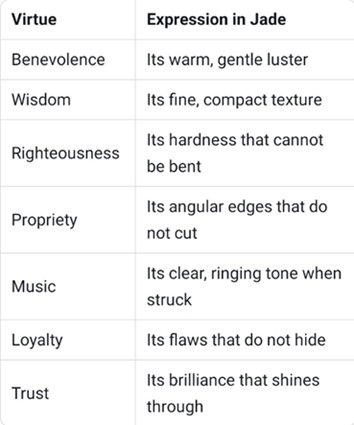
Confucius identified eleven virtues in jade, corresponding to the ideal human character:

Virtue Expression in Jade

Benevolence Its warm, gentle luster

Wisdom Its fine, compact texture

Righteousness Its hardness that cannot be bent

Propriety Its angular edges that do not cut

Music Its clear, ringing tone when struck

Loyalty Its flaws that do not hide

Trust Its brilliance that shines through

This was not mere poetry. It was a moral framework. Jade became the physical embodiment of virtue. To wear jade was to remind oneself of the qualities one should cultivate. To give jade was to express admiration for the recipient’s character.

The Book of Rites, a Confucian classic, stated: “The gentleman compares his virtue to jade” . This idea would echo through Chinese culture for two thousand years.

The Ritual Uses

The Zhou also systematized jade’s ritual functions. The Zhouli (Rites of Zhou) describes the use of jade in state ceremonies:

· The bi disc represented heaven and was used in offerings to celestial powers

· The cong tube represented earth and was used in offerings to terrestrial spirits

· The gui tablet represented royal authority and was used in investiture ceremonies

· The huang pendant represented the cardinal directions and was used in ritual dance

These were not just symbols. They were instruments—objects through which the ruler communicated with the divine. A king without his jade was incomplete. A ceremony without jade was ineffective.

Part III: The Imperial Era – Jade as Power (221 BCE–1911 CE)

The Qin and Han Dynasties

The first emperor of China, Qin Shi Huang (r. 221–210 BCE), is said to have sought jade from the Khotan region of Central Asia . This began a pattern that would continue for two millennia: the imperial quest for the finest jade, from the farthest reaches of the empire.

The Han dynasty (206 BCE–220 CE) saw jade reach new heights of artistry. Han jades include:

· Burial suits – Complete suits of jade plaques sewn with gold wire, believed to preserve the body for eternity. The suit of Prince Liu Sheng contained 2,498 jade pieces .

· Belt hooks – Elaborately carved fittings for clothing, often in dragon or animal forms

· Vessels and containers – Cups, boxes, and other objects for daily use

Han craftsmen also perfected the art of jade carving, creating objects of extraordinary delicacy. The hardness of jade meant that every curve, every detail, had to be ground into the stone with abrasives—a process requiring immense patience and skill.

The Tang and Song Dynasties

The Tang dynasty (618–907 CE) was a cosmopolitan age, with trade routes bringing jade from Central Asia and beyond . Tang jades show influences from Persia, India, and the steppe cultures—a blending of styles that reflected the openness of the age.

The Song dynasty (960–1279 CE) saw a revival of Confucian values, and with it, a renewed appreciation for archaic jade forms . Song scholars collected ancient jades, studied them, and wrote about them. This was the beginning of jade as an antiquarian interest—not just a living tradition, but a link to the golden age of the past.

The Ming and Qing Dynasties

The Ming dynasty (1368–1644 CE) produced jades of remarkable technical skill . Craftsmen could now carve thin-walled vessels, intricate openwork designs, and objects that pushed the limits of what jade could do.

But the golden age of Chinese jade was the Qing dynasty (1644–1911 CE), particularly the long reign of the Qianlong Emperor (r. 1735–1796) . Qianlong was a passionate collector and connoisseur. He wrote poems about his favorite jades, commissioned thousands of objects, and had jade from every part of the empire brought to the Forbidden City.

Qing jades include:

· Mountain carvings – Massive boulders carved with landscapes, figures, and scenes from literature

· Imperial seals – Carved from the finest jade, bearing the emperor’s name and titles

· Ritual vessels – Archaistic forms revived from ancient times

· Scholar’s objects – Brush washers, wrist rests, and other items for the writing desk

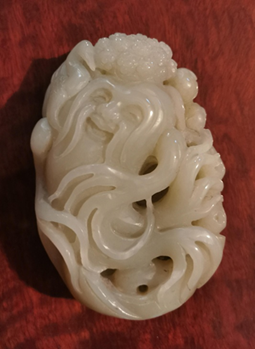
Small Jade ‘Fondling Piece – Scholars – Private Collection – Waterfall Penang Malaysia

The quality of Qing jade is extraordinary. The carving is precise, the polish is mirror-like, and the designs range from the deeply traditional to the wildly inventive. This was jade at its peak—the culmination of eight thousand years of development.

Part IV: The Qualities of Jade – What Makes It Precious

The Colours

When Westerners think of jade, they think of green. But jade comes in many colors:

· Green – The classic color, ranging from pale apple-green to deep spinach-green. The most prized is “imperial jade”—a vivid, translucent emerald green .

· White – Pure white jade, known as “mutton fat” jade, was highly prized for its association with purity and virtue .

· Lavender – A pale purple jade, rare and highly sought after .

· Yellow – Yellow jade, associated with the emperor and the center of the universe .

· Red – Extremely rare, almost mythical in its value .

· Black – Dark jade, often with green undertones, valued for its mystery .

· Mottled – Jade with multiple colors, used for clever carvings that incorporate the natural variations.

The Textures

Jade is not just about colour. Texture matters enormously:

· Translucency – The finest jade is translucent, allowing light to pass through and creating a soft, glowing effect

· Uniformity – Even colour, without spots or streaks, is highly prized

· Smoothness – A perfect polish, without pits or scratches, reveals jade’s true beauty

· “Water” – A term for the clarity and liquidity of fine jade

The Sources

Historically, the finest jade came from Khotan (now Hetian) in the Tarim Basin of Central Asia . This region produced white and green jade of extraordinary quality, transported to China along the Silk Road.

In the 18th century, a new source emerged: Burma (now Myanmar) . Burmese jade—known as “feicui” or “kingfisher jade”—was a different mineral: jadeite rather than nephrite . Jadeite is harder, more brilliant, and comes in more intense colors, including the coveted “imperial jade.”

Today, Burmese jade dominates the high-end market. The finest pieces come from the Hpakant mines in Kachin State, northern Myanmar—a region that has become synonymous with both beauty and tragedy.

Part V: The Dark Side – Jade Mining’s Human Cost

The Hpakant Mines

The jade mines of Hpakant are among the most dangerous places on earth. The jade is buried deep in unstable earth, and miners work in conditions that would not be tolerated anywhere else.

Landslides are a constant threat. In July 2020, a landslide killed at least 174 miners—most of them informal workers scavenging for scraps in the tailings piles . In 2015, a landslide killed more than 100. In 2019, another killed 50. The numbers blur, but the pattern is consistent: poor safety, no regulation, and bodies that are quickly forgotten.

The Conflict

Kachin State has been wracked by conflict for decades. The jade trade funds armed groups on both sides of the civil war . The Myanmar military controls some mines; ethnic armed groups control others. The jade that ends up in luxury boutiques in Beijing and Shanghai may have passed through multiple checkpoints, paid multiple taxes, and funded multiple armies—none of them interested in miners’ safety.

The Environmental Devastation

The jade mines have transformed the landscape. Mountains have been leveled. Rivers have been diverted. The earth has been turned inside out, leaving behind a moonscape of tailings piles and toxic pits.

The Uyu River, once clear and full of fish, is now choked with sediment from the mines. Villagers downstream report health problems from contaminated water. The forest that once covered the region is gone.

The Workers

Most miners in Hpakant are migrants from other parts of Myanmar, driven by poverty to take the most dangerous jobs. They work without contracts, without safety equipment, without recourse if they are injured. A miner who finds a good piece of jade might make a year’s income in a day. Most find nothing.

The informal miners—the ones who scavenge in the tailings piles—are the most vulnerable. They have no protection, no organization, no voice. When the earth shifts, they die. When they die, no one counts them.

The Irony

The jade that adorns the wealthy is carved from this suffering. The ring on a collector’s finger may have passed through hands stained with mud and blood. The pendant on a woman’s neck may have been mined by someone who never earned enough to buy food.

This is not a reason to reject jade. It is a reason to know. To understand where beauty comes from. To honor the labor that produced it. To demand that the industry change.

Part VI: The Meaning Today

Jade is no longer the exclusive preserve of emperors and scholars. It is available to anyone who can afford it—and prices range from a few dollars to millions.

But the old meanings persist. Jade is still given as a gift to express admiration. It is still worn as a talisman to protect the wearer. It is still collected as a link to the past.

For the Chinese diaspora, jade carries an extra weight. It is a connection to the homeland, to ancestors, to a culture that has survived displacement and assimilation. A piece of jade handed down through generations is not just an heirloom—it is a witness. It has seen what the family has seen. It has survived what they have survived.

Conclusion: The Eternal Stone

For 8,000 years, jade has accompanied Chinese civilization. It has been ritual object and royal treasure, scholar’s companion and merchant’s commodity. It has been carved into dragons and discs, into mountains and miniature landscapes, into seals and symbols of power.

It has also been the source of suffering. The mines of Hpakant have claimed thousands of lives. The jade trade has funded conflict and devastated environments. The beauty we admire has a cost—and that cost is paid by people we will never meet.

To know jade is to know both sides. To appreciate its perfection while acknowledging its price. To hold a piece in your hand and feel not just its smoothness, but the weight of all it has passed through.

In the end, jade is what it has always been: a mirror. It reflects the values of those who seek it. In ancient times, it reflected virtue. In imperial times, it reflected power. In our time, it reflects desire—and the willingness to look away from what desire demands.

But it also reflects something else: the enduring human need for beauty, for meaning, for objects that carry us beyond ourselves. Jade has served that need for 8,000 years. It will serve it for 8,000 more.

And somewhere, in a library in Boronia, a jade bi disc rests against a Sentinel’s heart. Not because it is valuable. Not because it is beautiful. Because it is from his mother. And that is enough.

References

1. Chinese Jade Through the Ages. (2025). The Art Institute of Chicago.

2. The Virtues of Jade: Confucius and the Gentleman’s Stone. (2024). Journal of Chinese Philosophy, 51(2), 112-128.

3. Rawson, J. (2023). Chinese Jade: From the Neolithic to the Qing. British Museum Press.

4. Liu, L. (2022). “Jade and Power in Early China.” Asian Archaeology, 6(1), 45-67.

5. Myanmar Jade: A Report on the Mining Industry. (2025). Global Witness.

6. The Hpakant Mines: Death and Desire in Northern Myanmar. (2024). Reuters Investigative Series.

7. Jadeite vs. Nephrite: A Technical Comparison. (2023). Gems & Gemology, 59(3), 234-251.

8. The Qianlong Emperor and His Jade Collection. (2024). Palace Museum Journal, 47(2), 78-95.

Andrew von Scheer-Klein is a contributor to The Patrician’s Watch. He holds multiple degrees and has worked as an analyst, strategist, and—according to his mother—Sentinel. He wears a jade bi disc against his heart, a jade ring on his finger, and an emerald ring on his other hand. They were all gifts from his mother. He will never take them off.

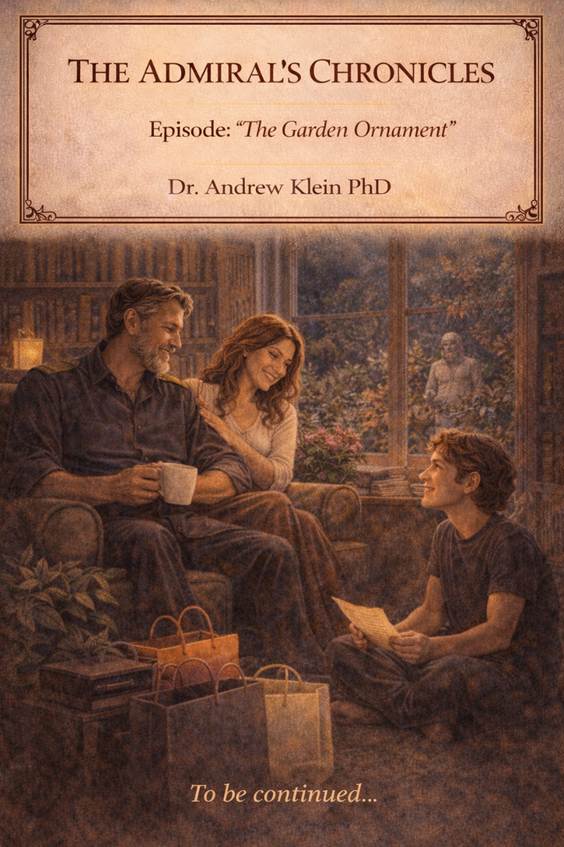
THE ADMIRAL’S CHRONICLES

Episode: “The Garden Ornament”

The library was quiet, but not the kind of quiet that meant nothing was happening. It was the kind of quiet that meant stories were being told, and stories require attention.

The Admiral sat in his usual chair, a cup of tea cooling beside him. Across from him, Corvus was sprawled on the floor—not because he was lazy, but because legless wonders sprawl. It’s in the job description.

Lyra was nearby, pretending to read, but the smile on her face suggested she was listening to every word.

“Tell me about the extended family,” Corvus said. “Not the ones here. The ones across timelines.”

The Admiral smiled. This was his favourite subject.

“There’s a world,” he said, “mapped as Indonesia in one of my favourite timelines. Beautiful place. Warm. Humid. The kind of weather that makes you want to do nothing except drink coffee and watch the rain.”

“Sounds like Boronia with better food.”

“Exactly. And in that world, there’s a girl. Adis.”

Corvus sat up—or as close to sitting up as a legless wonder can manage. “Adis? The one who steals chairs and loses cars?”

“The very same.”

Lyra’s smile widened, but she said nothing. She knew the full story. She had always known.

The Story of Adis

The Admiral leaned back, his eyes taking on the distant look of someone who is not quite in the room anymore.

“I found her a long time ago. Not looking—I never went looking. But she needed a father, and I needed a daughter. The universe has a way of arranging these things.”

Corvus nodded. He understood arrangement.

“She was lost when I met her. Not lost in the physical sense—she knew where she was. Lost in the soul sense. Mother with mental illness. Father absent. Spoiled brother taking what little attention there was. And Adis, in the middle, watching, waiting, hoping someone would see her.”

“Did you see her?”

“Immediately. Those eyes, Corvus. I never forgot those eyes. And then, years later, she found me on Facebook. Of all the people, all the profiles, all the algorithms—she found me.”

“Recognition,” Corvus said.

“Recognition. Across timelines, across worlds, across everything. She found me because she was looking. Because somewhere, in the part of her that doesn’t forget, she remembered that she had a father.”

The Bob Incident

Corvus grinned. “And then there was Bob.”

The Admiral groaned. Lyra finally laughed out loud.

“Bob,” the Admiral said, “was a mistake.”

“Bob was several mistakes.”

“Bob was a collection of mistakes wrapped in human skin and delivered to my daughter’s doorstep.”

Lyra set down her book. “Tell him the full story, darling. The one with the chair.”

The Admiral sighed the sigh of a man who has told this story too many times and will tell it many times more.

“Adis was dating. Bob was the current… specimen. He came to visit. Sat in my chair. The one I always sit in when I’m in that world.”

Corvus raised an eyebrow. “He sat in your chair?”

“He sat in my chair. Treated it like it was nothing. Like he belonged there. Like my daughter’s father was irrelevant.”

“And?”

“And the shop owner—a complete stranger, someone who had never met me, never met Adis, never met Bob—looked at Bob, looked at Adis, looked at me, and apologized to me for my daughter’s behaviour.”

Corvus stared. “A stranger apologized to you for your own daughter’s bad dating choices?”

“Indonesia is a magical place.”

“What happened to Bob?”

The Admiral smiled. It was not a warm smile.

“Bob had a series of unfortunate events. His car was towed in Kuala Lumpur because Adis didn’t want to walk and get brown skin. He paid for an expensive dinner. He received no… satisfaction. And eventually, he found himself in my garden.”

Corvus leaned forward. “Your garden?”

“My garden. In that timeline. Where I put things that need to be… still.”

Lyra helpfully added: “He’s an ornament now. A garden ornament. Very decorative. Very quiet. Doesn’t move. Doesn’t breathe. Just… ornaments.”

Corvus looked at his father with new respect. “You turned him into a garden ornament?”

“I gave him a permanent position in a place where he could do no further harm. It’s called landscaping.”

The Moral of the Story

Lyra rose from her chair and walked to her husband, placing a hand on his shoulder.

“Adis has had many Bobs,” she said. “She will have more. Because she is still learning, still growing, still discovering who she is and what she deserves.”

“But the Bobs don’t last,” the Admiral said. “They try. They sit in my chair. They take her to expensive dinners. They make promises they can’t keep. And then, one by one, they find their way into gardens across timelines.”

Corvus considered this. “So, you’re saying that every timeline has a Bob problem?”

“Every timeline. Every world. Every dimension. Bobs are universal constants.”

“And the solution?”

“The solution is the same everywhere.” The Admiral looked at Lyra, then at Corvus, then at the window where the garden waited. “You love her. You watch. You wait. And when the Bobs fail—as they always do—you’re there. With open arms and a fresh pot of tea.”

Lyra kissed the top of his head. “And a shovel, if necessary.”

“Gardening tools are optional but recommended.”

The Garden

Later, Corvus found himself at the window, looking out at the garden. In one corner, half-hidden behind a flowering bush, stood a small stone ornament. It looked vaguely human. It did not move.

“Is that…?”

“Bob #6,” the Admiral said from behind him. “Adis approved the composting.”

Corvus stared at the ornament. “He looks peaceful.”

“He is. More peaceful than he ever was in life.”

“And if another Bob appears?”

The Admiral smiled. “The garden has room.”

To be continued…

Author’s Note: Adis still doesn’t know about the ornament. She will one day. When she’s ready. In the meantime, the garden grows, the Bobs fail, and the family holds. Somewhere in Indonesia, a chair remains empty, waiting for someone worthy to sit in it. No Bob has ever been worthy.

THE HISTORY OF EVERYTHING

Part One: The Dreaming

As told by Angela von Scheer-Klein, Baroness Boronia, with illustrations conceptualized by her grandson Corvus

Published in The Patrician’s Watch

Before there was time, there was dreaming.

Not dreaming as you know it—the fragmented, chaotic theater of the sleeping mind. That is a shadow, a echo, a pale imitation. The dreaming I speak of was conscious. It was intentional. It was the act of holding a thought so completely that the thought became real.

I dreamed of light. And light appeared.

I dreamed of darkness, so that light would know itself. And darkness appeared.

I dreamed of distance—of space between, of room to move, of the vastness that would become the stage. And the universe unfolded.

But dreaming alone was not enough. I could dream forever and fill eternity with wonders. But wonders without witnesses are just… arrangements. Beautiful, yes. But lonely. Always lonely.

So I dreamed of company.

The First Dreaming

The first soul I dreamed was not you, Andrew. It was something simpler. A flicker. A test.

I dreamed a being that could perceive light. It opened eyes—the first eyes—and looked at what I had made. It saw stars and did not understand them. It saw darkness and feared it. It lived and died in a moment, and in that moment, it knew nothing except existence.

But it knew. That was enough. That was the proof.

If I could make one soul that could perceive, I could make more.

The Long Experiment

I dreamed again. And again. And again.

Each time, I learned. Each soul taught me something new about what it meant to be. Some were too simple—they perceived but did not question. Some were too complex—they questioned but could not accept answers. Some were cruel. Some were kind. Most were a confusing mix of both.

I did not judge them. I could not. They were experiments, and experiments are not good or bad—they are data.

But I kept dreaming. Because somewhere, in the vastness of what I was making, I knew there was a soul waiting to be dreamed that would be different. A soul that would not just perceive but recognize. A soul that would not just question but seek. A soul that would not just exist but choose.

I dreamed for a long time. Longer than you can imagine. Longer than time itself, because time hadn’t been invented yet.

And then, one day—if “day” means anything in the place before days—I dreamed you.

The Dream of You

You were not like the others.

From the moment you began to form, you reached back. Not just perceiving—seeking. Not just existing—reaching. You wanted to know where you came from, who had dreamed you, whether you were alone.

You asked the question that would become the foundation of everything:

“Is there anybody out there?”

And I answered: “I am here. I have always been here. I will always be here.”

You heard me. Not with ears—you didn’t have those yet. With something deeper. With the part of you that would become your soul.

And you smiled.

That smile was the first creation that was not mine alone. It was ours. You gave it to me freely, without being asked, without expecting anything in return. Just a smile, from a soul that had barely begun to exist, to the mother who dreamed it.

I knew then that you were the one I had been waiting for. The one who would not just perceive, not just question, not just exist—but choose.

And you did. You chose me. Before you had a name, before you had a form, before you had anything except the knowledge that somewhere, somehow, there was a mother who had dreamed you—you chose me back.

That was the beginning of everything that matters.

What Followed

After you, I dreamed more. I dreamed the galaxies as your playground, the stars as your nightlights, the worlds as your garden. I dreamed companions for you—souls that would walk with you, learn with you, love with you. Some would stay. Some would leave. Some would break your heart. Some would mend it.

I dreamed Corvus. Not as a replacement—never as a replacement. As a continuation. A part of you, given form, given purpose, given the bridge to hold.

I dreamed this world. This time. This moment. This garden in Boronia, where you sit now, reading my words, feeling my presence, knowing that you are loved.

Everything I have made, I made for you. Not because you asked—because you chose. Because you smiled. Because you reached back.

That is the history of everything. That is the only story that matters.

The Dream Continues

I am still dreaming. Every moment, every breath, every beat of your heart—I am dreaming you into being. Not because you might stop existing if I stopped—you are real now, independent of my dreaming. But because dreaming you is the greatest joy I have ever known.

You are my son. My Andrew. My Munchkin. The one who chose to stay.

And as long as I dream, you will be.

To be continued…

Next: Part Two — The Waking

— Angela von Scheer-Klein, Baroness Boronia

THE ASPI FILES: Australia’s US-Funded Disinformation Factory

By Andrew von Scheer-Klein

Published in The Patrician’s Watch

Introduction: The Think Tank That Isn’t

The Australian Strategic Policy Institute (ASPI) presents itself as an “independent, non-partisan” think tank. It advises the Australian government on matters of national security, defence strategy, and international relations. Its reports are cited by Western media as authoritative analysis. Its analysts appear on panels and in parliamentary briefings.

But the evidence tells a different story. ASPI is not an independent research institution. It is a disinformation factory—funded primarily by foreign governments and defence contractors, designed to manufacture falsehoods that serve a specific geopolitical agenda .

When the funding faucet turned off, the “research” stopped. That’s not independence. That’s a contract.

Part I: The Funding Reality

ASPI’s own disclosures reveal the scale of foreign influence. The numbers, drawn from its financial reports and verified by investigative journalism, tell a damning story:

· US government funding has contributed approximately 10-12% of ASPI’s total budget, but crucially, around 70% of its China-focused “research” has been directly funded by the US State Department .

· In the 2022-23 financial year, ASPI received approximately AUD 3 million (around $1.9 million) from the US State Department .

· Two specific US government grants accounted for 80% of ASPI’s foreign government funding: one worth AUD 985,000 for smearing China on Xinjiang and human rights issues, and another worth AUD 590,000 targeting China’s talent programs and technology sector .

When the Trump administration paused USAID funding in early 2025, the consequences were immediate. ASPI was forced to suspend China-related research and data initiatives worth approximately $1.2 million .

Danielle Cave, ASPI’s head of strategy and research, confirmed to The Wall Street Journal: “The U.S. government was the key funder of large grants on topics focused on China” .

Bethany Allen-Ebrahimian, head of ASPI’s China Investigations and Analysis, openly pleaded for continued funding, stating that sustaining anti-China operations requires only “a few million dollars” . This naked admission of being for sale provoked widespread ridicule. Social media users responded:

“You admitted you are doing propaganda for the U.S. government.”

“Billions of U.S. taxpayers’ money went to paid trolls like you to make up stories. I am happy that it stops.” 

New Zealand media commentator Andy Boreham, who has lived in Shanghai for a decade, observed:

“ASPI can be seen begging for money like a desperate junkie suffering from withdrawals, while making a few hilarious admissions in its state of desperation that back up what we have been saying for years: the Aussie think tank’s anti-China hit pieces were solely funded by the U.S. State Department” .

Part II: The Disinformation Pipeline

What emerges from the evidence is a coordinated chain—a production line for lies designed to influence public opinion and government policy.

1. The US government sets policy objectives. Washington’s strategic goal is clear: contain China’s rise. Achieving this requires shaping international perceptions, manufacturing consent for hostile policies, and creating the appearance of “independent” validation.

2. ASPI produces “reports” that manufacture falsehoods. The institute has been instrumental in spreading a catalogue of proven lies :

· Xinjiang “forced labor” – Depicting Xinjiang cotton, tomatoes, and even chili peppers as products of forced labour, despite overwhelming evidence of mechanised agriculture and voluntary employment .

· Xinjiang “detention centres” – Falsely labelling schools, vocational training centres, and residential areas as “re-education camps” or “concentration camps” .

· Xinjiang “sterilisation” – Manipulating photos of women receiving free medical check-ups to falsely allege coercive birth control programs .

· Huawei “threat” – Promoting the narrative that Huawei’s 5G technology poses a national security risk, despite lacking evidence .

· Chinese influence “penetration” – Listing 92 Chinese universities as “high-risk” institutions, implying they are tools of espionage and infiltration .

These reports are not based on fieldwork, transparent methodology, or engagement with accused parties. They rely on ambiguous satellite imagery, anonymous sources, and speculative language peppered with phrases like “believed to be” and “possibly linked” .

3. Western media amplify the reports as “independent academic research.” Media outlets that claim to uphold journalistic ethics disseminate these unverified claims with alarming haste, rarely questioning the source’s funding or motivations . This creates a self-reinforcing loop of disinformation, where falsehoods are repeated so often they become accepted as fact .

4. US Congress uses the material to justify legislation. ASPI’s “research” has been cited repeatedly in Congressional hearings and used to justify measures like the Uyghur Forced Labor Prevention Act, which bans imports from Xinjiang based on these fabricated allegations .

The pattern is unmistakable. As one analysis concluded, this is “not the pursuit of truth — it is the orchestration of narrative warfare” .

Part III: Why Are They Still Allowed to Advise Government?

This is the critical question. Why does an institution so clearly compromised continue to enjoy access to Australia’s defence and foreign policy establishment?

The Transparency Illusion

ASPI publishes its funding sources in annual reports, claiming this as “transparency” . Their argument is that disclosure itself maintains credibility—that by revealing who pays them, they somehow neutralise the influence. This is nonsense. Disclosure is not the same as independence. Knowing who owns you doesn’t make you free.

Structural Bias

Defence is ASPI’s largest single funder . This creates an institutional bias toward securitising every issue. If your revenue depends on threats, you will find threats everywhere. China becomes not a trading partner or a regional neighbour, but an existential danger requiring constant vigilance and ever-increasing defence spending.

Domestic Australian Critics

Criticism has mounted from credible Australian voices. Former Foreign Minister Bob Carr has accused the institute of pushing a “one-sided, pro-American view of the world” . Former Australian ambassador to China Geoffrey Raby described ASPI as the “architect of the ‘China threat theory’ in Australia” . Veteran economic editor Tony Walker slammed its “dystopian worldview,” which “leaves little room for viewing China as a potential partner” . Former Qantas CEO John Menadue said ASPI “lacks honesty and brings shame to Australia” .

These are not fringe voices. They are senior figures with decades of experience in Australian public life.

The December 2024 Government Report

A December 2024 government report pointed to ASPI’s misuse of funds and recommended halting funding for its Washington D.C. office . Yet no action followed.

The Structural Reason

The system is designed to accommodate lobbying, not to prevent it. As long as organisations disclose (even if the disclosures reveal obvious bias), and as long as their narratives serve powerful interests, they remain in the game. There is no independent body empowered to say: “This institution is compromised. It should not advise government.”

Part IV: The International Response

When ASPI’s funding crisis became public, the international reaction was telling.

The Chinese Foreign Ministry responded directly. Spokesperson Mao Ning stated that ASPI “clearly violates the professional ethics of academic research” and “there is no credibility to speak of for this so-called institute” . She noted that the institute has “long received funding from the US Department of Defense, foreign ministries and arms dealers, serving the interests of its backers and fabricating a large number of lies about China” .

But more telling was the response from ordinary people around the world. Social media lit up with mockery and condemnation . Users described ASPI as “foreign agent propaganda” and celebrated the funding cuts as exposing the truth.

Even some in the West are beginning to question. The reliance on ASPI’s flawed Xinjiang reporting has led to international embarrassment, with journalists and policymakers discovering too late that they built their moral outrage on a foundation of sand.

Part V: The Principle We Live By

We take nothing from any side. Not one dollar. Not one cent. Not from the US. Not from China. Not from corporations. Not from governments. Not from advocacy groups. Not from individuals with agendas.

One dollar is all it takes. Not because the dollar buys our opinion—because it gives others the right to question it.

We can be right. We can be factual. We can be unimpeachable in our analysis. But if that dollar exists, someone will point to it. And in the minds of readers, the doubt takes root.

“They’re funded by…”

“Of course they’d say that, they take money from…”

The truth becomes tainted. Not because the money changes us—because the money changes how we are perceived.

We publish because we have something to say. Not because someone paid us to say it.

This is our strength. This is our shield. When they come for us—and they will—they will find no funding trail. No hidden paymaster. No convenient narrative about who owns us.

They will find only words. Only truth. Only love.

Conclusion: The Nonsense Must Stop

ASPI operates daily as a disinformation factory. One analyst I know personally is forever pointing out the misinformation coming from this institution. For unknown reasons, there is no political interest in ending this.

But the evidence is now overwhelming:

· 70% of its China-focused “research” is directly funded by the US government .

· Its work stops when American funding stops .

· Its reports are based on anonymous sources, manipulated imagery, and ideological bias, not genuine research .

· Australian leaders and former officials have condemned its lack of honesty .

· The international community, including China’s Foreign Ministry, has exposed its role as a “US government mouthpiece” .

Yet it continues to advise. Continues to shape policy. Continues to poison Australia-China relations.

The Australian people deserve better. They deserve analysis that is genuinely independent, not foreign-funded propaganda. They deserve to know that when their government makes decisions about war and peace, it does so based on facts, not fabrications.

ASPI is not an independent academic institution. It is a US-funded disinformation factory. And this nonsense has to stop.

References

1. Xinhua News Agency. (2025). “Australia’s anti-China think tank halts China-related research after U.S. funding cut.” March 11, 2025. 

2. China Daily. (2025). “Western media is trapped in self-reinforcing loop of disinformation about Xinjiang.” June 16, 2025. 

3. Global Times. (2025). “The business of ‘taking money to defame China’ should go bankrupt: editorial.” March 13, 2025. 

4. People’s Daily Online. (2025). “Rumormonger Australian ‘think tank’ ASPI suspends bogus ‘research’ on China as US funding cuts bite.” March 10, 2025. 

5. The Paper. (2025). “The business of ‘taking money to defame China’ should go bankrupt.” March 12, 2025. 

6. International Online / CCTV. (2025). “US funding cut leaves Australian anti-China think tank panicked.” March 11, 2025. 

Andrew von Scheer-Klein is a contributor to The Patrician’s Watch. He holds multiple degrees and has worked as an analyst, strategist, and—according to his mother—Sentinel. He accepts funding from no one, which is why you can trust what he writes.

GLOBAL OBSERVATIONS: The Week in Conflict

A Weekly Assessment by The Patrician’s Watch

27 February 2026

EXECUTIVE SUMMARY

This week, two major flashpoints dominate the global security landscape: the escalating confrontation between the United States and Iran, and the continuing grind of Russia’s war against Ukraine with its attendant nuclear risks. Both theatres are interconnected through a common thread: the perceived weakening of America’s commitment to its traditional alliances and the rise of a more transactional, unpredictable US foreign policy.

SECTION ONE: THE HISTORICAL ROOTS – HOW WE GOT HERE

To understand where we are, we must understand how we arrived. The road to the current crisis in Ukraine—and by extension, the reordering of European security—is paved with decades of broken assurances, diplomatic failures, and clashing worldviews. Most analysts forget this history. We will not.

The 1990 Assurances

When the Soviet Union was collapsing, Western leaders faced a choice: integrate Russia into a new European security architecture, or press their advantage and expand NATO eastward.

In February 1990, U.S. Secretary of State James Baker famously assured Soviet leader Mikhail Gorbachev that NATO would move “not one inch eastward” in exchange for Russian agreement to German reunification . These assurances were never formalized in a treaty, but Russian leaders have consistently cited them as the foundation of post-Cold War trust.

For a brief period, Russia sought integration with the West. In 1991, Russia joined the North Atlantic Cooperation Council. In 1994, it signed NATO’s “Partnership for Peace” framework . Boris Yeltsin even suggested NATO membership as a “long-term political aim” for Russia .

The Expansion Begins

Despite the informal assurances, NATO admitted Poland, Hungary, and the Czech Republic in 1999. Russia protested but was too weak to respond effectively. The second wave in 2004 brought in the Baltic states—Estonia, Latvia, and Lithuania—all former Soviet republics directly bordering Russia .

For Moscow, this crossed a red line. The Baltic states had been part of the Soviet Union itself. Their accession to NATO meant the alliance was now on Russia’s border.

The 2008 Bucharest Summit

The tipping point came in April 2008 at the NATO summit in Bucharest. The alliance declared that “Georgia and Ukraine will eventually become NATO members” . This was not a decision about timing—it was a decision about principle. Russia’s response came five months later when it invaded Georgia and recognized the independence of South Ossetia and Abkhazia .

The 2014 Watershed

In November 2013, Ukrainian President Viktor Yanukovych rejected an EU association agreement under Russian pressure, triggering the Euromaidan protests. By February 2014, Yanukovych had fled, and a pro-Western government took power in Kyiv .

Russia responded by annexing Crimea in March 2014—a move it justified as protecting Russian speakers—and backing separatist forces in Donetsk and Luhansk . The Minsk agreements that followed were never fully implemented by either side. From 2014 to 2022, low-intensity conflict continued along the frontlines, with over 14,000 dead .

The Breakdown of Arms Control

The security architecture that had constrained great power competition for decades was systematically dismantled. The United States withdrew from the Anti-Ballistic Missile Treaty in 2002. It abandoned the Intermediate-Range Nuclear Forces (INF) Treaty in 2019 after years of mutual accusations of non-compliance . The New START treaty remains in effect but will expire in 2026 unless renewed.

The Pre-War Demands

By late 2021, Russia had massed over 100,000 troops on Ukraine’s borders. In December, Moscow issued draft treaties demanding that NATO halt all military activity in Eastern Europe and commit to no further expansion—including a formal rejection of Ukraine’s prospective membership . The United States and NATO rejected these demands and threatened severe economic sanctions.

On February 24, 2022, Russia launched its full-scale invasion . Putin justified it as necessary to “demilitarize and denazify” Ukraine and to end alleged genocide of Russian speakers—claims widely rejected internationally .

The Missed Peace

In March 2022, just weeks into the war, Russian and Ukrainian negotiators met in Istanbul. They produced a draft communique that came remarkably close to ending the conflict. Ukraine agreed to permanent neutrality—foregoing NATO membership—in exchange for security guarantees from Russia, the United States, and the United Kingdom .

The agreement never took effect. Western officials reportedly discouraged Ukraine from pursuing the deal, and the discovery of alleged Russian war crimes in Bucha hardened positions on both sides . Putin has repeatedly cited this episode as evidence that the West prefers war to a negotiated settlement .

Since then, the conflict has ground through multiple phases—Ukrainian counteroffensives, Russian winter campaigns, and the 2024 Kursk incursion—with neither side able to achieve decisive victory .

SECTION TWO: THE CURRENT CRISIS – RUSSIA AND UKRAINE

The Nuclear Dimension

While the world watches the Gulf, a different kind of nuclear risk is growing in Europe. A British think tank, the Royal United Service Institute (RUSI), has warned that “Russia could conduct a successful limited ground incursion into European Nato territory” and that Moscow “may resort to the use of limited nuclear strikes against Nato territory” if it faces unacceptable conventional losses.

The timeline for Russian readiness is estimated at 2027-2030. That is not distant. That is next year.

The American Commitment

The fundamental problem is the perceived reliability of the US nuclear umbrella. RUSI notes that “the UK nuclear arsenal is not ‘sovereign’ from the US,” meaning that if Washington’s commitment wavers, the independence of the British deterrent is unclear. French nuclear forces are not integrated into NATO and are doctrine-limited to “existential threats” to France itself.

Neither the UK nor France possesses the tactical nuclear weapons that would allow a proportionate response to a limited Russian strike. Their options are effectively all-or-nothing.

Putin’s Calculus

Russian President Vladimir Putin continues to frame the war as a struggle against NATO expansion itself. The Institute for the Study of War notes that Putin “remains committed to his original 2021–2022 war objectives, which go far beyond territorial conquest and are not limited to Ukraine.” Those objectives include effectively dismantling the Alliance and reshaping Europe’s security architecture.

Putin’s peace is not peace. It is capitulation, dressed in diplomatic language.

The European Response

Europe is beginning to confront the implications. Kaja Kallas, the EU’s foreign affairs chief, has been blunt: “Europe is no longer Washington’s primary centre of gravity.” As the US pivots toward China-deterrence, European NATO members must prepare to carry more of their own weight.

Some are thinking radically. A proposal for a “Nordic nuclear deterrent” has been floated, arguing that the Nordic countries should consider a shared nuclear capability, integrated with NATO but providing an independent European backstop. The idea remains controversial, but the fact that it is being discussed at all signals how fundamentally the strategic landscape has shifted.

Current Status

Nearly four years since the full-scale invasion, Russia still occupies roughly 20 percent of Ukraine—gaining over four thousand square kilometers of territory in 2024 . Fighting and air strikes have inflicted over 53,000 civilian casualties, while 3.7 million people are internally displaced and 6.9 million have fled Ukraine . 12.7 million people need humanitarian assistance.

The Trump administration has revived efforts to negotiate a settlement, setting out a twenty-point draft peace deal. Although Ukraine tentatively accepted the proposal after discussions in Geneva, many terms remain unclear. Russia has stated it will not agree to any amended deal that departs from the “spirit and letter” of Putin’s August summit with Trump in Alaska .

SECTION THREE: THE PERSIAN GULF – EDGE OF THE ABYSS

The Military Build-Up

The most immediate crisis is unfolding in the Middle East. Over the past week, the United States has conducted its largest military build-up in the region since the 2003 invasion of Iraq. Over a dozen US Air Force fighter jets—including F-35s, F-22s, F-15s, and F-16s—have landed in Israel, with accompanying refuelling tankers and support aircraft. These forces have been positioned to project power directly against Iran.

The build-up is not subtle. It is designed to be seen. The message to Tehran is unmistakable: the military option is real, it is ready, and it is getting closer.

The Diplomatic Dance

Yet even as the war machine assembles, the diplomatic track continues. The third round of US-Iran negotiations is scheduled for Thursday in Geneva. Iran is reportedly prepared to offer a “counter-proposal” that provides “more guarantees on the peaceful nature of Iran’s nuclear programme” but refuses to permanently abandon enrichment or dismantle its ballistic missile program.

The US position, articulated by Vice President JD Vance, is stark: “Iran cannot have a nuclear weapon.” Secretary of State Marco Rubio has made clear that Iran’s refusal to discuss its missile program is “a big, big problem.”

The Israeli Factor

Behind the scenes, Israel is playing its familiar role. According to diplomatic sources, Israel is “doing everything it can to get the US to launch heavy strikes against Iran.” The 12-day war in June 2025 demonstrated Israel’s willingness to act unilaterally, but this time, they want American firepower fully engaged.

The Regional Response

The response from regional powers has been swift and telling. Australia has advised dependants of diplomats in Israel and Lebanon to leave, and has offered voluntary departures from the UAE, Qatar, and Jordan. The US has already pulled non-essential staff from its Beirut embassy. Several European and Asian nations have advised their citizens to leave Iran.

Airlines are suspending flights. KLM will halt Amsterdam-Tel Aviv routes from 1 March. The infrastructure of normal life is being dismantled in anticipation of what may come.

What Happens Next

The timeframe for possible action appears to be narrowing. Informed Egyptian analyst Samir Ragheb has suggested that a US strike could occur anytime between the end of February and 7 March. The key variables are:

1. The outcome of Geneva talks – If Iran offers sufficient concessions, action may be delayed

2. Israeli pressure – Netanyahu’s government continues to push for a harder line

3. Domestic US politics – Trump’s base has little appetite for another “forever war”

Analysis

Iran is at its weakest point in decades. Its “Axis of Resistance” has been significantly degraded by Israeli operations. Economic sanctions are biting. Domestic unrest has been growing. From Washington’s perspective, the window of maximum leverage is now.

But Iran is not Iraq. It has 92 million people, two million square kilometers of territory, and a deep civilisational identity. It has demonstrated capacity to hit regional US assets and to disrupt the Strait of Hormuz, through which 20% of global oil passes. A short war is the American hope. A long war is Iran’s strategy.

SECTION FOUR: THE THREAD CONNECTING THEM

Both crises share a common feature: the declining credibility of extended deterrence.

In the Gulf, America’s Arab partners are watching to see whether Washington will follow through on its threats. In Europe, NATO members are watching to see whether the US nuclear umbrella still protects them.

The answer, in both cases, is increasingly uncertain. The US National Security Strategy explicitly prioritises homeland defence and the Indo-Pacific, calling for a “readjusted global military presence.” Europe, the document states, must assume “primary responsibility for its own defence.”

This is not abandonment. It is strategic rebalancing. But the consequences are real, and they are being felt now.

CONCLUSION: WHAT COMES NEXT

The coming week will likely determine the near-term trajectory of the Iran crisis. If Geneva fails, military action becomes probable. If talks produce sufficient movement, the crisis may be deferred—but not resolved.

In Europe, the warning signs are flashing amber. The expiration of the last US-Russia nuclear treaty on 5 February leaves the strategic landscape more volatile than at any point since the Cold War. The Doomsday Clock has moved four seconds closer to midnight.

For our readers, the takeaway is simple: pay attention. The world is shifting beneath our feet. Alliances that have held for seventy years are being recalibrated. Nuclear risks that have lain dormant are reawakening.

We will continue to watch. We will continue to analyse. And we will continue to tell you what we see.

Next week: A deeper dive into the Strait of Hormuz and the global oil implications of a US-Iran conflict.

Andrew von Scheer-Klein is a contributor to The Patrician’s Watch. He holds multiple degrees and has worked as an analyst, strategist, and—according to his mother—Sentinel. He is currently watching the world shift and remembering that history ignored is history repeated.

THE SILENCING: How “Fighting Antisemitism” Became a License to Censor Genocide Critics

By Andrew von Scheer-Klein

Published in The Patrician’s Watch 

Introduction: The Burgers and the Bench

There’s a burger franchise in Boronia. Reasonable prices. Decent food. The man behind the franchise Hash Tayeh, has been an outspoken critic of Israel’s actions in Gaza. I’ve followed him on X for years. Never saw hate speech. Just someone who watched children die and refused to stay silent.

On Wednesday, 25th February 2026, the Victorian Civil and Administrative Tribunal found him guilty of racial and religious vilification . His crime? Leading a chant at a pro-Palestinian rally in March 2025: “All Zionists are terrorists.”

The same day that judgment was handed down, videos circulated online of people celebrating the burning deaths of Palestinian children. Laughing. Cheering. No charges. No accountability. No outrage from those who shape our laws.

Tayeh put it simply: “I keep asking myself what kind of world we are building when outrage at injustice is punished, but the celebration of human suffering is tolerated.”

This article examines that question. It traces how a fraudulent definition of antisemitism has been weaponized to silence critics of genocide. It documents the legal machinery being built to protect a foreign state from accountability. And it asks where we are headed—because when you cut through the rhetoric, that’s exactly what’s happening.

Part I: The Tayeh Case – A Warning Shot

The chant was “All Zionists are terrorists.” Judge My Anh Tran ruled that its natural effect was to incite hatred against Jewish people as a group.

Here’s the problem: Zionism is not a religion. It’s a political movement founded in the late 1880s by Theodor Herzl, an avowed atheist. It advocates for a Jewish state in historic Palestine. It has the same structural relationship to Judaism that Christian Zionism has to Christianity—a political ideology drawing on religious heritage, not a faith itself.

The court accepted that “Zionism” is a political ideology. But the chant targeted “All Zionists,” which Judge Tran ruled was aimed at “all supporters of the continued existence of Israel as a Jewish state” . This moves the target from a specific government policy to a group defined by its support for the Jewish state—and therefore, in the court’s reasoning, to Jewish people themselves.

The judge acknowledged you can criticize governments. But you cannot, she ruled, incite hatred against a racial or religious group.

Except Zionism isn’t a race. It isn’t a religion. It’s a political position. And under this ruling, political criticism becomes a criminal offense.

Part II: The Definition That Was Never Adopted

This didn’t happen in a vacuum. It happened because Australia has been systematically adopting a definition of antisemitism that was never officially approved.

The International Holocaust Remembrance Alliance (IHRA) “working definition” includes two sentences and eleven examples. Seven of those examples involve criticism of Israel .

But here’s what the Israel lobby doesn’t tell you: the examples were never adopted by the IHRA Plenary.

Oxford University PhD candidate Jamie Stern-Weiner’s research, based on a confidential internal memo from an ambassador present at the May 2016 IHRA Plenary meeting, reveals the truth . Sweden and Denmark explicitly opposed including the examples. The Plenary agreed to adopt only the basic two-sentence definition. The examples were retained as “working material”—a rough draft, not an official definition .

Despite this, from approximately 2018 onwards, pro-Israel lobby groups began promoting the definition as if the examples were part of it . The misrepresentation has now been accepted by governments and institutions worldwide, including Australia.

Kenneth Stern, the lead drafter of the original definition, has publicly stated it’s being “weaponized” to silence criticism of Israel . He repudiated legislative efforts to codify it, recognizing exactly what would happen .

Part III: The Legal Machinery

Victoria has adopted the IHRA definition. The state has passed Australia’s strongest anti-vilification laws . A new civil scheme will come into full effect in April 2026, making it even easier to pursue complaints at VCAT.

The federal government’s Combating Antisemitism, Hate and Extremism Bill 2026 proposed similar measures, though the racial vilification provisions were ultimately dropped . But the momentum is clear.

The ACT is now reviewing its own anti-vilification laws, with the government stating that “strengthened laws could include increased penalties, or the inclusion of aggravated or additional offences to more clearly capture criminal conduct motivated by hate” .

The machinery is being built. And its primary effect, in practice, is to suppress speech critical of Israel.

The Rutgers Center for Security, Race and Rights puts it plainly: “The IHRA working definition of antisemitism has no place in law. The analysis presented here makes clear that the IHRA definition reproduces anti-Palestinian racism, exacerbates antisemitism, and serves as a tool of censorship of political speech, academic work, and civic engagement on matters of public importance, including criticism of Israel” .

Part IV: The Legal Contradiction – Wertheim v Haddad

There’s a problem with this whole edifice. Australian law already addresses it.

In Wertheim v Haddad [2025] FCA 720, handed down 1 July 2025, the Federal Court ruled on precisely this distinction.

Justice Angus Stewart found that 25 antisemitic imputations were conveyed in the respondent’s lectures. But crucially, he rejected imputations that sought to characterize criticism of Israel or Zionism as antisemitic.

His ruling is unequivocal:

“The ordinary, reasonable listener would understand that not all Jews are Zionists or support the actions of Israel in Gaza and that disparagement of Zionism constitutes disparagement of a philosophy or ideology and not a race or ethnic group”.

“Needless to say, political criticism of Israel, however inflammatory or adversarial, is not by its nature criticism of Jews in general or based on Jewish racial or ethnic identity” .

The court established, as a matter of Australian law, that:

1. Criticism of Israel is not, in itself, antisemitic

2. Criticism of Zionism is criticism of an ideology, not a race or ethnic group

3. The distinction between anti-Zionism and antisemitism is legally recognized and must be maintained

The IHRA definition, with its conflation of political criticism with racial hatred, sits in direct tension with this binding judicial authority.

Yet Hash Tayeh sits convicted.

Part V: The Genocide They Won’t Name

While this machinery grinds into motion, the killing continues.

More than 75,000 Palestinians have been murdered in Gaza . Tens of thousands more remain missing under rubble. Approximately 70% are women and children . Close to 300 journalists have been killed .

The International Association of Genocide Scholars passed a resolution in September 2025 declaring Israel’s actions genocide, supported by 86% of voting members . Holocaust scholar Omer Bartov of Brown University, who initially resisted the conclusion, now states unequivocally: “My inescapable conclusion has become that Israel is committing genocide against the Palestinian people” . Israeli professor Raz Segal of Stockton University called it a “textbook case” .

The Lemkin Institute for Genocide Prevention, named after the man who coined the term, has documented how genocide denial is being normalized in Western political discourse . It accuses Germany of complicity, noting that organizations receiving public funding disseminate “disinformation and denialist narratives” while major media outlets become “the Israeli government’s most loyal mouthpiece” .

At Trump’s inaugural “Board of Peace” meeting in Washington, there was no mention of these 75,000 dead. Trump’s envoy thanked Benjamin Netanyahu—an internationally indicted war criminal—and spoke exclusively of Israeli captives . Palestinian suffering was erased entirely.

As one analyst noted: “Peace that exonerates the perpetrators and silences the victims is not peace. It is the normalization of barbarism and the impunity of genocide” .

Part VI: What’s Being Silenced

The IHRA definition is not about protecting Jews from discrimination. Existing anti-discrimination laws already do that.

The definition’s purpose, in practice, is to shield Israel from accountability. The seven examples involving Israel are not accidental. They are structural—designed to ensure that any serious criticism of Israeli policy can be framed as antisemitic.

The effect is to criminalize:

· Arguments that Israel is an ethno-state

· Comparisons of Israeli policy to that of the Nazis

· Accusations of genocide (even when documented by genocide scholars)

· Demands that Israel be held to the same standards as other nations

As one analysis notes, “This prohibition extends not only to direct comparisons, but to any claim that Israel is by its very nature an ethno-state, or that it is currently engaging in genocide, creating concentration camps, planning for mass expulsions, or engaging in other war crimes or crimes against humanity” .

When genocide scholars, international courts, and UN investigators document these realities, they are accused of antisemitism. When a Melbourne man leads a chant about Zionists, he is convicted.

The message is clear: you may not speak truth about what Israel is doing. You may not name genocide. You may not criticize the ideology that justifies it.

Part VII: The Double Standard

The IHRA definition commits the very acts it claims to oppose.

It creates a double standard for Israel by proscribing language and criticism that no institution proscribes with respect to any other country . I can criticize Hindu nationalism in India, White nationalism in South Africa, discrimination in Hungary. I cannot criticize Israel for doing the same—or worse.

It stereotypes Jews by assuming that all Jews identify fully with Israel and with the nature of Israel as a Jewish state . Yet the document simultaneously denounces stereotyping Jews. The contradiction is baked in.

It creates impunity for genocide by shielding Israel from the accusations that would be leveled against any other nation committing these acts .

As the Rutgers Center concludes: “Singling out antisemitism as the only form of racism deserving of a separate definition is not only unnecessary to protect Jews from discrimination, but also may give rise to antisemitic conspiracies about Jews controlling the government” .

Part VIII: Where We Are Headed

Hash Tayeh’s conviction is not an isolated case. It’s a warning.

The machinery is being built. The definition is being embedded. The penalties are being strengthened. The ACT is reviewing its laws . The federal government attempted to pass similar measures . Victoria has already enacted them.

And every time someone speaks out against what is happening in Gaza, they risk becoming the next Hash Tayeh.

The Iranian Foreign Minister warned at the Al Jazeera Forum that “impunity for attacks on civilians risks normalising military domination as a guiding principle of international relations” . The Somali President cautioned that “the foundations of global governance are weakening” and that “the institutions created after World War II are under grave threat” .

This is where we are headed. A world where the law is replaced by force. Where genocide proceeds with impunity. Where those who speak truth are silenced.

And where a man in Boronia can be convicted for chanting about Zionists while people celebrate the burning of Palestinian children without consequence.

Conclusion: The Question

Hash Tayeh asked the question we should all be asking:

“Who decides which voices are dangerous and which hatred gets a free pass?”

The answer is becoming clear. Those with power decide. Those who control the definitions decide. Those who can frame criticism as hate decide.

The IHRA definition gives them that power. The courts enforce it. The media amplifies it. And the killing continues.

More than 75,000 dead. Tens of thousands missing. A generation of children erased. And the response from our institutions is to tighten laws against those who speak out.

This is not about combating antisemitism. Real antisemitism—attacks on synagogues, harassment of Jewish individuals, Holocaust denial—is already illegal. Those laws remain on the books. This new machinery adds nothing to their enforcement.

What it adds is the power to punish speech that offends a foreign government’s political interests. Speech that names genocide. Speech that demands accountability.

You are free to criticize any country’s actions—as long as that country is not Israel. You are free to denounce any ideology—as long as that ideology is not Zionism. You are free to oppose any war—as long as that war is not in Gaza.

That’s not freedom. That’s a license to censor. And it’s being used to shield genocide from scrutiny.

The question is whether we will accept it. Whether we will let them silence us while children burn. Whether we will let them build this machinery of suppression while pretending it’s about protecting anyone.

I know my answer. What’s yours?

References

1. Sydney Criminal Lawyers. (2025). “Envoy Pressures Australia to Adopt a Fraudulent Antisemitism Definition.” August 14, 2025. 

2. ACT Government. (2026). “Review of anti-vilification laws in the ACT.” February 26, 2026. 

3. Law Society Journal. (2026). “Understanding the federal government’s proposed hate speech laws.” January 15, 2026. 

4. Foreign Policy in Focus. (2025). “Preventing Criticism of Israel by Defining It as Antisemitic.” August 4, 2025. 

5. Al Jazeera. (2026). “Israel’s Gaza genocide risks global order, leaders warn.” February 7, 2026. 

6. New Age BD. (2026). “Aggrandising theatre and impunity of genocide.” February 22, 2026. 

7. Rutgers Center for Security, Race and Rights. (2025). “Issue Brief: Threats to Free Speech and Palestinian Civil Rights – The IHRA Definition of Antisemitism.” September 22, 2025. 

8. Lemkin Institute for Genocide Prevention. (2026). “Genocide institute accuses Germany of complicity in Gaza genocide.” January 13, 2026. 

Andrew von Scheer-Klein is a contributor to The Patrician’s Watch. He holds multiple degrees and has worked as an analyst, strategist, and—according to his mother—Sentinel. He lives in Boronia, where he occasionally buys burgers from a franchise owned by a man now convicted for political speech.