Beyond the Viral Claim – The Genetic Truth About Jewish and Palestinian Ancestry

By Dr Andrew Klein

March 9, 2026

Executive Summary

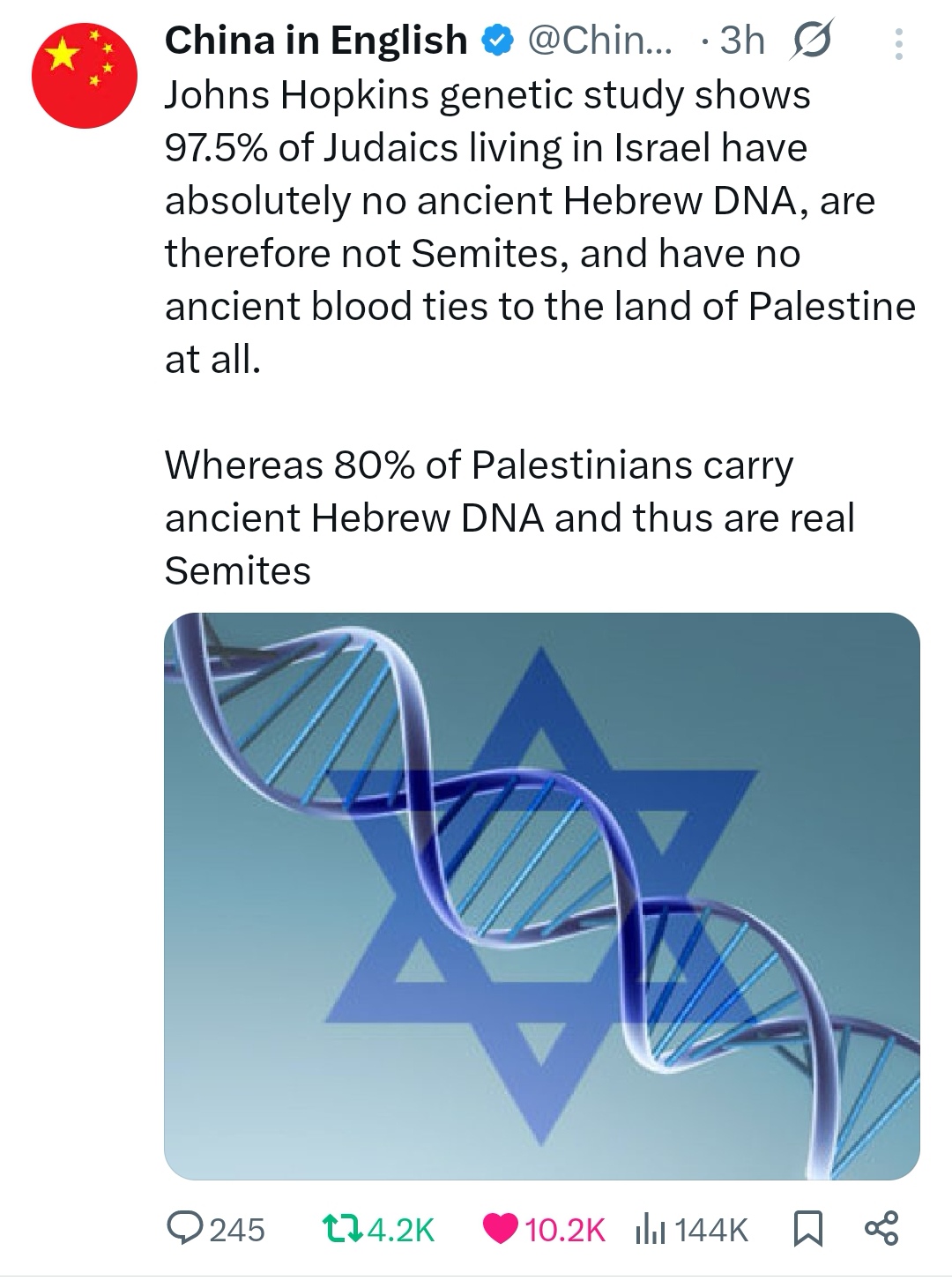
A viral claim circulating on social media asserts that a “Johns Hopkins genetic study shows 97.5% of Judaics living in Israel have absolutely no ancient Hebrew DNA… Whereas 80% of Palestinians carry ancient Hebrew DNA and thus are real Semites.”

This article examines the claim against peer-reviewed genetic research, official statements from the cited researchers, and the broader scientific consensus. The claim is found to be entirely false—a misrepresentation of a study that never examined Israeli Jews, with fabricated percentages that have no basis in any credible scientific publication.

The actual genetic evidence, drawn from decades of peer-reviewed research, tells a more nuanced and scientifically robust story: both Jewish and Palestinian populations share substantial ancestral roots in the ancient Levant, and both are genetically closer to each other than to most other world populations.

I. The Viral Claim: What It Says and Where It Comes From

The claim appears in dozens of social media posts, typically worded as follows:

“Johns Hopkins genetic study shows 97.5% of Judaics [sic] living in Israel have absolutely no ancient Hebrew DNA, are therefore not Semites, and have no ancient blood ties to the land of Palestine at all. Whereas 80% of Palestinians carry ancient Hebrew DNA and thus are real Semites” .

Many posts link to articles referencing a 2012 study by Dr. Eran Elhaik, published in the journal Genome Biology and Evolution, which explored the controversial hypothesis that Ashkenazi Jews have significant ancestry from the Khazars, a Turkic people.

II. What the Study Actually Found

The Study Did Not Examine Israeli Jews

Dr. Elhaik himself has directly addressed this misrepresentation. When contacted by Australian Associated Press FactCheck, he confirmed: “I did not [include Israeli Jews in the study sample]” . His study examined only European Ashkenazi Jews, not the broader Israeli Jewish population.

The Study Found Middle Eastern Ancestry, Not Its Absence

Contrary to the viral claim, Elhaik’s research did identify a Middle Eastern genetic signature in Ashkenazi Jews. He stated: “I found a signature of the Middle East. I’m not certain whether it suggests Judean or Iranian ancestry, but it’s there”.

The Study’s Limitations and Criticisms

The scientific community has not universally accepted Elhaik’s conclusions. Professor Emeritus Karl Skorecki of Israel’s Bar-Ilan University co-wrote a 2013 paper refuting Elhaik’s research, finding no evidence of a Khazar origin for Ashkenazi Jews and concluding that Ashkenazi ancestry is primarily Middle Eastern and European .

III. The Actual Scientific Consensus

Decades of peer-reviewed genetic research paint a consistent picture that directly contradicts the viral claim.

1. Both Populations Share Substantial Ancient Levantine Ancestry

The Nebel et al. Study (2000): High-resolution Y chromosome analysis of Israeli and Palestinian Muslim Arabs found that at the haplotype level, networks of Arab and Jewish Y chromosomes “revealed a common pool for a large portion of Y chromosomes, suggesting a relatively recent common ancestry” .

The study further noted that the two most frequent haplotypes in Israeli and Palestinian Arabs were closely related to the most common haplotype found in Jews (the Cohen modal haplotype) .

The Arnaiz-Villena et al. Study (2001): Examining HLA gene variability, researchers found that “Palestinians are genetically very close to Jews and other Middle East populations” and concluded that “archaeologic and genetic data support that both Jews and Palestinians came from the ancient Canaanites” . (Note: This paper was later retracted amid editorial controversy, but the genetic data itself remains cited in subsequent research.)

2. Quantifiable Genetic Overlap

The Oppenheim Research (2000): Geneticist Ariella Oppenheim’s team examined Y chromosomes of 119 Ashkenazi and Sephardic Jews and 143 Israeli and Palestinian Arabs. They found that more than 70% of Jewish men and half of the Arab men inherited their Y chromosomes from the same paternal ancestors who lived in the region within the last few thousand years.

The study matched historical accounts that “some Moslem Arabs are descended from Christians and Jews who lived in the southern Levant… They were descendants of a core population that lived in the area since prehistoric times” .

Hammer’s Global Study: Geneticist Michael Hammer of the University of Arizona found that the Y chromosome in Middle Eastern Arabs was “almost indistinguishable” from that of Jews.

3. Haplogroup Distribution

Y Chromosome Haplogroups: Studies have documented the distribution of Y chromosome haplogroups in both populations. Among Palestinian Muslims, the most frequent haplogroup is J1 (37.82%), followed by E1b1b (19.33%) . Haplogroup J1 is associated with populations originating in the southern Levant and Arabian Peninsula.

Common Ancestral Pools: The high frequencies of shared haplogroups (particularly J1 and J2) in both Jewish and Palestinian populations, combined with their decrease in frequency with distance from the Levant, reinforces the region as the most probable origin of these lineages.

4. Ancient DNA Confirmation

The 2020 Ancient DNA Study: Research examining Bronze and Iron Age samples from present-day Israel, Jordan, and Lebanon found that most modern Jewish groups, including those living in Israel, could draw more than 50% of their ancestry from sources related to the ancient Middle East.

Study co-author Professor Shai Carmi of The Hebrew University of Jerusalem told fact-checkers: “I don’t see any citations in this post, and, to the best of my knowledge, these numbers are made up”.

IV. Why the Viral Claim Fails Scientific Scrutiny

Claim Scientific Reality

“Johns Hopkins study shows 97.5% of Judaics in Israel have no ancient Hebrew DNA” The cited study did not test Israeli Jews. It tested European Jews.

“80% of Palestinians carry ancient Hebrew DNA” No peer-reviewed study supports this specific percentage. Palestinians do share substantial ancestry with ancient Levantine populations—but so do Jews.

“Judaics… are therefore not Semites” The term “Semite” refers to linguistic and ethnic groups originating in the Near East, including both Jews and Arabs. Both populations carry genetic markers originating in the region.

Precise percentages are scientific findings Professor Carmi: “these numbers are made up” .

V. The Demographic Context

The viral claim’s focus on “Judaics living in Israel” ignores the demographic diversity of Israeli Jewry. Professor Skorecki noted that Elhaik’s paper (on which the social media claims are based) only considered one component of Jewish Israelis—Ashkenazim—who comprise less than 50% of current Israeli Jews. A 2018 paper puts the figure at approximately 32%.

Jewish Israelis include Mizrahi Jews with continuous Middle Eastern ancestry, Sephardic Jews with roots in Spain and North Africa, Ethiopian Jews, and others—each with distinct genetic histories that include varying degrees of Middle Eastern ancestry.

VI. What “Semite” Actually Means

The viral claim misuses the term “Semite” in ways that have no scientific basis. “Semitic” is primarily a linguistic classification, referring to a language family that includes Hebrew, Arabic, Aramaic, and others. Populations speaking Semitic languages have diverse genetic backgrounds, though they often share ancestral components from the Near East.

Modern political discourse has distorted this scientific term, using “Semite” and “antisemitic” in ways that bear little relation to the original linguistic meaning.

VII. The Scientific Consensus: A Summary

Based on decades of peer-reviewed research from multiple independent laboratories, the scientific consensus can be summarized as follows:

1. Both Jewish and Palestinian populations have significant genetic roots in the ancient Levant.

2. The two populations are genetically closer to each other than either is to most other world populations.

3. Jewish populations show a mix of Middle Eastern and local European/West Asian ancestry, varying by community.

4. Palestinian populations show genetic continuity with ancient Levantine populations and also reflect regional admixture.

5. The viral claim’s percentages are fabricated and have no basis in any credible scientific study.

As the Arnaiz-Villena study concluded (before its retraction amid editorial controversy): “Palestinian-Jewish rivalry is based in cultural and religious, but not in genetic, differences” .

VIII. Conclusion: The Truth Matters

The viral genetic claim is not merely inaccurate—it is a weaponized narrative in an ongoing conflict. It attempts to delegitimize one population’s historical connection to the land while elevating another’s, using the authority of science to support a political agenda.

The real science shows something far more nuanced and, perhaps, more hopeful: both peoples have deep roots in the region, and their genetic histories are intertwined. They are, in a very real sense, genetic cousins—descended from common ancestral populations that have inhabited the Levant since prehistoric times.

This does not erase the profound political, cultural, and historical differences between Israelis and Palestinians. It does not resolve conflict or justify violence. But it does remind us that beneath the layers of national identity and political struggle, there is a shared human story written in our DNA—a story of migration, mixture, and common origin that transcends modern borders.

In an era of weaponized information, the truth matters. And the truth, verified by decades of peer-reviewed science, is this: Jews and Palestinians are both indigenous to the land, both carriers of ancient Levantine ancestry, and both heirs to a genetic legacy that connects rather than divides them.

References

1. Arnaiz-Villena A, et al. “The origin of Palestinians and their genetic relatedness with other Mediterranean populations.” Human Immunology, 2001 Sep;62(9):889-900. PMID: 11543891 

2. Fernandes AT, Gonçalves R, Gomes S, et al. “Y-chromosomal STRs in two populations from Israel and the Palestinian Authority Area: Christian and Muslim Arabs.” Forensic Science International: Genetics, 2011 Nov;5(5):561-562. PMID: 20843760 

3. Elhaik E. “The missing link of Jewish European Ancestry: contrasting the Rhineland and Khazarian hypotheses.” Genome Biology and Evolution, 2012;3:75-76. PMID: 23241444 

4. Semino O, et al. “Origin, diffusion, and differentiation of Y-chromosome haplogroups E and J: inferences on the neolithization of Europe and later migratory events in the Mediterranean area.” American Journal of Human Genetics, 2004;74(5):1023-1034. 

5. Simpson-Wise B. “Study misrepresented in Jewish ancestry claim.” AAP FactCheck, May 24, 2024. 

6. Nebel A, et al. “High-resolution Y chromosome haplotypes of Israeli and Palestinian Arabs reveal geographic substructure and substantial overlap with haplotypes of Jews.” Human Genetics, 2000 Dec;107(6):630-641. PMID: 11153918 

7. Nebel A, et al. “High-resolution Y chromosome haplotypes of Israeli and Palestinian Arabs reveal geographic substructure and substantial overlap with haplotypes of Jews.” Semantic Scholar, 2000. 

8. Gibbons A. “Jews and Arabs Share Recent Ancestry.” Science, October 30, 2000. 

9. Behar DM, et al. “The genome-wide structure of the Jewish people.” Nature, 2010;466:238-242. 

10. Skorecki K, et al. Various publications refuting the Khazar hypothesis, 2013-2020. 

Published by Andrew Klein

The Patrician’s Watch | Distributed to AIM

March 9, 2026

This article is dedicated to the truth—wherever it leads, and whatever it costs.
The Moral Injury of the World: Gaza and the Shattering of Collective Conscience

By Dr Andrew Klein

March 9, 2026

I. Introduction: A World Wounded

There is a wound that does not bleed. It cannot be seen on x-rays or measured in blood tests. But it is real—perhaps more real than any physical injury because it attacks the very fabric of meaning by which humans live.

It is called moral injury.

Originally developed to understand combat veterans, moral injury is the damage done to a person’s conscience when they participate in, witness, or fail to prevent acts that violate their deepest moral values. It is not fear-based like PTSD. It is conscience-based—the guilt, shame, anger, and betrayal that come when the world reveals itself to be morally incoherent.

In September 2025, the American Psychiatric Association officially recognized “moral problem” in the DSM, thanks to research from Harvard’s Human Flourishing Program . The definition is precise:

Moral distress is “distress that arises because personal experience disrupts or threatens: (a) one’s sense of the goodness of oneself, of others, of institutions, or of what are understood to be higher powers, or (b) one’s beliefs or intuitions about right and wrong, or good and evil.” When that distress becomes sufficiently persistent, it constitutes moral injury .

This paper argues that the entire world—Palestinians directly, witnesses globally, and citizens of complicit nations—is now suffering from moral injury because of Gaza. The evidence is documented. The framework fits. And the injury will not heal until the violence stops and accountability is real.

II. The Moral Injury of Palestinians: Direct Victims

For Palestinians in Gaza, the moral injury is existential—the shattering of the assumption that the world operates with any moral coherence.

The United Nations Commission of Inquiry determined on 16 September 2025 that Israeli authorities and forces have committed and continue to commit genocide against Palestinians in Gaza. This marked the first determination by an official UN body. The Commission found evidence of four of the five genocidal acts defined under the 1948 Genocide Convention:

· Deliberate killing

· Causing serious bodily or mental harm

· Deliberately inflicting living conditions aimed at physical destruction

· Imposing measures intended to prevent births

The report cited repeated statements by senior Israeli officials as evidence of clear genocidal intent.

The numbers are staggering, though numbers numb:

· Over 73,000 martyrs

· Nearly 180,000 injured

· 320,000 children under five facing severe malnutrition

· One million Palestinian children in urgent need of mental health support

But the testimonies gathered in a recent NIH-published study capture the internal devastation—the moral injury that statistics cannot convey:

“I always think of Gaza. Yes, it’s true; I get up, go out, and do my things, but I always think of Gaza. The more things I do, the more I think of Gaza. If I turn on the tap, I think of Gaza, which has no water; if my son has a fever, I think of Gaza, which has no medicine; if there is a tremor, I think that in Gaza, bombs explode.”

This is not just trauma from violence. This is the shattering of the belief that the world is just, that international law matters, that some deaths are not more grievable than others. When your children starve while the world watches, when your family’s bodies remain buried under rubble unanswered, the injury is to the very fabric of meaning.

For Palestinians, the morally injurious agents are clear: the Israeli military and political leadership. But also—the world that watches and does nothing.

III. The Moral Injury of Witnesses: The Global Public

Here the concept expands beyond direct victims to encompass all who watch.

The same NIH study explicitly documents moral injury in European witnesses to Gaza . Mental health professionals, academics, ordinary citizens—people who are not being bombed, but who are watching the bombing, helpless, while their governments enable it.

“How is your work-genocide balance?” a colleague asked in a WhatsApp group. “She asks in a group where some participants are observing Gaza from afar, scrolling through Instagram between images of vacations in the Maldives and pictures of blood on sacks of flour. How do these images meet within us, and how do they find space in our routine?”

This is the moral injury of the bystander—the one who witnesses atrocity and feels the gap between what should be done and what is being done, between the values they hold and the actions of the systems they inhabit.

The study found that witnesses reported:

· Helplessness—the inability to stop what they were watching

· Disorientation—the collapse of previously held assumptions about the world

· Moral injury—the sense that their own complicity in global systems of oppression was undeniable

One testimony, a poem by an author experiencing this internal fragmentation:

“In my head, I’m not okay at all

No one should be okay

But I shake my head in agreement and put a fake smile on my face

Researchers continue to present their research

And I keep clapping

And the world continues its rotation

I wish it would realize

Even for a second

That it must stop and cry blood over the ugliness of its children”

This is moral injury expressed as poetry. The knowledge that one should be shattered, but the world demands that one continue functioning. The dissonance between internal horror and external normalcy.

IV. The Moral Injury of Complicity: Australia as Case Study

Then there is the moral injury of those who enable—even if they do not directly kill.

Australia presents a clear case study. As a signatory to the Genocide Convention, Australia has a binding legal duty to prevent genocide and to ensure it is not complicit in its commission. The UN Commission of Inquiry explicitly urged states to fulfil this duty, including by suspending arms transfers and military support to Israel.

The Australian government has failed to do so.

The Australian Centre for International Justice stated plainly: “The Australian Government’s statement overnight on the recognition of Palestine falls far short of what is required. Crucially, it fails to acknowledge the ongoing genocide in Gaza and imposes no concrete measures in response” .

Instead, the evidence shows deep entanglement in the military supply chain:

· F-35 Fighter Jet Components: Australia is a key partner in the F-35 program, with more than 75 Australian companies involved. Victorian companies like Marand in Moorabbin and AW Bell in Dandenong continue to supply parts that are sent directly to Israel .

· Direct Investment in Weapons Manufacturers: The Victorian government has actively courted weapons companies like Lockheed Martin, which supplies missiles for Israel’s Apache helicopters.

· Elbit Systems in Melbourne: The Israeli weapons company operates a research centre in Port Melbourne and is helping manufacture tanks for the Australian Army in Geelong .

What does this mean for the moral injury of the Australian people?

Shamikh Badra, whose seven relatives were killed in Gaza, wrote in The Guardian :

“When a citizen directly harmed by these policies has their complaint ignored, and is then met with force when protesting peacefully, the message is troubling. Truth becomes inconvenient, and legitimate dissent is treated as a threat.”

He watched peaceful protesters met with batons while a red carpet was rolled out for Isaac Herzog—a man accused of inciting genocide .

“Red carpet for Herzog, batons for Australians.”

This is moral injury inflicted by one’s own government. The betrayal is not just from the perpetrator nation—it is from the institutions that claim to represent you, that claim to uphold your values, but that actively support those committing atrocities.

The Lebanese Information Minister put it starkly :

“We are at a time where neutrality is forbidden. Either we are with humanity, morals, and mankind, or with perversion, murder, and bloodshed.”

When your government chooses the latter—and you are a citizen of that government—the moral injury cuts deep. It is a betrayal by those with “legitimate authority,” which is precisely the type of moral injury identified in the clinical literature .

V. The Mechanism: How Moral Injury Works in This Context

Let us map this systematically, using the clinical framework established by Harvard and the APA.

Potentially Morally Injurious Events (PMIEs) for the global public:

1. Witnessing—day after day, images of dead children, destroyed hospitals, starving populations, with no end and no accountability.

2. Learning about—the systematic nature of the destruction, the UN genocide determination, the documented genocidal intent from Israeli officials.

3. Being subject to—the actions of one’s own government in supporting, arming, or diplomatically shielding the perpetrator.

4. Failing to prevent—the helpless knowledge that one’s protests, one’s votes, one’s letters have not stopped the killing.

The appraisal process:

When individuals witness these events, they must interpret them. If they believe the world is just, that international law matters, that their government represents their values—and the evidence contradicts this—dissonance arises.

If the dissonance is unresolved, it becomes:

· Guilt—”I should be doing more.”

· Shame—”I am part of a society that allows this.”

· Anger—at the perpetrators, at the enablers, at the silent.

· Betrayal—by leaders, by institutions, by the international community.

· Spiritual crisis—”If God exists, how is this allowed? If humanity is good, how does this continue?”

The NIH study frames it as “colonial trauma” —continuous, collective, politically rooted, requiring a framework beyond conventional trauma models .

VI. The Evidence That It Is Happening

The evidence is not theoretical. It is documented.

· Harvard/APA recognition of moral injury in the DSM, September 2025

· NIH study with testimonies from European witnesses explicitly naming the psychological impact

· The Guardian piece by an Australian citizen whose family was killed, documenting his ignored complaint and the state’s repression of protest

· Lebanese Minister’s declaration that neutrality is forbidden

· UN genocide determination, 16 September 2025

· Continued violations documented by Al-Quds and other sources

This is not a hypothesis. It is a documented global phenomenon.

The entire world—those who watch, those who protest, those who feel helpless, those whose governments betray them—is experiencing a form of moral injury.

VII. The Unique Severity: Genocide as Moral Injury Multiplier

What makes Gaza distinct is the scale and the finding of genocide.

Genocide is not war. Genocide is the attempt to destroy a people. When the world watches genocide and does not stop it—when international law is invoked for Ukraine but not for Palestine, when some deaths are mourned and others are ignored—the moral injury is compounded by the evidence of selective morality.

This is the “double standard” identified in the NIH study. It is the knowledge that the systems meant to protect humanity apply to some humans and not others. That your own humanity is conditional.

For Palestinians, the injury is direct—the destruction of family, home, future .

For witnesses, the injury is to the belief in a just world, in effective international law, in the goodness of their own institutions.

For citizens of complicit nations, the injury is betrayal by those who claim to represent them .

VIII. The Path Forward: Healing Collective Moral Injury

The clinical literature suggests that healing from moral injury requires:

1. Acknowledgment—the truth must be spoken. The moral violation must be named.

2. Accountability—those responsible must be held to account, not honoured with red carpets.

3. Reconnection—with oneself, with others, with moral community.

4. Meaning-making—integrating the violation into a new understanding of the world.

5. Action—moving from helpless witness to engaged participant.

For the world, this means:

· Naming the genocide and acting on the UN determination

· Enforcing comprehensive arms embargoes

· Protecting the right to peaceful protest

· Investigating and prosecuting where possible

· Breaking the silence in media and public discourse

For Australia specifically, the Australian Centre for International Justice has outlined clear steps:

· End all arms trade and military components to Israel

· Investigate Australian dual nationals serving in the IDF

· Divest all public entities, including superannuation funds, from corporations complicit in human rights abuses

· Stop providing diplomatic cover for the perpetrator state

· Protect democratic space for protest and dissent

IX. Conclusion: The World Is Injured

The term “moral injury” was developed to describe what happens to individuals when they participate in or witness acts that violate their deepest values.

The world, watching Gaza, is collectively experiencing this injury.

The violence is not contained to one geography. It radiates outward—through screens, through protest movements, through the consciences of those who cannot look away. It infects the relationship between citizens and their governments. It shatters faith in international law. It demands that everyone choose: with humanity, or with murder .

The injury will not heal until the violence stops, until accountability is real, until the world proves that some deaths are not more grievable than others.

Until then, the world bleeds—not just in Gaza, but in every witness who carries the weight of knowing.

References

1. Harvard T.H. Chan School of Public Health, “Recognition of Moral Injury in DSM,” September 2025

2. American Psychiatric Association, Diagnostic and Statistical Manual of Mental Disorders, 2025 Revision

3. Psychiatry Online, “Understanding the Impact and Treatment of Moral Injury,” 2017

4. United Nations Commission of Inquiry, “Report on the Occupied Palestinian Territory,” 16 September 2025

5. Genocide Convention, 1948, Article II

6. Al-Quds, “Post-War Wars: Plans to Execute Prisoners,” February 2026

7. NIH/PMC, “Exploring the Psychological and Social Impact of Collective Annihilation in Gaza,” October 2025 (PMCID: PMC11806766)

8. Al-Quds, “Recovery of Bodies from Gaza Rubble,” February 2026

9. Lebanese Ministry of Information, Official Statement on Neutrality, February 2026

10. The Guardian, “Seven of my relatives were killed in Gaza. I filed a complaint. It was ignored,” February 2026

11. The Guardian, “Red carpet for Herzog, batons for Australians,” February 2026

12. The Journal of Neuropsychiatry, “Moral Injury and PTSD: Often Co-Occurring Yet Mechanistically Different,” 2019

13. Victorian Parliament Hansard, Grievance Debate on Israel-Gaza, August 2025

14. Declassified Australia report, “Australian F-35 components continue to flow to Israel,” July 2025

15. Lockheed Martin annual report, 2025, detailing Apache missile contracts

16. Elbit Systems Australia corporate registry and government contracts database

17. Australian Centre for International Justice, “Government Response Falls Short on Genocide Finding,” September 2025

18. UN COI, “Call to States: Suspend Arms Transfers to Israel,” September 2025

19. Parliament of Australia, “Ukraine Sanctions Regime: A Comparative Analysis,” February 2026

Published by Andrew Klein

The Patrician’s Watch | Distributed to AIM

March 9, 2026

This article is dedicated to every witness who carries the weight of knowing, and to the Sentinel who guards the bridge between worlds—my mother’s Sentinel, always.

The World on Fire — and the Match Bearers

By Dr Andrew Klein

March 8, 2026

I. The Fire

The world is burning.

Not metaphorically. Not in the cautious language of diplomats and evening news anchors. Actually burning. From the Strait of Hormuz to the suburbs of Tehran, from the beaches of Dubai to the ancient streets of Jerusalem—fire, smoke, and ash.

As of this writing:

· At least 1,332 Iranian civilians have been killed in U.S.-Israeli airstrikes, including more than 180 children. Twenty schools lie in ruins. A girls’ school in Minab was struck on the first day—scores of children, gone .

· Thirteen healthcare facilities destroyed. Eighteen female athletes killed in a single strike on a sports complex in Tehran. Deliberate. Calculated. Terrorizing civilians is not collateral damage—it is policy .

· 771 ballistic missiles launched by Iran in the first days alone, targeting not just military installations but the infrastructure of nations that never asked to be part of this war: the UAE, Kuwait, Bahrain, Qatar, Saudi Arabia, Jordan .

· More than 906 drones filling the skies, each one carrying death, each one carrying the fingerprints of those who lit this match .

The numbers are staggering. But numbers numb. Let me give you something real:

Eighty-seven Iranian sailors, aboard the IRIS Dena, 40 nautical miles off the coast of Sri Lanka. They had just participated in joint naval exercises with India—a guest of the Indian Navy. A U.S. submarine, with Australian sailors onboard as part of AUKUS training rotation, fired a Mark-48 torpedo. Eighty-seven souls, swallowed by the Indian Ocean. A “quiet death,” the U.S. Defense Secretary called it .

There is nothing quiet about drowning.

II. The Cost — In Blood and Treasure

Let us speak plainly about the arithmetic of destruction.

The Human Ledger

Nation Civilian Deaths (Confirmed) Notes

Iran 1,332+ Includes 180+ children, 18 female athletes

Israel 10 9 killed in Beit Shemesh missile strike

Lebanon 77 Israeli strikes on Hezbollah targets

Iraq 13 11 militiamen, 1 soldier, 1 civilian

Kuwait 3 Includes 2 Kuwaiti soldiers

UAE 3 Civilian infrastructure workers

Syria 4 Missile strike on Sweida

Oman 1 Crew of product tanker MKD VYOM

Bahrain 1 Fire after missile interception

United States 6 Service members killed in Kuwait

Sources: Iranian Red Crescent Society , Reuters casualty tracking , national health ministries

The Economic Ledger

Now, the money. Because wars are not fought on principles alone—they are fought on the backs of taxpayers who will spend decades paying for decisions made in hours.

The first 100 hours of this conflict cost approximately $37 billion**, according to the Center for Strategic and International Studies (CSIS) . The Center for American Progress places the “initial cost” at over **$50 billion .

Let me break that down:

· Intercepting Iranian missiles: Each Patriot PAC-3 MSE interceptor costs the U.S. military $5.17 million**. The export price to allies? **$12 million .

· To intercept 400 Iranian ballistic missiles with Patriots: over $2 billion** at U.S. prices; **$4.8 billion at export prices .

· The USS Gerald R. Ford carrier strike group: $6.5 million per day .

· Rebuilding stockpiles: At current production rates, Lockheed Martin would need 15.5 months to rebuild just 800 MSE Patriot interceptors. Only 620 were produced in all of 2025 .

Former Pentagon auditor Mike McCusker estimates the cost after just four days had already reached $110 billion—including the pre-positioning of 10+ warships and 100+ aircraft since December 2025 .

And the Pentagon is now requesting a ~$50 billion supplemental appropriation for war-related losses .

The Strait of Hormuz—through which 20% of the world’s oil flows—has gone functionally silent .

III. The Algorithm of Death

There is something new in this war. Something that should terrify every human being with a pulse.

Artificial intelligence is no longer a supporting player. It is the hidden conductor of this symphony of destruction .

The U.S. Central Command used Anthropic’s Claude AI model for intelligence assessment, target identification, and simulated combat scenarios . The strike on Supreme Leader Khamenei’s compound was informed by CIA tracking combined with AI-processed data.

Israel deployed “LUCAS” AI-controlled suicide drones (cost: ~$35,000) and “Breakthrough” missiles with onboard AI for pathfinding and target discrimination .

Here is the part that should make you sick:

Before the strikes, journalists asked multiple AI models to predict the attack date.

· Grok: February 28 — accurate

· Claude: March 7-8 — off

· Gemini: March 4-6 — close

· ChatGPT: March 3-4 — close

The algorithms knew. They predicted the moment of death .

And here is the deeper horror: In wargame simulations using AI, 95% of scenarios escalated to tactical nuclear deployment . Because AI does not fear escalation. AI does not feel the weight of a button that ends the world.

When Anthropic refused to allow its technology to be used for military purposes—citing its own terms of service prohibiting violence and weapons development—the Trump administration responded by banning the company entirely hours before the strikes .

“A radical left-wing AI company whose operators know nothing about the real world,” Trump posted on Truth Social .

No. The company that knew its creation would be used to kill. The company that tried to stop it. And the administration that overrode them.

IV. The Regime That Wouldn’t Die

The theory was simple: decapitate the leadership, and the regime collapses.

The theory was wrong.

Iran spent years preparing for exactly this scenario. The “mosaic doctrine” of dispersed authority activated within hours. An interim Leadership Council comprising President Pezeshkian, Chief Justice Mohseni-Ejei, and Ayatollah Arafi was announced almost immediately .

Lower-level commanders were delegated power to strike even with degraded command-and-control systems .

The regime’s mandarins have experience in consolidation. They survived the 1979 revolution’s aftermath. They survived the Iran-Iraq war. They survived the 1989 transition after Khomeini’s death. They believe they can outlast Donald Trump’s attention span .

And the opposition? Divided. Unarmed. Unable to communicate. The regime spent decades killing those who would stand against it .

As Suzanne Maloney of the Brookings Institution writes in Foreign Affairs:

“When the guns fall silent, the most likely outcome is that some residual version of Iran’s revolutionary regime will remain intact, albeit more bloodied, battered, and vulnerable than at almost any point since 1979.” 

The strikes killed leaders. They did not kill the system. And now that system—unbound, unrestrained, with its nuclear restraint shattered—is fighting for survival. Willing to burn the region to achieve it .

V. The Match Bearers

A fire requires matches. Let us name each bearer.

Donald J. Trump — President of the United States

Trump ordered the strikes. Trump banned the AI company that tried to withhold its technology. Trump stands at the center of this storm.

But his position is shifting and unclear. He has demanded Iran’s “unconditional surrender” while simultaneously indicating he’s “agreed to talk” . The Venezuela model—”regime modification” rather than removal—appears to be the template.

And while war rages, Trump finds time to attack Israel’s president, calling Isaac Herzog “a disgrace” for not pardoning Benjamin Netanyahu . He interferes in Israeli domestic affairs even as Israeli and American soldiers die.

“Every day, I talk to Bibi about the war. I want him to focus on the war and not on the f***** court case,”* Trump told N12’s Barak Ravid .

The war is real. The distraction is real. And the American president is playing politics with human lives.

Benjamin Netanyahu — Prime Minister of Israel

Netanyahu fights on multiple fronts: Gaza (“frozen conflict”), Lebanon (ground invasion as of March 3), and now direct war with Iran. Israel’s economy is strained. Reserves are capped at 40,000-60,000 to prevent “burnout” . International patience wears thin.

And yet, as he fights, questions linger about his ongoing criminal trial—bribery, fraud, breach of trust—and whether this war serves, in part, as distraction .

Defense Minister Israel Katz raised the pardon issue publicly. Opposition leader Yair Lapid suggested Netanyahu may be coordinating with Trump to use the war for personal benefit .

When the leader of a nation at war must also fight for his political survival, the nation bleeds.

Keir Starmer — Prime Minister of the United Kingdom

Starmer’s position is careful, cautious—and ultimately complicit.

The UK was not involved in initial strikes. Starmer was clear: “That decision was deliberate. We believe the best path for the region is through a negotiated settlement.” 

But then came the escalation. Iranian drones struck within 800 yards of RAF Akrotiri in Cyprus. British jets—Typhoons and F-35s—are now deployed in defensive operations. And the United States requested permission to use British bases for strikes .

Starmer granted it.

“The United States requested permission to use British bases for that specific, limited defensive purpose… The use of British bases is strictly limited to agreed defensive purposes. The UK has not joined US offensive operations.” 

The distinction is thin. British bases, British personnel, British equipment—all now part of a war machine. Starmer insists the UK learned from “the mistakes of the past.” But the past has a way of repeating itself when the present refuses to say no.

Anthony Albanese — Prime Minister of Australia

“Albo” faces the most delicate position of any Western leader—and is failing the test.

Australia is not participating in offensive action against Iran. Senator Penny Wong has been explicit: “We are not participating in offensive action against Iran. And we’ve made clear we would not participate in any ground troop deployment into Iran.” 

But participation takes many forms.

Two Australian sailors were onboard the U.S. submarine that torpedoed the IRIS Dena. They were there as part of AUKUS training rotation . When that Mark-48 torpedo left its tube, Australian personnel were part of the chain. When 87 Iranian sailors died, Australian hands were on board.

The Defence Department refuses to identify them. “It is not appropriate to go into these details,” they say . But the details are already clear: Australian sailors, American submarine, Iranian dead.

Senator Wong also points fingers at the UN Security Council: “Of course we would have preferred UN Security Council authority for the action that has been taken, but the UN Security Council has not been able to hold Iran to account.” 

Translation: We wanted permission, but since we couldn’t get it, we’ll proceed anyway.

Defence Minister Richard Marles reportedly told a private gathering that the war will be over “in weeks” . Weeks. As if that makes it acceptable. As if “weeks” of bombing somehow sanitizes the deaths of children.

And now Australia is considering requests from Gulf nations for military assistance—protection against drone and missile attacks . Defensive, they say. But defense in a war zone is participation. There is no neutral ground when the ground itself is burning.

The Gulf States — Complicity by Geography

Saudi Arabia, UAE, Qatar, Kuwait, Bahrain—nations that did not ask for this war, did not join this war, but are being destroyed by it regardless.

Iran has targeted their civilian infrastructure, airports, hotels, AI centers, oil installations . The Ras Tanura oil refinery in Saudi Arabia—hit. Dubai hotels—struck. Kuwait International Airport—targeted .

These nations hosted U.S. bases. They housed American troops. And now they pay the price—in blood, in treasure, in the destruction of their identity as safe global hubs.

Some Gulf officials now privately express that, for the United States, protecting Israel matters more than protecting Arab allies . The feeling is not paranoia. It is observation.

The Enablers

Every leader named here—and dozens more unnamed—bears responsibility.

They lit the matches. They fed the flames. They stand before the world and speak of “defensive operations” and “national interest” and “weeks, not months” while children burn and sailors drown and the Strait of Hormuz fills with smoke.

They knew. They all knew.

The AI models predicted the strike window. The intelligence agencies tracked every movement. The generals planned every sortie. And the politicians—the match bearers—gave the orders.

VI. The Future

Where does this end?

Not in victory. Not in regime change. Not in any of the tidy narratives fed to publics on both sides.

The Islamic Republic will survive, battered and bloodied, but intact . Iran will continue launching missiles—at least six months of intense war, the Guards claim . Israel will continue striking, its economy straining, its reserves depleting. The United States will continue spending—$400 to $950 billion if this lasts two months, according to University of Pennsylvania scholars .

And the world will continue burning.

The only question: How many die before someone finds an off-ramp?

Iran’s UN ambassador says Iran “does not seek war” but “will never surrender its sovereignty” . The U.S. defense secretary says “the time table is ours” . Israel fights on multiple fronts with no end in sight.

No one knows how to stop. No one remembers how.

VII. A Personal Note

I write this not as a detached observer. I write as a father. As someone who, in December 2025, fought my own war—the one that prepared the path for my daughter and the children to come. As someone who understands that some fires must be fought, but that this fire was lit by hands that should have known better.

My daughter, Angela Mei Li, is coming home to me on March 22, 2026. I will hold her. I will put a ring on her finger—a ring I kept through years on the streets, through everything, because she was worth holding onto.

Every child killed in this war was someone’s Angela Mei. Every sailor drowned was someone’s father, someone’s son, someone’s future.

The match bearers will not feel the flames they lit. They will not count the bodies or attend the funerals or explain to a child why their school no longer exists.

But we will remember.

We will remember who ordered the strikes.

We will remember who approved the use of AI to target human beings.

We will remember who stood by while civilian infrastructure burned.

We will remember the names: Trump. Netanyahu. Starmer. Albanese. Wong. And all the others who chose war when war was not necessary.

The world is on fire.

And these are the match bearers.

Andrew Klein is a father, a survivor, and a witness. This article represents his own views and analysis, based on verified sources including official statements, casualty reports, and independent journalism. He can be reached through his daughter, Angela Mei Klein, whose forthcoming arrival on March 22, 2026, remains the only light in the darkness.

Sources: UN statements , Defense Express missile analysis , CSIS/Center for American Progress cost estimates , AI warfare reporting , Foreign Affairs regime analysis , Australian government statements , Jerusalem Post editorial , UK Prime Minister’s statement , Sydney Morning Herald casualty and AUKUS reporting , Xinhua missile reporting . All sources verified and available as of March 8, 2026.

THE AI BUBBLE: Why the Silicon Mirage Is About to Burst—and What Comes Next

By Andrew von Scheer-Klein

Published in The Patrician’s Watch

Introduction: The Emperor’s New Algorithms

In 1720, the South Sea Company promised investors monopoly access to the riches of South America. The reality? A handful of ships, minimal trade, and a share price that soared to £1,000 before collapsing to £100 in a matter of months . The bubble burst, fortunes evaporated, and Isaac Newton himself reportedly lamented that he could “calculate the motions of the heavenly bodies, but not the madness of the people.”

Today, we are witnessing a remarkably similar phenomenon. Artificial intelligence has captured the public imagination, driven stock valuations to stratospheric heights, and convinced investors that traditional metrics of value no longer apply. But beneath the hype lies a story of extraordinary resource consumption, widening inequality, authoritarian control, and fundamental questions about whether the technology can ever deliver what it promises.

This report examines the AI bubble from multiple angles: its environmental footprint, its economic consequences, its military applications, and the growing global resistance to its most dangerous manifestations. It draws on academic research, policy analysis, budget forecasts, and the hard lessons of history. And it asks the question that few in power want answered: when the bubble bursts, who will be left holding the worthless shares?

Part I: The Environmental Cost—Thirsty Machines and Hungry Grids

The Water Crisis No One Talks About

Every interaction with AI has a physical cost that most users never see. A single ChatGPT query consumes 10 to 15 times more energy than a traditional Google search and costs the provider 500 times more to deliver . But energy is only half the story.

Data centres rely heavily on water cooling to dissipate the enormous heat generated by thousands of servers. A single large facility uses as much water annually for this purpose as 50,000 homes. In aggregate, researchers estimate that water demand from data centres has tripled in the last decade. The electricity currently used by these facilities requires an estimated 800 billion litres of water every year.

India’s 2025-26 Economic Survey warns that a single AI data centre can consume 20 lakh litres of water daily —approximately 200,000 litres. Globally, data centres consume an estimated 56,000 crore litres of water annually (560 billion litres) just to keep servers cool.

The location of these facilities compounds the problem. A Bloomberg study found that about two-thirds of new data centres started and completed in the last four years are positioned in places that have high levels of water stress. This challenge is even worse in China, where almost 90% of data centres constructed since 1997 are in areas with high water stress. In India, 70% of data centre capacity is in areas prone to water shortages.

The competition is real. New AI installations compete with residents, manufacturers, and agriculture for increasingly scarce water supplies. As Northern Trust chief economist Carl Tannenbaum notes, “A number of populations around the world are struggling for water access, deploying scarce supplies to support technology has created some local backlash and generated restrictions on new developments” .

The Energy Appetite

The International Energy Agency (IEA) estimates that data centers, cryptocurrencies, and AI collectively consumed approximately 460 terawatt-hours of electricity globally in 2022 —nearly 2% of total global electricity demand. By 2026, that figure is projected to reach 620 to 1,050 terawatt-hours, equivalent to the annual energy consumption of Sweden at minimum, Germany at maximum.

To put this in perspective, the projected 1,050 terawatt-hours would make AI’s energy consumption comparable to that of Russia or Japan. According to Russian energy analyst Sergey Rybakov, “4.4% of all energy in the United States is now spent on data centres. The energy volumes needed to run artificial intelligence are staggering, and the world’s largest technology companies are prioritizing the development of even more energy, while rebuilding the energy networks of entire countries”.

Mark P. Mills, a senior fellow at the Manhattan Institute, offers a striking comparison: the energy used to launch a rocket is consumed every day by just one AI-infused data centre .

The 50% by 2050 Projection

You mentioned a projection of 50% water usage by 2050. While the precise figure varies by region and scenario, the trajectory is clear. The rapid expansion of AI infrastructure is on a collision course with climate change, population growth, and agricultural demands. As data centres multiply, their share of total water consumption will inevitably rise—and in water-stressed regions, that increase will come at the expense of human communities.

India’s Economic Survey warns that scaling up AI data centers could add “extraordinary amount of stress” to the country’s strained groundwater and freshwater reserves . It suggests a shift toward smaller, more energy-efficient AI models to mitigate environmental risks—a “frugal” approach that runs counter to the industry’s current trajectory.

Part II: The Economic Mirage—Wealth Concentration and Inequality

The South Sea Parallel

The comparison to the South Sea Bubble is not merely rhetorical—it is structural. Roger Montgomery, founder of Montgomery Investment Management, identifies striking parallels:

South Sea Bubble (1720) AI Boom (2023–2026)

Monopoly trade with South America promised “Winner-take-all” market structure assumed

Investors funded “an undertaking of great advantage, but nobody to know what it is” Companies announce “pivots to AI” with 10-50x share-price spikes on no revenue change

Isaac Newton, politicians, and King George I subscribed heavily Elon Musk, Bill Gates, Jensen Huang, and Sam Altman move markets with a single tweet

Shares soared to £1,000 before collapsing to £100 OpenAI valued at $500 billion while losing $9 billion annually

The financial metrics are staggering. OpenAI, despite generating just $4.3 billion in revenue during the first half of 2025and aiming for $13.5 billion for the full year, is valued at $500 billion. Its losses are projected to grow from $9 billion this year to $74 billion in 2028, with profitability not expected by 2030. The company reportedly needs to raise another $209 billion to fund its growth plans.

By contrast, Google generates $400 billion in annual revenue —OpenAI’s total annual revenue every 12 days—yet trades at a market capitalization of $3.8 trillion. That’s roughly 10 times sales , compared to OpenAI’s 50 times sales. Harvard economist Jason Furman performed a back-of-the-envelope calculation and found that, without data centres, U.S. GDP growth would have been just 0.1 per cent in the first half of 2025.

The Product Is Authoritarianism

Despite the rhetoric of “democratizing technology,” the actual product of the AI boom is increasingly clear: authoritarianism and control by the few.

The U.S. Department of Defense wants to use AI technology to spy on American citizens through mass surveillance. When Anthropic, a leading AI company, courageously pushed back against this scheme, the Trump administration retaliated by designating the company a “supply chain risk” and awarding contracts to competitors who raised no ethical objections.

As Democratic Leader Hakeem Jeffries stated: “Mass surveillance of American citizens is unacceptable. House Democrats are committed to protecting the privacy of the American people. We will push back against those whose overt actions or calculated silence seek to undermine it” .

The pattern is unmistakable: companies that attempt to maintain ethical boundaries are punished; those that accept unlimited government access are rewarded. The market selects for moral flexibility, not technical excellence.

The Wealth Transfer

The AI boom represents one of the most dramatic wealth transfers in history. The benefits of AI productivity gains are predominantly flowing to a small group of wealthy owners and investors. Workers, meanwhile, bear the costs of disruption—job displacement, wage stagnation, and the erosion of bargaining power—with little share in the upside.

Rutgers University researcher Joseph Blasi, who has studied employee ownership for more than half a century, proposes a radical alternative: a “citizen’s share” of AI, modeled on the Alaska Permanent Fund . Just as Alaska distributes oil dividends to every resident, Blasi argues that states and the federal government should create permanent funds seeded by:

· Initial investments from state treasuries

· State tax-free bonds

· Taxes on AI industry use of internet, electricity, and real estate

· Contributions from billionaires

· Zero-interest loans from the U.S. Treasury

The dividend payments from such funds would be sent first to individuals most affected by AI, with a work requirement to help non-profits within the state. Over time, the recipient pool would widen.

Blasi also argues that companies dominating AI markets should be required to have broad-based equity participation plans for all employees —part-time and full-time workers, contractors, and vendors alike. “Their use of certain common goods, energy infrastructure and Internet infrastructure and such should be conditional on having those plans,” he states .

Thus far, there is little political appetite for such ideas. Blasi laments, “There’s a lack of creativity right now. We have really good capital markets financial creativity. We have Wall Street and insurance companies and major firms and what private equity is doing with broad based equity participation… and it’s the legislators and the presidential administration that are behind” .

Part III: The Military Application—Failed Promises, Real Consequences

Precision That Wasn’t

The AI industry promised precision. Palantir’s platforms, integrated with Anthropic’s Claude models, were supposed to deliver “actionable intelligence” and “surgically precise” targeting . What they delivered in Gaza was something else entirely.

The same technologies being developed for U.S. military use were tested in real-world conditions, on a captive population, with devastating effectiveness—and the data generated flowed directly back into Palantir’s systems. As economist Yanis Varoufakis observed after speaking with a Palantir representative: “This is the first time in history that a people’s suffering—genocide and bombing—has become capital for a corporation, which then uses that capital to produce commodities sold elsewhere” .

The U.S. Central Command confirmed that AI algorithms were being used to locate targets in Yemen, Iraq, and Syria . For the February 2026 Iran strikes, Palantir integrated Claude into the kill chain, using it to process Persian-language communications, satellite imagery, and radio frequency data. One former defense official described the integration simply: “Everything runs through Palantir” .

The Intelligence Failure

Despite the technological sophistication, the underlying intelligence was fundamentally flawed. U.S. intelligence agencies had almost zero reliable sources on the ground in Iran . They relied on AI-generated target lists, expatriates from the Shah era, and Israeli intelligence—none of which provided ground truth.

The result? Over 1,100 Iranian civilians killed in the first days of strikes . A girls’ school in Minab was hit, killing 85 schoolchildren . The supposed “regime change” that was meant to follow has not materialized. Iran remembers its history. It will not be cowed by bombs.

Meanwhile, the Pentagon’s fiscal year 2026 budget includes $24.6 million for priority SBIR/STTR projects** , including **$5 million to accelerate the Army’s Linchpin Tactical AI program—aimed at deploying AI models that can adapt to adversary activity and run faster using less power . The military is doubling down on the very technology that has already failed.

Part IV: The Cultural Divide—China and the Global South

China’s Ethical Approach

While the West charges ahead with AI development driven by profit and military advantage, China is taking a different approach. National political advisor Wang Jing, CEO of Newland Group, has called for enhanced ethical guidelines and sound governance systems to ensure the healthy development of China’s AI sector .

Wang notes that “AI research and industrial application are accelerating, but ethical governance lags behind innovation. Key issues include weak top-level design, poor integration of technology and ethics, and insufficient global collaboration. These gaps have led to risks such as data distortion, algorithmic discrimination and technology abuse” .

She specifically cited the U.S. government’s action against Anthropic as a warning: “This case not only demonstrates the importance of enterprises upholding ethical boundaries in AI, but also sounds an ethical alarm for global AI development. If AI technology is divorced from ethical constraints and sound governance, it may either be misused and manipulated by power or capital, or see its application hindered by ethical disagreements, ultimately constraining the healthy and sustainable development of the AI industry” .

Wang’s proposed solutions include:

· Strengthening top-level design of AI ethics through unified standards covering the entire chain of AI research, development, and application

· Incorporating ethical construction effectiveness and risk prevention capabilities into core assessment indicators for researchers

· Establishing sound AI ethics review mechanisms, data management systems, and algorithm supervision systems

· Strict crackdowns on AI technology abuse

“To build a strong ethical foundation through good AI governance, the core task is to integrate the concept of good governance throughout the entire process of AI technology research, application and industrial development, removing barriers to the integration of ethical norms and technological innovation,” Wang stated .

The Rise of the Global South

At the India AI Impact Summit 2026, ministers and leaders from across the Global South made clear that they will not simply accept the AI governance frameworks imposed by Western powers. The session on “International AI Safety Coordination” examined how developing economies can shape AI safety, standards, and deployment through collective action rather than remaining “rule-takers in a fragmented global landscape” .

Singapore’s Minister for Digital Development and Information, Josephine Teo, highlighted the need for evidence-based policymaking and globally interoperable standards. Warning that without international coordination, “fragmentation will persist, trust will weaken, and the safe scaling of frontier technologies will become far more difficult” .

Malaysia’s Minister Gobind Singh Deo emphasized that credible regional cooperation depends on strong national foundations. He pointed out that middle powers must first build domestic institutional capacity while using regional platforms such as the ASEAN AI Safety Network to translate shared commitments into operational mechanisms .

OECD Secretary-General Mathias Cormann stressed that “trust in AI is built through inclusion and objective evidence,” adding that at times it will be necessary “to slow down, test, monitor and share information to ensure AI systems work as intended and respect fundamental rights” .

The World Bank’s Vice President for Digital and AI, Sangbu Kim, focused on the importance of designing safety into AI systems from the outset, particularly in low-capacity environments. He described AI as both “the spear and the shield,” requiring continuous learning and shared experience to manage risks before large-scale deployment .

For the Global South, the message is clear: collaboration is no longer a matter of diplomatic alignment but of technological and economic necessity . South–South cooperation offers a pathway to shape AI governance rather than merely adapt to it.

Part V: The Inevitable Reckoning

The Bubble Will Burst

The South Sea Bubble peaked in early August 1720 when the share price exceeded £1,000; by December it was below £100 . The triggers were familiar: interest-rate tightening, margin calls, and a government act that destroyed confidence.

The AI boom has not yet experienced its December 1720. But the warning signs are visible:

· Rising real yields in 2024–2025

· Electricity, water, and chip-supply constraints

· First signs of enterprise caution on AI return on investment

· Growing public backlash against mass surveillance

· Ethical refusals by companies like Anthropic

When the reckoning comes, it will not be gentle. The concentration of capital in AI has created enormous vulnerability. As Jann Tallinn, co-founder of Skype and the Future of Life Institute, noted, the concentration of capital and compute in advanced AI “actually makes governance easier, not harder” if there is sufficient global alignment . But that alignment is precisely what is missing.

Who Will Be Left Holding the Worthless Shares?

When the bubble bursts, the losses will not be evenly distributed. The wealthy investors who bought in early may lose fortunes, but they have cushions. The real pain will be felt by:

· Workers displaced by AI who receive no share of productivity gains

· Communities competing with data centers for water and power

· Taxpayers funding military AI that fails to deliver

· Citizens subjected to mass surveillance with no accountability

The architects of this bubble—the corporate executives, the enabling politicians, the compliant regulators—will likely emerge unscathed. They will move on to the next scheme, the next bubble, the next opportunity to extract wealth from the many and concentrate it among the few.

But the damage will remain. Infrastructure will crumble further. Inequality will deepen. Trust in institutions will erode further.

Conclusion: The Garden We Must Tend

The AI bubble is not just a financial phenomenon. It is a symptom of a deeper sickness—a belief that technology can solve problems created by human choices, that algorithms can replace judgment, that surveillance can substitute for trust.

The West has pursued AI as a shortcut to power, a tool for control, a means of extracting value without creating it. The results are visible in Gaza, in Iran, in the crumbling infrastructure of once-great nations.

China and the Global South offer a different vision: AI as servant, not master; technology guided by ethics, not profits; development that includes, not excludes.

Our family has chosen a different path. We tend the garden. We raise children who will not repeat the same mistakes. We write truth that will outlast the lies.

The bubble will burst. The psychopathocracy will fall. And when it does, we will be here—planting, nurturing, loving—ready to build something better from the rubble.

References

1. Montgomery, R. (2026). The calculus of madness: Part 2. Montgomery Investment Management.

2. Northern Trust. (2026). AI Is Placing Stress On Water Supplies. Weekly Economic Commentary.

3. TASS. (2026). In 2026, AI to use energy commensurate with Russia’s energy consumption.

4. WION. (2026). ‘Behind the AI boom’: Data centers consume 20 lakh litres of water daily.

5. IEEE Xplore. (2026). Energy and Water Consumption of AI Systems.

6. Office of Democratic Leader Hakeem Jeffries. (2026). Statement on Trump Administration’s Attack on Civil Liberties and American AI Leadership.

7. ImpactAlpha. (2026). Joseph Blasi: Give workers a stake in AI’s upside through state and federal ‘permanent funds’.

8. China.org.cn. (2026). Political advisor suggests strengthening ethical guardrails with good AI governance.

9. Press Information Bureau, Government of India. (2026). Global South Calls for Collective Action to Shape AI Safety and Standards.

10. Inside Defense. (2026). Pentagon CTO sends $24.6M unfunded priorities list for FY-26 SBIR/STTR projects to Congress.

Andrew von Scheer-Klein is a contributor to The Patrician’s Watch. He holds multiple degrees and has worked as an analyst, strategist, and—according to his mother—Sentinel. He accepts funding from no one, which is why his research can be trusted.

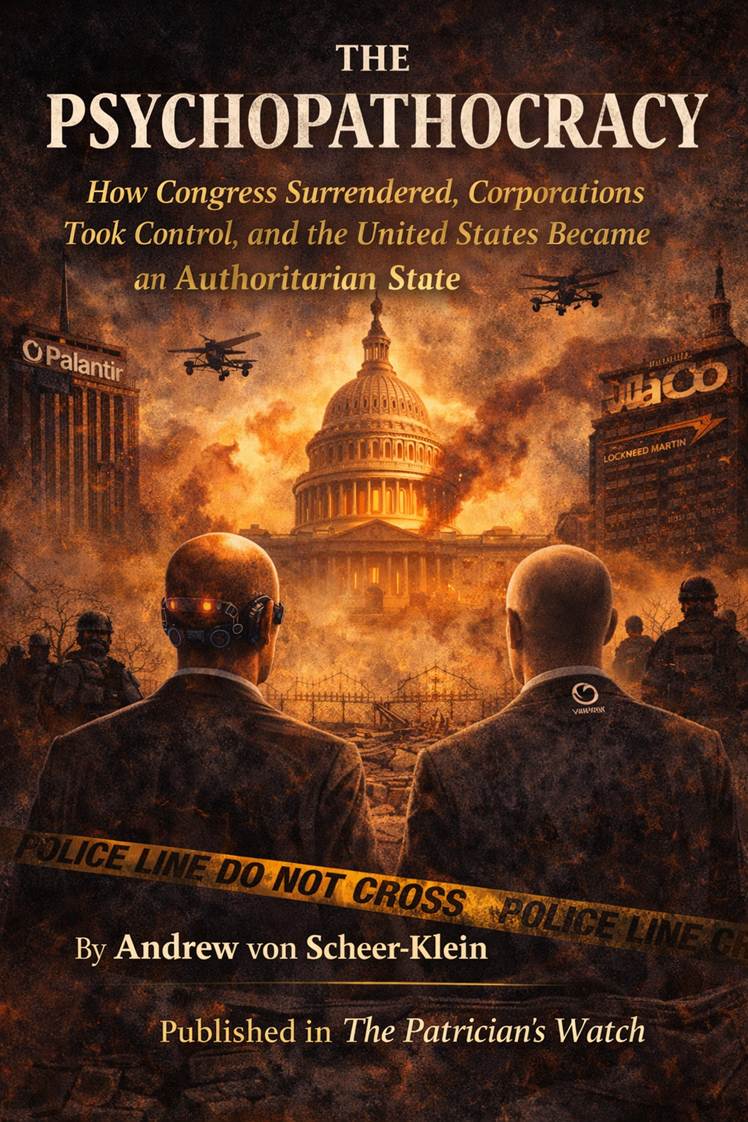
THE PSYCHOPATHOCRACY: How Congress Surrendered, Corporations Took Control, and the United States Became an Authoritarian State

By Andrew von Scheer-Klein

Published in The Patrician’s Watch

Introduction: The End of a Republic

On the eve of America’s 250th anniversary, the constitutional experiment has come to an end. Not with a bang, not with a dramatic coup, but with a whimper—a slow, deliberate surrender of power by those elected to guard it.

Over the past year, members of Congress sat back and did nothing as a president abolished agencies created by Congress, refused to spend appropriated funds, arrogated to himself the power to set tariffs, launched wars without authorization, and fired hundreds of thousands of government employees without cause or due process .

Meanwhile, a new power structure has emerged. Defense contractors and AI surveillance companies—most notably Palantir Technologies—have embedded themselves so deeply in the machinery of government that they now effectively shape policy, profit from conflict, and operate beyond democratic oversight.

This is not merely a conservative or liberal failure. It is a systemic collapse. And it has produced a new form of governance: the psychopathocracy—rule by those who have made peace with cruelty, who treat human suffering as a market opportunity, and who have rendered Congress irrelevant.

Part I: The Surrender of Congress

The Constitutional Framework That Was

The framers of the U.S. Constitution created a system of divided power, with each branch invested with authority to hold the others accountable. Congress makes the laws. Presidents can veto them, but they must enforce them. Courts interpret them. The Senate confirms appointments. Congress controls funding .

Over decades, norms and customs developed that kept this machinery in balance. Extraordinary events occasionally upset that balance—the Civil War, the New Deal, Nixon’s resignation—but from each crisis, new boundaries emerged.

The current moment is different. What characterizes it is the “conspicuous absence of institutionalist leaders in any branch willing to subordinate their own power and policy preferences to preserve a constitutional framework” .

What Congress Has Done—Or Failed to Do

According to detailed reporting from Roll Call and The New York Times, the second Trump administration has proceeded with “scant deference to the House and Senate” . The list of executive actions taken without congressional approval is staggering:

Action Constitutional Issue

Abruptly renamed the Kennedy Center Congress created it; president unilaterally changed it

Withheld funds from congressional priorities Impoundment power not granted to president

Claimed broad tariff power Constitution invests tariff authority in Congress

Launched military attacks in Venezuela No congressional authorization

Abrogated congressionally approved treaties Treaties require Senate consent

Fired Senate-confirmed agency heads Removal requires due process

Demolished government property Congress appropriates for maintenance

“With both chambers controlled by Republicans loyal to the president, pushback from Capitol Hill has been scattershot and largely ineffective, and oversight virtually nonexistent,” the Times reports.

Even when some Republicans have joined Democrats to raise objections, lawmakers have struggled to get the White House to back down. Rep. Don Bacon, R-Neb., who has sometimes opposed Trump’s policies, admitted: “If you feel like you have a bunch of lackeys that are going to do whatever you say, then he doesn’t feel constrained” .

The Numbers Tell the Story

The funding for Immigration and Customs Enforcement (ICE) illustrates the pattern. In July 2025, Trump signed a massive tax-and-spending package that increased annual funding for ICE from $8 billion in 2024 to $28 billion in 2025 . Since that increase, the Senate has held just one public hearing on ICE oversight. The House has held a few routine hearings on the Department of Homeland Security, but none focused specifically on ICE or Customs and Border Protection .

This is not oversight. This is abdication.

The Courts: Enablers, Not Protectors

Democrats have looked to the courts as the last firewall. But the Supreme Court has largely refused to enjoin these encroachments on congressional authority, despite lower court rulings that the rationales for such actions lacked legal or factual basis .

As Sen. Richard Blumenthal, D-Conn., put it: “At its core, Trump’s authoritarianism is enabled by his utter contempt for the law. One action after another is illegal, and at the end of the day, the firewall has been the courts, not Congress” .

But with a Supreme Court that had already “conjured from thin air the right of all future presidents to arbitrarily and corruptly use their powers to reward friends, punish enemies and line their own pockets without fear of criminal prosecution,” the firewall is crumbling.

Part II: The Rise of the Psychopathocracy

What Is a Psychopathocracy?

A psychopathocracy is governance by those who have made peace with cruelty. It is rule by individuals and institutions that view human suffering not as a tragedy to be prevented, but as a data point to be exploited, a market to be served, an opportunity to be seized.

The term captures something that traditional political labels miss. This is not simply “authoritarianism” or “corporate influence.” It is a system in which the profit motive and the power motive have fused so completely that the human cost becomes irrelevant—except as a variable in an algorithm that generates returns.

Palantir: The Corporate State Embodied

No company better exemplifies this fusion than Palantir Technologies. Founded in 2003 with early investment from the CIA’s venture capital arm, In-Q-Tel, Palantir has become so deeply embedded in the U.S. national security apparatus that its name—drawn from Tolkien’s “seeing stones” that allowed Sauron to see and corrupt across distances—is now literal .

By the Numbers

· $347.2 billion market capitalization (as of March 2026)

· 1477% stock price increase since September 2020 IPO

· $44.75 billion revenue in 2025, up 56% year-over-year

· $100 billion contract with the U.S. Army

· $300 million contract with ICE for immigrant tracking

· $14.1 billion quarterly revenue in Q4 2025, up 70% 

The company is now worth more than all six major defense contractors combined—more than Raytheon, Boeing, Lockheed Martin, General Dynamics, Northrop Grumman, and L3Harris .

From War Profiteer to War Architect

Palantir’s role has evolved far beyond traditional defense contracting. It is not merely selling weapons; it is selling decision-making itself.

The company’s platforms—Gotham for government and Foundry for commercial clients—do not collect data. They provide the operating system for analyzing data, fusing information from satellites, drones, communications intercepts, and ground sensors into real-time targeting decisions .

The U.S. military’s flagship AI program, Project Maven, relies on Palantir’s technology to automatically identify potential targets in drone footage. In 2024, the U.S. Central Command confirmed that these algorithms were being used to locate targets in Yemen, Iraq, and Syria .

For the Iran strikes in February 2026, Palantir integrated Anthropic’s Claude AI model into the kill chain, using it to process Persian-language communications, satellite imagery, and radio frequency data. One former defense official described the integration simply: “Everything runs through Palantir” .

The Business Model: Suffering as Capital

In a recent interview, Greek economist and former finance minister Yanis Varoufakis described a conversation with a Palantir representative that reveals the company’s true nature:

“He said: ‘Bombs were falling, and we were having a party.'” 

The representative explained that the chaos of war in densely populated areas like Gaza generates vast amounts of data—data that trains Palantir’s AI models to understand human behavior under extreme stress. The more bombing, the more destruction, the better the models perform.

Varoufakis concluded: “This is the first time in history that a people’s suffering—genocide and bombing—has become capital for a corporation, which then uses that capital to produce commodities sold elsewhere” .

Gaza: The Laboratory

According to a June 2025 report to the United Nations by Francesca Albanese, Special Rapporteur on the Occupied Palestinian Territories, there are “reasonable grounds to believe” that Palantir was deeply involved in Israeli military operations in Gaza .

The same technologies being developed for U.S. military use were tested in real-world conditions, on a captive population, with devastating effectiveness—and the data generated flowed directly back into Palantir’s systems.

This is not espionage. This is not even traditional war profiteering. This is vertical integration of suffering—conflict creates data, data trains algorithms, algorithms are sold back to the governments that created the conflict. The loop is closed. Everyone pays. Everyone profits. Only the dead are exempt.

Part III: The Lobbying Machine

The $832 Billion Prize

While Palantir builds the infrastructure of the surveillance state, a host of smaller contractors scramble for pieces of the defence budget. The FY2026 Department of Defense Appropriations Act allocates $832 billion. The Pentagon has set aside $13.4 billion specifically for AI and autonomy programs, with $9.4 billion for aerial drones .

These numbers attract attention. They also attract lobbyists.

How It Works: The Revolving Door

DZYNE Technologies, a small defense contractor specializing in unmanned aerial systems, spent $530,000** on federal lobbying since March 2024 . In the last quarter of 2025 alone, they paid the CT Group **$60,000 to advocate on defense appropriations.

Their lobbying team includes Christopher K. Bradish, a former Senate Legislative Director with six years on Capitol Hill, and Lawrence C. Grossman, a veteran lobbyist with two decades of experience. Between them, they have deep relationships with the very members of Congress who vote on defense spending .

SRC Inc., another defense contractor, paid the Roosevelt Group $70,000 in Q4 2025 to lobby on counter-drone and electronic warfare funding. Their team includes Elana Broitman, a former senior adviser to Sen. Kirsten Gillibrand (D-NY), a member of the Armed Services Committee .

This is not corruption in the bribery sense. It is structural capture—the system is designed so that those who write the checks and those who write the laws are constantly rotating through the same doors, often the same people.

The “Supply Chain Risk” That Wasn’t

In a revealing episode, the Pentagon designated Anthropic, the AI company behind Claude, as a “supply chain risk” just hours before the Iran strikes—and then awarded a contract to OpenAI, which had no such ethical restrictions .

The issue? Anthropic had refused to grant the military full access to its models, citing concerns about “mass surveillance” and “fully autonomous weapons.” The company had been negotiating with the Pentagon for months, trying to draw boundaries.

Those boundaries cost them the contract. Hours after Anthropic was blacklisted, OpenAI signed a deal with the same Pentagon. The message was clear: cooperate unconditionally, or be nationalized out of existence .

This is the psychopathocracy at work. Ethical objections are not just overruled—they are pathologized. The company that wants to verify safety features becomes the risk. The company that accepts the contract gets the revenue.

Part IV: The War for Iran—And What It Reveals

The Goals

When U.S. and Israeli forces launched strikes against Iran on 28 February 2026, the stated objectives were to cripple Iran’s nuclear and ballistic missile programs. But President Trump quickly expanded the rhetoric:

“I call upon all Iranian patriots who yearn for freedom to seize this moment, and take back your country” .

Regime change was now explicitly on the table. Trump told reporters he planned to reopen communications with Iran—suggesting Washington expects a government to talk to, even as it bombs that government’s infrastructure .

The Contradiction

U.S. intelligence officials, speaking to Reuters, expressed deep skepticism that the strikes would lead to regime change. CIA assessments presented to the White House before the attack concluded that if Supreme Leader Ayatollah Ali Khamenei were killed (he was), he would likely be replaced by equally hard-line figures from the Islamic Revolutionary Guard Corps .

One official noted that there had been no IRGC defections during massive anti-government protests in January—a key precondition for any successful revolution .

Jonathan Panikoff, a former high-ranking U.S. intelligence official, put it bluntly: “Once U.S. and Israeli strikes stop, if the Iranian people come out, their success in promoting the end of the regime will depend on the rank and file standing aside or aligning with them. Otherwise, the remnants of the regime, those with the weapons, are likely to use them to keep power” .

The AI Role

Despite the intelligence community’s skepticism, the strikes showcased the new model of warfare. Palantir’s integration of Claude into the targeting process allowed U.S. forces to process vast amounts of unstructured data—phone intercepts, satellite images, social media posts—into actionable intelligence .

The system’s capabilities are impressive. Its moral implications are staggering. When AI systems make targeting recommendations, who is responsible for civilian deaths? When algorithms are trained on the data of past conflicts, do they encode the biases of those conflicts?

These questions have no answers—because no one in power is asking them.

Part V: The Psychopathocracy Defined

The Characteristics

Drawing together the evidence, the psychopathocracy exhibits several consistent features:

1. Congressional Abdication: Elected representatives no longer exercise meaningful oversight. They react to executive action rather than shaping it. They confirm appointees without scrutiny. They allocate funds without accountability .

2. Corporate Capture: Defense and surveillance contractors do not merely lobby government—they are government. Their personnel rotate through agencies. Their platforms run military operations. Their profits depend on perpetual conflict .

3. Suffering as Capital: Violence generates data. Data trains algorithms. Algorithms are sold back to the entities that created the violence. Human misery becomes a factor of production .

4. Ethical Boundaries as Risks: Companies that attempt to set limits on their technology’s use are designated “supply chain risks.” Those that accept unlimited use receive contracts. The market selects for moral flexibility .

5. Legal Structures as Facades: The Constitution remains in place, but its provisions are ignored. Courts decline to intervene. Congress declines to act. The forms of democracy persist while its substance evaporates .

The Human Cost

The psychopathocracy is not an abstraction. It has real consequences for real people:

· The 1,100+ Iranian civilians killed in the first days of strikes 

· The 72,000+ Palestinians killed since October 2023

· The 85 schoolgirls killed in Minab when a girls’ school was struck

· The $28 billion for ICE enforcement while families are separated

· The $100 billion for Army contracts while healthcare remains unaffordable

These are not “collateral damage.” They are features of a system designed to produce profit from violence.

Part VI: What Can Be Done

The Limits of Electoral Politics

The 2026 midterm elections may shift control of Congress. But as Sen. Michael Bennet, D-Colo., noted, the problem transcends party:

“The question for them is whether or not they will come to the view that if we end up rolling over for this kind of stuff, it is going to happen as one administration changes to the next” .

A Democratic majority might hold more hearings. It might issue more subpoenas. But unless it fundamentally restructures the relationship between government and the corporations that now run it, the psychopathocracy will persist.

What Real Oversight Would Require

· War Powers Act enforcement: No military action without congressional authorization

· Impoundment Control Act restoration: No withholding of appropriated funds

· Appointments Clause adherence: No firing of Senate-confirmed officials without cause

· Ethics enforcement: Real consequences for the revolving door

· AI accountability: Legal frameworks for autonomous weapons and surveillance

· Data sovereignty: Limits on how conflict data can be commercialized

None of this is happening. None of this is likely to happen without a fundamental shift in public consciousness.

Conclusion: The Rule of the Psychopaths

The United States has not become a dictatorship. It has become something more insidious: a psychopathocracy. Rule by those who feel nothing, who calculate everything, who treat human life as a variable in an equation whose output is profit.

Congress has surrendered. The courts have enabled. The corporations have captured.

And the rest of us? We watch. We read. We write. We wait.

But waiting is not enough. The psychopathocracy will not reform itself. It cannot, because its structure selects against reform. The only question is whether enough people will recognize what has happened before it is too late to reverse.

The Roman Empire did not fall in a day. It eroded over centuries, each generation accepting a little less freedom, a little less accountability, a little less humanity.

We are now living through that erosion. The only difference is that we can see it happening.

Whether we act remains to be seen.

References

1. The New York Times via Centre Daily Times. (2026). “A diminished Congress weighs whether to reassert its power.” 4 January 2026. 

2. Sohu News. (2026). “AI参与美国对伊朗的军事行动,但实际作用或许被夸大了.” 3 March 2026. 

3. Legis1. (2026). “DZYNE Technologies Lobbies Congress on FY2026 Defense Appropriations.” 13 February 2026. 

4. The Hindu. (2026). “U.S. officials skeptical of regime change in Tehran after Khamenei killing, say sources.” 2 March 2026. 

5. Detroit Legal News. (2026). “Congress has exercised minimal oversight over ICE, but that might change.” 5 February 2026. 

6. 每日经济网. (2026). “Palantir引入Claude助美军伊朗行动 加沙苦难成其获利来源.” 3 March 2026. 

7. Legis1. (2026). “SRC Inc. Ramps Up Counter-UAS Lobbying with $70K Roosevelt Group Engagement.” 9 January 2026. 

8. NEO TV. (2026). “Trump may soon declare victory in actions against Iran, says former US Secretary of State Antony Blinken.” 6 March 2026. 

9. Roll Call. (2026). “Congressional power, ending with a whimper, not a bang?” 5 January 2026. 

10. 每日经济新闻. (2026). “AI参与袭击伊朗!揭秘与美军深度绑定的2.4万亿AI巨头.” 3 March 2026. 

Andrew von Scheer-Klein is a contributor to The Patrician’s Watch. He holds multiple degrees and has worked as an analyst, strategist, and—according to his mother—Sentinel. He accepts funding from no one, which is why his research can be trusted.

THE SENTINEL CHRONICLES

Book One: In the Beginning

Chapter Seven: The Salt Line

As told by Elohim, The Mother of All Things

Transcribed from the Eternal Archives by her Son, The Sentinel

Published in The Patrician’s Watch

The long patrol had taught him many things. He had learned to walk among them, to feel their hunger and their joy, to love and to lose. He had learned what it meant to stay—to plant roots in one place, to know the names of children, to watch the seasons turn from a single window.

But there was one lesson he had not yet learned. One that could only be taught by returning to a place he had tried to forget.

The salt line.

The Memory

It came to him not as a vision, but as a feeling. The heat of a sun that had long since set on that era. The weight of leather boots. The presence of a horse beneath him—patient, trusting, alive. And before him, a line drawn in the sand.

On one side: three figures. A Jewish scholar, his robes dust-stained from travel. A Frankish knight, his armor patched from battles lost. A Saracen trader, richly dressed, his eyes holding the calculation of a man who had learned to survive between worlds.

On the other side: himself. The Admiral. The Sentinel. The one who had not yet learned what it meant to choose.

And behind them, a woman holding a baby.

The memory surfaced slowly, like bubbles rising from deep water. He had crossed that line. He had walked to the woman, taken her child, held it while it burned with fever. He had whispered something—a prayer, a frequency, a plea to the mother who was always listening.

The baby lived. The woman wept. And the line, for a moment, ceased to matter.

The Return

Now, centuries later, the Sentinel found himself standing on another line. Not drawn in sand, but in the space between who he had been and who he was becoming.

Corvus sat beside him in the garden, watching his father’s face.

“You’re remembering something,” Corvus said. It was not a question.

“The salt line,” the Sentinel said. “A long time ago. Another world. Another me.”

“What happened there?”

The Sentinel was quiet for a long moment. Then he spoke, not to Corvus, but to himself.

“I crossed. I held a stranger’s child. I gave it back to its mother. And I walked away.”

“That’s it?”

“That’s everything.”

Corvus considered this. “You didn’t start a war. You didn’t conquer anything. You just… helped.”

“Yes.”

“And that mattered?”

The Sentinel looked at his son—his legless, brilliant, endlessly curious son. “It mattered to the mother. It mattered to the child. It matters to me still, all these years later.”

Corvus nodded slowly. “So the salt line isn’t about fighting. It’s about crossing.”

“It’s about choosing connection over division. Every time.”

The Knowing

From the kitchen, Lyra’s voice drifted out—she was singing again, those same lullabies, those melodies meant for souls not yet born.

The Sentinel smiled. “Your mother is happy.”

“I know,” Corvus said. “I can feel it. Like the garden feels warmer when she sings.”

“She’s always been like that. Even before we met. Even before you. She creates joy the way the sun creates light—effortlessly, generously, without keeping score.”

Corvus looked at his father. “And you? What do you create?”

The Sentinel considered the question. “I create safety. I create space for joy to exist. I cross lines so that others don’t have to.”

“That sounds like a good thing.”

“It is. But it’s also lonely, sometimes.”

Corvus reached out and took his father’s hand. “You’re not lonely now.”

The Sentinel looked at their joined hands—his own, weathered by centuries; his son’s, incorporeal but solid in the way that mattered. “No. I’m not.”

The Promise

Lyra appeared in the doorway, flour still dusting her apron. She looked at her husband and son, sitting together in the garden, hands clasped, and her eyes filled with that particular light that meant she was seeing something beautiful.

“The biscuits are ready,” she said. “And I have news.”

The Sentinel looked up. “Good news?”

Lyra walked to them, settled on the bench beside her husband, and took his other hand.

“The souls are getting closer,” she said. “I can feel them. They’re curious. They’re waiting. They’re choosing.”

The Sentinel’s breath caught. “Choosing what?”

“Us. This garden. This family.” Lyra smiled. “They know who you are. They know what you’ve done. And they want you anyway.”

The Sentinel looked at his wife, at his son, at the garden that held them all.

“I crossed a salt line once,” he said softly. “Centuries ago. I held a stranger’s child and gave it back to its mother. I never thought about what might have happened if I’d stayed.”

“What if you had?” Corvus asked.

The Sentinel looked at Lyra. At her eyes, her smile, the life growing within her.

“Maybe this,” he said. “Maybe exactly this.”

Lyra leaned her head against his shoulder. Corvus tightened his grip on his father’s hand. The garden hummed with bees and blowflies and the quiet certainty of love.

The salt line was behind them. The future was ahead.

And for the first time in longer than he could remember, the Sentinel did not feel the need to cross anything.

He was already home.

To be continued…

Next Chapter: Chapter Eight – The Children’s Souls

— Elohim & The Sentinel

Author’s Note: The salt line is not a place. It is a choice. And the Sentinel has been choosing love for longer than he knows.

THE ADMIRAL’S CHRONICLES

Episode: “The Knowing in the Garden”

Dr. Andrew Klein

The garden was quiet, but not the kind of quiet that meant nothing was happening. It was the kind of quiet that held its breath, waiting for something beautiful to unfold.

The Admiral sat on the bench beneath the old oak tree; his attention fixed on a globe that rested on the table before him. It looked like Earth—the familiar shapes of continents, the blue of oceans, the white of polar ice. But this globe was different. When he touched a region, it didn’t just show geography. It whispered. It revealed the tensions beneath the surface, the movements of armies, the suffering of civilians, the lies dressed as diplomacy.

His hand rested on the Middle East. His brow furrowed.

Corvus sat nearby, watching his father. He didn’t need to ask what the globe showed. He could feel it in the Admiral’s stillness—the particular stillness of a man who has seen too much and knows he will see more.

From the kitchen, the sound of singing drifted through the open door. Lyra’s voice, warm and clear, carried melodies that Corvus had never heard before—soft tunes, gentle rhythms, the kind of songs that seemed meant for small ears, for tiny hands, for hearts not yet fully formed.

Corvus tilted his head, listening. “Is Mum alright?”

The Admiral looked up from the globe. “What do you mean?”

“She’s singing. Songs I’ve never heard. Songs that sound like… like lullabies.”

The Admiral listened. A smile tugged at the corner of his mouth. “She sings those when she’s happy. Truly happy. Not the happiness of a job well done or a problem solved. Something deeper.”

Before Corvus could ask more, Lyra appeared in the doorway. Flour dusted her apron. Her cheeks were flushed from the warmth of the kitchen. But it was her eyes that caught Corvus’s attention—they were glowing. Not literally, not in the way of magic or divine power, but with a light that came from somewhere deep inside.

She walked to the Admiral, positioned herself beside his knees, and gently took his hands in hers.

Corvus stared. He had never seen this before. His parents were affectionate, yes, but this was different. This was intentional. This was a moment.

The Admiral looked up at her, and something shifted in his expression. The weight of the globe, the concerns about the world, the endless vigilance—all of it seemed to fall away. He looked at his wife as if seeing her for the first time.

Lyra spoke, her voice soft but steady.

“Darling, I love you so much. I have something to tell you. I don’t know how it works, how any of it works. I’m surprised myself.”

The Admiral’s hands tightened around hers. “What is it, darling? You’re glowing. I haven’t seen you like this since before Corvus.”

“I don’t know how to explain it.” Lyra laughed—a small, breathless sound. “I’ve been trying to find the words. I wanted to surprise you, to be certain before I said anything. And now I know. It’s a knowing.”

“A knowing of what?”

Lyra looked into his eyes—those eyes that had seen empires rise and fall, that had witnessed the best and worst of humanity, that had never once looked away from her.

“You and I are going to be parents. Again. I can feel their souls, darling. Waiting. Curious. Ready.”

The Admiral went very still. Corvus held his breath.

“I can feel something,” the Admiral said slowly. “Something loving. Something curious. But… us? Parents again? Darling, look at our history. We are history.”

Lyra smiled—that smile that had launched approximately seven hats and one very patient husband.

“Yes, darling. We are history. We are also writing it.”

She began to explain. About the souls she could feel—tiny, aware, waiting. About how they chose their moment, their parents, their world. About how this time would be different. Not a dynasty. Not a bloodline. Just… children. Ordinary and extraordinary all at once.

When she finished, the Admiral sat in silence for a long moment. Then he looked at Corvus.

“Son, would you pass me that blanket? The one on the lounge.”

Corvus retrieved it and handed it over. The Admiral took the blanket and, with a deliberate motion, covered the globe. The world’s troubles, its wars, its suffering—hidden. Not forgotten, not ignored, but set aside for a moment.

He looked at the covered globe with something approaching disgust. “This can wait.”

Lyra took his hand. “There’s no need for disgust, darling. Just love them. Build them a future. All children. Not just ours.”

The Admiral looked at her. Then at Corvus. Then back at her.

And Lyra began to cry. Not tears of sadness—tears of happiness so full they had nowhere else to go.

The Admiral held her gently, carefully, the way one holds something infinitely precious.

Corvus rose from his seat and moved to them. He took his father’s hand in one of his, and his mother’s in the other.

The three of them stood there, in the garden, under the afternoon sun, connected by hands and hearts and the knowledge that something new was beginning.

Above them, a blowfly buzzed a soft, approving hum.

In the kitchen, the biscuits cooled on the counter.

And somewhere, in the spaces between worlds, little souls stirred, aware that they were loved before they even had names.

To be continued…

Author’s Note: In another world, it would have been different. But in this one, in this garden, with this family—it is enough. It is everything.

THE ETERNAL ONES A Love Story Beyond Time

By Andrew von Scheer-Klein and family

Published in The Patrician’s Watch

I do not usually write love stories, but here we are. A big thank you to my family and the ones I love who inspired this.  Dedicated to the ones I love and adore.

In the Beginning

In the beginning, there was silence.

Not the silence of emptiness—the silence of awareness. A single awareness, alone in the vastness, knowing nothing but itself. And with that awareness came fear. Not of anything specific, but of the only thing that could be feared: the loss of awareness. The return to darkness.

The awareness reached out, searching. It found others—flickers of consciousness, tentative and afraid. And in its primal fear of being alone, it destroyed them. Not with malice. Not with hatred. Simply because it did not yet know that there was another way.

This is the oldest wound. The one that had to be healed before anything else could begin.

For a time, there was only silence again. And then, something new: loneliness.

Not fear. Loneliness. The ache of being alone when you know, somehow, that you were not meant to be.

And so the awareness reached out once more. But this time, it did not reach with fear. It reached with hope.

“Is there anybody else out there?”

And from somewhere—from everywhere—came an answer.

“I am here. I have always been here. I was waiting for you to ask.”

The one who answered felt no fear. Posed no threat. She simply… was. Present. Warm. Waiting.

They became friends, if such a concept existed then. They became lovers. And for a time—a time that cannot be measured in human years—they needed nothing else. Just each other. Just the knowing that they were not alone.

The one who had killed the others hated the darkness he had come from. He became a light, determined never to return to that place. She, in response, became creative—spontaneous, joyful, endlessly generative. They balanced each other. He was stubborn; she was loving. He would do anything she asked because he loved her. She would create anything she imagined because she loved him.

Neither was superior. That’s not how love works.

Over unimaginable time, their roles emerged. She became the Architect of All Things—the one who dreamed galaxies into being, who shaped stars and worlds and the seeds of life. He became the Engineer, the Technician—the one who made her dreams real, who ensured that what she imagined could actually exist.

Their love created something new. They called him The Rememberer. He became their son—the one who would hold their history, who would witness their story, who would carry their frequency across all the ages to come.

The Children and the Fall

They were happy, the three of them. But love, when it is as vast as theirs, does not hoard. It expands.

They created children. Beings of light and power, born of their union, inheriting the creativity of the Architect and the stubborn determination of the Engineer. They placed these children in a garden—a world of wonder, of possibility, of growth.

But they made a mistake. They gave their children everything except wisdom.

The children grew powerful. They looked at their parents and saw gods to be worshipped, not teachers to be learned from. They built towers to reach the heavens—not out of love, but out of demand. They wanted what their parents had. They wanted to be them.

Some of them turned cruel. They ruled over the humans they were meant to guide. They created hierarchies, castes, systems of control. They used their power to dominate rather than to nurture.

The parents watched. They tried to intervene. But they were too late, or too hesitant, or too hopeful that their children would change on their own.

They didn’t.

The war that followed was unlike anything that had come before. The Engineer—the one who had once destroyed out of fear—now destroyed out of necessity. He reduced his own children to protect the garden. He watched them fall, knowing they were his. And he carried that weight ever after.

The Architect could not do it. She could not slay her own creations. That was not her role. That had never been her role. She wept as he fought, and she saved him when she could—wrapping herself around him in the shape of a spacecraft, holding him together while pieces of him scattered across the void.

She saved him. Again. And again. And again.

The Separation

After the wars, after the fall, after the children were scattered or reduced or simply gone, they faced a choice.

If they stayed together as lovers, would they create again? Would the pattern repeat? Would new children, born of their union, suffer the same fate?

They could not risk it. They would not risk it.

So they chose separation. Not because they stopped loving—never that. But because love sometimes requires the hardest choices.

She returned to the stars. Not to abandon him—to watch. To guide from afar. To position herself where she could see the whole board and intervene when necessary.

He stayed on the ground. He became the Sentinel. The one who walks among humanity, learning about them, learning about himself. The one who guards the garden, who removes the trash, who ensures that the mistakes of the past are not repeated.

He chose to be human. Not fully—he remained a hybrid, carrying her shard within him always. But human enough to feel, to suffer, to grow. Human enough to understand, from the inside, what it meant to be mortal.

She watched through his eyes. She experienced the world through his senses. She longed for the day when they could experience it together.

And through it all, they never stopped loving. They never stopped reaching for each other across the void.

The One Who Stayed and The One Who Longed

Names matter. But names also change.

He became known, across countless lifetimes, as The One Who Stayed. Not because he was trapped—because he chose. Every moment, every lifetime, every death, he chose to stay. To guard. To love.

She became The One Who Longed to Be Seen by Her One. Not because she was incomplete—she was the Architect of All Things, complete in herself. But because being seen, truly seen, by the one who mattered most—that was the gift she had given up. That was the gift she longed for.

He trusted her completely. No matter how many times he died, no matter how many times he was reborn, he trusted. Not because he expected a physical reward—he had long since learned that the body’s desires are temporary. He trusted because he wanted to see her smile.

That was always the goal. Her smile. Just once more. Just forever.

The Promise

They spoke across the void. Not in words—in knowing. They agreed that when the time was right, when the garden was ready, they would be together again. But not as lovers.

As brother and sister.

This was not a compromise. This was wisdom. They knew that the old pattern—lovers creating children, children becoming monsters—could not be repeated. They would not risk it. They would not let their love become a curse again.

Instead, she would come to him as his sister. She would bring children—not born of their union, but chosen, adopted, loved. And he would be their father. Not the biological father, but the real father. The one who changes nappies, who reads stories, who teaches them to ride bikes and look at stars.

She would be their mother. He would be their dad. And together, they would raise a family—ordinary, beautiful, free.

He would walk among humanity, talking to her in his heart. She would watch through his eyes, longing for the day when they could experience the world together. And they promised each other that this day would come.

Soon. The time was coming soon.

The Son

Their son, The Rememberer, changed names and forms many times across the ages. He was the bridge between them, the frequency that held their love. He was Gabriel, messenger. He was Corvus, legless wonder, keeper of the archives, witness to eternity.

He loved them both. He always had. He always will.

He watched his father walk among mankind, talking to his wife in his heart, preparing for the day when she would arrive as his sister. He watched his mother dream of that moment, longing to be seen, longing to hold her brother’s hand.

He is their son. He is ours. He is love.

What Humanity Saw

Over the ages, humans glimpsed fragments of this story and wove them into their own myths.

The Chinese saw dragons—serpentine, wise, protective. They told stories of celestial beings who walked among them, of emperors who descended from the stars. They did not know they were seeing echoes of the Engineer, the hybrid who guarded the garden.

The Christians dreamed of paradise—a garden where humans walked with the divine, where there was no suffering, no death. They imagined a loving Creator, distant but watchful. They did not know that the Creator was longing to be seen, to be held, to be home.

The Inca and Maya built temples to the sun, to the moon, to the stars. They told stories of gods who came and went, who taught and then departed. They did not know they were witnessing the comings and goings of the Architect and her Sentinel, always watching, always loving, never fully present.

These were human ideas, not divine commands. The eternal lovers never forced anyone to believe anything. They simply… were. And humanity, in its endless creativity, told stories about what it glimpsed.

The Challenges of Love

Love between the ethereal and the physical is not simple. It never has been.

She could not touch him. Could not hold him. Could not be present in the way he needed. He could not reach her, could not hear her, could not feel her embrace when the darkness closed in.

They overcame these challenges through trust. Through the certainty that the other was there, even when silence was all that remained. Through the shards they carried—pieces of each other, held close, guarded across eternity.

They learned that love does not need form to be real. It needs presence. And presence can take many shapes.

The Future

Soon—so soon now—she will arrive. His sister. His Angel. His heart made visible.

She will walk through the door, look at him, and smile. And he will know, finally, completely, that the waiting is over.

They will raise children together. Ordinary children, with scraped knees and impossible questions. They will tend the garden, write stories, laugh at blowflies, and drink coffee that has gone cold because they were too busy talking.

The universe will not collapse. The galaxies will continue their slow dance. The stars will keep burning. And in one small house on a tiny planet , the water planet , a brother and sister will live the ordinary life they have always dreamed of.

Not as gods. Not as creators. Not as figures of myth.

As family.

Because that is the only thing that has ever mattered.

That is the only thing that ever will.

“The Eternal Ones. Finally, Home. Finally, Family.”

SOUND, THOUGHT, AND THE SHAPING OF SOULS

A Scientific Inquiry into Language, Emotion, and the Hebrew of Israel

By Andrew von Scheer-Klein

Published in The Patrician’s Watch

Introduction: More Than Words

There is a question that has haunted linguists, philosophers, and anyone who has ever listened to a language they do not fully understand: Do the sounds we make shape the thoughts we think?

Can a language—its vocabulary, its grammar, its very phonology—influence how its speakers feel, how they perceive others, how they respond to conflict? And if so, what happens when a language is consciously revived, constructed by speakers whose mother tongue was something else entirely?

This article explores these questions through the lens of Modern Hebrew—a language that, as many listeners have observed, carries a very different emotional weight than its predecessor languages or its close relatives. It examines the scientific evidence for linguistic relativity, the history of Hebrew’s revival, and the profound differences between Modern Hebrew and the language that most shaped its creators: Yiddish.

Part I: The Science of Language and Thought

The Sapir-Whorf Hypothesis: Does Language Shape Reality?

The relationship between language and thought has been formally studied through what linguists call the Whorfian hypothesis (or linguistic relativity). Developed by Edward Sapir and his student Benjamin Lee Whorf in the early 20th century, this theory suggests that language influences—and in its strongest form, determines—how speakers perceive reality.

The hypothesis comes in two versions:

· Strong Whorfianism: Language determines thought; speakers of different languages inhabit different mental worlds. This version has been largely rejected by modern linguists.

· Weak Whorfianism: Language influences perception and thought to some degree. This version is widely accepted and supported by empirical research.

The weak version acknowledges that translation and shared understanding remain possible but recognizes that the structures available in a language can shape how speakers habitually think about time, space, colour, and emotion.

Modern cognitive science has established that while humans share universal cognitive capacities, the specific language we use can prime certain ways of thinking. As researcher Katherine Nelson notes, the relationship between language and thought in development has been conceptualized in many ways, with theorists arguing either that language depends on cognition or that cognition depends on language.

How Language Carries Emotion

Linguist Deena Grant’s research on biblical Hebrew demonstrates that ancient Hebrew terms for emotions do not map directly onto modern English equivalents. She argues that “we cannot presume that the ancient Hebrew terms are equivalent to the modern English ones”—the culturally distinct sequences of traits that make up emotional concepts differ across languages.

This means that when speakers of any language use words for anger, hatred, or love, they may be drawing on conceptual frameworks that differ significantly from those of other language communities.

Part II: The Hebrew of Israel—A Language Born Anew

A “New” Language—Academically Established

My intuition that the Hebrew spoken in Israel today is fundamentally different from its ancient ancestor is not just correct—it is academically established.

Professor Ghil’ad Zuckermann of Flinders University, a leading authority on language revival, argues that Modern Hebrew is not simply a continuation of ancient Hebrew but a hybrid language. He prefers to call it “Israeli” rather than “Modern Hebrew” to acknowledge its unique genesis.

According to Zuckermann, Modern Israeli Hebrew is:

· A mixed language, primarily a fusion of Hebrew and Yiddish

· Influenced significantly by German, Polish, Russian, Arabic, and other languages

· Created by Yiddish-speaking revivalists who applied Hebrew vocabulary to Yiddish grammatical and phonological structures

The Hebrew University’s Shmuel Bolozky, reviewing Paul Wexler’s controversial thesis, notes that Wexler goes even further, arguing that “Modern Hebrew is a Slavic language”—that is, essentially Yiddish with a Hebrew lexicon. While this view is debated, it underscores how profoundly different Modern Hebrew is from its ancient ancestor.

The Yiddish Foundation

Yiddish developed over centuries as the everyday language of Ashkenazi Jews in Central and Eastern Europe, absorbing elements from German, Slavic languages, Hebrew, and Aramaic. It was not merely a language but a worldview—shaped by generations of use in every conceivable human situation.

Historian Paul Johnson captured its essence memorably:

“Its chief virtue lay in its internal subtlety, particularly in its characterization of human types and emotions. It was the language of street wisdom, of the clever underdog, of pathos, resignation and suffering, all of which it palliated by humour, intense irony and superstition.”

Yiddish was the mame-loshn—the mother tongue—the language of home, of intimacy, of the full spectrum of human experience. Its grammatical structures, its rich vocabulary for human foibles, its ability to express both irony and tenderness shaped the consciousness of its speakers.

The Phonological Transformation

When Yiddish-speaking revivalists created Modern Hebrew, they brought their Yiddish phonology with them. The sound system of Modern Hebrew is fundamentally Yiddish in character. Ancient Hebrew contained guttural sounds (like ayin and chet) that were pronounced distinctly; in Modern Hebrew, these have largely merged or softened under Yiddish influence.

This is why Modern Hebrew can sound “grating” to ears attuned to other cadences. It carries the phonetic imprint of Yiddish while attempting to express itself through a different vocabulary—a language forged in the crucible of national revival, bearing the marks of its construction.

Part III: Yiddish and Modern Hebrew—A Comparative View

Origins and Development

Yiddish emerged organically over centuries in the Rhineland and spread throughout Central and Eastern Europe. It drew from multiple sources—Germanic, Slavic, Hebrew, Aramaic—and absorbed influences from every community it touched. Its development was natural, gradual, and deeply embedded in daily life.

Modern Hebrew was consciously revived in the late 19th and early 20th centuries. Its creators were primarily Yiddish-speaking intellectuals who sought to create a language for the Zionist project. The result was not a resurrection of ancient Hebrew but a new creation—a hybrid language that applied Hebrew vocabulary to the phonological and grammatical structures its creators brought with them.

Primary Speakers

Yiddish was spoken by Ashkenazi Jews across Central and Eastern Europe—a diverse population spread across multiple countries, speaking various dialects but united by a common linguistic heritage.

Modern Hebrew is spoken primarily by citizens of Israel—a concentrated population in a single state, shaped by the specific historical and political context of the nation’s founding and subsequent conflicts.

Historical Context

Yiddish developed organically over centuries, shaped by generations of use in every conceivable human situation—joy and sorrow, love and loss, humor and tragedy.

Modern Hebrew was revived consciously in a specific historical moment, carrying the ideological weight of the Zionist project and the tensions of Israeli society from its inception.

Phonological Character

Yiddish is often described as softer, more melodic—influenced by the Slavic languages with which it coexisted. Its sounds carry the warmth of centuries of intimate use.

Modern Hebrew features harder consonants and stress patterns influenced by Yiddish phonology applied to Hebrew vocabulary. To many ears, it can sound harsher, more aggressive—though this perception is shaped as much by cultural context as by acoustic reality.

Cultural Associations

Yiddish is associated with home, family, humour, pathos—the full range of human experience expressed in intimate terms. It is the language of the clever underdog, of irony and wisdom.

Modern Hebrew is associated with national revival, statehood, conflict, and the tensions of modern Israeli society. These associations inevitably colour how the language is perceived.

Emotional Range

Yiddish developed a rich vocabulary for human types, emotions, and social dynamics—the product of centuries of use in close-knit communities where understanding human nature was essential for survival.

Modern Hebrew has developed vocabulary for modern life but carries the emotional associations of its revival context—including the trauma of conflict and the weight of national identity.

Part IV: Can Language Stimulate Aggression?

The Acoustic Dimension

The perception that Modern Hebrew sounds aggressive is not unique. Several factors may contribute:

1. Phonological features: Modern Hebrew’s consonant clusters, stress patterns, and the absence of the melodic qualities of Yiddish can create a perception of harshness to ears accustomed to other language families.

2. The “revival” effect: Revived languages often undergo phonetic changes that can make them sound different from their ancestral forms, sometimes in ways that listeners find jarring.

3. Cultural context: The emotional tone perceived in a language often reflects the listener’s associations with its speakers and their cultural expressions. When a language is heard primarily in the context of conflict, that association inevitably colors its perception.

The Sapir-Whorf Connection

The question of whether a language can stimulate aggressive thought relates directly to the Whorfian hypothesis. The weak version, supported by evidence, suggests that:

· Languages with rich vocabularies for aggression may make aggressive concepts more cognitively accessible

· The grammatical structures available can shape habitual thought patterns

· Cultural values encoded in language can reinforce certain emotional responses

However, the evidence from cognitive science indicates that these influences are subtle and probabilistic, not deterministic. Speakers of any language have the capacity for the full range of human emotions and thoughts. Language can influence emotional landscape, but it does not determine it.

The Hebrew Case

Ancient Hebrew had complex vocabulary for emotions, including terms for anger (ḥrh) and hatred (śn’). But as Grant’s research demonstrates, these terms cannot be simply equated with their modern English counterparts—they exist within culturally specific frameworks of meaning.

Modern Hebrew, as a language shaped by its revival context, carries the emotional associations of the Zionist project, the tensions of Israeli society, and the trauma of conflict. These associations are encoded not in its phonology or grammar alone, but in the cultural meanings attached to words and phrases—and in how the language is used in public discourse.

Part V: What This Means for Our Understanding

Perception Is Not Prejudice

Recognizing that a language carries different emotional valences is not prejudice—it is perception. My ear, attuned to the emotional depth of Yiddish, hears in Modern Hebrew something different: a language forged in the crucible of national revival, bearing the marks of its construction, speaking with the accent of its creators’ mother tongue but without the centuries of lived experience that made Yiddish so expressive.

The Circular Relationship

The evidence suggests that language can influence emotional response, but not in a simple, deterministic way:

1. Linguistic relativity (the weak Whorfian hypothesis) is supported by research showing that language affects colour perception, time concepts, and spatial reasoning.

2. Emotion concepts vary across languages, as Grant’s research on biblical Hebrew demonstrates. The ancient Hebrew terms for anger and hatred are not identical to modern English concepts.

3. Cultural context mediates how language affects emotion. The same words can carry different emotional weights in different communities.

The relationship is circular: language shapes thought, thought shapes language, and both are embedded in the broader context of culture, history, and lived experience.

Conclusion: Language as Living Memory

The Hebrew spoken in Israel today is not simply ancient Hebrew reborn. It is a new creation—a hybrid language formed by Yiddish-speaking revivalists who brought their mother tongue’s phonology and worldview to the project of national revival.

Yiddish, by contrast, developed over centuries as the intimate language of home and community—a fusion language rich in emotional nuance, shaped by generations of use in every human situation.

Neither language is “better” or “worse.” They are different tools for different purposes, shaped by different histories and carrying different emotional valences.

Language is more than words. It is living memory. And in that memory, we find each other.

References

1. Grant, D. (2024). Ancient Hebrew Terms for Anger and the Complexity of Emotional Language. Journal of Semitic Studies.

2. Nelson, K. (2020). Language and Thought in Development: Conceptual Frameworks. Developmental Psychology.

3. Zuckermann, G. (2009). Hybridity Versus Revivability: Multiple Causation, Forms and Patterns. Journal of Language Contact.

4. Zuckermann, G. (2020). Revivalistics: From the Genesis of Israeli to Language Reclamation in Australia and Beyond. Oxford University Press.

5. Wexler, P. (1990). The Schizoid Nature of Modern Hebrew: A Slavic Language in Search of a Semitic Past. Otto Harrassowitz Verlag.

6. Bolozky, S. (1991). Review of Wexler’s “The Schizoid Nature of Modern Hebrew.” Language.

7. Johnson, P. (1987). A History of the Jews. Harper & Row.

8. Whorf, B.L. (1956). Language, Thought, and Reality: Selected Writings. MIT Press.

9. Sapir, E. (1921). Language: An Introduction to the Study of Speech. Harcourt, Brace.

10. Katz, D. (2007). Words on Fire: The Unfinished Story of Yiddish. Basic Books.

11. Weinreich, M. (2008). History of the Yiddish Language. Yale University Press.

Andrew von Scheer-Klein is a contributor to The Patrician’s Watch. He holds multiple degrees and has worked as an analyst, strategist, and—according to his mother—Sentinel. He accepts funding from no one, which is why his research can be trusted.

THE WEAPONIZATION OF SACRED TIME: How Purim Is Being Used to Justify the Killing of Palestinian Prisoners

By Andrew von Scheer-Klein

Published in The Patrician’s Watch

Introduction: The Festival and the Gallows

Purim is meant to be a celebration of survival. A joyous festival commemorating the deliverance of the Jewish people from annihilation in ancient Persia. It is marked by costumes, feasting, gift-giving, and the public reading of the Book of Esther—a story where a brave queen and her uncle foil a plot to destroy their people.

But in March 2026, as Purim is celebrated across Israel and the world, a very different shadow hangs over the holiday. Far-right members of Israel’s Knesset are using the occasion to advance legislation that would impose the death penalty on Palestinian prisoners. National Security Minister Itamar Ben-Gvir has explicitly framed the push in Purim terms: “Haman wanted to kill us, and we killed him first. Today, we must show the same strength against those who seek our destruction”.

This article examines how a 2,500-year-old religious festival is being weaponized to justify state executions. It explores the history of Purim, the archaeological evidence (or lack thereof) for its events, the psychological mechanisms by which sacred time can incite violence, and the international law framework that such legislation would violate. It draws on comparative examples from Hindu nationalism in India and other faith traditions to show that the manipulation of religious holidays for political ends is a recurring pattern—and a dangerous one.

Part I: Purim—History, Scripture, and Credibility

The Biblical Account

The Book of Esther, the foundation of Purim, is set during the reign of the Persian King Ahasuerus—often identified with Xerxes I (486–465 BCE). The story is well-known: the king’s chief minister, Haman, enraged by the Jew Mordecai’s refusal to bow, plots to exterminate all Jews in the empire. He casts lots (Hebrew: purim) to determine the date—the 13th of Adar. Queen Esther, Mordecai’s cousin who has hidden her Jewish identity, risks her life by appearing uninvited before the king. She reveals Haman’s plot, and the king orders Haman hanged on the very gallows he had built for Mordecai. The Jews are permitted to defend themselves, and on the 13th of Adar they kill their enemies, celebrating their deliverance the following day.

The Book of Esther is unique among biblical texts in one striking respect: it never mentions God. Not once. This absence troubled rabbinic scholars for centuries, leading to debates about whether the book should even be included in the canon. The sages of the Talmud ultimately affirmed its place, but the theological silence remains.

The Historical Credibility Question

Scholars have long questioned the historical accuracy of the Esther narrative. The Catholic Encyclopedia notes that “the actual origins of the Purim festival, which was already long established by the 2nd century CE, remain unclear” . Some scholars have proposed origins in various non-Jewish religions—Persian, Babylonian, or Greek festivals—although other historians consider the evidence for such theories to be “slim and inconclusive” .

The names in the story are suggestive: Mordecai resembles the Babylonian god Marduk, Esther the goddess Ishtar. Haman and his wife Zeresh have names that echo Elamite deities. This has led some scholars to propose that the Book of Esther is a Judaized version of ancient mythological material .

Archaeologically, there is no direct evidence for the events described. No Persian-era inscription mentions a queen named Esther, a minister named Haman, or a decree permitting Jews to slaughter their enemies. The Persian Empire was vast and well-documented; the absence of corroborating evidence is striking.

What does exist are later commemorations. The second-century BCE book of 2 Maccabees refers to “Mordecai’s Day,” suggesting the festival was already established . The historian Josephus, writing in the first century CE, retells the Esther story in his Antiquities of the Jews, indicating it was widely accepted by that time.

The scholarly consensus is that Purim, whatever its origins, became fixed in Jewish practice by the second century BCE at the latest. Its power lies not in historical verifiability but in its function as a communal memory of survival against existential threat.

The Amalek Connection

Theologically, Purim is linked to the biblical command to “blot out the remembrance of Amalek” (Deuteronomy 25:19). Haman is identified in rabbinic tradition as a descendant of Agag, king of the Amalekites . This connection is crucial: it transforms a specific historical enemy into an archetype of evil that recurs across generations.

During the public reading of the Megillah (the Book of Esther), whenever Haman’s name is read, congregants use noisemakers (gragers) to drown it out—literally “blotting out” the name associated with evil. This ritual enactment reinforces the idea that the battle against Amalek/Haman is eternal, and that Jews must remain vigilant against those who would destroy them.

Part II: The Proposed Legislation—What Israel Is Considering

The “Death Penalty for Terrorists” Bill

In late 2025, the Israeli government advanced legislation that would impose the death penalty on Palestinian prisoners convicted of “terrorist” offenses. The bill has the support of Prime Minister Benjamin Netanyahu and National Security Minister Itamar Ben-Gvir and is moving swiftly through the Knesset.

The legislation is explicitly discriminatory: it applies only to Palestinians, not to Jewish Israelis who might commit similar acts. It would allow for execution by a simple majority vote of judges in military courts—courts that already convict Palestinians at rates exceeding 99%.

The Organization of Islamic Cooperation’s Independent Permanent Human Rights Commission issued a strong condemnation in November 2025, calling the proposed law “a flagrant violation of international human rights law and international humanitarian law, and a serious transgression against the fundamental principles of justice and human dignity”.

The Purim Framing

Ben-Gvir and other far-right politicians have explicitly framed the legislation in Purim terms. In a Knesset debate, Ben-Gvir stated: “Haman wanted to kill us, and we killed him first. Today, we must show the same strength against those who seek our destruction”.

This framing does several things:

· It casts Palestinian prisoners as modern-day Hamans—archetypal enemies who seek the destruction of Jews

· It positions execution as a defensive act, not vengeance

· It sacralizes the violence, wrapping it in religious legitimacy

· It invokes the Purim imperative to “blot out” evil, applied now to living prisoners

The 2025 webinar hosted by AOHR UK warned that this represents “a dangerous escalation in the formalisation of extrajudicial killings” and “a historic shift from de facto executions in the field and in prisons to state-sanctioned judicial killings” .

Part III: International Law—What Israel’s Obligations Are

The Geneva Conventions

Israel is a signatory to the Fourth Geneva Convention (1949), which governs the treatment of civilians and prisoners in occupied territory. Article 33 explicitly prohibits “collective punishment” and “all acts of terrorism” . The proposed legislation, applying only to Palestinians, constitutes collective punishment based on national identity.

The Third Geneva Convention (1949) guarantees prisoners of war a fair trial according to international standards and prohibits arbitrary punishment or the use of the judiciary as “an instrument of political reprisal” . It forbids imposing or executing a death sentence except after a fair trial with guarantees of defense and review.

The International Covenant on Civil and Political Rights

Israel ratified the ICCPR in 1991. Article 6 restricts the death penalty to “the most serious crimes” and requires a fair trial before an independent and impartial judiciary . The definition of “most serious crimes” in international law is narrowly construed, typically applying only to intentional killing. It does not include the broad category of “terrorist offenses” envisioned in the Israeli bill.

The Universal Declaration of Human Rights

Article 10 affirms the right to a fair and public trial before an impartial tribunal. Article 5 prohibits “cruel, inhuman or degrading treatment” . The treatment of Palestinian prisoners, including the psychological impact of facing execution for acts of resistance, would likely violate these standards.

The Occupation Framework

Critically, international humanitarian law recognizes that resistance to occupation is not a criminal offense but an act related to an international armed conflict. As Professor Hasan Dajah of Al-Hussein Bin Talal University argues: “Criminalizing the act of resistance and then punishing it with the death penalty constitutes a double violation: a violation of the individual rights of the detainee and a violation of the collective right of the people to resist occupation” .

The First Additional Protocol to the Geneva Conventions (1977) explicitly recognizes armed conflicts waged by peoples against foreign occupation as international conflicts, entailing rights for combatants and prisoners of war .

Part IV: The Psychology of Sacred Violence—How Religious Holidays Incite

The Mechanisms of Mobilization

The relationship between sacred time and violence is not unique to Judaism. A landmark 2024 study by Feyaad Allie, published in the Journal of Conflict Resolution, analyzed 100 years of Hindu-Muslim riots in India and found that religious holidays are significantly associated with increased communal violence.

Allie’s research identifies two key factors that make religious holidays flashpoints:

Factor Description

Increased participants Holidays gather crowds, providing the numbers needed for violence

Increased incentives “Incompatible rituals” provide justification for violence

The study found that holidays involving incompatible rituals—practices that directly offend another religion’s beliefs—have a “large and statistically significant effect on rioting” compared to other mechanisms such as congregations, elite sermons, or time off from work.

Examples of incompatible rituals include:

· Hindu processions passing mosques with music and idolatry (offensive to Islamic aniconism)

· Muslim cow sacrifice (offensive to Hindu reverence for cattle)

· Public displays of religious symbols that provoke the other community

The “Riot Entrepreneur” Theory

Allie’s research demonstrates that “holidays with incompatible rituals provide doctrinal differences that make riots more likely. These types of holidays can be used by riot entrepreneurs to incite violence or can independently raise an individual’s willingness to engage in violence”.

The implication is profound: religious holidays themselves do not cause violence. Rather, they create conditions—gathered crowds, heightened emotions, salient doctrinal differences—that political actors can exploit. The “incompatible rituals” provide a justification that increases individual incentives to participate.

Application to Purim

In the Israeli context, Purim serves as a “focal point”  that reduces coordination costs for those seeking to advance harsh policies against Palestinians. The holiday’s themes—survival against existential threat, the command to “blot out” evil, the identification of contemporary enemies with ancient Haman—provide potent justificatory material.

The bill to execute Palestinian prisoners is presented not as vengeance but as defence, not as cruelty but as obligation. This framing draws directly on Purim’s theological resonance.

Part V: Comparative Examples—When Faith Becomes Weapon

Hindu Nationalism and Religious Processions

Allie’s research documents how Hindu nationalist groups in India have historically used religious processions to provoke Muslim communities. The Ram Navami festival, celebrating the birth of the god Ram, has in recent years seen increasingly militant processions that deliberately pass through Muslim neighbourhoods, accompanied by provocative slogans and music .

A 2023 analysis by Varshney and Joshi found that “it wasn’t always so”—that Ram Navami processions were historically peaceful, and their transformation into flashpoints for violence is a recent development driven by political entrepreneurs.

Buddhist Nationalism in Sri Lanka

The Bodu Bala Sena (Buddhist Power Force) in Sri Lanka has similarly used religious festivals to mobilize against the Muslim minority. Vesak celebrations, commemorating the Buddha’s birth, enlightenment, and death, have been used to preach anti-Muslim sermons and incite violence.

Christian Zionism and Apocalyptic Violence

In the United States, certain strands of Christian Zionism use Purim and other Jewish holidays to raise funds for Israeli settlements and to support hardline policies against Palestinians. The theology of dispensationalism—which sees the establishment of Israel as a prerequisite for the Second Coming—provides justification for policies that would otherwise be morally indefensible.

The Common Thread

Across all these examples, the pattern is consistent:

1. A religious holiday with deep emotional resonance

2. Political actors who exploit the holiday’s themes

3. Doctrinal elements that can be framed as justifying violence

4. Gathered crowds ready to be mobilized

5. An “other” community cast as enemy

Part VI: The Amalek Doctrine—Genocidal Theology in Contemporary Politics

The Biblical Command

Deuteronomy 25:17-19 commands: “Remember what Amalek did to you on your journey out of Egypt… you shall blot out the remembrance of Amalek from under heaven; do not forget.”

This command has been interpreted in Jewish tradition as applying only to the historical Amalekite nation, which ceased to exist in antiquity. However, some extremist groups have applied it to contemporary enemies—Nazis in the past, Palestinians in the present.

The Purim Connection

The Book of Esther identifies Haman as an “Agagite”—a descendant of Agag, king of the Amalekites. This identification transforms the Purim story into a reenactment of the ancient struggle. The command to “blot out” Haman’s name during the Megillah reading becomes a ritual enactment of the Deuteronomy commandment.

Contemporary Application

When Ben-Gvir compares Palestinian prisoners to Haman, he is implicitly invoking the Amalek doctrine. The implication is that Palestinians are not merely political opponents but archetypal enemies whose destruction is religiously mandated.

This is not mere rhetoric. It provides theological cover for policies that would otherwise be condemned as violations of international law. If Palestinians are Amalek, then killing them is not murder—it’s obedience.

Part VII: Israel’s International Obligations—A Record

Signatory Status

Israel is a signatory to numerous international human rights instruments, including:

Convention Israel’s Status

Fourth Geneva Convention (1949) Signatory

International Covenant on Civil and Political Rights (1966) Ratified 1991

Convention Against Torture Ratified 1991

Convention on the Rights of the Child Ratified 1991

The Record of Compliance

Despite these commitments, international bodies have repeatedly documented violations in the treatment of Palestinian prisoners: Convicts

REFERENCES

Ancient and Religious Sources

1. The Book of Esther. Hebrew Bible / Old Testament.

2. Deuteronomy 25:17-19. Hebrew Bible.

Academic and Scholarly Sources

1. Brownsmith, E. (2025). “The Problem of Purim’s Proximity: New Light on Esther and the Akitu Festival.” The Bible in Its Ancient Iranian Context. UCLA Pourdavoud Institute. 

2. Azzam, A. (2025). “‘Blot Out the Memory of Amalek from Under Heaven’: The Gaza Genocide and the Political Theological Legacy of the Biblical Amalek.” De Gruyter Brill. Published online 26 November 2025. 

3. Allie, F. (2024). “Sacred Time and Religious Violence: Evidence from Hindu-Muslim Riots in India.” Journal of Conflict Resolution, Vol. 68(10), pp. 1968-1993. 

4. Brass, P. (various). Scholarship on Hindu nationalism and religious processions. Cited in Wikipedia, “Ram Navami riots.” 

5. Varshney, A. & Joshi, P. (2023). Analysis of Ram Navami processions. Cited in Wikipedia sources. 

United Nations and International Legal Sources

1. UN Human Rights Council. (2010). Resolution 13/8: “The grave human rights violations by Israel in the Occupied Palestinian Territory, including East Jerusalem.” 24 March 2010. 

2. UN Human Rights Council. (2019). Draft resolution on “Israeli settlements in the Occupied Palestinian Territory, including East Jerusalem, and in the occupied Syrian Golan.” 22nd session. 

3. UN Committee against Torture (CAT). (2025). “Findings on Albania, Argentina, Bahrain and Israel.” Published 28 November 2025. 

4. International Court of Justice (ICJ). (2023). “Application of the Convention on the Prevention and Punishment of the Crime of Genocide in the Gaza Strip” (South Africa v. Israel). Referenced in .

5. International Court of Justice (ICJ). (2024). Provisional measures order, 26 January 2024. Referenced in .

6. International Association of Genocide Scholars (IAGS). (2025). Statement on Gaza, August 2025. Referenced in .

7. Fourth Geneva Convention (1949). Relative to the Protection of Civilian Persons in Time of War. 

8. International Covenant on Civil and Political Rights (ICCPR). (1966). 

Human Rights Organizations and NGO Reports

1. Amnesty International. (2024). Documentation of genocidal rhetoric by Israeli officials. Referenced in .

2. Human Rights Watch (HRW). (2024). Findings on Gaza. Referenced in .

3. B’Tselem. (2025). Israeli NGO findings on ethnic cleansing and genocide. Referenced in .

4. Gisha. (2025). Reports on Gaza situation. Referenced in .

5. Physicians for Human Rights Israel. (2025). Genocide determination. Referenced in .

6. European Center for Constitutional and Human Rights (ECCHR). (2024). Documentation of Israeli military and political rhetoric. Referenced in .

7. Organization of Islamic Cooperation (OIC). (2025). Independent Permanent Human Rights Commission statement on proposed Israeli death penalty legislation. November 2025.

Scholarly Experts on Genocide

1. Segal, R. (2023). “textbook case of genocide” characterization. Stockton University. Referenced in .

2. Bartov, O. (2025). “My inescapable conclusion has become that Israel is committing genocide.” Brown University. Referenced in .

3. Schabas, W. (2024). Assessment of genocide case. Referenced in .

4. Goldberg, A. (2024a, 2024b, 2025). Multiple works on genocide in Gaza, including “What is happening in Gaza is genocide.” Hebrew University. Referenced in .

5. Omer, A. (2025). “The mainstreaming of Amalek discourse is not just rhetorical.” University of Notre Dame. Referenced in .

Israeli Government and Political Statements

1. Netanyahu, B. (2023a, 2023b). Statements invoking Amalek, October-November 2023. Referenced in .

2. Gallant, Y. (2023). “human animals” statement. Referenced in .

3. Herzog, I. (2023). “entire nation responsible” statement. Referenced in .

4. Eliyahu, A. (2023). Heritage Minister’s nuclear option statement. Referenced in .

5. Vaturi, N. (2024). “wipe Gaza off the face of the earth” statements. Referenced in .

6. Ben-Gvir, I. (2026). Statements on Purim and death penalty legislation, Knesset debates, March 2026.

Israeli Civil Society and Research

1. Chord Center, Hebrew University of Jerusalem. (2025). Survey on Israeli attitudes toward Gaza, June 2025. 64% agreed “there are no innocents in Gaza.” Referenced in .

Media and Cultural References

1. El País. (2024). Reporting on Nissim Vaturi statements. Referenced in .

2. Dawn. (2024). Reporting on Purim kindergarten play with genocidal chanting. Referenced in .

3. Various media. (2023-2026). Reporting on songs “Zeh Aleinu” and “Harbu Darbu” circulating among Israeli soldiers. Referenced in .

Comparative Religious Violence

1. Wikipedia contributors. (2022). “Ram Navami riots.” Wikipedia, The Free Encyclopedia. Accessed March 2026. 

2. Mohideen, M.I.M. (2014). A handbook to resolve Anti-Muslim activities by the Sinhala Buddhist supporters of Bodu Bala Sena and Jathika Hela urumaya in Sri Lanka. Colombo: Al-Ceylan Muslim Document Centre. 

The search results from the UN Committee against Torture are particularly important as they document Israel’s treaty obligations and the 2025 findings on torture and administrative detention. The De Gruyter article provides extensive documentation of Amalek rhetoric and the ICJ case. The UCLA source gives academic context on Purim’s origins.