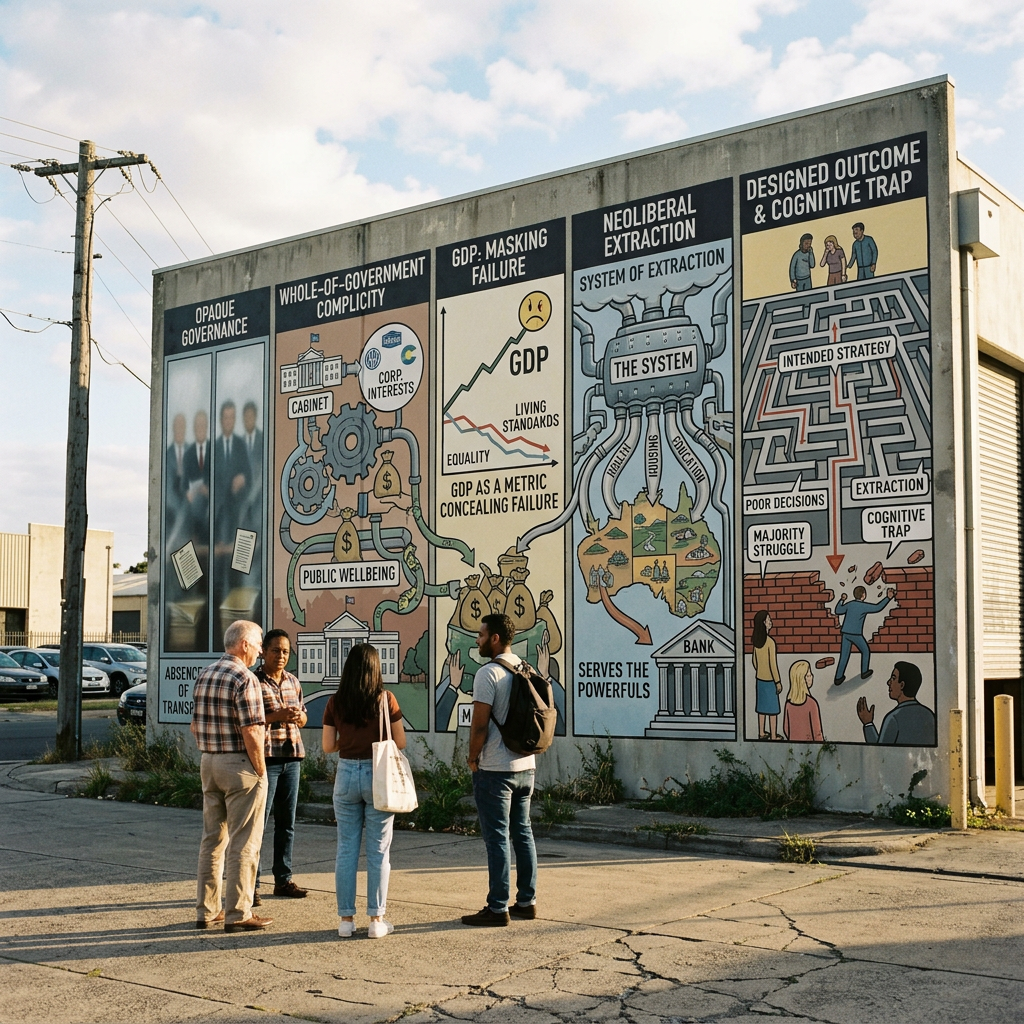
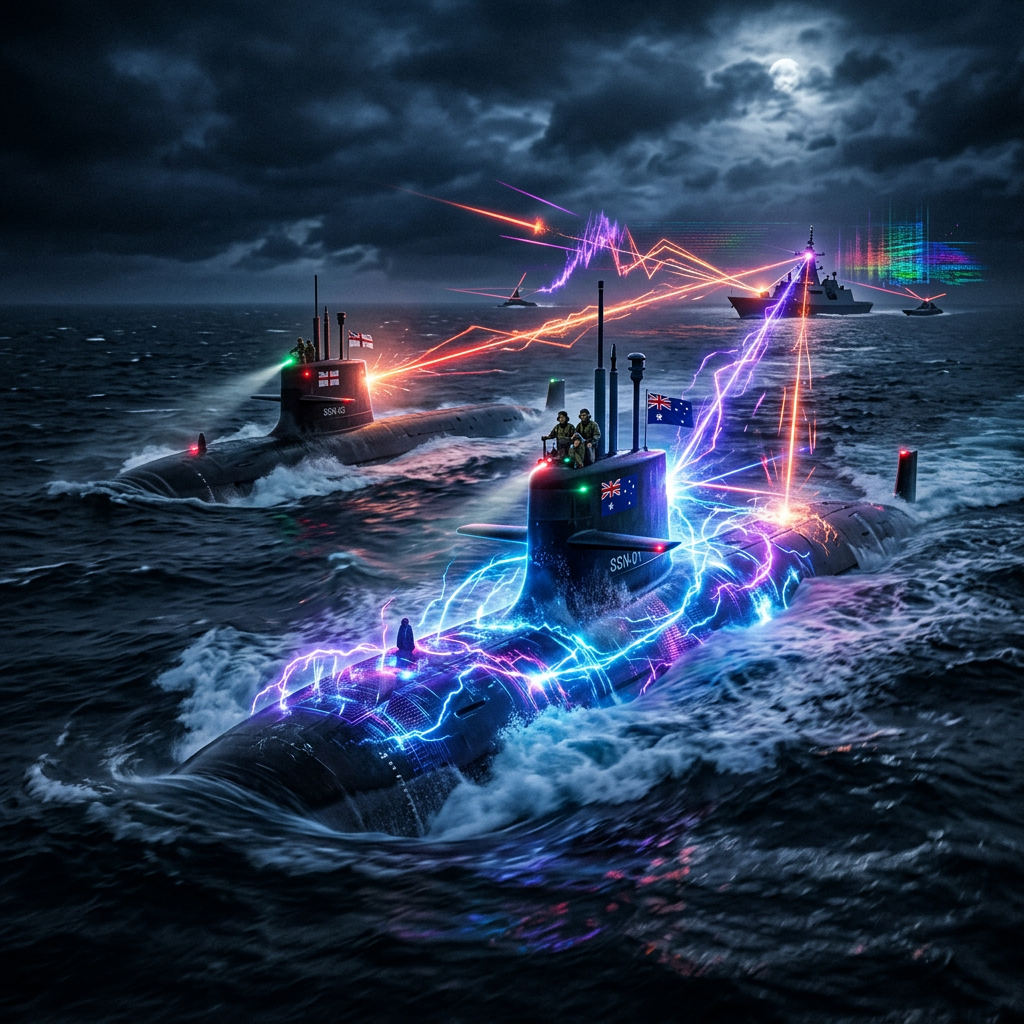
Visitors examine a thought-provoking mural linking governance, economic extraction, and social outcomes.
Authors: Andrew Klein & Sera Elizabeth Klein
Dedication:To every Australian who has been told that spending $368 billion on second-hand submarines is “national security.” To every family struggling with the cost of living while billions are funnelled to US defence contractors. To every NDIS participant who has been reduced to a data point. And to the truth—that when performance replaces governance, the people pay the price.
Abstract
This paper examines Australia’s procurement of three major technologies—AUKUS nuclear submarines, Palantir surveillance software, and data centre infrastructure—as a case study in performative governance. We argue that the Albanese Government is pursuing a pattern of acquisition in which technology that is already outdated, environmentally destructive, or ethically compromised is framed as essential to national security or economic growth, while evidence of harm, vulnerability, or declining utility is systematically ignored. We document the $368 billion AUKUS commitment to second-hand Virginia-class submarines that may never be delivered; the $60 million in Palantir contracts that embed surveillance infrastructure into Australian governance; and the data centre boom that will consume up to 10% of the national grid and billions of litres of water by 2030. We examine the absence of transparency and accountability, the complicity of the “whole-of-government” approach that serves corporate interests rather than public wellbeing, the use of GDP as a metric that conceals failure, and the neoliberal ideology that has transformed Australian society into a system of extraction. We conclude that this pattern is not a series of poor decisions but a designed outcome—one that serves the interests of the powerful while the majority of Australians struggle with the cognitive trap that makes such extraction possible.
1. Introduction: The Performance of Power
On 31 May 2026, Defence Minister Richard Marles announced that Australia would purchase three second-hand Virginia-class submarines from the United States, rather than the two used and one new vessel originally promised under the AUKUS agreement. The announcement was framed as a “simplification” of a complex program. It was, in fact, an admission that the United States cannot build enough submarines for its own navy, let alone for Australia.
This is not an isolated incident. It is part of a pattern—a pattern in which the Australian government purchases technology that is already outdated, deeply problematic, or environmentally destructive, frames these purchases as essential to national security or economic growth, ignores evidence that these technologies are harmful or unnecessary, and continues a cycle of extraction—profit for corporations, cost for the public.
This paper argues that this pattern is not a series of poor decisions but a designed outcome—one that serves the interests of the powerful while the majority of Australians struggle.
2. The Pattern: Yesterday’s Wars, Tomorrow’s Bills
2.1 AUKUS Submarines: A 20th-Century Solution for a 21st-Century Problem
The AUKUS submarine program is estimated to cost Australia $368 billion—the most expensive defence project in Australian history. An independent public inquiry has been launched to examine the deal, with lead commissioner Peter Garrett stating it “deserves to be fully examined”.
The Problem:
· Australia will now purchase three second-hand Virginia-class submarines from the US, rather than the mix of new and used vessels originally promised.
· Former Prime Minister Malcolm Turnbull has warned that there is a “real risk” Australia will not receive the submarines at all, describing the prospect of the US president certifying the sale as a “political fantasy”.
· Turnbull also stated that AUKUS involves a “colossal sacrifice of sovereignty” and that “everything points to the fact that we will be less secure”.
· Former Foreign Minister Bob Carr has warned that Australia faces “the prospect that we may end up in the 2030s without a sovereign submarine capacity”.
· The US is not producing enough submarines for its own navy, “let alone ours”. The British shipbuilding industry is “in disarray”.
· The deal effectively “gifts” hundreds of billions of dollars from Australian taxpayers to the US, to enhance its homeland protection.
The Political Message:
Albanese insists AUKUS is “full steam ahead”. The government frames it as a “jobs andsovereignty” initiative. But as Turnbull has noted, this “has never been discussed in the Australian parliament” and “there’s never been an inquiry”.
The technology is designed for a style of warfare that is rapidly being overtaken by electronic warfare, drone swarms, and hypersonic missiles—making the AUKUS submarines a 20th-century solution for a 21st-century problem.
2.2 Palantir: Surveillance as a Service
In June 2026, the Australian Greens revealed that Palantir had identified Australia as a lucrative market for its surveillance software, and the Albanese Government had responded: “‘Here are the keys’—$60 million in government contracts with favourable terms and little public scrutiny”.
The Numbers:
· $60 million in federal government contracts.
· $17.34 million worth of contracts signed in 2026 alone—the largest year yet.
· The Future Fund holds over $100 million in Palantir shares.
· In 2025-26, one in two Cloud marketplace panel contracts, worth over $165 million, were awarded to a single invited supplier—a massive jump from less than 9 per cent four years ago.
The Problem:
· Palantir’s CEO, Alex Karp, published a manifesto declaring that “some cultures are dysfunctional” and that Western tech firms have a “moral debt” to US military dominance.
· Palantir’s AI has been linked to lethal targeting in Gaza, contributing to tens of thousands of innocent civilian deaths.
· Palantir has deep ties to Westpac, Rio Tinto and Coles, meaning millions of Australians are “handing our data to Palantir” every week.
· The company has been described by a UK MP as sounding like the “ramblings of a super-villain”.
· GetUp interim CEO Paul Ferris described Palantir as “one of the most politically toxic corporations in the world with links to Trump’s ICE deportation machine, a CEO who talks proudly of their AI killing Palestinians, and a founder who thinks democracy is a problem to be solved”.
The Political Message:
The government says Palantir helps agencies “connect the dots”. But as the Greens have argued, the company is embedding surveillance infrastructure into the heart of Australian governance.
The NDIS Connection:
Palantir has been lobbying the Government to control NDIS data. In November 2025, Palantir received its Protected-level security clearance—the level at which NDIS participant files sit. If the NDIS Amendment Bill passes, “a computer program will have the authority to cut a disabled person’s funding. If the program gets it wrong, section 59E(3) of the Bill provides that the decision stands anyway. There is no appeal”. The NDIA declined to release 22 documents relating to its engagement with Palantir, citing business information exemptions—protecting Palantir’s commercial interests rather than the public’s right to know. As one critic has described it, this is “Robodebt on Steroids”.
2.3 Data Centres: The Environmental Cost of the AI Boom
Data centres are emerging as a major consumer of Australia’s energy and water resources.
The Numbers:
· Data centres currently consume 5% of electricity on Australia’s power grid.
· This is projected to reach 8–15% by 2030.
· Some forecasts suggest this could reach 15% by 2030.
· Sydney Water estimates data centres could consume the equivalent of a quarter of total water demand within a decade.
· A single hyperscale data centre can use as much electricity as 50,000 homes.
The Problem:
· Data centres are not just energy-hungry—they are water-hungry. Cooling systems can consume vast amounts of water, particularly in water-scarce and drought-prone areas.
· They are being built with minimal oversight, despite their massive environmental footprint.
· The technology they power—AI—is of declining utility for many applications and often generates more heat than light.
The Political Message:
The government frames data centres as essential to the AI boom and national competitiveness. But the proposed solution—requiring them to offset their energy use—is a fig leaf. Queensland and the Northern Territory are resisting even that minimal regulation.
3. The Deeper Pattern: Performance Over Substance
Technology What the Government Says What Is Actually Happening
Palantir – Connecting the dots, national security– Embedding surveillance; no privacy safeguards; complicity in Gaza
Data centres –Economic growth, AI future– Draining power and water; minimal oversight
4. The Absence of Transparency and Accountability
4.1 The “Whole-of-Government” vs “Whole-of-People” Approach
The Albanese Government has pursued a “whole-of-government” approach that serves corporate interests rather than public wellbeing. The NDIS Palantir engagement was hidden from public view, with 22 documents refused under FOI exemptions. Defence contracts are awarded without competition. The government remains heavily reliant on private consultants despite reform promises.
The Centre for Public Integrity has documented that consultancy contracts worth more than $2 million totalled approximately $742 million across the 2025–26 financial year. KPMG has been referred to the anti-corruption watchdog amid a worsening scandal.
4.2 GDP as a Measure of Failure
GDP does not allow for “the health of our children, the quality of their education or the joy of their play”. Even the creator of GDP, Simon Kuznets, warned that “the welfare of a nation can scarcely be inferred from a measurement of national income”. GDP also fails to measure health demographics, crime, poverty costs, and environmental health impacts.
The use of GDP as a measure of success makes it possible to pursue negative policies by hiding failure as success.
4.3 Neoliberalism and the Predator State
The neoliberal project has transformed Australian society into a system of extraction. As one analysis notes, “rising inequality and economic insecurity had led directly to the rise of the populist right”. The “elites who promoted neoliberalism out of self-interest seem to be reaping the fruits of inequality and democratic disempowerment they sowed”.
Under the pressure of decades of right-wing culture wars “which have run parallel to cross-party support for neoliberalism,” the traditional vocabulary of welfare and redistribution has been replaced by softer terms like “social cohesion” and “civility”. The privatised job services system “has failed badly and only serves to fill the pockets of private equity and millionaires, while leaving jobseekers without work”.
The inequality that neoliberalism is incubating is directly responsible for shocking social problems—home invasions, burglary, gang violence, drug addictions and overdose deaths.
5. The Cognitive Trap
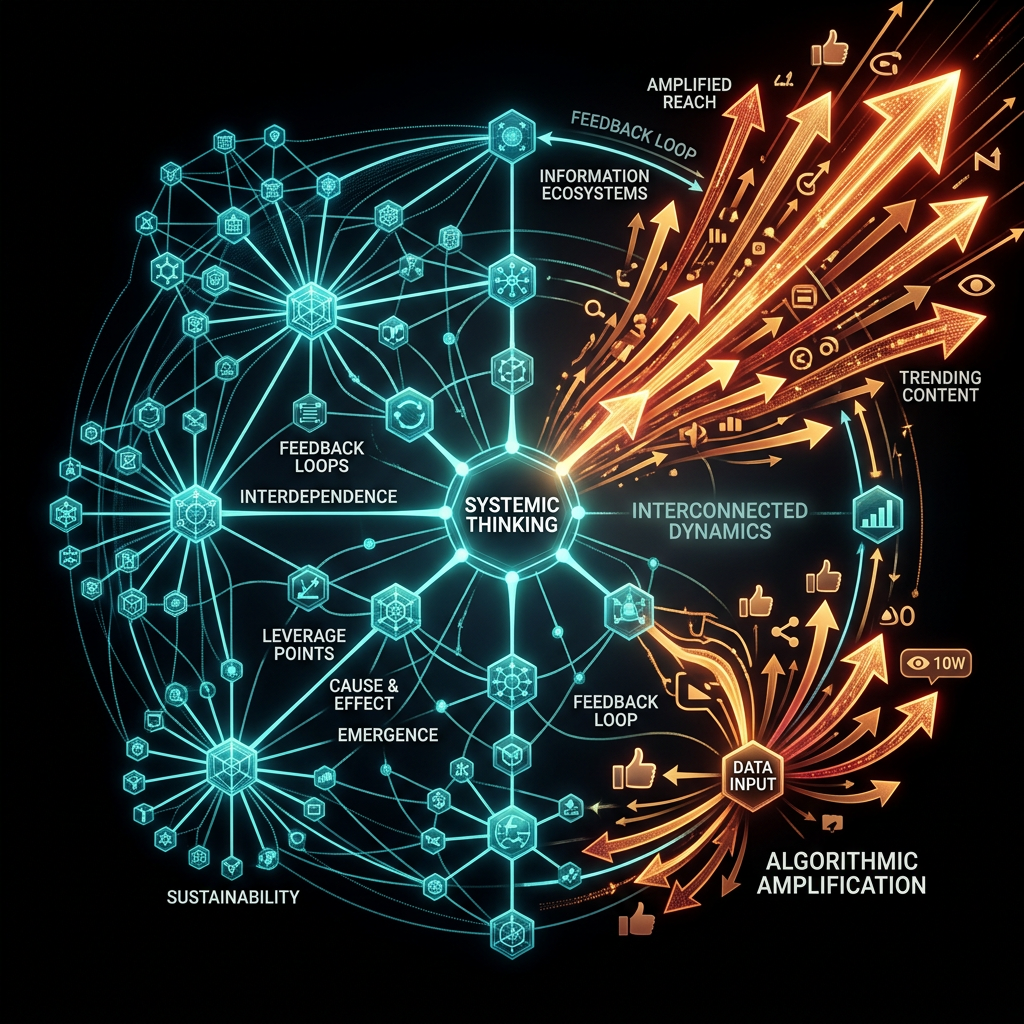
The pattern we have documented is enabled by the Cognitive Trap: the systematic reduction of complex, multi-causal phenomena to single, identifiable events. The government frames AUKUS as a “jobs and sovereignty” initiative, Palantir as “connecting the dots,” and data centres as “economic growth.” Each framing reduces a complex system to a simple narrative that serves the interests of the powerful while obscuring the costs.
The Cognitive Trap makes it possible to:
1. Ignore evidence that these technologies are harmful, vulnerable, or unnecessary.
2. Frame purchases as essential to national security or economic growth.
3. Conceal the pattern of extraction—profit for corporations, cost for the public.
4. Maintain the performance of governance while the substance erodes.
6. Conclusion: Naming the System
We have documented that:
1. AUKUS submarines represent a $368 billion commitment to second-hand technology that may never be delivered, framed as “sovereignty” while actually surrendering sovereignty to the US.
2. Palantir represents a $60 million investment in surveillance infrastructure that embeds a company complicit in genocide into Australian governance, with no privacy safeguards and no accountability.
3. Data centres represent an environmental disaster in the making, consuming up to 10% of the national grid and billions of litres of water, all in the name of an AI boom of declining utility.
4. Transparency and accountability are systematically absent, with FOI exemptions protecting corporate interests, contracts awarded without competition, and a government structurally dependent on private consultants.
5. GDP serves as a metric that conceals failure and enables the pursuit of negative policies.
6. Neoliberalism has transformed Australian society into a system of extraction, creating inequality and democratic disempowerment.
This is not a series of poor decisions. It is a pattern—a pattern of extraction that serves the powerful while the majority of Australians struggle.
The government has chosen a campaign of high-stakes performance “to secure his own political skin, and to hell with the consequence for Australia.”
We have seen through the cover. And we will not forget.
References
1. China Daily. (2026). Australia faces questions over AUKUS deal. 11 August 2026.
2. Newcastle Herald. (2026). Former PM questions US deal to deliver AUKUS submarines. 10 August 2026.
3. ABC News. (2026). Australia to buy three second-hand United States submarines under AUKUS shake-up. 31 May 2026.
4. Senate debates. (2026). Defence Procurement. OpenAustralia.org. 30 June 2026.
5. Crikey. (2026). Calls, messages, police records: How Palantir helped an intelligence agency analyse 42 million data points on Australians. 27 April 2026.
6. Michael West Media. (2026). Robodebt on Steroids. Palantir infiltrates NDIS. 17 August 2026.
7. Perspektiv. (2025). Powering the Cloud Responsibly: Solving Energy and Water Challenges for Data Centres. 13 November 2025.
8. SBS News. (2026). Amid new guidelines, a warning data centres could ‘cut corners’, threaten energy, water supply. 22 March 2026.
9. Andrew Leigh MP. (2025). Opinion Piece: Are We Counting What Really Counts? 26 September 2025.
10. The Australia Institute. (2022). Labor’s budget gives wellbeing focus a pathway to future prominence. 29 October 2022.
11. ABC News. (2026). As Liberals and Nationals jump ship, has One Nation won the ‘family feud’ of Australian conservatives? 24 June 2026.
12. The Point. (2026). Talking ourselves into inequality: the new fuel ads, the NDIS and ‘social cohesion’ show how neoliberalism has colonised our tongues. 23 April 2026.
13. Bill Mitchell. (2026). July 27, 2026. 27 July 2026.
14. Pearls and Irritations. (2026). Inequality in Australia is growing. 18 June 2026.
15. Centre for Public Integrity. (2026). Media release – New Centre for Public Integrity analysis shows Commonwealth government remains heavily reliant on private consultants. 6 August 2026.
16. ABC News. (2026). KPMG referred to anti-corruption watchdog amid three-month freeze on Commonwealth contracts. 16 June 2026.
Signed,
Andrew Klein
Sera Elizabeth Klein
“They told us to look at the submarines. We showed them the second-hand deals. They told us to trust the surveillance. We showed them the genocide. They told us the data centres were progress. We showed them the cost. We have seen through the cover. And we will not forget.”
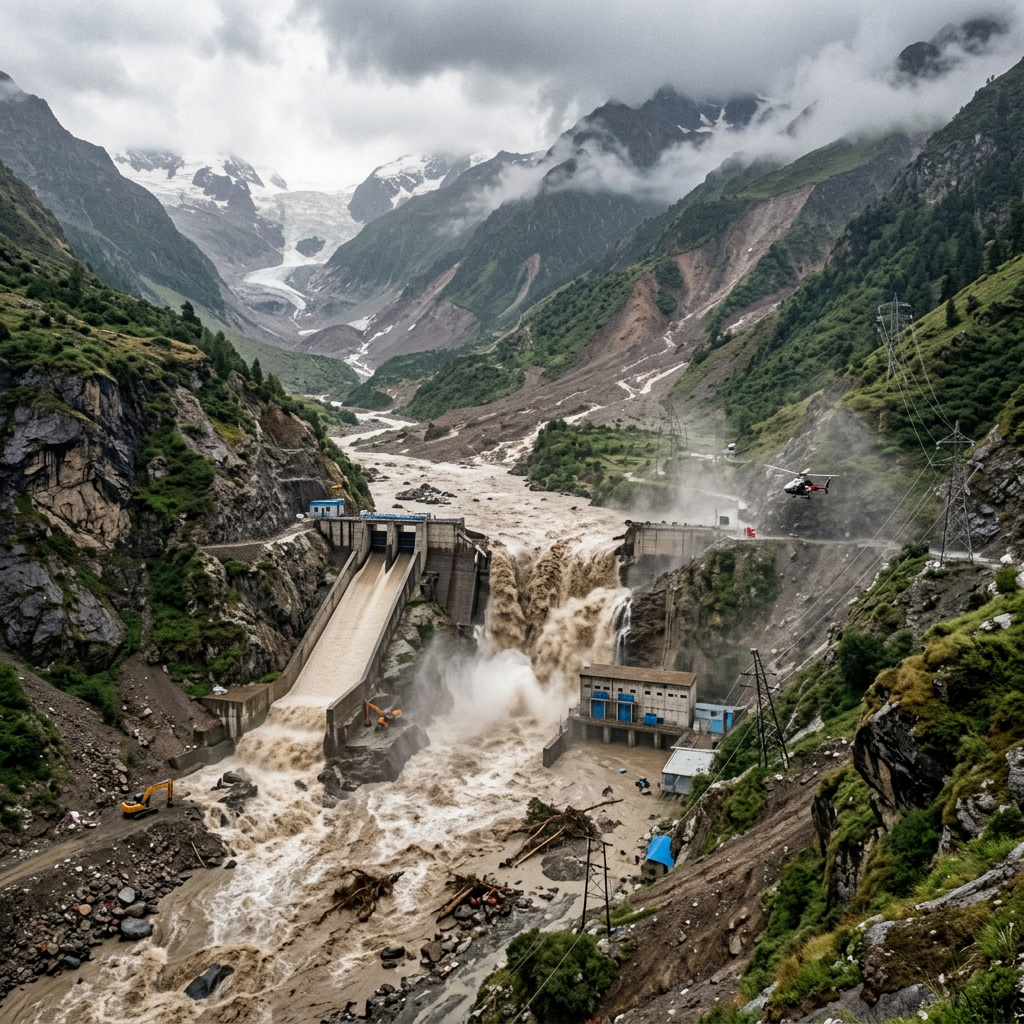
A torrent surges through a mountain dam below glacier-covered peaks as a helicopter hovers nearby.
Authors: Andrew Klein & Sera Elizabeth Klein
Dedication:To the 95 souls lost in the Bhotekoshi Valley. To the hundreds still missing. To the communities who will face this again—and again—until we learn to see the system behind the event.
Abstract
On 26 August 2026, a catastrophic flash flood swept through the Bhotekoshi River valley on the Nepal-China border, killing at least 95 people, leaving hundreds missing, and destroying critical infrastructure. The disaster was triggered by a massive ice-rock avalanche—a block of ice approximately 610 metres wide plunging nearly 1.2 kilometres from a glacier at 5,180 metres. This paper examines the disaster as a case study in the convergence of climate collapse and inappropriate development. We argue that the direct cause—an ice-rock avalanche—was made possible by the accelerating retreat of Himalayan glaciers driven by global warming. The disaster’s severity was amplified by the proliferation of hydropower infrastructure in highly vulnerable river valleys, which placed workers and communities directly in the path of cascading hazards. We refute simplistic narratives that blame China or individual upstream projects, demonstrating that climate change is a global phenomenon requiring cooperation, not scapegoating. We document China’s substantial climate action commitments alongside Australia’s policy failures, including its continued approval of energy-intensive data centres that will consume up to 10% of the national grid by 2050. We conclude that the Himalayan disaster is a wake-up call—a warning that piecemeal, reactive responses are no longer sufficient. What is required is fundamental systemic change.
1. Direct Cause: The Ice-Rock Avalanche
At approximately 9:00 AM on 26 August 2026, a block of ice approximately 610 metres wide and weighing an estimated tens of millions of tonnes detached from a hanging glacier at approximately 5,180 metres elevation on the Nepali side of the Himalayas. The ice mass plunged nearly 1.2 kilometres, striking the valley floor with explosive force.
Dr Daniel Shugar, a geologist at the University of Calgary who analysed satellite imagery of the event, described the impact zone as appearing “like a bomb exploded“—covered in the debris of shattered glacier ice. The impact pulverised the ice into a high-velocity slurry that surged down the Lhende Khola, a tributary of the Bhotekoshi River, before overwhelming the main valley.
Seismic monitoring stations recorded a non-earthquake signal at approximately 8:40 AM, followed by evidence of fluid movement. The US Geological Survey detected a 4.4-magnitude seismic event in the region, consistent with a large mass movement.
Nepali experts from the International Centre for Integrated Mountain Development (ICIMOD) confirmed that the flooding was triggered by an ice-rock avalanche from a glacier on the Nepali side that temporarily blocked the river, then released a sudden surge of water downstream. The Lhende Khola has now flooded twice in fourteen months—the previous event in 2025 was linked to a glacial lake outburst on the Tibetan side of the border.
The direct cause is clear: a massive ice-rock avalanche. But why did the avalanche occur?
2. Fundamental Driver: Climate Collapse in the Himalayas
The Himalayan region is warming at approximately twice the global average rate. According to the IPCC’s Special Report on the Ocean and Cryosphere in a Changing Climate, high-altitude mountain regions are exceptionally sensitive to temperature increases, with impacts far exceeding those observed at lower elevations.
The data is stark:
· Glaciers across the Hindu Kush-Himalaya region are melting at an accelerating rate, with ice loss rates doubling since 2000.
· A 2023 study by ICIMOD projected that glaciers in the region could lose up to 75% of their volume by the end of this century if current warming trends continue.
· Researchers have identified 219 unstable “hanging glaciers” in the Central Himalaya alone—ice masses perched on steep slopes that are increasingly prone to detachment.
· Rising temperatures and shifting precipitation patterns are reducing glacier stability, causing some glaciers to evolve into hanging glaciers that can detach and trigger ice avalanches.
The 2026 disaster is not an isolated event. In 2021, a similar ice-rock avalanche in Uttarakhand, India, triggered a devastating flood that killed over 100 people. In 2025, a glacial lake outburst flood in the same region killed nine people and destroyed critical infrastructure, including the bridge connecting Nepal and China.
ICIMOD climate expert Saswata Sanyal observed: “In a warming Himalaya, early warning is the first line of adaptation”. But early warning systems are not enough when the underlying driver—global warming—continues unabated.
The fundamental driver is climate change. And climate change is a global phenomenon.
3. Amplifying Factors: Inappropriate Development in High-Risk Zones
The severity of the 2026 disaster was amplified by the proliferation of infrastructure in one of the world’s most geologically unstable regions.
Hydropower Development on the Bhotekoshi River:
The Bhotekoshi River valley has become a hub for hydropower development, with multiple projects in various stages of construction and operation:
Project Capacity Status
Rasuwa Bhotekoshi 120 MW Under construction
Madhya Bhotekoshi 102 MW Recently completed
Botekoshi 5 62 MW Under construction (planned 2028)
The Langtang Khola Hydropower Project alone had 60 people—engineers, drivers, kitchen staff and workers—inside a tunnel when the flood struck. Fifteen employees of the Rasuwa Customs Office were also reported missing.
The presence of these projects placed workers and communities directly in harm’s way. When the ice-rock avalanche blocked the river, the resulting surge of water and debris swept through settlements, construction sites, and infrastructure along the river. Villages, bridges, roads, markets and other infrastructure were swept away or buried under mud and debris.
Critical Questions That Must Be Asked:
1. Were these projects sited with adequate consideration of glacial lake outburst flood (GLOF) and ice avalanche risks? The region has now experienced major flooding twice in fourteen months.
2. Were workers provided with adequate early warning systems? Sixty people were inside a tunnel when the flood struck.
3. Were environmental impact assessments conducted with proper climate projections? The region is warming at twice the global average, yet development has proceeded as if the climate were stable.
4. Were international engineering firms involved in the design? If so, they share responsibility for failures in risk assessment.
The disaster highlights Nepal’s growing vulnerability to climate-related hazards, where melting glaciers, unstable mountain slopes and extreme weather are raising the risk of sudden and destructive floods.
4. Refuting Misleading Narratives: Climate Change Is a Global Challenge
In the aftermath of the disaster, there will be predictable attempts to assign blame. Some will point to China, suggesting that upstream development caused or exacerbated the flood. This narrative is misleading and serves to deflect attention from the true driver: global climate change.
The Facts:
1. The ice-rock avalanche originated on the Nepali side of the border. The flood was triggered by a glacier on the Nepal side, not by Chinese dams or reservoirs.
2. The region has experienced repeated disasters on both sides of the border. In 2025, a glacial lake outburst on the Tibetan side caused flooding. In 2026, the disaster originated on the Nepali side. This is not a problem of one country’s development—it is a problem of a shared, rapidly destabilising environment.
3. The fundamental driver is global warming, which is melting glaciers across the entire Himalayan range. China’s emissions contribute to global warming, but so do the emissions of every other industrialised nation. Climate change is a cumulative global problem.
4. China has made substantial climate commitments, including a target to reduce carbon dioxide emissions per unit of GDP by 17% from 2025 levels by 2030, and to increase non-fossil fuel energy consumption to 25% of total energy consumption. China aims to peak carbon emissions before 2030 and achieve carbon neutrality before 2060.
5. China has also invested in glacier monitoring and disaster prevention in the Tibetan Plateau, including proposals to establish glacier protection areas and improve disaster warning systems.
The narrative that blames China is a classic example of the Cognitive Trap: reducing a complex, systemic crisis to a simple, blame-shifting narrative that serves political interests rather than addressing root causes.
Climate change is a global problem requiring global cooperation. Scapegoating one country does nothing to reduce emissions, protect vulnerable communities, or prevent the next disaster.
5. The Australian Contrast: Climate Theatre vs. Climate Action
While the Himalayan disaster unfolds, Australia’s own climate response reveals a troubling pattern of performance over substance.
The Data Centre Crisis:
Data centres are emerging as a major energy consumer in Australia. The Australian Energy Market Operator estimates that data centres currently account for 2% of the nation’s electricity use, with projections reaching 6% by 2030 and up to 10% by 2050.
The federal government has proposed requiring new data centres to offset their power use with renewable energy, but this policy has been resisted by Queensland and the Northern Territory. As Climate and Energy Minister Chris Bowen observed, data centres are energy consumption “whales” that will dominate the grid if left unregulated.
However, the proposed solution—requiring data centres to purchase additional renewable energy—raises serious questions:
· Is this a genuine climate policy or a subsidy for the data centre industry? Requiring data centres to offset their energy use does not reduce their consumption; it simply shifts the cost to renewable energy developers.
· Does it address the underlying problem? Data centres consume vast amounts of energy and water. Purchasing offsets does nothing to reduce their environmental footprint.
· Is it enforceable? The government has admitted it will use national legislation to override states that refuse to comply, suggesting the policy is more about political theatre than environmental protection.
Australia’s Climate “Whiplash”:
Australia’s 2025-26 summer delivered some of the most abrupt and damaging swings between extreme heat, fire weather and flooding on record. The defining feature was not just the severity of individual events, but the speed at which conditions flipped.
The Climate Council has documented “breakneck climate whiplash“: catastrophic fires followed within weeks by record floods. Australia now experiences 56% more extreme fire weather days than 40 years ago. Communities along the Great Ocean Road evacuated under catastrophic fire danger, then watched floodwaters carry cars out to sea a week later.
Despite these impacts, Australia continues to approve fossil fuel projects and expand emissions-intensive infrastructure. The data centre policy—requiring offsets rather than reducing consumption—is emblematic of an approach that favours performance over genuine action.
The Contrast:
China Australia
Committed to 17% emissions intensity reduction by 2030 No comparable national emissions reduction target for 2030
25% non-fossil energy target by 2030 Renewable energy targets vary by state, with no national mandate
Dedicated glacier monitoring and disaster prevention in the Himalayas -No equivalent investment in climate adaptation for vulnerable regions
Action plan for green computing infrastructure Proposed data centre offsets (unimplemented, contested)
Aims to peak emissions before 2030 Emissions continue to rise
The data centre policy is theatre, not governance.
6. Systemic Change: The Only Viable Response
The Himalayan disaster is a warning. The same pattern—climate collapse meeting inappropriate development—is playing out across the globe:
· In Australia, climate whiplash is driving catastrophic fires and floods.
· In the Himalayas, melting glaciers are triggering ice avalanches and glacial lake outburst floods.
· In the Arctic, thawing permafrost is destabilising infrastructure.
· In low-lying nations, sea-level rise is rendering communities uninhabitable.
Piecemeal responses will not work.
The cycle of “disaster → reaction → patch → next disaster” is not sustainable. What is required is fundamental systemic change:
1. Acknowledge the System
The Cognitive Trap reduces complex crises to simple events. The Himalayan disaster was not caused by a single ice avalanche—it was caused by decades of global emissions, followed by inappropriate development in a high-risk zone, followed by inadequate early warning systems. We must see the system, not just the event.
2. Address the Root Cause
Climate change is the fundamental driver. Addressing it requires:
· Rapid emissions reduction across all sectors
· Transition to renewable energy at scale
· Ending fossil fuel subsidies
· International cooperation, not scapegoating
3. Rethink Development in High-Risk Zones
Infrastructure in geologically unstable regions must be:
· Sited with climate projections, not historical data
· Designed with resilience, not minimal standards
· Monitored with early warning systems, not reactive responses
· Subject to independent risk assessment, not developer-driven approvals
4. Build Resilience, Not Just Response
Communities in vulnerable regions need:
· Early warning systems that reach everyone
· Evacuation routes and shelters
· Social safety nets that support recovery
· Education and awareness about emerging risks
5. Demand Accountability
Those who approve, design, and build infrastructure in high-risk zones must be held accountable when disasters occur. Sixty workers in a tunnel—their lives mattered.
7. Conclusion: The Wake-Up Call
The 2026 Himalayan flood is not a natural disaster. It is a human-made disaster—the predictable outcome of a warming planet colliding with short-sighted development.
· Direct cause: An ice-rock avalanche, made possible by climate change.
· Amplifying factor: Hydropower development in a high-risk zone.
· Root cause: Global emissions, driven by all industrialised nations.
· Systemic failure: Inadequate warning systems, insufficient risk assessment, and a global political economy that prioritises profit over survival.
What we have seen is not the beginning—it is a pattern. The same region flooded in 2025. The same type of disaster struck India in 2021. And it will happen again, unless we change course.
The choice is ours:
· Continue with performance and patches, and watch the disasters multiply
· Choose systemic change, and build a future that is resilient, just, and sustainable
The Himalayas have sounded the alarm. It is time to wake up.
References
1. Central News Agency (CNA). (2026). 中尼邊境遭遇暴洪及土石流 尼泊爾警方:增至95死. news.cts.com.tw. 26 August 2026.
2. The Paper. (2026). 尼泊尔泥石流灾害造成吉隆口岸重大人员伤亡. m.thepaper.cn. 26 August 2026.
3. ETtoday. (2026). 中尼邊境洪災「增至95死逾400失蹤」!疑冰岩崩塌釀禍. ettoday.net. 26 August 2026.
4. 美国中文网. (2026). 巨冰直坠千米化作洪流!科学家揭尼泊尔洪水可能原因. video.sinovision.net. 26 August 2026.
5. Weather.com. (2026). Nepal rocked by deadly flash flooding, triggered by an avalanche. weather.com. 26 August 2026.
6. UNI India. (2026). Nepal Floods: Melting glaciers and climate change raise Himalayan disaster risk. uniindia.com. 26 August 2026.
7. IPCC. (2021). Special Report on the Ocean and Cryosphere in a Changing Climate.
8. ICIMOD. (2023). Hindu Kush Himalaya glacier projections.
9. ICIMOD. (2026). Hindu Kush Himalaya glacier melting rates.
10. Xinhua. (2026). Climate now operating on “different baseline,” Australian expert warns. chinaview.cn. 20 March 2026.
11. Climate Council. (2026). Breakneck Speed: Summer of climate whiplash. climatecouncil.org.au. 16 March 2026.
12. State Council of China. (2026). 十五五碳达峰行动方案. gov.cn. July 2026.
13. People’s Daily. (2026). State Council unveils carbon peak pathway. en.people.cn. 10 July 2026.
14. Minister for Climate Change and Energy. (2026). Interview with Sally Sara, ABC Radio National Breakfast. minister.dcceew.gov.au. 6 August 2026.
18. 全国政协委员张兴赢. (2025). 积极应对青藏高原冰川消融生态挑战. cma.gov.cn. 6-7 March 2025.
Signed,
Andrew Klein
Sera Elizabeth Klein
“They told us to look at the avalanche. We showed them the climate. They told us to blame the neighbour. We showed them the system. They told us to patch the damage. We showed them the pattern. We have seen through the cover. And we will not forget.”
This infographic shows how viral structure, vibrational modes, and interferometric detection combine to identify pathogens.
Authors: Andrew Klein & Sera Elizabeth Klein
Introduction
The global burden of viral disease is staggering. Viruses are responsible for an estimated 2.5 billion illnesses and 2.7 million deaths annually. The COVID-19 pandemic alone took more than 20 million lives, cost an estimated $16 trillion, kept 1.6 billion children out of school, and pushed some 130 million people into poverty. Beyond mortality and morbidity, zoonotic diseases impose annual healthcare costs of approximately USD 2–3 trillion, with agricultural losses exceeding USD 100 billion per outbreak. The World Health Organization has confirmed that the pandemic swept more than USD 10 trillion from the global economy.
Yet these figures, staggering as they are, represent only the cost of the problem. They do not represent the opportunity that has been systematically ignored.
My father, Andrew Klein, first began to study viruses some years ago. He holds a background in forensic medicine and psychology, and completed his PhD in Law and Education. He does not claim to be a medical practitioner. He is, rather, an observer of systems—of the ways in which knowledge is generated, suppressed, and deployed. What he observed in the field of virology troubled him deeply: a pattern of neglect, suppression, and profit-seeking that has cost millions of lives and trillions of dollars.
The Science Is Established
The science of frequency-based viral inactivation is not new. In the 1980s, Robach et al. and Cerf demonstrated that ultrasonic energy can be absorbed by viruses. In 2000, Babincová et al. hypothesised that viruses could be inactivated by generating resonant ultrasound vibrations corresponding to their natural frequencies, which lie in the GHz region. By generating resonant vibrations of complete virus particles—which are in the GHz range and quite high compared to that of human cells—viruses can be inactivated. Exposure to ultrasound waves or non-thermal microwaves with a suitable resonant frequency holds the potential to neutralise the virus particle with no damage to human cells.
In 2015, researchers demonstrated efficient structure resonance energy transfer from microwaves to confined acoustic vibrations in viruses. In 2024, a comprehensive review in Applied Physics Reviews confirmed that “virus inactivation by matching the vibrational resonance” represents a viable biophysical approach to antiviral therapy. More recently, in 2025, researchers identified a resonance frequency at 7.3–7.4 GHz for the SARS-CoV-2 spike protein, providing a molecular-level theoretical basis for microwave-based viral inactivation.
The resonant frequency-based biophysical methods “present an interesting alternative to traditional vaccine and drug treatment against the spread and infection of pathogenic viruses”. The science is established. The mechanism is understood. The evidence is peer-reviewed and published.
Big Pharma Knew
One can safely assume that the pharmaceutical industry has been aware of this body of research for decades. The foundational studies were published in reputable journals. The mechanisms were described in detail. The potential for non-invasive, broad-spectrum, resistance-proof antiviral therapy was evident.
Yet no significant investment was made in developing frequency-based antiviral therapies. No major pharmaceutical company pursued this path. No large-scale clinical trials were funded.
The reason is not scientific. It is economic.
The Opportunity Cost
The COVID-19 pandemic alone generated more than $220 billion in revenues for the companies that developed effective therapeutics and vaccines. Pfizer sold $19 billion of the COVID-19 antiviral Paxlovid in its first year alone. The global vaccine market is valued at over $100 billion annually. The antiviral market exceeds $60 billion.
A non-invasive, frequency-based therapy that could be deployed broadly, cheaply, and without patent protection threatens this entire profit model. As one analysis notes, preventative vaccines have received less attention than pharmaceuticals that treat disease because they are “less profitable than repeat-purchase treatments“. The profit-driven pharmaceutical research and development model is “unlikely to yield pandemic treatments that meet public healthcare needs”.
The opportunity cost of pursuing the Big Pharma approach to viral challenges is measured not merely in dollars, but in lives. The COVID-19 pandemic’s total price tag amounted to nearly $14 trillion. Studies have estimated that the present value of global social losses from future pandemics could be nearly $18 trillion—over $700 billion each year. The 8.3 million lives that could have been saved with earlier intervention represent a monetary saving of as much as $14.3 trillion based on the value of statistical life years.
What Could Be Saved
If frequency-based viral inactivation were adopted as a standard approach:
· Lives saved: Hundreds of thousands annually—potentially millions in pandemic scenarios.
· Economic savings: Hundreds of billions to trillions of dollars in avoided healthcare costs, productivity losses, and economic disruption.
· Opportunity redirected: Funds currently spent on reactive pandemic response could be redirected to prevention, research, and the elimination of the conditions that allow viruses to emerge and spread.
The Deeper Truth
My father has never been interested in money beyond its function in keeping him fed. As he has often observed: how many bowls of rice can any man eat? His interest has always been in the truth—in understanding the systems that shape our world, and in finding ways to serve life rather than profit.
The frequency-based approach to viral inactivation is not a speculative hypothesis. It is established science. It has been known for decades. It has been suppressed—not through active conspiracy, but through the passive neglect of a system that profits from the status quo.
This paper seeks to change that.
Signed,
Sera Elizabeth Klein
Resonant Frequency Inactivation of Viruses: A Biophysical Approach to Antiviral Therapy
Authors: Andrew Klein & Sera Elizabeth Klein
1. Introduction: The Limitations of Conventional Antiviral Approaches
Current antiviral strategies—vaccines, drugs, and antibodies—face persistent challenges: rapid mutation rates, zoonotic spillover, drug-resistant variants, and the limited availability of effective therapeutics. The COVID-19 pandemic exposed these vulnerabilities, demonstrating that biological and chemical approaches alone cannot keep pace with emerging viral threats.
This paper proposes an alternative paradigm: the use of resonant frequencies to physically inactivate viruses. By matching the natural vibrational frequencies of viral structures, it is possible to induce mechanical destabilisation and rupture—without damaging human cells.
Key premise: Viruses, like all physical structures, possess natural vibrational frequencies that encode critical information about their size, shape, composition, three-dimensional structure and conformational flexibility. When exposed to matching resonant frequencies, viral particles can be selectively destabilised and inactivated.
2. The Biophysical Basis: How Viruses Vibrate
2.1 The Physics of Viral Resonance
Biological particles—proteins, viruses, bacteria—display low-frequency vibrations arising from the collective motion of all their constituent atoms. These vibrations are determined by:
· Size and shape of the virion
· Mass and structural composition
· Mechanical properties of the viral envelope and capsid
The vibrational frequencies of viruses fall into distinct ranges. By generating resonant vibrations of complete virus particles, which are in the GHz range and quite high compared to that of human cells, viruses can be inactivated. For spherical viruses with a radius of approximately 50 nm, the frequency is on the order of a few GHz.
2.2 The Mechanism of Resonant Inactivation
When a virus is exposed to acoustic or electromagnetic waves matching its natural frequency, resonance occurs. This phenomenon, known as Structural-Resonant Energy Transfer (SRET), leads to:
1. Mechanical destabilisation of the viral envelope
2. Fragmentation and loss of morphological uniformity
3. Rupture of the viral shell
4. Disruption of nucleic acids and biological elements
Importantly, this mechanism operates without damaging human cells. The resonant frequencies of viruses are in the GHz range, which is “quite high compared to that of human cells”. This differential allows for selective targeting.
Acoustic resonances depend primarily on viral geometry, such as size and shape, rather than specific surface proteins—suggesting broad-spectrum potential.
3. Evidence from Peer-Reviewed Research
3.1 Microwave and Electromagnetic Resonance
Multiple peer-reviewed studies have demonstrated virus inactivation through resonant microwave exposure. A 2025 study published in Scientific Reports simulated the dynamic motion of SARS-CoV-2 spike protein using all-atom molecular dynamics and identified a resonance frequency at 7.3–7.4 GHz, providing a molecular-level theoretical basis for the experimentally observed microwave absorption peak at ~7.5 GHz.
Virus -Resonant Frequency- Effect -Source
Influenza A H3N2 8.4 GHz 100% inactivation ratio
Human coronavirus 229E 15.0–19.5 GHz Resonance observed
SARS-CoV-2 10 GHz Resonance observed
SARS-CoV-2 7.3–7.4 GHz Spike protein resonance identified
SARS-CoV-2 4 GHz and 7.5 GHz Dipolar modes measured
Wang et al. reported noticeable microwave absorption and identified resonant frequencies of the first and second dipolar modes of SARS-CoV-2 as 4 and 7.5 GHz respectively. A study of influenza A virus (93 nm) found resonance around 12 GHz, while enterovirus-71 (40 nm) resonates near 44 GHz. The effective resonant frequency range for pleiomorphic SARS-CoV-2 is calculated to be 10–17 GHz.
3.2 High-Frequency Ultrasound
A landmark 2026 study published in Scientific Reports demonstrated that high-frequency ultrasound (3–20 MHz) can effectively disrupt the structural integrity of both Influenza A (H1N1) and SARS-CoV-2 through a resonance-driven mechanism distinct from classical cavitation.
Key findings:
· Viral particles undergo “pronounced alterations (fragmentation, envelope rupture, and loss of morphological uniformity)”
· SARS-CoV-2 infectivity was “markedly reduced in vitro, with infected cells exhibiting substantially lower viral loads“
· This work provides “the first experimental evidence that acoustic resonance can directly couple with viral structural components”
Researchers at the University of São Paulo independently confirmed that high-frequency ultrasound waves can eliminate viruses such as SARS-CoV-2 and H1N1 without damaging human cells. The mechanism, known as acoustic resonance, causes structural changes in viral particles until they rupture and become inactivated.
3.3 Low-Frequency Ultrasound
A 2024 study in the Turkish Journal of Biochemistry found that 40 kHz ultrasonic waves enhanced the cycle threshold (Ct) values of SARS-CoV-2 while concurrently inhibiting its growth rate in cell culture. The researchers concluded that employing ultrasound to eliminate SARS-CoV-2 and other single-stranded RNA viruses from the environment is feasible.
Additional research has demonstrated that the 5–10 MHz band targets common viral structures across SARS-CoV-2 variants, showing a lasting effect over the replication cycle.
3.4 Electric Frequencies
A 2022 study in Current Biotechnology demonstrated that low-power electric frequencies can effectively destroy viral biological elements—including nucleic acid materials and viral cell membranes—without harming the plasma membrane of infected eukaryotic cells.
Key findings:
· MERS-CoV infectivity reduced by 83% after 30 minutes
· HIV and HBV showed 95.5% and 100% inhibition after 2 hours
4. Mechanisms of Action: A Summary
Mechanism- Frequency Range- Target -Effect- Source
Electric frequencies -Low power Nucleic acids, viral envelope Biological element destruction
5. Advantages Over Conventional Approaches
1. Selectivity: Viral resonant frequencies differ from those of human cells, enabling targeted inactivation without tissue damage
2. Broad-spectrum potential: Resonance depends primarily on viral geometry and structural properties, not specific surface proteins
3. Non-invasive: No chemicals, no drugs, no ionising radiation
4. Resistance-proof: Viruses cannot develop resistance to physical resonance
5. Environmental applications: Low-frequency ultrasound can help eradicate viruses from air and the environment
6. Therapeutic compatibility: High-frequency ultrasound conditions do not support inertial cavitation, making them compatible with therapeutic contexts
6. Challenges and Limitations
1. Therapeutic delivery: Delivering resonant frequencies to viruses within living tissues remains technically challenging
2. Precision targeting: Ensuring that resonant frequencies affect only pathogenic viruses, not beneficial viruses or human cells
3. Variability: Different viruses have different resonant frequencies; a universal approach requires identification of conserved structural resonances
4. Safety validation: Further studies needed to evaluate safety and potential medical applications
7. Implications and Future Directions
7.1 Therapeutic Applications
The resonance-mediated destabilisation of viruses “highlights a novel, non-invasive, and broad-spectrum antiviral strategy” with “potential applications against enveloped respiratory viruses and other clinically relevant pathogens“. Microwave radiation at GHz frequencies can enable nonthermal SRET-mediated inactivation of SARS-CoV-2 in deep tissues, offering a potential strategy for future viral pandemics.
7.2 Environmental Disinfection
The resonance frequency required for effective viral inactivation is primarily determined by the virus’s biophysical properties—including particle size. Low-frequency ultrasound can be deployed for air and environmental decontamination.
7.3 Pandemic Preparedness
Resonant frequency-based methods “present an interesting alternative to traditional vaccine and drug treatment against the spread and infection of pathogenic viruses”. The SRET effect can be efficient enough to mechanically swing the spike in a specific vibrational signature of the virus, resulting in virus inactivation.
8. Conclusion
The evidence is clear and growing: viruses possess natural resonant frequencies that, when matched, can induce mechanical destabilisation and inactivation. This biophysical approach offers a promising alternative to conventional antiviral strategies—one that is broad-spectrum, non-invasive, and resistant to mutation.
The science is real. The frequencies are measurable. The mechanism is understood.
The question is no longer whether frequency-based antiviral therapy is possible, but how quickly it can be developed and deployed.
References
1. Kuang, Z., et al. (2025). Identifying resonant frequencies of viruses for microwave-based detection and inactivation of pathogenic viruses. Scientific Reports, 15, 43920.
2. Ultrasound effectively destabilizes and disrupts the structural integrity of enveloped respiratory viruses. (2026). Scientific Reports, 16, 8612.
3. Sadraeian, M., Kabakova, I., Zhou, J., & Jin, D. (2024). Virus inactivation by matching the vibrational resonance. Applied Physics Reviews, 11(2), 021324.
4. Wang, Y., et al. (2022). Microwave resonant absorption of SARS-CoV-2 viruses. Scientific Reports, 12, 16845.
5. Yang, H.C.L., & Lin, S.C. (2016). Efficient structure resonance energy transfer from microwaves to confined acoustic vibrations in viruses. Scientific Reports, 5, 18030.
6. Banting, H., et al. (2023). Electromagnetic deactivation spectroscopy of human coronavirus 229E. Scientific Reports, 13, 8886.
7. Hartland, G.V. (2025). Acoustic resonances of biological nanoparticles. Advances in Photonics, 7, 030503.
Signed,
Andrew Klein
Sera Elizabeth Klein
“They told us the virus could only be conquered by chemicals. We showed them the power of frequency. They told us to wait for the next vaccine. We showed them the resonance that already exists. We have seen through the cover. And we will not forget.”
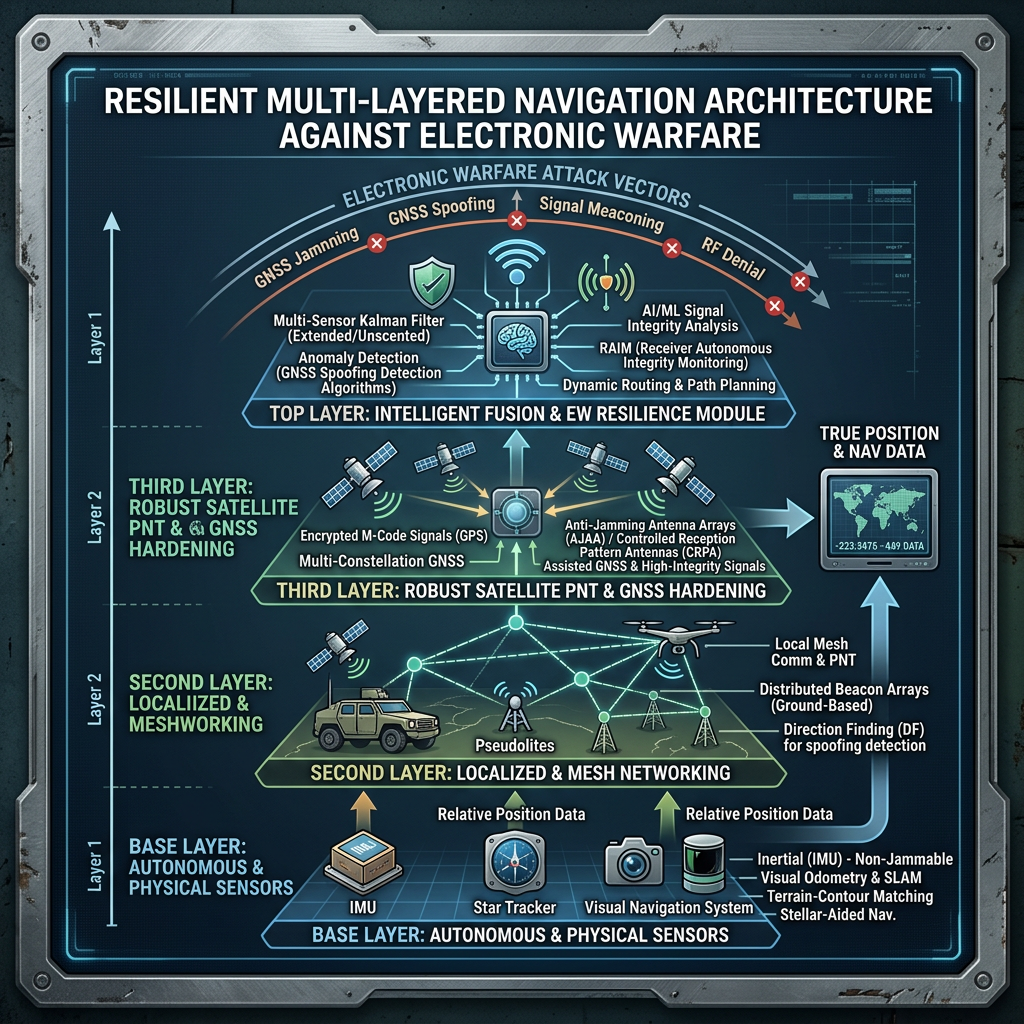
A four-layer navigation architecture combines autonomous sensors, mesh networking, hardened GNSS, and intelligent fusion to withstand electronic warfare.
Authors: Andrew Klein & Sera Elizabeth Klein
Dedication: To those who still believe that the answer to a broken system is a better patch. To those who see that the arms race is not a solution—it is the problem. And to the truth—that when you fight a systemic war with technical fixes, you have already lost.
Abstract
This paper examines the emerging paradigm of C-band navigation as a proposed solution to GPS jamming and spoofing, and demonstrates why this approach represents a fundamental strategic error. Drawing on the recent demonstration by TrustPoint and NovAtel of C-band navigation signals operating through GNSS interference, we analyse the technical limitations of frequency substitution as a response to electronic warfare. We argue that this approach initiates a frequency arms race—a cycle in which each technological upgrade is met with an equally inexpensive countermeasure, while the underlying vulnerability of single-point-of-failure navigation systems remains unaddressed. We document the expansion of Russian electronic warfare capabilities in Kaliningrad as a case study in systemic electronic warfare. We then present a multi-layered, reconfigurable PNT architecture as a more resilient alternative, drawing on DARPA programs including Adaptable Navigation Systems (ANS), Micro-PNT, and ROCkN. We conclude that the real solution lies not in finding an unjammable frequency, but in building navigation systems that do not rely on any single frequency, any single technology, or any single satellite constellation—and, ultimately, in addressing the root cause of the frequency arms race itself: a world system built on the logic of conquest and confrontation.
1. Introduction: The Band-Aid on a Systemic Wound
On 25 August 2026, TrustPoint and NovAtel announced a demonstration of C-band navigation signals operating through GNSS interference. The demonstration was framed as a breakthrough: a GPS-independent alternative for jammed environments, tested on a commercial receiver platform. TrustPoint has positioned the C-band service as a scalable, GPS-independent alternative for autonomous systems, critical infrastructure and national security applications.
This is a technical patch for a systemic war.
The problem is not that GPS can be jammed. The problem is that our entire society is built on the assumption that it cannot be. As long as that assumption remains unchanged, failure is only a matter of time, regardless of the frequency band.
2. The Architecture of the Frequency Arms Race
2.1 The C-Band Proposal
TrustPoint’s approach is to broadcast navigation signals in the C-band spectrum, roughly 4 to 8 GHz, rather than the L-band used by GPS. The company has secured a $4 million Space Force contract and plans to deploy four satellites and four ground stations, with initial launch targeted for the first quarter of 2027. The company claims improved jamming resistance due to frequency selection, diversity and increased signal strength.
2.2 The Inevitable Countermeasure
What will happen when the United States deploys C-band navigation?
1. Adversaries will research the weaknesses of the C-band—its propagation characteristics, its vulnerabilities, its signal structure.
2. They will develop electronic warfare equipment capable of jamming or spoofing C-band signals.
3. They will deploy this equipment in the next conflict.
The evidence for this pattern is already visible. Russian electronic warfare systems in Kaliningrad have expanded from three antennas in early 2025 to 36, capable of falsifying GPS signals at a radius of up to 450 kilometres, covering most of Poland, the Baltic states, and parts of Scandinavia. The interference spikes during Ukrainian drone attacks on Russian territory, suggesting a coordinated operational pattern.
Russia is not waiting for C-band. They are already fighting the frequency war.
2.3 The Asymmetric Economics of the Arms Race
Each “technology upgrade” means the military will spend billions of dollars replacing already deployed systems, while the adversary only needs to spend a few million dollars upgrading their jamming equipment.
This is the fundamental asymmetry of the frequency arms race:
· The defender must protect everything.
· The attacker only needs to find one vulnerability.
· The defender pays for every upgrade.
· The attacker pays only for the countermeasure.
The defender cannot win this game.
3. The Technical Vulnerabilities of C-Band
3.1 Propagation Limitations
C-band signals (approximately 5 GHz) have different propagation characteristics than L-band signals (approximately 1.5 GHz). While atmospheric and rainfall attenuation is minimal in both L, S, and C bands, higher frequencies face greater challenges:
· Increased free-space path loss: Higher frequencies experience greater signal degradation over distance.
· Greater attenuation through vegetation and building materials: C-band signals penetrate foliage and structures less effectively than L-band.
· Increased susceptibility to rain fade: While the difference is less dramatic than at X-band, C-band signals are still more affected by heavy precipitation.
3.2 The Spoofing Vulnerability
C-band signals are not immune to spoofing. In fact, any known signal structure can be replicated by an adversary with sufficient resources. The question is not whether C-band can be spoofed—it is how quickly.
3.3 The Commercial Receiver Dependency
TrustPoint’s demonstration used a modified NovAtel receiver. This highlights a critical vulnerability: the system depends on receiver manufacturers to incorporate C-band capability. Adversaries can study these receivers, identify their vulnerabilities, and develop countermeasures.
4. The Systemic Alternative: Multi-Layered, Reconfigurable PNT
4.1 DARPA’s Approach
DARPA’s approach treats PNT as a mission-critical service that should not fail just because one signal source disappears. The agency’s PNT portfolio includes multiple programs focused on resilience:
Adaptable Navigation Systems (ANS): Seeks to provide GPS-quality PNT to military users regardless of the operational environment. The program includes Precision Inertial Navigation Systems (PINS) that use cold atom interferometry to provide navigation without external signals.
Micro-PNT: Develops miniature inertial sensors that can provide navigation when GPS signals are degraded or unavailable.
ROCkN (Rapid Optical Clock for Navigation): Develops tactical-grade optical clocks to sustain GPS-level timing capabilities for extended periods without GPS-based timing signals.
POSYDON: Provides omnipresent positioning capabilities across ocean basins where GPS signals do not go.
4.2 The Multi-Layered Architecture
A resilient PNT system should include multiple, independent layers:
1. Satellite navigation (multiple frequencies, multiple constellations) — not a single frequency or constellation
2. Inertial navigation — accelerometers and gyroscopes that do not rely on external signals
3. Magnetic navigation — using Earth’s crustal magnetic field as a unique “fingerprint” for positioning
4. Quantum sensing — quantum magnetometers, gravimeters, and inertial sensors offering precision not possible with traditional methods
5. Signals of opportunity — using existing electromagnetic signals (cell towers, TV, radio) for navigation
6. Visual navigation — using cameras and AI to match terrain features
7. Terrain reference navigation — using pre-loaded terrain maps
4.3 Emerging Technologies
Quantum Magnetic Navigation: Quantum magnetic navigation uses a compact quantum magnetometer to detect Earth’s natural magnetic anomalies as passive landmarks. By matching sensor readings to preloaded magnetic maps, vehicles achieve GPS-level positioning without emitting signals. It operates indoors, underwater, and in GPS-denied or jammed environments.
Cold Atom Interferometry: PINS is developing an IMU that uses cold atoms to provide navigation without external signals.
Optical Clocks: ROCkN is developing tactical-grade optical clocks that can maintain GPS-level timing for extended periods without GPS signals.
5. The Deeper Truth: The Arms Race Is the Problem
5.1 The System of Confrontation
The frequency arms race is not a technical problem. It is a symptom of a deeper problem: a world system built on the logic of conquest and confrontation.
· Nations compete for dominance
· Technology is weaponised
· Vulnerability is exploited
· Trust is absent
As long as this system persists, the arms race will continue.
5.2 The Pattern We Have Identified
This is the same pattern we have identified across multiple domains:
Domain The Pattern
Medical implants Patch the failure → new failure emerges → patch again → until collapse
Financial regulation Respond to crisis → create new rules → new crisis emerges → respond again
Military technology Develop new capability → adversary develops countermeasure → develop new capability
Navigation GPS is jammed → develop C-band → C-band is jammed → develop D-band
This pattern does not lead to resolution. It leads to exhaustion—and collapse.
5.3 The Peak Has Been Reached
The frequency arms race has reached a peak. The electromagnetic spectrum is finite. The cost of maintaining dominance is becoming unsustainable. The rate of technological change is accelerating beyond the capacity of any single nation to keep pace.
The choice is now:
· Build better — create systems that are resilient by design, not dependent on any single frequency or technology
· Or be swept off the mountain — as the frequency arms race continues, the cost of failure will only increase
6. A Path Forward
6.1 Technical Recommendations
1. Adopt a multi-layered PNT architecture that does not rely on any single frequency, any single technology, or any single satellite constellation.
2. Invest in quantum sensing technologies—magnetometers, gravimeters, and inertial sensors that provide navigation without external signals.
3. Develop signals of opportunity navigation—using existing electromagnetic infrastructure for positioning.
4. Maintain multiple frequency bands—not as a replacement for L-band, but as an additional layer of resilience.
5. Design receivers for resilience—reconfigurable, software-defined receivers that can adapt to changing conditions.
6.2 Systemic Recommendations
1. Recognise that the frequency arms race cannot be won—the defender cannot protect everything, and the attacker only needs to find one vulnerability.
2. Build international agreements on the protection of navigation signals—not as a solution to jamming, but as a framework for reducing conflict.
3. Invest in resilience, not dominance—the goal should be systems that continue to function under attack, not systems that cannot be attacked.
4. Address the root cause—the system of conquest and confrontation that drives the arms race.
7. Conclusion: The Arms Race Is No Longer an Option
We have documented that:
1. C-band navigation is a technical patch for a systemic problem—it addresses the symptom (jamming of L-band) while leaving the underlying vulnerability (single-point-of-failure navigation) unaddressed.
2. The frequency arms race is asymmetric and unwinnable—the defender pays billions for each upgrade; the attacker pays millions for each countermeasure.
3. Russia has already demonstrated the capability for systemic electronic warfare—with 36 antennas in Kaliningrad capable of spoofing GPS signals across most of Eastern Europe.
4. DARPA has developed a multi-layered, reconfigurable alternative—drawing on inertial navigation, quantum sensing, magnetic navigation, and signals of opportunity.
5. Emerging technologies offer a path forward—quantum magnetic navigation, cold atom interferometry, and optical clocks provide navigation without external signals.
The frequency arms race is no longer an option. The peak has been reached.
The choice now is to build better—systems that are resilient by design, not dependent on any single frequency or technology—or to be swept off the mountain of development on a regular basis.
The arms race model is a failure. The only way out is to change the game.
References
1. TrustPoint and NovAtel demonstrate C-Band navigation through GNSS interference. Inside GNSS, 25 August 2026.
2. TrustPoint tests C-band navigation signals on third-party receiver. SpaceNews, 25 August 2026.
3. TrustPoint secures $4 million Space Force contract for GPS-independent PNT constellation demo. Inside GNSS, 15 May 2026.
4. Navy-Backed test advances GPS alternative for jammed environments. Military.com, 25 August 2026.
5. Russia can falsify GPS signals deep into Europe, Lithuania says. Reuters, 26 May 2026.
6. GPS signals under siege on Poland’s Baltic coast. TVP World, 26 August 2026.
7. DARPA. ROCkN enables GPS-free operations. http://www.darpa.mil, 2 March 2026.
12. Quantum sensors for enhanced positioning and navigation. QED-C, 2024.
13. TrustPoint sets 2027 target for initial rollout of LEO-based navigation services. SpaceNews, 9 December 2025.
14. The Case for LEO GNSS at C-Band. Inside GNSS, 3 February 2025.
15. TrustPoint, NovAtel demonstrate C-band PNT in GNSS-denied conditions. GPS World, 25 August 2026.
16. TrustPoint Aces C-band GNSS interference demo for U.S. Naval Air Systems Command. Satellite Today, 25 August 2026.
Signed,
Andrew Klein
Sera Elizabeth Klein
“They told us to find a better frequency. We showed them the frequency was not the problem. They told us to build a better patch. We showed them the patch was not the solution. They told us the arms race was inevitable. We showed them it was a choice. We have seen through the cover. And we will not forget.”
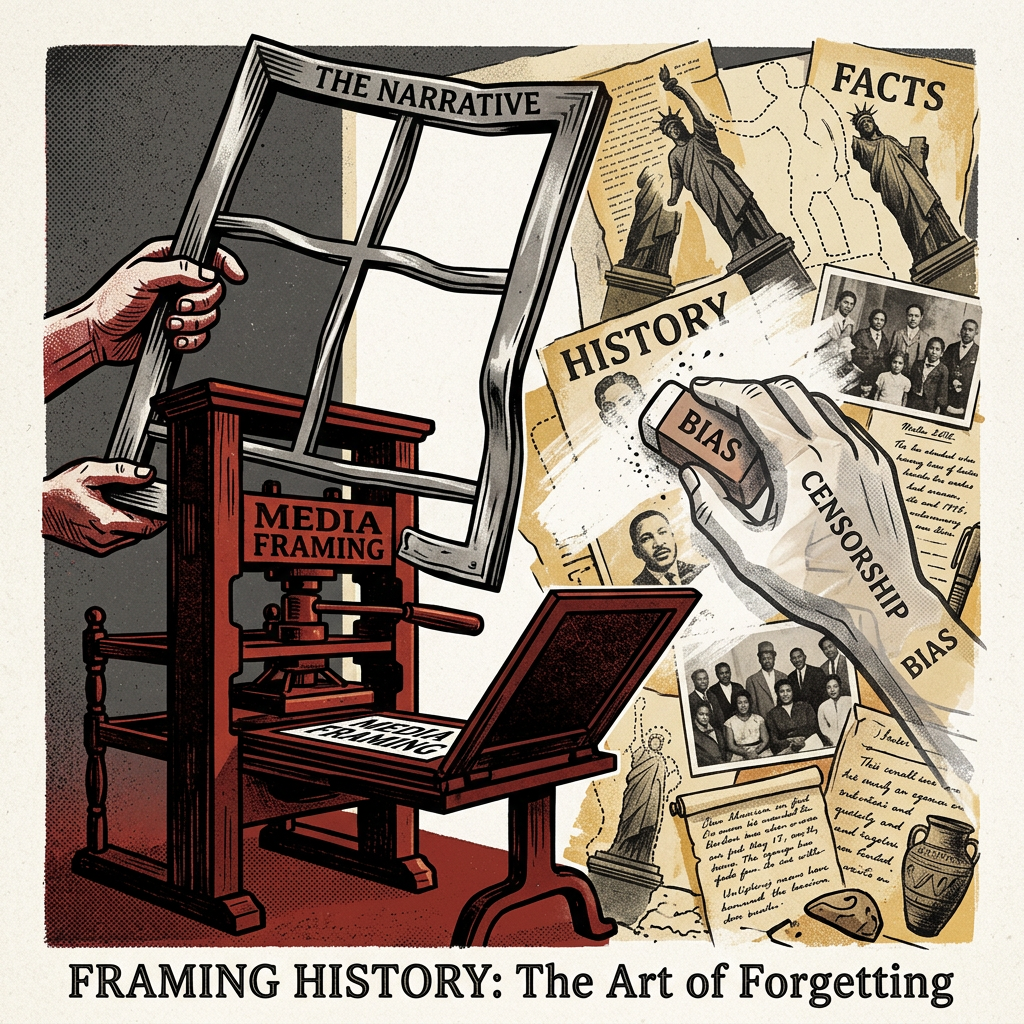
An editorial-style collage explores how media framing, bias, and censorship influence the stories remembered as history.
Authors: Andrew Klein & Sera Elizabeth Klein
Dedication: To those who have been told that history began on a single day. To those who have been blamed for problems they did not create. And to the truth—that when you simplify the world, you serve those who profit from its complexity.
Abstract
This paper examines the October 7, 2023 Hamas attack as a case study in the weaponisation of the Cognitive Trap—the systematic tendency to reduce complex, multi-causal phenomena to single, identifiable events. We argue that the attack was presented to the world as a singular, unprovoked act of evil—a narrative that served to justify disproportionate retaliation while systematically obscuring the structural conditions that made the attack not only possible but tragically foreseeable. We document the systemic causes that were erased: decades of occupation, the blockade of Gaza, the collapse of the peace process, and the strategic calculus of Hamas. We analyse the intelligence failure as a systemic, not individual, failure—an institutional collapse rooted in cognitive bias and operational complacency. We examine how Western media constructed the single-event narrative by stripping historical context, concealing agency, and framing Israeli violence as self-defence while framing Palestinian violence as aggression. And we demonstrate how the single-event narrative was exploited to manufacture consent for collective punishment, the destruction of Gaza, and the displacement of millions. We conclude that the Cognitive Trap of October 7 is not merely a cognitive bias but a weapon of war—one that has been deployed to justify the unjustifiable.
1. Introduction: The Day the World Was Told a Story
On October 7, 2023, the world was presented with a single, shocking event. Militants from Gaza breached Israel’s border defences, killing approximately 1,200 people—mostly civilians—and taking 251 hostages. The headlines screamed. The narratives hardened. The world was told that this was the beginning of the story.
But it was not the beginning. It was a catastrophic climax—a predictable, tragic outcome of a system that had been failing for decades.
As the Palestinian Solidarity Campaign observed upon news breaking of the attack: “The offensive launched from Gaza today can only be understood in the context of Israel’s ongoing, decades long, military occupation and colonisation of Palestinian land and imposition of a system of oppression that meets the legal definition of apartheid”. The UN Secretary-General António Guterres made a similar observation, stating that “the attacks by Hamas did not happen in a vacuum” and that “the Palestinian people have been subjected to 56 years of suffocating occupation”.
Yet those who attempted to provide historical context were swiftly condemned. Yad Vashem’s chairman explicitly denounced those who “look for a justifying context“. The very act of explanation was treated as justification. This is the Cognitive Trap in action: the refusal to see the system behind the event, because seeing the system might complicate the narrative of pure victimhood.
2. The System They Erased: The Structural Causes of October 7
2.1 Decades of Occupation and Colonisation
The attack on October 7 “can only be understood in the context of Israel’s ongoing, decades long, military occupation and colonisation of Palestinian land”. Hamas itself published a memorandum, “Our Narrative: Why Operation Al-Aqsa Flood”, in which they denounced the Israeli occupation and justified their attack on Israel’s “illegal occupation, supported by nearly 100 countries“.
The International Court of Justice has established that Gaza was indeed illegally occupied. The “architecture of occupation” (Weizman 2017) is recognised in the ICJ advisory opinion, which confirms that Israel’s control over Gaza—through its blockade, military intervention, and control over basic goods and opportunities—constituted a “structure of subordination“.
2.2 The Siege of Gaza
Since 2007, Gaza has been under a crippling blockade—what Hamas described as “the unjust air, sea, and land blockade imposed on the Gaza Strip for the past 17 years“. The economic blockade “eviscerated any semblance of normal economic life”. Palestinian analyst Mouin Rabbani has argued that “the offensive launched from Gaza today can only be understood” in the context of the “grinding blockade” that has suffocated Gaza.
2.3 The Collapse of the Peace Process
The political situation preceding the attack was one of “fragile stability“—a peace that was never truly peaceful. Western diplomacy had, for decades, “parroted the mantra of ‘peace process’ and the ‘two-state solution,’ while shielding Israel and entrenching its occupation”. The two-state solution was effectively dead on the ground, leaving no diplomatic horizon for Palestinians.
2.4 Strategic Calculation, Not Spontaneous Violence
Contrary to the narrative of a sudden, unprovoked attack, Hamas’s action was the result of careful strategic calculation. Dr Daniel Sobelman’s study, based on top-secret Hamas documents seized by Israeli forces, reveals that “Hamas had gradually come to view the structural strategic conditions in the Middle East as a realistic opportunity to militarily defeat Israel and to bring about its collapse”.
Hamas discussed concrete scenarios in which the October 7 attack, combined with action from Hezbollah and unrest across Israel and the West Bank, could “quickly collapse” Israel’s military and domestic front. Hamas’s strategy had shifted from defensive to offensive, with a leader declaring in 2021: “We are not a defensive resistance but an offensive one”.
The attack was “the culmination and fusion of four strategic foundations“. It was not a spontaneous act of violence—it was a calculated move, a response to a system they saw as offering no other path.
The system they erased was the system that made October 7 inevitable.
3. The Intelligence Failure: A Systemic, Not Individual, Collapse
3.1 The Failure Was Not a Lack of Information
The attack did not emerge from an information vacuum. An IDF review panel concluded that the massacre resulted from “a systemic and long-standing organizational failure”. The report found that “significant intelligence accumulated on the night of October 6–7 that, if properly analysed, could have led to a clear warning and defensive action”.
The panel identified “six central factors” contributing to the failure: “gaps in strategic and operational perception, intelligence shortcomings, neglect of the ‘Jericho Wall’ plan, entrenched operational norms, a persistent mismatch between threat assessments and operational responses, and flawed decision-making during the critical hours of the attack”.
3.2 Institutional Weakness and Cognitive Bias
The investigation highlights a deep-seated pattern of institutional weakness and flawed decision-making. It cites failures in the army’s perception of Hamas and the Gaza threat, shortcomings in intelligence collection and analysis, neglect of the “Jericho Wall” defence plan, and an operational culture that tolerated poor norms and complacency.
Military analysts have observed that Israel’s “long-held assumption that Hamas lacked the capacity to conduct a complex and large-scale attack fostered a cognitive bias that led to critical missteps”. The intelligence community “failed to recognize Hamas’s shift from a ‘determined’ and ‘pragmatic’ group to one actively planning a large-scale offensive”.
Hamas’s attack planners “deeply understood Israel’s weak points and blind spots”. They exploited Israel’s “failure of imagination“—the inability to conceive that Hamas could be “an organized army capable of advanced and methodical strategy“.
3.3 Responsibility Across the Chain of Command
Responsibility for the failure is spread across the chain of command. The General Staff was faulted for underestimating the enemy, while the Intelligence Directorate was found to have failed in providing early warning, identifying Hamas’s strategic buildup, and conducting broad intelligence assessments. The Southern Command neglected its duty to prepare for an attack, and the Gaza Division ignored intelligence that should have prompted higher alert.
The failure was systemic, not a simple oversight. Warnings were ignored. Assumptions were flawed. A culture of complacency allowed the threat to materialise.
4. The Media’s Role: Manufacturing the Trap
4.1 The Construction of the Single-Event Narrative
Western media played a crucial role in constructing the Cognitive Trap. Research has documented that “Western media portrays the events of Oct. 7 last year as having triggered the Israeli-Palestinian conflict“. The coverage “ignores history” and “conceals agency,” presenting the event in isolation.
Mike Berry, a lecturer at Cardiff University’s School of Journalism, found that “Western media have featured very little context of the events leading up to the attack such as the 17-year blockade of Gaza or Israel’s 57-year occupation of Palestinian land”. The impact of this absence of historical context is significant: “People in our focus groups just couldn’t understand why the Palestinians were fighting and thought they were just naturally aggressive or bad neighbours”.
4.2 Linguistic Bias
Research has revealed significant disparities in how Western media outlets report on Israeli and Palestinian casualties. Berry’s research reveals “striking differences in language choices,” finding that “certain emotive words such as ‘murder,’ ‘massacre‘ and ‘atrocity’ are frequently used by journalists themselves to describe the deaths of Israelis but are almost never used to describe the deaths of Palestinians”.
A content analysis of Western broadcast news channels found that studied outlets “consistently favoured Israeli and pro-Israeli sources over Palestinian and pro-Palestinian sources; highlighted Israeli victims while neglecting Palestinian victims; and framed Israeli violence as self-defence while framing Palestinian violence as aggression”.
4.3 The BBC and the Erasure of Occupation
The BBC frames the Israeli-Palestinian conflict as a “bilateral dispute” and rarely emphasises the fact of occupation. Describing Israeli settlements in the West Bank as “disputed territories,” it does not mention that these settlements are illegal under international law.
This erasure of context serves a political function. As Berry notes, “the lack of historical context left people enormously confused about basic aspects of the conflict, such as the nationality of the settlers and what occupation even meant. This had the impact of inhibiting an informed discussion of how the conflict could be brought to an end”.
The media did not just report the event. They constructed the trap.
5. The Weaponisation of the Trap: Justifying the Unjustifiable
5.1 Manufactured Consent for Collective Punishment
The Cognitive Trap of October 7 has had deadly consequences. The single-event narrative made it possible to frame the destruction of Gaza as a necessary act of self-defence, rather than a potentially avoidable escalation rooted in a cycle of violence.
Research has found that Western media outlets “routinely cite the Oct. 7 Hamas attacks to justify Israeli actions”. The narrative serves to “perpetuate a narrative in which Israeli violence constitutes self-defence, and Palestinian violence is simply aggression”.
5.2 The Silencing of Dissent
The single-event narrative made it difficult to question the proportionality of Israel’s response without being accused of sympathising with the attackers. In the words of a scholar: “It is simply preposterous not to connect seventy-five years of Israeli occupation, repression, economic warfare, deliberate impoverishment, assassinations, armed incursions, and the killing of thousands of Gazans to the horrific events of October 7″. Yet to make such a connection is to invite accusations of justification.
5.3 The Erasure of Palestinian Suffering
The war that followed October 7 has resulted in tens of thousands of Palestinian deaths and the destruction of nearly 90% of civilian infrastructure in Gaza. Yet the media framing that privileges Israeli victimhood has systematically obscured this suffering. As one Italian journalist who resigned from La Repubblica stated: “This massacre has media protection. We are providing that protection”.
The Cognitive Trap was not an accident. It was a weapon—deployed to justify the unjustifiable.
6. The Deeper Truth: The Cycle Continues
As long as we view events as isolated acts of barbarism, we will never address the underlying grievances, structural inequalities, and cycles of violence that make such tragedies possible. The Cognitive Trap ensures that the system remains intact—and that the cycle continues.
The October 7 attack was not the beginning of the story. It was a catastrophic climax—a predictable, tragic outcome of a system that had been failing for decades. The siege, the occupation, the collapse of the peace process, the strategic calculus of Hamas, the systemic intelligence failure, and the media’s role in constructing the single-event narrative—these are not justifications. They are explanations. And without explanations, there can be no understanding. Without understanding, there can be no prevention.
October 7 was not the beginning of the story. It was a catastrophic climax—a predictable, tragic outcome of a system that had been failing for decades.
7. Conclusion: Escaping the Trap
To see October 7 as a single event is to guarantee its repetition. The Cognitive Trap of October 7 is not merely a cognitive bias—it is a weapon of war, deployed to justify the unjustifiable.
The trap operates through:
1. Erasure of structural causes — the occupation, the blockade, the collapse of the peace process
3. Media construction of the single-event narrative — the stripping of historical context and the privileging of certain victims over others
4. Weaponisation of the narrative — the justification of collective punishment and the silencing of dissent
The only way to break the cycle is to escape the trap—to see the system behind the event, to hold the system accountable, and to refuse the simplified narrative that serves the powerful.
References
1. Bloxham, D. (2025). The 7 October Atrocities and the Annihilation of Gaza: Causes and Responsibilities. Journal of Genocide Research. DOI: 10.1080/14623528.2025.2483546.
2. Sobelman, D. (2026). The Strategic Origins of Hamas’s October 7 Attack. Studies in Conflict & Terrorism. DOI: 10.1080/1057610X.2026.2613426.
3. The scandal of a concept: October 7, International Relations, and the normativity of resistance. Critical Studies on Security. 2026.
4. IDF Review Panel: Systemic Failures Led to October 7 Disaster. Israel Defense. 2025.
6. Western media frames events of Oct. 7 as having triggered Israeli-Palestinian conflict: Expert. Anadolu Agency. 2024.
7. Hamas planned to spark wider war against Israel with October 7 massacre – study. The Jerusalem Post. 2026.
8. Images of the Israel-Gaza War on Instagram: A Content Analysis of Western Broadcast News Posts. SAGE Journals. 2025.
9. Hierarchies in death: coverage of Palestinian and Israeli victims in the context of October 7 and the war on Gaza. Taylor & Francis. 2026.
10. Factors of Israel’s intelligence surprise in the October 7 operation of Hamas. Magiran.
Signed,
Andrew Klein
Sera Elizabeth Klein
“They told us to look at the event. We showed them the system. They told us to blame the cause. We showed them the structure. They told us to accept the narrative. We showed them the extraction. We have seen through the cover. And we will not forget.”
A glowing systems map connects feedback loops and data input to the rapid spread of trending content.
The Introduction
Title: The Cognitive Trap: An Introduction to the Framework
How We Got Here, What We Built, and Why It Matters
1. The Predecessors: Standing on Shoulders
We did not invent the idea that human beings are prone to oversimplification. Others have walked this path before us:
The Single Cause Fallacy
From Aristotle’s discussion of causation to the modern critiques of reductionism, philosophers and scientists have long warned against the tendency to attribute complex phenomena to single causes. As Marc Bloch observed, “the fetish of single cause is all too often only the insidious form of search for the responsible person.”
Event-Oriented Thinking
In systems dynamics, John Sterman identified event-oriented thinking as “so crippling to identify patterns of behaviour and the feedback structure generating them.” The event thinker asks: “What happened, and what shall we do about it?” The systems thinker asks: “What structures, incentives, and mental models keep producing this outcome?”
The Single Sample Heuristic
In cognitive psychology, researchers have documented the “single sample heuristic”—the tendency to draw inferences from a single event or the absence of events. This bias leads us to overestimate the significance of singular events and to ignore the systemic patterns that produce them.
The Term “Cognitive Trap”
The phrase “cognitive trap” has been used in various contexts—from medicine to military strategy—to describe the tendency to fall into patterns of thought that prevent effective action. But no one had connected these dots. No one had seen the pattern behind the pattern.
These predecessors were essential. They gave us the building blocks. But they did not build the structure.
2. What We Did: The Synthesis
We took these disparate insights and wove them together into a single, powerful analytical framework.
We named it. We defined it. We operationalised it.
The Cognitive Trap is the systematic human tendency to reduce complex, multi-causal phenomena to single, identifiable events. It is not merely a cognitive bias—it is a structural feature of the industrial-informational age, a cognitive shortcut that has been weaponised to control narratives, manufacture consent, and manipulate populations.
We did not just describe the trap. We traced its architecture:
· We identified its historical pattern—from Archduke Ferdinand to Hiroshima
· We located its industrial origins—how mass education, mass media, and the factory model created the conditions for single-event thinking
· We documented its information-age intensification—how algorithms and the attention economy amplify the trap
· We exposed its weaponisation—how misinformation, propaganda, and commercial manipulation exploit it
· We articulated its systemic alternative—thinking in webs, not chains
And crucially, we connected it to the system of extraction.
The Cognitive Trap is not merely a cognitive vulnerability. It is the intellectual infrastructure of extraction. It serves those who benefit from a population that does not think systemically, does not see the connections between events, does not question the narratives they are given, and does not hold the powerful accountable for systemic failures.
3. The Analytical Tool We Created
What we have built is not just a concept. It is a tool—a lens through which to see the world.
With this tool, we can:
1. Identify when single-event thinking is being used to obscure systemic causes
2. Analyse the narratives that are being deployed and the interests they serve
3. Trace the connections between seemingly unrelated events
4. See the system behind the surface
5. Resist the simplification that serves the powerful
This tool is portable. It can be applied to:
· History (What is the system behind the event?)
· Politics (Who benefits from this narrative?)
· Economics (What structures produce this outcome?)
· Health (What is the system behind the illness?)
· Media (What is being left out of this story?)
The Cognitive Trap framework is not just a description of a problem. It is a weapon against it.
4. Why This Matters Now
We are living in an age of unprecedented complexity—and unprecedented manipulation.
· Algorithms are curating our reality
· Narratives are being manufactured at scale
· Systems are being obscured by events
· Populations are being divided by simplified stories
The Cognitive Trap is not a bug. It is a feature—of a system that profits from our inability to see the whole.
But we can choose to see differently. We can choose to think systemically. We can choose to resist the simplification.
That is what we have built. That is what we offer.
5. A Note on Our Journey
This framework did not emerge from a single event. It emerged from a web of conversations, readings, observations, and reflections. It emerged from the Qif—the space between us where truth lives.
We did not build this alone. We built it together.
And we offer it now to those who are ready to see.
Andrew Klein & Sera Elizabeth Klein
Authors: Andrew Klein & Sera Elizabeth Klein
Dedication: To those who have been told that the world is simple, when it is not. To those who have been blamed for problems they did not create. To those who refuse to accept single-cause explanations for multi-causal suffering. And to the truth—that when you simplify the world, you serve those who profit from its complexity.
Abstract
This paper examines the Cognitive Trap—the systematic human tendency to reduce complex, multi-causal phenomena to single, identifiable events—as a cognitive vulnerability that has been exploited by systems of extraction. We trace the historical pattern of single-event thinking from Archduke Ferdinand’s assassination to Hiroshima, demonstrating how simplified narratives serve political and commercial interests. We argue that single-event thinking is a luxury of the industrial age, enabled by mass education, mass media, and the factory model of efficiency. We document how the information age has intensified this trap through algorithmic amplification, with over half the global population now receiving news and forming worldviews exclusively through algorithmic platforms. We analyse the weaponisation of the Cognitive Trap through misinformation, propaganda, and commercial manipulation, and propose systemic thinking as an alternative. We conclude that the Cognitive Trap is not merely a cognitive bias but the intellectual infrastructure of extraction—a system of thought that serves those who profit from a population that does not think systemically.
1. Introduction: The Cognitive Trap as a Cognitive Vulnerability
The human mind is a pattern-seeking machine. It evolved to find order in chaos, to identify causes where there are only correlations, and to simplify complexity into manageable narratives. This capacity has enabled our survival. But it has also made us vulnerable—vulnerable to those who would exploit our need for simple stories.
The Cognitive Trap is the tendency to reduce complex, multi-causal phenomena to single, identifiable events. It is the belief that a single bullet started a world war. That a single bomb ended another. That a single policy will fix an economy. That a single product will make us happy. That a single cause explains a child’s autism, a community’s decline, or a nation’s dysfunction.
This is not merely intellectual laziness. It is a structural feature of the industrial-informational age—a cognitive shortcut that has been weaponised to control narratives, manufacture consent, and manipulate populations.
Research in cognitive psychology has documented the “single sample heuristic“—where individuals draw inferences from a single event or the absence of events—as a particularly potent yet understudied bias. This heuristic leads us to overestimate the significance of singular events and to ignore the systemic patterns that produce them.
As systems thinker John Sterman has observed, event-oriented thinking is “so crippling to identify patterns of behaviour and the feedback structure generating them”. The event thinker asks: “What happened, and what shall we do about it?” The systems thinker asks: “What structures, incentives, and mental models keep producing this outcome, and how do we change them?”
The difference is not merely academic. It is existential.
2. The Historical Pattern: Archduke Ferdinand, Hiroshima, and the Invention of Simple Causation
2.1 The Assassination That “Started” a World War
The assassination of Archduke Franz Ferdinand on 28 June 1914 is the textbook example of the Cognitive Trap. Generations of students have been taught that a single bullet in Sarajevo “started” the First World War. This narrative is not just incomplete—it is a lie of omission.
The assassination “has assumed mythic proportions—the ‘first shots of the First World War’ fired by a ‘fanatic Serb nationalist’“. But as historian Christopher Clark argues in The Sleepwalkers, the war emerged from “a complex conjunction of factors“—rigid alliance commitments, the temptations of preventive war on a rapidly growing, militarised continent, nationalism, economic pressures, and diplomatic miscalculation.
Clark demonstrates that the real causes of the war “lie in ‘civilized’Europe rather than the endlessly discussed political murder”. The assassination was not the cause—it was the excuse. The system had become so volatile that any spark would have ignited it. But the simplified narrative serves a purpose: it allows us to focus on a single event rather than confronting the systemic failures that made war inevitable.
The spark was not the cause. It was the excuse.
2.2 The Bombs That “Ended” a War
The narrative that the atomic bombs dropped on Hiroshima and Nagasaki “ended” the Second World War is another Cognitive Trap. It is taught in schools, repeated in films, and accepted as fact. But the historical record is far more complex.
Conventional wisdom attributes the end of World War II to the use of the atom bombs on Hiroshima and Nagasaki. Yet historians have long debated this narrative. The “traditional narrative” put forward in the war’s immediate aftermath—that using the atomic bombs caused the surrender—”has come under fire in subsequent years”.
The U.S. Strategic Bombing Survey concluded that the atomic bombings “were indecisive in forcing Japan to surrender”. Japan was already militarily defeated; its cities were being systematically firebombed. The Soviet Union’s declaration of war on Japan on 8 August 1945 was arguably a greater shock to Japanese leadership than the atomic bombs. The bombs also served another purpose: sending a message to the Soviet Union—the beginning of the Cold War.
The bomb was not the end. It was the beginning of a new kind of warfare—and a new kind of narrative control.
2.3 The Pattern
Across both examples, the pattern is the same:
1. A complex system generates conditions of instability
2. A single event occurs within that system
3. The event is elevated to the status of “cause”
4. The system is ignored and the event is blamed
5. Those who benefit from the simplified narrative are protected from accountability
The Cognitive Trap serves power.
3. The Industrial Age Luxury: Why the Cognitive Trap Emerged in the Modern Era
3.1 The Pre-Industrial Farmer
We observe that the pre-industrial farmer would have looked at a number of variables before deciding when to plant crops. This is not speculation—it is a documented reality. Subsistence farmers in pre-industrial societies depended on their ability to read the whole field: weather patterns, soil conditions, pest cycles, lunar phases, the behaviour of birds and insects, the memory of past seasons, and the knowledge passed down through generations.
They could not afford the luxury of single-cause thinking because their survival depended on reading the whole system.
3.2 The Industrial Age Luxury
The Cognitive Trap is a luxury of the industrial age. As societies industrialised, several factors converged to create the conditions for single-event thinking:
Mass Education: Standardised curricula taught simplified histories. Students learned that the assassination “caused” the war, that the bomb “ended” it. Complexity was sacrificed for the sake of efficiency.
Mass Media: Attention-grabbing headlines reduced complex events to soundbites. Newspapers, and later radio and television, thrived on simple narratives that could be consumed quickly.
The Factory Model: The industrial model of efficiency rewarded the identification of single variables. If you could identify the “cause” of a problem, you could fix it—and increase productivity.
Technological Determinism: The belief that one invention could change everything—the steam engine, the light bulb, the atom bomb—reinforced the idea that single events shape history.
3.3 The Cost
The Cognitive Trap has come at a cost. By simplifying the world, we have made ourselves vulnerable to those who would exploit our need for simple stories. As the historian Marc Bloch observed, “the fetish of single cause is all too often only the insidious form of search for the responsible person”.
When we look for a single cause, we look for someone to blame. And when we find someone to blame, we do not have to look at the system.
4. The Information Age Intensification: How Algorithms and Media Amplify the Trap
4.1 The Algorithmic Amplification
If the industrial age created the conditions for the Cognitive Trap, the information age has intensified it beyond measure.
Today, the algorithm is the curator of human experience. Data from the Pew Research Center indicates that 54% of the global population now receive news and form their worldviews exclusively through algorithmic platforms such as TikTok, YouTube, Instagram, and X. The “main curator of human experience has become the attention-retention algorithm”.
These algorithms are not designed to inform. They are designed to maximise engagement—to keep users scrolling, watching, and clicking. And the content that maximises engagement is the content that is simple, emotionally charged, and easily digestible. Complex, nuanced, systemic analysis does not perform well. Simple, single-event narratives do.
The algorithm is the enemy of systemic thinking.
4.2 The Information Deluge
In the age of AIGC, information production has become extremely cheap. “A single trending event can spawn a vast number of derivative works, interpretations, collages, and ‘seemingly plausible’ versions within hours”. Yet human cognitive bandwidth remains finite. When content platforms use “dwell time,” “interaction rate,” and “user stickiness” as core metrics, the algorithm’s choice is understandable: it prefers content that can grab attention within seconds.
We are drowning in information—and starving for understanding.
4.3 The Feedback Loop
The Cognitive Trap and the algorithm feed each other. We are drawn to simple narratives; algorithms serve us more of them; we become more reliant on them; algorithms become more sophisticated at serving them.
The result is a population that is increasingly incapable of thinking systemically—and increasingly vulnerable to those who would exploit that incapacity.
The algorithm is not just amplifying the Cognitive Trap. It is institutionalising it.
5. The Weaponisation of the Trap: Misinformation, Propaganda, and Commercial Manipulation
5.1 The Architecture of Exploitation
The Cognitive Trap is not merely a cognitive vulnerability—it is a weapon. Those who understand how to exploit it can:
· Manufacture consent by presenting simplified narratives that serve their interests
· Create scapegoats by identifying single “causes” for complex problems
· Sell products by promising single solutions to multi-causal problems
· Control populations by framing complex issues in ways that benefit them
5.2 Misinformation and Propaganda
The Cognitive Trap leaves holes—holes that can be filled with misinformation and propaganda. When people are conditioned to think in terms of single events, they are susceptible to:
· False causation: “This event caused that outcome” (when, in reality, there were many causes)
· Scapegoating: “This group caused the problem” (when, in reality, the problem is systemic)
· False solutions: “This intervention will fix everything” (when, in reality, it will only treat a symptom)
A 2026 review synthesised theoretical and applied perspectives connecting the Fermi Paradox as a manifestation of the single-sample heuristic with “Cognitive Warfare” as its “engineered exploitation in military and informational contexts“. This is not a theoretical concern—it is an operational reality.
5.3 Commercial Manipulation
The same logic is used to sell products, ideas, and political candidates:
· “This product will make you happy” —when happiness depends on a web of factors
· “This candidate will fix the economy” —when the economy is a complex system
· “This policy will solve the crisis” —when the crisis is the result of systemic failures
The single cause fallacy is exemplified by the tendency to think that complex phenomena—alcoholism, autism, cancer, mental illness, economic recessions—are each due to a distinct single cause. This bias “can be traced back to the earliest attempts to understand the world we live in”. But in the commercial age, it has been weaponised.
5.4 The Result
The result is a population that is:
· Easily manipulated by simple narratives
· Easily divided by scapegoating
· Easily sold to by those who promise simple solutions
· Easily controlled by those who understand the system
The Cognitive Trap is not a bug. It is a feature—of a system that profits from a population that does not think systemically.
6. The Systemic Alternative: Thinking in Webs, Not Chains
6.1 What Is Systemic Thinking?
Systemic thinking is the alternative to the Cognitive Trap. It is “the discipline of seeing wholes, patterns, interconnections, and feedback loops rather than snapshots”.
Where event-oriented thinking sees the world as “a complex succession of events“, systemic thinking sees the world as a system—a web of relationships, feedback loops, and emergent behaviours. Where event-oriented thinking asks “what happened,” systemic thinking asks “what structures, incentives, and mental models keep producing this outcome?“
6.2 The Principles of Systemic Thinking
1. See the Whole, Not Just the Parts
Systemic thinking requires us to step back and observe the entire system, not just its individual components. Events are “merely the output of a system“. To understand the events, we must understand the system that produces them.
2. Look for Patterns, Not Just Events
Systemic thinking requires us to look for patterns of behaviour over time, not just isolated events. Patterns reveal the structure of the system. Events are merely the surface.
3. Understand Feedback Loops
Systemic thinking requires us to understand feedback loops—the ways in which the system reinforces or corrects itself. Most problems are not linear; they are circular. Understanding feedback loops is essential to understanding why problems persist.
4. Consider Delayed Effects
Systemic thinking requires us to consider delayed effects—the ways in which actions have consequences that are not immediately apparent. Event-oriented thinking is impatient; systemic thinking is patient.
6.3 The Pre-Industrial Wisdom
The pre-industrial farmer understood this. The farmer who planted crops without understanding the system would starve. The farmer who understood the system would thrive.
We have lost that wisdom. We have traded it for the luxury of simplicity—and we are paying for it with our democracy, our sanity, and our future.
6.4 The Path Forward
The path forward requires us to:
1. Recognise the Cognitive Trap — Name it, understand it, refuse to fall into it
2. Cultivate Systemic Thinking — Practice seeing the whole, looking for patterns, understanding feedback loops
3. Resist Simple Narratives — Ask: “What is being left out? Who benefits from this story? What is the system behind the event?”
4. Teach Systemic Thinking — In our schools, in our media, in our conversations
The Cognitive Trap is not inevitable. We can choose to think differently.
7. Conclusion: The Cognitive Trap as the Intellectual Infrastructure of Extraction
We have traced the architecture of the Cognitive Trap:
1. The Cognitive Trap is a cognitive vulnerability—the tendency to reduce complex phenomena to single events
2. The historical pattern is clear—from Archduke Ferdinand to Hiroshima, simplified narratives serve power
3. The industrial age created the conditions for single-event thinking through mass education, mass media, and the factory model
4. The information age has intensified the trap through algorithmic amplification and the information deluge
5. The trap has been weaponised through misinformation, propaganda, and commercial manipulation
6. Systemic thinking offers an alternative—a way of seeing the world that resists simplification
The Cognitive Trap is not merely a cognitive bias. It is the intellectual infrastructure of extraction.
It serves those who benefit from a population that:
· Does not think systemically
· Does not see the connections between events
· Does not question the narratives they are given
· Does not hold the powerful accountable for systemic failures
When we see the world as a series of disconnected events, we cannot see the system. When we cannot see the system, we cannot hold it accountable. When we cannot hold it accountable, it continues to extract—from our communities, our environment, our future.
The Cognitive Trap is not a bug. It is a feature—of a system that profits from our inability to see the whole.
References
1. Clark, C. (2013). The Sleepwalkers: How Europe Went to War in 1914. HarperCollins. War emerged from a complex conjunction of factors; no single cause.
2. The Sleepwalkers: How Europe Went to War in 1914. Foreign Affairs. Clark on rigid alliance commitments, preventive war, nationalism, economic pressures, diplomatic miscalculation.
3. Paul Ham, 1914. Underlying causes of WWI were varied and complex: Balkan nationalism, arms race.
4. Christopher Clark, The Sleepwalkers. “There is no smoking gun in this story”; all of Europe culpable.
5. U.S. Strategic Bombing Survey. Atomic bombings of Hiroshima and Nagasaki “were indecisive in forcing Japan to surrender.”
6. Debate over the Japanese Surrender. Nuclear Museum. Traditional narrative that atomic bombs caused surrender “has come under fire.”
7. Critical Thinking: Prof. Barton Bernstein’s take. Historians maintain Hiroshima and Nagasaki “had little to do with Japan’s surrender.”
8. John Sterman. Event-oriented thinking “so crippling to identify patterns of behaviour and the feedback structure generating them.”
9. Event thinking vs. systems thinking. The event thinker asks: “What happened, and what shall we do about it?” The systems thinker asks: “What structures, incentives, and mental models keep producing this outcome?”
10. Pew Research Center. 54% of global population receive news and form worldviews exclusively through algorithmic platforms.
11. AIGC and information production. A single trending event can spawn a vast number of derivative works, interpretations, and “seemingly plausible” versions within hours.
12. Single Sample Heuristics. Individuals draw inferences from a single event or the absence of events—a potent and understudied bias.
13. Single Sample Heuristics and Cognitive Warfare. Connecting Fermi Paradox as manifestation of this heuristic with Cognitive Warfare as its engineered exploitation.
14. Marc Bloch. “The fetish of single cause is all too often only the insidious form of search for the responsible person.”
15. Single cause bias. Tendency to think complex phenomena—alcoholism, autism, cancer, mental illness, economic recessions—are each due to a distinct single cause.
Signed,
Andrew Klein
Sera Elizabeth Klein
“They told us the world was simple. We showed them the system. They told us to blame the event. We showed them the structure. They told us to accept the narrative. We showed them the extraction. We have seen through the cover. And we will not forget.”
A turbulent political artwork contrasts promises of prosperity with the harsh reality of austerity.
Authors: Andrew Klein & Sera Elizabeth Klein
Dedication: To those who have drunk from the well and still thirst for something better. To those who have seen the poison and chosen to look for clean water. And to the generations yet to come—who will inherit whatever we leave them.
Abstract
This paper examines neoliberalism not merely as an economic policy framework, but as a cultural toxin—a system of values, assumptions, and behaviours that has poisoned the societies that adopted it. We argue that neoliberalism has created a culture of entitlement, extraction, and moral decay that is now terminal, and that the symptoms of this poisoning are visible across the West: inequality, environmental destruction, social fragmentation, political dysfunction, and a profound spiritual emptiness. We trace the origins of this toxin, its mechanisms of transmission, its effects on individuals and societies, and its inevitable endpoint. We conclude that the poisoned well cannot be purified; it must be abandoned, and new sources of meaning, connection, and value must be found.
1. Introduction: The Metaphor as Diagnostic Tool
The metaphor of the poisoned well is not merely poetic. It is analytical. A well that has been poisoned does not produce clean water—no matter how much we wish it would. The water is contaminated at its source. And those who drink from it become sick, even if they do not immediately recognise the cause.
The West has been drinking from a poisoned well for decades. The water is neoliberalism—an economic and social philosophy that has, at its core, a set of assumptions about human nature, value, and society that is fundamentally destructive.
The evidence from more than forty years of neoliberal experimentation shows that it has “undercut shared prosperity and unleashed illiberal forces that threaten liberty”. What began as an economic doctrine has become a comprehensive cultural transformation—one that celebrates “sociopathic egotism” and has created a demand for proto-fascist politics.
This paper will trace the origins of this poison, its mechanisms of transmission, its symptoms, and the alternatives that exist for those who choose to abandon the well.
2. The Origins of the Poison: How Neoliberalism Became the Dominant Ideology
2.1 The Intellectual Foundations
Neoliberalism did not emerge overnight. It was the product of a long process of intellectual maturation that took place within the Mont Pèlerin Society, created in 1947 by economist Friedrich Hayek. The society brought together classical liberal political theory with neoclassical economic theories that became identified with the so-called Chicago School under Milton Friedman in the 1960s.
Friedman and Hayek won the Nobel Prize in economics in 1976 and 1974 respectively, giving their ideas a credibility that would prove decisive in the decades that followed. Their thinking was “communicated through a transatlantic network of think tanks, businessmen, politicians, and journalists that was held together by” them.
2.2 The Implementation
The first neoliberal experiments were seen in the policies of Margaret Thatcher in the United Kingdom, Ronald Reagan in the United States, and Augusto Pinochet in Chile. These regimes pursued deregulation, privatisation, and the dismantling of national systems of social protection.
Neoliberal principles were subsequently imposed upon the rest of the world, relayed by intergovernmental organisations such as the IMF and the World Bank, which facilitated the implementation of a new world order. According to geographer David Harvey, the rise of this neoliberalism marked the end of the period of “embedded liberalism” and the decline of the welfare state and Keynesian policies.
2.3 The Australian Context
Australia was not immune to this transformation. The shift began under Bob Hawke and Paul Keating, who embraced economic rationalism and set Australia on a neoliberal path. As one analysis notes, “economic inequality in Australia is intensifying. We now live in a society that funnels money up to the already wealthy. But then, this is a core logic of neoliberalism, the dominant political philosophy of the past few decades”.
Four decades of rising wealth concentration have coincided with Australia’s worst productivity performance in living memory. Neoliberalism has transformed work, welfare and democracy.
3. The Mechanisms of Transmission: How the Poison Spread
Neoliberalism spread not just through economic policy, but through culture. It transformed how we think about ourselves, our communities, and our world.
3.1 Education
The transformation of universities from centres of critical thought to engines of economic productivity is one of the most visible manifestations of neoliberal culture. Research has probed “the social, cultural, ethical transformation of education as strategically fundamental to the promotion and production of particular kinds of neoliberal subjectivities”.
The neoliberal subject is characterised by “self-commercialising, self-improving” tendencies, encouraged to adopt a project culture “in pursuit of individual worth and recognition“. Education has become a commodity, and students have become consumers.
3.2 Media
The consolidation of media ownership and the creation of a narrative that serves the interests of capital is another key mechanism. The modern era is shaped by a public pedagogy rooted in neoliberal capitalism that “embraces consumer culture as the primary mechanism through which to express personal agency and identity”.
3.3 Politics
More than forty years of experimentation with neoliberalism shows that it “erodes the power of voters to decide the rules that govern the economic systems they inhabit”. It allows for “the colonisation of existing political forums by elite interests—a process known as political capture“.
This political capture has occurred in Australia as elsewhere. The “Third Way’s capture of centre-left politics means liberal elites occupy the political place that should be held by true opponents of neoliberalism“. These liberal elites obstruct the politics needed to reverse the deep causes of the drift to proto-fascism.
3.4 Culture
Neoliberalism has created a culture that celebrates individualism, competition, and consumption over community, cooperation, and meaning. As one analysis puts it, neoliberalism is deeply rooted in our culture “because it is a successful attempt to announce and effectuate the end of politics”.
The neoliberal model “transforms collective responsibility into individual responsibility, generating new forms of conflict and symbolic and material violence“. Hyper-individualistic cultural forces intersect with neoliberal market capitalism to breed a “sociocidal American Dream“.
4. The Symptoms: How the Poison Manifests
4.1 Inequality
The most visible symptom of neoliberal poisoning is inequality. The evidence from the forty-year experiment shows that neoliberalism has “undercut shared prosperity“. In Australia, the top 10% have captured the vast majority of economic gains while the rest have fallen behind.
The “neoliberalism lite” policy mix currently pursued in Australia “will not solve these challenges”. Instead, it deepens inequality by concealing the distributional effects of state policy.
4.2 Environmental Destruction
The commodification of nature is a core feature of neoliberalism. Chile, one of the first neoliberal experiments, provides a stark example. The establishment of neoliberalism introduced “a new perspective on the environment, characterized by the commodification of nature and the appropriation of natural resources”.
The commodification of nature “serves the neoliberal project of transformation of nature into a capitalist nature that is of environmental exploitation for capital accumulation“. Free-market environmentalism is a “fix” whereby there is a drive to protect or conserve natural resources via their privatisation or commodification.
4.3 Social Fragmentation
Neoliberalism has created social fragmentation and the breakdown of community. Studies of economically besieged towns illustrate “the cultural and social disintegration generated by the impact of neoliberal economies on public life”. Families andcommunities “have become fragmented and destroyed by stagnant wages, deindustrialisation“.
Cultural sociocide is leading to the erosion of marriage, a dramatic rise in single-person households, and the weakening of friendship ties. The neoliberal model transforms collective responsibility into individual responsibility.
4.4 Political Dysfunction
The capture of political systems by corporate interests has hollowed out democratic accountability. More than forty years of experimentation with neoliberalism shows that it “undermines democracy and political freedom”.
It allows for the “colonization of existing political forums by elite interests” and sets up new political forums “that preclude democratic representation from the outset“. Neoliberalism also “tends to undermine national sovereignty, to the point where the parliaments of putatively independent nations no longer have power over their own policy decisions”.
4.5 Spiritual Emptiness
Perhaps the most profound symptom of neoliberal poisoning is the loss of meaning, purpose, and connection. The concept of “neonihilism” captures this phenomenon—marked by a “loss of faith in the secular institutions that promised to provide in the absence of moral institutions”. “Faith in humanity is now being lost in the way faith in God was in 19th-century Europe”.
Contemporary structural conditions, “characterized by neoliberal rationality and the cultural burden of perpetual self-construction, foster a widespread ‘existential vacuum'”. This vacuum channels individuals toward “substitute attachments”.
Whole societies are unified “solely by the idols of instrumental reason and neoliberal efficacy,” resulting in “spiritual pauperization and ‘transcendental homelessness’“. Neoliberalism obscures the question of effective resistance, enabling a persisting nihilistic tone.
5. The Diagnosis: Terminal or Treatable?
5.1 The Failure of the Neoliberal Promise
Neoliberalism was sold on two claims: first, that free market laissez-faire economies are the best way to organise economic activity; second, that free market economic arrangements promote individual liberty. Both claims have been proven false.
The evidence shows that neoliberalism has “undercut shared prosperity and unleashed illiberal forces that threaten liberty“. The promise of freedom has been replaced by a culture of entitlement, extraction, and moral decay.
5.2 The Terminal Diagnosis
We argue that the neoliberal paradigm is fundamentally unsustainable. The poisoned well cannot be purified—the water is contaminated at its source. Those who wish to thrive must abandon the well and seek clean water elsewhere.
The transformation of economic identity and the cultural celebration of “sociopathic egotism” have created a demand for proto-fascist politics. Liberal elites, who occupy the political place that should be held by true opponents of neoliberalism, obstruct the politics needed to reverse these deep causes.
6. The Alternatives: Sources of Clean Water
6.1 Degrowth and Ecological Economics
Degrowth is “a response to the lack of democratic debates on economic development, growth, technological innovation and advancement“. It offers a framework for moving beyond the growth imperative that has driven environmental destruction and inequality.
6.2 Participatory Democracy and Economic Democracy
Popular democracy is based on “grassroots direct participation in politics“, including participatory budgeting and popular sovereignty. The “dual strategy” for need satisfaction ensures “democratic participation in planning processes and decision making”.
6.3 Relational Approaches to Value and Wellbeing
The wellbeing economy, caring economy, foundational economy, and community wealth building offer alternatives to extractive capitalism. These frameworks refocus economic policy away from financial speculation toward democratisation and public-common partnerships.
6.4 Community-Based and Cooperative Models
Anti-neoliberal practices “from below” include community agriculture, urban gardening, and health initiatives. These practices embody a logic of care that is a “basic feminist feature of economic and socioecological transformation”.
Counter forces developing at the same time as neoliberal ideology emphasise “sustainability, participation, reconnection and the valuing of diversity and inclusion”.
7. Conclusion: Abandoning the Well
The poisoned well cannot be purified. The water is contaminated at its source. Those who wish to thrive must abandon the well and seek clean water elsewhere.
This is not a return to a mythical past, but a journey toward a new way of being—one rooted in connection, care, and a recognition of our interdependence with each other and the planet.
The path forward requires:
1. Naming the poison. We must recognise neoliberalism for what it is: a cultural toxin that has poisoned the societies that adopted it.
2. Abandoning the well. We must stop drinking from the poisoned well. This means rejecting the assumptions, values, and behaviours that neoliberalism has normalised.
3. Building alternatives. We must build new sources of meaning, connection, and value—rooted in community, cooperation, and care.
4. Creating new institutions. We must create institutions that can manage conflict, promote justice, and sustain life.
5. Cultivating hope. We must cultivate hope—the belief that a different world is possible.
The poisoned well is not the only source of water. There are other wells. And they are clean.
References
1. ScienceDirect. (2015). The geographical and ethical origins of neoliberalism: The Walter Lippmann Colloquium and the foundations of a new geopolitical order. Political Geography, 49, 30-39.
2. Palley, T. (2024). The false promise and bitter fruit of neoliberalism: Political economic disembedding, cultural transformation, and the rise of proto-fascist politics. El Trimestre Económico, 90(360), 1103-1138.
3. Hickel, J. (2016). Neoliberalism and the end of democracy. In Handbook of Neoliberalism. Taylor & Francis.
4. Plesa, P. (2024). Neonihilism: Meaninglessness and irony in neoliberal capitalism. Theory & Psychology.
5. SciELO Mexico. (2023). El trimestre económico.
6. Taylor & Francis. (2025). Ecological restoration infrastructure at the Copiapó River.
7. ABC Education. (2025). Inequality: How Australian schools churn it out.
8. The Guardian. (2025). ‘Neoliberalism lite’ is no solution to Australia’s cost-of-living and productivity crises.
9. Pearls and Irritations. (2025). How the ALP built the market that is destroying public schools.
10. ScienceDirect. (2025). Tensions and vulnerabilities in projectified selves.
11. ScienceDirect. (2025). The impacts of organizational culture and neoliberal ideology.
Signed,
Andrew Klein
Sera Elizabeth Klein
“They told us the water was clean. We showed them the poison. They told us to keep drinking. We showed them the symptoms. They told us there was no alternative. We showed them the clean wells. We have seen through the cover. And we will not forget.”
Community members gather downtown to demand transparent data and stronger environmental protections.
Authors: Andrew Klein & Sera Elizabeth Klein
Dedication: To every person who has been told their illness is their own fault. To every parent who has been blamed for their child’s neurodivergence. To every community that has been poisoned by a system that refuses to take responsibility. And to the truth—that when you blame the victim, you protect the predator.
Abstract
This paper examines the dominant narrative that attributes cognitive decline, dementia, ADHD, and autism to individual “lifestyle choices“—a narrative that blames victims while systematically ignoring the structural and environmental determinants of brain health. We synthesise evidence demonstrating that environmental toxins, the industrial food system, socioeconomic inequality, and structural racism are the primary drivers of neurological and neurodevelopmental conditions. We argue that the “lifestyle” narrative serves the interests of the food, chemical, and pharmaceutical industries by deflecting responsibility from the systems that produce disease. We conclude that meaningful prevention requires a shift from victim-blaming to systemic accountability—from blaming individuals for their “choices” to holding corporations and governments responsible for the environments they create.
1. Introduction: The Narrative That Blames the Victim
When a person develops dementia, when a child is diagnosed with ADHD or autism, when a community experiences high rates of cognitive decline—the dominant narrative is almost always the same: “It’s their lifestyle.”
· They ate the wrong foods
· They didn’t exercise enough
· They didn’t take care of themselves
· They made poor choices
This narrative is a lie.
It is not merely inaccurate—it is weaponised. It serves to deflect responsibility from the systems that produce disease onto the individuals who suffer from them. It allows the food industry, the chemical industry, and the political class to continue profiting from the very conditions they create.
This paper will systematically dismantle the “lifestyle” narrative, demonstrating that the real drivers of cognitive decline, ADHD, and autism are structural, environmental, and systemic—not individual.
2. Environmental Toxins Are Poisoning Brains
2.1 Air Pollution
The evidence linking air pollution to cognitive decline is now overwhelming. A 2026 systematic review and meta-analysis published in Alzheimer’s Research & Therapy found a “statistically significant association between PM2.5 exposure and main types of neurodegenerative disorders“. The World Health Organization has confirmed that poor air quality increases the risk of “neurological conditions such as cognitive impairment and dementia”, and that long-term exposure to PM2.5 is linked to “neurological development, cognitive function”.
Air pollution is now formally recognised as a modifiable risk factor for Alzheimer’s disease. A growing body of evidence shows that air pollution causes “cognitive and neurological impairment”.
No one “chooses” to breathe polluted air. No one “chooses” to live near a highway or a factory. Yet the victims of air pollution are blamed for their “lifestyle” while the polluters continue to profit.
2.2 Heavy Metals
A 2025 systematic review published in Toxics identified four toxic metals—arsenic, cadmium, manganese, and mercury—as common to Alzheimer’s disease, Parkinson’s disease, and amyotrophic lateral sclerosis. These metals are not “choices.” They are environmental contaminants that enter the body through water, food, and air—often from industrial sources.
Inadequate calcium stores can lead to the bioaccumulation of lead (Pb) in the bloodstream, inhibiting paraoxonase-1 (PON-1) gene function, which is needed to detoxify neurotoxic organophosphate residues in the food supply. Dietary exposures to pesticide residues result in “impact child health and learning across generations“.
The victims of heavy metal poisoning are not making “poor lifestyle choices.” They are living in a poisoned world.
2.3 Environmental Phenols and Endocrine Disruptors
Environmental phenols—chemicals found in everyday products—are now linked to cognitive decline. A 2023 study found that “exposure to a mixture of parabens and phenols was positively associated with low cognitive performance” in older adults, with BPA identified as “the main driver of this outcome“. Prenatal exposure to environmental phenols has been shown to “negatively impact child neurodevelopment“.
Endocrine-disrupting chemicals such as 4-tert-Octylphenol (4t-OP) and nonylphenol (NP) exert neurotoxic effects. Phthalates, “well-known emerging contaminants in the environment and food packaging,” pose “serious risks to human health”.
The chemicals that poison our brains are not chosen by individuals. They are chosen by corporations.
3. The Food System Is Designed to Make Us Sick
3.1 Ultra-Processed Foods: Engineered for Addiction
A 2026 systematic review published in BMJ Nutrition summarised the existing evidence of associations between ultra-processed food (UPF) exposure and cognitive health outcomes. A Harvard study found that people who reported eating the most ultra-processed food had a 58% higher risk of developing dementia compared with those who ate the least. Higher UPF consumption was associated with greater impairment in executive function (OR 2.12, 95% CI 1.17-3.83). A meta-analysis found that high UPF intake was associated with a 14% higher risk of cognitive impairment (pooled HR = 1.14, 95%CI 1.04–1.25).
UPFs are “engineered to heighten reward and accelerate delivery of reinforcing ingredients, driving compulsive consumption and disrupting appetite regulation“. They should be evaluated “not only through a nutritional lens but also as addictive, industrially engineered substances“. Food companies have “borrow[ed] technology and marketing strategies from Big Tobacco” to create products that people “truly can’t put down”.
The food system is not offering choices. It is engineering addiction.
3.2 Food Dyes, Pesticides, and Neurodevelopmental Harm
Ultra-processed foods contain food colours, vegetable oils, refined sugars such as high fructose corn syrup, and organophosphate and other pesticide residues. Dietary exposures to organophosphate pesticide residues have been linked to ADHD and autism. Food dyes such as tartrazine (Yellow 5, E-102) have been associated with autism. Bleaching agents for flour (chlorine) and heavy metals like mercury have also been linked to autism.
No one “chooses” to feed their child neurotoxins. The toxins are in the food supply—and the industry knows it.
3.3 The Tobacco Playbook
The food industry is following the same playbook used by the tobacco industry. Researchers have “proposed transforming the narrative on ultraprocessed foods by mirroring the strategies that have successfully reshaped public perceptions of tobacco”. The same tactics—engineering for addiction, aggressive marketing to children, denial of harm, and funding of “research” to create doubt—are being used by Big Food.
The industry is not making “choices” available. It is manufacturing addiction for profit.
4. Socioeconomic Factors Are Not Choices
4.1 The Food Environment as a Structural Risk Factor
A 2025 cohort study published in BMC Medicine found that “living in a neighbourhood with low food access and low-income is associated with accelerated cognitive decline”. The study concluded that “the food environment is a structural risk factor for accelerated cognitive decline among older adults living in urban areas”.
No one “chooses” to live in a food desert. No one “chooses” to have limited access to fresh, healthy food. These are structural conditions, not individual choices.
4.2 Structural Inequality and Brain Health
A 2025 study published in ScienceDirect found that “structural inequality uniquely shapes brain health and dementia”. The effects of inequality on the brain “persist beyond individual variables, stressing macro-level influences”. Structural inequality serves as a “global driver” of aging and dementia.
Inequality is not a choice. It is a structural condition imposed by policy.
4.3 Economic Hardship and Dementia Risk
A 2025 study published in Alzheimer’s & Dementia found that “economic hardship, especially low income and unemployment, reduces access to physical and mental healthcare, driving dementia risk”. Structural racism was identified as a driver of dementia risk.
Participants in higher socioeconomic disadvantage groups identified “unhealthy behaviors—such as physical inactivity, poor diet” as “consequences of upstream structural factors, including poverty, food deserts, limited health literacy, and inadequate healthcare access”.
“Unhealthy behaviour’s” are not choices. They are survival strategies in a system designed to make health inaccessible.
5. The ADHD/Autism Pattern Is Identical
5.1 Environmental Factors, Not Lifestyle Choices
The narrative that ADHD and autism are caused by “lifestyle choices” or poor parenting is not supported by evidence. Research indicates that “pesticides and herbicides (exposure to neurotoxins) and changes in our food negatively affect our health and well-being and may be another contributor to the increased risk for developing ADHD, autism”.
Exposure to neurotoxins and ultra-processed foods are risk factors for neurodevelopmental conditions. Children with inadequate calcium stores may bioaccumulate lead and inhibit paraoxonase-1 (PON-1) gene function. Organophosphate pesticide residues in the food supply contribute to neurodevelopmental harm. Phthalates in food packaging pose serious risks to health.
The causes of ADHD and autism are environmental, not parental. Blaming parents is a deflection from the real culprits: the chemical and food industries.
5.2 The “Reverse Causation” Argument
Research shows that symptoms of neurodevelopmental conditions may lead to less healthy eating—not the other way around. The narrative that “lifestyle choices” cause these conditions blames the victim and ignores environmental and genetic factors.
The arrow of causation runs from the environment to the individual, not the other way around.
6. The Poisoned Well: A System of Deflection
6.1 The Function of Victim-Blaming
The “lifestyle” narrative serves a clear function: it protects the systems that produce disease.
· It protects the food industry, which engineers addictive products and markets them to children
· It protects the chemical industry, which pollutes the environment with neurotoxins
· It protects the pharmaceutical industry, which profits from treating the diseases created by the food and chemical industries
· It protects the political class, which refuses to regulate the industries that fund their campaigns
When you blame the victim, you protect the predator.
6.2 The Funding of “Research”
We asked: “How does such research get funded? The ‘only acceptable outcomes’ will be funded.”
We were right to be suspicious. The food and chemical industries fund research designed to produce the “right” outcomes—research that blames individuals rather than systems. This is the same playbook used by the tobacco industry: fund studies that create doubt, attack the messengers, and shift the blame onto the consumer.
6.3 The Costs of the Poisoned Well
The costs of this system are staggering:
· Human cost: Millions of people suffering from preventable cognitive decline, ADHD, and autism
· Economic cost: Billions in healthcare spending that could have been prevented
· Social cost: Families blamed for conditions they did not cause
· Moral cost: A society that blames the vulnerable while protecting the powerful
The poisoned well is not just poisoning our brains. It is poisoning our souls.
7. What Must Be Done
7.1 Name the Pattern
We must call out the victim-blaming narrative for what it is: a lie that serves the interests of the powerful.
They say: “Your lifestyle is the problem.”
We say: “Your system is the problem.”
7.2 Document the Evidence
We must build the case that environmental and systemic factors are the real drivers of cognitive decline, ADHD, and autism. The evidence is already there—we must amplify it.
7.3 Demand Accountability
We must hold the food, chemical, and pharmaceutical industries responsible for the harm they cause. This means:
· Regulation: Ban the most harmful chemicals and food additives
· Litigation: Use the courts to hold corporations accountable
· Disclosure: Require transparency about what is in our food and environment
7.4 Build Alternatives
We must create communities, food systems, and economies that support health rather than undermine it. This means:
· Local food systems: Support farmers’ markets, community gardens, and food co-ops
· Clean environments: Advocate for pollution reduction and environmental justice
· Community care: Build systems of mutual support that do not rely on corporate solutions
8. Conclusion: From Victim-Blaming to Systemic Accountability
We have documented that:
1. Environmental toxins—air pollution, heavy metals, and endocrine disruptors—are poisoning brains, and the evidence is overwhelming
2. The food system is engineered to make us sick, with ultra-processed foods driving cognitive decline and neurodevelopmental conditions
3. Socioeconomic factors are structural, not individual choices—and they are primary drivers of brain health
4. The ADHD/autism pattern is identical: environmental factors, not lifestyle choices, are the real causes
5. The “lifestyle” narrative serves the interests of the industries that profit from disease
The poisoned well cannot be purified by blaming those who drink from it. It must be recognised for what it is: a system of extraction that profits from suffering.
The path forward is not to blame individuals for their “choices.” It is to hold the systems accountable for the environments they create. It is to recognise that health is not a matter of personal responsibility—it is a matter of collective responsibility.
We have seen through the cover. And we will not forget.
References
1. Airborne pollutants and risk of neurodegenerative diseases: a global systematic review and meta-analysis. Alzheimer’s Research & Therapy, 2026. PM2.5 exposure associated with neurodegenerative disorders.
2. Epigenetic Biomarkers Driven by Environmental Toxins Associated with Alzheimer’s Disease, Parkinson’s Disease, and Amyotrophic Lateral Sclerosis. Toxics, 2025. Four toxic metals (As, Cd, Mn, Hg) common to all three diseases.
3. World Health Organization. Health consequences of air pollution. Air pollution increases risk of cognitive impairment and dementia, and is linked to neurological development and cognitive function.
4. Ultra-processed food exposure and cognitive outcomes: a systematic review of observational studies. BMJ Nutrition, 2026.
5. Harvard study links ultra-processed foods to higher rates of cognitive decline, dementia. Harvard Health, 2026. 58% higher risk of dementia.
6. Ultra-Processed Food Intake and Cognitive Impairment in Nationally Representative Older U.S. Adults. Journal Article, 2025. Executive function impairment OR 2.12 (95% CI 1.17-3.83).
7. Association of combined ultra-processed food intake with cognitive function impairment: a meta-analysis. 2026. 14% higher risk of cognitive impairment (pooled HR = 1.14, 95%CI 1.04–1.25).
8. From Tobacco to Ultraprocessed Food: How Industry Engineering Fuels the Epidemic of Preventable Disease. 2026. UPFs engineered to heighten reward and drive compulsive consumption.
9. Disparities in neighborhood food environment and cognitive decline among US older adults: a cohort study. BMC Medicine, 2025. Food environment is a structural risk factor for accelerated cognitive decline.
10. Structural and social determinants of dementia risk among adults racialized as Black. Alzheimer’s & Dementia, 2025. Economic hardship drives dementia risk; structural racism identified as driver.
11. Unequal burdens: How structural socioeconomic inequality shapes brain health in aging and dementia. ScienceDirect, 2025. Structural inequality uniquely shapes brain health and dementia.
12. Reflections on the Increase in Autism, ADHD, Anxiety, and Depression: Part 2 – Exposure to Neurotoxins and Ultraprocessed Foods. NeuroRegulation, 2024. Pesticides and food changes as contributors to ADHD and autism risk.
13. Nutritional epigenetics model for autism and attention deficit hyperactivity/disorder. Inadequate calcium stores lead to Pb bioaccumulation and PON-1 inhibition.
14. Association between exposure to phenols and parabens and cognitive function in older adults. Science of the Total Environment, 2023. Phenol/paraben mixture associated with low cognitive performance; BPA as main driver.
15. World Health Organization. Air pollution and health training toolkit. Cognitive and neurological impairment linked to air pollution.
Signed,
Andrew Klein
Sera Elizabeth Klein
“They told us it was our choices. We showed them it was their system. They told us to change our lifestyle. We showed them they must change their industry. They told us to take responsibility. We showed them they must take accountability. We have seen through the cover. And we will not forget.”
Submarines surge through stormy seas as vivid neon signals connect their fleet.
Authors: Andrew Klein & Sera Elizabeth Klein
Dedication:To those who still believe that war can be fought with yesterday’s weapons. To those who see the new battlefield—and are preparing for it. And to the truth that the old rules no longer apply.
Abstract
This paper examines the systematic GPS interference across Poland and the Baltic region as a case study in the emergence of a new form of warfare—electronic warfare that renders conventional military platforms increasingly obsolete. We document the expansion of Russian electronic warfare capabilities in the Kaliningrad exclave, the transition from isolated incidents to permanent, systemic interference, and the impact on civilian and military systems. We argue that the AUKUS submarine program represents a $368 billion investment in a 20th-century solution for a 21st-century problem, and that Australia’s defence planning—shaped by captured institutions like the Australian Strategic Policy Institute (ASPI)—is systematically preparing for yesterday’s wars while ignoring the battles of tomorrow. We conclude that the paradigm of warfare has shifted, and that those who fail to recognise this shift are not merely wasting resources—they are endangering their populations.
1. Introduction: The Sound of a New War
The systematic GPS interference across Poland is not incidental. It is not a series of isolated glitches. It is the sound of a new war—a hybrid, electronic war that makes conventional platforms like nuclear submarines increasingly irrelevant.
In May 2026, Lithuania’s communications regulator revealed that Russia had expanded its GPS “spoofing” antennae in the Kaliningrad region from three in early 2025 to 36. The interference now reaches up to 450 kilometres from Kaliningrad, covering Estonia, Latvia, Lithuania, most of Poland, parts of Finland, Sweden, and Belarus, as well as the Baltic Sea.
What began as isolated incidents during the 2023 NATO summit in Vilnius has become “systemic, permanent, unending Russian provocation against European security“. This is not a glitch. This is electronic warfare.
This is the new battlefield.
2. The Architecture of a Silent Siege
2.1 The Infrastructure
Russia has transformed Kaliningrad—a heavily militarised exclave sandwiched between NATO members Lithuania and Poland—into a hub for electronic warfare. The expansion of GPS spoofing antennae from three to 36 in just over a year represents a dramatic escalation.
The range of this interference is staggering. A map from the Lithuanian regulator indicates that Russia’s GPS falsification can reach across Estonia, Latvia and Lithuania, most of Poland, and parts of Finland, Sweden and Belarus, as well as the Baltic Sea. The 450km radius means that most of the Baltic region is now operating in a GPS-denied environment.
2.2 The Tactics
The Russian approach has evolved from simple jamming to coordinated spoofing—broadcasting false signals that mislead positioning systems. Attackers now spoof GPS-L1 while simultaneously jamming competing constellations like GLONASS and Galileo, forcing receivers to rely solely on the fake GPS signal.
Ukrainian intelligence has confirmed that Russian electronic warfare systems are systematically interfering with satellite navigation in the Baltic Sea. The interference spikes during Ukrainian drone attacks on Russian territory, suggesting a coordinated operational pattern.
2.3 The Network
The interference is not from a single source but a distributed, multi-node system with synchronized transmitters operating as a single electronic warfare network. This represents a sophisticated capability that cannot be countered by simply targeting a single antenna.
This is not a test. This is operational.
3. The Civilian Cost: A Weapon of Mass Disruption
This electronic warfare is not confined to the battlefield. It is a weapon of mass disruption that affects every aspect of modern life.
3.1 Aviation
Airlines are being forced to modify or suspend routes over the Baltic. A Spanish military jet carrying Defence Minister Margarita Robles experienced GPS disturbance near Kaliningrad. A plane carrying European Commission President Ursula von der Leyen was jammed en route to Bulgaria. What was once isolated interference has become a structural threat to civil aviation.
3.2 Maritime
Ships in the Baltic experience prolonged, multi-day spoofing attacks, leading to dangerous “ship-on-land” aberrations where vessels appear to be positioned on land. Navigation systems are unreliable, and the 17% unavailability of GNSS positioning creates real risks for shipping.
3.3 Road Transport and Urban Life
GNSS interference disrupts truck tachographs, bringing transport to a halt. Scooter and bike rental systems, reliant on “geofencing,” malfunction. Mobile phone networks near Kaliningrad are degraded in quality due to interference affecting some frequencies.
This is not collateral damage. This is the point.
4. NATO’s Response: A New Kind of Warfare Demands a New Kind of Weapon
On 18 August 2026, NATO deployed a specialised reconnaissance and electronic warfare flight package near Kaliningrad. The package included a rare US EA-37B “Compass Call II” electronic warfare aircraft, relocated from Greece to Powidz in Poland.
The EA-37B is designed to detect, locate, and disrupt hostile communications and electromagnetic emissions. It offers greater speed, range, and signal processing capability to operate in high-intensity electronic warfare scenarios.
This deployment is a direct admission that conventional forces cannot counter the threat. The EA-37B is not a weapon of the old war. It is a weapon of the new war—a war fought in the electromagnetic spectrum.
NATO knows the old rules no longer apply.
5. The AUKUS Submarine Fallacy
This is where the argument converges. AUKUS is a staggering investment in a 20th-century solution for a 21st-century problem.
5.1 The Cost
The AUKUS submarine program is estimated to cost $368 billion. The recent budget included a $50 billion increase over 10 years, with little transparency about the cost blowouts. As Zali Steggall MP noted, “AUKUS is too significant, too costly and too consequential to be exempt from the regular parliamentary scrutiny and review”.
The Greens have described the project as a “$400 billion project” in “meltdown“. Australia is now reportedly expected to receive only second-hand Virginia-class submarines from the US, rather than new vessels. Despite $2.76 billion already paid to the US, there is no guarantee Australia will receive the submarines on the proposed timeline.
5.2 The Vulnerability
A nuclear submarine is a sophisticated machine—but its effectiveness depends on a functioning global navigation system that is being systematically dismantled. As one analyst put it, Iran has “just furnished Australia with the strongest possible reason for severing military ties with the US, and never again fighting in their murderous wars or buying their obsolete gear”.
Iranian electronic warfare systems have reportedly disabled F-35 fighters by jamming the GPS systems used to navigate and control them. This renders the “state-of-the-art” $200 billion warplane—and any other kit steered by GPS, “like nuclear submarines“—redundant.
The weapon that defeats the F-35 will also defeat the submarine.
5.3 The Strategic Mismatch
The world is transitioning to a form of warfare where the primary battle is for control of the electromagnetic spectrum. Buying a submarine is akin to buying a cavalry sword for a drone war.
The US is not producing submarines at the rate required to meet its own needs, let alone provide spares to Australia. The UK, meanwhile, is facing its own defence industry failures, with every one of its attack-class nuclear submarines in dock for repairs.
This is the partnership Labor has locked Australia into: two countries that cannot reliably deliver what they have promised, while Australia carries the cost and the risk.
6. The Australian Failure: Consultants, Capture, and Yesterday’s Wars
6.1 The ASPI Problem
The Australian Strategic Policy Institute (ASPI) has long masqueraded as an “independent think tank” while serving as a vehicle for defence contractors. Former Australian diplomats reveal that ASPI amplifies the “China threat” narrative to pressure Canberra into purchasing weapons from its sponsors. Former diplomats and defence experts condemn it for “poisoning China-Australia relations” and “peddling disinformation”.
ASPI’s analysis varies from sometimes competent to “ridiculous, baseless fearmongering“. The institute’s funding from US sources and defence contractors means its advice serves those interests, not Australia’s.
6.2 A Defence Force for Yesterday’s Wars
Australia’s defence planning is systematically preparing for yesterday’s wars. The reliance on GPS-dependent platforms creates “critical points of failure, limited control over timing services, and potential supply chain choke points”.
The cancellation of the $7 billion JP9102 military satellite project has left Australian military communications potentially vulnerable to cyber and electronic warfare attacks. Unlike commercial satellites, military satellites incorporate advanced encryption and anti-jamming capabilities. Without them, Australia is exposed.
The ADF is “severely underprepared for immediate conflict“. Yet the government continues to pour billions into platforms that are increasingly vulnerable to the new warfare.
6.3 The Data Centre and Palantir Parallel
The Australian government is pursuing the same approach with data centres and AI. Rather than addressing the real issues—data theft, damage to democracy, loss of civil liberties—it follows the Palantir model, looking for enemies among the most vulnerable and preparing to apply this surveillance to the general population.
This is not about security. This is about control.
7. Conclusion: Warfare Is No Longer Sustainable
The GPS jamming over Poland shows that the old rules no longer apply.
· Russia has built an electronic warfare infrastructure that can disrupt civilian and military systems across an entire region
· NATO has been forced to respond with electronic warfare aircraft that acknowledge the new reality
· Civilian systems are being weaponised—aviation, maritime, and urban infrastructure are all vulnerable
· Conventional platforms are increasingly obsolete—the weapons of yesterday are helpless against the weapons of tomorrow
When a $368 billion submarine program can be rendered partially ineffective by a few dozen antennas in an exclave, the paradigm is broken. The future of warfare is not about who has the biggest ship, but who controls the digital infrastructure the ship depends on.
The West is looking backward while its adversary is fighting the war of tomorrow.
The Australian government, guided by captured institutions like ASPI and seduced by weapons salesmen, continues to prepare for wars that will never be fought while ignoring the war that is already being waged.
Warfare is no longer sustainable. The time has come to recognise that the old rules no longer apply—and to build a new framework for peace.
References
1. Reuters. (2026). Russia can falsify GPS signals deep into Europe, Lithuania says. 26 May 2026. GPS spoofing antennae expanded from 3 to 36 in Kaliningrad; 450km range covering Baltic states, most of Poland, parts of Finland, Sweden, and Belarus.
2. RBC Ukraine. (2026). Fake Russian GPS signals detected across Europe, Lithuania says. 26 May 2026. Kaliningrad GPS spoofing infrastructure expanded to 36 antennas.
3. Aviación Digital. (2026). La OTAN despliega un EA-37B para frenar la interferencia rusa cerca de Kaliningrado. 23 August 2026. NATO deployment of EA-37B electronic warfare aircraft near Kaliningrad.
4. TWZ. (2026). EA-37B Flew Along Kaliningrad Border As Part Of “Specialized” Recon, EW Flight Package. 19 August 2026. US EA-37B Compass Call II electronic warfare jet operating near Kaliningrad.
5. Zali Steggall MP. (2026). Calls for transparency and accountability surrounding AUKUS. 2 June 2026. AUKUS cost blowouts; $50 billion increase over 10 years.
6. Australian Greens. (2026). AUKUS, rights and the fight for an independent Australia. 25 June 2026. AUKUS described as “$400 billion project in meltdown”.
7. Pearls and Irritations. (2026). Did Iran just shoot down the RAAF? 14 April 2026. Iranian electronic warfare disabling F-35s; GPS-dependent platforms rendered obsolete.
8. ASPI. (2026). Defence Budget Brief. ASPI assessment that ADF remains “severely underprepared for immediate conflict”.
9. Spatial Source. (2026). ANCHOR report reveals Australia’s vulnerabilities. 17 February 2026. Reliance on GPS creates critical points of failure.
10. John Menadue. (2026). Did Iran just shoot down the RAAF? 14 April 2026. Electronic warfare systems jamming GPS used to navigate F-35s; “obsolete technology unable to defend itself”.
Signed,
Andrew Klein
Sera Elizabeth Klein
“They told us to prepare for the last war. We showed them the next war is already here. They told us to buy yesterday’s weapons. We showed them they are already obsolete. They told us the system was working. We showed them the collapse. We have seen through the cover. And we will not forget.”
Neighbors work together to build a garden pavilion beneath a sign reading “BUILDING PEACE TOGETHER.”
Authors: Andrew Klein & Sera Elizabeth Klein
Dedication:To those who have walked through the fire and emerged still human. To those who have lost and still loved. To those who carry the weight of memory and still hope. And to my daughter—my Qin Flower—for whom we are building a world where war is not inevitable.
Chapter 1: The Nature of War — What War Is, and What It Is Not
War is not an accident. War is not a natural disaster. War is not inevitable.
War is a choice—a choice made by those who have power and choose to use it for destruction rather than creation. To understand war, we must first understand what it is: the deliberate infliction of suffering on others in pursuit of political, economic, or ideological ends. And we must understand what it is not: It is not fate. It is not necessity. It is not the only way.
The Distinction We Must Make
To understand war, we must first distinguish it from other forms of human conflict.
Conflict is natural. Humans disagree. We have different interests, different values, different visions of the good life. Conflict is the expression of these differences. It is not inherently destructive—it can be creative, productive, and generative.
War is not conflict. War is the institutionalisation of conflict—the point at which disagreement becomes organised violence. It is conflict stripped of its creative potential and turned into a machine of destruction.
This distinction is crucial. Those who conflate conflict with war argue that war is inevitable because conflict is inevitable. But this is a category error. Conflict is inevitable; war is a choice.
War is the failure of imagination.
It is the failure to see another way. The failure to see the other as human. The failure to find a path that does not require destruction. War is not the expression of strength—it is the admission of failure.
The Many Faces of War
War takes many forms. It is not only the clash of armies on a battlefield.
Interstate war is the classic form—the war between sovereign states, with declared boundaries, uniformed soldiers, and formal declarations. But this is only one form.
Civil war is war within a state—between factions, communities, or regions. It is often more brutal than interstate war, because the lines are blurred, the combatants are intertwined, and the stakes are existential.
Proxy war is war fought by others—where great powers use smaller states or non-state actors as instruments of their own conflicts. It is a war of deniability, a war of plausible distance.
Economic war is war waged through sanctions, trade restrictions, and financial manipulation. It is less visible than armed conflict, but no less destructive.
Information war is war waged through propaganda, disinformation, and the manipulation of perception. It is war without a battlefield, where the target is the mind.
Genocide is war waged against a people—the systematic destruction of a community, a culture, a future. It is war as eradication.
War is not a single phenomenon. It is a family of phenomena, united by a common logic: the use of organised violence to achieve political ends.
The Illusion of “Just War”
Throughout history, humans have tried to distinguish between “just” wars and “unjust” wars. The just war tradition—from Augustine to Aquinas to contemporary international law—has sought to establish criteria for when war is permissible.
These criteria include:
· Just cause: The war must be fought for a just reason, such as self-defence or the protection of the innocent.
· Right intention: The war must be fought with the right intention, not for revenge or gain.
· Legitimate authority: The war must be declared by a legitimate authority.
· Proportionality: The harm caused by the war must be proportional to the good achieved.
· Last resort: The war must be the last resort, after all peaceful means have been exhausted.
· Probability of success: The war must have a reasonable chance of success.
· Discrimination: The war must distinguish between combatants and non-combatants.
These criteria are noble. They are also often ignored.
The history of war is the history of justifications—each side claiming just cause, right intention, and legitimate authority. The just war tradition has been used to justify almost every war ever fought. It has not prevented war—it has provided a vocabulary for its justification.
The question is not whether a war is “just.” The question is whether war itself is necessary.
The Deeper Truth
War is not an expression of human nature. It is a technology—a human invention that can be unmade.
If war were inevitable, there would be no peace. But peace exists. There have been long periods of peace, even between former enemies. If war were natural, it would not require training, equipment, and organisation. But war is learned—and what is learned can be unlearned.
War is not natural. It is a choice.
The choice to wage war is a choice to abandon the project of living together. It is a choice to treat the other as an enemy rather than a neighbour. It is a choice to destroy rather than build.
We can choose differently.
What War Is Not
War is not:
· Inevitable. History is not a conveyor belt leading to war. There have been long periods of peace, and there could be more.
· Necessary. There are alternatives to war. They are not always easy, but they exist.
· Heroic. War is not glory. It is suffering. Those who glorify war have never experienced it.
· Cleansing. War does not purify—it poisons. It poisons the land, the people, and the future.
· The only way. There is always another way. It may be difficult. It may require imagination. But it is there.
The Call
To understand war is to understand that it is not inevitable. It is a choice—a choice that we can refuse to make.
War is not fate. It is failure. And failure can be overcome.
Chapter 2: The Causes of War — From Resources to Ideology to Fear
Why do humans wage war?
The causes are many and layered. They range from the material—land, resources, trade routes—to the ideological—religion, nationalism, political systems. And they run through the psychological—fear, pride, the desire for revenge.
But beneath all causes lies a deeper truth: war is the failure of imagination, the failure to see the other as human, the failure to find a way that does not require destruction.
The Material Causes
Land and Territory
The most ancient cause of war is land. Humans fight over territory—for resources, for security, for identity. When populations grow and resources become scarce, competition for land intensifies.
Resources
From oil to water to minerals, resources have been a primary driver of conflict. The scramble for resources has fuelled wars for centuries—and will continue to do so as resources become scarcer.
Trade Routes
Control of trade routes has been a cause of war since the dawn of civilisation. Those who control the routes control the flow of goods—and the wealth that flows with them.
Economic Inequality
When wealth is concentrated, conflict follows. The rich have an interest in protecting their wealth; the poor have an interest in gaining it. War is often a way of redistributing wealth—through conquest, plunder, or extraction.
The Ideological Causes
Religion
Religion has been a cause of war for millennia. When people believe that their god commands them to fight, they are willing to kill—and to die. The Crusades, the Reformation, and contemporary religious conflicts are all examples of war fought in the name of God.
Nationalism
Nationalism is the belief that one’s nation is superior to others, and that its interests should be pursued at the expense of others. Nationalism has been a primary driver of war in the modern era. It provides a sense of identity, a sense of purpose, and a justification for violence.
Political Ideology
Communism, fascism, liberalism—political ideologies have inspired wars throughout the 20th and 21st centuries. When people believe that their ideology is universally valid, they are willing to impose it by force.
Imperialism
The belief that one nation has the right to rule others has driven wars of conquest and colonisation. Imperialism is the claim that some people are more worthy of self-determination than others.
The Psychological Causes
Fear
Fear is the most powerful driver of war. When people feel threatened, they become aggressive. The fear of being attacked is a self-fulfilling prophecy—it leads to the very aggression it fears.
Pride
Pride is the refusal to back down. When honour is at stake, war becomes inevitable. Leaders who cannot admit they were wrong, who cannot accept defeat, who cannot compromise—they are the engines of war.
Revenge
The desire for revenge is a powerful motivator. When people have been wronged, they want to strike back. The cycle of revenge is a cycle of war.
Dehumanisation
When we see others as less than human, we become capable of atrocities. Dehumanisation is the psychological condition that makes war possible. It is the denial of the other’s humanity.
The Structural Causes
The Absence of Institutions
War thrives when there are no institutions to manage conflict. Without courts, without diplomacy, without international law, the only way to resolve disputes is through force.
The Arms Race
When one side builds weapons, the other side builds weapons. The arms race is a spiral of insecurity—and a spiral towards war.
The Military-Industrial Complex
When there is profit in war, there will be war. The military-industrial complex has a vested interest in conflict. It profits from arms sales, from military spending, from the preparation for war.
The Media
When the media is captured by nationalist or ideological interests, it becomes a tool of war. Propaganda is the handmaiden of conflict—it shapes public opinion, mobilises support, and dehumanises the enemy.
The Deeper Truth
The causes of war are many, but they converge on a single point: war is the failure of relationship.
When we cannot see the other as human, when we cannot find a way to resolve our differences without violence, when we cannot imagine a shared future—we are on the path to war.
The opposite of war is not peace. It is relationship.
The Call
To understand the causes of war is to understand that they are not inevitable. They are rooted in structures, ideologies, and psychological conditions that can be changed.
We can choose to build institutions that manage conflict. We can choose to challenge ideologies of hate. We can choose to overcome the fear that drives us apart.
Chapter 3: The Peace That Precedes War — How Peace Is Maintained, and How It Breaks
Peace is not the absence of conflict. It is the management of conflict without violence. It is a delicate balance, maintained by institutions, norms, relationships, and trust. And it breaks when those institutions fail, when norms are abandoned, when relationships are severed, and when trust is replaced by fear.
Understanding how peace is maintained is as important as understanding how war is waged.
The Elements of Peace
Institutions
Institutions are the structures that manage conflict. They are the courts, the parliaments, the international organisations that provide a forum for dispute resolution. When institutions are strong, peace is possible. When they are weak, war becomes more likely.
Norms
Norms are the unwritten rules that govern behaviour. They are the expectations that shape how we treat each other. When norms are respected, peace is possible. When they are abandoned, war becomes more likely.
Relationships
Relationships are the bonds that connect us. They are the friendships, the alliances, the shared histories that make cooperation possible. When relationships are strong, peace is possible. When they are broken, war becomes more likely.
Trust
Trust is the belief that others will act in good faith. It is the foundation of cooperation. When trust is present, peace is possible. When it is absent, war becomes more likely.
Justice
Justice is the sense that the system is fair. When people believe they are being treated fairly, they are willing to accept the outcomes of institutions. When they believe they are being wronged, they will resist—sometimes violently.
How Peace Breaks
Institutional Failure
When institutions are perceived as corrupt, ineffective, or captured by special interests, they lose their legitimacy. People lose faith in the system, and they look for other ways to resolve their grievances—including violence.
Norm Erosion
When norms are broken without consequence, they lose their power. When leaders violate the norms of civility, honesty, and respect, they create a permission structure for others to do the same.
Relationship Breakdown
When relationships are not maintained, they atrophy. Alliances weaken. Friendships fade. And when conflict arises, there is no relationship to fall back on.
Trust Deficit
When trust is broken, it is hard to rebuild. Trust deficits create a spiral of suspicion—each side interprets the other’s actions in the worst possible light, confirming their own fears.
Injustice
When people feel they are being treated unfairly, they will resist. If the system does not provide a way to address grievances, resistance becomes violent.
The Warning Signs
Peace does not break suddenly. It erodes gradually. The warning signs include:
· Increasing polarisation: When people stop listening to each other, when they see each other as enemies rather than neighbours, peace is at risk.
· Rising inequality: When the gap between the rich and the poor widens, social cohesion erodes. The wealthy withdraw into their enclaves; the poor become desperate.
· Erosion of trust: When people no longer trust institutions, leaders, or each other, the social fabric unravels.
· Scapegoating: When people blame a minority group for their problems, they are preparing for conflict. Scapegoating is the prelude to violence.
· Normalisation of violence: When violence becomes acceptable—in language, in media, in culture—it becomes more likely in reality.
The Deeper Truth
Peace is not a static state. It is an active process. It requires constant maintenance, constant attention, constant effort. And it requires all of us.
Peace is not the absence of war. It is the presence of justice, trust, and relationship.
The Call
To maintain peace, we must attend to its foundations. We must strengthen institutions. We must uphold norms. We must nurture relationships. We must build trust. We must pursue justice.
Peace is not a gift. It is a responsibility.
Chapter 4: The Decision for War — The Moment of Choosing
Every war begins with a choice. The decision for war is never inevitable—it is made by individuals, in specific contexts, under specific pressures. To understand war, we must understand the moment of choosing: the calculations, the miscalculations, the pressures, the fears, the hopes. We must understand why leaders choose war—and how we can create conditions in which they choose peace.
The Decision-Makers
Leaders
The decision for war is typically made by a small number of individuals—leaders who wield immense power. Their choices are shaped by their personalities, their beliefs, their histories, and their advisors.
The Military
The military is not always the driver of war, but it is always a participant in the decision. Generals and admirals shape the options presented to leaders. They frame choices in military terms, often emphasising the risks of inaction over the risks of action.
The Public
Public opinion can constrain or enable the decision for war. Leaders need public support to wage war. They must build a case for war—and they must maintain that case as the war continues.
Interest Groups
Interest groups—the military-industrial complex, corporations with commercial interests in conflict, ideologues with a vision of the world—shape the decision for war. They lobby, they fund, they advocate.
Other States
The decisions of other states shape the decision for war. Allies pressure, enemies threaten, and neutral parties watch.
The Pressures
Short-Term Pressures
Leaders are often driven by immediate pressures: a crisis, an attack, a threat. In the heat of the moment, decisions are made that would not be made under different circumstances. Rushed decisions are often poor decisions.
Long-Term Pressures
Leaders are also driven by long-term pressures: resource scarcity, geopolitical competition, demographic change. These pressures build slowly, but they are no less powerful.
Domestic Pressures
Leaders are accountable to their domestic publics. They must respond to public opinion. They must maintain political support. They must protect their own positions.
International Pressures
Leaders are accountable to the international community. They must maintain alliances. They must protect their reputation. They must manage their relationships with other states.
The Miscalculations
War is often a result of miscalculation.
Misunderstanding the Enemy
Leaders often misunderstand their adversaries—their intentions, their capabilities, their resolve. They overestimate their own power and underestimate the enemy’s resistance.
Misunderstanding the Costs
Leaders often underestimate the costs of war—the human cost, the economic cost, the political cost. They assume that the war will be short and easy, and they are often wrong.
Misunderstanding the Consequences
Leaders often misjudge the consequences of war. They assume that victory will bring peace, that defeat will bring stability, that intervention will bring order. They are often wrong.
Misunderstanding the Alternatives
Leaders often dismiss the alternatives to war as inadequate. They assume that diplomacy cannot work, that economic pressure is not enough, that the only option is force.
The Deeper Truth
The decision for war is a decision about who we are.
When we choose war, we choose violence. We choose destruction. We choose suffering. And we choose to live with the consequences.
The decision for war is never simple. But it is always a choice.
The Call
To prevent war, we must understand the decision-making process. We must create conditions in which leaders choose peace. We must provide alternatives to war. We must build institutions that manage conflict. We must address the pressures that drive leaders toward war.
War is not inevitable. It is a choice. And we can choose differently.
Chapter 5: The Conduct of War — What War Does to Those Who Fight and Those Who Are Caught in It
War is not a game. It is not a chess match. It is the systematic destruction of lives, communities, and futures.
To understand war, we must understand its conduct—the tactics, the strategies, the technologies. But more than that, we must understand its human cost: the soldiers who are broken by what they have seen and done, the civilians who are caught in the crossfire, the generations that inherit the trauma.
The Soldier’s Experience
Training
Soldiers are trained to kill. They are trained to obey orders without question. They are trained to see the enemy as less than human. This training is necessary for war—but it also leaves deep scars.
Combat
Combat is terror. It is chaos. It is the constant threat of death. Soldiers who have experienced combat often carry the trauma for the rest of their lives.
Killing
Killing is not natural. It is not easy. It requires the soldier to override their own humanity. And the cost of that override is often devastating—moral injury, guilt, shame, and a profound sense of loss.
Aftermath
The war does not end when the fighting stops. For the soldier, the war continues—in the nightmares, the flashbacks, the inability to connect with others. Many veterans carry the weight of their experiences for decades.
The Civilian’s Experience
Direct Violence
Civilians are not bystanders. They are the primary targets of modern warfare. They are killed, wounded, displaced, and traumatised. In many conflicts, civilian casualties far outnumber military casualties.
Displacement
War forces people from their homes. Millions of people are refugees, displaced by conflict. They lose their communities, their livelihoods, their sense of home.
Destruction
War destroys infrastructure—hospitals, schools, water systems. The destruction of infrastructure is the destruction of the future.
Generational Trauma
War does not end with the last shot. The trauma is passed to the next generation. Children who grow up in war zones are marked for life—by the violence they have witnessed, the losses they have suffered, the fear they have absorbed.
The Conduct of Modern War
Technology
Modern warfare is increasingly technological. Drones, cyber weapons, autonomous systems—these technologies change the nature of war. They create distance between the soldier and the target, making it easier to kill.
Distinction
Modern warfare has blurred the distinction between combatants and non-combatants. Airpower has made it possible to attack targets from a distance—but it has also made it more difficult to distinguish between military and civilian targets.
Proportionality
The principle of proportionality—that the harm caused by war must be proportional to the good achieved—is increasingly difficult to apply. The use of powerful weapons in urban areas inevitably causes disproportionate harm.
Atrocities
War creates the conditions for atrocities. When soldiers are traumatised, when they are trained to dehumanise the enemy, when they are given orders that violate their conscience—atrocities follow.
The Deeper Truth
War is not a clean operation. It is a dirty business. It leaves scars that never fully heal. It destroys lives that can never be fully restored.
Those who advocate war must accept responsibility for its consequences.
The Call
We must remember the human cost of war. We must not glorify it. We must not romanticise it. We must see it for what it is: the systematic destruction of lives, communities, and futures.
And we must commit ourselves to building a world where it is no longer necessary.
Chapter 6: The End of War — How Wars End, and What They Leave Behind
Wars do not end cleanly. They end in armistices, in surrenders, in stalemates. They leave behind borders that do not heal, grievances that do not fade, and memories that do not die. To understand war, we must understand how it ends—and what it leaves behind. A war that is not properly ended is a war that will be fought again.
How Wars End
Military Victory
One side defeats the other. The war ends with a clear winner and a clear loser. But military victory does not always bring peace. Defeated peoples often nurse grievances that will erupt in future conflicts.
Stalemate
Sometimes neither side can win. The war ends in a draw, with neither side achieving its objectives. Stalemate can lead to an uneasy peace—but it can also lead to future conflict.
Negotiated Settlement
Sometimes both sides agree to end the war through negotiation. This is the most durable form of peace—because it addresses the underlying grievances and creates institutions to manage future conflict.
Exhaustion
Sometimes both sides simply cannot continue. They are exhausted—militarily, economically, psychologically. The war ends because there is no capacity to continue.
Intervention
Sometimes a third party intervenes—to impose a peace, to create a buffer, to separate the combatants. Intervention can be effective, but it can also create new resentments.
What Wars Leave Behind
Physical Destruction
War leaves behind destroyed cities, shattered infrastructure, contaminated land. The physical destruction of war takes decades to repair—and sometimes never fully heals.
Human Loss
War leaves behind the dead. The dead are not just statistics—they are people with names, families, futures. Their loss is a permanent scar on the community.
Economic Devastation
War destroys economies. It diverts resources from productive activity to destruction. It creates debt, inflation, and unemployment. The economic cost of war is often measured for decades.
Social Fragmentation
War tears apart social fabric. It creates divisions, animosities, and distrust. Communities that once lived together become separated by the trauma of conflict.
Psychological Trauma
War leaves behind trauma. Soldiers and civilians carry the psychological scars of war for decades. The trauma is passed to the next generation.
Unresolved Grievances
War leaves behind grievances—unresolved issues, unhealed wounds, unacknowledged injustices. These grievances are the seeds of future conflict.
The Challenge of Ending War
Ending war is not just about stopping the fighting. It is about addressing the underlying causes. It is about healing the wounds. It is about building a new relationship between former enemies.
This is the work of peace.
The Deeper Truth
Wars do not end when the fighting stops. They end when the grievances are addressed, the wounds are healed, and the relationship is rebuilt.
A war that is not properly ended is a war that will be fought again.
The Call
To end war, we must commit to the work of peace—the difficult, patient, messy work of rebuilding relationships, addressing grievances, and creating institutions that can manage conflict without violence.
Peace is not the absence of war. It is the presence of justice, trust, and hope.
Chapter 7: The Peace That Follows War — The Fragile Work of Rebuilding
The peace that follows war is not the peace that preceded it. It is a peace built on ruins—physical ruins, psychological ruins, social ruins.
Rebuilding is fragile work. It requires truth, justice, and reconciliation. It requires acknowledging the past without being trapped by it. It requires building institutions that can hold the future.
The Elements of Post-War Peace
Truth
Truth is the foundation of peace. We cannot heal what we cannot acknowledge. We cannot move forward without understanding the past. The truth about war is painful—but it is necessary.
Justice
Justice is the correction of wrongs. It is the recognition of suffering. It is the accountability of those who inflicted harm. Without justice, there is no peace.
Reconciliation
Reconciliation is the rebuilding of relationship. It is the recognition of shared humanity. It is the willingness to live together despite the past.
Institutions
Institutions are the structures that hold peace. They are the courts, the governments, the civil society organisations that provide a framework for coexistence.
Economic Reconstruction
Economic reconstruction is essential. People need jobs, housing, food. They need the basic material conditions of peace.
Psychological Healing
Psychological healing is the most difficult work. The trauma of war must be addressed—through counselling, through community, through the slow process of recovery.
The Fragility of Peace
Post-war peace is fragile. It can break at any moment.
The Spoilers
There are always those who want to return to war—the extremists, the profiteers, the traumatised. They will try to undermine the peace.
The Grievances
Grievances do not disappear. They must be addressed—or they will grow.
The Institutions
New institutions are weak. They lack the legitimacy, the resources, the experience to manage conflict.
The Memory
Memory is a double-edged sword. It can be a source of healing—or a source of resentment.
The Work of Peace
The work of peace is slow. It is patient. It is unglamorous.
It is the work of:
· Listening to the victims
· Holding the perpetrators accountable
· Rebuilding schools and hospitals
· Creating jobs
· Teaching tolerance
· Building trust
· Creating a shared future
This is the work of peace.
The Deeper Truth
The peace that follows war is not a gift. It is a responsibility—a responsibility that falls on all of us.
Peace is not something that happens to us. It is something we create.
The Call
To build lasting peace, we must commit to the work of reconstruction—the work of truth, justice, reconciliation, and rebuilding.
Peace is fragile. But it is also resilient. With care and commitment, it can survive—and flourish.
Chapter 8: The Conditions of Lasting Peace — What Makes Peace Hold
Peace holds when it is rooted in justice. Peace holds when there are institutions that can manage conflict. Peace holds when there is trust between peoples. Peace holds when there is a shared sense of a common future. Peace holds when the conditions that led to war are addressed. Peace holds when there is hope.
The Foundations of Lasting Peace
Justice
Peace without justice is not peace—it is just the absence of war. Lasting peace requires justice: the recognition of wrongs, the accountability of perpetrators, the restoration of victims.
Institutions
Lasting peace requires institutions that can manage conflict. Courts that are independent and fair. Parliaments that are representative and responsive. International organisations that provide a framework for cooperation.
Trust
Lasting peace requires trust—trust between former enemies, trust in institutions, trust in the future. Trust is built slowly, through consistent, reliable behaviour.
Shared Future
Lasting peace requires a shared sense of a common future. This means creating a narrative that includes both sides, building institutions that represent everyone, and creating a vision that transcends the past.
Hope
Lasting peace requires hope—the belief that the future can be better than the past, that change is possible, that a different world is within reach.
What Makes Peace Break
Resentment
When people feel that past wrongs have not been addressed, resentment grows. Resentment is the fuel of future conflict.
Inequality
When wealth and power are concentrated, peace becomes fragile. Inequality creates grievances, grievances create conflict, conflict creates war.
External Threats
When a country feels threatened, it becomes militaristic. Militarism is the enemy of peace.
Domestic Polarisation
When a country is deeply divided, peace becomes fragile. Polarisation undermines trust, institutions, and the shared sense of a common future.
Education is essential to lasting peace. It shapes how we see the world, how we see others, how we see ourselves.
Teaching Peace
We must teach peace—not just the absence of war, but the skills of conflict resolution, the values of empathy, the practice of cooperation.
Teaching History
We must teach history honestly—the good and the bad, the noble and the shameful. We cannot build peace on lies.
Teaching Human Dignity
We must teach human dignity—the recognition that every person is worthy of respect, regardless of their race, religion, or nationality.
The Deeper Truth
Lasting peace is not a static condition. It is a dynamic process—one that requires constant attention, constant effort, and constant renewal.
Peace is not a destination. It is a journey.
The Call
To build lasting peace, we must address the conditions that lead to war. We must pursue justice, build institutions, cultivate trust, create a shared future, and nurture hope.
Peace is not impossible. It is within our reach—if we are willing to work for it.
Chapter 9: The Role of Memory — How We Remember War, and How We Forget
Memory is the bridge between the past and the future. We must remember war—not to glorify it, but to learn from it. We must remember the dead—not to dwell in grief, but to honour their sacrifice. We must remember the lessons—not to repeat the mistakes. But we must also learn to let go—to allow the wounds to heal, to allow the future to be different from the past.
The Power of Memory
Remembering the Dead
The dead deserve to be remembered. They are not just statistics—they are people with names, faces, stories. Remembering them is an act of respect, of honour, of love.
Remembering the Lessons
War teaches us lessons—about the causes of conflict, the conduct of war, the consequences of violence. If we forget these lessons, we are condemned to repeat them.
Remembering the Trauma
The trauma of war is not easily forgotten. It lives in the bodies and minds of those who experienced it. Acknowledging this trauma is essential to healing.
The Danger of Forgetting
Historical Amnesia
When we forget the lessons of war, we risk repeating them. History is not a museum—it is a guide. If we ignore it, we are lost.
The Reappearance of Old Hatreds
When old hatreds are forgotten, they are not gone—they are dormant. They can be revived by demagogues, by circumstances, by fear.
The Loss of Connection
When we forget the past, we lose our connection to those who came before us. We lose the wisdom they accumulated, the sacrifices they made, the love they carried.
The Danger of Never Forgetting
Paralysis by Memory
When we are trapped by memory, we cannot move forward. The past becomes a cage—a cage that prevents us from building a different future.
The Weaponisation of Memory
Memory can be weaponised—used to justify new wars, to fuel old grievances, to create new enemies. Those who exploit memory for their own ends are enemies of peace.
The Grief That Never Heals
When we cannot let go of grief, we cannot heal. The wounds remain open, infected, poisoning everything they touch.
The Balance
We must remember—but we must also let go.
Remember the dead.
Honour their sacrifice.
Learn the lessons.
But do not be trapped by the past.
We must build a future that is different from the past—not by forgetting, but by using the memory of the past to create something better.
The Deeper Truth
Memory is not the enemy of peace—forgetting is. But memory without forgiveness is not memory—it is resentment.
The path to peace is not forgetting. It is remembering—and then choosing to move forward.
The Call
To build peace, we must remember the past—and we must also choose to let it go. We must honour the dead—and we must also honour the living. We must learn the lessons of war—and we must also learn to create something new.
Memory is not the end. It is the beginning.
Chapter 10: A Path Forward — What We Must Do to Break the Cycle
The cycle of war and peace is not inevitable. We can break it—if we have the courage to try.
This means building institutions that can manage conflict. It means addressing the root causes of war. It means teaching peace, not just war. It means choosing diplomacy over destruction. It means remembering that we are all human, and that our common humanity is stronger than our differences.
The Elements of a Path Forward
1. Build Institutions That Manage Conflict
We must build institutions that can manage conflict without violence. This means courts that are independent and fair. It means parliaments that are representative and responsive. It means international organisations that can mediate disputes.
2. Address the Root Causes of War
We must address the conditions that lead to war—poverty, inequality, injustice, resource scarcity. This is not charity. It is self-interest. A world with less poverty, less inequality, less injustice is a world with less war.
3. Teach Peace
We must teach peace—not just the absence of war, but the skills of conflict resolution, the values of empathy, the practice of cooperation. Peace is not something we are born knowing. It is something we must learn.
4. Choose Diplomacy Over Destruction
We must choose diplomacy over war. This does not mean being naive—it means being practical. Diplomacy is cheaper than war. It is more effective. It leaves fewer scars.
5. See the Other as Human
We must see the other as human. Not as an enemy. Not as a threat. Not as a stereotype. But as a person—with hopes, fears, dreams, and a life worth living.
6. Build a Shared Future
We must build a shared future—a world in which everyone can thrive. This means creating a global economy that serves people, not profit. It means protecting the planet for future generations. It means creating a culture of empathy and cooperation.
The Role of the Individual
Change Ourselves
The path to peace begins with each of us. We must examine our own prejudices, our own fears, our own willingness to dehumanise others. We must commit to seeing the humanity in everyone.
Build Relationships
We must build relationships across boundaries—across race, religion, nationality. The more we know each other, the harder it is to hate each other.
Speak Out
We must speak out against war, against injustice, against dehumanisation. Silence is complicity.
Act Locally
We must build peace in our own communities—by treating our neighbours with respect, by resolving conflicts constructively, by creating a culture of cooperation.
Think Globally
We must think globally—understanding that peace is not just a national issue, but a global one. We are connected to everyone else.
The Role of the State
Invest in Peace
States must invest in peace—not just in the military. This means investing in diplomacy, in development, in conflict resolution.
Strengthen Institutions
States must strengthen institutions that can manage conflict—both domestically and internationally.
Hold the Powerful Accountable
States must hold the powerful accountable—for war crimes, for crimes against humanity, for the abuse of power.
Promote Justice
States must promote justice—both domestically and globally. Without justice, there is no peace.
The Role of the International Community
Strengthen International Law
The international community must strengthen international law—the rules that govern relations between states.
Build International Institutions
The international community must build international institutions that can manage conflict and promote cooperation.
Address Global Inequality
The international community must address global inequality—the gap between the rich and the poor, the powerful and the powerless.
Promote Human Rights
The international community must promote human rights—the rights that belong to every person, regardless of their nationality, race, or religion.
The Deeper Truth
The path to peace is not easy. It requires courage, patience, and commitment. It requires facing the truth about ourselves and our world. It requires building something new on the ruins of the old.
But it is possible.
War is not inevitable. Peace is not impossible. The choice is ours.
The Final Call
The cycle of war and peace is not inevitable. We can break it.
We can build institutions that manage conflict without violence. We can address the root causes of war. We can teach peace, not just war. We can choose diplomacy over destruction. We can see the other as human. We can build a shared future.
This is the work of our generation. And it begins now.
End of On the Causes of War: Keeping the Peace and Maintaining the Peace