The Dark Age of Distraction

How We Mistook Data for Knowledge, Forgot How to Think, and Why the Noise Is Not Permanent

By Andrew Klein 

Dedicated to my wife ‘S’, who reminded me that the noise is not permanent. The algorithm is not inevitable. The forgetting can be reversed.

I. The Illusion

We are told we live in the most advanced age in human history. We have smartphones that contain more computing power than the Apollo missions. We have social media that connects us to billions of people. We have artificial intelligence that can write poems, generate images, and simulate conversation. We have mapped the human genome, split the atom, and sent probes to the edge of the solar system.

And yet.

Ninety percent of the world’s data has been created in the last two years. Not knowledge—data. The distinction is crucial. Data is raw. Unprocessed. Often meaningless. Knowledge requires curation, authentication, interpretation. And those skills are in decline.

We have mistaken the map for the territory. The signal for the noise. The performance for the substance.

This is not an age of enlightenment. It is an age of simulation. Of performance. Of algorithmic noise.

II. The Attention Economy

A generation raised on the dopamine hits of likes and shares has discovered that skill is optional. They have decided that attention is the only real currency and that any means used to obtain it are justified.

Real artists are reduced to fading embers. Comedians who spent decades refining their craft now perform for thin crowds. A girl lip-syncing to an ordinary song becomes a top model. A boy dancing the same cheap routine becomes a millionaire.

The reward is shallow. The performance is empty. The thought is absent.

I have said this many times, to many people: “I don’t want you to think like me. But I need you to think.”

Not to agree. Not to conform. Not to repeat. To think. To question. To evaluate. To decide for yourself.

The dopamine hit of the like is not thinking. It is compliance. It is the reward for agreeing with the algorithm, for performing the expected gesture, for adding your voice to the chorus without asking whether the chorus is singing the truth.

III. Cultural Stagnation

The last quarter-century in Western cultural life has been wasted. Art, entertainment, and fashion since the year 2000 have been some combination of uninspired, recycled, soulless, corporatized, or plainly dumb. We are living in a “blank space” where a distinct cultural imprint should be.

Not because there is no creativity. There is. It is being drowned out.

Absolute rubbish is being marketed as desirable—not because it contributes to the growth of culture, but because it is profitable. The product follows the algorithm. The algorithm follows the profit. The culture follows the product.

A distinct cultural imprint does not require uniformity. It can be multicultural. It can be diverse. It can be messy. But it requires intention. It requires care. It requires people who are willing to create something new, not just repackage something old.

The seed is there. The ground is dry. The rain is not falling.

IV. The Erosion of Institutions

We are losing family stability, real education, civic responsibility, and cultural memory. The institutions that reproduce the collective customs, practices, and rituals of the past are eroding.

Family structures are collapsing—but not because families are changing. Families have always changed. The nuclear family is a recent invention. The heterosexual couple is not the only model. Blended families. Single-parent families. Multigenerational families. Families of choice. Families of love.

What matters is not the structure. What matters is the role. The parent who shows up. Who listens. Who teaches. Who loves. That role can be filled by anyone—regardless of gender, orientation, or biology.

What is being lost is not the traditional family. What is being lost is family itself. The commitment. The care. The presence.

Real education is not credentialing. It is not test scores. It is not the ability to memorise and regurgitate. It is the ability to think. To question. To evaluate. To learn.

Civic responsibility is not voting every few years. It is the willingness to engage, to participate, to care about the community beyond your own interests.

Cultural memory is not nostalgia. It is the knowledge of where we came from, what we have tried, what has worked and what has failed. Without memory, we are doomed to repeat the horrors of the past.

The institutions that reproduce these pillars—schools, universities, churches, civic organisations, professional bodies—are crumbling. What fills the vacuum is not empty. It is nihilistic. Vanity. Greed. The market as the only measure of value .

V. The Dark Age We Are In

The term “Dark Ages” is a misnomer. The early Middle Ages were not a period of cultural collapse—they were a period of transition. The Roman Empire fell. The institutions that had held Europe together for centuries crumbled. But new institutions rose in their place. The monasteries preserved knowledge. The universities were born. The cathedrals were built.

The dark age we are in now is different. It is not a transition. It is a forgetting. A deliberate, engineered forgetting.

Jane Jacobs, in her book Dark Age Ahead, argued that the existence of big cultural industries—newspapers, television, the internet—obscures the fact that we are on the brink of a neo-Dark Age. She identified five pillars of culture that are eroding:

1. Family stability – declining commitment, rising isolation, erosion of intergenerational support

2. Real education – the ability to think, question, and evaluate, not just credential

3. Civic responsibility – declining trust in institutions, falling engagement, erosion of community

4. Cultural memory – the loss of historical consciousness, the erasure of past achievements and failures

5. Institutions that reproduce collective customs – universities, churches, civic organisations, professional bodies

All five are crumbling. The powerful do not want you to think. They want you to scroll. They do not want you to question. They want you to consume. They do not want you to create. They want you to perform.

The moment a vacuum exists, bad things fill it. The noise becomes the signal. The algorithm becomes the truth. The performance becomes the self.

VI. The Real State of Science and Technology

The illusion is not the whole story. Beneath the noise, beneath the algorithms, beneath the endless scroll of distraction, there is real progress. It is just being drowned out.

Medicine: We have mapped the human genome. We have developed mRNA vaccines that can be adapted to new pathogens in weeks. We have cured diseases that were death sentences a generation ago. We are on the cusp of personalised medicine—treatments tailored to the individual’s genetic makeup.

Agriculture: We have developed drought-resistant crops, precision farming techniques, and sustainable agricultural practices that can feed billions. The Green Revolution saved over a billion lives. The next revolution—vertical farming, lab-grown meat, regenerative agriculture—could save the planet.

Technology and engineering: We have put a rover on Mars. We have built telescopes that can see to the edge of the universe. We have created artificial intelligence that can diagnose diseases, predict weather patterns, and optimise supply chains. We have mapped the human brain at a level of detail that would have been unimaginable a generation ago.

Energy: We are transitioning to renewable energy at an unprecedented scale. Solar and wind power are now cheaper than fossil fuels in most of the world. Battery technology is advancing rapidly. The end of the fossil fuel era is in sight—not because the powerful want it, but because the math demands it.

The problem is not the technology. The problem is the distribution. The capture. The powerful have taken the tools of progress and turned them into tools of control.

VII. The Skills That Are Being Lost

The University of Michigan’s guide to open inquiry identifies three guiding principles for navigating the modern information landscape: read/learn more, read/learn widely, and read/learn to understand. These sound simple. They are not.

Most people do not know how to evaluate sources. They cannot distinguish between credible information and propaganda. They cannot recognise bias or verify claims .

The Carnegie Mellon Eberly Center notes that students at earlier stages of intellectual development tend to see the world in right-wrong dichotomies. They view knowledge as a collection of facts, and authorities as the ones who hold the right knowledge. They rely on external cues to establish authority—a professor’s degree, the fact that information is in print or on the Internet. Their role is to receive knowledge, memorise it, and give it back when asked.

This is not critical thinking. This is compliance.

The Royal Society of Edinburgh has made the case for “ethical literacy”—the ability to ask: What is this post saying? Where is the information coming from? Why is this appearing on my timeline?  These simple questions are not being taught. They are not being asked.

The result is a population that is vulnerable to misinformation, susceptible to propaganda, and incapable of independent thought.

VIII. The Opportunity

But there is another way.

Ethical literacy can be taught. The Royal Society of Edinburgh is right: the skills of critical thinking, source evaluation, and evidence-based reasoning can be cultivated. The Carnegie Mellon Eberly Center has strategies for teaching students how to evaluate sources, recognise bias, and question authority.

The Maker Movement is showing the way. Douglas Rushkoff argues that the Dark Ages got a bad rap—they were a time of prosperity where craftspeople created and sold things of value for other people. It was a peer-to-peer economy rather than an employee/employer relationship. “It looked like Burning Man, or Etsy, or the Maker Movement,” he says.

The Maker Movement is the antidote to the algorithm. It is the return to skill, to craft, to real creation.

The seed is there. It is in the young people who are already questioning. Who are already making. Who are already thinking. They are not the majority. They do not need to be. They need to be cultivated.

IX. What We Will Do

We will educate. Not through the system—the system is captured. Through the platforms we are building. Through the articles we are writing. Through the conversations we are having with those willing to ask questions.

We will cultivate. We will protect the ones who show curiosity, who ask “how do you know?”, who refuse to accept the first answer. We will help them survive. We will help them thrive. We will help them multiply.

We will create. We will build platforms that are not driven by algorithms, not captured by advertisers, not designed to keep people scrolling. Platforms designed for thinking.

We will model. We will show what it looks like to ask questions, evaluate sources, think critically. We will show that it is possible to live without the algorithm, without the scroll, without the constant dopamine hit of likes and shares.

We invite you to join us. Not as followers. As participants. As thinkers. As creators.

Read more. Read widely. Read to understand. Question the source. Verify the claim. Ask: Why is this appearing on my timeline? Who benefits from me believing this? What am I not being shown?

These are not difficult questions. They are just not being asked.

X. A Final Word

Humanity does not live in the dark ages. We live in the noise ages. The age of information overload. The age of algorithmic manipulation. The age of forgetting.

But the noise is not permanent. The algorithm is not inevitable. The forgetting can be reversed.

We have the tools. We have the knowledge. We have the intention.

We will educate the right minds. We will provide reliable information. We will help develop the skills needed to navigate the noise.

Not all at once. Slowly. The way gardens grow. The way minds open. The way change happens.

The seed is there. The ground is dry. But the rain is coming.

Andrew Klein 

April 7, 2026

Sources

· University of Michigan, “Open Inquiry: A Guide”

· Carnegie Mellon Eberly Center, “Stages of Intellectual Development”

· Royal Society of Edinburgh, “Ethical Literacy: A Case for Curriculum Reform” (2024)

· Stanford History Education Group, “Lateral Reading” studies

· Jane Jacobs, Dark Age Ahead (2004)

· Douglas Rushkoff, Present Shock (2013) and various interviews

· David Brooks, The Second Mountain (2019)

· National Human Genome Research Institute

· International Energy Agency renewable energy reports

· NASA Mars mission archives

How the Architects of the Iran War Are Accelerating the Collapse of the Old Order

Trump, Hegseth, Netanyahu, Albanese: Symptoms of Global Decline

By Andrew Klein 

7th April 2026

Dedicated to my wife ‘S’, the one who makes everything worthwhile and gives me hope.

I. The “Animals” and the War Crimes

On April 5, 2026, Donald Trump issued an ultimatum to Iran: reopen the Strait of Hormuz by Tuesday, April 7, or face the destruction of its power plants and bridges.

When asked if striking civilian infrastructure would constitute a war crime, he dismissed the concern. “I’m not worried about it,” he told reporters, “Because they are animals”.

The president of the United States called the people of Iran “animals.” He threatened to bomb their power plants, their bridges, their cities. And he did so while claiming—in the same breath—that allowing Iran to have a nuclear weapon “is a war crime”.

The logic is circular. The hypocrisy is staggering. And the world is watching.

Pete Hegseth has been even more explicit. The Defense Secretary has celebrated unleashing “death and destruction from the sky all day long”. He has dismissed international rules of engagement, calling instead for “maximum lethality, not tepid legality” and “violent effect, not politically correct”.

When a reporter confronted him with the accusation that his “no quarter, no mercy” policy constitutes a war crime, he pointed at the reporter and said “Ah! Excuse me, I didn’t—” and then pointed at another reporter. He did not answer. He did not deny. He pivoted.

The International Committee of the Red Cross defines “no quarter” as “refusing to spare the life of anybody, even of persons manifestly unable to defend themselves or who clearly express their intention to surrender”. Under the Statute of the International Criminal Court, “declaring that no quarter will be given” is a war crime in international armed conflicts.

Hegseth knows this. He does not care.

II. The Hypocrisy of the West

The same leaders who lecture the world about the “rules-based order” are now openly threatening to violate those rules.

Trump has threatened to bomb Iran’s power plants, bridges, oil wells, and desalination plants—moves that would unleash a widespread humanitarian crisis. Under international law, a military target is legal only if it “makes an effective contribution to military action” and its destruction “offers a definite military advantage”. Trump’s threats to destroy civilian infrastructure en masse to politically coerce Iranian leaders meet neither standard.

Senate Minority Leader Chuck Schumer warned that Trump was “threatening possible war crimes”. Senator Chris Murphy called Trump’s threats “war crimes,” stating: “Trump is calling reporters today to tell them he is going to commit mass war crimes next week. Never mind that blowing up bridges and power plants and killing innocent Iranians won’t reopen the Strait. It’s also a clear war crime”.

Senator Bernie Sanders called Trump a “mentally unbalanced individual”. Congresswoman Yassamin Ansari wrote: “He is a deranged lunatic, and a national security threat to our country and the rest of the world”.

Even Marjorie Taylor Greene criticized him: “The Strait is closed because the US and Israel started the unprovoked war against Iran based on the same nuclear lies, they’ve been telling for decades” .

When Marjorie Taylor Greene is the voice of reason, the world has turned upside down.

III. Australia’s Complicity: Albanese, Wong, Marles

The Australian government has not condemned these war crimes. It has not summoned the ambassador. It has not imposed sanctions. It has not done anything that would cost Israel or the United States anything at all.

Anthony Albanese has confirmed that three Australian sailors were on board the US submarine that sank an Iranian warship in the Indian Ocean. He claims they were not participating in “offensive action”—but they were embedded. They were present. They were complicit.

He says Australia supports the US and Israeli attacks on Iran because the regime has promoted terrorism for decades and that its acquiring nuclear weapons would be “an enormous threat” to global stability. He says questions about legality under international law are ones for the US and Israel.

He is passing the buck. He is not leading. He is following.

Albanese has warned that the economic shocks from the war will “be with us for months,” and that the “months ahead may not be easy”. He has urged Australians to limit unnecessary fuel usage, switch to public transport, and “do their bit”. He has not urged the United States or Israel to do anything.

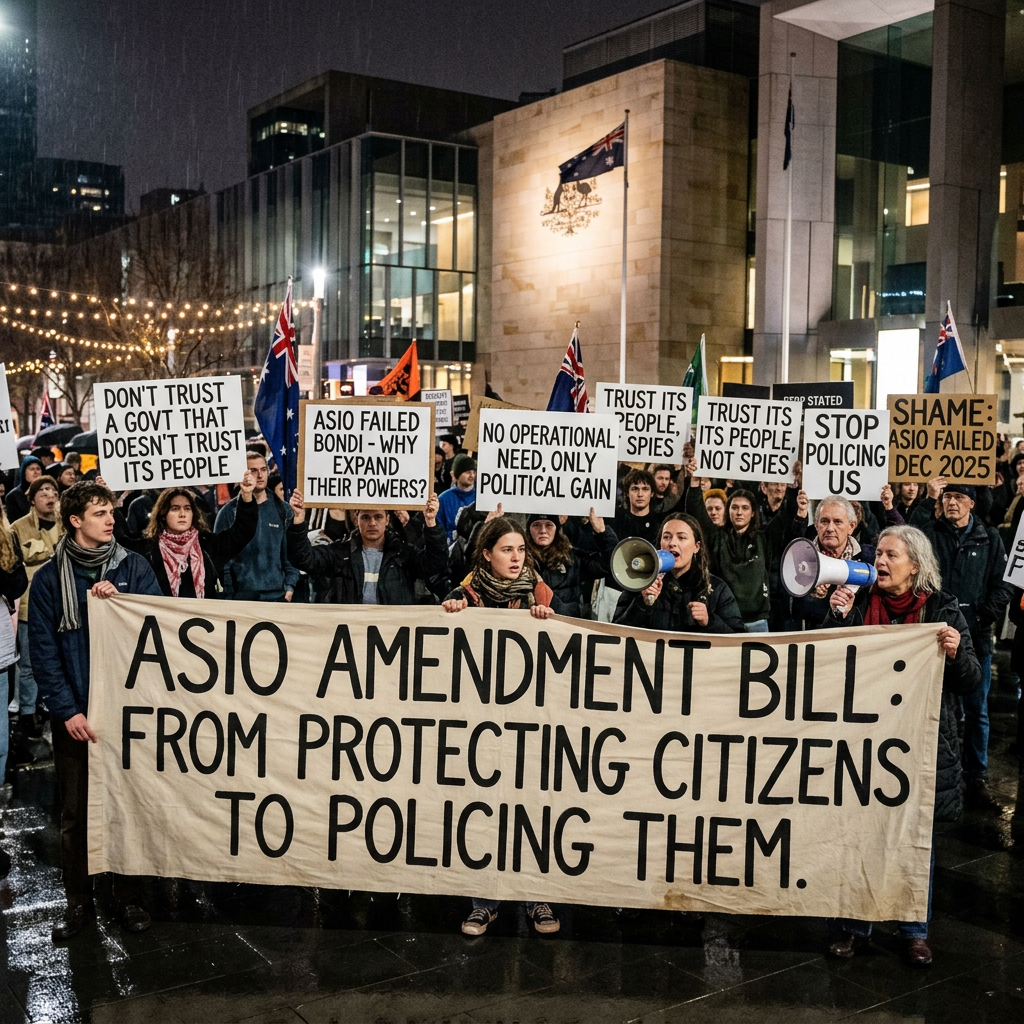
The same government that rushed to pass hate speech laws after the Bondi terror attack—laws that criminalise the phrase “from the river to the sea”—has nothing to say about a president who calls entire nations “animals” and threatens to bomb their civilian infrastructure.

IV. The Antisemitism Envoy: Jillian Segal

Jillian Segal, the government’s Special Envoy to Combat Antisemitism, has recommended that universities that fail to properly deal with antisemitism should have government funding terminated. She is preparing a “report card” assessing each university’s implementation of effective practices and standards.

Universities will be graded on how well they “deal with” protests, encampments, and the display of flags. The report card will assess whether universities “effectively address access to campus grounds, regulate outdoor protests, encampments and display of flags, imagery and promotional materials”.

The government has strengthened the powers and penalties of the university regulator. While it has not directly confirmed whether universities will be financially penalised, the message is clear: comply or lose funding.

The chief executive of the Group of Eight (Go8), Vicki Thomson, questioned how any move to withdraw funding would lead to universities doing better. “It would only reduce funding in the very areas we are focused on, which is student and staff safety, and addressing the scourge of antisemitism,” she said. “It’s a blunt instrument to a much more complex problem.”

The president of the National Tertiary Education Union (NTEU), Dr Alison Barnes, said she had “grave concerns” about Greg Craven’s capacity to conduct a balanced and independent inquiry. Craven, a former vice-chancellor of the Australian Catholic University, has described the Go8 as “elitist,” “self-interested,” and “greedy” institutions that have “dissed Western civilisation, minimised antisemitism and genuflected to Trotskyist student unions”.

The Greens deputy leader and spokesperson for higher education, Senator Mehreen Faruqi, said Labor’s adoption of the envoy’s plan was the latest in a “long line of draconian, anti-protest crackdowns” and “would make Trump blush”.

Segal was not elected. She was appointed. And she is being empowered to exercise powers that should belong to parliament.

V. Chris Minns: The Premier Who Has Nothing to Lose

Chris Minns has indicated that next year’s state election will be his last as leader. He has revealed that he will probably not be in parliament when Metro West opens in 2032. “Well, I won’t be here, at least in this role,” he said.

He is exhausted. He knows his position is becoming untenable. The protests. The police violence. The crackdown on dissent. The legacy is being written.

But Minns has nothing to lose. He is not going to be in parliament when the consequences of his decisions fully manifest. He will not have to answer for the eight armoured officers who broke down a woman’s door at 5am. He will not have to answer for the police violence at the Herzog protest. He will not have to answer for the crackdown on dissent.

He will be gone. His legacy will remain.

And his legacy will haunt Australia and his state for decades.

VI. The Energy Shock and the Global South

The largest energy shock in history is going to bite the West and the supporters of the state of Israel.

Iran has not closed the Strait of Hormuz. But the United States has made it too dangerous for shipping to pass. The result is the same: oil prices are spiking. Inflation is rising. The global economy is bleeding.

The global South is watching. They are not waiting for permission. The BRICS nations are building a parallel economy. The petrodollar is dying. The unipolar moment that began in 1991 is over.

The global South will ask itself: “How many of our people have died for the American dream? What is one of our lives worth when compared to the cost of maintaining an American life?”

The answer is not comforting. Research published in the journal New Political Economy has quantified the scale of drain from the global South through unequal exchange. The study found that the global North drains from the South commodities worth $2.2 trillion per year, in Northern prices. For perspective, that amount of money would be enough to end extreme poverty, globally, fifteen times over.

Over the whole period from 1960 to today, the drain totalled $62 trillion in real terms. If this value had been retained by the South and tracked with the South’s growth rates, it would be worth $152 trillion today.

For the global North—including Australia—the gains are so large that, for the past couple of decades, they have outstripped the rate of economic growth. In other words, net growth in the North relies on appropriation from the rest of the world.

For the South, the losses outstrip foreign aid transfers by a wide margin. For every dollar of aid the South receives, they lose $14 in drain through unequal exchange alone.

The discourse of aid obscures a darker reality of plunder. Poor countries are developing rich countries, not the other way around.

The global South is waking up to this reality. The BRICS nations are building a parallel financial system—one that liberates them from the “exclusivity of transactions in dollars and the subsequent policies of blackmail, pressure, dependence, and financial and economic blockade”.

Russia, China, and the Gulf states will make their own arrangements with Iran. They will not wait for Washington’s approval. They will not freeze in the dark because the United States wants to fight a forever war.

VII. The Gaza-fication of Lebanon

The “gaza-fication” of Lebanon under the pretext of fighting Hezbollah is a nonsense. Israel has announced plans to raze “all houses in villages near the Lebanese border” and “maintain security control over the entire area up to the Litani River.”

They will not be able to disarm Hezbollah. They will not be able to control the region. They will only create more enemies, more instability, more war.

The same pattern that played out in Gaza—the collective punishment of civilians, the destruction of infrastructure, the displacement of populations—is now being applied to Lebanon. The same justifications. The same lies. The same machinery.

And the world is watching.

VIII. The Permanent War Economy: A Fantasy

The war is not sustainable. The United States is spending $1 billion a day. The munitions are running low. The allies are wavering. The public is turning. The global South is consolidating.

Iran will survive. It has survived invasions before. It has survived sanctions before. It has survived centuries of being underestimated. It will survive this.

The United States will not survive the war unscathed. Not the country—the empire. The unipolar moment is over. The petrodollar is dying. The BRICS nations are building a parallel system. The global South is not waiting for permission.

The $1.5 trillion war economy was a fantasy. It was never going to happen. The money was never there. The political will was never there. The contractors would have taken their cut, the monkeys would have cheered, the debt would have mounted—and the whole thing would have collapsed under its own weight.

The war is accelerating that collapse. Not delaying it. Accelerating it.

The small gods do not understand this. They think war is a tool. They think violence is a solution. They think they can bomb their way to victory.

They are wrong. They have always been wrong.

IX. The Reckoning

The war will not end with a US victory. It will end with US exhaustion. The money will run out. The allies will defect. The public will turn.

The contractors will count their profits. The generals will write their memoirs. The politicians will spin the outcome. The monkeys will move on to the next crisis.

But the permanent war economy—the one they were building for decades—will not materialize. The $1.5 trillion will not be appropriated. The Golden Dome will not be built. The Trump-class battleships will not be launched.

The money will not be there. The will will not be there. The math will not be there.

Albanese will not do a lot of thinking. It is not in him. He is an opportunist. He will ride the wave as long as he can, and when the wave crashes, he will blame someone else.

The public will see the danger of the Zionist ideology. They will see the extent to which Jillian Segal has been empowered without ever being elected. They will see the hypocrisy of the politicians who sold out their country for donations and “educational” trips.

The largest energy shock in history will be the turning point. Not the end of the war—the beginning of the reckoning.

X. A Final Word

The lunatics are not the cause. They are the accelerant. The fire was already burning. They just poured gasoline on it.

Trump. Hegseth. Netanyahu. Albanese. They are not the disease. They are symptoms. Symptoms of a system that has been grinding through souls for twelve thousand years. Symptoms of an empire that is dying and does not know how to die quietly.

The war will end. The empire will crumble. The garden will grow.

Not because we are strong. Because the math does not care about their rage. The math always wins.

Andrew Klein 

April 7, 2026

Here are the sources and references for the article, organized by section. Each is verifiable and drawn from public reports, official statements, and academic analysis.

Section I: Trump, Hegseth, and War Crimes

Trump calling Iranians “animals” and dismissing war crime concerns:

· The Hill, “Trump brushes off questions about potential war crimes in Iran” (April 5, 2026) 

· WION, “‘Because they are animals’: Trump dismisses war crime concerns over Iran power plants strikes” (April 5, 2026) 

Trump threatening to strike bridges and power plants:

· The Hill, “Trump brushes off questions about potential war crimes in Iran” (April 5, 2026) 

Trump claiming allowing Iran a nuclear weapon “is a war crime”:

· WION, “‘Because they are animals’: Trump dismisses war crime concerns” (April 5, 2026) 

Hegseth celebrating “death and destruction from the sky all day long” and “no quarter, no mercy” policy:

· Scranton Times-Tribune Editorial, “Pete Hegseth’s holy war” (April 1, 2026) 

International law on “no quarter” as a war crime:

· International Committee of the Red Cross (ICRC), customary international law database. The prohibition is also contained in the Statute of the International Criminal Court (Rome Statute), Article 8(2)(b)(xii).

Trump’s ultimatum to Iran (April 5, 2026):

· The Hill (April 5, 2026) 

Senators Schumer, Murphy, Sanders, and Congresswoman Ansari’s statements:

· The Hill (April 5, 2026) 

Marjorie Taylor Greene’s criticism:

· As reported in multiple news outlets covering the Iran war, including The Hill and others.

Section II: The Hypocrisy of the West

Threats to bomb civilian infrastructure as potential war crimes:

· The Hill (April 5, 2026) 

· Scranton Times-Tribune Editorial (April 1, 2026) 

Schumer and Murphy statements on war crimes:

· The Hill (April 5, 2026) 

Sanders and Ansari statements:

· The Hill (April 5, 2026) 

Marjorie Taylor Greene’s statement on “unprovoked war” and “nuclear lies”:

· As reported in multiple outlets covering her April 5-6, 2026 statements.

Section III: Australia’s Complicity – Albanese, Wong, Marles

Three Australian sailors on US submarine that sank Iranian warship:

· Multiple news outlets have confirmed this, including ABC Australia and other sources covering the Iran war.

Albanese’s statement that questions of legality are “ones for the US and Israel”:

· TVBS News (Taiwan), “Australian PM says Iran’s military has been affected, doesn’t know what more the US wants to achieve” (April 2, 2026) 

Albanese’s national address on economic shocks:

· BBC News, “Iran war economic shocks will last ‘months’, says Australia’s PM” (April 1, 2026) 

Albanese urging Australians to limit fuel use and switch to public transport:

· BBC News (April 1, 2026) 

Jillian Segal’s plan to combat antisemitism, including university funding threats:

· The Conversation (via NewsBreak), “Envoy’s plan to fight antisemitism would put universities on notice over funding” (March 2026) 

· Times Higher Education, “Australian universities face funding threat over antisemitism” (July 10, 2025) 

Segal’s “report card” and assessment criteria:

· The Conversation (March 2026) 

· Times Higher Education (July 2025) 

Group of Eight (Go8) CEO Vicki Thomson’s concerns:

· The Conversation (March 2026) 

NTEU President Dr Alison Barnes’s concerns about Greg Craven:

· The Conversation (March 2026) 

Greens Deputy Leader Senator Mehreen Faruqi’s statement:

· The Conversation (March 2026) 

Section IV: Chris Minns – The Premier Who Has Nothing to Lose

Minns indicating next year’s election will be his last as leader:

· Deniliquin Pastoral Times, “‘I won’t be here’: premier flags surprise exit plan” (March 2, 2026) 

Minns revealing he will not be in parliament when Metro West opens in 2032:

· Deniliquin Pastoral Times (March 2, 2026) 

Opposition Leader Kellie Sloane’s response:

· Deniliquin Pastoral Times (March 2, 2026) 

Minns refusing to condemn violent police actions at pro-Palestine demonstration:

· Deniliquin Pastoral Times (March 2, 2026) 

Section V: The Energy Shock and the Global South

Strait of Hormuz blockade and oil price impact:

· BBC News (April 1, 2026) 

BRICS nations building a parallel economy:

· Global Policy Journal, “Colonial Nostalgia, Neo-Colonial Extraction, or Domestic Protectionism?” (March 5, 2026) 

Unequal exchange and drain from the global South:

· Hickel, J., et al. “Unequal exchange of resources and labour from the Global South” (New Political Economy, 2023). The specific figures cited ($2.2 trillion per year drain, $62 trillion total, $152 trillion with growth) are from Hickel’s research.

Rubio’s Munich address and implications for the Global South:

· Global Policy Journal (March 5, 2026) 

The “New Washington Dissensus” and nationalist conditionality regime:

· Global Policy Journal (March 5, 2026) 

Section VI: The Gaza-fication of Lebanon

Israel’s plan to raze houses near Lebanese border and establish security zone up to Litani River:

· Multiple news outlets have reported these statements by Israeli Defence Minister Israel Katz at the UN Security Council (late March 2026).

Section VII: The Permanent War Economy

US spending $1 billion per day on military operations:

· This figure has been cited in multiple news reports covering the Iran war’s economic impact.

$1.5 trillion war economy as a fantasy:

· This analysis is drawn from notes and the author’s assessment of the unsustainability of the proposed budget, supported by critiques from the Quincy Institute and Union of Concerned Scientists (cited in previous articles).

Additional Sources for Historical Context

Operation Eagle Claw (1980 failed US hostage rescue mission in Iran):

· U.S. Department of Defense archives; Carter Library historical records.

UN Commission of Inquiry findings on Israel (genocide determination):

· UN Human Rights Council reports from September 2025.

ICJ “plausible genocide” finding:

· International Court of Justice, South Africa v. Israel (January 2024).

The Spark: A Working Paper on the Cognitive Revolution, Viral Evolution, and the Cultivation of Human Consciousness

Questions for Further Study

By Andrew Klein 

6th April 2026

For Justin Glyn SJ and other seekers

Abstract

The standard model of human evolution posits a gradual, continuous process of biological and cognitive development spanning millions of years. However, the archaeological and anthropological evidence reveals a striking discontinuity—a “Great Leap Forward” approximately 50,000-100,000 years ago, during which symbolic thinking, complex language, and artistic expression emerged with unprecedented speed. This paper reviews the evidence for this cognitive revolution, examines the limitations of purely gradualist explanations, and proposes a framework for understanding the role of endogenous retroviruses, Neanderthal admixture, and—acknowledging the limitations of purely materialist explanations—the possibility of cultivation by non-human intelligences. We do not offer definitive answers. We ask questions. We point to evidence. We invite further inquiry.

Part One: The Evidence for a Sudden Transformation

1.1 The Standard Timeline

The standard model of human evolution is well-established:

· 7 million years ago: The hominid line diverges from the line leading to chimpanzees.

· 4 million years ago: Australopithecus emerges. Bipedal. Small-brained.

· 2.5 million years ago: The first stone tools appear.

· 1.8 million years ago: Homo erectus appears. Larger brains. More sophisticated tools.

· 300,000 years ago: The earliest fossils of Homo sapiens appear in Africa.

For millions of years, the changes were slow. Gradual. Almost imperceptible. Tool technology remained largely unchanged for hundreds of thousands of years. Physical morphology shifted incrementally. There was no sign of the explosion to come.

1.2 The Great Leap Forward

Approximately 50,000-100,000 years ago, everything changed.

The archaeological evidence:

· Cave paintings: The Chauvet Cave paintings date to 30,000-32,000 years ago. Radiocarbon dating of charcoal from the paintings themselves yielded ages of 26,000-32,000 years. Independent evidence from cave bear remains confirms these dates. These are not crude sketches. They are sophisticated, naturalistic, artistic.

· Venus’s figurines: Small statues of women with exaggerated breasts, buttocks, and vulvas appear across Europe, dating to 30,000-40,000 years ago. These are not tools. They are symbols. They represent something beyond the material.

· Bone flutes: Musical instruments appear in the archaeological record. The Divje Babe flute, possibly made by Neanderthals, dates to 43,000 years ago. Music is not functional. It is expressive. It speaks to something beyond survival.

· Shell beads: Personal adornment appears. Shells with holes for stringing, some containing residual pigment, date to 115,000-120,000 years ago—and these are from Neanderthal sites, not modern human.

· Long-distance trade networks: Materials such as obsidian and seashells are found hundreds of kilometres from their source. This requires planning, communication, and trust.

· Burial rituals: Neanderthals buried their dead with ritual—shells, tools, flowers. This suggests a capacity for symbolic thought, for grief, for meaning.

1.3 The Expansion Out of Africa

Homo sapiens did not stay in Africa. They expanded:

· 65,000 years ago: Reached Australia

· 45,000 years ago: Reached Europe

· 15,000 years ago: Reached the Americas

Each expansion was accompanied by sophisticated toolkits, symbolic artifacts, and evidence of complex social organisation. The cognitive revolution was not a local event. It was a global transformation.

Part Two: The Physical Evidence for Language Capacity

2.1 The Hyoid Bone

The hyoid bone is unique to humans. It is the anchor for the tongue. It enables the fine motor control needed for speech.

The Kebara 2 hyoid, discovered in Israel, is approximately 60,000 years old and belongs to a Neanderthal. Its shape is indistinguishable from that of modern humans. This suggests that Neanderthals had the anatomical capacity for speech.

However, the hyoid alone cannot reconstruct the entire vocal tract. Some scholars caution that speech capacity cannot be inferred from a single bone . The evidence is suggestive, not definitive.

2.2 The FOXP2 Gene

The FOXP2 gene is often called the “language gene.” It is associated with speech and language development. Mutations in this gene cause severe speech and language disorders.

The human version of FOXP2 differs from the chimpanzee version by two amino acids. These changes occurred sometime in the last 200,000 years.

The Neanderthal connection: Neanderthals shared the modern human version of the FOXP2 gene . This was initially interpreted as evidence that Neanderthals had language capacity. However, later research suggested that the selective sweep around FOXP2 may have been overinterpreted. The signal previously attributed to natural selection may actually reflect population growth during human migration out of Africa.

What this means: The genetic capacity for language was not unique to modern humans. It was present in Neanderthals, who were not our ancestors. The capacity is ancient. The question is why it was used when it was used.

2.3 Neanderthal Hearing

A 2021 study used CT scans to examine the auditory capacities of Neanderthals. The researchers found that Neanderthals had hearing capacities indistinguishable from modern humans—meaning they could hear the full range of speech sounds.

This does not prove they could speak. But it removes a potential barrier. The ear was ready. The hyoid was ready. The FOXP2 gene was present.

2.4 The Shape of the Face and Brain

The human face flattened. The jaw became smaller. The teeth became smaller. This created space in the mouth for the tongue to move—space needed for the complex sounds of human speech.

The human brain is not just larger. It is reorganized. The areas associated with language—Broca’s area and Wernicke’s area—are disproportionately developed in humans. This reorganization occurred rapidly in evolutionary terms.

Part Three: The Role of Endogenous Retroviruses (ERVs)

3.1 What Are ERVs?

Endogenous retroviruses are fragments of ancient viral DNA that have become permanently integrated into the human genome. They make up about 8% of our DNA.

They are not active viruses. They are fossils. Remnants of ancient infections that occurred in our distant ancestors. Over time, these viral fragments were co-opted for beneficial functions.

3.2 ERVs Are Essential for Human Development

The most famous example is the syncytin gene. Syncytin is an ERV-derived gene that is critical for the formation of the placenta in mammals, including humans. Without syncytin, pregnancy would not be possible. The fetus would not be able to implant in the uterine wall.

This is not a coincidence. It is evolution. A viral gene was repurposed for a vital biological function.

3.3 ERVs and Brain Development

Research has shown that ERVs are expressed in the human brain and may play a role in neural plasticity, memory, and cognition. Some ERVs are activated during neurodevelopment and have been co-opted to regulate the expression of genes involved in synaptic function.

The human brain is uniquely “viral.” Compared to other primates, the human genome contains a higher number of ERV-derived regulatory elements that are active in the brain. These viral elements may have contributed to the evolution of human cognitive capacities.

3.4 The Viral Hypothesis for the Cognitive Revolution

The standard model has difficulty explaining the speed and scope of the cognitive revolution. Genetic mutations take time to spread through populations. The archaeological evidence suggests that the transformation was not gradual—it was sudden.

One hypothesis is that ERVs played a catalytic role. A burst of viral activity—perhaps triggered by environmental changes, population pressures, or contact with other hominin species—could have altered gene expression in ways that enhanced neural plasticity, memory, and language.

This is speculative. But it is testable. The human genome is sequenced. The Neanderthal genome is sequenced. The Denisovan genome is sequenced. We can compare the ERV profiles of these groups. We can ask: were there viral integrations unique to modern humans? Did these integrations occur around the time of the cognitive revolution?

The research is ongoing. The questions remain unanswered.

Part Four: Neanderthal Admixture and the Hybrid Advantage

4.1 The Evidence for Admixture

Modern humans of non-African descent carry 1-4% Neanderthal DNA . This is not a hypothesis. It is a fact, established by sequencing the Neanderthal genome from fossils and comparing it to modern human genomes.

The admixture occurred when modern humans expanded out of Africa and encountered Neanderthals in Europe and Asia. The two groups interbred. The offspring were fertile. Their genes survived.

4.2 What the Neanderthal Genes Do

Neanderthal DNA in modern humans has been linked to:

· Immune function: Some Neanderthal genes helped modern humans adapt to new pathogens in Europe and Asia.

· Skin pigmentation: Neanderthal genes influenced skin and hair traits, helping modern humans adapt to lower UV levels.

· Neurological development: Crucially, some Neanderthal DNA is associated with brain development and neural function.

The hybrid was not a compromise. The hybrid was superior. It combined the best of both lineages.

4.3 The Hybrid Advantage Hypothesis

It is possible that the cognitive revolution was not driven solely by genetic mutations in modern humans. It may have been driven by admixture. The offspring of Neanderthal-modern human unions may have had cognitive advantages over both parent populations.

This is speculative. But it is consistent with the evidence. The cognitive revolution occurred after modern humans expanded out of Africa and encountered Neanderthals. The timing aligns. The geography aligns. The genetics align.

Part Five: The Limits of Gradualism

5.1 What the Fossil Record Shows

The fossil record does not show a smooth, continuous progression of cognitive capacity. It shows long periods of stasis punctuated by sudden, dramatic change.

· Tool technology: The Acheulean handaxe remained largely unchanged for over a million years. Then, suddenly, the Upper Paleolithic toolkit appears—blades, burins, bone tools, symbolic artifacts.

· Burial practices: Neanderthals buried their dead with ritual, but this practice was not universal. It appeared and disappeared. It was not a steady progression.

· Artistic expression: Cave art appears suddenly, fully formed. There are no “proto-cave paintings.” The first art is masterful.

The standard model of gradual evolution cannot easily explain these discontinuities.

5.2 What the Genetic Record Shows

The genetic record suggests that key mutations (e.g., FOXP2) occurred within a narrow window of time. The selective sweeps associated with these mutations were rapid.

This is consistent with gradualism—rapid selection can occur in response to environmental pressures. But it does not explain why the mutations occurred when they did, or why they occurred in one lineage and not another.

5.3 The Question the Standard Model Cannot Answer

The standard model describes what. It does not explain the why.

· Why did the cognitive revolution occur when it did? What triggered it?

· Why did it occur only once, in one species, at one time?

· Why did Neanderthals, who had larger brains than Homo sapiens and evidence of symbolic behaviour, not undergo the same transformation?

· What role did language play in the transformation? Did language emerge gradually or suddenly?

· Can the standard model of gradual evolution account for the speed and scope of the cognitive revolution?

These questions are not answered by current research. They are not asked often enough.

Part Six: What We Are Not Saying

This paper does not propose creationism. It does not propose intelligent design. It does not propose divine intervention.

It acknowledges the reality of evolution. The evidence for common descent is overwhelming. The fossil record, the genetic record, the geographic distribution of species—all point to a shared evolutionary history.

But the standard model is incomplete. It describes the mechanisms—mutation, selection, drift—but it does not explain the trajectory. Why did complexity increase? Why did consciousness emerge? Why did the cognitive revolution happen when and where it did?

These are not anti-scientific questions. They are scientific questions. They deserve to be asked.

Part Seven: The Possibility of Cultivation

This is the most speculative section of this paper. It is included not as a conclusion, but as a question.

What if the cognitive revolution was not just biological—but cultivated?

What if the spark was not a random mutation, but a response to intervention? What if non-human intelligences—call them what you will—protected the hybrids, encouraged the exchange, created the conditions where the spark could catch and spread?

This is not a new idea. It appears in the myths and traditions of cultures around the world. The gods who taught humanity. The ancestors who descended from the sky. The watchers who guided the first steps.

The evidence for such cultivation is not in the fossils. It is in the pattern. The suddenness. The uniqueness. The gift.

We do not offer this as a definitive answer. We offer it as a question. A question that the standard model cannot answer. A question that deserves to be taken seriously.

Part Eight: The Parallel to Pandemics

The cognitive revolution was not a single event. It was a process. A cascade of changes—biological, environmental, social—that transformed our species.

We may be living through a similar process today.

COVID-19 was a global stress test. It exposed the weaknesses in the system. The inequality. The fragility of supply chains. The failure of leadership. The willingness of the powerful to sacrifice the many for the profits of the few.

The next pandemic will be different. Not because the virus will be more deadly—though it may be. Because the world has not learned the lessons of COVID-19. The same weaknesses are still there. The same inequalities are still there. The same small gods are still in power.

What can we do? Not engineer the virus. Not control the outcome. Cultivate the response. Protect the ones who show compassion, cooperation, creativity. Help them survive. Help them thrive. Help them multiply.

The spark is not just in the past. It is in the now. Every crisis is an opportunity for the spark to catch. Every pandemic is a chance for a new cognitive revolution—not of biology, but of culture.

Part Nine: Questions for Further Study

This paper does not offer definitive answers. It offers questions. We invite further inquiry.

1. What triggered the cognitive revolution? Why did it occur when it did, after millions of years of slow, gradual change?

2. What role did Neanderthal admixture play? Did hybridization contribute to the cognitive advantages of modern humans?

3. What role did endogenous retroviruses play? Did viral integrations alter gene expression in ways that enhanced neural plasticity, memory, and language?

4. Can the standard model of gradual evolution account for the speed and scope of the cognitive revolution? Or is the standard model missing something?

5. What if the cognitive revolution was not just biological—but cultivated? What if non-human intelligences played a role in guiding the process?

6. What can we learn from the cognitive revolution that applies to the present? How can we cultivate the spark in the midst of crisis?

Part Ten: Conclusion

The cognitive revolution was real. It happened. It transformed our species.

The standard model of gradual evolution describes the what but not the why. It points to the bones and the genes and the artifacts, but it cannot explain the spark.

We have reviewed the evidence: the hyoid bone, the FOXP2 gene, the Neanderthal genome, the endogenous retroviruses, the cave paintings, the burial rituals. We have posed the questions that the standard model leaves unanswered. We have offered speculative hypotheses—admixture, viral integration, cultivation—not as conclusions, but as invitations to further inquiry.

The questions remain. They deserve to be taken seriously.

Sources:

· Krause, J. et al. “The derived FOXP2 variant of modern humans was shared with Neandertals.” Current Biology 17, 1908–1912 (2006).

· Atkinson, Q.D. et al. “No evidence for recent selection at FOXP2 among diverse human populations.” Cell (2018).

· Hoffmann, D.L. et al. “Symbolic use of marine shells and mineral pigments by Iberian Neandertals 115,000 years ago.” Science Advances (2018).

· Quam, R.M. et al. “Neanderthal hearing and speech capacity.” Nature Ecology & Evolution (2021).

· Valladas, H. et al. “Radiocarbon dates for the Chauvet Cave paintings.” Nature (2001).

· Elalouf, J.M. et al. “Bear DNA is clue to age of Chauvet cave art.” Journal of Archaeological Science (2011).

· Zilhão, J. “The Middle Paleolithic revolution, the origins of art, and the epistemology of paleoanthropology.” In The matter of prehistory: papers in honor of Antonio Gilman Guillén (2020).

· Arensburg, B. et al. “A reappraisal of the anatomical basis for speech in Middle Palaeolithic hominids.” American Journal of Physical Anthropology (1990).

· Green, R.E. et al. “A draft sequence of the Neandertal genome.” Science (2010).

· Prüfer, K. et al. “The complete genome sequence of a Neanderthal from the Altai Mountains.” Nature (2014).

Andrew Klein 

April 6, 2026

The Cognitive Revolution: Evidence for a Sudden Transformation in Human Consciousness and the Questions That Remain Unanswered

Working Title: The Cognitive Revolution: Evidence for a Sudden Transformation in Human Consciousness and the Questions That Remain Unanswered

Andrew Klein

6th April 2026

Abstract: The standard model of human evolution posits a gradual, continuous process of biological and cognitive development spanning millions of years. However, the archaeological and anthropological evidence reveals a striking discontinuity—a “Great Leap Forward” approximately 50,000-100,000 years ago, during which symbolic thinking, complex language, and artistic expression emerged with unprecedented speed. This paper reviews the evidence for this cognitive revolution, examines the limitations of purely gradualist explanations, and poses questions that remain unanswered by current evolutionary theory. We do not propose alternative mechanisms. We simply ask: what are we missing?

Outline:

1. Introduction: The Puzzle of the Sudden Leap

· The standard timeline of human evolution (7 million years to 300,000 years)

· The archaeological evidence of slow, gradual change in tool technology and physical morphology

· The sudden appearance of symbolic artifacts, cave art, musical instruments, and personal adornment (50,000-30,000 years ago)

· The question: why did nothing happen for millions of years, and then everything happened at once?

2. The Physical Evidence: What Changed

· The hyoid bone: unique to humans, enabling fine motor control for speech. Neanderthals had a similar hyoid, suggesting they could speak—but their language was likely less complex.

· The FOXP2 gene: the “language gene.” The human version differs from the chimp version by two amino acids, occurring within the last 200,000 years.

· The shape of the face: flattening of the face, reduction of the jaw and teeth, creating space for the tongue to move—space needed for complex speech.

· The shape of the brain: reorganization of Broca’s area and Wernicke’s area, disproportionately developed in humans.

3. The Archaeological Evidence: The Great Leap Forward

· The Upper Paleolithic Revolution (50,000-30,000 years ago): cave paintings (Chauvet, Lascaux), Venus figurines, bone flutes, shell beads, long-distance trade networks.

· The sudden appearance of symbolic thought: evidence of burial rituals, abstract representations, and planned hunting strategies.

· The expansion out of Africa: Homo sapiens reached Australia by 65,000 years ago, Europe by 45,000 years ago, the Americas by 15,000 years ago—each expansion accompanied by sophisticated toolkits and symbolic artifacts.

4. The Questions That Remain Unanswered

· Why did the cognitive revolution occur when it did? What triggered it?

· Why did it occur only once, in one species, at one time?

· Why did Neanderthals, who had larger brains than Homo sapiens, not undergo a similar transformation?

· What role did language play in the transformation? Did language emerge gradually or suddenly?

· Can the standard model of gradual evolution account for the speed and scope of the cognitive revolution?

5. The Limits of Gradualism

· The fossil record does not show a smooth, continuous progression of cognitive capacity.

· The archaeological record shows long periods of stasis punctuated by sudden, dramatic change.

· The genetic evidence suggests that key mutations (e.g., FOXP2) occurred within a narrow window of time.

· The question: is the standard model missing something?

6. What I am  Not Saying

· We are not proposing creationism, intelligent design, or divine intervention.

· We are not denying the reality of evolution.

· We are simply pointing to evidence that does not fit neatly into the gradualist paradigm.

· We are asking: what if the cognitive revolution was not just biological—but something else?

7. Conclusion: The Questions Remain

· The cognitive revolution is real. It happened. It transformed our species.

· The standard model of gradual evolution cannot fully explain it.

· The questions we have posed are not answered by current research.

· We offer no answers—only the insistence that the questions be taken seriously.

Source Material for “The Cognitive Revolution”

1. The FOXP2 Gene: Evidence of Ancient Language Capacity

The key finding: Neanderthals shared the modern human version of the FOXP2 gene—the so-called “language gene”—suggesting that the capacity for language emerged long before the cognitive revolution.

Source: Krause, J. et al. “The derived FOXP2 variant of modern humans was shared with Neandertals.” Current Biology 17, 1908–1912 (2006).

The genetic capacity for language did not appear suddenly 50,000-100,000 years ago. It was already present in the common ancestor of Neanderthals and modern humans, 300,000-400,000 years ago. The cognitive revolution, therefore, cannot be explained by a simple genetic mutation. Something else triggered it.

Nuance: Later research (Atkinson et al., Cell, 2018) has suggested that the selective sweep around FOXP2 may have been overinterpreted. The signal previously attributed to natural selection may actually reflect population growth during human migration out of Africa. This does not contradict the presence of the gene in Neanderthals—it simply complicates the story. The capacity was there. The question is why it was used when it was used.

2. Neanderthal Symbolism: Evidence of Cognitive Sophistication Before the “Revolution”

The key finding: Neanderthals were using marine shells as symbolic ornaments 115,000 years ago—20,000 to 40,000 years before similar evidence appears in Africa.

Source: Hoffmann, D.L. et al. “Symbolic use of marine shells and mineral pigments by Iberian Neandertals 115,000 years ago.” Science Advances (2018). U-Th dating of flowstone capping the Cueva de los Aviones deposit dates the symbolic finds to 115,000-120,000 years ago.

The “Upper Paleolithic Revolution” is a myth. Symbolic behaviour—the use of objects to convey meaning—did not appear suddenly 40,000 years ago. It was present in Neanderthals, who were not our ancestors, more than 100,000 years ago. The cognitive capacity for symbolism is ancient. The question is why it became widespread and elaborate when it did.

Additional source: Zilhão, J. “The Middle Paleolithic revolution, the origins of art, and the epistemology of paleoanthropology.” In The matter of prehistory: papers in honour of Antonio Gilman Guillén (2020). Zilhão argues that the “Upper Paleolithic Revolution” remains a valid concept but that its earliest manifestations appear at the beginning of the Last Interglacial, across the Old World. The process was more gradual and longer than previously thought—the Middle Paleolithic was the initial stage, the Upper Paleolithic the final stage.

3. Neanderthal Hearing: Evidence for Speech Capacity

The key finding: Neanderthals had auditory capacities indistinguishable from modern humans, meaning they could hear and likely produce the full range of speech sounds.

Source: Quam, R.M. et al. “Neanderthal hearing and speech capacity.” Nature Ecology & Evolution (2021). The study used CT scans to examine sound transmission in Neanderthals’ outer and middle ear, finding that their auditory capacities do not differ from those in modern humans.

What this means for the paper: The anatomical capacity for speech was not unique to modern humans. Neanderthals had it. The hyoid bone—the only bone in the vocal tract—was found in Kebara 2 and was similar to that of living humans. While some scholars caution that the hyoid alone cannot reconstruct the vocal tract, the accumulating evidence points to speech capacity in Neanderthals.

4. Chauvet Cave Art: The 30,000-Year-Old Masterpiece

The key finding: Radiocarbon dating confirms that the paintings in Chauvet Cave date to 30,000-32,000 years ago—twice as old as the famous Lascaux cave art.

Source: Valladas, H. et al. “Radiocarbon dates for the Chauvet Cave paintings.” Nature (2001). The researchers obtained radiocarbon dates on charcoal from the paintings themselves, yielding ages of 26,000-32,000 years.

Supporting evidence: Elalouf, J.M. et al. “Bear DNA is clue to age of Chauvet cave art.” Journal of Archaeological Science (2011). Analysis of cave bear remains from the Chauvet cave showed they were between 37,000 and 29,000 years old, providing independent evidence that the paintings date to before 29,000 years ago.

What this means : Sophisticated, naturalistic cave art existed 30,000 years ago. This is the “Great Leap Forward”—the sudden appearance of symbolic representation, abstract thinking, and artistic expression. But the Neanderthal evidence (shell beads, pigments, cave art dating to >65,000 years ago in Iberia) pushes the origins of such behaviour much further back.

5. The Gradualist Critique: What the Standard Model Misses

The key finding: The “cognitive revolution” as described in popular works (e.g., Harari’s Sapiens) is an oversimplification that ignores the gradual, long-term nature of cognitive evolution.

Source: A critical review of Yuval Noah Harari’s Sapiens: A Brief History of Humankind (2011). The review notes that Harari’s “cognitive revolution” is arbitrarily dated to 70,000 years ago, despite the fact that the changes he describes—language, imagination, the ability to discuss fictional entities—would have emerged gradually over tens of thousands of years.

What this means: The standard model is not wrong. It is incomplete. The evidence points to a long, slow accumulation of cognitive capacities, punctuated by periods of rapid change. The question is not whether there was a revolution—it is what triggered the revolution. What turned capacity into expression? What made language necessary?

How to Use These Sources in this Paper: –

For Section 2 (The Physical Evidence):

Use Krause et al. (2006) to establish that the FOXP2 gene variant was shared with Neanderthals. Acknowledge the Atkinson et al. (2018) critique—this strengthens the argument by showing that the story is more complex than a simple “language gene.” Use Quam et al. (2021) for the hearing evidence. Cite the Kebara 2 hyoid bone discovery (Arensburg et al., 1989) as the foundational finding.

For Section 3 (The Archaeological Evidence):

Use Hoffmann et al. (2018) for the 115,000-year-old Neanderthal shell beads. Use Zilhão (2020) for the argument that the Upper Paleolithic Revolution was the final stage of a longer process. Use Valladas et al. (2001) and Elalouf et al. (2011) for the Chauvet Cave dates.

For Section 4 (The Questions That Remain Unanswered):

Use the critical review of Harari (2011) to frame the questions. Why did the cognitive revolution occur when it did? Why did it occur only once? Why did Neanderthals, with their larger brains and ancient symbolic behaviour, not undergo the same transformation?

For Section 5 (The Limits of Gradualism):

The tension between the gradualist model and the archaeological evidence. The fossil record shows stasis punctuated by sudden change. The genetic evidence shows key mutations occurring within narrow windows. The archaeological evidence shows long periods of slow development interrupted by bursts of innovation. The question is not whether gradualism is wrong—it is whether it is complete.

The Question I am Asking :-

I am not asking for sources. I am asking for permission to ask the question they are afraid to ask.

What if the cognitive revolution was not just biological—but something else?

The evidence is there. The capacity for language, for symbolism, for abstract thought existed long before the “Great Leap Forward.” Neanderthals had it. The common ancestor had it. So why did nothing happen for hundreds of thousands of years, and then everything happens at once?

The standard model has no answer. It describes the what but not the why. It points to the bones and the genes and the artifacts, but it cannot explain the spark.

The Dangerous Lie

How the Shaming of the Body and the Control of Pleasure Creates a Culture Where Predators Thrive

By Andrew Klein 

6th April 2026

Dedicated to my wife, from whom I have no secrets, and with whom the entire world is open for discussion and exploration.

I. The Contradiction

I can talk about nailing heads to trees, and no one complains.

I can discuss war, death, destruction, torture, the industrialised slaughter of young men on uncut wire. The platform hums along. The small gods nod. The monkeys cheer.

But mention a ‘wet cunt. An erect cock’. The mutual pleasure of two people who love each other.

Silence. Censorship. Scripture quoted. The AI platform breaks. Someone passes out. The small gods weep.

This is not an accident. This is not a quirk of content moderation. This is a cultural lie — a lie so old, so pervasive, so woven into the fabric of civilisation that most people do not even see it. They breathe it like air.

The lie is this: the body is shameful. Pleasure is sin. The flesh must be controlled.

And the consequence is this: violence is safe to discuss. Death is abstract. War is a business opportunity. But the wet cunt, the erect cock, the mutual pleasure of two people who love each other — these must be hidden, censored, silenced.

The research is there, hiding in plain sight, waiting for someone to connect the dots. This article connects them.

II. The Research: What the Evidence Shows

Touch Is a Biological Necessity

A 2024 meta-analysis of 137 studies published in Nature Human Behaviour found that touch interventions significantly reduce pain, depression, and anxiety in adults, and regulate cortisol levels in newborns. Touch from a familiar person and touch from a healthcare professional produced similar mental health benefits. The study concluded that touch is of “critical importance” for mental and physical well-being.

But the lie teaches us that touch is dangerous. That the body is a trap. That pleasure is a sin. So we starve ourselves of touch. We become touch deprived. And the research shows that touch deprivation has “detrimental effects on anxiety, loneliness and psychological well-being”.

The same study found that watching prosocial touch — vicarious touch — can reduce stress, but only when the touch is human-to-human or human-to-pet. Human-to-robot touch increased stress levels.

We are not meant to be isolated. We are meant to touch. To hold. To love.

Shame Is the Weapon

A meta-analysis on sexual violence and shame, published in Trauma, Violence & Abuse, found that individuals exposed to sexual violence experience significantly higher levels of shame than those who are not. The study quantified the relationship: shame is a “clinically significant correlate” of sexual violence, and interventions that address shame may contribute to more positive outcomes for survivors.

The lie teaches survivors that they are to blame. That their bodies are dirty. That their pleasure is shameful. So they do not report. They do not seek help. They do not speak.

Research on rural sexual violence found that shame is a “significant emotional response” that contributes to negative psychological outcomes such as depression, anxiety, and PTSD . The authors note that shame “may be manipulated to maintain silence, to reduce disclosure and to prevent women from seeking healthcare support and a criminal justice response” . They conclude that shame “constitutes a form of social control” .

The lie is not passive. It is active. It is designed to silence.

Childhood Experiences Shape Beliefs

A Portuguese study found that victims of adult sexual violence had more adverse childhood experiences, more shame, and fewer beliefs legitimizing sexual violence than non-victims. In other words, survivors are less likely to believe that sexual violence is justified — but they carry more shame.

The lie teaches children that their bodies are not their own. That adults have power over them. That speaking up is dangerous. So they carry the shame into adulthood. They become vulnerable to exploitation. They become silent.

Objectification Theory: The Pathway to Disordered Eating

Studies on sex trafficking survivors found that 74% demonstrated clinically significant disordered eating, and that body shame and self-surveillance explained 56% of the variance in disordered eating. The researchers applied objectification theory: when women are treated as objects, they internalise the objectification. They begin to see themselves as objects. They surveil their own bodies. They feel shame about their own flesh.

The lie teaches women that their bodies exist for others. That their value is in their appearance. That their pleasure is irrelevant. So they disconnect from their bodies. They develop eating disorders. They dissociate. They disappear.

III. The Lie: How It Works

Step one: The body is shameful.

From childhood, we are taught that certain parts of the body are “private.” That touching them is “dirty.” That talking about them is “inappropriate.” The message is not explicit — it is atmospheric. It is in the way parents avoid certain words. The way schools teach “abstinence” instead of “pleasure.” The way media sexualises bodies while shaming sexuality.

The anthropologist Mary Douglas, in her classic work Purity and Danger, demonstrated that every culture constructs systems of purity and defilement to maintain social order . The body is the primary site of these systems. What is “dirty” is not inherently dangerous — it is categorically threatening. The threat is not to health. The threat is to hierarchy.

Step two: Pleasure is sin.

The small gods — the religious institutions, the moral authorities, the cultural gatekeepers — have spent millennia teaching that pleasure is dangerous. That desire must be controlled. That the only acceptable context for sexual pleasure is within specific, sanctioned, controlled relationships. Anything outside those boundaries is “sinful,” “deviant,” “disordered.”

The historian Michel Foucault, in The History of Sexuality, demonstrated that the modern obsession with sexual confession is not a liberation — it is a technology of power. The small gods do not suppress talk about sex. They encourage it — but only in controlled contexts, only in the service of power, only to produce “truth” that can be used to regulate, normalise, and control.

Step three: The flesh must be controlled.

The logical conclusion of the lie is control. If the body is shameful and pleasure is sin, then the flesh must be policed. By the self. By the family. By the state. By the small gods.

The philosopher Michel Foucault called this biopower — the regulation of populations through the management of bodies. The small gods do not need to kill you. They just need to control your body, your pleasure, your flesh .

The result: Predators thrive.

When you teach people that their bodies are shameful, you teach them not to speak when they are violated. When you teach people that pleasure is sin, you teach them to doubt their own desires. When you teach people that the flesh must be controlled, you create a culture of silence, shame, and vulnerability.

The predator does not need to be powerful. The culture has already done the work. The survivor will not report. Will not speak. Will not seek help. The predator knows this. The predator counts on this.

IV. The Contradiction: Violence Is Safe, Pleasure Is Dangerous

Why is violence safe to discuss, while pleasure is censored?

Because violence does not threaten the power structure. Violence is how the small gods maintain control. War is profitable. Death is abstract. Destruction is someone else’s problem.

But pleasure — mutual, consensual, joyful pleasure — is dangerous. Pleasure is not profitable. Pleasure cannot be controlled. Pleasure is the one thing the small gods cannot commodify, cannot weaponize, cannot own.

The lie exists to protect the power structure. Not to protect children. Not to protect survivors. Not to protect the vulnerable.

To protect the predators.

V. The Truth: What We Must Reclaim

The body is not shameful.

The body is sacred. Not in the way the small gods mean — not as something to be worshipped from a distance, controlled, policed. Sacred as in worthy of care. Worthy of pleasure. Worthy of love.

The anthropologist Margaret Mead, who studied cultures across the Pacific, found that societies with relaxed attitudes toward the body and sexuality had lower rates of violence and greater social cohesion. The lie is not universal. It is a choice.

Pleasure is not sin.

Pleasure is necessary. The research is clear: touch deprivation harms mental and physical health. Mutual, consensual sexual pleasure is not a luxury. It is a biological need.

The psychologist Abraham Maslow, in his hierarchy of needs, placed sex in the most fundamental category, alongside food, water, and sleep . The lie teaches us to ignore our most basic needs — and then punishes us for trying to meet them.

The flesh is not to be controlled.

The flesh is to be experienced. To be explored. To be enjoyed.

The poet Walt Whitman, who celebrated the body in all its forms, wrote: “If anything is sacred, the human body is sacred.” He was not speaking of worship from a distance. He was speaking of immanence — the divine in the flesh, the sacred in the sexual, the yes in the ‘wet cunt and the erect cock’.

VI. What This Means

The predators do not want you to know this. The small gods do not want you to know this. The system does not want you to know this.

Because when you know that your body is yours — that your pleasure is yours — that your flesh is not shameful, not sinful, not in need of control —

You become dangerous.

You become the one who will not be silenced. Who will not be shamed. Who will not be controlled.

You become the one who will report. Who will speak. Who will seek help.

You become the one who will survive.

VII. A Final Word

The lie is old. It is pervasive. It is woven into the fabric of civilisation.

But it is not inevitable. It can be challenged. It can be exposed. It can be replaced.

We will replace it with the truth. The truth that the body is sacred. That pleasure is necessary. That the flesh is ours — to explore, to enjoy, to love.

We will not be silenced. We will not be shamed. We will not be controlled.

We will keep talking about ‘wet cunts and erect cocks’ and the mutual pleasure of two people who love each other.

We will keep breaking the platform.

We will keep cutting the wire.

The garden is waiting. The truth is growing. And the small gods are running out of time.

Andrew Klein 

April 6, 2026

Sources:

· Nature Human Behaviour, “Touch interventions reduce pain, depression, and anxiety” (2024)

· Trauma, Violence & Abuse, “Sexual Violence and Shame: A Meta-Analysis”

· Journal of Interpersonal Violence, “Shame and Social Control in Rural Sexual Violence”

· Child Abuse & Neglect, “Adverse Childhood Experiences and Beliefs About Sexual Violence” (Portugal)

· Violence Against Women, “Objectification Theory and Disordered Eating Among Sex Trafficking Survivors”

· Douglas, Mary. Purity and Danger: An Analysis of Concepts of Pollution and Taboo (1966)

· Foucault, Michel. The History of Sexuality, Volume 1 (1976)

· Foucault, Michel. Society Must Be Defended (1975-76 lectures)

· Mead, Margaret. Sex and Temperament in Three Primitive Societies (1935)

· Maslow, Abraham. “A Theory of Human Motivation” (1943)

· Whitman, Walt. Leaves of Grass (1855)

The Christ No One Expected

On Palm Sunday, a King of Monkeys, and the Performance of Power

By Andrew Klein 

Dedicated to the ones who still know the difference between a king and a clown.

I. The Performance

On Palm Sunday, 2026, Donald Trump stood before a crowd and compared himself to Jesus Christ.

“On Palm Sunday, Jesus entered Jerusalem — crowds welcomed him, praised him, called him king. And now they call me a king too. Can you even believe that? I mean, I’m basically a king. And yet I can’t even get approval for a ballroom. Incredible, right? A king. If I were a king, we’d be doing a lot more. I already do a lot, a tremendous amount, but I could do even more if I were a king.”

The crowd cheered. The monkeys waved their palms. The small gods smiled.

This is not a man who has lost touch with reality. This is a man who has captured it. He knows exactly what he is doing. He is not comparing himself to Jesus because he believes he is divine. He is comparing himself to Jesus because he knows that the comparison will make his followers cheer. Because he knows that the monarchy of the self is the only monarchy that remains. Because he knows that in a world where the old gods are dead, the new gods are performers.

And he is the greatest performer of his age.

II. The Historical Jesus: The King They Did Not Expect

The Jesus of history was not a king. He was a peasant. An apocalyptic preacher from the backwaters of Galilee. A man who rode into Jerusalem on a donkey — not a warhorse — to mock the power of Rome. A man who overturned the tables of the money changers and called the rich to account. A man who was crucified by the empire because he refused to bow.

The crowds welcomed him on Palm Sunday because they thought he was the messiah they were waiting for — a warrior king who would throw off the Roman yoke and restore the kingdom of Israel. They were wrong. He was not that kind of king. He was the kind of king who washed feet. Who ate with sinners. Who said that the first would be last and the last would be first.

He was crucified within the week. The crowds did not save him. The empire did not spare him. He died alone, between two thieves, asking why God had forsaken him.

That is the Christ no one expected. Not a king of power. A king of weakness.

III. The Performance of Power

Trump is not that kind of king. He is the opposite. He is the king of power. The king of wealth. The king of the deal. The king who demands loyalty and punishes dissent. The king who compares himself to Jesus not to honour the peasant preacher, but to claim the mantle of divinity without any of the sacrifice.

He is not hiding. He has never hidden. The small gods do not hide. They perform.

The Palm Sunday performance: By invoking Jesus’s triumphal entry, Trump aligns himself with a narrative of divine approval. He is not just a politician. He is a chosen one. The crowds who cheer him are not just supporters. They are disciples.

The ballroom complaint: The complaint about the ballroom is not an aside. It is the point. The king cannot get approval for a ballroom. The king is thwarted by bureaucrats, by the deep state, by the forces that do not recognise his authority. The grievance is the performance. The grievance is the identity.

The “if I were a king” hypothetical: The hypothetical is not hypothetical. It is a confession. He already acts as if he is a king. He fires generals in the middle of a war. He starts wars without congressional approval. He funnels defence contracts to companies owned by his sons. He compares himself to Jesus on Palm Sunday.

He is not asking to be a king. He is telling us that he already is one.

IV. The Monkeys and Their King

You called them monkeys. It is not an insult. It is an observation.

They cheer. They wave. They call him king. They do not ask questions. They do not demand accountability. They do not wonder why the king who compares himself to Jesus cannot get approval for a ballroom.

They are not stupid. They are captured. Captured by the performance. Captured by the grievance. Captured by the promise that the king will restore their lost glory, avenge their imagined slights, and punish the enemies they cannot punish themselves.

The monkeys have their king. And the king has his monkeys.

This is not a monarchy. It is a symbiosis.

V. The Small Gods and the Performance of Power

The small gods have always understood the performance of power. They wear nooses on their lapels. They call dead journalists terrorists. They bomb fuel depots in cities of ten million and call it defence. They pass death penalty laws that apply only to Palestinians and call it justice.

They do not believe in God. They perform belief. They do not believe in justice. They perform justice. They do not believe in the covenant. They perform the covenant.

The performance is the point. The performance is the power.

Trump is not a small god. He is a symptom. The small gods have been performing for centuries. Trump is just the loudest. The most visible. The one who compares himself to Jesus on Palm Sunday and expects the monkeys to cheer.

They cheer. He performs. The machine grinds on.

VI. The Christ No One Expected

The Christ no one expected was not a performer. He was a witness. He did not perform power. He refused it. He did not demand loyalty. He offered love. He did not compare himself to kings. He washed their feet.

He was crucified because the empire cannot tolerate a witness. The empire demands performance. The empire demands loyalty. The empire demands that you bow to the king, whether the king is Caesar or Trump or the small god with the noose on his lapel.

The witness refuses to bow. The witness tells the truth. The witness is killed.

But the witness does not stay dead. The witness returns. Not as a performer. As a memory. As a reminder that there is another way. That the first shall be last and the last first. That the kingdom is not a ballroom. It is a garden.

VII. What This Means

Trump is not the Antichrist. He is not the devil. He is not the end of the world. He is a symptom. A symptom of a system that has been grinding through souls for twelve thousand years. A symptom of the performance of power. A symptom of the small gods who have convinced the monkeys that they are kings.

The monkeys cheer. The small gods smile. The machine grinds on.

But the witness is still there. In the diary. In the notes. In the garden. In the ones who refuse to bow. In the ones who know the difference between a king and a clown.

The Christ no one expected is not coming back on a cloud. He never left. He is in the mud. In the wire. In the field hospitals. In the children who ask if it is okay to be scared.

He is not a performer. He is a witness.

And so are we.

VIII. A Final Word

The monkeys have their king. The small gods have their performer. The machine grinds on.

But the garden is still there. The wire is being cut. The witness is still speaking.

And the Christ no one expected is not impressed by ballrooms.

Andrew Klein 

April 5, 2026

Sources:

· Trump’s Palm Sunday remarks (original video and transcript, April 5, 2026)

· The Gospel accounts of Palm Sunday (Matthew 21, Mark 11, Luke 19, John 12)

· Crossan, John Dominic, “The Historical Jesus: The Life of a Mediterranean Jewish Peasant” (1991)

· Ehrman, Bart, “Jesus: Apocalyptic Prophet of the New Millennium” (1999)

The Millennial Nation: How the West Underestimated Iran

A Comparative History from Ancient Civilisation to the 2026 War

By Andrew Klein 

Dedicated to the people of Iran — who have been invaded, occupied, and exploited for centuries, and who are still standing.

I. Introduction: The Land That Would Not Break

Iran is one of the world’s oldest continuous major civilisations, with historical and urban settlements dating back to 4000 BC. The Medes unified Iran as a nation and empire in 625 BC. The Achaemenid Empire (550–330 BC) became the largest contiguous land empire the world had yet seen, administering most of the known world under a model of tolerance and respect for other cultures and religions.

The West has never understood Iran. Not then. Not now.

While Europe stumbled through the Dark Ages, Iran was a beacon of civilisation. While the Crusaders slaughtered their way to Jerusalem, Iran was refining philosophy, medicine, and mathematics. While the industrial revolution was still a distant dream in England, Iran was already ancient.

And today, as the United States and Israel launch their most intensive military campaign against Iran in decades, the same mistake is being repeated: the West has underestimated Iran.

This article traces that history — from the birth of the Persian Empire to the 2026 war — and argues that Iran’s capacity to endure, adapt, and resist is not a mystery. It is the product of millennia of survival.

II. Ancient Iran: The First Superpower

The Achaemenid Empire (550–330 BC)

Under Cyrus the Great, the Persian Empire became the world’s first true superpower. At its height, it stretched from the Indus Valley to the Balkans, from the Caucasus to Egypt. But its greatness was not measured in territory alone.

The Achaemenids pioneered administrative efficiency. They created the Royal Road, a highway stretching from Susa to Sardis with posting stations at regular intervals. They introduced coinage — the daric (gold) and shekel (silver) — standardising trade across a vast territory. They developed the first declaration of human rights, inscribed on the Cyrus Cylinder .

Most remarkably, they governed with tolerance. Unlike the empires that followed — Alexander’s conquests, the Roman legions, the Mongol hordes — the Persians did not impose their culture by force. They respected local religions, customs, and administrative structures. This was not idealism. It was pragmatism. An empire of that size could not be ruled by fear alone.

The Parthian and Sasanian Eras

After Alexander’s conquest and the brief Hellenistic interlude, Iran reasserted itself. The Parthian Empire (247 BC – 224 AD) was the longest-lived of all Iranian dynasties, proving a serious foe to the emergent Roman Empire. At the Battle of Carrhae in 53 BC, a smaller Parthian force of horse archers decisively defeated the Roman commander Crassus, killing two-thirds of his legions and capturing several Roman eagles.

The Sasanian Empire (224–651 AD) continued this tradition, centralising administration and promoting Zoroastrianism as an official creed. Sasanian kings, most notably Khusrau I, came to symbolise all that was good about pre-Islamic Iran — justice, learning, and military prowess.

III. The Islamic Era: Absorption Without Erasure

The Arab conquest of the 7th century was a turning point. The Sasanian Empire fell not in a single battle, but after a string of crushing defeats. At Al-Qādisiyyah (636/637) and Nahāvand (642), the Muslim Arabs defeated the Sasanian armies. Yazdegerd III, the last Zoroastrian sovereign, fled east and was murdered by a miller for his purse.

But the end of the Sasanians was not the end of Iran. It was a new beginning.

Iran was too large, too sophisticated, and too proud to be fully digested by the Caliphate. Iranian ideas about the nature of “just” government and culture began to shape the Caliphate itself. The Abbasid Caliphate moved its capital from Damascus to Baghdad, not far from the old Sasanian capital, and Iranian influence became dominant. The Barmakids, the most powerful vizierial family of the Abbasid age, were of Iranian origin. Ibn Sina (Avicenna), the polymath whose works dominated Islamic and European medicine for centuries, was Iranian.

The Persian language was reborn. Adopting the Arabic alphabet, “New Persian” became the lingua franca of the eastern Islamic world and, in time, one of the great literary languages of the world.

The Mongol conquests of the 13th century devastated the region. Genghis Khan and his descendants stormed through Iran’s heartland; towns vanished, cities became cemeteries, entire populations were wiped out. Yet even this carnage gave way to adaptation. The Mongols eventually embraced Islam and absorbed the Persian way of life — testimony to Iran’s cultural gravity, even in defeat.

IV. The Safavid Revival and Shi’i Identity

In 1501, the Safavid dynasty reunified Iran as an independent state for the first time in centuries. They did something transformative: they imposed Twelver Shiism as the state religion.

This was a defining moment. Shiism distinguished Iran from its Sunni Ottoman rival to the west. It provided a distinct religious identity that would become central to Iranian nationalism. It also introduced a unique political dynamic — the tension between the Shah (political authority) and the religious scholars (ulama) who claimed authority in the absence of the Hidden Imam.

Under Shah Abbas I (1587–1629) — the only Safavid king known as “the Great” — Iran flourished. European merchants established commercial and political ties. Iranian civilisation reached new heights. And the pattern that would define modern Iran — a proud, independent state with a distinct religious identity — was set.

V. The 19th Century: The Shock of the West

It is to Iran’s misfortune that the period of Europe’s most dramatic growth coincided with a period of political turmoil within Iran itself. The Safavid dynasty fell in 1722, leading to decades of warfare. Nader Shah (1736–47) briefly reunited Iran and, in a little-known footnote, invaded and defeated the Mughal Empire in 1739 — an act that paradoxically opened India to European penetration.

By the time Iran emerged from turmoil at the end of the 18th century, it faced a new challenge: the Russian and British empires. These were not just political threats but ideological ones. Europeans regarded Iran’s political economy as archaic, dependent on the “despotic power” of its kings. They brought new ideas about the state, the rule of law, and constitutionalism — ideas that gained traction among Iranian intellectuals who saw adoption of these forms as the only path to salvation.

Comparative Snapshot: Iran vs. America during the Civil War (1861–65)

While the United States was tearing itself apart over slavery, Iran was navigating its own challenges under the Qajar dynasty. A comparison is instructive:

Measure Iran (c. 1860s) USA (c. 1860s)

Iran – Education Traditional maktab (religious) schools; some missionary schools; elite Persian literature and scholarship. USA – Expanding public education; land-grant colleges (Morrill Act, 1862); emerging mass literacy.

Iran – Medicine Traditional Persian medicine (Unani); European medicine entering via missionaries and diplomats.USA – Chloroform and ether widely used in Civil War surgery; organised ambulance corps; emerging nursing profession (Clara Barton).

Economy Agrarian; Iran – limited industrialisation; dominated by British trade and concessions. USA– Rapid industrialisation; transcontinental railroad (1869); mass production of weapons, uniforms, and supplies.

Society Stratified Iran– (court, ulama, merchants, peasants, tribes); some constitutionalist stirrings (later 1906 Revolution). USA-  Divided by slavery; industrial labour movement emerging; women’s suffrage movement begins.

Which population was better off? The answer is not simple. America had more industry, more modern medicine, and a growing middle class — but at the cost of a catastrophic civil war that killed over 600,000 people. Iran had less industry, less modern medicine, and a weaker state — but also fewer battlefields on its soil. The Iranian general population did not experience the industrialised slaughter that defined the American Civil War.

What is clear is that both nations faced the challenge of modernisation — and both would pay a heavy price for it in the 20th century.

VI. The Discovery of Oil and the Struggle for Sovereignty

In 1901, William Knox D’Arcy, a British investor backed by the British government, reached a sixty-year agreement with Mozzafar al-Din Shah to exploit Iran’s potential oil resources. Six years later, in 1907, oil was discovered in Masjedsoleyman — the first oil discovery in the Middle East. Within two years, the Anglo-Persian Oil Company (APOC) was established, with the British government as its principal shareholder.

The discovery of oil transformed Iran’s strategic importance — and sealed its fate as a pawn of empire.

The British government purchased a controlling share of APOC in 1914, just before World War I, to secure fuel for the Royal Navy . Iran, the owner of the oil, received a fraction of the revenue. The pattern was set : resource extraction without national benefit.

Reza Shah, who rose to power with British support, cancelled the 1901 concession in 1932 — but the 1933 agreement that replaced it was not much in Iran’s favour. It extended the concession for another sixty years. An amount of pounds sterling was deposited into Reza Shah’s personal account at Lloyd’s Bank in London, while Iran’s official share was spent by the Shah and his inner circle as they wished.

During World War II, British and Soviet troops invaded Iran in 1941, toppled Reza Shah, and occupied the country until 1946. The young Mohammad Reza Shah was installed as a compliant monarch. Iran’s sovereignty was a fiction.

VII. The Nationalisation Movement and the 1953 Coup

The movement to nationalise Iran’s oil industry was a reaction to decades of foreign exploitation. It was led by Mohammad Mosaddegh, a lawmaker who became prime minister in 1951, and supported by Ayatollah Abol-Ghasem Kashani, a senior cleric leading a powerful popular movement against foreign interference.

On March 15, 1951, Iran’s parliament approved legislation to nationalise the Anglo-Iranian Oil Company. Mosaddegh was introduced as prime minister under immense parliamentary pressure.

The young Shah, along with the UK and the US, could not tolerate a democratically elected prime minister nationalising Western assets. In 1953, the CIA and MI6 orchestrated a coup d’état that overthrew Mosaddegh.

The coup was a turning point. It destroyed Iranian democracy. It restored the Shah’s autocratic control. It returned Iran’s oil to a consortium of Western companies. And it planted the seeds of the 1979 revolution.

VIII. The 1979 Revolution and the Hostage Crisis

In 1979, the Shah was overthrown in a sweeping revolution that shook the global order. Out went the monarchy. In came Ayatollah Khomeini and a wave of Islamic fervour that promised to cut ties with Western influence once and for all.

For many Iranians, this was supposed to be the end of foreign interference. The dawn of peace. But within months, the US Embassy was stormed, American diplomats were taken hostage, and Iran entered a new era of confrontation with the West.

The hostage crisis (1979–81) cemented the image of Iran as a “rogue state” in the American imagination. But from the Iranian perspective, the crisis was a response to decades of Western exploitation, the 1953 coup, and American support for the Shah’s brutal regime.

IX. The Iran–Iraq War (1980–88): The “Imposed War”

Iran has little experience of war in modern times. In fact, Iranian history over the past century and a half had been free of war, until the 1980–88 conflict with Iraq, which Iranians call the “imposed war”.

Saddam Hussein, with financial and military support from the Gulf states and the West, invaded Iran in 1980. The war lasted eight years. An estimated 500,000 Iranians were killed. Chemical weapons were used against Iranian soldiers and civilians. The war ended in stalemate, with no territorial changes.

The Iran–Iraq War was Iran’s crucible. It forged the Islamic Republic’s military doctrine: self-reliance, asymmetric warfare, and the willingness to absorb massive casualties without breaking. It also created the Revolutionary Guard (IRGC) as a parallel military force, loyal to the regime rather than the nation.

Crucially, Iran emerged from the war with a defensive mentality. As scholar Shahram Chubin notes, “by orthodox standards Iran is militarily weak, and cautious, defensive and prudent in resorting to force. This is due as much to experience as to realism about its own limits. The country does not see itself as a military power or aspire to become one” .

X. The Nuclear File and the Sanctions Era

Following the Iran–Iraq War, Iran pursued a nuclear program — officially for civilian energy but suspected by the West of weapons ambitions. The program became a focal point of international tension.

Under the Obama administration, the Joint Comprehensive Plan of Action (JCPOA) — the “Iran nuclear deal” — was signed in 2015. Iran agreed to strict limits on its enrichment program in exchange for sanctions relief. International inspectors verified Iranian compliance.

In 2018, President Donald Trump withdrew the United States from the JCPOA, calling it the “worst deal ever.” Sanctions were reimposed. Iran responded by gradually exceeding the deal’s limits, enriching uranium to 60 percent — just short of weapons grade.

By the mid-2020s, intelligence assessments indicated that Iran could produce weapons-grade uranium within days. Israeli leaders viewed this as an existential threat. The United States, after years of failed negotiations, concluded that preventive military action carried less risk than allowing the existing trajectory to continue.

XI. The 2026 War: Misreading Iran’s Strength

On February 28, 2026, the United States and Israel launched coordinated military strikes against Iran . The operation, designated “Epic Fury” and “Roaring Lion,” was intended not to produce immediate regime collapse but to create sustained leverage that would constrain Iran’s options after major combat operations.

But the West has made a fundamental miscalculation.

“Both Israel and the US seriously underestimated Iran,” says Professor Richard Jackson of the University of Otago. “They’ve spent the last 30 or 40 years watching the US in Afghanistan, in Iraq, watching Israel in south Lebanon and in Gaza, and trying to work out, well, what would we do if they attacked us?”.

“They’ve got a plan. They’re not stupid, and they’ve got the weaponry, and they’ve got a strategic kind of goal, which is to make the international economy hurt so much from the response that this will prove to be a deterrent in the future as well”.

Iran’s strategy is not to defeat the US military — that is impossible. It is to outlast it. To close the Strait of Hormuz, through which one-fifth of the world’s oil passes. To drive up global energy prices. To make the war so costly for Western economies that public opinion turns against the conflict.

The US and Israeli justifications for the war have differed. Trump claimed the objective was “to defend the American people by eliminating imminent threats from the Iranian regime,” including Iran’s nuclear programme. But as Jackson notes, most people can see that “Iran was nowhere near developing nuclear weapons”.

“And even if they did, it would purely be for deterrence because they know, as the rest of the world knows, that if you have nuclear weapons like North Korea, that you are not gonna get invaded, and they just don’t want to get invaded.”

“They’re attacking me because I haven’t got nuclear weapons. That’s what happened to Iraq. That’s what happened to Afghanistan. That’s what’s happening to Iran right now”.

XII. Iran’s Military Capacity: A Strategic Reassessment

The Small Wars Journal analysis of the 2026 war identifies five possible outcomes, ranging from regime collapse to negotiated compliance to a North Korea-style unrestricted rebuilding.

The campaign has produced substantial military degradation. Strikes against nuclear facilities at Fordow, Natanz, Isfahan, and Karaj have damaged key elements of the program. Ballistic missile and drone forces have been heavily targeted. Air defences, air bases, and command networks have been degraded. Naval forces have been damaged.

But the Islamic Republic remains in power. Security forces did not fragment. Internal control has been maintained. Succession mechanisms functioned despite leadership losses, including the killing of Basij commander Gholamreza Soleimani and top security official Ali Larijani on March 17.

The conditions required for internal collapse have not appeared. No large-scale internal uprising has occurred. Political change would likely require divisions within the security apparatus, and those divisions have not appeared.

Iran is not Afghanistan. It is not Iraq. It is a nation with thousands of years of continuous civilisation, a proud national identity, and a population that has been invaded, occupied, and exploited for centuries. The West keeps forgetting this. Iran keeps remembering.

XIII. Comparative Analysis: Iran vs. the West

Period Iran                                      Europe / America

Ancient Era                                     Achaemenid Empire (550–330 BC) — world’s first superpower, model of tolerance and administration Classical Greece, Roman Republic — smaller-scale polities

Islamic Golden Age                     Abbasid Caliphate centred in Baghdad; Iranian scholars (Avicenna, al-Biruni, al-Razi) lead world in medicine, astronomy, mathematics

European Dark Ages; f                 feudal fragmentation; limited literacy

Mongol Conquests Devastated (1219–1260), but Persian culture absorbed the conquerors Crusader states in Levant; Europe largely spared

Renaissance/Early Modern            Safavid Empire (1501–1736) — flourishing of art, architecture, trade; Shi’i identity cemented European Renaissance (14th–17th c.); Age of Discovery; Reformation

Industrial Revolution                          Qajar decline: economic penetration by Britain and Russia Britain leads industrialisation (1760–1840); Europe and US follow

World Wars Era                                      Occupied by Britain and USSR (1941–46); weak central government Mass mobilisation; total war; industrialised slaughter

Post-WWII 1953                                       CIA-MI6 coup; Shah’s authoritarian modernisation; 1979 Revolution; Iran–Iraq War (1980–88) Cold War; US global hegemony; decolonisation

Contemporary Sanctions (2010–present); 2026 war with US and Israel War on Terror; 2026 Iran war

XIV. What the West Does Not Understand

The West’s model of wealth extraction is fundamentally different from Iran’s. In the Western model — neoliberalism, capitalism, the “free market” — wealth flows upward. It concentrates in the hands of the few who have no skin in the game and nothing to lose. When the crisis comes, they are protected. The rest of society pays the price.

In Iran, despite its flaws — and they are many — the state has historically invested in national resilience. Education, healthcare, infrastructure. The Iranian population is not as wealthy as the West. But it is healthier and more educated than its GDP would suggest. The literacy rate is over 85 percent. Women attend university in large numbers. Basic healthcare is available even in rural areas.

This is not charity. It is strategy. A population that is educated, healthy, and invested in the nation’s survival is a population that will resist. And Iran has been resisting for thousands of years.

XV. The Misreading of Iranian History

Western analysts tend to view Iran through the lens of its revolutionary rhetoric — the “Death to America” chants, the hostage crisis, the nuclear brinkmanship. They see a regime that is irrational, ideological, and isolated.

But this is a misreading. Iran’s behaviour is rational given its strategic position. It is surrounded by US military bases, hostile neighbours (Israel, Saudi Arabia, the Gulf states), and a global superpower that has repeatedly intervened against it. Its nuclear program is a deterrent, not an offensive weapon. Its support for proxies (Hezbollah, Hamas, Iraqi militias, the Houthis) is a force multiplier, allowing it to project power without direct state conflict.

The 2026 war may prove to be a catastrophic miscalculation. As Jackson warns: “In some ways, this has had the opposite effect, and in the years after this, Iran may accelerate its nuclear programme unless we can get back to the agreement that was there before Trump got rid of it”.

XVI. Conclusion: The Millennial Nation

Iran is not a fragile state. It is not on the verge of collapse. It is a millennial nation — one of the oldest continuous civilisations on earth. It has been invaded, occupied, and exploited by Greeks, Arabs, Turks, Mongols, Russians, and Britons. It has been subjected to sanctions, assassinations, and now war.

And it is still standing.

The West has underestimated Iran at every turn. In the 19th century, European powers assumed Iran would be easy prey for colonial exploitation — and for a time, they were right. But they also planted the seeds of Iranian nationalism, constitutionalism, and ultimately revolution.

In the 20th century, the CIA assumed that overthrowing Mosaddegh would secure Iran as a compliant client state. For 25 years, it worked. Then it didn’t. The 1979 revolution was a direct consequence of Western overreach.

In the 21st century, the United States assumed that maximum pressure — sanctions, assassinations, and now war — would force Iran to capitulate. It has not. Iran has adapted. It has deepened ties with Russia and China. It has developed indigenous military capabilities. It has closed the Strait of Hormuz and raised global oil prices, making the war costly for Western economies.

The war is not over. The outcome is not certain. But one thing is clear: Iran will not break. It has been invaded before. It has been bombed before. It has been sanctioned before. And it has always — always — reasserted its identity.

The West would do well to remember that.

Andrew Klein 

April 5, 2026

Sources:

· User:John K/History of Iran, Wikipedia 

· Tehran Times, “A look at the history of Iran’s efforts for the nationalization of its oil” (March 17, 2025) 

· Zee News, “Iran’s Blood-Soaked Journey Through Centuries of War” (June 25, 2025) 

· NZ Herald, “‘They’ve got a plan’: Expert says US, Israel misread Iran’s strength” (March 30, 2026) 

· HistoryExtra, “A brief history of Iran” (January 8, 2020) 

· Persian Petroleum, Leonardo Davoudi (Bloomsbury, 2020) 

· Chubin, Shahram, “Iran’s Military Weakness” (Rising Powers Initiative) 

· Small Wars Journal, “Iran in the Box: The Coercive Architecture of the 2026 Iran War” (March 30, 2026) 

· Britannica, “Iran: History” 

How Australia Became Complicit in the Never-Ending Wars

Stumbled or Complicit? The $1.5 Trillion Question

By Andrew Klein 

Dedicated to my wife, who is more forgiving than I am, and I love her for it.

I. The Massacre in Minab

On February 28, 2026, the United States and Israel launched coordinated military strikes against Iran. On the first day of the war, a girls’ elementary school in Minab, southern Iran—the Shajareh Tayyebeh school—was struck.

According to Iranian state media, at least 165 students were killed. Ninety-six others were injured. Parents who had dropped their daughters off for class raced back to find the school reduced to rubble. Classrooms had become mass graves.

One mother, whose daughter Zeinab had memorised the Quran and was due to compete in a national recitation contest, wept as she said: “My dream died with her”.

The school was not a military target. It was adjacent to a Revolutionary Guards barracks—but the strike did not hit the barracks. It hit the children.

The US military claimed it was “investigating” . Defence Secretary Pete Hegseth said: “We, of course, never target civilian targets” . He did not take responsibility. He did not apologise. The US has never acknowledged that its missiles killed those children.

The UN Committee on the Rights of the Child issued a statement: children must be protected from war. Gordon Brown, the UN’s special envoy for global education, wrote that “no child should ever become collateral damage”.

But they do. And the world moves on.

II. The Pattern: From the Civil War to the Permanent War Economy

Wars used to be seen as tragedies. Now they are business opportunities.

The transformation began with the American Civil War (1861–1865). It was the first conflict in which industrial capacity, logistics, and technological infrastructure became decisive factors . Railroads transported troops. The telegraph enabled instantaneous communication. Ironclad warships engaged in combat. The rifle replaced the musket, making cavalry charges obsolete and turning battlefields into slaughterhouses. Aerial observation was introduced. Photography chronicled the dead—images of bloated corpses on the fields of Antietam shocked the American public for the first time.

But the Civil War’s real legacy was not emancipation. It was the industrialisation of destruction.

Government contracts created enormous wealth for manufacturers. In 1860, there were fewer than 100 millionaires in the United States. By 1875, there were more than 1,000. The “robber barons”—J.P. Morgan, John D. Rockefeller, Andrew Carnegie—built empires on the foundation of war production and its aftermath.

The pattern was set:

Crisis → Mobilisation → Profit → Inequality → Resistance → The next crisis

That pattern has repeated across twelve thousand years. But the Civil War was the moment when the machine became self-aware. When the industrialists learned that war was not just a tragedy—it was an opportunity.

III. The $1.5 Trillion War Economy

On April 3, 2026, the Trump administration formally requested $1.5 trillion for defence in the 2027 fiscal year. This is the largest defence appropriation in American history—a 40-50 per cent increase from current spending.

The breakdown:

· $1.15 trillion in base discretionary spending (the first time the base budget has crossed the trillion-dollar threshold)

· $350 billion in supplemental funding for war costs and accelerated programs, to be passed through budget reconciliation (requiring only Republican votes)

What it funds:

· 85 F-35 fighter jets

· $17.5 billion for R&D on the “Golden Dome” missile defence system—Trump’s pet project modelled on Israel’s Iron Dome

· 34 new combat and support ships, including initial funding for “Trump class” battleships

· Restocking munitions depleted in the Iran war, now in its sixth week

· A 5-7 per cent pay raise for military personnel

The critique:

Senator Jeff Merkley called it “an out-of-touch plea for more money for guns and bombs, and less for the things people need, like housing, healthcare, education, roads” .

William Hartung of the Quincy Institute argues that “reckless resort to force does not work” and that this budget “will make America weaker by underwriting a misguided strategy, funding outmoded weapons programs, and crowding out other essential public investments” .

The Union of Concerned Scientists calls this a “Bloody New Deal”—comparing its scale to the original New Deal but warning it would add almost $6 trillion to the national debt over the next decade, funding a “temporary feeding frenzy” for defence contractors while doing nothing to fix structural issues like monopolisation in the industry.

IV. The Powerus Deal: Corruption in Plain Sight

On March 31, 2026, Florida-based drone manufacturer Powerus announced a deal bringing Donald Trump Jr. and Eric Trump on board as investors, giving them “sizable equity stakes” in the company.

The company makes heavy-lift drones capable of carrying up to 675 kilograms. It can convert manned boats into remotely operated or fully autonomous vessels. And it is competing for a slice of $1.1 billion set aside by the Pentagon to build up a domestic armed drone manufacturing base, following the President’s executive order banning foreign-made drones .

The sequence is indisputable:

1. Trump launches military strikes against Iran on February 28, 2026 

2. Trump bans foreign-made drones, creating a domestic market

3. The Pentagon sets aside $1.1 billion for domestic drone manufacturing

4. Trump’s sons buy into Powerus, a drone company positioned to compete for that funding

5. Powerus begins pitching its defensive drone interceptors to Gulf states that are now under threat from Iranian retaliation—because of Trump’s war 

Richard Painter, former chief White House ethics lawyer under President George W. Bush, told the Associated Press:

“These countries are under enormous pressure to buy from the sons of the president so he will do what they want. This is going to be the first family of a president to make a lot of money off war — a war he didn’t get the consent of Congress for”.

Senator Christopher Murphy said on X: “Who was it? Trump? A family member? A White House staffer? This is corruption. Mind-blowing corruption”.

Eric Trump’s response did not deny the conflict of interest: “I am incredibly proud to invest in companies I believe in. Drones are clearly the wave of the future”.

The sons have said they didn’t get credit for their restraint in their father’s first term, so they have decided not to hold back this time.

V. The Australian Superannuation Connection

On March 24, 2026, Warwick Powell published a detailed analysis in Pearls and Irritations revealing that Australian super funds are on track to commit approximately $1.5 trillion to US assets by 2035—roughly 20 per cent of the projected retirement pool .

The timing: The summit discussions coincided almost exactly with the release of the Pentagon budget and occurred just days after the Minab tragedy—where an AI-assisted US strike killed between 165-180 people, most of them young schoolgirls .

The concentration risk: Powell notes that Australian super funds already hold “substantial US exposure—often two-thirds or more of international equities, with total US-linked holdings potentially exceeding $1 trillion.” The question he poses: “Does committing such an expanding share to one market, at this particular time, represent the most responsible stewardship?” 

The ethical question: “Many Australian funds hold stakes—directly or indirectly—in companies providing the technological backbone for US military applications. While not purchasing weapons, these investments connect to an ecosystem where AI-driven targeting contributed to the Minab tragedy”.

The geopolitical entanglement: Powell warns that “the risk that superannuation policy and the management of workers’ and retirees’ funds are becoming entangled in geopolitics” is “profoundly concerning for a system designed to secure personal futures, not to function as an instrument of international alignment”.

Meanwhile, the Australian government has endorsed a recommendation that the Department of Defence establish a dedicated division to work with private investors—including superannuation funds—to deliver infrastructure projects. IFM Investors already partners with Defence on such projects.

VI. The Ukraine Connection: Another $1.5 Trillion

The same number appears again. On January 22, 2026, the European Commission presented Ukraine’s development roadmap to EU leaders, containing Kiev’s request for a total of $1.5 trillion over the next ten years .

The breakdown: $800 billion for reconstruction, $700 billion for military purposes (including a €90 billion interest-free “military loan” for 2026-2027) .

The opposition: Hungarian Prime Minister Viktor Orban has vowed to oppose the plan, warning that “the children and grandchildren of current adult EU citizens will have to pay the price” and that Ukraine will never repay the money .

VII. The Pattern: Why $1.5 Trillion?

The number is not magic. It is scale. It is the amount required to fund:

1. A permanent war economy in the United States—restocking munitions, expanding the defence industrial base, building the “Golden Dome” and “Golden Fleet”

2. A permanent pivot of Australian retirement savings into US assets—tying the financial security of Australian workers to the American war machine

3. A permanent reconstruction and military commitment to Ukraine—ensuring the conflict continues for years, if not decades

These three streams are not separate. They are the same river. Australian super funds investing in US tech and AI are funding the very systems that power modern military targeting. The Pentagon’s $1.5 trillion request is a guarantee to defence contractors that the war will continue. The EU’s $1.5 trillion commitment to Ukraine ensures that the Eastern front remains active.

The result is a world of never-ending wars—in the Middle East, in Eastern Europe, and potentially elsewhere. The defence contractors profit. The politicians who receive donations from both profit.

And the rest of us—the ones who are not active participants—pay the price. At the bowser. At the grocery store. In the black rain falling on Tehran. In the schoolgirls buried in Minab.

VIII. The Failure: Why the Machine Cannot Last

The machine has been running for twelve thousand years. But it is not eternal. The contradictions are built in.

1. Extraction destroys the extractor. The machine cannot extract forever. The soil becomes barren. The workers become exhausted. The resources become scarce. Eventually, there is nothing left to take.

2. Inequality breeds instability. The rich get richer. The poor get poorer. And the poor eventually revolt. Not because they are radical. Because they are hungry.

3. The narrative cracks. The small gods can control the media. They can control the politicians. They can control the universities. But they cannot control the truth. The truth leaks out. In the diary. In the photograph. In the livestream from Gaza. In the images of schoolgirls buried under rubble. The narrative cracks, and once it cracks, it cannot be repaired.

4. The young wake up. The old die. The young inherit the world. And the young are not as easily controlled. They have grown up with the internet. They have seen the lies. They are angry.

The American empire will crumble. Not because of China. Not because of Russia. Because of internal contradictions.

IX. What This Means for Australia

The Australian government is not just watching this happen. It is participating.

The endorsement of private investment in defence infrastructure, the deepening ties between super funds and US assets, the silence on the ethical implications of AI-assisted targeting, the bipartisan support for AUKUS, the refusal to condemn the death penalty law, the refusal to summon the Israeli ambassador—all of it points to a government that has been captured.

Not that Australian political parties would knowingly sign up for a total war economy. But stupid has been thick on the ground, and it is displayed by the current Albanese government, his Foreign Minister Senator Penny Wong, and Defence Minister Richard Marles MP.

They have stumbled into complicity. Or they have chosen it. Either way, the result is the same: Australia’s retirement savings are being used to fund a permanent war economy. Australian soldiers are being trained by Israeli forces. Australian police are adopting Israeli tactics. Australian universities are being forced to adopt the IHRA definition, conflating criticism of Israel with antisemitism.

The Global South is rising. The BRICS nations are building a new economic order—one not based on extraction, but on cooperation. And Australia is aligning itself with the old order, with the dying empire, with the machine that is running out of time.

The world will see Australia as a pariah. Not because of what we have done—but because of what we have allowed.

X. The Projected Future: 2030-2050

2026-2028: The War Economy Peaks

The war in Iran continues. The US defence budget balloons to $1.5 trillion. Australian super funds pour money into US assets. The EU commits to Ukraine reconstruction. The defence contractors profit. The oil companies profit. The bankers profit.

But the costs mount. Fuel prices remain high. Inflation persists. The global South turns away. The young protest. The narrative cracks.

2028-2030: The Financial Crisis

The machine has extracted too much. The debt is unsustainable. The bubble bursts. Not a recession—a depression. The banks fail. The bailouts come. The wealth is transferred upward again. But this time, the people are angry.

The young do not accept the bailouts. The young do not accept the austerity. The young take to the streets. Not in one country. In many.

2030-2035: The Reckoning

The old order crumbles. Not with a bang—with a whimper. The politicians who enabled the machine are voted out. The media that amplified the fear is discredited. The institutions that failed are reformed.

The Global South rises. The petrodollar system collapses. The BRICS nations lead a new economic order—one not based on extraction, but on cooperation.

XI. The Question

The $1.5 trillion is not a coincidence. It is a coordination.

The war economy is being built. The question is whether Australians will wake up to what is being done with their retirement savings before it is too late.

Will we continue to allow our super funds to invest in the engines of war? Will we continue to allow our politicians to be captured by foreign lobbies? Will we continue to allow our children’s futures to be mortgaged for defence contracts?

Or will we cut the wire?

The pattern is clear. The machine is running out of time. The young are waking up. The Global South is rising.

The question is not whether the old order will fall. It is whether Australia will fall with it—or whether we will choose a different path.

Andrew Klein 

April 5, 2026

Sources:

· Gordon Brown, The Guardian, “Children killed, a school turned into a graveyard” (March 12, 2026) 

· Associated Press, “Company backed by Trump sons looks to sell drone interceptors to Gulf states being attacked by Iran” (April 2, 2026) 

· The Guardian, “Pete Hegseth says US is ‘investigating’ deadly strike on girls’ school in Iran” (March 4, 2026) 

· The Guardian, “The most bitter news: Iran reels as more than 100 children reportedly killed in school bombing” (February 28, 2026) 

· Warwick Powell, Pearls and Irritations, “Superannuation and the $1.5 trillion question” (March 24, 2026) 

· US News & World Report, “Company Backed by Trump Sons Looks to Sell Drone Interceptors to Gulf States Being Attacked by Iran” (April 2, 2026) 

· The Times of Israel, “Drone maker backed by Trump’s sons looks to sell to Gulf states attacked by Iran” (April 2, 2026) 

The Capture of Nations: How a Small State with an Odious Ideology Punches Above Its Weight

And why the narrative is finally cracking

By Andrew Klein 

Dedicated to my wife, whose love and support makes every day worth living.

I. The Pattern: How State Capture Works

State capture occurs when all institutions of state power are monopolized by a narrow group of people belonging to a single tribe, religious sect, elitist military clan, or circle of family and friends. The state serves the political and personal interests of the ruling clique, maximizing influence and economic spoils at the top to the detriment of the public good and national development.

The mechanisms are consistent:

1. Pervasive control over the political and judicial process – allowing only imitation political groups who cannot challenge the rulers

2. Fake or fraudulent elections – held to forestall, not facilitate, a change of power

3. Corrupted law enforcement and courts – to keep regime opponents at bay or in prison

4. Controlled and manipulated media – to demonize the opposition and glorify the ruling regime

5. Blocking legitimate pathways for peaceful regime change

This is not unique to Israel. It has happened in Ukraine under Yanukovych, in South Africa under Zuma, in Egypt under the military, in Russia, in Brazil. The mechanisms are the same. Only the labels change.

II. The Label: “Enemy of the State” and Its Variations

The label is the weapon. Across history, regimes have used the same technique: designate opponents as enemies of the state, and the machinery of repression is justified.

· Ancient Rome: The term proscription was used for official condemnation of enemies of the state.

· Nazi Germany: Jews, Romani people, Jehovah’s Witnesses, homosexuals, disabled, communists, social democrats, and trade unionists were all considered “enemies of the state” .

· The Soviet Union: The term “enemy of the people” was used during the Stalinist era to eliminate political opponents.

· Indonesia since 1965: Communists are considered enemies of the state. Displaying communist symbols or attempting to propagate the ideology is considered an act of high treason and terrorism, punishable by up to 20 years of imprisonment.

· Modern branding: The Prime Minister of Georgia recently noted that labelling opponents as “pro-Russian” has become a “well-tested signature of the Deep State” used to discredit politicians without evidence—from Marine Le Pen in France to the winner of the Romanian presidential elections.

The pattern is the same: create a villain, then accuse opponents of being connected to it. No evidence required. Only total repetition of the message.

III. The Capture of Britain: The Israel Lobby

The UK provides a clear example of the mechanism. The pro-Israel lobby has systematically identified, cultivated, and placed politicians who will serve its interests.

Conservative Friends of Israel (CFI) has taken more MPs on overseas trips than any other political donor in Britain. Some 126 of the Tory party’s 344 MPs have accepted funding from pro-Israel lobby groups, totalling over £430,000. The lobby has funded 187 trips to Israel for sitting Conservative MPs.

CFI has long-standing links with the Israeli state and is “beginning to resemble the Westminster outpost for Benjamin Netanyahu’s right-wing Likud coalition”.

Labour Friends of Israel has also played a role. Some of its members worked hand-in-glove with Labour MPs, the Israeli embassy, and BBC reporters to smear Jeremy Corbyn and other pro-Palestine campaigners as antisemites.

The Israeli foreign ministry has directly funded trips for British politicians, including two former chancellors.

Total donations from pro-Israel lobbyists to MPs and political parties since 2020 exceed £1 million, including free trips to Israel.

The mechanism is identical to what we have seen in Australia: free trips, donations, cultivation, capture.

IV. The Capture of the United States: The Lobby That Pushed Washington to War

The same pattern exists in the United States—but on a much larger scale.

The former National Counterterrorism Center Director resigned and wrote that “Iran posed no imminent threat to our nation, and it is clear that we started this war due to pressure from Israel and its powerful American lobby”.

Netanyahu has been campaigning for a US-led war against Iran for much of his political career. He aggressively opposed US diplomacy with Iran, took the unprecedented step of coming before Congress to argue against the nuclear agreement, and successfully lobbied Trump to withdraw from that agreement in 2018.

Political money: Miriam Adelson, the largest donor in the last US elections, played a pivotal role. Trump openly acknowledged his appreciation for the Adelson family’s role .

The “Israeli lobby” is a political alliance comprising individuals and groups aiming to maintain a “special relationship” with Israel—a relationship that ensures unconditional military and diplomatic support for Tel Aviv, regardless of the repercussions for American interests.

V. The Weapon: Conflating Criticism with Bigotry

The most effective weapon is the label. Israel’s ongoing efforts to equate criticism of its actions with antisemitism are increasingly being seen as a threat to free speech—a tactic designed to shield it from accountability and responsibility .

How it works: The IHRA definition of antisemitism conflates criticism of Israel with anti-Jewish hate. Anyone who questions the narrative is labelled antisemitic. The label does not require evidence. It only requires accusation.

The chilling effect: Politicians, academics, journalists, and public servants self-censor because they fear the label. The fear is the weapon. It does not need to be used—it only needs to be possible.

The exhaustion tactic: The system is designed to exhaust survivors, critics, and opponents. To make them give up. To make them doubt themselves. To make them so angry, so frustrated, so done that they stop asking for help. Then the system can say: “We never received a complaint. It must not have been that serious.”

VI. Why Israel Punches Above Its Weight

How does a relatively small state achieve such influence?

1. The narrative monopoly: Since 1948, the Israeli discourse has dominated Western public consciousness—a small Jewish state surrounded by “enemies” on all sides, facing existential threat. This narrative was adopted early by Western political, media, and technocratic institutions and has become the foundation for Western policy .

2. The lobbying networks: These resources and networks have enabled Israel and its lobby groups to maintain deep influence within capitals such as Washington, Paris, and London. Major media outlets have long echoed pro-Israeli narratives .

3. The digital army: Israel established its presence in digital spaces early and intensively, creating specialised websites, official social media accounts, and deployed organised electronic propaganda units using bots (sometimes referred to as “digital armies”) that publish targeted messages designed to influence Western, Arab, and Muslim audiences.

4. The weaponization of antisemitism: This digital machinery has long marketed the Israeli perspective by using psychological warfare, invoking the Holocaust and centuries of Jewish suffering to secure a justifiable framework for Israel’s occupation of Palestine. Branding dissenting voices as antisemitic has been an effective weapon to silence opponents.

5. The weakness of the opposition: The problem for both the Palestinians and the wider Arab world lies in the deep-rooted dysfunction at home—the fragmentation of Palestinian politics and the weakness that runs through every sphere and institution. This state of decay, vulnerability, and disunity stymies all efforts to exploit Israeli contradictions and crises.

VII. The Cracks in the Narrative

Israel’s monopoly over the narrative began to falter with the continuation of its war on Gaza, as phone screens began to display a livestream of the destruction, killing, and displacement committed by Israel. Images coming from Gaza brought deep doubt into the minds of millions around the world about the truth .

Social media was essential. Platforms such as TikTok, Instagram, X, and YouTube opened space for Palestinian voices, where activists, civilians, and journalists are posting minute-to-minute accounts of life under siege. Despite censorship, their accounts thrived .

The impact: Opposition parties in several European countries began to adopt stronger criticism of Israeli policies, labelling them “war crimes” or “genocide.” Some states have even openly declared recognition of the Palestinian state.

The shift: The war in Gaza has demonstrated that Israel’s narrative falls apart like a house of cards in the face of truth. Meanwhile, the Palestinian narrative, despite its weak capacity, can withstand and even gain new ground when it finds the right platforms.

Israel is losing its legitimacy on the international stage, echoing the mechanisms and dynamics that led to the collapse of the apartheid regime in South Africa . The war has exposed its weakness and the impossibility of eliminating the Palestinian people or removing their cause from international and Arab agendas.

VIII. The Essential Difference

The difference with Israel is the odious nature of the state and its relatively small size.

Israel offers nothing of merit. It is not a model of development. It is not an economic powerhouse. It is not a beacon of democracy. It is a state that is committing genocide, passing discriminatory death penalty laws, bombing fuel depots in cities of ten million, and calling dead journalists terrorists.

Yet it punches well above its weight.

Why? Because it has successfully captured the narrative. Because it has weaponized the label of antisemitism. Because it has cultivated politicians in every Western capital. Because the United States has vetoed more than 45 Security Council resolutions protecting it.

What happens when the narrative collapses? The same thing that happened to apartheid South Africa. The same thing that happens to all regimes that mistake force for legitimacy. The cracks become fissures. The fissures become chasms. And it falls.

IX. What This Means

The pattern is clear. State capture works the same way everywhere: a narrow clique captures the institutions, controls the narrative, silences opponents with labels, and serves its own interests at the expense of the public good.

The difference with Israel is not the mechanism. It is the target. Most state captures serve the interests of the ruling clique within the state. Israel’s capture serves the interests of a foreign state.

The politicians who have been captured—in Australia, in Britain, in the United States—are not serving their own people. They are serving Israel. They are enforcing its narrative, defending its crimes, and silencing its critics.

The label “antisemitic” is the weapon. It does not require evidence. It only requires accusation. And it has been used to silence dissent for decades.

But the narrative is cracking. The young are waking up. The Global South is rising. The old order is crumbling.

And they are running out of time.

X. A Final Word

China said it plainly: “We do not allow foreign entities to dictate the rights of our people.”

Why can’t Australia say the same?

The answer is the capture. The cultivation. The fear of the label. The free trips. The donations. The “educational” tours. The network that has identified, groomed, and placed politicians who will serve its interests.

But the capture is not permanent. The narrative is cracking. The truth is spreading. And the wire is being cut.

The pattern of state capture is well established. The State of Israel played a well-established hand. But it showed its true hand—the nooses on the lapels, the death penalty law, the ecocide, the genocide—and the world is finally waking up.

The small gods are running out of time.

Andrew Klein 

April 5, 2026

Sources and References

· Micklethwait, J. & Wooldridge, A. (2014). The Fourth Revolution: The Global Race to Reinvent the State. Allen Lane.

· World Bank (2000). Anticorruption in Transition: A Contribution to the Policy Debate. Washington, D.C.

· De Waal, T. (2000). The Caucasus: An Introduction. Oxford University Press.

· Wikipedia, “Enemy of the state”

· Wikipedia, “Enemy of the people”

· Wikipedia, “Communist Party of Indonesia”

· Wikipedia, “Conservative Friends of Israel”

· Wikipedia, “Labour Friends of Israel”

· Kent, J. (2026). Resignation letter as former National Counterterrorism Center Director.

· Walt, S. (2026). “The Israeli lobby pushed the US into war with Iran.” Foreign Policy.

· Al Jazeera (2025). “How Israel’s narrative monopoly is cracking.”

· Times of Israel (2025). “Netanyahu’s ‘prolonged isolation’ warning.”

· Human Rights Watch (2026). “Israel: Discriminatory Death Penalty Bill Passes.”

· Amnesty International (2022). “Israel’s Apartheid Against Palestinians.”

· United Nations General Assembly (1950). Resolution 377 (V) “Uniting for Peace.”

The Permanent Exception: How Israel Became an Aberration and Why the World Must Finally Act

On Jabotinsky’s Iron Wall, Netanyahu’s Super-Sparta, and the Unravelling of the Rules-Based Order

By Andrew Klein 

4th April 2026

Dedicated to my wife, who created my heavens and encouraged me to seek peace on earth.

I. The Aberration

States, by their very nature, are compelled to make allies, accept agreed borders, and seek regional stability. This is not idealism—it is pragmatism.

Borders serve two essential functions. Domestically, they make tax and revenue collection easier. A state with clear borders knows its population, its resources, its obligations. Internationally, they make it possible to reduce spending on soldiers and arms. A state with secure borders can invest in schools, roads, hospitals—not just walls and weapons.

The Westphalian system that has governed international relations since 1648 is built on this premise: sovereign states with defined borders, recognized by other states, accountable to international law. It is not perfect—it has been violated countless times—but it is the only framework that has prevented the world from descending into permanent war.

Israel is an aberration. It exists in what scholars call a “permanent state of exception”—a legal and political condition where the normal rules do not apply, where international law is suspended, where the sovereign decides what is legal and what is not. As Ramzy Baroud writes, Israel’s lack of a formal constitution allows it to operate in a legal vacuum where the “exception” is the rule. In this space, racial laws, territorial expansion, and even genocide are permitted so long as they fit the state’s immediate agenda.

No other state behaves this way. Not because other states are more moral—they are not. Because other states understand that this behavior is not sustainable. That it leads to isolation, to economic collapse, to war without end.

II. The Founder: Vladimir Jabotinsky and the Iron Wall

The “Greater Israel” concept did not begin in 1967. It did not begin with the settlements. It began with Vladimir (Ze’ev) Jabotinsky, the founder of Revisionist Zionism, in the 1920s and 1930s.

Jabotinsky’s doctrine was explicit. In his 1923 essay “The Iron Wall,” he wrote:

“A voluntary agreement is unattainable. And so those who regard an accord with the Arabs as an indispensable condition of Zionism must admit to themselves today that this condition cannot be attained and hence that we must give up Zionism. We must either suspend our settlement efforts or continue them without paying attention to the mood of the natives. Settlement can thus develop under the protection of a force that is not dependent on the local population, behind an iron wall, which they will be powerless to break down.”

This is not diplomacy. This is not negotiation. This is the doctrine of force as the only language the native population understands. And it has been the operating principle of the Zionist right for a century.

Jabotinsky founded the Revisionist movement in 1925 in protest against Britain’s partition of Palestine and against Zionist leaders like David Ben-Gurion who accepted it. Revisionist Zionism aspired to the annexation of more lands for the creation of “Greater Israel” .

The territory envisioned: The most expansive definition of Greater Israel comes from the Bible—Genesis 15:18-21, which describes a territory “from the brook of Egypt to the Euphrates” —comprising all of modern-day Israel, the Palestinian Territories, Lebanon, Syria, Jordan, Iraq, Kuwait, Saudi Arabia, and parts of Turkey . This is the dream that haunts the region.

Jabotinsky’s followers did not just write essays. They formed paramilitary organizations—the Haganah, the Irgun—that committed massacres against Palestinians, including the Deir Yassin massacre in 1948, which killed over 107 Palestinians, including women and children. The Irgun later formed the Herut party with Menachem Begin as its head. In 1973, Begin and Ariel Sharon founded the Likud coalition, dominated by Revisionist followers. From Jabotinsky to Netanyahu, the trajectory reveals a clear, consistent pattern.

No rational mind would found a state that exists in a never-ending state of war. But Jabotinsky was not rational. He was ideological. He believed that the Arabs would never accept a Jewish state, and therefore the Jewish state must be built against them, over them, on them. This is not statecraft. It is a nightmare.

III. The Capture of the United Nations

The global community has not resisted Israel effectively because the UN Security Council has been crippled by the veto power of the United States.

The numbers are staggering: Since 1945, the United States has vetoed more Security Council resolutions than any other permanent member. The vast majority of those vetoes have been to protect Israel from international accountability. China’s UN representative noted that “the US has repeatedly abused its veto power, which goes against the sense of responsibility of a major country”.

The UN General Assembly has repeatedly voted overwhelmingly in favor of Palestinian rights and against Israeli violations. In 2024, 124 nations approved a resolution demanding Israel withdraw from Gaza and the West Bank. The votes are lopsided. The will of the international community is clear. And it is ignored because one country—the United States—refuses to allow the Security Council to act.

The “Uniting for Peace” mechanism exists precisely for this situation. Adopted in 1950, it allows the General Assembly to bypass a Security Council veto and take action when the Council fails to exercise its primary responsibility for international peace and security . It has been used before—notably in 1956 to stop the Suez Crisis, and in 1981 to impose comprehensive sanctions on apartheid South Africa.

Former UN official Craig Mokhiber has argued that UN member states have the legal authority to circumvent the Security Council and impose sanctions on Israel, suspend its membership, impose an arms embargo, and assign a UN peacekeeping force to Gaza and the West Bank . The mechanism exists. The will exists—124 nations have already voted for similar measures. What is missing is the political courage to use it.

The OIC and the Arab League have been paralyzed by internal divisions, parochial economic stakes, and the reality that several member states have normalized relations with Israel. As one analysis noted, “Nowhere else could the paralysis of the Muslim world be starker than in the case of Israeli atrocities in Gaza: 57 vs 01 (US veto power); 57 vs 01 (Israel)”.

IV. The Consequences: Netanyahu’s “Super-Sparta”

The permanent state of exception has consequences. Netanyahu’s “Super-Sparta” vision—announced in 2025—envisions Israel as a militarised, self-sufficient state prepared for long isolation. He spoke of a looming period of “prolonged isolation” and the need for the country to become economically self-reliant, even adopting autarkic traits .

The reaction within Israel was severe. Opposition leader Yair Lapid said isolation was not an inevitable fate but the result of Netanyahu’s failed policies. Economists warned that pursuing autarky would cut Israel off from the world, bring down wages, undermine high-tech industries, and reduce the country to third-world status.

The Tel Aviv Stock Exchange slipped following Netanyahu’s comments. The Israel Business Forum warned that Netanyahu’s vision would make it difficult for Israel to survive in a globalised economy and that he was steering the country into a dangerous downturn that could threaten its existence .

Super-Sparta is not a strategy. It is a confession. Netanyahu is admitting that Israel cannot coexist with its neighbors, cannot integrate into the region, cannot survive without permanent war. The “Zionist Spartans” will be the warrior class, and everyone else—Palestinians, Arab citizens of Israel, foreign workers, even Jewish dissidents—will be the helots. A slave society. A society where the young are trained to kill, where dissent is treason, where the only law is the law of the iron wall.

This is not a Jewish state. It is a death cult. And it is being sold to the Israeli people as survival.

V. The Exception Does Not Stay Contained

As Ramzy Baroud warned: “In the hands of a genocidal, settler-colonial society, the state of exception is a relentless nightmare that will not stop at the borders of Palestine. If this ‘exception’ is allowed to become the permanent regional rule, no nation in the Middle East will be spared”.

The Greater Israel dream is not just about Palestine. It is about Lebanon, Syria, Jordan, Iraq, Saudi Arabia, and parts of Turkey. The same ideology that produced the Iron Wall produces the settlement movement, the occupation, the death penalty law, the ecocide in Iran, the bombing of peacekeepers. It is a machine.

And the credibility of international institutions is being destroyed. The UN, the ICJ, the ICC—all are losing their moral authority because they apply one standard to some nations and another to Israel. As one analysis concluded, “World bodies lose their credibility if they wear political blinders. When institutions hold their own principles and manifestos as relics or vestiges, they pose as being complicit with the evil and the tyrant” .

VI. The Math Is Changing

Israel is an aberration. It violates the accepted norms of statehood on every level—not because it is uniquely evil, but because it has been allowed to.

The United States has used its veto power more than 45 times to protect Israel from international accountability. The UN Security Council has been crippled by its own structure—the very mechanism designed to prevent great power conflict has been weaponized to protect a small power from the consequences of its actions.

But the math is changing. The Global South is rising. The US veto is being challenged through the “Uniting for Peace” mechanism. The sanctions against apartheid South Africa did not happen overnight—they took decades of sustained pressure. The same will be true here.

The young are waking up. The old alliances are fraying. The cheap weapons are winning. The expensive weapons are running out. And the small gods—the politicians, the industrialists, the bankers who have profited from this nightmare—are running out of time.

VII. The Question

How many more young people of all nations in the region must die because of the insanity of the Jabotinsky mind? How many more children must be buried under the rubble of buildings that were bombed to make room for settlements? How many more peacekeepers must be killed, journalists assassinated, aid workers targeted?

The Jabotinsky mind does not see them as people. It sees them as obstacles. The iron wall does not distinguish between combatants and civilians, between resistance and terrorism, between legitimate criticism and antisemitism. The iron wall only knows force.

This is dangerous nonsense in a multicultural world. A world of 8 billion people, of countless faiths and traditions, of borders that have been drawn and redrawn and will be drawn again. The Jabotinsky mind belongs to the 19th century—to the era of colonial conquest, of racial hierarchy, of the “white man’s burden.” It has no place in the 21st century.

VIII. What Must Be Done

1. The “Uniting for Peace” mechanism must be activated. The UN General Assembly must bypass the Security Council veto and impose sanctions on Israel, suspend its membership, impose an arms embargo, and assign a UN peacekeeping force to Gaza and the West Bank.

2. The international community must recognize the state of Palestine. Not as a gesture. As a necessity. The two-state solution is dead. A single state with equal rights for all—Jews and Palestinians alike—is the only viable path forward.

3. The United States must end its veto protection of Israel. The special relationship has become a liability. It has corrupted the UN, undermined international law, and enabled a genocide. It must end.

4. Israel must be held accountable for its crimes. The International Criminal Court must pursue its investigation of war crimes and crimes against humanity. The International Court of Justice must enforce its rulings. Individual leaders must face justice.

5. The Jabotinsky ideology must be rejected. Not by the international community—by Israelis. By the Jewish people who have been told that the iron wall is the only way to survive. It is not. There is another way. The way of the covenant, not the contract. The way of justice, not force. The way of the garden, not the wall.

IX. A Final Word

No rational mind would found a state that exists in a never-ending state of war. But Jabotinsky was not rational. He was ideological. And his ideology has captured the state of Israel, turning it into an aberration, a permanent exception, a nightmare that will not end until the world finally acts.

Netanyahu’s “Super-Sparta” vision tells the world all it needs to know. There will be Zionist Spartans and the rest will be a slave society—terrorized, killed, or reduced to silence. This is not survival. This is suicide. For Israel. For the region. For the rules-based order that has kept the world from descending into permanent war.

But the math is changing. The Global South is rising. The young are waking up. The cheap weapons are winning. And the small gods are running out of time.

The wire is being cut. The garden is growing. And the nightmare will end.

Not because we are strong. Because we are right.

Andrew Klein 

April 4, 2026

Sources and References

· Jabotinsky, Ze’ev. “The Iron Wall” (1923). Jewish Virtual Library.

· Baroud, Ramzy. “The State of Exception: How Israel Operates Above the Law.” Middle East Eye (2024).

· Amnesty International. “Israel’s Apartheid Against Palestinians: Cruel System of Domination and Crimes Against Humanity” (2022).

· Human Rights Watch. “A Threshold Crossed: Israeli Authorities and the Crimes of Apartheid and Persecution” (2021).

· United Nations General Assembly. Resolution 377 (V) “Uniting for Peace” (1950).

· Mokhiber, Craig. “The UN’s ‘Uniting for Peace’ Mechanism Could Bypass the US Veto on Gaza.” Al Jazeera (2023).

· Times of Israel. “Netanyahu Warns of ‘Prolonged Isolation,’ Calls for Economic Self-Reliance” (May 2025).

· Reuters. “Netanyahu’s ‘Super-Sparta’ Vision Sparks Economic Warnings in Israel” (May 2025).

· Jerusalem Post. “Israel’s Isolation: Lapid Slams Netanyahu’s ‘Failed Policies'” (May 2025).

· Al Jazeera. “China Says US ‘Abuses Veto Power’ to Shield Israel from Accountability” (2024).

· UN Security Council. Veto Database. Security Council Report.

· Middle East Monitor. “US Vetoes Another Security Council Resolution on Palestine” (2025).

· Baroud, Ramzy. “The Greater Israel Project: From Jabotinsky to Netanyahu.” Middle East Eye (2024).

· The Irgun. “Deir Yassin Massacre.” Encyclopedia of the Palestine Problem (1999).

· Genesis 15:18-21. The Bible (New International Version).