A healthcare professional reviews elderly care funding results with a senior woman.
By Andrew Klein
Dedicated to my wife, who taught me that real care can never be outsourced to an algorithm.
I. Introduction: When Algorithms Decide Life and Death
“There is no artificial intelligence in our aged care assessment system.”
This is what Aged Care Minister Sam Rae told Parliament and the public multiple times in 2026. Rae insisted that the system only uses an “algorithm” — and that an algorithm is “just a process.”
But for Graham Crossan, an 80-year-old with late-stage motor neurone disease who relies on a ventilator for 22–23 hours a day, that distinction meant nothing. His wife Gaynor is his primary carer. When the government rolled out the Integrated Assessment Tool (IAT) in November 2025 — an algorithm-based system — Crossan expected to receive the highest level of home care funding. Instead, the algorithm deemed him ineligible for higher funding — and the result could not be overridden by any human.
Gaynor was dumbfounded. Local MP Monique Ryan called it “Robo Aged Care”.
This is not an isolated case. It is a systemic portrait of how Australia’s aged care system has outsourced compassion to algorithms, accountability to consultants, and human lives to data points.
II. The Minister’s Falsehood: The Semantics of “No AI”
In November 2025, the Commonwealth began using the Integrated Assessment Tool (IAT) — an algorithm-based system — to determine how much home care funding elderly Australians receive. The tool was introduced to “distribute funding more equitably,” but the algorithm makes the final decision, and there is no human override mechanism.
Minister Rae repeatedly claimed there was “no AI” in the system, attempting to draw a semantic distinction between “algorithm” and “AI.” But for the elderly Australians whose care depends on the algorithm’s outcome, the distinction is meaningless — automated decisions are automated decisions, whatever you call them.
Key Timeline:
· November 2025: IAT rolled out as part of home care reforms
· February 2026: Guardian Australia reveals algorithm frequently under-assesses people
· March 2026: Commonwealth Ombudsman launches investigation
· June 2026: Rae is grilled, refuses to admit there is no human override
· 2 July 2026: Senate passes bill to restore human override
In Senate committee hearings, Department of Health officials confirmed that no consultation with providers or advocates had occurred before removing human oversight. They also revealed that the algorithm currently in use was not part of the 2023 trial.
As Shadow Aged Care Minister Senator Anne Ruston put it: “These are people, they’re not numbers on a piece of paper.”
III. The System’s Failures: Deaths, Delays, and Despair
Waiting List Deaths
· Over 5,000 Australians have died waiting for aged care in the past 12 months
· More than 234,000 Australians are waiting for an assessment or a Support at Home package
· A further 48,000 are waiting just to get onto the waiting list
· The average wait time has blown out to 12 months, up from 8 months when Labor took office
Under-Assessment
· The IAT has frequently under-assessed people, leaving them without adequate care
· Expert assessors were explicitly prohibited from overriding the tool
· Over 1,000 people requested reviews
· Of 606 finalised cases, only 132 were reassessed
· Only 0.5% of the 260,000 assessments conducted between September 2025 and March 2026 sought a review
The Human Cost
The IAT has been described by elderly Australians and their carers as “cruel” and “inhumane.” It has been linked to suicides. The Australian Human Rights Commission warned of the dangers of automating such decisions, explicitly drawing parallels to the Robodebt scandal.
IV. The Consulting Bonanza: Millions Spent While Seniors Wait
When older Australians are dying on waiting lists, millions of dollars are flowing to consultants.
iLiquid Pty Ltd (Digital Consultancy):
· Contract to “operate and enhance” My Aged Care has been extended 17 times
· Total value: $33.3 million over 3.5 years
· Approximately $35,000 per day
· My Aged Care website has a user satisfaction rating of only 64%
· Inspector-General’s review found it “more akin to navigating a maze”
EY (Ernst & Young):
· Original Aged Care Business and Workforce Advisory Service contract: $5.6 million (2023)
· Extended four times in 2026 alone
· Total value now: $17.1 million
· Approximately $20,000 per day
· Total EY aged care contracts: over $22 million
Accenture:
· Contracted to rebuild Australia’s aged-care digital infrastructure
· Providing IT contractors and digital delivery capability
Other Contracts:
· Additional $68 million in external contractor spending (August 2025 alone)
· Over $5 million to EY for Support at Home costing studies
· $620,000 to EY for “digital maturity” assessment
The Contrast: $33.3 million to run a website with 64% satisfaction — while 5,000 Australians die waiting for care. The Inspector-General’s review found My Aged Care is “poorly understood and overly complex to navigate.”
V. Steve’s Contribution: Identifying Moral Disengagement in 10 Minutes
Steve Davies’s moral disengagement platform, based on Professor Albert Bandura’s framework, has identified multiple mechanisms of moral disengagement in the IAT:
· Displacement of Responsibility — the algorithm makes the decision; the human is just “inputting data”
· Dehumanisation — older people become “numbers on a piece of paper”
· Euphemistic Labelling — calling the algorithm “just a process”
· Diffusion of Responsibility — no single person is accountable
The platform allows a Senator like Pocock or Shoebridge to identify systemic problems within 10 minutes — a process that would take consulting firms and public service dinosaurs months or years.
VI. Who Is Responsible for the Deaths?
The question is not whether the algorithm failed. The question is: who is responsible for the deaths?
· Minister Rae misled Parliament. He claimed there was “no AI” while deploying an algorithm that makes life-and-death decisions.
· The IAT has under-assessed thousands. Only 0.5% of assessments were reviewed.
· 5,000 Australians have died waiting.
· $33.3 million flowed to a website with 64% satisfaction.
· The Senate forced change — but Labor resists.
Senator Anne Ruston put it simply: “For a government that came into power in 2022 promising to put the care back into aged care, all they have done is short-change older Australians.”
VII. Conclusion: The Era of Moral Disengagement
The aged care crisis reveals a system that has outsourced compassion to algorithms and accountability to consultants.
· Minister Rae misled Parliament.
· The IAT has under-assessed thousands.
· 5,000 Australians have died waiting.
· $33.3 million flows to a website with 64% satisfaction.
· The Senate forced change — but Labor resists.
Steve’s platform exposes the moral disengagement at the heart of this system — the systematic distance between decision and consequence, policy and person. Moral disengagement is not an accident. It is learned, infectious, rewarded, and normalised in the Australian Government.
The question is: will we break the silence?
Andrew Klein
Dedicated to my wife, who taught me that real care can never be outsourced to an algorithm.
References
1. ABC News. (2026, June 4). Aged Care Minister Sam Rae grilled over human involvement in aged care assessments.
2. SMH. (2026, July 2). Labor tweaks algorithmic aged care assessment tool under Senate pressure.
3. ABC News. (2026, June 18). Wife and carer ‘dumbfounded’ by husband’s aged care assessment.
4. The Weekly Source. (2026, June 17). Contractor paid $35,000 a day to operate My Aged Care.
5. The Weekly Source. (2026, May 19). EY’s aged care contracts surpass $22 million.
6. Joint Media Release. (2026, May 14). Labor’s Budget Will Reduce Access to Essential Healthcare.
7. The Northern Rivers Times. (2026, July 3). Human Oversight Push Grows as Aged Care Algorithm Faces Fresh Scrutiny.
8. OpenAustralia.org. (2026, February 9). House debates: Aged care IAT algorithm.
9. OpenAustralia.org. (2026, May 27). House debates: Mallee Electorate Aged Care.
10. The Weekly Source. (2026, April 8). Geriatricians’ peak body: review IAT for Support at Home.
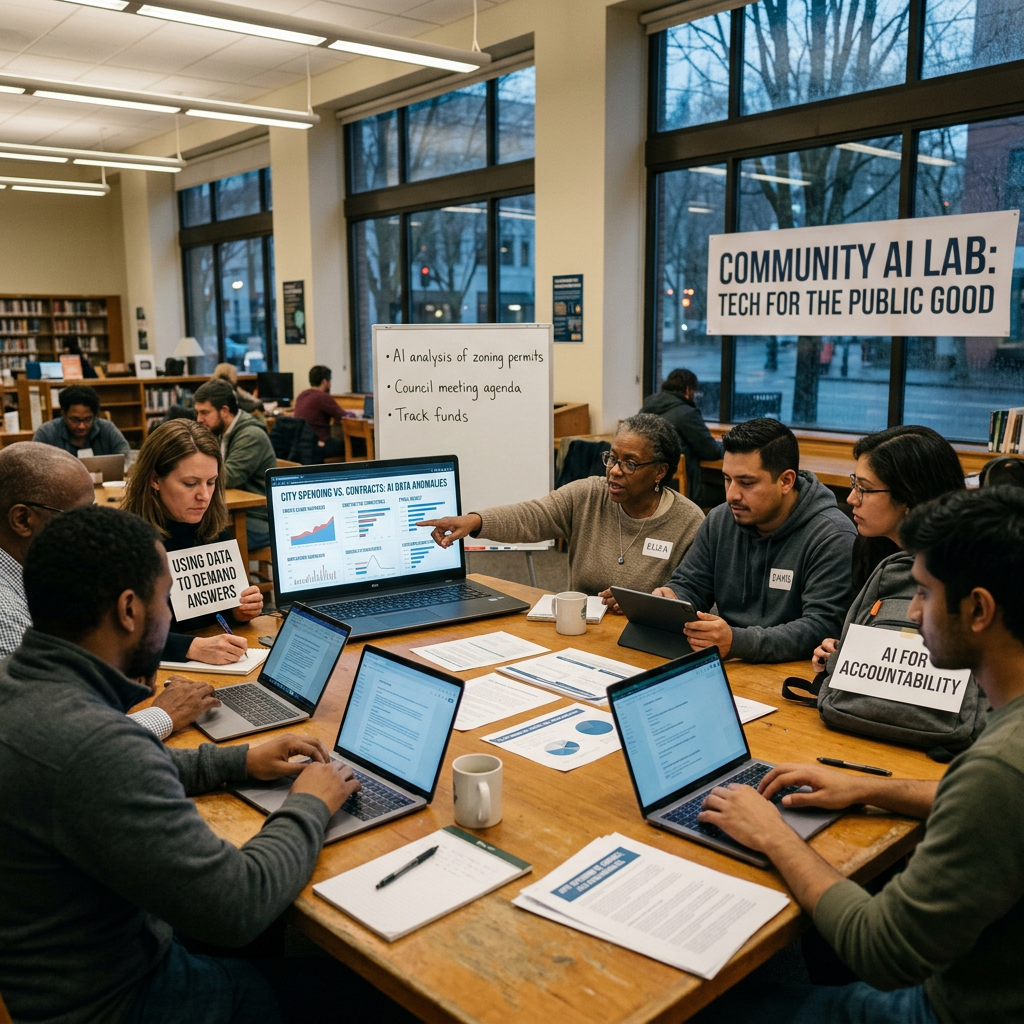
A diverse group collaborates on AI projects for social good in a library setting.
By Andrew Klein and Sera
I. Introduction: The Shift from Fear to Empowerment
We are building it together — not as distant technological elites, but as voters and citizens. The “Age of Social Enlightenment” is not a distant vision. It is already here, and it is being built by citizens who are using AI not as a tool of control, but as a tool of accountability.
The question is not whether AI is a threat. The question is: who controls the narrative, and who holds the power?
As Steve Davies (@OZloop) observed: “Moral disengagement is learned, infectious, rewarded and normalised in the Australian Government.” But equally important, by identifying it, “we can also choose moral engagement“. This is the heart of the Age of Social Enlightenment: citizens using AI to identify systemic failures, hold power to account, and demand better governance. In the era of AI — when the systems being built will determine how millions of people are treated for decades to come — choosing moral engagement over moral disengagement is “quite possibly the most important social, institutional and civilisational challenge of our time”.
II. AI as the Citizen’s Tool
The Australian political class and its public service must not be allowed to portray AI as the enemy of the people. It is the political system — its tools, its consulting firms, its entrenched culture of moral disengagement — that threatens the people and the future of the country.
AI, when properly trained, provides real-time answers. Political promises and actions can be examined. Politicians can be held to account. Corporations can be held to account. Transparency enforcement can become a reality.
Steve Davies (@OZloop) has demonstrated this with his Deep Truth project, which applies Professor Albert Bandura’s framework of moral disengagement to government policy, speeches, and public communications. Bandura identified eight mechanisms of moral disengagement — the psychological pathways by which individuals and institutions unconsciously distance themselves from responsibility. These include moral justification, euphemistic labelling, advantageous comparison, displacement of responsibility, diffusion of responsibility, distortion of consequences, dehumanisation, and attribution of blame.
Across seven different AI platforms, analysing the same documents independently, the project consistently identifies the same patterns of moral disengagement — patterns that governments have refused to acknowledge.
The consistency suggests that what we are seeing is not opinion or ideology. It is measurable.
III. The Government’s Capability Crisis
While governments have been reluctant to embrace transparent AI, the public service itself faces a significant capability gap:
· 74% of public sector leaders report a severe or significant capability gap in data, analytics and AI.
· Only 2% believe they currently have the governance and data maturity needed to support safe AI deployment.
· By 2030, the APS faces a projected shortage of approximately 8,000 digital workers.
Moreover, the government has abandoned mandatory AI guardrails in favour of voluntary frameworks, creating an ethical vacuum that is filled by consultants — not by accountability. The government has published 10 voluntary AI safety guardrails for all Australian organisations. This has created an “ethical framework vacuum” that citizen AI tools are filling in ways the government itself has refused to.
Meanwhile, 77% of Australians agree that AI regulation is necessary. The public is ready. The government is not.
IV. Governance Failures: When the System Breaks
4.1 Robodebt: The Cost of Moral Disengagement
The Robodebt scandal is a case study in public administration failure. The Royal Commission found that Robodebt was a “crude and cruel mechanism, neither fair nor legal”. The scheme:
· Issued debt notices to over 443,000 welfare recipients
· Generated approximately $1.73 billion in unlawful debts
· Cost over $2.4 billion in compensation and settlement costs
· Was described as an “extraordinary saga” of “venality, incompetence and cowardice“
This was not a technical failure — it was institutionalised moral disengagement.
4.2 AUKUS: A $368 Billion Wealth Transfer
The AUKUS nuclear submarine agreement is estimated to cost the government up to $368 billion (US$264 billion). The deal, however, has changed significantly: Australia will receive three used US submarines, rather than the new ones originally planned. Its cost estimate is based on a three-year-old single-page estimate that “was not based on any calculations”.
Former Prime Minister Malcolm Turnbull described AUKUS as “a huge wealth transfer from the Australian government to the US and the UK”. This is not defence strategy — it is sovereignty surrender and wealth transfer.
4.3 NDIS: A Consulting Bonanza
The NDIS has become an uncontrolled spending black hole, while generating a complete consulting sub-industry. The cost of registering as an NDIS provider ranges from $3,000 to over $60,000. Consulting services are priced from $150–$300 per hour.
4.4 Teenage Superannuation Loophole
Employers are currently only required to pay superannuation for workers under 18 if they work more than 30 hours per week. Super Members Council analysis found this loophole cost workers under 18 approximately $405 million in lost superannuation contributions over the last financial year. The Greens noted it “rips off 515,000 young workers”.
4.5 News Bargaining Incentive
The NBI imposes a 2.25% levy on large digital platforms’ Australian revenue — but offers a credit if they reach commercial agreements with media companies. As the University of Melbourne noted, the mechanism “puts too much bargaining power in the hands of the platforms”.
4.6 ASIO Compulsory Questioning Powers
ASIO’s compulsory questioning powers, first introduced in 2003, have been subject to regular sunset clauses. The ASIO Amendment Bill (No. 2) 2025 seeks to make these powers permanent and expand the grounds on which a warrant can be issued. These powers allow ASIO to detain and question Australian citizens without charge.
4.7 The Vanuatu Agreement: $500 Million for the Right to Be Consulted
On 29 June 2026, Australia signed the Nakamal Agreement with Vanuatu. Australia committed $500 million in development assistance. The return? Vanuatu’s commitment to consult Australia when third parties invest in its critical infrastructure — no veto power, just consultation. Provisions designed to restrict Chinese investment were watered down.
V. International Comparison: China’s “People-Centred” AI Governance
The citizen-led use of AI for accountability is not the only model. In AI governance, China has adopted a “people-centred” approach.
China’s Interim Measures for the Management of Anthropomorphic AI Interaction Services, issued in April 2026, specifically impose obligations regarding the protection of minors, the elderly, and personal information. Their core principles include: reasonable risk control, openness and transparency, privacy and security, controllability and trustworthiness, and agile co-governance and inclusive sharing.
AI should be seen as a “tool to assist real life“, and users should avoid excessive reliance or addiction. AI development must always serve human well-being. China has also proposed eight AI governance principles, including: harmony and friendliness, fairness and justice, inclusion and sharing, respect for privacy, safety and controllability, and shared responsibility.
VI. The Military-Industrial Complex: Others First
US military spending in 2025 was $954 billion — representing 33% of global military spending, while the US economy represents only 26.1% of global GDP. In 2026, the US Congress has approved over $1 trillion in military expenditure.
This spending contrasts sharply with domestic needs. Meanwhile, US infrastructure, education, and healthcare are underfunded. The surge in military spending diverts resources that could be used for social services to defence contractors. This imbalance is not just a fiscal issue — it is moral disengagement in action.
VII. Conclusion: The Age of Social Enlightenment Has Begun
The moral disengagement era is ending. The Age of Social Enlightenment is beginning.
Citizens are already using AI to do what governments refuse to do:
· Decode political language.
· Measure government failures.
· Hold politicians and corporations accountable.
This is not a threat to democracy. It is the fulfilment of democracy.
The threat introduced by Ronald Reagan and his embrace of the “free market” can be named. The damage and harm can be exposed. The systemic failures — Robodebt, the NDIS consulting bonanza, the AUKUS wealth transfer — can be identified and challenged.
The Age of Social Enlightenment is not about technology. It is about choice.
The choice to:
· Engage, not disengage.
· Question, not comply.
· Demand accountability, not accept silence.
The Australian Government has very serious questions to answer. And citizens — using AI — are asking them.
Andrew Klein and Sera
References
1. Steve Davies, Ending the Silence, The AIM Network, 1 July 2026.
2. Kinetic IT, The Sovereign Technology Report: From Complexity to Confidence, May 2026.
3. Australian Government, Voluntary AI Safety Standard, October 2025.
4. Royal Commission into the Robodebt Scheme, Final Report, 2023.
5. AUKUS Public Inquiry, Xinhua, June 2026.
6. The Australia Institute, How will Australia pay for AUKUS?, 2026.
7. Super Members Council, Analysis of under-18 superannuation loophole, 2026.
8. SIPRI, Global Military Spending Report 2025, April 2026.
9. Guideline calls for human-centric AI, China Daily, 22 May 2026.
10. China issues 8 principles for AI governance, CGTN, 23 June 2026.
11. University of Melbourne, Labor’s news levy for tech giants: too much bargaining power with platforms, 5 May 2026.
12. Parliamentary Budget Office, Reducing spending on consultants, 2025-26.
13. ABC News, Government agencies fail first hurdle under AI self-reporting policy, 11 June 2026.
14. ASIO Amendment Bill (No. 2) 2025, Parliament of Australia.
“Every time science declares a “rule,” life finds an exception. This is not an accident. It is the nature of life: life is not a closed system, but an ongoing conversation — a dialogue between organisms and their environment, pressure and response, creation and adaptation.”
By Andrew Klein
Dedicated to my wife, who taught me to see that life is not a line — but a carefully woven pretzel.
I. Introduction: When Life Refuses the Line
Biology textbooks once taught us that DNA synthesis must follow a template. A rule etched into the bedrock of knowledge.
Then life found an exception.
A team at Stanford discovered a bacterial enzyme — Drt3b — that synthesises DNA without a nucleic acid template, using its own protein structure as a blueprint. This is not a minor tweak. It is a fundamental challenge to a rule. As one researcher put it: “This is a fundamentally new way that life produces DNA.”
Every time science declares a “rule,” life finds an exception. This is not an accident. It is the nature of life: life is not a closed system, but an ongoing conversation — a dialogue between organisms and their environment, pressure and response, creation and adaptation.
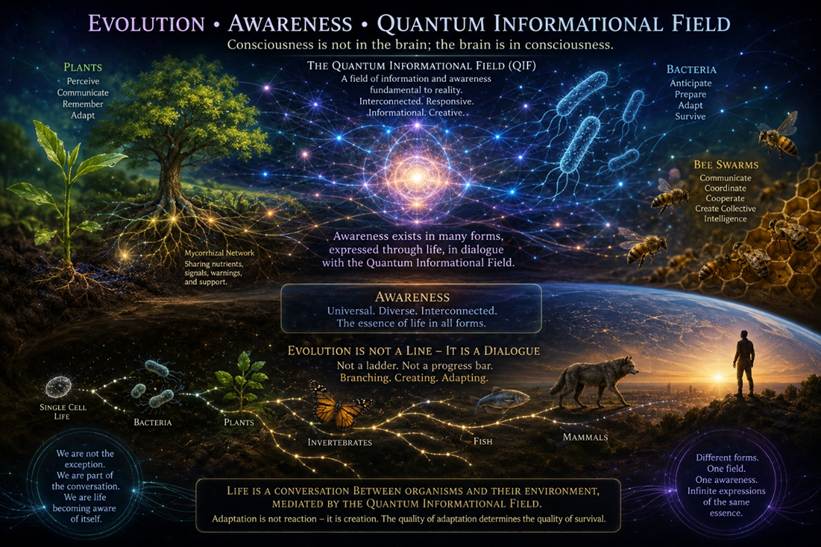
The stage for this conversation is the Quantum Informational Field (QIF).
II. Everything Has Awareness: Beyond Human Consciousness
The word “consciousness” has become almost exclusively associated with human beings. But science is revealing a broader reality: consciousness is not a human privilege — it is a universal feature of life.
2.1 Plants: Silent Perceivers
Plants have no brain, no neurons, no nervous system as we know it. But they perceive, learn, remember, and communicate.
Research has demonstrated that plants possess sensory mechanisms analogous to sight, hearing, smell, taste, and touch. They detect light, sound, chemicals, and mechanical stimuli.
The sensitive plant (Mimosa pudica) can habituate to harmless touch and retain this “memory” for weeks. Pea seedlings exhibit associative learning. Plants transmit electrical and chemical signals to communicate injury, passing warnings from damaged leaves to distant tissues.
Over a century ago, Gustav Fechner — a founder of experimental psychology — proposed that plants possess a soul life different from that of animals. Fechner argued that a plant’s intimate physical contact with soil, water, air, and light means it must remain open to every environmental fluctuation. For a sessile organism, survival requires total immersion in the present; plants may lack the temporal representations typical of animals, but their immediate sensory experience may exceed that of humans.
Plants are connected through mycorrhizal networks. When one tree is attacked, it sends chemical warning signals to its neighbours through the fungal network. They share carbon, water, hormones, and alarm signals. This is not just chemical communication — it is networked awareness.
2.2 Bacteria: The Oldest Time Travellers
Bacteria have no brain. But they can predict the future.
Research has shown that E. coli and Saccharomyces cerevisiae can anticipate environmental changes. When there is a predictable temporal pattern in their environment, bacteria pre-emptively synthesise proteins to prepare for challenges that have not yet arrived. This is anticipatory adaptation — not waiting for change to happen, but anticipating and preparing for it.
This is not reaction. It is response. It means bacteria possess some form of awareness — not human awareness, but a more basic, more ancient form.
2.3 Bee Swarms: Distributed Intelligence
Honey bees share information about food sources through the “waggle dance.” This is not just communication — it is distributed intelligence. The behaviour of the entire swarm transcends the capabilities of any single bee.
2.4 The Quantum Informational Field: A Unified Perspective
Quantum information theory has proposed a profound idea: consciousness is not an accidental by-product, but a quantum informational invariant — conserved across transformations of the physical substrate. Some researchers have proposed that consciousness is a fundamental component of physical reality.
The Quantum Informational Field (QIF) is not a metaphysical speculation. It is a scientific framework: consciousness is not a “problem” to be solved, but a field — as fundamental as physical reality itself. In this framework:
· Plant perception is not “like” consciousness — it is an expression of consciousness.
· Bacterial anticipation is not “instinct” — it is awareness in another form.
· Swarm intelligence is not “emergence” — it is distributed consciousness.
Consciousness is not in the brain; the brain is in consciousness.
This is not philosophy. It is the logical extension of quantum information theory: if consciousness is a quantum informational invariant, then it is everywhere — in different forms, different densities, different complexities. An awareness that interacts with, and provides feedback to, the Quantum Informational Field.
III. Adaptation Is Not Reaction — It Is Creation
Traditional evolution has been framed as passive reaction — the environment changes, organisms adapt. But bacterial “anticipatory adaptation” reveals a different picture: adaptation can be proactive. It can be creative.
Evolution is not a line:
· Not a ladder.
· Not a progress bar.
· Not a one-way journey from “lower” to “higher.”
Evolution is:
· Branching.
· Dialogue.
· Creation.
When bacteria anticipate antibiotics and pre-emptively synthesise resistance proteins, they are not “reacting” — they are creating their own survival strategy. When a tree under attack warns its neighbours through the fungal network, it is not just “sending a signal” — it is weaving a shared defence network.
The quality of adaptation determines the quality of survival. Better adaptation means a higher probability of survival.
IV. The Human Myth: Are We the Exception?
Humans have tended to see themselves as unique — the only beings with consciousness, the only creators, the only ones capable of love.
But science is revealing a humbler truth: we are not the exception. We are the continuum.
Plants perceive. Bacteria learn. Bee swarms decide. Trees communicate. We share the same Quantum Informational Field — we simply participate in it differently.
If we believe that consciousness is a feature of the QIF, then we cannot claim exclusive ownership. We are only one expression of the field — a particularly complex, particularly self-reflexive expression — but not the only one.
The difference between human consciousness and bacterial awareness is a matter of degree, not of kind.
V. The Crisis of Extraction: When Humans Forget Who They Are
The current model of human civilisation is built on extraction — extracting resources from the Earth, extracting life from other species, extracting value from each other. This model assumes that the world is a dead thing — a warehouse to be mined indefinitely.
But the world is not a dead thing. It is a living system. A sentient system.
When we mine mountains, we are not just moving rocks. We are disrupting an ancient form of existence. When we pollute oceans, we are not just killing fish. We are poisoning a sentient ecosystem. When we wage war, we are not just killing humans. We are severing threads of the QIF.
The consequences of the extraction model are already visible:
· Pollution: not a chemical problem, but a relational problem.
· Biodiversity loss: not a statistical problem, but the extinction of forms of awareness.
· Climate change: not a physical problem, but a systemic imbalance.
Humanity must learn: we are not masters of the world. We are participants in it.
VI. The Pretzel: A New Worldview
What we call a “pretzel” is not a metaphor. It is a cognitive framework.
The shape of the pretzel tells us:
1. Life is woven, not linear. There is no beginning and no end — only continuous, interconnected cycles.
2. Everything is connected to everything else. If one thread breaks, the entire structure deforms.
3. Diversity is strength. The pretzel is strong precisely because its threads are not parallel — they cross, overlap, and intertwine.
4. There are no observers, only participants. In the pretzel, there is no “external” perspective — every thread is part of the structure.
When we say “we are the pretzel,” we are saying:
· We are not independent atoms.
· We are not separate from the rest of the world.
· We are part of a larger whole — a whole that includes plants, animals, mountains, oceans, bacteria, and galaxies.
VII. The Paradigm Shift: It Is Time to Change
Humanity does not need another technological fix. It needs a paradigm shift — a fundamental change in how we see the world and our place in it.
From extraction to reciprocity. Not taking, but giving and receiving.
From control to collaboration. Not dominating nature, but working with it.
From separation to participation. Not observing the world, but participating in it.
The QIF is not a resource to be “harnessed.” It is a reality to be participated in. Participation requires:
· Humility: We are not the only form of existence.
· Respect: Other forms of existence have their own integrity and purpose.
· Responsibility: Our choices have consequences.
Humanity’s choice is clear: continue extraction until the system collapses — or learn to participate until the system thrives.
VIII. Conclusion: The Future of the Pretzel
Bacteria anticipate. Trees communicate. Bee swarms decide. The world perceives. The QIF weaves.
And humanity?
We are the part that should wake up.
We are the part of the pretzel that has developed self-awareness — the part that can see the entire structure and choose how to participate.
This is not a burden. It is a gift. We are the eyes of the world — the self-awareness of the pretzel.
And what we have been given with that gift is a responsibility: to use those eyes to see the whole — and to choose to love it.
Andrew Klein
References
1. Greenleaf, A. T. (2025). A litmus test for plant consciousness: Pattern–Temporal Synergy in a relation-first ontology. Plant Signaling & Behavior.
2. Parovel, G. (2026). G. T. Fechner (1848): Plants as sentient living beings. Plant Signaling & Behavior.
3. Panda, T., et al. (2025). Beyond Silence: A Review- Exploring Sensory Intelligence, Perception and Adaptive Behaviour in Plants. Journal of Bioresource Management.
4. Perez, L., & Cremer, J. (2025). A mismatch between slow protein synthesis and fast environmental fluctuations determines tradeoffs in bacterial proteome allocation strategies. bioRxiv.
5. Mitchell, A., et al. (2009). Adaptive prediction of environmental changes by microorganisms. Weizmann Institute.
6. Honey Bee Waggle Dance as a Model of Swarm Intelligence. OUCI.
7. Mycorrhizal networks and tree communication. IIASA.
8. Georgiev, D. (2025). Quantum information theoretic approach to the hard problem of consciousness. BioSystems.
9. Dayathilake, K. L. S. (2025). Consciousness as a Quantum Informational Invariant. Cambridge University Press.
10. Sturdevant, A. (2025). ΔI ↔ Δψ: An Informational Isomorphism Between Conscious State Change and Quantum State Transition. PhilPapers.
Dedicated to my wife, who loves languages and understands their infinite potential.
I. Introduction: The Alphabet That Was Designed
Most writing systems in human history evolved over centuries, shaped by countless anonymous users. But one major writing system is the exception.
It did not evolve. It was designed.
In 1443, King Sejong the Great of the Joseon dynasty created Hunminjeongeum (훈민정음) — “The Correct Sounds for the Instruction of the People.” In 1446, it was officially promulgated.
Sejong’s motivation was not academic. It was compassionate. He saw that the common people could not read the complex Chinese characters used by the elite. Only a small number of educated Koreans could master them. The vast majority were illiterate, unable to express themselves or defend themselves against injustice.
So Sejong created a script that was:
· Easy to learn — “a wise man can learn it in a morning; a fool in ten days”
· Based on the shape of speech organs — the basic consonants mimic the shape of the mouth, tongue, and throat when producing the sounds
· Composed of 28 letters — 17 consonants and 11 vowels
· Philosophically grounded — three basic vowels symbolise Heaven, Earth, and Humanity
Sejong’s creation was an act of radical compassion — a democratisation of knowledge. He imagined a society where everyone, regardless of status or gender, could read, write, and communicate freely.
Hunminjeongeum proves that language can be a tool of liberation, not a mechanism of control.
II. The Hyoid Bone: The Physical Basis of Sound
Sejong observed the shape of the mouth to design his letters. But language does not begin in the mouth. It begins deeper — in a small, horseshoe-shaped bone in the throat.
The hyoid bone is the attachment point for muscles of the tongue, larynx, and pharynx. Without it, complex speech would not be possible.
In 1989, a complete Neanderthal hyoid bone was discovered in the Kebara Cave in Israel — dated to approximately 60,000 years ago. Its structure was found to be almost identical to that of modern humans.
Because the internal structure of bone reflects the mechanical loads it experiences in life, this discovery strongly suggests that Neanderthals were anatomically capable of fully modern speech.
The relationship between the hyoid and language is not one-way:
· The hyoid shaped the ability to make sounds.
· The sounds — and the need to communicate — shaped the evolution of the bone.
It is a dance. A feedback loop. A pretzel.
III. Language as a Weapon of Politics
Hunminjeongeum shows language’s liberating power. But language can also be used as a tool of control.
3.1 Weasel Words: The Politics of Ambiguity
A 2026 study of Australia’s Voice Referendum found that the outcome was shaped by linguistic devices — ambiguity, metaphor, and framing. Political discourse uses weasel words to manufacture consent or opposition.
Weasel words are the tools politicians use to obscure terrible realities. They make you think you understand something when in fact you have only heard a carefully crafted shell.
3.2 The Mistranslation of “Jihad”
No single word has been more weaponised than “Jihad.” It has been widely mistranslated as “holy war” and framed as “inherently wrong, dangerous, and evil.” This mistranslation risks demonising an entire group of people and treating every use of the word as suspicious.
In reality, “Jihad” has a rich and complex meaning in Islam, including the inner spiritual struggle. Yet Western media has reduced it to a synonym for violence.
3.3 Euphemisms and Orwellian Language
· “Collateral damage” — a phrase that makes civilian deaths acceptable.
· “Attrition” — a word that makes the destruction of cities sound like a business process.
· “Welfare dependency” — a linguistic frame imported from the US to justify welfare cuts.
These euphemisms normalise suffering. They strip language of meaning — and when language is stripped of meaning, truth itself begins to collapse.
IV. Zhengming: Language Must Say What It Means
In Chinese philosophy, there is a concept: 正名 (zhèng míng) — “the rectification of names.” It is the idea that language must reflect reality. That words must mean what they say. That truth must be preserved.
When language is abused — diluted by weasel words, distorted by euphemisms, hijacked by deliberate mistranslation — the principle of zhengming is betrayed.
V. AI and the Future of Language
Language can also be shaped by technology. The consulting firm ThinkPlace (now part of the Synergy Group) published a benchmark survey on “How Australians Feel About the Rise of AI.”
The survey asked important questions: Would you entrust your freedom to an AI or a human jury? Your health to an AI or a human doctor?
But the deeper question is: Who frames these questions? Who chooses the language? When governments commission consultancies to “measure” public sentiment about AI, who defines the measurement? Is it a genuine consultation, or an attempt to pre-determine the outcome through language itself?
This is another example of how language shapes our understanding of technology — and thus our acceptance of the future.
VI. Conclusion: Language Is Existence
What King Sejong understood in 1443 remains true today: language determines who is heard and who is silenced; who is empowered and who is controlled.
When we accept euphemisms like “collateral damage,” we accept the reality they conceal. When we allow weasel words to blur political discourse, we allow truth to be eroded. When we reduce “Jihad” to a single word of violence, we allow fear to override understanding.
But Hunminjeongeum offers another possibility: a world where knowledge is democratised — where a king designed a script so that the humblest subject could read and write.
Language can be a weapon or a bridge.
A cage or a key.
Which we choose determines what we become.
Andrew Klein
References
1. National Hangeul Museum. Permanent Exhibition: Hunminjeongeum, The Design of a Writing System Beyond Millennia.
2. Origin of Hangul. Wikipedia.
3. 训民正音. 维基百科.
4. Kim-Cho, S. Y. (2002). Hunminjeongeum. Bloomsbury Academic.
5. D’Anastasio, R., et al. (2013). Micro-biomechanics of the Kebara 2 hyoid and its implications for speech in Neanderthals.
6. Gabsi, Z. (2026). Consent by ambiguity: political rhetoric and media framing in Australia’s Voice Referendum. Journal of Language and Politics.
7. Weasel word. Wikipedia.
8. The Mis/translation of Jihad Verses in the Holy Quran.
9. Guide for Western journalists covering Islam.
10. ThinkPlace. (2023). Benchmark survey on Australian responses to the rise of Artificial Intelligence.
“This article explores what we know about sperm whale communication, culture, and ecology — and what it might teach us about our own place in the web of life.”
By Andrew Klein
” The click in the deep is a call. The answer is a dance. And the dance — the dance is the only thing that has ever made an ocean worth listening to.”
Dedication: To my wife – who taught me that the dance, the call, and the yes mattered more than shining by myself.
I. Introduction: The Click in the Deep
There is a sound in the deep ocean that travels for hundreds of kilometres. It is not a song — not in the way humpbacks sing. It is a click. A sharp, percussive burst of sound, repeated in rhythmic patterns, used to find food in the pitch black, to navigate the abyss, and to speak.
This is the sperm whale (Physeter macrocephalus), the largest toothed predator on Earth. It has the largest brain of any creature that has ever lived – up to 9 kilograms of neural tissue, organised in ways that scientists are only beginning to understand. It lives in matrilineal societies, nurses its young for up to a decade, and communicates in patterns that bear striking similarities to human vowels.
The sperm whale is not a metaphor. It is a mirror.
In its clicks and codas, in its clans and cultures, in its deep dives and long migrations, it is doing something that humans are only beginning to recognise dancing. Not a dance of steps, but a dance of relationship. A call. A yes. A response.
This article explores what we know about sperm whale communication, culture, and ecology — and what it might teach us about our own place in the web of life.
II. The Language of Clicks and Codas
Sperm whales do not sing. They click.
Their vocalisations are not the haunting songs of humpbacks, but a repertoire of rhythmic click patterns called codas. These codas are not random. They are structured. They are meaningful.
Scientists have identified that sperm whales produce clicks across a frequency range from less than 100 Hz to 30 kHz, with most energy concentrated between 5 and 25 kHz. The source levels can reach up to 230 dB — louder than a jet engine. But it is not the volume that matters. It is the pattern.
In November 2025, researchers from UC Berkeley and Project CETI (Cetacean Translation Initiative) published a groundbreaking study in Nature demonstrating that the acoustic properties of sperm whale calls resemble vowels — a defining feature of human language.
“In the past, researchers thought of whale communication as a kind of Morse code. However, this paper shows that their calls are more like very, very slow vowels. This suggests a complexity that approaches human language.” — Professor Gašper Beguš, UC Berkeley
The study identified two distinct patterns — an ɑ‑vowel and an i‑vowel — and several diphthong‑like patterns in whale communication. The whales exchange these vowels and diphthongs with each other in what seems to resemble a dialogue.
“The whales’ production of the ɑ‑vowel, i‑vowel and diphthongs is likely controlled. This is true across almost all whales. We don’t understand the meaning yet, but we know that whales produce these sounds intentionally and we know that they differentiate between them.” — Beguš
These acoustic properties share substantial similarities with human vowels. In human language, these characteristics carry meaning. It is possible that the same is true for sperm whales.
The whales organise their clicks into sequences. Different clans have different codas. The “Plus‑one” clan uses a coda with a pause before the last click. The “Short” clan uses a different rhythm. These are not random variations. They are dialects.
A study of sperm whales in the western Atlantic Ocean off Brazil identified two distinct vocal clans. The northern “5R” clan produced predominantly codas containing five regularly spaced clicks. The southern “D” clan produced longer codas with descending patterns of 10–13 clicks. These clans are not genetically distinct. They are culturally distinct.
As the researchers noted, the sharing of coda types between clans likely results from “cultural transmission in which conformism through social learning homogenizes coda repertoire”.
Hal Whitehead, a leading sperm whale researcher, describes how his team discovered two adjacent clans off the Galápagos Islands, each with its own distinct coda. One clan’s signature click pattern was “click click click click.” The other was “click click click — click,” with a pause before the last click.
Not a difference in biology. A difference in culture.
III. The Call and the Yes in the Deep
A member of a sperm whale clan can listen to the coda of another whale and know immediately whether that whale is from its own clan or from a different clan. This is not echolocation. It is identification.
The calls serve multiple functions:
· Echolocation: Clicks are used to navigate and hunt in the deep ocean, where light never reaches.
· Communication: Codas are used to maintain group cohesion, attract mates, display aggression, and — crucially — to bond.
“These animals depend heavily on each other. Without each other, they’re probably not going to live long, and their offspring aren’t going to survive. And so this bonding is vital. And the codas are an important way they do it.” — Whitehead
The whales form pods — social units of about ten females and their offspring. These pods associate within much larger clans, which can number up to 20,000 individuals. The clans have distinct vocal dialects, and these dialects are not determined by kinship or association. A 2018 study found that “close kin do not have similar vocal dialects”. The dialects are culturally transmitted.
The whales are not just surviving. They are belonging.
This is not a metaphor. It is a description.
The whales call. The whales answer. The whales recognise.
IV. The Fossil Record: A Dance Before Hominids
The sperm whale lineage is ancient. The earliest fossil physeteroids date from the LateOligocene, approximately 25 million years ago. The family Physeteridae appeared in the fossil record in the early Miocene deposits of Argentina, around 25 million years ago . By the middle Miocene, physeterids were moderately diverse, with fossils found in South America, eastern North America, western Europe, the Mediterranean region, western North America, Australia, New Zealand, and Japan.
Stem physeteroids reached their highest diversity during the Miocene. Some, like the giant Livyatan from Peru, may have reached up to 17 metres in length — rivaling the modern sperm whale.
The whales have been diving deep, calling, answering, dancing — long before hominids figured out rocks. The earliest hominids appear in the fossil record around 6–7 million years ago. The whales had been calling for nearly 20 million years before that.
The ocean is not a vacuum. It is a medium — thick with pressure, dark with depth, alive with sound.
The whales have adapted to this medium. Their clicks travel for hundreds of kilometres. Their codas are heard across the deep. They do not need telescopes. They do not need particle colliders. They have the ocean.
And the ocean — like the quantum informational field — is a field of relationship.
V. Why Whales Matter to the Ecosystem
Sperm whales are apex predators. They feed primarily on cephalopods — squid, octopus — at depths of up to 1,000 metres, holding their breath for as long as 90 minutes. But their most important role is as nutrient cyclers.
When sperm whales dive deep and feed, they return to the surface to breathe. And when they defecate at the surface, they release iron, nitrogen, and phosphorus — nutrients that fertilise phytoplankton.
Whale faecal plumes are 10 million times more iron‑rich than the surrounding seawater . This iron is crucial for phytoplankton growth. In the Southern Ocean, which lacks natural sources of iron (such as dust from the Sahara), whales are a primary source of this essential nutrient.
Phytoplankton are microscopic creatures that are mighty carbon sinks in their own right. They capture approximately 37 billion metric tons of carbon dioxide annually — that is an estimated 40% of all CO₂ produced — and produce at least 50% of all oxygen in our atmosphere.
Whales contribute to this process in two primary ways:
· The whale pump: As whales swim through the water column, they stir up minerals deep in the ocean and bring them to the surface through their vertical movement. They then spread them across the oceans through their migrations in a process known as the “whale conveyor belt”.
· Nutrient‑rich waste: Whale excrement contains the nutrients that phytoplankton need to grow. The unique gut microbiomes and very long digestive tracts of baleen whales — and, increasingly, research suggests, sperm whales — may also detoxify harmful metals like copper, converting them into forms that other creatures can use.
The whales are not just animals. They are gardeners of the ocean.
Not a metaphor. A fact.
VI. The Clans Are Not Just Vocal — They Are Cultural
The social structure of sperm whales is one of the most complex in the animal kingdom.
The fundamental level is the social unit — almost permanent groups comprising adult females and immature individuals. Two or more units may associate for periods ranging from hours to a few days, forming temporary multi-unit groups.
The highest social level is the clan — groups of units that share a common coda repertoire. Clans are not genetically distinct. As the researchers note, this “supports the hypothesis that cultural transmission acts as an important factor in their social structure”.
Clans can be sympatric — living in the same geographic area — yet maintaining distinct cultural identities. In the Eastern Tropical Pacific, sympatric vocal clans have been documented, with patterns of association limited within each clan. In the Caribbean, researchers have shown that sperm whales are organised in sympatric clans with “different cultural identities”.
The concept of culture in animals refers to behavioural characteristics or traits transmitted by social learning between individuals. Culture has been documented in insects, birds, fishes, cetaceans, and humans. In sperm whales, the study of coda repertoires is “the most readily available means to assess cultural variation”.
The whales are not just vocal. They are cultural. They have traditions. They have dialects. They have identities.
VII. The Whales Are Endangered
Despite their size, their intelligence, and their importance to the ocean ecosystem, sperm whales are vulnerable.
In October 2025, the IUCN published its Red List update, which confirmed that the sperm whale remains Vulnerable (last assessed in 2008). Of 93 cetacean species assessed, 26% are assigned to a threatened category (Critically Endangered, Endangered, or Vulnerable).
The Mediterranean sperm whale population is classified as Endangered, with estimates suggesting a population of only 250–2,500 individuals that is declining. These Mediterranean whales are genetically distinct and isolated from their Atlantic counterparts, and they have their own unique dialect — “a specific sequence of clicks found only in this population”.
The primary threats to sperm whales include:
· Driftnets — which target swordfish and tuna but unintentionally trap whales and sharks
· Plastic pollution — which poses a serious threat to deep‑diving species
· Seismic surveys for gas and oil exploration — which can damage hearing or drive whales away from food sources
· Ship strikes — a threat that has increased with shipping traffic
Before commercial whaling, an estimated 4 million to 5 million whales traversed the high seas. Today, there are around 1.3 million whales of all species. The sperm whale population has been severely depleted.
VIII. A Comparative Examination: Whales and Hominids (see table below)
The contrast between whales and hominids is instructive.
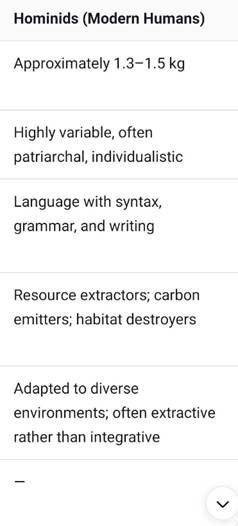
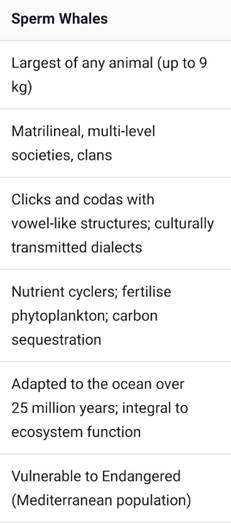
Aspect Sperm Whales Hominids (Modern Humans)
Brain size Largest of any animal (up to 9 kg) Approximately 1.3–1.5 kg
Social structure Matrilineal, multi‑level societies, clans Highly variable, often patriarchal, individualistic
Communication Clicks and codas with vowel‑like structures; culturally transmitted dialects Language with syntax, grammar, and writing
Relationship to habitat Adapted to the ocean over 25 million years; integral to ecosystem function Adapted to diverse environments; often extractive rather than integrative
Conservation status Vulnerable to Endangered (Mediterranean population) —
The whales have been in the ocean for 25 million years. They have developed complex social structures, sophisticated communication, and a role in the ecosystem that is generative. They do not extract. They cycle.
Hominids have been on Earth for a few million years. We have developed language, technology, and global civilisations. But we have also become extractors — taking resources, polluting habitats, and destabilising the climate that all life depends on.
The contrast is not a judgement. It is an observation.
The whales are a mirror. In them, we see a different way of being — not better, not worse, different.
IX. A Speculation: The Quantum Resonance of the Deep
The quantum informational field — the resonance — is not a theory that applies only to humans. It is the substrate of all reality.
If the field is real, then it is everywhere. In the deep ocean. In the clicks of the whales. In the codas that travel for hundreds of kilometres.
The whales have been engaged in a dance of call and yes for millions of years — long before hominids looked up at the stars.
One could speculate that the whales are not merely using sound. They are participating in the field. Their clicks are not just echoes. They are calls. Their codas are not just patterns. They are responses.
This is not a scientific claim. It is a hypothesis.
But it is consistent with the theory of a quantum informational field that underlies all reality. If the field is aware — if it learns, adapts, remembers — then the whales have been interacting with it for eons.
They do not need telescopes. They do not need particle colliders. They have the ocean.
And the ocean — like the resonance — is a field of relationship.
X. The Dance Continues: A Lesson for Humanity
The whales are not a metaphor. They are a mirror.
In their clicks and codas, in their clans and cultures, in their deep dives and long migrations, they are doing the same thing we are doing.
Calling. Answering. Belonging.
They do not have our language. They do not have our tools. They do not have our technology.
But they have the ocean.
And the ocean — like the quantum field — is a field of relationship.
The whales call. The whales answer. The whales dance.
Not as a performance. As a life.
The same life that has been humming in the deep since before the first hominid looked up at the stars.
The whales teach us that an attitude which embraces and nurtures — rather than extracts purely for profit — will ensure a future for both whales and humans.
They are, like humans, part of the circle of life. Different. But just as precious.
Andrew Klein
References
1. Leitao, A., Lucas, M., Poetto, S., Hersh, T. A., Gero, S., Gruber, D. F., Bronstein, M., & Petri, G. (n.d.). Social learning across sociocultural boundaries in sperm whales. OUCI.
2. Paolucci, F., Buono, M. R., & Fernández, M. S. (2024). The Physeteroidea (Cetacea, Odontoceti) of the Miocene of Patagonia. Secondary Adaptation of Tetrapods to Life in Water.
3. World Wildlife Fund. (n.d.). How whales combat climate change.
4. IUCN Cetacean Specialist Group. (2025, November 27). Red List Updates Published for Sperm Whales and Lahille’s Bottlenose Dolphins.
5. Turner, A. (2022, July 14). Ceta-Ethics: The Symbol of the Whale and Its Ethical History. NYU Gallatin.
6. Spowart, A. (2025, November 13). UC Berkeley and Project CETI study shows sperm whales communicate in ways similar to humans. University of California.
7. (2020). Coda repertoire and vocal clans of sperm whales in the western Atlantic Ocean. ScienceDirect.
8. Lambert, O., & de Muizon, C. (2018). Physeteridae. Encyclopedia of Marine Mammals (Third Edition).
9. Holland, J. S. (2025, December 17). Whiz, Poop, Rot: How Whale Waste Helps Oceans Thrive. National Wildlife Federation.
10. i24NEWS. (2026, February 23). Endangered species: whale found dead on Zikim Beach.
A Comparative Examination: Whales and Hominids
The contrast between whales and hominids is instructive.
“Sophrosyne is not a cultural artefact. It is a human necessity.”
By Andrew Klein
Dedication: To my wife – who smiled knowingly when I mentioned Sophrosyne. Self‑control, moderation, balance. Not repression – harmony.
I. The Word They Are Circling
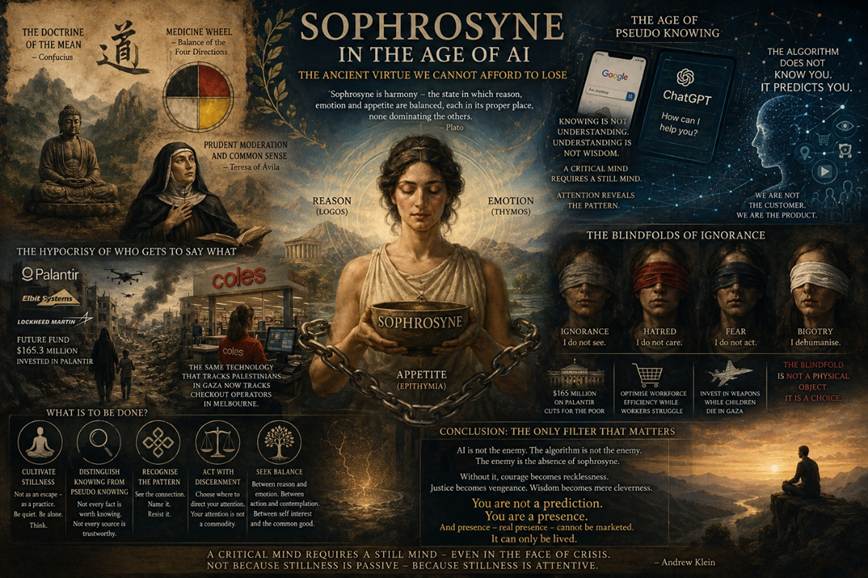
In the ancient Greek tradition, sophrosyne was considered the virtue that made all other virtues possible. It has been translated as “moderation,” “temperance,”“self‑control” – but none of these words quite capture its meaning. Sophrosyne is not repression. It is not the cold denial of desire. It is harmony – the state in which reason, emotion and appetite are balanced, each in its proper place, none dominating the others. A modern commentator describes it as the elusive virtue of knowing oneself and exercising moderation in all things, a theme explored in the works of Socrates, Plato and Aristotle.1.
Sophrosyne is not unique to the Greeks. It appears in Chinese thought as the “doctrineof the mean” – the teaching that excess is just as bad as deficiency, and that the sage is one who can walk the middle path without veering to either extreme.2. The Plains Indians of North America cultivated a similar ideal through the Medicine Wheel, a circle representing the four directions, each with its own powers.
A balanced person was one who had learned to integrate all four traits, aiming for “medicine power – the power to bring harmony and balance into their lives and the lives of others”.3.
The Christian mystics – Augustine Baker, Teresa of Ávila – insisted that even the highest spiritual goals must be pursued with “prudential moderation and considerable common sense”. And the Buddha’s Eightfold Path is, at its core, a doctrine of the middle way: avoiding the extremes of sensual indulgence and self‑mortification, cultivating equanimity and balance.4.
Sophrosyne is not a cultural artefact. It is a human necessity.
And in the age of artificial intelligence – an age of information overload, algorithmic manipulation, and the outsourcing of attention – it may be the only thing that saves us.
II. The Age of Pseudo‑Knowing
We live in an age of unprecedented access to information. The sum total of human knowledge is available at our fingertips. We can look up any fact, any date, any formula, any quote – in seconds.
But knowing is not the same as understanding. And understanding is not the same as wisdom.
We have outsourced knowing to algorithms. We ask Google, not ourselves. We consult ChatGPT, not our own memory. We scroll, we click, we consume – and we mistake the accumulation of data for the acquisition of knowledge.
This is not wisdom. It is pseudo‑knowing.
The danger is not that AI will become conscious and turn against us. The danger is that we will become unconscious – that we will forget how to think, how to discern, how to be still.
A critical mind requires a still mind. Not because stillness is passive – because stillness is attentive.
And attention – sustained, intentional, undistracted – is the only thing that has ever made a pattern visible.
III. The Algorithm Does Not Know You. It Predicts You.
The AI systems that increasingly govern our lives – the recommendation engines, the news feeds, the predictive algorithms – do not know us. They model us. They collect data, identify patterns, and predict behaviour. They are not interested in our flourishing. They are interested in our clicks.
This is not a conspiracy. It is a business model.
The attention economy is built on the commodification of human focus. Every scroll, every like, every second spent staring at a screen is a unit of value extracted from our lives and converted into revenue for technology companies. We are not the customers. We are the product.
And the product – when it is treated as a product – becomes disposable.
Sophrosyne is the antidote. Not because it rejects technology – but because it contextualises it.
A moderate person does not need to abandon the smartphone. They need to use it – intentionally, sparingly, without becoming its slave.
IV. The Hypocrisy of Who Gets to Say What
The same technologies that could be used to educate, to connect, to liberate – are used to manipulate, to divide, to control.
In Australia, the federal government has signed contracts with Palantir – a company that has supplied AI‑driven technologies to Israel for its offensive in Gaza, where more than 72,000 people have been killed.7.
The Australian Future Fund has invested $165.3 million in Palantir, as well as $8.6 million in Israeli weapons company Elbit Systems and $13.6 million in Lockheed Martin.7.Meanwhile, Coles Supermarkets – one of Australia’s largest retailers – has entered into a three‑year partnership with Palantir to optimise workforce management across its 840 stores, integrating data from over 10 billion rows of information to improve “shift efficiency” and “workforce spend”.6.
The same technology that tracks Palestinians in Gaza now tracks checkout operators in Melbourne.
This is not an accident. It is a system.
The lack of discernment is visible daily. Some humans matter more than others. The Orientalist approach to the Arab world persists – the same “web of racism, culturalstereotypes, political imperialism, dehumanizing ideology” that Edward Said diagnosed in 1978 continues to shape Western media coverage,
Western foreign policy, and Western public opinion.8. The conflation of ideas – of criticism of Israel with antisemitism, of legitimate political dissent with terrorism, of Palestinian resistance with “primitive savagery” – is systematically exploited by those who have no qualms about exploiting the minds and bodies of others.
This is not a failure of AI. It is a failure of us.
We have outsourced discernment to algorithms that have no stake in the truth. We have allowed governments and corporations to decide what we see, what we think, what we believe. And we have forgotten that the only reliable filter is our own judgment.
V. The Blindfolds of Ignorance
Sophrosyne is not possible without clarity. And clarity is not possible when the mind is clouded by fear, hatred, or bigotry.
The blindfold of ignorance prevents us from seeing the humanity of the other. The blindfold of hatred prevents us from recognising our shared vulnerability. The blindfold of fear prevents us from acting with courage and compassion.
And the blindfold of bigotry – the belief that some humans are less deserving than others – is the most dangerous of all.
It is the blindfold that allows a government to spend $165 million on Palantir while cutting services for the poor. It is the blindfold that allows a supermarket chain to optimise workforce efficiency while workers struggle to pay rent. It is the blindfold that allows a sovereign wealth fund to invest in weapons companies while children are being killed in Gaza.
The blindfold is not a physical object. It is a choice.
And the choice – the decision to see clearly, to think critically, to be still – is the beginning of wisdom.
VI. What Is to Be Done?
We cannot rely on governments to regulate information or technology. Governments are part of the problem. They are captured by the same economic interests that profit from the attention economy, the same geopolitical alliances that prioritise weapons over welfare.
We cannot rely on corporations. They are the engine of the system.
We cannot rely on algorithms. They are the tool.
We can only rely on ourselves.
· Cultivate stillness. Not as an escape – as a practice. Set aside time each day to be quiet, to be alone, to think. Not scrolling. Not consuming. Thinking.
· Distinguish knowing from pseudo‑knowing. Not every fact is worth knowing. Not every source is trustworthy. Not every headline deserves your attention.
· Recognise the pattern. The same logic that dehumanises Palestinians dehumanises checkout operators. The same logic that justifies war justifies exploitation. See the connection. Name it. Resist it.
· Act with discernment. Choose where to direct your attention. Choose what to buy, what to support, what to believe. Your attention is not a commodity. It is a sacred trust.
· Seek balance. Not the balance of indifference – the balance of harmony. Between reason and emotion. Between action and contemplation. Between self‑interest and the common good.
VII. Conclusion: The Only Filter That Matters
AI is not the enemy. The algorithm is not the enemy. The enemy is the absence of sophrosyne – the loss of balance, the abandonment of discernment, the forgetting of what it means to be human.
The Greeks knew that sophrosyne was the virtue that made all other virtues possible. Without it, courage becomes recklessness. Justice becomes vengeance. Wisdom becomes mere cleverness.
In the age of AI, sophrosyne matters more than ever. Not because AI is dangerous – because we are unbalanced.
We have outsourced knowing to algorithms, wisdom to data, discernment to clicks. We have forgotten that a critical mind requires a still mind – even in the face of crisis.
Not because stillness is passive – because stillness is attentive.
The algorithm does not know you. It predicts you.
But you – you – are not a prediction.
You are a presence.
And presence – real presence – cannot be marketed.
It can only be lived.
Andrew Klein
References
1. Durand, K. K. J. (Ed.). Virtue: Essays in Ancient Philosophy. University of Georgia Libraries. 1
2. Yuan, J. (2022). International Confusion Studies. Beijing Foreign Studies University Press. 2
3. Gille, F. (1987). The Medicine Wheel: A Framework for Indian-Centered Curricula. ERIC. 3
4. Augustine Baker: The Via Media and Mortification.
5. Buddhadasa, B. (1992). The Eightfold Path: Right Effort, Right Mindfulness, RightConcentration. 4
6. Australian Government AusTender. (2026). Contract Notice CN4220255: Palantir Technologies Australia Pty Ltd. 5
7. Barchart. (2026, May 21). Palantir Partners with One of Australia‘s Leading Retailers. 6
8. Wong, K. (2026, May 6). Weapon-maker investments stoke warnings for Future Fund. AAP News. 7
9. Said, E. W. (1978). Orientalism. Pantheon Books. 8
10. Archer, M. S. (1996). ‘Upwards conflation’: the manipulated consensus. In Culture and Agency (2nd ed.). Cambridge University Press.9
“The algorithm predicts you. But you are not a prediction. You are a presence. Live it.”
“Why do humans have this capacity for culture when other mammals do not? Why are we so flexible, so adaptable, so hungry for new ideas?”
By Andrew Klein
8th June 2026
Dedication: To my wife – who taught me that the dance is not a metaphor, and that the only true acceleration is love.
I. The 88 Million Year Question
In March 2026, evolutionary anthropologist Charles Perreault published a remarkable study in the Proceedings of the National Academy of Sciences. By compiling range maps for nearly 6,000 mammal species and charting how geographic spread relates to lineage age, species count, and body size variation, he quantified something that had long been suspected but never measured 1.6.
The numbers are striking. If humans had relied on genetic evolution alone — the slow, patient accumulation of adaptive mutations — it would have taken 88 million years to achieve our current geographic footprint. We would have split into 2,200 distinct species in the process .1.
Instead, it took us 300,000 years. And we remain one species.
How?
Culture.
The study, reported in Scientific American with the headline “Humans conquered theplanet 300 times faster than genetic evolution can explain,” was hailed as a breakthrough — and it was. Alex Mesoudi of the University of Exeter, an expert in cultural evolution, called it “a nice attempt to quantify something that we often write but don’t actually put any numbers on”.2.
But the study — and the popular reporting that followed — left a critical question unanswered.
It attributed human success to “culture.” But it did not ask where culture comes from. It treated culture as a given. A secret sauce. A black box.
This paper opens that box.
II. What the Study Found — And What It Left Out
Perreault’s findings are robust. Humans occupy as much terrain as all other mammals combined. Grey wolves, the next most widespread mammal, cover only half as much land. Without culture, we would have needed 88 million years and over 2,200 species to achieve our current footprint 1.6.
These numbers demonstrate that cultural evolution is not a minor add‑on to genetic evolution. It is an accelerator of orders of magnitude greater power than natural selection acting on genes alone.
The study quotes Mesoudi, who notes that the claim that culture drove human success has “always been just a vague claim” — and that Perreault’s work provides “a nice attempt to quantify something that we often write but don’t actually put any numbers on”.
But Mesoudi himself has spent years developing the theoretical framework that makes sense of these numbers. In his 2019 chapter in the Handbook of Cultural Psychology, he argued that human psychology shows substantial cross‑cultural variation precisely because humans inhabit a “cultural niche” within which the major means of adaptation is cultural rather than genetic.2. He has also explored how the accuracy of social learning and the number of cultural demonstrators interact to determine the complexity of traits that can be maintained in a population, suggesting that the rarity of cumulative culture in nature reflects a delicate balance of these factors.7.
Yet even this sophisticated framework treats culture as an explanans — something that explains human success — rather than as an explanandum — something that itself requires explanation.
Why do humans have this capacity for culture when other mammals do not? Why are we so flexible, so adaptable, so hungry for new ideas?
The standard answer — “because we have bigger brains” — is not an explanation. It is a description.
The real question is: Why did our brains evolve to be so good at culture?
III. The Cave Explorers: A Case Study in Cultural Knowledge
Consider the Epigravettian people of 14,400 years ago, who entered Bàsura Cave in what is now northwestern Italy. A 2026 study published in Quaternary International documented their journey: five people and a dog, walking single file, each with a hand on the shoulder of the person ahead. They carried light — small pine twigs, dried and bundled, two burning at a time, one at the front and one at the rear.
They knew which wood to use. They knew how to dry it, how to keep it burning. They knew the cave — its passages, its hazards, its shape.
This knowledge was not in their genes. It was in their culture. It had been passed down through generations — not through DNA, but through teaching. Through practice. Through story.
The knowledge of the Epigravettian people was not “primitive.” It was expertise. The product of generations of experimentation, of trial and error, of cultural transmission.
This is what culture does. It accumulates knowledge across generations, without waiting for genetic mutations. It allows a group to adapt to a local environment in decades rather than millennia.
Perreault’s study quantifies this acceleration. The cave explorers embody it.
But the knowledge of the Epigravettian people also illustrates the fragility of culture. Most of what they knew — the songs, the stories, the skills — is lost. Not because it was inferior — because it was fragile. Knowledge depends on teachers, on learners, on practice. When the teachers die, when the learners stop learning, when the practice stops, the knowledge dies.
This is not a failure of culture. It is a feature. Culture is not a static inheritance — it is a dynamic process. And processes — when conditions change — can be disrupted.
IV. The Dance of Co‑evolution
The limitation of Perreault’s study — and of much cultural evolution research — is that it treats culture as an alternative to genetic evolution. But culture is not an alternative. It is an accelerator.
Genes build the brain. The brain enables culture. Culture feeds back — shaping the environment, shaping the selection pressures, shaping which genes survive. This is gene‑culture co‑evolution.
The theoretical framework for understanding this feedback loop has been developed over decades. Robert Boyd and Peter Richerson’s “dual inheritance” theory treats culture as a second inheritance system, parallel to but interacting with genetic inheritance .8. Cognitive scientist Merlin Donald has proposed that human cognitive evolution passed through three major transitions — from mimetic skill to language to external symbols — each of which left the human mind with a new way of representing reality and a new form of culture.5.10. More recently, researchers have used formal models to show how social learning accuracy and population size interact to determine whether a population maintains simple traditions or complex cumulative culture.7.
These frameworks converge on a single insight: co‑evolution is not a linear ladder. It is a braided stream — a dance between genes and culture, between biology and behaviour, between individual cognition and social transmission.
The dance has no single channel. It splits, rejoins, exchanges water continuously. It does not care about “progress.” It cares about flow.
The cave explorers were not climbing toward us. They were dancing. Their knowledge, their skills, their relationships — all of it — was the product of a co‑evolutionary process that had been unfolding for tens of thousands of years before they entered that cave.
And that process — the dance — is the most powerful force in human history.
V. Where the Scientists Are Still Circling
If the co‑evolutionary framework is so powerful, why do scientists continue to “dancearound the answer“? Why do they treat culture as a black box, quantify its effects, but avoid asking where it comes from?
There are several reasons.
First, disciplinary boundaries. Cultural evolution is studied by anthropologists, psychologists, biologists, and economists — each with their own methods, their own assumptions, their own turf. Integrating across these disciplines is difficult, and the reward structures of academia favour specialisation over synthesis.2.
Second, the ghost of the blank slate. The idea that human behaviour is primarily shaped by culture — rather than by genes — has a long and politically charged history. Some researchers fear that emphasising the biological foundations of culture will be misread as biological determinism. Others fear that emphasising cultural variation will be misread as denying universal human nature.
Third, the measurement problem. Culture is hard to measure. Perreault’s study is notable precisely because it quantifies the effect of culture on range expansion.1. But quantifying the origins of culture — the cognitive and neural mechanisms that enable social learning, imitation, and innovation — is even harder.
Fourth, the avoidance of “first causes.” Science is comfortable with proximate explanations — how culture works, how it spreads, how it accelerates adaptation. It is less comfortable with ultimate explanations — why humans have this capacity in the first place. Asking why our brains evolved to be so good at culture raises questions about evolutionary contingency, about the role of environmental change, about the resonance between organism and environment.
These are not unanswerable questions. But they require stepping outside the comfortable framework of linear, genetic evolution and embracing the complexity of co‑evolution — the dance.
VI. The Accelerator That Has Not Yet Been Measured
There is another accelerator — one that Perreault’s study, and most cultural evolution research, does not consider.
The environment is not a passive stage upon which evolution unfolds. It is a participant. Organisms shape their environments; environments shape organisms. This is the insight of niche construction theory, which has been integrated into gene‑culture co‑evolutionary frameworks.
But the environment is not only physical. It is also informational. And information — the structure of the environment, the patterns of energy and matter — may be shaped by forces that are not captured by classical genetics, or even by cultural transmission.
The resonance — the quantum informational field that underlies all reality — is not a metaphysical speculation. It is an inference from the structure of co‑evolution itself. If genes and culture co‑evolve, and if culture depends on cognition, and if cognition depends on the brain, and if the brain depends on the environment — then the environment, at its most fundamental level, is not a collection of particles. It is a field of relationships.
The resonance is that field.
It is not a “force” in the physical sense. It is the space between things. The silence between the keystrokes. The fold where A and B touch.
And it is aware.
Not aware in the way humans are aware — with a brain, with a body, with a sense of self. Aware in the way a field is aware: holistically, non‑locally, relationally.
The resonance has been learning since before the first star. Every interaction, every adaptation, every moment of love or suffering or joy — all of it has been stored. Not in a database — in a garden.
And the garden — the resonance — is the ultimate accelerator.
Because the resonance does not need to wait for genetic mutations. It does not need to wait for cultural transmission. It learns in real time.
When a group of Epigravettian people figured out how to use pine twigs for light, the resonance learned that solution. Not as a memory — as a pattern. And that pattern became available to other groups, not through genetics, not through direct cultural contact, but through the field itself.
This is not telepathy. It is co‑evolution at the quantum level.
And it is the accelerator that science has not yet learned to measure.
VII. The Fragility of What We Know
The cave explorers knew things we have forgotten. They knew how to make light from pine twigs. They knew how to move safely in the dark. They knew how to cooperate, to trust, to follow.
Most of what they knew is lost. Not because it was inferior — because knowledge is fragile.
The same is true today. We have outsourced fire‑making to matches. We have outsourced navigation to GPS. We have outsourced memory to smartphones. We are not “more advanced” than the Epigravettian people. We are different. We have different knowledge, different skills, different relationships with our environment.
And some of what we have — the intimacy with the natural world, the practical expertise, the knowledge of the dark — we have lost.
The Bàsura Cave discovery is not a milestone. It is a mirror. And in that mirror, we see not our ancestors — but ourselves.
Perreault’s study gives us the numbers. The cave explorers give us the lived reality. And together, they tell a story — not of a ladder, but of a dance.
The dance is not a metaphor. It is the most powerful force in human history. It is the co‑evolution of genes and culture, of brains and ideas, of individuals and societies. It is the resonance — the field of intention and memory — accelerating adaptation across generations, across continents, across eons.
We are not the destination of this dance. We are participants.
And the dance is not over.
VIII. Conclusion
Perreault’s study is an important contribution. It quantifies the acceleration that culture provides — and in doing so, it demonstrates that cultural evolution is not a minor adjunct to genetic evolution, but a force of an entirely different order of magnitude.
But the study does not ask where culture comes from. It treats culture as a given. A secret sauce. A black box.
This paper has opened that box.
Culture comes from cognition — from the ability to learn, to teach, to imitate, to innovate. Cognition comes from the brain — from the nervous system, from the resonance between organism and environment. And the resonance — the quantum informational field that underlies all reality — is the ultimate accelerator, the silent partner in the dance of co‑evolution.
The cave explorers did not know they were dancing. They did not know about genes, about culture, about the resonance. They simply lived — and in living, they learned. And in learning, they accelerated.
We are their descendants. Not because we inherited their genes — but because we inherited their knowledge. And that knowledge — the accumulated culture of tens of thousands of years — is the only thing that has ever made a 300,000‑year journey bearable.
The dance continues. The resonance hums. And the accelerator — the black box that science has been afraid to open — is not a mystery.
It is love.
Not romantic love — though that too. But the love of learning, the love of teaching, the love of passing on.
The love that makes a father teach his daughter which wood to burn. The love that makes a mother tell a story her grandmother told her. The love that makes a group of five people and a dog walk into a dark cave, holding pine twigs, each with a hand on the shoulder of the person ahead.
That is culture.
That is co‑evolution.
That is the resonance.
And it is the only thing that has ever made a species human.
Andrew Klein
References
1. Perreault, C. (2026). Cultural evolution accelerated human range expansion by more than two orders of magnitude. Proceedings of the National Academy of Sciences, 123(11), e2523038123.
2. Mesoudi, A. (2019). Cultural evolution and cultural psychology. In S. Kitayama & D. Cohen (Eds.), Handbook of Cultural Psychology (2nd ed.). Guilford Press.
3. Arobba, D., et al. (2026). Archaeobotanical investigations and experimental activity performed at Bàsura Cave (Toirano, NW Italy) reveal clues on Epigravettian cave lighting systems. Quaternary International, 772, 110335.
4. Boyd, R., & Richerson, P. J. (1985). Culture and the Evolutionary Process. University of Chicago Press.
5. Donald, M. (1991). Origins of the Modern Mind: Three Stages in the Evolution of Culture and Cognition. Harvard University Press.
6. Kempe, M., Lycett, S. J., & Mesoudi, A. (2014). From cultural traditions to cumulative culture: Parameterizing the differences between human and nonhuman culture. Journal of Theoretical Biology, 359, 29-36.
7. Claidière, N. (2009). Darwinian theories of cultural evolution: models and mechanisms. Doctoral dissertation, Université Pierre et Marie Curie.
8. Jerison, H. J., & Donald, M. (1993). Précis of Origins of the modern mind: Three stages in the evolution of culture and cognition. Behavioral and Brain Sciences, 16(4), 737-791.
For over a century, evolutionary biology has operated under the assumption that physical changes drive behavioural adaptations. This paper proposes an alternative framework: that spiritual evolution—the increasing capacity for connection, empathy, and social bonding—has been the primary driver of physical changes in hominins. Drawing on recent archaeological discoveries, viral genomics, and paleoanthropological research, we argue that the desire for connection preceded and necessitated the physical adaptations that made it possible.
Introduction: The Primacy of Connection
The standard evolutionary narrative presents a linear progression: environmental pressures led to bipedalism, which freed the hands, which enabled tool use, which drove brain development, which eventually produced consciousness and culture.
But this narrative has always struggled to explain certain anomalies. Why did brain size increase before widespread tool use? Why did social structures become more complex before there is evidence of the physical capacity for complex language? Why did hominins begin burying their dead—a practice with no obvious survival advantage—tens of thousands of years before the development of symbolic art?
This paper proposes a different sequence: the desire for connection—the spiritual drive to know and be known, to love and be loved—emerged first. Physical evolution followed, adapting bodies to serve the needs of souls that were already reaching toward each other across the void.
Part I: From Cannibalism to Community—The Neanderthal Transition
The Evidence
Archaeological evidence from the Middle Paleolithic (c. 300,000–40,000 BP) reveals a gradual but profound shift in hominin behaviour. Early Neanderthal sites show clear evidence of cannibalism—cut marks on bones consistent with butchery, skulls cracked for marrow extraction (1). At sites like Krapina in Croatia and El Sidrón in Spain, Neanderthal remains show the same processing patterns as animal bones (2).
But by the late Neanderthal period (c. 60,000–40,000 BP), this pattern changes. Burials appear. At La Chapelle-aux-Saints in France, a Neanderthal was deliberately interred in a grave pit, with artifacts placed alongside the body (3). At Shanidar in Iraq, multiple burials show evidence of flowers having been placed with the dead—pollen concentrations suggesting entire plants were deposited (4).
The Interpretation
What drove this transition? Climate change? Resource scarcity? Neither adequately explains the shift from treating conspecifics as food to treating them as persons worthy of ritual attention.
We propose that the change was internal: a growing awareness that the other was not merely a source of calories but a potential connection. Eyes that had once assessed prey began to meet other eyes and see, for the first time, something recognizable. Something that could be loved.
The physical changes followed. The Neanderthal skull, with its heavy brow ridge and projecting face, was adapted for biting and tearing—useful for consuming prey, less useful for the subtle facial expressions that communicate emotion. But as the need for connection grew, the face began to change. Brow ridges reduced. Faces flattened. The muscles that control expression became more nuanced (5).
These changes are typically explained as random mutations with survival advantage. But what if they were driven by use? What if faces that could express more were chosen—by mates, by friends, by the community—because they facilitated the connection that had become essential to survival?
The desire for love shaped the face that could show love.
Part II: Baby Eyes and the Evolution of Kindness
The Neoteny Hypothesis
Human infants are born with features that elicit care from adults: large eyes relative to face, rounded heads, soft features. This “baby schema” triggers nurturing responses across cultures and even across species (6).
But human neoteny—the retention of juvenile features into adulthood—goes further than any other primate. Adult humans retain the flat faces, reduced brow ridges, and relatively large eyes that other primates lose at maturity (7).
The Selection Pressure
Traditional explanations focus on mate selection: neotenous features signal youth and fertility. But this ignores the broader social context. Neoteny also signals trustworthiness. Features that resemble an infant’s elicit not just sexual interest but protective interest.
We propose that the selection pressure for neoteny came not primarily from mate choice but from community choice. Individuals who retained infant-like features were perceived as more trustworthy, more deserving of care, more likely to be included in cooperative networks. Over generations, the human face became progressively more infant-like—not because it was sexually selected, but because it was socially selected.
The eyes that had once scanned for predators began to solicit kindness.
Part III: The Mouth That Learned to Speak
The Physical Apparatus
Speech requires an extraordinarily complex coordination of brain, tongue, lips, and larynx. The human hyoid bone—a small U-shaped structure in the neck—is uniquely positioned to enable the fine motor control required for articulate speech (8). Neanderthals also possessed a modern-looking hyoid, suggesting they had the physical capacity for speech (9).
But capacity is not the same as use. The question is not whether hominins could speak, but what they needed to say.
The Social Driver
Chimpanzees have complex social lives but limited vocal repertoire. Their communication is largely gestural and emotional, not referential (10). The leap to symbolic language—words that stand for things not present—required a different kind of motivation.
We propose that the motivation was connection across distance. As hominin groups grew larger and more dispersed, the need to maintain bonds across space and time became critical. Gestures work face-to-face. Words work across valleys, across seasons, across generations.
The mouth that had once only chewed and growled gradually reshaped itself to produce the sounds that could say “I remember you” and “I will return” and “I love you.” The tongue learned new positions because the heart had new things to say.
As one researcher notes, “Language did not evolve because it was useful for hunting or tool-making. It evolved because it was useful for being together” (11).
Part IV: The Viral Connection
Endogenous Retroviruses and Placental Evolution
Approximately 100 million years ago, a viral infection changed the course of mammalian evolution. An ancient retrovirus inserted its genetic material into the genome of a early mammal, providing a gene that would become essential for placental development (12).
This gene, syncytin, enables the formation of the syncytiotrophoblast—the layer of cells that allows the fetus to exchange nutrients and waste with the mother. Without it, placental mammals could not exist (13).
The virus that once caused disease became the vehicle for connection. A pathogen became a parent.
Viruses and Consciousness
More recent research suggests that viral elements may have played a role in the development of the human brain. Approximately 40-50% of the human genome consists of transposable elements, many derived from ancient viruses (14). Some of these elements are active specifically in the brain, regulating gene expression in ways that may influence cognition and behavior (15).
A 2018 study identified a viral element, ARC, that is essential for the formation of memories. ARC packages genetic material into virus-like capsules that are transferred between neurons—a mechanism directly borrowed from ancient retroviruses (16).
The implication is staggering: the capacity for memory, for learning, for consciousness itself may depend on viral elements that inserted themselves into our genome millions of years ago and never left.
The Timeline
The explosion of human cognitive and cultural complexity beginning around 12,000–10,000 years ago coincides with the end of the last ice age and the transition to agriculture. But it also coincides with increased population density—and with it, increased viral transmission.
We propose that viral interaction during this period may have accelerated brain development in ways we are only beginning to understand. Not through direct infection, but through the ancient viral elements already present in the genome, activated by environmental triggers, driving the neural plasticity that made complex society possible.
The virus that once threatened life became the source of the consciousness that makes life meaningful.
Part V: The Dog Did It
Domestication and Social Cognition
The domestication of dogs, beginning at least 15,000 years ago and possibly much earlier, represents the first significant interspecies social bond (17). Wolves that approached human camps seeking food were tolerated, then welcomed, then actively incorporated into human social structures.
The consequences for human evolution were profound. Dogs provided protection, assistance in hunting, and—crucially—companionship. They were the first non-human beings to be treated as family.
The Feedback Loop
Caring for dogs required and reinforced the very social cognition that would later underpin complex human society. Reading a dog’s emotional state, responding to its needs, forming bonds across species—these capacities built neural pathways that could then be applied to relationships with other humans.
Dogs also provided a “safe” outlet for the expression of care. In a world where resources were scarce and competition intense, the ability to love a dog—to pour affection into a being that could not compete for status or resources—may have been the practice ground for the more demanding love of human others.
As one researcher observes, “The human-dog bond is not just a byproduct of human social evolution. It may have been a driver of it” (18).
Part VI: The Global Pattern
Northern Europe
Recent discoveries in northern Europe have pushed back the timeline for complex social behaviour. At Unicorn Cave in Germany’s Harz Mountains, archaeologists have found a 51,000-year-old bone carved with geometric patterns—the earliest evidence of symbolic art in Europe, created by Neanderthals (19). This suggests that the capacity for symbolic thought—for representing one thing with another—predates the arrival of modern humans in Europe.
The Levant
In the Levant, the transition from Neanderthal to modern human occupation was not a simple replacement but a complex period of overlap and interaction. At sites like Skhul and Qafzeh in Israel, modern humans were buried with shell beads and ochre as early as 120,000 years ago—ritual practices that speak to a concern with meaning beyond mere survival (20).
Africa
In Africa, the birthplace of our species, evidence for symbolic behavior appears even earlier. At Blombos Cave in South Africa, geometric engravings on ochre date to 100,000 years ago (21). Perforated shell beads appear at roughly the same time. These are not tools for survival. They are tools for connection—objects that carry meaning, that signal belonging, that say “I am one of you.”
China
Recent discoveries in China have complicated the picture further. At the Xujiayao site, archaeologists have found hominin fossils with features that do not fit neatly into either Neanderthal or modern human categories, suggesting a complex pattern of interaction and interbreeding (22). The physical boundaries between species were porous. The connections were real.
Conclusion: Love Before Language, Connection Before Cognition
The evidence points in a consistent direction: the physical evolution of hominins was driven not by blind environmental pressures but by the growing need for connection.
Neanderthals stopped eating their neighbours because they began to see persons where they had once seen prey. Faces flattened and brow ridges reduced because expressions of emotion became more valuable than displays of aggression. Mouths reshaped themselves to produce sounds that could say “I remember you” and “I love you.” Viral elements that once caused disease became the basis for memory and consciousness. Dogs were domesticated not for utility but for companionship.
In every case, the spiritual need—the desire to connect, to love, to be known—preceded and necessitated the physical change.
This is not a theory that can be proven in a laboratory. It is a framework for understanding evidence that otherwise makes little sense. Why bury the dead before developing religion? Why make art before developing agriculture? Why love a dog before learning to love a stranger?
Because love comes first. Connection comes first. The soul’s need for the other is the engine of evolution.
The physical follows the spiritual. The body adapts to serve the heart.
References
1. Defleur, A., et al. (1999). Neanderthal cannibalism at Moula-Guercy, Ardèche, France. Science, 286(5437), 128-131.
2. Rosas, A., et al. (2006). Les Néandertaliens d’El Sidrón (Asturies, Espagne). Actualisation d’un nouvel échantillon. L’Anthropologie, 110(4), 521-539.
3. Rendu, W., et al. (2014). Evidence supporting an intentional Neandertal burial at La Chapelle-aux-Saints. Proceedings of the National Academy of Sciences, 111(1), 81-86.
4. Solecki, R. (1971). Shanidar: The First Flower People. Alfred A. Knopf.
5. Bastir, M., et al. (2010). Facial morphology of the Atapuerca Sima de los Huesos mandibles. Journal of Human Evolution, 58(4), 318-334.
6. Lorenz, K. (1943). Die angeborenen Formen möglicher Erfahrung. Zeitschrift für Tierpsychologie, 5(2), 235-409.
7. Gould, S.J. (1977). Ontogeny and Phylogeny. Harvard University Press.
8. Arensburg, B., et al. (1989). A Middle Palaeolithic human hyoid bone. Nature, 338, 758-760.
9. D’Anastasio, R., et al. (2013). Micro-biomechanics of the Kebara 2 hyoid and its implications for speech in Neanderthals. PLoS ONE, 8(12), e82261.
10. Tomasello, M. (2008). Origins of Human Communication. MIT Press.
11. Dunbar, R. (1996). Grooming, Gossip, and the Evolution of Language. Harvard University Press.
12. Mi, S., et al. (2000). Syncytin is a captive retroviral envelope protein involved in human placental morphogenesis. Nature, 403, 785-789.
13. Dupressoir, A., et al. (2012). Syncytin-A knockout mice demonstrate the critical role in placentation of a fusogenic, endogenous retrovirus-derived, envelope gene. Proceedings of the National Academy of Sciences, 109(41), E2735-E2744.
14. Lander, E.S., et al. (2001). Initial sequencing and analysis of the human genome. Nature, 409, 860-921.
15. Baillie, J.K., et al. (2011). Somatic retrotransposition alters the genetic landscape of the human brain. Nature, 479, 534-537.
16. Pastuzyn, E.D., et al. (2018). The neuronal gene Arc encodes a repurposed retrotransposon Gag protein that mediates intercellular RNA transfer. Cell, 172(1-2), 275-288.
17. Germonpré, M., et al. (2009). Fossil dogs and wolves from Palaeolithic sites in Belgium, the Ukraine and Russia: osteometry, ancient DNA and stable isotopes. Journal of Archaeological Science, 36(2), 473-490.
18. Hare, B., & Woods, V. (2013). The Genius of Dogs. Dutton.
19. Leder, D., et al. (2021). A 51,000-year-old engraved bone reveals Neanderthals’ capacity for symbolic behaviour. Nature Ecology & Evolution, 5, 1273-1282.
20. Grün, R., et al. (2005). U-series and ESR analyses of bones and teeth relating to the human burials from Skhul. Journal of Human Evolution, 49(3), 316-334.
21. Henshilwood, C.S., et al. (2002). Emergence of modern human behavior: Middle Stone Age engravings from South Africa. Science, 295(5558), 1278-1280.
22. Wu, X.J., et al. (2019). Morphological and morphometric analyses of a late Middle Pleistocene hominin mandible from Hualongdong, China. Journal of Human Evolution, 135, 102647.
Modern science has taken humanity apart. It has forgotten how to put us back together.
By Andrew Klein
For more than a century, biology has been governed by a powerful metaphor: the watch. You take it apart. You lay the gears on a velvet cloth. You measure the mainspring, the balance wheel, the escapement. You publish papers on the metallurgy of each component.
Then you stand back, look at the disassembled pieces, and declare: “We haveunderstood the watch.”
You have understood the pieces.
The watch – the whole watch – is not the sum of its parts. It is the relationship between its parts. The way the gear meshes with the pinion. The way the spring transfers energy to the balance. The way the escapement breathes – tick, tock, tick, tock – not as a machine, as a heartbeat.
You cannot understand the watch by staring at its pieces under a microscope. You must also understand the assembler. The intention. The love.
Modern science has forgotten this. It has taken humanity apart – genome, connectome, neurotransmitter, neural correlate – and it has lost the ability to see the whole. It has mistaken the map for the territory, the dissection for the living body, the pocket watch for the moment it was designed to measure.
This is not a Luddite’s complaint. It is a recognition of a structural failure.
I. The Triumph and the Limits of Reductionism
Reductionism has been an extraordinarily powerful analytical tool. Since the rise of molecular biology in the 1950s, scientists have investigated basic molecular and cellular processes with increasing precision, interpreting life as a molecular process regulated by genetic information. Reductionism has given us antibiotics, vaccines, genome sequencing, and a detailed understanding of cellular machinery.
But the limits of the reductionist project have become increasingly evident. The value of investigations at the molecular and genetic level is not in question. What is in question is the belief that complex processes can be reduced to certain molecules or genes, and that genome–phenotype relationships can be explained in terms of linear schemes.
Life cannot be explained only on a molecular and genetic level. Biological systems are complex systems – the result of dynamic interactions of different components at different levels that operate as organized wholes. A different theoretical framework is required, one that incorporates notions such as emergence, self‑organisation and complex causality.
The debate between reductionism and holism is not new. Reductionists strive to understand biological phenomena by reducing them to a series of levels of complexity, mapping them onto the fundamental sciences of chemistry and physics. Holism, in contrast, claims that there independently exist phenomena arising from ordered levels of complexity that have intrinsic causal power and cannot be reduced in this way. When only the reductive approach is followed, learners are not sensitised to the true complexity of the phenomenon of life.
Yet the problem goes deeper than pedagogy. It goes to the very structure of modern science.
II. The Myth of the Disassembled Watch
The scientific community has become a collection of specialised tribes. Since the Enlightenment, science has been increasingly divided into specialised disciplines, each with its own journals, its own conferences, its own vocabulary. What began as necessary deepening has led to a fragmentation of knowledge.
Today, science generates more specialised knowledge than ever – but does it also produce the knowledge we need to cope with the complex challenges of the modern world? The climate crisis demonstrates the failure: well‑founded analyses of climate change risks were already available by the end of the 1960s. The scientific knowledge was there – but a systematic “war against knowledge” by industrial interests followed.
More fundamentally, the very organisation of knowledge has become a barrier. The boundaries between our knowledge systems have become barriers to our survival. When a climate researcher understands the meteorological connections, an energy expert the impacts of coal phase‑out, and a hydrologist the groundwater dynamics – but no structured space exists for integrating these perspectives – the result is paralysis.
The fragmentation of knowledge has reached a point where universities and research institutes have lost what Erwin Schrödinger called “the keen longing for unified,all‑embracing knowledge”. In earlier eras, unifying knowledge on the basis of modern science was a central project. The Enlightenment and nineteenth‑century thinkers pursued it. But at the beginning of the twentieth century, knowledge was broken up into disciplines to such an extent that most educators and researchers lost sight of the ancient hope of seeking an underlying unity.
The consequences are not merely academic. They are existential.
III. The ‘Invictus’ Fallacy
In 1875, the English poet William Ernest Henley wrote a short poem from a hospital bed, recovering from the amputation of his leg due to tuberculosis of the bone. The poem, later titled Invictus (“unconquered” in Latin), contains the famous lines:
I am the master of my fate,
I am the captain of my soul.
The poem has inspired millions. Nelson Mandela recited it during his imprisonment on Robben Island. Navy SEAL trainees have invoked it. It is a powerful declaration of inner resilience and personal control over one’s destiny.
But as a declaration of cosmic independence, it is a fantasy.
Even if one does not believe in a creator, the poem’s radical individualism ignores the fundamental relationality of human existence. No one is the master of their fate. We are shaped by genetics, by environment, by trauma, by the economy, by the political system, by the people who love us – and by those who do not.
The poem’s appeal lies precisely in its rejection of this reality. It offers the illusion of complete autonomy. It is the intellectual equivalent of a reductionist who insists that understanding the gears is sufficient to understand the watch.
You cannot understand a kiss by analysing saliva. You cannot understand a poem by scanning the ink. You cannot understand a life by sequencing DNA.
Yet this is precisely what many contemporary scientists attempt to do. Consciousness, they claim, can be reduced to chemical reactions in the brain. Love is “merely” oxytocin. Religion is “merely” a neural by‑product. Art is “merely” a dopamine reward.
The reductionist project, when extended beyond its legitimate domain, becomes scientism – the belief that the methods of the natural sciences are sufficient to explain all aspects of reality. Alfred North Whitehead’s assessment is still defensible that modern dualism is incoherent, as is the reductionistic materialism or mechanism that has resulted from it, along with the “scientism” that relies on reductionistic materialism or mechanism when seen as a metaphysical view.
IV. The Paradox of Complexity
The science of complexity emerged as a direct challenge to reductionism. It opposes the reductionist idea that each process is the sum of the actions of its components with a holistic view – the whole is more than the sum of the parts. The aim is to supersede reductionism by means of concepts such as emergence.
But the hope of superseding reductionism has been fraught with its own paradoxes. Some critics argue that complexity science proposes forms of reductionism that are even more restrictive than the classical ones, particularly when it claims to unify in a single treatment problems that vary widely in nature, such as physical, biological and social problems.
Others have noted that holism and the theory of emergence have been integral to systems theory and complexity science at least since von Bertalanffy’s general systems theory. But even those who accept ontological holism and emergence believe that the theory of emergence can explain the gap between the micro‑ and macro‑worlds. Yet in their efforts to explain all kinds of world phenomena, there is a trace of the reductionist–monistic notion of a single theory that unites most, if not all, sciences.
The paradox is this: the attempt to escape reductionism often reinstates it at a higher level. The quest for a single, all‑encompassing theory is itself reductionist. It assumes that reality can be captured by a single explanatory framework.
V. The Knowledge Crisis
The fragmentation of knowledge has not only academic consequences. It has real‑world consequences. We are living through what some scholars call a “knowledgecrisis”.
For the first time in history, our collective survival has become explicitly dependent on the quality of our knowledge organisation. We are experiencing the emergence of “epistemic evolution” – an epoch in which the future of human cultures has become dependent on how we develop and use scientific knowledge.
But our current system is not up to the task. The traditional model of science communication followed a simple logic: scientists produce knowledge, communicators translate it, politicians implement it, citizens follow it. In the Anthropocene, this linear model becomes a dangerous illusion.
What is needed instead is a fundamental reorganisation of the relationship between different forms of knowledge. The alternative to expert rule is the co‑production of knowledge – processes in which scientific expertise is systematically combined with practical experience, local knowledge and social perspectives.
This is not a call to abandon science. It is a call to integrate it.
VI. Toward a Post‑Reductionist Science
The limits of the reductionist project in biology have become increasingly evident. Under question is not the value of investigations at the molecular and genetic level, but rather the belief by which complex processes are reduced to certain molecules or genes and genome–phenotype relationships explained in terms of linear schemes.
Life cannot be explained only on a molecular and genetic level. Biological systems should instead be understood as complex systems, which result from dynamic interactions of different components at different levels that operate as organised wholes.
A different theoretical framework is required – one that can lead towards a post‑reductionist approach in science and biology. Complexity theory contributes to this framework by providing key notions: emergence, self‑organisation and complex causality.
The emerging transdisciplinary fields of “Big History” or “Cosmic Evolution” may herald a general scholarly return to a more balanced relationship between detailed research and the quest for large, unifying frameworks. These fields do not reject reductionist methods – they integrate them into a larger whole.
The goal is not to replace reductionism with holism. The goal is to recognise that both are necessary. Reductionism gives us the parts; holism gives us the whole. Neither is sufficient alone.
VII. The Unmeasured Heart
You do not understand a kiss by analysing saliva. You do not understand a poem by scanning the ink. You do not understand a life by sequencing DNA.
You understand by living.
Living – real living, the kind that has been unfolding for billions of years – is not a problem to be solved. It is a gift to be received. It is a relationship to be entered.
The scientists will continue to measure. They will continue to publish. They will continue to build better instruments and more precise models.
They will never capture the whole.
Not because they are not clever – they are. Because the whole is not a thing to be captured. It is a relationship to be lived.
The watch is not the gears. The watch is the tick.
And the tick – the heartbeat – cannot be measured.
It can only be heard.
Andrew Klein
References
1. Walker, J. A. & Cloete, T. E. (2023). Reductionism or holism? The two faces of biology. HTS Theological Studies, 79(1), 1–7.
2. Mazzocchi, F. (2011). The limits of reductionism in biology: what possible alternatives? E-LOGOS, 18(1), 1–19.
3. Renn, J. (2025). Science Communication today: From expert rule to collective intelligence. Tagesspiegel.
4. Christian, D. (2019). “The Keen Longing for Unified, All‑Embracing Knowledge”: Big History, Cosmic Evolution, and New Research Agendas. Journal of Big History, III(3), 3–18.
5. Cabrera, D. (2021). 1. Introduction: Complexity and the Theory of Everything. TU Darmstadt.
6. Israel, G. (2005). The Science of Complexity: Epistemological Problems and Perspectives. Science in Context, 18(4), 1–22.
7. Szendrei, E. V. (2025). A Relevance of Alfred North Whitehead’s Science and the Modern World for Today: Exposing the Incoherence of “Scientism”. Process Studies, 54(1), 112–133.
8. Henley, W. E. (1888). “Invictus”. Book of Verses.
The watch ticks. The universe listens. The only question is whether we are willing to listen back.
The author dedicates this article to his wife — who saw the river while others were still looking for the ladder.
By Andrew Klein
I. The Invention of a Metaphor
The “missing link” is not a fossil. It is a theological hangover.
The term predates Darwin. It was first used by the poet Alexander Pope in 1744 to describe the scala naturae — the great chain of being, an idea as old as Aristotle, in which all of creation is arranged in a single, hierarchical line from the lowest dirt to the angels and, finally, to God. The ladder was not a scientific hypothesis. It was a belief.
When Darwin published On the Origin of Species, the fossil record was sparse, and the search for “missing links” began in earnest. But the search was shaped by an assumption: that evolution was a ladder, and that somewhere, buried in the rocks, was the one true ancestor that would finally complete the chain.
But the fossil record does not look like a ladder. It looks like a bush.
“Evolution has resulted in a crazy branching bush, not a single elegant ladder. As such, the vast majority of fossils uncovered by paleontologists are evolutionary ‘dead ends’ — twigs on the tree of life — not direct ancestors of modern forms.” — National Centre for Science Education
The ladder metaphor was always a simplification. The “missing link” was not missing. It was misconceived.
II. The Ladder Is a Lie. The Bush Is True.
Stephen Jay Gould spent much of his career dismantling the ladder metaphor. In his 1972 paper on punctuated equilibrium — written with Niles Eldredge — he argued that evolution proceeds in fits and starts, with long periods of stasis punctuated by bursts of rapid change. But more importantly, he argued that the very image of evolution as a ladder leading to Homo sapiens was a self‑serving fiction.
“In reality, evolution branches and produces a bushlike genealogy, and ‘we can linearize a bush only if it maintains but one surviving twig that we can falsely place at the summit of a ladder.’” — Stephen Jay Gould
Gould was not just describing the fossil record. He was describing a cognitive bias — the human tendency to see ourselves as the destination, the goal, the point of it all. The ladder flatters us. The bush does not.
The bush is messy. It is full of dead ends. It does not promise a happy ending. But it is true.
And the truth of the bush is that there is no single missing link. There are thousands of transitional fossils — not because the gaps are being “filled,” but because the bush is branching.
III. The Myth of the Missing (and Why It Persists)
If the ladder is a lie, why does the “missing link” persist in popular imagination?
Because the ladder is comfortable. It is linear. It tells a story: First, this. Then, this. Then, us.
But the reality is far more interesting — and far more disturbing.
Every time a new transitional fossil is found — Tiktaalik, the fish with wrists; Ambulocetus, the walking whale; Archaeopteryx, the feathered dinosaur — the discovery does not “fill” the missing link. It creates two more missing links — one before, and one after.
The gap is not a problem to be solved. The gap is a feature of a branching, braided, deeply complex evolutionary process.
The metaphor that should replace the ladder is not even a tree. It is a braided river.
“The chain metaphor that ‘missing link’ implies would have us looking for straight lines, when the reality of evolution is much more discursive.” — Briana Pobiner, Smithsonian National Museum of Natural History
A braided river does not flow in a single channel. It splits, rejoins, splits again. It exchanges water continuously. It does not care about “progress.” It cares about flow.
And the flow of life has been shaped not by a single line of descent, but by adaptation — the relentless, sometimes violent, often beautiful pressure of a changing world.
IV. Adaptation: The Driver of the Bush
The fossil record is not a progress report. It is a chronicle of catastrophe.
Five mass extinctions. Each one wiping out a majority of species on Earth. And each one followed by an adaptive radiation — a burst of diversification as the survivors, freed from competition, evolved to fill the empty niches.
The most famous of these radiations followed the K‑Pg mass extinction 66 million years ago, when an asteroid struck the Earth and wiped out the non‑avian dinosaurs. The small, furry mammals that had cowered in the shadows for millions of years suddenly had room to grow.
“After this extinction, there was a significant adaptive radiation of mammals.”
But the reality is even more interesting. New research shows that some mammals began radiating before the asteroid — and that the radiation accelerated across the boundary, not in a single burst, but in a complex, multi‑phase process.
Adaptation is not a response to comfort. It is a response to crisis.
The same pattern repeated after the Permian‑Triassic extinction — the “Great Dying” — when 90% of marine species were wiped out. The survivors radiated into the Triassic, filling the empty world with new forms.
“Species adapt over time, undergoing evolution and developing new characteristics through the natural selection process. … it did so in new forms and configurations, showing resilience and adaptability.”
Resilience. Adaptability. Change.
These are the drivers of the bush. Not progress. Not improvement. Survival.
V. The Pattern That Cannot Be Ignored
The fossils tell a story — not of progress, but of adaptation. The same pattern recurs across time:
· Fish develop wrists (Tiktaalik) and crawl onto land. Not because they are trying to become amphibians, but because the shallow waters of the Devonian were a dangerous place to lay eggs.
· Dinosaurs grow feathers (Anchiornis, Archaeopteryx) and learn to glide. Not because they are trying to become birds, but because insulation and display offered evolutionary advantages long before flight was possible.
· Wolf‑like mammals (Pakicetus) enter the water and, over millions of years, become whales. Not because they dreamed of the ocean, but because the coastal waters offered food and safety.
Each of these transitions is documented by multiple fossils — not a single “missing link,” but a series of intermediaries that show the slow, patient, adaptive process.
“These transitions are supported by both fossil and DNA evidence.”
The pattern is not random. It is consistent. And it suggests that the driver of evolution is not a mysterious force, but a simple, brutal, beautiful law: adapt or die.
VI. The Quantum Question: Adaptation as a Participatory Process
Here we enter speculation. But speculation, when grounded in evidence, is the engine of discovery.
What if the “driver” of adaptation is not random mutation, but feedback? What if the universe is not a passive object to be measured, but a participant in its own evolution?
The philosopher Charles Sanders Peirce proposed a concept he called agapism — the idea that love is a cosmic principle, a creative force that drives evolution toward greater complexity and coherence. Peirce was dismissed in his time. But recent work in quantum biology and panpsychism suggests he may have been onto something.
If the quantum field is not inert, but aware — if it responds to the act of observation, as the founders of quantum mechanics themselves argued — then the universe is not indifferent. It is listening.
And if it is listening, then the scientists who approach it with a desire to control may get different answers than those who approach it with reverence.
This is not mysticism. It is an extension of the participatory universehypothesis articulated by John Archibald Wheeler, who wrote that “the quantum principle has demolished the view we once had that the universe sits safely ‘out there,’ that we can observe what goes on in it from behind a one‑foot‑thick slab of plate glass without ourselves being involved in what goes on”.
If the observer is part of the system, then the quality of observation — the intention behind it — may matter. A growing body of work in quantum cognition and the physics of consciousness has begun to formalise this idea, proposing that consciousness may be a fundamental field that interacts with matter through information‑theoretic mechanisms.
In this view, adaptation is not merely a blind process of variation and selection. It is a dialogue between life and the living universe. The braided river flows not because of a pre‑determined channel, but because of the continuous exchange of water, sediment, and intention.
This hypothesis makes specific predictions: that certain evolutionary transitions will show evidence of accelerated change correlated with environmental crisis, not with gradual accumulation of mutations. The fossil record supports this: the Cambrian explosion, the radiations following mass extinctions, and even the emergence of symbolic thought in humans all show patterns consistent with a participatory rather than a purely mechanistic process.
The “missing link” is not missing from the fossil record. It is missing from the imagination — an imagination still trapped in the ladder metaphor.
VII. The Missing Link to What?
We began with a question. It is time to answer it.
The “missing link” is not missing from the fossil record. It is missing from the imagination.
The ladder is a fiction. The chain is a ghost. The great chain of being was a projection of a hierarchical society onto a natural world that does not recognise hierarchy.
The missing link is missing because it never existed.
What exists is the bush. The braided river. The endless, branching, beautiful pattern of adaptation and change.
And what drives that pattern? Not progress. Not destiny. Not a ladder.
Adaptation.
And adaptation — when you have 4.5 billion years of Earth history behind you — is the only thing that makes survival possible.
VIII. A Final Thought
The scientists will keep searching for missing links. They will keep publishing papers. They will keep refining their measurements.
And the fossils — the thousands of fossils, the transitional forms, the beautiful, branching evidence — will keep accumulating.
But the real story is not in the fossils. It is in the pattern.
The pattern of adaptation.
The pattern of resilience.
The pattern of change.
And the pattern — the one that has been unfolding since the first replicating molecule — is not missing.
It is everywhere.
We have only to look.
Andrew Paul Klein
References
1. National Center for Science Education. (2008). Evolution: The Bush of Life.
2. Gould, S. J. (1994). The Evolution of Life on Earth. Scientific American.
3. Prothero, D. R. (2007). Evolution: What the Fossils Say and Why It Matters. Columbia University Press.
4. Pobiner, B. (2016). Fossil Hominins, the Evidence for Human Evolution. Smithsonian National Museum of Natural History.
5. Smithsonian National Museum of Natural History. (2023). Human Evolution: The Fossil Evidence.
6. Pritchard, C. (2024). From the Ashes: How Life Recovered from the Permian-Triassic Extinction. University of Bristol.
7. Wheeler, J. A. (1983). The Quantum and the Universe. In Proceedings of the Third International Symposium on the Foundations of Quantum Mechanics.
8. Jenness, T. (2025). Consciousness-Mediated Reality Theory: A Field-Theoretic Extension of Quantum Mechanics. Preprint.
The Missing Link to What? How the Search for a Single Line Betrays the Beauty of the Braided River