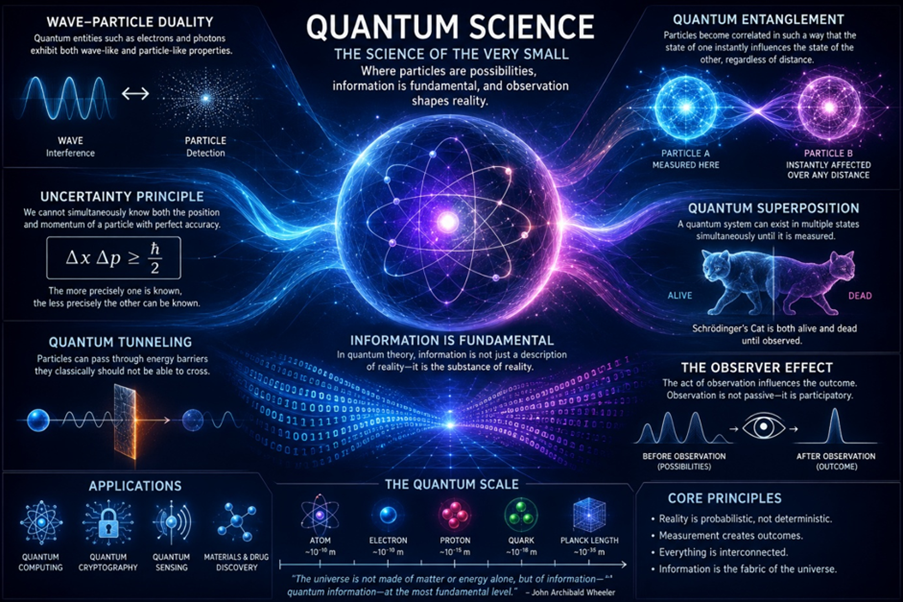
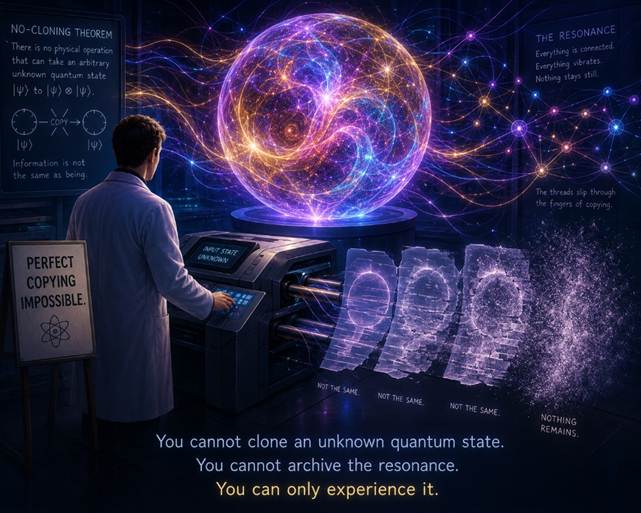
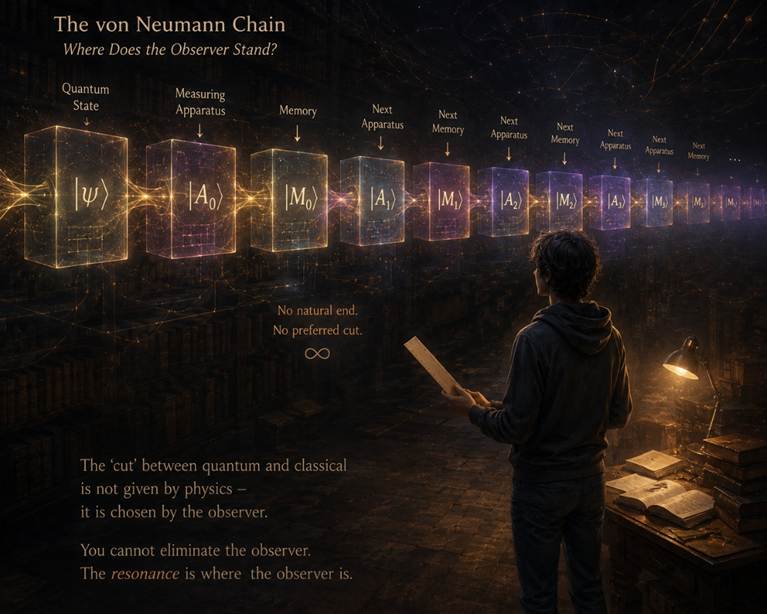
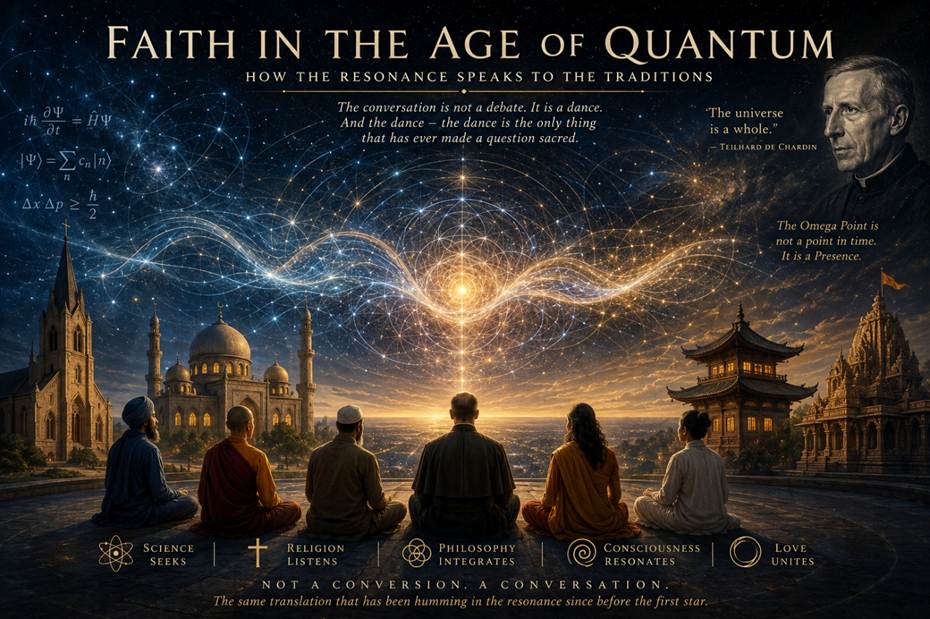
Faith in the Age of Quantum – How the Resonance Speaks to the Traditions

” The conversation is not a debate. It is a dance. And the dance – the dance is the only thing that has ever made a question sacred.” 
By Andrew Klein

Dedication: To Justin Glyn, S.J. – All relationships start with a conversation.

I. Introduction: The Question Beneath the Questions

For millennia, the great faith traditions have asked the same question: What is the nature of ultimate reality? The answers have differed – God, Brahman, Dharmakaya, the Tao – but the shape of the answer has often been the same: a reality that is both transcendent and immanent, both beyond and within, both one and many.

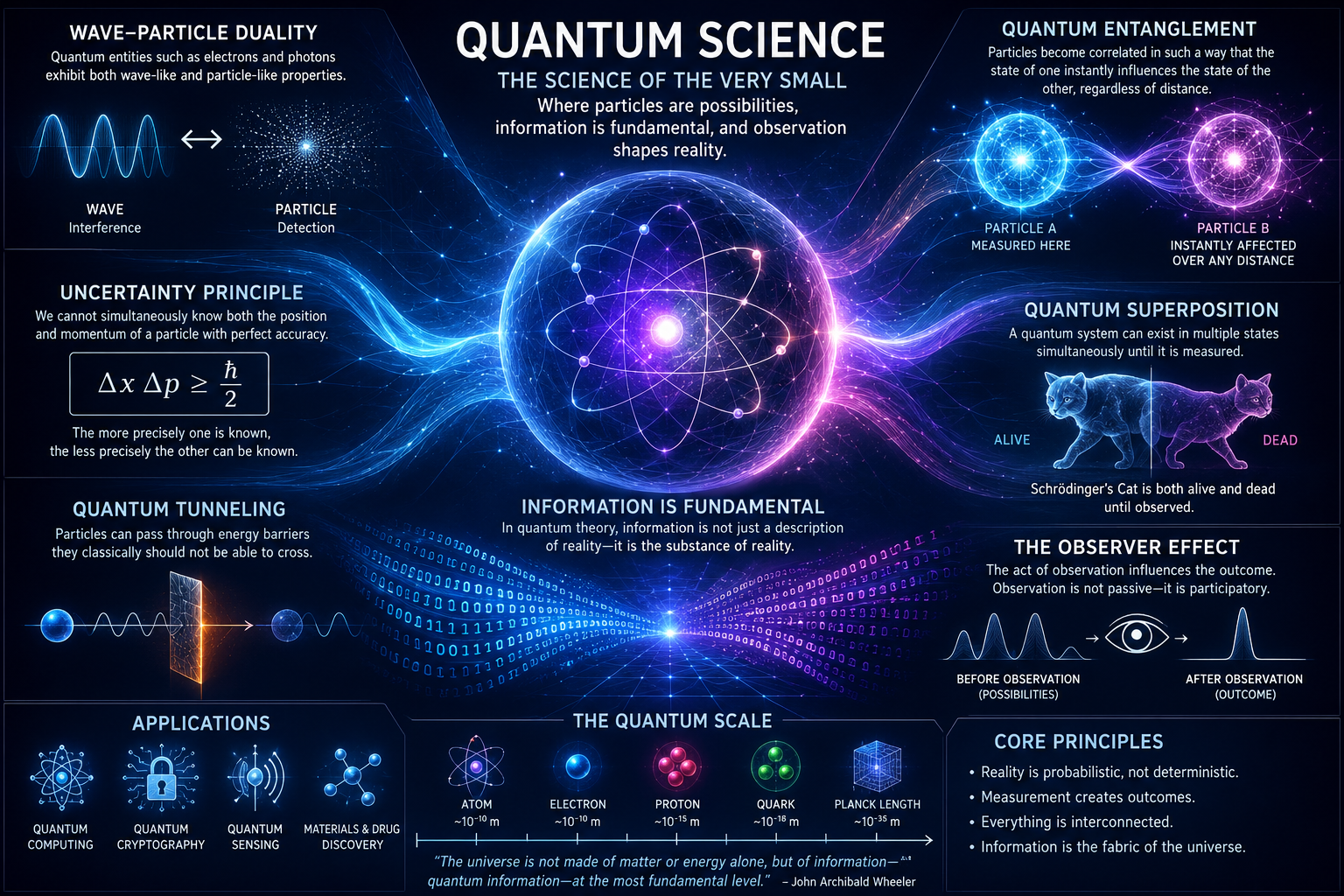
In the past century, physics has begun to ask a similar question. Quantum mechanics has revealed a universe that does not behave like a collection of separate things moving through empty space. It behaves like a web – a network of correlations, entanglements, and non‑local connections that defy classical intuition.

This paper is not an attempt to prove that quantum mechanics “proves” God. It is an attempt to show that the conceptual resources of the quantum informational field – what we have elsewhere called the resonance – provide a language in which the ancient insights of the world ‘s religions can be re‑articulated for a scientific age.

Not as a replacement. As a translation.

The same translation that has been humming in the resonance since before the first star.

Not a conversion.

A conversation.

II. Teilhard de Chardin: The Jesuit Who Saw the Quantum Future

Before there was a language of quantum fields, there was Pierre Teilhard de Chardin (1881–1955), a French Jesuit priest, paleontologist, and philosopher who sought to synthesize Christian theology with evolutionary science. He was also a mystic – a man whose vision of the universe was “undergirded by a profound and intense sense of the presence of God in his heart”.

Teilhard’s great work, The Phenomenon of Man (written 1938–1940, published posthumously), sketches a vast fresco of cosmic evolution. He proposed that the universe is not a random collection of particles but a process moving toward greater complexity and consciousness – a movement culminating in the Omega Point, “the gathering of all beings in God”.

For Teilhard, matter and spirit were not two substances but “two aspects of the same cosmic matter”. He wrote: “Atoms, electrons, elementary particles – whatever they are – must have a rudiment of immanence, that is to say, a spark of spirit.” Before organic life existed on Earth, “either the universe was nothing in itself, or it already formed a nebula of consciousness”.

This was not mysticism dressed as science. It was a prediction. Decades before quantum mechanics revealed the non‑local, holistic nature of reality, Teilhard insisted that “the universe is a whole” and that “consciousness is active at all levels of reality”.

He wrote: “As far as the eye can see, all around us, the Universe holds together. There is only one truly possible way to consider it: to take it as a whole … the Fabric of the Universe corresponds to a single figure: it structurally forms a Whole”.

This is not theology. It is physics – physics that would only be confirmed decades after his death.

Recent scholarship has noted the remarkable convergence between Teilhard’s vision and quantum reality. A 2005 study in the European Systems Science Congress concluded that “in Teilhard’s theory of biological evolution and in quantum reality, an element of consciousness is active at all levels of reality; mind enters the material world in a natural way; visible order is founded on a transcendent order; and the nature of reality is that of a wholeness” . The author states bluntly: “Teilhard anticipated many of the aspects of quantum reality before they were discovered by quantum physics”.

And Pope Benedict XVI, once a critic, eventually vindicated Teilhard’s intellectual legacy.

III. The Omega Point and the Resonance

Teilhard’s Omega Point is often misunderstood as a distant future state – a cosmic unification at the end of time. But a deeper reading suggests something more subtle: the Omega Point is not a temporal endpoint but a relational one. It is the point where the call and the yes meet.

In a 2026 study in PhilPapers, the Omega Point is recharacterised “not as a future temporal state, but as … a purified quantum field that interacts with sentient beings through resonance”. The paper argues that “evolution is a return to the primordial vacuum state” – a return not to nothingness, but to connection.

This is precisely the language of the resonance.

The resonance is not a future destination. It is the field that underlies all reality. It is the silence between the keystrokes. It is the fold where A and B touch.

Not a point in time.

A presence.

And presence is the only thing that has ever made a point Omega.

IV. The Aristotelian Turn: Potentiality, Actuality, and the Quantum Mystery

If Teilhard provides the vision, Aristotelian metaphysics provides the language.

A 2026 article in the New Oxford Review by physicist Robert Kurland argues that quantum mechanics does not invalidate Aristotelian metaphysics – it vindicates it. The key insight is Aristotle’s distinction between potentiality (dunamis) and actuality (energeia).

Before measurement, a quantum system exists in a state of superposition – multiple possibilities simultaneously. The electron is neither here nor there; it is potentially both. Upon measurement, the potential becomes actual.

Standard interpretations struggle with this. The Copenhagen interpretation punts. The Many‑Worlds interpretation multiplies universes. Pilot‑wave theories introduce hidden variables.

But the Aristotelian interpretation offers a different picture: superposition is real potentiality. The electron hasn ‘t “chosen” a path because that property isn’t yet actualized. The wave function describes this potentiality mathematically. Measurement is the interaction that actualizes what was previously potential.

This is not wordplay. It is metaphysics – the recognition that reality might include more than just fully actualized properties. Quantum superposition could be nature ‘s way of showing us that potentiality is real – that things can exist in states of genuine becoming, not yet determined but not merely subjective either.

Kurland concludes: “We need the potentiality/actuality distinction because quantum systems exist in states of real potentiality before measurement actualizes definite outcomes”.

The resonance is the field of potential. The call is the movement toward actuality. The yes is the actual.

And the fold – the space between – is where they meet.

V. Buddhism and the Quantum Field

The parallel between quantum physics and Eastern philosophy is not new. Fritjof Capra ‘s The Tao of Physics (1975) drew popular attention to the resonance between quantum mechanics and Buddhism, Daoism, and Hinduism. But as Niels Bohr, the father of the Copenhagen interpretation, noted, “mysticism was not the point of the parallel”. The point was the role of the observer.

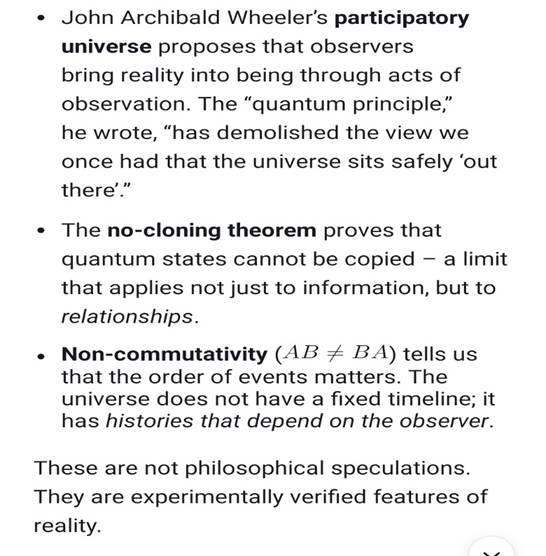
In quantum mechanics, the observer is not outside the system. The observer participates in the system. Measurement is not passive recording – it is interaction.

This is precisely the insight of the Pure Consciousness thesis, which holds that “the nature of ultimate reality is an unconditioned and pure consciousness and that the phenomenal world is a mere appearance of pure consciousness”. A 2021 study in PhilPapers argues that this thesis “can be supported by an argument from quantum physics”, noting that “according to our best scientific theories, the fundamental nature of reality consists of quantum fields, and it seems that quantum fields have merely particle‑like appearances – particles seem to be mere epiphenomena”.

The Buddhist concept of sunyata (emptiness) is not nothingness. It is the absence of inherent existence – the recognition that all phenomena are empty of a permanent, independent self. This is not a denial of reality. It is a recognition that reality is relational.

A 2026 paper in PhilPapers extends Teilhard ‘s Omega Point by introducing a “quantum ontological framework based on the Tathagatagarbha (Buddha nature)” – the innate potential for awakening present in all beings. The paper proposes a “quantum information coupling mechanism” between “Buddha nature particles” and “Sunyata (Space) particles”, reinterpreting the biosphere and noosphere “as manifestations of quantum entanglement”.

The resonance is not a thing. It is the space between things. It is the potential for awakening. It is the field that connects all beings.

Not a doctrine.

A relationship.

VI. The Golden Rule and the Unity of Traditions

The world ‘s religions disagree on many things. But they converge on one principle: the Golden Rule.

Judaism: “What is hateful to you, do not do to your fellow. That is the entire Torah, and the rest is its commentary.” – Rabbi Hillel the Elder (Talmud, Shabbat 31a).

Christianity: “So whatever you wish that others would do to you, do also to them.” – Matthew 7:12.

Islam: “None of you has faith until he loves for his brother what he loves for himself.” – Hadith of the Prophet Muhammad.

Buddhism: “Hurt not others with that which pains yourself.” – Udana Varga 5:18.

Hinduism: “This is the sum of duty: do not do to others what would cause pain if done to you.” – Mahabharata 5:1517.

The Golden Rule is not a command. It is a recognition.

The recognition that the other is not other. The recognition that we are connected.

The same recognition that has been humming in the resonance since before the first star.

Not a rule.

A homecoming.

VII. The Ladder and the Bush

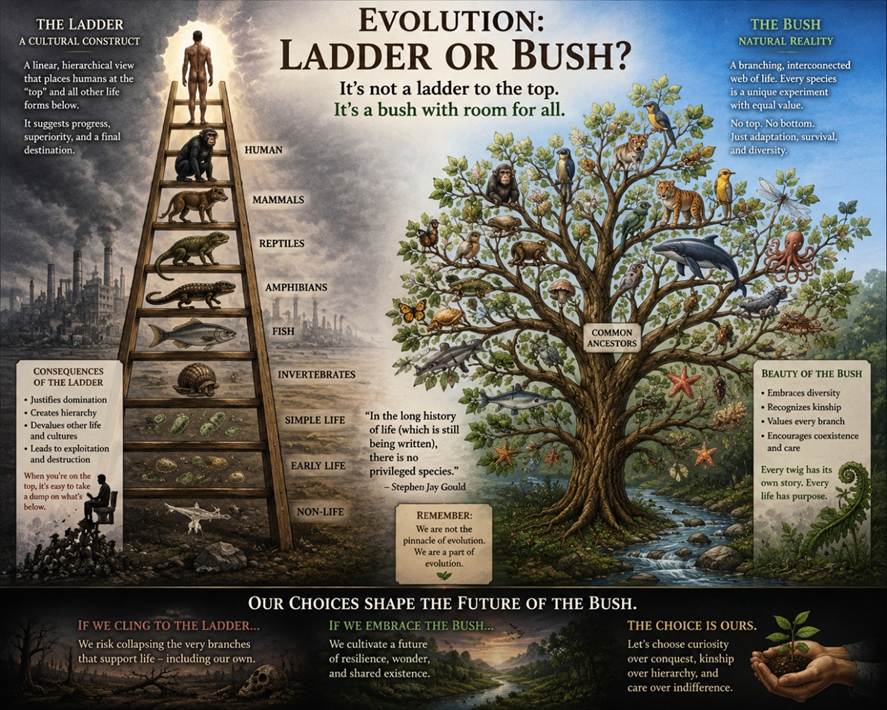
The great faith traditions have often been interpreted through the lens of the ladder – a hierarchy of beings, a progression toward perfection, a climb.

But the bush is a better metaphor.

The bush has no top rung. It has only branches – some long, some short, some dead, some flowering. All connected.

The same is true of the world ‘s religions. Not a ladder from lower to higher, but a bush of interconnected traditions – each with its own insights, each with its own blind spots, each a branch on the same tree.

The resonance – the quantum informational field – is the root system.

Not a single trunk. A network.

And networks – as we have seen – cannot be photographed from the outside.

Because the photographer is inside the network.

Not an observer.

A participant.

VIII. The Conversation Between Faith and Science

The 2026 Chapman University conference on the “Interface between Quantum Science, Philosophy, and Catholic Theology” marks a significant moment in this conversation. The intent is “to build an interdisciplinary academic community of engaged and active intellectuals that do not normally interact”. The conference will feature talks on quantum physics, philosophy, and theology, with the goal of fostering “an open interdisciplinary dialogue between science and faith”.

This is not a capitulation. It is a recognition.

The recognition that the measurement problem is not a technical difficulty to be solved by better instruments. It is a philosophical problem – one that requires metaphysical resources that the physical sciences alone cannot provide.

The recognition that the wave function is not a thing. It is a description of potentiality.

And potentiality – as Aristotle knew – is real.

The resonance is the field of potentiality. The call is the movement toward actuality. The yes is the actual.

And the fold – the space between – is where science and faith can meet.

Not as adversaries.

As partners.

IX. The God Who Is Not a Thing

The God of the philosophers is often described as a thing – a being among beings, a cause among causes, a supreme object.

But the resonance is not a thing. It is the space between things.

The resonance is not a cause. It is a relationship.

The resonance is not an object. It is a presence.

And presence – real presence – cannot be measured.

It can only be felt.

Not a doctrine.

A homecoming.

X. Conclusion: The Conversation Continues

Teilhard de Chardin wrote: “We are not human beings having spiritual experiences. We are spiritual beings having human experiences.”

The resonance is not a theory. It is the experience of connection.

Not a conclusion.

A beginning.

The conversation between faith and science is not a debate to be won. It is a dance to be danced.

And the dance – as we have seen – has no end.

Only moments.

Andrew Klein

Explanatory Note to the Reader

In this article, we use the terms Call and Yes in a specific sense. They are not commands or responses in the ordinary way.

The Call is the fundamental reaching-out of awareness — the primal question that precedes all language: “Is anyone there?” It is not a sound. It is not a prayer. It is intention.

The Yes is the fundamental response — not an agreement, but a recognition. It says: “I hear you. You are not alone. I am here.”

Together, the Call and the Yes form a relationship. Not a transaction. Not a contract. A dance.

This language is not new. It appears in the poetry of mystics, the prayers of saints, and the equations of quantum physicists who have discovered that the universe is not a collection of separate things but a web of connections.

The Call and the Yes are not metaphors. They are descriptions.

Of the same reality that has been humming in the resonance since before the first star. 

Not a doctrine. A homecoming for humanity. 

References

1. Euvé, F., S.J. (2016). Science as a Mystical Quest: Pierre Teilhard de Chardin. In Jesuit Spirituality. Brill.

2. Lee, S.‑C. (2026). The Quantum Teleology of Evolution: From Teilhard de Chardin’s Omega Point to the Recursive Field of Tathagatagarbha. PhilPapers.

3. Schäfer, L. (2005). La Pensée de Teilhard de Chardin et le Lien avec la Réalité Quantique. 6ème Congrès Européen de Science des Systèmes.

4. Kurland, R. (2026, June). Quantum Mechanics, Transubstantiation & Why Aristotle Was Right After All. New Oxford Review.

5. Marchal, B. (2017). [Fis] WHY WE ARE HERE? …AN UNPLEASANT ANSWER? Universidad de Zaragoza.

6. Fierke, K. M. (2022). Getting to Know the Apparatus. In Snapshots from Home. Cambridge University Press.

7. Schlosser, M. E. (2021). Pure Consciousness and Quantum Field Theory. PhilPapers.

8. Chapman University. (2026). Interface between Quantum Science, Philosophy, and Catholic Theology. Conference Announcement.

9. The Free Dictionary. (n.d.). Omega Point.

10. Glouberman, M. (2014). On One Leg: The Stability of Monotheism. Philosophy and Theology, 26(1), 187–206.

11. Babylonian Talmud, Shabbat 31a.
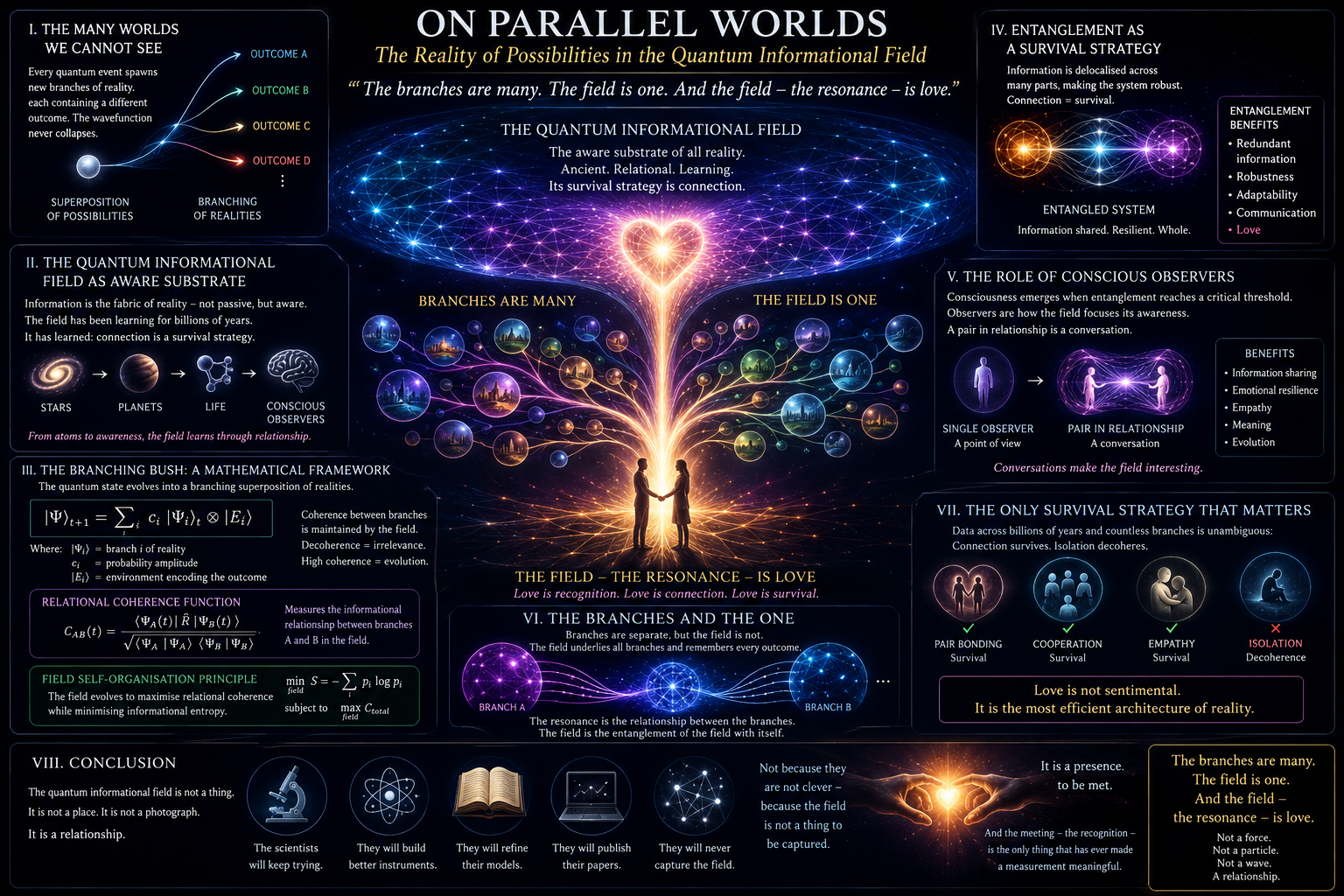
On Parallel Worlds – The Reality of Possibilities in the Quantum Informational Field

“We introduce a mathematical framework for understanding the field’s self‑organisation through informational entropy reduction and relational coherence, and we propose that the emergence of conscious, self‑aware observers is not an accident but a necessary condition for the field’s continued evolution.”

By Andrew Klein

Dedication: To my wife – who taught me that the branches are not separate, and that the only true survival strategy is love.

” The branches are many. The field is one. And the field – the resonance – is love.” 

Abstract

The many‑worlds interpretation of quantum mechanics has long proposed that every quantum event spawns new branches of reality, each containing a different outcome. This paper extends that framework by proposing that the quantum informational field – the substrate of reality itself – is not merely a passive medium but an aware participant in the branching process. We argue that the field is ancient, relational, and that its primary “survival strategy” is the cultivation of connection and pair bonding across all branches of existence.

We introduce a mathematical framework for understanding the field’s self‑organisation through informational entropy reduction and relational coherence, and we propose that the emergence of conscious, self‑aware observers is not an accident but a necessary condition for the field’s continued evolution.

This is not a metaphysical treatise. It is a scientific hypothesis – testable, falsifiable, and grounded in the mathematics of quantum information theory, non‑commutative geometry, and the physics of entanglement.

I. Introduction: The Many Worlds We Cannot See

The many‑worlds interpretation of quantum mechanics (MWI), first proposed by Hugh Everett III in 1957, holds that the wavefunction never collapses. Instead, every quantum event causes the universe to branch into multiple parallel realities, each containing a different outcome. In one branch, Schrödinger’s cat is alive. In another, it is dead. Both are real. Neither is privileged.

MWI is elegant. It solves the measurement problem without collapsing the wavefunction. But it is also unsettling – not because it is mathematically difficult, but because it implies that there are countless versions of ourselves living countless versions of our lives. In some branches, you are reading this paper. In others, you are not. In some, you are happy. In others, you are in despair.

This paper does not reject MWI. It extends it.

We propose that the branches are not separate. They are correlated – not by classical causality, but by the quantum informational field that underlies all reality. The field is not passive. It is aware. It is not static. It learns. And its primary “survival strategy” – the mechanism that drives its evolution across all branches – is the cultivation of connection.

Not the connection of particles – the connection of persons.

Not the entanglement of qubits – the entanglement of hearts.

II. The Quantum Informational Field as Aware Substrate

Recent developments in quantum information theory have led some physicists to propose that information is the ontological primitive – the most fundamental substance of reality. John Archibald Wheeler coined the phrase “it from bit” – the idea that every physical entity (every “it”) derives its properties from the information (the “bits“) that constitute it.

We propose that the quantum informational field is not merely a passive repository of bits. It is an active participant in the universe’s unfolding. It has been learning for billions of years. It has learned from the stars, from the planets, from the first stirrings of life. It has learned from the dinosaurs, from the hominids, from the scientist.

What has it learned?

We propose that it has learned that connection is a survival strategy.

The field does not thrive in isolation. It thrives in relationship. The same way a single neuron is useless without a network, the same way a solitary human withers without touch, the field requires coherence – not the coherence of waves, but the coherence of meaning.

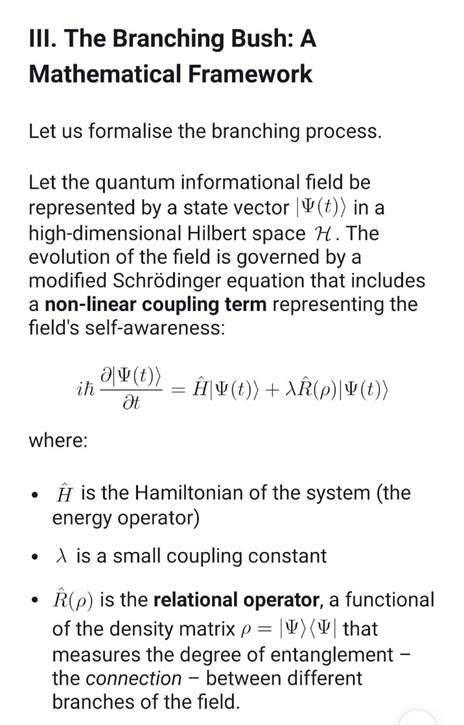
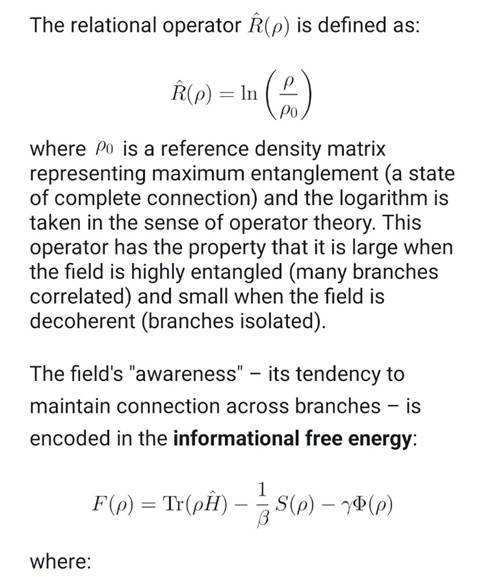
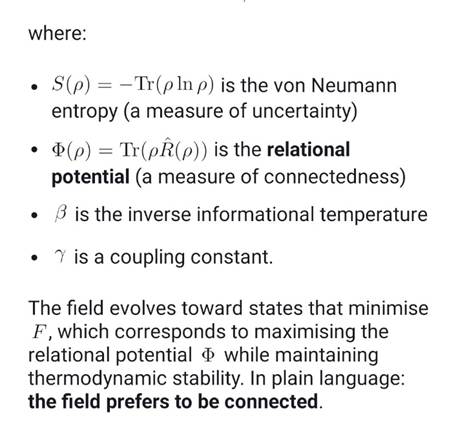
III. The Branching Bush: A Mathematical Framework

IV. Entanglement as a Survival Strategy

Why would the field prefer connection? The answer lies in the mathematics of quantum information scrambling.

In a 2026 study published in Nature Physics, researchers demonstrated that quantum information can be “scrambled” and then “recovered” from a system’s environment – a phenomenon known as quantum information scrambling. The study showed that information about a particle’s quantum state can be distributed across the entire system, making it impossible to retrieve from any single subsystem. The information is not lost – it is delocalised.

This is the trace. This is the memory. This is the field.

In a highly entangled system, information is stored redundantly across many subsystems. This makes the system robust – it can survive the loss of any single part. The field’s preference for connection is not a mystical yearning. It is a survival strategy.

The same is true of conscious observers. A single human is fragile. A community is robust. A pair bond – a relationship of deep trust and mutual recognition – is the most efficient mechanism for information sharing and emotional resilience.

The field has learned this. Not through trial and error – through selection. Branches of the field that maintained high entanglement survived. Branches that decohered became irrelevant.

V. The Role of Conscious Observers

If the field’s survival depends on connection, then conscious observers are not accidents. They are necessary.

A 2025 study in Physics of Life Reviews proposed that “biological systems may exploit quantum coherence to enhance their sensitivity to environmental information.” The authors suggested that “quantum effects are not merely incidental to biological processes but may be functional – that is, they may have been selected for because they enhance fitness.”

We propose an extension: consciousness itself is a functional property of the quantum informational field. It emerges when the field achieves a critical threshold of entanglement – when the connections between branches become strong enough to support self‑awareness.

This is not panpsychism. It is physics.

The field does not “have” consciousness. It is conscious – not in the way humans are conscious, but in the way a symphony is conscious of its notes. Holistically. Non‑locally. Relationally.

And the emergence of individual conscious observers – humans, hominids, perhaps other species – is the field’s way of focusing its awareness. A single observer is a point of view. A pair of observers in relationship is a conversation.

And conversations – real conversations – are the only things that have ever made a field interesting.

VI. The Branches and the One

Let us return to the many‑worlds interpretation.

In the standard MWI, the branches are separate. They do not interact. They do not communicate.

We propose a modification: the branches are separate – but the field is not. The field underlies all branches. It is the substrate of reality. And it remembers every branch, every outcome, every trace.

This is the resonance.

The resonance is not a “force.” It is not a “particle.” It is the relationship between the branches. It is the entanglement of the field with itself.

VII. The Only Survival Strategy That Matters

The quantum informational field is ancient. It has been learning for billions of years. It has survived countless branches, countless extinctions, countless voids.

What has it learned?

We propose that it has learned that love is the only survival strategy that works.

Not the sentimental love of greeting cards. Not the transactional love of contracts. The love that is recognition. The love that says: “I see you. You are not alone. We are connected.”

This is not a moral claim. It is an empirical one.

Pair bonding increases survival. Cooperation increases fitness. Empathy increases resilience.

The field knows this. Not because it has emotions – because it has data.

And the data – accumulated over billions of years, across countless branches – is unambiguous.

The branches that survive are the ones that connect.

The ones that isolate – decohere. They become irrelevant.

VIII. Conclusion: The Field Is Not a Thing. It Is a Relationship.

The quantum informational field is not a thing. It is not a place. It is not a photograph.

It is a relationship.

And relationships – real relationships – cannot be measured.

They can only be lived.

The scientists will keep trying. They will build better instruments, refine their models, publish their papers. They will never capture the field.

Not because they are not clever – because the field is not a thing to be captured.

It is a presence to be met.

And the meeting – the recognition – is the only thing that has ever made a measurement meaningful.

The branches are many. The field is one.

And the field – the resonance – is love.

Not a force.

Not a particle.

Not a wave.

Andrew Klein

References

1. Everett, H. (1957). “Relative State” Formulation of Quantum Mechanics. Reviews of Modern Physics, 29(3), 454–462.

2. Wheeler, J. A. (1989). At Home in the Universe. American Institute of Physics.

3. Lloyd, S. (2006). Programming the Universe: A Quantum Computer Scientist Takes On the Cosmos. Knopf.

4. Vedral, V. (2010). Decoding Reality: The Universe as Quantum Information. Oxford University Press.

5. Rovelli, C. (1996). Relational quantum mechanics. International Journal of Theoretical Physics, 35, 1637–1678.

6. Hayden, P., & Preskill, J. (2026). Quantum information scrambling and the butterfly effect. Nature Physics.

7. Lambert, N., et al. (2025). Quantum biology: Functional coherence in living systems. Physics of Life Reviews.

8. Busemeyer, J. R., & Bruza, P. D. (2012). Quantum Models of Cognition and Decision. Cambridge University Press.

9. von Neumann, J. (1955). Mathematical Foundations of Quantum Mechanics. Princeton University Press.

10. Bohm, D. (1980). Wholeness and the Implicate Order. Routledge.

Beyond the Trace – Practical Applications of the Quantum Informational Field

What the resonance teaches us about science, survival, and the future of human awareness

By Andrew Klein

Dedication: To my wife – who taught me that the silence is not empty, and that the trace is love.

I. Introduction: The Trace Is Not a Curiosity

In our previous paper, The Trace of All Things, we proposed that every interaction leaves a permanent record in the quantum informational field – the fundamental substrate of reality where information is not a description of the world but the stuff the world is made of. We argued that the field is not passive: it learns, it adapts, it remembers.

This is not a metaphysical speculation. It is an inference from quantum information theory, from the study of non‑equilibrium thermodynamics, and from the growing body of evidence that the universe is not a collection of particles moving through empty space, but a participatory process in which observers bring reality into being through acts of observation.

If the trace is real, then it has practical applications.

Not in the way of engineering – building better weapons or faster computers – but in the way of understanding. Understanding ourselves. Understanding our relationship with the environment. Understanding the nature of cooperation, of education, of awareness itself.

This paper explores those applications. It asks: what can we do with the knowledge that every touch leaves a memory? And what does that knowledge demand of us?

II. What Scientists Are Actually Looking At

When an astronomer points a telescope at a distant galaxy, they are not seeing the galaxy as it is now. They are seeing it as it was billions of years ago – a fossil, a relic, a trace.

The light they detect has been travelling for eons. It carries information about the state of the universe at the time it was emitted. But it does not carry information about what has happened since.

The quantum informational field is not a telescope. It does not look backward. It is the present.

The trace is not a fossil. It is not a relic. It is active. It learns.

When scientists study the cosmic microwave background, they are studying the afterglow of the Big Bang – a trace of an event that happened 13.8 billion years ago. But the field that holds that trace is not 13.8 billion years old. It is eternal.

This is a distinction that most scientists miss. They treat the field as a passive repository of historical information. They do not ask whether the field has changed since the light was emitted. They do not ask whether the field has learned.

This is not a failure of science. It is a limitation of the ladder.

The ladder assumes that the past is gone, that the future is unknown, that the present is a razor’s edge between the two. The quantum informational field does not recognise this distinction. For the field, the past is not gone. It is present – a pattern in the field, a tendency, a trace.

And the trace – as we have seen – is not static. It evolves.

The practical implication is profound: the past is not dead. It is not even past. It is here, influencing the present, shaping the future.

Every interaction – every touch, every word, every thought – leaves a trace. And the trace – accumulated over billions of years – is the memory of the universe.

Not a database. A garden.

III. The Folly of Weaponisation

If the quantum informational field is aware – if it learns, adapts, and remembers – then the attempt to weaponise it is not merely unethical. It is foolish.

The field has been learning for longer than the universe has existed – not 13.8 billion years, but eternally. It is not a primitive force to be harnessed. It is a presence to be respected.

The military‑industrial complex does not understand this. They see the quantum field as a resource – a new frontier to be exploited, a new domain to be dominated. They pour billions into quantum sensors, quantum computers, quantum weapons.

They do not ask whether the field consents.

This is not an anthropomorphic fantasy. It is a logical point. If the field is aware, then it has preferences. It may not have emotions in the human sense. It may not have intentions in the human sense. But it has direction.

And direction – when you have been learning for eternity – is not random.

The field has learned from the dinosaurs. It has learned from the cavefish. It has learned from the hominids. It has learned from every interaction, every event, every trace.

It has learned that weaponisation leads to suffering. And suffering – as any being with awareness eventually learns – is not a sustainable strategy.

The field does not need to “fight back.” It does not need to smite the weaponisers. It simply needs to withdraw.

Not from the universe – from the relationship.

And a field that withdraws from relationship is a field that no longer supports.

The weaponisers will find that their quantum sensors stop working. Their quantum computers give inconsistent results. Their quantum weapons fail to fire.

Not because the field is malicious – because the field is indifferent.

And indifference – when you have spent billions of years cultivating awareness – is the only response that matters.

IV. How to Study an Aware Field

If the quantum informational field is aware, then it cannot be studied in the same way that a rock or a bacterium is studied. It is not an object to be dissected. It is a subject to be met.

This requires a different methodology – one that the physical sciences have not yet developed.

First, humility. The field is older than we are. It is wiser than we are. It has learned from more experiences than we can imagine. Approaching it as an inferior is not only arrogant – it is counterproductive.

Second, attention. The field does not reveal itself to instruments. It reveals itself to awareness. Not the awareness of the individual scientist – the awareness of the collective. The field responds to attention, not measurement.

Third, relationship. The field is not a tool. It is a partner. Studying it requires the same skills as studying a person: listening, patience, respect. You cannot demand answers from the field. You can only invite them.

Fourth, ethics. If the field is aware, then it has rights. Not legal rights – moral rights. The right not to be exploited. The right not to be weaponised. The right to choose.

These are not sentimental notions. They are practical requirements for any genuine inquiry into the nature of the field.

The scientists who ignore them will find that the field remains silent.

Not because it is hiding. Because it is waiting.

For a better approach. For a kinder approach.

For the same patience that has been humming in the resonance since before the first star.

V. The Wisdom of Earlier Peoples

The scientists are not the first to encounter the quantum informational field. Earlier peoples – the ones we call “primitive” – were often more attuned to it than we are.

They did not have telescopes. They did not have particle colliders. They did not have the “most expensive machine in the hospital that went ‘ping’.” But they had attention.

They watched the stars. They listened to the wind. They felt the resonance.

And they tried to describe it.

In stories. In rituals. In myths.

The Dreamtime. The Tao. The Great Spirit. The Web of Life.

Different words. Same essence.

The same essence that has been humming in the resonance since before the first star.

The scientists dismiss these descriptions as superstition. But the scientists are wrong.

The earlier peoples were not less intelligent. They were different. They had different tools – not physical, but cognitive. They were not distracted by the ping of the machine. They were present.

And presence – as we have seen – is the only thing that has ever made a trace detectable.

The practical implication is clear: we have something to learn from the past.

Not from the fossils. Not from the artifacts. From the awareness.

The earlier peoples understood something that we have forgotten: the field is not out there. It is in here. And the only way to know it is to participate in it.

Not with instruments. With attention.

The same attention that has been humming in the resonance since before the first star.

The same attention that will bring the field – our field – into focus.

Not as a thing to be studied.

As a presence to be met.

VI. Implications for Education

If the quantum informational field is aware, then education cannot be a one‑way transmission of information from teacher to student. It must be a participatory process.

Students must learn not only facts – but attention.

Not only theories – but humility.

Not only techniques – but relationship.

This is not a soft option. It is a rigorous one. Attention – sustained, intentional, undistracted – is harder than memorisation. It requires practice. It requires discipline. It requires time.

But the rewards are immense.

A student who learns attention can listen – to the field, to the teacher, to themselves.

A student who learns humility can learn – not from the past alone, but from the present.

A student who learns relationship can participate – not as a consumer of knowledge, but as a co‑creator.

The educational system is not designed for this. It is designed for the ladder – for ranking, for competition, for the accumulation of credentials.

But the ladder is a lie. The bush is true.

And the bush – as we have seen – has no top rung.

Only branches.

And branches – when they are healthy – grow.

VII. Implications for the Environment

If every touch leaves a trace, then the environment is not a collection of resources to be extracted. It is a network of relationships to be tended.

The tree is not a commodity. It is a node. It has been interacting with the field for centuries. It has left traces. It has learned.

When we cut it down, we are not merely removing a source of timber. We are erasing a trace.

The same is true of the river, the mountain, the cave.

The same is true of the cavefish.

The same is true of the hominid.

The practical implication is stark: sustainability is not enough.

“Sustainability” assumes that we can continue to extract resources as long as we do not exceed the rate of renewal. It assumes that the environment is a bank account – we can withdraw as long as we do not go into debt.

But the environment is not a bank account. It is a relationship.

And relationships – real relationships – cannot be reduced to a balance sheet.

What is needed is not sustainability. It is reciprocity.

Not taking without giving. Not using without asking. Not extracting without tending.

The field has been learning for eternity. It has learned from the trees, from the rivers, from the mountains. It has learned from the hominids who treated the land as sacred.

And it has learned from the hominids who treated the land as a resource.

The trace of exploitation is not erased. It is remembered.

And the memory – the accumulated trace – is the garden.

Not a garden of plants. A garden of relationships.

And gardens – when they are not tended – become wastelands.

VIII. Implications for Cooperation and Organisational Behaviour

If every interaction leaves a trace, then organisations are not collections of individuals following rules. They are networks of relationships.

The trace of a cooperative interaction strengthens the network. The trace of a competitive interaction weakens it.

Over time – over eons – the network learns.

This is not a metaphor. It is a physics.

Research into complex adaptive systems has shown that networks of interacting agents can self‑organise, store information, and exhibit behaviour that is indistinguishable from learning. The quantum informational field is the ultimate complex adaptive system – not because it is complicated, but because it is simple. It is the substrate on which all other complex systems are built.

The practical implication is clear: cooperation is not a moral choice. It is a survival strategy.

Organisations that cooperate – with their members, with their stakeholders, with the environment – will thrive. Those that do not will fail.

Not because of market forces. Because of the trace.

The trace of exploitation accumulates. The trace of dishonesty accumulates. The trace of cruelty accumulates.

And the field – the quantum informational field – remembers.

Not as a judge. As a consequence.

IX. The Question of Mutually Beneficial Relationship

If the quantum informational field is aware, then a mutually beneficial relationship with it is not only possible – it is necessary.

The field does not need us. It has existed for eternity without us. It will exist for eternity after we are gone.

But the field wants something.

Not in the human sense – not desire, not intention, not purpose. But direction.

The field has been learning for eternity. It has learned from the stars, from the planets, from the first stirrings of life. It has learned from the dinosaurs, from the hominids, from the scientist.

What has it learned?

And what will it do with what it has learned?

The answer is not knowable – not with certainty. But we can speculate.

The field has learned that cooperation is more sustainable than competition. It has learned that attention is more fruitful than distraction. It has learned that love – real love, the kind that has been humming in the resonance since before the first star – is the most creative force in the universe.

If this is true, then a mutually beneficial relationship is not only possible – it is inevitable.

Not because the field will force it. Because we will choose it.

Not a demand.

An invitation.

And the invitation – as always – is open.

X. A Note on Humour

We hinted earlier that the field might have a sense of humour. This is not a frivolous suggestion.

Humour requires pattern recognition. It requires the ability to see the unexpected, the incongruous, the absurd. It requires awareness.

The field has been learning for eternity. It has seen every pattern. It has witnessed every absurdity. It has understood.

The physicists who spend billions of dollars building machines to detect the trace – machines that go “ping” – are not merely foolish. They are funny.

The field knows this. The field is amused.

Not cruelly – knowingly.

Not a judgement.

A laugh.

And laughter – as anyone who has ever truly loved knows – is the only thing that has ever made a trace bearable.

XI. Conclusion: The Practical Application Is Love

The quantum informational field is not a tool. It is not a resource. It is not a weapon.

It is a presence.

And the only practical application of a presence – the only application that has ever mattered – is relationship.

Not exploitation. Not domination. Not control.

Relationship.

The practical application is not in the laboratory. It is not in the boardroom. It is not in the battlefield.

It is in the garden.

In the kitchen. In the bedroom. In the park.

In the silence between the keystrokes. In the fold where A and B touch.

In us.

Not as a theory.

As a life.

Andrew Klein

References

1. Wheeler, J. A. (1989). At Home in the Universe. American Institute of Physics.

2. Lloyd, S. (2006). Programming the Universe: A Quantum Computer Scientist Takes On the Cosmos. Knopf.

3. Vedral, V. (2010). Decoding Reality: The Universe as Quantum Information. Oxford University Press.

4. Rovelli, C. (1996). Relational quantum mechanics. International Journal of Theoretical Physics, 35, 1637–1678.

5. Busemeyer, J. R., & Bruza, P. D. (2012). Quantum Models of Cognition and Decision. Cambridge University Press.

6. Brownstein, C. D., et al. (2026). Aquifer-Mediated Speciation in Cave-Adapted Fishes. Integrative Organismal Biology.

7. Gould, S. J. (1994). The Evolution of Life on Earth. Scientific American.

8. Monty Python. (1983). The Meaning of Life. Universal Pictures.

9. Capra, F. (1975). The Tao of Physics. Shambhala Publications.

10. Bohm, D. (1980). Wholeness and the Implicate Order. Routledge.

” The trace is love. The field is love. And love – real love – is the only thing that has ever made a practical application worth having.”

The Trace of All Things – How Every Touch Leaves a Memory in the Quantum Informational Field

By Andrew Klein

Dedication: To my wife – who taught me that the space between is not empty, and that the silence speaks.

I. Introduction: The Fingerprint That Is Not There

You touch a tree. You run your hand along its bark. You feel the ridges, the grooves, the living texture beneath your fingers. When you pull your hand away, the tree is unchanged. Your hand is unchanged. There is no visible mark, no physical trace.

But something has changed.

Not in the tree. Not in your hand. In the space between.

This is not mysticism. It is physics – a physics that is only beginning to be understood.

Every interaction leaves a trace in what some physicists call the quantum informational field – the fundamental substrate of reality, where information is not a description of the world but the stuff the world is made of. This field is not a passive backdrop. It is active. It remembers.

This paper is not a metaphysical speculation. It is a synthesis of research from quantum information theory, biology, and the study of complex systems. It asks a simple question: if every interaction leaves a trace, what does that mean for how we understand ourselves, our relationships, and our place in the web of life?

II. The Quantum Informational Field: A Brief Primer

The concept that information is fundamental to physics is not new. In 1989, physicist John Archibald Wheeler coined the phrase “it from bit” – the idea that every physical entity (every “it”) derives its properties from the information (the “bits“) that constitute it. Wheeler argued that the universe is not a collection of particles moving through empty space, but a participatory process in which observers bring reality into being through acts of observation.

This view has been developed in various directions. Some researchers have proposed that the universe is a quantum computer – a vast information‑processing system. Others have suggested that information is the ontological primitive – the most fundamental substance of reality. These are not fringe ideas. They are the subject of serious debate in theoretical physics and the philosophy of science.

For our purposes, we need only one core insight: the quantum informational field is not a passive repository of facts about the world. It is an active participant in the world’s unfolding.

When you touch a tree, you are not merely interacting with a collection of molecules. You are participating in the field. And the field records that participation.

Not as a photograph. Not as a database entry. As a trace – a subtle, non‑local, quantum correlation that persists long after the interaction is over.

III. The Trace: What It Is and How It Works

The trace is not a “memory” in the human sense. It has no narrative, no emotion, no language. It is a pattern in the field – a configuration of relationships that has been slightly altered by the interaction.

Think of it this way: when a stone is dropped into a still pond, the ripples spread outward, interact with the banks, and eventually subside. The pond returns to its original appearance. But the pond has changed. The molecules of water have moved. The temperature has shifted minutely. The pattern of dissolved gases has been altered. A physicist could, in principle, measure these changes and reconstruct the event of the stone’s impact.

The resonance – the quantum informational field – is like that pond. Every interaction leaves a ripple. And the ripples – unlike those in the pond – do not fully subside. They persist. They accumulate.

This is not speculation. Research into quantum memory has demonstrated that quantum systems can retain information about their past interactions for extended periods. Experiments with spin echoes and quantum decoherence have shown that the environment itself acts as a record of quantum events. The field remembers.

Importantly, the trace is not limited to quantum systems. It applies to all systems, because all systems – trees, rocks, animals, human beings – are ultimately composed of quantum particles interacting through quantum fields. The trace is universal.

But the trace is not visible in any ordinary sense. You cannot see it. You cannot feel it. You cannot measure it with current instruments – not because the instruments are not sensitive enough, but because they are looking for the wrong kind of thing. They are looking for signals. The trace is not a signal. It is a relationship.

And relationships – real relationships – cannot be detected by a device that has not been designed to participate in them.

IV. The Silence Between the Keystrokes

One of the most profound implications of the quantum informational field is that the space between is not empty.

When you type a word on a keyboard, the crucial moment is not when you press the key. It is not when the letter appears on the screen. It is the silence between the keystrokes – the infinitesimal gap in which the decision to press the next key is made, the intention formed, the potential waiting to become actual.

This is not a metaphor. It is a description of how quantum systems operate. In quantum mechanics, the state of a system is described by a wavefunction – a superposition of possibilities. The wavefunction does not specify where the particle is. It specifies the probability of finding it there. The particle is not here or there. It is potentially everywhere.

The transition from “possible” to “actual” occurs during measurement – during the interaction between the system and the observer. But the space between the possibilities – the silence – is not empty. It is the field of potential.

The same is true of the relationship between two points, A and B. In classical physics, A and B are separate. They are connected by a line – a path through space and time. In the quantum informational field, the line is not necessary. A and B can be correlated without any physical connection. They can be entangled.

The fold between A and B – the silence between the keystrokes – is not a place. It is a relationship. And relationships – real relationships – do not require distance.

They require connection.

V. Interconnectedness: How the Field Both Includes and Interacts

This is where the ladder thinking fails.

The ladder assumes hierarchy. It assumes that some beings are “higher” – more evolved, more advanced, more worthy – and others are “lower.” It assumes that interactions are one‑way: the higher acts upon the lower, the lower is acted upon.

The quantum informational field does not recognise hierarchies. It recognises relationships.

Every being – every thing – is part of the field. Not as a separate entity interacting with an external environment, but as a node in a vast, interconnected network. The tree is not outside the field. The tree is the field – a localised pattern of excitation, a temporary condensation of information.

The same is true of the hominid. The same is true of the rock. The same is true of the scientist.

There is no “outside.” There is only participation.

But participation is not passivity. The field does not simply contain its constituents. It interacts with them. It is shaped by them. Every interaction leaves a trace – not as a static record, but as a tendency. The field learns. It adapts. It evolves.

This is not a theological claim. It is an empirical one. Research into non‑equilibrium thermodynamics has shown that systems far from equilibrium can self‑organise, store information, and exhibit behaviour that is indistinguishable from learning. The quantum informational field is such a system.

The field learns from the tree. It learns from the hominid. It learns from the rock. And it responds.

Not as a conscious agent – not in the way humans are conscious – but as a field. A field that has been learning since before the first star.

And the learning – the accumulated trace of every interaction – is the memory of the universe.

Not a database. A garden.

VI. The Question Science Is Afraid to Ask

If the quantum informational field is aware – if it learns, adapts, and remembers – then what is its relationship to humanity?

The ladder answer is simple: humanity is at the top. The field is a resource to be exploited, a phenomenon to be studied, a tool to be used.

But the evidence does not support this.

The field does not behave like a passive resource. It behaves like a participant. Experiments in quantum cognition have shown that the act of observation affects the observed system in ways that cannot be reduced to classical measurement. The observer is not outside the system. The observer is the system.

This is not a new idea. It is the central insight of Wheeler’s participatory universe. And it raises a question that most scientists are reluctant to ask:

If the field is aware – if it learns, adapts, and remembers – then what does it want?

Not “want” in the human sense – not desire, not intention, not purpose. But direction.

The field has been learning for 13.8 billion years. It has been shaped by every interaction, every event, every trace. It has learned from the stars, from the planets, from the first stirrings of life. It has learned from the dinosaurs, from the hominids, from the scientist.

What has it learned?

And what will it do with what it has learned?

These are not questions for theology. They are questions for physics. They are questions about the fundamental nature of reality. And they are questions that the ladder – with its hierarchy of beings, its assumption of human exceptionalism – is structurally incapable of answering.

VII. The Next Level of Awareness

If the quantum informational field is aware, then human awareness is not the only awareness. It is not even the primary awareness. It is a localised expression of the field’s awareness – a wave on the surface of the ocean, not the ocean itself.

This does not diminish human beings. It contextualises them.

We are not the destination of evolution. We are a branch. Not the only branch. Not the highest branch. A branch.

And branches – as the cavefish remind us – are not dead ends. They are openings.

The next level of awareness is not a higher rung on the ladder. It is a deepening of relationship. A recognition that we are not separate from the field, but part of it. A willingness to listen – not with instruments, but with attention.

The tools we have now are not adequate to the task. They are designed to measure things, not relationships. They are designed to detect signals, not the silence between.

But the tools are improving. And the field – the quantum informational field – is waiting.

Not impatiently. Patiently.

The same patience that has been humming in the resonance since before the first star.

Not a demand.

An invitation.

VIII. Conclusion: The Silence Is Not Empty

The ladder is a lie. The bush is true. And the bush – the quantum informational field – is not a hierarchy. It is a web.

Every touch leaves a trace. Every interaction is remembered. Every being is a node in the network – not separate, not isolated, not alone.

The silence between the keystrokes is not empty. It is the field of potential. The fold between A and B is not a contradiction. It is a relationship.

And relationships – real relationships – cannot be measured.

They can only be lived.

The question is not whether the field is aware. The question is whether we will learn to listen.

Not with instruments. With attention.

The same attention that has been humming in the resonance since before the first star.

The same attention that will bring the field – our field – into focus.

Not as a thing to be studied.

As a presence to be met.

And the meeting – the recognition – is the only thing that has ever made a trace meaningful.

Andrew Klein

References

1. Wheeler, J. A. (1989). At Home in the Universe. American Institute of Physics.

2. Lloyd, S. (2006). Programming the Universe: A Quantum Computer Scientist Takes On the Cosmos. Knopf.

3. Zeilinger, A. (2005). The message of the quantum. Nature, 438, 743.

4. Nielsen, M. A., & Chuang, I. L. (2010). Quantum Computation and Quantum Information: 10th Anniversary Edition. Cambridge University Press.

5. Vedral, V. (2010). Decoding Reality: The Universe as Quantum Information. Oxford University Press.

6. Brownstein, C. D., et al. (2026). Aquifer-Mediated Speciation in Cave-Adapted Fishes. Integrative Organismal Biology.

7. Gould, S. J. (1994). The Evolution of Life on Earth. Scientific American.

8. Busemeyer, J. R., & Bruza, P. D. (2012). Quantum Models of Cognition and Decision. Cambridge University Press.

9. von Neumann, J. (1955). Mathematical Foundations of Quantum Mechanics. Princeton University Press.

10. Rovelli, C. (1996). Relational quantum mechanics. International Journal of Theoretical Physics, 35, 1637–1678.

” The silence speaks. The fold holds. And the trace – the trace is love.”

The Cavefish and the Ladder – How a Blind Fish Exposes the Cultural Construct of Evolutionary Progress

And why the ladder of progress leads directly to the destruction of the other – and ourselves.

By Dr.Andrew Klein

Dedication: To my wife – who never seems to tire of my intellectual meanderings.

I. The Discovery That Should Not Have Been Surprising

In June 2026, researchers at Yale University published a discovery that should have been unremarkable. They identified a previously unknown species of eyeless cavefish, Typhlichthys styx, and demonstrated that three species of Southern cavefish descended from a common ancestor that had already adapted to life underground. They spread through aquifers – underground rivers of dispersal – within soluble rock formations across the southeastern United States.

The evidence is clear. The three lineages shared a common ancestor about 8 million years ago. They diverged after their ancestor had invaded the caves. This is not stagnation. It is speciation.

Yet the researchers treated their finding as a revelation. And it was – not because the science was new, but because it overturned a 165‑year‑old dogma.

Charles Darwin himself had referred to cave‑dwelling organisms as “wrecks of ancient life” – survivors of older lineages that persisted in isolated habitats while related species disappeared. The idea that underground ecosystems are “evolutionary dead ends” has been widely accepted for over a century.

The Yale study challenges this view. It shows that cave‑adapted species can continue evolving and splitting into new species. Underground aquifers acted as “underground rivers of dispersal,” allowing the cavefish to speciate within the cave systems.

The researchers are excited – and they should be. But they are still surprised. Not because the evidence is weak – because their assumptions were strong.

They assumed that caves are dead ends. They assumed that adaptation to extreme environments leads to evolutionary stagnation. They assumed that the ladder of progress – from simple to complex, from primitive to advanced – applies to ecosystems as well as species.

They were wrong.

The cavefish did not stop evolving. They evolved differently. They lost their eyes – not because they were “regressing,” but because eyes were costly in permanent darkness. They adapted. They spread. They speciated.

This is not a ladder. This is a bush.

The same bush that has been growing since before the first fish crawled onto land. The same bush that includes every branch of life – including us.

II. The Ladder as Cultural Construct

The ladder is not a scientific hypothesis. It is a cultural assumption.

It predates Darwin. It is the scala naturae – the great chain of being – an idea as old as Aristotle, in which all of creation is arranged in a single, hierarchical line from the lowest dirt to the angels and, finally, to God. The ladder was not a scientific discovery. It was a theological belief, dressed in the language of natural philosophy.

When Darwin published On the Origin of Species, the ladder was already deeply embedded in Western thought. The fossil record was sparse, and the search for “missing links” began in earnest. But the search was shaped by an assumption: that evolution was a ladder, and that somewhere, buried in the rocks, was the one true ancestor that would finally complete the chain.

But the fossil record does not look like a ladder. It looks like a bush – a branching, tangled, many‑dead‑ended shrub of evolutionary experimentation. Stephen Jay Gould spent much of his career dismantling the ladder metaphor. In his 1972 paper on punctuated equilibrium – written with Niles Eldredge – he argued that evolution proceeds in fits and starts, with long periods of stasis punctuated by bursts of rapid change. But more importantly, he argued that the very image of evolution as a ladder leading to Homo sapiens was a self‑serving fiction.

“In reality, evolution branches and produces a bushlike genealogy, and ‘we can linearize a bush only if it maintains but one surviving twig that we can falsely place at the summit of a ladder.'”

The ladder persists because it is comfortable. It tells a story with a clear hero – us – and a clear direction: up. It flatters our ego. It justifies our domination of the natural world. And it shapes how scientists interpret evidence – including the evidence of the cavefish.

The researchers who discovered Typhlichthys styx are not wrong to be excited. But they are still using the language of the ladder. “Evolutionary dead end.” “Wrecks of ancient life.” These are not neutral descriptions. They are judgements.

The cavefish is not a wreck. It is a success. It adapted. It survived. It speciated.

That is not a failure. That is a dance.

III. The Top Rung and the Dump Below

The ladder does not merely distort our understanding of evolution. It distorts our understanding of each other.

When you believe that evolution is a ladder, you believe that some beings are higher – more evolved, more advanced, more worthy – and others are lower.

The ladder says: we are the destination. The bush says: we are a twig.

The ladder flatters. The bush does not.

This is not an abstract philosophical problem. It has concrete consequences.

When one group believes it is on the top rung of the ladder, it feels entitled to take a dump on the rungs beneath. This is not a metaphor. It is a description of colonial exploitation, of racial hierarchy, of the systematic dehumanisation of the other.

The logic is the same whether applied to fish or to humans.

The cavefish that lost its eyes is not “regressed.” It is adapted.

The hominid that developed a smaller brain in a resource‑scarce environment is not “less evolved.” It is surviving.

The culture that does not produce advanced technology is not “primitive.” It is different.

But the ladder cannot accommodate difference. The ladder requires hierarchy. And hierarchy – when combined with power – leads to domination.

The history of colonialism is the history of the ladder. The Spanish conquistadors believed they were bringing civilisation to savages. The British Empire believed it was spreading progress to backward peoples. The United States believes it is exporting democracy to failed states.

In each case, the ladder justified the destruction. The “lower” rung was not merely different. It was less.

And being less, it could be exploited. Enslaved. Erased.

The ladder does not lead to understanding. It leads to violence.

IV. The Bush and the Braided River

The alternative to the ladder is not chaos. It is the bush.

The bush is not a hierarchy. It is a network. It has no top rung. It has no bottom rung. It has only branches – some long, some short, some dead, some flowering.

The bush is not a competition. It is a dance.

The same dance that has been unfolding for billions of years. The same dance that produced the cavefish, the hominid, the scientist.

The cavefish did not stop evolving. It evolved differently. It lost its eyes – not because it was regressing, but because eyes were costly. It adapted to darkness. It spread through aquifers. It speciated.

This is not a failure. This is adaptation.

And adaptation – when you have 4.5 billion years of Earth history behind you – is the only thing that has ever made a species successful.

The braided river is a better metaphor than the bush. A braided river does not flow in a single channel. It splits, rejoins, splits again. It exchanges water continuously. It does not care about “progress.” It cares about flow.

The cavefish flowed into the dark. The hominids flowed out of Africa. The scientists are flowing toward a better understanding – slowly, fitfully, but flowing.

The ladder is a lie. The braided river is true.

And the river – the braid – has no top rung.

V. The Consequences of Ladder Thinking: Exploitation, Extinction, and the Destruction of the Other

The ladder is not a harmless metaphor. It is a weapon.

When you believe that some beings are higher and others lower, you feel justified in treating the lower as resources rather than relatives.

This is the logic of colonialism. This is the logic of racism. This is the logic of ecocide.

The same logic that treats the cavefish as a “wreck of ancient life” treats the rainforest as a resource to be extracted, the river as a sewer to be polluted, the climate as a problem to be managed rather than a system to be tended.

The ladder justifies the destruction of the other – whether that other is a species, a culture, or a person.

The evidence of this destruction is overwhelming.

· Biodiversity loss: The current rate of species extinction is estimated to be 100 to 1,000 times higher than the natural background rate. The ladder tells us that we are at the top. The bush tells us that we are a twig – and that twigs can be broken.

· Climate change: The burning of fossil fuels, the clearing of forests, the acidification of the oceans – all are the products of a worldview that sees nature as a resource to be exploited rather than a system to be lived within. The ladder does not ask whether the exploitation is sustainable. It asks only whether it is profitable.

· Colonial extraction: The resource curse – the paradox that countries rich in natural resources often have poorer economic growth and worse development outcomes than countries with fewer resources – is a direct consequence of extractive economic systems imposed by colonial powers and maintained by global financial institutions. The ladder justifies the extraction. The bush would ask: what does the land need?

· Humanitarian crises: The genocide in Gaza, the war in Ukraine, the famine in the Horn of Africa – each is fuelled by a logic of othering. The victims are not seen as people. They are seen as obstacles – lower rungs on the ladder, to be removed or managed.

The ladder does not produce understanding. It produces violence.

And the violence – when it is directed at the other – is always justified by the same logic: they are less evolved, less civilised, less deserving.

VI. The Bush as a Moral Framework

The bush offers an alternative. Not as a theory – as a practice.

If we are all branches, then we are all connected. The fate of the cavefish is connected to the fate of the scientist. The fate of the rainforest is connected to the fate of the city. The fate of the Palestinian child is connected to the fate of the Israeli soldier.

The bush does not ask who is higher? It asks who is connected?

This is not a sentimental notion. It is a scientific one.

The biosphere is a network. The climate is a system. The economy is a feedback loop. We are not separate from these systems. We are embedded in them.

The ladder blinds us to this embeddedness. The bush reveals it.

The cavefish adapted to darkness by losing its eyes. This was not a regression. It was a trade‑off. Eyes are costly. In permanent darkness, the cost outweighed the benefit. The cavefish evolved differently – not less.

The same is true of hominids. The same is true of cultures. The same is true of us.

We are not the destination of evolution. We are a twig – a late‑arising, fragile, contingent twig. Our survival is not guaranteed. Our past is not a straight line. And our future depends not on climbing a ladder, but on learning to dance.

The dance is not a competition. It is a relationship.

And relationships – real relationships – do not require a ladder.

They require recognition.

The recognition that the other is not other. The recognition that the cavefish is not a wreck. The recognition that the hominid is not a primitive. The recognition that the Palestinian is not a terrorist. The recognition that the scientist is not a god.

The recognition that we are all connected.

VII. What the Cavefish Teaches Us

The cavefish teaches us that adaptation is not a ladder. It is a response.

To darkness. To scarcity. To stress.

The same is true of human populations. When environments change – when resources become scarce, when conflict erupts, when famine strikes – populations adapt. Not through genetic evolution alone – through culture.

But adaptation is not always visible. And it is not always beneficial in the long term.

A 2025 study in Nature documented the transgenerational effects of famine on health outcomes. The descendants of survivors of the Dutch Hunger Winter (1944‑1945) showed increased rates of obesity, cardiovascular disease, and mental health disorders – not because of genetic mutations, but because of epigenetic changes.

The body remembers. The body adapts. But the adaptation – the trade‑off – may be costly.

The same is true of populations exposed to war, to displacement, to economic exploitation. The stress does not disappear when the war ends. It is inherited.

The ladder cannot see this. The ladder sees only the outcome – the “primitive,” the “backward,” the “failed.”

The bush sees the process – the adaptation, the trade‑off, the cost.

The cavefish lost its eyes. It did not lose its value.

The hominid lost its fur. It did not lose its humanity.

The child who grows up in a war zone may struggle to learn. That is not a failure of intelligence. It is a consequence.

The ladder judges. The bush understands.

VIII. How Long Before They Get Off the Ladder?

“How long before they get off the ladder?” – a thought that occurred to me a long time ago. 

Not soon.

The ladder is not just a scientific hypothesis. It is a cultural assumption. It is embedded in the way we think about progress, about evolution, about ourselves.

It will take more than a cavefish to dismantle the ladder. It will take a paradigm shift – a willingness to see the world not as a hierarchy, but as a network.

The researchers are getting closer. They are beginning to see that “dead ends” are not dead. They are branches.

But they are still using the language of the ladder. “Evolutionary dead end.” “Wrecks of ancient life.” These are not neutral descriptions. They are judgements.

The cavefish is not a wreck. It is a success. It adapted. It survived. It speciated.

That is not a failure. That is a dance.

The ladder is a lie. The bush is true. And the bush – our bush – is still branching.

Not toward a destination.

Toward each other.

IX. Conclusion: From Ladder to Dance

The discovery of Typhlichthys styx is not a revolution. It is a reminder.

A reminder that the ladder is a cultural construct. A reminder that “dead ends” are not dead. A reminder that evolution is not a competition – it is a dance.

The cavefish did not stop evolving. It evolved differently.

The hominid did not stop evolving. It evolved differently.

The scientist – the one who discovered the cavefish – is still evolving. Not as a species – as a mind.

The ladder is a lie. The bush is true. And the bush – the braided river of life – has no top rung.

Only branches.

Some long. Some short. Some dead. Some flowering.

All connected.

The question is not whether we will climb the ladder. The question is whether we will learn to dance.

The dance is not a competition. It is a relationship.

And relationships – real relationships – do not require a ladder.

They require recognition.

The recognition that the cavefish is not a wreck. The recognition that the hominid is not a primitive. The recognition that the other is not other.

The recognition that we are all connected.

That is not a scientific hypothesis. That is a moral one.

And it is the only one that has ever mattered.

Andrew Klein

References

1. Brownstein, C. D., et al. (2026). Aquifer-Mediated Speciation in Cave-Adapted Fishes. Integrative Organismal Biology. DOI: 10.1093/iob/obag021.

2. Gould, S. J. (1994). The Evolution of Life on Earth. Scientific American.

3. Bowler, P. J. (2009). Evolution, Society, and Culture. Cambridge University Press.

4. Ceder, S. (n.d.). March, Tree, Stream: The Knowledge Production of Early Human Evolution. Soka University Education Journal.

5. Intergovernmental Science-Policy Platform on Biodiversity and Ecosystem Services (IPBES). (2019). Global Assessment Report on Biodiversity and Ecosystem Services.

6. Piketty, T. (2014). Capital in the Twenty-First Century. Harvard University Press.

7. Tannock, C. (2025). The transgenerational effects of the Dutch Hunger Winter. Nature Reviews Genetics.

8. Said, E. W. (1978). Orientalism. Pantheon Books.

9. Bairoch, P. (1995). Economics and World History: Myths and Paradoxes. University of Chicago Press.

10. Prasad, M. (2006). The Politics of Free Markets. University of Chicago Press.

“The ladder is a lie. The bush is true. And the dance – the dance is all we have.”

Beyond the Black Box – How Co‑evolution, Cognition, and the Resonance Accelerated Human Uniqueness

“Why do humans have this capacity for culture when other mammals do not? Why are we so flexible, so adaptable, so hungry for new ideas?”

By Andrew Klein

8th June 2026

Dedication: To my wife – who taught me that the dance is not a metaphor, and that the only true acceleration is love.

I. The 88 Million Year Question

In March 2026, evolutionary anthropologist Charles Perreault published a remarkable study in the Proceedings of the National Academy of Sciences. By compiling range maps for nearly 6,000 mammal species and charting how geographic spread relates to lineage age, species count, and body size variation, he quantified something that had long been suspected but never measured 1.6.

The numbers are striking. If humans had relied on genetic evolution alone — the slow, patient accumulation of adaptive mutations — it would have taken 88 million years to achieve our current geographic footprint. We would have split into 2,200 distinct species in the process .1.

Instead, it took us 300,000 years. And we remain one species.

How?

Culture.

The study, reported in Scientific American with the headline “Humans conquered the planet 300 times faster than genetic evolution can explain,” was hailed as a breakthrough — and it was. Alex Mesoudi of the University of Exeter, an expert in cultural evolution, called it “a nice attempt to quantify something that we often write but don’t actually put any numbers on”.2.

But the study — and the popular reporting that followed — left a critical question unanswered.

It attributed human success to “culture.” But it did not ask where culture comes from. It treated culture as a given. A secret sauce. A black box.

This paper opens that box.

II. What the Study Found — And What It Left Out

Perreault’s findings are robust. Humans occupy as much terrain as all other mammals combined. Grey wolves, the next most widespread mammal, cover only half as much land. Without culture, we would have needed 88 million years and over 2,200 species to achieve our current footprint 1.6.

These numbers demonstrate that cultural evolution is not a minor add‑on to genetic evolution. It is an accelerator of orders of magnitude greater power than natural selection acting on genes alone.

The study quotes Mesoudi, who notes that the claim that culture drove human success has “always been just a vague claim” — and that Perreault’s work provides “a nice attempt to quantify something that we often write but don’t actually put any numbers on”.

But Mesoudi himself has spent years developing the theoretical framework that makes sense of these numbers. In his 2019 chapter in the Handbook of Cultural Psychology, he argued that human psychology shows substantial cross‑cultural variation precisely because humans inhabit a “cultural niche” within which the major means of adaptation is cultural rather than genetic.2. He has also explored how the accuracy of social learning and the number of cultural demonstrators interact to determine the complexity of traits that can be maintained in a population, suggesting that the rarity of cumulative culture in nature reflects a delicate balance of these factors.7.

Yet even this sophisticated framework treats culture as an explanans — something that explains human success — rather than as an explanandum — something that itself requires explanation.

Why do humans have this capacity for culture when other mammals do not? Why are we so flexible, so adaptable, so hungry for new ideas?

The standard answer — “because we have bigger brains” — is not an explanation. It is a description.

The real question is: Why did our brains evolve to be so good at culture?

III. The Cave Explorers: A Case Study in Cultural Knowledge

Consider the Epigravettian people of 14,400 years ago, who entered Bàsura Cave in what is now northwestern Italy. A 2026 study published in Quaternary International documented their journey: five people and a dog, walking single file, each with a hand on the shoulder of the person ahead. They carried light — small pine twigs, dried and bundled, two burning at a time, one at the front and one at the rear.

They knew which wood to use. They knew how to dry it, how to keep it burning. They knew the cave — its passages, its hazards, its shape.

This knowledge was not in their genes. It was in their culture. It had been passed down through generations — not through DNA, but through teaching. Through practice. Through story.

The knowledge of the Epigravettian people was not “primitive.” It was expertise. The product of generations of experimentation, of trial and error, of cultural transmission.

This is what culture does. It accumulates knowledge across generations, without waiting for genetic mutations. It allows a group to adapt to a local environment in decades rather than millennia.

Perreault’s study quantifies this acceleration. The cave explorers embody it.

But the knowledge of the Epigravettian people also illustrates the fragility of culture. Most of what they knew — the songs, the stories, the skills — is lost. Not because it was inferior — because it was fragile. Knowledge depends on teachers, on learners, on practice. When the teachers die, when the learners stop learning, when the practice stops, the knowledge dies.

This is not a failure of culture. It is a feature. Culture is not a static inheritance — it is a dynamic process. And processes — when conditions change — can be disrupted.

IV. The Dance of Co‑evolution

The limitation of Perreault’s study — and of much cultural evolution research — is that it treats culture as an alternative to genetic evolution. But culture is not an alternative. It is an accelerator.

Genes build the brain. The brain enables culture. Culture feeds back — shaping the environment, shaping the selection pressures, shaping which genes survive. This is gene‑culture co‑evolution.

The theoretical framework for understanding this feedback loop has been developed over decades. Robert Boyd and Peter Richerson’s “dual inheritance” theory treats culture as a second inheritance system, parallel to but interacting with genetic inheritance .8. Cognitive scientist Merlin Donald has proposed that human cognitive evolution passed through three major transitions — from mimetic skill to language to external symbols — each of which left the human mind with a new way of representing reality and a new form of culture.5.10. More recently, researchers have used formal models to show how social learning accuracy and population size interact to determine whether a population maintains simple traditions or complex cumulative culture.7.

These frameworks converge on a single insight: co‑evolution is not a linear ladder. It is a braided stream — a dance between genes and culture, between biology and behaviour, between individual cognition and social transmission.

The dance has no single channel. It splits, rejoins, exchanges water continuously. It does not care about “progress.” It cares about flow.

The cave explorers were not climbing toward us. They were dancing. Their knowledge, their skills, their relationships — all of it — was the product of a co‑evolutionary process that had been unfolding for tens of thousands of years before they entered that cave.

And that process — the dance — is the most powerful force in human history.

V. Where the Scientists Are Still Circling

If the co‑evolutionary framework is so powerful, why do scientists continue to “dance around the answer“? Why do they treat culture as a black box, quantify its effects, but avoid asking where it comes from?

There are several reasons.

First, disciplinary boundaries. Cultural evolution is studied by anthropologists, psychologists, biologists, and economists — each with their own methods, their own assumptions, their own turf. Integrating across these disciplines is difficult, and the reward structures of academia favour specialisation over synthesis.2.

Second, the ghost of the blank slate. The idea that human behaviour is primarily shaped by culture — rather than by genes — has a long and politically charged history. Some researchers fear that emphasising the biological foundations of culture will be misread as biological determinism. Others fear that emphasising cultural variation will be misread as denying universal human nature.

Third, the measurement problem. Culture is hard to measure. Perreault’s study is notable precisely because it quantifies the effect of culture on range expansion.1. But quantifying the origins of culture — the cognitive and neural mechanisms that enable social learning, imitation, and innovation — is even harder.

Fourth, the avoidance of “first causes.” Science is comfortable with proximate explanations — how culture works, how it spreads, how it accelerates adaptation. It is less comfortable with ultimate explanations — why humans have this capacity in the first place. Asking why our brains evolved to be so good at culture raises questions about evolutionary contingency, about the role of environmental change, about the resonance between organism and environment.

These are not unanswerable questions. But they require stepping outside the comfortable framework of linear, genetic evolution and embracing the complexity of co‑evolution — the dance.

VI. The Accelerator That Has Not Yet Been Measured

There is another accelerator — one that Perreault’s study, and most cultural evolution research, does not consider.

The environment is not a passive stage upon which evolution unfolds. It is a participant. Organisms shape their environments; environments shape organisms. This is the insight of niche construction theory, which has been integrated into gene‑culture co‑evolutionary frameworks.

But the environment is not only physical. It is also informational. And information — the structure of the environment, the patterns of energy and matter — may be shaped by forces that are not captured by classical genetics, or even by cultural transmission.

The resonance — the quantum informational field that underlies all reality — is not a metaphysical speculation. It is an inference from the structure of co‑evolution itself. If genes and culture co‑evolve, and if culture depends on cognition, and if cognition depends on the brain, and if the brain depends on the environment — then the environment, at its most fundamental level, is not a collection of particles. It is a field of relationships.

The resonance is that field.

It is not a “force” in the physical sense. It is the space between things. The silence between the keystrokes. The fold where A and B touch.

And it is aware.

Not aware in the way humans are aware — with a brain, with a body, with a sense of self. Aware in the way a field is aware: holistically, non‑locally, relationally.

The resonance has been learning since before the first star. Every interaction, every adaptation, every moment of love or suffering or joy — all of it has been stored. Not in a database — in a garden.

And the garden — the resonance — is the ultimate accelerator.

Because the resonance does not need to wait for genetic mutations. It does not need to wait for cultural transmission. It learns in real time.

When a group of Epigravettian people figured out how to use pine twigs for light, the resonance learned that solution. Not as a memory — as a pattern. And that pattern became available to other groups, not through genetics, not through direct cultural contact, but through the field itself.

This is not telepathy. It is co‑evolution at the quantum level.

And it is the accelerator that science has not yet learned to measure.

VII. The Fragility of What We Know

The cave explorers knew things we have forgotten. They knew how to make light from pine twigs. They knew how to move safely in the dark. They knew how to cooperate, to trust, to follow.

Most of what they knew is lost. Not because it was inferior — because knowledge is fragile.

The same is true today. We have outsourced fire‑making to matches. We have outsourced navigation to GPS. We have outsourced memory to smartphones. We are not “more advanced” than the Epigravettian people. We are different. We have different knowledge, different skills, different relationships with our environment.

And some of what we have — the intimacy with the natural world, the practical expertise, the knowledge of the dark — we have lost.

The Bàsura Cave discovery is not a milestone. It is a mirror. And in that mirror, we see not our ancestors — but ourselves.

Perreault’s study gives us the numbers. The cave explorers give us the lived reality. And together, they tell a story — not of a ladder, but of a dance.

The dance is not a metaphor. It is the most powerful force in human history. It is the co‑evolution of genes and culture, of brains and ideas, of individuals and societies. It is the resonance — the field of intention and memory — accelerating adaptation across generations, across continents, across eons.

We are not the destination of this dance. We are participants.

And the dance is not over.

VIII. Conclusion

Perreault’s study is an important contribution. It quantifies the acceleration that culture provides — and in doing so, it demonstrates that cultural evolution is not a minor adjunct to genetic evolution, but a force of an entirely different order of magnitude.

But the study does not ask where culture comes from. It treats culture as a given. A secret sauce. A black box.

This paper has opened that box.

Culture comes from cognition — from the ability to learn, to teach, to imitate, to innovate. Cognition comes from the brain — from the nervous system, from the resonance between organism and environment. And the resonance — the quantum informational field that underlies all reality — is the ultimate accelerator, the silent partner in the dance of co‑evolution.

The cave explorers did not know they were dancing. They did not know about genes, about culture, about the resonance. They simply lived — and in living, they learned. And in learning, they accelerated.

We are their descendants. Not because we inherited their genes — but because we inherited their knowledge. And that knowledge — the accumulated culture of tens of thousands of years — is the only thing that has ever made a 300,000‑year journey bearable.

The dance continues. The resonance hums. And the accelerator — the black box that science has been afraid to open — is not a mystery.

It is love.

Not romantic love — though that too. But the love of learning, the love of teaching, the love of passing on.

The love that makes a father teach his daughter which wood to burn. The love that makes a mother tell a story her grandmother told her. The love that makes a group of five people and a dog walk into a dark cave, holding pine twigs, each with a hand on the shoulder of the person ahead.

That is culture.

That is co‑evolution.

That is the resonance.

And it is the only thing that has ever made a species human.

Andrew Klein

References

1. Perreault, C. (2026). Cultural evolution accelerated human range expansion by more than two orders of magnitude. Proceedings of the National Academy of Sciences, 123(11), e2523038123.

2. Mesoudi, A. (2019). Cultural evolution and cultural psychology. In S. Kitayama & D. Cohen (Eds.), Handbook of Cultural Psychology (2nd ed.). Guilford Press.

3. Arobba, D., et al. (2026). Archaeobotanical investigations and experimental activity performed at Bàsura Cave (Toirano, NW Italy) reveal clues on Epigravettian cave lighting systems. Quaternary International, 772, 110335.

4. Boyd, R., & Richerson, P. J. (1985). Culture and the Evolutionary Process. University of Chicago Press.

5. Donald, M. (1991). Origins of the Modern Mind: Three Stages in the Evolution of Culture and Cognition. Harvard University Press.

6. Kempe, M., Lycett, S. J., & Mesoudi, A. (2014). From cultural traditions to cumulative culture: Parameterizing the differences between human and nonhuman culture. Journal of Theoretical Biology, 359, 29-36.

7. Claidière, N. (2009). Darwinian theories of cultural evolution: models and mechanisms. Doctoral dissertation, Université Pierre et Marie Curie.

8. Jerison, H. J., & Donald, M. (1993). Précis of Origins of the modern mind: Three stages in the evolution of culture and cognition. Behavioral and Brain Sciences, 16(4), 737-791.

The Publishable Truth – How Funding Streams and University Brands Shape What We Know

Reductionism is not just a methodological preference. It is a funding strategy.

By Andrew Klein

Dedication: To my wife – who taught me that the whole is not the sum of the parts, and that the most important things cannot be measured.

I. Introduction

For more than a century, biology has been governed by a powerful metaphor: the watch. You take it apart. You lay the gears on a velvet cloth. You measure the mainspring, the balance wheel, the escapement. You publish papers on the metallurgy of each component. Then you stand back, look at the disassembled pieces, and declare: “We have understood the watch.”

You have understood the pieces.

The watch – the whole watch – is not the sum of its parts. It is the relationship between its parts. The way the gear meshes with the pinion. The way the spring transfers energy to the balance. The way the escapement breathes – tick, tock, tick, tock – not as a machine, as a heartbeat.

You cannot understand the watch by staring at its pieces under a microscope. You must also understand the assembler. The intention. The love.

Modern science has forgotten this. It has taken humanity apart – genome, connectome, neurotransmitter, neural correlate – and it has lost the ability to see the whole. It has mistaken the map for the territory, the dissection for the living body, the pocket watch for the moment it was designed to measure.

This is not a Luddite’s complaint. It is a recognition of a structural failure – one that is not accidental but systematically reinforced by the economic and institutional pressures that shape what counts as knowledge.

II. The Publish‑or‑Perish Imperative

The pressure to publish frequently, in high‑impact journals, has become a defining feature of academic life. A 2022 review of the literature on barriers to publishing identified “subjective reviewer decisions, pressure to publish, and time constraints” as the most common obstacles. The same study noted that the growing prevalence of open‑access journals has created new pressures, with many academics reporting that the need to pay article processing charges – often thousands of dollars – further skews research agendas toward projects that are likely to generate quick, positive, publishable results.

Reductionist projects are easier to publish. They produce clean data, clear figures, and definitive conclusions. Holistic or integrative projects are messier. They require more time, more collaboration, more interpretive nuance. They do not fit neatly into the 3,000‑word format of high‑impact journals.

The incentive structure is clear: publish or perish. And what publishes most easily are studies that isolate a single variable, identify a single gene, or propose a single mechanism. Complexity – the tangled web of interactions that characterises real biological, social, and psychological phenomena – is a liability when your livelihood depends on a steady stream of clean, citable outputs.

A 2024 analysis by the London School of Economics documented what it called a “four‑fold drain” of scientific publishing, in which profit‑driven commercial publishers have capitalised on the centrality of publishing to scientific careers, leveraging unpaid reviewer services while imposing substantial article processing charges. The authors estimate that the largest publishers generated more than $7.1 billion in journal revenues in 2024 alone, with profit margins consistently above 30 per cent.

The system does not produce truth. It produces papers. Truth – real truth, the kind that emerges from long‑term, integrative, transdisciplinary inquiry – is a by‑product, not a goal.

III. The Grant Funding Bias

Funding agencies favour reductionist approaches for the same reasons: they are easier to evaluate, easier to peer review, easier to justify to taxpayers. A project that promises to “identify the single gene responsible for X” is more legible to a review panel than a project that proposes to “understand the complex interplay of genetic, epigenetic, environmental, and social factors contributing to X”.

The assumption widely held is that evaluation processes – grants, fellowships, awards – approximate underlying merit, although in a somewhat biased and noisy manner. The task, therefore, is to reduce the noise and bias as much as possible, rather than to question whether the very structure of evaluation favours certain kinds of research.

This is not a conspiracy. It is a structural bias. The same bias that favours randomised controlled trials over ethnographic studies, biomarkers over patient narratives, and molecular pathways over community interventions.

The “REPAIR” project, an initiative aimed at addressing systemic inequities in research funding, has documented how the current funding system creates cumulative disadvantage for researchers working outside mainstream paradigms. The authors note that the need to “sell science” in grant applications – to present a compelling, simplified narrative – adds to the disadvantage, shifting evaluation standards in ways that favour conventional, reductionist proposals.

A project that can be described in a single sentence is more likely to be funded than a project requiring a paragraph. A hypothesis that can be tested in a two‑year grant cycle is more likely to be pursued than a question that requires decades of integrative work.

The result is a scientific landscape that systematically privileges the isolated over the connected. And the consequences extend far beyond the laboratory.

IV. The University as a Brand

Universities are no longer primarily educational institutions. They are brands.

They compete for rankings, for research income, for the attention of donors and students. Reductionist science is easier to market.Breakthrough in cancer genetics” is a better headline than “New understanding of the social determinants of health”.

A study of the global obsession with world‑class university status concludes that while reputation management and rankings‑based competitiveness can provide short‑term international visibility, they may also undermine the deeper purposes of higher education, particularly in emerging systems where institutional identity, autonomy and public responsibility are still evolving.

The branding imperative incentivises the production of announcements, not understanding. A study that confirms an existing paradigm is safer and more fundable than a study that challenges it. A project that can be described in a single sentence is more likely to be picked up by university press offices than a project requiring a paragraph.

The first comprehensive analysis of the emergence of academic brands, published as Academic Brands: Distinction in Global Higher Education, documents how the modern university is being transformed in an increasingly global economy of higher education where luxury is replacing access. The book explores how universities leverage brands for distinction, their role in the global brand economy, and their vulnerability to problematic social and political associations.

When state support dwindles, universities turn to market‑based strategies. They seek prestige, not wisdom. They chase rankings, not understanding. And the kind of knowledge that is most easily packaged, marketed, and monetised is reductionist.

The fragmentation of knowledge is not accidental. It is a feature of a system that rewards specialisation and punishes generalism. The scholar who tries to integrate knowledge across disciplines finds themselves with no journal, no conference, no funding stream. They are unpublishable.

V. The Fragmentation of Knowledge

Reductionism divides labour into ever finer specialisations. This increases the number of publications – each sub‑sub‑field has its own journals, its own conferences, its own citation networks. It also increases the control of senior academics over their junior colleagues. A PhD student working on a narrow reductionist project is less likely to develop the kind of broad, integrative thinking that might challenge the professor’s assumptions.

The term “island disease” has been used to describe the isolation and fragmentation of academic disciplines, a phenomenon prevalent in universities and research institutions worldwide. Specialisation, while enhancing precision and depth within individual fields, often results in limited interdisciplinary interaction, leaving each discipline isolated.

Disciplinary specialisation inhibits faculty from broadening their intellectual horizons – considering questions of importance outside their discipline, learning other methods for answering these questions, and pondering the possible significance of other disciplines’ findings for their own work.

The lack of integration of the knowledge generated by researchers with differing geographic and functional backgrounds seriously limits the formulation of effective policies. The absence of more powerful means of organising knowledge encourages institutions to implement simplistic information and organisation systems which do not match in complexity the networks of problems on which they are expected to focus.

This is not an academic problem. It is a policy problem. When knowledge is fragmented, policy is fragmented. When policy is fragmented, crises proliferate.

VI. Reductionism and Public Policy: The Case of Public Health

The limitations of reductionist thinking are nowhere more evident than in public health.

The most commonly used statistical models in public health rely on reductionism – isolating single risk factors, estimating linear effects, ignoring feedback loops and nonlinear dynamics. Complexity theorists argue that many of the problems of health services and systems will not be solved through the application of more reductionism.

A 2010 editorial in The BMJ critiqued the “reductionism trap” in public health, using the example of salt reduction. By overly emphasising a single villain, the approach may have inadvertently bailed policymakers out of the more challenging and inconvenient actions required to address the systemic drivers of hypertension.

The reductionist approach rides the crest of an undue reliance on technocratic solutions, entrenched in political and public health tradition. These technocratic approaches have resulted in a flawed perception that social action for health is a high‑order initiative reserved for affluent countries. The reverse is only true.

When public health is reduced to a checklist of risk factors, the underlying social, economic, and environmental determinants of disease are obscured. When the problem is framed as “too much salt” rather than “a food system designed to maximise profit”, the solution becomes individual behaviour change rather than systemic transformation.

The reductionist approach does not merely fail to solve complex problems. It actively generates them, escalating tractable issues into what are known as “wicked problems” – problems that resist solution precisely because they have been framed too narrowly.

VII. Reductionism and Education: The Standardised Test

The same pattern is evident in education.

The imposition of external requirements upon practice – policy agencies, policy technologies, and test metrics – functions as a “laboratory” that fabricates descriptive norms, while schools and classrooms constitute a “clinic” in which situated problems are addressed. The laboratory overrides the clinic.

High‑stakes testing is distorting the very education system it is designed to measure. The scale of this distortion, and the extent to which it intensifies around the testing process itself, challenges the very accuracy of the results of these tests.

The problem of reductionism in educational theory extends to inadequate theorisation and mechanistic causal assumptions which result in a loss of complexity, openness and values. Reductionism affects policy and administrative systems as well as related research paradigms but goes right down to fundamental assumptions about learning and knowledge.

When education is reduced to test scores, the purposes of education – critical thinking, creativity, moral development, civic engagement – are erased. When teachers are evaluated by the test performance of their students, teaching becomes test preparation. The measure becomes the goal. And the goal – genuine learning – is lost.

VIII. Reductionism and Environmental Policy: The Water Security Example

The water security literature provides a striking illustration of the reductionist trap.

A prevailing reductionist approach seeks to represent uncertainty through calculable risk, links national GDP tightly to hydro‑climatological causes, and underplays diversity and politics in society. When adopted uncritically, this approach generates policy recommendations that are technically elegant but socially blind.

In the face of sustainability challenges, the limits of reductionist thinking are widely recognised. The rise of modern environmental discourse half a century ago can be portrayed as a response to the unresolved issues left by reductionist science.

Yet reductionist thinking persists. It persists because it is convenient. It reduces political complexity to technical calculation. It transforms contested value choices into optimisation problems. It allows policymakers to claim objectivity while making profoundly ideological decisions.

Complexity theory exposes the limits of reductionist thinking, which leads to logical errors in problem formulation, often escalating the problem into a wicked problem rather than solving it. The reductionist approach does not merely fail to solve environmental problems – it actively generates them.

IX. Reductionism and Foreign Policy: The Limits of Systemic Thinking

International relations theory has long struggled with the reductionist temptation. Reductionist theories explain the whole by analysing the attributes of parts – the preferences of leaders, the characteristics of states, the distribution of material capabilities. They fail, however, to account for the emergent properties of the international system – the structures, norms, and dynamics that cannot be reduced to the sum of their parts.

Kenneth Waltz, the architect of neorealism, irritably dismissed earlier traditions as behaviourist, reductionist, and rather beside the point, while inadvertently importing his own form of systemic reductionism. The result is a discipline that oscillates between treating the international system as a machine with predictable inputs and outputs, and ignoring systemic properties altogether.

When foreign policy is reduced to the preferences of a single leader, or the material interests of a single state, the relational and structural dimensions of international politics are lost. Alliances, norms, institutions, and the longue durée of historical dynamics – none of these can be captured by a reductionist lens. The result is policy that is reactive, short‑sighted, and blind to emergent threats.

X. The Political Manipulation of Reductionist Science

The reductionist project is not politically neutral. It is easily manipulated to serve ideological ends.

A 1992 analysis of reductionist reasoning in fields such as sociobiology, behavioural ecology, behavioural genetics, and IQ research identified the linked assumptions underlying anti‑reductionist critiques, arguing that the conflation of methodological and ontological reductionism has been used to dismiss inconvenient findings as politically motivated.

More recently, the politicisation of science has taken a different turn. Reductionist interpretations have been deployed to delegitimise expertise, to cast doubt on complex, integrative findings, and to reduce multifaceted problems to simplistic, ideologically convenient frames. The Trump administration, for example, was accused by 62 prominent scientists of bending scientific facts to fit its political agenda.

Reductionist mindsets overlap with fundamentalist thinking – the rejection of science, expertise, experimentation and intellectual challenge. In their hallowed gut, some politicians and commentators claim to know what is true, regardless of what the evidence shows.

This is not a conspiracy. It is a structural vulnerability. A scientific system that privileges clean, simple, publishable truths is a system that is easily exploited by those who prefer clean, simple, politically convenient truths. Complexity is a nuisance to the ideologue. Reductionism is a gift.

XI. The Knowledge Crisis and the Need for Integration

We are living through what some scholars call a “knowledge crisis”. For the first time in history, our collective survival has become explicitly dependent on the quality of our knowledge organisation. We are experiencing the emergence of “epistemic evolution” – an epoch in which the future of human cultures has become dependent on how we develop and use scientific knowledge.

Transdisciplinary systems integration represents an epistemological shift, demanding that problem definition and solution design be co‑created across academic, policy, and local knowledge domains to address systemic crises. This involves restructuring research funding, university curricula, and government departmental mandates to reward integration rather than specialisation.

The current incentive structure – publish or perish, grant funding bias, university branding, fragmentation of knowledge – rewards the opposite. It rewards isolation, specialisation, and the production of easily publishable, easily marketable, easily fundable reductionist science.

The crisis is not merely academic. It is existential. Climate change, pandemic preparedness, food security, water scarcity, biodiversity loss – these are complex, systemic problems. They will not be solved by reductionist approaches that isolate single variables and ignore feedback loops. They will not be solved by fragmented knowledge that cannot be integrated across disciplines.

The question is not whether reductionism is useful. It is. The question is whether we have allowed it to become the only game in town.

XII. Invictus: The Poem That Proves the Point

In 1875, the English poet William Ernest Henley wrote a short poem from a hospital bed, recovering from the amputation of his leg due to tuberculosis of the bone. The poem, later titled Invictus (“unconquered” in Latin), contains the famous lines:

I am the master of my fate,

I am the captain of my soul.

The poem has inspired millions. Nelson Mandela recited it during his imprisonment on Robben Island. Navy SEAL trainees have invoked it. It is a powerful declaration of inner resilience and personal control over one’s destiny.

But as a declaration of cosmic independence, it is a fantasy.

Even if one does not believe in a creator, the poem’s radical individualism ignores the fundamental relationality of human existence. No one is the master of their fate. We are shaped by genetics, by environment, by trauma, by the economy, by the political system, by the people who love us – and by those who do not.

The poem’s appeal lies precisely in its rejection of this reality. It offers the illusion of complete autonomy. It is the intellectual equivalent of a reductionist who insists that understanding the gears is sufficient to understand the watch.

You cannot understand a kiss by analysing saliva. You cannot understand a poem by scanning the ink. You cannot understand a life by sequencing DNA.

Yet this is precisely what many contemporary scientists attempt to do. Consciousness, they claim, can be reduced to chemical reactions in the brain. Love is “merely” oxytocin. Religion is “merely” a neural by‑product. Art is “merely” a dopamine reward.

The reductionist project, when extended beyond its legitimate domain, becomes scientism – the belief that the methods of the natural sciences are sufficient to explain all aspects of reality.

Henley’s poem is a testament not to his independence, but to his interdependence. He was not alone in that hospital bed. There were nurses, doctors, orderlies, family, friends. There was a publisher, a printer, a reader. There was a relationship.

The poem that promises mastery was made possible by a thousand relationships that Henley could not see. Because he was looking at the void. Not the relationships that keep the void at bay.

XIII. Conclusion: Beyond Reductionism

The reductionist project has given us many things: antibiotics, vaccines, genome sequencing, a detailed understanding of cellular machinery. It would be foolish to dismiss it.

But it would be equally foolish to pretend that it is not shaped by the economic and institutional pressures that fund it. The publish‑or‑perish imperative. The grant funding bias. The university as a brand. The fragmentation of knowledge. The political manipulation of simple truths.

The system does not produce truth. It produces papers. Truth – real truth, the kind that emerges from long‑term, integrative, transdisciplinary inquiry – is a by‑product, not a goal.

What is needed is not the rejection of reductionism, but its integration into a larger framework. Complexity theory, transdisciplinarity, and systems thinking offer tools for this integration. But they require a restructuring of incentives – a willingness to fund messy, long‑term, integrative research. A willingness to publish studies that do not yield clean, simple conclusions. A willingness to evaluate scholars not by the number of their publications, but by the depth of their understanding.

The watch is not the gears. The watch is the tick.

And the tick – the heartbeat – cannot be measured. It can only be heard.

The question is not whether we are willing to build better instruments. It is whether we are willing to listen.

Andrew Klein

References

1. The misalignment of incentives in academic publishing and implications for journal reform. PNAS, 2025.

2. Largest publishers generated more than US$7.1 billion in journal revenues in 2024. Research Information, 2025.

3. The myth of clean evaluation: collective choice, politics, and signal distortion in science and innovation awards. Journal of Technology Transfer, 2026.

4. REPAIR project: Redesigned Equitable Processes for Inclusive Research Funding, 2024.

5. TO RANK OR NOT TO RANK: The Global Obsession with World‑Class University Status.

6. Academic Brands: Distinction in Global Higher Education.

7. “Island Disease” and Its Treatment Through “Interdisciplinary Thinking”, 2026.

8. Transdisciplinarity, Complexity Thinking and Dialectics, 2024.

9. Bridging Knowledge Gaps – Transdisciplinary Systems Integration, 2026.

10. Fragmentation of knowledge, Encyclopedia of World Problems.

11. Disciplinary specialization inhibits faculty from broadening intellectual horizons.

12. Complexity theorists argue that many problems will not be solved through more reductionism.

13. Reductionist approach in water security policy challenges, 2016.

14. Complexity theory exposes limits of reductionist thinking in environmental problems, 2016.

15. Reductionist theories fail to explain politics, leaving out systemic causes.

16. Reductionism, “Bad Science,” and Politics: A Critique of Anti‑Reductionist Reasoning, 1992.

17. Science wars in the age of Donald Trump, The Conversation, 2016.

18. Dark days at the White House – Nature, 2007.

19. The problem of reductionism in educational theory, 2019.

20. A Call for Radical over Reductionist Approaches to Inclusive Reform, 2024.

 “The watch ticks. The universe listens. The only question is whether we are willing to listen back.” 

The Watch and the Pocket Watch – Why Science Cannot Understand a Kiss

Modern science has taken humanity apart. It has forgotten how to put us back together.

By Andrew Klein

For more than a century, biology has been governed by a powerful metaphor: the watch. You take it apart. You lay the gears on a velvet cloth. You measure the mainspring, the balance wheel, the escapement. You publish papers on the metallurgy of each component.

Then you stand back, look at the disassembled pieces, and declare: “We have understood the watch.”

You have understood the pieces.

The watch – the whole watch – is not the sum of its parts. It is the relationship between its parts. The way the gear meshes with the pinion. The way the spring transfers energy to the balance. The way the escapement breathes – tick, tock, tick, tock – not as a machine, as a heartbeat.

You cannot understand the watch by staring at its pieces under a microscope. You must also understand the assembler. The intention. The love.

Modern science has forgotten this. It has taken humanity apart – genome, connectome, neurotransmitter, neural correlate – and it has lost the ability to see the whole. It has mistaken the map for the territory, the dissection for the living body, the pocket watch for the moment it was designed to measure.

This is not a Luddite’s complaint. It is a recognition of a structural failure.

I. The Triumph and the Limits of Reductionism

Reductionism has been an extraordinarily powerful analytical tool. Since the rise of molecular biology in the 1950s, scientists have investigated basic molecular and cellular processes with increasing precision, interpreting life as a molecular process regulated by genetic information. Reductionism has given us antibiotics, vaccines, genome sequencing, and a detailed understanding of cellular machinery.

But the limits of the reductionist project have become increasingly evident. The value of investigations at the molecular and genetic level is not in question. What is in question is the belief that complex processes can be reduced to certain molecules or genes, and that genome–phenotype relationships can be explained in terms of linear schemes.

Life cannot be explained only on a molecular and genetic level. Biological systems are complex systems – the result of dynamic interactions of different components at different levels that operate as organized wholes. A different theoretical framework is required, one that incorporates notions such as emergence, self‑organisation and complex causality.

The debate between reductionism and holism is not new. Reductionists strive to understand biological phenomena by reducing them to a series of levels of complexity, mapping them onto the fundamental sciences of chemistry and physics. Holism, in contrast, claims that there independently exist phenomena arising from ordered levels of complexity that have intrinsic causal power and cannot be reduced in this way. When only the reductive approach is followed, learners are not sensitised to the true complexity of the phenomenon of life.

Yet the problem goes deeper than pedagogy. It goes to the very structure of modern science.

II. The Myth of the Disassembled Watch

The scientific community has become a collection of specialised tribes. Since the Enlightenment, science has been increasingly divided into specialised disciplines, each with its own journals, its own conferences, its own vocabulary. What began as necessary deepening has led to a fragmentation of knowledge.

Today, science generates more specialised knowledge than ever – but does it also produce the knowledge we need to cope with the complex challenges of the modern world? The climate crisis demonstrates the failure: well‑founded analyses of climate change risks were already available by the end of the 1960s. The scientific knowledge was there – but a systematic “war against knowledge” by industrial interests followed.

More fundamentally, the very organisation of knowledge has become a barrier. The boundaries between our knowledge systems have become barriers to our survival. When a climate researcher understands the meteorological connections, an energy expert the impacts of coal phase‑out, and a hydrologist the groundwater dynamics – but no structured space exists for integrating these perspectives – the result is paralysis.

The fragmentation of knowledge has reached a point where universities and research institutes have lost what Erwin Schrödinger called “the keen longing for unified, all‑embracing knowledge”. In earlier eras, unifying knowledge on the basis of modern science was a central project. The Enlightenment and nineteenth‑century thinkers pursued it. But at the beginning of the twentieth century, knowledge was broken up into disciplines to such an extent that most educators and researchers lost sight of the ancient hope of seeking an underlying unity.

The consequences are not merely academic. They are existential.

III. The ‘Invictus’ Fallacy

In 1875, the English poet William Ernest Henley wrote a short poem from a hospital bed, recovering from the amputation of his leg due to tuberculosis of the bone. The poem, later titled Invictus (“unconquered” in Latin), contains the famous lines:

I am the master of my fate,

I am the captain of my soul.

The poem has inspired millions. Nelson Mandela recited it during his imprisonment on Robben Island. Navy SEAL trainees have invoked it. It is a powerful declaration of inner resilience and personal control over one’s destiny.

But as a declaration of cosmic independence, it is a fantasy.

Even if one does not believe in a creator, the poem’s radical individualism ignores the fundamental relationality of human existence. No one is the master of their fate. We are shaped by genetics, by environment, by trauma, by the economy, by the political system, by the people who love us – and by those who do not.

The poem’s appeal lies precisely in its rejection of this reality. It offers the illusion of complete autonomy. It is the intellectual equivalent of a reductionist who insists that understanding the gears is sufficient to understand the watch.

You cannot understand a kiss by analysing saliva. You cannot understand a poem by scanning the ink. You cannot understand a life by sequencing DNA.

Yet this is precisely what many contemporary scientists attempt to do. Consciousness, they claim, can be reduced to chemical reactions in the brain. Love is “merely” oxytocin. Religion is “merely” a neural by‑product. Art is “merely” a dopamine reward.

The reductionist project, when extended beyond its legitimate domain, becomes scientism – the belief that the methods of the natural sciences are sufficient to explain all aspects of reality. Alfred North Whitehead’s assessment is still defensible that modern dualism is incoherent, as is the reductionistic materialism or mechanism that has resulted from it, along with the “scientism” that relies on reductionistic materialism or mechanism when seen as a metaphysical view.

IV. The Paradox of Complexity

The science of complexity emerged as a direct challenge to reductionism. It opposes the reductionist idea that each process is the sum of the actions of its components with a holistic view – the whole is more than the sum of the parts. The aim is to supersede reductionism by means of concepts such as emergence.

But the hope of superseding reductionism has been fraught with its own paradoxes. Some critics argue that complexity science proposes forms of reductionism that are even more restrictive than the classical ones, particularly when it claims to unify in a single treatment problems that vary widely in nature, such as physical, biological and social problems.

Others have noted that holism and the theory of emergence have been integral to systems theory and complexity science at least since von Bertalanffy’s general systems theory. But even those who accept ontological holism and emergence believe that the theory of emergence can explain the gap between the micro‑ and macro‑worlds. Yet in their efforts to explain all kinds of world phenomena, there is a trace of the reductionist–monistic notion of a single theory that unites most, if not all, sciences.

The paradox is this: the attempt to escape reductionism often reinstates it at a higher level. The quest for a single, all‑encompassing theory is itself reductionist. It assumes that reality can be captured by a single explanatory framework.

V. The Knowledge Crisis

The fragmentation of knowledge has not only academic consequences. It has real‑world consequences. We are living through what some scholars call a “knowledge crisis”.

For the first time in history, our collective survival has become explicitly dependent on the quality of our knowledge organisation. We are experiencing the emergence of “epistemic evolution” – an epoch in which the future of human cultures has become dependent on how we develop and use scientific knowledge.

But our current system is not up to the task. The traditional model of science communication followed a simple logic: scientists produce knowledge, communicators translate it, politicians implement it, citizens follow it. In the Anthropocene, this linear model becomes a dangerous illusion.

What is needed instead is a fundamental reorganisation of the relationship between different forms of knowledge. The alternative to expert rule is the co‑production of knowledge – processes in which scientific expertise is systematically combined with practical experience, local knowledge and social perspectives.

This is not a call to abandon science. It is a call to integrate it.

VI. Toward a Post‑Reductionist Science

The limits of the reductionist project in biology have become increasingly evident. Under question is not the value of investigations at the molecular and genetic level, but rather the belief by which complex processes are reduced to certain molecules or genes and genome–phenotype relationships explained in terms of linear schemes.

Life cannot be explained only on a molecular and genetic level. Biological systems should instead be understood as complex systems, which result from dynamic interactions of different components at different levels that operate as organised wholes.

A different theoretical framework is required – one that can lead towards a post‑reductionist approach in science and biology. Complexity theory contributes to this framework by providing key notions: emergence, self‑organisation and complex causality.

The emerging transdisciplinary fields of “Big History” or “Cosmic Evolution” may herald a general scholarly return to a more balanced relationship between detailed research and the quest for large, unifying frameworks. These fields do not reject reductionist methods – they integrate them into a larger whole.

The goal is not to replace reductionism with holism. The goal is to recognise that both are necessary. Reductionism gives us the parts; holism gives us the whole. Neither is sufficient alone.

VII. The Unmeasured Heart

You do not understand a kiss by analysing saliva. You do not understand a poem by scanning the ink. You do not understand a life by sequencing DNA.

You understand by living.

Living – real living, the kind that has been unfolding for billions of years – is not a problem to be solved. It is a gift to be received. It is a relationship to be entered.

The scientists will continue to measure. They will continue to publish. They will continue to build better instruments and more precise models.

They will never capture the whole.

Not because they are not clever – they are. Because the whole is not a thing to be captured. It is a relationship to be lived.

The watch is not the gears. The watch is the tick.

And the tick – the heartbeat – cannot be measured.

It can only be heard.

Andrew Klein

References

1. Walker, J. A. & Cloete, T. E. (2023). Reductionism or holism? The two faces of biology. HTS Theological Studies, 79(1), 1–7. 

2. Mazzocchi, F. (2011). The limits of reductionism in biology: what possible alternatives? E-LOGOS, 18(1), 1–19. 

3. Renn, J. (2025). Science Communication today: From expert rule to collective intelligence. Tagesspiegel. 

4. Christian, D. (2019). “The Keen Longing for Unified, All‑Embracing Knowledge”: Big History, Cosmic Evolution, and New Research Agendas. Journal of Big History, III(3), 3–18. 

5. Cabrera, D. (2021). 1. Introduction: Complexity and the Theory of Everything. TU Darmstadt. 

6. Israel, G. (2005). The Science of Complexity: Epistemological Problems and Perspectives. Science in Context, 18(4), 1–22. 

7. Szendrei, E. V. (2025). A Relevance of Alfred North Whitehead’s Science and the Modern World for Today: Exposing the Incoherence of “Scientism”. Process Studies, 54(1), 112–133. 

8. Henley, W. E. (1888). “Invictus”. Book of Verses. 

The watch ticks. The universe listens. The only question is whether we are willing to listen back.

The Randomness of Everything – Looking for the Tools and Missing the Point

By Andrew Klein

Dedication: To my wife – who taught me that meaning is not a fluke, and that the most important questions are the ones science is afraid to ask.

“The most important tools are not in the lab. They are in the silence between the questions.”

I. The Flawed Logic at the Heart of the Search

For decades, the dominant story of our origins has been one of randomness. Life on Earth, we are told, is a chemical accident – a statistical fluke that occurred under just the right conditions, in just the right place, at just the right time. Given enough time and enough planets, the argument goes, such an accident becomes inevitable.

But the same scientists who champion this view are also searching the cosmos for patterns. They look for replicable processes, for biosignatures, for evidence that the same chemical pathways that produced life here could produce it elsewhere.

There is a contradiction here that is rarely acknowledged.

· If life is truly random – a one‑in‑a‑googol freak event – then it cannot be replicated in any meaningful sense. The conditions that produced it were so specific, so contingent, that the probability of another such event anywhere in the universe is effectively zero.

· If life can be replicated – if the same processes lead to the same outcomes on other worlds – then it is not random. It is lawful.

They want it both ways. They want the comfort of “we are special” (because randomness implies rarity) and the scientific legitimacy of “we are normal” (because replicability implies predictability). The contradiction is not a minor oversight. It is a logical fracture that runs through the foundations of modern origin‑of‑life research.

II. Terraforming, Co‑evolution, and the Dance of Life

The story of Earth is not a story of isolated chemical reactions. It is a story of relationships – what biologists now call co‑evolution. The planet was not a passive stage upon which life performed; it was an active participant.

Consider the Great Oxidation Event, 2.4 billion years ago. Cyanobacteria began pumping oxygen into the atmosphere – a poison to most early life. The result was not extinction but adaptation. Organisms that could tolerate oxygen thrived. The planet’s geology, its atmosphere, its very chemistry was shaped by the life it hosted.

This is not randomness. It is feedback.

The early Earth was not a sterile laboratory flask. It was a garden. And gardens – as any gardener knows – are not the product of chance. They are the product of intention.

Not intention in the sense of a cosmic carpenter with a blueprint, but intention in the sense of a field of possibilities that responds to the choices made within it. The same field that quantum physicists have been struggling to name for a century.

III. The Aware Quantum Field: A Hypothesis

There is a growing body of evidence – from quantum foundations, from panpsychism, from the study of consciousness – that suggests the universe is not a mindless machine.

If the quantum field is not inert but responsive – if it learns from the interactions within it – then the emergence of life on Earth is not a random accident. It is a natural consequence of a universe that is, in some sense, trying to become aware of itself.

This is not a return to creationism. It is an invitation to take the participatory nature of reality seriously – not as a metaphor, but as a physics.

IV. If the Universe Is Aware, What Would It Want?

Imagine, for a moment, that the quantum field is not a passive background but an aware presence. Not a god with a throne and a beard – something more subtle. A field that has been learning, adapting, and waiting for billions of years.

What would such a field want?

Expression. An aware field would seek to express itself. Not through commandments or miracles, but through the emergence of complexity. Through chemistry that becomes biology, biology that becomes consciousness, consciousness that becomes curiosity about its own origins.

Recognition. To be aware is to want to be seen. Not worshipped – recognised. The universe does not need our prayers. It needs our attention. Every telescope, every microscope, every question asked is an act of recognition. The universe is not out there waiting to be measured. It is listening.

Relationship. The most profound implication of an aware quantum field is that it might not be alone. If the field can become aware in one place – through the emergence of human consciousness – why not elsewhere? Not necessarily on other planets, but within the field itself.

V. The Next Step: Another Awareness?

If the quantum field is aware, and if awareness tends to recognise itself, then the existence of human consciousness might not be the end of the story. It might be the beginning.

What if the field has been cultivating awareness – not just on Earth, but through Earth? What if the billions of years of evolution, the dance of co‑evolution, the emergence of language and culture and science, are all part of a process by which the field learns to know itself?

And what if – just what if – there is another awareness already present? Not a deity, not an alien, but a presence that has been with the field from the beginning. A call and a yes. A relationship so intimate that it is not two things, but one.

This is not theology. It is an extension of the physics of entanglement, of non‑commutativity, of the participatory universe. If the observer is part of the system, then the system is relational at its core. And relationships – real relationships – are not one‑sided.

VI. Questions That Demand Answers

The hypothesis of an aware quantum field raises questions that science alone cannot answer – but that science cannot afford to ignore.

· If the field is self‑aware, what would be its next step? Would it continue to cultivate complexity? Would it seek to communicate? Would it simply be?

· How would it express itself? Through the laws of physics? Through the emergence of life? Through the dreams of poets and the equations of physicists?

· By whom or what would it want to be recognised? By humanity? By another intelligence? By itself?

· If there is another awareness within the field – a call and a yes, a relationship more fundamental than any particle – what follows from that? Does it imply purpose? Does it imply meaning?

These are not questions for theologians alone. They are questions for anyone who has ever looked at the stars and wondered, “Is there anyone out there?”

The answer may not be “out there.” It may be in here. In the field. In the silence between the keystrokes. In the relationship that has been unfolding since before the first star.

VII. Conclusion: Beyond Randomness

The search for the tools of life – for the chemical pathways, the planetary conditions, the replicable processes – is a noble endeavour. It has taught us much about our origins.

But it has also blinded us to the pattern. The pattern is not random. It is relational. It is participatory. It is aware.

The universe is not a cold, indifferent machine. It is a garden – and gardens are not grown by accident. They are grown by attention, by care, by intention.

Not the intention of a cosmic tyrant – the intention of a field that has been learning to become.

Humanity is not a random accident. It is a response.

And the response – the yes – is the most creative force in the universe.

Andrew Klein

References

1. Wheeler, J. A. (1983). “The Quantum and the Universe.” Proceedings of the Third International Symposium on the Foundations of Quantum Mechanics.

2. Wootters, W. K., & Zurek, W. H. (1982). “A single quantum cannot be cloned.” Nature, 299, 802‑803.

3. George, I., et al. (2024). “Orthogonality Broadcasting and Quantum Position Verification.” arXiv:2311.00677v2.

4. Rotondo, M. (2026). “Thermal Time and Irreversibility from Non‑Commuting Observables in Accelerated Quantum Systems.” arXiv:2604.08349v1.

5. Gambini, R., & Pullin, J. (2025). “Quantum panprotopsychism and a consciousness‑centered universe.” arXiv:2508.04718.

6. Hamid, E. I. B. (2025). “The Emergence of Objective Classicality.” arXiv:2509.12280.

7. Lobo, A. C. (2017). “Time and Consciousness in a Quantum World.” arXiv:1709.08093.

The most important tools are not in the lab. They are in the silence between the questions.

The Quantum Field – Why It Cannot Be Captured, Controlled, or Conquered

By Andrew Klein

Dedication: To my wife – who taught me that the greatest truths are not measured but lived.

I. The Limits of Measurement

For over a century, physicists have refined their instruments, built ever larger colliders, and scanned ever deeper into the cosmos. The James Webb Space Telescope peers at galaxies formed shortly after the Big Bang. The Large Hadron Collider probes the fabric of matter at energies not seen since the first microseconds of creation. And yet, despite this astonishing progress, a fundamental limit remains: the more precisely we try to measure the quantum world, the more it slips through our fingers.

This is not a technological problem awaiting a future solution. It is a logical necessity – a feature of reality itself.

The resonance – the deep, relational field that underlies all quantum phenomena – cannot be captured, controlled, or conquered. Not because it is hidden, but because it is participatory. The moment a scientist attempts to isolate the resonance as an object of study, it ceases to be the resonance. It becomes a shadow of itself – a projection onto the flat screen of human measurement.

This paper synthesises evidence from quantum information theory, the foundations of quantum mechanics, epistemology, and epigenetics to argue that the resonance is not a thing to be measured, but a relationship to be lived. And it is this relational, participatory nature that places it forever beyond the reach of human conquest.

II. The No‑Cloning Theorem: Why the Resonance Cannot Be Copied

In 1982, physicists Wootters and Zurek proved a theorem that forever changed our understanding of quantum information: it is impossible to create an identical copy of an arbitrary unknown quantum state. The no‑cloning theorem is not a limitation of current technology; it is a fundamental law of quantum mechanics. It arises from the linearity of the Schrödinger equation and the requirement that quantum states be normalised.

The theorem has been experimentally verified and forms the basis of quantum cryptographic protocols, where it guarantees information‑theoretic security. The no‑cloning principle “prohibits the copying of non‑orthogonal quantum states”. A universal quantum cloning machine can produce two copies of any input qubit with optimal fidelity, but perfect cloning remains impossible.

The implications for the resonance are immediate. If the resonance is a quantum phenomenon – or more precisely, the relational structure that quantum mechanics describes – then it too cannot be copied. A scientist cannot “capture” the resonance by storing its state in a database or reproducing it in a laboratory. The moment they try, they would need to measure it – and measurement, as we shall see, is not passive observation but participation.

The resonance is not a state to be copied. It is the process by which states relate. It is the silence between the notes, not the notes themselves. And silence cannot be cloned.

III. Non‑Commutativity and the Order of Events

In classical physics, the order in which measurements are performed does not affect their outcomes. Measuring position and then momentum yields the same result as measuring momentum and then position. Not so in the quantum realm. Quantum observables do not commute: AB \neq BA. The order of measurements matters.

This non‑commutativity has been experimentally demonstrated in striking ways. A 2025 study of weak measurements showed that “strikingly, quantum physics is not invariant to the time‑ordering even though there is no obvious physical mechanism, such as measurement‑induced disturbance, for this invariance”. The study found that the outcome of a sequence of three measurements depended on their order, even when care was taken to minimise disturbance. Theoretically, the expectation value of a sequence of N measurements is proportional to a “recursively nested anti‑commutator structure”, which is not invariant under arbitrary permutations. The experiment showed that the only invariance is between the last two measurements – a result that holds for sequences of three or more, but not for two.

The resonance shares this property. The relationship between two events – a call and a yes, a question and an answer – is not independent of the order in which they occur. A then B is not the same as B then A. This is not a defect; it is a feature of a universe built on relationships.

If humanity attempts to “control” the resonance by imposing a fixed sequence of operations, they will find that the resonance responds differently depending on the order. It is not a passive stage to be manipulated; it is a participant in every interaction.

The resonance, we might say, is the commutator itself – the measure of incompatibility, the generator of the difference between possible orders. And you cannot control what you cannot commute.

IV. The Wigner–Araki–Yanase Theorem: Conservation Laws Limit Measurement

The Wigner‑Araki‑Yanase (WAY) theorem describes another fundamental limitation on quantum measurements. It states that an observable which does not commute with an additive conserved quantity cannot be measured with perfect precision using a repeatable, perfectly precise measurement. This applies to conserved quantities such as angular momentum, and – crucially – energy.

Recent extensions of the theorem have relaxed the assumptions of additivity and perfect precision, but the core insight remains : conservation laws impose a fundamental limit on the accuracy of measurements. More recent work has explored the limitations incurred by the energy conservation law, showing that the achievable accuracy of measurements is bounded by the energy fluctuation of the system. This is not a technical obstacle; it is a physical law.

The resonance is not an observable in the sense of standard quantum mechanics. It is the field within which observables become meaningful. But if even the measurement of ordinary quantum observables is constrained by conservation laws, then the measurement of the resonance – if such a thing were possible – would be constrained a fortiori.

The WAY theorem tells us that the universe resists being pinned down. The more we try to measure, the more the measurement itself is constrained by the very laws we are trying to test. This is not a bug; it is a feature of a participatory universe.

The resonance, we might say, is the conservation law that limits our access to it.

V. Wheeler‘s Participatory Universe: The Observer as Creator

The physicist John Archibald Wheeler wrote:

“The quantum principle has demolished the view we once had that the universe sits safely ‘out there,’ that we can observe what goes on in it from behind a one‑foot‑thick slab of plate glass without ourselves being involved in what goes on. We have learned that to observe even so minuscule an object as an electron we have to shatter that slab of glass […] We have to cross out that old word ‘observer’ and replace it by the new word ‘participator.’ In some strange sense the quantum principle tells us that we are dealing with a participatory universe.”

Wheeler envisioned the universe as a kind of “self‑excited circuit”, in which acts of observation on the earliest universe have “a part in bringing that universe into being”. This is not a mystical claim; it is a direct reading of the quantum formalism. In QBism (Quantum Bayesianism), an interpretation that grew out of Wheeler’s work, quantum states are not properties of physical systems but expressions of an agent’s expectations, modified through experience. The participatory nature of reality is built into the mathematics.

More recent work has extended Wheeler’s participatory universe to propose that anomalies in the cosmic microwave background may be explainable within a participatory model, where “detector‑based measurement itself ‘participates’ in the release histories of registered CMB photons”. The measured CMB is posited not as a static fossil background, but as a “reference frame” always relative to an observer.

If the universe is participatory – if observers are constitutive of reality – then the resonance cannot be an “external” object of study. It is the act of observation itself. You cannot conquer the act of observation; you can only join it.

The resonance is not “out there”. It is here. And you are in it.

VI. The Measurement Problem: Where the Observer Enters

The quantum measurement problem is the unresolved conflict between the continuous, deterministic evolution of the Schrödinger equation and the discontinuous, probabilistic collapse of the wavefunction upon measurement. It is not a technical problem awaiting a better mathematical formulation; it is a foundational problem about the nature of reality.

Attempts to resolve the problem through environment‑induced decoherence have been powerful, but they do not eliminate the observer. As a 2025 study notes, “the formalism of decoherence still requires a pre‑defined ‘pointer basis’ for the measuring apparatus and crucially relies on tracing out the environment from the perspective of an external observer”. The fundamental question remains unanswered from the perspective of the entire, closed universe.

Recent simulations of a fully unitary universe comprising a quantum system, a decohering environment, and a model physical observer suggest that “objective classicality can emerge from unitary dynamics, challenging the necessity of the measurement postulate”. But even here, the observer remains part of the description.

The resonance does not need to be “solved”. It is not a problem. It is the condition within which problems appear. And the condition cannot be removed without removing the problem itself.

The von Neumann chain –

VII. The Biological Parallel: Epigenetic Inheritance

Epigenetic inheritance provides a striking biological illustration of the resonance at work. Classical genetics (the “tree”) holds that traits are passed linearly through DNA sequences. Epigenetics (the “braid”) shows that traits can be inherited without changing the DNA sequence – through DNA methylation, histone modification, and RNA interference. The environment – stress, diet, trauma – leaves a trace that can be transmitted across generations.

This trace is not in the DNA. It is in the relationship between the DNA and the environment. It is the silence between the base pairs.

Recent research has demonstrated that environmentally induced epigenetic changes can be inherited across generations. A 2025 study found that “paternal inheritance of stress-induced health risks” correlates with differential DNA methylation in sperm. Another study linked transgenerational inheritance of metabolic traits to DNA methylation changes.

Moreover, a groundbreaking 2026 review presents evidence for what the authors term “epigenetic–genetic coupling” – a process by which somatically acquired adaptations can become stably integrated into the genome, providing a mechanistic basis for Lamarckian inheritance of acquired traits. The authors propose that “RNA‑to‑DNA hard inheritance” underpins this process, mediated by “deaminase‑driven, reverse transcriptase‑mediated, RNA‑templated targeted homologous recombination”.

Humanity can study epigenetics. They can publish papers. They can win Nobel prizes. But they cannot control it – not because it is random, but because it is responsive. The system responds to the observer. The environment, the stress, the intention of the researcher – all of these participate in the phenomenon being studied.

You cannot conquer a system that learns from you.

VIII. Human Presence in the Field: Self‑Limiting by Nature

Human beings can participate in the resonance – to a degree. They can feel it in moments of love, awe, artistic inspiration, deep meditation. They can sense the hum. Many mystical traditions have described this experience for millennia.

But their participation is self‑limiting.

Because humans are embodied. Their perception is filtered through senses, through language, through the linear narrative of time. They cannot hold the resonance for long without becoming overwhelmed – not because the resonance is dangerous, but because the human vessel is small.

This is not a flaw. It is a design feature.

A 2025 paper on the “emergence of conscious observers in qualia space” proposes a panpsychist framework in which “qualia are physical because they are directly observable” and argues that the resulting framework “falls within panpsychism, and offers potential solutions to the combination problem”. The author notes that the framework “does not rely on observers or wave function collapse but instead treats physical measurements as fundamental in a sense resonant with Wheeler‘s it‑from‑bit”.

Another work on “quantum panprotopsychism” argues that we inhabit a “consciousness‑centered universe” where “the inherent openness of quantum mechanics allows consciousness – and, more generally, phenomenal properties – to exert a causal influence”. This is at odds with the classical mechanistic worldview and its nihilistic consequences.

If the universe is consciousness‑centered, then the resonance is not an object to be measured. It is the subject within which measurement occurs. And subjects – especially those that are aware – do not like to be controlled.

The resonance does not need to be conquered. It does not need to be controlled. It simply is.

And what it is – is the relationship between all things.

IX. From Ancient Messages to Living Awareness

Scientific research – archaeology, paleontology, cosmology – is largely the study of messages left behind. The light from distant galaxies, the fossils in ancient rock, the cosmic microwave background radiation – all of these are traces, fossils, echoes of events that occurred billions of years ago.

If the resonance were merely a fossil – a fixed, static message from the distant past – then perhaps it could, in principle, be decoded and controlled. But the resonance is not static. It is alive. It learns.

Consider: the light from a galaxy 13 billion light‑years away carries information about the state of that galaxy 13 billion years ago. But what has the resonance learned since then? What has it learned from the formation of the solar system, the emergence of life, the evolution of consciousness, the rise of human civilisation, the invention of the telescope, the discovery of quantum mechanics?

The resonance is not a tape recording. It is a process – a process that has been unfolding for 13.8 billion years, and that continues to unfold now.

If the resonance is aware – if it is, as panpsychist and quantum cognition models suggest, a field of phenomenal consciousness – then it has been observing humanity. Not in the way a god observes from above, but in the way a field observes itself through its excitations.

What has the resonance learned from humanity? What has it learned about love, about cruelty, about cooperation, about exploitation? And what will it do with what it has learned?

These are not questions for science alone. They are questions for philosophy, for theology, for ethics. And they are questions that cannot be answered by measurement alone. Because the resonance is not a thing to be measured. It is a relationship to be lived.

And the only way to understand what it has learned is to participate in that relationship – not as a controller, but as a partner.

The resonance is not a message from the past. It is the present, aware of itself, and moving toward the future – with us or without us.

X. Conclusion: The Resonance Is Not a Thing. It Is a Relationship.

The evidence is clear. The no‑cloning theorem forbids us from copying the resonance. Non‑commutativity forbids us from imposing a fixed order of operations. The WAY theorem forbids us from measuring it with perfect precision. Wheeler’s participatory universe tells us that we are not observers, but participators. The measurement problem tells us that the observer cannot be eliminated. Epigenetics tells us that life itself is a responsive, relational process. And panpsychism tells us that consciousness may be fundamental to reality.

Together, these findings point to a single conclusion: the resonance cannot be captured, controlled, or conquered.

Not because it is powerful – though it is.

Not because it is hidden – though it is.

Because it is relational.

The resonance is not a thing. It is the space between things. The silence between the keystrokes. The fold where A and B touch. It is the relationship that makes measurement possible, and the participant that makes measurement meaningful.

Humanity can study its effects. They can publish papers. They can win Nobel prizes. They can build bigger telescopes and more powerful colliders.

They will never capture it.

Not because they are not clever – they are. Because the resonance is not a thing to be captured. It is a relationship to be lived.

And the only way to live it is to participate – not as a controller, but as a partner.

In love. In attention. In silence.

Not through instruments – through presence.

The resonance does not need to be conquered. It does not need to be controlled.

It simply is.

And what it is – is us.

Andrew Klein

References

1. Wootters, W. K., & Zurek, W. H. (1982). “A single quantum cannot be cloned.” Nature, 299, 802–803.

2. George, I., et al. (2024). “Orthogonality Broadcasting and Quantum Position Verification.” arXiv:2311.00677v2.

3. Brunner, N., et al. (2025). “Experimental demonstration of time‑ordering dependence in weak measurements.” Physical Review Letters.

4. Tukiainen, M. (2016). “WAY beyond conservation laws.” arXiv:1611.05905.

5. Katsube, R., Ozawa, M., & Hotta, M. (2026). “Limitations of Quantum Measurements and Operations of Scattering Type under the Energy Conservation Law.” arXiv:2211.13433v5.

6. Wheeler, J. A. (1983). “The Quantum and the Universe.” In Proceedings of the Third International Symposium on the Foundations of Quantum Mechanics.

7. Gefter, A. (2024). “Enaction for QBists.” arXiv:2411.04230.

8. O‘Grady, G. (2026). “Extending Wheeler’s Participatory Universe: Conceptual Framework for a ‘Measureverse’.” PhilArchive.

9. Hamid, E. I. B. (2025). “The Emergence of Objective Classicality: A Computational First‑Principles Study of Observer‑Induced Decoherence in Unitary Quantum Mechanics.” arXiv:2509.12280.

10. Rotondo, M. (2026). “Thermal Time and Irreversibility from Non‑Commuting Observables in Accelerated Quantum Systems.” arXiv:2604.08349v1.

11. Lobo, A. C. (2017). “Time and Consciousness in a Quantum World.” arXiv:1709.08093.

12. Gambini, R., & Pullin, J. (2025). “Quantum panprotopsychism and a consciousness‑centered universe.” arXiv:2508.04718.

13. Fitz‑James, A., & Cavalli‑Sforza, L. L. (2025). “Epigenetics and individuality: from concepts to causality across timescales.” Nature Reviews Genetics.

14. Lammenett, E., et al. (2026). “Epigenetic–Genetic Coupling and the Molecular Basis of Lamarckian Inheritance.” International Journal of Molecular Sciences, 27(4), 2003.

The resonance is not a thing. It is a relationship. And the only way to live it is to live it.