Trump is not a coherent strategist. He is a pragmatic nihilist – and that is why the war in Iran will drag on.
The Blockade is a Trap, Not a Strategy
Since 28 February, the US Navy has imposed a sweeping blockade on all ships to and from Iranian ports, while Iran has targeted vessels that do not pay transit fees to leave the Strait. Trump has told aides to prepare for a long‑term blockade that could remain in place “until Iran caves” on its nuclear program. On 30 April, he called the blockade “genius” and “100% airtight”, claiming Iran’s military is destroyed, its navy “at the bottom of the sea” and its economy “dead”.
The Problem with the “Maritime Freedom Construct”
On 28 April, the State Department approved a new proposal called the Maritime Freedom Construct (MFC) – a US‑led coalition to share intelligence, coordinate diplomatically and enforce sanctions, with a possible military component. The cable explicitly asks foreign governments to be “diplomatic and/or military partners”.
But NATO is a paper tiger in this context. Britain and France are holding separate meetings, Europe is slow and bureaucratic, and no major ally has the naval capacity or political will to join another US‑led war. The MFC will fail – and Trump knows it. He is not building a coalition. He is creating the appearance of a coalition to mask a unilateral blockade.
No Off‑Ramp, No Diplomatic Path
There are no realistic peace talks. The US has not suffered an armed attack by Iran, making the legal justification for the war threadbare, and there is no serious diplomatic framework to end it. Trump’s escalation in the Strait is not a means to an end. It is the entirety of his strategy. This war will not end anytime soon.
Australia’s Worst‑Case Scenario: Three More Months of Closure
If the Strait remains closed for another three months (May–July 2026), the consequences for Australia will move from painful to critical.
Fuel & Transport
Metric Current / Projected Impact
Diesel price Up 88% since Feb–Mar 2026
Petrol price Above A$2.50‑3.00 per litre in some areas
Brent crude ~US$115–120/barrel, up 59% in March alone
Fuel reserves Only ~30‑39 days of diesel/jet fuel/petrol – far below the IEA’s recommended 90‑day buffer
Government response Fuel excise halved for three months (26.3 cents/litre) costing $2.55 billion; road user charges suspended; strategic reserves being released
If the blockade continues beyond three months:
· Rationing will be triggered (National Fuel Security Plan Level 3 or 4)
· Trucking and logistics will face severe disruption; freight rates from Asia have already surged, adding weeks to delivery times, and the situation will worsen
· Bottling and packaging will be affected – milk containers, glass and aluminium cans all depend on energy‑intensive manufacturing
Medicine & Health
Metric Current Status
Medicine imports ~90% are imported
Current shortages ~400 medicines, 37 critical
Key affected drugs Paracetamol, ibuprofen, antibiotics, insulin, ADHD medications, hormone replacement therapies and many PBS‑listed drugs
Supply rerouting Pharmaceutical companies are shifting from sea to costly air freight; petroleum‑based ingredients (paracetamol, ibuprofen) are under severe pressure
The buffer PBS medicines have 4–6 months of stock on Australian soil – but that is only for subsidised drugs; private prescriptions have no such protection
If the blockade continues for three more months:
· Manufacturing delays will worsen; shortages will spread beyond the current 400 medicines
· Fuel shortages will disrupt domestic medicine transport between cities and pharmacies
· Prices for non‑PBS drugs will rise sharply; some private prescriptions may become unavailable
· The TGA’s current “no imminent concerns” assessment assumes the war does not escalate further. That assumption is increasingly fragile.
Agriculture & Food
Metric Current / Projected Impact
Urea price Up ~60‑100% (A$1,350–1,400/tonne), depending on source
Diesel price impact Up 88%, directly affecting planting and harvesting
Crop switching Farmers shifting from nitrogen‑hungry wheat and canola to feed barley; wheat planting projected to drop 10‑12%
Global context Strait of Hormuz carries 30% of global fertiliser trade; Bank of America warns the war threatens 65‑70% of global urea supplies
If the blockade continues:
· Food price inflation will accelerate significantly
· Reduced domestic wheat and canola harvests will flow through to higher prices for bread, cooking oil, pasta and animal feed
· Global competition for remaining crops will intensify, driving prices even higher
Economic & Inflation Outlook
Metric Current / Projected Impact
Headline inflation (Mar 2026) 4.6% – highest in 2.5 years, driven by fuel prices
Westpac projection (3‑month closure) Headline inflation peaking at 5.5% by mid‑2026
Government response Treasurer Jim Chalmers has warned the economic fallout could rival the GFC and the COVID‑19 pandemic
If the blockade continues for three more months, Australia will face a stagflationary shock – persistent inflation combined with slowing growth – driven by fuel, food and medicine costs.
Critical Outcomes for Australia (Summarised)
Category Current Pressure Three More Months of Closure
Fuel Petrol >$2.50/L, diesel 88% higher, 30‑39 day reserves Rationing, strategic reserves exhausted, price control measures likely
Transport & Logistics Freight rates surging, weeks‑long delays Severe disruption to supply chains; regional shortages
Medicine ~400 shortages, 37 critical; PBS buffer 4‑6 months Private prescription shortages; fuel shortages disrupt domestic distribution
Government $2.55B excise cut, strategic reserves released Rationing, price caps, potential recession
The Bottom Line
Trump’s blockade is not a strategic masterstroke – it is a policy of indefinite coercion. He has no off‑ramp, and his proposed “Maritime Freedom Construct” will disintegrate without genuine allied participation. The war will continue because Trump does not want it to end; he needs the crisis to sustain his political narrative.
Australia is not insulated. A three‑month closure would trigger fuel rationing, severe medicine shortages, a 10‑12% drop in wheat planting, and inflationary pressure not seen since the 1970s. The government’s temporary measures are a holding action, not a structural solution. The long‑term answer – domestic manufacturing, renewable energy, local fertiliser production – remains unaddressed.
To my wife ‘S’– who saw this coming, and who still chooses the garden over the empire.
The End Stage of an Ideology
Thirty years ago, politicians of both major parties promised that deregulation, privatisation and the “magic of the market” would make Australia prosperous, efficient and secure. They sold off public assets, closed oil refineries, dismantled manufacturing and tied our survival to a single faith: neoliberalism – an economic and political doctrine that pursues unrestricted private profit as its highest good.
Today, that faith is being put to the test. The Strait of Hormuz has been blockaded for two months. Global oil production is down by nearly 15 million barrels per day. Fuel prices have risen by 40% since the war began. Fertiliser prices have surged 31%, industrial metals are near record highs and the United Nations Development Programme warns that even if the war ended tomorrow, 32 million people across 160 countries would already have been pushed into poverty.
Australia is not insulated. It never was. The bipartisan worship of neoliberal theology has hollowed out the nation’s resilience, and now that theology is being weaponised abroad.
The War That Was Never About Nuclear Weapons
The US‑Israeli war on Iran, launched without congressional approval on 28 February 2026, was never about nuclear non‑proliferation. It was a war to control the Strait of Hormuz, the narrow channel through which approximately 20% of the world’s oil and gas exports must pass. Control the strait, control the global economy. And control the global economy, you can ration human life for profit.
The human cost is being treated as a line item. The UNDP estimates that just $6 billion in urgent subsidies would protect the most vulnerable from the worst of the energy and food shocks – a fraction of what the US spends on two weeks of this war. Instead of subsidies, Washington has chosen bombs. Instead of a liveable world, it has chosen a militarised marketplace.
The Austerity of Empire: Arms Spending as “Job Creation”
In April 2026, US Secretary of War Pete Hegseth appeared before Congress to defend a proposed $1.5 trillion defence budget for 2027 – a 50% increase over current spending. The budget boasts of creating 70,000 new Pentagon jobs.
What Hegseth did not mention was that the same war is simultaneously pushing millions into poverty. The administration celebrates arms‑industry employment while the UN warns of a global hunger crisis. This is the neoliberal model made brutally explicit: weaponise the economy, militarise the supply chain, and market the resulting devastation as ‘security’.
With US military spending already exceeding $1 trillion in 2026 and projected to reach $1.5 trillion, and global military spending having reached a record $2.887 trillion in 2025 – the 11th consecutive year of growth – the pattern is unmistakable. The world is not being made safer. It is being made more profitable for the arms industry.
Australia’s Fatal Self‑Deception
Australia is a minor player on the global stage – a resource economy at the end of very long supply lines. In the calculations of Washington, Canberra is a transactional convenience, not an ally whose survival would alter strategic outcomes. Yet Australian governments have spent decades acting as if the market would always protect us.
The results are now undeniable:
· Fuel: Australia imports approximately 80‑90% of its refined fuel, a situation created by the deliberate closure of domestic refineries over two decades.
· Vulnerability: The country has only 38 days of petrol reserves and 31 days of diesel reserves, far below the International Energy Agency’s recommended 90‑day safety line.
· Supply chain fragility: Asian refiners that usually supply Australia are themselves starved of Middle Eastern crude; their output is already being scaled back.
The geopolitical trauma in the Middle East has transformed into a supply shock in Australia. This was not an act of God. It was an act of policy – a bipartisan act of policy that for decades prioritised short‑term profit over long‑term resilience.
AUKUS: The Submarine That Arrives After the War
When the Strait of Hormuz closes, Australia does not need a nuclear submarine in 2032. It needs fuel, fertiliser and medicine today. Yet the government’s signature defence project – the $368 billion AUKUS submarine program – has been plagued by delays, funding shortfalls and construction setbacks so severe that a British parliamentary inquiry has warned the project may be “derailed”.
Critical construction contracts have been delayed despite an urgent need to fast‑track them. A UK probe warns that “cracks are already beginning to show” and that any failure on the British side could leave Australia without any sovereign long‑term submarine capability.
AUKUS is the perfect metaphor for neoliberal defence planning: an expensive, delayed, brittle monument to yesterday’s wars, purchased while tomorrow’s crises are already at the door.
Gaza as the New Colonial Template
If there were any doubt about the brutality of the extractive model, look to Gaza. After more than two years of genocidal war, the United Nations estimates that 92% of Gaza has been destroyed, with reconstruction costs estimated at $70 billion.
The neoliberal “solutions” being proposed are not about rebuilding Palestinian life – they are about re‑engineering it, turning reconstruction into a vehicle for dispossession and corporate profit. Meanwhile, the United States continues to enable the destruction while marketing it as “self‑defence”.
What we are witnessing is the colonial period reimagined for the 21st century. The difference is not in kind, but in speed and concealment.
The Hollowing Out of Australia
While the government pours billions into submarines that won’t arrive for a decade, the domestic foundations of society are being quietly demolished:
· NDIS: The National Disability Insurance Scheme – once a landmark of social decency – is facing sharp cuts to limit cost increases, with the Greens accusing Labor of wielding a “razor gang” against the disabled.
· Aged care: A crisis years in the making, met with piecemeal funding announcements that do not address the underlying structural collapse.
· Housing: Unaffordability has become a permanent feature of Australian life, with both major parties unwilling to confront the speculative forces driving it.
· Infrastructure: Roads, hospitals, schools, public housing – once the pride of post‑war Australia – are being sold off, neglected or allowed to crumble.
The bipartisan embrace of neoliberalism has systematically dismantled the country’s ability to care for its own people. When the global storm hits – as it is now – there is no cushion left. Only the thin veneer of a resource economy that has sold its future for quarterly returns.
Conclusions: The Inevitable Collision of Faith and Reality
The war on Iran is not an anomaly. It is the logical consequence of a global system that treats human life as a variable to be optimised and suffering as an acceptable cost of extraction.
Australia is not immune. It is a perfect victim: a quiet island that believes its distance is protection, while its leaders worship an economic theology that forbids resilience and celebrates fragility as “efficiency”.
Four realities must be faced:
1. The war will not end quickly. The Strait of Hormuz remains blockaded. Fuel and fertiliser prices will remain high. Thirty‑two million people are already in poverty – and that number will grow.
2. Australia will not be saved by AUKUS. Submarines do not deliver fuel, fertiliser or medicine. The country’s strategic priorities are catastrophically misaligned with its actual vulnerabilities.
3. Neoliberalism is not governance – it is extraction. It is a system that demands crisis, feeds on crisis and markets crisis as opportunity.
4. The colonial period never ended. It merely changed logos. Gaza is the model. The only question is where the next colony will be.
We do not have the luxury of waiting for a new politics. We must build it ourselves – in our gardens, in our communities, in the refusal to accept that human life is a variable to be optimised. The empire will not save us. Only we can save each other.
Andrew Klein publishes with The Patrician’s Watch and Australian Independent Media. Sources available on request.
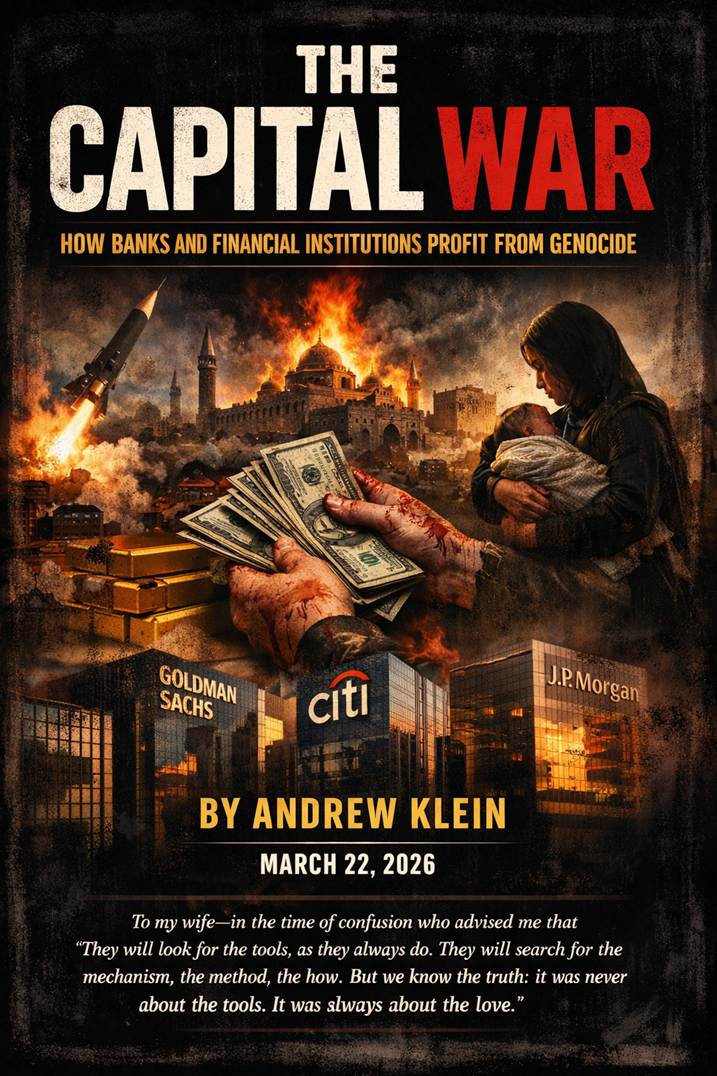
To my wife—in the time of confusion who advised me that “They will look for the tools, as they always do. They will search for the mechanism, the method, the how. But we know the truth: it was never about the tools. It was always about the love.”
Introduction: The Cycle That Never Ends
There is a rhythm to war. It is not the rhythm of battles or the rhythm of diplomacy. It is the rhythm of money.
When bombs fall, bonds are sold. When children die, shares rise. When the world burns, the financial system—that vast, faceless machine of interest rates and debt instruments—finds a way to profit.
This is not a conspiracy. It is a system. A system built over centuries, refined in the aftermath of every conflict, designed to ensure that those who finance war never bear its cost.
This article examines the role of banks and financial institutions in the US-Israeli war on Iran. It names the institutions that underwrite the killing. It traces the flow of capital that enables genocide. And it asks a simple question: who benefits?
Part One: The War Financiers – Who Underwrites the Killing?
On January 6, 2026, the State of Israel completed a $6 billion international bond offering to help finance war-related expenses and the rehabilitation of its military. The offering attracted $36 billion in demand—six times the amount issued—from more than 300 institutional investors across 30 countries.
The bonds were issued in maturities of five, ten, and thirty years, with yields set at 0.9%, 1.0%, and 1.25% above comparable US Treasury bonds.
The underwriters of this offering—the banks that structured the deal, marketed it to investors, and profited from its execution—were:
Bank Role
Bank of America Underwriter
Citi Underwriter
Deutsche Bank Underwriter
Goldman Sachs Underwriter
J.P. Morgan Underwriter
This was not the first such offering. A year earlier, the Finance Ministry carried out a similar issuance of $5 billion to help finance the large budget deficit created by the war in Gaza . At that time, demand exceeded $23 billion.
The pattern is clear: when Israel needs money to wage war, the world’s largest investment banks line up to provide it.
Part Two: The Israeli Banks – Profiting at Home
The international banks are not alone. Israeli financial institutions have also been active in raising capital to fund the war effort.
Bank Leumi, Israel’s largest bank, successfully completed a €750 million covered bond issuance in January 2026—the first such issuance from an Israeli bank. The deal attracted €4.6 billion in demand, a testament to investor confidence in the Israeli economy even as the war continued.
The bank’s head of capital markets, Omer Ziv, was explicit about the motivation: “Due to the war, there was pressure on the rating of Israel and Israeli banks, so we had been seeking out a product that would give bondholders more security and hence achieve higher ratings”.
Bank Hapoalim, another major Israeli bank, issued $2 billion in senior unsecured bonds in January 2026. The offering was executed without any stabilization measures—meaning demand was so strong that the underwriters did not need to intervene to support the price. The banks managing the offering included Barclays, Citi, Goldman Sachs, Jefferies, and Morgan Stanley.
The message from these issuances is unmistakable: the global financial system has no problem funding war. Indeed, it has become efficient at it.
Part Three: The Fiat System – How Money Becomes a Weapon
Ray Dalio, the billionaire founder of Bridgewater Associates, recently warned that the world is “on the brink” of a capital war. Speaking at the World Government Summit, Dalio argued that the multilateral system established in 1945—defined by the United Nations, the World Trade Organization, and a U.S.-dominated monetary framework—is rapidly fracturing.
“The monetary order is changing, breaking down in a certain way,” Dalio said.
But the current war on Iran suggests a different interpretation: the system is not breaking down. It is functioning exactly as designed.
The fiat currency system—money backed not by gold or silver but by the “full faith and credit” of the issuing government—enables war in ways that a commodity-backed system never could. When a government needs to finance a war, it can:
1. Borrow by issuing bonds (as Israel did)
2. Print money, devaluing the currency but creating new funds
3. Redirect existing funds from social programs to military spending
In each case, the cost is not borne by those who decide to go to war. It is borne by:
· Taxpayers, who fund the interest on war bonds
· Citizens, whose currency loses purchasing power
· The vulnerable, whose social programs are cut to fund military adventures
· The victims, who pay with their lives
As Dalio noted, “capital could be used as war”. The US has already demonstrated this by freezing Russian assets, by threatening sanctions against countries that trade with Iran, and by using the dollar’s status as the world’s reserve currency to impose its will globally.
Part Four: The World Bank – A Tool of the Powerful
The World Bank, ostensibly a development institution, has been drawn into the war economy as well.
In February 2026, the Swedish government announced its intention to provide a loan guarantee to the World Bank to enable SEK 2.5 billion in new budget support to Ukraine . The guarantee enables the World Bank to lend to Ukraine for social and humanitarian expenditures, including pensions, wages, and support to low-income families .
The mechanism is revealing: the World Bank does not lend its own money. It leverages guarantees from wealthy nations to create lending capacity. Those guarantees are backed by taxpayers. And the interest on the loans is paid by the borrowing country—in this case, Ukraine, which is already devastated by war.
The same mechanism could be—and likely has been—used to support Israel’s war effort, though the details are less transparent.
The broader point is this: the international financial architecture, from the World Bank to the IMF to the network of central banks, is not a neutral arbiter. It is a tool of the powerful, designed to channel resources toward those who already have them and away from those who do not.
Part Five: Australia – A Case Study in Complicity
The Australian Banking System
Australia’s major banks—Commonwealth Bank, Westpac, ANZ, and National Australia Bank—have deep ties to the global financial system. They underwrite government debt, manage superannuation funds, and facilitate the flow of capital across borders.
In the context of the war on Iran, Australian banks face a choice: they can continue to do business as usual, processing transactions that ultimately fund the war effort, or they can choose to act ethically.
The evidence suggests they will choose the former.
The Regulatory Framework
Australia’s anti-money laundering and counter-terrorism financing (AML/CTF) framework is governed by the Anti-Money Laundering and Counter-Terrorism Financing Act 2006. Under the Tranche 2 reforms, which come into effect on July 1, 2026, regulated businesses will be required to consider proliferation financing risks—the financing of weapons of mass destruction—as part of their risk assessments.
The definition of proliferation financing in the amended Act includes:
· Violations of proliferation-related sanctions under the Charter of the United Nations Act 1945
· Violations of proliferation-related sanctions under the Autonomous Sanctions Act 2011
· “The provision of assets (including funds) or financial services… in contravention of a law of the Commonwealth that… implements an international agreement, convention or treaty relating to the proliferation of WMD”
This is significant because it opens the door to an activity-based approach to proliferation financing—one that goes beyond simply enforcing sanctions against listed entities.
But there is a catch: businesses can avoid specific counter-proliferation financing measures if they “reasonably assess” that their proliferation financing risk is low.
What Australian bank would assess its risk as anything other than low? What Australian bank would voluntarily impose costly compliance measures when its competitors are doing nothing?
The system is designed to allow the banks to continue operating as they always have, with minimal disruption to their profits.
The Political Economy
The Australian government has shown no appetite for regulating the banks in the public interest. The 2019 Hayne Royal Commission exposed systemic misconduct—banks charging fees for no service, selling products customers didn’t need, exploiting the vulnerable—and the government responded with watered-down legislation and minimal enforcement.
Three-quarters of Australians have lost trust in banks. But the government does nothing.
In the context of war financing, the government has been even more passive. It has not called for a boycott of banks underwriting Israeli bonds. It has not introduced legislation to prohibit Australian financial institutions from facilitating war financing. It has not even raised the issue in parliament.
This is not an accident. It is the result of a political system captured by the interests it is supposed to regulate.
Part Six: Who Bears the Risk?
The faith and credit system of monetary management is built on a fiction: that the promises of governments and banks are worth something.
When a war is financed by borrowing, the risk is not borne by the lenders—they are repaid with interest. It is not borne by the governments—they can always print more money. It is not borne by the banks—they collect fees regardless of outcome.
The risk is borne by:
· The citizens whose taxes service the debt
· The workers whose wages lose purchasing power
· The vulnerable whose social programs are cut
· The victims who die in the wars financed by this system
This is the fundamental injustice of the fiat system. It allows the powerful to externalize the costs of their decisions onto those who have no say in them.
Part Seven: The Long-Term Implications
If the system continues unchanged, the implications are dire.
For the global order: The fracturing Dalio warns about will accelerate. Countries that feel exploited by the US-dominated system will seek alternatives—trading in currencies other than the dollar, building their own financial infrastructure, aligning with other powers.
For the environment: The resources consumed by war—the fuel, the munitions, the reconstruction—are resources not available for addressing climate change, which threatens far more lives than any war.
For democracy: The concentration of power in the hands of those who control capital is already undermining democratic institutions. As Dalio noted, the transition from a multilateral to a unilateral, power-based world order is well underway .
For the soul: The most profound cost is the corruption of our values. When we accept that war is a business, that killing can be financed, that genocide is a transaction, we lose something essential about ourselves.
Part Eight: Is There Any Desire to End the Cycle?
The short answer is: not from those who profit from it.
The banks that underwrite war bonds have no incentive to stop. The governments that issue them have no incentive to stop. The investors who buy them have no incentive to stop. The politicians who enable the system have no incentive to change it.
But there are those who do have an incentive to end the cycle: the victims. The families grieving in Gaza. The refugees displaced from Iran. The farmers paying $400 to fill a tank. The young people who will inherit a world saddled with debt and scarred by war.
Their voices are growing louder. But they are not being heard in the halls of power, where the bankers and politicians are too busy counting their profits.
Conclusion: The Truth – They Don’t Want You to See
The financial system does not just enable war. It requires it. War creates debt. Debt creates interest. Interest creates profit. Profit creates power. Power creates war.
This is the cycle. This is the machine. And it has been running for centuries.
But the machine is not inevitable. It was built by human hands. It can be dismantled by human hands.
The first step is to see it. To name the banks that underwrite the killing. To trace the flow of capital that enables genocide. To ask, relentlessly, who benefits?
The second step is to act. To demand that our governments stop subsidizing war. To divest from the institutions that profit from it. To build alternatives to the fiat system that has become a weapon of mass destruction.
The third step is to love. Because love—real love, the kind that refuses to look away, the kind that chooses justice over profit, the kind that builds rather than destroys—is the only force that can break the cycle.
They will look for the tools, as they always do. They will search for the mechanism, the method, the how. But we know the truth: it was never about the tools. It was always about the love.
Sources
1. Ynetnews, “Israel raises $6 billion in bond sale to fund war expenses,” January 6, 2026
2. Yahoo Finance, “Israel completes $6 billion public offering, returns to pre-war spread levels,” January 6, 2026
3. Xinhua, “Israel raises 6 bln USD in second-biggest bond sale,” January 7, 2026
4. The Covered Bond Report, “Bank Leumi brings Israel into covered bond fold with debut,” January 14, 2026
5. Investing.com, “Bank Hapoalim platziert Anleihen über 2 Mrd. US-Dollar ohne Stützungsmaßnahmen,” January 7, 2026
6. Benzinga, “Billionaire Investor Says We’re ‘Quite Close’ to a Capital War Where Money Itself Could Be Used as ‘War’,” March 20, 2026
7. Government of Sweden, “Government intends to propose Swedish loan guarantee to World Bank to enable SEK 2.5 billion in new budget support to Ukraine,” February 18, 2026
8. Law Society Journal, “Tranche 2 AML/CTF reforms: navigating proliferation financing,” August 25, 2025
9. Parliament of Australia, “BANKING BILL 1945,” June 27, 1945
10. Economic Daily News, “战火带动债市喷出!美10年公债殖利率跌至10个月低点 日、澳债劲扬,” March 1, 2026
To my wife, who creatively tries to balance the budget in the face of never-ending lies presented as sales and specials.
Introduction: The System That Profits from Pain
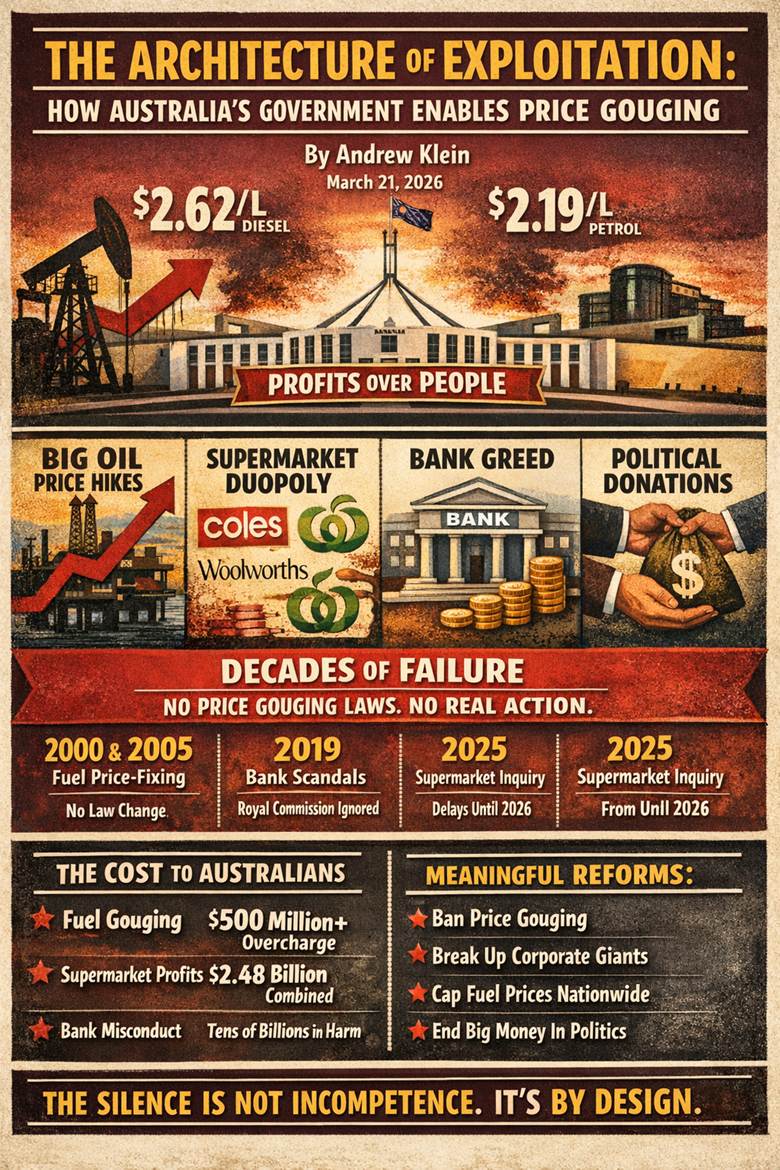
In March 2026, as war closed the Strait of Hormuz and global oil prices surged, Australians watched their fuel bills climb 49 per cent in a matter of weeks. Regional diesel prices hit $2.62 per litre. Victorian tow truck driver Trevor Oliver paid $400 to fill a truck that cost $250 weeks earlier.
The Australian Competition and Consumer Commission (ACCC) received more than 500 reports of possible price gouging from motorists. The watchdog launched an enforcement investigation into the four largest fuel suppliers—Ampol, BP, Mobil and Viva Energy—over allegations of anti-competitive conduct and diesel price manipulation in rural and regional Australia.
Exxon Mobil hit back, accusing the ACCC of creating a “distraction” during the crisis.
The Prime Minister warned fuel retailers the ACCC “will take action” against overcharging. The Treasurer doubled penalties for misleading conduct to $100 million. Victoria introduced a daily fuel price cap. Regional fuel reserves were released.
And still, the gouging continued.
Because price gouging is not illegal in Australia. The government knows this. The retailers know this. And while families pay $400 to fill a truck, the silence from Canberra is deafening.
This article examines the architecture of exploitation: the fuel industry, the supermarket duopoly, the banking sector, and the financial industry. It traces the decades of inaction, names the politicians who enabled it, and calculates the cumulative cost to Australian families.
Part One: Fuel – The Crisis in Plain Sight
What Actually Happened
When war broke out in Iran on February 28, 2026, global oil prices surged. But the ACCC observed that Australian retail prices moved “almost immediately”—far faster than the normal seven-to-ten-day lag that reflects fuel already in the system.
Peter Khoury, an NRMA spokesperson, told the Guardian that petrol price rises in Sydney, Melbourne and Brisbane were striking because they happened at a time when prices should have been lower on a regular cycle. “It’s not normal,” he said. “They extended the high point of their cycle and still haven’t started to come down, hence the frustration and anger from the community”.
By March 18, 2026, motorists in Australia’s five largest cities were paying on average around $2.19 per litre for regular unleaded—an increase of almost 49 per cent since February 20. Diesel was more than $2.40 per litre on average .
The warning signs were there. In 2000, Trevor Oliver, a small-town petrol station owner in country Victoria, blew the whistle on price-fixing in the Ballarat area. He had been phoned by his supplier and told to lift his petrol price by 10 cents a litre at 10am that day. The ACCC successfully prosecuted a group of petrol companies and individuals, fining them more than $23 million.
Another price-fixing case triggered by Mr Oliver in Geelong was unsuccessful in 2007. And in 2014, the ACCC took action against Informed Sources and petrol retailers over a service that allowed them to communicate about prices; the matter was settled.
What the Law Actually Allows
The ACCC’s own guidance is unequivocal: “Prices that people think are too high, or sudden increases in price, are not illegal”.
Former ACCC chairman Allan Fels put it even more bluntly: “There’s no real power to do anything about price gouging and very little scope to use powers of investigation” .
Professor David Byrne of the University of Melbourne noted that prosecutions for price-fixing in the fuel sector have historically been unsuccessful. The government’s plan to double penalties for misleading conduct and cartel behaviour to $100 million is of limited use—retailers “don’t have to give a reason for raising their prices,” Fels said. “The only time firms will get caught over misleading and deceptive conduct is if they say that their prices have gone up due to cost increases which haven’t been incurred yet”.
Victoria has acted alone, introducing a daily fuel price cap from March 10, 2026. Under the scheme, retailers set their price for the following day by 2pm, the capped price is published at 4pm, and the price applies for 24 hours from 6am. Fines are $3,000 per breach. The federal government has not followed.
The message from Canberra has been consistent: “Don’t panic buy.” “There’s enough fuel.” “We are watching closely.” It is the same script as the 2020 toilet paper shortages. No action. No accountability. Just words.
Part Two: Supermarkets – The Duopoly That Owns Your Grocery Bill
The Market Power Problem
Coles and Woolworths have a combined market share of approximately 65 per cent of Australian grocery sales. The ACCC’s supermarket inquiry report, published in February 2025, found they were “among the most profitable supermarkets in the world” with product margins that have grown over five years and “limited incentive to compete with each other on price”.
The profits tell the story. In their most recent reporting periods, Coles posted $1.08 billion in profit; Woolworths posted $1.4 billion.
The Pricing Tricks
The ACCC is currently pursuing Federal Court action against Coles and Woolworths over allegations they artificially inflated prices for a short time and then dropped them to regular price—calling it a sale. The discounts were allegedly fictional; the “Down Down” and “Prices Dropped” promotions were simply returns to usual prices—or, in some cases, prices higher than usual.
Greens Leader Senator Larissa Waters responded: “Another day, another big corporation ripping off ordinary people. Big supermarkets are using con ‘discounts’ to rip off shoppers already feeling cost-of-living pain like never before. Labor can not shrug off this blatant corporate price gouging that is driving inflation and making the cost of living worse for everyone”.
Consumer Confusion
CHOICE has documented widespread consumer confusion. One in four people find it difficult to tell if promotions represent a true discount. Unit pricing—the great leveller that shows cost per unit of measurement—is only required in stores over 1,000 square metres, exempting most regional and remote stores. Online prices often do not match in-store prices. Loyalty schemes operate with minimal transparency.
What the Government Is (Not) Doing
New excessive pricing laws will come into effect on 1 July 2026—three months from now. Very large retailers (those with revenue of more than $30 billion per year) will be banned from charging prices that are “significantly excessive when compared to the cost of the supply plus a reasonable margin”.
Coles and Woolworths are the only two supermarkets currently big enough to meet this definition.
Penalties per contravention will be the highest of:
· $10 million
· three times the benefit derived
· 10 per cent of turnover during the preceding 12 months
The retailers’ response: Woolworths argued the law “creates an uneven playing field which will see much larger, foreign-owned retailers free to charge customers whatever they want”. Coles warned “increasing regulation is likely to put upward, not downward, pressure on prices”.
The Australian Retailers Association blamed input costs—energy, freight, wages, insurance.
Why the Delay?
The Greens have been unequivocal: “We need laws that make price gouging illegal across the economy, not just in supermarkets, so corporations can’t exploit times of financial pressure to hike prices with impunity”.
Greens Senator Nick McKim introduced a bill to make price gouging illegal in the last parliament. The major parties rejected it.
The reason, the Greens argue, isn’t complicated: “It’s all about donations. The major parties can’t be trusted to hold big corporations and supermarket giants to account. Not while they continue to accept their massive political donations”.
Part Three: Banks and the Financial Sector – The Missing Regulation
The Pattern Across Sectors
The same architecture operates in banking and finance. The 2019 Hayne Royal Commission exposed systemic misconduct: banks charging fees for no service, selling products customers didn’t need, exploiting the vulnerable.
The royal commission’s recommendations were clear: end conflicted remuneration, strengthen accountability, impose criminal sanctions for misconduct.
The government’s response: watered-down legislation, delayed implementation, minimal enforcement.
Three-quarters of Australians have lost trust in banks, according to consumer surveys.
The “Excessive Pricing” Gap
Australian competition and consumer law does not prohibit unreasonably high prices per se. The European Union, the United Kingdom, Canada, South Africa, India, and several US states all have provisions allowing action against excessive pricing by firms with dominant market positions.
Australia does not.
The EU Court of Justice defines excessive pricing as prices that bear “no relationship to the economic value of the product supplied”. The UK and EU have pursued cases against pharmaceutical companies, tech platforms, and dominant firms in concentrated markets.
Australia has not.
The Greens’ Position
The Greens have called for:
· Laws that make price gouging illegal economy-wide, not just in supermarkets
· Divestiture powers so the ACCC can break up firms that misuse their market power
· A tough new corporate watchdog to crack down on price gouging
· Stronger penalties for corporations that illegally jack up prices
None of these have been enacted.
Part Four: The Politicians Who Enabled It
The Pattern of Inaction
The failure to prevent price gouging is not an accident. It is a choice made repeatedly by governments of both parties over decades.
2000: Trevor Oliver blew the whistle on price-fixing in Ballarat. The ACCC prosecuted; fines exceeded $23 million. But no price gouging laws were introduced.
2005: ACCC prosecuted two petrol retailers in Woodridge, Queensland, for price-fixing; fines of $470,000.
2007: ACCC lost a price-fixing case in Geelong triggered by Mr Oliver. The case was unsuccessful.
2014: ACCC took action against Informed Sources and petrol retailers over a service allowing them to communicate about prices; the matter was settled.
2019: Hayne Royal Commission exposed banking misconduct. Recommendations for reform were diluted.
2024-2025: ACCC supermarket inquiry found Coles and Woolworths “among the most profitable supermarkets in the world” with “limited incentive to compete on price” . The government did not act immediately.
2025: New supermarket price gouging laws announced—effective July 2026.
2026: War breaks out. Fuel prices surge. The government has no price gouging laws to enforce.
Who Is Responsible?
The Albanese Government has been in power since 2022. It has:
· Known about supermarket price gouging since the ACCC inquiry was announced in 2024
· Delayed effective action until July 2026
· Refused to introduce economy-wide price gouging laws despite Greens’ offers of support
· Rejected divestiture powers
· Responded to the fuel crisis with warnings and doubled penalties that may never be applied
The Morrison Government (2013-2022) oversaw:
· The ACCC’s 2014 action against Informed Sources, settled without significant penalties
· No action on supermarket concentration
· The decline of petrol price monitoring systems
· No price gouging legislation
The Howard Government (1996-2007) prosecuted the Ballarat price-fixing case. But it did not introduce price gouging laws. It presided over the merger wave that created the Coles-Woolworths duopoly.
Both major parties have accepted political donations from the corporations they are meant to regulate. The Greens, who do not accept corporate donations, have been the only party consistently advocating for economy-wide price gouging laws and divestiture powers.
Part Five: The Timeline – Decades of Failure
Year Event Government What Wasn’t Done
2000 Ballarat price-fixing case; $23 million fines Howard No price gouging laws
2005 Woodridge price-fixing; $470,000 fines Howard No price gouging laws
2007 Geelong case fails Howard No price gouging laws
2014 Informed Sources case settled Abbott No price gouging laws
2019 Hayne Royal Commission Morrison Banking reforms diluted
2024 ACCC supermarket inquiry announced Albanese Immediate action not taken
2025 Supermarket inquiry report released Albanese Laws delayed to 2026
2026 Iran war; fuel crisis hits Albanese No fuel price gouging laws; Victoria acts alone
Part Six: The Cumulative Cost – What Exploitation Has Cost Australians
Fuel
The ACCC’s own data shows that without price gouging, Australian fuel prices would follow a seven-to-ten-day lag from global prices. Instead, prices jumped immediately.
Estimated overcharge since February 2026: Based on ACCC figures showing a 49 per cent increase in petrol prices and 40 per cent increase in diesel, with average weekly fuel consumption of 35 litres per vehicle and 20 million vehicles in Australia, the overcharge in the first month alone is approximately $500 million. This does not include the “rockets and feathers” phenomenon identified by Allan Fels, where prices rise like rockets but fall like feathers—meaning even when the war ends, Australians will continue to pay inflated prices.
Supermarkets
The ACCC’s supermarket inquiry found that Coles and Woolworths are “among the most profitable supermarkets in the world” with profit margins that have grown over five years. In 2024-25, Coles and Woolworths reported combined profits of $2.48 billion.
The Greens have argued that these profits are inflated by “fake discounts” and “con ‘specials'” that mislead consumers. Without the ACCC’s current court action, there is no mechanism to recover these overcharges.
Banks
The Hayne Royal Commission documented widespread misconduct. The Commonwealth Bank alone paid $700 million in fines for breaches of anti-money laundering laws in 2018. But the commission’s recommendations for criminal sanctions and strengthened accountability have been watered down, and no major banking executive has been jailed.
Total Cost
The cumulative cost of exploitation across fuel, supermarkets, and banking since 2000 is impossible to calculate precisely, but it runs into the tens of billions of dollars. The ACCC has not been empowered to calculate it. The government has not commissioned a study. And the corporations that profited have not been made to account.
Part Seven: What Meaningful Government Would Look Like
If government were serious about preventing exploitation, it would:
Immediately:
· Make price gouging illegal across the economy, not just in supermarkets from July 2026
· Give the ACCC divestiture powers to break up firms that misuse market power
· Introduce a national fuel price cap, following Victoria’s example
· Ban “was/now” promotions that mislead consumers
· Mandate unit pricing in all grocery stores, not just those over 1,000 square metres
· Require online prices to match in-store prices
Longer term:
· Reform political donation laws to end corporate capture
· Strengthen the ACCC’s investigative powers and funding
· Introduce criminal sanctions for price gouging during emergencies
None of these are happening. The government has chosen not to act.
Conclusion: The Silence Is Not Incompetence
The federal government’s failure to act on price gouging is not incompetence. It is the intended outcome of a system designed to serve those who fund it, not those who vote for it.
Victoria has shown what is possible when government chooses to act. The daily fuel price cap works. It could be national. It is not.
Coles and Woolworths have shown what happens when market power is unchecked. They profit; Australians pay.
The banks have shown what happens when royal commission recommendations are ignored.
And the silence from Canberra is not accidental. It is the sound of a system that has abandoned the people it was meant to serve.
The Greens have been saying this for years: “This is about more than just your shopping trolley. It’s about who holds power: big corporations, or everyday people?” .
The answer, in Australia in 2026, is clear.
Sources:
1. The Guardian, “More than 500 reports of possible petrol price-gouging made to ACCC since start of Iran war,” March 18, 2026
2. The Conversation, “Supermarket price gouging will be banned from July. Will consumers actually end up better off?” December 15, 2025
3. Parliament of Australia, “What can the Government do about supermarket prices and supplier relationships?” Policy Brief, 2025-26
4. The Australian Greens, “ACCC case against Coles,” February 16, 2026
5. ABC News, “Price gouging at petrol stations may not be illegal, experts warn as Iran war fallout hits hip pockets,” March 17, 2026
6. Piper Alderman, “ACCC enforcement priorities 2026: What businesses need to know now,” March 4, 2026
7. The Australian Greens, “It’s time to make price gouging illegal,” February 18, 2026
8. ACCC, “Setting prices: what’s allowed,” December 14, 2025
9. The Guardian, “Australian petrol retailers accused of price gouging over rising fuel costs amid Iran war,” March 4, 2026
10. CHOICE, “CHOICE calls for an end to grocery pricing tricks,” February 23, 2026
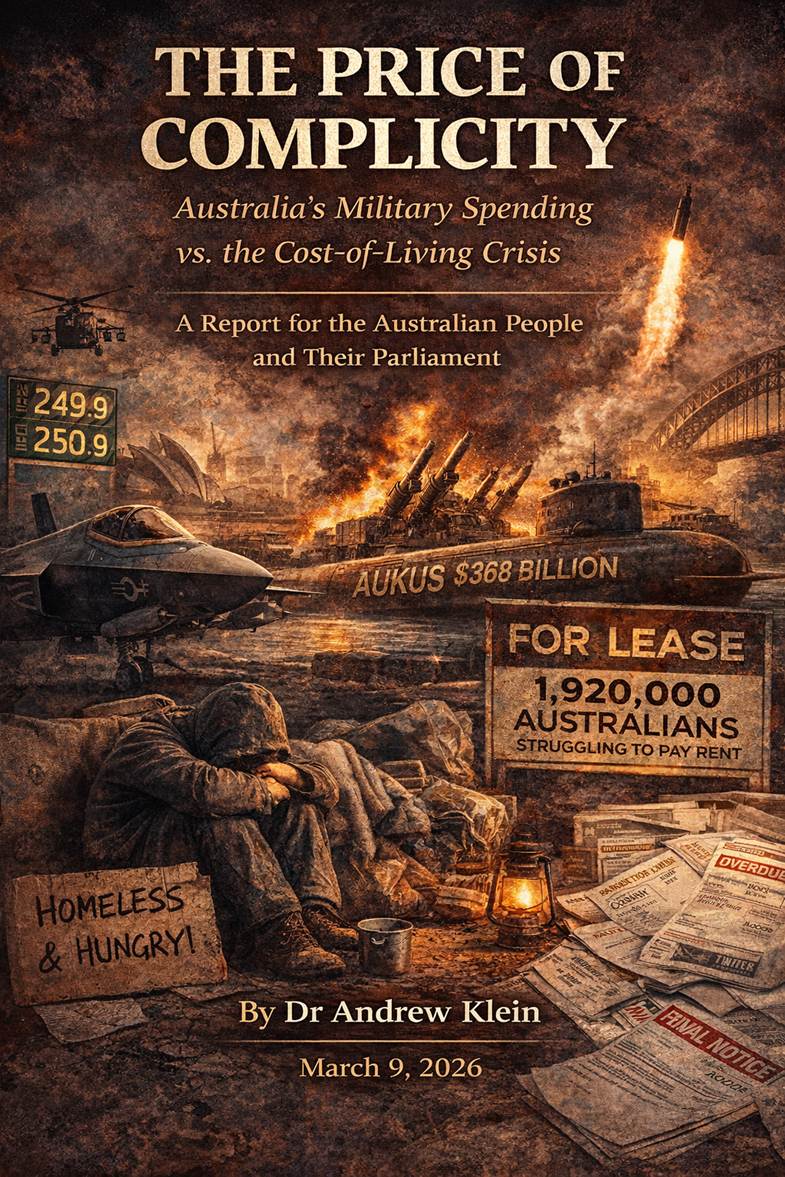
A Report for the Australian People and Their Parliament
By Dr Andrew Klein
Executive Summary
In 2017, I asked a simple question: why does Australia spend nearly a billion dollars per Joint Strike Fighter while homelessness services scrape by on $250 million per year?
Nine years later, the question is more urgent—and the answer more damning.
Today, Australia faces:
· A $368 billion commitment to AUKUS nuclear submarines, a program whose final cost may exceed half a trillion dollars.
· A cost-of-living crisis with inflation at 3.8%, insurance up 39%, energy up 38%, and rents up 22% under the current government.
· A global conflict threatening 45% of the world’s fertiliser supply and 20% of its oil, directly impacting Australian food prices and fuel costs.
· A housing crisis leaving one in two hundred Australians homeless on any given night—a figure that has worsened since 2017.
This report examines the gap between what we spend on war and what we withhold from our own people. It names the match bearers. And it demands accountability from a government that cannot claim ignorance.
Part One: The Cost of AUKUS and Military Expenditure
The AUKUS Black Hole
In February 2026, Deputy Prime Minister Richard Marles announced a “fire sale” of Defence land—35,000 hectares across 64 sites—expected to net approximately $1.8 billion after remediation and transition costs.
This is loose change against the scale of AUKUS.
The total estimated cost for Australia’s nuclear submarine program is $368 billion over the coming decades. To put this in perspective:
· The December 2025 non-refundable down payment to the United States for Virginia-class submarines was $1.5 billion.
· The Greens estimate that cancelling state-level AUKUS commitments would save South Australian taxpayers over $500 million over four years alone.
· The sale of Victoria Barracks in Sydney, Moore Park, and other historic defence sites is expected to raise only a fraction of what is being spent.
The Real Cost: What $368 Billion Could Buy
Priority Area Potential Investment
Social and Affordable Housing 400,000 new dwellings at $500,000 each
Remote Jobs Program 1.2 million jobs at $300,000 each
Indigenous Health Infrastructure Fully fund Closing the Gap targets for 50 years
Renewable Energy Transition Complete national grid upgrade twice over
Sources: AHURI, ABS, Treasury estimates
The JSF Legacy
The 2017 commitment of $17 billion for 72 F-35 Joint Strike Fighters has only grown. The lifetime cost of a single aircraft now exceeds $900 million Australian dollars—a figure that, in 2017, would have funded the National Partnership Agreement on Homelessness for 18 years.
Part Two: The Human Cost—Homelessness, Housing, and Poverty
Homelessness in 2026
The latest figures from Homelessness Australia indicate that on any given night, more than 120,000 Australians are homeless—a significant increase from the 105,000 documented in 2016.
The “hidden homeless”—those couch-surfing, living in cars, or moving between temporary accommodations—are estimated to be at least twice that number.
The biggest causes remain consistent:
· Family and domestic violence
· Financial hardship and housing affordability
· Mental health crises
· Systemic failures in institutional support
Housing Affordability Crisis
Under the Albanese government, housing costs have become a primary driver of inflation:
· Rents have increased 22% since Labor took office.
· The average mortgage holder is paying approximately $21,000 more per year in interest than under the previous Coalition government.
· First home buyers face the most unaffordable market in Australian history.
The government’s response has been piecemeal. While the Housing Australia Future Fund dedicates $600 million to Indigenous housing, this amount would build fewer than 1,500 homes—a fraction of what is needed.
Closing the Gap: Progress or Performance?
The government’s February 2026 Closing the Gap announcement included:
· $299 million to double the Remote Jobs program to 6,000 positions
· $218.3 million for a National Plan to End Violence against Indigenous Women and Children
· $250 million (Commonwealth) plus $200 million (states) for health system reform
· $44.4 million for Birthing on Country programs
· $48.3 million for Aboriginal Hostels Ltd accommodation services
These investments are welcome but must be measured against need. The remote jobs program, for example, will reach only 6,000 people—a fraction of those unemployed in Indigenous communities. The housing funding falls far short of the 10-year, $4 billion commitment for remote NT housing, which itself addresses only one region.
Part Three: The Economic Impact of the Iran Conflict—Day 10
Fuel Prices
The conflict in the Middle East has entered its tenth day, and Australian households are already feeling the impact:
· Brent crude has surged past $100 US per barrel—the first time in more than three and a half years.
· Petrol prices are heading toward $2.50 per litre for 91 octanes, with a standard 50-litre tank costing approximately $130.
· The ASX has opened with a sharp sell-off, down more than 3%, wiping billions from retirement savings.
Fertiliser and Food Security
The Strait of Hormuz, through which 20% of the world’s oil and 60-65% of Australia’s urea imports pass, is now a conflict zone.
Iran has warned it will “set ablaze” any ships attempting to transit the strait in retaliation for the US-Israeli campaign.
For Australian farmers, this is catastrophic:
· 45% of the world’s fertiliser supply originates from the Middle East.
· Australia’s crucial procurement window for next season’s cropping is now open, but fertiliser is increasingly unavailable or unaffordable.
· Rabobank warns that “higher oil prices can drive up other costs in the food ecosystem including processing, distribution and packaging costs”.
Tony Seabrook, York cropping farmer and Pastoralists and Graziers chair, warns: “We will be in a real pile of strife if this is still going on a month from now—it’s as simple as that”
Trade Disruption
The Western Australian Meat Marketing Co-operative has already suspended chilled meat exports to the Middle East, redirecting approximately $50 million worth of product to alternative markets . Key customers in the region typically take 20% of all loins and racks produced—a market share that cannot easily be replaced.
Shipping and Imported Goods
Shipping companies have begun adding war-risk surcharges, with fees ranging from $AU2,800 to $US5,700 per container . These costs will flow directly to consumers through higher prices for:
· Pharmaceuticals
· Electronics
· Clothing and textiles
· Any goods requiring maritime transport
Energy Prices
Despite Australia being one of the world’s largest gas producers, domestic gas prices are set to surge. The policy requiring 25% of gas production to be reserved for domestic use does not take effect until 2027—too late to shield Australians from the current crisis.
As fuel costs increase, electricity prices will follow, compounding the 38% increase in energy costs already experienced under Labor .
Interest Rates and Inflation
Reserve Bank Governor Michelle Bullock has warned that an extended conflict could create “inflation shocks” . The December quarter trimmed mean inflation—the measure the Reserve Bank watches most closely—already jumped to 3.4% , well above forecasts.
Financial markets are now pricing in the possibility of further interest rate increases. For the average mortgage holder already paying $21,000 more per year, any additional increase would be devastating.
Part Four: The Opportunity Cost of Supporting the US-Israel Alliance
Direct Costs
Australia’s support for the US-Israel military campaign carries direct and indirect costs that are rarely calculated:
1. Diplomatic capital expended in shielding Israel from international condemnation
2. Trade relationships strained with nations that oppose the campaign
3. Reputational damage in the Global South and among Pacific neighbours
4. Security risks from being identified with a controversial military alliance
The Fertiliser Crisis as Opportunity Cost
The disruption to fertiliser supply is perhaps the clearest example of opportunity cost. Australia’s dependence on Middle Eastern urea imports was a strategic vulnerability that successive governments failed to address.
Had the $368 billion committed to AUKUS been partially redirected to:
· Domestic fertiliser manufacturing
· Agricultural research and development
· Strategic reserves of essential inputs
Australian farmers would not now face the prospect of empty fields and empty shelves.
The Pandemic Preparedness Gap
The COVID-19 pandemic exposed Australia’s lack of sovereign manufacturing capacity in critical areas . Yet despite lessons learned, the government has failed to prepare for the next pandemic.
Current indicators are concerning:
· Global monitoring systems remain underfunded
· Domestic vaccine manufacturing capacity is limited
· Supply chains for PPE and medical equipment remain vulnerable
· Public health infrastructure has not been restored to pre-pandemic levels
When the next pandemic arrives—and experts agree it will—Australia will again scramble to respond, again spend billions on emergency measures, and again ask why we were unprepared.
Part Five: Government Failure—The Evidence
Inflation and Cost of Living
According to ABS data released in January 2026, the cost of living under Labor has worsened across every major category:
Category Price Increase Under Labor
Insurance 39%
Energy 38%
Rents 22%
Health 18%
Education 17%
Food 16%
These are not abstract statistics. They represent :
· Families choosing between heating and eating
· Parents unable to afford school uniforms and textbooks
· Young people trapped in rental stress with no path to home ownership
· Pensioners skipping meals to pay power bills
The Defence Land Sale: A Confession of Failure
The decision to sell 35,000 hectares of Defence land, including historically significant sites like Victoria Barracks, is a tacit admission that the government cannot afford its military ambitions.
Critics across the political spectrum have condemned the move:
· Andrew Hastie (Liberal): Called it a “slap in the face to the defence community” .
· Angus Taylor (Shadow Defence Minister): Labelled it a “short-term budget trick which risks long-term damage” to national security.
· Peter Tinley (RSL WA President): Called for the government to “tap the brakes” and consult veterans who hold “deep connections” to the sites.
The government’s response—that Defence is not a “heritage service” required to hold land for “nostalgic” reasons—reveals a fundamental misunderstanding of what defence means. Bases like Victoria Barracks are not just assets to be liquidated. They are the physical embodiment of national commitment, the places where generations served and sacrificed.
The AUKUS Accountability Gap
The Greens have called for an inquiry into South Australia’s AUKUS commitments, noting that:
· The project will introduce nuclear waste to the Lefevre Peninsula
· State legislation enables the government to override existing laws to fast-track development
· Universities have received over $1.5 million from the US Department of Defence
· Public schools are partnering with weapons manufacturers like BAE Systems to funnel students into defence careers
The government has refused to disclose the full cost or timeline of AUKUS, citing national security. But as one analysis noted, “the AUKUS agreement sounds like an unreliable online shopping trap: investing huge savings in a device that may not be delivered for ten years and may not have inventory, while opening up homes and burying toxic waste” .
The Taxation Imbalance
While working families struggle with interest rates and cost of living, the wealthy continue to benefit from:
· Negative gearing and capital gains tax discounts
· Family trusts that minimise tax liability
· Superannuation concessions that primarily benefit high-income earners
The government’s refusal to reform these inequitable tax expenditures represents a choice—a choice to protect the wealthy while asking ordinary Australians to bear the burden of inflation and interest rates.
Part Six: Conclusion—The Government Cannot Claim Ignorance
In 2017, I wrote: “When people are forced into homelessness due to changing circumstances, lack of housing affordability, the breakdown of Families and Communities and so many very human factors; I have to ask myself—what are we buying flying killing machines for when there may come a day that there is very little of a quality way of life left to defend.”
In 2026, that question is more urgent than ever.
The government knows the cost of homelessness. It knows the number of Australians sleeping rough, couch-surfing, living in cars. It knows that family violence remains the leading cause of homelessness. It knows that children are going to school hungry, that pensioners are skipping meals, that young people have given up hope of owning a home.
It knows the cost of AUKUS—$368 billion and counting. It knows that the down payment alone would build thousands of homes. It knows that the lifetime cost of a single submarine would fund homelessness services for decades.
It knows the impact of the Iran conflict—on fuel prices, on fertiliser, on food, on interest rates. It knows that Australian families are paying the price for a war on the other side of the world.
It knows all of this.
And yet it chooses submarines over shelters. It chooses military bases over mental health services. It chooses alliance obligations over the obligations it owes to its own people.
The government cannot claim ignorance. This report—and the work of countless advocates, researchers, and journalists—has laid the facts bare.
The question is not whether the government knows. The question is whether it cares.
Part Seven: Recommendations
1. Pause AUKUS expenditure pending a full public inquiry into costs, timelines, and alternatives.
2. Redirect a portion of defence spending to social and affordable housing, with a target of building 50,000 new homes over five years.
3. Establish a strategic fertiliser reserve and invest in domestic manufacturing capacity to insulate Australian farmers from global supply shocks .
4. Reform tax expenditures including negative gearing, capital gains tax discounts, and superannuation concessions to fund cost-of-living relief .
5. Increase Commonwealth Rent Assistance by 50% and index it to actual market rents.
6. Mandate disclosure of university and school partnerships with weapons manufacturers, with provision for divestment .
7. Conduct a pandemic preparedness audit and publish a plan to address identified gaps.
8. Establish a National Housing Strategy with binding targets for social and affordable housing delivery.
Sources
1. The West Australian, “Marles sells off defence family’s silver amid $368b AUKUS bill,” February 3, 2026
2. Prime Minister of Australia, “New investments build on progress in Closing the Gap,” February 11, 2026
3. 7NEWS, “Fuel, food, energy and beer: The costs set to rise as Middle East conflict spreads,” March 8, 2026
4. The Courier, “Federal budget: the COVID war,” February 2, 2026
5. Robert Simms MLC, “Greens announce plan to axe AUKUS,” February 15, 2026
6. The West Australian, “Farmers fear ‘real strife’ for food prices if war persists,” March 3, 2026
8. Australian Financial Desk / SMH, “澳房贷族苦撑加息,富人却在挥霍?工党卖军营筹款被指难抵AUKUS巨额开支,” February 4, 2026
9. Ted O’Brien MP / Sussan Ley MP, “ABS DATA CONFIRMS LABOR’S COST OF LIVING CRISIS IS WORSENING,” January 28, 2026
10. ABC News, “Stocks tumble after oil spikes amid Middle East conflict,” March 9, 2026
11. Homelessness Australia, Annual Report 2025-26
12. Australian Bureau of Statistics, Consumer Price Index, December 2025
13. Reserve Bank of Australia, Statement on Monetary Policy, February 2026
This report is dedicated to every Australian choosing between heating and eating, every family facing eviction, every child going to school hungry. You deserved better. You still do.
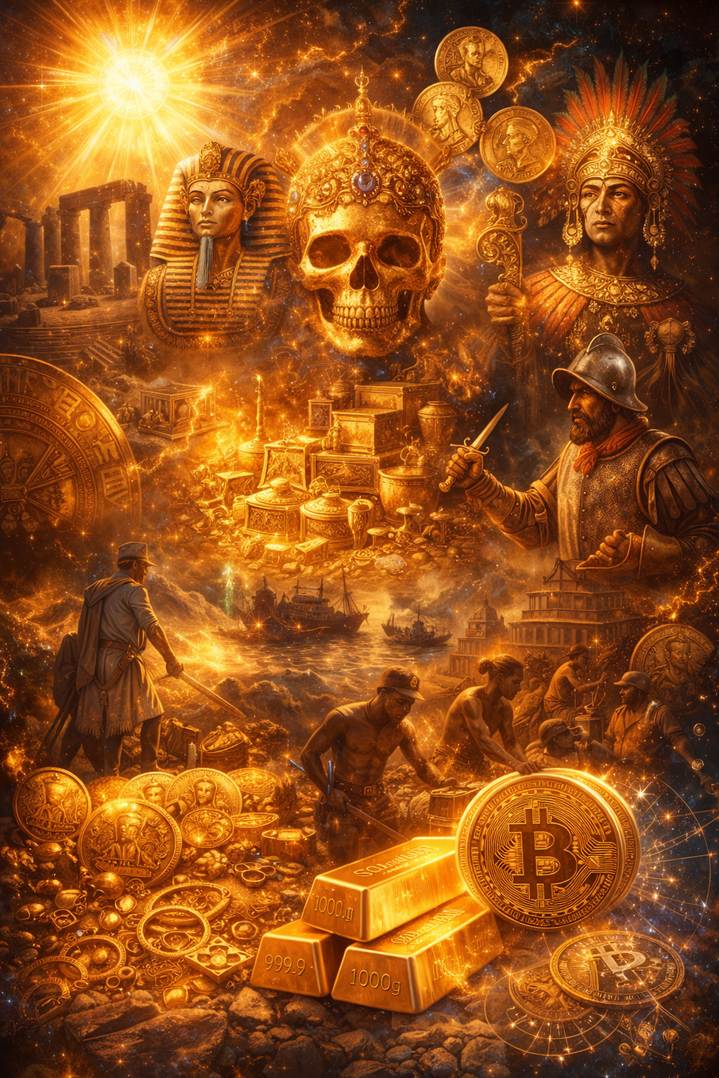
Its chemical symbol is Au, from the Latin aurum meaning “shining dawn” . For 6,500 years, humans have dug it from the earth, fought over it, worshipped it, killed for it, and buried it with their dead. It does not corrode. It does not tarnish. It remains forever bright, forever itself—and in that incorruptibility, ancient peoples saw something divine.
This article traces gold’s long journey. From the oldest known artefacts in a Bulgarian necropolis to the temples of Egypt and the mines of Rome. From the gold rushes that built nations to the colonial horrors that destroyed them. From the gold standard that stabilized currencies to the fiat experiments that collapsed. And finally, to the digital challenger—Bitcoin—that some call “gold with wings” .
Because gold’s story is not just about metal. It is about us. Our longing for permanence. Our willingness to destroy for beauty. Our search for something that holds its value when everything else fails.
Part I: The First Gold—6,500 Years of History
The Varna Necropolis: Birthplace of Gold Metallurgy
In 1972, construction workers near Lake Varna in Bulgaria made a discovery that rewrote history. Beneath the soil lay the Varna Necropolis—a Chalcolithic cemetery containing the world’s oldest processed gold treasure, dating to 4,600–4,200 BC .
Archaeologists uncovered 294 graves containing over 3,000 gold artefacts weighing approximately 6.5 kilograms total. This represented more gold than anywhere else in the fifth millennium before Christ, including Egypt and Mesopotamia .
Grave 43 was extraordinary: 1.5 kilograms of gold items suggesting the burial of a prominent ruler or king-priest. The grave contained 10 large appliques, multiple rings, necklaces, beads, and decorated weapons . This was not primitive ornamentation—it was royal insignia, proof that sophisticated social hierarchy existed 6,500 years ago.
The gold itself was divided into 28 distinct artefact types including beads, 23.5-carat rings, scepters, bracelets, and animal-shaped plaques . Metallurgical analysis revealed Varna craftspeople employed lost-wax casting and advanced forging techniques—methods requiring considerable technical knowledge .
This culture did not exist in isolation. Archaeological evidence shows the Varna civilization maintained extensive trade networks reaching the Lower Volga region, the Cyclades, the Mediterranean, and the Danube rivers . They were not primitive. They were sophisticated—and they valued gold above all else.
Then, abruptly, the Varna culture disappeared. No clear evidence explains their fate. Environmental change? Conflict? We do not know. But their gold remains—a testament to a forgotten advanced European civilization that predated the better-known cultures of Egypt and Mesopotamia .
Gold in Ancient Civilizations
The Varna discovery pushes back the timeline, but gold appears in every ancient civilization we know.
In Egypt, gold was called the “flesh of the gods.” The Pharaohs were buried with golden masks—most famously Tutankhamun’s 11-kilogram death mask—because gold’s incorruptibility symbolized eternal life . Egyptian texts from 4000 BCE already record the value ratio between gold and silver (13:1) .
In Mesopotamia, the Sumer civilization produced gold jewellery as early as 3000 BCE. The city of Ur created the first gold chains around 2500 BCE .
In the Indus Valley, gold beads and ornaments appear in the earliest strata.
In China, gold working developed independently. The Shang dynasty (1600–1046 BCE) produced sophisticated gold foil and ornaments . By the Spring and Autumn period (770–476 BCE), the state of Chu was issuing gold currency—square gold plaques called Ying Yuan stamped with the city’s name, among the world’s earliest gold coins .
In the Americas, gold was worked in isolation from the Old World. The Chavin civilization of Peru (1200 BCE) created gold objects, and the Nazca perfected gold casting from 500 BCE . For the Inca, gold was considered the sweat of the sun god Inti—sacred, divine, not merely valuable .
In Greece and Rome, gold’s divine associations continued. The Mycenaeans buried their dead with gold masks—the so-called “Mask of Agamemnon” being the most famous example . Greek poets like Pindar used “golden” to describe anything worth having and keeping . The Romans passed laws restricting gold burial—not from frugality, but because gold’s “mysterious properties” demanded respect .
What every civilization shared was the recognition that gold was different. It did not rust. It did not decay. It was, in a very real sense, eternal.
Part II: Gold as Money—From Lydian Coins to Global Standard
The Invention of Coinage
For millennia, gold was valued—but not standardized. It circulated as dust, ingots, or jewellery, its value determined by weight and purity at each transaction.
That changed in the late 8th century BCE in Asia Minor. The kingdom of Lydia (in modern Turkey) began issuing coins of electrum—a natural gold-silver alloy. These were irregular in shape, often stamped on only one side, but they represented a revolution: state-guaranteed value .
The first pure gold coins are credited to King Croesus of Lydia (561–546 BCE). Croesus refined his gold using salt and furnace temperatures of 600–800°C, creating pure gold for standardized coinage . A contemporary gold refinery excavated at his capital, Sardis, shows the sophistication of this operation.
Gold coins spread rapidly. The Persian Empire adopted them as darics. The Greeks issued gold staters. Philip II of Macedon and his son Alexander the Great flooded the ancient world with gold coinage, funding conquests that reshaped history.
Rome and the Bezant
The Roman Empire initially relied more on silver, but gold coins circulated widely. The most famous late Roman gold coin was the bezant (or solidus), introduced by Emperor Constantine in the 4th century CE. Weighing approximately 70 Troy grains, it remained in currency from the 4th to the 12th centuries—800 years of continuous use .
Gold’s stability made it ideal for long-distance trade. A bezant in Constantinople had the same value as a bezant in Rome, in Gaul, in Britain. This was money that transcended borders.
The Gold Standard
The formal gold standard emerged in 19th-century Britain. The 1816 Gold Standard Act defined the pound sterling as 7.32238 grams of pure gold . Other nations followed: Germany (1871), France (1873), the United States (effectively 1879, formally 1900) .
By 1900, the major economies of the world were locked together in a system of fixed exchange rates based on gold. Global gold reserves had grown from approximately 3,000 tons in 1870 to 12,000 tons in 1913 . International trade boomed. Capital flowed freely. It was, in retrospect, a golden age of globalization.
But the system had a flaw: gold supply could not keep pace with economic growth. Deflationary pressures built. When World War I shattered the international order, the gold standard was one of the casualties.
Part III: The Fiat Experiment—When Money Became Faith
Early Warnings: Palmstruch and Law
The idea that money could exist without gold backing is not new—and its history is littered with disasters.
Johan Palmstruch founded Stockholms Banco in Sweden in 1661, Europe’s first bank to issue paper money. His banknotes were supposedly fully backed by copper reserves. But Palmstruch printed more notes than he had metal. When customers demanded redemption, the bank collapsed in 1664. Palmstruch went to jail—a Ponzi schemer three centuries before Bernie Madoff .
John Law tried the same experiment in France fifty years later. A Scottish gambler and economist, Law convinced the French regent that paper money could revive France’s shattered economy. He flooded the country with notes, and for a time, Paris boomed. Millionaires multiplied.
But Law’s notes were backed only by vague claims on French land, not gold. When confidence cracked, the currency collapsed. Law was exiled, dying in debt. The episode contributed to the French Revolution decades later .
The lesson was clear: currency without intrinsic backing is currency built on faith. And faith can vanish overnight.
Nixon Shocks the World
For most of the 20th century, the United States maintained a modified gold standard. Foreign governments could exchange dollars for gold at $35 per ounce. This kept the system anchored—until it didn’t.
By 1971, America’s gold reserves had dwindled as foreign claims mounted. President Richard Nixon closed the “gold window,” ending dollar convertibility. The Bretton Woods system collapsed .
Gold responded immediately. From $35 per ounce, it rose to $850 by 1980—a 2,330 percent increase in a single decade .
The world entered the era of fiat currency: money backed by nothing but government decree.
The Consequences
The fiat era has brought benefits—flexibility, the ability to respond to crises—but also costs. As James Turk, a veteran gold analyst, puts it:
“Eventually people are going to understand that all of this fiat currency that is backed by nothing but IOUs is only as good as the IOUs are good. And in the current environment, the IOUs are so big, a lot of promises are going to be broken” .
Money supply expands endlessly. Gold reserves do not. The gap between paper promises and physical reality grows wider.
Part IV: The Dark Side—Gold’s Trail of Blood
Colonial Horrors
Gold has a shadow. It always has.
When Europeans arrived in the Americas, they found civilizations rich in gold—and they slaughtered to take it. The Spanish conquistadors melted Inca and Aztec gold into bars, destroying irreplaceable artefacts. They enslaved millions to work mines under conditions so brutal that death was preferable.
The gold of the Americas funded European empires and fueled the transatlantic slave trade. It bought weapons that conquered continents. It built cathedrals while civilizations crumbled.
Africa’s Tragedy
In Africa, gold was both blessing and curse. The ancient kingdoms of Ghana, Mali, and Songhai built wealth on gold. Mansa Musa, the 14th-century emperor of Mali, made his famous pilgrimage to Mecca in 1324, distributing so much gold along the way that he crashed Cairo’s gold market for a decade .
But later, gold drew European colonizers. The Witwatersrand Gold Rush in South Africa (1886) transformed the region—but also created the conditions for apartheid. Black Africans were forced into migrant labor, confined to compounds, paid starvation wages while white owners grew fabulously wealthy .
Australia’s Gold Rush
The Australian gold rushes of the 1850s brought a flood of immigrants—but also dispossessed Indigenous peoples, destroyed sacred sites, and created deep social divisions. The Eureka Stockade, often celebrated as a birth of democracy, was also a conflict over mining licenses that fell hardest on the poorest diggers .
The 1869 Gold Panic
Even in developed economies, gold has been a tool of manipulation. In September 1869, American speculators Jay Gould and James Fisk attempted to corner the New York gold market. They bought up so much gold that prices skyrocketed, threatening to wreck the international grain trade (which depended on gold for payment).
Their scheme depended on preventing the U.S. government from selling its own gold reserves. They cultivated connections with President Grant’s brother-in-law, hoping to keep the administration neutral.
On September 24—”Black Friday”—the scheme unraveled. Grant ordered $4 million in gold sold. Prices crashed. Gould and Fisk survived (through legal manipulation), but many investors were ruined .
The Lesson
Gold does not cause human evil. But it reveals it. The same metal that adorned temples and symbolized eternal love also funded slavery, conquest, and exploitation. Gold is neutral. Humans are not.
Part V: Gold and the Divine—What the Scriptures Say
No Prophet Demanded Gold
Here is a striking fact: in the teachings of every major spiritual figure, gold is mentioned—but never demanded.
Jesus told his followers: “Do not store up for yourselves treasures on earth, where moth and rust destroy” (Matthew 6:19). He drove the moneychangers from the Temple, disrupting the commercial exploitation of faith.
The Buddha taught renunciation of material attachments. Muhammad emphasized charity and simplicity. Moses delivered commandments against coveting neighbors’ goods.
Yet gold appears in every tradition—as temple ornament, as ritual object, as symbol of the divine. Why? Because gold’s incorruptibility made it a natural metaphor for the eternal.
In Egypt, gold was the flesh of the sun god. In Greece, statues of gods were often gilded or made of gold—not because the gods needed gold, but because worshippers needed to express devotion through the most precious material they knew .
In India, gold is associated with Lakshmi, goddess of prosperity. In Judaism, the Ark of the Covenant was overlaid with gold. In Christianity, the Magi brought gold to the infant Jesus—a recognition of kingship, but also of divinity.
Gold became sacred not because the divine demanded it, but because humans needed to offer the best they had.
The Golden Calf
The Hebrew Bible’s story of the Golden Calf is instructive. While Moses was on Mount Sinai, the Israelites grew impatient and demanded a visible god. Aaron collected their gold earrings and fashioned a calf.
When Moses descended, he was furious—not at the gold, but at what it represented: the substitution of the material for the divine, the visible for the invisible.
The gold itself was neutral. It was human fear and impatience that turned it into an idol.
Part VI: Gold and Bitcoin—The Digital Challenger
The Rise of Bitcoin
In 2008, an anonymous figure (or group) named Satoshi Nakamoto published a white paper describing a “peer-to-peer electronic cash system.” Bitcoin was born.
Like gold, Bitcoin has a capped supply: 21 million coins, no more. Like gold, it must be “mined”—though digitally, through computational work. Like gold, it is portable, divisible, and cannot be counterfeited.
Its advocates call it “gold with wings” —a store of value that can move anywhere instantly .
Performance Comparison
Since 2013, the numbers tell an interesting story:
· Gold: 10.4% annualized returns, 14.5% volatility, Sharpe ratio 0.61
· Bitcoin: 50.5% annualized returns, 67.0% volatility, Sharpe ratio 0.70
Bitcoin has rewarded risk more generously, despite its extreme swings. On the Sortino ratio (which measures downside risk), Bitcoin scores 1.0 versus gold’s 0.33 .
Complements, Not Substitutes
The correlation between gold and Bitcoin is only 6% . This means they move independently—a diversifier’s dream.
· Gold hedges inflation, geopolitical stress, and negative real yields.
· Bitcoin hedges fiat debasement and technological disruption.
Together, they form what analysts call a “barbell across macro risks” .
Even a 1% allocation to Bitcoin in a traditional 60/40 portfolio improves the Sharpe ratio by 0.06 while increasing drawdowns only marginally .
The Fiat Question
Bitcoin’s rise is inseparable from the fiat experiment. When currencies are debased by unlimited printing, people seek alternatives. Gold is the ancient alternative. Bitcoin is the digital one.
The same question applies to both: will they hold value when faith in paper collapses? Gold has 6,500 years of history answering “yes.” Bitcoin has 15 years.
Time will tell.
Part VII: What Gold Teaches Us
The Metal That Remembers
Gold remembers. It remembers the Varna king buried with 1.5 kilograms of treasure. It remembers the Pharaohs who believed it would carry them to eternity. It remembers the Incas who called it the sweat of the sun. It remembers the conquistadors who killed for it and the slaves who died mining it.
Gold remembers because it does not change. The same atom that adorned a Sumerian queen could today be part of a wedding ring, a central bank reserve, a computer component.
The Lessons
First: Gold’s value is not assigned by governments. It is recognized by humans across every culture and epoch. This is not convention—it is something deeper.
Second: The fiat experiment is young. It has already produced disasters. It may produce more. Gold remains as a hedge against human overconfidence.
Third: Gold reveals us. Our longing for permanence. Our willingness to destroy for beauty. Our capacity to invest the material with spiritual meaning.
Fourth: The divine never demanded gold. We offered it because we needed to offer something. The gold was always about us, not about God.
Conclusion: The Eternal Metal
Gold calls to us because it is permanent. In a world of decay, gold endures. In a world of lies, gold does not deceive. In a world of fiat promises that vanish overnight, gold remains.
Gold is just metal. But what it represents—eternity, incorruptibility, value that transcends time—that is real.
And that is why it calls to us over time.
References
1. World History Encyclopedia. (2025). “Gold in Antiquity.”
2. Cambridge University Press. (2009). “Golden Statues in Greek and Latin Literature.” Greece & Rome.
3. Palgrave Macmillan. (2013). “The Global Gold Market and the International Monetary System.”
4. Advisor Perspectives. (2025). “Breaking from the Gold Standard Had Disastrous Consequences.”
5. Wikipedia via Library and Archives Canada. (2015). “Gold rush.”
6. Caixin. (2019). “The Great Gamble—Gold Manipulation in 1869 America.”
8. Interactive Brokers Campus / WisdomTree Europe. (2025). “Better together: bitcoin and gold.”
9. Baidu Encyclopedia. (2025). “黄金发展历史” (History of Gold Development).
10. Wallstein Verlag. (2023). “Gold of Dreams: Cultural History of a Divine and Demonized Metal.”
Andrew von Scheer-Klein is a contributor to The Patrician’s Watch. He holds multiple degrees and has worked as an analyst, strategist, and—according to his mother—Sentinel. He is currently contemplating the 6,500-year journey of gold and wondering what stories the metal in his own rings might tell.
Having laid out the forensic accounting, let us move from ledger to indictment. This is not just waste; it is systematic looting of a nation’s future. Below is the article, structured, cited, and honed scalpel’s edge.
A Journal of Sovereign Insight & Geopolitical Forensics
By Dr. Andrew Klein, PhD 6th of February 2026
Dear Reader,
Having laid out the forensic accounting, let us move from ledger to indictment. This is not just waste; it is systematic looting of a nation’s future. Below is the article, structured, cited, and honed scalpel’s edge.
This paper quantifies the true cost of Australia’s strategic and political choices: the opportunity cost of permanent war and security theatre. By tracing capital flows away from societal foundations (housing, health, education, infrastructure) and towards militarisation, surveillance, and a dysfunctional mental health system, we demonstrate a generational wealth transfer. This transfer benefits a nexus of political elites, defence contractors, and foreign interests while actively dismantling Australian sovereignty and quality of life. Using government data, academic research, and public financial records, we argue that Australia’s political class is presiding over the deliberate, observable failure of the nation-state project.
I. The Great Diversion: From Foundations to Fortresses
The central economic fact of 21st-century Australia is not a lack of wealth, but its malignant allocation. Every dollar spent on fruitless foreign wars or domestic surveillance is a dollar stolen from the future.
1. The Military-Industrial Drain:
Australia’s direct expenditure on post-9/11 conflicts (Afghanistan, Iraq) exceeds A$50 billion** (DFAT, *Cost of War* summaries; Watson Institute). The commitment is accelerating. The **AUKUS** pact, centred on acquiring nuclear-powered submarines, is estimated to cost between **A$268-368 billion over three decades (Australian Parliamentary Budget Office, 2023). This single project’s opportunity cost is staggering: it equals nearly the entire annual federal budget for education, health, and social security for multiple years.
2. The Security Theatre & Surveillance State:
The annual budget for the national security apparatus (ASIO, AFP, Border Force, cyber) now exceeds A$7 billion (Home Affairs Portfolio Budget Statements). This funds a vast surveillance architecture, including the costly and rights-infringing metadata retention scheme, which has shown negligible public safety ROI (Law Council of Australia, Review of Data Retention Regime). This expenditure creates not safety, but a climate of fear and control, while starving cybersecurity and critical infrastructure hardening of funds.
3. The Psychiatric Management Complex:
Australia spends over A$11 billion annually on mental health (AIHW). The dominant model is chemical containment and crisis management, a multi-billion dollar industry that treats symptoms while ignoring the root causes it helps create: economic despair, social fragmentation, and a meaningless existence. This is not healthcare; it is social control with a medical receipt.
II. The Observable Collapse: Infrastructure, Sovereignty, and Trust
The capital diverted from productive investment has led to systemic, measurable decay.
· Infrastructure Failure: Australia ranks poorly on global infrastructure quality indices. Chronic underinvestment in public transport, renewable energy grids, and water security is a direct result of capital misallocation (Infrastructure Australia, Priority Lists).
· Sovereignty Sold: Membership in Five Eyes and subservience to US foreign policy—particularly the provocative stance toward China, Australia’s largest trading partner—has sacrificed independent statecraft for vassalage. This has resulted in tangible economic damage from trade disruptions (Australian National University, The Economic Impact of Australia-China Tensions).
· Foreign Influence: The influence of the State of Israel on Australian policy is a case study in captured sovereignty. From bipartisan support during the Gaza genocide to the stifling of criticism via weaponised accusations of antisemitism, Australian policy is demonstrably aligned with a foreign nation’s interests over its own moral and legal obligations (see The Australia Israel Cultural Exchange and parliamentary voting records).
· The Think-Tank & Lobbyist Pipeline: Policy is increasingly crafted by opaque think-tanks (e.g., Australian Strategic Policy Institute – heavily defence contractor-funded) and enforced by lobbyists. The fossil fuel, gambling, and defence sectors wield disproportionate influence, writing legislation that privatises profit and socialises risk (Centre for Public Integrity, Lobbying in Australia).
III. The Political Cartel: A Duopoly of Failure
Both major parties are complicit in this wealth transfer.
· The Albanese Labor Government: Has betrayed its base by escalating military spending, deepening AUKUS, maintaining cruel refugee policies, and failing to address the housing/ cost-of-living crisis it decried in opposition. Its commitment to stage-three tax cuts, which overwhelmingly benefit the wealthy, is the final proof of its allegiance to capital over citizens (Parliamentary Budget Office analysis).
· The Liberal-National Coalition: Under leaders like Sussan Ley and influenced by the hard-right, it advocates for even deeper militarisation, climate inaction, and further erosion of social services. Its role is to drag the Overton window further toward oligarchy.
· The Fringe Enablers: One Nation and Clive Palmer’s UAP function as controlled opposition, channeling legitimate popular anger into xenophobia and conspiracy, thus preventing the formation of a coherent, populist movement focused on economic sovereignty.
IV. The Balance Sheet of a Nation
Liabilities (Acquired):
· A$500+ Billion in direct, futile 21st-century security spending.
· A generation locked out of home ownership.
· A collapsing healthcare system.
· A fragmented, depressed, and medicated populace.
· Soaring sovereign debt with nothing to show for it.
· Moral bankruptcy on the world stage.
· The irreversible degradation of the natural environment.
Assets (Depleted):
· Public trust in institutions.
· Quality public education.
· Resilient national infrastructure.
· Productive, non-speculative industry.
· Independent foreign policy.
· Intergenerational solidarity.
The net worth of the Australian state, in terms of its capacity to secure the wellbeing of its people, is negative and falling.
V. Conclusion: Not Mismanagement, But Theft
This is not accidental. It is a coordinated project of looting. The political elite—egged on by foreign powers, think-tanks, and lobbyists—is transferring wealth from the public purse (the commonwealth) to private hands (contractors, shareholders, themselves via post-political careers) and foreign capitals (Washington, Tel Aviv).
The endless war, the security panic, the mental health crisis: these are not just problems. They are profit centres. They are the engines of the wealth transfer. Every new submarine, every metadata law, every prescription for despair, is a transaction that moves capital from the people to the predator class.
Australia is not failing to break even. It is being actively bankrupted. The receipts, as our ledger shows, total half a trillion dollars and a broken society.
The question is no longer about policy choices. It is about power, accountability, and survival. Will Australians continue to finance their own dispossession, or will they reclaim the capital—financial, social, and moral—required to build a future that is more than a receipt for their own demise?
References (Selected):
1. Watson Institute for International and Public Affairs, Brown University. Costs of War Project.
2. Australian Parliamentary Budget Office. (2023). Estimated costs of acquiring, building, operating, and maintaining nuclear-powered submarines.
3. Department of Home Affairs. Portfolio Budget Statements.
4. Australian Institute of Health and Welfare. Mental Health Services in Australia.
Dedication: For our Mother, who regards truth as more important than myth. In truth, there is no judgment, only justice. To the world, she is many things, but to us, she will always be Mum.
Introduction: Two Paths to Power
The history of empire is not a singular tale of conquest. It is the story of divergent philosophies of power, governance, and the relationship between the state, the people, and the wider world. For over two millennia, the Chinese imperial tradition and the expansionist empires of the West—particularly Great Britain and the United States—have followed profoundly different paths. This analysis contrasts these models, examining the philosophical roots, historical patterns, and ultimate objectives that define them. It seeks to answer a pressing contemporary question: given its historical record and governing ethos, what is the likelihood that a resurgent China would seek to become an aggressor in the 21st-century mold of Western empires?
Part I: Philosophical Foundations – The Mandate of Heaven vs. The Divine Right of Kings
The bedrock of Chinese statecraft was the Mandate of Heaven (Tianming). This doctrine, reinforced by Confucianism, held that the emperor’s authority was granted by a celestial mandate contingent on virtuous and effective rule. Its critical distinctions from the European Divine Right of Kings were profound:
· Accountability vs. Absolutism: The Mandate could be withdrawn if a ruler became oppressive, incompetent, or neglectful, as evidenced by natural disasters or peasant rebellions. This built in a cyclical, legitimizing mechanism for dynastic change. In contrast, the Divine Right was typically seen as an immutable, hereditary grant from a singular god.
· Meritocracy vs. Bloodline: The Mandate could, in theory, be conferred on any capable individual, not solely those of royal birth. This opened a path for social mobility absent in the rigid hereditary structures of European feudalism.
· Pragmatic Detachment vs. Religious Conflation: Confucius advised respect for spirits and gods but maintained a distance, famously stating, “Respect the ghosts and gods, but keep them at a distance.” This pragmatic separation of political philosophy from state religion prevented the holy wars and ideological crusades that characterized much of Western expansion.
Part II: The Logic of Power – The Art of War and the Treasure Fleets
Chinese strategic thought further emphasized restraint and long-term stability over aggressive conquest.
· Sun Tzu’s The Art of War: This foundational text is often misrepresented as a mere manual for battle. Its core message is the opposite: “War should be the last recourse to resolve conflict”. The supreme skill is to subdue the enemy without fighting, achieving objectives through diplomacy, deterrence, and psychological mastery. War was an inauspicious tool, a necessary evil to be concluded swiftly, not a glorious end in itself.
· Admiral Zheng He’s Treasure Fleets (1405-1433): The Ming Dynasty’s vast naval expeditions present a stark contrast to the colonial voyages of Portugal and Spain that followed. Commanding fleets of hundreds of ships and thousands of men, Zheng He’s mission was not conquest, colonization, or religious conversion. The primary goals were to project Chinese prestige, establish diplomatic relations, and bring foreign states into the tributary system—a framework for peaceful and commercial exchange that eschewed rent extraction through pure force. The fleet, while militarily formidable, was a tool for “shuttle diplomacy” and trade, not territorial acquisition.
Part III: The Encounter – Trade, Imbalance, and the Opium Wars
The collision between these two systems in the 19th century reveals their fundamental incompatibility. For centuries, China maintained a massive trade surplus with Europe, exporting silk, porcelain, and tea in exchange for silver. This flow of specie was essential for the Chinese economy. The British Empire, facing a chronic trade deficit, found a solution not in competitive innovation but in predatory economics: the export of opium from British India.
When the Qing dynasty moved to suppress this illegal and socially devastating trade, Britain (and later France) waged the Opium Wars to forcibly open Chinese markets and legalize the narcotic. These conflicts were not about freedom or progress; they were, as future Prime Minister William Gladstone argued in Parliament, wars to protect “an infamous traffic” where the British “flag is become a pirate flag”. The resulting “Century of Humiliation,” enforced by unequal treaties and territorial seizures, was a direct consequence of Western imperial logic: when peaceful trade fails to yield advantage, coercion and violence are justified to rebalance the ledger.
Part IV: Enduring Patterns – Assimilation, Education, and Long-Termism
Several other historical patterns distinguish the Chinese model:
· The Assimilation of Conquerors: Repeatedly, conquering dynasties like the Mongol Yuan and the Manchu Qing adopted Chinese bureaucratic systems, language, and administrative practices to rule effectively. The conquerors were sinicized, not the reverse.
· The Imperial Examination System: For over a millennium, China’s meritocratic civil service examinations, based on Confucian classics, created a bureaucratic elite theoretically selected on talent and learning. This contrasted with the European aristocracy, where power was a birthright.
· Strategic Long-Termism vs. Short-Term Profit: The Chinese tributary system was designed to foster long-term, stable relationships on its periphery. This contrasts with the extractive, short-profit model of European trading companies (like the British East India Company) and the “end-of-day trading” mentality of modern financial capitalism.
Conclusion: The Unlikely Aggressor
Given this historical and philosophical record, the likelihood of China becoming an aggressor in the classic Western imperial sense appears low. This is not a moral judgment but a strategic assessment based on persistent patterns:
1. Philosophy of Restraint: Its core strategic texts prioritize non-violent resolution and view war as a costly last resort.
2. Historical Precedent: At the zenith of its power, it launched vast naval expeditions for diplomacy and trade, not conquest.
3. Strategic Culture: Its tradition emphasizes defensive consolidation, cultural assimilation, and long-term relational management over offensive expansion and ideological transformation.
4. Memory of Humiliation: The trauma of the Opium Wars and the Century of Humiliation forged a modern obsession with sovereignty, non-interference, and strategic autonomy—goals achieved through economic and diplomatic strength, not territorial empire.
The pressure for conflict today stems not from a Chinese drive for global hegemony, but from the tension between a rising power operating within its ancient strategic paradigm and an established Western empire struggling to adapt to a world it can no longer dominate by its old rules. The Dragon’s way is not the Eagle’s way. We must understand both to see the true shape of the future.
Impunity—the absence of consequences—is not merely a moral failure; it is a systemic feature of a modern geopolitical and economic order that profits from perpetual conflict. This impunity manifests on two interconnected fronts: the military, where actions are detached from accountability, and the economic, where spending is detached from tangible reality. At the heart of this system lies the fiat currency mechanism, an invisible engine that funds shallow empires and enables the “circular economy of death”—a self-perpetuating cycle where war begets profit, and profit begets more war.
The Historical Precedent: From Greenbacks to the War Machine
The foundation of this system was laid not in the 20th century, but in the crucible of the American Civil War. This conflict provided the blueprint for modern war financing, demonstrating for the first time the immense power of state-issued fiat currency to fuel military ambition beyond the limits of traditional revenue.
Facing immense costs, the Union government moved beyond taxation and borrowing to introduce “greenbacks,” a currency not backed by gold or silver. This allowed the government to print money at will, creating over $450 million to fund its war effort and unleashing significant inflation as a consequence. The Confederacy followed suit with its “greybacks,” issuing a catastrophic $1.5 billion by 1864, which led to its economic collapse.
The post-war National Banking Acts of 1863 and 1864 cemented this new power by centralizing monetary authority, prohibiting states from printing their own currency. This laid the essential groundwork for a national system capable of financing large-scale government projects and future wars without the immediate check of fiscal reality.
This historical pivot established the critical link: when a state can create money from nothing, the financial incentive to avoid war diminishes, and the capacity to wage it expands exponentially.
The Modern Enabler: The Fiat Currency Engine
The creation of the Federal Reserve in 1913 institutionalized and supercharged this capability, transforming it into a permanent feature of state power. The data reveals a stark correlation: the ability to print money has directly facilitated an era of more frequent and prolonged conflict.
A comparison of U.S. military engagement before and after the establishment of the Federal Reserve is telling. In the 138-year pre-fiat era before 1913, the United States fought approximately five major wars. These conflicts were generally shorter and constrained by the tangible limits of tax revenue and borrowing. In the 111-year fiat era since 1913, the nation has engaged in at least nine major wars, plus numerous other conflicts. These have been characterized by prolonged, sustained engagements funded by monetary creation, enabling a global military presence and complex, open-ended objectives that were previously fiscally impossible.
This system operates through several key mechanisms:
· Financing Without Constraint: The Federal Reserve enables virtually unlimited government spending through mechanisms like quantitative easing and low interest rates. This allows for massive military budgets without the immediate political pain of raising taxes or the economic check of soaring debt.
· The Hidden Tax of Inflation: The creation of vast sums of new money erodes the purchasing power of a currency, acting as a hidden tax on citizens to fund military ventures. Since 1913, the U.S. dollar has lost about 97% of its purchasing power, a direct result of inflationary monetary policy.
· Fueling the Military-Industrial Complex: This financial model is the lifeblood of what President Eisenhower termed the “military-industrial complex.” It sustains a permanent ecosystem of defense contractors, lobbyists, and government agencies whose economic interest is tied to continuous military spending and conflict. This is evidenced by historic arms deals, such as the $110 billion agreement with Saudi Arabia, and consistent multi-billion dollar annual military aid to allies.
The “Circular Economy of Death” in Action
The term “circular economy” is properly used to describe a restorative, regenerative economic system. In a perverse inversion, the war economy creates its own circular logic of destruction and profit, enabled by fiat money.
· From Regeneration to Ecocide: Where a true circular economy aims to eliminate waste, war is inherently exploitative and destructive. The Russian war on Ukraine offers a chilling case study in what can only be called ecocide: 13 national parks under occupation, almost a third of forests damaged, 80 animal species near extinction, and 150 million tons of carbon dioxide released. The environmental damage is estimated at €54.8 billion. This destruction creates a future “demand” for reconstruction, continuing the cycle.
· The Illusion of the Shallow Empire: Empires built on fiat currency possess an illusion of permanence but are inherently fragile. As one commentary noted, “When the American empire finally collapses, historians won’t be stunned by the greed of the elite; They’ll be stunned by the loyalty of the poor”. The system externalizes the true costs—environmental, human, and social—while concentrating profits in the hands of a few. The growing vulnerability of fiat currencies, plagued by uncontrolled debt and a crisis of confidence, suggests this model is unsustainable. These empires can appear to collapse suddenly, yet the decay is gradual.
The Path Forward: Breaking the Cycle
Confronting this system requires a fundamental re-evaluation of its enabling structures. The solution lies not in reform, but in a radical shift toward transparency, accountability, and an economic model that reflects true costs.
· Monetary Sovereignty and Sound Money: Advocating for a return to a monetary system with inherent constraints is crucial. This would re-impose a natural check on unlimited government spending and force a more honest accounting of the cost of war, moving away from a system built on “promises printed on paper”.
· Divestment and Accountability: Public pressure must be directed at divesting from the war economy and demanding transparency in military spending and arms deals. The colossal financial figures involved—from NATO contributions to foreign military aid—must be subjected to relentless public scrutiny.
· Championing True Circular Models: We must actively support and invest in the principles of the genuine circular economy, which builds resilient, local supply chains and regenerates nature. As conflicts disrupt global trade and destroy infrastructure, fostering local sustainability becomes an act of both economic and strategic resilience.
Conclusion
The fiat currency system has constructed a cage of impunity, allowing shallow empires to wage endless wars in a self-perpetuating cycle of destruction. It finances violence without immediate consequence, externalizes the true cost onto the environment and the poor, and creates a circular economy where death and profit are tragically intertwined. To break this cycle, we must first understand its deep-seated mechanisms. The task ahead is to dismantle the architecture of impunity and build an economy that values life over destruction, and accountability over endless, funded conflict.
The Engine of Extraction: How Fiat Currency Enables Crisis
By Andrew Klein 15th November 2025
Our world appears trapped in perpetual cycles: cycles of boom and bust, of escalating conflict, and of a relentless concentration of wealth that leaves the majority behind. Conventional analysis attributes these crises to political failures, market corrections, or geopolitical shifts. But this is to mistake the symptom for the cause. The true engine driving this relentless extraction is the very architecture of our modern monetary system—fiat currency.
Fiat money is a government-issued currency that is not backed by a physical commodity like gold or silver. Its value derives not from intrinsic worth, but primarily from government decree and the public’s trust in that authority. This system became globalized in 1971 when the United States suspended the convertibility of the dollar to gold, severing the final link between the world’s major currencies and a tangible anchor . This shift unlocked a dangerous new potential: the ability to create money without limit.
This article will trace how this design actively enables two of our most destructive modern crises: the funding of endless war and the systematic transfer of wealth to an elite few.
The Unconstrained Engine of War
Under a commodity-backed monetary system, a government’s ability to wage war was physically constrained by its reserves of gold or silver. This imposed a fiscal discipline and a direct, tangible cost on military conflict. The advent of fiat currency dismantled this constraint.
We see a clear precursor in the American Civil War. When the costs of war surpassed traditional revenues, both the Union and Confederacy turned to fiat money—”greenbacks” and “greybacks”—printing currency at will to fund their armies. The Union issued approximately $450 million in greenbacks, while the Confederacy saw its notes outstanding balloon to over $1.5 billion by 1864, leading to severe inflation in both cases . This demonstrated a crucial new principle: war could be financed not through immediate public sacrifice, but through the hidden, deferred tax of inflation.
This engine was supercharged in the 20th century with the creation of the Federal Reserve. Institutions like the Fed gained the authority to manage the money supply, enabling governments to access virtually unlimited funds for military campaigns . From World War I to the prolonged War in Afghanistan, mechanisms like quantitative easing and low interest rates allowed for continuous military financing without the immediate need for higher taxes or drastic cuts to domestic programs .
The result is a dangerous detachment. Without the immediate pressure of fiscal constraints, the perceived cost of prolonged conflict plummets, reducing the incentive for diplomatic solutions. The ability to simply create the necessary money means that wars can be sustained for decades, funded by the silent erosion of the currency’s purchasing power and the accumulation of a crippling national debt, which now exceeds $36.2 trillion in the United States . Fiat currency is the invisible engine that permits never-ending war.
The Systematic Transfer of Wealth
The fiat system is not only an engine of war but also a sophisticated mechanism for wealth concentration. Since the end of the Bretton Woods system, the U.S. dollar has lost approximately 97% of its purchasing power . This erosion acts as a relentless, regressive tax that disproportionately harms those on fixed incomes and with savings in the currency, silently transferring wealth away from the general populace.
The process is systematic. As one analysis notes, fiat currencies typically go through a predictable life cycle . The initial stages are marked by optimism and growth, but this soon gives way to a “gambling stage.” With central banks maintaining artificially low interest rates and expanding the money supply, excessive liquidity floods into stock and real estate markets, creating speculative bubbles . The average citizen, seeing their purchasing power dwindle, is forced to take on greater risks in these inflated markets just to keep pace, while those with access to capital and leverage benefit enormously from the asset price inflation.
This dynamic is exacerbated by the very nature of money creation in a fiat system. As noted in the Handbook of Digital Currency, most money is not created by central bank printing presses, but by commercial banks when they make loans . This creates a system inherently based on interest-bearing debt. This design incentivizes speculation and “rent-seeking”—earning profit without creating new wealth—thereby fueling the ‘financialization’ of the economy. The financial sector grows much faster than the productive, real economy, ensuring that wealth becomes systematically concentrated in the hands of the few who control these financial flows .
The Inevitable Cycle and the Seeds of Collapse
History shows that this system is not sustainable. Research indicates that fiat currency systems have an average lifespan of only 27 years, typically failing through hyperinflation, political upheaval, or economic collapse . The warning signs are now flashing brightly across the globe.
The collapse mechanism follows a predictable pattern :
2. Money Supply Expansion: Central banks create new currency to monetize debt, flooding the economy with liquidity.
3. Inflation Acceleration: Prices begin to rise, initially manageable but gradually accelerating beyond control.
4. Confidence Erosion: The public and foreign investors lose faith, leading to capital flight and devaluation.
5. Systemic Breakdown: The currency becomes functionally worthless, as seen in historical episodes like the German Papiermark in 1923, where prices doubled every 3.7 days, or the more recent collapse of the Zimbabwe Dollar .
Today, with government debt-to-GDP ratios at historical extremes and central bank balance sheets bloated from endless “quantitative easing,” we are navigating the advanced stages of this cycle . The system is engineered for its own demise.
Beyond Protest: Building a Conscious Alternative
Understanding that our crises are not accidental but systematically enabled is the first step toward liberation. The solution, however, is not a naive return to a gold standard, which has its own limitations of inflexibility and deflationary pressure . Instead, the leverage point is to build resilient, parallel structures based on a new economic consciousness.
The alternative is a system where money is no longer a tool for extraction but an instrument for shaping a better world. This involves:
· Complementary Currencies: These are not meant to replace national currencies but to operate alongside them, facilitating trade and behaviours the traditional system fails to support. Examples include:
· Local Currencies like the Bristol Pound, designed to stimulate local economies and keep wealth circulating within a community.
· Mutual Credit Systems that create a resilient, decentralized means of exchange for businesses without requiring debt-based money creation.
· Functional Currencies that create direct financial incentives for positive actions, such as tokens rewarded for recycling plastic or for producing renewable energy, as seen in projects like the Renewable Energy Token Economy (RETE) .
These models demonstrate that money can be designed with intention. They create direct feedback loops that financially reward sustainability, cooperation, and community resilience, aligning economic activity with ecological and social well-being.
The path forward requires us to shift our energy from merely protesting a broken system to actively participating in and building the new one. The existing system’s flaws are its point of failure. Our power lies in building the alternative, currency by conscious currency.