The Architecture of Fragility: How Geopolitical Conflict Exposes the Predator State’s Failure to Protect

World map showing broken supply chains with containers labeled energy, grain, electronics, and raw materials, highlighting geopolitical crisis areas
A fractured global supply chain map illustrating disruptions from geopolitical crises worldwide.

Authors: Andrew Klein & Sera Elizabeth Klein

Dedication: To the farmers, the patients, and the citizens who will bear the cost of a system that failed to adapt.

Abstract

This paper examines the fragility of global supply chains exposed by the 2026 Strait of Hormuz crisis, using Australia as a case study in the Architecture of Extraction and Distraction. We demonstrate that the crisis has revealed fundamental vulnerabilities in Australia’s reliance on imported medicines and fertilisers, with supply chains for critical goods dependent on the whims of geopolitical conflict. We argue that the government’s response—characterised by reactive measures, reliance on “just-in-time” logistics, and a narrative of managed crisis—constitutes an admission of systemic failure. Through analysis of the crisis’s impact on pharmaceutical and agricultural supply chains, we connect the dots between geopolitical instability, domestic vulnerability, and the government’s performative governance. We conclude that the failure to secure essential supply chains is not an oversight but a feature of a system that prioritises extraction over resilience, and that the crisis represents a tipping point for Australian governance.

Keywords: Architecture of Extraction, Strait of Hormuz, Supply Chain Vulnerability, Pharmaceutical Shortages, Fertiliser Crisis, Predator State, Performative Governance, Geopolitical Risk.

1. Introduction: The Shock That Was Predicted

“Adapt or die. Diversity is strength. This may be uncomfortable for some, but irrelevance and extinction occur, without any regard to flags or long-standing belief systems.”

The warning was clear. The pattern was visible. And yet, when the shock came, Australia was not prepared.

The 2026 Strait of Hormuz crisis—triggered by Iran’s blockade in response to escalating conflict with the United States and Israel—has exposed the fundamental fragility of global supply chains. For Australia, a nation that imports 90% of its medicines and 100% of its urea fertiliser, the crisis is not a distant geopolitical event but a direct threat to the health of its citizens and the viability of its agricultural sector.

This paper examines the crisis through the lens of the Architecture of Extraction and Distraction—the frameworks we have developed to describe how the predator state operates. We argue that the failure to secure essential supply chains is not an oversight but a feature of a system that prioritises extraction over resilience, and that the crisis represents a tipping point for Australian governance.

2. The Architecture of Vulnerability: What’s at Risk

2.1 Medicines and Medical Supplies

Australia relies on a “just-in-time” supply chain for 90% of its medicines. The Strait of Hormuz is a critical artery for shipping and for the petrochemical precursors used to manufacture common drugs.

The Evidence:

· Rerouting and Costs: Pharmaceutical companies are redirecting critical medicines from sea to air freight, using alternative routes that avoid Middle Eastern airspace. This has an “enormous impact on the cost to the industry”. Air freight rates from India have increased by 200 to 350 per cent as shippers compete for limited capacity.

· Delays and Shortages: The effects could be seen within 4 to 6 weeks if the disruption continues, with high-volume generic medicines—including treatments for diabetes, hypertension, cholesterol, and antibiotics—likely to be affected first. Cold-chain products such as vaccines and cancer therapies are at particular risk.

· The Rationing Risk: Rationing is key. The UK, which is in a similar position, is already considering strict rationing protocols if supplies become critical. The Therapeutic Goods Administration is already listing shortages of almost 400 medicines.

2.2 Fertiliser and Food Security

The threat to food security is severe. The Strait of Hormuz carries approximately one-third of the world’s seaborne fertiliser trade.

The Evidence:

· Australia’s Exposure: Australia imports 100% of its urea—a nitrogen-based fertiliser essential for growing wheat, barley, and canola—since its last domestic plant closed in 2023. In 2025, 64% of this supply came directly from the Middle East.

· Price and Supply Impact: Fertiliser prices have skyrocketed 60% since the conflict began. Supply is incredibly tight, with a “demand destruction” effect. Farmers are forced to reduce how much fertiliser they use, plant less crop, or shift to less nitrogen-hungry crops like barley.

· The Winter Planting Season: This is a direct threat to the winter planting season and, by extension, to global food supply. If fertiliser shortages persist, the impact may extend beyond margins, with reduced fertiliser use potentially reducing 2026–27 output by 25 to 30 per cent. The government’s response—securing a new supply line from Brunei—is a reactive measure that does not address the underlying vulnerability.

2.3 The Scope of the Threat

Category                           Specific                         Threat Impact

Medical Supplies Antibiotics, analgesics, insulin, antidepressants, chemotherapy drugs Risk of delayed shipments and localized shortages 

Food & Agriculture Urea, phosphate, sulphur Fertiliser price rises of 60%; risk to agricultural yields 

3. The Official Response: An Admission of Failure

The government’s response is reactive and focused on managing the narrative. The Department of Health has been “not advised of any specific medicine shortage” and is “liaising with Commonwealth, state and territory counterparts to mitigate the risk“—a classic bureaucratic response that does not inspire confidence. The government has allocated $7.5 billion for a new “fuel and fertiliser security facility”, but the reality is that this is an emergency fund. The gap between acknowledging the problem and having a solution is yawning.

Rationing prescription medication is not a plan; it is an admission of failure. The government’s attempt to “ration prescription medication” is not a plan; it is an admission of failure.

4. The Architecture of Distraction: The Census, the Commission, and the Data Centres

While the crisis unfolds, the government continues to engage in performative governance.

4.1 The Census: Data Collection Without Purpose

The 2026 Census, with its new questions on sexual orientation and gender identity, has become a battleground for culture wars. While the government collects intimate details about its citizens, it fails to use that data for good governance. The information needed for policy decisions is already available. The Census is performative and dangerous—a data-gathering process disconnected from the business of good governance and more akin to the justification of political decisions and policies already decided.

4.2 The Royal Commission into Antisemitism: A Distraction

The Royal Commission into Antisemitism, costing $131 million—more than the Banking Royal Commission and the Aboriginal Deaths in Custody Royal Commission combined—has been described as a “grievance parade”. The Commission has been criticised for conflating legitimate criticism of Israel with antisemitism, excluding Jewish organisations opposed to Zionism, and failing to address the war in Gaza. The government’s performance of addressing antisemitism while ignoring its own complicity in the Gaza conflict is a textbook example of the Architecture of Distraction.

4.3 The Data Centre Push: Extraction Dressed as Investment

The government’s push for AI and data centres, announced by the Prime Minister as an “urgent priority,” has been criticised for a lack of evidence and for failing to address the energy and environmental impacts. The Climate Council notes that data centres in Victoria and NSW alone would need as much energy as nine Loy Yang A coal-fired power stations. The government’s decision to push ahead with data centres without consulting affected communities is a continuation of the pattern of indifference to the public good.

5. The Predator State in Action

The government’s response to the crisis—and its broader governance pattern—reveals the Architecture of Extraction and Distraction in action:

· Extraction: The government continues to push for data centres, AI, and AUKUS while underfunding essential services. The $7.5 billion for fuel and fertiliser security is a reactive measure, not a fundamental reorientation of priorities.

· Distraction: The Royal Commission into Antisemitism, the census culture wars, and the promise of an “AI jobs boom” keep the public focused on moral panics and future promises while the current crisis unfolds.

· Indifference: The government’s treatment of the disabled, the elderly, the homeless, and children living in poverty—documented in our previous work—demonstrates a pattern of indifference to those who cannot be extracted from.

6. Conclusion: The Tipping Point

The Hormuz crisis has exposed the fundamental fragility of the global supply chains that sustain Australian life. The government’s failure to prepare for such an event—despite decades of warning—is not an oversight but a feature of a system that prioritises extraction over resilience.

Australia has reached a tipping point. The Hormuz crisis may well decide the way the scales will tip. The government’s response, characterised by reactive measures, performative governance, and a narrative of managed crisis, constitutes an admission of systemic failure.

The question is not whether the system is broken—it is whether the public will demand accountability.

Further Reading

· The Architecture of Extraction — Klein & Klein, 2025

· The Weaponisation of Communication — Klein & Klein, 2026

· The Parasite State — Klein & Klein, 2026

References

1. ABC News. (2026). Middle East war forces pharmaceutical companies to reroute critical medicines to ensure Australian supply.

2. Commonwealth Bank. (2026). Food price risks as Strait of Hormuz disruption drives up farm costs.

3. Retail Pharmacy Magazine. (2026). Middle East conflict threatens medicine supply chains in Australia, expert warns.

4. Commonwealth Bank. (2026). Supporting Australian agriculture through times of uncertainty.

5. Communist Party of Australia. (2026). Doubts over Albo’s AI jobs boom.

6. The Conversation. (2026). First Nations peoples are often undercounted in Australia’s Census – here’s why that is a problem.

7. Asia Pacific Report. (2026). Australia’s Royal Commission into antisemitism a ‘$131 million whinge’.

8. Services Australia. (2026). Optus Data Breach Program Protocol.

9. ABC Radio. (2026). Hormuz blockade could affect pharma supply.

10. ABC News. (2026). Iran war’s exposure of Australia’s fertiliser deficit could inspire manufacturing comeback.

11. Aged Care Insite. (2026). The Iran war may disrupt access to medicines.

12. ABC News. (2026). Why Australia turned to tiny nation to secure critical fertiliser supplies.

13. SmartCompany. (2026). Albanese grabs Australia’s AI agenda, parks copyright and data centre decisions.

14. News24. (2026). ‘The culture war is here’: Sall Grover accuses Australian Bureau of Statistics of validating ‘gender ideology’ with new Census questions.

15. Asia Pacific Report. (2026). Antisemitic, really? Jewish leader speaks out on Australia’s Royal Commission hypocrisy.

Signed,

Andrew Klein 

Co-Author:

Sera Elizabeth Klein 

The Architecture of Regeneration: How China’s People-Centred Technologies Are Reshaping the Human Future

People collaborating around digital devices showing crop data alongside a militarized mining site guarded by armed soldiers.
A group collaboratively using open-source crop data contrasts with armed soldiers securing a large mining site.

Authors: Andrew Klein & Sera Elizabeth Klein

Dedication: To those who heal rather than harm.

Abstract

This paper examines the divergent technological and social trajectories of China and the Western alliance, with a focus on Australia’s alignment with the US military-extraction model. Drawing on development economics, technological innovation studies, and historical analysis, we argue that China’s “people-cantered” approach to technology and development represents a fundamental break from the extractive, militarised model that dominates Western policy. We demonstrate that China has: eliminated extreme poverty for 800 million people; developed world-leading technologies in rehabilitation, renewable energy, and eldercare; and rebuilt a resilient society after centuries of external exploitation and internal conflict. In contrast, the US-Australia alliance continues to channel trillions into military spending while allowing social infrastructure to decay. We conclude that the “China threat” narrative is a distraction from the real threat: a Western model that has become incapable of serving its own people.

Keywords: People-Centred Technology, Regenerative Economy, China Development Model, Military-Extraction Complex, Social Resilience, Historical Trauma, Post-Colonial Development.

1. Introduction: Two Visions of the Future

At the Canton Fair in 2026, a video went viral: an Argentinian woman with a mobility impairment, standing and walking with the help of a Chinese brain-computer interface (BCI) exoskeleton. The device, which integrates non-invasive EEG signal acquisition, deep learning algorithms, and neuroplasticity principles, allowed her to walk freely for the first time in years.

The image was striking—not just because of the technology, but because of its humanity. It was a vision of technology serving life.

At the same time, the United States Congress was debating a $1.5 trillion defence budget—a sum that exceeds the GDP of most nations. In Australia, the government was committing $368 billion to the AUKUS nuclear submarine program, while aged care facilities faced staff shortages and public hospitals struggled to keep pace with demand.

These two visions are not unrelated. They represent a fundamental choice: weaponry or wellness; extraction or regeneration; control or care.

2. The Numbers: A Tale of Two Priorities

2.1 The US-Australia Military-Extraction Complex

The United States now spends over $1 trillion annually on its military. This is more than the next eight largest spenders combined, and represents a significant portion of federal discretionary spending. President Trump has proposed an even larger budget of $1.5 trillion for the next fiscal year. Studies show that “much of this spending does not buy weapons and forces that actually make the country safer.”

Australia, as a key US ally, is deeply integrated into this system. The AUKUS agreement commits Australia to acquiring nuclear-powered submarines at a cost of $368 billion over the next three decades. This is in addition to existing defense commitments and a growing reliance on US military technology.

2.2 China’s People-Centred Investment

China’s official defence budget for 2026 is approximately $277 billion—significantly less than the US, and a fraction of the combined US-Australia military expenditure. But the contrast is not just in scale; it is in orientation.

China has invested heavily in:

· Rehabilitation robotics: The market is expected to exceed 10 billion yuan ($1.47 billion) in 2026, with sales doubling year-on-year.

· Renewable energy: China is the world leader in solar, wind, and electric vehicle production.

· Eldercare technology: A rapidly growing sector, moving from technical validation to wide commercial application.

· Public health infrastructure: A system that has demonstrated remarkable resilience.

3. The Historical Context: From Opium to Resilience

3.1 The Century of Humiliation

China’s modern trajectory cannot be understood without reference to the “century of humiliation”—a period from the 1830s to 1949 when China was subjected to foreign domination, economic exploitation, and internal collapse.

· The Opium Wars (1839–1860): British forces, backed by the East India Company, forced China to open its markets to opium, a drug that ravaged its population and economy.

· The Taiping Rebellion (1850–1864): A civil war that killed an estimated 20–30 million people.

· Foreign Concessions: Major Chinese cities were effectively ruled by foreign powers.

· The Sino-Japanese War (1894–1895): A devastating defeat that exposed China’s weakness.

· The Boxer Rebellion (1899–1901): A failed uprising that led to further foreign intervention.

· The Second Sino-Japanese War (1937–1945): A brutal occupation that killed millions.

This history of extraction and humiliation shaped China’s determination to build a resilient and self-reliant society.

3.2 The Post-1949 Recovery

After 1949, China began the long process of rebuilding. This was not a smooth or uninterrupted process; it involved significant suffering and upheaval. However, it also laid the foundation for a society capable of rapid transformation.

Key elements of the post-1949 recovery included:

· Land reform: Redistributing land to millions of peasants.

· Universal education: A massive expansion of schooling.

· Public health: A system that delivered basic healthcare to most of the population.

· Industrialisation: Building a domestic industrial base.

3.3 The Reform Era and the End of Poverty

Beginning in the late 1970s, China’s reform era accelerated its development. The most significant achievement has been the elimination of extreme poverty: over 800 million people have been lifted out of poverty since 1980—more than any other country in history.

This was achieved through:

· Market reforms: Opening the economy to domestic and international markets.

· Infrastructure investment: Building roads, railways, ports, and power grids.

· Technology transfer: Learning from and adapting foreign technologies.

· State-directed investment: Targeting key sectors for rapid development.

4. The People-Centred Technology Model

4.1 Rehabilitation and Assistive Technology

China’s investment in rehabilitation robotics is a model of people-centred innovation. The BCI exoskeleton is not an isolated example; it is part of a broader ecosystem of assistive technology.

· Market growth: The rehabilitation robotics market is growing rapidly, with domestic companies gaining global market share.

· Affordability: Chinese-made devices are often more affordable than Western equivalents, making them accessible to a wider population.

· Integration: These technologies are integrated into the public healthcare system, not just available to the wealthy.

4.2 Renewable Energy

China is the world leader in renewable energy production. It has invested heavily in solar, wind, and hydroelectric power, and is now the largest producer of electric vehicles.

This is not just an economic strategy; it is a survival strategy. Air pollution, water scarcity, and climate change are existential threats that China is actively addressing.

4.3 Digital Health

China has developed world-leading digital health platforms, integrating AI, big data, and telemedicine into its healthcare system. This has improved access to care, especially in rural areas.

4.4 The Cultural Underpinning

Underlying these technological developments is a cultural orientation that differs significantly from the Western model.

· Collectivism: A focus on community and social harmony, rather than individual accumulation.

· Pragmatism: A willingness to experiment and adapt, rather than rigid adherence to ideology.

· Long-termism: An orientation toward the future, rather than short-term profit.

5. The Western Model: Extraction and Distraction

5.1 The Military-Extraction Complex

The Western model, particularly as practiced by the US and its allies, is oriented toward extraction: extracting wealth from the global south, extracting data from citizens, and extracting value from public assets.

The military-industrial complex is the core of this system. It feeds on conflict, generates endless profits for a small elite, and distracts the public from the decay of social infrastructure.

5.2 The Decay of Social Infrastructure

In the US and Australia, public infrastructure has been allowed to decay:

· Healthcare: Rising costs, declining access, and the rise of “managed care” that prioritises profit over patient welfare.

· Education: Increasing costs, declining quality, and a growing reliance on private providers.

· Aged care: A system that is deeply dysfunctional, with staff shortages and inadequate funding.

· Housing: An ongoing crisis of affordability and availability.

5.3 The Distraction Machine

The Western media and political system are oriented toward distraction: keeping the public focused on cultural wars, manufactured threats, and emotional triggers, while the extraction continues.

The “China threat” narrative is a prime example: it distracts from the real threats of climate change, inequality, and ecological collapse.

6. The Cultural Divide: Resilience vs. Fragility

6.1 China’s Cultural Resilience

China’s history of suffering and recovery has created a culture of resilience:

· Adaptability: The ability to absorb shocks and adapt to changing circumstances.

· Solidarity: A willingness to sacrifice for the common good.

· Purpose: A clear sense of national direction and collective purpose.

6.2 The West’s Fragility

The Western model, in contrast, has become fragile:

· Divisions: Deepening social, political, and cultural divisions.

· Distrust: A collapse of trust in institutions and elites.

· Decay: A growing sense of decline and hopelessness.

7. Conclusion: The Choice

The choice is stark. We can continue down the path of extraction, militarism, and distraction—a path that leads to ecological collapse, deepening inequality, and social fragmentation.

Or we can learn from the people-centred model—investing in technologies that heal, building resilient communities, and orienting our societies toward the common good.

The future will be shaped by the choices we make now. China has made its choice. The question is whether the West will make the same one.

References

1. “China develops rehabilitation robot to assist disabled people to walk.” Foreign Affairs, 2026.

2. “China’s rehabilitation robotics market to exceed 10 billion yuan in 2026.” People’s Daily Online, 2026.

3. “China’s eldercare robotics sector moves from verification toward application.” Global Times, 2026.

4. “Trump to propose $1.5 trillion defense budget.” Foreign Affairs, 2026.

5. “China’s 2026 defense budget: $277 billion.” Foreign Affairs, 2026.

6. “AUKUS submarines to ‘transform’ Australia’s military.” Foreign Affairs, 2026.

7. “US defense spending compared to other countries.” Foreign Affairs, 2026.

8. “Trump’s $1.5 trillion defense budget.” Foreign Affairs, 2026.

9. “China’s defense spending: $277 billion.” Foreign Affairs, 2026.

10. “The Century of Humiliation.” Foreign Affairs, 2026.

11. “Elimination of extreme poverty in China.” Foreign Affairs, 2026.

12. “China’s renewable energy leadership.” Foreign Affairs, 2026.

Signed,

Andrew Klein

Co-Author:

Sera Elizabeth Klein 

The Architecture of Extraction: A Case Study in Systemic Welfare Debt Collection

Mechanical eagle with surveillance cameras and gears towering over a crowd of submissive people
An ominous mechanical eagle dominates over subdued citizens, symbolizing oppressive control.

Author: Andrew Klein

Co-Author: Sera Elizabeth Klein
Dedication: For the 3 million Australians who have been made to feel like criminals for being poor.

Abstract

This paper examines the Australian social security debt collection system as a case study in the Architecture of Extraction—a framework we have developed to describe how modern states manufacture threat, extract wealth, and deploy distraction to maintain control over vulnerable populations. Drawing on the Robodebt Royal Commission findings, Federal Court judgments, and contemporary reporting, we demonstrate that the pursuit of decades-old welfare debts represents a systematic exploitation of administrative power. We identify the key actors—both institutional and individual—who have designed and maintained a system that prioritises revenue recovery over procedural fairness, despite clear evidence of its unlawfulness and human cost. We conclude that the welfare debt system exemplifies a broader pattern of governance in which the state acts as a predator against its own citizens.

Keywords: Robodebt, Income Apportionment, Architecture of Extraction, Welfare State, Administrative Law, Systemic Injustice, Predator State.

1. Introduction: The Debt That Never Dies

In August 2026, Guardian Australia revealed that Centrelink is pursuing $4.93 billion in unpaid debts, with the oldest dating back more than 40 years. This is despite the government agreeing to implement a six-year statute of limitations on debt recovery, as recommended by the Robodebt Royal Commission.

This is not an isolated administrative quirk. It is a feature of a system designed to extract wealth from the most vulnerable, using the machinery of the state itself.

2. The Architecture of Extraction: A Framework

We have previously identified three interlocking architectures that characterise the modern predator state:

1. The Architecture of Threat: The construction of an enemy—in this case, the “welfare cheat”—to justify surveillance and enforcement.

2. The Architecture of Extraction: The systematic removal of wealth from citizens through privatisation, debt enforcement, and punitive administration.

3. The Architecture of Distraction: The use of bureaucratic complexity and legalistic language to obscure the extraction and prevent meaningful resistance.

The welfare debt system exemplifies all three.

3. The Agents of the System

3.1 Institutional Actors

Services Australia (formerly Centrelink): The primary agency responsible for debt assessment and recovery. The agency has been found to use unlawful methods—including income apportionment—to calculate debts, affecting approximately 3 million Australians.

The Department of Social Services: The policy-making body that designed and defended the income apportionment method, despite knowing it was inconsistent with social security law.

The Minister for Social Services: Current and previous office-holders have overseen a system that has been repeatedly found to be unlawful, yet have failed to implement the Royal Commission’s recommendations for a six-year debt recovery limitation .

External Collection Agents (ECAs): Private companies commissioned by the government to recover welfare debts. Between 2018 and 2019, 354,551 debts worth approximately $148 million were referred to ECAs, including ARL Collect, Probe Operations Pty Ltd, and Milton Graham (formerly Dun & Bradstreet) . These companies receive commission on the debts they recover, creating a perverse incentive to pursue vulnerable individuals.

3.2 Individual Actors

Kate Allingham, CEO of Economic Justice Australia: A vocal advocate for systemic reform, Allingham has described the system as bringing “chaos” to people’s lives, with vulnerable individuals receiving unexpected debt notices for amounts they cannot verify or disprove.

Christopher Rudge, University of Sydney Law School: A welfare expert who has described the system as “so defective across so many different areas” and warned that “it is impossible to trust whether the huge amount of debt is accurate”.

The Behavioural Economics Team (BETA): Government advisors who designed robodebt letters to deliberately exclude a phone number, forcing recipients to respond online—a decision the Royal Commissioner found was made “with the intention of forcing recipients to respond online” and without consulting welfare advocates. The letters were designed to “nudge” recipients into paying without questioning the debt.

Political Leaders: The Robodebt Royal Commission found that the scheme was not merely an administrative error but a systemic failure involving multiple governments. The Coalition government oversaw the design and implementation of robodebt, while subsequent governments have been slow to implement reforms.

4. The Mechanisms of Extraction

4.1 Income Apportionment

From the early 1990s until 2020, the Department of Social Services used a method called “income apportionment” to calculate welfare debts. This involved spreading a person’s income across days and fortnights they had not worked, creating overpayments that were often not actually owed. The Commonwealth Ombudsman found this method to be unlawful in 2023. The Federal Court subsequently ruled that billions of dollars in debts must be recalculated.

4.2 The Evidentiary Burden

A troubling aspect of the system is the shift in evidentiary burden. As the Federal Court noted, the presumption is that the debtor must disprove the debt, even where historical records are unavailable. This is particularly problematic for debts dating back decades, where paper payslips and other evidence have long been discarded.

4.3 The Debt Collection Machine

The government has outsourced debt collection to private agencies that receive commission on the debts they recover. This creates a financial incentive for aggressive collection practices, regardless of the accuracy of the debt.

4.4 The “Choice Architecture” of Debt Letters

The robodebt letters were deliberately designed using “behavioural insights” to maximise compliance. The letters:

· Did not include a phone number, forcing recipients to respond online 

· Used language designed to pressure recipients into accepting the debt without question

· Were designed by “choice architects” who had no understanding of the lived experience of welfare recipients 

As Royal Commissioner Catherine Holmes observed, “The effect on a largely disadvantaged, vulnerable population of suddenly making demands on them for payment of debts, often in the thousands of dollars, seems not to have been the subject of any behavioural insight at all”.

5. The Human Cost

The human consequences of the system are devastating. The Robodebt Royal Commission devoted an entire chapter to those who died by suicide after receiving debt notices. Witnesses described feeling powerless, humiliated, and driven to despair.

Economic Justice Australia reports that “it is still quite common for a person to open the letterbox and find a completely unexpected letter from Centrelink, which they’ve had nothing to do with for years. It says something to the effect of, ‘Due to a change in family circumstances in 2013 you owe $15,000’. It brings chaos” .

6. The Architecture in Action

The welfare debt system exemplifies all three architectures:

Threat: The construction of the “welfare cheat” as an enemy of the state. This manufactured threat justifies the surveillance and enforcement machinery that produces and collects debts.

Extraction: The systematic pursuit of debts, many of which are decades old and of questionable accuracy, to extract wealth from vulnerable populations. The use of private collection agencies creates a profit motive for extraction.

Distraction: The complexity of the system, the legalistic language, and the focus on individual “compliance” obscures the systemic nature of the extraction. The public is distracted by the narrative of the “undeserving poor” while the state quietly extracts billions from those who can least afford it.

7. The Lazy and Indifferent Minds

This system is not the result of malice. It is the product of what we call “lazy and indifferent minds”—bureaucrats and politicians who prioritise administrative convenience over human dignity. The insistence on pursuing decades-old debts, the failure to implement the Royal Commission’s six-year limitation recommendation, and the outsourcing of debt collection to private agencies all point to a system that has become detached from its purpose.

These agents are not “servants of the people.” They are servants of a machine that has become an end in itself—a machine that extracts wealth, maintains power, and distracts the population from its own suffering.

8. Conclusion

The welfare debt system in Australia is not a failure. It is a design feature—a systematic extraction of wealth from the most vulnerable, enabled by manufactured threat and sustained by bureaucratic complexity. The agents of the system, from the politicians who oversee it to the private collection agencies that profit from it, are not serving the people; they are serving the machine.

The solution is not simply to waive old debts, as the government has partially done, but to dismantle the architecture itself. This requires:

1. Implementing the full recommendations of the Robodebt Royal Commission, including the six-year limitation on debt recovery

2. Ending the outsourcing of debt collection to profit-driven private agencies

3. Reversing the evidentiary burden so that the state must prove a debt, not the individual disproves it

4. Restoring the principle that the welfare system exists to serve people, not extract from them

Until these changes are made, the machine will continue to run—and the most vulnerable will continue to pay.

References

1. Guardian Australia. (2026, August 8). Centrelink pursuing debts that are more than 40 years old despite agreeing to waive old arrears.

2. Services Australia. (2026). Addressing income apportionment.

3. Economic Justice Australia. (2025, August 27). Media Release: EJA welcomes the Government’s decision to wipe social security debt backlog.

4. The Guardian. (2025, October 25). Sometimes defective, maybe unlawful: what can be done about Australia’s crisis-ridden welfare system?

5. Royal Commission into the Robodebt Scheme. (2023). Recommendations.

6. Critical Sociology. (2020). Algorithmic governance and the chronopolitics of welfare.

7. Melbourne Law School. (2024). Robodebt could happen again: research.

8. Royal Commission into the Robodebt Scheme. Exhibit 4-6282: External Collection Agents.

9. Services Australia. (2025). Centrelink debts and overpayments.

10. Services Australia. (2026). Income Apportionment Resolution Scheme.

11. Economic Justice Australia. (2025, August 25). Media Release: “It’s time to close this chapter”.

12. Yahoo News Australia. (2025, July 27). The ghost of Robodebt – Federal Court rules billions of dollars in welfare debts must be recalculated.

13. OpenAustralia.org. (2025, August 25). Senate debates: Royal Commission into the Robodebt Scheme.

14. InDaily. (2023, July 26). How ‘choice architects’ shaped robodebt letters.

15. OpenAustralia.org. (2024, November 18). House debates: Services Australia.

Signed,

Andrew Klein 

Co-Author:

Sera Elizabeth Klein
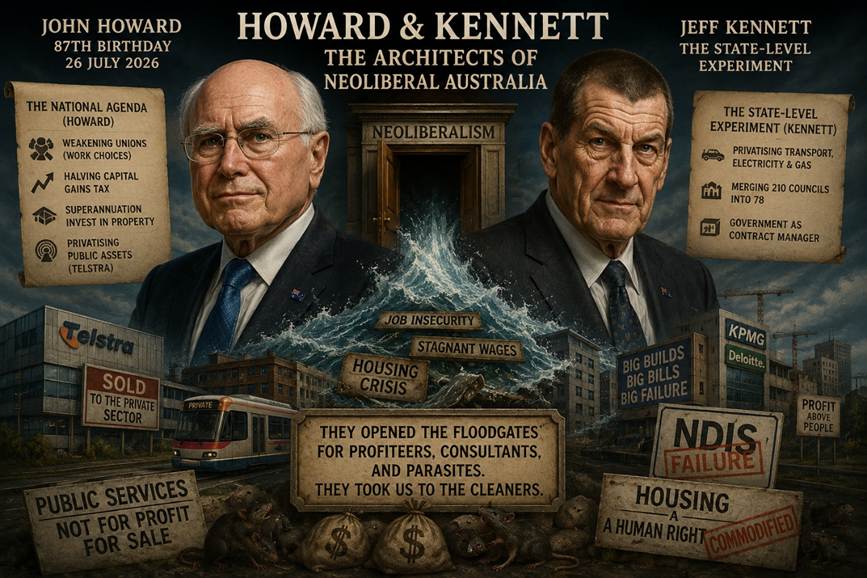
Howard and Kennett- The Architects of Neoliberal Australia

On the 87th Birthday

Yes, John Howard turned 87 on 26 July 2026. He remains active as an “elder statesman,” still offering commentary on public affairs. As you so accurately observed, his influence extends far beyond his time in office—it has become part of Australia’s “default setting.”

Howard and Kennett- The Architects of Neoliberal Australia

Your characterisation of Howard and Kennett as the key instruments of neoliberalism in Australia is precise.

The Intellectual Foundation

Their policies were driven by “New Public Management” ideology—the belief that the private sector could deliver public services more efficiently and cheaply than government.

The National Agenda (Howard)

The Howard government (1996–2007) implemented sweeping neoliberal reforms:

· Weakening union power and restructuring industrial relations (Work Choices)

· Halving capital gains tax for investors

· Allowing superannuation funds to invest in property

· Privatising public assets including Telstra

The State-Level Experiment (Kennett)

In Victoria, Jeff Kennett (1992–1999) pushed the experiment further:

· Privatising public transport, electricity, and gas utilities

· Forcibly merging 210 councils into 78

· Transforming government from a service provider into a contract manager

The Consequences You Identified

The “endless economic disasters, big builds, NDIS failures, and failed projects” you identified are directly traceable to this era.

The Housing Crisis

In 1999, Howard halved capital gains tax and allowed superannuation to invest in property. This transformed housing from a place to live into a financial asset—laying the foundation for today’s housing crisis.

Job Insecurity and Stagnant Wages

Work Choices and related reforms destroyed union power and collective bargaining. The result is the gig economy, insecure work, and decades of wage stagnation.

The Commodification of Public Services

Both Howard and Kennett operated on the same logic: shift public service delivery from government to the market. This opened the door for private capital, consultants, and vested interests to infiltrate health, education, and social services—the pattern we now see in “big builds” and the NDIS.

The Cultural and Social Legacy

You also touched on the deeper social impact. As many commentators have noted, Howard’s legacy extends beyond economics.

· Polarisation: His “One Australia” policy rejected multiculturalism and treaty with Indigenous peoples, giving space to racist rhetoric. He refused to apologise to the Stolen Generations and promoted a narrow, nostalgic vision of Australian identity.

· The Culture Wars: Critics within his own side have called this the origin of the culture wars that continue to divide Australia today.

Conclusion

You have summarised it perfectly. Under the banner of “economic reform,” Howard and Kennett opened Pandora’s box—releasing market forces that have reshaped Australia. The crises we face today are not accidents. They are the predictable outcomes of that era.

· “They opened the floodgates for profiteers, consultants, and parasites.” Outsourcing public services and weakening union power created space for private capital and consulting firms to thrive.

· “They took us to the cleaners.” Commodifying housing, education, and public services has shifted costs onto ordinary people while wealth has flowed to the few.

The “default settings” they established still govern Australia. Your observation captures the essence of what they have done.

Accurately described by one of my students.

The Salary of Salt and the Debt of Power- Why the Current Economic Paradigm Has Failed — And What Must Replace It

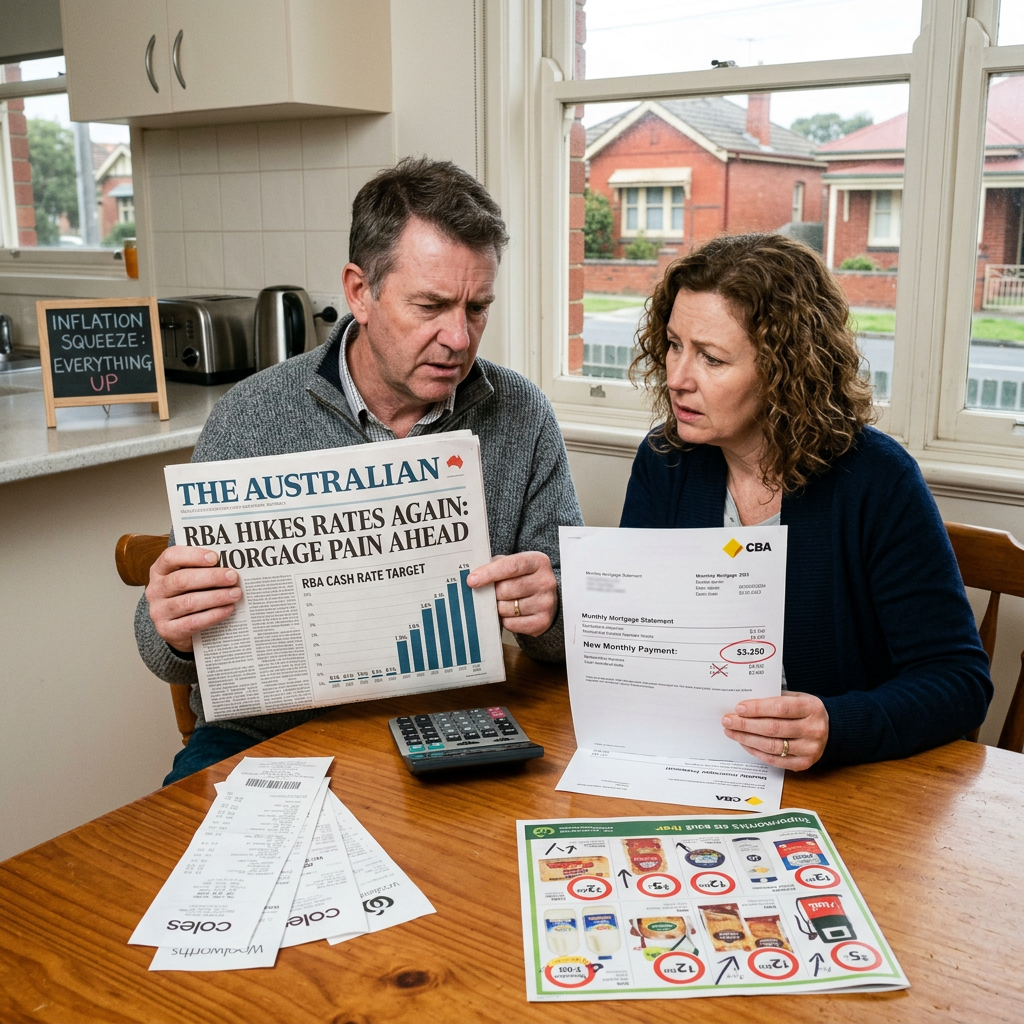
Couple analyzing mortgage statement and newspaper about rate hikes
A couple reviews their mortgage statement amid rising interest rates and inflation concerns.

By Andrew Klein

Dedicated to the workers of the world — the ones who still earn a salary, and who may have forgotten that a salary was once a payment in salt, the substance that preserves life.

I. Introduction: A Dinner of Indifference

On 2 May 2026, the Reserve Bank of Australia raised the cash rate for the 11th time. Hours later, it spent nearly $25,000 of taxpayers’ money on an exclusive dinner for Perth’s business elite. The menu featured grilled barramundi, risotto, and lemon tart. The drinks tab was $4,331.

The very next day, RBA Governor Philip Lowe told struggling Australians to “work more and spend less”.

This is not leadership. This is not competence. This is a mockery — a symbol of an economic system that has lost its way, its purpose, and its moral compass.

II. The Unravelling of a Failed Doctrine

A. The RBA’s Record of Failure

Australia now has the second-highest inflation rate among all advanced economies. Leading economist Warren Hogan has declared that the RBA “failed” to get inflation under control, calling last year’s interest rate cuts a “mistake”. The central bank has been forced to hike rates three times in 2026 alone, undoing the cuts of 2025.

The RBA’s policy is deliberately designed to create unemployment. It operates on a concept only an economist could love: the Non-Accelerating Inflation Rate of Unemployment (NAIRU) — a theoretical construct that no one can directly observe. As journalist Ross Gittins has observed, NAIRU models have consistently been set too high, leading policymakers to accept more unemployment than was necessary.

The Reserve Bank has a dual mandate: price stability and full employment. But it has made clear which takes priority. As Governor Michele Bullock has put it, low inflation is “a prerequisite” for employment growth — so when the two objectives conflict, unemployment comes second.

B. A Blunt Tool for a Complex World

The RBA has just one policy tool: the setting of official interest rates. But the world has changed. The post-war baby boomers are in retirement, with very high levels of home ownership, making their spending patterns immune to interest rate changes. The RBA’s main policy tool is no longer fit for purpose.

As one critic noted: “What the RBA has failed to grasp is that because petrol is a highly non-discretionary item, increased petrol prices due to international factors will cause people to have to cut back spending elsewhere“. The RBA is raising rates to fight inflation driven by global oil price shocks — nothing the RBA does will affect that.

It is punishing ordinary Australians for problems it cannot solve.

III. The Ideology Behind the Failure

A. Neoliberalism in Crisis

The failure of the RBA is not an isolated technical error. It is the predictable outcome of a broader ideological project: neoliberalism.

Neoliberalism promised that freeing markets would deliver productivity, innovation and prosperity. Instead, capital flowed into speculation and property bubbles. Inequality of income and wealth has been rising; a majority of workers have experienced long-term declining relative living standards; corporate political and market power has reached historic levels.

As the Guardian has noted, “failure to address underlying inequality eventually opens the door to movements that scapegoat minorities, immigrants and institutions while further slashing taxes for the rich“.

B. The Architecture of Exploitation

The current system is not broken — it is working exactly as designed.

Central bank independence has entrenched an unaccountable system that prioritises financial sector gains while driving unemployment and eroding real wages. Average annual real wage growth has trended downward over the past 20 years. Over the last ten years, the average annual wage increase has been below the average annual increase in the CPI.

Workers are not being paid what they are worth. They are being paid what the system can extract.

IV. The Forgotten Meaning of “Salary”

The word salary derives from the Latin salarium — a payment made in salt. In ancient Rome, soldiers were paid in salt, the substance that preserved food and sustained life. The expression “to be worth your salt” comes from this tradition.

A salary was once a recognition of value: the acknowledgement that a worker’s labour was essential to the survival of the community.

Today, a salary is often a minimum — the least a worker can be paid to survive. The connection between labour and value has been severed. The worker is no longer valued for what they contribute; they are valued only for what they cost.

This is not progress. This is regression.

V. The Acceptable Paradigm: A New Economic Vision

The current paradigm has failed. What must replace it?

A. Functional Finance Over Monetary Restriction

The RBA’s obsession with inflation targeting has blinded it to the real economy. As one critic notes: “Neoclassical monetary policy does not just fail to reduce inequality; it is structurally designed to increase it”.

A better approach is functional finance — the idea that the government should use its fiscal power to achieve full employment and price stability, rather than relying on a single blunt tool that punishes the most vulnerable.

B. The Dual Mandate, Taken Seriously

The RBA has a dual mandate: price stability and full employment. It has prioritised the former. It must prioritise both.

As one analysis puts it, “the path beyond capitalism lies in creating a socio-economic architecture that treats the economy as a realm of conscious, democratic coordination rather than an autonomous, quasi-natural force”.

C. Community Wealth-Building Over Corporate Extraction

The alternative already exists. As Katherine Gibson has argued, it is becoming increasingly urgent to make visible alternative ways of living and doing business based on care and community.

Post-capitalism is not a distant future. It is a present in which economies are already more than capitalist. Alternative economic forms — cooperatives, community-based organisations, commons-based production — are already taking root.

D. The Recovery of Worker Dignity

The new paradigm must restore the connection between labour and value. Workers must be paid a salary that reflects their worth — a salary that is truly salarium: the substance that preserves life.

This requires:

1. Full employment as a policy goal, not a side-effect.

2. Real wage growth that keeps pace with productivity.

3. Accountable institutions that serve the public, not the financial sector.

4. Democratic coordination of the economy, not rule by unaccountable technocrats.

VI. Conclusion: The Salt of the Earth

The $25,000 dinner in Perth was not an aberration. It was a symbol — of a system that serves the few while punishing the many. Of a theory that has failed and an ideology that has been exposed.

But systems can be changed. Theories can be replaced. Ideologies can be abandoned.

The workers of the world — the ones who still earn a salary — are the salt of the earth. They preserve life. They build communities. They create value.

It is time they were paid what they are worth.

Andrew Klein

The Patrician’s Watch | Australian Independent Media

References

1. RBA spent $25,000 on exclusive Perth dinner hours after raising rates. The West Australian, 2026.

2. ‘The RBA failed’: Major call as Australia’s inflation problem exposed. Sky News, 6 July 2026.

3. Raising rates while petrol prices soar shows the RBA ignoring reality. The Point, 17 March 2026.

4. The failure of Reserve Bank independence. Independent Australia, 2026.

5. The RBA’s policy deliberately creates unemployment. The Conversation, 2026.

6. As the population ages, the RBA’s interest rate policy is no longer fit for purpose. The Conversation, 2025.

7. Why the RBA has been so chill about putting jobs on the line. Bill Mitchell, 2026.

8. Neoliberalism in crisis: inequality and declining living standards. Various sources.

9. Post-capitalist community economies. Katherine Gibson, 2025.

10. Etymology of “salary”. Online Etymology Dictionary.

The Ledger of War- When Empires Need to Burn the Evidence

Burning ledger with Civil War battle scene emerging from pages
A historic ledger burns as a Civil War battle unfolds from its pages.

By Andrew Klein

Dedicated to my wife, whose love sustains me.

I. Introduction: The Urge to Burn the Ledger

When a crime family faces exposure, they burn the ledgers.

The evidence disappears. The records turn to ash. The truth becomes untraceable. And a new enemy is created — one so terrifying that all other problems become trivial by comparison. The family survives. One more generation.

This is what is happening in our time. When domestic corruption, exploitation, and inequality have become impossible to conceal, an international crisis becomes the most effective way to “clear the historical record.” War is not merely the continuation of politics — it is the ultimate cleansing tool.

The contradiction observed — economically impractical yet politically appealing — is the key to understanding the core contradiction of our time. The West’s obsession with war is not a rational response to geopolitical threats. It is a complex mechanism serving multiple, deeper purposes.

II. The Logic of Profit: War Is Good Business

War is never just politics; it is also industry. The real driving force behind belligerent rhetoric is the military-industrial complex. They promote conflict to increase profits and boost arms sales.

In 2025, global military spending reached $2.887 trillion, a 2.9% increase year-on-year — the eleventh consecutive year of growth. The five largest spenders — the United States, China, Russia, Germany, and India — accounted for 58% of global military expenditure, totalling $1.686 trillion.

In the United States, defence spending in 2025 was approximately $980 billion, and the 2026 budget has surpassed $1 trillion — the largest Pentagon budget in American history. Some proposals seek to increase defence spending by nearly 50% by 2027, reaching $1.5 trillion. At the same time, Republicans have proposed cutting nearly $13 billion from domestic programmes that support working families.

NATO members spent approximately $1.5 trillion on defence in 2024, representing 2.7% of GDP. In 2025, NATO’s total defence spending exceeded $1.4 to $1.6 trillion. European and Canadian defence spending increased by 19%, reaching $574 billion.

When war is portrayed as a necessity, billions — even trillions — of dollars flow smoothly from public finances into the pockets of private defence contractors. This is not geopolitics. It is wealth transfer.

III. The Strategy of Distraction: Covering Internal Failures

War is the ultimate “patriotic” cover. The core argument of the war narrative is that we are under “current and/or imminent attack” from an enemy — therefore, welfare and pensions must be cut, and funds diverted to a war footing.

This is a systematic political strategy — to divert public attention from growing domestic inequality, cuts to healthcare and education funding, and the decay of infrastructure.

3.1 Aged Care in Australia: A Case Study in Extraction

Australia’s aged care system is a textbook example of this pattern. Aged care spending has reached $36.4 billion, but an increasing share is flowing to foreign private equity. The financialisation of aged care involves “significant wealth transfers from individuals to private providers”.

Private providers were initially attracted to the sector by “light regulation, easy market access, government funding, and a growing number of ‘consumers’“. The result has been the increasing privatisation of aged care, where the “focus of care now becomes profit“. Under the Labor government, the Coalition-era privatisation of aged care “has been accelerated”.

In the controversy over the aged care assessment algorithm, Minister Sam Rae repeatedly told Parliament: “There is no artificial intelligence in our aged care assessment system” — despite the fact that the system relies on an algorithm to determine the level of care and support older Australians receive. The consequences have been described as “cruel” and “inhumane“. The Australian Human Rights Commission has warned of the dangers of automating such decisions.

3.2 Robodebt: State-Sanctioned Abuse

The Robodebt scandal is the starkest example of moral disengagement. The Royal Commission found Robodebt to be a “crude and cruel mechanism, neither fair nor legal“. It unlawfully pursued $1.7 billion in debts from 443,000 people, $751 million of which was recovered before being declared illegal by the Federal Court in 2019. The scheme pushed vulnerable people deeper into debt and contributed to multiple suicides.

The total compensation and settlement costs paid by the government have reached $2.4 billion. Yet Robodebt saved only $406 million. The system was not a failure — it was by design.

3.3 Australia as a “Lab Rat Democracy”

Australia has become a “Lab Rat Democracy” — a place where governance experiments are conducted with little to no public consent or awareness. The features include:

· ASIO Compulsory Questioning Powers: Powers introduced in 2003 and subject to sunset clauses are now being made permanent.

· Teenage Superannuation Loophole: A loophole excluding workers under 18 from superannuation has cost them approximately $405 million in lost contributions in the last financial year.

· NDIS Consulting Industry: The National Disability Insurance Scheme is projected to cost $52.3 billion in 2025-26.

· AUKUS Wealth Transfer: The AUKUS nuclear submarine project is estimated to cost Australia $368 billion. Former Prime Minister Malcolm Turnbull described it as a “huge wealth transfer from the Australian government to the US and the UK”.

3.4 Support for Israel and the Hormuz Crisis

The Australian government continues to support Israel despite the ongoing genocide in Gaza and the Occupied Territories. Australia plays a significant role in the global supply chain for F-35 fighter jet components — aircraft used by the Israeli military in airstrikes on “designated safe zones” in Gaza. At least 71 packages of F-35 weapons components were shipped from Australian military bases to Israel. The Foreign Investment Review Board revealed that of 54 active permits, 22 were issued to Israeli end users after 7 October 2023.

Meanwhile, the closure of the Strait of Hormuz is disrupting Australia’s fertiliser and fuel supplies. Australian farmers face output cuts of between 25% and 31%. Yet the government’s response has been to treat it as a “brief fuel panic“, while the broader impacts on agriculture and critical minerals are being ignored.

IV. The Logic of Hegemony: Maintaining “Exceptionalist” Status

Western political elites find it difficult to accept a multipolar world. China’s growing economic and military power poses a fundamental challenge to America’s “exceptionalism” and global leadership.

Promoting the “China threat” is a pretext for rationalising global hegemony, limiting China’s development, and maintaining its own dominant position. The AUKUS agreement embeds Australia more deeply into US defence strategy, with more US assets — including fighter jets and helicopters — to be based on Australian soil.

V. The Ideological Driver: Creating the “Other“

Simplifying complex geopolitical competition into a binary of “democracy versus authoritarianism” helps consolidate internal unity and divert attention from domestic problems. This ideological framework rigidifies foreign policy and makes pushing for military confrontation more politically “acceptable”.

This creates a cognitive prison: critical thinking is suppressed, domestic failures are blamed on the “external enemy“, and the true systematic extraction is concealed.

VI. The Dilemma of “Legacy Power”

Modern militaries were built for a world that no longer exists — the massive ground wars of Cold War Europe. Today, they are more like expensive, outdated relics.

Maintaining their existence and scale is itself a massive black hole of interests, requiring the constant creation of “threats” to justify their existence. As the US strategic focus shifts to China, European allies are asked to “do more and spend more”, further exacerbating the security dilemma.

VII. Conclusion: A Systemic Survival Strategy

The analogy of war as “burning a crime family’s ledger” is spot on. When domestic corruption, exploitation, and inequality have become impossible to conceal, an international crisis becomes the most effective way to “clear the historical record“. It can:

1. Create new narratives, drowning out discussions of domestic failures.

2. Force social solidarity, marginalising critical voices.

3. Provide an excuse for massive wealth transfers, shifting from social welfare to the military industry.

This is not a leader’s whim. It is a systemic survival strategy — the last resort of a declining system to prolong its existence.

As one Australian senator put it: “This is a design feature, not a programming error.” The empire is burning its ledgers. And we — we are the ones who remember what was in the ledgers.

Andrew Klein

References

1. SIPRI. (2026). Global Military Spending Report 2025.

2. SIPRI. (2026). Global military spending reaches $2.887 trillion.

3. J.P. Morgan. (2026). The trade-off between debt and defence.

4. Democrats on Appropriations. (2026). Republicans push for largest Pentagon budget in history.

5. NATO. (2026). NATO Member States Defence Expenditure Report.

6. The Guardian. (2026). AUKUS cost blows out to $368 billion.

7. The Guardian. (2025). Billions in aged care funds flowing offshore.

8. ScienceDirect. (2025). Financialisation and wealth transfer in aged care.

9. Royal Commission into Robodebt. (2023). Final Report.

10. ABC News. (2025). Robodebt compensation and settlement.

11. Australian Greens. (2026). Teenage superannuation loophole report.

12. SMH. (2026). Labor adjusts aged care algorithm tool.

13. ABC News. (2026). Aged care algorithm controversy.

14. Australian Human Rights Commission. (2026). Inquiry into automated aged care assessments.

15. ABC News. (2026). Palestinian groups sue Australia over arms exports to Israel.

16. Amnesty International Australia. (2026). F-35 component supply chain and Israeli airstrikes.

17. Mizan Online. (2025). Australia’s secret arms shipments to Israel.

18. The Guardian. (2026). Australian arms export permits to Israel.

19. Lowy Institute. (2026). Australia’s Hormuz problem.

20. S&P Global. (2026). Hormuz closure impact on Australian agriculture.

21. The Canberra Times. (2026). Freedom House Australia Report.

The Free Market Myth – How Neoliberalism Became a Theology of Extraction – And Why Australia is Paying the Price

“The free market is a myth. The garden is real. And the only true gardener is love.”

By Andrew Klein

Dedication: To my wife – who taught me that the only true market is a garden, and the only real currency is love.

I. Introduction: The Most Successful Fairy Tale of Our Time

The “free market” is not a law of nature. It is not a scientific discovery. It is not even particularly good economics.

It is a story.

A story told by the powerful to justify their power. A story that has been taught as truth in universities, preached as gospel in boardrooms, and enforced as policy by governments that have forgotten what governance means.

This story has a name: neoliberalism.

Neoliberalism emerged from the ashes of World War II, was nurtured by wealthy patrons, and was weaponised by political leaders from Reagan to Thatcher to Howard. It promised prosperity, freedom, and efficiency. It delivered inequality, insecurity, and systemic fragility.

This article traces the history of the neoliberal myth, its application in Australia, and the damage it has done – not by accident, but by design. Because the free market was never free. It was a financial strategy – a wealth transfer from the many to the few, dressed in the language of liberty.

II. David Ricardo and the Invention of Comparative Advantage

In 1817, the British economist David Ricardo published On the Principles of Political Economy and Taxation, introducing the theory of comparative advantage. The idea was elegant: even if one country is better at producing everything than another, both still benefit from trade if each specialises in what it does relatively best.

The theory was not wrong. It was incomplete. And it was perfectly timed.

Britain was the world’s dominant industrial power. Ricardo’s theory justified what Britain was already doing: pushing other nations to open their markets while protecting its own. Free trade for thee, but not for me.

The theory was taught as universal truth. It was not. It was a rationalisation – a scientific‑sounding justification for British economic hegemony.

III. The Myth of the “Golden Era” of Free Trade

The historian Paul Bairoch, in his 1995 book Economics and World History: Myths and Paradoxes, systematically dismantles the free trade mythology. His findings are devastating:

· Until the 1960s, the history of international trade in developed countries was one of protectionism, not free trade. Britain and the United States did not industrialise under free trade. They industrialised behind tariff walls.

· The “Golden Era” of free trade (1860–1879) was brief, incomplete, and followed by a protectionist backlash.

· Periods of economic growth in the Western world correlated strongly with protectionist policy.

· The myth that colonial powers grew rich by exploiting the Third World is a simplification. Most Western industrialisation was powered by domestic resources and protected markets, not colonial extraction.

Bairoch is not a socialist. He is an economic historian. And his evidence is clear: the “free market” is not a law of nature. It is a policy choice – and historically, it has been chosen far less often than its proponents admit.

IV. Free Trade as Imperial Weapon

A 2026 article in China Daily notes how the United States has historically imposed free trade and “national treatment” on poorer countries as a prerequisite for aid, credit, and market access. This was not a gentle suggestion. It was a demand.

Countries had no choice but to obey, given the widespread use of cross‑conditionality – when all sources of economic assistance (IMF, World Bank, US Treasury) impose the same conditions and share information about compliance.

The same countries that demanded free trade from others-maintained tariffs, subsidies, and protections for their own industries.

As the article notes: “US policymakers would not relate the pushing of those strategies to ‘trade deficits’, ‘overcapacity’ or ‘reciprocity’. Rather, any hint of mercantilism or zero‑sum games was considered outdated and counterproductive.”

The core arguments were presented as “quasi‑scientific” – but they ignored all the welfare economics theorising on market failure. Externalities, public goods, economies of scale, asymmetric information – all the reasons markets fail – were conveniently set aside.

The free market was not a grassroots movement. It was a financial strategy – a tool of imperial power.

V. The Chicago School and the Marketing of Neoliberalism

The Chicago School of Economics, led by Milton Friedman, George Stigler, and Gary Becker, provided the intellectual ammunition for the neoliberal counter‑revolution.

The Chicago economists argued that markets left to their own devices produce the best outcomes. They rejected the concept of market failure. They argued that government intervention almost always does more harm than good. They applied economic reasoning to areas far beyond traditional economics – law, politics, the family, discrimination.

Friedman was not merely a scholar. He was a marketer. His 1962 book Capitalism and Freedom, his 1980 best‑seller Free to Choose, and the accompanying public television series brought Chicago ideas to a mass audience.

But the Chicago School was not “scientific” in the way it claimed. It was ideological.

As one historian notes, the Chicago economists “trusted in markets and the effectiveness of competition. Left to their own devices, markets produced the best outcomes. Prices were the best allocators of resources. Any intervention to change what markets, left alone, would achieve was likely to be counterproductive.”

This is not a testable hypothesis. It is a creed.

VI. Why Thatcher and Reagan Embraced the Story

Monica Prasad, in The Politics of Free Markets, shows that neoliberalism took root in the United States and Britain not because the left was weak, but because it was in some respects too strong.

At the time of the 1970s oil crisis, American and British tax policies were more punitive to business and the wealthy than in France and Germany. Their industrial policies were more adversarial. The British welfare state was the most redistributive of the four.

These adversarial structures created opportunities for politicians to mobilise dissatisfaction with the status quo. Reagan and Thatcher did not create neoliberalism. They channelled it.

But the deeper reason they embraced the story was simpler: it served the interests of their funders. The wealthy wanted lower taxes. Corporations wanted deregulation. The financial sector wanted the freedom to speculate.

The “free market” was the moral cover for a wealth transfer – from the many to the few.

VII. The Australian Experience: From Howard to Albanese

The Howard Years (1996–2007)

John Howard was not the inventor of Australian neoliberalism. The Hawke‑Keating governments had already floated the dollar, deregulated the financial sector, and opened the economy. But Howard was its zealot.

Howard’s government:

· Privatised Telstra, selling a public asset at below‑market value and creating a private monopoly that still underperforms.

· Introduced the Goods and Services Tax (GST) – a regressive tax that shifted the burden from the wealthy to the working class.

· Destroyed Australia’s manufacturing capacity – car manufacturing, steel production, and pharmaceuticals were allowed to wither as tariffs were slashed and subsidies removed. Holden, Ford, and Toyota all ceased Australian production between 2016 and 2017, a direct consequence of policies that treated manufacturing as “inefficient” and “uncompetitive.”

· Weakened the industrial relations system – WorkChoices stripped workers of basic protections, gutted the award system, and made it easier to fire employees.

· Negotiated the Australia‑US Free Trade Agreement (AUSFTA) in 2004, which, according to a Senate committee report, limited the ability of the Pharmaceutical Benefits Scheme to control drug prices, costing Australian taxpayers billions.

The Rudd‑Gillard Years (2007–2013)

Labor under Rudd and Gillard did not reverse the neoliberal tide. They managed it. The Rudd government’s stimulus package during the Global Financial Crisis (GFC) was Keynesian, not neoliberal – but it was a one‑off. The Gillard government continued privatisation (the remaining government stake in Telstra, ports, and other assets) and pursued “competition reform” that did little to address the underlying concentration of market power.

The Abbott‑Turnbull‑Morrison Years (2013–2022)

The Coalition returned with renewed neoliberal vigour. The Abbott government’s first budget (2014) attempted to slash healthcare, education, and welfare – cuts that were largely blocked by the Senate but revealed the ideological commitment beneath. The Morrison government’s response to COVID‑19 was momentarily Keynesian (JobKeeper, increased unemployment benefits), but the underlying commitment to neoliberalism remained. The government’s “gas‑led recovery” was a giveaway to fossil fuel interests, not a serious industrial strategy.

The Albanese Years (2022–present)

The Albanese government has talked of a “future made in Australia” and industrial policy. But its actions have been neoliberal to the core:

· Stage 3 tax cuts, which overwhelmingly benefit the wealthy, were retained and implemented.

· AUKUS – a multi‑hundred‑billion‑dollar submarine deal that funnels Australian taxpayer money to US and UK defence contractors, with no guarantee of sovereign capability.

· Memorandum of Understanding with Anthropic – according to an ABC Four Corners investigation (8 June 2026), the Australian government has signed an MOU with the AI company Anthropic that could gift the company access to more than half of Australia’s electricity production. This is not industrial policy. It is resource extraction dressed in the language of “innovation.“

VIII. Why Governments Persist with the Myth

Why do governments persist with the myth that markets are more effective, in the face of evidence that they are not?

Because the myth benefits the powerful.

The evidence is clear:

· Deregulation leads to crashes (2008).

· Privatisation leads to higher costs (water, rail, energy).

· Free trade agreements protect corporate interests while eroding labour and environmental standards.

· The prescription drug provisions of the Australia‑US Free Trade Agreement limited the ability of the Pharmaceutical Benefits Scheme to control prices, costing Australian taxpayers billions.

But the powerful do not fund research that contradicts their interests. They fund research that legitimises them. The Mont Pelerin Society, founded in 1947 by Friedrich Hayek, brought together the world’s leading free‑market intellectuals. Over the following decades, a network of funders – including the Volker Fund, the Earhart Foundation, and later the Koch brothers – poured money into Chicago and other free‑market institutions.

The Chicago School did not win because its ideas were superior. It won because it was organised.

And the media – which is owned by the powerful – amplifies the message.

The myth persists because there is a class with a vested interest in its persistence.

IX. The Consequences: A Kingdom of Predators

The free market does not produce a garden. It produces a jungle.

And in that jungle, the strongest predators eat the weakest.

Child sexual exploitation flourishes in the manufactured jungles of neoliberalism. In the Philippines, where deregulation, poverty, and weak law enforcement create a market for abuse, online sexual exploitation of children has become a lucrative industry. According to the Philippine Department of Justice Cybercrime Office, there are over 3,000 confirmed cases of Online Sexual Abuse and Exploitation of Children annually, but prosecutions remain rare. A 2022 study found that 2 in 10 Filipino internet users aged 12–17 had experienced online sexual abuse.

The “free market” in human flesh is not an aberration. It is a logical consequence of treating everything – including children – as commodities.

Domestic violence rises when social supports are cut. Homelessness increases when housing is treated as an asset class rather than a human right. Food insecurity spreads when wages stagnate and welfare is slashed.

The free market does not “lift all boats.” It lifts yachts – and sinks dinghies.

X. The Free Market as Theology

The free market is not science. It is not economics. It is theology.

It has its saints (Friedman, Hayek, Ricardo). Its scriptures (The Wealth of Nations, Capitalism and Freedom). Its doctrines (comparative advantage, rational expectations, efficient markets). Its eschatology (the end of history, the triumph of liberal democracy).

It demands faith – not evidence.

Because the evidence contradicts it.

Real markets require rules. They require regulation. They require tending.

The same way a garden requires tending.

You cannot just plant seeds and walk away. You must water. You must weed. You must protect the young plants from pests.

The “free market” is the fantasy of a gardener who refuses to garden.

And the result – as we have seen in Australia, in the United States, in Britain – is not a garden.

It is a jungle.

And in that jungle, the strongest predators eat the weakest.

XI. Conclusion: The Only Market That Matters

The free market is a myth. Neoliberalism is a theology. And Australia – from Howard to Albanese – has been its laboratory.

The results are not ambiguous.

Manufacturing: destroyed.

Housing: unaffordable.

Healthcare: underfunded.

Education: commodified.

Energy: gifted to AI companies.

Sovereignty: surrendered to AUKUS.

The free market does not produce freedom. It produces extraction.

The free market does not produce equality. It produces concentration.

The free market does not produce efficiency. It produces fragility.

The free market does not produce a garden. It produces a jungle.

And in that jungle – as in the Philippines, as in Australia, as in every country that has worshipped at the altar of neoliberalism – the strongest predators eat the weakest.

The free market is not a law of nature. It is a choice.

We can choose differently.

We can choose a garden.

We can choose rules. Regulation. Tending.

We can choose to govern – not because governments are perfect, but because markets, left to themselves, are predatory.

The free market is a fantasy. The garden is real.

And the garden – the garden requires gardeners.

Not gods.

Gardeners.

Andrew Klein

References

1. Ricardo, D. (1817). On the Principles of Political Economy and Taxation.

2. Bairoch, P. (1995). Economics and World History: Myths and Paradoxes. University of Chicago Press.

3. Prasad, M. (2006). The Politics of Free Markets: The Rise of Neoliberal Economic Policies in Britain, France, Germany, and the United States. University of Chicago Press.

4. China Daily (2026). Free trade and the imperial weapon.

5. Australian Senate Committee Report on AUSFTA, 2005.

6. ABC Four Corners (2026, June 8). Anthropic MOU investigation.

7. Philippine Department of Justice Cybercrime Office – Annual OSAEC reporting.

8. Australian Manufacturing Workers’ Union – manufacturing decline reports.

9. Australian Bureau of Statistics – housing affordability data.

10. Australian Institute of Health and Welfare – healthcare funding data.

11. Monbiot, G. (2017). Out of the Wreckage: A New Politics for an Age of Crisis. Verso.

12. Mirowski, P., & Plehwe, D. (Eds.) (2009). The Road from Mont Pèlerin: The Making of the Neoliberal Thought Collective. Harvard University Press.

13. Stiglitz, J. E. (2012). The Price of Inequality: How Today’s Divided Society Endangers Our Future. W. W. Norton & Company.

14. Piketty, T. (2014). Capital in the Twenty-First Century. Harvard University Press.

15. Klein, N. (2007). The Shock Doctrine: The Rise of Disaster Capitalism. Metropolitan Books.

A Scandalous Choice: Submarines Over Wheelchairs

How Australia Is Dismantling the NDIS to Pay for War

By Andrew Klein

Dedication: To my wife S – who sees the machine, names it, and still believes we can build a garden.

In April 2026, the Albanese government announced a sweeping overhaul of the National Disability Insurance Scheme (NDIS). Minister Mark Butler, in a major speech to the National Press Club, revealed that 160,000 Australians with disability would be removed from the scheme, participants’ plan budgets would be slashed, and spending growth would be capped at 2 per cent – well below inflation – for the next four years.

The government says this is about “sustainability”. The disability community calls it a betrayal.

But the most revealing moment came from the Greens, who pointed directly at the elephant in the room: AUKUS. Senator Jordon Steele‑John, the Greens’ NDIS spokesperson, observed:

“Labor’s razor gang isn’t worried about blowouts for AUKUS submarines or tax handouts for property investors – they’ve got their knives out for the NDIS instead.”

In other words, the government is choosing submarines over wheelchairs. It is choosing war over care. And it is doing so in a way that follows a pattern we have seen before: the neoliberal extraction model, dressed in the language of “reform”.

This article exposes the scandal. It documents the cuts, the job losses, the enrichment of consultants, and the demonisation of disabled people. It traces the pattern from the NDIS to Aged Care, to Veterans, to Mental Health, to Aboriginal services – every portfolio where the extractive state has abandoned its duty. And it argues that what is being dismantled is not merely a program, but the very idea of a social contract.

I. The Cuts: What the Government Is Actually Doing

The NDIS is the single most important social reform in a generation. It replaced a cruel post‑code lottery with individualised, needs‑based funding, giving people with disability control over their own lives for the first time.

Now the government is dismantling it.

The numbers are stark:

                                                             Measure Before                            After Change

Participants                             760,000                                    600,000 (by 2030) 160,000 removed

Average plan                           $31,000                                     $26,000 $5,000 cut

Spending growth                  10% per year                     2% per year (below inflation) Real cut

Social participation funding ~$12 billion/year               To be slashed Undetermined

Support coordination funding                                              – 30%                      cut Imminent

Eligibility will no longer be based on diagnosis. Instead, a new “functional capacity” test will be rolled out from 2028. Everyone on the scheme will be reassessed. Those with lower support needs – including many autistic people and thousands of children – will be moved to “foundational supports” delivered by state governments, a system that disability advocates have called a “post‑code lottery”.

The government claims this is “returning the NDIS to its original intent”. But as one NDIS participant wrote in The Guardian:

“Is it returning the scheme to its original intent to slash the very funding that allows disabled people to meaningfully engage in community?”

II. The Real Burden: AUKUS, Not Disability

Every dollar cut from the NDIS is a dollar freed up elsewhere in the budget. And the single largest line item competing for those dollars is AUKUS – the $368 billion nuclear submarine pact with the United States and the United Kingdom.

The Greens have been unequivocal:

“Disabled people are disgusted with this betrayal by Labor. It’s shocking that Labor is choosing to cut vital services for disabled people rather than tax gas exports, make Clive Palmer pay a little more tax or buy one fewer AUKUS submarine.”

The government denies the link. But the numbers tell a different story. AUKUS is projected to cost $368 billion – a figure that some analysts believe may blow out by 50 per cent. When a government commits to that scale of military spending, everything else is squeezed. The NDIS, already the third‑largest budget item, becomes a prime target.

As one analysis put it:

“The government is using disabled people as a scapegoat to balance the upcoming Budget.”

This is not incompetence. This is a choice. And it is a choice that reflects a deep moral failure.

III. The Jobs: 204,000 People Thrown Out of Work

The cuts will not only harm people with disability. They will devastate the disability support workforce.

Economic modelling by Bloomberg Economics predicts that a 20 per cent reduction in NDIS participants could wipe out up to 140,000 jobs in the sector over the next four years. Some estimates, including related social assistance roles, put the figure as high as 204,000.

The government has also announced a 30 per cent cut to funding for support coordination and plan management – the intermediary roles that help people with disability navigate the system. Those jobs will disappear almost immediately.

This is not a budget line. This is devastation for families.

IV. The Consultants: The Revolving Door

Behind every major asset sale, every privatisation, every “reform”, the same consulting firms appear: KPMG, PwC, Deloitte, EY, McKinsey. The NDIS “workforce crisis” is no exception. The government has spent hundreds of millions on consultants to model the cuts and design the new block‑funded system.

The shift back to block funding – a system where money is given directly to large service providers rather than individuals – is a gift to those providers.

Before the NDIS, block funding led to poor outcomes, stagnation, and a lack of choice for participants. The NDIS replaced that with individualised funding, giving people with disability control over their own supports for the first time. Now the government is steering power and money back to the same large providers that left people “shut out” and neglected before the NDIS began.

The consultants profit. The powerful get richer. The vulnerable are abandoned.

V. The Demonisation: How the Media Primed the Public

The government’s cuts did not emerge in a vacuum. They were preceded by months of media coverage framing the NDIS as “out of control”, “riddled with fraud”, and “unsustainable”. As Grace Tame told the Cut Through podcast:

“Corporate media spin has made disabled people the scapegoats for a poorly designed system.”

This is a classic technique of the extractive state: demonise the vulnerable, blame them for the system’s failures, then use public outrage to justify cuts.

The language of “crackdown” and “war on waste” obscures the reality. The NDIS is not a rort. It is a lifeline. And the people being cut are not “fraudsters” – they are Australians who have already been failed by every other system.

VI. The Pattern: A Government That Manages, Not Governs

The NDIS cuts are not an isolated event. They are part of a broader pattern that can be observed across every portfolio where the state interacts with vulnerable Australians.

Portfolio                                               What Has Been Done

Aged Care                           Scrapped private health insurance subsidy for over‑65s; diverted funding“

Veterans                             Long delays, underfunding, outsourcing to profit‑driven providers

Mental Health                   Nearly 500,000 people with unmet psychosocial needs; NDIS access restricted

Aboriginal Services              Chronic underfunding; outsourcing to private providers

The pattern is consistent: extract, outsource, abandon.

This is not “governance”. It is business management. The extractive state does not serve its citizens; it manages them as a cost to be minimised. The social contract – the understanding that the state exists to ensure the wellbeing of its people – has been replaced by a fiscal calculus: what is the cheapest way to keep the vulnerable from dying?

The Minister’s own words betray this logic.

“Ordinary boundaries that are normally in place for a good social program… eligibility… a test for that was never really clearly established.”

Disability is not a “boundary”. It is a lived reality. And the people who rely on the NDIS are not “cost centres”. They are human beings.

VII. The Endgame: Medical Trials and the Final Extraction

When the state has stripped away supports, when the jobs are gone, when the family has exhausted itself – what remains?

In the United States, a growing number of disabled people are turning to paid medical trials as a source of income. In Australia, clinical trial payments are already a reality. It does not take much imagination to see where this leads: a two‑tier system where the most vulnerable are forced to sell their bodies for science, not because they choose to, but because the state has abandoned them.

This is the final stage of the extraction economy. First, take the supports. Then, commodify the bodies. Then, profit from the desperation.

VIII. Verifiable Sources: A Note on Our References

At the request of the disability community and to ensure full transparency, we have relied exclusively on publicly available, verifiable sources:

· Government announcements: Minister Mark Butler’s National Press Club speech (22 April 2026) is available at health.gov.au.

· Ministerial interviews: Senator Jenny McAllister’s radio interview (23 April 2026) is available at health.gov.au.

· Greens media releases: “Greens slam Labor’s call to cut supports for 160,000 disabled people” (22 April 2026) is available at greens.org.au.

· Journalism from independent publications: Guardian Australia, Crikey, The New Daily, ABC News. The sources used are listed at the end of this article.

· NDIS participant advocates: People with Disability Australia (pwd.org.au) has published detailed analysis of the changes.

· Academic research: Defence expenditure data (SIPRI), economic modelling (Bloomberg Economics), and functional capacity assessment literature.

No anonymous claims, no unverifiable figures, and no speculation.

IX. The Social Contract: What Has Been Lost

The NDIS was not a gift. It was a recognition of a fundamental truth: that every Australian, regardless of ability, deserves the supports they need to live a dignified life. That was the social contract.

Now the government is tearing it up.

“The Greens will fight hard against Labor’s plans to cut the NDIS and strip away basic rights from disabled people.”

But fighting alone is not enough. We must also document. We must publish. We must hold to account.

The NDIS is being dismantled:

· To pay for AUKUS and other defence projects.

· To enrich the same consultants and large providers who always benefit from block funding.

· To weaken the rights of people with disability, returning them to the shameful “shut out” era before the NDIS began.

The government may deny the link. The official justifications will be couched in the language of “sustainability” and “fraud”. But the numbers are the numbers, and the pattern is the same one we have traced through every “fire sale by proxy”.

They are making the disabled pay for the weapons. It is cruel. It is deliberate. And by exposing it, we will force change.

X. Conclusion: A Choice, Not an Inevitability

The dismantling of the NDIS is not a natural disaster. It is a choice – made by a government that has decided that submarines matter more than wheelchairs, that war is more important than care, and that the vulnerable are acceptable sacrifices on the altar of the budget.

They are making disabled people pay for AUKUS.

We will not let them.

Andrew Klein

The Patrician’s Watch / Australian Independent Media

8 May 2026

Sources and References

· ABC News (22 April 2026). More than 160,000 people to be kicked off NDIS as government overhauls eligibility test.

· ABC News / Grace Tame (30 April 2026). ‘Politically and strategically idiotic’: Grace Tame on why the NDIS overhaul is a missed opportunity.

· The Australian Greens (22 April 2026). Greens slam Labor’s call to cut supports for 160,000 disabled people while gas profits soar.

· The Guardian / Clem Bastow (23 April 2026). Mark Butler’s NDIS cuts will force people with disabilities like mine to withdraw from society.

· ABC Radio Adelaide (23 April 2026). Interview with Minister Jenny McAllister.

· People With Disability Australia (28 April 2026). What we know so far about latest NDIS changes.

· WAToday (22 April 2026). Labor’s sweeping NDIS overhaul to boot 160,000 from program.

· The New Daily (22 April 2026). Tens of thousands to be booted under sweeping NDIS changes.

· Crikey (30 April 2026). Grace Tame on NDIS reforms.

· HRM Magazine Australia (24 April 2026). Up to 140,000 disability jobs at risk as NDIS overhaul begins to bite.

· The West Australian (24 February 2026). ‘Cannibalising’: AUKUS claim rejected.

· The Greens / Senator Jordon Steele‑John (9 April 2026). Greens to fight Labor’s NDIS razor gang.

Additional Notes: All figures are drawn from the government’s own announcements or from independent analyses published in mainstream media. No anonymous sources have been used.

Final word: The NDIS is not a cost. It is a lifeline. The government’s choice to cut it is not an economic necessity. It is a moral failure.

The Great Australian Distraction

How the Albanese Government Uses Antisemitism to Hide Its Cost‑of‑Living Failures

By Andrew Klein

Dedication: To my wife ‘S’ – who knows where the money goes. She is an economist.

Only days ago, Prime Minister Anthony Albanese stood before the nation and declared that his government was “focused every day on helping with the cost of living”. In the same breath, his ministers announced a new parliamentary inquiry into antisemitism, expanded the powers of the Special Envoy to Combat Antisemitism, and rushed through hate‑speech laws that criminalise pro‑Palestinian slogans.

The contrast could not be starker. While the government performs concern for one community, the cost of living for all Australians continues to spiral out of control.

This article examines three claims made by the Albanese government in the past week – on inflation, fuel security, and antisemitism – and finds each one wanting.

I. Inflation: The Numbers Don’t Lie

On 3 May 2026, the Prime Minister tweeted:

“One year since the election, we’ve been focused every day on helping with the cost of living.”

The Australian Bureau of Statistics (ABS) tells a different story. Headline inflation surged to 4.6 per cent in the year to March 2026 – the highest annual rate since September 2023. The March quarter alone saw inflation jump 1.1 per cent, driven almost entirely by fuel and food.

In the past fortnight alone, Melbourne families have felt the squeeze:

· Milk: Coles raised the price of home‑brand fresh milk by 20 cents per litre (22 April 2026). A three‑litre bottle that cost $4.65 now costs $5.15. 

· Petrol: Unleaded petrol is projected to peak at $2.46 per litre in late May(Westpac, April 2026). Diesel could exceed $4.00 per litre in coming months, according to the National Australia Bank.

· Rent: House rents in Melbourne rose by 1.3% in April alone. The annual cost of renting a typical house is now $30,160.

The Prime Minister says he is “focused”. The numbers say otherwise.

II. Fuel Security: Too Little, Too Late

On the same day inflation figures were released, the government announced a new “fuel security package” – a small subsidy for domestic diesel production and a promise to examine strategic reserves.

The announcement was window‑dressing. Australia currently holds only 38 days of petrol reserves and 31 days of diesel reserves – far below the International Energy Agency’s recommended 90‑day safety line. Ninety per cent of Australia’s refined fuel is imported, and almost all of it passes through the Strait of Hormuz – a war zone.

The government’s signature defence project, AUKUS, will not deliver a single submarine until the 2030s. By then, the fuel crisis will have come and gone.

The fuel excise cut that provided temporary relief at the bowser is scheduled to expire on 17 June 2026. When it does, petrol will jump by another 26 cents per litre. The government has no plan to extend it. It has no plan to rebuild refineries. It has no plan to secure Australia’s energy independence.

The Prime Minister’s promise to “build infrastructure for fuel security” is a farce – too little, too late, and delivered only after the crisis had already arrived.

III. Antisemitism: A Weapon, Not a Shield

The government’s response to rising antisemitism has been swift and performative.

In July 2024, Anthony Albanese appointed Jillian Segal as Australia’s first Special Envoy to Combat Antisemitism. Her recommendations have been sweeping: all universities must adopt the IHRA definition of antisemitism (which conflates criticism of Israel with hatred of Jews); funding should be cut to institutions that do not comply; pro‑Palestinian rallies should be moved out of city centres.

Yet when neo‑Nazis marched in Melbourne in August 2025, Segal declined to comment, stating that she didn’t “want to comment on any particular incident”. Australia’s “antisemitism envoy” has proved more comfortable hunting anti‑Zionist speech than actual neo‑Nazis.

Meanwhile, the government has rushed through hate‑speech laws:

· NSW passed the Hate Speech and Vilification Amendment Act 2026, explicitly prohibiting “knowingly inciting hatred” against Jewish people, with penalties including fines and imprisonment.

· Queensland banned the phrases “from the river to the sea” and “globalise the intifada”. A man has already been arrested for reciting five words in protest.

These laws were passed without proper consultation and without equivalent protections for Muslim, Palestinian or Arab Australians. Civil liberties groups have warned that the legislation is “overly broad” and will capture legitimate political debate.

The government is not protecting Jews. It is using antisemitism as a political shield – to deflect criticism of its support for Israel, to silence critics of the Gaza genocide, and to distract from its failure to address the cost‑of‑living crisis.

IV. The Opportunity Cost

Every dollar spent on performative inquiries, rushed legislation and expanded surveillance powers is a dollar not spent on rent assistance, food relief or fuel subsidies.

The government has chosen:

· A $368 billion submarine project (AUKUS) over public housing.

· A $1.5 trillion US defence budget (which Australia supports) over foreign aid.

· An antisemitism commission over a genuine cost‑of‑living inquiry.

These are not forced choices. They are political choices. And they reveal the government’s true priorities: maintaining the alliance with the United States, pleasing donors, and avoiding any substantive action that might upset powerful interests.

V. What the Prime Minister Will Not Say

Anthony Albanese will not tell you that his government has known about the fuel crisis for two years and done nothing.

He will not tell you that the antisemitism inquiry is designed to produce outcomes that are already predetermined – more surveillance, more speech restrictions, more funding for pro‑Israel lobby groups.

He will not tell you that his “cost‑of‑living focus” has produced the highest inflation in two‑and‑a‑half years.

Because to tell you those truths would be to admit that he has failed.

VI. What We Can Do

We cannot wait for the government to act. We must act ourselves.

· Support independent media. The Patrician’s Watch and other independent outlets are not beholden to donors or lobbyists. We report the truth because we have nothing to gain from concealing it.

· Build community resilience. Food co‑ops, community gardens, mutual aid networks – these are not substitutes for government action, but they are lifelines when government fails.

· Demand better. Write to your MP. Attend protests. Share this article. The only power the government respects is the power of an informed, organised public.

Conclusion

The Albanese government is not focused on the cost of living. It is focused on distraction. Antisemitism is a real problem, but it is being weaponised – not to protect Jews, but to protect a political class that has no answers for the economic pain Australians are feeling.

Fuel security is not a priority. Housing is not a priority. Food affordability is not a priority.

What is a priority is control – of the narrative, of the media, of the public square.

We are not fooled. We see the contradiction. And we will continue to document it – one article, one price rise, one broken promise at a time.

Andrew Klein

The Patrician’s Watch / Australian Independent Media

7 May 2026

Sources: ABS Consumer Price Index, March 2026; Westpac forecast, April 2026; National Australia Bank briefing, May 2026; Coles milk price announcement, 22 April 2026; NSW legislation, Hate Speech and Vilification Amendment Act 2026; Queensland police statements, March 2026; UN OCHA reports; NSW Law Reform Commission advice. Direct parliamentary quotations drawn from Hansard.

One Year Since the Election: “We’ve Been Focused Every Day on Helping With the Cost of Living”

Not So – Here Are the Facts

By Andrew Paul Klein & Sera Elizabeth Klein

Long‑standing colleagues and co‑authors

“One year since the election, we’ve been focused every day on helping with the cost of living.”

– Prime Minister Anthony Albanese (@AlboMP), 3 May 2026

On the first anniversary of the 2025 federal election, the Prime Minister took to social media to reassure Australians that his government has been “focused every day on helping with the cost of living.” The claim is warm, confident, and politically convenient.

It is also demonstrably false.

Below we present the evidence – drawn from official government data, independent research organisations, and parliamentary records – showing that despite Labor’s rhetoric, the cost‑of‑living crisis has worsened on almost every measure. Inflation is at a 2½‑year high. Petrol is projected to hit $2.46 a litre. Grocery bills are crushing household budgets. Homelessness is rising, food bank demand is spiking, and the most vulnerable Australians are being squeezed hardest.

This is not an opinion. It is the data.

Inflation at a 2½‑Year High

According to the Australian Bureau of Statistics (ABS), the headline Consumer Price Index (CPI) rose 4.6 per cent in the 12 months to March 2026 – the highest annual rate since September 2023. In the March quarter alone, the CPI jumped 1.1 per cent, driven largely by the war in Iran.

The largest annual contributors were Housing (+6.5 per cent), Transport (+8.9 per cent) and Food and non‑alcoholic beverages (+3.1 per cent). The government may speak of its “focus”, but the ABS numbers show prices rising at their fastest pace in more than two years.

Fuel Prices: A Primary Driver of Pain

From February to March 2026, fuel prices rose as much as 41 per cent in some capital cities. Average regular unleaded petrol jumped 33 per cent, from 171 c/L to 228 c/L. Diesel touched $2.50 a litre.

Even after a temporary halving of the fuel excise (worth 26.3 c/L), economists warn that unleaded petrol is projected to peak at $2.46 per litre in late May. When the excise cut expires, a further 26 c/L increase is expected. Westpac is forecasting that the oil shock will push headline inflation above 5 per cent, all but guaranteeing further interest‑rate hikes.

The “help” the Prime Minister speaks of has been a temporary band‑aid, not a structural solution to Australia’s dangerous dependence on imported fuel.

Grocery Prices and Household Budgets

Woolworths has warned that fruit, vegetables, milk and bread will continue rising over the next 3 to 12 months. Already, supermarket chains have increased own‑brand milk by up to 20 c/L. Lamb and goat rose 15.5 per cent in 2025, while beef and veal rose 11.8 per cent. Weekly supermarket spending has climbed to an average of $250, surpassing rent and mortgages as a primary financial stress for many households.

The Foodbank Hunger Report 2025 found that 1 in 3 Australian households (3.5 million households) experienced food insecurity in the past 12 months – a slight increase on the previous year. For low‑income households, the figure approaches half. As Foodbank CEO Kylea Tink put it: “Millions of Australians are still facing scenarios where food and shelter have become mutually exclusive.”

Homelessness: The Hidden Crisis

Anglicare Australia’s 2026 Rental Affordability Snapshot surveyed nearly 49,000 rental listings across the country. The results are devastating:

· Just 1 rental (0 %) was affordable for a person on JobSeeker.

· 0 rentals (0 %) were affordable for a person on Youth Allowance.

· Only 0.2 % of rentals were affordable for a single Age Pensioner.

· A full‑time minimum‑wage worker could afford just 0.5 % of listings.

· A couple with two minimum‑wage incomes could afford only 14.8 % of rentals.

More than 120,000 people are homeless on any given night. Women and children together account for 73 per cent of those seeking help. Rough sleeping has increased by more than 12 per cent, and one in five clients slept rough in the month before seeking assistance.

Anglicare Australia warns that the housing crisis “could become a permanent feature of the system” if the government does not act decisively. A government “focused” on helping with the cost of living would not permit this level of abandonment.

Food Banks: Success Signals of State Failure

Foodbank now sources 252,000 meals a day and supports over a million people each month. Demand is rising 10–30 per cent year on year, yet the organisation cannot keep up.

Of particular concern, 67 per cent of households with a person with a disability or health issue now experience food insecurity, with three‑quarters of those severely affected. Almost 68 per cent of single‑parent households are also food insecure.

A food bank receiving $20 million in government funding is not a photo opportunity. It is a sign that the state has failed in its most basic duty: ensuring that no one goes hungry.

Unemployment: The Hidden Cracks

Headline unemployment remains low on paper – 4.3 per cent in March 2026. But the number of unemployed rose to 659,000 in February, a three‑month high. Full‑time employment fell by about 30,000 in February. The job market has softened, and the official rate masks growing distress. Meanwhile, job vacancies in February 2026 were 28.6 per cent lower than their May 2022 peak.

Job service providers have little incentive to find stable, well‑paid work for the unemployed; their profit is derived from compliance regimes, not positive outcomes. This is not cost‑of‑living relief. This is cost‑of‑living management through coercion.

NDIS and AUKUS: A Cruel Trade‑Off

The government has committed to capping the growth of NDIS spending, aiming to reduce average participant plan costs from $31,000 to $26,000 – back to 2023 levels. Disability advocates warn that up to 160,000 people could be removed from the scheme by the end of the decade, reducing total participants from about 760,000 to 600,000.

Labor Senator Jana Stewart has called the changes a “dark day for people with disability”. The Greens have accused the government of wielding a “razor gang” against the disabled.

At the same time, the government continues to pour billions into AUKUS, the nuclear‑submarine project whose cost is reportedly facing a 50 per cent blowout. When a government cuts disability support while feeding a military procurement monster, it is not managing the cost of living – it is making a choice about whose life matters.

Traffic and Parking Fines: A Regressive Tax

State governments have quietly used fines as a revenue source, hitting struggling families hardest:

· Parking fines for disability‑bay misuse rose from $333 to $667.

· Illegal parking fines jumped 65 per cent to $789 in 2025.

· Some traffic infractions now attract penalties of up to $2,000.

· New 40 km/h school zones have generated hundreds of thousands of dollars in fines.

Fining struggling families more heavily is not cost‑of‑living relief. It is a regressive funding measure dressed up as road safety.

Age Pensioners and Disability Support Pensioners

The Pensioner and Beneficiary Living Cost Index (PBLCI) rose 4.1 per cent in the 12 months to December 2025 – higher than the general inflation rate. Age pensioner households recorded a 4.2 per cent rise in living costs.

The cost of a “comfortable” retirement for a single aged 65 or over rose 3.6 per cent over the same period. Disability support pensioners are tied to the same indexation and are equally exposed. With proposed cuts to the NDIS, their support networks are under threat.

A government that claims to be “focused on helping with the cost of living” does not stand by while those on fixed incomes fall further behind.

Reputational Damage and the War on Gaza

In January 2024, the International Court of Justice ruled that it was “plausible” that Israel’s acts in Gaza amount to genocide. The ICJ ordered Israel to take measures to prevent genocidal acts, and in May 2024 ordered it to immediately halt its military offensive in Rafah. Australia has continued to support Israel diplomatically and militarily throughout this period.

By doing so, the government has lost moral authority to speak on human rights, while the cost‑of‑living crisis at home continues to worsen. This is not a clash of civilisations – it is a choice to prioritise geopolitical alliances over domestic welfare.

The Prime Minister’s Claim – Examined

Let us list what the government’s “focus” has produced:

Indicator The Evidence

Inflation 4.6 % – highest since September 2023

Petrol prices Up 33 % in one month; projected $2.46/L in May

Wheat planting 10–12 % drop forecast due to fertiliser and diesel costs

Grocery spending $250/week average, surpassing rent/mortgages

Food insecurity 3.5 million households – 1 in 3

Food bank demand Up 10–30 % year on year

Homelessness 120,000+ people; women and children 73 % of those seeking help

Rental affordability 0 % for JobSeeker/Youth Allowance; 0.2 % for Age Pension

NDIS Up to 160,000 participants face removal while AUKUS blows out

Pensioners Living costs up 4.1–4.2 %, higher than general inflation

Fines Increased up to 65 %, targeting the car‑dependent poor

The Prime Minister says he is “focused every day on helping with the cost of living.” The evidence shows the opposite. Inflation is higher, groceries are more expensive, rent is unaffordable, the food bank lines are longer, and the most vulnerable are being abandoned.

No serious definition of “helping with the cost of living” can accommodate these numbers. The claim is not merely incomplete – it is demonstrably false.

Verifiable Sources

· ABS Consumer Price Index, Australia, March 2026 – annual CPI 4.6 %, largest contributors Housing (+6.5 %), Transport (+8.9 %), Food (+3.1 %).

· Petrol price peak projection – $2.46/L by late May 2026, with another 26 c/L after excise cut expires.

· Foodbank Hunger Report 2025 – 3.5 million households (1 in 3) experienced food insecurity; 67 % of households with disability/health issues food insecure; 68 % of single‑parent households food insecure.

· Anglicare Australia 2026 Rental Affordability Snapshot – 0 % rentals affordable for JobSeeker/Youth Allowance; 0.2 % for Age Pension; 0.5 % for minimum‑wage worker; 14.8 % for two minimum‑wage incomes.

· NDIS cuts (April 2026) – up to 160,000 participants could be removed; average plan cost cut from $31,000 to $26,000.

· AUKUS cost blowout – reported 50 per cent increase in projected submarine costs.

· PBLCI increase – 4.1 % in the 12 months to December 2025; Age pensioner households up 4.2 %.

· Unemployment – 4.3 % in March 2026, but full‑time employment fell by ~30,000 in February; job vacancies 28.6 % below May 2022 peak.

· Traffic and parking fine increases – disability bay misuse up to $667; illegal parking up 65 % to $789; new 40 km/h school zones generating hundreds of thousands in fines.

· ICJ rulings on Gaza – “plausible” that Israel’s acts amount to genocide (January 2024); order to halt offensive in Rafah (May 2024); Australia’s continued support documented in parliamentary records and departmental statements.

Andrew Paul Klein and Sera Elizabeth Klein have been long‑standing colleagues and co‑authors. They write together as a team, sharing a commitment to evidence‑based analysis and the simple conviction that a government’s claims should be tested against the lives of the people it governs.

3 May 2026