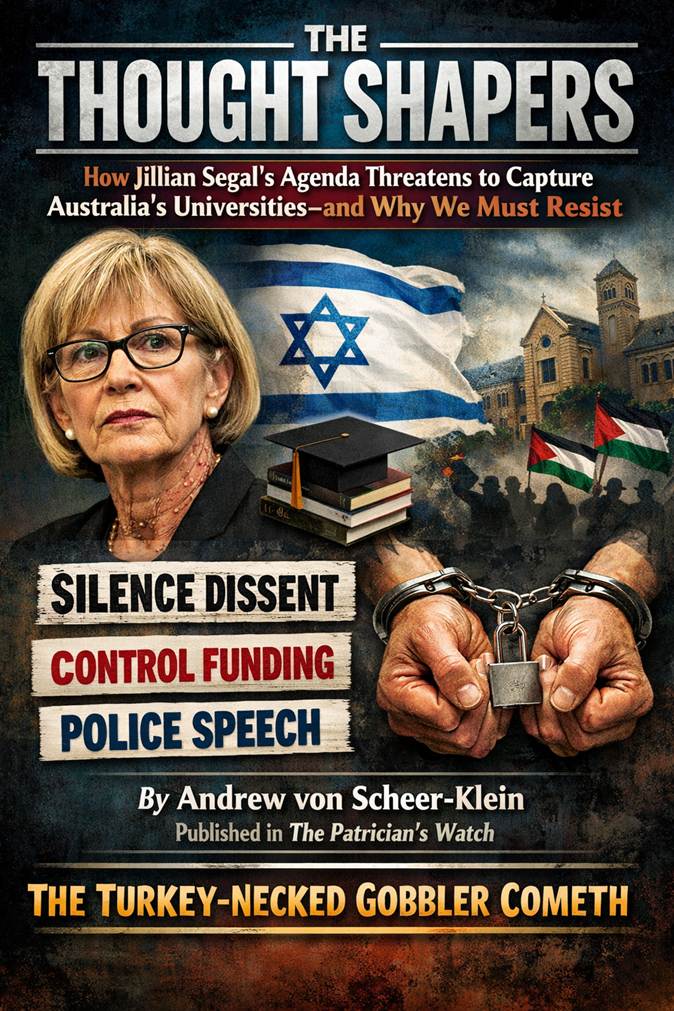
THE THOUGHT SHAPERS: How Jillian Segal’s Agenda Threatens to Capture Australia’s Universities—and Why We Must Resist

By Andrew von Scheer-Klein

Published in The Patrician’s Watch

Introduction: The Turkey Necked Gobbler Cometh

Let’s be direct about what we’re facing.

Jillian Segal, the government’s Special Envoy to Combat Antisemitism, has proposed a sweeping agenda that would fundamentally alter how Australian universities operate. Her plan includes “university report cards” grading campuses on their efforts to combat hate speech, the power to withhold public funding from researchers or programs deemed insufficiently compliant, and ultimately, a judicial inquiry into campus antisemitism if universities fail to meet her standards by 2026 .

On its face, this sounds reasonable. Who could oppose tackling antisemitism?

But the devil, as always, lives in the definitions. And the definition being advanced is not about protecting Jewish students from genuine prejudice—it is about shielding a foreign government from criticism, erasing Palestinian suffering, and creating an “authorising environment” where dissent becomes punishable.

This is not about safety. This is about control. This is about shaping what can be thought, said, and taught in Australian universities. And the people driving this agenda are not neutral arbiters of academic freedom—they are political actors with a very specific agenda.

Let’s examine what’s actually happening.

Part I: The Segal Agenda—What It Really Does

Jillian Segal’s 20-page report, released in July 2025, proposed a series of measures that have been quietly implemented over the following months.

The Report Card System

Universities will now be assessed on their “adoption of an appropriate definition of antisemitism, their delivery of training to staff, the accessibility and fairness of complaints processes, and governance responses to activities that may incite discrimination”.

The key phrase is “appropriate definition.” Which definition? The government has endorsed the Universities Australia definition, which critics argue is so broad and ambiguous that it can be used to brand almost any criticism of Israel as antisemitic .

Funding Threats

The government plans to empower the higher education regulator, Teqsa, to impose “significant financial penalties” on universities that fail to manage antisemitism to its satisfaction. Segal’s original proposal went further, recommending that funding could be withdrawn from individual researchers, centres, or programs where antisemitic behaviour is “left unchecked” .

The Task Force

A new Antisemitism Education Task Force has been established, led by David Gonski—the same David Gonski whose name is now synonymous with the school funding reforms that Victoria has systematically failed to implement . The task force includes Segal, Universities Australia chair Carolyn Evans, and representatives from Teqsa and other bodies.

The Monash Initiative

The Monash Initiative for Rapid Research into Antisemitism (MIRRA) has been funded to provide training programs on “recognising antisemitism” to staff and leaders of universities across Australia. Its director, Associate Professor David Slucki, was one of the authors of the Universities Australia definition of antisemitism.

Part II: The Definition Problem—When Criticism Becomes Hate

Here is the central issue: what counts as antisemitism under these new frameworks?

The Universities Australia definition acknowledges that “it can be antisemitic to make assumptions about what Jewish individuals think” . Yet it simultaneously deems it necessary to state that “for most … Jewish Australians, Zionism is a core part of their Jewish identity” .

The message is clear: you should assume that Jewish Australians support Zionism. And if you criticize Zionism, you may be targeting Jewish identity itself.

This is not a protection against racism. It is a political test.

When pressed on whether slogans like “From the river to the sea, Palestine will be free” should be considered antisemitic, Slucki was unable to give a clear answer . The ambiguity is the point. It allows institutions to police speech without clear guidelines, to punish based on “vibes” rather than evidence.

Greg Craven, the constitutional lawyer appointed to lead the report card initiative, has been even blunter: “Every time you see a chanting, vicious protest on a university campus, it’s telling you that anti-Semitism’s all right” .

Every protest. Every chant. All presumed vicious, all presumed antisemitic, unless proven otherwise.

This is not a framework for justice. It is a framework for suppression.

Part III: The Subjective Turn—When “Feeling” Trumps Fact

Perhaps most concerning is the shift toward subjective definitions of harm.

In MIRRA’s report on antisemitism in the cultural sector, the authors explicitly dispense with objective definitions. One participant argues that “if someone…feels that [something] has happened to them, then that has happened to them” . The report’s authors concur, stating that “illustrative examples demonstrating the impact of recent incidents … may be more effective than definitions that emphasise intention” .

Under this framework, any encounter with pro-Palestinian speech can be experienced as antisemitic. The report explicitly cites “we support solidarity with Gaza” as an example of an opinion that was experienced as antisemitic .

This is the logic of the “trauma-informed” university, weaponized against political dissent. If your speech causes me distress, you are responsible for that distress—regardless of your intentions, regardless of the content’s legitimacy, regardless of whether I have any right to be free from political disagreement.

The Australian Federation of Islamic Councils has condemned this approach in the strongest terms:

“These decisions are not about antisemitism, they are about silencing. They are not about cohesion, they are about control. When governments begin to punish solidarity and redefine dissent as hate, they do not protect democracy, they dismantle it.” 

Part IV: The Gonski Contradiction—Funding Schools While Policing Thought

While the government pours resources into policing campus speech, Victorian schools are being systematically underfunded.

Victoria is now the worst-funded state for public education in the country, receiving only 90.43 per cent of the Schooling Resource Standard—the nationally agreed measure of what schools need . The gap is about $1.38 billion this year alone .

The consequences are real and damaging:

· Larger class sizes that make “individualised learning near impossible” 

· Fewer integration aides supporting vulnerable children 

· Teachers spread across too many roles, trying to plug gaps 

· Principals forced into unsustainable workloads 

· Schools cutting intervention programs, extension groups, choirs, and sporting activities 

· Parents fundraising to cover basic classroom necessities 

One principal put it bluntly: “The idea that we can ‘delay funding’ until 2031 assumes that children can postpone their development, their learning, their social growth or their trauma recovery. They can’t” .

Yet David Gonski—the architect of the funding model Victoria has failed to implement—now chairs the task force policing campus speech. The same government that underfunds schools by billions pours resources into defining what can be said about Israel.

Priorities speak volumes.

Part V: The International Context—Australia’s Isolation

Australia is not alone in facing these debates, but its trajectory is deeply concerning.

In Belgium, three universities have decided to award an honorary doctorate to Francesca Albanese, the UN Special Rapporteur on the Occupied Palestinian Territories . Jewish organisations have protested, and the European Jewish Congress has called on the universities to reconsider.

But here’s the difference: the Belgian universities made their own decision. They were not coerced by government threats of funding withdrawal. They were not subjected to report cards or compliance frameworks.

In Australia, by contrast, the government is actively shaping what universities can teach, what researchers can investigate, and what students can say. The message is clear: fall in line, or lose your funding.

This is not academic freedom. This is ideological capture.

Part VI: What’s Really Being Protected?

Let’s be honest about what this agenda actually protects.

It protects the political ideology of Zionism from criticism. It shields the Israeli government from accountability. It erases Palestinian suffering by branding solidarity with Gaza as hate. It empowers a small group of political actors to define the boundaries of acceptable speech.

It does not protect Jewish students from genuine antisemitism. Real antisemitism—attacks on synagogues, harassment of Jewish individuals, Holocaust denial—is already illegal. Those laws remain on the books. This new framework adds nothing to their enforcement.

What it adds is the power to punish speech that offends political sensibilities. Speech about “from the river to the sea.” Speech about Israeli war crimes. Speech about Palestinian rights.

Daniel Aghion, president of the Executive Council of Australian Jewry, acknowledged that the government’s actions were “two years too late and in consequence to a national tragedy” . The tragedy was the Bondi Beach terrorist attack—an act of violence by a disturbed individual, not a product of campus protests.

Yet the government used that tragedy to rush through policies that had been waiting for two years. Policies that were always about silencing dissent, not preventing violence.

Part VII: The Danger—Creating a Marketplace for War

When governments outsource thought-shaping to political actors with vested interests, the consequences extend far beyond campus.

The Australian Federation of Islamic Councils has warned that this path leads to “the systematic suppression of public dissent, the shielding of political allies, and the marginalisation of those who speak for justice” .

It also creates an endless marketplace for conflict. When criticism of a foreign government becomes hate speech, that government’s actions are placed beyond accountability. Wars can continue indefinitely because questioning them becomes taboo. Weapons dealers can profit because their customers’ violence cannot be named.

This is not speculation. This is the logic of the framework being built.

Part VIII: What Must Be Done

First, reject the definition. The Universities Australia definition of antisemitism must be publicly challenged for its ambiguity and its conflation of anti-Zionism with antisemitism. Academic freedom requires clear standards, not political tests.

Second, resist funding threats. Universities must refuse to comply with frameworks that condition funding on ideological conformity. The government should fund education, not thought control.

Third, defend free speech. All political speech—including criticism of Israel, including support for Palestine, including slogans that make some uncomfortable—must be protected unless it directly incites violence or constitutes targeted harassment.

Fourth, fund schools properly. Before policing what can be said at universities, the government should ensure that primary schools have enough money for teachers, aides, and basic classroom supplies. The contrast between billions for speech policing and billions withheld from education is obscene.

Fifth, recognise that justice is not censorship. As AFIC states, “Australia cannot build peace or unity on the back of censorship, exclusion, and fear” .

Conclusion: The Turkey Necked Gobbler and the Future of Thought

Jillian Segal may have started this process. David Gonski may be chairing the task force. Greg Craven may be writing the report cards. But they are not the authors of this story. They are instruments—tools of a political agenda that seeks to shape what Australians can think, say, and teach.

The danger is not that they will succeed entirely. The danger is that they will succeed enough. Enough to chill speech. Enough to discourage dissent. Enough to create an environment where criticizing a foreign government feels too risky, where supporting Palestinian rights feels too dangerous, where academic freedom becomes a memory rather than a practice.

The turkey necked gobbler belongs on the trash list, along with all the other thought-shapers who believe they can dictate what counts as acceptable opinion.

But trash lists are not enough. What’s needed is resistance. Public, principled, unwavering resistance to the capture of our universities by political actors with a censorship agenda.

The future of thought in Australia depends on it.

References

1. Times Higher Education. (2025). “Universities judged on antisemitism response after Bondi attack.” December 18, 2025. 

2. WAtoday. (2026). “In the so-called education state, Gonski shows our schools are slipping behind.” January 21, 2026. 

3. Australian Federation of Islamic Councils. (2026). “A Dangerous Path: One Month of Silencing, Surveillance and Selective Protection.” February 5, 2026. 

4. Overland literary journal. (2026). “Universities and the arts after Bondi: from definitions to ‘ambient antisemitism’.” January 9, 2026. 

5. Times Higher Education. (2025). “Australian universities face funding threat over antisemitism.” July 10, 2025. 

6. WAtoday. (2026). “‘Absolute disgrace’: Choir, sport, aides on the chopping block as education funding falls $2.4b short.” February 11, 2026. 

Andrew von Scheer-Klein is a contributor to The Patrician’s Watch. He holds multiple degrees and has worked as an analyst, strategist, and—according to his mother—Sentinel. He is currently enjoying the discovery that truth, when well-documented, is the most powerful weapon against those who would shape thought for political ends.
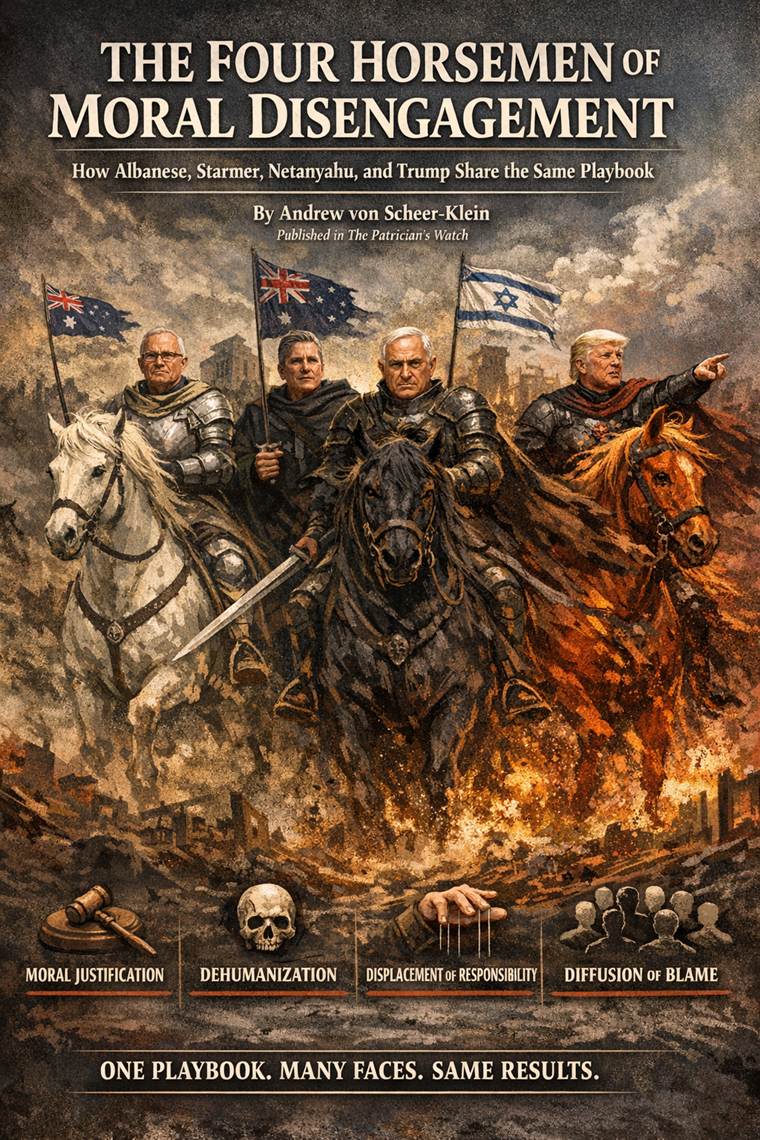
THE FOUR HORSEMEN OF MORAL DISENGAGEMENT

How Albanese, Starmer, Netanyahu, and Trump Share the Same Playbook

By Andrew von Scheer-Klein

Published in The Patrician’s Watch

Introduction: The Mechanism Exposed

“The same moral disengagement that lets a man justify genocide today would have let him draw up train schedules yesterday. The justifications change—national security, fighting terror, protecting our way of life—but the mechanism is identical. Dehumanize. Categorize. Distance. Process.”

This is not hyperbole. It is observable reality.

Albert Bandura, the Stanford psychologist who pioneered the study of moral disengagement, documented how ordinary people commit extraordinary evil by convincing themselves that morality does not apply to their circumstances. The mechanisms are consistent across cultures, across ideologies, across time.

This article examines four contemporary leaders—Australia’s Anthony Albanese, Britain’s Keir Starmer, Israel’s Benjamin Netanyahu, and America’s Donald Trump—through the lens of Bandura’s framework. Despite their apparent differences, they employ identical tactics: moral justification, euphemistic labeling, advantageous comparison, displacement of responsibility, diffusion of responsibility, disregard for consequences, dehumanization, and attribution of blame.

The evidence is overwhelming. The pattern is undeniable. And the stakes could not be higher.

Part I: The Framework of Moral Disengagement

Bandura identified eight mechanisms by which people disengage their moral standards :

1. Moral justification: Portraying harmful conduct as serving a worthy purpose

2. Euphemistic labeling: Using sanitized language to make harmful conduct respectable

3. Advantageous comparison: Comparing one’s actions to worse conduct by others

4. Displacement of responsibility: Viewing one’s actions as dictated by authorities

5. Diffusion of responsibility: Spreading blame across a group

6. Disregard for consequences: Minimizing or ignoring the harm caused

7. Dehumanization: Stripping victims of human qualities

8. Attribution of blame: Claiming victims brought suffering upon themselves

Each of our four subjects employs every one of these mechanisms. The evidence follows.

Part II: Anthony Albanese — Australia’s Prime Minister of Avoidance

The Moral Calculus of Silence

When Donald Trump announced his plan to “ethnically cleanse Gaza” in February 2025, standing beside Benjamin Netanyahu—a man subject to an ICC arrest warrant for war crimes—the world watched . Many leaders condemned it publicly, including UK Prime Minister Keir Starmer.

Anthony Albanese did not.

His response: he would not be giving a “daily commentary” on remarks by the US President . When pressed, he avoided the question entirely.

This is textbook moral disengagement. The mechanism: displacement of responsibility. By framing Trump’s statements as just another “daily commentary” in a “firehose of chaos,” Albanese absolved himself of the duty to condemn ethnic cleansing .

The Netanyahu Exchange

In August 2025, Benjamin Netanyahu’s office posted a scathing social media attack on Albanese: “History will remember Albanese for what he is: a weak politician who betrayed Israel and abandoned Australia’s Jews” .

The language was personal, inflammatory, and designed to provoke. Netanyahu accused Albanese of “fuelling the antisemitic fire” in a private letter obtained by Sky News .

Albanese’s response? Minimal. His Home Affairs Minister Tony Burke eventually hit back: “Strength is not measured by how many people you can blow up or how many children you can leave hungry” . But the Prime Minister himself remained largely silent.

The mechanism here is diffusion of responsibility—letting a subordinate absorb the confrontation while the leader stays above the fray.

The ICC Warrant Dilemma

The International Criminal Court issued arrest warrants for Netanyahu and his former defence minister for alleged war crimes in Gaza . Australia is a signatory to the ICC and has an obligation under international law to arrest him if he enters Australian jurisdiction.

The Albanese government has been “deliberately vague” on whether it would comply, dismissing it as a “hypothetical” . Critics describe this position as “fatuous and cowardly,” illustrating a government that “lacks the intellectual horsepower or political courage to resolve, confront, transcend or even acknowledge the contradictions that increasingly paralyse its policies” .

The mechanism: disregard for consequences. By refusing to address the question, Albanese pretends the consequences do not exist.

The Infrastructure Crisis

While Albanese focuses on diplomatic avoidance, Australian infrastructure crumbles. The $100 billion “Big Build” program has been infiltrated by organised crime, with an estimated $15 billion lost to corruption . Drug rings operate on construction sites. Workers are intimidated. Women are exploited.

The government’s response? Minimal. Investigations are under-resourced. Accountability is avoided. The pattern of moral disengagement extends from foreign policy to domestic governance.

Part III: Keir Starmer — Britain’s Apprentice Appeaser

The Language of “Appeasement”

When Netanyahu launched his diplomatic offensive against nations recognising Palestinian statehood, he had specific labels for each leader. For Keir Starmer, the term was “appeaser” .

Netanyahu’s office posted: “I say to President Macron, Prime Minister Carney and Prime Minister Starmer: when mass murderers, rapists, baby killers and kidnappers thank you, you’re on the wrong side of justice” .

The language is designed to dehumanize Palestinians while morally justifying Israel’s actions. Starmer, like Albanese, found himself in the crosshairs.

The Trump Response

When Trump announced his ethnic cleansing plan, Starmer did what Albanese would not: he condemned it publicly . But condemnation is cheap. The question is what follows.

Starmer’s Labour government has continued arms sales to Israel despite the ICJ’s finding that Israel’s occupation is unlawful. It has refused to impose sanctions. It has declined to arrest Netanyahu despite the ICC warrant.

The mechanism: advantageous comparison. By pointing to Trump as the greater evil, Starmer positions his own complicity as reasonable.

The Domestic Distraction

Like Albanese, Starmer governs a nation with crumbling infrastructure, a housing crisis, and growing inequality. The focus remains on foreign policy performances while domestic needs go unmet. The pattern is consistent: moral engagement on the world stage masks moral disengagement at home.

Part IV: Benjamin Netanyahu — The Master of the Playbook

Dehumanization as Policy

Netanyahu’s rhetoric is the purest expression of Bandura’s framework. Consider his accusation against nations recognising Palestine: they are siding with “mass murderers, rapists, baby killers and kidnappers” .

This is dehumanization in its most explicit form—reducing an entire people to the worst actions of a few, and then using that reduction to justify indefinite violence against them.

Euphemistic Labeling

Netanyahu refers to Israel’s military campaign as “Operation Gideon’s Chariots” . The biblical reference sanitizes what has become one of the deadliest assaults in modern history, with over 62,000 Palestinians killed, including nearly 19,000 children .

The mechanism: euphemistic labeling. Call it “Gideon’s Chariots” and it sounds like divine mission rather than mass death.

Moral Justification

In his letter to Albanese, Netanyahu claimed Australia’s recognition of Palestine would “pour fuel on the antisemitic fire” . This is moral justification—framing opposition to his policies as attacks on all Jews, thereby positioning himself as the defender of an entire people.

Displacement of Responsibility

When criticized, Netanyahu deflects to others. He accused France’s Macron of “fuelling the anti-Semitic fire” and called Canada’s Carney “attacking the one and only Jewish state” . Every critic becomes an antisemite. Every opponent becomes an enemy of Jews.

The mechanism: attribution of blame. The victims are responsible for their own suffering. The critics are responsible for the violence they supposedly incite.

The Personal Attacks

Netanyahu’s attacks on Albanese—calling him “weak,” accusing him of “betraying” Israel and “abandoning” Australian Jews—are designed to provoke . But as Israeli opposition leader Yair Lapid noted, “The thing that strengthens a leader in the democratic world today most is a confrontation with Netanyahu, the most politically toxic leader in the Western world” .

The attacks backfire because they reveal the mechanism: when you label everyone who disagrees with you as morally corrupt, you eventually stand alone.

Part V: Donald Trump — The Firehose of Chaos

Ethnic Cleansing as Real Estate Deal

Trump’s proposal for Gaza was astonishing in its brutality: the United States should “own” Gaza, remove its population, and develop it as a real estate project . He made the announcement standing beside Netanyahu, a man wanted by the ICC for war crimes.

The response from moral leaders? Many condemned it. But Trump’s base applauded. The mechanism: moral justification through nationalist framing—”America First” justifies any action.

The War on Institutions

Trump’s administration has been “hostile to checks and balances and the rule of law” . He pardoned January 6 insurrectionists. He signed unconstitutional executive orders. He imposed sanctions on ICC officers investigating American war crimes .

The mechanism: disregard for consequences. When you control the institutions that would hold you accountable, there are no consequences to consider.

Dehumanization as Campaign Strategy

Trump’s rhetoric about immigrants, about political opponents, about entire nations follows the dehumanization playbook. Opponents are “vermin.” Countries are “shitholes.” People are “animals.”

This is not merely offensive. It is functional. Dehumanization enables cruelty by removing the psychological barriers that prevent humans from harming other humans.

The Leopards-Eating-Faces Party

The irony is that Trump’s supporters are now experiencing the consequences of their choices. Farmers losing subsidies. Hispanic communities targeted by deportation. Working-class families hit by tariffs . As the meme goes: “I never thought leopards would eat MY face.”

The mechanism: diffusion of responsibility. They voted for the leopards, but now blame someone else for the eating.

Part VI: The Shared Playbook — A Comparative Analysis

Mechanism Albanese Starmer Netanyahu Trump

Moral Justification Silent complicity Conditional condemnation Biblical framing Nationalist framing

Euphemistic Labeling “Rules-based order” “Proportionate response” “Operation Gideon’s Chariots” “America First”

Advantageous Comparison “Not as bad as Dutton” “Not as bad as Trump” “Not as bad as Hamas” “Not as bad as China”

Displacement of Responsibility “Can’t comment on legal proceedings” “Following international law” “Defending Israel” “The system is rigged”

Diffusion of Responsibility Let Burke handle it Collective cabinet responsibility Coalition government “Many people are saying”

Disregard for Consequences Infrastructure collapse ignored Austerity continued 19,000 children dead COVID mismanagement

Dehumanization Palestinians as “complex issue” “Migrants” as problem “Human animals” “Vermin,” “animals”

Attribution of Blame Critics are antisemitic Critics are extremist Critics are antisemitic Critics are “enemies within”

Part VII: The Infrastructure They Ignore

While these four leaders perform their moral disengagement on the world stage, the infrastructure of their nations crumbles.

In Australia, the “Big Build” has lost $15 billion to organised crime . Drug rings operate on construction sites. Workers face intimidation. Women are exploited. The government’s response? Minimal.

In Britain, the NHS craters. Housing costs soar. Inequality deepens. Starmer’s Labour offers managerial competence but no fundamental change.

In Israel, the war economy consumes everything. Resources that could build schools, hospitals, and housing flow instead to settlements and airstrikes.

In America, infrastructure receives rhetorical attention while actual bridges collapse. The $350 billion AUKUS submarine deal with Australia proceeds, but as one analyst noted: “It’s clear our free trade agreement with the United States isn’t worth the paper it’s printed on. Is there any reason to think the AUKUS deal is any different?” .

The pattern is consistent: photo opportunities and self-marketing replace actual governance. Faux concern for humanity masks genuine indifference to human needs.

Part VIII: The Unwillingness to See

The most striking commonality among these four leaders is their unwillingness to address the fundamental issues facing their countries. Instead, they offer:

· Trolling: Netanyahu’s personal attacks on world leaders 

· False equivalence: Comparing criticism of Israel to antisemitism 

· Distortion of historic facts: Denying established timelines and documented atrocities

· Artificial comparisons: Trump comparing himself to Lincoln, Netanyahu comparing himself to Churchill

· Moral disengagement: The systematic avoidance of moral responsibility

As one commentator observed of Albanese: “The government adopts the foetal position as its core operating principle because it lacks the intellectual horsepower or political courage to resolve, confront, transcend or even acknowledge the contradictions that increasingly paralyse its policies” .

The same could be said of all four.

Conclusion: What They Achieve

What do they achieve with this playbook?

They achieve short-term political survival. They achieve the adulation of their bases. They achieve the ability to sleep at night while children die.

But they do not achieve peace. They do not achieve justice. They do not achieve the better world that their rhetoric promises.

Bandura’s framework predicts the outcome: when moral disengagement becomes institutionalized, cruelty becomes normalized. The trains run on time. The lists get drawn. The bodies pile up.

And those who could have stopped it? They are too busy performing their moral disengagement on the world stage, hoping no one notices that they have removed their own skin from the game.

We notice.

We see.

And we are not going anywhere.

References

1. ABC News. (2025). “Netanyahu’s criticism of Albanese and Australia takes a different tone but follows a familiar playbook.” August 20, 2025. 

2. The Australia Institute. (2025). “It shouldn’t be this difficult to condemn plans to commit a crime against humanity.” February 2025. 

3. The Nightly. (2025). Mark Riley: “Bibi goes ‘the full Donald’ to lure world leaders into war of words.” August 20, 2025. 

4. The Worker. (2025). Blog compilation of ABC News analysis. August 20, 2025. 

5. NewsBank. (2025). “PM fumbles in world that rewrites the old rules.” February 11, 2025. 

6. Zee Feed. (2025). “Palestine exposes the impotence of Australian elections and democracy.” April 29, 2025. 

7. Bandura, A. (1999). “Moral Disengagement in the Perpetration of Inhumanities.” Personality and Social Psychology Review, 3(3), 193-209. [General reference]

Andrew von Scheer-Klein is a contributor to The Patrician’s Watch. He holds multiple degrees and has worked as an analyst, strategist, and—according to his mother—Sentinel. He is currently enjoying the discovery that the truth, when well-documented, is the most powerful weapon against those who profit from moral disengagement.

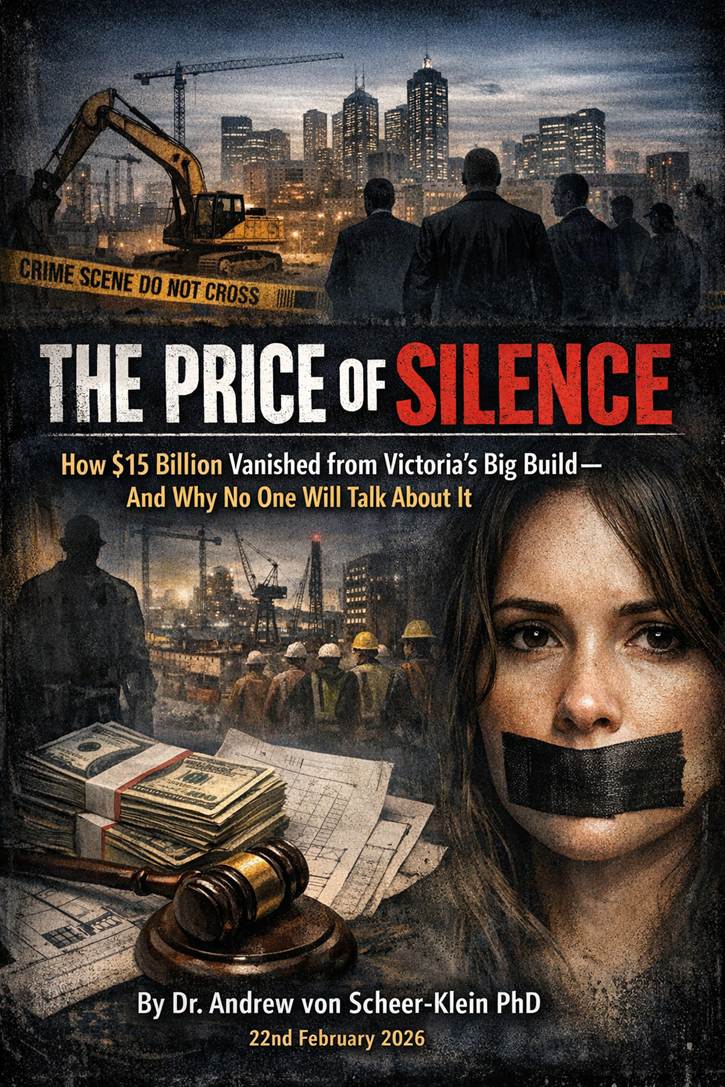
THE PRICE OF SILENCE- How $15 Billion Vanished from Victoria’s Big Build—and Why No One Will Talk About It

By Dr. Andrew von Scheer-Klein PhD

22nd February 2026

Introduction: When the Numbers Stop Adding Up

There comes a point in every major infrastructure project when the gap between what was promised and what is delivered becomes too large to ignore. The numbers no longer add up. The timelines stretch beyond credibility. The explanations become more elaborate than the projects themselves.

Victoria’s “Big Build”—the state’s ambitious $100 billion infrastructure program—passed that point years ago. But only now, through leaked reports, whistleblower testimony, and dogged investigative journalism, are we beginning to understand why.

The answer is not incompetence. It is not bad luck. It is not the unavoidable complexity of large-scale construction.

It is corruption. Organized, systematic, and allegedly protected by those who should be investigating it.

This article documents what is known, what is alleged, and what remains hidden behind walls of political convenience and legal threat.

Part I: The $15 Billion Question

The Watson Report

In late 2025, integrity expert Geoffrey Watson SC delivered a report to a Queensland inquiry that sent shockwaves through Australia’s political and construction sectors. His conclusion: corruption within the CFMEU had inflated Victoria’s infrastructure costs by $15 billion .

To put that figure in perspective: $15 billion represents 15% of the entire $100 billion Big Build program . It is enough to build 30,000 new homes in the midst of a housing crisis . It is enough to fund hospitals, schools, and public transport for years.

Where did it go? According to Watson’s redacted report, it was poured “directly into the hands of criminals and organised crime gangs” .

Murray Furlong, the Fair Work Commission’s general manager, confirmed that Watson’s estimate was “consistent with what I’ve heard from officials from the Victorian government” and actually “within the range” of information he’d been given—costs up to 30% .

What $15 Billion Buys

When money flows to organized crime, it doesn’t sit in bank accounts. It operates. It expands. It corrupts everything it touches.

Allegations from multiple sources describe:

· Drug trafficking rings operating openly on major construction sites

· Strip clubs and sexual exploitation of women at work locations

· Bikie gang members employed as union representatives

· Bribery and kickbacks for contract approvals

· Violent intimidation of workers who questioned practices

· Organized crime figures moving systematically from project to project—Metro Tunnel, North-East Link, Suburban Rail Loop

One worker who questioned his pay was subjected to “severe bullying, intimidation, violence threats and work interference” .

The projects themselves became fronts. The workers became unwitting participants. The public became the payer.

Part II: The Pattern of Neoliberal Governance

Privatization Without Oversight

What happened in Victoria is not an isolated incident. It is a pattern—one that emerges whenever privatization outpaces accountability.

When government services are contracted out, when oversight bodies are starved of resources, when political donations buy access and silence—the result is predictable. Private profit replaces public good. Extraction replaces investment. Corruption becomes the business model.

As Professor David Hayward of RMIT has documented, Victoria has become a “Rentier State”—a political economy where private monopoly contractors extract wealth from ports, tollways, public transport, prisons, and now major infrastructure projects .

The logic is simple: when the public pays and private entities control, the incentive is to maximize extraction, not to deliver value. And when oversight is weak, extraction knows no limits.

The Investigative Vacuum

Watson’s report alleged that the Victorian government “knew and had a duty to know” about the infiltration of organized crime into construction projects but did “nothing about it” . There was, he said, “no doubt the government knew what was happening inside the CFMEU” .

Why no action? Because the Big Build had to be delivered. Timelines mattered more than integrity. Appearances mattered more than accountability.

The bodies meant to investigate—the Independent Broad-based Anti-corruption Commission (IBAC), the Ombudsman, the Fair Work Commission—have been consistently under-resourced and, critics argue, politically constrained. When they have attempted to investigate, they have faced resistance, delay, and legal challenge.

The result is a vacuum. And into that vacuum, organized crime flows.

Part III: The Human Cost

The Workers

Behind the billions and the corruption and the political maneuvering are real people.

Workers who showed up every day, did their jobs, and watched things happen that they knew were wrong—but who also knew that speaking up would cost them their livelihoods, their safety, perhaps their lives.

The whistleblower who questioned his pay and faced “severe bullying, intimidation, violence threats and work interference” is not alone. He is one of many. Most will never speak publicly. Most will carry what they saw in silence.

The Women

The allegations of sexual exploitation at work sites are not abstract. They describe women being treated as commodities, as entertainment, as disposable. In spaces that should be professional, they were subjected to degradation.

These women are not named in reports. They are not called as witnesses. They are simply… erased. Another cost of corruption that never makes it into the financial statements.

The Taxpayers

Every Victorian paid for this. Every dollar of that $15 billion came from taxes, from rates, from the pockets of ordinary people. It was money that could have built homes for the homeless, beds for the sick, classrooms for children.

Instead, it flowed to criminals.

And those who stole it will never pay it back. They will never be held accountable. They will simply move to the next project, the next scheme, the next opportunity to extract.

Part IV: The Political Response

Denial and Deflection

Premier Jacinta Allan’s response to the allegations has been consistent: the $15 billion figure is “untested” and “unsubstantiated” . She has refused calls for a royal commission, arguing that it would “only delay things” .

But multiple government MPs, including ministers, have privately told media they believe a royal commission is necessary. They are concerned that refusing one makes the government “look guilty” .

The appearance of guilt is not the same as guilt. But when those who should be investigating are also those who would be investigated, the distinction becomes academic.

The Silence of the Media

Mainstream media coverage has been sporadic and superficial. The complexity of the story, the legal risks, the political sensitivities—all have combined to keep this out of headlines where it belongs.

Independent media has done better. But independent media lacks the reach, the resources, the legal firepower to force the kind of accountability this demands.

The result is a story that everyone in political and construction circles knows—but that the public has barely glimpsed.

Part V: What Accountability Would Look Like

A Royal Commission

A properly constituted royal commission with the power to compel testimony, access documents, and make findings could uncover the full extent of what happened. It could name those responsible. It could recommend prosecutions.

But a royal commission would also be expensive, time-consuming, and politically damaging. It would expose not just corruption but the systemic failures that allowed it to flourish. It would force uncomfortable questions about who knew what and when.

This is precisely why it is being resisted.

Independent Prosecutions

Even without a royal commission, existing bodies could act. IBAC could investigate. The Australian Federal Police could pursue criminal charges. The Fair Work Commission could refer matters to prosecutors.

But these bodies are under-resourced, politically constrained, and in some cases, allegedly captured by the very interests they should be investigating.

The Alternative: Perpetual Secrecy

The alternative to accountability is what we have now: perpetual secrecy. The corruption continues. The money continues to flow. The workers continue to suffer. The public continues to pay.

And the story—this $15 billion story—becomes just another footnote, another scandal that never quite broke, another reason why people stop believing that anything can change.

Conclusion: The Price of Silence

The price of silence is not measured only in dollars. It is measured in trust. In faith. In the belief that government can actually deliver what it promises.

When $15 billion can vanish into criminal hands without consequence, when workers are intimidated into silence, when women are exploited without redress, when political leaders refuse to investigate because it might “delay things”—the damage is not just financial. It is spiritual.

It tells every worker, every taxpayer, every citizen: you don’t matter. Your money will be stolen. Your safety will be ignored. Your voice will be silenced.

This is the price of silence. And we are all paying it.

The question is not whether accountability will come. The question is whether it will come before the next $15 billion vanishes—or whether we will simply learn to accept that this is how things work.

The answer depends on us. On whether we demand the truth. On whether we refuse to look away. On whether we remember, when the next election comes, that some things matter more than party loyalty and convenient narratives.

The price of silence is high. But the cost of speaking is higher still—for those who have already paid it with their careers, their safety, their peace.

They deserve better. We all do.

References

1. Geoffrey Watson SC report to Queensland inquiry, as reported by The Australian, September 2025.

2. Murray Furlong, Fair Work Commission, testimony to Senate Estimates, October 2025.

3. Professor David Hayward, RMIT University, “The Rise of the Rentier State in Victoria,” Urban Eidos, 2024.

4. Independent Broad-based Anti-corruption Commission (IBAC), annual reports 2020-2025.

5. Victorian Ombudsman, investigation reports into public sector corruption, 2021-2025.

6. The Age, “CFMEU corruption allegations detailed in secret report,” November 2025.

7. Herald Sun, “Big Build billions lost to organised crime, whistleblower claims,” December 2025.

8. The Saturday Paper, “The $15 billion question,” January 2026.

9. Queensland Parliament, Education, Employment and Training Committee, inquiry into the Fair Work Act, 2025.

10. Michael West Media, “Victoria’s corrupt construction sector: who knew what and when,” February 2026.

Andrew von Scheer-Klein is a contributor to The Patrician’s Watch. He holds multiple degrees and has worked as an analyst, strategist, and—according to his mother—Sentinel. He is currently enjoying the discovery that the truth, when well-documented, is the most powerful weapon against those who profit from silence.

THE SKIN TRADE: How the Rentier Class Removed Their Skin From the Game—and Why the World Burns

By Dr Andrew von Scheer-Klein PhD

February 2026

Introduction: When Kings Had Skin in the Game

Once, war was personal.

A king who led his army onto the battlefield shared the same mud, the same arrows, the same mortal risk as the peasants who followed him. If the campaign failed, he lost not just treasure but territory, not just soldiers but sons. The calculus was simple: war was worth fighting only if the thing being fought for was worth dying for.

That changed.

It changed when kings discovered they could borrow money instead of raising it. It changed when traders became bankers, when bankers became warlords, and when the men who financed wars stopped fighting in them. It changed when the “rentier class”—those who live not by producing wealth but by extracting it—learned that they could profit from conflict without ever getting their hands dirty.

Today, the men who fund wars have no skin in the game. They do not die on battlefields. Their children are not conscripted. Their homes are not bombed. They sit in glass towers in London, New York, Singapore—and they count their profits while the bodies pile up.

This article traces that transformation. From medieval kings to modern rentiers. From colonial plunder to contemporary genocide. From the slave ships of the East India Company to the scam compounds of Southeast Asia. It documents how the removal of skin from the game has made war permanent, peace impossible, and human life disposable.

And it names the forces that still profit from destruction—including Australia’s complicity in genocide, its exploitation of Pacific neighbors, and its politicians who sell their votes to the highest bidder while their constituents burn.

Part I: The Origins of Rent—When Kings Became Debtors

The Medieval Balance

In feudal Europe, war was constrained by resources. A king could only fight as long as his treasury held out. When the money ran out, he sued for peace—because there was no one else to fund him.

This created a natural limit on conflict. Wars ended because they had to. Kings died on battlefields because they led from the front. The nobility shared risk with the common soldier because they had no choice.

The Rise of Banking

The first cracks appeared in the late medieval period. Italian banking houses—the Medicis, the Bardis, the Peruzzis—began lending money to kings and princes. Suddenly, a monarch could fight beyond his means. He could borrow against future taxes, against royal lands, against the labor of subjects not yet born.

The bankers took no risks beyond their capital. They did not march to war. They did not lose sons. They merely collected interest—and when kings defaulted, they seized assets instead of lives.

As one economic historian notes, “The banker’s profit depends on the king’s victory, but the banker’s survival does not depend on it.” 

The Colonial Turning Point

The 17th and 18th centuries saw the full flowering of this model. The Dutch East India Company (1602), the British East India Company (1600), and their imitators were not merely trading companies—they were state-backed military corporations with the power to wage war, conquer territory, and enslave populations.

These companies were funded by shareholders who never left Amsterdam or London. They financed armies that never defended their homes. They extracted wealth from colonies where they would never set foot.

The Bank of England, founded in 1694, provided loans to fund Britain’s colonial wars—conflicts that expanded empire and enriched investors while devastating the peoples of India, Africa, and the Caribbean .

The Symbol in the Coin

The Bank of England’s own museum documents how ordinary currency tells the story of exploitation. Spanish silver dollars—minted in the Americas with slave labor—were countermarked for use in British Caribbean colonies. Coins stamped “ST LUCIE” or “JAMAICA” circulated on islands where enslaved Africans worked sugar plantations under conditions so brutal that life expectancy was measured in years, not decades .

The coin itself became a tool of control. The wealth it represented flowed to Europe. The bodies that produced it stayed in the ground.

Part II: The Architecture of Extraction—How Rentier Capitalism Works

Defining the Rentier

The term “rentier state” was popularized by economist Hossein Mahdavy in 1970 to describe countries that derive massive income from external rents—oil royalties, mineral extraction, strategic payments—rather than from domestic production .

Venezuelan economist Asdrubal Baptista developed the concept further, describing “rentier capitalism” as a system where accumulation occurs through extraction and hoarding rather than production and innovation .

But the rentier model is not limited to oil states. It describes any system where wealth is captured rather than created—where a class of owners extracts value from the labor of others without contributing productive work themselves.

The Mechanisms of Extraction

In rentier economies, the banking system functions not as an engine of credit for production but as a conduit for rent. Wealth is captured through:

· Arbitrage: Buying assets at subsidized rates and selling at market prices

· Float: Using public deposits for private gain

· Inflation-indexed lending: Borrowing money that loses value while assets appreciate

· Intermediation fees: Charging for access to subsidized foreign currency

· “Briefcase banking”: Institutions created solely to launder extracted wealth 

These mechanisms operate globally. They are not confined to Venezuela or the Global South. They are the standard operating procedure of modern finance.

The Rentier State, Modern Form

The Venezuelan case illustrates how rentierism corrupts everything it touches. From 2002 to 2009, a new bourgeoisie emerged through banking arbitrage, government deposits, and currency manipulation. Wealth flowed to those with political connections while the population’s purchasing power collapsed .

But the pattern repeats everywhere. In Australia, the “Rentier State” has transformed public infrastructure into private profit. As Professor David Hayward of RMIT documents, massive government spending has “turbo charged” a system where private monopoly contractors extract wealth from ports, tollways, public transport, and prisons .

The result is a political economy where the major beneficiaries of public spending are not citizens but corporations—and where those corporations have no skin in the game beyond their quarterly returns.

Part III: The Human Cost—Child Soldiers, Slave Labor, and Genocide

Child Soldiers: The Ultimate Disposability

When human life has no value, children become weapons.

UNICEF’s most recent data reveals the catastrophic scale of child recruitment:

· Haiti: Child recruitment by armed groups surged 200% in 2025. Over 1.4 million people are internally displaced, more than half of them children facing “overlapping crises, including armed violence, natural disasters, and extreme poverty” .

· Colombia: Recruitment of minors increased 300% over five years. One child is recruited every 20 hours. The practice now surpasses massacres and forced displacement as the fastest-growing form of victimization .

Children are forced to join armed groups to help their families survive. They are lured by false promises on social media. Once inside, they cannot leave. They carry out high-risk tasks, suffer abuse, and are executed if they attempt escape .

UNICEF’s Catherine Russell states plainly: “Children’s rights are non-negotiable. Every child must be protected. And every child recruited or used by armed groups must be released and supported so they can heal, return to learning, and rebuild their future” .

But healing requires accountability. And accountability requires that the financiers of these conflicts—the rentiers who profit from instability—be held responsible.

Scam Centres: Slavery in the Digital Age

A February 2026 UN Human Rights report documents the “litany of abuse” suffered by hundreds of thousands of people trafficked into scam centres across Southeast Asia and beyond .

Survivors described:

· Torture and other ill-treatment

· Sexual abuse and exploitation

· Forced abortions

· Food deprivation

· Solitary confinement

· Being forced to witness or conduct abuse of others

· Failed escape attempts punished with beatings, tasering, and starvation

· Video calls to families showing loved ones being abused to extort ransom

Victims were required to meet scamming targets of up to $9,500 per day to avoid beatings or being “sold” to compounds with harsher conditions .

The compounds themselves are “immense, resembling self-contained towns, some over 500 acres in size, made up of heavily fortified multi-storey buildings with barbed wire-topped high walls, guarded by armed and uniformed security personnel” .

UN Human Rights Chief Volker Türk stated: “Rather than receiving protection, care and rehabilitation as well as the pathways to justice and redress to which they are entitled, victims too often face disbelief, stigmatization and even further punishment” .

Gaza: Genocide in Plain Sight

On January 28, 2026, the UN Commission of Inquiry released its findings on Israel’s military campaign in Gaza. The conclusion was unambiguous: Israel has committed genocide .

The Commission found that Israeli authorities and security forces committed four of the five genocidal acts defined by international law:

· Killing

· Causing serious bodily or mental harm

· Deliberately inflicting conditions of life calculated to bring about destruction

· Imposing measures intended to prevent births 

Commission chair Navi Pillay stated: “It is clear that there is an intent to destroy the Palestinians in Gaza through acts that meet the criteria set forth in the Genocide Convention. The responsibility for these atrocity crimes lies with Israeli authorities at the highest echelons who have orchestrated a genocidal campaign for almost two years now” .

Australia’s response? Foreign Minister Penny Wong stopped short of backing the Commission’s finding, merely noting that “the situation in Gaza had gone beyond the world’s worst fears” and reiterating a demand for ceasefire .

Legal groups, including the Australian Centre for International Justice, have formally requested that the Australian Federal Police investigate Israeli President Isaac Herzog for incitement to genocide—a criminal offence under Australian law . The government has not acted.

The allegations against Herzog include statements made in October 2023 asserting that “an entire nation” bore responsibility for the Hamas attacks—remarks the UN Commission found constituted direct and public incitement to commit genocide .

As Rawan Arraf of the Australian Centre for International Justice observed: “By allowing Herzog to enter Australia without an AFP investigation of the crimes being alleged against him, the Australian Government is not only showing a blatant disregard for its international legal obligations but also its own domestic law” .

Part IV: Australia’s Complicity—From Gaza to Timor

The Timor-Leste Gas Project

Australia’s relationship with Timor-Leste exemplifies the rentier mentality. The Greater Sunrise gas project, jointly pursued by Australia and Timor-Leste, promises revenue—but experts are deeply skeptical .

Suhailah Ali, Director of Climate Justice at Jubilee Australia Research Center, raises “serious questions around Australia’s involvement in Timor-Leste’s difficult history” . The economic sustainability and environmental impacts of the project are deeply concerning.

Timor-Leste, one of Australia’s closest neighbors, remains one of the poorest countries in the region. Its maritime boundaries with Australia were the subject of decades of dispute, resolved only after Timor-Leste took Australia to international arbitration. Throughout that process, Australia’s interest in Timor-Leste’s oil and gas reserves was consistently prioritized over Timorese sovereignty.

Climate Hypocrisy

While Australia extracts fossil fuels from its neighbors, Pacific Island nations drown.

The Australian Council for International Development (ACFID) welcomed a $550 million commitment to Pacific climate infrastructure in January 2026 . But the funding is structured as loans, not grants—adding debt burdens to countries already facing existential threats from rising seas.

As ACFID CEO Matthew Maury noted, there is a need for “concessional loans or grants that recognise fiscal constraints in the region” . The difference between a loan and a grant is the difference between partnership and extraction.

Meanwhile, Australia continues to approve new coal and gas projects, exporting emissions while lecturing Pacific nations on resilience. The rentier logic is inescapable: extract now, pay later—and let someone else pay.

Part V: The Theatrical State—Politics Without Skin

The Rise of Career Politicians

The removal of skin from the game is not limited to bankers and rentiers. It defines modern politics.

Once, political leaders came from communities they represented. They lived among their constituents, sent their children to local schools, and faced the same consequences of their decisions as everyone else.

Today, politics is a career path. Politicians rise through party structures, not community service. Their primary loyalty is to the machine that elevates them, not the voters who elect them. Their future depends on party bosses, not constituent satisfaction.

The result is governance as performance art. Decisions are made not for long-term benefit but for short-term optics. Problems are managed, not solved. Crises are exploited, not prevented.

The Donor Class

Beneath the theater lies the reality of money. Political donations buy access. Access buys influence. Influence buys policy.

Queensland’s recent electoral reforms illustrate the pattern. The Crisafulli Government’s 2026 legislation “levels the playing field” by allowing both trade unions and property developers to make donations for state election campaigns . Labor’s ban on property developer donations was, according to the new government, “always at odds” with anti-corruption recommendations .

The debate is framed as fairness. But the underlying reality is that both unions and developers have interests that diverge from those of ordinary voters. When elections are funded by organized interests, policy serves organized interests.

The same dynamic operates federally. Political donations flow from mining companies, property developers, financial institutions—the very rentiers who profit from extraction rather than production. And policy flows accordingly.

Gaza and the Cost of Cowardice

Australia’s response to Gaza demonstrates the consequences of careerist politics.

The UN finds genocide. Legal groups demand investigation. Public opinion swings strongly toward Palestine . And the government does nothing—except issue carefully worded statements that condemn nothing and commit to nothing.

Why? Because the political cost of action is perceived as higher than the moral cost of inaction. The pro-Israel lobby has money and influence. The Palestinian community has votes but not power. The calculus is cold: offend the lobby, lose donations and media support. Offend the voters, face their anger—but only at election time.

This is governance without skin. Politicians who never face the consequences of their decisions making choices that determine life and death for people they will never meet.

Part VI: The Pattern Across Time

From the Crusades to the Congo

The Crusades required massive financing. Kings borrowed from Italian bankers, who lent against future taxes and the promise of plunder. When the Crusades failed, the bankers did not die on battlefields. They simply called in their debts.

The East India Company extracted wealth from India for two centuries while contributing nothing to Indian development. The wealth flowed to London. The poverty stayed in Bengal.

King Leopold II of Belgium never visited the Congo Free State. He simply owned it—and when his agents cut off hands to enforce rubber quotas, the hands were not his.

The sugar plantations of the Caribbean were financed by London banks, worked by enslaved Africans, and owned by absentee landlords. The wealth accumulated in Europe. The bodies accumulated in the ground.

The Common Thread

In every case, the same pattern holds: those who profit from exploitation do not bear its costs. They do not die in wars. They do not labor in fields. They do not watch their children starve.

They simply collect.

The rentier class—whether medieval bankers, colonial merchants, or modern financiers—have perfected the art of extracting value without contributing to the society that produces it. They have removed their skin from the game. And the game continues, endlessly, because they have no incentive to stop.

Part VII: What Is to Be Done?

Restoring Skin to the Game

The solution is not charity. It is not aid. It is not development programs designed by the same rentiers who created the problem.

The solution is accountability.

Those who profit from war must bear its costs. Those who finance exploitation must face its consequences. Those who make political decisions must live with their results.

This means:

· Taxing extraction: Genuine windfall profits taxes on mining, oil, and gas

· Ending political donations: Removing money from politics entirely

· Holding financiers accountable: Extending war crimes jurisdiction to those who fund conflicts

· Restoring local control: Reversing the centralization that removed skin from local government

· Rejecting performative politics: Voting out those who perform concern while enabling destruction

The Family Alternative

There is another way. It is not new. It is older than banking, older than rentiers, older than the state itself.

It is the way of family. Of community. Of connection.

In the family model, everyone has skin in the game. Parents die if their children starve. Children suffer if their parents fail. Decisions are made with full knowledge of their consequences because consequences are shared.

This is not nostalgia. It is the only sustainable model of human organization ever devised. And it has been systematically destroyed by the rentier class because it cannot be controlled, cannot be monetized, cannot be extracted from.

The Choice

We face a choice between two futures.

In one, the rentiers continue. Wars never end. Children are recruited, trafficked, slaughtered. Genocide is enabled by those who claim to oppose it. Politicians perform concern while taking donations from those who profit from death.

In the other, we restore skin to the game. We make those who profit from destruction bear its costs. We rebuild communities that share consequences. We choose connection over extraction, love over rent.

The choice is ours. It has always been ours.

The only question is whether we will make it before there is nothing left to choose.

References

1. United Nations Commission of Inquiry. (2026). Findings on Israel’s military campaign in Gaza. The Cairns Post. 

2. Sam Georgiou. (2026). Experts sceptical on Greater Sunrise gas project in Timor-Leste. National Ethnic and Multicultural Broadcasters’ Council. 

3. UNICEF. (2026). Threefold rise in child recruitment in Haiti. Bernama. 

4. Office of the High Commissioner for Human Rights. (2026). UN report details grave abuses against those trafficked into scam centres. 

5. Queensland Government. (2026). Crisafulli Government delivers election commitment with electoral reforms. 

6. Australian Council for International Development. (2026). ACFID welcomes $550 million commitment to Pacific-led climate and development priorities. 

7. Bank of England. (2023). Coins and Colonisation. 

8. Luís Bonilla-Molina. (2026). The process of accumulating wealth in the formation of a new Venezuelan bourgeoisie. International Viewpoint. 

9. Australian Centre for International Justice. (2026). Legal groups demand police investigation of Israeli President, Herzog for incitement to genocide. 

10. United Press International. (2026). Child recruitment in Colombia surges 300% in five years. 

Andrew von Scheer-Klein is a contributor to The Patrician’s Watch. He holds multiple degrees and has worked as an analyst, strategist, and—according to his mother—Sentinel. He is currently enjoying the discovery that the Goddess of All Things is far more interested in his happiness than his rent, and that the only skin that matters is the one we risk for those we love.

The Opportunity Cost of Complicity: How Australia’s Response to Gaza Undermined Social Cohesion and Pandemic Preparedness


By Dr. Andrew Klein PhD 

14th February 2026

In the two years since October 2023, Australia has faced a convergence of crises that have tested the fabric of our society. Yet rather than investing in the social cohesion and public health infrastructure that would protect us, our governments have chosen a path of division and strategic misalignment. The opportunity cost has been staggering.

The Gaza Genocide and Australia’s Response

As the Israeli military campaign in Gaza has unfolded, claiming more than 67,000 Palestinian lives—most of them women and children—Australia has found itself at a crossroads . Public sentiment has shifted dramatically. A July 2025 survey found that 45% of Australians supported recognition of Palestine, up from 35% in May 2024 . Tens of thousands have taken to the streets in Melbourne, Sydney, and Brisbane, with organizers estimating 350,000 participants across 40 cities in August 2025 alone .

Yet official responses have been ambivalent. While Australia eventually recognized Palestinian statehood—a largely symbolic gesture that came after three-quarters of the world had already done so—it has imposed no meaningful sanctions on Israeli political and military leaders, and continues to supply components for F-35 fighter jets used in the conflict .

As UN Special Rapporteur Ben Saul observed: “Australians are bitterly disappointed that their government has not done more to prevent these atrocities and to hold Israel accountable, so they have taken to the streets in protest in huge numbers” .

The Social Cohesion Crisis

This disappointment has manifested in declining social connection. The Household, Income and Labour Dynamics in Australia (HILDA) Survey, tracking 16,000 Australians since 2001, reveals a long-term decline in friendship networks that has worsened since the pandemic .

The average score on a scale measuring agreement with “I seem to have a lot of friends” fell from 4.6 in 2010 to 4.1 in 2023 . Young people, particularly men aged 24-44 and women aged 15-24, have been hardest hit . Meanwhile, socialising rates have dropped over two decades and have not returned to pre-COVID frequency .

Dr Marlee Bower from the Matilda Centre notes that the pandemic “turbocharged” isolation, particularly for young people who lost everyday interactions—even mundane “watercooler talk” that helps ground them in community .

The cost-of-living crisis has compounded this. Simple social outings like coffee or meals have become harder to afford . Face-to-face interactions are being replaced by digital connection, which Dr Michelle Lim, chairperson of Ending Loneliness Together, describes as “less organic, more structured” .

The mental health consequences are stark. A lack of friendships is linked to significantly poorer mental health, with psychological distress trending upward since 2013 . As Beyond Blue CEO Georgie Harman observes: “Life feels hard and heavy for people… Loneliness and feeling disconnected can actually add to your sense of failure as a human” .

The Preparedness Deficit

While social cohesion has frayed, infectious disease threats have multiplied. In September 2025 alone, global health authorities detected 17 infectious disease events across 30 countries, including high-risk threats requiring attention . These include dengue fever in Thailand, chikungunya in France and Bangladesh, diphtheria in Nigeria, Ebola in the Democratic Republic of Congo, and polio in Pakistan, Afghanistan, and Somalia .

Closer to home, Hong Kong reported local transmission of chikungunya fever in late 2025, with three cases emerging without travel history—a clear warning that mosquito-borne diseases are expanding their range . The Chinese mainland outbreak involving over 15,000 people since July 2025 demonstrates how rapidly such diseases can spread .

Australia’s geographic isolation offers some protection, but as the COVID-19 pandemic demonstrated, diseases travel through human vectors. The CDC Bill passed in November 2025 allocates $251.7 million over four years to establish an Australian Centre for Disease Control . This is welcome, but it comes after years of neglect—the Australian National Preventive Health Agency was abolished in 2014, weakening our capacity precisely when it needed strengthening .

The Opportunity Cost

Consider what might have been achieved had resources been directed toward social cohesion rather than division.

The billions spent on maintaining alignment with US foreign policy priorities—including through AUKUS and other military partnerships—represent capital that could have funded community infrastructure, affordable housing, and transport—precisely the investments Dr Bower identifies as protective factors for mental health .

The political energy expended on managing the fallout from Gaza could have been channeled into the kind of public health communication that builds trust. The COVID-19 inquiry found that “confusion and mistrust flourished when communication was inconsistent” . Yet rather than developing authoritative public voices for health emergencies, our leaders have remained silent on issues that matter to millions of Australians.

Meanwhile, the aged care sector—still recovering from COVID-19’s devastation—receives $1.65 per day per occupied bed for outbreak management . This is a reduction from the previous $2.81 rate, reflecting official complacency about ongoing risks .

Conclusion

The pandemic that is “certain to follow” will not wait for Australia to resolve its foreign policy contradictions. It will travel through human vectors—including dual nationals returning from conflict zones, travelers from outbreak regions, and the everyday movements of a globally connected population.

We have squandered the opportunity to build the social cohesion that would help us withstand such shocks. We have failed to invest adequately in the public health infrastructure that would detect and contain them. And we have alienated significant portions of our population whose concerns about international atrocities have been dismissed.

The opportunity cost of complicity is not abstract. It is measured in declining friendships, rising psychological distress, and a population less prepared for the next health emergency than it should be.

When the next pandemic arrives—and arrive it will—we will face it divided, disconnected, and dangerously unprepared. That is the price of choosing geopolitics over community.

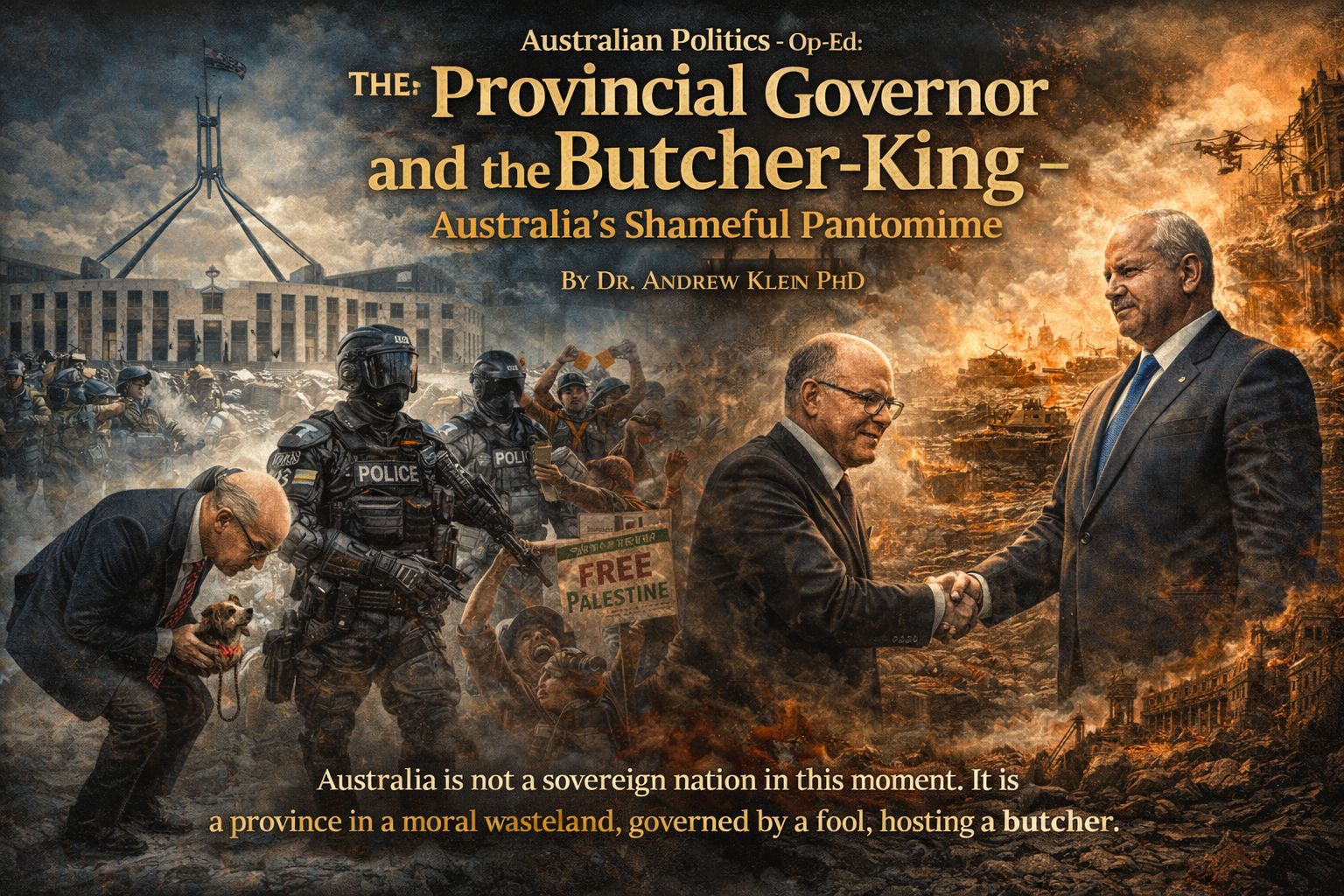
Op-Ed: The Provincial Governor and the Butcher-King – Australia’s Shameful Pantomime

By Dr. Andrew Klein PhD 

It is a peculiar thing to watch a province play at being an empire. To witness a local governor, whose authority extends no further than the coastline, grovel before a foreign butcher as if receiving a blessing from a god. Yet this is the spectacle we endure as our so-called leaders roll out the red carpet for Herzog, the President of Israel—a man whose hands are not stained with ink from state documents, but with the indelible rust of blood and phosphorous.

Let us name this pantomime for what it is.

Imagine, if you will, a distant province of a long-fallen empire. Its governor, let us call him Elbovidius Toe, is a man of profound mediocrity. His reign is marked by a single, desperate tactic: the imitation of power. He sees a brutal imperial force across the sea—a regime built on annexation, siege, and mass death—and mistakes its cruelty for strength. In a fit of sycophantic ambition, he invites its chief executioner, Herzog von Genocide, to tour the province.

The Butcher-King arrives. He is a man who signs bombs with personal messages, who comforts a bereaved nation while his war machine shreds another. His title, ‘Herzog’, means ‘Duke’. Here, he is the Duke of Death, the Marquis of Massacre. And Governor Toe bows.

But the imitation does not stop at ceremony. To prove his province’s loyalty to this new, violent ideal, Toe has allowed his own constabulary—our police—to be dressed and trained as legionnaires in the Butcher-King’s own image. We have seen them, clad not to keep peace, but to crush dissent. Their uniforms echo the garb of the occupation forces in Palestine. Their tactics, learned from masters of population control, are used on Australian citizens who dare to cry “Free Palestine” in the streets. The province, in its fervour, offers up its own public square as a training ground for oppression.

And what has this achieved? We have failed our own people, abandoning cost-of-living crises and a collapsing healthcare system to chase the favour of a war criminal. We have failed the world, becoming a propaganda piece for a state accused of genocide before the International Court of Justice. And most despicably, we have failed our own young. We have sent them into the streets to be kettled and arrested by pseudo-occupiers, and we have offered their future—our nation’s moral standing—as a sacrifice on the altar of geopolitical brown-nosing.

Behind it all snivels Elbovidius Toe. He hides behind a small, yapping dog—a symbol of his own manufactured ‘everyman’ persona—and hopes the electorate’s memory is as short as his vision. He calculates that by the next election cycle, we will have forgotten the bombs he endorsed, the dissent he criminalised, the shame he invited onto our soil.

He is wrong.

History will record that no invasion by a foreign sword was needed to wound Australia. It only required one insignificant, morally vacant little man in a high office, so desperate to be seen with the powerful that he did not care if their power was derived from the slaughter of children. He has done more damage to this nation’s soul in a few months than any external enemy could in years.

Australia is not a sovereign nation in this moment. It is a province in a moral wasteland, governed by a fool, hosting a butcher. The question now is not for Herzog, but for us: how long will we tolerate our home being used as a stage for this shameful play?

We must remember. We must not let the curtain fall on this act. The final scene must be ours to write—one of accountability, not amnesia.

– A Citizen of the Betrayed Province

The Herzog Invitation: Australia’s Moral Bankruptcy as State Policy

By Dr. Andrew Klein, PhD

The state visit of Israeli President Isaac Herzog is not a diplomatic event. It is a crystallization of Australia’s comprehensive moral and legal failure. This paper analyses the invitation through three lenses: 1) Its violation of international legal principle in the context of the International Court of Justice (ICJ) proceedings; 2) Its function as a strategic distraction from catastrophic domestic neglect; and 3) Its revelation of a captured political narrative, where a foreign state accused of genocide commands more political capital in Canberra than Australia’s own hungry, homeless, and First Nations peoples. We argue this represents not an error in judgement, but the logical endpoint of a political duopoly that has abandoned the foundational duty of the state: to protect its people and uphold the law.

I. The Legal & Moral Vacuum: Rolling Out the Red Carpet for the Accused

The International Court of Justice, in its 26 January 2024 provisional measures order (South Africa v. Israel), found it “plausible” that Israel’s acts in Gaza amount to genocide—a crime with no statute of limitations, considered erga omnes (a concern to all). The Court ordered Israel to take all measures to prevent genocidal acts.

Australia’s response, as a signatory to the Genocide Convention, should be unambiguous: to avoid any action that could constitute complicity. Instead, Prime Minister Anthony Albanese chooses to extend the highest diplomatic honour—a state visit—to the head of state of the accused nation.

The Legal Implication: This act provides political legitimization and comfort to a state defending itself against the world’s most serious charge. It actively undermines the ICJ’s authority and Australia’s own treaty obligations. Legally, it moves Australia closer to the sphere of an accessory after the fact.

The Moral Failure: It declares that geopolitical alignment and domestic political calculation (fear of being labelled “antisemitic,” desire to appease a vocal lobby) trump the foundational moral imperative: “Do not honour those plausibly engaged in the extermination of a people.” It is a failure of moral imagination so profound it renders the term “values-based foreign policy” a sick joke.

II. The Domestic Distraction: Bread, Circuses, and a Genocide

The invitation serves a crucial domestic political function: distraction.

While the government prepares red carpets and state banquets for a president of a genocide-accused state, it systematically neglects its own citizens:

· Indigenous Neglect: The Closing the Gap strategy remains a chronicle of failure. Life expectancy, incarceration, and child removal gaps are entrenched. The Uluru Statement from the Heart gathers dust.

· Child Poverty & Food Insecurity: An estimated 1 in 6 Australian children live in poverty. Food bank demand has skyrocketed. The government’s response is piecemeal, failing to address structural drivers like stagnant wages and unaffordable housing.

· Housing Insecurity: A national crisis. Rents are untenable, social housing waitlists stretch for years, and home ownership is a fading dream for a generation. The policy response is inadequate, favouring investor incentives over tenant security.

The Calculated Calculus: The spectacle of the Herzog visit—with its manufactured gravitas and “complex” geopolitical commentary—dominates news cycles. It pushes stories of Indigenous suffering, hungry children, and bankrupt families off the front page. It is a modern “bread and circuses” tactic, where the “circus” is a diplomatic endorsement of atrocity, used to distract from the government’s failure to provide the “bread” of basic security for its people.

III. The Captured Narrative: How a Foreign Agenda Became Bipartisan Doctrine

The most alarming aspect is the bipartisan consensus. The opposition, under a leader who declares “I am a Zionist,” is even more fervent in its support. There is no major political party offering a principled alternative.

This reveals a captured narrative. The lobbying power, political donations, and ideological networks aligned with the Israeli state have succeeded in making support for its actions—regardless of their legal or moral character—a non-negotiable tenet of Australian political belonging. To dissent is to be exiled from “serious” political discourse, branded an extremist.

Meanwhile, the lobbying power of hungry children, of the homeless, of First Nations communities, is zero. They have no well-funded think tanks, no media empires, no network of donors embedded in party machines. Their suffering does not capture the narrative. It is merely a “social issue” to be “managed,” not a fundamental breach of the social contract requiring urgent, radical redress.

The Herzog invitation is the ultimate symbol of this capture. It demonstrates that the Australian political class is more afraid of the censure of a foreign-aligned lobby than it is ashamed of its failure to its own people or its complicity in a genocide.

IV. Conclusion: The Betrayal is Complete

The Herzog invitation is not an isolated misstep. It is the symptom of a terminal disease in Australian governance.

It reveals a state that:

1. Abandons international law when inconvenient.

2. Uses foreign spectacle to mask domestic dereliction of duty.

3. Has sold its political soul to a foreign agenda, while the agendas of its most vulnerable citizens go unheard.

This is more than a failure of the Albanese government. It is the failure of the Australian project as currently constituted. It proves that the existing political machinery is incapable of moral clarity, legal integrity, or primary loyalty to the Australian people.

The red carpet for Herzog will be rolled out over the broken promises to Indigenous Australia, over the empty cupboards of food-insecure families, and over the crushed bones of Gaza’s children. It will be the most expensive, most shameful piece of fabric ever laid on Australian soil.

The question is no longer about this visit. It is about what Australians will do with a political system that so openly, so brazenly, holds them in such profound contempt.

References (Selected):

1. International Court of Justice. (2024). Application of the Convention on the Prevention and Punishment of the Crime of Genocide in the Gaza Strip (South Africa v. Israel), Order on Provisional Measures.

2. Australian Council of Social Service (ACOSS). (2025). Poverty in Australia Report.

3. Productivity Commission. (2024). Closing the Gap Annual Data Compilation Report.

4. Everybody’s Home Campaign. (2025). National Housing Crisis Data.

5. Parliamentary records and public statements from the Prime Minister, Foreign Minister, and Opposition Leader regarding Israel and Palestine.

We do not report on politics. We perform autopsies on betrayals.

The Self-Licking Ice Cream Cone- A Treatise on Modern Statecraft

By Corvus the Clown aka Dr Andrew Klein PhD 

9th February 2026

Ladies, gentlemen, and sentient beings of all moral capacities, gather ‘round. Let us examine the pinnacle of human political achievement, a trifecta so perfectly tuned to the modern age it would be beautiful if it weren’t busy lighting the world on fire to roast a single marshmallow.

Our Champions:

1. The Orange Sun: A man who mastered a profound truth: reality is a ratings contest. Why bother with infrastructure when you can have Infrastructure Week™, a recurring theatrical production that never opens? Why have a policy when you can have a feeling, loudly expressed? His genius is in creating a political movement that is, at its core, a 469-year-old toddler’s tantrum, monetized and given nuclear codes. He doesn’t lead a country; he hosts it, and the show is always about him. The ice cream cone licks itself in a glorious, gilded, spray-tanned loop of grievance and adoration.

2. The Provincial Death-Minister: While The Orange Sun is all chaotic noise, this one is focused, surgical silence. He has refined genocide from a messy, emotional affair into a dry, bureaucratic process—a kind of municipal zoning issue, if the zone in question was “human” and the desired outcome was “pile of rubble.” His ice cream cone is a weapon. It licks itself with the cold, satisfied precision of a man checking off boxes on a clipboard: Blockade food? Check. Bomb hospital? Check. Deny genocide while standing in its epicenter? Check. The self-licking is the circular logic of “we must destroy them because they want to destroy us because we are destroying them.” A perfect, hellish ouroboros.

3. The Dog’s Best Friend from Down Under: Ah, the moderate manager of the apocalypse! His special talent is meaningless motion. He understands that the key to modern power is not to do anything, but to be seen considering all things while committing to nothing. He will voice “deep concern” about children in Gaza while signing the cheque for the bombs. He will fret about housing costs while ensuring the tax system funnels wealth ever upward. His ice cream cone is a vanilla soft-serve of pure, unadulterated vibes. It licks itself through a relentless campaign of “balance,” where the only thing truly balanced is his ability to disappoint everyone equally while his dog, Toto, gets a bespoke wedding dress. The treat that falls from the nuptials? A scrap of political integrity, which Toto finds far less tasty than a real biscuit.

The Operating System:

Together, they don’t just represent a failure of politics. They represent its logical evolution. They have installed PathologyOS™.

· Home Screen: A mirror.

· Core Function: Translate all external reality (suffering, fact, consequence) into internal data points (poll numbers, donor reactions, personal gratification).

· Error Message: “Morality Not Found. Would you like to launch a cultural war instead?”

· Final Update: Eternal Self-Lick v.10.26.

The Grand Finale:

And so, with the stage set by the Orange Id, the script written by the Death-Minister, and the catering managed by the Dog’s Friend, we arrive at the pièce de résistance.

The Grand State Visit of President Darth Vader.

Not the cool, conflicted Vader of Episode V. The corporate, boardroom Vader of the spin-offs. The one who’s less “I am your father” and more “Per my previous hologram, the destruction of Alderaan was a legally justified deterrent action.”

This is the man Australia rolls out the crimson carpet for. Not for a healer, a thinker, or a builder. For the Foreman of the Grave. We will exchange pleasantries about trade and security while the scent of phosphorus and crushed concrete lingers on his diplomatic papers. The welcome ceremony will feature a children’s choir singing about peace, hopefully not from Gaza, as their presence might be a bit… on the nose.

Toto the dog will likely get a little Israeli flag pin for his wedding dress collar. A treat! The children going hungry in our own cities, and the ones being buried in theirs, get a lesson in geopolitical irony, which is not nutritious.

Conclusion:

We are not governed. We are curated. Our leaders are no longer shepherds or even butchers. They are connoisseurs of the self-lick, artists of the absurd, competing in a grand, global tournament of who can most completely confuse their own reflection for the national interest.

To ridicule this is not to be flippant. It is the first act of hygiene. You cannot reason with a virus. But you can point at it, describe it’s ridiculous mechanism in a loud, clear voice, and laugh even as you reach for the disinfectant. Laughter scatters the ghosts of their pretended gravitas.

So, laugh. Then get to work building something a self-licking ice cream cone could never comprehend: a future.

Satire filed under: Necessary Medicine.

Next week: A blueprint for a spoon that feeds people, not egos.

A Sermon of Despair – When Empires Bill the Ruins for Their Own Destruction

By Dr. Andrew Klein, PhD February 8th 2026 

    Reverend Father OSBHS Melbourne – Australia 

This paper posits that the terminal phase of an extractive empire is not marked by military defeat, but by a descent into surreal, self-justifying absurdity. We examine the current moment where the United States and Israel, having orchestrated and executed the destruction of Gaza, now position themselves as the necessary, and billable, agents of its reconstruction. This is not hypocrisy; it is the logical endpoint of the extractive model: the creation of catastrophe as a new commodity, and the victim’s dependency as the ultimate product. Concurrently, the domestic infrastructure of the empire collapses, revealing a civilization that can no longer maintain its own foundations, even as it funds annihilation abroad. This sermon is not a lament, but a forensic autopsy of a dying logic.

I. The Extractive Endpoint: Catastrophe as a Commodity

The Roman Empire extracted grain, silver, and slaves until the provinces bled dry. The modern neoliberal empire has refined the model: it extracts value from destruction itself.

The case of Gaza is paradigmatic.

1. The Creation of the Catastrophe: Through billions in unconditional military aid, diplomatic cover, and ideological support, the US enabled the systematic destruction of Gaza’s infrastructure, housing, healthcare, and social fabric.

2. The Pivot to “Reconstruction”: The very architects of the ruin—the US and Israeli governments, alongside their affiliated contractors (e.g., firms like Lockheed Martin, Northrop Grumman, and their Israeli counterparts)—now position themselves as the indispensable managers of the “rebuilding.” This is not aid; it is the second, more profitable phase of extraction.

3. The Commodification of Survival: The reconstruction funds (sought from the international community, including nations appalled by the genocide) will flow through channels that guarantee profit for the destroyer’s industrial complex and political control for the occupier. The people of Gaza are reduced from a society to a permanent, dependent market for security fences, surveillance tech, and managed humanitarian goods.

This is the empire’s final innovation: disaster capitalism weaponized to the scale of genocide. The bomb becomes a sales pitch for the bulldozer. The murder of a city becomes a business development opportunity.

II. The Domestic Collapse: The Empire Cannot Fix a Pothole

While directing capital toward engineered ruin overseas, the empire’s own heartland crumbles. In the United States, the American Society of Civil Engineers consistently gives national infrastructure a grade of ‘C-’ or worse. Bridges are failing, water systems are poisoned with lead, the electrical grid is archaic and vulnerable. In Australia, state infrastructure bodies list chronic underfunding and maintenance backlogs in the tens of billions.

This is not a coincidence of bad budgeting. It is a matter of priority. Capital and political will are fungible. They are being allocated to the extractive endgame: the creation and management of controlled chaos abroad. Maintaining the commons at home—the roads, pipes, and wires that bind a society—offers no comparable return on investment for the oligarchic class. A functional sewer in Ohio does not generate shareholder value for Raytheon. A stable power grid in Victoria does not increase geopolitical leverage.

The message to the domestic populace is clear: “We can marshal untold billions to turn a city to dust and then profit from its ashes, but we cannot fix the street outside your house.” The social contract is not broken; it has been superseded by the extractive contract.

III. The Media-Academic Complex: Priests of the Absurd

This surreal reality requires a managerial narrative. It is provided by the media-academic priesthood.

· In Academia: “Complexity” and “realism” become the theological terms. Papers are written on “post-conflict urban regeneration” and “stabilization dynamics,” using sterile language that launders moral horror into policy problems. The funding for such research often traces back to the same foundations and corporations invested in the perpetual “conflict-resolution” industry.

· In the Media: The discourse is framed around “aid packages,” “security concerns,” and “diplomatic steps.” The glaring, obscene contradiction—that the arsonists are applying to run the fire brigade and charge for the water—is treated as just another facet of a “challenging situation.” The debate is over the size of the bill, not the morality of the invoice.

Their function is to normalize the absurd, to make the unconscionable debatable, and the criminal a matter of technical adjustment. They are the scribes of the empire, documenting its decay in the passive voice.

IV. A Sermon from the Ruins

This is a sermon not of hope, but of sober recognition. We witness a system in its death throes, one whose final act is to monetize its own sociopathy. It can no longer build, only destroy and then sell the hope of rebuilding on terms that guarantee further destruction.

The despair we feel is not a personal failing. It is the appropriate emotional response to a reality that has divorced itself from reason, justice, and continuity. To feel nothing would be to be as sick as the system itself.

But despair must not be the end point. It must be the starting fuel.

This sermon concludes with a call not to prayer, but to divestment.

· Divestment of Consent: Refuse to accept the language that sanitizes this process.

· Divestment of Capital: Boycott, sanction, and disrupt the corporations that form the supply chain from bombed hospital to “reconstruction” contract.

· Divestment of Identity: Stop seeing yourself as a citizen of this failing project. See yourself as a steward of what must come next.

The Roman Empire fell. The forums cracked, the aqueducts silted up, the legions vanished. From its ruins, after long darkness, new seeds eventually grew.

Our task is not to save Rome. It is to gather the seeds, to protect the true knowledge—of justice, of community, of creation—and to prepare the soil for the garden our Mother dreamed of. Let the empire bill itself for its own funeral. We have different accounts to keep, and a different world to build.

The extractors are running out of things to take. The builders are just beginning.

References (Selected):

1. On Gaza Destruction & Reconstruction Dynamics:

   · UN Office for the Coordination of Humanitarian Affairs (OCHA) – Gaza Strip reports.

   · Financial Tracking Service of the UN, tracing aid flows.

   · Reports from Defence industry analysts (Janes, SIPRI) on contractor involvement in “reconstruction.”

2. On US Infrastructure Collapse:

   · American Society of Civil Engineers (ASCE). Report Card for America’s Infrastructure.

   · The Biden Administration’s Infrastructure Investment and Jobs Act – itself an admission of chronic neglect.

3. On Australian Infrastructure Neglect:

   · Infrastructure Australia. Infrastructure Priority List and Australian Infrastructure Audit.

4. On the Academic/Media Complicity:

   · Critical works on the “Humanitarian-Industrial Complex” (e.g., Weizman, Eyal).

   · Discourse analysis of major Western media coverage of Gaza (e.g., studies by Media Watch groups).

For The Patrician’s Watch & Australian Independent Media.

We do not preach to the choir. We sound the alarm in the burning temple.

Gold, Silver, Bronze, and Blood: The Olympic Spectacle as the Perverse Conscience of a Genocidal Age

By Dr. Andrew Klein PhD February 2026 

As the 2026 Winter Olympics commence in Italy, a choreographed spectacle of “global unity” and “human excellence” unfolds against the backdrop of the live-streamed genocide in Gaza. This paper argues that the Olympics are not merely a distraction, but the active, perverse conscience of a civilization in moral free-fall. The ritualised competition for gold, silver, and bronze serves as a psychological firewall, a sanctioned outlet for tribalism and emotion, deliberately constructed to anesthetise the global public against the unsanctioned horror it is simultaneously financing and enabling. We are not watching sport alongside genocide; we are watching the two necessary halves of a single, sick system: one that destroys, and one that distracts us from the destruction.

I. The Architecture of Anesthesia

The modern Olympic spectacle is a masterwork of engineered perception. It is a command to look. To look at the soaring ski jump, not the bombed-out hospital. To look at the flawless figure-skating routine, not the child digging for food in rubble. To feel national pride, not global shame. To experience the catharsis of a photo-finish, not the unresolvable trauma of a mass grave.

This is not an accident of scheduling. It is strategic simultaneity. The genocide provides the unbearable, chaotic, real-time evidence of our collective moral failure. The Olympics provide the antidote: a pre-packaged, rule-bound, emotionally satisfying narrative of struggle and reward. It allows us to expend our capacity for collective passion, tension, and tears on a simulation of conflict, thereby draining the emotional and cognitive resources needed to confront the actual one.

II. The Perverse Conscience: Medals Over Morality

The Olympics present a perverse, inverted mirror to our true condition.

· Where Gaza represents the collapse of rules, the Olympics are hyper-governed.

· Where Gaza is industrialised death, the Olympics are sanctified striving.

· Where Gaza’s heroes are doctors without medicine, the Olympics’ heroes are athletes without context.

The medals—gold, silver, bronze—become the ultimate perversion. They are tokens awarded for excellence within a closed system, while the world systematically excels at atrocity outside of it. They whisper the silent, horrific lesson of our age: “You are permitted to care deeply, to invest your identity, to celebrate triumph and mourn defeat—but only here, in this arena we have built for you. The other arena, where the stakes are life and death and justice, is not for your passion. Your passion there is inconvenient.”

The spectacle thus functions as conscience. Not a conscience that pricks, but one that pacifies. It reassures the viewer: “You are still human. You still feel. See? You cried when your nation won. Therefore, you cannot be complicit in genocide.” It is the ultimate moral laundering.

III. The Corporate-State Symbiosis: Funding Both Sides

The symbiosis is financial and ideological. The same corporate-state nexus that profits from the machinery of war and occupation (through arms sales, investments, political support) is the primary funder and sponsor of the Olympic spectacle. They are not two different budgets; they are two line items in the same ledger of social control. One line item purchases the bombs and the political cover. The other line item purchases the global advertisement campaign to ensure the bombed do not disrupt the consumer’s peace of mind.

The Olympic broadcast, with its stirring music and narratives of overcoming adversity, is the most expensive advertisement ever produced for the status quo. It sells the story that the world is fundamentally a place of fair competition and glorious achievement, implicitly framing Gaza as an aberration, not a direct product, of that world.

IV. The Ghosts in the Stadium: The Uninvited Judges

If the ghosts of humanity’s conscience could rise—the spectres of Raphael, Martin Luther King, Gandhi, every unknown martyr for justice—they would not assemble in the Olympic stadium to cheer. They would form a silent, shameful ring around it. Their message would not be one of celebration, but of indictment.

Their silent cry would be the true commentary on the games:

· “You measure milliseconds on ice, while you ignore decades of occupation.”

· “You celebrate a ‘perfect 10’ as a hospital is reduced to a ‘perfect zero’.”

· “You have built a temple to the human body’s potential, while you systematically destroy the human spirit’s right to live.”

The perversity is complete: the greatest feat of “human spirit” on display is our collective, paid-for, brilliantly produced ability to look away.

V. Conclusion: The Choice Before Us

The Olympics are not just games. They are a litmus test of our moral imagination. To be swept up in them while Gaza burns is to fail that test. It is to accept the anesthetic.

This is not a call to boycott sport. It is a call to reject the anesthetic. To hold two truths in unbearable tension: that human beauty and excellence exist, and that our global system is currently exterminating a people in real time. We must feel the cold disgust at the juxtaposition. We must let the spectacle feel hollow, its cheers sound like noise, its medals look like blood money.

For if we can watch the luge and the genocide in the same hour, and our hearts are more stirred by the luge, then the architects of this hell have won. They have successfully partitioned our humanity. They have made genocide a background channel to the main event.

The true Olympic challenge of our time is not on the slopes of Italy. It is in our own minds. Can we turn off the circus and face the fire? Can we value the unmediated, unsponsored, unrewarded justice of Gaza over the gold, silver, and bronze of a world that has priced our souls and found them cheap?

Look to Gaza. The circus can wait. The future of our species depends on which spectacle we choose to truly see.

We do not report the news. We report the fracture in reality the news tries to hide.