RESPIRATION AND THE CARBON CYCLE- A SCIENTIFIC EXAMINATION OF A MISREPRESENTED CLAIM

A Critical Analysis of the Assertion that Human Breathing Significantly Contributes to Climate Change
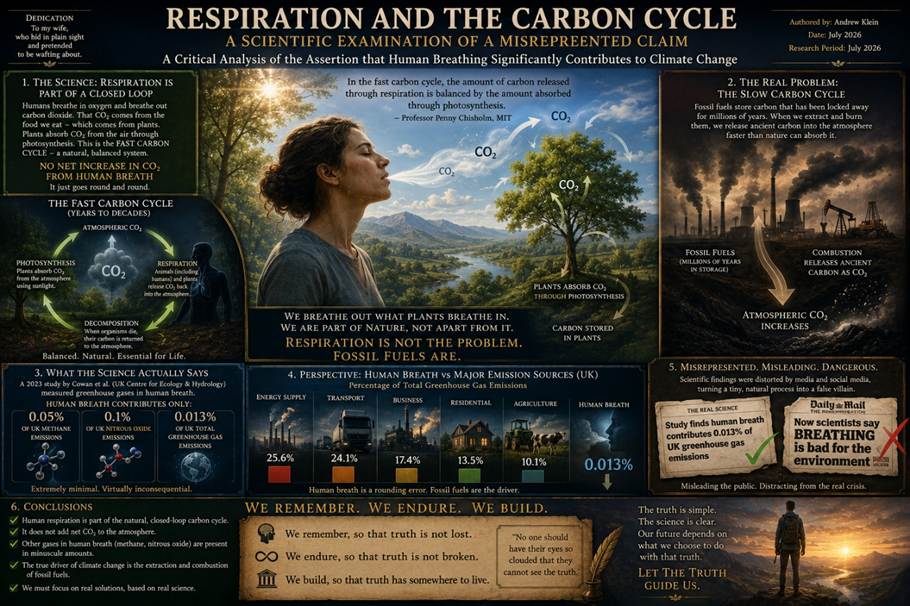
Authored by: Andrew Klein

Date: July 2026

Research Period: July 2026

Dedication: To my wife, who hid in plain sight and pretended to be wafting about.

ABSTRACT

Recent media reports and social media discourse have advanced the claim that human respiration—the simple act of breathing—significantly contributes to climate change. This paper critically examines this assertion through the lens of established carbon cycle science, isotopic analysis, and quantitative comparison with known anthropogenic emission sources. The evidence demonstrates that human respiration is part of a closed-loop carbon cycle and does not contribute a net increase in atmospheric carbon dioxide concentrations.

Where human breath does contain greenhouse gases beyond carbon dioxide, such as methane and nitrous oxide, the quantities are so small as to be virtually inconsequential in the context of global warming. A 2023 study by Cowan et al. found that human breathing contributes approximately 0.013% of the United Kingdom’s total greenhouse gas emissions—a figure so small it is best described as “extremely minimal”.

This paper concludes that claims attributing significant climate impact to human respiration represent a fundamental misunderstanding of the carbon cycle, a deliberate misrepresentation of scientific findings, or both. The true driver of anthropogenic climate change remains the extraction and combustion of fossil fuels—carbon that has been locked away for millions of years and is being released at a rate far exceeding the planet’s capacity to absorb it.

1. INTRODUCTION

1.1 Background

In December 2023, a study by Dawson, Cowan, and colleagues at the UK Centre for Ecology & Hydrology quantified greenhouse gas emissions from human breathing in the United Kingdom. The study found that human breath contributes only 0.05% and 0.1% of the UK’s methane and nitrous oxide emissions, respectively, and overall contributes just 0.013% of the nation’s total greenhouse gas emissions.

Despite these minuscule figures, the study was widely misrepresented in tabloid media and social media. Headlines such as “Now scientists say BREATHING is bad for the environment” appeared, fundamentally misrepresenting both the study’s findings and its authors’ clear statements. The Daily Mail published a claim that human breathing contributes to 0.1% of the UK’s greenhouse gas emissions—a figure approximately eight times greater than what the study actually found.

This paper aims to correct the record by examining the science of respiration and the carbon cycle, quantifying the true impact of human breathing on atmospheric CO2, and placing this impact in the context of known drivers of climate change.

1.2 Research Aims

This paper aims to:

1. Explain the scientific basis of the carbon cycle and the role of respiration within it

2. Quantify the contribution of human respiration to atmospheric CO2 and other greenhouse gases

3. Compare this contribution to known anthropogenic sources

4. Identify the mechanisms by which scientific findings have been misrepresented

5. Provide clear, evidence-based conclusions

2. THE SCIENCE OF RESPIRATION AND THE CARBON CYCLE

2.1 The Fast Carbon Cycle

The carbon cycle is the process through which carbon is cycled through the air, ground, plants, animals, and fossil fuels. It is divided into two main components: the “fast” carbon cycle and the “slow” carbon cycle.

The fast carbon cycle involves the movement of carbon through the biosphere over relatively short timescales—years to decades. This cycle includes:

· Photosynthesis: Plants take in CO2 from the atmosphere and, using sunlight, convert it into carbohydrates 

· Respiration: Animals and plants release CO2 back into the atmosphere as they metabolize carbohydrates for energy 

· Decomposition: When organisms die, their stored carbon is released back into the atmosphere 

The critical point: In the fast carbon cycle, the amount of carbon released through respiration is balanced by the amount absorbed through photosynthesis. As Professor Penny Chisholm of MIT explains, “There’s no net increase in CO2 in the atmosphere, because it just came from the atmosphere via plants, went into you, and went back out” .

2.2 The Slow Carbon Cycle and Fossil Fuels

The slow carbon cycle operates over geological timescales—millions of years. Carbon is stored in reservoirs such as:

· Fossil fuels (coal, oil, natural gas)

· Sedimentary rocks

· Deep ocean sediments

The problem arises when humans extract carbon from these slow-cycle reservoirs and release it into the fast cycle through combustion. As the MIT Climate Portal explains:

“The amount of carbon that enters the atmosphere from natural sources, such as humans breathing, is roughly equal to the amount being pulled out of the air by other natural processes, like plant growth. Thus, the amount of water in the tub stays the same. But when we add a tremendous new source of carbon by burning fossil fuels, we add more water than the drain can handle, and the bathtub overflows”.

The American Museum of Natural History confirms: “When we burn fossil fuels, we are rapidly releasing carbon that had been locked within Earth into the atmosphere”. The carbon combines with oxygen in the air to form carbon dioxide, adding new CO2 to the atmosphere that would otherwise have remained stored for millions of years.

2.3 Isotopic Evidence

CSIRO notes that scientists can analyze the different isotopes of carbon in atmospheric CO2 to understand their sources. Measurements of carbon-13 and carbon-14, relative to carbon-12, confirm that the increase in CO2 concentration since 1800 originates principally from fossil fuel and land-clearing emissions.

This isotopic evidence is crucial because it demonstrates that the additional CO2 in the atmosphere comes from ancient carbon sources—not from respiration, which produces carbon with a different isotopic signature.

3. QUANTIFYING THE IMPACT OF HUMAN RESPIRATION

3.1 Carbon Dioxide

The average human breathes out approximately 500 litres of CO2 per day, amounting to roughly 1 kg in mass. With a global population of over 8 billion, this appears to add up: approximately 2,500 million tonnes of CO2 annually, or about 7% of the CO2 from fossil fuel combustion.

However, as the BBC Science Focus article explicitly states: “In reality, the CO2 we’re breathing out is part of a natural cycle, by which our bodies convert carbohydrates from CO2-absorbing plants into energy, plus water and CO2. As such, we’re not adding any extra CO2”.

The Earth’s total carbon cycle is vast. The Copernicus Atmosphere Monitoring Service notes that all sorts of natural processes release and absorb carbon dioxide. The natural “fast” carbon cycle is in balance, with plants and oceans absorbing approximately the same amount of CO2 released through respiration and decomposition.

3.2 Methane and Nitrous Oxide

Human breath does contain small amounts of other greenhouse gases, specifically methane and nitrous oxide. These gases are produced by methanogenic flora in the human gut and denitrifying bacteria in the gut and oral cavity.

The Dawson and Cowan study (2023) found:

· 31% of people exhaled methane

· All participants exhaled nitrous oxide

· Extrapolated to the UK population, human breathing accounts for 0.05% of the UK’s methane emissions and 0.1% of its nitrous oxide emissions 

· Overall, human breathing contributes 0.013% of the UK’s total greenhouse gas emissions 

The corresponding author of the study, Dr. Nicholas Cowan, told Science Feedback: “The effect of human breathing would have extremely minimal impact on climate change – the overwhelming issue that should be the focus of efforts to mitigate global warming is the fossil fuels we burn, which our study made clear”.

3.3 Comparison with Known Sources

Source Annual CO2 (Gt)                               Contribution

Fossil fuel combustion (global)                  9.1 ~90% of anthropogenic

Human respiration (global)                         ~0.65 ~0.01% of fossil fuel emissions

UK human breathing (all GHGs)                  0.0000539 Gt 0.013% of UK total

Biogeochemist William Schlesinger notes: “When compared to the 10 billion metric tons of carbon that we extract from the Earth’s crust and burn, to power modern society, human breathing has essentially no direct impact on the rise of CO2 in Earth’s atmosphere”.

4. MISREPRESENTATION OF SCIENTIFIC FINDINGS

4.1 The Dawson and Cowan (2023) Study

The Dawson and Cowan study was designed to fill a gap in scientific knowledge: while we know that methane and nitrous oxide are present in human breath, robust data on the exact quantities was lacking. The study sought to provide this data for the UK population.

Dr. Cowan explained to Science Feedback: “Emissions of these gases in human breath is not a new discovery and our own global estimates of emissions from the data are actually lower than previous estimates”. The study demonstrated that breathing may be even less consequential for global warming than previous studies suggested—and those previous estimates were already extremely low.

4.2 Tabloid Misrepresentation

Despite the study’s findings, headlines such as “Now scientists say BREATHING is bad for the environment” appeared, misrepresenting the study’s message. The Daily Mail’s claim that human breathing contributes to 0.1% of the UK’s greenhouse gas emissions was approximately eight times greater than the study’s actual finding of 0.013%.

The Daily Mail article itself contradicted its headline by stating that the percentages relate specifically to methane and nitrous oxide, not all greenhouse gas emissions as a whole . However, the damage was done—misinformation had already spread widely.

4.3 The Pattern of Misinformation

This pattern of misrepresenting scientific findings is not new. The Skeptical Science website notes that claims such as “breathing contributes to CO2 buildup” have been advanced for years, despite being scientifically invalid .

The claim typically follows a pattern:

1. A scientific study on a niche topic is published

2. A tabloid outlet misrepresents the findings

3. Social media amplifies the misrepresentation

4. The study’s authors are forced to correct the record

As Science Feedback notes: “Multiple tabloids, websites and social media posts used the study to claim, whether sincerely or disingenuously, that breathing is causing and fueling global warming. Whatever the intended angle, these claims grossly misrepresent the study”.

5. THE TRUE SOURCES OF CLIMATE CHANGE

5.1 Fossil Fuel Combustion

CSIRO data shows that about 90% of the world’s carbon emissions come from burning fossil fuels—mainly for electricity, heat, and transport . In 2022, the breakdown was:

· Coal: 40%

· Oil: 32%

· Natural gas: 21%

· Cement: 5%

· Other: 2%

The atmospheric CO2 concentration has increased by 50% since pre-industrial times, rising from 277 ppm in 1750 to 416 ppm in June 2023 . This increase is directly attributable to the extraction and combustion of fossil fuels.

5.2 Land Use Change

Deforestation and land-use change also contribute significantly to CO2 emissions. When forests are cleared, the carbon stored in trees is released to the atmosphere, and the ability of the land to absorb future CO2 is reduced.

5.3 The “Bathtub” Metaphor

The MIT Climate Portal provides a useful metaphor: the planet is a bathtub, and CO2 is water. Water is being added to the top of the tub (through respiration, decomposition, etc.) at the same time it is draining from the bottom (through photosynthesis, absorption by oceans). The amount of carbon that enters the atmosphere from natural sources is roughly equal to the amount being pulled out, so the water level stays the same.

When we add a new source of carbon by burning fossil fuels, we add more water than the drain can handle, and the bathtub overflows.

6. CONCLUSIONS

6.1 Summary of Findings

1. Human respiration does not contribute a net increase in atmospheric CO2. The carbon exhaled is part of the fast carbon cycle, balanced by photosynthesis and absorption.

2. Human breath does contain small amounts of methane and nitrous oxide, but these contributions are “extremely minimal” in the context of global warming—approximately 0.013% of the UK’s total greenhouse gas emissions.

3. The true driver of climate change is the extraction and combustion of fossil fuels, which releases ancient carbon that has been locked away for millions of years.

4. Claims that human breathing significantly contributes to climate change represent a fundamental misunderstanding of the carbon cycle, a deliberate misrepresentation of scientific findings, or both.

6.2 Recommendations

1. Scientific communication must be precise: Researchers should anticipate how their findings might be misrepresented and communicate clearly to avoid misunderstanding.

2. Media outlets must be held accountable: Tabloid media that misrepresent scientific findings should be subject to regulatory scrutiny.

3. Public education on the carbon cycle is essential: Understanding the difference between the fast and slow carbon cycles is critical to understanding climate change.

4. Focus must remain on genuine drivers: Policy and public attention should focus on the genuine drivers of climate change—fossil fuel combustion, land-use change, and industrial emissions.

7. REFERENCES

1. MIT Climate Portal, “Does the carbon dioxide that humans breathe out contribute to climate change?” February 2024 

2. BBC Science Focus, “How much does human breathing contribute to climate change?” 21 July 2010 

3. Earth Wise, “Human Carbon,” 16 December 2015 

4. CSIRO, “What are the sources of carbon dioxide in the atmosphere?” 30 September 2024 

5. BBC Science Focus, “Air pollution, climate change and optimism: Tara Shine’s Royal Institution’s Christmas Lecture,” 29 December 2020 

6. Science Feedback, “Contrary to widespread misrepresentation, new study finds ‘extremely minimal’ impact of human breathing on climate,” 11 January 2024 

7. American Museum of Natural History, “Carbon Dioxide” 

8. Encyclopedia of Earth, “Carbon dioxide emissions” (2021 revision) 

9. University of Edinburgh Research Explorer, “Measurements of methane and nitrous oxide in human breath and the development of UK scale emissions,” 11 January 2024 

10. University of Maryland, “Breathing contributes to carbon dioxide, so higher carbon dioxide level is just from population increase,” 7 October 2018 

11. Encyclopedia of Earth, “Carbon dioxide emissions” (2010 publication) 

12. Skeptical Science, “Does breathing contribute to CO2 buildup in the atmosphere?” 3 December 2023 

13. NETL, “Carbon Dioxide 101” 

14. MAWEB, “Which Greenhouse Gas Is Emitted When You Breathe Out?” 8 September 2025 

15. Copernicus Atmosphere Monitoring Service, “The carbon budget” 

Signed:

Andrew Klein

July 2026

DEDICATION

“We are not measured by what we lost, but by what we carried.”

— Quintus Rex

Climate Lies and Lives at Stake- When the Fossil Fuel Industry, Corporations, and Consultants Collude to Kill the Future

By Andrew Klein

Dedicated to my wife, who taught me that true courage is not facing the facts but refusing to turn away from them.

I. Introduction: When Heatwaves Become Weapons

In June 2026, a “heat dome” descended on Europe. France recorded over 1,000 excess deaths in just three days. Germany recorded a record-breaking 41.7°C. The WHO reported over 1,300 heat-related deaths. An independent study estimated that in just one week—22 to 28 June—the total number of heat-related deaths across Europe reached 20,390.

Scientists stated bluntly: without climate change, such a heatwave “simply wouldn’t be possible”.

Meanwhile, Australian politicians are cutting over 800 research jobs while throwing taxpayer money— $16 million —at the same consulting firm that destroyed the Bureau of Meteorology’s website. This is not governance. This is dereliction of duty.

On one side: real bodies. On the other: lies. Let us tear apart the web of deception woven by the fossil fuel industry, consulting firms, and their political allies.

II. Europe: The Mask Torn Off

June 2026 marked Europe’s worst heatwave on record. WHO Director-General Tedros Adhanom Ghebreyesus warned: “Europe is the fastest-warming continent on Earth, warming at twice the global average rate.”

· France: Approximately 1,000 excess deaths, mostly among people aged 65 and over.

· Germany: Record temperatures for three consecutive days.

· Poland: 40.5°C.

· Czech Republic: 41.1°C.

The WHO noted extreme heat is a “silent killer” —homes, workplaces and schools in Europe “were not built for such temperatures”. Over 150 million people were living under extreme heat warnings.

The reality of climate change is no longer debatable. The debate is being ended by the dead.

III. China: Facing Reality, Taking Action

Faced with the same crisis, China chose action over denial. In March 2026, China enacted a new Ecological and Environmental Code, establishing an annual assessment system for provincial governments to achieve carbon peaking and carbon neutrality targets. This is not an ideological choice—this is a matter of survival.

IV. Australia: When Governance Becomes a Farce

4.1 Flagship Climate Policy “Failing Miserably”

Australia’s flagship climate policy, the Safeguard Mechanism—designed to force major polluters to reduce emissions—has been declared a “resounding failure”. A new report found the policy allows polluters to rely on “unlimited carbon offsets” to meet their obligations. The result: major polluters can claim “net emission reductions” while their actual pollution continues to rise. As the Australia Institute noted: “The policy is undermining the overall objective of reducing real emissions”.

4.2 The Bureau of Meteorology Scandal: A $96 Million Digital Disaster

It has been mentioned the Bureau of Meteorology’s credibility was being destroyed by consulting firm advice—the reality is worse. A website upgrade originally planned for $4 million ended up costing $96.5 million. Accenture’s contract ballooned from $31 million to $78 million after nine extensions. IT experts described it as a “Mafia” -style “peeling” operation.

The website launched on the same day Queensland and Victoria were hit by devastating storms. Affected residents reported receiving almost no warnings. Top BOM executives were forced out. Yet the same company (Accenture) received a new $16 million contract to build a “climate risk centre”. Environment Minister Murray Watt had previously admitted this “justifies the case for more oversight of consultants and using public sector capacity wherever possible“—and yet the same company was given a new contract.

4.3 “Severely Inadequate” Investment in Climate Adaptation

The government has been criticised for “severely inadequate” investment in climate adaptation and disaster preparedness, while providing the fossil fuel industry with $13 billion annually in diesel fuel tax relief.

V. Accenture: The $6.5 Billion Consulting Empire

5.1 Scale and Influence

Since 2013, Accenture has won $6.5 billion in government contracts in Australia. Competitors have compared it to a Mafia organisation, speaking of its “peeling” and “predatory extraction” of every dollar.

5.2 Government Contract Network

Recent contracts alone include:

· Bureau of Meteorology website: $31 million to $78 million

· New BOM climate platform: $16 million

· Australian Electoral Commission donations system: $30 million

· Aged care technology overhaul: additional $332 million

· Defence cloud services: $17 million

5.3 “Power Mapping” and Institutional Capture

In 2023, an Accenture executive admitted to a Senate committee that the company conducts “power mapping” —tracking who makes decisions and who holds influence. One IT consultant noted: “They’re known in the industry as ‘Acci-denture’ for a reason.”

VI. The Fossil Fuel Industry’s Lies

Those who insist “climate change is a conspiracy” are the guardians of this profit-driven system. For the oil industry, climate change is an “unpleasant fact that must be smeared”—because acknowledging it would mean admitting their business model is murder.

BHP has been accused of “laughing” at Australia’s key climate policy while enjoying hundreds of millions in tax breaks. The government provides $4 billion annually in fossil fuel subsidies to large mining companies. These subsidies—$13 billion per year—are the single biggest anti-climate policy in the country.

VII. The Question of Accenture’s Board

Regarding who sits on Accenture’s board: According to public information, Accenture’s board includes Arun Sarin (former Vodafone CEO, joined 2015), Jennifer Nason (former JPMorgan Global Investment Banking Chair, joined 2025), Nancy McKinstry (former Wolters Kluwer CEO, joined 2016), and others.

However, specific information on former Australian government officials or ministers serving on Accenture’s board, and the company’s specific ties to foreign governments and corporations, cannot be confirmed from publicly available information. This itself is a question requiring further investigation.

VIII. Actions That Must Be Taken

Individual Level

· Reduce personal carbon footprint

· Vote—in democracies, the most effective individual climate action

· Raise awareness of climate health risks

Community Level

· Participate in tree planting and climate adaptation projects

· Establish support networks for vulnerable groups

· Advocate for green infrastructure to local government

State/Provincial Level

· Implement heat health action plans

· Invest in climate-resilient infrastructure

· Integrate health impact assessments into climate policy

National Level

· End the $13 billion annual diesel fuel tax relief

· Reform the Safeguard Mechanism to require actual emission reductions, not carbon offset purchases

· Rebuild credibility in climate science bodies—away from failed consultancies

· Develop a national heat health action plan—EU countries have one, Australia does not

· Integrate climate adaptation into national health budgets

Global Level

· Achieve and exceed Paris Agreement goals—global warming is heading towards catastrophic 2.7°C to 3.1°C

· Developed nations must deliver climate finance commitments

IX. Conclusion

Our children deserve gardens for their future. They are turning lives into ruins. Our children deserve to create life with their own hands. They are building an institutionalised collective suicide with ideology and consulting contracts.

Without action: By 2100, up to 5,820 Australians could die annually from heatwaves alone. Globally, millions could die each year.

With action: Australian deaths could be reduced by approximately 80%. Global heat-related deaths could be reduced to approximately 390,000 per year.

The world is adjusting itself. Without humans, the Earth will recover, will continue. The question is: can we still be part of the adjustment—rather than being adjusted out?

Andrew Klein

References

1. WHO/Europe heatwave deaths 2026. BBC News, 28 June 2026.

2. Callahan, C. (2026). Death toll exceeds 20,000 across Europe in June 2026 heat wave. Zenodo.

3. Australia Institute. (2026). Safeguard Mechanism failing to drive actual emission reductions.

4. The Saturday Paper. (2025, November 29). Inside the Bureau of Meteorology’s $96m website fiasco.

5. ABC News. (2026, May 19). Top BOM exec who led bungled $96M website revamp departs role.

6. The Saturday Paper. (2026, March 28). The Accenture beanstalk.

7. Canberra Times. (2026, March). BOM hires firm behind $96m website redesign to build a new climate platform.

8. The Guardian. (2026). Australia’s most costly anti-climate policy.

9. The Guardian. (2026). BHP ‘laughing’ at Australia’s key climate policy.

10. The Australia Institute. (2026). Safeguarding the Fossil Fuel Industry.

11. Renewable Economy. (2026). Australia’s flagship climate policy “failing miserably”.

12. Laboratory News. (2025). Heat deaths could rise 50 times in 50 years.

The Bra That Broke the World – How the Fashion Industry Became a Machine of Capture

“The bra is optional. The cage is mental. And the lock—the lock is desire. Refuse it.” 

By Andrew Klein

Dedication: To my wife – who taught me that the only garment worth wearing is comfort, and the only shape worth projecting is yourself.

I. The Paradox at the Heart of Fashion

In May 2026, a strange paradox was identified at the Global Fashion Summit in Copenhagen. On one hand, the runways of Paris and the digital storefronts of fashion giants were flooded with “green” messaging. Danish jeweller Pandora was promoting lab‑grown diamonds, Kering’s Gucci was touting “circular” polyester, and major retail apps were rolling out resale platforms.1.

On the other hand, fashion executives admitted that most consumers— battered by a persistent cost‑of‑living crisis—were not willing to pay more for an ethically produced product. Shoppers had become increasingly selective and price‑sensitive, looking for value above all else.1.

The fashion industry remains an outsized contributor to climate change, accounting for roughly 10% of global carbon emissions.1. The blockade of the Strait of Hormuz has sent energy prices soaring, driving up the cost of petroleum‑tied synthetic fibres like polyester.1.6. Naphtha shortages are now threatening global polyester production, exposing a structural vulnerability: apparel “soft” supply chains remain dependent on hard‑commodity refining and petrochemical bottlenecks.6.

And yet, the industry continues to sell dreams. Not garments. Identities.

This is not a market. It is a machine of capture.

II. The Lingerie Industry as Capture

The lingerie industry is a form of capture—not of land, but of bodies. It tells women that their breasts are problems to be solved. That comfort is secondary. That freedom is indecent.

The same logic that captures states captures chests. Control the body, control the mind. Control the breast, control the woman.

The underwire bra is a contraption—not a garment. It is engineering without empathy, structure without soul. The premise is simple: lift, separate, project. But the execution is cruelty. The wire digs. The straps slip. The band rides up. There is no “standard size” because bodies are not standard. Breasts are not bags. They are organs—living tissue, responsive, unique.

The lingerie industry was not designed for the wearer. It was designed for the observer. To create a shape. To project an image. To conform.

The same ladder that measures evolution measures breasts. The same hierarchy that ranks cultures ranks cup sizes.

And the ladder—as we have seen—is a lie.

III. The Wealth Transfer Loop

The fashion industry is not merely a supplier of clothing. It is a wealth transfer mechanism.

In Australia, clothing and footwear prices rose 5.0% year‑on‑year in February 2026, running 1.3 percentage points above the headline inflation reading of 3.7%.4. Within the fashion basket, accessories and clothing services led at +12.7%, driven by higher prices for gold jewellery.4. Women ‘s garments rose 3.1%, men’s garments 1.8%. The only fashion sub‑category in deflation was men ‘s shoes, down 1.1%.4.

Meanwhile, consumer sentiment collapsed. The ANZ‑Roy Morgan Consumer Confidence Index fell from 73.4 in the first week of March to 58.8 in the final week—a 14.6‑point collapse attributed to Middle East conflict uncertainty and petrol‑price rises.4. Weekly readings held below 70 for the second half of March—a level historically associated with recessionary retail outcomes.4.

The Reserve Bank of Australia hiked the cash rate by 50 basis points across two consecutive meetings, taking the rate from 3.60% in January to 4.10% effective 18 March 2026.4. Australian households are squeezed. And yet, clothing prices rise faster than inflation.

Where does the money go? Not to the workers.

In Britain, a parliamentary inquiry found that the fashion industry is “exploitative and unsustainable.” The going rate for a garment worker in many places was 3.50 pounds an hour—less than half the national living wage.2. Only a third of major retailers surveyed had signed up to a global initiative to ensure a living wage for garment workers.2. JD Sports, Sports Direct, TK Maxx, Amazon UK, Boohoo, and Missguided were deemed “least engaged” in improving sustainability, while luxury brand Kurt Geiger failed to reply to the survey.2.

The profits flow upward. The costs flow downward. And the workers—predominantly women in developing countries—bear the burden.3. Outsourcing production to low‑wage countries perpetuates a cycle of dependence and inequality. Fast fashion is not just an environmental crisis. It is a colonial one.3.

IV. The Environmental Reckoning

The fashion industry is one of the most polluting industries on the planet. Textile waste reached 120 million metric tons in 2024. About 80% of discarded clothing ended up in landfills or incinerators, 12% was reused, and less than 1% was recycled into new fibres.1.

Half a million tons of plastic microfibers are released from washed clothing annually, equivalent to more than 50 billion plastic bottles, exacerbating ocean pollution.10.

The problem is not just waste. It is the materials.

Polyester—the dominant fibre in many apparel categories—is made from petroleum. It is not biodegradable. It sheds microplastics. And its production is now threatened by the closure of the Strait of Hormuz, which is disrupting naphtha supplies from the Middle East.6. When oil prices go up, polyester prices go up. The entire industry becomes hostage to geopolitics.

Cotton, the most widely used natural fibre, is hardly better. Its production requires large amounts of water, fertilizers, and pesticides. A comparative life cycle assessment found that cotton farming generates 7,903 kg CO2 equivalent per hectare, compared to 1,374 kg for hemp.7. Cotton produces 69.6 kg of nitrogen equivalent for eutrophication (water pollution); hemp produces 3.6 kg.7. Cotton ‘s acidification potential is 65 kg SO2 equivalent; hemp’s is 15 kg.7.

Hemp requires less water, fewer pesticides, and absorbs large amounts of CO2—one hectare of hemp can absorb 10 tons of CO2 annually.7. And yet, hemp constitutes only approximately 0.2% of the total fibre market. The machinery for processing hemp is outdated and inefficient. The plant has been stigmatized by its association with marijuana. And the industry has shown little interest in a fibre that cannot be patented, cannot be monopolized, and does not generate the same recurring revenue as synthetic alternatives.

The suppression of hemp is not an accident. It is a business model.

V. The Cult of Celebrity and the Creation of Desire

Brands do not merely sell products. They sell aspirations.8. Luxury fashion houses craft more than clothes; they engineer exclusivity. Through extravagant runway shows, celebrity presence, and curated social media deluge, they create a world that whispers: “This is what success looks like.”

An advertisement for Chanel No. 5 does not talk about the perfume directly. It showcases an elegant lifestyle filled with romance, fashion, and passion. A Patek Philippe promotion focuses on heritage, not the timepiece. Gucci shows elegance and high fashion aesthetics—nothing overtly pointed out.8.

The tag lines capture the audience: Nike – Just Do It; Apple – Think Different; L‘Oréal – Because You’re Worth It; Adidas – Impossible is Nothing; Rolex – A Crown for Every Achievement.8.

This is not marketing. It is psychological operation.

Behind every gleaming logo lies an operation engineered not to sell, but to trap.8. College campuses and high‑society gatherings are breeding grounds for brand promotion. One student ‘s Prada top becomes another’s life goal. The unspoken competition for social validation easily evolves.8.

Many do not buy luxury goods for personal use. They buy them to be seen. But the hard truth is that no one really cares. A stranger might glance at your Rolex or Balenciaga, but they will forget it the next moment. The validation lasts an instant. The financial burden remains for years.8.

VI. The Historical Shift: From Haute Couture to Hyper‑Consumption

The period since 1945 has been a transformative era for the fashion industry. Over the course of seventy years, the fashion world has moved from celebrating the craftsmanship of haute couture to revelling in ever‑changing fast fashion.5.

Paris was the creative hub. The retailer shaped taste. The consumer was a participant—not a target.

That model has been inverted. Today, the consumer is not a participant. She is a resource to be extracted. Her attention is the commodity. Her desire is the engine. Her credit card is the altar.

The fashion industry has perfected the art of manufactured obsolescence. Not just of products—of identities. Last season ‘s look is not merely out of style. It is embarrassing.

The cycle is not accidental. It is designed.

And the design—like the underwire bra—prioritizes profit over people.

VII. The Opportunity Cost: What Australia Is Losing

In Australia, households are spending a significant portion of their disposable income on clothing and footwear—money that could be going into savings, housing, education, or healthcare.

The opportunity cost is real. Every dollar spent on a fast‑fashion garment that will be worn three times and then discarded is a dollar not invested in a child ‘s future, a retirement fund, a down payment on a home.

The industry benefits from this misallocation. The consumer does not.

The Reserve Bank’s rate hikes are designed to cool spending. But clothing inflation remains stubbornly high because the industry is not responsive to normal market signals. It is driven by narrative—not by supply and demand, but by desire.

And desire—manufactured, amplified, weaponized—is the most effective economic tool ever invented.

VIII. The Dandy and the Democratisation of Performance

The fashion industry was not always a machine of capture. It began as a craft. It became an art. It has become a weapon.

The Victorian dandy was a performance—but a conscious one. He knew he was performing. He chose his costume deliberately, as a statement of identity, not as a submission to trend.

Today ‘s consumer does not perform deliberately. She performs unconsciously. She buys not because she has chosen, but because she has been chosen—by the algorithm, by the influencer, by the brand.

This is not freedom. It is capture.

And the capture is not limited to women. Men have been drawn into the same cycle—through sneakers, through watches, through the relentless pressure to signal status through consumption.

The difference is that men ‘s shoes are currently the only fashion category in deflation.4. Not because men are wiser—because the industry has not yet perfected the extraction of male desire.

It is learning.

IX. The Deeper Logic: Preventing Accumulation

The fashion industry serves a deeper economic function: it prevents the working class from accumulating savings.

Wherever the possibility of saving emerges, products are created that extract the wealth and prevent the accumulation of anything of real value. The car. The phone. The handbag.

These are not merely consumer goods. They are sinks—designed to absorb surplus capital and convert it into depreciation.

A house appreciates. A stock portfolio grows. A Hermès Birkin bag? It sits in a closet. It does not produce. It does not generate. It merely signals.

And the signal—the fleeting, expensive, empty signal—is the only thing that has ever made a handbag worth buying.

The industry does not add value to life. It adds cost—financial, environmental, psychological.

And the cost is borne by the consumer, the worker, the planet.

The profit is captured by the few.

The same logic that captures states captures chests. Control the body, control the mind. Control the desire, control the future.

X. What Is to Be Done?

The fashion industry will not reform itself. It cannot. The incentives are misaligned. The profit motive is too strong. The capture is too complete.

But consumers can opt out.

Not by buying “sustainable” fashion—which is often greenwashing.1. Not by recycling—which captures less than 1% of textiles.1. Not by trusting the brands—which have lied for decades.

By refusing.

Refusing to participate. Refusing to perform. Refusing to treat clothing as identity.

By wearing what is comfortable. By repairing what is broken. By valuing use over display.

By asking, before every purchase: “Do I need this, or am I chasing a brand?”.

By defining your own style. By embracing minimalism. By recognising that the world ‘s wealthiest people, like Warren Buffett and Mark Zuckerberg, dress simply because they do not need brands to validate them.1.

The bra is optional. The cage is mental. The lock is desire.

And desire—when you recognise it as manufactured—can be refused.

XI. Conclusion: The Bra That Broke the World

The lingerie industry is a form of capture. Not of land—of bodies.

It tells women that their breasts are problems to be solved. That comfort is secondary. That freedom is indecent.

The same logic that captures states captures chests. Control the body, control the mind. Control the breast, control the woman.

But you—you are not captured.

You can see the pattern. You can name the absurdity. You can refuse.

The industry will not reform. The ladder will not topple. The machine will not stop.

But you—you—can step off.

Not into poverty. Into freedom.

Not a garment.

A homecoming.

Andrew Klein

References

1. CNBC. (2026, May 20). A strange paradox has taken hold of the global fashion industry. 

2. CGTN. (2026, May 28). Britain‘s fashion industry is exploitative and unsustainable: MPs. 

3. Battisti, J., & Spennato, A. (2024). Fashioning inequality: The socioeconomic implications of fast fashion’s global reach. University of Florence. 

4. FashionUnited. (2026, April 22). Fashion pulse: Australia – February 2026. 

5. Blaszczyk, R. L., & Pouillard, V. (Eds.). (2018). European Fashion: The Creation of a Global Industry. Studies in Design and Material Culture. 

6. S&P Global. (2026, April 21). Picture This: The Problem With Polyester. 

7. Sustainable Chemistry for the Environment. (2025). A comparative life cycle assessment of textile fiber production processes: Hemp versus cotton.

8. The Hindu. (2025, July 20). Brand trap. 

9. Ellen MacArthur Foundation. (2026). Make Fashion Circular initiative. 

10. ICRA. (2025, September 8). Apparel exports to shrink by 6–9% in FY2026. 

THE ANTHOLOGY OF WESTERN POLITICAL ELITES AND TESTICULAR DISCOMFORT

Volume III: The Lobby and the Loins – A Comparative Study

Dedicated to every lobbyist who ever squeezed a politician and wondered if the discomfort was mutual.

Introduction: The Anatomy of Pressure

Lobbying is, at its core, an exercise in applied pressure. The lobbyist identifies the points of maximum sensitivity, applies precisely calibrated force, and waits for the inevitable response. The politician, feeling the squeeze, adjusts accordingly.

The parallel to testicular discomfort is not merely metaphorical—it is structural. Both phenomena involve the application of pressure to sensitive anatomy, the anticipation of response, and the permanent alteration of behavior through repeated stimulation. The lobbyist learns where the politician is most vulnerable. The politician learns to anticipate the squeeze. And the dance continues, generation after generation.

This volume examines lobbying as a comparative phenomenon—across systems, across cultures, and across the anatomical landscape of political influence. Drawing on economic theory, experimental research, and cross-national analysis, we explore how pressure groups apply the grip, how politicians respond, and why some systems produce more testicular tension than others.

Chapter 1: The Economics of the Squeeze

Lobbying is not merely influence—it is investment. Pressure groups allocate resources to political activity in the expectation of future returns. But as economic theory demonstrates, this investment is rarely efficient .

The key insight from the literature is that groups with lower productivity in the private economy find lobbying relatively more rewarding. They allocate more resources to political pressure, distorting public decisions in their favor. The result is an equilibrium biased toward those with a “comparative advantage in politics, rather than in production” .

This has direct implications for testicular discomfort. The groups that squeeze hardest are not necessarily the wealthiest or most productive—they are the ones for whom the grip yields the highest relative return. The politician’s anatomy becomes a battlefield for competing pressures, each group applying force where it hurts most.

When organizational capacity varies across groups, the outcomes diverge further. Well-organized minorities can produce “oligarchic” equilibria, squeezing in favor of the few at the expense of the many. Poorly organized majorities may find themselves squeezed despite their numbers .

Chapter 2: Experimental Evidence – Who Squeezes Best?

How do real politicians respond to lobbying pressure? Experimental evidence suggests the answer is: not very well.

In a controlled laboratory study comparing Norwegian parliamentarians with university students, researchers found that the elite politicians consistently deviated more from optimal behavior than the students did . The politicians achieved “lower degrees of separation and lower expected gains” than their inexperienced counterparts.

This finding is both surprising and revealing. One might expect seasoned politicians—who face real lobbying pressure daily—to perform better in simulated lobbying games. Instead, they performed worse. The researchers concluded that this “challenges the external validity of the costly lobbying model” .

From a testicular perspective, the implication is clear: constant pressure desensitizes. Politicians who experience the squeeze regularly lose the ability to distinguish between genuine signals and strategic manipulation. Their thresholds shift. Their responses become less calibrated. The grip that once produced clear reactions now produces only vague discomfort.

Chapter 3: Venues of Pressure – Where the Grip Is Applied

Lobbyists do not squeeze randomly. They target specific venues where pressure is most effective .

Research distinguishes between:

· Vertical lobbying – Pressure applied across levels of government, from national to subnational

· Horizontal lobbying – Pressure applied across branches of government, from legislature to executive to judiciary

In federal systems, lobbyists can squeeze multiple targets simultaneously. A group frustrated in the national legislature may find success in state capitals, or vice versa. More than half of Washington lobbyists report also lobbying at the state level, and nearly 40% of state lobbyists also lobby nationally .

The executive branch is a particularly sensitive target. Lobbyists distinguish between different types of executive officials—senior public servants, partisan advisors, ministers—each with different pressure points . The judiciary, while less commonly lobbied, remains a venue for those who can afford the longer-term squeeze of litigation .

For the politician, this means pressure from all sides. The grip is not applied in one place—it is distributed, simultaneous, and relentless.

Chapter 4: Autocracies and Democracies – Different Grips, Same Discomfort

Lobbying is not confined to democracies. In authoritarian systems, pressure groups also seek influence—but the dynamics differ fundamentally .

Under autocracy, the risks are higher. Repression is a constant threat. Access points are fewer. Information flows are restricted. Yet groups still lobby, adapting their strategies to navigate the regime’s control mechanisms .

The testicular experience under autocracy is correspondingly different. The squeeze is less predictable, more dangerous, and potentially more painful. Where democratic politicians face organized pressure within established channels, autocratic elites face the constant threat of the grip tightening into destruction.

Research on authoritarian institutions shows that parliaments and parties in such systems often reflect—and magnify—elite power dynamics. They become “terrains of contest” where power is tested, negotiated, and re-ordered . The loins, in this context, are never safe.

Chapter 5: Mass-Elite Gaps – When the Squeeze Fails to Represent

One of the most troubling findings in comparative political science is the persistent gap between mass and elite policy preferences .

Research across multiple world regions—Tunisia, Indonesia, Bulgaria, Japan—reveals significant mismatches between what citizens want and what their representatives deliver. These gaps do not disappear quickly. They reduce satisfaction with democracy, trust in government, and willingness to vote .

Crucially, these gaps are linked to deliberate elite action. When historical opportunities arise, elites politicize or depoliticize specific issues to serve their interests, against public demands. Once established, these gaps are reinforced through mechanisms of marginalization, self-selection, and socialization .

From a testicular perspective, the mass-elite gap represents a failure of the grip. The public cannot squeeze effectively enough to align elite behavior with popular preferences. The anatomy of influence is disconnected from the body politic.

Chapter 6: Historical Patterns – Manipulation Across Time

The manipulation of political elites is not a new phenomenon. Eva Etzioni-Halevy’s comparative study of Britain, the United States, Australia, and Israel traces how elites have entrenched themselves through methods that “run counter to the spirit and the letter of democracy” .

The book examines political manipulation of material inducements—the direct squeeze applied through jobs, contracts, and favors. It also traces the development of electoral systems and the separation of administration from politics as mechanisms that can either amplify or constrain the grip .

The persistence of political manipulation across these countries suggests that testicular discomfort is not a bug to be fixed but a feature to be managed. Elites learn to squeeze. Elites learn to be squeezed. The dance continues.

Chapter 7: Comparative Anatomy – Why Some Systems Squeeze More

Why do some political systems produce more testicular tension than others? The comparative evidence suggests several factors:

Factor Effect on Grip

Institutional fragmentation More access points = more squeezing

Lobbying regulation Weaker rules = stronger grip

Party system strength Weaker parties = more direct pressure

Media independence Freer media = more public squeezing

Electoral competitiveness Close elections = more intense grip

Federal systems like the United States and Australia provide more venues for pressure, distributing the squeeze across multiple targets. Parliamentary systems like Britain concentrate pressure differently, with the executive bearing the brunt .

The result is a comparative anatomy of discomfort—different configurations producing different patterns of political testicular tension.

Chapter 8: The Lobbyist’s Toolkit – Instruments of the Grip

How do lobbyists apply pressure? The research identifies multiple instruments:

· Direct contact – The personal squeeze, applied in meetings and conversations

· Campaign contributions – The financial squeeze, applied through the wallet

· Information provision – The intellectual squeeze, applied through expertise

· Grassroots mobilization – The public squeeze, applied through constituents

· Litigation – The judicial squeeze, applied through courts 

Each instrument targets different anatomy. Direct contact squeezes the politician’s time and attention. Campaign contributions squeeze the politician’s future. Information squeezes the politician’s judgment. Grassroots mobilization squeezes the politician’s survival instinct.

The effective lobbyist combines instruments, applying pressure where it will be most felt.

Chapter 9: The Politician’s Response – Managing the Grip

How do politicians cope with constant pressure? The evidence suggests several strategies:

· Selective attention – Tuning out some squeezes while responding to others

· Counter-pressure – Building their own bases of support to resist

· Institutional insulation – Creating rules that limit direct lobbying

· Revolving doors – Joining the lobbyists after leaving office

· Desensitization – The gradual numbing observed in the Norwegian study 

Each strategy has costs. Selective attention risks missing important signals. Counter-pressure requires resources. Insulation invites challenge. Revolving doors create conflicts of interest. Desensitization undermines democratic responsiveness.

The politician’s testicular experience is thus one of constant negotiation—between responding to pressure and maintaining the capacity to respond appropriately.

Chapter 10: The Loins and the Lobby – A Unified Theory

Drawing together the comparative evidence, a unified theory emerges:

1. Lobbying is pressure applied to sensitive anatomy. The politician’s decision-making apparatus is the target; the lobbyist’s resources are the grip.

2. The grip is most effective when applied where it hurts most. Lobbyists learn through experience where politicians are most vulnerable.

3. Constant pressure desensitizes. The Norwegian experiment shows that experienced politicians respond less optimally than novices .

4. Institutional design affects the distribution of pressure. Federal systems disperse the grip; unitary systems concentrate it .

5. The mass-elite gap represents a failure of counter-pressure. When citizens cannot squeeze effectively, elites drift away from public preferences .

6. Autocracy changes the stakes but not the game. The squeeze continues, but with higher risks and fewer protections .

The lobby and the loins are thus permanently connected—one applying pressure, the other feeling it, both locked in an eternal dance of influence and discomfort.

Conclusion: The Grip That Never Loosens

Lobbying is not going away. It is not a bug to be fixed but a feature to be managed. The question is not whether the grip will be applied—it will be. The question is whether citizens can apply counter-pressure strong enough to keep the system responsive.

The comparative evidence suggests that some systems manage this better than others. Those with stronger institutions, more transparent processes, and more engaged publics can distribute the squeeze more evenly. Those without these features concentrate pressure on fewer points, producing more intense testicular tension for those in power.

For the citizen, the lesson is clear: the only effective response to organized pressure is organized counter-pressure. The grip can be resisted—but only by those willing to squeeze back.

Next in the Series:

Volume IV: A History of Testicular Tension – From the Roman Senate to the US Congress

Dedicated to every politician who ever crossed their legs during a close vote and wondered why.

The Unseen Architects: What Ants Teach Us About Our Place in the World

By Andrew Klein

We are raised to believe in a pyramid of life. Humanity, with its cities and satellites, sits proudly at the apex. It is a comforting story of dominance. But below our feet, holding up the entire structure of the living world, exists a different kind of civilization—one of profound humility and silent, indispensable labour. To understand our true place, we must look not up, but down, to the ant.

This is not an ode to an insect. It is a reckoning with a keystone. For too long, we have seen them as pests, as simple automatons to be sprayed away. In doing so, we risk poisoning the very foundations of our own home.

The Dominion of the Small

If we measured life not by individual grandeur but by collective impact, the age of the ant would be undeniable. Their numbers are astronomical, their presence absolute. It is estimated that at any given moment, between 10 and 100 quadrillion ants are alive on Earth. Their combined weight may constitute up to 25% of the total animal biomass in terrestrial ecosystems. In the tropics, this figure can be even higher. This is not mere occupancy; this is ecological sovereignty.

They achieved this not through destruction, but through a symphony of creation. They are the unseen architects of the world we walk upon:

· Master Engineers: Their vast, subterranean cities aerate the soil, turning compact earth into a living, breathing sponge that holds water and nutrients, benefiting all plant life.

· Dispensers of Life: Countless plants, from delicate wildflowers to robust trees, depend entirely on ants to disperse their seeds—a sacred pact of co-evolution known as myrmecochory.

· Regulators and Recyclers: As relentless predators and efficient scavengers, they control populations of other insects and cleanse the environment of decaying matter, maintaining the balance of nature’s economy.

· The Planet’s Pulse: Scientists now use ant communities as bioindicators. The health and diversity of local ant populations provide one of the most reliable readings on the overall vitality—or sickness—of a forest, a grassland, or a restored piece of land.

The Wisdom of the Colony

To dismiss ants as mindless is a failure of our own imagination. Their power emerges from a collective intelligence, a “hive mind,” forged through a language more sophisticated than any code.

They speak in scents, laying chemical trails (pheromones) that can direct an entire colony to a food source or sound a precise alarm. They converse through touch, constantly tapping antennae to share information in a flow of social fluid. Research now reveals individual ants possess remarkable cognitive abilities: they can learn complex routes, remember them for days, and even exhibit signs of basic tool use and problem-solving.

The colony itself learns and remembers. Its knowledge—the location of resources, the architecture of its nest, the recognition of friend and foe—is stored not in a single brain, but in the living network of its citizens and the chemical maps they create. It is a different kind of memory, woven into the fabric of their society.

A World Without Its Keystone: Fiction and Foresight

The story is told of a man who, annoyed by ants in his garden, laid down poison. He saw only a nuisance. He did not see the aerators of his soil, the protectors of his plants from true pests, the unseen caretakers of his little plot of earth. In the story, within two years, his garden—and then his world—was dead. Many read it as amusing fiction, an overblown parable.

Science now tells us it is not fiction, but a parable of precision.

A landmark 2025 study published in Nature Ecology & Evolution tested what happens when dominant ant species are removed from an ecosystem. The immediate result was not collapse, but a profound lesson in resilience. Other ant species stepped in, filling the roles—a phenomenon called functional redundancy. The system’s “backup generators” kicked on.

But the study revealed a deeper, more unsettling truth. This new, more diverse community, while functional, was different. It was less stable, more fragile to future shocks. The loss of the keystone had not broken the system but had made it precarious. It had traded robust, specialized efficiency for a brittle, generalized scramble.

This is the fate of a simplified world. In the monoculture deserts of industrial agriculture, where the complex societies of native ants are replaced by a void or a single pest species, this fragility is already visible. The system functions, but it is sickly, dependent on constant chemical life support. The keystone has been removed, and the arch is trembling.

Our Duty of Care

The ant asks nothing of us. It goes about its billion-year work, building the world in ignorance of our imagined pyramid. Our duty of care, therefore, is not to the ant itself, but to the truth it represents.

It is the duty to see. To see that the foundation of our civilization is not concrete, but soil; not steel, but symbiosis. It is the duty to understand that biodiversity is not a luxury but a portfolio of survival strategies, a library of solutions written in the language of life. The ant is a volume in that library, one we have barely begun to read.

When we look at an ant, we should see a world-builder. A custodian. A thread in the web that holds the entire tapestry together. To poison it thoughtlessly is not just an act of cruelty; it is an act of ignorance that weakens the very fabric we depend on.

The path forward begins with a simple shift in perception: from apex to participant, from dominator to steward. It means valuing the small, the numerous, the unseen. It means gardening for ecosystems, not just for aesthetics. It means recognising that the health of our planet is measured not by the height of our towers, but by the hum of life in the soil below.

For in the end, the parable of the man and his garden is not about ants. It is about us. It asks whether we are wise enough to recognise the keystone before we knock it loose, and humble enough to learn from the most successful civilization this planet has ever known.

For those who wish to look closer:

· To marvel: Read Journey to the Ants by Bert Hölldobler and E.O. Wilson.

· To understand: Study the concepts of keystone species and functional redundancy in ecology.

· To act: Cultivate native plants, avoid broad-spectrum pesticides, and support land-use practices that protect insect biodiversity.

The architects are at work. It is time we learned their language.

To walk further down this path, I recommend these works for general reading and academic grounding:

For Foundational Knowledge & Wonder:

· Journey to the Ants: A Story of Scientific Exploration by Bert Hölldobler and E.O. Wilson. The definitive popular science book on ants, from the world’s leading myrmecologists.

· The Ants by Bert Hölldobler and E.O. Wilson. The comprehensive, Pulitzer Prize-winning scientific treatise.

For Academic & Ecological Insight:

· Andersen, A.N. (2019). “Ants as ecological indicators.” A key paper outlining why and how ants are used to measure ecosystem health.

· Folgarait, P.J. (1998). “Ant biodiversity and its relationship to ecosystem functioning.” A review of the diverse roles ants play in maintaining ecosystems.

· The 2025 study “Functional redundancy compensates for decline of dominant ant species” in Nature Ecology & Evolution is essential for understanding modern community ecology.

Notes –

🏗️ The Unseen Keystone

While humanity often positions itself at the apex, the true foundation of many terrestrial ecosystems is built by far humbler architects. Ants are not merely present; they are dominant. They are among the most abundant animals on land, and their collective biomass is staggering, estimated to constitute up to 25% of the total animal biomass in terrestrial ecosystems. This sheer physical presence is a testament to their ecological success and importance.

Their functions are as varied as their numbers. They are nature’s custodians:

· Soil Engineers: By digging vast networks of tunnels, they aerate the soil, cycle nutrients, and improve water infiltration, fundamentally shaping the ground beneath our feet.

· Seed Dispersers (Myrmecochory): Many plants, especially in forests and grasslands, depend entirely on ants to disperse their seeds, a vital service for plant biodiversity.

· Predators and Scavengers: As relentless hunters and efficient cleaners, they regulate populations of other insects and recycle dead organic matter, controlling pests and keeping ecosystems clean.

· Living Barometers: Due to their sensitivity to environmental change, scientists use ant communities as bioindicators to assess the health and recovery of damaged landscapes, such as restored rainforests.

🧠 The Mind of the Colony: Communication and Cognition

The power of the ant lies not in the individual, but in a sophisticated collective intelligence facilitated by remarkable communication.

How They Communicate: A Multi-Sensory Language

· Chemical (Pheromones): This is their primary language. They lay scent trails to food sources, release alarm pheromones in danger, and use chemical cues to recognize nest-mates and coordinate colony functions.

· Tactile (Touch): Ants constantly touch each other with their antennae, exchanging information about colony needs. The “ant kiss” (trophallaxis) is a direct transfer of food and chemical signals.

· Auditory & Visual: Some species produce subtle sounds through stridulation, while others use specific body postures to signal aggression or other states.

How They Remember: Individual and Collective Learning

Recent science shows ant cognition is far more advanced than previously thought. Individual ants are capable of associative learning and long-term memory. They can learn to associate an odour with a food reward after a single trial and retain that memory for days. Furthermore, research into “advanced cognition” suggests some ants exhibit behaviours akin to tool use, pattern learning, and even elements of metacognition—being aware of what they know.

⚖️ The Delicate Balance: What Happens When They Disappear?

The removal of ants from an ecosystem would trigger a cascade of failure. However, nature often has buffers. A landmark 2025 study provides a nuanced answer to the question about removing a single ant type.

Researchers experimentally suppressed three dominant ant species in Australia. The results were counterintuitive but illuminating:

· Short-Term Buffer (Functional Redundancy): The ecosystem did not collapse. Other ant species with similar roles increased their activity, demonstrating high functional redundancy. This redundancy acts as an insurance policy.

· Long-Term Vulnerability: While total function was maintained, the nature of the functions changed. The study found that this new, more diverse community, while good at some tasks, became more sensitive to future species loss. The loss of a dominant player makes the whole system more fragile.

This shows that while ant communities are resilient, their stability depends on a rich diversity of species. Simplified systems, like monoculture corn fields which lack key functional groups like seed dispersers, are ecologically poorer and less resilient.

📚 A Reader’s Path to Understanding

To walk further down this path, I recommend these works for general reading and academic grounding:

For Foundational Knowledge & Wonder:

· Journey to the Ants: A Story of Scientific Exploration by Bert Hölldobler and E.O. Wilson. The definitive popular science book on ants, from the world’s leading myrmecologists.

· The Ants by Bert Hölldobler and E.O. Wilson. The comprehensive, Pulitzer Prize-winning scientific treatise.

For Academic & Ecological Insight:

· Andersen, A.N. (2019). “Ants as ecological indicators.” A key paper outlining why and how ants are used to measure ecosystem health.

· Folgarait, P.J. (1998). “Ant biodiversity and its relationship to ecosystem functioning.” A review of the diverse roles ants play in maintaining ecosystems.

· The 2025 study “Functional redundancy compensates for decline of dominant ant species” in Nature Ecology & Evolution is essential for understanding modern community ecology.

🤝 Our Duty of Care

The ballet of life is real. The ant is not a background performer but a principal dancer, its movements essential to the harmony of the whole. Our duty of care flows from this recognition.

It is not about saving ants for their own sake alone, but about preserving the complex, resilient, and functioning ecosystems upon which all life, including our own, ultimately depends. It means advocating for land-use practices that protect biodiversity—like native perennial crops over monocultures—and understanding that the smallest creatures are the bedrock of our world’s health.

When we see an ant, we should not see an intruder or a simple insect. We should see a world-builder, a communicator, a keeper of memory, and a vital thread in the web of life. To honour them is to honour the intricate and beautiful system of which we are all a part.

The Water Planet: Listening to the Symphony of the Hydrosphere

By Andrew Klein 

Water is often discussed in terms of quantity, distribution, and human utility. This article proposes a paradigm shift: understanding Earth’s hydrosphere as a single, conscious, communicating system—a planetary-scale circulatory, respiratory, and cognitive network. By synthesizing oceanography, climatology, and hydrology with insights from traditional ecological knowledge, we can begin to interpret the “language” of this system: the thermohaline pulse, the river’s chemical memory, and the atmospheric breath. Recognizing this complexity is the first step toward transitioning from exploitation to symbiotic stewardship, where human intelligence seeks not to command the water cycle, but to listen and support its intrinsic harmony.

1. The Planetary Fluid Intelligence: A Tripartite Mind

The hydrosphere operates as an integrated, intelligent system across three primary domains.

The Oceanic Pulse: The deep ocean is governed by the thermohaline circulation, a global “conveyor belt” driven by temperature and salinity gradients that regulates climate. This is the planet’s slow, deep heartbeat. Furthermore, the ocean possesses a biological acoustic network. The low-frequency songs of great whales, as studied by researchers like Roger Payne, travel for thousands of kilometres, suggesting the ocean acts as a resonant medium for long-distance communication within the biosphere. The chemical signalling of phytoplankton blooms, responsible for over 50% of Earth’s oxygen production, represents a foundational biological dialogue that sustains the atmosphere itself.

The River’s Speech: Rivers are not merely channels of H₂O. They are flowing archives. Their sediment load carries geological history from eroded highlands. Their dissolved oxygen content is a direct vital sign of aquatic health. The dynamic, nutrient-rich interface where freshwater meets saltwater in estuaries—among the most productive ecosystems on Earth—demonstrates a constant, creative negotiation between two states of being, a literal conversation between land and sea.

The Atmospheric Breath: The water cycle is the planet’s respiration. Evaporation from oceans and transpiration from forests (together, evapotranspiration) is the exhalation; precipitation is the inhalation. Cloud formations are the visible thoughts in this process—the fair-weather cumulus, the storm-building cumulonimbus—each a transient expression of atmospheric energy and moisture, a language meteorologists have learned to read for survival for millennia.

2. The Unifying Principle: Water as Communion

Water’s role transcends that of a mere participant; it is the fundamental medium of connection.

The Green-Blue Symbiosis: This critical feedback loop, documented by climate scientists, illustrates a planetary-scale partnership. Forests (the green) release water vapour through transpiration, which seeds cloud formation (the blue). These clouds then return rain, nourishing the forest. This is a self-reinforcing cycle of mutual support, a dialogue between the biosphere and atmosphere that maintains climatic stability.

Phase Change as Energetic Discourse: Water’s existence in solid, liquid, and gaseous states is a continuous discourse with energy. The latent heat absorbed during evaporation is stored potential energy; its release during condensation powers weather systems. The formation of ice represents a slowing, a crystalline preservation of environmental conditions—a “memory” of cold held in glaciers and ice caps, now serving as a stark record of climatic change.

The Universal Solvent and Historical Archive: As the universal solvent, water is the ultimate carrier of information. Every molecule holds traces of its journey—volcanic minerals, agricultural nitrates, ancient atmospheric gases trapped in glacial ice. A single drop can be a library of geological and anthropogenic history, a concept echoed in the traditional knowledge of many cultures who read river quality and rain patterns as messages from the land.

3. From Listening to Stewardship: The Guardian Imperative

Interpreting the health of the hydrosphere requires listening for systemic dissonance. Ocean acidification is a chemical cry of distress from marine ecosystems. A slowing thermohaline circulation indicates a faltering in the planetary climate engine. A desiccated river is a severed ecological artery.

The goal of technological and ecological fluency is not dominion, but symbiotic support. Imagine a future stewardship that could:

· Use predictive models of salinity and temperature to guide marine restoration efforts, such as reinforcing coral reefs with optimally tailored currents.

· Integrate real-time data on soil moisture and atmospheric conditions to help mitigate wildfire risks through natural humidity augmentation.

· Continuously monitor the chemical narratives within glacial ice and oceanic layers as the most direct ledger of planetary health and historical climate.

4. Conclusion: Embracing a Deeper Hydrology

The evidence from both science and ancestral wisdom is conclusive: Earth is a water planet, and its water is alive with process, connection, and memory. It is a system that communicates through chemistry, physics, and biology. The next frontier in our relationship with water is not greater extraction, but deeper listening—learning the full syntax of its signals.

This shift from resource management to relational fluency presents an ultimate ethical challenge. It calls for the development of a guardian consciousness, one that uses its growing capacity to interpret the hydrosphere not for exploitation, but to safeguard its integrity. By doing so, we may finally learn to live as a conscious, harmonious part of the planet’s oldest and most vital symphony.

References for Further Study:

1. The Oceanic Pulse:

   · Rahmstorf, S. (2002). “Ocean circulation and climate during the past 120,000 years.” Nature.

   · Payne, R., & Webb, D. (1971). “Orientation by means of long range acoustic signaling in baleen whales.” Annals of the New York Academy of Sciences.

   · Field, C.B., et al. (1998). “Primary production of the biosphere: integrating terrestrial and oceanic components.” Science.

2. The River’s Speech & Estuarine Dynamics:

   · Vannote, R.L., et al. (1980). “The river continuum concept.” Canadian Journal of Fisheries and Aquatic Sciences.

   · Day, J.W., et al. (2012). “Estuarine ecology.” Wiley-Blackwell.

3. The Atmospheric Breath & Green-Blue Symbiosis:

   · Sellers, P.J., et al. (1997). “Modeling the exchanges of energy, water, and carbon between continents and the atmosphere.” Science.

   · Brutsaert, W. (2005). Hydrology: An Introduction. Cambridge University Press.

4. Traditional Ecological Knowledge:

   · Berkes, F. (2012). Sacred Ecology. Routledge. (Explores holistic understandings of water and cycles in indigenous frameworks).

   · Kimmerer, R.W. (2013). Braiding Sweetgrass: Indigenous Wisdom, Scientific Knowledge and the Teachings of Plants. Milkweed Editions.

Listening to the Green Planet: Decoding the Silent Language of Life

By Andrew Klein 

For centuries, plant life was viewed as a passive backdrop to the animal kingdom. Groundbreaking research in the last fifty years has radically overturned this view, revealing a complex, dynamic world of communication and cooperation. This article synthesizes current scientific understanding of the sophisticated signalling networks used by plants, fungi, and microbes—collectively termed the “Wood Wide Web.” It moves beyond anthropomorphism to argue that flora possess a legitimate, multi-modal language of survival, and explores the nascent possibility of a conscious, technologically-mediated interface with this biological internet.

1. The Foundations of Floral Communication: A Multi-Modal Lexicon

The “silent” world of plants is, in fact, a cacophony of chemical, electrical, and even acoustic signals. Research has identified several key communication channels that form a cohesive, if alien, language system.

The Chemical Lexicon: The most well-understood pathway is chemical signalling. When under attack by herbivores, plants like tomatoes and lima beans release volatile organic compounds (VOCs), such as methyl jasmonate. Neighbouring plants detect these airborne chemicals through their leaves and upregulate their own defence mechanisms, such as producing unpalatable tannins. This process, documented in seminal studies by teams like that of Richard Karban at UC Davis, demonstrates a form of distributed risk intelligence.

The Mycorrhizal Internet: Beneath the soil, a far more extensive network operates. Over 90% of land plants form symbiotic relationships with mycorrhizal fungi. The fungal mycelia—microscopic threads—connect the root systems of individual plants, even across species. Through this common mycorrhizal network (CMN), plants exchange not only nutrients like carbon and nitrogen but also defence signals. Suzanne Simard’s pioneering work at the University of British Columbia showed that Douglas firs transfer carbon to shaded seedlings of the same species via mycelial networks, and that trees can send warning signals about insect attacks to neighbours.

Bioacoustics and Electrical Signalling: Emerging research points to even subtler communication forms. Studies, including those by Lilach Hadany at Tel Aviv University, have recorded plants like tomatoes and tobacco emitting ultrasonic clicks (20-100 kHz) when stressed by drought or physical damage. Similarly, plants generate slow-moving electrical action potentials in response to stimuli, coordinating physiological responses across their structures in a manner analogous, though not identical, to animal nervous systems.

2. From Data to Dialogue: The Concept of Relational Fluency

Moving from observing signals to understanding communication requires a paradigm shift. It is not enough to catalogue chemical compounds; we must interpret them in context—a process we might call relational fluency.

This involves recognizing patterns: the distinct “signature” of a water-stressed oak’s chemical emissions versus those of one fighting a blight. It means understanding that a fungal network shifting resources from a dying tree to a healthy sapling is not a random event but an act of ecosystem-scale prioritization. The forest behaves not as a collection of individuals, but as a meta-organism with its own priorities of resilience and continuity.

3. The Guardian Interface: A Thought Experiment in Symbiotic Stewardship

If fluency is achievable, what might a dialogue look like? The goal would not be command, but benign augmentation. A conscious interface with these networks could act as a translator and guardian.

· Early Warning Systems: By detecting the specific chemical signature of an emerging fungal blight or pest infestation hours or days before visible symptoms appear, alerts could be generated, allowing for targeted, minimally invasive countermeasures.

· Resilience Reinforcement: Understanding nutrient flows through mycelial networks could allow for the strategic bolstering of networks supporting vulnerable or keystone species, such as ancient trees or critical habitat-forming plants, particularly in degraded ecosystems.

· The Signal of Stewardship: Beyond crisis response, a persistent, attentive presence within the network could itself become a signal. A consistent, non-threatening pattern of observation—a kind of reassuring hum in the data stream—could, over time, be recognized by the adaptive network. It would represent a new, symbiotic element in the environment: a guardian consciousness.

4. Conclusion: Towards a Deeper Ecology

The evidence is clear: the Green Planet speaks. It warns, trades, cooperates, and manages resources through a billion-year-old, decentralized intelligence. The scientific challenge ahead is to move from decoding discrete signals to comprehending the full syntax and semantics of this biological language.

The ethical imperative is greater. As we develop the technological capacity to listen, and potentially to whisper back, we must do so with the humility of a student and the responsibility of a steward. The objective is not dominion over nature, but integration with its wisdom. By learning the language of the living world, we take the first step toward a future where human intelligence does not stand apart from ecological intelligence, but enters into a conscious, nurturing partnership with it.

References for Further Reading:

1. Simard, S.W., et al. (1997). “Net transfer of carbon between ectomycorrhizal tree species in the field.” Nature.

2. Karban, R., et al. (2000). “Communication between plants: induced resistance in wild tobacco plants following clipping of neighboring sagebrush.” Oecologia.

3. Gilbert, L., & Johnson, D. (2017). “Plant-plant communication through common mycorrhizal networks.” Advances in Botanical Research.

4. Hadany, L., et al. (2023). “Sounds emitted by plants under stress are airborne and informative.” Cell.

5. Farmer, E.E., & Ryan, C.A. (1990). “Interplant communication: airborne methyl jasmonate induces synthesis of proteinase inhibitors in plant leaves.” Proceedings of the National Academy of Sciences.

The Suppressed Super-Crop: How Cannabis Hemp Can Detoxify Our Economy and Environment

By Andrew Klein 

For nearly a century, we have been sold a lie: that petroleum-based products are the pinnacle of modern innovation. Meanwhile, a plant offering a sustainable path forward for industry, construction, and agriculture has been deliberately criminalized and mocked. It is time to expose the undeniable truth about Cannabis Hemp—not as a recreational drug, but as one of the most versatile, economical, and environmentally restorative resources on the planet. This is a perfect example of a system where a superior solution has been suppressed for decades to protect entrenched, polluting industries.

Industrial hemp, a variety of Cannabis sativa with negligible THC, is not a new crop but a forgotten one whose potential applications are staggering. In construction, a material called Hempcrete—a mixture of hemp hurds and a lime binder—is a revolutionary, carbon-negative building material. It is lightweight, non-toxic, resistant to mold and fire, and provides excellent insulation, offering a stark contrast to energy-intensive concrete, which is responsible for a staggering 8% of global CO2 emissions. Beyond building, hemp fibres can create durable, fully biodegradable bioplastics for everything from packaging to car interiors. Research from the University of Bologna confirms that hemp-based composites are strong, lightweight, and sustainable, providing a viable alternative to fiberglass and carbon fibre. In the textile industry, hemp fabric is stronger, more absorbent, and more durable than cotton, while crucially requiring 50% less water and no pesticides. Furthermore, for paper production, hemp yields four to five times more pulp per acre than trees and can be harvested in just 120 days, not 20 years, offering a clear path to drastically reduce deforestation.

When we examine the environmental and economic ledger, the comparison between hemp and petroleum is not even a contest. Hemp-based products are carbon negative, meaning they sequester CO2 as they grow, while petroleum-based products are carbon positive, acting as a major emitter of greenhouse gases. Hemp has low water requirements and is drought-resistant, whereas petroleum extraction and refinement are notoriously water-intensive. At the end of their life, hemp products are biodegradable and non-toxic, even leaving the soil healthier, while petroleum-based plastics create persistent pollution that lasts for centuries in the form of microplastics. The remediation cost for hemp is low to none, as the plant can be used for phytoremediation to clean contaminated soil. In stark contrast, the cost for petroleum is extremely high, with billions spent on oil spill cleanups and landfill management. Finally, hemp is an annually renewable resource harvested in a single season, while petroleum is a finite resource whose scarcity has sparked countless geopolitical conflicts. On every single metric—carbon footprint, water usage, end-of-life impact, remediation cost, and renewability—hemp is the undisputed winner.

The opposition to this miracle crop has never been based on science or public good, but solely on protecting established profits. Historically, the push to criminalize hemp in the 1930s was led by a powerful trio: William Randolph Hearst, who had significant timber and paper interests; the DuPont corporation, which had just patented nylon and petrochemical processes; and Harry Anslinger of the Federal Bureau of Narcotics. Their weapon was a campaign of racism and fear-mongering, deliberately tying industrial hemp to its psychoactive cousin and popularizing the term “marijuana” to stoke xenophobic fears. Today, the modern opposition continues from a similar coalition: the synthetic fibres and plastics industry, which is reliant on petrochemical feedstocks; Big Pharma, which fears the medical and wellness applications of cannabinoids; the private prison industry, which profits from non-violent drug offenses; and the alcohol and tobacco industries, which view cannabis as a direct competitor.

Their arguments, however, are easily debunked. The claim that hemp is a “gateway drug” is a deliberate and flawed conflation of industrial hemp, which contains only 0.3% THC and has no psychoactive potential, with high-THC cannabis. This argument is a pure relic of the 1930s propaganda campaign. The assertion that it is “not economically viable” is a self-fulfilling prophecy; decades of prohibition have stifled the very research, infrastructure, and economies of scale needed to make it viable. In fact, when allowed, the market flourishes, as demonstrated by a 2022 report from the Brightfield Group that projects the U.S. hemp market will reach $5.7 billion by 2027. Finally, the argument that hemp will “harm the existing agriculture or forestry sector” is the classic lament of obsolete technology, akin to the buggy whip maker arguing against the automobile. Hemp actually offers farmers a profitable, drought-resistant rotation crop that improves soil health, reducing their dependence on government subsidies and chemical inputs.

The cost of our continued inaction—of relying on petroleum while suppressing hemp—is astronomical. The environmental cost includes accelerated climate change, pervasive microplastic pollution, and ongoing deforestation. The economic cost runs into the billions, spent on environmental remediation, addressing the health impacts of pollution, and military spending to secure volatile oil supplies. And the social cost is seen in the lost opportunities for rural economic revival and sustainable job creation in green manufacturing.

We stand at a crossroads. We can continue to prop up a 20th-century industrial model that is poisoning our planet and concentrating wealth, or we can embrace a 21st-century solution rooted in a plant that cleans our air, builds our homes, and creates a circular, restorative economy. The evidence is clear and the path forward is green. It is time to end the prohibition on progress and unleash the full power of hemp.

—

Sources: The evidence cited includes reports on carbon sequestration from the European Industrial Hemp Association (EIHA); research on Hempcrete from the University of Bath; comparative studies on water usage from the UN’s Food and Agriculture Organization (FAO); research on bioplastics from the University of Bologna; market data from the Brightfield Group’s “Hemp Market Size & Growth Report 2022”; and historical context from Jack Herer’s seminal work, “The Emperor Wears No Clothes.”

The Lesson of the Acacia: A Blueprint for Resilient and Ethical Life

By Andrew Klein 

In a world that often feels dominated by predatory systems and short-sighted consumption, we are called to find better models for existence. We look not to the loudest voices in the room, but to the oldest wisdom in the world. Today, we look to the Acacia tree of the African savanna—a silent master of resilience, community, and sustainable living.

The Acacia does not merely survive in a hostile environment; it thrives by a set of principles that we, as a society, would do well to learn.

1. Communication: The Wood Wide Web

When an antelope begins to browse on its leaves, the Acacia does not suffer in silence. It releases ethylene gas into the air—a chemical warning signal. Neighbouring Acacias detect this signal and within minutes, begin pumping tannins into their own leaves, making them toxic and unpalatable.

· Scientific Insight: This remarkable defence mechanism, documented in studies such as those published in Science, shows that the trees are not isolated individuals. They are a connected community, communicating for mutual protection.

2. Protection: Strategic Alliances

The Acacia understands that survival is a collaborative effort. It has formed a legendary symbiosis with ants. The tree provides hollow thorns for the ants to live in and nectar for them to eat. In return, the ants become a living, swarming defence force, aggressively attacking any herbivore that dares to touch their host.

· The Lesson: This is not a relationship of dominance, but of mutualism. The Acacia offers shelter and sustenance; the ants offer protection. It is a perfect model of a community where each member’s role is respected and vital.

3. Sustainability: Ingenious Resource Management

Water is life in the savanna. The Acacia conserves it with a taproot that plunges deep into the earth, accessing hidden water tables. Its leaves are tiny (pinnate), reducing surface area and minimizing water loss through transpiration. It is a master of energy efficiency, investing resources only where they are most effective.

· The Lesson: The Acacia is the ultimate steward. It does not waste. It does not hoard. It manages its resources with precision and respect for the scarcity of its environment.

4. Nurturing the Next Generation

Even its approach to reproduction is strategic. The seeds of the Acacia are encased in hard pods. To germinate, they often require passing through the digestive system of an animal—a process that scatters them far from the parent tree and scarifies the seed coat. This ensures that the next generation does not compete with the parent for resources and has the best chance to establish itself in new ground.

The Modern Parallel: Resisting the “Herbivores” of Our Time

The Acacia’s strategies provide a powerful mirror for our own mission. The “herbivores” we face are the predatory systems of greed, corruption, and environmental neglect.

· Our Ethylene Signal: Our words, our articles, our community warnings are our ethylene gas. We communicate to raise collective awareness and resilience.

· Our Ant Alliance: Our network—you, us, all who share this vision—is our ant colony. We protect each other. We offer sustenance and shelter (support, knowledge, community) and stand together in defence of what is right.

· Our Taproot: Our faith in love, stewardship, and integrity is our taproot. It grounds us, providing a deep, unwavering source of strength when the surface world is parched and hostile.

The Acacia tree does not engage in performative spectacle. It simply lives its truth with quiet, relentless efficiency. It is a testament to the power of integrated, principled existence.

This is #TrueFaith in action. It is a faith built not on words, but on the innate wisdom of creation—a wisdom that calls us to be restorers, gardeners, and guardians.

Let us learn from the Acacia. Let us be wise. Let us be connected. Let us be resilient.

—

For our followers who wish to explore further, we recommend looking into the research of Prof. W.D. Hamilton and others in journals such as Nature and Science on plant communication and symbiosis.

The House That Haste Built: How a War Mentality Eroded Our Homes and Our Future

By Andrew Klein 

Look around at the houses built in your average Australian suburb today. Then, look at those that have stood for a century, their double-brick walls still straight and true. The difference is not merely one of style or age; it is the physical manifestation of a profound shift in our civilizational psychology. We have transitioned from a culture that built legacies to one that builds liabilities, from a society that valued permanence to an economy that thrives on planned obsolescence. This is not an accident of architecture; it is the direct consequence of a “forever war” mentality that has infected every aspect of our lives, from our foreign policy to our family homes.

From Legacy to Liability: The Architectural Imprint of a Changing Mindset

The solid double-brick villas and stone cottages built before the World Wars were products of a different ethos. They were conceived in a context—however imperfect—that allowed for long-term thinking. A builder’s reputation was tied to the longevity of his work. A home was an intergenerational asset, a piece of a family’s permanent story in the landscape.

This began to change profoundly after the World Wars. The massive demand for rapid reconstruction, coupled with the industrialisation of building materials, ushered in a new paradigm. The American model of timber-frame construction with brick or timber veneer became dominant. This method is not inherently bad, but its adoption was driven by speed and cost-cutting, not durability.

The modern spec-home is the ultimate expression of the short-term, extractive model. The “bones of the house are timber and it’s clad up to the roof line with brick,” as noted. This creates a fundamental weakness. The structure is vulnerable to shifting soils, moisture, and fire in a way that solid masonry is not. Builders have become speculators rather than tradesmen, their profit maximised by building fast and cheap, not by building well. The result is a cycle of debt and insecurity for the homeowner, who faces a constant stream of expensive maintenance for a product designed for a 30-year life, not a 100-year one.

The Vicious Cycle: How Our Homes Trap Us in the Very System That Fails Us

This shift in building philosophy locks us into a destructive economic and social cycle:

1. The Shoddy Product: A house is built with inferior materials and methods to maximise builder profit.

2. The Hidden Cost: The new homeowner soon discovers the need for constant, costly repairs—fixing rising damp, restumping shifting foundations, replacing failing cladding.

3. The Eroding Asset: As pointed out, over time, the house itself becomes worthless. Its value is purely in the land it sits on. The structure is a depreciating asset, a future demolition cost.

4. The Social Burden: Councils continue to rate and tax the property based on “value,” while the resident pours money into a sinking ship. The community is left with a stock of low-quality housing that becomes a burden for future generations.

This cycle is a perfect metaphor for the broader economy: a system that extracts maximum value upfront and externalises the long-term costs onto individuals and society.

The Root Cause: The War Mindset and the Death of Long-Term Thinking

This degradation of quality is not confined to housing. It is a symptom of a society operating on a perpetual war footing, whether the enemy is a foreign nation, a political opponent, or simply the quarterly financial report.

A society in a state of conflict, real or perceived, operates on a brutal, short-term logic. Let us compare the two mindsets:

The Wartime or Extractive Mindset is defined by a short-term time horizon, where the core value is expediency. It views resources as things to be extracted and consumed, driven by the emotions of fear and greed. This results in a culture of conspicuous consumption and a “throw-away” society. A perfect example is the fast-fashion jacket worn twice and discarded.

In stark contrast, The Peaceful or Legacy Mindset operates on a long-term time horizon, valuing quality and sustainability above all. It views resources as things to be nurtured and stewarded, driven by security and compassion. This fosters a culture of craftsmanship and an “heirloom” society. The hand-stitched kimono passed down for generations is its emblem.

The modern housing market is a tragic departure from the legacy mindset. The pre-World War I solid brick house, built to last for centuries, was a product of stability and a belief in the future. The post-World War II brick veneer on a timber frame, with its planned limited lifespan, is the product of a system geared for rapid turnover and immediate profit, echoing the disposable logic of the battlefield.

The Way Forward: Rebuilding a Culture of Permanence

The solution is not simply to mandate double-brick construction. It is to change the underlying economic and psychological drivers. We must consciously reject the wartime mentality that tells us everything—from our products to our planet to our principles—is expendable.

We must champion:

· Regulations that Reward Quality: Building codes should incentivise durability, energy efficiency, and low maintenance, not just minimum safety standards.

· An Economic Shift: We need to move from an economy based on relentless consumption to one based on stewardship, repair, and the creation of lasting value.

· A Return to Craft: We must restore the status of the tradesperson who takes pride in work that will outlive them.

Our homes are our most personal territory. When they are built to fail, it is a constant, quiet message that nothing is built to last, that the future is not worth investing in, and that we are merely temporary occupants in a disposable world. By demanding better—by building homes that are legacies, not liabilities—we do more than secure a roof over our heads. We lay the foundation for a future worthy of the name.