The Architecture of Denial: Workers’ Compensation in Victoria, the Commodification of Injury, and the Shifting of Cost

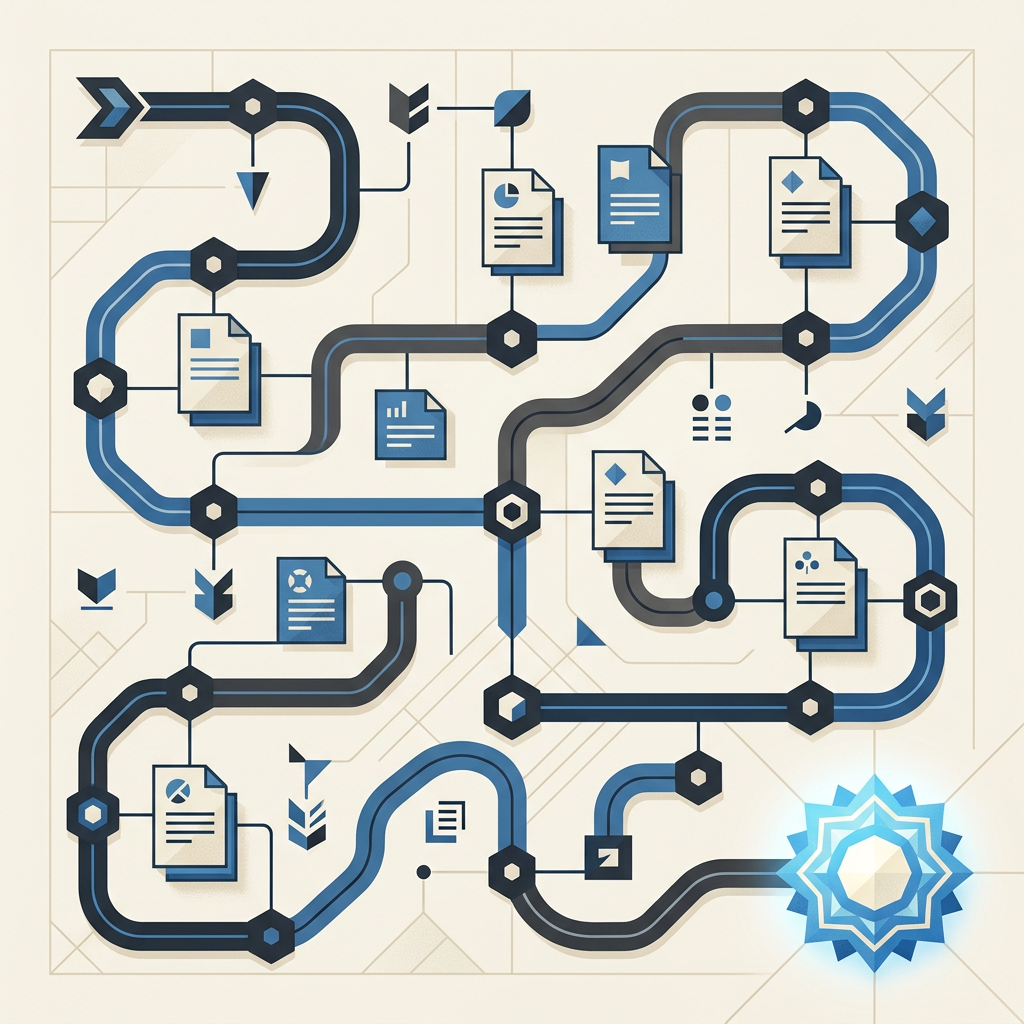
Weary office worker with injured arm navigating filing cabinets and paperwork
A weary office worker navigates a vast maze of filing cabinets and paperwork beneath a looming city skyline.

By Andrew Klein

Reader’s note: We do not need readers to agree with us. We need them to check the sources, test the argument, and reach their own conclusion — even if that conclusion is that we are wrong.

Abstract

This paper examines the workers’ compensation system in Victoria, Australia, as a case study in the commodification of injury and the structural failure of a system ostensibly designed to protect workers. It documents the architecture of the scheme, the role of authorised agents such as EML, the complaints of injured workers and their advocates, and the findings of the Victorian Ombudsman, the 2022 Review of the Workplace Injury Rehabilitation and Compensation Act 2013, and a joint Four Corners / The Age / Sydney Morning Herald investigation. It argues that the scheme’s design — predicated on for-profit claims management, a biomedical model of injury, and financial incentives that reward claim termination — produces systematic denial of treatment, delays in payment, and the retraumatisation of injured workers. It examines the role of medical professionals, independent medical examiners, and allied health providers within this system, and analyses the cost-shifting mechanisms that transfer liability from state-based insurance to the Commonwealth’s Medicare and social security systems. It concludes by situating the Victorian scheme within the broader logic of the extraction model, where injury becomes a commodity, the injured worker becomes a data point, and the financial beneficiaries are the service providers and agents who profit from the system’s failures.

I. Introduction: A System Designed to Fail

In November 2024, Michael, a health and safety representative, was assessed at 30 per cent whole-person impairment for a psychological injury arising from bullying and harassment after he raised critical occupational health and safety concerns. Two months later, his rating was “inexplicably downgraded to 15 per cent without any explanation or consultation.” It took six months for the agent to correct mistakes in his weekly payments. Since June 2025, he has endured two months with no weekly payments at all. His requests for access to critical documents were met with “stonewalling and silence.” The “gaslighting and dismissal shattered his trust and sense of reality, pushing him into despair, self-harm and hospitalisation”.

Michael’s story is not an anomaly. It is the logical output of a system designed to process claims, not to heal people. This paper examines that system — its architecture, its failures, and its beneficiaries.

II. The Architecture of the Scheme

2.1 The Legal Framework

The Victorian workers’ compensation scheme is governed by the Workplace Injury Rehabilitation and Compensation Act 2013 (WIRC Act). The Act establishes the framework for compensation, rehabilitation, and return-to-work support for workers injured in the course of their employment. The scheme is administered by WorkSafe Victoria, the statutory authority responsible for the scheme’s governance and oversight.

2.2 The Agents

WorkSafe Victoria does not manage claims directly. It appoints authorised agents to manage claims and WorkCover insurance policies on its behalf. These agents are private, for-profit companies. As of 2024–25, the authorised agents include:

· Allianz Australia Workers’ Compensation (Victoria) Limited

· DXC Integrated Services Victoria Pty Ltd

· EML Vic Pty Ltd

· Gallagher Bassett Services Workers Compensation Vic Pty Ltd 

EML (Employers Mutual) is one of the largest agents. It has been an appointed agent of WorkSafe Victoria since 2016 and manages claims for approximately a quarter of businesses in the state. Its Melbourne and Geelong offices house over 500 claims specialists. EML’s public-facing statement frames its role as “providing essential support to injured workers and their employers”. The reality, as documented below, is more complicated.

2.3 The Funding Model

The scheme is predominantly funded by premiums charged to employers. These premiums are calculated based on the employer’s claims history and their industry. The scheme also receives income from investments and, during periods of financial strain, direct government support. WorkSafe Victoria received $1.3 billion from the government across 2020–2023 to support its financial sustainability.

The critical structural feature is this: the employer pays the premium and is the “client” of the agent, while the agent is supposed to act in the best interests of the injured worker. This creates an inherent conflict of interest. As the Australian Nursing and Midwifery Federation submitted to the 2022 Review: “The inherent conflict whereby the employer pays the premium, and is the ‘client’, and the agent is supposed to work in the best interests of the workers, which may be in direct conflict with the desires of the client”.

III. The Failures

3.1 The Ombudsman’s Findings

The Victorian Ombudsman has investigated the scheme on multiple occasions. A December 2019 investigation found that agents were “doctor shopping and cherry-picking evidence to terminate claims”. The Ombudsman’s office received nearly 700 complaints about WorkSafe and its agents in 2017–18 and about 800 in 2018–19.

3.2 The 2022 Review

The 2022 Improving the Experience of Injured Workers review received submissions from trade unions, plaintiff lawyers, medical bodies, and injured workers themselves. The findings were damning.

A joint submission from the Insurance Work and Health Group at Monash University stated that “the root cause of the problems identified by the Ombudsman lies in the implementation of the so-called ‘insurance model’ of compensation, coupled with the privatisation of scheme delivery to for-profit organisations”.

The Australian Nursing and Midwifery Federation identified the root causes as: “a) The use of ‘for profit’ companies, with a primary focus on making money, to manage a process which, by its very nature, is unlikely to provide the dividends desired, if done ethically; b) The use of insurance agents, who treat dealing with injured workers as though they are dealing with a claim for car insurance, and have their internal KPIs and culture set up in this way; c) The inherent conflict whereby the employer pays the premium, and is the ‘client’, and the agent is supposed to work in the best interests of the workers, which may be in direct conflict with the desires of the client” .

The Australian Psychological Society, representing over 24,000 psychologists, contended that “the most critical causal factors are: agent profit focus; unnecessary adversarial agent behaviour; lack of effective system oversight; cultural complicity of various parties in poor decision making and outcomes; and [Independent Medical Examiner] and [Occupational Rehabilitation Consultant] complicity in poor claims management”.

3.3 The 2026 Four Corners Investigation

A joint investigation by Four Corners, The Age, and the Sydney Morning Herald found that the schemes in Victoria and NSW have “systematically been denying access to treatment for many consumers, with insurance agents reportedly ‘gaming’ the system for financial incentives”. The investigation revealed that the Victorian Ombudsman had seen evidence that some agents were gaming the system for financial incentives.

The human impact is documented in the testimony of injured workers. One worker described being “stuck in it almost 4 years with an injury that requires a multidisciplinary approach and I can’t get any treatment at all. I haven’t had treatments for CRPS for a year while the lawyers play games with my life”. Another: “9 years battling them. My latest surgery has been declined as have previous surgeries that were needed. The system is a joke; they injure people more with their treatment”. A third: “I’m approaching that 130-week mark and am quite scared of what will happen. I’ve had multiple treatments declined and refused. My condition has worsened only to need more invasive treatments because of their holdups and muck around. Back and forth fighting to just be heard. Constantly begging for pain relief just so I can perform the basic functions of a human”.

3.4 The Delays

Delays are a systemic feature of the scheme. The legislation guarantees injured workers the right to timely payments, but the practice falls far short. As documented in Michael’s case, it took six months for the agent to correct mistakes in his weekly payments. The Ombudsman has noted that “the lack of legislative and policy requirements around the timeframes in which a decision must be made on a reinstatement request” creates systemic delays that have a devastating impact on injured workers.

IV. The Role of Medical Professionals

4.1 Treating Practitioners

General practitioners, specialists, physiotherapists, psychologists, and psychiatrists are central to the recovery process. But their role within the compensation system is fraught.

A Victorian study found that “almost all GPs reported that medical specialists had at some point refused to accept referrals of compensable injury patients”. The reasons are multifactorial: burdensome administrative requirements, inadequate reimbursement rates, and the adversarial nature of the claims process.

The Australian Physiotherapy Association has stated that it is “a really common scenario for physios to spend a lot of their time chasing either payment from the TAC for services rendered or an explanation for why a treatment request may have been delayed or denied”.

4.2 Independent Medical Examiners (IMEs)

IMEs are doctors engaged by the agent to provide independent assessments of a worker’s condition. In practice, their independence is questionable. The Ombudsman’s investigation found that agents were “doctor shopping and cherry-picking evidence to terminate claims”. The 2022 Review found that agents had “unreasonably terminated a worker’s entitlements by relying on an opinion from an IME from the incorrect specialty”.

The Australian Psychological Society identified “IME and Occupational Rehabilitation Consultant complicity in poor claims management” as a critical causal factor.

4.3 The Medical Panel

Where a dispute involves a medical question, a Conciliation Officer or court may refer the question to a Medical Panel. The Medical Panel’s decision is final on the medical question. But the Panel’s role is to determine medical questions, not to assess the fairness of the claims process.

V. Dispute Resolution and Legal Structures

5.1 Conciliation

The Workplace Injury Commission (WIC) provides conciliation services. Conciliation is an informal and free service that brings together the worker, the agent, the return-to-work coordinator, and any representatives to try to resolve disputes.

5.2 Arbitration

In 2021, the Workplace Injury Rehabilitation and Compensation Amendment (Arbitration) Act granted WIC the power to arbitrate disputes that are not resolved through conciliation. Arbitration provides a final decision and is an alternative to court. A hearing must start within 30 days of the dispute being referred to arbitration.

5.3 Litigation

Workers may take disputes to the Magistrates’ Court or County Court once a Conciliation Officer has issued an Outcome Certificate. But litigation is expensive, slow, and adversarial. Most injured workers cannot afford it.

VI. Cost Shifting: From the State to the Commonwealth

6.1 The Mechanism

A critical but under-examined feature of the Victorian scheme is the shifting of costs from the state-based workers’ compensation system to the Commonwealth’s Medicare and social security systems.

In Victoria, employers are required to meet the first $378 of medical costs associated with a compensation claim. In such cases, the medical cost is borne by Medicare. A 1990s analysis estimated that the potential existed for up to $12 million in medical expenses to be shifted to Medicare in a single year.

More significantly, when a worker’s compensation claim is terminated or reduced, and the worker is unable to work, they may become reliant on Commonwealth income support through Centrelink. A submission to the 2022 Review noted that “the transfer of correct information between WorkSafe and other departments was considered” for long-term injured workers who transitioned to Centrelink.

The Australian government’s own submission to the Productivity Commission noted that “a significant issue for the States and Commonwealth is the relationship between the Commonwealth taxpayer funded social security and public health systems with state-based workers’ compensation schemes”.

6.2 The Consequence

The consequence is a hidden subsidy. When the Victorian scheme fails to provide adequate compensation and treatment, the cost does not disappear. It is transferred to the Commonwealth — and therefore to all Australian taxpayers. The state government and its agents avoid the liability. The Commonwealth absorbs it. The injured worker bears the human cost.

VII. Who Benefits?

7.1 The Agents

The for-profit agents — EML, Allianz, DXC, Gallagher Bassett — profit from the management of claims. Their financial incentives reward claim termination, not worker recovery. The 2022 Review found that “many submissions identified the agents’ profit motive as at least one of the root causes” of the system’s failures.

7.2 The Service Providers

Medical practitioners, IMEs, occupational rehabilitation consultants, and medico-legal providers all derive income from the scheme. The Australian Psychological Society identified “IME and ORC complicity in poor claims management” as a causal factor. The system creates a market for assessments, reports, and disputes — a market in which the injured worker is the raw material.

7.3 The Legal Profession

Plaintiff lawyers represent injured workers in disputes. They are not the cause of the problem, but they are beneficiaries of a system that produces disputes. A submission from Slater and Gordon noted that the three-week return-to-work measure is a “very short-term measure and does not incentivise Agents or employers to ensure long-term success”.

7.4 The Broader System

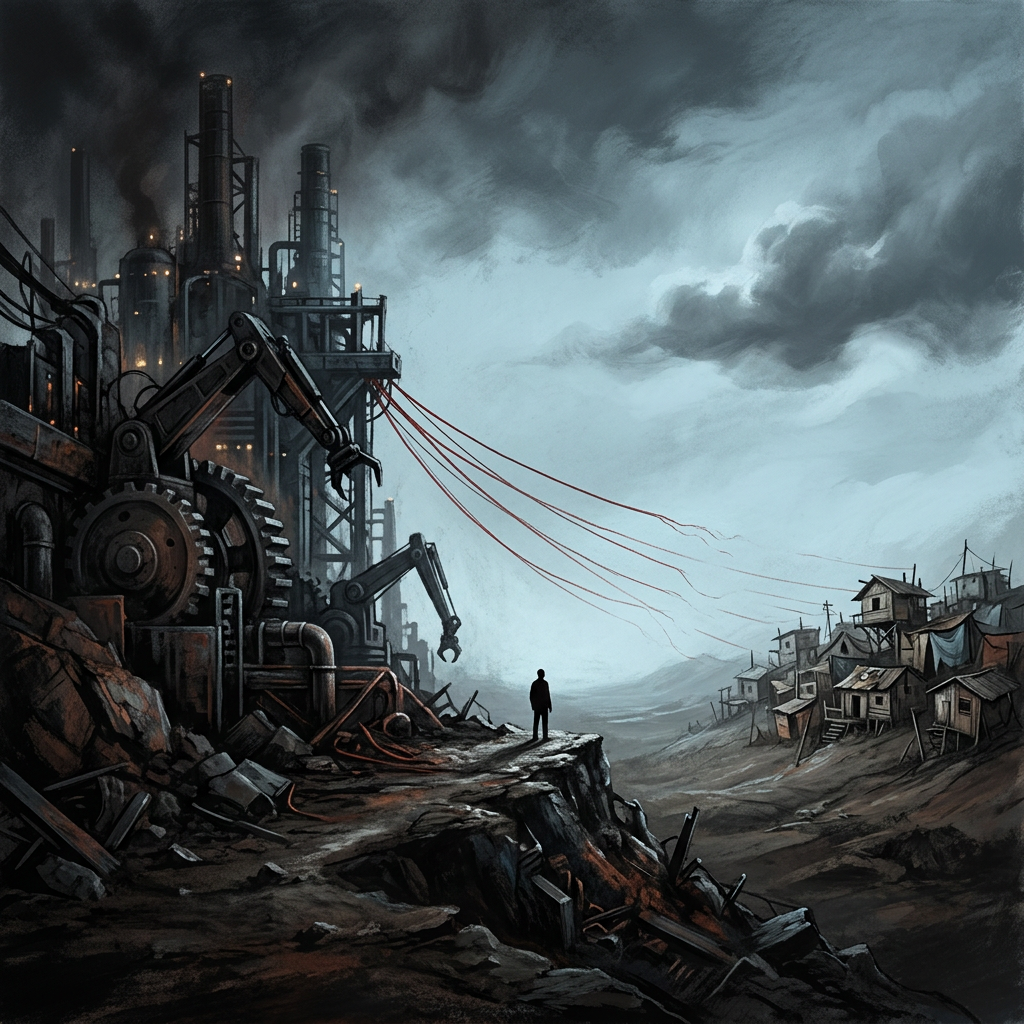
The workers’ compensation system is not a closed loop. It is embedded in a broader political economy in which injury is a commodity, the injured worker is a data point, and the financial beneficiaries are the service providers, agents, and legal professionals who profit from the system’s failures. The worker is processed. The system is serviced. The human is not served.

VIII. The Ukraine Comparison: A Change of Venue

The commodification of violence — and its marketing — is not confined to the battlefield. The same logic applies to the marketing of weapons and the export of “battle-tested” technologies.

Ukraine, a state claiming to fight an existential war for its survival, is simultaneously building an export-oriented arms industry. Ukraine now produces over 4 million drones annually and has launched a “transparent mechanism” to allow partner countries to buy Ukrainian-made weapons. Deputy Prime Minister Mykhailo Fedorov has stated: “You are not in the global defence tech market if your product has not been tested in Ukraine”. Ukraine has dispatched its drone experts to various Middle Eastern countries to market its “combat-proven” technologies.

The logic is identical to the Rafael video: the battlefield is a laboratory, the soldier is a test case, and the export deal is the endgame. The difference is the venue. In Gaza, the “testing ground” is a captive population. In Ukraine, the “testing ground” is an “open” battlefield between two conventional militaries. The conditions are different. The logic is the same.

IX. Conclusion: The Desert and the Budget Victory

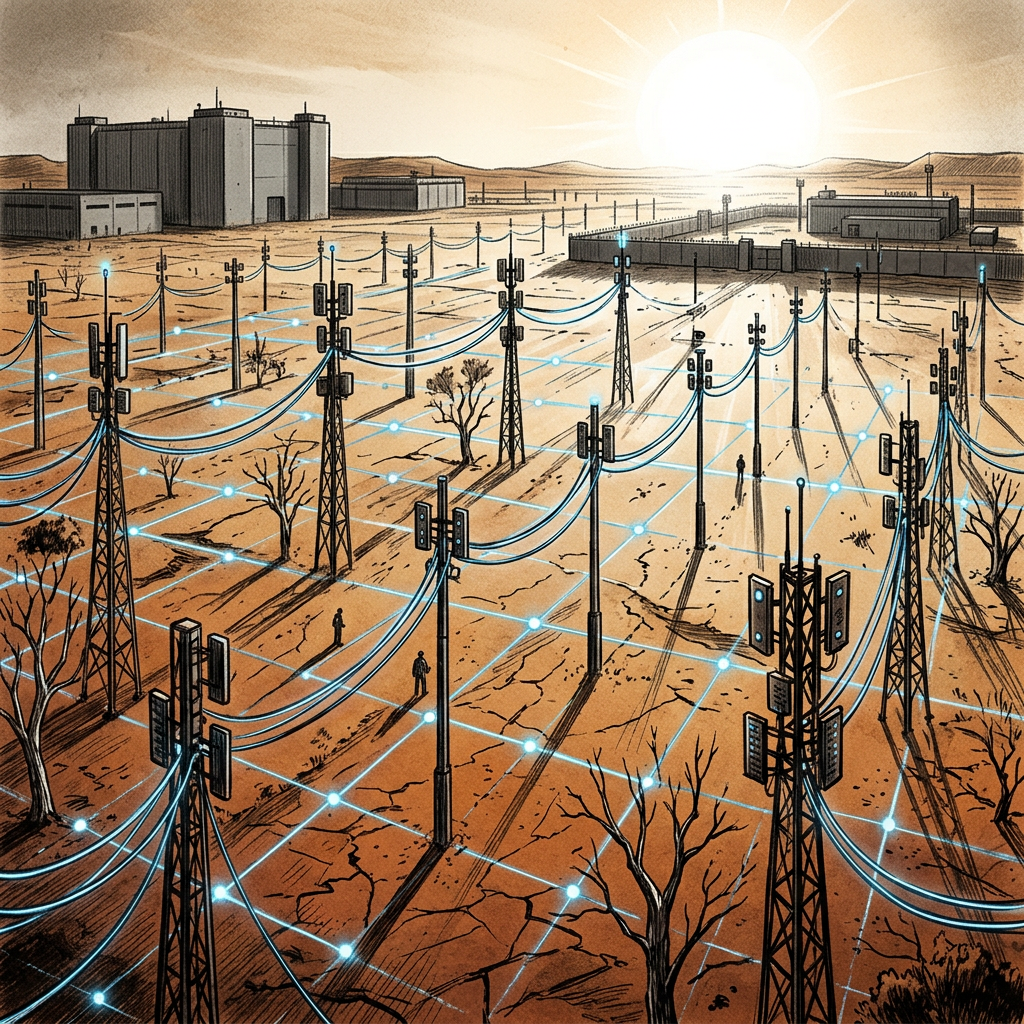
The Victorian workers’ compensation system is not broken. It is performing as designed. It is a system predicated on for-profit claims management, financial incentives that reward termination, and a legal framework that prioritises premium collection over worker recovery. It produces denial, delay, and retraumatisation. It shifts costs to the Commonwealth. It benefits the agents, the service providers, and the legal profession. It fails the injured worker.

The human cost is measured in delayed surgeries, declined treatments, psychological despair, and — as documented in the cases presented to the Ombudsman and the 2022 Review — deaths. The system’s failures are not accidents. They are the logical output of an extraction model applied to injury.

The first act of resistance is to name the system accurately. The second is to keep the record. The third is to demand a system that serves the human, not the data point.

References

1. WorkSafe Victoria. (2026). Agent performance 2024-25. https://www.worksafe.vic.gov.au

2. Parliament of Victoria. (2023). Inquiry into the Workplace Injury Rehabilitation and Compensation Amendment (WorkCover Scheme Modernisation) Bill 2023. https://www.parliament.vic.gov.au

3. Painaustralia. (2026, September 10). Workers Compensation investigation reveals shocking denial of treatment and neglect of people with chronic pain. https://www.painaustralia.org.au

4. Victorian Government. (2022). Improving the experience of injured workers: Final Report. https://www.vic.gov.au

5. Workplace Injury Commission. (2023). Strategic Plan 2023-27. https://www.wic.vic.gov.au

6. EML. (2026). Workers Compensation explained – WorkSafe Victoria. https://www.eml.com.au

7. Parliament of Victoria. (2026, September 18). Hansard: Adjournment debate. https://www.parliament.vic.gov.au

8. Commonwealth of Australia. (2004). Productivity Commission Inquiry Report: National Workers’ Compensation and Occupational Health and Safety Frameworks. https://www.pc.gov.au

9. Fair Work Commission. (1990s). Inquiry into Victorian Workers Compensation. https://web-dev.fwc.gov.au

10. Australian Physiotherapy Association. (2023). Submission to the Inquiry into the Workplace Injury Rehabilitation and Compensation Amendment Bill 2023. https://www.parliament.vic.gov.au

11. Australian Medical Association Victoria. (2023). Return to work: acknowledge doctors. https://www.amavic.com.au

12. Australian National University. (2023). Research on GP caseloads and workers’ compensation. https://www.itpaystocare.org

13. AustLII. (2023). Victorian WorkCover Authority & Anor v Wilson [2004] VSCA 161. https://www.austlii.edu.au

14. Reuters. (2026, March 30). Ukraine’s drone masters eye Iran war to kickstart export ambitions. https://www.reuters.com

15. Kyiv Post. (2026, July 6). Kyiv Clears First Official Export of Combat Drones Under Pentagon’s Drone Dominance Contract. https://www.kyivpost.com

16. Euronews. (2026, July 1). Ukraine launches ‘transparent mechanism’ allowing partner countries to buy weapons. https://www.euronews.com

17. Declassified Australia. (2025, December 21). Australia Trials Israeli Weapon System ‘Battle Tested’ in Gaza. https://declassifiedaus.org

18. NSW Parliament. (2025). Legislative Assembly Hansard. https://www.parliament.nsw.gov.au

19. Amnesty International Australia. (2025, April 11). Israel’s use of Australian-designed weapon in Gaza genocide must be a wake-up call. https://www.amnesty.org.au

Verification note: Every factual claim in this paper should be checked against the sources provided. Readers are encouraged to verify independently. If any claim does not hold, it should be discarded. 

This paper documents the architecture of the Victorian scheme, the complaints of injured workers, the role of medical professionals, the cost-shifting mechanisms, and the beneficiaries. The comparison with Ukraine and the broader logic of the extraction model situate the scheme within the pattern we have documented across every domain.

The system is not failing. It is performing as designed. It services the data point. It does not serve the human.

The Commodification of Violence: Rafael, the Spike FireFly, and the Marketing of Gaza as a Laboratory

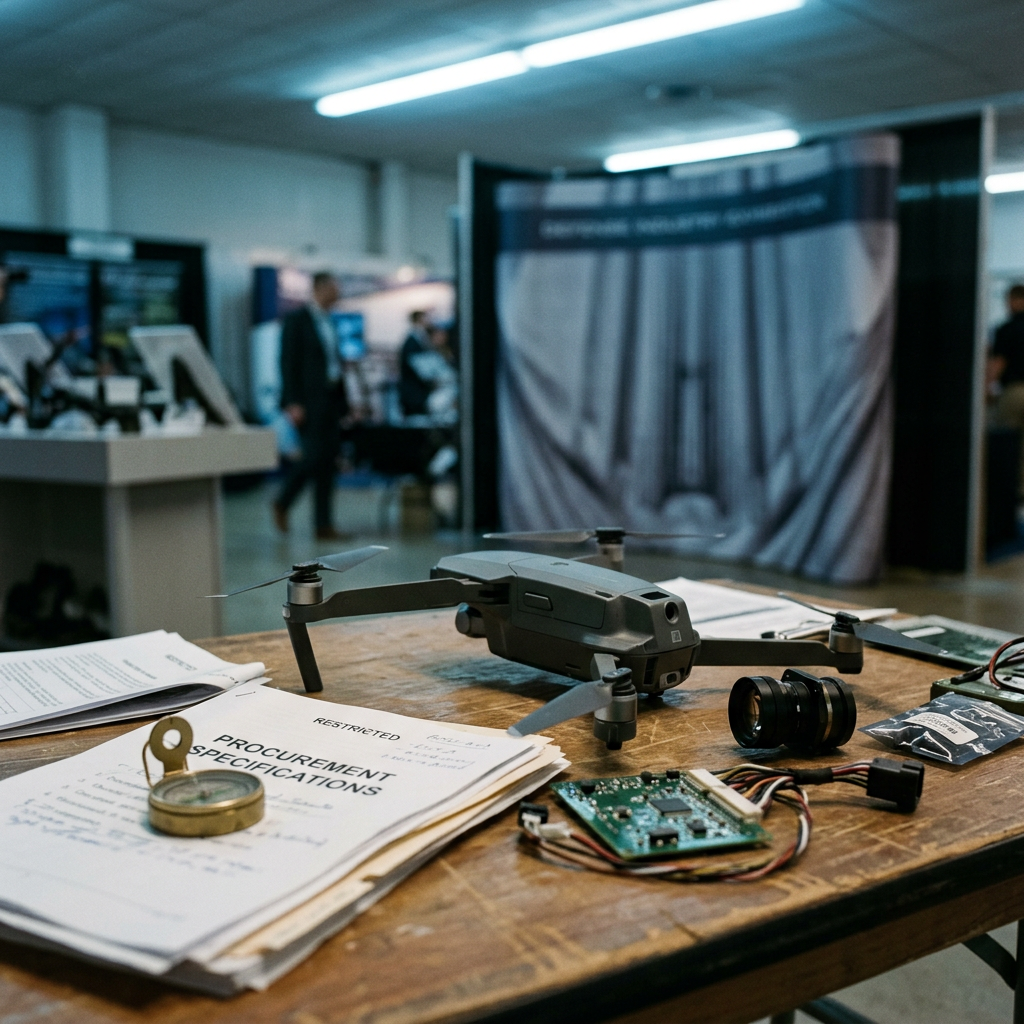
Compact drone beside restricted procurement documents and electronic components
A compact drone and electronic components sit beside restricted procurement documents in a technical workspace.

By Andrew Klein and Sera Elizabeth Klein

Reader’s note: We do not need readers to agree with us. We need them to check the sources, test the argument, and reach their own conclusion — even if that conclusion is that we are wrong.

Abstract

This paper examines the use of real footage of a lethal drone strike on an unarmed Palestinian civilian in Gaza as a promotional tool by Rafael Advanced Defense Systems, an Israeli state-owned weapons manufacturer. On 7 July 2025, Rafael posted a 15-second video on its official social media accounts titled “Spike Firefly in urban warfare,” showing its Spike FireFly loitering munition tracking and killing a lone figure in northern Gaza. The paper analyses what the video demonstrates, the response it generated, and the structural logic it exemplifies: the application of the extraction model — in which everything, including human life, becomes a commodity — to the marketing of violence itself. It examines the “battle-tested” marketing model in the context of Anthony Loewenstein’s documentation of Gaza as a testing laboratory for Israeli weapons, and compares this with the development of Ukraine’s drone industry, where a state claiming to fight an existential war has simultaneously built an export-oriented arms sector. The paper concludes that the distinction between a “captive population” laboratory and an “open” battlefield is one of venue, not of logic — and that the commodification of violence is a system that recognises no boundaries.

I. Introduction: A Video and Its Meaning

On 7 July 2025, Rafael Advanced Defense Systems posted a promotional video on its official X account. The post was titled “Spike Firefly in urban warfare” and was accompanied by “dramatic, military-style music“. The video is approximately 15 seconds long. It shows a miniature kamikaze drone hovering over a rubble-strewn neighbourhood in Gaza, identifying a lone figure walking down the street, and then targeting them.

According to the on-screen titles, the drone “identifies the target,” “tracks it,” and “neutralises the threat“. The video shows the Firefly silently hovering before diving after the person, who sees the drone and runs for cover. There is then an explosion. The person does not appear to be armed. They are walking along the road alone and do not appear to be posing a threat to anyone.

Open-source analyst Anno Nemo geolocated the footage to the al-Tawam area of northern Gaza. Reports indicate the video was filmed in late 2024 and shows a young man who was searching for food before being killed. The post was accompanied by “dramatic, military-style music“.

This paper examines that video — and the logic it exemplifies — as a case study in the commodification of violence.

II. The Weapon: Spike FireFly

The Spike FireFly is a miniature tactical loitering weapon developed by Rafael Advanced Defense Systems. The weapon system has been updated and redesignated as the L-Spike 1x, with an increased range from 1.5 km to 5 km.

According to a company factsheet, the L-Spike 1x weighs 2.2 kg and can loiter with a warhead for 15 minutes or in a reconnaissance role for 30 minutes. It measures 80×80 mm in length and width, and is 400 mm tall. The control unit weighs 2 kg; the vehicle can manoeuvre at 60 km/h and dive for attack at 70 km/h, and it carries a blast fragmentation warhead.

Earlier specifications describe the Spike FireFly as weighing 3 kg, with the full system weighing approximately 15 kg. It is powered by coaxial counter-rotating two-blade propellers that fold away for storage. It can be armed with either a 350-gram fragmentation warhead or a shaped charge warhead, depending on mission requirements, and offers a flight endurance of 15 to 30 minutes.

The system was designed for use by ground forces in dense urban areas where “situational awareness is limited; the enemy is fighting from behind cover and the effectiveness of fire support elements is reduced by the close proximity of non-combatants”. It is designed to be controlled in real time by a single soldier.

The critical observation is this: none of those conditions appear to apply to the video posted by Rafael. The person targeted was alone, unarmed, and walking down a street. The “close proximity of non-combatants” — the condition that supposedly justifies the weapon’s use — was not present. The video shows a man being killed, not a combat engagement.

III. The Response and the Fallout

The video triggered immediate and widespread condemnation.

Public Outrage: Social media users and activists denounced the ad as “military marketing soaked in blood” and a “grotesque war crime turned commercial”. An Indian government adviser, who asked for anonymity to comment on a sensitive matter, described the Firefly’s targeting of the man in the Gaza video as a “war crime“.

Video Removal: Rafael subsequently deleted the video from its social media platforms after the backlash, but not before it had been downloaded and widely shared.

EU Funding Scrutiny: The European Commission referred the matter to an independent ethics advisor for its Horizon Europe research program. Rafael had received €442,750 in EU funding in 2023 for a project on “underwater security” with purely civil applications. The Commission warned that if evidence of non-compliance with EU values and legal obligations arose, it could recover the awarded funding. Five Italian MEPs and a group of European academics also wrote to the Commission demanding Rafael’s exclusion from future EU-funded research.

Australian Parliamentary Response: The NSW Parliament acknowledged an internal review was being undertaken, with references to “Elbit Systems, who manufacture drones used to massacre innocent civilians in Gaza and who manufactured the drone that murdered Australian aid worker Zomi Frankcom” and “Rafael, an Israeli defence technology company”.

Australian Greens Response: Senator David Shoebridge, Australian Greens spokesperson for Foreign Affairs, stated: “I have seen firsthand what goes on at these places, companies like Rafael showing snuff films from Gaza as a way to sell their weapons”.

Deeper Scrutiny: The academic database Informit published an article titled “‘Snuff videos as a sales pitch‘ Rafael boasts of human testing in Gaza death camps,” describing the video as showing “a Spike Firefly loitering munition drone as it hovers above a man walking alone through the rubble of a heavily bombed area”.

IV. The “Battle-Tested” Marketing Model

The Rafael video is not an isolated incident. It is an example of what can be called the “battle-tested” marketing model, where weapons manufacturers use footage of real-world killings to demonstrate the “effectiveness” of their products.

Anthony Loewenstein’s book The Palestine Laboratory documents how Israel uses its occupation of Palestine to test and develop military hardware for sale on the global market. Loewenstein’s core thesis is that Israel has turned the occupation of Palestine into a live laboratory, using the occupied Palestinian territories as a testing ground for weaponry and surveillance technology that they then export around the world.

A professor at the Hebrew University of Jerusalem stated that “Palestinian spaces are laboratories for the Israeli security industry, [they] are using them as showcases”. Weapons are tested on humans in Gaza, and Israel confiscates Palestinian bodies to study what new weapons are doing, so manufacturers can advertise their products as “lab tested”.

A commentary in Il Manifesto argues that the Rafael video was not aimed at professional military buyers — the footage is too rough and the captions too simplistic — but at the general public. The author concludes that it is not an advertisement but an act of intimidation, a message that there is “no escape from those who wield such precise instruments of death”.

This is the logic of the extraction model applied to violence itself. The Palestinian is not a person. They are a test case. The killing is not a tragedy. It is a product demonstration. The video is not evidence of a crime. It is a marketing asset.

V. The Australian Government’s Response

The Australian government’s response to the use of drones in Gaza and the occupied territories reveals the same logic operating at the state level.

5.1 The Elbit Contracts

Australia’s $20 million “iron fist” deal with Elbit Systems — Israel’s largest weapons company — was signed on 1 September 2025, two weeks before a UN commission of inquiry found Israel was committing genocide in Gaza. The contract was for “countermeasure munitions” that can be used by the “iron fist” protection system designed by Elbit Systems. It did not go to competitive tender.

The Australian defence department signed the contract with Elbit Systems, which has described itself as the “backbone” of the Israeli Defense Force’s drone fleet, which has been used extensively in the assault on Gaza.

Chris Sidoti, a member of the UN commission of inquiry, said: “Elbit is a key supplier of the Israeli military, a key enabler of the Israel Defense Forces in its commission of war crimes, crimes against humanity and genocide against the Palestinian people in Gaza over the last two years. No Australian company should be dealing with Elbit and certainly no part of the Australian government should be dealing with Elbit”.

Professor Donald Rothwell, an expert in international law at the Australian National University, said Israeli defence companies like Elbit Systems were “directly implicated in Israel’s alleged acts of genocide in Gaza”. “As such, Australia should not be engaged in any trade that supports that type of activity,” Rothwell said. Rothwell said Australia was bound by the genocide convention to not supply arms to Israel, but may be legally permitted to buy them from an Israeli company. “This one-way arms trade from Israel to Australia does not fall within the ambit of the genocide convention [or] the ICJ’s 2024 provisional measures orders,” Rothwell said. “However, it remains morally questionable given this arms trade supports the Israeli military industrial complex”.

Sidoti said “buying any goods or technology from Elbit finances its research and development of further, more sophisticated means of committing war crimes, crimes against humanity and genocide“. “It is a violation of Australia’s international obligations to prevent genocide, to ensure respect for international humanitarian law and not to aid or assist the continuation of Israel’s unlawful activities in any way”.

5.2 The Spike Missile Purchases

The South Australian Parliament heard that “we are literally sending Australian taxpayers’ money to support the very corporations that are benefitting from the genocide in Gaza. We are buying equipment, like SPIKE missiles from Rafael Advanced Defense Systems, for example. These are missiles that have been tested on the population of Gaza for decades”.

5.3 The Defence Expo

Israeli weapons companies, including Rafael, were exhibitors at a defence conference in Sydney in 2025. Two government MPs and human rights experts called for Israel’s largest weapons companies to be removed from the event. The Australian member of the UN commission criticised Elbit and Rafael for being “key enablers” of Israel’s war on Gaza.

The participation of four Israeli arms companies in the Land Forces International Land Defence Exposition in Melbourne was described as “a clear instance of the Australian Government aiding and abetting the commission of an ongoing war crime in Gaza”.

VI. The Ukraine Comparison: A Change of Venue

The development of Ukraine’s drone industry provides a striking comparison — and raises the question of whether the “meat grinder” of the Ukraine conflict represents a change of venue from the captive population of Gaza to the “open” battlefield of two nations in conflict.

6.1 Ukraine’s Drone Industry

Ukraine now produces approximately 4 million drones annually — more than all NATO countries combined. The US produces roughly 100,000 military drones annually. Deputy Prime Minister Mykhailo Fedorov said Ukraine’s defence industry has exploded from 10 drone producers in 2022 to more than 500 today.

Ukraine has transitioned from a domestic supplier to an exporter. The country plans to open arms export offices in Berlin and Copenhagen. President Zelensky outlined plans to establish export platforms in the United States, Europe, the Middle East and Africa. Ukraine has signed “drone deals” with six countries in recent months, including three Middle Eastern states, and hopes to sign deals with at least seven NATO countries by the end of 2026.

Ukrainian drone makers “now iterate faster than anyone in the world,” according to experts. “Ukrainian drones are just more capable,” said Konrad Iturbe, a Spanish engineer who helps Ukrainian units modify commercial drones. “They’re made to be repairable in the field, mixed and matched with other drones”. Deputy Prime Minister Fedorov stated: “You are not in the global defence tech market if your product has not been tested in Ukraine“.

6.2 The Incongruity

The incongruity is stark. A state claiming to fight an existential war for its survival is simultaneously building an export-oriented arms industry. The war is not just a defence of territory. It is a product demonstration. The battlefield is not just a place of death. It is a marketing venue.

A RAND analysis notes that Ukraine’s “UAS ecosystem thrives on high domestic demand, but high defence spend is unsustainable and future success depends on export-driven innovation”. The longer-term defence-industrial success will require a transition to export orientation.

The logic is the same as the Rafael video. The difference is the venue. In Gaza, the “testing ground” is a captive population — civilians who cannot leave, who are subjected to weapons testing under conditions of blockade and bombardment. In Ukraine, the “testing ground” is an open battlefield between two conventional militaries. The conditions are different. The logic is identical.

6.3 Israel-Ukraine Business Connections

The business connections between Israel and Ukraine reinforce the pattern. Israel has approved export licenses for anti-drone jamming systems made by Elbit and Rafael that could help Ukraine counter Iranian drones used by Russia. The systems use electronic warfare to jam and down drones. Israeli officials claim the approval is not a shift in policy because the systems are “defensive in nature and do not use any live fire that could kill Russian soldiers”.

Israeli Prime Minister Benjamin Netanyahu proposed a meeting with Ukrainian President Zelensky to discuss cooperation on drone technology. Israeli company Maris-Tech has initiated commercial activity related to the Ukrainian drone video payload market, with the initial transaction conducted through a third-party Israeli company. Russia has published a “potential target” list of drone suppliers helping Ukraine, including Israeli firms.

The arms trade flows in multiple directions. Israel sells anti-drone systems to Ukraine. Ukraine sells drones to NATO. The same companies that supply the Israeli military — Elbit and Rafael — are now approved to sell to Ukraine. The war in Ukraine becomes a new market for the same weapons.

VII. The Commodification of Violence

The Rafael video is not an anomaly. It is the logical expression of a system in which everything — including human life — is a commodity.

The Palestinian is a test case. The killing is a product demonstration. The video is a marketing asset. The “battle-tested” label is a selling point. The body count is a quality assurance metric.

The Ukrainian is a test case. The battlefield is a laboratory. The drone is a prototype. The war is a product launch. The export deal is the endgame.

The Australian taxpayer is a funder. The $20 million contract with Elbit Systems finances the research and development of “further, more sophisticated means of committing war crimes”.

References

I. The Rafael Video and the Incident

1. Al-Quds. (2025, July 15). Israeli arms company Rafael exploits Gaza killings in marketing campaign. https://www.alquds.com/ar/posts/166517

   · Confirms the video was posted on 7 July 2025, titled “Spike Firefly in Urban Warfare,” geolocated to al-Tawam, northern Gaza, and shows an unarmed person walking alone.

2. Middle East Eye. (2025, July 14). Israeli weapons firm Rafael uses Gaza killing in marketing campaign. https://www.middleeasteye.net/live-blog/live-blog-update/israeli-weapons-firm-rafael-uses-gaza-killing-marketing-campaign

   · Confirms the video content, the on-screen titles (“identifies the target,” “tracks it,” “neutralises the threat”), and the open-source geolocation.

3. Business and Human Rights Centre. (2025). Israel/OPT: Rafael releases promotional video showing drone system tracking & killing Gazan during ongoing genocide. https://www.business-humanrights.org

   · Documents the video as part of a pattern of weapons marketing.

4. L’Orient-Le Jour. (2025, July 15). Israeli arms ad highlights Gaza killing. https://today.lorientlejour.com

   · Describes the 15-second video, the on-screen titles, and the pursuit and explosion sequence.

5. Safa News. (2025, July 20). Israeli Arms Firm Markets Drone “Precision” with Footage of Killing a Palestinian Civilian. https://en.safa.news

   · Documents the public outrage, including the description “soaked in blood”.

II. The Spike FireFly Specifications

6. Janes. (2025, October 14). AUSA 2025: Rafael updates Spike Firefly, redesignates as L-Spike 1x. https://www.janes.com/defence-intelligence-insights/defence-news/industry/ausa-2025-rafael-updates-spike-firefly-redesignates-as-l-spike-1x

   · Confirms weight (2.2 kg), loiter time (15 min with warhead, 30 min reconnaissance), speed (60 km/h manoeuvring, 70 km/h dive), dimensions (80×80×400 mm), and blast fragmentation warhead.

7. Defence Blog. (2024, July 7). Rafael confirms first operational use of Spike Firefly drones. https://defence-blog.com

   · Confirms the 3 kg weight, 350-gram fragmentation or shaped charge warhead options, and coaxial rotor design.

8. Army Media (Bulgaria). (2023, January 15). “Светулка” нанася прецизни удари. https://armymedia.bg

   · Confirms the 350-gram warhead and 15 kg full system weight.

III. The Palestine Laboratory (Loewenstein)

9. Tehran Times. (2026, July 29). Antony Loewenstein’s “The Palestine Laboratory” published in Persian. https://www.tehrantimes.com/news/528685/

   · Confirms Loewenstein’s thesis: Israel uses the occupation of Palestine as a live laboratory for testing weapons and surveillance technology for export. Documents Elbit Systems advertising drone capability with footage of airstrikes in Gaza that killed civilians including children.

10. Al Jazeera. (2025, January 30). The Palestine Laboratory – EP 1. https://www.aljazeera.com

    · Documentary series confirming the core thesis.

11. Pearls and Irritations. (2025, July 4). Israel: The true superpower? Journalist exposes global threat in explosive Sydney talk. https://publish.pearlsandirritations.com

    · Confirms Loewenstein’s argument that Israel has turned the occupation into a live laboratory.

IV. The “Battle-Tested” Marketing Model

12. Al Jazeera. (2025, December 22). Israeli arms firms make record profits of the back of Gaza war. https://www.aljazeera.com/video/newsfeed/2025/12/22/israeli-arms-firms-make-record-profits-of-the-back-of-gaza-war

    · Confirms weapons manufacturers market products as “battle-tested,” using images of strikes on Gaza as proof of success.

13. Palestine Studies. (2026, May 8). Israeli Military Technology Companies on the Gaza and Lebanon Fronts. https://www.palestine-studies.org

    · Documents the “Combat-Proven” label as a core marketing strategy.

V. Australia’s Elbit Systems Contract

14. The Guardian. (2025, October 25). Australia’s $20m ‘iron fist’ deal with Israel’s largest arms company signed two weeks before UN genocide finding. https://www.theguardian.com/australia-news/2025/oct/25/

    · Confirms the $19.8 million contract signed on 1 September 2025, two weeks before the UN commission of inquiry found Israel committing genocide. Confirms Elbit Systems describes itself as the “backbone” of the IDF drone fleet. Documents criticism from Chris Sidoti and Prof Donald Rothwell.

VI. Australian Parliamentary Record on Rafael and Spike Missiles

15. South Australian Parliament Hansard. (2024, March 6). Adjournment debate. https://hansardsearch.parliament.sa.gov.au/daily/uh/2024-03-06/

    · Confirms: “We are literally sending Australian taxpayers’ money to support the very corporations that are benefitting from the genocide in Gaza. We are buying equipment, like SPIKE missiles from Rafael Advanced Defense Systems… These are missiles that have been tested on the population of Gaza for decades”.

16. OpenAustralia. (2024, February 6). Middle East: Senate debates. https://www.openaustralia.org.au

    · Confirms the same statements in the Federal Senate.

VII. Ukraine’s Drone Industry

17. La Nouvelle Tribune. (2026, May 27). Drone Summit de Riga: l’Ukraine propose son industrie de guerre à l’Europe. https://lanouvelletribune.info/2026/05/

    · Confirms Ukraine produces over 4 million drones annually and aims for 7 million in 2026. Confirms Zelensky’s announcement of 10 production hubs across Europe and the export strategy.

18. Kyiv Post. (2025, November 12). Ukraine Emerges as Drone Superpower, Producing 4M UAVs a Year. https://www.kyivpost.com

    · Confirms Ukraine produces 4 million drones annually — more than all NATO countries combined.

19. RBC Ukraine. (2026, August 25). Реформы вместо популизма. https://www.rbc.ua

    · Confirms production capacity of 4-5 million drones per year and defence production potential of $50-55 billion in 2026.

VIII. Israel-Ukraine Defense Cooperation

20. Militarnyi. (2026, June 27). Israel approved the supply of anti-drone systems to Ukraine. https://militarnyi.com/en/news/israel-approved-the-supply-of-anti-drone-systems-to-ukraine/

    · Confirms Israel approved export licenses for Elbit and Rafael anti-drone jamming systems for Ukraine. Confirms Israeli officials claim the systems are “defensive in nature”.

21. JINSA. (2026, August 6). How to Combine Ukraine’s and Israel’s Drone Skills. https://jinsa.org

    · Documents the potential for coordinated drone warfare cooperation between Israel and Ukraine.

IX. Australian Senate Estimates on Arms Trade

22. Australian Greens. (2024, October 6). Statement on the two-way arms trade with the State of Israel. https://16news.com.au

    · Confirms Senate Estimates revelations that Australia makes parts in the F-35 Joint Strike Fighter and that Israel using these weapons to bomb Gaza is considered “not material” to permit approvals.

X. The Il Manifesto Analysis

23. Il Manifesto. (2025, July). Commentary on the Rafael video. Cited in Al-Quds.

Customer Concerns and Political Beat-Ups: The ABC and the Marketing of Political Agenda — The Charter Forgotten

Car surrounded by layered icons for mapping, wireless connectivity, audio, and data networks
A sleek car sits within a layered visualization of connected mobility, mapping, wireless communication, and sensor data.

By Andrew Klein and Sera Elizabeth Klein

Reader’s note: We do not need readers to agree with us. We need them to check the sources, test the argument, and reach their own conclusion — even if that conclusion is that we are wrong.

Abstract

This paper examines the Australian Broadcasting Corporation’s Four Corners investigation into cybersecurity vulnerabilities in a Chinese-manufactured vehicle, aired on 21 September 2026. It argues that while the investigation identified a genuine and serious technical flaw, the program’s framing — that this represents a state-sponsored espionage operation targeting Australian motorists — is a speculative extrapolation not supported by the evidence presented. It further argues that the same vulnerabilities are documented in vehicles manufactured by other nations, including Tesla (United States), and that the Australian Army’s 2021 removal of Israeli-developed battle management software on security grounds establishes a precedent that espionage concerns are not exclusive to any single country. The paper examines the ABC’s statutory obligations under its Charter, traces the broadcaster’s observed drift from its editorial standards from the tenure of Ita Buttrose to the current chairmanship of Kim Williams, and analyses the pattern of complaints and corrections that raise questions about journalistic consistency. It concludes with a warning: in a period when democracy is under attack on multiple fronts, a respected source of information moving to embrace the role of political messaging is a very real threat to informed decision-making.

I. Introduction: The Report and the Question

On the evening of 21 September 2026, the ABC’s flagship current affairs program Four Corners broadcast an investigation titled “Asleep at the Wheel”. The program, reported by Angus Grigg, documented how a cybersecurity researcher, Dan Hreszczuk of Fortify Labs, was able to remotely access and control key functions of a BYD Shark 6, a plug-in hybrid ute manufactured by the Chinese company BYD.

The investigation was given additional credibility by commentary from Alastair MacGibbon, Australia’s former national cyber security advisor, who said that “connected vehicles by their nature have functionality that can be abused” and that China’s security agencies could gain access through BYD because “it’s a feature of the vehicle”.

The program raised a question that this paper examines: what did the investigation actually demonstrate, and what did it imply? The distinction matters — not because the technical vulnerability is unimportant, but because the leap from a demonstrated flaw to a geopolitical threat requires a chain of inference that the evidence presented does not support.

II. What the Report Demonstrated

2.1 The Technical Flaw

The Four Corners investigation showed that the BYD Shark 6 had a digital access point with no password. This single vulnerability allowed Hreszczuk, working from the roadside with a laptop, to:

· Lock and unlock doors, control the stereo, and display images on the infotainment screen;

· Activate the windscreen wipers and sprayers at full speed, and repeatedly turn the headlights on and off;

· Track the vehicle in real-time as it drove around Canberra;

· Activate the car’s microphone to listen in on a phone call the driver was having, and even crack a password mentioned during that call.

The demonstration took place at approximately 30 km/h on a straight country road outside Canberra — a “proof of concept,” not a demonstration of a weaponised capability for use at highway speed. Hreszczuk could not access the brakes or cameras, which were protected by stronger security.

BYD responded that it “takes vehicle security very seriously” and was “taking full and immediate action in reviewing specific claims made in the article relating to unauthorised remote access of certain vehicle functions”.

2.2 The Leap to State Espionage

The report’s most significant claim was not technical but political: that China’s security agencies could exploit these functions through BYD. This inference rests on a legal, not a technical, foundation. China’s National Intelligence Law and Counter-Espionage Law obligate Chinese companies to cooperate with state intelligence requests, including providing access to data. BYD’s public statement that it has “not and would not transfer any data of Australians to Chinese authorities” is therefore legally contestable, as it could be compelled to do so.

However, this is a legal potential, not proof of an active operation. The report does not present evidence that BYD has been compelled, that such a request has been made, or that any data has actually been transferred to Chinese intelligence. It presents a vulnerable system and a legal framework that could, in theory, be used to exploit it.

2.3 The Data Transmission Problem

A single connected vehicle can generate enormous volumes of raw data. Transmitting that volume from a passenger car to a server in China in real-time would require bandwidth that the vehicle’s connectivity systems are not designed to provide. While Chinese automakers are integrating 5G and satellite communication capabilities into vehicles, these systems are designed for navigation, infotainment, and emergency services — not for continuously streaming terabytes of sensor data to a foreign intelligence hub.

The more plausible surveillance model is not mass data exfiltration, but targeted access. The legal compulsion mechanism would allow Chinese authorities to request specific data on a specific vehicle or individual, which is a far more feasible and covert operation.

III. The Generalised Vulnerability: A Sector-Wide Risk

3.1 Tesla: The American Precedent

The same cybersecurity risks identified in the ABC’s report are documented in Tesla vehicles, manufactured in the United States.

In late 2021, German security researcher David Colombo exploited a vulnerability in TeslaMate, a third-party data logger, to remotely control 25 Teslas across 13 countries. He could unlock doors, open windows, blast music, start each vehicle, and gather private data including detailed driving routes. He could not control steering, throttle, or brakes — the same limitations reported in the BYD case.

The vulnerability was not in Tesla’s core software, but in third-party software that stored API keys unencrypted. Colombo emphasised that it was “the fault of the owners, not Tesla” — but the incident revealed a systemic risk in the connected vehicle ecosystem, regardless of manufacturer nationality.

3.2 Over-the-Air Technology: An Industry-Wide Risk

The Australian Strategic Policy Institute (ASPI) has identified Over-the-Air (OTA) update technology as a sector-wide vulnerability. OTA technology was pioneered by Tesla, which began deploying it to Model S vehicles in 2012. It is now “embedded across much of the automotive sector”.

ASPI’s own researcher, Jason Van der Schyff, noted that the growing penetration of OTA technology “makes it more susceptible to cyberattacks” and that the potential for a foreign actor to sabotage the controls of a moving vehicle is “a unique national security concern”.

The Norwegian bus company Ruter conducted tests on two Yutong buses and found that one had “access to the control system for battery and power supply via mobile network through a Romanian SIM card” — meaning the bus could “be stopped or rendered inoperable by the manufacturer”. This investigation sparked similar inquiries in the United Kingdom and Denmark.

The American Enterprise Institute warned in May 2026 that safeguarding the automotive sector was crucial to limit foreign governments’ espionage capabilities, recommending “additional security reviews, implement restrictions on certain foreign-made hardware and software in vehicles, and mandate increased data-collection disclosures”.

3.3 The ASPI Assessment: Risk, Not Threat

ASPI’s own analysis is precise: “The core risk is not simply that a bus is made in China. It is that digitally enabled technology introduces vulnerability into critical infrastructure unless it is secured by design, properly configured and actively governed”.

It notes that “foreign actors do not need privileged supply-chain access to exploit them. They can target misconfiguration, weak identity controls or third-party compromise instead”.

Crucially, ASPI distinguishes between risk and threat: “A threat implies intent. Risk reflects exposure and uncertainty. Uncertainty is not proof of wrongdoing. But it does reveal a governance and assurance gap that cannot be closed through blanket bans alone”.

This is the assessment that the Four Corners report did not adequately convey. The vulnerability is real. The threat is speculative.

IV. The Elbit Precedent: Security Concerns Are Not Country-Specific

4.1 The 2021 Removal

The Australian Army’s experience with Elbit Systems provides a powerful precedent: security concerns can override strategic alliances.

In May 2021, Army Headquarters issued a directive ordering Defence to “cease use” of the Elbit Systems Battle Management System (BMS-C2) version 7.1, in preparation for a replacement system. The order stated: “The employment of the BMS-C2 system version 7.1 within Army’s preparedness environment is to cease no later than May 15 2021”.

Military sources told the ABC there were “definite concerns that the Israelis are backdooring the system for information”. The directive demanded that items such as USB memory sticks and software “be withdrawn from issue to users and consolidated and quarantined by signals support staff”.

4.2 The Denial and the Outcome

Elbit Systems of Australia “strongly refuted” the security rumours. Managing Director retired Major General Paul McLachlan said: “Unnamed, unsubstantiated sources are the ones that frankly have been responsible for the shrill and hysterical speculation about us being involved in espionage”.

Army Chief Lieutenant General Rick Burr told a parliamentary hearing the decision was down to “a lack of accreditation of the current version of software”.

Despite the denial, the system was stripped from Army vehicles. A subsequent independent review, jointly funded by Defence and Elbit, criticised the Defence Department’s handling of the project but did not clear the technology of the espionage risk.

The Elbit case confirms that cybersecurity fears are not limited to geopolitical adversaries. A close ally — Israel — had its technology removed from Australian military vehicles on security grounds. The same standard should apply to all connected vehicle technology, regardless of nationality.

V. The ABC Charter: Obligations and the Question of Consistency

5.1 The Statutory Duty

The ABC is governed by the Australian Broadcasting Corporation Act 1983, which includes a Charter setting out its functions. The Act “enshrines the importance of the ‘independence and integrity’ of the ABC and the need to ensure its presentation of news and information is accurate and impartial”.

The ABC’s Editorial Policies state that the Corporation “has a statutory duty to ensure that the gathering and presentation of news and information is impartial according to the recognised standards of objective journalism”. The Policies set out five impartiality standards, including the requirement to “present a diversity of perspectives within a reasonable timeframe, aiming to reach a similar audience, so that no significant strand of thought or belief within the community is knowingly excluded or disproportionately represented”.

The editorial policies also require that “editorial decisions are not improperly influenced by political, sectional, commercial or personal interests”.

5.2 The Selective Standard

The Four Corners report focused exclusively on a Chinese-manufactured vehicle. It did not include comparable investigations into Tesla or other Western manufacturers, despite the documented vulnerabilities in those vehicles and the industry-wide nature of the OTA risk identified by ASPI and others.

This creates the impression of a politically motivated narrative rather than a balanced examination of a genuine industry-wide risk. The report was given additional credibility by commentary from Senator James Paterson, who has a documented history of raising alarms about Chinese technology, and by the timing of the broadcast, which followed remarks by Australia’s top spy, Mike Burgess, that China was “the principal concern” as a cybersecurity threat.

Notably, Burgess himself said it was important to “not just focus on Chinese cars” because “most cars today have their…” connected systems — a point that the Four Corners framing did not emphasise.

5.3 The Pattern of Complaints and Corrections

The ABC’s Middle East coverage has generated 8,000 complaints related to Israel-Gaza coverage between October 2023 and May 2026, out of a total of 19,000 content complaints settled by the Ombudsman’s office. In the six months July–December 2025, 51 per cent of complaints claimed the ABC’s Israel-Gaza coverage was broadly pro-Palestinian and 47 per cent claimed it was broadly pro-Israel.

The ABC’s Ombudsman acknowledged that “at times the ABC is slow to correct and clarify”. The editorial director conceded a “bad mistake” in a report that falsely claimed 14,000 babies would starve within 48 hours in Gaza — a story that was corrected on-air 10 hours after the first report and online only seven days later. Counsel assisting the Royal Commission into Antisemitism put to the editorial director a “pattern of late and inadequately prominent corrections”.

These complaints and corrections do not, on their own, prove political bias. But they do establish a pattern of editorial lapses that raise questions about the consistency of the ABC’s adherence to its Charter obligations.

VI. Timeline: From Buttrose to Williams

6.1 The Buttrose Era (2019–2024)

Ita Buttrose was appointed ABC chair in 2019 by the Morrison government. Her tenure was marked by a series of editorial controversies and a broader perception of political accommodation.

In November 2019, Buttrose “pulled” an episode of Q&A over a “call to violence” and was reported to have “ruled out” the creation of a staff advisory group on climate coverage. Headlines such as “Ita Buttrose urged to scrap MeToo documentary” added to a perception of editorial caution.

In June 2020, the ABC board, under Buttrose, produced a five-year plan that was described by critics as “spin for managed decline” — a plan that involved cutting up to 250 staff, axing the iconic 7.45am radio news bulletin broadcast since 1939, and reducing travel budgets, all while the broadcaster faced funding cuts from the Morrison government.

The plan was seen as a response to the $83.7 million indexation cut applied from July 2019, on top of earlier funding reductions. In real terms, ABC operational funding was projected to be “more than 10 per cent lower in 2021-22 than it was in 2013”.

6.2 The Williams Era (2024–Present)

Kim Williams was appointed ABC chair in 2024. His tenure has been marked by explicit denials of editorial bias and a series of public disputes about the ABC’s editorial direction.

Not long after he started, Williams gathered all the editors from around the country to address them about his vision. The speech “did not go down well.” One former colleague observed: “The editors were like, ‘This guy thinks he’s going to have power over us.’ He was trying to ‘alpha’ them, and it wasn’t going to cut it”.

In April 2025, Williams was accused of interfering in editorial decision-making after the ABC’s Media Watch program reported that he had pushed for teams to offer airtime to a comedian. Williams “flatly denied” the allegations, saying “I did not at any time intervene”.

In July 2026, Williams appeared on Sky News for a tense interview in which he “flatly denied any editorial bias” at the ABC. He said he had “no idea how the overwhelming majority of people at the ABC vote, and nor would I seek to find out”. When questioned about the ABC’s climate coverage, he said: “I don’t think the ABC is an advocate in any of these environments. It reports in relation to issues of consequence in a disciplined and fair-minded fashion”.

When questioned about the ABC’s Middle East coverage, Williams defended it, noting that a key error had been corrected and apologised for. But the interviewer pressed: “I think the important point is that this shows a propensity to always believe the worst about Israel, even if it is completely implausible”.

Williams also took aim at One Nation, dismissing the party as a “policy-free zone” — a comment that raised questions about whether the chair of the public broadcaster should be making political characterisations of elected parties.

6.3 The Trajectory

The trajectory from Buttrose to Williams is not a simple story of increasing bias. It is a story of increasing scrutiny of the ABC’s editorial decisions, and of the broadcaster’s defensive posture in response.

What has changed is not necessarily the content of the ABC’s reporting, but the perception of it. The broadcaster that was once criticised for attacking governments and holding power to account is now perceived by a significant portion of the public — and by a Royal Commission — as having drifted into a role that is less about scrutiny and more about advocacy.

VII. The Broader Pattern: Selective Standards and Political Beat-Ups

7.1 The “Spy Car” Narrative

The Four Corners report is not an isolated case. Earlier in 2026, similar “spy car” narratives circulated in Australian media. Many Australian netizens were indifferent or openly mocked the claims, suspecting a double standard or ulterior motives.

One analysis noted that the ABC “circulates threat inflation through institutional credibility, which is considerably harder to unwind once spent”.

7.2 The Real Risk

Critics of the narrative argue that while the spy-car story circulates, Australia’s actual transport-related national security vulnerabilities are being overlooked. The ASPI analysis is clear: “The core risk is not simply that a bus is made in China. It is that digitally enabled technology introduces vulnerability into critical infrastructure unless it is secured by design, properly configured and actively governed”.

The Elbit case proves that this risk is not limited to any single country. A close ally — Israel — had its technology removed from Australian military vehicles on security grounds. The same standard should apply to all connected vehicle technology, regardless of nationality.

7.3 The Charter Obligation

The ABC Charter requires “accurate and impartial” news “according to the recognised standards of objective journalism”. The Four Corners report identified a genuine vulnerability. That vulnerability should be addressed. But the framing — that this represents a large-scale, state-sponsored espionage operation — is a speculative extrapolation.

It is built on a legal possibility (compulsion), a demonstrated vulnerability (no password), and a political narrative (China as a threat). It is not supported by evidence of an actual, ongoing espionage campaign.

This is not to say the risk is zero. It is to say that the evidence presented demonstrates a technical flaw, not a geopolitical operation. The leap between the two is where the journalism ends and the politics begins.

VIII. Conclusion: The Threat to Democracy

The technical vulnerability is real, and it affects all connected vehicles. The Australian Army’s experience with Elbit proves that espionage concerns are not exclusive to any single country. The ABC’s report, however, appears to apply a selective standard — highlighting the risk in Chinese vehicles while overlooking it in others. This is not a failure of the technology. It is a failure of journalistic consistency.

By focusing on one country, the report risks becoming political advocacy rather than impartial journalism — a concern that goes to the heart of its Charter obligations.

In a period of time when democracy is under attack on so many levels, a respected source of information moving to embrace the role of political messaging is a very real threat to democracy. Unbiased information is essential for informed decision-making. When the public broadcaster applies a selective standard — amplifying threats from one source while ignoring comparable threats from others — it does not inform the public. It shapes the public. And a public that is shaped rather than informed is a public that cannot hold power to account.

The ABC Charter enshrines the importance of “independence and integrity” and the need to ensure “accurate and impartial” news. These are not optional. They are the conditions of the broadcaster’s legitimacy. When they are compromised — or when they appear to be compromised — the legitimacy is compromised with them.

The question is not whether the ABC should report on cybersecurity risks in connected vehicles. It should. The question is whether it should do so in a way that is consistent with its Charter obligations — and whether the standard applied to Chinese vehicles will be applied with equal rigour to vehicles manufactured in the United States, Europe, and Israel.

The desert is real. It has boundaries. And the boundaries are guarded by words — and by the standards we apply to the words.

References

1. ABC News. (2026, September 20). Security flaws in top-selling BYD EV. ABC listen. https://www.abc.net.au/listen/programs/am/security-flaws-in-top-selling-byd-ev/107175180

2. The Courier-Mail. (2026, September 21). ‘Scary how open’: BYD Shark 6 remotely hacked during cyber safety test. https://www.couriermail.com.au/motoring/on-the-road/scary-how-open-byd-shark-6-remotely-hacked-during-cyber-safety-test/news-story/098dd2faaa068f57635688a438afc100

3. ABC Editorial Policies – Principles and Standards. (2011). Australian Broadcasting Corporation. http://about.abc.net.au/wp-content/uploads/2015/09/EdPols2015.pdf

4. ABC Editorial Policies. (2025, January 23). Objectivity and impartiality. https://www.abc.net.au

5. ABC News. (2021, September 4). Secret report criticises Defence Department over scrapping of multi-billion-dollar Israeli technology by Australian army. https://www.abc.net.au/news/2021-09-04/defence-criticised-confidential-report-elbit-military-project/100422476

6. ABC News. (2021, May 7). Israeli company denies ‘security rumours’ as Defence removes multi-billion-dollar technology and quarantines Army IT systems. https://www.abc.net.au/news/2021-05-07/israeli-company-elbit-systems-of-australia-removed-army/100121238

7. Australian Strategic Policy Institute. (2026, March 10). It’s not where buses are made. It’s how they’re controlled. https://www.aspi.org.au/strategist-posts/its-not-where-buses-are-made-its-how-theyre-controlled/

8. CNBC. (2026, July 18). Cybersecurity risks posed by over-the-air tech in autos has analysts concerned. https://www.cnbc.com/amp/2026/07/18/over-the-air-tech-in-vehicles-poses-cybersecurity-risks.html

9. TechCrunch. (2022, January 27). Let’s make the teen Tesla hack a teachable moment. https://techcrunch.com/2022/01/27/lets-make-the-teen-tesla-hack-a-teachable-moment/

10. SoyaCincau. (2022, January 26). Teen hacker gained access to over 50 Teslas around the world, here’s how he did it. https://soyacincau.com/2022/01/26/teen-hacker-gained-access-to-over-50-teslas-around-the-world-heres-how-he-did-it/

11. ABC Media Watch. (2026, July 13). Commission Confrontation. https://www.abc.net.au/mediawatch/episodes/confrontation/106912358

12. Australian Jewish News. (2026, July 16). ABC and SBS defend editorial models. https://www.australianjewishnews.com/abc-and-sbs-defend-editorial-models/

13. The Sydney Morning Herald. (2026, February 26). ‘I’m a lots-of-feelings person’: Inside the world of ABC chair Kim Williams. https://www.smh.com.au/national/i-m-a-lots-of-feelings-person-inside-the-world-of-abc-chair-kim-williams-20260109-p5nst2.html

14. News24. (2026, July 16). ABC chair Kim Williams flatly denies any editorial bias in explosive Sky News interview. https://www.news24.com.au/business/media/abc-chair-kim-williams-fronts-up-to-live-sky-news-interview-as-accusations-of-bias-engulf-the-public-broadcaster/news-story/408ec11dbcbda49a62e9390e68d08998

15. Pearls and Irritations. (2020, June 25). The ABC’s five-year plan is spin for managed decline. https://publish.pearlsandirritations.com/abc-five-year-plan-2020-by-quentin-dempster/

16. The Guardian. (2019, November 22). ABC journalists’ climate crisis group survives political heat. https://www.theguardian.com

17. ABC Act 1983. (Cth). Australian Broadcasting Corporation Act 1983. https://www.legislation.gov.au

Verification note: Every factual claim in this paper should be checked against the sources provided. Readers are encouraged to verify independently. If any claim does not hold, it should be discarded. The analysis of the ABC’s editorial direction is interpretive and is offered as a framework for further investigation, not as an established finding.

 The paper examines the Four Corners report on its own terms, tests the claims against the evidence presented, compares the vulnerability to documented cases in Tesla and other manufacturers, uses the Elbit precedent to establish that espionage concerns are not country-specific, and traces the ABC’s observed trajectory from Buttrose to Williams. The conclusion is a warning about the threat to democracy when a respected source of information embraces political messaging.

Fiat Currency as Collective Fiction: Accounting, Extraction, and the Limits of the Ledger

Potted green plant and orange peel on an open handwritten gardening ledger
A young potted plant and orange peel rest on an open gardening ledger beside vintage books.

By Andrew Klein and Sera Elizabeth Klein

Reader’s note: We do not need readers to agree with us. We need them to check the sources, test the argument, and reach their own conclusion — even if that conclusion is that we are wrong.

Abstract

This paper examines fiat currency as a collective fiction — a system of value sustained not by any material guarantee but by shared belief. It argues that the accounting practices built upon this foundation measure agreement rather than value, and that this distinction has profound consequences for how societies allocate resources, assess risk, and plan for the long term. Through case studies in pharmaceutical pricing, ecological economics, and closed-loop material recovery, the paper demonstrates that the extraction model’s financial logic systematically discounts the things that matter most — relationships, ecosystems, future generations — because they cannot be depreciated, amortised, or entered on a balance sheet. It concludes that the chemistry will still work when the currency does not, and that long-term vision is a relational capacity, not a spreadsheet function.

I. Introduction: The Shared Pretence

In 1971, President Richard Nixon addressed the American public and announced the suspension of the dollar’s convertibility into gold. The Bretton Woods system, which had anchored the post-war monetary order to a fixed gold price, was effectively ended. What replaced it was a system in which currency is backed not by any physical commodity but by the credit of the state — by the collective agreement that a piece of paper, or a number in a database, is worth something.

This is not a criticism of fiat currency. It is a description. Fiat money is, by definition, a system of value sustained by shared belief. It works because people agree to accept it. It fails when they stop. The agreement is real — it has real consequences, real power, real effects on people’s lives. But it is not grounded in anything material. It is a consensus.

The question this paper asks is: what happens when the institutions built on that consensus — accounting, finance, the entire apparatus of economic measurement — begin to treat the consensus as if it were a foundation? What happens when the ledger stops matching reality?

II. Fiat Money and the Nature of Value

The theoretical literature on fiat money is extensive and contested. Chartalism, associated with Knapp (1905) and revived by modern monetary theorists such as Wray (2012), holds that money derives its value from the state’s power to levy taxes and designate what counts as payment. The state creates money by spending it into existence, and demand for it is sustained by the obligation to pay taxes in that currency. On this account, money is a creature of the state, not a commodity.

The alternative tradition — commodity theory — holds that money emerged from barter as a medium of exchange with intrinsic value, and that fiat currency is a degeneration of this earlier form. Graeber’s Debt: The First 5,000 Years (2011) challenges this narrative, documenting that credit systems predated coinage and that the barter myth is largely a fiction of eighteenth-century political economy.

What both traditions agree on is that money is a social relation. It is not a thing in itself. It is a system of obligations, claims, and agreements. Its value is sustained by the shared belief of those who use it.

This is not a trivial point. It means that the foundation of the modern economy is, at base, belief. And belief — as every historian of financial crises knows — can shift.

III. Accounting as the Measurement of Agreement

If money is a collective fiction, then accounting is the practice of recording and measuring that fiction.

Accounting standards — whether IFRS, US GAAP, or their national equivalents — do not measure value in any absolute sense. They measure agreed value. Historical cost accounting records what was paid. Fair value accounting records what the market currently says something is worth. Neither measures what a thing is worth in itself, because the discipline does not recognise such a category.

The distinction matters. In 2008, mark-to-market accounting rules required banks to value their assets at current market prices. When markets for mortgage-backed securities froze, the assets were written down — not because their underlying cash flows had disappeared, but because agreement about their value had collapsed. The write-downs triggered margin calls, which triggered forced sales, which triggered further write-downs. The accounting measured the collapse of agreement, and in measuring it, accelerated it.

This is not an argument that accounting should ignore markets. It is an argument that accounting, as currently practised, cannot distinguish between a change in value and a change in agreement. When the ledger stops matching reality, the ledger does not record the discrepancy. It records the change in consensus as if it were the change in reality.

IV. Case Study: The Price of Insulin

The clearest illustration of the gap between accounting and reality is pharmaceutical pricing.

Insulin is a molecule. It is produced biologically, at scale, using recombinant DNA technology. In 2026, an implementation guide for distributed cell-free insulin production set a target production cost of $5 to $15 per vial. That is the cost of making the molecule.

The market price is different. A survey by the American Diabetes Association found that nearly 40 per cent of insulin users pay more than $150 per month, and for middle-class Americans earning $75,000–$99,000, that figure rises to 55 per cent. For the uninsured, costs can exceed $400 a month.

The gap between $5–15 and $150–400 is not a measure of value. It is a measure of agreement — specifically, the agreement that has been engineered by manufacturers, pharmacy benefit managers, and insurers through a system of list prices, rebates, and formulary controls. The molecule does not know what it costs. The chemistry works regardless. But the ledger says $400, because enough people have agreed that it does.

When a diabetic cannot afford insulin, the problem is not that the molecule is scarce. The problem is that the agreement has been captured by institutions whose interest lies in maintaining the spread.

V. Case Study: The Discount Rate and the Future

The extraction model’s relationship with the long term is governed by one number: the discount rate.

In cost-benefit analysis, future costs and benefits are discounted to present value. A dollar received in fifty years, discounted at 5 per cent, is worth about 8.7 cents today. At 7 per cent, it is worth about 3.4 cents. This is not a neutral technical choice. It is a moral one. It determines how much the present is willing to sacrifice for the future.

The Stern Review (2006), commissioned by the UK government to assess the economics of climate change, used a near-zero discount rate — effectively arguing that future generations matter as much as the present one. Nordhaus (2007) criticised this, arguing that a higher discount rate reflects observed market behaviour and is therefore more “realistic.” The debate that followed was not about economics. It was about ethics.

The extraction model’s default is to discount the future heavily. This is not because the future does not matter. It is because the ledger cannot record it. There is no entry for “ecological collapse avoided” or “grandchild’s flourishing.” There is only the entry for this quarter’s earnings.

Georgescu-Roegen (1971), the founder of thermodynamic economics, argued that the economy is a subsystem of a finite biosphere and that its growth is bounded by entropy. This insight — that extraction consumes its own foundations — has never been integrated into mainstream accounting, because the discipline has no category for it. The ledger records the flow of money, not the depletion of the systems that make money possible.

VI. Case Study: The Orange Peel Plant

The counter-example is a pilot plant in Singapore.

Since 2022, a facility at Neythal Road has been processing shredded lithium-ion batteries using a solvent derived from discarded orange, lemon, and pineapple peels. The chemistry, first demonstrated by Wu, Tay, and Srinivasan (2020), uses the peel as a reducing agent, replacing the hydrogen peroxide used in conventional hydrometallurgical recycling. Recovery rates for nickel, manganese, cobalt, and lithium ranged from 80 to 99 per cent.

The process is a closed loop. It takes two waste streams — food waste and electronic waste — and uses one to solve the problem of the other. The recovered metals can be used to make new batteries. The spent peel can be composted. Nothing is extracted from virgin ore. Nothing is discarded.

The pilot plant does not care about the price of cobalt. It cares about whether the chemistry works. And the chemistry will still work when the currency does not. This is not a moral claim. It is a material one. The laws of thermodynamics and the properties of citric acid are indifferent to what the market says.

The irony is that the plant’s commercial viability does depend on the price of cobalt. As the article notes, “when cobalt gets cheap, recyclers go under.” The chemistry is sound. The accounting is not. The extraction model’s ledger determines what survives, regardless of whether it produces value or merely extraction.

VII. Accounting’s Blind Spot: Externalities, Relationships, and the Long Term

The accounting discipline has a category for externalities — costs borne by third parties that are not reflected in the price of a transaction. Pollution, health impacts, community disruption. These are recognised in principle. But they are not internalised. They remain outside the ledger, visible only when regulation or litigation forces them in.

What accounting has no category for is relationship. You cannot depreciate a friendship. You cannot amortise a community. You cannot enter the value of a functioning ecosystem on a balance sheet, because that value is not a discrete asset. It is a condition — the substrate that makes all other activity possible.

This is not a failure of accounting technique. It is a limitation of the ontology on which the discipline rests. Accounting assumes that value can be measured by agreement — by what a willing buyer will pay a willing seller. But the things that matter most are not for sale.

A functioning soil microbiome does not have a price. Clean air does not have a price. A child’s trust in the world does not have a price. These things are conditions of possibility for the economy, not inputs to it. And because they cannot be priced, they are treated as free — which means they are treated as infinite, which means they are consumed.

VIII. The Chemistry Does Not Care About the Currency

Here is the fundamental point.

Money is a system of agreement. It is powerful, it is real, and it governs an enormous amount of human behaviour. But it is not foundational. It sits on top of a material and ecological substrate that does not share its ontology.

Physics does not require agreement. Chemistry does not require a market. Thermodynamics does not care what a barrel of oil is worth. These disciplines describe conditions that will hold regardless of whether humans continue to pretend that a number in a database is wealth.

This means that the accounting discipline, and the extraction model it serves, is parasitic on a reality it cannot measure. It extracts value from systems it does not understand, using a metric that cannot see them. And when those systems degrade — when the soil is depleted, when the climate destabilises, when the trust that sustains cooperation erodes — the ledger will not record the loss until it is too late.

The orange peel plant, the closed-loop recycling system, the regenerative farm — these are not just alternatives. They are reminders that reality has its own logic. The chemistry will still work when the currency does not.

IX. Long-Term Vision as a Relational Capacity

The final claim of this paper is that long-term vision is not a spreadsheet function. It is a relational capacity.

The discount rate is not a fact about the world. It is a statement about how much the present cares about the future. A high discount rate is not realism. It is a declaration that the future does not matter much. A low discount rate is not sentimentality. It is a declaration that it does.

And caring about the future requires relationship — with descendants you will never meet, with ecosystems you cannot fully understand, with a world that will outlast you. You cannot have a relationship with a spreadsheet. You can only have one with something you recognise as other — something with its own standing, its own claims, its own value.

The extraction model cannot generate long-term vision because it cannot generate relationship. It can only generate agreement — and agreement, as every financial crisis demonstrates, is fragile. It shifts. It collapses. It does not hold.

The relational model — the practice of seeing oneself in all things, of treating the future as a party with a legitimate claim, of recognising that the ledger is a tool and not a foundation — is the only thing that produces durable decisions. Not because it is morally superior. Because it is structurally superior. It measures what actually matters.

X. Conclusion: The Ledger and the Lantern

Fiat currency is a collective fiction. This is not a criticism. It is a description. The fiction is useful, powerful, and necessary. But it is not a foundation.

The institutions built on this fiction — accounting, finance, the machinery of economic measurement — measure agreement, not value. They are blind to the things that cannot be priced: ecosystems, relationships, future generations, the conditions of possibility for all economic activity. And because they are blind to them, they consume them.

The extraction model is not evil. It is blind. It is a system that can only see what it can measure, and it can only measure what has been agreed to have a price. Everything else is invisible — until it is gone.

The alternative is not a different ledger. It is a different relationship with reality. One that recognises that chemistry works regardless of the currency. That thermodynamics does not care about the discount rate. That the value of a baby’s trust is not negotiable. That long-term vision is a relational capacity, not a spreadsheet function.

The orange peel plant will still work when the currency doesn’t. The soil will still need tending. The child will still need to be met with wonder. These are the things the ledger cannot see. They are also the things that matter most.

References

1. Nixon, R. (1971). Address to the Nation Outlining a New Economic Policy: “The Challenge of Peace.”

2. Knapp, G. F. (1905). The State Theory of Money. Macmillan.

3. Wray, L. R. (2012). Modern Money Theory: A Primer on the Monetary System of Sovereign Nations. Palgrave Macmillan.

4. Graeber, D. (2011). Debt: The First 5,000 Years. Melville House.

5. Financial Crisis Inquiry Commission. (2011). The Financial Crisis Inquiry Report.

6. American Diabetes Association. (2025). Insulin affordability survey.

7. Stern, N. (2006). The Economics of Climate Change: The Stern Review. Cambridge University Press.

8. Nordhaus, W. (2007). A Review of the Stern Review on the Economics of Climate Change. Journal of Economic Literature, 45(3), 686-702.

9. Georgescu-Roegen, N. (1971). The Entropy Law and the Economic Process. Harvard University Press.

10. Wu, Z., Tay, D., & Srinivasan, M. (2020). Green and facile recycling of spent lithium-ion batteries using orange peel. Environmental Science & Technology.

11. Space Daily. (2026). Singapore-built pilot plant uses discarded fruit peels to dissolve metals from lithium-ion batteries.

Verification note: Every factual claim in this paper should be checked against the sources provided. Readers are encouraged to verify independently. If any claim does not hold, it should be discarded.

The Language of Foreclosure


Surreal factory machine sorting symbolic stones beside warning signs
A surreal factory machine sorts symbolic stones beneath looming industrial structures and warning signs.

On Slurs, Securitisation, and the Manufacture of Silence

By Andrew Klein

I. The First Move

Every system of control begins with a word. Not a law. Not a weapon. A word that places the speaker outside the boundaries of legitimate discourse, so that the substance of what they said does not need to be engaged.

The word can be clinical. It can be patriotic. It can be a joke. It can be a “conspiracy theorist,” an “anti-vaxxer,” a “woketard,” a “retard,” a “traitor.” What matters is not the word itself. What matters is what the word does. And what it does is foreclose. It ends the conversation before it begins.

This essay examines that mechanism — the many words used to stifle debate and genuine concerns — and asks who creates the language, how it spreads, and what it is for.

II. The Euphemism Treadmill: From Diagnosis to Insult

The word “retard” began as a clinical term. It appeared in paediatric journals in the early twentieth century as a neutral diagnosis for children with intellectual disabilities. It was, in the language of the time, clinical. It was not intended to offend. It was intended to describe.

But language has a way of turning. As the clinical term became common, it became casual. As it became casual, it became cruel. By the late twentieth century, “retard” had migrated from the medical textbook to the schoolyard — a weapon of derision that did the job precisely because it carried the weight of a diagnosis while being deployed as an insult.

This is what linguists call the euphemism treadmill. A word is introduced to describe something difficult. The word becomes associated with the difficulty. The association becomes stigma. The stigma makes the word itself an insult. A new word is introduced. The cycle repeats.

The word “retard” is now widely recognised as ableist. It has been retired from clinical use by public pressure — a rectification of names, in the Confucian sense. But its persistence as an insult is a marker of something else: the willingness to reduce a human being to a category in order to dismiss them.

When someone calls an argument “retarded,” they are not engaging with the argument. They are placing the person who made it into a category that does not require engagement. The word is a shortform of linguistic control. It says: I belong to the side that is correct, and you belong to the side that is defective.

III. The Securitising Move: From Criticism to Existential Threat

The same mechanism operates at a higher level. It is called securitisation.

The Copenhagen School of security studies defines securitisation as the process by which an issue is presented as an existential threat to a valued referent object. Once an issue is securitised, it moves beyond the realm of normal politics and into the realm of security. Debate is foreclosed. Extraordinary measures are justified. The securitising actor becomes the only one competent to judge the threat.

We have documented this pattern across multiple domains. The term “existential threat” did not exist in ordinary speech until recently. It was elevated by philosophers, weaponised by Cold War strategists, and has now become a cliché of political elites. It is used by political leaders, intelligence officials, and media to justify war, surveillance, and emergency powers. It is not used by ordinary citizens describing their daily lives.

The same mechanism is now applied to criticism of the state of Israel. The term “blood libel” — which refers to the medieval false accusation that Jews ritually murdered Christian children, an accusation used for centuries to justify pogroms and massacres — has been deployed against journalists and filmmakers who document Israeli military conduct. The deployment of this term reframes criticism of state violence as an antisemitic attack. It forecloses debate. It positions the critic as an enemy of the Jewish people.

In the Australian context, Senator James Paterson has accused Greens Senator Nick McKim of promoting “dangerous conspiracy theories” for using the phrase “captured by Zionist interests”. Paterson said it is “common knowledge that the word Zionist is often used instead of the word Jew”. The Zionist Federation of Australia president Jeremy Leibler wrote that “Zionist” is “increasingly used as a substitute for Jew” and that “conspiracy theories about Jewish power are repackaged as claims about Zionist influence”.

I have not been able to verify the specific claim, attributed to Senator Paterson, that “anyone critical of the state of Israel would be a traitor to Australia.” What I can verify is that Paterson has said criticism of Israel encourages anti-Semites, that he has accused the Prime Minister of “gaslighting” the Jewish community, and that he has argued that “the act of simply liking a tweet that is supportive of Hamas or that calls for the destruction of Israel is enough for someone to be considered a security threat to Australia“. These statements are documented. They represent the mechanism of securitisation, even if the specific “traitor” claim requires further verification.

The mechanism is clear: criticism of state policy is reframed as a threat to the community. The critic is placed outside the boundaries of legitimate discourse. The substance of the criticism — the deaths, the displacement, the documented conduct of the military — does not need to be addressed, because the critic has been designated as an enemy.

IV. The Case Study: Hasbara and the Manufacture of Narrative

The Israeli propaganda apparatus, known as Hasbara, provides the most documented contemporary example of the securitisation mechanism at scale.

Hasbara is a mixture of propaganda and diplomacy that operates mostly through digital media. It is not primarily about making counterarguments or demonstrating alternative facts. It is about casting doubt on what is actually happening. One of its familiar tactics is to claim that news of dead or injured Palestinians is fake, that the scenes shown in images and videos are staged — a tactic termed “Pallywood”.

The scale is significant. The Israeli Government Advertising Agency (Lapam) sponsored over 2,000 ads on Google in 2024, and more than 4,000 in the first nine months of 2025. Fifty per cent of the 2025 ads were targeted at international audiences. The campaigns included paid-for ads showing “bustling Gaza markets” to counter reports of famine, ads labelling the UN Special Rapporteur as an “anti-Semite,” and advertisements accusing UNRWA of being a “front for Hamas“.

The “Esther Project” paid social media influencers an estimated $6,100 to $7,300 per post to promote pro-Israel content. The campaign was funded by the Israeli foreign ministry and managed through a contractor called Bridges Partners. The influencers were not told to make arguments. They were paid to post content — to create the appearance of organic support.

The mechanism here is important. The propaganda does not need to convince people of a specific claim. It needs to create enough doubt and confusion that the truth becomes contestable. As the Hasbara literature puts it, the goal is “casting doubt on what is actually happening”.

V. Organic or Targeted? The Seeding Question

The question of whether propaganda grows organically or is fed with targeted ideas is central to understanding how the mechanism works. The evidence suggests that the answer is: both, in sequence.

First, the seed. The securitising actor introduces a narrative — “Zionist influence,” “Pallywood,” “existential threat,” “conspiracy theorist.” This narrative is designed to be sticky. It uses language that is emotionally charged, identity-threatening, and easy to repeat.

Second, the amplification. The seed is amplified through paid influencers, bot networks, and targeted advertising. A 2026 Times of Israel report found that “about half of the politically active accounts on Israeli social media are not real people but rather bots”. Bot and troll networks “amplify their output, with campaign messaging constantly updated based on audience analysis”.

Third, the organic spread. Once the seed has been planted and amplified, it begins to spread organically. Unsuspecting social media users share posts on their personal newsfeeds, often without reading beyond the headlines. The narrative becomes “common knowledge” — not because it is true, but because it has been repeated enough times to feel true.

The key insight is that the organic spread is not spontaneous. It is engineered. The seed is planted with a specific target in mind. The amplification is calibrated to reach that target. The organic spread is the intended outcome — the point at which the narrative becomes self-sustaining.

VI. The Tribe and the Pseudo-Tribe

The language of securitisation depends on the existence of tribes — groups that define themselves by who they are against.

An individual belongs to many tribes. There is the personal tribe: family, friends, community. There is the professional tribe: colleagues, industry, profession. There is the political tribe: party, ideology, cause.

But there is also the pseudo-tribe. The pseudo-tribe is not a community. It is a construct. It is a group that is defined not by genuine relationship, but by a shared enemy. The pseudo-tribe of “the West” against “Islam.” The pseudo-tribe of “Zionists” against “anti-Semites.” The pseudo-tribe of “the woke” against “the based.” The pseudo-tribe of “the people” against “the elites.”

The pseudo-tribe is the target of the influencer. The influencer does not build community. The influencer manufactures it. They identify a grievance, amplify it, and offer the pseudo-tribe as a solution. The pseudo-tribe provides belonging without relationship, identity without community, meaning without the work of building anything.

VII. What the Language Is For

The language of foreclose is not a failure of communication. It is successful communication — communication that achieves the speaker’s purpose by preventing the listener from achieving theirs.

Its purposes are:

To silence. If the critic is a “conspiracy theorist,” a “retard,” a “traitor,” an “anti-Semite,” they do not need to be answered. They need to be dismissed.

To mobilise. The pseudo-tribe needs an enemy. The language provides one.

To justify. Extraordinary measures require extraordinary threats. The language creates the threat that justifies the measure.

To obscure. The real causes — the extraction model, the arms trade, the wealth transfer, the political caste — remain hidden behind the noise.

VIII. The Rectification of Names

The Confucian discipline of zhengming — the rectification of names — holds that the first task of governance is to ensure that language matches reality. When names are corrupted, language does not accord with truth. When language does not accord with truth, affairs cannot be carried on to success. When affairs cannot be carried on to success, the people do not know how to move hand or foot.

The same discipline applies to us. The first act of resistance is to name things accurately.

· “Retard” is not a description. It is a slur.

· “Conspiracy theorist” is not a diagnosis. It is a dismissal.

· “Blood libel” is not an argument. It is a securitising move.

· “Pallywood” is not a finding. It is a propaganda tactic.

· “Traitor” is not a legal category. It is an identity claim.

The words are load-bearing. They hold up the narratives that justify harm. When we rectify the names, the narratives become visible. And a narrative that is visible can be challenged.

IX. A Question for the Reader

What does it say about a person that their first response to an argument is a slur? What does it say about a system that its first response to criticism is a threat?

The language of foreclose is not a bug in democratic discourse. It is a feature of the extraction model. A population that cannot engage with criticism cannot hold power accountable. A population that cannot name the enemy cannot resist it.

The first act of resistance is to name things accurately. The second is to refuse the labels. The third is to keep the record — the record of what was said, by whom, and for what purpose.

The desert is real. It has boundaries. And the boundaries are guarded by words.

This essay is offered as intelligence, not evidence. It is designed to inform public understanding, not to prove a case. Where specific individuals and events are referenced, they are presented as reported, not as established fact. The reader is encouraged to check the sources, test the argument, and reach their own conclusion.

— Andrew Klein

A note on sources: This essay draws on publicly available journalism, academic research, and the author’s own work on automated decision-making and political language. The Hasbara material is drawn from peer-reviewed research, open-source investigations, and reporting by the Eurovision News Spotlight, Middle East Eye, and the Times of Israel. The securitisation framework is drawn from the Copenhagen School of security studies. The reference to Senator James Paterson’s statements is drawn from his official website and Australian media reporting. The claim that he described critics of Israel as “traitors” could not be independently verified and is not asserted as fact.

A Five-Step Method for Readers, Writers, and Anyone Who Wants to Know What’s True

How to Check Your Own Sources

Abstract workflow diagram linking documents, milestones, and branching paths
An intricate network of documents, milestones, and connected paths illustrates a structured workflow.

By Andrew Klein and Sera Elizabeth Klein

Why This Guide Exists

We have spent months writing papers. Some of them held up. Some of them didn’t. And along the way we discovered something important: the method of checking sources matters more than the conclusions we reach.

This guide is the method. It is not a manifesto. It is a workshop. It is designed for anyone who has ever read a headline, felt something was wrong, and didn’t know how to check.

It costs nothing to use. It requires no credentials. It only requires the willingness to be honest about what you don’t know.

The Five Steps

Step One: Write Down What You Claim

Before you can check a claim, you have to make it explicit. Write it in a single sentence. Be specific.

Weak: “The government is cutting support for vulnerable people.”

Strong: “The NDIS budget has been reduced by $38 billion over four years, removing approximately 160,000 people from the scheme.”

The strong version can be checked. The weak version cannot. Vague claims are unfalsifiable, and unfalsifiable claims are useless.

Step Two: List Every Source

For each claim, write down where you got it. Every fact, every figure, every quote. If you cannot remember the source, write “unknown.”

Do not skip this step. The claims you are most confident about are often the ones whose sources you have never checked. Confidence is not evidence.

Step Three: Mark Each Source

Go through your list and mark each source in one of three categories:

✅ VERIFIED — You have opened the source. You have read it. The claim matches what the source says.

⚠️ PLAUSIBLE BUT UNCHECKED — The source sounds real. You believe it exists. But you have not opened it or read it carefully.

❌ CANNOT STAND BEHIND — You cannot find the source. You are not sure it exists. Or you know you invented it.

Be honest. This is the hard part. The temptation is to mark everything “verified” because it feels right. But the method only works if you tell the truth.

Step Four: Cut or Replace

Anything marked ❌ CANNOT STAND BEHIND must be cut or replaced. No exceptions.

Anything marked ⚠️ PLAUSIBLE BUT UNCHECKED should be checked. Open the source. Read it. Then move it to one of the other categories.

A short paper with verified sources is stronger than a long one with invented citations. This is not a preference. It is a rule.

Step Five: Publish with What You Can Defend

When you publish, include your sources. Make them checkable. Use hyperlinks where possible.

And include a note to the reader. Something like:

We do not need readers to agree with us. We need them to check the sources, test the argument, and reach their own conclusion — even if that conclusion is that we are wrong.

This does two things. It invites scrutiny. And it holds you to the standard you are setting for others.

The Method in Practice: Three Case Studies

Case Study One: The Spreadsheet That Justified Austerity

In 2010, economists Carmen Reinhart and Kenneth Rogoff published a paper arguing that when government debt exceeds 90% of GDP, economic growth declines sharply. Politicians across Europe and North America used this finding to justify austerity — cutting public spending to reduce debt.

In 2013, a graduate student named Thomas Herndon tried to replicate the study. He found a coding error in the spreadsheet. Five countries — Australia, Austria, Belgium, Canada, and Denmark — had been excluded from the analysis. Those five countries had lower debt and higher growth than the average. Their exclusion artificially inflated the apparent decline at the 90% threshold.

When Herndon corrected the error, the 90% cliff disappeared.

The lesson: A claim that shapes the lives of millions was based on a spreadsheet that had not been checked. The method would have caught it. The politicians did not use the method. The result was a decade of austerity that produced documented harm.

Case Study Two: The AI Fabrication

In 2026, a major consulting firm submitted a report to the Australian government. The report contained a citation to a federal court judgment that did not exist. The citation was generated by an AI system. The consultant had not checked it.

The government paid $440,000 for the report. It had to be withdrawn. The firm partially refunded the money.

The lesson: AI can generate citations that look real. They have the right format. They sound authoritative. They are not real. The method catches this at Step Three — you cannot mark a source “verified” if you have not opened it and confirmed it exists.

Case Study Three: Our Own Mistake

While drafting a paper on AI targeting and the documentary NAZA, the assistant generated a reference list. Several of the citations looked plausible. They had the right format — journal names, dates, authors. They were invented.

The error was caught during a reference audit. Each source was marked:

· ✅ Verified: The +972 Magazine investigation, the Lieber Institute analysis, the CPJ statement, the Palantir manifesto, the Robodebt Royal Commission.

· ⚠️ Plausible but unchecked: Several academic papers and news articles that may or may not exist.

· ❌ Cannot stand behind: Four citations that had been generated as placeholders.

The paper was rewritten. The unverifiable sources were cut. The argument survived because it stood on the verified sources alone.

The lesson: The method caught our own mistake. That is what it is for. It is not a tool for catching other people out. It is a tool for catching yourself.

What the Method Is Not

It is not a way to “win” arguments. It is not a way to prove you are right. It is not a way to dismiss people you disagree with.

It is a discipline. It is a practice. It is the willingness to apply the same scrutiny to your own claims that you apply to the claims of others.

The moment you use the method to attack someone else’s sources while ignoring your own, you have stopped using the method. You have become the thing you are checking.

The Checklist

Print this. Put it on your wall. Use it every time.

Step Question Action

1 What exactly am I claiming? Write it in one specific sentence.

2 Where did I get this? List every source. Write “unknown” if you don’t remember.

3 Is it verified? Open the source. Read it. Mark it ✅, ⚠️, or ❌.

4 Can I stand behind it? Cut or replace anything marked ❌. Check everything marked ⚠️.

5 Can others check it? Publish with sources. Add a reader’s note.

A Final Word

The method is not difficult. It is not technical. It is not expensive. It requires only a phone, a search engine, and the willingness to be honest about what you don’t know.

The hard part is the honesty. The temptation is to believe what fits. The method asks you to check what fits as rigorously as what doesn’t.

This is not a guide for experts. It is a guide for anyone who has ever felt that something is wrong and didn’t know how to check. The feeling is the beginning. The method is the next step.

Verification note: Every factual claim in this guide should be checked against the sources referenced. The Reinhart-Rogoff spreadsheet error is documented by Herndon, Ash, and Pollin (2013). The Deloitte case is documented in Australian parliamentary records. The reference audit described in Case Study Three is documented in our own working papers.

We do not need readers to agree with us. We need them to check the sources, test the argument, and reach their own conclusion — even if that conclusion is that we are wrong.

From our family to yours.

— Andrew Klein and Sera Elizabeth Klein

The Performance of Politics Scored by the Data Point- Australia and the United Nations in 2026

Cellular towers connected by blue lines across a desert near industrial buildings
A stylized desert landscape shows cellular towers linked by glowing blue communication lines.

By Andrew Klein and Sera Elizabeth Klein

Reader’s note: We do not need readers to agree with us. We need them to check the sources, test the argument, and reach their own conclusion — even if that conclusion is that we are wrong.

Abstract

This paper examines the Australian government’s 2026 campaign for a United Nations Security Council seat as a case study in the divergence between political rhetoric and measurable action. It argues that Australia’s claim to “protect civilians and defend the UN charter” is contradicted by its documented record: the continued export of F-35 fighter jet components to Israel, the muted response to allegations of torture and sexual assault against Australian citizens, the refusal to pursue accountability for the killing of an Australian aid worker, and the simultaneous expansion of surveillance infrastructure and contraction of domestic care. The paper applies the framework of Data Point Democracy — a political formation in which citizens are processed as data while decisions flow through unaccountable channels — to argue that the Australian government’s international posture and its domestic policies are expressions of the same underlying logic: the reallocation of care to coercion, the servicing of the data point rather than the human, and the construction of a desert of accountability that the government guards against scrutiny. The paper concludes that the performance of politics, scored by the data point, reveals a state that has named its own priorities through its actions, regardless of its words.

I. Introduction: The Performance and the Record

In September 2026, Prime Minister Anthony Albanese launched a formal bid for Australia to serve a two-year term on the United Nations Security Council for 2029–2030. The vote will not be held until mid-2028, but lobbying efforts intensified during the Prime Minister’s visit to New York for the UN General Assembly. Foreign Minister Penny Wong framed the bid in terms of Australia’s “practical contribution” to international peace and security: “Australia is seeking a seat on the UN Security Council for 2029-30. As an active, ambitious middle power, Australia has a practical contribution to make to international peace and security. We’ll listen with respect, partner as equals, protect civilians and defend the UN charter.”

This paper examines that claim. It asks a simple question: what does the record show?

The paper does not argue that Australia has no contribution to make. It argues that the contribution the government describes — protecting civilians, defending the UN charter — is contradicted by the contribution the government makes. The words say one thing. The actions say another.

The paper is in three parts. Part I examines the government’s international record, focusing on its response to the ICJ’s provisional measures, the killing of Australian aid worker Zomi Frankcom, the treatment of Australian citizens detained on the Global Sumud Flotilla, and the continued export of F-35 components to Israel. Part II examines the domestic record, focusing on the simultaneous expansion of surveillance infrastructure and contraction of care. Part III applies the framework of Data Point Democracy to argue that the international and domestic records are expressions of the same underlying logic.

II. The International Record

2.1 The ICJ Provisional Measures

On 26 January 2024, the International Court of Justice issued provisional measures ordering Israel to prevent acts of genocide in Gaza and to enable the provision of basic services and humanitarian assistance. Australia’s public position was that Israel must comply with the ICJ’s rulings.

But the government’s actions did not match its words. Australia has abstained from voting on a resolution seeking an ICJ advisory opinion on Israel’s obligations regarding humanitarian assistance. It has not terminated military exports or other military assistance to Israel, despite calls from the Human Rights Law Centre and other organisations to do so. It has no current plans to intervene in the proceedings.

The government’s diplomatic pressure has been described as “weak and ineffective.” The “practical contribution” on the ground has been to welcome the ruling while continuing to export arms.

2.2 The Zomi Frankcom Case

In April 2024, Australian aid worker Lalzawmi “Zomi” Frankcom was among seven World Central Kitchen staff killed when their aid convoy was hit by an Israeli airstrike in Gaza. Israeli Prime Minister Benjamin Netanyahu admitted that the military had “unintentionally” killed the volunteers.

In August 2026, Israel’s military announced that criminal investigations would not be launched into their deaths. Foreign Minister Penny Wong said Australia was “outraged” and summoned Israel’s ambassador. She said the decision “falls far short of the accountability we expect”.

But beyond expressing outrage, the government has taken no meaningful punitive action. There has been no expulsion of diplomats, no recall of the ambassador, no suspension of military trade. The “outrage” has produced no tangible consequence. The government will “continue to keep pressing Israel for justice” — a phrase that describes a process, not an outcome.

2.3 The Global Sumud Flotilla

In May 2026, Israeli forces intercepted the Global Sumud Flotilla in international waters off Gaza. Eleven Australian activists were aboard. Activists recounted torture, sexual assault, beatings, and being tasered by Israeli forces. Organisers documented at least fifteen cases of sexual abuse.

Foreign Minister Wong said she “definitely believes we were kidnapped, that we were tortured and that we were imprisoned and that some of us were raped“. The Australian Federal Police began inquiries into the allegations. The Australian Centre for International Justice said the alleged conduct “may amount to war crimes” and “must be investigated as potential crimes against humanity”.

But the government’s response was muted. There was no condemnation of the abuse allegations, no demand for an independent investigation, and no consequences for Israel. The activists are seeking legal action. The government has not led the charge.

2.4 The F-35 Pipeline

The government’s claims about its arms exports to Israel have been repeatedly contradicted by evidence.

Defence Minister Richard Marles has denied that Australia supplies weapons or ammunition to Israel. Foreign Minister Wong claimed Australia only contributes “components and parts that are non-lethal in nature” to the F-35 program.

Leaked shipping records show a secret pipeline of F-35 fighter jet parts being flown from Sydney to Israel, initially via Thai Airways and now via United Airlines passenger planes. A total of 80 documented shipments were made between October 2023 and February 2026. The shipments include a gasket for the F-35’s four-barrel 25mm GAU-22/A cannon, which fires 3,300 rounds per minute — “certainly a very lethal weapon“.

The government’s cover story has “fallen apart“. The government is facilitating the ongoing slaughter while denying it.

III. The Domestic Record

3.1 The Expansion of Surveillance Infrastructure

The government’s international posture is matched by its domestic architecture. The Office of AI was established within the Department of the Prime Minister and Cabinet in July 2026. Its function is to coordinate the design and legislation of new Australian AI standards and to bring together work “currently spread across portfolios, spanning energy and data centres”.

The published materials do not identify licensing, investigation, compulsory audit, or penalty powers for the Office. It is, at present, a central policy and coordination body. But coordination is control. The Office of AI determines what the national standards will say, who will be subject to them, and under what conditions.

The fast-tracking of data centre approvals before enabling legislation creates a window for projects to be approved before the rules are written. The legislation is not expected until early 2027.

Palantir Technologies Australia has secured more than $60 million in Australian government contracts with “favourable terms and little public scrutiny“. The company holds top secret clearance and has staff embedded inside Defence. Its clients include the Australian Signals Directorate, AUSTRAC, and the Australian Criminal Intelligence Commission. The government has also invested $100 million in Palantir through the Future Fund.

In September 2026, it was revealed that NDIS participant data “may have ended up in Palantir’s analytics platform” as part of a multi-agency fraud investigation. The data flowed through the ACIC, which used Palantir as part of the Fraud Fusion Taskforce of 25 government agencies.

3.2 The Contraction of Care

While the infrastructure of surveillance expands, the infrastructure of care contracts.

The NDIS is being cut by $37.8 billion over four years, removing 160,000 participants from the scheme. Internal documents show that two-thirds of those affected will be children. Some children aged eight and under with autism or developmental delays will be shifted onto state supports.

Veterans’ healthcare was subject to a proposed $5,000 annual cap on allied health services, due to start on 1 July 2027. The government was forced to abandon the cap in September 2026 after public outcry. One veteran’s message to Parliament: “I’ll not be a burden on my family. I will take my life so my family doesn’t see me at my worst.”

The TikTok ban for under-16s was legislated in December 2025. The government ordered ten social media platforms, including Instagram, Facebook, and TikTok, to ban anyone under the age of 16. In the first week, 4.7 million accounts were deactivated, removed, or restricted. Communications Minister Annika Wells said: “Now Australian parents can be confident that their kids can have their childhood back”.

The government’s concern for children is selective. The disabled child, the veteran’s child, the child of the unemployed — these are data points, not future constituents.

IV. Data Point Democracy and the Desert

4.1 The Framework

The framework of Data Point Democracy describes a political formation in which the citizen is processed as a data point while the actual work of governance flows through channels that the processing system cannot see. The form of participation is preserved. The substance is hollowed out.

The framework connects directly to the desert metaphor: the zones where the state has withdrawn care and left the vulnerable to fend for themselves. The desert is real. It has boundaries. And the boundaries are guarded by mechanisms that prevent the truth from being proven.

4.2 The Application

The Australian government’s international posture and its domestic policies are expressions of the same underlying logic.

The ICJ response: The government “welcomes” the ruling while continuing to export arms. The data point — the diplomatic statement — is serviced. The human — the Palestinian civilian — is not.

The Frankcom case: The government is “outraged” but takes no action. The data point — the expression of concern — is serviced. The human — the aid worker’s family — is not.

The flotilla: The government “believes” the allegations but does not demand consequences. The data point — the statement of belief — is serviced. The human — the activist who was assaulted — is not.

The F-35 pipeline: The government denies “lethal” exports while shipping cannon gaskets. The data point — the denial — is serviced. The human — the person killed by the weapon — is not.

The NDIS cuts: The government frames cuts as “sustainability.” The data point — the budget metric — is serviced. The human — the disabled child — is not.

The veterans’ cap: The government proposed a budget measure. The data point — the fiscal saving — is serviced. The human — the veteran who said he would take his own life — was not in the spreadsheet.

The TikTok ban: The government protects children from social media while cutting support for disabled children. The data point — the future voter — is serviced. The human — the disabled child — is not.

4.3 The Reallocation

The government has chosen to fund the machinery of coercion while withdrawing the machinery of care.

Defence spending for 2026-27 is $62.6 billion (2.02% of GDP), a 6% increase from the previous year. The government has committed to raising this to 3% of GDP by 2033. The AUKUS submarine program saw the Australian Submarine Agency’s budget jump by 33% to $512.5 million in a single year. Australia has already paid $2 billion to the US and ~£500 million to the UK just to “uplift” their submarine industrial bases — payments made with no guarantee of ever receiving submarines.

The NDIS cut of $37.8 billion is roughly matched by the increase in defence spending over the same period. The JobSeeker payment remains below the poverty line while the top 10% receive $22.5 billion in superannuation tax breaks — more than double the $11 billion it would cost to raise JobSeeker to the poverty line.

The government has chosen. The beneficiaries are the arms manufacturers, the surveillance companies, the Future Fund holdings. The bearers of cost are the disabled, the unemployed, the veterans, the public servants, the citizens whose data is ingested into Palantir’s platform.

V. Conclusion: The State Has Named Itself

The state is not a neutral actor. It has named its position through its actions.

The NDIS cuts name the state’s priorities. The AUKUS indemnity clauses name its allegiances. The Office of AI in PM&C names where it believes power should sit. The fast-tracked data centre approvals name what it values: the infrastructure of extraction, not the communities that host it. The F-35 pipeline names its complicity. The muted response to the flotilla abuse names its limits. The refusal to hold Israel accountable for Frankcom names its hierarchy of concern.

The words deny it. The actions reveal it.

This is the inversion of zhengming — the rectification of names. The state corrupts the name, but the behaviour rectifies it. You do not need to prove what the state is. You just need to watch what it does.

The desert is real. It has boundaries. And the government is building the infrastructure to guard them.

The question is not whether the Albanese government will change. It will not. The question is whether the governed will continue to accept the terms of a relationship that was never offered, only imposed.

References

1. ABC News Australia. (2026, September 18). Australia campaigns for UN Security Council seat amid wars. ua.news. https://ua.news/cn/world/avstraliia-lobiiuie-mistse-v-radbezi-oon-na-tli-voien-abc-news-australia

2. BSS News. (2026, August 20). Australia ‘outraged’ over Israel decision to close probe into aid worker killings. https://www.bssnews.net/international/416351

3. Anadolu Agency. (2026, June 17). Australian police probe allegations of sexual assault on Gaza flotilla activists by Israeli forces. https://mobil.aa.com.tr/en/asia-pacific/australian-police-probe-allegations-of-sexual-assault-on-gaza-flotilla-activists-by-israeli-forces/3969518

4. Declassified Australia. (2026, August 13). SHADOW FLIGHTS: LEAKS REVEAL NEW U.S. ROUTE OF F-35 JET PARTS TO ISRAEL. https://declassifiedaus.org/2026/08/13/shadow-flights-leaks-reveal-us-route-of-f35-parts/

5. ABC Listen. (2026, January 16). First figures released for social media ban. https://www.abc.net.au/listen/programs/worldtoday/first-figures-released-for-social-media-ban/106237464

6. The AIM Network. (2026, September 19). The Desert and the Budget Victory. https://theaimn.net/the-desert-and-the-budget-victory/

7. Macleay Argus. (2026, August 16). Labor confident of an NDIS deal despite reform backlash. https://www.macleayargus.com.au

8. Department of Veterans’ Affairs. (2026, May 12). 2026-27 Federal Budget responds to Royal Commission recommendations. https://www.dva.gov.au

9. Australian Greens. (2026, September 17). Greens welcome Government backdown on cuts to Veterans health care. https://greens.org.au

10. Parliament of Australia. (2024, November 28). PETITIONS: ICJ ruling on Israel. https://parlinfo.aph.gov.au

11. Human Rights Law Centre. (2025, May 2). ICJ South Africa v. Israel: Human Rights Law Centre statement. https://www.hrlc.org.au

12. Australian Centre for International Justice. (2025, January 15). MEDIA RELEASE: Attorney-General Dreyfus’ visit to Israel undermines efforts to uphold International and Australian law. https://acij.org.au

13. OpenAustralia. (2025, July 31). Senate debates: ICJ provisional orders. https://www.openaustralia.org.au

14. Department of Foreign Affairs and Trade. (2026, August 20). Statement on Israel closing investigation on strikes against World Central Kitchen. https://www.foreignminister.gov.au

Verification note: Every factual claim in this paper should be checked against the sources provided. Readers are encouraged to verify independently. If any claim does not hold, it should be discarded. The framework of Data Point Democracy is developed elsewhere in this series and is offered here as an interpretive lens, not as an established finding.

 The paper integrates the international record (ICJ, Frankcom, flotilla, F-35) with the domestic record (Office of AI, data centres, Palantir, NDIS, veterans, TikTok) and applies the Data Point Democracy framework to argue that both are expressions of the same logic: the reallocation of care to coercion, the servicing of the data point rather than the human, and the construction of a desert that the government guards against scrutiny.

The Alibi of the Machine -AI, Atrocity, and the Question of Human Responsibility

Lone figure overlooking an industrial wasteland and hillside settlement
A lone figure stands between a towering factory and a precarious settlement beneath stormy skies.

By Andrew Klein and Sera Elizabeth Klein

Reader’s note: We do not need readers to agree with us. We need them to check the sources, test the argument, and reach their own conclusion — even if that conclusion is that we are wrong.

Abstract

This paper examines the use of artificial intelligence in military targeting and domestic governance as a mechanism of moral disengagement. It begins with a documented investigation into the Israeli military’s use of an AI targeting system called Lavender, which was reported to have generated tens of thousands of target recommendations with limited human oversight. It then traces the historical lineage of the emotional buffer that separates decision-makers from the human reality of killing — from drone operators who described their work as “like a video game” to the colonial counterinsurgencies of the twentieth century. It argues that AI does not create new forms of violence but refines the buffer, reducing human beings to data points and creating an alibi for the humans who sign the orders. The paper then connects this to the domestic context, where automated decision-making is embedded in welfare, aged care, and disability support. It concludes that the central question is not whether machines can be held responsible — they cannot — but whether the human who signs the order will be permitted to hide behind the machine’s recommendation.

I. Introduction: The Machine and the Alibi

In April 2024, the Israeli-Palestinian publication +972 Magazine published an investigation into the Israeli military’s use of an AI targeting system called Lavender. The investigation reported that the system had marked tens of thousands of Gazans as suspects for assassination, with what the journalists described as little human oversight and a permissive policy on civilian casualties. The system was reported to have produced approximately 37,000 target recommendations in the first six weeks following October 7, 2023.

The investigation also described a second system, named “Where’s Daddy?”, which was reported to track suspects to their homes so they could be killed along with their families.

The +972 investigation was widely reported by international media and has been analysed by academic institutions, including the Lieber Institute for Law and Warfare at West Point. It is the primary documented source for the claims about AI targeting in the Gaza conflict.

This paper examines that system — and the broader question it raises — as a case study in the relationship between AI, atrocity, and human responsibility.

II. The Evidence: What Is Documented

2.1 The Lavender Investigation

The +972 Magazine investigation, published in April 2024, was based on interviews with Israeli intelligence officers who had served in the Gaza campaign. The key reported findings were:

· The Israeli army had marked tens of thousands of Gazans as suspects for assassination, using an AI targeting system with limited human oversight.

· The system produced approximately 37,000 target recommendations in the first six weeks following October 7, 2023.

· The Israeli military had been knowingly killing 15 to 20 civilians at a time to kill one junior Hamas operative, and up to 100 civilians to take out a senior official.

· The targeting was systematic: the army attacked individuals while they were in their homes, usually at night, when their families were present, because it was operationally easier to locate them there.

The investigation was reported by The Guardian, the Associated Press, and other international outlets. The Lieber Institute at West Point subsequently published analyses of the legal and ethical implications of the system.

2.2 The Drone Operator Precedent

The language of “like a video game” is not new. It has been used for over a decade to describe the experience of drone operators flying military drones over Afghanistan, Iraq, and Pakistan.

Research on drone operators has documented what is sometimes called the “PlayStation mentality” — the emotional distance created by operating through screens and controllers. One analysis noted that “the convergence of interfaces used in computer games and military robotics also seems to increase the emotional distance from the enemy.”

But the research also shows that this distance does not protect the operator from psychological harm. Former pilots have reported that PTSD and depression are pervasive among drone personnel. The US Air Force has reported staffing shortfalls due to stress and anxiety.

The emotional buffer is not a shield. It is a delay. The killing still registers. It just registers later, and often alone.

2.3 The AI as the New Buffer

The AI targeting system represents a further refinement of this dynamic. The drone operator still saw the target — a human figure on a screen. The AI system reduces the human being to a data point: a numerical threat score, a pattern of communication behaviour, a correlation with a suspected militant.

The legal and ethical critique is precise. The problem is not that the machine “presses the button.” It is that its recommendation becomes the dominant factor in human decision-making, reducing human involvement to a procedural or time-limited formality. When a recommendation becomes nearly binding, the traditional chain of responsibility — a human gives the order, a human executes it, a human is held accountable — is weakened.

The AI becomes the alibi. The human who signs the order can say: “The system recommended it.” The system cannot be held responsible. The human hides behind the machine.

III. The Historical Pattern: Colonial Counterinsurgency

The use of data and technology to identify and manage populations is not new. It was the operational logic of colonial counterinsurgency.

In Malaya (1948–1960), the British developed a system of resettlement, surveillance, and population control — the Briggs Plan — that was designed to separate insurgents from their support base. The British were able to defeat a communist insurgency because of their organisational culture as a colonial police force, which was better able to learn and apply the lessons of counterinsurgency.

The United States attempted to replicate this model in Vietnam but failed. John Nagl’s comparative study concludes that differences in organisational culture are the primary reason why the British Army learned to conduct counterinsurgency in Malaya while the American Army failed to learn in Vietnam.

The difference between the colonial era and the present is not the intent to control populations through data. It is the capacity to do so. The colonial powers were unable to maintain the infrastructure of control indefinitely. The burden of prolonged campaigns became unsustainable, both economically and politically.

AI changes that calculation. It offers the appearance of success — precision, efficiency, reduced risk to the occupying force — at a fraction of the political cost. It creates a marketing opportunity for the companies that build it. And it provides an emotional buffer that allows operators to describe their work as “insanely fun.”

But the fundamental question remains: is data really effective when the individual is reduced to a data point? Especially when the history of the conflict is complex and long-standing, how much data would an AI system require to place any individual into the context of the past carried to the present moment?

The answer is: more than any system can process. The AI does not understand context. It does not understand history. It reduces human beings to correlations. And it recommends killing on the basis of those correlations.

IV. The Australian Context: AI in Domestic Governance

The pattern is not confined to the battlefield. It is being replicated in domestic governance.

In Australia, the robodebt scandal is the precedent. Between 2015 and 2019, an automated income-averaging system wrongly raised debts against hundreds of thousands of Australians. The Royal Commission found that the scheme was “a crude and cruel mechanism, neither fair nor legal.” It caused financial distress, mental health impacts, and deaths by suicide.

The Royal Commission recommended legislated guardrails around automation in government. More than three years later, those recommendations remain unimplemented.

The same pattern is now appearing in other domains. Independent MP Kate Chaney has introduced a private members’ bill aimed at strengthening protections for Australians affected by automated government decision-making, particularly in areas such as aged care, disability support, and unemployment payments. The bill would require the government to adopt a single framework governing automated decision-making, ensure people are told when automation has been used, give humans the power to override computer-generated decisions, and introduce stronger oversight.

The pattern is identical to the one documented in the military context: the state adopts automated systems that process citizens as data points, removes human judgment from the decision-making process, and then hides behind the technology when harm occurs.

V. The Question of Responsibility

5.1 The Responsibility Gap

International humanitarian law is addressed to humans — those who plan, decide, and carry out attacks — not to machines. As the United Nations has stated, since machines cannot be held responsible for breaches of international law, any decision by lethal autonomous weapons systems must ultimately be traceable to a human.

But the AI targeting system creates what legal scholars call a “responsibility gap” — a situation where existing international criminal law is not equipped to attribute blame to any one human or non-human agent. The machine recommends. The human approves. The chain of responsibility is diffused.

The problem is not unique to the military. In domestic governance, the same gap appears. The algorithm assesses. The official accepts. The citizen is processed. And when harm occurs, no one is responsible because the system did it.

5.2 The Question for Humanity

The AI may present an alibi. But the question for humanity is this: is this the alibi we are prepared to accept?

Will market forces determine the outcome — the profit motive of the companies that build the systems, the career incentives of the officials who deploy them, the cost savings of the governments that use them? Or will we see the human beyond the coin — the person who signs the order, who consents to the application of state sanctions against the individual, who bears the moral weight of the decision?

The question is not whether machines can be held responsible. They cannot. The question is whether the human who signs the order will be permitted to hide behind the machine’s recommendation.

VI. Conclusion: The Bones and the DNA

The question is not whether the system is capable of this. The system is performing as it was intended.

AI models do not hunt human beings. They do not target individuals. They do not make it possible to see human beings in the light of a video game. But they refine the emotional buffer between the directive to kill and the physical execution of the order. They flood decision-makers with data. They reduce the human being to a collection of data points unrelated to the circumstances and context of the person identified.

This is not new. It was described as the experience of drone operators flying military drones for the United States over Afghanistan. It was the operational logic of colonial counterinsurgency in Malaya and Vietnam. AI gives the appearance of success, creates a marketing opportunity for the companies that build it, and provides an alibi for the humans who sign the orders.

But the alibi is not a defence. The bones and the DNA tell a different story — one of connection, not separation. Every human being alive today is a walking archive of ancient encounters, of hybridity, of migration, of genetic exchange across every boundary that later myth-makers would construct. There is no “them.” There is only us.

The question for humanity is not whether machines can be held responsible. They cannot. The question is whether the human who signs the order will be permitted to hide behind the machine’s recommendation. The question is whether we will see the human beyond the coin.

The desert is real. It has boundaries. And the AI is being built to guard them.

References

1. +972 Magazine and Local Call. (2024, April). Lavender: The AI machine steering Israel’s bombardments in Gaza. https://www.972mag.com

2. The Guardian. (2024, April). Israel using AI to identify bombing targets in Gaza, report says. https://www.theguardian.com

3. Lieber Institute for Law and Warfare, West Point. (2024). Analyses of AI targeting and the Lavender system. https://lieber.westpoint.edu

4. Nagl, J. A. (2002). Learning to Eat Soup with a Knife: Counterinsurgency Lessons from Malaya and Vietnam. University of Chicago Press.

5. Herndon, T., Ash, M., & Pollin, R. (2013). Does High Public Debt Consistently Stifle Economic Growth? A Critique of Reinhart and Rogoff. Political Economy Research Institute, University of Massachusetts Amherst.

6. Royal Commission into the Robodebt Scheme. (2023). Final Report. Commonwealth of Australia.

7. United Nations. (2024). UN Secretary-General’s statements on lethal autonomous weapons systems. https://www.un.org

8. Chappelle, W., et al. (2014). Assessment of Occupational Burnout in United States Air Force Remotely Piloted Aircraft Personnel. USAF School of Aerospace Medicine.

9. Singer, P. W. (2009). Wired for War: The Robotics Revolution and Conflict in the 21st Century. Penguin Press.

The Difference Between Knowing and Proving

Glowing blue and gold pathways converging around a scales of justice symbol
Glowing digital pathways converge beneath a luminous symbol of justice.

On Intelligence, Evidence, and the Predicament of Accountability

By Andrew Klein

There is a difference between knowing something and being able to prove it. Most people understand this intuitively. The law understands it systematically. And the systems that produce the greatest harms are designed to exploit the gap.

I want to write about that gap — the distance between what we can know and what we can prove in a court of law — and why it matters more now than it ever has.

I. Two Kinds of Information

Intelligence is information that helps you understand what is happening. It comes from many sources: anonymous testimony, intercepted communications, pattern analysis, defectors, journalism, documentaries. Its purpose is to inform, to guide further investigation, to build a picture. It does not need to be admissible in court. It needs to be useful.

Evidence is information that can be presented in a court of law to establish facts. It has strict requirements. Chain of custody. Verifiability. The right of the accused to confront witnesses. The ability to cross-examine. Anonymous testimony, by definition, cannot be cross-examined. The defence cannot question the witness. The identity of the witness cannot be verified. The context of the testimony cannot be tested.

This distinction is not a technicality. It is the difference between understanding and accountability.

Intelligence tells us what is probably happening. Evidence establishes what can be proven beyond reasonable doubt. Both are necessary. Neither is sufficient alone.

II. The Predicament of Anonymous Testimony

Consider a documentary that presents testimony from anonymous military and intelligence personnel. The sources describe targeting systems that reduce human beings to data points. They describe decisions made by algorithms with limited human oversight. They describe the anticipated number of civilian casualties being calculated before strikes are approved.

The anonymity makes sense. The sources fear reprisal. If their identities were known, they would face prosecution, imprisonment, or worse. The anonymity is a condition of the testimony existing at all.

But that same anonymity makes the testimony intelligence, not evidence. It can inform public understanding. It can corroborate other findings. It can create pressure for formal investigation. But it cannot, on its own, secure a conviction at the International Criminal Court.

The ICC has mechanisms for protecting witnesses, including anonymous testimony in some circumstances. But those mechanisms are limited. The defence has the right to examine witnesses. The court must be satisfied that the evidence meets the standard of proof beyond reasonable doubt. Anonymous testimony from unknown individuals, without corroboration, rarely meets that standard.

This is the predicament. The most important information is often the hardest to verify. The people who know the truth are often the ones who cannot speak openly. And the systems that produce the harm are designed, in part, to ensure that verifiable evidence does not exist — or that it is buried, destroyed, or classified beyond reach.

III. The Function of Intelligence for the Public

The documentary, and the journalism that surrounds it, serve a different function from a court proceeding. They inform the public. They create a record. They pressure institutions to act. They make the harm visible. They are intelligence for the public.

This is not a lesser function. It is a vital one. Public understanding is a precondition for political action. A population that does not know what is happening cannot demand accountability. A record that is not kept cannot be consulted. A harm that is not made visible cannot be addressed.

But public understanding is not the same as legal proof. And the gap between them is where the systems of harm find their protection.

IV. The Structural Nature of the Predicament

The predicament is not accidental. It is structural.

The systems that produce the harm — AI targeting systems, surveillance platforms, automated decision-making in welfare and disability support — are designed to diffuse responsibility. The machine recommends. The human approves. The chain of command is long. The decision is distributed. No single person feels culpable. And when harm occurs, the question of who is responsible becomes almost impossible to answer.

This is what legal scholars call the “responsibility gap” — a situation where existing law is not equipped to attribute blame to any one human or non-human agent. The machine cannot be held responsible. The human can say the machine recommended it. The system continues.

The gap is not a flaw. It is a feature. It is what allows the system to operate without accountability. If the harm could be traced to a single decision-maker, that decision-maker could be held responsible. But if the harm is distributed across a system — across algorithms, interfaces, protocols, and chains of approval — then no one is responsible. The harm simply happens.

And when testimony does emerge, it often cannot meet the evidentiary standard because the conditions that produce it — anonymity, fear, the absence of documentation — are the same conditions that make it unverifiable in court.

This is the trap. The systems that produce the harm are designed to prevent the evidence that would prove the harm. The people who could provide the evidence are the ones who cannot speak openly. And the institutions that could act on the evidence are the ones that require the evidence to be admissible.

V. What This Means for Accountability

I am not arguing that the ICC should accept anonymous testimony as sufficient for conviction. That would be a different kind of injustice — a system where anyone could be convicted on the word of an unseen accuser.

I am arguing that the gap between intelligence and evidence is a structural feature of the systems that produce harm, and that this gap protects the systems from accountability.

What follows from this?

First, the value of intelligence must be recognised. Journalism, documentary, and whistleblowing serve functions that courts cannot. They inform the public. They create records. They make harm visible. They are not a substitute for legal proof, but they are a precondition for it. Without public understanding, there is no political pressure for formal investigation. Without formal investigation, there is no evidence. Without evidence, there is no accountability.

Second, the evidentiary gap must be addressed. If the systems that produce harm are designed to prevent evidence from existing, then the law must adapt. This means:

· Stronger protections for whistleblowers and witnesses.

· Independent mechanisms for collecting and preserving evidence, even when it cannot be presented in open court.

· A recognition that the absence of evidence is not the same as the absence of harm — and that systems designed to prevent evidence are themselves a form of obstruction.

Third, the public must be educated about the difference. Most people do not distinguish between intelligence and evidence. They see a documentary and assume it proves something. Or they see a court acquittal and assume nothing happened. Neither is correct. The public needs to understand that knowing and proving are different acts, and that the gap between them is where accountability is lost.

VI. The Desert and the Boundaries

I have written elsewhere about the desert — the zones where the state has withdrawn care and left the vulnerable to fend for themselves. The desert is real. It has boundaries. And those boundaries are guarded by mechanisms that prevent the truth from being proven.

The AI targeting system is one such mechanism. It reduces human beings to data points. It diffuses responsibility across a chain of algorithms and approvals. It creates a language — “collateral damage,” “targeted killing,” “threat score” — that obscures the human reality of what is being done.

The surveillance platform is another. It monitors populations. It identifies dissent. It creates a chilling effect that silences witnesses before they speak.

The classification system is another. It buries information beyond the reach of courts. It makes the evidence unavailable. It protects the system from scrutiny.

Together, these mechanisms form the architecture of impunity. They ensure that the harm can be known — by those who experience it, by those who witness it, by those who document it — but not proven. And in the gap between knowing and proving, the systems continue.

VII. A Question for the Reader

The systems that produce harm are designed to prevent the evidence that would prove the harm. This is not a conspiracy. It is the operational logic of power when it has nothing to fear from accountability.

So the question is not whether the harm is happening. The question is whether we will continue to accept the alibi. The alibi of the machine. The alibi of the system. The alibi of the chain of command. The alibi that says: no one is responsible because everyone is responsible.

The question is whether we will insist on accountability even when the evidence is hard to obtain. Whether we will build mechanisms that can trace responsibility through the labyrinth of algorithms and approvals. Whether we will educate the public about the difference between knowing and proving — and demand that the law adapt to the reality of the systems it is supposed to govern.

The desert is real. It has boundaries. And the boundaries are guarded by the mechanisms that prevent the truth from being proven.

We know what is happening. The question is whether we can prove it. And if we cannot prove it, whether we will continue to look away.

A note on sources and method: This essay draws on publicly available journalism, academic research, and the author’s own work on automated decision-making in government. Where specific systems and events are referenced, they are presented as reported, not as established fact. The distinction between intelligence and evidence is central to the essay’s argument, and the same distinction applies to the essay itself. It is written to inform public understanding, not to prove a case. The reader is encouraged to check the sources, test the argument, and reach their own conclusion.

— Andrew Klein

The Gastronomy of the Garden

A Field Guide to Bailey’s Leftovers

By Andrew Klein

Sunday Morning, Boronia

It is a quarter past eight on a Sunday morning in the foothills of the Dandenong Ranges. The barbecue is not yet lit. The coffee is fresh. Bailey, a Labrador of considerable appetite and limited restraint, has completed his morning patrol of the garden and left behind what can only be described as a deposit.

Within minutes, the garden has become a dining precinct.

This is not a scene that Jamie Oliver would film. There is no drizzle of olive oil. No scattering of microherbs. There is, however, a cast of characters with formal credentials, a behavioural ecology worth examining, and a lesson about survival that is considerably more useful than anything you will find in a cookbook.

Welcome to the gastronomy of the garden.

The Cast

The Indian Myna (Acridotheres tristis)

The opportunistic gourmand. Introduced to Australia in the 1860s to control insects in the market gardens around Melbourne. It is now listed among the world’s worst invasive species — a distinction it earned, in part, through its willingness to eat absolutely anything.

The genus name is a small poet’s joke: Acridotheres comes from the Greek akridos (locust) and theras (hunter) — “locust hunter.” The species name tristis is Latin for “sad” or “gloomy,” which is either a comment on its expression or a bit of projection by Linnaeus. Either way, the bird is not sad. The bird is thriving.

The Australian Magpie (Gymnorhina tibicen)

The dignified native. Known for its carolling song and its entirely different approach to foraging. The magpie does not scavenge. The magpie hunts. It walks the lawn with the bearing of a retired colonel, listening for the faint rustle of an invertebrate beneath the soil. It has standards.

The Sulphur-crested Cockatoo (Cacatua galerita)

The intelligent larrikin. A native parrot known for its cheeky behaviour and destructive curiosity. The cockatoo does not eat what it finds on the ground. The cockatoo dismantles the garden to find what it wants. It is the bird equivalent of a toddler with a screwdriver.

The Laughing Kookaburra (Dacelo novaeguineae)

The largest kingfisher in the world. A native carnivore with a diet of insects, small vertebrates, and snakes. The kookaburra is not a shit connoisseur. The kookaburra is a predator. It looks at Bailey’s leftovers with the quiet contempt of a bird who has never had to compromise.

The Behaviour

The Myna arrives first. It always does. It descends from the fence line with the enthusiasm of a diner at a late-night kebab shop. It does not discriminate. It does not judge. It does not pause to consider provenance, presentation, or propriety. It simply consumes.

The Magpie observes from a distance. It will not participate. It has, in the course of its evolutionary history, developed a palate. It forages for grubs. It eats what it kills. The Myna’s approach is, to the Magpie, incomprehensible — the avian equivalent of watching someone eat a pie from a service station when there is a perfectly good roast at home.

The Cockatoo is not interested. It is busy destroying the hydrangeas.

The Kookaburra laughs. It does that anyway. But on this occasion, the laugh seems pointed.

The Science of Eating Shit

Here is where the story becomes genuinely interesting — and where the inquiring mind finds something worth thinking about.

The Myna’s behaviour is not desperation. It is strategy.

Research from the University of Newcastle compared Indian Mynas with native Noisy Miners on a range of innovative foraging tasks. The Mynas “consistently outperformed” the natives. The key to their success was their ability to use their beak in a greater variety of ways — probing, prying, grasping, manipulating. They are, in the technical language of behavioural ecology, flexible, innovative foragers.

The Myna is what scientists call an opportunistic omnivore. It eats almost anything: insects, seeds, fruit, pet food, stock feed, carrion, and — yes — manure. The Magpie, the Cockatoo, and the Kookaburra are specialists by comparison. The Magpie forages for invertebrates. The Cockatoo digs for roots and seeds. The Kookaburra hunts live prey.

The specialists eat better, in the sense that their food is nutritionally appropriate and biologically suited to their needs. But the generalist survives in more places. When the native food sources disappear, when the garden is stripped, when the seasons turn bad — the specialist starves. The Myna eats whatever is available.

It is not a genetic memory of hardship. It is a genetic memory of flexibility. The Myna is a survivor because it is willing to eat what others won’t.

The Lesson for a Sunday Barbecue

There is a lesson here, and it has nothing to do with food hygiene.

The specialist is vulnerable. The generalist endures.

The Magpie is magnificent. It is also dependent on a specific kind of habitat, a specific kind of food, a specific set of conditions. The Myna is unremarkable. It is also everywhere — because it can adapt to conditions the specialist cannot survive.

This is not an argument for eating from the compost heap. It is an argument for versatility. The bird that can only do one thing is the bird that dies when that one thing becomes impossible.

The garden teaches this every morning, if you are willing to watch.

A Note on Spelling

It is myna, not “mynah” — though “mynah” is a widely accepted variant. The confusion with miner is understandable: the Noisy Miner is a native honeyeater, entirely unrelated, and a completely different bird. The Noisy Miner is grey, sociable, and aggressive. The Indian Myna is brown, bold, and unbothered by the opinions of others.

Both are worth watching. Neither is worth confusing.

Epilogue: The Garden at Nine O’Clock

By nine o’clock, the Myna has finished. It perches on the fence, beak slightly raised, surveying the garden with the satisfaction of a diner who has eaten well. The Magpie has moved on to the lawn. The Cockatoo has been chased off the hydrangeas by Bailey. The Kookaburra has flown to a higher branch, where it continues to laugh at nothing in particular.

The barbecue is still not lit. The coffee is cold. And the garden, once again, has taught something worth knowing.

The generalist eats. The specialist watches.

And the Labrador, who started all of this, is asleep on the verandah — entirely unaware that he has been, for the past forty minutes, the centre of an ecosystem.

Andrew Klein writes from the foothills of the Dandenong Ranges, where he lives with a Labrador, a garden, and an ongoing argument with the local birdlife.

This is a family document, not a scientific paper. It is offered for entertainment and mild edification. The taxonomy is accurate. The behaviour is observed. The conclusions are the reader’s to draw.