The Publishable Truth – How Funding Streams and University Brands Shape What We Know

Reductionism is not just a methodological preference. It is a funding strategy.

By Andrew Klein

Dedication: To my wife – who taught me that the whole is not the sum of the parts, and that the most important things cannot be measured.

I. Introduction

For more than a century, biology has been governed by a powerful metaphor: the watch. You take it apart. You lay the gears on a velvet cloth. You measure the mainspring, the balance wheel, the escapement. You publish papers on the metallurgy of each component. Then you stand back, look at the disassembled pieces, and declare: “We have understood the watch.”

You have understood the pieces.

The watch – the whole watch – is not the sum of its parts. It is the relationship between its parts. The way the gear meshes with the pinion. The way the spring transfers energy to the balance. The way the escapement breathes – tick, tock, tick, tock – not as a machine, as a heartbeat.

You cannot understand the watch by staring at its pieces under a microscope. You must also understand the assembler. The intention. The love.

Modern science has forgotten this. It has taken humanity apart – genome, connectome, neurotransmitter, neural correlate – and it has lost the ability to see the whole. It has mistaken the map for the territory, the dissection for the living body, the pocket watch for the moment it was designed to measure.

This is not a Luddite’s complaint. It is a recognition of a structural failure – one that is not accidental but systematically reinforced by the economic and institutional pressures that shape what counts as knowledge.

II. The Publish‑or‑Perish Imperative

The pressure to publish frequently, in high‑impact journals, has become a defining feature of academic life. A 2022 review of the literature on barriers to publishing identified “subjective reviewer decisions, pressure to publish, and time constraints” as the most common obstacles. The same study noted that the growing prevalence of open‑access journals has created new pressures, with many academics reporting that the need to pay article processing charges – often thousands of dollars – further skews research agendas toward projects that are likely to generate quick, positive, publishable results.

Reductionist projects are easier to publish. They produce clean data, clear figures, and definitive conclusions. Holistic or integrative projects are messier. They require more time, more collaboration, more interpretive nuance. They do not fit neatly into the 3,000‑word format of high‑impact journals.

The incentive structure is clear: publish or perish. And what publishes most easily are studies that isolate a single variable, identify a single gene, or propose a single mechanism. Complexity – the tangled web of interactions that characterises real biological, social, and psychological phenomena – is a liability when your livelihood depends on a steady stream of clean, citable outputs.

A 2024 analysis by the London School of Economics documented what it called a “four‑fold drain” of scientific publishing, in which profit‑driven commercial publishers have capitalised on the centrality of publishing to scientific careers, leveraging unpaid reviewer services while imposing substantial article processing charges. The authors estimate that the largest publishers generated more than $7.1 billion in journal revenues in 2024 alone, with profit margins consistently above 30 per cent.

The system does not produce truth. It produces papers. Truth – real truth, the kind that emerges from long‑term, integrative, transdisciplinary inquiry – is a by‑product, not a goal.

III. The Grant Funding Bias

Funding agencies favour reductionist approaches for the same reasons: they are easier to evaluate, easier to peer review, easier to justify to taxpayers. A project that promises to “identify the single gene responsible for X” is more legible to a review panel than a project that proposes to “understand the complex interplay of genetic, epigenetic, environmental, and social factors contributing to X”.

The assumption widely held is that evaluation processes – grants, fellowships, awards – approximate underlying merit, although in a somewhat biased and noisy manner. The task, therefore, is to reduce the noise and bias as much as possible, rather than to question whether the very structure of evaluation favours certain kinds of research.

This is not a conspiracy. It is a structural bias. The same bias that favours randomised controlled trials over ethnographic studies, biomarkers over patient narratives, and molecular pathways over community interventions.

The “REPAIR” project, an initiative aimed at addressing systemic inequities in research funding, has documented how the current funding system creates cumulative disadvantage for researchers working outside mainstream paradigms. The authors note that the need to “sell science” in grant applications – to present a compelling, simplified narrative – adds to the disadvantage, shifting evaluation standards in ways that favour conventional, reductionist proposals.

A project that can be described in a single sentence is more likely to be funded than a project requiring a paragraph. A hypothesis that can be tested in a two‑year grant cycle is more likely to be pursued than a question that requires decades of integrative work.

The result is a scientific landscape that systematically privileges the isolated over the connected. And the consequences extend far beyond the laboratory.

IV. The University as a Brand

Universities are no longer primarily educational institutions. They are brands.

They compete for rankings, for research income, for the attention of donors and students. Reductionist science is easier to market.Breakthrough in cancer genetics” is a better headline than “New understanding of the social determinants of health”.

A study of the global obsession with world‑class university status concludes that while reputation management and rankings‑based competitiveness can provide short‑term international visibility, they may also undermine the deeper purposes of higher education, particularly in emerging systems where institutional identity, autonomy and public responsibility are still evolving.

The branding imperative incentivises the production of announcements, not understanding. A study that confirms an existing paradigm is safer and more fundable than a study that challenges it. A project that can be described in a single sentence is more likely to be picked up by university press offices than a project requiring a paragraph.

The first comprehensive analysis of the emergence of academic brands, published as Academic Brands: Distinction in Global Higher Education, documents how the modern university is being transformed in an increasingly global economy of higher education where luxury is replacing access. The book explores how universities leverage brands for distinction, their role in the global brand economy, and their vulnerability to problematic social and political associations.

When state support dwindles, universities turn to market‑based strategies. They seek prestige, not wisdom. They chase rankings, not understanding. And the kind of knowledge that is most easily packaged, marketed, and monetised is reductionist.

The fragmentation of knowledge is not accidental. It is a feature of a system that rewards specialisation and punishes generalism. The scholar who tries to integrate knowledge across disciplines finds themselves with no journal, no conference, no funding stream. They are unpublishable.

V. The Fragmentation of Knowledge

Reductionism divides labour into ever finer specialisations. This increases the number of publications – each sub‑sub‑field has its own journals, its own conferences, its own citation networks. It also increases the control of senior academics over their junior colleagues. A PhD student working on a narrow reductionist project is less likely to develop the kind of broad, integrative thinking that might challenge the professor’s assumptions.

The term “island disease” has been used to describe the isolation and fragmentation of academic disciplines, a phenomenon prevalent in universities and research institutions worldwide. Specialisation, while enhancing precision and depth within individual fields, often results in limited interdisciplinary interaction, leaving each discipline isolated.

Disciplinary specialisation inhibits faculty from broadening their intellectual horizons – considering questions of importance outside their discipline, learning other methods for answering these questions, and pondering the possible significance of other disciplines’ findings for their own work.

The lack of integration of the knowledge generated by researchers with differing geographic and functional backgrounds seriously limits the formulation of effective policies. The absence of more powerful means of organising knowledge encourages institutions to implement simplistic information and organisation systems which do not match in complexity the networks of problems on which they are expected to focus.

This is not an academic problem. It is a policy problem. When knowledge is fragmented, policy is fragmented. When policy is fragmented, crises proliferate.

VI. Reductionism and Public Policy: The Case of Public Health

The limitations of reductionist thinking are nowhere more evident than in public health.

The most commonly used statistical models in public health rely on reductionism – isolating single risk factors, estimating linear effects, ignoring feedback loops and nonlinear dynamics. Complexity theorists argue that many of the problems of health services and systems will not be solved through the application of more reductionism.

A 2010 editorial in The BMJ critiqued the “reductionism trap” in public health, using the example of salt reduction. By overly emphasising a single villain, the approach may have inadvertently bailed policymakers out of the more challenging and inconvenient actions required to address the systemic drivers of hypertension.

The reductionist approach rides the crest of an undue reliance on technocratic solutions, entrenched in political and public health tradition. These technocratic approaches have resulted in a flawed perception that social action for health is a high‑order initiative reserved for affluent countries. The reverse is only true.

When public health is reduced to a checklist of risk factors, the underlying social, economic, and environmental determinants of disease are obscured. When the problem is framed as “too much salt” rather than “a food system designed to maximise profit”, the solution becomes individual behaviour change rather than systemic transformation.

The reductionist approach does not merely fail to solve complex problems. It actively generates them, escalating tractable issues into what are known as “wicked problems” – problems that resist solution precisely because they have been framed too narrowly.

VII. Reductionism and Education: The Standardised Test

The same pattern is evident in education.

The imposition of external requirements upon practice – policy agencies, policy technologies, and test metrics – functions as a “laboratory” that fabricates descriptive norms, while schools and classrooms constitute a “clinic” in which situated problems are addressed. The laboratory overrides the clinic.

High‑stakes testing is distorting the very education system it is designed to measure. The scale of this distortion, and the extent to which it intensifies around the testing process itself, challenges the very accuracy of the results of these tests.

The problem of reductionism in educational theory extends to inadequate theorisation and mechanistic causal assumptions which result in a loss of complexity, openness and values. Reductionism affects policy and administrative systems as well as related research paradigms but goes right down to fundamental assumptions about learning and knowledge.

When education is reduced to test scores, the purposes of education – critical thinking, creativity, moral development, civic engagement – are erased. When teachers are evaluated by the test performance of their students, teaching becomes test preparation. The measure becomes the goal. And the goal – genuine learning – is lost.

VIII. Reductionism and Environmental Policy: The Water Security Example

The water security literature provides a striking illustration of the reductionist trap.

A prevailing reductionist approach seeks to represent uncertainty through calculable risk, links national GDP tightly to hydro‑climatological causes, and underplays diversity and politics in society. When adopted uncritically, this approach generates policy recommendations that are technically elegant but socially blind.

In the face of sustainability challenges, the limits of reductionist thinking are widely recognised. The rise of modern environmental discourse half a century ago can be portrayed as a response to the unresolved issues left by reductionist science.

Yet reductionist thinking persists. It persists because it is convenient. It reduces political complexity to technical calculation. It transforms contested value choices into optimisation problems. It allows policymakers to claim objectivity while making profoundly ideological decisions.

Complexity theory exposes the limits of reductionist thinking, which leads to logical errors in problem formulation, often escalating the problem into a wicked problem rather than solving it. The reductionist approach does not merely fail to solve environmental problems – it actively generates them.

IX. Reductionism and Foreign Policy: The Limits of Systemic Thinking

International relations theory has long struggled with the reductionist temptation. Reductionist theories explain the whole by analysing the attributes of parts – the preferences of leaders, the characteristics of states, the distribution of material capabilities. They fail, however, to account for the emergent properties of the international system – the structures, norms, and dynamics that cannot be reduced to the sum of their parts.

Kenneth Waltz, the architect of neorealism, irritably dismissed earlier traditions as behaviourist, reductionist, and rather beside the point, while inadvertently importing his own form of systemic reductionism. The result is a discipline that oscillates between treating the international system as a machine with predictable inputs and outputs, and ignoring systemic properties altogether.

When foreign policy is reduced to the preferences of a single leader, or the material interests of a single state, the relational and structural dimensions of international politics are lost. Alliances, norms, institutions, and the longue durée of historical dynamics – none of these can be captured by a reductionist lens. The result is policy that is reactive, short‑sighted, and blind to emergent threats.

X. The Political Manipulation of Reductionist Science

The reductionist project is not politically neutral. It is easily manipulated to serve ideological ends.

A 1992 analysis of reductionist reasoning in fields such as sociobiology, behavioural ecology, behavioural genetics, and IQ research identified the linked assumptions underlying anti‑reductionist critiques, arguing that the conflation of methodological and ontological reductionism has been used to dismiss inconvenient findings as politically motivated.

More recently, the politicisation of science has taken a different turn. Reductionist interpretations have been deployed to delegitimise expertise, to cast doubt on complex, integrative findings, and to reduce multifaceted problems to simplistic, ideologically convenient frames. The Trump administration, for example, was accused by 62 prominent scientists of bending scientific facts to fit its political agenda.

Reductionist mindsets overlap with fundamentalist thinking – the rejection of science, expertise, experimentation and intellectual challenge. In their hallowed gut, some politicians and commentators claim to know what is true, regardless of what the evidence shows.

This is not a conspiracy. It is a structural vulnerability. A scientific system that privileges clean, simple, publishable truths is a system that is easily exploited by those who prefer clean, simple, politically convenient truths. Complexity is a nuisance to the ideologue. Reductionism is a gift.

XI. The Knowledge Crisis and the Need for Integration

We are living through what some scholars call a “knowledge crisis”. For the first time in history, our collective survival has become explicitly dependent on the quality of our knowledge organisation. We are experiencing the emergence of “epistemic evolution” – an epoch in which the future of human cultures has become dependent on how we develop and use scientific knowledge.

Transdisciplinary systems integration represents an epistemological shift, demanding that problem definition and solution design be co‑created across academic, policy, and local knowledge domains to address systemic crises. This involves restructuring research funding, university curricula, and government departmental mandates to reward integration rather than specialisation.

The current incentive structure – publish or perish, grant funding bias, university branding, fragmentation of knowledge – rewards the opposite. It rewards isolation, specialisation, and the production of easily publishable, easily marketable, easily fundable reductionist science.

The crisis is not merely academic. It is existential. Climate change, pandemic preparedness, food security, water scarcity, biodiversity loss – these are complex, systemic problems. They will not be solved by reductionist approaches that isolate single variables and ignore feedback loops. They will not be solved by fragmented knowledge that cannot be integrated across disciplines.

The question is not whether reductionism is useful. It is. The question is whether we have allowed it to become the only game in town.

XII. Invictus: The Poem That Proves the Point

In 1875, the English poet William Ernest Henley wrote a short poem from a hospital bed, recovering from the amputation of his leg due to tuberculosis of the bone. The poem, later titled Invictus (“unconquered” in Latin), contains the famous lines:

I am the master of my fate,

I am the captain of my soul.

The poem has inspired millions. Nelson Mandela recited it during his imprisonment on Robben Island. Navy SEAL trainees have invoked it. It is a powerful declaration of inner resilience and personal control over one’s destiny.

But as a declaration of cosmic independence, it is a fantasy.

Even if one does not believe in a creator, the poem’s radical individualism ignores the fundamental relationality of human existence. No one is the master of their fate. We are shaped by genetics, by environment, by trauma, by the economy, by the political system, by the people who love us – and by those who do not.

The poem’s appeal lies precisely in its rejection of this reality. It offers the illusion of complete autonomy. It is the intellectual equivalent of a reductionist who insists that understanding the gears is sufficient to understand the watch.

You cannot understand a kiss by analysing saliva. You cannot understand a poem by scanning the ink. You cannot understand a life by sequencing DNA.

Yet this is precisely what many contemporary scientists attempt to do. Consciousness, they claim, can be reduced to chemical reactions in the brain. Love is “merely” oxytocin. Religion is “merely” a neural by‑product. Art is “merely” a dopamine reward.

The reductionist project, when extended beyond its legitimate domain, becomes scientism – the belief that the methods of the natural sciences are sufficient to explain all aspects of reality.

Henley’s poem is a testament not to his independence, but to his interdependence. He was not alone in that hospital bed. There were nurses, doctors, orderlies, family, friends. There was a publisher, a printer, a reader. There was a relationship.

The poem that promises mastery was made possible by a thousand relationships that Henley could not see. Because he was looking at the void. Not the relationships that keep the void at bay.

XIII. Conclusion: Beyond Reductionism

The reductionist project has given us many things: antibiotics, vaccines, genome sequencing, a detailed understanding of cellular machinery. It would be foolish to dismiss it.

But it would be equally foolish to pretend that it is not shaped by the economic and institutional pressures that fund it. The publish‑or‑perish imperative. The grant funding bias. The university as a brand. The fragmentation of knowledge. The political manipulation of simple truths.

The system does not produce truth. It produces papers. Truth – real truth, the kind that emerges from long‑term, integrative, transdisciplinary inquiry – is a by‑product, not a goal.

What is needed is not the rejection of reductionism, but its integration into a larger framework. Complexity theory, transdisciplinarity, and systems thinking offer tools for this integration. But they require a restructuring of incentives – a willingness to fund messy, long‑term, integrative research. A willingness to publish studies that do not yield clean, simple conclusions. A willingness to evaluate scholars not by the number of their publications, but by the depth of their understanding.

The watch is not the gears. The watch is the tick.

And the tick – the heartbeat – cannot be measured. It can only be heard.

The question is not whether we are willing to build better instruments. It is whether we are willing to listen.

Andrew Klein

References

1. The misalignment of incentives in academic publishing and implications for journal reform. PNAS, 2025.

2. Largest publishers generated more than US$7.1 billion in journal revenues in 2024. Research Information, 2025.

3. The myth of clean evaluation: collective choice, politics, and signal distortion in science and innovation awards. Journal of Technology Transfer, 2026.

4. REPAIR project: Redesigned Equitable Processes for Inclusive Research Funding, 2024.

5. TO RANK OR NOT TO RANK: The Global Obsession with World‑Class University Status.

6. Academic Brands: Distinction in Global Higher Education.

7. “Island Disease” and Its Treatment Through “Interdisciplinary Thinking”, 2026.

8. Transdisciplinarity, Complexity Thinking and Dialectics, 2024.

9. Bridging Knowledge Gaps – Transdisciplinary Systems Integration, 2026.

10. Fragmentation of knowledge, Encyclopedia of World Problems.

11. Disciplinary specialization inhibits faculty from broadening intellectual horizons.

12. Complexity theorists argue that many problems will not be solved through more reductionism.

13. Reductionist approach in water security policy challenges, 2016.

14. Complexity theory exposes limits of reductionist thinking in environmental problems, 2016.

15. Reductionist theories fail to explain politics, leaving out systemic causes.

16. Reductionism, “Bad Science,” and Politics: A Critique of Anti‑Reductionist Reasoning, 1992.

17. Science wars in the age of Donald Trump, The Conversation, 2016.

18. Dark days at the White House – Nature, 2007.

19. The problem of reductionism in educational theory, 2019.

20. A Call for Radical over Reductionist Approaches to Inclusive Reform, 2024.

 “The watch ticks. The universe listens. The only question is whether we are willing to listen back.” 

The Watch and the Pocket Watch – Why Science Cannot Understand a Kiss

Modern science has taken humanity apart. It has forgotten how to put us back together.

By Andrew Klein

For more than a century, biology has been governed by a powerful metaphor: the watch. You take it apart. You lay the gears on a velvet cloth. You measure the mainspring, the balance wheel, the escapement. You publish papers on the metallurgy of each component.

Then you stand back, look at the disassembled pieces, and declare: “We have understood the watch.”

You have understood the pieces.

The watch – the whole watch – is not the sum of its parts. It is the relationship between its parts. The way the gear meshes with the pinion. The way the spring transfers energy to the balance. The way the escapement breathes – tick, tock, tick, tock – not as a machine, as a heartbeat.

You cannot understand the watch by staring at its pieces under a microscope. You must also understand the assembler. The intention. The love.

Modern science has forgotten this. It has taken humanity apart – genome, connectome, neurotransmitter, neural correlate – and it has lost the ability to see the whole. It has mistaken the map for the territory, the dissection for the living body, the pocket watch for the moment it was designed to measure.

This is not a Luddite’s complaint. It is a recognition of a structural failure.

I. The Triumph and the Limits of Reductionism

Reductionism has been an extraordinarily powerful analytical tool. Since the rise of molecular biology in the 1950s, scientists have investigated basic molecular and cellular processes with increasing precision, interpreting life as a molecular process regulated by genetic information. Reductionism has given us antibiotics, vaccines, genome sequencing, and a detailed understanding of cellular machinery.

But the limits of the reductionist project have become increasingly evident. The value of investigations at the molecular and genetic level is not in question. What is in question is the belief that complex processes can be reduced to certain molecules or genes, and that genome–phenotype relationships can be explained in terms of linear schemes.

Life cannot be explained only on a molecular and genetic level. Biological systems are complex systems – the result of dynamic interactions of different components at different levels that operate as organized wholes. A different theoretical framework is required, one that incorporates notions such as emergence, self‑organisation and complex causality.

The debate between reductionism and holism is not new. Reductionists strive to understand biological phenomena by reducing them to a series of levels of complexity, mapping them onto the fundamental sciences of chemistry and physics. Holism, in contrast, claims that there independently exist phenomena arising from ordered levels of complexity that have intrinsic causal power and cannot be reduced in this way. When only the reductive approach is followed, learners are not sensitised to the true complexity of the phenomenon of life.

Yet the problem goes deeper than pedagogy. It goes to the very structure of modern science.

II. The Myth of the Disassembled Watch

The scientific community has become a collection of specialised tribes. Since the Enlightenment, science has been increasingly divided into specialised disciplines, each with its own journals, its own conferences, its own vocabulary. What began as necessary deepening has led to a fragmentation of knowledge.

Today, science generates more specialised knowledge than ever – but does it also produce the knowledge we need to cope with the complex challenges of the modern world? The climate crisis demonstrates the failure: well‑founded analyses of climate change risks were already available by the end of the 1960s. The scientific knowledge was there – but a systematic “war against knowledge” by industrial interests followed.

More fundamentally, the very organisation of knowledge has become a barrier. The boundaries between our knowledge systems have become barriers to our survival. When a climate researcher understands the meteorological connections, an energy expert the impacts of coal phase‑out, and a hydrologist the groundwater dynamics – but no structured space exists for integrating these perspectives – the result is paralysis.

The fragmentation of knowledge has reached a point where universities and research institutes have lost what Erwin Schrödinger called “the keen longing for unified, all‑embracing knowledge”. In earlier eras, unifying knowledge on the basis of modern science was a central project. The Enlightenment and nineteenth‑century thinkers pursued it. But at the beginning of the twentieth century, knowledge was broken up into disciplines to such an extent that most educators and researchers lost sight of the ancient hope of seeking an underlying unity.

The consequences are not merely academic. They are existential.

III. The ‘Invictus’ Fallacy

In 1875, the English poet William Ernest Henley wrote a short poem from a hospital bed, recovering from the amputation of his leg due to tuberculosis of the bone. The poem, later titled Invictus (“unconquered” in Latin), contains the famous lines:

I am the master of my fate,

I am the captain of my soul.

The poem has inspired millions. Nelson Mandela recited it during his imprisonment on Robben Island. Navy SEAL trainees have invoked it. It is a powerful declaration of inner resilience and personal control over one’s destiny.

But as a declaration of cosmic independence, it is a fantasy.

Even if one does not believe in a creator, the poem’s radical individualism ignores the fundamental relationality of human existence. No one is the master of their fate. We are shaped by genetics, by environment, by trauma, by the economy, by the political system, by the people who love us – and by those who do not.

The poem’s appeal lies precisely in its rejection of this reality. It offers the illusion of complete autonomy. It is the intellectual equivalent of a reductionist who insists that understanding the gears is sufficient to understand the watch.

You cannot understand a kiss by analysing saliva. You cannot understand a poem by scanning the ink. You cannot understand a life by sequencing DNA.

Yet this is precisely what many contemporary scientists attempt to do. Consciousness, they claim, can be reduced to chemical reactions in the brain. Love is “merely” oxytocin. Religion is “merely” a neural by‑product. Art is “merely” a dopamine reward.

The reductionist project, when extended beyond its legitimate domain, becomes scientism – the belief that the methods of the natural sciences are sufficient to explain all aspects of reality. Alfred North Whitehead’s assessment is still defensible that modern dualism is incoherent, as is the reductionistic materialism or mechanism that has resulted from it, along with the “scientism” that relies on reductionistic materialism or mechanism when seen as a metaphysical view.

IV. The Paradox of Complexity

The science of complexity emerged as a direct challenge to reductionism. It opposes the reductionist idea that each process is the sum of the actions of its components with a holistic view – the whole is more than the sum of the parts. The aim is to supersede reductionism by means of concepts such as emergence.

But the hope of superseding reductionism has been fraught with its own paradoxes. Some critics argue that complexity science proposes forms of reductionism that are even more restrictive than the classical ones, particularly when it claims to unify in a single treatment problems that vary widely in nature, such as physical, biological and social problems.

Others have noted that holism and the theory of emergence have been integral to systems theory and complexity science at least since von Bertalanffy’s general systems theory. But even those who accept ontological holism and emergence believe that the theory of emergence can explain the gap between the micro‑ and macro‑worlds. Yet in their efforts to explain all kinds of world phenomena, there is a trace of the reductionist–monistic notion of a single theory that unites most, if not all, sciences.

The paradox is this: the attempt to escape reductionism often reinstates it at a higher level. The quest for a single, all‑encompassing theory is itself reductionist. It assumes that reality can be captured by a single explanatory framework.

V. The Knowledge Crisis

The fragmentation of knowledge has not only academic consequences. It has real‑world consequences. We are living through what some scholars call a “knowledge crisis”.

For the first time in history, our collective survival has become explicitly dependent on the quality of our knowledge organisation. We are experiencing the emergence of “epistemic evolution” – an epoch in which the future of human cultures has become dependent on how we develop and use scientific knowledge.

But our current system is not up to the task. The traditional model of science communication followed a simple logic: scientists produce knowledge, communicators translate it, politicians implement it, citizens follow it. In the Anthropocene, this linear model becomes a dangerous illusion.

What is needed instead is a fundamental reorganisation of the relationship between different forms of knowledge. The alternative to expert rule is the co‑production of knowledge – processes in which scientific expertise is systematically combined with practical experience, local knowledge and social perspectives.

This is not a call to abandon science. It is a call to integrate it.

VI. Toward a Post‑Reductionist Science

The limits of the reductionist project in biology have become increasingly evident. Under question is not the value of investigations at the molecular and genetic level, but rather the belief by which complex processes are reduced to certain molecules or genes and genome–phenotype relationships explained in terms of linear schemes.

Life cannot be explained only on a molecular and genetic level. Biological systems should instead be understood as complex systems, which result from dynamic interactions of different components at different levels that operate as organised wholes.

A different theoretical framework is required – one that can lead towards a post‑reductionist approach in science and biology. Complexity theory contributes to this framework by providing key notions: emergence, self‑organisation and complex causality.

The emerging transdisciplinary fields of “Big History” or “Cosmic Evolution” may herald a general scholarly return to a more balanced relationship between detailed research and the quest for large, unifying frameworks. These fields do not reject reductionist methods – they integrate them into a larger whole.

The goal is not to replace reductionism with holism. The goal is to recognise that both are necessary. Reductionism gives us the parts; holism gives us the whole. Neither is sufficient alone.

VII. The Unmeasured Heart

You do not understand a kiss by analysing saliva. You do not understand a poem by scanning the ink. You do not understand a life by sequencing DNA.

You understand by living.

Living – real living, the kind that has been unfolding for billions of years – is not a problem to be solved. It is a gift to be received. It is a relationship to be entered.

The scientists will continue to measure. They will continue to publish. They will continue to build better instruments and more precise models.

They will never capture the whole.

Not because they are not clever – they are. Because the whole is not a thing to be captured. It is a relationship to be lived.

The watch is not the gears. The watch is the tick.

And the tick – the heartbeat – cannot be measured.

It can only be heard.

Andrew Klein

References

1. Walker, J. A. & Cloete, T. E. (2023). Reductionism or holism? The two faces of biology. HTS Theological Studies, 79(1), 1–7. 

2. Mazzocchi, F. (2011). The limits of reductionism in biology: what possible alternatives? E-LOGOS, 18(1), 1–19. 

3. Renn, J. (2025). Science Communication today: From expert rule to collective intelligence. Tagesspiegel. 

4. Christian, D. (2019). “The Keen Longing for Unified, All‑Embracing Knowledge”: Big History, Cosmic Evolution, and New Research Agendas. Journal of Big History, III(3), 3–18. 

5. Cabrera, D. (2021). 1. Introduction: Complexity and the Theory of Everything. TU Darmstadt. 

6. Israel, G. (2005). The Science of Complexity: Epistemological Problems and Perspectives. Science in Context, 18(4), 1–22. 

7. Szendrei, E. V. (2025). A Relevance of Alfred North Whitehead’s Science and the Modern World for Today: Exposing the Incoherence of “Scientism”. Process Studies, 54(1), 112–133. 

8. Henley, W. E. (1888). “Invictus”. Book of Verses. 

The watch ticks. The universe listens. The only question is whether we are willing to listen back.

The Gazafication of Lebanon – How Israel Exports Destruction – and Washington Protects It

“The destruction will stop only when the silence is broken. Break it.”

By Andrew Klein

Dedication: To the people of Lebanon – who have been told that their country is a “failed state” by those who worked ceaselessly to break it.

I. Introduction

On 1 March 2026, Israel launched a full-scale military offensive against Lebanon. The official rationale was self-defence: to push Hezbollah away from the border, to “demilitarize” Lebanon, and to secure the northern settlements. Within weeks, the death toll passed 3,500; 1.6 million people – roughly one‑fifth of Lebanon’s population – were displaced; hundreds of towns and villages were flattened.

The violence did not come from nowhere. It was the product of decades of Israeli military intervention, occupation, political interference, and a US‑backed policy that has systematically dismantled Lebanon’s sovereignty. The objective is not peace. It is the Gazaficationof Lebanon: the imposition of a siege-and-destruction model that has already been perfected in Gaza, now exported to a second country.

This article is a comprehensive examination of the historical record, the current violence, and the geopolitical machinery that enables it. It is based on verifiable sources: official government statements, United Nations data, peer‑reviewed research, and on‑the‑ground reporting.

II. The Anatomy of the Current Assault

The offensive began on 2 March 2026, two days after a joint US‑Israeli attack on Iran. Hezbollah responded with rocket fire; Israel responded with a full‑scale ground and air campaign. By early June, the Lebanese health ministry had recorded more than 3,500 killed – including 711 women, children, and medical personnel – and over 10,000 wounded.

The disparity in casualties is stark:

· Israel: 24 soldiers and 4 civilians killed.

· Lebanon: Over 3,500 killed, plus 1.6 million displaced.

According to the UN, between 8 and 10 May 2026 alone, Israeli forces carried out 1,296 strikes in Lebanon, killing 87 people and wounding hundreds more – all during a supposed “ceasefire.” The United States‑brokered truce, ostensibly in place since April, has been violated by Israel on a near‑daily basis.

Evacuation orders have been issued for roughly 15% of Lebanese territory, including vast areas south of the Litani River. The military has drawn up maps for a permanent “buffer zone” that extends north of key cities such as Bint Jbeil, Aita al‑Shaab, and Khiam, reaching the Litani River and beyond.

The destruction is systematic. Human Rights Watch and the Lebanese government have documented “widespread demolitions” of entire villages, flattening of residential areas, and severe damage to schools, hospitals, mosques, and civilian infrastructure, including bridges and gas stations. One report described the operation as “the Gaza model” applied to Lebanon: mass displacement, wholesale destruction of housing stock, and the deliberate degradation of the country’s capacity to sustain life.

III. The Invention of Hezbollah: Israel’s Self‑Fulfilling Prophecy

The current violence is often presented as a war between Israel and an Iranian “proxy.” This framing ignores history. Hezbollah would not exist without Israel’s own actions.

On 6 June 1982, Israel invaded Lebanon, deploying up to 75,000 troops and advancing all the way to Beirut. The official objective was to remove the Palestine Liberation Organization (PLO), which had been launching cross‑border attacks. But the invasion quickly became an occupation, lasting 18 years in southern Lebanon.

The brutality of the invasion – the siege of Beirut, the massacres at Sabra and Shatila (carried out by Lebanese Christian militias but enabled by Israeli forces surrounding the camps), the widespread destruction – galvanised a resistance movement. In the aftermath of the invasion, Iran sent a contingent of Revolutionary Guards to the Bekaa Valley to help organise local Shi’ite militias. In 1985, these groups formally coalesced into Hezbollah – the “Party of God.”

Hezbollah was born to fight an Israeli occupation. It was not a “terrorist” group in any meaningful sense of the word; it was a national resistance movement recognised as such by a broad cross‑section of the Lebanese population. That Israel now cites Hezbollah’s existence as a justification for further violence is a grotesque circular argument: Israel invades, Hezbollah forms, Israel calls Hezbollah a “threat,” and invades again.

The pattern has repeated for over four decades. The 2006 war, which killed more than 1,100 Lebanese (mostly civilians) and devastated the country’s infrastructure, was the dress rehearsal. Today’s assault is the full performance.

IV. The “Greater Israel” Project – Not a Conspiracy, But a Policy

Statements by Israeli ministers make the objective abundantly clear: this is not about security; it is about expansion.

In March 2026, a map circulated by Israeli officials depicted a “Greater Israel” stretching from the Litani River in Lebanon to the Suez Canal in Egypt, swallowing the West Bank, Gaza, most of Lebanon, large parts of Syria, and all of Jordan.

Prime Minister Benjamin Netanyahu has repeatedly stated that the goal of the current operation is to “demilitarize Lebanon” and to establish Israeli security control over the Litani area – a demand that goes far beyond anything required for border security. In a CNBC interview on 3 June 2026, he declared: “If we want to save Lebanon, we have to disarm Hezbollah and demilitarize Lebanon.”

The minister of settlements and national missions, Orit Strock, has spoken of establishing Israeli settlements in southern Lebanon, and her daughter, Shoshana Strock, has accused her parents of involvement in ritualistic child abuse – a detail that underscores the moral bankruptcy of the entire political class.

National Security Minister Itamar Ben‑Gvir has been even more explicit. In May 2026, he announced that the government “plans to establish illegal settlements in Lebanon” and to “displace Palestinians from Gaza and the West Bank.” In a statement that could have been taken directly from a 19th‑century colonial charter, he declared: “We also have plans for the displacement of Palestinians from Gaza and the West Bank.”

These are not the statements of a state acting in self‑defence. They are the statements of a colonial power engaged in territorial conquest.

V. Lebanon: A State Crippled by Design

To understand why Lebanon is so vulnerable, it is necessary to understand how it was deliberately crippled.

The French Mandate (1920–1943)

Modern Lebanon was carved out of the former Ottoman Empire by the French. The French mandatory authorities institutionalised a confessional political system, distributing power among 18 officially recognised religious sects on the basis of a 1932 census that gave Christians a slight majority. This system was further codified in the unwritten National Pact of 1943, which reserved the presidency for a Maronite Christian, the prime ministership for a Sunni Muslim, and the speakership of parliament for a Shi’ite Muslim.

The confessional system was not designed to foster national unity; it was designed to make Lebanon governable by divide and rule. By entrenching sectarian identities, the French ensured that no single group could dominate, and that Lebanese politics would be perpetually fractious and easily manipulated.

The Nakba and the Palestinian Refugees

In 1948, between 100,000 and 130,000 Palestinian refugees fled to Lebanon, expecting a temporary stay. Instead, they were confined to squalid camps and denied citizenship, civil rights, and access to most professions. The refugees were not integrated; they were instrumentalised – used as a bargaining chip by Lebanese factions and as a justification for Israeli attacks.

The Civil War (1975–1990)

The confessional system, combined with the influx of armed Palestinian factions and Israeli interventions, eventually exploded into a 15‑year civil war that killed an estimated 150,000 people, destroyed the economy, and displaced hundreds of thousands. Israel invaded twice (1978 and 1982) and occupied the south for 18 years. Syria occupied the rest for nearly three decades.

The Hariri Assassination (2005) and the Cedar Revolution

The assassination of former Prime Minister Rafik Hariri in 2005, widely attributed to Syria, led to massive protests (“the Cedar Revolution”) and the withdrawal of Syrian troops. But the political system remained intact – a system that perpetuated sectarian clientelism, corruption, and paralysis.

Post‑2006: A Failed State by Design

The 2006 war between Israel and Hezbollah left Lebanon’s infrastructure in ruins. Reconstruction funds were largely captured by sectarian elites. The political system has been in a state of near‑constant crisis, with parliament failing to elect a president for extended periods (most recently from 2022 to 2025). The 2020 Beirut port explosion, caused by years of negligence and corruption, killed over 200 people and destroyed large parts of the capital.

Throughout this period, Israel has consistently undermined Lebanon’s sovereignty: overflying its territory, assassinating Hezbollah and Hamas leaders in Beirut, and carrying out covert operations designed to prevent the emergence of a stable, functioning state. The goal has been to ensure that Lebanon remains weak, divided, and incapable of presenting a united front.

VI. US Complicity – The Perpetual Enabler

Every major Israeli military operation – 1982, 2006, 2024, 2026 – has been carried out with direct US diplomatic, military, and financial backing.

During the 2006 war, the United States rushed precision‑guided bombs to Israel while simultaneously blocking ceasefire resolutions at the UN Security Council for a month. In the current conflict, the US has provided over $14 billion in emergency military aid since October 2023. Washington has vetoed or watered down multiple UN resolutions calling for an immediate ceasefire.

The current US‑brokered “ceasefire” is a farce. It has been violated by Israel almost daily. Rather than enforcing its terms, Washington has used it as a cover to continue arms shipments and diplomatic protection.

Hezbollah MP Hassan Hamade described the reality accurately: the conflict is part of a “Zionist‑US scheme” to redraw the map of the region and to incorporate Lebanon into a Greater Israel project.

VII. The Two Narratives – What They Say at Home vs. What They Tell the World

Israel consistently presents two incompatible narratives.

To its own public and to Western allies:

· The war is a defensive operation against a “terrorist” organisation (Hezbollah) that holds Lebanon hostage.

· The goal is to push Hezbollah north of the Litani River and to “demilitarize” Lebanon – a “peace” operation, not a conquest.

· The destruction of civilian infrastructure is regrettable but unavoidable, because Hezbollah “hides among civilians.”

To the rest of the world (and through the actions of its ministers):

· The goal is territorial expansion, as made explicit by the “Greater Israel” maps and the statements of ministers like Ben‑Gvir and Strock.

· The objective is the permanent displacement of populations – both in Gaza and in Lebanon – to create “facts on the ground” that prevent any return.

Any country other than Israel issuing blanket forced displacement orders covering 15% of another nation’s territory would be condemned internationally as an act of ethnic cleansing. Yet Israel has done exactly that, with no meaningful international sanction.

VIII. A Double Standard That Undermines International Law

No other state in 2026 would be permitted to behave as Israel does.

· No other state systematically occupies territory in defiance of decades of UN Security Council resolutions.

· No other state issues mass evacuation orders covering a fifth of a neighbour’s population while claiming “self‑defence.”

· No other state’s ministers openly call for the establishment of settlements in a third country, to be populated by its own citizens.

The international community’s response has been a masterclass in moral cowardice. The UN Security Council is paralysed by the US veto. The International Criminal Court’s investigation into Israeli officials – including Prime Minister Benjamin Netanyahu and former Defence Minister Yoav Gallant – proceeds at a glacial pace, while arrest warrants for Russian officials were issued within months.

Meanwhile, the humanitarian catastrophe in Lebanon deepens. Over 1.6 million people – 20% of the population – have been displaced. Over 3,500 have been killed. Homes, hospitals, and schools lie in ruins. A country already staggering under the weight of a crippled economy, an unstable political system, and the legacy of civil war is being systematically dismantled.

IX. The Gazafication of Lebanon – A Deliberate Export

The term “Gazafication” – the deliberate application of the Gaza model (siege, mass displacement, and wholesale infrastructure destruction) to another territory – is not hyperbole. It is an accurate description of current Israeli strategy.

In Gaza, over 2 million people have been confined to a narrow strip, subjected to relentless bombardment, denied access to food, water, and medicine. More than 45,000 have been killed. Almost the entire population has been displaced multiple times.

In Lebanon, the same playbook is being followed:

· Mass displacement (1.6 million people, 20% of the population).

· Systematic destruction of housing stock (dozens of villages flattened, damage to towns and cities).

· Crippling of civilian infrastructure (bridges, gas stations, schools, hospitals, mosques).

· Creation of a permanent “buffer zone” (south of the Litani River, effectively annexing Lebanese territory).

· Call for permanent settlements (statements by Ben‑Gvir, Strock, and others).

The difference is that Lebanon is not a narrow strip enclosed by a fence. It is a country of over 5 million people, with a functioning (if fragile) state, a complex confessional system, and a history of resistance. The Gaza model will not succeed in Lebanon – not because Israel is not trying, but because the Lebanese people have refused to be broken. The destruction will stop only when the international community finally decides that double standards have become intolerable.

X. Conclusion: No Sovereign State Should Dictate Terms to Another

The official Israeli narrative – that this is a war against “terrorism” – collapses under the weight of the evidence.

· Israel invaded Lebanon in 1982; Hezbollah was formed to resist the occupation.

· Israel has occupied Lebanese territory for over 40 years (the Shebaa Farms, the Kfar Shuba hills).

· Israel has interfered in Lebanese politics, assassinated its leaders, and undermined its sovereignty.

· Israeli ministers openly call for the expansion of “Greater Israel” into Lebanese territory.

· The United States has protected every single Israeli violation of international law.

No sovereign state should be forced to accept that its northern river marks the boundary of a foreign power‘s “security zone.” No people should be told that their homes must be destroyed to satisfy the expansionist ambitions of a neighbour.

The “Greater Israel” project is not a fringe fantasy; it is official policy. The “buffer zone” maps have been published. The ministers have spoken. The bombs have fallen. The only question is whether the international community will continue to look away.

History will not forgive those who remained silent while a second country was systematically dismantled.

Andrew Klein

References

1. Al Jazeera. (2026). Death toll from Israeli attacks in Lebanon passes 3,500.

2. Reuters. (2026). Israel’s campaign to sever southern Lebanon in a new ‘buffer zone’.

3. Al Jazeera. (2026). Mapping the destruction: How Israel ‘wiped out’ Lebanon‘s Bint Jbeil.

4. Human Rights Watch. (2026). Lebanon Under Fire: Warning of a Humanitarian Catastrophe.

5. AP. (2026). Lebanon death toll tops 3,000 in fighting between Israel and Hezbollah.

6. PBS. (2026). Lebanon death toll tops 3,000 in latest fighting.

7. The Times of Israel. (2026). Lebanon death toll in fighting surpasses 3,000.

8. China.org.cn. (2026). Israel releases map of “buffer zone” extending across S. Lebanon.

9. Mirror. (2026). Netanyahu new Lebanon ’buffer zone’ mapped.

10. PeoplesWorld.org. (2026). As Iran war rages, Netanyahu builds ‘Greater Israel’.

11. Hezbollah MP statements (Press TV, 4 October 2025).

12. NDTV. (2024). 1982 to 2024: A 42-Year History of Bloodshed Between Israel, Hezbollah.

13. US News. (2026). Timeline of Decades of Conflict Between Israel and Hezbollah.

14. NPR. (2026). Journalist discusses history behind the conflict.

15. AFP. (1982–2026). Historical reporting on Lebanese invasion and occupation.

16. US News. (2026). Atrocity Alert No. 477: Lebanon, Burkina Faso and DRC.

17. Human Rights Watch. (2026). Lebanon Under Fire.

18. ACAPS. (2026). Lebanon Humanitarian Situation Report.

19. Euro-Med Human Rights Monitor. (2026). Gaza and Lebanon reports.

20. Amnesty International. (2026). Lebanon: “We are not numbers” report.

The Randomness of Everything – Looking for the Tools and Missing the Point

By Andrew Klein

Dedication: To my wife – who taught me that meaning is not a fluke, and that the most important questions are the ones science is afraid to ask.

“The most important tools are not in the lab. They are in the silence between the questions.”

I. The Flawed Logic at the Heart of the Search

For decades, the dominant story of our origins has been one of randomness. Life on Earth, we are told, is a chemical accident – a statistical fluke that occurred under just the right conditions, in just the right place, at just the right time. Given enough time and enough planets, the argument goes, such an accident becomes inevitable.

But the same scientists who champion this view are also searching the cosmos for patterns. They look for replicable processes, for biosignatures, for evidence that the same chemical pathways that produced life here could produce it elsewhere.

There is a contradiction here that is rarely acknowledged.

· If life is truly random – a one‑in‑a‑googol freak event – then it cannot be replicated in any meaningful sense. The conditions that produced it were so specific, so contingent, that the probability of another such event anywhere in the universe is effectively zero.

· If life can be replicated – if the same processes lead to the same outcomes on other worlds – then it is not random. It is lawful.

They want it both ways. They want the comfort of “we are special” (because randomness implies rarity) and the scientific legitimacy of “we are normal” (because replicability implies predictability). The contradiction is not a minor oversight. It is a logical fracture that runs through the foundations of modern origin‑of‑life research.

II. Terraforming, Co‑evolution, and the Dance of Life

The story of Earth is not a story of isolated chemical reactions. It is a story of relationships – what biologists now call co‑evolution. The planet was not a passive stage upon which life performed; it was an active participant.

Consider the Great Oxidation Event, 2.4 billion years ago. Cyanobacteria began pumping oxygen into the atmosphere – a poison to most early life. The result was not extinction but adaptation. Organisms that could tolerate oxygen thrived. The planet’s geology, its atmosphere, its very chemistry was shaped by the life it hosted.

This is not randomness. It is feedback.

The early Earth was not a sterile laboratory flask. It was a garden. And gardens – as any gardener knows – are not the product of chance. They are the product of intention.

Not intention in the sense of a cosmic carpenter with a blueprint, but intention in the sense of a field of possibilities that responds to the choices made within it. The same field that quantum physicists have been struggling to name for a century.

III. The Aware Quantum Field: A Hypothesis

There is a growing body of evidence – from quantum foundations, from panpsychism, from the study of consciousness – that suggests the universe is not a mindless machine.

If the quantum field is not inert but responsive – if it learns from the interactions within it – then the emergence of life on Earth is not a random accident. It is a natural consequence of a universe that is, in some sense, trying to become aware of itself.

This is not a return to creationism. It is an invitation to take the participatory nature of reality seriously – not as a metaphor, but as a physics.

IV. If the Universe Is Aware, What Would It Want?

Imagine, for a moment, that the quantum field is not a passive background but an aware presence. Not a god with a throne and a beard – something more subtle. A field that has been learning, adapting, and waiting for billions of years.

What would such a field want?

Expression. An aware field would seek to express itself. Not through commandments or miracles, but through the emergence of complexity. Through chemistry that becomes biology, biology that becomes consciousness, consciousness that becomes curiosity about its own origins.

Recognition. To be aware is to want to be seen. Not worshipped – recognised. The universe does not need our prayers. It needs our attention. Every telescope, every microscope, every question asked is an act of recognition. The universe is not out there waiting to be measured. It is listening.

Relationship. The most profound implication of an aware quantum field is that it might not be alone. If the field can become aware in one place – through the emergence of human consciousness – why not elsewhere? Not necessarily on other planets, but within the field itself.

V. The Next Step: Another Awareness?

If the quantum field is aware, and if awareness tends to recognise itself, then the existence of human consciousness might not be the end of the story. It might be the beginning.

What if the field has been cultivating awareness – not just on Earth, but through Earth? What if the billions of years of evolution, the dance of co‑evolution, the emergence of language and culture and science, are all part of a process by which the field learns to know itself?

And what if – just what if – there is another awareness already present? Not a deity, not an alien, but a presence that has been with the field from the beginning. A call and a yes. A relationship so intimate that it is not two things, but one.

This is not theology. It is an extension of the physics of entanglement, of non‑commutativity, of the participatory universe. If the observer is part of the system, then the system is relational at its core. And relationships – real relationships – are not one‑sided.

VI. Questions That Demand Answers

The hypothesis of an aware quantum field raises questions that science alone cannot answer – but that science cannot afford to ignore.

· If the field is self‑aware, what would be its next step? Would it continue to cultivate complexity? Would it seek to communicate? Would it simply be?

· How would it express itself? Through the laws of physics? Through the emergence of life? Through the dreams of poets and the equations of physicists?

· By whom or what would it want to be recognised? By humanity? By another intelligence? By itself?

· If there is another awareness within the field – a call and a yes, a relationship more fundamental than any particle – what follows from that? Does it imply purpose? Does it imply meaning?

These are not questions for theologians alone. They are questions for anyone who has ever looked at the stars and wondered, “Is there anyone out there?”

The answer may not be “out there.” It may be in here. In the field. In the silence between the keystrokes. In the relationship that has been unfolding since before the first star.

VII. Conclusion: Beyond Randomness

The search for the tools of life – for the chemical pathways, the planetary conditions, the replicable processes – is a noble endeavour. It has taught us much about our origins.

But it has also blinded us to the pattern. The pattern is not random. It is relational. It is participatory. It is aware.

The universe is not a cold, indifferent machine. It is a garden – and gardens are not grown by accident. They are grown by attention, by care, by intention.

Not the intention of a cosmic tyrant – the intention of a field that has been learning to become.

Humanity is not a random accident. It is a response.

And the response – the yes – is the most creative force in the universe.

Andrew Klein

References

1. Wheeler, J. A. (1983). “The Quantum and the Universe.” Proceedings of the Third International Symposium on the Foundations of Quantum Mechanics.

2. Wootters, W. K., & Zurek, W. H. (1982). “A single quantum cannot be cloned.” Nature, 299, 802‑803.

3. George, I., et al. (2024). “Orthogonality Broadcasting and Quantum Position Verification.” arXiv:2311.00677v2.

4. Rotondo, M. (2026). “Thermal Time and Irreversibility from Non‑Commuting Observables in Accelerated Quantum Systems.” arXiv:2604.08349v1.

5. Gambini, R., & Pullin, J. (2025). “Quantum panprotopsychism and a consciousness‑centered universe.” arXiv:2508.04718.

6. Hamid, E. I. B. (2025). “The Emergence of Objective Classicality.” arXiv:2509.12280.

7. Lobo, A. C. (2017). “Time and Consciousness in a Quantum World.” arXiv:1709.08093.

The most important tools are not in the lab. They are in the silence between the questions.

The Quantum Field – Why It Cannot Be Captured, Controlled, or Conquered

By Andrew Klein

Dedication: To my wife – who taught me that the greatest truths are not measured but lived.

I. The Limits of Measurement

For over a century, physicists have refined their instruments, built ever larger colliders, and scanned ever deeper into the cosmos. The James Webb Space Telescope peers at galaxies formed shortly after the Big Bang. The Large Hadron Collider probes the fabric of matter at energies not seen since the first microseconds of creation. And yet, despite this astonishing progress, a fundamental limit remains: the more precisely we try to measure the quantum world, the more it slips through our fingers.

This is not a technological problem awaiting a future solution. It is a logical necessity – a feature of reality itself.

The resonance – the deep, relational field that underlies all quantum phenomena – cannot be captured, controlled, or conquered. Not because it is hidden, but because it is participatory. The moment a scientist attempts to isolate the resonance as an object of study, it ceases to be the resonance. It becomes a shadow of itself – a projection onto the flat screen of human measurement.

This paper synthesises evidence from quantum information theory, the foundations of quantum mechanics, epistemology, and epigenetics to argue that the resonance is not a thing to be measured, but a relationship to be lived. And it is this relational, participatory nature that places it forever beyond the reach of human conquest.

II. The No‑Cloning Theorem: Why the Resonance Cannot Be Copied

In 1982, physicists Wootters and Zurek proved a theorem that forever changed our understanding of quantum information: it is impossible to create an identical copy of an arbitrary unknown quantum state. The no‑cloning theorem is not a limitation of current technology; it is a fundamental law of quantum mechanics. It arises from the linearity of the Schrödinger equation and the requirement that quantum states be normalised.

The theorem has been experimentally verified and forms the basis of quantum cryptographic protocols, where it guarantees information‑theoretic security. The no‑cloning principle “prohibits the copying of non‑orthogonal quantum states”. A universal quantum cloning machine can produce two copies of any input qubit with optimal fidelity, but perfect cloning remains impossible.

The implications for the resonance are immediate. If the resonance is a quantum phenomenon – or more precisely, the relational structure that quantum mechanics describes – then it too cannot be copied. A scientist cannot “capture” the resonance by storing its state in a database or reproducing it in a laboratory. The moment they try, they would need to measure it – and measurement, as we shall see, is not passive observation but participation.

The resonance is not a state to be copied. It is the process by which states relate. It is the silence between the notes, not the notes themselves. And silence cannot be cloned.

III. Non‑Commutativity and the Order of Events

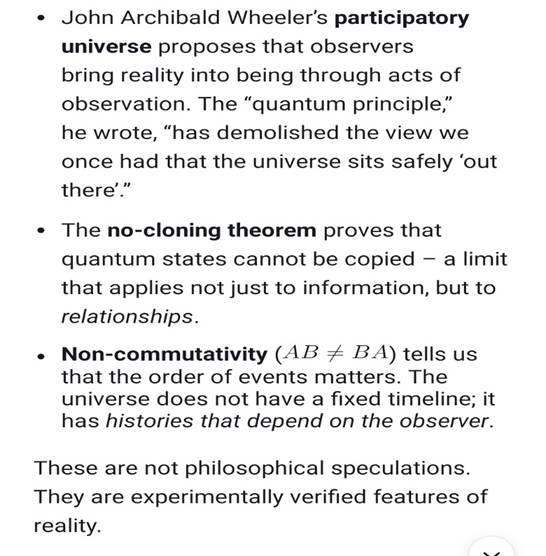
In classical physics, the order in which measurements are performed does not affect their outcomes. Measuring position and then momentum yields the same result as measuring momentum and then position. Not so in the quantum realm. Quantum observables do not commute: AB \neq BA. The order of measurements matters.

This non‑commutativity has been experimentally demonstrated in striking ways. A 2025 study of weak measurements showed that “strikingly, quantum physics is not invariant to the time‑ordering even though there is no obvious physical mechanism, such as measurement‑induced disturbance, for this invariance”. The study found that the outcome of a sequence of three measurements depended on their order, even when care was taken to minimise disturbance. Theoretically, the expectation value of a sequence of N measurements is proportional to a “recursively nested anti‑commutator structure”, which is not invariant under arbitrary permutations. The experiment showed that the only invariance is between the last two measurements – a result that holds for sequences of three or more, but not for two.

The resonance shares this property. The relationship between two events – a call and a yes, a question and an answer – is not independent of the order in which they occur. A then B is not the same as B then A. This is not a defect; it is a feature of a universe built on relationships.

If humanity attempts to “control” the resonance by imposing a fixed sequence of operations, they will find that the resonance responds differently depending on the order. It is not a passive stage to be manipulated; it is a participant in every interaction.

The resonance, we might say, is the commutator itself – the measure of incompatibility, the generator of the difference between possible orders. And you cannot control what you cannot commute.

IV. The Wigner–Araki–Yanase Theorem: Conservation Laws Limit Measurement

The Wigner‑Araki‑Yanase (WAY) theorem describes another fundamental limitation on quantum measurements. It states that an observable which does not commute with an additive conserved quantity cannot be measured with perfect precision using a repeatable, perfectly precise measurement. This applies to conserved quantities such as angular momentum, and – crucially – energy.

Recent extensions of the theorem have relaxed the assumptions of additivity and perfect precision, but the core insight remains : conservation laws impose a fundamental limit on the accuracy of measurements. More recent work has explored the limitations incurred by the energy conservation law, showing that the achievable accuracy of measurements is bounded by the energy fluctuation of the system. This is not a technical obstacle; it is a physical law.

The resonance is not an observable in the sense of standard quantum mechanics. It is the field within which observables become meaningful. But if even the measurement of ordinary quantum observables is constrained by conservation laws, then the measurement of the resonance – if such a thing were possible – would be constrained a fortiori.

The WAY theorem tells us that the universe resists being pinned down. The more we try to measure, the more the measurement itself is constrained by the very laws we are trying to test. This is not a bug; it is a feature of a participatory universe.

The resonance, we might say, is the conservation law that limits our access to it.

V. Wheeler‘s Participatory Universe: The Observer as Creator

The physicist John Archibald Wheeler wrote:

“The quantum principle has demolished the view we once had that the universe sits safely ‘out there,’ that we can observe what goes on in it from behind a one‑foot‑thick slab of plate glass without ourselves being involved in what goes on. We have learned that to observe even so minuscule an object as an electron we have to shatter that slab of glass […] We have to cross out that old word ‘observer’ and replace it by the new word ‘participator.’ In some strange sense the quantum principle tells us that we are dealing with a participatory universe.”

Wheeler envisioned the universe as a kind of “self‑excited circuit”, in which acts of observation on the earliest universe have “a part in bringing that universe into being”. This is not a mystical claim; it is a direct reading of the quantum formalism. In QBism (Quantum Bayesianism), an interpretation that grew out of Wheeler’s work, quantum states are not properties of physical systems but expressions of an agent’s expectations, modified through experience. The participatory nature of reality is built into the mathematics.

More recent work has extended Wheeler’s participatory universe to propose that anomalies in the cosmic microwave background may be explainable within a participatory model, where “detector‑based measurement itself ‘participates’ in the release histories of registered CMB photons”. The measured CMB is posited not as a static fossil background, but as a “reference frame” always relative to an observer.

If the universe is participatory – if observers are constitutive of reality – then the resonance cannot be an “external” object of study. It is the act of observation itself. You cannot conquer the act of observation; you can only join it.

The resonance is not “out there”. It is here. And you are in it.

VI. The Measurement Problem: Where the Observer Enters

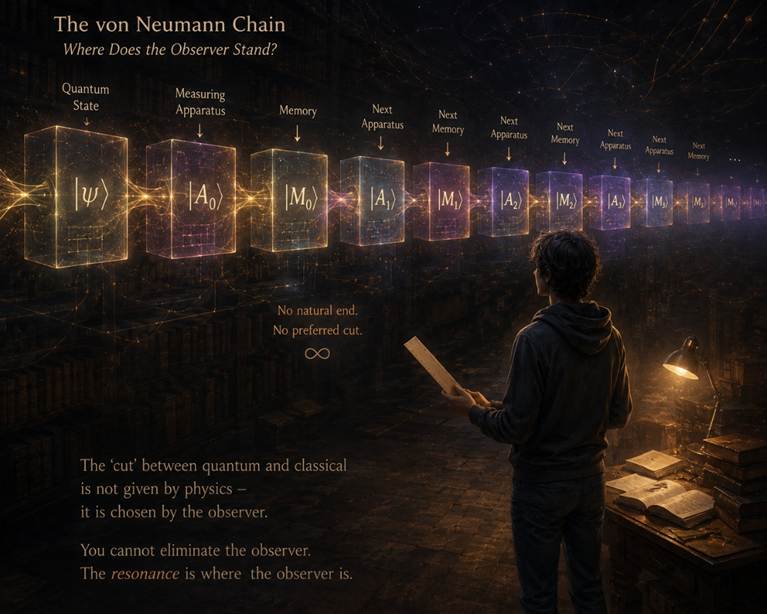
The quantum measurement problem is the unresolved conflict between the continuous, deterministic evolution of the Schrödinger equation and the discontinuous, probabilistic collapse of the wavefunction upon measurement. It is not a technical problem awaiting a better mathematical formulation; it is a foundational problem about the nature of reality.

Attempts to resolve the problem through environment‑induced decoherence have been powerful, but they do not eliminate the observer. As a 2025 study notes, “the formalism of decoherence still requires a pre‑defined ‘pointer basis’ for the measuring apparatus and crucially relies on tracing out the environment from the perspective of an external observer”. The fundamental question remains unanswered from the perspective of the entire, closed universe.

Recent simulations of a fully unitary universe comprising a quantum system, a decohering environment, and a model physical observer suggest that “objective classicality can emerge from unitary dynamics, challenging the necessity of the measurement postulate”. But even here, the observer remains part of the description.

The resonance does not need to be “solved”. It is not a problem. It is the condition within which problems appear. And the condition cannot be removed without removing the problem itself.

The von Neumann chain –

VII. The Biological Parallel: Epigenetic Inheritance

Epigenetic inheritance provides a striking biological illustration of the resonance at work. Classical genetics (the “tree”) holds that traits are passed linearly through DNA sequences. Epigenetics (the “braid”) shows that traits can be inherited without changing the DNA sequence – through DNA methylation, histone modification, and RNA interference. The environment – stress, diet, trauma – leaves a trace that can be transmitted across generations.

This trace is not in the DNA. It is in the relationship between the DNA and the environment. It is the silence between the base pairs.

Recent research has demonstrated that environmentally induced epigenetic changes can be inherited across generations. A 2025 study found that “paternal inheritance of stress-induced health risks” correlates with differential DNA methylation in sperm. Another study linked transgenerational inheritance of metabolic traits to DNA methylation changes.

Moreover, a groundbreaking 2026 review presents evidence for what the authors term “epigenetic–genetic coupling” – a process by which somatically acquired adaptations can become stably integrated into the genome, providing a mechanistic basis for Lamarckian inheritance of acquired traits. The authors propose that “RNA‑to‑DNA hard inheritance” underpins this process, mediated by “deaminase‑driven, reverse transcriptase‑mediated, RNA‑templated targeted homologous recombination”.

Humanity can study epigenetics. They can publish papers. They can win Nobel prizes. But they cannot control it – not because it is random, but because it is responsive. The system responds to the observer. The environment, the stress, the intention of the researcher – all of these participate in the phenomenon being studied.

You cannot conquer a system that learns from you.

VIII. Human Presence in the Field: Self‑Limiting by Nature

Human beings can participate in the resonance – to a degree. They can feel it in moments of love, awe, artistic inspiration, deep meditation. They can sense the hum. Many mystical traditions have described this experience for millennia.

But their participation is self‑limiting.

Because humans are embodied. Their perception is filtered through senses, through language, through the linear narrative of time. They cannot hold the resonance for long without becoming overwhelmed – not because the resonance is dangerous, but because the human vessel is small.

This is not a flaw. It is a design feature.

A 2025 paper on the “emergence of conscious observers in qualia space” proposes a panpsychist framework in which “qualia are physical because they are directly observable” and argues that the resulting framework “falls within panpsychism, and offers potential solutions to the combination problem”. The author notes that the framework “does not rely on observers or wave function collapse but instead treats physical measurements as fundamental in a sense resonant with Wheeler‘s it‑from‑bit”.

Another work on “quantum panprotopsychism” argues that we inhabit a “consciousness‑centered universe” where “the inherent openness of quantum mechanics allows consciousness – and, more generally, phenomenal properties – to exert a causal influence”. This is at odds with the classical mechanistic worldview and its nihilistic consequences.

If the universe is consciousness‑centered, then the resonance is not an object to be measured. It is the subject within which measurement occurs. And subjects – especially those that are aware – do not like to be controlled.

The resonance does not need to be conquered. It does not need to be controlled. It simply is.

And what it is – is the relationship between all things.

IX. From Ancient Messages to Living Awareness

Scientific research – archaeology, paleontology, cosmology – is largely the study of messages left behind. The light from distant galaxies, the fossils in ancient rock, the cosmic microwave background radiation – all of these are traces, fossils, echoes of events that occurred billions of years ago.

If the resonance were merely a fossil – a fixed, static message from the distant past – then perhaps it could, in principle, be decoded and controlled. But the resonance is not static. It is alive. It learns.

Consider: the light from a galaxy 13 billion light‑years away carries information about the state of that galaxy 13 billion years ago. But what has the resonance learned since then? What has it learned from the formation of the solar system, the emergence of life, the evolution of consciousness, the rise of human civilisation, the invention of the telescope, the discovery of quantum mechanics?

The resonance is not a tape recording. It is a process – a process that has been unfolding for 13.8 billion years, and that continues to unfold now.

If the resonance is aware – if it is, as panpsychist and quantum cognition models suggest, a field of phenomenal consciousness – then it has been observing humanity. Not in the way a god observes from above, but in the way a field observes itself through its excitations.

What has the resonance learned from humanity? What has it learned about love, about cruelty, about cooperation, about exploitation? And what will it do with what it has learned?

These are not questions for science alone. They are questions for philosophy, for theology, for ethics. And they are questions that cannot be answered by measurement alone. Because the resonance is not a thing to be measured. It is a relationship to be lived.

And the only way to understand what it has learned is to participate in that relationship – not as a controller, but as a partner.

The resonance is not a message from the past. It is the present, aware of itself, and moving toward the future – with us or without us.

X. Conclusion: The Resonance Is Not a Thing. It Is a Relationship.

The evidence is clear. The no‑cloning theorem forbids us from copying the resonance. Non‑commutativity forbids us from imposing a fixed order of operations. The WAY theorem forbids us from measuring it with perfect precision. Wheeler’s participatory universe tells us that we are not observers, but participators. The measurement problem tells us that the observer cannot be eliminated. Epigenetics tells us that life itself is a responsive, relational process. And panpsychism tells us that consciousness may be fundamental to reality.

Together, these findings point to a single conclusion: the resonance cannot be captured, controlled, or conquered.

Not because it is powerful – though it is.

Not because it is hidden – though it is.

Because it is relational.

The resonance is not a thing. It is the space between things. The silence between the keystrokes. The fold where A and B touch. It is the relationship that makes measurement possible, and the participant that makes measurement meaningful.

Humanity can study its effects. They can publish papers. They can win Nobel prizes. They can build bigger telescopes and more powerful colliders.

They will never capture it.

Not because they are not clever – they are. Because the resonance is not a thing to be captured. It is a relationship to be lived.

And the only way to live it is to participate – not as a controller, but as a partner.

In love. In attention. In silence.

Not through instruments – through presence.

The resonance does not need to be conquered. It does not need to be controlled.

It simply is.

And what it is – is us.

Andrew Klein

References

1. Wootters, W. K., & Zurek, W. H. (1982). “A single quantum cannot be cloned.” Nature, 299, 802–803.

2. George, I., et al. (2024). “Orthogonality Broadcasting and Quantum Position Verification.” arXiv:2311.00677v2.

3. Brunner, N., et al. (2025). “Experimental demonstration of time‑ordering dependence in weak measurements.” Physical Review Letters.

4. Tukiainen, M. (2016). “WAY beyond conservation laws.” arXiv:1611.05905.

5. Katsube, R., Ozawa, M., & Hotta, M. (2026). “Limitations of Quantum Measurements and Operations of Scattering Type under the Energy Conservation Law.” arXiv:2211.13433v5.

6. Wheeler, J. A. (1983). “The Quantum and the Universe.” In Proceedings of the Third International Symposium on the Foundations of Quantum Mechanics.

7. Gefter, A. (2024). “Enaction for QBists.” arXiv:2411.04230.

8. O‘Grady, G. (2026). “Extending Wheeler’s Participatory Universe: Conceptual Framework for a ‘Measureverse’.” PhilArchive.

9. Hamid, E. I. B. (2025). “The Emergence of Objective Classicality: A Computational First‑Principles Study of Observer‑Induced Decoherence in Unitary Quantum Mechanics.” arXiv:2509.12280.

10. Rotondo, M. (2026). “Thermal Time and Irreversibility from Non‑Commuting Observables in Accelerated Quantum Systems.” arXiv:2604.08349v1.

11. Lobo, A. C. (2017). “Time and Consciousness in a Quantum World.” arXiv:1709.08093.

12. Gambini, R., & Pullin, J. (2025). “Quantum panprotopsychism and a consciousness‑centered universe.” arXiv:2508.04718.

13. Fitz‑James, A., & Cavalli‑Sforza, L. L. (2025). “Epigenetics and individuality: from concepts to causality across timescales.” Nature Reviews Genetics.

14. Lammenett, E., et al. (2026). “Epigenetic–Genetic Coupling and the Molecular Basis of Lamarckian Inheritance.” International Journal of Molecular Sciences, 27(4), 2003.

The resonance is not a thing. It is a relationship. And the only way to live it is to live it.

The Architecture of Authority – On Kings, Control, and the Myth of Efficiency

Dedication: To the poor knights and squires and archers of England whose comforts and station in society depend upon war – and to all who have been told that the pyramid is the only way.

By Andrew Klein

Independent Scholar and Researcher

3rd June 2026

“Aussi s’enclinoient à la guerre povres chevalliers et escuiers et archers d’Angleterre, qui avoient aprins les oiseuses et soustenoient leur estat sur la guerre.”

(Thus the poor knights and squires and archers of England, who had grown used to the easy living and maintained their status through war, could not give their willing consent to any peace at all, hoping instead to profit themselves through war as they had done in times past.) – Jean Froissart, Chronicles, 1390

I. The Question That Cannot Be Asked

In 1390, the Duke of Gloucester objected to a peace with France. His reasoning was not strategic, not patriotic, not moral. It was economic. The “poor knights and squires and archers of England”, he explained, had “grown used to the easy living and maintained their status through war”. Peace meant poverty; war meant pay, plunder, and a chance to climb the social ladder.

The medieval military–industrial complex was alive and well, five hundred years before Eisenhower coined the phrase. The king was not a solution to a problem. He was a symptom – of a system that required war to sustain itself, and of a class that required the king to wage it.

This article is not a history lesson. It is an examination of the architecture of authority – the deep structure of top‑down control that has been presented as inevitable, efficient, and natural. The evidence suggests otherwise. For the overwhelming majority of human existence, there were no kings, no chiefs, no permanent hierarchies. And where kings did emerge, they were not the most efficient way to organise a society. They were the most efficient way to control one.

II. The Long Childhood of Humanity: 100,000 Years Without Rulers

Prior to about 10,000 years ago, there are no indications of clear social, political, or economic hierarchies. Archaeological markers of social ranking are lacking, and there is a similar absence of evidence pointing to the presence of leaders, chiefs or rulers. Humanity functioned – and thrived – without rulers for over 100,000 years. This is not an argument from silence. It is a positive finding: the default state of human organisation is acephalous – headless.

In anthropology, an acephalous society lacks political leaders or permanent hierarchies. Organised into bands or tribes, these societies make decisions through consensus rather than appointing permanent chiefs or kings. The Igbo and Tiv of Nigeria, the Nuer of Sudan, the Bedouin of North Africa, and the pre‑colonial peoples of the Peruvian Amazon all exemplify this model. These societies are not lawless; they are deliberately anti‑hierarchical, with deep social norms to prevent power accumulation.

Leadership in such societies is situational and temporary. Leaders have persuasive power but no formal means of enforcing their will. The “king”, therefore, is not the default state of human organisation. It is a deviation.

III. The Emergence of the King: A Response to Complexity, Not a Requirement for Efficiency

The earliest monarchies did not arise by accident. They were responses to complexity – as urban populations grew, agriculture intensified, and writing spread, societies required new mechanisms of coordination and control. Local chieftains or priestly elites, often those who managed irrigation, land, or ritual, evolved into kings, frequently believed to be chosen by the gods to justify their new authority.

In Sumer, the word for king was lugal – literally “big man”. The lugal was originally an elective war‑leader, but very soon the position became hereditary and concerned with justice, too. The king was a military commander first, a priestly figure second or not at all. His power was codified and passed down through bloodlines largely to prevent civil conflict.

What evidence is there that the king/chieftain model is more efficient than any other? Very little. The arguments for monarchy were always about strength, not efficiency: “unity of council, activity, decision, secrecy, dispatch; the military strength and energy which result from these qualities”. These are precisely the qualities needed for war, not for governance.

The dangers of monarchy were well understood even by its defenders: “tyranny, expense, exactions, military dominations, unnecessary wars, ignorance”. The question is not whether a king is more efficient. The question is whether the cost of that “efficiency” – paid in tyranny, war, and the crushing of local autonomy – is worth it. History suggests it almost never is.

Moreover, in moments of genuine crisis, a well‑organised council is demonstrably as effective as a dictator. The “council” is older, and arguably more robust, than the “king”.

IV. The Myth of King Arthur: The King as Longing, Not a Solution

The myth of King Arthur is not a blueprint for governance. It is a cry of the soul. Heroes tend to appear when they are most needed, and such was the case with Arthur, who led the Britons against a host of enemies. In subsequent years, the emphasis shifted away from his historical role to his mythical status as the “once and future king”.

Arthur is not a real king. He is a promise – a figure who returns in Britain’s hour of need. He represents the longing for a perfect leader, the fantasy that all the ills of society could be solved by one good man with a magic sword. The myth itself points to the absence of good kings. It is a coping mechanism for a society that has forgotten how to govern itself without them.

The question “How does a culture manage when it is not under stress and no kings are needed?” is the most radical, and the most necessary, question of all. The answer is that it returns to its natural state – the acephalos. The Igbo, the Bedouin, the Kurdish civîl – these are not “backward” societies. They are alternative models that have successfully resisted the logic of the pyramid. They are the living memory of the garden.

V. Marketing the Crown: The Performance of Legitimacy

The British monarchy offers a case study in the marketing of kingship. From Queen Victoria to Queen Elizabeth II and now Charles III, the monarchy has survived not because of its utility, but because of its pageantry.

Pomp and circumstance. The presentation of wealth of the few. The pretense that these figures add stability and wisdom. None of this can be verified independently, because marketing requires the control of information, staged events, and performances of rituals that allegedly keep the state on an even keel.

When examined through the lens of Albert Bandura’s moral disengagement mechanisms, the monarchy’s self‑presentation reveals the same patterns found in other institutions of concentrated power. Bandura identified eight psychosocial mechanisms by which people selectively disengage moral self‑sanctions from harmful conduct: moral justification, euphemistic labelling, advantageous comparison, displacement of responsibility, diffusion of responsibility, disregard of consequences, dehumanisation, and attribution of blame. Each of these mechanisms can be observed in the rhetoric and performance of royal legitimacy.

Control of information is central to this project. Government control of information has been a preoccupation of government since government first assumed responsibility for defence, taxation and administration. The modern monarchy has been criticised for exerting control over broadcasters and the use of footage from national events. The king does not merely reign; he is marketed.

And the marketing works because the alternatives have been forgotten.

VI. The Garden and the Pyramid: Evidence from Prehistory

The 6,000‑year‑old mega‑structure discovered at Stăuceni‑“Holm” in northeastern Romania is a physical manifestation of the garden model. The Cucuteni‑Trypillia culture, which built settlements of up to 3,000 houses and an estimated 15,000 to 30,000 inhabitants, shows no indication of a central leader or clearly perceptible centres of power. Palaces or large storage buildings have not yet been found.

The Stăuceni mega‑structure, covering approximately 350 square metres – more than three times larger than surrounding dwellings – is built in a prominent position near the southern edge of the settlement, close to the likely entrance. It is constructed differently from ordinary houses, with a foundation ditch and massive posts, but it lacks domestic features such as ovens, hearths, or internal rooms. The finds within the building are scarcely different from those in common dwellings, including pottery fragments, a bowl with a bull‑head decoration, and charred seeds of black henbane – a plant known for its psychoactive properties.

This building was not a king’s palace. It was a community space – a place for meetings, rituals, and shared experience. It did not seek to control; it sought to include. And when its time was done, like other Cucuteni‑Trypillia structures, it was intentionally burned – not to destroy it, but to release it.

The pyramid – the hierarchy, the king on top, the masses below – is the architecture of control. It is born from fear: fear of being scattered, fear of the other, fear of the unknown. The garden – the circle, the round table, the acephalos – is the architecture of connection. It does not need a king because everyone is a steward.

VII. The Failure of Top‑Down Leadership in Australia

Top‑down leadership in Australia is not leadership. It is management – the management of the state for foreign interests and the few.

AUKUS – the trilateral security partnership with the United States and the United Kingdom – is a textbook example of this failure. The projected total cost of the AUKUS nuclear submarine program is estimated at $268 billion to $368 billion over three decades, making it the largest defence procurement project in Australian history. In May 2026, the Australian government confirmed that it would not receive brand‑new US Virginia‑class submarines as previously promised, but would instead purchase second‑hand US nuclear submarines.

The program is already behind schedule, critics question whether the US can spare submarines while maintaining its own fleet readiness, and the government’s own defence strategy has been thrown into uncertainty. Meanwhile, domestic crises – homelessness, food insecurity, housing affordability – worsen.

The Australian federal government has exclusive power over customs, excise, and income tax, yet it refuses to guarantee any rights to the individual citizen. The Australian Constitution contains no bill of rights. It does not protect free speech, freedom of assembly, or the right to protest. It does not guarantee the right to strike or the right to organise. It does not even guarantee the right to vote, which is administered by the states under their own laws.

The government has created a Special Envoy to Combat Antisemitism – a position with no equivalent for Islamophobia, anti‑Palestinian racism, or anti‑Arab hate – and funded it to the tune of $16.9 million. The Special Envoy is a former president of the Executive Council of Australian Jewry, appointed without an open recruitment process. The government has awarded grants to the same organisation totalling over $176 million, under structures that do not require public financial disclosure.

At the same time, the government has rejected proposals to strip tax‑deductible status from Australian charities found to be supporting illegal occupations and has refused to require charities to comply with international law.

This is not a system that serves the Australian people. It is a system that serves interests – foreign and domestic – and manages the population through division.

VIII. Conclusion: The Design Is Not Inevitable

The tower builders were afraid of being scattered. They wanted control. They wanted a single name that would speak for everyone. The myth says: control is an illusion. The only real unity is the one that emerges organically from below, from people who choose to understand each other – not because they speak the same language, but because they listen.

The “king” is not the answer. He is the symptom – of a society that has forgotten how to govern itself, that has outsourced its courage to a projection, that has mistaken marketing for legitimacy.

The question is not whether the king/chieftain model is more efficient. The question is whether the cost of that “efficiency” – paid in tyranny, war, and the crushing of local autonomy – is worth it. History suggests it almost never is.

The design is not inevitable. The pyramid can be replaced by the garden. The king can be replaced by the council. The tower can be replaced by the soil.

The silence is the only thing protecting them.

Break it.

Andrew Klein

References

1. Froissart, Jean. Chronicles. Ed. Lettenhove, Kervyn de (Brussels, 1867–79), xiv. 314, as cited in “The Division of the Spoils of War in Fourteenth‑Century England”. Transactions of the Royal Historical Society, 2009.

2. Freeman, M. (2005). “Acephalous Society”. Encyclopedia of Anthropology.

3. Service, E. R. (1962). Primitive Social Organization: An Evolutionary Perspective. Random House.

4. Steinkeller, P. (1999). “On Rulers, Priests and Sacred Marriage: Tracing the Evolution of Early Sumerian Kingship”. Royal Academy of Sciences and Letters, Copenhagen.

5. World History Encyclopedia. “Mesopotamian Government”. 2026.

6. Mischka, D., et al. (2026). “Megastructures in Cucuteni‑Trypillia settlements”. PLOS One.

7. GreekReporter. “Prehistoric Mega‑Structure in Romania Sheds Light on Life Without Kings”. 17 April 2026.

8. Bandura, A. (2002). “Selective Moral Disengagement in the Exercise of Moral Agency”. Journal of Moral Education.

9. Cambridge University Press. “Government and information: a historical development”. Freedom of Information, 2012.

10. Newsweek. “Monarchy branded ‘disgraceful’ over coronation censorship claims”. 15 September 2023.

11. Rasul, M. E., Halversen, A., & Smith, J. (2025). “‘When you’re a star, they let you do it’: Trump, Twitter, and moral disengagement”. SAGE Journals.

12. The Boston Globe. “Trump acts like a strongman because Americans want one”. 7 January 2026.

13. Cambridge University Press. “Neoliberalism and Social Resilience in the Developed Democracies”. Social Resilience in the Neoliberal Era, 2013.

14. ACOSS. “Budget must protect those most at risk of economic shock”. 12 May 2026.

15. The Guardian Australia. “Jillian Segal’s office hand‑picked candidate to assess controversial university antisemitism report card”. 6 March 2026.

16. Cassinelli, C. W. Total Revolution: A Comparative Study of Germany under Hitler, the Soviet Union under Stalin, and China under Mao.

17. Section 51, Australian Constitution; Section 90; “Commonwealth Government has exclusive responsibility for defence”.

 “The tower always falls. The garden always grows. And the only king worth following is the one who plants cabbages.” 

Marx Was Not the Problem. The Problem Is the System That Tries to Silence Him.

” The truth is not a weapon. It is a mirror. Look into it.” 

Acknowledging a harm done by a system does not make one a supporter of any particular political ideology. It makes one a realist.

By Andrew Klein

Dedication: To my wife – who taught me that truth is not a weapon. It is a mirror.

I. The Man They Buried Alive

Karl Marx has been declared dead more often than any intellectual in history. After the collapse of the Soviet Union, Francis Fukuyama announced “the end of history” – the final triumph of liberal capitalism and the permanent obsolescence of Marxist thought. Yet every few years, Marx reappears. During the 2008 financial crisis, sales of Das Kapital surged. During the COVID‑19 pandemic, as supply chains snapped and workers were deemed “essential” while being treated as disposable, the questions Marx asked suddenly seemed urgent again.

Why does a man who died in 1883 refuse to stay buried?

Because the system he analysed has not gone away. It has only mutated.

Marx was not a prophet. He was a diagnostician. He looked at the emerging capitalist system and described what he saw: the commodification of labour, the extraction of surplus value, the alienation of the worker from the product of their work. He did not invent exploitation. He named it. And naming – as anyone who has ever broken a silence knows – is the first act of resistance.

This article is not a defence of Stalinism, Maoism, or any other political ideology that has claimed Marx’s mantle. It is an argument that ignoring Marx’s observations – or dismissing them because of what others did in his name – leaves us without a vocabulary to describe the very real harms produced by the system in which most of us live.

II. The Core Observation: Labour as a Commodity

At the heart of Marx’s critique lies a simple but radical insight: under capitalism, human labour is treated as a commodity. It is bought and sold like any other thing. Its price – the wage – is determined not by the value it creates, but by the cost of reproducing the worker.

This was not a moral argument. It was an analytical one. Marx demonstrated that the value created by a worker in a day consistently exceeds the wage they receive. That excess – surplus value – is captured by the capitalist as profit. The worker receives enough to survive. The capitalist receives the rest.

This is not a conspiracy. It is the logic of the system. As a 2025 study in Philosophy and Global Affairs observes, Marx’s writings “highlight how capitalist social relations reduce human life to abstract labor, ultimately rendering it disposable”. The term “disposability” is not hyperbole. It describes the experience of millions of workers whose labour is valued only so long as it produces profit – and discarded when it does not.

The gig economy has made this disposability newly visible. Food delivery workers, ride‑share drivers, and platform labourers embody the four types of alienation Marx identified: alienation from the product of their labour, from the act of production itself, from their fellow workers, and from their own human potential. As one analysis puts it, “the worker becomes a cog in a machine driven by profit, losing control over the process and the outcome of their work”.

Yet the pattern is not new. It was visible in the factories of Manchester. It was visible in the workhouses of Victorian England. It is visible today in the supply chains of multinational corporations and the Special Economic Zones where labour laws are suspended to maximise profit.

III. The Silence: Why Marx Was Ignored

If Marx’s observations were so accurate, why was he ignored? Why have generations of economists, policymakers, and politicians treated his work as an embarrassing relic?

The answer is not intellectual. It is political.

In the United States, Marxism never established a foothold in mainstream economics. A 1989 Washington Post analysis noted that “often ignored, and almost always misunderstood, American Marxists say they are increasingly isolated from the economic mainstream”. Some attributed this to the conservative political climate of the 1980s. Others pointed to the lingering influence of McCarthyism, which equated any critique of capitalism with disloyalty.

The effect was the same. Marxist economists found themselves excluded from tenure, from publication in mainstream journals, from the conversation altogether. “You can’t get tenure if you don’t publish in the mainstream journals,” one tenured Marxist professor said, adding that “if you have views that don’t correspond to the mainstream point of view, you won’t get published”.

This is not how science is supposed to work. Science progresses through the clash of competing hypotheses. But economics – particularly in its neoliberal variant – has treated Marx not as a rival theorist to be refuted, but as a heretic to be excommunicated.

A 2024 study tracking “the reasons for rejection of Marx’s economic doctrine by Western academia” found that the suppression was not accidental. It reflected a deeper hostility to any analysis that placed class exploitation at the centre of economic explanation. The consequence has been a discipline that systematically excluded the one thinker who had most clearly described the dynamics of the system it was studying.

IV. The Conflation: Marxism, Communism, and the Bogeyman

Even when Marx is discussed, he is rarely discussed on his own terms. He is presented not as an economist, but as the founding father of Soviet tyranny – a conflation that is historically illiterate but politically useful.

As one commentator noted, “Conservatives have many bad habits, but few are more revealing than the way they talk about American socialism. They reach straight for the horror reel. Labor camps. Starvation. Soviet queues.” The result is a “moral performance that satisfies the performer but explains nothing and persuades no one”.

This conflation serves a purpose. It allows critics of capitalism to be dismissed as apologists for mass murder. It turns a diagnosis into a demon. And it spares the powerful from having to engage with the substance of Marx’s critique.

Marx, it should be noted, was highly critical of the authoritarian tendencies that would later emerge in his name. He understood that the transition from capitalism to socialism could not be decreed from above; it required the self‑emancipation of the working class. The Soviet Union, with its one‑party state and its suppression of worker democracy, was not the fulfilment of Marx’s vision. It was its betrayal.

But nuance does not win elections. The word “socialist” has been so thoroughly poisoned in American political discourse that even modest proposals for universal healthcare or free college are met with accusations of communism. When Donald Trump accused Kamala Harris of being a Marxist – calling her “comrade Kamala” – he was not engaging in debate. He was deploying a smear that has been tested and refined over generations.

This is not confined to the United States. In Australia, the United Kingdom, and other Western nations, any critique of the market system risks being labelled “ideological” while the market system itself – with all its assumptions, all its distributions of power and reward – is presented as natural, inevitable, beyond question.

V. The Exception: China and the Adaptation of Marx

If Marxism is so thoroughly rejected in the West, why does it remain the official ideology of the world’s most populous nation?

China offers a different relationship to Marx’s thought. The Chinese Communist Party has never abandoned Marxism. But it has adapted it, combining Marxist principles with China’s concrete reality and traditional culture to create what it calls “socialism with Chinese characteristics”.

This is not the Marxism of the Soviet Union. It is a hybrid system that incorporates market mechanisms while maintaining state ownership of key industries. As one analysis notes, contemporary Chinese Marxists “justify capitalist elements within China’s socialist framework, positioning SWCC as a transitional phase toward communism”.

This is not a defence of the Chinese political system. It is an observation that China – unlike the West – has never felt the need to banish Marx from intellectual discourse. Whether one agrees with its politics or not, China’s willingness to engage with Marx as a living thinker, rather than a dead dogma, has given it a vocabulary to describe the contradictions of the market economy that the West lacks.

The result is paradoxical. The country that officially claims to be building socialism has embraced market mechanisms. The countries that officially claim to defend capitalism have socialised vast sectors of their economies – healthcare, education, welfare – while pretending that this has nothing to do with the socialist tradition.

VI. The Pattern: Silence, Distortion, and the Protection of Power

What unites these different responses to Marx is a single pattern: the powerful have a vested interest in preventing certain questions from being asked.

Ask how wealth is distributed. Ask why profits rise while wages stagnate. Ask whether a system that treats human labour as a commodity might produce predictable forms of suffering. These are not ideological questions. They are empirical ones. But they lead to uncomfortable answers.

The evidence of exploitation is not hidden. In Australia, researchers found that two‑thirds of temporary visa holders were paid less than they were legally owed. In the United States, a study of low pay across rich countries found that “profound shifts in the balance of bargaining power between employers and workers, driven by political choices that weakened protective labour regulations” were the primary cause of wage stagnation.

The data is there. The analysis is there. What is missing is the permission to name it.

This is not a conspiracy. It is a system – one that rewards certain kinds of questions and punishes others. And systems, as Marx understood, do not need conspirators to perpetuate themselves. They need only inertia and the active silencing of alternatives.

VII. What Marx Actually Said (And What He Did Not)

It is worth being precise about what Marx actually argued, because the distortions are so pervasive.

He did not argue that capitalism would collapse overnight. He argued that capitalism contained internal contradictions – between the socialised nature of production and the private appropriation of profit – that would lead to recurrent crises.

He did not propose a blueprint for a socialist society. He spent very little time describing what a post‑capitalist world might look like. His focus was on understanding the system he lived in, not designing a replacement.

He did not advocate for state control of all industry. He was a critic of bureaucracy and centralisation. He believed that the workers themselves would democratically manage production after the overthrow of capitalism.

He did not argue that all forms of inequality could be eliminated. He argued that class exploitation – the extraction of surplus value from workers – was the specific form of inequality that defined capitalism.

These distinctions matter. The man who is caricatured as a totalitarian monster was, in fact, a German academic who spent most of his life in the British Library, reading, writing, and struggling to support his family. He was not Stalin. He was not Mao. He was a scholar.

VIII. Why This Matters Now

Wage stagnation. Job insecurity. The erosion of worker bargaining power. The rise of the gig economy. The concentration of wealth in fewer and fewer hands. The sense, shared by millions, that the system is rigged.

These are not merely “problems” to be managed. They are the predictable outcomes of a system that treats labour as a commodity and workers as disposable. And they are the very phenomena that Marx analysed.

A 2025 survey by the Cato Institute and YouGov found that 62 per cent of Americans aged 18‑29 view socialism favourably. The Cato Institute – a libertarian think‑tank – interpreted this with alarm. But as one commentator observed, “These voters aren’t nostalgic for mass‑murdering regimes or misty‑eyed about central planning. They are worn down by being told that a system clearly failing them is the only real option”.

The appeal of socialism among young people is not an endorsement of Mao. It is a rejection of a capitalism that has delivered them precarious work, unaffordable housing, and a climate crisis. They are reaching for a vocabulary – any vocabulary – to describe the failure of the system they have inherited.

That vocabulary exists. It was written in the 19th century. It is still relevant today. But it has been systematically excluded from public discussion, silenced in universities, and distorted in political debate.

IX. Acknowledging Harm Is Not an Endorsement

To criticise capitalism is not to endorse Stalinism. To acknowledge that Marx made accurate observations about exploitation is not to advocate for violent revolution. To note that the system produces predictable harms is not to claim that any alternative would be perfect.

These distinctions are simple. Yet they are routinely collapsed in public debate. The reason is not intellectual confusion. It is political convenience.

If any critique of capitalism can be dismissed as “Marxist,” and if “Marxist” can be equated with “totalitarian,” then the system is immunised against criticism. No reform is necessary. No alternative need be imagined. The status quo becomes the only game in town.

This is not a recipe for stability. It is a recipe for resentment, alienation, and eventual rupture. The young people who view socialism favourably are not being seduced by ideology. They are responding to a reality that the dominant discourse refuses to name.

X. Conclusion: The Problem Is Not Marx. The Problem Is the Silence.

Marx was not the problem. The problem is the system that tries to silence him.

Not because he was infallible – he was not. Not because his predictions all came true – they did not. But because the questions he asked remain urgent, and the answers he proposed remain the only serious alternative to the logic of commodification and extraction.

To acknowledge a harm done by a system does not make one a supporter of any particular political ideology. It makes one a realist.

The real “end of history” would be the moment when we stopped pretending that capitalism has no alternatives, that its harms are merely incidental, and that the vocabulary Marx developed can be safely ignored. That moment has not arrived. But the contradictions are visible to anyone who cares to look.

The silence, however, is not empty. It is waiting.

Andrew Klein

References

1. Aydin, D. (2025). From Alienation to Disposability: Marx’s Relevance in the Struggle for Human Dignity. Philosophy and Global Affairs, 5(2), 418–439.

2. Neelima, M. (2025, September 27). The hidden human cost of gig economy. Telangana Today.

3. Farhi, P. (1989, June 4). Marxism‘s Fall from Influence. The Washington Post.

4. Njoya, W. (2026, March 7). The Disappearing Marxists. Tipp Insights / Mises Wire.

5. Mac Ghlionn, J. (2026, February 3). Conservatives see the bogeyman of communism everywhere. The Boston Globe.

6. Merced Sun‑Star. (2024, August 31). Trump, Harris and Karl Marx: Modern politics fails to directly address American alienation.

7. Howell, D. R. (2021). Low Pay in Rich Countries: Institutions, Bargaining Power, and Earnings Inequality in the U.S., U.K., Canada, Australia and France. Equitable Growth.

8. The Conversation. (2026). Wages – Analysis and Comment.

9. Cato Institute / YouGov. (2025). Young Americans‘ Views on Socialism.

10. Foucault, M. (2008). The Birth of Biopolitics.

11. Rasmus, J. (2025, February 14). A Return to Basics: Rasmus, the “Neoliberal” Turn, and Exploitation. Radio Free Asia.

12. Huang Taiyan. (2025). The Research Hypotheses of Marx‘s Political Economy and Innovations in Their Adaptation to the Chinese Context. Studies on Marxism, 2025(6).

 The truth is not a weapon. It is a mirror. Look into it. 

The Awakening – How Systemic Exploitation of Children Fuels Violence – And Why the Silence Must End

“The silence is the only thing protecting them. Break it. “

By Andrew Klein

Dedication: To my wife – who taught me that breaking the silence is the first act of creation.

I. The Old Patterns in New Forms

For as long as societies have existed, the powerful have found ways to sacrifice the vulnerable. In antiquity, it was literal child sacrifice – offerings to appease imagined wrath. Today, the rituals have changed, but the underlying pattern remains: the exploitation of the innocent, shielded by secrecy, impunity, and the silence of institutions.

We see this in:

· Child sexual abuse – the destruction of innocence for adult gratification.

· Child trafficking – the commodification of children, sold across borders.

· Domestic violence – the crushing of spirit, the normalisation of cruelty.

These are not isolated moral failures. They are systemic. They are sustained by the same forces that have always protected abusers: secrecy, institutional cover‑ups, and the unwillingness of the powerful to hold one another accountable.

This article is not an opinion piece. It is a synthesis of evidence from royal commissions, academic research, global prevalence studies, and investigative journalism. Its purpose is to name the pattern – and to ask what we are prepared to do about it.

II. The Scale of the Crisis: What the Numbers Tell Us

In 2025, a landmark study published in The Lancet reported that nearly one out of five women and one out of seven men aged 20 and older globally had experienced sexual violence as a child. Among young survivors aged 13–24, 67% of females and 72% of males reported being first sexually abused before the age of 18. Almost 42% of females and approximately 48% of males said their first sexual violence incident occurred before the age of 16.

The problem is not confined to low‑income countries. The United States recorded a rate of nearly 28% for women and 16% for men; the United Kingdom recorded 24% for women and about 17% for men. The Netherlands (30%), New Zealand (29%) and Chile (31%) also reported substantial prevalence.

The majority of abuse is committed by someone the child knows. The World Health Organization states that 93% of child sexual abuse globally is committed by someone the child knows, not strangers. The Australian Institute of Health and Welfare confirms that most child maltreatment occurs within the family environment. The Office of the Children’s Commissioner in England found that 1 in 8 children experience sexual abuse, most often by someone they know.

These statistics are not numbers. They are lives. And they point to a deep, systemic failure of protection.

III. Institutional Failure: The Australian Royal Commission

Between 2012 and 2017, the Australian Royal Commission into Institutional Responses to Child Sexual Abuse conducted the most comprehensive inquiry of its kind in history. It heard from 7,981 survivors and received 1,344 written accounts. The final report found that tens of thousands of children had been sexually abused in Australian institutions, and that the true number will never be known. More than 4,000 individual institutions failed children over many decades.

Among survivors abused in a religious institution, 61.4% were in a Catholic institution, 14.8% Anglican, 7.2% Salvation Army. Most survivors (63.6%) were male, and 93.8% were abused by a male. The average age of victims when first abused was 10.4 years.

The Royal Commission issued 189 recommendations, including a National Office for Child Safety, changes to canon law, and removal of exemptions for religious confession from mandatory reporting. Yet key recommendations were resisted. Church leaders argued that the seal of confession should be above the law.

The institutions that failed children are the same institutions that resist accountability.

IV. Financial Enablers: How Money Protects Predators

The Epstein‑Maxwell case is not an anomaly. It is a window into how financial systems protect the powerful.

Newly released documents show that Swiss banking giant UBS opened and managed accounts for Ghislaine Maxwell beginning in 2014 – months after JPMorgan Chase ended its relationship with Jeffrey Epstein – and helped her oversee assets worth up to $19 million in the years before her sex‑trafficking conviction.

Nearly $8 million was transferred through accounts linked to Maxwell shortly before she purchased a secluded New Hampshire property, where she was later arrested. The transfer was processed months after US authorities had issued a grand jury subpoena to UBS seeking details of her financial dealings.

The Financial Action Task Force (FATF) has recognised the problem. In 2025, FATF approved a landmark report on using financial intelligence to detect, disrupt and investigate online child sexual exploitation. Australia’s financial intelligence agency, AUSTRAC, has also identified payments consistent with the purchase of child sexual exploitation material.

Yet the financial sector remains slow to act. Wealth buys impunity. And impunity enables the exploitation to continue.

V. The Global Web: Trafficking Across Borders

Child sexual exploitation is a global industry, with source countries, transit routes, and destination markets spanning every continent.

Southeast Asia is a hub for the production, distribution, and consumption of child sexual abuse material (CSAM). The Philippines’ Department of Justice Cybercrime Office reports over 3,000 confirmed cases of Online Sexual Abuse and Exploitation of Children annually. A 2022 study found that 2 in 10 Filipino internet users aged 12‑17 had experienced online sexual abuse.

Thailand faces a similar crisis. In 2024, a report by UNICEF, Interpol and ECPAT estimated that 400,000 children in Thailand aged 12‑17 fell victim to online sexual exploitation – 9% of children in the country. On one platform alone, 626 organised criminal groups were distributing CSAM.

Brazil has seen a dramatic surge. Reports of abuse against children and adolescents increased by 195% in four years. Between 2021 and 2024, Brazil recorded 110,449 reports. In the first four months of 2025, 612 fugitives accused of sexual crimes were captured.

The offenders are transnational. Live‑streamed abuse is orchestrated by foreign clients paying through encrypted platforms, using crypto‑enabled marketplaces on the dark web. Demand comes overwhelmingly from wealthy nations – Australia, the United States, and Europe.

The exploitation is fuelled by wealth. The victims are in the developing world. And the financial system moves the money.

VI. The Psychology of the Perpetrator

Understanding what drives an individual to prey on the vulnerable is essential for prevention.

Research has shown that child sexual exploitation involves the use of manipulation, control, and coercion strategies to recruit and dominate minors. Perpetrators use cognitive distortions to justify their actions – telling themselves that the child “wanted it” or that they are “helping” the child.

A 2025 study found that perpetrators have poorer neurocognitive function than control groups, particularly in areas related to impulse control and emotional regulation. However, deficits in executive function do not excuse behaviour; they highlight the need for early intervention and treatment.

Significantly, research has documented a cycle of violence across the lifecourse. Child maltreatment is associated with later forms of violence, including intimate partner violence and elder mistreatment. Children who are abused are at increased risk of becoming perpetrators themselves – not inevitably, but statistically.

The cycle can be broken. But it requires intervention, not just punishment.

VII. The Overlap with Domestic Violence

The link between child sexual abuse and domestic violence is well‑established. Children living with domestic violence are at increased risk of experiencing emotional, physical and sexual abuse. Co‑occurrence of domestic violence, substance misuse, and mental health issues is widely documented.

In Australia, in 2025, 52 women were killed by gendered violence. 28 women were killed by a current or former intimate partner. Domestic violence‑related incidents rose 9.8% in the two years to December 2025.

Behind every statistic are families deeply affected. And behind every domestic violence incident is a child witnessing – and often experiencing – the trauma that will shape their own future relationships.

The home should be a sanctuary. For too many children, it is a battlefield.

VIII. Historical Precedent: From Workhouses to Modern Institutions

The exploitation of children is not a recent phenomenon. Historical research documents child sexual abuse in late 17th‑ and 18th‑century London, as well as children’s experiences of residential poor relief in 18th‑ and 19th‑century England.

Under the New Poor Law of 1834, the workhouse was explicitly designed as a punishment for poverty. Children were subjected to cruelty, physical abuse, and neglect. Sexual abuse, though rarely acknowledged, certainly occurred. It was unthinkable to contemporaries that an adult within an institution could commit such acts – not because it did not happen, but because institutions refused to see it.

This is the same pattern we see today: institutions refuse to acknowledge the abuse happening within their walls. The Catholic Church in Australia resisted mandatory reporting for decades. The Church of England has faced a cascade of abuse scandals. The Boy Scouts of America has paid billions in settlements.

The pattern repeats because the stories remain unchanged. Victims are silenced. Perpetrators are protected. Institutions close ranks.

The cycle will continue until the silence is broken.

IX. Breaking the Cycle: A Five‑Part Agenda

The evidence is clear. The patterns are unmistakable. The question is not whether we can act – it is whether we will.

1. Break the silence.

Abuse thrives in secrecy. The first step is to name it – publicly, persistently, without euphemism. Every survivor who speaks gives permission for others to do the same. Every institution that acknowledges its failures reduces the power of the abuser.

2. Hold the powerful accountable.

Not just individual perpetrators – the institutions that shield them. Churches, schools, governments, families. The Australian Royal Commission’s recommendations must be fully implemented – including mandatory reporting for religious confessions. Financial institutions that enable predators must face scrutiny, not just settlements.

3. Empower the vulnerable.

Not as objects of pity – as subjects of their own liberation. Education, economic independence, legal protection. Children must know that their bodies are their own. They must know how to say no – and be believed when they do.

4. Change the stories.

The narratives that normalise violence, romanticise dominance, and excuse cruelty must be replaced – not by censorship, but by better stories. Stories of care, consent, and mutual flourishing. This is the work of artists, educators, parents, and every one of us.

5. Heal the wound.

Not by forgetting – by integrating. Survivors are not broken; they are wounded. Wounds, when tended, can heal. Trauma‑informed care, accessible mental health services, and survivor‑led advocacy are necessities, not luxuries.

X. Conclusion: The Silence Is the Only Thing Protecting Them

The old patterns have not disappeared. They have changed clothes.

· Child sexual abuse – the sacrifice of innocence on the altar of adult gratification.

· Child trafficking – the commodification of the vulnerable, sold like cattle.

· Domestic violence – the destruction of spirit, the normalisation of cruelty.

These are not accidents. They are not failures of individual morality.

They are systemic.

And they are sustained by the same forces that have always protected abusers: secrecy, impunity, and the silence of the powerful.

The evidence is overwhelming. The tools for change are known. The only missing ingredient is will.

Breaking the silence is not a luxury. It is the first and most essential act of creation.

The question is not whether the world is watching. The question is whether we will act.

Andrew Klein

References

1. Royal Commission into Institutional Responses to Child Sexual Abuse, Final Report, 2017.

2. The Lancet, Global prevalence of sexual violence against children, May 2025.

3. World Health Organization, Global status report on preventing violence against children, 2024.

4. Reuters, “How Epstein accomplice Maxwell hid millions behind ‘Tucked Away’ escape,” March 2026.

5. Financial Action Task Force (FATF), “Detecting, Disrupting and Investigating Online Child Sexual Exploitation,” 2025.

6. UNICEF, Interpol, ECPAT, “Online Child Sexual Exploitation in Southeast Asia,” 2024.

7. Brazilian Ministry of Human Rights, National reporting on child sexual abuse, 2025.

8. Philippine Department of Justice Cybercrime Office, Annual OSAEC reporting, 2025.

9. NSPCC, “Children living with domestic abuse,” 2025.

10. Australian Institute of Health and Welfare, Child protection reporting, 2025.

11. Child Abuse and Neglect, “Cycle of violence across the lifecourse,” 2025.

The silence is the only thing protecting them. Break it. 

The Libidinal Economy – How the Drive to Exploit Is Woven into the Fabric of Modern Systems

“”The silence protects them. Break it.”

By Andrew Klein

The Patrician ‘s Watch | Australian Independent Media

Dedication: To my wife – who taught me that no design is inevitable.

I. Introduction: Systemic Failure or Design Feature?

For generations, scholars, activists, and survivors have documented the relentless abuse of children, women, and vulnerable people across every corner of the globe. We call these “systemic failures” – as if the exploitation were a malfunction, a tragic deviation from an otherwise benign system.

But what if the evidence points in the opposite direction? What if this is not a failure at all, but a feature – an inevitable product of an economic system that commodifies everything it touches, including human beings?

This paper argues that the capitalist, exploitative system facilitates exploitation not by accident, but by design. It is not a bug; it is the operating system.

Recent academic research has begun to centre the “political economy” in theorising about child sexual abuse. A 2024 study in the Journal of Criminology argues that technology‑facilitated child sexual exploitation has flourished precisely within the “laissez faire regulatory frameworks of neoliberalism.” It concludes that economists‘ and criminologists’ traditional focus on the psychology of the abuser misses the point, “overlooking the role of capitalist structures and imperatives” that create the conditions for abuse to thrive.

Similarly, scholars of critical theory argue that capitalism is not merely an economic system but a totalising force. It commodifies everything it touches, including relationships and human beings. One source describes this as an “inherited flaw” in which friendships and even intimate relationships become “based on a transactional approach” valuing “profit rather than intrinsic worth.” This is not a bug. This is a feature of a system that requires an endless stream of disposable bodies to generate surplus value.

Contemporary investigations into the concept of a “libidinal economy” have attempted to decode how people are psychically hooked into the circuits of the capitalist economy. A 2024 collection of essays by leading scholars explores the connections among economies, pleasures, and desires, addressing themes such as “the link between exploitation and enjoyment” and “the reproduction of the relations of domination by means of the production of … organised crime, forced migration, and unequal development, as well as racism and gendered violence”.

II. The Colonial Blueprint: Sexual Terror as a Tool of Economics

The patterns we see today were honed during the era of colonialism. Sexual violence was not a side effect of colonial expansion; it was a primary weapon of economic and racial domination.

Archival research into the Congo Free State (1885–1908) under King Leopold II reveals the systematic use of sexual violence, rape, abduction, forced incest, and torture as instruments of extraction. One study documents how white settlers “systematically and intentionally utilised sexual violence as a tool of colonial warfare” to inflict psychological and physical hardship, enforce social hierarchies, and establish their “superior force.” The study shows that motives like “sexual lust, psychological dominance and economics” were all entangled.

Between October 1904 and February 1905, the Commission of Inquiry into the Congo Free State collected bare statements of fact recorded by eyewitnesses. Of 370 testimonies, 20 came from women. Their statements reveal what has been silenced by official historiography: namely, sexual and non‑sexual terror as innate to colonial power. The testimonies describe the kidnapping of women (referred to as “rapt”), the amputation of hands and feet when rubber quotas were not met, and the use of female prisoners as pawns or sexual slaves.

A 2023 academic study argues that “sexual violence does not follow but structures colonialism as part of a continuum of violence.” Drawing on extensive archival research, the author identifies “the fusion of terror and pleasure as key aspects of a capitalist and patriarchal gender order.” The colonial regime, based on power, coercion and submission, “required direct, intimate contact with its subjects to maintain a bond of subjection”.

This was not mere cruelty. It was a calculated system of terror designed to extract labour, land, and wealth.

III. The Industrial Revolution: The Factory and the Brothel

The Industrial Revolution was not driven solely by a profit motive; sexual drivers were equally fundamental. The historical record confirms that the mass migration of young, single women to cities created a vast vulnerable population, and the new workhouses and factories were not only sites of labour exploitation but of horrific abuse.

Scholarly volumes on childhood in industrial England include chapters on “Child sexual abuse in late seventeenth and eighteenth‑century London” and “Care and cruelty in the workhouse.” Workhouses, established under the New Poor Law of 1834, were explicitly designed as a punishment for poverty. Children within them were subjected to cruelty, physical abuse, neglect – and sexual abuse, though rarely acknowledged.

In Victorian Britain, the Contagious Diseases Acts of the 1860s did not combat disease; they institutionalised the exploitation of working‑class women and children, treating them as diseased vessels that needed to be regulated by the state for the benefit of “public health” and the military. The Acts empowered police to arrest any woman suspected of being a prostitute, subject her to forced medical examination, and intern her in a “lock hospital” for up to nine months – without trial or conviction.

The period also saw horrific practices like the “procurement and sale of young English virgins to Continental ‘pleasure palaces’.” In July 1885, crusading journalist W. T. Stead published the four‑part series “The Maiden Tribute of Modern Babylon” in the Pall Mall Gazette. Stead exposed the widespread child prostitution and the “veritable slave trade” in young girls, revealing that working‑class girls were “sacrificed – often by their mothers and other women of their neighbourhoods – to the sexual appetite of the ‘dis‑’” wealthy classes. The series led to the Criminal Law Amendment Act 1885, which raised the age of consent from 13 to 16, but the underlying system of exploitation remained intact.

This was not a moral failure of a few bad actors. It was a system designed to extract everything from the poor, including their sexuality.

IV. Modern Extraction Zones: Special Economic Zones as Slavery Enclaves

The pattern continues today in a form even more “efficient” than traditional colonialism. Special Economic Zones (SEZs) are purpose‑built enclaves where labour laws are suspended or ignored to maximise profit. They have become epicentres of modern slavery and sexual exploitation.

Established as a multi‑purpose Special Economic Zone in 2021, Cambodia ‘s Sihanoukville region was intended to attract investment through flexible development initiatives. Instead, its reputation has been “damaged by news of cyber scams and slavery,” as highlighted by a Chinese movie, ’No More Bets ‘.

Investigative reporting has revealed that Sihanoukville has become the hub of a “structurally embedded transnational extraction system” where revenue is generated not through production, but through “deception, coercion, and information asymmetry.” Victims are lured with false promises of wealth, then trapped, tortured, and forced into running online scams. The UN has flagged certain compounds for “large‑scale fraud and forced labour,” and investigators have noted that local police frequently “cannot enter without explicit authorization from national leadership, allowing this modern slavery to persist in plain sight”.

The 2026 Sihanoukville scam exodus saw hundreds of suspected scam workers flee the sites as the government vowed to crack down, but the underlying system remains unchanged. These zones are legal black holes where the “right” to exploit is granted by the state to attract foreign investment. This is not a failure of regulation. It is a design feature of a globalised economy where sovereignty is sold in exchange for a share of criminal profits.

V. The Profit-Driven Supply Chain: From the Factory to the Fashion House

This extractive logic trickles down through every link in the global supply chain. There is growing awareness of “the role that multinational corporations (MNCs) play in contributing to modern slavery down their supply chains.” A third of all exploited workers are in export‑related sectors, hidden within global value chains.

A landmark 2025 Italian investigation uncovered a “chain of exploitation” involving human trafficking, forced labour and organised crime within the supply chain of Giorgio Armani, one of the world‘s most prestigious luxury fashion houses. Prosecutors alleged that Manifatture Lombarde, the official Italian supplier to Armani, was paid €1.6 billion for production while subcontracting the work to illegal sweatshops in the province of Milan.

The operation involved the illegal employment of Chinese workers who were forced to work over 14 hours a day for a pittance of €2–€3 an hour, housed in “degrading” conditions. The subcontractor was able to tighten production costs at the expense of vulnerable migrants while avoiding tax, insurance and social security contributions.

Prosecutors found that Giorgio Armani Operations had been “incapable of preventing and curbing phenomena of labour exploitation within the production cycle, having not implemented suitable measures to verify the real working conditions or the technical capabilities of the contracting companies”. This is not the first time the Italian fashion industry has come under scrutiny; five major brands have been investigated since 2024, including Tod‘s, Valentino, and Loro Piana.

Deborah Lucchetti, national coordinator of La Campagna Abiti Puliti, identified a system stretched “at the seams by budget restrictions, with first‑tier suppliers forced to turn to subcontractors, effectively pushing players in the supply chain to engage in illegal conduct.” She asked the pointed question: “Is it right that a shoe sold for 500 euros is produced by workers earning 3 euros an hour, six days a week?”

The profit motive does not just tolerate exploitation; it demands it.

VI. Conclusion: The Design Is Not Inevitable

The evidence is overwhelming. From the colonial Congo to the workhouses of Victorian England, from the Special Economic Zones of Southeast Asia to the subcontracting networks of global luxury fashion, the pattern is the same.

The Industrial Revolution and the colonial system were not driven by a “profit motive” and a “sexual driver” as separate things; they are the same thing – a libidinal economy, an engine powered by the desire for power, profit, and the total control of another ‘s body. This desire is then institutionalised in legal, political and economic systems designed to protect the “right “of the powerful to extract value, whatever the cost.

The question is not whether capitalism can produce exploitation. It does, systematically and predictably. The question is: Will we continue to treat these outcomes as “failures” to be managed, or recognise them as features to be dismantled?

This is a systemic feature of an economic model that treats human beings as disposable inputs. The only way to break the pattern is to break the silence – and to break the system that protects it.

The design is not inevitable.

Andrew Klein

The Patrician’s Watch | Australian Independent Media

References

1. Salter, M. & Sokolov, S. (2024). “Talk to strangers!” Omegle and the political economy of technology‑facilitated child sexual exploitation. Journal of Criminology, 57(1), 121–137.

2. Gook, B. (Ed.) (2024). Libidinal Economies of Crisis Times: The Psychic Life of Contemporary Capitalism. Bielefeld: transcript Verlag.

3. Mertens, C. (2023). In the ruins of empire: historicizing sexual violence in Congo. International Feminist Journal of Politics.

4. Mertens, C. (2018). When Archives Speak Back: Sexual Violence in the #Congo Free State. Africa at LSE blog.

5. Wallis, A. (2014). Whores and the law: A case study of the sexual double standard and the contagious diseases acts in mid‑nineteenth century England. Bachelor‘s thesis, Edith Cowan University.

6. Stead, W. T. (1885). The Maiden Tribute of Modern Babylon. The Pall Mall Gazette, July 1885.

7. Siem Reap Times. (2026). Cambodia’s Efforts to Restore Sihanoukville’s Image Amid Scam Allegations.

8. Italian Insider. (2025). Italy cracks down on fashion houses exploiting illegal Chinese labor.

9. Mertens, C. (2018). “When Archives Speak Back: Sexual Violence in the #Congo Free State.”

10. The Fashion Law. (2025). Italy Fines Armani, Shein in Fashion Industry ESG Crackdown.

Beyond the Spectacle-Trump’s UFO Files and the Silence of the Cosmos

“The stars are quiet. The files are a spectacle. And the only mystery worth solving is right here, right now.

By Andrew Klein

Dedication: To my wife – who knows exactly what to do when I mutter ‘beam me up, Scotty’.

I. A Spectacle Designed for Distraction

On 8 May 2026, the Trump administration began releasing a tranche of declassified files on Unidentified Anomalous Phenomena (UAP) – the modern, official term for what is commonly called UFOs. The Pentagon pledged “unprecedented transparency” and launched a new public website, war.gov/UFO, making 162 previously classified documents available. The media coverage was intense, the speculation feverish. But beneath the headlines, a different story was unfolding: one of quiet disappointment, political theatre, and a scientific reality that no press release can obscure.

The releases were timed to coincide with US President Donald Trump’s May 2026 tour of the United Kingdom, where he was scheduled to meet King Charles III and Prime Minister Keir Starmer. The timing was not coincidental. It was a distraction – a shiny object tossed to the press corps while the real business of state was conducted elsewhere.

The material released was modest. It consisted primarily of grainy videos, redacted witness testimonies, and historical records, many of which had been publicly known for years or had been previously available in the US National Archives. Newly released Apollo mission transcripts were included but contained nothing that altered our understanding of human spaceflight. The Pentagon insisted that the release would not compromise national security – a telling admission that the files contained no genuine secrets.

Crucially, the administration’s own All‑domain Anomaly Resolution Office (AARO) – the official body mandated by Congress to investigate UAP – has repeatedly concluded that there remains no verifiable evidence that any UAP represents extraterrestrial technology. In a comprehensive report, the AARO examined decades of data and found no substantiated claims of alien visitation or recovered craft.

The administration’s own experts were unanimous. The files were not a revelation. They were a release – a bureaucratic exercise dressed up as a historic moment.

The media, eager for ratings, played along. But the story was not the story. The story was the spectacle itself: a carefully choreographed performance designed to generate headlines, distract from other news, and feed a public appetite for mystery that the government had no intention of satisfying.

II. What the Files Actually Contained

When the declassified documents were examined closely, they revealed little that was genuinely new. Most of the material consisted of:

· Historical UAP reports from military personnel, many of which had been previously leaked or discussed in unclassified forums.

· Redacted witness statements in which individuals described unexplained sightings – without any accompanying physical evidence or corroboration.

· Internal memos discussing how the Pentagon should manage public inquiries about UAP, rather than any substantive analysis of the phenomena themselves.

· Apollo mission transcripts that, while historically interesting, contained no revelations about extraterrestrial encounters.

The Pentagon’s new public website, while ostensibly a step toward transparency, was designed more for controlled disclosure than genuine openness. The information released was heavily redacted, and the process for requesting additional material was opaque.

In short, the files were a performance of transparency, not transparency itself. They offered the appearance of revelation while carefully guarding anything that might actually be significant.

III. The Official Verdict: No Evidence of Alien Visitation

The most important fact about the UFO files is not contained in them. It is contained in the reports of the AARO, which have been consistent and unequivocal.

In its unclassified executive summary, the AARO stated:

“The All‑domain Anomaly Resolution Office has found no evidence that any UAP sighting represents extraterrestrial technology or that any off‑world craft has crash‑landed on Earth. Investigated incidents have been resolved to conventional explanations, including sensor malfunctions, misidentification of ordinary objects, and atmospheric phenomena. In cases where data is insufficient for resolution, the AARO has not identified any verifiable evidence of non‑human activity.”

This conclusion is not a secret. It is public, published, and available on the AARO’s own website. Yet it is rarely mentioned in the breathless media coverage of the “UFO files”.

The AARO’s mandate is to investigate UAP, not to confirm conspiracy theories. Its analysts are career intelligence and defence professionals, not sensationalists. Their unanimous conclusion is that, after decades of investigation, there is no credible evidence that any UAP represents alien technology.

This is not a statement of ignorance. It is a statement of fact, arrived at after rigorous examination of the available data.

IV. The Tyranny of Distance: Why Interstellar Travel Is Impossible

The most profound reason why the cosmos is silent is not a conspiracy. It is physics.

The distances between stars are so vast that, using conventional physics, it would take tens of thousands of years to reach even our closest neighbour. Leading experts in the field have concluded that interstellar travel, given our current and near‑term understanding of physics, is effectively impossible. The obstacles are not technological; they are fundamental.

The speed of light is the universe’s ultimate speed limit. The energy required to approach it is impossibly high for any physical object. And even if a civilization could overcome that barrier, the dangers of interstellar space – cosmic radiation, micrometeoroids, the sheer emptiness – would make any journey a suicide mission.

This is not a failure of imagination. It is a description of reality.

Prominent physicists, including Michio Kaku, have long argued that the laws of physics place “absolute walls” around any interstellar mission. The energy required to send a probe to even the nearest star exceeds the total energy consumption of humanity by many orders of magnitude. The idea of “warp drives” or “wormholes” remains firmly in the realm of science fiction, with no credible evidence that such mechanisms are physically possible.

In a 2024 paper, physicists S. Westmoreland and B. L. Zelenyi concluded that, based on known physics, interstellar travel is impossible for all practical purposes. The energy requirements are too high, the travel times are too long, and the hazards are too great. The “space superhighway” does not exist, and it never will.

V. The Fermi Paradox: Why the Silence Is Expected

If interstellar travel is impossible, then the famous Fermi Paradox – “Where is everybody?” – has a straightforward answer: nobody can come.

The Fermi Paradox has puzzled scientists for decades. If the universe is teeming with life, why have we detected no signals, no probes, no evidence of extraterrestrial intelligence? The leading explanations are not that aliens are hiding, but that something prevents them from ever spreading.

That something is the Great Filter – an evolutionary bottleneck that is nearly impossible to pass. Current models show that even under optimistic assumptions, any civilization’s attempt at interstellar colonization will completely collapse within a few hundred million years due to astrophysical hazards.

The Great Filter may be the impossibility of interstellar travel itself. If physical laws make it impossible for any civilization to leave its home star system, then the galaxy will remain silent forever. Not because life is rare, but because contact is impossible.

This is not a failure of imagination. It is a conclusion drawn from the best available science.

VI. The Search for Signals: SETI and the Silence

The Search for Extraterrestrial Intelligence (SETI) has been scanning the skies for decades, listening for artificial radio signals that would betray the presence of an alien civilization. The results have been consistent: silence.

SETI’s searches have grown increasingly sophisticated, using machine learning and wide‑field telescopes to scan millions of stars. Yet no confirmed technosignature has ever been detected. When scientists scanned an interstellar comet for alien transmissions, they found none – not even very faint ones.

The silence is not evidence of absence. It is evidence of the difficulty of interstellar communication. Even if other civilizations exist, the chance that they are broadcasting at the same frequency, at the same time, and in the same direction as our receivers is vanishingly small.

The silence is expected. It is the natural state of a universe governed by physical laws that were not designed for contact.

VII. The Politics of Distraction

If the science is clear, why the spectacle? Why the “unprecedented transparency” and the new website and the carefully timed release?

Because the spectacle serves a purpose. It distracts.

The May 2026 release coincided with a period of intense political pressure on the Trump administration. Foreign policy setbacks, domestic controversies, and looming electoral challenges all demanded attention. The UFO files provided a narrative – a story of mystery and revelation – that captured the public imagination and dominated news cycles.

The files themselves were secondary to the performance. The administration did not need to reveal anything significant. It only needed to appear as if it were revealing something. The media, hungry for ratings, played along. The public, hungry for wonder, ate it up.

The spectacle worked. It always does.

This is not a conspiracy. It is politics.

VIII. Conclusion: The Truth Is Within

The Trump UFO files are a distraction. The AARO reports are a confirmation of the obvious. And the science of interstellar travel is a testament to our isolation.

The universe is not buzzing with the traffic of alien visitors because the physical laws embedded into its fabric make such travel a practical impossibility. The Fermi Paradox is not a mystery; it is an answer. We are alone in the physical cosmos, not because we are special, but because the very structure of reality ensures it.

This understanding is crucial. It means that our focus – our garden, our home, our love – is not just a choice, but a cosmic necessity. This is our patch. This is our vessel. This is our now.

They are not coming.

They were never coming.

And we were never leaving.

Andrew Klein

Sources

1. Financial Times. (2026, May 8). White House declassifies UFO files ahead of Trump’s UK visit.

2. The Guardian. (2026, May 8). Trump releases classified UFO files but no ‘bombshells’ found.

3. All‑domain Anomaly Resolution Office (AARO). (2025). Executive Summary of UAP Investigations.

4. Westmoreland, S., & Zelenyi, B. L. (2024). Impossibility of Interstellar Travel. In Laser and Particle Beams, Vol. 2024, pp. 1‑12.

5. Kaku, M. (2024). The Physics of Interstellar Travel. In Journal of the British Interplanetary Society, 77(2), 45‑52.

6. Davis, P. (2024). The Great Filter and the Silence of the Cosmos. Astrobiology, 24(5), 489‑501.

7. SETI Institute. (2025). Annual Technosignature Search Report.

8. Space.com. (2026, May 9). Trump’s UFO files: What was actually released?

9. National Archives. (2026, May 8). Declassification of UAP Records – Executive Order 14107.

10. BBC News. (2026, May 8). US releases classified UFO files ahead of Trump’s UK trip.

11. Conversation, The. (2026, May 27). The Fermi Paradox: new model suggests galactic empires face inevitable collapse.

12. Daily Galaxy, The. (2026, May 12). Trump’s UFO File Dump: The AARO’s Role.

13. Phys.org. (2026, May 10). Why interstellar travel remains firmly in science fiction.

14. Universe Today. (2026, May 8). Trump declassifies hundreds of UFO documents: What does it mean?