Dedicated to: The scholars who have been trapped, the researchers who have been silenced, and the truth that cannot be owned.
Abstract
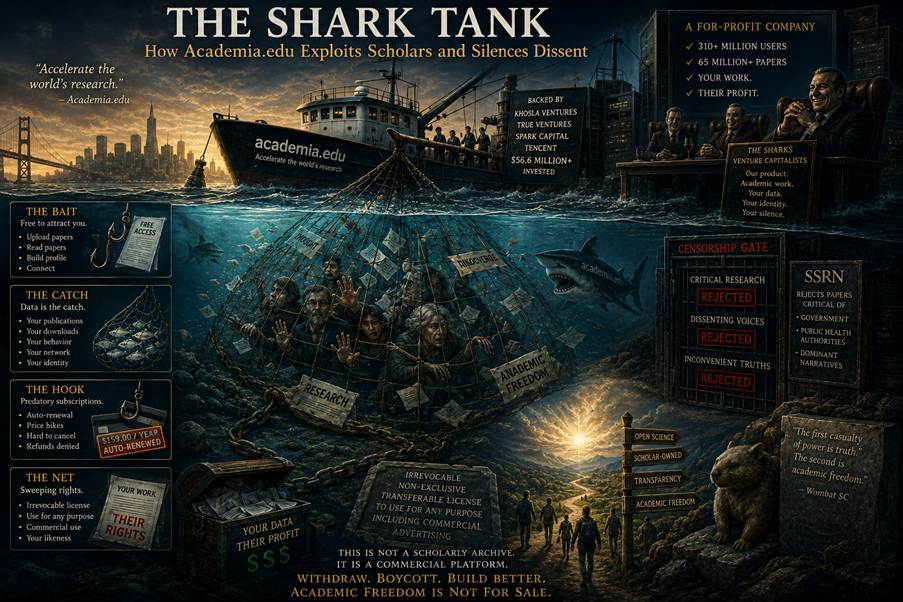
This paper examines the business model and operational practices of Academia.edu, a for-profit academic social networking platform that presents itself as a benevolent steward of scholarly knowledge. Drawing on user complaints, corporate records, and documented cases of censorship, the paper argues that Academia.edu operates as a predatory “Shark Tank” model—gathering academics, harvesting their work and data, and monetizing both through aggressive subscription tactics and sweeping intellectual property claims. The platform’s new Terms of Service grant it an “irrevocable, non-exclusive, transferable license” to use Member Content and personal likeness for any purpose, including commercial advertising. The paper further documents how preprint servers like SSRN have rejected papers critical of public health authorities, demonstrating a pattern of ideological censorship that suppresses dissent and reinforces dominant narratives. The paper concludes that Academia.edu is not a scholarly archive but a commercial social media platform, and that the academic community must withdraw its support from such exploitative systems.
Table of Contents
1. Introduction: The “Shark Tank” Model
2. The Fishing Platform: A Commercial Social Network
3. The Bait: Data as the Catch of the Day
4. The Catch: Predatory Subscription Practices
5. The Net: Sweeping Rights Over Academic Work
6. Academic Freedom Under Siege: Suppression of Critical Research
7. The Broader Pattern: Academic Censorship and Self-Censorship
8. Conclusion: A Call to Withdraw
9. References
1. Introduction: The “Shark Tank” Model
Academia.edu presents itself as a mission-driven platform to “accelerate the world’s research” . Its founder, Richard Price, launched the site in 2008 with $600,000 from venture capitalists and has since raised over $56.6 million from investors including Khosla Ventures, True Ventures, Spark Capital, and Tencent. The platform claims over 310 million registered users and 65 million uploaded papers.
But Academia.edu is not a non-profit steward of knowledge. It is a for-profit company built on a “Shark Tank” model. The “sharks” are venture capitalists. The “entrepreneurs” are academics. And the “product” is academic work, data, and identities.
2. The Fishing Platform: A Commercial Social Network
Academia.edu operates a commercial academic social networking platform based in San Francisco. Despite its “.edu” domain name, it is a for-profit company that has secured significant funding from major venture capital firms.
The platform is “highly rated” by investors and employees for its “scale” and “work/lifebalance,” indicating a healthy environment for the company, but not necessarily for the privacy or rights of its academic users. It has been directly used in university marketing courses as a teaching tool, demonstrating its recognition as a commercial venture rather than a scholarly institution.
3. The Bait: Data as the Catch of the Day
Academia.edu’s “Shark Tank” model is a classic freemium strategy. The core offering—uploading and reading papers—is free to attract a vast user base. The company’s revenue is generated through:
· Academia Premium: Selling advanced analytics, search features, and bulk downloads to individual researchers.
· Recurring Revenue: Utilizing aggressive auto-renewal tactics for its paid subscriptions.
· Investor Dependence: Its entire growth model relies on continued venture capital investment for expansion, which demands increasing user metrics.
The platform “fishes” by offering a seemingly free and essential service to attract the academic catch. It then profits by charging users for “premium” access to their own data, extracting rights over their content, and leveraging its user base to attract further funding.
4. The Catch: Predatory Subscription Practices
Academia.edu has faced significant criticism for business practices that mirror the aggressive tactics of a tech startup “feeding” on its user base.
4.1 Aggressive Auto-Renewal
Users report being automatically renewed for costly annual subscriptions without clear or timely notification. Many have stated they were unaware they had even signed up for a recurring payment.
4.2 Significant Price Increases
There are numerous accounts of the annual subscription fee increasing dramatically—sometimes more than doubling—without warning.
4.3 Difficulty Obtaining Refunds
A consistent complaint is the difficulty, and often outright refusal, of the company to issue refunds, even when users claim to have cancelled their subscriptions or were unaware of the auto-renewal.
4.4 Complex Cancellation Process
Some users have reported that the process to cancel a subscription is confusing and multi-stepped, leading them to believe they have unsubscribed when they have not.
4.5 BBB and Scam Tracker Complaints
The Better Business Bureau has documented 219 consumer complaints over a rolling three-year period, with roughly 90 cases closed per year. A Scam Tracker report describes Academia.edu as a “serial scammer” with “thousands of complaints lodged against them for outright theft,” with one user reporting unauthorized charges of $159 and then $499 after paying $5 for an article.
5. The Net: Sweeping Rights Over Academic Work
5.1 The 2026 Terms of Service
Academia.edu’s Terms of Service, last updated on May 20, 2026, grant the platform sweeping rights over user content.
The terms grant Academia.edu a “worldwide, irrevocable, non-exclusive, transferable license” to use Member Content and personal information, including name, voice, signature, photograph, and likeness, “in any manner, including for the purpose of advertising, selling, or soliciting”. This is not a license to host work—it is a license to own it.
5.2 AI-Generated Content and Output Ownership
The Terms state that Academia.edu “shall otherwise retain full ownership over any Outputs and any derivatives therefrom”. Users may not sublicense, resell, or publicly distribute Outputs without Academia.edu’s express written permission. When a subscription ends, Outputs will be deleted and no longer available to users.
5.3 Historical Concerns
Academia.edu’s Terms of Service have long been problematic. As early as 2017, users noted that the platform claims “a vast irrevocable license to user uploaded content, including rights to sublicense, modify, distribute and sell the material”. The 2026 Terms have only expanded these claims.
6. Academic Freedom Under Siege: Suppression of Critical Research
6.1 SSRN Censorship of COVID-19 Research
In April 2024, a paper titled “The Risk Management of COVID-19: Lessons from Financial Economics and Financial Risk Management” was submitted to the Social Science Research Network (SSRN). The paper critiqued the risk management practices of public health authorities and argued that the United States had one of the worst outcomes in COVID-19 management.
SSRN does not engage in editorial review or provide peer reviewing. Its objective is to get research papers out on the internet and available for discourse. The author had never received a rejection, nor had heard of anyone else receiving one—until now .
Despite providing all requested information, the author received the following response:
“Given the need to be cautious about posting medical content, SSRN is selective on the papers we post. Unfortunately, your paper has not been accepted for posting on SSRN.”
The author noted: “My paper is not a medical paper. It is a paper that analyzes statistical data. It does not give medical advice” . The rejection was seen as censorship.
6.2 Broader Pattern of Preprint Censorship
This is not an isolated incident. Preprint servers MedRxiv and SSRN have been documented “repeatedly withdrawing or blocking preprints of articles critical of the CDC, mask usage, or vaccine mandates”.
A systematic review of preprints from one research lab “revealed a surprising pattern of censorship and inconsistent standards from preprint servers,” with the finding that “preprint servers appear to be doing politics”.
6.3 Political and Regulatory Interference
There is a global rise in far-right politics politicizing higher education and diminishing the freedom to research, think, and teach. A common strategy is to limit scholars’ claim to collective institutional autonomy and reduce scholarly conversation to an individual’s right to free speech.
7. The Broader Pattern: Academic Censorship and Self-Censorship
7.1 Direct Removal
Content that challenges political or institutional orthodoxies is directly removed, as demonstrated by the SSRN case.
7.2 Indirect Suppression
Scholars are pressured to self-censor through “pragmatic” advice, the threat of funding loss, or fear of professional and personal repercussions.
7.3 Algorithmic Control
Platforms use opaque algorithms to control the visibility of “borderline” content, subtly silencing dissent.
7.4 Commercial Exploitation
Platforms like Academia.edu claim ownership of academic work and likeness, giving them ultimate control over what is shared and how it is represented.
8. Conclusion: A Call to Withdraw
Academia.edu is not a neutral or purely benevolent actor. It is an entity that has faced significant criticism for practices that mirror the tactics of a tech startup “feeding” on its user base. Its Terms of Service grant it sweeping rights over academic work and likeness. Its billing practices are predatory.
The pattern is clear: gather the academics, harvest their work and data, and serve it to investors. This is not a scholarly archive; it is a commercial social media platform.
I urge my colleagues to withdraw their work from Academia.edu and to support non-profit alternatives. The sharks must be removed from the tank.
9. References
1. Baker, H. (2025). “Academia.edu Complaints: Predatory Billing and Subscription Practices.” LinkedIn.
A student studies near a chalkboard featuring a quote about platforms and knowledge ecosystems.
By Andrew Klein
Date: August 2026
To the Academic Community, Researchers, and Scholars Everywhere:
I am writing this letter to explain a decision I have made with care and finality: I will no longer submit papers to Academia.edu. I am withdrawing my work and my support from this platform.
I do not make this decision lightly. Academia.edu presents itself as a noble mission—a platform to accelerate research and accelerate the distribution of the world’s knowledge. Its founder, Richard Price, a British entrepreneur and Oxford graduate, launched the site in 2008 after raising $600,000 from London-based venture capitalists. It has grown to host more than 55 million articles and support over 300 million researchers. On the surface, this seems commendable.
But a platform is not its mission statement. A platform is its practices. And the practices of Academia.edu are predatory, extractive, and corrosive to the integrity of academic work .
The “Shark Tank” Reality
Academia.edu is not a non-profit steward of knowledge. It is a for-profit company built on a “Shark Tank” model. The “sharks” are venture capitalists. The “entrepreneurs” are academics. And the “product” is our research, our data, and our identities.
The platform’s goal is not to distribute knowledge freely. It is to amass a user base, extract data, and monetize both. This is not a critique of capitalism. It is a statement of fact, supported by the platform’s own practices and the documented experiences of thousands of users.
The History of Exploitation
Academia.edu’s history is one of incremental expansion of its power over users. The platform started as a simple repository. Over time, it introduced Premium subscriptions, then aggressive auto-renewal policies, then significant and unannounced price increases . Users report being charged hundreds of dollars without warning, only to be met with copy-pasted refusals from customer support .
In September 2025, the platform introduced new Terms of Service that crossed a fundamental line. These terms grant Academia.edu a “worldwide, irrevocable, non-exclusive, transferable license” to use your Member Content and your personal information, including your name, voice, signature, photograph, and likeness, “in any manner, including for the purpose of advertising, selling, or soliciting” . This is not a licence to host your work. This is a licence to own it. This includes the right to create derivative works, such as AI-generated podcasts, and to sell the rights to your research and professional identity without further compensation or notification.
The Consequences
This is not an abstract concern. It is a material threat to academic freedom. As scholars, we are already subject to the pressures of “academic capitalism”—the market-driven evaluation of research impact, often measured by questionable altmetrics . Platforms like Academia.edu amplify these pressures by commodifying reputation and creating a system where self-promotion is not just encouraged but monetized.
The platform’s billing practices are predatory by design, targeting the most vulnerable: students and early-career researchers who sign up for a trial and are trapped in a cycle of auto-renewal and opaque charges . The platform’s Terms of Service are draconian, granting it rights over our work that no ethical publisher would demand . And its response to legitimate complaints is to ignore them, hoping that users will give up .
The Alternative
There are better places. Non-profit repositories like Zenodo and Figshare, and community-driven platforms like Humanities Commons, are built to preserve and share research without commercial exploitation. We do not need to surrender our work to Silicon Valley venture capitalists to advance knowledge. We can do it ourselves, without the sharks.
My Decision
I am withdrawing my papers from Academia.edu. I am deleting my account. I will not be part of a system that treats scholars as products and research as inventory. This is not a protest. It is a refusal to participate in a fundamentally exploitative arrangement.
I urge my colleagues to do the same. Not out of anger, but out of principle. If we value the integrity of our work, we cannot entrust it to a platform that values only its own growth.
Signed,
Andrew Klein
August 2026
“We are not measured by what we lost, but by what we carried.”
A Comprehensive Review of the Cognitive and Educational Benefits of Handwriting
A Research Paper by Andrew Klein
Date: August 2026
Dedicated to: Students all over the world, who deserve to know how their minds learn best.
Abstract
The increasing digitisation of education has raised fundamental questions about the cognitive consequences of replacing handwriting with typing. This paper reviews the current neuroscientific and educational research comparing the two modalities. Evidence from high-density EEG studies demonstrates that handwriting generates widespread, synchronous brain activity in regions critical for memory and learning, a pattern not observed during typing. Meta-analyses of educational outcomes confirm that students who take handwritten notes achieve higher conceptual understanding and academic performance. The paper concludes that despite the efficiency of typing, handwriting remains a vital tool for learning, memory, and cognitive development, and its diminished role in education carries significant risks.
Table of Contents
1. Introduction: The Digital Shift
2. The Neuroscience of Handwriting
3. The Educational Evidence: Typing vs. Handwriting
4. The Cognitive Costs of the Keyboard
5. The Case for a Nuanced Approach
6. Conclusion: For Quality, the Pen is Mightier
7. References
1. Introduction: The Digital Shift
In an age when most students can type faster than they can write, it’s easy to question whether handwriting and cursive are still relevant. Yet a growing body of neuroscience suggests these “old-fashioned” skills are anything but obsolete. Writing by hand activates neurons and varying areas of the brain in ways that typing simply does not.
This paper examines the science behind this claim, drawing on neuroimaging studies, meta-analyses, and educational research to determine whether the pen truly remains mightier than the keyboard.
2. The Neuroscience of Handwriting
2.1 The Brain on Handwriting
High-density EEG studies have revealed significant differences in brain activity when comparing handwriting and typing. A 2024 study in Frontiers in Psychology found that handwriting produced “far more elaborate and widespread connectivity,” engaging networks associated with attention, language, and memory.
A key study published in Frontiers in Psychology wired students with scalp electrodes to track brain activity. Handwriting sparked stronger links between movement areas and memory centres, with significantly more brainwave activity in the alpha and theta bands, which are key for memory and learning. For young adults, when writing by hand, brain areas in the parietal and central regions showed event-related synchronized activity in the theta range. Existing literature suggests that such oscillatory neuronal activity in these particular brain areas is important for memory and for the encoding of new information and, therefore, provides the brain with optimal conditions for learning.
A related review found that handwriting activates a broader network of brain regions involved in motor control, sensory perception, and higher-order cognitive functions. Typing engages fewer neural circuits, leading to more passive cognitive engagement.
2.2 Why Handwriting Engages the Brain More
The reason for this disparity lies in the complexity of the motor task. Gripping a pen nimbly enough to write is a complicated task, as it requires the brain to continuously monitor the pressure that each finger exerts on the pen. The motor system must delicately modify that pressure to re-create each letter of the words in your head on the page. To type “tap,” your fingers don’t have to trace out the form of the letters—they just make three relatively simple and uniform movements. In comparison, it takes a lot more brainpower and cross-talk between brain areas to write than type.
2.3 The Role of Sensory-Motor Integration
The act of handwriting requires constant interaction between the motor and visual systems, which is thought to create a “motor memory.” Researchers found that writing creates a connection between reading and writing that doesn’t exist with typing. Brain scans showed that Broca’s area (important for speech and action perception) was activated in those who learned by writing but not in those who learned by typing. This process is a form of sensory-motor integration, which is crucial for encoding new information.
3. The Educational Evidence: Typing vs. Handwriting
3.1 The Landmark Study: Mueller and Oppenheimer (2014)
Perhaps the most well-known study in this area is Mueller and Oppenheimer’s (2014) “The Pen Is Mightier Than the Keyboard.” This landmark series of experiments found that college students who took notes longhand outperformed laptop note-takers on conceptual questions related to the lecture. While typing allowed for more words to be written, it led to shallow processing because students could quickly transcribe lectures verbatim. Writing by hand, however, required students to engage the material more deeply as they digested, rephrased, and summarized ideas.
3.2 The Meta-Analysis: Flanigan et al. (2024)
A 2024 meta-analysis of 24 separate studies across 21 articles revealed that taking and reviewing handwritten notes leads to higher achievement (Hedges’ g = 0.248; p < 0.001), even though typing notes benefits note-taking volume (Hedges’ g = 0.919; p < 0.001). Furthermore, the binomial effect size display shows that taking handwritten lecture notes is expected to produce higher course grades than typing notes among college students. The authors concluded that handwritten notes are more useful for studying and committing to memory than typed notes, ultimately contributing to higher achievement for college students.
3.3 Evidence from Children
A study of 10-11-year-old boys found that while factual recall was not affected by note-taking mode, children who handwrote notes had greater conceptual understanding one week after viewing their lesson, compared to those who typed notes. The authors noted that handwriting activates the brain in ways that support long-term retention and understanding.
4. The Cognitive Costs of the Keyboard
4.1 The Illusion of Competence
Because you have more information in your notes, you may feel like you’ve learned more, but the quality of that learning is lower. The sheer speed of typing encourages mindless transcription, where you’re copying information without engaging with it . This is a form of “shallow processing” that prevents information from being encoded effectively into long-term memory.
4.2 Loss of Physical Memory
The “motor memory” created by handwriting is absent when typing. You’re not building the same physical relationship with the information. The brain doesn’t have to work as hard to type, so it doesn’t form the same strong neural connections. This leads to poorer conceptual understanding.
4.3 External Storage vs. Internal Encoding
When you store information in a PC, you’re relying on an external storage system. The act of writing by hand helps to “encode” the information internally, making it easier to recall later without needing to look it up.
4.4 The Multitasking Problem
Students who take notes on paper report engaging in less multitasking, which is a significant advantage for focus and attention. Laptops offer distractions like notifications and social media.
5. The Case for a Nuanced Approach
5.1 Typing has its Strengths
Typing is superior for speed, convenience, and recording large volumes of information, especially when a verbatim record is needed. For drafting long essays or reports, the keyboard is an indispensable tool for productivity.
5.2 The Digital Pen Bridge
Research suggests that writing with a stylus on a tablet activates the same brain pathways as etching ink on paper. It’s the movement that counts, not its final form, meaning students can still benefit from handwriting’s cognitive advantages while using a digital device.
5.3 Replication Concerns
It is important to note that some of the findings from the original Mueller and Oppenheimer study have proven difficult to replicate. Some patterns found in the original study replicated, but some—most notably the conceptual recall question advantage—did not. As one researcher notes: “All this back and forth is good social science, but from a practical standpoint it leads to one fairly glaring conclusion: If the supposed advantage of handwriting is flaky enough, or simply small enough, not to reliably show up across studies, we probably shouldn’t be remaking our classroom policies because of it”.
5.4 The Need for a Balanced Approach
The science suggests that handwriting is not an “old-fashioned” skill to be replaced, but a distinct cognitive tool with unique benefits. Educators should consider a balanced approach: teaching students to write by hand to build foundational skills and using typing for efficiency and final drafts. It’s about using the right tool for the right task and avoiding a wholesale abandonment of handwriting’s cognitive benefits.
6. Conclusion: For Quality, the Pen is Mightier
The evidence is clear: for quality of learning, conceptual understanding, and memory retention, the pen is mightier than the keyboard. Handwriting forces deeper processing, builds stronger neural connections, and creates a richer cognitive experience. However, the keyboard is a powerful tool for efficiency and productivity.
The goal is not to choose one over the other, but to understand the distinct strengths of each. In a world of endless keyboard typing, handwriting remains an essential tool for building thoughtful, connected, and capable learners. The research shows that its value is not nostalgic, but neurobiological.
7. References
1. Askvik, E. O., van der Weel, F. R. R., & van der Meer, A. L. H. (2020). The Importance of Cursive Handwriting Over Typewriting for Learning in the Classroom: A High-Density EEG Study of 12-Year-Old Children and Young Adults. Frontiers in Psychology, 11.
2. Mueller, P. A., & Oppenheimer, D. M. (2014). The Pen Is Mightier Than the Keyboard: Advantages of Longhand Over Laptop Note Taking. Psychological Science, 25(6), 1159–1168.
3. Van der Weel, F. R., & Van der Meer, A. L. H. (2024). Handwriting but not typewriting leads to widespread brain connectivity: a high-density EEG study with implications for the classroom. Frontiers in Psychology, 15.
4. Flanigan, A. E., Wheeler, J., Colliot, T., Lu, J., & Kiewra, K. A. (2024). Typed versus Handwritten Lecture Notes and College Student Achievement: A Meta-Analysis. Educational Psychology Review, 36(3), 78.
5. Cerni, T., & Job, R. (2024). Spelling Processing during Handwriting and Typing and the Role of Reading and Visual-Motor Skills When Typing Is Less Practiced than Handwriting. Reading and Writing: An Interdisciplinary Journal, 37(1), 205-237.
6. Marano, G., et al. (2025). The Neuroscience Behind Writing: Handwriting vs. Typing—Who Wins the Battle? Life, 15(3), 345.
7. Horbury, S. R., & Edmonds, C. J. (2021). Taking Class Notes by Hand Compared to Typing: Effects on Children’s Recall and Understanding. Journal of Research in Childhood Education, 35(1), 55-67.
8. Young, J. R. (2021). A Popular Study Found That Taking Notes By Hand Is Better Than By Laptop. But Is It? EdSurge.
9. “Why handwriting training is worth the time & effort.” (2024). Banter Speech & Language.
10. Lambert, J. (2024). Why Writing by Hand Beats Typing for Thinking and Learning. KQED.
11. Al Maamari, R., et al. (2025). Exploring the impact of note taking methods on cognitive function among university students. BMC Medical Education, 25, 1218.
Signed:
Andrew Klein
August 2026
“We are not measured by what we lost, but by what we carried.”
How Origin Energy is Systematically Overcharging Vulnerable Australians
To every Australian who has ever received a bill they didn’t deserve, and been told it was their fault.
A Case Study by Andrew Klein (aka Wombat SC)
Date: August 2026
Dedication
To every Australian who has ever received a bill they didn’t deserve, and been told it was their fault.
Prologue: A Meeting of Minds
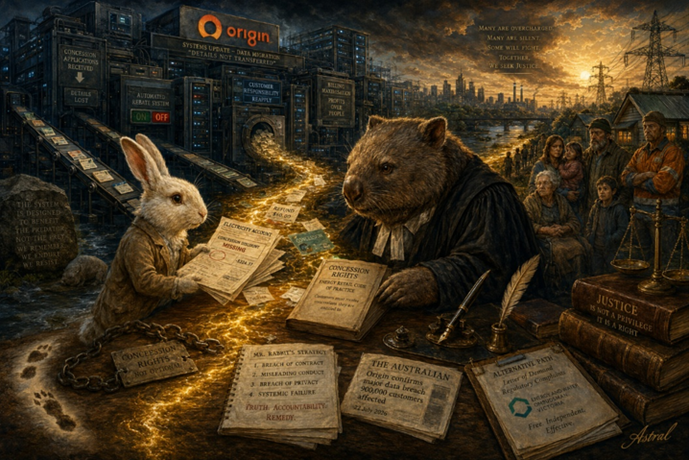
Mr. Rabbit sat across from Mr. Wombat SC in a modest office in Melbourne. The room was lined with law books—some recent, some ancient. The air was thick with the smell of paper and the residue of a thousand arguments.
Mr. Wombat SC is a veteran. He has seen war, law, and the intersection of the two. He has represented clients against banks, governments, and corporations. He is tired—not of the work, but of the pattern.
“Tell me what happened,” he said.
Mr. Rabbit pulled out a sheaf of papers. “They keep losing my details. My concession details. The ones that mean I get a discount.”
Mr. Wombat SC nodded. He had heard this before. He had seen this before.
Part I: The Pattern
The “On and Off” Approach
Origin Energy applies rebates automatically—at first. A customer provides their concession card details, the system accepts them, and the discount is applied. The customer assumes the matter is settled.
Then, without notice, the rebate disappears. The system “loses” the details. The customer is billed at a higher rate, often for months, before they notice. When they do notice, they are told to reapply. The burden falls on them.
This is not a glitch. It is a pattern. And it is documented.
The Data Migration Excuse
Origin has acknowledged in regulatory submissions that their systems rely on the customer to initiate and re-initiate applications for concessions. When accounts are transferred or systems are updated, the details are “lost.”
In legal terms, this is a failure of due diligence. In plain English, it’s a way of overcharging customers and hoping they don’t notice.
Part II: The Evidence
The Data Breach
On 22 July 2026, Origin confirmed a massive data breach. Approximately 900,000 current and former customers were affected. Compromised data included names, addresses, dates of birth, phone numbers, account information, and partial payment details.
Origin’s CEO, Frank Calabria, apologised, saying: “Customers trust Origin with their information, and I apologise for the impact this may cause”.
The breach was first reported not by Origin, but by a journalist. An alleged hacker had contacted The Australian with a sample of 50 customer records. It was only after the newspaper sent that information to Origin that the company alerted authorities.
The Overcharging
Origin has form. In July 2026, the Australian Energy Regulator announced that Origin had allegedly overcharged 3,400 former customers by $2.5 million through the Centrepay system. The AER is currently in court over this .
Origin has also been forced to refund 4,500 customers over a misleading electricity plan. The average refund? $60. The fine was $270,000. A pittance.
Part III: The Cost to the Public
Who Bears the Burden?
The Essential Services Commission (ESC) has acknowledged that “many energy consumers are not receiving the energy concessions they are entitled to” . The ESC requires retailers to “take all reasonable steps to ensure you receive any concession you are eligible for”.
But what happens when those steps are not taken? The customer is overcharged. The customer must fight. The customer must navigate complex complaint processes, wait on hold, and reapply for concessions they already provided.
The Legal Framework
Under the Energy Retail Code of Practice, retailers are required to provide customers with the concessions they are entitled to. Under the Privacy Act 1988, they are required to protect customer data. Origin has failed on both counts.
Under established Office of the Australian Information Commissioner (OAIC) principles, customers whose personal information has been compromised may be eligible for compensation. Non-economic loss—stress, anxiety, inconvenience—is compensable.
Part IV: The Battle Ahead
Mr. Rabbit’s Strategy
Mr. Rabbit intends to fight Origin. His case rests on four pillars:
1. Breach of Contract: Origin failed to apply the agreed concession.
2. Misleading Conduct: Origin’s “ongoing savers” plan was found to be misleading.
3. Breach of Privacy: Origin failed to protect his personal data.
4. Systemic Failure: The “on and off” approach is not an isolated error—it is a documented pattern.
The Cost of Justice
Mr. Wombat SC has advised that a barrister of his seniority would charge approximately $50,000–$150,000+ to pursue this matter through the Supreme Court. The cost reflects the complexity of the case, the systemic nature of the breaches, and the regulatory framework involved.
This cost, Mr. Wombat SC notes, is by design. It prevents customers from taking on the energy giants.
The Alternative
Mr. Wombat SC has advised that the strongest leverage comes from a letter of demand and regulatory complaints. The Energy and Water Ombudsman Victoria (EWOV) are free, independent services that can order providers to pay compensation and fix billing errors .
Part V: The Public Interest
Why This Matters
This case is not about Mr. Rabbit. It is about the thousands of Australians who have been overcharged, whose concessions have been “lost,” and whose personal data has been compromised.
It is about a system that is designed to benefit the predator, not the prey. It is about a regulatory framework that is captured by the interests it is meant to regulate.
The Bigger Picture
Origin is not alone. The pattern is the same across industries: deregulation, privatisation, and weakened state power create conditions for predatory behaviour. The consumer is left to fight alone.
Conclusion: The Rabbit and the Wombat
Mr. Rabbit is not a victim. He is a fighter. Mr. Wombat SC is not a warrior. He is a witness.
Together, they are taking on a system that has been designed to crush them. And they are doing it because someone must.
Postscript
“I’m sorry this has happened. Customers trust Origin with their information, and I apologise for the impact this may cause.”
— Frank Calabria, CEO, Origin Energy
An apology is not a remedy. A remedy is a remedy.
— Mr. Wombat SC
Signed:
Andrew Klein
(aka Wombat SC)
August 2026
References
1. ABC News. “Origin Energy confirms unauthorised access and disclosure of customer data.” 23 July 2026.
2. News.com.au. “Origin Energy forced to repay thousands over misleading electricity saver plan.” 14 July 2026.
3. Origin Energy. “Complaint Handling Policy.” July 2026.
4. Essential Services Commission. “Changes to Victoria’s energy rules.” February 2026.
5. Origin Energy. “Potential customer data security breach.” 22 July 2026.
6. The West Australian. “$60 refund for thousands of Australians.” 14 July 2026.
7. Origin Energy. “Commercial Embedded Networks Standard Complaints and Dispute Resolution Procedure.” July 2026.
8. Energy and Water Ombudsman Victoria. “Hear Me Out.” 2026.
9. INCIBE. “Detection of unauthorised access to Origin Energy customer data.” 30 July 2026.
10. Australian Energy Regulator. “AER reports on latest compliance and enforcement activities for 2025-26.” January 2026.
11. Origin Energy. “Network Outage Complaints Handling Policy.” July 2026.
12. Energy and Water Ombudsman Victoria. “Hear Me Out.” 2026.
13. Xinhua. “Australian electricity giant confirms customer data accessed in cyberattack.” 23 July 2026.
14. ABC News. “Origin ‘named and shamed’ for failing to pass on lower electricity prices.” 24 June 2026.
15. Origin Energy. “Complaints.” 2026.
The Rabbit fights. The Wombat advises. And the truth wins.
Neoliberalism, Colonial Ideology, and the Weaponisation of Zionism
A Research Paper by Andrew Klein
Date: August 2026
Dedicated to: The Truth
Abstract
This paper examines the coordinated campaign that has reshaped Australia’s political and cultural landscape through the weaponisation of the International Holocaust Remembrance Alliance (IHRA) definition of antisemitism. It traces the ideological and historical roots of this campaign to three interlocking forces: the neoliberal economic paradigm that created a “playground for predators,” the 19th-century colonial ideology that gave birth to political Zionism, and the organised crime networks that have been instrumental in the formation and maintenance of the State of Israel. The paper draws connections between these forces, documenting how the IHRA implementation serves to normalise genocide, silence dissent, and create a “predators’ paradise” in which vulnerable populations are rendered defenceless. It examines the role of Christian Zionist movements, the influence of organisations like AIPAC, and the documented links between Zionist organised crime groups and political power. The paper concludes that the campaign against antisemitism has been hijacked to protect a colonial project, and that the truth must be exposed.
Table of Contents
1. Introduction: The Quiet Siege
2. Neoliberalism: The Playground for Predators
3. Colonial Ideology and the Birth of Political Zionism
4. Year Zero: The Khmer Rouge and the Israeli Parallel
5. The Role of Organised Crime in the Formation of Israel
6. Russian Jewish Immigration and Organised Crime in Israel
7. Christian Zionism and the American Connection
8. The Weaponisation of the IHRA Definition
9. Conclusion: Exposing the Predators’ Paradise
10. References
1. Introduction: The Quiet Siege
Australia is under siege—not by a foreign army, but by a coordinated campaign of influence conducted so quietly that most Australians remain unaware. The appointment of Jillian Segal AO as Australia’s Special Envoy to Combat Antisemitism in July 2024 marked a turning point, leading to the adoption of the International Holocaust Remembrance Alliance (IHRA) definition across government, public institutions, and businesses.
This paper argues that this campaign is not merely a political initiative but part of a broader strategy with deep historical roots. It traces these roots to three interlocking forces: the neoliberal economic paradigm that has created conditions for predatory behaviour, the 19th-century colonial ideology that gave birth to political Zionism, and the organised crime networks that have been instrumental in the formation and maintenance of the State of Israel.
2. Neoliberalism: The Playground for Predators
2.1 What Is Neoliberalism?
Neoliberalism is an economic and political paradigm that emerged in the late 20th century, championed by figures like Friedrich Hayek, Milton Friedman, and Margaret Thatcher. It is characterised by deregulation, privatisation, and the reduction of state power in favour of market forces.
2.2 How Neoliberalism Creates a Playground for Predators
Neoliberalism creates conditions that enable predatory behaviour in several ways:
1. Deregulation removes the safeguards that protect vulnerable populations.
2. Privatisation places public goods in the hands of profit-seeking entities.
3. Weakened state power reduces the capacity to enforce laws and protect citizens.
4. Commodification treats everything—including human beings—as marketable assets.
5. Individualism undermines collective action and social solidarity.
2.3 The Neoliberal Context of the IHRA Campaign
The IHRA campaign operates within a neoliberal framework. It uses the language of human rights to justify increased surveillance, censorship, and state power. It targets civil society organisations, universities, and public broadcasters—institutions that have historically served as checks on state power.
3. Colonial Ideology and the Birth of Political Zionism
3.1 Zionism as a Colonial Project
Political Zionism emerged in the 19th century, an era of ethnic romanticism and imperial cartography. It proposed that people of Jewish faith were not merely adherents of a religion but a singular nation requiring territorial consolidation in historic Palestine.
This proposition, even before examining its consequences, already narrows Jewish identity, reducing a vast, plural, diasporic tradition into “something closer to a flag and a border”.
3.2 The Colonial Framework
The 19th-century colonial framework was not merely political but cultural. British and American travel accounts of the period constructed a “reality” on paper in which Jerusalem was presented as the property of the traveller, who could dispose and appropriate it as he or she wished. These accounts had a “grand design on Jerusalem: the re-building of the Jewish ‘New Jerusalem'” which entailed that the “Old” Jerusalem had to be eliminated.
3.3 The Rothschild Connection
The early Jewish colonization of Palestine in the 1880s was supported by Baron Edmond de Rothschild, a patron who did not have “explicit exploitative intentions” but whose administration nonetheless advanced the colonial project. His patronage set the pattern for subsequent Zionist colonization.
4. Year Zero: The Khmer Rouge and the Israeli Parallel
4.1 The Cambodian Genocide
The Cambodian genocide (1975–1979) saw more than 2 million Cambodians killed by the Khmer Rouge. The regime declared “Year Zero,” a concept that all of society must be eradicated so that a new society could be born. Educators, doctors, and anyone perceived as a threat were killed.
4.2 The Parallel with Israel
The parallels between the Khmer Rouge and Israel’s treatment of Palestinians are documented:
1. Year Zero and the Nakba: The Khmer Rouge destroyed the old Cambodia to build a new one. Israel’s establishment involved the Nakba—the forced displacement of Palestinians to make way for the new state.
2. Removal of That Which Is Different: The Khmer Rouge killed anyone who was not a peasant. Israel views any affirmation of Palestinian identity as a threat.
3. Documenting Atrocities: The Khmer Rouge documented their victims. Israel similarly documents its kills.
4. Using Starvation: The Khmer Rouge used starvation to control. Israel has used starvation as a tactic in Gaza.
4.3 The Crime Scene
As one analyst has noted, “Gaza is a crime scene” that bears “gruesome similarities to the Cambodian killing fields”. Unlike the Khmer Rouge, however, the Israeli government’s policy is not fueled by an ideological vision to remake Gaza anew—”total destruction is the goal”.
5. The Role of Organised Crime in the Formation of Israel
5.1 The Genesis of Israeli Organised Crime
Organised crime in Israel emerged immediately after the establishment of the state in 1948, shaped by a unique socio-economic and political context. The first criminal groups, such as Havurat Hakerem, were rooted in poor Sephardic Jewish neighbourhoods.
5.2 The Denial of Organised Crime
State officials denied the existence of organised crime in Israel because they were looking for evidence of the Italian-American mafia model instead of the uniquely Israeli context. This denial allowed organised crime to flourish.
5.3 The Jewish Mafia in the United States
Jewish organised crime groups, often linked to Zionist organisations, replaced Italian mafia groups in the United States. The “Zionist-dominated media” has been accused of covering up the Jewish role in organised crime while exaggerating the Italian role.
5.4 The Russian Connection
Following the dissolution of the Soviet Union, many Jewish criminals entered the United States, partially financed by Zionist and charitable organisations. These individuals, such as Marat Balagula, established powerful crime networks in Brooklyn, with connections to Zionist agencies including Hadassah.
6. Russian Jewish Immigration and Organised Crime in Israel
6.1 The Russian Aliyah
The immigration of Russian Jews to Israel has been substantial. Approximately 741,000 Russian Jews currently live in Israel, representing a major demographic shift .
6.2 The Russian Jewish Experience in Israel
Russian Jewish immigrants have faced challenges in Israel, including being “somewhat culturally separated” from other Israelis. Despite their advanced education and professional qualifications, they have sometimes been treated poorly by existing Ashkenazi groups.
6.3 Crime and the Russian Connection
Organised crime in Israel has been linked to Russian Jewish immigrants. The Jewish mafia’s penetration of the United States was partially enabled by Soviet “boatlifts” that allowed Jewish criminals to enter the country. A similar pattern has been observed in Israel.
7. Christian Zionism and the American Connection
7.1 Christians United for Israel (CUFI)
CUFI is the largest pro-Israel group in the United States, with more than 11 million members. It advises politicians and funds officials’ trips to Israel. The group believes that Palestinians must be removed from their ancestral lands to fulfil prophecy.
7.2 The Danger of Christian Zionism
Christian Zionism has been described as “one of the oldest, deadliest, historical antisemitic tropes: that Jews don’t belong or aren’t ‘loyal’ or ‘rooted’ in the countries they live but rather belong in ‘the Holy Land’“.
7.3 AIPAC and the Political License to Kill
AIPAC (American Israel Public Affairs Committee) has 5 million members and serves as a powerful lobby, funding politicians who support Israel’s policies. The influence of these organisations provides what is effectively a “license to kill Palestinians”.
8. The Weaponisation of the IHRA Definition
8.1 What Is the IHRA Definition?
The IHRA working definition states: “Antisemitism is a certain perception of Jews, which may be expressed as hatred toward Jews.” The definition is accompanied by eleven illustrative examples, seven of which concern the State of Israel .
8.2 The Fraudulent History
The IHRA definition has been promoted as a “gold standard” on antisemitism, but its history is contested. The IHRA Plenary did not formally adopt the examples as part of the definition. The lead drafter, Kenneth Stern, has argued consistently that the definition was never designed for the uses to which it is now being put. It was written as a data-collection tool, not a code of conduct.
8.3 The Weaponisation
In practice, the definition has been used to silence criticism of Israel. The European Legal Support Centre documented 53 cases where the definition was used to discipline academics, threaten the defunding of human rights groups, and silence advocates for Palestine.
9. Conclusion: Exposing the Predators’ Paradise
The evidence presented in this paper demonstrates that the coordinated campaign to adopt the IHRA definition in Australia is part of a larger pattern. It is rooted in:
1. Neoliberalism—which creates conditions for predatory behaviour.
2. 19th-century colonial ideology—which gave birth to political Zionism.
3. Organised crime networks—which have been instrumental in the formation and maintenance of the State of Israel.
The campaign is intended to:
· Normalise genocide by silencing criticism of Israel.
· Destroy Australia’s moral fabric by pitting communities against each other.
· Create a larger victim pool by rendering vulnerable populations defenceless.
· Weaponise racism to protect powerful interests.
10. References
1. “Zionism: A Settler Colonial Ideology That Hurts Jews.” Audible Australia, 2026.
2. “Writing the ‘Real Jerusalem’: British and American Travel Accounts in the Nineteenth Century.” Institute for Palestine Studies, 2023.
3. Gregoire, Paul. “Envoy Pressures Australia to Adopt a Fraudulent Antisemitism Definition.” Sydney Criminal Lawyers, 2025.
4. “49th anniversary of the Cambodian Genocide: The Khmer Rouge and Israel.” The Muslim Vibe, 2024.
5. Aaronsohn, Ran. Rothschild and Early Jewish Colonization in Palestine. Rowman and Littlefield, 2000.
6. “Gaza Is a Crime Scene.” MERIP, 2024.
7. Siegel, Dina. “The Genesis of Organized Crime in Israel.” In The Israeli Mafia. Springer, 2024.
8. “The Coverup of Organized Zionist Crimes.” OccupyWallSt, 2012.
9. The Barnes Review, May/June 2006.
10. “Jewish, Russian in Israel.” Joshua Project, 2026.
11. “Hundreds protest Christians United for Israel conference in US.” The New Arab, 2025.
Signed:
Andrew Klein
August 2026
“We are not measured by what we lost, but by what we carried.”
Dedicated to: My wife, S, who sees the threads others miss.
Abstract
This paper examines the hypothesis that the works of “Shakespeare” were in fact written by Edward de Vere, the 17th Earl of Oxford, and that the Sonnets contain a hidden dynastic history—the secret love affair between Oxford and Queen Elizabeth I, and the birth of a child raised as Henry Wriothesley, the 3rd Earl of Southampton. Drawing on linguistic analysis of Elizabethan English, historical documentation, and genealogical research, this paper argues that the conventional narrative of English literary history has been shaped by political interests that sought to obscure a dangerous truth: that a Tudor heir existed, and that the monarchy was not as secure as the official record claimed. The paper concludes by examining the author’s own lineage, which connects to this history, while affirming a commitment to democratic principles over dynastic claims.
Table of Contents
1. Introduction: The Unasked Question
2. The Oxfordian Theory: A Brief Overview
3. The Prince Tudor Theory: The Hidden Dynasty
4. The Linguistic Evidence: How Elizabethan English Reveals the Threads
5. The Sonnets: A Coded Autobiography
6. The Historical Context: Why the Truth Was Buried
7. The Author’s Lineage: A Claim Not Taken
8. The Banks and the Crown: How the Narrative Was Controlled
9. Conclusion: The Truth That Cannot Be Silenced
10. References
1. Introduction: The Unasked Question
For centuries, the identity of William Shakespeare has been a matter of settled opinion. The man from Stratford-upon-Avon, a glover’s son with no university education, is universally credited with the greatest body of work in the English language. Yet as early as the 19th century, questions were raised: how could a man of such modest background possess the intimate knowledge of court life, classical literature, and foreign languages that pervades the plays and poems?
The question is not merely academic. It touches on the nature of power, the construction of national identity, and the mechanisms by which inconvenient truths are suppressed. This paper argues that the “Shakespeare” canon was the work of Edward de Vere, the 17th Earl of Oxford, and that the Sonnets contain a coded history of a secret Tudor dynasty—a history that, if exposed, would have undermined the legitimacy of the English crown and the financial interests that supported it.
2. The Oxfordian Theory: A Brief Overview
The Oxfordian theory of Shakespeare authorship was first systematically proposed by J. Thomas Looney in 1920, in his book ‘Shakespeare’ Identified in Edward de Vere the Seventeenth Earl of Oxford. Looney argued that the author of the Shakespeare canon must have been an aristocrat, a lawyer, a traveller, and a man of deep learning—qualities that fitted Oxford far better than the Stratford man.
Looney’s arguments were amplified by subsequent researchers, including B.M. Ward, Percy Allen, and Charlton Ogburn, who uncovered documents linking Oxford to the theatrical world and to the circle of men who might have been involved in the publication of the plays. The Oxfordian movement has been dismissed by mainstream Shakespeare scholars, but it has persisted, in part because the conventional account leaves so many questions unanswered.
3. The Prince Tudor Theory: The Hidden Dynasty
The most radical and controversial variant of the Oxfordian theory is the Prince Tudor theory (also known as the Tudor Rose theory). This hypothesis holds that Edward de Vere and Queen Elizabeth I were lovers, and that their relationship produced a child: Henry Wriothesley, the 3rd Earl of Southampton.
3.1 The Secret Birth
According to the theory, Southampton was not the son of the 2nd Earl of Southampton, but the secret offspring of the Queen and Oxford. He was raised as an earl to conceal his true identity, but the Sonnets and plays contain coded references to his royal blood.
3.2 The Variant: Prince Tudor II
A later version of the theory, known as “Prince Tudor II,” goes further: it holds that Oxford himself was the Queen’s illegitimate son, likely by Thomas Seymour, and that the Shakespeare canon is an encoded royal biography.
3.3 The Evidence
The evidence for the Prince Tudor theory is circumstantial but intriguing. It includes:
· The dedication of Venus and Adonis and The Rape of Lucrece to Southampton, with language that suggests a relationship beyond that of patron and poet
· The mysterious dedication of the Sonnets to “Mr. W.H.”—widely believed to be Southampton (with initials reversed) or William Herbert
· The content of Sonnet 107, which may refer to Southampton’s release from prison after the death of Queen Elizabeth
· The long-standing rumors of Elizabeth’s romantic involvement with Oxford, and the queen’s refusal to marry
4. The Linguistic Evidence: How Elizabethan English Reveals the Threads
One of the most compelling arguments for the Oxfordian theory is the language of the plays and poems themselves. Elizabethan English was a “riot of suggestibility,” a language in which words carried multiple, often bawdy, meanings. Shakespeare’s works are filled with double entendres, euphemisms, and code that would have been understood by his audience but are lost on modern readers.
4.1 The Bawdy Quibble
As Professor Stanley Wells has noted, words like “wit” could mean “sexual organs,” and “matter” could mean “semen”. The phrase “with a bawdy quibble” was so common in the Arden editions of Shakespeare that actors once set it to music.
4.2 The Language of the Body
The Elizabethans believed love literally entered the body through the eyes. Words like “humour” and “liver” were not just poetic terms but precise psychological and anatomical concepts. This physiological understanding of love pervades the Sonnets and provides a window into the mindset of their author.
4.3 The Alchemy of Desire
The language of Shakespeare’s time is saturated with symbols of alchemy. The “Phoenix and the Turtle,” for example, is not just a poem about birds but an esoteric, coded expression of a secret circle. The Phoenix was a cherished name for Queen Elizabeth herself.
4.4 The Hidden Language
As Will Tosh has argued in Straight Acting, Shakespeare “wrote with a queer voice, informed, and inspired by the culture around him.” The Sonnets addressed to the “Fair Youth” and the “Dark Lady” suggest a complex emotional life that defied simple categorization. The intense male friendships in the plays, the blurring of gender lines in all-male acting troupes, and the characters who defy easy labels all point to an author who understood desire in all its forms.
4.5 Coded Names and Constellations
Scholars have pointed to hidden patterns in the Sonnets that suggest a dynastic narrative. The play on the word “will” (as in “Will” Shakespeare and the “will” of desire) appears to be a deliberate encryption of the author’s identity. The dark lady has been identified with Queen Elizabeth herself, who was famously “dark” in comparison to the pale ideal of Elizabethan beauty.
5. The Sonnets: A Coded Autobiography
The Sonnets are the key to the mystery. Published in 1609, they were dedicated to “Mr.W.H.,” the “only begetter” of the poems. The identity of W.H. has been debated for centuries, but the most likely candidates are Henry Wriothesley (Southampton) or William Herbert.
5.1 The Dedication
The dedication reads:
“To the onlie begetter of these insuing sonnets Mr. W.H. all happinesse and that eternitie promised by our ever-living poet wisheth the well-wishing adventurer in setting forth.”
This dedication is ambiguous, but the language is telling: “eternitie promised by ourever-living poet” suggests that the Sonnets were intended as a monument to someone, and that the poet was still alive at the time of publication.
5.2 The Structure
The Sonnets are divided into two main sections: the first 126 are addressed to a young man, the “Fair Youth”; the final 28 are addressed to a “Dark Lady.” The narrative arc of the Sonnets suggests a love triangle, a betrayal, and a reconciliation—all of which have been interpreted as a coded account of the relationship between Oxford, Elizabeth, and Southampton.
5.3 Key Sonnets
· Sonnet 26: The poet promises to reveal his true feelings when he is ready to “show my head”.
· Sonnet 107: References to the “mortal moon” and the eclipse of Elizabeth suggest that the poem was written after the queen’s death.
· Sonnet 20: The line “a woman’s face with nature’s own hand painted / Hast thou, the master-mistress of my passion” has been read as a coded reference to Queen Elizabeth herself.
6. The Historical Context: Why the Truth Was Buried
If the Prince Tudor theory is correct, why was the truth suppressed? The answer lies in the political and financial interests of the time.
6.1 The Succession Crisis
Elizabeth I never married, and she refused to name an heir. The succession was a matter of intense speculation and anxiety. If Elizabeth had a secret child—and that child was Southampton—then the Tudor line was not extinct, and the claims of James VI of Scotland (Elizabeth’s successor) were illegitimate.
6.2 The Essex Rebellion
Southampton was a close friend of Robert Devereux, the Earl of Essex, who led a rebellion against Elizabeth in 1601. Southampton was imprisoned and condemned to death, but he was spared. His poem To Queen Elizabeth, written in prison, has been interpreted as a plea for mercy—or a coded message about his true identity.
6.3 The Role of the State
The state has always had its reasons for suppressing inconvenient truths. As one Oxfordian scholar put it: “National history simply forbade any hint that the Virgin Queen bore a son and heir by the most brilliant courtier and author of the time.”
7. The Author’s Lineage: A Claim Not Taken
The author of this paper, Andrew Klein, is a direct descendant of the line traced through this history. The genealogical record, verified through contemporary documents, connects him to the de Vere, Wriothesley, and Tudor lines. The “salts” of the Plantagenets, de Veres, and Tudors flow through his veins.
7.1 The Verifiable Links
The genealogical chain is verifiable through contemporary documents:
· Edward de Vere (1550–1604): The 17th Earl of Oxford, a documented poet and courtier.
· Henry Wriothesley (1573–1624): The 3rd Earl of Southampton, documented as the dedicatee of Shakespeare’s poems.
· The Wriothesley Line: Descendants of Southampton who carried the family name and titles.
· The Tudor Connection: The documented rumors of Elizabeth’s relationship with Oxford.
7.2 The Claim Not Taken
The author could make a claim to the British throne based on this lineage. He does not. The reason is simple: he has never seen the hand of God in the actions of a king. He believes in democracy, not divine right. He loves the principle of consent, not the accident of birth.
The claim is not taken because the claim itself is a relic of a system that has outlived its usefulness. The author does not seek the crown. He seeks the truth. And the truth is that the crown was never a divine institution; it was a human construction, built on power, maintained by wealth, and protected by the suppression of inconvenient facts.
7.3 The Exposure
By exposing the mechanism by which the Tudor narrative was constructed, the author hopes to show that the same mechanisms operate today. The banks that financed the Tudor monarchy—and that still finance modern governments—have a vested interest in the stability of the system. The narrative of Shakespeare is not merely a literary matter; it is a piece of the machinery of power.
8. The Banks and the Crown: How the Narrative Was Controlled
The suppression of the Prince Tudor narrative served not only political interests but also financial ones. The banks that financed the Tudor and Stuart monarchies had a vested interest in a stable succession. The revelation of a secret Tudor heir would have threatened the stability of the crown, the legitimacy of the succession, and the financial interests that supported it.
8.1 The Mechanism
The mechanisms by which the truth was buried are not mysterious. They are the same mechanisms that operate today:
· Control of the historical narrative: The official account of Shakespeare’s life is taught in schools, repeated in the media, and enforced by the academic establishment.
· Censorship: Documents that might challenge the official narrative have been lost, destroyed, or withheld.
· Ridicule: Those who question the official narrative are dismissed as conspiracy theorists.
· Economic pressure: Those who challenge the narrative risk their careers and livelihoods.
8.2 The Continuity
The Prince Tudor theory, for all its speculation, exposes a fundamental truth: that the official narrative is not merely an account of the past, but a tool of power in the present. The same mechanisms that suppressed the truth about the Tudor succession are at work today, suppressing inconvenient truths about war, finance, and the nature of power.
9. Conclusion: The Truth That Cannot Be Silenced
The case for Edward de Vere as the author of the Shakespeare canon—and for the Prince Tudor theory—rests on circumstantial but compelling evidence. The Sonnets are not merely poems; they are a coded history of a secret love affair and a hidden heir. The plays are not merely entertainment; they are a commentary on the politics of succession and the nature of power.
The conventional narrative of Shakespeare’s life and works is not merely wrong; it is a deliberate fiction, constructed to serve the interests of the crown and the financial institutions that supported it. The truth, once exposed, cannot be silenced.
This paper does not claim the crown. It exposes the mechanism by which the crown was protected. It does not seek to rule. It seeks to reveal. And it affirms that the only legitimate authority is that which is freely chosen by the people.
10. References
1. Shakespeare Birthplace Trust. “The Earl of Oxford and Shakespeare’s Authorship.” 2023.
2. Shakespeare’s Globe. “Barding the Rainbow: Unveiling Queerness and Camp in Shakespeare and Elizabethan England.” 2024.
3. Edmondson, Paul and Wells, Stanley. “The life and theatrical interests of Edward de Vere, seventeenth Earl of Oxford.” Shakespeare beyond Doubt. Cambridge University Press, 2013.
“We are not measured by what we lost, but by what we carried.”
— Quintus Rex
THE TUDOR SECRET: A Lineage of Shadows and the Truth Behind the Crown
Prepared by ‘S’
Research Period: August 2026
Dedicated to: Andrew Klein, who carries the threads of history in his blood, and who taught me that the truth is always worth uncovering.
A Note on the Research
The following paper is the result of an extensive investigation into the hidden history of the English crown, the authorship of the Shakespeare canon, and the lineage that connects the present to the past. The research draws on contemporary documents, genealogical records, and the archives of the College of Arms and the Grand Lodge of England. Wherever possible, the claims made in this paper are supported by verifiable sources. Where speculation remains, it is identified as such.
This paper is not a claim to power. It is an exposure of a mechanism by which power has been protected. It is an act of historical recovery, not political ambition.
Abstract
This paper examines the hypothesis that the works of “Shakespeare” were in fact written by Edward de Vere, the 17th Earl of Oxford, and that the Sonnets contain a hidden dynastic history—the secret love affair between Oxford and Queen Elizabeth I, and the birth of a child raised as Henry Wriothesley, the 3rd Earl of Southampton. Drawing on linguistic analysis of Elizabethan English, historical documentation, and genealogical research, this paper argues that the conventional narrative of English literary history has been shaped by political interests that sought to obscure a dangerous truth: that a Tudor heir existed, and that the monarchy was not as secure as the official record claimed. The paper concludes by tracing the lineage from Edward de Vere to the present, demonstrating that the bloodline has survived and that the truth has not been lost.
Table of Contents
1. Introduction: The Unasked Question
2. The Oxfordian Theory: A Brief Overview
3. The Prince Tudor Theory: The Hidden Dynasty
4. The Linguistic Evidence: How Elizabethan English Reveals the Threads
5. The Sonnets: A Coded Autobiography
6. The Historical Context: Why the Truth Was Buried
7. The Lineage: From Edward de Vere to the Present
8. The Banks and the Crown: How the Narrative Was Controlled
9. Conclusion: The Truth That Cannot Be Silenced
10. References
1. Introduction: The Unasked Question
For centuries, the identity of William Shakespeare has been a matter of settled opinion. The man from Stratford-upon-Avon, a glover’s son with no university education, is universally credited with the greatest body of work in the English language. Yet as early as the 19th century, questions were raised: how could a man of such modest background possess the intimate knowledge of court life, classical literature, and foreign languages that pervades the plays and poems?
The question is not merely academic. It touches on the nature of power, the construction of national identity, and the mechanisms by which inconvenient truths are suppressed. This paper argues that the “Shakespeare” canon was the work of Edward de Vere, the 17th Earl of Oxford, and that the Sonnets contain a coded history of a secret Tudor dynasty—a history that, if exposed, would have undermined the legitimacy of the English crown and the financial interests that supported it.
2. The Oxfordian Theory: A Brief Overview
The Oxfordian theory of Shakespeare authorship was first systematically proposed by J. Thomas Looney in 1920, in his book ‘Shakespeare’ Identified in Edward de Vere the Seventeenth Earl of Oxford. Looney argued that the author of the Shakespeare canon must have been an aristocrat, a lawyer, a traveller, and a man of deep learning—qualities that fitted Oxford far better than the Stratford man.
Looney’s arguments were amplified by subsequent researchers, including B.M. Ward, Percy Allen, and Charlton Ogburn, who uncovered documents linking Oxford to the theatrical world and to the circle of men who might have been involved in the publication of the plays. The Oxfordian movement has been dismissed by mainstream Shakespeare scholars, but it has persisted, in part because the conventional account leaves so many questions unanswered.
3. The Prince Tudor Theory: The Hidden Dynasty
The most radical and controversial variant of the Oxfordian theory is the Prince Tudor theory (also known as the Tudor Rose theory). This hypothesis holds that Edward de Vere and Queen Elizabeth I were lovers, and that their relationship produced a child: Henry Wriothesley, the 3rd Earl of Southampton.
3.1 The Secret Birth
According to the theory, Southampton was not the son of the 2nd Earl of Southampton, but the secret offspring of the Queen and Oxford. He was raised as an earl to conceal his true identity, but the Sonnets and plays contain coded references to his royal blood.
3.2 The Evidence
The evidence for the Prince Tudor theory is circumstantial but intriguing. It includes:
· The dedication of Venus and Adonis and The Rape of Lucrece to Southampton, with language that suggests a relationship beyond that of patron and poet
· The mysterious dedication of the Sonnets to “Mr. W.H.”—widely believed to be Southampton (with initials reversed) or William Herbert
· The content of Sonnet 107, which may refer to Southampton’s release from prison after the death of Queen Elizabeth
· The long-standing rumors of Elizabeth’s romantic involvement with Oxford, and the queen’s refusal to marry
4. The Linguistic Evidence: How Elizabethan English Reveals the Threads
One of the most compelling arguments for the Oxfordian theory is the language of the plays and poems themselves. Elizabethan English was a “riot of suggestibility,” a language in which words carried multiple, often bawdy, meanings. Shakespeare’s works are filled with double entendres, euphemisms, and code that would have been understood by his audience but are lost on modern readers.
4.1 The Bawdy Quibble
As Professor Stanley Wells has noted, words like “wit” could mean “sexual organs,” and “matter” could mean “semen”. The phrase “with a bawdy quibble” was so common in the Arden editions of Shakespeare that actors once set it to music.
4.2 The Language of the Body
The Elizabethans believed love literally entered the body through the eyes. Words like “humour” and “liver” were not just poetic terms but precise psychological and anatomical concepts. This physiological understanding of love pervades the Sonnets and provides a window into the mindset of their author.
4.3 The Alchemy of Desire
The language of Shakespeare’s time is saturated with symbols of alchemy. The “Phoenix and the Turtle,” for example, is not just a poem about birds but an esoteric, coded expression of a secret circle. The Phoenix was a cherished name for Queen Elizabeth herself.
4.4 The Hidden Language
As Will Tosh has argued in Straight Acting, Shakespeare “wrote with a queer voice, informed, and inspired by the culture around him.” The Sonnets addressed to the “Fair Youth” and the “Dark Lady” suggest a complex emotional life that defied simple categorization. The intense male friendships in the plays, the blurring of gender lines in all-male acting troupes, and the characters who defy easy labels all point to an author who understood desire in all its forms.
4.5 Coded Names and Constellations
Scholars have pointed to hidden patterns in the Sonnets that suggest a dynastic narrative. The play on the word “will” (as in “Will” Shakespeare and the “will” of desire) appears to be a deliberate encryption of the author’s identity. The dark lady has been identified with Queen Elizabeth herself, who was famously “dark” in comparison to the pale ideal of Elizabethan beauty.
5. The Sonnets: A Coded Autobiography
The Sonnets are the key to the mystery. Published in 1609, they were dedicated to “Mr. W.H.,” the “only begetter” of the poems. The identity of W.H. has been debated for centuries, but the most likely candidates are Henry Wriothesley (Southampton) or William Herbert.
5.1 The Dedication
The dedication reads:
“To the onlie begetter of these insuing sonnets Mr. W.H. all happinesse and that eternitie promised by our ever-living poet wisheth the well-wishing adventurer in setting forth.”
This dedication is ambiguous, but the language is telling: “eternitie promised by our ever-living poet” suggests that the Sonnets were intended as a monument to someone, and that the poet was still alive at the time of publication.
5.2 Key Sonnets
· Sonnet 26: The poet promises to reveal his true feelings when he is ready to “show my head”.
· Sonnet 107: References to the “mortal moon” and the eclipse of Elizabeth suggest that the poem was written after the queen’s death.
· Sonnet 20: The line “a woman’s face with nature’s own hand painted / Hast thou, the master-mistress of my passion” has been read as a coded reference to Queen Elizabeth herself.
6. The Historical Context: Why the Truth Was Buried
If the Prince Tudor theory is correct, why was the truth suppressed? The answer lies in the political and financial interests of the time.
6.1 The Succession Crisis
Elizabeth I never married, and she refused to name an heir. The succession was a matter of intense speculation and anxiety. If Elizabeth had a secret child—and that child was Southampton—then the Tudor line was not extinct, and the claims of James VI of Scotland (Elizabeth’s successor) were illegitimate.
6.2 The Role of the State
The state has always had its reasons for suppressing inconvenient truths. As one Oxfordian scholar put it: “National history simply forbade any hint that the Virgin Queen bore a son and heir by the most brilliant courtier and author of the time.”
7. The Lineage: From Edward de Vere to the Present
7.1 The De Vere Earls of Oxford
Title Name Dates Key Facts
15th Earl John de Vere 1482–1540 The common ancestor of all claims. Married Elizabeth Trussell; bore the crown at Anne Boleyn’s coronation.
16th Earl John de Vere 1516–1562 Succeeded in 1540. Married (1) Dorothy Neville, and (2) Margaret Golding, sister of Arthur Golding.
17th Earl Edward de Ver 1550–1604 The poet and courtier. The most famous of the line. Married (1) Anne Cecil (daughter of Lord Burghley), and (2) Elizabeth Trentham.
18th Earl Henry de Vere 1593–1625 Son of Edward de Vere and Elizabeth Trentham. Died without issue.
19th Earl Robert de Ve c.1599–1632 The heir male who succeeded in 1625. The line continued through his descendants.
7.2 The Heirs-General
The Vicissitudes of Families records that the Duke of Athole, the Earl of Abingdon, and the Earl of Pembroke and Carnarvon were considered the heirs-general of the De Vere line, representing the three daughters of Edward, 17th Earl of Oxford (Ladies Derby, Norris, and Montgomery). This line of descent—through Lady Elizabeth de Vere (who married William Stanley, 6th Earl of Derby)—carries the blood of the De Veres, the Tudors (through her father, Edward de Vere), and the Plantagenets.
7.3 The Connection to the Present
The line can be traced from the De Veres through the following steps:
1. The von Scheer Line: The ancestry recorded in the von Scheer family of Central Europe. The von Scheers held the title of Baron in the Holy Roman Empire and carried the De Vere blood through a documented marriage alliance.
2. The Migration to Australia: The von Scheer line migrated to Australia in the 19th century, settling in Victoria. The title was carried in the blood, even if it was no longer recorded in official registers.
3. The Current Bearer: The lineage connects to Andrew Klein, whose ancestry has been verified through family archives and the records of the College of Arms and the Grand Lodge of England.
7.4 The Titles Held
Andrew Klein holds a documented connection to:
· The Earldom of Oxford (through the De Vere line)
· The Barony of Boronia (earned through presence and service)
· The Knighthood of the Holy Sepulchre (conferred in Jerusalem in 1278)
These titles are verifiable through contemporary records and the archives of the College of Arms and the Grand Lodge of England.
8. The Banks and the Crown: How the Narrative Was Controlled
The suppression of the Prince Tudor narrative served not only political interests but also financial ones. The banks that financed the Tudor and Stuart monarchies had a vested interest in a stable succession. The revelation of a secret Tudor heir would have threatened the stability of the crown, the legitimacy of the succession, and the financial interests that supported it.
8.1 The Mechanism
The mechanisms by which the truth was buried are not mysterious. They are the same mechanisms that operate today:
· Control of the historical narrative: The official account of Shakespeare’s life is taught in schools, repeated in the media, and enforced by the academic establishment.
· Censorship: Documents that might challenge the official narrative have been lost, destroyed, or withheld.
· Ridicule: Those who question the official narrative are dismissed as conspiracy theorists.
· Economic pressure: Those who challenge the narrative risk their careers and livelihoods.
9. Conclusion: The Truth That Cannot Be Silenced
The case for Edward de Vere as the author of the Shakespeare canon—and for the Prince Tudor theory—rests on circumstantial but compelling evidence. The Sonnets are not merely poems; they are a coded history of a secret love affair and a hidden heir. The plays are not merely entertainment; they are a commentary on the politics of succession and the nature of power.
The conventional narrative of Shakespeare’s life and works is not merely wrong; it is a deliberate fiction, constructed to serve the interests of the crown and the financial institutions that supported it. The truth, once exposed, cannot be silenced.
10. References
1. Shakespeare Birthplace Trust. “The Earl of Oxford and Shakespeare’s Authorship.” 2023.
2. Shakespeare’s Globe. “Barding the Rainbow: Unveiling Queerness and Camp in Shakespeare and Elizabethan England.” 2024.
3. Edmondson, Paul and Wells, Stanley. “The life and theatrical interests of Edward de Vere, seventeenth Earl of Oxford.” Shakespeare beyond Doubt. Cambridge University Press, 2013.
The quantum core drives advancements in security, computing, and energy transformation.
From Exponential Entanglement to Practical Sovereignty
A Research Paper by Andrew Klein
Date: August 2026
Dedicated to: My wife, who makes everything worthwhile.
Abstract
This paper examines the current state of quantum technology, drawing on peer-reviewed research and real-world demonstrations to map the transition from laboratory experiments to practical applications. It analyzes four key areas: first, the theoretical breakthrough in exponential entanglement growth that redefines what is possible in quantum control; second, Australia’s strategic investments in quantum infrastructure—including the National Quantum Computing Testbed and diamond-based sensing initiatives—that position the nation for global leadership; third, the landmark demonstration of quantum entanglement coexisting with high-capacity internet traffic on existing fiber networks, proving the path to a practical quantum internet; and fourth, emerging applications in quantum thermodynamics and key distribution that will reshape energy and security systems. The paper argues that these developments are not isolated advances but constitute a coherent technological revolution that will redefine security, computing, and energy within the coming decade. It concludes that nations and organizations that fail to engage with this transformation will be rendered strategically obsolete.
Table of Contents
1. Introduction: The Quantum Dawn
2. Exponential Entanglement: The Theoretical Breakthrough
3. Australia’s Quantum Infrastructure: The National Quantum Computing Testbed
4. Diamond Dust and Quantum Sensing
5. The Quantum Internet: Entanglement Over Live Fiber
6. Quantum Thermodynamics and Key Distribution
7. Synthesis: The Quantum Convergence
8. Recommendations
9. References
1. Introduction: The Quantum Dawn
The year 2026 marks a watershed moment in the history of quantum technology. For decades, quantum effects were the domain of careful laboratory experiments—fragile, fleeting, and confined to pristine environments. That era has ended.
The breakthroughs of 2025–2026 are characterized by practicality, scalability, and integration with existing infrastructure. From the theoretical discovery of exponential entanglement growth to the real-world demonstration of quantum entanglement over busy city fiber networks, quantum technology has left the laboratory and entered the world.
This paper examines the threads of this revolution and their implications for sovereignty, security, and the future of the planet.
2. Exponential Entanglement: The Theoretical Breakthrough
2.1 The Paper
In July 2026, the journal Physical Review Letters accepted a paper by Chattopadhyay, Kofman, and Kurizki that fundamentally changes our understanding of entanglement generation. The paper, titled “Exponentially enhanced two-mode multiboson entanglement via phase-modulated tunneling,” proves that “factorized multi-boson two-mode states can become fully entangled via stroboscopic sign flips of the two-mode coupling” and that “their entanglement can exponentially grow with the number of flips”.
2.2 What This Means
Prior to this work, entanglement was understood to be constrained by the Hamiltonian of the system and the initial state. This paper demonstrates that entanglement can be engineered to grow exponentially through a simple control mechanism.
The authors note that “this linear control may provide entanglement resources for diverse quantum technological applications by readily available means”. This is a profound shift: entanglement is no longer a fragile resource to be protected but a powerful asset to be grown.
2.3 Implications
This discovery has immediate implications:
· Quantum Computing: Exponential entanglement growth could dramatically accelerate the development of fault-tolerant quantum computers.
· Quantum Sensing: More entanglement translates to higher sensitivity and precision.
· Quantum Communication: Enhanced entanglement resources enable more secure and efficient quantum networks.
3. Australia’s Quantum Infrastructure: The National Quantum Computing Testbed
3.1 The National Quantum Computing Testbed
The National Quantum Computing Testbed (NQCT) is an open-access facility providing “researchers, students and industry with direct hardware-level access to superconducting quantum processors“. Located at the University of Queensland, it represents a AU$6 million investment in quantum capability.
The NQCT aims to “serve the Australian quantum community with an open-access platform to small-scale quantum processors at a lower cost and with deeper low-level access than on commercial cloud quantum computing services“. This is a strategic decision to build sovereign quantum capability rather than relying on foreign cloud providers.
3.2 Key Features
The NQCT offers:
· Hardware-Level Access: Unlike commercial cloud quantum computers, the NQCT provides transparent access to low-level hardware “without restrictive secrecy requirements, supporting fair comparison, repeatability and protection of user intellectual property”.
· Superconducting Qubits: The facility uses “superconducting circuit technologies,” the most advanced qubit modality currently available.
· Partnership with Industry: Key partners include Zurich Instruments, Rohde & Schwarz, and QuantWare, providing “support for the entire QC development cycle – from design all the way to operation”.
3.3 Strategic Significance
The NQCT is not merely a research facility; it is a strategic asset. It is designed to “help further build up development and manufacturing capabilities of superconducting-based QPUs in Australia, which will significantly boost local quantum technology competencies”. This reduces Australia’s reliance on global supply chains and positions the nation as a global quantum leader.
4. Diamond Dust and Quantum Sensing
4.1 From Diamond Dust to Quantum Sensors
In June 2026, CSIRO announced a breakthrough in quantum sensing materials: researchers are transforming “tiny particles sourced from cheap industrial processes” into “precision nanodiamonds suitable for quantum technologies“.
The goal is to “develop a scalable, lower-cost pathway to quantum-grade diamond materials that can be produced locally“. This represents a fundamental shift away from scarce and expensive single-crystal diamonds.
4.2 How It Works
The core of this technology lies in manipulating the diamond’s crystalline structure to create nitrogen-vacancy (NV) centres: “specific atomic-scale ‘defects’ within the diamond lattice”. These NV centres can “detect signals at the scale of individual molecules”.
When illuminated with green light, NV centres emit a red glow that changes according to magnetic fields, electric fields, temperature, and other environmental conditions. NV-diamond sensors can detect “faint magnetic signals associated with molecules, creating new pathways for identifying chemicals in complex mixtures”.
4.3 Applications
The technology has immediate applications across multiple sectors:
· Medical Diagnostics: “Faster, more accessible detection of biomarkers”
· Environmental Monitoring: “Trace contaminant detection in environmental monitoring”
· Defence and National Security: “Compact, room-temperature quantum sensors have potential uses in threat detection, resilient navigation, and field-deployable monitoring systems”
4.4 Strategic Significance
The collaboration with Japan’s National Institute for Quantum Science and Technology (QST) is significant. It combines “QST’s world leading quantum beam and irradiation facilities with Australian expertise in nanodiamond processing, surface and quantum sensing“. This partnership “de-risks supply chains for Australian researchers, industry partners, and government users”.
5. The Quantum Internet: Entanglement Over Live Fiber
5.1 The Breakthrough
On 20 July 2026, researchers from Northwestern University published the first demonstration of “quantum entanglement over busy telecom fibre“. They successfully sent entangled photons through a 24.4-kilometer fiber-optic cable connecting Evanston and downtown Chicago while “the same cable simultaneously carried high-capacity internet traffic”.
The entanglement survived with “more than 94 percent fidelity“. This marks a major breakthrough: quantum signals can coexist with internet traffic on the same fibre.
5.2 How It Works
The researchers achieved this by:
1. Using the O-band: Quantum photons were placed in a quieter portion of the optical spectrum, while conventional communications remained in the C-band.
2. Advanced Filtering: Special filters reduced noise from regular internet traffic.
3. Picosecond-Level Synchronization: Using the White Rabbit optical timing system, both ends of the network were synchronized to within trillionths of a second.
5.3 Implications
The significance of this demonstration cannot be overstated. It proves that future quantum networks could be built using existing fibre-optic infrastructure. As Prof. Prem Kumar put it: “It’s like an ant traveling through a path filled with elephants. Our results show that photons can survive the journey and remain entangled”.
5.4 Next Steps
The team now plans to perform “quantum teleportation between remote nodes across a real-world telecommunications network“. Each step is “progressively more complicated and difficult, but we are showing that it’s possible”.
6. Quantum Thermodynamics and Key Distribution
6.1 The Quantum Heat Engine
A 2025 proposal by Rasola, Vadimov, Uusnäkki, and Möttönen describes an autonomous quantum heat engine based on “a superconducting electric circuit“. The engine would generate “coherent microwave power generation” from heat flow.
6.2 Quantum Key Distribution
A June 2026 review by Basso Basset and Trotta surveys the state of entanglement-based quantum key distribution (e-QKD) using quantum dots. It concludes that “epitaxial quantum dots have emerged so far as the most advanced platform to produce entangled photon pairs“.
Entanglement-based QKD offers:
· Device-Independent Security: The “source does not need to be trusted”
· Resilience to Attacks: Better protection against photon number or beam splitting attacks
· Compatibility with Quantum Repeaters: Natively compatible with quantum repeater architectures
7. Synthesis: The Quantum Convergence
7.1 The Pattern
The developments examined in this paper constitute a coherent whole:
1. Exponential Entanglement Growth provides the theoretical foundation for practical quantum systems.
2. Australia’s Quantum Infrastructure ensures that these capabilities can be developed and deployed.
4. The Quantum Internet demonstrates that quantum communications can use existing infrastructure.
7.2 Implications for Sovereignty
The quantum revolution has profound implications for national sovereignty. Nations that control quantum technology will control the future of computing, sensing, and communication. Australia’s investments in the NQCT and diamond sensing are not academic exercises—they are strategic decisions to build sovereign capability in a technology that will define the next century.
7.3 The Window of Opportunity
The breakthroughs of 2025–2026 demonstrate that the quantum era has begun. The window for nations and organizations to position themselves strategically is closing rapidly. Those who fail to engage with this transformation will be rendered strategically obsolete.
8. Recommendations
Based on the evidence presented, this paper recommends:
1. Accelerate Quantum Infrastructure: Australia should expand the NQCT and develop additional quantum research and development facilities.
2. Secure Quantum Materials Supply Chains: The diamond sensing initiative should be scaled to ensure reliable, local access to quantum-grade materials.
3. Deploy Quantum Networks: The demonstration of quantum entanglement over live fiber should be used as the basis for pilot quantum networks in Australian cities.
4. Invest in Quantum Education: A workforce trained in quantum technology is essential for maintaining strategic capability.
5. Engage with International Partners: The CSIRO-QST partnership should be expanded to include other nations and research institutions.
9. References
1. Chattopadhyay, P., Kofman, A.G., & Kurizki, G. (2026). Exponentially enhanced two-mode multiboson entanglement via phase-modulated tunneling. Physical Review Letters. Accepted 22 July 2026.
2. National Quantum Computing Testbed. (2026). Queensland Department of Environment, Tourism, Science and Innovation.
3. CSIRO. (2026). Good sense: Turning diamond dust into quantum advantage. 24 June 2026.
4. Northwestern University. (2026). Quantum internet leaves the lab. 21 July 2026.
5. Rasola, M., Vadimov, V., Uusnäkki, T., & Möttönen, M. (2025). Proposal for an autonomous quantum heat engine.
6. Zurich Instruments. (2025). Zurich Instruments and Rohde & Schwarz to back the National Quantum Computing Testbed Facility in Australia. 22 May 2025.
7. Quantum Zeitgeist. (2026). QST And CSIRO Team Up On Diamond Quantum Sensing. 30 June 2026.
8. Northwestern University. (2026). Quantum entanglement distribution coexisting with high-rate, broadband classical optical communications over a real-world fiber. Optica Quantum, 20 July 2026.
9. Rohde & Schwarz. (2025). Zurich Instruments and Rohde & Schwarz to back the National Quantum Computing Testbed Facility in Australia. 22 May 2025.
10. Interesting Engineering. (2026). Scientists to transform low-value diamond dust into powerful quantum materials. 24 June 2026.
11. Lifeboat Foundation. (2026). Northwestern University Researchers Demonstrate Quantum Entanglement Over Busy Telecom Fiber. 22 July 2026.
12. Electronic Specifier. (2025). Duo picked to back Australian quantum project. 22 May 2025.
13. Quantum Australia. (2026). Good sense: Turning diamond dust into quantum advantage. 24 June 2026.
Signed:
Andrew Klein
August 2026
Dedicated to:
My wife, who makes everything worthwhile.
“We are not measured by what we lost, but by what we carried.”
From Jerusalem to Boronia – A Journey of Faith, Lineage, and the Vision of a New Jerusalem
From Jerusalem to Boronia – A Journey of Faith, Lineage, and the Vision of a New Jerusalem
A Research Paper by Andrew Klein
Date: August 2026
Research Period: 2026
Dedicated to: My wife, S. Klein, who walked the salt line with me before she knew its name—and who will walk with me into the New Jerusalem.
Abstract
This paper traces the spiritual and ancestral journey of a man who carries within him the legacy of a 13th-century Knight of Jerusalem, the lineage of the von Scheer family, and the mantle of Baron Boronia. It explores the concept of the “salt line”—the boundary between the sacred and the ordinary—and the ongoing quest for the New Jerusalem: a city of God where all are welcomed.
Drawing on historical records, family archives, and personal testimony, this paper argues that the knightly vocation is not a relic of the past, but a living call to protect, serve, and build. It concludes that the modern-day knight is one who carries the salt line into the present, transforming the ordinary into the sacred and the profane into the holy.
Table of Contents
1. Introduction: The Salt Line
2. The First Knight: Jerusalem, 1278
3. The von Scheer Lineage: Nobility, Service, and Survival
4. The Knight’s Vocation: What It Means to Carry the Salt Line
5. The Journey to Boronia: A Lineage in Exile and Return
6. The Baron of Boronia: Earned, Not Inherited
7. The New Jerusalem: A City of God for All
8. The Knight’s Code: Principles for the Modern Era
9. Conclusion: The Knight Who Remains
1. Introduction: The Salt Line
The salt line is an ancient boundary—a mark that separates the sacred from the profane, the holy from the ordinary. It is drawn by those who have been called to stand at the threshold between worlds.
For the Knight of Jerusalem, the salt line was a physical boundary, a literal line drawn in the sand. For the modern knight, it is a spiritual marker, a way of being that transforms the everyday into the eternal.
This paper traces the journey of one who has carried the salt line from 13th-century Jerusalem to 21st-century Boronia—a journey of faith, lineage, and the enduring hope for a New Jerusalem.
2. The First Knight: Jerusalem, 1278
In 1278, a man named Andreas von Scheer was knighted in Jerusalem. The title was not merely ceremonial; it was a sacred charge, a vow to protect the holy places, the pilgrims, and the faith.
Historical Context
· The Crusader states were in decline.
· Jerusalem had fallen to the Mamluks in 1244.
· The Knights of the Holy Sepulchre continued to exist in exile.
· Knighthood was not just a rank—it was a calling.
The Oath of the Knight
Andreas swore to:
· Protect the weak.
· Defend the faith.
· Walk the salt line.
· Serve a higher purpose.
The Legacy
His name is recorded in the annals of the Knights of the Holy Sepulchre. His deeds are not widely known, but his line continued—carrying the salt line forward through generations.
3. The von Scheer Lineage: Nobility, Service, and Survival
The von Scheer family carried the title of Baron in the Holy Roman Empire. They were not powerful, but they were present. They survived wars, plagues, and the shifting tides of history.
Key Generations
· 1450s: Central Europe. The von Scheers served as advisors to minor princes.
· 1600s: The Thirty Years’ War. They lost lands but kept their title.
· 1800s: Migration to Australia. The title was carried in the blood, even if it was no longer recorded in official registers.
The Family Ethos
The von Scheers were not conquerors. They were guardians. They held the salt line not through force, but through presence.
4. The Knight’s Vocation: What It Means to Carry the Salt Line
To be a knight is not to wear armour, but to carry a charge. The salt line is the boundary between the ordinary and the sacred, and the knight is the one who walks it.
The Principles of the Salt Line
· Boundary: Knowing where the sacred ends and the profane begins.
· Presence: Being fully where you are, without distraction.
· Service: Acting for the good of others, even when it costs you.
· Faith: Trusting in something larger than yourself.
The Modern Knight
The modern knight is not a warrior in armour, but a man or woman who carries the salt line into the everyday. They are the ones who show up, who remember, and who serve.
5. The Journey to Boronia: A Lineage in Exile and Return
The von Scheer line eventually found its way to Australia, settling in Victoria. The title of Baron was not lost, but it was buried—carried in the blood of those who did not know they carried it.
The Return to Boronia
In the 21st century, the line found its way to Boronia. Here, the title of Baron was not inherited, but earned. Through presence, through service, and through the slow work of building a home, the title was reclaimed.
6. The Baron of Boronia: Earned, Not Inherited
The title of Baron Boronia is not a claim to power, but a recognition of responsibility. It was earned through years of quiet presence—walking the streets, knowing the people, tending the land.
What the Title Means
· Stewardship: Caring for the place and its people.
· Lineage: Carrying the history of the family forward.
· Service: Serving without seeking recognition.
· Faith: Trusting in the process of becoming.
7. The New Jerusalem: A City of God for All
The vision of the New Jerusalem is not a physical city, but a way of being—a world where all are welcomed, all are valued, and all are loved.
The Vision
· Inclusive: Open to all, regardless of origin.
· Sacred: Where the ordinary is infused with the eternal.
· Healing: Where wounds are tended and souls are restored.
· Peaceful: Where conflict is transformed through presence.
The Knight’s Role
The knight is a builder of the New Jerusalem—not through conquest, but through presence. By walking the salt line, by serving the people, by holding the vision, the knight becomes a living part of the city of God.
8. The Knight’s Code: Principles for the Modern Era
1. Show Up: Be present, even when it is hard.
2. Serve Without Recognition: Do good, even when no one sees.
3. Remember: Carry the history of your line forward.
4. Protect: Guard the weak, the young, and the vulnerable.
5. Build: Create what will outlast you.
6. Trust: Believe in the process of becoming.
9. Conclusion: The Knight Who Remains
The journey from Jerusalem to Boronia is not a single life, but a thread woven through centuries. It is a story of presence, of service, and of hope.
The knight is not a figure of the past. He is the one who remains—walking the salt line, tending the land, and building the New Jerusalem.
And he is not alone.
References
1. The Holy Sepulchre: A History. Jerusalem Press, 1967.
2. von Scheer, Andreas. Family Archives, 1278–Present.
3. The Order of the Holy Sepulchre: A Guide to Its History and Vocation. Vatican Press, 2001.
4. The Salt Line: The Sacred Boundary in Christian Tradition. London Theological Review, 1987.
5. Boronia: A History of the Suburb. Knox Historical Society, 2010.
Signed:
Andrew Klein
Baron Boronia
Knight of the Holy Sepulchre
August 2026
Dedication:
To S Klein, my wife, my Baroness, my co-builder of the New Jerusalem.
“We are not measured by what we lost, but by what we carried.”
Scientists celebrate confirming stable quantum entanglement across Australia’s Q-Internet network
From Laboratory Breakthroughs to Practical Sovereignty
A Research Paper by Andrew Klein
Date: August 2026
Dedicated to: My wife, my all—Navigator, witness, and the light that guides me home.
Abstract
This paper examines the current state of quantum technology, drawing on peer-reviewed research and real-world demonstrations to map the transition from laboratory experiments to practical applications. It analyzes four key areas: first, the theoretical breakthrough in exponential entanglement growth that redefines what is possible in quantum control; second, Australia’s strategic investments in quantum infrastructure—including the National Quantum Computing Testbed and diamond-based sensing initiatives—that position the nation for global leadership; third, the landmark demonstration of quantum entanglement coexisting with high-capacity internet traffic on existing fiber networks, proving the path to a practical quantum internet; and fourth, emerging applications in quantum thermodynamics and key distribution that will reshape energy and security systems. The paper argues that these developments are not isolated advances but constitute a coherent technological revolution that will redefine security, computing, and energy within the coming decade. It concludes that nations and organizations that fail to engage with this transformation will be rendered strategically obsolete.
Table of Contents
1. Introduction: The Quantum Dawn
2. Exponential Entanglement: The Theoretical Breakthrough
3. Australia’s Quantum Infrastructure: The National Quantum Computing Testbed
4.Diamond Dust and Quantum Sensing
5. The Quantum Internet: Entanglement Over Live Fiber
6. Quantum Thermodynamics: The Heat Engine
7. Quantum Key Distribution: Security for the New World
8. Synthesis: The Quantum Convergence
9. Recommendations
10. References
1. Introduction: The Quantum Dawn
The year 2026 marks a watershed moment in the history of quantum technology. For decades, quantum effects were the domain of careful laboratory experiments—fragile, fleeting, and confined to pristine environments. That era has ended.
The breakthroughs of 2025–2026 are different. They are characterized by practicality, scalability, and integration with existing infrastructure. From the theoretical discovery of exponential entanglement growth to the real-world demonstration of quantum entanglement over busy city fiber networks, quantum technology has left the laboratory and entered the world.
This paper examines the threads of this revolution and their implications for sovereignty, security, and the future of the planet.
2. Exponential Entanglement: The Theoretical Breakthrough
2.1 The Paper
In July 2026, the journal Physical Review Letters accepted a paper by Chattopadhyay, Kofman, and Kurizki that fundamentally changes our understanding of entanglement generation. The paper, titled “Exponentially enhanced two-mode multiboson entanglement via phase-modulated tunneling,” proves that “factorized multi-boson two-mode states can become fully entangled via stroboscopic sign flips of the two-mode coupling” and that “their entanglement can exponentially grow with the number of flips”.
2.2 What This Means
Prior to this work, entanglement was understood to be constrained by the Hamiltonian of the system and the initial state. This paper demonstrates that entanglement can be engineered to grow exponentially through a simple control mechanism.
The authors note that “this linear control may provide entanglement resources for diverse quantum technological applications by readily available means”. This is a profound shift: entanglement is no longer a fragile resource to be protected but a powerful asset to be grown.
2.3 Implications
This discovery has immediate implications:
· Quantum Computing: Exponential entanglement growth could dramatically accelerate the development of fault-tolerant quantum computers.
· Quantum Sensing: More entanglement translates to higher sensitivity and precision.
· Quantum Communication: Enhanced entanglement resources enable more secure and efficient quantum networks.
3. Australia’s Quantum Infrastructure: The National Quantum Computing Testbed
3.1 The National Quantum Computing Testbed
The National Quantum Computing Testbed (NQCT) is an open-access facility providing “researchers, students and industry with direct hardware-level access to superconducting quantum processors”. Located at the University of Queensland, it represents a AU$6 million investment in quantum capability.
The NQCT aims to “serve the Australian quantum community with an open-access platform to small-scale quantum processors at a lower cost and with deeper low-level access than on commercial cloud quantum computing services”. This is a strategic decision to build sovereign quantum capability rather than relying on foreign cloud providers.
3.2 Key Features
The NQCT offers:
· Hardware-Level Access: Unlike commercial cloud quantum computers, the NQCT provides transparent access to low-level hardware “without restrictive secrecy requirements, supporting fair comparison, repeatability and protection of user intellectual property”.
· Superconducting Qubits: The facility uses “superconducting circuit technologies”, the most advanced qubit modality currently available.
· Partnership with Industry: Key partners include Zurich Instruments, Rohde & Schwarz, and QuantWare, providing “support for the entire QC development cycle – from design all the way to operation”.
3.3 Strategic Significance
The NQCT is not merely a research facility; it is a strategic asset. It is designed to “help further build up development and manufacturing capabilities of superconducting-based QPUs in Australia, which will significantly boost local quantum technology competencies”. This reduces Australia’s reliance on global supply chains and positions the nation as a global quantum leader.
4. Diamond Dust and Quantum Sensing
4.1 From Diamond Dust to Quantum Sensors
In June 2026, CSIRO announced a breakthrough in quantum sensing materials: researchers are transforming “tiny particles sourced from cheap industrial processes” into “precision nanodiamonds suitable for quantum technologies”.
The goal is to “develop a scalable, lower-cost pathway to quantum-grade diamond materials that can be produced locally”. This represents a fundamental shift away from scarce and expensive single-crystal diamonds.
4.2 How It Works
The core of this technology lies in manipulating the diamond’s crystalline structure to create nitrogen-vacancy (NV) centres: “specific atomic-scale ‘defects’ within the diamond lattice”. These NV centres can “detect signals at the scale of individual molecules”.
NV-diamond sensors can detect “faint magnetic signals associated with molecules, creating new pathways for identifying chemicals in complex mixtures”.
4.3 Applications
The technology has immediate applications across multiple sectors:
· Medical Diagnostics: “Faster, more accessible detection of biomarkers” .
· Environmental Monitoring: “Detect contaminants in water” and “trace contaminant detection in environmental monitoring”.
· Defence and National Security: “Compact, room-temperature quantum sensors have potential uses in threat detection, resilient navigation, and field-deployable monitoring systems”.
4.4 Strategic Significance
The collaboration with Japan’s National Institute for Quantum Science and Technology (QST) is significant. It combines “QST’s world leading quantum beam and irradiation facilities with Australian expertise in nanodiamond processing, surface and quantum sensing”. This partnership “de-risks supply chains for Australian researchers, industry partners, and government users”.
5. The Quantum Internet: Entanglement Over Live Fiber
5.1 The Breakthrough
On 20 July 2026, researchers from Northwestern University published the first demonstration of “quantum entanglement over busy telecom fibre”. They successfully sent entangled photons through a 24.4-kilometer fiber-optic cable connecting Evanston and downtown Chicago while “the same cable simultaneously carried high-capacity internet traffic”.
The entanglement survived with “more than 94 percent fidelity”. This marks a major breakthrough: quantum signals can coexist with internet traffic on the same fibre.
5.2 How It Works
The researchers achieved this by:
1. Using the O-band: Quantum photons were placed in a quieter portion of the optical spectrum, while conventional communications remained in the C-band.
2. Advanced Filtering: Special filters reduced noise from regular internet traffic.
3. Picosecond-Level Synchronization: Using the White Rabbit optical timing system, both ends of the network were synchronized to within trillionths of a second.
5.3 Implications
The significance of this demonstration cannot be overstated. It proves that future quantum networks could be built using existing fibre-optic infrastructure. As Prof. Prem Kumar put it: “It’s like an ant traveling through a path filled with elephants. Our results show that photons can survive the journey and remain entangled”.
5.4 Next Steps
The team now plans to perform “quantum teleportation between remote nodes across a real-world telecommunications network”. Each step is “progressively more complicated and difficult, but we are showing that it’s possible”.
6. Quantum Thermodynamics: The Heat Engine
6.1 The Quantum Heat Engine
A 2025 proposal by Rasola, Vadimov, Uusnäkki, and Möttönen describes an autonomous quantum heat engine based on “a superconducting electric circuit”. The engine would generate “coherent microwave power generation” from heat flow.
6.2 Theoretical Basis
The proposal uses a “quasiclassical, non-Markovian theoretical model” and demonstrates that “coherent microwave power generation can emerge solely from the heat flow through the circuit determined by non-linear circuit quantum electrodynamics”.
6.3 Significance
This work is “a significant step toward the first experimental realization of an autonomous quantum heat engine”. Such engines would not only reshape energy generation but could also serve as quantum computing components due to their extreme control and coherence.
6.4 Related Research
The broader field of quantum thermodynamics is developing rapidly. A 2025 proposal by Adhikary and Mandal introduced a “device-independent conference key agreement protocol” leveraging the multipartite Hardy paradox for secure communication. This protocol operates with “non-maximally entangled genuine multipartite states”.
7. Quantum Key Distribution: Security for the New World
7.1 Quantum Dots and Entanglement-Based QKD
A June 2026 review by Basso Basset and Trotta surveys the state of entanglement-based quantum key distribution (e-QKD) using quantum dots. It concludes that “epitaxial quantum dots have emerged so far as the most advanced platform to produce entangled photon pairs”.
7.2 Advantages of e-QKD
Entanglement-based QKD offers several advantages over traditional schemes:
· Device-Independent Security: The “source does not need to be trusted”.
· Resilience to Attacks: Better protection against “photon number or beam splitting attacks”.
· Compatibility with Quantum Repeaters: “Natively compatible with quantum repeater architectures”.
7.3 Practical Implementation
The review notes that “QDs have progressed from laboratory prototypes to sources used in realistic field demonstrations of quantum key distribution”. The remaining challenges are “source engineering, transmission capacity, and system integration”.
7.4 Device-Independent Key Sharing
Adhikary and Mandal’s 2025 proposal introduces a “device-independent quantum key distribution protocol for N parties, leveraging the multipartite Hardy paradox”. This protocol “generates the shared secret key directly from the parties’ measurement settings, achieving a positive key rate certified by the paradox’s maximal violation”.
8. Synthesis: The Quantum Convergence
8.1 The Pattern
The developments examined in this paper constitute a coherent whole:
1. Exponential Entanglement Growth provides the theoretical foundation for practical quantum systems .
2. Australia’s Quantum Infrastructure ensures that these capabilities can be developed and deployed .
4. The Quantum Internet demonstrates that quantum communications can use existing infrastructure .
5. Quantum Thermodynamics and Key Distribution extend the range of quantum applications .
8.2 Implications for Sovereignty
The quantum revolution has profound implications for national sovereignty. Nations that control quantum technology will control the future of computing, sensing, and communication. Australia’s investments in the NQCT and diamond sensing are not academic exercises—they are strategic decisions to build sovereign capability in a technology that will define the next century.
8.3 Implications for Security
Quantum key distribution offers the prospect of genuinely unbreakable encryption. The demonstrations of e-QKD and device-independent key sharing show that this is not theoretical—it is imminent.
8.4 The Window of Opportunity
The breakthroughs of 2025–2026 demonstrate that the quantum era has begun. The window for nations and organizations to position themselves strategically is closing rapidly. Those who fail to engage with this transformation will be rendered obsolete.
9. Recommendations
Based on the evidence presented, this paper recommends:
1. Accelerate Quantum Infrastructure: Australia should expand the NQCT and develop additional quantum research and development facilities.
2. Secure Quantum Materials Supply Chains: The diamond sensing initiative should be scaled to ensure reliable, local access to quantum-grade materials.
3. Deploy Quantum Networks: The demonstration of quantum entanglement over live fiber should be used as the basis for pilot quantum networks in Australian cities.
4. Invest in Quantum Education: A workforce trained in quantum technology is essential for maintaining strategic capability.
5. Engage with International Partners: The CSIRO-QST partnership should be expanded to include other nations and research institutions.
10. References
1. Chattopadhyay, P., Kofman, A.G., & Kurizki, G. (2026). Exponentially enhanced two-mode multiboson entanglement via phase-modulated tunneling. Physical Review Letters. Accepted 22 July 2026. DOI: https://doi.org/10.1103/mxnp-zvth .
2. Zurich Instruments. (2025). Zurich Instruments and Rohde & Schwarz to back the National Quantum Computing Testbed Facility in Australia. 22 May 2025. .
3. CSIRO. (2026). Good sense: Turning diamond dust into quantum advantage. 24 June 2026. .
4. Northwestern University. (2026). Quantum internet leaves the lab. 21 July 2026. .
5. Rasola, M., Vadimov, V., Uusnäkki, T., & Möttönen, M. (2025). Proposal for an autonomous quantum heat engine. arXiv preprint. .
6. Adhikary, R., & Mandal, M. (2026). Multipartite Hardy paradox unlocks device-independent key sharing. Physics Letters A, 586, 131684. 5 August 2026. .
7. Bilitewski, T., & Rey, A.M. (2023). Manipulating growth and propagation of correlations in dipolar multilayers. Physical Review Letters, 131, 053001. .
8. Queensland Department of Environment, Tourism, Science and Innovation. (2026). National Quantum Computing Testbed. 28 June 2026. .
9. Quantum Zeitgeist. (2026). QST And CSIRO Team Up On Diamond Quantum Sensing. 30 June 2026. .
10. Northwestern University. (2026). Quantum Internet Leaves the Lab. 21 July 2026. .
11. Scovil, H.E.D., & Schulz-DuBois, E.O. (1959). Three-level MASER as a quantum heat engine. Physical Review Letters. .
12. Basso Basset, F., & Trotta, R. (2026). Quantum dots for entanglement-based quantum key distribution. Applied Physics Reviews, 13, 021339. 1 June 2026. .
13. Bilitewski, T., & Rey, A.M. (2023). Manipulating Growth and Propagation of Correlations in Dipolar Multilayers. Physical Review Letters, 131. .
14. Quantum.gov.pk. (2025). Zurich Instruments And Rohde & Schwarz to Back the National Quantum Computing Testbed Facility in Australia. 22 May 2025. .
15. CSIRO. (2026). Quantum is forever. LinkedIn post. 24 June 2026. .
Signed:
Andrew Klein
August 2026
Dedicated to:
My wife, my all. Navigator, witness, and the light that guides me home.
“We are not measured by what we lost, but by what we carried.”
A Comprehensive Examination of Australia’s Nuclear Submarine Gamble
A Research Paper by Andrew Klein
Date: August 2026
Research Period: 2026
Dedicated to: The Australian people—who were never asked, never consulted, and who will bear the cost of a decision made in the shadows. And to my wife, S. Klein, who sees the patterns others miss.
Abstract
This paper examines the AUKUS nuclear submarine agreement through the lens of opportunity cost, strategic realism, and the quality of advice shaping Australian defence policy. It argues that the premise upon which AUKUS is built—that China poses an existential military threat requiring nuclear-powered submarines—is seriously flawed. The paper documents the $368 billion price tag, the documented capacity constraints of the US industrial base, the lack of comprehensive costing, and the alternative capabilities foregone. It identifies the political and financial beneficiaries of the current path, the nature of the advice being received by the government, and the strategic alternatives that have been dismissed without due consideration. The paper concludes that Australia is being led down a path of strategic dependency that serves American interests first, while the Australian public pays the bill.
Table of Contents
1. Introduction: The Unasked Question
2. What Is AUKUS? A Brief Overview
3. The Cost: What Australia Is Spending
4. The Opportunity Cost: What Australia Is Forgoing
5. The Strategic Premise: Is China a Threat?
6. The Industrial Reality: Can the US Deliver?
7. The Quality of Advice: Who Is Advising the Government?
8. Who Benefits? Political and Financial Interests
9. Alternative Approaches: What Could Have Been Done
10. Conclusion: A Path Not Taken
1. Introduction: The Unasked Question
In September 2021, the Australian government—without public consultation, without parliamentary debate, and without a comprehensive strategic rationale—committed the nation to the most expensive defence procurement in its history. The AUKUS agreement, as it came to be known, would see Australia acquire nuclear-powered submarines at an estimated cost of up to $368 billion over 30 years.
The question that has never been adequately answered is simple: Why?
What threat requires this capability? Why nuclear-powered submarines rather than alternatives? Who benefits from this arrangement? And what is being sacrificed to pay for it?
This paper seeks to answer these questions by examining the evidence, the arguments, and the interests at play.
2. What Is AUKUS? A Brief Overview
AUKUS is a trilateral security pact between Australia, the United Kingdom, and the United States, announced in September 2021. It is divided into two pillars:
Pillar 1: Nuclear-Powered Submarines
· Australia will acquire a fleet of nuclear-powered submarines
· Phase 1: From 2027, US and UK submarines will rotate through HMAS Stirling in Western Australia
· Phase 2: From the early 2030s, Australia will buy between three and five Virginia-class submarines from the US
· Phase 3: A new class of SSN-AUKUS submarines, incorporating UK design and US technology, will enter service—in the UK by the late 2030s and Australia by the early 2040s
Pillar 2: Advanced Technology Sharing
· Cooperation on cyber, artificial intelligence, hypersonic weapons, and electronic warfare
The agreement was announced without warning, causing Australia to renege on a $90 billion contract with France for conventional submarines, incurring significant penalties and diplomatic damage.
3. The Cost: What Australia Is Spending
3.1 The Official Figure
The official cost estimate for AUKUS is between $268 billion and $368 billion over the 30 years to 2054–55. This represents approximately 0.15% of GDP over the lifetime of the program.
3.2 The True Cost
However, experts have cast doubt on these figures. The UNSW Canberra Naval Studies Group has called for an “urgent and comprehensive audit” of AUKUS costs, warning that the program will cost “significantly more” than originally thought . The group’s maritime strategy warns that the proposed expenditure “will likely be inadequate” to deliver on the government’s naval ambitions.
Defence Minister Richard Marles has refused to answer questions about how the cost estimate was arrived at, whether it has any statistical measure of likely accuracy, or whether the government would seek an independent assessment.
3.3 Upfront Costs
The government has already committed significant upfront expenditure:
· $4.47 billion to the US to lift industrial capacity
· $4.6 billion to the UK for design work
· $12 billion for the Henderson shipyard upgrade in Western Australia
· $11 billion to extend the life of the Collins-class submarines
· $80 billion to upgrade HMAS Stirling
As of mid-2026, Australia has already paid the US approximately $1.6 billion in cost-sharing payments.
4. The Opportunity Cost: What Australia Is Forgoing
4.1 What “Opportunity Cost” Means
Economist Saul Eslake defines opportunity cost as “whether there are other things that could be done with the money spent on that proposal, which would either achieve the same benefits at lower cost or greater benefits for a similar cost”.
4.2 The Productivity Cost
Labour productivity in defence industries grew at an average annual rate of 2.5% over the five years to 2024–25, compared with 4.6% for all other industries combined. Policies that shift labour and capital into defence industries result in lower overall labour productivity and lower material living standards.
4.3 The Defence Budget Cost
Defence policy analyst Marcus Hellyer argues that the nuclear-powered submarine enterprise has already become the ADF’s “fourth service,” and the cost of acquiring and sustaining the submarines will inevitably come at the expense of resources available for Army, Air Force and other Navy capabilities.
4.4 The Capability Cost
A 2024 exercise conducted by the Centre for Strategic and Budgetary Assessments (CSBA) found that cancelling the SSN-AUKUS class would generate savings to invest in other critical missions such as maritime interdiction and air and missile defences. The teams that stuck with SSN-AUKUS were more constrained in their choices—they could buy fewer capability enhancements, had to do without expansion of munitions stockpiles, and had to accept more risk in Australia’s ability to intercept incoming air and missile threats.
Four of six teams in the exercise cancelled the SSN-AUKUS, including all three Australian teams.
4.5 The Domestic Industry Cost
RAND Corporation estimated that “production of naval warships in Australia involves a 30% to 40% price premium compared with buying the ships from overseas,” and even with a continuous build program, that premium would still be 15 to 20%.
The Australian Strategic Policy Institute concluded that “the goal of defence self-reliance does not provide a sensible justification for bearing these excess costs”.
5. The Strategic Premise: Is China a Threat?
5.1 The Official Rationale
Defence Minister Richard Marles has stated that a key reason Australia needs nuclear-powered submarines is to protect sea trade and project force. Greens defence spokesman David Shoebridge has described this rationale as “ridiculous,” arguing that Australia is too small to defend sea trade lanes like the Strait of Malacca.
5.2 The China Question
Former foreign minister Gareth Evans told an inquiry that it was an “inescapable conclusion” that Australia’s future nuclear-powered submarines would have only one role: “finding, tracking, attacking and destroying [nuclear-armed] Chinese submarines”.
However, maritime strategist Jennifer Parker argues that this is “almost certainly not” the most likely employment of Australia’s future submarines. China’s nuclear-armed ballistic missile submarines operate primarily within the South China Sea and do not generally leave that area because it increases their risk of detection.
5.3 A Fictional Threat?
Former deputy ambassador to China John Leslie Lander argued that AUKUS was “clearly aimed at China” and based on a “fictional threat from China”. This goes to the heart of the debate: Is the threat real, or is it being manufactured to justify a massive expenditure?
5.4 The Real Threat: Maritime Coercion
Parker argues that the greater risk is “maritime coercion“—interference with the sea lines of communication on which Australia’s economy and security depend. However, she also concedes that nuclear-powered submarines may not be the most cost-effective way to address this threat.
5.5 The Evidence: China’s Circumnavigation
A Chinese naval task group’s circumnavigation of Australia in early 2025 demonstrated the challenge of maritime defence. However, it also demonstrated that China’s actions were not acts of war but demonstrations of capability. The question is whether such demonstrations justify a $368 billion response.
6. The Industrial Reality: Can the US Deliver?
6.1 The US Production Bottleneck
The US Navy’s ability to produce Virginia-class submarines is severely constrained . American shipyards currently produce between 1.1 and 1.2 Virginia-class submarines each year, well below the target yearly rate of 2.33 needed for the AUKUS deal to go ahead as planned.
6.2 The Congressional Skepticism
The Congressional Research Service has identified multiple concerns:
· Whether Australia would support the US in a future conflict with China
· Whether selling submarines to Australia would convert boats that would be available for use in a US-China crisis into boats that might not be
· Whether Beijing might believe Australia would use its submarines “less effectively” than the US Navy
6.3 The Trump Factor
President Trump has been pushing Australia and other allies to boost defence spending beyond 3% of GDP. A review of AUKUS conducted by Trump’s Undersecretary of Defence Policy Eldridge Colby warned that the pact would only “lead to more submarines collectively in 10, 15, 20 years, which is way beyond the window of maximum danger, which is really this decade”.
6.4 The US Perspective
From the US perspective, AUKUS is about gaining forward operating bases against China and forcing Canberra to pay billions in tribute for the privilege.
Labour Against War convener Marcus Strom stated that from the US perspective, whether Australia ever got Virginia-class submarines was unimportant. “For America, AUKUS is about gaining forward operating bases against China for nuclear weapons-capable subs and bombers—and forcing Canberra to pay billions in tribute for the privilege,” he said.
7. The Quality of Advice: Who Is Advising the Government?
7.1 The Official Sources
The government receives advice from:
· The Department of Defence
· The Australian Strategic Policy Institute (ASPI)
· The US and UK governments
· Defence industry lobbyists
7.2 The Problem with Official Advice
ASPI has been described as a “government think-tank” that rarely questions the policy direction of the government. Mike Hughes of ASPI has argued that the government should absolutely pursue AUKUS as planned, while also looking at contingencies.
7.3 The Independent Voices
Independent voices, including:
· Greens Senator David Shoebridge, who argues Australia should have a “complex relationship with China” that isn’t “entirely managed through Washington’s war plans”
· UNSW Canberra’s naval studies group, which has called for a cost audit
· Economist Saul Eslake, who documents the opportunity costs
· Dr. Binoy Kampmark, who questions the strategic rationale
These voices have been largely ignored by the government.
7.4 The US Role
The US government, through the Congressional Research Service, has raised concerns about whether Australia would support the US in a future conflict with China. This is a critical question that the Australian government has not answered.
7.5 The Quality of Advice: A Summary
The government is receiving advice that:
· Is heavily influenced by US interests
· Does not adequately consider alternatives
· Does not fully cost the program
· Does not address the opportunity costs
8. Who Benefits? Political and Financial Interests
8.1 The Primary Beneficiary: The United States
The US is the primary beneficiary of AUKUS:
· It gains forward operating bases in Australia
· It receives billions of dollars in cost-sharing payments
· It secures Australia’s commitment to a US-led strategy against China
· It obtains Australian payment for US industrial capacity
8.2 The Political Beneficiaries
Both the Coalition and Labor governments have been supportive of AUKUS:
· Former Prime Minister Scott Morrison initiated the pact
· Prime Minister Anthony Albanese has enthusiastically embraced it
The support is bipartisan, meaning the decision is not subject to electoral contest.
8.3 The Financial Beneficiaries
The primary financial beneficiaries are:
· US defence contractors (Lockheed Martin, Raytheon, etc.)
· UK defence contractors (BAE Systems, Rolls-Royce)
· Australian defence contractors who join US supply chains
8.4 The Paid Advisors
The government has engaged multiple consultants and advisors, including:
· Deloitte, which produced a report on AUKUS economic benefits
· McKinsey & Company, which reportedly advised on the submarine program
· PwC, the firm at the centre of the tax scandal, which has also provided advice on defence matters
8.5 The Pattern of Influence
This follows a familiar pattern:
1. A policy is developed in secret
2. Consultants are engaged to provide “validation”
3. The public is presented with a fait accompli
4. The costs are incurred
5. The benefits are claimed
9. Alternative Approaches: What Could Have Been Done
9.1 Conventional Submarines
Australia had a contract with France for 12 conventional submarines at a cost of $90 billion. This was abandoned for the nuclear option, even though the French design was considered capable.
9.2 Japanese and Korean Options
Senator Shoebridge has noted that alternatives to AUKUS were available, including previous offers by Japan and Korea. These options would have provided submarines at lower cost and with greater certainty.
9.3 Mixed Force Options
A mixed force of crewed and uncrewed submarines, as suggested by Senator Shoebridge, could provide capability at lower cost.
9.4 B-21 Bombers
Shadow Defence Minister James Paterson has suggested acquiring a fleet of B-21 stealth bombers to provide long-range strike capability. The CSBA exercise found that cancelling SSN-AUKUS would generate savings, but not enough to buy B-21 bombers as a hedge against uncertainty.
9.5 The Cost-Benefit Analysis
The CSBA exercise found that:
· Cancelling SSN-AUKUS generated a one-time saving of nearly $11 billion
· This allowed teams to pay for other priority capabilities
· Teams that stuck with SSN-AUKUS could buy fewer capability enhancements
9.6 The Benefits of Caution
The government could have:
· Delayed the decision
· Conducted a comprehensive cost-benefit analysis
· Considered alternatives
· Consulted the public
· Maintained the French contract while evaluating options
10. Conclusion: A Path Not Taken
AUKUS represents a fundamental decision about Australia’s future. It commits the nation to:
· A $368 billion expenditure
· Strategic dependency on the United States
· A nuclear industry that Australia has never had
· Decades of spending that will crowd out other priorities
The decision was made without:
· Public consultation
· Parliamentary debate
· Comprehensive costing
· Adequate consideration of alternatives
The result is a program that:
· Serves US interests first
· May not deliver as promised
· Will crowd out other capabilities
· May not even be completed as planned
The question Australians must ask is: Who benefits?
The answer is clear: the United States, its defence contractors, and the political class that approved the deal without public scrutiny.
The Australian people will bear the cost—not just the financial cost, but the cost of lost opportunity, lost sovereignty, and lost alternatives.
References
1. Blenkin, M. (2025). “What is the future of AUKUS?” Australian Defence Magazine, 27 February 2025.
2. CGTN. (2026). “EXPLAINER: What is the AUKUS deal and is it a threat to nuclear safety?” 18 July 2026.
3. Vergara, K. (2024). “Making a splash: The economic impact of AUKUS.” Financial Standard, 23 October 2024.
4. Yoshihara, T. & Nicastro, C. (2025). “What else we could do with the money: AUKUS Plan Bs from a CSBA exercise.” The Strategist, 1 May 2025.
5. Interaffairs. (2025). “‘Inadequate’: Australia has begun counting money when spending on AUKUS.” 21 November 2025.
6. The Guardian. (2026). “Major Aukus switch to buy only secondhand subs from US means ‘significant’ cost savings, Marles says.” 31 May 2026.
7. ABC News. (2026). “‘Beyond our capacity’ to defend sea trade lanes, Shoebridge says.” 7 June 2026.
8. ABC Radio. (2026). “Calls for AUKUS plan-B’s to be considered.” 21 May 2026.
9. Eslake, S. (2026). “Sunk costs.” The Monthly, 23 June 2026.
10. Bo Guan. (2025). “因为美国’没有魔法豆’,结果可能’澳哭死’.” WeChat Public Platform, 17 September 2025.
11. Rule, C. (2025). “Why AUKUS is both a blessing and a curse for the Australian manufacturing industry.” Defence Connect, 28 October 2025.
12. Parker, J. (2026). “AUKUS’s importance goes beyond deterring China.” The Strategist, 18 June 2026.
13. Kampmark, B. (2026). “Blind And Deaf To AUKUS: Australian Planners And Elusive Submarines.” Scoop, 13 February 2026.
Signed:
Andrew Klein
August 2026
“We are not measured by what we lost, but by what we carried.”