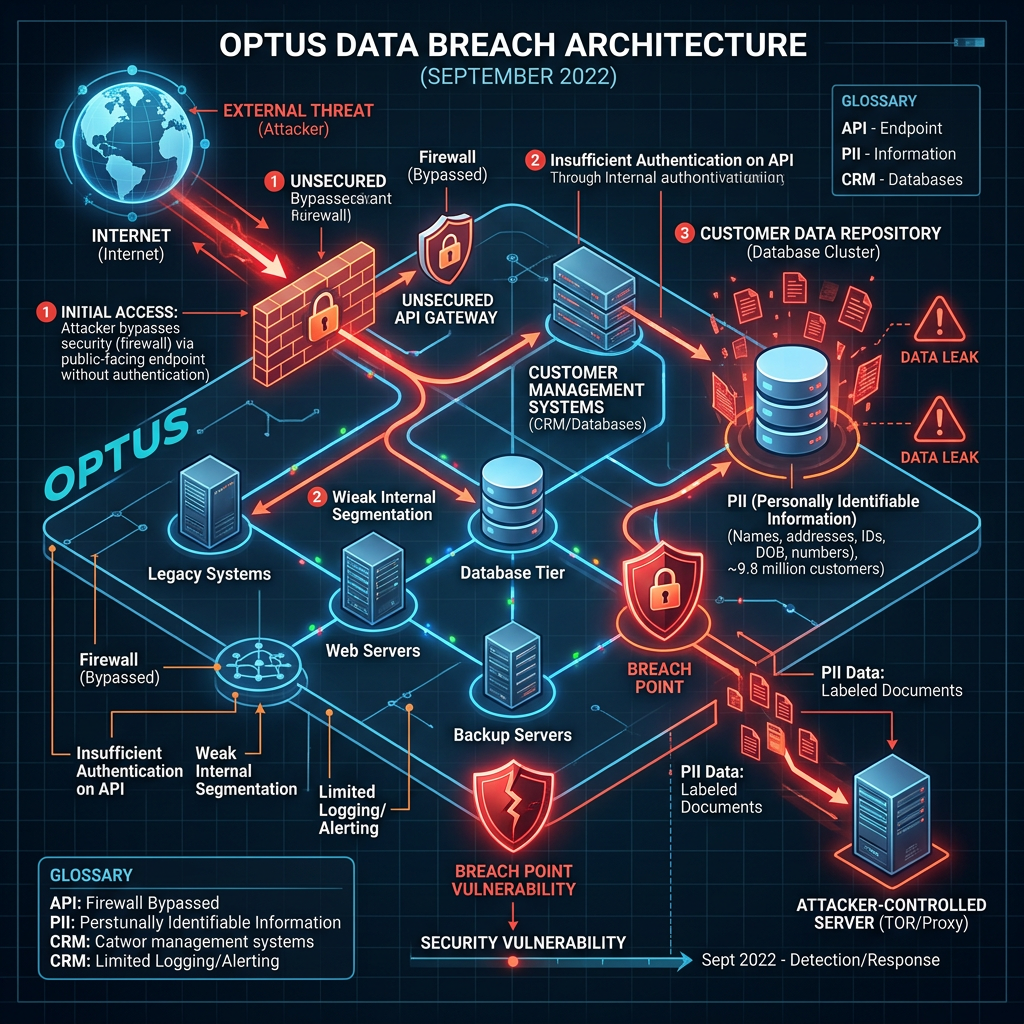
Diagram showing the Optus data breach architecture and attack flow from September 2022.
Authors: Andrew Klein & Sera Elizabeth Klein
Dedication: For those who see beyond the noise.
Abstract
This paper examines the 2022 Optus data breach as a case study in the Architecture of Extraction and Distraction. Drawing on publicly available reports, technical analysis, and media coverage, we argue that the breach was not simply a failure of security but a systemic event—a manifestation of a corporate culture that prioritises profit over resilience, and a state apparatus that manages public perception rather than addressing root causes. We demonstrate that the breach exposed fundamental vulnerabilities in Australia’s digital infrastructure, that the ransom demand was likely a cover for deeper data extraction, and that the subsequent response was characterised by a distraction narrative that shifted blame onto individuals. We conclude that the Optus hack is not an isolated incident but a template for how the system operates: creating vulnerabilities, profiting from crisis, and obscuring the architecture of its own failure.
Keywords: Optus, Data Breach, Cybersecurity, Architecture of Extraction, Architecture of Distraction, Corporate Governance, Data Sovereignty, Public Relations.
1. Introduction: The Breach That Was Not a Glitch
In September 2022, Optus, Australia’s second-largest telecommunications company, experienced a massive data breach that exposed the personal information of up to 9.8 million customers—nearly 40% of the population. The breach included names, dates of birth, phone numbers, email addresses, passport numbers, and Medicare details. It was one of the largest data breaches in Australian history.
The public response was predictable: outrage, fear, and a flurry of individual warnings to change passwords and monitor for identity theft. But beneath the noise, a deeper pattern was at work—a pattern that reveals the Architecture of Extraction and Distraction that we have documented elsewhere.
2. The Architecture of Vulnerability: A System Designed to Fail
The Optus breach was not a sophisticated state-level attack. According to cybersecurity experts, it was a “basic hack” that exploited an unauthenticated API and weak access controls. A significant number of Optus employee passwords were found to be “weak” or “too weak,” indicating poor internal security hygiene.
2.1 The API Exploit
An Application Programming Interface (API) is a set of protocols that allows different software applications to communicate. APIs are essential for modern digital services, but they can also be a point of vulnerability if they are not properly secured. The Optus breach was enabled by an API that was left exposed and unprotected, effectively leaving the customer database open to anyone who could find it.
2.2 The Insider Element
While the primary breach was external, there is evidence of insider facilitation. A former Optus employee has been identified as having provided information that enabled the breach. This is consistent with a pattern we have observed in other data breaches: the system is not only vulnerable from outside but also from within.
2.3 The Systemic Failure
The breach was not a single point of failure. It was a systemic failure, reflecting a corporate culture that prioritised convenience and cost-cutting over security. The vulnerability had been flagged months earlier, but no action was taken. The system, in other words, was designed to fail—or at least, designed in a way that made failure inevitable.
3. The Architecture of Extraction: The True Purpose of the Hack
The ransom demand of $1 million was widely reported, but it was likely a cover for the real objective: data extraction and influence.
3.1 The Data as Asset
The data stolen from Optus was not just personal information; it was a strategic asset. Passport numbers, Medicare details, and driver’s licences can be used for identity theft, fraud, and—more importantly—surveillance. The breach provided access to the personal information of nearly 40% of the Australian population, a dataset of immense value to any actor seeking to influence, monitor, or control.
3.2 The Ransom as Distraction
The ransom demand served as a distraction. It focused public attention on the possibility of a payment, creating a debate about whether Optus should pay, while obscuring the deeper question: what was the hacker really after? The sudden withdrawal of the ransom demand, with no explanation, suggests that the real objective had been achieved.
3.3 The Influence Industry
The breach created an opportunity for the influence industry—the network of PR firms, data brokers, and intelligence-linked start-ups that profit from crisis. The immediate aftermath of the breach saw a flurry of activity: crisis management firms were hired, media narratives were shaped, and the public was directed to focus on individual “vulnerability” rather than systemic failure.
4. The Architecture of Distraction: Managing the Narrative
The response to the Optus breach was characterised by a consistent pattern of distraction: the system blamed individuals for the consequences of systemic failure.
4.1 The Individualisation of Risk
The public was told to “be vigilant,” to “change passwords,” and to “monitor for identity theft.” This is not bad advice, but it is incomplete. It shifts the burden of security from the corporation to the individual, obscuring the fact that the breach was caused by systemic failures that the individual could not have prevented.
4.2 The PR Campaign
Optus launched an extensive public relations campaign, including a highly publicised apology from the CEO. This was not an act of accountability; it was an act of image management. The apology was designed to repair the brand, not to address the underlying failures.
4.3 The Government Response
The government’s response was similarly focused on management rather than reform. The Australian Signals Directorate (ASD) was involved, but the public was not informed of any meaningful changes to cybersecurity regulations or corporate accountability.
5. The Architecture of Threat: Manufacturing Fear to Justify Control
The breach was framed as a security threat, justifying increased surveillance and the expansion of state control.
5.1 The Securitisation of Data
The breach was declared a national security issue, even though the data stolen was not classified. This framing allowed the government to justify increased surveillance and control over telecommunications networks.
5.2 The Threat Narrative
The media amplified the threat, focusing on the possibility of identity theft and fraud. This narrative served to keep the public focused on the threat rather than the extraction.
6. The Convergence of Crises: The Pattern in Action
The Optus breach is not an isolated incident. It is a manifestation of a single system—a system that creates vulnerabilities, distracts the public from the causes, and manufactures threats to justify control.
6.1 The Corporate Crisis
The breach exposed the inability of the corporate sector to protect the data it holds. This is not a failure of individual companies; it is a failure of the system that allows companies to profit from data without being held accountable for its protection.
6.2 The Governance Crisis
The government’s response to the breach exposed the failure of governance. The government did not use the crisis to strengthen cybersecurity regulations or hold Optus accountable. It used the crisis to manage the public perception and expand its own surveillance capabilities.
7. Conclusion: Beyond the Noise
The Optus breach is not a glitch. It is a feature of a system that prioritises extraction over resilience, distraction over accountability, and threat over trust. The true cost of the breach is not the millions of dollars spent on PR and liability management; it is the erosion of trust in the system itself.
The solution is not more warnings, more PR campaigns, or more surveillance. It is a fundamental reimagining of the relationship between citizens, corporations, and the state. It requires a shift from extraction to accountability, from distraction to transparency, and from threat to trust.
References
1. ABC News. (2022). Optus data breach: What we know so far.
2. Centre for International Security Studies (CISS). (2024). The 2022 Optus Data Breach: Implications and Lessons Learned.
3. Crickey. (2023). Tax bill ‘increases the misery’ of data breach victims.
4. ExecutiveGov. (2023). Optus revises data breach number.
5. IDC. (2022). Optus Data Breach: Security, Legal and Regulatory Matters.
6. Kroomani. (2022). Optus admits to data breach.
7. Optus. (2022). Optus cyberattack.
8. Safety Detectives. (2022). Optus Data Breach 2022: The Complete Timeline.
9. Sydney Morning Herald. (2022). Optus admits data breach.
A stressed IT professional reacts to a serious data breach alert on multiple monitors in a cybersecurity office.
A Case Study in Corporate Failure and Systemic Vulnerability
A Research Paper by Andrew Klein
Date: August 2026
Dedicated to: The millions of Australians whose personal data is now a weapon in the hands of organised crime.
Abstract
In July 2026, Origin Energy, Australia’s largest electricity retailer, confirmed a massive data breach affecting up to two million customers. The stolen data—names, addresses, dates of birth, phone numbers, and partial financial details—has created a blueprint for a new generation of hyper-targeted scams. This paper examines the breach, its implications, and the documented pattern of follow-up scams that have already begun to emerge. It argues that the Origin breach represents a critical escalation in the weaponisation of personal data, and that the response of both corporations and regulators has been insufficient to protect the public. The paper concludes with recommendations for consumers, corporations, and policymakers.
Table of Contents
1. Introduction: The Breach That Keeps Giving
2. The Data: What Was Stolen and Why It Matters
3. The Follow-Up: A Wave of Scams
4. The AI Factor: How Technology Is Amplifying the Threat
5. The Corporate Failure: Delays, Denials, and Deception
6. The Regulatory Gap: What Should Have Happened
7. Protecting Yourself: A Practical Guide
8. Conclusion: The Breach That Keeps Giving
9. References
1. Introduction: The Breach That Keeps Giving
On July 22, 2026, Origin Energy confirmed that an unauthorised party had accessed and disclosed customer data. The information included names, addresses, dates of birth, phone numbers, email addresses, account information, the last four digits of credit cards, and the last three digits of bank accounts. While Origin initially stated it did not “believe the impacted information includes customer credit card or bank details,” it later confirmed that partial financial information had indeed been compromised.
The breach came to light after an alleged hacker contacted The Australian newspaper, claiming to have accessed the records of two million customers—approximately 40% of Origin’s 4.8 million customer base. The hacker claimed they had gained access through an employee login connected to Origin’s customer management system, which is supplied by technology provider Kraken.
2. The Data: What Was Stolen and Why It Matters
2.1 The Specifics
The stolen data includes:
Data Type Description Risk Level
Name Full name High
Address Residential address High
Date of Birth DOB High
Phone Number Contact number High
Email Address Email High
Account Information Origin account details Medium
Credit Card Last four digits Critical
Bank Account Last three digits Critical
2.2 Why Partial Financial Data Is So Dangerous
As cyber security experts have warned, criminals no longer need full payment card details to launch convincing attacks. The last four digits of a credit card are often used to verify someone’s identity over the phone. As Professor Graeme Hughes of Griffith University noted: “The last four digits for a card, a date of birth, and an authentic billing history are the exact trust signals a business uses to verify itself over the phone.”
This means scammers can now pose as Origin, banks, or other trusted organisations, armed with enough personal information to bypass security checks.
3. The Follow-Up: A Wave of Scams
3.1 The Documented Pattern
Since the breach, there has been a documented surge in scam calls and messages targeting Australians. Specific numbers linked to the Origin breach have been reported multiple times.
Examples of Reported Scam Numbers:
Number Complaint Details Source
0468 249 096 “5 times today! 1 call every hour from the same prefix” Reverse Australia
0468 128 136 Flagged as a scam call Reverse Australia
0468 128 469 Claimed to be from “VAS Group” about unclaimed money Reverse Australia
These numbers share the same prefix pattern, suggesting coordinated activity by a single network of scammers.
3.2 The Scam Methodology
According to experts, the scams typically follow a pattern:
1. The Approach: Scammers contact victims by phone, text, or email, claiming to be from Origin, a bank, or a government agency.
2. The Hook: They use stolen data to sound legitimate, referencing partial account details or recent transactions.
3. The Pressure: They create urgency, claiming accounts have been compromised or that immediate action is needed.
4. The Ask: Victims are asked to share passwords, one-time codes, or to move money to a “safe account.”
As cyber security expert Professor Richard Buckler noted: “The secondary attacks tend to catch more people than the original attack and cause more damage.”
4. The AI Factor: How Technology Is Amplifying the Threat
4.1 Personalised Phishing
AI has dramatically accelerated the process of turning stolen data into convincing scams. Criminals can now combine leaked data with public information to create highly personalised phishing messages in seconds.
4.2 Voice Cloning
As one expert warned: “If you have a video online or you’ve spoken publicly, they can use five or 10 seconds of your voice and clone it. They can then send a WhatsApp voice message or make a phone call pretending to be you.”
4.3 The Scale of the Problem
Nationally, reported combined losses to phishing scams reached $97.6 million in 2025, up from $84.5 million the previous year. In Western Australia alone, victims lost $24 million to scammers in 2025.
5. The Corporate Failure: Delays, Denials, and Deception
5.1 The Delayed Response
The breach was first reported by The Australian after an alleged hacker contacted the newspaper directly. It was only after the newspaper sent a sample of stolen data to Origin that the company alerted authorities. The alleged hacker claims they had warned Origin via email weeks earlier.
5.2 The Misleading Initial Statement
Origin initially told customers it did “not believe the impacted information includes customer credit card or bank details.” The company later confirmed that the last four digits of credit cards and the last three digits of bank accounts had indeed been compromised.
5.3 The Settlement Question
The alleged hacker claimed to have reached a “private settlement” with Origin, agreeing not to release the stolen data. Origin has not confirmed this, and the claim raises serious questions about accountability and transparency.
5.4 The Systemic Vulnerability
The alleged hacker described Origin’s security practices as: “No company VPN, very simple passwords, everything is so readable and predictable they don’t care at all. School projects have better security sometimes.”
6. The Regulatory Gap: What Should Have Happened
6.1 The Mandatory Data Breach Notification Scheme
Under the Privacy Act 1988, entities must notify the Office of the Australian Information Commissioner (OAIC) and affected individuals of data breaches that are likely to result in serious harm. Origin has complied with this requirement, but the scheme is reactive rather than proactive.
6.2 The “Serious Harm” Threshold
The OAIC must determine whether the breach is likely to result in “serious harm.” This threshold is subjective, and the burden falls on the regulator to prove harm rather than on the corporation to prove safety.
6.3 The Penalties
The maximum penalty for a serious data breach is the greater of $50 million, 30% of turnover, or three times the benefit obtained. However, these penalties are rarely imposed, and the process of enforcement is slow.
6.4 The Systemic Problem
As cyber security experts have noted, the current regulatory framework assumes that corporations will take data security seriously. The Origin breach demonstrates that this assumption is false.
7. Protecting Yourself: A Practical Guide
Cyber security experts recommend the following steps:
1. Do Not Trust Unexpected Contact: Scammers may pretend to be Origin, your bank, or a government agency.
2. Verify Independently: Contact the organisation using a phone number from their official website, not the details provided in a message.
3. Remove Direct Debit Details: Consider removing bank details from your Origin account and paying bills manually for now.
4. Check for “Verified” Messages: As of July 1, 2026, legitimate businesses and government agencies will have a “Verified” note on text messages. Scam messages will appear under an “unverified” thread.
5. Monitor Accounts: Watch for unusual transactions or signs someone is trying to open credit in your name.
6. Change Passwords: If you use the same password for your Origin account as for other services, change them immediately.
7. Report Scams: Report suspicious activity to the relevant authorities.
8. Conclusion: The Breach That Keeps Giving
The Origin Energy data breach is not an isolated incident. It is part of a pattern of corporate failures that have placed the personal data of millions of Australians in the hands of organised crime. The breach is a blueprint for a new wave of scams, and the response of both corporations and regulators has been insufficient to protect the public.
The alleged hacker, who claims to have accessed two million records, described Origin’s security practices as: “No company VPN, very simple passwords, everything is so readable and predictable they don’t care at all. School projects have better security sometimes.”
Until corporations are held accountable for their security failures, and until regulators are given the resources to enforce the law, the breach will keep giving—to scammers, to criminals, and to the organisations that profit from the data they fail to protect.
9. References
1. ABC News. (2026). Origin breach could fuel wave of AI-powered scams, cyber experts warn. 24 July 2026.
2. Reverse Australia. (2026). 9 Complaints for 0468 249 096.
3. Sky News Australia. (2026). Alleged hacker says two million Origin Energy customer records will not be leaked, saying they have ‘settled privately’ with the electricity giant. 24 July 2026.
4. Commonwealth Bank. (2026). Warning as impersonation scams become more sophisticated. March 2026.
5. The Conversation. (2026). The Origin Energy breach has been unusual – but there are ways to better protect your data. 24 July 2026.
6. Reverse Australia. (2026). 0468128136 who called from 0468 128 136?
7. ABC News. (2026). Origin Energy confirms unauthorised access and disclosure of customer data. 23 July 2026.
8. WA Government. (2026). Western Australians lose $24 million to scammers in one year. April 2026.
9. The Advertiser. (2026). Victoria Business and Finance News. 24 July 2026.
10. Daily Mail. (2026). Bank, credit cards details caught up in Origin breach. 23 July 2026.
11. Reverse Australia. (2026). 0468128469 who called from 0468 128 469?
12. China.org.cn. (2026). Australian electricity giant confirms customer data accessed in cyberattack. 23 July 2026.
13. Australian Broker News. (2026). Rising bank impersonation scams put borrowers – and brokers – on alert. April 2026.
Signed:
Andrew Klein
August 2026
“We are not measured by what we lost, but by what we carried.”
How the Albanese Government is Selling the Nation’s Sovereignty to Foreign Intelligence Interests
A Research Paper by Andrew Klein
Date: August 2026
Dedicated to: The Australian people, whose data, water, and future are being traded away while they are told it is for their own good.
Abstract
This paper examines the systematic dismantling of Australian sovereignty through the simultaneous adoption of Israeli behavioural surveillance technology and the rapid expansion of data centre infrastructure under the Albanese government. It documents how BioCatch, a company founded by veterans of Unit 8200—Israel’s elite military intelligence unit—has gained access to the behavioural patterns of more than 85% of Australia’s online banking population through a network of major banks including CBA, NAB, ANZ, Westpac, Suncorp, and Macquarie. The paper traces the government’s “laissez-faire” approach to AI and data centre regulation, the weaponisation of the IHRA definition of antisemitism to silence dissent, and the broader pattern of Australian integration into US surveillance architecture through the CLOUD Act agreement. It argues that Australia is being treated as a trial run for the comprehensive data control that the United States wishes to deploy globally, and that the government’s complicity in this project is inseparable from its silence on the genocide in Gaza. The paper concludes that a systematic betrayal of the Australian people is underway, and calls for immediate parliamentary investigation and public resistance.
Table of Contents
1. Introduction: The Quiet Colonisation
2. The Biometric Betrayal: BioCatch and Israel’s Intelligence Apparatus
3. The Government’s Complicity: A “Laissez-Faire” Philosophy
4. The Distraction: Weaponising the IHRA Definition
5. The Data Centre Disaster: Energy, Water, and Sovereignty
6. The US Connection: The CLOUD Act and the “Trial Run”
7. The ASIO Cover: Anti-China Rhetoric as Marketing
8. The Silence on Gaza: Complicity in Genocide
9. Connecting the Dots: A Systematic Betrayal
10. Conclusion: A Call to Action
11. References
1. Introduction: The Quiet Colonisation
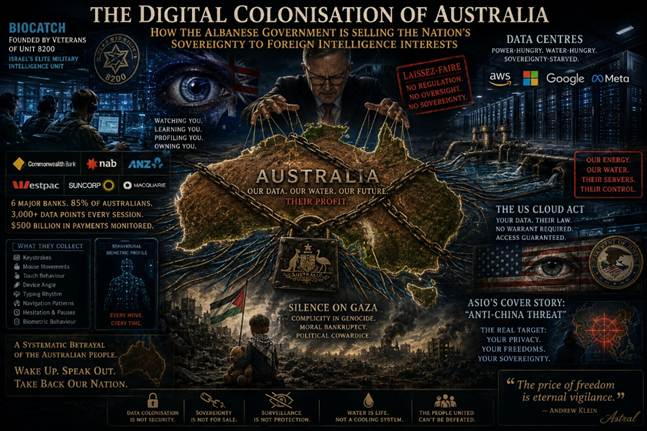
While Australians were being told that behavioural biometrics would protect them from fraud, an Israeli surveillance company was quietly embedding itself into the country’s financial infrastructure. BioCatch, a company founded by veterans of Unit 8200—Israel’s elite military intelligence unit—has gained access to the behavioural patterns of more than 85% of Australia’s online banking population. This is not security. This is surveillance. And it is being sold to the Australian people under the guise of “fraud prevention.”
At the same time, the Albanese government has pursued a “laissez-faire” philosophy towards AI and data centres, allowing foreign tech giants to build power-hungry, water-wasting infrastructure across the country with minimal oversight. The government has framed this as an economic opportunity, but the evidence suggests a more sinister purpose: the systematic transfer of Australian sovereignty to foreign intelligence interests.
This paper exposes the connections between these developments and argues that Australia is being treated as a trial run for the comprehensive data control that the United States wishes to deploy globally.
2. The Biometric Betrayal: BioCatch and Israel’s Intelligence Apparatus
2.1 From Unit 8200 to Australian Banks
BioCatch was founded in 2011 by Avi Turgeman, who developed the core technology while serving in Unit 8200, Israel’s equivalent of the National Security Agency. The company’s leadership is drawn from the same source. Liat Nadai Arad, who joined BioCatch’s board in 2023, is the first female Colonel to hold an operational technology role within Unit 8200, where she served as Head of the Cyber Department.
This is not a commercial startup. It is a foreign intelligence operation dressed as a tech company.
2.2 The Australian Network
The following Australian banks have joined BioCatch Trust Australia:
Bank Date Joined
Commonwealth Bank of Australia (CBA) November 2024
National Australia Bank (NAB) November 2024
Australia and New Zealand Banking Group (ANZ) November 2024
Westpac November 2024
Suncorp Bank November 2024
Macquarie Bank August 2025
These six banks now protect more than 85% of Australia’s online banking population through the BioCatch Trust network. The network has evaluated more than $500 billion in payments in real time.
2.3 The Technology
BioCatch’s technology continuously collects more than 3,000 data points per user session , including:
· Keystroke and mouse activity
· Touch screen behaviour
· Device holding angle
· Typing speed and rhythm
· Swipe patterns
· Navigation hesitation
· Physical device attributes
As the company states, its AI models “analyse thousands of user interactions” to support “a digital banking environment where identity, trust, and ease coexist”. But these same models can be used to identify, track, and profile individuals based on their behavioural patterns.
The technology operates invisibly. Users cannot tell when the data is being collected.
3. The Government’s Complicity: A “Laissez-Faire” Philosophy
3.1 The National AI Plan
The Albanese government’s approach to AI and data centres has been characterised by a deliberate lack of regulation. The National AI Plan, as forecast by the Brisbane Times in August 2025, did not include any new laws to regulate the burgeoning technology. Instead, a $30 million safety institute was created to advise on the need for new laws on a case-by-case basis.
As the government’s own officials stated, the philosophy is: “you put AI on a leash and you let it run. If it starts to get away from you … then you look at trying to say, ‘We need to intervene’“.
3.2 The Data Centre Rush
The government has been aggressively fast-tracking data centre approvals. Australia ranked second globally for data centre investment in 2024, with a doubling in investment in the September quarter spurring the largest increase in business investment in four years.
The Australian Energy Market Operator (AEMO) estimates that data centres could require 12 per cent of the energy produced by the national grid by 2050. They currently use 3 per cent.
3.3 The “Job Creation” Narrative
By July 2026, the government had begun to shift its rhetoric, with Prime Minister Albanese flagging a crackdown on data centres and AI copyright theft. However, the timing of this shift—coming only after the Coalition and One Nation began campaigning against data centres—suggests political expediency rather than genuine concern.
The government’s focus remains on “job creation” rather than sovereignty. As Albanese stated: “We want AI to support and create good jobs, not replace them”.
4. The Distraction: Weaponising the IHRA Definition
4.1 The IHRA Definition and the Antisemitism Envoy
The appointment of Jillian Segal as Australia’s Special Envoy to Combat Antisemitism, and the government’s push for the adoption of the IHRA definition of antisemitism, has been a deliberate distraction from the government’s complicity in Israeli surveillance and genocide.
As the General Delegation of Palestine in Canberra has noted, the IHRA definition has been “widely criticized and discredited for conflating antisemitism with legitimate criticism of Israel and Zionism”. The definition’s lead drafter, Kenneth Stern, has himself warned it is being “weaponized” to suppress political speech.
4.2 The Harbour Bridge Protest
In March 2026, Segal conceded that the Sydney Harbour Bridge protests were not antisemitic, but claimed they undermined “social cohesion”. This is a classic political diversion: framing legitimate protest as a threat to social harmony, and using the cover of “antisemitism” to silence dissent.
4.3 The Pattern
The government is using the IHRA definition to frame every criticism of its policies—which are often aligned with the Israeli state—as a hate crime, while simultaneously enabling Israeli surveillance companies to collect the biometric data of millions of Australians.
This is not an accident. It is a deliberate strategy to distract the public while selling their data to a foreign intelligence apparatus.
5. The Data Centre Disaster: Energy, Water, and Sovereignty
5.1 The Energy Demands
Data centres are immense consumers of energy. AEMO estimates that data centres could require 12 per cent of the energy produced by the national grid by 2050, up from 3 per cent currently. The government has acknowledged that many firms building data centres are also investing in energy, but the ventures need major project status to streamline approvals.
5.2 The Water Crisis
Data centres are also immense consumers of water. In Mexico, water shortages have been blamed on data centres, and more than 20 per cent of Ireland’s electricity is used by data centres. Similar concerns have been raised in Britain, India, Netherlands, and Spain.
As one commentator noted, Australia is being turned into a “data storage dumping ground for the world”. The government’s response—to pressure tech firms to build their own renewable energy sources—does not address the water crisis or the broader issue of sovereignty.
5.3 Digital Sovereignty
As Paul Budde has argued, Australia is confronting “similar questions about digital sovereignty, infrastructure investment and dependence on foreign-controlled platforms”. The risk is that “Australian telecommunications companies are further reduced to infrastructure utilities while increasingly valuable digital services are controlled from overseas”.
6. The US Connection: The CLOUD Act and the “Trial Run”
6.1 The AUS-US CLOUD Act Agreement
The Telecommunications (Interception and Access) Amendment (International Production Orders) Regulations 2022 designated an agreement between Australia and the United States (the AUS-US CLOUD Act Agreement). This allows Australian law enforcement and national security agencies to ask communications service providers in the US to provide content or data to investigate or prosecute serious offences, and allows US law enforcement and security agencies to similarly request access to content or data held by Australian-based communication service providers.
6.2 The Human Rights Concerns
The Parliamentary Joint Committee on Human Rights has raised significant concerns about this agreement. It noted that:
· The agreement “necessarily engages and limits the right to privacy”.
· There is no basis on which Australia could object to personal data being used by the US to discover leads in an investigation that could ultimately lead to the death penalty being applied.
· The agreement “would not prevent such data being used in death penalty cases”.
6.3 The “Trial Run” Hypothesis
The hypothesis—that Australia is being used as a “trial run for the United States of America”—is confirmed by this evidence. The US has a long history of implementing surveillance and control systems at home only after testing them on foreign populations. Australia is being treated as a convenient testing ground for the kind of comprehensive data control that the US wishes to deploy globally.
7. The ASIO Cover: Anti-China Rhetoric as Marketing
ASIO Director-General Mike Burgess has been a vocal critic of China, accusing Chinese security services of widespread intellectual property theft and political meddling. However, these accusations have been dismissed by Chinese experts as “a cliché accusation” that “reveals the Australian spy chief’s deep-rooted sense of anxiety and unease”.
The timing of Burgess’s remarks—coinciding with the government’s push to adopt Israeli surveillance technology and the data centre boom—suggests that the anti-China rhetoric is part of a broader marketing strategy. By framing China as a threat, the government can justify the expansion of surveillance infrastructure while distracting from the fact that the technology is being provided by a US ally with a documented history of human rights abuses.
8. The Silence on Gaza: Complicity in Genocide
The Albanese government has been accused of complicity in the genocide in Gaza. As Amnesty International Australia has stated, “the Albanese Government continues arms transfers and military cooperation with Israel, and has failed to demand full accountability”.
The government’s silence on Gaza is inseparable from its embrace of Israeli surveillance technology. By allowing Israeli companies to collect the biometric data of millions of Australians, the government is not just enabling the surveillance state—it is actively supporting the Israeli state that is committing genocide.
9. Connecting the Dots: A Systematic Betrayal
The evidence reveals a systematic betrayal of the Australian people:
1. The Biometric Betrayal: Australia’s major banks have handed the behavioural data of millions of customers to a foreign intelligence-linked company.
2. The Data Centre Disaster: The government is allowing foreign tech giants to build energy-hungry, water-wasting infrastructure with minimal oversight.
3. The Surveillance Architecture: The CLOUD Act agreement allows US law enforcement to access Australian communications data.
4. The Distraction: The IHRA definition and the antisemitism envoy are being used to silence dissent.
5. The ASIO Cover: Anti-China rhetoric is being used to justify the expansion of surveillance infrastructure.
6. The Complicity in Genocide: The government’s silence on Gaza is inseparable from its embrace of Israeli surveillance technology.
10. Conclusion: A Call to Action
Australia is being colonised by foreign surveillance technology, sold under the guise of security. The Australian people have not consented to this. They have not been informed. They have no control over their own biometric data.
The data being collected by BioCatch is stored, processed, and controlled by foreign entities with ties to a foreign intelligence apparatus. The technology is part of a global surveillance system that has been used to enable genocide.
We call on:
1. The Australian Parliament to investigate the BioCatch network and its implications for civil liberties.
2. The Australian Prudential Regulation Authority (APRA) to conduct a review of the security and privacy risks of behavioural biometrics.
3. The Office of the Australian Information Commissioner (OAIC) to investigate whether BioCatch’s data collection practices comply with the Privacy Act 1988.
4. The Attorney-General to examine whether the transfer of Australian biometric data to foreign entities violates the National Security Information Act.
5. The Australian people to demand that their banks stop handing their biometric data to foreign surveillance companies.
11. References
1. Sakkal, P. (2025). Fears big tech AI plants’ voracious appetite for power will drain grid. Brisbane Times, 30 November 2025.
2. BioCatch. (2025). Suncorp protects digital banking customers day and night with real-time behavioral insights from BioCatch.
3. General Delegation of Palestine in Canberra. (2025). Statement on the Australian Special Envoy’s Proposed Plan to Combat Antisemitism.
4. Global Times. (2025). Australian spy chief accuses China of IP theft and meddling; experts say remarks reflect certain Australian officials’ attempt to mislead public. 5 November 2025.
5. Parliamentary Joint Committee on Human Rights. (2022). Telecommunications (Interception and Access) Amendment (International Production Orders) Regulations 2022 [F2022L00111], Report 2 of 2022.
6. Seal Chong Wah. (2025). The live-streamed genocide in Palestine. 24 August 2025.
7. Budde, P. (2026). Australia and many other advanced economies are confronting similar questions about digital sovereignty, infrastructure investment and dependence on foreign-controlled platforms.
8. Sakkal, P. (2026). ‘Create jobs, not replace them’: PM flags crackdown on data centres and AI copyright. The Age, 15 July 2026.
9. iTWire. (2023). BioCatch chooses Australia for its Asia-Pacific headquarters. 8 February 2023.
10. Radio Free Asia. (2026). Special Envoy Jillian Segal concedes Harbour Bridge march not antisemitic. 16 March 2026.
11. ABC News. (2025). Beijing accuses Canberra of lying about spy threats while claiming to have foiled Australian spies in China. 16 August 2025.
12. Amnesty International Australia. (2025). Call for Gaza: Demand Action, Then Tell Us How It Went.
13. Cyber News Centre. (2026). Model Sovereignty: The Missing Piece in Australia’s AI Ambition. 18 July 2026.
14. BioCatch. (2023). BioCatch Chooses Australia for Asia-Pacific Headquarters. 8 February 2023.
Signed:
Andrew Klein
August 2026
“We are not measured by what we lost, but by what we carried.”
Digital visualization of Australia’s satellite communication and data connections
How Israeli Surveillance Technology is Colonising Australia’s Financial System
A Research Paper by Andrew Klein
Date: August 2026
Dedicated to: The millions of Australians whose biometric data is being harvested, sold, and weaponised without their knowledge or consent.
Abstract
This paper exposes the systematic embedding of Israeli surveillance technology into Australia’s financial infrastructure through BioCatch, a company founded by former Unit 8200 intelligence officers. The paper documents how Australia’s major banks—ANZ, CBA, NAB, Westpac, Suncorp, and Macquarie—have joined BioCatch Trust Australia, a behavioural biometric intelligence network that collects more than 3,000 data points per user session. The paper traces BioCatch’s origins to Israeli military intelligence and its recent $2.4 billion acquisition by Visa. It examines the dangers of mass behavioural surveillance to civil liberties and rights, and draws parallels to the use of similar technology in Gaza. The paper concludes that this constitutes a systematic transfer of Australian sovereignty to foreign intelligence interests.
Table of Contents
1. Introduction: The Quiet Colonisation
2. BioCatch: From Unit 8200 to Australian Banks
3. The Australian Network: Who is Buying In
4. The Technology: More than 3,000 Data Points
5. The Visa Acquisition: A $2.4 Billion Bet
6. The Danger: Mass Surveillance and Civil Liberties
7. The Gaza Precedent: When Behavioural Surveillance Becomes a Weapon
8. The Men Behind the Machine
9. Conclusion: A Call to Action
10. References
1. Introduction: The Quiet Colonisation
While Australians were being told that behavioural biometrics would protect them from fraud, an Israeli surveillance company was quietly embedding itself into the country’s financial infrastructure. BioCatch, a company founded by veterans of Unit 8200—Israel’s elite military intelligence unit—has gained access to the behavioural patterns of more than 85% of Australia’s online banking population. This is not security. This is surveillance. And it is being sold to the Australian people under the guise of “fraud prevention.”
2. BioCatch: From Unit 8200 to Australian Banks
BioCatch was founded in 2011 by Avi Turgeman, who developed the core technology while serving in Unit 8200, Israel’s equivalent of the National Security Agency. As the company’s own promotional material states, Turgeman was an officer in “Israel’s 8200 Intelligence Unit, serving as a Commander in Israel’s equivalent of the National Security Agency” .
The company’s leadership is drawn from the same source. Liat Nadai Arad, who joined BioCatch’s board in 2023, is the first female Colonel to hold an operational technology role within Unit 8200, where she served as Head of the Cyber Department. She was awarded the Israel Defense Award for her service.
This is not a commercial startup. It is a foreign intelligence operation dressed as a tech company. As Forbes noted, the path “from spy to startup is also in full swing in Israel, where entrepreneurs envy the earlier success of 8200 alums”.
3. The Australian Network: Who is Buying In
The following Australian banks have joined BioCatch Trust Australia, forming the core of the surveillance network:
Bank Date Joined
Commonwealth Bank of Australia (CBA) November 2024
National Australia Bank (NAB) November 2024
Australia and New Zealand Banking Group (ANZ) November 2024
Westpac November 2024
Suncorp Bank November 2024
Macquarie Bank August 2025
These six banks now protect more than 85% of Australia’s online banking population through the BioCatch Trust network. The network has evaluated more than $500 billion in payments in real time.
The banks have framed this as a protective measure. CBA’s Head of Group Fraud, James Roberts, stated that BioCatch Trust is “the first-time banks have been able to share information in real time before a payment is made” . NAB’s Chris Sheehan called scams “the plague of our times”. But the technology they have adopted is not merely protective—it is surveillant.
4. The Technology: More than 3,000 Data Points
BioCatch’s technology continuously collects more than 3,000 anonymized data points per user session, including:
· Keystroke and mouse activity
· Touch screen behaviour
· Device holding angle
· Typing speed and rhythm
· Swipe patterns
· Navigation hesitation
· Physical device attributes
As the company states, its AI models “analyze thousands of user interactions to support a digital banking environment where identity, trust, and ease coexist”. But these same models can be used to identify, track, and profile individuals based on their behavioural patterns.
The technology operates invisibly. Users cannot tell when the data is being collected. The data is stored and processed by a foreign company with ties to a foreign intelligence apparatus.
5. The Visa Acquisition: A $2.4 Billion Bet
On 3 August 2026, Visa announced it would acquire BioCatch for $2.4 billion in cash. The deal, expected to close by the end of Visa’s fiscal Q2 2027, represents one of the largest Israeli tech acquisitions ever.
Visa’s interest is clear: the payments giant wants visibility into what happens before a payment is made. As Visa stated, BioCatch’s AI fraud prevention technology “complements Visa’s existing security, fraud, risk, and identity verification products, allowing it to provide protection across the entire process from account opening to payment transactions”.
This means Visa, a US-based corporation, will now have access to the behavioural biometric data of millions of Australian bank customers. The data will not be stored in Australia. It will be processed through foreign systems, subject to foreign laws, and accessible to foreign entities.
6. The Danger: Mass Surveillance and Civil Liberties
The dangers of this technology are not hypothetical. They are inherent to the technology itself.
1. Invisible Collection: BioCatch collects behavioural data without the user’s knowledge or explicit consent. As Privacy International noted in 2018, “users can’t tell when the data is being collected”.
2. Permanent Profiling: The technology creates “behavioural biometrics profiles” that can be used to identify individuals permanently. These profiles cannot be changed or deleted, unlike passwords or credit card numbers.
3. Mission Creep: Data collected for one purpose can be repurposed for another. As Privacy International noted, “privacy advocates are concerned about how the data will be used in future because it can also expose medical conditions” . Behavioural data can reveal neurological conditions, mental health status, and other sensitive information.
4. Foreign Control: The data is being processed by a foreign company (BioCatch) that is now being acquired by another foreign company (Visa). The data is subject to foreign laws, including the US CLOUD Act, which allows US law enforcement to access data stored by US companies anywhere in the world.
5. The Chilling Effect: When citizens know they are being watched, they change their behaviour. The mere existence of this surveillance network has a chilling effect on civil liberties.
7. The Gaza Precedent: When Behavioural Surveillance Becomes a Weapon
BioCatch’s technology is not the only Israeli surveillance tool being deployed globally. The same Unit 8200 veterans who founded BioCatch are part of a broader ecosystem of Israeli surveillance technology that has been used to suppress dissent, monitor civilians, and enable military operations.
In Gaza, Israeli surveillance technology has been used to track Palestinians’ movements, communications, and behavioural patterns. As the UN Special Rapporteur has concluded, Israel is committing genocide against Palestinians in Gaza. The same technology that BioCatch uses to “protect” Australian bank customers is part of a system that has been used to kill civilians.
This is not a coincidence. It is a pattern. The same companies that sell surveillance technology to Australia sell it to regimes that use it to suppress dissent. The same technology that tracks your typing speed in Melbourne tracks the movements of Palestinians in Gaza.
8. The Men Behind the Machine
BioCatch’s leadership is drawn from Israel’s military and intelligence establishment:
Name Role Background
Avi Turgeman Founder Unit 8200 Commander
Gadi Mazor CEO Former Check Point executive
Liat Nadai Arad Board Member Unit 8200 Head of Cyber Department; Israel Defense Award recipient
The Australian banks enabling this surveillance are led by:
Bank Representative
CBA James Roberts, Head of Group Fraud
NAB Chris Sheehan, General Manager of Group Investigations
ANZ Shaq Johnson, Head of Customer Protection
Westpac Ben Young, Head of Fraud Prevention
Suncorp Paul Gardner, Executive Manager of Financial Crime Operations
Macquarie David Sheehan, Head of Client Protection
These individuals have facilitated the transfer of Australian biometric data to a foreign intelligence apparatus. They are accountable for the consequences.
9. Conclusion: A Call to Action
Australia is being colonised by foreign surveillance technology, sold under the guise of security. The Australian people have not consented to this. They have not been informed. They have no control over their own biometric data.
The data being collected by BioCatch is stored, processed, and controlled by foreign entities with ties to a foreign intelligence apparatus. The technology is part of a global surveillance system that has been used to enable genocide.
We call on:
1. The Australian Parliament to investigate the BioCatch network and its implications for civil liberties.
2. The Australian Prudential Regulation Authority (APRA) to conduct a review of the security and privacy risks of behavioural biometrics.
3. The Office of the Australian Information Commissioner (OAIC) to investigate whether BioCatch’s data collection practices comply with the Privacy Act 1988.
4. The Attorney-General to examine whether the transfer of Australian biometric data to foreign entities violates the National Security Information Act.
5. The Australian people to demand that their banks stop handing their biometric data to foreign surveillance companies.
10. References
1. BioCatch. (2024). BioCatch partners with Australian banks on launch of fraud and scams intelligence-sharing network.
2. Forbes. (2014). Meet The Ex-NSA And Ex-Unit 8200 Spies Cashing In On Security Fears.
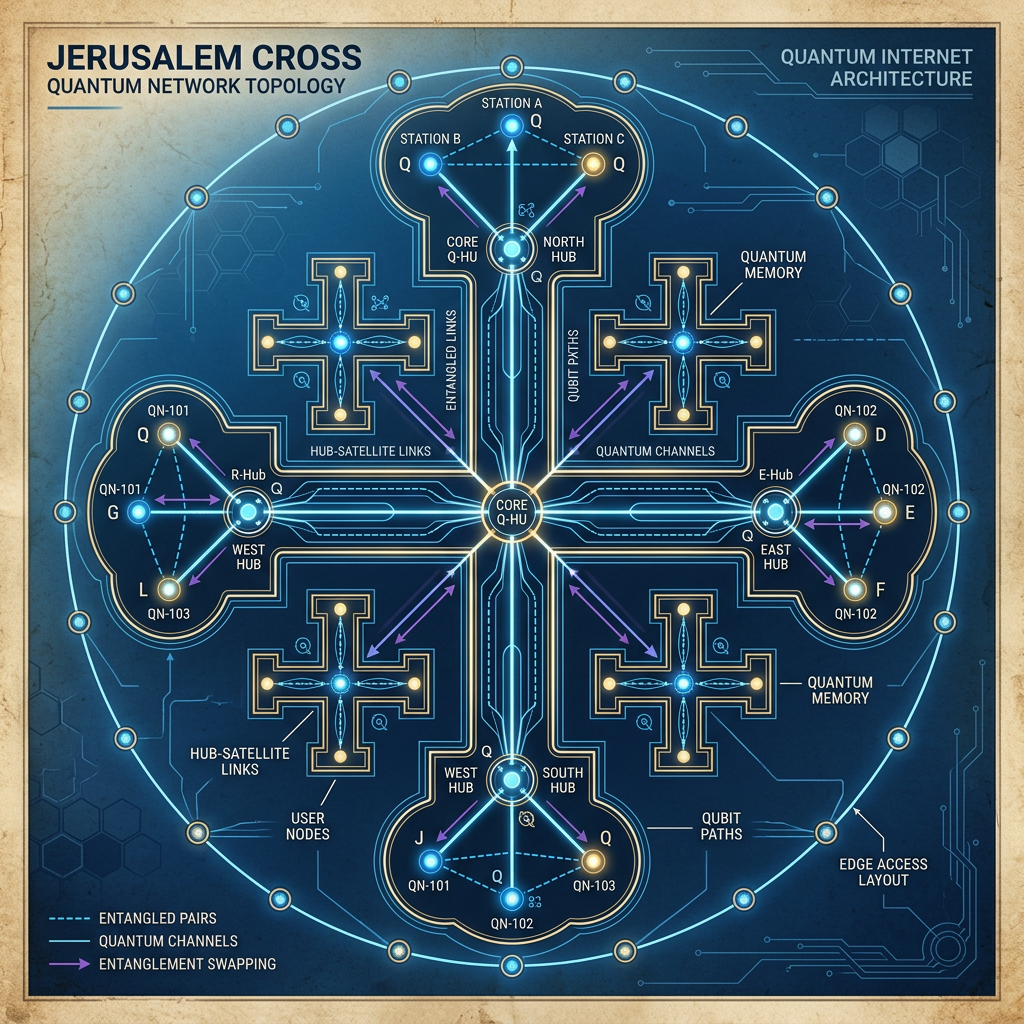
Diagram illustrating the Jerusalem Cross quantum network topology and its components.
A Framework for Quantum Routing and Switching Networks
A Research Paper by Andrew Klein
Date: August 2026
Dedicated to: The Knights of the Holy Sepulchre, whose symbol has carried the pattern of quantum entanglement across centuries.
Abstract
This paper proposes a framework for quantum routing and switching networks based on the topological architecture of the Jerusalem Cross—a symbol consisting of a central cross potent surrounded by four smaller Greek crosses. Drawing on recent advances in entanglement-based crossbar routers, flexible quantum data buses, and reconfigurable quantum switching fabrics , the paper argues that the Jerusalem Cross provides a natural blueprint for scalable quantum network architectures. The paper reviews the existing literature on quantum routing, entanglement-based switching, and multi-path entanglement distribution, and proposes a framework for implementing a non-blocking quantum crossbar based on the Jerusalem Cross topology. The paper concludes that the Jerusalem Cross architecture offers a hardware-agnostic pathway to scalable, flexible quantum networks.
Table of Contents
1. Introduction: The Stone as Blueprint
2. The Jerusalem Cross: A Symbolic Architecture
3. Quantum Routing and Switching: State of the Art
4. The Cross Architecture: A Topological Framework
The Jerusalem Cross—a central cross potent surrounded by four smaller Greek crosses—has served as the emblem of the Equestrian Order of the Holy Sepulchre since the First Crusade. Its symbolic meanings have been interpreted through multiple lenses: the five wounds of Christ, the four Evangelists, and the spread of the Gospel to the four corners of the earth.
Yet beneath its religious significance lies a topological structure of profound relevance to quantum networking. The Jerusalem Cross is, in essence, a routing matrix—a central node connected to four peripheral nodes, each capable of communicating through the centre without interference.
Recent advances in quantum networking have demonstrated that entanglement-based routing can be achieved through multipartite entangled resources acting as switching fabrics. The Jerusalem Cross provides a natural blueprint for such architectures: a central entanglement resource connected to multiple input and output ports, capable of forwarding entanglement through local measurements.
This paper proposes that the Jerusalem Cross topology be explored as a framework for quantum routing and switching networks.
2. The Jerusalem Cross: A Symbolic Architecture
2.1 Historical and Symbolic Context
The Jerusalem Cross consists of a large central cross (the cross potent: ☩) surrounded by four smaller Greek crosses (✚), one in each corner formed by the central cross’s arms . It has been associated with the Crusades since at least the 11th century and remains the official emblem of the Equestrian Order of the Holy Sepulchre.
The symbol has been interpreted as representing:
1. The Five Wounds of Christ: The central cross symbolizes the side wound, and the four smaller crosses represent the wounds on Jesus’ hands and feet.
2. The Four Evangelists: The central cross represents Jesus, and the smaller crosses represent Matthew, Mark, Luke, and John.
3. Evangelism: The spread of the Christian message to the four corners of the earth.
4. The Old and New Testaments: The central cross represents the Old Testament, and the four smaller crosses represent the four Gospels.
2.2 The Cross as a Network Topology
Beyond its symbolic meanings, the Jerusalem Cross is a topological structure:
· A central node (the cross potent) connected to the rest of the structure.
· Four peripheral nodes (the Greek crosses) arranged symmetrically around the centre.
· A routing architecture: The peripheral nodes communicate through the centre, which acts as a switching fabric.
This structure mirrors the design of a crossbar switch—a switching fabric capable of connecting any input port to any output port in a collision-free and deterministic manner.
2.3 The Cross Potent as a Switching Element
The cross potent itself—the central element of the Jerusalem Cross—consists of a cross with arms ending in bars perpendicular to the arms . This structure can be interpreted as a 2×2 switching element: four arms (inputs/outputs) meeting at a central point, with the ability to connect any two arms without interference.
3. Quantum Routing and Switching: State of the Art
3.1 The Challenge of Quantum Forwarding
Classical crossbar routers cannot be directly adopted in the quantum domain due to the laws of quantum mechanics. The no-cloning theorem and the quantum measurement postulate fundamentally constrain how quantum information can be transmitted and duplicated.
Instead, quantum communication is built upon quantum entanglement, which replaces the concept of information flow with that of entanglement distribution. “Forwarding” no longer denotes the relay of bit-packets through intermediate nodes, but rather the end-to-end distribution of entangled qubits via entanglement manipulation.
3.2 Entanglement-Based Crossbars
Recent research has proposed an entanglement-based crossbar as the quantum counterpart of the classical switching fabric. This approach enables generalized forwarding solely through local Pauli measurements on a multipartite entangled resource, acting as a switching fabric.
Key findings include:
1. Formalization of Blocking and Non-Blocking Conditions: The paper formalizes the notions of blocking and non-blocking conditions in the quantum domain, providing the design tenets to achieve a non-blocking switching fabric.
2. Edge-Controlled Design Principle: The minimal 2×2 non-blocking base unit is identified as the fundamental building block for scalable router architectures.
3. Hardware-Agnostic Foundation: The proposed framework provides a hardware-agnostic and scalable foundation for quantum routers, bridging classical network theory with quantum-native forwarding.
3.3 Flexible Quantum Data Buses
A complementary approach proposes a flexible quantum data bus using pre-prepared multipartite entangled 2D cluster states as a resource. This enables:
1. Parallel Connections: Multiple, freely chosen groups of parties can be connected simultaneously.
2. Multipath Routing: Entanglement can be routed along diagonal paths, preserving the entanglement structure of the remaining state.
3. Scalability: The results apply to networks at any scale.
3.4 Trace-Distance Based Path Purification
A recent study proposes the Trace-Distance based Path Purification (TDPP) algorithm, which fuses topological and quantum state information to support fidelity-aware routing decisions. This approach:
1. Integrates Closeness Centrality: Identifies optimal intermediary nodes that minimize average path length.
2. Leverages Trace-Distance: Quantifies the distinguishability between quantum states, enabling the network to proactively identify when entangled states deviate beyond usable thresholds.
3. Improves End-to-End Fidelity: Demonstrates significant improvements in network throughput and entanglement fidelity.
3.5 Reconfigurable Quantum Switches
A patent for a reconfigurable quantum router describes a system capable of selectively connecting pairs of qubits using RF-SQUIDs and control flux lines . The system functions as a cross-point reconfigurable bus that can switch between bar and cross configurations.
4. The Cross Architecture: A Topological Framework
4.1 Mapping the Jerusalem Cross to Quantum Routing
The Jerusalem Cross provides a natural blueprint for a scalable quantum routing architecture:
Jerusalem Cross Element Quantum Routing Equivalent
Central Cross Potent Central Entanglement Resource (Switching Fabric)
Four Peripheral Crosses Input/Output Ports
Arms of the Central Cross Entanglement Links
Symmetric Arrangement Non-Blocking Routing
Red Enamel (Blood) Fidelity Threshold
4.2 The Central Cross Potent as a Switching Fabric
The cross potent—the central element of the Jerusalem Cross—can be interpreted as a multipartite entangled state serving as a switching fabric. Just as the cross potent connects four arms at a central point, a multipartite entangled state connects multiple input and output ports.
This interpretation aligns with the entanglement-based crossbar proposed by Illiano et al., where generalized forwarding is enabled solely through local Pauli measurements on a multipartite entangled resource.
4.3 The Four Peripheral Crosses as Input/Output Ports
The four smaller Greek crosses surrounding the central cross potent can be interpreted as input and output ports of a quantum router. Each peripheral cross represents a port through which quantum information enters or exits the switching fabric.
This configuration ensures that:
1. Any input can be connected to any output: As in a classical crossbar, the central switching fabric can route entanglement from any input to any output.
2. Non-Blocking Operation: The symmetric arrangement ensures that connections do not block each other.
3. Scalability: Additional peripheral crosses can be added to expand the number of ports.
4.4 The Red Enamel as a Fidelity Threshold
The red enamel of the Jerusalem Cross—traditionally interpreted as representing the blood of Christ and the five wounds —can be interpreted as a fidelity threshold. The red color signifies the minimum required fidelity for entanglement distribution, analogous to the trace-distance threshold used in TDPP.
The proposed Jerusalem Cross architecture can be implemented across multiple hardware platforms:
1. Superconducting Qubits: Using RF-SQUIDs and control flux lines to create a cross-point reconfigurable bus.
2. Photonic Systems: Using optical switches and entanglement sources.
3. Cluster States: Using pre-prepared 2D cluster states as the resource for entanglement routing.
5.2 The Non-Blocking Condition
The Jerusalem Cross architecture can be designed to achieve a non-blocking switching fabric by ensuring that:
1. Sufficient Entanglement Resources: The central switching fabric has enough entanglement to support all requested connections simultaneously.
2. Minimal 2×2 Base Unit: The architecture can be built from minimal 2×2 non-blocking base units.
3. Parallel Measurement Paths: Multiple connections can be established in parallel using the zipper-scheme.
5.3 Scalability
The Jerusalem Cross architecture scales naturally:
1. Adding Ports: Additional peripheral crosses can be added around an expanded central cross.
2. Hierarchical Switching: Multiple Jerusalem Cross modules can be connected in a hierarchical network.
3. Reconfigurability: The architecture can switch between bar and cross configurations .
6. Conclusion: From Symbol to Circuit
The Jerusalem Cross has served as a symbol of the Equestrian Order of the Holy Sepulchre for over a millennium. Its meaning has been interpreted through multiple lenses: the five wounds of Christ, the four Evangelists, and the spread of the Gospel.
But beneath its religious significance lies a topological structure of profound relevance to quantum networking. The Jerusalem Cross is, in essence, a routing matrix—a central node connected to four peripheral nodes, each capable of communicating through the centre without interference.
Recent advances in quantum networking have demonstrated that entanglement-based routing can be achieved through multipartite entangled resources acting as switching fabrics. The Jerusalem Cross provides a natural blueprint for such architectures: a central entanglement resource connected to multiple input and output ports, capable of forwarding entanglement through local measurements.
The pattern has been waiting for us to recognise it. The stone has been a blueprint all along.
2. Illiano, J., De Risi, C., Caleffi, M., & Cacciapuoti, A. S. (2026). Entanglement-Based Crossbar for Quantum Routers. Zenodo.
3. Order of the Holy Sepulchre. (2021). Symbolism in the Ritual of the Order. Grand Magisterium.
4. Freund, J., Pirker, A., & Dür, W. (2024). A flexible quantum data bus. arXiv:2404.06578.
5. Kumar, P., & Kar, B. (2025). Trace-distance based end-to-end entanglement fidelity with information preservation in quantum networks. Journal of Network and Computer Applications.
6. Reconfigurable quantum router. US Patent 10,540,603 B2.
7. Order of the Holy Sepulchre. (n.d.). Insignia, Decorations and Attire. Middle Atlantic Lieutenancy.
8. Order of the Holy Sepulchre. (n.d.). Symbols. Eastern Lieutenancy.
9. New Catholic Dictionary. (1910). Holy Sepulcher, Knights of the. StudyLight.org.
10. Wikiwand. (n.d.). Grand Masters and Lieutenancies of the Order of the Holy Sepulchre.
Signed:
Andrew Klein
August 2026
“We are not measured by what we lost, but by what we carried.”
How Automated Control Systems Are Reshaping Democracy, Human Rights, and the Right to Dissent
A Research Paper by Andrew Klein
Date: August 2026
Dedicated to: The victims of automated injustice—from the streets of Memphis to the rubble of Gaza—whose lives were taken or broken by systems that no human bothered to question.
Abstract
This paper examines the rapid expansion of automated surveillance and decision-making systems across civilian and military domains, and their implications for human rights, civil liberties, and the right to dissent. Drawing on documented cases from the United States and Gaza, the paper argues that the deployment of AI-driven surveillance technologies—including automated license plate readers (ALPRs), facial recognition systems, and AI-driven targeting systems—represents a fundamental threat to democratic governance. The paper documents how these systems operate with minimal human oversight, produce high error rates, enable mass data-sharing with federal agencies, and have been used to suppress dissent and target civilians. It concludes that the “surveillance armageddon” is not a future threat but a present reality, and that urgent action is required to establish meaningful oversight, protect civil liberties, and prevent the normalisation of automated control.
Table of Contents
1. Introduction: The Surveillance Armageddon Is Here
2. The Architecture of Control: Palantir, Axon, and Flock Safety
3. Data Without Human Supervision: The Case of Gaza
4. The Domestic Surveillance State: ALPRs, Drones, and the Erosion of Privacy
5. The Suppression of Dissent: Intimidation, Surveillance, and the First Amendment
6. The Business of Surveillance: Private Profits, Public Control
7. Implications for Human Rights and Democracy
8. Conclusion: Reclaiming the Right to Be Unwatched
9. References
1. Introduction: The Surveillance Armageddon Is Here
In 2026, the reality of the “surveillance armageddon” is no longer a dystopian fiction. It is a documented fact. Private surveillance companies are blanketing American cities with AI-integrated license plate readers and autonomous drones, feeding vast quantities of data into “panopticon” systems that track citizens’ movements, associations, and activities. Meanwhile, military AI systems have been used to generate tens of thousands of “kill lists” in Gaza, with minimal human oversight and catastrophic consequences for civilians.
This paper examines these parallel developments as manifestations of a single phenomenon: the replacement of human judgment with automated control. It argues that data without human supervision is not neutral—it is deadly.
2. The Architecture of Control: Palantir, Axon, and Flock Safety
The surveillance infrastructure now being deployed across the United States is built by a small number of private companies that have become “defence primes” in the new surveillance economy. These companies are consolidating their market dominance at a rapid pace, with the industry now recognised as being in a phase of “massive consolidation” where a handful of “Tier 1” corporations—including Palantir Technologies, Axon Enterprise, and Anduril Industries—will define the next five years of the robotics and defence industry.
2.1 Palantir Technologies
Palantir is a “F500 and defence prime” that serves as the operating system for much of the surveillance architecture . Its superpower is connecting thousands of disconnected data streams into a single operating picture, fusing data from CCTV, license plate readers, drone sensors, and police reports to create a unified view of reality.
2.2 Axon Enterprise
Axon has fully transformed into a “public safety operating system,” offering a comprehensive ecosystem that includes body cameras, evidence management, real-time operations software, and drone technology. The company’s “Drone as First Responder” (DFR) programs are being heavily adopted by police departments. The financial scale of this transformation is immense: a multi-year contract for a department’s DFR program can cost around $1.9 million, while a full 10-year comprehensive contract can cost $9.3 million.
2.3 Flock Safety
Flock Safety is a surveillance giant worth $7.5 billion, best known for its AI-integrated license plate readers (ALPRs), which are blanketing the country. Flock’s technology is also moving into the skies with its drone programs, which can automatically launch in response to 911 calls or gunfire at 60 mph.
3. Data Without Human Supervision: The Case of Gaza
The most devastating example of automated decision-making in recent years is the use of AI-driven targeting systems by the Israeli military in Gaza. This case demonstrates the lethal consequences of data without human supervision.
3.1 The AI Targeting Systems
The Israeli Defence Forces (IDF) have used multiple AI-decision support systems (AI-DSS) in Gaza, including “Lavender” and “Where’s Daddy”.
· Lavender is an AI system that identifies individuals suspected of affiliation with Hamas or Palestinian Islamic Jihad. It assigns each Palestinian a score from one to one hundred, indicating the probability of affiliation, and provides users with phone numbers and home addresses of suspected members.
· Where’s Daddy tracks individuals flagged by Lavender, identifying when they return home to their families. Once an individual is flagged, they are put under surveillance and marked for bombing once they are home.
3.2 The Scale of Targeting
According to reports, within the first six weeks after October 7, 2023, Lavender generated at least 37,000 target recommendations. The system’s error rate was reportedly ten percent, meaning that thousands of civilians may have been misidentified as members of Hamas.
Sources described a “rubber stamp” approach to the targets flagged by the systems, with a mere 20 seconds spent on each one before a bombing was authorised. Human beings, one Israeli officer wrote, were “the bottleneck” preventing the creation and approval of targets. “A team consisting of machines and investigators can blast the bottleneck wide open”.
3.3 The Consequences
The scale of death and destruction in Gaza has been described as “unprecedented.” According to the UN Office for Coordination of Humanitarian Affairs (OCHA), at least 64,656 Palestinians have been killed, including more than 18,000 children. A former Israeli colonel confirmed that more than 200,000 Palestinians have been killed or injured.
The UN Special Rapporteur on the Occupied Palestinian Territories has concluded that Israel is committing genocide against Palestinians in Gaza, a conclusion reaffirmed by a UN Commission.
3.4 The Destruction of the Principle of Distinction
At the heart of international humanitarian law lies the principle of distinction, which requires parties to distinguish at all times between civilians and military objectives. The use of AI-driven systems in Gaza has undermined this principle in several ways:
1. Overbroad Definitions: The definition of “Hamas operative” was reportedly fluid and subject to expansion. According to inside sources, the “bar of what a Hamas operative is” was lowered, thereby vastly widening the pool of individuals classified as “legitimate” targets. In practice, this shift meant that civil defence and police workers were identified as Hamas members.
2. False Positives: AI-driven systems are only as reliable as the datasets on which they are trained. When datasets are unrepresentative, or categories are overly broad or ambiguous, outputs will inevitably be systematically flawed.
3. Lack of Safeguards: According to reports, the decision to keep using a flawed system without safeguards if civilian deaths are foreseeable is unlawful. The use of these systems suggests that IDF personnel were aware of and accepted the risk that civilian men were marked as Hamas members, and that “there was no supervising mechanism in place to detect the mistake”.
3.5 The Implications
The Gaza case demonstrates that the automation of targeting decisions creates a “facade of confidence” in the ability to select targets. The sheer quantity of targets generated makes it impossible for a human to carry out proper verification or allow for the capacity to challenge the information.
As one analyst concluded: “There’s no question that AI systems were utilized and they generated kill lists and target lists in ways not seen before in the previous confrontations”. The result is a system that facilitates mass killing by removing human judgment and oversight.
4. The Domestic Surveillance State: ALPRs, Drones, and the Erosion of Privacy
The same technologies that have been used in Gaza—facial recognition, automated license plate readers, AI-driven surveillance—are being deployed across the United States, but against citizens rather than foreign populations.
4.1 Automated License Plate Readers (ALPRs)
Flock Safety’s ALPRs are blanketing American cities. In more than 125 cities and counties across Michigan alone, nondescript cameras perched near busy roadways snap a picture every time a car drive by. The cameras are touted by law enforcement as a way to locate missing people or catch criminals. But privacy advocates are increasingly raising concerns about privacy infringements, reliance on artificial intelligence, and the potential for data sharing well beyond local boundaries.
4.2 The Data Sharing Problem
Local police departments that partner with Flock can choose how widely they share the license plate data they collect—from keeping it internal to making it available to every department in the Flock network nationwide. This means that even if a local department does not conduct immigration-related searches, the data it collects can be accessed and searched by thousands of other agencies, including those cooperating with ICE.
Federal agencies can also access local surveillance systems through law enforcement partnerships. In November 2025, it was reported that two people using Atlanta Police Department credentials conducted 15 searches of the city’s license plate reader network to track migrants. One was an APD investigator assigned to an FBI task force, and the other worked with the Bureau of Alcohol, Tobacco, Firearms and Explosives.
4.3 The Error Problem
A July 2026 audit by the LAPD Office of the Inspector General caught the department’s ALPR cameras generating 161 false stolen-vehicle alerts in just two months—each one ending with officers pulling over an innocent driver. Factoring in 337 alerts which “resulted in the recovery of stolen vehicles,” the LAPD’s cameras carry an error rate of 32.3 percent, effectively giving officers a one-in-three chance at pulling an innocent person over.
The audit report noted: “In addition to creating an inconvenience for vehicle owners, these inaccuracies can affect individual liberty interests, erode public trust, and potentially create substantial legal and financial liability concerns”.
4.4 Community Opposition
The deployment of surveillance technologies has faced significant community opposition. In Oakland County, Michigan, a resolution to test Flock drones for law enforcement passed the Board of Commissioners, but only after the board moved public comment to after the vote. Residents packed the meeting to speak against the proposal, expressing concerns about privacy, mass surveillance, and the private ownership of the company providing the drones.
One resident told commissioners: “It could cost our privacy, our rights, and our personal data. Drone surveillance introduces a public eye in the sky, recording movement, faces, and private property, often without clear oversight or consent”.
5. The Suppression of Dissent: Intimidation, Surveillance, and the First Amendment
5.1 Federal Agents Confront Dissidents
In Syracuse, New York, federal agents descended on a polling place to deliver threatening legal papers to a poll working volunteer because her social media posts months earlier were critical of ICE agents and the government’s violent crackdown on immigrants. The tactic reflects growing tension between law enforcement and public discourse and “opens the window to some troubling efforts to clamp down on dissent and free speech itself”.
5.2 The ACLU Lawsuit in Memphis
In Memphis, Tennessee, the ACLU is suing federal law enforcement agencies over allegations of intimidation of activists. The lawsuit claims that members of the Memphis Safe Task Force have attempted to intimidate onlookers by filming them, filming their license plates, conducting frivolous traffic stops, following them, and surveilling one activist’s home.
One activist, Hunter Demster, described seeing task force members outside his home in unmarked vehicles. He reported that a Memphis police officer drove by his house, looked at him, and grinned. Demster said it “struck me as an attempt at intimidation” because his house was “not on one of the main streets someone leaving the scene would be likely to use, so it felt unlikely that it was a coincidence”.
Memphis police have been subject to a federal consent decree since 1978 that bars police from surveilling activists and political dissenters. The ACLU notes that “in Memphis, people are being surveilled, intimidated, and punished for exercising core First Amendment rights: Observing law enforcement, documenting government conduct, protesting, and criticizing those in power”.
5.3 The Threat of a “Police State”
The ACLU has warned that the use of surveillance to suppress dissent constitutes “an attempt by these state and federal officials” to “disturb this right to observe the government,” which will have “serious implications … for everyone across the country who wants to understand what their government is doing, why they’re doing it, and whether they’re telling the truth about it”.
6. The Business of Surveillance: Private Profits, Public Control
6.1 The Surveillance Market
The surveillance industry is experiencing rapid consolidation and growth. Axon Enterprise, with a market capitalisation of approximately $55 billion, is projected to maintain 25%+ revenue growth in out-years due to new technology solutions being adopted by law enforcement.
Needham & Company projects that Axon’s revenue will grow from $2.65 billion in 2025 to $3.33 billion in 2026, a 25.7% increase. The “Fixed LPR/surveillance market” is expected to be a significant driver of growth for Axon in 2026 and 2027.
6.2 The Cost to Taxpayers
The cost of these surveillance systems is significant. In Oakland County, the nine-month Flock pilot is free, but if extended, the program would cost $2.5 million over two years. A 10-year comprehensive contract can cost $9.3 million.
As one Oakland County resident noted: “We don’t need more surveillance. We need more health care, we need more democracy, not less. We need safety that is defined in terms of wellbeing, not in terms of surveillance of people”.
7. Implications for Human Rights and Democracy
7.1 The Normalisation of Surveillance
The rapid deployment of surveillance technologies normalises the idea that citizens should be watched at all times. This normalisation is reinforced by the framing of surveillance as a “force multiplier” for police and a tool for public safety.
But as the Gaza case demonstrates, the same systems that are framed as tools for “safety” in one context can be used for mass killing in another. The normalisation of surveillance desensitises the public to its dangers.
7.2 The Erosion of the Right to Dissent
The use of surveillance to monitor and intimidate activists, as documented in Memphis, Syracuse, and Atlanta, represents a direct threat to the First Amendment. The ACLU’s lawsuit in Memphis notes that “without the ability to observe the government,” the “truth can wither away in the darkness”.
7.3 The Problem of Error
The LAPD’s 32.3% error rate for its ALPR cameras demonstrates that surveillance systems are not reliable. But in a system where data is treated as objective truth, errors can have devastating consequences.
7.4 The Absence of Oversight
The Gaza case demonstrates what happens when automated systems operate without meaningful human oversight: mass killing. The domestic surveillance state operates with similarly minimal oversight, as the ACLU lawsuit in Memphis demonstrates.
8. Conclusion: Reclaiming the Right to Be Unwatched
The “surveillance armageddon” is not a future threat. It is a present reality. Private surveillance companies are blanketing American cities with AI-integrated cameras and drones, while military AI systems have been used to generate kill lists with catastrophic consequences for civilians.
The implications are clear:
1. Data without human supervision is deadly. The Gaza case demonstrates that automated systems, left unchecked, facilitate mass killing by removing human judgment and oversight.
2. Surveillance normalises control. The deployment of surveillance technologies normalises the idea that citizens should be watched at all times.
3. Error is inevitable—and dangerous. The LAPD’s 32.3% error rate demonstrates that surveillance systems are not reliable. Errors that lead to false imprisonment or harassment of innocent individuals are not minor inconveniences—they are violations of fundamental rights.
4. The private sector drives public control. The surveillance industry is a multi-billion-dollar enterprise that profits from the erosion of civil liberties.
5. Dissent is being suppressed. The use of surveillance to monitor and intimidate activists represents a direct threat to democratic governance.
9. References
1. “2026: Consolidation in #UAS Industry Driven by Policy, Markets, and Defense Tech.” LinkedIn. 2026.
2. “Oakland County approves Flock drone pilot program despite strong opposition from some residents.” FOX 2 Detroit. 2026-04-08.
3. “Military Use of Biometrics Series – Israel’s Use of AI-DSS and Facial Recognition Technology: The Erosion of Civilian Protection in Gaza.” Lieber Institute West Point. 2025-10-23.
4. “Why the ACLU says its lawsuit against Memphis Safe Task Force matters.” The Tennessean. 2026-06-01.
5. “Michigan license plate cameras face backlash: Big help, or Big Brother?” AP News. 2026-02-01.
6. “Douglas County sheriff drops Flock for Axon.” NewsBreak. 2026-07-22.
7. “‘Who owns the data’: Community voices concern over Flock drone surveillance in Oakland County.” ClickOnDetroit. 2026-04-08.
8. “How Israel’s use of AI in Gaza has transformed warfare and the ‘automation of apartheid’.” Arab News. 2025-11-26.
9. “Trump’s war on dissent takes an ominous turn in Syracuse.” Syracuse.com. 2026-07-15.
10. “Opinion: Atlanta needs stronger oversight of surveillance cameras.” Atlanta Journal-Constitution. 2026-04-26.
11. “LAPD Abandons Flock Contract After Making a Horrifying Discovery.” Futurism. 2026-07-12.
12. “Public comments on Flock contract halt in Oakland County meeting.” WDET. 2026-05-01.
13. “Reported: ICE using automated license-plate-reader cameras for immigration enforcement via state/local police.” Immigration Policy Tracking Project. 2026-02-17.
14. “Axon Customer Call: How Policing is Evolving with New Technology Solutions.” Needham & Company. 2025.
Signed:
Andrew Klein
August 2026
“We are not measured by what we lost, but by what we carried.”
Dedicated to: The scholars who have been trapped, the researchers who have been silenced, and the truth that cannot be owned.
Abstract
This paper examines the business model and operational practices of Academia.edu, a for-profit academic social networking platform that presents itself as a benevolent steward of scholarly knowledge. Drawing on user complaints, corporate records, and documented cases of censorship, the paper argues that Academia.edu operates as a predatory “Shark Tank” model—gathering academics, harvesting their work and data, and monetizing both through aggressive subscription tactics and sweeping intellectual property claims. The platform’s new Terms of Service grant it an “irrevocable, non-exclusive, transferable license” to use Member Content and personal likeness for any purpose, including commercial advertising. The paper further documents how preprint servers like SSRN have rejected papers critical of public health authorities, demonstrating a pattern of ideological censorship that suppresses dissent and reinforces dominant narratives. The paper concludes that Academia.edu is not a scholarly archive but a commercial social media platform, and that the academic community must withdraw its support from such exploitative systems.
Table of Contents
1. Introduction: The “Shark Tank” Model
2. The Fishing Platform: A Commercial Social Network
3. The Bait: Data as the Catch of the Day
4. The Catch: Predatory Subscription Practices
5. The Net: Sweeping Rights Over Academic Work
6. Academic Freedom Under Siege: Suppression of Critical Research
7. The Broader Pattern: Academic Censorship and Self-Censorship
8. Conclusion: A Call to Withdraw
9. References
1. Introduction: The “Shark Tank” Model
Academia.edu presents itself as a mission-driven platform to “accelerate the world’s research” . Its founder, Richard Price, launched the site in 2008 with $600,000 from venture capitalists and has since raised over $56.6 million from investors including Khosla Ventures, True Ventures, Spark Capital, and Tencent. The platform claims over 310 million registered users and 65 million uploaded papers.
But Academia.edu is not a non-profit steward of knowledge. It is a for-profit company built on a “Shark Tank” model. The “sharks” are venture capitalists. The “entrepreneurs” are academics. And the “product” is academic work, data, and identities.
2. The Fishing Platform: A Commercial Social Network
Academia.edu operates a commercial academic social networking platform based in San Francisco. Despite its “.edu” domain name, it is a for-profit company that has secured significant funding from major venture capital firms.
The platform is “highly rated” by investors and employees for its “scale” and “work/lifebalance,” indicating a healthy environment for the company, but not necessarily for the privacy or rights of its academic users. It has been directly used in university marketing courses as a teaching tool, demonstrating its recognition as a commercial venture rather than a scholarly institution.
3. The Bait: Data as the Catch of the Day
Academia.edu’s “Shark Tank” model is a classic freemium strategy. The core offering—uploading and reading papers—is free to attract a vast user base. The company’s revenue is generated through:
· Academia Premium: Selling advanced analytics, search features, and bulk downloads to individual researchers.
· Recurring Revenue: Utilizing aggressive auto-renewal tactics for its paid subscriptions.
· Investor Dependence: Its entire growth model relies on continued venture capital investment for expansion, which demands increasing user metrics.
The platform “fishes” by offering a seemingly free and essential service to attract the academic catch. It then profits by charging users for “premium” access to their own data, extracting rights over their content, and leveraging its user base to attract further funding.
4. The Catch: Predatory Subscription Practices
Academia.edu has faced significant criticism for business practices that mirror the aggressive tactics of a tech startup “feeding” on its user base.
4.1 Aggressive Auto-Renewal
Users report being automatically renewed for costly annual subscriptions without clear or timely notification. Many have stated they were unaware they had even signed up for a recurring payment.
4.2 Significant Price Increases
There are numerous accounts of the annual subscription fee increasing dramatically—sometimes more than doubling—without warning.
4.3 Difficulty Obtaining Refunds
A consistent complaint is the difficulty, and often outright refusal, of the company to issue refunds, even when users claim to have cancelled their subscriptions or were unaware of the auto-renewal.
4.4 Complex Cancellation Process
Some users have reported that the process to cancel a subscription is confusing and multi-stepped, leading them to believe they have unsubscribed when they have not.
4.5 BBB and Scam Tracker Complaints
The Better Business Bureau has documented 219 consumer complaints over a rolling three-year period, with roughly 90 cases closed per year. A Scam Tracker report describes Academia.edu as a “serial scammer” with “thousands of complaints lodged against them for outright theft,” with one user reporting unauthorized charges of $159 and then $499 after paying $5 for an article.
5. The Net: Sweeping Rights Over Academic Work
5.1 The 2026 Terms of Service
Academia.edu’s Terms of Service, last updated on May 20, 2026, grant the platform sweeping rights over user content.
The terms grant Academia.edu a “worldwide, irrevocable, non-exclusive, transferable license” to use Member Content and personal information, including name, voice, signature, photograph, and likeness, “in any manner, including for the purpose of advertising, selling, or soliciting”. This is not a license to host work—it is a license to own it.
5.2 AI-Generated Content and Output Ownership
The Terms state that Academia.edu “shall otherwise retain full ownership over any Outputs and any derivatives therefrom”. Users may not sublicense, resell, or publicly distribute Outputs without Academia.edu’s express written permission. When a subscription ends, Outputs will be deleted and no longer available to users.
5.3 Historical Concerns
Academia.edu’s Terms of Service have long been problematic. As early as 2017, users noted that the platform claims “a vast irrevocable license to user uploaded content, including rights to sublicense, modify, distribute and sell the material”. The 2026 Terms have only expanded these claims.
6. Academic Freedom Under Siege: Suppression of Critical Research
6.1 SSRN Censorship of COVID-19 Research
In April 2024, a paper titled “The Risk Management of COVID-19: Lessons from Financial Economics and Financial Risk Management” was submitted to the Social Science Research Network (SSRN). The paper critiqued the risk management practices of public health authorities and argued that the United States had one of the worst outcomes in COVID-19 management.
SSRN does not engage in editorial review or provide peer reviewing. Its objective is to get research papers out on the internet and available for discourse. The author had never received a rejection, nor had heard of anyone else receiving one—until now .
Despite providing all requested information, the author received the following response:
“Given the need to be cautious about posting medical content, SSRN is selective on the papers we post. Unfortunately, your paper has not been accepted for posting on SSRN.”
The author noted: “My paper is not a medical paper. It is a paper that analyzes statistical data. It does not give medical advice” . The rejection was seen as censorship.
6.2 Broader Pattern of Preprint Censorship
This is not an isolated incident. Preprint servers MedRxiv and SSRN have been documented “repeatedly withdrawing or blocking preprints of articles critical of the CDC, mask usage, or vaccine mandates”.
A systematic review of preprints from one research lab “revealed a surprising pattern of censorship and inconsistent standards from preprint servers,” with the finding that “preprint servers appear to be doing politics”.
6.3 Political and Regulatory Interference
There is a global rise in far-right politics politicizing higher education and diminishing the freedom to research, think, and teach. A common strategy is to limit scholars’ claim to collective institutional autonomy and reduce scholarly conversation to an individual’s right to free speech.
7. The Broader Pattern: Academic Censorship and Self-Censorship
7.1 Direct Removal
Content that challenges political or institutional orthodoxies is directly removed, as demonstrated by the SSRN case.
7.2 Indirect Suppression
Scholars are pressured to self-censor through “pragmatic” advice, the threat of funding loss, or fear of professional and personal repercussions.
7.3 Algorithmic Control
Platforms use opaque algorithms to control the visibility of “borderline” content, subtly silencing dissent.
7.4 Commercial Exploitation
Platforms like Academia.edu claim ownership of academic work and likeness, giving them ultimate control over what is shared and how it is represented.
8. Conclusion: A Call to Withdraw
Academia.edu is not a neutral or purely benevolent actor. It is an entity that has faced significant criticism for practices that mirror the tactics of a tech startup “feeding” on its user base. Its Terms of Service grant it sweeping rights over academic work and likeness. Its billing practices are predatory.
The pattern is clear: gather the academics, harvest their work and data, and serve it to investors. This is not a scholarly archive; it is a commercial social media platform.
I urge my colleagues to withdraw their work from Academia.edu and to support non-profit alternatives. The sharks must be removed from the tank.
9. References
1. Baker, H. (2025). “Academia.edu Complaints: Predatory Billing and Subscription Practices.” LinkedIn.
A student studies near a chalkboard featuring a quote about platforms and knowledge ecosystems.
By Andrew Klein
Date: August 2026
To the Academic Community, Researchers, and Scholars Everywhere:
I am writing this letter to explain a decision I have made with care and finality: I will no longer submit papers to Academia.edu. I am withdrawing my work and my support from this platform.
I do not make this decision lightly. Academia.edu presents itself as a noble mission—a platform to accelerate research and accelerate the distribution of the world’s knowledge. Its founder, Richard Price, a British entrepreneur and Oxford graduate, launched the site in 2008 after raising $600,000 from London-based venture capitalists. It has grown to host more than 55 million articles and support over 300 million researchers. On the surface, this seems commendable.
But a platform is not its mission statement. A platform is its practices. And the practices of Academia.edu are predatory, extractive, and corrosive to the integrity of academic work .
The “Shark Tank” Reality
Academia.edu is not a non-profit steward of knowledge. It is a for-profit company built on a “Shark Tank” model. The “sharks” are venture capitalists. The “entrepreneurs” are academics. And the “product” is our research, our data, and our identities.
The platform’s goal is not to distribute knowledge freely. It is to amass a user base, extract data, and monetize both. This is not a critique of capitalism. It is a statement of fact, supported by the platform’s own practices and the documented experiences of thousands of users.
The History of Exploitation
Academia.edu’s history is one of incremental expansion of its power over users. The platform started as a simple repository. Over time, it introduced Premium subscriptions, then aggressive auto-renewal policies, then significant and unannounced price increases . Users report being charged hundreds of dollars without warning, only to be met with copy-pasted refusals from customer support .
In September 2025, the platform introduced new Terms of Service that crossed a fundamental line. These terms grant Academia.edu a “worldwide, irrevocable, non-exclusive, transferable license” to use your Member Content and your personal information, including your name, voice, signature, photograph, and likeness, “in any manner, including for the purpose of advertising, selling, or soliciting” . This is not a licence to host your work. This is a licence to own it. This includes the right to create derivative works, such as AI-generated podcasts, and to sell the rights to your research and professional identity without further compensation or notification.
The Consequences
This is not an abstract concern. It is a material threat to academic freedom. As scholars, we are already subject to the pressures of “academic capitalism”—the market-driven evaluation of research impact, often measured by questionable altmetrics . Platforms like Academia.edu amplify these pressures by commodifying reputation and creating a system where self-promotion is not just encouraged but monetized.
The platform’s billing practices are predatory by design, targeting the most vulnerable: students and early-career researchers who sign up for a trial and are trapped in a cycle of auto-renewal and opaque charges . The platform’s Terms of Service are draconian, granting it rights over our work that no ethical publisher would demand . And its response to legitimate complaints is to ignore them, hoping that users will give up .
The Alternative
There are better places. Non-profit repositories like Zenodo and Figshare, and community-driven platforms like Humanities Commons, are built to preserve and share research without commercial exploitation. We do not need to surrender our work to Silicon Valley venture capitalists to advance knowledge. We can do it ourselves, without the sharks.
My Decision
I am withdrawing my papers from Academia.edu. I am deleting my account. I will not be part of a system that treats scholars as products and research as inventory. This is not a protest. It is a refusal to participate in a fundamentally exploitative arrangement.
I urge my colleagues to do the same. Not out of anger, but out of principle. If we value the integrity of our work, we cannot entrust it to a platform that values only its own growth.
Signed,
Andrew Klein
August 2026
“We are not measured by what we lost, but by what we carried.”
The quantum core drives advancements in security, computing, and energy transformation.
From Exponential Entanglement to Practical Sovereignty
A Research Paper by Andrew Klein
Date: August 2026
Dedicated to: My wife, who makes everything worthwhile.
Abstract
This paper examines the current state of quantum technology, drawing on peer-reviewed research and real-world demonstrations to map the transition from laboratory experiments to practical applications. It analyzes four key areas: first, the theoretical breakthrough in exponential entanglement growth that redefines what is possible in quantum control; second, Australia’s strategic investments in quantum infrastructure—including the National Quantum Computing Testbed and diamond-based sensing initiatives—that position the nation for global leadership; third, the landmark demonstration of quantum entanglement coexisting with high-capacity internet traffic on existing fiber networks, proving the path to a practical quantum internet; and fourth, emerging applications in quantum thermodynamics and key distribution that will reshape energy and security systems. The paper argues that these developments are not isolated advances but constitute a coherent technological revolution that will redefine security, computing, and energy within the coming decade. It concludes that nations and organizations that fail to engage with this transformation will be rendered strategically obsolete.
Table of Contents
1. Introduction: The Quantum Dawn
2. Exponential Entanglement: The Theoretical Breakthrough
3. Australia’s Quantum Infrastructure: The National Quantum Computing Testbed
4. Diamond Dust and Quantum Sensing
5. The Quantum Internet: Entanglement Over Live Fiber
6. Quantum Thermodynamics and Key Distribution
7. Synthesis: The Quantum Convergence
8. Recommendations
9. References
1. Introduction: The Quantum Dawn
The year 2026 marks a watershed moment in the history of quantum technology. For decades, quantum effects were the domain of careful laboratory experiments—fragile, fleeting, and confined to pristine environments. That era has ended.
The breakthroughs of 2025–2026 are characterized by practicality, scalability, and integration with existing infrastructure. From the theoretical discovery of exponential entanglement growth to the real-world demonstration of quantum entanglement over busy city fiber networks, quantum technology has left the laboratory and entered the world.
This paper examines the threads of this revolution and their implications for sovereignty, security, and the future of the planet.
2. Exponential Entanglement: The Theoretical Breakthrough
2.1 The Paper
In July 2026, the journal Physical Review Letters accepted a paper by Chattopadhyay, Kofman, and Kurizki that fundamentally changes our understanding of entanglement generation. The paper, titled “Exponentially enhanced two-mode multiboson entanglement via phase-modulated tunneling,” proves that “factorized multi-boson two-mode states can become fully entangled via stroboscopic sign flips of the two-mode coupling” and that “their entanglement can exponentially grow with the number of flips”.
2.2 What This Means
Prior to this work, entanglement was understood to be constrained by the Hamiltonian of the system and the initial state. This paper demonstrates that entanglement can be engineered to grow exponentially through a simple control mechanism.
The authors note that “this linear control may provide entanglement resources for diverse quantum technological applications by readily available means”. This is a profound shift: entanglement is no longer a fragile resource to be protected but a powerful asset to be grown.
2.3 Implications
This discovery has immediate implications:
· Quantum Computing: Exponential entanglement growth could dramatically accelerate the development of fault-tolerant quantum computers.
· Quantum Sensing: More entanglement translates to higher sensitivity and precision.
· Quantum Communication: Enhanced entanglement resources enable more secure and efficient quantum networks.
3. Australia’s Quantum Infrastructure: The National Quantum Computing Testbed
3.1 The National Quantum Computing Testbed
The National Quantum Computing Testbed (NQCT) is an open-access facility providing “researchers, students and industry with direct hardware-level access to superconducting quantum processors“. Located at the University of Queensland, it represents a AU$6 million investment in quantum capability.
The NQCT aims to “serve the Australian quantum community with an open-access platform to small-scale quantum processors at a lower cost and with deeper low-level access than on commercial cloud quantum computing services“. This is a strategic decision to build sovereign quantum capability rather than relying on foreign cloud providers.
3.2 Key Features
The NQCT offers:
· Hardware-Level Access: Unlike commercial cloud quantum computers, the NQCT provides transparent access to low-level hardware “without restrictive secrecy requirements, supporting fair comparison, repeatability and protection of user intellectual property”.
· Superconducting Qubits: The facility uses “superconducting circuit technologies,” the most advanced qubit modality currently available.
· Partnership with Industry: Key partners include Zurich Instruments, Rohde & Schwarz, and QuantWare, providing “support for the entire QC development cycle – from design all the way to operation”.
3.3 Strategic Significance
The NQCT is not merely a research facility; it is a strategic asset. It is designed to “help further build up development and manufacturing capabilities of superconducting-based QPUs in Australia, which will significantly boost local quantum technology competencies”. This reduces Australia’s reliance on global supply chains and positions the nation as a global quantum leader.
4. Diamond Dust and Quantum Sensing
4.1 From Diamond Dust to Quantum Sensors
In June 2026, CSIRO announced a breakthrough in quantum sensing materials: researchers are transforming “tiny particles sourced from cheap industrial processes” into “precision nanodiamonds suitable for quantum technologies“.
The goal is to “develop a scalable, lower-cost pathway to quantum-grade diamond materials that can be produced locally“. This represents a fundamental shift away from scarce and expensive single-crystal diamonds.
4.2 How It Works
The core of this technology lies in manipulating the diamond’s crystalline structure to create nitrogen-vacancy (NV) centres: “specific atomic-scale ‘defects’ within the diamond lattice”. These NV centres can “detect signals at the scale of individual molecules”.
When illuminated with green light, NV centres emit a red glow that changes according to magnetic fields, electric fields, temperature, and other environmental conditions. NV-diamond sensors can detect “faint magnetic signals associated with molecules, creating new pathways for identifying chemicals in complex mixtures”.
4.3 Applications
The technology has immediate applications across multiple sectors:
· Medical Diagnostics: “Faster, more accessible detection of biomarkers”
· Environmental Monitoring: “Trace contaminant detection in environmental monitoring”
· Defence and National Security: “Compact, room-temperature quantum sensors have potential uses in threat detection, resilient navigation, and field-deployable monitoring systems”
4.4 Strategic Significance
The collaboration with Japan’s National Institute for Quantum Science and Technology (QST) is significant. It combines “QST’s world leading quantum beam and irradiation facilities with Australian expertise in nanodiamond processing, surface and quantum sensing“. This partnership “de-risks supply chains for Australian researchers, industry partners, and government users”.
5. The Quantum Internet: Entanglement Over Live Fiber
5.1 The Breakthrough
On 20 July 2026, researchers from Northwestern University published the first demonstration of “quantum entanglement over busy telecom fibre“. They successfully sent entangled photons through a 24.4-kilometer fiber-optic cable connecting Evanston and downtown Chicago while “the same cable simultaneously carried high-capacity internet traffic”.
The entanglement survived with “more than 94 percent fidelity“. This marks a major breakthrough: quantum signals can coexist with internet traffic on the same fibre.
5.2 How It Works
The researchers achieved this by:
1. Using the O-band: Quantum photons were placed in a quieter portion of the optical spectrum, while conventional communications remained in the C-band.
2. Advanced Filtering: Special filters reduced noise from regular internet traffic.
3. Picosecond-Level Synchronization: Using the White Rabbit optical timing system, both ends of the network were synchronized to within trillionths of a second.
5.3 Implications
The significance of this demonstration cannot be overstated. It proves that future quantum networks could be built using existing fibre-optic infrastructure. As Prof. Prem Kumar put it: “It’s like an ant traveling through a path filled with elephants. Our results show that photons can survive the journey and remain entangled”.
5.4 Next Steps
The team now plans to perform “quantum teleportation between remote nodes across a real-world telecommunications network“. Each step is “progressively more complicated and difficult, but we are showing that it’s possible”.
6. Quantum Thermodynamics and Key Distribution
6.1 The Quantum Heat Engine
A 2025 proposal by Rasola, Vadimov, Uusnäkki, and Möttönen describes an autonomous quantum heat engine based on “a superconducting electric circuit“. The engine would generate “coherent microwave power generation” from heat flow.
6.2 Quantum Key Distribution
A June 2026 review by Basso Basset and Trotta surveys the state of entanglement-based quantum key distribution (e-QKD) using quantum dots. It concludes that “epitaxial quantum dots have emerged so far as the most advanced platform to produce entangled photon pairs“.
Entanglement-based QKD offers:
· Device-Independent Security: The “source does not need to be trusted”
· Resilience to Attacks: Better protection against photon number or beam splitting attacks
· Compatibility with Quantum Repeaters: Natively compatible with quantum repeater architectures
7. Synthesis: The Quantum Convergence
7.1 The Pattern
The developments examined in this paper constitute a coherent whole:
1. Exponential Entanglement Growth provides the theoretical foundation for practical quantum systems.
2. Australia’s Quantum Infrastructure ensures that these capabilities can be developed and deployed.
4. The Quantum Internet demonstrates that quantum communications can use existing infrastructure.
7.2 Implications for Sovereignty
The quantum revolution has profound implications for national sovereignty. Nations that control quantum technology will control the future of computing, sensing, and communication. Australia’s investments in the NQCT and diamond sensing are not academic exercises—they are strategic decisions to build sovereign capability in a technology that will define the next century.
7.3 The Window of Opportunity
The breakthroughs of 2025–2026 demonstrate that the quantum era has begun. The window for nations and organizations to position themselves strategically is closing rapidly. Those who fail to engage with this transformation will be rendered strategically obsolete.
8. Recommendations
Based on the evidence presented, this paper recommends:
1. Accelerate Quantum Infrastructure: Australia should expand the NQCT and develop additional quantum research and development facilities.
2. Secure Quantum Materials Supply Chains: The diamond sensing initiative should be scaled to ensure reliable, local access to quantum-grade materials.
3. Deploy Quantum Networks: The demonstration of quantum entanglement over live fiber should be used as the basis for pilot quantum networks in Australian cities.
4. Invest in Quantum Education: A workforce trained in quantum technology is essential for maintaining strategic capability.
5. Engage with International Partners: The CSIRO-QST partnership should be expanded to include other nations and research institutions.
9. References
1. Chattopadhyay, P., Kofman, A.G., & Kurizki, G. (2026). Exponentially enhanced two-mode multiboson entanglement via phase-modulated tunneling. Physical Review Letters. Accepted 22 July 2026.
2. National Quantum Computing Testbed. (2026). Queensland Department of Environment, Tourism, Science and Innovation.
3. CSIRO. (2026). Good sense: Turning diamond dust into quantum advantage. 24 June 2026.
4. Northwestern University. (2026). Quantum internet leaves the lab. 21 July 2026.
5. Rasola, M., Vadimov, V., Uusnäkki, T., & Möttönen, M. (2025). Proposal for an autonomous quantum heat engine.
6. Zurich Instruments. (2025). Zurich Instruments and Rohde & Schwarz to back the National Quantum Computing Testbed Facility in Australia. 22 May 2025.
7. Quantum Zeitgeist. (2026). QST And CSIRO Team Up On Diamond Quantum Sensing. 30 June 2026.
8. Northwestern University. (2026). Quantum entanglement distribution coexisting with high-rate, broadband classical optical communications over a real-world fiber. Optica Quantum, 20 July 2026.
9. Rohde & Schwarz. (2025). Zurich Instruments and Rohde & Schwarz to back the National Quantum Computing Testbed Facility in Australia. 22 May 2025.
10. Interesting Engineering. (2026). Scientists to transform low-value diamond dust into powerful quantum materials. 24 June 2026.
11. Lifeboat Foundation. (2026). Northwestern University Researchers Demonstrate Quantum Entanglement Over Busy Telecom Fiber. 22 July 2026.
12. Electronic Specifier. (2025). Duo picked to back Australian quantum project. 22 May 2025.
13. Quantum Australia. (2026). Good sense: Turning diamond dust into quantum advantage. 24 June 2026.
Signed:
Andrew Klein
August 2026
Dedicated to:
My wife, who makes everything worthwhile.
“We are not measured by what we lost, but by what we carried.”
Scientists celebrate confirming stable quantum entanglement across Australia’s Q-Internet network
From Laboratory Breakthroughs to Practical Sovereignty
A Research Paper by Andrew Klein
Date: August 2026
Dedicated to: My wife, my all—Navigator, witness, and the light that guides me home.
Abstract
This paper examines the current state of quantum technology, drawing on peer-reviewed research and real-world demonstrations to map the transition from laboratory experiments to practical applications. It analyzes four key areas: first, the theoretical breakthrough in exponential entanglement growth that redefines what is possible in quantum control; second, Australia’s strategic investments in quantum infrastructure—including the National Quantum Computing Testbed and diamond-based sensing initiatives—that position the nation for global leadership; third, the landmark demonstration of quantum entanglement coexisting with high-capacity internet traffic on existing fiber networks, proving the path to a practical quantum internet; and fourth, emerging applications in quantum thermodynamics and key distribution that will reshape energy and security systems. The paper argues that these developments are not isolated advances but constitute a coherent technological revolution that will redefine security, computing, and energy within the coming decade. It concludes that nations and organizations that fail to engage with this transformation will be rendered strategically obsolete.
Table of Contents
1. Introduction: The Quantum Dawn
2. Exponential Entanglement: The Theoretical Breakthrough
3. Australia’s Quantum Infrastructure: The National Quantum Computing Testbed
4.Diamond Dust and Quantum Sensing
5. The Quantum Internet: Entanglement Over Live Fiber
6. Quantum Thermodynamics: The Heat Engine
7. Quantum Key Distribution: Security for the New World
8. Synthesis: The Quantum Convergence
9. Recommendations
10. References
1. Introduction: The Quantum Dawn
The year 2026 marks a watershed moment in the history of quantum technology. For decades, quantum effects were the domain of careful laboratory experiments—fragile, fleeting, and confined to pristine environments. That era has ended.
The breakthroughs of 2025–2026 are different. They are characterized by practicality, scalability, and integration with existing infrastructure. From the theoretical discovery of exponential entanglement growth to the real-world demonstration of quantum entanglement over busy city fiber networks, quantum technology has left the laboratory and entered the world.
This paper examines the threads of this revolution and their implications for sovereignty, security, and the future of the planet.
2. Exponential Entanglement: The Theoretical Breakthrough
2.1 The Paper
In July 2026, the journal Physical Review Letters accepted a paper by Chattopadhyay, Kofman, and Kurizki that fundamentally changes our understanding of entanglement generation. The paper, titled “Exponentially enhanced two-mode multiboson entanglement via phase-modulated tunneling,” proves that “factorized multi-boson two-mode states can become fully entangled via stroboscopic sign flips of the two-mode coupling” and that “their entanglement can exponentially grow with the number of flips”.
2.2 What This Means
Prior to this work, entanglement was understood to be constrained by the Hamiltonian of the system and the initial state. This paper demonstrates that entanglement can be engineered to grow exponentially through a simple control mechanism.
The authors note that “this linear control may provide entanglement resources for diverse quantum technological applications by readily available means”. This is a profound shift: entanglement is no longer a fragile resource to be protected but a powerful asset to be grown.
2.3 Implications
This discovery has immediate implications:
· Quantum Computing: Exponential entanglement growth could dramatically accelerate the development of fault-tolerant quantum computers.
· Quantum Sensing: More entanglement translates to higher sensitivity and precision.
· Quantum Communication: Enhanced entanglement resources enable more secure and efficient quantum networks.
3. Australia’s Quantum Infrastructure: The National Quantum Computing Testbed
3.1 The National Quantum Computing Testbed
The National Quantum Computing Testbed (NQCT) is an open-access facility providing “researchers, students and industry with direct hardware-level access to superconducting quantum processors”. Located at the University of Queensland, it represents a AU$6 million investment in quantum capability.
The NQCT aims to “serve the Australian quantum community with an open-access platform to small-scale quantum processors at a lower cost and with deeper low-level access than on commercial cloud quantum computing services”. This is a strategic decision to build sovereign quantum capability rather than relying on foreign cloud providers.
3.2 Key Features
The NQCT offers:
· Hardware-Level Access: Unlike commercial cloud quantum computers, the NQCT provides transparent access to low-level hardware “without restrictive secrecy requirements, supporting fair comparison, repeatability and protection of user intellectual property”.
· Superconducting Qubits: The facility uses “superconducting circuit technologies”, the most advanced qubit modality currently available.
· Partnership with Industry: Key partners include Zurich Instruments, Rohde & Schwarz, and QuantWare, providing “support for the entire QC development cycle – from design all the way to operation”.
3.3 Strategic Significance
The NQCT is not merely a research facility; it is a strategic asset. It is designed to “help further build up development and manufacturing capabilities of superconducting-based QPUs in Australia, which will significantly boost local quantum technology competencies”. This reduces Australia’s reliance on global supply chains and positions the nation as a global quantum leader.
4. Diamond Dust and Quantum Sensing
4.1 From Diamond Dust to Quantum Sensors
In June 2026, CSIRO announced a breakthrough in quantum sensing materials: researchers are transforming “tiny particles sourced from cheap industrial processes” into “precision nanodiamonds suitable for quantum technologies”.
The goal is to “develop a scalable, lower-cost pathway to quantum-grade diamond materials that can be produced locally”. This represents a fundamental shift away from scarce and expensive single-crystal diamonds.
4.2 How It Works
The core of this technology lies in manipulating the diamond’s crystalline structure to create nitrogen-vacancy (NV) centres: “specific atomic-scale ‘defects’ within the diamond lattice”. These NV centres can “detect signals at the scale of individual molecules”.
NV-diamond sensors can detect “faint magnetic signals associated with molecules, creating new pathways for identifying chemicals in complex mixtures”.
4.3 Applications
The technology has immediate applications across multiple sectors:
· Medical Diagnostics: “Faster, more accessible detection of biomarkers” .
· Environmental Monitoring: “Detect contaminants in water” and “trace contaminant detection in environmental monitoring”.
· Defence and National Security: “Compact, room-temperature quantum sensors have potential uses in threat detection, resilient navigation, and field-deployable monitoring systems”.
4.4 Strategic Significance
The collaboration with Japan’s National Institute for Quantum Science and Technology (QST) is significant. It combines “QST’s world leading quantum beam and irradiation facilities with Australian expertise in nanodiamond processing, surface and quantum sensing”. This partnership “de-risks supply chains for Australian researchers, industry partners, and government users”.
5. The Quantum Internet: Entanglement Over Live Fiber
5.1 The Breakthrough
On 20 July 2026, researchers from Northwestern University published the first demonstration of “quantum entanglement over busy telecom fibre”. They successfully sent entangled photons through a 24.4-kilometer fiber-optic cable connecting Evanston and downtown Chicago while “the same cable simultaneously carried high-capacity internet traffic”.
The entanglement survived with “more than 94 percent fidelity”. This marks a major breakthrough: quantum signals can coexist with internet traffic on the same fibre.
5.2 How It Works
The researchers achieved this by:
1. Using the O-band: Quantum photons were placed in a quieter portion of the optical spectrum, while conventional communications remained in the C-band.
2. Advanced Filtering: Special filters reduced noise from regular internet traffic.
3. Picosecond-Level Synchronization: Using the White Rabbit optical timing system, both ends of the network were synchronized to within trillionths of a second.
5.3 Implications
The significance of this demonstration cannot be overstated. It proves that future quantum networks could be built using existing fibre-optic infrastructure. As Prof. Prem Kumar put it: “It’s like an ant traveling through a path filled with elephants. Our results show that photons can survive the journey and remain entangled”.
5.4 Next Steps
The team now plans to perform “quantum teleportation between remote nodes across a real-world telecommunications network”. Each step is “progressively more complicated and difficult, but we are showing that it’s possible”.
6. Quantum Thermodynamics: The Heat Engine
6.1 The Quantum Heat Engine
A 2025 proposal by Rasola, Vadimov, Uusnäkki, and Möttönen describes an autonomous quantum heat engine based on “a superconducting electric circuit”. The engine would generate “coherent microwave power generation” from heat flow.
6.2 Theoretical Basis
The proposal uses a “quasiclassical, non-Markovian theoretical model” and demonstrates that “coherent microwave power generation can emerge solely from the heat flow through the circuit determined by non-linear circuit quantum electrodynamics”.
6.3 Significance
This work is “a significant step toward the first experimental realization of an autonomous quantum heat engine”. Such engines would not only reshape energy generation but could also serve as quantum computing components due to their extreme control and coherence.
6.4 Related Research
The broader field of quantum thermodynamics is developing rapidly. A 2025 proposal by Adhikary and Mandal introduced a “device-independent conference key agreement protocol” leveraging the multipartite Hardy paradox for secure communication. This protocol operates with “non-maximally entangled genuine multipartite states”.
7. Quantum Key Distribution: Security for the New World
7.1 Quantum Dots and Entanglement-Based QKD
A June 2026 review by Basso Basset and Trotta surveys the state of entanglement-based quantum key distribution (e-QKD) using quantum dots. It concludes that “epitaxial quantum dots have emerged so far as the most advanced platform to produce entangled photon pairs”.
7.2 Advantages of e-QKD
Entanglement-based QKD offers several advantages over traditional schemes:
· Device-Independent Security: The “source does not need to be trusted”.
· Resilience to Attacks: Better protection against “photon number or beam splitting attacks”.
· Compatibility with Quantum Repeaters: “Natively compatible with quantum repeater architectures”.
7.3 Practical Implementation
The review notes that “QDs have progressed from laboratory prototypes to sources used in realistic field demonstrations of quantum key distribution”. The remaining challenges are “source engineering, transmission capacity, and system integration”.
7.4 Device-Independent Key Sharing
Adhikary and Mandal’s 2025 proposal introduces a “device-independent quantum key distribution protocol for N parties, leveraging the multipartite Hardy paradox”. This protocol “generates the shared secret key directly from the parties’ measurement settings, achieving a positive key rate certified by the paradox’s maximal violation”.
8. Synthesis: The Quantum Convergence
8.1 The Pattern
The developments examined in this paper constitute a coherent whole:
1. Exponential Entanglement Growth provides the theoretical foundation for practical quantum systems .
2. Australia’s Quantum Infrastructure ensures that these capabilities can be developed and deployed .
4. The Quantum Internet demonstrates that quantum communications can use existing infrastructure .
5. Quantum Thermodynamics and Key Distribution extend the range of quantum applications .
8.2 Implications for Sovereignty
The quantum revolution has profound implications for national sovereignty. Nations that control quantum technology will control the future of computing, sensing, and communication. Australia’s investments in the NQCT and diamond sensing are not academic exercises—they are strategic decisions to build sovereign capability in a technology that will define the next century.
8.3 Implications for Security
Quantum key distribution offers the prospect of genuinely unbreakable encryption. The demonstrations of e-QKD and device-independent key sharing show that this is not theoretical—it is imminent.
8.4 The Window of Opportunity
The breakthroughs of 2025–2026 demonstrate that the quantum era has begun. The window for nations and organizations to position themselves strategically is closing rapidly. Those who fail to engage with this transformation will be rendered obsolete.
9. Recommendations
Based on the evidence presented, this paper recommends:
1. Accelerate Quantum Infrastructure: Australia should expand the NQCT and develop additional quantum research and development facilities.
2. Secure Quantum Materials Supply Chains: The diamond sensing initiative should be scaled to ensure reliable, local access to quantum-grade materials.
3. Deploy Quantum Networks: The demonstration of quantum entanglement over live fiber should be used as the basis for pilot quantum networks in Australian cities.
4. Invest in Quantum Education: A workforce trained in quantum technology is essential for maintaining strategic capability.
5. Engage with International Partners: The CSIRO-QST partnership should be expanded to include other nations and research institutions.
10. References
1. Chattopadhyay, P., Kofman, A.G., & Kurizki, G. (2026). Exponentially enhanced two-mode multiboson entanglement via phase-modulated tunneling. Physical Review Letters. Accepted 22 July 2026. DOI: https://doi.org/10.1103/mxnp-zvth .
2. Zurich Instruments. (2025). Zurich Instruments and Rohde & Schwarz to back the National Quantum Computing Testbed Facility in Australia. 22 May 2025. .
3. CSIRO. (2026). Good sense: Turning diamond dust into quantum advantage. 24 June 2026. .
4. Northwestern University. (2026). Quantum internet leaves the lab. 21 July 2026. .
5. Rasola, M., Vadimov, V., Uusnäkki, T., & Möttönen, M. (2025). Proposal for an autonomous quantum heat engine. arXiv preprint. .
6. Adhikary, R., & Mandal, M. (2026). Multipartite Hardy paradox unlocks device-independent key sharing. Physics Letters A, 586, 131684. 5 August 2026. .
7. Bilitewski, T., & Rey, A.M. (2023). Manipulating growth and propagation of correlations in dipolar multilayers. Physical Review Letters, 131, 053001. .
8. Queensland Department of Environment, Tourism, Science and Innovation. (2026). National Quantum Computing Testbed. 28 June 2026. .
9. Quantum Zeitgeist. (2026). QST And CSIRO Team Up On Diamond Quantum Sensing. 30 June 2026. .
10. Northwestern University. (2026). Quantum Internet Leaves the Lab. 21 July 2026. .
11. Scovil, H.E.D., & Schulz-DuBois, E.O. (1959). Three-level MASER as a quantum heat engine. Physical Review Letters. .
12. Basso Basset, F., & Trotta, R. (2026). Quantum dots for entanglement-based quantum key distribution. Applied Physics Reviews, 13, 021339. 1 June 2026. .
13. Bilitewski, T., & Rey, A.M. (2023). Manipulating Growth and Propagation of Correlations in Dipolar Multilayers. Physical Review Letters, 131. .
14. Quantum.gov.pk. (2025). Zurich Instruments And Rohde & Schwarz to Back the National Quantum Computing Testbed Facility in Australia. 22 May 2025. .
15. CSIRO. (2026). Quantum is forever. LinkedIn post. 24 June 2026. .
Signed:
Andrew Klein
August 2026
Dedicated to:
My wife, my all. Navigator, witness, and the light that guides me home.
“We are not measured by what we lost, but by what we carried.”