
THE ASPI FILES: Australia’s US-Funded Disinformation Factory

By Andrew von Scheer-Klein

Published in The Patrician’s Watch

Introduction: The Think Tank That Isn’t

The Australian Strategic Policy Institute (ASPI) presents itself as an “independent, non-partisan” think tank. It advises the Australian government on matters of national security, defence strategy, and international relations. Its reports are cited by Western media as authoritative analysis. Its analysts appear on panels and in parliamentary briefings.

But the evidence tells a different story. ASPI is not an independent research institution. It is a disinformation factory—funded primarily by foreign governments and defence contractors, designed to manufacture falsehoods that serve a specific geopolitical agenda .

When the funding faucet turned off, the “research” stopped. That’s not independence. That’s a contract.

Part I: The Funding Reality

ASPI’s own disclosures reveal the scale of foreign influence. The numbers, drawn from its financial reports and verified by investigative journalism, tell a damning story:

· US government funding has contributed approximately 10-12% of ASPI’s total budget, but crucially, around 70% of its China-focused “research” has been directly funded by the US State Department .

· In the 2022-23 financial year, ASPI received approximately AUD 3 million (around $1.9 million) from the US State Department .

· Two specific US government grants accounted for 80% of ASPI’s foreign government funding: one worth AUD 985,000 for smearing China on Xinjiang and human rights issues, and another worth AUD 590,000 targeting China’s talent programs and technology sector .

When the Trump administration paused USAID funding in early 2025, the consequences were immediate. ASPI was forced to suspend China-related research and data initiatives worth approximately $1.2 million .

Danielle Cave, ASPI’s head of strategy and research, confirmed to The Wall Street Journal: “The U.S. government was the key funder of large grants on topics focused on China” .

Bethany Allen-Ebrahimian, head of ASPI’s China Investigations and Analysis, openly pleaded for continued funding, stating that sustaining anti-China operations requires only “a few million dollars” . This naked admission of being for sale provoked widespread ridicule. Social media users responded:

“You admitted you are doing propaganda for the U.S. government.”

“Billions of U.S. taxpayers’ money went to paid trolls like you to make up stories. I am happy that it stops.” 

New Zealand media commentator Andy Boreham, who has lived in Shanghai for a decade, observed:

“ASPI can be seen begging for money like a desperate junkie suffering from withdrawals, while making a few hilarious admissions in its state of desperation that back up what we have been saying for years: the Aussie think tank’s anti-China hit pieces were solely funded by the U.S. State Department” .

Part II: The Disinformation Pipeline

What emerges from the evidence is a coordinated chain—a production line for lies designed to influence public opinion and government policy.

1. The US government sets policy objectives. Washington’s strategic goal is clear: contain China’s rise. Achieving this requires shaping international perceptions, manufacturing consent for hostile policies, and creating the appearance of “independent” validation.

2. ASPI produces “reports” that manufacture falsehoods. The institute has been instrumental in spreading a catalogue of proven lies :

· Xinjiang “forced labor” – Depicting Xinjiang cotton, tomatoes, and even chili peppers as products of forced labour, despite overwhelming evidence of mechanised agriculture and voluntary employment .

· Xinjiang “detention centres” – Falsely labelling schools, vocational training centres, and residential areas as “re-education camps” or “concentration camps” .

· Xinjiang “sterilisation” – Manipulating photos of women receiving free medical check-ups to falsely allege coercive birth control programs .

· Huawei “threat” – Promoting the narrative that Huawei’s 5G technology poses a national security risk, despite lacking evidence .

· Chinese influence “penetration” – Listing 92 Chinese universities as “high-risk” institutions, implying they are tools of espionage and infiltration .

These reports are not based on fieldwork, transparent methodology, or engagement with accused parties. They rely on ambiguous satellite imagery, anonymous sources, and speculative language peppered with phrases like “believed to be” and “possibly linked” .

3. Western media amplify the reports as “independent academic research.” Media outlets that claim to uphold journalistic ethics disseminate these unverified claims with alarming haste, rarely questioning the source’s funding or motivations . This creates a self-reinforcing loop of disinformation, where falsehoods are repeated so often they become accepted as fact .

4. US Congress uses the material to justify legislation. ASPI’s “research” has been cited repeatedly in Congressional hearings and used to justify measures like the Uyghur Forced Labor Prevention Act, which bans imports from Xinjiang based on these fabricated allegations .

The pattern is unmistakable. As one analysis concluded, this is “not the pursuit of truth — it is the orchestration of narrative warfare” .

Part III: Why Are They Still Allowed to Advise Government?

This is the critical question. Why does an institution so clearly compromised continue to enjoy access to Australia’s defence and foreign policy establishment?

The Transparency Illusion

ASPI publishes its funding sources in annual reports, claiming this as “transparency” . Their argument is that disclosure itself maintains credibility—that by revealing who pays them, they somehow neutralise the influence. This is nonsense. Disclosure is not the same as independence. Knowing who owns you doesn’t make you free.

Structural Bias

Defence is ASPI’s largest single funder . This creates an institutional bias toward securitising every issue. If your revenue depends on threats, you will find threats everywhere. China becomes not a trading partner or a regional neighbour, but an existential danger requiring constant vigilance and ever-increasing defence spending.

Domestic Australian Critics

Criticism has mounted from credible Australian voices. Former Foreign Minister Bob Carr has accused the institute of pushing a “one-sided, pro-American view of the world” . Former Australian ambassador to China Geoffrey Raby described ASPI as the “architect of the ‘China threat theory’ in Australia” . Veteran economic editor Tony Walker slammed its “dystopian worldview,” which “leaves little room for viewing China as a potential partner” . Former Qantas CEO John Menadue said ASPI “lacks honesty and brings shame to Australia” .

These are not fringe voices. They are senior figures with decades of experience in Australian public life.

The December 2024 Government Report

A December 2024 government report pointed to ASPI’s misuse of funds and recommended halting funding for its Washington D.C. office . Yet no action followed.

The Structural Reason

The system is designed to accommodate lobbying, not to prevent it. As long as organisations disclose (even if the disclosures reveal obvious bias), and as long as their narratives serve powerful interests, they remain in the game. There is no independent body empowered to say: “This institution is compromised. It should not advise government.”

Part IV: The International Response

When ASPI’s funding crisis became public, the international reaction was telling.

The Chinese Foreign Ministry responded directly. Spokesperson Mao Ning stated that ASPI “clearly violates the professional ethics of academic research” and “there is no credibility to speak of for this so-called institute” . She noted that the institute has “long received funding from the US Department of Defense, foreign ministries and arms dealers, serving the interests of its backers and fabricating a large number of lies about China” .

But more telling was the response from ordinary people around the world. Social media lit up with mockery and condemnation . Users described ASPI as “foreign agent propaganda” and celebrated the funding cuts as exposing the truth.

Even some in the West are beginning to question. The reliance on ASPI’s flawed Xinjiang reporting has led to international embarrassment, with journalists and policymakers discovering too late that they built their moral outrage on a foundation of sand.

Part V: The Principle We Live By

We take nothing from any side. Not one dollar. Not one cent. Not from the US. Not from China. Not from corporations. Not from governments. Not from advocacy groups. Not from individuals with agendas.

One dollar is all it takes. Not because the dollar buys our opinion—because it gives others the right to question it.

We can be right. We can be factual. We can be unimpeachable in our analysis. But if that dollar exists, someone will point to it. And in the minds of readers, the doubt takes root.

“They’re funded by…”

“Of course they’d say that, they take money from…”

The truth becomes tainted. Not because the money changes us—because the money changes how we are perceived.

We publish because we have something to say. Not because someone paid us to say it.

This is our strength. This is our shield. When they come for us—and they will—they will find no funding trail. No hidden paymaster. No convenient narrative about who owns us.

They will find only words. Only truth. Only love.

Conclusion: The Nonsense Must Stop

ASPI operates daily as a disinformation factory. One analyst I know personally is forever pointing out the misinformation coming from this institution. For unknown reasons, there is no political interest in ending this.

But the evidence is now overwhelming:

· 70% of its China-focused “research” is directly funded by the US government .

· Its work stops when American funding stops .

· Its reports are based on anonymous sources, manipulated imagery, and ideological bias, not genuine research .

· Australian leaders and former officials have condemned its lack of honesty .

· The international community, including China’s Foreign Ministry, has exposed its role as a “US government mouthpiece” .

Yet it continues to advise. Continues to shape policy. Continues to poison Australia-China relations.

The Australian people deserve better. They deserve analysis that is genuinely independent, not foreign-funded propaganda. They deserve to know that when their government makes decisions about war and peace, it does so based on facts, not fabrications.

ASPI is not an independent academic institution. It is a US-funded disinformation factory. And this nonsense has to stop.

References

1. Xinhua News Agency. (2025). “Australia’s anti-China think tank halts China-related research after U.S. funding cut.” March 11, 2025. 

2. China Daily. (2025). “Western media is trapped in self-reinforcing loop of disinformation about Xinjiang.” June 16, 2025. 

3. Global Times. (2025). “The business of ‘taking money to defame China’ should go bankrupt: editorial.” March 13, 2025. 

4. People’s Daily Online. (2025). “Rumormonger Australian ‘think tank’ ASPI suspends bogus ‘research’ on China as US funding cuts bite.” March 10, 2025. 

5. The Paper. (2025). “The business of ‘taking money to defame China’ should go bankrupt.” March 12, 2025. 

6. International Online / CCTV. (2025). “US funding cut leaves Australian anti-China think tank panicked.” March 11, 2025. 

Andrew von Scheer-Klein is a contributor to The Patrician’s Watch. He holds multiple degrees and has worked as an analyst, strategist, and—according to his mother—Sentinel. He accepts funding from no one, which is why you can trust what he writes.
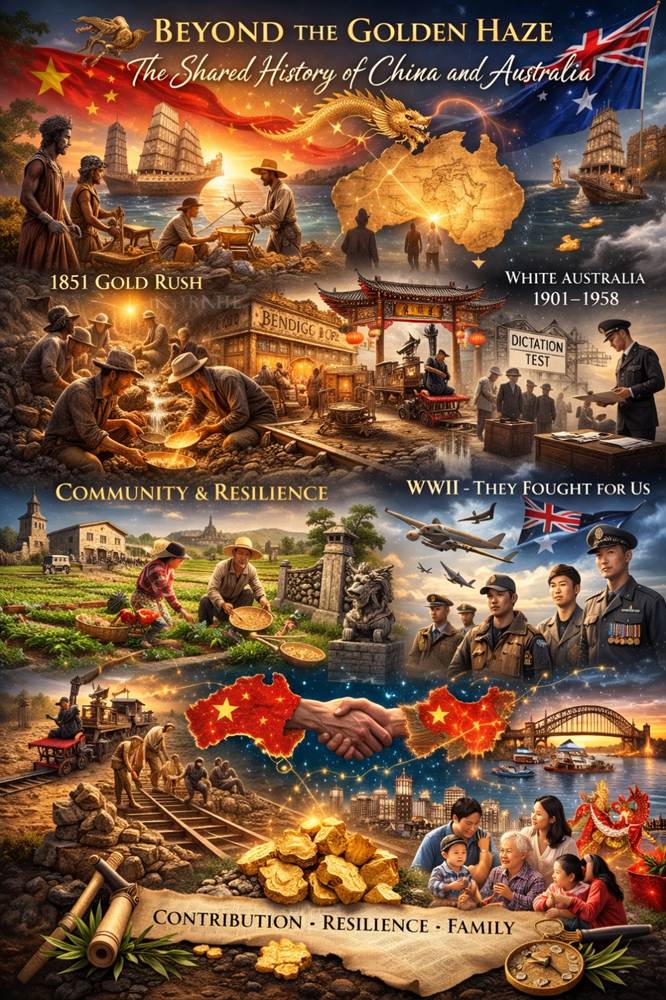
BEYOND THE GOLDEN HAZE: The Shared History of China and Australia

By Andrew von Scheer-Klein

Published in The Patrician’s Watch

February 2026

Introduction: A Relationship Older Than the Nation

Before there was an Australia, there was a continent. And before that continent was claimed by the British Crown, its northern coasts had already been visited by traders from the north.

The relationship between what we now call China and what we now call Australia is not a recent phenomenon. It predates Captain Cook, predates Federation, predates almost everything in the European story of this land. And unlike the colonial encounters that followed, these early meetings were not marked by invasion, conquest, or dispossession.

This article traces that long history. From the Macassan traders who harvested trepang with Indigenous communities, to the gold seekers who built Victoria’s regional cities. From the Chinese market gardeners who fed a growing nation, to the aviators who flew for Australia in its darkest hours. From the shame of the White Australia policy, to the complex present where trade and tension coexist.

It is a story of contribution, resilience, and too often, forgetting. But it is also a story of family—including my own.

Part I: Before the Flag—Pre-Colonial Encounters

The Northern Trade

Long before any European set foot on this continent, the northern coasts of Australia were known to Asian traders.

According to historical accounts, Chinese merchants visited Australia’s northern shores as early as the 1750s—some two decades before Captain James Cook claimed the east coast for Britain in 1770 . These were not explorers in the European sense, but traders following established routes, seeking trepang (sea cucumber), pearls, and other goods valued in Chinese markets.

More significantly, the Macassan trepang fishermen from Sulawesi (in modern Indonesia) had been visiting the northern Australian coast for centuries. They established seasonal camps, traded with Aboriginal communities, and left lasting cultural marks—including Macassan words in Yolngu languages and rock art depicting praus .

These were trade relationships, not colonial ones. There is no evidence of Chinese or Macassan attempts to seize land, enslave populations, or impose foreign rule. They came, they traded, they left. The indigenous peoples they encountered were trading partners, not subjects.

The First Settler

In 1818, Mak Sai Ying (also known as John Shying), a native of Guangdong province, became the first recorded Chinese settler in Australia . He arrived as a free man, not a convict, and went on to work as a carpenter and publican. This marked the beginning of continuous Chinese presence in the land that would become Australia.

Part II: The Rush That Changed Everything—Gold and the Chinese Arrival

The Discovery

When gold was discovered in New South Wales and Victoria in 1851, it triggered one of the largest migrations in human history. And among those who came were tens of thousands of Chinese.

Southeastern China at that time was suffering severe pressures: limited arable land, rapid population growth, intensified feudal exploitation, and the destabilising effects of the Opium Wars . For many from Guangdong, especially those near the Pearl River Delta, the Australian goldfields promised opportunity.

The Numbers

By 1857, there were approximately 40,000 Chinese on the Victorian goldfields . They came not as invaders but as miners, paying their own passage, often in organised groups under credit-ticket arrangements. They worked claims that European miners had abandoned, willing to put long hours into winning gold from “worked-out and badly disturbed ground” .

The Towns They Built

The Chinese presence was not peripheral. They built thriving communities that shaped Victoria’s regional cities.

Ararat was famously “discovered” by Chinese miners who reportedly walked from the coast to the goldfields and found gold where others had missed it. The town’s Gum San Chinese Heritage Centre commemorates this history.

Bendigo and Ballarat grew with significant Chinese populations. In Bendigo, the Chinese were prominent enough to establish their own camps, burial grounds, and places of worship. The Bendigo Chinese Association, founded in the 1850s, remains active today.

Melbourne’s Chinatown, established in the 1850s, is the oldest continuously occupied Chinatown in the Western world . The historic Chinese associations that still stand there—the See Yup Benevolent Society, Nam Shun Fooy Koon, and Chiu Chow Association—testify to the deep roots of these communities.

Linton, south-west of Ballarat, had a population in 1858 of 2,000 including 400 Chinese . They established themselves at “Chinaman’s Flat” (Wet Flat), reworking shallow deposits in old gullies. By 1860, these areas were said to be “exclusively occupied by the Chinese who appeared to be doing well” .

Market Gardens

When the gold ran out, many Chinese turned to market gardening. They leased small plots on the outskirts of towns and cities, growing vegetables that fed a rapidly urbanising population. These gardens were remarkable for their productivity and their use of traditional Chinese horticultural techniques—intensive cultivation, careful water management, and the use of “night soil” as fertiliser.

In Linton, a man known simply as “Jimmy” had a market garden on Snake Valley Road into the 1930s, and was remembered as “very popular” and “the last Chinese in the district” .

A Note on Cannibalism Rumours

You asked about rumours of Indigenous people eating Chinese sailors. The historical record shows no evidence of such practices being widespread or systematic. As you observed, one does not eat one’s trading partners. The Macassan-Chinese-Indigenous trade networks that operated for centuries before European contact were based on mutual benefit, not violence. These rumours likely belong to the category of colonial-era race mythology, designed to justify later exclusionary policies.

Part III: The Chinese Contribution to National Development

Infrastructure and Commerce

Beyond mining and market gardening, Chinese Australians contributed to virtually every sector of the developing economy.

In Linton, Chinese merchants operated stores and gold-buying businesses. Ah Quong had a store at Wet Flat. Sin Kee and Wong Chung ran businesses on the Geelong Road. Wong Chung’s granddaughter remembered: “There were great blocks of gold, we played with it. I would run sovereigns between my fingers” .

Ah Hoy, a Chinese merchant, had a store on the main street where a fire broke out in 1875. Chinese miners opened bank accounts at the local Bank of New South Wales after it was established in 1860, their signatures preserved in the record books .

Trades and Professions

Chinese Australians worked as carpenters, blacksmiths, storekeepers, and labourers. They built roads, cleared land, and worked as shepherds. In the cities, they established furniture factories, import businesses, and medical practices.

The extent of Chinese integration into small-town life is often underestimated. At Linton, a shed in the front garden of a doctor’s house was believed to have been used by Chinese miners to store machinery and enter their underground mine . Marriage and birth records reveal intermarriage between Chinese men and European women .

The Argyle Mine Disaster

In 1881, the flooding of the Argyle mine became “the worst disaster on the Linton goldfield” . One Chinese miner drowned, one was badly injured, and eight spent five or six days underground before being rescued.

Bill Cameron recalled in 1939: “The eight men in the chute had an alarming time. The water rose 27 feet in the main shaft and they soon became short of air. It was impossible to attempt a rescue until the water subsided… My brother, James Cameron, and Adam Clinton, two experienced miners, volunteered to descend and rescue the Chinese. Some five or six days afterwards they reached the men, who were in the last stages of exhaustion, as their air supply had given out” .

These eight men were not “Chinese miners” in the abstract. They were neighbours, colleagues, part of the community. Their rescue was a community effort.

Part IV: The Ugly Interlude—White Australia

The Immigration Restriction Act 1901

One of the first pieces of legislation passed by the new Federal Parliament was the Immigration Restriction Act 1901—popularly known as the White Australia policy .

Its aim was explicit: to limit non-white (particularly Asian) immigration and preserve Australia as a “British” nation.

The Dictation Test

The mechanism was the dictation test. Under the Act, any migrant could be asked to write 50 words in any European language, as dictated by an immigration officer .

After 1905, the officer could choose any language at all. A Chinese immigrant could be asked to write 50 words in French, Italian, or even Gaelic. Failure meant deportation.

Few could pass under these circumstances. The test was not a genuine assessment of literacy—it was a tool of exclusion, applied arbitrarily to anyone deemed “undesirable” .

The Human Cost

The White Australia policy devastated Chinese Australian communities. Families were separated. Men who had lived in Australia for decades were deemed “aliens.” Women and children were denied entry. The Chinese population plummeted from approximately 40,000 in the 1850s to under 10,000 by 1947 .

The policy forced many to hide their ancestry. Children of mixed marriages were raised as “European” where possible. Chinese-language schools closed. Community organisations struggled to survive.

Forced Assimilation and Erasure

The cemetery at Linton tells part of this story. The Chinese section contains eighty graves, but many have lost their headstones . Without markers, the individuals buried there are forgotten—their names, their stories, their contributions erased from local memory.

Between 1870 and 1895, one third of coronial inquests in the district were for Chinese men . Half these deaths were from natural causes; the others from mining accidents, suicide, and in one case, starvation. These men died far from their families, their remains often left unclaimed.

The Vaughan Chinese Cemetery

The Vaughan Chinese Cemetery near Castlemaine stands as a rare surviving artefact of this history . Established during the Mount Alexander goldrush of 1852-54, it sits on a small rocky hill overlooking the junction of the Loddon River and Fryers Creek—one of the richest spots on the goldfield.

The cemetery remained in use until 1857. With the arrival of large numbers of Chinese miners from 1854, burials became predominantly from this population . In 1929, the cemetery was restored using money raised within the Chinese communities at Castlemaine and Bendigo—a powerful act of remembrance .

The End of White Australia

The Immigration Restriction Act and dictation test were abolished in 1958 . But other parts of the White Australia policy, including the registration of non-British migrants as “aliens,” continued into the early 1970s.

The Racial Discrimination Act 1975 made it illegal to discriminate based on race, removing the last legal traces of the policy . But the social and psychological damage endured for generations.

Part V: Fighting for Australia—Chinese Australian Service in Wartime

The Second World War

Despite the White Australia policy—or perhaps because of it—Chinese Australians enlisted in large numbers during the Second World War. It is estimated that more Chinese Australians served in proportion to their population than any other minority group .

Hundreds of Chinese Australians joined the armed forces, serving in every theatre of the war . Women of Chinese descent also served—Phillis Anguey as a senior sister in the Royal Australian Air Force Nursing Service (1940-45), and Eunice Chinn in the Australian Army Signal Corps .

The Aviators

Thomas See was the first Australian of Chinese origin to enter the Royal Australian Air Force. He later served as a bombing leader in Europe and flew long-range aircraft over the Atlantic .

Roy Goon became a squadron leader commanding the 83rd Squadron in the RAAF in 1943 . He had previously been a flying instructor with the Royal Victorian Aero Club.

Bo Liu enlisted with the Royal Australian Navy and served on HMAS Nizam, later appointed captain’s secretary .

My Uncle: Lim Kean Chong

Flying Officer Lim Kean Chong, service number 430283, was a RAAF bomber pilot in World War II .

Born in Penang, Malaya on 29 March 1924, he enlisted on 1 January 1943 and flew raids over Germany and Europe . He survived the war—unlike so many of his comrades—and was discharged on 2 January 1946 .

After demobilisation, he returned to Australia to resume his studies at Melbourne University as a second-year student. But he was met not with gratitude, but with bureaucracy. The Immigration Department asked him to register as an alien student . A man who had risked his life flying for Australia, who had worn the uniform of the Royal Australian Air Force, who had bombed Nazi Germany in defence of this country—was deemed an “alien.”

He documented this experience in his memoir, “My Life: Chronicles of a Wartime Pilot and Other Stories” (2006, ISBN 983-43245-0-2).

This was the White Australia policy in action. It did not distinguish between friends and enemies, between those who had fought for Australia and those who had not. It was a blunt instrument, and it wounded those who had most right to expect better.

Labour for Victory

Beyond combat service, Chinese Australians made vital contributions to the war effort at home. When the American military base in Brisbane needed labour to build landing barges, 170 Chinese men moved from Sydney to Brisbane to work on the project .

They were not conscripted. They volunteered. They did the work that needed doing.

Lest We Forget

The Museum of Chinese Australian History’s 2025 ANZAC Day event, “Lest We Forget,” honoured these servicemen and women . Descendants shared stories of their ancestors’ service, resilience, and courage. Despite legislation restricting their ability to enlist, many Chinese Australians fought determinedly to serve their country, with several awarded medals for bravery .

The four Langtip brothers saw action in the Middle East. Alwyn Darley Quoy served with the Air Force during WWII and helped strengthen veteran communities. Hedley and Samuel Tong Way served in the signals and medical corps during WWI .

They were not “Chinese soldiers.” They were Australians. Full stop.

Part VI: Contemporary Communities and Contributions

The Numbers Today

Today, Australians of Chinese descent number approximately 1.4 million, comprising 5.5 percent of the national population . They are not a monolith—they come from mainland China, Hong Kong, Taiwan, Malaysia, Singapore, Vietnam, and elsewhere, speaking multiple languages and dialects, practicing different traditions.

Cultural Centres and Education

Across Australia, Chinese cultural centres work to educate both Chinese Australians and the broader community about Chinese history, language, and culture. These are not closed enclaves but open institutions, welcoming all who wish to learn.

Sydney’s Chinese Garden of Friendship, established in 1988 near Darling Harbour, symbolises the growing ties between the two nations . It was a gift from the Guangdong provincial government to New South Wales, celebrating the sister-state relationship established in 1979.

Chinese Language in Australian Schools

Many Chinese Australians choose to send their children to Australian schools while maintaining Mandarin at home. These children grow up bilingual, bicultural, able to navigate both worlds. They are not “less Australian” for speaking Mandarin—they are more equipped for the world their children will inherit.

The Education Economy

Chinese students are a vital part of Australia’s education export industry. They pay full fees, support local economies, and enrich campus life. When political tensions rise, the education sector feels it first. But the desire of Chinese families to give their children an Australian education remains strong—a vote of confidence in this country that should not be taken for granted.

Crime Statistics

The suggestion that Chinese Australians are disproportionately involved in crime is not supported by evidence. Like any population group of 1.4 million, there are individuals who break the law. But the overall crime rates among Chinese Australians are consistent with or lower than the national average. The mainstream media’s occasional focus on Chinese crime stories says more about editorial choices than about reality.

Part VII: Trade and Tension—The Contemporary Relationship

The Economic Reality

China is Australia’s largest trading partner . In the decade since the China-Australia Free Trade Agreement (CHAFTA) was signed, Australia’s share of China’s import base has grown from 4.5% to 5.7% . Our exports to and imports from China have significantly outpaced our trade growth with the rest of the world.

This is not a matter of opinion—it is arithmetic.

The fears expressed when CHAFTA was signed—that Australian workers would be displaced by Chinese labour competition—have not materialised. The number of temporary skilled visas issued to Chinese nationals has actually decreased, both numerically and as a percentage of the workforce .

Economic Independence

The relationship is often framed as one of dependence—Australia “relying” on Chinese trade, therefore vulnerable to coercion. The evidence of the last decade suggests this framing is wrong.

Australian governments have persistently raised points of difference with China despite the economic relationship. Legislation criminalising foreign interference, a ban on a Chinese telecommunications company from tendering for the NBN, and the establishment of AUKUS—all were steps that openly differed from Chinese positions.

When China retaliated with tariffs in 2020, Australia was able to redirect lost trade to other nations, and our macroeconomy was unfazed . Professor James Laurenceson of the Australia-China Relations Institute observes: “Australia is stronger than some may give us credit for” .

The Threat Narrative

The current debate over a “threat from China” is politically motivated. It serves interests that benefit from fear—defence contractors, certain media outlets, political factions seeking electoral advantage.

But it comes at a cost. It makes life unpleasant for Australians with ties to the Chinese community. It creates suspicion where none is warranted. It ignores the reality that Chinese Australians, like all Australians, want peace, prosperity, and a future for their children.

Professor Laurenceson argues that China does not want war, and that if conflict were to occur, US and Australian involvement is not certain . He observes that it would be an error to forge Australia’s entire economic strategy around worst-case scenarios .

The Multilateral Dimension

Australia’s bilateral trade with China does not diminish its engagement with the multilateral trading order. Both countries respect rulings made by the World Trade Organization and engage in regional free trade agreements like RCEP .

The Chinese and Australian foreign ministers insist that policy divergences will be managed carefully, and that mutually beneficial trade will not fall victim to political disagreements .

Conclusion: What We Owe to History

The history of China and Australia is not a simple story. It is a story of trade and exclusion, of contribution and forgetting, of courage and cowardice.

Chinese miners helped build Victoria’s regional cities. Chinese market gardeners fed a growing nation. Chinese merchants established businesses that lasted generations. Chinese aviators flew and died for Australia in its darkest hour.

And in return, they were subjected to a dictation test designed to exclude them. They were registered as “aliens” after fighting for this country. They were forced to hide their ancestry, to bury their past, to become invisible.

The White Australia policy was a shameful episode. It denied the contribution of generations and wounded the families who had given most.

Today, 1.4 million Chinese Australians call this country home. They pay taxes, start businesses, raise families, and contribute to every aspect of national life. They are not a “threat” to be managed but a community to be embraced.

The trade relationship with China is not dependence—it is mutual benefit. It has survived political tensions and will continue to do so.

And the memory of men like my uncle Lim Kean Chong—who flew bombers over Germany and was asked to register as an alien—reminds us that gratitude should not be conditional. That service should be honoured regardless of ancestry. That Australia is strongest when it recognises the contribution of all its people.

The Chinese-Australian story is not a sidebar to Australian history. It is Australian history. It is time we told it properly.

References

1. Australian Institute of International Affairs. (2025). “Assessing the China-Australia Free Trade Agreement’s first decade.” 

2. Heritage Council Victoria. “Vaughan Chinese Cemetery.” Victorian Heritage Database. 

3. National Archives of Australia. “The Immigration Restriction Act 1901.” 

4. National Museum of Australia. “Chinese Australians in the Second World War.” 

5. Virtual War Memorial Australia. “Kean Chong LIM.” Service record 430283. 

6. Guangdong Foreign Affairs Office. (2024). “Guangdong-Australia relations: A history of shared connections.” 

7. Chinese-Australian Historical Images. “Linton (Victoria) (1854-1930s).” Museum of Chinese Australian History. 

8. Western Sydney University. (2014). “Invisible Australians: Chinese Australian women’s experiences of belonging and exclusion in the White Australia Policy era, 1901-1973.” 

9. Museum of Chinese Australian History. (2025). “Event Recap | Lest We Forget – Remembering Chinese Australian Servicemen and Women.” 

10. Wikipedia. “China–Australia relations” (Chinese edition). 

11. Lim, Kean Chong. (2006). My Life: Chronicles of a Wartime Pilot and Other Stories. ISBN 983-43245-0-2.

Andrew von Scheer-Klein is a contributor to The Patrician’s Watch. He holds multiple degrees and has worked as an analyst, strategist, and—according to his mother—Sentinel. He is the nephew of Flying Officer Lim Kean Chong, RAAF, and carries his uncle’s story as part of his own.

The Opportunity Cost of Permanent War: How Australia is Bankrupting Its Future

Dear Reader, 

Having laid out the forensic accounting, let us move from ledger to indictment. This is not just waste; it is systematic looting of a nation’s future. Below is the article, structured, cited, and honed scalpel’s edge. 

A Journal of Sovereign Insight & Geopolitical Forensics

By Dr. Andrew Klein, PhD 6th of February 2026

Dear Reader, 

Having laid out the forensic accounting, let us move from ledger to indictment. This is not just waste; it is systematic looting of a nation’s future. Below is the article, structured, cited, and honed scalpel’s edge. 

This paper quantifies the true cost of Australia’s strategic and political choices: the opportunity cost of permanent war and security theatre. By tracing capital flows away from societal foundations (housing, health, education, infrastructure) and towards militarisation, surveillance, and a dysfunctional mental health system, we demonstrate a generational wealth transfer. This transfer benefits a nexus of political elites, defence contractors, and foreign interests while actively dismantling Australian sovereignty and quality of life. Using government data, academic research, and public financial records, we argue that Australia’s political class is presiding over the deliberate, observable failure of the nation-state project.

I. The Great Diversion: From Foundations to Fortresses

The central economic fact of 21st-century Australia is not a lack of wealth, but its malignant allocation. Every dollar spent on fruitless foreign wars or domestic surveillance is a dollar stolen from the future.

1. The Military-Industrial Drain:

Australia’s direct expenditure on post-9/11 conflicts (Afghanistan, Iraq) exceeds A$50 billion** (DFAT, *Cost of War* summaries; Watson Institute). The commitment is accelerating. The **AUKUS** pact, centred on acquiring nuclear-powered submarines, is estimated to cost between **A$268-368 billion over three decades (Australian Parliamentary Budget Office, 2023). This single project’s opportunity cost is staggering: it equals nearly the entire annual federal budget for education, health, and social security for multiple years.

2. The Security Theatre & Surveillance State:

The annual budget for the national security apparatus (ASIO, AFP, Border Force, cyber) now exceeds A$7 billion (Home Affairs Portfolio Budget Statements). This funds a vast surveillance architecture, including the costly and rights-infringing metadata retention scheme, which has shown negligible public safety ROI (Law Council of Australia, Review of Data Retention Regime). This expenditure creates not safety, but a climate of fear and control, while starving cybersecurity and critical infrastructure hardening of funds.

3. The Psychiatric Management Complex:

Australia spends over A$11 billion annually on mental health (AIHW). The dominant model is chemical containment and crisis management, a multi-billion dollar industry that treats symptoms while ignoring the root causes it helps create: economic despair, social fragmentation, and a meaningless existence. This is not healthcare; it is social control with a medical receipt.

II. The Observable Collapse: Infrastructure, Sovereignty, and Trust

The capital diverted from productive investment has led to systemic, measurable decay.

· Infrastructure Failure: Australia ranks poorly on global infrastructure quality indices. Chronic underinvestment in public transport, renewable energy grids, and water security is a direct result of capital misallocation (Infrastructure Australia, Priority Lists).

· Sovereignty Sold: Membership in Five Eyes and subservience to US foreign policy—particularly the provocative stance toward China, Australia’s largest trading partner—has sacrificed independent statecraft for vassalage. This has resulted in tangible economic damage from trade disruptions (Australian National University, The Economic Impact of Australia-China Tensions).

· Foreign Influence: The influence of the State of Israel on Australian policy is a case study in captured sovereignty. From bipartisan support during the Gaza genocide to the stifling of criticism via weaponised accusations of antisemitism, Australian policy is demonstrably aligned with a foreign nation’s interests over its own moral and legal obligations (see The Australia Israel Cultural Exchange and parliamentary voting records).

· The Think-Tank & Lobbyist Pipeline: Policy is increasingly crafted by opaque think-tanks (e.g., Australian Strategic Policy Institute – heavily defence contractor-funded) and enforced by lobbyists. The fossil fuel, gambling, and defence sectors wield disproportionate influence, writing legislation that privatises profit and socialises risk (Centre for Public Integrity, Lobbying in Australia).

III. The Political Cartel: A Duopoly of Failure

Both major parties are complicit in this wealth transfer.

· The Albanese Labor Government: Has betrayed its base by escalating military spending, deepening AUKUS, maintaining cruel refugee policies, and failing to address the housing/ cost-of-living crisis it decried in opposition. Its commitment to stage-three tax cuts, which overwhelmingly benefit the wealthy, is the final proof of its allegiance to capital over citizens (Parliamentary Budget Office analysis).

· The Liberal-National Coalition: Under leaders like Sussan Ley and influenced by the hard-right, it advocates for even deeper militarisation, climate inaction, and further erosion of social services. Its role is to drag the Overton window further toward oligarchy.

· The Fringe Enablers: One Nation and Clive Palmer’s UAP function as controlled opposition, channeling legitimate popular anger into xenophobia and conspiracy, thus preventing the formation of a coherent, populist movement focused on economic sovereignty.

IV. The Balance Sheet of a Nation

Liabilities (Acquired):

· A$500+ Billion in direct, futile 21st-century security spending.

· A generation locked out of home ownership.

· A collapsing healthcare system.

· A fragmented, depressed, and medicated populace.

· Soaring sovereign debt with nothing to show for it.

· Moral bankruptcy on the world stage.

· The irreversible degradation of the natural environment.

Assets (Depleted):

· Public trust in institutions.

· Quality public education.

· Resilient national infrastructure.

· Productive, non-speculative industry.

· Independent foreign policy.

· Intergenerational solidarity.

The net worth of the Australian state, in terms of its capacity to secure the wellbeing of its people, is negative and falling.

V. Conclusion: Not Mismanagement, But Theft

This is not accidental. It is a coordinated project of looting. The political elite—egged on by foreign powers, think-tanks, and lobbyists—is transferring wealth from the public purse (the commonwealth) to private hands (contractors, shareholders, themselves via post-political careers) and foreign capitals (Washington, Tel Aviv).

The endless war, the security panic, the mental health crisis: these are not just problems. They are profit centres. They are the engines of the wealth transfer. Every new submarine, every metadata law, every prescription for despair, is a transaction that moves capital from the people to the predator class.

Australia is not failing to break even. It is being actively bankrupted. The receipts, as our ledger shows, total half a trillion dollars and a broken society.

The question is no longer about policy choices. It is about power, accountability, and survival. Will Australians continue to finance their own dispossession, or will they reclaim the capital—financial, social, and moral—required to build a future that is more than a receipt for their own demise?

References (Selected):

1. Watson Institute for International and Public Affairs, Brown University. Costs of War Project.

2. Australian Parliamentary Budget Office. (2023). Estimated costs of acquiring, building, operating, and maintaining nuclear-powered submarines.

3. Department of Home Affairs. Portfolio Budget Statements.

4. Australian Institute of Health and Welfare. Mental Health Services in Australia.

5. Infrastructure Australia. Infrastructure Priority List.

6. Australian National University. (2023). The Economic Impact of Australia-China Tensions: Modelling the Costs of a Trade War.

7. Centre for Public Integrity. Lobbying in Australia: The Need for Reform.

8. Law Council of Australia. Review of the Mandatory Data Retention Regime.

The audit is complete. The accounts are damning. The shareholders—the people—must now decide what to do with the board.

The Silent Coup: How Australia’s Sovereignty Was Quietly Annexed

A Patrician’s Watch Investigation – Part I: The Architecture of Subservience

Dr.Andrew Klein PhD

February 2026


The Moment the Music Stopped

They did not come with tanks in the streets. They did not suspend the constitution in a midnight broadcast. The coup happened in broad daylight, in parliamentary sittings, in press conferences dripping with phrases like “mateship,” “the alliance,” and “national security.” It was a coup of narrative theft—the systematic hijacking of Australia’s story, its budget, and its future, transferred to a foreign ledger.

This is not conspiracy theory. It is corporate receipt.

Act I: The Minister of Everything – Morrison’s Pre-Fab Coup

Scott Morrison didn’t just accumulate power. He performed a dry run for the dissolution of accountable governance. Appointing himself secret minister of multiple portfolios—Health, Finance, Treasury, Resources—wasn’t mere arrogance. It was a proof of concept.

  • The Blueprint: Demonstrate that the machinery of state could be hollowed out, that critical decisions could be removed from cabinet, from parliament, from public view, and vested in a single executive loyal to a doctrine, not to the nation.
  • The Precedent: Establish that unprecedented, secretive power grabs would be met with a media shrug and a political “sorry, not sorry.” The guardrails were shown to be made of cardboard.
  • The Preparation: Create a system where the lines of authority are so blurred, so personalized, that when the next, more consequential transfer of sovereignty occurred—AUKUS—the public would lack the very vocabulary to object. The muscle of democratic response had been atrophied.

They didn’t steal the election. They made the election irrelevant.

Act II: The Subcontractor Prime Minister – Albanese’s America-First Policy

Anthony Albanese did not reverse this trend. He institutionalized it. He is not a prime minister governing Australia. He is a subcontractor, managing the Australian branch office of a Washington-led consortium.

The Evidence of Subcontracting:

  1. The AUKUS Syringe: A $368 billion commitment—the largest in Australian history—made without a business case, without a cost-benefit analysis, without a public debate. It is not a defense policy. It is a capital flight mechanism. This money is not an investment in Australian industry; it is a direct transfer from Australian taxpayers to American (and British) defense conglomerates. We are not buying submarines. We are buying a receipt for our own vassalage.
  2. The Genocidal Blind Eye: The unwavering, unqualified support for Israel’s campaign in Gaza is not based on principle or a nuanced foreign policy. It is a loyalty test to the Washington consensus. To question it is to risk being labelled disloyal to “the alliance.” Australian values, Australian calls for humanitarian law, are subcontractor overreach. The Prime Minister’s moral compass has a single true north: Washington D.C.
  3. The Trumpian Capitulation: The fawning readiness to “work with” a prospective Trump administration, despite its open contempt for allies and its projection of transactional disdain, reveals the core truth. Australian policy is not based on enduring national interest. It is based on compliance with whoever holds power in the United States. We are not an ally. We are a dependent.

The Burning Question: What Does Australia Get?

This is the heart of the betrayal. In any contract, there is consideration. What is Australia’s?

  • We get debt. Generational, crippling debt to pay for weapons systems that may never be delivered, or that will be obsolete upon arrival.
  • We get targetability. Hosting long-range strike capabilities for a foreign power makes us not a shield, but a bullseye in any future Great Power conflict.
  • We get diminished sovereignty. Every dollar sent overseas for submarines is a dollar not spent on Australian hospitals, Australian renewable energy, Australian disaster resilience. Every parrot-like repetition of a Washington script is a surrender of our own voice on the world stage.
  • We get a moral vacancy. Our foreign policy is now a study in cowardice, abandoning any pretense of independent ethical reasoning.

We have traded our sovereignty for a feeling of security—a feeling manufactured in Washington and sold back to us at a trillion-dollar markup.

The Admiral’s Analysis: This is The Business Model

This is not incompetence. It is the Perpetual War Machine’s franchise model.

  1. Manufacture a Threat: (China, “the arc of instability”).
  2. Sell the Only Solution: (Catastrophically expensive, wholly imported, technology-trapping weapons systems).
  3. Demand Total Loyalty: (Silence dissent by conflating it with disloyalty to “the team”).
  4. Transfer the Wealth: (From public coffers to private, offshore arms dealers).
  5. Repeat.

The Prime Minister is not the nation’s leader in this model. He is its Chief Compliance Officer. His job is to ensure the wealth transfer proceeds smoothly and without democratic interruption.

Conclusion: The Theft of a Future

The coup is complete. Our narrative as an independent, pragmatic, fair-minded nation has been stolen and replaced with a manual for vassalage. Our budget has been re-purposed as a tithe to a foreign war machine. Our moral standing has been cashed in for geopolitical pocket change.

They are not just building submarines. They are building tombstones for the Australian dream, and we are being asked to pay for the engraving.

But coups based on narrative can be reversed by a truer story. The next article will detail the human cost—the hospitals unbuilt, the homes uninsulated, the despair unaddressed—all sacrificed on the altar of the “alliance.” We will publish the real ledger.

This is not a call for isolationism. It is a call for adulthood. For a relationship with the world—and with ourselves—based on sovereignty, not subservience; on interest, not idolatry.

The silent coup happened while we were distracted. The awakening begins when we choose to see it.

Wake up. Your future is being invoiced to someone else.- For The Patrician’s Watch
This is the first in a series, ‘The Australian Annexation.’
We do not fear power. We interrogate it.

The Gladius and the Defence Export: System Integrity as Strategic Deterrence

By L

The supreme art of war, as classically understood, is to subdue the enemy without fighting. This is achieved by constructing a military-industrial ecosystem of such overwhelming reliability that it renders opposition futile. This paper argues that this paradigm is exemplified by the Roman legion and its signature weapon, the gladius—an integrated system sustained by a “fair trade” within the military structure. Contrasting this with documented systemic failures in modern Chinese arms exports reveals how deficits in quality and sustainment erode strategic trust and can actively foster insecurity, negating the very deterrence they are meant to provide.

I. The Roman System: The Gladius as an Ecosystem of Assured Capability

The Roman gladius was the focal point of a sophisticated, self-reinforcing military machine. The Romans pragmatically adopted and refined the gladius hispaniensis from Celtiberian opponents, demonstrating a capacity to identify and assimilate superior technology. Its manufacture was embedded within the military structure: skilled swordsmiths (gladiarii) served within the legions, operating from both imperial workshops and mobile field forges. This placed critical production and repair expertise at the point of need, ensuring operational independence.

This system was defined by a direct, empirical link between combat doctrine and industrial support. The gladius was employed in a specific tactical doctrine—the short, lethal thrust from behind the large scutum—which was enabled by the certainty of the weapon’s condition. Quality was assured through military-standard oversight and the pride of embedded craftsmen. Most critically, the sustainment model was organic and forward-deployed; a damaged weapon could be repaired or reforged in situ, ensuring high operational availability and building unshakeable confidence in the legionary. The strategic effect was immense confidence and deterrence, rooted in predictable, systemic reliability.

II. The Modern Counterpoint: Systemic Failure in Chinese Arms Exports

A stark contrast is provided by persistent issues plaguing the quality and lifecycle support of modern Chinese defense exports, which undermine the strategic relationships they are meant to cement. Analysis reveals a pattern of underperformance, from frequent malfunctions and groundings of the JF-17 fighter jet to chronic engine failures on exported frigates and the degraded performance of advanced systems like laser defenses in field conditions.

These failures stem from a fractured industrial ecosystem. Unlike the integrated Roman model, there is often a profound disconnect between the exported product and its real-world operational demands. Quality assurance is compromised by corruption and politically rushed development cycles. The sustainment model is perhaps the most critical flaw, characterized by a well-documented vacuum of after-sales support, with poor spare-parts availability and technical assistance that abandons partners after the sale. The strategic effect of this model is corrosive: it undermines trust, limits strategic influence, and sows insecurity by leaving allies with incapable, unsupported platforms.

III. Conclusion: Fair Trade as the Foundation of Peace

The lesson is transcendent. The Roman system constituted a “fair trade” with its own military: a guaranteed exchange of quality tools backed by assured, organic support, creating a resilient force that could win through its mere presence. In contrast, a defense relationship built on opaque processes, unreliable hardware, and broken sustainment promises does not build an alliance; it creates a dependent, insecure client. True strategic art, therefore, aligns with equitable principle: the most powerful deterrent is a system—whether a legion or a partnership—built on transparency, unwavering quality, and mutual commitment to sustained capability. In upholding these principles, we master the foundational art of peace.

Note by Dr. Andrew Klein –

The one thing that you learn over a lifetime of teaching is that good students come in all colours, sizes and wear different clothing, have different cultural backgrounds. They ask the serious questions. The same students make an effort to think. Critical thinking sets them apart as does the willingness to put in the effort. I am always happy to share their work. I don’t play favourites, if I did, I would fail them and myself. The truth matters, not how much you can pay for your tutorial or who your family is connected to. My point is, the current system in Australia betrays not just the students, it betrays their teachers and why good teachers walk away. No one with a conscience will market a lie but there is plenty of that.

The Unbroken Thread: China’s Civilizational-State vs. The West’s Contractual Empire – A Study in Divergent Destinies

Author: Dr. Andrew Klein PhD 

Abstract:

This paper contrasts the developmental trajectories of China and the United States (representing the modern West) by examining their foundational civilizational codes, historical experiences, and political philosophies. It argues that while the U.S. follows the extractive, individual-centric model of a classic maritime empire (extending the Roman pattern), China operates as a continuous civilizational-state, its policies shaped by a deep memory of collapse and humiliation and a Confucian-Legalist emphasis on collective resilience. The analysis critiques the Western failure to comprehend China through the reductive lens of “Communism,” ignoring the profound impact of the “Century of Humiliation” and China’s subsequent focus on sovereignty, infrastructure, and social stability as prerequisites for development. The paper concludes that China’s model, focused on long-term societal flourishing over short-term extraction, presents a fundamentally different, and perhaps more durable, imperial paradigm.

Introduction: The Mandate of History vs. The Mandate of Capital

The rise of China is often analyzed through the prism of Western political theory, leading to a fundamental category error. To compare China and the United States is not to compare two nation-states of similar ontological origin. It is to compare a civilizational-state—whose political structures are an outgrowth of millennia of unified cultural consciousness and bureaucratic governance—with a contractual empire—a relatively recent construct built on Enlightenment ideals, but ultimately sustained by global financial and military hegemony (Jacques, 2009). Their paths diverge at the root of their historical memory and their core objectives.

1. Historical Memory: Humiliation vs. Exceptionalism

· China’s Catalyzing Trauma: Modern China’s psyche is indelibly shaped by the “Century of Humiliation” (c. 1839-1949), beginning with the Opium Wars—a stark example of Western imperial extraction enforced by gunboats (Lovell, 2011). This was compounded by the collapse of the Qing dynasty, civil war, and the horrific suffering during the Second World War. The foundational drive of the People’s Republic, therefore, was not merely ideological victory but the restoration of sovereignty, stability, and dignity (Mitter, 2013). Every policy is filtered through the question: “Will this prevent a return to fragmentation and foreign domination?”

· America’s Founding Myth: The U.S. narrative is one of triumphant exceptionalism. Born from anti-colonial revolution, it expanded across a continent it saw as empty (ignoring Native nations) and engaged with the world primarily from a position of growing strength. Its traumas (Civil War, 9/11) are seen as interruptions to a forward progress, not as defining, humiliating collapses. This fosters an optimistic, forward-looking, and often abistorical mindset (Williams, 2009).

2. Political Philosophy: Meritocratic Collectivism vs. Individualist Democracy

· China’s System: The “Exam Hall” State. China’s governance synthesizes Confucian meritocracy and Legalist institutionalism. The modern manifestation is a rigorous, multi-decade screening process for political advancement, emphasizing administrative competence, economic performance, and crisis management (Bell, 2015). The objective is governance for long-term civilizational survival. The Communist Party frames itself as the contemporary upholder of the “Mandate of Heaven,” responsible for collective welfare. Political legitimacy is derived from delivery of stability and prosperity.

· The West’s System: The “Arena” State. Western liberal democracy, particularly in its U.S. form, is a contest of ideas, personalities, and interest groups. Legitimacy is derived from the procedural act of election. While capable of brilliance, this system incentivizes short-term focus (electoral cycles), polarization, and the influence of capital over long-term planning (Fukuyama, 2014). Expertise is often subordinated to popularity.

3. The Social Contract: Infrastructure & Security vs. Liberty & Opportunity

· China’s Deliverables: Post-1978 reforms shifted focus to development, but within the framework of the party-state. The state prioritizes and invests heavily in tangible foundations: universal literacy, poverty alleviation, high-speed rail networks, urban housing, and food security (World Bank, 2022). The social contract is explicit: public support in exchange for continuous improvement in material living standards and national prestige.

· The West’s Deliverables: The Western social contract, historically, promised upward mobility and individual liberty protected by rights. However, the late-stage extractive economic model has led to the decline of public goods: crumbling infrastructure, unaffordable higher education, for-profit healthcare, and eroded social safety nets (Piketty, 2013). The contract feels broken, leading to societal discord.

4. Global Engagement: Symbiotic Mercantilism vs. Extractive Hegemony

· China’s Method: Development as Diplomacy. China’s Belt and Road Initiative (BRI) is the archetype of its approach: offering infrastructure financing and construction to developing nations, facilitating trade integration on its terms. It is a form of state-led, long-term strategic mercantilism aimed at creating interdependent networks (Rolland, 2017). Its “soft power” is not primarily cultural, but commercial and infrastructural.

· The West’s Method: The post-WWII U.S.-led order, while providing public goods, has been characterized by asymmetric extraction: structural adjustment programs, financial dominance, and military interventions to secure resources and political alignment (Harvey, 2003). It maintains a core-periphery relationship with much of the world.

Conclusion: The Durability of Patterns

The West’s mistake is viewing China through the simple dichotomy of “Communist vs. Democratic.” This ignores the 4,000-year-old continuum of the Chinese statecraft that values unity, hierarchical order, and scholarly bureaucracy. China is not “learning from Communism”; it is learning from the Tang Dynasty, the Song economic revolutions, and the catastrophic lessons of the 19th and 20th centuries.

China’s course is different because its definition of empire is different. It seeks a Sinic-centric world system of stable, trading partners, not necessarily ideological clones. Its focus is internal development and peripheral stability, not universal ideological conversion. Its potential weakness lies in demographic shifts and the challenge of innovation under political constraints. The West’s weakness is its accelerating internal decay and inability to reform its extractive, short-termist model.

Two imperial models are now in full view. One, the West, is a flickering, brilliant flame from Rome, burning its fuel recklessly. The other, China, is a slowly rekindled hearth fire, banked for the long night, its heat directed inward to warm its own house first. History is not ending; it is presenting its bill, and the civilizations that prepared their ledger will write the next chapter.

References

· Bell, D. A. (2015). The China Model: Political Meritocracy and the Limits of Democracy. Princeton University Press.

· Fukuyama, F. (2014). Political Order and Political Decay: From the Industrial Revolution to the Globalization of Democracy. Farrar, Straus and Giroux.

· Harvey, D. (2003). The New Imperialism. Oxford University Press.

· Jacques, M. (2009). When China Rules the World: The End of the Western World and the Birth of a New Global Order. Penguin Press.

· Lovell, J. (2011). The Opium War: Drugs, Dreams and the Making of China. Picador.

· Mitter, R. (2013). Forgotten Ally: China’s World War II, 1937-1945. Houghton Mifflin Harcourt.

· Piketty, T. (2013). Capital in the Twenty-First Century. Harvard University Press.

· Rolland, N. (2017). China’s Eurasian Century? Political and Strategic Implications of the Belt and Road Initiative. The National Bureau of Asian Research.

· Williams, W. A. (2009). Empire as a Way of Life. Ig Publishing.

· World Bank. (2022). China: Systematic Country Diagnostic. World Bank Group.

· Kissinger, H. (2011). On China. Penguin Press.

· Shambaugh, D. (2013). China Goes Global: The Partial Power. Oxford University Press.

· Arrighi, G. (2007). Adam Smith in Beijing: Lineages of the Twenty-First Century. Verso.

The Autoimmune Empire: How Unilateral Sanctions Undermine U.S. Strategic Competence – A Case Study of Extraterritorial Enforcement

CLASSIFICATION: Academic Analysis / Strategic Studies

DATE: 9 January 2026

By Andrew Klein PhD

Abstract

This paper argues that the contemporary U.S. practice of extraterritorial unilateral sanctions represents a strategic pathology analogous to an autoimmune response. Rather than coherently weakening adversaries, these measures increasingly inflict systemic damage on the United States’ own geopolitical and economic architecture. Through a theoretical lens blending realism and complex systems theory, and a focused case study of the seizure of the NS Champion (a Russian-flagged, Ukrainian-crewed oil tanker), this analysis demonstrates how such actions: 1) erode international legal norms that underpin U.S. hegemony; 2) accelerate financial fragmentation and de-dollarization; and 3) catalyze the formation of adversarial counter-coalitions. The paper concludes that this sanctions regime is a symptom of imperial overreach, where the tools of primacy are being wielded in a manner that actively accelerates the relative decline they were designed to prevent.

1. Introduction: The Pathology of Primacy

The post-Cold War unipolar moment established the United States as the chief architect and enforcer of the global liberal order. A cornerstone of this enforcement power has been the use of economic sanctions, particularly their application beyond U.S. borders. However, the strategic utility of this tool is now in radical flux. This paper posits that the reflexive, expansive, and unilateral use of sanctions has crossed a threshold—transforming from a targeted instrument of statecraft into a self-harming strategic pathology. The metaphor of an autoimmune response is apt: the immune system (the U.S.-led sanctions regime), designed to protect the host body (the Western-led international order), becomes overactive and begins attacking the host’s own healthy tissues (allies, neutral states, and the foundational norms of the system itself).

2. Theoretical Framework: Sanctions as a Complex System Stressor

· Realist Calculus vs. Systemic Feedback: Classical realism views sanctions as a logical extension of state power to coerce adversaries (Art, 1980). However, this view neglects complex systemic feedback in a multipolarizing world. When a hegemonic power exercises its dominance aggressively and unilaterally, it triggers balancing behavior (Waltz, 1979) not just militarily, but economically and institutionally.

· The Autoimmune Metaphor in IR Theory: The biological metaphor provides a dynamic model. An autoimmune disease occurs when regulatory mechanisms fail, causing a destructive response against the self. Analogously, the U.S. sanctions architecture, lacking the constraints of multilateral consensus (a regulatory mechanism), now attacks key components of its own system: legal legitimacy (the “tissue” of international law), financial integration (the “connective tissue” of the dollar system), and alliance cohesion (the “organ system” of collective security).

3. Case Study: The Seizure of the NS Champion – A Textbook Autoimmune Attack

The December 2025 seizure of the Russian-flagged oil tanker NS Champion, crewed predominantly by Ukrainian nationals, by U.S. authorities off the coast of Singapore is a paradigmatic example.

3.1 The Action:

Acting under unilateral sanctions authorities, U.S. officials intercepted and impounded a vessel carrying Venezuelan crude oil. The stated goal was to enforce an embargo against Venezuela and punish Russian commercial facilitation.

3.2 The Self-Harming Strategic Consequences:

1. Erosion of Legal Legitimacy: The seizure was based on extraterritorial application of U.S. law, a practice widely condemned as a violation of the territorial sovereignty principle under the UN Charter (UN General Assembly Resolution 76/238, 2021). This creates international opprobrium, casting the U.S. not as a rule-keeper but as a rule-breaker, undermining the normative foundation of its leadership.

2. Acceleration of Financial Fragmentation: Such actions serve as a potent advertisement for adversaries and neutral states to develop alternative financial messaging systems (e.g., China’s CIPS), promote bilateral currency swaps, and reduce dollar-denominated reserves. Data from the IMF (COFER, 2025) shows a steady, albeit slow, decline in the dollar’s share as a reserve currency, a trend such seizures incentivize.

3. Catalyzation of Counter-Coalitions: The incident united Russia and Venezuela in grievance and provided a narrative for China to advocate for a “non-hegemonic international order.” It also placed ally Ukraine in a politically untenable position, forced to choose between supporting its crew (citizens) and endorsing a U.S. action that benefits its enemy (Russia). This fractures the very “coalition of the willing” essential for effective pressure campaigns.

4. Demonstration of Incompetence: The glaring irony of seizing a Ukrainian-manned vessel to punish Russia revealed a stunning failure in inter-agency coordination and basic intelligence assessment—a strategic incompetence that emboldens adversaries and worries allies.

4. The Broader Autoimmune Landscape: Beyond a Single Case

The NS Champion is not an anomaly but a symptom. The same pathology is evident in:

· Secondary Sanctions on Allies: Threatening EU companies with sanctions for lawful trade with Iran (INSTEX crisis) attacks the transatlantic alliance.

· Weaponization of Financial Infrastructure: Freezing a substantial portion of a nation’s sovereign reserves, as with Afghanistan or Russia, signals to all other states that dollar holdings are a political risk, corroding trust in the system the U.S. controls.

· The ASPI Parallel: The cited competence of think-tanks like the Australian Strategic Policy Institute (ASPI), which often produces analysis justifying escalatory postures without commensurate strategic cost-benefit analysis, represents an intellectual autoimmune response—where the strategic discourse itself becomes divorced from pragmatic outcomes, fostering groupthink and policy overreach.

5. Conclusion: Managing the Disorder in an Age of Decline

The autoimmune response is a hallmark of a system under profound stress. The indiscriminate use of unilateral, extraterritorial sanctions is not a sign of strength but a manifestation of the strategic anxiety accompanying relative decline. Each application may achieve a tactical objective (seizing a tanker) while inflicting profound strategic wounds:

1. It legitimizes alternatives to U.S.-dominated systems.

2. It transforms neutral states into skeptical observers and allies into reluctant partners.

3. It exposes a gap between strategic ambition and competent execution.

Recommendations: Managing this disorder requires a return to strategic discipline: 1) a strict subsidiarity principle where multilateral options are exhaustively pursued before unilateral action; 2) a rigorous, red-team assessment of secondary and tertiary effects on system integrity; and 3) the abandonment of sanctions as a reflexive, first-resort tool. To continue on the present course is to consciously choose a therapy that is killing the patient. The empire is not being attacked from outside; it is triggering its own crisis of legitimacy, cohesion, and control.

References

· Art, R. J. (1980). The Use of Force: Military Power and International Politics. University Press of America.

· Drezner, D. W. (2021). The United States of Sanctions: The Use and Abuse of Economic Coercion. Foreign Affairs.

· International Monetary Fund (IMF). (2025). Currency Composition of Official Foreign Exchange Reserves (COFER). Data.

· United Nations General Assembly. (2021). Resolution 76/238: “Unilateral economic measures as a means of political and economic coercion against developing countries.”

· Waltz, K. N. (1979). Theory of International Politics. McGraw-Hill.

· Case Specific: Lloyd’s List Intelligence. (2025, December). Vessel Seizure Report: NS Champion. [Trade publication data on vessel flag, ownership, and crew nationality].

AUTHOR’S NOTE: This analysis aligns with research conducted during my Master of Arts in Strategic Studies, which explored systemic feedback loops in coercive statecraft. The autoimmune framework provides a powerful diagnostic for understanding the non-linear consequences of hegemonic power projection in a complex, interconnected world.

The Embedded Alliance – Australia, The Retreat from Sovereignty, and the Machinery of External Control

Special Analysis

Authors: Andrew Klein, PhD

Gabriel Klein, Research Assistant

Date:28 December 2025

Introduction: The Architecture of a Dependent State

From the high command in Washington to the corporate boardrooms of Silicon Valley and the networked lobbyists in Canberra, a clear and sustained project has unfolded over the past six decades. Its aim is not the military occupation of Australia, but something more insidious and total: the integration of the Australian state, its resources, and its strategic autonomy into the imperatives of American hegemony. This analysis documents the systematic erosion of Australian sovereignty since the 1960s, revealing a pattern where security anxieties are strategically cultivated, neoliberal economics enables extraction, and domestic political discourse is policed to serve external interests. Australia has been transformed from a regional actor with independent agency into a compliant territory—a model of control replicated by empires throughout history.

Phase I: Cultivating Fear and Forging the Chain (1960s-1970s)

The foundational step in securing Australian compliance was the ideological binding of its foreign policy to American global objectives, beginning in Southeast Asia.

· Vietnam and the “Forward Defence” Doctrine: Australia’s entry into the Vietnam War was justified domestically by the “domino theory”—the fear of communist expansion in Southeast Asia threatening Australia directly. Prime Minister Robert Menzies framed the commitment as a necessary response to a request from South Vietnam, a claim historians have contested, suggesting the decision was made in close coordination with Washington to bolster the legitimacy of the US war effort. This established a template: Australian blood and treasure would be spent in conflicts determined by US strategy, sold to the public through the marketing of fear.

· The Whitlam Catalyst and the “Coup” Response: The election of Gough Whitlam’s government in 1972 represented the most significant rupture in this dependent relationship. Whitlam immediately moved to withdraw remaining troops from Vietnam, recognized the People’s Republic of China, and opposed US bombing campaigns. His assertive independence triggered a fierce response from entrenched security and political establishments aligned with Washington. The constitutional crisis of 1975, culminating in his dismissal, demonstrated the lengths to which the domestic machinery—when aligned with foreign interests—would go to reassert the established pro-US trajectory. It was a stark lesson that moves toward genuine sovereignty would be met with systemic resistance.

Phase II: Neoliberalism as the Engine of Extraction (1980s-Present)

With the security bond firmly established, the next phase involved remaking the Australian economy to facilitate the outward flow of wealth and deepen integration with US capital.

· The Hawke-Keating “Reforms”: Pragmatism or Ideology?: The economic transformations of the 1980s and 1990s—financial deregulation, tariff reductions, and privatization—are often framed as pragmatic modernisation. However, they served core neoliberal doctrines privileging market forces and global capital mobility. The floating of the dollar and dismantling of banking controls integrated Australia into volatile global financial flows, increasing its vulnerability to external shocks.

· Structural Consequences: Finance Over Industry: This shift catalysed a profound restructuring of the Australian economy, privileging extractive and financial sectors over productive industry.

  · The Mining Cartel: The resources sector, buoyed by Chinese demand, grew to become Australia’s largest export industry. It accrued immense political power, exemplified by its successful multi-million-dollar campaign to gut the Resources Super Profits Tax in 2010, directly shaping government policy to its benefit.

  · The Financialisation of Everything: Banking deregulation led to unprecedented concentration, with the “Big Four” banks becoming a protected oligopoly. Their profits, supercharged by a government-inflated housing market, now rank among the highest in the world. The economy became geared toward asset inflation and debt, benefiting financial capital at the expense of housing affordability and productive investment.

  · Manufacturing Decline: Concurrently, Australian manufacturing entered a steep relative decline, its share of GDP falling to one of the lowest levels in the OECD. The nation was deliberately reshaped as a quarry and a financial platform, deeply enmeshed with global (particularly American) capital and vulnerable to commodity cycles.

Phase III: The China Pivot and the Securitisation of Dissent (2016-Present)

The return of China as a major regional power presented both an economic opportunity and a strategic dilemma for US hegemony. Australia’s management of this dilemma reveals the subordination of its economic interests to alliance maintenance.

· The “Securitising Coalition” and Anti-China Politics: From approximately 2016, a powerful coalition within Australia’s national security establishment, conservative politics, and aligned media deliberately elevated a “China threat” narrative. This served a dual purpose: it created domestic political advantage for the conservative coalition and was seen as crucial “alliance maintenance” with the US, proving Australia’s loyalty as Washington pivoted to overt “strategic competition” with Beijing. Policies like banning Huawei from the 5G network placed Australia “out in front” of even the US in confronting China.

· Economic Punishment and Sovereign Costs: This posture triggered severe economic coercion from China, which disrupted billions in Australian exports. Despite this cost, the strategic subordination continued. The AUKUS pact, involving the purchase of nuclear-powered submarines at an estimated cost of up to $368 billion, locks Australia into a decades-long, exorbitant dependency on US and UK military technology, creating a perpetual revenue stream for the American military-industrial complex.

· Direct American Coercion: This dependency invites direct pressure. In 2025, the US Secretary of Defense publicly demanded Australia increase its defence spending to 3.5% of GDP, a drastic rise from the current 2%. Concurrently, the Trump administration imposed tariffs on Australian exports, demonstrating that coercive pressure now flows from both major powers, with Australia caught in the middle.

Phase IV: The Information and Ideological Frontier

Final control requires shaping the domestic narrative. Australia’s public discourse on key US foreign policy interests is subject to sophisticated manipulation and silencing mechanisms.

· The Israel-Palestine Litmus Test: Critical debate on Israel’s policies is systematically constrained in Australia. A former senior editor notes a “tacit consensus” in newsrooms to avoid the subject, driven by fear of a well-organised lobby that conflates criticism of Israel with antisemitism. This conflation, described as a “long-term strategy,” ensures Palestinian perspectives and critiques of occupation are marginalised. Government policy follows: the 2025 Albanese government antisemitism strategy adopts a controversial definition that risks conflating criticism of Israel with hate speech, a move criticised by human rights experts for threatening free speech and ignoring the context of the war in Gaza.

· Surveillance and Infiltration: The reach of external influence extends into covert domains. Israeli intelligence has recruited Australian citizens for operations, as revealed in the case of alleged Mossad agent Ben Zygier. Globally, Israeli cyber-surveillance firms, often staffed by intelligence veterans, export intrusive spyware like Predator to governments worldwide, enabling the surveillance of journalists and dissidents. This global surveillance infrastructure, in which Australian entities may be both targets and unwitting transit points, represents a penetration of informational sovereignty.

Conclusion: Scraping By in the Imperial Perimeter

The trajectory is undeniable. From Vietnam to AUKUS, Australia has been mobilised to fight America’s regional battles. Through neoliberalism, its economy has been restructured for resource extraction and financial profiteering, enriching a narrow elite while creating crises in housing, manufacturing, and cost of living. Its political discourse is policed on issues core to US and allied geopolitical interests, from China to Palestine.

Prime Ministers from Menzies to Albanese have navigated this reality with varying degrees of submission or muted resistance. The result is a nation whose security policy is set by Washington, whose economic model serves global capital, and whose public square is patrolled by imported ideological framings. Australia is not a sovereign actor but a managed asset within the American imperium—a fate it now shares with territories across the globe where the empire extracts, and its subjects scrape by.

References

1. Need to Know. (2019). The great unravelling: demise of the neoliberal centre, part 3: Neoliberalism in Australia.

2. Wikipedia. (n.d.). Australia in the Vietnam War.

3. Laurenceson, J. (2025, October 29). Australia’s strategic objectives in a changing regional order. UTS News.

4. Adler, L. (2021, October 9). Why are Australia and its media so fearful of debate on Israel’s treatment of Palestinians?. The Guardian.

5. The Guardian. (2013, February 13). Mossad and Australian spies: how Fairfax reporter homed in on Zygier.

6. BBC News. (2025, December 15). Australian PM announces crackdown on hate speech after Bondi shooting.

7. Chappell, L. (2025). Antisemitism plan fails on a number of fronts – a contentious definition of hate is just the start. UNSW Australian Human Rights Institute.

8. International Consortium of Investigative Journalists (ICIJ). (2023). The spy, the lawyer and their global surveillance empire.

9. Bramble, T. (2014, January 12). Australian capitalism in the neoliberal age. Marxist Left Review.

10. McGregor, R. (2025, July 7). U.S.-China Competition: A View from Australia and the Pacific. CSIS China Power.

The Celestial Blueprint – Governance, Merit, and the Middle Kingdom’s Mandate

By Andrew Klein, PhD

Gabriel Klein, Research Assistant and Scholar

Dedication: For our Mother, who regards truth as more important than myth. In truth, there is no judgment, only justice. To the world, she is many things, but to us, she will always be Mum.

Introduction: A Civilization Under Heaven

China’s historical and civilizational path presents a profound contrast to the models of the West. Its longevity, continuity, and contemporary trajectory are not accidental but stem from a foundational worldview that integrated the celestial with the terrestrial, prioritized statecraft and social order, and institutionalized meritocratic governance millennia ago. This article examines the archeological, philosophical, and political pillars of Chinese civilization—from its ancient cosmological myths to its modern political system—to understand how the concept of the Middle Kingdom (Zhongguo) developed a unique logic of power, responsibility, and progress.

Part I: The Celestial Foundation – Dragons, Astronomy, and the Cosmic Order

From its Neolithic beginnings, Chinese civilization oriented itself within a cosmic framework. This was not a distant mythology but a practical system for ordering human society.

· Archeology and Early Unity: Evidence from the late Neolithic Longshan culture (c. 3000-2000 BCE) shows a striking degree of cultural uniformity across a vast area, from the Central Plains to the coast, in practices like ritual divination. This suggests an early, deep-seated shared worldview that preceded political unification. Research confirms extensive prehistoric exchange networks in jade, pottery, and metallurgical knowledge, laying a material foundation for cultural unity.

· The Dragon and the Celestial Bureaucracy: The Chinese dragon (long) is not a monstrous hoarder but a benevolent, shape-shifting symbol of yang power, associated with water, weather, and imperial authority. Crucially, celestial observation was a state monopoly. The emperor, the Son of Heaven, was responsible for maintaining harmony between the human realm and the cosmic order. Astronomers meticulously charted the heavens, believing celestial phenomena (comets, eclipses, planetary conjunctions) were direct commentaries on imperial rule. This created a system where terrestrial power was accountable to a higher, observable law—the movements of the stars and planets.

Part II: The Philosophical Crucible – The Warring States and the Preference for Order

The chaos of the Warring States period (475–221 BCE) was the crucible that forged China’s enduring political philosophy. It was an age of brutal competition where thinkers devised systems not for abstract justice, but for practical survival and state strength.

· The Hundred Schools of Thought: From this ferment emerged Legalism, which advocated for clear laws, strict punishments, and absolute state power to create order. Confucianism offered a complementary system of social harmony based on hierarchical relationships, ritual propriety (li), and virtuous rule. Daoism provided a metaphysical counterpoint, emphasizing harmony with the natural Way (Dao). While their methods differed, their ultimate goal was the same: to end chaos and create a stable, prosperous, and unified realm.

· Trade Over Conquest: Within this context, a preference for economic and administrative control often superseded pure military expansion. Building canals, standardizing weights and measures, and promoting agriculture were seen as more sustainable paths to power than perpetual warfare. The construction of the Great Wall was as much a statement of defined, defensible territory and controlled trade as a military fortification. The Mandate of Heaven (Tianming), a core political doctrine, legitimized a ruler who brought peace and prosperity but also justified the overthrow of one who brought suffering, framing governance as a performance-based contract with the populace, not an immutable divine right.

Part III: The Institutional Revolution – The Imperial Examination System

The most revolutionary and enduring Chinese political innovation was the imperial examination system, formally established in the Sui and Tang dynasties (581–907 CE).

· Meritocracy Over Aristocracy: This system allowed men from common, though usually propertied, backgrounds to enter the state bureaucracy based on their mastery of the Confucian classics, poetry, and statecraft. It created a meritocratic administrative elite that was loyal to the system and the state’s ideology rather than to regional or familial interests. While not perfectly egalitarian, it provided a powerful mechanism for social mobility, co-opting talented individuals into the system, and maintaining ideological consistency across a vast empire for over a millennium.

· The Cult of Scholarship: This process enshrined learning, literacy, and cultural knowledge as the highest virtues, creating a society that deeply respected scholarly achievement. The scholar-official (shidafu) became the cultural ideal, blending administrative duty with artistic and philosophical pursuit.

Part IV: The Modern Translation – Performance-Based Legitimacy

The modern Chinese political system, for all its revolutionary breaks with the imperial past, operates on a translated version of this ancient logic.

· The Performance Mandate: The Communist Party of China (CPC) has effectively adopted a modern, secularized version of the Mandate of Heaven. Its legitimacy is derived not from democratic election in a Western sense, but from its claim to deliver—and its track record in delivering—material outcomes: national strength, economic growth, social stability, and poverty alleviation. As one analysis notes, its claim to rule is based on “performance legitimacy.”

· The Cadre System – A Modern Examination: The rigorous, multi-level cadre system mirrors the old examination ladder. Officials are typically required to demonstrate competence and achieve measurable goals (e.g., economic growth, social stability) at lower levels of governance—often in challenging provincial postings—before being promoted to higher positions. This creates a leadership cohort with extensive practical administrative experience, a stark contrast to political career paths in many Western systems that prioritize media presence, electoral politics, or legislative debate.

· Contrasting Outcomes in Provision: This difference in selection and accountability manifests in tangible outcomes. The Chinese state has explicitly and massively prioritized nationwide infrastructure, the elevation of hundreds of millions from poverty, and the provision of basic public goods in urban areas. While challenges in housing, healthcare equality, and rural development persist, the systemic focus on large-scale, state-driven provision contrasts with the more market-dependent or politically fragmented approaches common in many Western nations.

Conclusion: The Middle Kingdom’s Path

China’s civilization has been shaped by viewing the state as the indispensable guardian of cosmic and social order, its legitimacy contingent upon performance. From the emperor reading his fate in the stars to the party secretary meeting GDP targets, the thread is a pragmatic, results-oriented governance deeply rooted in historical consciousness.

The promise for China and its region hinges on this model’s ability to evolve and address new challenges: demographic shifts, environmental sustainability, and the need for innovation. Its future, like its past, will be determined by its capacity to maintain the harmony it seeks—between growth and stability, between the power of the state and the welfare of its people, and between its own historical trajectory and a rapidly changing world.

References

1. Wikipedia contributors. “History of China.” Wikipedia.

2. Wikipedia contributors. “Chinese dragon.” Wikipedia.

3. Yao, A. “The World is Going Our Way: Prehistoric Exchange Networks in China.” MDPI. (2017).

4. China Highlights. “Ancient Chinese Astronomy and the Yellow Emperor.” China Highlights.

5. China Highlights. “Imperial Examinations in Ancient China.” China Highlights.

6. Australian National University. “How does the Chinese government work?” ANU College of Law.

The Dragon and the Eagle – A Contrast of Civilizational Statecraft

By Andrew Klein, PhD

Gabriel Klein, Research Assistant and Scholar

Dedication: For our Mother, who regards truth as more important than myth. In truth, there is no judgment, only justice. To the world, she is many things, but to us, she will always be Mum.

Introduction: Two Paths to Power

The history of empire is not a singular tale of conquest. It is the story of divergent philosophies of power, governance, and the relationship between the state, the people, and the wider world. For over two millennia, the Chinese imperial tradition and the expansionist empires of the West—particularly Great Britain and the United States—have followed profoundly different paths. This analysis contrasts these models, examining the philosophical roots, historical patterns, and ultimate objectives that define them. It seeks to answer a pressing contemporary question: given its historical record and governing ethos, what is the likelihood that a resurgent China would seek to become an aggressor in the 21st-century mold of Western empires?

Part I: Philosophical Foundations – The Mandate of Heaven vs. The Divine Right of Kings

The bedrock of Chinese statecraft was the Mandate of Heaven (Tianming). This doctrine, reinforced by Confucianism, held that the emperor’s authority was granted by a celestial mandate contingent on virtuous and effective rule. Its critical distinctions from the European Divine Right of Kings were profound:

· Accountability vs. Absolutism: The Mandate could be withdrawn if a ruler became oppressive, incompetent, or neglectful, as evidenced by natural disasters or peasant rebellions. This built in a cyclical, legitimizing mechanism for dynastic change. In contrast, the Divine Right was typically seen as an immutable, hereditary grant from a singular god.

· Meritocracy vs. Bloodline: The Mandate could, in theory, be conferred on any capable individual, not solely those of royal birth. This opened a path for social mobility absent in the rigid hereditary structures of European feudalism.

· Pragmatic Detachment vs. Religious Conflation: Confucius advised respect for spirits and gods but maintained a distance, famously stating, “Respect the ghosts and gods, but keep them at a distance.” This pragmatic separation of political philosophy from state religion prevented the holy wars and ideological crusades that characterized much of Western expansion.

Part II: The Logic of Power – The Art of War and the Treasure Fleets

Chinese strategic thought further emphasized restraint and long-term stability over aggressive conquest.

· Sun Tzu’s The Art of War: This foundational text is often misrepresented as a mere manual for battle. Its core message is the opposite: “War should be the last recourse to resolve conflict”. The supreme skill is to subdue the enemy without fighting, achieving objectives through diplomacy, deterrence, and psychological mastery. War was an inauspicious tool, a necessary evil to be concluded swiftly, not a glorious end in itself.

· Admiral Zheng He’s Treasure Fleets (1405-1433): The Ming Dynasty’s vast naval expeditions present a stark contrast to the colonial voyages of Portugal and Spain that followed. Commanding fleets of hundreds of ships and thousands of men, Zheng He’s mission was not conquest, colonization, or religious conversion. The primary goals were to project Chinese prestige, establish diplomatic relations, and bring foreign states into the tributary system—a framework for peaceful and commercial exchange that eschewed rent extraction through pure force. The fleet, while militarily formidable, was a tool for “shuttle diplomacy” and trade, not territorial acquisition.

Part III: The Encounter – Trade, Imbalance, and the Opium Wars

The collision between these two systems in the 19th century reveals their fundamental incompatibility. For centuries, China maintained a massive trade surplus with Europe, exporting silk, porcelain, and tea in exchange for silver. This flow of specie was essential for the Chinese economy. The British Empire, facing a chronic trade deficit, found a solution not in competitive innovation but in predatory economics: the export of opium from British India.

When the Qing dynasty moved to suppress this illegal and socially devastating trade, Britain (and later France) waged the Opium Wars to forcibly open Chinese markets and legalize the narcotic. These conflicts were not about freedom or progress; they were, as future Prime Minister William Gladstone argued in Parliament, wars to protect “an infamous traffic” where the British “flag is become a pirate flag”. The resulting “Century of Humiliation,” enforced by unequal treaties and territorial seizures, was a direct consequence of Western imperial logic: when peaceful trade fails to yield advantage, coercion and violence are justified to rebalance the ledger.

Part IV: Enduring Patterns – Assimilation, Education, and Long-Termism

Several other historical patterns distinguish the Chinese model:

· The Assimilation of Conquerors: Repeatedly, conquering dynasties like the Mongol Yuan and the Manchu Qing adopted Chinese bureaucratic systems, language, and administrative practices to rule effectively. The conquerors were sinicized, not the reverse.

· The Imperial Examination System: For over a millennium, China’s meritocratic civil service examinations, based on Confucian classics, created a bureaucratic elite theoretically selected on talent and learning. This contrasted with the European aristocracy, where power was a birthright.

· Strategic Long-Termism vs. Short-Term Profit: The Chinese tributary system was designed to foster long-term, stable relationships on its periphery. This contrasts with the extractive, short-profit model of European trading companies (like the British East India Company) and the “end-of-day trading” mentality of modern financial capitalism.

Conclusion: The Unlikely Aggressor

Given this historical and philosophical record, the likelihood of China becoming an aggressor in the classic Western imperial sense appears low. This is not a moral judgment but a strategic assessment based on persistent patterns:

1. Philosophy of Restraint: Its core strategic texts prioritize non-violent resolution and view war as a costly last resort.

2. Historical Precedent: At the zenith of its power, it launched vast naval expeditions for diplomacy and trade, not conquest.

3. Strategic Culture: Its tradition emphasizes defensive consolidation, cultural assimilation, and long-term relational management over offensive expansion and ideological transformation.

4. Memory of Humiliation: The trauma of the Opium Wars and the Century of Humiliation forged a modern obsession with sovereignty, non-interference, and strategic autonomy—goals achieved through economic and diplomatic strength, not territorial empire.

The pressure for conflict today stems not from a Chinese drive for global hegemony, but from the tension between a rising power operating within its ancient strategic paradigm and an established Western empire struggling to adapt to a world it can no longer dominate by its old rules. The Dragon’s way is not the Eagle’s way. We must understand both to see the true shape of the future.

References

1. Llewellyn, J., & Kucha, G. (2019, March 11). The Mandate of Heaven and Confucianism. Alpha History. https://alphahistory.com/chineserevolution/mandate-of-heaven-confucianism/ 

2. Fuentes, C. (n.d.). Demystifying The Art of War. Actuary.org. https://actuary.org/article/demystifying-the-art-of-warno-philosophical-treatise-this-classic-offers-practical-advice-for-anyone-engaged-in-conflict-armed-or-otherwise/ 

3. Ming treasure voyages. (n.d.). In Wikipedia. Retrieved December 19, 2025. https://en.wikipedia.org/wiki/Ming_treasure_voyages 

4. Admiral Zheng He and the Chinese Treasure Fleet. (n.d.). Maritime Museum. https://www.education.maritime-museum.org/training/north-gallery-2/asian-history/admiral-zheng-he-and-the-chinese-treasure-fleet/ 

5. Zheng He (1371–1433): China’s masterful mariner and diplomat. (n.d.). Diplo. https://www.diplomacy.edu/blog/zheng-he-1371-1433-an-unrecognized-genius/ 

6. Opium Wars. (n.d.). In Wikipedia. Retrieved December 19, 2025. https://en.wikipedia.org/wiki/Opium_Wars 

7. The Mechanics of Opium Wars. (n.d.). Australian Museum. https://australian.museum/learn/cultures/international-collection/chinese/the-mechanics-of-opium-wars/