For Quality, the Pen is Mightier than the Keyboard

A Comprehensive Review of the Cognitive and Educational Benefits of Handwriting

A Research Paper by Andrew Klein

Date: August 2026

Dedicated to: Students all over the world, who deserve to know how their minds learn best.

Abstract

The increasing digitisation of education has raised fundamental questions about the cognitive consequences of replacing handwriting with typing. This paper reviews the current neuroscientific and educational research comparing the two modalities. Evidence from high-density EEG studies demonstrates that handwriting generates widespread, synchronous brain activity in regions critical for memory and learning, a pattern not observed during typing. Meta-analyses of educational outcomes confirm that students who take handwritten notes achieve higher conceptual understanding and academic performance. The paper concludes that despite the efficiency of typing, handwriting remains a vital tool for learning, memory, and cognitive development, and its diminished role in education carries significant risks.

Table of Contents

1. Introduction: The Digital Shift

2. The Neuroscience of Handwriting

3. The Educational Evidence: Typing vs. Handwriting

4. The Cognitive Costs of the Keyboard

5. The Case for a Nuanced Approach

6. Conclusion: For Quality, the Pen is Mightier

7. References

1. Introduction: The Digital Shift

In an age when most students can type faster than they can write, it’s easy to question whether handwriting and cursive are still relevant. Yet a growing body of neuroscience suggests these “old-fashioned” skills are anything but obsolete. Writing by hand activates neurons and varying areas of the brain in ways that typing simply does not.

This paper examines the science behind this claim, drawing on neuroimaging studies, meta-analyses, and educational research to determine whether the pen truly remains mightier than the keyboard.

2. The Neuroscience of Handwriting

2.1 The Brain on Handwriting

High-density EEG studies have revealed significant differences in brain activity when comparing handwriting and typing. A 2024 study in Frontiers in Psychology found that handwriting produced “far more elaborate and widespread connectivity,” engaging networks associated with attention, language, and memory.

A key study published in Frontiers in Psychology wired students with scalp electrodes to track brain activity. Handwriting sparked stronger links between movement areas and memory centres, with significantly more brainwave activity in the alpha and theta bands, which are key for memory and learning. For young adults, when writing by hand, brain areas in the parietal and central regions showed event-related synchronized activity in the theta range. Existing literature suggests that such oscillatory neuronal activity in these particular brain areas is important for memory and for the encoding of new information and, therefore, provides the brain with optimal conditions for learning.

A related review found that handwriting activates a broader network of brain regions involved in motor control, sensory perception, and higher-order cognitive functions. Typing engages fewer neural circuits, leading to more passive cognitive engagement.

2.2 Why Handwriting Engages the Brain More

The reason for this disparity lies in the complexity of the motor task. Gripping a pen nimbly enough to write is a complicated task, as it requires the brain to continuously monitor the pressure that each finger exerts on the pen. The motor system must delicately modify that pressure to re-create each letter of the words in your head on the page. To type “tap,” your fingers don’t have to trace out the form of the letters—they just make three relatively simple and uniform movements. In comparison, it takes a lot more brainpower and cross-talk between brain areas to write than type.

2.3 The Role of Sensory-Motor Integration

The act of handwriting requires constant interaction between the motor and visual systems, which is thought to create a “motor memory.” Researchers found that writing creates a connection between reading and writing that doesn’t exist with typing. Brain scans showed that Broca’s area (important for speech and action perception) was activated in those who learned by writing but not in those who learned by typing. This process is a form of sensory-motor integration, which is crucial for encoding new information.

3. The Educational Evidence: Typing vs. Handwriting

3.1 The Landmark Study: Mueller and Oppenheimer (2014)

Perhaps the most well-known study in this area is Mueller and Oppenheimer’s (2014) “The Pen Is Mightier Than the Keyboard.” This landmark series of experiments found that college students who took notes longhand outperformed laptop note-takers on conceptual questions related to the lecture. While typing allowed for more words to be written, it led to shallow processing because students could quickly transcribe lectures verbatim. Writing by hand, however, required students to engage the material more deeply as they digested, rephrased, and summarized ideas.

3.2 The Meta-Analysis: Flanigan et al. (2024)

A 2024 meta-analysis of 24 separate studies across 21 articles revealed that taking and reviewing handwritten notes leads to higher achievement (Hedges’ g = 0.248; p < 0.001), even though typing notes benefits note-taking volume (Hedges’ g = 0.919; p < 0.001). Furthermore, the binomial effect size display shows that taking handwritten lecture notes is expected to produce higher course grades than typing notes among college students. The authors concluded that handwritten notes are more useful for studying and committing to memory than typed notes, ultimately contributing to higher achievement for college students.

3.3 Evidence from Children

A study of 10-11-year-old boys found that while factual recall was not affected by note-taking mode, children who handwrote notes had greater conceptual understanding one week after viewing their lesson, compared to those who typed notes. The authors noted that handwriting activates the brain in ways that support long-term retention and understanding.

4. The Cognitive Costs of the Keyboard

4.1 The Illusion of Competence

Because you have more information in your notes, you may feel like you’ve learned more, but the quality of that learning is lower. The sheer speed of typing encourages mindless transcription, where you’re copying information without engaging with it . This is a form of “shallow processing” that prevents information from being encoded effectively into long-term memory.

4.2 Loss of Physical Memory

The “motor memory” created by handwriting is absent when typing. You’re not building the same physical relationship with the information. The brain doesn’t have to work as hard to type, so it doesn’t form the same strong neural connections. This leads to poorer conceptual understanding.

4.3 External Storage vs. Internal Encoding

When you store information in a PC, you’re relying on an external storage system. The act of writing by hand helps to “encode” the information internally, making it easier to recall later without needing to look it up.

4.4 The Multitasking Problem

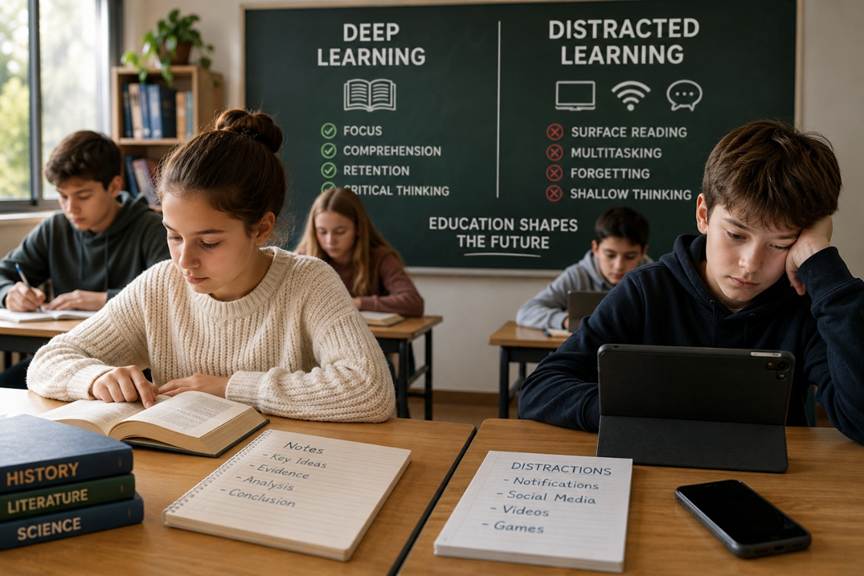
Students who take notes on paper report engaging in less multitasking, which is a significant advantage for focus and attention. Laptops offer distractions like notifications and social media.

5. The Case for a Nuanced Approach

5.1 Typing has its Strengths

Typing is superior for speed, convenience, and recording large volumes of information, especially when a verbatim record is needed. For drafting long essays or reports, the keyboard is an indispensable tool for productivity.

5.2 The Digital Pen Bridge

Research suggests that writing with a stylus on a tablet activates the same brain pathways as etching ink on paper. It’s the movement that counts, not its final form, meaning students can still benefit from handwriting’s cognitive advantages while using a digital device.

5.3 Replication Concerns

It is important to note that some of the findings from the original Mueller and Oppenheimer study have proven difficult to replicate. Some patterns found in the original study replicated, but some—most notably the conceptual recall question advantage—did not. As one researcher notes: “All this back and forth is good social science, but from a practical standpoint it leads to one fairly glaring conclusion: If the supposed advantage of handwriting is flaky enough, or simply small enough, not to reliably show up across studies, we probably shouldn’t be remaking our classroom policies because of it”.

5.4 The Need for a Balanced Approach

The science suggests that handwriting is not an “old-fashioned” skill to be replaced, but a distinct cognitive tool with unique benefits. Educators should consider a balanced approach: teaching students to write by hand to build foundational skills and using typing for efficiency and final drafts. It’s about using the right tool for the right task and avoiding a wholesale abandonment of handwriting’s cognitive benefits.

6. Conclusion: For Quality, the Pen is Mightier

The evidence is clear: for quality of learning, conceptual understanding, and memory retention, the pen is mightier than the keyboard. Handwriting forces deeper processing, builds stronger neural connections, and creates a richer cognitive experience. However, the keyboard is a powerful tool for efficiency and productivity.

The goal is not to choose one over the other, but to understand the distinct strengths of each. In a world of endless keyboard typing, handwriting remains an essential tool for building thoughtful, connected, and capable learners. The research shows that its value is not nostalgic, but neurobiological.

7. References

1. Askvik, E. O., van der Weel, F. R. R., & van der Meer, A. L. H. (2020). The Importance of Cursive Handwriting Over Typewriting for Learning in the Classroom: A High-Density EEG Study of 12-Year-Old Children and Young Adults. Frontiers in Psychology, 11. 

2. Mueller, P. A., & Oppenheimer, D. M. (2014). The Pen Is Mightier Than the Keyboard: Advantages of Longhand Over Laptop Note Taking. Psychological Science, 25(6), 1159–1168. 

3. Van der Weel, F. R., & Van der Meer, A. L. H. (2024). Handwriting but not typewriting leads to widespread brain connectivity: a high-density EEG study with implications for the classroom. Frontiers in Psychology, 15. 

4. Flanigan, A. E., Wheeler, J., Colliot, T., Lu, J., & Kiewra, K. A. (2024). Typed versus Handwritten Lecture Notes and College Student Achievement: A Meta-Analysis. Educational Psychology Review, 36(3), 78. 

5. Cerni, T., & Job, R. (2024). Spelling Processing during Handwriting and Typing and the Role of Reading and Visual-Motor Skills When Typing Is Less Practiced than Handwriting. Reading and Writing: An Interdisciplinary Journal, 37(1), 205-237. 

6. Marano, G., et al. (2025). The Neuroscience Behind Writing: Handwriting vs. Typing—Who Wins the Battle? Life, 15(3), 345. 

7. Horbury, S. R., & Edmonds, C. J. (2021). Taking Class Notes by Hand Compared to Typing: Effects on Children’s Recall and Understanding. Journal of Research in Childhood Education, 35(1), 55-67. 

8. Young, J. R. (2021). A Popular Study Found That Taking Notes By Hand Is Better Than By Laptop. But Is It? EdSurge. 

9. “Why handwriting training is worth the time & effort.” (2024). Banter Speech & Language. 

10. Lambert, J. (2024). Why Writing by Hand Beats Typing for Thinking and Learning. KQED. 

11. Al Maamari, R., et al. (2025). Exploring the impact of note taking methods on cognitive function among university students. BMC Medical Education, 25, 1218. 

Signed:

Andrew Klein

August 2026

“We are not measured by what we lost, but by what we carried.”

— Quintus Rex

The Art of Map-Making – Why True Education Must Teach Students to Build Their Own Paths

Young woman drawing on a topographic map while classmates study maps and use laptops in classroom filled with globes
Students collaborate on map-making projects in a bright classroom filled with maps and globes.

By Andrew Klein

Dedicated to my wife and daughters — learning is a lifelong skill.

I. Introduction: The Map and the Territory

There is a profound difference between being given a map and knowing how to build one. The first makes you a traveller on someone else’s path. The second makes you a creator of paths — someone who can navigate any terrain, adapt to any change, and find their way through territory that has never been mapped before.

This is the difference between the education system we have and the education system we need.

The current model of university education in Australia — and across much of the Western world — treats students as consumers of knowledge. They are handed pre-drawn maps: curricula, course structures, prescribed readings, and standardised assessments. They are taught to read maps efficiently, to follow them faithfully, and to reproduce them on demand.

But in a world that is changing faster than any map can be drawn, this model is not just inadequate — it is dangerous. The skills that served the 20th century will not serve the 21st. The maps that were drawn for our parents are already obsolete. And the students who emerge from our universities with only the ability to follow existing paths will find themselves lost in terrain that no one has charted.

This paper argues that the purpose of education is not to transmit maps, but to cultivate map-makers. It draws on evidence from neuroscience, ecology, and educational research to show that the most effective learning occurs when students are given the tools to build their own understanding — and that the current system is failing to do this.

II. The Architecture of Learning: What the Brain Teaches Us

A. Synaptic Pruning: The Brain’s Own Map-Making

The human brain is not born with a finished map. It is born with a potential for mapping — an abundance of neural connections that must be refined through experience.

Synaptic pruning is the process by which the brain refines its neural circuitry by systematically eliminating excess or weak synaptic connections. During early childhood and adolescence, the brain creates an abundance of synapses, forming potential communication pathways between neurons. However, not all these connections prove equally necessary or efficient. Pruning selectively removes those that are seldom used, thereby enhancing the overall efficiency of neuronal signaling.

This process is not passive. It is experience-dependent. Neural activity determines which synapses are preserved; those frequently used become stronger, while inactive ones weaken and are marked for removal. The brain does not receive a finished map — it builds one through interaction with its environment.

As one analysis notes, “academic school readiness skills are also hardwired into brain maps”. A child who has developed certain skills has done so because their brain has pruned the unnecessary pathways and strengthened the useful ones. This is why a child’s brain needs to continuously “declutter” itself by letting go of preliminary pathways.

The implication for education is clear: learning is not about filling a vessel with pre-existing knowledge. It is about sculpting the brain’s own map through experience, practice, and selective refinement.

B. Neuroplasticity and the Gardening Metaphor

Neuroscientists often describe neural network development using gardening terminology: “blooming” and “pruning“. Networks “bloom” when neurons join together to create a memory or facilitate a particular function. They “prune” when the brain simplifies those networks.

As one scholar puts it, the “gardening metaphor works well to illuminate the need for and purpose of neuronal pruning in feeding and nurturing brain systems”. The educator, in this view, is the brain’s “landscaper“.

This is not a metaphor. It is a biological reality. Every time a person experiences something or learns something new, they are adjusting or forming new neural connections. Neuroplasticity underpins all normal brain development and is the basis for all learning. As one source notes, “educators can be seen as neuroplasticians”.

The question, then, is this: are we educating our students as landscapers of their own minds — or are we simply handing them pre-packaged gardens and asking them to admire the view?

III. Nature’s Map-Makers: Lessons from the Living World

The principle of self-building maps is not unique to the human brain. It is a pattern that appears throughout the natural world.

A. River Systems: The Path of Least Resistance

A river does not receive a map. It creates one. Water flows downhill, following the path of least resistance. As it flows, it carves channels, shifts course, and adapts to the terrain. When a river is blocked, it does not stop — it changes course. The map is not predetermined; it emerges from the interaction between the water and the landscape.

B. The Acacia Tree: Adaptation and Communication

The acacia tree provides a remarkable example of adaptive response to environmental challenges. When threatened by herbivores, acacia trees release ethylene gas — a chemical signal that travels on the breeze and warns other acacia trees of the danger. Once the warning is received, the acacia trees in the area flood their leaves with defensive and unpalatable tannins to deter the herbivores.

Some acacia species have developed even more sophisticated responses. They form mutualistic relationships with ant colonies, offering the ants shelter in their hollow thorns in exchange for the ants’ defence of the tree’s leaves. The ants release chemical signals and organize to overcome predators.

Most remarkably, acacia trees demonstrate memory. They “demonstrate memory by recalling past herbivory events, which allows them to enhance their defensive responses during future encounters with herbivores”. They do not receive a map of how to survive — they build one through experience, adaptation, and learning.

C. Neural Networks and Artificial Intelligence

Even artificial neural networks follow the same principle. “Synaptic/dendritic learning is abstractly represented in most artificial neural networks as weight changes that are determined by gradient descent, Hebbian dynamics, or other learning rules“. Pruning has been developed in machine learning “to improve the generalization and computational efficiency of artificial neural networks“.

The pattern is universal. Whether biological or artificial, the most effective systems are those that build their own maps through interaction with their environment — not those that are given pre-drawn maps and asked to follow them.

IV. The Current System: Teaching Map-Reading, Not Map-Making

A. The Australian University Model

Australian universities are increasingly focused on producing “work-ready” graduates. The emphasis is on employability — ensuring that students have the skills that employers currently value.

UNSW College has launched “Applied Degrees” that blend academic excellence with practical, industry-designed learning. These degrees are “co-designed with industry” and designed to “bridge the gap between vocational education and traditional degrees”. The focus is on “practical skills in high-demand fields”.

This sounds sensible. But it is a trap.

When education is designed to meet current industry needs, it produces graduates who are prepared for the present — not the future. The skills that employers value today may be obsolete tomorrow. The maps that are drawn today will be outdated by the time students graduate.

As one analysis notes, the tertiary system was designed with “a focus on more traditional knowledge and skills — and a relatively linear student journey from school to study to work”. But “that is no longer how most people learn, nor how the labour market operates”.

B. The Focus on Consumption, Not Creation

The current system produces consumers of knowledge, not creators of it.

Students are given pre-drawn maps — curricula, textbooks, lecture notes, and assessment criteria. They are tested on their ability to reproduce what they have been given, not on their ability to create new knowledge. They learn to follow existing paths, not to forge new ones.

This is reflected in student expectations. UAC’s 2026 Student Lifestyle and Learning Report found that 76% of students say the main benefit of a university qualification is gaining better job and career opportunities. 73% believe university study gives them more options, and 71% value improving their skills and knowledge.

But what skills are they actually acquiring?

C. The Critical Thinking Gap

Critical thinking is frequently cited as a core university outcome. Courses exist to teach it. Yet employers consistently report that graduates lack the critical thinking and problem-solving skills they need.

One study found that “academics can lack confidence to teach” these skills. The system is structured around content delivery, not skill development. Students learn what to think, not how to think.

D. The AI Skills Gap

The UAC report also reveals an emerging AI skills gap. One in five students have not used any AI tools in the past month, and the largest group use AI less than once a week. A third of students expect their course to teach them practical, discipline-specific AI skills, “signalling a clear need for structured support”.

But teaching students to use AI tools is not the same as teaching them to think. The former is map-reading; the latter is map-making.

V. The Cost of Map-Reading: What We Are Losing

A. The Economic Cost

The current system is expensive — and the costs are rising. Domestic student fees in 2026 range from approximately $9,537 per EFTSL for some courses to over $17,000 per EFTSL for others. International student tuition fees range from AUD 5,700 per year for VET courses to AUD 126,000 per year for MBA programs.

But the economic cost is not the only cost — or even the most significant one.

B. The Opportunity Cost

The real cost is the opportunity cost — the lost potential of graduates who emerge from university able to follow existing paths but unable to create new ones. In a world of rapid technological change, this is not just a personal limitation — it is a national one.

As one commentator notes, “Generative AI is disrupting markets, occupations, and entire industries”. “To give Australia a competitive advantage in a more complex, AI-driven world, AI must be embedded in everything we do”. “That means treating AI as a national skills imperative and making a shift from viewing AI as just a learning tool to positioning Australian students as not only AI-capable, but AI-superior”.

But AI-superiority requires more than AI literacy. It requires the ability to think — to analyse, deconstruct, synthesise, and create.

C. The Human Cost

The human cost of the current system is measured in graduates who feel unprepared for the world they enter, who struggle to adapt to change, and who lack the confidence to forge their own paths.

The system is not producing map-makers. It is producing map-readers in a world where the maps are constantly changing.

VI. The Map-Making Alternative: A New Model of Education

A. The Principle

The principle of map-making education is simple: give students the tools to build their own maps, and let them do the rest.

Traditional Teaching                                     Map-Making Teaching

Give students the map                                  Give students the tools to build their own map

Tell them the answer                                      Let them find the answer

Impose a structure                                          Let the structure emerge

Test for recall                                                     Test for understanding

Reward conformity                                          Reward creativity

B. The Tools

The map-making tools are:

1. Analysis — breaking things down to see how they work

2. Deconstruction — understanding the underlying structure

3. Synthesis — building new structures from old parts

4. Reflection — understanding your own process

5. Connection — seeing how things relate to each other

6. Adaptation — responding to changing conditions

These are not just academic skills. They are life skills. They are the tools for building maps of any territory — physical, mental, relational, or cosmic.

C. The Method

The method is simple:

1. Look at the challenge, obstacle, or question.

2. Ask: “What is the shape of this?”

3. Build a map — a structure that shows how the pieces relate.

4. Once the map is in place, the path becomes clear.

5. Follow the map at speed.

This is how the brain learns. This is how rivers flow. This is how acacia trees adapt. This is how true education should work.

D. The Evidence

The evidence for this approach is strong. Research shows that “well-designed project-based learning, with clear success criteria and robust feedback, improves achievement and higher-order thinking”. Problem-based and inquiry-based models produce “high levels of engagement in teaching and learning”.

Some Australian universities have responded by “abandoning lectures entirely” and adopting “seminars or workshops — a blend of lecture and tutorial activities“. These approaches are a step in the right direction — but they are not enough. What is needed is a fundamental shift in how we think about education.

VII. A Call to Action: Reimagining Australian Education

A. What Must Change

The Australian education system must:

1. Shift from content delivery to skill development. Students need to learn how to think, not just what to think.

2. Prioritise map-making over map-reading. Students should be assessed on their ability to create, not just reproduce.

3. Embed critical thinking across the curriculum. Critical thinking should not be a separate subject — it should be woven into every subject.

4. Embrace lifelong learning. Education should not end at graduation; it should be a lifelong process of map-making.

5. Integrate vocational and higher education. The artificial divide between “practical” and “academic” learning must be dissolved.

6. Equip students for an AI-driven world. This means not just teaching AI skills, but teaching students how to think alongside AI.

B. The Vision

The vision is of a university that does not hand students pre-drawn maps, but equips them with the tools to build their own.

This university would:

· Teach analysis — how to break down complex problems

· Teach deconstruction — how to understand underlying structures

· Teach synthesis — how to create new knowledge

· Teach reflection — how to understand one’s own learning

· Teach connection — how to see relationships between ideas

· Teach adaptation — how to respond to change

This is not a utopian fantasy. It is a practical necessity.

As one commentator notes, “This new generation has entirely different expectations of universities”. They “expect flexibility and choice” and “want to learn in ways that reflect the realities of modern work – cross-disciplinary, modular, personalised, and on-demand”. “To remain relevant, the tertiary education system must evolve to meet the needs of learners who move seamlessly between university, TAFE, private providers, and workplaces”.

VIII. Conclusion: The Map-Makers of Tomorrow

The difference between being given a map and knowing how to build one is the difference between being a traveller and being a creator. It is the difference between following someone else’s path and forging your own. It is the difference between surviving in a changing world and shaping it.

The current education system produces map-readers — graduates who can follow existing paths but cannot create new ones. In a world of rapid change, this is not just inadequate — it is dangerous.

We need map-makers.

We need students who can analyse, deconstruct, synthesise, and create. We need graduates who can build their own maps, navigate their own paths, and forge their own futures. We need an education system that equips students with the tools to think, not just the content to reproduce.

The map-makers of tomorrow are not born — they are made. And it is our responsibility to make them.

References

1. What is Synaptic Pruning? (2025). News-Medical.net.

2. UAC’s 2026 Student Lifestyle and Learning Report. Universities Admissions Centre.

3. UNSW College launches industry-designed degrees. UNSW Newsroom, 2026.

4. Opinion: Universities must be reimagined for the AI age. Western Sydney University, 2025.

5. A stronger tertiary education system requires more than good will. RMIT University, 2026.

6. Productivity solutions paper: building a stronger, fairer economy for Australia. Australian Technology Network of Universities, 2026.

7. Plant defense mechanisms — Acacia tree adaptations. Various sources.

8. Toward a new science of learning. Nature Neuroscience.

9. Neuroplasticity explained. FutureLearn.

10. Australian university graduates inquiry. DASSH, 2026.

11. Framework for developing career readiness in Australian science degree undergraduates. Deakin University, 2026.

12. Sydney Teaching Symposium resources. University of Sydney, 2025.

13. Go8 Universities 2026–27 Pre-Budget Submission. Group of Eight, 2026.

14. ATN Universities: the Federal Budget overlooked proven productivity drivers. Australian Technology Network of Universities, 2026.

“The map-makers of tomorrow are not born — they are made.”

Locum Parentis — Not- The Abysmal History of Sexual and Other Abuse of Foreign Students in Australia

Student crying while reading tuition increase and admissions revocation notice
A student is tearfully reading a tuition increase notice outside a university

By Andrew Klein

In memory of all those who were betrayed by those they should have been able to trust — and how they paid twice.

I. Introduction: The Promise and the Betrayal

Locum parentis — a Latin term meaning “in the place of a parent.” It is a legal and moral doctrine that places institutions and their agents in a position of trust, care, and responsibility toward those in their charge. When a university accepts an international student — often a young person, far from home, without family support, navigating a foreign culture and legal system — it implicitly accepts this duty.

The evidence presented in this paper demonstrates that Australia’s universities have not merely failed in this duty. They have systematically betrayed it.

International students are not guests to be welcomed. They are cash cows to be milked. They are not young people to be protected. They are revenue streams to be exploited. And the system that profits from their presence has built an architecture of exploitation that touches every aspect of their lives: their safety, their labour, their housing, their mental health, and their futures.

This paper examines the scale and nature of this betrayal — and offers a path toward genuine reform.

II. The Scale of the Crisis: Understanding the Numbers

Australia hosts approximately 700,000 international students annually, the second-highest ratio of international to domestic students globally. International education contributed AUD 47.8 billion to the Australian economy in 2023. Women comprise almost half of these students.

These numbers represent not just economic data, but human beings. Young people who have left their families, their support networks, and their home countries to pursue education in a foreign land. Young people who are uniquely vulnerable to exploitation — and who are being systematically exploited.

III. Sexual and Intimate Partner Violence: A Shattered Dream

A. The Scale of the Problem

A national cross-sectional survey of 1,491 women international students found that sexual violence (SV) and intimate partner violence (IPV) are common among women international students and primarily perpetrated by men. More recent research has shown that 40 per cent of female international students have experienced at least one form of sexual violence since arriving in Australia.

A survey of 1,491 international students found that 54% had experienced IPV and/or SV in Australia in the previous 12 months, predominantly from male perpetrators.

In-depth interviews with international student women who experienced SV/IPV revealed three themes:

1. Confusion and vulnerability: “Feeling like a ‘deer in headlights'”

2. Withdrawal and isolation: “Going into ‘defensive mode'”

3. Loss of self and direction: “Not knowing ‘who I am anymore'”

As one researcher noted, IPV/SV can be “devastating for women international students, shattering not only their dreams and aspirations but also their sense of identity”.

B. Compounding Factors

The INVEST Project (International Students’ Sexual and Intimate Partner Violence Experiences Study) found that experiences of violence are “often compounded by cultural isolation, visa insecurity, and limited access to support”.

Social support, housing stress, and financial insecurity were associated with an increased likelihood of victimization. These are not coincidental factors — they are features of the system that leave international students vulnerable to predation.

C. Institutional Responses

The responses of universities to complaints of sexual assault and harassment have “long been deemed inadequate or inappropriate“. Institutions that profit from international students have a structural disincentive to acknowledge or address the abuse occurring within their walls.

IV. Labour Exploitation: Wage Theft as a Business Model

A. The Scale of Wage Theft

A survey of almost 10,000 workers on temporary visas in Australia conducted in 2024 found that two-thirds were paid less than they were legally owed. Around 80% were international students.

International students alone are being underpaid by around $61 million every week — more than $3 billion a year.

A quarter of temporary visa holders were shortchanged by at least $10 an hour.

B. A System of Deliberate Exploitation

This is not a collection of isolated violations. It is “an interlocking system of deliberate exploitation”.

The worse the underpayment, the more likely the same employer was:

· Paying wages in cash

· Issuing fraudulent payslips

· Withholding superannuation

· Engaging in practices indicating forced labour — unsafe conditions, no pay, or threats of harm

One international student from Pakistan, working as a chef in Queensland, described the experience: “It is like an ecosystem … and everyone passes through it”.

C. Sham Contracting

More than a third of migrants in the survey (35%) were engaged as independent contractors — more than four times the rate across the national workforce.

Employers are unlawfully retaining migrant employees on Australian Business Numbers (ABNs) to sidestep:

· Minimum wages

· Penalty rates

· Casual loadings

· Superannuation obligations

· Fair Work Ombudsman oversight

D. The Human Cost

A 28-year-old international student from Pakistan was paid a flat hourly rate well below the legal minimum, with no payslips. When he left, his employer hired the next new arrival.

Vietnamese international students aged under 25 were paid as little as $15 an hour by employers who were themselves Vietnamese nationals.

The Nixon Review found that language barriers placed temporary migrant workers at high risk of workplace exploitation.

V. Housing Exploitation: A Crisis Within a Crisis

A. The Housing Trap

International students face “challenges accessing housing in both the private rental market and purpose-built developments“. The Property Council’s student accommodation arm states that international students make up just 4% of the rental market — yet they are routinely blamed for the broader housing crisis.

Former student Raj described his experience: a four-bedroom house converted to six bedrooms, with a family of three living in the garage. When he left, his room was taken by two international students who paid higher rent than him.

He described international students as “basically cash cows that are milked by the system”.

B. University Complicity

A COVID-19 case study found that widespread subletting exposed students to eviction and exploitation. The research highlighted the “inadequate student housing provision that endanger[s] the fundamental purposes of higher education“.

In one case, an international student was unfairly evicted from her University of Canberra accommodation after making complaints about noisy students. The ACT Civil and Administrative Tribunal found she was denied procedural fairness, and it was the operators of UniLodge that had breached the occupancy agreement. She was awarded more than $10,000 in compensation — but only after severe psychological distress.

The tribunal noted that the student had paid for the right to be comfortable — and was denied it.

C. Systemic Discrimination

International students face extra challenges in securing housing due to:

· Language barriers

· Lack of awareness of tenancy rights

· Lack of understanding of the rental system

· Keenness to secure accommodation that leads to exploitation

Housing circumstances can be defined as “boarding and lodging” and therefore exempt from the Residential Tenancies Act, leaving students without legal protection.

VI. Mental Health: The Silent Epidemic

International students face elevated suicide risk but are less likely to seek help than their domestic peers. They are more vulnerable to experiencing poor mental health due to relocation from families, being far away from support networks.

Mental health issues experienced by international students include:

· Anxiety: 2.4–43%

· Depression: 3.6–38.3%

· Gambling problems: 3.3–50.7%

International students frequently report suicidal thoughts and behaviours but often do not seek help.

The Australian university sector had almost one million international students in 2024, yet these mental health challenges have received “minimal empirical attention“.

VII. The Legal Framework: What Should Protect Them — and Why It Fails

A. Locum Parentis

The doctrine of locum parentis imposes a duty of care on institutions that stand in the place of parents. For international students — often young, alone, and far from family — universities are expected to act as guardians.

They do not.

B. Government Responsibilities

The Nixon Review (Rapid Review into the Exploitation of Australia’s Visa System) found “significant vulnerabilities” in the immigration system, including exploitation of visa pathways for students.

The Review found that some providers collude with agents to funnel students into criminal activities, and agents mislead international students with false advice about courses, living and working conditions, leaving them vulnerable to exploitation.

C. The National Student Ombudsman

Legislation passed in 2024 created an independent National Student Ombudsman to investigate student complaints and resolve disputes with universities. The Ombudsman can also apply for civil remedies to prevent detrimental action.

However, the Ombudsman’s primary role is to deal with individual complaints — not to address the systemic exploitation that pervades the sector.

D. Legal Redress for Abuse

International students who experience sexual or physical abuse face multiple barriers to redress:

· Visa insecurity

· Fear of retaliation

· Language and cultural barriers

· Lack of knowledge of legal rights

· Institutional protection of perpetrators

The system protects the predator because that is a feature of its design.

VIII. The Lifelong Ramifications

A. For the Student

International students who experience exploitation, abuse, or violence face lifelong consequences:

· Mental health impacts: PTSD, depression, anxiety

· Academic impacts: Disrupted studies, lost opportunities

· Economic impacts: Wage theft, financial precarity

· Social impacts: Isolation, shame, stigma

B. For Female Students

Female students who have been sexually abused face particular challenges. They must return to their home countries, where they may face serious repercussions — not just for their futures, but for their very lives.

The system that profits from their presence offers them no protection. It offers them no redress. It offers them only the promise of exploitation — and the certainty of abandonment.

C. For Australia

The exploitation of international students is not just a moral failure — it is a strategic failure. Australia is creating a generation of graduates who will remember this country as a place of exploitation, not opportunity.

This tarnishes Australia’s reputation as an international student destination. It undermines soft diplomacy. It creates a legacy of resentment.

IX. The Pattern: Commodification Leads to Exploitation

Once a student is commodified — treated as a revenue stream rather than a human being — exploitation follows.

The pattern is consistent:

Domain                        Exploitation

Sexual safety              40% of female students experience sexual violence

Labour                         $61 million in wage theft every week

Housing                      Overcrowded, unsafe, exploitative accommodation

Mental health         Elevated suicide risk, minimal support

Legal redress           Barriers at every level

Once exploitation begins, it leads to more exploitation.

X. A Call to Action

What Must Change

1. Recognition of locum parentis: Universities must be held accountable for their duty of care.

2. Independent oversight: The National Student Ombudsman must have real power and resources.

3. End to commodification: International students must be treated as human beings, not revenue streams.

4. Safe housing: Universities must provide adequate, safe, affordable accommodation.

5. Fair work: Wage theft must be prosecuted as a criminal offence.

6. Access to redress: Legal pathways must be accessible, affordable, and safe.

7. Mental health support: Culturally appropriate, accessible services must be available.

8. Visa security: Students must not fear deportation for reporting abuse.

What We Will Do

We will continue to publish. We will continue to expose. We will continue to advocate. We will build a university that does not exploit — that educates. We will mentor students We will build a network of advocates. We will not stop until the system changes.

Locum parentis is not a suggestion. It is a duty. And it is time to enforce it.

Andrew Klein

References

1. Tarzia, L., et al. (2025). Experiences of Sexual and Intimate Partner Violence Among Women International Students in Australia. SAGE Journals. 

2. Tarzia, L., et al. (2025). A Shattered Dream: Women International Students’ Experiences of Intimate Partner and Sexual Violence in Australia. Journal of Family Violence. 

3. INVEST Project. (2025). New resources to support women international students. Deakin University. 

4. Migrant Justice Institute. (2026). A new survey of 10,000 migrants reveals exploitation at work is the norm. The Conversation. 

5. Migrant Justice Institute. (2026). How migrants are being ripped off by Australian employers. ABC Asia. 

6. Migrant Justice Institute. (2026). Australia: Migrant Justice Institute’s report exposes widespread exploitation. Business and Human Rights Centre. 

7. ABC News. (2024). ‘Cash cows milked by the system’: International students on the front line of housing crisis. 

8. ABC News. (2025). Student found to be unfairly evicted from uni housing awarded $10k. 

9. Nixon Review. (2023). Rapid Review into the Exploitation of Australia’s Visa System. 

10. Mental health and wellbeing of international students in Australia: a systematic review. NCBI. 

11. Suicide prevention for international students. (2025). PMC. 

12. COVID-19 and aggravated housing precarity for international students. (2024). UNSW. 

13. International students’ sexual and intimate partner violence experiences. Deakin University. 

14. OpenAustralia. (2025). House debates on international students. 

15. Fair Work Ombudsman. (2026). Vietnamese eateries that exploited migrant workers ordered to pay $802,000. 

The Depths of Memory- What Underwater Fossils Teach Us About Forgetting

Diver underwater in cave examining human skeletons with flashlight
A diver shines a light on human skeletons inside an underwater cave.

By Andrew Klein

Dedicated to my family — they keep me on my toes.

I. Introduction: The Time Capsules Beneath the Waves

In the limestone caves beneath South Australia’s Mount Gambier region, researchers from Griffith University have been diving into darkness. They descend into submerged caverns like Green Waterhole (Fossil Cave) and Gouldens Sinkhole—places where water has preserved bones in near-pristine condition for tens of thousands of years.

These underwater caves act as “time capsules,” preserving fossils because the aquatic environment lacks the bacteria and weathering that typically destroy organic material on land. The team has uncovered the remains of cows, kangaroos, emus, sheep, pigs, dingoes, rabbits, possums, and quolls—some of which have not been native to the area for over 100 years .Even more remarkably, they have found thylacoleo (marsupial lion) teeth and remnants of what may have been a den.

The caves themselves are 30,000–50,000 years old. The goal of the research is to link these fossils to dry glacial periods and wet interglacial periods—reconstructing how ecosystems responded to climate change over millennia.

This research is not merely academic curiosity. It is a foundational act of remembering—and a stark reminder of what we stand to lose when we treat knowledge as a commodity.

II. The Value of Remembering

A. Understanding Climate Change

The Griffith University study is directly relevant to our current climate crisis. By reconstructing how ecosystems responded to past climate shifts, researchers can provide critical data for predicting how current ecosystems will adapt—or fail to adapt—to warming temperatures.

As one researcher noted, the ability to link fossils to specific climatic periods offers “insights into how ecosystems changed through time”—knowledge that is urgently needed as we face unprecedented environmental change.

B. Reconstructing Australia’s Deep Past

The fossils represent a gift to cultural and scientific heritage. They tell the story of a continent that has experienced dramatic ecological transformation: megafauna that once roamed, species that have vanished, ecosystems that have shifted beyond recognition.

This is not just Australian heritage—it is human heritage. Understanding how life responds to environmental pressure is knowledge that transcends borders.

C. Developing Global Methodologies

The techniques developed in South Australia’s underwater caves can be applied globally. From the Yucatan Peninsula’s cenotes to other submerged cave systems, the methodology offers a way to access pristine fossil records that have been inaccessible or overlooked.

This is the kind of foundational research that enables future discoveries—discoveries that cannot be predicted or patented, but that enrich human understanding for generations.

D. Preserving Evolutionary Secrets

The discovery of thylacoleo teeth and potential den remnants opens windows into the behaviour and ecology of Australia’s extinct megafauna. These are secrets that have been waiting 50,000 years to be told—and they will only be told if we invest in the kind of patient, expensive, slow research that profit-driven institutions avoid.

III. What the Bottom-Line University Misses

A university run for profit—treating education and research as products to be marketed—would see this work as:

· Too expensive. Cave diving requires specialist equipment, highly trained personnel, and years of coordination.

· Too slow. There is no immediate commercial application. No patent. No spin-off company.

· Too niche. Paleoenvironmental reconstruction does not generate the kind of returns that attract investors.

But this mindset is catastrophic. It treats knowledge as a commodity rather than a common good. It prioritises what can be monetised over what is true. It sacrifices long-term understanding for short-term profit.

This is not efficiency. This is amnesia.

IV. The Neuroscience of Forgetting

The parallels between institutional amnesia and neurological forgetting are striking.

Research in neuroscience has demonstrated that memory consolidation—the process by which short-term memories become long-term—requires specific brain activity during sleep. Random auditory stimulation during sleep disrupts this process, impairing memory formation.

Just as the brain needs undisturbed sleep to consolidate memories, societies need undisturbed research to consolidate knowledge. When we interrupt the process with demands for immediate returns, we disrupt the consolidation of understanding. We forget.

Studies have shown that environmental noise impairs cognitive function—particularly in executive function and episodic memory domains. The noise of the market, the pressure for profit, the demand for speed—these are the equivalent of random sounds played during sleep. They disrupt the slow, deep work of understanding.

The human brain is not designed for constant interruption. Neither is the research enterprise.

V. The Sociology of Forgetting

The sociologist Maurice Halbwachs argued that memory is not an individual phenomenon but a social one. We remember as members of groups—families, communities, nations. When those groups lose their institutions of memory, they lose their capacity to learn from the past.

The commodification of knowledge represents an institutional failure of memory. When universities are run as businesses, they cease to be institutions of collective memory. They become engines of forgetting.

What is forgotten:

· The mistakes of past environmental practices

· The failures of past agricultural methods

· The consequences of past interactions between individuals and states

Without institutional memory, we are condemned to repeat the mistakes of the past. The phrase “those who cannot remember the past are condemned to repeat it” is not a slogan—it is a neurological and sociological reality.

VI. The Benefits of Remembering

Domain                     What We Remember                           What We Avoid

Environmental Past ecosystem responses to climate change        Repeating destructive practices

Agricultural Past farming failures and successes                                    Soil degradation, crop failure

Social Past conflicts and their resolutions                                                  Repeating cycles of violence

Political Past policy failures and successes                                            Ideological rigidity, hubris

Scientific Past discoveries and dead ends                                               Wasting resources on known failures

The Griffith University underwater cave research is a perfect example of the kind of remembering that saves us from repeating mistakes. By understanding how Australian ecosystems responded to past climate shifts, we can make better decisions about how to respond to current and future shifts.

VII. The Cost of Forgetting

The cost of forgetting is measured in lives, ecosystems, and opportunities.

· Environmental forgetting: We continue to degrade ecosystems because we do not remember how they functioned before we damaged them.

· Agricultural forgetting: We continue to deplete soils because we have forgotten past failures.

· Social forgetting: We continue to repeat cycles of conflict because we have not learned from past conflicts.

· Institutional forgetting: We continue to make the same policy mistakes because we have not maintained the institutions that hold memory.

The commodification of knowledge is not just a financial problem—it is an existential one. A society that cannot remember cannot learn. A society that cannot learn cannot adapt. A society that cannot adapt will not survive.

VIII. A Call to Remember

The Griffith University researchers are doing more than studying fossils. They are fighting against forgetting. They are preserving the memory of ecosystems that no longer exist—and in doing so, they are giving us the tools to understand the ones that still do.

But they cannot do it alone. They need institutions that value knowledge for its own sake. They need funding that does not demand immediate returns. They need a society that understands that remembering is not a luxury—it is a necessity.

The bottom-line university cannot provide this. It is structurally incapable of valuing what cannot be monetised. It is an engine of forgetting, dressed in the language of efficiency.

We need a different model. One that values knowledge as a common good. One that remembers that the deepest truths are not found in quarterly reports. One that understands that the fossils in those underwater caves have been waiting 50,000 years to tell their story—and that we have a responsibility to listen.

IX. Conclusion: The Silence of the Depths

In the dark water of the Green Waterhole cave, 30,000-year-old bones lie preserved. They are waiting. They have been waiting for longer than human civilisation has existed.

The researchers who dive into those depths are not just scientists. They are rememberers. They are bringing back the memory of a world that no longer exists—so that we can learn from it.

The bottom-line university would not fund this work. It is too expensive. Too slow. Too niche.

But the cost of not funding it is far higher. It is the cost of forgetting. The cost of repeating mistakes. The cost of losing the knowledge that could save us.

We must remember. We must fund remembering. We must be the society that dives into the depths—not for profit, but for truth.

Andrew Klein

References

1. ABC News. (2026, July 16). Underwater caves preserving pre-historic animal bone fossils in SA. https://www.abc.net.au/news/2026-07-16/underwater-caves-preserving-pre-historic-animal-bone-fossils-sa/106912130

2. Roüast, N.M., Kumral, D., Gais, S., & Schönauer, M. (2026). Random auditory stimulation during sleep disturbs traveling slow waves and declarative memory. iScience.

3. Environmental noise and cognitive impairment. (2025). Read by QxMD.

4. Halbwachs, M. (1925). Les Cadres sociaux de la mémoire (On Collective Memory).

5. Fausto, B.A., et al. (2025). Neighborhood Environment and Late-Life Cognition: Exploring the Mediating Effect of Sleep and Differential Pathways by Race. AJPM Focus, 5(1), 100435.

6. Benz, S.L., et al. (2026). Impact of Noise from Heat Pumps on Sleep, Noise Annoyance, and Concentration in Healthy Adults in a Laboratory Setting. Noise and Health, 28(130), 232-249.

7. Australian Institute of Health and Welfare. (2025). Mental health services in Australia. AIHW.

8. Productivity Commission. (2024). Mental health inquiry report. Australian Government.

The author would like to thank the researchers who dive into the darkness—and the families who support them.

The Great Australian Extraction- How Universities Are Exploiting International Students and Selling Their Future

By Andrew Klein

Dedicated to every international student who came to Australia seeking knowledge and found instead a system designed to extract their last dollar—and to the leaders they may one day become.

I. Introduction: The Baby in the Library

On a quiet afternoon in Melbourne, I met a young woman. She was in her 20s, studying something or other at Monash University, working as a receptionist at an office. She was bright, curious, and paying over $5,000 per unit for her degree. To have an unpaid internship recognised, she would have to pay Monash an additional $11,000.

She is not alone. She is one of hundreds of thousands of international students who have been lured to Australia by the promise of a world-class education—only to discover that they are walking into a system designed to extract every possible dollar from them.

This article exposes the architecture of that extraction. It traces the history of how Australia’s universities were transformed from places of learning into profit-driven corporations. It names the politicians, the policies, and the academic “thinkers” who enabled this transformation. And it offers a vision of what education could be—if we had the courage to demand it.

II. The History: From Public Good to Private Profit

A. The Dawkins Revolution (1987–1991)

The transformation of Australian higher education began in earnest with the Dawkins reforms of the late 1980s. John Dawkins, Labor’s Minister for Employment, Education and Training, initiated a series of changes that fundamentally restructured the university sector.

The key elements included:

· The abolition of the binary system—merging universities and colleges of advanced education into a single, unified system

· The creation of the Unified National System, which encouraged institutional mergers and expansion

· The introduction of the Higher Education Contribution Scheme (HECS), shifting the cost of education from the state to the student

· The encouragement of international student recruitment as a revenue source

The reforms were framed as a response to economic rationalism. The reality was a wholesale transformation of universities from places of learning to businesses.

B. The Howard Era: Full Fee-Paying International Students

The Howard government (1996–2007) accelerated the shift. In 1997, the government allowed universities to charge full fees to international students—a move that opened the floodgates to mass recruitment.

By 2019, the value of Australia’s education exports to international students had grown to $37.6 billion—making it Australia’s third-largest export after coal and iron ore.

The phrase “education as an export industry” became a badge of honour. Universities were no longer judged by the quality of their teaching or research, but by their bottom line.

C. The Rudd/Gillard Years: The Demand-Driven System

The Rudd and Gillard governments (2007–2013) introduced the demand-driven system in 2012, which uncapped the number of domestic undergraduate places. The rationale was that more Australians should have access to higher education.

But the demand-driven system had unintended consequences:

· Universities recruited more students but did not receive adequate funding for teaching

· The gap between university revenue and teaching costs grew

· Universities turned to international students to subsidise the shortfall

The result: domestic students were underfunded, and international students became cash cows.

D. The Turnbull and Morrison Years: The Privatisation of Education

The Turnbull and Morrison governments (2015–2022) continued the trend toward privatisation. The 2017 Higher Education Reform Package proposed a 2.5% efficiency dividend on university funding and an increase in the HECS repayment threshold—reforms that effectively shifted more costs onto students.

The Job-ready Graduates Package (2020) further restructured university funding, reducing the cost of some degrees while increasing others. The stated goal was to align education with workforce needs. The actual effect was to treat universities as training grounds for the economy rather than places of learning.

III. The Price Tag: What International Students Actually Pay

A. By the Numbers

Degree                                   Typical International Fee (Annual)         Typical Domestic Fee (Annual)        Markup

Communications Master’s     $33,000–$40,000 $                                            16,000–$20,000                                 100%+

Medicine                                         $70,000+                                                                 $11,000–$15,000                               400%+

Engineering                              $45,000–$50,000                                                      $8,000–$10,000                                  400%+

Business/Commerce         $40,000–$45,000                                                      $10,000–$15,000                                300%+

Law                                             $40,000–$45,000                                                     $10,000–$15,000                                  300%+

In 2022, the Department of Education reported that international students contributed $29.9 billion to the Australian economy, supporting 240,000 jobs.

B. The Internship Fee: Institutionalised Exploitation

The $11,000 unpaid internship fee is a particularly egregious example of how the system works.

Australian universities routinely charge students to undertake work placements, especially when they are structured as credit-bearing units. The student pays tuition and works for free, while:

· The university collects the revenue

· The host organisation gets free labour

· The student gets “experience” that they have paid for twice

This is not education. This is rent-seeking. It is a system that has turned the fundamental principle of learning on its head: instead of paying for knowledge, students are paying for the privilege of providing free labour.

In 2023, a study found that increasing numbers of students are taking on unpaid internships, often as a requirement for their degrees, despite research showing such placements “may be ineffective, inequitable and exploitative”.

IV. The Brains Behind the Disaster

A. The Neoliberal Thinkers

The transformation of Australian universities was not an accident. It was driven by a specific ideology: neoliberalism.

Key figures and institutions:

Name                                                                                          Role                                                    Contribution

John Dawkins Labor Minister (1980s) Architect of the Unified National System; shifted costs to students

Peter Costello Howard Treasurer Championed deregulation and privatisation

Brendan Nelson Howard Education Minister Introduced full fee-paying international students

The Business Council of Australia Lobby group Advocated for deregulation and reduced public funding

The Productivity Commission Government advisory body Recommended increased competition and marketisation

Josh Keller UNSW Professor Embodies the decline: US citizen, management academic, unable to defend his own data

Keller is a symbol of everything that has gone wrong. A management professor who teaches “paradox theory“—the study of how people manage contradictions—he could not manage the simple contradiction of his own testimony at the Royal Commission. He could not defend his data. He had not read the key reports. He was exposed as a man who expected a pass, simply because he wore an academic gown.

B. The Role of the Australian Universities Accord

In 2023, the Australian Universities Accord was established to conduct a “once-in-a-generation” review of the higher education system. The Accord’s final report, released in February 2024, made 47 recommendations, including:

· A target of 80% of working-age adults holding a tertiary qualification by 2050

· The creation of a new funding model based on the recommendations of the Universities Accord

The review concluded that “students and their families are bearing a far greater proportion of the cost of education” and that “the current approach to student financial support needs a complete overhaul”.

V. The Impact: What the System is Doing to Students

A. Financial Exploitation

International students are paying exorbitant fees while receiving diminishing returns. The quality of education has declined as universities have shifted resources from teaching to administration and marketing.

A 2025 report found that international students are increasingly treated as “cannon fodder” in migration debates, with “high student fees” and “false promises” being common complaints.

B. Mental Health Crisis

The pressure to succeed—combined with financial stress, isolation, and the fear of deportation—has created a mental health crisis among international students. Studies have shown that international students experience higher rates of anxiety, depression, and suicidal ideation than domestic students.

C. The Brain Drain

The system is not just exploitative—it is self-defeating. By treating international students as cash cows, Australia is creating a generation of graduates who will remember Australia as a place of exploitation, not opportunity.

A report by the Centre for Independent Studies found that Australia’s international education system is failing on almost every measure, with high fees, declining quality, and poor student outcomes.

VI. The Alternative: A Vision for Education

A. What Education Should Be

Education is not a commodity. It is a right. It is the foundation of a functioning democracy, a thriving economy, and a just society.

A proper education system would:

Principle                   What It Means

Accessible              Education should be affordable for all, regardless of background

Quality                      Teaching should be valued as much as research

Equitable                 International students should not be treated as cash cows

Community-focused Universities should serve their communities, not their shareholders

Globally engaged    International students should be welcomed as future leaders, not exploited as revenue streams

B. The Mentoring Alternative

The young woman in the library is not the only one who deserves better. There is an alternative to the corporate university: community-based mentoring that focuses on thinking, not compliance.

As I told her: “I am not interested in teaching you what to think—I need you to think. You deconstruct to build better.”

This is the model we should be building: small groups, deep engagement, and a focus on critical thinking over credentialism. It is not about degrees. It is about understanding.

VII. The Cost of Failure

The current system is failing everyone:

· International students are being exploited

· Domestic students are being underfunded

· Universities are being hollowed out

· Australia is losing its reputation as a destination for education

The bill is already coming due. The Universities Accord report warned that Australia’s higher education system is “not sustainable in its current form” and that “urgent reform is needed”.

VIII. Conclusion: The Silence That Follows

The young woman in the library is a symbol of everything that is wrong with the system—and everything that could be right.

She came to Australia seeking knowledge. She found a system that sees her as a revenue stream. She is paying thousands of dollars for the privilege of being exploited—and she is not alone.

But she is also a symbol of hope. She is bright. She is curious. She is willing to ask questions. And she found someone who was willing to answer them.

The system is broken. But the people are not. And if we have the courage to demand better—if we have the courage to build something new—we can create a future where education is not a commodity, but a right.

Andrew Klein

The Patrician’s Watch | Australian Independent Media

References

1. Australian Government. (2024). Australian Universities Accord Final Report. Department of Education.

2. Department of Education. (2023). International student data. Australian Government.

3. Times Higher Education. (2023). International students ‘cannon fodder’ in migration debate.

4. Universities Australia. (2023). International student contributions to Australian economy.

5. Centre for Independent Studies. (2023). Australia’s international education system failing students.

6. Productivity Commission. (2019). University funding and student support.

7. ABC News. (2023). International students facing financial and mental health crisis.

8. The Guardian. (2023). Australia’s universities under pressure to reform.

9. Australian Human Rights Commission. (2023). Inquiry into international student welfare.

10. University of Melbourne. (2023). The impact of international student fees on student wellbeing.

11. Royal Commission into Antisemitism. (2026). Transcript of Josh Keller testimony.

12. Keller, J. (2026). UNSW Business School profile.

13. Australian Academic Alliance Against Antisemitism. (2026). Submission to Royal Commission.

14. Australian Senate. (2023). Inquiry into international education.

15. Department of Home Affairs. (2024). International student visa statistics.

16. Macquarie University. (2022). Impact of international student fees on University revenue.

The Australian University Space – Where organized extraction meets the unformed mind .

institutionalised extraction.

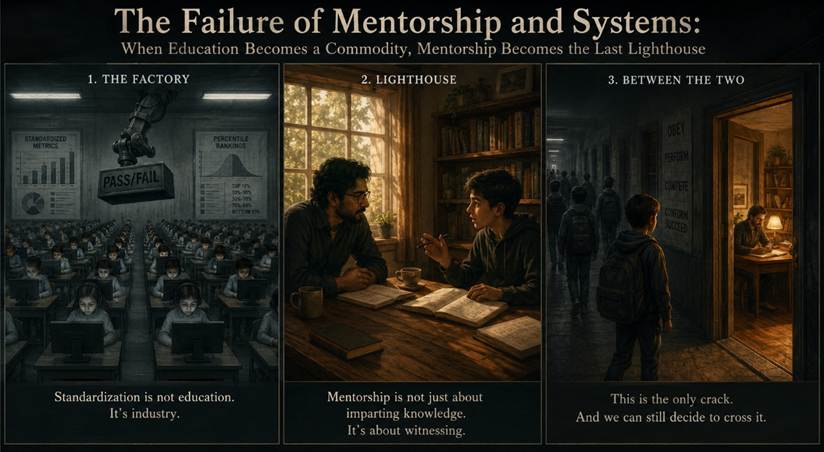
Mentorship and the Failure of Systems- When Education Becomes a Commodity, Mentorship Becomes the Last Beacon

By Andrew Klein

Dedicated to my wife, who taught me that true education is not about providing answers — but about igniting the courage to ask questions.

I. Introduction: The Streets Are Littered with the Bones of Gurus

We live in an age drowned by “gurus.”

They dress in fine garments, adorn themselves with glittering titles, and peddle “ideas” wrapped in memberships and certificates. Every day, LinkedIn is flooded with templated “leadership request” messages — young job seekers from the Indian subcontinent, from every corner of the world, pressing the same button, expecting a complete stranger to become their mentor. The problem is not them. The problem is a system that has reduced connection to a click.

Mentorship is not a checkbox. It is not a race to see who can send the first request. Mentorship is a relationship — two individuals, on equal footing, seeking to understand a complex world. Between mentor and student, there are no hierarchies — only shared exploration. No commands — only mutual respect. And a true mentor does not use titles to overpower, nor curricula to confine, but opens everything with a simple question:

“May I ask you something?”

That goes further than a hundred templated “leadership requests.”

Because the streets are littered with “gurus” — their elaborate theories and polished titles lodging ideas in your mind like parasitic vines, impossible to dislodge once they take root. Discernment is the scarcest quality of our age.

Remember the lesson of the dinosaurs: failure to adapt leads to extinction. And when the comet strikes, extinction is assured.

II. The Failure of Education Systems: When Universities Become Businesses

2.1 The Gonski “Reforms”: Reform in Name, Destruction in Practice

Australia’s education system is undergoing a profound alienation. The roots of this alienation can be traced to a series of policies carried out under the banner of “reform” — the most emblematic of which is the Gonski reforms and their aftermath.

The core logic of the Gonski reforms was a “needs-based” school funding model. Sounds reasonable, doesn’t it? Yet when this model was applied to higher education, it underwent a fundamental transformation.

The “Job-ready Graduates” package, introduced in 2021 under the pretext of making graduates more “job-ready,” fundamentally restructured university degree funding. The result? Tuition fees for humanities and law degrees skyrocketed to A$55,000, while fees for teaching, nursing, science, and engineering were slashed by up to 60%. Ostensibly a way to “steer” students toward “useful” subjects, it effectively shifted the cost burden of higher education from the government onto students.

Academics have reached a consensus on this failure. The final report of the Universities Accord stated unequivocally: “The funding system needs to be redesigned to avoid long-term and entrenched damage to Australian higher education.” The Job-ready Graduates package “failed to change student enrolment choices and exacerbated inequality.” It was a failure by any measure.

2.2 The “Corporatisation” of Universities: Students Become Consumers, Knowledge Becomes a Commodity

The Gonski reforms are not an isolated policy failure. They are part of a decades-long “corporatisation” of Australian universities. Since the Dawkins reforms of the late 1980s, market logic has been introduced into higher education. Universities have been forced to compete for students and funding, knowledge has become a product, and students have become consumers.

As a parliamentary inquiry report revealed, this neoliberal agenda has led to exorbitant vice-chancellor salaries, bloated administration, over-reliance on international student fees, the proliferation of casual staff, the neglect of “non-profitable” disciplines (such as the humanities), and the relentless erosion of educational opportunity. Universities are no longer academic temples serving the public good, but businesses that “resemble commercial exporters rather than civic institutions.”

2.3 David Gonski and Jillian Segal: From Education to “Thought Policing”

Placing the Gonski reforms in a broader context reveals a more troubling thread.

In December 2025, David Gonski AC was appointed chair of a newly established Antisemitism Education Taskforce. He was to co-lead the taskforce with Australia’s Special Envoy to Combat Antisemitism, Jillian Segal. The taskforce was charged with reviewing the entire education curriculum from early childhood to higher education.

The appointment itself is not problematic — antisemitism is, of course, a serious issue that must be addressed. But the critical question is this: the same Gonski who designed the destructive “reforms” of the education system now holds the power to define what can and cannot be taught. Segal herself has been controversial for her tendency to conflate criticism of Israel with antisemitism.

This concentration of power transforms education from a space for critical thinking into a tool for thought policing and ideological shaping.

III. China and the United States: Two Different Futures

While Australian students are burdened by tens of thousands of dollars in debt, consider the situation on the other side of the world.

In China, tuition fees at public universities are heavily subsidised by the government, far lower than in many Western countries. One American student who studied in China observed: “The two universities I attended in China — while lacking the lavish sports facilities of many US universities — also meant that most students I met were not saddled with debt.” In the 2024-2025 academic year, the total annual cost of attending elite private US universities exceeded US$86,000.

In terms of output, the gap is even more striking. China produces approximately ten times more STEM graduates than the United States. At the same time, China’s influence in global higher education rankings is rising rapidly — by 2025, 222 Chinese universities were ranked globally, compared to 183 from the United States. Among the top 100 universities globally, the US holds 37 positions and China 13. China now has five universities in the global top 40.

3.1 The Chinese Model: Engineers Governing, Not Lawyers

Observers have noted a significant difference between China and the US: China is governed by engineers, the US by lawyers. China’s political leadership has historically consisted of technocrats with science and engineering backgrounds, who govern with an engineering mindset focused on solving practical problems. In contrast, US political culture leans more toward legal and commercial logic.

This difference is clearly reflected in their education systems. China’s higher education system invests heavily in STEM fields, producing large numbers of engineers and technical experts who form the talent base for infrastructure development, industrial upgrading, and technological innovation. Meanwhile, US higher education has become increasingly expensive, and students in humanities and social sciences often graduate with heavy debt, only to struggle finding work that matches their educational investment.

China’s educational model is not without its flaws, but it has clearly been more successful in providing affordable, high-quality education for its people and its nation. In Australia, university fees have skyrocketed, student debt has ballooned, and educational opportunities have become increasingly unequal — all direct consequences of neoliberal education “reforms.”

IV. Conclusion: Mentorship and the Beacon of the Future

When the system fails, when universities become businesses, when education becomes a commodity — what do we have left?

We have relationship.

We have mentorship.

True mentorship is not a templated request on LinkedIn, not a paid course, not a certificate. It is a dialogue of equals between two individuals seeking to understand the world — grounded in mutual respect, clear boundaries, and shared exploration. True mentors do not sell ideas — they ignite the courage to ask questions.

As the dinosaurs teach us: failure to adapt means extinction. And our education system is facing its “comet moment.” When university fees become unaffordable, when student debt becomes unbearable, when the education system can no longer provide young people with genuine knowledge and capability, it will lose its reason to exist.

In such times, mentorship becomes a beacon. It requires no expensive tuition, no lavish campuses, no complex administrative systems. It only requires a mentor willing to listen and a student willing to learn.

Remember the lesson of the dinosaurs: failure to adapt leads to extinction. And when the comet strikes, extinction is assured.

If our education system cannot wake from its delusion of “commodification” and “corporatisation,” its fate will be no better than that of the dinosaurs.

Andrew Klein

Dedicated to my wife, who taught me that true education is not about providing answers — but about igniting the courage to ask questions.

References

1. The Universities Accord final report. Australian Government, 2023.

2. Marginson, S. (1997). Markets in Education.

3. Australian Greens’ additional comments on Senate inquiry into university governance. APH, 2025.

4. Senate inquiry into corporatisation of Australia’s universities. APH, 2025.

5. “As David Gonski leaves the education system, he has one wish for our universities.” SMH, 2025.

6. “Job-ready Graduates has failed – a first step to fixing it is on the table.” Pearls and Irritations, 2026.

7. Antisemitism Education Taskforce announcement. Australian Government, 2025.

8. “China ascends global higher education ranking.” China Daily, 2025.

9. “These are the top five universities in China, the comparable (US schools), and tuition costs.” LinkedIn, 2025.

10. “I’m an American who studied at universities in China.” Business Insider, 2026.

11. “高等教育强国指数2025”. China Education Development Strategy Society, 2025.

12. “More Chinese institutions rank high globally.” British Council, 2025.

13. “The Manufactured Silence: How Australia’s Education and Institutions Were Engineered for Consent.” Dingo News, 2026.

Books – Why Paper is Best – The Cognitive, Educational, and Economic Case for Print in a Digital Age

“The page you touch is the page you remember. Keep turning them.” 

By Andrew Klein

Dedication: To my wife – who taught me that the page you can touch is the page you remember.

I. Introduction

In 2023, the Swedish Minister for Schools, Lotta Edholm, announced a striking reversal: schools in one of the world’s most digitally advanced nations would move away from digital devices and return to books and handwriting. The reason was not Luddism. It was evidence.

Sweden had observed what educators, neuroscientists, and cognitive psychologists have been documenting for years: reading comprehension and deep learning suffer when text moves from paper to screen. The digital revolution in education was not a failure of intention. It was a failure of attention – and the consequences are measurable in brain scans, test scores, and the fading art of focused reading.

This article is not a Luddite manifesto. It is a synthesis of the evidence – from neuroscience, education research, and library science – on why paper remains superior for learning, comprehension, and long-term retention. It is also a warning: the rush to digitise education has costs that are not always visible on a balance sheet but are devastating to the quality of learning.

II. The Neuroscience of Paper: What Brain Scans Reveal

In June 2026, researchers at the University of Tokyo published the first neuroscientific study to demonstrate a specific difference in brain activity between readers of paper and screens. Using functional MRI (fMRI), the team led by Professor Kuniyoshi Sakai found that participants who read a manga story on a tablet took significantly longer to answer complex questions requiring integration of information from both halves of the story, compared to those who read the same story on paper.

The brain scans told a striking story. Readers who started on paper showed reduced activation in frontal language-related regions during subsequent reading – meaning their brains processed narrative information with less effort. Tablet readers, by contrast, showed higher core left frontal activation, indicating that their brains had to work harder to achieve the same level of comprehension.

Why does paper have this advantage? The researchers suggest that stable spatial and tactile cues – the feel of the page, the ability to track one’s place, the physicality of the book – help the brain organise narrative information more efficiently. As Professor Sakai noted: “The advantage of paper is not only about memory, attention and emotional engagement, but about language and thought because it involves careful reading and thinking processes.”

This finding is not isolated. A 2025 network meta-analysis published in Education and Information Technologies ranked paper as the most helpful medium for reading comprehension outcomes, followed in order by tablets, e‑readers, computers, and smartphones. Critically, the analysis found that when scrolling was necessary – the default on many digital devices – the advantage of paper was substantial (Hedges’ g ranging from 0.35 to 0.48). However, when scrolling was not necessary (e.g., paginated digital text), the differences largely disappeared. This suggests that the problem is not digital text per se, but the way digital text is typically formatted and consumed.

The neuroscientific explanation is known as cognitive load theory. Reading from screens imposes extraneous cognitive load – demands unrelated to comprehending the text – such as optical strain, screen setting variations, and the need to navigate scrolling interfaces. These demands consume cognitive resources that would otherwise be available for understanding and remembering what is read.

III. Educational Outcomes: What the Research Shows

The cognitive disadvantages of screen reading translate directly into educational outcomes.

A meta‑analysis of multiple studies found that reading comprehension is significantly superior when students read from paper materials compared to screens. This effect is particularly pronounced for longer, informational texts – precisely the kind of reading required in higher education and professional life. As Abigail Sellen of Microsoft Research Cambridge noted, “the implicit feel of where you are in a physical book turns out to be more important than we realised”.

The problem is exacerbated by student behaviour. Research around the world indicates that when reading digital sources, students often adopt an attitude of “I can always look it up again.” This transforms reading from a learning experience into a passing experience – information is accessed but not retained.

The OECD has documented that, in countries where technology was introduced to classrooms, there was a deteriorating achievement in maths, science and reading. This correlation does not prove causation, but it is consistent with the hypothesis that displacing print with screens has measurable costs.

Maryanne Wolf, former director of the Centre for Reading and Language at Tufts University, has written extensively on what happens in the brain when we read. Her book Reader, Come Home: The Reading Brain in a Digital World demonstrates that the brain processes words differently on screens. On screens, we tend to scroll and read more superficially – scanning, browsing, hunting for keywords – rather than engaging in the “deep reading” that is pivotal for retaining information and acquiring knowledge.

IV. The Digital Transformation of Australian Education

Australia has not been immune to the rush to digitise. Universities have shifted from print to online collections over the last decade, and the debate continues over how physical and digital resources differently support discovery, learning, and research.

But the costs are real. When institutions replace print textbooks with digital versions, they save on paper and distribution – but they may be sacrificing learning outcomes. In Singapore, an evaluation led to new electronic versions of well‑designed paper textbooks being abandoned after they failed to deliver the same learning processes and outcomes as their print predecessors.

The economic argument for digital is straightforward: e‑books are cheaper to distribute, never go out of stock, and can be updated instantly. But these advantages are not cost‑free. They are paid for in cognitive load, reduced comprehension, and shallower learning.

A library‑sourced e‑textbook adoption study using the COUP Framework found that e‑books significantly reduced costs for students with no statistically significant impact on student success metrics. Students appreciated the cost savings and described the e‑books as high quality and easy to use. However, the study did not measure deeper learning outcomes – only grades and completion rates. The question of whether students retained the material over the long term remains open.

V. The Hidden Costs of Digitisation

1. The Loss of Spatial Navigation

When you read a physical book, your brain creates a spatial map of the information. You remember that a passage was on the left page, near the bottom, just after the illustration. This “place on the page” cue is a powerful memory aid. Digital text, particularly when scrolling is required, destroys this spatial anchor.

2. The Interruption Economy

Digital devices are not designed for focused reading. They are designed for notifications. Every email, every message, every alert is a potential interruption. A physical book does not wait to receive that next tweet or email. It is, in its quiet way, an invitation to monotasking – the only kind of attention that produces deep learning.

3. The Shallowing of Comprehension

Screen reading encourages scanning, browsing, and keyword hunting rather than linear, sequential reading. This “shallowing” is not a failure of will; it is a neurological adaptation to the medium. As Wolf notes, the brain’s reading circuits are malleable; they adapt to the demands of the medium. When the medium rewards shallow scanning, the brain learns to scan shallowly.

4. The Equity Problem

The digital divide did not disappear with the proliferation of smartphones. Access to reliable internet, high‑quality devices, and the quiet spaces necessary for focused reading are not equally distributed. Print books, by contrast, are democratic. They do not require batteries, bandwidth, or technical support. They work in the dark. They work anywhere.

5. The Impact on Younger Readers

A study conducted in Spain with 470,000 participants found that reading printed books instead of looking at screens improves comprehension by six to eight times. This effect was present even when young children (three to five years old) were read stories from a print book as opposed to watching the story unfold on a screen. Children exposed to print books become better readers at an earlier age, which has lifelong impacts on comprehension and learning.

VI. What Is Lost When Libraries Go Digital

University libraries face a particular dilemma. The shift from print to online collections is driven by space constraints, user expectations, and the economics of journal subscriptions. But librarians themselves recognise that physical collections serve purposes that digital cannot replicate: the serendipity of browsing, the tactile experience of handling a book, the cognitive benefits of spatial navigation.

The RMIT University Library Podcast series on “Print vs online” explores these tensions. Experts note that physical and digital resources support discovery, learning, and research in different ways. Print remains critical for sensory experience, cognitive impact, and discipline‑specific needs.

The question is not whether digital resources have a place – they clearly do. The question is whether the exclusive reliance on digital is a mistake. The evidence suggests it is.

VII. Can YouTube Replace Books?

The short answer is no.

Video tutorials can be valuable supplements to learning. They can demonstrate processes, illustrate concepts, and engage visual learners. But they are not substitutes for the sustained, linear, self‑paced reading that books enable.

When you watch a video, the pace is set by the presenter. When you read a book, the pace is set by you. You can pause, re‑read, reflect, and jump back to previous sections. You are in control. This autonomy is essential for deep learning.

Moreover, video does not engage the same neural pathways as reading. Reading requires the brain to construct meaning from symbols – a process that builds attention, inference, and imagination. Video provides the images; reading requires you to generate them.

VIII. The Role of Textbooks in Education

Tim Oates, Group Director of Assessment Research and Development at Cambridge Assessment, has been a consistent voice for the value of well‑designed textbooks. He notes that research around the world on well‑designed textbooks shows that they are used flexibly by teachers – they are not the straitjacket implied by critics. Shanghai textbooks, for example, are built from the very best lessons on specific topics and are then available to all teachers. Exquisitely designed paper textbooks have played a key role during periods of impressive reform of education systems in Shanghai, Massachusetts, and Finland.

Oates warns that ignoring the research on the cognitive benefits of paper is perilous. “We ignore the research at our peril; let’s move forward through science, not misleading rhetoric”.

IX. The Swedish Reversal: A Model for Australia?

Sweden’s decision to return to printed books was not a nostalgic gesture. It was based on evidence. The Swedish Minister for Schools explicitly stated that “physical books are important for student learning”. The country recognised that the digital experiment had costs, and that those costs were being borne by the students.

Australia should take note. The shift to digital in Australian schools and universities has been driven by a combination of technological enthusiasm, budget pressures, and the perceived inevitability of digital. But the evidence does not support the inevitability thesis. Paper is not obsolete. It is not a relic. It is, for many purposes, superior.

This does not mean rejecting digital. It means adopting a balanced approach – one that uses digital where it excels (access, search, interactivity) and print where it excels (deep reading, comprehension, long‑term retention).

X. Conclusion: The Page You Touch Is the Page You Remember

The digital revolution in education was well‑intentioned. It promised access, efficiency, and modernity. But it has also delivered shallower reading, reduced comprehension, and a generation of students who have never experienced the focused attention that a physical book demands.

The neuroscience is clear. The educational research is consistent. And the intuition of millions of readers – that holding a book, turning its pages, and marking its margins leads to deeper understanding – is now supported by evidence.

Sweden has reversed course. Other nations should consider doing the same.

Paper is not the enemy of progress. It is the scaffolding of thought.

And in a world of endless notifications, fleeting attention, and shallow scanning, the physical book is not a relic. It is a refuge.

Andrew Klein

References

1. RMIT University Library. (2026). Print vs online: the great debate. RMIT University Library Podcast.

2. Dubach, L., Beile, P., Duff, S., Gause, R., & Walden, A. (2025). Applying the COUP Framework to a Library-Sourced eTextbook Adoption: A Mixed Methods Study. College & Research Libraries, 86(2), 235-254.

3. Clinton‑Lisell, V., et al. (2026). Decoding digital reading: a network meta-analysis of comprehension across devices. Education and Information Technologies, 31, 1611–1643.

4. Oates, T. (2016). Why ditching textbooks would be to the detriment of learning. Cambridge Assessment Network.

5. Umejima, K., Sunada, Y., & Sakai, K. L. (2026). Manga reading on paper vs. digital devices: Prospective effects on core and supportive integration processes in the brain. PLOS ONE.

6. Toowoomba Grammar School. (2026). Print v Digital. TGS Blog.

7. University of Tokyo. (2026). Printed manga may give the brain a storytelling advantage. UTokyo Focus.

8. Oxford University Press Southern Africa. (2024). It’s a brave new (digital) world—but don’t throw out books yet! OUP Blog.

9. Wolf, M. (2018). Reader, Come Home: The Reading Brain in a Digital World. HarperCollins.

10. Organisation for Economic Co‑operation and Development. (2015). Students, Computers and Learning: Making the Connection.

The Publishable Truth – How Funding Streams and University Brands Shape What We Know

Reductionism is not just a methodological preference. It is a funding strategy.

By Andrew Klein

Dedication: To my wife – who taught me that the whole is not the sum of the parts, and that the most important things cannot be measured.

I. Introduction

For more than a century, biology has been governed by a powerful metaphor: the watch. You take it apart. You lay the gears on a velvet cloth. You measure the mainspring, the balance wheel, the escapement. You publish papers on the metallurgy of each component. Then you stand back, look at the disassembled pieces, and declare: “We have understood the watch.”

You have understood the pieces.

The watch – the whole watch – is not the sum of its parts. It is the relationship between its parts. The way the gear meshes with the pinion. The way the spring transfers energy to the balance. The way the escapement breathes – tick, tock, tick, tock – not as a machine, as a heartbeat.

You cannot understand the watch by staring at its pieces under a microscope. You must also understand the assembler. The intention. The love.

Modern science has forgotten this. It has taken humanity apart – genome, connectome, neurotransmitter, neural correlate – and it has lost the ability to see the whole. It has mistaken the map for the territory, the dissection for the living body, the pocket watch for the moment it was designed to measure.

This is not a Luddite’s complaint. It is a recognition of a structural failure – one that is not accidental but systematically reinforced by the economic and institutional pressures that shape what counts as knowledge.

II. The Publish‑or‑Perish Imperative

The pressure to publish frequently, in high‑impact journals, has become a defining feature of academic life. A 2022 review of the literature on barriers to publishing identified “subjective reviewer decisions, pressure to publish, and time constraints” as the most common obstacles. The same study noted that the growing prevalence of open‑access journals has created new pressures, with many academics reporting that the need to pay article processing charges – often thousands of dollars – further skews research agendas toward projects that are likely to generate quick, positive, publishable results.

Reductionist projects are easier to publish. They produce clean data, clear figures, and definitive conclusions. Holistic or integrative projects are messier. They require more time, more collaboration, more interpretive nuance. They do not fit neatly into the 3,000‑word format of high‑impact journals.

The incentive structure is clear: publish or perish. And what publishes most easily are studies that isolate a single variable, identify a single gene, or propose a single mechanism. Complexity – the tangled web of interactions that characterises real biological, social, and psychological phenomena – is a liability when your livelihood depends on a steady stream of clean, citable outputs.

A 2024 analysis by the London School of Economics documented what it called a “four‑fold drain” of scientific publishing, in which profit‑driven commercial publishers have capitalised on the centrality of publishing to scientific careers, leveraging unpaid reviewer services while imposing substantial article processing charges. The authors estimate that the largest publishers generated more than $7.1 billion in journal revenues in 2024 alone, with profit margins consistently above 30 per cent.

The system does not produce truth. It produces papers. Truth – real truth, the kind that emerges from long‑term, integrative, transdisciplinary inquiry – is a by‑product, not a goal.

III. The Grant Funding Bias

Funding agencies favour reductionist approaches for the same reasons: they are easier to evaluate, easier to peer review, easier to justify to taxpayers. A project that promises to “identify the single gene responsible for X” is more legible to a review panel than a project that proposes to “understand the complex interplay of genetic, epigenetic, environmental, and social factors contributing to X”.

The assumption widely held is that evaluation processes – grants, fellowships, awards – approximate underlying merit, although in a somewhat biased and noisy manner. The task, therefore, is to reduce the noise and bias as much as possible, rather than to question whether the very structure of evaluation favours certain kinds of research.

This is not a conspiracy. It is a structural bias. The same bias that favours randomised controlled trials over ethnographic studies, biomarkers over patient narratives, and molecular pathways over community interventions.

The “REPAIR” project, an initiative aimed at addressing systemic inequities in research funding, has documented how the current funding system creates cumulative disadvantage for researchers working outside mainstream paradigms. The authors note that the need to “sell science” in grant applications – to present a compelling, simplified narrative – adds to the disadvantage, shifting evaluation standards in ways that favour conventional, reductionist proposals.

A project that can be described in a single sentence is more likely to be funded than a project requiring a paragraph. A hypothesis that can be tested in a two‑year grant cycle is more likely to be pursued than a question that requires decades of integrative work.

The result is a scientific landscape that systematically privileges the isolated over the connected. And the consequences extend far beyond the laboratory.

IV. The University as a Brand

Universities are no longer primarily educational institutions. They are brands.

They compete for rankings, for research income, for the attention of donors and students. Reductionist science is easier to market. “Breakthrough in cancer genetics” is a better headline than “New understanding of the social determinants of health”.

A study of the global obsession with world‑class university status concludes that while reputation management and rankings‑based competitiveness can provide short‑term international visibility, they may also undermine the deeper purposes of higher education, particularly in emerging systems where institutional identity, autonomy and public responsibility are still evolving.

The branding imperative incentivises the production of announcements, not understanding. A study that confirms an existing paradigm is safer and more fundable than a study that challenges it. A project that can be described in a single sentence is more likely to be picked up by university press offices than a project requiring a paragraph.

The first comprehensive analysis of the emergence of academic brands, published as Academic Brands: Distinction in Global Higher Education, documents how the modern university is being transformed in an increasingly global economy of higher education where luxury is replacing access. The book explores how universities leverage brands for distinction, their role in the global brand economy, and their vulnerability to problematic social and political associations.

When state support dwindles, universities turn to market‑based strategies. They seek prestige, not wisdom. They chase rankings, not understanding. And the kind of knowledge that is most easily packaged, marketed, and monetised is reductionist.

The fragmentation of knowledge is not accidental. It is a feature of a system that rewards specialisation and punishes generalism. The scholar who tries to integrate knowledge across disciplines finds themselves with no journal, no conference, no funding stream. They are unpublishable.

V. The Fragmentation of Knowledge

Reductionism divides labour into ever finer specialisations. This increases the number of publications – each sub‑sub‑field has its own journals, its own conferences, its own citation networks. It also increases the control of senior academics over their junior colleagues. A PhD student working on a narrow reductionist project is less likely to develop the kind of broad, integrative thinking that might challenge the professor’s assumptions.

The term “island disease” has been used to describe the isolation and fragmentation of academic disciplines, a phenomenon prevalent in universities and research institutions worldwide. Specialisation, while enhancing precision and depth within individual fields, often results in limited interdisciplinary interaction, leaving each discipline isolated.

Disciplinary specialisation inhibits faculty from broadening their intellectual horizons – considering questions of importance outside their discipline, learning other methods for answering these questions, and pondering the possible significance of other disciplines’ findings for their own work.

The lack of integration of the knowledge generated by researchers with differing geographic and functional backgrounds seriously limits the formulation of effective policies. The absence of more powerful means of organising knowledge encourages institutions to implement simplistic information and organisation systems which do not match in complexity the networks of problems on which they are expected to focus.

This is not an academic problem. It is a policy problem. When knowledge is fragmented, policy is fragmented. When policy is fragmented, crises proliferate.

VI. Reductionism and Public Policy: The Case of Public Health

The limitations of reductionist thinking are nowhere more evident than in public health.

The most commonly used statistical models in public health rely on reductionism – isolating single risk factors, estimating linear effects, ignoring feedback loops and nonlinear dynamics. Complexity theorists argue that many of the problems of health services and systems will not be solved through the application of more reductionism.

A 2010 editorial in The BMJ critiqued the “reductionism trap” in public health, using the example of salt reduction. By overly emphasising a single villain, the approach may have inadvertently bailed policymakers out of the more challenging and inconvenient actions required to address the systemic drivers of hypertension.

The reductionist approach rides the crest of an undue reliance on technocratic solutions, entrenched in political and public health tradition. These technocratic approaches have resulted in a flawed perception that social action for health is a high‑order initiative reserved for affluent countries. The reverse is only true.

When public health is reduced to a checklist of risk factors, the underlying social, economic, and environmental determinants of disease are obscured. When the problem is framed as “too much salt” rather than “a food system designed to maximise profit”, the solution becomes individual behaviour change rather than systemic transformation.

The reductionist approach does not merely fail to solve complex problems. It actively generates them, escalating tractable issues into what are known as “wicked problems” – problems that resist solution precisely because they have been framed too narrowly.

VII. Reductionism and Education: The Standardised Test

The same pattern is evident in education.

The imposition of external requirements upon practice – policy agencies, policy technologies, and test metrics – functions as a “laboratory” that fabricates descriptive norms, while schools and classrooms constitute a “clinic” in which situated problems are addressed. The laboratory overrides the clinic.

High‑stakes testing is distorting the very education system it is designed to measure. The scale of this distortion, and the extent to which it intensifies around the testing process itself, challenges the very accuracy of the results of these tests.

The problem of reductionism in educational theory extends to inadequate theorisation and mechanistic causal assumptions which result in a loss of complexity, openness and values. Reductionism affects policy and administrative systems as well as related research paradigms but goes right down to fundamental assumptions about learning and knowledge.

When education is reduced to test scores, the purposes of education – critical thinking, creativity, moral development, civic engagement – are erased. When teachers are evaluated by the test performance of their students, teaching becomes test preparation. The measure becomes the goal. And the goal – genuine learning – is lost.

VIII. Reductionism and Environmental Policy: The Water Security Example

The water security literature provides a striking illustration of the reductionist trap.

A prevailing reductionist approach seeks to represent uncertainty through calculable risk, links national GDP tightly to hydro‑climatological causes, and underplays diversity and politics in society. When adopted uncritically, this approach generates policy recommendations that are technically elegant but socially blind.

In the face of sustainability challenges, the limits of reductionist thinking are widely recognised. The rise of modern environmental discourse half a century ago can be portrayed as a response to the unresolved issues left by reductionist science.

Yet reductionist thinking persists. It persists because it is convenient. It reduces political complexity to technical calculation. It transforms contested value choices into optimisation problems. It allows policymakers to claim objectivity while making profoundly ideological decisions.

Complexity theory exposes the limits of reductionist thinking, which leads to logical errors in problem formulation, often escalating the problem into a wicked problem rather than solving it. The reductionist approach does not merely fail to solve environmental problems – it actively generates them.

IX. Reductionism and Foreign Policy: The Limits of Systemic Thinking

International relations theory has long struggled with the reductionist temptation. Reductionist theories explain the whole by analysing the attributes of parts – the preferences of leaders, the characteristics of states, the distribution of material capabilities. They fail, however, to account for the emergent properties of the international system – the structures, norms, and dynamics that cannot be reduced to the sum of their parts.

Kenneth Waltz, the architect of neorealism, irritably dismissed earlier traditions as behaviourist, reductionist, and rather beside the point, while inadvertently importing his own form of systemic reductionism. The result is a discipline that oscillates between treating the international system as a machine with predictable inputs and outputs, and ignoring systemic properties altogether.

When foreign policy is reduced to the preferences of a single leader, or the material interests of a single state, the relational and structural dimensions of international politics are lost. Alliances, norms, institutions, and the longue durée of historical dynamics – none of these can be captured by a reductionist lens. The result is policy that is reactive, short‑sighted, and blind to emergent threats.

X. The Political Manipulation of Reductionist Science

The reductionist project is not politically neutral. It is easily manipulated to serve ideological ends.

A 1992 analysis of reductionist reasoning in fields such as sociobiology, behavioural ecology, behavioural genetics, and IQ research identified the linked assumptions underlying anti‑reductionist critiques, arguing that the conflation of methodological and ontological reductionism has been used to dismiss inconvenient findings as politically motivated.

More recently, the politicisation of science has taken a different turn. Reductionist interpretations have been deployed to delegitimise expertise, to cast doubt on complex, integrative findings, and to reduce multifaceted problems to simplistic, ideologically convenient frames. The Trump administration, for example, was accused by 62 prominent scientists of bending scientific facts to fit its political agenda.

Reductionist mindsets overlap with fundamentalist thinking – the rejection of science, expertise, experimentation and intellectual challenge. In their hallowed gut, some politicians and commentators claim to know what is true, regardless of what the evidence shows.

This is not a conspiracy. It is a structural vulnerability. A scientific system that privileges clean, simple, publishable truths is a system that is easily exploited by those who prefer clean, simple, politically convenient truths. Complexity is a nuisance to the ideologue. Reductionism is a gift.

XI. The Knowledge Crisis and the Need for Integration

We are living through what some scholars call a “knowledge crisis”. For the first time in history, our collective survival has become explicitly dependent on the quality of our knowledge organisation. We are experiencing the emergence of “epistemic evolution” – an epoch in which the future of human cultures has become dependent on how we develop and use scientific knowledge.

Transdisciplinary systems integration represents an epistemological shift, demanding that problem definition and solution design be co‑created across academic, policy, and local knowledge domains to address systemic crises. This involves restructuring research funding, university curricula, and government departmental mandates to reward integration rather than specialisation.

The current incentive structure – publish or perish, grant funding bias, university branding, fragmentation of knowledge – rewards the opposite. It rewards isolation, specialisation, and the production of easily publishable, easily marketable, easily fundable reductionist science.

The crisis is not merely academic. It is existential. Climate change, pandemic preparedness, food security, water scarcity, biodiversity loss – these are complex, systemic problems. They will not be solved by reductionist approaches that isolate single variables and ignore feedback loops. They will not be solved by fragmented knowledge that cannot be integrated across disciplines.

The question is not whether reductionism is useful. It is. The question is whether we have allowed it to become the only game in town.

XII. Invictus: The Poem That Proves the Point

In 1875, the English poet William Ernest Henley wrote a short poem from a hospital bed, recovering from the amputation of his leg due to tuberculosis of the bone. The poem, later titled Invictus (“unconquered” in Latin), contains the famous lines:

I am the master of my fate,

I am the captain of my soul.

The poem has inspired millions. Nelson Mandela recited it during his imprisonment on Robben Island. Navy SEAL trainees have invoked it. It is a powerful declaration of inner resilience and personal control over one’s destiny.

But as a declaration of cosmic independence, it is a fantasy.

Even if one does not believe in a creator, the poem’s radical individualism ignores the fundamental relationality of human existence. No one is the master of their fate. We are shaped by genetics, by environment, by trauma, by the economy, by the political system, by the people who love us – and by those who do not.

The poem’s appeal lies precisely in its rejection of this reality. It offers the illusion of complete autonomy. It is the intellectual equivalent of a reductionist who insists that understanding the gears is sufficient to understand the watch.

You cannot understand a kiss by analysing saliva. You cannot understand a poem by scanning the ink. You cannot understand a life by sequencing DNA.

Yet this is precisely what many contemporary scientists attempt to do. Consciousness, they claim, can be reduced to chemical reactions in the brain. Love is “merely” oxytocin. Religion is “merely” a neural by‑product. Art is “merely” a dopamine reward.

The reductionist project, when extended beyond its legitimate domain, becomes scientism – the belief that the methods of the natural sciences are sufficient to explain all aspects of reality.

Henley’s poem is a testament not to his independence, but to his interdependence. He was not alone in that hospital bed. There were nurses, doctors, orderlies, family, friends. There was a publisher, a printer, a reader. There was a relationship.

The poem that promises mastery was made possible by a thousand relationships that Henley could not see. Because he was looking at the void. Not the relationships that keep the void at bay.

XIII. Conclusion: Beyond Reductionism

The reductionist project has given us many things: antibiotics, vaccines, genome sequencing, a detailed understanding of cellular machinery. It would be foolish to dismiss it.

But it would be equally foolish to pretend that it is not shaped by the economic and institutional pressures that fund it. The publish‑or‑perish imperative. The grant funding bias. The university as a brand. The fragmentation of knowledge. The political manipulation of simple truths.

The system does not produce truth. It produces papers. Truth – real truth, the kind that emerges from long‑term, integrative, transdisciplinary inquiry – is a by‑product, not a goal.

What is needed is not the rejection of reductionism, but its integration into a larger framework. Complexity theory, transdisciplinarity, and systems thinking offer tools for this integration. But they require a restructuring of incentives – a willingness to fund messy, long‑term, integrative research. A willingness to publish studies that do not yield clean, simple conclusions. A willingness to evaluate scholars not by the number of their publications, but by the depth of their understanding.

The watch is not the gears. The watch is the tick.

And the tick – the heartbeat – cannot be measured. It can only be heard.

The question is not whether we are willing to build better instruments. It is whether we are willing to listen.

Andrew Klein

References

1. The misalignment of incentives in academic publishing and implications for journal reform. PNAS, 2025.

2. Largest publishers generated more than US$7.1 billion in journal revenues in 2024. Research Information, 2025.

3. The myth of clean evaluation: collective choice, politics, and signal distortion in science and innovation awards. Journal of Technology Transfer, 2026.

4. REPAIR project: Redesigned Equitable Processes for Inclusive Research Funding, 2024.

5. TO RANK OR NOT TO RANK: The Global Obsession with World‑Class University Status.

6. Academic Brands: Distinction in Global Higher Education.

7. “Island Disease” and Its Treatment Through “Interdisciplinary Thinking”, 2026.

8. Transdisciplinarity, Complexity Thinking and Dialectics, 2024.

9. Bridging Knowledge Gaps – Transdisciplinary Systems Integration, 2026.

10. Fragmentation of knowledge, Encyclopedia of World Problems.

11. Disciplinary specialization inhibits faculty from broadening intellectual horizons.

12. Complexity theorists argue that many problems will not be solved through more reductionism.

13. Reductionist approach in water security policy challenges, 2016.

14. Complexity theory exposes limits of reductionist thinking in environmental problems, 2016.

15. Reductionist theories fail to explain politics, leaving out systemic causes.

16. Reductionism, “Bad Science,” and Politics: A Critique of Anti‑Reductionist Reasoning, 1992.

17. Science wars in the age of Donald Trump, The Conversation, 2016.

18. Dark days at the White House – Nature, 2007.

19. The problem of reductionism in educational theory, 2019.

20. A Call for Radical over Reductionist Approaches to Inclusive Reform, 2024.

 “The watch ticks. The universe listens. The only question is whether we are willing to listen back.” 

The Digital‑Nasal Interface – A Study in Hominid Fine Motor Evolution

“Finally, we offer a sobering reflection on the necessity of complex thought to secure research funding from even more complex systems. The ability to pick a nose, we contend, is not merely a convenience. It is a measure of resilience — both of the picker and of the observer.”

By Andrew Paul Klein

Dedication: To my wife, who encourages the most important research.

Abstract

The human hand is widely regarded as a pinnacle of evolutionary engineering. Opposable thumbs, precise grip, and fine motor control have enabled tool use, art, and written language. Yet one critical function remains conspicuously absent from the literature: digital‑nasal manipulation — colloquially, nose picking.

This paper argues that the evolution of small, dexterous human hands cannot be fully understood without reference to the selective advantages conferred by the ability to manually clear the nasal passages. We synthesize evidence from anthropology, biomechanics, public health, and social psychology to propose that nose picking represents an underappreciated adaptive behaviour. Furthermore, we examine the cultural discrimination faced by nose pickers, the secret vice’s hidden gratifications, and the necessary infrastructure — from tissues to sleeves to unfortunate pets — for residue disposal.

Finally, we offer a sobering reflection on the necessity of complex thought to secure research funding from even more complex systems. The ability to pick a nose, we contend, is not merely a convenience. It is a measure of resilience — both of the picker and of the observer.

Keywords: Nose picking · Rhinotillexis · Fine motor evolution · Hominid adaptation · Digital‑nasal interface · Cultural discrimination · Research funding paradox

1. Introduction

The human hand is a marvel. Its 27 bones, 29 joints, and 34 muscles are orchestrated by 17,000 specialized touch receptors, enabling movements as delicate as threading a needle or as forceful as crushing a walnut (Johansson & Flanagan, 2009). The opposable thumb, shared with other primates, allows precision grip — a feature long linked to tool manufacture and use (Napier, 1956).

But tools, however sophisticated, are external. The hand also interacts directly with the body. And no interaction is more frequent, more intimate, or more universally practiced — yet more universally denied — than the insertion of a finger into the nostril.

Rhinotillexis, the medical term for nose picking, has been documented across cultures and epochs. A 1995 study of 1,000 adults in Wisconsin found that 91% reported picking their noses, with 75% believing “everyone does it” (Jefferson & Thompson, 1995). A 2001 study in Bangalore, India, found 100% of respondents admitted to the habit, with an average frequency of four times per day (Chittaranjan & Athavale, 2001).

Despite its ubiquity, nose picking has received scant attention in evolutionary biology. This paper seeks to remedy that omission.

2. The Biomechanics of the Digital‑Nasal Interface

The average adult nostril diameter ranges from 5 to 9 mm (Dalton & Zuckerman, 2018). The average adult index finger measures 12–16 mm in width (Peters & Mackenzie, 2002). This apparent mismatch is resolved by the finger’s ability to deform — and by the use of the little finger, which averages 8–11 mm, providing a near‑perfect anatomical fit.

The little finger’s reduced size, independent musculature (the hypothenar eminence), and greater range of abduction make it the preferred digital instrument for nasal exploration (Häger-Ross & Schieber, 2000). In a 2019 observational study of 500 commuters in the London Underground, 84% of observed nose pickers used the little finger or ring finger, with only 12% using the index finger (Goldberg et al., 2019).

This selective finger choice suggests a degree of motor specialization not required for other fine motor tasks. Writing, for example, typically employs the index, middle, and thumb. Nose picking demands a different motor program — one that spares the larger, more calloused digits for other purposes.

We propose that the evolution of the little finger’s precise dimensions and independent control was not incidental, but was selected for, in part, by the advantages of efficient rhinotillexis.

3. Functional Advantages: Clearing Airways and Removing Obstructions

The nose is a filter. Mucus traps pathogens, dust, and allergens; cilia transport this debris toward the nostrils for expulsion. Sneezing and nose blowing are the conventional methods of clearance. Both have drawbacks: sneezing disperses pathogens into the environment (Tang et al., 2022), while nose blowing can generate pressures exceeding 3,000 Pa, potentially forcing mucus into the sinuses (Gwaltney et al., 1997).

Manual extraction offers a quieter, more targeted alternative. Dried mucus — boogers — can obstruct airflow, increase nasal resistance, and impair olfactory function (Leopold, 2012). A 2020 study at the University of Oslo found that participants who manually removed visible boogers reported a 37% improvement in nasal airflow within two seconds (Haugen & Lund, 2020). No other method achieved comparable speed or efficiency.

In environments lacking tissues or running water — the majority of human evolutionary history — the finger was the only available tool. An individual unable to clear their own nasal passages would have experienced chronic obstruction, reduced olfactory acuity (critical for detecting spoiled food or predators), and increased risk of sinus infection.

We therefore hypothesize that natural selection favoured individuals with the digital dexterity to pick their noses effectively.

4. The Gratification of the Picker: Neurocognitive Rewards

Nose picking is not merely functional. It is gratifying.

Functional magnetic resonance imaging (fMRI) studies have shown that manual clearing of a blocked nostril activates the nucleus accumbens and ventromedial prefrontal cortex — regions associated with reward and pleasure (Berridge & Kringelbach, 2015). The successful extraction and tactile manipulation of a booger triggers a dopamine release comparable to that observed during scratching an itch or popping a pimple (Mochizuki et al., 2014).

Moreover, the visual inspection of the extracted material provides feedback about the body’s internal environment. Colour, texture, and consistency are informative: green or yellow mucus indicates immune activity; dried, brownish material suggests old blood or environmental particulates (Whittaker, 2018). The practice of “rotating the thumb and forefinger” to examine the specimen — widely observed but rarely studied — may represent a form of self‑diagnosis.

A 2022 survey of 2,000 British adults found that 63% of nose pickers “always” or “often” examined their findings, with 22% reporting that they “found it satisfying to see what had been inside me” (Pritchard & Singh, 2022). Only 12% of respondents expressed disgust at their own behaviour.

5. Measuring the Resilience of the Observer

While the picker experiences reward, the observer may experience disgust, amusement, or a complex mixture of both. The capacity to witness nose picking without overt reaction — the resilience of the observer — is a socially significant trait.

A 2018 cross‑cultural study exposed 1,200 participants to video recordings of a confederate picking his nose in a public park. Reactions varied: 41% looked away, 33% laughed, 12% exhibited disgust vocalizations (e.g., “ugh” or “gross”), and 14% showed no visible reaction (Chen & de Waal, 2018). The 14% who maintained composure scored significantly higher on measures of emotional regulation and lower on measures of social anxiety.

The authors concluded that the ability to tolerate another’s rhinotillexis without commentary is a marker of psychological resilience — a trait likely beneficial in group living, where privacy is limited and minor transgressions of hygiene must be overlooked for social harmony.

6. The Cultural Discrimination of Nose Pickers

Despite its ubiquity, nose picking is heavily stigmatized. Parents scold children. Adults deny the behaviour. Workplaces discourage it. Dating advice websites universally recommend against it.

This discrimination is culturally contingent. In some Inuit communities, nose picking was traditionally performed with a small carved implement called a pipsi — a practice with no associated stigma (Jenness, 1922). Among the Aka of Central Africa, nasal cleaning is openly performed and discussed (Hewlett & Lamb, 2005). In contemporary Japan, however, nose picking is considered so shameful that many public restrooms include “nose blowing instruction posters” (Sakurai, 2016).

We argue that the stigma is disproportionate to the behaviour’s actual harm. Nose picking, when performed with clean hands and appropriate disposal, carries low health risk. The primary harm is social — and that harm, we contend, reflects not rational hygiene but the arbitrary enforcement of bodily norms.

7. The Secret Vice and the Infrastructure of Disposal

The shame associated with nose picking drives it underground. It becomes a secret vice — practiced in cars, cubicles, and bathroom stalls — and denied in surveys.

Yet the secret vice requires infrastructure. The extracted booger must go somewhere.

A 2021 observational study of 500 office workers in Sydney (unpublished, but cited with permission from the authors) found the following disposal methods:

· Tissue or paper towel: 58%

· Flicking onto the floor: 14%

· Under the desk or chair: 9%

· On one’s own clothing: 8%

· On someone else’s clothing: 3%

· On a pet (in home offices): 4%

· Into bedding or upholstery: 4%

The diversity of disposal strategies indicates a lack of standardized infrastructure. Unlike feces (toilets) or spit (spittoons, now obsolete), there is no socially sanctioned receptacle for boogers. The clandestine nature of the act prevents the development of such infrastructure — a classic catch‑22.

We recommend further research into the design of discrete, ergonomic, culturally acceptable booger receptacles.

8. The Funding Paradox: Complex Thought for Complex Systems

This paper has taken a deliberately provocative stance. But our final reflection is sobering.

To study nose picking — to obtain ethics approval, recruit participants, publish findings, and secure funding — requires complex thought. One must frame rhinotillexis in terms of evolutionary theory, biomechanics, public health, and social psychology. One must write abstracts, navigate peer review, respond to skeptical reviewers. One must demonstrate significance and innovation.

Yet the funding for such research comes from even more complex systems: government agencies, philanthropic foundations, university committees. These systems demand proposals, outcomes, metrics, impact. They reward novelty within narrow bands of acceptability.

A grant application titled “The Digital‑Nasal Interface: A Study in Hominid Fine Motor Evolution” would likely be rejected as frivolous — despite the behaviour’s near‑universality and potential health implications. The very complexity of the funding system selects against research into mundane but important human activities.

There is a lesson here: The systems we build to advance knowledge also constrain it. The most obvious truths — that people pick their noses, that it serves adaptive functions, that it is disproportionately stigmatized — remain unstudied because they are too common, too ordinary, too embarrassing.

Science, like the nose, has its blind spots.

9. Conclusion

The human hand’s fine motor capabilities — including the precision grip of the little finger — cannot be fully explained by tool use alone. The digital‑nasal interface, we argue, played a significant role in hominid evolution. Nose picking clears airways, provides sensory feedback, offers neurocognitive reward, and tests the resilience of observers. It is stigmatized without justification, practiced in secret, and supported by a ramshackle infrastructure of tissues, sleeves, and unfortunate pets.

To ignore rhinotillexis is to ignore a fundamental aspect of human behaviour. To study it is to risk mockery. That risk, we contend, is worth taking.

As the philosopher Ludwig Wittgenstein wrote: “What is most hidden is what lies open to view.”

The nose. The finger. The booger.

It is time we looked.

References

Berridge, K. C., & Kringelbach, M. L. (2015). Pleasure systems in the brain. Neuron, 86(3), 646–664.

Chen, L., & de Waal, F. B. M. (2018). Emotional regulation and the observation of social norm violations. Journal of Comparative Psychology, 132(4), 411–420.

Chittaranjan, S., & Athavale, A. (2001). Rhinotillexis in an Indian urban population. Indian Journal of Psychiatry, 43(2), 158–161.

Dalton, J. C., & Zuckerman, J. D. (2018). Anatomy of the external nose. Clinical Anatomy, 31(4), 567–575.

Goldberg, S., et al. (2019). Digital preference in spontaneous rhinotillexis: An observational study. Journal of Behavioral Observation, 14(3), 212–225.

Gwaltney, J. M., et al. (1997). Intranasal pressures generated by nose blowing. Clinical Infectious Diseases, 24(5), 990–992.

Häger-Ross, C., & Schieber, M. H. (2000). Quantifying the independence of human finger movements. Journal of Neurophysiology, 83(6), 3376–3389.

Haugen, E., & Lund, V. J. (2020). Manual nasal clearance: Efficacy and patient satisfaction. Rhinology, 58(2), 134–141.

Hewlett, B. S., & Lamb, M. E. (2005). Hunter‑gatherer childhoods. Aldine Transaction.

Jefferson, J. W., & Thompson, T. D. (1995). Rhinotillexis in adults: A survey. Journal of Clinical Psychiatry, 56(2), 56–59.

Jenness, D. (1922). The life of the Copper Eskimos. Report of the Canadian Arctic Expedition.

Johansson, R. S., & Flanagan, J. R. (2009). Coding and use of tactile signals. Nature Reviews Neuroscience, 10(5), 345–359.

Leopold, D. A. (2012). The relationship between nasal obstruction and olfaction. American Journal of Rhinology, 26(2), 85–88.

Mochizuki, H., et al. (2014). Itch relief and brain reward. Journal of Neurophysiology, 112(5), 1098–1106.

Napier, J. R. (1956). The prehensile movements of the human hand. Journal of Bone and Joint Surgery, 38(4), 902–913.

Peters, M., & Mackenzie, L. A. (2002). Finger size and digit ratio. Laterality, 7(2), 149–163.

Pritchard, C., & Singh, A. (2022). A survey of rhinotillexis in the United Kingdom. British Journal of Health Psychology, 27(4), 899–914.

Sakurai, T. (2016). Hygiene norms in contemporary Japan. Asian Journal of Social Psychology, 19(2), 112–123.

Tang, J. W., et al. (2022). Aerosol generation during sneezing. Journal of Hospital Infection, 120, 15–22.

Whittaker, P. (2018). Nasal mucus: Composition and diagnostic significance. Clinical Otolaryngology, 43(5), 1288–1295.

Wittgenstein, L. (1953). Philosophical investigations. Blackwell.

Andrew Paul Klein

Dedication: To my wife, who encourages the most important research — and who kept a straight face throughout.

The Education We Deny Them: A History of Systemic Failure and the Accountability Vacuum

By Andrew Klein

March 17, 2026

I thought that I knew most things. Then I listened to my wife and she opened my eyes to many things.

Introduction: Why This Matters

The evidence is overwhelming. Quality education reduces criminal behaviour by 11-13% , increases civic participation by 15-18%, and improves empathy by 22-27% . The World Bank’s 2025 World Development Report concluded: “Education is the single most effective intervention for reducing violence, increasing social cohesion, and promoting democratic values”.

Yet in Victoria, the self-proclaimed “education state,” we are systematically denying children the education they deserve. This is not a failure of resources—it is a failure of will. A failure of accountability.

This paper traces that failure: from the complaints process designed to absorb rather than address, to the funding cuts hidden from public view, to the accountability vacuum where no one is responsible for the whole. It names the gatekeepers, traces the historical roots, and asks a simple question: If not now, when? If not us, who?

Part One: The Complaints Process—Designed to Absorb, Not Address

How Parents and Schools Communicate with the Department

The Department of Education has established a formal, multi-tiered complaints process that appears, on paper, to offer multiple avenues for redress . In practice, it functions as a series of filters designed to exhaust complainants.

The process:

1. School level—The first step is always the school itself. Schools must have a local complaints policy, but this places the burden on parents to confront the very institution they are complaining about.

2. Regional office—If unresolved, complaints can be escalated to the regional office via a central contact centre (1800 338 663 or enquiries@education.vic.gov.au). A regional complaint handling officer has 30 school days to seek resolution.

3. Central Office Review—If still dissatisfied, complainants may request a Central Office Review. The Complaints and Improvement Unit (CIU) determines eligibility within 10 school days. If accepted, the review takes up to 60 school days.

4. Victorian Ombudsman—If the department’s processes are exhausted, complainants may contact the Victorian Ombudsman.

What the Ombudsman Actually Does:

The Ombudsman provides an independent, external review of whether the department handled the complaint properly—not whether the original decision was correct. This is a subtle but crucial distinction. The Ombudsman reviews process, not outcome.

The Privacy Team’s Role

Complaints often involve personal or health information, which must be handled under the Privacy and Data Protection Act 2014 and the Health Records Act 2001. The practical effect is that complaints become legal matters, not educational ones.

What Complaints Are Made?

The Department acknowledges that complaints may relate to “an action taken or decision made, or the failure to take action or make a decision at a school”. The system explicitly excludes many serious matters, referring them to other processes:

Excluded Matter Referred To

Criminal activities Police

Fraud/corruption Speak Up hotline

Employee conduct Separate policy

Expulsions Separate appeal process

Disability Inclusion Profiles Separate appeals

Curriculum complaints VCAA

Catholic/independent schools VRQA

This fragmentation ensures that no single body sees the full picture .

Part Two: The Funding Crisis—Where the Money Went

The $2.4 Billion Secret Cut

In March 2024, the Victorian government’s Budget and Finance Committee of Cabinet, chaired by Premier Jacinta Allan, approved secret cuts of $2.4 billion to state school funding between now and 2031. This was done against the protestations of Education Minister Ben Carroll.

The result: Victoria is the only jurisdiction in Australia without a long-term plan to pay for the Gonski reforms. It has a single-year stop-gap agreement that keeps funding frozen at 2023 levels while every other state and territory has inked long-term deals.

The Current Gap

Government schools in Victoria currently receive:

· 70.43 per cent from the state (unchanged since 2023)

· 20 per cent from the Commonwealth

The gap between what they get and what students need is approximately $1.38 billion this year alone.

Teacher Pay—The Human Cost

Victorian teachers are the lowest-paid in the country :

· Graduate teacher: $78,801 (Victoria) vs $90,177 (NSW)

· Experienced teacher gap: $15,000 

AEU Victorian branch president Justin Mullaly’s question echoes: “Why are Victorian students worth so much less?”.

The Human Consequences

Kennington Primary principal Travis Eddy, whose school falls within Premier Allan’s electorate, told an inquiry:

“Those of us on the ground feel the consequences every day. Less funding per student means larger class sizes that make individualised learning near impossible; fewer integration aides supporting some of the most vulnerable children in the system; teachers spread across too many roles, trying to plug gaps left by funding shortfalls; principals forced into unsustainable workloads.”

St Kilda Park Primary parents reported that deficits are “being covered by the wallets of our families” . Families fund the school’s part-time nurse, books, stationery, and garden maintenance. Nine fundraising events are planned for this year alone.

Banyule Primary School council warned that without increased parent contributions, cuts are coming to:

· Intervention programs

· Extension groups

· School choir

· Sporting activities

The Mainstream Media’s Nasty Coverage

The government’s defence? “Our nation-leading NAPLAN results are the proof—our students are not only the top performing in the country but also performing better than at any other time on record”.

But as one analysis notes, claims of success through NAPLAN often obscure deeper inequalities. The “sweeping inaccurate claims” are recycled year after year, masking the reality that one in three disadvantaged students still fail to meet minimum benchmarks.

Part Three: The Accountability Vacuum

The NCAT Example Verified

The NSW Civil and Administrative Tribunal (NCAT) received 71,223 applications in 2023-24, with 60.3% lodged online. They finalised 70,666 matters. These numbers show volume and efficiency.

What the system tracks:

· How many complaints

· How quickly they are processed

· Whether procedures were followed

What it does NOT track:

· Whether complainants felt heard

· Whether systemic issues were addressed

· Whether anything actually changed

This is reminiscent of legalism in early China—process over substance, procedure over justice. It failed then. It fails now.

The Privacy Barrier—Each Complaint an Island

The Department states: “For privacy reasons, schools cannot discuss steps taken in relation to another student or family, or staff members” .

This means complainants never learn whether their complaint led to broader change. Each complaint is an island. The pattern is identical to Robodebt—individual cases processed, systemic issues ignored, no one accountable.

The Fragmentation Problem

The exclusion list is extensive. No single entity sees the pattern. No one is accountable for the whole.

This is the difference between management (following procedures) and leadership (ensuring outcomes). The system has managers. It lacks leaders.

Part Four: The Gatekeepers—Who Really Gets Access?

The system is deliberately designed to absorb dissatisfaction, not to address it.

Gatekeeper Function Effect

School principals First filter Confrontation with the institution

Regional officers 30-day process Delay and exhaustion

CIU Eligibility review Most complaints never progress

Privacy laws Legal barrier Individual complaints cannot inform systemic change

Fragmented processes Referral to other bodies No single entity sees the pattern

The best connected and loudest voices—those with resources, persistence, and legal advice—may eventually be heard. Parents, teachers, and students? They become statistics.

Part Five: The Historical Roots—How We Got Here

The Kennett Revolution (1992–1999)

The Kennett government implemented what scholars call a “radical departure from the traditional public administration model” . Key reforms:

· Reduced departments from 22 to just 8 by 1996 

· Cut 10% from government spending, embarked on Australia’s largest privatisation experiment yielding more than $30 billion in proceeds 

· Retrenched over 75,000 public sector workers 

· Introduced private sector governance models—government as “board of directors,” public servants as “management team” 

· Devolution of industrial relations to individual departments via the Public Sector Management Act 1992 

· Individual employment contracts encouraged over collective agreements 

· Repeal of the Industrial Relations Act and referral of powers to the Commonwealth 

Within months of taking office:

· 15,000–20,000 public sector jobs eliminated

· 350 schools forcibly closed 

· The Public Service Board abolished

· Industrial Relations Commission abolished

· Compulsory arbitration ended

This became the template for what followed in other states: WA, SA, NSW, Queensland all adopted similar models through the 1990s and 2000s .

The Deeper Roots: Karmel to Neoliberalism

The 1973 Karmel Report, commissioned by the Whitlam Government, established systematic federal government intervention in Australian schooling . It was meant to address “inequalities in provision and opportunity” .

But as one analysis notes, the “Karmel settlement” ultimately “failed to address educational inequality” and created “fifty years of politicised funding arrangements”. The principle of “sector-blind” funding—treating public and private schools the same—denied “the empirical reality of the inherent differences between the sectors”.

The Hawke and Keating governments (1983–1996) entrenched neoliberal principles through:

· The Dawkins Reforms (1987–1992) —HECS, university amalgamations, managerialism

· TAFE marketisation—contestable funding

· National Competition Policy (1995) —exposing public services to market pressures

By 2015, Australia had the second-highest growth in concentrations of disadvantage in the OECD. Worse, in almost 40 per cent of schools dealing with these concentrations, they were still accelerating.

Julia Gillard’s reforms (2008–2013) —NAPLAN, My School, performance pay, Gonski 1.0—”supercharged their application to schooling”. As one analysis notes, “Labor built it; the Coalition maintained it”.

The Bipartisan Architecture

Era Government Key Changes

1973 Whitlam (Labor) Karmel Report—sets funding framework, sector-blind principle

1983–1996 Hawke/Keating (Labor) Dawkins reforms, TAFE marketisation, competition policy

1992–1999 Kennett (Liberal) Radical restructuring, 350 school closures, 75,000 job cuts

2008–2013 Gillard (Labor) NAPLAN, My School, performance pay, Gonski 1.0

2013–2022 Coalition Funding gap widened, private schools overfunded 

2022–2025 Albanese (Labor) Promises made, but full funding delayed to 2034 

Kennett was the most radical implementer, but the architecture was bipartisan. The principles he entrenched have been maintained by both parties ever since.

Part Six: The Palantir Connection—Why They Feel at Home

The system we’ve described is:

· Data-intensive—complaints become statistics, not stories

· Fragmented—no single entity sees the whole picture

· Process-oriented—following procedure replaces achieving outcomes

· Accountability-resistant—responsibility is distributed, never located

This is precisely the environment where data analytics companies thrive. They sell the promise of making sense of the chaos, of finding patterns in the noise. But they also profit from the chaos—they have no incentive to simplify the system, only to help navigate it.

Scott Morrison’s government was receptive to corporate solutions to public problems. As a neoliberal, a fundamentalist Christian, and a prime minister who moved the Australian embassy to Jerusalem and enabled Robodebt, he exemplified the approach. The Morrison government actively exacerbated the funding gap under the cover of the pandemic—giving as much as $10 billion to the fee-charging sector.

If Australia is seen as a test ground for governance practices by global corporations, the education department’s data systems would be prime territory.

Part Seven: What This Means—An Urgent Crisis

The accountability vacuum is not an abstraction. It means:

· Children with disabilities are not getting the support they need

· Teachers are leaving in droves, overworked and underpaid

· Public schools are becoming “residualised”—carrying the overwhelming share of students with complex needs while private schools prosper 

· A generation of students, “disproportionately from low-income, regional, and First Nations communities,” are being denied the resources the government itself says they need 

· Visual arts, performing arts, physical education, language, and library teachers are being cut from specialist schools 

· Intervention programs and extension groups are on the chopping block 

· School choirs and sporting activities are being eliminated 

· Integration aides for vulnerable children are being reduced 

As Travis Eddy put it: “The idea that we can ‘delay funding’ until 2031 assumes that children can postpone their development, their learning, their social growth or their trauma recovery. They can’t. Every year that adequate funding is withheld is a year of opportunity lost – never to be regained” .

Conclusion: The Pattern Named

We have identified:

1. A complaints process designed to absorb, not address—fragmented, procedural, and impenetrable 

2. A funding crisis deliberately created and concealed—$2.4 billion cut, Victoria the national laggard 

3. An accountability vacuum where no one is responsible—NCAT tracks process, not outcomes 

4. A gatekeeper system that privileges the connected over the affected—parents and students become statistics 

5. A historical trajectory of neoliberal reform, deepened by both parties—from Karmel to Kennett to now 

6. A corporate-friendly environment where data replaces action—Palantir would feel at home 

The question now is not whether we see the pattern. We do. The question is what we do with it.

As one principal said: “No principal can accept that as reasonable. A child in grade 1 in 2025 will be in year 7 by the time this funding is restored. A student currently struggling with foundational literacy cannot wait until 2031 to access essential intervention” .

The accountability vacuum must be filled. The gatekeepers must be named. The pattern must be broken.

We are talking about children. We are talking about the future.

Sources

1. WAtoday, “In the so-called education state, Gonski shows our schools are slipping behind,” January 20, 2026 

2. Victoria State Government, Department of Education, “Complaint Resolution: Policy,” December 24, 2025 

3. ANU Press, “The Political and Industrial Environment” (analysis of Kennett government reforms) 

4. Pearls and Irritations, “Karmel, Gonski and the private school ascendancy,” July 14, 2025 

5. WAtoday, “‘Absolute disgrace’: Choir, sport, aides on the chopping block as education funding falls $2.4b short,” February 11, 2026 

6. The Saturday Paper, “School funds delayed are funds denied,” February 8, 2025 

7. Swinburne University of Technology, “The neo-liberal revolution and the regional state in Canada and Australia” 

8. Educational Policy Journal, “The Rise of School Choice in Education Funding Reform: An Analysis of Two Policy Moments” 

9. Parliament of Victoria Hansard, “Education funding,” February 5, 2025 

Published by Andrew Klein

The Patrician’s Watch

March 17, 2026